“There are few authentic prophetic voices among us, guiding truth-seekers along the right path. Among them is Fr. Gordon MacRae, a mighty voice in the prison tradition of John the Baptist, Maximilian Kolbe, Alfred Delp, SJ, and Dietrich Bonhoeffer.”
— Deacon David Jones

Fr Gordon MacRae in the Prison Journal of George Cardinal Pell
Shunned by some Catholic media, wrongly imprisoned Fr Gordon MacRae appears prominently in the Prison Journal of Cardinal George Pell published by Ignatius Press.

Shunned by some Catholic media, wrongly imprisoned Fr Gordon MacRae appears prominently in the Prison Journal of Cardinal George Pell published by Ignatius Press.
Editor’s Note: The following is a guest post by Ryan A. MacDonald author of “Truth in Justice: Was the Wrong Catholic Priest Sent to Prison?”
+ + +
October 13, 2021
I was incensed recently to learn of the treatment one of Fr Gordon MacRae’s most important recent posts received from a purportedly Catholic online venue. His eye-opening post, “A Catholic Priest 27 Years Wrongly in Prison in America,” was typed, as he described it, “ten minutes at a time here and there” on whatever typewriter wasn’t already in use in the prison library where he works. He had to type half on one machine and the rest on another. He finished it seconds before a deadline for getting it into the mail on time.
And it was a blockbuster, shared to date about 5,000 times on Facebook alone. Some 800 members of Linkedin read it. Over the next week, thousands came to it from around the Globe, including many thousands in the United States. Many who read that post learned of Father G for the first time and were aghast at the story it told.
Then the heavy hammer of jaundiced Catholic judgment fell. With the help of a friend outside, that post was shared at the r/Catholicism community at Reddit which boasts some 129,000 members. A multitude of positive comments poured in, and then suddenly stopped. On September 28, Father MacRae received this message read to him in prison from his Gmail inbox. It was from the unnamed r/Catholicism moderator at Reddit:
“You are permanently banned from participating in r/Catholicism. You can still view and subscribe, but you won’t be allowed to post or comment. Due to the nature of your participation, we cannot permit you to continue participating in the r/Catholicism community.”
This suppression of a much respected voice in the public square is shameful and merciless. I cannot see any difference between this and recent decisions at Twitter, Facebook, and Amazon to cancel voices that do not stick to an established media narrative. The fact that this suppression was done in the name of a self-described Catholic community is an outrage, especially given the conditions under which this priest has to write.
Fr Stuart MacDonald, JCL, the Canon Law advisor for Beyond These Stone Walls, attempted to engage the r/Catholicism moderator with a statement that, despite his imprisonment, Fr MacRae is quite widely considered to be innocent of his charges, has not been dismissed from the clerical state, and has earned the respect of thousands of Catholics including priests and bishops.
Father MacDonald’s intervention was simply ignored.

The Prison Journal of George Cardinal Pell
Now contrast this treatment with that from another prominent Catholic voice in the public square, that of Cardinal George Pell. Formerly the Cardinal Archbishop of Sydney, Australia, Cardinal Pell had been appointed by Pope Francis to serve as Prefect of the Secretariat for the Economy of the Holy See and the Vatican Council of Cardinals, a body of eight close advisors to the pope.
Then, like Father MacRae, Cardinal Pell was tragically accused of “historic” sexual abuse alleged to have occurred decades earlier in Australia. Also like Father MacRae, he was convicted in a sham trial without evidence despite a multitude of inconsistency and fraud surrounding his trial. This, too, was a case shamelessly tried in the media before it ever got to a court of law. The 78-year-old prelate was convicted and sentenced to six years in prison on March 13, 2019. It was, as was the Father MacRae trial, a case of prosecutorial “Trophy Justice.”
On November 3, 1170, King Henry II raged in public against Thomas Becket, Archbishop of Canterbury. The latter had rightly challenged the King’s claim to ultimate authority over Catholic affairs and the discipline of priests. When the King asked aloud, “Will no one rid me of this turbulent priest?” four of his guards took it upon themselves to murder Becket during Mass in the Canterbury Cathedral.
Not that much has changed in a thousand years. Unlike most other Catholic journalists, I am no longer going to make any reference to the “abuse crisis” in the Church. It is now the “accuse crisis” in the Church. Any priest can be “gotten rid of” by a mere accusation of uncorroborated sexual impropriety dating back decades. It is, as Father MacRae described in a stand-out article at Linkedin, “A Weapon of Mass Destruction: Catholic Priests Falsely Accused.”
Many thinking people long suspected, and now know without a doubt, that Cardinal George Pell was entirely innocent of the claims against him. Following a first failed appeal, he served 13 months in the harshness of prison in solitary confinement before sanity returned to Australian justice. Finally, in a unanimous 7-to-0 decision, he was exonerated by the Australian High Court. The victory was not just his alone, but that of the entire Church too long held hostage by the “accuse crisis.”
During his time in prison, Cardinal Pell kept a journal that today has been hailed as a masterpiece of prison writing in the ranks of Saint Paul of Tarsus, Dietrich Bonhoeffer, Father Walter Ciszek, and Saint Thomas More. Archbishop Charles Chaput described the Pell journal with clarity:
“Two lessons emerge from this astonishing work. The first is the length to which a hate-filled judicial process will go against an innocent man. The second is the power of a good man’s endurance in the face of humiliation and poisonous deceit.”
Echoing that long before even hearing it, Father MacRae wrote from his own prison cell his first of several articles about this story in defense of Cardinal Pell. He said he wonders today if Cardinal Pell was even aware of his first post about the state of Australian justice: “Cardinal George Pell Is on Trial and So Is Australia.”
Today back in Rome, Cardinal Pell might understandably have every reason to want to distance himself from the grave injustice that befell him, and from the “accuse crisis” in the Church that ensnared him and paved the way for his wrongful conviction. In this, he was not alone. I don’t think there was anyone, except perhaps the Cardinal himself, who pondered and prayed over this injustice more than the wrongly imprisoned Fr Gordon MacRae. So what a shock it was to him when he learned that while in prison Cardinal George Pell had pondered his plight as well.
The following is an excerpt from Prison Journal Volume 2 by George Cardinal Pell (Ignatius Press, 2021):

From the prison cell of Cardinal Pell - Friday, 2 August 2019:
“By a coincidence, today I received from Sheryl [Collmer], a regular correspondent from Texas, a copy of the 15 May 2019 post on the blog These Stone Walls written by Fr Gordon MacRae. The article was entitled, “Was Cardinal George Pell Convicted on Copycat Testimony?” Fr MacRae was convicted on 23 September 1994 of paedophilia and sentenced to sixty-seven years in a New Hampshire prison for crimes allegedly committed around fifteen to twenty years previously. The allegations had no supporting evidence and no corroboration.
“It is one thing to be jailed for five months. It would be quite another step up, which I would not relish, to spend another three years if my appeal were unsuccessful. But we enter another world with a life sentence. Australia is not New Hampshire, and I don’t believe all the Australian media would blackball the discussion of a case such as MacRae’s.
“The late Cardinal Avery Dulles, SJ, whom I admired personally and as a theologian, encouraged Fr MacRae to continue writing from jail, stating, ‘Someday your story and that of your fellow sufferers will come to light and be instrumental in a reform.’ Fr MacRae recounts the extraordinary similarities between the accusations I faced and the accusations of Billy Doe in Philadelphia, which were published in Australia in 2011 in the magazine, Rolling Stone. Earlier this year, Keith Windschuttle, editor of the quality journal, Quadrant, publicized the seven points of similarity, pointing out that ‘there are far too many similarities in the stories for them to be explained by coincidence.’ [See Keith Windshuttle, ‘The Borrowed Testimony that Convicted George Pell.’ Quadrant, 8 April 2019].
"The author of the 2011 Rolling Stone article was Sabrina Rubin Erdely, no longer a journalist, disgraced and discredited. In 2014 she had written, and provoked a storm which reached Obama’s White House, about ‘Jackie’ at the University of Virginia, who claimed she was gang-raped at a fraternity party in 2012 by seven men. As MacRae points out, ‘The story was accepted as gospel truth once it appeared in print.’ [Note: Rolling Stone later retracted the article in April, 2015]. Jackie’s account turned out to be a massive lie. A civil trial for defamation followed; the seven students were awarded $7.5 million in damages by the jury; and Rolling Stone was found guilty of negligence and defamation.
“The allegations behind the 2011 Rolling Stone article, published in Australia, have also been demolished as false by, among others, Ralph Cipriano’s ‘The Legacy of Billy Doe’ published in the Catalyst of the Catholic League in January-February 2019.
“No one realized in 2015, when the allegations against me were first made to police, that the model for copycat allegations, or the innocent basis for the remarkable similarities, was also a fantasy or a fiction.
“I am grateful to Fr MacRae for taking up my cause, as I am to many others. These include in North America George Weigel and Fr Raymond de Souza and here in Australia Andrew Bolt, Miranda Devine, Gerard Henderson, Fr Frank Brennan, and others behind the scenes.
“I will conclude, not with a prayer, but with Fr MacRae’s opening quotation from Baron de Montesquieu (1742) [from BTSW ‘About’],
‘There is no crueler tyranny than that which is perpetrated under the shield of law and in the name of justice.’”
— George Cardinal Pell, Prison Journal Volume 2, p. 58-60
+ + +
Editor’s Note: Please share this important post from Ryan A. MacDonald. After the harsh condemnation Fr MacRae received from rCatholicism at Reddit, he and we were grateful to learn that a recent article from Beyond These Stone Walls received a commendation in the October 2021 issue of Catalyst, the Journal of the Catholic League for Religious and Civil Rights. The citation was for “exposing with clarity the double standard applied when priests are accused.” The article receiving the citation was: Bishop Peter A. Libasci Was Set Up by Governor Andrew Cuomo
You may also like these other posts from Ryan A. MacDonald:
The Trial of Father MacRae: A Conspiracy of Fraud
The Prison of Father MacRae: A Conspiracy of Silence
The Post-Trial Extortion of Father Gordon MacRae
You may also wish to see our new feature on the BTSW Menu: Voices from Beyond.
+ + +
Note from Father Gordon MacRae: Readers may recall that Father Stuart A. MacDonald, JCL, is the volunteer Canon Law advisor for Beyond These Stone Walls. He was also the subject of a post in July, 2021 entitled “Fr Stuart MacDonald and Our Tabloid Frenzy about Fallen Priests.” Father Stuart has since received the approval of his bishop to commence a doctoral degree program in Canon Law. We want to congratulate Father Stuart in this important development and the recognition of his expertise for which we hope to soon be a beneficiary. Please keep Father Stuart in prayer as he pursues this exhaustive program in addition to his parochial ministry.

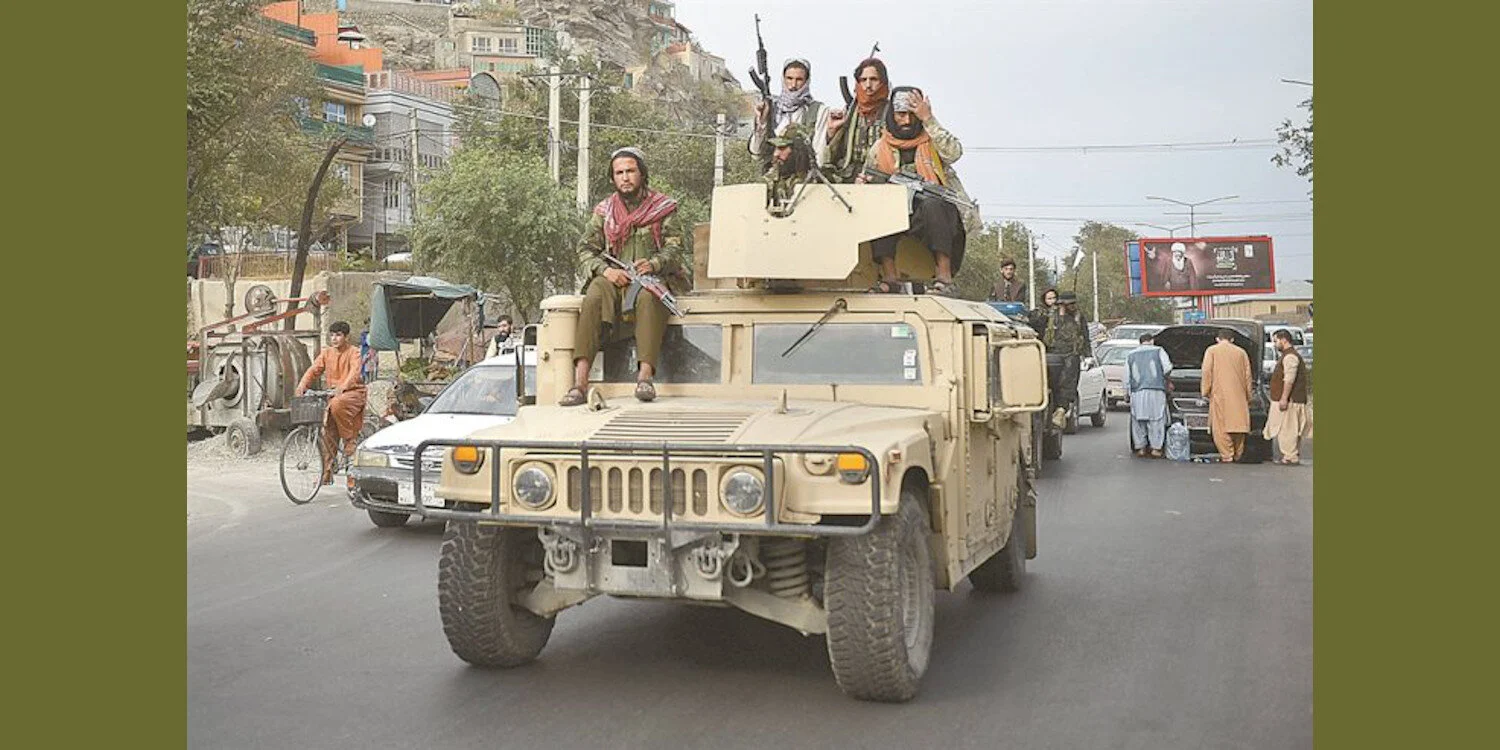
Left in Afghanistan: Taliban, al Qaeda, ISIS-K, Credibility
In a frenzied flight from Afghanistan the U.S. left behind Americans, allies, $80 billion in weapons of war, some hard won credibility, and a leadership vacuum.

In a frenzied flight from Afghanistan the U.S. left behind Americans, allies, $80 billion in weapons of war, some hard won credibility, and a leadership vacuum.
October 6, 2021
The late author, Tom Clancy was widely considered to be a master of the Cold War techno-thriller. I once wrote about his first novel, The Hunt for Red October (Putnam, 1984), which kept me awake for a few nights as a young priest in 1985. President Ronald Reagan sent it to the top of the bestseller lists when he famously described it as "Unputdownable." I wrote about Tom Clancy and that book shortly after his untimely death in October 2013. My post, which found a wide audience among his millions of readers, was “Tom Clancy, Jack Ryan, and the Hunt for Red October.”
Tom Clancy instilled in me a high regard for history as a lens to the present. I have since digested 23 of Tom Clancy’s historical novels — some 15,000 pages — about foreign policy, its impact on history, or history’s impact on it. But it was a sequel to The Hunt for Red October that first drew me into the necessity of seeing the present with eyes that have gazed upon the past.
And it was that same sequel that opened my eyes about Afghanistan. The Cardinal of the Kremlin (Putnam, 1988) was set toward the end of the Soviet Union’s decade-long occupation of Afghanistan from 1979 to 1989, and the struggle of the Afghan people to be rid of that invasion force. Everything that is happening in Afghanistan today has its roots in that decade. The Taliban were never mentioned in the book, nor were al Qaeda, Islamic State, or ISIS-K. None of them existed yet, but the seeds of all of them were firmly planted and flourishing as a result of that decade and all that followed.
On Christmas Day, 1979, Soviet forces invaded Afghanistan. They quickly won control of the capital, Kabul, and other important regions. The Soviets executed the Afghan political leader and installed in his place a puppet government led by a faction more amenable to Soviet control. Wide rejection of that government by the Afghan people led to civil war. A man named Osama bin Laden, a Saudi multimillionaire, established a training camp in the mountains of Afghanistan for rebels fighting the Soviet forces.
The 1980s also saw increased friction between the United States and the Soviet Union resulting mainly from the invasion of Afghanistan in 1979. President Ronald Reagan, elected in 1980, greatly increased American military capabilities. The Soviets viewed him as a formidable foe committed to subverting the Soviet system. In his 1985 State of the Union address, President Reagan called the USSR an “Evil Empire,” and vowed to root out and destroy any political movements that supported the Soviet Union. He was much aided in this effort by Pope John Paul II who single handedly saved Poland from Soviet domination.

The Rise of the Taliban
In the mid-1980s, resistance to the Communist government and the Soviet invaders grew throughout Afghanistan. Some ninety regions in the country were commanded by guerrilla leaders who called themselves “mujahideen,” meaning “Muslim holy warriors.” The mujahideen resented the Soviet presence and its puppet government. By the mid-1980s the U.S. was spending hundreds of millions of dollars each year to aid these Afghan rebels based in Pakistan in their war to expel the Soviet Union from Afghanistan. Up to 1.3 million people died in their struggle against the occupation.
Then in 1989, the Soviets withdrew from Afghanistan leaving in their wake a leadership vacuum in a country wracked by civil war. From a distance, over the decade to follow, the United States continued to provide funds and weapons to the mujahideen rebels. Afghanistan was now without solidifying leadership, and nature abhors a vacuum. From the rubble of war, chaos, and a rudderless nation, the Taliban were born.
The Taliban movement was created in 1994 in the southern Afghan city of Kandahar by Mohammed Omar, a senior Muslim cleric (called a mullah). The name, “Taliban” simply means “student.” It refers to the movement’s roots in the fundamentalist Islamic religious schools. For many youth in war-torn Afghanistan, religious indoctrination was the only education they received.
Even that limited education was available only to young men. As the Taliban rose to power in 1994, the movement imposed a strict Islamic fundamentalism on the nation. Secondary schools for girls were closed and girls were barred from receiving education beyond a rudimentary level. Music and dancing were banned outright. Public works of art were destroyed. I wrote recently in these pages of an infamous example. In 2001, as al Qaeda was plotting against the United States, the Taliban blew up a 180 foot stone statue of Buddha that had been carved into an Afghan mountainside where it stood for 1500 years.
Many of the Taliban laws alarmed human rights groups and provoked worldwide condemnation. The Taliban strictly enforced ancient customs of purdah, the forced separation of men and women in public. Men were required to grow full beards. Those who did not comply, or could not comply, were subjected to public beatings.
Women were required to be covered entirely from head to toe in burkas while in public view. Those who violated this were often beaten or executed on the spot by the Taliban religious police. Women were also forbidden from working outside the home. Having lost hundreds of thousands of men to war, this left many widows and orphans in dire poverty.
As the Taliban movement grew in size and strength, it recruited heavily from the mujahideen, the anti-Soviet freedom fighters who were funded and armed in part by the United States. The Taliban gave a new national identity to the thousands of war orphans who were educated in only two fields of study: strict fundamentalist Islamic interpretation of the Quran and ancient tribal beliefs and practices — and war.

The Rise of Al Qaeda
By the late 1990s, in the absence of a government, the Taliban had taken control of all of Afghanistan with the exception of a small opposition force known as the Northern Alliance. Most other countries did not recognize the Taliban regime as a legitimate government, thus further isolating Afghanistan and its people from oversight and connection with the world community.
From that pinnacle of power, the Taliban also provided safe harbor to Osama bin Laden and al Qaeda, formed in 1980s Afghanistan to help repel the Soviet invasion. Osama bin Laden had a single goal: to incite a global holy war called, in Arabic, a jihad. The term, al Qaeda is Arabic for “base” or “base camp.” For its founder and adherents, it would become the base from which worldwide Islamic revolution and domination would be launched.
Over the course of the Soviet occupation from 1979 to 1989, Osama bin Laden and al Qaeda trained, equipped, and financed 50,000 mujahideen warriors from 50 countries. Saudi Arabian nationals comprised more than fifty percent of the recruits. Saudi Arabia’s strict interpretation of Islam motivated many young men to come to the defense of Afghanistan and the Muslim world against Western “infidel” influences.
When the Soviet Union withdrew from Afghanistan in 1989, Osama bin Laden returned to his original goal for al Qaeda: to overthrow Muslim or Arab regimes that he considered to be too tolerant of Western influence. Bin Laden envisioned replacing these regimes with a single Muslim empire organized around Islamic “Sharia” law. He targeted the United States and other Western nations because he saw them as obstacles to his cause by becoming political allies with the Muslim nations he considered to be corrupt.
From 1991 to 1996, with the Taliban in control of Afghanistan, bin Laden quietly built al Qaeda into a formidable international terrorist network with cells and operations in 45 countries. Training camps were established in Sudan, and by 1992 most of al Qaeda’s operations were relocated there. From that base, attacks on U.S. troops and U.S. interests were launched in Yemen and Somalia and at a joint U.S.-Saudi military training base in Saudi Arabia. Osama bin Laden was especially angered by the presence of U.S. military in Saudi Arabia.
Bowing to pressure from the Saudi and U.S. governments, al Qaeda and bin Laden were expelled from Sudan in 1996 and returned to Afghanistan. He formed a mutually beneficial relationship with the Taliban while plans for a direct assault on the United States took shape. The September 11, 2001 attacks, which killed nearly 3,000 Americans on U.S. soil, were described recently in these pages in “The Despair of Towers Falling, the Courage of Men Rising.”
In response, the United States declared war on terrorism, the first declaration of war against a concept instead of a country. While Taliban leaders rejected U.S. demands to surrender bin Laden, the U.S. began aerial bombings of terrorist training camps and Taliban military positions in October, 2001. Ground troops of the Northern Alliance, meanwhile, continued their front-line offensive against Taliban forces in northern Afghanistan with help in the form of funds and weapons from the United States.

The U.S. Withdrawal From Afghanistan
The Taliban lost its hold on Afghanistan in November, 2001 when the Northern Alliance, aided by U.S. bombardments, captured the capital, Kabul. The Taliban surrendered its traditional stronghold of Kandahar in December 2001. A decade after the Soviets left, the United States now occupied Afghanistan and drove out the Taliban.
Around the world, a global anti-terrorism effort was underway resulting in the arrests or deaths of over 1,000 al Qaeda operatives and another 3,000 members of peripheral terrorist networks. One third of al Qaeda’s leadership was either dead or in custody. In May, 2011, U.S. Special Forces operatives killed Osama bin Laden at a house in Islamabad, Pakistan where he had been hiding in plain sight. Al Qaeda lost a general but gained a martyr.
Twenty years later, seven months into his term in office, the administration of President Joe Biden announced an end to the 20 year U.S. military presence in Afghanistan. It will be one of the great ironies of history that the U.S. left Afghanistan just as it was found in 2001 — with the Taliban in complete control. Just days after President Biden assured both nations that it is highly unlikely the Taliban will ever again rise to power in Afghanistan, they took complete control of the country in a matter of days — even before the U.S. departure was completed.
Wall Street Journal columnist and former presidential speech writer, Peggy Noonan — no fan of Mr. Biden’s predecessor — had written some flattering prose about the new tone in Washington led by an empathetic gentleman in the White House. In the aftermath of this catastrophic withdrawal from Afghanistan, however, she wrote, “The Afghan Fiasco Will Stick to Biden” (WSJ, September 4, 2021):
“August left a lingering, still head-shaking sense of ‘This isn’t how we do things.’ We don’t make up withdrawal dates that will have symbolism for photo-ops with the president looking determined on the anniversary of 9/11; we don’t time epic strategic decisions around showbiz exigencies. We wait for the summer fighting season to pass; we withdraw in the winter when Taliban warriors are shivering in their caves.
“We don’t leave our major air base in the middle of the night — in the middle of the night! — without even telling the Afghan military. We don’t leave our weapons behind so 20-year-old enemies can don them for military play-acting and drive up and down with guns and helmets. We don’t fail to tell our allies exactly what we are doing and how we are doing it — they followed us there and paid a price for it. We don’t see signs of an overwhelming enemy advance and treat is as a perception problem as opposed to a reality problem. We don’t get the U.S. military out before the U.S. citizens and our friends.”
— WSJ, Sep 4, 2021
In regard to Ms. Noonan’ s sentence, “We don’t leave our weapons behind,” the London Times composed a basic inventory of what was left behind in Afghanistan in addition to a number of Americans and allies who are still there and still in jeopardy. Scattered across Afghanistan in several former U.S. military depots — and now in the hands of the Taliban — are the following:
“22,174 American armored military humvees [like the one featured atop this post], 42 trucks and SUVs, 64,363 machine guns, 358,000 military grade assault rifles and millions of rounds of ammunition; 162,043 military grade night vision goggles and military radios; 126,295 pistols, 176 heavy artillery weapons, 100 helicopters including 33 Blackhawks, four c-130 transport planes, 60 other fixed-wing aircraft, and lots of ammunition for a total cost of eighty billion dollars in advanced military assets.”
There was a lot more left behind in Afghanistan. Peggy Noonan and other writers spoke of a humiliating transformation in this U.S. departure. The U.S. set a deadline for leaving, but somehow the “leaving” seemed more like an expulsion with the Taliban dictating the terms. In the end, America fled, taking only as many citizens and allies as conveniently possible while leaving many more behind. Senator Tom Cotton said that the U.S. left behind 1,000 Afghan allies who were fully veted to come to the United States, while taking 1,000 Afghan about whom the U.S. knows nothing.

The Rise of ISIS-K
Then a new terror group emerged on the scene. ISIS-K, also known as Islamic State Khorasan, managed to smuggle a suicide bomber into Hamid Kara airport in Kabul. The explosion killed ten U.S. marines, two U.S. army sergeants, and a U.S. Navy medic along with 95 Taliban soldiers. ISIS-K is a mortal enemy of the Taliban and has extreme hostility to the United States.
The “K” in its title refers to Khorasan, a once powerful Muslim territory that spanned Afghanistan, Turkmenistan, Pakistan, and Iran. Both the U.S. and the Taliban knew that ISIS-K was operating and planning attacks in Afghanistan. In May, 2021, ISIS-K bombed a Kabul school for girls. The group accuses the Taliban of growing “soft” on imposing Islamic “Sharia” law. Since then, the Taliban capitulated by banning all secondary education for Afghan girls.
In House and Senate hearnings, Generals Miley and McKenzie said that they recommended leaving between 2,500 and 3,500 troops in Kabul to maintain control over the evacuation and assure that Americans would not be left behind. They were overruled by the White House.
In response to the ISIS-K killing of 13 U.S. soldiers, President Joe Biden warned that “we will hunt you down and you will pay.” But without boots, eyes, and ears on the ground in Afghanistan now, that was easier said than done. Days later, the Pentagon and the President told the nation that a U.S. drone strike successfully killed ISIS-K terrorists. They said the reprisal was well vetted and “a righteous strike.”
It took several days for the truth to come out. The U.S. drone missile instead struck a white Toyota Corolla killing three innocent adults and seven children ranging in age from two to 15, all trying to flee Kabul and the Taliban.
Then our national attention was turned quickly once again to the other human disaster, the one at the Southern Border. While all eyes had been on Afghanistan, some 16,000 people amassed under and around a bridge in Del Rio, Texas. There was some gruesome footage of men on horseback chasing down and coralling desperately fleeing Haitians. The footage was not what it first seemed, but it was nonetheless a disturbing indictment of current policy.
An embarrased President Biden reacted with a declaration that the buck stops somewhere else. He vowed that the massively overwhelmed Border Patrol “will be held responsible and will pay.” It was the same thing he said when ISIS-K killed 13 U.S. soldiers in Kabul.
Rules for leadership are universal, and America is no exception. Nature abhors a vacuum, and fills it with chaos.
+ + +
Editor’s Note: Please share this post, and if you haven’t already, please Subscribe to Beyond These Stone Walls. You may also like these related posts from Father Gordon MacRae:
Christians and The Crusades of Islamic State
The Despair of Towers Falling, the Courage of Men Rising
Tom Clancy, Jack Ryan, and the Hunt for Red October
+ + +


Michael, Gabriel, Raphael: Allies in Spiritual Battle
On September 29, the Church honors the three named angels of Sacred Scripture, the Archangels Michael, Gabriel, and Raphael, and on October 2, our Guardian Angels.
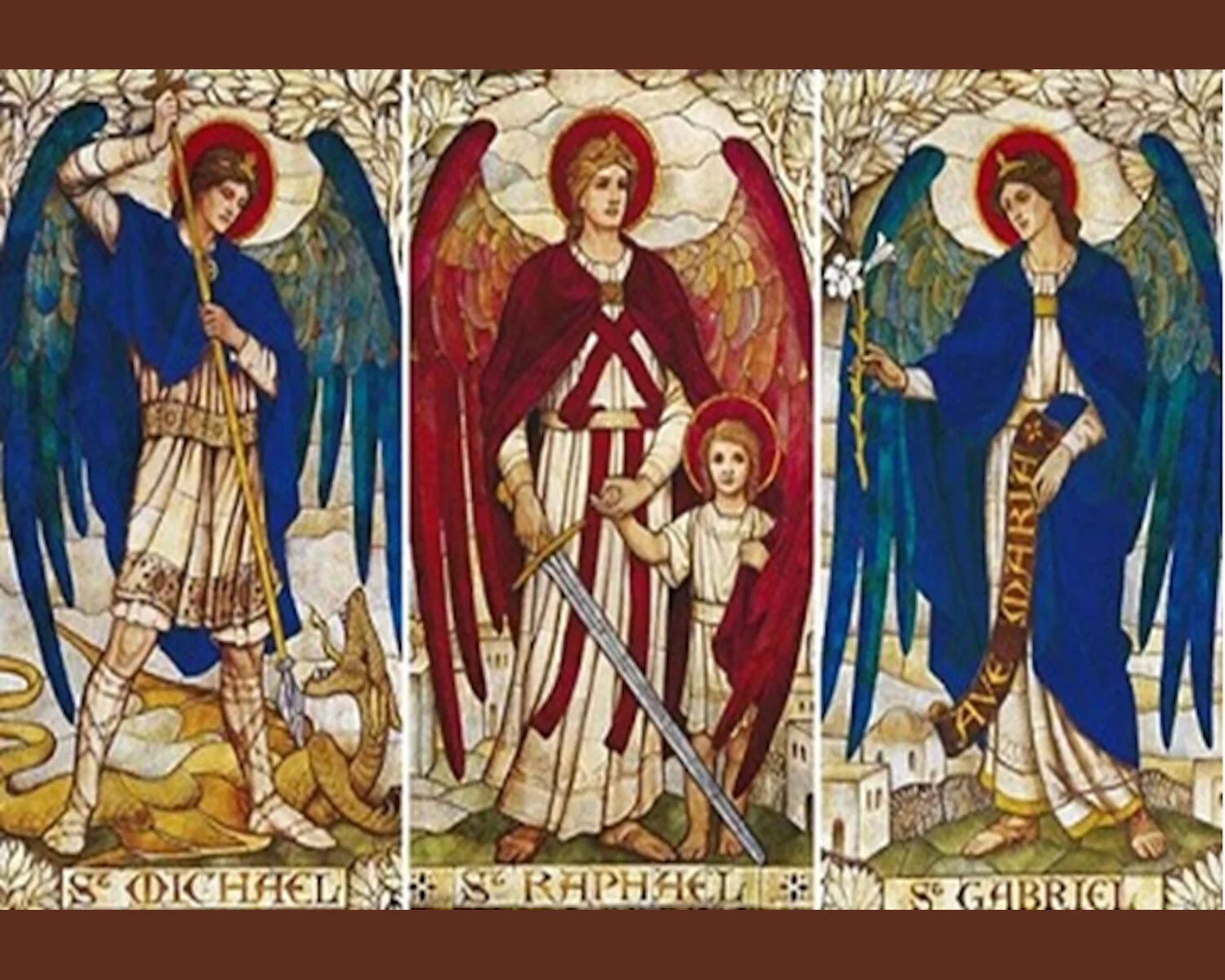
On September 29, the Church honors the three named angels of Sacred Scripture, the Archangels Michael, Gabriel, and Raphael, and on October 2, our Guardian Angels.
September 29, 2021
“Because you have made the Lord your refuge, the Most High your dwelling place, no evil shall befall you, no scourge come near your tent. For He will command his angels concerning you to guard you in all your ways.”
— Psalm 91:9-11
The September 2021 issue of “Give Us This Day,” a monthly prayer and liturgy guide for Catholics published by Liturgical Press, has a small tribute to the great Japanese novelist, Shusaku Endo. He died on the Feast of Michaelmas, September 29, 1996, at the age of 73.
Shusaku Endo was a Catholic convert best known for his acclaimed novel, Silence, which I read in my early years in prison. It had an enormous impact on me. It is a small book, about 200 pages, first published in Japanese in 1969. The focus of much of Endo’s writing reflects his struggles, as a translator described it, “with the anguish of faith and the mercy of God.”
I read it at a time when I, too, was struggling with both. It is sometimes less of a struggle, and therefore a temptation, to simply not believe. There is a scene in this powerful book that left me spellbound. The story is about a Portuguese Jesuit priest, Father Sebastian Rodrigues, who entered Japan in the 16th Century at the height of Christian persecution at the hands of the Shogun. That is the Japanese name for the military dictatorship ruling Japan from 1192 to 1867. The name is a contraction of the Japanese, “seii tai shogun” (“barbarian-hunting warriors”)
Father Rodrigues was among the “barbarians” hunted by the Shogun military, the samurai, under a constant threat of public torture and death. The scene that made me shudder most was a description of how Father Rodrigues entered Japan. Foreign ships were barred from its ports so the ship that bore him secretly approached a remote part of the 16th Century Japanese coast in the dark of night. The priest swam to shore in the pitch blackness with nothing but the clothes on his back and no idea of where, or to whom, he would go. The fear of the dark unknown and the courage it took to overcome it was vivid and staggering.
Darkness is itself a character in this highly symbolic book. Father Rodrigues spent a good deal of time in a brutal Shogun prison in a constant state of darkness and near starvation. At one point, in an intense scene of fear and despair, he asked — and it is from this that the book takes its title — “Lord, why are you silent? Why are you always silent?”
I have asked that same question many times in the dark of prison. For the character of Father Rodrigues, however, the silence of God was finally broken. He was tortured by the Shogun in order to force him into publicly trampling on the “fumie,” the Japanese term for a sacred icon. It was a crucifix. Despite the torture, Father Rodrigues refused and endured. Then he was forced to watch while 30 Christian converts were lined up one by one to take his place for torture unless he trampled on the crucifix. An inner voice came to him:
“Trample! Trample! I more than anyone know the pain of your foot. Trample! It was to be trampled on by men that I was born into this world. It was to share men's pain that I carried my cross!”
— Silence, p.171
Father Rodrigues trampled upon the crucifix.

Spiritual Battle
Upon first reading, that excerpt may seem a betrayal. However, digging a little deeper into the words that came to the priest unveils a profound soteriology, the theology of salvation. The priest bore his own suffering, but by his actions he redirected the suffering destined for his converts onto Christ. “It was to share men’s pain that I carried my cross.”
I was surprised to learn that Shusaku Endo left this life leaving behind the life of his fictional tormented priest, Sebastian Rodrigues — on the Feast of Michaelmas. That was the old English name for the feast day of what was once called Saint Michael and All Angels on September 29. In the Catholic calendar it is now the Feast Day of Michael, Gabriel, and Raphael, the only angels in the Bible whose personal names are revealed.
The September 29 date was established in the Sixth Century when on that same date the Church of Saint Michael and All Angels was dedicated on the Salarian Way in Rome. The feast day was called “Michaelmas,” meaning “the Mass of St. Michael.” In British custom, it was one of the “quarter days,” traditionally marked by the election of magistrates and the beginning of the legal and university terms. This may have been because — or the cause of — the designation of Saint Michael as the Patron of Justice.
It was on another date — the feast day of the Guardian Angels on October 2 — that I discovered in prison that the silence of God is but an illusion. God has spoken volumes throughout all of human history, and His megaphones are Scripture, Tradition, and the ongoing revelation of grace in our lives. Justice is also not just an elusive and singular event, but a cosmic guarantee, and Saint Michael is its manifestation.
This is a difficult concept that I will try to convey to whatever extent I understand it myself. Scripture suggests to us that the conflicts we face and the struggles we endure in our lives on Earth have an unseen spiritual dimension. The Catholic Biblical scholar, Scott Hahn expressed this in his terrific little book, Angels and Saints: A Biblical Guide to Friendship with God's Holy Ones (Image Books, 2014):
“St. Michael is mighty among the angels. The Book of Revelation (12:7ff) depicts him as the commander of the heavenly host of angels as they battle Satan and the rebellious spirits .... We know how the battle ends, and we know Michael is victorious (12:10). Still, the war will rage on until the final consummation of history.”
— Angels and Saints, p. 84
From the earliest days of the Church, Christians have invoked Michael as a guardian, patron, and leader in spiritual warfare. Our troubles and struggles in this world are not always simple anxieties over material discomforts, painful relationships, or the tragedies that occur in our lives. They are also manifestations of spiritual battle, and should be seen and resisted as such. People of deep faith recognize the spiritual battles within themselves and their environments, and rely on faith and spiritual allies to defend against them.
I have suggested before that priests especially are targets of spiritual warfare, inundated by constant temptation in a culture locked in spiritual combat between Heaven and hell. I have cited a Holy Week post of mine that exemplifies the most active goal of Satan: to prevent our reception of the Eucharist and undermine its truth. Every time I write about this, it is followed by days or weeks of spiritual struggle and painful events all around me. This is clearly a story “someone” does not want exposed. The post in which I first exposed this is “Satan at the Last Supper: Hours of Darkness and Light.”

The Art of War Requires Allies
For 23 years, I had been living in the Hancock Building in this prison complex. For the first six, though I had done nothing to warrant it, I was forced to live in a place with eight men per cell. Words cannot express the assault on the psyche and spirit that life in such a constant environment produced. Just about everyone living there was given an opportunity to move to better housing within a year. I was there for six years.
In that same six years, my friend, Pornchai Moontri, was in the neighboring state of Maine living in the spiritual madness of endless solitary confinement. We lived with polar opposite prison anxieties, and each was in its own way devastating.
In 2000, I was finally moved to a saner place with two prisoners per cell. In 2006, Pornchai Moontri arrived. For the next 15 years we lived in the same cell. Then, in 2016, both of us, along with 94 others, were forced in a mass migration back into the place with eight prisoners to a cell. It was because of a development in the prison that had nothing to do with us. We were promised a return to a better housing situation in a matter of weeks. One year later, we were still there.
In mid-July, 2017, I was summoned from my job as the legal clerk in the prison law library and handed a few trash bags. After 23 years in the dreaded Hancock Building, I was given one hour to unravel from it and move to another unit on the opposite end of this prison complex. I was told that Pornchai would be joining me there on the next day. After my arrival, another officer told me that Pornchai was supposed to come with me, but some unseen hand changed that order and he was to be sent somewhere else.
The next day, from a top floor stairwell outside the law library where I work, I saw Pornchai in the distance looking forlorn as he wheeled a cart in the opposite direction from where I now lived. I thought I would never see him again. It was a crushing blow for us both. I knew he would be facing deportation in a few years and now would face it alone. I cannot make sense of what happened next.
The outcome of this spiritual battle was stunning, but became so only when I sought help from our allies in spiritual warfare. I knew in my heart that I was called to bring some justice and hope to the burdens Pornchai carried. I described them in “Pornchai Moontri and the Long Road to Freedom.” Three weeks after our parting, I returned from work one day to find the person living in the bunk above me gone, and in his place was Pornchai Moontri. This never happens here. We were shocked, perplexed and overjoyed.
There were later signs that our allies summoned other allies behind the scenes who had come to know of us. On the day we were reunited, they were in just the right place at just the right time saying just the right things to just the right people. It was the most unlikely symphony of actual grace. Incredible!

This computer generated image depicts the constellation Triangulum and galaxy RD1, 12.2 light-years billion from Earth, formed in the early period of the Universe after the Big Bang.
3:00 AM in a Dark Prison Cell
I’m sorry if this gets a little weird. Just before all these clouds gathered on the horizon and our chaotic upheavals took place, I had a mysterious dream. It was early in the morning of October 2, 2016, the day the Church honors our Guardian Angels. Had I ever really believed in them? I do now.
I found myself at 3:00 AM standing and staring into a small stretch of sky that I could see beyond my barred cell window. There was an older man standing with me. I could see Pornchai fast asleep in his upper bunk. The older man was very familiar and someone I felt I implicitly trusted, but I cannot remember what he looked like. That part of the dream was erased when I awakened. He pointed to the sky and asked, “What do you see?”
I said, “I only see the prison lights.” “Look beyond the prison lights,” said the mysterious man. Then in the dream my vision suddenly changed. I was able to see far, far away into the vast darkness, and there in the center of my field of view I saw a constellation, a triangle of three stars. Within the triangle, the stars were joined by streams of glowing light. “It looks like neon,” I said stupidly in the dream. Then the companion said, “Michael dwells within the light.”
It seemed that I stood for a long time, mesmerized by this vision. Then I awakened in my bunk. It was very dark. I got up and walked to the window wondering whether it was a dream or real. I saw only prison lights, but I have since learned to look beyond them. I could not forget the simple statement that “Michael dwells within the light.” Later that morning, I called a friend to search an astronomy database to see if such a triangular constellation even exists. This was what was sent to me:
1998 — The Most Distant Object Yet Discovered: Astronomers have stumbled upon the most distant galaxy ever found, an object 12.2 billion light-years from Earth. It was announced on March 12, 1998. A light-year is the distance that light travels in a year. The speed of light is 186,000 miles per second. So a light-year is a distance of 5.6 trillion miles. The distance of this object in miles is that times 12.2 billion. [Good luck with the math!]
A team of scientists led by astrophysicist Arjun Dey of Johns Hopkins University, was analyzing the light from a distant galaxy inside the Constellation Triangulum when they noticed the spectral signature of a faint and far more distant galaxy at its center. By taking longer exposures with the Keck-II telescope they were able to identify the new galaxy which is 90 million light-years farther away than the previous most distant galaxy discovered.
Based on knowledge that the universe is approximately 13 billion years old, “RD1” was formed soon after the Big Bang gave birth to the universe. By studying it, astronomers hope to learn how and when the earliest galaxies formed. Little is currently known about these early galaxies. A report on the discovery was accepted for publication in the Astrophysical Journal Letters.
This, of course, rocked my world. You might recall from our recent post, “Fr. Georges Lemaitre, the Priest Who Discovered the Big Bang,” by priest and physicist Father Andrew Pinsent, that the Church and science are on the same page about the origin of the Universe in an instant, “out of nothing.”
In the Fifth Century, Saint Augustine proposed that in the Genesis story of creation, God’s declaration of “Let there be light” (Genesis 1:3) was the moment the angels were created. In the next verse (Genesis 1:4), God separated the light from the darkness. For Augustine, this was the moment the fallen angels were driven from Heaven by Saint Michael in the battle of the Heavenly Hosts.
This all left me with a profound sense that our stories are not just our own, nor are our struggles or pain. We are a collective part of an immense fabric God has woven toward a specific end. And we have allies who connect with us within the threads. I have written about three of them who now appear together in our BTSW Library under the Category, “Spiritual Warfare.” I also link to them here.
Angelic Justice: St. Michael the Archangel and the Scales of Hesed
St Gabriel the Archangel: When the Dawn from On High Broke Upon Us

+ + +

Most glorious prince of the heavenly armies, Saint Michael the Archangel, defend us in our battle against principalities and powers, against the rulers of this world of darkness, against the spirits of wickedness. Corne to the assistance of us whom God has created to His likeness, and whom He has redeemed at a great price from the tyranny of the devil. Holy Church venerates you as her guardian and protector. To you the Lord has entrusted the souls of the redeemed to be led into heaven. Pray therefore the God of peace to crush Satan beneath our feet, that he may no longer hold us captive and do injury to the Church. Offer our prayers to the Most High, that without delay they may draw His mercy down upon us. Take hold of the dragon, the ancient serpent which is the devil and Satan. Bind him and cast him into the abyss so that he may no longer seduce the nations.

Saint Gabriel the Archangel, we beseech you to intercede for us at the throne of Divine Mercy. As you announced the mystery of the Incarnation to Mary, so through your prayers may we receive strength of faith and courage of spirit and thus find favor with God and redemption through Christ our Lord. May we sing with the angels and saints in Heaven forever the praise of God our Savior through your Annunciation: “The Word was made flesh, and dwelt among us.”

O Raphael the Archangel, lead us toward those we are waiting for, those who are waiting for us. Raphael, Angel of happy meeting, lead us by the hand toward those we are looking for. May all our movements be guided by your light and transfigured with your joy. Angel, guide of Tobias, lay the request we now address to you at the feet of Hirn whose unveiled face you are privileged to gaze. Lonely and tired, crushed in spirit by the separations and sorrows of life, we feel the need of calling to you and pleading for the protection of your wings so we may not be as strangers in the province of joy. Remember the weak, you who are so strong, you whose home lies beyond the region of thunder in a land that is always at peace, bright with the resplendent glory of God.


A Catholic Priest 27 Years Wrongly in Prison in America
On the Feast of St Padre Pio, Fr Gordon MacRae marks 27 years of wrongful imprisonment amassing tools for coping mentally and spiritually with life's unjust wounds.

Father MacRae being led to prison, September 23, 1994
On the Feast of St Padre Pio, Fr Gordon MacRae marks 27 years of wrongful imprisonment amassing tools for coping mentally and spiritually with life’s unjust wounds.
September 22, 2021
Note from the Editor: The title for this post was inspired by a 2019 article at LinkedIn by Fr. James Valladares, Ph.D. entitled, “A Catholic Priest 25 Years Wrongly in Prison in America.” It was written by Father Valladares from excerpts of his acclaimed book on priesthood cited below. Still in prison two years later, this version is written entirely from the perspective of Fr. Gordon MacRae as his 27th year in prison comes to an end.
+ + +

Wounds from the Church
As most readers know, I was convicted and sent to prison on September 23, 1994, the same day the Church honors Padre Pio, a great saint whose shrine at San Giovanni Rotondo is the most visited Catholic shrine in the world. Padre Pio was canonized by another saint, Pope John Paul II, on June 16, 2002 at the height of the Catholic sex abuse scandal as it emerged out of Boston and spread like a virus.
For fifty years, Padre Pio bore the visible wounds of Christ on his body. He also bore the less visible wounds of slander and false witness inflicted from inside the Church. On several occasions in his life, his priestly ministry was suspended because lurid and ludicrous accusations were hurled at him from unscrupulous critics, many of whom were Church personnel. It was because of this, and some uncanny threads of connection, that Padre Pio entered our lives and became a Patron Saint of Beyond These Stone Walls. This is an account last told in 2020 in “Padre Pio: Witness for the Defense of Wounded Souls.”
In 2012, Australian Catholic priest, psychologist, and author, Fr. James Valladares, Ph.D., published a widely acclaimed book, “Hope Springs Eternal in the Priest1y Breast” (iUniverse). It cites a good deal of my own writing on the subjects of sacrifice, suffering, and priesthood. I am not at all worthy of this citation that appears on his "Acknowledgments" page:
“Fr. Gordon MacRae — an extraordinarily heroic priest with indomitable courage, unrelenting tenacity, unwavering patience, and Christ-like magnanimity who personally reflects what Pope Benedict XVI confessed: ‘All of us [priests] are suffering as a result of the sins of our confreres who betrayed a sacred trust or failed to deal justly and responsibly with allegations of abuse.’”
I don’t know about any of that, especially the part about “unwavering patience.” (Maybe Pornchai, writing from Thailand will weigh in on that.) Anyway, the book extensively cites the Pulitzer Prize-winning work of Dorothy Rabinowitz at The Wall Street Journal whose three major articles on my trial and imprisonment took this story out of the darkness of one-sided suppression. It also cites the work of Ryan A. MacDonald, most notably his investigative journalism compiled in “Truth in Justice.”
However, the cryptic statement of Pope Benedict cited by Father Valladares above needs clarification. The Pope’s reference to “the sins of our confreres who betrayed a sacred trust” needs no explanation. His further statement referring to those who “failed to deal justly and responsibly with allegations of abuse” is broader in scope. Fr. Valladares understood it to refer to some in the Church who tried to remedy one injustice by inflicting yet another. Some bishops went far beyond what has been required by the rule of law and also acquiesced to demands of the media and others with an agenda by publishing lists of priests deemed “credibly accused” but without basic due process of law.
Before my trial in 1994, for example, a past bishop of my diocese wrote a press release declaring me guilty of victimizing not only my accusers, but the entire Catholic Church. Two years ago, twenty-five years into my unjust sentence, a subsequent bishop joined the mob with stones in hand by publishing anew such a list with the stated goal of “transparency.” A year later, that same bishop was himself accused in a case that on its face is “credible” according to the standards bishops have used against priests.
The claims against Bishop Peter Libasci are alleged to have taken place in 1983, the same year as the claims against me. His defense is being handled by a law firm that most priests could never afford. But as I have documented in the post linked below, I believe the claims against him to be untrue and unjust. I was criticized for defending my bishop after my own name appeared on his list, but I am not looking for the mob approval my bishop was apparently looking for. I wrote of the injustice he faces in “Bishop Peter A. Libasci Was Set Up by Governor Andrew Cuomo.”

Detective James McLaughlin celebrates his 350th arrest.
Wounds from the State
I cannot bring myself to rehash the litany of false witness and official misconduct that sent me to prison on September 23, 1994. I just read a report by the National Registry of Exonerations (NRE). It reveals the disturbing fact that in more than half of the cases overturned with new evidence revealing that the person in prison did not commit the crime, misconduct by prosecutors or police was the primary cause. (See Dale Chappell “Report Shows Official Misconduct Responsible for More than Half of Exonerations.”)
In the cases of many falsely accused Catholic priests, however, misconduct usually has a different outcome. There is never any “planted evidence,” but there is usually a lot of money in play as accusers become plaintiffs in civil lawsuits. Money is often an enticement to corruption and false witness. In many of these cases, no actual crime was ever committed 20, 30, or 40 years earlier when claims were alleged to have occurred.
In the Exonerations Report, sex offenses constituted the second highest category of wrongful convictions. Exonerations in that category encompassed a wide range of official misconduct including police threatening defendants and witnesses, falsified forensic evidence, police not pursuing exculpatory evidence, and police lying under oath. All of this was in the background of my trial and is documented in “Wrongful Convictions: The Other Police Misconduct.”
Many people ask me why I am still in prison when others have come forward with evidence and testimony that casts doubt on the integrity of my conviction. I believe that the most important factor in my continued imprisonment is that the officer behind it has scored convictions via lenient plea deals in over a thousand cases of suspected sexual abuse. Lenient plea deals bolstered his conviction rate without totally destroying the defendants for life. As most readers know, I was offered such a deal in 1994 which would have had me released from prison by 1996 had I actually been guilty or willing to pretend so.
Reversing a conviction based on Detective James F. McLaughlin’s malfeasance in my case may have the unintended consequence of reopening a thousand others that he was involved with. It would have required moral courage and judicial integrity on the part of the judge, a former federal prosecutor who declined a hearing in my habeas corpus appeal. Judges rely on a procedural ruling giving state courts a right to finality. No judge has ruled on the evidence or witnesses that have arisen in the years since my trial. No judge has ever even heard the evidence or witnesses.
This raises a hard truth about our justice system. Guilty defendants are inclined to accept lenient plea deals while many innocent defendants cannot or will not. I am one of them. As a result, many guilty defendants spend far less time in prison than innocent ones. You have already seen a glaring example.
As a direct result of my writing about the horrific crimes perpetrated against Pornchai Moontri when he was brought to America against his will at age 12 in 1985, Richard Alan Bailey was found and arrested in Oregon. Due to extensive evidence, he pled no contest to forty felony charges of sexual assault in the State of Maine in 2018. He was sentenced to 18 years probation and never saw the inside of a prison. In nearby New Hampshire, I refused a one year plea deal and faced trial with no evidence. I was then sentenced to 67 years in prison. Let that sink in.

The Prophet Jonah: A Final Chapter
But none of this addresses what I intended to be at the heart of this post that marks those 27 years. There is nothing I can do to secure justice or freedom for myself. And there was nothing I did do to bring about my loss of them. But there was a lot I could do to secure justice and restore freedom for one whose path on this journey from Jerusalem to Jericho crossed with mine.
I did nothing so grandiose as the conversion of Nineveh, but through the Grace of God I became a necessary instrument in the conversion of Pornchai Moontri who once was lost and broken and now lives free in the light of Divine Mercy. In a September 10 telephone call to him in Thailand on his birthday, his first as a free man, he told me that his deliverance from both prison and his past could not have happened without me. I do not regret paying that ransom. I today believe this to be the purpose for what I have endured.
In my recent post, “The Parable of a Priest and the Parable of a Prisoner,” I wrote about the Seventh Century BC Prophet Jonah and why much of the Book of Jonah is today considered to be a parable. I did not want to detract from the hopeful outcome of that story, so I held its final chapter until now. Its last chapter also took place in Nineveh, but in our time and not Jonah’s.
Though the story of Jonah and the Great Fish is a parable, the Prophet Jonah was a historical figure honored by all three of the great monotheistic faiths: Judaism, Christianity, and Islam. When Jonah was sent by God to the ancient city of Nineveh in the Seventh Century BC, it was the capital of the Assyrian Empire in its time of glory. Nineveh was a center for commercial trade routes on the Tigris River in what is now northern Iraq, just opposite the modern city of Mosul. Nineveh was established in the Neolithic period more than 8,000 years ago, and inhabited almost without a break until about 1500 AD.
In the centuries before the Prophet Jonah was sent to Nineveh, the city was known as a religious center, but it fell far away from its religious roots. The city honored the Assyrian goddess, Ishtar, a goddess of healing who somehow was transformed by the time of Jonah into a goddess of war. The Assyrians built the city with broad boulevards, parks and gardens, and a magnificent palace of more than 80 rooms.
Today, Nineveh is reduced to two large mounds beneath which are the ruins of a city once thriving. The mounds are called, in Arabic, “Kuyunjik” and “Nebi Yunus” which means “place of Jonah.” In ancient times, a massive tomb in honor of the Prophet Jonah was built in a Sunni mosque in Nineveh on the site of an Assyrian church where the remains of Jonah were thought to be buried. This part of the city was revered by Christians, Jews, and Muslims. The Tomb of the Prophet somehow managed to survive intact until just a decade ago. After standing for over a thousand years, the Tomb of the Prophet Jonah was blown up and destroyed in 2011 by the fundamentalist Islamic group, al Qaeda.
The Taliban had been doing the same thing in Afghanistan. Islam was preceded there by Buddhism which was eventually eclipsed by Islam and driven out around the Seventh Century AD. In the Sixth Century AD, Buddhist monks carved into a cliff side the world’s largest statue of Buddha. Standing at 180 feet, it survived for 1,500 years before it was blown up by the Taliban in 2001. It was destroyed at about the same time the Taliban harbored Osama bin Laden and al Qaeda while the September 11, 2001 assault on the United States was planned.
I bring all of this up now because witnessing in my own recent lifetime the demise of people, places, and things once held sacred by many people has had an outsized impact on me that some might find perplexing. Why would I care so much about the Tomb of the Prophet Jonah or a 1,500 year-old gigantic stone Buddha? No matter who these monuments ultimately served, they arose from the hearts and souls of a people. When religious icons are destroyed by evil intent, so is the spirit of those people.
Catholicism and the cancel culture assault on the priesthood now risk this same fate. That risk is manifested most in America over just the last two decades. This threat does not come from the Taliban or Islamic State — though they may be poised to take advantage of the vacuum of hopelessness left in its wake. The terrorism behind this threat is called “apathy.”
If the priesthood and the Mass fall away, it will have as its primary cause the agendas of a few and the silence of too many.
We have witnessed in just recent years a chronic disparagement of the priesthood even from Pope Francis and our bishops, a canceling of a widely reverenced ancient form of the Sacrifice of the Mass, a handing over of the Church’s patrimony to the Chinese Communist government, a disparaging of our Church and faith as a “non essential service” by secular authority, a rampant capitulation to that by some bishops, a failure to defend the sanctity of life and the sanctity of the Eucharist, and a Catholic President who believes in neither.
This is why the Taliban despise us and judge us to be “Infidels,” which means exactly what it implies: “A people of little faith.”
+ + +
From a Homily of Padre Pio
“Why does is there evil in the world? Listen closely to me. There was a mother who was embroidering on a small weaving frame. Her young son was seated in front of her on a small low stool watching his mother work. But as he watched, he saw only the underside of the weaving frame. And so he said, ‘But Mother, what are you doing? The embroidery is so ugly!’ So his mother lowered the frame to show him the other side of the work, the good side with all its colors in place and all the threads in a harmonious pattern. That is it. Have you seen what evil is like? Evil is the reverse side of that embroidery and we are all sitting on a small stool.”
Note from Father Gordon MacRae: I want to thank readers who have consulted our Special Events page to assist our friend Pornchai in the daunting task of rebuilding his life. As you know, he was taken from Thailand at age 11. On his September 10 birthday this month, he had a touching reunion with his cousin who was eight when they lived together and is now 45 and an officer in the Royal Thai Navy. They met on September 10th for a birthday celebration at the Gulf of Thailand.

You may also wish to review the related posts linked herein:
Padre Pio, Witness for the Defense of Wounded Souls
Wrongful Convictions: The Other Police Misconduct

The Despair of Towers Falling, the Courage of Men Rising
The smoke of Satan billows still 20 years after September 11, 2001, but the courage of the men and women aboard Flight 93 is also an enduring legacy of that day.
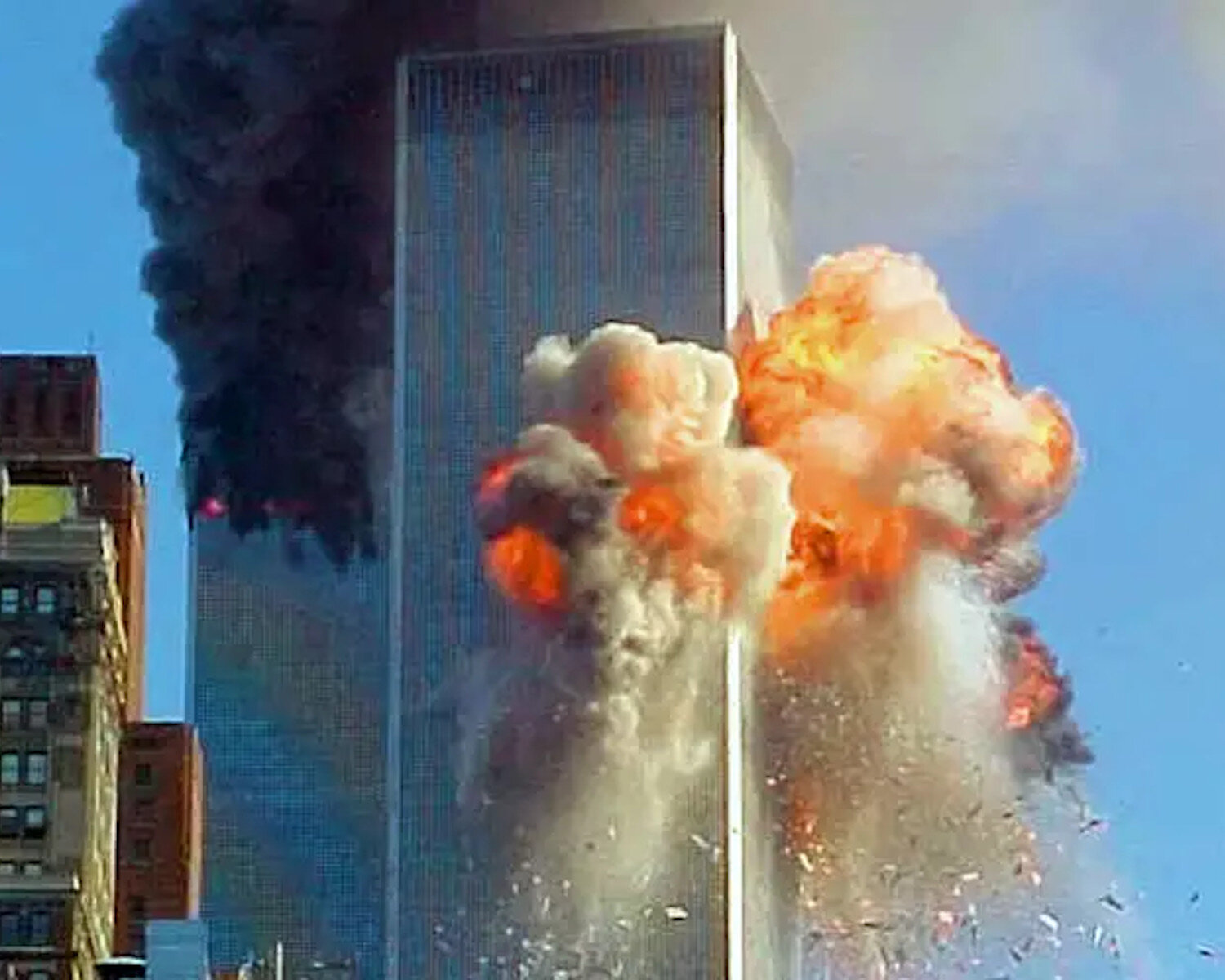
The smoke of Satan billows still two decades after September 11, 2001, but the courage of those aboard Flight 93 is also an enduring legacy of that day.
September 15, 2021
“Are you guys ready? OK. Let's roll!” You may know these words but you may not know the name of the man who spoke them. Todd Beamer said these words to his fellow passengers, Jeremy Glick, Mark Bingham, and Tom Burnett aboard United Airlines Flight 93 on September 11, 2001. All four were athletes who found themselves aboard this fateful flight. There is no indication that they had ever met before that day. They knew their plane had been taken over by hijackers, and like most they became resolved to let it all play out as was the case with most hijack flights during the 1970s.
But as they and other passengers around them made cellphone calls to family and others that morning, they quickly learned of the devastation unfolding in Manhattan and Washington at the Twin Towers and the Pentagon. The lights went on in their minds. This flight was now under the control of terrorists and was destined to crash into some as yet unknown building in Washington to kill everyone aboard and to maximize the loss of life in the nation’s capital. Its ultimate goal was to humiliate and crush the spirit of America.
The clock was ticking as most passengers were subdued by the terror. Knowing the inevitable fate of Flight 93, the four men, led by Todd Beamer made a decision to thwart the terrorist plan and retake control of their plane. None of them were pilots, but it seems in their noble defiance that they set that detail aside. Todd organized the others into a rudimentary plan to wage war against the terrorists who were armed with knives and what turned out to be a fake bomb while these heroic men were not armed at all. Todd prayed Psalm 23 aloud, “Though I walk through the valley of the shadow of death, I fear no evil for Thou art with me with Thy rod and Thy staff that give me courage.” “OK. Let’s roll,” he said. Over the next seven minutes, the flight recorder caught the sound of intense struggle as the four men fought the terrorists and crashed their way through the cockpit door. Flight 93, intended to be used as a weapon to kill everyone aboard and hundreds more in Washington was crashed into the ground in Shanksville, Pennsylvania.
It took a few days for that day to be accurately pieced together. So this is posted on the twentieth anniversary of their heroism. Todd Beamer and his comrades set their survival aside to save the lives of unknown hundreds.
The following is an account of that day that I first wrote on its tenth anniversary. It is told from a most unusual perspective, and I have rewritten it on this twentieth anniversary of 9/11. Please share it in honor of Todd Beamer, Jeremy Glick, Mark Bingham, Tom Burnett and the passengers of Flight 93, the only flight to be denied its intended target that day.

In memory of Todd Beamer
+ + +
I was ten years old on November 22, 1963, the day President John F. Kennedy was assassinated by Lee Harvey Oswald in Dallas, Texas. Fifty-eight years later, every detail of what I was doing as the news unfolded on that infamous day remains vividly engraved in my mind’s eye. That day and the days of infamy to follow play in my mind like videos I’ve seen a thousand times.
Every generation seems to have these “imprinted” events, some more catastrophic than others. The generation just behind mine remembers what they were doing when Pearl Harbor was attacked. Others a bit younger than me remember the great Northeast Blackout of 1965, and the 1968 assassination of Rev. Martin Luther King.
September 11, 2001 was like all of those days combined. Whenever I ask anyone about it, I get an account not only of the terror, but also of the normal activities of a day underway for those who witnessed it. It seems the closer to Ground Zero we were — emotionally or physically — the more vivid the imprinted memories of these events.
For me, the losses of that day were compounded by prison in ways difficult to explain. One of the most troubling events in the aftermath of what has become universally known simply as “9/11” came about six months later.
A weekly Catholic newspaper had published an article on prisons, and the folly of a system in which punishment alone prevails at the expense of rehabilitation. One letter to the editor in response was from the wife of a prison guard. She wanted to set the public straight that prisoners are a vile bunch and most defy rehabilitation. Her most vivid example was a claim that prisoners all over the country cheered for the terrorists on 9/11.
It was the sort of thing I hear often quoted by prison staff, especially at contract time. Prisons and prisoners are portrayed as inhuman and dangerous with most prison staff taking their lives in their hands every day they go to work. In twenty-seven years in prison, this has not been my experience with the vast majority of prisoners. And, the prison guard’s wife’s account notwithstanding, it certainly wasn’t my experience in prison on 9/11.
It is true that there are dangerous men in prison. Some are sociopaths; some are seriously mentally ill; some are just evil in their very core; but all combined they constitute a small minority of the one-size-fits-all prison environment. In my experience, twenty percent of prisoners should never leave prison if public safety is any consideration. Many of them don’t even want to leave. Their attitudes and behaviors are largely shaped by forces within them that allow no consideration for others.
Their sheer numbers and impact are dwarfed, however, by the eighty percent of prisoners who have but a singular goal: to atone for their mistakes, and to rejoin their families and communities as responsible and contributing members of society. Prisons are designed, built, and managed to contain the former group, however, and everyone else pays a price for that.
The biggest price prisoners had to pay in the wake of the terrorist attacks is having to live with the popular notion that most prisoners sided with the 9/11 terrorists, and would terrorize you themselves if given half a chance. Perhaps the best evidence against this notion was the true reaction of prisoners to the events of September 11, 2001.

Pearl Harbor in Manhattan
It was a Tuesday morning that began like any other. In this prison, every cell is at least “double bunked,” meaning that everyone has at least one roommate, and sometimes as many as seven. After nearly six years in an eight-man cell, I was moved just a year earlier to a prison unit with but two per cell. After years spent in the crucible of the prison’s “inner city,” it was like a move to the relative calm of the suburbs.
On September 11,2001, my roommate was Bob, a 37-year-old prisoner who is now long since a free man. With cups of instant coffee in hand that morning, Bob and I both stood for the day’s first prisoner count at 0730. After the count, Bob took his coffee to a table outside the cell while I prayed morning prayer from my breviary. Like most prison roomates forced to survive in a tiny space, Bob and I fell into a routine we could live with after a few months. Bob didn’t have a job in the prison — there are far more prisoners than available jobs — and I worked on the afternoon shift — back then in the prison programs office. So it became a sort of unspoken routine that Bob had some solitude every afternoon while I worked, and I had some space in the mornings to pray and write. Before either of us was moved to that cell, solitude was unheard of. Most people don’t really value solitude until they lose it.
After the count, I reached over to turn on the morning news on my small television. It was 8:48 AM. Both CNN and FOX had the same silent image on the screen: smoke pouring from a giant gash in the North Tower of the World Trade Center in Manhattan. Our TVs have no speakers so I reached for my headphones, then heard the fluttering voice of a commentator in a helicopter hovering nearby:
“We are just currently getting a look at the World Trade Center. Something has happened here . . . flames and an awful lot of smoke from one of the towers . . . This is easily three quarters of the way up . . . whatever has occurred has just occurred, within minutes . . . We’ll keep you posted.”
I tuned in just two minutes after some sort of plane struck the building. The camera cut to a more distant scene. “Wow, that’s a lot of smoke,” I thought. “Hey Bobby,” I called, “take a look at this.” Bob stepped back into the cell from reading his Stephen King book at a table just outside. “Look at this,” I said again, as I angled my small TV for Bob to see. Bob grew up in New Jersey, just across the Hudson River from Manhattan. The scene on my screen — minus the smoke and flames — was one he had seen a thousand times.
Bob stared at the screen, and asked me what happened. The news commentators were just then saying that a plane flew into the North Tower. Commercial passenger jets would never be in the air space above Manhattan, so we both assumed this was a small, private plane that veered badly off course. Then I saw a close-up of the gash in the building. It seemed awfully big for a small plane to have caused it.
The news would only slowly unfold, and when it did, it was devastating. At 7:59 AM, American Airlines Flight 11 took off from Logan International Airport in Boston, bound for Los Angeles. It had a two-man flight crew, nine flight attendants, and 81 passengers — five of whom were al Qaeda terrorists armed with pepper spray and box cutters.
No one outside that plane knew what was happening when at 8:14 AM an air traffic controller’s instruction to climb to 35,000 feet went unanswered. No one knew that Mohamed Atta and four other terrorists had already stabbed two flight attendants and a passenger, and used pepper spray and the threat of a ficticious on-board bomb to subdue the rest.
The plane turned due south. Twelve minutes later, it began a rapid descent toward South Manhattan. At 8:46 AM, it flew into the North Tower of the World Trade Center killing all 92 passengers and crew on board, and many others inside that building.
Oblivious to all of this from my vantage point, fourteen minutes passed as the CNN commentators pondered what sort of plane it might have been. Bob and I were riveted to the screen, feeling rather than seeing the lights slowly go on in our awareness. This wasn’t an accident.
Then at exactly 9:02, I spotted another plane. From CNN’s camera angle, it seemed to drift casually into view. The CNN commentator seemed not to notice it as she droned on about the North Tower. What was clearly a commercial airlines jet swept into the scene. I pointed to it on the screen, and said loudly “This shouldn’t be there.” I heard Bob whisper, “I know” when the plane disappeared behind the South Tower followed by an immense fireball exploding through the other side. “It’s an attack,” I said. “It’s a terrorist attack!”
It took some time for the story to unfold. Just one minute before American Airlines Flight 11 took off from Boston, United Airlines Flight 175 also departed Logan Airport bound for Los Angeles on another runway. It carried nine crew members and 56 passengers, five of them al Qaeda terrorists about to hijack that plane. Both planes were Boeing 767s.
At 8:51 AM, United 175 deviated from its flight path and New York air traffic controllers learned they could not contact its crew. At 8:58, it veered toward Manhattan. Four minutes later, I and thousands of other viewers spotted it on CNN’s live TV feed. I remember a split second of denial — perhaps the last moment of ignorant bliss this nation has seen — as that plane disappeared behind the South Tower and out of view. Then at 9:02 its enormous fireball emerged from half way up the building, and brought reality back home again.
Within moments, my cell was filled with people. Silent men in forest green prison uniforms, young, middle aged, and old, all staring at me. They knew that I had just seen what they saw, and none of them wanted to see any more of it alone. Then there were several guards, and it dawned on me for the first time that prisoners have televisions while prison guards do not — at least not while they are at work. “What’s happening?” they wanted to know. In they squeezed to stare at my screen.
Everyone standing in my doorway and crowded into my cell hoped against hope to hear the same thing. That this was some bizarre accident that could likely never happen again. Instead, I looked up and said, “This is a terrorist attack, and it isn’t over. Hundreds of people have just been killed, and those buildings are filled with people. This is going to be the worst disaster our country has ever seen. The world we knew just changed.”
I felt a little as though I was in that long remembered scene from childhood as Walter Cronkite explained what just happened in Dallas that November 22nd when I was ten. On this September day, you could hear a pin drop as I recounted to others in my cell the events of that morning and repeated what was known up to that moment. It came as a shock to realize that less than thirty minutes had passed since I closed my breviary and reached for my TV’s ON button.
And it was true that there was more coming. It would be awhile before we learned that at 8:20 AM, American Airlines Flight 77 departed Washington’s Dulles Airport, also bound for Los Angeles. It was a Boeing 757 with six crew and 58 passengers. Five of them were al Qaeda terrorists. At 8:54 AM its transponder beacon was deactivated.
At 9:37 AM, exactly 35 minutes after the South Tower was struck in Lower Manhattan, American Airlines Flight 77 slammed into the west side of the Pentagon between corridors four and five, piercing the E, D, and C Rings and entering the B Ring. All 64 people aboard the plane, and many inside the Pentagon itself, were killed instantly.
I suddenly became aware of a transformation among the people crowded into my small cell. There were no longer prisoners and prison guards. There were only men in the face of an alarming new enemy and a common resolve.
Just four minutes before that first Boeing 767 struck the North Tower in Manhattan, United Airlines Flight 93 bound for San Francisco departed Newark Airport. It carried seven flight crew and 37 passengers. Five of them were al Qaeda terrorists. Cell phone calls to family members of the passengers wove together a chilling account of how passengers became aware of the other attacks, and then confronted the terrorists aboard their own flight, now heading for a selected target in Washington, DC. In the ensuing, heroic struggle between the passengers and the terrorists, United Flight 93 slammed into the ground at 10:02 AM in a field in Shanksville, PA, 20 minutes out from Washington. We could only imagine ourselves aboard that plane, and, in fact, many prisoners wished they were.
Then in Manhattan, the Twin Towers collapsed. The knowledge that hundreds of police, fire fighters, EMTs and rescue workers, there to help only to be crushed to death, caused both prisoners and guards to turn from my television and place their faces in their hands. America was under siege, and we were men. We could see it only from a distance, and we were powerless to answer.
The mood in prison throughout that day and in the days to follow was eerily somber. It was one characterized first and foremost by shame — the shame of being in prison at a time when families needed the comfort of their fathers, their husbands, their brothers, their sons; the shame of being detained while their country was being attacked.
In the days, weeks, and months to follow, the prisoners I knew would have given anything to go to help sort through rubble at Ground Zero, to clear out debris from the Pentagon, or to kneel in prayer at Shanksville, PA. As the very notion of freedom and an open society were under attack, the least of the free longed for a chance, any chance, to serve, to protect, to make amends.
I, for one, took this very personally. I grew up in sight of Logan Airport in Boston from where some of these flights were hijacked. This began at home — my home, our home, while our backs were turned. As the news unfolded that this was the work not of a hostile government, or some organized crime cartel, but rather the actions of religious believers waging jihad — holy war — against us, we had no category for it; no terms of understanding with which to make sense of it.
And then within weeks of 9/11, for Catholics, at least, revelations of a jihad of another sort roared out of Boston and spread across the U.S. News of decades-old abuses — some of them unspeakable, but some of them also untrue — were repackaged by the news media for eyes already clouded with suspicion for the religious terrorists in our midst.
Two decades have passed, and we still struggle with trading civil liberties for security, due process rights for safety in a free society edging toward becoming less so. To our nation’s credit, we have declared our unwillingness to blame all of Islam for the crimes of its twisted and radical few. But while refusing to allow Islam to be reflected in the acts of its lunatic fringe, we’ve tolerated — even cultivated — a virulent anti-Catholicism that holds the Church in contempt for not acting in 1965 as it would in 2005.
If America truly believes that the answer to jihad is to abandon our own faith, and our fidelity as Catholics, then the war is over. The 9/11 terrorists have already won.
+ + +
Note from Father Gordon MacRae: If you have not already done so, please subscribe to Beyond These Stone Walls. We promise to haunt your inbox only once per week. Please also visit our Special Events page.


The Parable of a Priest and the Parable of a Prisoner
A Parable of Divine Mercy: Pornchai Moontri has a first birthday in freedom on September 10. One third of his life passed in a prison cell with a Catholic priest.

A Parable of Divine Mercy: Pornchai Moontri had a first birthday in freedom on September 10. One third of his life passed in a prison cell with a Catholic priest.
September 8, 2021
Jesus taught in parables, a word which comes from the Greek, paraballein, which means to “draw a comparison.” Jesus turned His most essential truths into simple but profound parables that could be easily pondered, remembered, and retold. The genre was not unique to Jesus. There are several parables that appear in our Old Testament. I wrote of one some time ago — though now I cannot recall which post it was — about the Prophet Jonah.
The Book of Jonah is one of a collection of twelve prophetic books known in the Hebrew Scriptures as the Minor Prophets. The Book of Jonah tells of events — some historical and some in parable form — in the life of an 8th-century BC prophet named Jonah. At the heart of the story, Jonah was commanded by God to go to Nineveh to convert the city from its wickedness. Nineveh was an ancient city on the Tigris River in what is now northern Iraq near the modern city of Mosul. It was the capital of the Assyrian Empire from 705-612 BC.
Jonah rebelled against the command of God and went in the opposite direction, boarding a ship to continue his flight from “the Presence of the Lord.” When a storm arose and the ship was imperiled, the mariners blamed Jonah and cast him into a raging sea. He was swallowed by “a great fish” (1:17), spent three days and nights in its belly, and then the Lord spoke to the fish and Jonah “was spewed out upon dry land” ( 2: 10) . ( I could add, as a possible aside, that the great fish might later have been sold at market, but there was no longer any prophet in it!)
Then God, undaunted by his rebellion, again commanded Jonah to go to Nineveh. Jonah finally went, did his best, the people repented, and God saved them from destruction. Many biblical scholars regard this part of the Book of Jonah as a parable. Jesus Himself referred to the Jonah story as a presage, a type of parable account pointing to His own death and Resurrection:
“Some of the scribes and Pharisees said to him, 'Teacher, we wish to see a sign from you.' But he answered them, 'An evil and adulterous generation asks for a sign, but no sign will be given except the sign of the Prophet Jonah. For just as Jonah was three days in the belly of the giant fish so for three days and three nights, the Son of Man will be in the heart of the earth.”
— Matthew 12:38-40
What I take away from the parable part of the story of Jonah is that there is no point fleeing from “the Presence of the Lord.” God is not a puppeteer dangling and directing us from strings. Rather, the threads of our lives are intertwined with the threads of other lives in ways mysterious and profound. I have written several times of what I call “The Great Tapestry of God.” Within that tapestry — which in this life we see only from our place among its tangled threads — God connects people in salvific ways, and asks for our cooperation with these threads of connection.
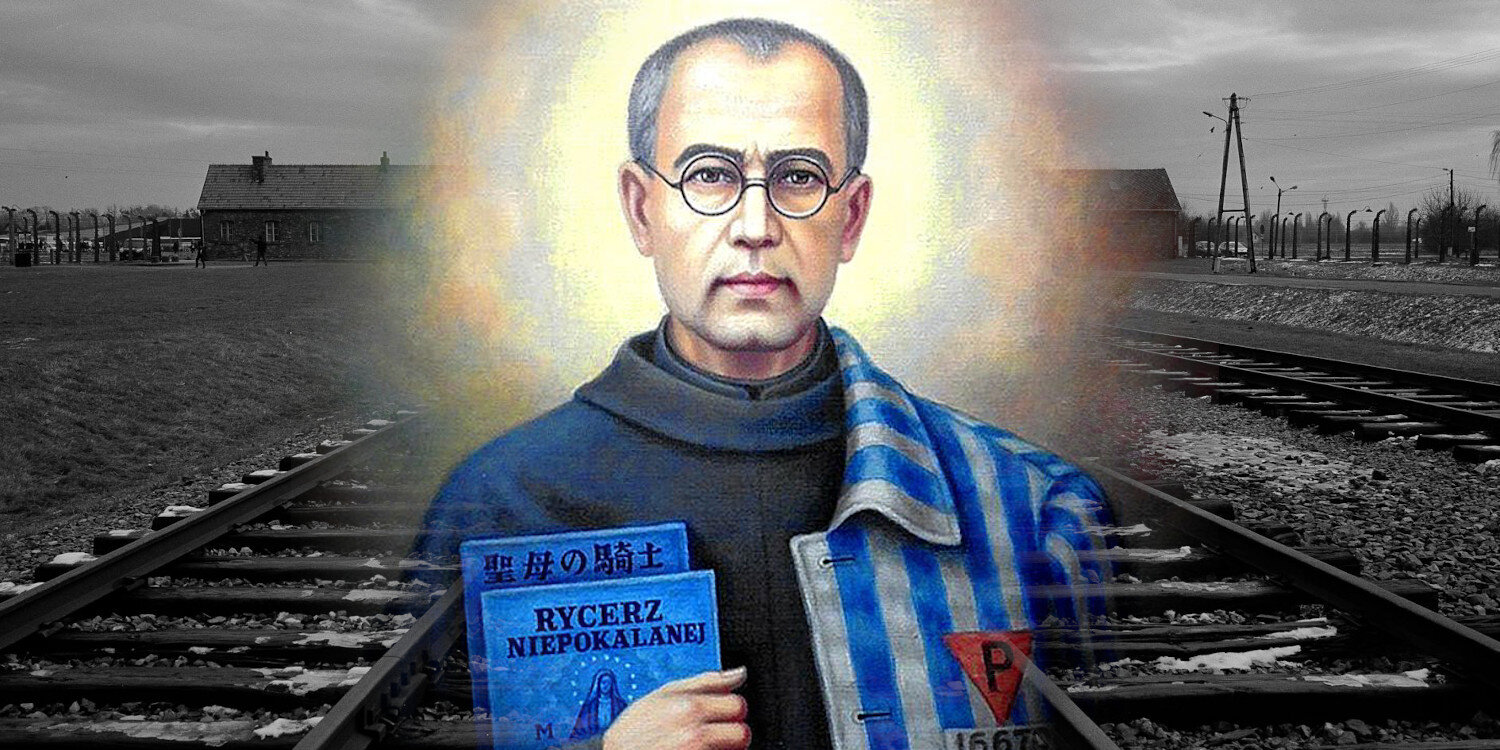
The Parable of the Priest
I was slow to awaken to this. For too many days and nights in wrongful imprisonment, I pled my case to the Lord and asked Him to send someone to deliver me from this present darkness. It took a long time for me to see that perhaps I have been looking at this unjust imprisonment from the wrong perspective. I have railed against the fact that I am powerless to change it. I can only change myself. I know the meaning of the Cross of Christ, but I was spiritually blind to my own. Ironically, in popular writing, prison is sometimes referred to as “the belly of the beast.”
After a dozen years of railing against God in prison, I slowly came to the possible realization that no one was sent to help me because maybe I am the one being sent. My first nudge in this direction came upon reading one of the most mysterious passages in all of Sacred Scripture. It arose when I pondered what exactly happened to Jesus between the Crucifixion and the Resurrection, the three days He refers to in the Sign of Jonah parable in the Gospel of Matthew above. A cryptic hint is found in the First Letter of Peter:
“For it is better to suffer for good, if suffering should be God's will, than to suffer for evil. For Christ also suffered for sins once for all, the righteous for the unrighteous, in order to bring you to God. He was put to death in the flesh, but made alive in the Spirit, in which he also went and made a proclamation to the spirits in prison who in former times did not obey.”
— 1 Peter 3:17-20
The second and much stronger hint also came to me in 2006, twelve years after my imprisonment commenced. This may be a familiar story to long time readers, but it is essential to this parable. I was visited in prison by a priest who learned of me from a California priest and canon lawyer whom I had never even met. The visiting priest was Father James McCurry, a Conventual Franciscan who, unknown to me at the time, had been a postulator for the cause of sainthood of St. Maximilian Kolbe whom I barely knew of.
Our visit was brief, but pivotal. Father McCurry asked me what I knew about Saint Maximilian Kolbe. I knew very little. A few days later, I received in the mail a letter from Father McCurry with a holy card (we could receive cards then, but not now). The card depicted Saint Maximilian in his Franciscan habit over which he partially wore the tattered jacket of an Auschwitz prisoner with the number, 16670. I was strangely captivated by the image and taped it to the battered mirror in my cell.
Later that same day, I realized with profound sadness that on the next day — December 23, 2006 — I would be a priest in prison one day longer than I had been a priest in freedom. At the edge of despair, I had the strangest sense that the man in the mirror, St. Maximilian, was there in that cell with me. I learned that he was canonized by Pope John Paul II in 1982, the year I was ordained. I spent a lot of time pondering what was in his heart and mind as he spontaneously stepped forward from a line of prisoners and asked permission to take the place of a weeping young man condemned to death by starvation. I wrote of the cell where he spent his last days in “Saint Maximilian Kolbe and the Gift of Noble Defiance.”
On the very next day after pondering that man in the mirror on Christmas Eve, 2006 — a small but powerful book arrived for me. It was Man’s Search for Meaning, by Auschwitz survivor, Dr. Viktor Frankl, a Jewish medical doctor and psychiatrist who was the sole member of his family to survive the horror of the concentration camps. I devoured the little book several times. It was one of the most meaningful accounts of spiritual survival I had ever read. Its two basic premises were that we have one freedom that can never be taken from us: We have the freedom to choose the person we will be in any set of circumstances.
The other premise was that we will be broken by unending suffering unless we discover meaning in it. I was stunned to see at the end of this Jewish doctor’s book that he and many others attributed, in part, their survival of Auschwitz to Maximilian Kolbe “who selflessly deprived the camp commandant of his power over life and death.”

The Parable of a Prisoner
God did not will the evil through which Maximilian suffered and died, but he drew from it many threads of connection that wove their way into countless lives, and now I was among them. For Viktor Frankl, a Jewish doctor with an unusual familiarity with the Gospel, Maximilian epitomized the words of Jesus, “Greater love has no man than this, that a man lay down his life for his friends.” (John 15:13)
I asked the Lord to show me the meaning of what I had suffered. It was at this very point that Pornchai Moontri showed up in the Concord prison. I have written of our first meeting before, but it bears repeating. I was, by “chance,” late in the prison dining hall one evening. It was very crowded with no seats available as I wandered around with a tray. I was beckoned from across the room by J.J., a young Indonesian man whom I had helped with his looming deportation. “Hey G! Sit here with us. This is my new friend, Ponch. He just got here.”
Pornchai sat in near silence as J.J. and I spoke. I was shifting in my seat as Pornchai’s dagger eyes, and his distrust and rage were aimed in my direction. J.J. told him that I can be trusted. Pornchai clearly had extreme doubts.
Over the next month, Pornchai was moved in and out of heightened security because he was marked as a potential danger to others. Then one day as 2006 gave way to 2007, I saw him dragging a trash bag with his few possessions onto the cell block where I lived. He paused at my cell door and looked in. He stepped toward the battered mirror and saw the image of St. Maximilian Kolbe in his Franciscan habit and Auschwitz jacket and he stared for a time. “Is this you?” he asked.
Within a few months, Pornchai’s roommate moved away and I was asked to move in with him. Less than four years later, to make this long and winding parable short, Pornchai was received into the Catholic faith on Divine Mercy Sunday, 2010. Two years after that, on the Solemnity of Christ the King, 2012, we both followed Saint Maximilian Kolbe into Consecration to Jesus through the Immaculate Heart of Mary.
Most readers likely know by now the depth of the wounds Pornchai experienced in life. He was abandoned as a child in Thailand, suffered severe malnutrition, and then, at age eleven, he fell into the hands of a monster. He was taken from his country and the only family he knew, and was brought to the U.S. where he suffered years of unspeakable abuse. He escaped to a life of homelessness, living on the streets as a teenager in what was to him a foreign land. At age 18, he accidentally killed a much larger man during a struggle, and was sent to prison.
Pornchai’s mother, the only other person who knew of the years of abuse he suffered, was murdered on the Island of Guam after being taken there by the man who abused him. In 2018, after I wrote this entire account, that man, Richard Alan Bailey, was brought to justice and convicted of forty felony counts of sexual abuse of Pornchai. After the murder of his mother at that man’s hands, Pornchai gave up on life and spent the next seven years in the torment of solitary confinement in a supermax prison in the State of Maine. From there, he was moved here with me.
Over the ensuing years, as I gradually became aware of the enormity of Pornchai’s suffering, I felt compelled to act in the only manner available to me. I followed Saint Maximilian Kolbe into the Gospel passage that characterized his life in service to his fellow prisoners: “Greater love has no man than this, that a man lay down his life for his friends.” (John 15:13)
I asked the Lord, through the Immaculate Heart of Mary, to free Pornchai from his past and the seemingly impenetrable prisons that held him bound. I offered the Lord my life and freedom just as Maximilian did on that August day of 1941. Then I witnessed the doors of Divine Mercy open to us.
This blog began just then. In the time he spent with me, Pornchai graduated from high school with honors, earned two additional diplomas in guidance and psychology, enrolled in theology courses at Catholic Distance University, and became an effective mentor for younger prisoners in a Fast Track program. He tutored young prisoners in mathematics as they pursued high school equivalency, and, as I have written above, he had a celebrated conversion to the Catholic faith, a story captured by Felix Carroll in his famous book, Loved, Lost, Found.
Pornchai became a master craftsman in woodworking, and taught his skill to other prisoners. One of his model ships is on display in a maritime museum in Belgium. His conversion story spread across the globe. After taking part in a number of Catholic retreat programs sponsored by Father Michael Gaitley and the Marians of the Immaculate Conception, Pornchai was honored as a Marian Missionary of Divine Mercy. So was I, but only because I was standing next to him.
One of the most beautiful pieces of writing that has graced this blog was not written by me, nor was it written for me. It was written for you. It was a post by Canadian writer Michael Brandon, a man I have never met, a man who silently followed the path of this parable for all these years. His presentation is brief, but unforgettable, and I will leave you with it. It is, “The Parable of the Prisoner.”
+ + +
Saint Maximilian Kolbe and the Gift of Noble Defiance
Book: Man’s Search for Meaning
Book: Loved, Lost, Found

Note from Fr. Gordon MacRae: On September 10, Pornchai will mark his 48th birthday. It is his first birthday in freedom. In 2020 on that date he was just beginning a grueling five months in ICE detention awaiting deportation. For the previous 29 years he was in prison. For the four years before that he was a homeless teenager having fled from a living nightmare.
I asked him what he would like for his birthday, and this was his response:
“I have never seen the ocean. I would like to go to the Gulf of Thailand and visit my cousin who was eight years old when I was eleven and last saw him. He is now an officer in the Thai Navy.”
Please visit our “SPECIAL EVENTS” page, and our BTSW Library category for posts about Pornchai.


Fr Georges Lemaître, the Priest Who Discovered the Big Bang
British priest and Oxford physicist Fr Andrew Pinsent shares this amazing post about the origin of the Universe and a stunning connection that struck close to home.

British priest and Oxford physicist Fr Andrew Pinsent shares this amazing post about the origin of the Universe and a stunning connection that struck close to home.
September 1, 2021
Note from Father Gordon MacRae: I am honored to present this guest post by Father Andrew Pinsent, Research Director of the Ian Ramsey Centre for Science and Religion at Oxford University. Formerly a physicist at CERN, Father Andrew now also serves on the Faculty of Theology at Oxford. Father Andrew holds a doctorate degree in particle physics from Oxford, a doctorate in philosophy from St. Louis University, and advanced degrees in theology from the Pontifical Gregorian University in Rome. He is a member of the United Kingdom Institute of Physics, the author of many publications on science and faith, and has appeared on BBC news, EWTN, and at the Vatican conference for scientists.
+ + +
Why should anyone be interested in Fr Georges Lemaître? Here’s one reason. Being both a priest and a former particle physicist at CERN, I am often asked to give talks on faith and science. Quite often young people ask me the following question, “How can you be a priest and believe in the Big Bang?” To which I am delighted to respond, “We invented it! Or more precisely, Fr Georges Lemaître invented the theory that is today called the “Big Bang” and everyone should know about him.”
Here is a little of the historical background. The Belgian priest-astrophysicist Fr Georges Lemaître in 1927 published a paper in the Annals of the Scientific Society of Brussels presenting the idea of an expanding universe. When invited to a meeting of the British Association in London in 1931, on the subject of science and religion, Fr Lemaître proposed that the universe had expanded from an initial point, which he called the ‘Primeval Atom’. In 1949, the astronomer Fred Hoyle described Fr Lemaître’s theory as a ‘Big Bang’. Shortly before Fr Lemaître died in 1966, he learned of the discovery of cosmic microwave background radiation, widely interpreted today as the faint echo of the Big Bang itself. With some modifications, the Big Bang has today become our standard grand narrative for understanding the cosmos.
Given that this history is incontrovertible (see, for example, Helge Kragh, Cosmology and Controversy (Princeton, N.J.: Princeton University Press, 1996)), why then do young people still ask me, “How can you be a priest and believe in the Big Bang?” Many answers could be given in particular cases, but the underlying reason, I think, is that there is another kind of grand narrative at work. Part of that narrative today, absorbed from at least the age of ten in schools and from the media, is that faith is opposed to reason, and the Catholic Church in particular is opposed to science. The fact that a Catholic priest invented the Big Bang theory is therefore what might be called an ‘inconvenient truth’, something that cannot happen and therefore, for all intents and purposes, did not happen. More subtly, some people acknowledge Fr Lemaître’s achievement but deny that any significant implications can be drawn for understanding the relation of faith and science. They point out that his scientific work was distinct from his priesthood or that he is a ‘black swan’ event from which no wider conclusions can be drawn.
Such criticisms, however, overlook the value of the negative conclusion, namely that faith and revolutionary brilliance in science were clearly not incompatible in Fr Lemaître’s life, and perhaps that there are more ‘black swans’ waiting to be rescued from neglect. Moreover, even an appreciation of the extent to which Fr Lemaître is overlooked can serve as a catalyst for a broader re-examination of cultural prejudices regarding faith and science. For example, did the Catholic Church oppose the Big Bang theory? Was Fr Lemaître exiled or disgraced? No! Fr Lemaître was honoured by the Pope, who appointed him to the Pontifical Academy of Sciences in 1936. Did atheists welcome the Big Bang theory? No, or at least many did not for a surprisingly long time! As late as 1948, at a meeting in Leningrad, Soviet astronomers affirmed the need to fight against the ‘reactionary-idealistic’ theory of a ‘primeval atom,’ (i.e. the Big Bang) support for which, it was claimed, would help ‘clericalism’ (see Kragh, p. 262).
Such opponents saw, perhaps more clearly than we do today, that although aspects of the cosmos can be modelled by mathematics, to consider the formation and evolution of the cosmos as a whole requires taking up a God-like perspective in our imaginations, an implicitly hazardous prospect (at least at first) for the materialist or physicalist. Furthermore, to explore the origins, structure and evolution of the cosmos with the expectation of discerning knowable order is a habit born out of patterns of thinking shaped over centuries by the revelation of a Creator God of reason and love. As early as the first Christian century, we find, for example, Pope St Clement I referring to the sun, moon, and stars being “…put in motion by his [God’s] appointment … in harmony and without any violation of order …” (Epistle of Pope Clement I to the Corinthians, 19:2 - 20:12 (trans. C. Hoole)), a narrative of order and love that has shaped the expectations of our culture regarding the possibility and value of cosmology.
What, then, is to be done to help raise the profile of people like Fr Georges Lemaître? Among Catholics with some kind of popular outreach, Fr Gordon MacRae through his widely-read blog BTSW has done more than almost anyone I know in recent years to draw attention to Fr Lemaître. Inspired in part by Fr Gordon’s work, my colleagues and I in England have now put together some high quality laminated A3 posters that we can send worldwide in a series called the “Catholic Knowledge Network”. A copy of the A3 poster for Fr Lemaître is shown at the bottom of this post. If you would like to purchase these beautiful posters (for education institutions, parish halls, classrooms, and other public spaces), please do so from our publisher, the Catholic Truth Society in London, from where they can be sent worldwide.
As a regular reader of Beyond These Stone Walls and a contributor, I thank him for this opportunity and for the remarkable worldwide impact of his blog. I also thank those who edit and maintain this blog on his behalf.
Fr Andrew Pinsent
Theology and Religion Faculty
Oxford University

Two Phenomenal Postscripts from Fr Gordon MacRae
I am indebted to Father Andrew Pinsent for the above post. After he wrote it, I came across two discoveries related to it that I thought were phenomenal. The first is an excerpt from Einstein’s Heroes: Imagining the World Through the Language of Mathematics (Oxford University Press, 2005), a wondrous book by a brilliant mathematician, Robyn Arianrhod:
“In 1931, [Georges] Lemaitre formally sowed the seeds of the Big Bang theory when he suggested the universe had started as an explosion of a ‘primeval atom,’ and that it had continued expanding from that explosive beginning .... [From] Einstein’s equation [he] predicted the universe had expanded not from a tiny piece of matter located in an otherwise empty cosmos, but from a single point in four-dimensional space-time .... Before this point, about thirteen billion years ago, there was no time and no space. No geometry, no matter, nothing. The universe simply appeared out of nowhere. Out of nothing.”
“The Universe simply appeared out of nowhere. Out of nothing.” This is the conclusion of modern cosmology that began with the work of another brilliant mathematician-physicist, Fr. Georges Lemaître. If you wonder about the relevance of faith in the scientific world, you may be surprised to learn that science is using some of the same concepts as the Catechism of the Catho1ic Church to describe the origin of a created universe:
“God created the universe out of nothing.” — CCC 290
“We believe that God needs no pre-existent thing or any help in order to create. God created freely out of nothing." — CCC 296
“God said, ‘let there be light,’ and there was light” (Genesis 1:4). Scripture bears witness to faith in creation ‘out of nothing’ as a truth filled with promise and hope.” — CCC 297
“Since God created everything out of nothing, He can also, through the Holy Spirit, give spiritual life to sinners by creating a pure heart in them, and bodily life to the dead through the Resurrection.” — CCC 298
As Father Andrew Pinsent described, the cosmic background radiation left by the Big Bang was first detected and identified in 1965 by American astrophysicists, Arno Penzias and Robert Wilson. Father Lemaître died one year later having witnessed the final acceptance by science of the truth of his discovery about the origin of the created universe.
Between 1989 and 1993, NASA’s Cosmic Background Explorer (COBE) spacecraft mapped the cosmic background radiation. It verified that the distribution of intensity of the background radiation precisely matched that of matter that emits radiation because of its temperature, as also predicted by Father Lemaître’s Big Bang theory. For the science of cosmology, the created universe, which Father Georges Lemaître said began ‘On a Day without Yesterday,’ is no longer a theory. I hope you will read anew and share my first post about the Father of the Big Bang and Modern Cosmology, “A Day Without Yesterday: Fr Georges Lemaître and the Big Bang.”

My second postscript to Father Andrew Pinsent’s article above is more personal, but just as phenomenal. After we both posted our respective articles about Father Georges Lemaître, I received a letter from Belgium where Father Lemaître had long ago taught at the University of Louvain. The letter was written from Pornchai Moontri’s Godfather, Pierre Matthews, who read both posts. His letter revealed something astonishing, something that seems as much the work of the Hand of God as the Big Bang itself.
It turns out that Fr Georges Lemaître, Father of the Big Bang and modern cosmology, was the Godfather of Pornchai Moontri’s Godfather. The photograph above depicts Pierre’s family with Fr. Lemaître and his mother on holiday at Lake Luzern, Switzerland. That’s 14-year-old Pierre just behind and to the left of Father Lemaître. Pierre’s sister and mother are to the right of Father Lemaître’s mother. In his letter with the photo Pierre wrote:
“My mother and Fr. Lemaître were both born in the same little town, Marcinelle, in Belgium. My maternal grandparents and Fr. Lemaître’s parents were close friends so my mother grew up with Georges Lemaître. He was as an uncle to me. In the summer of 1954, as the photo depicts, we spent four weeks together at the shore of Lake Luzern, Switzerland. I thought you and Pornchai might like to have this photograph.”
It was the understatement of the year. Pierre Matthews passed away in 2020 just as his Godson, Pornchai, regained his freedom.
+ + +
Note from Father Gordon MacRae: I don’t know about you, but I needed a break from all the drama of my last several posts. Thank you for reading Fr Andrew Pinsent’s guest post and my postscript. They will be placed in our newest BTSW Library category, “Science and Faith.”
Please “Subscribe” to Beyond These Stone Walls if you have not done so already, and please visit our “Special Events” page. You may also like these related posts:
“A Day Without Yesterday:” Fr Georges Lemaitre and the Big Bang

Father Andrew Pinsent
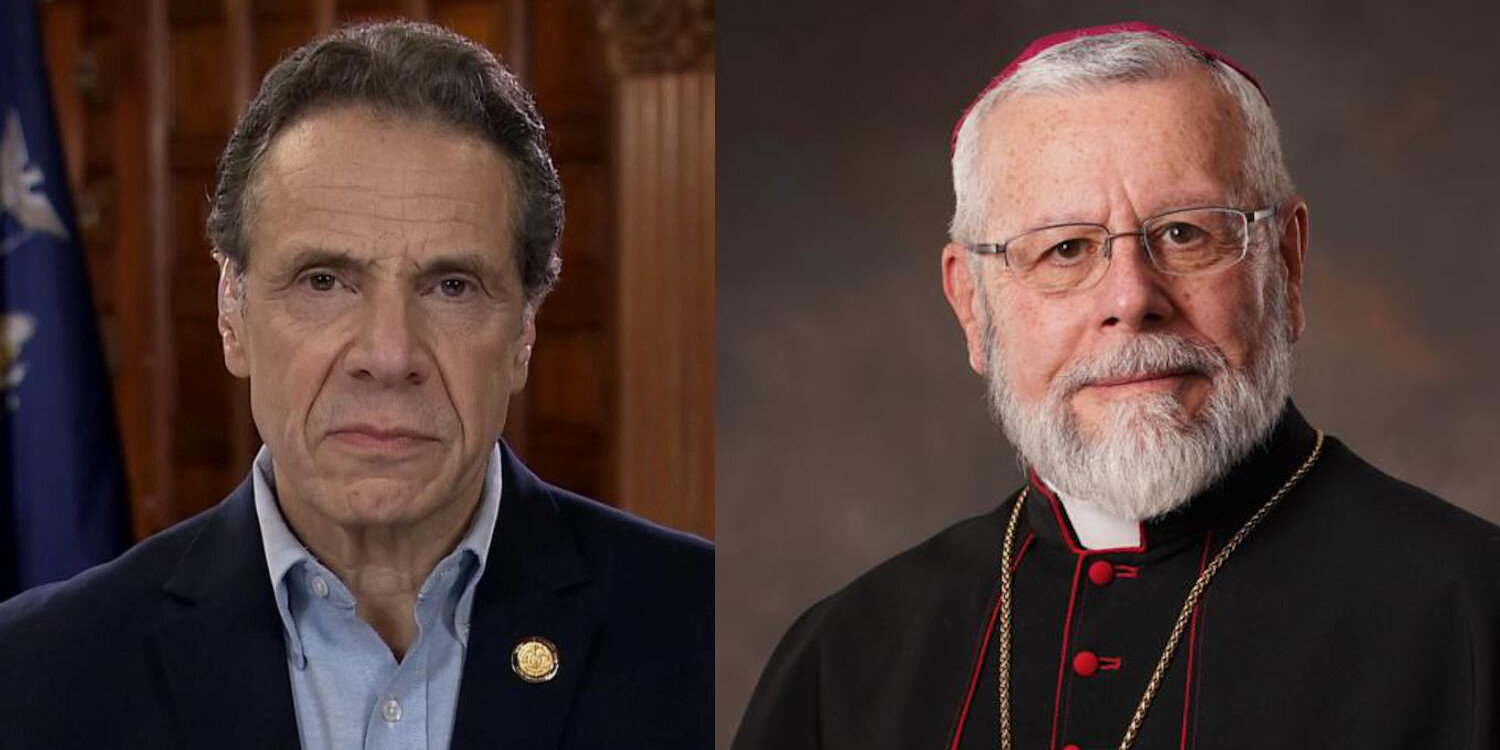
Bishop Peter A. Libasci Was Set Up by Governor Andrew Cuomo
Before he was himself accused New York Governor Andrew Cuomo signed into law a window in the civil statute of limitations spawning claims against a Catholic bishop.

Before he was himself accused New York Governor Andrew Cuomo signed into law a window in the civil statute of limitations spawning claims against a Catholic bishop.
August 25, 2021
Back in 2010, I closely followed a story that appeared in most national news media outlets. It was about Bishop Eddie Long, a well-known preacher, TV evangelist, and pastor of a Baptist mega church in Georgia. He was accused of sexual assault in multiple lawsuits brought by three young adult males.
Unlike in nearly all similar claims against Catholic clergy, all three of the men, barely out of their teens, opted to allow their names to appear in media coverage. The story unfolded in stark contrast with similar claims against Catholic priests in other ways as well. Lawyers and victim advocates have explained away the sometimes decades-long gaps that have comprised 70-percent of the claims against priests. It is routinely claimed that accusers of Catholic clergy — the vast majority of whom were teens at the time of an alleged offense — may require decades to come forward due to the trauma inflicted on them. In contrast, the three young men accusing Bishop Eddie Long filed lawsuits within two years.
Bishop Long denied that the claims were true. Criminal charges were never filed so the claims were not investigated. The story came down to his word against theirs. When The Wall Street Journal published a 2010 account of Bishop Long’s vow to fight these claims, it was among the five most-read stories of that week at WSJ.com. Clearly, many in the news media presumed at first reading of the headlines that he was a Catholic bishop. The decision to fight the claims rather than simply settle thus stood out as a news story of its own.
In the end, however, Bishop Long and his congregation decided to settle the claims for an undisclosed sum in 2010. No one questioned their assertion that settlement of such claims is common and in no way should be seen as an admission of guilt or culpability. Beyond Bishop Long’s congregation, there were no deeper pockets to pursue. He simply resumed his ministry as though nothing had ever happened.
This could never happen when the accused is a Catholic priest. It was once explained to me by another bishop, Most Rev. John B. McCormack, formerly Bishop of Manchester, NH, that one of the hard lessons of the Catholic clergy abuse narrative is the fact that once a priest is accused, his legal interests and those of his bishop and diocese diverge. When I maintained my innocence against lawsuits that I knew were fraudulent, I was dropped as a defendant so I no longer had standing to challenge settlements.
The New Hampshire statute of limitations for lawsuits was six years then. (In 2020 the civil limitation statute was removed entirely.) The allegations against me were from twelve years earlier. My defense against the claims was that they never took place. The sole argument of my diocese was that the statute had expired so the lawsuits should be time barred. Judge Carol Ann Conboy ruled in Merrimack County Superior Court that the six-year statute begins to toll “only when a victim becomes aware” of a connection between a claim of abuse and a current injury.
My diocese opted to settle rather than appeal that dubious lower court precedent which has since evolved into a pattern of unquestioned mediated settlements in other claims against priests going all the way back to 1950. In many cases no lawsuit was even filed. In his once published resume, former Msgr. Edward J. Arsenault (now Edward J. Bolognini) claimed that he personally negotiated 250 settlements in allegations against NH priests.
Of interest, one NH lawyer told the news media that he personally obtained 250 settlements in claims against NH priests. In a 2002 media report he added,
“During settlement negotiations, diocesan officials did not press for details such as dates and allegations for every claim. ‘I’ve never seen anything like it,’ [Attorney Peter] Hutchins said.”
— Mark Hayward, NH Diocese Will Pay $5 Million to 62 Victims, NH Union Leader, November 27, 2002

Manchester Bishop Peter A. Libasci
Misuse of the word, “credible” has been a source of injustice in the U.S. Church since 2002. Prior to the events described above, Bishop John McCormack told a lawyer and a media producer that he believed I was falsely accused and wrongly imprisoned. His statements were documented in a pair of independently sworn affidavits in 2001.
In 2002, after the USCCB adopted the Dallas Charter and “zero tolerance,” claims against me entered a category used by all bishops since. Once money changed hands, they became “credible.” I wrote of the fallout in “Our Tabloid Frenzy About Fallen Priests.”
What the bishops collectively mean by “credible” is not a standard of justice used in any other circumstance. It means no more than “possible.” If a priest and an accuser lived in the same parish or community 30, 40, 50 years ago, then a sexual abuse claim against the priest is “credible.” It is deeply unjust that bishops continue to use that term while knowing that the public and the news media wrongly interpret it as “substantiated.”
There has been a point of contention with my current Ordinary, Bishop Peter A. Libasci. In 2019, while under no pressure from anyone to do so, he published the names of 73 priests of this one diocese who, he says, were “credibly” accused. Many are deceased. This resulted in a pair of pointed articles by Ryan A. MacDonald: “In the Diocese of Manchester, Transparency and a Hit List,” and “Our Bishops Have Inflicted Grave Harm on the Priesthood.”
Now Bishop Libasci has himself been “credibly accused.” On July 22, 2021, the New Hampshire Union Leader newspaper, in an article by Mark Hayward, reported, “NH Bishop accused of sexual abuse by an altar boy decades ago.” Whatever differences I have had with Bishop Peter Libasci and his published list, I was and am deeply saddened by this development. The accusation stems from 1983, the same year as the accusations against me. The lawsuit, filed in Suffolk County, New York, alleges that then Father Peter Libasci sexually assaulted a boy aged 12 to 13 “on numerous occasions” at a parish and Catholic school in Deer Park in the Diocese of Rockville Center, New York.
Bishop Libasci maintains through counsel that he is entirely innocent of these claims. I believe that he is in fact innocent. I do not find the claims to be credible at all, but I do not use that term in the same manner the bishops use it against priests. I will get back to this.
One of the claims from the now unnamed 50-year-old accuser is that he was assaulted in the sacristy while setting up for a Mass. That has all the earmarks of a “copycat” claim that is almost verbatim a claim in a different but much more notorious New York case, that of former Cardinal Theodore McCarrick. No one who knows Bishop Libasci could or should conclude that these claims are at all credible. It would be a grave injustice if such claims prevail without clear evidence.
However, that also leaves the matter in a conundrum. If that accuser lived in Deer Park, New York and attended that parish or school at the time Bishop Libasci was there, then this is more than enough for his fellow bishops to conclude — as they would in the case of any similarly accused priest — that the claims are “credible.” Bishop Libasci has not, at this writing, been removed from ministry by the Vatican. As unjust as that would be, any priest in the same circumstance would have been removed immediately.

Former New York Governor Andrew Cuomo
This is happening to Bishop Libasci and others with roots in the State of New York because in 2019, New York Governor Andrew Cuomo promoted and ultimately signed a bill that opened a window to allow civil claims to be filed even if they had been time barred by the statute of limitations. The window in which these claims could be filed expired on August 14, 2021. The Catholic bishops of the state of New York knew well what the result would be so they opposed the unjust bill.
Before signing it into law, Governor Cuomo accused the bishops and other Church officials of threatening politicians who did not support their opposition to the bill. In response to similar bills that were not passed in previous efforts, Cuomo said, “I believe it was the conservatives in the Senate who were threatened by the Catholic Church, and this went on for years.” Catholic League President Bill Donohue pointed out in “Cuomo Had A Different Standard for Priests,” Catalyst, April 2021,
“When teachers’ unions oppose a bill, it is called lobbying. When bishops oppose a bill, it is called a threat. Cuomo’s double standard, and his animus against the Catholic Church, could not be more plain.”
Governor Cuomo also promoted and signed a June 2020 bill that set a very low bar as a standard of evidence in claims of sexual abuse or harassment in the workplace. The New York Times reported that the legislation eliminates the state’s “severe or pervasive” standard. When signing the bill into law, Governor Cuomo said,
“The ongoing culture of sexual harassment in the workplace is unacceptable and has held employees back for far too long. This critical measure finally ends the absurd legal standard for victims to prove sexual harassment in the workplace and makes it easier for those who have been subjected to this disgusting behavior to bring claims forward.”
I once wrote a post entitled, “Be Wary of Crusaders! The Devil Sigmund Freud Knew Only Too Well.” It documented multiple stories of crusaders against sexual abuse who turned out to be guilty of the same sorts of offenses they were crusading against. It was the result of a combination of forces within the psyche in the form of two classic defense mechanisms described by the Father of Psychoanalysis, Sigmund Freud. From recent news accounts of his resignation to avoid a pending impeachment, Governor Cuomo seems to have been a textbook case for this.
As accusation after accusation emerged against Cuomo, he insisted on a presumption of innocence and his due process rights. He responded to the allegations with, “You can allege something. It might be true or it might not be true. You may have misperceived. There may be other facts.” All true, but when it came to allegations against priests — whether in the present or in the distant past — innocence was never a possible conclusion. As Catholic League President Bill Donohue observed in the link above,
“Cuomo showed no respect for the due process rights [of priests]. He was happy to sign legislation that gave rapacious lawyers out to sue the Church all the leeway they wanted.”
This is the Pandora’s Box our bishops opened with their use of the term, “credible” as a standard of evidence for removing priests. The current claims against Bishop Peter Libasci arose only because Governor Andrew Cuomo signed into law in New York a bill that takes advantage of the lowest possible standard of evidence to score lucrative windfall settlements from the Catholic Church.
According to the standard our bishops have adopted, however, those claims are as “credible” as many of the claims against the priests on Bishop Libasci’s published list. I would like to believe that Bishop Libasci may now, in hindsight and humility, rethink his decision to publish that list. Injustice, however, is often a bell that cannot be unrung.
Nonetheless, absent compelling evidence — and so far there is none — I firmly believe Bishop Peter Libasci is entirely innocent. I hope and pray that his good name is restored and he is delivered from this injustice.
+ + +
Update by Editor — September 8, 2024: In July 2024 it was announced in news media that the accuser of Bishop Peter A. Libasci has died in Rockville Centre, New York. The cause of death has not been public, but he would have been a man in his mid-fifties. This sadly leaves the case against Bishop Libasci unresolved both civilly and canonically.
Since then, the Diocese of Manchester under Bishop Libasci has revised its policy regarding accusations against Catholic clergy. Bishop Libasci has approved a new standard to be applied to cases of accusations against priests. The “credible” standard has been discarded within this Diocese. Now any priest merely accused, from however long ago, substantiated or not, will be removed from ministry and his name added to a public list of the accused. The Diocese has announced that financial compensation for all accusers will be arranged by “trauma-informed consultants.” This new standard will apply to all diocesan personnel, except apparently, Bishop Libasci himself.
To Fleece the Flock: Meet the Trauma-Informed Consultants
+ + +
Note from Father Gordon MacRae: Please share this post. Please also pray for a just outcome for Catholic priests falsely accused, and for legitimate victims of sexual abuse and exploitation. Let us remember as we walk through this minefield that we are a Church.
You may also like these relevant posts:
In the Diocese of Manchester, Transparency and a Hit List by Ryan A. MacDonald
Our Bishops Have Inflicted Great Harm on the Priesthood by Ryan A. MacDonald
A Weapon of Mass Destruction: Catholic Priests Falsely Accused by Father Gordon J. MacRae, LinkedIn Pulse
Accused Priests Deserve Better by Catholic League President Bill Donohue (Catalyst, March 2020)
Bogus Charges Against Priests Abound by Father Michael Orsi, Ed.D., Ave Maria School of Law


The Pillar; Msgr Jeffrey Burrill; Blackmail of the Vatican
A story of one U.S. priest and his moral fall from grace has spun into accusations of a witch hunt and international suspicions of Chinese blackmail of the Vatican.

A story of one U.S. priest and his moral fall from grace has spun into accusations of a witch hunt and international suspicions of Chinese blackmail of the Vatican.
August 18, 2021
After just weeks ago posting “Our Tabloid Frenzy About Fallen Priests,” I have been highly resistant to stepping into this one. In a matter of weeks, this story has grown so many tentacles that I am not even certain of where to begin. My goal is not to join the frenzy, but rather to perhaps bring a little perspective to it. So I will begin where no one else has begun.
For the last year, Msgr Jeffrey Burrill had been in the high profile and highly prestigious position of General Secretary of the U.S. Conference of Catholic Bishops. For the preceding four years he served in the position of Associate General Secretary. He has been referred to as the highest ranking member of the U.S. Catholic clergy who is not a bishop. I do not have a defense of Msgr Burrill except to say that his life and priesthood have been shredded in recent weeks. Perhaps this is even right and just, but a Church should not settle for leaving the story there. I hope and pray for an avenue of repentance and restoration.
But first, the tabloid frenzy: The story is complicated. A new Catholic media venue called The Pillar published an investigative report on July 20, 2021 that resulted in the abrupt resignation of Msgr Burrill from his position in the leadership of the USCCB. It also ignited a firestorm of debate about journalistic ethics, priestly celibacy and homosexuality, and the difference between private behavior and public crimes. To date, Msgr Burrill stands accused of no crimes, but The Pillar report alleging promiscuous homosexual behavior left his career in ruins.
The Pillar, founded just eight months ago, is staffed by former Catholic News Agency editor J. D. Flynn and former CNA reporter, Ed Condon. Using and doggedly cross-referencing easily accessible data from a homosexual “hook-up” app called Grindr, the two journalists were able to pinpoint “emitted app data signals” from Grindr to a specific device “on a near daily basis during parts of 2018, 2019, and 2020” according to The Pillar report. The device belongs to Msgr Jeffrey Burrill and was allegedly used for the purpose of anonymous sexual encounters from his USCCB office and residence as well as in other cities, sometimes while handling USCCB affairs.
The journalists sought comment from Msgr Burrill and the USCCB leadership before breaking this story. A meeting was scheduled, then cancelled. Msgr Burrill resigned from his position as USCCB General Secretary on July 19, a day before the 3,000 word story was published by The Pillar under the title: “Pillar Investigates: USCCB Gen Sec Burrill Resigns After Sexual Misconduct Allegations.”
Almost immediately, apologists for the gay agenda went into action. The National Catholic Reporter (please be clear that we are not talking about the NC Register) accused The Pillar of operating on “a shaky journalistic foundation.” (Coming from NCR, I found that to be most ironic.) Jesuit Father James Martin accused The Pillar of using “immoral tactics” to “out” Msgr Burrill. Writing for The Wall Street Journal, Deputy Editorial Features Editor Matthew Hennessey wrote an outstanding defense of The Pillar's journalism in “Catholic Journalists Expose a Scandal, and Liberals Scoff” (August 2, 2021). Mr. Hennessey reported,
“Vox.com described Grindr in 2018 as ‘an underground digital bathhouse’ whose purpose is to ‘help gay men solicit sex, often anonymously, online.’ At the very least most Catholics, liberal or conservative, would say this doesn’t sound like the kind of thing a priest should have on his phone. Is it news? Without a doubt ... If the priest who leads the USCCB is living a life antithetical to Church teaching on matters of human sexuality, It’s a story.”

Is This Really about Human Sexuality?
Complicating this story further, Msgr Jeffrey Burrill is a priest of the Diocese of Lacrosse, Wisconsin whose Ordinary, Bishop William P. Callahan, recently suspended the priestly faculties of another high profile priest, Father James Altman for the stated reason of being “divisive and ineffective.”
The criticism of Jesuit Father James Martin, that The Pillar journalists used “immoral tactics” to “out” Msgr Burrill, is curious at best. It is true that they went after this story with an unexplained laser focus and determination, but their methods were not at all unique in the digital age. Father Martin’s use of the term “out” leaves the impression that he protests exposing Msgr Burrill’s sexual orientation. Father Martin has invested a lot of energy and ink to present and lobby for same-sex unions to be perceived as both normative and acceptable in and outside of the Church.
His rhetoric on this only further harms Msgr Burrill, however. Grindr bills itself as “the largest social network for gay, bisexual, transgender and ‘queer’ people” for the singular purpose of locating and exploiting opportunities for anonymous sexual encounters, often between complete strangers. There is not even the remotest opportunity for relationship, mutuality, love, or companionship in such encounters. This is not a reflection of human sexuality. It is about narcissistic exploitation of oneself and other human beings. It is about sexual compulsion.
If all that has been suggested about Msgr Jeffrey Burrill’s use of the Grindr app is true, he does not need Father Martin’s affirmation or defense, nor does he need our revulsion or contempt. He needs our help. The great tragedy of all this is that the person most in place to help him — his own bishop — is rendered unable or unwilling to do so because of the tabloid frenzy of the media and the bishops’ collective fear of it.
When the story of former Cardinal Theodore McCarrick first surfaced in the arena of public contempt, I wrote a controversial post entitled, “Cardinal Theodore McCarrick and the Homosexual Matrix.” It explained my own vicarious experience of the world and influence of Cardinal McCarrick in the seminary I attended in the 1970s. Its central point cautioned against a witch hunt to root out from the priesthood the existence of same-sex attraction because those who experience it are just as capable of living celibate lives committed to Christ as any other priest or religious. The real impediment to Holy Orders, that post suggests, is not same-sex attraction but rather narcissistic personality disorder, a condition that defies treatment and objectifies others, but is far more detectable in screening a candidate for priesthood or religious life.
I have known many priests who have struggled with same-sex attraction who are exemplary priests. I strongly believe that there is a direct correlation between the health of their lives as men and as priests and their ability to resist narcissism by leading selfless lives. The compulsion for anonymous sexual encounters and the objectification of others exploited by sites like Grindr have a lot more to do with the plague of narcissism than anything resembling human sexuality.
I have also known priests, though in a far smaller number, who gradually descended into the darkness of sexual narcissism and the world of anonymous “hook-ups” that Grindr exploits. Some of these men were sent to a residential treatment center for priests where I served as Director of Admissions. Many were helped, but only to the extent that they could do the hard work of exposing and understanding their narcissistic personalities and commit themselves to selfless and transparent lives and a priesthood centered on Christ.
In nearly every case, their long, slow descent into darkness was known to other priests who did nothing and said nothing to stop or challenge them. In the case of Cardinal McCarrick, it is a fact that many bishops knew of his behavior, but today lie about this. Today he is dismissed, scapegoated and ostracized, but his sins were not just his own. It will merely compound this tragedy, and the Church’s shame, if Msgr Jeffrey Burrill now is left with only one option: to disappear into the night.

Was the Holy See a Victim of Blackmail?
A side story has developed over use of the Grindr app that has led some to draw a possible connection with the Vatican’s troubling agreement with the Chinese Communist Party over the selection of bishops for the state-controlled church. The evidence is enticing, but entirely circumstantial. This aspect of the Grindr app story was first exposed in a Breitbart News article by Thomas Williams, Ph.D. entitled, “‘Extensive’ Gay Hookup App Usage Compromises Vatican Security,” (July 28, 2021). The article draws on the previous article in The Pillar to explore a possible exposure to blackmail for use of the app within Vatican walls.
The Pillar revealed that at least sixteen different mobile devices emitted signals from Grindr within areas of Vatican City not generally open to the public. That’s sixteen cellphones over four days within an eight-month period between March and October 2018. To date, the owners of those phones are unknown. With this information, and a lot of conjecture, some Vatican watchers now suggest that the 2018 Concordat, the contents of which to date remain private, may have been a result of blackmail over use of the app within the Vatican. From my perspective, this is possibly a huge leap of the imagination.
According to the Breitbart article, a Chinese entity was the original owner of the Grindr app. It is surmised that the CCP could have accessed the same data investigated by The Pillar. I have written more than once questioning the secret agreement of 2018 between the Vatican and the Chinese Communist Party. The Holy See appears to have conceded to allowing the CCP to select candidates for bishop in the state-run Chinese Catholic Patriotic Association which was first established by the late Chairman Mao Zedong. I wrote of this just weeks ago in “Pope Francis Suppresses the Prayers of the Faithful.”
Added to the circumstantial evidence is a June 2019 change in the Vatican’s longstanding China policy which previously forbade priests from joining that association. After the ban was lifted, Hong Kong Cardinal Joseph Zen went on record to say that the lifting of that ban was even more destructive than the 2018 agreement itself.
Added to the above evidence has been the relative silence of the Holy See about Chinese atrocities toward the Uyghur people in the XinJiang Autonomous Region, and the increased persecution of priests and other Catholics who remain in the “underground” Church that is loyal to Rome even if Rome is not loyal to them. All of this is indeed cause for grave concern.
However, none of it is evidence of blackmail. Our friend and Canon Law adviser, Father Stuart MacDonald, sees this evidence as being similar in tone and substance to that used by bishops to expel accused priests in cases with no hard evidence. It all seems “credible,” but only in the sense that it “might” be true. It is, however, no measure of justice when it is the only evidence.
Earlier this month, I posted an important addition to our Library category, “Our Patron Saints.” The post is “Saints and Sacrifices: Maximilian Kolbe and Edith Stein at Auschwitz.” In 1937, Pope Pius XI published a courageous document entitled, in German, “Mit Brennender Sorge” (With Deep Anxiety). It was a bold confrontation with the Nazi regime over the forced deportation of Jews from Europe. In retaliation, many people were imprisoned. Some were put to death. Among them was Edith Stein, a woman who was born a Jew, became a Catholic, a celebrated university doctor of philosophy, and a Carmelite nun. She was dragged in full Carmelite habit from her convent in Holland, stuffed onto a cattle train, and transported to Auschwitz where she was immediately put to death.
When Pope Pius XII ascended the Chair of Peter shortly thereafter, he was, in a sense, blackmailed by this and other atrocities into silence about Hitler and the Third Reich. Speaking out would have jeopardized many lives, and many underground efforts at diplomacy to save people who were imperiled. To conclude today without evidence that the Pope is silenced by someone holding over his head a story of someone in the Vatican calling a gay hookup app is shameful in comparison. That part of the story might better belong in Soap Opera Digest.
+ + +
Note from Father Gordon MacRae: Please share this important post. Please also visit our Subscribe Page and Special Events. You may also like these relevant posts from Beyond These Stone Walls:
Cardinal Theodore McCarrick and the Homosexual Matrix
The McCarrick Report & the Silence of the Sacrificial Lambs
Pope Francis Suppresses the Prayers of the Faithful
Saints and Sacrifices: Maximilian Kolbe and Edith Stein at Auschwitz

Photo courtesy of CNS/L'Osservatore Romano

A House Divided: Cancel Culture and the Latin Mass
In Traditionis Custodes restricting the Traditional Latin Mass, Pope Francis insists that his goal is ecclesial communion. Then he dropped a bombshell of division.

In Traditionis Custodes restricting the Traditional Latin Mass, Pope Francis insists that his goal is ecclesial communion. Then he dropped a bombshell of division.
In the above composite photo Pope Emeritus Benedict XVI and Pope Francis offer Mass Ad Orientem in the Sistine Chapel.
August 11, 2021
The Year of Our Lord 2003 seemed a lot more like a year of Our Lord’s Calvary. It was a most painful year for me personally and for many Catholics. Starting in Boston with a rapid ripple effect across the land, diocese after diocese faced relentless Catholic scandal over the horror of Catholic priests accused of sexual abuse. A spotlight was cast upon the Catholic Church to the delight of the news media, but the subject needed a flood light. There was little justice in the moral panic to follow. This is a story I wrote about in a recent post, “A Sex Abuse Cover-Up in Boston Haunts the White House.”
Just beyond the glare of The Boston Globe spotlight, there was another event that had an even more profound impact on another church community in 2003. It took place just north of Boston in New Hampshire and from there it, too, rippled across the land, and many lands. Its most distinctive feature was its contrast to the Catholic story. While Catholic priests were judged and condemned in the media, one Episcopal clergyman in New Hampshire became a celebrity of pop culture.
In 2003, The Reverend V. Gene Robinson became the first openly gay Episcopalian priest to be nominated to become a bishop. The announcement had the immediate effect of alienating conservative members of the Episcopal Diocese of New Hampshire. Born Vicky Gene Robinson in 1947, the nominee had been married, raised a family, divorced, and was in a conjugal same-sex relationship at the time of his nomination. For many, this seemed more of a politically correct statement than a serious nomination. If The Reverend Robinson had been divorced and living with another woman who was not his wife, this nomination would have gone nowhere.
Bishop Robinson’s nomination was confirmed by the Episcopal church of New Hampshire to equal parts applause and dismay. Then the cascade of damage was set in motion. With the support of the Nigerian Anglican church, many American conservative Episcopalians broke from the Worldwide Anglican Communion to form the Anglican Church in North America. The Anglican bishops of Uganda announced that they too broke from communion with the Episcopal church. This spread among conservative Anglican bishops across Africa and other parts of the world.
Having torn the Worldwide Anglican Communion asunder, Bishop Robinson announced his retirement seven years later in 2010. At some point he checked into drug rehab, and then used his voice as a retired bishop to promote same-sex marriage before the New Hampshire Legislature. He and his partner were among the first to “marry” under the new law he helped to pass. Then he announced his divorce to a news media that kept it very low key.
Among the protests came a multitude of petitions to Pope Benedict XVI who, in 2009, promulgated the Motu Proprio, Anglianorum Coetibus accepting into the Roman Rite entire Anglican parishes desiring to “cross the Tiber” to join the Roman Church. The first was a parish that became part of the Roman Catholic Diocese of Galveston-Houston, Texas in 2009.

We Are on a Road to Calvary Not Schism
The reactions that resulted in a breakup of the Worldwide Anglican Communion could not happen in the Catholic Church. Canon Law does not allow for the decisions to leave promoted by the Anglican bishops of Africa and other conservative communities. Only the Holy See can declare that a schism exists in a region or diocese. Popes have gone to great lengths to avoid schism. Pope Benedict XVI lifted the excommunication of Bishops in the Society of Saint Pius X (SSPX) to heal a longstanding rift with traditionalists. In 2007, Pope Benedict further mended that rift with his Motu Proprio, Summorum Pontificum, which removed obstacles to the Traditional Latin Mass.
Now Pope Francis has reopened those wounds anew with Traditionis Custodes, his Motu Proprio: announced on July 16, 2021 which contradicts and revokes the permissions granted by Pope Benedict. I wrote of this last week in these pages in “Pope Francis Suppresses the Prayers of the Faithful.”
I used that title because in many ways my experience of the vast majority of those who seek out the Latin Mass are among the most faithful. In a published Letter to the Editor of The Wall Street Journal on July 30, 2021, writer Ray Martin of Ridgefield, Connecticut described what has become a lax and often disrespectful atmosphere in too many parishes. This is an impression that I hear about frequently from readers:
“I do not regularly attend a Latin Mass but I do remember it from childhood ... Nowadays, fewer Catholics attend Mass regularly, they tend to come late and leave early, and it is not unusual to see T-shirts, short-shorts and flip flops. Everyone presents at the altar for Communion. One study found that around one in three Catholics believes in the True Presence of Jesus in the Eucharist. I would guess that more than 90-percent of Latin Mass attendees do.”
— Ray Martin, WSJ.com
My experience of the many Catholics I hear from who seek out the Latin Mass either weekly or even just on occasion is that they are our modern day Essenes. I wrote of the Essenes and their role in preserving the faith of both Israel and the early Jewish Christians in “Qumran: The Dead Sea Scrolls and the Coming Apocalypse.” When Pope Benedict XVI opened the Church door to those requesting the Tridentine Latin Mass, many thought it would draw only senior citizens and some “far-right cranks,” as one writer put it back then. That has been far from true. Pope Francis expressed a concern that many who take part in the Latin Mass deny the validity of the Novus Ordo, the form of the Mass promulgated by Pope Paul VI in 1970. This also is far from true. I hear from many Latin Mass attendees who also take part in the Novus Ordo Mass. All they ask for is a sense of the sacred, and a communal acknowledgment that Jesus is truly present in the Eucharist. Their appreciation of the Novus Ordo has been strengthened by the Latin Mass.
Writing for The Wall Street Journal, Matthew Walther, editor of The Lamp magazine, penned an eye-opening op-ed one week after Pope Francis announced new, severe and immediate restrictions on the Latin Mass. Entitled, “Pope, Francis, the Latin Mass, and My Family” (July 23, 2021), Mr. Lamb described the reaction of those in his Catholic community of faith:
“We are loyal children of the Church on the receiving end of a harsh punishment. Pope Francis ... seemed to suggest that things had gone too far and were threatening to undo the liturgical reforms of the 1960s. The gradual displacement of the new rite, which emerged after Vatican II, was in fact the half-articulated ambition of many traditionalists. Until recently many had looked forward to a future in which the 'extraordinary form' of the Mass, as Benedict referred to it, was set to become rather ordinary.”
— Matthew Walther
Perhaps that is the point. The solemnity, majesty, and sacredness of the sacrifice taking place is just that — extraordinary. I want to contrast that with an experience I had as a newly ordained priest in one New Hampshire parish whose pastor made a weekly show of rushing through Sunday Mass at warp speed. After his hasty final blessing he would look at his watch and declare, “Twenty-two minutes, and I didn’t miss a thing!”

Standing with Peter v. Standing Our Ground
In some ways, Pope Francis has been unpredictable for so-called progressive Catholics as well. After playing down the issue of homosexuality with oft-quoted remarks like, “Who am I to judge?”, he disappointed many in liberal Catholic enclaves like Germany when he refused to allow blessings of same-sex unions. He dismissed the proposition while shocking liberal German priests with the definitive statement, “God cannot bless sin.” In an open letter to German Catholics in 2019, he cautioned them against “multiplying and nurturing the evils the Church wants to overcome.” He also gave a definitive “no” on the topic of ordination of women.
With all the open, and often flagrant, dissent from Church teaching and discipline in Germany and other parts of Europe, why would Francis choose to label traditional Catholics who appreciate the Latin Mass as “divisive?” I do not have answers.
But I do have more questions and a few suspicions. As I pointed out in these pages a week ago, there is an immense and growing contrast between the state of the Catholic Church in Germany and other areas in Europe, and that of the Church in Africa. The former has been in a state of stagnation for decades, and is now deeply involved in the embrace of what has come to be called, “Cancel Culture.” In its Catholic manifestation, I can only describe this as the setting aside of the “sensus fidei,” the sense of the faith as it has been expressed across two millennia, in favor of populist social trends of just the first two decades of the 21st Century.
With that understanding, “Cancel Culture” has become a modern plague on humanity that is far more destructive than any viral pandemic. If we do not understand history, and learn from it, we are doomed to repeat its most destructive patterns. Joining this secularized culture by placing God on the shelf while morphing Roman Catholicism into a mirror image of the flailing American Episcopal church is perilous.
The rapid growth of the Traditional Latin Mass since Pope Benedict XVI re-opened that door may well be the work of the Holy Spirit. Pope Francis knows well that the entire Church — and not just the bishops with whom he consulted — comprises the “sensus fidelium,” the action of the Holy Spirit in the hearts and minds and souls of the faithful from the Sacrifice at Calvary to the present day. The faithful witness of those who embrace the Traditional Latin Mass may prove to be a gift to the Church.
But the faithful must not stand against Peter to achieve that end. We are a Church built upon the blood of martyrs, and faithful witness may now require paying the cost of discipleship. Sometimes in the Church’s story of faith, white martyrdom has not only been for the Church. Sometimes it has been from the Church. Padre Pio knew this. So did Cardinal George Pell. So do I.
I have been most struck by the two volumes of Cardinal Pell’s Prison Journal. He frequently repeated his longing for Mass and the Eucharist in a place where he was barred from them. I recall reading from Father Walter Ciszek’s book, With God In Russia, that he sat on the edge of his bunk in a Siberian labor camp and would mouth from memory the words of the Roman Canon of the Mass.
My experience of Mass as a prisoner is reduced to the contents of a small plastic box. On Sunday nights at 11:00 PM, after the last prisoner count of the day, I take that box from a shelf and place it at the foot of my prison bunk. It serves as both a container and an altar. It has a Corporal that I spread over its surface. I attach a small battery powered book light to the wall just above it, and begin my preparation for Mass. The Mass is always “Ad Orientem,” toward the East, not by any design of my own, but because the cell window faces in that direction.
I have no sacred vessels. I have a coffee cup purchased years ago but never used for any other purpose. I have a weekly supply of a host placed on a clean linen purificator, and a one-quarter ounce of unfermented wine with no additives approved for liturgical use by Catholic priests serving in a war zone. I have a small wooden crucifix on a stand on a shelf just above where my Mass is offered.
There was a time when I did not have even these. For many years in prison, I had no access at all to the Mass. So I look upon this present drama unfolding now in our Church, and see it as madness that is hopefully brief. If you have appreciated the Traditional Latin Mass, you must not leave. The Church needs you. We need you to remind us of a lesson that I have long since learned harshly, and can now never forget.
What we obtain too cheap, we esteem too lightly.
+ + +
Note from Father Gordon MacRae: Please share this post. And please visit our Special Events page. It contains a story that is dear to my heart.
You may also like these relevant posts from Beyond These Stone Walls:
Pope Francis Suppresses the Prayers of the Faithful

The feast of Saint Maximilian Kolbe, our patron saint, is August 14. The above photo is his prison cell.