“There are few authentic prophetic voices among us, guiding truth-seekers along the right path. Among them is Fr. Gordon MacRae, a mighty voice in the prison tradition of John the Baptist, Maximilian Kolbe, Alfred Delp, SJ, and Dietrich Bonhoeffer.”
— Deacon David Jones

The Trial of Cardinal Becciu, the Betrayal of Cardinal Pell
In December 2023 Cardinal Giovanni Angelo Becciu, the first prelate in history to face trial in a Vatican court, was convicted of embezzlement and money laundering.

Credits: Left, CNS; Right, CNS/Paul Haring
In December 2023 Cardinal Giovanni Angelo Becciu, the first prelate in history to face trial in a Vatican court, was convicted of embezzlement and money laundering.
January 10, 2024 by Fr Gordon MacRae
I recently explained to a friend concerned about the emergence of accounts of historic abuse by priests that mainstream media often save such stories to run them near Christmas and Easter. The motive of the left-leaning media in this seems obvious. It is to drive a wedge between Catholics and their Church. So it was doubly distressing when lurid stories of criminal behavior were generated from the highest levels of Church authority during the Advent and Christmas seasons this year.
“A Cardinal Once Seen as Future Pope Now Faces Prison.” That shocking headline was a front page story by Francis X. Rocca in the December 13, 2023 edition of The Wall Street Journal. Cardinal Giovanni Angelo Becciu, Prefect of the Vatican Congregation for the Causes of Saints, has stood accused by Vatican investigators of the crimes of embezzlement and money laundering since 2020. Trial for the then 75-year-old prelate commenced in 2021. In the weeks before Christmas in 2023, he was convicted of the charges and sentenced to a prison term of five-and-a-half years.
Cardinal Becciu is the first cardinal in Church history to face criminal charges in a Vatican court. According to the Rocca article, five others also faced criminal charges in the same case. They included other Vatican officials and outsiders. The case centered on a failed Vatican investment in a high-end London property and “the alleged theft of money intended to free a kidnapped nun but reportedly spent instead on resort vacations and luxury goods from Prada and Louis Vuitton,” according to Rocca. This story could not be worse.
The trial, which concluded near Christmas, included “accusations of Vatican vendettas as well as Becciu’s secretly recorded conversation with the pope.” Mr. Rocca reported that Pope Francis changed Church laws during the investigation in ways that defendants’ lawyers said favored the prosecution and violated the right to a fair trial — “including a broader authority to eavesdrop on suspects.”
Prior to his role as prefect for the Vatican office, Cardinal Becciu had been in the official role of “Substitute for General Affairs.” Mr. Rocca described this role as “effectively the pope’s chief of staff.” Becciu served in this capacity for the last two years of the pontificate of Benedict XVI and at least the first five years of the papacy of Francis. Becciu described this role, reported by journalist Francis X. Rocca, in 2018: “The substitute is, so to speak, the one who has no time for himself but must give it first to the Holy Father and therefore be willing to take any of his calls and favor any of his initiatives.”
It was Francis who elevated Becciu to the rank of cardinal and appointed him to his role overseeing the canonization of Saints. When the charges of money laundering and embezzlement emerged in 2020, Pope Francis asked him to resign.

Cardinal Becciu, Pope Francis, Cardinal Pell [Credits: CNS/Guglielmo Mangiapane/Reuters, CBCEW, Daniel Ibanez/CNA/EWTN]
Who’s Left on the Side of Right?
Several biographies of Pope Francis point to Vatican corruption as a primary impetus for his elevation to the papacy in the conclave of 2013. In my post, “Synodality Blues: Pope Francis in a Time of Heresy,” I described the conditions under which Benedict XVI shocked the world with his decision to step down from the Chair of Peter. His final year was marred by Vatican corruption, especially revolving around Vatican finances. The betrayals and political machinations in Rome became legendary.
The word, “machination” refers to a crafty scheme or cunning design for the accomplishment of a sinister end. There were several such schemes at work in the background that caused Benedict XVI to conclude, as he did in his February 2013 announcement, that he must step down:
“I have come to the certainty that my strengths, due to an advanced age, are no longer suited to an adequate exercise of the Petrine ministry.”
In the years to follow the 2013 conclave, one scandal after another emerged from Rome. Writing for The New York Times in 2018, conservative Catholic columnist Ross Douthat wrote of the “latest bomb” to go off in “an already cratered Catholic landscape.” The bomb then was an 11-page “testimony” from Archbishop Carlo Maria Vigano, a former Vatican ambassador to the United States, accusing Pope Francis of shielding and enabling a serial abuser, Cardinal Theodore McCarrick, by releasing him from restrictions on his activities and travel.
The restrictions had been imposed by Benedict XVI in the wake of revelations that McCarrick had sexually abused seminarians for years. Cardinal McCarrick had been restricted by Benedict to a life of prayer and penance, but ignored it. According to columnist Robert George writing in The Washington Post in 2018, “Pope Francis ignored it as well.”
Ross Douthat attributed this decision of Francis to the fact that he “needed allies” in the ongoing struggle between conservative and liberal Catholics. This is a scandal of its own. Douthat reported that McCarrick “was sympathetic to the Pope’s planned liberalizing push.” The irony was that liberal Catholics, the very ones who championed full exposure of the sexual abuse crisis, were willing to look the other way when Francis promoted McCarrick, removed his disciplinary sanctions, and corralled his help for an obsessive agenda to thwart Catholic conservatives. Some have suggested that such obsessive concerns helped to keep rogue Vatican actors like Cardinal Becciu from scrutiny. When the spotlight of obsession is on sexual abuse alone, money flows freely in the surrounding darkness.

When Cardinal Pell Was Accused
The case against Cardinal George Pell was also influenced by nefarious machinations, including police and prosecutor corruption. This was at the heart of a curious incident related in Prison Journal (Volume 1, p. 329). At a pretrial hearing on Cardinal Pell’s false sexual abuse charges, among the most difficult charges to defend against, a Melbourne, Australia priest who was present in the court told Pell’s supporters that he prays that the prosecutor will “mess up his presentation.” When that actually happened, the priest reportedly said, “See, my prayers are working!” When Cardinal Pell was told of this he said, “I would have much preferred that he prayed for justice to be done.”
Those were the spontaneous words of an innocent man who believed that justice in this life is possible — even likely. The guilty on the other hand engage in any number of contrived machinations to do an end run around the law. When a defendant is innocent and there is no evidence supporting the charge, it is too often police and prosecutors who resort to machinations to do an end run around the law.
There is a vivid example of this on the same page of Pell’s Prison Journal cited above. Detective Sgt. Kevin Carson of the Ballarat, Australia Police Department produced a report claiming that sexual abuse by Catholic priests in Victoria — where Pell was facing trial — was responsible for forty-three suicides. After the shocking story was leaked to tabloid media, a parliamentary inquiry into the Church’s handling of sexual abuse was launched. An inquiry is similar to a grand jury report in the United States.
The police set up an investigation, but were able to identify only twenty-five of the forty-three named by Detective Carson. Of those twenty-five names, only sixteen had committed suicide. But only one of the sixteen had been assaulted by a member of the clergy. As Pell himself pointed out, “One is one too many, but one is not forty-three.” This tendency to “heighten the hype” lends itself to unfair trials and wrongful convictions, but it also lends itself to career advancement, a shamefully strong force in many of the US grand jury reports on Catholic clergy.
In his analysis of the Cardinal Becciu trial in The Wall Street Journal cited above, Francis X. Rocca included the following paragraph:
“Around that time, Francis made Australian Cardinal George Pell his finance chief and gave him sweeping powers. Pell unveiled new financial guidelines for the Vatican. But he clashed with the secretariat, which opposed his plans for a financial audit by an external auditing firm. Pell considered Becciu his main opponent.... Other Vatican officials also lobbied the Pope against Pell’s changes. The Pope curtailed Pell’s powers and the external audit was canceled. Pell later returned to Australia to face child sex abuse charges. He was acquitted on appeal and died” [on January 10, 2023].
In an October 15, 2023 published commentary on Mr. Rocca’s account in The Wall Street Journal, I added some further context to the story:
“The part of this nebulous story that most troubles me is the decision of the Pope to listen to Cardinal Becciu and other Vatican officials who lobbied against Cardinal George Pell’s financial reforms even after [ the Pope] had empowered him to reform Vatican finances. Mr. Rocca does not speculate on the source of charges against Cardinal Pell in Australia — charges for which he was exonerated in a unanimous decision of Australia’s High Court. This was after he wrongly spent 400 days in prison. There are many who believe that there may have been a connection between these false charges and Cardinal Pell’s attempted reforms of Vatican finances. Pell himself suspected this.”

Book cover image courtesy of Ignatius Press; Red cardinal photo by RachidH (CC BY-NC 2.0 DEED)
Many Unanswered Questions
In Cardinal Pell’s Prison Journal Volume 2, in an entry dated 2 August 2018, he devoted several pages to an article of mine, “Was Cardinal George Pell Convicted on Copycat Testimony?” The article had been sent to him in prison by Sheryl Collmer, a columnist for Crisis magazine. (The full excerpt now appears at our “Voices from Beyond” feature. )
My article drew a parallel between an accuser’s testimony in the trial of Cardinal Pell and that of another accuser in an unrelated case reported in Rolling Stone magazine by a now disgraced reporter, Sabrina Rubin Erdely. It turned out that there was indeed a connection, and the Erdely article was widely read in Australia before Pell was accused. As Francis X. Rocca observed in The Wall Street Journal excerpt above, “Pell considered Becciu his main opponent.” Is there something further to be deduced from this? Consider this 2020 entry from the Australia site Wrongful Convictions Report — “Cardinal Pell ... well, well, well”:
“Italian media have reported that Cardinal Giovanni Angelo Becciu, 72, is suspected of wiring 700,000 euros to recipients in Australia who helped to ensure hostile testimony in the trial of Cardinal George Pell, who was accused of molesting choir boys in Melbourne in the 1990s. Becciu, days after being sacked by the Pope, denies the truth of the reports.”
Consider also these further entries in Cardinal Pell’s Journal written from his prison cell:
Friday, 2 August 2019: “The allegations behind the 2011 Rolling Stone article, published in Australia, have also been demolished as false by, among others, Ralph Cipriano’s ‘The Legacy of Billy Doe’ published in the Catalyst of the Catholic League in January-February 2019. No one realized in 2015, when the allegations against me were first made to police, that the model for copycat allegations was also a fantasy or a fiction. I am grateful to Fr MacRae for taking up my cause.”
Sunday, 27 October 2019: “I finished reading a collection of articles from 23 October 2019 on the Vatican finance scandals ... [One] article mentioned Msgr Cesare Burgazzi, who worked in the Vatican Secretariat of State on the finances who became disillusioned by his discovery of a parallel bank, another IOR, and was then removed from his position through media accusations of sexual behavior which were later shown to be completely baseless. I had not heard of this.” [Emphasis added].
Thursday, 14 November 2019: “So far, the Vatican financial scandals have not bitten as deeply, especially in Australia, but they are a scandal of incompetence exploited by criminals.... Becciu had given an interview to a journalist as he was under pressure, which is not surprising.”
Thursday, 28 November 2019: “Cardinal Becciu furiously denounced as ‘another false article’ Ed Condon’s accurate account on the London property fiasco and of the accounting procedures which attempted to conceal it.” [Footnote: Ed Condon, “Vatican Officials: Swiss Bank Suspected of Money Laundering led to Pell Conflict,” Catholic World Report, 21 November 2019.]
Saturday, 30 November 2019: “I am becoming more interested in trying to put together the early stages in the evolution of the charges against me. Why were the charges first ascribed to 1997 instead of 1996? When was Sunday Mass introduced as a setting for the crime? Who helped the complainant? When did the similarities with the [Rolling Stone’s] Billy Doe incidents in Philadelphia emerge?”
Cardinal Pell’s last question now haunts this story: “Is there a Rome connection?”
+ + +
Note from Fr Gordon MacRae: I continue to feel an obligation to the late Cardinal Pell to uncover the truth of this story whenever and wherever possible. Thank you for reading and sharing this post. You may also like these related posts from Beyond These Stone Walls:
Excerpt: From the Prison Journal of Cardinal Pell, 2 August 2019
Was Cardinal George Pell Convicted on Copycat Testimony?
The Path of Sabrina Rubin Erdely's Rolling Stone
The Lying, Scheming Altar Boy on the Cover of Newsweek

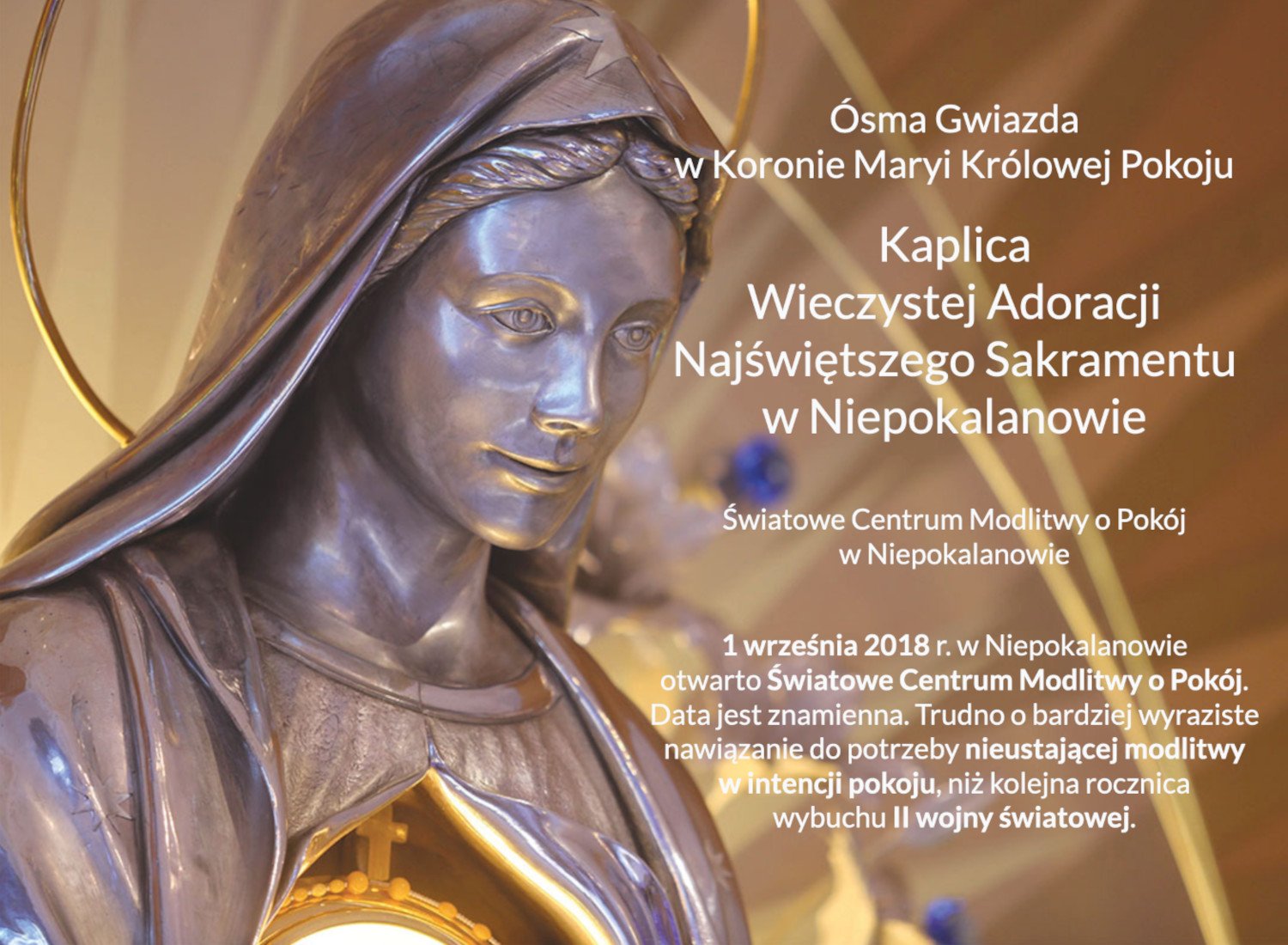

The Eucharistic Adoration Chapel established by Saint Maximilian Kolbe was inaugurated at the outbreak of World War II. It was restored as a Chapel of Adoration in September, 2018, the commemoration of the date that the war began. It is now part of the World Center of Prayer for Peace. The live internet feed of the Adoration Chapel at Niepokalanow — sponsored by EWTN — was established just a few weeks before we discovered it and began to include in at Beyond These Stone Walls. Click “Watch on YouTube” in the lower left corner to see how many people around the world are present there with you. The number appears below the symbol for EWTN.
Click or tap here to proceed to the Adoration Chapel.
The following is a translation from the Polish in the image above: “Eighth Star in the Crown of Mary Queen of Peace” “Chapel of Perpetual Adoration of the Blessed Sacrament at Niepokalanow. World Center of Prayer for Peace.” “On September 1, 2018, the World Center of Prayer for Peace in Niepokalanow was opened. It would be difficult to find a more expressive reference to the need for constant prayer for peace than the anniversary of the outbreak of World War II.”
For the Catholic theology behind this image, visit my post, “The Ark of the Covenant and the Mother of God.”

Pornchai Moontri: Here in Thailand with the Lion Kings
Pornchai Moontri arrived in Thailand in early 2021 during a global pandemic and after a 36-year absence. Life has been a daily struggle, but hope is on the horizon.

Pornchai Moontri arrived in Thailand in early 2021 during a global pandemic and after a 36-year absence. Life has been a daily struggle, but hope is on the horizon.
January 3, 2024 by Pornchai Maximilian Moontri
Editor’s Note: Pornchai Moontri is now the Asia Correspondent for Beyond These Stone Walls. The image atop this post depicts the route for a high-speed passenger and cargo rail that will have a station in Pak Chong, Thailand where Pornchai is now living. His most recent post, which we will link to again at the end of this one, was the very moving “On the Day of Padre Pio, My Best Friend Was Stigmatized.”
+ + +
Sawasdee Kup, my friends. When Fr Gordon MacRae asked me to write the first post of 2024 at Beyond These Stone Walls, I was excited. But when I asked him what I should write about he said “Just write whatever comes to mind.” Now I am just totally nervous! This was during a phone call to Thailand from the little barred room where we once both lived in Concord, New Hampshire. Being there was supposed to be a punishment, and in many ways it lived up to that expectation. But in spite of it, there were also very special things that happened there. I learned the ways of Divine Mercy there, and was touched by it. We conversed with St. Maximilian Kolbe and our Blessed Mother there, and they answered us.
It was from there that Father G helped to win my freedom and from there that he walked with me every day through the daily torment of ICE detention and deportation. Every day for 150 days trapped in crowded ICE custody during a pandemic, I would wake up and ask the Lord if this might be the day I will be free. Then at night I would go to bed asking for the grace to cope with yet another day. Father G reminded me that this is how we live now — in union with the Suffering of Christ.
After 29 years in prison and over five months in ICE detention, I finally arrived in Thailand on February 9, 2021. I thought I would burst with excitement, but in reality, I was filled with fear. Because it was in the middle of the Covid pandemic, the Thai government required me to stay alone, with no human contact at all, in a Holiday Inn hotel room in Bangkok for fifteen days. I have to say it was a lot nicer than all my other stays in solitary confinement.
Back in 2005, after several years in the prison version of solitary confinement, I was moved to an over-crowded prison in New Hampshire and many years of never, ever being alone. After that, the sudden aloneness of a Holiday Inn hotel room felt scary. But in a daily phone call, Father G walked with me through that trial as well. His contacts here arranged to have a Samsung Galaxy smart phone placed in the room before I arrived. You would laugh if you saw me trying to figure it out. I had never before seen one. It was like an alien device to me.
At the Home Page on the little screen, I typed in “Beyond These Stone Walls.” I did not expect anything to happen, but suddenly there it was! For eleven years I could only imagine what this magical blog looked like. I remember the Psalm, “If today you hear his voice, harden not your hearts.” I think people on the Space Station could have seen my smile when Father G appeared on my screen and I heard him speaking.
I had stumbled upon a video documentary interview that he once told me about. But now I was seeing and hearing it. It was 2:00 AM and I was exhausted from jet lag and the 24-hour flight to Bangkok, but I wanted to hear it all. Just like old times, however, Father G put me to sleep! That was the end of day one in Thailand. You can read the rest if you want in one of the first posts I wrote from here: “Beyond These Stone Walls in Thailand.”

Photo by Diana Robinson (CC BY-NC-ND 2.0 DEED)
The Lion Kings
Then came the hard adventure of adjusting and thriving as opposed to just living. That was the challenge Father G gave me. “I don’t want you to just survive. I want you to thrive.” Well, that has been a harder challenge, easier said than done, but I haven't given up on it. Neither has Father G.
Sometimes I felt like Simba in The Lion King. Banished from the kingdom and trying to find his way in a strange land separated from all he knew, Simba could only imagine his father’s voice. For a time after my arrival in Thailand, I was living with Father John Le, SVD and some members of the Missionary Society of the Divine Word. Father John, who is now the local superior for the Thailand province of his Order, became a very good friend to both me and Father Gordon.
Father John manages a Vietnamese Refugee Project in Thailand. On my last day in hotel solitary, he showed up to pick me up. People being deported can take nothing but the clothes they are wearing, and mine were meant for Concord, New Hampshire, not Thailand where the temperature was about 114 degrees Fahrenheit and super humid.
Father G and our friend Viktor Weyand had some U.S. funds sent for me ahead of time, so Father John took me shopping for clothing more suitable to Thailand. He took me to the biggest and busiest shopping mall in Bangkok where I had a panic attack from being around so many people. I heard of this happening to other former prisoners. One day a few months later, Father G challenged me to go back to that mall. I could walk to it from Father John’s SVD house where I was living then. It was a sort of personal triumph that I went back there and just walked around for a couple of hours.
I did not buy anything, but it helped me not to panic so much around crowds of people. Language was also a problem. I look Thai and have a Thai name, but no one could understand me or why I looked so confused when they spoke to me. It was embarrassing and I could not explain the long traumatic story that led up to this moment.
Over the next few months, I had the great honor of helping Father John with food distribution when visiting the Vietnamese refugee communities he serves in Thailand. One of these visits took me to the far Northeast of Thailand about nine hours drive with Father John to the place where I was born and where my mother’s little house still stands unoccupied. I lived there with my aunt and cousins until I was eleven and was taken from Thailand. My mother was later murdered. Father G told that awful story in “Getting Away with Murder on the Island of Guam.” I cannot bring myself to read it, but I lived it.
On one of the refugee visit trips north, Father John and I ended up staying at that house. There were lots of memories, many of them painful. Some of my mother’s things were still in the house which was left unoccupied for over 20 years. I have traveled back there a few times to work on my mother’s house and make it habitable, but it became clearer to me that I cannot live there. I had been gone for too long. The family I thought I remembered no longer remembered me. With help from Father G and Father John, I had to accept that I no longer have the family I thought I had in Thailand.
Father G and Father John are my family now, and Chalathip, a retired teacher and benefactor of Father John’s refugee work. She also took me in. She convinced Father G that I must relearn Thai, and cannot do so while living with four priests who spoke only Vietnamese. Chalathip lived just a short walk away on the same street as Father John’s SVD Community house and she offered me an empty apartment on her second floor.
Father John and Father G speak often and Father G still calls me every morning. He calls at 6:00 PM which is at 6:00 AM for me. I never imagined that someone’s guidance would become so important to me. For much of my life, the only voice I listened to was my own. That did not always go so well. I have learned that family is not always just the blood that runs though our veins. It is where our heart is. I am blessed with the example and fatherhood of two priests who live selfless lives and work tirelessly for others. They are, to me, The Lion Kings.

Independence Day Delayed
Back in 2006 or so, at just about the time Father G and I met, I was told by two immigration officials that I would have to be deported back to Thailand when my sentence was over. I worried about this for months back then, and I could see only doomsday scenarios in my future. I settled in my mind on my imagined “Plan B.” It was built on hopelessness. My “Plan B” was to wait until my sentence was almost over, and then in the last days of it, I would destroy myself. I saw no other way and I did not know how to ask for help and, really, I believed that there was no one I could ask. God? Who’s he? I was proud then even though I had nothing in my life to be proud about.
Father G knew about my eventual deportation, and he kept wanting to help me prepare for it. I had not heard Thai spoken since I was eleven in 1985 so by twenty years later my Thai was all but gone. Through a Thai language publisher in San Francisco, Father G got some Thai instruction books and CDs donated to the prison library and he arranged with the librarian for me to go there twice a week to study Thai. I had the added handicap of never having learned to read and write Thai as a child.
People who have no hope don’t usually prepare for the future. I did not believe I had a future. I only had a past. But Father G was relentless. He began to poke around in my past and the dark corners of my mind where I never let anyone look. He managed to get the whole story of my life out of me. Then he convinced me to let him write about it. He told me that people in Thailand would see it, and someone there would reach out to help me. I told him that I did not need anyone's help. I did not want anyone's help. Father G saw right through that lie.
He saw other things as well. He became the only person who ever looked out for my best interest, so I surrendered control of my life to him, but he told me to surrender only to God. I tried that, and ended up becoming a Catholic on Divine Mercy Sunday in 2010. I could not believe the whole Divine Mercy thing at first but I believed that Father G believed it so I gave it a try. My mother was murdered by the evil man who took me from Thailand, but Father Gordon told me that the Mother of Jesus would be my Mother as well. She put me into the Hands of the Living God.
Then everything changed. All my problems were still there, my doubts, my mood swings, my painful past. And I was plagued with nightmares. But now there was a spark of something new. One day, Gordon sat me down and challenged me that if I want to let God in, I had to abandon all thoughts of “Plan B,” so I did.
The largest religious belief in most Southeast Asian countries is Theravada Buddhism. It began in India around the Sixth Century BC and arrived in Thailand and Cambodia in the first century AD as the primary religion and philosophy of life. Like most abandoned children in Thailand, I was handed over to a Buddhist monastery for a time as a young child. When I was taken from Thailand at age eleven, all that happened before then was forgotten. So I came to God as an empty vessel.

The Train to Singapore
After a year or so in super-hot, super-crowded Bangkok, Father John and Chalathip and Father G talked about bringing me to a property Chalathip owns in the city of Pak Chong in the mountain region of central Thailand. I have lived there since. I attend Mass at St. Nicholas Catholic Church, one of three Catholic churches right here in Pak Chong, a city of about 225,000.
There are two homes on the large property. I live in the smaller one. The picture above this section is the view from my bedroom window. Pak Chong is much cooler than Bangkok, and I see Father John often because he stops here and stays with me on his way to and from his Order’s headquarters in Nong Bua Lamphu where I was born. My greatest wish and prayer is that Father G will be free, and be able to come here and stay.
Father G recently wrote about “Thailand’s Victims of Hamas in Israel.” He explained how some 30,000 young Thai men applied for work in Israel because there are few job opportunities in Thailand since the pandemic. I have to work — even if it is without income which has been the case since I arrived in Thailand. So I landscaped the entire property in Pak Chong and now it is a sort of oasis.
Pak Chong is just a few kilometers from the Khao Yai National Park, Thailand’s oldest and largest park and game preserve. It still has tigers and elephants in the wild. No one ever sees the tigers. They do not want to be seen. l repair the larger house as needed and as funds permit to make it ready for vacation rentals. In December 2023 I had our first guests, a small group that came here for an overnight to explore Khao Yai National Park.
The economy here is only slowly opening up. The largest industry in Thailand is tourism, and that had been shut down for three years. Father G has been studying a promising development that will very much impact Pak Chong and the rest of Thailand. China, to our north, leads the world in shipping and transportation by high-speed railway, a technology developed in China and Japan. China recently signed a treaty with Laos — which is between Thailand and China — to construct a high-speed railway from the City of Kunming in the South Chinese Province of Yunnam running all the way to Vientiane, the Capital of Laos on the Laos-Thailand border.
Thailand did not want China to build and operate its railway system, so the Chinese agreed to provide the high-speed rail technology while Thailand builds it. It will stretch from Vientiane in Laos in the north all the way to Bangkok in the south. The hopeful news is that a major station on the trade route and passenger rail is being built right here in Pak Chong. Father G had me take the photos of its construction above.
It is a 2.5-hour drive from Pak Chong to Bangkok, but the high-speed railway traveling at 240 kilometers per hour will reduce the travel time to just under one hour.This is promising news for Pak Chong which is situated right on that route, and for the Thai economy and its major industry, tourism.
Father G created a map of the route which is expected to be completed in Pak Chong in 2026. Once it reaches Bangkok, the Thai Capital, China plans to pick up completion of the railway again and extend it all the way down the Malay Peninsula. When complete, the high-speed rail will extend from Kunming, China through Laos, Thailand, and Malaysia, and finally connect with Singapore. Father G said that a major station on the route will exist right where I have settled in Pak Chong, and that may be an act of Divine Providence. I hope so.
Umm, did I just mention “Hope?”
+ + +
We found this June 2023 article “Phase 1 of high-speed rail ready ‘by 2026’” in the Bangkok Post.
Note from Father Gordon MacRae :
Our Tool Fund Project for Pornchai and Father John Le’s Refugee Program are still active at our “Special Events” page. Pornchai, Father John and I are deeply grateful to donors who contributed this past year.
You may also like these related posts by Pornchai Moontri:
On the Day of Padre Pio, My Best Friend Was Stigmatized
Free at Last Thanks to God and You!
Elephants and Men and Tragedy in Thailand
Imprisoned by Walls, Set Free by Wood
Father John and I caught this giant Mekong River catfish one day. I had to hold it down before it could swallow Father Jonah ... Umm, I mean Father John. We put it back in the river where it swam away after giving me a rather nasty look. I will never swim in that river again.

The Eucharistic Adoration Chapel established by Saint Maximilian Kolbe was inaugurated at the outbreak of World War II. It was restored as a Chapel of Adoration in September, 2018, the commemoration of the date that the war began. It is now part of the World Center of Prayer for Peace. The live internet feed of the Adoration Chapel at Niepokalanow — sponsored by EWTN — was established just a few weeks before we discovered it and began to include in at Beyond These Stone Walls. Click “Watch on YouTube” in the lower left corner to see how many people around the world are present there with you. The number appears below the symbol for EWTN.
Click or tap here to proceed to the Adoration Chapel.
The following is a translation from the Polish in the image above: “Eighth Star in the Crown of Mary Queen of Peace” “Chapel of Perpetual Adoration of the Blessed Sacrament at Niepokalanow. World Center of Prayer for Peace.” “On September 1, 2018, the World Center of Prayer for Peace in Niepokalanow was opened. It would be difficult to find a more expressive reference to the need for constant prayer for peace than the anniversary of the outbreak of World War II.”
For the Catholic theology behind this image, visit my post, “The Ark of the Covenant and the Mother of God.”

Catholic Grief and Faithful Shepherds in Death and Exile
2023 began in sorrow with the death of two beloved and faithful Catholic shepherds. It ended in sorrow with the exile of two beloved and faithful Catholic shepherds.

2023 began in sorrow with the death of two beloved and faithful Catholic shepherds. It ended in sorrow with the exile of two beloved and faithful Catholic shepherds.
December 27, 2023 by Fr Gordon MacRae
“Will no one rid me of this turbulent priest?” King Henry II (1133-1189) referring to Thomas Becket, Archbishop of Canterbury, who opposed the King’s effort to subject priests to trials under English law instead of Church law. Four of King Henry’s knights took the words as a directive. They murdered Thomas Becket as he offered Mass in the Canterbury Cathedral on December 29, 1170.
+ + +
Of the 54 posts published here in 2023, fully half of them were consumed with the painful internal affairs of the Catholic Church — affairs in which both priests and faithful Catholics always seem to come out on the losing end of things. My second post of 2023 was “Priests in Crisis: The Catholic University of America Study.”
Its title speaks for itself. The results of CUA’s broad study demonstrated a huge chasm between the perspective of bishops and that of priests in the trenches. The consensus among priests was that their bishops are largely oblivious and unresponsive to the pressures and challenges of their ministry. The consensus among bishops was the opposite, that they are right on top of things and are supportive of their priests in challenging times.
Perhaps the most glaring result of the study was the perception among priests that they can be “canceled” by their bishops for any reason or no reason at all. It is a grave irony, as we will explore later in this post, that the year began with an in-depth review of this study and ended with the removal of a faithful bishop from his ministry with no clear canonical crime or reason other than his fidelity.
Many Catholic laity also spent much of 2023 in a state of high anxiety about their lived experience of Catholic faith. As I began typing this post, I received a letter from a reader who revealed that she and her family have been spiritually enriched from weekly participation in the Traditional Latin Mass. “Please pray that this is not taken from us,” she pleaded. It gripped my heart to realize that the Catholic version of “cancel culture” is a source of torment for traditional Catholics.
This year began as the previous year ended — with breaking news of the December 31, 2022 death of Pope Emeritus Benedict XVI. His longtime secretary, Archbishop Georg Gänswein, revealed that Benedict was alarmed and saddened by the new restrictions placed by decree on any celebration of the Latin Mass, a practice that Benedict himself had restored to the faithful by Motu Proprio, the same means by which Pope Francis restricted it. The “optics,” as politicians often say, were terrible.
Much of the last year of Benedict’s Earthly life was spent fending off the exploitation and unjust smearing of his good name while the liberal secular news media feasted on the spoils. Much of the mud thrown at him seemed to emanate from the heart of the German synodal path. I wrote of this story and its fallout in 2022 in “Benedict XVI Faces the Cruelty of a German Inquisition.”
The matter at hand was the elderly Benedict’s failure to instantly recall accurately, and without consulting notes, a meeting he attended forty years earlier in which an accused priest was discussed. Benedict was thus accused of obfuscating, minimizing, and covering up the truth. The real agenda, according to Archbishop Gänswein, was to undermine Benedict’s reputation as a bulwark of Catholic Truth and orthodoxy, and to drive a wedge between faithful Catholics and his papacy. I addressed this again in early 2023 in “Paths I Crossed with Benedict XVI and Cardinal George Pell.”

George Cardinal Pell v. Vatican Corruption
Just ten days after the death of Benedict XVI, Cardinal George Pell died during routine surgery in a Rome hospital on January 10, 2023. Between 2020 and 2023, I wrote twelve posts about the plight of Cardinal Pell. I wrote them perhaps because I can most identify with all that he endured from explosive accusations and charges, a trial by media, exploitation by enemies of the Church from without and within, false imprisonment, and suspected corruption from both secular and ecclesiastical sources.
Among my posts about Cardinal Pell in 2023, one of them, the last one, drew a huge readership from around the globe. It was “Pell Contra Mundum: Cardinal Truth on the Synod.”
In the trials of my own life, I have not yet been able to attain the reversal of injustice that ultimately set Cardinal Pell free, but only because U.S. courts function with a different standard than Australia’s courts. In the U.S., finality in a case is given more weight than other considerations and it is difficult to overcome. When I started this post, I found a letter written to me by Cardinal Pell in Rome after his exhoneration. He wrote that I had been on his mind since his release from prison. He spoke of his plan to raise my case during various meetings in and around Rome, but he never got that chance.
While Cardinal Pell was in prison, I wrote an article about something I had researched heavily. The article is entitled, “Was Cardinal George Pell Convicted on Copycat Testimony?” Well, it turned out that he was. My article was sent to him in prison, and it became an entry in his celebrated Prison Journal, which was published after his release. He wrote the entry in his prison cell after reading my post.
Four of my dozen posts about the injustices that befell Cardinal Pell were written in 2023. One of them became recommended reading by the Catholic League for Religious and Civil Rights. It tied together, though unintentionally, several stories that are now prominent in the news. That post was “Miranda Devine, Cardinal Pell, and the Laptop from Hell.”
Readers may have seen recent news of the trial and conviction of Cardinal Giovanni Angelo Becciu charged with embezzlement in a Vatican Court. Vatican magistrates alleged that Becciu had embezzled more than $100,000 through a non-profit group run by his brother. Cardinal Becciu has been on trial since 2020 and was the first cardinal in history to face trial in the Vatican criminal court. On December 13, 2023, just a few days before the verdict of guilty, The Wall Street Journal’s Vatican correspondent, Francis X. Rocca, ran an extended story analyzing the case in “A Cardinal Once Seen as Future Pope Now Faces Prison.” Here is an excerpt:
“The Secretariat of State managed around $700 million in financial assets, including the investment that later engulfed Becciu and other Vatican officials in scandal.... Around that time, Francis made Australian Cardinal George Pell his finance chief and gave him sweeping powers. Pell unveiled new financial guidelines for the Vatican. But he clashed with the secretariat, which opposed his plans for a financial audit by an external auditing firm. Pell considered Becciu his main opponent in the secretariat. Other Vatican officials also lobbied the Pope against Pell’s changes. The Pope curtailed Pell’s powers and the external audit was canceled.... Pell later returned to Australia to face child sex abuse charges. He was acquitted on appeal and died this year.”
In an October 15 commentary on this account in The Wall Street Journal, I added some further context to this story:
“The part of this nebulous story that most troubles me is the decision of Pope Francis to listen to Cardinal Becciu and other Vatican officials who lobbied against Cardinal George Pell’s financial reforms after [the Pope] had empowered him to reform Vatican finances. Mr. Rocca does not speculate on the source of charges against Cardinal Pell in Australia — charges for which he was exonerated in a unanimous decision of Australia’s High Court. This was after he wrongly spent 400 days in prison. There are many who believe that there may have been a connection between Cardinal Pell’s attempted reforms of Vatican finances and these false charges in Australia. Pell himself suspected this.”
While researching this, I discovered yet another similarity between the Pell case and my own. In both of our legal matters, police misconduct and government corruption played a substantial role. It is a little known fact in the Cardinal Pell case that a 2014 email reveals an exchange between a media assistant in the Victoria, Australia Police Department and the Deputy Commissioner of Police suggesting that promoting these charges in the media could deflect from public exposure of a burgeoning scandal within the Police Department.

Bishop Joseph Strickland and Raymond Cardinal Burke
Then, seemingly dwarfing all of the above in shock value, Pope Francis swiftly and mysteriously removed Bishop Joseph Strickland from his role as shepherd of the Diocese of Tyler, Texas in November 2023. Then, in rapid succession he ordered Cardinal Raymond Burke to vacate his Vatican apartment and reportedly left this faithful shepherd without income or position. Lots of ink has been spilled over both stories, especially in the United States. I covered the Bishop Strickland story a week ago in the first segment of “Christmas for Those Bowed Down by the Fatigue of this World,” my Christmas post this year.
Both stories have been heavily covered by so many Catholic writers and commentators that there is nothing left for me to add except sorrow. These are faithful shepherds. Perhaps in time, the hidden truth of both matters will emerge. Absent that, I am sad to write, the buck stops only at the top.
In a stunning article in the January 2024 edition of Newsmax magazine (Pope Pushes Radical Agenda that Shocks Faithful) the National Catholic Register’s Vatican correspondent, Edward Pentin, commented on both stories:
“This past November, Francis removed [Bishop Joseph] Strickland from heading the Diocese of Tyler, Texas, citing his criticism of the Pope’s liberal social agenda and allowing the faithful to partake in the Latin Mass.... But the biggest surprise was his late November targeting of Cardinal Raymond Burke, the former Archbishop of Saint Louis and one of the Vatican’s most influential prelates.
“Burke has been an open critic of Francis for some time, alleging that the Holy Father has been discarding some of the most basic church teachings on communion, sexuality, and marriage. In a private meeting in Rome, Francis reportedly declared that Burke was ‘my enemy’ and he would strip him of his Vatican salary and even his apartment residence in Rome.”
Early in his pontificate, I wrote several posts in defense of Pope Francis. However, what Edward Pentin describes above seems more reminiscent of the court of Caligula than the Vicar of Christ.
Scandal and sorrow were not the only news items dominating this blog in 2023. There were other major events. We took a break from all the bad news of the Church to launch “A Personal Holy Week Retreat at Beyond These Stone Walls” in March. It was composed of most of our past special Holy Week posts and the invitation had many takers. In a Church wandering in the desert mired in political controversy it was encouraging to see this vast lay interest in the events of Holy Week.
In June, documentary film producer Frank X. Panico unveiled his project about my trial and imprisonment in a 45-minute video production, “Convicted for Cash: An American Grand Scam.”
As I marked the beginning of a 30th year in prison on the Feast of Saint Padre Pio in April, our friend Pornchai Moontri moved the world to tears with his deeply moving post that left me and many others speechless. It was, “On the Day of Padre Pio, My Best Friend Was Stigmatized.”
Not wanting to leave justice dangling, Los Angeles documentary researcher, Claire Best, caused a New Hampshire earthquake with her bombshell post, “New Hampshire Corruption Drove the Fr. Gordon MacRae Case.”
That led us finally into December with the much needed shining light of the year, “The Music of Eric Genuis Inspired Advent Hope.”
And on that note, this is where I leave you until 2024. Keep the faith. Keep it close to your heart. And may the Lord Bless you and keep you in the New Year ahead.
+ + +
Note from Fr Gordon MacRae: Thank you for reading and sharing this important post. You may like these related posts from Beyond These Stone Walls :
Priests in Crisis: The Catholic University of America Study
Paths I Crossed with Benedict XVI and Cardinal George Pell

Christ the Good Shepherd
The Eucharistic Adoration Chapel established by Saint Maximilian Kolbe was inaugurated at the outbreak of World War II. It was restored as a Chapel of Adoration in September, 2018, the commemoration of the date that the war began. It is now part of the World Center of Prayer for Peace. The live internet feed of the Adoration Chapel at Niepokalanow — sponsored by EWTN — was established just a few weeks before we discovered it and began to include in at Beyond These Stone Walls. Click “Watch on YouTube” in the lower left corner to see how many people around the world are present there with you. The number appears below the symbol for EWTN.
Click or tap here to proceed to the Adoration Chapel.
The following is a translation from the Polish in the image above: “Eighth Star in the Crown of Mary Queen of Peace” “Chapel of Perpetual Adoration of the Blessed Sacrament at Niepokalanow. World Center of Prayer for Peace.” “On September 1, 2018, the World Center of Prayer for Peace in Niepokalanow was opened. It would be difficult to find a more expressive reference to the need for constant prayer for peace than the anniversary of the outbreak of World War II.”
For the Catholic theology behind this image, visit my post, “The Ark of the Covenant and the Mother of God.”

Christmas for Those Bowed Down by the Fatigue of this World
At Christmas 2023 the world is frazzled by the winds of war: Ukraine, Russia, Israel, Hamas, the Culture Wars, the political wars, and even a divisive Catholic war.

At Christmas 2023 the world is frazzled by the winds of war: Ukraine, Russia, Israel, Hamas, the Culture Wars, the political wars, and even a divisive Catholic war.
At Christmas by Fr. Gordon MacRae
“I have often thought it very well that Christmas should fall out in the Middle of Winter.”
— Joseph Addison (1672-1719) English poet and statesman
+ + +
Because of the limits under which I write, I had to begin to ponder this Christmas post just a few days after publishing “Thailand’s Victims of Hamas in Israel” on December 6 this year. No matter how hard I tried, I just could not make the leap from what happened to those young Thai men at the vicious hands of Hamas to find any joy in Advent hope and a Christmas spirit. I am hearing of a similar quandary from lots of readers.
Then, when the mail arrived later that same day, I picked up my copy of the December 6 edition of the National Catholic Register a very good newspaper owned by EWTN. On the front page was a large, simple, but beautiful Advent candle array with the inscription, “O Come, Divine Messiah ... .” It was very nice.
But that was all above the fold. As I flipped the paper over to see below the fold, I was assailed by the glaring headline, “Searching for Answers : Why Was Bishop Joseph Strickland Removed?” Just to the right of it on the front page was an op-ed by Fr Raymond De Souza declaring Bishop Strickland to be the former Bishop of Tyler, Texas and the current “Bishop of Twitter.”
Father De Souza ended his op-ed with a criticism that Bishop Strickland could have attended the US Bishops’ annual meeting in Baltimore even after his removal, but “preferred to pray the Rosary outside as the still-presiding Bishop of Twitter.” I was in no mood by then to make light of what happened to Bishop Strickland. The NC Register news account on the same page ended with a statement that Bishop Strickland was asked by the Apostolic Nuncio not to attend the USCCB meeting.
This edition of the NC Register was dated December 6. The news account about Bishop Strickland continued on page 6, and the op-ed by Fr De Souza also continued on page 6. There were a lot of sixes in this story. Three, to be exact.
Then, on the heels of this, it was announced that the honorable and ever faithful Cardinal Raymond Burke was told to vacate his apartment in Rome and was stripped of his retirement income and any official position. No public reason was given, but the assumption of many is that both men were removed for being critical of Pope Francis. I am loathe to jump to such a conclusion, but in the absence of any other plausible one it is what most Catholics conclude.
On “The World Over with Raymond Arroyo” on EWTN on November 30 (replayed on December 5), the guests included the Catholic Register Vatican reporter Edward Pentin and Damien Thompson from The Spectator of London. Of interest, I quoted both men at length in my recent post, “Pell Contra Mundum: Cardinal Truths and the Synod.” On EWTN, both men drew the same conclusions that I described above. It was riveting, but profoundly sad.
This all seems embarrassingly petty next to the non-Catholic headlines running parallel to it: Russia’s imperial crushing of Ukraine, the Hamas brutality in Israel, Israel’s apocalyptic response, and the woke world’s decision to not see or speak the truth about the grotesquely inhuman physical and sexual violence Hamas has inflicted on innocent victims.
The Ukraine, Russian, Israeli and Hamas battles will not pause for Advent and Christmas while the relatively petty Catholic battles seem to have chosen Advent and Christmas for their escalation. That is difficult to get past. Can we move Christmas to mid-summer when many battlefields take a time-out from the heat? I suppose not.
But we can do the next best thing. We can pause for more than just a cursory time-out to honor the Birth of the Messiah. So we are repeating our BTSW Christmas card of past years with new inspired music videos, some thoughts on Christmas, a few links to inspiring Christmas posts, and an invitation to come together in a time of Eucharistic Adoration in the chapel of our Patron, Saint Maximilian Kolbe, who was no stranger to the winds of war.
+ + +
How December 25 Became Christmas

Father Abraham first heard God 21 centuries before a star rose above Bethlehem. We now live in the 21st century after. At the center of all things, Christ is born.
“For while gentle silence enveloped all things, and night in its swift course was now half gone, thy all-powerful Word leaped from heaven, from the royal throne, into the midst of the land that was doomed.”
— Wisdom of Solomon 18:14-15
No one really knows when or why tradition first places the Birth of Christ on December 25th, but the custom is ancient. Some theorize that it was influenced by a Roman pagan feast called Saturnalia that stretched for twelve days from the winter solstice into January. The “Twelve Days of Christmas” are thus linked by some historians to pre-Christian Roman tradition. The Persian cult of Mithra, “Sol Invictus” (the “Unconquerable Sun”) practiced by many Roman legionnaires, was also marked on December 25th, and some propose a link between that and the date for Christmas.
However the observance of Christ’s birth on December 25th is far older than the time when Christianity became respectable in the Roman Empire. The first recorded mention of December 25 as the date of observance of the Feast of the Holy Birth was in a Roman document called the Philocalian Calendar dated as early as 336 A.D. Popular observance of the December 25 date of the Nativity, however, was at least a century older.
One obscure theory points to an early Roman Empire legend that great men are fated to die on the same date they were conceived. One tradition traced the date of Passover at or near March 25 in the year Jesus of Nazareth was crucified. If thus among some Romans it became popular belief that he was conceived on that date, then nine months to the day later would be December 25. In the Roman Calendar which preceded our Gregorian Calendar, March 25 was considered the first day of the new year, and to this day it remains observed as the Feast of the Annunciation.
The Roman Martyrology also includes a solemn and far more ancient reach into Judeo-Christian Tradition. The “Proclamation of the Birth of Christ” is sometimes read at the Midnight Mass at Christmas after a procession from the entrance of a church to the Nativity scene. That proclamation places us at a special point in Salvation history. In fact, from our perspective, it places Christ at the very center of that history.
The Proclamation declares that Christ was born in the 21st century after Abraham, our Father in faith, ventured out of Ur of the Chaldees and first encountered God. We now live in the 21st century after. So we kneel before Him this Christmas season knowing that Christ is exactly equidistant between us and the very genesis of the human experience of God. It’s a realization that ought to shake us out of our political and theological divisions, out of our spiritual doldrums, out of any more mundane concerns.
Instead of quibbling over who among the alienated might be saved and how, this Christmas makes us fall on our knees, in sin and error pining, as He appears and our souls feel their worth. All divisions cease.
The Roman Martyrology Proclamation of the Birth of Christ:
The twenty-fifth day of December when ages beyond number had run their course from the creation of the world, when God in the beginning created the heavens and earth, and formed man in His own likeness; when century upon century had passed since the Almighty set his bow in the clouds after the Great Flood, as a sign of covenant and peace — In the twenty-first century since Abraham, our father in faith, came out of Ur of the Chaldees; in the thirteenth century since the people of Israel were led by Moses in the Exodus from Egypt; in the tenth century since David was anointed King; in the sixty-fifth week of the prophecy of Daniel; in the one hundred and ninety-fourth Olympiad; in the year seven hundred and fifty-two since the founding of Rome; in the forty-second year in the reign of Caesar Octavian Augustus, the whole world being at peace — Jesus Christ, eternal God and Son of the eternal Father, desiring to consecrate the world by his most loving presence, was conceived by the Holy Spirit, and when nine months had passed since His conception, was born of the Virgin Mary in Bethlehem of Judah, and was made man.
— The Nativity of our Lord Jesus Christ according to the flesh
O Come! Let us adore Him!
+ + +

Credit: Jobs for Felons Hub
Our Christmas Card from East of Eden
I am forced by circumstance to live in a place with men who are banished, not just from home and family and freedom, but too often also from hope. Some with even the darkest pasts have come into the light to thrill us with their stories of grace and true repentance and conversion. You have read of several in these pages and there are other stories yet to come. Some of these wounded men become saints, I am not fit to fasten their sandals.
We live East of Eden, a place from which the Magi of the Gospel saw a star and heard good news, the very best of news: Freedom can be found in only one place, and the way there is to follow the Star they followed. If you follow Beyond These Stone Walls, never follow me. Follow only Christ.
My Christmas card to you is this message, a tradition of sorts from behind these stone walls. My small, barred cell window faces East. It is there that I offer Mass for readers Beyond These Stone Walls. So my gaze is always toward the East, a place to which we were all once banished to wander East of Eden.
At the end of these cold and gray December days I step outside to watch toward the West as the sun descends behind towering prison walls. It reminds me of my favorite prayer,
Lead, Kindly Light, amid the encircling gloom, Lead Thou me on;
The night is dark, and I am far from home; Lead Thou me on
Keep Thou my feet; I do not ask to see
The distant scene; one step enough for me.
I was not ever thus, nor prayed that Thou shouldst lead me on;
I loved to choose and see my path, but now, Lead Thou me on.
I loved the garish day, and, spite of fears,
Pride ruled my will: Remember not past years.
So long Thy power hath blessed me, sure it still will lead me on,
O’er moor and fen, o’er crag and torrent, till the night is gone.
And with the morn those Angel faces smile,
Which I have loved long since, and lost awhile.
— Saint John Henry Newman
+ + +
Here is composer Eric Genuis with his original composition of Panis Angelicus, courtesy of Catholic TV.
+ + +
Here is the great Celine Dion with my favorite Christmas hymn, “O Holy Night.”
The Eucharistic Adoration Chapel established by Saint Maximilian Kolbe was inaugurated at the outbreak of World War II. It was restored as a Chapel of Adoration in September, 2018, the commemoration of the date that the war began. It is now part of the World Center of Prayer for Peace. The live internet feed of the Adoration Chapel at Niepokalanow — sponsored by EWTN — was established just a few weeks before we discovered it and began to include in at Beyond These Stone Walls. Click “Watch on YouTube” in the lower left corner to see how many people around the world are present there with you. The number appears below the symbol for EWTN.
Click or tap here to proceed to the Adoration Chapel.
The following is a translation from the Polish in the image above: “Eighth Star in the Crown of Mary Queen of Peace” “Chapel of Perpetual Adoration of the Blessed Sacrament at Niepokalanow. World Center of Prayer for Peace.” “On September 1, 2018, the World Center of Prayer for Peace in Niepokalanow was opened. It would be difficult to find a more expressive reference to the need for constant prayer for peace than the anniversary of the outbreak of World War II.”
For the Catholic theology behind this image, visit my post, “The Ark of the Covenant and the Mother of God.”

The Music of Eric Genuis Inspired Advent Hope
A prison concert by composer Eric Genuis and his outstanding musicians made Advent spirits soar for a prisoner priest and an old friend whom you have come to know.

A prison concert by composer Eric Genuis and his outstanding musicians made Advent spirits soar for a prisoner priest and an old friend whom you have come to know.
December 13, 2023 by Fr Gordon MacRae
“Music is a language with the profound ability to stir the heart, inspire the mind, and awaken the soul .”
— Pianist and Composer Eric Genuis
Note from the Editor: The above image shows Eric Genuis and his ensemble performing his composition The Butterfly at a Concert of Hope in Ft. Collins, CO.
+ + +
I have, over time and of necessity, become somewhat attuned to signs and wonders here at Beyond These Stone Walls. As Advent loomed, there was no shortage of them and little time to ponder them. The wonders began in the weeks before Advent began. I was descending the multiple flights of stairs from the prison law library where I work as a clerk when, at the bottom, I heard someone call my name.
It was the Director of the prison’s Recreation Department who stopped me. He asked if I know a music composer named Eric Genuis. I said that I did not, but that I had heard of him. “Well, he has heard of you, too,” said the Director adding, “We are scheduling a music concert with him next month, and he emailed me to ask if you might be able to attend.” It was suggested that I keep an eye out for the notice and then sign up if I want to go. Weeks later, I saw a poster advertising the concert. There would be two performances in the prison gymnasium, one at 8:30 AM and the other at 1:00 PM. I signed up for the earlier one thinking that it might be less crowded.
When I arrived for the concert that day, all the front rows were filled with prisoners anticipating something very special. Like a good Catholic, I took a seat at the end of an empty row of seats at the rear. Then someone came over to me, pointing out Eric Genuis conversing with some of his musicians off to one side. I got up and walked over to them. Eric spun around and vigorously shook my hand. “This is Father MacRae, the priest and writer I told you about,” he said to the others. I wanted to sink back into my seat and disappear. Eric spoke of it being an honor to meet me and said that he is a reader of Beyond These Stone Walls. Others in the small group also shook my hand and commented that they appreciated my recent post “Pell Contra Mundum.”
Thirty years in prison have not exactly left me accustomed to recognition, or even basic human respect for that matter. Being where I am, I do not have a sense of the impact of anything I write or of who reads it. When we finished our greetings, Eric asked me for a blessing. Every eye in the huge room was riveted to this scene as I made my way back to the seat I had just vacated. I will get back to this in a moment.

The Memorare
By longstanding tradition at Beyond These Stone Walls, but with occasional exceptions, we publish one post per week on Wednesday mornings. The tradition was born out of the limits of prison writing. As described here recently, this blog has to contend with many obstacles to appear in print. With no computer and just an old fashioned standard Smith Corona typewriter, I count on postal mail — sometimes in vain — to get my completed post from New Hampshire to New York each week. However, one particular post did not cooperate. It was “I Know Why the Caged Bird Sings Some Older Songs.”
Fourteen days after mailing it, that post still had not arrived for scanning and editing. So we had to do the unthinkable. At the behest of our editor who does all the hard work, I had to dictate my new post word for word over the telephone while our editor typed it one character at a time. She was a paradigm of patience while I imagined little clouds filled with expletives hovering about my head like in the comic books while she typed.
Adding to the frustration, just about every phone call from prison is dropped multiple times and has to be reconnected. Writing like this leaves me feeling a bit like Saint Paul in the middle of his shipwreck (2 Corinthians 11:25). So here we are in the middle of the Second Week of Advent, and I struggle to decide what I will write about in this post. Advent is a most difficult time for a Catholic writer who can publish only once per week.
The reasons may not be so obvious. Just two days after my Wednesday post of last week, the Church honored the Solemnity of the Immaculate Conception, a most important Marian Feast that I cannot let pass by without notice. She is central to Advent, and there is no Christian hope at all without her Fiat, her “Be it done to me according to Thy Word.” I wrote of her during a past Advent in “Saint Gabriel the Archangel: When the Dawn from On High Broke Upon Us.” (We will link to it again at the end of this post.)
Then, just a few days later in Advent is the Feast of Our Lady of Guadalupe, a very special Catholic observance for me because she appeared to me as well. Hmmm — I should modify that a little. She did not appear as she did to Saint Juan Diego on Tepayac Hill in Mexico in 1531. She came to me quite differently, and it could easily be dismissed as coincidence, but it wasn’t. You had to be there to see and feel the impact of it, but no one was there except me. Ten years ago, in 2013, I was leaving my job in the prison law library for the day late in an afternoon.
There is a computer at my desk there containing the Law Library database that I must use daily. As I was shutting everything down for the day, I had the sudden inkling to change the background image on the screen. I had never done so before, so when I went to the listings of thousands of background photos to choose from, I could see only identifying numbers but no text or titles or descriptions. I had but minutes left. So I randomly chose one of them only by number from among the thousands of numbers on the screen. I could not see it. Then I shut down the computer.
My next work day that year was December 12, but I was not even conscious of the date. I arrived at my desk at the usual time on that morning and booted up the computer. I opened drawers to pull out files I had to work on, and when I looked back at the screen, I gasped. There was no one I could tell because no one here would understand it and the few who might understand it also might not have believed it. So I told no one except my friends Father Michael Gaitley and Father George David Byers who both took it in agonizing stride.
On my screen that day was a brilliant painting of Our Lady of Guadalupe as she appeared to Juan Diego on Tepayac Hill. In the background is the modern day Basilica of Our Lady, all painted on a canvas in Mexico City. Then, as if tasered, I noted the date this happened. It was December 12, 2013 — ten years ago on the Feast day of Our Lady of Guadalupe. My friend Father George David Byers found a grainy copy of the same image which is posted above, but it does not do justice to what is on my screen.
Two other things happened in the months preceding this. Two persons who had been my friends in prison also became my family. It was mostly by default because none of the three of us had one. December 2013 was the most trying month of my entire, and entirely unjust, imprisonment. It was also the month that Pornchai Moontri and I, with profound reluctance at first, signed up for a six-week program that would end in our Consecration to Jesus through the Immaculate Heart of Mary. That story is told on the Marian Fathers own website in “Behold Your Son! Behold Your Mother!”
Then, in that same month, our other family-friend, Alberto Ramos, was suddenly transferred from New Hampshire to a Florida prison from where we would likely never see each other again. “Likely,” however, does not always get the last word.
Now back to 2023 and the Eric Genuis concert ... .

The Measure by Which You Measure
After Eric and his musical entourage asked for a blessing, I made my way back to my seat — only now there was someone else sitting in it. To my utter shock and surprise, it was Alberto Ramos who ten years earlier had been moved to another state to serve out his sentence. Discounting that anything positive can come from any association between prisoners, most states do not allow them to communicate with each other. So for ten years there was nothing but silence from or about Alberto who was sentenced to 30 years in prison at age 14. He is now 44, and has never known any other life.
I wrote of Alberto’s life, and his offense at age 14, in a post many years ago entitled, “Why You Must Never Give Up Hope for Another Human Being.” In 2022, after ten years in distant silence, I wrote of him again in “The Measure by Which You Measure: Prisoners of a Captive Past.” Here is an excerpt from that post:
“Alberto was 14 years old when the knife in his hand severed the artery of an 18-year-old with whom he struggled. It was a vicious end to a late night drug deal gone very bad in a dark Manchester, New Hampshire alley. It happened in 1994, the same year that I was sent to this prison. It seemed a flip of a coin which combatant would die that night and which would survive only to wake up in prison. At age 14, Alberto had won the battle but lost himself. Sentenced to a prison term of 30 years to life, he spent his first few years in solitary confinement. The experience extracted from him, as it also did from Pornchai Moontri, any light in his heart, any spark of optimism or hope in his eyes.
“Then, when finally age 18, Alberto was allowed to live in the prison’s general population where the art of war is honed in daily physical and spiritual battle. It is a rare day that a City of Concord Fire Department ambulance doesn’t enter these prison walls shutting down all activity while some young man is taken to a local hospital after a beating or a stabbing or a headlong flight down some concrete stairs. The catalyst for such events is the same here as it was in the alley that sent Alberto here. There is no honor in any of it. It is just about drugs and gangs and money.
“Alberto’s path to prison seemed inevitable. Abandoned by his father, he was raised by a single mother who lost all control over him by age 12. Drugs and money and avoiding the law were the dominant themes of his childhood. By age 14, he was a child of the streets and nowhere else, but the streets make for the worst possible parents. In ‘Big Prison’ it was discovered that there is more to Alberto than the violence of his childhood. Alberto was 22 when he earned his high school diploma here. He will soon be released after having spent more than two-thirds of his life behind bars.”
The photo atop this section is that of his graduation class at Granite State High School within the New Hampshire State Prison. I wish today that I could have made a movie clip of that graduation. Pornchai Moontri was the class valedictorian so he had to give a speech. Alberto, who is just over Pornchai’s shoulder to the right, snickered when Pornchai momentarily lost his place, but quickly recovered.
Back to the concert again. When Alberto was brought back to New Hampshire from prison in another state to prepare for his upcoming release on parole, he was housed in a different unit than the one I am in. When he saw a poster for the Eric Genuis concert, he signed up hoping that he might see me there. It is for Alberto and Pornchai and thousands like them in prisons across America that Eric Genuis so gracefully and generously shares his God-given gifts.
It is very difficult to describe in words. Eric Genuis is a world class classical pianist and a composer of the most stirring music I have ever heard. Eric’s piano, along with accompaniment from a cello, a violin and the angelic voice of a vocalist reached deeply into our souls. After the ensemble’s rendition of “Panis Angelicus,” an original composition by Eric Genuis with words composed by Saint Thomas Aquinas, Alberto turned to me with a look of awe. “I have never heard anything like this before,” he whispered with tears in his eyes. For the next two hours, we and others in that gym were lifted up and out of prison into a melodious visit to the lower heavens. I began to fear that we might all get charged with attempted escape.
Just a few days later, Alberto was gone again — this time to a minimum security prison unit outside these walls where he can prepare to reconstruct his broken life. Divine Mercy is real, and because it is real, Mrs. Rose Emerson read of Alberto in these pages. She is the mother of the young man Alberto killed all those years ago at age 14. She contacted me asking me to convey to Alberto her forgiveness of him, and her wish to help him when he is ready for parole and release.
On the evening after the concert, I called Pornchai Moontri in Thailand. I told him that Alberto was back, and that we had spent two hours together in a magnificent concert by Eric Genuis. I told Pornchai that we had very little by way of Advent hope going for us this year. Just little snippets of fleeting hope that we cling to on dark winter days in prison. Eric Genuis set that fleeting hope to music, and then set it ablaze.
+ + +
Notes from Fr. Gordon MacRae:
Please visit the music of Eric Genuis at www.ericgenuis.com. His cds would be a gift of hope in any Christmas stocking.

The Eucharistic Adoration Chapel established by Saint Maximilian Kolbe was inaugurated at the outbreak of World War II. It was restored as a Chapel of Adoration in September, 2018, the commemoration of the date that the war began. It is now part of the World Center of Prayer for Peace. The live internet feed of the Adoration Chapel at Niepokalanow — sponsored by EWTN — was established just a few weeks before we discovered it and began to include in at Beyond These Stone Walls. Click “Watch on YouTube” in the lower left corner to see how many people around the world are present there with you. The number appears below the symbol for EWTN.
Click or tap here to proceed to the Adoration Chapel.
The following is a translation from the Polish in the image above: “Eighth Star in the Crown of Mary Queen of Peace” “Chapel of Perpetual Adoration of the Blessed Sacrament at Niepokalanow. World Center of Prayer for Peace.” “On September 1, 2018, the World Center of Prayer for Peace in Niepokalanow was opened. It would be difficult to find a more expressive reference to the need for constant prayer for peace than the anniversary of the outbreak of World War II.”
For the Catholic theology behind this image, visit my post, “The Ark of the Covenant and the Mother of God.”

Thailand’s Victims of Hamas in Israel
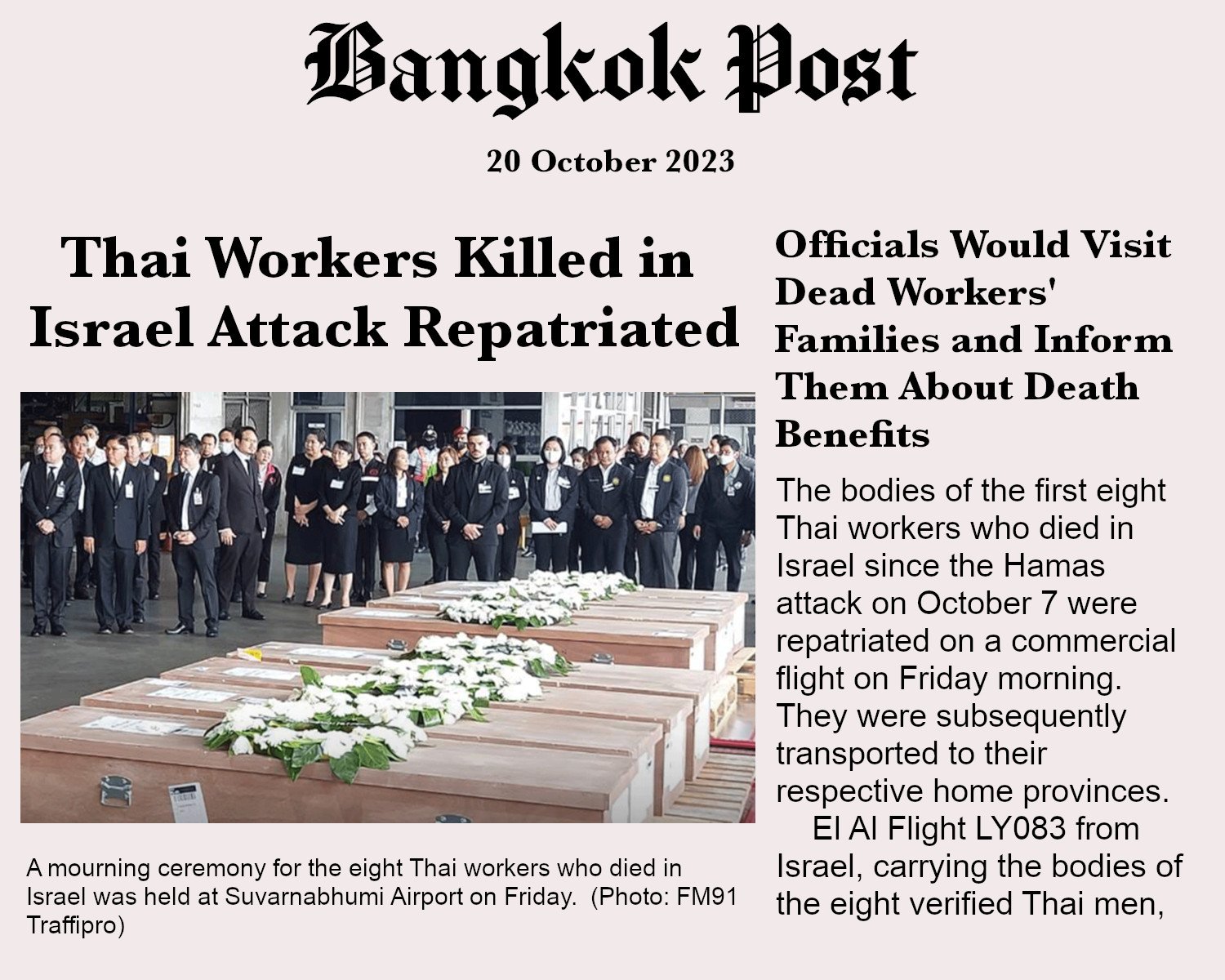
Young Thai migrant workers were killed or held hostage by Hamas in Israel on October 7, 2023. They knew nothing of the Hamas hatred for Jews. They were simply poor.
Young Thai migrant workers were killed or held hostage by Hamas in Israel on October 7, 2023. They knew nothing of the Hamas hatred for Jews. They were simply poor.
December 6, 2023 by Fr Gordon MacRae
[January 30, 2025: Important message from Fr MacRae:
A ceasefire between Israel and the terrorist group Hamas has resulted in the promise of release of additional hostages held by terrorists. Hamas has pledged to release five young Thai hostages who were agricultural workers in Israel when Hamas attacked in 2023. Most were murdered. Many were raped and murdered. And some were taken as hostages. There are eight remaining Thai hostages held by Hamas. Two are already dead. Five will be released in the coming days, and there is no information on the last one. The world should not forget the truth of what happened on October 7, 2023.]
+ + +
The small Thai city of Udon Thani near Thailand’s northern border with Laos is no stranger to being caught up in the shrapnel of someone else’s war. It is the home of a man we have come to know, a Catholic priest whose life and priesthood were shaped and shifted by the American war in Vietnam. Our readers became acquainted with him, and with Udon Thani, in a post published here on November 30, 2022: “For Fr. John Tabor, the Path to Priesthood Was War.”
So it caught my attention when the name of a young Thai migrant worker from Udon Thani appeared on a list of Thai citizens who found temporary field work in Israel to support their families back home only to be caught up in the winds of someone else’s war. Many young Thai men were murdered or became hostages in the barbaric Hamas slaughter of Israelis and anyone else in their path at the Israel-Gaza border on October 7, 2023. This story has been buried under the larger political issues.
The Thai economy, with tourism as its principal industry, suffered greatly over the course of the global pandemic of 2019 through 2022. Reopening and rebuilding the Thai economy has made much progress, but it has been slow. I have firsthand knowledge of the burden this creates for young Thai citizens trying to support themselves and their families. Our friend Pornchai Moontri was repatriated to Thailand in 2021 after a 36 year absence. With no employment history in Thailand, he now competes without tools with thousands of others for gainful employment.
While hoping that the gradually reopening Thai turism industry will provide more opportunities, Pornchai applied for and received a Thai passport. It took one year. In 2023, he could have easily been lured by the offshore prospects for work in Israel. He was, after all, alone with no family to support or support him. I urged him not to do so, but to stay the course to adjust to his native land while I and some friends tried to raise basic sustenance for him which amounts to only a few hundred US dollars per month. I wrote of this in “For This Prodigal Son, Homecoming Is a Work In Progress.”
Pornchai’s unique situation does not reflect that of others in Thailand struggling to support their families. Mitchai Sarabon, age 32, is the field worker from Udon Thani I mentioned above. He traveled this year with dozens of other young Thai citizens for migrant work at a southern Israel kibbutz. A kibbutz is a sort of cooperative community in Israel. It comes from the Hebrew term, gibbes, meaning, “to gather.”
Kibbutz members contribute by working according to their capacity. In return they receive food, communal housing, and other needs along with a chance to earn money to support their families back in Thailand. The Thai workers earn five times what they could earn in the struggling post-Covid Thai economy. Other kibbutz migrant worker communities include workers from the Philippines and Nepal.
These foreign field hands largely replace Palestinian workers. In 1987, after a series of militant strikes, demonstrations and riots known as the “Intifada,” many Palestinians in the West Bank and Gaza Strip were prevented from taking up work in Israel. The Intifada movement of violence against Israel began in the Gaza Strip. It was distinguished from earlier movements by the extent of popular participation from Palestinians, by its long duration, and by the part played by Islamic agitators.
The Intifada was comprised of multiple groups who, in the beginning, advocated for the creation of an Islamic state that included all of historic Israeli territory. However, in 1988 one of the groups, the Palestine Liberation Organization (PLO) changed its policy. It now supported a Palestinian state coexisting with Israel. As the Intifada continued, popular participation decreased, violence increased, and the other Islamic groups grew in strength. The Intifada was a factor leading to the 1993 and 1995 agreements between the PLO and Israel, establishing Palestinian control over the Gaza Strip and portions of the West Bank.

Photo from NBC News
October 7, 2023
Some Palestinians continued to work in Israel while Thai migrant workers had seasonal field work there for years after a 2012 bilateral economic treaty between Israel and Thailand. Slow recovery from the 2019 Covid pandemic greatly increased the number of young Thai citizens available for migrant agricultural work in Israel. At the time of the brutal Hamas assault, some 30,000 Thais were doing seasonal work in Israel.
On Saturday, October 7, 2023, some of the Nepalese workers from a nearby kibbutz came to join the Thais who were spending that Saturday doing chores and playing music. It was Mitchai Sarabon, aged 32, a Thai migrant worker who formerly served in the Thai military who first noticed that something was very wrong. He later described the terror that set upon them. The fact that he is alive today to tell this tale seems miraculous:
“We became used to rockets flying overhead from Gaza. Then suddenly I heard gunshots and the gunshots came closer. One of our Nepalese friends was shot. Others ran to take cover in a bomb shelter. Then the terrorists arrived in large numbers. They all threw grenades and then shot people trying to run away.”
The Hamas terrorists then walked around the compound shooting and killing the wounded. Mitchai Sarabon and five others managed to take shelter in a kitchen in one of the kibbutz structures where they hid. Sarabon reports having the impression that he and the others were intentional targets. “The Hamas appeared to know exactly where they were going and who they were targeting,” said Sarabon. As they took shelter behind a closed and blockated door, the Hamas terrorists were shouting, “Open the door!” They were shouting this in Thai.
Once the door was broken down, the Hamas raiders shot everyone inside. Sarabon was shot in the back and in the chest. Ten Nepalese were also shot and killed while four others were wounded. One was taken as a hostage. Sarabon was shot a third time, this time in the head. He lost consciousness and this is likely what ultimately saved him. The Hamas terrorists thought he was already dead. It is a miracle that Sarabon survived these wounds. His injuries were critical and he may never fully recover. He told this account from a hospital bed, and all of it has been confirmed by others.
The Wall Street Journal report recounted that one Thai worker heroically raced to pick up an unexploded grenade and throw it away from his friends before it detonated. Another WSJ report, “Hamas Puts Its Pogrom on Video,” (October 28, 2023) recounted a snapshot of the barbarism of that day from a screening for journalists of a video of the Hamas invasion reviewed at the New York Israeli Consulate. This video then seems to have been suppressed by some mainstream media. Here is an excerpt of the WSJ report:
“Why did the Hamas men, upon confronting the dead body of a teenage girl start cheering? Why did they argue over who would get to decapitate a Thai guest worker they had shot, then proclaim ‘Allahu akbar,’ ‘God is most great’ with every swing at his neck? ‘Allahu akbar’ was on their lips over and over as they shot defenseless civilians, dragged corpses, and pumped round after round into the dead. There it was again on the terrorists’ return to Gaza, ‘Allahu akbar’ coming from crowds as a Hamas man pulled by the hair a battered hostage with pants bloodied around her groin … . During the music-festival massacre, a terrorist paused to put a bullet through each of the porta-potties lest a single girl escape.”
I am sorry you had to read the above WSJ excerpt, but the parts I left out are only more hideous and barbaric. ‘Allahu akbar!’ God IS great, but this is not God. This is the work of evil spinning up from the dark hearts of men who have over eons of inherited hatred, let their politics take the place of God.
Mitchai Sarabon, an exceptionally brave and resilient young Thai man, told an interviewer from his hospital bed, “I want the people of Israel to know that they are in my thoughts and prayers all the time.”
The Thai ambassador to Israel said that Thai workers were the second largest group next to Israelis to be killed, wounded, or taken hostage on October 7. Eric Parens, an attorney with a focus on US-Thai legal matters, said at a recent protest in a media interview at United Nations Headquarters:
“The United Nations, world governments, and international protestors have willfully ignored the targeted killing, abduction and torture of hundreds of Thai civilian nationals who had been working along side both Israelis and Palestinians by Hamas on October 7.”
The glaring irony in this tragic story is that none of these Thai, Nepalese or Philippino victims new anything about the political fractures for which organized terror groups today declared themselves to be the world’s victims, the excuse they use to maim, kill, rape and pillage the innocent.
As I write this, news and firsthand accounts are emerging about the vicious sexual assaults committed by Hamas against Israeli women even as they were being killed and taken hostage. It was unspeakable, a term employed today by members of the so-called Squad, a progressive wing of the US Congress who have minimized, obfuscated, and denied this aspect of the terror.
The scenes of pro-Palestinian protests in universities across the Western world say more about the state of Western education than the State of Israel.

Israeli army Southern Command General Ariel Sharon with Defense Minister Moshe Dayan during the Yom Kippur War in October 1973 on the western bank of the Suez Canal in Egypt.
War and Remembrance
The Jewish Commonwealth of Israel dates back 3,000 years to the time of King David. One thousand years later, Jewish sovereignty was disrupted with the Roman Empire’s occupation of Palestine and its destruction of the Jerusalem Temple in 70 A.D. I wrote of how forces in the Middle East previously sent Israel into exile as a divided kingdom, and of how its capital and nation were restored in “The Hamas Assault on Israel and the Emperor Who Knew Not God.” In November, 1947, following the Holocaust, the United Nations member states voted in General Assembly to partition British Mandated Palestine into a Jewish State and an Arab State. This was in part an acknowledgment of the historic homeland of the Jews and the fact that world politics had come to deprive them of a safe place to live. Jews accepted the two-state plan but Arabs did not. In May, 1948, Israel proclaimed its independence and its right to exist. One day later, Israel was attacked by a coalition of Arab states in the first Israeli-Arab War. The much smaller army of Israel put down the Arab assault.
In September 1967, in Khartoum, Sudan, the Arab League adopted a mandate of “Three No’s” — No Negotiations, No Recognition, and No Peace with Israel.
On October 6, 1973 on the Jewish High Holy Day of Yom Kippur, the Day of Atonement, the Arab nations led by Egypt and Syria launched a surprise attack on Israel. Though there were heavy casualties on both sides, Israel again prevailed. It is important to note, for much of the world has failed to do so, that the terrorist attack by Hamas on October 7, 2023, occurred on the day after the 50th anniversary of the Yom Kippur attack on Israel in 1973.
In December 1987, six years after the Yom Kippur attack, Hamas was formed to establish an Intifada — an Arabic term meaning a “throwing off,” as when a dog throws off its fleas. It was the designation of a manifest destiny defined by Hamas as a right and duty to destroy Israel. Hamas is actually an acronym for the Arabic, “Harakat al-Muqawama al-Islamiyya,” or “Islamic Resistance Movement.” It is designated as a terrorist organization by the United States and most western nations.

Thai Prime Minister Sretta Thavisin
Citizens of the Kingdom of Thailand
As traumatized hostages were released by Hamas a few at a time, the entire civilized world became its hostage. Those few released at first, including children and the elderly, reported spending 50 days in near total underground darkness with no showers and scant food in an information blackout. To its great credit, the Kingdom of Thailand launched immediately into what The Wall Street Journal proudly called “a high-gear crash course in hostage recovery and Middle East conflict politics.” A December 2, 2023 article, “How Thais Scrambled to Free Hostages” by Joe Parkinson and Drew Hinshaw tells a riveting tale of the Thai government’s relentless and heroic efforts to rescue its captive citizens. Here is an excerpt:
“Thai Prime Minister Sretta Thavisin began shuttling between countries that he hoped could reach Hamas, starting with Malaysia, his Muslim-majority neighbor, which hosts a Palestinian embassy and doesn’t recognize Israel. On October 20 he met with Saudi Crown Prince Mohammed Bin Salman at the Ritz Carlton in Riyadh. The Crown Prince said he would ‘do his utmost.’”
This was followed by a multitude of Thai entreaties to Hamas through every possible channel. The Thai former Minister of Education flew to Iran. Detachments were flown to the Thai Embassy in Tel Aviv to support efforts to house thousands of Thais searching for a safe haven in the now declared Israeli-Hamas war zone. Hamas did not even seem to know which Thais were still alive and held hostage. In four cases, families in Thailand were mourning news of the deaths of their sons, fathers, brothers, husbands only to later learn that they survived. At this writing, most but not all of the Thai hostages have been freed or accounted for. One victim of that terrible day, Mitchai Sarabon, who was left for dead but never taken captive remained in a hospital for over a month until he was well enough to be flown home to his family in Udon Thani, Thailand.
The question for the rest of the world now seems crystal clear. If Israel is sacrificed to appease terrorists, who will they come for next?
✡ ✡ ✡
Note from Fr Gordon MacRae: Thank you for reading this important post. It was long ago said to me by a Sacred Scripture professor that “Salvation comes from the Jews.” I have long pondered that, and it continues to inform me.
You may also like these related posts:
On Good Authority, “Salvation Is from the Jews”
The Hamas Assault on Israel and the Emperor Who Knew Not God
The Passion of the Christ in an Age of Outrage
Advent of the Mother of God
(Never underestimate the power of a Jewish Mom!)

Mitchai Sarabon recovering at a Tel Aviv hospital. Photo courtesy Mitchai Sarabon.
The Eucharistic Adoration Chapel established by Saint Maximilian Kolbe was inaugurated at the outbreak of World War II. It was restored as a Chapel of Adoration in September, 2018, the commemoration of the date that the war began. It is now part of the World Center of Prayer for Peace. The live internet feed of the Adoration Chapel at Niepokalanow — sponsored by EWTN — was established just a few weeks before we discovered it and began to include in at Beyond These Stone Walls. Click “Watch on YouTube” in the lower left corner to see how many people around the world are present there with you. The number appears below the symbol for EWTN.
Click or tap here to proceed to the Adoration Chapel.
The following is a translation from the Polish in the image above: “Eighth Star in the Crown of Mary Queen of Peace” “Chapel of Perpetual Adoration of the Blessed Sacrament at Niepokalanow. World Center of Prayer for Peace.” “On September 1, 2018, the World Center of Prayer for Peace in Niepokalanow was opened. It would be difficult to find a more expressive reference to the need for constant prayer for peace than the anniversary of the outbreak of World War II.”
For the Catholic theology behind this image, visit my post, “The Ark of the Covenant and the Mother of God.”

I Know Why the Caged Bird Sings Some Older Songs
The Covid pandemic nearly ended this blog by a priest in prison. From under its wreckage came something new, but catching up and keeping up is a steep uphill climb.

The Covid pandemic nearly ended this blog by a priest in prison. From under its wreckage came something new, but catching up and keeping up is a steep uphill climb.
November 29, 2023 by Fr Gordon MacRae
I will always be grateful to the Catholic League for Religious and Civil Rights for seeing past the myths and agendas about the sexual abuse crisis in the Church. They got to the truth, and boldly exposed it in Bill Donohue’s recent book, The Truth about Clergy Sexual Abuse. If you are not a member of the Catholic League, please consider joining. It has done much to support the religious liberty of Catholics and has defended the reputations of Catholic priests falsely accused, including mine.
Most of our readers know that this blog began in the summer of 2009 as These Stone Walls. I had been invited by Bill Donohue to submit an article for the monthly Catholic League journal, Catalyst. My first published piece from prison was rather bluntly but truthfully titled, “Sex Abuse and Signs of Fraud.”
It was published in November 2005 just six months after Dorothy Rabinowitz and The Wall Street Journal published a major two-part exposé about the fraudulent case against me. Together, these articles caused a bit of an uproar with denunciations coming from the activist group, SNAP, the Survivors Network of those Abused by Priests. It was out of fear of the relentless public condemnation of accused priests that our due process rights severely eroded while most in the Church maintained a self-preserving silent distance. That tide changed just a little when the Catholic League published “SNAP Exposed.” After terrorizing priests and bishops for two decades, SNAP president David Clohessy resigned after exposure in a kickback scheme.
Besides Bill Donohue, some other high profile Catholics — though they were few — also took courageous positions in spite of ridicule. Cardinal Avery Dulles sent words of encouragement, the first I had ever heard in prison from any prelate or priest: “Your article is an important one, and hopefully will be followed by many others. Your writing, which is clear, eloquent, and spiritually sound, will be a monument to your trials.”
However, one Catholic blogger took umbrage with that. He need not be named now, but he published a mean-spirited criticism of Cardinal Dulles, chastising him for reaching out (technically, reaching “in”) to a convicted priest in prison. When it was read in Australia, a writer there urged me to allow her to start a blog in my name. At about the same time, Father Richard John Neuhaus published an influential editorial about my trial in First Things magazine entitled, “A Kafkaesque Tale.”
One month later in 2008, Cardinal Dulles asked in a letter to me in prison that I consider “adding a new chapter to the volume of Christian writing from those unjustly in prison.” He asked that I add to the voices of some who had already become my spiritual heroes: St. Maximilian Kolbe, Fr Walter Ciszek, Fr Alfred Delp, and Dietrich Bonhoeffer. If Cardinal Dulles were to make this request today, he would surely add Cardinal George Pell. All had inspired me. All had become a part of my life in prison.
Then Cardinal Dulles died on December 12, 2008, the Feast day of Our Lady of Guadalupe. His good friend, Father Richard John Neuhaus, who joined him in eternal life just three weeks later, eulogized him in First Things: “We thank God for love’s fire that burned to the end, and we pray that the truth to which he bore tireless witness, is now opened to him in the fullness of the Beatific Vision for which he longed with nothing less than everything.”
Thus These Stone Walls was born in 2009. It was my friend, Pornchai Moontri who suggested its name from a 17th Century poem, “To Althea from Prison,” by Richard Lovelace:
Stone walls do not a prison make,
Nor iron bars a cage;
Minds innocent and quiet take
That for an hermitage;
If I have freedom in my love,
And in my soul am free,
Angels alone that soar above
Enjoy such liberty.
This blog began in conflict but it also began in friendship. What started off as a negative slur against me and Cardinal Dulles turned into something life-changing, for both me and others. I recently recalled this story with my friend, Pornchai Moontri, who is now free in Thailand, but struggling to reclaim the life that was long ago taken from him. On September 23, to mark the start of my 30th year unjustly in prison, Pornchai wrote a deeply moving post about what happened to both of us and what this blog has accomplished in our lives. It made me cry. It also many of our readers cry, but not all tears are tears of sorrow. Pornchai’s post was, “On the Day of Padre Pio, My Best Friend Was Stigmatized.”

Some Older Songs Must Now Be Sung Anew
My apologies and thanks to the great Marguerite Johnson for lending me a title for this post from I Know Why the Caged Bird Sings, her acclaimed 1970 autobiography. Born in St. Louis, Missouri in 1928, Marguerite began writing under the pen name, Maya Angelou at age 25 in 1953, the year I was born. She went on to become a celebrated American poet, novelist, screenplay writer, actress, film director, and an icon of the American Civil Rights movement. Her writing began in trauma, as did mine, and her trauma was followed by seven years of silence. During those seven years, Maya Angelou did not speak at all.
Some of our readers have seen the graphic atop this post before. As the Covid pandemic engulfed the world in 2020, writing from my present location became difficult to the point at which I was almost effectively silenced. Then, after publishing over 500 posts, These Stone Walls, our earlier version of this blog, collapsed entirely in October of 2020 as Covid shutdowns swept the world, and swept away my ability to write and publish from prison.
At the same time my writing from prison was collapsing, my friend Pornchai Moontri was spending five horrible months awaiting deportation in ICE detention packed 70 to a room during the worst of the Covid pandemic. I wrote of what happened in our first post for the newer version of this blog which we renamed, Beyond These Stone Walls. Posted on November II, 2020, I described the loss of our earlier blog in “Life Goes On Behind and Beyond These Stone Walls.”
Then this caged bird began to sing again — and without that awful mask! Now here we are, three years later, and we are running into a problem for which I need your help and patience. When These Stone Walls collapsed in 2020, we left behind more than 500 past posts that now exist in a sort of archival limbo uploaded to a computer in New York. They need to be restored one by one and then reformatted to fit the host venue at Beyond These Stone Walls. This is a time-consuming process and, as you know, I can do none of it myself. I have no access to a computer or the internet and have never actually even seen this blog.
Longtime readers may have noticed that some posts in the last month or two seem vaguely familiar. Some — especially posts about Sacred Scripture which readers seem to appreciate — follow the Church’s three-year liturgical cycle for Mass readings. For special feasts and observances, I have been asking our editor to retrieve a past post to restore and update it for posting anew. Sometimes these posts are updated to the point at which they are entirely new. Occasionally, readers note that a post seems to have been “recycled.”
Our volunteer editor spends many days preparing my new posts for publication by embedding links and choosing graphics — sometimes even creating new and inspiring graphics from scratch. It would not be possible for her to format and publish new posts while also trying to restore more than 500 older posts one by one. I resolve part of the problem by occasionally restoring a relevant older post and then posting it anew. But they are not simply “reruns.” These restored posts go through a lot of re-editing with new and updated content.
Over the last year or so, many readers have asked me to consider editing our past posts into a book format for a published journal similar to the three-volume Prison Journal of George Cardinal Pell. I don’t think I have written anything worthy of such a project, but the bigger problem is that nearly everything I have written over the I4-year life of this blog has been for an electronic format. It would be a massive effort for even an experienced editor to accomplish the task of converting over 500 blog posts for publishing in a book. I cannot even see my own blog and have no access to past posts beyond what is in my own mind, so I could accomplish none of this myself.

God Alone Knows What the Future Holds
Two years ago, I thought that any hope for justice in my life was a ship that had long since sailed. You may have read of our experience with New Hampshire judges who have simply declined to review any new evidence or witnesses in this matter. Ryan MacDonald wrote of this in “A Grievous Error in Judge Joseph Laplante’s Court.”
Then at the beginning of 2022 Ryan MacDonald also wrote of a new development in, “Police Misconduct: A Crusader Cop Destroys a Catholic Priest.” Along with that came a new hope for justice, but it is justice against the tide and there are many people with nefarious agendas committed to preventing it.
However, I have declined to allow any fundraising toward this end. Many of our readers contributed generously to an appeal effort several years ago only to have it dashed in the end by New Hampshire judges who declined to hold hearings in the matter. We described how and why this was so in “Why This Falsely Accused Priest Is Still in Prison.” In the arena of justice, little has changed since then except perhaps in the court of public opinion.
I also know that all of our readers endured the same financial burdens I did during the long pandemic shutdown worldwide. Other countries have suffered much more than America did. In recent days, I have learned that some 24 young men from Thailand — who sought migrant labor in Israel to support their families — are now held captive by Hamas terrorists in tunnels under Palestine. As I write this, 10 have been released back to the Thai government after spending six weeks in hellish captivity underground. Many more of these young workers from Thailand were slaughtered by Hamas terrorists on October 7. I plan to write more about this soon. These innocent bystanders had nothing to do with the issues behind their captivity. They are captives of terrorists now only because they are poor.
But I cannot now shun all fundraising without also silencing my own voice. Toward the end of each year, fees for our platform and domain come due along with fees from a few services that help in the management of this site. Along with those costs, I must also, at this time, order Mass supplies and typing ribbons for the coming year. And I have to eat and replace some tattered clothing. Prisoners must also provide a co-pay for medical services. And, as many of you know I sacrifice to continue assistance to my friend, Pornchai, who could have easily been among those who were killed or in captivity in Gaza as they sought migrant work to support themselves and their loved ones.
So in the month before Christmas each year, I count on our readers for help, if able. Please visit our “Contact and Support” page for how. Thank you for considering this.
I was a Beatles fan as a youth in the 1960s. They were radical then but now they are just “old school.” Several years after the 2001 death of George Harrison, a group of musicians from that era led by Paul McCartney and Ringo Starr appeared in a tribute to George Harrison on PBS. It featured many of the songs Harrison wrote for the Beatles and others. One of them was the haunting ode, “All Things Must Pass.”
The song depressed me at first, but now it inspires me. What kind of world would this be if none of us ever left it behind? This humble blog must also one day pass. I am not Jesus so my words will all one day pass away. But in the meantime, there is Truth to be told for as long as I have a voice and a forum to tell it. Unlike most Catholic blogs, this one comes to you in spite of many hurdles.
There are hopeful signs still, including a resurgence of interest in the matter of justice. And as for this Voice in the Wilderness, there is new interest there as well. The popular Catholic site, GloriaTV established a page to present some of my posts which has increased traffic to BTSW substantially.
However, no one brought more timely meaning and light to these pages than the late Cardinal George Pell of Australia. A white martyr for the cause of truth and justice, his voice seems louder and clearer now than ever. It was most recently heard in my post, “Pell Contra Mundum: Cardinal Truth on the Synod”
+ + +
Note from Father Gordon MacRae: If you have not already done so, please share my recent post, “Pell Contra Mundum: Cardinal Truth on the Synod” which also addresses the recent plight of Bishop Joseph Strickland which has roiled the entire Church.

The late Cardinal Avery Dulles and Father Richard John Neuhaus, who passed from this life just three weeks apart, and just as this blog which they spawned was beginning.
The Eucharistic Adoration Chapel established by Saint Maximilian Kolbe was inaugurated at the outbreak of World War II. It was restored as a Chapel of Adoration in September, 2018, the commemoration of the date that the war began. It is now part of the World Center of Prayer for Peace. The live internet feed of the Adoration Chapel at Niepokalanow — sponsored by EWTN — was established just a few weeks before we discovered it and began to include in at Beyond These Stone Walls. Click “Watch on YouTube” in the lower left corner to see how many people around the world are present there with you. The number appears below the symbol for EWTN.
Click or tap here to proceed to the Adoration Chapel.
The following is a translation from the Polish in the image above: “Eighth Star in the Crown of Mary Queen of Peace” “Chapel of Perpetual Adoration of the Blessed Sacrament at Niepokalanow. World Center of Prayer for Peace.” “On September 1, 2018, the World Center of Prayer for Peace in Niepokalanow was opened. It would be difficult to find a more expressive reference to the need for constant prayer for peace than the anniversary of the outbreak of World War II.”
For the Catholic theology behind this image, visit my post, “The Ark of the Covenant and the Mother of God.”

A Not-So-Subtle Wake-Up Call from Christ the King
The Gospel for the Solemnity of Christ the King is the Judgment of the Nations, an invitation to Glory and a road map on how to get there.

The Gospel for the Solemnity of Christ the King in 2023 was the Judgment of the Nations, an invitation to Glory and a map for how to get there.
November 18, 2020 by Fr. Gordon MacRae
“I consider that the sufferings of this present time are not worth comparing with the glory that is to be revealed to us.”
— Saint Paul, Romans 8:18
The image atop this post is one that we used at the end of my post, “The God of the Living and the Life of the Dead.” It was written for All Souls Day which just happened to fall in 2020 just days before the most contentious and bitterly divided U.S. election in decades. Its echoes of civil unrest reverberated out of America to circle the globe. So we are using the image again and reposting the link because in the heat of battle a lot of readers missed that post.
The image is a powerful one of Christ leading prisoners through the gates of Dachau — or is it Purgatory? It is a hopeful image, and one that reflects the Mind of God as revealed by the Prophet Ezekiel at Mass on the Solemnity of Christ the King:
“As a shepherd tends his flock when he finds himself among his scattered sheep, so will I tend my sheep. I will rescue them from every place where they were scattered when it was cloudy and dark... The lost I will seek out; The strayed I will recover; The injured I will bind up; The sick I will heal.”
— Ezekiel 34:15-17
That describes the Mission of the Church as well, or at least what it should be. I recently received a message from a lawyer who asked if I would be willing to talk with a young priest who has had a catastrophic and very public failure. His bishop’s only public comments were that the priest will be expelled from ministry and will never function as a priest again. The lawyer wants to find spiritual and psychological treatment for him. I am still stricken by this confusion of roles and expectations. The lawyer calls for healing while the shepherd calls only for vengeance.
There is a lot in the readings for Christ the King that should give us pause about our own roles and expectations — not our expectations of faith, but rather faith’s expectations of us.
The Gospel for Christ the King is from Matthew 25:31-46, a passage referred to as the “Judgement of the Nations.” It ends with a familiar condemnation, not of what some of us did in life, but of what we didn’t do:
“I was hungry and you gave me no food; I was thirsty and you gave me no drink; I was a stranger and you did not welcome me, naked and you did not clothe me; sick and in prison and you did not come to me... Truly I say to you, as you did it not to one of the least of these, you did it not to me.”
— Matthew 25:42-46
It is interesting that in the Gospel of Saint Matthew, the plot of the Pharisees and High Priest to kill Jesus unfolds just after the above passage. There are certain things that human nature is loathe to hear, and one of them is to have our hypocrisy mirrored and laid bare. I am no exception. Welcoming the stranger and the alienated requires the strength of will to resist some potent peer pressure.
Some years ago, at about the time I first began writing posts for publication from prison, a man was moved into the housing unit where I lived. He was horribly disfigured and everyone just avoided him. He was living out in the open in an overflow bunk with no place to retreat from the scowls and stares of other prisoners. I was disgusted by the way he was shunned.
And then I awoke in the middle of the night disgusted with myself. While passing judgment on the avoidance and shunning of the crowd I was oblivious to my own. This is called spiritual blindness, among the most self-righteous of our sins. So after a sleepless night I went to him, pulled a chair up to his bunk as he sat alone, and talked for awhile. After some days, he trusted me enough to tell me that his disfigurement was the result of a suicide attempt. My heart went out to this broken man, and we remained friends for the entire time he was in prison.

There but for the Grace of God
The fact that my own life had once spiraled into what the Prophet Ezekiel described above as a place “cloudy and dark,” became in that instance a tool for aiding that man. I wrote of my own venture into cloudy and dark in “How Father Benedict Groeschel Entered My Darkest Night.” Had I never experienced such darkness, I could not have imagined what my friend was enduring.
The image atop this segment of this post is one we have used before, but it is a perfect image for the Solemnity of Christ the King. “When I was in prison you came to me” is perhaps one of the Gospel’s most daunting challenges. The image depicts a priest hearing a confession through the food slot of a door in a supermax prison in solitary confinement. I like to think that this brave priest ministering to the darkness is someone who has come to terms with a hard truth. “If my life had veered even slightly from the path I was on, that could just as easily be me living behind that door. There but for the grace of God go I.”
Coming to terms with such a truth strips away all pretense of moral or spiritual superiority. As you know, my good friend, Pornchai spent many years behind such a door before he ended up here with me. It took some time for the demons he encountered to leave him, but they eventually did. He once described his coming to faith as the result of a long, slow exorcism. Now, as described here a week ago in “Life Goes On Behind and Beyond These Stone Walls,” his prison sentence is fully served. But he is not at all free. He now approaches ten weeks in ICE detention which his keepers keep reminding him is not a prison.
In reality, he says it is the worst prison he has ever been in. Packed forty to eighty in a room, he is surrounded by mostly young men awaiting forced, but horribly slow, deportation. If solitary confinement is the cruelest thing we do in America, ICE detention comes a close second. His travel documents that were valid for 90 days when they were issued by his Embassy three months ago have been negligently allowed to expire by indifferent ICE handlers.
He is fortunately able to reach out to me through some of those who help to publish these posts. The for-profit ICE detention center sells food to detainees at highly inflated prices and allows telephone calls at the rate of eleven cents per minute. What we all thought would be a two-week stay there has turned into ten, and I have had to sacrifice to get funds to him each week for food and phone calls, both of which are a necessity to ward off total discouragement.
The disappointment and discouragement in his voice when he calls are painful to hear. But in the midst of such suffering, Pornchai has done something remarkable. He has fulfilled the Gospel for Christ the King. There are a few young men around him who have been stranded there with nothing for many months with no funds, no food, and no way to call anyone. Their families impoverished in Honduras do not even know where they are and they have no way to reach out to them. I felt embarrassed when Pornchai asked me if it is okay for him to share his food with them.
Then he made a list of their names, ICE detention numbers, and countries of origin for our helpers to call their Consulate and begin the process of obtaining travel documents for them to move on. The irony is that, thanks to him, they have all left before him. This week he told me that he has a new friend, age 22, who speaks no English and has been stranded there for six months. They pray together and Pornchai shares his food with him. I asked how they communicate and Pornchai said, “by food and prayers.” The young man’s name — this floored me — is Maximilian.
“Come you who are blessed by My Father, inherit the Kingdom prepared for you from the foundation of the world. For I was hungry and you gave me food, I was thirsty and you gave me drink, a stranger and you welcomed me, naked and you clothed me, ill and you cared for me, in prison and you came to me.”
— Matthew 25:34-36

In a World Cloudy and Dark
One night some months ago while Pornchai was still in this cell with me, I stumbled upon EWTN in the middle of a talk by our friend, Father Michael Gaitley, MIC. I told Pornchai to leave his football game and turn his little TV to EWTN. At the moment he did so, he saw himself on the screen. Father Gaitley had put up a photograph of Pornchai and me reciting our Consecration to Jesus through Mary in the prison chapel on the Solemnity of Christ the King in 2013.
That seems so very long ago now. We had just completed Father Gaitley’s “33 Days to Morning Glory” retreat, and we felt as though we had just discovered a bright light in what was a very dark time for us. Marian Helper magazine published this account back then in “Mary Is at Work Here,” (Marian Helper, Spring 2014). The author, Felix Carroll, paid a special tribute to Pornchai:
“The Marians believe Mary chose this particular group of inmates to be the first. That reason eventually was revealed. It turns out that one of the participating inmates was Pornchai Moontri who was featured in last year’s Marian Press title, Loved, Lost, Found: 17 Divine Mercy Conversions... Fr. Gordon MacRae joined Pornchai in the consecration and called it a ‘great spiritual gift that opened a door to the rebirth of trust’ at a particularly dark time for both men.”

Inmates Pornchai Moontri (second from left) and Fr. Gordon MacRae (third from left) make their consecration to Jesus through Mary on Nov. 24 in New Hampshire State Prison for Men. They pray to become instruments in Mary's "immaculate and merciful hands for bringing the greatest possible glory to God."
Now for so many, Pornchai and I included, this seems like an even cloudier and darker time with tension and uncertainty part of our daily experience. I plan to read the above excerpt from Marian Helper to Pornchai when we speak on the night I am typing this. In the bleak setting in which he now finds himself, this reminder of the ray of light that beckoned to us is much needed.
The callousness of ICE handlers notwithstanding, the real culprit in all these delays extending Pornchai’s imprisonment has been the global pandemic. Thailand has closed its borders to all international travel and presently allows only repatriation flights for its own citizens to return to their country. Pornchai seems to be far down the list, but he must not forget who his Mother is.
Many people are hurting and anxious over the times that we are in and the perils that lie before us. Trust seems to have gone out of our world, and the reign of Christ the King feels for many like a vague notion of the past. It is not. The task before us is to look into the present darkness to reach out to souls worse off than ourselves. I am humbled by how much Pornchai just spontaneously does this in a place that offers little beyond anxiety and hopelessness.
Gospel for the Solemnity of Christ the King, don’t ask yourself how you could possibly be expected to go visit the imprisoned. If you read this far, you already have. Now open your heart to do the rest, and inherit the Kingdom prepared for you from the foundation of the world.

Editor’s Note: On April 29, 1995 — the fiftieth anniversary of the liberation of Dachau — the Russian Orthodox Memorial Chapel of Dachau was consecrated. Dedicated to the Resurrection of Christ, the chapel holds an icon depicting angels opening the gates of the concentration camp and Christ Himself leading the prisoners to freedom.
Dachau 1945: The Souls of All Are Aflame
Note from Fr. Gordon MacRae: Please visit our Special Events Page for information on how you can help us behind and Beyond These Stone Walls. Thank you and God Bless you.


The Eucharistic Adoration Chapel established by Saint Maximilian Kolbe was inaugurated at the outbreak of World War II. It was restored as a Chapel of Adoration in September, 2018, the commemoration of the date that the war began. It is now part of the World Center of Prayer for Peace. The live internet feed of the Adoration Chapel at Niepokalanow — sponsored by EWTN — was established just a few weeks before we discovered it and began to include in at Beyond These Stone Walls. Click “Watch on YouTube” in the lower left corner to see how many people around the world are present there with you. The number appears below the symbol for EWTN.
Click or tap here to proceed to the Adoration Chapel.
The following is a translation from the Polish in the image above: “Eighth Star in the Crown of Mary Queen of Peace” “Chapel of Perpetual Adoration of the Blessed Sacrament at Niepokalanow. World Center of Prayer for Peace.” “On September 1, 2018, the World Center of Prayer for Peace in Niepokalanow was opened. It would be difficult to find a more expressive reference to the need for constant prayer for peace than the anniversary of the outbreak of World War II.”
For the Catholic theology behind this image, visit my post, “The Ark of the Covenant and the Mother of God.”
You may also like these related posts:
The God of the Living and the Life of the Dead

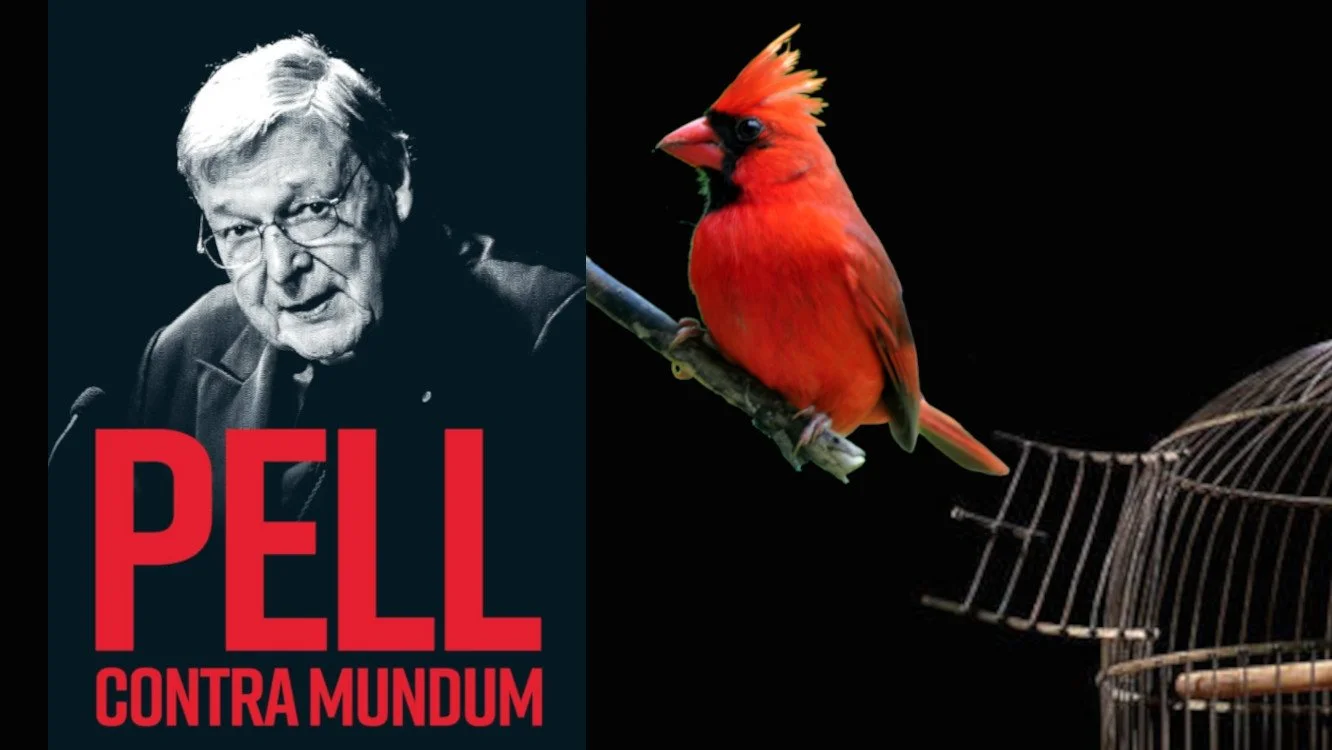
Pell Contra Mundum: Cardinal Truth on the Synod
In Pell Contra Mundum, Fr. Robert A. Sirico profiles the late Cardinal George Pell including some incisive reflections on the Synod he called ‘a toxic nightmare.’
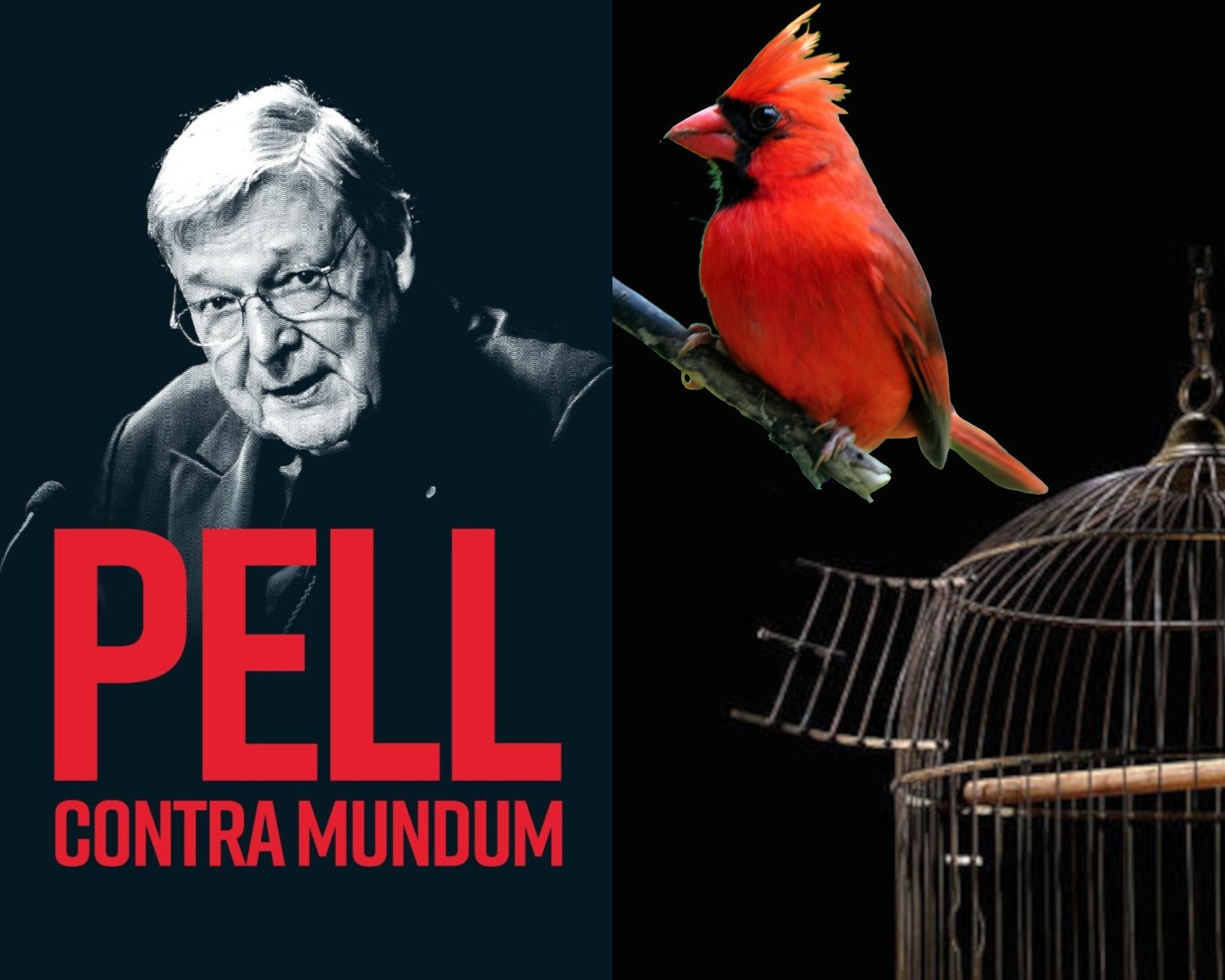
Book cover image courtesy of Connor Court Publishing; Red cardinal photo by RachidH (CC BY-NC 2.0 DEED)
In Pell Contra Mundum, Fr. Robert A. Sirico profiles the late Cardinal George Pell including some incisive reflections on the Synod he called ‘a toxic nightmare.’
November 15, 2023 by Fr Gordon MacRae
“This prison journal should never have been written. That it was written is a testament to the capacity of God’s grace to inspire insight, magnanimity, and goodness amidst wickedness, evil, and injustice. That it was written so beautifully bears witness to the Christian character that divine grace formed in its author.”
Such words could never describe anything that I have ever written or will write from within my impenetrable prison walls. The above quote is from George Weigel’s Introduction to the Prison Journal of George Cardinal Pell (Ignatius Press, 2020). As I undertook my own prison journal — writing one post at a time, week after week, half a world away from the prison Cardinal Pell innocently and gracefully endured — I had no idea that my own prison writing would have a presence in his.
I learned of it only after Cardinal Pell finally saw justice and became free after 400 days in solitary confinement in an Australia prison. Like much of the free and thinking world, I was angered and mortified that he had to endure those 400 days, and the humiliating trials that preceded them, for crimes that never took place. I had written a post from my own prison entitled, “Was Cardinal George Pell Convicted on Copycat Testimony?” It was sent to Cardinal Pell in prison by Sheryl Collmer of Tyler, Texas, a writer for Crisis Magazine. It brought a focused light to the prosecutorial fraud that, once exposed, may have helped to overturn his conviction.
Still, even today in Australia and beyond, there are some who claim to a biased and bigoted condemnation of this White Martyr, a condemnation devoid of all truth and justice. After his release and his return to Rome, Cardinal Pell wrote to thank me for the small role I played in writing about the fraud perpetrated against him. I don’t think anyone has ever gotten all the way to the bottom of that fraud.
After his release, Cardinal Pell also wrote to me of his desire to bring attention to my own plight, but that was not meant to be. It was nonetheless a great solace to me to be able to write in 2020, “From Down Under, the Exoneration of George Cardinal Pell.”
On the day that I write this entry into my own less exalted prison journal, I mark 10,740 days and nights in prison also for crimes that never took place. I do not compare this to the abomination of humiliation endured by George Pell. It is just the opposite. I write it to convey the extent to which he inspired me, inspires me still, and gives me hope that justice eventually wins out whether here or in Thy Kingdom Come.
Cardinal Pell is gone from our sight now, but his words still inspire many. One of the many is Fr. Robert A. Sirico, cofounder of the Acton Institute and editor of the recent book, Pell Contra Mundum (Connor Court Publishing, 2023). Father Sirico described his subject matter for the book: “George Cardinal Pell, a White Martyr with insights into the Spirit of this age and the ongoing crisis in the Church.” In an interview with Edward Pentin in the National Catholic Register, Father Sirico spoke of the book:
“It really grew out of the sadness, the grief of Cardinal Pell’s death. I was with him the night of Pope Benedict’s funeral. We had dinner in his apartment. Cardinal Zen [another White Martyr] was there and a few others ... . I had known Pell for more than 25 years, and over these last few months we had been talking about the Synod and things happening in the Church. We knew he was going in for the surgery. I left Rome, and then that morning got up to the call that he had died in the hospital ... . And later that day or the next, his piece in the London Spectator came out.”

“Hostile to the Apostolic Tradition”
KABOOM! As 2023 was underway shortly after Cardinal Pell’s death, that is how I summed up his posthumously published article in The Spectator which Pell titled, “The Catholic Church Must Free Itself from this Toxic Nightmare.” Its focus was on the present Synod on Synodality that has rocked the Church and faithful Catholics. In that same edition of The Spectator (11 January 2023) associate editor Damian Thompson characterized Cardinal Pell’s explosive article:
“Shortly before he died ... Cardinal George Pell wrote the following article for The Spectator in which he denounced the Vatican’s plan for its upcoming ‘Synod on Synodality’ as ‘a toxic nightmare.’ The booklet produced by the Synod, to be held in two sessions this year and next year, is ‘one of the most incoherent documents ever sent out from Rome,’ says Pell. Not only is it ‘couched in neo-Marxist jargon,’ but it is ‘hostile to the apostolic tradition,’ and ignores fundamental Christian tenets such as belief in divine judgment, heaven and hell.
“The Australian-born Cardinal, who endured the terrible ordeal of imprisonment in his home country on fake charges of sex abuse before being acquitted, was nothing if not courageous. He did not know that he was about to die when he wrote this piece; he was prepared to face the fury of Pope Francis and the organisers when it was published. As it is, his sudden death may add extra force to his words when the Synod meets this October.”
I commend with gratitude Father Robert Sirico, Damian Thompson at The Spectator, Edward Pentin at the National Catholic Register, and others who have posthumously amplified Cardinal Pell’s voice in service to the Church. On 11 January 2023 the day after Cardinal Pell’s death while undergoing surgery, Damian Thompson wrote for The Spectator, “Cardinal Pell’s righteous fury at the Vatican’s theological direction”:
“Cardinal Pell, a former head of Vatican finances does not criticise Pope Francis directly in the piece he has written for The Spectator. But it was the latter who instituted this ‘synodal way’ which, according to Pell, ‘has neglected, indeed downgraded the Transcendent, covered up the centrality of Christ with appeals to the Holy Spirit and encouraged resentment, especially among participants.’ Pell states quite plainly that the whole process — which began with a ‘consultation’ of the laity in which only a minuscule proportion of the world’s Catholics took part — is in the process of being rigged. The Synod’s participants will not be allowed to vote and the organising committee’s views will be passed on to Pope Francis ‘for him to do as he decides.’
“That phrase goes to the heart of the matter. Pell describes this arrangement as ‘an abuse of synodality, a sidelining of the bishops, which is unjustified by scripture or tradition’ and ‘liable to manipulation.’ ... This is the last public statement by a hugely influential cardinal who was once part of the Pope’s inner circle. Put simply, it expresses righteous fury at the theological direction of this pontificate, hinting that it is betraying Christ himself. And, by a sad coincidence, it appears in the same week as Archbishop Gänswein’s revelations that Benedict XVI in retirement was horrified by his successor’s suppression of the Latin Mass and also suggested that it was based on a bogus consultation.”
As Cardinal Pell thus wrote with candor and love for the Church: “The Catholic Church must free itself from this toxic nightmare.”

A Prequel: The German Inquisition of Benedict XVI
I cannot continue this post without placing it in its truthful context with an extended excerpt from my March 2, 2022 post, “Benedict XVI Faced the Cruelty of a German Inquisition.” Following vile accusations out of Germany that Benedict XVI was negligent in dealing with sexual abuse charges against a priest 40 years earlier, it did not take long for the true agenda to be unmasked. In the same week as this condemnation of Benedict, a meeting of Germany’s “Synodal Path” declared its support for same-sex unions, sweeping revisions in Church teaching on homosexuality and the practice of priestly celibacy, the ordination of women, lay involvement in the selection of bishops, and other signs of a Catholic “woke” agenda.
Several clergy from Germany anonymously shared that post with others, but only one under his own name on social media. On April 11, 2022, a group of 103 bold and faithful bishops from the United States, Canada, and around the world signed “A Fraternal Open Letter to Our Brother Bishops in Germany.” Here is an excerpt:
“Events in Germany compel us to express our growing concern about the nature of the entire German ‘Synodal Path’ process and the content of its various documents... . The urgency of our joint remarks is rooted in Romans 12, and especially in Saint Paul’s caution: ‘Do not be conformed to this world.’ And their seriousness flows from the confusion that the Synodal Path has already caused and continues to cause, and the potential for schism in the life of the Church that will inevitably result.”
In his weekly podcast carried by LifeSiteNews, Tyler, Texas Bishop Joseph Strickland explained why he was one of the signatories of that letter:
“It should be every bishop, in my opinion, and it’s because we are being bishops. Bishops are to guard the deposit of faith. It is a promise we made. And frankly, the Synodal Path of Germany is doing the opposite. It is eroding the deposit of faith, saying, ‘It’s all up for grabs.’”
It was encouraging for many that 103 brave and faithful bishops signed that letter in March of 2022. Ironically, and it is very painful for faithful Catholics in the United States, Bishop Joseph Strickland was removed as Shepherd of the Diocese of Tyler, Texas by Pope Francis on the very day that I am writing this post. Mainstream US media is only supposing the reason because no one really knows except Pope Francis. The secular media is attributing it to his disagreements with Pope Francis on the direction of the Synod.
From my limited perspective it is encouraging that 103 bishops signed that letter, and alarming that Bishop Strickland was removed for it. The bishops of Germany are failing to read and interpret the writing on the wall. Their agenda, which seems to have overwhelmed the direction of the Synod is barely distinguishable from the one being imposed on our culture by "woke" politicians. I wrote of that agenda in “The ‘Woke’ Have Commenced Our Totalitarian Re-Education.”
In Prison Journal Volume 2, Cardinal Pell wrote candidly about his concern for the direction of the Church in Germany and the Synod. From his prison cell on August 9, 2019, he wrote of Edith Stein, now known as Saint Teresa Benedicta of the Cross, who like Saint Maximilian Kolbe one year earlier, was murdered at Auschwitz in 1942.
In his journal, Cardinal Pell wrote that Edith Stein was German by birth, and he asked readers to pray for her intercession for the Catholic Church in Germany. He quoted German Cardinal Gerhard Müller, former Prefect of the Congregation for the Doctrine of the Faith, a position once held by Cardinal Joseph Ratzinger:
“The Catholic Church in Germany is going down. Leaders there are not aware of the real problems. They are self-centered and concerned primarily with sexual morality, celibacy, and women priests. They do not speak about God, Jesus Christ, grace, the Sacraments, faith, hope, or love.”
— Prison Journal Volume 2, p. 75
It is a cause of deepest concern and confusion that Bishop Strickland is removed from office while the bishops of Germany remain in place with their apostasy barely challenged. Later in the book, Cardinal Pell wrote about Vatican concerns for the growing possibility of a German Catholic schism over the very issues identified by Cardinal Müller. If such a progressive schism were to occur, it would sweep much of Europe where — with the exception of Poland — Mass attendance is at a historically low point. Cardinal Pell cited a September 17, 2019 Catholic Culture article by Philip Lawler, “Who Benefits from all this talk of schism?”
Lawler argued in 2019 that the prospect of a schism is remote, but becoming less so. He cited that Pope Francis has spoken calmly about such a prospect saying that he is not frightened by it, something that Lawler and Cardinal Pell found to be disconcerting in and of itself.
Cardinal Pell added that The New York Times has been writing about the prospect of a Catholic schism by the “John Paul and Benedict followers in the United States.” Cardinal Pell wrote that Lawler’s diagnosis is correct. The Cardinal added:
“The most aggressive online defenders of Pope Francis realize they cannot engineer the radical changes they want without precipitating a split in the Church. So they want orthodox Catholics to break away first, leaving progressives free to enact their own revolutionary agenda.”
— Prison Journal Volume 2, p.215 (emphasis added)
In light of this, it comes as no surprise that some progressive US bishops have pushed Pope Francis into divisive restrictions on the Traditional Latin Mass and other traditional expressions of the faith. These efforts, and German Catholic steps taken to marginalize the late Benedict XVI and Archbishop Gänswein, both stalwarts of Catholic orthodoxy, should be of grave concern to faithful Catholics everywhere. Embracing and promoting fidelity at this juncture has never been more minimized in Rome yet more urgently needed everywhere else.
Faithful Catholics must never accede to the desired end that German progressives and perhaps even the Synodal Path now seek. Handing the Church over to them would leave “Satan at the Last Supper” while Jesus is removed from the room. It is not the faithful, after all, who wander today into the desert to Azazel.
+ + +
An Important Message sent to us from the Catholic League for Religious and Civil Rights
November 17, 2023
To watch last night's episode of EWTN’s "The World Over with Raymond Arroyo," featuring Bishop Joseph Strickland, Fr. Gerald Murray, and Robert Royal, click here.
+ + +
Note from Fr. Gordon MacRae: Please share this post in honor of the late Cardinal George Pell and those who have amplified his most important voice in the desert. You may also like these related posts from Beyond These Stone Walls:
The Vatican Today: Cardinal George Pell’s Last Gift to the Church
Paths I Crossed with Benedict XVI and Cardinal George Pell
Fr Gordon MacRae in the Prison Journal of George Cardinal Pell by Ryan A. MacDonald
The Eucharistic Adoration Chapel established by Saint Maximilian Kolbe was inaugurated at the outbreak of World War II. It was restored as a Chapel of Adoration in September, 2018, the commemoration of the date that the war began. It is now part of the World Center of Prayer for Peace. The live internet feed of the Adoration Chapel at Niepokalanow — sponsored by EWTN — was established just a few weeks before we discovered it and began to include in at Beyond These Stone Walls. Click “Watch on YouTube” in the lower left corner to see how many people around the world are present there with you. The number appears below the symbol for EWTN.
Click or tap here to proceed to the Adoration Chapel.
The following is a translation from the Polish in the image above: “Eighth Star in the Crown of Mary Queen of Peace” “Chapel of Perpetual Adoration of the Blessed Sacrament at Niepokalanow. World Center of Prayer for Peace.” “On September 1, 2018, the World Center of Prayer for Peace in Niepokalanow was opened. It would be difficult to find a more expressive reference to the need for constant prayer for peace than the anniversary of the outbreak of World War II.”
For the Catholic theology behind this image, visit my post, “The Ark of the Covenant and the Mother of God.”

From Dorothy Rabinowitz: ‘Say Not the Struggle Naught Availeth’
A Pulitzer Prize-winning journalist inspired poetic justice for a wrongly imprisoned priest with some obscure poetry that left a giant footprint on world history.
A Pulitzer Prize-winning journalist inspired poetic justice for a wrongly imprisoned priest with some obscure poetry that left a giant footprint on world history.
November 8, 2023 by Fr Gordon MacRae
Introductory Note: A few years ago I wrote a post to honor Veterans Day, and have reposted a link to it each year near November 11. History is important and if we ignore it we end up repeating it. In the photo above, US President Franklin Roosevelt and British Prime Minister Winston Churchill met in 1941 to discuss a possible American entry into World War II after the Nazi invasion of Europe cast the entire free world into darkness. Strangely, their final decision was prompted by their trading two obscure poems each delivering to the other a message about vital events in history. Winston Churchill’s message to FDR was a pivotal moment. It was recently sent to me by Wall Street Journal columnist Dorothy Rabinowitz who inspired hope for me in the tyranny of darkness I faced. This is that remarkable story.
+ + +
As most readers know, I work in a library and though it is technically a law library it still gives me access to a world of books. Some of what is available there is not very helpful and not exactly literary but I still try to keep classic literature from being discarded to make room for the junk that too many prisoners want to read, such as graphic novels and comic books. Graphic novels fly off the shelves while Les Miserables collects dust.
The library has a fairly large poetry section, but what most prisoners are looking for is not Robert Frost or T.S. Elliot. They scour the shelves for snippets of love poems to plagiarize for their letters to girlfriends, both real and imagined. Longfellow languishes on the shelf while Cowboy Love Poetry blazes happy trails through the prison mail room.
I had also been scouring the poetry section. After the struggle described in some of our posts — such as “Dying in Prison in the ‘Live Free or Die’ State” — I received one day a surprising message from Dorothy Rabinowitz at The Wall Street Journal with the subject, “Thoughts Between Deadlines.” It set me on a course of self-assessment in the face of struggle when she wrote:
“Do you have access to Google for information seeking? This isn’t the kind of information that moves legal proceedings, but it is a great source of empowerment nonetheless. I would ask you to look up just the line, ‘Say Not the Struggle Naught Availeth.’ It should bring up the poem, written by the Victorian poet, Arthur Clough, who never wrote anything in the least memorable, except this one whose powers were such that, a hundred years after it was written, Winston Churchill sent it to Franklin Roosevelt.”
With this, Dorothy Rabinowitz certainly had my rapt attention pushing all the buttons — history, literature, and irony — that would draw me into a course of discovery. Between 2005 and 2022, The Wall Street Journal published a series of four major articles about my struggle culminating in the most recent, “Justice Delayed for Father MacRae,” by Boston attorney Harvey A. Silverglate.
In all that time, Dorothy maintained a rather stolid interest, more inclined to uncover and report the facts of a difficult and nebulous story than its implications far beyond just me. In all these years, this message from her was the first contact that went to my struggle for justice and not just the discernment of facts.
With no access to Google or the internet, it took a few days for Dorothy’s message to get to me along with the results of the search she recommended. By telephone, I asked a friend to conduct the search that Dorothy recommended. To my surprise it took us to a remarkable but obscure poem, and I will get back to that in a moment. But first, the remainder of Dorothy’s equally remarkable message:
“The year was 1941. The English stood alone. America was not yet at war, but FDR was doing all within his power to get aid to them. The world faced a Europe overrun with triumphant Nazi troops. FDR had just won his fourth term and sent his new personal ally, the very Republican he had defeated — a heroic internationalist, Wendell Wilkie, who had been the standard bearer for an entirely isolationist Republican party — with a personal message of support to Churchill.”
There is more to the message, which I will get back to in a moment, but what made it so fascinating for me was my admiration for both Churchill and FDR. By 1940, Nazi Germany under Hitler occupied Poland, France and much of Europe with terrifying speed while America slept. The Battle of Britain (a very fine historical film) made clear that Hitler could not defeat the British air and naval forces under Churchill. Back to that in a moment as well.
Readers may have heard or read recent articles about newly discovered information about Pope Pius XII and the Vatican during the Nazi terror in Europe in the 1940s. A lot of ink has been spilled suggesting that Pope Pius was “Hitler’s Pope.” It was a slur derived from commentary about his reticence to publicly condemn Hitler and the Nazi Party during the war. The new information recently divulged centered on an archbishop advising Pope Pius who became concerned that Germany was going to win this war and a slaughter would ensue. It could have been the end of the Catholic Church. So with Nazi troops on his doorstep, and the rest of Europe under siege, Pope Pius became extremely cautious. The Catholic bishops of Holland issued a public statement in German condemning the Nazi deportation of Jews who had become Catholics to Auschwitz and other death camps. In retaliation, the Nazis raided convents and monasteries in Holland arresting anyone with Jewish roots. One result was the execution of Edith Stein who is now revered as Saint Teresa Benedicta of the Cross. This is a story I told in “Saints and Sacrifices: Maximilian Kolbe and Edith Stein at Auschwitz.”
Poetic Justice
The origin of the term, “Poetic Justice” has been difficult to nail down. It appears to have been first used in the Sixth Century B.C. in reference to the Greek poet, Ibycus. His works were collected in seven books, of which only fragments survive. The manner of his death created a legend. Dying from an assault by robbers, the legend held, Ibycus called on a passing flock of cranes to avenge him. Near Corinth, one of the robbers saw the flock of cranes and cried out, “Behold the avengers of Ibycus!” His cry betrayed him and the cranes devoured him, a death described as “poetic justice.”
Dorothy Rabinowitz sent me the most stunning example of poetic justice in the modern era. Fears of Nazi domination of the Atlantic made it easier for Franklin Roosevelt to defy the American isolationists by increasing aid to Britain. When the U.K. depleted its financial reserves, FDR replaced them with U.S. funding for arms production. Under the “Lend-Lease” act of 1941, there were no terms for payback. Dorothy continued in her message:
“FDR’s message to Churchill included the Longfellow poem that ended, ‘Sail on, Sail on, O Union strong and great — humanity with all its hopes and fears is resting on thy fate.”
This, of course, sent me on a hunt for its source. I found it in a collection of poetry by Henry Wadsworth Longfellow entitled, “The Building of a Ship” published in 1850. Remember that both FDR and Churchill had come to the realization that England alone held the fragile line against German invasion and global tyranny. Its collapse seemed just a matter of time. This epic poem sent by FDR to Churchill nearly a century after it was written concluded,
“Then too, sail on O Ship of State!
Sail on, O Union strong and great!
Humanity with all its fears,
With all the hopes of future years,
Is hanging breathless on thy fate!
Sail on, nor fear to breast the sea!
Our hearts, our hopes are all with thee,
Our hearts, our hopes, our prayers, our tears,
Our faith triumphant o’er our fears,
Are all with thee, are all with thee.”
I can readily see why FDR sent this to Churchill along with his diplomatic message about US funding for arms production. The demonic shroud of darkness that Hitler cast over all of Europe 83 years ago placed the rest of the world in a state of hopeless terror. Dorothy’s message to me continued:
“Churchill had no trouble grasping the importance of the pledge in this American poem, and recited it in a 1941 address to Parliament. As a return message, he sent to FDR the British poem I am writing to you about. You will see why I thought of you when I read it. Read it in the face of all the silences and rejections of appeals to justice that you have seen.”
Dorothy’s message was printed and snail-mailed to me. As soon as I received it, I called a friend to search for the poem she refers to. Its author is the British poet, Arthur Hugh Clough (1819-1861). Educated at Oxford, he became a tutor there during the Oxford Movement. Also called “Tractarianism,” one of the chief leaders of the Oxford Movement was Saint John Henry Cardinal Newman. Newman and the other adherents of the movement challenged a common view that the English Reformation constituted a complete break between Rome and the Church of England. The movement began in 1833 when the British government abolished ten bishoprics in Ireland. The Oxford Movement’s adherents warned that the Church of England was abandoning the principles of the 16th Century Reformers by allowing the Church of England to be dominated by secular authorities.
The Oxford Movement proposed that the Church of England could be saved from secularism only through a return to its Catholic origins. This became wildly controversial in the Church of England when Cardinal Newman published “Tract 90” in 1841 in which he attempted to prove that the Anglican 39 Articles of Religion were not inconsistent with Roman Catholic teaching. As a consequence of the Oxford Movement being suppressed, several hundred English clergy left the Church of England to become Roman Catholic, including Cardinal Newman himself. It was at this time that Arthur Hugh Clough left Oxford in protest against the Church of England’s 39 Articles of Religion, a struggle that informed his poetry.
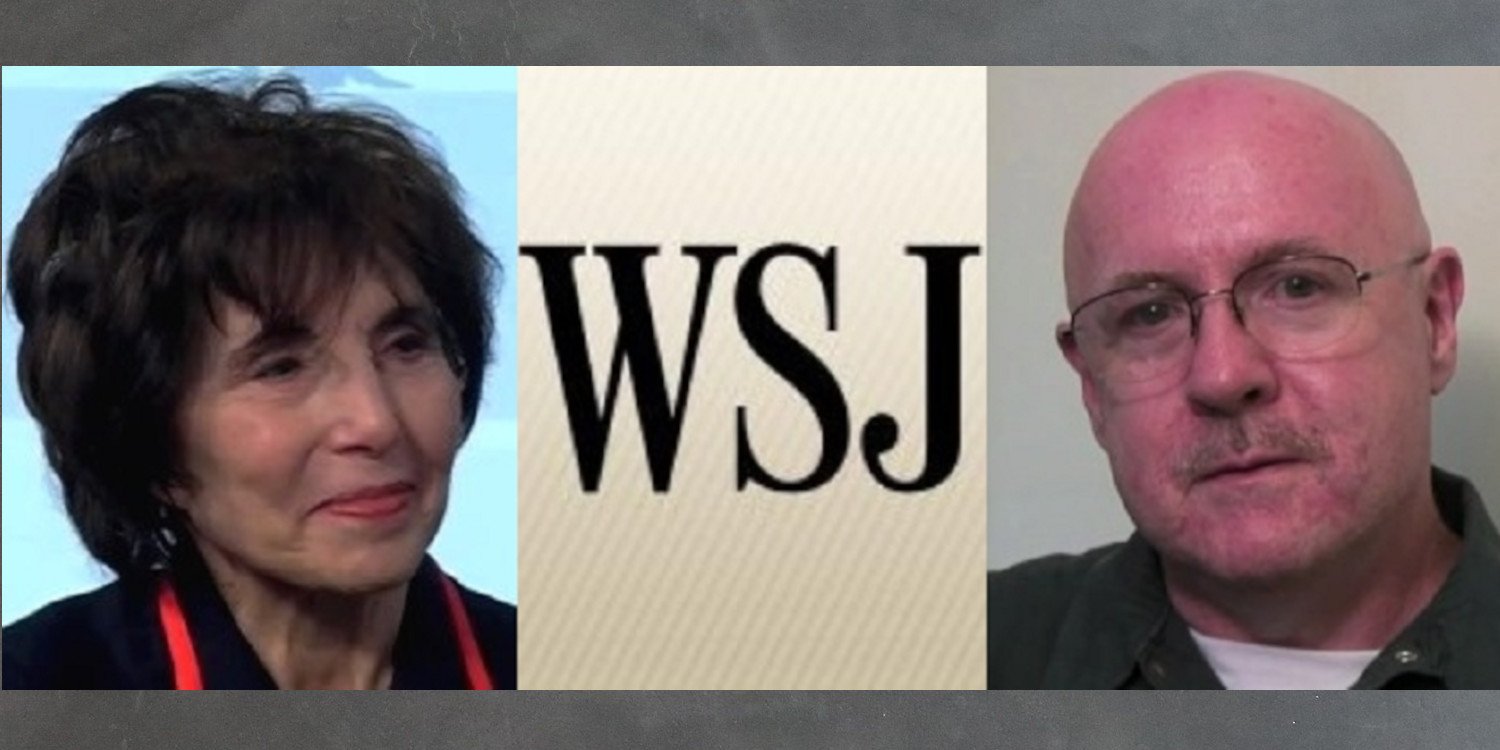
Background (CC BY-NC-SA 2.0 DEED)
Say Not the Struggle Naught Availeth
As Dorothy Rabinowitz wrote in her message to me, Arthur Clough wrote little that was memorable except this one poem, “Say Not the Struggle Naught Availeth.” A century after its writing, it had an oversized footprint on history. Here is the entire poem sent from Churchill to FDR:
Say not the struggle naught availeth,
The labour and the wounds are vain,
The enemy faints not, nor faileth,
And as things have been, they remain.
If hopes were dupes, fears may be liars;
It may be, in yon smoke concealed,
Your comrades chase e’en now the fliers,
And, but for you, possess the field.
For while the tired waves, vainly breaking
Seem here no painful inch to gain,
Far back through creeks and inlets making,
Comes silent, flooding in, the main.
And not by eastern windows only,
When daylight comes, comes in the light,
In front the sun climbs slow, how slowly,
But westward, look, the land is bright.
Clough’s beautiful poem is a testament to the notion that whatever struggle we must take up and endure in this life, the struggle itself is worthy, even when what we fight against is unjust and impenetrable. This is sometimes difficult to see and accept, but what sort of person would I be if I did not struggle against injustice not only against me, but for all priests falsely accused for financial gain? Margaret Drabble, a poetry critic at Literary Hub wrote of the poem:
“This poem by Arthur Hugh Clough unfailingly brings tears to my eyes. It speaks of hope, and effort, and disappointment, and perseverance... The imagery is profoundly beautiful, and reminds me of the great beaches of my childhood, of Wordsworth’s immortal shore. I can feel those ‘tired waves, vainly breaking,’ and then the flooding fullness of the sea.”
Dorothy also described the poem in her message:
“Clough was unspecific in the references. There are references to military battles, but they are clearly only metaphors. Its imperishable eloquence is exactly the kind that fires resolve to win in the end, which I depend on, which we must all depend on. Read it, and let me know you found it.”
So, Dorothy, as you can see, I found it! “Say Not the Struggle Naught Availeth” is now enshrined on my cell wall. As you have suggested, I read it in the face of all the silences and rejections of appeals to justice that I have seen. It is a vivid reminder, as it was for Churchill and FDR, that some struggles are much bigger than their mere protagonists. This struck home for me when a prominent writer — an author and Catholic deacon in Pennsylvania where the priesthood and Church have been much maligned of late — published this review of Beyond These Stone Walls:
“There are few authentic prophetic voices among us, guiding truth-seekers along the right path. Among them is Fr. Gordon MacRae, a mighty voice in the prison tradition of John the Baptist, Alfred Delp, SJ, and Dietrich Bonhoeffer.”
— Deacon David Jones
With that, Dorothy, I stopped being a victim of this struggle and became a warrior.
+ + +
Note From Father Gordon MacRae: Adolf Hitler declared war on the United States on December 11, 1941, so, for America, the struggle was availeth after all.
Please share this post. Please watch and listen to Dorothy Rabinowitz in a five-minute WSJ interview on this story.
You may also like these related posts from Beyond These Stone Walls:
Hitler’s Pope, Nazi Crimes and The New York Times
Catholic Scandal and The Third Reich: The Rise and Fall of a Moral Panic
November 11 is Veterans Day, a day set aside to remember all those who bravely risked much to win and defend our freedoms. Please honor them with me by sharing my post, “Veterans Day: War and Remembrance and the Cost of Freedom.”
May the Lord Bless you and keep you.
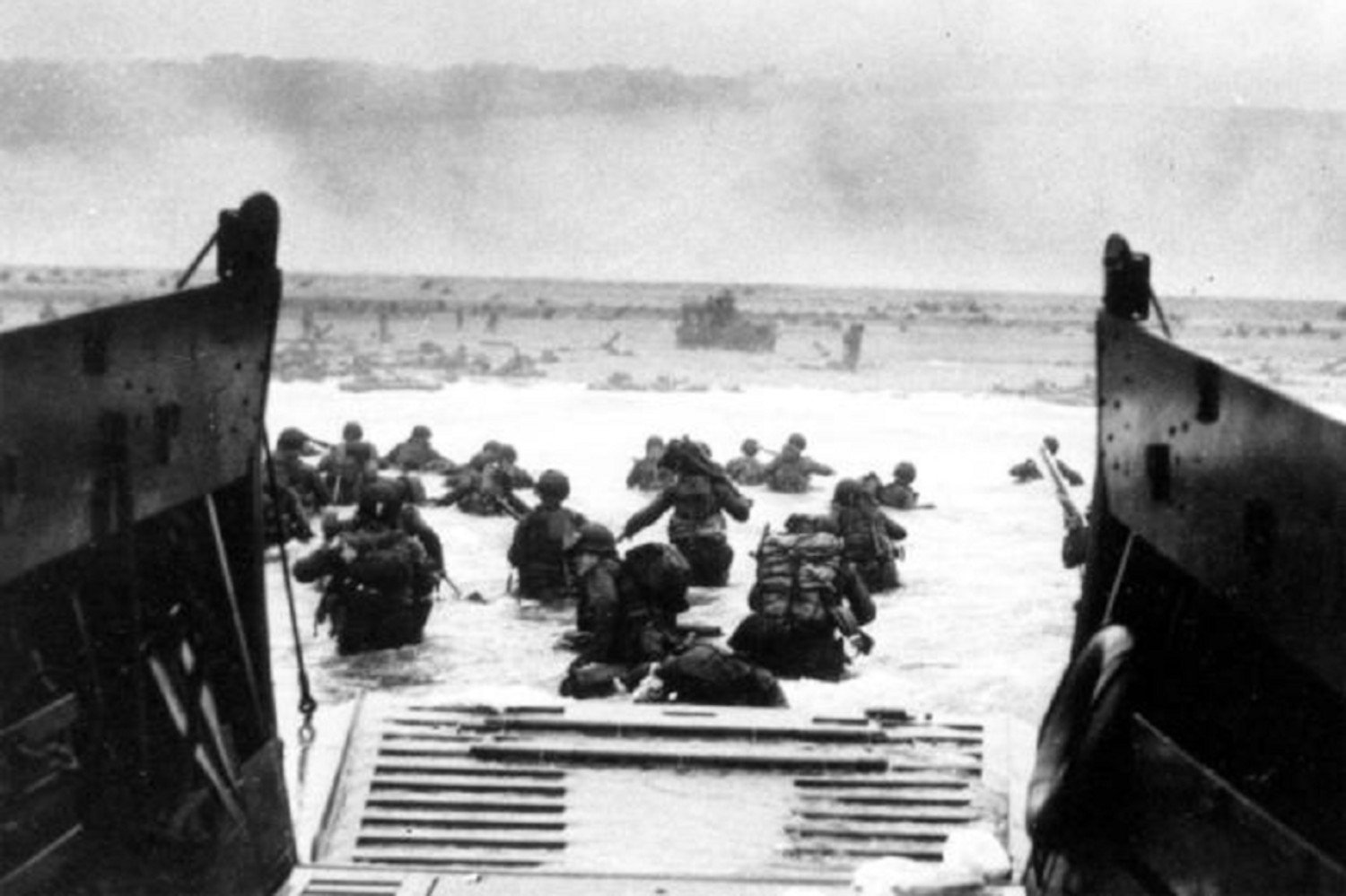

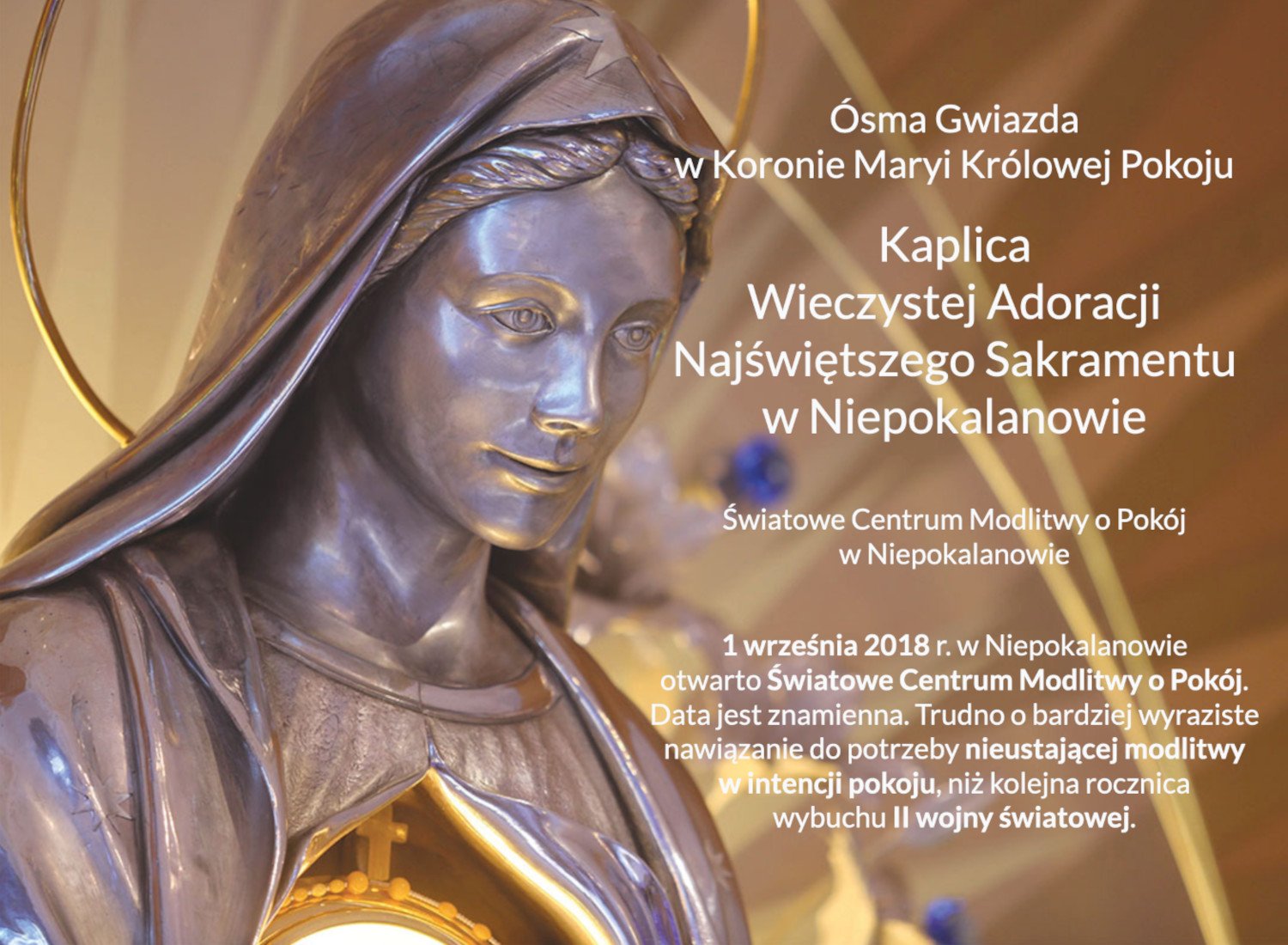

The Eucharistic Adoration Chapel established by Saint Maximilian Kolbe was inaugurated at the outbreak of World War II. It was restored as a Chapel of Adoration in September, 2018, the commemoration of the date that the war began. It is now part of the World Center of Prayer for Peace. The live internet feed of the Adoration Chapel at Niepokalanow — sponsored by EWTN — was established just a few weeks before we discovered it and began to include in at Beyond These Stone Walls. Click “Watch on YouTube” in the lower left corner to see how many people around the world are present there with you. The number appears below the symbol for EWTN.
Click or tap here to proceed to the Adoration Chapel.
The following is a translation from the Polish in the image above: “Eighth Star in the Crown of Mary Queen of Peace” “Chapel of Perpetual Adoration of the Blessed Sacrament at Niepokalanow. World Center of Prayer for Peace.” “On September 1, 2018, the World Center of Prayer for Peace in Niepokalanow was opened. It would be difficult to find a more expressive reference to the need for constant prayer for peace than the anniversary of the outbreak of World War II.”
For the Catholic theology behind this image, visit my post, “The Ark of the Covenant and the Mother of God.”