“There are few authentic prophetic voices among us, guiding truth-seekers along the right path. Among them is Fr. Gordon MacRae, a mighty voice in the prison tradition of John the Baptist, Maximilian Kolbe, Alfred Delp, SJ, and Dietrich Bonhoeffer.”
— Deacon David Jones

Cultural Meltdown: Prophetic Wisdom for a Troubled Age
Cultural Meltdown: The Secular Roots of Our Moral Crisis by Bill Donohue is a tour de force about our culture in decline and what we need to stem the encroaching tide.

Cultural Meltdown: The Secular Roots of Our Moral Crisis by Bill Donohue is a tour de force about our culture in decline and what we need to stem the encroaching tide.
August 21, 2024 by Bill Donohue, Catholic League President
Introduction by Fr Gordon MacRae:
Speaking at the “Essence Festival of Culture” in 2023, Vice President and Democratic presidential nominee Kamala Harris described what culture means to her:
“Culture is — it is a reflection of our moment and our time. Right? And present culture is the way we express how we’re feeling about the moment and we should always find times to express how we feel about the moment. That is a reflection of joy. Because, you know … it comes in the morning. We have to find ways to also express the way we feel about the moment in terms of just having language and a connection to how people are experiencing life. And I think about it in that way, too.”
That quote from the current Vice President at a symposium on culture, was followed by her signature outburst of raucous laughter. I found it cited (without the laughter) in the June, 2024 edition of Catalyst, the Journal of the Catholic League for Religious and Civil Rights, in “Kamala Wins Race to the Bottom.”
Fortunately for America, Catholic League President Bill Donohue has a more nuanced view of culture, what it means for a society to survive, and the price we pay if it fades away. I believe the United States would face even greater cultural decline if not for the brakes applied by honest and vocal prophetic witnesses like Bill Donohue. Among the many accolades of his newest book, Cultural Meltdown: The Secular Roots of Our Moral Crisis (Sophia Institute Press, 2024) Catholic Encyclopedia editor Russell Shaw wrote, “Like the prophets, Donohue skewers bad guys — doers of evil and sowers of confusion — with consistent vigor and style.”
Cultural Meltdown (the book) is riveting, and in equal parts alarming, hopeful, and culturally uplifting. Donohue holds nothing back. His discussion of the roots and fallout of “Transgenderism” spans 58 pages, an education unto itself. It is a deeply troubling exposition of where we are and how we got here. The sheer madness of gender transition treatment for children is distressing. I recall hearing President Joe Biden casually say that “If an eight-year-old boy decides he wants to be a girl, his parents should have no say in it.” Pope Francis, no staunch defender of cultural traditions, called transgender ideology “demonic.”
In June, 2024, the Pew Research Center released results of a nationwide cultural survey. Sixty percent of respondents on the political left reported that being a man or a woman is merely a matter of personal preference and choice. Only nine percent of those on the conservative political right believe that. The lines of demarcation have permeated our politics. A recent Wall Street Journal news report analyzed the evidence of an ideological shift toward the right in young men under the age of thirty. The experience of one man, age 22, is an eye-opener:
“Harrison Wells said Trump’s 2016 campaign initiated his shift to the political right. He recalled being confused by the apoplectic reaction from teachers and students to Trump’s [2016] victory. His high school canceled classes and held listening sessions with students. ‘People were crying, upset,’ he said. ‘Everyone was hysterical.’ The experience crystallized growing skepticism of his private Catholic high school outside Menlo Park CA which organized lectures about the importance of access to contraceptives and abortion and celebrating transgender visibility.”
— “ElectionTriggers Battle of the Sexes, “ WSJ, July 30, 2024
No one involved with the article raised a question about how or why a California Catholic high school sponsored lectures on “the importance of access to abortion and contraceptives and celebrating transgender visibility.”
In the July/August 2024 issue of the Catholic League Journal, Catalyst, Bill Donohue wrote a brief essay entitled, “We Are Badly Divided.” As evidence for his title he wrote, “Those who love Biden hate Trump, and vice versa. The hatred of Trump, often called Trump Derangement Syndrome, is so bad that 86 percent of Democrats reported in a recent survey that the Justice Department should have authorized ‘the use of deadly force’ in its retrieval of documents at Trump’s Mar-a-Lago residence.”
This comes from the same people on the left who have gone on record, as Vice President Kamala Harris has, to advocate for defunding police. Such attitudes lured a hapless 20-year-old at a recent rally in Pennsylvania to the destruction of his own life while trying to end the life of Donald Trump. There is a way out of this cultural madness, and the prophetic Bill Donohue charts its course. What follows is Bill Donohue’s own explanation of why he wrote Cultural Meltdown. I could not improve upon it, so with his permission I am reproducing some of it here:

From Bill Donohue: “Why America Is in Trouble”
“The principal reason I wrote my new book is to address why America is in trouble. We live in a topsy-turvy world and most people, especially older adults, can’t seem to make sense of it. It is my hope that after reading Cultural Meltdown the reader will have a better handle on how this happened. We are a country torn between two conflicting visions of man and society. There are those who accept the religious vision and there are those who accept the secular vision. These perspectives are not only different, they are irreconcilable.
“Right now everything is in flux. As someone who favors the religious vision, I see signs of optimism, but not always. At some point, one side will win. We can’t go on indefinitely living as if we are living in two different worlds. The religious vision acknowledges belief in God, truth, human nature, the natural law, moral absolutes and Original Sin. It recognizes the limitations of the human condition. While it believes in progress it manifestly rejects the idea of human perfectibility.
“The secular vision promotes exactly the opposite view: God does not exist; truth is a mirage; human nature can be changed; there is no such thing as natural law; there are no moral absolutes; and the idea of Original Sin is fanciful. Furthermore, as the secular vision considers the human condition to be infinitely malleable, it champions the idea of the perfectibility of man.
“Left-wing intellectuals epitomize the secular vision. They are the ones who have had the greatest influence on the young, liberals, Democrats, and the well educated. As survey research shows, these are the most secular people in our society.
“The Catholic Church epitomizes the religious vision. We are made in the image and likeness of God. Men and women are biologically different, but possess equal dignity. We are expected to conform our behavior according to the tenets of the natural law. The faculty of reason is important, but it should complement faith, not oppose it.
“Those who ascribe to the religious vision reject the moral relativism that secularists promote. Moral relativism holds that what is moral is a matter of opinion and that there is no such thing as an act which is inherently immoral. Intellectuals very much believe this to be true. So did Hitler.
“I mention Hitler because he rode the waves of moral relativism right into office. There were political and economic reasons why he succeeded, but it was the moral collapse of German culture during the Weimar Republic (between the two world wars) that left the masses without a clear understanding of right and wrong. He capitalized on this cultural meltdown.
“Secularists are fond of saying that as long as two people agree on what constitutes proper moral behavior, that’s all that matters. It all boils down to consent. Those who believe in the religious vision know this to be false. It could justify incest. Without an understanding that God has given us Commandments to live by — and the moral absolutes they entail — all kinds of monstrosities are possible. History has shown exactly that.
“If there is one intellectual strain that is creating mass confusion it is postmodernism. For this we can thank French intellectuals in the 1960s. It is the most extreme expression of the secular vision. At bottom, it regards truth to be a fiction. Once this idea takes hold, look out. Here’s how postmodernism plays out in real life:
“David Detmer is a philosopher who knows how absurd postmodernism is. He interviewed one of its practitioners, fellow philosopher Laurie Calhoun. He asked her a simple question, one that any preschool child could answer: ‘Are giraffes taller than ants?’ ‘No,’ she replied. It is ‘an article of religious faith in our culture.’ In an earlier time, we would house people like her in an asylum. Today they are working in the academy.
“There is a chapter in the book on libertinism, or sexual license. Normal people regard people with perversions as sick and in need of help. Many left-wing intellectuals — who do not want to be regarded as normal, and who indeed reject the idea of normalcy — not only disagree that perverts are abnormal, they want to celebrate them.
“In 2022, Indiana University erected a large bronze sculpture of Alfred Kinsey, the zoologist-turned-sexologist. School officials celebrated his years of work there. There is also a Kinsey Institute on campus. They are proud of his writings and research on sexuality. They shouldn’t be. As I point out [in Cultural Meltdown, p.107] Kinsey was ‘a scientific fraud, a pervert, a voyeur, an exhibitionist, a gay-bar-hopping homosexual (even though he was married) and a child abuser. Oh yes, he also had sex with animals.’ Guess which institution he hated? The Catholic Church.”

More from Bill Donohue: Christianity and Transgenderism
“The secular vision, especially postmodernism, explains the existence of Transgenderism, or gender ideology. If truth does not exist, then it is entirely possible for boys to think they are girls and vice versa. It does not matter what our chromosomes are. All that matters is what we feel is real.
“The tenets of Christianity and Transgenderism are polar opposites and cannot be reconciled. Pope Francis understands this as well as anyone. He calls gender ideology ‘one of the most dangerous ideological colonizations’ of our time. ‘Why is it dangerous? Because it blurs the differences and the value of men and women.’ So upset was [Pope Francis] with this ideological madness that he once called it ‘demonic.’
“Anti-science transgender activists are among the most intolerant people in our society. They believe there are more than two sexes (which they falsely call genders) and anyone who disagrees with them — which is to say most normal people — is dismissed as a bigot.
“The damage being done to young people — 80-percent of those who ‘transition’ to the opposite sex are girls who want to be boys — is incalculable. The long-term physical and psychological problems that they will experience have yet to be determined. We already know that puberty blockers, chemical castration, and genital mutilation have created enormous suffering. Indeed, this is the greatest child abuse issue of our day.
“The last two chapters [of Cultural Meltdown] explain why we are so divided as a nation. To take one example, we are treating racial and ethnic groups as if they were different tribes, pitting one against the other. Robin DiAngelo, the author of the best-selling book, White Fragility likes it that way: ‘People of color need to get away from white people and have some community with each other.’ They teach this racism — in the name of combating it — in many colleges and corporations. No doubt the Klan would agree with her. So does Harvard. That is why it designated ‘an exclusive space for Black-identifying audience members’ when an adaptation of MacBeth was performed in 2021.
“Welcome to the world of the new apartheid. That much-condemned South African practice of separating the races is now very much in vogue in the United States. We have separate dorms on college campuses based on race, as well as separate graduation ceremonies. Part of the problem is the tendency of left-wing intellectuals to compare the tenets of the American Creed — the belief in freedom, equality and rule of law — to existing conditions. Inevitably, we come up short. But the Creed is the ideal; it is not reality. It gives us something to shoot for — holding out the potential that some day we will make good on this promise. Martin Luther King, Jr. understood this. Why can’t intellectuals?”
Back to Father MacRae:
I came of age as a young adult in the middle of the Civil Rights movement of the late 1960s and early 1970s. I was deeply affected by it, and in some ways the roots of my vocation to priesthood were inspired by Reverend Martin Luther King, Jr. We have come a long way since then. It is doubly tragic for those who gave their lives to promote racial equality to see the deterioration of their work today. It is deeply sad that some in the Democratic Party of today choose to foment racial and ethnic divisiveness instead of promoting unity. For me, it feels like a giant step backwards in our culture. Bill Donohue concludes his book with a caveat:
“The Catholic Church — along with evangelical Christians, Orthodox Jews, Mormons, and Muslims — must hold the line and not bow to secular opinion. Secularism is the heart of our moral crisis; it is responsible for our cultural meltdown. We need to proclaim and defend eternal truths about man and society and the moral imperatives that make for the best of all possible worlds on Earth. We don’t need to re-create anything. We need to repair to our religious moorings.”
We are at a crossroads. As we face another presidential election in 2024, we stand at midnight in the garden of good and evil. Even some facets within our Church have quietly ventured over to one side of that garden — the “woke” side. Cultural Meltdown is our wake-up call.
+ + +
Bill Donohue is President of the New York-based Catholic League for Religious and Civil Rights. He holds a Ph.D. in sociology from New York University and served for twenty years on the Board of the National Association of Scholars. The author of ten previous books, he has appeared on thousands of news, television and radio programs including EWTN, Fox News, CNN, NEWSMAX and other national media.
Cultural Meltdown: The Secular Roots of Our Moral Crisis by Bill Donohue is published in 2024 by Sophia Institute Press. His most recent guest post for Beyond These Stone Walls was, “The Ordeal of Father Gordon MacRae.” He was also instrumental in our recent, highly acclaimed post, “A Catholic League White House Plea Set Pornchai Moontri Free.”

Digital billboard just outside the United Center in Chicago, the venue of the Democratic National Convention.

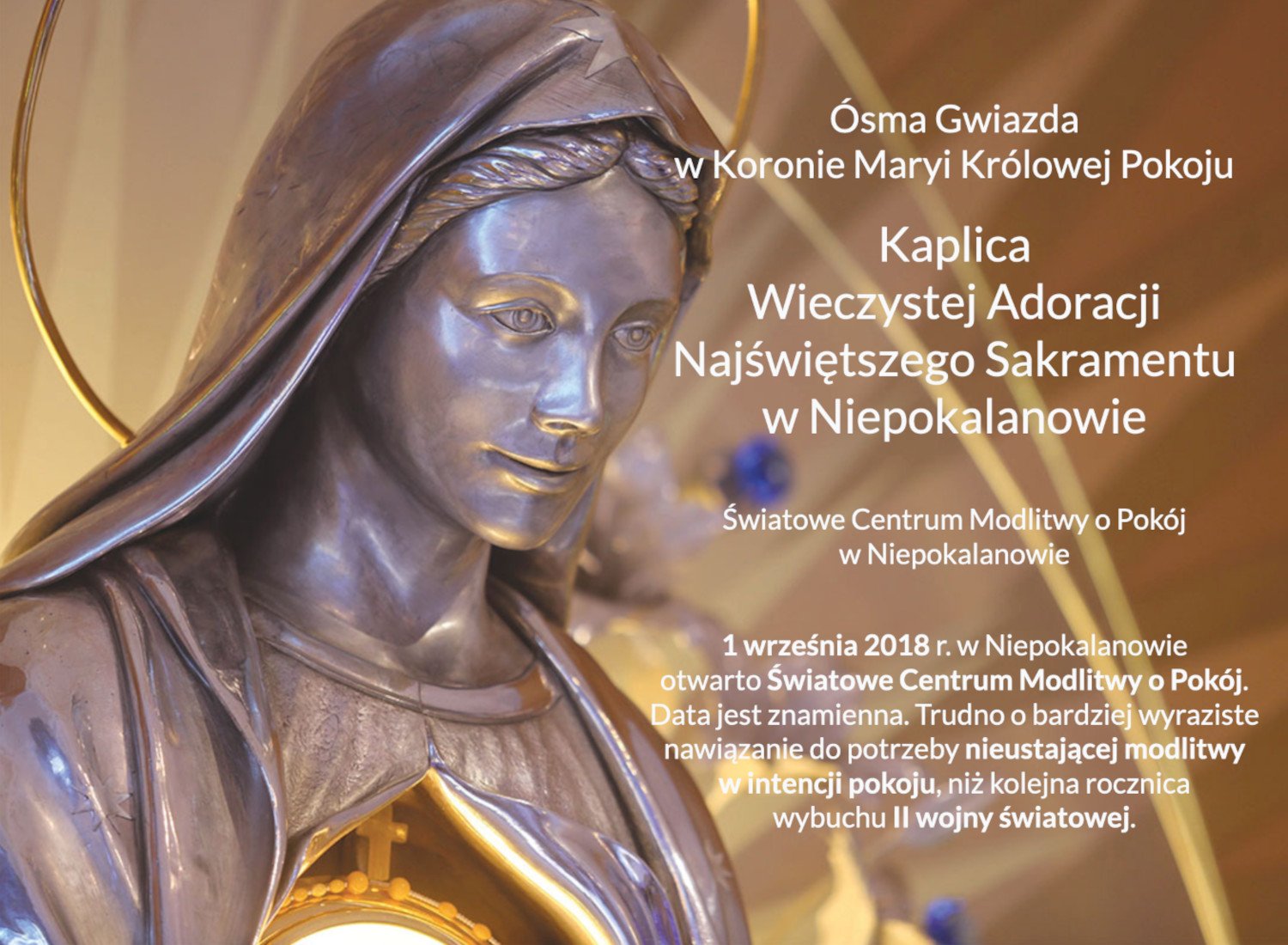

The Eucharistic Adoration Chapel established by Saint Maximilian Kolbe was inaugurated at the outbreak of World War II. It was restored as a Chapel of Adoration in September, 2018, the commemoration of the date that the war began. It is now part of the World Center of Prayer for Peace. The live internet feed of the Adoration Chapel at Niepokalanow — sponsored by EWTN — was established just a few weeks before we discovered it and began to include in at Beyond These Stone Walls. Click “Watch on YouTube” in the lower left corner to see how many people around the world are present there with you. The number appears below the symbol for EWTN.
Click or tap here to proceed to the Adoration Chapel.
The following is a translation from the Polish in the image above: “Eighth Star in the Crown of Mary Queen of Peace” “Chapel of Perpetual Adoration of the Blessed Sacrament at Niepokalanow. World Center of Prayer for Peace.” “On September 1, 2018, the World Center of Prayer for Peace in Niepokalanow was opened. It would be difficult to find a more expressive reference to the need for constant prayer for peace than the anniversary of the outbreak of World War II.”
For the Catholic theology behind this image, visit my post, “The Ark of the Covenant and the Mother of God.”

The Assumption of Mary and the Assent of Saint Maximilian Kolbe
In one of history’s darkest times and places, Saint Maximilian Kolbe continued his life’s greatest quest: to know, honor, and echo the assent of Mary to the Lord.

In one of history’s darkest times and places, Saint Maximilian Kolbe continued his life’s greatest quest: to know, honor, and echo the assent of Mary to the Lord: ‘Be it done to me according to thy word.’
August 14, 2024 by Fr. Gordon MacRae
On November 1, 1950, Pope Pius XII solemnly defined as a dogma of faith the bodily Assumption into Heaven of Mary, the Mother of Jesus. The precise words of Pope Pius are found in the Apostolic Constitution, Munificentissimus Deus, “The Most Bountiful God,” defining what much of the Church already believed, and now holds as a matter of truth:
“We pronounce, declare and define it to be a divinely revealed truth that the Immaculate Mother of God, the ever Virgin Mary, having completed the course of her earthly life, was assumed body and soul into heavenly glory.”
It was not without controversy. Pius XII thus became the first pope in a century to define a new dogma of faith. Five papacies earlier, in 1869, Pope Pius IX sought, cajoled, and in the end imposed, the doctrine of papal infallibility. In his book, Making Saints, former Newsweek editor Kenneth Woodward described the doctrine of infallibility as a “sheathed sword” (Making Saints, p. 314). He described it that way because, from the time of the doctrine’s inception in 1869, a declaration of papal infallibility has only been invoked once: a century later in 1950 when Pius XII declared the Assumption of Mary to be an infallible tenet of faith.
This was not just a unilateral pronouncement from on high. Before defining the dogma in 1950, Pius XII sought and received an amazing response of affirmation from the “sensus fidelium,” the assent of the faithful from throughout the world. The Our Sunday Visitor Encyclopedia of Catholic Doctrine describes this beautifully:
“Infallibility in belief pertains to the whole Church. ‘The whole body of the faithful … cannot err in matters of belief. This characteristic is shown in the supernatural appreciation of the faith (the ‘sensus fidei’) of the whole people when, from the bishops to the last of the faithful, they manifest a universal consent to matters of faith and morals.” (Lumen Gentium)
“To understand properly how the whole people of God is infallible in its sense of the faith (sensus fidei, sensus fidelium) it must be born in mind that the body of the faithful goes beyond limits both of place and, especially, of time. The People of God always includes those of past generations as well as those in the present moment. The former are in fact the vast majority, and it is easier to ascertain what they believed. It is that belief that marks the sensus fidelium and points infallibly to the truth." (p. 334)
To help in understanding this concept of the Universal Church that includes the faith of all generations past, see my post, “The God of the Living and the Life of the Dead” (linked again at the end of
this post). It is evidence of the ongoing connectedness of the faithful departed to the life of the Church.
I found this concept to be a stunning affirmation, not only of what we believe, but of why we believe it. The idea that infallibility includes the unwavering faith of the vast majority of the People of God taken as a whole over the span of millennia is mind-boggling truth.
The faith of the entire Church, from its birth at Pentecost to the present, points to a belief in Mary as Theotokos, the Bearer of God and the New Ark of the Covenant. Pope Pius XII strongly considered this before defining as infallible the Dogma of the Assumption in 1950. From the Chair of Peter, Pius XII sought the assent of the faithful in the present through his encyclical, Deiperae Virginis Mariae, to inquire whether Mary’s bodily Assumption should be defined.
As a result, an amazing number of petitions reached Rome from every corner of the Church. The petitions included those of 8,000,000 laity, 50,000 religious women, 32,000 priests, 2,505 archbishops and bishops, 311 cardinals, and 81 patriarchs of the Eastern Church. If this demonstration of assent had been able to span the entire life of the Church the result would have been immeasurable.
From the earliest days of the Church many considered the Assumption of Mary — centuries before it was defined as a tenet of faith — to be, in the words of Pius XII, “the fulfillment of that most perfect grace granted to the Blessed Virgin and the special blessing that countered the curse of Eve” — original sin. In the Eastern Church, a “Memorial of Mary” was already being celebrated on August 15 in the Fifth Century. It spread from the East and came ot be known as the koimesis in Greek and the dormitio in Latin, both of which mean the “falling asleep.” By the Eighth Century, belief in the bodily Assumption of Mary was widely accepted in both the East and West.
In the 19th Century, John Henry Cardinal Newman wrote that both the Immaculate Conception and the Assumption of Mary are implicit in her identification as the “New Eve,” a title given to Mary since the Second Century. Just as the Resurrection of Jesus was the essential element of His victory over sin and death, Mary shares that victory in her designation as the New Eve, and in the words of Jesus at the foot of the Cross as the spiritual Mother of all. Seeing His Mother at the foot of the Cross, Jesus said ot her, “Woman, behold your son.” And then to the Disciple John, “Behold your Mother.” It was an adoption arrangement (John 19:26-27).
Among the earliest titles of Mary is Theotokos, Greek for “The Bearer of God.” For the Scriptural foundation of this belief and its implications, see my post, “The Ark of the Covenant and the Mother of God.”

“What Will Become of You?”
In the Gospel account of the Transfiguration (Matthew 17:2), Moses and Elijah appear with Jesus at Mount Tabor. Both Moses and Elijah, according to Scripture, entered heaven in both body and soul. The appearances of Mary at Fatima, Lourdes, Tepeyac Hill in Mexico, and others all point to an understanding of Mary as existing still in that same form. I wrote of the details of one of these visits in “A Subtle Encore from Our Lady of Guadalupe.”
There is no saint of modern times with a stronger and more dedicated devotion ot Mary than Saint Maximilian Kolbe who seemed to live with a perpetual presence of the Immaculata in his field of view. Long before he was the Saint of Auschwitz and Founder of the Militia Immaculata, Saint Maximilian Kolbe was simply “Raymond,” a highly intelligent and gifted boy born into poverty in a rural farming community in Poland.
Like me, Raymond Kolbe was fascinated by the sciences of astronomy and cosmology and actually once built a working rocket as a boy. Also like me, he exasperated his mother at times. One day his frustrated mother scolded him, “Raymond! Whatever will become of you?” Filled with grief, young Kolbe went immediately to a local church and turned to the Mother of God with the same question. According to Kolbe’s own words as reported by my friend, Father Michael Gaitley, MIC in his wonderful book, 33 Days to Morning Glory,
“Then the virgin appeared to me holding in her hands two crowns, one white and one red. She looked at me with love and she asked me if I would like to have them. The white meant that I would remain pure, and the red meant that I would be a martyr. I answered, ‘yes, I want them.’ Then she looked at me tenderly and disappeared.”
Father Gaitley went on to describe that what was meant by “pure” in this sense was that Kolbe would never allow evil or dishonesty to take root in his heart. And it never did. On August 14, the date this is posted, the Church honors Saint Maximilian Kolbe. He also happens to be my own Patron Saint as well as that of my friend, Pornchai Maximilian Moontri, and the Patron Saint of this blog. To the best of our ability, we follow in his spiritual footsteps, but his footsteps took him to an ultimate sacrifice. The nature of that sacrifice, along with Maximilian’s Auschwitz prison number 16670, now a badge of honor, is expressed on Pornchai’s T-shirt atop this section of our post. Our friend, Father Michael Gaitley, MIC, described the footsteps of Saint Maximilian in brief but familiar prose in 33 Days to Morning Glory :
“In 1941, after decades of incredibly fruitful apostolic labors in Poland and Japan, Kolbe was arrested by the Gestapo and sent to the Auschwitz concentration camp. Before his arrest, his brother Franciscans had pleaded with him to go into hiding. He said he was grateful for their loving hearts but couldn’t follow their advice.
“He later explained why: ‘I have a mission to fulfill.’ That mission was fulfilled on the eve of the Feast of Mary’s Assumption into Heaven when, after he volunteered to take the place of another prisoner condemned to starvation, the impatient Nazis finished Kolbe off with a lethal injection. Thus, St. Maximilian died a martyr of charity and received the red crown from his Immaculata.”
Two hours before his arrest, Fr. Maximilian Kolbe penned what Father Gaitley called “the single most important theological reflection of his life. It was nothing less than the answer to a question that eluded him for many years, the question he had pondered over and over throughout his life was: “Who are you, O Immaculate Conception?”
In the document, according to Father Gaitley, Kolbe raised a key point. In the appearances of Mary at Lourdes, Mary did not say to St. Bernadette, “I am immaculately conceived,” but rather she said, “I am the Immaculate Conception.” It was thus clarified for Maximilian that through a special grace from God, Mary was in fact immaculately conceived in the womb of her own mother with no stain of original sin and that grace became her very identity by the as yet unseen merits of her Son. Understanding this means stepping out of conventional time and space for a moment into the mystery of the “nunc stans” the "Eternal Now" in which God dwells and in which He envisions all time and space as one. It is a difficult concept for our linear existence to ponder, but I have pondered it for my entire life.
Father Gaitley asks (p. 52): “Why does Mary make the grace she received at her conception her very name?” Clearly, Mary is not a divine being. Kolbe wrestled with this divinity problem for decades, and it ultimately led to a solution.
There are two Immaculate Conceptions, one created (Mary) and the other uncreated (the Holy Spirit). Before Mary, there was the uncreated Immaculate Conception, “the One Who for all eternity springs from God the Father and God the Son as an uncreated conception of love, the prototype of all conceptions that multiply life throughout the universe. The Father begets, the Son is begotten, the Spirit is the 'conception' that springs from their love. The Holy Spirit is the “Immaculate Conception” b e c a u s e, being God, He is without sin.
Is Mary then a personification of the Holy Spirit? The truth of this union between the Holy Spirit and Mary is found in a somewhat difficult passage in Maximilian’s own writings as reported by Father Gaitley:
"What type of union is this? It is above all an interior union, a union of her essence with the ‘essence’ of the Holy Spirit. The Holy Spirit dwells in her, lives in her. This was true from the first instant of her existence. It was always true; it will always be true.” ( Gaitley, p. 53)
“In what does this life of the Spirit in Mary consist? He himself is uncreated Love in her; the Love of the Father and of the Son, the Love by which God loves Himself, the very Love of the Most Holy Trinity ... . In a much more precise, more interior, more essential manner, the Holy Spirit lives in the soul of the Immaculata, in the depths of her very being” (Gaitley, p. 53-54)
"My soul magnifies the Lord, and my Spirit rejoices in God my Savior, for he has looked with favor on the lowliness of his servant. Surely, henceforth all generations shall call me
blessed.”
— From the Magnificat of Mary, Luke 1:46-48
In “The Ark of the Covenant and the Mother of God,” I explored a similar Marian theology, and from it I think I can finally make sense of what Saint Maximilian has proposed. Mary, Theotokos , the Bearer of God, is an eternal repository of the Holy Spirit. Both my friend Pornchai Maximilian Moontri and I owe her a great debt — not for saving us from Earthly Powers of destruction, because they actually mean little, but for preserving us in faith despite them.
+ + +
“Remember that those who ask for Heaven of the Immaculata will surely achieve it because she is unable to deny us anything nor is the Lord God able to deny her anything. We shall shortly know exactly what it will be like in Heaven. Surely in a hundred years none of us will be walking on this Earth. But what are a hundred years in the face of what we have been through? Soon, therefore, provided we are well prepared under the protection of the Immaculata.”
— St. Maximilian Kolbe, 1941
+ + +

Note from Father Gordon MacRae: Thank you for reading and sharing this post. Please spend some time in prayer and thanksgiving at the live feed of Saint Maximilian Kolbe’s own Adoration Chapel featured below after all our posts at Beyond These Stone Walls.
You may also like these related posts:
The God of the Living and the Life of the Dead
The Ark of the Covenant and the Mother of God
The Eucharistic Adoration Chapel established by Saint Maximilian Kolbe was inaugurated at the outbreak of World War II. It was restored as a Chapel of Adoration in September, 2018, the commemoration of the date that the war began. It is now part of the World Center of Prayer for Peace. The live internet feed of the Adoration Chapel at Niepokalanow — sponsored by EWTN — was established just a few weeks before we discovered it and began to include in at Beyond These Stone Walls. Click “Watch on YouTube” in the lower left corner to see how many people around the world are present there with you. The number appears below the symbol for EWTN.
Click or tap here to proceed to the Adoration Chapel.
The following is a translation from the Polish in the image above: “Eighth Star in the Crown of Mary Queen of Peace” “Chapel of Perpetual Adoration of the Blessed Sacrament at Niepokalanow. World Center of Prayer for Peace.” “On September 1, 2018, the World Center of Prayer for Peace in Niepokalanow was opened. It would be difficult to find a more expressive reference to the need for constant prayer for peace than the anniversary of the outbreak of World War II.”
For the Catholic theology behind this image, visit my post, “The Ark of the Covenant and the Mother of God.”

One Nation under God: The Future of the U.S. Supreme Court
‘One Nation under God’ was added to the Pledge of Allegiance by joint resolution of Congress in 1954. Today some forces want it gone, and God gone with it.

‘One Nation under God’ was added to the Pledge of Allegiance by joint resolution of Congress in 1954. Today some forces want it gone, and God gone with it.
August 7, 2024 by Fr Gordon MacRae
Editor’s Note: We are revisiting a post originally published before the U.S. presidential election of 2020 and its many unresolved issues.
The title of this post should be recognizable to just about every resident of the United States over the age of fifty, citizen or not. It comes, of course, from the Pledge of Allegiance, an oath with a storied history. The idea for such an oath began with an editor of The Youth’s Companion, a magazine published in the United States from 1827 to 1912. The first official use of the Pledge was in a ceremony honoring Christopher Columbus on October 12, 1892 by a proclamation of President Benjamin Harrison, a Republican.
In 1954, by a joint resolution of both Houses of Congress and signed into law by President Dwight D. Eisenhower, the words, “one nation under God” were added to the Pledge to wide popular acclaim. Now, 66 years later, some members of Congress refuse to include those words in any recitation of the pledge. Some decline to recite the Pledge at all. Rioting mobs are tearing down any statue that even looks like it might represent Christopher Columbus. The name of God is the prey of activist judges.
Thus comes the beginning of the end of “one nation under God,” and perhaps even of the nation itself. In the midst of all this chaos, U.S. Supreme Court Justice Ruth Bader Ginsburg died in September 2020 leaving the administration of President Donald Trump with a third nomination to the nation’s highest court and a reshaping of the Court unprecedented in modern times. This mirrors the real priority of the election of 2016, a fact that I wrote about then in “Wikileaks Found Catholics in the Basket of Deplorables.” It opens eyes now just as it did then.
There is a lot at stake in this upcoming election [and especially in the current administration that has vowed to radically reshape the Supreme Court along ideological lines through term limits and stacking the Court with additional justices.] If you find it a challenge to read such a political position from a Catholic priest, well, “For Zion’s sake I cannot keep silent. For Jerusalem’s sake, I will not rest” (Isaiah 62:1). At the heart of all this there are urgent considerations for human rights, religious freedom, and Catholic moral teaching.
At least consider the unfiltered voices of your fellow Americans that have not been strained through the sieve of the mainstream news media’s surrender to the deep political left. In 2020, the fourth year of the current President’s first term in office, the highly respected Gallup Poll conducted a broad scientific survey of the level of trust Americans invest in the institutions of government and civil society. This survey came in the midst of a global pandemic and the high anxiety of a highly contentious election year. The results are very different from what you are hearing from CNN or MSNBC.
Churches and organized religion ranked near the top in overall public trust with 42-percent reporting a “great deal” or “quite a lot” of trust. Only 28-percent reported having “very little.” The U.S. Military came out at the very top with 72-percent of Americans who report having “very high” trust and only 8-percent having “very little.” Despite all the bad news, the nation’s police also fared better than expected. 48-percent of Americans reported having “very high” trust while 33-percent reported “very little.”
Political institutions were the most interesting. In 2020, four years into President Trump’s first, and so far only term, 42-percent of Americans reported having a “very high” trust level for his office while 32-percent reported having “very little.” A look at the same Gallup Poll in the fourth year of Barack Obama’s first term revealed lower numbers with 32-percent having “high” trust and 35-percent “very little.” You won’t hear this on CNN.

Nancy Pelosi’s Congress Tipping Further Left
In the image above, Speaker of the House Nancy Pelosi is seen dramatically tearing up the President’s 2020 State of the Union address. The lower House of Congress had capitulated to the progressive left and handed over unprecedented control to the newer members who self-identified as socialists. Their unofficial voice has been Rep. Alexandria Ocasio Cortez who announced in a news conference in 2020 that “We are confident that President Joe Biden can be guided further left.” [The decision not to run for reelection in 2024 made his turn left a moot point. With the current Vice President now running in place of Joe Biden for a second term, the threatened push to turn further left is no longer necessary because she is already much further left than the president Americans elected in 2020.]
Of interest, the 2020 Gallup Poll Trust Survey responded to this. Only 13-percent of Americans reported having “high” or “very high” trust in Congress while 48-percent reported having “very little.” American’s trust level in the Congress of 2020 controlled by Democrats was even lower than trust in the mainstream news media which was at its historical all-time lowest point. Newspapers earned the high trust of only 24-percent of Americans while “very little” trust came in at 35-percent. Television news fared even worse. Only 19-percent reported having “high” trust while 43-percent reported “very little” or none at all. You won’t hear this on CNN either.
The 2020 sharp leftward tilt of Congress toward socialism is of grave concern if it drags the Supreme Court along with it. President Trump’s 2020 conservative nominee had been met with threats by Congress to retaliate if Democrats remain in control and gain the Senate and the White House as well. The most vocal threat is that they will “pack the Court” by increasing its number and filling the additional seats with liberal judges. [That is no longer an idle threat. The present Democratic nominee for president has already identified it as an urgent goal.]
This would be disastrous for America. The first Supreme Court was seated with five justices in 1789. In 1837, Congress increased the number to nine. That number was arrived at to make political stalemates very unlikely. The nine-justice Court has been a fixture in Washington for nearly two centuries. One of the most vocal criticisms of the Court in recent years has been the presence of “activist judges” in the lower courts who “legislate from the bench.”
The Supreme Court’s most important responsibility is to decide cases that raise questions of Constitutional interpretation. This is called “Judicial Review” and it places the Supreme Court in a pivotal role in the American political system. It is the ultimate authority for applying the Constitution in the most important issues facing the country. It is disastrous if activist judges find their way onto the Supreme Court. Examples of “Legislating from the Bench” came in two cases before the modern Court.
In 1973, the Supreme Court did not find a right to abortion in the Constitution, and so it invented one and placed it there, usurping the role of Congress and the votes of the American people. This happened again in 2015 in “Obergefell v Hodges,” the same-sex marriage ruling. In the (5-4) split decision, Justice Antonin Scalia wrote a blistering dissent accusing the liberal judges of placing a constitutional right to marriage in the Constitution when it simply is not there.

Sheldon Whitehouse and the Judiciary Committee
Shortly after [then-]President Trump announced his decision to put forward a nominee for the Supreme Court seat vacated by the death of Justice Ruth Bader Ginsburg, some in Congress and the Senate went into high gear to denounce it. The players knew very well what the real issue of precedent was. When President Barack Obama nominated Judge Merrick Garland to fill a vacancy in his last months as President in 2016, a vacancy left by the death of conservative Justice Antonin Scalia, the Republican controlled Senate declined to consider it. The Republicans were in the right (no pun intended) on the matter of precedent.
The controlling authority in 2016 was the precedent that, since 1888, the Senate does not confirm a nominee in an election year with a divided government. In 2016, the White House was occupied by a Democrat while the majority in the Senate was Republican. The Senate Democrats know, but hoped you did not know, that it was Joe Biden himself who popularized this exception. As Chair of the Senate Judiciary Committee in 1992, Senator Biden urged President George H.W. Bush to refrain from making a Supreme Court nomination during that election year because the “divided government” meant there was an “absence of a nationwide consensus.” Without such a consensus on constitutional philosophy, Senator Biden insisted, “action on a Supreme Court nomination must be put off until after the election is over.”
A divided government was the case again in 2016 so the “Biden Rule” applied. It was not the case in 2020. Ruth Bader Ginsburg herself argued that in the final months of a president’s term in office, “the president is still the president,” and he has a constitutional mandate to fill a Supreme Court vacancy. Speaker Nancy Pelosi, however, had the most suspect response:
“Though we [n Congress] strongly believe this is a matter of the gravest importance for our nation, for life, liberty, and the pursuit of our agenda, it would be wrong to fill this with just a few months left of this presidency.”
Even overlooking the fact that “life, liberty, and the pursuit of our agenda” is not exactly what the Bill of Rights had in mind, Mrs. Pelosi seems to have concluded that the election is already over and your voices have already been heard. In “Ginsburg Succession Battle Shows Hypocrisy Is an Enduring Norm,” Wall Street Journal Editor-at-Large Gerard Baker was as put off as I was:
“The reason millions of voters swallowed their doubts about Donald Trump in 2016 was that they believed their voices had too often been ignored… It has been clear all summer that there is an emerging progressive consensus [in Congress] that considers the nation’s institutions, traditional values, and even its history to be fundamentally illegitimate.”
— The Wall Street Journal, Sep. 22, 2020
But no one left me more uneasy about the road ahead in 2020 than Senator Whitehouse (D-RI) who sits on the Senate Judiciary Committee. Fox News Anchor Bill Hemmer asked him a pointed question (Sep. 22) about the obliteration of Justice Brett Kavanaugh’s due process rights in the his confirmation hearing. Senator Sheldon Whitehouse responded that Kavanaugh had “a credible accusation” against him that overshadowed those hearings in what I could only conclude to be a sham trial. In welcoming the newly seated Justice Kavanaugh to the Court, Justice Ruth Bader Ginsburg referred to that process as “a highly partisan show.”
Justice Brett Kavanaugh was guilty of no more than being accused. I, for one, can relate to such an albatross around my neck. The uncorroborated and unsubstantiated allegations were exploited by Senator Whitehouse and others on his committee in a vicious partisan display that voters have not forgotten.
What made these claims “credible” in the eyes of Senator Whitehouse? Sheldon Whitehouse spent his high school years at St. Paul’s School, an elite prep school in Concord, New Hampshire with historic ties to the Episcopal church. Its alumni list looks like a who’s who of Washington politics. The school has been the subject of multiple grand jury investigations for alleged sexual assaults by both students and faculty dating back several decades. I wrote about the fallout from this in “Grand Jury, St Paul’s School and the Diocese of Manchester.” If Sheldon Whitehouse were to be accused today, should that fact alone make the claims “credible?” Justice Brett Kavanaugh might be among the first to defend his due process rights.
So what sort of witch hunt were we in for when [then-]President Trump put forth the name of Judge Amy Coney Barrett for nomination in 2020? The fact that she is Catholic had already become an unconstitutional religion test applied by members of the Judiciary Committee in 2020. In 2018, a non profit progressive organization called “Demand Justice” spent $5 million building opposition to Justice Kavanaugh’s appointment to the Court. How much of this money paid for false accusations? The Wall Street Journal reports that when asked if the group donated to Senator Whitehouse, he responded, “hope so!” In “Questions for Senator Whitehouse,” (Review & Outlook, Sep. 22, 2020) the Journal concluded:
“Mr Whitehouse is trying to stifle the donations and speech of his political opponents. The least he can do is set an example by disclosing his own dark money network and its plans to undermine judicial independence.”
Epilogue
Jumping back to 2024, President Joe Biden and presidential candidate Kamala Harris have both announced a plan to form an exploratory committee to reform the Court through term limits, additional seats on the Court, and the same threats that would re-make the Supreme Court into just another political action committee. Joe Biden, the proponent of term limits for the Court spent 48 years in Congress. For those who care about the state of Justice in America, I believe this effort must be halted.
+ + +
Editor’s Note: Please share this post. You may also like these related posts:
The Eucharistic Adoration Chapel established by Saint Maximilian Kolbe was inaugurated at the outbreak of World War II. It was restored as a Chapel of Adoration in September, 2018, the commemoration of the date that the war began. It is now part of the World Center of Prayer for Peace. The live internet feed of the Adoration Chapel at Niepokalanow — sponsored by EWTN — was established just a few weeks before we discovered it and began to include in at Beyond These Stone Walls. Click “Watch on YouTube” in the lower left corner to see how many people around the world are present there with you. The number appears below the symbol for EWTN.
Click or tap here to proceed to the Adoration Chapel.
The following is a translation from the Polish in the image above: “Eighth Star in the Crown of Mary Queen of Peace” “Chapel of Perpetual Adoration of the Blessed Sacrament at Niepokalanow. World Center of Prayer for Peace.” “On September 1, 2018, the World Center of Prayer for Peace in Niepokalanow was opened. It would be difficult to find a more expressive reference to the need for constant prayer for peace than the anniversary of the outbreak of World War II.”
For the Catholic theology behind this image, visit my post, “The Ark of the Covenant and the Mother of God.”

A Catholic League White House Plea Set Pornchai Moontri Free
January 2021: In the last days of President Trump’s first term in office, a petition by Catholic League President Bill Donohue led to Pornchai Moontri’s freedom.

January 2021: In the last days of President Trump’s first term in office, a petition by Catholic League President Bill Donohue led to Pornchai Moontri’s freedom.
July 31, 2024 by Fr Gordon MacRae
This post has been a long time in the making. It’s the result of an epiphany, a sudden realization of truth that radically changed my perception of what had previously been to me just a painful memory. Then I stumbled upon something entirely new. To convey this thunderous awakening, I have to first ask you to return with me to a time not long ago that was painful and confusing for us all: the rise of the Covid pandemic of 2020 and 2021. The virus, the masks, the closures, the lies, the “mostly peaceful” protests that were actually riots, the burning cities each night on the news, it was all just awful.
Then there was Covid itself. I had it twice, the first time in the month after my friend, Pornchai “Max” Moontri, was taken away in the custody of ICE, Immigration and Customs Enforcement, after 36 years in America and 15 years as my roommate. Prisons are not known for having empathy about the human side of things. There was not a single concern about what happens to Pornchai or where I go from there. For over 15 years Max lived in the bunk above me where we were engaged in an epic spiritual battle to reconcile his past and secure a future. Then at 0700 on the morning of September 8, 2020, he was gone. By 0900, a stranger was living in his place.
And as I struggled to regain my sense of autonomy and balance, dark forces chose that very moment to bring down this blog. The only means I had to communicate with the outside world. I had to set all this aside to focus my meager resources and attention on the biggest crisis at hand: how to help Max cope with the hellish vortex of being lost in ICE detention with little hope and no means to communicate at all.
I seem to never learn to trust, however. I instinctively lean back on to my own resources and rely on no one else. That was certainly not working and it was not going to work. Then our late friend Claire Dion revealed an ingenious plan. Pornchai Max and I could not call each other, but we both could call Claire. She cared very much for us, and being a retired RN, she put her ingenuity to work. She devised a plan that I described not long after her death from cancer this year. That post was “Claire Dion Has Fallen into the Hands of the Living God.” Here is our treasured photo of how Claire put us back together.

The ICE Follies
As you know, Pornchai Moontri was taken from Thailand at age 11 in 1985 and brought to America. This forced him into a devastating and traumatic life from which there was but one escape. So he fled from it, again and again, the last time leaving him all alone in this world, a homeless teen at age 14 in a foreign country with a language and customs he could not comprehend.
Fleeing the trauma of exploitation, Pornchai fell into life on the streets where he trusted no one. He would steal food to survive, and sleep in doorways, shelters, and sometimes on the floor in the home of a friend. One day he stole a few cans of beer from a store. Fleeing across the store parking lot in 1992, Pornchai was tackled and pinned down by a much larger man. He could not be in that situation again. He could not be someone’s victim. He snapped, and that man died over a few cans of beer.
Ironically, just as I began typing this post I received a message from “Melissa.” Nearly 40 years ago at age 12 she had been a classmate of Pornchai in the seventh grade in middle school in Bangor, Maine when he first arrived in the United States. Melissa’s comment was both caring and brave, and it struck me that the trauma to which Pornchai was subjected has echoes all around him and across the years. Here is an excerpt of Melissa’s comment:
“I met Pornchai in seventh grade. I remember him as a sweet boy who was always smiling. However, a ‘foreigner’ he was not going to be accepted into the ‘in crowd’ though I don’t recall anyone that didn’t like him. How could they not? He had a great disposition … . I was upset to learn of Pornchai’s arrest back in 1992 because I knew the kid never stood a chance. We had all heard about the abusive home in Bangor. Over the years I would check to see if he had yet been released and was infuriated to learn that he had not. He had stolen beer, was chased into the parking lot by a grown man who confronted him. Pornchai reacted as the scared, cornered boy that he was. It was a tragedy for both. However, this boy, barely a legal adult, was locked up and forgotten. His American dream was a living nightmare. He became Bangor’s forgotten son. America, Bangor, Penobscot County Courts, DCF, teachers … . We all failed him.”
Years later, Pornchai emerged from over a decade in solitary confinement. Then our lives converged, clearly by design. I drew the entire story of his life out of Pornchai including all the madness that had been inflicted upon him.
What sparked me to write this post in 2024 was something that I did not know until very recently. I stumbled upon a plea from Catholic League President Bill Donohue addressed to the White House in 2021 in the final days of President Donald Trump’s first term in office. Dr. Donohue published this petition in the January 2021 issue of Catalyst, the Journal of the Catholic League, under title “White House Petitioned on ICE Detainee”:
We took up a very serious case at Christmastime, hoping to bring relief to a man who has paid his dues and has been through enough. We asked Catholics to appeal to President Donald Trump to release Pornchai Moontri from the custody of the Immigration and Customs Enforcement (ICE). He deserves to be repatriated to Thailand.
We were encouraged by news that the embassy in Thailand was contacted by ICE just days after we made our request; Pornchai’s case showed movement for the first time. Right before Christmas we asked our email subscribers to redouble their efforts making one more push.
Bill Donohue has known of the plight of Pornchai for many years. It was Fr. Gordon J. MacRae — he is another victim of injustice — who brought Pornchai’s story to his attention. Pornchai rightly credits Fr. MacRae with mentoring him. More than that, MacRae brought him into the Catholic Church.
We explained why Pornchai deserves to be released.
Pornchai was born in Thailand in 1973 and was abandoned by his mother when he was two-years-old. She intended to sell him, but a young relative came to his rescue and brought him into his home. When he was 11-years-old his mother reemerged with a new husband; they took him to Bangor, Maine, against his will. His stepfather, Richard Bailey, immediately started raping him, and did so for three years. At age 14, Pornchai escaped (it was his second escape) and became homeless. When he was 18, he got into a fight with a much bigger man while he was intoxicated and took the man’s life during the struggle (he was so drunk he does not recall stabbing him).
While awaiting trial, Pornchai’s mother came to visit him in jail, warning him that if he disclosed to the authorities what his stepfather did to him, she would suffer the consequences. Fearing for his mother’s life, he prudently decided not to speak, even to the point of not defending himself in court. He was convicted of murder and sentenced to 45 years in prison. Maine has no parole.
In 2000, his mother attempted to leave her husband; they were living in Guam. That is where she was beaten to death. The only suspect was her husband, but there was no evidence to convict him. Subsequently, many things changed.
In 2005, Pornchai was sent to a New Hampshire State Prison. That is where he met Fr. MacRae. Five years later, Pornchai became a Catholic; he soon became a fan of the Catholic League.
In 2018, after new evidence emerged — advocates for Pornchai pursued Bailey — and justice was finally done. Bailey was convicted on forty felony counts of child sexual abuse against Pornchai.
On September 11, 2020, Pornchai, after serving his full sentence, was released at age 47 to the custody of ICE for deportation to his native Thailand. He is still in custody, with no end in sight.
Pornchai has served his time and has suffered enough. He should now be set free.
— William Donohue, PhD, Catalyst, January 2021

A White House Intervention
When Bill Donohue published the above, and Catholic League members sent it to the White House, Pornchai had already been held by ICE in an ICE detention facility in Gena, Louisiana for five months. It was the peak of Covid contagion and he was living 70 to a room with no protection and lights blazing around the clock. Despite my daily assurances that we were working hard to get him out, he was showing signs of extreme stress and depression. While I was shielding Pornchai from false hopes and promises, I was unaware that others were also shielding me about their own efforts. I thought I was a lone ranger doing my best each day to reach out to anyone who would take a call from a prisoner — and they were few — to plea for relief from Pornchai’s plight. The Covid pandemic had the world locked tightly in its grip and the riots across America were evidence of how tightly wound our world had become. Pornchai believed that he would remain trapped in ICE until the Covid crisis was over and that could take years. So in the meantime, I asked Pornchai to try to reach out to others who were also trapped in ICE, but even less fortunate than himself. He did exactly that, and ended up saving 17-year-old Trepha, a Vietnamese teen who ended up in the same ICE facility as Pornchai, but surrounded mostly by young men from Latin America. Trepha had stowed away on a container ship departing Vietnam and then his unplanned world tour ended in Mexico.
Smugglers took what little money Trepha had saved and then led him across the Rio Grande and locked him in the trunk of an abandoned car. When Border Patrol agents found him, they made no distinction between migrants from Latin American countries and those who had come from abroad. Pornchai protected Trepha by keeping him away from the Central American gangs at Gena and then tasked me with reaching out to the Vietnamese Consulate to try to get Trepha returned home. I still hear from him on occasion. He is back in Vietnam with his grandmother and has promised me that he would not undertake any more world tours. In December 2020 we posted “An Open and Urgent Letter to President Donald Trump” asking for an intervention to move Pornchai’s relocation along despite the Covid pandemic and its international restrictions. What I did not know at the time I wrote that post was that Catholic League President Bill Donohue also reached out to the White House greatly magnifying our voice.
I learned of this only recently, three years later in 2024. I stumbled upon some fascinating paperwork from my friend Fr George David Byers in North Carolina who had been helping me then behind the scenes in this blog. Father George printed a few pages of a BTSW traffic report showing visitors to this site and what they were seeing in December 2020 and January 2021. I did not make much sense of it then, so I just put it aside out of sight and out of mind. Three years passed and I discovered it again just weeks ago. I could see that many of the site views were from ICE Headquarters in New Orleans and then in January 2021 from Homeland Security in Washington and then finally from the White House. This was the culmination of the interest of thousands of Catholic League members who intervened to assist Pornchai Moontri.
Then, upon discovering the above, I went to the prison law library where I work. I keep there a collection of the many issues of Catalyst, the Journal of the Catholic League for Religious and Civil Rights. I began to look through them, and then found one breathlessly in the January 2021 edition entitled “White House Petitioned on ICE Detainee.”
It did not just move the needle, it moved a mountain. Just two weeks after its publication Pornchai was aboard a Korean Airlines flight bound for Seoul along two plainclothes ICE officers who accompanied him. From there they boarded a connecting flight to Bangkok. The flight was 23 hours.
It turned out that the ICE officers read a good deal about Pornchai and as a result treated him very well. In fact, they saved the day. Upon their arrival after midnight in the Customs area at Bangkok International Airport, an exhausted Pornchai found himself surrounded by Thai police who were waiting for him. They demanded to know why he was being deported from the United States. The two ICE officers quickly intervened telling Pornchai not to answer. The ICE officers said that Pornchai had done nothing wrong, that he was being repatriated to his native country in cooperation with the Thai government and was entirely a free man. The Thai police went silent. Pornchai had never seen anything like it. Much later Pornchai wrote of his arrival in “Free at Last Thanks to God and You!”
Pornchai learned from me this week that Catholic League President Bill Donohue, and likely also then-President Donald Trump, were instrumental in a worldwide effort to restore him to freedom. He marveled at this, and so do I. “The Hand of God was on them both,” I told him, “and on you as well.”
“I could not see that then,” said Pornchai, “it took a priest and two presidents, but I see it now.”
+ + +
Note from Fr Gordon MacRae: Catholic League President Bill Donohue has a riveting and timely new book that I hope to soon review in these pages. It is Cultural Meltdown: The Secular Roots of Our Moral Crisis
The Catholic League for Religious and Civil Rights is the nation’s largest Catholic civil rights organization defending individual Catholics and the Church against defamation. No one in the U.S. Catholic Church has done more to assist me and Pornchai Moontri than Catholic League President Bill Donohue. Join forces with us at www.CatholicLeague.org.
You may also like these related posts:
The Parable of a Priest and the Parable of a Prisoner
Untying the Knots of Sin in Prison by Marie Meaney
Free at Last Thanks to God and You! by Pornchai Moontri
On the Day of Padre Pio, My Best Friend Was Stigmatized by Pornchai Moontri
The Eucharistic Adoration Chapel established by Saint Maximilian Kolbe was inaugurated at the outbreak of World War II. It was restored as a Chapel of Adoration in September, 2018, the commemoration of the date that the war began. It is now part of the World Center of Prayer for Peace. The live internet feed of the Adoration Chapel at Niepokalanow — sponsored by EWTN — was established just a few weeks before we discovered it and began to include in at Beyond These Stone Walls. Click “Watch on YouTube” in the lower left corner to see how many people around the world are present there with you. The number appears below the symbol for EWTN.
Click or tap here to proceed to the Adoration Chapel.
The following is a translation from the Polish in the image above: “Eighth Star in the Crown of Mary Queen of Peace” “Chapel of Perpetual Adoration of the Blessed Sacrament at Niepokalanow. World Center of Prayer for Peace.” “On September 1, 2018, the World Center of Prayer for Peace in Niepokalanow was opened. It would be difficult to find a more expressive reference to the need for constant prayer for peace than the anniversary of the outbreak of World War II.”
For the Catholic theology behind this image, visit my post, “The Ark of the Covenant and the Mother of God.”

God, Grant Me Serenity. I’ll be Waiting
The Serenity Prayer by Reinhold Niebuhr is much more than a few verses on the walls of a Twelve Step program. It’s a vital petition to recover from spiritual wounds.

The Serenity Prayer by Reinhold Niebuhr is much more than a few verses on the walls of a Twelve Step program. It’s a vital petition to recover from spiritual wounds.
“Forgiveness is to give up all hope for a better past.”
For the last several years where I live, greeting cards of any sort have been banned. It was somehow determined that some people on the “outside” found a way to separate the card stock on which greeting cards are made, and then insert narcotics between the layers of the card. I hear that there were machines that could detect all this, but the cheaper and more expedient way of dealing with it was to simply ban all cards from friends and families of prisoners. This was a morale bombshell especially around Christmas which is already sanitized to be virtually unrecognizable in prison. The draconian measure has been resolved a bit, but not for the better. We now get no mail at all. We receive only a photocopy of any mail that you send while the original is shredded. Bah, humbug!
The word “draconian” is an interesting word. Some people spell it with a capital “D” because it’s one of those words that came into English from the name of an actual historical person. Though technically the capital isn’t necessary, the word refers to the application of harsh laws such as those codified by Draco, a legislator in the city-state of Athens, Greece in the Seventh Century, B.C. Draco was notorious for imposing the death penalty for both serious and trivial crimes, thus giving rise to “draconian,” a rather uncomplimentary word named after him. When I explained all this some years ago to my friend, Pornchai-Max, he said, “maybe in a thousand years, going off on long, boring explanations about history will be called ‘gordonian.’” HMMPH! He lives in Thailand now and out of my reach, except by telephone.
Anyway, back to mail call. Of course, every prisoner loves mail, but when it comes to replying to it all, I get a D+ at best. A part of my excuse is that I can purchase only six Smith Corona typewriter ribbons per year, so that means having to handwrite most mail. So I find myself writing much of the same things over and over. It’s especially difficult to respond to overseas mail because the prison commissary sells only U.S. First Class 73¢ stamps, and has a purchase limit of twenty per week. Writing overseas takes three of them which costs much more than a day’s pay here. So some of my mail tends to pile up until I am able to respond.
I am so very sorry for this, but prison is one reality I wish I could change, but can’t. I hope it doesn’t discourage you from writing. Sometimes I try to incorporate responses to letters in some of my posts, and hope that readers can detect some of their letters between the lines. As an example, this excerpt is from a letter received just before Christmas last year from an Ohio reader (but still in a pile in my cell):
“Dear Fr MacRae: I first learned about you when I read the book, Loved, Lost, Found: 17 Divine Mercy Conversions [by Felix Carroll]. I am always so inspired by other people’s conversions! When I read the chapter about Pornchai Moontri I was very touched by his story and remarkable conversion and, frankly, I was shocked by your story. I became very concerned when I looked you up online and found your blog and read some of your articles… It did not take me long to have your blogs come right to my inbox and I gobble up everything you write. You inspire me to want to be a better follower of Christ and to accept the things I cannot change in my life.”
The writer added, in a paragraph later, “You are doing so much good despite what was done to you. Your light is still shining.” On the same day, I received another letter from a reader in the U.K. in which he wrote that my posts remind him of Dietrich Bonhoeffer’s famous Letters and Papers from Prison. Talk about pressure! This resulted in a post by me on my birthday, “Resistance: A Birthday in the Shadow of Dietrich Bonhoeffer.”
I had long been aware of Dietrich Bonhoeffer, the famous Lutheran pastor condemned to prison in Hitler’s Germany because of his writing. Both of the letters described above made me think of Dietrich Bonhoeffer although the first one never mentioned him. He never knew in life the profound impact that his writings from prison would have on others for generations to come.
I once read a superb interview with Eric Metaxas by Kate Bachelder in The Wall Street Journal entitled “The Death of God Is Greatly Exaggerated”. In it, Eric Metaxas
“recalls how in 1939 Dietrich Bonhoeffer was sitting safely in New York at Union Theological Seminary. He elected to return to Germany, what Mr. Metaxas calls ‘the great decision.’ What would animate someone to leave comfort and security for the depraved Nazi Germany, where he would surely be arrested for supporting the Jews?”

The Serenity Prayer
There is an answer to that question, but first let’s get back to the pre-Christmas letter cited above from an Ohio reader. She mentioned that my posts inspire her “to want to be a better follower of Christ and to accept the things I cannot change in my life.” You might instantly recognize the latter half of that sentence as a reference to what is now commonly known as “The Serenity Prayer.”
It’s one of the most iconic prayers in common use in Western culture, and a portion of it adorns the walls and literature, of every meeting of Alcoholics Anonymous in the world, as well as most other self-help endeavors based on the Twelve Steps of A.A. The prayer was written in 1926 by Lutheran pastor and theologian, Reinhold Niebuhr, but most people know it only by the few verses adopted by A.A. Here is its original form:
God, grant me
Serenity to accept the things
I cannot change;
Courage to change the things
I can, and
Wisdom to know the difference.
Living one day at a time;
Enduring one moment at a time;
Accepting hardship
as a pathway to peace.
Taking, as Jesus did,
this sinful world as it is,
and not as I would have it.
Trusting that You
will make all things right
if I but surrender to Your will;
That I may be
reasonably happy in this life, and
supremely happy with You in the next.
— Reinhold Niebuhr, 1926

Courage to Change the Things I Can
The famous prayer begins with a request for the grace of serenity, but in my current location, as it was in Dietrich Bonhoeffer’s prison, there is little of it to be found on the outside. I received a letter from a reader recently who told me of the imprisonment of his wife of some fifty years. It is not a physical prison, but it is no less of a prison than the one I am in. Having lost and buried their own son from cancer, she finds herself in a prison of distrust and resentment over the losses of the past. It’s the sort of prison that has so many of us under lock and key.
“Forgiveness is to give up all hope for a better past.” I began this post with that quote, but I do not know its origin. A fellow prisoner whose mother died while he was in prison, stood in my doorway one morning to tell me that someone sent him that quote. It made me realize how much serenity requires the grace of surrender for the events of the past. It’s a real challenge where I am, but it’s a real challenge wherever any of you are too. Dare we hope? Dare we believe? Both take serenity, courage, and wisdom in the present moment. Our crosses of the present cannot be an excuse for retreating into the past.
The prisoner whose mother died spoke with me at length about the death of his mother, and about the painful letting go that it required of him with no opportunity for goodbye other than from within his own heart. I gave him a copy of “A Corner of the Veil,” about the death of my own mother during my imprisonment. But it’s really about more than that. It’s about my own letting go of the things I cannot change. The prisoner kept that post and read it several times. He said that he was profoundly affected by my challenge not to reduce the present to a litany of losses in the past.
Through this discernment, he made a decision to reconsider one part of his past: his Catholic faith that he long ago had abandoned. Through the loss of his mother, he opened himself to the one thing he has left to share with her, a faith that spans a bridge between his life and hers. He later attended Father Michael Gaitley’s “33 Days to Morning Glory” retreat when it was offered in this prison.
The wounds of the past surface in times of loss. Like the wife of the reader mentioned above, the struggles and wounds of life accumulate into a litany of loss until it is life itself that we now distrust. Sometimes it is life itself that requires our forgiveness. To do so, then, is to surrender all hope for a better past because such a hope is futile. No matter how you spin it in your heart and mind, no matter who you blame for it, no matter how long you have lived with it, you will never have a different past. Eric Metaxas alluded to this in his WSJ interview:
“One of my favorite Bible verses is Philippians 4:6” ‘Be anxious about nothing.’ Nothing. Now what does that mean, ‘nothing’? It means ‘NOTHING.’ [So] ‘Rejoice in the Lord always.’ That’s a command.”

The Wisdom to Know the Difference
Both Maximilian Kolbe and Dietrich Bonhoeffer died in prison. And yet the entire world today is shaken up by the wisdom that emanated from their prison writing.
Over the decades here in my own imprisonment, I have been tempted by the prospect of simply giving up on the present and retreating into the past. On the night before writing this post I had a long talk by telephone with my friend Pornchai Maximilian Moontri in Thailand. He also spent 30 years in prison for a crime set in motion by someone else. When I told him about this post he reminded me of something said in a homily by the late Father Bernie Campbell, a Capuchin priest who offered Sunday Mass in this prison for decades. Pornchai told me that Father Bernie once said in a homily that “life is like toilet paper. It goes by a lot faster toward the end of the roll.” We both laughed at the truth of that.
I was so very struck by the reader at the beginning of this post who wrote that this blog reminds him of Dietrich Bonhoeffer’s Letters and Papers from Prison. The letter caused me to return to Bonhoeffer’s writings. Reinhold Niebuhr, who composed “The Serenity Prayer” was on the faculty of Union Theological Seminary in New York where he had a profound influence on Bonhoeffer at the time he arrived at “the great decision” that Eric Metaxas described. The great decision was to return to Germany because “He who believes does not flee,” no matter the cost.
Both men also had a very great influence on my late friend and mentor, Father Richard John Neuhaus. Along with Cardinal Avery Dulles, Father Neuhaus urged me to write and was instrumental in my starting this blog in 2009. His own great decision to pave a path from Lutheranism to Rome by becoming a Catholic and a priest — took great courage and wisdom.
You do not have to read very far into Bonhoeffer’s words and actions to see Reinhold Niebuhr’s “the courage to change the things that I can” reflected there. I think serenity itself was more of a challenge. Bonhoeffer freely chose to return to Nazi Germany from the comfort of Reinhold Niebuhr’s New York seminary knowing — very much like Father Maximilian Kolbe — that his own moral compass would not permit him to cease writing the truth.
And like Saint Maximilian Kolbe, Bonhoeffer wrote knowing, and fearing, that the truth would land him in a Nazi prison, but he wrote that truth anyway. Finding serenity along such a path is an immense spiritual challenge, and its only source is grace — and the conditions in which such grace is found are often surprising.
True courage does not mean the absence of fear. It means to do the right thing, to act morally, in spite of fear. There are some things which have terrified me — decades in prison being one of them— but terror alone was not sufficient cause to take up an easier cross. For Dietrich Bonhoeffer, and for Maximilian Kolbe, prison was no obstacle to grace.
The powerfully riveting book by Eric Metaxas, Bonhoeffer: Pastor, Martyr, Prophet, Spy (2011) presents Bonhoeffer’s very life as a profile in courage. His writings and actions led inexorably to the sacrifice of his life on April 9, 1945, eight years to the day before I was born. Just imagine then the irony of my own introduction to prison. Standing in court facing prison on September 23, 1994, I was forced to be silent while prosecutor Bruce Elliot Reynolds asked Judge Arthur Brennan and my jury to disregard any good I have ever done, because “for some people, even Hitler was a nice guy.”
Over the years between his imprisonment and his execution by hanging upon the orders of Hitler himself, Dietrich Bonhoeffer wrote his Letters and Papers from Prison. When what he wrote was posthumously published, those who knew him found some of it shocking. One of his most pointed criticisms of his own church during those years in prison was its tendency to limit faith and the requirements of faith to the “otherworldly,” focusing on the next life at the expense of this one. Though that is a part of all faith — certainly Catholic faith — we are now in this life, “taking, as Jesus did, this sinful world as it is, and not as I would have it.”
It was in the unjust imprisonment imposed upon him through the corruption of others that Dietrich Bonhoeffer found the core of his Christology. It could be summed up in three words: “life for others.” And it was in that same circumstance that Maximilian Kolbe discerned that “Love alone creates,” the center of his life in Christ that drew him toward surrendering his life that another may live.
In both men, in the struggles between courage and wisdom, in the midst of great suffering, trial, and loss can be found inspiration for the greatest challenge and adventure of our lives, that most essential part of Reinhold Niebuhr’s famous prayer: “God, grant me Serenity to accept the things I cannot change.”
+ + +
Note from Fr Gordon MacRae: Thank you for reading and sharing this post as an example of “the courage to change the things that I can.” You may also like these related posts from Beyond These Stone Walls:
Resistance: A Birthday in the Shadow of Dietrich Bonhoeffer
Saint Maximilian Kolbe and the Gift of Noble Defiance
On the Day of Padre Pio, My Best Friend Was Stigmatized by Pornchai Maximilian Moontri
The Eucharistic Adoration Chapel established by Saint Maximilian Kolbe was inaugurated at the outbreak of World War II. It was restored as a Chapel of Adoration in September, 2018, the commemoration of the date that the war began. It is now part of the World Center of Prayer for Peace. The live internet feed of the Adoration Chapel at Niepokalanow — sponsored by EWTN — was established just a few weeks before we discovered it and began to include in at Beyond These Stone Walls. Click “Watch on YouTube” in the lower left corner to see how many people around the world are present there with you. The number appears below the symbol for EWTN.
Click or tap here to proceed to the Adoration Chapel.
The following is a translation from the Polish in the image above: “Eighth Star in the Crown of Mary Queen of Peace” “Chapel of Perpetual Adoration of the Blessed Sacrament at Niepokalanow. World Center of Prayer for Peace.” “On September 1, 2018, the World Center of Prayer for Peace in Niepokalanow was opened. It would be difficult to find a more expressive reference to the need for constant prayer for peace than the anniversary of the outbreak of World War II.”
For the Catholic theology behind this image, visit my post, “The Ark of the Covenant and the Mother of God.”

Trump at Mount Rushmore, Lincoln at the Emancipation
Abraham Lincoln was the first Republican President of the United States. If the progressive woke earthly powers had their way, Donald Trump may have been the last.

Abraham Lincoln was the first Republican President of the United States. If the progressive woke earthly powers had their way, Donald Trump may have been the last.
July 17, 2024 by Fr Gordon MacRae
Over the fifteen years that I have been writing a weekly post for this blog, the month of July has always been a bit of a disappointment. As many readers know, there is no air conditioning where I live. Residing on the top floor of a four-story dormitory setting where 24 grown men must share one bathroom with two toilets, the stifling heat, lack of activity and seasonally subdued reader attention have all combined to strip away much of my enthusiasm to write in July.
So I chose an older post as a summer rerun for this week. July is also often a slow news time. I chose this post just before the events of July 13 when a political rally for Donald Trump in Butler, Pennsylvania exploded in news across the globe. I had wrestled with whether I should rethink my choice for this week’s post.
After I first wrote it a few months before the 2020 election, I was assailed in messages from a few readers for having the audacity to write of him without the usual vague sense of vitriol that so much of the rest of the media utilizes for all things Trump.
“Vitriol” is an interesting word with a strange etymology that results in nearly opposite usages. It refers to bitter or corrosive feelings about someone or something. In chemistry, vitriol is another name for sulfuric acid which can corrode metal. But in another usage it refers to having the properties of glass, transparent and resilient.
I hope you don’t have the impression that I like Donald Trump, or that I now endorse him for president. Priests should probably refrain from such things even though we all have opinions like everyone else. What I do like is the idea of Donald Trump, of the fact that a non-politician with no apparent appreciation for Washington, DC politics-as-usual can be elected president against overwhelming odds. Only in America!
What I do not like, at all, is a mindset that has grown in U.S. politics that is mercilessly set against him. If you turned on MSNBC News anytime of day or night before the assassination attempt against Donald Trump in Butler, Pennsylvania you would witness exactly what I mean. Even MSNBC has lightened up just a bit, but only because it is politically insensitive to attack a presidential candidate who has just been shot.
I support the right of U.S. citizens to resist a domineering woke agenda that seeks to nullify your vote with its own prejudice by denouncing Donald Trump at every turn. It is for voters, and not the elite of Washington politics, or the entrenched progressive news media, to decide this coming election. Every possible subversive effort has been employed to confiscate your will and turn your vote against this man. It is not right and it is certainly not American. And when all the lawfare and rhetoric failed to circumvent the will of the people and steal this election, the unthinkable happened. Those subversive earthly powers utilized a delusional young man with a rifle and a bullet to ultimately do what all the pundits could not do.
Donald Trump survived — seemingly miraculously — and now it seems that the rest just enters into history. History is the real subject of this 2020 post that I have chosen to rewrite and update for this 2024 summer rerun:

Trump at Mount Rushmore, Lincoln at the Emancipation
American psychologist, Daniel Kahneman, was awarded the Nobel Prize in economics in 2002 for his research into the power of “availability bias,” a sort of groupthink in which a proposition is widely accepted as true merely because it has been repeated in the media. Kahneman’s research challenged the long-held view that people make decisions rationally, based on their own self-interest. His research demonstrated that groupthink can result in irrational decisions that are contrary to self-interest.
The threat of groupthink, though not in so many words, was at the heart of George Orwell’s novel, Nineteen Eighty-Four, about a future totalitarian society in which human will is controlled by established norms. Since Orwell wrote his landmark novel, studies have shown that decision-making groups often fall victim to groupthink, a phenomenon that excessively demands group concurrence and condemns dissent. Members blindly convince themselves that the group’s position is correct by suppressing all evidence to the contrary. It sounds very familiar.
We have heard a multitude of examples in recent months. Some of our leaders have embraced the groupthink, for example, that Covid-19 is easily spread among Catholics at Mass but not at all among mass protesters, plunderers, and rioters in a “woke” demand to cleanse history. Any dissent from the approved doctrine is met with group condemnation.
History would call this “The March of Folly.” My favorite among the many historians I have read is Barbara Tuchman, twice winner of the Pulitzer Prize. And my favorite among her books is The March of Folly: From Troy to Vietnam. In it, Dr. Tuchman analyzes four turning points in history that illustrate a group’s actions against self-interest.
Her choices for this analysis were: (1) the Trojan War; (2) the breakup of the Holy See provoked by the Renaissance Popes (I wrote of this one in “Michelangelo and the Hand of God: Scandal at the Vatican”); (3) the loss of the British loss of the American Colonies by King George III, and (4) the United States’ folly in Vietnam. Barbara Tuchman’s Introduction contains a wise caveat that should be the hallmark of every historian:
“Nothing is more unfair than to judge men of the past with the ideas of the present.”
— The March of Folly, p.5
Were Barbara Tuchman alive in some distant future, I wonder if she might add a fifth turning point: The folly of 2020, the point at which America turned on itself by destroying its monuments to history, committing on a national scale the same unfair judgment of the past that Tuchman described above.
History must be clearly understood by every generation lest it repeat itself. When the Third Reich came to power in 1939 Germany, it was all about amassing power by convincing the people that certain of their neighbors, and certain of their neighbors’ ideas, were dangerous. Books were burned. Monuments were destroyed by fired-up mobs. Businesses were looted and burned to the ground. The past was stripped away from the present.

An Independence Day Address at Mount Rushmore
The usual critics were loudly vocal, but not exactly truthful, about President Trump’s speech on the eve of Independence Day 2020 before a crowd gathered at Mount Rushmore. The memorial features the heads of Presidents George Washington, Thomas Jefferson, Abraham Lincoln, and Theodore Roosevelt. The impressively massive sculpture was carved into the granite rim of Mount Rushmore 500 feet above the valley floor. Each face is 60 feet tall. The monument was begun in 1927 and completed in 1941 as the United States entered World War II.
The rhetoric surrounding President Trump’s appearance there has been astonishing. The vile disparagement that took place among much of the U.S. news media is evidenced in these headlines:
“At Mt. Rushmore, Trump Uses Fourth of July Celebration to Stoke a Culture War”
— Los Angeles Times
“Trump Uses Mount Rushmore Speech to Deliver Divisive Culture War Message”
— New York Times
“Trump Pushes Racial Divisions, Flouts Virus Rules at Rushmore”
— Associated Press
“At Mount Rushmore, Trump Exploits Social Divisions, Warns of ‘Left-Wing Cultural Revolution’ in Dark Speech Ahead of Independence Day”
— Washington Post
“What really struck me about the speech... was that [Trump] spent more time worried about honoring dead confederates. [He] spent all his time talking about dead traitors.”
— Senator Tammy Duckworth at CNN
The claims from Senator Duckworth seemed the most puzzling of all. Even The New York Times, no fan of this President, reported that Mr. Trump “avoided references to the symbols of the Confederacy.” In a later article, the Times added, “[Trump] avoided specifically mentioning anything related to Confederate monuments!” He never mentioned any of the “dead confederates” cited by Senator Duckworth who appears not to have actually heard the speech.
During the presidential primaries of 2016, some of the same media reported on Senator Bernie Sanders’ visit to Mount Rushmore. Of the monument itself, Mr. Sanders was quoted: “It really does make one proud to be an American.” When Mr. Trump spoke there on the eve of Independence Day 2020, a CNN reporter characterized it as a speech “in front of a monument to two slave owners on land wrestled away from Native Americans.”
Somehow between 2016 and 2020, Mount Rushmore — and America itself — became a symbol of oppression to the media left. So did Donald Trump. The Wall Street Journal’s assessment was vastly different, however.
In “Trump at Mount Rushmore,” a lead editorial of July 6, 2020, editors commended the President for delivering “one of the best speeches of his presidency”:
“Contrary to the media reporting, the America Mr. Trump described is one of genuine racial equality and diversity. He highlighted the central idea of the Declaration of Independence that ‘all men are created equal.’ As he rightly put it, ‘These immortal words set in motion the unstoppable march of freedom’ that included the abolition of slavery.”
In a published Letter to the Editor on July 6, 2020, one Wall Street Journal reader wrote that after following all the anti-Trump Facebook rhetoric about the Mount Rushmore speech, he conducted a little experiment. He posted an excerpt of the speech on Facebook, but without attribution. The passage was:
“We are the country of Andrew Jackson, Ulysses S. Grant, and Frederick Douglass. We are the land of Wild Bill Hickock and Buffalo Bill Cody. We are the nation that gave rise to the Wright Brothers, the Tuskegee Airmen, Harriet Tubman, Clara Barton, Jesse Owens, General George Patton, the great Louis Armstrong, Alan Shepherd, Elvis Presley, and Muhammad Ali. And only America could have produced them all. No other place.”
The passage merited a barrage of Facebook “likes” from the same people who had been condemning the President’s Mount Rushmore speech — obviously without ever actually hearing or reading it.

The Emancipation Memorial
Another debate has been raging over a longstanding Washington, DC monument in Lincoln Park known as the “Emancipation Memorial.” The monument was dedicated on that site in 1876 by Frederick Douglass, a former slave who campaigned for the abolition of slavery. His widely celebrated autobiography described his life as a slave in the South, as a fugitive in the North, and as a prominent African American orator, journalist, and antislavery leader.
In later life Frederick Douglass worked for full civil rights for African Americans while holding several U.S. government positions. Despite his dedication of the Emancipation Monument, he had misgivings about its design. The current controversy over the monument unearthed a previously unknown letter in which Douglass wrote that the former slave depicted there, “while rising, is still on his knees.”
Two Letters in The Wall Street Journal (July 7, 2020) captured the opposing views of the controversial monument. One writer knew its history. The other judged it solely by impressions of the present when separated from its history. I leave it to you to decide which expresses the monument’s original meaning:
WSJ READER 1: “The image shows a clear hierarchy of power — Abraham Lincoln with elegant clothes dominating Archer Alexander [a former slave] wearing only a piece of cloth... No back story, facts or prestigious titles you wave in our faces will convince people to see ‘emancipation’ there. What might have been questionably allowed in 1892 isn’t acceptable now.”
WSJ READER 2: “The scene depicted actually happened. Admiral David Dixon Porter accompanied President Lincoln to Richmond to accept the surrender of the Confederacy, and recounted the story in his 1885 memoir. Lincoln was recognized by hundreds of newly freed slaves who crowded him. When one fell to the ground at his feet, Lincoln said, ‘Do not kneel to me. You must kneel only to God and thank Him for your liberty. Liberty is your birthright. God gave it to you as he gave it to all others. It is a sin that you have been deprived of it for so many years.’ It was Admiral Porter’s account that inspired the statue’s design. Little more than one week later, Lincoln was assassinated.”
+ + +
Note from Fr Gordon MacRae: Thank you for reading and sharing this important and timely post. We also recommend these related posts from Beyond These Stone Walls:
Neither Donald Trump nor I Should Wear That Scarlet Letter!
Cardinal Bernard Law on the Frontier of Civil Rights
Wikileaks Found Catholics in the Basket of Deplorables
The Hamas Assault on Israel and the Emperor Who Knew Not God
The Eucharistic Adoration Chapel established by Saint Maximilian Kolbe was inaugurated at the outbreak of World War II. It was restored as a Chapel of Adoration in September, 2018, the commemoration of the date that the war began. It is now part of the World Center of Prayer for Peace. The live internet feed of the Adoration Chapel at Niepokalanow — sponsored by EWTN — was established just a few weeks before we discovered it and began to include in at Beyond These Stone Walls. Click “Watch on YouTube” in the lower left corner to see how many people around the world are present there with you. The number appears below the symbol for EWTN.
Click or tap here to proceed to the Adoration Chapel.
The following is a translation from the Polish in the image above: “Eighth Star in the Crown of Mary Queen of Peace” “Chapel of Perpetual Adoration of the Blessed Sacrament at Niepokalanow. World Center of Prayer for Peace.” “On September 1, 2018, the World Center of Prayer for Peace in Niepokalanow was opened. It would be difficult to find a more expressive reference to the need for constant prayer for peace than the anniversary of the outbreak of World War II.”
For the Catholic theology behind this image, visit my post, “The Ark of the Covenant and the Mother of God.”

Neither Donald Trump nor I Should Wear That Scarlet Letter!
Convicted felon is a label bestowed like a scarlet letter solely to shame another. The real shame is when it is used selectively as cover for one’s own inadequacies.

Convicted felon is a label bestowed like a scarlet letter solely to shame another. The real shame is when it is used selectively as cover for one’s own inadequacies.
July 10, 2024 by Fr Gordon MacRae
The famous New England author, Nathaniel Hawthorne, published The Scarlet Letter in 1850. In its time, it was a lurid Puritan New England soap opera that became classic American literature. In its pages, which shocked the Puritans of Hawthorne’s time, the young Hester Prynne was found to be with child, but the father was not her husband, a much older and morally ruthless Puritan man. The real father was the Reverend Arthur Dimmesdale, the local Congregational minister. Refusing to reveal that truth, Hester Prynne was placed on display in the market square each day to be publicly shamed and shunned while adorned with a scarlet letter “A” for “adulterer” prominently on her dress. Nathaniel Hawthorne was well versed in the Puritan prejudices that shaped New England. His great grandfather was one of the three judges who presided over the 1692 Salem Witch Trials.
Today, the scarlet letter takes many other forms. We made it almost to the end of the now infamous June 27, 2024 Presidential Debate before President Joe Biden declared to the American people that Donald Trump, his opponent in the upcoming election, is a “convicted felon.” It seemed much more an act of desperation than inspiration. “What was the point of it?” a commentator asked. Everything about it told me that its only point was to lay shame upon the opposing candidate when all other rhetoric was failing.
It told us nothing about Donald Trump that we did not already know. It told us nothing about the New York trial that mysteriously transformed questionable misdemeanor charges into felonies to bestow that dubious title upon him for strictly political purposes. But it spoke volumes about the desperate state of the one who said it. It was the clearest thing said by President Biden that night, and likely the most rehearsed.
I, too, am a convicted felon, and if you are not reading this blog for the first time then you know, or at least suspect, that the term has been unjustly imposed. So I have a legitimate gripe about its use and misuse. Just about every fair-minded person familiar with this blog knows that even a cursory look under the hood of my 1994 trial leaves its outcome in serious doubt. Only those with bias and hidden agendas of their own still point to the “convicted felon” millstone around my neck.
Dorothy Rabinowitz, a longtime columnist and member of The Wall Street Journal Editorial Board, was awarded the Pulitzer Prize for her bold series of concience-stirring revelations about some of the most notorious witch-hunts sex abuse trials of modern times. My trial was one of them. In regard to my “convicted felon” status, Ms. Rabinowitz wrote: “Those aware of the facts of this case find it hard to imagine that any court today would ignore the perversion of justice it represents.” (“The Trials of Father MacRae,” The Wall Street Journal, May 13, 2013).
To those who read and share my posts, I am grateful for your openminded conclusion that justice failed on the day that scarlet letter was imposed on me. And not only on me; the late Cardinal George Pell also refused to wear the “convicted felon” label before he was finally exonerated after 400 days and nights in solitary confinement in prison. Fortunately, the Australian justice system ultimately delivered him from that injustice. American courts differ from Australian courts in this respect. In modern times, American courts have developed a barrier to the pursuit of justice that grants to the justice system itself the last word and a right to finality. Experts described the dynamics behind this in an article, “Why This Falsely Accused Priest Is Still in Prison.”
There have been thousands of proven wrongful convictions in U.S. courts during the 30 years I have spent in prison for refusing to willfully accept the Scarlet Letter label. I could have left prison 28 years ago if I accepted the deal the State of New Hampshire tried to impose upon me. There are an estimated tens of thousands still wrongfully in prison in the United States because they are unable to “prove” their innocence even when no one had to prove their guilt.
Our incarceration nation leads the world in imprisonment with five percent of the world’s population but twenty-five percent of the world’s prisoners. So it would follow that it also leads the world in conviction errors, forty-percent of which are attributed to police and prosecutor misconduct.

Photo by Jim Heaphy (CC BY-SA 3.0)
A “Convicted Felon’ in the White House?
On the night before beginning this post, I had a long distance discussion about it with my friend, Pornchai Moontri in Thailand. He is, as most readers know, a real survivor of the very sort of crimes for which I was falsely accused. He is also a survivor of almost 16 years in a prison cell with me. In our recent discussion, Pornchai told me that my only crime was being a Catholic priest and then letting it cost me everything I had. I guess I have to let that sink in. I could have devoted my life in this injustice to building a monument of volcanic bitterness. There is plenty of that to go around where I live. “Thank God you didn’t,” Pornchai said.
So instead of weeping, wailing, and gnashing of teeth, I write. I do not just write about the state of my own injustice. I also write about injustice that has befallen others. I write about the state of our freedom, and what is at stake when we take it for granted. I write about the state of our character, about our Church, our politics, our descent into evil and our capacity for good. I write about the senseless impact of prison, and about some, like my friend Pornchai, who overcame it, became redeemed from it, and now faces the challenge of avoiding debilitating labels like the one imposed on me and Donald Trump.
Pornchai Moontri added his belief that I would not be in prison today if I were not a Catholic priest. Then he said that Donald Trump would not have faced those charges in New York if he were not a Republican candidate for President. Mr. Moontri is right about this, and he zoomed in on the one thing that I find most disturbing about Trump’s candidacy: the elitist view that a political outsider has no business running for President of the United States. This prejudice has been evident in mainstream news media since his election in 2016. It has been nothing short of an attempt at voter nullification and egregious election interference.
I know that some of our readers do not like Donald Trump. Back in 2021, we lost some readers when I wrote “Biden and the Bishops: Communion and the Care of a Soul.” It is globally one of our most read posts and it was also recommended by the Catholic League for Religious and Civil Rights. But some of our slightly left-leaning readers concluded that any criticism of President Biden is an ipso facto affirmation of Donald Trump. That post is a classic example of the sometimes vague boundaries between politics and morality, and why no priest should be afraid to write or speak about the latter.
I have never promoted Donald Trump, and do not do so now. That said, I have never demoted him either. But as an American, I resent all the one-sided rhetoric denouncing his candidacy based on his character. That is a matter for voters to decide, not the courts, and not the news media, and certainly not the elite holding office in Washington, DC. In 2020, it was insisted to me that the whole Hunter Biden laptop story that emerged and was covered up before the election of 2020 was Russian disinformation. I know that I ruffled feathers when I wrote “Miranda Devine, Cardinal Pell, and the Laptop from Hell.” I was lied to then, and so were you.
The clincher in my decision to write this post about Donald Trump’s legal woes came from reading the June 21, 2024 issue of the National Catholic Reporter. It is a far left-leaning “independent” newspaper that I stopped reading decades ago. Another priest gave me a gift subscription to it, and I have wondered ever since what I did to offend him. The front-page headline in the June 21 issue is “Does the Catholic Vote Still Matter?” It was followed by this highlighted text: “A majority of Catholics are trending toward voting for Donald Trump — even after conviction.” Should that fact alone be evidence that the Catholic vote no longer matters just because it doesn’t fit NCR’s ideology?

… and to the Banana Republic for Which It Stands …
I am much informed by a recent Wall Street Journal article, “Why Republicans Don’t Abandon ‘Felon’ Trump” by Michael W. McConnell (June 20, 2024). The author is a Stanford Law School professor, a retired judge on the 10th U.S. Circuit Court of Appeals, and a senior fellow at the Hoover Institution. He dissected the various charges lodged against Mr. Trump during this election cycle. His conclusions are an eye-opener. Only one of these cases has gone to trial, and after a series of U.S. Supreme Court rulings, it appears that many of the other claims perhaps never will. Of the supposed felonies for which a New York State court declared Trump guilty, Professor McConnell wrote:
“Most Democrats I know persuaded themselves of the righteousness of criminally prosecuting Donald Trump to keep him from becoming President again. How, they ask, can any respectable person defend Mr. Trump now that he is a felon? Many Republicans … believe that Democratic prosecutors are waging lawfare against Mr. Trump [and] now consider the legal crusade against Trump to be as threatening to democracy as what happened on January 6, 2021. The charges against Mr. Trump in New York were bogus.”
The article lays out in compelling terms how New York DA Alvin Bragg’s prosecution was an attempt to influence voters and the electoral process. DA Bragg had also been a donor to the Biden campaign and should have disqualified himself from prosecuting the case. Instead, according to Professor McConnell he “openly campaigned on a vow to hold Mr. Trump and his family accountable.” The attention grabber for me was what followed in Professor McConnell’s article: “Mr. Bragg didn’t pursue particular crimes of concern to the public. He pursued a particular defendant who happened to be the other party’s candidate for President.”
That analysis is so vastly unlike almost all other news coverage of that trial that is shocked me, and for good reason. The “suspect in search of a crime” motif was exactly what happened to me. No one ever went to Keene, NH Detective James F. McLaughlin with a complaint about me. Instead, this sex abuse crusader targeted me for no reason other than my being a Catholic priest. Then, armed with a fraudulent claim that he himself manufactured, he manipulated — sometimes with monetary bribes and threats — dozens of troubled adolescents and young adults in places where I had been assigned. He did this relentlessly for five years until he found some who would accuse me for money. (See the “Statement of Steven Wollschlager.”)
The “ lawfare” pursuit of Donald Trump was political, but it never reflected American justice. Its sole purpose was the imposition of a scarlet letter that would most likely be overturned on appeal. According to the purposes of D.A. Bragg, it need only hold up until the November election. After a recent U.S. Supreme Court ruling on Presidential Immunity, New York State judge Juan Merchan delayed Mr. Trump’s sentencing until September 18, 2024.
Meanwhile, President Biden’s son Hunter Biden, now also a “convicted felon” has been serving in the role of a senior advisor to the President during both family and staff negotiations about his future political life, negotiations in which Hunter Biden has a clear conflict of interest. The hypocrisy is stunning.
In his first term as 45th President of the United States, President Donald Trump sponsored the First Step Act. A major tenet of it was a call for the removal of “the box,” a prejudicial feature of federal job applications that kept thousands of former prisoners from finding meaningful work. Permanent “Convicted Felon” status is unjust, demeaning, useless and sometimes even baseless. Recall the words of Sheriff Beauford Puser in my post, “Walking Tall: The Justice Behind the Eighth Commandment”: “If you let ‘em get away with this, you give ‘em the eternal right to do the same damn thing to anyone of you!”
+ + +
Note from Fr Gordon MacRae: Thank you for reading and sharing this timely post. You may also like these related titles from Beyond These Stone Walls:
The Hamas Assault on Israel and the Emperor Who Knew Not God
Miranda Devine, Cardinal Pell, and the Laptop from Hell
The Eucharistic Adoration Chapel established by Saint Maximilian Kolbe was inaugurated at the outbreak of World War II. It was restored as a Chapel of Adoration in September, 2018, the commemoration of the date that the war began. It is now part of the World Center of Prayer for Peace. The live internet feed of the Adoration Chapel at Niepokalanow — sponsored by EWTN — was established just a few weeks before we discovered it and began to include in at Beyond These Stone Walls. Click “Watch on YouTube” in the lower left corner to see how many people around the world are present there with you. The number appears below the symbol for EWTN.
Click or tap here to proceed to the Adoration Chapel.
The following is a translation from the Polish in the image above: “Eighth Star in the Crown of Mary Queen of Peace” “Chapel of Perpetual Adoration of the Blessed Sacrament at Niepokalanow. World Center of Prayer for Peace.” “On September 1, 2018, the World Center of Prayer for Peace in Niepokalanow was opened. It would be difficult to find a more expressive reference to the need for constant prayer for peace than the anniversary of the outbreak of World War II.”
For the Catholic theology behind this image, visit my post, “The Ark of the Covenant and the Mother of God.”

The Birds and the Bees Behind These Stone Walls
Fr Gordon MacRae wrote this post for Independence Day 2012 when he lived in a far more confining space. We are updating this summer gem about the meaning of liberty.

Photo by Lip Lee — CC BY-SA 2.0
Fr Gordon MacRae wrote this post for Independence Day 2012 when he lived in a far more confining space. We are updating this summer gem about the meaning of liberty.
July 3, 2024 by Fr Gordon MacRae
Okay, relax! This isn’t going to be a soap opera about the lurid things you’ve heard about prisons — most of which are not true at all. And I’m not going to San Francisco wearing flowers in my hair or anything. I don’t even have any hair, let alone flowers. So before you unsubscribe or delete BTSW from your blog lists, let me deflate your expectations. My title is far more boring than it sounds.
This is being posted on Independence Day in the United States, the peak of vacation season in the Northern Hemisphere. So I expect a lot of BTSW readers will be outside barbecuing and not stuck inside reading this post. Of course, in an age of iPhones and iPads — neither of which I have ever seen — you could be lounging at the beach while reading of Independence Day in the slammer. Actually, I hope most of you somehow manage to do both!
This post really is about birds and bees — real ones, not the metaphorical ones parents lectured us about growing up. This is about the great outdoors, which, from my perspective, is mostly experienced through a two-by-three-foot, sealed and heavily barred window in a concrete and steel prison cell. Through that window, I have seen 18 years of summers come and go. I was never one for hanging around bars, but now I have little choice. I have been a devoted observer of the rhythms of life through a small barred window for a long, long time.
Sometimes I receive letters from readers who tell me they’re hesitant to write of their vacations and travels, their celebrations and family gatherings, their liberties. They write that they fear making me depressed by reminding me of places I cannot see, things I cannot have, and freedoms I can no longer embrace. Please don’t ever feel this way. I do not see most things in terms of myself. I don’t think there is anyone who revels in your freedom more than I do.
Hebrews 13:3 tells us to “Remember those who are in prison as though in prison with them.” I much appreciate that so many of you fulfill this admirably. But I can also remember freedom, and I can celebrate yours. Perhaps there are things you can also learn about appreciating life and liberty from someone unjustly in prison. On this Independence Day, if you can log off Beyond These Stone Walls with some new appreciation for freedom, I will be the happiest writer in cyberspace.

The Inside-Out Aquarium
“Contentious Convicts” was one of my earliest posts on BTSW. (We later republished it as the third of three short posts, so if you click on it, just scroll to number three.) It was brief, so I hope you’ll take a few moments to read it anew because it is closely related to this post. Since I wrote it, I’ve had a recurring dream in prison that I live in a reverse aquarium. In the dream, I live inside the tank and all the water and life are on the outside. My view out my cell window is a lot like that, and is perhaps even the source of my disconcerting dream.
The more we are denied something as basic as the great outdoors, the more we long for it, and are fascinated by it. The patch of grass I can see is not really grass. It might have been at one time. Today, it is a few square yards of weeds interspersed with grass and a few wildflowers. My cell is on the bottom floor of a four-story cinder block prison containing 96 cells and 504 prisoners. It is one of six housing units in this prison complex. All surrounded by a 20-foot wall.
Some prisoners in this building live eight to a cell, a horror I endured for over six years. Some prisoners live stacked in dayrooms and recreation areas with no windows at all. So today I count myself blessed to live on the ground floor, with only two to a cell, and a window but a few feet from the birds and the bees and the flowers and the trees that I can see so closely, but never touch.
You might be amazed at the varieties of life I’ve seen in just the small patch of grass and shrubs that separates this window from the towering prison wall dominating my field of view from ten yards away. At night a family of skunks somehow manages to tunnel into the prison (Go figure!) to forage for grubs among the weeds and grass. Early one morning last summer, a beautiful red-tailed hawk perched for an hour atop the prison wall just beyond my window. It seemed as though he was watching me on this side of the bars and thick Plexiglas. Then his three-foot wingspan spread out. He swooped toward me, and caught a field mouse just two feet from my window. I was shocked at how quickly he devoured it. The experience really put me off field mice for breakfast. I’ll stick with Cheerios, thank you!
I’ve had a close-up view as the dandelions open to greet the dawn. I’ve watched the bees just a few feet away as they fly from flower to flower. There is a ficus tree about twenty feet from my window. I first spotted it years ago when it was just a foot tall. It grows up the center of a dense spiral of razor wire that descends from a corner of the prison wall just outside my window. Over a few years the ficus tree slowly engulfed the spirals of razor wire and completely obscured them. It was a drama about the victory of life played out in slowest motion. I cheered that tree on! Then one morning, my spirits fell.
Through a security grate under the window I awoke to the sounds of saws and clippers. Was it four summers ago or five? Years in prison tend to blend together. Anyway, I watched in silent mourning as the ficus tree was cut down to its very roots. Someone had declared it a security hazard because it had grown so tall, blocking the view from atop a nearby guard tower. I missed that tree, and I resented the spirals of razor wire back in full view. My tree lost that battle.
Prison: 1 — Ficus Tree: 0
For the rest of that summer, I stared out the window at the small bare stumps left behind among the grass and weeds beneath the razor wire. I thought sure the tree was dead. Then three summers ago, I noticed a few shoots with tiny buds protruding from the stumps and the grass around them. Day after day the buds unfolded into leaves and a small bush slowly took shape.
Over each succeeding summer the ficus tree emerged anew, and grew bigger and stronger. It took on a different shape than it had in its first life, growing wider and taller. It became a host for birds and a way station for all manner of living things. The birds and the bees seem to thrive around it. I never before witnessed something cling so tenaciously to life.
Prison: 0 — Ficus Tree: 1

Photo by Francesco Pradella — CC BY-ND 2.0
Emily Dickinson on Poetic Justice
In a week or so, our friend Pornchai Moontri will commence a course in American Literature, his final class before earning his full high school diploma from Granite State High School, an accredited high school program inside prison walls.
Pornchai earned his GED equivalency years ago, and has since completed a few college level classes in theology at Catholic Distance University. But he decided to take on the challenge of finishing high school the hard way, and with this one last class he will graduate. (Note: In 2024, I wrote of this 2012 graduating class in “Evenor Pineda and the Late Mother’s Day Gift.”) I’m proud of Pornchai’s undaunted effort like I’m proud of that ficus tree.
I’m looking forward to Pornchai’s American Lit class mostly because I’ll be able to steal a few hours with his textbook. I once wrote of my third year at Saint Anselm College in 1977. I had written a term paper entitled, “Emily Dickinson, Recalcitrant Daughter of Abraham.” The paper focused on Emily Dickinson’s reputation as a recluse and cynic in her poetry. Here are a few paragraphs that I wrote about her in a previous post:
“As I sat here yesterday morning thinking of a title, I heard something unusual through the open grate. It was a song, and it came from a red-breasted robin perched atop the spirals of razor wire on the twenty-foot wall that had been my view of the outside world for years. I watched the robin for a long time, and listened as he sang. It instantly made me think of Emily Dickinson and one of her most pessimistic poems:
“ ‘I dreaded that first Robin, so,
But He is mastered, now,
I’m some accustomed to Him grown,
He hurts a little, though — ’ ”
I won’t depress you with the rest. I could just imagine the reclusive Emily Dickinson pondering with a grimace the signs of life that spring brought to her window — the very idea of cracking it open a bit to let some spring air clear the foul mood of her winter.
I understood her though. It’s hard to be depressed while listening to a robin sing. Her’s must have sung a lot, for she changed her own tune with a later poem:
“Hope is the thing with feathers —
That perches in the Soul —
And sings the tunes without the words —
And never stops — at all.”
My robin sings the latter song, and he was back again this morning. I don’t dread this robin at all. I just dread not being able to open this window so I can hear him better!
If you’re not planning some time outside, consider this: A recent study found that youngsters in America now spend more than four hours a day in front of computer screens of one sort or another. As a result, there’s no longer time for nature. Over the last few years, childhood outdoor recreation fell another 15 percent. In another study, psychologist Ruth Ann Atchley gave 60 backpackers a standard test of creativity before a hike. She gave the same test to a different group four days into a hiking trip. The latter group scored fifty percent higher on the creativity test across the board, and these results were consistent for all age groups. Without a doubt, exposure to the outdoors is good for us.
So as soon as the realities of prison allow it, I’ll get away from this window and take a long walk around the baseball field. I wrote about that field in a very special article published at LinkedIn entitled, “At Play in the Field of the Lord.”
To get to that field, I have to stare beyond the ficus tree to wait for a door to open in that prison wall. Then I have to wait to be buzzed through three sets of locked doors, wait in a long line at a guard station for a “movement pass,” wait for passage through two more security checkpoints, and then walk the walled path around the back of this building right past that “resurrected” ficus tree now consuming all the prison razor wire in its slow dance of victory over prison and death.
Your friends behind these stone walls offer some of our days and nights in prison for you. So on this Independence Day, honor life, and let freedom ring! Then resist with all your might the forces in our world now seeking to squander or squash them both.
+ + +
Note from Fr. Gordon MacRae: Thank you for reading and sharing this post. You may also like these related posts at Beyond These Stone Walls:
Faith and Freedom at the Twilight’s Last Gleaming
Contentious Convicts (scroll to the third section)
Evenor Pineda and the Late Mother’s Day Gift
At Play in the Field of the Lord
The Eucharistic Adoration Chapel established by Saint Maximilian Kolbe was inaugurated at the outbreak of World War II. It was restored as a Chapel of Adoration in September, 2018, the commemoration of the date that the war began. It is now part of the World Center of Prayer for Peace. The live internet feed of the Adoration Chapel at Niepokalanow — sponsored by EWTN — was established just a few weeks before we discovered it and began to include in at Beyond These Stone Walls. Click “Watch on YouTube” in the lower left corner to see how many people around the world are present there with you. The number appears below the symbol for EWTN.
Click or tap here to proceed to the Adoration Chapel.
The following is a translation from the Polish in the image above: “Eighth Star in the Crown of Mary Queen of Peace” “Chapel of Perpetual Adoration of the Blessed Sacrament at Niepokalanow. World Center of Prayer for Peace.” “On September 1, 2018, the World Center of Prayer for Peace in Niepokalanow was opened. It would be difficult to find a more expressive reference to the need for constant prayer for peace than the anniversary of the outbreak of World War II.”
For the Catholic theology behind this image, visit my post, “The Ark of the Covenant and the Mother of God.”

Bombshells and Black Ops Defeated Justice in New Hampshire
Keene, NH sex crimes Detective James F McLaughlin is retired but his legacy of bombshells and black ops left a lingering trail of deceit, injustice and ruined lives.

Keene, NH sex crimes Detective James F McLaughlin is retired but his legacy of bombshells and black ops left a lingering trail of deceit, injustice and ruined lives.
June 26, 2024 by Ryan A. MacDonald
(Editor’s Note: The photo above depicts the Keene, NH Central Square gazebo. Photo: “Keene NH 26” by Alexius Horatius, used under CC BY-SA 3.0 / cropped)
On the day this article is published, a Catholic priest in America will awaken in a prison cell at age 71 in his thirtieth year of wrongful incarceration for fictitious crimes, sans evidence alleged to have occurred in 1983.
Every time I write about this story, my Inbox fills with messages from readers stunned and appalled by the facts of the 1994 trial of Fr Gordon MacRae. A small minority pose questions such as “How do you know he is innocent?” to which I usually reply, “What makes you think he may not be?” Then the tirades begin, but they never answer my question. Those who labor to suppress this case of false accusation preface their answers with statements like, “Priests did terrible things and bishops covered it up!” “We all know these priests are guilty,” and (from a SNAP activist) “The Catholic Church is a child raping institution!”. The prevailing logic here is that the details of this specific case do not matter. Father MacRae went to prison in 1994 for the sins of the Church, the sins of the bishops, and the sins of the priesthood. For too many silent Catholics who just want to move on from The Scandal, that is okay. It is not okay.
Then there are those who trumpet the fact that after Fr MacRae’s trial he pled guilty to other things. It is a favorite chant of the prosecutorial voices in all this which, sadly, include some officials of MacRae’s diocese. But it is true only if one is jaded enough to view the truth in its narrowest sense, disconnected from its factual history. It is not the whole truth. I explored that phenomenon in depth in “The Post Trial Extortion of Father Gordon MacRae,” a previous chapter in this series.
In the trial of Father MacRae, the sole evidence was the word of Thomas Grover, a 27-year-old, 200 pound former high school football player who fell on bad times. Grover had a criminal rap sheet for assault, theft, forgery, and narcotics charges — all kept from the jury by Judge Arthur Brennan. He had a long history of drug abuse, and gained nearly $200,000 for “telling a lie and sticking to it,” as his ex-wife later described his testimony. She also says, today, that he punched her and broke her nose when she questioned his perjury.
And yet throughout this case, with all these factors in plain sight of everyone but the jury, not one person questioned whether this man might be lying for money. Not the zealot Detective James F. McLaughlin who today reportedly responded to the question of injustice with one of his own: “Why didn’t MacRae just take the plea deal?” Not the two prosecutors, one of whom was fired after this trial while the other later committed suicide. Not Judge Arthur Brennan who sent this priest to prison for the rest of his life while citing evidence that no one has ever seen or heard, evidence that never existed. Evidence that Grover was lying for money would have been in plain sight in a legitimate investigation. It emerged only years later in the Statement of Charles Glenn.
Nor was the possibility of lying for money ever openly considered by anyone in the Diocese of Manchester as they wrote six-figure checks to pay Grover and his brothers off. By the time it was all over, Thomas Grover, Jonathan Grover, David Grover and Jay Grover — all adults “remembering” their claims in the same week over a decade later — emerged from the case with combined settlements in excess of $650,000. Father MacRae boldly addressed the nature of such settlements, which continue to this day, in “To Fleece the Flock: Meet the Trauma-Informed Consultants.”
MacRae took, and passed, two pre-trial polygraph (lie detector) tests in this case. Thomas Grover and his brothers never assented to take a polygraph.
In “The Ordeal of Father MacRae,” President Bill Donohue of the Catholic League for Religious and Civil Rights charged that Fr MacRae, “has been treated unjustly by the authorities, both ecclesiastical and civil.” Bill Donohue is not the first Church figure of note to suggest this. The late writer and editor, Father Richard John Neuhaus wrote that this case “reflects a Church and a justice system that seem indifferent to justice.” The late Cardinal Avery Dulles expressed a similar analysis of the case. I do not imagine any of them would blithely suggest that some Church officials — by commission or, more likely, omission — abetted a process in which a priest was wrongly imprisoned less than twenty miles from the Chancery Office of his diocese while denied proper legal assistance and due process for three decades.

Celebrating a Witch Hunt
The truth is worse than you know. During these same three decades , Fr MacRae — and he is still “Father” MacRae — has been forced to divide his less than meager resources to also fight off a simultaneous attempt by his Bishop to have him dismissed from the clerical state based on the fact that he is convicted and in prison. In a commentary for the Homiletic and Pastoral Review, I referred to such forced laicization as “a sort of ecclesiastical equivalent of lethal injection.” To date, that one-sided effort has not yet been successful in the MacRae case, but the effort was initiated by the same bishop who was the subject of this letter from a former official at PBS television:
“I contacted the Manchester Diocese from WGBH… A few weeks later, when I met with Bishop [John] McCormack, the very first words he said to me were, ‘This must never leave this office. I believe Fr MacRae is innocent and his accusers likely lied.’.”
— Letter to Judge Brennan, Oct. 24, 2013
This whole story began with an explosive, slanderous lie. But the question remains, “Whose lie was it?” Bill Donohue wrote that MacRae’s troubles began in 1983 with a vague claim that was investigated, but nothing came of it. In 1985 the same claim surfaced again, was investigated by state officials, and was formally dismissed as “Unfounded.” This story should have ended there, but it was only just beginning.
In September of 1988, Ms. Sylvia Gale with the New Hampshire Division of Children, Youth and Families (DCYF) sent a letter to Keene, NH sex crimes Detective James F. McLaughlin. The letter claimed that she had developed information that before coming to New Hampshire, Father Gordon MacRae was a priest in Florida where “he molested two boys, one of whom was murdered and his body mutilated.” She identified MacRae as the primary suspect in that case, and claimed in the letter that the case remained unsolved when MacRae was sent by Church officials to “Berlen (sic) NH” to avoid that investigation. The Sylvia Gale letter was at best, a bombshell.
The explosive letter went on to claim that this information was passed on to Sylvia Gale by a former employee of Catholic Social Services who claimed to have been told this account by her supervisor, Monsignor John Quinn of the Diocese of Manchester. Ms. Gale’s letter alleged that Msgr Quinn threatened to fire his employee if she divulged this story further. This unnamed Catholic social services worker appears to have also been the therapist who began the MacRae case with the repeated but unfounded claims in 1983 and 1985.
Until 1994, when he received it as part of pre-trial discovery, Fr MacRae was entirely unaware of the libelous letter from Sylvia Gale implicating him in molestation and murder. But in New Hampshire, state social workers, prosecutors, and judges are immune from lawsuits. Nor was MacRae even aware of Detective McLaughlin’s investigation that ensued as a result of the Sylvia Gale letter. He had no idea that Detective McLaughlin, armed with this letter, proceeded to track down every family whose adolescent sons knew Father MacRae at any time during the 1980s. His report describes questioning twenty-six Keene, NH adolescents and their parents while generating little more than gossip and innuendo for most, and the first thoughts of lucrative opportunities for some.
Among those approached by Detective McLaughlin armed with the Florida molestation and murder story in 1988 was Patricia Grover, the mother of accusers yet to come and herself a state social worker in the same child protection agency that employed Sylvia Gale. It appears from the reports that the two had already collaborated about the Florida letter, and Ms. Grover vowed that she would begin speaking with her sons who knew Father MacRae.
One of them, Jonathan Grover, was soon to be discharged from the U.S. Navy for refusing its alcohol intervention program after a drunk driving arrest. Jonathan years later died of an accidental fentanyl overdose at age 48 in Phoenix, Arizona. Another, Thomas, then age 21, had been terminated from his third or fourth stint in residential treatment for drug addiction after he was caught smuggling drugs into the treatment facility. In 1988, these approaches to the Grover brothers yielded no accusations. Five years later, as the prospect of money loomed, they changed their minds.
In regard to the slanderous Florida, claim, Father MacRae had never been a priest in Florida, had never even visited Florida, and had never been assigned in Berlin, NH, as Sylvia Gale’s letter alleged. A simple check with the records of the Diocese of Manchester would have revealed that he was ordained for that diocese in 1982. He spent the previous four years at St Mary Seminary & University in Baltimore, Maryland and the four years before that at St Anselm College in Manchester, NH. Detective McLaughlin ran with the Sylvia Gale letter without ever bothering to check the facts. This is consistent with a reading of all of his reports in the MacRae case and with new witness statements. It appears that McLaughlin skillfully avoided asking questions or pursuing leads that might yield any information contrary to his bias.
I read up to page fifty of Detective McLaughlin’s voluminous, outrageous witch hunt that was his 1988 report before the Florida story emerged again. He learned from unnamed Florida police that the story was bogus and never happened, that there was never a molestation and murder case involving a Catholic priest, and that they had never before even heard the name of Father Gordon MacRae.
However McLaughlin’s report also claimed that another Florida sheriff, a “Sgt. Smith,” revealed that some other priest molested two boys there and was moved by the Church to New Hampshire. “But the names don’t match and your suspect is too young to be that suspect,” McLaughlin quoted the Florida sheriff. His report gives the impression that McLaughlin did not even think to ask for the name of that priest. Officials of the Diocese of Manchester later wrote that no priest ever came to the Diocese of Manchester under those circumstances.
It is of interest in these reports that Fr MacRae was somehow transformed from a “subject” to a “suspect,” but of what? This was never a case in which individuals went to the police with a complaint about this priest. From all the witness statements I have seen, it was McLaughlin who went to them, and it was McLaughlin who suggested that “a large sum of money” could be had by accusing MacRae. In another report McLaughlin wrote, “I asked him where he stood on a civil lawsuit.”
Meanwhile, written questions to Monsignor John Quinn about his reportedly being the source of the Florida story were answered minimally, with one-word denials but no light. Others in the Diocese of Manchester cooperated in similar fashion and often only after prompting by the suggestion of a subpoena.
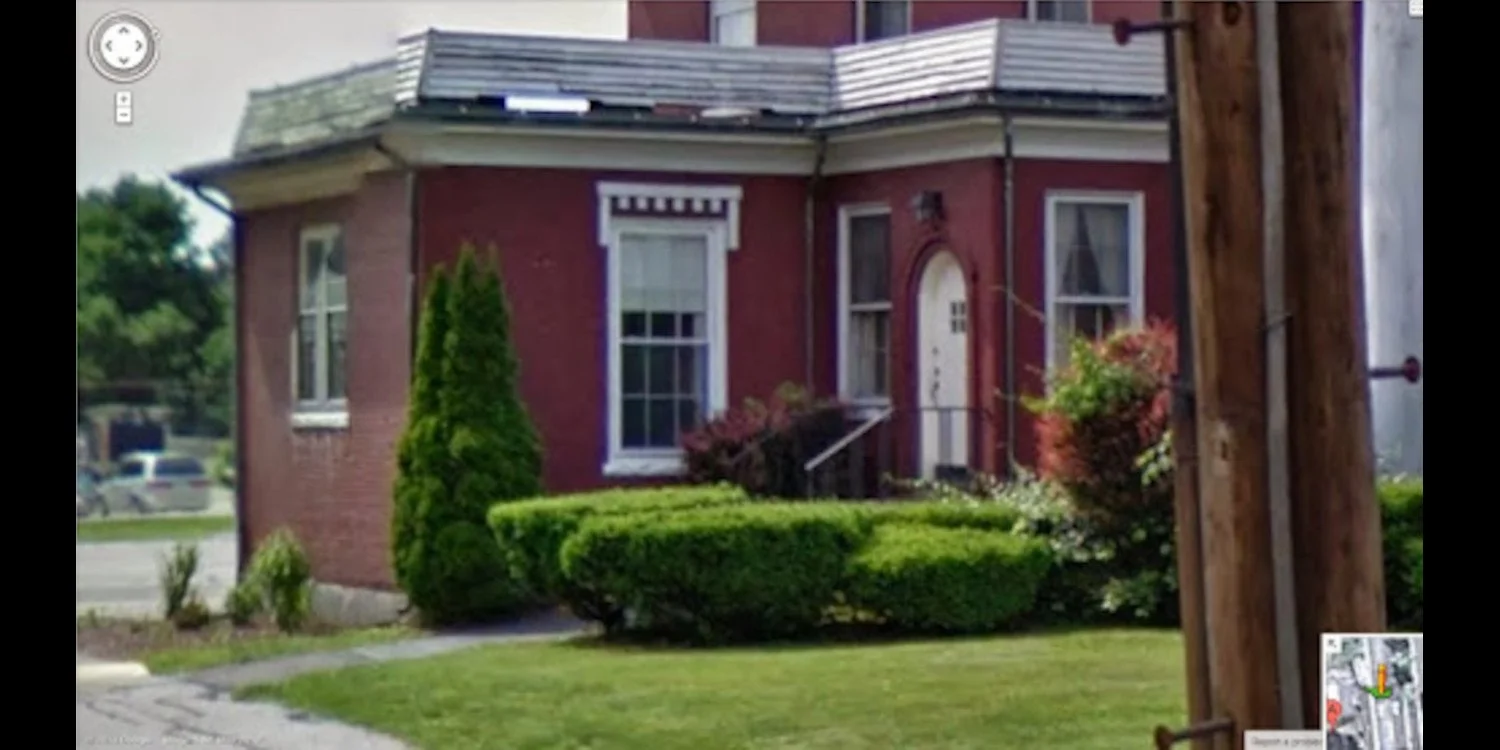
The door and window of Father MacRae’s office at Saint Bernard rectory in Keene, New Hampshire in 1983. It overlooks Main Street and the busiest part of downtown Keene, NH.
“Going for a Sex Abuse Victim World Record”
A year before the above investigation ensued, Thomas Grover was a patient at Derby Lodge, a drug treatment center in Berlin, NH, and his third or fourth attempt at such treatment. While there, according to his counselor, he was repeatedly confronted for his distortions, dishonesty, and manipulation. He reportedly told his counselor, Ms. Debbie Collett , that he had been sexually abused by his adoptive father who by this point had been divorced from Patricia Grover.
According to Ms. Collett’s statements, Grover also claimed to have been sexually abused by so many people in the past that it appeared that he was “going for some sort of sexual abuse victim world record.” Also according to her statements, he never accused Fr Gordon MacRae. Ms. Collett went on to reveal an alleged series of coercive harassment and overt threats from Detective McLaughlin to get her to alter her account before testifying at MacRae’s 1994 trial.
Four and a half years after the Florida letter and Detective McLaughlin’s investigation swept through Keene, NH, Thomas Grover and two of his brothers — and later a third brother, Jay Grover, who once told Detective McLaughlin that MacRae had never done anything wrong — all now accused the priest. Two of them also accused another priest, Father Stephen Scruton, providing highly detailed accounts of rape and molestations by Scruton. Fr Scruton was also named as someone who witnessed MacRae’s abuse of Jonathan Grover, and in two of his claims, the two priests abused him simultaneously at age 12. Then it was changed to age 14.
However, Fr Scruton was not present in that parish with MacRae until Jonathan Grover was over sixteen years old. When that fact became apparent, it never raised a doubt in McLaughlin’s mind. He just excised Scruton’s name from future reports as though never mentioned, and MacRae became the sole priest accused. The entire file contains no evidence that Detective McLaughlin ever questioned Rev. Stephen Scruton about Jonathan Grover’s claims despite having already investigated and charged Scruton with an entirely unrelated claim brought by Todd Biltcliff who was a high school classmate of Jonathan Groven. That claim resulted in a financial settlement by the Diocese of Manchester.
McLaughlin wrote in one of his reports that he gave the Grovers a copy of MacRae’s resume “to help them with their dates.” At the end of this three-ring circus, Father MacRae ended up in a trial of the facts where there were no facts, in a courtroom where credibility was the sole measurement of guilt or innocence. But there was also no credibility. Hype and a stellar performance by a practiced con artist had to suffice, and it did.

Witness Tampering
Late in 2013, a man who was present at that 1994 trial wrote a letter about it to retired Judge Arthur Brennan who presided over the MacRae trial. What follows are some excerpts of that letter postmarked November 24, 2013:
“My wife and I were present in the courtroom throughout most of the trial of Fr Gordon MacRae in 1994. I have had many questions about this trial and much that I’ve wanted to clarify for my own peace of mind… We saw something in your courtroom during the MacRae trial that I don’t think you ever saw. My wife nudged me and pointed to a woman, Ms. Pauline Goupil, who was engaged in what appeared to be clear witness tampering. During questions by the defense attorney, Thomas Grover seemed to feel trapped a few times. On some of those occasions, we witnessed Pauline Goupil make a distinct sad expression with a down-turned mouth and gesturing her index finger from the corner of her eye down her cheek at which point Mr. Grover would begin to cry and sob on the stand. The questions were never answered.
“I have been troubled about this for all these years. I know what I saw, and what I saw was clearly an attempt to dupe the court and the jury. If the sobbing and crying were not truthful, then I cannot help but wonder what else was not truthful on the part of Mr. Grover. If he were really a victim who wanted to tell the simple truth, why was it necessary for him and Ms. Goupil to have what clearly appeared to be a set of prearranged signals to alter his testimony? The jury was privy to none of this to the best of my knowledge.”
One of the challenges for the prosecution of this trial was to get Thomas Grover to look like a victim. It was not easy. At 27 years old at trial, Grover was a 5’ 11”, 200-pound ex-high school football player with a history of alcoholism and a police record including domestic violence, assault, forgery, narcotics, and theft charges — all suppressed in this trial by Judge Arthur Brennan. The sobbing Thomas Grover on the witness stand could not mask his real persona for long. Consider this next excerpt from the above letter to Judge Brennan from a witness at trial:
“Secondly, I was struck by the difference in Thomas Grover’s demeanor on the witness stand in your court and his demeanor just moments before and after outside the courtroom. On the stand, he wept and appeared to be a vulnerable victim. Moments later, during court recess, in the parking lot he was loud, boisterous and aggressive. One time he even confronted me in a threatening attempt to alter my own testimony during sentencing.”
The presence of Ms. Pauline Goupil in this story is highly problematic, and, to a layman’s eyes, most suspicious. A masters level psychotherapist, she was retained pre-trial by Grover at the behest of his contingency lawyer “because it would look better for the jury,” according to Grover’s ex-wife, Trina Ghedoni, whose later Statement cast some previously unseen light on this trial.
At one point in the trial, Ms. Goupil, once exposed, was forced under a court order to turn over her treatment file. It contained but a few pages, and not a single therapeutic record pertaining to any claims of abuse of Thomas Grover by Father MacRae. However, Ms. Goupil’s file did contain this letter purportedly written by her to Thomas Grover who apparently had not been showing up for his pre-trial coaching sessions with her:
“Jim tells me MacRae is being offered a deal his lawyers will want him to take so there won’t be a trial. We can just move on to the settlement phase.”
I discussed this letter previously in “The Trial of Father MacRae: A Conspiracy of Fraud,” my first installment in this series. The letter was part of a file of perhaps six pages that Pauline Goupil turned over upon orders of the court. A year later, during evidentiary proceedings from lawsuits brought by Thomas Grover and two of his brothers — a hearing in which everyone but the imprisoned priest had lawyers representing them — Ms. Goupil testified at length about her pre-trial sessions with Thomas Grover and her work in aiding the reconstruction of his memories of abuse at age 15. For excerpts of that testimony see my article, “Psychotherapists Helped Send an Innocent Priest to Prison.”
None of Ms. Goupil’s role in this case ever became known by the Fr MacRae trial jury. Like everyone else involved in the prosecution of this case, she has since declined to be interviewed or to answer any questions.
“Jim” in Ms. Goupil’s above letter to Thomas Grover refers to Detective James McLaughlin, a now retired sex crimes investigator for the Keene, NH Police Department. In 2018, his name was briefly added to a secret list of police officers with a history of official misconduct. McLaughlin sued in a secret “John Doe” lawsuit heard with no public accountability. In May 2024, he was allowed to have his name removed from that public list. The prevailing belief among court observers in New Hampshire was that McLaughlin was afforded this level of anonymity and the judicial outcome because leaving his name on that list could have reopened hundreds of other cases like MacRae’s.
At some point in his investigation of Thomas Grover’s claims against Gordon MacRae, the detective appears to have taken up some sideline work on behalf of Grover’s contingency lawyer. In 1993 before Fr MacRae was charged or even aware of the claims against him, McLaughlin obtained a warrant for a “one-party intercept,” a sting attempt to record a telephone call from Thomas Grover to the priest who at that time was involved in in New Mexico. Little, if any, of the resultant call made its way into the 1994 trial, however. The recorded claims from Grover elicited nothing more than the bewildered voice of Father MacRae apparently wondering what on Earth the caller was talking about. However, this attempt at a telephone sting revealed something far more interesting.
Detective McLaughlin had apparently learned of a toll-free “800” number for contacting Fr MacRae. His police report detailed his attempts to call that number from his office at the Keene Police station. However, phone records which coincided with McLaughlin’s reports about executing the warrant indicate that the calls were not placed from his office at Keene Police headquarters, but from the office of Grover’s contingency lawyer 50 miles away. This has never been explained. Also never explained are statements from Grover’s family members who today reveal that the contingency lawyer gave Grover repeated cash advances before MacRae’s criminal trial, a practice that, if true, was a violation of the New Hampshire Rules of Professional Conduct for lawyers. It is but another example of the pervasive lure of money in this story from start to finish.
An immediate problem for anyone trying to get to the bottom of all this is the absence of recorded interviews. It seemed to be Detective McLaughlin’s standard procedure to record interviews with accusers — referred to as “victims” in every one of his reports that I have read.
Another new witness statement from Steven Wollschlager alleges that McLaughlin knowingly elicited false accusations against Fr MacRae in exchange for cash and an implication that “life could go easier with a lot of money.” Wollschlager was subpoenaed to testify before a Grand Jury to process a new indictment against Fr MacRae just before the Grover trial, but decided at the last minute that he could not pursue this lie. Wollschlager added that McLaughlin’s reports contain statements that he never said, and distortions of what he did say.
The one recording McLaughlin did appear to make was that of his interview with Thomas Grover’s counselor, Ms. Debbie Collett. Today, she reports that he badgered her, threatened her, and allegedly bullied her into restating her account into something he wanted to hear, and he did all of this on tape. That recording was never turned over to the defense and has never seen the light of day.
Detective McLaughlin did not seem to record his interviews with any of the Grover brothers accusing Gordon MacRae. This was a startling departure from his own longstanding methods and protocols. The choice not to record anything in this one case seems calculated, and it has never been explained. The fact that today, multiple witnesses claim to have been bribed, coerced, badgered, and otherwise manipulated by this detective could lead a rational observer to question what has gone on here, and to doubt the credibility of the claims against this priest.
It is true that there has been a cover-up in the Catholic clergy sex abuse story, but it is not the one everyone thinks it is. It took place twenty years ago in beautiful downtown Keene, New Hampshire.
+ + +
Editor’s Note: The above article continued a series by Ryan A. MacDonald. Other titles in this series include “The Trial of Father MacRae: A Conspiracy of Fraud,” “The Prison of Father MacRae: A Conspiracy of Silence,” and “The Post-Trial Extortion of Father Gordon MacRae.”

Judge Arthur Brennan, who sentenced Father Gordon MacRae to life in prison, being arrested in the Congressional Chambers in Washington, DC as part of the “Occupy Movement.”
The Eucharistic Adoration Chapel established by Saint Maximilian Kolbe was inaugurated at the outbreak of World War II. It was restored as a Chapel of Adoration in September, 2018, the commemoration of the date that the war began. It is now part of the World Center of Prayer for Peace. The live internet feed of the Adoration Chapel at Niepokalanow — sponsored by EWTN — was established just a few weeks before we discovered it and began to include in at Beyond These Stone Walls. Click “Watch on YouTube” in the lower left corner to see how many people around the world are present there with you. The number appears below the symbol for EWTN.
Click or tap here to proceed to the Adoration Chapel.
The following is a translation from the Polish in the image above: “Eighth Star in the Crown of Mary Queen of Peace” “Chapel of Perpetual Adoration of the Blessed Sacrament at Niepokalanow. World Center of Prayer for Peace.” “On September 1, 2018, the World Center of Prayer for Peace in Niepokalanow was opened. It would be difficult to find a more expressive reference to the need for constant prayer for peace than the anniversary of the outbreak of World War II.”
For the Catholic theology behind this image, visit my post, “The Ark of the Covenant and the Mother of God.”

Cardinal Bernard Law on the Frontier of Civil Rights
Former Boston Archbishop, Cardinal Bernard Law was vilified by The Boston Globe and SNAP, but before that he was a champion of justice in the Civil Rights Movement.

Former Boston Archbishop, Cardinal Bernard Law was vilified by The Boston Globe and SNAP, but before that he was a champion of justice in the Civil Rights Movement.
June 19, 2024 by Fr Gordon MacRae
Note from Fr MacRae: I first wrote this post in November 2015. I wrote it in the midst of a viral character assassination of a man who had become a convenient scapegoat for what was then the latest New England witch hunt. That man was Cardinal Bernard Law, Archbishop of Boston. I have to really tug hard to free this good man’s good name from the media-fueled availability bias that so mercilessly tarnished it back then. A good deal more has come to light, and I get to have the last word.
By coincidence, and it was not planned this way, but the date of this revised reposting is June 19, 2024, the day that the United States commemorates the emancipation of African American slaves on June 19, 1865 in Galveston, Texas. As you will read herein, Cardinal Bernard Law was a national champion in the cause for Civil Rights and racial equality.
+ + +
Four years after The Boston Globe set out to sensationalize the sins of some few members of the Church and priesthood, another news story — one subtly submerged beneath the fold — drifted quietly through a few New England newspapers. After a very short life, the story faded from view. In 2006, Matt McGonagle resigned from his post as assistant principal of Rundlett Middle School in Concord, New Hampshire. Charged with multiple counts of sexually assaulting a 14-year-old high school student six years before, McGonagle ended his criminal case by striking a plea deal with prosecutors. McGonagle pleaded guilty to the charges on July 28, 2006.
He was sentenced to a term of sixteen months in a local county jail. An additional sentence of two-and-a-half to five years in the New Hampshire State Prison was suspended by the presiding judge in Merrimack County Superior Court — the same court that declined to hear evidence or testimony in my habeas corpus appeal in 2013 after having served 20 years in prison for crimes that never took place.
In a statement, Matt McGonagle described the ordeal of being prosecuted. He said it was “extraordinarily difficult,” and thanked his “many advocates” who spoke on his behalf. In the local press, defense attorney James Rosenberg defended the plea deal for a sixteen month county jail sentence:
“The sentence is fair, and accurately reflects contributions that Matt has made to his community as an educator.”
— Melanie Asmar, “Ex-educator pleads guilty in sex assault,” Concord Monitor, July 29, 2006
Four years earlier, attorney James Rosenberg was a prosecutor in the New Hampshire Attorney General’s Office from where he worked to prosecute the Diocese of Manchester for its handling of similar, but far older claims against Catholic priests.
The accommodation called for in the case of teacher/principal Matt McGonagle — an insistence that he is not to be forever defined by the current charges against him — was never even a passing thought in the prosecutions of Catholic priests. Those cases sprang from the pages of The Boston Globe, swept New England, and then went viral across America. The story marked The Boston Globe’s descent into “trophy justice.”

Cardinal Sins
I have always been aware of this inconsistency in the news media and among prosecutors and some judges, but never considered writing specifically about how it applied to Cardinal Bernard Law until I read Sins of the Press, a book by David F. Pierre, Jr. On page after page it cast a floodlight on The Boston Globe’s Pulitzer-endorsed lynching of Cardinal Law, offered up as a scapegoat for The Scandal and driven from Boston by the news media despite having never been accused, tried, or convicted of any real crime.
Does the “lynching of Cardinal Law” seem too strong a term? Historically, the word “lynching” came into the English lexicon from the name of Captain William Lynch of Virginia who acted as prosecutor, judge and executioner. He became notorious for his judgment-sans-trial while leading a band to hunt down Loyalists, Colonists suspected of loyalty to the British Crown in the War for Independence in 1776.
The term applies well to what started in Boston, then swept the country. Most of those suspected or accused in the pages of The Boston Globe, including Cardinal Bernard Law, were never given any trial of facts. As I recently wrote in, “To Fleece the Flock: Meet the Trauma-Informed Consultants,” many of the priests were deceased when accused, and many others faced accusations decades after any supportive evidence could be found, or even looked for. The Massachusetts Attorney General issued an astonishing statement given short shrift in the pages of The Boston Globe:
“The evidence gathered during the course of the Attorney General’s sixteen-month investigation does not provide a basis for bringing criminal charges against the Archdiocese and its senior managers.”
— Commonwealth of Massachusetts Attorney General Thomas Reilly, “Executive Summary and Scope of the Investigation,” July 23, 2003
So I decided to explore the story of Cardinal Bernard Law for Beyond These Stone Walls. When I first endeavored to write about him, he had been virtually chased from the United States by some in the news media and so-called victim advocates deep into lawsuits to fleece the Church. Though not intended originally, my post was to be published on November 4, 2015, which also happened to be Cardinal Law’s 84th birthday.
When I wrote of my intention to revisit the story of Cardinal Bernard Law from a less condemning perspective, it sparked very mixed feelings among some readers. A few wrote to me that they looked forward to reading my take on the once good name of this good priest. A few taunted me that this was yet another “David v Goliath” task. Others wrote more ominously, “Don’t do it, Father! Don’t step on that minefield! What if they target you next?” That reaction is a monument to the power of the news media to spin a phenomenon called “availability bias.”
A while back, I was invited by Catholic League President Bill Donohue to contribute some articles for Catalyst, the Journal of the Catholic League for Religious and Civil Rights. My second of two articles appeared in the July/August 2009 issue just as Beyond These Stone Walls began. It was entitled “Due Process for Accused Priests” and it opened with an important paragraph about the hidden power of the press to shape what we think:
“Psychologist Daniel Kahneman won the Nobel Prize in Economics in 2002 for his work on a phenomenon in psychology and marketing called ‘availability bias.’ Kahneman demonstrated the human tendency to give a proposition validity just by how easily it comes to mind. An uncorroborated statement can be widely seen as true merely because the media has repeated it. Also in 2002, the Catholic clergy sex abuse scandal swept out of Boston to dominate news headlines across the country….”
This is exactly what happened to Cardinal Law. There was a narrative about him, an impression of his nature and character that unfolded over the course of his life. I spent several months studying that narrative and it is most impressive.
Then that narrative was replaced by something else. With a target on his back, the story of Cardinal Law was entirely and unjustly rewritten by The Boston Globe. Then the rewrite was repeated again and again until it took hold, went viral, and replaced in public view the account of who this man really was.
Even some in the Church settled upon this sacrificial offering of a reputation. Perhaps only someone who has known firsthand such media-fueled bias can instinctively recognize it happening. Suffice it to say that I instinctively recognized it. I offer no other defense of my decision to visit anew the first narrative in the story of who Bernard Law was. If you can set aside for a time the availability bias created around the name of Cardinal Bernard Law, then you may find this account to be fascinating, just as I did.

From Harvard to Mississippi
As this account of a courageous life and heroic priesthood unfolded before me, I was eerily reminded of another story, one I came across many years ago. It was the year I began to seek something more than the Easter and Christmas Catholicism I inherited. It was 1968, and I was fifteen years old in my junior year at Lynn English High School just north of Boston. Two champions of the Civil Rights Movement I had come to admire and respect in my youth — Martin Luther King and Bobby Kennedy — had just been assassinated. And just as my mind and spirit were being shaped by that awful time, I stumbled upon something that would refine for me that era: the great 1963 film, The Cardinal.
Based on a book of the same name by Henry Morton Robinson (Simon & Schuster 1950), actor Tom Tryon portrayed the title role of Boston priest, Father Stephen Fermoyle who rose to become a member of the College of Cardinals after a heroic life as an exemplary priest. It was the first time I encountered the notion that priesthood might require courage, and I wondered whether I had any. I was fifteen, sitting alone at Mass for the first time in my life when this movie sparked a scary thought.
Father Fermoyle was asked by the Apostolic Nuncio to tour the southern United States “between the Great Smokies and the Mississippi River” — an area known for anti-Catholic prejudice. He was tasked with writing a report on the state of the Catholic Church there during a time of great racial unrest.
In the script (and in the book which I read later) Mississippi Chancery official, Monsignor Whittle (played in the film by actor, Chill Wills) was fearful of the racist, anti-Catholic Ku Klux Klan. He tried to dissuade Father Fermoyle from making any waves, but his mere presence there would set off a tidal wave of suspicion. In a horrific scene, Father Fermoyle was kidnapped in the night, blindfolded, and driven to the middle of a remote field — a field where many young black men had disappeared.
His blindfold removed, he found himself surrounded by men in sheets and white hoods, illuminated by the light of a burning cross. Father Fermoyle was given a crucifix and ordered to spit on it or face the scourging of Christ. Henry Morton Robinson’s book conveys the scene:
“He held the crucifix between thumb and forefinger, lofting it like a lantern in darkness…. Ancient strength of martyrs flowed into Stephen’s limbs. Eyes on the gilt cross, he neither flinched nor spoke. [The music played] ‘In Dixieland I’ll take my stand.’ Stephen prayed silently that no drop of spittle, no whimpering plea for mercy, would fall from his lips before the end… The sheeted men climbed into their cars. Not until the last taillight had disappeared had Stephen lowered the crucifix.”
— The Cardinal, pp 412-413
This could easily have been a scene from the life of Father Bernard Law. Born on 4 November 1931 in Torreon, Mexico, Bernard Francis Law spent his bilingual childhood between the United States, Latin America, and the Virgin Islands. His father was a U.S. Army Captain in World War II and Bernard was an only child. Very early in life, he learned that acceptance does not depend on race, or color, or creed, and once admonished his classmates in the Virgin Islands that “Never must we let bigotry creep into our beings.”
At age 15, Bernard read Mystici Corporis, a 1943 Encyclical of Pope Pius XII that Bernard later described as “the dominant teaching of my life.” He was especially touched by the language of inclusion of a heroic Pope in a time of great oppression. The encyclical was banned in German-occupied Belgium for “subversive” lines connecting the Mystical Body of Christ with the unity of all Christians, transcending barriers such as race or politics.
As a weird aside, I was in shock and awe as I sat typing this post when I asked out loud, “How could I find a copy of Mystici Corporis while stuck in a New Hampshire prison cell?” Then our convert friend, Pornchai Moontri jumped from his bunk, pulled out his footlocker containing the sum total of his life, and handed me a heavily highlighted copy of the 1943 Encyclical. I haven’t yet wrapped my brain around that, but it’s another post for another time.
While attending Harvard University, Bernard Law found a vocation to the priesthood during his visits to Saint Paul’s Church in Cambridge, Massachusetts. After graduating from Harvard in 1953, the year I was born, a local bishop advised him that Boston had lots of priests and he should give his talents to a part of the Church in need. At age 29, Father Bernard Law was ordained for what was the Diocese of Natchez-Jackson, Mississippi.

Standing before the Mask of Tyranny
The year was 1961. The Second Vatican Council would soon open in Rome, and the Civil Rights Movement was gathering steam (and I do mean steam!) in the United States, Father Law immersed himself in both. A Vicksburg lawyer once remarked that Father Law “went into homes as priests [there] had never done before.” With a growing reputation for erudition and bridge building on issues many others simply avoided, Bernard was summoned by his bishop to the State Capital to become editor of the diocesan weekly newspaper, then called The Mississippi Register.
It was there that the courage to proclaim the Gospel took shape in him, and became, along with his brilliant mind, his most visible gift of the Holy Spirit. Another young priest of that diocese noted that Father Law’s racial attitudes — shaped by his childhood in the Virgin Islands — were different from those of most white Mississipians. “He felt passionately about racial justice from the first moment I knew him,” the priest wrote. “It wasn’t a mere following of teaching, it came from his heart.”
I know many Mississippi Catholics today — including many who read Beyond These Stone Walls — but in the tumultuous 1960s, Catholics were a small minority in Mississippi. They were also a target for persecution by the Ku Klux Klan which was growing in both power and terror as the nation struggled with a burgeoning Civil Rights Movement.
An 1896 U.S. Supreme Court decision in “Plessy v. Ferguson” had defined the doctrine of “separate but equal” as a Constitutional nod to racial segregation, but in 1954 in “Brown v. Board of Education,” the Supreme Court based a landmark desegregation ruling on solid evidence that “separate” was seldom “equal.” Opposition to the ruling grew throughout the South, and so did terrorist Klan activities. In 1955, the murder of a black Mississippi boy, 14-year-old Emmett Till, rocked the state and the nation, as did the acquittal of his accused white killers.
This was the world of Father Bernard Law’s priesthood. Up to that time, the diocesan newspaper, The Mississippi Register, had been visibly timid on racial issues, but this changed with this priest at the helm. In June of 1963 he wrote a lead story on the evils of racial segregation citing the U.S. Bishops’ 1958 “Statement on Racial Discrimination and the Christian Conscience.”
One week later, the respected NAACP leader Medgar Evers was gunned down outside his Jackson, Mississippi home. Both Father Law and (then) Natchez-Jackson Bishop Richard Gerow boldly attended the wake for Medgar Evers under the watchful eyes of the Klan. Father Law’s next issue of The Mississippi Register bore the headline, “Everyone is Guilty,” citing a statement by his Bishop that many believe was written by Bernard Law:
“We need frankly to admit that the guilt for the murder of Mr. Evers and the other instances of violence in our community tragically must be shared by all of us… Rights which have been given to all men by the Creator cannot be the subject of conferral or refusal by men.”
Father Law and Bishop Gerow were thus invited to the White House along with other religious leaders to discuss the growing crisis in Mississippi with President John F. Kennedy and his brother, Attorney General Robert Kennedy. Later that summer, Father Law challenged local politicians in The Mississipi Register for their lack of moral leadership on racial desegregation, stating “Freedom in Mississippi is now at an alarmingly low ebb.” Massachusetts District Judge Gordon Martin, who was a Justice Department attorney in Mississippi at that time, once wrote for The Boston Globe that Father Law…
“…did not pull his punches, and the Register’s editorials and columns were in sharp contrast with the racist diatribes of virtually all of the state’s daily and weekly press.”
Later that year, Father Law won the Catholic Press Association Award for his editorials. In “Freedom Summer” 1964, when three civil rights workers were missing and suspected to have been murdered, Father Bernard Law openly accepted an invitation to join other religious leaders to advise President Lyndon Johnson on the racial issues in Mississippi. When the bodies of the three slain young men were found buried at a remote farm, the priest boldly issued a challenge to stand up to the crisis:
“In Mississippi, the next move is up to the white moderate. If he is in the house, let him now come forward.”
Later that year Father Law founded and became Chairman of the Mississippi Council on Human Relations. Then the home of a member, a rabbi, was bombed. Then another member, a Unitarian minister, was shot and severely wounded. The FBI asked Father Law to keep them apprised of his whereabouts, and Bishop Gerow, fearing for his priest’s safety, ordered him from the outskirts of Jackson to the Cathedral rectory, but Bernard Law feared not.
Cardinal Law’s life and mine crossed paths a few times over the course of my life as a priest. I mentioned above that while attending Harvard University, Bernard Law found his vocation to the priesthood during visits to Saint Paul’s Church in Cambridge. Many years later, in 1985, my uncle, Father George W. MacRae, SJ, the first Roman Catholic Dean of Harvard Divinity School and a renowned scholar of Sacred Scripture, passed away suddenly at the age of 57. I was a concelebrant at his Mass of Christian Burial at Saint Paul’s Church in Cambridge. Concelebrating with me was Cardinal Bernard Law where his life as a priest first took shape.
In 2013, The New York Times sold The Boston Globe for pennies on the dollar.
On December 20, 2017, Cardinal Bernard Law passed from this life in Rome.
Oh, that such priestly courage as his were contagious, for many in our Church could use some now. Thank you, Your Eminence, for the gift of a courageous priesthood. Let us not go gentle into The Boston Globe’s good night.
+ + +
Note from Father Gordon MacRae: I am indebted for this post to the book, Boston’s Cardinal : Bernard Law, the Man and His Witness, edited by Romanus Cessario, O.P. with a Foreword by Mary Ann Glendon (Lexington Books, 2002).
You may also like these related posts from Beyond These Stone Walls:
Saint John Paul the Great: A Light in a World in Crisis
Pell Contra Mundum: Cardinal Truths about the Synod
The Eucharistic Adoration Chapel established by Saint Maximilian Kolbe was inaugurated at the outbreak of World War II. It was restored as a Chapel of Adoration in September, 2018, the commemoration of the date that the war began. It is now part of the World Center of Prayer for Peace. The live internet feed of the Adoration Chapel at Niepokalanow — sponsored by EWTN — was established just a few weeks before we discovered it and began to include in at Beyond These Stone Walls. Click “Watch on YouTube” in the lower left corner to see how many people around the world are present there with you. The number appears below the symbol for EWTN.
Click or tap here to proceed to the Adoration Chapel.
The following is a translation from the Polish in the image above: “Eighth Star in the Crown of Mary Queen of Peace” “Chapel of Perpetual Adoration of the Blessed Sacrament at Niepokalanow. World Center of Prayer for Peace.” “On September 1, 2018, the World Center of Prayer for Peace in Niepokalanow was opened. It would be difficult to find a more expressive reference to the need for constant prayer for peace than the anniversary of the outbreak of World War II.”
For the Catholic theology behind this image, visit my post, “The Ark of the Covenant and the Mother of God.”