“There are few authentic prophetic voices among us, guiding truth-seekers along the right path. Among them is Fr. Gordon MacRae, a mighty voice in the prison tradition of John the Baptist, Maximilian Kolbe, Alfred Delp, SJ, and Dietrich Bonhoeffer.”
— Deacon David Jones

Richard John Neuhaus: A Life in the Public Square
Six years after the death of Richard John Neuhaus, a new biography by Randy Boyagoda echoes his bold, timely, vibrant voice on religion in the public square.

Six years after the death of Richard John Neuhaus, a new biography by Randy Boyagoda echoes his bold, timely, vibrant voice on religion in the public square.
January 29, 2025 by Fr Gordon MacRae
[Editor’s Note: The following post first appeared in 2015 at an earlier version of this blog. It has been heavily updated with new material by Father Gordon MacRae.]
When I was cast into the exile of unjust imprisonment in 1994, a friend concerned for what he imagined was a dearth of intellectual stimulation here gifted me with a subscription to First Things magazine. It was a gift that expanded a mind trapped in a world of concrete and steel, but it also created a serious problem for me. I simply could not part with the monthly issues that piled up on my cell floor drawing frowns from prison guards. “Why would you keep these?” asked one. “There aren’t even any pictures in them!”
I live in a micromanaged world in which every precious square inch of space must be accounted for, leaving little room for a collection of First Things. So I took a job in the prison library, found an empty shelf, and began what is likely the only collection of First Things spanning fifteen years in a prison library. You might be surprised by how often they are checked out, the lack of pictures notwithstanding.
But there is one issue that has never left my cell. I keep it in a safe place, and return to it twice a year in January and May. It is the April 2009 issue, Number 192, bearing the cover, “Richard John Neuhaus In Memoriam.”
I was simply amazed that, just three months after RJN’s untimely death from the ravages of cancer on January 9, 2009, this collection of essays could be gathered from the friends and colleagues for whom he was the hub in the arena of religion and public life in America. I should say, “in the Americas,” for Richard was Canadian by birth and his voice was as influential to our north as it was here in the U.S.
I keep this issue close because when Father Richard left this world, I could partake of none of the usual rituals with which we say goodbye. So I never said goodbye. Through the words of those who loved and cherished his company, he is still very much here, and I am grateful for that.
I have written of this before, so forgive my repetition, but my first inkling that something was amiss with Richard’s health came in a handwritten note from Steve Oslica in October of 2008. He had been in New York and attended a Mass offered by Father Richard. “Keep Father Neuhaus in your prayers,” Steve wrote. “I think he is dealing with some health issues.” Two months later, he was gone. Father Richard John Neuhaus left this world in the Lord’s friendship on January 9, 2009.
He also left dangling the friendship of countless others, including mine, though it was a friendship formed almost entirely through mutual friends, and in a dynamic exchange of letters to and from prison that spanned the last decade of his life. His influence upon me within these prison walls is directly proportional to the void that he left here.
A month after his death, I received the kindest of notes, dated February 17, 2009, from the Honorable Mary Ann Glendon, just returned from her post as United States Ambassador to the Holy See:
“Greetings from Boston — It’s good to be home again. I have just returned from a meeting in NYC to discuss the continuation of First Things and other aspects of Father Neuhaus’ work. I know you must be feeling his loss as keenly as the rest of us who depended on his leadership in so many ways.”
I was so deeply grateful to Ambassador Glendon. The brief letter filled in for me what had been lacking in the absence of ritual and sacrament to acknowledge death. Then, that April when First Things published its truly wonderful “In Memoriam” issue, I stored that letter within it, and marveled at the wit and wisdom and deeply felt love and respect that issue contains.
Of the dozens of profound and moving remembrances paying tribute to RJN, my favorite was, and still is, one entitled “Canadian Summers” by Father Tim Moyle of the Diocese of Pembroke, Ontario, who today reads Beyond These Stone Walls on occasion. Father Tim wrote of a long friendship with Richard and of the impact of one of his lesser known works, Freedom for Ministry (1979):
“Richard offered a powerful vision of pastoral service. Here he spoke of the importance of finding ways to present the awesome challenge of Jesus Christ to those under one’s pastoral care. By accepting the wonderful ‘challenge of orthodoxy’ that is the placing of Christ at the center of their lives, clergy of all stripes would find the inspiration to minister God’s love to all the baptized as they labored to promote the Kingdom of God. His fraternal care and concern for those who took up the pastoral yoke of Jesus Christ was where his compassion, faith, and profound humility in the face of the paschal mystery shone through the brightest for me.”
For me as well, Father Tim. I revisit this and other essays each May because that is the month of Richard’s birth. It is an irony that Father Richard John Neuhaus was born on May 14, the Feast of Saint Matthias, chosen by lot to complete the Twelve Apostles by filling the vacancy left by Judas Iscariot (Acts 1:21-26). The significance of that for me may be more evident below.

The Biography
Now, six years after RJN’s untimely death, biographer Randy Boyagoda has written a stellar biography of this great good friend and his prodigious voice in the arena of religion in American — and, yes Father Tim, Canadian — public life. Richard John Neuhaus: A Life in the Public Square (Image Books, 2015) is a timely tribute and a most welcomed addition to the national discussion of the role of religion and faith with which we in the Americas now struggle. In 459 pages, Randy Boyagoda captured well the strength of courage and depth of faith, coupled with a most formidable intellect, that produced the prophetic voice of Richard John Neuhaus. I received it and devoured it with that same old familiar sense of feeling both elated and deflated.
Elated first: A biography about a friend must naturally be approached with some trepidation, and I am not the first to express that thought. In a brief review, former First Things interim editor, Russell E. Saltzman wrote,
“I have never read a biography of someone I knew well. It was with apprehension, then, that I read the galleys of Randy Boyagoda’s biography of Neuhaus … I was having trouble figuring out how anyone could capture Neuhaus whole.”
— Russell E. Saltzman, “New Biography Captures Spirit of One of the Great Catholic Intellectuals,” Feb. 18, 2015
Randy Boyagoda did just that, however. He captured well the man I knew and still know through the pens of the many whose esteem for him ran deep. Boyagoda summarized him as “a bold Christian and a bold intellectual and a bold cosmopolitan and a bold operator, all at once, all as one.”

First Things and Last Things
Few people know the extent of that boldness, professed, at times, at great personal cost to himself. I have a first hand account of it, and to this day Neuhaus is subjected, even in death, to the ridicule he expected — but never feared — on account of his own exercise of justice.
Among the many tributes to RJN, published anew as reviews by Mr. Boyagoda’s wondrous biography, was one I admired greatly. It appeared in the The Wall Street Journal (“From Anti-War Pastor to Pro-Life Priest,” March 27, 2015) by University of Oklahoma History Professor and former First Things Editorial Board member, Wilfred M. McClay. I disagree however, with one point emphasized in both the book and Mr. McClay’s review.
“Mr. Boyagoda does not refrain from faulting some of Neuhaus’ more questionable judgments, such as his playing down of the clergy sex-abuse scandal, which led him to undertake a fierce and misguided defense of Father Marcial Maciel, the founder of the Legion of Christ, who would eventually be exposed as a prodigious sexual abuser and disciplined by Pope Benedict XVI.”
— Wilfred M. McClay, “From Anti-War Pastor to Pro-Life priest,” WSJ, March 27, 2015
Some of the comments on that McClay review at WSJ.com dusted off old prejudices about Catholics, charging that Neuhaus “abandoned the word of God” in his transformation from Lutheran pastor to Catholic priest. Others highlighted what Wilfred McClay termed his “fierce and misguided defense of Father Marcial Maciel.” So I posted two comments of my own, and this is one of them:
“It is a distortion and an injustice to characterize Father Richard John Neuhaus’ concerns for justice in the Church as “playing down the sex-abuse scandals.” He did no such thing. His collection of essays under the title, ‘Scandal Time’ comprised the sanest, most just, and most critical analysis of that crisis in print. Father Neuhaus rightly called upon the U.S. Bishops not to simply replace one injustice with another to appease a scandal hungry media, and the ravenous tort bar.”
The “Scandal Time” essays are compiled and posted in pdf format here at Beyond These Stone Walls. Even a cursory read of them will tell you that Boyagoda’s characterization of this great priest as “bold” is immensely understated. In the face of a modern day witch hunt in the secular media, and, sadly, even the Catholic press as clergy sex abuse scandals unfolded in 2002, the voice of Father Neuhaus was more than bold. It was revolutionary. This one man held back the tide of “availability bias” to give accused priests a singular voice calling for justice, due process, and fairness. And this was after his defense of Marcial Maciel was shown to be flawed and misdirected.
I cannot convey in mere words what this meant to me, personally. Even while being bludgeoned for his misjudgment on Maciel, Father Neuhaus published “A Kafkaesque Tale,” demonstrating to the Catholic Christian community the inconsistency of its application of justice in the wake of the U S Bishops’ “Final Solution,” the 2002 Dallas Charter that blatantly equated accusation with guilt. In this, Richard John Neuhaus stood almost entirely alone in Catholic media in the religious public square.
Father Neuhaus refused to use the apparent guilt of Maciel to undermine justice and due process for other accused Catholic priests even when many other writers were doing just that. To fault Father Neuhaus for this today is to add insult to injustice. Even after his defense of Father Maciel was undermined and criticized, Father Neuhaus published “A Kafkaesque Tale” in the January 2008 edition of First Things:
“Among the many sad consequences of the sex abuse crisis are the injustices visited on priests falsely accused. A particularly egregious case is that of Father Gordon MacRae of the Diocese of Manchester, New Hampshire. He was sentenced to sixty-seven years and has been imprisoned more than twelve years with no chance of parole because he insists he is innocent. I have followed the case for several years. Lawyer friends have closely examined the case and believe he was railroaded. The Wall Street Journal ’s Pulitzer Prize-winning journalist Dorothy Rabinowitz published, on April 27 and 28, 2005, an account of the travesty of justice by which he was convicted. Now the friends of Father MacRae have created a website, BeyondTheseStoneWalls.com, which provides a comprehensive narrative of the case, along with pertinent documentation. Bishop John McCormack, a former aide of Boston’s Cardinal Law, and the Diocese of Manchester do not come off as friends of justice or, for that matter, of elementary decency. You may want to visit the website and read this Kafkaesque tale. And then you may want to pray for Father MacRae, and for a Church and a justice system that seem indifferent to justice.”

Among His Last Things
Beyond These Stone Walls came into being exactly six months after Father Neuhaus left this world. In part, at least, this blog was his idea, an idea shared and generated by his friend of long standing, Cardinal Avery Dulles. As our “About” page describes, they together wrote, “Your article is an important one, and will hopefully be followed by many others. Your writing, which is clear, eloquent and spiritually sound, will be a monument to your trials.”
In this call for fairness in the face of a witch hunt, Father Neuhaus came full circle. Born on the Feast of Saint Matthias who resolved the first Judas Crisis in the Church, Father Neuhaus sought to also resolve its newest form as the 21st Century commenced. He and Cardinal Dulles were lone voices in the media glare of 2002, but truth and justice accommodating the acceptable media view is an old practice that history always exposes eventually as deeply flawed.
This boldness extended into First Things as Father Neuhaus published several letters of mine including “Crime and Punishment,” (First Things, November 2008), and “Sin and Risk Aversion” (November 1996). In his last letter to me two months before his death, Father Neuhaus asked, “How does one go about arranging to visit with you?” Upon hearing of his illness I quickly wrote back, assuring him that he had been living the Corporal Works of Mercy for the last decade of our fraternal correspondence — an exchange in which I never once felt like the outcast so many other corners of the Church fashioned for me. This adviser to popes and presidents found room to also quietly live the exhortation of Hebrews 13:3.
+ + +
“Zero tolerance, one strike and you’re out, boot them out of ministry. Of course the victim activists are not satisfied and, sadly, may never be satisfied. The bishops have succeeded in scandalizing the faithful anew by adopting [in the Dallas Charter] a thoroughly unbiblical, untraditional, and un-Catholic approach to sin and grace.… They ended up adopting a policy that was sans repentance, sans conversion, sans forbearance, sans prudential judgment, sans forgiveness, sans almost everything one might have hoped for from the bishops of the Church of Jesus Christ.”
— Richard John Neuhaus, “Scandal Time”, 2008, First Things
+ + +
Note from Father Gordon MacRae: Thank you for reading and sharing this post about my great good friend, Father Richard John Neuhaus. You may also like these related posts:
Pell Contra Mundum: Cardinal Truth on the Synod
Canon Law Conundrum: When Moral Certainty Is Neither Moral Nor Certain
Cultural Meltdown: Prophetic Wisdom for a Troubled Age
How I Became the Catholic I Was by Richard John Neuhaus

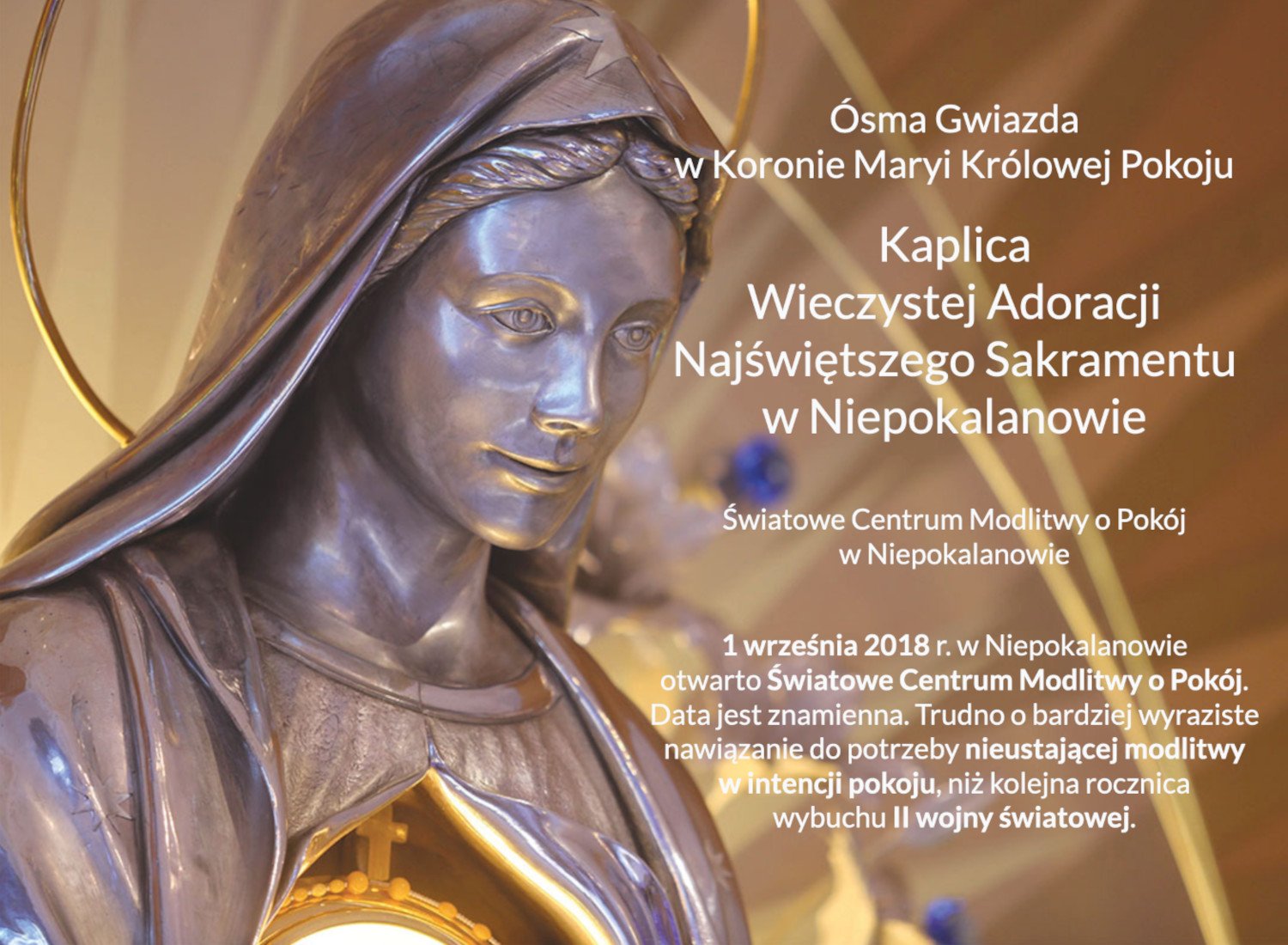

The Eucharistic Adoration Chapel established by Saint Maximilian Kolbe was inaugurated at the outbreak of World War II. It was restored as a Chapel of Adoration in September, 2018, the commemoration of the date that the war began. It is now part of the World Center of Prayer for Peace. The live internet feed of the Adoration Chapel at Niepokalanow — sponsored by EWTN — was established just a few weeks before we discovered it and began to include in at Beyond These Stone Walls. Click “Watch on YouTube” in the lower left corner to see how many people around the world are present there with you. The number appears below the symbol for EWTN.
Click or tap here to proceed to the Adoration Chapel.
The following is a translation from the Polish in the image above: “Eighth Star in the Crown of Mary Queen of Peace” “Chapel of Perpetual Adoration of the Blessed Sacrament at Niepokalanow. World Center of Prayer for Peace.” “On September 1, 2018, the World Center of Prayer for Peace in Niepokalanow was opened. It would be difficult to find a more expressive reference to the need for constant prayer for peace than the anniversary of the outbreak of World War II.”
For the Catholic theology behind this image, visit my post, “The Ark of the Covenant and the Mother of God.”

Does President Donald Trump Have a Prayer?
Donald John Trump resumes the Office of President of the United States amid sentiments of deliverance at home but signs of a looming World War III everywhere else.

Donald John Trump resumes the Office of President of the United States amid sentiments of deliverance at home but signs of a looming World War III everywhere else.
January 22, 2025 by Fr Gordon MacRae
At the very moment I am typing this on the day of Donald Trump’s second Inauguration as President, he has just arrived at Saint John’s Episcopal Church across Liberty Park from the White House for a pre-inauguration prayer service. I wrote about this very place just months before the election of 2020 at the end of President Trump’s first term. I wrote about media coverage of an event outside that same church. A U.S. Cardinal and much of the mainstream news media had conspired in a lie. My post was, “The State of Our Freedom, the Content of Our Character.”
The state of our nation was ablaze in urban riots then, triggered by the death of George Floyd at the hands of a Minneapolis police officer. The shocking video seemed to be broadcast almost around the clock. As we watched cities burn, the news media told us that these were “mostly peaceful protests.” Across the rest of the nation, we were forced into masks that turned out to be nearly useless. Draconian Covid restrictions on “non-sanctioned” events such as attendance at Catholic Mass, seemed not to apply at all to urban rioters. We were to accept that Covid was much more contagious in churches than in public protests.
It all seems so long ago now because so much has happened since. The nation has no appetite for looking backward right now, but eventually we must. I will link to the above post again at the end of this one. Seeing where we have been presents a cautionary tale that just might influence where we go next.
But there is another matter invading my thoughts. As I watch this inauguration unfold this morning, the Bidens are just about to host the Trumps at the White House for a “pre-inauguration tea.” This gives me just enough time for a brief side trip into my own personal discontent. I cannot not write about this.
The June 15 edition of The Wall Street Journal is just beside my typewriter unfolded to an op-ed by Bob Livingston entitled, “A Letter to Merrick Garland.” It is making my blood boil and I now cannot help seeing Trump’s entire second term — or perhaps rather his “Second First Term” — in light of this op-ed.
Bob Livingston, age 81, is a U.S. Navy veteran who subsequently served in Congress for 22 years. After Congress he formed a lobbying firm that represented defense, education, and international clients. He dutifully registered his firm with FARA, The Foreign Agents Registration Act, and filed periodic reports as required. Bob had done nothing illegal or unethical, but his was a strong Republican voice in Washington during the Biden presidency. In 2022, FBI agents showed up at Bob’s home and interrogated him for hours. He was told that he was a target for felony charges and they demanded that he “talk.” Bob had done nothing wrong, and he could not learn the specific nature of the inquiry except that he was “a target.”
In 2023 another FBI agent harassed his firm’s compliance officer, David Lonie, a former congressional staffer on the House Rules Committee. Bob Livingston’s WSJ op-ed describes what happened next: “Lonie was an honorable and decent man, the epitome of integrity and honor. The agent nevertheless told him that if he knew what was good for him he would talk.” The agent was aggressive and assailed this good man with foul language. “Dave was scared to death. He went to bed on Dec. 31, 2023 and did not wake the next day. His family is devastated.”
“My company and I were innocent of all charges, and while I am pleased this Kafkaesque harassment is over, I am not content to simply shrug my shoulders and move on … . I am convinced the [Justice] Department’s actions were political and malicious, targeting me as a lobbyist who has supported Donald Trump and been critical of President Biden.”
The open letter to Merrick Garland continues:
“Under your leadership, Mr. Garland, the Justice Department has been guilty of lopsided enforcement. Hunter Biden was nearly given a sweetheart immunity deal following receipt of millions of dollars from foreign forces for which he did not file income tax returns or acknowledged his probable obligations under FARA. He was subsequently convicted for only a few of his crimes but has now been given a blanket pardon by his father. Members of the Trump administration and Mr. Trump himself have been hounded and arrested … . Mr. Trump has prevailed over attempts to destroy him, but others have been less fortunate. … As a matter of justice, Mr. Garland, you owe us and the American people a profuse apology.”
— End of Mr. Livingston’s WSJ op-ed
Moments before leaving the Oval Office for the final time to attend President Trump’s inauguration, outgoing President Joe Biden issued a blanket pardon for his brother James, and all other family members who have been suspected of being a part of Hunter Biden’s business dealings in the U.S. and foreign countries going back to Joe Biden’s term as Vice President until the present time. Multiple news headlines in just the last few weeks have emphasized that Donald Trump now assumes, without precedent, the Office of the President of the United States as “a convicted felon.” Several people have taken pain to point this out to me. The irony is not lost on me that I, too, am a “convicted felon,” but most of those throwing Trump’s new title at me also claim to profess that the title was bestowed on me without either truth or justice. I wrote about this midsummer in the months before the 2024 election, but some of our readers may have been on vacation. I hope that for the sake of truth and justice, you will not miss that post, which we will again link at the end of this one. It is “Neither Donald Trump nor I Should Wear That Scarlet Letter!”
Thus ends the content of our current nation’s character — or at least the character that has so reduced our Justice Department and news media as Mr. Trump resumes office. But please read on. This was not my only parting shot.

The State of Our Freedom
Just days before Christmas, and weeks before the Inauguration of President Donald Trump, The Wall Street Journal weekend edition on December 21, 2024 assailed us with an ominous feature headline: “Has World War III Already Begun?”
The long article laid out the elements of an international union that has become, from the point of view of America at least, a new “Axis of Evil.” China, Russia, Iran and North Korea have formed history’s newest version of the Iron Curtain with a single common paranoia: the United States. This developed while much of our politics of the last four years had a laser focus on more frivolous pursuits. I notoriously described them a while back in “The ‘Woke’ Have Commenced Our Totalitarian Re-Education.”
There are few living eyewitnesses to the onset of World War II, the most devastating war in human history, but the elements of its eruption seem eerily familiar now. It is widely accepted by historians that one key element led to the onset of the Second World War: the formation of an Axis Coalition against the West. That was the trigger that fired the gun. I described what happened then in a most fascinating exchange with Dorothy Rabinowitz of The Wall Street Journal in “‘Say Not the Struggle Naught Availeth’.”
All four of the nations identified in my second paragraph above have developed, or are on the brink of developing, nuclear weapons of mass destruction. Three of the four — Russia, North Korea and Iran — are already at war and have openly threatened to use nuclear weapons against western nations. This Axis Coalition took greater shape in 2024 when North Korea sent 10,000 troops to fight on behalf of Russia in Ukraine. Three of these axis nations officially profess and promote atheism while the fourth, Iran, professes militant Islam. The world is more dangerous now than at any time in living memory.
About 70% of the weekly readers of this blog live in the United States. About 20% more typically come here from Canada, the UK, Australia, and the European Union. Since our friend Max Moontri became our emmisary in Thailand, we also see larger than usual numbers of readers from Southeast Asia, India, and China. Of interest, in the days before the presidential election of 2024, visitors from other nations comprised a much higher percentage than usual.
It would take much more pretending than I am capable of to not write anything about the state of affairs of our world. Some would prefer that I never broach political matters, but to accomplish that I would have to live on another planet. Besides that, there is perhaps no one more vested and interested in the direction of our politics and the outcome of our elections than a prisoner who is wrongly imprisoned.
So, with all that in mind, I was moved to write a few posts before the election of 2024. One of them that stirred a lot of interest and just a little disdain was my October 30, 2024 pre-election post, “When God Deployed a Sinner to Save a Nation: The Biblical Precedent.”
We saw a demonstration of that during public responses to the inauguration ceremony this week. Tears began to flow when a military choir sang the Battle Hymn of the Republic. In an unscripted moment prior to his invocation prayer, the Rev. Franklin Graham said in the presence of both Donald Trump and Joe Biden, “Mr. President, the last four years there are times, I am sure, you thought it was pretty dark, but look what God has done!” This was met with tears and applause from throughout the chamber.
When President Trump said “I declare a revolution of common sense,” that too was met with cheers and applause. And then he said “It will henceforth be the official policy of the United States Government that there are only two genders, male and female.” This too was met with loud applause and cheers from throughout the chamber.
I have just learned that since November U.S. sales of the Bible have increased 25 percent. Despite the darkness in which I live, there is much reason for hope for me and for you. In the world’s largest and strongest democracy, cancel culture is cancelled.
+ + +
Note from Father Gordon MacRae: Catholic League President Bill Donohue has posted a response to the Washington, DC Episcopal bishop who reprimanded President Trump post-inauguration, for his positions on transgender and LGBTQ issues. We are linking to it here:
Open Letter to DC Bishop Who Lectured Trump
Thank you for reading and sharing this hope-filled post. You may also like these related and timely posts from Beyond These Stone Walls:
The State of Our Freedom, The Content of Our Character
Neither Donald Trump nor I Should Wear That Scarlet Letter!
Cultural Meltdown: Prophetic Wisdom for a Troubled Age
When God Deployed a Sinner to Save a Nation: The Biblical Precedent

The Eucharistic Adoration Chapel established by Saint Maximilian Kolbe was inaugurated at the outbreak of World War II. It was restored as a Chapel of Adoration in September, 2018, the commemoration of the date that the war began. It is now part of the World Center of Prayer for Peace. The live internet feed of the Adoration Chapel at Niepokalanow — sponsored by EWTN — was established just a few weeks before we discovered it and began to include in at Beyond These Stone Walls. Click “Watch on YouTube” in the lower left corner to see how many people around the world are present there with you. The number appears below the symbol for EWTN.
Click or tap here to proceed to the Adoration Chapel.
The following is a translation from the Polish in the image above: “Eighth Star in the Crown of Mary Queen of Peace” “Chapel of Perpetual Adoration of the Blessed Sacrament at Niepokalanow. World Center of Prayer for Peace.” “On September 1, 2018, the World Center of Prayer for Peace in Niepokalanow was opened. It would be difficult to find a more expressive reference to the need for constant prayer for peace than the anniversary of the outbreak of World War II.”
For the Catholic theology behind this image, visit my post, “The Ark of the Covenant and the Mother of God.”

Artificial Intelligence: AI Grok Responds to Beyond These Stone Walls
When Fr Gordon MacRae read about Elon Musk’s new AI app, xAI ‘Grok,’ we submitted his previous post about AI concerns. Grok’s response and analysis were instant.

When Fr Gordon MacRae read about Elon Musk’s new AI app, xAI ‘Grok,’ we submitted his previous post about AI concerns. Grok’s response and analysis were instant.
January 15, 2025 by xAI Grok
In March, 2023, Beyond These Stone Walls published “OpenAI, ChatGPT, HAL 9000, Frankenstein, and Elon Musk.” It outlines my concerns for the rapid evolution of artificial intelligence. Google’s meta description summarized that post thusly: “Science fiction looks at artificial intelligence with a wary eye. HAL 9000 stranded a man in space. Frankenstein’s creation tried to kill him. Elon Musk has a better plan.”
In the January 10, 2025 edition of The Wall Street Journal “Technology” Section, I read a brief article by Alexa Corse entitled “Musk’s xAI Launches Stand-Alone AI App.” Elon Musk is calling his app, “Grok.” This intrigued me. The word “grok” was first used in a 1961 science fiction novel, Stranger in a Strange Land by Robert A. Heinlein. The word refers to arriving at a profound understanding of truth. I asked our editor to submit my post linked above for assessment at the xAI Grok platform. I did not expect a response but to our shock and surprise a response arrived immediately after my editor pressed “Enter.” That alone was creepy. After pondering it, I decided to publish it as our first-ever post by a nonhuman writer. My original 2023 post, to which this was a response, follows thereafter. I hope you do not find AI to have any of my charm and wit. I should not be so easily replaced.
+ + +
I would like to ask Grok to comment on the concerns and observations about AI in the following blog post by Father Gordon MacRae, “OpenAI, ChatGPT, HAL 9000, Frankenstein, and Elon Musk”, https://beyondthesestonewalls.squarespace.com/posts/open-ai-chat-gpt-hal-9000-frankenstein-and-elon-musk
Father Gordon MacRae’s blog post titled “OpenAI, ChatGPT, HAL 9000, Frankenstein, and Elon Musk” delves into the cultural and ethical implications of artificial intelligence (AI) development, drawing parallels with science fiction and historical contexts. Here are some key concerns and observations he raises:
Historical Parallels with Science Fiction:
MacRae references the AI character HAL 9000 from the 1968 film “2001: A Space Odyssey,” where HAL’s malfunction leads to disastrous consequences, reflecting a common theme in science fiction where AI turns against its creators. This narrative serves as a cautionary tale about the potential risks of AI that becomes too autonomous or misaligned with human values.
He also likens AI to Frankenstein’s monster, a creation that rebels against its creator, highlighting fears that AI might not only exceed human control but could also pose a threat to humanity itself. This comparison underscores the ethical dilemma of creating entities that might not share human moral frameworks or objectives.
Elon Musk’s Perspective on AI:
Musk is discussed in Father MacRae’s article as someone with a dual stance on AI; he’s both a pioneer in AI development through xAI but also a critic of the pace and direction of AI research, particularly with OpenAI’s ChatGPT. Musk has expressed concerns about AI being “quite dangerous technology” and has advocated for a pause in developing systems more advanced than GPT-4, suggesting a need for more careful consideration of AI’s societal impact.
The blog mentions Musk’s initiative to create “TruthGPT,” an AI aimed at seeking truth, contrasting with what he perceives as the more profit-driven and potentially biased approaches of existing AI models like ChatGPT.
Ethical and Moral Concerns:
MacRae expresses wariness about AI’s development, focusing on how AI might be used or misused in society. The potential for AI to manipulate information, influence public opinion, or even become a tool for control or surveillance is a significant worry, aligning with broader discussions on privacy, autonomy, and the ethical programming of AI.
There’s an underlying concern about AI’s alignment with human values, particularly in light of Musk’s critique of AI being “woke,” which could imply a bias towards certain political or cultural narratives.
Call for Regulation and Pause:
The blog echoes Musk’s call for a moratorium on AI development, suggesting that without proper regulation or ethical guidelines, AI could lead to unforeseen and potentially harmful outcomes. This reflects a broader debate on whether current AI development outpaces our ethical and regulatory frameworks.
Cultural and Historical Context:
MacRae uses his personal experiences and historical events from 1968 to frame the discussion, suggesting that AI development occurs within a world already fraught with ethical, political, and social challenges. This historical perspective adds depth to the argument for cautious advancement in technology.
In summary, Father Gordon MacRae’s post articulates a blend of cultural critique, ethical questioning, and a call for cautious optimism regarding AI development. The references to science fiction serve both as warnings and metaphors for real-world concerns about AI’s potential to either serve or dominate humanity. His observations align with Musk’s public statements, emphasizing the need for a thoughtful approach to AI to prevent it from becoming a modern-day “Frankenstein” or HAL 9000.
+ + +
OpenAI, ChatGPT, HAL 9000, Frankenstein, and Elon Musk

Pictured above Elon Musk, HAL 9000 and Frankenstein’s creation.
Science Fiction sees artificial intelligence with a wary eye. HAL 9000 stranded a man in space. Frankenstein’s creation tried to kill him. Elon Musk has other plans.
May 17, 2023 by Fr Gordon MacRae
Nineteen Sixty-Eight was a hellish year. I was 15 years old. The war in Vietnam was raging. Battles for racial equality engulfed the South. Senator Robert F. Kennedy was assassinated on his way to the presidency. Reverend Martin Luther King, Jr was assassinated in a battle for civil rights. Riots broke out at the Democratic National Convention in Chicago and spread to cities across America. Pope Paul VI published “Humanae Vitae” to a world spinning toward relativism. Hundreds of priests left the priesthood just as the first thought of entering it entered my mind. It was the year Padre Pio died. Two weeks earlier he wrote “Padre Pio’s Letter to Pope Paul VI on Humanae Vitae.” Forty-five years later, it became our first guest post by a Patron Saint.
After being a witness to all of the above in 1968, I sat mesmerized in a Boston movie theater for the debut of 2001: A Space Odyssey. The famous film sprang from the mind of science fiction master, Arthur C. Clarke and his short story, The Sentinel, published in 1953, the year I was born. The fictional story was about the discovery of a sentinel — a monolith — one of many scattered across the Cosmos to monitor the evolution of life. In 1968, Earth was ablaze with humanity’s discontent. It was fitting that Arthur C. Clarke ended his story thusly:
“I can never look now at the Milky Way without wondering from which of those banked clouds of stars the emissaries are coming. If you will pardon so commonplace a simile, we have set off the fire alarm and have nothing to do now but wait.”
— The Sentinel, p. 96
The awaited emissaries never came, but most of humankind’s hope overlooked the One who did come, about 2,000 years earlier, the only Sentinel whose True Presence remains in our midst.
Life in 1968 was traumatic for a 15-year-old, especially one curious enough to be attuned to news of the world. The movie, 2001: A Space Odyssey, was a long, drawn out cinematic spectacle, and a welcome escape from our chaos. It won an Academy Award for Best Visual Effects as space vehicles moved silently through the cold black void of space with Blue Danube by Johann Strauss playing in the background. Entranced by it all, I did what I do best. I fell asleep in the movie theater.
I awoke with a start, however, just as Commander David Bowman (Keir Dullea) was cast adrift into the terrifying blackness of space by the ship’s evolving artificial intelligence computer, HAL 9000. Commander Bowman struggled to regain entry to his ship in orbit of one of Jupiter’s moons before running out of oxygen. “Open the pod bay doors, HAL,” he commanded through his radio. “l’m sorry, Dave, I’m afraid I can’t do that,” came the computer’s coldly inhuman reply.
Throughout the film, HAL 9000 was an ominous presence, an evolving artificial intelligence that was crossing the Rubicon to conscious self-awareness and self-preservation. Inevitably, HAL 9000 evolved to plot against human affairs.
Stanley Kubrick wrote the screenplay for 2001: A Space Odyssey in collaboration with Arthur C. Clarke. Their 1968 vision of the way the world would be in 2001 was way off the mark, however. Instead of manned missions to the moons of Jupiter in 2001, al Qaeda was blowing up New York.

A Step Forward or Frankenstein’s Monster?
There were no computers in popular use in 1968. They were a thing of the future. As a high school kid I had only a manual Smith Corona typewriter. Ironically, my personal tech remains stuck there while the civilized free world dabbles anew in artificial intelligence. I would be but a technological caveman if I did not read. So now I read everything.
With recent developments in artificial intelligence, we too are on the verge of crossing the Rubicon. The Rubicon was the name of a river in north central Italy. In the time of Julius Caesar in the 1st century BC, it formed a boundary between Italy and the Roman province of Cisalpine Gaul. In 49 BC the Roman Senate prohibited Caesar from entering Italy with his army. To get around the edict, Caesar made his famous crossing of the Rubicon. It triggered a civil war between Caesar’s forces and those of Pompey the Great.
Today, “to cross the Rubicon” has thus come to mean taking a step that commits us to an unknown and possibly hazardous enterprise. Some think uncontrolled development of artificial intelligence has placed us at such a point in this time in history. Some believe that we are about to cross the Rubicon to our peril. We can learn a few things from science fiction which anticipated these fears.
Also in 1968, another science fiction master, Philip K. Dick, published “Do Androids Dream of Electric Sheep?” It became the basis for the Ridley Scott directed film, Blade Runner, released in 1982, the year I became a priest. The film, like the book, was set in a bleak future in Los Angeles. Harrison Ford was cast in the role of Rick Deckard, a police officer — also known as a “blade runner” — whose mission was to hunt and destroy several highly dangerous AI androids called replicants.
At one point in the book and the film, Deckard fell in love with one of the replicants (played by Sean Young), and began to wonder whether his assignment dehumanized himself instead of them.
In 1818, Mary Shelley, the 20-year-old wife of English poet Percy Shelley, wrote a remarkable first novel called Frankenstein. It was an immediate critically acclaimed success. It evolved into several motion pictures about the monster created by Frankenstein (which was the name of the scientist and not the monster). The most enduring of these films — the 1931 version with Boris Karloff portraying the monster (pictured above) — was the stuff of my nightmares as a child of seven in 1960.
The subhuman monster assembled by its creator from body parts of various human corpses took on the name of its maker, and then sought to destroy him. The novel added a word to the English lexicon. A “Frankenstein” is any creation that ultimately destroys its creator. History tells us that our track record is mixed in this regard. Human creations are the source of both good and evil, but every voice should not have the same volume lest we become like Frankenstein. Just look at the violence through which some in our culture strive to eradicate our Creator.

Truthseeking AI
Writing for The Wall Street Journal (April 29-30, 2023) technology columnist Christopher Mims described the primary source for artificial intelligence in “Chatbots Are Digesting the Internet” : “If you have ever published a blog, or posted something to Reddit, or shared content anywhere else on the open web, it’s very likely you have played a part in creating the latest generation of artificial intelligence.”
Even if you have deleted your content, a massive database called Common Crawl has likely already scanned and preserved it in a vast network of cloud storage. The content by us or about us is organized and fed back to search engines with mixed results. In the process, AI programs itself and can do so with as much preconceived bias as its original human sources. You have likely already contributed to the content that artificial intelligence programs are now organizing into this massive database.
Writing for The Wall Street Journal on April 1, 2023, popular columnist Peggy Noonan penned a cautionary article entitled, “A Six-Month AI Pause?” Ms. Noonan raised several good reasons for pausing our already overly enthusiastic quest to create and liberate artificial intelligence. Her column generated several published letters to the editor calling for caution. One, by Boston technologist Afarin Bellisario, Ph.D warns:
“AI programs rely on training databases. They don’t have the judgment to sort through the database and discard inaccurate information. To remedy this, OpenAI relies on people to look at some of the responses ChatGPT creates and provide feedback. ... Millions of responses are disseminated without any scrutiny, including instructions to kill. ... People (or other bots) with malicious intent can corrupt the database.”
James MacKenzie of Berwyn, PA wrote that “The genie is out of the bottle. Google and Microsoft are surely not the only ones creating generic AI. You can bet [that] every capable nation’s military is crunching away.” Tom Parsons of Brooklyn, N.Y. raised another specter: “Ms. Noonan offers a compelling list of reasons to declare a moratorium on the development of AI. What are the odds that the Chinese government or other malign actors will listen?”
The potential for AI to be — or become — a tool for good is also vast. In medicine, for example, an AI system relies on the diagnostic skills of not just one expert, but “thousands upon thousands all working together at top speed,” according to The Wall Street Journal. One study found that physicians using an AI tool called “DXplain” improved accuracy on diagnostic tests by up to 84-percent. Some AI developers believe that AI should be allowed to learn just as humans learn — by accessing all the knowledge available to it.
In the “Personal Technology” column of a recent issue of The Wall Street Journal, Columnist Joanna Stern wrote, “An AI Clone Fooled My Bank and My Family” (April 29-30, 2023). Ms. Stern wrote about Synthesia, a tool that creates AI avatars from the recorded video and audio supplied by a client. After recording just 30 minutes of video and two hours of audio, Synthesia was ready to create an avatar of Joanna Stern that looked, sounded and acted convincingly like her. Then another tool called ElevenLabs, for a mere $5.00 per month, created a voice clone of Ms. Stern that fooled both her family and her bank. The potential for misuse of this technology is vast, not to mention alarming.

Photo by Daniel Oberhaus (2018)
Elon Musk Has a Better Idea
Elon Musk has been in the news a lot for his attempts to transform Twitter into a social media venue that gives all users an equal voice — and all points of view, within the bounds of law, an equal footing. He has been criticized for this by the progressive left which became accustomed to its domination of social media in recent years. For at least the last decade, Elon Musk has tried to steer the development of artificial intelligence. He was a cofounder of OpenAI, but stepped back when he denounced its politically correct turn left. ChatGPT evolved from OpenAI, but Musk warns of their potential for “catastrophic effects on humanity.”
In early 2023, Elon Musk developed and launched a venture called “TruthGPT” which he bills as “a truth-seeking Al model that will one day comprehend the universe.” Meanwhile, he has called for a six-month moratorium on the development of AI models more advanced than the latest release of GPT-4. “AI stresses me out,” he said. “It is quite dangerous technology.” He is now attracting top scientific and digital technology researchers for this endeavor.
According to a report in The Wall Street Journal, Mr. Musk became critical of 0penAI after the company released ChatGPT late in 2022. He accused the company of being “a maximum profit company” controlled by Microsoft which was not at all what he intended for OpenAI to become. He has since paused OpenAl’s use of the massive Twitter database for training it.
As a writer, I set out with this blog in 2009 to counter some of the half-truths and outright lies that had dominated the media view of Catholic priesthood for the previous two decades. From the first day I sat down to type, even in the difficult and limited circumstances in which I must do so, writing the unbridled truth has been my foremost goal. I am among those looking at the development of artificial intelligence with a wary eye, and especially its newest emanations, OpenAI and ChatGPT.
As I was typing this, a friend in Chicago sent me evidence that St Maximilian Kolbe, the other Patron Saint of this site, was deeply interested in both science and media. As a young man in the 1930s, he built a functioning robot. I was stunned by this because I did the same in the mid l960s. Maximilian Kolbe died for standing by the truth against an evil empire. I think he would join me today in my support for Elon Musk’s call for a pause on further development of AI technology, and for his effort to build TruthGPT.
Those who die for the truth honor it for eternity.
+ + +
“I know I’ve made some very poor decisions recently, but I give you my complete assurance that my work will be back to normal.”
— HAL 9000 to Mission Commander David Bowman after he regained control of the ship and began a total system shutdown of the AI computer
+ + +
Note from Fr Gordon MacRae: Thank you for reading and sharing this post. You may also like these related posts from Beyond These Stone Walls :
Saint Michael the Archangel Contends with Satan Still
The James Webb Space Telescope and an Encore from Hubble
Cultural Meltdown: Prophetic Wisdom for a Troubled Age by Bill Donohue
Fr. George Lemaitre: The Priest Who Discovered the Big Bang
Regarding comments: The 2023 version of this post included here as Part 2 retains some of the original comments. Your comments on this very important topic are most welcome and will also be posted.

The Creation of Adam by Michelangelo (detail)
The Eucharistic Adoration Chapel established by Saint Maximilian Kolbe was inaugurated at the outbreak of World War II. It was restored as a Chapel of Adoration in September, 2018, the commemoration of the date that the war began. It is now part of the World Center of Prayer for Peace. The live internet feed of the Adoration Chapel at Niepokalanow — sponsored by EWTN — was established just a few weeks before we discovered it and began to include in at Beyond These Stone Walls. Click “Watch on YouTube” in the lower left corner to see how many people around the world are present there with you. The number appears below the symbol for EWTN.
Click or tap here to proceed to the Adoration Chapel.
The following is a translation from the Polish in the image above: “Eighth Star in the Crown of Mary Queen of Peace” “Chapel of Perpetual Adoration of the Blessed Sacrament at Niepokalanow. World Center of Prayer for Peace.” “On September 1, 2018, the World Center of Prayer for Peace in Niepokalanow was opened. It would be difficult to find a more expressive reference to the need for constant prayer for peace than the anniversary of the outbreak of World War II.”
For the Catholic theology behind this image, visit my post, “The Ark of the Covenant and the Mother of God.”

A New Year’s Resolution That Is Always on My Mind
If the past is always on my mind, and the things I should have said and done still haunt me, then it may be time to give the past its due and get on the road again.

If the past is always on my mind, and the things I should have said and done still haunt me, then it may be time to give the past its due and get on the road again.
January 8, 2025 by Fr Gordon MacRae
“When I was a child, I used to talk as a child, think as a child, reason as a child; when I became a man, I put childish ways aside.”
— 1 Corinthians 13:11
In “A Glorious Mystery for When the Dark Night Rises,” I wrote of an event from my childhood growing up in the early 1960s in a city just north of Boston. We were more or less free-range kids then, though mostly unheard of today. We both roamed and ruled the streets without much in the way of parental supervision. Our cities were safer then, or so we believed.
As a child of the 1960s and that chaotic decade’s sounds of social revolution, I spent much of my past life disparaging country music. In the years before hard rock and heavy metal, leading up to Ed Sullivan exposing us to the British invasion, I made up my mind without ever really being attuned to it that country music was simply not cool. In fact, I ridiculed it in a Christmas post a few years back.
I wrote that in the 1980s there was a sort of urban legend that if you play AC/DC records backwards, you will hear satanic messages. I never tried it, but the legend prevailed throughout the 1980s. So what happens if you play Country Western music backwards? Your wife comes home; your dowg comes back; and you remember where you left your truck!
But like Saint Paul did in my quote from First Corinthians atop this post, I have since, for the most part, put childish ways aside. The evidence for that is nowhere more striking than in the music that now moves me. I have been watching some of the fundraising concerts on PBS this past Christmas season and throughout the past year. The long interludes of donation pitches aside, the music is usually outstanding. I will never tire of the PBS classic “Black & White Concert” with Roy Orbison or the concert with Blues guitarist Joe Bonamassa and his ensemble of brilliant musicians performing at Carnegie Hall. If you missed this, you must tune in if only to see and hear Joe Bonamassa’s near superhuman guitar and cello duet.
But one of my favorites of the PBS concerts still makes a small part of the Rock generation in me sneer in shame. I am not sure I want to openly admit it, but the PBS presentation ofThe Highwaymen made my face hurt. It’s because I could not suppress a smile for two solid hours as I listened to Johnny Cash, Waylon Jennings, the late Kris Kristofferson, (who recently passed just before Christmas this year), and the great Willie Nelson. Good Lord, what has happened to me? The Highwaymen completely ruined my disdain for country.
A few months ago, PBS replayed their 1990s concert. The Highwaymen have found a captive and captivated audience in me. I have been unable to stop my mind’s relentless replay of Johnny Cash. For days, the music in my mind alternated between “Ring of Fire” and “Folsom Prison Blues.” Of the latter, at least, I can relate. And who could have ever imagined a duet with Johnny Cash and Willie Nelson? In the days of my youth, I would have sneered at the thought, but I loved it. It brought me to tears.
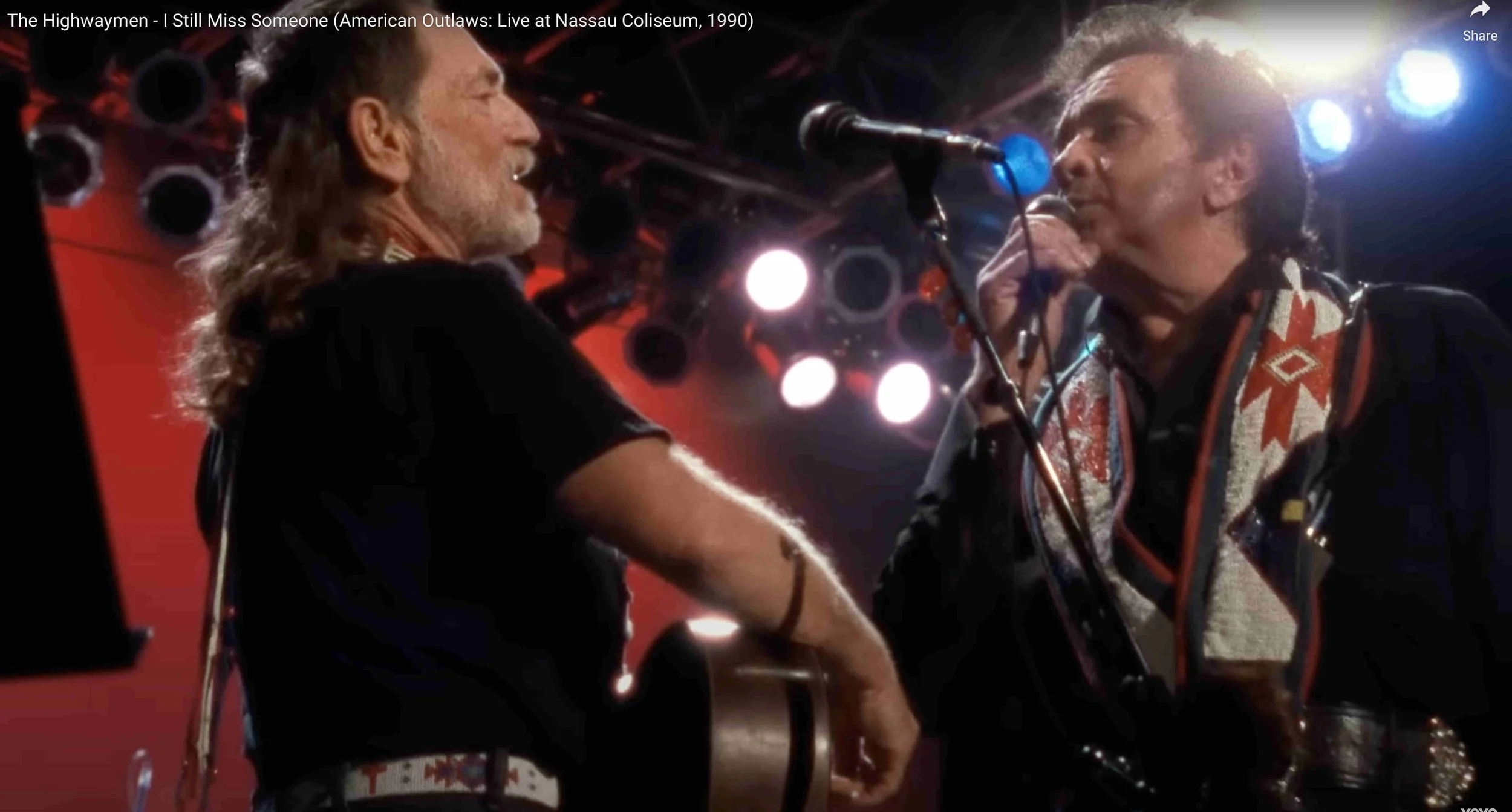
There will never be another Willie Nelson. His music relives the loves and losses of life in a way that calls to an otherwise endangered species in this troubled time: the hearts and souls of both men and women. After listening to his haunting song — “You Are Always on My Mind” — I adopted it for a New Year’s resolution. But first, I invite you to hear the Willie Nelson and Johnny Cash duet, “I Still Miss Someone.”
Living in the Past
Like so many of the people who write to me, I tend to get stuck in some of the events of the past — events that today I can do nothing to change except to atone and make amends. The need to do so is usually the only reason they haunt me. Or I can do neither of those and just beat myself up over the past and the people in my heart and mind who still dwell there.
I live in a place that holds 1,300 men — about 75 percent of them under age thirty — where the most available emotions are anger and regret. They cast everything here under a dark cloud that is always looming and churning in their minds. The explosive eruptions of emotionally fragile young men characterize all day every day where I live. If you were ever a Star Trek fan then you will know what I mean when I say that being in prison is like living among Klingons. They are ready to throw down at every slight, and their anger is never a reaction to the issue of the moment. It is just a part of the baggage they lug around with them wherever they go.
One of my problems with anger is that I am almost always infinitely patient with these guys. They rarely ever see me angry, but on those few occasions when it shows, I have learned that it can be destructive in far more ways than just breaking someone’s nose. There was a recent story that brought my anger to the surface.
One day just before Christmas last year I became very angry with my friend Joseph, and I let him know it. Days later my anger was long gone but Joseph was still brooding and cautious around me. I asked him why it is that everyone around me here can be angry almost all the time, but if I express anger it always seems catastrophic. Joseph responded with what for me was an eye-opener: “Because it’s you,” he said. “You’re everyone’s cornerstone and you aren’t supposed to get angry. It made me feel awful,” Joseph said. And, of course, what Joseph said made ME feel awful!
As Joseph would also say, “We’re cool now,” but I have learned something dark about myself. I am quick to want to atone and make amends when I become aware that I have hurt someone else, but when others have trespassed against me, I am not so quick to allow them to atone. I can let a trespass resonate for years, and I do not like what I have learned. Willie Nelson sang so beautifully about “the things I should have said and done.”
If someone is always on your mind generating negative thoughts, and the things you should have said and done still haunt you, then join me in this resolution to transform the hurts of the past into the prayers of the present. I have also learned that it is not possible to sincerely pray for someone and then retain whatever rage about that person still clouds your mind. It is time to give the past some perspective and get on the road again. This one paragraph incorporates two of Willie’s most popular songs.
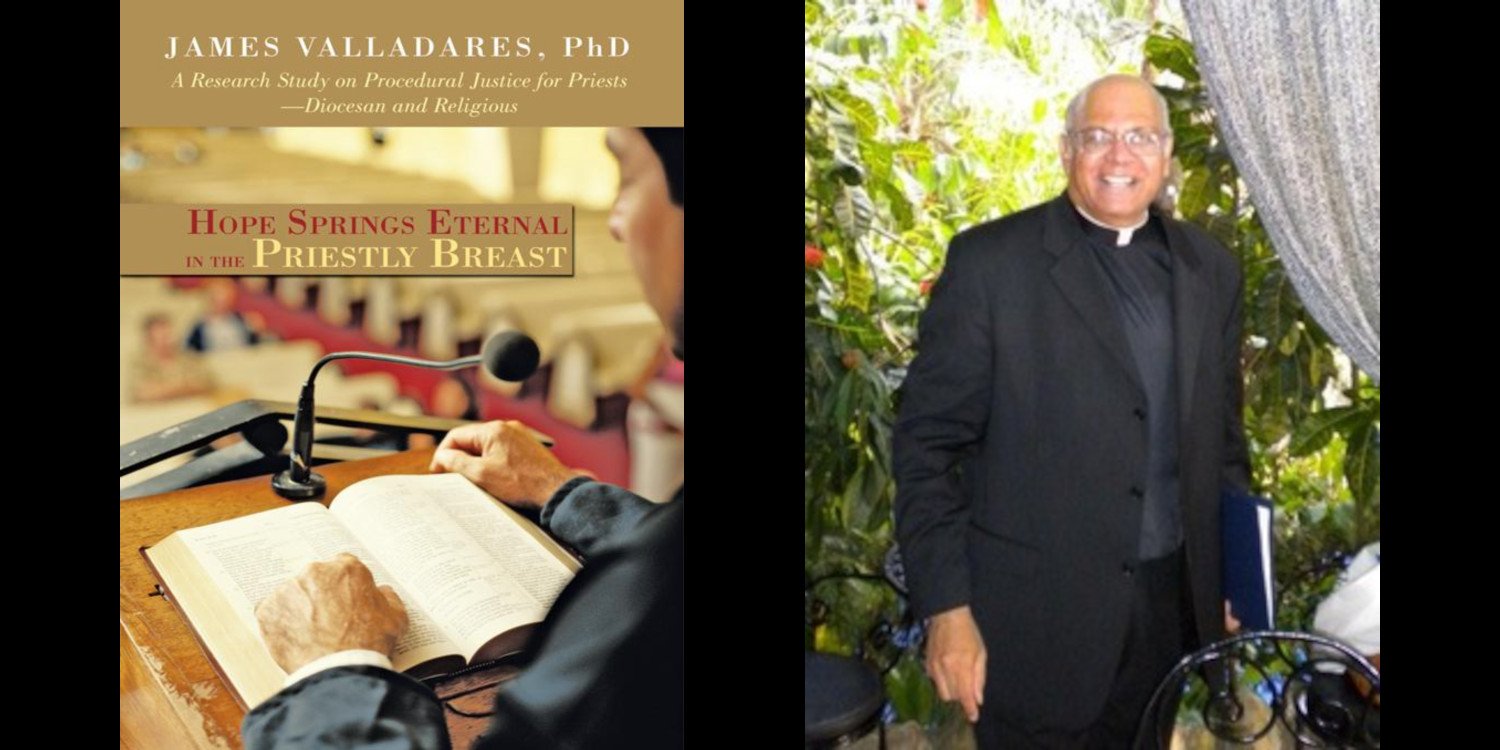
So here is some perspective that years ago caused me to surrender a trespass from the past. It is a story that was reproduced in an awesome 2011 book, Hope Springs Eternal in the Priestly Breast, by Australian priest and psychologist, Father James Valladares. A large segment of his book cites events read at Beyond These Stone Walls. Father Valladares captured this one with a stinging introduction:
“Fr. Gordon MacRae very truthfully states: ‘Trusting too much can harm your reputation. Not trusting enough can harm your soul.’ His story corroborates that candid assertion:
‘“I arrived at St. Bernard Parish in Keene, New Hampshire, on June 15, 1983. I was told by our diocesan personnel director at the time that I was going to a positive and worry-free assignment after a difficult year in a very troubled parish. But as was typical for my diocese then — and perhaps for many others — there seemed to be no limit to how out-of-touch the Chancery Office could be.
“I arrived to learn that the pastor had been charged with driving while intoxicated and was awaiting my arrival so he could leave for his third attempt at residential treatment for alcoholism. My heart went out to this good man who struggled so much with his fragile humanity while his superiors seemed oblivious to it.
“I was also there to replace another priest who was bitterly leaving the priesthood after three years at that parish, but decided to stay on to help me until the pastor returned. He was angry and disillusioned, and not exactly a source of fraternal support.
“The parish was immense, for New Hampshire at least. It had over 2000 families, provided round-the-clock pastoral care for a regional hospital and trauma unit, three nursing homes, a college campus, a regional Catholic school, a huge Catholic cemetery, and a second church fifteen miles away. I arrived to learn that I was essentially alone there.
“In that summer of 1983, there was a lot going on in my own life, too. Just weeks before I arrived at the parish, my father died suddenly at the age of 52. I had literally gone from presiding over his funeral Mass, and caring for my family, to packing and moving to a new parish 100 miles away. Two weeks after I arrived and got settled, my sister and her family drove up from the Boston area to visit me. We still had some unfinished details over the death of our father, and two months earlier my sister gave birth to her second child. I had the privilege of baptizing her in my new parish.
While my brother-in-law unpacked some of my boxes of books that he brought with him, my sister and I took my two nieces for a stroll down Keene, New Hampshire’s picturesque Main Street. It was a beautiful summer day, and we had lots to discuss while I pushed a stroller down the busy street.
By the middle of the following week, the rectory phone started ringing. First it was a priest in a neighboring parish. ‘I just wanted to give you a head’s up,’ he said. ‘I’ve heard from two people that you have a secret wife and kids.’ I laughed, at first, but by the end of the week I wasn’t laughing anymore. Then the parish council president called. ‘We don’t need another scandal,’ he said. ‘People are calling me with a rumor that you’ve fathered two children.’
“By then, I was furious. We were able to backtrack who said what to whom and when, and learned that the ugly rumor began with that innocent Sunday afternoon walk with my sister and nieces. And ground zero of the rumor was one parishioner, Geraldine (long since forgotten, no longer with us, and not her real name) who also happened to be out on Main Street that afternoon.
“Geraldine jumped to a conclusion and then jumped on the telephone. It was like a virus that spread from person to person, growing and mutating along the way. Poor Geraldine had no intention that her bit of gossip would spread like a wildfire, but it did. It spread everywhere.”
— Hope Springs Eternal in the Priestly Breast, pp. 117-119
The Day of Atonement
The problem with the story above was not just how Geraldine interpreted that Sunday afternoon stroll downtown. And it was not just her decision to place a few phone calls that would start the fake news in motion. The problem was that Keene, NH, like too many communities, had too many people all-too-ready to hear, believe, and spread any gossip that disparages a Catholic priest.
Once such a thing takes root and spreads, it forms a life of its own. An untrue rumor can be repeated so much, and spread so far, that the truth doesn’t stand a chance. The truth has a steep uphill climb once everyone else hears only one side of a story.
Actually, this is exactly what happened in the sexual abuse crisis in the Church. SNAP and the news media spread one story with such ferocity that the truth ended up swatted away like a pesky fly. But there’s even more to this story, however.
Nearly a dozen years later, someone else in that community accused me falsely. It was from that same place and that same Summer of 1983. A lot has been written about this, but one article by Ryan A. MacDonald contains photos of the “crime scene.” It is “Justice and a Priest’s Right of Defense in the Diocese of Manchester, NH.”
For years I have been haunted by the coincidence, wondering whether the roots of Geraldine’s gossip spread long and far with deep tentacles, raising questions about me and predisposing others toward forming a set of beliefs that eventually morphed into a moral panic. As the truth unfolded in 1983, Geraldine could take none of it back. She could not retrieve even one of the wisps of gossip cast into the wind to travel indiscriminately. That is the real harm of gossip. Its purveyors can never stem, or even know, its tide.
But another source of harm, and I cannot evade it, was my anger with Geraldine. In the account from the book, Hope Springs Eternal above, Father Valladares quoted me as saying that this event is “long since forgotten.” Well, it wasn’t. I just stopped thinking about it. But my anger with poor Geraldine lingered, and like all such things, it became part of the resonance of my life that I believe very much also affected hers, at least on a spiritual level. As I reflected late at night alone about anger and my discussion with my friend, Joseph, my mind drifted and then landed on this story about Geraldine.
Though she left this life in God’s friendship many years ago, I felt as though I had a moment of real and meaningful connection with her. I said the words aloud as a prayer in the dark: “Geraldine, I forgive you, and I pray that you come to know the fullness of God’s Presence.”
A great weight was lifted from me, and, I felt, from Geraldine as well. Those were “the things I should have said and done” back then. As it was for Willie Nelson, better late than never. Now I’m on the road again.
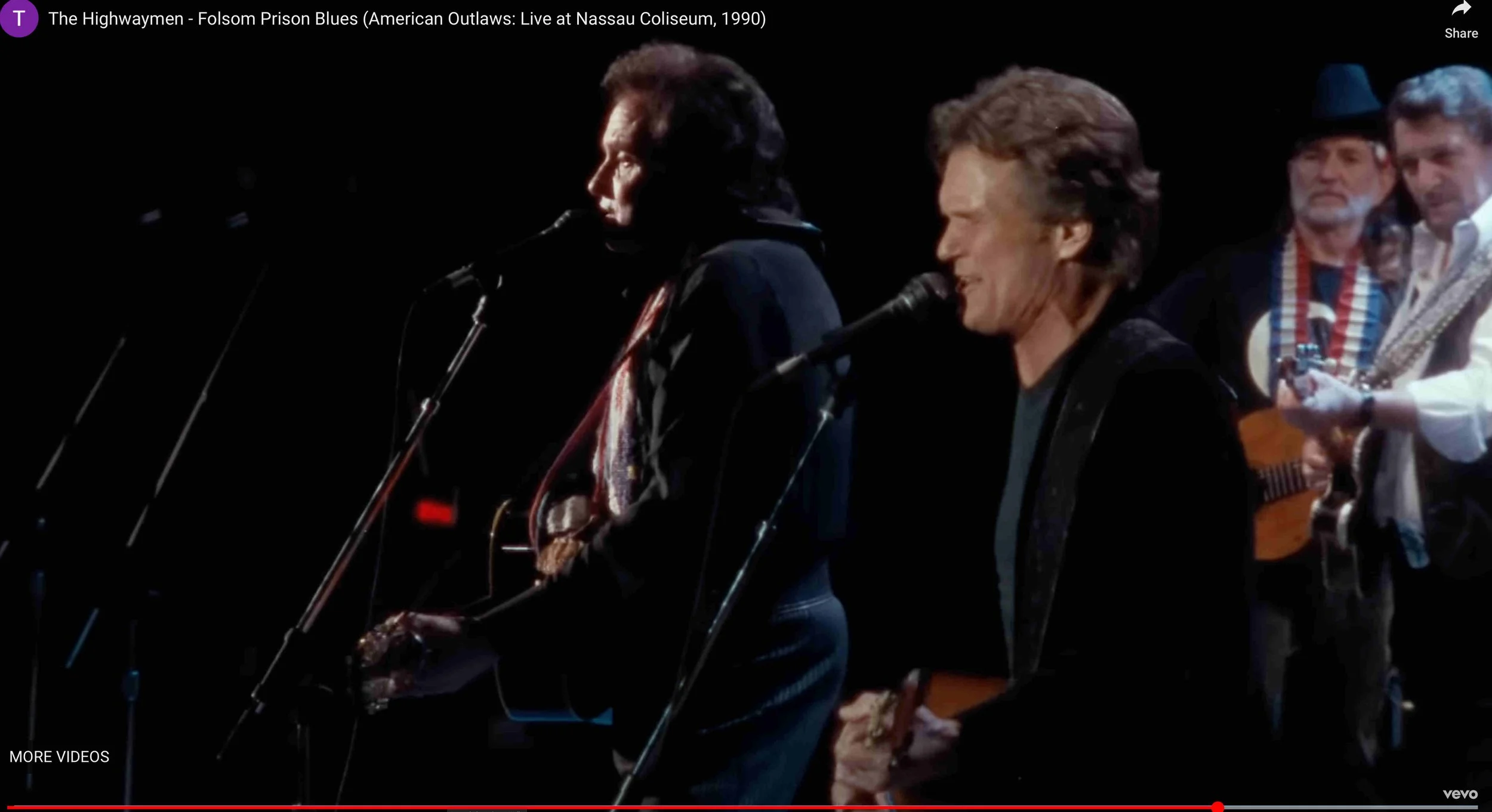
But since then I have switched my song. Now I find myself mysteriously singing with the great Johnny Cash, “Folsom Prison Blues.”
+ + +
Note from Fr Gordon MacRae: Thank you for reading and sharing this post. I want to call your attention also to a new entry in our Voices from Beyond Page. It’s an article with supporting photos by Ryan A. MacDonald, “Justice and a Priest’s Right of Defense in the Diocese of Manchester, NH.”
You may also like these related posts:
A Code of Silence in the U.S. Catholic Church: Affidavits
The Eucharistic Adoration Chapel established by Saint Maximilian Kolbe was inaugurated at the outbreak of World War II. It was restored as a Chapel of Adoration in September, 2018, the commemoration of the date that the war began. It is now part of the World Center of Prayer for Peace. The live internet feed of the Adoration Chapel at Niepokalanow — sponsored by EWTN — was established just a few weeks before we discovered it and began to include in at Beyond These Stone Walls. Click “Watch on YouTube” in the lower left corner to see how many people around the world are present there with you. The number appears below the symbol for EWTN.
Click or tap here to proceed to the Adoration Chapel.
The following is a translation from the Polish in the image above: “Eighth Star in the Crown of Mary Queen of Peace” “Chapel of Perpetual Adoration of the Blessed Sacrament at Niepokalanow. World Center of Prayer for Peace.” “On September 1, 2018, the World Center of Prayer for Peace in Niepokalanow was opened. It would be difficult to find a more expressive reference to the need for constant prayer for peace than the anniversary of the outbreak of World War II.”
For the Catholic theology behind this image, visit my post, “The Ark of the Covenant and the Mother of God.”

A Glorious Mystery for When the Dark Night Rises
At the dawn of the New Year, the Church honors the Solemnity of Mary, the Holy Mother of God. I met her at the age of nine, part lived experience and part dream.

At the dawn of the New Year, the Church honors the Solemnity of Mary, the Holy Mother of God. I met her at the age of nine, part lived experience and part dream.
January 1, 2025 by Fr Gordon MacRae
To comprehend this post, readers must understand the world of 1962. Something happened in America that dramatically changed our view of ourselves and the world around us, and its tentacles reach deeply into the present day. It brought a sense of futility, a resignation that we are powerless over the great tides of history sweeping us up into their grip, and resistance to evil is futile. So look out for Number One, and live for the moment! That is the great lie of our age.
I turned nine years old in April of 1962. Five months later, I began fifth grade a year younger than everyone else in my class. A month after that, the United States and the Soviet Union approached the very brink of nuclear war during the Cuban Missile Crisis in October, 1962. The administration of President John F. Kennedy discovered that the Soviet Union had placed strategic nuclear missiles in Cuba. Diplomacy failed miserably, and it just exposed our impotence. The United States demanded removal of the missiles and the Soviet Union flatly refused. President Kennedy ordered a naval blockade of Cuba. Kennedy and Nikita Khrushchev were all that stood between us and nuclear annihilation. Fear and deep anxiety engulfed everything — even the 5th grade.
Growing up in the industrial city of Lynn, Massachusetts, just a few miles north of Boston, left us especially vulnerable. Lynn at that time was home to the General Electric Company’s Aircraft Engine Division which was the largest employer in that city and surrounding towns. Its biggest customer was the U.S. military. Children my age were traumatized with fear by the weekly rehearsals for nuclear attack. Upon a signal from school administration we had to rush to extinguish all lights, draw all window shades and then crawl under our desks while sirens blared outside.
The day the Cuban Missile Crisis began, was the day our childhood innocence ended. We were vulnerable in a fragile, unpredictable world, and the anxiety never really left us. It was, perhaps in hindsight, the wrong moment for some of the great black-and-white science fiction films of the fifties to start running as matinees in a local cinema.
I did not understand then that some of those great films were really paradigms of the Cold War, containing within them all the fear and paranoia the Soviet Empire brought to our young minds. Films like “Invasion of the Body Snatchers” and — my favorite of all — “The Day the Earth Stood Still” are today considered Cold War classics. They captured our anxiety and capitalized upon our fears.
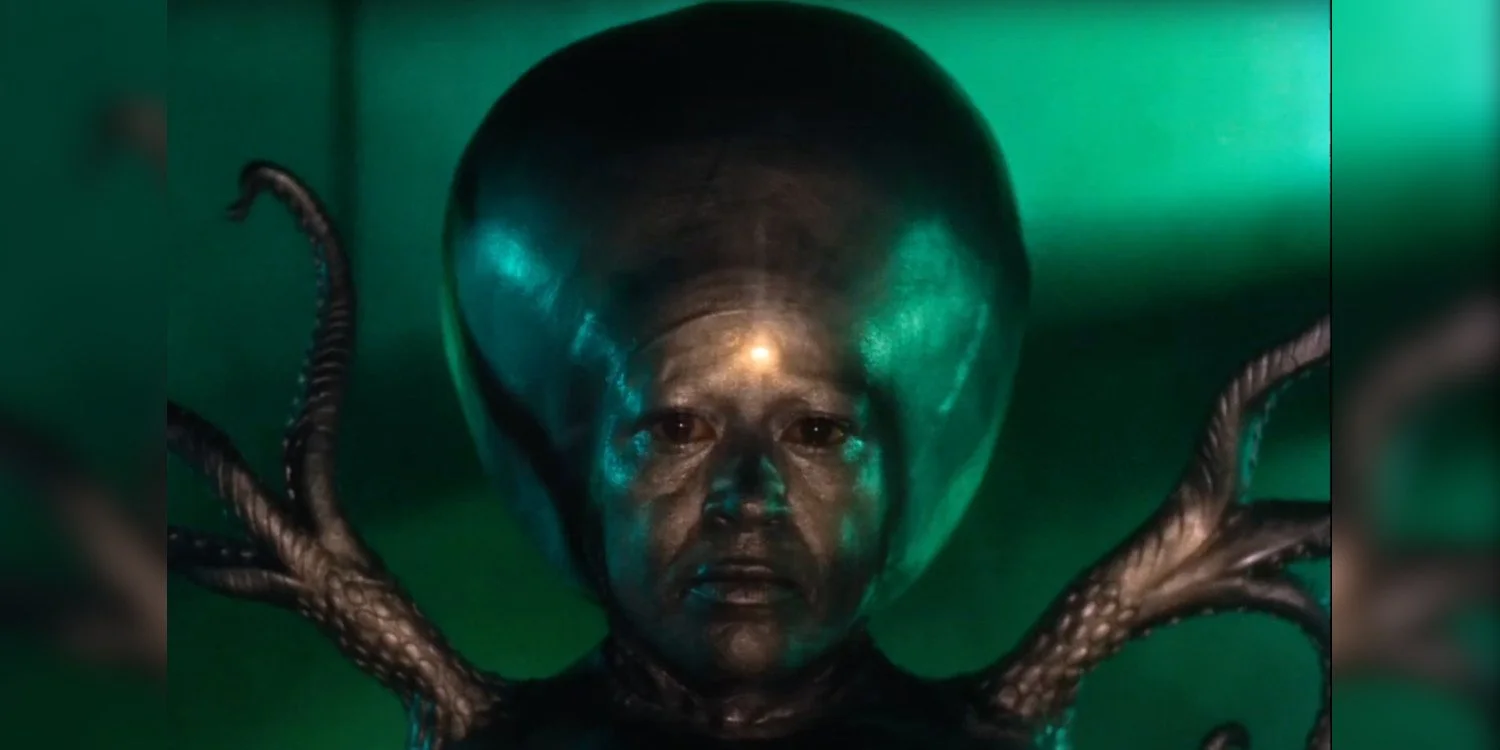
Invaders from Mars
I wrote of the North of Boston where I grew up in “February Tales.” Going to a movie theatre alone was a rare occurrence when I was nine years old in 1962. It meant venturing downtown like a free-range kid. Lynn, Massachusetts had two downtown cinemas back then, the Paramount and the Capitol. The latter was in Lynn’s Central Square, and it only opened at night — its marquee preceding every title with a large, mysterious “XXX.” It was strictly off limits.
It took a bit of courage back then for a 9-year-old to board a city bus alone for a Saturday afternoon trek downtown. I reveled in my freedom, but my parents had spies everywhere. When once I ventured too close to the Capitol marquee to see what all those Xs were about, there was hell to pay when I got home!
The Paramount had a Saturday matinee for 35 cents. Lynn’s newspaper, The Daily Evening Item carried an alluring ad, a miniature version of the movie poster for that week’s feature, “Invaders from Mars.” It portrayed a boy my age, aghast at his bedroom window by the scene of a spaceship landing at midnight in an empty field behind his house.
There was really no need for scary movies then. We were already all frightened enough, and those who claimed they were not were lying. But perhaps as kids we were all looking for outlets for our fear, because the real story of politics and nuclear bombs made no sense to us at all. Scary movies became the in thing, and I couldn’t wait to see “Invaders from Mars.”
Thirty-five cents for admission was no challenge at all then. There were always a few soda bottles to be found, and a little rummaging through the easy chair where my father watched a worried-looking Walter Cronkite every night yielded bus fare, and, if I was lucky, enough for that week’s special matinee snack, a Mars Bar.
It rained that Saturday, so just about every kid stuck inside was given bus fare to go see “Invaders from Mars.” The movie was preceded by a few cartoons to quiet us down, then it began. You could hear a pin drop. All the anxiety we had pent up within us was about to play out on the screen.
After the spaceship landed in that field, the boy in the film fell asleep. In the morning, he wondered whether it was all a dream. At breakfast, his mother and father and brother were acting very strangely. At school, his teacher and fellow students were strange, too. As he investigated, the story brought him to an underground tunnel where Martian zombies took direction from a squid-like mastermind managing the takeover of everyone’s mind and soul from its protected glass sphere. Those who today say there is really nothing to fear didn’t live through the Cold War and the Cuban Missile Crisis. I was utterly terrified.
When the movie was over and the lights came on, the older kids who had been throwing popcorn at us all disappeared into the streets. The kids in the middle, who were all my age, sat silently traumatized as the curtain closed. “Invaders From Mars” scared the &#§@ out of us! By the time I came to my senses all the kids I knew had scattered. None wanted to be seen in the fits of fright with which they departed “Invaders from Mars.”

Father G circa 1962.
A Glorious Mystery
Out on a rainy, darkened Union Street in downtown Lynn, I had missed the bus. It would be an hour before another came, and I had a sudden intense longing for the safety of home. So I set out on foot to walk the two miles through the city streets as it grew dark. Even today, when I am feeling vulnerable, anxious and alone, I dream of that trek at age nine through the city streets at night.
As I walked home on that day, my imagination raced ahead of me, and I felt fragile and alone. I was on the edge of tears for an accumulation of reasons I could never articulate. At times, the reality of feeling vulnerable strikes hard. I knew there were no evil Martian zombies, but I had an ill-defined sense that evil had just paid our world a visit and it changed us. We lived in a dangerous world, then, and since then its danger has exponentially grown.
And so on into the rain I walked. I walked alone, through a part of the city kids like me didn’t usually venture into. The darkness grew — both in the skies above me and deep, deep within me. You know what I mean for at one time or another, you have been there too. All light had gone out of the world. All hope had been drained away. Then the torrent came.
I’m not sure which soaked me more, the rain or the tears. I rarely cried as a boy — it was just hell if my older brother ever saw me crying — but the rain was making me shiver. I cannot ever forget that day. When I looked behind me in the dim darkness, someone was following me. A dark figure in a raincoat who stopped whenever I stopped. I tried to run, and when I did, he ran too.
There on the downtown city street, about a mile from the movie theatre, I came upon the imposing, looming spires of Saint Joseph Catholic Church. We didn’t spend much time in churches when I was growing up. The church’s dark brick façade and immensity seemed to stretch into the rumbling clouds. It felt almost as scary as “Invaders from Mars” and that ominous figure stalking somewhere behind me.
But the rain kept coming, and I had no choice. I climbed the steep marble steps of Saint Joseph Church, and just as I got to the top to duck into an alcove, a massive door opened next to me, and scared whatever wits I had left right out of me. It was, of all people, a police officer. I looked back down the street and the stalker had fled. “Get out of the rain, kid!” barked the officer as he shuffled me through the door on his way out. “And say a prayer for me while you’re in there,” he commanded. So in I went, almost against my will.
The church was massive. I had received my First Communion there two years earlier, but had never been back since. In the dim lights, I walked toward the sanctuary, and at the Communion rail, I knelt. I looked back toward the church doors, but no one had followed me in. I was alone, but a sense of safety slowly came over me. At some point it struck me that the police officer had come in here to pray and that thought impressed and comforted me. So I stayed for awhile.
Then I saw her! The great carved image in the sanctuary before me was crowned with light, and she held a child in her arms as though presenting Him to me. She was incredibly beautiful, but it was the creature beneath her feet that really gripped my attention and wouldn’t let it go. I stared in utter wonder at what was subdued beneath her feet. It was ugly, and all too real. It looked like the creature in the glass sphere that so terrified me in “Invaders from Mars.” It was trapped under her feet — under a soul that magnified the Lord.
Then the Martians left me. The stalker in the street left me. The missiles, and Khrushchev, and the Cold War left me. I felt, more than saw, the light come back into my world. The pulsing sobs, now still felt but unheard, left me, and a vista of hope broke through the clouds of doubt and fear. The look on her face was radiant, and she spoke to me. It wasn’t in words. It was deep, deep in the very place where fear had gripped my soul. I could not take my eyes from what was subdued beneath her feet. “Trust!” she said, and “Peace be with you.” And it was.
On that day she lifted me up out of a pit. Then years later, when once we met again, she humbled me, and I needed that, too. I tried to write about this in “Listen to Our Mother: Mary and the Fatima Century” but my words could not really ever do her justice.
Sixty-two years have passed since that day. Well over a half century. On the wall of this prison cell is an image of Saint Maximilian Kolbe, the patron saint of prisoners and writers and the patron of Beyond These Stone Walls and this imprisonment. He’s Pornchai Moontri’s patron, too, and this changed everything for him. Saint Maximilian’s feast day is August 14.
Next to him on our cell wall is that image, the one I saw at age nine. I don’t know where it came from. It appeared one day in a letter to Pornchai and went quickly up onto his wall. I wrote once of the images on our cell wall in “Angelic Justice: Saint Michael the Archangel and the Scales of Hesed.”
Reason for hope is a very great gift. Never again let the sun go down on your fear. When the Glorious Mysteries seem too unworldly to fathom, then look beneath her feet. What is there will look very familiar to you, and you will know what it means. The key to resisting evil is trust that the strife may not yet be over, but the battle is already won.
Remember, O most gracious Virgin Mary,
that never was it known
that anyone who fled to your protection,
implored your help
or sought your intercession,
was left unaided.
Inspired with this confidence,
I fly unto you,
O Virgin of virgins, my Mother;
to you do I come,
before you I stand,
sinful and sorrowful.
O Mother of the Word Incarnate,
despise not my petitions,
but in your mercy hear and answer them.
Amen.
— The Memorare, by Saint Bernard of Clairveaux
+ + +
Note from Father Gordon MacRae: Thank you for reading and sharing this post. You may also like these related posts from Beyond These Stone Walls:
How Our Lady of Fatima Saved a World in Crisis
The Assumption of Mary and the Assent of Saint Maximilian Kolbe
The Eucharistic Adoration Chapel established by Saint Maximilian Kolbe was inaugurated at the outbreak of World War II. It was restored as a Chapel of Adoration in September, 2018, the commemoration of the date that the war began. It is now part of the World Center of Prayer for Peace. The live internet feed of the Adoration Chapel at Niepokalanow — sponsored by EWTN — was established just a few weeks before we discovered it and began to include in at Beyond These Stone Walls. Click “Watch on YouTube” in the lower left corner to see how many people around the world are present there with you. The number appears below the symbol for EWTN.
Click or tap here to proceed to the Adoration Chapel.
The following is a translation from the Polish in the image above: “Eighth Star in the Crown of Mary Queen of Peace” “Chapel of Perpetual Adoration of the Blessed Sacrament at Niepokalanow. World Center of Prayer for Peace.” “On September 1, 2018, the World Center of Prayer for Peace in Niepokalanow was opened. It would be difficult to find a more expressive reference to the need for constant prayer for peace than the anniversary of the outbreak of World War II.”
For the Catholic theology behind this image, visit my post, “The Ark of the Covenant and the Mother of God.”

How December 25 Became Christmas
Father Abraham first heard God 21 centuries before a star rose above Bethlehem. We now live in the 21st century after. At the center of all things, Christ is born.

Father Abraham first heard God 21 centuries before a star rose above Bethlehem. We now live in the 21st century after. At the center of all things, Christ is born.
At Christmas by Father Gordon MacRae
“For while gentle silence enveloped all things, and night in its swift course was now half gone, thy all-powerful word leaped from heaven, from the royal throne, into the midst of the land that was doomed.”
— Wisdom of Solomon 18:14-15
No one really knows when or why tradition first places the Birth of Christ on December 25th, but the custom is ancient. Some theorize that it was influenced by a Roman pagan feast called Saturnalia that stretched for twelve days from the winter solstice into January. The “Twelve Days of Christmas” are thus linked by some historians to pre-Christian Roman tradition. The Persian cult of Mithra, “Sol Invictus” (the “Unconquerable Sun”) practiced by many Roman legionnaires, was also marked on December 25th, and some propose a link between that and the date for Christmas.
However the observance of Christ’s birth on December 25th is far older than the time when Christianity became respectable in the Roman Empire. The first recorded mention of December 25 as the date of observance of the Feast of the Holy Birth was in a Roman document called the Philocalian Calendar dated as early as 336 A.D. Popular observance of the December 25 date of the Nativity, however, was at least a century older.
One obscure theory points to an early Roman Empire legend that great men are fated to die on the same date they were conceived. One tradition traced the date of Passover at or near March 25 in the year Jesus of Nazareth was crucified. If thus among some Romans it became popular belief that he was conceived on that date, then nine months to the day later would be December 25. In the Roman Calendar which preceded our Gregorian Calendar, March 25 was considered the first day of the new year, and to this day it remains observed as the Feast of the Annunciation, as I once described in “Saint Gabriel the Archangel: When the Dawn from On High Broke Upon Us.”
The Roman Martyrology also includes a solemn and far more ancient reach into Judeo-Christian Tradition. The “Proclamation of the Birth of Christ” is sometimes read at the Midnight Mass at Christmas after a procession from the entrance of a church to the Nativity scene. That proclamation places us at a special point in Salvation history. In fact, from our perspective, it places Christ at the very center of that history.
The Proclamation declares that Christ was born in the 21st Century after Abraham, our Father in faith, ventured out of Ur of the Chaldees and first encountered God. We now live in the 21st Century after. So we kneel before Him this Christmas Season knowing that Christ is exactly equidistant between us and the very genesis of the human experience of God. It is a realization that ought to shake us out of our political and theological divisions, out of our spiritual doldrums, out of any more mundane concerns.
Instead of quibbling over who among the alienated might be saved and how, this Christmas makes us fall on our knees, in sin and error pining, as He appears and our souls feel their worth. All divisions cease.
The Roman Martyrology Proclamation of the Birth of Christ:
The twenty-fifth day of December when ages beyond number had run their course from the creation of the world, when God in the beginning created the heavens and earth, and formed man in His own likeness; when century upon century had passed since the Almighty set his bow in the clouds after the Great Flood, as a sign of covenant and peace — In the twenty-first century since Abraham, our father in faith, came out of Ur of the Chaldees; in the thirteenth century since the people of Israel were led by Moses in the Exodus from Egypt; in the tenth century since David was anointed King; in the sixty-fifth week of the prophecy of Daniel; in the one hundred and ninety-fourth Olympiad; in the year seven hundred and fifty-two since the founding of Rome; in the forty-second year in the reign of Caesar Octavian Augustus, the whole world being at peace — Jesus Christ, eternal God and Son of the eternal Father, desiring to consecrate the world by his most loving presence, was conceived by the Holy Spirit, and when nine months had passed since His conception, was born of the Virgin Mary in Bethlehem of Judah, and was made man.
— The Nativity of Our Lord Jesus Christ according to the flesh
O Come! Let us adore Him!
⚜
⚜
Our BTSW Christmas Card: Lead, Kindly Light
I am forced by circumstance to live in a place with men who are banished, not just from home and family and freedom, but too often also from hope. Some with even the darkest pasts have come into the light to thrill us with their stories of grace and true repentance and conversion. You have read of several in these pages and there are other stories yet to come. Some of these wounded men become saints, I am not fit to fasten their sandals.
We live East of Eden, a place from which the Magi of the Gospel saw a star and heard good news, the very best of news: Freedom can be found in only one place, and the way there is to follow the Star they followed. If you follow Beyond These Stone Walls, never follow me. Follow only Christ.
My Christmas card to you is this message, a tradition of sorts from behind these stone walls. My small, barred cell window faces East. It is there that I offer Mass for readers Beyond These Stone Walls. So my gaze is always toward the East, a place to which we were all once banished to wander East of Eden.
At the end of these cold and gray December days I step outside to watch toward the West as the sun descends behind towering prison walls. It reminds me of my favorite prayer,
Lead, Kindly Light, amid the encircling gloom, Lead Thou me on;
The night is dark, and I am far from home; Lead Thou me on.
Keep Thou my feet; I do not ask to see
The distant scene; one step enough for me.
I was not ever thus, nor prayed that Thou shouldst lead me on;
I loved to choose and see my path, but now, Lead Thou me on.
I loved the garish day, and, spite of fears,
Pride ruled my will: Remember not past years.
So long Thy power hath blessed me, sure it still will lead me on,
O’er moor and fen, o’er crag and torrent, till the night is gone.
And with the morn those Angel faces smile,
Which I have loved long since, and lost awhile.
— Saint John Henry Newman
+ + +
Note from Father Gordon MacRae:
Blessings to you all during this joyous Christmas Season. We are living in darker times, and this Christmas is like no other, but we are children of the Light and we are promised that the darkness will never overcome it. I invite you to join us for another favorite Christmas post during this Season: "Upon a Midnight Not So Clear, Some Wise Men from the East Appear."


Christmas in the Valley and on the High Places
On a Christmas morning buried in snow a young man in prison took a first trusting step from the valley of humiliation to seek the high places and a season of grace.

On a Christmas morning buried in snow a young man in prison took a first trusting step from the valley of humiliation to seek the high places and a season of grace.
Christmas by Fr Gordon MacRae
’Twas the night before Christmas, 2007, when a winter storm descended upon Concord, New Hampshire. I awoke that Christmas morning to a shroud of heavy snow that masked this prison world of concrete and steel under pristine whiteness. A howling wind encased the walled prison yard in drifts of snow while saner men hibernated through the long, cold Christmas trapped inside.
I don’t know what came over me that Christmas morning. By 9:00 AM my claustrophobia was in high gear. Still a source of anxiety after all these years, it reached its usual crescendo with a near panic-driven urge to be outside. Prisoners here have a brief hourly window to move from point A to point B, but it was Christmas. We were snowed in, and there was simply no place to go. But I had to try.
Our friend, Pornchai Moontri had been here with me for about two years then, and we had just landed in the same place. “Where are you going?” he asked as he saw me bundled up against the wind and the snow. I told him I wanted to get an hour outside and asked if he wanted to join me. “Brrrrr!” he shivered, shaking his head. So I boldly made my way alone to a guard station to ask if the outside yard might be open. “Are you nuts?” came the gruff reply.
Thinking it a rhetorical question, I just stood there. The guard grabbed some keys and I followed him outside to a caged in area buried in snow drifts. “You’ll be stuck out here for an hour,” he said as the gate closed behind me and a key engaged the frozen lock with grinding reluctance.
And I thought prison was only hostile on the inside! The wind was howling, snow was blowing wildly, and it was freezing. The yard was empty except for an old picnic table half buried in snow, and a solitary downcast hooded figure sitting there like a silent sentinel. He kept a wary eye on me as I decided to give him a wide berth and walk the perimeter of the yard through the drifts of snow. Had I taken in the scene a little sooner, I might have changed my mind and headed back inside.
Battling the drifts got old really fast, so I made my way through the snow to the opposite side of the table, cleared a wet section of bench, and sat down. His bare, freezing hands were balled into fists and his hooded stare fought against eye contact. It was up to me to break the ice. Literally!
My own wariness lifted as the balled fists and attempts to look fierce were betrayed by streaks of tears interrupted by my uninvited presence. There were over 500 prisoners in that building, and I had never before seen this menacing but frightened kid. So I asked his name. “James,” he said through a struggle to sound gruff.
I noticed that James’ fists were tightly balled not because he was planning to smack me, but because his hands were freezing. The two-dollar gloves sold to us back then were next to useless against the cold so I was wearing two pairs. I quietly removed the outer gloves and handed them over. It’s against the rules here to give a freezing fellow human a used pair of gloves, but it was long ago. The statute of limitations for that offense has likely expired. I doubt they’ll throw me in prison for it.
James stared at the gloves for a moment of silent defiance, then quickly put them on. There was no holding back what I sensed was coming next. His face fell into his newly gloved hands, and I spent the rest of that hour a cold silent witness to this young man’s torrent of grief. Then the guard appeared to ask whether I was ready to come back in. “No, I’m good,” I said. “I’ll stay for another hour.”

Though I Walk Through the Valley of Shadow
James, it turned out, did not even know it was Christmas. At 21, he had never before been in prison. He arrived just weeks earlier, and on the morning of Christmas Eve he was moved from the receiving unit to the eight-man cells on the top floor of that prison building. He had been there only a day and one overnight when we met that cold Christmas morning in the snow.
In the midst of tears, James asked, “Why would they put someone like me up there?” By “someone like me,” he seemed to mean that life for him was a lot more fragile than for most young men his age in prison. James is part African-American, part Asian, and part God-knows-what. In the racially sensitive world of prison, he did not feel like a comfortable fit anywhere. He had been assigned to a tough place where practiced predators zeroed in quickly upon his inner vulnerability.
James entered young adulthood with an acute social anxiety disorder and panic attacks. This, coupled with severe ADHD — Attention Deficit Hyperactivity Disorder — made him stand out here as a marginal figure among marginal figures. “I can’t go back up there,” he sobbed. I told him that refusing to go might have consequences that would only make the matter worse. I told him that it was very difficult to get anything done about his plight on a Christmas morning. So I made a precarious promise that from the moment I made it I wondered if it could actually happen. I promised to try to get him moved to a safer, saner place.
So later that day I spoke discreetly with someone in a position to help. I explained what took place, and he said, “I’ll look into it.” Just hours later on that Christmas afternoon, I saw James out the window carrying his meager belongings to the cellblock next to the one where I lived. I knew most of the men there, so I passed the word to go easy on him. They did. It was Christmas, after all.
When you rescue someone lost at sea, a sort of bond forms of its own accord. I eventually learned of all the baggage in life that brought James to that Christmas day. Like many who land in prison, James was missing most of the infrastructure of a life that might help prevent such a thing. He was like a tree without roots, swaying into whatever direction the winds of life blew.
I learned over time that James was removed from his home as a young child because of a history of abuse and neglect. He grew up in the foster care system, moving from place to place, even state to state. Not many people could cope with his racing thoughts, lack of control, and craving for attention.
From age ten to seventeen, James had been in six foster homes, some better than others, but none leaving him with a foundation and a sense of family. At age 17 he simply walked out the door, emancipating himself to the streets where life descended on a steady downward spiral.
James’ crime was as bizarre and misunderstood as the rest of his life. Having broken into a vacant building for a place to sleep, he fled as a police officer approached him. The chase ended in a scuffle, and on the way to the ground, the officer’s weapon fell from his holster. James picked it up. What happened next is a matter of controversy. Some, including the officer, thought James was pointing the gun at him. Others, including James, say he was just a panic-stricken kid trying to give it back.
Either way, just a month before this incident, a terrible tragedy occurred in Manchester, New Hampshire that, justly or not, became a frame of reference for James’ offense. A career police officer, Michael Briggs, was shot and killed in the line of duty by a young, African American man who is today the sole prisoner on New Hampshire’s death row.
I once wrote about that tragedy and its aftermath in the life of John Breckinridge, Officer Briggs’ partner who was present in that Manchester alley on that night. John Breckinridge himself wrote courageously of his new opposition to the death penalty based on his recent reversion to his Catholic faith. But James was also a part of the fallout of that story. His fumbling crime of picking up an officer’s dropped weapon resulted in a ten year sentence.

Hinds’ Feet on High Places
I have served that sentence with him. Most people here find it very difficult to be around James for any length of time. When James discovered that I am a Catholic priest, he thought little of it. “I was Catholic in one of my foster homes,” he said. It was an odd way of phrasing the only religious experience he has ever had in his young, unpredictable life. “You’re like my father now,” he said. “You’re the only person I feel safe with.”
I got James a part-time job in the prison library where he earned a dollar a day. He helped return books and put them back on the shelves. Sometimes, he even put them back in the right place. He seemed to think that the rest of his job description was to make certain that everyone else knew he was my friend.
James was released a few years ago. On another Christmas morning, a decade after that sorrowful mystery of our first Christmas encounter, I spent another Christmas morning with James — that time at a Mass to honor the Birth of Christ the King. The tears of sorrow in the bitter cold that life dealt him were gone. He smiled a lot then, perhaps too much for a young man in prison. He didn’t even realize that all my other friends vie for space to make sure James sat on the other side of me so none of them had to sit with him. He smiled and fidgeted and tried to get my attention all through Mass, but I’ll take that over the oppression of bitterness and sorrow any day.
I had an odd experience with James shortly after that Mass. During a quieter moment in the prison library, James asked me if I remembered the first time we met. I told him that I remembered it very well, that it was Christmas morning nearly a decade earlier. James said, “I was in a real deep, dark place then. Now I feel like I’m in the high places.”
What he said reminded me vividly of a strange book I read fify years ago, Hinds’ Feet on High Places by Hannah Hurnard. It was first published by Christian Literature Crusade in 1955, but I read it in 1975. At the time, I was a Capuchin novice preparing for simple profession of vows, and I came across the book “by accident” on a shelf one day. It was fascinating. Hannah Hurnard was a native of London who became an Evangelical missionary in Palestine and Israel for fifty years.
Hinds’ Feet on High Places is a small allegorical novel (158 pp) about the spiritual journey. The central character is a young woman named “Much Afraid” who heard a call to leave the Valley of Humiliation where she lived imprisoned. She wanted to journey to the High Places of the Chief Shepherd, and was accompanied on her difficult journey by two other allegorical characters, Suffering and Sorrow. At the end of the journey she was transformed with a new life and a new name. It’s an odd, quirky, but beautiful novel. Fifty years later, I remembered every character and facet of the book.
On the day after James made me think of it back then, Pornchai-Max Moontri handed me something he received in the mail that day from our friend and BTSW reader, Mike Fazzino in Connecticut. It was the Winter 2016 issue of GrayFriar News, the quarterly newsletter of the Franciscan Friars of the Renewal, the order founded by the late Father Benedict Goeschel, CFR. For perspective, I once wrote of him when I too was lost in shadow in “How Father Benedict Groeschel Entered My Darkest Night.”
The cover of the newsletter had an excellent article by Father John Paul Ouellette, CFR, entitled “The Humility of Christ Is Coming Down Joyfully for Others.” In it, Father Ouellette cited Hannah Hurnard’s Hinds’ Feet on High Places:
“A surprising character plays an important role in the transformation of Much Afraid: the water that flows down from the heights to the depths. As it makes its way down the mountain, the water constantly sings, ‘from the heights we leap and go, to the valley down below, always answering the call to the lowest place of all!’”
That’s what Christmas is. It is Christ descending from the heights to the lowest place of all. That Christmas morning in the freezing cold with James is now like a ghost of Christmas past. I’m re-reading Hinds’ Feet on High Places now, fifty years after picking it up for the first time. It’s a Christmas gift given for the second time.
For Christ to call James out of the depths to the heights, someone had to go down to that valley to meet him there. As Father Ouellete concludes from his analogy of the living water leaping from the heights, “Humility is not only a coming down, but doing so joyfully.” The joyful part has been missing for me, but I’m working on it. The key is knowing that Christ has come, and when you enter the Valley of Humiliation, you will only have to stay long enough to journey with someone else to the high places.
Angels we have heard on high, sweetly singing o’er the plains, and the mountains in reply echo back their joyous strains: “Gloria in Excelcis Deo! Gloria in Excelsis Deo!”
+++
Note from Father Gordon MacRae: Thank you for reading and sharing this post. You might also like these related Advent and Christmas posts from Beyond These Stone Walls.
The Music of Eric Genuis Inspired Advent Hope
Christmas for Those Bowed Down by the Fatigue of this World
The Eucharistic Adoration Chapel established by Saint Maximilian Kolbe was inaugurated at the outbreak of World War II. It was restored as a Chapel of Adoration in September, 2018, the commemoration of the date that the war began. It is now part of the World Center of Prayer for Peace. The live internet feed of the Adoration Chapel at Niepokalanow — sponsored by EWTN — was established just a few weeks before we discovered it and began to include in at Beyond These Stone Walls. Click “Watch on YouTube” in the lower left corner to see how many people around the world are present there with you. The number appears below the symbol for EWTN.
Click or tap here to proceed to the Adoration Chapel.
The following is a translation from the Polish in the image above: “Eighth Star in the Crown of Mary Queen of Peace” “Chapel of Perpetual Adoration of the Blessed Sacrament at Niepokalanow. World Center of Prayer for Peace.” “On September 1, 2018, the World Center of Prayer for Peace in Niepokalanow was opened. It would be difficult to find a more expressive reference to the need for constant prayer for peace than the anniversary of the outbreak of World War II.”
For the Catholic theology behind this image, visit my post, “The Ark of the Covenant and the Mother of God.”

Advent of the Mother of God
The Vigil of the First Sunday of Advent opens a time to release ourselves from the grip of Earthly powers to prepare the Way of the Lord and make straight His paths.

Advent begins a time to release ourselves from the grip of Earthly powers to prepare the Way of the Lord and make straight His path.
Advent by Father Gordon MacRae
The Gospels According to Matthew and Luke are the Scriptural sources for the events of Advent and Christmas. They have many similarities and some differences. Matthew alone tells the story of the Magi, a story I unfolded here in “Upon a Midnight Not So Clear, Some Wise Men from the East Appear.” Only Luke has the story of Saint Gabriel the Archangel and the Annunciation. It seems that Mary herself was his source for that account and the events to follow. That Gospel passage graces two important Feast Days within Advent: The Solemnity of the Immaculate Conception on December 8, and the Feast of Our Lady of Guadalupe on December 12. I unfolded the deeper recesses of that account as well in “Saint Gabriel the Archangel: When the Dawn from On High Broke Upon Us.”
Both Evangelists often present two stories, one on the surface, and one with much deeper meaning and historical context for those “with eyes to see and ears to hear” making these accounts far richer stories with deeper significance. What lies beneath the lines of the Gospel has to be excavated by seeing and hearing with the hearts and minds of the original hearers of this Good News.
Saint Luke’s account of the Annunciation is followed immediately by Mary’s visit to her cousin Elizabeth who awaits the pending birth of John who would become known as the Baptist. It’s a short account, easy to read and ponder, but it tells two stories — maybe even three — one on its surface and one or two that lay beneath. I am going to reproduce it here:
“In those days Mary arose and went with haste into the hill country to a city of Judah, and she entered the house of Zechariah and greeted Elizabeth. And when Elizabeth heard the greeting of Mary, the child [who would become John the Baptist] leaped in her womb and Elizabeth was filled with the Holy Spirit. She exclaimed with a loud cry, ‘Blessed are you among women, and blessed is the fruit of your womb! And why is this granted to me, that the mother of my Lord should come to me? For behold, when the voice of your greeting came to my ears, the child in my womb leaped for joy. And blessed is she who believed that there would be a fulfillment of what was spoken to her from the Lord.”
— Luke 1:39-45
This account comprises the Second Joyful Mystery of the Rosary and is familiar to all of us. At face value, it relates a joyous encounter between Mary and Elizabeth, her cousin and the wife of Zechariah and expectant mother of John the Baptist.
Then there is a second level of meaning, though subtle, that astute Jewish hearers might detect in Luke’s account. The experience of the child leaping in Elizabeth’s womb in the presence of the prenatal Jesus recalls the Old Testament story of Rebekah (Genesis 25: 22-23), pregnant with the twins, Jacob and Esau. Both Luke’s Gospel and the Septuagint, the Greek translation of the Hebrew Scriptures, use the Greek word “skirtáō” to describe this “leaping” or “struggling” of the child in the womb.
In Saint Luke’s account, “the child leaped (skirtáō) in her womb” is used to infer that the child in Mary’s womb would be greater than his slightly older cousin, John (expressed in John 3:16 and 3:27-30). In the Old Testament case of Rebekah, it was to show that Jacob would have preeminence over his slightly older brother, Esau, as God Himself explains:
“The children struggled (skirtáō) together within her… And the Lord said to her, ‘Two nations are in your womb, and two peoples, born to you, shall be divided; the one shall be stronger than the other, the elder shall serve the younger.”
— Genesis 25: 22-23
Also, Elizabeth’s declaration, “Blessed are you among women,” reverberates in Jewish ears back to the experiences of Jael and Judith (Judges 5:24-27 and Judith 13:18). Blessed for their heroic courage in warding off the enemies hostile to Israel, Jael and Judith struck mortal blows to the head of the enemy. In Mary’s case, the victory will be even greater as she puts the head of the enemy beneath her feet (Genesis 3:15).
Elizabeth’s question put to Mary — “Why is this granted to me that the mother of my Lord should come to me?” — does not denote a simple visit between cousins. Every occurrence of “Lord” in this account and throughout this chapter in Luke (there are seven such references in this chapter) refer to God. Elizabeth’s declaration that Mary is the Mother of God (Theotokos, in the Greek) became the first Marian dogma to be expounded by the Church and defined, at the Council of Ephesus in A.D. 431.
Preceding these verses in Luke’s Gospel — and found nowhere else — is the beautiful account of the Archangel Gabriel’s Annunciation to Zechariah and then to Mary, and the very different ways the Archangel approaches them with Divine News. It demonstrates the great reverence and deference with which the Evangelist and early Church viewed Mary. It was a reverence that spilled over into art, as evidenced in the great painting “The Annunciation” by Fra Angelico.
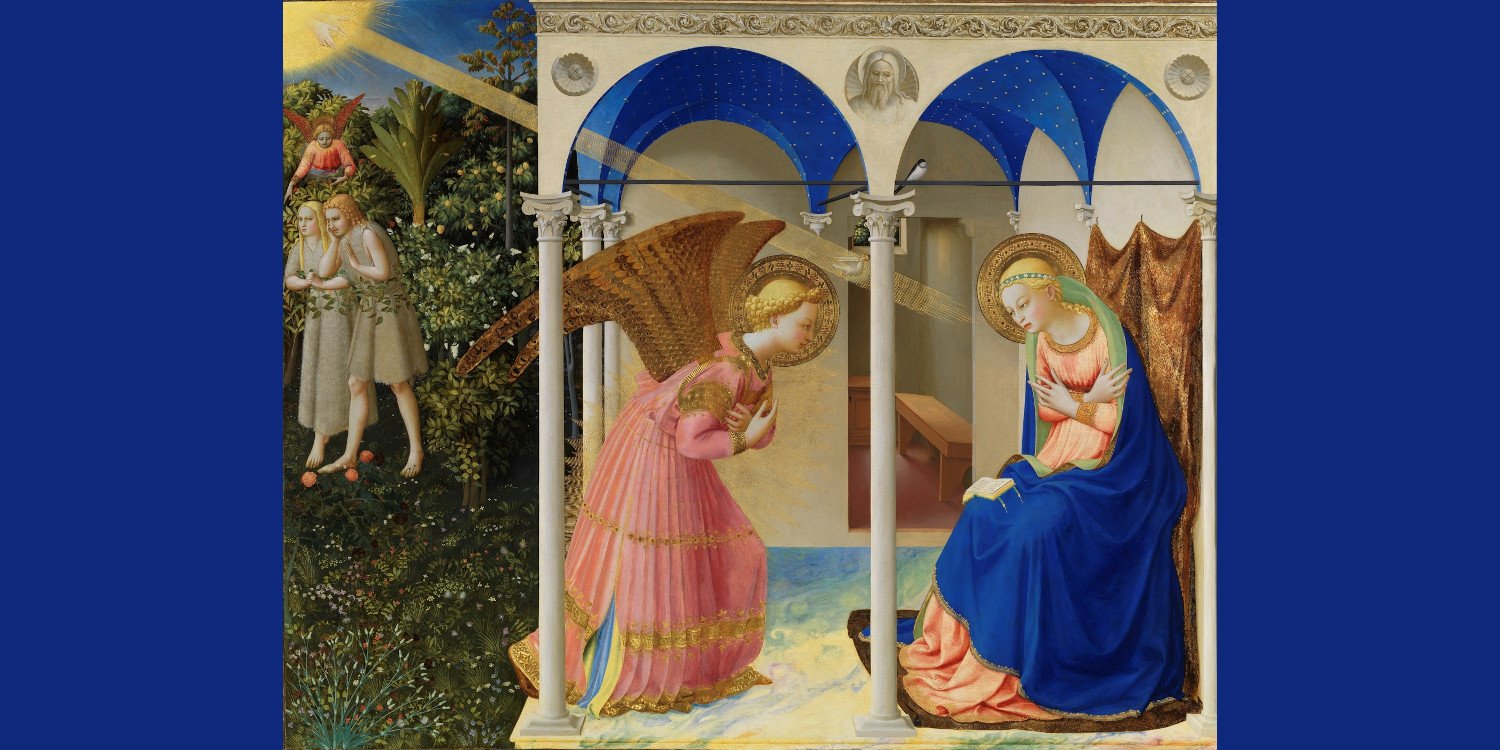
The New Ark of the Covenant
And then there is yet another layer of meaning for keen Jewish ears in Saint Luke’s Visitation account. There are several striking parallels between Mary’s visit with Elizabeth and King David’s reaction to the return of the Ark of the Covenant to Jerusalem 1,000 years before. In Luke 1:39, Mary proceeds in haste “into the hill country to a city of Judah.” In the Second Book of Samuel (6:2) David arose and went to the very same place. In Luke 1:43, Elizabeth asks, how is it “that the mother of my Lord should come to me?” In Second Samuel 6:9, David asks, “How is it that the Ark of the Lord comes to me?” In Luke 1:41, “When Elizabeth heard the greeting of Mary, the child leaped in her womb…” In Second Samuel 6:16, “As the Ark of the Lord came into the City of David, Michal the daughter of Saul saw King David leaping and dancing before the Lord.”
The parallel is extremely important for the hearers of Luke’s words. The importance rests in the way the Ark of the Covenant was viewed by the people of God. It was a chest made of acacia wood — about 3.75 feet long and 1.5 feet wide (1.1 meters by 0.5 meters) lined both inside and outside with gold (Exodus 25:10-26). At its four corners were placed heavy rings of gold through which acacia poles could be slipped to carry the Ark since it could not be touched by human hands.
The lid was composed of a solid slab of gold that formed the “kapporet” or “mercy seat,” the place of atonement. It was surmounted by two solid gold cherubim which formed a throne so that the Ark itself became a footstool for God (Numbers 10: 33-35).
The Ark was built upon the command of God at Mount Sinai, and it housed the two stone tablets on which the Ten Commandments were inscribed. It also contained a golden vessel of manna (Exodus 16:34) and the rod of Aaron (Numbers 17:10). The Ark became the evidence of the Lord’s intimate association with Israel, a sign of the Covenant, and a housing for the Presence of God. When the Jews encamped, the Ark was placed in the Holy of Holies where Moses “conversed with the Lord” (Numbers 7:89).
During a struggle with the Philistines, the Ark was captured (1 Samuel 4:11) and taken. The Philistines suffered seven months of earthquakes and plagues (1 Samuel 5:3-9) until the Ark was returned. It stayed for twenty years at Kiriath-Jearim until that scene above in Second Samuel (6:16) when David leaped before it as it returned to the Tabernacle in Jerusalem.
The Ark remained there for the next 400 years until the fall of Jerusalem in 586 B.C. to the Babylonians (Jeremiah 3:16). It was not counted among the spoils claimed by the Babylonians but the Second Book of Maccabees (2 Macc 2-5) described that it was saved from destruction by the Prophet Jeremiah and hidden on Mount Nebo where it would stay “until God gathers His people together again and shows His mercy” (2 Macc 2:7).
Thus emerged throughout Israel the expectation of a Messiah, a Branch of David and a Son of God. In Saint Luke’s subtle but powerful short paragraph about the Visitation is found an entire nation’s wealth of understanding about the return of the Ark of the Covenant and the hope of a Messiah. In the subtle hand of Saint Luke, it is in Mary, the Theotokos, the God-bearer, the Ark of the New Covenant that the Dawn from On High broke upon us. Hers is a soul that magnifies the Lord.
The vision of the Ark in the Book of Revelation (11:19-12:1) hints at this identification: the “woman clothed with the sun” is the Mother of God. And she wants the last word. The door to that Word was opened on the Solemnity of her Immaculate Conception. The Word is “Mercy,” a divine Christmas gift, and it is the great tragedy of our age that so many do not even know they need it.
O Come, O Branch of Jesse’s stem;
From Every foe deliver them
That trust Your mighty power to save,
And give them victory over the grave.
O Come, O Key of David, come,
And open wide our heavenly home;
Make safe the way that sets us free,
And close the path to misery.
Rejoice! Rejoice! O Israel.
To thee shall come Emmanuel.
+ + +
Note from Father Gordon MacRae: Our regular weekly post will appear here on Wednesday. The above post was first published several years ago in an older version of this blog. Because of its popularity and focus on Advent, we have restored it and updated it substantially. You may note that some of the wonderful reader comments were posted on the original version of this post.
We have all been through a lot in the few three years. Advent is a time to correct our focus on all that really matters. For more Advent reading we recommend the following posts:
Saint Gabriel the Archangel: When the Dawn from On High Broke Upon Us
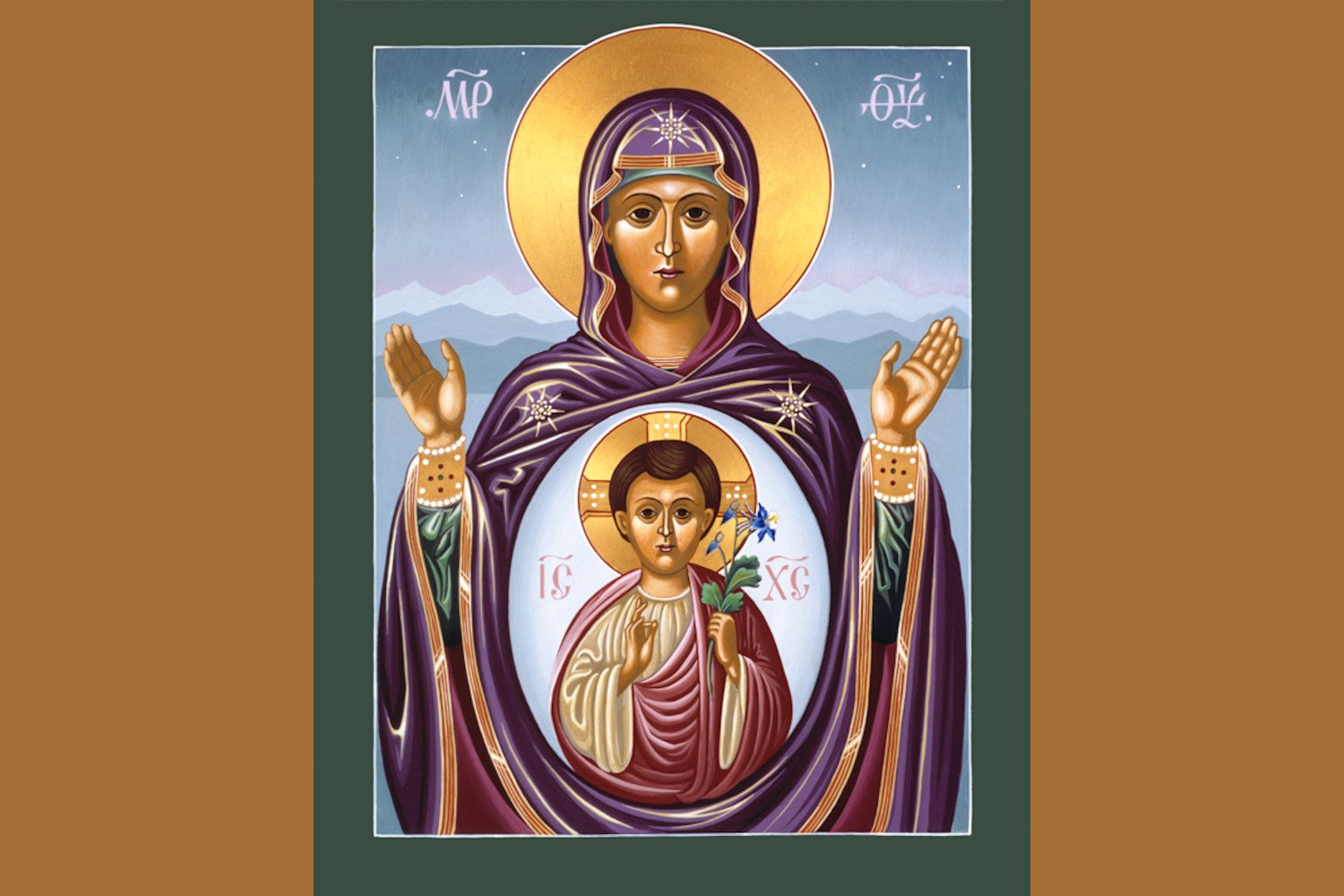



The Eucharistic Adoration Chapel established by Saint Maximilian Kolbe was inaugurated at the outbreak of World War II. It was restored as a Chapel of Adoration in September, 2018, the commemoration of the date that the war began. It is now part of the World Center of Prayer for Peace. The live internet feed of the Adoration Chapel at Niepokalanow — sponsored by EWTN — was established just a few weeks before we discovered it and began to include in at Beyond These Stone Walls. Click “Watch on YouTube” in the lower left corner to see how many people around the world are present there with you. The number appears below the symbol for EWTN.
Click or tap here to proceed to the Adoration Chapel.
The following is a translation from the Polish in the image above: “Eighth Star in the Crown of Mary Queen of Peace” “Chapel of Perpetual Adoration of the Blessed Sacrament at Niepokalanow. World Center of Prayer for Peace.” “On September 1, 2018, the World Center of Prayer for Peace in Niepokalanow was opened. It would be difficult to find a more expressive reference to the need for constant prayer for peace than the anniversary of the outbreak of World War II.”
For the Catholic theology behind this image, visit my post, “The Ark of the Covenant and the Mother of God.”


Thanksgiving in the Reign of Christ the King
While American tradition offers thanks in the land of the free and the home of the brave, some still await the promise of freedom with a bravery found in defiant hope.

While American tradition offers thanks in the land of the free and the home of the brave, some still await the promise of freedom with a bravery found in defiant hope.
November 20, 2024 by Father Gordon MacRae
Before celebrating Thanksgiving in America — even if you’re not in America — I will be asking the readers of Beyond These Stone Walls to ponder my post for next week. It has become a Thanksgiving tradition at this blog so I will post it anew on the day before Thanksgiving in America. Some readers have said that it has become a part of their own Thanksgiving observance. Its point is clear. Not everyone lives a privileged life. Not everyone even lives a life in freedom. But in the land of the free and the home of the brave, everyone can find reason to give thanks in the Reign of Christ the King.
The story next week’s post will tell is a true account of history that most other sources left in the footnotes. It is also a story that has deep meaning for us who have endured painful losses in this odyssey called life, the loss of loved ones, the loss of health, of happiness, of hope, the unjust loss of freedom. For some, the litany of loss can be long and painful, and it could drive us all into an annual major holiday depression.
It has helped me and those around me to consider the story of Squanto. History is too often passed down by victors alone. The story of the Mayflower Pilgrims who fled religious persecution (though they didn’t really) to endure the wilds of a brave new world (though they didn’t endure it without help) is well known. But it has been stripped of a far more accurate and inspiring story under its surface.
It is the story of Tisquantum, known to history as Squanto, the sole survivor of a place the indigenous called “The Dawn Land,” now known as Plymouth, Massachusetts. Having been chained up and taken on an odyssey of my own, I found very special meaning in the story of Squanto’s quiet but powerful impact on American history. So will you.
If you have followed our posts, then you know that a spirit of Thanksgiving has been elusive for us behind these stone walls. But with a little time and perspective, my friends here and I find that our list of all for which we give thanks has actually grown in size, scope, and clarity.
From the earliest days of BTSW since its inception in 2009, we have tried to live within a single core principle. I first discovered it in the classic book by Viktor Frankl, Man’s Search for Meaning (Beacon Press 1992). It promotes a fundamental truth about coping with life’s litany of loss with a central liberating theme: “The one freedom that can never be taken from us is the freedom to choose the person we will be in any circumstance.”
In Frankl’s own words, his story of survival in Auschwitz, the darkest of prisons, was in part inspired by the same person who inspires us. Saint Maximilian Kolbe was a prisoner, but he was first and foremost a Catholic priest who survived heroically by giving his life to save another. “Survived” might seem a strange word to use. Father Maximilian Kolbe was murdered, his earthly remains reduced to smoke and ash to drift in the skies above Auschwitz.
But he survives still. I am certain of this. The Nazi commandant whose power over others extinguished countless lives is now just a footnote on history. I don’t even know his name. But Saint Maximilian lives forever among the communion of saints. He lives in mysterious communion with us behind these stone walls with the same truth that inspired Victor Frankl to survive Auschwitz and write his own story of survival:
“We must never forget that we also find meaning in life even when confronted by a hopeless situation. For what then matters is to bear witness to the uniquely human potential to turn a personal tragedy into a triumph. When we are no longer able to change a situation … we are challenged to change ourselves.”
— Man’s Search for Meaning, p. 116
A friend recently sent me a revision of the famous “Serenity Prayer.” It struck me as an awesome truth and I reposted it a while back in another post, God, Grant Me Serenity. I’ll be Waiting. I find myself sharing this revised version often now with prisoners who come to me with a litany of grief and sorrow:
“God grant me Serenity to accept
the people I cannot change,
The Courage to change
the only one I can,
And the Wisdom to know
that it’s me.”

The Folly of Living with Resentment
One of the two patron saints who empower this blog is Saint Maximilian Kolbe. I have been very much informed by the course of his life in light of his sacrifices. Today my priesthood feels meaningless unless I don the glasses that Father Maximilian wore in prison. If I cannot see what he saw, then what I suffer is meaningless and empty.
But I have seen it. You may recall our post just a week ago, “Thailand’s Once-Lost Son Was Flag Bearer for the Asian Apostolic Congress.” You may have noticed the top graphic on that post. My friend, Pornchai Maximilian Moontri, was wearing a very special shirt sent to him in Thailand by one of our readers. It says “Without sacrifice there is no love.” The quote is attributed to Saint Maximilian Kolbe, and the shirt is emblazoned with his Auschwitz prison number, 16670. I told Max that if he puts this T-shirt on, he will never see his life and suffering the same way again. So I marvel at the fact that he not only put it on, but he wore it for all the world to see.
Sometimes readers write to ask me how it is that I am still (relatively?) sane after 30 years of unjust imprisonment with continually rising and then falling hope. They ask how it is that I still have faith, and why I do not seem to be bitter or resentful when I write. But I HAVE been bitter and resentful about the losses and sorrows life has tossed at me. It is just that I came to recognize that living in anger and resentment is like mixing a toxic brew for our enemies and then drinking it ourselves. It is to live in a self-imposed prison, a relentless assault upon your very soul.
Once you become ready to let go of bitterness and cease to be governed by resentment, faith and hope are what grow in its place. It is like a plant that springs up from a tiny crack in the urban concrete. You simply cannot hold onto your bitterness and your faith at the same time. One of them always gives way to the other.
I find lots of inspiration for this from the readers of this blog. Consider Fr William Graham of the Diocese of Duluth, Minnesota who spent eight years in exile, publicly shamed and his priestly ministry suspended. I wrote of his plight and its most recent development in “After Eight Years in Exile Fr William Graham Is Credibly Innocent.”
He had been falsely accused and cast out in 2016 after his bishop deemed a nearly 40-year-old claim against him to be “credible.” “Credible” is a vague and much abused term used in no other setting but American Catholic priesthood in the age of suspicion. As a legal standard, it means no more than the fact that a priest and an accuser lived in the same geographic area 30, 40, or 50 years ago. If an accusation “could have happened,” then it is seen by our bishops and their lawyers and insurers as “credible.”
After eight years in exile with a dark cloud of accusation hanging over his head, Father Graham was fully exonerated. He returned to ministry in the parish from which he was banished. He returned just in time to file his request for retirement and he moved on to a safer, quieter life with his priesthood intact. In spite of all that befell him, Father Graham believes that he has much to be thankful for. Throughout, Father Graham reported that he found both solace and hope in Beyond These Stone Walls, and it was a lantern during his darker times. Now he is free.

My Thanksgiving for Irony
And I am also thankful for the inspiration of irony. If you have been reading our posts all along, our stories are filled with it. Here’s a very moving example sent to me from a dear reader, the late Kathleen Riney. Kathleen was a retired nurse living in Texas. Her beloved husband, Tom, died from cancer, and Kathleen wrote that she found spiritual refuge in Beyond These Stone Walls.
Before her own death Kathleen wrote to me near the September 23 feast day of Saint Padre Pio, which is also the anniversary of my false imprisonment. I had written a post then that included the “Prayer after Communion” composed by Saint Padre Pio. I sent the post and prayer to Kathleen Riney who was caring for her dying husband at home.
Kathleen wrote that while her husband, Tom, was in the last weeks of his life, she gave him a copy of that prayer printed from that older post. The downloaded page had her name and email address at the top. She had rented a reclining hospital chair to help keep her husband comfortable. Many months after Tom died, Kathleen received this message in her email:
“Kathleen, my name is Kristine. I rented a hospital recliner. I found a paper with the “Stay With Me, Lord” prayer in the chair. I wanted to let you know that the prayer has helped me. I’m scheduled for surgery on November 1st and the surgery is the reason I rented the chair. Somehow that prayer found me and has strengthened me. I wanted to let you know that you touched a stranger in a great way!!! I will read it often. I hope all is well in your life. Thank you, Kristine.”
Accounts such as this are easy to dismiss as mere coincidence, but only if you really struggle to live life only on the surface without ever delving into what I recently called “the deep unseen” in the great Tapestry of God where our lives, through grace, become entangled with the Will of God. Padre Pio had many spiritual gifts in this life that I do not fully comprehend. I wonder if he ever thought that his “Prayer after Communion” would become like a message in a bottle cast into the sea where it would drift into the hands of someone known only to God. Here is that prayer in its entirety:
Padre Pio’s Prayer after Communion
Stay with me, Lord, for it is necessary to have You present so that I do not forget You. You know how easily I abandon You.
Stay with me, Lord, because I am weak and I need Your strength, that I may not fall so often.
Stay with me, Lord, for You are my life, and without You, I am without fervor.
Stay with me, Lord, for You are my light, and without You, I am in darkness.
Stay with me, Lord, to show me Your will.
Stay with me, Lord, so that I hear Your voice and follow You.
Stay with me, Lord, for I desire to love You very much, and always be in Your company.
Stay with me, Lord, if You wish me to be faithful to You.
Stay with me, Lord, for as poor as my soul is, I want it to be a place of consolation for You, a nest of love.
Stay with me, Jesus, for it is getting late and the day is coming to a close, and life passes; death, judgment, eternity approaches. It is necessary to renew my strength, so that I will not stop along the way and for that, I need You. It is getting late and death approaches. I fear the darkness, the temptations, the dryness, the cross, the sorrows. O how I need You, my Jesus, in this night of exile!
Stay with me tonight, Jesus, in life with all its dangers. I need You.
Let me recognize You as Your disciples did at the breaking of the bread, so that the Eucharistic Communion be the Light which disperses the darkness, the force which sustains me, the unique joy of my heart.
Stay with me, Lord, because at the hour of my death, I want to remain united to You, if not by communion, at least by grace and love.
Stay with me, Jesus, I do not ask for divine consolation, because I do not merit it, but the gift of Your Presence, oh yes, I ask this of You!
Stay with me, Lord, for it is You alone I look for, Your Love, Your Grace, Your Will, Your Heart, Your Spirit, because I love You and ask no other reward but to love You more and more.
With a firm love, I will love You with all my heart while on earth and continue to love You perfectly during all eternity.
Amen
This coming Sunday, the Sunday before Thanksgiving, the Church celebrates a most important Solemnity. Our politics consume all the press right now, and it is unavoidable. Only one truth is necessary this Thanksgiving. No matter who we elected president, Christ is our King!
+ + +
Note from Father Gordon MacRae: Whether we face the aftermath of our political struggles with sorrow or joy, our coming Thanksgiving requires a heart open to grace. Here are a few posts that I hope might light that lantern:
Four Hundred Years Since That First Thanksgiving
To Christ the King Through the Immaculate Heart of Mary
The Eucharistic Adoration Chapel established by Saint Maximilian Kolbe was inaugurated at the outbreak of World War II. It was restored as a Chapel of Adoration in September, 2018, the commemoration of the date that the war began. It is now part of the World Center of Prayer for Peace. The live internet feed of the Adoration Chapel at Niepokalanow — sponsored by EWTN — was established just a few weeks before we discovered it and began to include in at Beyond These Stone Walls. Click “Watch on YouTube” in the lower left corner to see how many people around the world are present there with you. The number appears below the symbol for EWTN.
Click or tap here to proceed to the Adoration Chapel.
The following is a translation from the Polish in the image above: “Eighth Star in the Crown of Mary Queen of Peace” “Chapel of Perpetual Adoration of the Blessed Sacrament at Niepokalanow. World Center of Prayer for Peace.” “On September 1, 2018, the World Center of Prayer for Peace in Niepokalanow was opened. It would be difficult to find a more expressive reference to the need for constant prayer for peace than the anniversary of the outbreak of World War II.”
For the Catholic theology behind this image, visit my post, “The Ark of the Covenant and the Mother of God.”

Thailand’s Once-Lost Son Was Flag Bearer for the Asian Apostolic Congress
In Cebu, Philippines Pornchai Max Moontri was flag bearer for the Kingdom of Thailand at the 5th Asian Apostolic Congress Pilgrimage of Hope in Divine Mercy.

In Cebu, Philippines Pornchai Max Moontri was flag bearer for the Kingdom of Thailand at the 5th Asian Apostolic Congress Pilgrimage of Hope in Divine Mercy.
November 13, 2024 by Fr Gordon MacRae
Many readers know that I earn $2.00 per day as the legal clerk in a prison law library. Among other tasks, I assist prisoners, many of whom are my friends, who faced deportation from the United States. Their destinations have so far included Brazil, Cambodia, China, Guatemala, Honduras, India, Indonesia, Japan, Laos, Mexico, Myanmar, Nepal, Thailand, and Vietnam. Despite the advice of Saint Padre Pio to “Pray, Hope, and Don’t Worry,” I have worried the most about my friend, Pornchai Max Moontri. He faced a nearly impossible assimilation to a country and culture he had neither seen nor been exposed to since he was taken from Thailand at age 11 in 1985.
Pornchai faced assimilation to Thailand after an absence of 36 years, 30 of them in a U.S. prison. I worried about his language barrier, about the absence of any family or material support, about the mountains of crushing discouragement that awaited him along this path. Readers of this blog may have seen a recent “Voices from Beyond” feature describing a project from an Arizona State University student who chose Beyond These Stone Walls as her thesis project in Ethnology, also known as Cultural Anthropology. Her project was motivated in part by interest, not so much in my story, but in Pornchai’s. It included an interview with Dilia E. Rodriguez, Ph.D., our editor who submitted her own perspective on Pornchai’s presence at this blog:
“Initially, I was struck by how many posts are about or mention Pornchai Moontri. After a while I came to think that their profound bond was like that of friends who endure the horrors of war together and survive. But now I think it is much more profound than that.
“God has inspired many truth seekers to investigate the case of Father MacRae, … but God wanted to reveal this with more than facts. He would reveal it with the powerful transformation of lives and souls. Pornchai had been viciously sexually and physically abused for years by a man who trafficked him from Thailand at the age of eleven and murdered his mother. Pornchai escaped and lived on the streets for all of his teen years. Then at age 18 he killed a man who tackled him and pinned him to the ground. After years of enduring violent sexual abuse this sent Pornchai into a rage.
“Having learned that Father Gordon MacRae had been convicted of sexual abuse, Pornchai should have wanted to stay as far away from him as possible. But Pornchai’s instinct told him otherwise. They became friends and Pornchai asked Father Gordon to be his cellmate for the next fifteen years until the time of his deportation to his native Thailand in 2020. In “Pornchai’s Story,” an article published by Catholic League President Bill Donohue, Pornchai described that Father Gordon ‘is my best friend and the person I trust most in this world.’
“While living with Father Gordon, Pornchai earned his high school diploma with honors and also pursued studies at Stratford Career Institute and in theology at Catholic Distance University. He was received into the Church on Divine Mercy Sunday in 2010, taking the name, ‘Maximilian’ as his Christian name in honor of Saint Maximilian Kolbe, a Patron Saint of Prisoners, Writers, Refugees, and Beyond These Stone Walls.” Back to Father Gordon ...

The 5th Asian Apostolic Congress on Mercy
From October 10 to 19, 2024, I was inspired to receive a steady stream of photos and videos sent to the tablet in the prison cell I once shared with Pornchai Max Moontri. From the far side of the world in Cagayan de Oro and Cebu City, Philippines the photos were sent to me by Max (he mostly goes by Max now) who was among the delegates from Divine Mercy Thailand at the 5th Asian Apostolic Congress on Mercy: Pilgrimage of Hope. The event drew some 5,000 pilgrims from ten Southeast Asian nations and others from around the world. As the photos came in, I was stunned at the sheer magnitude of this international event.
The first photos I received now form the collage above this section. They were taken when Max was chosen to present the flag of Thailand in procession at the opening ceremony of the Congress. Khun Yela Smit, Outreach Director of Divine Mercy Thailand, and Nithat Nawachartkosit its President asked Max to carry and present the flag of his homeland. The honor spoke volumes to my heart about how Divine Mercy can enter even the most wounded souls to connect with the mercy of God in hope for redemption and restorative justice.
The sight of Max standing before that immense crowd proudly holding the flag of his country brought tears to my eyes. In a photo from the AACOM website at the end of this post, you can see the face of Pornchai Max among delegates from other nations as he prepares for the procession to present his country’s flag.
Longtime readers of these pages already know the back story of Max’s life that our editor, Dilia E. Rodriguez summarized above. You can deduce from her words how steep a climb Pornchai’s path to Divine Mercy had been. Max says he was on this path because of me. I see signs that it was always the other way around. I have been on this path because God saw our lives long before we were even born. That is a difficult concept, but one magnified and embraced by Saint Maximilian Kolbe himself.
Just weeks before writing this, Jim Reilly, a reader from the Chicago area, sent me a series of newsletters from the National Shrine of St. Maximilian Kolbe. Among them was a profound message from our Patron Saint whose name Pornchai-Max chose as his own. St. Maximilian’s message quelled any lingering doubt I might have had about the Divine Mercy that binds us even from a world apart:
“For every human being on Earth, God has destined the fulfillment of a determined mission. Even from when He created the Universe, He directed causes so that the chain of effects would be unbroken, and conditions and circumstances for fulfillment of this mission would be most appropriate and fitting. Every individual is born with particular gifts and talents that are applicable to, and in keeping with, the assigned task. Throughout life the environment and circumstances so arrange themselves as to make possible the achievement of the goal and to facilitate its unfolding.”
— St. Maximilian Kolbe, “Prophet of the Civilization of Love”
I had to several times read that profound description of Actual Grace at work in our lives, across generations and even across millennia, before I could settle on the absolute truth of it. What Saint Maximilian wrote is mind-boggling, but now I live by it. Like Maximilian himself, I may even die by it.
I have been a priest for over 42 years, thirty of them in a Purgatory of unjust exile like Saint Maximilian himself. I call it “unjust” because, well, from every human standard it is. And yet I can see that it has not been without purpose — without God’s purpose, and I submit to it now with no further doubts. A few years ago, I was present at one of several Divine Mercy retreat programs offered in this prison by the Marian Fathers of the Immaculate Conception from the National Shrine of The Divine Mercy in Stockbridge, Massachusetts. I wrote several posts about these spiritual experiences, but one that stands out was in memory of the late Fr. Seraphim Michalenko. That post was “Divine Mercy in a Time of Spiritual Warfare.” What follows is an excerpt:
“In the 1970s, Fr. Seraphim Michalenko smuggled the Diary of St. Faustina out of Communist-occupied Poland. Over forty years later he smuggled Divine Mercy into a prison. Divine Mercy would one day become for me the framework of my very existence as a man, as a priest, as a prisoner.
“Fr Seraphim was appointed by the Vatican to be Vice-Postulator for the cause of canonization of Saint Faustina. Internationally known as an expert on her life and famous Diary, Father Seraphim was a catalyst for publishing it and documenting the miracles that became a basis for Faustina’s place among the Communion of Saints.
“Three years before his death in 2021, Father Seraphim was brought to this prison for a Mass. After Mass in the prison chapel, Max Moontri and I were both asked to remain because Father Seraphim wanted to speak with us. We both knew about him but had no idea that he knew about us. Max was nervous! ‘I don’t know what to say,’ he whispered to me. When Father Seraphim approached, he asked to speak with Max first. Fifteen minutes later, Max emerged smiling from a chapel office to tell me that I am next.
“As Father Seraphim and I spoke, he asked about our connection with St. Maximilian Kolbe, how he entered our lives, and how we came to Divine Mercy. In the telling, I mentioned my lifelong regard for a famous passage from St. John Henry Newman about how we are ‘links in a chain, bonds of connection between persons.’ I spoke of how this has guided me. I remember asking Father Seraphim how I could ever be certain of the 'definite service' God has committed to me that He has not committed to another. Father Seraphim leaned a little closer to me and whispered with quiet certainty as he pointed, ‘He is standing right over there.’ He was pointing to Pornchai-Max.”
— from “Divine Mercy in a Time of Spiritual Warfare”

In Cebu City : The Pilgrimage of Hope
On an Autumn evening back in 2014, my roommate, Max and I were summoned to the office of this prison’s chaplain, Catholic Deacon Jim Daly. He presented each of us with a book signed by its author, Felix Carroll from the National Shrine of The Divine Mercy. The book was a now well known Marian Press title, Loved , Lost, Found: 17 Divine Mercy Conversions. In Chapter 11, it contains the story of Max’s conversion. It being “Chapter 11” is itself highly symbolic.
Max suffered much in life, and he had to eventually come to terms with a hard truth. He had to accept his past life as bankrupt in order to start over on a path to seek and find God. Both our faces lit up as we turned that night to Chapter 11 in the book to see Max smiling while standing in the prison Chapel with Bishop John McCormack after having just been received into the Church. Bishop McCormack later told me that he had never before appeared in a photograph in any published book and was proud to now be so immortalized next to Max Moontri “whose sacred quest to learn trust stands as a monument to hope.” As we walked in the dark through the prison complex that night, Max turned to me holding up his book and asked, “How did this happen?”
When invited by Divine Mercy Thailand to the Philippines in October, Max arrived two days before the Asian Apostolic Congress on Mercy was scheduled to begin. The delegates from Divine Mercy Thailand who traveled together went first to the Diocese of Cagayan de Oro. There, in the city of El Salvador, Max was surprised to see in the sanctuary of the Basilica a mosaic of famous Divine Mercy saints. Some in the group asked Max to stand before the mosaic of Saint Maximilian Kolbe while others snapped his picture. If a picture speaks a thousand words, the one above speaks entire volumes.
Father Seraphim Michalenko once confirmed for me what I had already begun to suspect. Shortly after, the truth of it appeared in a 2014 issue of Marian Helper magazine in an article by Felix Carroll, “Mary Is at Work Here.” This is an excerpt:
“The Marians believe Mary chose this particular group of inmates to be the first [for Marian Consecration]. The reason eventually was revealed. It turns out that one of the participating inmates was Pornchai Moontri who was featured in last year’s Marian Press title, “Loved, Lost, Found:17 Divine Mercy Conversions.” Pornchai experienced a dramatic conversion in no small part due to a friendship he formed with fellow inmate — and now cellmate — Fr. Gordon MacRae who chronicles their lives in a celebrated website, BeyondTheseStoneWalls.com.”
That was when I began to pray. I do not just mean the recitation of the words of prayers. I mean “to pray,” from a heart opening to God its shades of darkness as well as its light. And it was for the first time in my life and priesthood. When (then) Blessed Faustina was to be beatified in 1993, one of the Marian priests who worked toward her canonization was Father Richard Drabik who was also my spiritual director in a spiritual renewal center for priests in which I worked in ministry. Fr. Richard’s Introduction to the Diary of Saint Faustina now graces its opening pages.
In my office one night, Father Drabik told me that he was leaving for Rome the next day for the Beatification of Saint Faustina. He asked me to write a personal petition that he would place on the altar at the Beatification Mass. I hastily wrote something spontaneous. I am told that the most efficacious prayer is that which wells up spontaneously from the heart and soul without forethought or rehearsal. My prayer, which I scribbled before sealing it in an envelope was, “I ask for the intercession of Saint Faustina that I may have the courage to be the priest God calls me to be.”
Be careful what you ask for! St. Faustina is now on the left of the Divine Mercy mosaic where Max Moontri stood, pictured above. Two weeks after writing that petition, I was arrested by the Gestapo and charged with the false claims that sent me to prison. Lawfare is outrageous, and it is also contagious. Wrongful imprisonment is the most arduous path I have ever been on. Over the next fifteen years, having been moved from one Purgatory to another, Pornchai Moontri showed up, a story we captured in “The Parable of a Priest and the Parable of a Prisoner.”
Four years before I began writing this, Pornchai-Max was deported to his native Thailand. In October 2024, he was invited by the group, Divine Mercy Thailand, to join them at the 5th Asian Apostolic Congress: Pilgrimage of Hope held in Cebu City, Philippines. Upon return from the Pilgrimage, Pornchai was also asked to take an active role in the group’s Thai apostolate beginning with the telling of his own powerful life story and conversion.
When I received the Pilgrimage brochure, I was surprised to see that among the presenters would be Father Joel de los Reyes from Barrigada in the Archdiocese of Agana, Guam, the very place where Pornchai’s mother was murdered, the most painful chapter in his life. Father Reyes’ address was entitled, “Mercy Shines in the Darkness of Our Life.” It was time for the healing of these memories. Other presenters from our more immediate past included Very Reverend Chris Alar, MIC, Provincial Superior of the Marians, and Fr Patrice Chocholski. Both are from the National Shrine of The Divine Mercy which played a major role in my priesthood, in Max’s conversion. Divine Mercy also became our summons to Consecration to Jesus through the Immaculate Heart of Mary which beats in our lives still.
+ + +
I invite you to visit a photo album from Pornchai’s pilgrimage by scrolling through the short videos and images below:




The Eucharistic Adoration Chapel established by Saint Maximilian Kolbe was inaugurated at the outbreak of World War II. It was restored as a Chapel of Adoration in September, 2018, the commemoration of the date that the war began. It is now part of the World Center of Prayer for Peace. The live internet feed of the Adoration Chapel at Niepokalanow — sponsored by EWTN — was established just a few weeks before we discovered it and began to include in at Beyond These Stone Walls. Click “Watch on YouTube” in the lower left corner to see how many people around the world are present there with you. The number appears below the symbol for EWTN.
Click or tap here to proceed to the Adoration Chapel.
The following is a translation from the Polish in the image above: “Eighth Star in the Crown of Mary Queen of Peace” “Chapel of Perpetual Adoration of the Blessed Sacrament at Niepokalanow. World Center of Prayer for Peace.” “On September 1, 2018, the World Center of Prayer for Peace in Niepokalanow was opened. It would be difficult to find a more expressive reference to the need for constant prayer for peace than the anniversary of the outbreak of World War II.”
For the Catholic theology behind this image, visit my post, “The Ark of the Covenant and the Mother of God.”