“There are few authentic prophetic voices among us, guiding truth-seekers along the right path. Among them is Fr. Gordon MacRae, a mighty voice in the prison tradition of John the Baptist, Maximilian Kolbe, Alfred Delp, SJ, and Dietrich Bonhoeffer.”
— Deacon David Jones
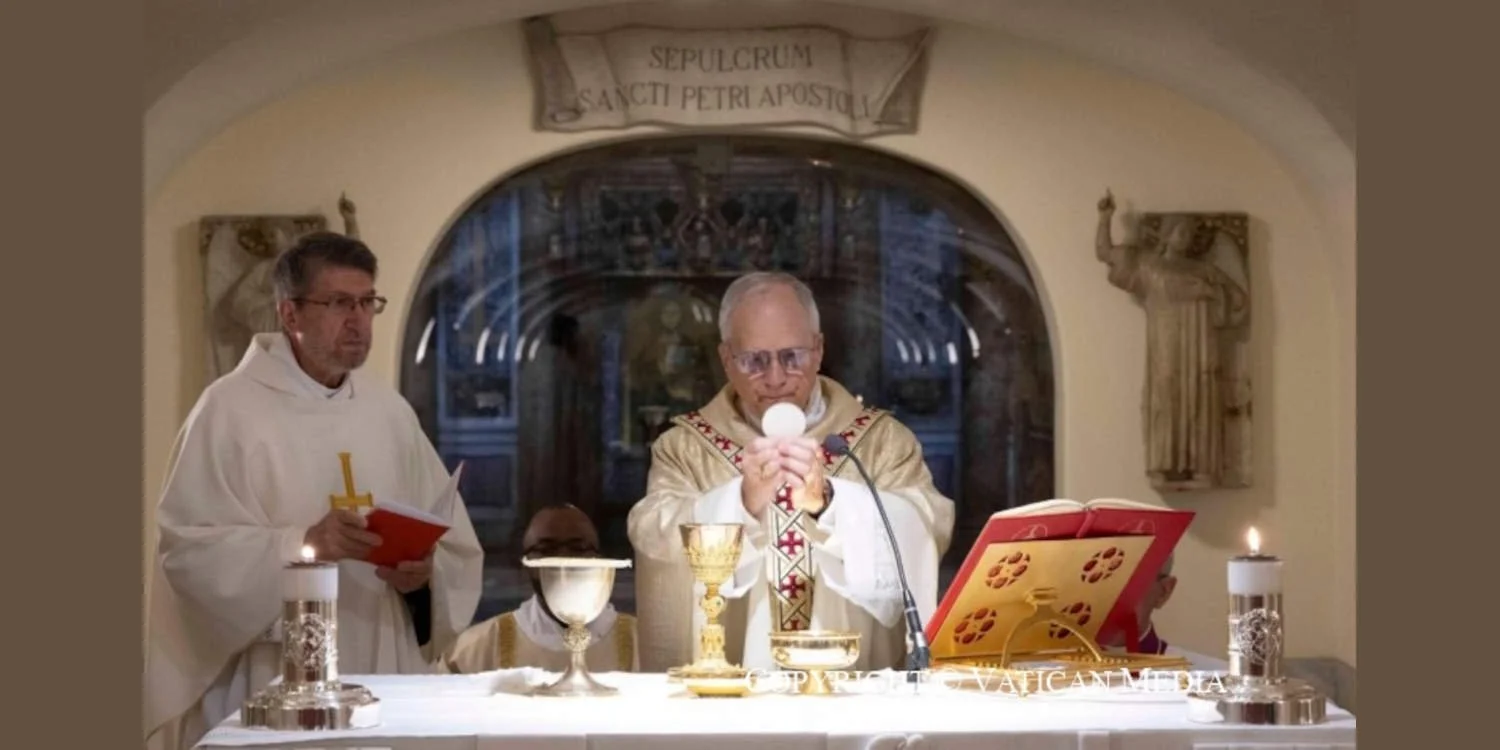
“Peter Lives in Rome Again”
In March, 2010 when Beyond These Stone Walls was a newborn blog, a post about Vatican scandal went viral. Fifteen years later it is still widely read and spread.

In March, 2010 when Beyond These Stone Walls was a newborn blog, a post about Vatican scandal went viral. Fifteen years later it is still widely read and spread.
May 14, 2025 by Father Gordon MacRae
We have already published a post this week, though four days earlier than our usual. It has a rather blunt title, but if you missed it, you should at least indulge me. That post was, “Pope Leo XIV Is Certainly No Clone of Pope Francis.”
If you search in any search engine the term “scandal at the Vatican,” using quotes, you will immediately come across a post that technically gave birth to this blog. It was written in March, 2010 when Beyond These Stone Walls was literally nine months along. Its title is “Michelangelo and the Hand of God: Scandal at the Vatican.” I had no idea when I wrote it that “Scandal at the Vatican” would become one of the most common searches on the Internet in regard to Catholic affairs thus making my post top the charts at various points along the way.
Vatican scandal was not at all what I had in mind when I wrote that post. It tells a fascinating story about overlapping layers of art history and we will link to it again at the end of this post.
Just days ago, worldwide attention was focused on the Sistine Chapel, the site at which Pope Leo XIV was recently elected. My post from fifteen years ago was focused upon that very same place but for different reasons. I am always a bit nervous when that post surfaces widely into view again as it did during and after the recent conclave. My post was about art, and Michelangelo, and a little-known event of art history. Rome is home to some of the world's most accomplished artists and art historians. I sometimes worry about whether and how something I wrote might measure up to their scrutiny. But the post in question has been making waves on the Internet for at least the last fifteen years. No one has yet complained or challenged my artistic interpretation. I won’t repeat that entire story here. You may read it for yourself linked again at the end of this post. Despite the fact that I wrote it, it is indeed an amazing story.

Landmarks
Among the vast media sources of published commentary about the results of the recent Vatican papal conclave, some have stood out far above the rest. One of these was published in The Wall Street Journal by Canadian priest and author of some reknown, Father Raymond de Souza entitled “Catholics Welcome an American Pope” (WSJ, May 9, 2025). I found a few of its paragraphs to be especially fascinating and moving. They gave me my title for this post:
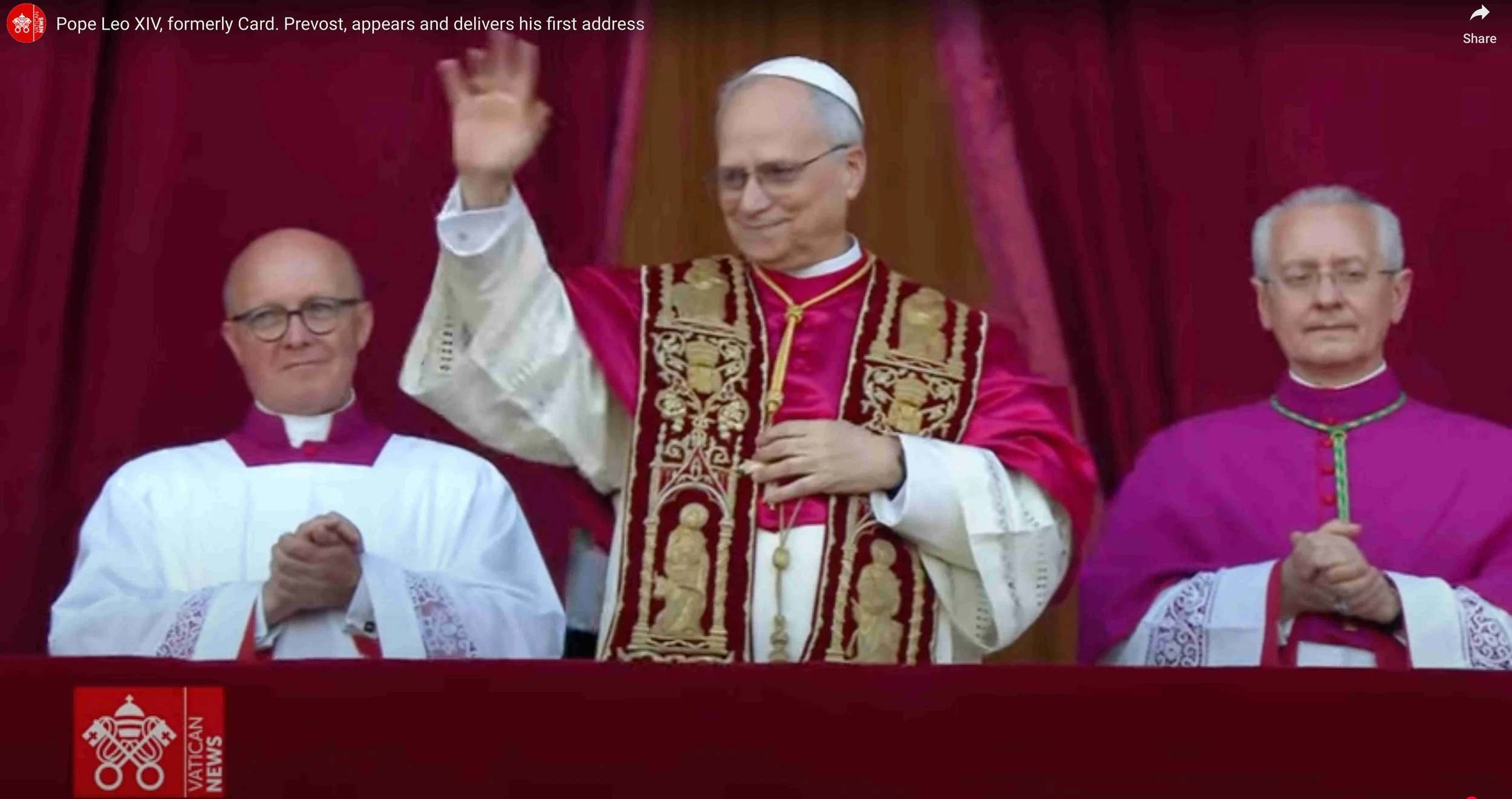
“Twenty years ago, at the election of Pope Benedict XVI, Cardinal Francis George, Archbishop of Chicago, stood on the balcony of St. Peter’s and was caught staring off into the distance. He confessed later that he was marveling that the Church had elected yet another man to succeed Peter, while the great imperial Rome, the caput mundi, which put Peter to death on the Vatican hill, was no longer. Only ruins remained.
“In 1586, Pope Sixtus V had moved one of these ruins, a 350-ton granite obelisk, to the center of St. Peter’s Square, where it stands to this day. That obelisk could have been among the last landmarks St. Peter looked upon as he was crucified. It is the first thing a new pope sees when he lookes out over the assembled masses in the square below.
“On the top of that obelisk is a bronze cross, and place therein is a relic of the true Cross of Christ. There is in the Catholic calendar a feast of the Exaltation of the Holy Cross. It falls on September 14 — the new Pope Leo XIV’s birthday.”
“Peter lives in Rome again.”
+ + +
Note from Father Gordon MacRae: Thank you for reading and sharing this post, and our post about Pope Leo XIV for whom we hold high hopes which, if you saw the faces of the immense crowd in St. Peter’s Square last week, seemed to be contagious.
Please also read and share these related posts cited herein:
Michelangelo and the Hand of God: Scandal at the Vatican
Conclave: Amid the Wind and the Waves, a Successor of Peter
Pope Leo XIV is No Clone of Pope Francis
+ + +

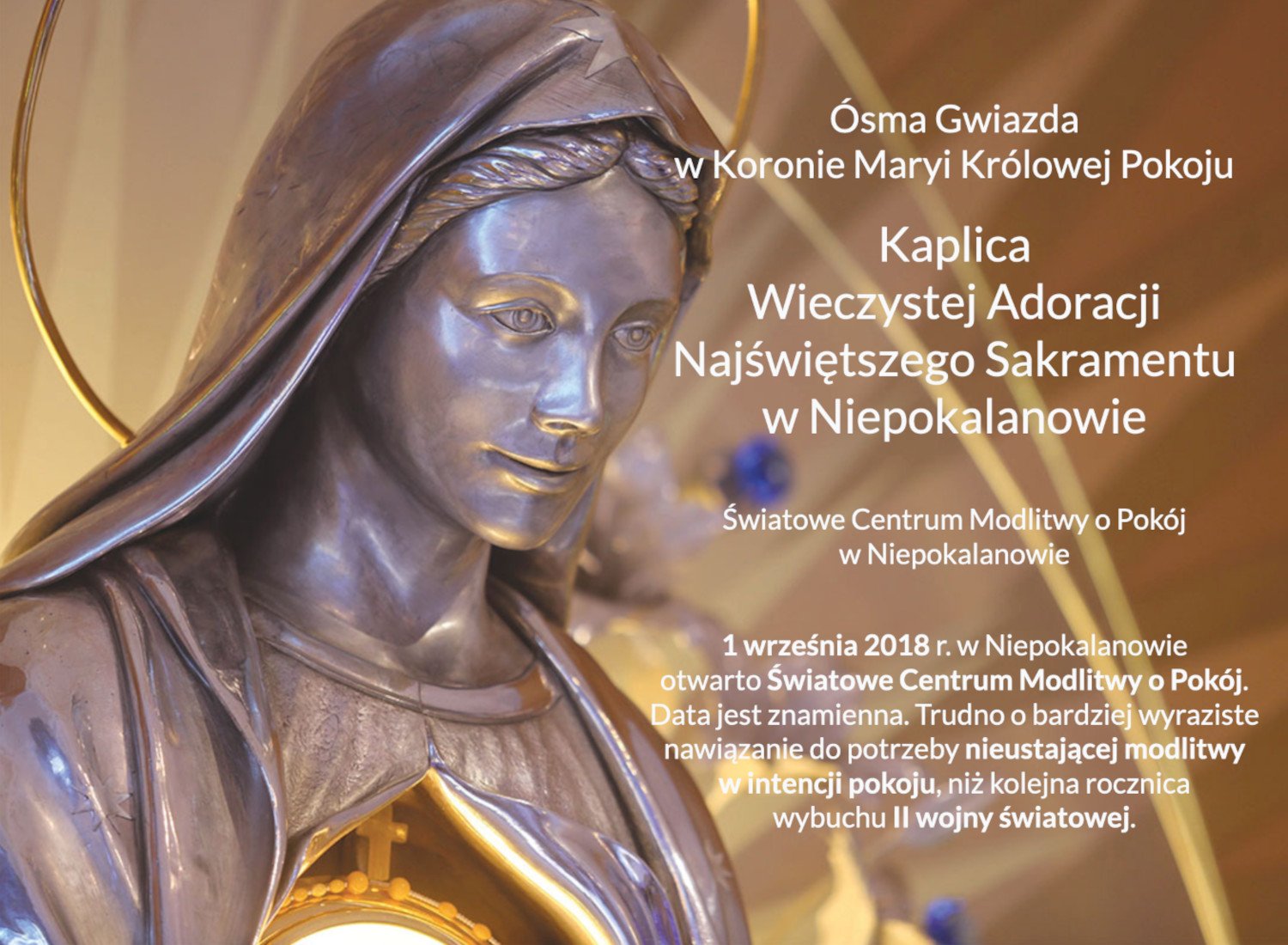

The Eucharistic Adoration Chapel established by Saint Maximilian Kolbe was inaugurated at the outbreak of World War II. It was restored as a Chapel of Adoration in September, 2018, the commemoration of the date that the war began. It is now part of the World Center of Prayer for Peace. The live internet feed of the Adoration Chapel at Niepokalanow — sponsored by EWTN — was established just a few weeks before we discovered it and began to include in at Beyond These Stone Walls. Click “Watch on YouTube” in the lower left corner to see how many people around the world are present there with you. The number appears below the symbol for EWTN.
Click or tap here to proceed to the Adoration Chapel.
The following is a translation from the Polish in the image above: “Eighth Star in the Crown of Mary Queen of Peace” “Chapel of Perpetual Adoration of the Blessed Sacrament at Niepokalanow. World Center of Prayer for Peace.” “On September 1, 2018, the World Center of Prayer for Peace in Niepokalanow was opened. It would be difficult to find a more expressive reference to the need for constant prayer for peace than the anniversary of the outbreak of World War II.”
For the Catholic theology behind this image, visit my post, “The Ark of the Covenant and the Mother of God.”

Pope Leo XIV Is Certainly No Clone of Pope Francis
Pope Leo XIV, the first pope with American roots, is profiled by some as being in solidarity with the progressivism of Pope Francis, but a closer look is required.

Pope Leo XIV, the first pope with American roots, is profiled by some as being in solidarity with the progressivism of Pope Francis, but a closer look is required.
May 10, 2025 by Father Gordon MacRae
We are posting this days before our usual Wednesday post day, but we did not want to wait. On Thursday, May 8, 2025 Robert Francis Cardinal Prevost became the 267th Pontiff of the Catholic Church, and the first in Church history to assume the Chair of Peter from America. One priest I called on that day described him as “a clone of Francis.” I gasped at the thought, but it is too much of a knee-jerk reaction. Since then, several voices from the left have spread the notion that he is our latest “woke pope.” That is nonsense, little more than propaganda, and there is lots of information to discredit it.
That was an otherwise interesting day for me. The Conclave began on Wednesday, May 7, 2025. I wrote about our expectations here in “Conclave: Amid the Wind and the Waves, a Successor of Peter.”
You could probably tell by that post that I expected a slightly more prolonged conclave, predicting that it might end with white smoke no sooner than Friday, May 9. I followed it intensely from the first procession into the Sistine Chapel. It was just a coincidence that my work was cancelled on Thursday afternoon. So at 1 PM, I was in my cell staring at the Sistine Chapel stove pipe while busy writing some notes. I looked away for just a minute and when I looked back and there were puffs of white smoke billowing out of the pipe. The silence was deafening, but the bells left no doubt.
I was off by a full day. I had ascertained that the 1978 election of John Paul II took eight votes. The 2005 election of Benedict XVI took three, and the 2013 election of Francis took five. So in my mind I calculated the average of all three votes to take 5.33 voting sessions. I therefore predicted that the conclave would end in the afternoon of Friday. The longest conclave in Church history lasted 1,006 days many centuries ago. None of us has the nerve to survive such a thing. But now, a day early there it was, white smoke at 1 PM (EST). Before the new pope was even introduced to the world, I quickly telephoned our editor, Dilia, in New York. Most of us about to witness monumental events wish not to witness them alone. So while Dilia was tuned in to EWTN, I watched Fox News and we compared notes. We were both stunned to meet Cardinal Robert Prevost, a native of Chicago, who was presented to the world as Pope Leo XIV. I imagine that every reporter on earth scrambled to discover what they could about the relative unknown.
Pundits immediately compared him to the late Pope Francis, claiming that they shared the same worldview and progressive mindset. There might even be some truth to that. We will all find out going forward. But what my eyes saw there on that balcony told a very different story. There, standing before the world, was an obviously humble man overwhelmed by the roaring crowds of Saint Peter’s Square. The roaring crowd was evidence of something in its own right. There were thousands of young men and women shouting in triumph in support not only of this man, but of this moment. When did we become, seemingly overnight, a Church filled with young and vibrant true believers?
I was struck by the presentation of Pope Leo XIV. Unlike his predecessor he chose to be bedecked in all the traditional garb of the Roman Pontiff. That is a sign, read with a bullhorn of what we may expect from this pope. These signs and wonders were all of his personal choice. So was the papal name he chose. It was that alone which filled me with hope.
We have a lot yet to learn about Pope Leo XIV. His chosen namesake, Pope Leo XIII who reigned from 1878 to 1903, can tell us volumes about the nature and person of the man who now occupies the Chair of Peter. The pontificate of Pope Leo XIII began the modern age of Roman Catholicism. He was known as “a social justice warrior,” a title that may bring shivers to some. But theologically, and in affairs of the Church and our life of faith, that Leo was certainly no liberal. His letters echoed the emphases of Pius IX Syllabus of Errors, and he endorsed the stance about concience, worship, and separation of Church and State by Pope Gregory XVI. Pope Leo XIII wrote the encyclical letters, Aeterni Patris (Eternal Father) which urged a revival of the work of Saint Thomas Aquinas as the basis of political and social renewal. Pope Leo was also the author of the encyclical, Rerum Novarum, which advocated for just wages earning him the title of “The Worker’s Pope.”
It seems that Leo XIV sees the Church and the world, at least in part, through the eyes of Leo XIII. And they were eyes never deluded about the true nature of this world and the Church which works for salvation within it.
I was thrilled by this knowledge. Pope Leo XIII and I shared a common vision about this world and the dangers it poses for the Church. After a night of terror, Pope Leo XIII wrote the following prayer, which I can only hope will also be prayed by his successor and namesake. We must also pray that prayer for him:

Prayer to Saint Michael the Archangel by Pope Leo XIII
O Glorious Prince of the heavenly host, St. Michael the Archangel, defend us in the battle and in the terrible warfare that we are waging against the principalities and powers, against the rulers of this world of darkness, against the evil spirits. Come to the aid of man, whom Almighty God created immortal, made in His own image and likeness, and redeemed at a great price from the tyranny of Satan.
Fight this day the battle of the Lord, together with the holy angels, as already thou hast fought the leader of the proud angels, Lucifer, and his apostate host, who were powerless to resist thee, nor was there place for them any longer in Heaven. That cruel, ancient serpent, who is called the devil or Satan who seduces the whole world, was cast into the abyss with his angels. Behold, this primeval enemy and slayer of men has taken courage. Transformed into an angel of light, he wanders about with all the multitude of wicked spirits, invading the earth in order to blot out the name of God and of His Christ, to seize upon, slay and cast into eternal perdition souls destined for the crown of eternal glory. This wicked dragon pours out, as a most impure flood, the venom of his malice on men of depraved mind and corrupt heart, the spirit of lying, of impiety, of blasphemy, and the pestilent breath of impurity, and of every vice and iniquity.
These most crafty enemies have filled and inebriated with gall and bitterness the Church, the spouse of the immaculate Lamb, and have laid impious hands on her most sacred possessions. In the Holy Place itself, where the See of Holy Peter and the Chair of Truth has been set up as the light of the world, they have raised the throne of their abominable impiety, with the iniquitous design that when the Pastor has been struck, the sheep may be scattered.
Arise then, O invincible Prince, bring help against the attacks of the lost spirits to the people of God, and give them the victory. They venerate thee as their protector and patron; in thee holy Church glories as her defense against the malicious power of hell; to thee has God entrusted the souls of men to be established in heavenly beatitude. Oh, pray to the God of peace that He may put Satan under our feet, so far conquered that he may no longer be able to hold men in captivity and harm the Church. Offer our prayers in the sight of the Most High, so that they may quickly find mercy in the sight of the Lord; and vanquishing the dragon, the ancient serpent, who is the devil and Satan, do thou again make him captive in the abyss, that he may no longer seduce the nations. Amen.
Our Holy Father Pope Leo XIV has an immense task before him. Let us pave that way with the support of our prayers and good intentions.
+ + +
Note from Fr Gordon MacRae: Thank you for reading this post. You can help stem the tide of misinformation by sharing it. We can no longer share to Facebook, but you can do so in our stead. You may also follow Beyond These Stone Walls on X and at gloria.tv.
You may also like these related posts:
Saint Michael the Archangel Contends with Satan Still
The Eucharistic Adoration Chapel established by Saint Maximilian Kolbe was inaugurated at the outbreak of World War II. It was restored as a Chapel of Adoration in September, 2018, the commemoration of the date that the war began. It is now part of the World Center of Prayer for Peace. The live internet feed of the Adoration Chapel at Niepokalanow — sponsored by EWTN — was established just a few weeks before we discovered it and began to include in at Beyond These Stone Walls. Click “Watch on YouTube” in the lower left corner to see how many people around the world are present there with you. The number appears below the symbol for EWTN.
Click or tap here to proceed to the Adoration Chapel.
The following is a translation from the Polish in the image above: “Eighth Star in the Crown of Mary Queen of Peace” “Chapel of Perpetual Adoration of the Blessed Sacrament at Niepokalanow. World Center of Prayer for Peace.” “On September 1, 2018, the World Center of Prayer for Peace in Niepokalanow was opened. It would be difficult to find a more expressive reference to the need for constant prayer for peace than the anniversary of the outbreak of World War II.”
For the Catholic theology behind this image, visit my post, “The Ark of the Covenant and the Mother of God.”

Conclave: Amid the Wind and the Waves, a Successor of Peter
In the Sistine Chapel, under the gaze of Christ in Michelangelo’s Last Judgment, cardinal-electors discern the successor of Peter the Holy Spirit has already chosen.

In the Sistine Chapel, under the gaze of Christ in Michelangelo’s Last Judgment, cardinal-electors discern the successor of Peter the Holy Spirit has already chosen.
May, 7 2025 by Father Gordon MacRae
“Simon, Simon, behold, Satan demanded to have you, that he might sift you like wheat, but I have prayed for you that your faith may not fail; and when you have turned again, strengthen your brethren.”
— Luke 22:31-32
“Jesus said, ‘Come.’ So Peter got out of the boat and walked on the water, but when he saw the wind and the waves he was afraid and began to sink, calling out, ‘Lord, save me.’”
— Matthew 14:29-30
+ + +
It has been written, by me and by others, that 1968 was the year we drank from the poison of this world. I was fifteen years old then. The war in Vietnam was raging. Battles for racial equality engulfed the American South. Senator Robert F. Kennedy was assassinated on his way to the presidency. Reverend Martin Luther King, Jr was assassinated on his way to civil rights. Riots broke out at the Democratic National Convention in Chicago. Violent partisan politics spread across the land like a pandemic setting a tone for decades to come.
Nineteen Sixty-Eight was also the year Pope Paul VI published Humanae Vitae, a papal encyclical asserting a moral framework for sexual ethics and human reproduction. From Catholics of every stripe, including some bishops and theologians, it subjected Pope Paul to tidal waves of global resentment and dissent. A notable exception, which was published in these pages, was “Padre Pio’s Letter to Pope Paul VI on Humanae Vitae.” The letter was written two weeks before Padre Pio’s death on September 23, 1968.
After witnessing all the above in 1968, I sat mesmerized in a Boston movie theater at age fifteen on a Sunday afternoon for the debut screening of “The Shoes of the Fisherman,” a film about the election of a pope based on a 1963 novel of the same name by Australian writer, Morris West. Like the book, the movie was long and ponderous, short on action, long on dialogue. At least it seemed that way to the mind of a fifteen year old.
But it told an amazing story. Archbishop Kyril Lakota, a courageous Soviet dissident was elevated to the papacy after spending seventeen years in a Soviet prison. Had I been able to see three or four decades into my own future in 1968, I might have cheered the result of that conclave.
Beyond my baptism, of which I had no recollection, and my first communion at age seven — which I remember mostly for the hot cocoa I spilled on my borrowed white suit in a diner where my mother took me afterward — I had little to no knowledge of the Catholic faith in 1968.
So, largely ignorant of our faith, I devoured The Shoes of the Fisherman — first the movie and then later the book. The film won a Golden Globe Award for Best Musical Score, which rose up to transcend any music I had ever heard up to that point in my life.

Emerging from All Our Prisons
Keeping his original name, Pope Kyril faced the greatest political and moral crisis ever seen in the 2000-year life of the Church. The world was at the brink of nuclear war. The people of China were starving while the Soviet Empire exploited other world powers which became islands unto themselves. Pope Kyril was tasked with mediating an end to hostilities and the looming threat of full-scale nuclear war which could destroy the planet and everyone on it. So after much prayer, Pope Kyril did the unthinkable. He sacrificed the patrimony of the Church. He sought to avert hunger and war by liquidating and surrendering all property and other assets held by the global Catholic Church.
Critics of the communists chafed. Critics of the movie choked, while critics of the Church cheered. They dismissively held that the Church would not have survived a nuclear war anyway. But faith would survive and Pope Kyril was boldly going to put that to the test. I left the theater resolved to take a serious look at the Church the adolescent me had set aside as irrelevant.
I watched this film and read this book fifty-seven years ago. I am amazed today to recall how much of its details became imprinted upon me. At the conclave in The Shoes of the Fisherman, Kyril Lakota was a startling figure. The book describes him:
“For seventeen years he had been in prison or in the labor camps. Only once in all that time had he been able to offer Mass, with a thimbleful of wine and a crust of white bread. All that he could cling to of doctrine and prayer and sacrament formulae was locked in his own mind. All that he had tried to spend of strength and compassion upon his fellow prisoners he had to dredge up out of himself and out of the well of Divine Mercy.”
— The Shoes of the Fisherman, p 20
During his Soviet imprisonment, Kyril had become a cardinal in pectore (in secret). Released just before the death of the pope, he was entirely unknown while facing the conclave ahead. After the opening Mass, the cardinal camerlengo was to choose someone to read a homily in Latin. Expecting to be bored, most of the electorate settled in for a long, boring treatise. Instead, the carmerlengo walked to the far end of the stalls in the Sistine Chapel and led to the pulpit the former prisoner, Kyril, portrayed in the film by the great Anthony Quinn:
“My name is Kyril Lakota, and I am come the latest and the least into this Sacred College. I speak to you today by the invitation of our brother the Cardinal Camerlengo. To most of you I am a stranger because my people are scattered and I have spent the last seventeen years in prison. If I have any rights among you, any credits at all, let this be the foundation of them — that I speak for the lost ones, for those who walked in darkness and in the valley of the shadow of death. It is for them and not for ourselves that we are entering into conclave. It is for them and not for our selves that we must elect a pontiff.
“The first man who held this office was one who walked with Christ, and was crucified like the Master. Those who have best served the Church and the faithful are those who have been closest to Christ and to the people who are the image of Christ. We have power in our hands, my brothers, but we shall put even greater power into the hands of the one we elect. We must use that power as servants and not as masters …
“It is not asked of us that we shall agree on what is best for the Church, but only that we shall deliberate in charity and humility and in the end give our obedience to the one who shall be chosen by the majority. We are asked to act swiftly so that the Church may not be left without a head. In all this we must be what, in the end, our Pontiff shall proclaim himself to be — servants of the servants of God.”
— The Shoes of the Fisherman, p 17

The Conclave of 2025
My authority for the following reflections on the current conclave now underway are largely from one whom I have come to respect as a fair and balanced observer unfettered by personal bias. Most of what I here present is summarized from a fine article by George Weigel in The Wall Street Journal (“The High Stakes in Choosing the next Pope,” WSJ, April 26-27, 2025).
Of the 252 current members of the College of Cardinals, 135 are eligible to vote in the Conclave underway in the Sistine Chapel under the stern gaze of Christ in Michelangelo’s The Last Judgment. The Conclave’s mystery, pagentry and secrecy have long provided fodder for movies, novels, and conspiracy theories run amok.
Among the conclave myths is one that has recently proliferated in the media with a concern for the direction in which Pope Francis took the Church during his twelve-year reign. There is widespread concern that, because his papacy elevated a high percentage of the current cardinal-electors, some two thirds of them to be exact, Francis may have already determined his own successor, or at least the ideological mindset of his successor.
To the great relief of many, George Weigel points out that history does not support that notion. He cites several examples:
IN 1878, every cardinal-elector had been appointed by either Gregory XVI, an unabashed reactionary, or Pius IX, a fierce critic of modernity. That electorate chose a pope, Leo XIII, who took Catholicism in a different direction for 23 years, seeking to engage cultural, social, and political modernity rather than merely condemning it.
Leo XIII appointed 61 of the 62 electors who then chose his successor in 1903. They chose Pius X who firmly applied the brakes to his predecessor’s reform initiatives.
And just over a decade ago, cardinals chosen by John Paul II and Benedict XVI elected as a successor Pope Francis whose pontificate has included senior figures determined to dismantle the legacies of John Paul II and Benedict XVI.
Shocking events have also played a role in the selection of a pope. In October, 1978, cardinal-electors were stunned to be recalled to Rome for a conclave after the 33-day pontificate of Pope John Paul I, whom they had just elected in a swift conclave. That shock created the conditions for doing what previously seemed unthinkable. The electors broke the succession of Italian popes electing the first non-Italian in 455 years, Poland’s Karol Wojtyla, who became John Paul II.
Another shocker soon followed after the 25-year papacy of John Paul II. The succession of Josef Ratzinger who became Benedict XVI and faithfully continued the legacy of John Paul II ended in another unexpected shock. In 2013 Benedict XVI became the first pope to step down since the year 1415. Like in the fictional story of The Shoes of the Fisherman, a consensus formed among the electors that they had to resolve the election quickly to demonstrate the Church’s unity. Cardinal Jorge Mario Bergoglio of Argentina, who like Kyril Lakota in The Shoes of the Fisherman had given a moving reflection on the person of Christ during the pre-conclave session, was quickly chosen becoming Pope Francis.
The conditions under which the current conclave is taking place have no precedent in Church history. No one can predict the outcome. The electorate in this conclave will be the largest and most diverse in history. When Pius XII was elected in 1939 there were 62 cardinal-electors of whom 37, or 60 percent, were Italian. The current electorate is over twice that size with 135 cardinal-electors and only 28, or 21 percent, are Italian. Today 13 percent of the electors are from sub-Saharan Africa, which George Weigel points out is the Church’s greatest area of growth. In other regions, 17 percent are from Asia, another 17 percent are from Latin America and the Caribbean, 10 percent are from North America, and 39 percent are from across Europe excluding Italy. Some of the more powerful European electors, such as those from Germany, represent a nation of Catholics for whom participation in the Mass and the Eucharist hovers around two percent, compared to over 70 percent in Africa. For the first time there are cardinal-electors from Singapore, East Timor, Papua New Guinea, Malaysia, Myanmar, South Sudan, Mongolia, Sweden, Serbia, Ruwanda, Burkina Faso, Paraguay, Laos, Morocco, Cape Verde and Haiti. Traditional Catholic centers such as Dublin, Paris, Milan, Venice and Los Angeles will have no one in the conclave.
I must give the last word in this post to His Eminence Cardinal Raymond Leo Burke, who has composed a beautiful and timely Novena Prayer for Catholics to participate in the Conclave by seeking the intercession of Our Lady of Guadalupe, who has been known to be in the company of the Holy Spirit:
Cardinal Burke’s Novena for the Election of the Next Pope
I kneel before you, O Virgin Mother of God, Our Lady of Guadalupe, the compassionate mother of all who love you, cry to you, seek you, and trust in you. I plead for the Church at a time of great trial and danger for her. As you came to the rescue of the Church at Tepeyac in 1531, please intercede for the Sacred College of Cardinals gathered in Rome to elect the Successor of Saint Peter, Vicar of Christ, Shepherd of the Universal Church.
At this tumultuous time for the Church and for the world, plead with your Divine Son that the Cardinals of the Holy Roman Church, His Mystical Body, will humbly obey the promptings of the Holy Spirit. Through your intercession, may they choose the most worthy man to be Christ’s Vicar on earth. With you, I place all my trust in Him Who alone is our help and salvation. Amen.
Heart of Jesus, salvation of those who trust in Thee, have mercy upon us!
Our Lady of Guadalupe, Virgin Mother of God and Mother of Divine Grace, pray for us!
Raymond Leo Cardinal BURKE
April 24, 2025

+ + +
Note from Fr Gordon MacRae: Thank you for reading and sharing this post with others during this most critical time for the life of the Church. I also invite you to visit these related posts from Beyond These Stone Walls:
The Once and Future Catholic Church
A Vision on Mount Tabor: The Transfiguration of Christ
The Vatican Today: Cardinal George Pell’s Last Gift to the Church
Synodality Blues: Pope Francis in a Time of Heresy
+ + +
Follow Beyond These Stone Walls on X.

The Eucharistic Adoration Chapel established by Saint Maximilian Kolbe was inaugurated at the outbreak of World War II. It was restored as a Chapel of Adoration in September, 2018, the commemoration of the date that the war began. It is now part of the World Center of Prayer for Peace. The live internet feed of the Adoration Chapel at Niepokalanow — sponsored by EWTN — was established just a few weeks before we discovered it and began to include in at Beyond These Stone Walls. Click “Watch on YouTube” in the lower left corner to see how many people around the world are present there with you. The number appears below the symbol for EWTN.
Click or tap here to proceed to the Adoration Chapel.
The following is a translation from the Polish in the image above: “Eighth Star in the Crown of Mary Queen of Peace” “Chapel of Perpetual Adoration of the Blessed Sacrament at Niepokalanow. World Center of Prayer for Peace.” “On September 1, 2018, the World Center of Prayer for Peace in Niepokalanow was opened. It would be difficult to find a more expressive reference to the need for constant prayer for peace than the anniversary of the outbreak of World War II.”
For the Catholic theology behind this image, visit my post, “The Ark of the Covenant and the Mother of God.”

South Park’s Bill Donohue Disgrace Was This Convert’s Amazing Grace
If ever there is an award for a Catholic who heroically goes above and beyond for others, Pornchai Moontri’s Nominee would be Catholic League President Bill Donohue.

If ever there is an award for a Catholic who heroically goes above and beyond for others, Pornchai Moontri’s Nominee would be Catholic League President Bill Donohue.
April 30, 2025 by Fr Gordon MacRae and Pornchai Maximilian Moontri
Earlier in April 2025, the Catholic League for Religious and Civil Rights in New York City sent out the following Media Alert to all Catholic League members:
“April 10, 2025
South Park's "Fantastic Easter Special," featuring the animated character of Bill Donohue, will air Friday morning, April 11, on Comedy Central at 4:00 a.m. ET. It can also be streamed on HBO's streaming service for those who have a subscription.”
I had the Alert sent by email to our friend Max Moontri in Pak Chong, Thailand. For those who are newer readers to this blog, Pornchai Max Moontri was my roommate for almost 16 years. His story, amazing in its own righ, was told in these pages just a week ago on Relevant Radio in an interview with The Drew Mariani Show.
Upon receipt of Bill Donohue’s Media Alert about South Park, Max wrote to me immediately to tell me that the date of the Catholic League Media Alert was also the anniversary of Max being received into the Catholic Church on Divine Mercy Sunday, 2010. It is difficult to hear this entire story and still cling to any doubt about the truth and power of Divine Mercy. Pornchai Max filled in a lot of blanks so I will now turn this story over to him.
“I was a teenager when I went to prison [in 1992]. Over the next 13 years, I was sent to solitary confinement over and over, for up to three-and-a-half years at a time, because I was so hostile. The longer I was there each time, the more inhuman I felt and became. Living for years on end in solitary confinement joined with the guilt I felt for the life I took during a struggle when I was 18 years old.
“So I just gave up on myself as a human being. I sank to the very bottom of the prison I was in, and stayed there. Then, in the spring of 2005, after almost fourteen years in and out of solitary confinement in Maine’s Supermax Prison, I was told that I was to be shipped to another prison in another state. I sat for months alone in my cell wondering about whatever hell was coming next. Then one day, guards in riot gear came and chained me up….”
[Editor: You can see the solitary confinement unit that held Pornchai in PBS FRONTLINE “Solitary Nation.” If you have not seen this, you cannot begin to know what Pornchai has been through.]
While I was writing the above, I had already lived in a prison cell with Father Gordon MacRae (“Father G”) for almost five years. I shudder when I think of my life before then. It is hard to put together this series of events that seem to be disconnected from each other. It only seems that way. Going from years in brutal solitary confinement to life in a cell with a Catholic priest is something I never imagined.
When I look back, and see all the small steps in which our Blessed Mother inserted herself into my life leading me to Jesus, it seems miraculous to me. If someone else told me this story twenty years ago, I would not believe it. But there is a lot more to my story.
Most people I knew in my earlier prison were afraid of me. Most expected me to erupt in violence any minute. I liked having that reputation then. I could not see it at the time, but it protected me from ever again feeling the terror I felt from the time I was taken from Thailand at age 11 to the time I ended up a homeless teenager living alone on the streets of Bangor, Maine at age 14.

A Black Hole from Which No Light Could Escape
What happened in those three years upon my arrival in America was like a black hole from which no light could escape without Divine assistance. I kept it bottled up within me for many years in a seething rage of trauma and hurt. It became my prison within a prison. But it served a purpose. It kept everyone else away, everyone except Father G.
I have read a little about exorcism since I became a Catholic on Divine Mercy Sunday in 2010. I understand it to be the spiritual casting out of evil. My exorcism at the hands of Jesus through His priest took a long time. It had to begin with my long, slow awakening to the fact that the evil within me was not planted there by me and it was not mine to keep. It was placed in my heart and soul by someone else.
On September 12, 2018, the Feast of the Most Holy Name of Mary, Richard Alan Bailey, the man who violently raped and tortured me more than forty times when I was taken to America, was brought to justice. It was Father G and Beyond These Stone Walls that ultimately accomplished this. Father G wrote some articles about what happened to me. They circled the globe and eventually they found the right persons who would be instrumental in my redemption. One of those persons was Dr. Bill Donohue, President of the Catholic League for Religious and Civil Rights of which I am now a member.
Backing up a little, in Fall, 2005, I was shackled, chained, thrown into a prison van, and driven from solitary confinement in Maine to Concord, New Hampshire. I was handled like a dangerous animal, and thrown into a familiar place: another stint in solitary confinement. But it was brief. It was also in 2005 that The Wall Street Journal wrote its first articles about the injustices that happened to Father G. Not long after I first met him by “chance” one day, I read those articles.
Later in 2006, Father G and I landed in the same place. Our cells were two doors apart. I remember the first time I walked into his cell. I saw a photo on a card attached to a battered mirror on the cell wall, and the man on the card looked sort of like Father G. So I said, “Is this you?” This turned out to be the most important question of my life. Father G then told me about St. Maximilian Kolbe, about what he did in prison at Auschwitz, and about how this card came to be on his mirror. Father G wrote this story in “The Parable of a Priest and the Parable of a Prisoner.”
Then one day came dreaded news. A U.S. Immigration Court ruled that I would be deported to Thailand at the end of my sentence. I never wanted to leave Thailand as a child. I was forcibly brought to America, and all I really knew in America was its prisons. In the meantime, my Mother — my only connection to Thailand — was murdered on the Island of Guam after she was brought there by Richard Alan Bailey. Her death remains classified there as a “cold case unsolved homicide.” It is not “unsolved” in the minds of either me or Father G.
When news of my eventual deportation came, I sank into deep depression. I knew that I had no future in Thailand. I had no future anywhere. Father G helped me appeal the deportation order, but like most such appeals, it was denied. So I just gave up again, and settled in my mind on my own “Plan B,” my eventual self-destruction. Father G confronted this setback with his own optimism that provided no hope or comfort at all. He said, “We are just going to have to build a bridge from here to Thailand.”
Who could take him seriously? I sure didn’t. We were in a prison cell thousands of miles away! All the things Father G tried to instill in me about hope and trust and surrender just felt empty again. But I had nothing else to hang onto. No hope at all. So I hung onto his.

Catholic League President Bill Donohue [l] and Pornchai Moontri at age 12 [r] just as he arrived in America and before the troubling events in this story took place.
Pornchai’s Story
Soon after this rejection from the Immigration Court, Father G came into our cell one day and told me that we have to get a summary of my life story on paper… So we talked for a long time. He asked me lots of questions and took notes. Then he helped me put it together in a four-page document. I could not see the point of it. I tried to type it on his typewriter, but my heart was not in it at all. Father G became impatient with my one-word-per-minute typing speed. So Father G took over and he typed it while I waited. He was not patient with my typing speed, but he was patient with me and my attitude of hopelessness and defeat.
After the story was typed, Father G said that he wanted my permission to send the short life story we typed to a few contacts in the outside world. He said that these were all people who had connections, and that he believed one of them would find connections for me in Thailand.
I thought this was hopeless, of course. No one is going to be interested in me. But I hate arguing so I just told him to go ahead. I believed it would come to nothing.

Dr Bill Donohue on South Park
I wrote that story with Father G’s help in 2007. When Father G said he wanted to send it out to others, I answered with a sarcastic “Whatever!” It was that word for which every parent of every adolescent wants to smack him for saying it. Father G sent my story to several people and he told me that it will come to good. Then I said it again, “Whatever!”
In coming weeks — to my shock and awe — I started receiving letters of support and encouragement. One was from Cardinal Kitbunchu, Archbishop Emeritus of Bangkok, Thailand. I nearly fell over when I saw the envelope with his return address and Thai stamps. Another came from Honorable Mary Ann Glendon, U.S. Ambassador to the Vatican. Another was from Father Richard John Neuhaus, Editor of First Things magazine. They encouraged me to cling to hope even when I saw none. And then finally one came from Dr. Bill Donohue, President of the Catholic League for Religious and Civil Rights. Dr. Donohue shocked me. He asked my permission for the Catholic League to publish my story.
At first, I was excited. Then the inevitable gloom within me crept back in. I did not dare to hope. Hope is not for the beaten down. It is just too painful. I told Father G I did not want others to know that I was victimized in America. I also was consumed with shame. I told Father G that I did not want to publish the story. But this gets really strange from here on.
I used to sometimes come across a horrible cartoon called South Park on the Comedy Central TV channel. South Park spared no one. They would often take famous people and create a cartoon satire to ridicule them. On April 5, 2007, I was watching an episode of South Park. It was their Easter Special. Suddenly, there on my screen was a cartoon version of Dr. Bill Donohue.
I stuck my head down from my top bunk and told Father G to turn it on. The cartoon was very disrespectful, but my first reaction was to shout, “WOW! DR DONOHUE IS REALLY FAMOUS!”
I thought he must be really good because only good people are ridiculed on South Park. Dr. Donohue was ridiculed along with Jesus and Pope Benedict in the same episode. At one point, Jesus punched Dr. Donohue. I was horrified! But this is also what changed my mind. I thought that if Dr. Donohue is brave enough to endure this ridicule, I can be too. So I asked Father G to help me write to Dr. Donohue with permission for the Catholic League to publish my story. It was because of South Park!
Two years later, in 2009, Beyond These Stone Walls began our long adventure in what Father G calls “The Great Tapestry of God.” He told me that in this life, we live only in the back of the tapestry, unable to see what all our tangled threads are producing.
Over the next decade, we together confronted evil. It was not all at once. It was in slow steps because at points along the way whenever I felt overwhelmed, I would retreat and then give up and quit. But Father G never quit. He stayed the course, patiently waiting for a better day to pull me back onto what he called “our road to Emmaus.” And staying the course meant writing about me. What he wrote started to become noticed.
Strange things began to happen. Just weeks after I was received into the Church on Divine Mercy Sunday in 2010, I read that South Park editors cancelled an episode that ridiculed Mohammed after freely ridiculing Jesus, Pope Benedict and Dr. Bill Donohue. I never watched South Park again.
But there are stranger things still. Because of what was being written about me, Clare and Malcolm Farr — husband and wife attorneys in Southwest Australia — offered to assist me pro bono. They are today among my dearest friends, but we have never actually even met in person. They performed miracles with contacts in Thailand, with an attempt to reopen the case of the murder of my Mother in Guam, and with helping Father G to bring my abuser to justice.
Then Father G received a letter from a group called Divine Mercy Thailand. The letter revealed that Marian Father Seraphim Michalenko had been in Thailand and he carried with him a copy of “Pornchai’s Story,” which he read from the Catholic League’s site to the Divine Mercy Thailand group. I learned only later from Father G that Father Seraphim Michalenko was the Vatican’s vicepostulator for the cause of sainthood of Maria Faustina Kowalska. It was Father Seraphim who smuggled Saint Faustina’s diary out of Communist Poland and assisted in its English translation. Father G wrote about this when Father Seraphim came to this prison to interview both of us. Father G’s post was “Divine Mercy in a Time of Spiritual Warfare.”
Father Seraphim’s interest, triggered by Dr. Bill Donohue, then inspired Felix Carroll, who was then Editor of Marian Helper magazine, to contact Father G. Felix Carroll said that he posted my story from the Catholic League’s site and “it lit up our website like never before.” Felix asked that we allow him to include a chapter about me in his book, Loved, Lost, Found: 17 Divine Mercy Conversions.
The miracles continued. I was visited in prison by a representative of the Royal Thai Consulate in New York who offered help in restoring my Thai citizenship and preparing me for repatriation. Then one day I was called to the prison library. The library had received a donated set of Thai language CDs which were set up on a computer for me to study. Then Divine Mercy Thailand wrote again and offered me a home. The bridge to Thailand Father G had once promised was built and I was utterly amazed. Then, in 2020, just before the pandemic took hold, Father G filed a petition on my behalf revealing all that had happened that never made its way into my trial in 1992. I was to be set free within the coming months.
I will never say “Whatever!” to Father G again. He and Bill Donohue, and even the disgraceful South Park, became the keys to the locks that held me bound. If there is ever a book called Divine Mercy Miracles, I expect to find this story in it. I am free!
+ + +
Eternal Father, I offer You the Body and Blood, Soul and Divinity of Your Dearly Beloved Son, Our Lord, Jesus Christ, in atonement for our sins and those of the whole world. For the sake of His sorrowful Passion, have mercy on us and on the whole world.
+ + +
Note from Fr Gordon MacRae: If you are not a member of the Catholic League, please consider lending your voice to this nation’s largest endeavor in protection of Religious Liberty: Catholic League Membership Subscription. Your membership fee also includes a one-year subscription to the Catholic League Journal Catalyst.
We also recommend these related posts:
Pornchai’s Story: The Catholic League Conversion Story for 2008
Divine Mercy in a Time of Spiritual Warfare
A Catholic League White House Plea Set Pornchai Moontri Free
The Parable of a Priest and the Parable of a Prisoner
Thailand’s Once-Lost Son Was Flag Bearer for the Asian Apostolic Congress

The Eucharistic Adoration Chapel established by Saint Maximilian Kolbe was inaugurated at the outbreak of World War II. It was restored as a Chapel of Adoration in September, 2018, the commemoration of the date that the war began. It is now part of the World Center of Prayer for Peace. The live internet feed of the Adoration Chapel at Niepokalanow — sponsored by EWTN — was established just a few weeks before we discovered it and began to include in at Beyond These Stone Walls. Click “Watch on YouTube” in the lower left corner to see how many people around the world are present there with you. The number appears below the symbol for EWTN.
Click or tap here to proceed to the Adoration Chapel.
The following is a translation from the Polish in the image above: “Eighth Star in the Crown of Mary Queen of Peace” “Chapel of Perpetual Adoration of the Blessed Sacrament at Niepokalanow. World Center of Prayer for Peace.” “On September 1, 2018, the World Center of Prayer for Peace in Niepokalanow was opened. It would be difficult to find a more expressive reference to the need for constant prayer for peace than the anniversary of the outbreak of World War II.”
For the Catholic theology behind this image, visit my post, “The Ark of the Covenant and the Mother of God.”

Divine Mercy for Doubting Thomas and Other Spiritually Wounded
The Gospel on Divine Mercy Sunday is St John’s account of the spiritually wounded Thomas who would not know peace until surrendering his wounds to the Risen Christ.

The Gospel on Divine Mercy Sunday is St John’s account of the spiritually wounded Thomas who would not know peace until surrendering his wounds to the Risen Christ.
April 23, 2025 by Fr Gordon MacRae
There is a scene in the great World War II prisoner of war film, Stalag 17, in which an American Air Force officer (played by actor William Holden) negotiates with the German Commandant over the treatment of a fellow prisoner. I was dragged into a similar role here several years ago when I protested an injustice aimed at a friend.
For a long time I had managed to avoid efforts to recruit me for an Inmate Communications Committee (ICC), a group of eight chosen from 1,500 prisoners here. The ICC advocated for better prison conditions and due process. After protesting over another prisoner, I no longer had a valid excuse, so I reluctantly accepted.
From the start, I was saddled with doing all the writing, which included detailed minutes of every meeting for distribution to prison officials, a monthly summary of progress, and a quarterly newsletter.
The job — which payed nothing — was in addition to my Law Library job which payed next to nothing. It also meant writing endless memos, proposals, clarifications, and requests that I fielded each week. We succeeded in only about ten percent of the concessions we set out to obtain, and that is more or less on par with William Holden’s success rate in Stalag 17.
About the only high point is that I was also required to be present at a Jobs and Education Fair in the prison gymnasium twice a year. It was an effort to get the other 1,500 prisoners here into jobs, educational classes and programs, and typically about 500 showed up. Among the dozens of display tables set up, the Law Library and ICC were side by side, so I manned both.
The Veterans Affairs table was set up next to the ICC table. It was a nice display with information on veteran groups here, an annual POW/MIA Remembrance, and other programs. The table was staffed by my friend, John, whom I did not get to see as often as I would like. John was a Navy veteran in his mid to later thirties. He lost his leg during active duty in the Middle East before coming to prison. John told me that when he arrived here, his prosthetic leg was taken from him because of an infection at the amputation site with the result of consigning him to a wheelchair. John was very anxious to get the prosthetic leg back and get back on his feet again, but because of the fear of infection, the prison medical officials were withholding it. It was John, by the way, who told me of the release of my friend Martin, the U.S. Marine veteran I wrote about in “A U.S. Marine Who Showed Me What to Give Up for Lent.”
I told John that I would do some research to see if there was a precedent here that John might use to restore his prosthetic leg. Then, without thinking, I thanked him for “stepping up” to take charge of the Veteran’s table. I quickly apologized for my faux pas, but John had a good laugh.
Then he told me that he spent half his day thanking people for all sorts of small things: an assist out of the chair, a push up a steep ramp, picking up a dropped item. He said that my thanks was the first time in a long time anyone had thanked him for his service to others. That small, awkward gesture had a profound effect on John. As I left, he was beaming. I made a decision that I would find a way to help restore what he lost and get him out of that dreaded wheelchair.
I can sometimes become so aware of the spiritual warfare that engulfs me here that it diminishes my awareness of the wounds of others. We are all, in one way or another, wounded by life physically, emotionally, spiritually, and it dulls our senses.
It drives us onto self-centered islands of emotional distance and spiritual isolation. The wounds we carry foster pessimism and doubt, erode faith, and turn the joy of living into a crucible of mere existence. Peace evades wounded warriors, even in spiritual warfare.

Doubting Thomas
This is the great plague of our age. I receive lots of mail from readers asking me to pray for a husband or wife, a son or daughter, who has lost their faith in response to the wounds of life and the sheer weight of living. In a war with one’s self, faith is often the first to go and the last to come back. If this describes you or someone in your life, then pay special attention to the Apostle Thomas in the Gospel from Saint John on Divine Mercy Sunday.
There are some remarkable elements in Saint John’s account of the death of Jesus and all that came after the Cross. The first witness to the “Seventh Sign,” the Resurrection of Jesus, was a woman whose own demons Jesus had once cast out. I wrote of her and the evidence for her first-hand witness in “Mary Magdalene: Faith, Courage, and an Empty Tomb.” I would like to reproduce a scene from that post that never took place, but it is one that I have long imagined.
“Mary came to the disciples, Peter and the others, hidden by fear behind locked doors, and said, ‘I have good news and not-so-good news.’ Peter asked, ‘What’s the good news?’ Mary replied, ‘The Lord has risen and I have seen him.’ Peter then asked, ‘What’s the not-so-good news?’ Mary said, ‘He’s on his way here, and He wants a word with you about last Friday.”
The focus is so intensely on Jesus in the Resurrection accounts that it is easy to forget the wounds of everyone else in this story. They are all living with the deeply felt trauma of loss, and not only loss, but with an overwhelming sense of utter discouragement. They are devastated and stripped of hope.
John, the Beloved Disciple, stood with the mother of Jesus at the foot of the Cross and watched Him die a most gruesome death at the hands of the Roman Empire, but at the behest of his own people, the Chief Priests who answered Pilate, “We have no king but Caesar.”
Mary Magdalene stood there as well, and watched. The others fled. Peter, their leader, denied three times that he even knew Jesus. All that had been promised and hoped for had been misunderstood, and now gone forever. The Chief Priests — emboldened when Pilate caved to their “We Have No King but Caesar” — sought only to round up the rest.
It was in this state of fear that Mary Magdalene showed up in the Upper Room where the Apostles were in hiding for fear of the mobs. She had news that defied belief. And when Jesus first appeared to them behind that locked door, His demeanor was the opposite of what I imagined above to be a human response to their abandonment of Him. “Peace be with you,” He said. It is not a reference to a state of peace between disputing parties or someone subject to Earthly powers. The word the Gospel used in Greek – Eiréné – has more to do with spiritual welfare than spiritual warfare.
It refers to a state of mind, heart and soul, the equivalent of the Hebrew “Shalom”, and its usage means harmony with God within one’s self. It is the same sense that the Prophet Isaiah used in his Messianic expectation of the Prince of Peace:
“For us a child is born, to us a son is given; and the government will be upon his shoulder and his name will be called ‘Wonder Counselor, Mighty God, Everlasting Father, Prince of Peace.’”
— Isaiah 9:6
It is what Saint Paul refers to in his letter to the Colossians, “Let the peace of Christ reign in your hearts” (Col. 3:15). Once you have it, it is far more contagious than any pandemic. This peace is the foundation and gift of Divine Mercy.
But Thomas missed the whole thing. When he arrived and found them stunned and exuberant, he retreated into his own deep wounds. Thomas did not stay to see Jesus crucified. Like the others, he could not bear it. He and they fled when Jesus appeared before Pilate mocked, beaten, broken, as the accusing mob grew beyond control to threaten even Pilate himself, “Crucify him! Crucify him!” But Thomas saw enough to know that it was over, that all was lost, and all hope had gone out of the world. So when faced with the great risk of trusting and hoping again, he said,
“Unless I see the mark of the nails in his hands, and put my finger into the nail marks, and place my hand in his side, I will not believe.”
— John 20:25

Trusting Divine Mercy
For this, the Apostle is forever called, “Doubting Thomas,” but I see something more painful than his doubt. I see him also as hurting, defeated, robbed of hope. He had to touch the wounds of the Risen Christ because the wounds of the Crucified Christ had already touched him, had broken his heart, and devastated his faith, and destroyed all hope. As so many of you know only all too well, coming to trust again after such hurt is a very risky business.
I find it fascinating that the story of Thomas and his struggle with trust and hope after the events of Holy Week is the Gospel for Divine Mercy Sunday. When Jesus presented Himself to Thomas, and invited him to probe the wounds in his living hands and side, Thomas did not oblige. Instead, he surrendered his own wounds, and responded in a leap of faith, “My Lord and my God.” Pope Benedict XVI wrote of this in his magisterial book, Jesus of Nazareth: Holy Week:
“In His two appearances to the Apostles gathered in the Upper Room, Jesus repeats several times the greeting, ‘Peace be with you’… It becomes the gift of peace that Jesus alone can give because it is the fruit of his radical victory over evil… For this reason Saint John Paul II chose to call this Sunday after Easter ‘Divine Mercy,’ with a very specific image: that of Jesus’ pierced side from which blood and water flowed.”
This image, revealed to Saint Maria Faustina Kowalska as the image of Divine Mercy, is that of the same wounds transfigured:
“I saw the Lord Jesus dying on the Cross amidst great suffering, and out of the Heart of Jesus came the two rays as are in the image.”
— Diary of Saint Faustina, 414
“The two rays denote blood and water. The pale ray stands for the Water which makes souls righteous. The red ray stands for the Blood which is the life of souls… Happy is the one who will dwell in their shelter…”
— Diary of Saint Faustina, 299
I recently wrote a post entitled “Thailand’s Once-Lost Son Was Flag Bearer for the Asian Apostolic Congress.” Most of our readers know the story of what led to Pornchai Maximilian Moontri’s Divine Mercy conversion. Starting at the age of two in rural Thailand, he knew only abandonment by the very people who should have taught him trust. Forced to forage in the streets for food, he was hospitalized for malnutrition. Then at age eleven he was taken from Thailand and forced into a life marked by violence, exploitation and abuse. At age 18, after several years of adolescent homelessness, he killed a man after being pinned to the ground in a struggle. Pornchai was sent to prison for life. While there, his mother, his only contact in the free world was murdered by the man who exploited him. After many years of solitary confinement, Pornchai was moved to another prison and spent the next 15 years as my roommate.
How does anyone emerge from such wounds? How does anyone ever trust again when all prior trust was broken? On Divine Mercy Sunday in 2010, Pornchai took on a new name, “Maximilian,” after Saint Maximilian Kolbe who walked this path with him and led him to Jesus through the Immaculate Heart of Mary.
In the course of this remarkable journey, Pornchai’s wounds never healed. They are with him for life, but they have been transformed. He is a powerful figure today in the realm of Divine Mercy because he has placed his wounds in the service of the Risen Lord. Back in October of 2024, Pornchai was invited to carry the flag of the Kingdom of Thailand in procession at the Fifth Asian Apostolic Congress on Divine Mercy held in the Philippines. In the scene atop this section, Pornchai Max proudly carries the flag of Thailand before a crowd of 5,000 pilgrims in honor of Divine Mercy.
If a picture speaks a thousand words, this one below speaks volumes. This is the Face of Divine Mercy.

+ + +


And to honor our late Holy Father: “Pope Francis Had a Challenge for the Prodigal Son’s Older Brother.”
The Eucharistic Adoration Chapel established by Saint Maximilian Kolbe was inaugurated at the outbreak of World War II. It was restored as a Chapel of Adoration in September, 2018, the commemoration of the date that the war began. It is now part of the World Center of Prayer for Peace. The live internet feed of the Adoration Chapel at Niepokalanow — sponsored by EWTN — was established just a few weeks before we discovered it and began to include in at Beyond These Stone Walls. Click “Watch on YouTube” in the lower left corner to see how many people around the world are present there with you. The number appears below the symbol for EWTN.
Click or tap here to proceed to the Adoration Chapel.
The following is a translation from the Polish in the image above: “Eighth Star in the Crown of Mary Queen of Peace” “Chapel of Perpetual Adoration of the Blessed Sacrament at Niepokalanow. World Center of Prayer for Peace.” “On September 1, 2018, the World Center of Prayer for Peace in Niepokalanow was opened. It would be difficult to find a more expressive reference to the need for constant prayer for peace than the anniversary of the outbreak of World War II.”
For the Catholic theology behind this image, visit my post, “The Ark of the Covenant and the Mother of God.”

Pope Francis Had a Challenge for the Prodigal Son’s Older Brother
During his papacy, Pope Francis called upon the Church to evangelize with a moral compass instead of a moral hammer, and to do so in the language of angels.

During his papacy, Pope Francis called upon the Church to evangelize with a moral compass instead of a moral hammer, and to do so in the language of angels.
April 21, 2025 by Fr Gordon MacRae
Note from Father MacRae: Our Holy Father Pope Francis visited a prison on Holy Thursday, he met with Vice President JD Vance on Easter Sunday, and then he left this life at age 88 early in the morning on the day after Easter 2025. I admit that I was somewhat irked by his leadership, especially in his suppression of the Traditional Latin Mass, which seemed to alienate some of the more faithful among us. However, I have never walked a single step in his shoes. I write here about what I most admired and most want to remember about Pope Francis.
+ + +
There are those among us who would break the compass with the hammer, but this Pope knew that what the world needs from us and our faith is a compass, not a hammer. This post started off as a reflection on the Church’s belief in angels in light of Pope Francis’ consecration of Vatican City to St Michael the Archangel, but Pope Francis himself hijacked my topic. This is a strange way to begin a story of angels, but it is the beginning that came to me.
A well known Gospel reading, Saint Luke’s account of the Parable of the Prodigal Son has been emphasized throughout the Pontificate of Pope Francis. I think it should better be called, “The Challenge to the Son Who Never Left.” The father in the well-known parable is, of course, terribly disappointed with the choices of his younger son who left his father’s side to go squander his life and his inheritance on “dissolute living.” Losing all, reduced to life as a servant of the swine, he finally comes to his senses. He decides to venture home to save himself by striking a deal with his father: “I am no longer worthy to be called your son.” He will return a servant and not a son. He plans to negotiate a plea deal but they are seldom just. I know all about the lure of plea deals.
His father is not having it, however. Overjoyed at the sight of his broken son, he ignores the well-rehearsed plea deal and restores his son to his home and his patronage with great celebration. Pope Francis spoke of this prodigal parable during the Angelus in Saint Peter’s Square saying, “Here is the entire Gospel! Here!”
Meanwhile, the older son — the one who never left and was always faithful — was not so keen about his father’s embrace of his brother home from wandering “In the Land of Nod, East of Eden.” It is an attitude his father felt obliged to challenge, and in the parable, the greater challenge is the one issued to this son. Note the powerful symbolism: this son is standing outside his father’s house as he issues his protest against mercy toward his brother. This is an important parable for the story of Divine Mercy, and it is reflected throughout the story of God that encompasses our Sacred Scripture.

“A Piece of Life’s Puzzle That Doesn’t Fit”
But first I must tell you how much I thought of my friend, Michael as I read the parable of The Prodigal Son and his Older Brother. At age 21, Michael is starting his third year in prison, and it seems a self-fulfilling prophesy for him. His father is in prison in some other state and they lost contact years ago. Prison is like the gift that keeps on giving. The sons of prisoners are 85 percent more likely than anyone else to one day go to prison, a reality I wrote of in a post about fathers and sons, “In the Absence of Fathers: A Story of Elephants and Men.”
Michael has also not seen or heard from his mother in over a decade. He was virtually homeless when he graduated from high school — an amazing accomplishment — but most of the rest of his young life has been squandered in dissolute living. I am not sure there was a point at which he actually chose that. There was just no one to stop him.
A year or so ago, Michael shattered a collarbone in several places, and it was never treated. The bone fragments have left him contorted, deformed, and in pain. He is on a waiting list for surgery to repair that mess, but there is no line to stand in to repair a shattered life. Michael’s life is in ruins, and he has little hope for anything so out of his reach as redemption.
Meanwhile, some of my other friends are not so keen on me associating with someone like Michael. This seems especially so of some of my devoutly Catholic friends. They would prefer that I be more like the priest and Levite of another famous Gospel parable and simply step over Michael left beaten by life on the side of the road. The fact that Michael reaches out to me and not one of the many street gangs that proliferate in prison says something important about him — something to which my friends should listen.
With a little help from Pornchai Moontri, while he was here with me, I managed to put a halt to the verbal harassment and disdain Michael endured in prison. Someone always has to be everyone else’s scapegoat in a place like this, and it is usually the most spiritually wounded among us. Now Michael is left alone, and is grateful for that. When asked about God, he says he started life as a Catholic, but it did not last long. “I’m just a piece of that puzzle that doesn’t fit,” he said. I am just not ready to hand Michael over to the darkness.

Pope Francis and That Older Brother
What is the point of saving only the already saved? Pope Francis has recently asked this and some other very hard questions. He seems determined that we are not to be a self-referential Church, a Church that sees membership not as food for the journey, but as the reward for arriving. The news media was all abuzz again recently over comments by Pope Francis about the face of Catholicism presented to a world on the sidelines of redemption.
Some time ago, Pope Francis spoke over 12,000 words reduced to less than 50 in the news media. What Pope Francis said comes down to this: The Catholic Church and the faith we present to the world must not be reduced to a litany of what we oppose — or are supposed to oppose. In the New Evangelization with which this Pope is tasked, the Church must stand as a moral compass and guide, and not a moral hammer. His task is to challenge his spiritual sons and daughters who are alienated from faith, but his more daunting challenge is to the rest of us.
FOX News commentator, Jonathan Morris called the Pope’s words “a new emphasis on mercy, kindness, justice, and truth,” and it is an emphasis that does not change or redefine any moral truths for which the Church stands fast. This faith has behind it a magisterial, two-millennia-old compendium of salvific truths that must not be shrunk in our public voice simply to a list of what we are not, a judgment on the ills we perceive in the world that is not us. For Pope Francis, if that is the face of our Catholic faith that we present to a dying world then our faith may die with it.
It did not take long for a few Catholic bloggers to raise the alarm when Pope Francis suggested that we not limit our Catholic voice to our opposition to abortion, contraception, same-sex marriage. One Catholic blogger who probably should have taken that day off posted in response, “We Don’t Need a Conformist Church.” I think that Pope Francis — who no one would ever characterize as being a conformist Pope — sees that a line can be crossed in our counter-cultural positions that risks making Catholicism appear exclusive. This same tendency has shattered the mainstream Protestant denominations, fosters anti-Catholic sentiment, and leaves many spiritually wounded souls on the other side of a line drawn in the sand. For Pope Francis, it is the Mission of the Church to lead those souls home, not to leave them homeless and adrift.
Pope Francis has not diluted or set aside one sentence of the Church’s moral teaching. Most of the mainstream media — even much of the Catholic press — failed to report on his comments made just one day after his call to reflect a positive and merciful Church. On September 20, 2013 the Vatican Information Service blog published the following:
“Today the Pope met with members of the International Federation of Catholic Medical Associations and Catholic Gynecologists. Francis spoke of the ‘throw-away culture that leads to the elimination of human beings, especially those who are physically and socially weakest. Our response to this mentality is a “yes” to life, decisive and without hesitation. The first right of the human person is his life. He has other goods and some are precious, but this one fundamental right is the condition for all others….’
“Reiterating that in recent times, human life in its entirety has become a priority for the Magisterium of the Church, the Pope… asked those present to ‘bear witness to and disseminate a culture of life…and not only as a matter of faith but as a matter of reason and science, there is no human life more sacred than another; there is no human life qualitatively more meaningful than another.’”
— Pope Francis, September 20, 2013

To Speak with the Tongues of Men and of Angels
In a reflection of mine when Pope Francis consecrated Vatican City to Saint Michael the Archangel, I mentioned some media taunts that this Pope sometimes seems “obsessed with Satan and the demonic.” It is nonsense, of course. If you listen to him, he really emphasizes far more the human capacity for good, and how that good must respond to a suffering humanity by carrying for the world not only truth, but both truth and light. When I began to reflect while writing a post about angelic witness, I was faced with a very surprising mathematical equation that lends authority to the Church Pope Francis wants to present to the world.
In the entire canon of Jewish and Christian Sacred Scripture — our Old and New Testament — there are 117 references to the words “devil” (35), “demon” (28), and the name of Satan (54). In the same canon of Scripture, there are exactly four times that many — 468 — references to the words “angel” or “angels” (326), the angelic orders such as archangel, cherubim, seraphim (114), and the named angels, Michael, Gabriel, and Raphael (28). The math alone tells a simple story. The ratio of angels to demons in the Story of God upon which our faith is built is exactly four to one. These are not bad odds for a Pope called upon to rebuild the face of the Church in the spirit of Saint Francis of Assisi.
In regard to those odds, Satan is referenced 54 times in the canon of Scripture while God vastly overshadows him by being named 4,773 times. There is no question of whose story is being told. It is a story of a people called out of darkness, delivered from slavery to sin, and redeemed at a very great price.
In its telling, this Holy Father, like the angelic witnesses to the deeds of God before him, wants to proclaim a salvific truth at the heart of the Gospel, a truth that the Prodigal Son’s Older Brother needed to hear: “Blessed are the merciful, for they shall obtain mercy.”
+ + +
Related reading:
Synodality Blues: Pope Francis in a Time of Heresy (Relax! The heresy is not at all what you might think.)
A sobering reflection on the pontificate of Pope Francis by Catholic League President Bill Donohue.
The Eucharistic Adoration Chapel established by Saint Maximilian Kolbe was inaugurated at the outbreak of World War II. It was restored as a Chapel of Adoration in September, 2018, the commemoration of the date that the war began. It is now part of the World Center of Prayer for Peace. The live internet feed of the Adoration Chapel at Niepokalanow — sponsored by EWTN — was established just a few weeks before we discovered it and began to include in at Beyond These Stone Walls. Click “Watch on YouTube” in the lower left corner to see how many people around the world are present there with you. The number appears below the symbol for EWTN.
Click or tap here to proceed to the Adoration Chapel.
The following is a translation from the Polish in the image above: “Eighth Star in the Crown of Mary Queen of Peace” “Chapel of Perpetual Adoration of the Blessed Sacrament at Niepokalanow. World Center of Prayer for Peace.” “On September 1, 2018, the World Center of Prayer for Peace in Niepokalanow was opened. It would be difficult to find a more expressive reference to the need for constant prayer for peace than the anniversary of the outbreak of World War II.”
For the Catholic theology behind this image, visit my post, “The Ark of the Covenant and the Mother of God.”

Behold the Lamb of God Upon the Altar of Mount Moriah
“This is the night when Christ broke the prison-bars of death and rose victorious from the underworld. Our birth would have been no gain had we not been redeemed.”

“This is the night when Christ broke the prison-bars of death and rose victorious from the underworld. Our birth would have been no gain had we not been redeemed.”
Holy Week 2025 by Fr Gordon MacRae
You might readily see the irony of my invoking the haunting passage above. It is from the Exultet, that wondrous proclamation of Salvation History as the Paschal Candle is blessed at the doors of the church in the liturgy for the Easter Vigil. The imagery of Christ breaking the prison bars of death may understandably have deep meaning for me. The excerpt recalls a scene from Holy Week that I once wrote about in “To the Spirits in Prison: When Jesus Descended into Hell.”
That post tells the story referenced in the Second Letter of Saint Peter, about what happened to Jesus on what we now call Holy Saturday, that period of darkness between the Cross and the Resurrection. And I just now realized, looking back at that post from several years ago, that I cited that same passage from the Exultet in its opening.
Back in February 2025, I wrote a post entitled “On the Great Biblical Adventure, the Truth Will Make You Free.” It mentioned my recent acquisition of the much anticipated Ignatius Catholic Study Bible: Old and New Testament edited by Dr. Scott Hahn. That post also referred to a recent and surprising resurgence of biblical interest throughout the free world. I learned of that explosion of interest when Ignatius Press placed me on a waiting list for that particular bible which is now in its fourth or fifth printing. I have been lugging the weighty hardcover tome, consisting of 2,314 pages, around with me for two months at this writing. I don’t seem to be able to part with it for long. It is a treasure trove of biblical insight and truth, filled not only with readable and scholarly translations of Sacred Scripture, but also with scholars’ notes on the biblical texts. From a historical perspective it draws clear connections between the Old and New Testaments. From a spiritual perspective it is as though a lamp has been relit opening for me, and hopefully also for you, a world of deeper meaning embedded within the texts. As I mentioned in a previous post, my goal has been two-fold: to educate, or rather reeducate myself on the story of God and us, and to avoid dropping the very heavy book on my foot in the process.
The interpretation of a religious text is a study called exegesis. It seeks to convey and understand both the literal and spiritual sense of biblical truths. Neither should be sacrificed in pursuit of the other. I have often described it this way: There is a story on its surface, which is true, and a far greater story in its depths which points to even greater truths. One way in which the spiritual truth of Scripture is expressed is in allegory. Jesus told many allegorical accounts in parables. Most readers are clear that the truth in these precious accounts is in the lesson they convey. Two of the most famous examples are the “Parable of the Good Samaritan” and the “Parable of the Prodigal Son.” You know these stories well, and they need no explanation.
Most of Sacred Scripture is not conveyed in parable form, but as a historical narrative. Allegory is still very much a part of that narrative, and we are cheating our understanding of a text when we suppress its allegorical content. We should start by accepting both truths: the truth of the historical content of Scripture and the equal and sometimes even greater truth in its allegorical content. In this sense allegory refers to a story, poem, or picture that can be interpreted to reveal a hidden meaning, typically a moral or religious one. In the 19th and 20th centuries, fundamentalist Scripture scholars stripped allegory from their interpretations of the text, but at great cost. More modern scholars have restored it. One of them has been Dr. Scott Hahn.
When I cited an excerpt from the Exultet Proclamation from the Easter Vigil liturgy as I opened this post, I later realized that the Second Reading for the Easter Vigil Mass is one that I have pondered for a very long time. It is from Genesis 22:1-19, the story of God calling upon Abraham to sacrifice Isaac, his beloved son. “So momentous is this event in its outcome,” wrote Scott Hahn, “that it stands as one of the defining moments of Salvation History.” I have set out to study the great depths of this account and they are astonishing.

Abraham and Isaac
Isaac is a Hebrew name, of course, and it means “He laughs.” It has its origin in Genesis 17:16-17: “ ‘I will bless (Sarah) and moreover I will give you a son by her; I will bless her and she shall be the mother of nations; kings of peoples shall come from her.’ Then Abraham fell on his face and laughed, and said to himself, ‘Shall a child be born to a man who is a hundred years old? Shall Sarah, who is ninety years old, bear a child?’ ”
Abraham apparently gave little thought to the wisdom of falling to the ground and laughing at God. The fact that he “said it to himself” is no guarantee that God would not have heard it loud and clear. And so it was that the Word of God came to give the son of Abraham and Sarah the name “Isaac,” which means “He laughs.”
Abraham was apparently not the only one laughing. God seemed to get a chuckle out of it as well.
As the story progressed, the significance of Isaac’s birth was immediate. He was to be the fulfillment of God’s promise to Abraham. Isaac was to be the bearer of the covenant into future generations: “I will establish my covenant with him as an everlasting covenant for him and his descendants after him” (Genesis 17:19). Then the drama of the Book of Genesis reaches its greatest intensity with the heart-wrenching story of God’s call to Abraham to sacrifice as a burnt offering his beloved son upon the heights of Mount Moriah. Had Abraham shown anything less than heroic faith and obedience the grand narrative of the Bible would have developed very differently thereafter. Here is the Genesis account which became the Second Reading of our Easter Vigil liturgy.
From the Book of Genesis 22:1-18:
After these things, God tested Abraham and said to him, “Take your son, your only begotten son Isaac, whom you love, and go to the land of Moriah, and offer him there as a burnt offering upon one of the mountains of which I shall tell you.” So Abraham rose early in the morning, saddled his donkey, and he cut the wood for the burnt offering, and went to the place of which God had told him. … Abraham took the wood for the burnt offering and laid it on the shoulders of his son to carry, and he took in his own hands the fire and the knife. So they went both of them together. Isaac said to his father, “Behold the fire and the wood, but where is the lamb for a burnt offering?” Abraham said, “God will provide himself the lamb for a burnt offering, my son.”
When they came to the place of which God had told him, Abraham built an altar there and laid the wood in order, and he bound Isaac his son and laid him on the altar upon the wood. Then Abraham put forth his hand and took the knife to slay his son. But the angel of the Lord called to him from heaven and said, ‘Abraham, Abraham! Do not lay your hand on your son or do anything to him for now I know that you have not withheld your only begotten son from me.” Abraham then lifted up his eyes and looked, and behold, behind him was a ram caught in a thicket by his horns. So Abraham went and took the lamb and offered it up as a burnt offering instead of his son. So Abraham called the name of that place YHWH YIR’EH, in Hebrew, “The Lord will see.”
It is from this very account that, twenty one centuries later, the Gospel of John (1:29) proclaims “Behold the lamb of God who takes away the sin of the world.”
I have always felt that this account in Genesis was a presage, a looking far ahead, to the sacrifice of Jesus upon Golgotha. It is allegorical in that sense. The account is true on its literal face but it is also true that it echoes the Greatest Story Ever Told which will come many centuries later. All the elements are there. The Second Book of Chronicles (3:1) identifies Moriah as the site upon which, nearly one thousand years later, Solomon would build the Jerusalem Temple, and Calvary, where the only begotten Son of God was crucified, is a hillock in the Moriah range. So for the Hebrew reader of the story of the Crucifixion, there is a powerful sense of déjà vu: the place, the mount, Abraham placing the wood for sacrifice upon the back of Isaac, and is not the ram caught by its horns in the thicket highly reminiscent of the Crown of Thorns? But we cannot reminisce backwards. This amazing account from Genesis is a mysterious example of the power of biblical inspiration. Only in the mind of God, in the time of Genesis, was the story of Christ evident.

From Sheol to the Kingdom of Heaven
In the Old Testament, “to die” meant to descend to Sheol. It was our final destination. To rise from the dead, therefore, meant to rise from Sheol, but no one ever did. The concept of Sheol being the “underworld” is a simple employment of the cosmology of ancient Judaism which understood the abode of God and the heavens as being above the Earth, and Sheol, the place of the dead, as below it. This is the source of our common understanding of Heaven and hell, but it omits a vast theological comprehension of the death, Resurrection and Ascension of Jesus and the human need to understand our own death in terms of faith.
If, up to the time of Jesus, “to die” meant to descend into Sheol, then Jesus introduced an entirely new understanding of death in his statement from the Cross to the penitent criminal, Dismas, who pleaded from his own cross, “Jesus remember me when you come into your kingdom.” Jesus responded, “Today you will be with me in Paradise” (Luke 23:43). This is an account that I once told entitled, “Dismas, Crucified to the Right: Paradise Lost and Found.”
It is by far the most widely read of our Holy Week posts, and not just at Holy Week. On the Cross, where the penitent criminal comes to faith while being crucified along with Jesus, God dissolves the bonds of death because death can have no power over Jesus. It is highly relevant for us that the conditions in which the penitent Dismas entered Paradise were to bear his cross and to come to faith.
It was at the moment Jesus declared, in His final word from the Cross, “It is finished,” that Heaven, the abode of God, opened for human souls for the first time in human history. The Gospels do not treat this moment lightly:
“It was now about the sixth hour [3:00 PM], and there was darkness over the whole land until the ninth hour while the sun’s light failed; and the curtain of the Temple was torn in two. Then Jesus, crying with a loud voice, said, ‘Father, into your hands I commend my spirit.’ Saying this he breathed his last.”
— Luke 23:44-46
“And behold, the curtain of the Temple was torn in two from top to bottom, and the Earth shook, and the rocks were split. The tombs also were opened, and many bodies of the saints who had fallen asleep were raised ... When the centurion, and those who were with him keeping watch over Jesus, saw the earthquake, and what took place, they were filled with awe, and said, ‘Clearly, this was the Son of God.’”
— Matthew 27:51-54
The veil of the Temple being torn in two appears also in Mark’s Gospel (15:38) and is highly significant. Two veils hung in the Jerusalem Temple. One was visible, separating the outer courts from the sanctuary. The other was visible only to the priests as it hung inside the sanctuary before its most sacred chamber in which the Holy of Holies dwelled (see Exodus 26:31-34). At the death of Jesus, the curtain of the Temple being torn from top to bottom is symbolic of salvation itself. Upon the death of Jesus, the barrier between the Face of God and His people was removed.
According to the works of the ancient Jewish historian, Josephus, the curtain barrier before the inner sanctuary that was torn in two was heavily embroidered with images of the Creation and the Cosmos. Its destruction symbolized the opening of Heaven, God’s dwelling place and the Angelic Realm, to human souls.
In ancient Israel in the time of Abraham and Isaac the concept of Sheol after death was closely connected with the grave and pictured only as a gloomy underworld hidden deep in the bowels of the Earth. There human souls descended after death (Genesis 37:35) to a joyless existence where the Lord is neither seen nor worshipped. Both the righteous and the wicked sank into the nether world (Genesis 44:31). Despite the apparent finality of death, Scripture displays great confidence in the power of God to deliver his people from its clutches. That confidence was made manifest in the deliverance of Jesus from his tomb after he displayed the power of God to the one place where he had always been absent, the realm of the dead. “For Christ also died for sins once and for all, the righteous for the unrighteous, that he might bring us to God, being put to death in the flesh but made alive in the spirit, in which he went and declared to the spirits in prison who did not formerly obey when God’s patience waited in the days of Noah.” (1 Peter 3:18-20)
The essential point for us could not be clearer or more hopeful. Besides Jesus himself, the first to be sanctioned with a promise of paradise was a condemned prisoner who, even in the intense suffering of his own cross, refused to mock Jesus but rather came to believe and then place all his final hope in that belief. As I ended “Dismas, Crucified to the Right” Dismas was given a new view from his cross, a view beyond death away from the East of Eden, across the Undiscovered Country of Death, toward his sunrise and eternal home.
I have written many times that we live in a most important time. The story of Abraham told above took place twenty one centuries before the Birth of the Messiah. We now live in the twenty first century after. Christ is now at the very center of Salvation History.
+ + +

+ + +
Note from Father Gordon MacRae: Thank you for reading and sharing this post. Here are some recommended posts along a similar theme.
The God of the Living and the Life of the Dead
To the Kingdom of Heaven through a Narrow Gate
Dismas, Crucified to the Right: Paradise Lost and Found
A Devil in the Desert for the Last Temptation of Christ
+ + +
Our “From Ashes to Easter” feature will be retitled after the Easter Season to become “Salvation History.” We will adding other Scripture-based posts at that time.
News Alert: When we tried to share some of these Holy Week posts in several Facebook Catholic groups, Facebook characterized them as “SPAM” and then disabled our account. There is no easy way to communicate with Facebook about this. We have opened an “X” account (formerly Twitter) and find it a much more accepting platform for Catholic or traditional viewpoints. Please follow us there at BeyondTheseStoneWalls.
With many thanks and Easter Blessings,
Father Gordon MacRae

The Eucharistic Adoration Chapel established by Saint Maximilian Kolbe was inaugurated at the outbreak of World War II. It was restored as a Chapel of Adoration in September, 2018, the commemoration of the date that the war began. It is now part of the World Center of Prayer for Peace. The live internet feed of the Adoration Chapel at Niepokalanow — sponsored by EWTN — was established just a few weeks before we discovered it and began to include in at Beyond These Stone Walls. Click “Watch on YouTube” in the lower left corner to see how many people around the world are present there with you. The number appears below the symbol for EWTN.
Click or tap here to proceed to the Adoration Chapel.
The following is a translation from the Polish in the image above: “Eighth Star in the Crown of Mary Queen of Peace” “Chapel of Perpetual Adoration of the Blessed Sacrament at Niepokalanow. World Center of Prayer for Peace.” “On September 1, 2018, the World Center of Prayer for Peace in Niepokalanow was opened. It would be difficult to find a more expressive reference to the need for constant prayer for peace than the anniversary of the outbreak of World War II.”
For the Catholic theology behind this image, visit my post, “The Ark of the Covenant and the Mother of God.”

A Devastating Earthquake Shook Thailand, Myanmar, and Our Friends
On the day Pornchai Max and I debated who should write this post about important anniversaries, a 7.7 earthquake shook Myanmar and Thailand with devastating results.

On the day Pornchai Max and I debated who should write this post about important anniversaries, a 7.7 earthquake shook Myanmar and Thailand with devastating results.
April 9, 2025 by Fr. Gordon MacRae
I turn 72 years old on the day this is posted. That is not the earthquake referred to in my title, though sometimes aging does feel like one, especially in this place where I grow older. But I am not yet at the brink of falling apart. I still go to work every day, and just in the process of getting there and back, I climb a few hundred stairs daily, sometimes carrying loads besides myself. I am no worse for the wear, and holding up well.
I never really thought much about birthdays, at least not my own. The last time I mentioned it was in a 2022 post about a personal hero and role model of mine. I hope you might read that one if you haven’t already. It was “Resistance: A Birthday in the Shadow of Dietrich Bonhoeffer.” He was a man I could never forget and the world should not forget him either.
More importantly, on April 10 this year, Pornchai Max Moontri and I celebrate his 15 years as a Catholic, a transformation that we also should not forget. Becoming Catholic on Divine Mercy Sunday in 2010 was a major inflection point in his life, and in a way, in my life as well. An inflection point is a geometry term. It refers to the point at which a convex arc becomes a concave arc radically changing its perspective. I wrote of how Pornchai’s conversion, and the Heavenly influencers that brought it about, became a major inflection point in both our lives in “The Parable of a Priest and the Parable of a Prisoner.”
But this year, Max and I both face these hopeful events with some sorrow. I have to start with the earthquake and all that was lost in recent days. Well, actually, I guess I have to start with Aung. As most readers know, every denizen of this overcrowded prison is assigned a prisoner-roommate. At the time Max was deported to Thailand in 2020, he and I had shared a cell for 15 years. Some amazing grace — though none of it of my making — happened during those years. Many of our longer-term readers have been witnesses to that grace. The transition to a new roommate after 15 years was uncomfortable at first. The experience can be anywhere from an anxious one to an absolute nightmare. For every prisoner everywhere, the nature and demeanor of his or her roommate is the single most important factor in coping.
It was Max who selected my next roommate four and a half years ago. On his way out the prison door for ICE detention on September 8, 2020, Max stopped and asked the unit sargeant to consider his proposal for my next roommate. One hour later that person was living in my cell. Still, it was a jarring adjustment. Now, four and a half years later, that person has left and I was the sole occupant of this cell for the next week. Then, just a week before writing this, Aung showed up carrying two trashbags containing the sum total of his evidence of a life.
Aung is 49 years old and he had been living for almost a year in an open recreation area due to a lack of available cells. Because of his language barrier, no one had requested him as a roommate. We actually knew each other. Months earlier, Aung came to the prison law library where I work. He was a traumatized man of 49 displaced from his family and from a country engulfed in a four-year-long civil war with no end in sight.
On the evening after Aung had been placed with me, I spoke with Max in Thailand and he was glad to hear of this development. Max did not know Aung, but he knew a lot about Myanmar, the country from whence Aung came. Max told me about the nation of Myanmar which shares a long troubled border with Thailand. This set me upon a resolve to do some research on its government and history.
Aung grasp of English is limited, but he speaks some Thai, and over the preceding 15 years I picked up enough Thai to communicate with Aung. When I addressed him with the traditional Thai greeting —‟Sawasdee Kup, Khun Aung” — he was shocked. Aung is a refugee from the rogue nation of Myanmar, formerly called Burma. He knows that he will one day be deported there, a future mired in anxiety and dense fog. As the legal clerk for this prison’s law library, it will fall to me to help prepare Aung for that nightmare. He was forced to flee Myanmar coming to the United States as a religious refugee from a nation ruled by the iron fist of an oppressive military junta.

The Southeast Asia Earthquake
Just a week after Aung’s arrival in my cell, the earthquake happened on March 28. I was very moved by the large number of BTSW readers and our friends who sent comments and messages with prayers and concerns for Pornchai-Max. I was unable to get a call through to Thailand for much of that first day after the quake. I knew that Max had been in Bangkok which was severely jolted by a 6.2 magnitude earthquake and several aftershocks. When I finally got through, I was relieved to learn that he left Bangkok the day before the quake and returned to the central Thailand city of Pak Chong where he had been living. That area, called the Korat Plateau is mountainous so all the expended energy of the earthquake was absorbed that far north. Max told me that he learned about the disaster that morning when a young cousin called him from Bangkok where she was applying for a job. She was terrified and crying, and could not reach her parents. The earthquake was happening just then and the city was in chaos. Max told her to go outside away from buildings and to stay outside. The later scene of a collapsed skyscraper under construction in Bangkok was terrifying. The death toll reached over 100 there. Earthquakes are relatively rare in Thailand, but nonetheless Thailand had updated its earthquake building codes in 2007 and published new regulations on seismic-resistant building design in 2021. As a result many other buildings in Bangkok shook violently but stood.
In neighboring Myanmar in the city of Mandalay, the epicenter of the quake 600 miles north and west of Bangkok, the scene was very different. Mandalay, with a population of 1.5 million was struck on March 28 with a powerful 7.7 magnitude earthquake on the Richter scale. It was the same force of the quake that leveled the city of San Francisco in 1906 destroying scores of buildings and claiming over 3,000 lives. The Mandalay quake caused the second earthquake across the border in Bangkok. Both quakes were followed by several nerve-wracking aftershocks. The scene of a collapsed 30-story high rise in Bangkok was the first to appear in news media.
The difference between these neighboring nations became most evident during this time of tragedy. The military junta ruling Myanmar prohibits foreign journalists and tightly controls information coming into or leaving the country. News of Thailand’s earthquake spread quickly around the world while the tragedy for Myanmar and its people remained in the dark.
At this writing, some 3,500 people have perished in the Myanmar disaster, and 5,000 more were seriously injured. These numbers are expected to rise. Most of the dead, injured and missing were crushed under collapsing buildings. Five days after the quake victims were still pulled alive, though barely, from the rubble. Hope for the remaining victims dissipated by the hour. Myanmar’s military junta declared a state of emergency, but it was not at all equipped to respond adequately. In an extremely rare public plea the military governor, Min Aung Hlaing, televised an appeal for international support which was slow in coming because Myanmar had no history of allowing or receiving international aid.
This devastation struck one of Asia’s poorest countries already ripped apart by a civil war boiling over since 2021, and with a government regime resolved to keep its people in the dark while remaining ill-equipped to respond to such a human tragedy.

Aung San Suu Kyi
Myanmar and its People
The Union of Myanmar, formerly called Burma, in Southeast Asia is bordered on the west by Bangladesh, on the northwest by India, on the northeast by China, and on the east by Laos and Thailand. Myanmar’s longest international border is with Thailand and historic hostility has long existed between the two nations. The unelected military regime assumed control of Myanmar by force in 1988. Yangon (formerly known as Rangoon) is the commercial capital and largest city. The administrative capital is Naypyidaw.
Dawaung San Suu Kyi, pictured above, is the internationally recognized elected leader of the nonviolent movement for human rights and the restoration of democracy in Myanmar. Born in 1945, she received an honorary doctor of laws degree from the American University in Washington, DC in 1997. Her father, U Aung San, is known as the founder of modern Myanmar for negotiating Myanmar’s independence from British rule in 1947.
After living abroad for most of her life, Aung San Suu Kyi returned to Myanmar in 1988 and immediately became involved in the country’s growing movement for democracy. She and other prodemocracy leaders founded the National League for Democracy (NLD). General Ne Win, the self-appointed military dictator of Myanmar since 1962 retired in 1988 plunging the country into a political vacuum. Suu Kyi’s nonviolent strategy of peaceful rallies and pacifism in the face of threats from the military junta effectively diffused the military’s sustained attempt to obstruct free elections.
In July 1989 Aung San Suu Kyi was placed under house arrest by the junta and the National League for Democracy was declared illegal in Myanmar. Despite her house arrest, Suu Kyi led the NLD to a landslide victory in a May 1990 election, winning 80 percent of the parliamentary seats. However, the military junta refused to allow the elected parliament to convene. Suu Kyi’s arrest and confinement, which ended after six years in July 1995, drew national and international attention to the situation in Myanmar. Suu Kyi refused military offers that would allow her to safely leave the country. She refused them because she knew she would not be allowed to return.
While under house arrest, Suu Kyi was awarded the Sakharov Prize for Freedom of Thought and the Nobel Peace Prize in 1991. However, she was barred from travel to receive the latter. She was able to travel to Oslo, Norway in 2012 to receive the Nobel Prize after the National League for Democracy won 43 of 45 parliamentary seats. Despite her ongoing house arrest, the NLD swept the 2020 parliamentary elections. In February 2021, another military coup ousted the civilian government. Aung San Suu Kyi and other prodemocracy leaders were arrested and the election results were nullified. Protests against the regime were met with deadly violence. Hundreds of protesters were killed and many others tortured. In July 2022 executions of prodemocracy activists took place. One of the executed was Aung’s cousin who had been elected to parliament and then hanged.

EPILOGUE
The earthquake of March 28 was a great setback for the people of Myanmar, but it also further weakened the government. The coverage of the earthquake and resulting thousands of deaths has at least the potential to open a window on this suffering Asian nation that exists only to serve a repressive regime. Complicating the response to this human tragedy is the government’s pursuit of civil war against an organized rebel resistance .
Meanwhile, our two friends are surviving for the moment. Pornchai-Max spent the days after the quake assisting an elderly couple on a small farm east of Bangkok near the Cambodian border. A support beam was badly damaged in their home and Pornchai saved the home by replacing the beam.
Aung has been grieving this devastation of his homeland. Though he does not read English well, he has been engrossed in my copies of The Wall Street Journal, which carries rare images of the disaster unfolding in Myanmar even as I write. On Monday of this week I sat on a bench awaiting movement to the prison law library. Aung came and sat next to me. With sadness in his eyes he spoke one English word pulled from the wreckage in the pages of the WSJ: “devastating,” he whispered.
+ + +
Note from Father Gordon MacRae: Thank you for reading. You could help open the world’s windows onto the nation of Myanmar by sharing this post. Also, I recently put together our “From Ashes to Easter” collection of Scriptural posts. When we tried to share it, Facebook described it as “Spam” and froze my account, again! I cannot share this post on Facebook, but you can.
You may also like these related posts from Beyond These Stone Walls:
Resistance: A Birthday in the Shadow of Dietrich Bonhoeffer
The Parable of a Priest and the Parable of a Prisoner
Thailand’s Once-Lost Son Was Flag Bearer for the Asian Apostolic Congress
Elephants and Men and Tragedy in Thailand by Pornchai Moontri
For the moment we have given up on Facebook, which has given up on posting Catholic content. We have begun a new X account (formerly Twitter) under BeyondTheseStoneWalls. I invite you to follow us there where we have posted some articles and other content.
In the coming days leading to Holy Week I also invite you to spend some time with “From Ashes to Easter,” my expanded collection of Holy Week Scriptural posts.
The Eucharistic Adoration Chapel established by Saint Maximilian Kolbe was inaugurated at the outbreak of World War II. It was restored as a Chapel of Adoration in September, 2018, the commemoration of the date that the war began. It is now part of the World Center of Prayer for Peace. The live internet feed of the Adoration Chapel at Niepokalanow — sponsored by EWTN — was established just a few weeks before we discovered it and began to include in at Beyond These Stone Walls. Click “Watch on YouTube” in the lower left corner to see how many people around the world are present there with you. The number appears below the symbol for EWTN.
Click or tap here to proceed to the Adoration Chapel.
The following is a translation from the Polish in the image above: “Eighth Star in the Crown of Mary Queen of Peace” “Chapel of Perpetual Adoration of the Blessed Sacrament at Niepokalanow. World Center of Prayer for Peace.” “On September 1, 2018, the World Center of Prayer for Peace in Niepokalanow was opened. It would be difficult to find a more expressive reference to the need for constant prayer for peace than the anniversary of the outbreak of World War II.”
For the Catholic theology behind this image, visit my post, “The Ark of the Covenant and the Mother of God.”

Vatican Bans Publishing Lists of ‘Credibly’ Accused Priests
The Vatican’s Dicastery for Legislative Texts, two other Vatican Dicasteries, and Pope Francis himself have banned publishing lists of priests ‘credibly’ accused.

The Vatican’s Dicastery for Legislative Texts, two other Vatican Dicasteries, and Pope Francis himself have banned publishing lists of priests ‘credibly’ accused.
April 2, 2025 by Fr Gordon MacRae and William A. Donohue, PhD
Note from Father Gordon MacRae: This post may not move hearts, but it should move minds and consciences. It is of utmost importance to me, to the priesthood and to the whole Church. So we should not be silent in the face of injustice. So please share this post.
+ + +
On February 22, 2025, the Dicastery for Legislative Texts, the Vatican office responsible for issuing authoritative legal interpretations and directives for the universal Church, published online a long awaited guidance to bishops impacting the due process rights of “credibly accused” Catholic priests.
The announcement underscores the Dicastery’s decision that bishops considering publication of lists of priests deemed credibly accused of sexual abuse are prohibited under Canon Law from doing so. This guidance is for a multitude of reasons connected to long established civil and canonical rights of due process. I will describe below some examples of how these rights have been impacted.
From the point of view of official Church positions, the problem is, and has always been, the bishops’ collective interpretation and use of the term “credible” in their response to the crisis. It is a standard applied nowhere else in the world of civil or criminal jurisprudence. It means only that a claim of abuse cannot be immediately dismissed on its face. If a claimant alleges abuse in a specific community 30 or 40 years ago, for example, and the named priest had once been assigned there, the claim is “credible” unless and until it is disproven.
There is no court in America that admits such a standard of evidence but it is routinely applied now to accused Catholic priests. Courts have long recognized that older memories are highly malleable, and misidentification of the accused is a frequent risk.
Before delving further into this, I want to present a reaction to the Vatican news from William A. Donohue, Ph.D., President of the Catholic League for Religious and Civil Rights, who has consistently defended the due process rights of priests.

From Catholic League President Bill Donohue
Vatican Finally Does Right by Accused Priests
Six years after Pope Francis rejected the practice of publishing the names of accused priests, the Vatican has finally codified his plea. Henceforth, dioceses are discouraged from publishing such a list. Among the reasons cited was the inability of deceased accused priests to defend themselves.
This should never have been an issue in the first place. But in the panic that ensued following the 2002 series in The Boston Globe detailing clergy sexual abuse, the bishops convened in Dallas in 2004 to adopt a charter that listed comprehensive reforms, some of which substantially weakened the rights of the accused.
At the time, I was highly critical of the way some bishops allowed a gay subculture to flourish, one that resulted in a massive cover-up of the sexual abuse of minors (homosexual priests — not pedophiles — were responsible for 8 in 10 cases of abuse). But I also said of the Dallas reforms, “There is a problem regarding the rights of the accused. It appears that the charter may short-circuit some due process rights.”
One of the problems was the desire to publish the names of accused priests. Egging the bishops on was Judge Anne Burke, the first person to head the National Review Board commissioned by the bishops to deal with the problem.
She made it clear that priests — and only priests — should be denied their constitutionally prescribed right to due process. “We understand that it is a violation of the priest’s due process rights — you’re innocent until proven guilty — but we’re talking about the most vulnerable people in our society and those are children,” she said. Such thinking allowed the bishops to make public the names of accused priests.
In an interview I had in my office with a female reporter from CNN, she became quite critical of the Church for not posting the names of accused priests on its diocesan websites. I picked up the phone and, holding it in my hand, asked her for the name and phone number of her boss. When she asked why, I said I was going to accuse her of sexual harassment. I added that I wanted to see if CNN would post her name on its website. She said, “I get it.” I put the phone down. (For more on this see my book, The Truth about Clergy Sexual Abuse).
No organization in the United States, religious or secular, publishes the names of accused employees. That there should be an exception for priests is obscene.
The rights of accused priests need to be safeguarded, and the penalties for those found guilty need to be severe. The Church failed on the latter, which is why the scandal took place, and it failed on the former, which is why Pope Francis, and now the entire Church, had to act.
The sexual abuse of minors in the Church in America has long been checked — almost all the cases in the media are about old cases, and most of the bad guys are dead or out of ministry. Now that the rights of the accused have been given a much needed shot in the arm, we can say with confidence that the problem has been ameliorated.
Now back to Father MacRae............

But My Diocese Employs “Trauma-Informed” Consultants
On July 31, 2019, Bishop Peter A. Libasci, Bishop of Manchester, New Hampshire proactively published a list of the names and assignment histories of 73 priests in his diocese who had been “credibly” accused of sexual abuse of minors and removed from ministry. Most of the claims deemed “credible” are decades old. The majority of the priests on Bishop Libasci’s list are long deceased. In most cases, the sole condition making the claims “credible” was the fact that money — lots of it — changed hands.
Bishop Libasci’s stated goal for publishing his list was “transparency.” In 2024, long after Pope Francis discouraged bishops from doing so, Bishop Libasci republished the list with the names of additional accused but deceased priests.
Weeks after Bishop Libasci’s original list was publicized in 2019, Ryan A. MacDonald penned and published a contentious objection: “In the Diocese of Manchester, Transparency and a Hit List.” It was contentious because it represented well my disagreement with this action of the bishop of my diocese, something I otherwise hoped to avoid. Plaintiff attorneys and activist groups like SNAP pressured bishops to publish such lists for the purpose of “assuring victims they are not alone and that they are heard.”
The real reason for pushing for published lists, however, was to provide a forum and online database for false “copycat” claims, a lucrative business for contingency lawyers and claimants alike with little or no court oversight. In May 2024, Ryan A. MacDonald published a report on how and why this happens in “To Fleece the Flock: Meet the Trauma-Informed Consultants.” Here is an excerpt from an official statement of my Diocese:
“The Diocese of Manchester provides financial assistance to those who have been harmed, regardless of when abuse occurred, through a process utilizing independent trauma-informed consultants.”
A basic problem with handling the matter of due process for the accused and outcomes for the Diocese by abdicating judgment to “trauma-informed consultants” is that the term is widely noted and critiqued by professionals as highly biased. It has a documented negative impact on judicial fairness and due process of law in claims of sexual abuse and assault.
The Center for Prosecutor Integrity (CPI ) is an organization that seeks to strengthen prosecutorial ethics, promote due process, and end wrongful convictions. Victim-centered investigations, also known in the sex abuse contingency lawyer industry as “trauma-informed,” presume the guilt of all accused and lead to wrongful convictions.
According to the Center’s website, “The most destructive types of victim-centered investigations are known as “Start by Believing,” and “Trauma-Informed.” The Center exhibits a professional bibliography documenting the “junk science” behind such investigations creating an epidemic of false witness and police and prosecutorial misconduct. Given the well-founded caution about false claims and financial scammers, it was alarming to read the following in a recent news article, “Diocese of Manchester Settles Sexual Abuse Claims from the 1970s.” Here’s an excerpt:
“No lawsuit was filed because the alleged abuse happened outside the statute of limitations, but the attorney representing the ‘John Doe’ who was involved said it’s important for survivors to come forward as part of the healing process, … thus announcing a six-figure settlement outside the Diocese of Manchester office.”
Has it never dawned on anyone in Church leadership that there are those in our midst who would find a “six-figure settlement” an enticement for false accusations? This is especially so when there is no court oversight for such claims. The process has been made very simple. A lawyer writes a letter and a bishop writes a check.
In addition to these trauma-informed consultants retained by the Diocese of Manchester and other dioceses,”it seems that civil lawyers and risk managers, not bishops, are often running the show.” So wrote prominent canon lawyer, Michael Mazza, JD, JCD, in a recent First Things article (February 24, 2025): “Who’s Really Calling the Shots at U.S. Diocesan Chanceries?” Mazza concludes:
“ln the wake of the clerical abuse crisis, church leaders may have surrendered too much authority to risk managers focused on eliminating every threat. Seasoned entrepreneurs understand that the moment lawyers run the show, adopting a zero-risk strategy as the business model, the company grinds to a halt. While the surest way for a car company to avoid getting sued is to stop making cars, that strategy is not an option for an institution that has received a divine call to preach the Gospel to all nations. Bishops must recognize this truth and seize the helm with the resolve their office demands.”

The Perspective of a Not-So-Credibly Convicted Priest
My name was on Bishop Libasci’s published list under the unique category, “convicted,” but that was not at all my point of contention with his list. Unlike most of the priests named on that ongoing list, I at least had public charges in a public forum — a 1994 criminal trial — no matter how jaded and unjust it was. The details of those charges and that trial have emerged over time and are also now in public view. They have raised awareness about the absence of truth and the aura of injustice in the forum in which I was condemned and sentenced.
As Ryan A. MacDonald’s article, “In the Diocese of Manchester, Transparency and a Hit List” points out, Bishop Libasci’s predecessor, the late Bishop John B. McCormack, went on record in an unpublished media interview in the aftermath of my trial stating his informed belief that I was falsely accused, wrongly convicted, and should not be in prison. He insisted, however, that this information should never leave his office. These details were exposed in a 2021 post, “Omertà in a Catholic Chancery — Affidavits Expanded.”
Going back even further in this history of neglected due process, Bishop McCormack’s predecessor, the late Bishop Leo O’Neil, chose not to wait for the outcome of a trial. Before my trial commenced, he published an official diocesan press release declaring that I victimized not only my accusers but the entire Catholic Church. After that, a trial seemed just a formality.
The most visible post-trial analysis of due process in the case, however, was that of Dorothy Rabinowitz, awarded a Pulitzer Prize for her courageous exposure of “accusation, false witness, and other terrors of our time.” Her series of articles in The Wall Street Journal culminated in “The Trials of Father MacRae” in 2013, six years before Bishop Libasci published his list.
In a compelling five-minute video interview produced by The Wall Street Journal, Dorothy Rabinowitz saw through all the smoke and mirrors and got to the heart of the matter. It is a brief but bold exposé of unassailable truth that ties the two-decade outbreak of clergy abuse claims to the very unquestioned settlements money promised by my Diocese in its statements above.
I give the last word to “A Video Interview with Dorothy Rabinowitz.”
+ + +
Note from Father Gordon Mac Rae: I thank Catholic League President Bill Donohue for his contribution to this post. His outstanding book on this subject is The Truth about Clergy Sexual Abuse (2021) published by Ignatius Press.
I also thank Michael J. Mazza, JD, JCD for letting us reprint a segment of an article that I highly recommend: Who’s Really Calling the Shots at U.S. Diocesan Chanceries? First Things, February 24, 2025.
During Lent this year I created a list of our Scriptural posts and published them together under the title “From Ashes to Easter.” We shared the list on several Facebook Catholic groups. In response, Facebook dismissed it as “SPAM,” and then froze our account. (Again!) So we cannot share this post on Facebook, but you can. Thank you for doing so.
You may also like these related and eye-opening posts from Beyond These Stone Walls:
In the Diocese of Manchester, Transparency and a Hit List
To Fleece the Flock: Meet the Trauma-Informed Consultants
The Eucharistic Adoration Chapel established by Saint Maximilian Kolbe was inaugurated at the outbreak of World War II. It was restored as a Chapel of Adoration in September, 2018, the commemoration of the date that the war began. It is now part of the World Center of Prayer for Peace. The live internet feed of the Adoration Chapel at Niepokalanow — sponsored by EWTN — was established just a few weeks before we discovered it and began to include in at Beyond These Stone Walls. Click “Watch on YouTube” in the lower left corner to see how many people around the world are present there with you. The number appears below the symbol for EWTN.
Click or tap here to proceed to the Adoration Chapel.
The following is a translation from the Polish in the image above: “Eighth Star in the Crown of Mary Queen of Peace” “Chapel of Perpetual Adoration of the Blessed Sacrament at Niepokalanow. World Center of Prayer for Peace.” “On September 1, 2018, the World Center of Prayer for Peace in Niepokalanow was opened. It would be difficult to find a more expressive reference to the need for constant prayer for peace than the anniversary of the outbreak of World War II.”
For the Catholic theology behind this image, visit my post, “The Ark of the Covenant and the Mother of God.”

The Prodigal Son: Alexander’s Long Lent Toward Easter Sunrise
This account of a young man’s conversion to the Catholic faith is the Parable of the Prodigal Son told in prose; a story of pain and loss, of grace and freedom.

This account of a young man’s conversion to the Catholic faith is the Parable of the Prodigal Son told in prose; a story of pain and loss, of grace and freedom.
March 26, 2025 by Alexander
My name is Alex. I am 38 years old. Fourteen years ago I was prisoner number 96829 in the New Hampshire State Prison. One day back then I was standing in the doorway of Cell Number One having a conversation with two friends. I think you might know the ones I mean. Anyway, I went there a lot to talk about a very big decision I made back then that changed the course of my life. I didn’t know when I went to visit Cell One that I would one day be telling you this story, but here I am. It took a long time for this to come into print, and in the meantime all of our lives have changed.
I have become a Catholic. That might seem no big deal to the casual observer. Just about everywhere at this time of year, people are getting ready to enter the Catholic Church. If you knew me then, however, you might see that this decision was most unlikely, but, like I said, here I am.
It’s hard to pin down the point where I first thought of this. It isn’t something that I pursued. It’s more like it pursued me. Of all the places for a person to find faith for the first time in his life, prison seems the most unlikely. At least that’s what I always thought. Before I went there with my life in ruins, I had lots of misconceptions about prison and prisoners.
My memory of my life as a child is that it was fairly normal for today’s standards. I had loving parents and an older brother. Until I was 11 years old, everything was ordinary for me. Then came the fall. My father left. He didn’t just leave. He left my Mom alone to raise two sons. He moved to Kansas in search of himself and a new family. I was yesterday’s child, and I was angry about it.
Those years were rough for my family. My Mom struggled to keep our home, but couldn’t. My older brother worked as much as he could to lift the burden from my Mom, but couldn’t. At 12 I started smoking dope and drinking, trying hard to escape feeling like a burden and discarded. My best friend was going through a similar breakdown in his family and we escaped together into drugs and alcohol. There was just no one there to stop us.
So in the eighth grade we began skipping school. First, a day here and there, then it slowly became our way of life. Up to then I was an honor student, but by ninth grade I was drinking every day and all honor left me. It was a crushing source of shame that I stole money from my already struggling Mom and from my friend’s Mom. I was feeding a growing addiction to oxycodone. Today I see its grip on my 14-year-old self as demonic.
I was barely living, fighting every day with my Mom who fought hard to save my life and my soul from self-destruction. It was a losing battle, but still, as with everything else, she struggled. Then another life-changing event happened. My Mom and I were in a terrible accident in the fall of my ninth grade. She was hospitalized for a year. My brother had to leave school and work full time to support us.
By the tenth grade I told my Mom that I wanted to drop out of school and work full time as a roofer. She reluctantly agreed, but got me to at least agree to work on obtaining my G.E.D. high school equivalency. I signed the papers and went to work, but I hated my life and the powers that had stolen my will. I was yearning for something, though then I thought it was just drugs.
Some of my “friends” would offer me drugs for free when I had no money just to keep me in my habit. That’s when I learned that I had no real friends. My older brother even told me that there was nothing wrong with doing drugs, or as he put it, “living life.” I didn’t see it then, but I see it today. He had no more guidance than I did, and neither of us knew what “living life” meant.

California Dreaming
I was 17 years old when I had enough of the way I was living and sought a geographical cure. I talked with a friend in California who told me I would have a place to sleep if I came out there. So off I went. I wasn’t counting on the fact that my Mom was still struggling to save me, so in her eyes I was now a 17-year-old runaway. Eventually, she came to tolerate my latest bad decision, but reminded me of my promise to at least complete a G.E.D.
In California, I landed a job within five days. My glorious new life of freedom from myself and the past lasted all the way up to my first paycheck which, true to form, was handed over to alcohol and drugs. In California, nothing changed but the direction of the tides. The tides of my life, meanwhile, still flooded over me.
I think it’s important to note that up until this point in my life I had no real exposure to religion or faith. I did not believe in anything, least of all myself. I remember as a small child asking my Dad what religion we were. He said, “Well, if you had to put a label on it, I’d say we are Protestant.” I had no idea what a Protestant was. As I grew older, I learned that my Mom was a Methodist as a child, and I discovered that I had been baptized whatever that meant.
But here in California I was more lost than ever before. I stayed until I was almost 20 until the next geographical cure brought me home to New Hampshire where my downward spiral with drugs and alcohol continued until I was 24.
On July 6, 2010, my first and only son was born. When I saw him open his eyes for the first time and stare into mine, I cried. It was as though someone had turned a light on for the first time in my life, and I saw how very limited I was. I knew things had to change, for my son and for myself. I was determined not to bestow upon my son the legacy of absent fatherhood, the abyss I spent so much of my life trying to fill.
Over the next six months, I stopped drinking and using drugs. I began to think more about the miracle of life before me and less about all the searching I left behind. There had to be something more to life. I had seen it in my son’s eyes.
So I began to read about religion. I read about Buddhism, Islam, and Judaism. Then one day I was parked on a street waiting for a friend when I began to pray for the first time in my life. I asked God to show me the way. When I opened my eyes I saw two young men cross the road carrying a Bible and I started to laugh. I watched as the young men left, and thought I had missed my chance.
So I prayed again. I told God that if those young men ever again cross my path, I will get up the courage to talk with them. When I finished and looked up, they were standing, still holding their Bible, looking around and puzzled. They turned 180 degrees and started walking back toward my car. I jumped from the car, and I think I scared them. That day I received my first Bible and started reading.
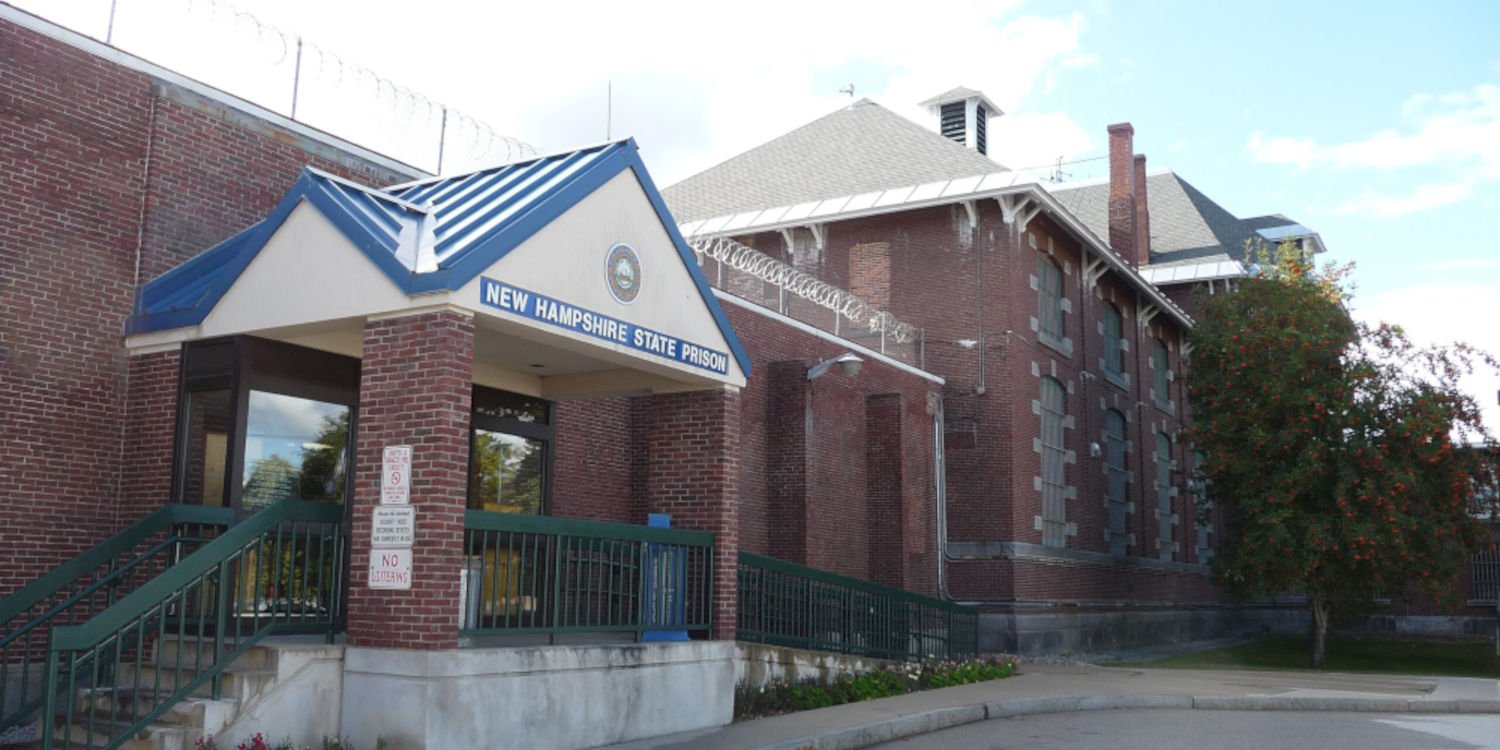
The Debts of the Past
Then my life of wandering caught up with me. In 2014, I was sent to prison. I had never before been in jail or prison, and I was preparing for the worst. It’s not at all like what you see in the movies or on T.V. It was devastating and frightening. At the point at which I was just beginning to discover myself, I became prisoner 96829.
After three months of being classified, I was terrified. In the whole time I was there, all I heard were prisoner horror stories about this one unit called Hancock, or “H-Building” as it was called. Prisoners called it the “gladiator unit,” and I prayed to God that I wouldn’t be sent there. So when I was told to pack my things and move to H-Building, I was terrified.
When I arrived in Hancock, I was sent to Echo or “E-Pod” where there were eight prisoners per cell. I quickly began to learn the difference between T.V. prison and real prison. Day to day life was very difficult with fights breaking out all around me. It was always loud and dirty, and the arguments and fights were a daily occurrence. I tried to keep to myself, but the overcrowding made that impossible. I knew that sooner or later I would have to defend myself. It was filled with aimless young men all trying to prove themselves and not appear vulnerable.
I knew this place could destroy me so I started going to classes in the prison and to the prison chapel whenever I could. After all, I thought, it could be worse. I could be on Bravo or “B-Pod.” The rumor on the upper pods was that B-Pod had “lifers who will take what they want and kill you in a heartbeat.” I prayed to God not to let me be sent to B-Pod. Within days of that prayer, just after my birthday, I was told to pack my things because I was being moved. When I asked where, the dreaded words terrified me all over again. “You’re going to B-Pod.”
I was put on a top bunk on B-Pod out in the day room where the lights are kept on 24/7. I was at least glad to have a top bunk because I thought it would be harder for someone to jump me. I was terrified and knew everyone could see it. I also knew that prisoners would be true to form, and most would look to exploit my fear.
I unpacked my few things, most of which I expected to be stolen by morning, and climbed into my bunk to hide behind a book. It felt as though everyone was avoiding me, “the new guy,” like the plague. I was afraid to leave my bunk to go to the prison chow hall so I just stayed there behind my book. As the day moved on, prisoners started returning from work. This one bald guy with glasses walked past me and stopped. “Where did you come from?” he asked.
I recognized him as the guy who works behind the desk in the law library. He saw instantly that I was very intimidated by this place so he told me not to worry, that everything would be okay and no one would harm me. I only later learned that this man was Fr Gordon MacRae.
Then the next guy to come over to me was Donald Spinner. He asked me why I did not go to dinner, and I had no answer for him. So Donald came back and left some bread and peanut butter and jelly on my bunk and said “you’ll be hungry before the day is over.” I was starving!
Then the next guy to stop was an Asian man everyone called “Ponch.” He joked around and made me laugh, and then said he is G’s roommate, and to just come over if I need anything. Yeah right! I thought. I’m not going anywhere near these guys!
Later, a lot later, I would have the privilege of reading a post by Father G called “The True Story of Thanksgiving: Squanto, the Pilgrims and the Pope.” In it he wrote about a man named Squanto who was horribly lost in the odyssey of life. I thought this could have been my story. When I read it I thought back to that first day on that bunk out on the pod, and I realized that the discipleship that these guys believed in was very real. These guys didn’t just believe it. They lived it.

The Homecoming
One day I ventured over to the weight machine on the pod to look at it. Pornchai Moontri came over and asked me if I was interested in getting into shape. I thought it was a lost cause, but he encouraged me. For the next several months, Pornchai worked with me every day, teaching me weightlifting and how to get enough exercise to change the way I think and feel about myself.
Then he began to talk about faith and what I believe. I knew he had become Catholic. Another friend of Pornchai and Gordon, Michael Ciresi also worked out with us. One day I read Michael’s post that Father G invited him to write. It was “Coming Home to the Catholic Faith I left Behind” and it profoundly changed the way I see my past, my present, and my future. I could see these guys heading off to Mass every Sunday, but more importantly I could see the way they conducted themselves in a very difficult environment from Monday through Saturday. I could also see the way everyone else conducted themselves around them. It was best behavior all around! These guys were the real deal.
One day I was sitting on a bench near Donald Spinner’s cell. He asked if I was okay, and I asked him, “What do Catholics believe about Baptism?” I told him that I thought I needed to be baptized again, and he said that if I already am, it is for life. This led to many conversations about faith and about the Catholic Church’s place in history. I wasn’t being “won over” so much as “called home.” I began to see that I was changing not just physically, but spiritually.
When I began to go to Mass offered by Father Bernard Campbell — Father Bernie — I approached him and said that I needed to be forgiven. I asked if I could go to Confession, and Father Bernie didn’t even ask if I was Catholic. He smiled and said, “Of course,” and said he would meet me at the Chapel on the following Friday. I will never forget that day — the day of my first Confession when I walked away a new man.
That new man now has a new faith, and is on fire with it. I am clean, and sober, and free of the life long burdens of the past. I remember something that Father G showed me that Pornchai wrote:
“One day I woke up with a future when up to then all I ever had was a past.”
Today, miraculously born in the most unlikely place, I have an identity. I no longer wake up wondering who I am. I am a man! I am a father! I am strong! I am a Catholic! I am hopeful! I am free!
+ + +
Note from Fr Gordon MacRae: Thank you for reading and sharing this post. You may also like these other stories of Redemption from behind these stone walls.
Saint Joseph: Guardian of the Redeemer and Fatherhood Redeemed
In the Absence of Fathers: A Story of Elephants and Men
Elephants and Men and Tragedy in Thailand by Pornchai Moontri
Coming Home to the Catholic Faith I Left Behind by Michael Ciresi
We have added a new feature at this blog, a list of the Scriptural accounts of Salvation History, which I hope you will visit and share with others: From Ashes to Easter.
The Eucharistic Adoration Chapel established by Saint Maximilian Kolbe was inaugurated at the outbreak of World War II. It was restored as a Chapel of Adoration in September, 2018, the commemoration of the date that the war began. It is now part of the World Center of Prayer for Peace. The live internet feed of the Adoration Chapel at Niepokalanow — sponsored by EWTN — was established just a few weeks before we discovered it and began to include in at Beyond These Stone Walls. Click “Watch on YouTube” in the lower left corner to see how many people around the world are present there with you. The number appears below the symbol for EWTN.
Click or tap here to proceed to the Adoration Chapel.
The following is a translation from the Polish in the image above: “Eighth Star in the Crown of Mary Queen of Peace” “Chapel of Perpetual Adoration of the Blessed Sacrament at Niepokalanow. World Center of Prayer for Peace.” “On September 1, 2018, the World Center of Prayer for Peace in Niepokalanow was opened. It would be difficult to find a more expressive reference to the need for constant prayer for peace than the anniversary of the outbreak of World War II.”
For the Catholic theology behind this image, visit my post, “The Ark of the Covenant and the Mother of God.”