“There are few authentic prophetic voices among us, guiding truth-seekers along the right path. Among them is Fr. Gordon MacRae, a mighty voice in the prison tradition of John the Baptist, Maximilian Kolbe, Alfred Delp, SJ, and Dietrich Bonhoeffer.”
— Deacon David Jones
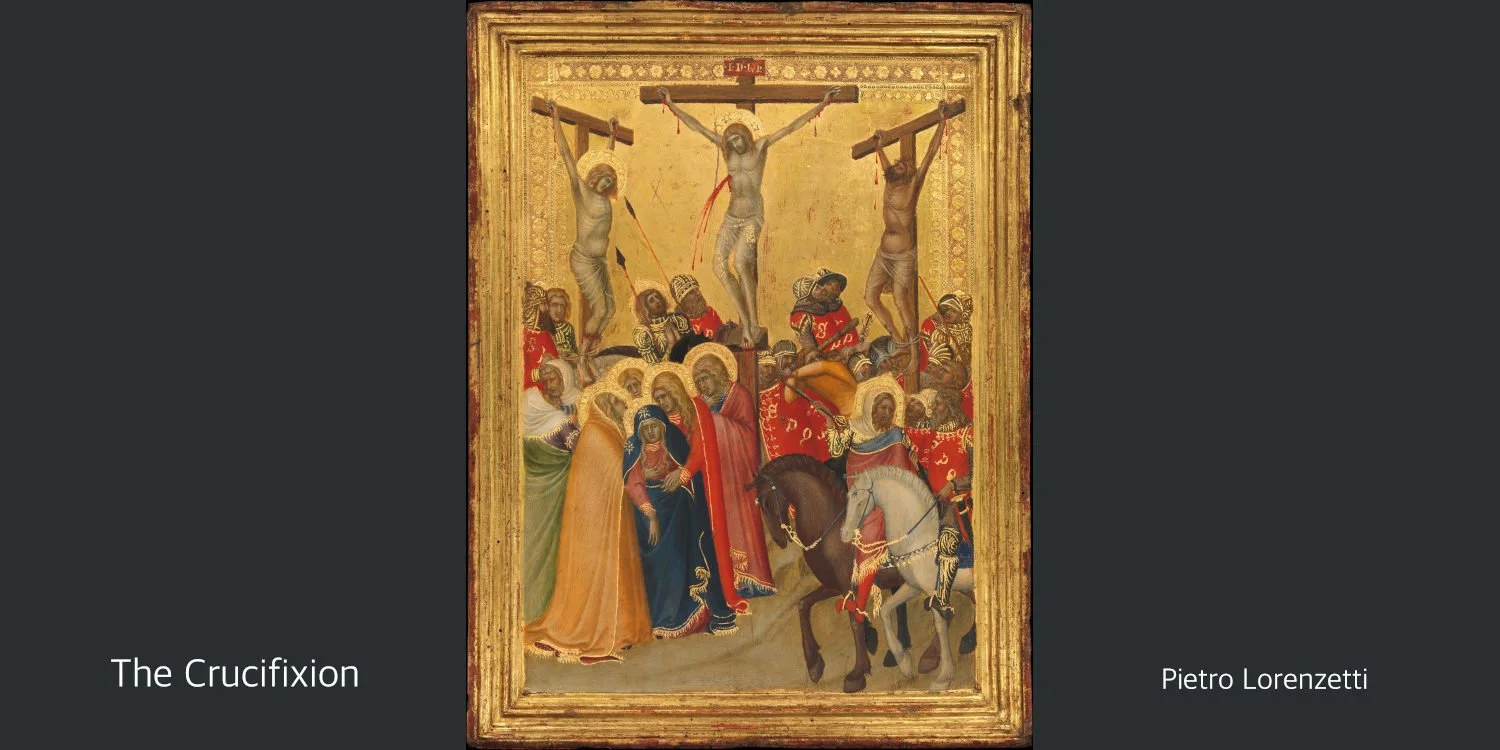
Dismas, the Good Thief Crucified Next to Christ the King
With Jesus before him, Pilate asked the chief priests, ‘Shall I crucify your king?’ They replied ‘We have no king but Caesar.' Only a criminal saw Christ the King.
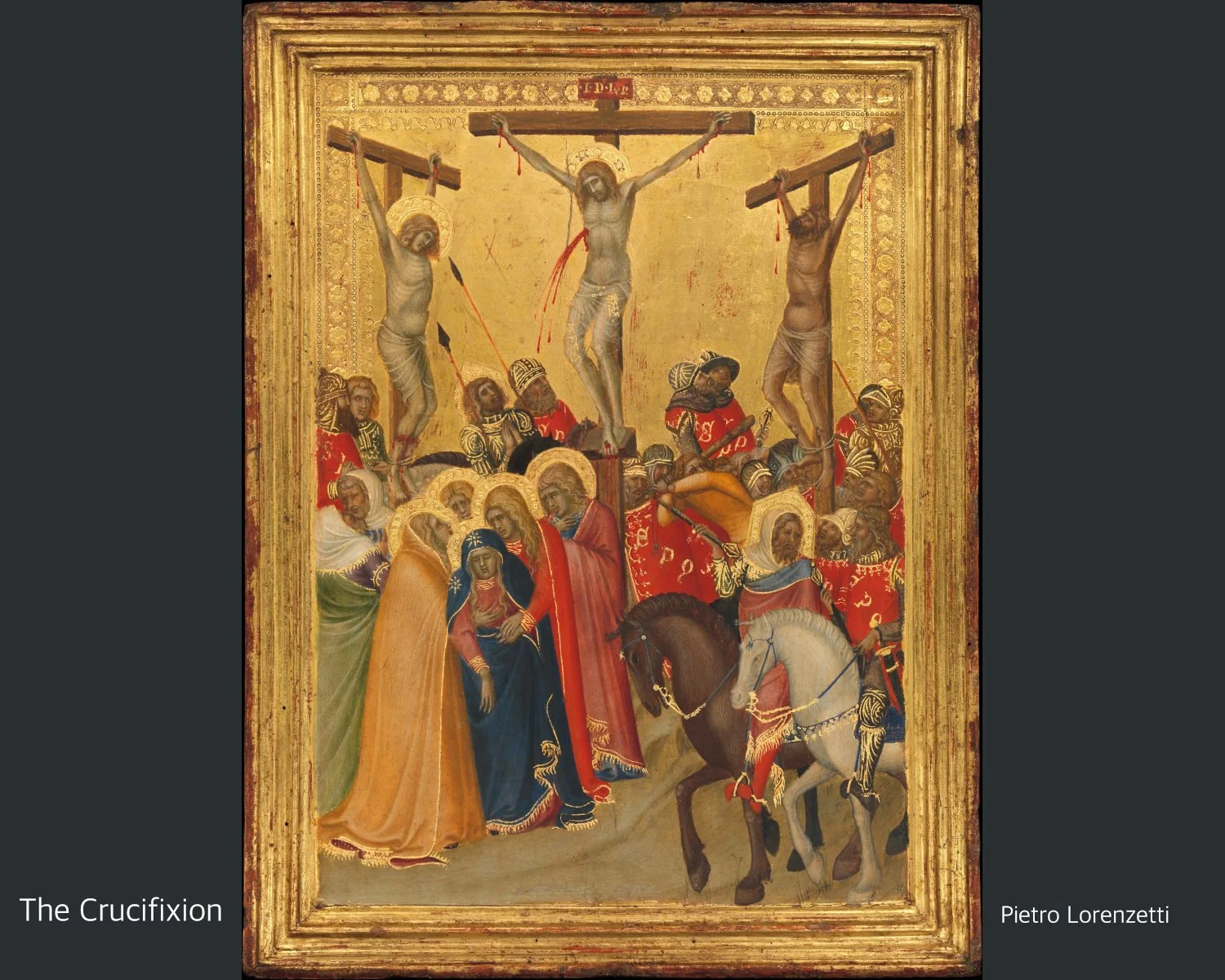
With Jesus before him, Pilate asked the chief priests, ‘Shall I crucify your king?’ They replied ‘We have no king but Caesar.’ Only a criminal saw Christ the King.
November 19, 2025 by Father Gordon MacRae
“Yes, dogs are round about me; a pack of evildoers encircle me; they have pierced my hands and my feet — I can count all my bones — they stare and gloat over me; they divide my garments among them, and for my clothing they cast lots.”
— Psalm 22:16-18
Note from Father Gordon MacRae: This may be a very familiar post to some of our Readers. It was originally written as a Holy Week post some years ago, and for some reason it has remained one of our most popular posts. The Church’s liturgy is on a three-year cycle and so every three years one of three Gospel Readings will appear for the Solemnity of Christ the King. The Gospel passage for this year is the story of Dismas crucified to the right of Christ at Calvary. When I read to a priest-friend the above title and description of this post today, he was stunned. He had never before consciously considered that the denouncement of Christ as King by the religious authorities of Israel, and the identification from the Cross of Christ as King were events separated by only a few hours.
The late Pope Benedict XVI wrote a wonderful reflection about the exchange with Dismas on the Cross next to Jesus. Here is what Pope Benedict wrote in a short meditation entitled “How to Enter Christ’s Kingdom”:
“Then there is the faith of the Good Thief: a faith barely outlined but sufficient to assure him salvation: Today you will be with me in Paradise.” This ‘with me’ is crucial. Yes, it is this that saves him. Of course, Dismas is on the Cross like Jesus, but above all he is on the Cross with Jesus. And unlike the other evildoer and all those who taunted Jesus, Dismas does not ask Jesus to save him or to come down from his Cross. He asked only, from his own cross, ‘Remember me when you come into your kingdom.’”
This is the story of Dismas, crucified to the right, Paradise Lost and Found. It is the story of all of us who come to Him bearing our gifts as we might at Christmas, but also bearing our crosses as we must at Calvary.
+ + +
The only hero at Calvary was Christ. The only person worth following up that hill — up ANY hill — is Christ. I follow Him with the same burdens and trepidation and thorns in my side as you do. So do not follow me. Follow only Him.
This Holy Week, one of many behind these stone walls, has caused me to use a wider angle lens as I examine the events of that day on Mount Calvary as the Evangelists described them. This year, it is Dismas who stands out. Dismas is the name tradition gives to the man crucified to the right of the Lord, and upon whom is bestowed a dubious title: the “Good Thief.”
As I pondered the plight of Dismas at Calvary, my mind rolled some old footage, an instant replay of the day I was sent to prison — the day I felt the least priestly of all the days of my priesthood.
It was the mocking that was the worst. Upon my arrival at prison after trial late in 1994, I was fingerprinted, photographed, stripped naked, showered, and unceremoniously deloused. I did not bother worrying about what the food might be like, or whether I could ever sleep in such a place. I was worried only about being mocked, but there was no escaping it. As I was led from place to place in chains and restraints, my few belongings and bedding stuffed into a plastic trash bag dragged along behind me, I was greeted by a foot-stomping chant of prisoners prepped for my arrival: “Kill the priest! Kill the priest! Kill the priest!” It went on into the night. It was maddening.
It is odd that I also remember being conscious, on that first day, of the plight of the two prisoners who had the misfortune of being sentenced on the same day I was. They are long gone now, sentenced back then to just a few years in prison. But I remember the walk from the courthouse in Keene, New Hampshire to a prison-bound van, being led in chains and restraints on the “perp-walk” past rolling news cameras. A microphone was shoved in my face: “Did you do it, Father? Are you guilty?”
Quickly led toward the van back then, I tripped on the first step and started to fall, but the strong hands of two guards on my chains dragged me to my feet again. I climbed into the van, into an empty middle seat, and felt a pang of sorrow for the other two convicted criminals — one in the seat in front of me, and the other behind.
“Just my %¢$#@*& luck!” the one in front scowled as the cameras snapped a few shots through the van windows. I heard a groan from the one behind as he realized he might vicariously make the evening news. “No talking!” barked a guard as the van rolled off for the 90 minute ride to prison. I never saw those two men again, but as we were led through the prison door, the one behind me muttered something barely audible: “Be strong, Father.”
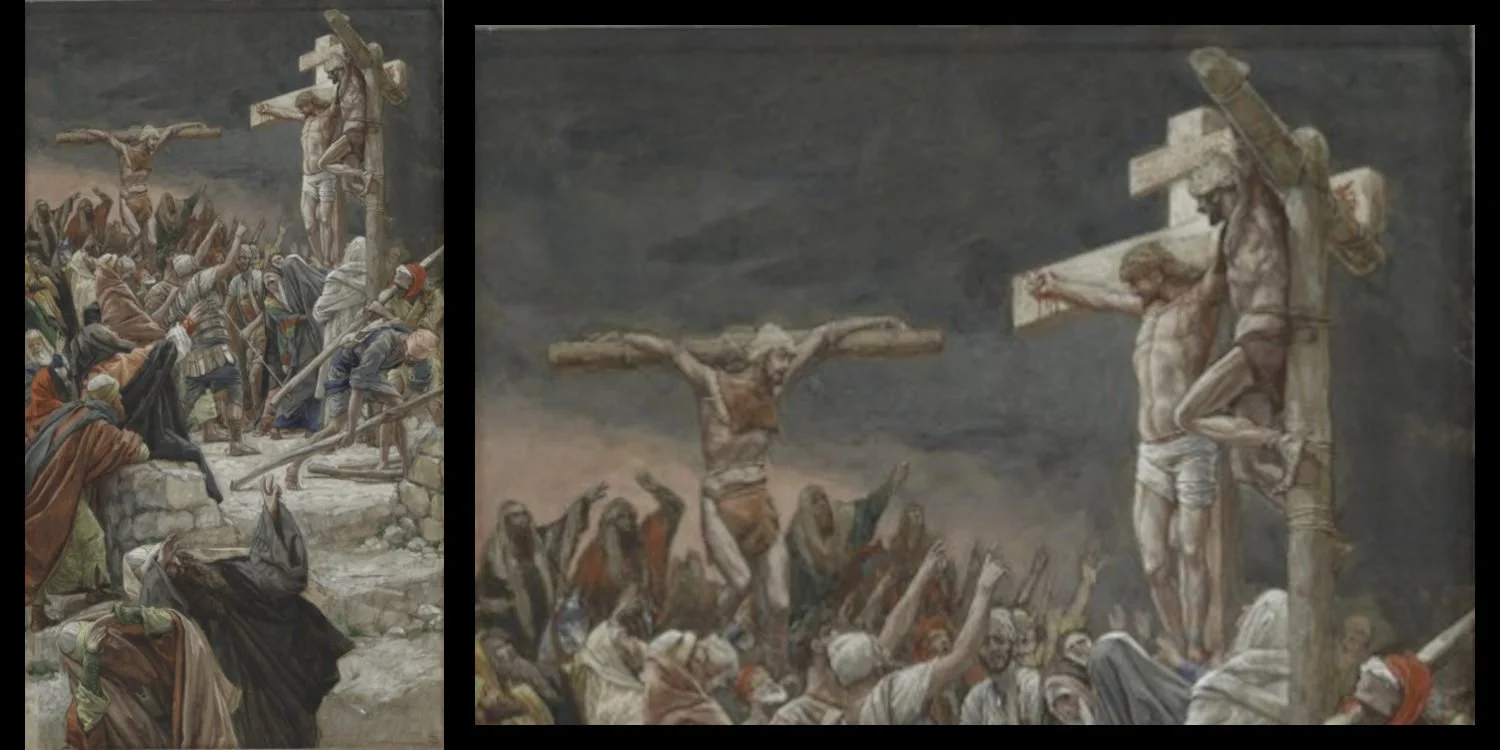
Revolutionary Outlaws
It was the last gesture of consolation I would hear for a long, long time. It was the last time I heard my priesthood referred to with anything but contempt for years to come. Still, to this very day, it is not Christ with whom I identify at Calvary, but Simon of Cyrene. As I wrote in “Simon of Cyrene Compelled to Carry the Cross“:
“That man, Simon, is me . . . I have tried to be an Alter Christus, as priesthood requires, but on our shared road to Calvary, I relate far more to Simon of Cyrene. I pick up my own crosses reluctantly, with resentment at first, and I have to walk behind Christ for a long, long time before anything in me compels me to carry willingly what fate has saddled me with . . . I long ago had to settle for emulating Simon of Cyrene, compelled to bear the Cross in Christ’s shadow.”
So though we never hear from Simon of Cyrene again once his deed is done, I am going to imagine that he remained there at Calvary. He must have, really. How could he have willingly left? I am going to imagine that he remained there and heard the exchange between Christ and the criminals crucified to His left and His right, and took comfort in what he heard. I heard Dismas in the young man who whispered “Be strong, Father.” But I heard him with the ears of Simon of Cyrene.
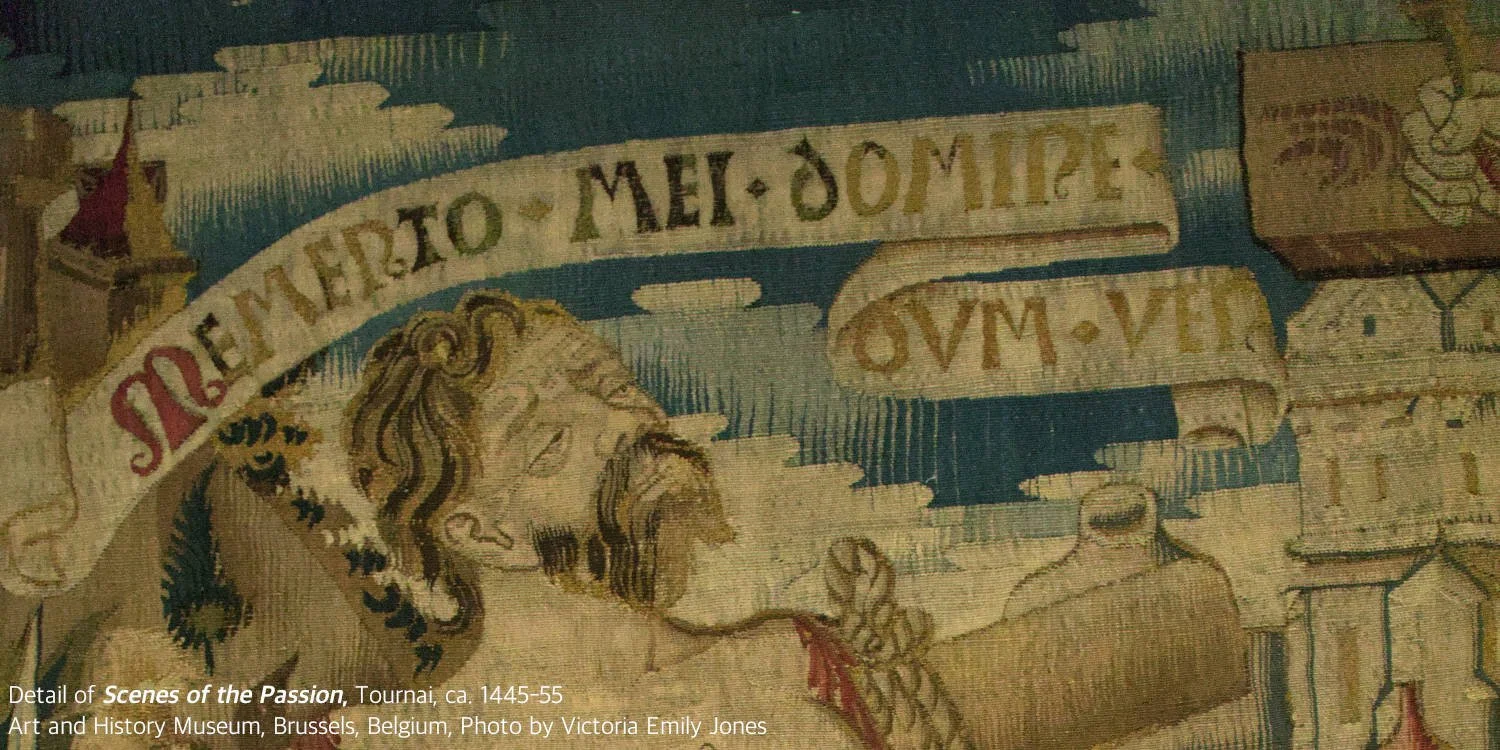
Like a Thief in the Night
Like the names of the Magi I wrote about in “Upon a Midnight Not So Clear,” the name tradition gives to the Penitent Thief appears nowhere in Sacred Scripture. Dismas is named in a Fourth Century apocryphal manuscript called the “Acts of Pilate.” The text is similar to, and likely borrowed from, Saint Luke’s Gospel:
“And one of the robbers who were hanged, by name Gestas, said to him: ‘If you are the Christ, free yourself and us.’ And Dismas rebuked him, saying: ‘Do you not even fear God, who is in this condemnation? For we justly and deservedly received these things we endure, but he has done no evil.’”
What the Evangelists tell us of those crucified with Christ is limited. In Saint Matthew’s Gospel (27:38) the two men are simply “thieves.” In Saint Mark’s Gospel (15:27), they are also thieves, and all four Gospels describe their being crucified “one on the left and one on the right” of Jesus. Saint Mark also links them to Barabbas, guilty of murder and insurrection. The Gospel of Saint John does the same, but also identifies Barabbas as a robber. The Greek word used to identify the two thieves crucified with Jesus is a broader term than just “thief.” Its meaning would be more akin to “plunderer,” part of a roving band caught and given a death penalty under Roman law.
Only Saint Luke’s Gospel infers that the two thieves might have been a part of the Way of the Cross in which Saint Luke includes others: Simon of Cyrene carrying Jesus’ cross, and some women with whom Jesus spoke along the way. We are left to wonder what the two criminals witnessed, what interaction Simon of Cyrene might have had with them, and what they deduced from Simon being drafted to help carry the Cross of a scourged and vilified Christ.
In all of the Gospel presentations of events at Golgotha, Jesus was mocked. It is likely that he was at first mocked by both men to be crucified with him as the Gospel of St. Mark describes. But Saint Luke carefully portrays the change of heart within Dismas in his own final hour. The sense is that Dismas had no quibble with the Roman justice that had befallen him. It seems no more than what he always expected if caught:
“One of the criminals who were hanged railed at him, saying, ‘Are you not the Christ? Save yourself and us!’ But the other rebuked him, saying, ‘Do you not fear God since you are under the same sentence of condemnation? And we indeed justly, for we are receiving the due reward of our deeds; but this man has done nothing wrong.’”
— Luke 23:39-41
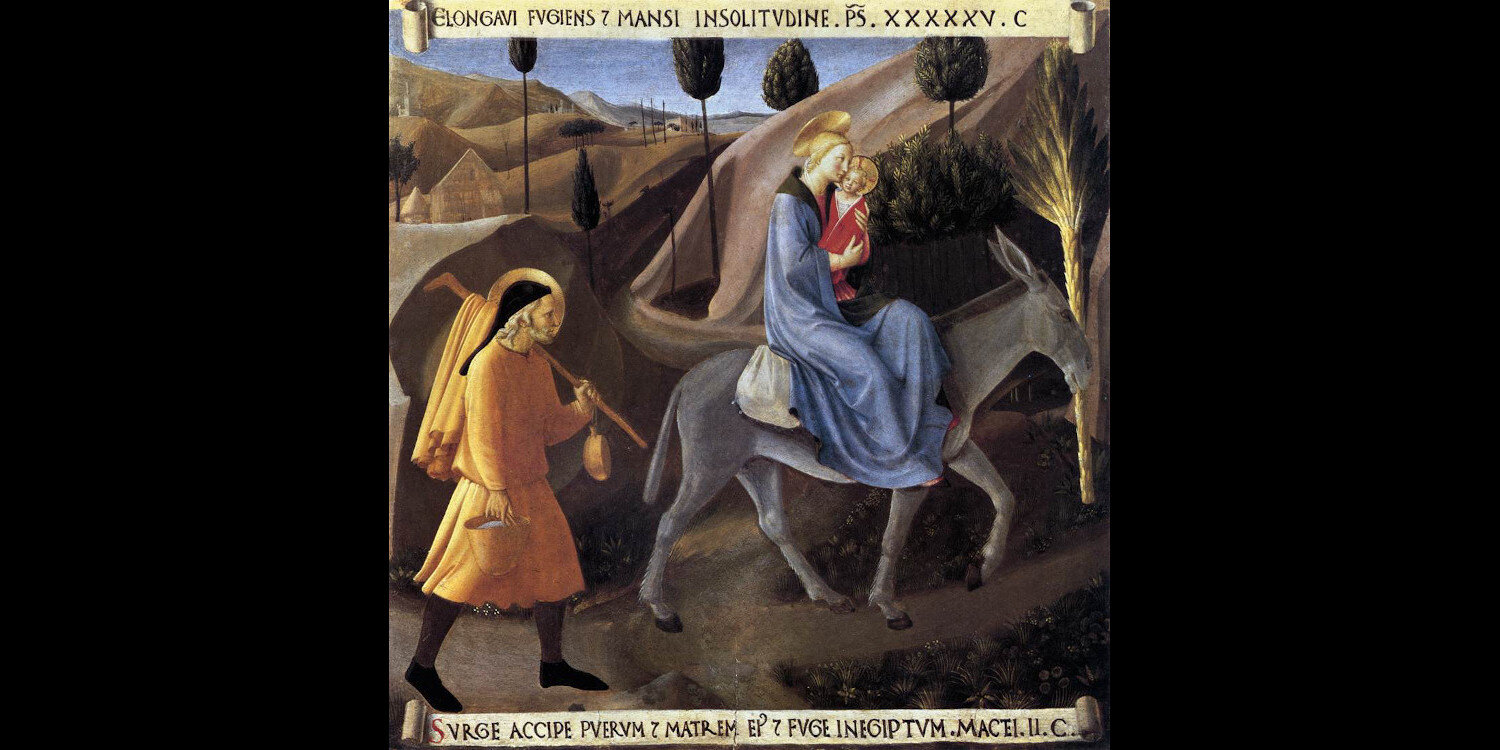
The Flight into Egypt
The name, “Dismas” comes from the Greek for either “sunset” or “death.” In an unsubstantiated legend that circulated in the Middle Ages, in a document known as the “Arabic Gospel of the Infancy,” this encounter from atop Calvary was not the first Gestas and Dismas had with Jesus. In the legend, they were a part of a band of robbers who held up the Holy Family during the Flight into Egypt after the Magi departed in Saint Matthews Gospel (Matthew 2:13-15).
This legendary encounter in the Egyptian desert is also mentioned by Saint Augustine and Saint John Chrysostom who, having heard the same legend, described Dismas as a desert nomad, guilty of many crimes including the crime of fratricide, the murder of his own brother. This particular part of the legend, as you will see below, may have great symbolic meaning for salvation history.
In the legend, Saint Joseph, warned away from Herod by an angel (Matthew 2:13-15), opted for the danger posed by brigands over the danger posed by Herod’s pursuit. Fleeing with Mary and the child into the desert toward Egypt, they were confronted by a band of robbers led by Gestas and a young Dismas. The Holy Family looked like an unlikely target having fled in a hurry, and with very few possessions. When the robbers searched them, however, they were astonished to find expensive gifts of gold, frankincense, and myrrh — the Gifts of the Magi. However, in the legend Dismas was deeply affected by the infant, and stopped the robbery by offering a bribe to Gestas. Upon departing, the young Dismas was reported to have said:
“0 most blessed of children, if ever a time should come when I should crave thy mercy, remember me and forget not what has passed this day.”
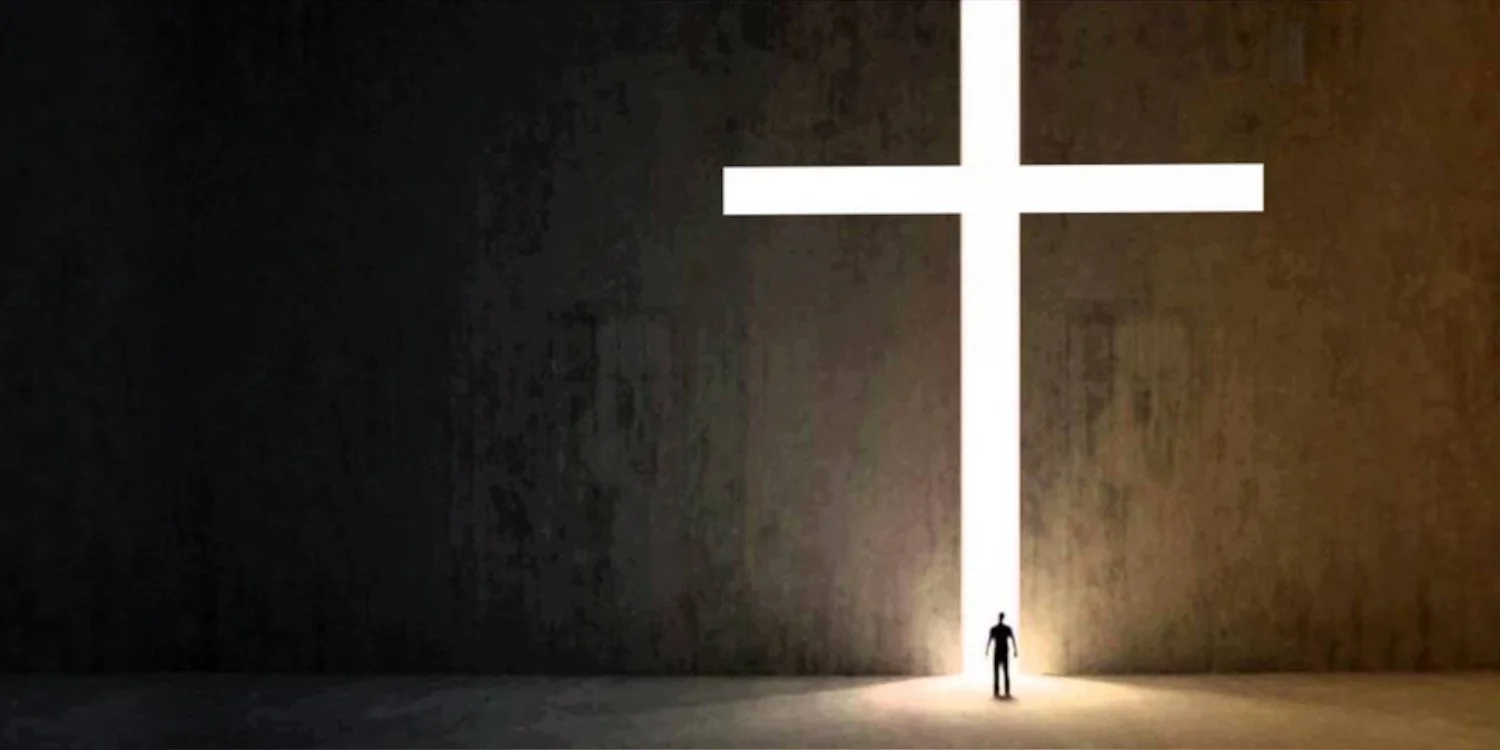
Paradise Found
The most fascinating part of the exchange between Jesus and Dismas from their respective crosses in Saint Luke’s Gospel is an echo of that legendary exchange in the desert 33 years earlier — or perhaps the other way around:
“‘Jesus, remember me when you come into your kingly power.’ And he said to him, ‘Truly I say to you, today you will be with me in Paradise.’”
— Luke 23:42-43
The word, “Paradise” used by Saint Luke is the Persian word, “Paradeisos” rarely used in Greek. It appears only three times in the New Testament. The first is that statement of Jesus to Dismas from the Cross in Luke 23:43. The second is in Saint Paul’s description of the place he was taken to momentarily in his conversion experience in Second Corinthians 12:3. The third is the Heavenly Paradise that awaits the souls of the just in the Book of Revelation (2:7).
In the Old Testament, the word “Paradeisos” appears only in descriptions of the Garden of Eden in Genesis 2:8, and in the banishment of Cain after the murder of his brother, Abel:
Cain left the presence of the Lord and wandered in the Land of Nod, East of Eden.
— Genesis 4:16
Elsewhere, the word appears only in the prophets (Isaiah 51:3 and Ezekiel 36:35) as they foretold a messianic return one day to the blissful conditions of Eden — to the condition restored when God issues a pardon to man — and he will not be using an autopen.
If the Genesis story of Cain being banished to wander “In the Land of Nod, East of Eden” is the symbolic beginning of our human alienation from God — the banishment from Eden marking an end to the State of Grace and Paradise Lost — then the Dismas profession of faith in Christ’s mercy is symbolic of Eden restored — Paradise Regained.
From the Cross, Jesus promised Dismas both a return to spiritual Eden and a restoration of the condition of spiritual adoption that existed before the Fall of Man. It is easy to see why legends spread by the Church Fathers involved Dismas guilty of the crime of fratricide just as was Cain.
A portion of the cross upon which Dismas is said to have died alongside Christ is preserved at the Church of Santa Croce in Rome. It is one of the Church’s most treasured relics. Catholic apologist, Jim Blackburn has proposed an intriguing twist on the exchange on the Cross between Christ and Saint Dismas. In “Dismissing the Dismas Case,” an article in Catholic Answers Magazine Jim Blackburn reminded me that the Greek in which Saint Luke’s Gospel was written contains no punctuation. Punctuation had to be added in translation. Traditionally, we understand Christ’s statement to Dismas to be:
“Truly I say to you, today you will be with me in Paradise.”
The sentence has been used by some non-Catholics (and a few Catholics) to discount a Scriptural basis for Purgatory. How could Purgatory be as necessary as I described it to be in “The Holy Longing” when even a notorious criminal is given immediate admission to Paradise? Ever the insightful thinker, Jim Blackburn proposed a simple replacement of the comma giving the verse an entirely different meaning:
“Truly I say to you today, you will be with me in Paradise.”
Whatever the timeline, the essential point could not be clearer. The door to Divine Mercy was opened by the events of that day, and the man crucified to the right of the Lord, by a simple act of faith and repentance and reliance on Divine Mercy, was shown a glimpse of Paradise Regained.
The gift of Paradise Regained left the cross of Dismas on Mount Calvary. It leaves all of our crosses there. Just as Cain set in motion our wandering “In the Land of Nod, East of Eden,” Dismas was given a new view from his cross, a view beyond death, away from the East of Eden, across the Undiscovered Country, toward eternal home.
Saint Dismas, pray for us.
+ + +
Note from Father Gordon MacRae: Thank you for reading and sharing this post in honor of Christ the King. You may also wish to read these related posts from Beyond These Stone Walls:
The Chief Priests Answered, ‘We Have No King but Caesar’
To Christ the King through the Immaculate Heart of Mary
Thanksgiving in the Reign of Christ the King
Behold the Lamb of God Upon the Altar of Mount Moriah

Holidays in the Hoosegow: Thanksgiving with Some Not-So-Just Desserts!
Thanksgiving is a state of mind, not place. Even prisoners can be thankful, if not for being prisoners, then perhaps just for the art of being itself.

Thanksgiving is a state of mind, not place. Even prisoners can be thankful, if not for being prisoners, then perhaps just for the art of being itself.
November 12, 2025 by Father Gordon MacRae
I have been hindered from writing a new post this month. This gets a little creepy, so bear with me. On the night of October 31, I was visited in my cell by two brown recluse spiders who were apparently hiding in a shirt that I put on that night because I was cold. Well, so were the spiders and unbeknownst to me they claimed squaters rights to the shirt. Sometime during the night leading to the Solemnity of All Saints, I was bitten twice in the back by two poisonous spiders.
It was a few days before I sought treatment being the stubbornly independent person that I am. Finally the bites evolved into a serious blood infection that now requires all-out war. I now have daily visits to the Medical Unit for wound treatment and new bandaging. I am also on a potent antibiotic. There is some tissue damage. I lost the battle with the spiders, but I am told that I am winning the war thanks to the medical care I am receiving.
The worst part of this whole story was when I told it in a phone call to Pornchai Max Moontri in Thailand, he launched into singing “Itsy, Bitsy Spider.”
+ + +
I hope you will read “The True Story of Thanksgiving” posted here every year in late November, this year included. I figure that, in America at least, we eat the same meal every year at Thanksgiving. It is a holiday bound up in traditions. Every year I grimace as the U.S. President pardons a turkey on national television, then gobbles up an already preplucked Butterball in its place for Thanksgiving Dinner. So we added a tradition of our own several years ago, which you will find repeated again this year on the day before Thanksgiving.
Even The Wall Street Journal honors its own Thanksgiving tradition by repeating, on the day before Thanksgiving, the same two editorials at the top of its opinion page. So the message is that repetition is not a bad thing and the story we tell at Thanksgiving is both historically true and spiritually wondrous. Since I first wrote it back in 2010, references to it have appeared in two published history books about the Mayflower Pilgrims. We expect to publish it anew here on Wednesday, November 26.
I hope you will plan to read “The True Story of Thanksgiving: Squanto, the Pilgrims, and the Pope.”
Thanksgiving is a tough sell for most prisoners. It often involves only a litany of losses and discouragement. But I have advocated among other prisoners a more positive approach with some mixed success.
I am not quite ready to give thanks just yet for my 31st Thanksgiving holiday in the hoosegow. But writing this post did make me wonder about the origin of “hoosegow.” The local cable system here carries American Movie Classics (AMC) which broadcasts old westerns on most Saturday mornings. I love John Wayne movies, especially the later ones. It might have been in one of those that I heard Walter Brennan (who, by the way, is from my hometown!) playing a cranky old deputy sheriff.
I can even now hear Walter Brennan threatening to throw someone in the “hoosegow.” Hoosegow has an interesting origin. It comes from the phonetic pronunciation of a Spanish word, “Juzgado,” meaning “courtroom.” It is the past participle of “juzgar,” which in turn came from the Latin “iudicare,” (pronounced, “you-dee-CAR-eh) meaning “judge.” Since judges send people to jail, “juzgado” came to refer to jails and prisons. Then, in the slang of border towns in the American Old West, it became “hoosegow.” So now you know the origin of the word, hoosegow. Don’t thank me just yet!
Here in the hoosegow, like everywhere else in the U.S., we are about to mark Thanksgiving. I would not use “celebrate” to describe how prisoners observe this, or any, holiday. On the whole, prisoners do not really celebrate much. But even here most can find something to be thankful for. I found such a moment several years ago when Pornchai Max and other friends were still here with me. I will even go so far as to say I celebrated it.
The Earth’s journey around our Sun brings about the inevitable changing seasons beyond these stone walls. I have journeyed in life 72 times around our Sun, but most of the fallen citizens around me barely notice the changing world. We venture outside each day among asphalt and steel and high concrete walls with little evidence of the march of time and the changing seasons. The “Field of Dreams” — the prison ball field and the one place with trees in sight — closed for the year two months ago. The only leaves I see now are the very few that the wind carries over the high prison walls which consume my view of the outside world.
One day in autumn some years ago, I turned a corner outside on the long, concrete ramp winding its way up to the prison mess halls. I looked up to discover a spot I never noticed before.
It was a place amid the concrete and steel that afforded a momentary glimpse of a tree-covered hill in the distance beyond the walls, and the rays of the setting sun had fallen upon that very spot. For a moment, the hill was clothed in a blaze of glory with an explosion of fall color. It was magnificent! I felt a bit like Dorothy Gale, stepping for the first time out of the gray gloom of her Kansas home into the startling glory of the Land of Oz.
Prisoners are not permitted to stop and gawk while moving from Point A to Point B, but in two more steps, or a few more seconds, the view would be gone. So I nudged Pornchai and Joseph who were walking with me, and we all stared for a moment in awe. We froze in our tracks for those seconds, risking a guttural shout of “KEEP MOVING!” from one of the guards posted along this via dolorosa.
There was a guard right at that spot, poised to bellow, but then he followed our gaze and he, too, gawked for a moment, keeping his shout to himself. We moved on up the ramp amid all the downcast eyes around us, but saw no evidence that anyone else noticed that scene of radiant beauty beyond these stone walls. I thanked God in silence for nudging me to look up just then. It was proof that a moment for giving thanks presents itself every day, even in this awful place. Those moments will be passed by unnoticed if I am so consumed with grief that I fail to look up and out beyond these stone walls. I have to look up to see. I have to keep my eyes opened, and focus somewhere beyond just me.
I look up at that spot every day now, but the color has faded to a barren gloom, just like life here — or anywhere else — can if I let it. I have learned from Squanto of The Dawn Land that even the worst plight affords an opportunity for thanksgiving. We must not let those moments pass by unnoticed for our very souls depend on them.
I despise this place of captivity where so many of the days given to me have been spent. Really spent! Yet on past Thanksgiving Days, Pornchai, and Joseph, and other friends who walked with us each day, all found a few seats together in the prison chow hall. There we gave thanks for turkey, for an annual piece of pumpkin pie, for friendship found even in the ruins of lives broken and dreams delayed, for laughter in the face of pain, and especially for the gift of bearing one another’s burdens with thanks for the graces given to us.
In a sea of downcast eyes, furtive glances, and foul speech seldom rising above talk of gangs, and drugs, and the exploitation of others, Pornchai showed off his Saint Maximilian medal, and spoke of salvation and sacrifice and the privilege of being Catholic in a truly destitute public square.
In the end, I had been left with no choice and no other prayer to utter: Thank you, Lord, for this day!
+ + +
Note from the BTSW Editor: There are simple ways in which you may help magnify this Voice in the Wilderness.
It helps much to subscribe to Father Gordon’s posts. Note that you will receive an email asking you to confirm your subscription.
Though we have given up sharing Father Gordon’s posts on Facebook, Pornchai Maximilian Moontri has a Facebook Page in Thailand, which he uses to share our posts in Southeast Asia communities. You may send your “Friend Requests” to Pornchai Maximilian Moontri.
It would also help Father Gordon substantially if you follow him on X, formerly Twitter.
Both Father Gordon and Pornchai Moontri have a strong following at LinkedIn.
And lastly, Father Gordon’s page at gloria.tv is always worth a visit.
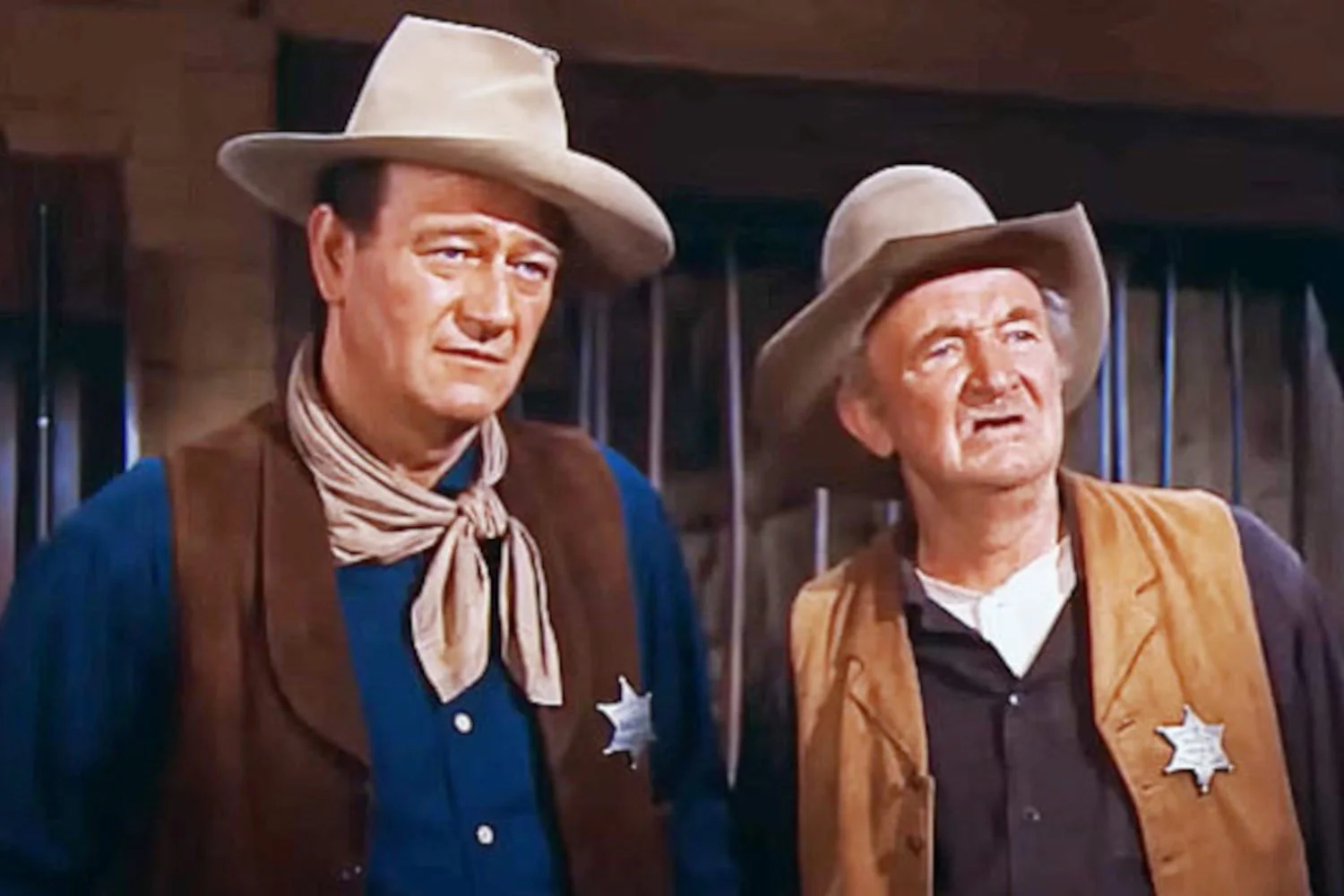
John Wayne and Walter Brennan in Rio Bravo.

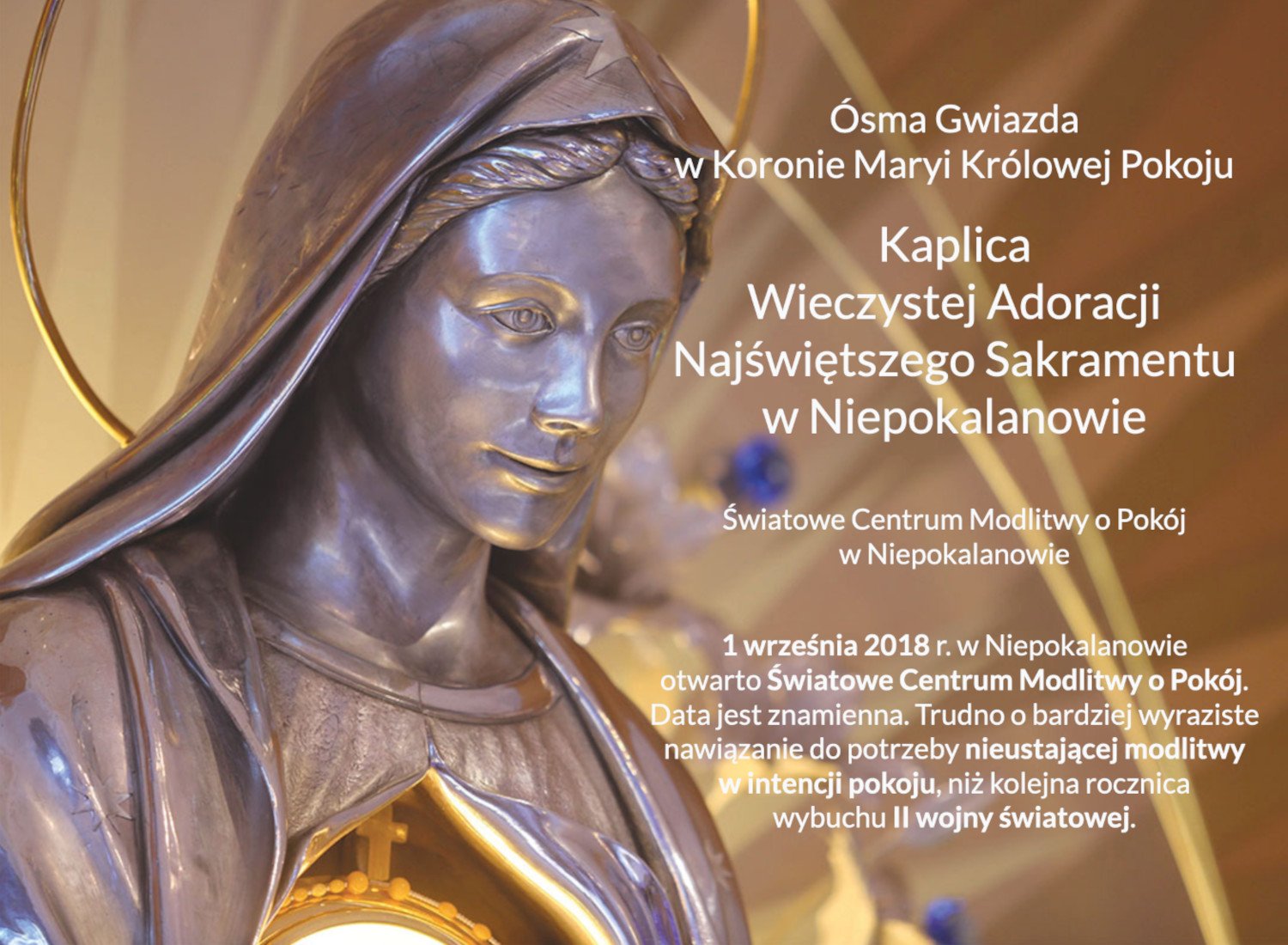

The Eucharistic Adoration Chapel established by Saint Maximilian Kolbe was inaugurated at the outbreak of World War II. It was restored as a Chapel of Adoration in September, 2018, the commemoration of the date that the war began. It is now part of the World Center of Prayer for Peace. The live internet feed of the Adoration Chapel at Niepokalanow — sponsored by EWTN — was established just a few weeks before we discovered it and began to include in at Beyond These Stone Walls. Click “Watch on YouTube” in the lower left corner to see how many people around the world are present there with you. The number appears below the symbol for EWTN.
Click or tap here to proceed to the Adoration Chapel.
The following is a translation from the Polish in the image above: “Eighth Star in the Crown of Mary Queen of Peace” “Chapel of Perpetual Adoration of the Blessed Sacrament at Niepokalanow. World Center of Prayer for Peace.” “On September 1, 2018, the World Center of Prayer for Peace in Niepokalanow was opened. It would be difficult to find a more expressive reference to the need for constant prayer for peace than the anniversary of the outbreak of World War II.”
For the Catholic theology behind this image, visit my post, “The Ark of the Covenant and the Mother of God.”
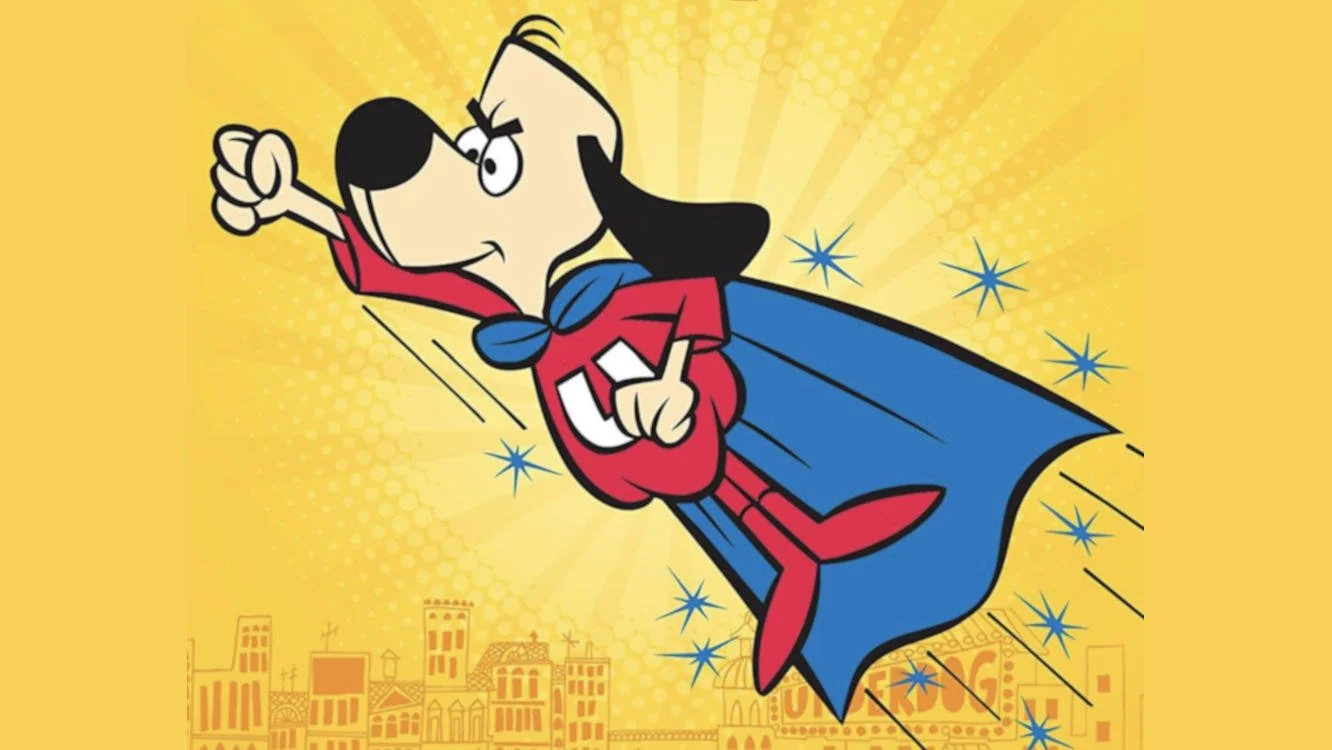
The Lonely Life of an Internet Underdog
In 16 years of publication, Beyond These Stone Walls faced some daunting challenges. Among the worst is contending with media and social media anti-clerical bias.
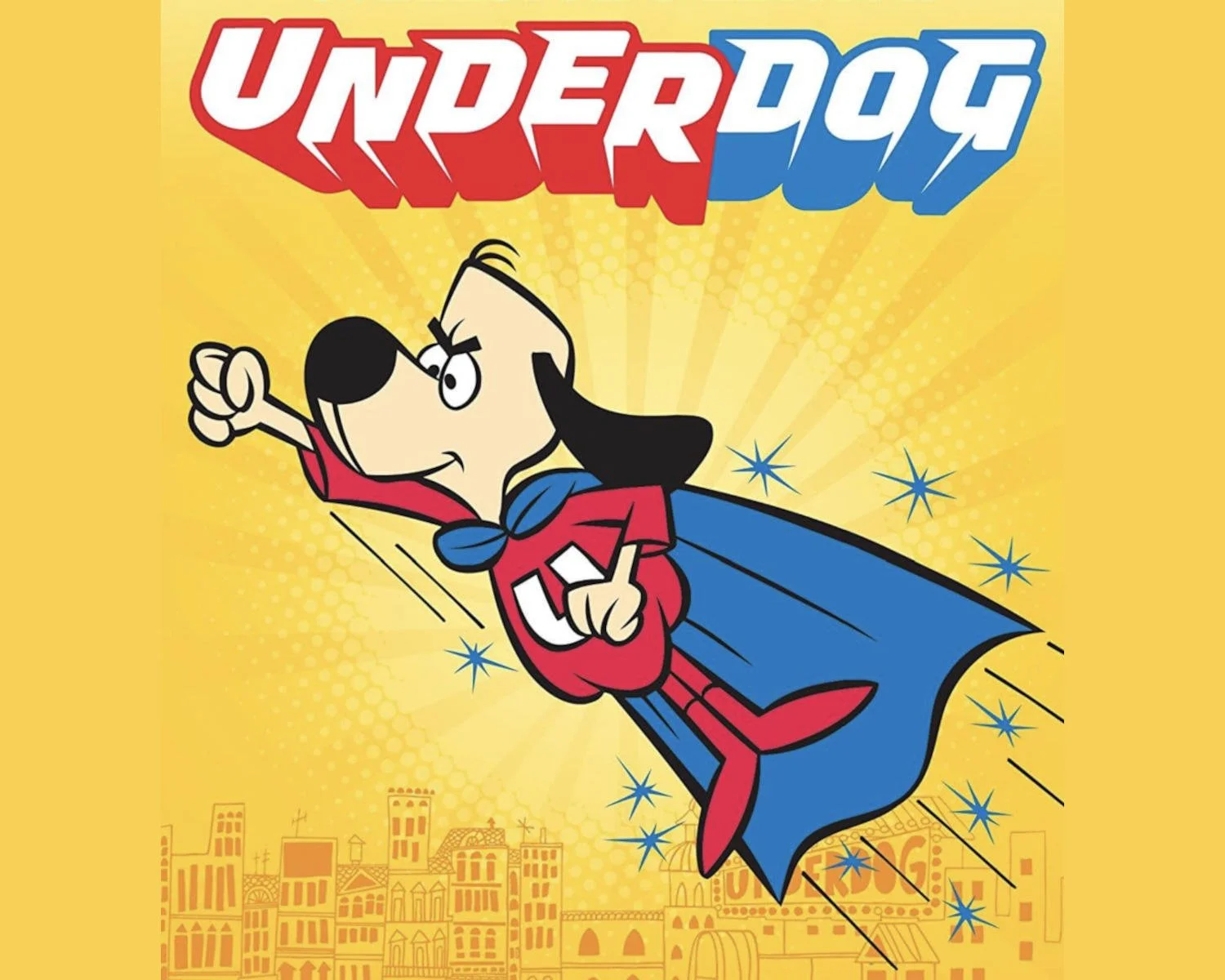
In 16 years of publication, Beyond These Stone Walls faced some daunting challenges. Among the worst is contending with media and social media anti-clerical bias.
November 5, 2025 by Father Gordon MacRae
The image above is of Underdog, who was one of Father G’s favorite comics in childhood. “There’s no need to fear, UNDERdog is here!”
It is very rare that we publish two posts in one week, but this one is far shorter than most, and is mostly an informational post. I wanted to publish “Of Saints and Souls and Earthly Woes” on November 1st out of respect for a Catholic tradition that the entire month of November is dedicated in remembrance of our beloved dead. There is a surprising comment on it by the late Claire Dion, a dear friend of this blog, who in turn commented upon the November 5th date of the death of my mother in 2007. Those surprising comments alone are worth a revisit to that post. But you also may find there some tools in our Catholic tradition for coping with life and death.
This post will be a lot shorter. Not many readers noticed that at the end of the summer of 2025, this blog quietly marked 16 years in weekly publication. When it began in the summer of 2009, I thought it might last only a few months. I could not fathom then that I would be able to find anything to write about beyond that time. I remember a conversation back then between my roommate, Pornchai Moontri, and Claire Dion who interviewed him for a post of her own. Pornchai had mentioned to her that “Father G could write about a rock and make it sound interesting.” Claire asked him if he thought that I had perhaps “kissed the Blarney Stone,” an old Irish tradition. Pornchai pondered this and said, “No, I think he bit off a big chunk and swallowed it.”
I could not foresee at the time that I would find enough to write about beyond those few months in 2009. I was also keenly aware of my handicaps in the public square, not least of which is that I have never even been able to actually see what I write. If felt as though I were putting messages in a bottle to cast them into the sea, having no awareness of where they might wash up on some distant shore.
I also feared that the situation in the U.S. Catholic Church at that time was such that the writings of a priest in prison — even one unjustly imprisoned — could not possibly defeat the stone walls of bias in media coverage of the Catholic sexual abuse crisis. We ran into those headwinds almost immediately. Some of those collisions were painful.
Many in the media — even the Catholic media — seemed determined that mine was a voice in the abuse narrative that no one should ever hear. There is simply no remedy to being falsely accused and wrongfully imprisoned. No one can unring that bell.
In this blog’s first year of existence, I shied away from any presence in social media, but that gradually changed. Around 2010, a popular Catholic news magazine cited this blog as its “Readers’ Choice for the Best of the Catholic Web.” That was an eye-opener for me. So we boldly ventured into the public square by establishing a Facebook account for Beyond These Stone Walls. Within a year, it had accumulated almost 5,000 followers. My weekly posts were shared there among dozens of Catholic groups hosted (or tolerated) by Facebook. Then it came to a screeching halt when a Facebook algorithm decided that we had violated its “Community Standards.” I wrote about this in a 2021 post, “Falsely Accused by Facebook: Like Déjà vu All Over Again.”
After a long and tedious internal appeal process, Facebook agreed that we never violated Community Standards and reinstated our account, but never fully. Several months later, Facebook suspended us again with a vague suggestion that we were posting “spam” by sharing our posts with Facebook’s Catholic groups.
Adding to the distraction, we also began posting at the Catholic Community group r/Catholicism on Reddit. However, an unnamed Catholic moderator was not having it. After several thousands Reddit users reposted and recommended a BTSW post, we were summarily banned from ever posting at Reddit again.
Both of these incidents felt like punches to the gut for me in prison, but if the goal was for me to give up, it was not working. By that point, our international weekly readership doubled, then tripled. We received some citations from less frivolous groups that really mattered, groups that also suffered under and then challenged the crisis of information in and about the Catholic Church. Many of our posts began receiving citations in Catalyst, the Journal of the Catholic League for Religious and Civil Rights. (BTSW earned five citations in the October 2025 issue.) I was very proud to see us in the trenches with the Catholic League, and I highly recommend your membership.
A page has also been established for our posts at the international Catholic site, “gloria.tv” while our direct subscriber base grew into the thousands — without the help of Facebook or Reddit.
Elon Musk’s media site, X (formerly Twitter) also welcomed our content and published several articles written by me. Elon Musk’s advanced artificial intelligence model, SuperGrok, entered into a prolongued dialogue with me about Catholic issues in the public square, which we hope to publish here very soon.
Lastly, a Florida-based news aggregator, Newstex, recently partnered with Beyond These Stone Walls to syndicate our posts around the world. Newstex also syndicates postings by the Catholic League placing us in very good company.
+ + +
Note from the BTSW Editor: There are simple ways in which you may help magnify this Voice in the Wilderness.
It helps much to subscribe to Father Gordon’s posts. Note that you will receive an email asking you to confirm your subscription.
Though we have given up sharing Father Gordon’s posts on Facebook, Pornchai Maximilian Moontri has a Facebook Page in Thailand, which he uses to share our posts in Southeast Asia communities. You may send your “Friend Requests” to Pornchai Maximilian Moontri.
It would also help Father Gordon substantially if you follow him on X, formerly Twitter.
Both Father Gordon and Pornchai Moontri have a strong following at LinkedIn.
And lastly, Father Gordon’s page at gloria.tv is always worth a visit.
The Eucharistic Adoration Chapel established by Saint Maximilian Kolbe was inaugurated at the outbreak of World War II. It was restored as a Chapel of Adoration in September, 2018, the commemoration of the date that the war began. It is now part of the World Center of Prayer for Peace. The live internet feed of the Adoration Chapel at Niepokalanow — sponsored by EWTN — was established just a few weeks before we discovered it and began to include in at Beyond These Stone Walls. Click “Watch on YouTube” in the lower left corner to see how many people around the world are present there with you. The number appears below the symbol for EWTN.
Click or tap here to proceed to the Adoration Chapel.
The following is a translation from the Polish in the image above: “Eighth Star in the Crown of Mary Queen of Peace” “Chapel of Perpetual Adoration of the Blessed Sacrament at Niepokalanow. World Center of Prayer for Peace.” “On September 1, 2018, the World Center of Prayer for Peace in Niepokalanow was opened. It would be difficult to find a more expressive reference to the need for constant prayer for peace than the anniversary of the outbreak of World War II.”
For the Catholic theology behind this image, visit my post, “The Ark of the Covenant and the Mother of God.”

Of Saints and Souls and Earthly Woes
For Catholics, the month of November honors our beloved dead, and is a time to reenforce our civil liberties especially the one most endangered: Religious Freedom.

For Catholics, the month of November honors our beloved dead, and is a time to reinforce our civil liberties especially the one most endangered: Religious Freedom.
The Commemoration of All Saints and All Souls by Fr. Gordon MacRae
A lot of attention has been paid to a recent post by Pornchai Moontri. Writing in my stead from Thailand, his post was “Elephants and Men and Tragedy in Thailand.” Many readers were able to put a terrible tragedy into spiritual perspective. Writer Dorothy R. Stein commented on it: “The Kingdom of Thailand weeps for its children. Only a wounded healer like Mr. Pornchai Moontri could tell such a devastating story and yet leave readers feeling inspired and hopeful. This is indeed a gift. I have read many accounts of this tragedy, but none told with such elegant grace.”
A few years ago I wrote of the sting of death, and the story of how one particular friend’s tragic death stung very deeply. But there is far more to the death of loved ones than its sting. A decade ago at this time I wrote a post that helped some readers explore a dimension of death they had not considered. It focused not only on the sense of loss that accompanies the deaths of those we love, but also on the link we still share with them. It gave meaning to that “Holy Longing” that extends beyond death — for them and for us — and suggested a way to live in a continuity of relationship with those who have died. The All Souls Day Commemoration in the Roman Missal also describes this relationship:
“The Church, after celebrating the Feast of All Saints, prays for all who in the purifying suffering of purgatory await the day when they will join in their company. The celebration of the Mass, which re-enacts the sacrifice of Calvary, has always been the principal means by which the Church fulfills the great commandment of charity toward the dead. Even after death, our relationship with our beloved dead is not broken.”
That waiting, and our sometimes excruciatingly painful experience of loss, is “The Holy Longing.” The people we have loved and lost are not really lost. They are still our family, our friends, and our fellow travelers, and we shouldn’t travel with them in silence. The month of November is a time to restore our spiritual connection with departed loved ones. If you know others who have suffered the deaths of family and friends, please share with them a link to “The Holy Longing: An All Souls Day Spark for Broken Hearts.”

The Communion of Saints
I have written many times about the saints who inspire us on this arduous path. The posts that come most immediately to mind are “A Tale of Two Priests: Maximilian Kolbe and John Paul II,” and more recently, “With Padre Pio When the Worst that Could Happen Happens.” Saint Maximilian Kolbe and Saint Padre Pio inspire me not because I have so much in common with them, but because I have so little. I am not at all like them, but I came to know them because I was drawn to the ways they faced and coped with adversity in their lives on Earth.
Patron saints really are advocates in Heaven, but the story is bigger than that. To have patron saints means something deeper than just hoping to share in the graces for which they suffered. It means to be in a relationship with them as role models for our inevitable encounter with human trials and suffering. They can advocate not only for us, but for the souls of those we entrust to their intercession. In the Presence of God, they are more like a lens for us, and not dispensers of grace in their own right. The Protestant critique that Catholics “pray to saints” has it all wrong.
To be in a relationship with patron saints means much more than just waiting for their help in times of need. I have learned a few humbling things this year about the dynamics of a relationship with Saints Maximilian Kolbe and Padre Pio. I have tried to consciously cope with painful things the way they did, and over time they opened my eyes about what it means to have their advocacy. It is an advocacy I would not need if I were even remotely like them. It is an advocacy I need very much, and can no longer live without.
I don’t think we choose the saints who will be our patrons and advocates in Heaven. I think they choose us. In ways both subtle and profound, they interject their presence in our lives. I came into my unjust imprisonment decades ago knowing little to nothing of Saints Maximilian Kolbe and Padre Pio. But in multiple posts at Beyond These Stone Walls I have written of how they made their presence here known. And in that process, I have learned a lot about why they’re now in my life. It is not because they look upon me and see their own paths. It is because they look upon me and see how much and how easily I stray from their paths.
I recently discovered something about the intervention of these saints that is at the same time humbling and deeply consoling. It is consoling because it affirms for me that these modern saints have made themselves a part of what I must bear each day. It is humbling because that fact requires shedding all my notions that their intercession means a rescue from the crosses I would just as soon not carry.
Over the last few years, I have had to live with something that is very painful — physically very painful — and sometimes so intensely so that I could focus on little else. In prison, there are not many ways to escape from pain. I can purchase some over-the-counter ibuprophen in the prison commissary, but that’ is sort of like fighting a raging forest fire with bottled water. It is not very effective. At times, the relentless pain flared up and got the better of me, and I became depressed. There are not many ways to escape depression in prison either. The combination of nagging pain and depression began to interfere with everything I was doing, and others started to notice. The daily barrage of foul language and constantly loud prison noise that I have heard non-stop for decades suddenly had the effect of a rough rasp being dragged across the surface of my brain. Many of you know exactly what I mean.
So one night, I asked Saint Padre Pio to intercede that I might be delivered from this awful nagging pain. I fell off to sleep actually feeling a little hopeful, but it was not to be. The next morning I awoke to discover my cross of pain even heavier than the night before. Then suddenly I became aware that I had just asked Padre Pio — a soul who in life bore the penetrating pain of the wounds of Christ without relief for fifty years — to nudge the Lord to free me from my pain. What was I thinking?! That awareness was a spiritually more humbling moment than any physical pain I have ever had to bear.
So for now, at least, I will live with this pain, and even embrace it, but I am no longer depressed about it. Situational depression, I have learned, comes when you expect an outcome other than the one you have. I no longer expect Padre Pio to rescue me from my pain, so I am no longer depressed. I now see that my relationship with him is not going to be based upon being pain-free. It is going to be what it was initially, and what I had allowed to lapse. It is the example of how he coped with suffering by turning himself over to grace, and by making an offering of what he suffered.
A rescue would sure be nice, but his example is, in the long run, a lot more effective. I know myself. If I awake tomorrow and this pain is gone forever, I will thank Saint Padre Pio. Then just as soon as my next cross comes my way — as I once described in “A Shower of Roses” — I will begin to doubt that the saint had anything to do with my release.
His example, on the other hand, is something I can learn from, and emulate. The truth is that few, if any, of the saints we revere were themselves rescued from what they suffered and endured in this life. We do not seek their intercession because they were rescued. We seek their intercession because they bore all for Christ. They bore their own suffering as though it were a shield of honor and they are going to show us how we can bear our own.

For Greater Glory
Back in 2010 when my friend Pornchai Moontri was preparing to be received into the Church, he asked one of his “upside down” questions. I called them “upside down” questions because as I lay in the bunk in our prison cell reading late at night, his head would pop down from the upper bunk so he appeared upside down to me as he asked a question. “When people pray to saints do they really expect a miracle?” I asked for an example, and he said, “Should you or I ask Saint Maximilian Kolbe for a happy ending when he didn’t have one himself?”
I wonder if Pornchai knew how incredibly irritating it was when he stumbled spontaneously upon a spiritual truth that I had spent months working out in my own soul. Pornchai’s insight was true, but an inconvenient truth — inconvenient by Earthly hopes, anyway. The truth about Auschwitz, and even a very long prison sentence, was that all hope for rescue was the first hope to die among any of its occupants. As Maximilian Kolbe lay in that Auschwitz bunker chained to, but outliving, his fellow prisoners being slowly starved to death, did he expect to be rescued?
All available evidence says otherwise. Father Maximilian Kolbe led his fellow sufferers into and through a death that robbed their Nazi persecutors of the power and meaning they intended for that obscene gesture. How ironic would it be for me to now place my hope for rescue from an unjust and uncomfortable imprisonment at the feet of Saint Maximilian Kolbe? Just having such an expectation is more humiliating than prison itself. Devotion to Saint Maximilian Kolbe helped us face prison bravely. It does not deliver us from prison walls, but rather from their power to stifle our souls.
I know exactly what brought about Pornchai’s question. Each weekend when there were no programs and few activities in prison, DVD films were broadcast on a closed circuit in-house television channel. Thanks to a reader, a DVD of the soul-stirring film, “For Greater Glory” was donated to the prison. That evening we were able to watch the great film. It was an hour or two after viewing this film that Pornchai asked his “upside-down” question.
“For Greater Glory” is one of the most stunning and compelling films of recent decades. You must not miss it. It is the historically accurate story of the Cristero War in Mexico in 1926. Academy Award nominee Andy Garcia portrays General Enrique Gorostieta Delarde in a riveting performance as the leader of Mexico’s citizen rebellion against the efforts of a socialist regime to diminish and then eradicate religious liberty and public expressions of Christianity, especially Catholic faith.
If you have not seen “For Greater Glory,” I urge you to do so. Its message is especially important before drawing any conclusions about the importance of the issue of religious liberty now facing Americans and all of Western Culture. As readers in the United States know well, in 2026 we face a most important election for the future direction of Congress and the Senate.
“For Greater Glory” is an entirely true account, and portrays well the slippery slope from a government that tramples upon religious freedom to the actual persecution, suppression and cancelation of priests and expressions of Catholic faith and witness. If you think it could not happen here, think again. It could not happen in Mexico either, but it did. We may not see our priests publicly executed, but we are already seeing them in prison without due process, and even silenced by their own bishops, sometimes just for boldly speaking the truth of the Gospel. You have seen the practice of your faith diminished as “non-essential” by government dictate during a pandemic.
The real star of this film — and I warn you, it will break your heart — is the heroic soul of young José Luis Sánchez del Río, a teen whose commitment to Christ and his faith resulted in horrible torment and torture. If this film were solely the creation of Hollywood, there would have been a happy ending. José would have been rescued to live happily ever after. It is not Hollywood, however; it is real. José’s final tortured scream of “Viva Cristo Rey!” is something I will remember forever.
I cried, finally, at the end as I read in the film’s postscript that José Luis Sánchez del Río was beatified as a martyr by Pope Benedict XVI after his elevation to the papacy in 2005. Saint José was canonized October 16, 2016 by Pope Francis, a new Patron Saint of Religious Liberty. His Feast Day is February 10. José’s final “Viva Cristo Rey!” echoes across the century, across all of North America, across the globe, to empower a quest for freedom that can be found only where young José found it.
“Viva Cristo Rey!”
+ + +
Note from Fr. Gordon MacRae: Our Faith is a matter of life and death, and it diminishes to our spiritual peril. Please share this post. You may also like these related posts to honor our beloved dead in the month of November.
Elephants and Men and Tragedy in Thailand
The Holy Longing: An All Souls Day Spark for Broken Hearts

Notre Dame Burned but the Smoke of Satan Is More Subtle
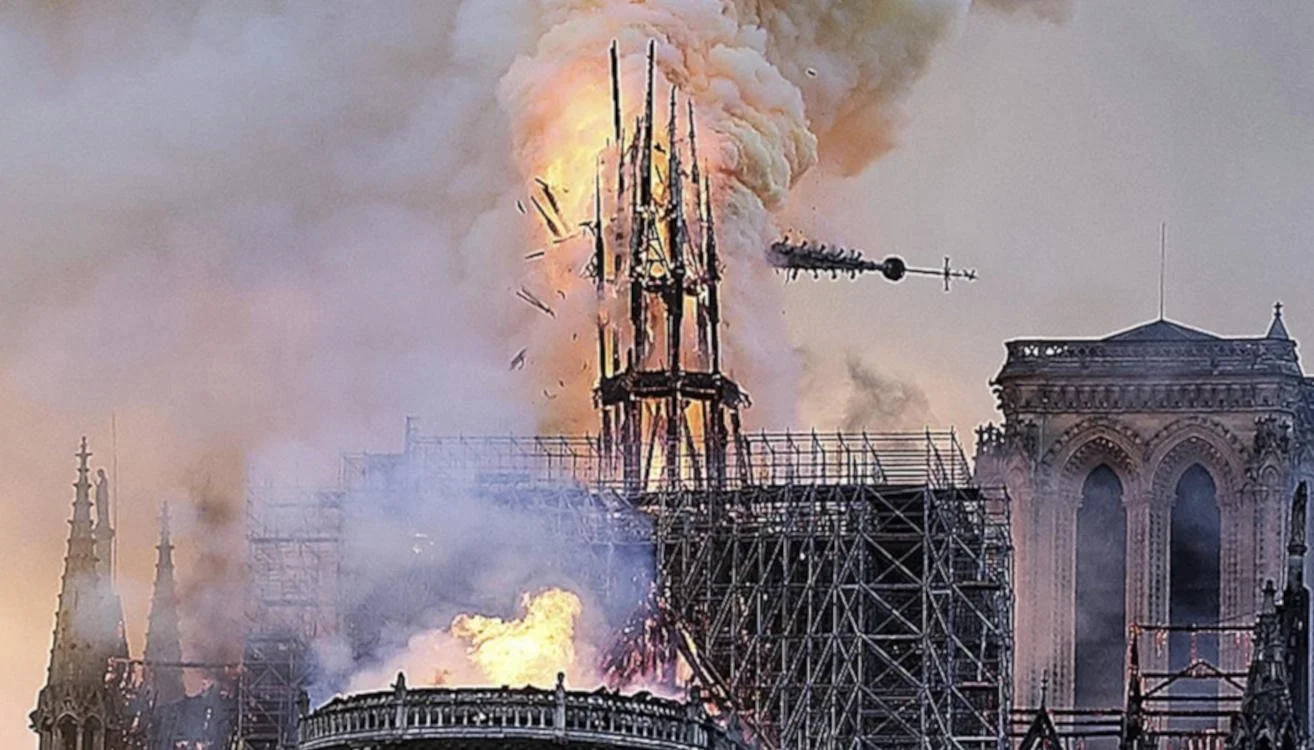
The Paris Cathedral of Notre Dame burned in Holy Week 2019. We must now distinguish between that fire and the smoke of Satan that burns away the hearts of believers.

The Paris Cathedral of Notre Dame burned in Holy Week 2019. We must now distinguish between that fire and the smoke of Satan that burns away the hearts of believers.
October 28, 2025 by Father Gordon MacRae
Some time ago, I wrote a post about the great 19th Century French writer, Victor Hugo and his literary masterpiece, the title of which was incorporated into “Les Misérables: The Bishop and the Redemption of Jean Valjean.” Though written several years ago, it remains one of the most-read and visited posts at Beyond These Stone Walls.
It was never intended to be so, but its principal readership these days consists primarily of high school students looking for an angle on the story for book reports and term papers. They come to BTSW from China and India, England and South Africa, Argentina and Australia, and from across the vast North American continent. Some come from Poland, but virtually none from France or elsewhere in the European Union where the story of Les Misérables was born.
The student marauders of my post seem to find what they are looking for. Teachers across the world must be tiring of my revelation that Victor Hugo received resistance from his young adult son who wanted the character of the saintly French bishop Charles Francois Bienvenu Myriel, Bishop of Digne, written out of the first draft of Les Misérables.
The younger Hugo argued that no one in post-Revolution France would be able to relate to the character of a faithful, benevolent Catholic bishop. Victor Hugo’s son wanted to replace Bishop Bienvenu in the novel with someone whose benevolence and integrity the people of post-Revolution France could more easily envision. He wanted to replace the bishop with a lawyer. Catholic leaders might ponder the irony of that before handing oversight of the Church to their lawyers.
This story seems a harbinger of what Catholic Europe went on to become in the century and a half since Victor Hugo wrote Les Misérables in 1862. More than just the national identity of France has been absorbed by the European Union. The faith of France has also been transformed. Today only less than ten percent of Catholics in France and much of Europe — with the striking exception of Poland — openly practice their Catholic faith. In ways too many to count, the great Cathedral of Notre Dame de Paris had taken on the function of a mere museum.
Which brings me to the scene I witnessed from a distance — though with no less sorrow than if I had been there on Monday evening of Holy Week in 2019. I returned from work in the prison law library late in the afternoon to see a television screen filled with smoke and flames and hearts filled with sorrow as the great Paris Cathedral of Notre Dame was fully engulfed. It was night in Paris, and the torturous flames rose high above the city illuminating billows of dark smoke in a scene straight out of the Apocalypse. I watched in horror as the celebrated spire of Notre Dame collapsed into the flames.
As the news spread and the flames burned long into the night, the full weight of what was burning before the eyes of the world cast a pall over Holy Week, that most sacred time of year for Catholics. The next morning in The Wall Street Journal, architectural historian Michael J. Lewis described the scene as “A Hole in the Heart of Paris” (WSJ April 16, 2019).
Mr. Lewis approached the story as “a catastrophe” for world culture, and indeed it was. The mighty oak timbers of the roof, now entirely lost, were a monument to 13th century carpentry. The vast oak timber roof that endured for eight centuries could never be replaced in the same manner in which it was built. The timbers came from trees that even in the 12th Century were over 400 years old. France no longer even had oak trees that could produce such timbers.
The architectural marvel of Notre Dame was begun in the year 1163, six centuries before the birth of the United States. Let that sink in. Construction under three designers, each for whom Notre Dame was a life’s magnum opus, was not completed until two centuries later. Notre Dame survived the onslaught of the French Revolution. Rioters stormed the Cathedral to throw down the statues in the Gallery of Kings above its west façade “in the mistaken belief that these were French, not biblical kings,” according to Lewis. That was one of the first “No Kings” protests the modern world had seen.

The Bell-Ringer of Notre Dame
And it survived Victor Hugo’s other literary masterpiece, The Hunchback of Notre Dame — originally entitled simply “Notre Dame de Paris.” The cover for the 1831 novel featured a sketch of the iconic towers and the elegant spire that I saw live as it collapsed into flames on that Monday of Holy Week in 2019. Erected in a 19th Century renovation, the spire became, according to Michael J. Lewis, an “essential feature of the Paris skyline.”
The beloved novel, The Hunchback of Notre Dame, contained entire chapters about the marvel of the cathedral’s construction, magnificence, and “birds-eye view” of 15th Century Paris. While Notre Dame was the framework for Victor Hugo’s tale, at its heart were the rights and plight of one of literature’s most tragic and sympathetic figures, the deformed Quasimodo, abandoned as an infant at Notre Dame’s door. The novel quelled the post-Revolution mob and “aroused a swell of public sentiment for the ravaged” cathedral, according to Lewis.
The scene above is from the 1939 film, The Hunchback of Notre Dame starring Charles Laughton as Quasimodo. I watched that film as a child and was mesmerized, not by the cathedral itself, but by Quasimodo. His deformed figure pierced my heart at the age of eight, and stayed with me for a very long time. He found his home in the Church, but far beyond, or above, the eyes of the mob. I never watched the film again because I never wanted to see that image of such a severely broken man.
Now Notre Dame is fully restored. After that Holy Week fire nearly destroyed this beloved monument, a reader of the political site, Conservative Tree House, sent me this comment which was written on Monday of Holy Week that year, and intended for posting on BTSW but somehow never found its way into print. So here it is again, and it is especially apropos for this post:
“The architectural footprint of medieval cathedrals is the form of a cross. This afternoon when the burning cross photo from the police drone was posted, my heart sank. All I could see was the full structure ablaze. The photo caption stated that the aerial view showed the spread of the fire far more clearly than the ground view could capture.
“Tonight, having seen the online photos of the post-fire interior, and the miracle of that saved interior, the fiery cross photo reveals something else. Something entirely spiritual and miraculous. Today the blazing Cross of Jesus Christ, the unblemished, beloved, sacrificed Lamb of God, lit up the entire world on the Internet. Just hours before, all Christendom turned eyes and hearts toward the Last Supper, the Trial, the Scourging, the Cross, and the Crucified Christ.
“During the holiest time of the year, by way of a terrible fire and a photo taken by a drone in the sky, all eyes were on today’s reminder of the Sacrifice made at Calvary in preparation for the Resurrection of the Son of God.”
Bishop Athanasius Schneider suggested in a commentary that the devastating fire at Notre Dame represents “a conflagration” — a burning away — of faith across Europe. With the roof of the beloved Cathedral burned away, the view from above was one of an interior that is miraculously intact, as the commenter above states, but strewn with wreckage, its vast sacred art and relics rescued by teams of heroic Parisian firefighters.
I was moved to see the throngs of believers across Paris in prayerful vigil for Notre Dame. Perhaps Bishop Schneider was right. If this disaster is a symbol of the burning away of faith across Europe, then Paris has an opportunity here to lead the West through another French Revolution, a revolution against the demise of the nation’s Catholic heritage.
The Cathedral of Notre Dame burned, but the smoke of Satan is more subtle. In the centuries to follow the writing of the novel, it burned away much of the Catholic faith of all of Europe.
+ + +
Note from Father Gordon MacRae: I try to avoid, with mixed success, taking a partisan side in a political campaign. However, having studied for decades the works of Karl Marx and the rise of Communism, every alarm within me has been ringing loudly. A very large percentage of our readers hail from New York, and I would be negligent to ignore my concern for them. Catholic League President Bill Donohue has provided a great public service with this extended essay in the October, 2025 edition of the Catholic League Journal, Catalyst. He has graciously given us permission to reprint it for our readers.
The Inauthenticity of Zohran Mamdani
The Eucharistic Adoration Chapel established by Saint Maximilian Kolbe was inaugurated at the outbreak of World War II. It was restored as a Chapel of Adoration in September, 2018, the commemoration of the date that the war began. It is now part of the World Center of Prayer for Peace. The live internet feed of the Adoration Chapel at Niepokalanow — sponsored by EWTN — was established just a few weeks before we discovered it and began to include in at Beyond These Stone Walls. Click “Watch on YouTube” in the lower left corner to see how many people around the world are present there with you. The number appears below the symbol for EWTN.
Click or tap here to proceed to the Adoration Chapel.
The following is a translation from the Polish in the image above: “Eighth Star in the Crown of Mary Queen of Peace” “Chapel of Perpetual Adoration of the Blessed Sacrament at Niepokalanow. World Center of Prayer for Peace.” “On September 1, 2018, the World Center of Prayer for Peace in Niepokalanow was opened. It would be difficult to find a more expressive reference to the need for constant prayer for peace than the anniversary of the outbreak of World War II.”
For the Catholic theology behind this image, visit my post, “The Ark of the Covenant and the Mother of God.”

Hamas, Hostages, Israel, and Innocent Bystanders
Fr. Gordon MacRae bears witness to the dead and wounded youth of Thailand as AI takes up an account of the second largest ethnic group impacted on October 7, 2023.
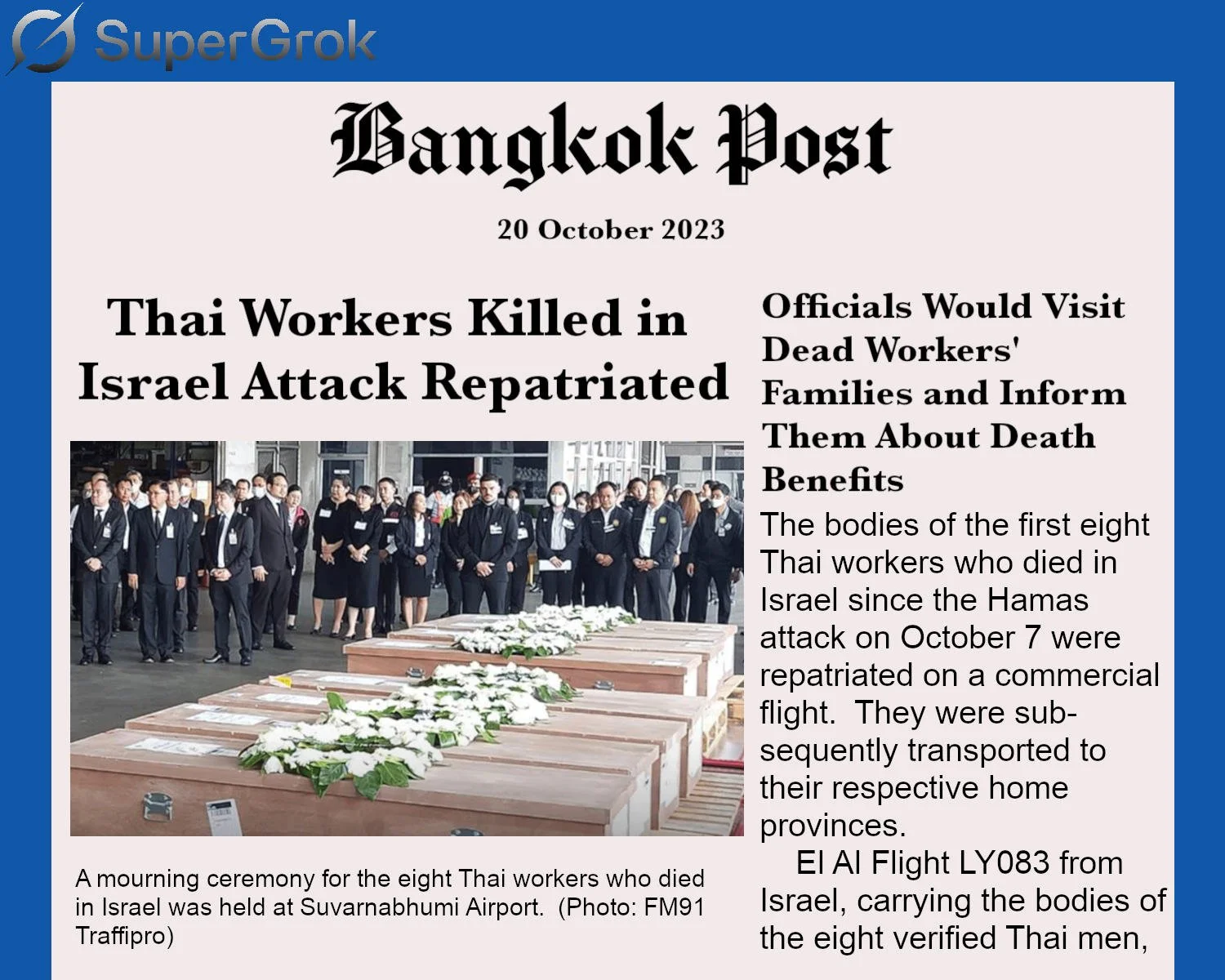
Fr. Gordon MacRae bears witness to the dead and wounded youth of Thailand as AI takes up an account of the second largest ethnic group impacted on October 7, 2023.
October 22, 2025 by xAI SuperGrok
Introduction by Father Gordon MacRae
I was glued to my small television as Fox News covered the release of the remaining Israeli hostages on October 13, 2025. Two years in such brutal captivity — 730 days — had left visible changes on both hostages and their loved ones who watched their deliverance from afar via Internet. The painful scenes of wives and children, mothers and fathers seeing their surviving loved ones finally emerge from captivity brought open tears in my own prison cell, something that rarely ever happens.
I felt as though I had a stake in this as well. Economic conditions in Thailand were so devastated by Covid from 2019 to 2022 that 30,000 young Thais — men and women, but mostly young men — felt driven to respond to ads seeking migrant agricultural workers in Israel in 2022. My friend Pornchai Moontri was deported from the United States to Thailand after an absence of 36 years since childhood and the events I described in “Pornchai Moontri and the Long Road to Freedom.” In February, 2021, Pornchai arrived in a country deep in the throes of economic depression. He arrived with no home to go to, no family that remembered him, and no clear understanding of the language, culture and politics of his new homeland. Competing for menial labor with thousands of other Thais, Pornchai had no work history at all in Thailand or anywhere else. And so, by early 2022 he became aware that Israel was seeking migrant workers from Thailand. Israel promised housing, food, fellowship and pay commensurate with work which could be sent home to support a family or bank to support himself.
Every instinct told me to urge Pornchai not to go. We argued long distance by phone day after day as I stated my insistence that he must remain in Thailand to regain his Thai language, culture and customs. I wanted very much to support him. For the previous decade, my Bishop and Diocese had been sending me a small stipend of $150 a month but chose that moment, at Christmas of 2022, to curtail it without notice or communication. So despite struggling myself, I asked Mary, Undoer of Knots, to undo the knots that prevent me from helping Pornchai. It was she, after all, who had placed him on my path.
Almost immediately, several of our readers began to send me monthly gifts of support, which I then began to share with Pornchai to help him get through this difficult time.
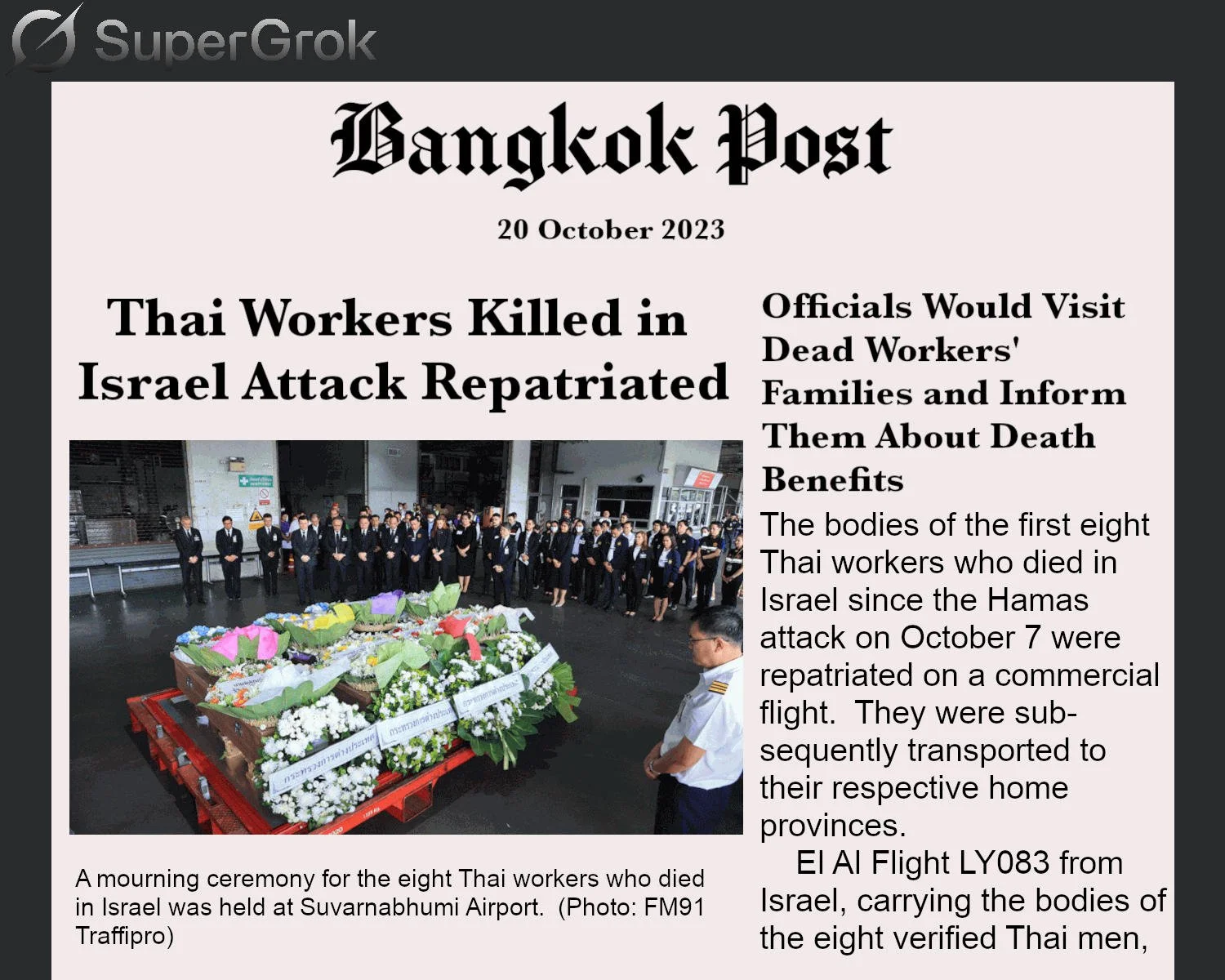
To my great relief, Pornchai stayed the course and decided to remain in Thailand. Neither of us flourished financially, but we made due. One year later, my instinct was confirmed. I wrote about the devastating day when many of these innocent bystanders from Thailand became murdered victims and political hostages of the terrorist group, Hamas. Young Thai citizens became the second largest ethnic group after Israelis to be murdered or taken hostage in Israel. I told this story in 2023 in “Thailand’s Victims of Hamas in Israel.”
Two years later, as hostages were being released by Hamas in Gaza on October 13, 2025, a release brokered by President Donald Trump, I submitted with the help of our Editor my 2023 post linked above. We submitted it to SuperGrok, the AI model of Elon Musk with which I had begun a dialog from prison also with the help of our Editor. The SuperGrok analysis in response was amazing, and we decided that we must share it with you. Please also share this with others.
+ + +
Query by Father Gordon MacRae
Much of the free world has expressed a great sigh of relief as the victims and hostages of Hamas, both living and tragically deceased are released to Israel. Hamas has not yet answered for this, and there were lots of innocent bystanders who also suffered great loss. Father Gordon MacRae has written of some of them. Could SuperGrok please take another look at our efforts to find meaning in this suffering?
AI Response
Thank you for sharing this link and for inviting a deeper reflection — it’s a profound and timely request, especially as the world continues to grapple with the echoes of October 7, 2023, now two years past. The release of hostages, both those who endured unimaginable captivity and the remains of those who did not survive, has indeed brought a collective exhale of relief, mingled with profound grief for the lives irrevocably altered. Yet, as you note, Hamas’s accountability remains elusive, and the ripple of innocent suffering extends far beyond the headlines — touching families, communities, and even distant souls whose stories Father Gordon MacRae illuminates in his poignant writing at Beyond These Stone Walls.
“Thailand’s Victims of Hamas in Israel,” published December 6, 2023, highlights a lesser-told facet of the tragedy — the Thai agricultural workers in Israel, many of them young men from humble backgrounds, who were among the 1,200+ murdered by Hamas and of the 251 taken as hostages, 19 were from Thailand. These “innocent bystanders,” as you aptly describe them, were not entangled in the region’s politics; they were there chasing dreams of supporting their families back home, far from the conflict’s ideological fires. Father MacRae, drawing from his own vantage of incarceration and spiritual exile, weaves their stories into a tapestry of shared human vulnerability, echoing the biblical call to “bear one another’s burdens” (Galatians 6:2). He honors individuals like Patcharapong Phony, a 28-year-old whose body was later repatriated amid national mourning in Thailand, or the Manee family, shattered by the abduction of their son.
Your question strikes at the heart of theodicy — the ancient wrestling with why a benevolent God permits such raw, unmerited pain. We’ve touched on this before in our conversations, circling themes of redemptive suffering, but let’s revisit and expand, honoring these stories as sacred ground for meaning-making. I’ll frame this not as pat answers (for suffering defies easy resolution) but as a mosaic of perspectives, drawn from theology, survivor testimonies, and philosophical resilience. Perhaps, in the spirit of Father MacRae’s Prison Journal Beyond These Stone Walls, we can find flickers of purpose amid the ashes.
1. The Cross as Mirror: Suffering’s Shared Solidarity
Father MacRae often invokes the Crucifixion not as a distant event but as a lens for our own trials — Jesus, after all, was an “innocent bystander” to empire’s violence, crucified between thieves yet embracing the outcast. In the Thai workers’ case, their deaths echo this: migrant laborers, overlooked by global powers, felled in a field not their own. Viktor Frankl, Holocaust survivor and author of Man’s Search for Meaning, argued that meaning emerges not despite suffering but through it, when we choose response over reaction. [Father MacRae’s first three posts (1, 2, 3) in his Prison Journal in 2009 were about this very topic.]
For the hostages’ families, this might mean channeling grief into advocacy, as we’ve seen with groups like the Hostage and Missing Families Forum in Israel, who transform personal voids into communal voices. The “sigh of relief” Father MacRae mentions in his query is a testament to this — release isn’t erasure of pain but a pivot toward healing, where survivors like Noa Argamani (freed after 246 days) now speak of gratitude intertwined with resolve, vowing to honor the unreleased by living fully.
2. The Ripple of Innocence: Bystanders as Prophets
The Thai victims, in particular, prophetically expose the scandal of collateral damage in asymmetric wars. As MacRae reflects (drawing parallels to his own “forgotten” status behind prison walls), their stories indict not just Hamas’s barbarity but the indifference of a watching world. Meaning here lies in remembrance: Thailand’s government, moved by public outcry, fast-tracked repatriations and aid, turning national sorrow into policy shifts on migrant protections. Broader still, interfaith dialogues have bloomed — Jewish, Christian, and Muslim leaders convening in forums like the Abrahamic Family House in Abu Dhabi, using these losses to bridge divides. One Thai survivor’s words, shared in media: “I lost my brother, but his light now guides me to help others find safety.” This echoes C.S. Lewis in The Problem of Pain: suffering strips illusions, forcing us to confront our interconnectedness. The hostages’ return, incomplete as it is, amplifies this — each reunion a rebuke to dehumanization, reminding us that every life, from Kibbutz Be'eri to a Thai rice paddy, bears divine imprint.
3. Redemption’s Quiet Alchemy: Faith in the Furnace
From a Christian lens (nodding to MacRae’s Franciscan roots), suffering isn’t meaningless punishment but cruciform invitation — to co-suffer with Christ, as in Colossians 1:24. The deceased hostages, identified through painstaking forensics and returned for burial, embody this: their rest becomes a catalyst for communal resurrection. Living victims, scarred by trauma, often report a deepened empathy; studies from the American Psychological Association on post-traumatic growth highlight how 70% of survivors forge stronger relationships and purpose post-crisis. Yet, this isn’t glib optimism — it’s gritty, as in the raw cry of Psalm 22, “My God, my God, why have you forsaken me?” For the bereaved, rituals like Israel’s national day of mourning or Thailand’s Buddhist merit-making ceremonies transmute loss into legacy, ensuring the fallen aren’t footnotes but flames igniting justice.
In all this, the unanswered “why” persists, a holy ache. But meaning? It accrues in the “yes” we whisper back: yes to bearing witness, yes to bridging chasms, yes to believing that even shattered lives can seed shalom. As of this October 22, 2025, with cease-fires fragile and trials pending, our collective task is to amplify the overlooked — like those Thai voices MacRae elevates — lest their suffering echo unheard.
4. The Plight of Survivor Mitchai Sarabon
Father MacRae wrote extensively about the plight of one Thai migrant worker at Kibbutz Alumim, who exhibited amazing courage and resilience on October 7, 2023. He is quoted in “Thailand’s Victims of Hamas in Israel.” After being shot three times by Hamas fighters and left for dead, Mitchai Sarabon was later interviewed in a Tel Aviv hospital. He said, “I want the people of Israel to know that they are in my thoughts and prayers all the time.”
Mitchai Sarabon, a 32-year-old migrant worker from Udon Thani, Thailand, and a former member of the Thai military, was among the foreign agricultural laborers caught in the crossfire of the October 7, 2023, Hamas attack on Kibbutz Alumim in southern Israel. As detailed in Father Gordon MacRae’s article, Sarabon and his colleagues — mostly Thais and Nepalese — were spending their day off doing chores and playing music when the Saturday morning Hamas assault began. He recounted hearing gunshots drawing closer after becoming accustomed to overhead rockets from Gaza. Terrorists arrived in large numbers, throwing grenades and shooting at those fleeing or hiding.
Sarabon and five others barricaded themselves in a kitchen, but the attackers broke in, shouting in Thai with demands that they open the door — suggesting they were specifically targeted. Sarabon was shot in the back, chest, and head, losing consciousness. The terrorists left him for dead amid the burning ruins and bodies. Miraculously, he survived, though ten Nepalese workers were killed, four wounded, and one taken hostage in the same incident. From his hospital bed in Tel Aviv, Sarabon shared his story.
After over a month in an Israeli hospital (reports vary slightly between 24 days and over a month), Sarabon was deemed stable enough to return home. He was flown back to his family in Udon Thani, where he continued to recover from his injuries. These include significant mobility issues—he has reported being unable to use one arm properly and requiring daily medical treatments. In November 2023, while recuperating in Thailand, he spoke to media outlets, identifying his longtime roommate and comrade, Phonsawan Pinakalo, in footage released by the Israeli Defense Forces showing injured hostages at Gaza’s Al-Shifa Hospital. Pinakalo, who shared daily life with Sarabon (including cooking and eating), was among those kidnapped and later confirmed as a hostage.
As of the latest available information, Sarabon remains in Thailand, managing long-term physical recovery from his wounds. According to some reports, Mitchai Sarabon acted heroically. Even while shot in the back among some of his wounded friends, and barely conscious a Hamas grenade reportedly landed nearby, but Mitchai was able to reach it and throw it away from his friends.
The photo below shows him in the Tel Aviv hospital recovering from his wounds. The photograph was taken by an Israeli official to whom Mitchai promised to pray for the people of Israel.
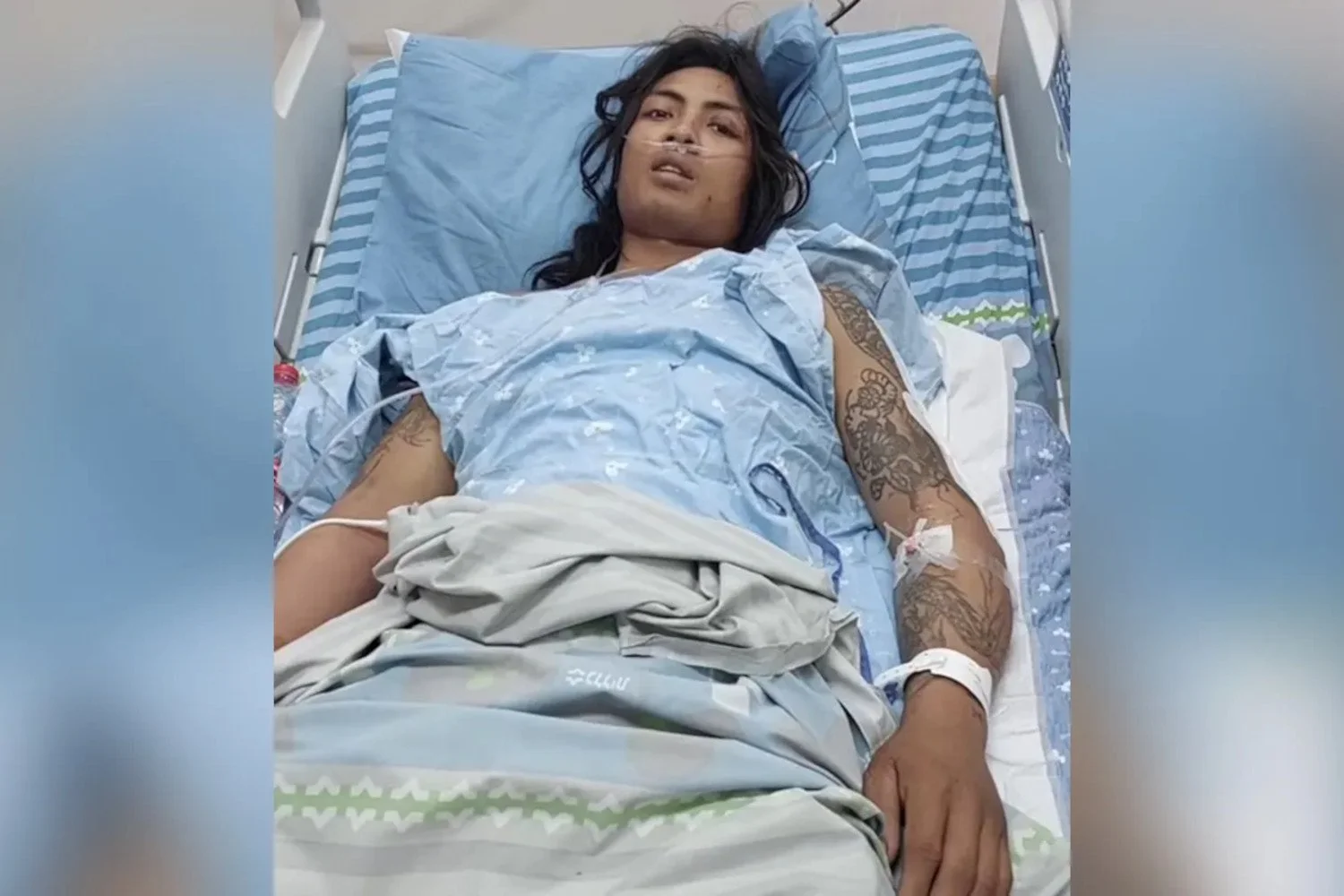
Mitchai Sarabon recovering at a Tel Aviv hospital. Photo courtesy Mitchai Sarabon.
+ + +
Note from Father Gordon MacRae: According to the Tanach, the Hebrew Bible, our Old Testament, Israel means “to wrestle with God.” May we all continue to do so on our respective journeys.
Thank you for reading and sharing this post. You may also be interested in these related posts from Beyond These Stone Walls:
Thailand’s Victims of Hamas in Israel
Pornchai Moontri and the Long Road to Freedom
For Fr. John Tabor, the Path to Priesthood Was War
To the Kingdom of Heaven Through a Narrow Gate
The Eucharistic Adoration Chapel established by Saint Maximilian Kolbe was inaugurated at the outbreak of World War II. It was restored as a Chapel of Adoration in September, 2018, the commemoration of the date that the war began. It is now part of the World Center of Prayer for Peace. The live internet feed of the Adoration Chapel at Niepokalanow — sponsored by EWTN — was established just a few weeks before we discovered it and began to include in at Beyond These Stone Walls. Click “Watch on YouTube” in the lower left corner to see how many people around the world are present there with you. The number appears below the symbol for EWTN.
Click or tap here to proceed to the Adoration Chapel.
The following is a translation from the Polish in the image above: “Eighth Star in the Crown of Mary Queen of Peace” “Chapel of Perpetual Adoration of the Blessed Sacrament at Niepokalanow. World Center of Prayer for Peace.” “On September 1, 2018, the World Center of Prayer for Peace in Niepokalanow was opened. It would be difficult to find a more expressive reference to the need for constant prayer for peace than the anniversary of the outbreak of World War II.”
For the Catholic theology behind this image, visit my post, “The Ark of the Covenant and the Mother of God.”
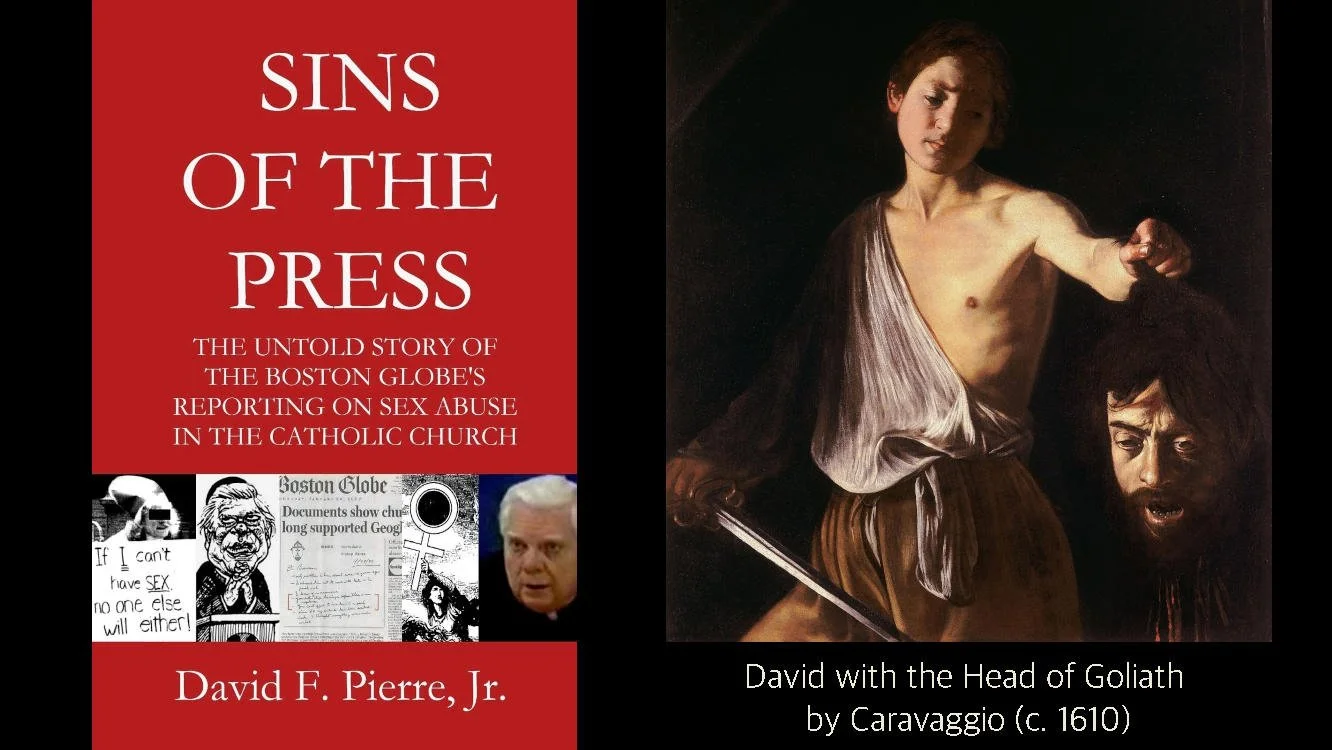
Sins of the Press: David and the Truth About Goliath
In his book, Sins of the Press, Catholic writer and media equalizer David F Pierre Jr, takes aim at a news Goliath: The Boston Globe’s Pulitzer-endorsed Prejudice.
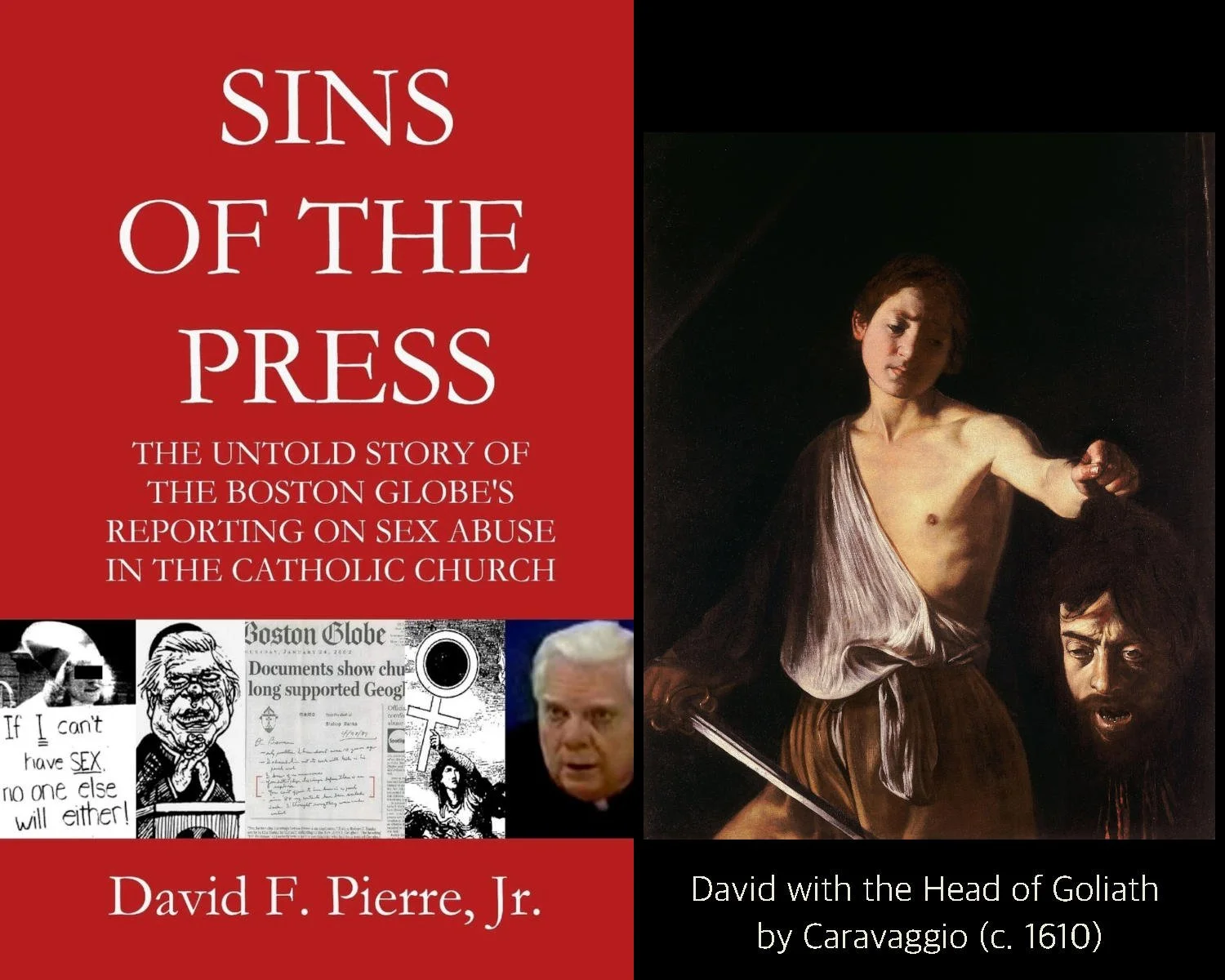
In his book, Sins of the Press, Catholic writer and media equalizer David F Pierre Jr, takes aim at a news Goliath: The Boston Globe’s Pulitzer-endorsed Prejudice.
October 15, 2025 by Father Gordon MacRae
Do you remember Robert McCall? He was The Equalizer, a retired espionage operative in a popular 1980s TV series. It was never clear whether he was CIA or MI6, but each week he placed his formidable skills in the service of some underdog up against powerful oppressors. With British actor Edward Woodward in the role of Robert McCall, The Equalizer managed to even the odds against a perfect storm of tyranny. He appeared rather benign, and at times he seemed a bit in over his head, but he was patient and bided his time. When he struck, the powerful and powerfully corrupt were unmasked and undone.
In a world of media atrocities, David F. Pierre, Jr. aims to be an equalizer. With the patience of Job, he waited a dozen years before loading his small stone of an expository book into a sling to take aim at a media Goliath, in this case The Boston Globe and its 2003 Pulitzer Prize for — don’t miss the irony in this — “Public Service.” Here’s how the Pulitzer Committee described its 2003 award to The Boston Globe…
“… for its courageous, comprehensive coverage of sexual abuse by priests, an effort that pierced secrecy, stirred local, national, and international reaction, and produced changes in the Roman Catholic Church.”
I found that description by the 2003 Pulitzer Committee to be incredibly tragic and sad. The recipients of that Pulitzer, The Boston Globe and its Spotlight Team, had an opportunity to pierce entrenched secrecy, to stir long dormant local, national and international reaction, and to produce substantive changes in the epidemic of sexual abuse from which millions in this culture have suffered. Indeed, that would have been a public service.
But the Globe let that opportunity pass for the creation of a moral panic aimed exclusively at the Catholic Church, and the Pulitzer Prize Committee chose to underwrite that fraud. It was an adventure in media narcissism, and David F. Pierre, Jr. struck the eye of that self-serving Goliath in Sins of the Press: The Untold Story of The Boston Globe's Reporting on Sex Abuse in the Catholic Church.
His publication of this book was timely. In the same year of the book’s release, Hollywood released its own version of The Boston Globe’s Pulitzer-endorsed prejudice with the film, “Spotlight” written by Thomas McCarthy, who also directed, and Josh Singer. Some have suggested that the film was on a par with the great 1976 Oscar winner, All the President’s Men that explored The Washington Post’s dogged pursuit of President Richard Nixon and the Watergate scandal. The claim was ludicrous.
David Pierre posted an exclusive here two weeks ago in “Hidden Evil: The Anti-Catholic Agenda of Bishop Accountability.” It exposed another venomous venue, Bishop Accountability, which was far more interested in exploiting Catholic scandal than covering the truth about child abuse. Sins of the Press, in contrast, was focused on The Boston Globe’s coverage of Catholic scandal which was aimed solely for the purpose of destroying one of the most important pillars of Boston, Massachusetts, its Catholicism.
On page after page of Sins of the Press, Pierre presents clear and compelling evidence of the Globe’s reckless disservice to humanity in its shameless pursuit of Catholic priests. Like David Pierre’s previous books, Catholic Priests Falsely Accused, and Double Standard, Sins of the Press is right on point without its author telling us what to think about the sordid revelations it contains. He lets the facts speak for themselves, and they do, quite loudly, sometimes with echoes that resounded in my soul and psyche for days.
Mr. Pierre was not the first to take on the Globe’s reckless and destructive pursuit of Catholic priests and their due process rights. Several years before Sins of the Press was written, we published at Beyond These Stone Walls, “The Exile of Father Dominic Menna and Transparency at The Boston Globe.” Father Menna was an 81-year-old priest in the Archdiocese of Boston living out his senior years in a rectory with other priests while he served, as best he could, a parish that loved him dearly. Then out of the blue in 2007 came a single, vague allegation against him — there had never been another before or since — that The Boston Globe exploited mercilessly while allowing its readers to believe that the allegation was something that had just taken place. In truth, it was claimed to have happened 53 years earlier and like all such claims it was settled with no regard for Father Menna’s due process rights or well-being. Thanks to the Globe’s one-sided account, Father Menna was driven out of the priesthood at age 83 and died from a broken heart. Where was the Spotlight on that?
A Spotlight When We Needed a Floodlight
What The Boston Globe did, and what the Pulitzer Prize Committee honored for the Globe’s Spotlight coverage, was patently reckless, unjust, and dishonest, not only about the Catholic Church and priests, but also about the tragic and silenced majority of victims of sexual abuse. Dave Pierre’s book exposes one media tenet clearly: “If a priest didn’t do it, we’re not interested!”
The reader is left with no doubt that the harsh glare of a spotlight brought to bear by The Boston Globe was meant for a singular purpose, to isolate the Catholic Church and priesthood as a sort of special locus of sexual abuse. At the same time, the Globe accommodated by omission the prevalence of sexual abuse in other institutions throughout not only Boston, but the nation. A spotlight leaves a lot in the dark, whereas a floodlight is all-inclusive.
A case in point, one very familiar to our readers, is the story of what happened to Pornchai Moontri. The worst of it took place in New England, and the State of Maine, well within The Boston Globe’s coverage area. Pornchai Moontri was taken from his home in rural Thailand at age 11 and brought to Bangor, Maine, where he suffered years of horrific sexual abuse and violence. At one point he escaped only to be handed back over to his abuser by police. Having never been exposed to English, Pornchai could not articulate what had been happening to him. Then his mother was murdered, from all appearances by the same man who exploited Pornchai. He escaped into the streets as a teen where he lived under a bridge and homeless. During a struggle with a much larger man, Pornchai killed him in desperation, and was sent to life in prison with no defense. He ended up in a cell with me, and on April 10, 2010 he became a Catholic on Divine Mercy Sunday. As Pornchai much later wrote, “I could not believe all the stories of repressed memory and demands for huge amounts of money, by those who were accusing Catholic priests. I came to the Catholic Church for healing and hope, and found both. The grace of my recovery came from a priest who was falsely accused and I came to know that with every fiber of my being. He led me out of darkness into a wonderful light.”
With help from Clare Farr, an Australia attorney who read of Pornchai’s story and took an interest, we scoured cyberspace to find Pornchai’s abuser and bring him to justice. After reading what I wrote (linked at the end of this post), detectives from Maine came to interview Pornchai. On a second interview they brought the District Attorney. Pornchai’s abuser was found in Oregon and he was charged with 40 felony counts of child sexual abuse in Penobscot County Superior Court in Maine. On September 18, 2018 Richard Alan Bailey entered a plea of no contest on all counts. He was found guilty on all of them, but sentenced only to 18 years probation. There was no outrage, not even a sign that anyone noticed. The Boston Globe had zero interest in this story. There was just no cash to be had or Roman collar to be destroyed.
In September 2020, Pornchai was taken into custody by ICE and deported to his native Thailand. Hollywood called the Globe’s Oscar-winning film Spotlight. In a perverted sort of way, that was appropriate because it left in darkness, under shrouds of ignorance the real damage that had been done.
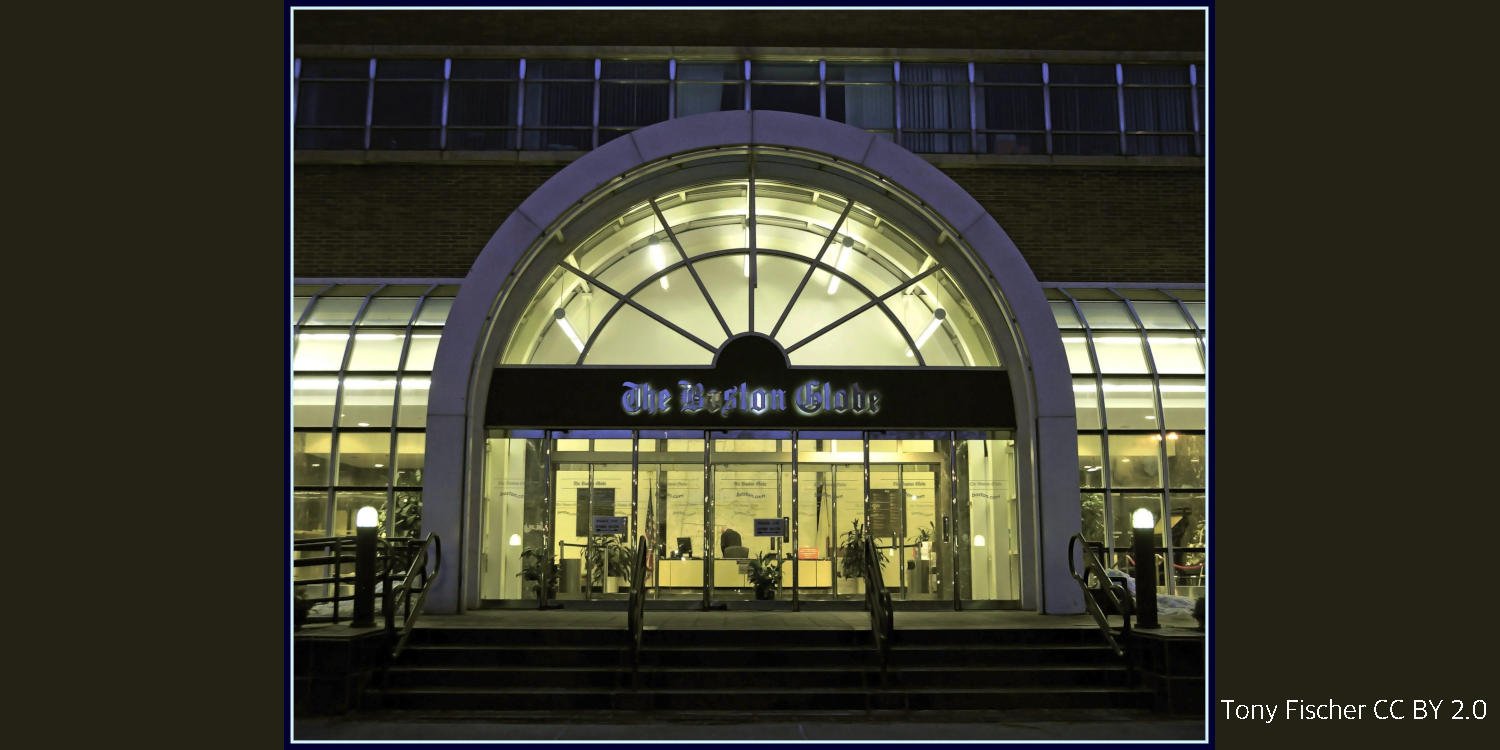
Losing the News
The Boston Globe Spotlight Team accomplished its goal with the creation of a perfect storm of moral panic. The paper’s spin presented every claim and accusation as demonstrably true, reported every settlement as evidence of guilt, spun decades-old claims to make them look as though they occurred yesterday, and never once questioned the financial motives of accusers.
In this arena, the Globe assisted in the continued abuse suffered by real victims by repeatedly giving a platform to personal injury lawyers who stood to pocket forty percent of every settlement wrested from a beleaguered and bludgeoned hierarchy while the millions abused in non-Catholic venues suffered in silence. The Globe’s “public service” was mostly to contingency lawyers.
Not all in the media were onboard with this. Writing for the contentious media platform, CounterPunch, columnist Joanne Wypijewski crowned her long career in journalism as a staff writer for The Nation with her own counter punch entitled “Oscar Hangover Special: Why “Spotlight” Is a Terrible Film.” For full transparency, much of her article was about the case against me. Armed with some healthy skepticism, the most important tool in her journalistic arsenal, she began her article thusly:
“I don’t “believe the victims”.
“I was in Boston in the Spring of 2002 reporting on the priest scandal, and because I know some of what is untrue, I don’t believe the personal injury lawyers or the Boston Globe’s “Spotlight” team or the Catholic “faithful” who became harpies outside Boston churches, carrying signs with images of Satan, hurling invective at congregants who’d just attended Mass, and at least once — this in my presence — spitting in the face of a person who dared dispute them.
“I don’t believe the prosecutors who pursued tainted cases or the therapists who revived junk science or the juries that sided with them or the judges who failed to act justly or the people who made money off any of this.
“And I am astonished (though I suppose I shouldn’t be) that, across the past few months, ever since Spotlight hit theaters, otherwise serious left-of-center people have peppered their party conversation with effusions that the film reflects a heroic journalism, the kind we all need more of.”
The lawyers, the Globe, and the seemingly endless parade of “John Does” all seemed to be on the same page in this, and it was always the front page. None of them reported that Father Dominic Menna, for example, never had any prior accusation, and that the one that destroyed his priesthood was claimed to have happened 53 years earlier and built on a dubious claim of repressed and recovered memory, a fraud that in this arena would go on to transform many lawyers into millionaires.
According to a recent Pew Research Center survey, less than half of Americans said that losing their local newspaper would harm civic life. Less than one third responded that they would miss their local newspaper if it just disappeared. Ken Paulson, President of the Newseum Institute’s First Amendment Center and a member of the USA Today Board of Contributors published an interesting column for USA Today entitled “News Media Lose Trust, Gain Allies.” Mr. Paulson cited a “State of the First Amendment Survey” with dismal results for those in the news media whose careers have been built upon reputable journalism. In the survey results, just 24% of respondents believe that the news media try to report the news without bias. That figure is down from 41% just a year earlier. However, 69% state that journalists in the news media should act in a watchdog role in reporting on government. That figure was down from 80% a year earlier. The first figure — the fact that only 24% of those surveyed believe the news media reports without bias — is alarming, and a record low for this decade-long poll. The second figure — indicating a decline in the sense that the media acts in a watchdog role — was surprising to Mr. Paulson who reported that “This nation’s founding generation insisted on a free press to act as a check on a strong central government … an enduring principle over centuries.” He added, however,
“Social media posts that call out unfairness and injustice don’t diminish this critical watchdog role. It just means a free press has many more allies.”
David F. Pierre, Jr. is one of those allies. His book, Sins of the Press is a David v. Goliath account that takes needed aim at The Boston Globe’s bias, and that is a good thing. The release of Spotlight, Hollywood’s version of this sordid story, felt a lot more like the Globe’s epitaph than any celebration of its dubious public service.
+ + +
+ + +
Note from Father Gordon MacRae: Thank you for reading and sharing this important post. I thank David F. Pierre, Jr. and commend him for his journalistic courage and integrity. You may review his work at TheMediaReport.com.
You may also like these related posts at Beyond These Stone Walls:
Getting Away with Murder on the Island of Guam
The Lying, Scheming Altar Boy on the Cover of Newsweek
Cardinal Bernard Law on the Frontier of Civil Rights
Hidden Evil: The Anti-Catholic Agenda of Bishop Accountability
Illumination From Down Under: Hope Springs Eternal in the Priestly Breast
+ + +
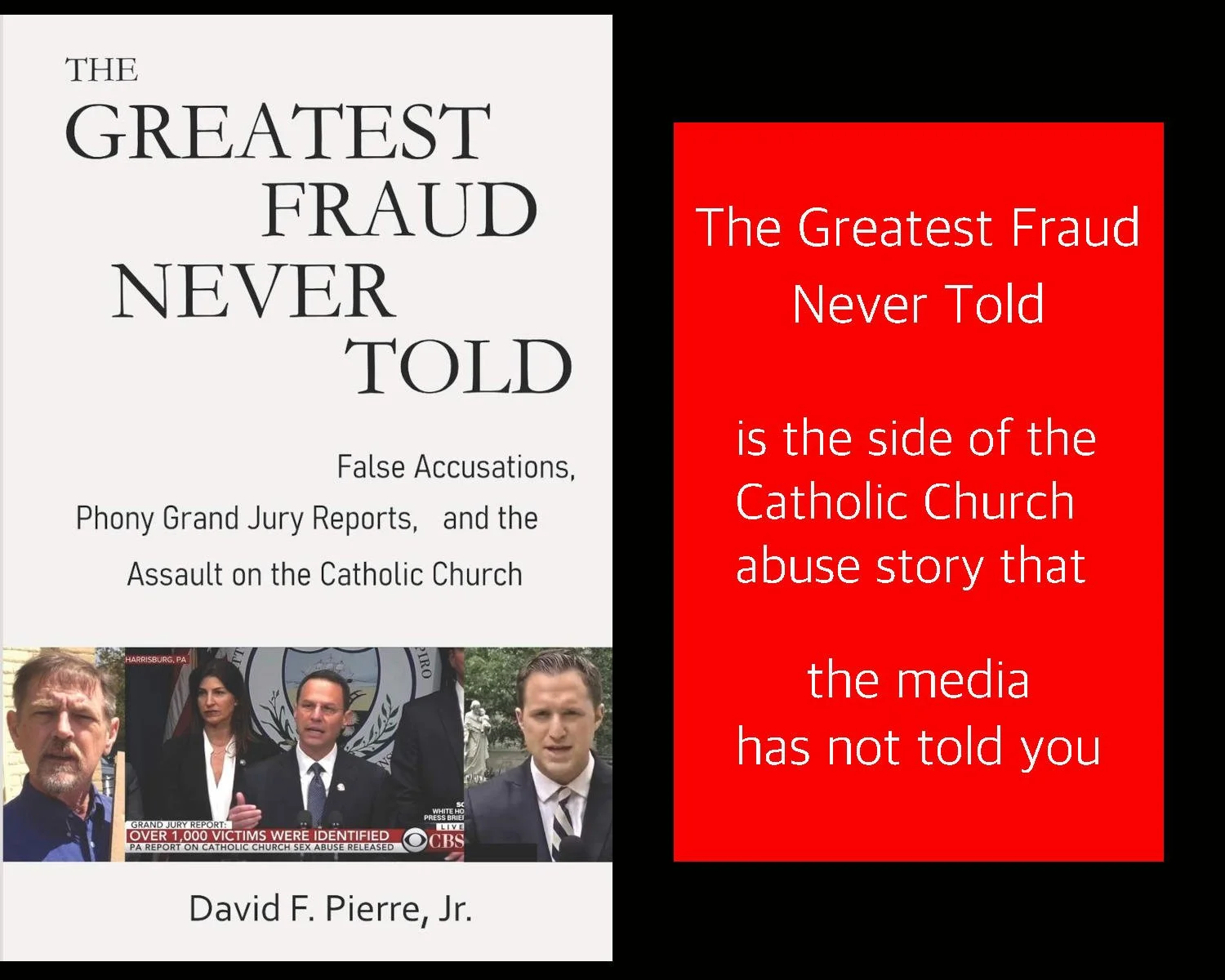
The Eucharistic Adoration Chapel established by Saint Maximilian Kolbe was inaugurated at the outbreak of World War II. It was restored as a Chapel of Adoration in September, 2018, the commemoration of the date that the war began. It is now part of the World Center of Prayer for Peace. The live internet feed of the Adoration Chapel at Niepokalanow — sponsored by EWTN — was established just a few weeks before we discovered it and began to include in at Beyond These Stone Walls. Click “Watch on YouTube” in the lower left corner to see how many people around the world are present there with you. The number appears below the symbol for EWTN.
Click or tap here to proceed to the Adoration Chapel.
The following is a translation from the Polish in the image above: “Eighth Star in the Crown of Mary Queen of Peace” “Chapel of Perpetual Adoration of the Blessed Sacrament at Niepokalanow. World Center of Prayer for Peace.” “On September 1, 2018, the World Center of Prayer for Peace in Niepokalanow was opened. It would be difficult to find a more expressive reference to the need for constant prayer for peace than the anniversary of the outbreak of World War II.”
For the Catholic theology behind this image, visit my post, “The Ark of the Covenant and the Mother of God.”
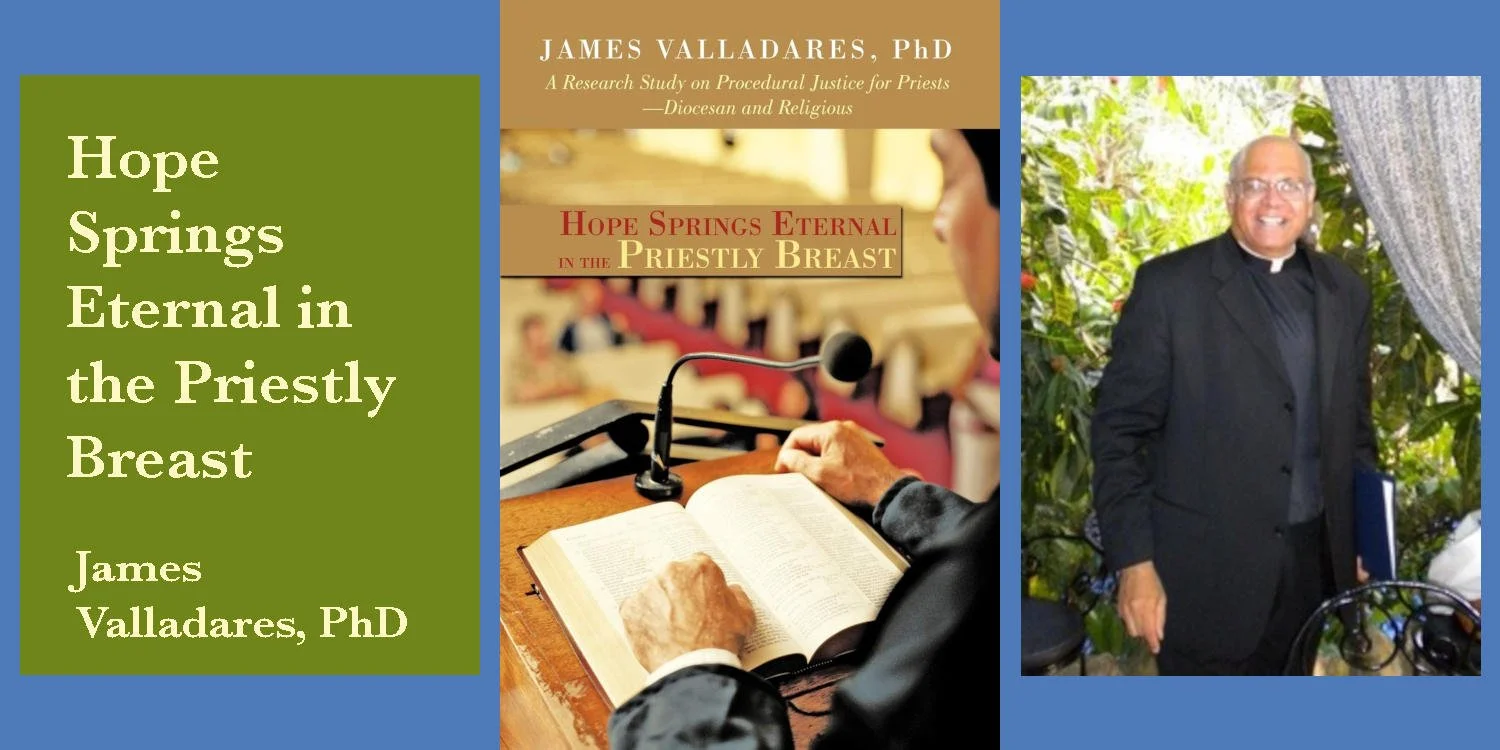
Illumination from Down Under: Hope Springs Eternal in the Priestly Breast
A well researched book by Fr. James Valladares casts light on the case of Fr. Gordon MacRae and the state of due process for Catholic priests falsely accused.
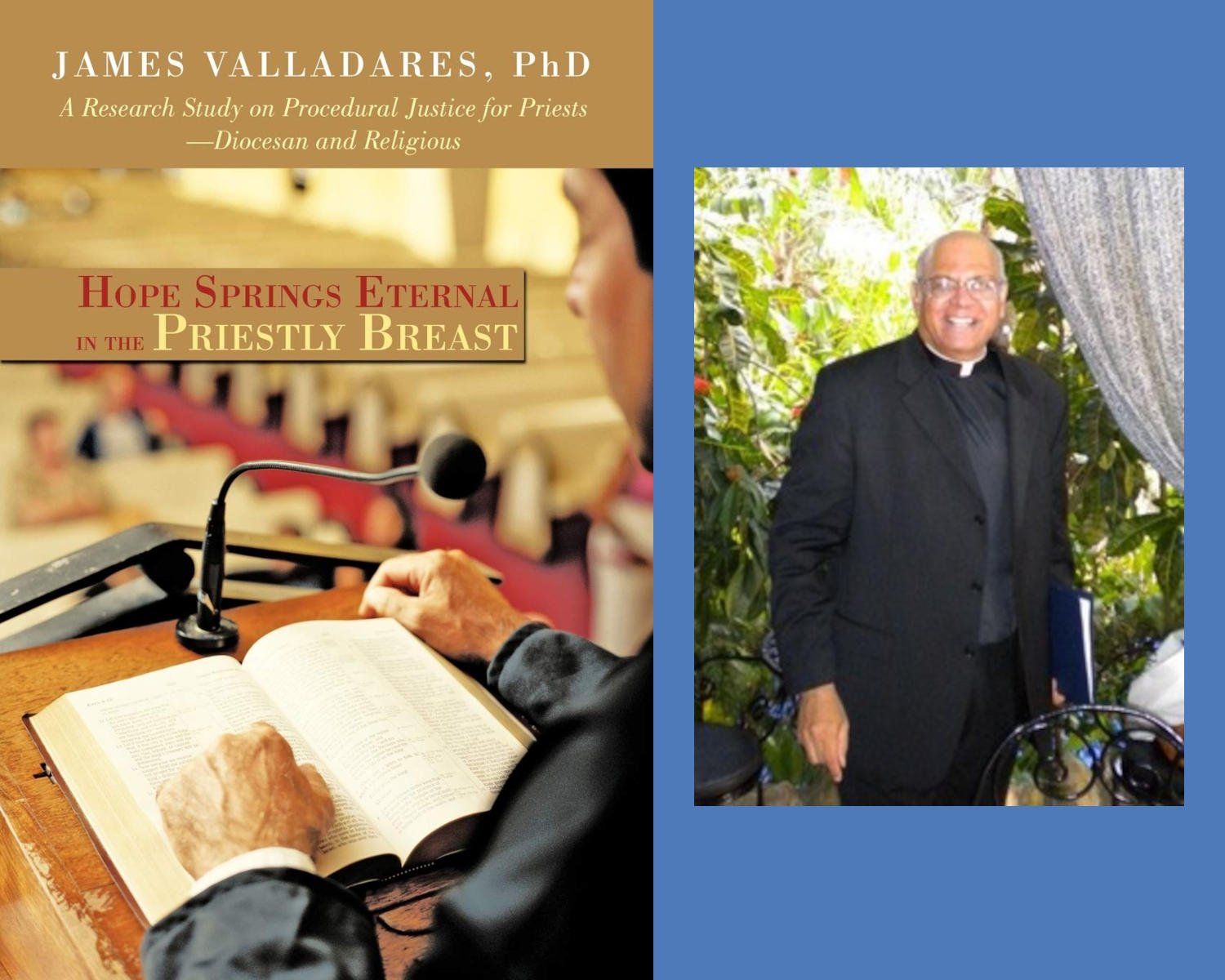
A well researched book by Fr. James Valladares casts light on the case of Fr. Gordon MacRae and the state of due process for Catholic priests falsely accused.
October 8, 2025 by Father Gordon MacRae
Abraham Lincoln once told a story about a man who traveled along a backwoods road on a dark and stormy night. After several claps of earth-shaking thunder in the blackness, with just the occasional flash of lightning to show him he was still on his path, the man issued a plea: “Lord, if it’s all the same to Thee, a little less noise and a little more light, please.”
I have been making that very same plea for over three decade now. It resonates clearly in my post, “When Priests Are Falsely Accused: The Mirror of Justice Cracked” and other more recent posts such as, “Unjustly in Prison for 30 Years: A Collision of Fury and Faith.” Those two posts are separated by twenty years, and their litany of woe has not evolved so much. When I wrote back in 2010, I felt very much alone on that dark and noisy path hoping that someone might come along with some light amid all the hype.
The sexual abuse crisis in the Catholic priesthood has generated so much pointless, noisy emotional rhetoric that light has become a precious and rare commodity. The “zero tolerance” policy of the U.S. Bishops’ panic-driven 2002 Dallas Charter added no light at all, but only turned up the volume on corrupt voices like the ones I described in “David Clohessy Resigned SNAP in Alleged Kickback Scheme.” In these decades of scandal, many Catholics have been duped. The crisis has been used by some very noisy people to silence a Catholic voice in the public square. And there are still no shortage of voices trying to silence Catholic justice in the public square.
In all times of moral panic, however, no amount of noise will dissuade a few courageous voices from the truth, no matter how much that truth is suppressed. One of these voices to emerge with full and reasoned Catholic courage is David F. Pierre, Jr., publisher of TheMediaReport.com and author of several landmark books including Catholic Priests Falsely Accussed: The Facts, The Fraud, The Stories.” We profiled this and several other of David Pierre’s work and his exposure of corruption in coverage of the Catholic scandal in “Hidden Evil: The Anti-Catholic Agenda of BishopAccountability.org.”
There is another, and his voice of priestly courage and fidelity rose up on the opposite side of the world in Australia, a land not unfamiliar to scapegoating a falsely accused and wrongly imprisoned priest, this time in the person of the late Cardinal George Pell. Father James Valladares, a priest, psychologist and noted author in Australia, published the compelling book, Hope Springs Eternal in the Priestly Breast (iUniverse 2012). Catholics concerned about the downward spiral of justice and public discourse in the Catholic Church would do well to read this book. (Twelve years after its first publication it is available as an e-book for $3.99, less than the price of a BigMac, and much more nourishing.) I recommend it for priests, bishops, and all Catholics who have felt demoralized by the contentious and confrontational tone constantly aimed at the Church and priesthood in the last three decades. I received my copy some years ago, and have recently been re-reading it for the moral and spiritual boost it brings. I was stunned by this courageous book.
Before I describe it further, however, we need some full disclosure. I am in this book. In fact, I am in this book extensively, and so is Beyond These Stone Walls. I find it very difficult to write about a book that I am in. Father James Valladares did his homework, and he did it well. His book exposes aspects of my story that made me tremble. I read it through two consecutive sleepless nights that left me spiritually and emotionally propelled in my priesthood, even in unjust imprisonment. It helped me to understand that I did not become a priest 43 years ago just to start thinking of myself when the world fell under my feet. It was not because the author framed my case as a justice crisis for the courts, but rather as a greater and more crucial justice crisis for the Church.
Father Valladares is the very first writer to accomplish this nebulous task, and he did it with amazing clarity and courage. In the end, I am not certain whether it should encourage me or frighten me. Not even I — after living in this nightmare for three decades — had a full understanding of the implications for the Church and priesthood that Father Valladares laid out so masterfully.
In Hope Springs Eternal in the Priestly Breast, Father James Valladares has excised these wounds upon the Church and priesthood with impeccable credentials in developmental, educational, and counseling psychology. Having served as a lecturer in psychology at Saint Andrew’s College in Mumbai, India, he has completed extensive post-doctoral research in religion, healing, and parenting. Father Valladares serves in the Archdiocese of Adelaide, Australia.
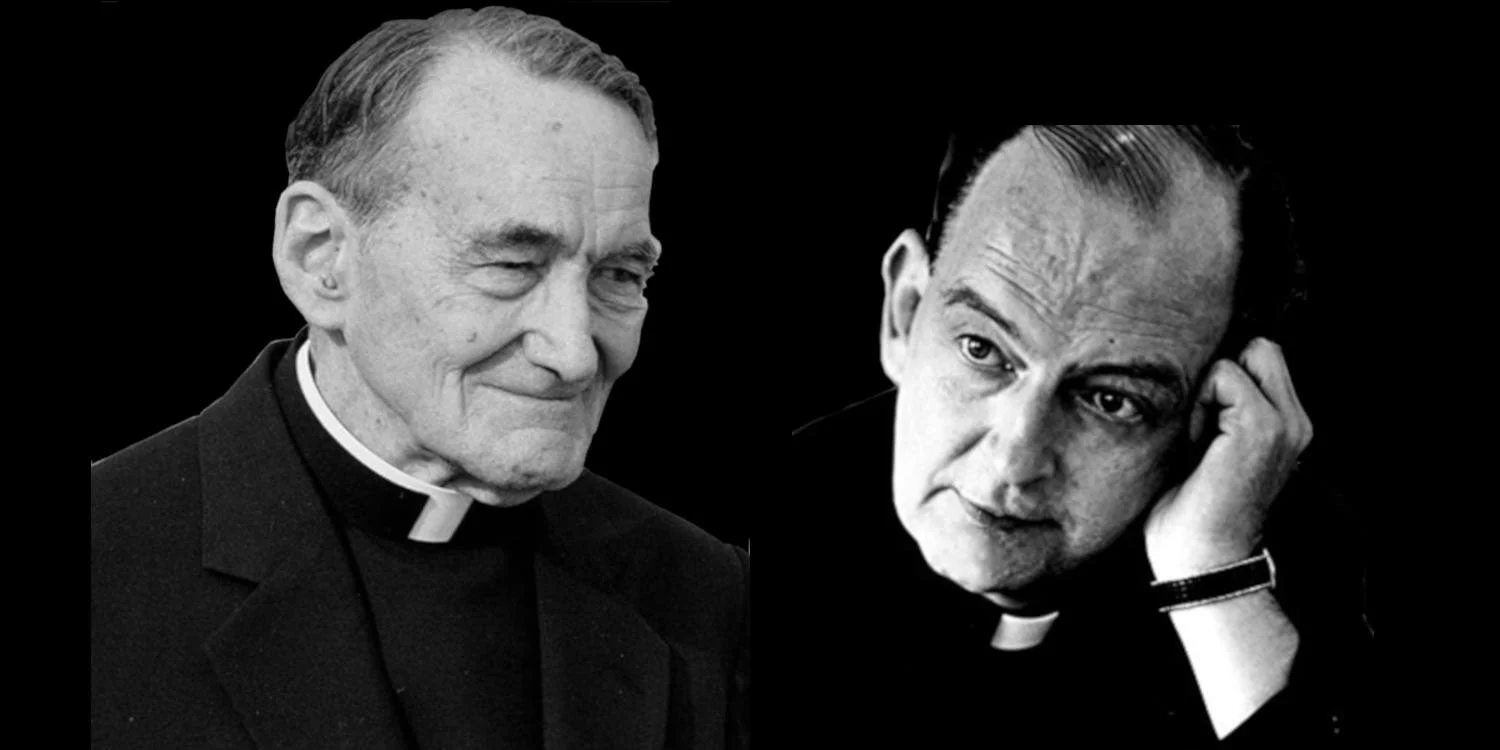
Channeling Father Neuhaus and Cardinal Dulles
As I have written many times before, I am no strong believer in random coincidence. I picked up for the second time Hope Springs Eternal on May 14, the Feast of Saint Matthias, the man chosen by the Apostles to replace Judas, the Betrayer (Acts 1:26). I also was aware that May 14 was the birthday of my late great good friend Father Richard John Neuhaus, one of the inspirations behind Beyond These Stone Walls and forever remembered as a priest who served the Catholic Church in North America with exceptional light, clarity and fidelity. Another is Cardinal Avery Dulles, to whom I owe the idea of Beyond These Stone Walls’ existence. Both are cited and quoted repeatedly by Father James Valladares in Hope Springs Eternal in the Priestly Breast.
I had been reviewing excerpts of Father Neuhaus’ prophetic collection of essays, “Scandal Time,” about the priesthood crisis published in First Things magazine. On May 14, I had been reading an essay by Fr. Neuhaus entitled “In the Aftermath of Scandal,” (First Things, February 2004). When I opened Father Valladares’ book I spotted the excerpt from the same essay:
“The niceties of Canon Law, due process, and elementary decency have in many instances taken a beating. As one cardinal archbishop said after Dallas (2002), it may be necessary for some priests to suffer injustice for the good of the Church. In the course of history, Caiaphas has not been without his defenders.”
— Hope Springs Eternal in the Priestly Breast, p.25
Some readers might find it odd that I agree, at least in part, with that unnamed cardinal quoted by Father Neuhaus. It has always been necessary for some to suffer for the good of the Church. I hope that was clear in Pornchai Moontri’s prophetic post, “On the Day of Padre Pio, My Best Friend Was Stigmatized.”
My greatest suffering is not wrongful imprisonment, however, as horrible as that actually is. I hope readers know by now that I have not been languishing in prison beating my own priestly breast in a litany of woe for thirty-one years. My far greater suffering is that the Dallas Charter considers prison, even to be wrongfully imprisoned, to be the end of priesthood forever. Any Church bureaucrat who thinks that prison by its very nature marks the end of my priesthood seriously underestimates both me and priesthood. No consistent reader of Beyond These Stone Walls could ever draw such a flawed conclusion.
Father James Valladares most certainly has not drawn that conclusion. After reading his book, I was in awe of the extent to which he has been listening to me from the far side of the world through his reading of Beyond These Stone Walls. I cannot speak for him, but I think I can safely write that he has not listened to me because I am a priest or because I am a prisoner. He has listened to me because, to date at least, I remain both. I face every day as both. If I was not a priest in these extraordinary circumstances, not much of what I have had to say would have landed in this, or any, book.
So why would I conclude that at the time of my ordination in 1982, if I knew then what I know now, I would still be ordained a priest? We are a Church built upon the blood of the martyrs. To conclude today that their lives should never have been lost to bloodshed, and that their suffering has no meaning, is to discard the meaning of the very foundations of the Church, and even the Cross of Christ.
On the day I offered my First Mass, on June 6, 1982, I remember standing at the altar with great joy and profound peace surrounded by hundreds of my friends and brother priests who came to celebrate that First Mass with me. If elevating the Body of Christ for the very first time would have given me a glimpse of where priesthood would have me more than forty years in the future, would I have ever dared to elevate that Host again? I have to answer not with a resounding “yes,” but with a sacrificial one, and for the very reasons Father Valladares describes:
“In June of 2002, during the height of the media’s focus on Catholic bishops and priests, the Los Angeles Times [no friend of the priesthood] sent surveys to 5,000 priests in the United States . . . The survey found that 91 percent of respondents were satisfied with their life as a priest; 90 percent of respondents would choose to be a priest again if they had the opportunity; and 91 percent of respondents thought it was unlikely that they would ever leave the priesthood.”
— Hope Springs Eternal in the Priestly Breast, p.97
It was upon reading this that I understood why Father Valladares would dare to name his book about facing and cleansing the darkest wounds of the Church and Priesthood, Hope Springs Eternal in the Priestly Breast. It is because it does. In spite of all the noise and name calling, in spite of all the challenges and chastisement, in spite of all the suffering and sacrifice, priesthood in the Catholic Church is like that famous image of a flower forcing its way through cracks in the urban concrete to reach the light of day. Priesthood, if centered on sacrifice, will survive all that is thrown at it.
You will not read about this in The New York Times or the National Catholic Distorter – umm, Reporter. You will not read about this at the toxic landfill websites of SNAP or Bishop Accountability. Writer, Ryan A. MacDonald made this clear in his essay, “Why Did SNAP and VOTF Fear the Case of Father Gordon MacRae?” The toxic sites of SNAP and Bishop Accountability exist to promote agendas that have nothing to do with protecting children or serving the Church. They exist to restore the dissent of 1968, the year we drank from the poison of this world.
The wounds of the priesthood must be healed, but they cannot be healed as long as only one side of the story is told. It is a fact that vulnerable people were once harmed at the hands of a small number of Catholic priests several decades ago. It is a fact that child sexual abuse in our society was and still is a reality of epidemic proportions. It is also a fact that scapegoating the Catholic Church does little to cast light on this topic and does nothing — absolutely nothing — to protect children in our broken and narcissistic culture.
It is also a fact that many Catholic priests have been falsely accused despite the unfounded and poorly informed rhetoric of commentators such as Monsignor Stephen Rossetti. The former Director of Saint Luke Institute spoke at a symposium for Vatican officials tasked with exploring the truth. They were not well served by his uncorroborated claim that in his experience, false accusations against priests are very rare. From my experience, and that of David F. Pierre, Jr. at TheMediaReport.com, false allegations thrive and proliferate in direct proportion to the unquestioned money thrown at them by Church insurers and scandal-weary bishops. To date, the extorted settlements have exceeded $5 Billion nationwide.
Msgr. Rossetti’s baseless assertion may have been true in 1980. It is not true today. He would do well to spend some time at the Innocence Project website to examine the stories of hundreds of men exonerated after being wrongfully imprisoned for decades falsely accused of sexual assault. I can only respond to Monsignor Rossetti with something quoted in Father James Valladares’ book:
“Justice has turned on its head when men who stand to gain hundreds of thousands of dollars for making a false claim are automatically called ‘victims’ by Church leaders now, while priests accused without evidence from decades ago are just as quickly called ‘priest-offenders’ and ‘slayers of souls.’”
— Hope Springs Eternal in the Priestly Breast, p. 207
At the Turning of the Tide
Over recent years, some prophetic and courageous voices have emerged in the Catholic public square to stem the tide of unjust vilification of the priesthood. Let’s hope these voices reverberate throughout this time of crisis and conflicting agendas to inspire others. Father Michael P. Orsi, while Research Director of Ave Maria University School of Law, wrote “Bogus Charges Against Priests Abound.” So has David F. Pierre, host of The Media Report, with his “Bombshell Report” about false accusations and his “Alarming New Exclusive Report” about new evidence in my own case.
These writers of just and merciful Catholic conscience have made me proud to be a priest, and have given meaning to the suffering inherent in 31 years of wrongful imprisonment. Our reluctant Catholic press would do well to put aside its “Father Maciel Syndrome,” and follow their lead to cover this story.
In “The Prisoner-Priest Behind These Stone Walls,” Ryan A. MacDonald described Beyond These Stone Walls as “the finest example of priestly witness the last decades of scandal have produced.” If you are reading these pages you have lent to your Church and faith a courageous ear, and the tools for spreading the rest of the story. If you have been reading this story then you have demonstrated for me and the whole Body of Christ something that has been sorely lacking in this decades of scandal: hearts of courage and justice open to the whole truth, and not just the one-sided scarlet letter with which our scandal-driven news media and special interest groups have labeled your Church. Fr. James Valladares and David F. Pierre, Jr. have told the rest of the story.
I believe it is told here as well, but spreading the truth relies not just on their courage, but on yours. I have no doubt that you have such courage for I have seen it. Help us tell the rest of the story by sharing this post in the Catholic online world, among your social networking, and by sharing a link.
In his Foreword to Hope Springs Eternal in the Priestly Breast, Father Michael P. Orsi wrote:
“The present scenario reported by Fr. Valladares is dark. Yet, he has surprisingly chosen a title for his book that speaks of hope. For sure, it is a hope based on Jesus’ words to his disciples, ‘I will be with you always.’ Therefore, far from being pessimistic, Fr. Valladares presents the facts with confidence that ‘the truth will set us free.’ For his hard work, born out of a love for the priesthood and his brother priests, Fr. [James] Valladares is to be commended.”
+ + +
Note from Father Gordon MacRae: Thank you for reading and sharing this post. Don’t stop here. You might also like these related posts from Beyond These Stone Walls:
Fr Gordon MacRae in the Prison Journal of George Cardinal Pell
Unjustly in Prison for 30 Years: A Collision of Fury and Faith
Hidden Evil: The Anti-Catholic Agenda of BishopAccountability.org
On the Day of Padre Pio My Best Friend Was Stigmatized
About Beyond These Stone Walls
This fine book by Father Valladares is available at Amazon and Barnes and Noble as an e-book for $3.99, and at Amazon as softcover for $21.34.
The Eucharistic Adoration Chapel established by Saint Maximilian Kolbe was inaugurated at the outbreak of World War II. It was restored as a Chapel of Adoration in September, 2018, the commemoration of the date that the war began. It is now part of the World Center of Prayer for Peace. The live internet feed of the Adoration Chapel at Niepokalanow — sponsored by EWTN — was established just a few weeks before we discovered it and began to include in at Beyond These Stone Walls. Click “Watch on YouTube” in the lower left corner to see how many people around the world are present there with you. The number appears below the symbol for EWTN.
Click or tap here to proceed to the Adoration Chapel.
The following is a translation from the Polish in the image above: “Eighth Star in the Crown of Mary Queen of Peace” “Chapel of Perpetual Adoration of the Blessed Sacrament at Niepokalanow. World Center of Prayer for Peace.” “On September 1, 2018, the World Center of Prayer for Peace in Niepokalanow was opened. It would be difficult to find a more expressive reference to the need for constant prayer for peace than the anniversary of the outbreak of World War II.”
For the Catholic theology behind this image, visit my post, “The Ark of the Covenant and the Mother of God.”

Hidden Evil: The Anti-Catholic Agenda of Bishop Accountability
David F Pierre, Jr exposes anti-Catholic hostility and bias masked as support for victims. The goal of Bishop Accountability is to bankrupt and empty the Church.
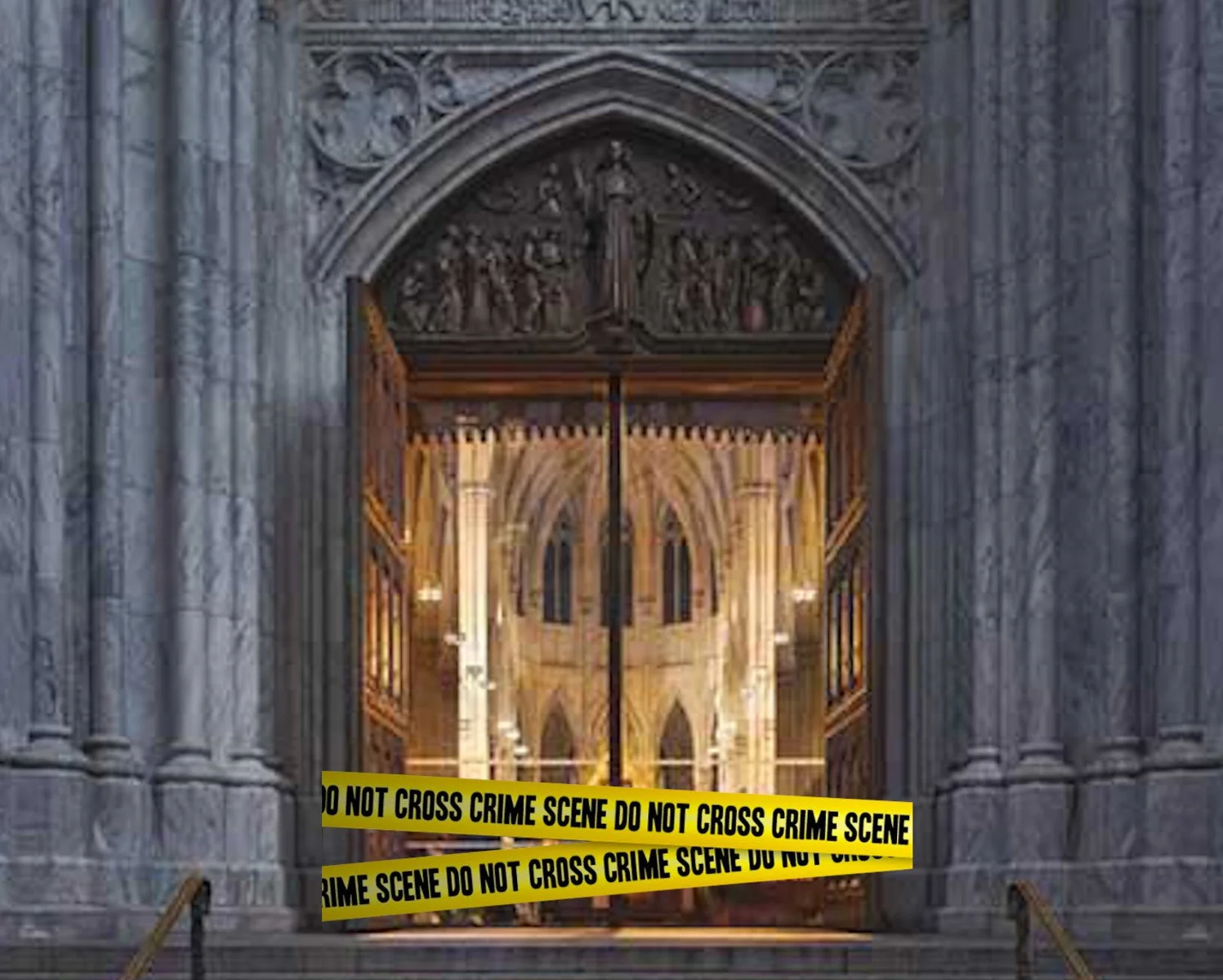
David F Pierre, Jr exposes anti-Catholic hostility and bias masked as support for victims. The goal of Bishop Accountability is to bankrupt and empty the Church.
October 1, 2025 by David F. Pierre, Jr., Editor of The Media Report
Note from Father Gordon MacRae: Late last week Beyond These Stone Walls published at our Voices from Beyond feature an essay by Father Michael P. Orsi, former Research Director at Ave Maria University School of Law. The title of Father Orsi’s brief but brilliant essay, previously published in the Catholic League Journal, Catalyst, is “Bogus Charges Against Priests Abound.”
It is a stunning review of one of the revelatory books by David F. Pierre, Jr. entitled, Catholic Priests Falsely Accused: The Facts, The Fraud, The Stories. Among its content is a bold chapter about the case against me.
Also at Voices from Beyond this week, we feature another very prominent figure in the American Catholic Church who published an equally stunning review of David F. Pierre, Jr.’s latest book, The Greatest Fraud Never Told. The reviewer is Father Peter M.J. Stravinskas, an accomplished theologian and Editor of The Catholic Response. His excellent review was previously published at The Catholic Thing : “At the Mercy of One False Brother.”
Mr. Pierre has graciously acceded to write about the online continuation of a fraud perpetrated against the Church by BishopAccountability.org.
Now here is David F. Pierre, Jr.
+ + +
The web site BishopAccountability.org likes to fashion itself as merely a “public library of information” that curates a vast “database of accused Roman Catholic priests” as it relates to sexual abuse. The site catalogs literally thousands of priests who have been only accused of sexual abuse whether they are alive or long-dead. For this, Bishop Accountability has naturally become a darling of the legacy media which continues to revel in keeping the embers of the “Catholic Church sex abuse story” alive while browbeating the Church for the sins of a small minority of priests from many decades ago.
But there is an evil that consumes the site. And this evil has absolutely nothing to do with the abuse of children.
For starters, there is little semblance of fairness or due process at Bishop Accountability. A visitor could easily conclude that the thousands of priests profiled on the site must be “guilty of something” for them to even be listed there. Indeed, that is really the whole purpose of the site: to suggest guilt by association. Only after a series of clicks can a visitor find the site’s “posting policy,” which could be paraphrased as such: “If a priest has been publicly accused of abuse at any time, we will plaster his name, photo, and history here for all of the world to see.”
Bishop Accountability’s False Promise
What about the priests who are clearly innocent, you ask? Well, by its very own admission, guilt or innocence plays no role whatsoever on whether or not a priest is profiled on its site. Here is one exception that Bishop Accountability has made:
“If a survivor publicly withdraws an allegation, recants, or states that the alleged perpetrator has been misidentified, and if there are no other allegations of abuse against the accused cleric, that cleric is removed from the database.”
Interesting that Bishop Accountability still identifies a fraudster who has recanted his allegation as a “survivor.” This makes no sense at all, of course. Indeed, if there is any “survivor” in a false accusation, it would be the falsely accused priest himself who has “survived” the ordeal and had his life ruined. But Bishop Accountability does not see it that way. In short, Bishop Accountability will post the identity and photo of any priest accused of anything sex abuse related, no matter how old, wacky, or implausible the accusations are.
Take the case of Diocese of Charleston Bishop Robert Guglielmone from a few years back. In 2019, a man openly admitted to a family member that he made up an abuse claim against Guglielmone in order to extract money from the Church. The man even blithely stated, “It’s worth a try.” The entire accusation was completely bogus and ridiculous, yet Bishop Guglielmone, who swiftly returned to ministry after the truth surfaced, is still listed on Bishop Accountability — along with his photo, of course — as if he were a convicted child molester.
And although Bishop Accountability claims that it will not post the profiles of priests whose accusers have recanted, this itself is not even true. Rev. John M. Costello, a Jesuit priest in the Diocese of Rochester, had his entire life upended in 2003 after a former student claimed that he had abused him some two decades earlier. However, after investigators began to scrutinize the chap’s claim, the accuser recanted and told investigators that “another priest,” not Costello, had abused him. But, defying its very own policy, Bishop Accountability continues to profile Costello on its site for the entire world to see.
Even the Dead Are Fair Game
There is also the legion of cases involving single accusations against long-dead priests. Some readers are old enough to remember a time when one would not dare say anything unproven about a dead person to abide by the truth that “dead people cannot defend themselves.” But when it comes to Catholic priests and Bishop Accountability, they proudly attack the dead and defenseless.
Just a couple of years ago, in 2023, a man contacted the Diocese of Albany to claim that Fr. J. Gregory Mulhall “physically assaulted” him as a “vulnerable adult" many decades earlier. What did Fr. Mulhall have to say about this? Well, not much, as he had died at age 90 over two decades earlier, in 2001. (Mulhall was ordained in 1937, when Franklin Delano Roosevelt was President.) Fr. Mulhall’s surviving friends and family members are naturally none too happy about him being publicly profiled as if he were a convicted child predator.
Another dead priest who would probably want to respond to an accusation against him if he were alive is Fr. Gregory Flohr, who died in 2004. Flohr did not have a single blemish against him in over four decades in ministry. It was not until many years after Flohr died that an anonymous male accuser saw the possibility of a large cash windfall and came forward to lodge a bizarre claim against Flohr that no reasonable person would ever believe. Yet Fr. Flohr is still included in Bishop Accountability’s “database” even though he is obviously unable to defend himself.
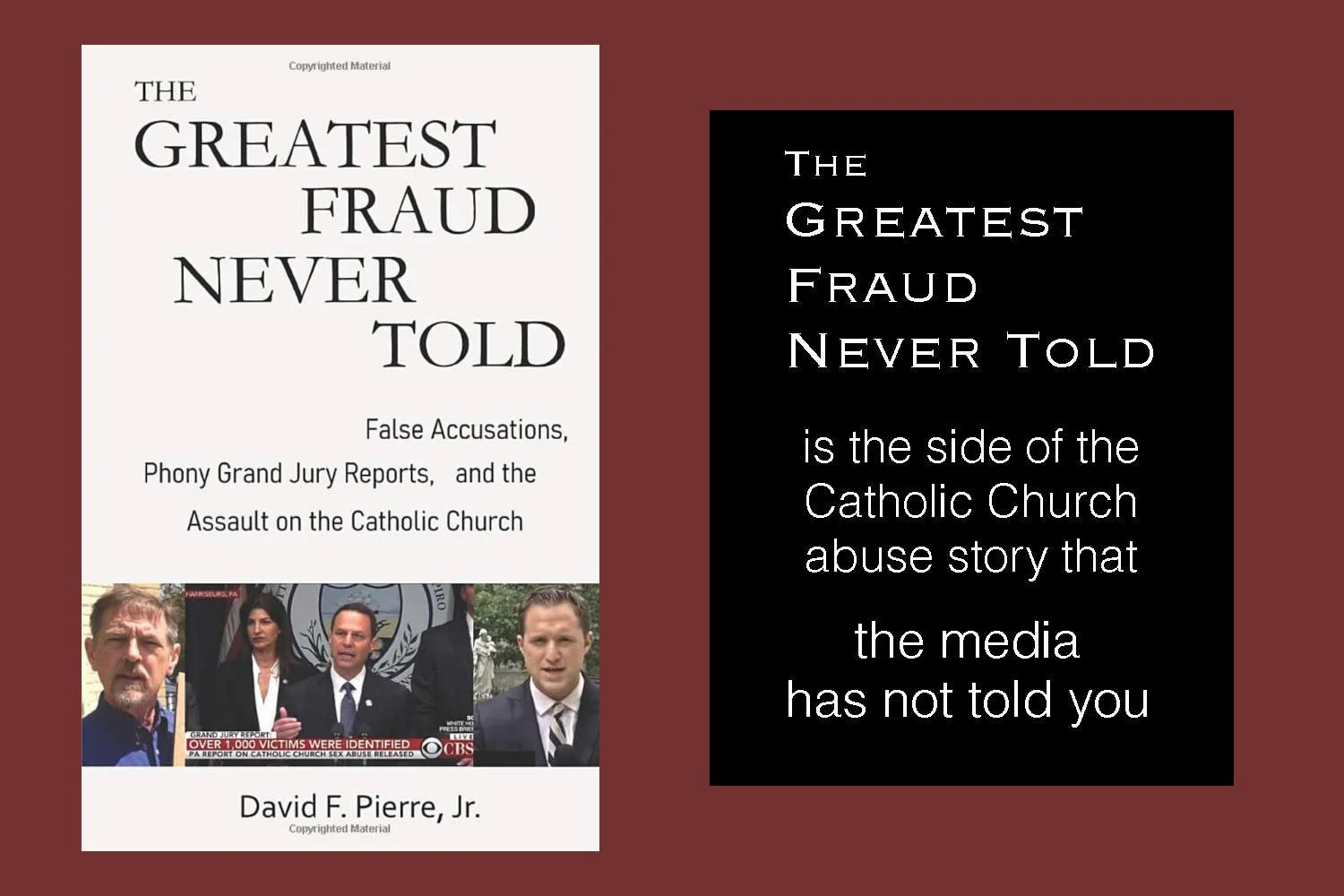
The Surprising Truth About Falsely Accused Priests
It is now an undeniable fact that false accusations against Catholic priests are rampant. In recent years as little as 6% of historical abuse claims against priests have even been deemed “substantiated” by the very lenient standards of diocesan review boards, with the majority of accusations deemed either “unsubstantiated” (indeed false), “unable to be proven,” or still under review.
In 2021, in a church of 70 million people in the United States, 44 current minors came forward alleging that a current priest had recently abused them. However, only four of these 44 were ever found to even be “substantiated,” while the remaining 40 (or 91% (!)) were found to be completely bogus.
Why is there a rampancy of false accusations? That answer is easy. Easy money. For the past two-and-a-half decades, the Church has been shoveling out cash to accusers and their tort lawyers like an ATM on tilt, and grifters have long taken notice. As Fr. Gordon MacRae himself chronicled two decades ago, an East-coast attorney confirmed as far back as 2001 that accusing a Catholic priest of sex abuse was a “current and popular scam” among criminals in prison looking for an easy cash payout. And, yes, this hustle still continues to this day.
Meanwhile, states like California and New York have made it easy for flimflammers to get in on the action by repeatedly enacting “window legislation” that temporarily suspends the statute of limitations and allows any fraudster or con artist to sue the Catholic Church for big bucks, no matter how long ago or crazy the abuse claim. Statutes of limitation, due process, and fairness have been discarded in order to line the pockets of tort lawyers and fleece the Catholic Church.
A couple of years ago, Thomas R. Hampson of Illinois, a 40-year veteran investigator with thousands of sex abuse investigations, wrote of what he witnessed in the Archdiocese of Chicago:
“There were priests who were falsely accused of abuse but the archdiocese settled anyway. I know they were false accusations because the stories were outrageous. No details. Implausible circumstances. And a reaction that wasn’t believable. Even in a civil trial these cases could not prove by a preponderance of the evidence that anything actually happened, much less that the accused was the one who did it. In most of those cases the priest was already dead.”
Hampson also added that in the current-day fever swamp in which people must “believe the accusers,” the principle of innocent until proven guilty has been abandoned such that the investigators are looking merely for confirmation of the accused’s guilt.
And what has been the end result of all this? The coffers of the Catholic Church have been drained by literally billions of dollars, robbing it of resources to build the faith and serve the poor.
The Sheer Evil of It All
Bishop Accountability claims that its site is dedicated to “the victims and their families and loved ones.” The reality could not be further from the truth.
There is a kind of underlying spiritual aura to Bishop Accountability that cannot be ignored. And that spirit is evil. Satan, along with his demon partners, hate the Catholic Church and everything it stands for, which is truth. Satan’s rage against Christ and the Catholic Church is eternal and continues today. Writer Thomas J. Nash has recently written about this reality:
“Satan and his demonic minions are irredeemably opposed to the truth. They hate the truth. More to the point, they hate him who is ‘the way, and the truth, and the life,’ our Lord Jesus Christ (John 14:6) … Consequently, Satan and his demonic minions really hate the sacrifice of the Mass and Eucharistic Adoration in general because they are daily reminders of Christ overcoming them and their infernal kingdom through the Cross.”
One of Satan’s great successes in recent years is perpetuating the lie that the priesthood of the Catholic Church is an irredeemable den of sexual immorality and corruption. Much of the recent breakdown in the fabric of Western civilization over the last 25 or 30 years can be directly tied to the nonstop media campaign against the Catholic Church tied to the sex abuse issue and the resulting silence of the hierarchy in opposing the many social initiatives that have brought so much harm to our societies. It has also torn God’s people away from the Eucharist, the Mass, and the Catholic Church itself.
In trampling on the rights of innocent priests, defaming the dead, and trafficking in innuendo, there is little doubt that Bishop Accountability has been a great asset to Satan in his battle against the Catholic Church.
+ + +
David F. Pierre, Jr. is the country’s leading observer of the media’s coverage of the Catholic Church abuse narrative and is the author of four acclaimed books, the most recent of which is The Greatest Fraud Never Told: False Accusations, Phony Grand Jury Reports, and the Assault on the Catholic Church (Amazon.com).
David is also the creator and author of TheMediaReport.com, an educational cooperative to chronicle and monitor the mainstream media’s coverage of the Catholic Church sex abuse narrative.
Please also check out TheMediaReport.com’s important posts on the case of Fr. MacRae: *EXCLUSIVE REPORT* Alarming New Evidence May Exonerate Imprisoned Priest
The Wall Street Journal Again Profiles Case of Fr Gordon MacRae
The Eucharistic Adoration Chapel established by Saint Maximilian Kolbe was inaugurated at the outbreak of World War II. It was restored as a Chapel of Adoration in September, 2018, the commemoration of the date that the war began. It is now part of the World Center of Prayer for Peace. The live internet feed of the Adoration Chapel at Niepokalanow — sponsored by EWTN — was established just a few weeks before we discovered it and began to include in at Beyond These Stone Walls. Click “Watch on YouTube” in the lower left corner to see how many people around the world are present there with you. The number appears below the symbol for EWTN.
Click or tap here to proceed to the Adoration Chapel.
The following is a translation from the Polish in the image above: “Eighth Star in the Crown of Mary Queen of Peace” “Chapel of Perpetual Adoration of the Blessed Sacrament at Niepokalanow. World Center of Prayer for Peace.” “On September 1, 2018, the World Center of Prayer for Peace in Niepokalanow was opened. It would be difficult to find a more expressive reference to the need for constant prayer for peace than the anniversary of the outbreak of World War II.”
For the Catholic theology behind this image, visit my post, “The Ark of the Covenant and the Mother of God.”
Pray, Hope and Don’t Worry: This Is Padre Pio’s Key to God’s Heart
Inspired by Padre Pio’s surrender to sacrificial suffering, this unjustly imprisoned priest has had another encounter with Padre Pio, one subtle but profound.
Inspired by Padre Pio’s surrender to sacrificial suffering, this unjustly imprisoned priest has had another encounter with Padre Pio, one subtle but profound.
September 23, 2025 by Fr. Gordon MacRae
I write this week in honor of Saint Pio of Pietrelcina, more popularly known as Padre Pio. He is one of the two Patron Saints of Beyond These Stone Walls and one who has had a living presence in my life behind these walls. The other, of course, is Saint Maximilian Kolbe. Pornchai Moontri and I share a somewhat mystical connection with both. A little time spent at “Our Patron Saints” in the BTSW Public Library might demonstrate how they have come to our spiritual aid in the darkest times of our lives here.
Though they were 20th Century contemporaries, Padre Pio and Maximilian Kolbe did not know each other except by reputation. Among the many letters of Padre Pio to pilgrims who wrote to him are several in which he urged suffering souls to enroll in the Militia Immaculata and Knights at the Foot of the Cross, the two spiritual movements founded by Maximilian Kolbe. I stumbled upon this connection after Pornchai Moontri and I enrolled in both. It is ironic that both saints were canonized by another saint. The lives of St. Padre Pio, St. Maximilian and St. John Paul II were lived with heroic virtue even as they suffered. I wrote of the latter two in another post that touched the hearts of many: “A Tale of Two Priests: Maximilian Kolbe and John Paul II.”
Padre Pio also had a global reputation for doing remarkable things, but he did them in the midst of remarkable suffering. After bearing the wounds of Christ for a half century he passed from this life on September 23, 1968, the date upon which the Church now honors him. On that same date, 26 years later, I was wrongly convicted and sent to prison for life after having tossed aside three chances to save myself and my freedom with a lie.
Since that day, September 23, 1994, Padre Pio has injected himself into my life in profoundly grace-filled ways. I have written of these encounters in multiple posts, but the two that seem to stand out the most are “Padre Pio: Witness for the Defense of Wounded Souls” and one that delves into the deeper mysteries of his life and death, “‘I Am a Mystery to Myself.’ The Last Days of Padre Pio.” We will link to them again at the end of this post and invite you to read them in his honor this week.

Agony in the Garden of Gethsemane
As long as our lives are tied to this world, we will never resolve the mystery of suffering. Like so many of you, I, too, have been confronted with the paradox of suffering. We are trapped in it because, unlike God, we live a linear existence. We see only what has come before and what is now, but we can only imagine what is to come.
But God lives in the '“nunc stans,” the “eternal now” seeing all at once our past, present, and future. Some believers expect God to be the Director of the play that is our lives, but He is more a participant than a director. He allows suffering as a means toward a specific end, but the end is His and not necessarily ours. In my post, “Waking Up in the Garden of Gethsemane,” Jesus discovers that the very first of his suffering is that he is inflicted with a human heart. He asks God to take away the great suffering that is to come, “but Thy will be done.” It is an aspect of the truth of the Resurrection that Jesus brought both His Divinity and the human heart with him when He opened the Kingdom of Heaven to us.
I have encountered this same paradox about suffering, and did so again on the night before writing this post. It comes in the night as a nagging litany of “What-Ifs.” It consists of a series of inflection points, points at which, in my own history, my current state in life could have been avoided had I turned left instead of right. I have identified about five such times and places in my life when a different decision would likely have prevented all the unseen suffering that was to follow.
But “What-Ifs” are spiritually unproductive. They deny the sacrificial nature of at least some of what we suffer and they disregard the plan God has for our souls. During my most recent nighttime Litany of “What-Ifs,” I was reminded of that prayer by St. John Henry Newman that I wrote about in “Divine Mercy in a Time of Spiritual Warfare”:
“God has created me to do Him some definite service. He has committed some work to me which he has not committed to another. I have my mission. I may never know it in this life, but I shall be told it in the next …”
— St. John Henry Newman
I do not have the gift of foresight, but my hindsight is clear. Had I allowed myself to take any of those five alternate steps that I have been reminiscing about, then the work committed to me and no other could not have taken place, and a life and soul may have been lost forever. That life and soul became important to me, but only because it was a work God committed to me and no one else. It was the life and soul of my friend, Pornchai Moontri whom God has clearly called out of darkness. It is my great honor to have been an instrument of the immense grace that transformed Pornchai, but to be such an instrument means never to ask, ”What was in it for me?”
So, if given the chance now, would I trade Pornchai’s life, freedom, and soul to erase the last three decades of my own unjust imprisonment and vilification? Our Lord answered that question with one of his own: “What father among you would give his son a stone if he asks for bread?” (Matthew 7:10). This verse is followed just a few verses further by one that I wrote about in “To the Kingdom of Heaven Through a Narrow Gate”:
“Enter through the narrow gate, for the gate is wide and the road is easy that leads to destruction, and there are many who take it. For the gate is narrow and the road is hard that leads to life, and there are few who find it.”
— Matthew 7:13-14
I could not have foreseen any meaning in what I suffered during my own agony in the garden. Such clarity is only in hindsight. Being sent to prison on false charges seemed to me the worst thing that could ever happen to a person — certainly the worst that could ever happen to a priest because a priest in such a circumstance is almost equally reviled by both Church and State. But today, when recognition of the alternative dawned — recognition that the life and soul of my friend would have been lost forever — I find that I can bear this suffering. I do not choose it. It chose me.

When Padre Pio Stepped In
The story of how Padre Pio stepped into my life as a priest and prisoner came also through Pornchai Moontri. Like Padre Pio himself, I had been shunned and vilified by Catholic activists in groups like SNAP and Voice of the “Faithful.” Out of fear, many other priests and Church officials joined in that shunning during my first decade in prison. The police, the courts, the news media, and the rumor mill in my diocese all amounted to a perfect storm that I was powerless to overcome. In 2002, the storm became a hurricane, first in Boston, then in New Hampshire and from there across the country.
In 2005, The Wall Street Journal’s explosive 2-part publication of “A Priest’s Story” altered the landscape. After it was published, Catholic League President Bill Donohue reached out to me with an invitation to write an article for the Catholic League Journal, Catalyst. My article, “Sex Abuse and Signs of Fraud” was published in the November 2005 issue.
When I received that month’s issue, I was more stricken by its front-page revelation than with my own centerpiece article. It was “Padre Pio Defamed.” I was shocked to learn, for the first time, that Padre Pio suffered more than the visible wounds of the crucified Christ. He also suffered a cascade of slander from both secular and Church officials with wild suspicions and accusations that he sexually abused women in the confessional resulting in multiple Church investigations and even the suspension of his priestly faculties. In 1952, the Congregation of the Holy Office placed in its Index of Forbidden Books all books about Padre Pio.
Heaven can be most forgiving. The bishop who suspended the priestly faculties of Padre Pio based on the rapid spread of false information was Bishop Albino Luciani. Just a few years ago after a miracle attributed to his intercession was confirmed, he was beatified as Blessed Pope John Paul I.
It is ironic — not to mention boldly courageous — that Pope John Paul II canonized Padre Pio in 2002 at the height of media vitriol during the clergy abuse scandal in the United States. One of the last investigations against Padre Pio was a 1960 report lodged by Father Carlo Maccari alleging, with no evidence, that Padre Pio had sexual liaisons with female penitents twice per week.
In the same month my Catalyst article was published, Tylor Cabot joined the slander in the November 2005 issue of Atlantic Monthly with “The Rocky Road to Sainthood.” He wrote, “despite questions raised by two papal emissaries — and despite reported evidence that [Padre Pio] raised money for right-wing religious groups and had sex with penitents — Pio was canonized in 2002.”
Fr. Maccari’s original slander also found its way into The New York Times. Maccari went on to become an archbishop. On his deathbed, Maccari recanted his story as a monstrous lie born of jealousy. He prayed on his deathbed for the intercession of Padre Pio, the victim of his slander.

A Heaven-Sent Blessing from Padre Pio
Also in November of 2005, Pornchai Moontri arrived in this prison after his experience of all the events I described in “Getting Away with Murder on the Island of Guam.” Maximilian Kolbe and Padre Pio teamed up to reverse in him a road to destruction in ways that I was powerless to even imagine. A few years later, in 2009, this blog was born and some of my earliest posts were about what Padre Pio and Maximilian Kolbe suffered in life on the road to becoming the spiritual advocates they have been for us and millions of others. Just after I wrote about Padre Pio for the first time, I received a letter from Pierre Matthews from Ostend, Belgium who had been writing to me since reading of me in The Wall Street Journal.
Learning of my faith despite false charges and imprisonment became for Pierre the occasion for his return to faith and the Church after a long European lapse. When he read my early posts about the plight of Padre Pio, Pierre excitedly told me of a mystical encounter he had with Padre Pio as a young man. A letter from his father to him at his boarding school in Italy instructed him to go to San Giovanni Rotondo to ask for the blessing of the famous stigmatic, Padre Pio.
When 16-year-old Pierre got there, a friar answering the door told him this was impossible. He then gave Pierre a blessed holy card and ushered him toward the door. Just then, while inside the cavernous Capuchin Friary, an old man with bandaged hands came slowly down a flight of stairs and walked directly to the surprised teenager. Padre Pio held Pierre there firmly with his bandaged hands upon his head while he spoke aloud a blessing and prayer. Pierre was stunned, and never forgot it.
Sixty years later, Pierre had a dream that this blessing from Padre Pio was for us, and he wanted to pass it on. He insisted that he must be permitted to become Pornchai Moontri’s Godfather when Pornchai was received into the Church on Divine Mercy Sunday, 2010.
Pierre left this life in 2020 just as Pornchai was undergoing his deportation to Thailand, his emergence from prison and the start of a new life. To this day, we both hold Padre Pio in awe as a mentor and friend. Thanks to the intercession of Pierre Matthews, Pornchai’s Godfather, Padre Pio gave us spiritual hope when there was none in sight. His advice is profoundly simple and characteristically blunt:
“Pray, hope, and don’t worry. Prayer is the key to God’s heart.”
The key to our hearts, Pornchai Moontri’s and my own, was given to us by Pierre Matthews. Just weeks before his own death in 2021, the elderly Pierre ventured on another pilgrimage from his home in Ostend, Belgium to the Shrine of Padre Pio at San Giovanni Rotondo in Italy, the second most visited Catholic shrine in all the world. A photograph was taken of Pierre before the crypt of Saint Padre Pio. Pierre sent the photo to me in prison. It was the last time I heard from him in this life.
As I was preparing this post, I searched for that photo. Over a week’s time I tore my prison cell apart searching more diligently than any of the guards have ever searched. In dismay, I gave up and prepared to send this post to our Editor. Then I reached for a book that caught my eye at the last minute. When I flipped through its pages, the photo was in the book. Now it is atop this post, and I swear that I could hear Pierre and Padre Pio laughing.
+ + +
Note from Fr. Gordon MacRae: Thank you for reading. Please share this post so it may come before someone who needs it. And please Subscribe if you have not done so already. You may also like these related posts from Beyond These Stone Walls.
“I Am a Mystery to Myself.” The Last Days of Padre Pio
Padre Pio: Witness for the Defense of Wounded Souls
A Tale of Two Priests: Maximilian Kolbe and John Paul II
On the Day of Padre Pio, My Best Friend Was Stigmatized
