
Voices from Beyond
Bogus Charges Against Priests Abound
This review by Rev. Michael P. Orsi, a Research Fellow in Law and Religion at Ave Maria School of Law first appeared in the Catholic League Journal, Catalyst.
This review by Rev. Michael P. Orsi, a Research Fellow in Law and Religion at Ave Maria School of Law first appeared in the Catholic League Journal, Catalyst.
March 2012 by Rev. Michael P. Orsi | Catalyst
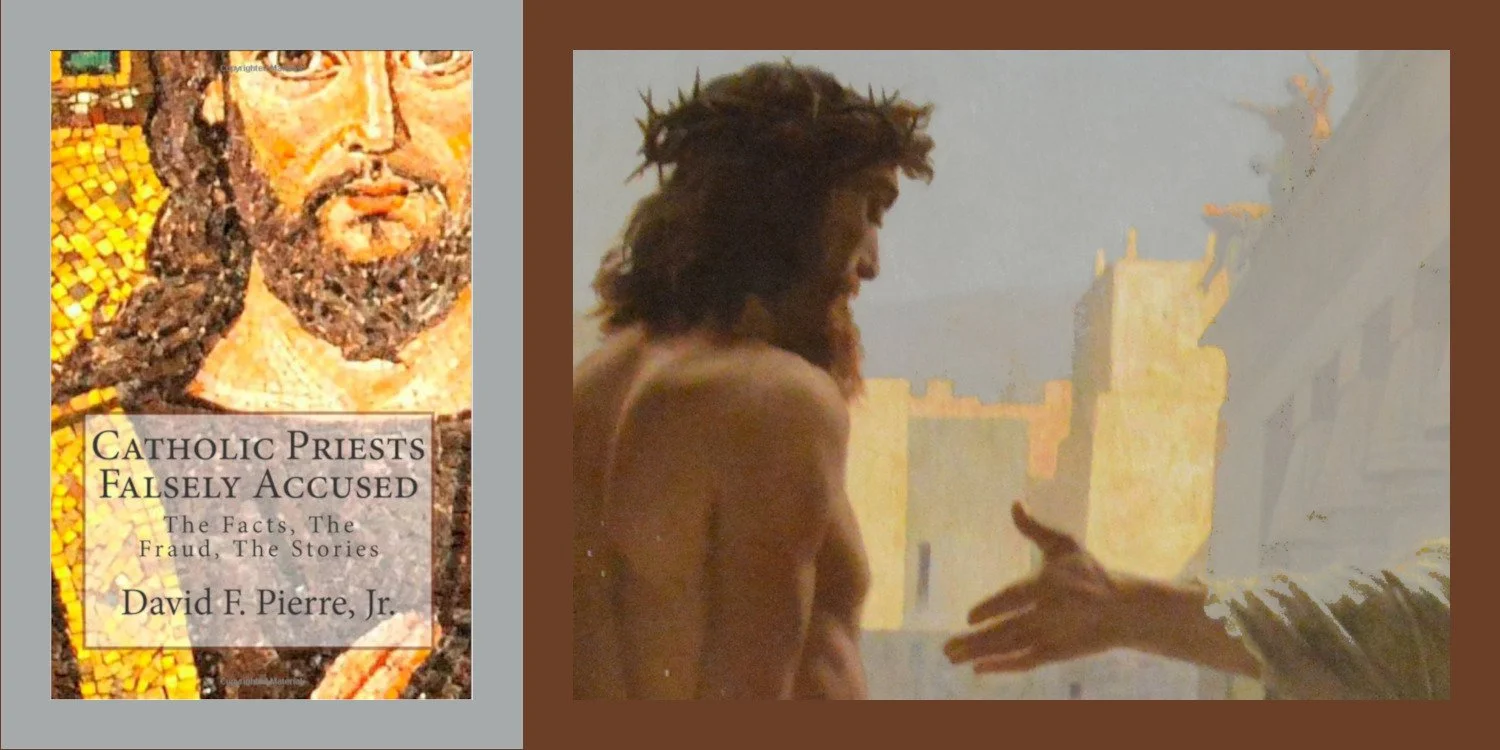
Catholic Priests Falsely Accused: The Facts, The Fraud, The Stories by David F. Pierre, Jr. of TheMediaReport.com.
David Pierre is one of the country’s leading observers of the Catholic Church abuse narrative. In Catholic Priests Falsely Accused: The Facts, the Fraud, the Stories, he presents case studies backed by hard data which clearly demonstrates some of the injustices foisted on Catholic priests and the Church.
The Survivors Network of those Abused by Priests (SNAP) is identified by Pierre as a major culprit in advancing the destruction of innocent priests. He outlines the methods used by the group to manipulate clergy abuse charges and how they play the media. The organization, he says, provides talking points and staging tips for accusers and their attorneys at the workshops they hold at their yearly conference. SNAP’s tactics, he says, have grossly exaggerated the clergy abuse problem in the Church. He contends, that with data garnered by expert crime investigators, it is not unreasonable for an observer to deduce that “approximately one third” of all accusations against Catholic priests are entirely false or greatly exaggerated.
It is important for Church officials to challenge and, if need be, litigate every accusation. The results of these investigations should be publicized. And, if the allegations prove to be false, the name of the accuser, if an adult, should be made public. Not to do so lets the lies live on and continue to undermine the Body of Christ. “According to a sworn declaration submitted to the Los Angeles County Superior Court in November of 2010,” Pierre writes, “attorney Donald Steier claimed, ‘One retired F.B.I. agent who worked with me to investigate many claims in the Clergy Cases told me, in his opinion, about ONE-Half of the claims made in the Clergy Cases were either entirely false [or] greatly exaggerated.’”
Other culprits identified by Pierre adding to the abuse frenzy are plaintiffs’ attorneys and Church insurance carriers. Attorney fees, which are usually up to forty percent on a settlement have made pursuing allegations, even false ones, very lucrative for this new breed of ambulance chasers. These attorneys realize that many claims will be settled out of court because insurers and the Church would rather pay out “large-scale blanket settlements” than go to trial where litigation costs will be exorbitant. They also fear losing a case due to a jury prejudiced against the Church or sympathetic to those claiming victim status. This may, in fact, incur greater putative and compensatory damages.
Dubious claims of the widely discredited psychological theory of “repressed memories,” have been used to put priests at a significant disadvantage in obtaining justice. In these cases, individuals claim that a priest molested them years earlier and assert that they repressed the memory due to the trauma. The alleged incident is often recalled, Pierre says, “through the suggestive questioning of an unprincipled therapist and, often under hypnosis.” Naturally, hypnosis leaves people open to the power of suggestion. Many experts believe that repressed memory is simply bogus. Dr. James McGaugh, from the University of California, Irvine, an expert in the area of memory, states, “I do not believe there is such a thing as a repressed memory… And there’s absolutely no proof that it can happen. Zero. None. Niente.” Dr. Richard J. McNally, Director of Clinical Training in the Department of Psychology at Harvard University claims, repressed memory therapy is “the worst catastrophe to befall the mental health field since the lobotomy era.”
Regarding Diocesan Review Boards, Pierre says, “they are very often composed of individuals who have profound sympathy for victims of abuse. These panels consist of child welfare advocates, social workers, therapists, child psychologists,” as well as “individuals who were actual victims of clergy abuse.” Perhaps this is why these boards tend to be less than sympathetic to accused priests. Another reason for these review boards’ bias may be the “credible” evidence standard that they use when determining whether a priest should be put on Administrative Leave. “When an accuser comes forward to allege abuse from decades earlier,” Pierre writes, “one can deem the accusation ‘credible’ simply because the accuser can show that he or she lived at a given time in the same general geographical area of a priest.”
Media bias needs to be met with the facts. For example, Pierre says, a book by Marci A. Hamilton ─ a professor at the Cardozo School of Law at Yeshiva University, in New York City ─ entitled, Justice Denied: What America Must do to Protect Its Children (2008), excoriates the Catholic Church for its handling of the abuse crisis and accuses the Catholic leaders of orchestrating the sexual abuse of children. Yet, according to legal experts, the book contains “a number of outright falsehoods and misleading passages.” For instance, when attorney L. Martin Nussbaum and his wife, Melissa, reviewed Hamilton’s book for First Things in an article entitled, “MarciWorld” they noted that “Hamilton claimed, that in some states, a child abused at age seven would have only until the age of nine to sue the abuser. That is simply false in all 50 states and the District of Columbia.”
Pierre notes that, “Hamilton has represented SNAP and has done extensive legal work for the organization.” She is also, according to Pierre, closely associated with the Philadelphia district Attorney’s Office, which Pierre shows to have a particular animus toward the Church. He says, “the Philadelphia D.A.’s Office has not targeted any other organization for its past abuses with the same prosecutorial zeal.” Pierre then cites statistics that show public school teachers have a much higher rate of abuse than Catholic priests. Yet, they have escaped the same kind of scrutiny by Hamilton.
Hamilton is a strong advocate of dropping the “statute of limitations” for private institutions under the auspice of “protecting children.” However, Pierre claims, “Hamilton has made it her crusade to lobby state legislatures to remove the statute of limitations in order to inflict maximum financial and institutional damage to the Catholic Church.” Alarmingly, Pierre points out that, “public schools have a special immunity from being sued.” As a government entity, they are shielded by the doctrine of “sovereign immunity,” which only allows an accuser a limited window to make an accusation and limits lawsuit damages, making claims less profitable for attorneys and their clients.
It is important, Pierre believes, to aggressively market the fact that the Catholic Church now has the safest environment in the world for protecting children. Data collected from The Center for Applied Research in the Apostolate (CARA) indicates allegations of abuse of minors to be on average less than 10 per year since 2005 nationwide. The Church’s safeguards and accomplishments need to be widely disseminated by Her authorities and related organizations.
The most troublesome accusations are those leveled against dead priests. Pierre reports that, according to CARA, 43% of all priests accused of abuse in 2010 were deceased. How can the dead defend themselves? The simple solution in many cases for a diocese is to simply pay out. And, unfortunately in some dioceses, the deceased priest’s name is added to a diocesan website listing him as a pedophile or accused of being one. The intangible losses in doing this far exceed the monetary costs. The ruination of a priest’s reputation along with the sorrow that it causes to his family and those whom he had served who have fond memories of him ─ giving them their First Holy Communion, presiding over their marriage, or offering them advice and consolation in times of need ─ is a source of great discouragement among the faithful.
There is an old cliché, “the best defense is a good offense.” Church officials have been too reluctant to expose the lies about priests, the obvious anti-Catholic bias in the media, the greed and the anti-Catholicism of some in public office which feeds the abuse crisis. This has caused a decline in clergy morale and vocations to the priesthood. Large monetary settlements have hindered Catholic evangelization and charitable work and have led to the bankruptcy of some dioceses. But, worst of all, it has also caused a loss of confidence by many Catholics in the institutional Church.
A sure way to ameliorate the injustices perpetrated against priests and to rehabilitate the reputation of the Church would be to re-examine the cases of those priests found guilty due to false or dubious abuse claims filed against them. The widely reported case of Fr. Gordon MacRae, of the Diocese of Manchester, New Hampshire, would be a good place to start. Pierre outlines it in his book. It is quite obvious that Fr. MacRae did not receive a fair trial according to the facts cited in a piece published in The Wall Street Journal. MacRae’s accuser, a fifteen year old boy, had a lengthy juvenile record and presented doubtful evidence in trial testimony. The judge even went so far as to order the jury to “disregard inconsistencies in Mr. Grover’s (his accuser) testimony.” Father MacRae, protesting his innocence, refused a plea bargain deal of two years in prison. Now he is serving a 67 year sentence. His own, now retired, bishop believes him to be innocent. What a moral boost this would be for the nation’s priests and for the Catholic laity if the Church in New Hampshire began a petition drive to have this case reopened!
In a chapter entitled, “Kathy Told a Story,” Pierre chronicles the tale of an Irish woman, Kathy O’Beirne, who wrote of the abuse she sustained at one of Ireland’s institutions that cared for young women, the Magdalene Home. She reports being severely abused by nuns and having been raped by a priest. “Her chronicle,” says Pierre, “enthralled readers.” It received rave reviews and achieved bestseller status. Except, the woman’s siblings claim “Our sister was not in the Magdalene Home… Our sister has a self-admitted psychiatric and criminal history, and her perception of reality has always been flawed.” A further investigation revealed Kathy’s book to be a fraud. Nevertheless, this book continues to secure five star reviews in Amazon.com’s U.K. site and has respectable sales in England and Ireland.
If the late Paul Harvey were able to comment on this book, he would have certainly said, “And now the rest of the story.” This book is concise, easy to read, filled with verifiable data, and points out the problems with both the ecclesiastical and civil responses to the clergy abuse crisis.
Father Orsi is Chaplain and Research Fellow in Law and Religion at Ave Maria School of Law.
+ + +
This ground-breaking book by David F. Pierre, Jr. was also reviewed at Beyond These Stone Walls: The Media Report: Catholic Priests Falsely Accused.
Tainted Judge Nixes Trump’s Citizenship Order

July 11, 2025 by William A. Donohue, Ph.D., President of the Catholic League
Anyone who has been following the ordeal of Father Gordon MacRae, the falsely accused priest who has been imprisoned in New Hampshire since 1994, is aware of the injustice he has had to endure. One of the persons who has contributed to this injustice is U.S. District Judge Joseph Laplante.
He is back in the news for halting President Trump’s executive order on birthright citizenship. He has given the president one week to appeal his decision.
To understand why the Catholic League believes this judge is morally delinquent, read the account by Detective Ryan MacDonald on how Laplante put the screws to Father MacRae.

Catholic Assessment of Kamala Harris
Catholic League President Bill Donohue represents the largest religious freedom organization in the nation. Here he assesses presidential nominee Kamala Harris.

Catholic League President Bill Donohue represents the largest religious freedom organization in the nation. Here he assesses presidential nominee Kamala Harris.
by William Donohue, Ph.D., President of the Catholic League
There are many ways to assess any public person. My interest here is to assess Kamala Harris from a Catholic perspective. issuing an abbreviated rendition of this article at the end of July, the last news release I wrote about Harris was in May. It was occasioned by her foul mouth. Everyone concedes that politicians of all stripes are known to curse, but they typically do so among themselves, or at private events. Not her.
On May 13, with the cameras rolling, she spoke at an Asian American organization, saying, “We have to know that sometimes people will open the door for you and leave it open. Sometimes they won’t, and then you need to kick that f**king door down.” She then descended into her proverbial cackle.
Why the obscenity in a public forum? She is the Vice President of the United States. Nice role model for young minority girls.
Sometimes Harris says things that embarrasses her family. Her father, who is from Jamaica, took umbrage at a comment she made suggesting that Jamaicans are all a bunch of potheads.
In 2019, Harris was asked on a radio talk show if she supported legalizing marijuana. She responded, “Half my family’s from Jamaica. Are you kidding me?”
Her father, Donald Harris, quickly rebuked her, saying his grandmothers and deceased parents “must be turning over in their graves right now to see their family name, reputation and proud Jamaican identity being connected, in any way, jokingly or not with the fraudulent stereotype of a pot-smoking joy seeker and in pursuit of identity politics. Speaking for myself and my immediate Jamaican family, we wish to categorically dissociate ourselves from this travesty.”
Harris not only makes offensive comments, her feminist views are so extreme that she reflexively sides with women who accuse men of sexual harassment.
When Brett Kavanaugh was being considered for a seat on the Supreme Court, he was accused by Christine Blasey Ford of sexually assaulting her when they were teenagers. But under stiff questioning, her account fell apart. In March 2024, the Washington Examiner ran a piece that said it all. “Half a Decade Later, Christine Blasey Ford Still Has No Corroborating Witness.”
At the time, Harris sat on the Senate Judiciary Committee; it was charged with assessing Kavanaugh’s suitability to be on the Supreme Court. Before he uttered one word at the hearing, Harris said of Ford, “I believe her.” After Ford came off as a fraud, Harris stuck to her guns and tweeted that Kavanaugh “lied.”
At least she is consistent. In 2019, when she was a senator, Biden was accused by women of touching them inappropriately. At a presidential campaign event in Nevada, she said, “I believe them.” She even wrote a piece for The Hill that was titled, “Harris: ‘I Believe’ Biden accusers.” Fortunately for her, the media never ask her to explain herself.
Of primary interest to Catholics is Harris’ position on social and cultural issues. Let’s begin by assessing her definition of culture. She spoke about this at the 2023 Essence Festival of Culture in New Orleans.
“Culture is — it is a reflection of our moment and our time. Right? And present culture is the way we express how we’re feeling about the moment and we should always find times to express how we feel about the moment. That is a reflection of joy. Because, you know…it comes in the morning.” She then broke out into a fit of laughter. But she was not done.
“We have to find ways to also express the way we feel about the moment in terms of just having language and a connection to how people are experiencing life. And I think about it that way, too.” No one knew what she was talking about.
Harris may be incoherent in her speeches, but her policy decisions, especially on social and cultural issues, are not in doubt.
On September 13, 2019, I wrote a news release titled, “Kamala Harris’ Lust For Abortion.” Earlier in the year, I said, she defended abortion at any time during pregnancy, right up until birth. She also wanted to force states that restrict abortions to obtain federal approval from the Department of Justice before implementing them.
When Harris was California’s attorney general, she bludgeoned pro-life activist David Daleiden. He used undercover videos to expose how abortion operatives harvest and sell aborted fetal organs. She authorized her office to raid his home: they seized his camera equipment and copies of revealing videos that implicated many of those who work in the abortion industry.
In her role as California AG she also sought to cripple crisis pregnancy centers with draconian regulations. Specifically, she supported a bill that would force these centers to inform clients where they could obtain an abortion. She was sued and lost in the Supreme Court three years later.
Like many other Democrats, Harris is not content to sanction child abuse in the womb. Even when they are born, she is okay with letting those who survive an abortion die.
To be specific, on February 25, 2020, Sen. Harris voted against the Born-Alive Abortion Survivors Protection Act, a bill that would “prohibit a health care practitioner from failing to exercise the proper degree of care in the case of a child who survives an abortion or attempted abortion.” That’s called infanticide.
Harris’ record on abortion and infanticide is at odds with her opposition to the death penalty. When it comes to convicted serial rapists and mass shooters, she wants to spare their lives. In 2019, she was explicitly asked if she opposed the death penalty for acts of treason. She said she did.
There we have it. Harris says that those who endanger the safety of all Americans by attempting a violent overthrow of the government, or spying on the military for a foreign enemy, should have their lives spared, but innocent children who are moments away from being born are not entitled to have their lives spared. And children who survive an abortion, but are in need of medical attention, can be left to die on the table, and no one will be held accountable.
The Democratic Party is the proud party of homosexual activists and transgender radicals.
Harris is so happy to see two people of the same sex “marry” that she actually performed “marriages” between gay couples in 2004. She also opposed Proposition 8, the California initiative barring gay marriage. The people spoke — they voted for it — but she does not believe in “power to the people”: she believes in power to the ruling class (which won in the Supreme Court). No wonder her voting record earned her a perfect score of 100 percent by the anti-women and anti-science gay behemoth, the Human Rights Campaign.
When Florida Gov. Ron DeSantis supported a bill that would prohibit teachers in the early grades, K-3rd grade, from being indoctrinated with gay and transgender propaganda, she opposed it. In doing so she also showed her contempt for parental rights; the bill prohibited efforts to undermine them.
Harris’ enthusiasm for transgender rights includes allowing females who claim to be men to join the military and males who claim to be female to compete against girls and women in sports.
Religious liberty is a First Amendment right, but her deeds suggest she is not supportive of it. She is good at “God talk” — when referring to a specific year she occasionally says “in the year of our Lord.” But talk is cheap. As a U.S. senator, she co-sponsored the “Do No Harm Act” that would force religious institutions to violate their doctrinal prerogatives.
Harris even co-sponsored the most anti-religious liberty bill ever introduced, the Equality Act. It would coerce Catholic doctors and hospitals to perform abortions and to mutilate the genitals of young people seeking to transition to the opposite sex. This bill would sideline the Religious Freedom Restoration Act, a bill passed by Congress and signed by President Bill Clinton ensuring that the government does not encroach on religious rights.
In 2018, the Catholic League was among the first organizations in the nation to protest her attack on a Catholic nominee for a federal district judge post. She badgered Brian Buescher at a hearing, simply because he was a member of the Knights of Columbus, a male entity.
As I pointed out at the time, Harris has never objected to Jewish women groups or the League of Women Voters. Just a Catholic male group. What really got her goat is Buescher’s membership in a Catholic organization that is pro-life and pro-marriage, rightly understood. In other words, she was invoking a religious test for public office, which is unconstitutional.
Not only does Harris harbor an animus against Catholics, she has no respect for separation of church and state. In 2021, she created a video to be played in Virginia black churches urging everyone to vote for Democratic gubernatorial candidate Terry McAuliffe. The video aired in 300 churches for several weeks. Harris starred in it, beckoning congregants to vote for him.
Harris is no friend of the black poor. She has consistently voted against school choice, thus keeping inner-city blacks in their place. If she truly believed in social justice, she would work to see that poor blacks have the same opportunity to send their children to the school of their choice. Instead, she consigns them to schools that no member of the ruling class would ever elect for their own kids.
Her biography explains why she is so insensitive to the black poor. She was raised in a home of privilege, and has lived a privileged life ever since. She has successfully exploited her connections to advance her career, having been anointed most of her posts. She even secured her first job out of law school as a deputy district attorney in Alameda County even though she was not a lawyer (she failed the bar the first time around).
Being a beneficiary of black privilege explains why she is so uncharitable. When she was California attorney general, her 2011-2013 tax returns showed she made $158,000 but did not give a dime to charity. Liberals do not believe they need to have any skin in the game — it’s the job of government to pay for the poor.
Another way the government is supposed to fulfill her social justice agenda is by supporting reparations for slavery. When she was in the senate, she co-sponsored a bill to do just that. In doing so, she put herself in an awkward position. Her ancestors were slavemasters.
Her father, Donald Harris, who is a Stanford professor of economics, said in 2018 that his grandmother was a descendant of Hamilton Brown, who was a plantation and slave owner in northern Jamaica. Brown didn’t own one or two slaves — he owned scores of them. Most of them were brought from Africa, which has a long history of slavery (it still exists today in some countries).
As I said four years ago, “if the average American has to pay X amount for slavery, Harris should at least have to pay 10X. Isn’t that what redistributive justice is all about? Catholics need to know.”

Untying the Knots of Sin in Prison by Marie Meaney
Beyond These Stone Walls is a global blog. These two brief posts were published in France by Marie Meany at Cheminons aves Marie qui défait les nɶuds. What follows is an English translation.

[Editor’s Note: Beyond These Stone Walls is truly a global blog. The latest evidence for its reach is these two brief posts which were written and published in France in 2021 by Marie Meany at the blog Cheminons aves Marie qui défait les nœuds. What follows is an English translation of the original French.]
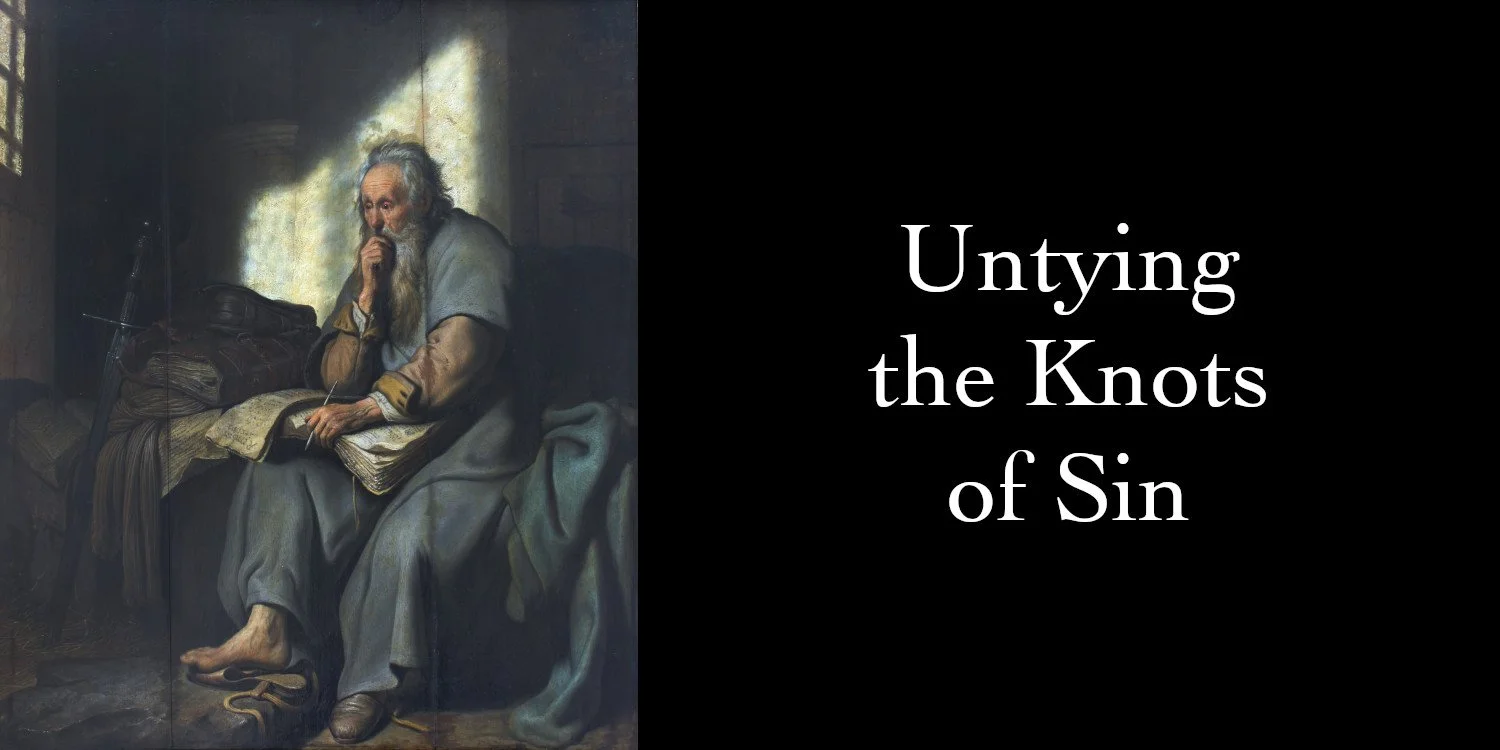
Often, we desperately try to untie the knots in our lives that cause such suffering. Yet these knots, when lovingly accepted, become part of the beautiful tapestry of our lives. From eternity we will see how precious they are in God’s eyes, and frequently much more significant than any successes we experienced. Sometimes God allows us to catch a glimpse of the way He weaves our lives together into a story of salvation. Let me give an example of this.
Father Gordon MacRae
The Catholic priest, Father Gordon MacRae, was falsely condemned on trumped-up charges of sexual abuse in 1994 and has been in prison since then, refusing pretrial deals that would have shortened his sentence to merely one to three years had he been willing to confess to something he hadn’t done. This sad story will be covered at a later point. Though these 25 years in prison caused great suffering to Father Gordon, they have not been wasted. His presence there has changed the hell of prison into a haven of salvation for some of his co-prisoners. One of them is Pornchai Moontri from Thailand who had killed a man in a drunken stupor in 1992 in Bangor, Maine.
Pornchai Moontri
Pornchai was a very angry man, filled with hatred who had spent 6 of his then 14 years in prison in solitary confinement in Maine before Providence led him to the New Hampshire State Prison in 2005 where he encountered Father Gordon. He had been abandoned by his mother at the age of two. When she returned 10 years later with an American husband on September 10th, 1985, this started a new life for him though it would unfortunately turn out to be a life of abuse and much suffering. On that day, Fr. Gordon was present at his uncle’s funeral, a priest who had an important influence on his life. Little did either of them know that some 25 years later, their paths would cross.
As it turned out, Pornchai’s stepfather was cruel and abusive. He raped him and his brother multiple times, and threatened to hurt their mother if they disclosed this abuse. Eventually he ran off at the age of 14, lived on the street, fending for himself, carrying a knife for self-defense that he would use later, when pinned down to the floor after shoplifting. Because he was worried about his mother’s safety, he didn’t dare speak about his own ordeals during his trial and was condemned at the age of 18 for 45 years without parole. None of the mitigating circumstances of Pornchai’s plight were known. Unfortunately, he couldn’t save his mother who was later murdered in Guam by his stepfather, it seems.
It is a strange twist of fate that he who had been sexually abused would be helped by a priest falsely condemned for that crime. Fr. Gordon gained his trust by being kind, not allowing himself to be put off by Pornchai’s anger since he saw beneath it much hurt and pain. Eventually Pornchai’s hell of anger and hatred was transformed into hope, faith and love. “I woke up one day with a future when up to then all I ever had was a past”, he said. On April 10th, 2010, he was baptized and confirmed, and the following day which was Divine Mercy Sunday, he received his first Holy Communion. He has now completed his high-school diploma and taken long-distance classes in Catholic Studies at Catholic Distance University. In another 6 or 8 years, at the end of his prison-sentence, he will be deported to Thailand though he does not remember the language anymore nor does he know anyone there. However, he wants to give his life to Christ and bring others to Him.
“I know today that my life was never what I once thought it was”, Pornchai wrote in 2012. “It was never just a series of accidents and bad events driving me ever deeper to the despair… Instead, I was led down a path to hope because I took the risk of finally trusting someone.” The seeming disasters, failures and even grave sins we commit will only destroy the tapestry of our lives if we take them as the final word. But if we give them over to God, He will turn them into its most beautiful parts, for He knows — to paraphrase the Bible — to weave straight on crooked looms.
Let us pray for Pornchai so that he can fulfill his dream of evangelizing others. And let us also pray to Our Lady Untier of Knots for those unjustly condemned to prison, that they may be freed and, in the meantime, may find their peace in Christ.
Marie Meaney

We live in a time where unspeakable evil is being uncovered within the Church, namely the sexual abuse of minors. However, let us not forget those priests who are unjustly accused, condemned and become victims themselves. The risk is great of engaging in witch-hunts against the innocent in one’s hasty eagerness to punish the guilty.
In our fallen world, we frequently react like a pendulum to what we perceive as wrong in previous modes of behavior and attitudes. We do not realize, however, that we thereby make opposite errors no less bad and beset with consequences just as perilous as the previous ones. Only wisdom and peace of heart, which help us make decisions in truth without becoming a plaything of recent events, can counter this. But these are divine gifts for which we need to beg. To take on a position of prideful self-righteousness, from which we look down upon previous generations with contempt, makes that impossible.
That the past decades have seen a terrible evil in the sexual abuse of the young by clerics is true. This was further aggravated by their superiors who closed their eyes to it in a false worry to protect the Church from scandal and a twisted concern for their priests; for authentic love seeks truth and healing, not a protection that constitutes an enabling to continue on their path of abuse with all the deep wounds that entails for others as well as on their own souls. The uncovering of this abuse was long in coming and urgently needed. For wounds to heal, the abuse must be acknowledged, the perpetrators punished, forgiveness must be asked (whether it is accepted or not), the situation must be remedied and future occurrences prevented as far as possible.
However, as with all things human, during this process the danger is real that those who either have some monetary or political interests, those who are driven by mental illness or those whose hurt drives them on, persecute the innocent. This seems the case with Cardinal Pell in Australia recently or with Fr. Gordon McRae on whom I will focus in this article, who was condemned to prison for 67 years in the mid-90ies on some allegedly trumped-up charges. For 25 years, Fr. Gordon has already been in prison for crimes, it appears, he never committed, but this presence there has brought about the conversion of some of the other prisoners. Ironically enough, one of them, Pornchai Moontri on whom I wrote an article in June and whose Calvary had started with sexual abuse at the hands of his stepfather, was saved by a priest falsely accused of this crime.
Fr. Gordon had taken care of troubled inner-city kids from broken homes and thus was an easy target for drug-addicts who wanted to get some easy money by accusing him falsely. His case has been taken up by people like Dorothy Rabinowitz, a Pulitzer-prize-winning journalist from The Wall Street Journal or William Donahue, President of the Catholic League for Religious & Civil Rights, and the National Center for Reason and Justice. Father Gordon had everything to gain from admitting to the abuse he is accused of — for he could have struck a deal multiple times that would have gotten him out of prison within one to three years — and everything to lose from sticking to the truth. But he will not cave in and in the mean time has started with a blog that is run by a friend outside of prison. I can only encourage you to read it, for it is inspiring.
The inconsistencies and improbabilities of the accusations are so glaring, it is hard to believe that Fr. Gordon could have been condemned — but then again, “There is no segment of the American population with less civil liberties protection than the average American Catholic priest” as William Donohue, President of the above-mentioned Catholic League for Religious & Civil Rights, asserted (NBC’s “TODAY,” 10/13/05.). The abuse is supposed to have happened in one of the busiest places of Keene, New Hampshire, in the light of day. The accuser, Thomas Grover, 16 years at the time and a drug-addict, came once a week over 5 weeks to see Fr. Gordon and claims to have been abused each time, while having supposedly repressed his memory from one time to the next and having an “out of body experience”.
But this same man had been accusing so many people of sexually abusing him “that he appeared to be going for some sort of sexual abuse victim world record” according to Grover’s former counselor, Ms. Debbie Collett, who said that Grover had never mentioned Fr. McRae during their sessions though pressure had been put on her by the Keene police to alter her testimony. This small 22,000 inhabitant town had been assigned a detective, James F. McLaughlin, to uncover sex abuse cases. He claims to have found 1,000 victims of sexual abuse which seems a very high percentage. It looks like he was out to find “victims”, whether real or not. This, as well as the dioceses’ reaction nationwide to distance themselves from accused priests before proven guilty for the sake of avoiding law-suits, explains why Fr. Gordon was left on his own without enough money to pay for his lawyers after a certain point.
Human justice is frail and even in the best-run judiciary, there will always be those who are in prison for crimes they did not commit. But sometimes justice is so by name only, for it has become a witch-hunt, where a scape-goat, who fits the profile, is sought to carry the blame, whether he truly is guilty or not.
Let us pray to Mary, Undoer of knots to unravel the intricate knots that are keeping Fr. Gordon in prison and all those who have been unjustly condemned to prison. Let us also pray to her that we may be given the gift of wisdom to resist the tide of current opinion in order to seek the truth wherever it is and whether it pleases us or not.
Marie Meaney
+ + +
Editor’s Note: To learn more about this story, visit the following posts:

Pornchai’s Story
Bill Donohue, President of the Catholic League for Religious and Civil Rights was so moved by this account that he published it as ‘The Conversion Story of 2008.’
Bill Donohue, President of the Catholic League for Religious and Civil Rights was so moved by this account that he published it as ‘The Conversion Story of 2008.’
January 1, 2008 by Pornchai Moontri
From Dr. Bill Donohue: “As we begin the New Year, we’d like to share with you this moving account of one young man’s conversion story.”
My name is Pornchai Moontri, and as I write this I am prisoner #77948 in the New Hampshire State Prison. I come to the Catholic faith after a painful journey in darkness that my friend, Father Gordon MacRae, has asked me to write candidly. This is not something I do easily, but I trust my friend.
I was born in Bua Nong Lamphu, a small village in the north of Thailand near Khon Kaen on September 10, 1973. At the age of two, I was abandoned by my mother and a stranger tried to sell me. A distant teenaged relative rescued me. He walked many miles to carry me away to his family farm where I worked throughout my childhood raising water buffalo, rice, and sugar cane. I never attended school, however, and never learned to read and write in Thai. Though my childhood involved hard work, I was safe and happy.
When I was 11 years old, my mother re-emerged in Thailand with a new husband — an American air traffic controller from Bangor, Maine. I was taken from Thailand by them against my will, and brought to the United States. This transition was a trauma to be endured. A month after my arrival in Bangor, my new stepfather’s motive for importing a ready-made Thai family became clear. I was forcibly raped by him at age 11, an event that was to be repeated with regularity over the next three years. I was a prisoner in his house, and resistance was only met with violence against me and against my mother. I was all of 100 pounds. I cannot describe this further. Welcome to America!
Being one of only three Asians in 1985 Bangor, and speaking little English, I did not readily comprehend my new names. “Gook,” “V.C.” and “Charlie” meant nothing to me, but I could sense the scorn with which such names were delivered. Because my English was poor, I was treated as though I was stupid. Part of my humiliation was that I had to get a paper route at age 12, and my earnings were taken from me to pay for the “privilege” of living in my captor’s house. Stephen King’s home was on my paper route. Mr. King once gave me a Christmas bonus of 25¢ for delivering his newspaper all year. The horror stories he wrote about Maine are all true. Remember the one with the evil clown? It’s true.
When I was 14, my English was better. I was a little bigger, and a lot stronger — and nothing but angry. Anger was all I had. So with it I fled that house and became a homeless teenager in and around Bangor. One day the Bangor police actually picked me up and forced me to go “home.” I would rather have gone to one of the ones Stephen King wrote about. I just fled again and again, and ended up at the Good Will Hinckley School for people like me. I was there for a year and got kicked out for fighting. I was always fighting. I fought everyone.
Back on the streets of Bangor, I began to carry a knife. At 17 and 18, a lot of people were after me. I lived under a bridge for a while and sometimes my mother would bring me things. I tried to climb out of the deep hole I was in by signing up for night classes at age 18 to finish my high school diploma. I was kicked out of Bangor High School for punching the principal.
One night, at age 18, something that lived in me got out. I got very drunk with friends, and we walked into a Bangor Shop & Save supermarket to buy cigarettes. I barely remember this. In my drunken state, I opened a bottle of beer from a case and started to drink it. The manager confronted me and ordered me to leave. I tried to flee the store, but the manager and other employees then tried to keep me there. I tried to fight them off to flee. When I got outside, a manager from another Shop & Save had witnessed the incident and pounced on me. I was 130 pounds and was pinned to the ground by this 190-pound man. I think something snapped in my mind. IT was happening again. I fought, but his dead weight was suffocating me. The newspapers would later tell a different story, but this was the truth, and it is all I remember.
In jail that night, I was questioned for three hours. I was told that I had stabbed a man and was charged with attempted murder. I have no memory, to this day, of stabbing the man. The next morning, I awoke in a jail cell and was told that I was charged with Class A murder. The man had died during the night. I was told that I blew a .25 on the Breathalyzer, but the result was so high it was discarded as an error.
My stepfather could have hired expert counsel, but it was clearly not in his best interest that my life be evaluated so I was left in the care of a public defender who wanted this high profile case off his desk. There was talk about the Breathalyzer, and “level of culpability,” and things like “defensive vs. offensive wounds,” but in the end there were no theories, no experts and no defense. I was terrified of being abandoned. My mother came to me in jail and pleaded with me to protect her and “the family” by not revealing what happened in my life. So I remained silent. I offered no defense at all. My co-defendant told the truth of my being pinned down, but he was not believed. I was convicted of “Class A murder with deliberate indifference” and sentenced, at age 18, to 45 years in a Maine Prison. Maine has no parole.
I was also sentenced with the soul of the innocent man whose life I took — despite my being unable to remember taking it. The mix of remorse and anger was toxic in prison, and I gave up. Prison became just an extension of where I had already been. My anger raged on and on, and I spent 13 of my 15 years in prison in Maine’s “supermax” facility for those who can’t be trusted in the light of day.
Five years into my imprisonment, I learned one night in my supermax cell that my mother and stepfather had relocated to the Island of Guam where my mother was murdered. She was pushed from a cliff. The only suspect was her husband but there was no evidence. I was now alone in my rage.
After 14 years of this, the Maine prison decided to send me to an out-of-state prison. I had no idea where I was to be sent. I arrived in the New Hampshire State Prison on October 18, 2005 dragging behind me the Titanic in which I stored all my anger and hurt and loss and loss and loss — and guilt.
I started my time in a new prison by getting into a fight and ended up in the same old place — the hole. When some months went by, I was given another chance. I was sent to H-Building where I met my friend JJ, an Indonesian who was waiting to be deported. JJ introduced me one day to Gordon, who he said was helping him and some others with appealing their INS removal orders or with preparing themselves to be deported. He seemed to be the only person who even cared. JJ trusted Gordon, so I had several conversations with him. A few months later, I was moved to the same unit in which he lives in this prison. We became friends.
By patience and especially by example, Gordon helped me change the course of my life. He is my best friend, and the person I trust most in this world. It is the strangest irony that he has been in prison for 13 years accused fictionally of the same behaviors visited upon me in the real world by the man who took me from Thailand. I read the articles about Gordon in The Wall Street Journal last year. I know him better, I think, than just about anyone. I know only too well the person who does what Gordon is wrongly accused of. Gordon is not that person. Far from it. It is hard for me to accept that laws and public sentiment allow men to demand and receive huge financial settlements from the Catholic Church years or decades after claimed abuse while all that happened to me has gone without even casual notice by anyone — except, ironically, Gordon MacRae.
On September 10, I will be 34 years old. I have been in prison now for nearly half of my life, but in the last year I have begun to know what freedom is. My anger is still with me and it always lurks just below the surface, but my friend is also with me. We both recently signed up for an intense 15-week course in personal violence. He is doing this for me. I spend my days in school instead of in lock-up now, and I will soon complete my High School diploma. Gordon helped me obtain a scholarship for a series of non-credit courses in Catholic studies at Catholic Distance University. In the last year, with help and understanding, I have completed programs offered in the New Hampshire prison. One day I felt strangely light so I looked behind me, and the Titanic was not there. I parked it somewhere along the way. I have put my childhood aside. Now I am a man.
In March of this year, after 15 years in prison, I was ordered by an INS court to be removed from the United States and deported to Thailand at the end of my sentence in 17 to 20 years or so. Gordon hopes that I can seek a sentence reduction so that I can return to Thailand at an age at which I may still build a life. There are many obstacles. The largest is that I do not speak Thai any longer and I never had an opportunity to learn and to read and write in Thai. We are working hard to prepare me for this. Though years away, it is a very frightening thing to go to a country only vaguely familiar. I have not heard Thai spoken since age 11, 23 years ago. There is no one I know there and no place for me to go. I have no home anywhere.
Along this steep path, I have made a decision to become Catholic. The priest in my friend has not been extinguished by 13 years in prison. It is still the part of him that shines the brightest. Gordon never asked me to become Catholic. He never even brought it up. It is the path he is on and I was pulled to it by the force of grace, and the hope that one day I could do good for others. Gordon showed me a book, Jesus of Nazareth, in which Pope Benedict wrote: “The true ‘exodus’…consists in this: Among all the paths of history, the path to God is the true direction that we must seek and find.”
I am taking a correspondence course in Catholic studies through the Knights of Columbus and I look forward to the studies through Catholic Distance University. I go to Mass with Gordon when it is offered in the prison, and our faith is always a part of every day. When I return to the place I haven’t seen since age 11, I want to go there as a committed Catholic open to God’s call to live a life in service to others. It is what someone very special to me has done for me, and I must do the same.
My friend asked me to sit down today and type the story of my life and where I am now. He asked me to let him send this to a few friends who he says may play some role — directly or indirectly — in my life some day. The account is my own. What Gordon added was hope, and somehow faith has also taken root. In prison, hope and faith are everything. Everything!

On April 10, 2010, Divine Mercy Sunday, Pornchai Maximilian Moontri was received into the Catholic Church and has found his home.