
Voices from Beyond
Bogus Charges Against Priests Abound
This review by Rev. Michael P. Orsi, a Research Fellow in Law and Religion at Ave Maria School of Law first appeared in the Catholic League Journal, Catalyst.
This review by Rev. Michael P. Orsi, a Research Fellow in Law and Religion at Ave Maria School of Law first appeared in the Catholic League Journal, Catalyst.
March 2012 by Rev. Michael P. Orsi | Catalyst
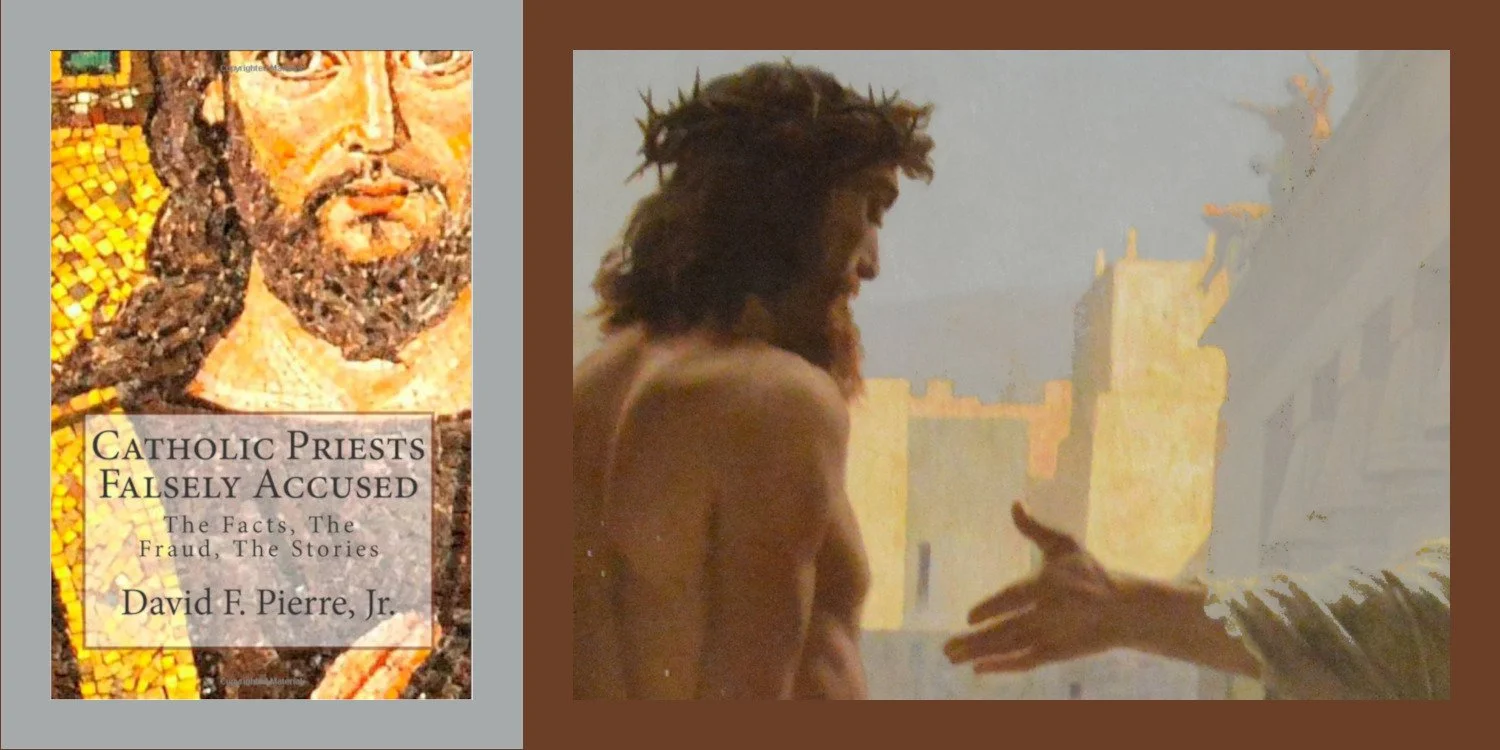
Catholic Priests Falsely Accused: The Facts, The Fraud, The Stories by David F. Pierre, Jr. of TheMediaReport.com.
David Pierre is one of the country’s leading observers of the Catholic Church abuse narrative. In Catholic Priests Falsely Accused: The Facts, the Fraud, the Stories, he presents case studies backed by hard data which clearly demonstrates some of the injustices foisted on Catholic priests and the Church.
The Survivors Network of those Abused by Priests (SNAP) is identified by Pierre as a major culprit in advancing the destruction of innocent priests. He outlines the methods used by the group to manipulate clergy abuse charges and how they play the media. The organization, he says, provides talking points and staging tips for accusers and their attorneys at the workshops they hold at their yearly conference. SNAP’s tactics, he says, have grossly exaggerated the clergy abuse problem in the Church. He contends, that with data garnered by expert crime investigators, it is not unreasonable for an observer to deduce that “approximately one third” of all accusations against Catholic priests are entirely false or greatly exaggerated.
It is important for Church officials to challenge and, if need be, litigate every accusation. The results of these investigations should be publicized. And, if the allegations prove to be false, the name of the accuser, if an adult, should be made public. Not to do so lets the lies live on and continue to undermine the Body of Christ. “According to a sworn declaration submitted to the Los Angeles County Superior Court in November of 2010,” Pierre writes, “attorney Donald Steier claimed, ‘One retired F.B.I. agent who worked with me to investigate many claims in the Clergy Cases told me, in his opinion, about ONE-Half of the claims made in the Clergy Cases were either entirely false [or] greatly exaggerated.’”
Other culprits identified by Pierre adding to the abuse frenzy are plaintiffs’ attorneys and Church insurance carriers. Attorney fees, which are usually up to forty percent on a settlement have made pursuing allegations, even false ones, very lucrative for this new breed of ambulance chasers. These attorneys realize that many claims will be settled out of court because insurers and the Church would rather pay out “large-scale blanket settlements” than go to trial where litigation costs will be exorbitant. They also fear losing a case due to a jury prejudiced against the Church or sympathetic to those claiming victim status. This may, in fact, incur greater putative and compensatory damages.
Dubious claims of the widely discredited psychological theory of “repressed memories,” have been used to put priests at a significant disadvantage in obtaining justice. In these cases, individuals claim that a priest molested them years earlier and assert that they repressed the memory due to the trauma. The alleged incident is often recalled, Pierre says, “through the suggestive questioning of an unprincipled therapist and, often under hypnosis.” Naturally, hypnosis leaves people open to the power of suggestion. Many experts believe that repressed memory is simply bogus. Dr. James McGaugh, from the University of California, Irvine, an expert in the area of memory, states, “I do not believe there is such a thing as a repressed memory… And there’s absolutely no proof that it can happen. Zero. None. Niente.” Dr. Richard J. McNally, Director of Clinical Training in the Department of Psychology at Harvard University claims, repressed memory therapy is “the worst catastrophe to befall the mental health field since the lobotomy era.”
Regarding Diocesan Review Boards, Pierre says, “they are very often composed of individuals who have profound sympathy for victims of abuse. These panels consist of child welfare advocates, social workers, therapists, child psychologists,” as well as “individuals who were actual victims of clergy abuse.” Perhaps this is why these boards tend to be less than sympathetic to accused priests. Another reason for these review boards’ bias may be the “credible” evidence standard that they use when determining whether a priest should be put on Administrative Leave. “When an accuser comes forward to allege abuse from decades earlier,” Pierre writes, “one can deem the accusation ‘credible’ simply because the accuser can show that he or she lived at a given time in the same general geographical area of a priest.”
Media bias needs to be met with the facts. For example, Pierre says, a book by Marci A. Hamilton ─ a professor at the Cardozo School of Law at Yeshiva University, in New York City ─ entitled, Justice Denied: What America Must do to Protect Its Children (2008), excoriates the Catholic Church for its handling of the abuse crisis and accuses the Catholic leaders of orchestrating the sexual abuse of children. Yet, according to legal experts, the book contains “a number of outright falsehoods and misleading passages.” For instance, when attorney L. Martin Nussbaum and his wife, Melissa, reviewed Hamilton’s book for First Things in an article entitled, “MarciWorld” they noted that “Hamilton claimed, that in some states, a child abused at age seven would have only until the age of nine to sue the abuser. That is simply false in all 50 states and the District of Columbia.”
Pierre notes that, “Hamilton has represented SNAP and has done extensive legal work for the organization.” She is also, according to Pierre, closely associated with the Philadelphia district Attorney’s Office, which Pierre shows to have a particular animus toward the Church. He says, “the Philadelphia D.A.’s Office has not targeted any other organization for its past abuses with the same prosecutorial zeal.” Pierre then cites statistics that show public school teachers have a much higher rate of abuse than Catholic priests. Yet, they have escaped the same kind of scrutiny by Hamilton.
Hamilton is a strong advocate of dropping the “statute of limitations” for private institutions under the auspice of “protecting children.” However, Pierre claims, “Hamilton has made it her crusade to lobby state legislatures to remove the statute of limitations in order to inflict maximum financial and institutional damage to the Catholic Church.” Alarmingly, Pierre points out that, “public schools have a special immunity from being sued.” As a government entity, they are shielded by the doctrine of “sovereign immunity,” which only allows an accuser a limited window to make an accusation and limits lawsuit damages, making claims less profitable for attorneys and their clients.
It is important, Pierre believes, to aggressively market the fact that the Catholic Church now has the safest environment in the world for protecting children. Data collected from The Center for Applied Research in the Apostolate (CARA) indicates allegations of abuse of minors to be on average less than 10 per year since 2005 nationwide. The Church’s safeguards and accomplishments need to be widely disseminated by Her authorities and related organizations.
The most troublesome accusations are those leveled against dead priests. Pierre reports that, according to CARA, 43% of all priests accused of abuse in 2010 were deceased. How can the dead defend themselves? The simple solution in many cases for a diocese is to simply pay out. And, unfortunately in some dioceses, the deceased priest’s name is added to a diocesan website listing him as a pedophile or accused of being one. The intangible losses in doing this far exceed the monetary costs. The ruination of a priest’s reputation along with the sorrow that it causes to his family and those whom he had served who have fond memories of him ─ giving them their First Holy Communion, presiding over their marriage, or offering them advice and consolation in times of need ─ is a source of great discouragement among the faithful.
There is an old cliché, “the best defense is a good offense.” Church officials have been too reluctant to expose the lies about priests, the obvious anti-Catholic bias in the media, the greed and the anti-Catholicism of some in public office which feeds the abuse crisis. This has caused a decline in clergy morale and vocations to the priesthood. Large monetary settlements have hindered Catholic evangelization and charitable work and have led to the bankruptcy of some dioceses. But, worst of all, it has also caused a loss of confidence by many Catholics in the institutional Church.
A sure way to ameliorate the injustices perpetrated against priests and to rehabilitate the reputation of the Church would be to re-examine the cases of those priests found guilty due to false or dubious abuse claims filed against them. The widely reported case of Fr. Gordon MacRae, of the Diocese of Manchester, New Hampshire, would be a good place to start. Pierre outlines it in his book. It is quite obvious that Fr. MacRae did not receive a fair trial according to the facts cited in a piece published in The Wall Street Journal. MacRae’s accuser, a fifteen year old boy, had a lengthy juvenile record and presented doubtful evidence in trial testimony. The judge even went so far as to order the jury to “disregard inconsistencies in Mr. Grover’s (his accuser) testimony.” Father MacRae, protesting his innocence, refused a plea bargain deal of two years in prison. Now he is serving a 67 year sentence. His own, now retired, bishop believes him to be innocent. What a moral boost this would be for the nation’s priests and for the Catholic laity if the Church in New Hampshire began a petition drive to have this case reopened!
In a chapter entitled, “Kathy Told a Story,” Pierre chronicles the tale of an Irish woman, Kathy O’Beirne, who wrote of the abuse she sustained at one of Ireland’s institutions that cared for young women, the Magdalene Home. She reports being severely abused by nuns and having been raped by a priest. “Her chronicle,” says Pierre, “enthralled readers.” It received rave reviews and achieved bestseller status. Except, the woman’s siblings claim “Our sister was not in the Magdalene Home… Our sister has a self-admitted psychiatric and criminal history, and her perception of reality has always been flawed.” A further investigation revealed Kathy’s book to be a fraud. Nevertheless, this book continues to secure five star reviews in Amazon.com’s U.K. site and has respectable sales in England and Ireland.
If the late Paul Harvey were able to comment on this book, he would have certainly said, “And now the rest of the story.” This book is concise, easy to read, filled with verifiable data, and points out the problems with both the ecclesiastical and civil responses to the clergy abuse crisis.
Father Orsi is Chaplain and Research Fellow in Law and Religion at Ave Maria School of Law.
+ + +
This ground-breaking book by David F. Pierre, Jr. was also reviewed at Beyond These Stone Walls: The Media Report: Catholic Priests Falsely Accused.

Judge Arthur Brennan Sentenced Father Gordon MacRae to Die in Prison
In 2011, former N.H. Judge Arthur Brennan was arrested at an "Occupy Movement" protest at the U.S. Capitol. In 1994, he sentenced Fr Gordon MacRae to die in prison.

In 2011, former N.H. Judge Arthur Brennan was arrested at an "Occupy Movement" protest at the U.S. Capitol. In 1994, he sentenced Fr Gordon MacRae to die in prison.
Editor’s Note: This eye-opener was written and published by author Ryan A. MacDonald on February 9, 2012. In the 11 years hence, much new information has surfaced that supports and upholds Ryan’s conclusions about the nature and intent of the trial of Father MacRae.
+ + +
I spent some time recently poking around inside Beyond These Stone Walls, an extraordinary website that by all odds should not exist. I once wrote of all the random factors that had to coalesce for this story of a Catholic priest falsely accused and wrongfully imprisoned to be told. “The Prisoner-Priest Behind These Stone Walls” tells that tale, and hopefully has drawn some fair minded souls to this remarkable site.
Spend just a few minutes at the “About” page at Beyond These Stone Walls, and consider its simple math. On September 23, 1994, in Cheshire County Superior Court in Keene, New Hampshire, Judge Arthur Brennan sentenced Catholic priest, Gordon MacRae to consecutive prison terms for a combined sentence of 67 years in prison. The sentence was imposed after a highly problematic jury trial in which MacRae was convicted of having sexually assaulted Thomas Grover during counseling sessions in 1983 when Grover was 15 years old.
The accused priest was 29 years old when his “crimes” — now deemed by many to be fictitious — were claimed to have occurred. MacRae was 41 years old when the sentence was imposed. At this writing [2012] he is 59 years old and still in prison. Barring the just outcome of a pending new appeal based on new evidence in the case, the priest will be 108 years old when his sentence is fully served and he is free to leave prison. There is no other possible conclusion. Judge Arthur Brennan sentenced Father Gordon MacRae to die in the New Hampshire State Prison.
From a pragmatic perspective, and even with an emphasis on retributive justice, this makes little sense. Given that New Hampshire prosecutors sought a pre-trial plea deal that would have released MacRae after one or two years had he been actually guilty or willing to pretend so, a 67-year sentence seems an expensive folly that will cost New Hampshire taxpayers millions of dollars. Even if MacRae’s sentences were imposed concurrently instead of consecutively — an option for judges when defendants have no prior felony record — MacRae would not still be in prison today.
Parole in New Hampshire for someone convicted of a sexual offense — true or not — invariably requires completion of a prison sex offender program which in turn requires an unqualified admission of guilt. Because of the vast numbers of men convicted of similar offenses in New Hampshire — by some estimates more than 40% of the state’s prison population — the waiting list for the prison sex offender program requires that inmates must be within two years of their aggregate minimum sentence to be eligible.
By the time MacRae could fulfill this requirement for parole consideration, over 50 years will have passed between the charged offenses and the “treatment” program. At age 80, this priest’s parole would rest on his ability to recall with consistency the details of fictitious sexual assaults alleged to have occurred when he was 29. What seemed to make perfect sense to Judge Arthur Brennan in this sentence eludes just about everyone else.
Nonetheless, these considerations are all rendered moot. From everything I have read on this case, MacRae is innocent of the claims, and will not say otherwise just to avoid dying in prison. Justice is not served when an innocent defendant is coerced to plead guilty to something he did not do just to discharge a decades-long prison term. Coercive plea deals work well for the guilty, but not for the innocent. Careful readers of this story know that MacRae, sitting alone in a county jail awaiting sentencing, his meager assets wiped out by the trial, his diocese having already publicly condemned him, and his lawyers having abandoned the case for lack of funds to investigate and defend it, was coerced by circumstances into a post-trial plea deal on remaining charges in exchange for a sentence of zero additional time in prison. He and others close to the case described this, then and now, as “a negotiated lie.”
Today, I describe what played out in Judge Arthur Brennan’s court after MacRae was found guilty in his first trial as an extorted lie, and it is nothing new. Attorney Barry Scheck, founder of the Innocence Project, reveals that of the hundreds of DNA exonerations his organization has championed to free the wrongfully imprisoned, a full 25% have involved coerced and extorted plea deals such as that inflicted on Father Gordon MacRae, post trial. It is for abuses such as this that a March 21, 2012 U.S. Supreme Court ruling vastly expanded judicial oversight of the pressures placed on defendants during plea deals, requiring that competent counsel advise them.
The details of the related, but untried charges against this priest render them highly doubtful as well. The Wall Street Journal’s Dorothy Rabinowitz wrote of these claims brought by Thomas Grover’s brothers and others jumping aboard this cash-cow opportunity in “A Priest’s Story.” I wrote of other details related to these claims in “Police Investigative Misconduct Railroaded an Innocent Catholic Priest” and “Truth in Justice: Was the Wrong Catholic Priest Sent to Prison?” No just person can read these documents and conclude the legitimacy of Father Gordon MacRae’s trial and imprisonment.
A Sentence Devoid of Common Sense
Gordon MacRae, Prisoner No. 67546, at this writing [2012] has been in prison for 18 years. Nearly 30 years have already passed since his charges were claimed to have occurred — charges that new evidence shows never occurred at all. New Hampshire prosecutors were willing to let MacRae out of prison after just one year had he been willing to forgo trial and stand before Judge Brennan to utter a single word, “guilty.”
MacRae refused three such prosecution overtures for a plea deal to end the case with a recommended sentence of only one to three years. One such offer was made to the priest’s lawyers in writing. Another came in the middle of MacRae’s trial. That offer was made just after 27-year-old Thomas Grover wept dramatically from the witness stand as he recounted being forced to endure sexual assaults five times during counseling sessions for his drug problem at age 15 in 1983. He vaguely claimed to return from week to week unable to remember being raped the week before. His heavily coached description of PTSD-induced “out of body experiences” was his only explanation for how such traumatic memories were “repressed.” After this incredulous testimony, the two prosecutors looked at each other and headed for a hallway with MacRae’s lawyer to offer a new plea deal — this time a sentence of one to two years. The priest refused it.
In the end, Judge Arthur Brennan sentenced Defendant Gordon MacRae to more than thirty times the maximum sentence State prosecutors were prepared to request. Those prosecutors are long since gone. One was inexplicably fired the day after MacRae’s trial ended, and later relocated to another state under a cloud. The other has since committed suicide.
Even a cursory examination of new evidence in the MacRae case warrants vacating his convictions. Additionally, there are elements of the case that could not be part of the appeal process, and are not generally known. For example, MacRae agreed to two pre-trial polygraph examinations in 1994. The polygraph tests were based on the claims of Thomas Grover and his brother, Jonathan Grover, whose accusations amassed most of the indictments for which the priest faced trial. Father MacRae passed the polygraph tests conclusively. Even today, after the passage of many years, the polygraph examiner recalls this case and reported that Father MacRae “did very well” on these investigative tools. Neither Thomas Grover nor Jonathan Grover, nor any other accuser ever agreed to submit to polygraph testing.
There is more. A lot more. David F. Pierre, author of the book, Catholic Priests Falsely Accused and host of The Media Report, performed a public service by reviewing hundreds of pages of court documents and trial transcripts now published at the website of The National Center for Reason and Justice. David Pierre’s summary of these documents, entitled “Alarming New Evidence May Exonerate Imprisoned Priest,” includes the following eye-opening facts:
The ex-wife of accuser Thomas Grover has revealed this case as a fraud. Her statement describes him as a “compulsive liar” who “never stated one word of abuse by MacRae” until the prospect of money loomed. She describes him as a “manipulator...who can tell a lie and stick to it ’til its end.” She reports that Grover’s lawyer advised him to “act crazy before the jury” and hired a therapist to heighten the effect. Once Grover got his nearly $200,000 settlement, all therapy came to a halt.
Thomas Grover’s adult stepson today states that Grover repeatedly told him before and after trial that he “had never been molested by MacRae,” and that he was “setting MacRae and the Catholic Church up for money.” He reports that Grover laughed and joked with him about this scheme before, during, and after MacRae’s trial.
The former wife and stepson both report that before MacRae’s trial, Grover repeatedly sought and obtained cash advances on his projected settlement from his contingency lawyer, a practice that is prohibited in the New Hampshire Code of Professional Conduct for lawyers.
Two observers present throughout the trial report having observed the manipulation of Grover’s testimony by therapist Pauline Goupil, M.A., a victim advocate hired by Thomas Grover’s contingency lawyer. According to signed statements Ms. Goupil influenced Grover’s trial testimony using hand signals for him to feign sobbing during specific segments of his testimony. In several instances she was observed placing her index finger over her eye and down her cheek at which point Grover would commence sobbing, disrupting cross examination and, on at least one occasion, prompting Judge Brennan to call a recess.
Debra Collett, Thomas Grover’s former drug addiction counselor, today states that Grover made so many claims of sexual abuse in the course of drug treatment that “he appeared to be going for some sort of sex abuse victim world record.” She reports that his claims of sexual abuse targeted his adoptive father and others, but he did not accuse MacRae.
Ms. Collett also described that she was threatened by “coercion, intimidation, veiled and more forward threats,” “overtly threatened” and confronted “with threats of arrest” by the investigating police detective to alter her testimony for the trial and “to get me to say what they wanted to hear.”
A former accuser of MacRae has today recanted his claim of abuse stating, “I was aware at the time of [the] trial knowing full well that it was all bogus and having heard of the lawsuits and money involved, also the reputations of those who were making accusations.” This former accuser attests that “[Keene, NH Detective James] McLaughlin had me believing that all I had to do was make up a story ... and I could receive a large sum of money as others already had. McLaughlin reminded me of the young child and girlfriend I had and referenced that life could be easier for us with a large amount of money.” This witness reports he was given cash by Det. McLaughlin after this interview.
James Abbott, a veteran career Special Agent with the F.B.I., today reports: “In the entirety of my three-year investigation of this matter, I discovered no evidence of MacRae having committed the crimes charged, or any crimes. Indeed, the only thing pointing to any improper behavior by MacRae were Grover’s stories — that were undermined by the people who surrounded him at the time he made his accusations.”
The Money Flows
After Father MacRae was sent to prison, Thomas Grover’s three brothers reportedly walked away from this case with additional settlements from the Diocese of Manchester in excess of $430,000. I have written of these accusations in my column, “Truth in Justice: Was the Wrong Catholic Priest Sent to Prison?” Two of the three brothers also accused another priest, but pre-trial discovery shows no indication that the other priest was interviewed or even investigated.
Following publication of the two-part “A Priest’s Story” in The Wall Street Journal in 2005, Arthur Brennan defended his presiding over this trial and his sentence of MacRae by stating that it was all “more complex” than what Dorothy Rabinowitz reported. Indeed it was, and the complexities which continue to surface leave many doubts about the justice of the MacRae trial and the legitimacy of its entire pre-trial investigation and prosecution.
Arthur Brennan took early retirement from the New Hampshire bench for a brief stint with the U.S. State Department’s Office of Transparency and Accountability in Iraq. The trial and sentence of Gordon MacRae have transparency and accountability issues of their own still to be resolved.
Do the Math! Judge Arthur Brennan sentenced Father Gordon MacRae to die in a New Hampshire prison. It’s an outcome I suspect this priest would not shrink from if it comes down to it. For the rest of us, evidence now spells out clearly the travesty of justice this case was — and still is.
“We are disgusted with the lack of integrity in Congress, the Senate, The White House and the U.S. Supreme Court. We will stop these pretenders from stealing our freedom and our universal human rights.”
— By Arthur Brennan, quoted from “Forty years later, a new call to protest” (August 21, 2011).