
Voices from Beyond
At the Mercy of One False Brother
This review by Rev. Peter M. J. Stravinskas, an accomplished theologian and Editor of The Catholic Response, first appeared in The Catholic Thing.
This review by Rev. Peter M. J. Stravinskas, an accomplished theologian and Editor of The Catholic Response, first appeared in The Catholic Thing.
September 12, 2020 by Rev. Peter M.J. Stravinskas | The Catholic Thing
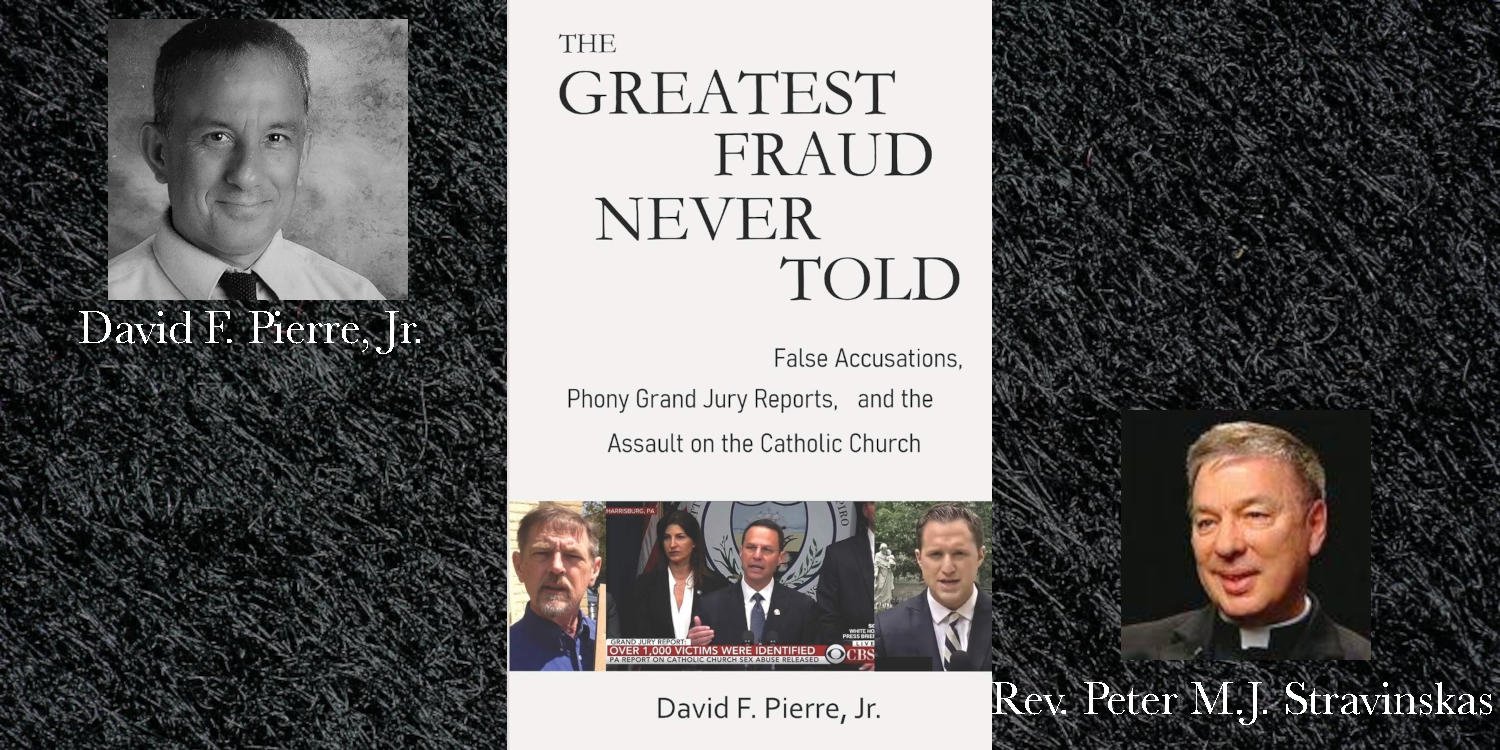
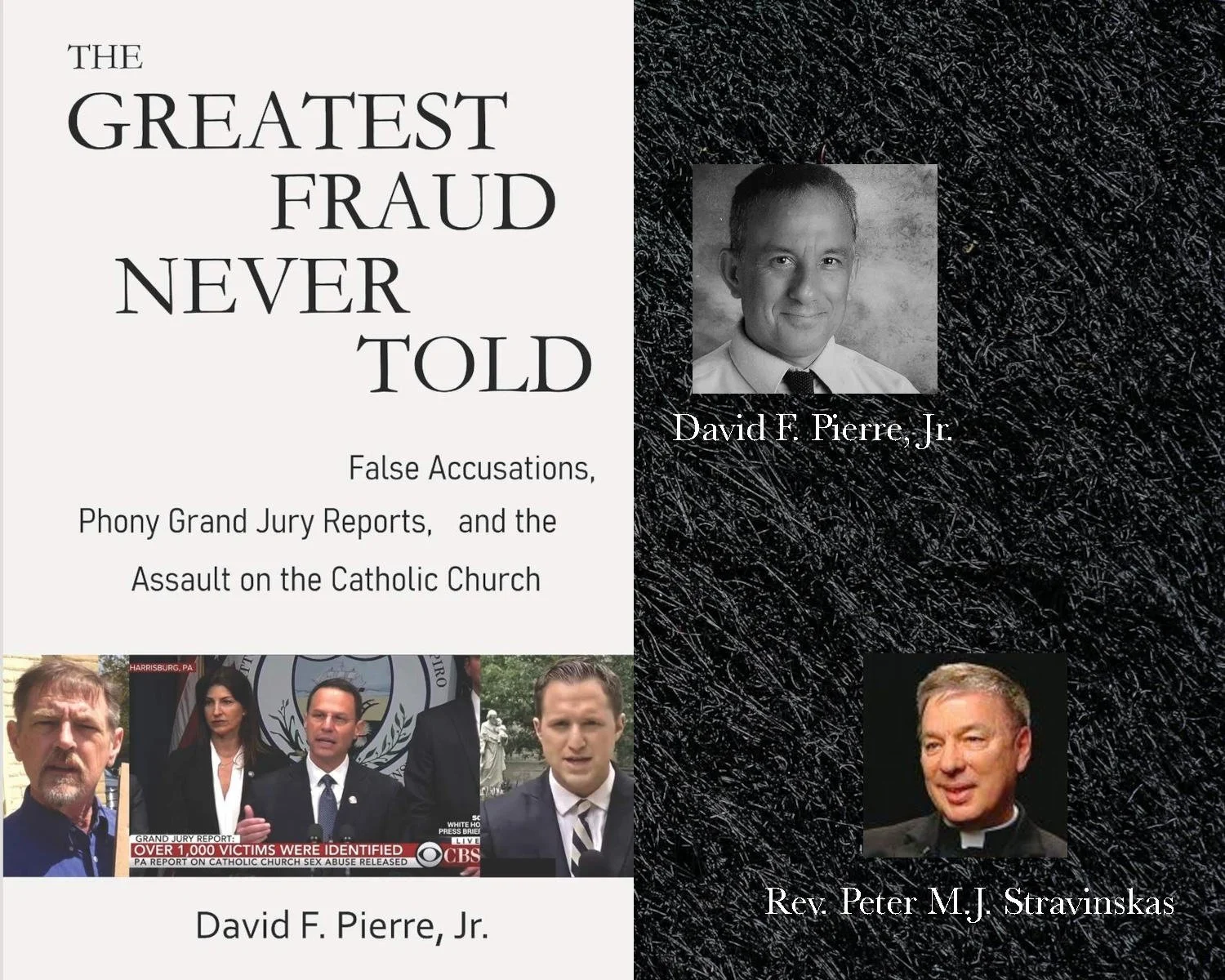
David Pierre of Media Report has published an illuminating new book, The Greatest Fraud Never Told: False Accusations, Phony Grand Jury Reports, and the Assault on the Catholic Church. Pierre and his work are often ignored because he is unjustly accused of dismissing accusations of clergy sex abuse, en masse. That charge is not true. Instead, Pierre stresses an often-forgotten truth: “a false accusation is truly an affront to those who genuinely suffered as the result of their horrendous abuse.”
When the first hints of clergy sexual abuse began to surface in the late-80s, I served as an advisor to many of the good, new bishops being appointed. On this topic, I counseled the bishops:
First, do not call this pedophilia – because, for the most part, it is same-sex activity between a cleric and a post-pubescent young man; that’s the truth and, the truth always sets us free. “Pedophilia” conjures up images of five- and six-year-old boys. Further, if the sinful activity had been properly labeled, ironically, the secular media wouldn’t have given it much coverage, since they always promote same-sex relations.
Second, never settle any case out of court for a variety of reasons, not least that while a pastoral plea demands a pastoral response, a legal challenge demands a legal response. Moreover, when a financial settlement is made, that more than suggests guilt, thus damaging irreparably an innocent priest’s reputation. Regrettably, most bishops listened, instead, to diocesan attorneys and insurance companies.
Owing to the Dallas Charter of 2002, the heavy-handed treatment of accused priests by bishops has resulted in an adversarial relationship, which Cardinal Avery Dulles foretold in 2004. Pierre also observes, quite correctly and sadly, that most priests dread it when the chancery calls. Why? Because “the mere accusation against a Catholic priest carries an automatic assumption that the claim is true.” And because the principle of “innocent until proven guilty,” in both ecclesiastical law and American civil law, has been eviscerated by current Church praxis: the accused priest is hung out to dry with an immediate diocesan press release, forced out of his residence within hours, placed on administrative leave, forbidden to wear clerical garb, and required to pay for legal counsel out of his own resources.
Interestingly, none of that happens for a bishop; his legal expenses are borne by the diocese. I should note that the procedure used for accused bishops is the proper one, but the double standard that exists when it comes to priests is responsible for the resentment all too many priests have toward their bishops, which Pierre underscores.
Yet another problem, again, thanks to the Dallas Charter, is the removal of the statute of limitations, causing Pierre to raise two essential questions: “How does one defend oneself against an accusation from 30, 40, 50 years ago? How would you defend yourself against an accusation from 40 years ago?” Of course, that is the very reason for a statute of limitations. Quite inconsistently, bishops have fought vociferously against removal of statutes of limitation in the civil realm.
Pierre devotes a chapter to the infamous Pennsylvania Grand Jury Report, which he calls “the Grand Fraud” because its approach, content, and language all betray an animus against the Church, starting from the theatrics of the Attorney General, Josh Shapiro, in the press conference releasing the report. Bald-faced lies abound, as do innuendo and inflammatory language. Dead priests account for 53 percent of the accused (one was born in 1869!). Pierre follows up with “Pennsylvania Perjury,” where he tackles the Report’s assertion that the bishops of the State “did nothing” when confronted with abuse; he demonstrates the very opposite.
Concluding his treatment of the Pennsylvania Report, our author expresses astonishment at the relative silence of the Catholic media in the face of this gross miscarriage of justice, not “defending bishops, priests, and the Church when they were publicly wronged.” More disturbing to me was the almost gleeful promotion of the Report, by many would-be “conservative” or “traditional” Catholic outlets, so that “these partisan platforms began airing stories that were simply false, and in some cases, quite bizarre.”
Pierre also highlights the pervasive anti-Catholicism throughout the entire crisis; he cites remarks by the Attorney General of Michigan (the Catholic Church is “a criminal enterprise”) and observes that “a public official would never get away with such a clearly bigoted remark against another religion.”
Chapter Eight is titled “A Disastrous Practice,” which refers to how bishops sent offending priests to treatment centers and then followed the advice of the “professionals,” most of whom assured bishops that these priests were ready to return to ministry. Formerly, bishops often sent problematic priests to permanent confinement in a monastery. But a secular model cowed a spiritual model in recent decades, with psychiatrists controlling the process. To be fair, this “therapeutic” approach was employed by basically every institution, Catholic or not, in the country at the time.
Chapter Twelve is provocatively entitled, “The Catholic ATM.” Pierre notes how expensive litigation is, but goes on to observe that the dioceses cause themselves harm by having what the New York Archdiocese calls “lenient standards of evidence,” thus paying out “on many weak claims.” The result: “the more the Church pays out on these bogus claims, the more claims it gets. It all makes sense. Why not file suit? There is nothing to lose.”
Rolling over and playing dead is not “pastoral”; it’s irresponsible because it squanders the diocesan patrimony and, far more importantly, gives credence to lies that do irreparable damage to the image of the Church and clergy.
Pierre shares some good news amidst this depressing saga: Some priests are now suing government officials who have violated their civil rights or fraudulent victims who have defamed them. You might ask, “What has taken so long for this to happen?” The answer, in many instances, is that priests were prohibited from doing so by their bishops, who thought it wouldn’t “look good.”
It’s worth reading the material on SNAP (Survivors Network of those Abused by Priests), a viciously anti-Catholic group. One employee eventually saw through the façade and questioned its modus operandi, which brought about a hostile work environment and her filing of a lawsuit against SNAP. She delineates a whole series of accusations against her former employer, which should be disturbing, but not surprising.
David Pierre has done all a great service in assembling the hard data. The truth of the matter is that the “mop-up” operation of the past two decades has made any institution of the Catholic Church in this country the safest place for any minor or vulnerable adult. There are nearly 40,000 priests in our country; last year twenty accusations were made – accusations, not substantiated cases. Cardinal Newman, with his uncanny capacity to gaze into the crystal ball, warned seminarians in 1873: “With a whole population able to read, with cheap newspapers day by day conveying the news of every court, great and small to every home or even cottage, it is plain that we are at the mercy of even one unworthy member or false brother.”
Indeed, even one unworthy member or false brother.
+ + +
Bogus Charges Against Priests Abound
This review by Rev. Michael P. Orsi, a Research Fellow in Law and Religion at Ave Maria School of Law first appeared in the Catholic League Journal, Catalyst.
This review by Rev. Michael P. Orsi, a Research Fellow in Law and Religion at Ave Maria School of Law first appeared in the Catholic League Journal, Catalyst.
March 2012 by Rev. Michael P. Orsi | Catalyst
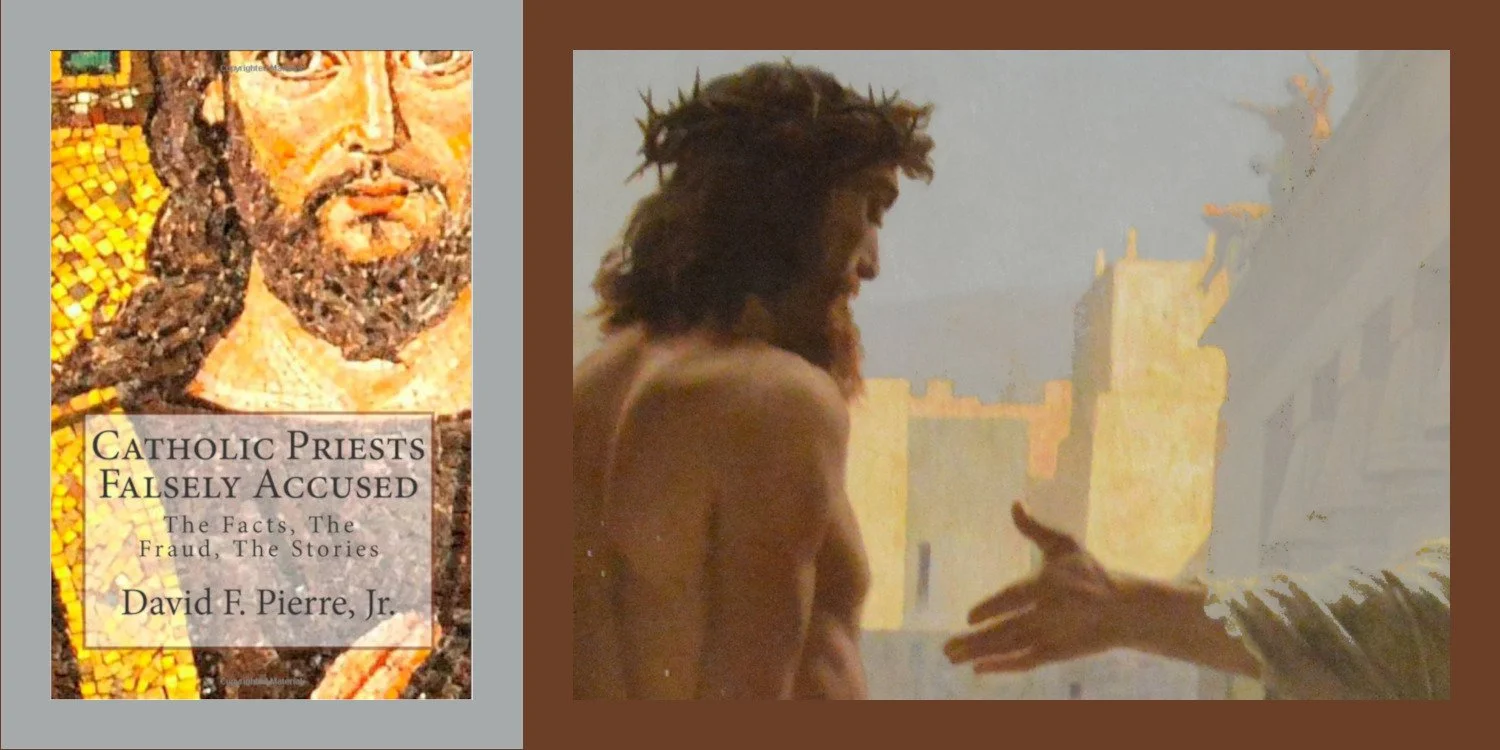
Catholic Priests Falsely Accused: The Facts, The Fraud, The Stories by David F. Pierre, Jr. of TheMediaReport.com.
David Pierre is one of the country’s leading observers of the Catholic Church abuse narrative. In Catholic Priests Falsely Accused: The Facts, the Fraud, the Stories, he presents case studies backed by hard data which clearly demonstrates some of the injustices foisted on Catholic priests and the Church.
The Survivors Network of those Abused by Priests (SNAP) is identified by Pierre as a major culprit in advancing the destruction of innocent priests. He outlines the methods used by the group to manipulate clergy abuse charges and how they play the media. The organization, he says, provides talking points and staging tips for accusers and their attorneys at the workshops they hold at their yearly conference. SNAP’s tactics, he says, have grossly exaggerated the clergy abuse problem in the Church. He contends, that with data garnered by expert crime investigators, it is not unreasonable for an observer to deduce that “approximately one third” of all accusations against Catholic priests are entirely false or greatly exaggerated.
It is important for Church officials to challenge and, if need be, litigate every accusation. The results of these investigations should be publicized. And, if the allegations prove to be false, the name of the accuser, if an adult, should be made public. Not to do so lets the lies live on and continue to undermine the Body of Christ. “According to a sworn declaration submitted to the Los Angeles County Superior Court in November of 2010,” Pierre writes, “attorney Donald Steier claimed, ‘One retired F.B.I. agent who worked with me to investigate many claims in the Clergy Cases told me, in his opinion, about ONE-Half of the claims made in the Clergy Cases were either entirely false [or] greatly exaggerated.’”
Other culprits identified by Pierre adding to the abuse frenzy are plaintiffs’ attorneys and Church insurance carriers. Attorney fees, which are usually up to forty percent on a settlement have made pursuing allegations, even false ones, very lucrative for this new breed of ambulance chasers. These attorneys realize that many claims will be settled out of court because insurers and the Church would rather pay out “large-scale blanket settlements” than go to trial where litigation costs will be exorbitant. They also fear losing a case due to a jury prejudiced against the Church or sympathetic to those claiming victim status. This may, in fact, incur greater putative and compensatory damages.
Dubious claims of the widely discredited psychological theory of “repressed memories,” have been used to put priests at a significant disadvantage in obtaining justice. In these cases, individuals claim that a priest molested them years earlier and assert that they repressed the memory due to the trauma. The alleged incident is often recalled, Pierre says, “through the suggestive questioning of an unprincipled therapist and, often under hypnosis.” Naturally, hypnosis leaves people open to the power of suggestion. Many experts believe that repressed memory is simply bogus. Dr. James McGaugh, from the University of California, Irvine, an expert in the area of memory, states, “I do not believe there is such a thing as a repressed memory… And there’s absolutely no proof that it can happen. Zero. None. Niente.” Dr. Richard J. McNally, Director of Clinical Training in the Department of Psychology at Harvard University claims, repressed memory therapy is “the worst catastrophe to befall the mental health field since the lobotomy era.”
Regarding Diocesan Review Boards, Pierre says, “they are very often composed of individuals who have profound sympathy for victims of abuse. These panels consist of child welfare advocates, social workers, therapists, child psychologists,” as well as “individuals who were actual victims of clergy abuse.” Perhaps this is why these boards tend to be less than sympathetic to accused priests. Another reason for these review boards’ bias may be the “credible” evidence standard that they use when determining whether a priest should be put on Administrative Leave. “When an accuser comes forward to allege abuse from decades earlier,” Pierre writes, “one can deem the accusation ‘credible’ simply because the accuser can show that he or she lived at a given time in the same general geographical area of a priest.”
Media bias needs to be met with the facts. For example, Pierre says, a book by Marci A. Hamilton ─ a professor at the Cardozo School of Law at Yeshiva University, in New York City ─ entitled, Justice Denied: What America Must do to Protect Its Children (2008), excoriates the Catholic Church for its handling of the abuse crisis and accuses the Catholic leaders of orchestrating the sexual abuse of children. Yet, according to legal experts, the book contains “a number of outright falsehoods and misleading passages.” For instance, when attorney L. Martin Nussbaum and his wife, Melissa, reviewed Hamilton’s book for First Things in an article entitled, “MarciWorld” they noted that “Hamilton claimed, that in some states, a child abused at age seven would have only until the age of nine to sue the abuser. That is simply false in all 50 states and the District of Columbia.”
Pierre notes that, “Hamilton has represented SNAP and has done extensive legal work for the organization.” She is also, according to Pierre, closely associated with the Philadelphia district Attorney’s Office, which Pierre shows to have a particular animus toward the Church. He says, “the Philadelphia D.A.’s Office has not targeted any other organization for its past abuses with the same prosecutorial zeal.” Pierre then cites statistics that show public school teachers have a much higher rate of abuse than Catholic priests. Yet, they have escaped the same kind of scrutiny by Hamilton.
Hamilton is a strong advocate of dropping the “statute of limitations” for private institutions under the auspice of “protecting children.” However, Pierre claims, “Hamilton has made it her crusade to lobby state legislatures to remove the statute of limitations in order to inflict maximum financial and institutional damage to the Catholic Church.” Alarmingly, Pierre points out that, “public schools have a special immunity from being sued.” As a government entity, they are shielded by the doctrine of “sovereign immunity,” which only allows an accuser a limited window to make an accusation and limits lawsuit damages, making claims less profitable for attorneys and their clients.
It is important, Pierre believes, to aggressively market the fact that the Catholic Church now has the safest environment in the world for protecting children. Data collected from The Center for Applied Research in the Apostolate (CARA) indicates allegations of abuse of minors to be on average less than 10 per year since 2005 nationwide. The Church’s safeguards and accomplishments need to be widely disseminated by Her authorities and related organizations.
The most troublesome accusations are those leveled against dead priests. Pierre reports that, according to CARA, 43% of all priests accused of abuse in 2010 were deceased. How can the dead defend themselves? The simple solution in many cases for a diocese is to simply pay out. And, unfortunately in some dioceses, the deceased priest’s name is added to a diocesan website listing him as a pedophile or accused of being one. The intangible losses in doing this far exceed the monetary costs. The ruination of a priest’s reputation along with the sorrow that it causes to his family and those whom he had served who have fond memories of him ─ giving them their First Holy Communion, presiding over their marriage, or offering them advice and consolation in times of need ─ is a source of great discouragement among the faithful.
There is an old cliché, “the best defense is a good offense.” Church officials have been too reluctant to expose the lies about priests, the obvious anti-Catholic bias in the media, the greed and the anti-Catholicism of some in public office which feeds the abuse crisis. This has caused a decline in clergy morale and vocations to the priesthood. Large monetary settlements have hindered Catholic evangelization and charitable work and have led to the bankruptcy of some dioceses. But, worst of all, it has also caused a loss of confidence by many Catholics in the institutional Church.
A sure way to ameliorate the injustices perpetrated against priests and to rehabilitate the reputation of the Church would be to re-examine the cases of those priests found guilty due to false or dubious abuse claims filed against them. The widely reported case of Fr. Gordon MacRae, of the Diocese of Manchester, New Hampshire, would be a good place to start. Pierre outlines it in his book. It is quite obvious that Fr. MacRae did not receive a fair trial according to the facts cited in a piece published in The Wall Street Journal. MacRae’s accuser, a fifteen year old boy, had a lengthy juvenile record and presented doubtful evidence in trial testimony. The judge even went so far as to order the jury to “disregard inconsistencies in Mr. Grover’s (his accuser) testimony.” Father MacRae, protesting his innocence, refused a plea bargain deal of two years in prison. Now he is serving a 67 year sentence. His own, now retired, bishop believes him to be innocent. What a moral boost this would be for the nation’s priests and for the Catholic laity if the Church in New Hampshire began a petition drive to have this case reopened!
In a chapter entitled, “Kathy Told a Story,” Pierre chronicles the tale of an Irish woman, Kathy O’Beirne, who wrote of the abuse she sustained at one of Ireland’s institutions that cared for young women, the Magdalene Home. She reports being severely abused by nuns and having been raped by a priest. “Her chronicle,” says Pierre, “enthralled readers.” It received rave reviews and achieved bestseller status. Except, the woman’s siblings claim “Our sister was not in the Magdalene Home… Our sister has a self-admitted psychiatric and criminal history, and her perception of reality has always been flawed.” A further investigation revealed Kathy’s book to be a fraud. Nevertheless, this book continues to secure five star reviews in Amazon.com’s U.K. site and has respectable sales in England and Ireland.
If the late Paul Harvey were able to comment on this book, he would have certainly said, “And now the rest of the story.” This book is concise, easy to read, filled with verifiable data, and points out the problems with both the ecclesiastical and civil responses to the clergy abuse crisis.
Father Orsi is Chaplain and Research Fellow in Law and Religion at Ave Maria School of Law.
+ + +
This ground-breaking book by David F. Pierre, Jr. was also reviewed at Beyond These Stone Walls: The Media Report: Catholic Priests Falsely Accused.