
Voices from Beyond
I <Heart> Israel
Jesus Christ is the fulfillment of all the Old Testament types and feasts. Of this, there is no question, but God has not disowned Israel as a result.

Jesus Christ is the fulfillment of all the Old Testament types and feasts. Of this, there is no question, but God has not disowned Israel as a result.
May 23, 2026 by Sheryl Collmer, a friend of Beyond These Stone Walls
Israel remains beloved.
I love Israel. No, I don’t love or endorse any crimes, real or alleged, by the government of Israel. Funny, I can say I love England without having to explain that I don’t endorse the rape gangs protected by the British government. I can love Canada, though its government appears intent on suiciding a wide swath of the population.
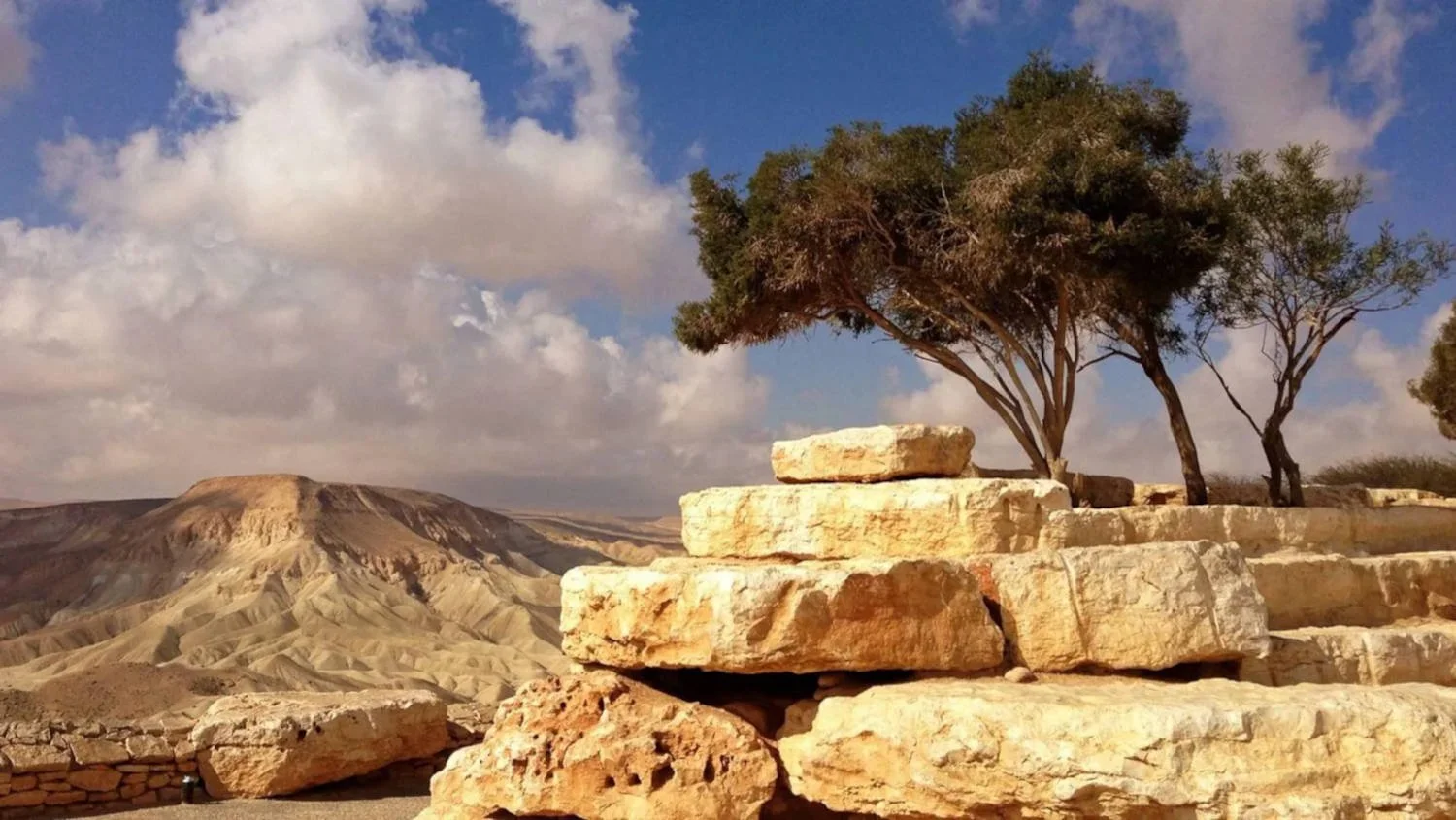
I love Israel for its people, its landscape, its deserts and kibbutzim, the Biblical history that infuses every rock of this tiny country from Moriah to Megiddo, Bethlehem to Beersheva, its familiarity to Jesus as He walked up and down this land, sanctifying it with His footsteps, this land that is different from any other land because God deigned it so.
In the Pentateuch, God showed His detailed, I would almost call it obsessive, order for the land. He commanded each of the twelve tribes of Jacob to settle in a specific place, a bounded section of the land: Asher in the far north, Judah in the south, Gad beyond the Jordan, and so on. You knew exactly where your home began and ended.
Belonging to a particular piece of land was so deeply inscribed that God provided a way for all people to get back to their tribal homeland every 50 years, because a life couldn’t be experienced as good if lived away from that plat of earth that God had assigned to you. It is a revelation of God’s regard for family and homeland, so different from our modern tendency to leave home in search of somewhere better.
I love the landscape of Israel, the desolate rockiness of some parts, and the exuberant productivity of those patches reclaimed for farmland. I love the diet of Israel, the fish and figs and dates and wine, the way it all comes from the land and sea, not from a box.
I love the smallness of Israel, about 1/20th the size of Texas. The Israel National Trail runs vertically, from the Lebanese border in the north to the Red Sea in the south, and can be trekked on foot in about a month, comparable to the Camino de Santiago in Spain. I’d like to walk the Trail myself someday.
I love the feasts of Israel, detailed in Leviticus 23, especially the Passover. ⁽¹⁾ Passover began at sundown on April 1 this year. During the night, Jewish families all over the world celebrated God’s rescue of the Israelites from the pursuing Egyptian army, through the parted waters of the Red Sea. It is a remembrance of the tender care God took of them, in the cloud and the manna and the water from the rock.
The land between Egypt and the promised land, where the tribes wandered for forty years, is desolate even now. Look up “Sinai” on GoogleMaps and switch to satellite view. It’s a big, brown empty. Zoom in, zoom out; there’s no difference, it’s a blank wilderness. No wonder Moses had so much trouble getting the Israelites to keep faith: hunger, thirst, snakes, sand blowing into every crevice of your body, hard rock impenetrable to a plow. It would have been like living in a tent in Death Valley … but God provided for their every need.
Every day in the Holy Sacrifice of the Mass, Catholics celebrate the fulfillment of the Passover in the true Lamb of God who is Jesus Christ, with especially fervent joy on Holy Thursday when we read the Passover narratives.
I love the Israeli dance, the hora. At USC, the Jewish students’ Hillel House was next door to the Catholic Newman Center. Hillel hosted lively parties of dancing once a week; I could hear the music through the walls. The hora is the circular dance you see at Jewish weddings, or in The Chosen or Fiddler on the Roof. The Newman Center had much to recommend it, but oh! I always wanted to go next door and dance the hora.
I love the pathos of a ragged bunch of wounded survivors building a nation nearly from scratch. There had always been a remnant in Israel, but after the decimated remains of European Jewry staggered out of camps in 1945-47 and found their way to Israel, the population bloomed. Soon Jews from all over fought their way to Israel, to the “one little corner of the earth where the word ‘Jew’ was not a slander.⁽²⁾”
I love Old Testament history, especially the women: Deborah and Jael, Judith, Susannah and Esther. They are ancient Joans of Arc: brave, clever, virtuous and strong.
Deborah⁽³⁾ resided in Ephraim around 1200 years before Christ. The people were under the thumb of a Canaanite king who confined them in the mountains in order to starve them out. Deborah called on Barak of the tribe of Naphtali to march on the Canaanite general Sisera, who panicked at the sight, and ran away. Sisera took refuge in the tent of an Israelite woman Jael, who gave him milk to help him sleep and then drove a tent stake through his temple. The grisly scene was a favorite subject for later medieval Christian artists.
In the sixth century before Christ, King Nebuchadnezzar of Assyria (modern-day Iraq, basically) called all the people of Judea to enlist in his army. The Israelites ignored the summons. Vowing revenge, the Assyrian king sent his military commander Holofernes with instructions to kill them all and fill the valleys with their dead bodies, from the river to the sea, as it were.
The men made ready the military defenses, while the women and children laid themselves prostrate in prayer and fasting. Holofernes had been advised not to pitch direct battle against the Israelites, who occupied the defensible heights, but to starve them out. The Israelites were on their last vestige of endurance when Judith⁽⁴⁾, a lovely widow from the tribe of Simeon, prayed to the Lord for a plan to break the Assyrians.
She made herself so beautiful that the guards on duty around the enemy camp were stunned, saying, “How can we despise the Israelites when they have women like this one?” She was taken straight to the tent of the commander, like a prize of war. Big, strong man that he was, he fell to her flattery and praise. While she drank nothing, Holofernes drank way too much. He was consumed with desire for her, but unfortunately for his plans, he fell asleep. Judith took his scimitar, and with two strokes, cut off his head, stuffed it in her bag, and raced for home.
“Here is the head of Holofernes, struck down by the hand of a woman!” Many centuries later, Judith and Holofernes were favorite subjects for Italian Renaissance painters such as Caravaggio, Gentileschi and Botticelli.
Susannah⁽⁵⁾ lived in Babylon during the Exile. She was another beautiful Hebrew woman, and two elders of Israel were shaken with lust for her. She refused their advances so they claimed to have seen her commit adultery with a young man in the garden. Since they were men of stature, they were believed, and Susannah was sentenced to death.
The prophet Daniel called a halt to the farce. He separated the two elders and asked them, one at a time, for details. The first elder testified that Susannah sinned under a mastic tree, the second said it was an oak, and thereby Daniel knew the elders were lying. In accordance with the law of Moses, the elders suffered the penalty that they would have imposed on the innocent Susannah.
Esther⁽⁶⁾ saved the whole Jewish people in Persia from the malicious plotting of Haman, a court official of King Xerxes, who wanted to exterminate the Hebrews in the fifth century before Christ. Her courage and resourcefulness is celebrated in the Jewish feast of Purim, which passed in early March this year, just as bombing began between Iran and Israel.
No wonder Israeli women don’t hesitate to serve in the military; there’s a history.
I love that Israeli young people regardless of gender or income or education fulfill mandatory service to their country. Every citizen is imbued with the sense that Israel belongs to them personally, and to their children. They will hold on to it for that reason, even at great cost.
I think I could have written this article a few years ago, and it would not have occasioned criticism. It would have been read as more or less a neutral memoir or travelogue, if read at all. Now a person loses friends for mentioning Israel in a positive light, without even touching on politics. That’s quite a rapid change.
I want to sing my love for Israel precisely because it is so unpopular. Israel is our homeland, every one of us who are bound to Jesus through baptism. We are the wild olive shoots grafted on to the cultivated Hebrew root stock.⁽⁷⁾ St. Paul tells us not to boast, but to stand in awe of such a gift.⁽⁸⁾
Does it mean to never speak criticism of the secular government? Certainly not. I can critique some action of a relative without withdrawing my love or condemning him to oblivion. We are family, and no disagreement, no matter how deep, erases that.
So I will continue to love Israel, without disabling my critical thinking, and dream of the day I can walk her trails and dance the hora.
(1) Exodus
(2) Leon Uris, Exodus, 1958
(3) Judges 4
(4) Book of Judith (Catholic Bible)
(5) Daniel 13 (Catholic Bible)
(6) Book of Esther
(7) Romans 11: 17-18
(8) Romans 11:20
+ + +
Note from Father Gordon MacRae: Sheryl Collmer is a frequent writer for Crisis magazine and other venues. Our readers may remember her from my posts about the exoneration of Cardinal George Pell in Australia after he spent 400 days in wrongful imprisonment there. It was Sheryl Collmer who sent him a copy of a post I had written exposing copycat testimony from an American case in his Australian trial. This turned out to be, at least in part, the cause of his ultimate exoneration and restoration to freedom.
We are very pleased to have this post about Israel from Sheryl Collmer. Her most recent post in these pages was
The Tenebrae of Maximilian Kolbe.
You may also like these related posts from Beyond These Stone Walls:
On Good Authority, “Salvation Is from the Jews”