
Voices from Beyond
At the Mercy of One False Brother
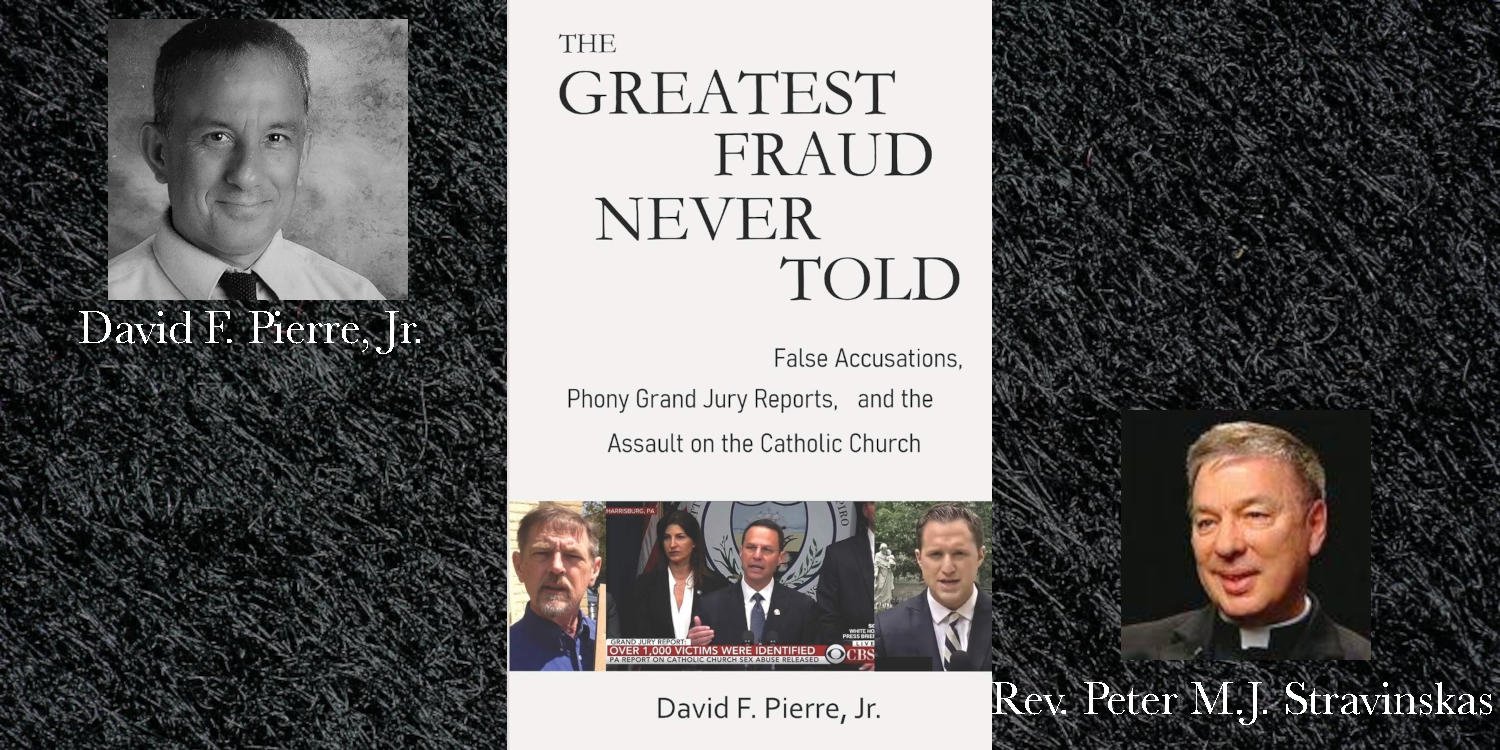
This review by Rev. Peter M. J. Stravinskas, an accomplished theologian and Editor of The Catholic Response, first appeared in The Catholic Thing.
This review by Rev. Peter M. J. Stravinskas, an accomplished theologian and Editor of The Catholic Response, first appeared in The Catholic Thing.
September 12, 2020 by Rev. Peter M.J. Stravinskas | The Catholic Thing
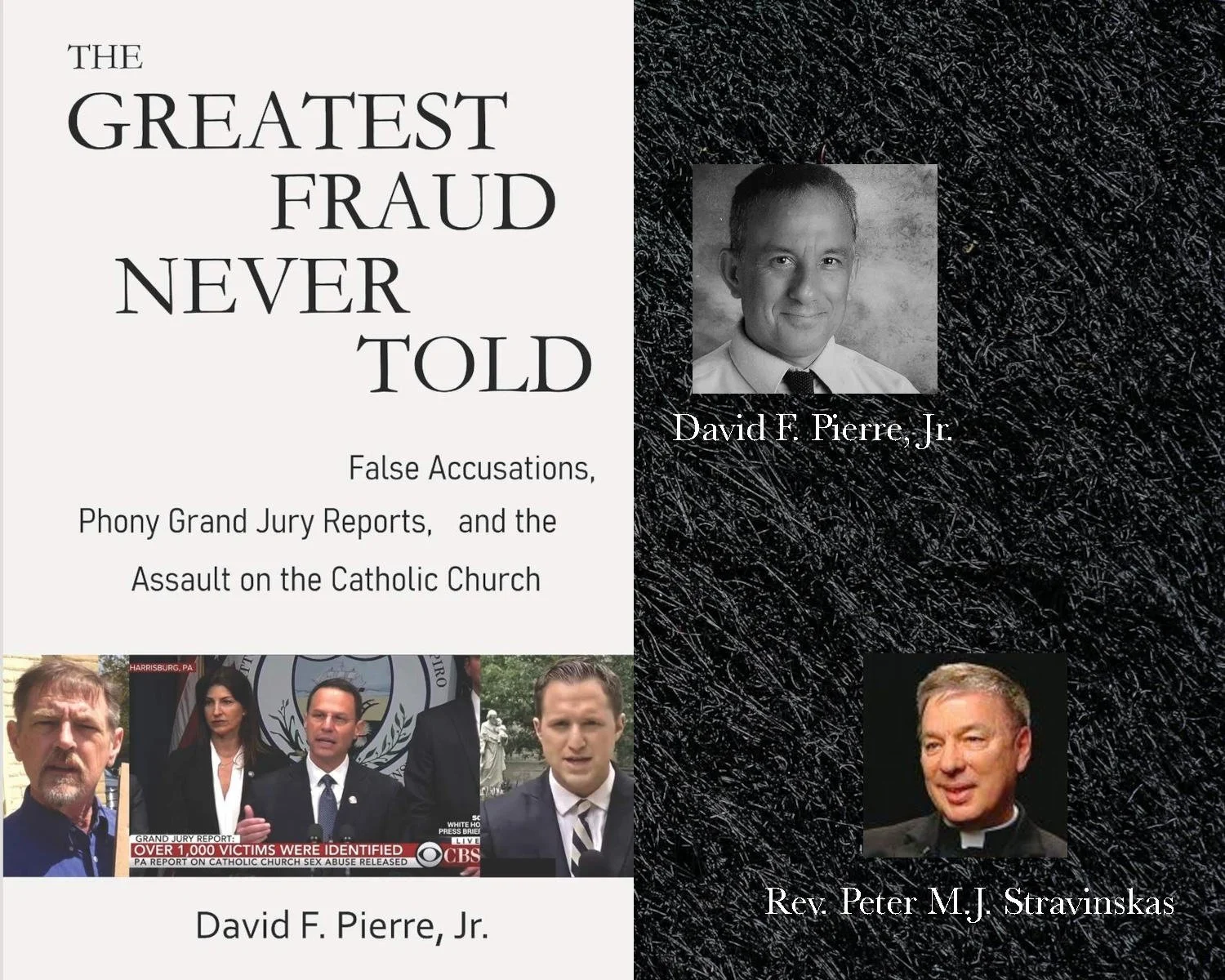
David Pierre of Media Report has published an illuminating new book, The Greatest Fraud Never Told: False Accusations, Phony Grand Jury Reports, and the Assault on the Catholic Church. Pierre and his work are often ignored because he is unjustly accused of dismissing accusations of clergy sex abuse, en masse. That charge is not true. Instead, Pierre stresses an often-forgotten truth: “a false accusation is truly an affront to those who genuinely suffered as the result of their horrendous abuse.”
When the first hints of clergy sexual abuse began to surface in the late-80s, I served as an advisor to many of the good, new bishops being appointed. On this topic, I counseled the bishops:
First, do not call this pedophilia – because, for the most part, it is same-sex activity between a cleric and a post-pubescent young man; that’s the truth and, the truth always sets us free. “Pedophilia” conjures up images of five- and six-year-old boys. Further, if the sinful activity had been properly labeled, ironically, the secular media wouldn’t have given it much coverage, since they always promote same-sex relations.
Second, never settle any case out of court for a variety of reasons, not least that while a pastoral plea demands a pastoral response, a legal challenge demands a legal response. Moreover, when a financial settlement is made, that more than suggests guilt, thus damaging irreparably an innocent priest’s reputation. Regrettably, most bishops listened, instead, to diocesan attorneys and insurance companies.
Owing to the Dallas Charter of 2002, the heavy-handed treatment of accused priests by bishops has resulted in an adversarial relationship, which Cardinal Avery Dulles foretold in 2004. Pierre also observes, quite correctly and sadly, that most priests dread it when the chancery calls. Why? Because “the mere accusation against a Catholic priest carries an automatic assumption that the claim is true.” And because the principle of “innocent until proven guilty,” in both ecclesiastical law and American civil law, has been eviscerated by current Church praxis: the accused priest is hung out to dry with an immediate diocesan press release, forced out of his residence within hours, placed on administrative leave, forbidden to wear clerical garb, and required to pay for legal counsel out of his own resources.
Interestingly, none of that happens for a bishop; his legal expenses are borne by the diocese. I should note that the procedure used for accused bishops is the proper one, but the double standard that exists when it comes to priests is responsible for the resentment all too many priests have toward their bishops, which Pierre underscores.
Yet another problem, again, thanks to the Dallas Charter, is the removal of the statute of limitations, causing Pierre to raise two essential questions: “How does one defend oneself against an accusation from 30, 40, 50 years ago? How would you defend yourself against an accusation from 40 years ago?” Of course, that is the very reason for a statute of limitations. Quite inconsistently, bishops have fought vociferously against removal of statutes of limitation in the civil realm.
Pierre devotes a chapter to the infamous Pennsylvania Grand Jury Report, which he calls “the Grand Fraud” because its approach, content, and language all betray an animus against the Church, starting from the theatrics of the Attorney General, Josh Shapiro, in the press conference releasing the report. Bald-faced lies abound, as do innuendo and inflammatory language. Dead priests account for 53 percent of the accused (one was born in 1869!). Pierre follows up with “Pennsylvania Perjury,” where he tackles the Report’s assertion that the bishops of the State “did nothing” when confronted with abuse; he demonstrates the very opposite.
Concluding his treatment of the Pennsylvania Report, our author expresses astonishment at the relative silence of the Catholic media in the face of this gross miscarriage of justice, not “defending bishops, priests, and the Church when they were publicly wronged.” More disturbing to me was the almost gleeful promotion of the Report, by many would-be “conservative” or “traditional” Catholic outlets, so that “these partisan platforms began airing stories that were simply false, and in some cases, quite bizarre.”
Pierre also highlights the pervasive anti-Catholicism throughout the entire crisis; he cites remarks by the Attorney General of Michigan (the Catholic Church is “a criminal enterprise”) and observes that “a public official would never get away with such a clearly bigoted remark against another religion.”
Chapter Eight is titled “A Disastrous Practice,” which refers to how bishops sent offending priests to treatment centers and then followed the advice of the “professionals,” most of whom assured bishops that these priests were ready to return to ministry. Formerly, bishops often sent problematic priests to permanent confinement in a monastery. But a secular model cowed a spiritual model in recent decades, with psychiatrists controlling the process. To be fair, this “therapeutic” approach was employed by basically every institution, Catholic or not, in the country at the time.
Chapter Twelve is provocatively entitled, “The Catholic ATM.” Pierre notes how expensive litigation is, but goes on to observe that the dioceses cause themselves harm by having what the New York Archdiocese calls “lenient standards of evidence,” thus paying out “on many weak claims.” The result: “the more the Church pays out on these bogus claims, the more claims it gets. It all makes sense. Why not file suit? There is nothing to lose.”
Rolling over and playing dead is not “pastoral”; it’s irresponsible because it squanders the diocesan patrimony and, far more importantly, gives credence to lies that do irreparable damage to the image of the Church and clergy.
Pierre shares some good news amidst this depressing saga: Some priests are now suing government officials who have violated their civil rights or fraudulent victims who have defamed them. You might ask, “What has taken so long for this to happen?” The answer, in many instances, is that priests were prohibited from doing so by their bishops, who thought it wouldn’t “look good.”
It’s worth reading the material on SNAP (Survivors Network of those Abused by Priests), a viciously anti-Catholic group. One employee eventually saw through the façade and questioned its modus operandi, which brought about a hostile work environment and her filing of a lawsuit against SNAP. She delineates a whole series of accusations against her former employer, which should be disturbing, but not surprising.
David Pierre has done all a great service in assembling the hard data. The truth of the matter is that the “mop-up” operation of the past two decades has made any institution of the Catholic Church in this country the safest place for any minor or vulnerable adult. There are nearly 40,000 priests in our country; last year twenty accusations were made – accusations, not substantiated cases. Cardinal Newman, with his uncanny capacity to gaze into the crystal ball, warned seminarians in 1873: “With a whole population able to read, with cheap newspapers day by day conveying the news of every court, great and small to every home or even cottage, it is plain that we are at the mercy of even one unworthy member or false brother.”
Indeed, even one unworthy member or false brother.
+ + +

Betrayed by Victims’ Advocates
This firsthand account by an adolescent sexual abuse survivor first appeared in the Catholic League Journal, Catalyst, in April 2020. It is reprinted here with permission from the publisher.

This riveting account by a survivor of adolescent sexual abuse first appeared in the Catholic League Journal, Catalyst, in April 2020. It is republished with permission at Beyond These Stone Walls.
April 15, 2020 | Catalyst
As an adolescent victim of homosexual clergy abuse, I know the challenges that men face in coming forward. Many of us are silenced in shame after being abused. Aggravating the recovery process is that, despite the evidence, there is an ongoing agenda to cover up the homosexual nature of the abuse crisis, disenfranchising more than 80% of us victims.
Recovery is difficult enough without predatory advocacy groups and their lawyers trolling us for profit and politics. The added torment of being told the problem isn’t related to homosexuality only compounds our pain. For this reason, I am grateful to the Catholic League for giving me the opportunity to relay the difficulties facing victims of homosexual abuse in particular, with all due respect and recognition of the grief suffered by victims who were subjected to heterosexual abuse.
For all of us men who were robbed of the opportunity to allow our sexual identities to mature before being assaulted, the abuse may be ruinous, to the point that some victims never speak of it. Sadly, the odds of suicide attempts are 2-4 times higher among women and a staggering 4-11 times higher for men compared to those who are not abused. These statistics do not account for the compounded effect of betrayal of our faith caused by our spiritual fathers.
I never spoke a word about my abuse until seven years later, feeling safe only to disclose under the seal of confession. The problem was that I didn’t know that the priest behind the confessional screen was an active homosexual. So, when I confessed to him, and he offered to help me, I didn’t know I was being solicited.
I was 22 years old, it was 1989, and there was no public knowledge of the predatory homosexual cadre in our Church. Over the ensuing 18 months the priest from the confessional provided pastoral counseling, but I was also subjected to lewd homosexual conversation and harassment. It was complicated, I was benefitting from his counseling as I was preparing for medical school and hoping to get better, so I tolerated his sporadic foulness. I became dialed into my faith like never before, attending mass and praying on my knees every night. I seemed to be recovering. But that all ended one night when he phoned me, ostensibly drunk, blurting out the most appalling sexual propositions. It was truly devastating. After that I could no longer sit through a mass. I left the Church, vowing I would never speak about my abuse again.
Decades would pass before I found myself in professional counseling. Not knowing I had PTSD, I was dealing with severe anxiety. I didn’t intend to tell the psychologist about the abuse, however, he got to the source, and thus began my recovery. I was 44 years old, with a wife and four kids. We had made the difficult decision years earlier to educate our kids in Catholic schools.
I’d like to share some experiences I had in the recovery process to benefit other survivors and their families to learn from my mistakes, and for members of the Church to understand what happens to us victims when we step forward. Recovery is a difficult course to navigate with plenty of bad actors and hidden agendas out there.
The first step I took after coming forward was to learn what happened to my abuser. I found the “Bishop Accountability” website and read that he had been incarcerated in Oklahoma for assaulting boys there. On that webpage I saw a banner ad for a group called “Road to Recovery”.
I reached out, and had an immediate response by founder and former priest, Bob Hoatson. In that first email he asked if I would like an attorney. I was surprised by this, it wasn’t why I was contacting him, I declined the solicitation and told him I only wanted to get better.
I took his counsel thinking he was an expert on clergy abuse. He appeared on CNN with Anderson Cooper and was in countless newspaper articles. He became a significant influence on me. Ultimately, under his influence, I brought a suit against the Church and I would leave the Church, again. I drew the line when Hoatson encouraged me to get my children out of the Church. Nonetheless, my family was going to mass without me with a negative effect on us.
Hoatson introduced me to the petulant attorney, Mitchell Garabedian, at the Survivors Network of those Abused by Priests (SNAP) conference in Chicago. SNAP proclaims to be a support group for survivors, but what I experienced was anything but support for survivors. SNAP invited the shark attorneys, used the victims like chum, and watched the frenzy unfold.
I saw Jeff Anderson, the mega-sex abuse plaintiff attorney, giggly and excitedly prance around the conference to funnel money to SNAP. All the attorneys raised their hands to show how much they “cared”, but it was an obvious pledge to their motherlode, SNAP. Anderson offered to match all donations up to $50,000. I thought Anderson was entirely inappropriate and found his exuberance personally offensive for the occasion. I watched in disbelief as survivors were subjected to the machinations of SNAP.
After the victims were commoditized with attorneys in the conference room, we broke into small groups. I was looking forward to this part, thinking someone could tell me how to break through. Our group leader, Patrick Wall, was an ex-priest. I thought, “surely these ex-priests, Hoatson and Wall, must be good people and can help.” Instead, what happened in my small group had no therapeutic value. From my years of training in medicine, my assessment was that Mr. Wall had no skills in facilitating a group like this. There were about 10 men in my group and nothing was accomplished. Nothing.
Then, Wall told us he was an attorney working in Jeff Anderson’s practice. My heart sank, my eyes welled up with tears. I went to the SNAP conference to get better, and I had hoped they would help, but all I saw was SNAP aligning victims with attorneys for money and to weaponize victims against the Church.
I left the small group session deflated, and sat in the hallway. A woman came asking if I was OK. I told her that SNAP wasn’t what I thought it was going to be. She said, “I’m sorry that you feel that way.” I asked if she was part of SNAP. She said no, “I am an attorney, here to see how I can help.” She handed me her card. I felt sick and had to get out of there.
I found David Clohessy, the president of SNAP, in the hotel lobby. He authored an article about my abuser. I wanted to know where he got his information and where I could learn more. When asked, he couldn’t remember writing the article. He couldn’t give me any information about my abuser. I thought, “how can someone write an article and not remember a single thing about it?”
What I’ve come to learn over the years is that SNAP will regurgitate negative news about the Church to multiply the exposure. That’s why Clohessy didn’t remember his article. He did not offer to help me, he only apologized for not knowing anything.
Soon after the conference, a whistle blower, Gretchen Hammond successfully sued SNAP. She witnessed SNAP taking kickbacks from the attorneys. I was happy and felt vindicated that someone stood up for victims against SNAP.
Fast forwarding through the years, I was able to prosecute my abuser with a loophole in the statute of limitations. He was convicted, sentenced to prison, and will likely expire there. On December 23rd, 2017, I had a remarkable and unexpected reversion to our Faith. Being back in the Faith brought joy that superseded the happiness I was seeking in counseling.
Hoatson made some disparaging remarks about my return to the Church and my communication with him fell off. In reflection, I realized how he funneled victims to Garabedian, manipulating them much like SNAP. I asked Hoatson what his financial relationship was with Garabedian, he only said “Mitch takes good care of me.”
In September of 2018, I was traveling across the Great Rift Valley in Africa, leading a team on a medical mission. I received an email from Hoatson in our satellite-equipped safari truck. He sent me his press release in response to the Pennsylvania Grand Jury Report. It read, “homosexuals don’t rape minors, predators rape minors.” He went on, “sure, some homosexuals rape minors, and some heterosexuals rape minors,” leading the reader to believe that there is no difference. He also implored Catholics to embrace homosexual and transgender priests.
I confronted him, asking him to add facts to his press release and tell the truth. I replied, “Bob, I was raped by a homosexual and you’re telling the press that I wasn’t. How do you think that makes me feel?” He told me I was the only survivor who felt that way. I reported this to Cardinal Tobin, in New Jersey, where Hoatson’s organization is located. I learned that I am not the only survivor who feels disenfranchised by the position that homosexuality has nothing to do with the crisis.
The effort to protect and harbor active homosexual priests in the Church adds insult to victims’ injury. Many point to “clericalism” as a cause. Alright then, let’s recognize that homosexuals far and away outpace heterosexuals in using clericalism as a means to an end. Can we stop with this politically correct nonsense? We are the Church, forever counter-cultural, with no duty to bow to the gay agenda.
Sometimes I hear words of hope. Like Pope Francis’ statements on homosexuals in ministry. Recently our local rector sent out a notice about screening homosexuals from entering the seminary. In response, I immediately sent a $1,000 donation in gratitude.
Today, SNAP continues to smear our Church. Recently, Clohessy appeared in my city with TV coverage accusing our Bishop of not including my abuser on a list of accused, highlighting my abuser on the news. But he was never in this archdiocese. I contacted the TV station and SNAP multiple times asking them to correct their false reporting but they never responded. SNAP created false news, smeared the Church, their mission accomplished. SNAP also recognized Bob Hoatson with an award last year.
Navigating the recovery process is tough. There are forces vying for victims’ money and souls. However, for me, it was my return to the Catholic Faith that pulled me through the effects of abuse. I am grateful to God for that.
+ + +
Related:
David Clohessy Resigns SNAP in Alleged Kickback Scheme
Coming Home to the Catholic Faith I Left Behind by Michael Ciresi