“There are few authentic prophetic voices among us, guiding truth-seekers along the right path. Among them is Fr. Gordon MacRae, a mighty voice in the prison tradition of John the Baptist, Maximilian Kolbe, Alfred Delp, SJ, and Dietrich Bonhoeffer.”
— Deacon David Jones
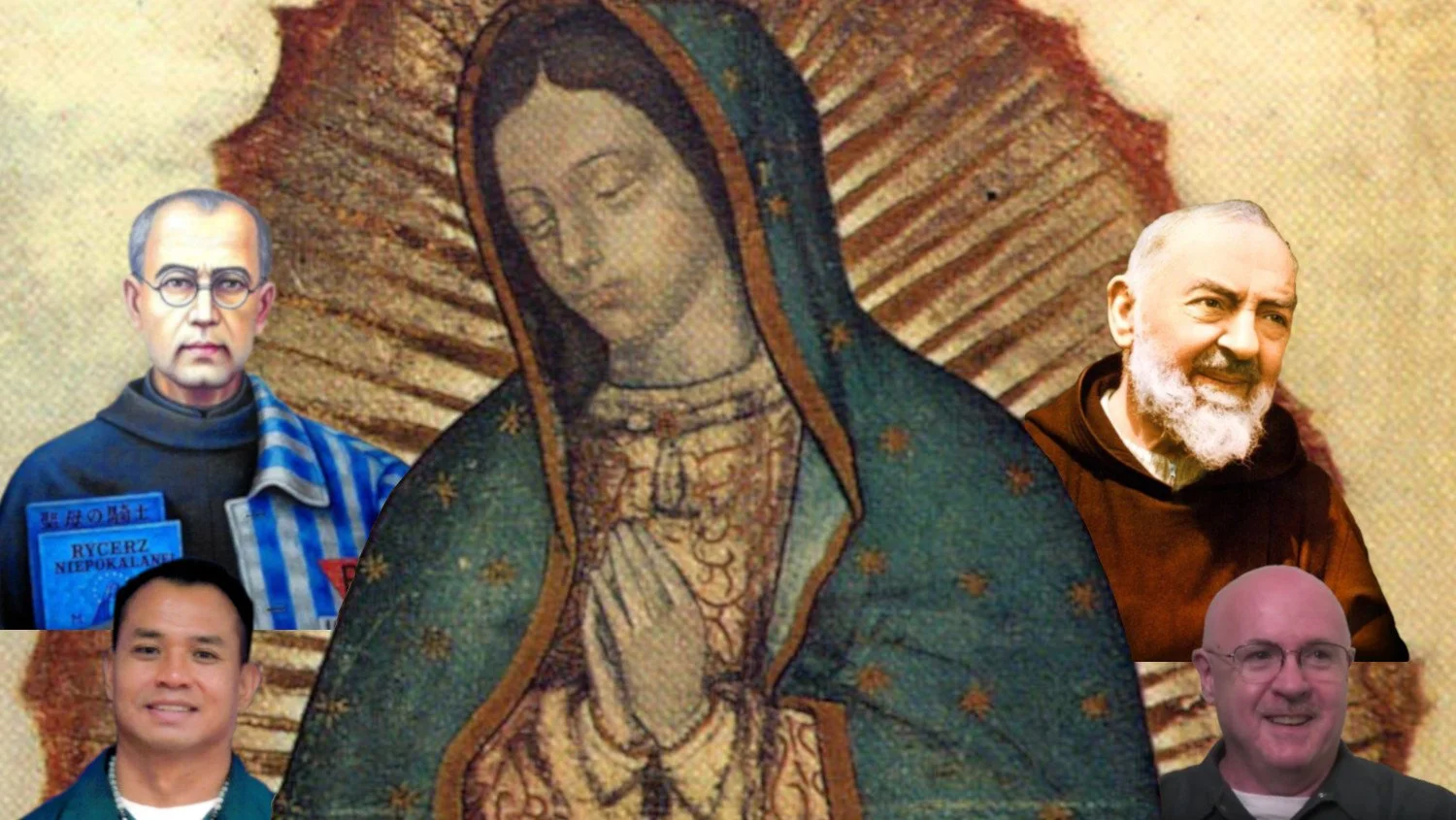
The Prison of Father Gordon MacRae and Pornchai Maximilian Moontri
Marking 44 years of sacrificial priesthood, Father Gordon MacRae has been an instrument of Divine Mercy securing freedom for many wounded and imprisoned souls.

Marking 44 years of sacrificial priesthood, Father Gordon MacRae has been an instrument of Divine Mercy securing freedom for many wounded and imprisoned souls.
June 3, 2026 by Rebecca Virelles
From the Editor:
This Friday, June 5, 2026, marks the 44th anniversary of the ordination of Father Gordon MacRae. On this occasion, we have a guest author. Rebecca Virelles has been a regular reader for years. A while back, she interviewed me about BTSW, which resulted in my article, “From Arizona State University: An Interview with Our Editor.” She then wrote her insightful article, “A Voice for the Voiceless: Beyond These Stone Walls.”
Recently, she has been reflecting on the literature of those unjustly incarcerated. Her aim is to make their lives and writings more accessible to new audiences. She has considered various saints and moral icons from history, and also Father Gordon MacRae and Pornchai Maximilian Moontri, whose lives are deeply intertwined. We have asked her to share with BTSW readers the part of her work concerning our two friends.
We think it is a fitting way to reflect on the priesthood of Father Gordon MacRae on his anniversary of ordination. We thank God for the gift this priesthood has been to the Church, and we ask Him to continue to bless him and be his strength.
+ + +
Dear Reader,
Before you read about the two men named above, please know they are real people, living at the time of this writing, who are dear to many on earth and in heaven. Though you may never meet them in this life, please extend mercy with your heart and read their stories carefully.
Historical Context
Father Gordon MacRae is an American priest who is currently serving up to 67 years in prison. He was wrongly convicted of sexual assault in 1994. At the time of this writing, he has spent 32 years in prison for crimes for which he is wholly innocent, crimes that never took place. Because Father MacRae maintains his innocence, he will never receive parole and thus will serve the full 67 years, a life sentence, unless some other intervention materializes.
The Evidence
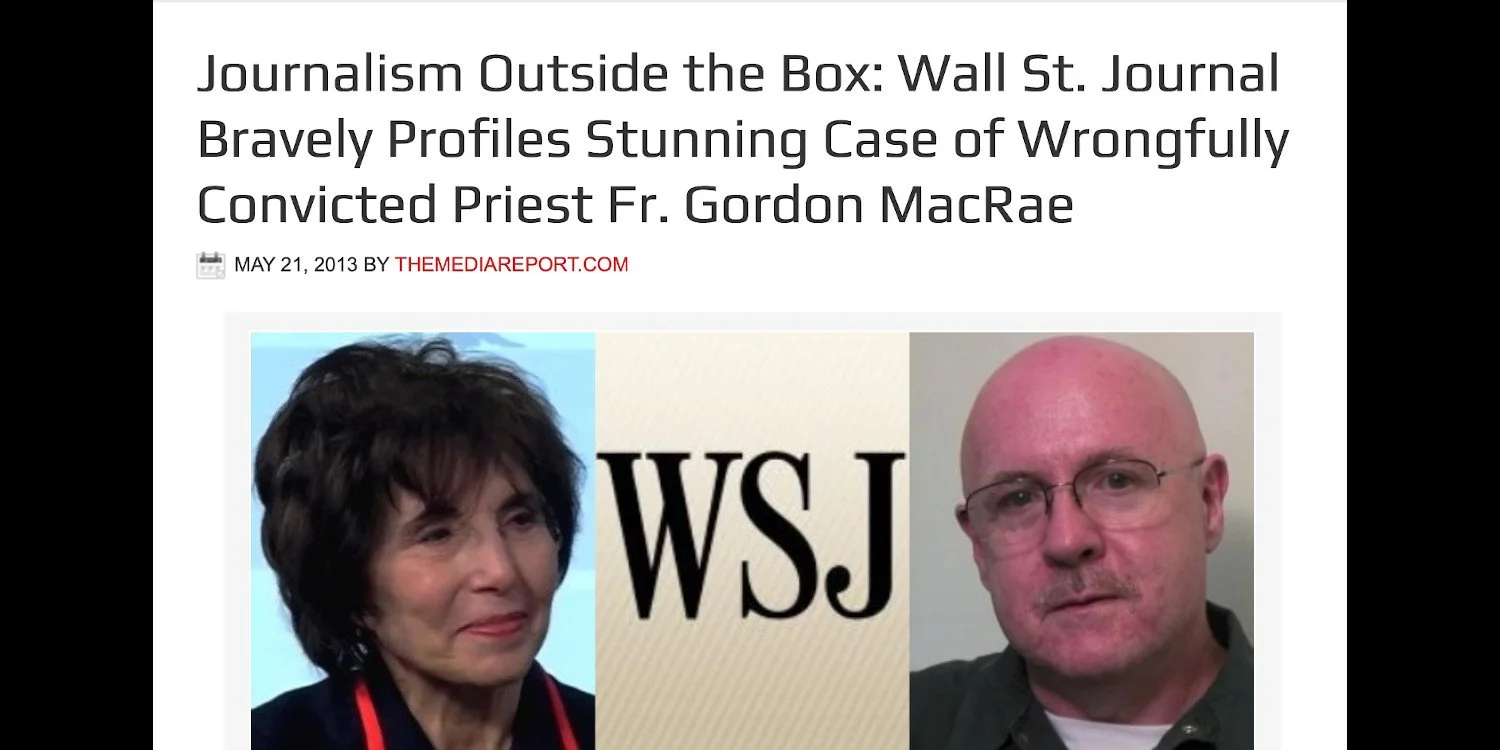
In 2005 and 2013, Dorothy Rabinowitz, an award-winning journalist wrote multiple articles for The Wall Street Journal covering this egregious injustice: “Trials of Father MacRae” (2013), “A Priest’s Story” (2005). Dorothy Rabinowitz was awarded the Pulitzer Prize and the “Champion of Justice Award” from the National Association of Criminal Defense Lawyers.
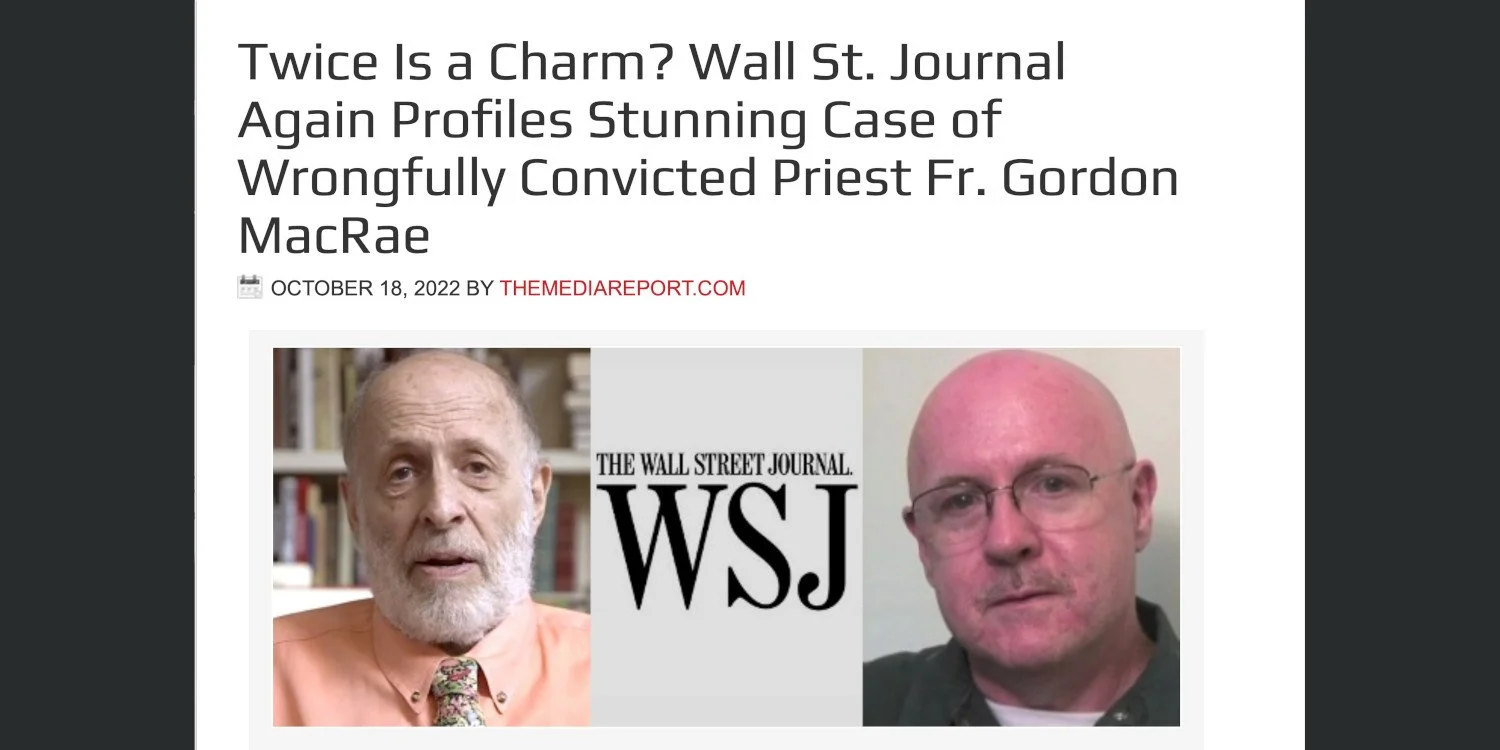
In 2022, Boston criminal justice and civil rights Attorney Harvey Silverglate also wrote for The Wall Street Journal in “Justice Delayed for Father MacRae.” His article revealed new information which came to light about the “falsification of records” of the lead detective behind Father MacRae’s case, James F. McLaughlin.
Additionally, a post-trial investigation by former F.B.I. Investigator James Abbott revealed that Detective McLaughlin threatened a defense witness, a therapist, with arrest if she did not change her testimony which would have helped to exonerate Father MacRae. The therapist had planned to testify that the accuser, Thomas Grover, had never accused MacRae of anything, though he accused several others of sexual abuse. This would have weakened McLaughlin’s case. She stated, “McLaughlin told me he would personally come to my home, drag me out of it bodily if necessary, and force me to appear in court and testify despite my information to him.” Her statement is here: Statement of Debra Collett.
Here is an excerpt of a letter dated October 24, 2013 by a media official for PBS to Judge Arthur Brennan, who sentenced Father MacRae to prison:
“My wife, Penny, and I were present in the courtroom throughout most of the trial of Fr. Gordon MacRae. For all these years, I have had many questions about this trial and much that I’ve wanted to clarify for my own peace of mind. I learned recently that both a superior court judge here in New Hampshire and the NH Supreme Court declined to hold a hearing on the evidence and merits of a habeas corpus petition in this case. Now that state courts seem no longer to be involved, I feel more inclined to approach you on what has been bothering me, as you were the presiding judge.
“We saw something in your courtroom during the MacRae trial that I don’t think you ever saw. My wife nudged me and pointed to a woman, Ms. Pauline Goupil [now Pauline Vachon], who was engaged in what appeared to be clear witness tampering. During questioning by the defense attorney, Thomas Grover seemed to feel trapped a few times. On some of those occasions, we witnessed Pauline Goupil make a distinct sad expression with a downturned mouth and gesturing with her finger from the corner of her eye down her cheek at which point Mr. Grover would begin to cry and sob on the stand. The lawyer’s questions were never answered.
“I have been troubled about this for all these years. I know what I saw, and what I saw was a clear attempt to dupe the court and the jury. If the sobbing and crying was not truthful, then I cannot help but wonder what else was not truthful on the part of Mr. Grover. If he was really a victim who wanted to tell the simple truth, why was it necessary for him and Ms. Goupil to have what clearly appeared to be a set of prearranged signals to alter his testimony? The jury was privy to none of this, to the best of my knowledge.
“Signed, Leo Demers”
His full statement is here: Statement of Leo Demers.
Here is an excerpt of a statement by Steven Wollschlager on October 27, 2008:
“McLaughlin asked me many times if Gordon ever tried to come onto me sexually or offered me money for any sexual favors. He had me believing that all I had to do was make up a story about Gordon and I could receive a large sum of money as others already had. McLaughlin reminded me of the young child and girlfriend I had and referenced that life could be easier for us with a large amount of money [...] I was at the time using drugs and could have been influenced to say anything they wanted for money.
“A short time later after being subpoenaed to Court, I had a different feeling about the situation. I did not want to lie or make up stories. After speaking with the Clerk of Courts I was approached by another person. After telling this person that I did not want to be there and I stated Gordon had never done anything wrong towards me sexually or otherwise. I was told I could leave. This person seemed visibly upset that I had nothing to say.”
His full statement is linked: Statement of Steven Wollschlager.
The last to make a statement in support of Father MacRae’s innocence whom I will mention is Charles Glenn, Thomas Grover’s former stepson. An excerpt of his signed statement reads as follows:
“From 1993 to 1997 I was assigned to the Youth Development Center in Manchester, New Hampshire. During this period, my mother Trina Ghedoni was dating and later married to Thomas Grover. Almost every week my mother would visit me with Thomas Grover and on numerous weekends I would receive a furlough and be allowed to go to my home at 410 Prescott St. in Manchester where my mother and Thomas Grover lived.
“During these visits, and over a number of months and years, Thomas Grover discussed the sex abuse allegations against Gordon MacRae with me. Grover often stated to me that he was going to set MacRae and the church up to gain money for sexual abuse. Grover would laugh and joke about this scheme and after the criminal trial and civil cash award he would again state how he had succeeded in this plot to get cash from the church. On several occasions Thomas Grover told me that he had never been molested by MacRae.”
His full statement is here: Statement of Charles Glenn.
These statements are not the only evidence of wrongdoing, manipulation, and fraud in the case against Father Gordon MacRae, however for the sake of brevity I will conclude with linking Father MacRae’s own synopsis of the case against him: Synopsis of the Case.
Where To From Here?
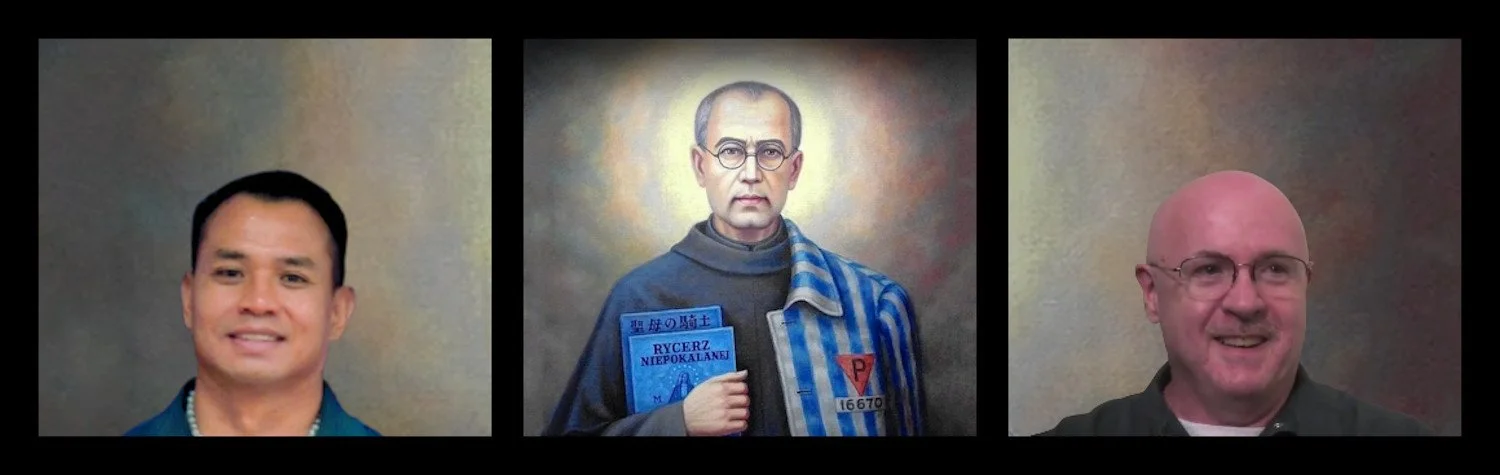
Now that we have covered this injustice, we can turn our attention to what Father MacRae has done with his time and talents within those stone walls. He has successfully encouraged many prisoners to seek and complete higher education, and he has helped multiple prisoners prepare for deportation to countries where they had few or no connections or means of assistance. Some of the best work Father Gordon MacRae has done is not material: he has cooperated with the Holy Spirit to bring people, in and outside of prison, to hope and to God despite what they have endured or what they have done. Pornchai Max Moontri, one of Father MacRae’s closest friends, and a free man now living in Thailand, says of him:
“Father Gordon MacRae freed me from the evil inflicted on me. He taught me that this evil is not mine to keep. What do I do with such a story? If Father G had not been here, what would have become of me? He freed my mind and soul from the horror inflicted by a real predator. It breaks my heart that the man responsible for my freedom will now be left behind in prison.”
— Statement of Pornchai Maximilian Moontri in a post written from Thailand: “On the Day of Padre Pio, My Best Friend Was Sigmatized.”
Father MacRae has a blog, Beyond These Stone Walls, in which he posts weekly reflections about Faith, Science, current events, and updates on the lives of his friends. Two of my favorites of his posts are: Science and Faith Are Not Mutually Incompatible and In the Absence of Fathers: A Story of Elephants and Men.
Here is a link to a post written on September 26, 2018, about his friend Pornchai Max titled: Pornchai Moontri: Bangkok to Bangor, Survivor of the Night.
My Analysis: Finding Light in the Dark
“As for you, you meant evil against me, but God meant it for good, to bring about that many people should be kept alive, as they are today.”
— Joseph to his brothers who sold him into slavery, Genesis 50:20
The purpose of this essay is to share the literature and lives of those who chose freedom of the soul over physical freedom. Other lives I have recounted and written about were courageous for facing death, but it is inspiring to see two people not give up after so much injustice and years of confinement. It is also wonderful to see how the effects of this hope have spread to others. At the end of Pornchai Max’s sentence in 2020, he faced five months in ICE (Immigration and Customs Enforcement) detention and deportation to a land he had not seen or spoken the language of for many years. This was due to Richard Bailey’s meaningful choice not to allow Pornchai Max’s mother (Wannee) to apply for U.S. citizenship, as he knew it helped him to keep a higher control of the mother and sons. It is likely Bailey threatened Wannee that if she did not do what he said that she would be deported to Thailand without means or assistance, as this was one of the reasons Wannee pleaded with Pornchai Max not to testify against his stepfather, Bailey.
However, what man intended for evil, God used for good. Thanks to Divine Providence, Beyond These Stone Walls readers, the “bridge” Father MacRae and Pornchai Max built, and the hard work and faithfulness of Pornchai Max in meeting these challenges, he was able to find housing and meaningful employment. He now lives in Thailand and volunteers to help those less fortunate. If Father Gordon MacRae had taken the lenient plea deals offered to him, he would not have met him and Pornchai Max would likely have never seen any measure of justice for what he endured.

Pornchai Moontri was selected to be the flag bearer for Thailand at the Fifth Asian Apostolic Congress in the Philippines in 2024.
“ ‘Behold, I make all things new.’ ”
— Revelation 21:5
Pornchai Max’s triumph over the past is also evidenced by his accomplishments: earning his diploma and graduating as class Valedictorian in 2012, completing social work and psychology academic certificates at Stratford Career Institute “with highest honors”, and completing Theology courses at Catholic Distance University through a scholarship with all “A’s”. The late Clare Dion, who interviewed, visited, and befriended Pornchai Max during his imprisonment wrote, “What Pornchai has accomplished is nothing short of amazing given that he learned English in prison. He and ‘Father G’ encourage other prisoners to become educated, and Pornchai spent time mentoring and tutoring them, especially in mathematics in which he excels. He also spent his days in the woodworking and Hobby Craft shop where he taught safety training to other prisoners on the use of carpentry tools and machines.”
Testimony
A recent comment on the “Book of Tobit: The Angel Raphael on the Road with Pornchai Moontri” reads:
“What a beautiful faith-filled story! What left me with goosebumps is the fact that I know that every word of it is true. I have known Father Gordon and Max for many years. I was a lost 17-year-old when I was sent to prison, and I spent many years in hopelessness before meeting these two incredible guys. Though I walked through the valley of the shadow of death, they were at my side bringing light to my very dark journey. I am a different person today because of them. I have wept over Max’s journey and the continued challenges he faced even in freedom. But Father G was there for him, even from a distance, and that is true of me as well. I also love dogs and this is the best dog story ever! I treasure you guys.
God bless you.
Bobby T”
A comment on a different post reads:
“WOW! I spent a couple of years in that prison. Because of overcrowding, there were no cells available for me. So I was stuck in an overflow bunk right outside cell #1 on Bravo Pod in Hancock Building. In time I came to see that I was the luckiest person in the world because the two prisoners living in cell #1 were Father G and Pornchai. When the gangs tried to recruit me, they weren’t having it. When a predator tried to extort me, they sent him packing. I felt so exposed going to prison at a very young age that these two guys made me feel perfectly safe. They weren’t taking any BS from me either. In exchange for looking after me, they made me go to school and I earned my high school diploma. That is a miracle because I have always been a dumbass. My worst enemy was Math, but Pornchai was a whiz at Math and got me through it. These two guys were seen by everyone as a team and I was fortunate enough to be their gatekeeper. I was popular by default. I have a lot of gratitude toward them both, and I thank them for their patience with me. I admire Pornchai so much more now to see that he is a man of deep faith. God bless them both.
With love from Ralph”
According to “Mercy Inside These Stone Walls,” a chapter in a book by Felix Carroll, fellow inmate, Donald Spinner, a Catholic convert, says his faith took root through Pornchai’s example. “Pornchai, especially, has influenced so many people here,” he says. “We all expect Father G. to be a good person, but Pornchai’s life of grace is inspiring to everyone. … The cost of discipleship for me has been the loss of my selfishness. No one can be selfish in such company.”
Conclusion
Evil and injustice are the hardest things to grapple with, especially as we witness our own struggles with light and dark. As others have written before, in our lives we cannot control the evil that happens to us, but we do always have the choice in how we respond. Even after meeting Father Gordon, Pornchai Maximilian could have chosen not to trust in him — he had every reason not to. Yet his courage and hope in setting aside the past propelled him forward, to freedom and to seeing some measure of justice served. Father Gordon could have chosen the easy way out, yet he would not have touched many lives, as several of the comments on his posts attest.
In an echo of one of his writings quoting St. Padre Pio: We often do not see how things are being woven together in God’s tapestry; we only see what looks like a tangled mess on the back. Yet, if we trust and do our part, even in the dark, even in pain, we will do what is right and one day understand it all. That is the essence of choosing the freedom of your soul over convenience, over your family, even over your life. True freedom comes from choosing to do the right thing, the will of God written on our hearts, and returning to it again when we stumble and fall. Our lives look different in the light of eternity.
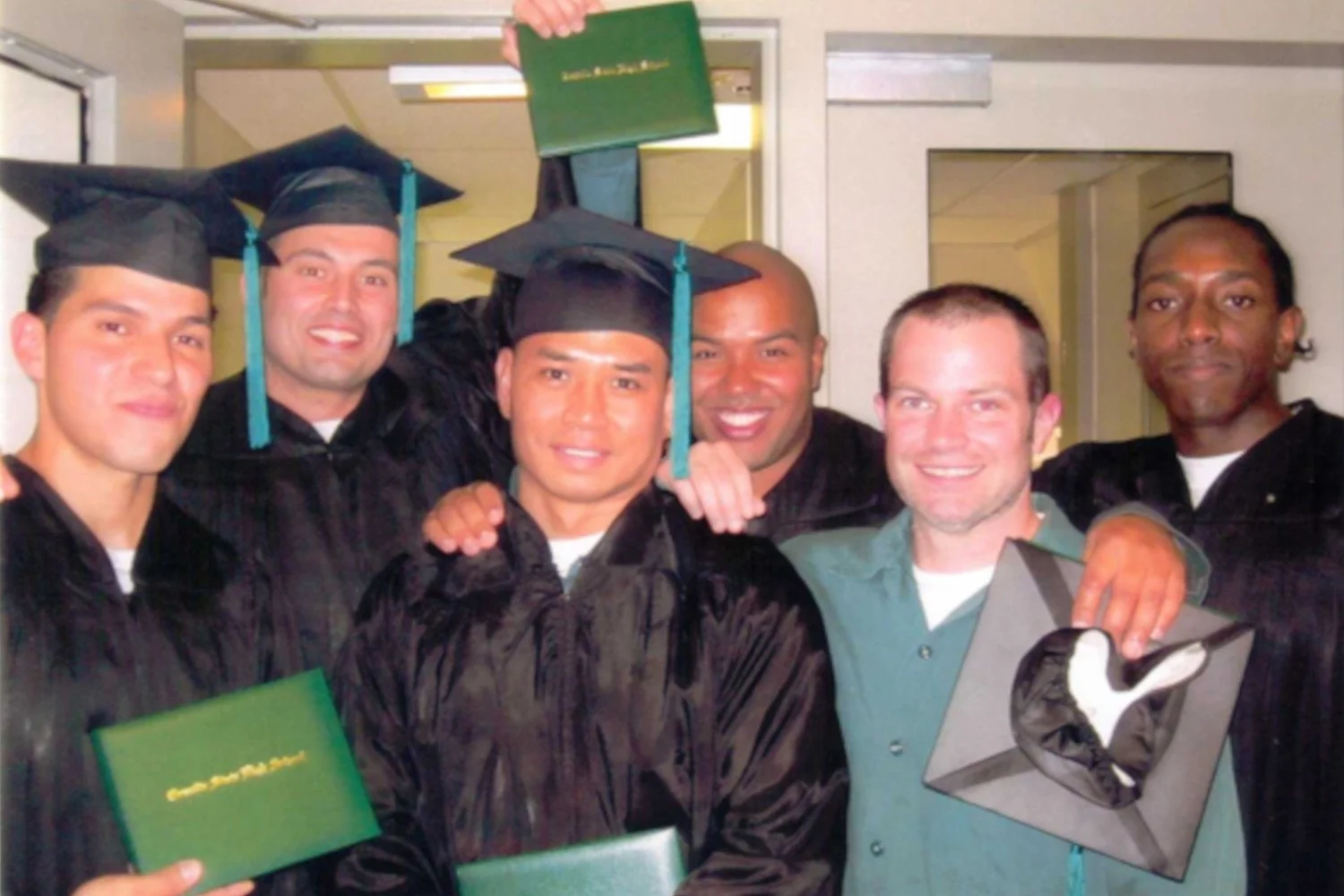
In the photograph above, Pornchai Moontri is at the center of his graduating class, who obtained their high school diplomas in the most trying circumstances but with hard work and honor. They are smiling at Father Gordon MacRae, who took the picture in 2012.
+ + +
Appended by the Author:
Father MacRae has thus far assisted prisoners throughout their deportation process from the United States to Thailand, Cambodia, Vietnam, India, Pakistan, China, Myanmar, Nepal, Indonesia, Malaysia, Japan, United Kingdom, Canada, Australia, Ivory Coast, Nigeria, Dominican Republic, Mexico, Guatemala, Honduras, Kenya, and Brazil. Each country represents a person, a soul with few or no means or outside assistance, whom Father MacRae aided when most would have looked the other way.
Rebecca Virelles is a Senior at Arizona State University’s Bachelor of Arts in English degree program online. She served on active duty for nine years and is now a stay-at-home wife and mother. When not studying, she enjoys reading, baking, and traveling with her family. She aspires to write children’s literature one day in the tradition of J.R.R. Tolkien and C.S. Lewis.
+ + +
Editor’s Note: Thank you for reading and sharing this important article by Rebecca Virelles. You may also like these related articles from multiple other writers:
A Criminal Defense Expert Unfurls Father MacRae Case by Vincent James Sanzone, Jr., Esq.
Travesty of Justice: The Ordeal of Father Gordon MacRae by William Donohue, Ph.D., President of the Catholic League
Could Fr. Gordon MacRae Finally Go Free? by Kathy Schiffer at TheCatholic World Report
Alarming New Evidence May Exonerate Imprisoned Priest by David F. Pierre, Jr. at The Media Report

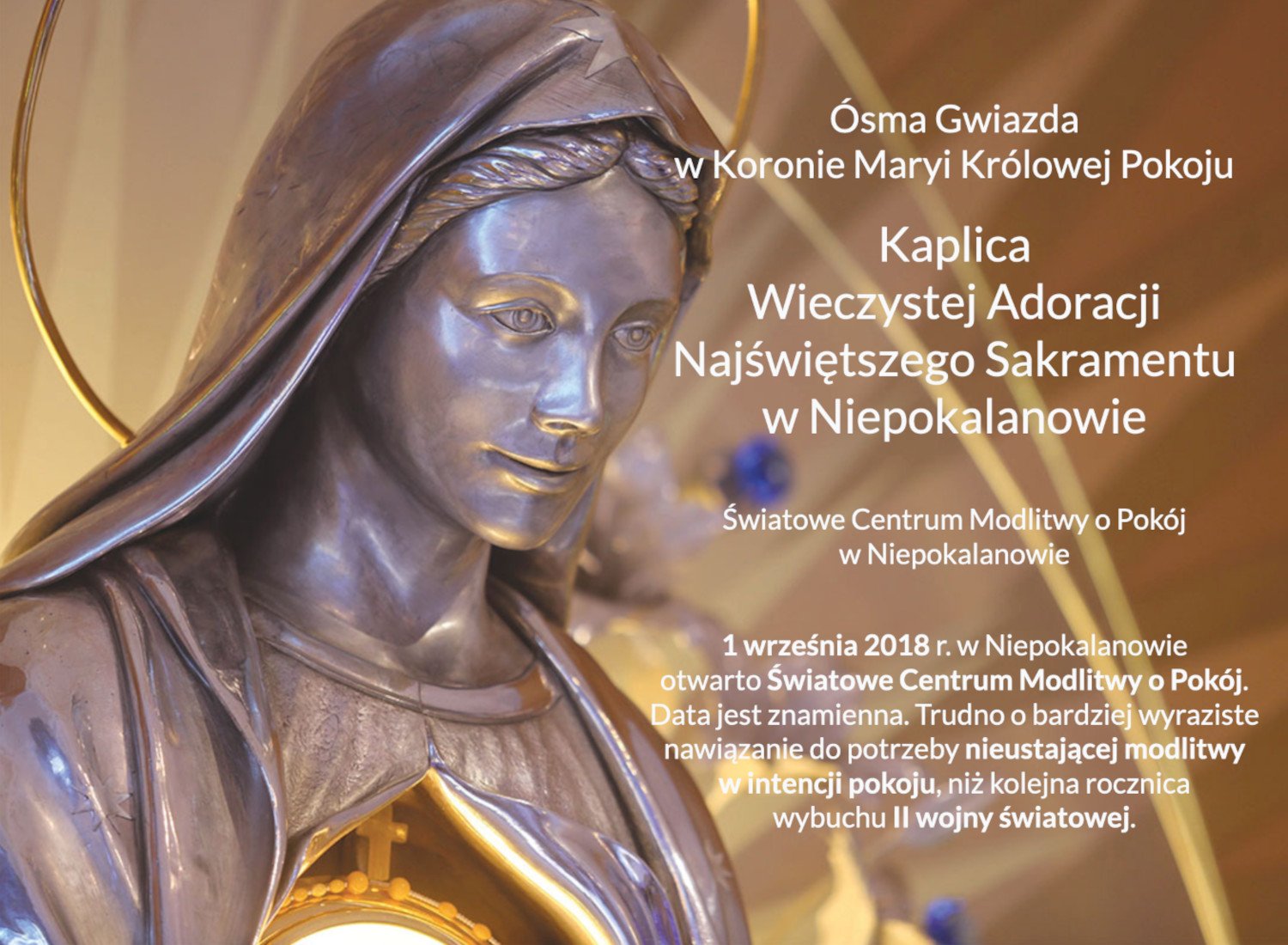

The Eucharistic Adoration Chapel established by Saint Maximilian Kolbe was inaugurated at the outbreak of World War II. It was restored as a Chapel of Adoration in September, 2018, the commemoration of the date that the war began. It is now part of the World Center of Prayer for Peace. The live internet feed of the Adoration Chapel at Niepokalanow — sponsored by EWTN — was established just a few weeks before we discovered it and began to include in at Beyond These Stone Walls. Click “Watch on YouTube” in the lower left corner to see how many people around the world are present there with you. The number appears below the symbol for EWTN.
Click or tap here to proceed to the Adoration Chapel.
The following is a translation from the Polish in the image above: “Eighth Star in the Crown of Mary Queen of Peace” “Chapel of Perpetual Adoration of the Blessed Sacrament at Niepokalanow. World Center of Prayer for Peace.” “On September 1, 2018, the World Center of Prayer for Peace in Niepokalanow was opened. It would be difficult to find a more expressive reference to the need for constant prayer for peace than the anniversary of the outbreak of World War II.”
For the Catholic theology behind this image, visit my post, “The Ark of the Covenant and the Mother of God.”

Oprah, Geraldo, and a Psycho-Therapist: A Perfect Storm
Popular 1980s daytime television hosts like Oprah, Geraldo and others injected repressed memory into pop psychology bringing unjust harm to a multitude of innocents.

Popular 1980s daytime television hosts like Oprah, Geraldo and others injected repressed memory into pop psychology bringing unjust harm to a multitude of innocents.
December 3, 2025 by Fr. Gordon MacRae and the False Memory Syndrome Foundation
Just as I was preparing to type this post, an alert reader informed me that my name is mentioned in a brief but brilliant article by William A. Donohue, PhD, President of the Catholic League for Religious and Civil Rights. The article, “What Happens When Truth Doesn’t Matter” appears in the November 2025 issue of the Catholic League Journal Catalyst. It tells a fascinating but disturbing story about a wealthy woman who had developed a best-selling memoir recounting her newly emerged memories of being raped by a middle school teacher 37 years earlier when she was 12. The story emerged with the help of a psychotherapist and the influence of a psychedelic drug called MDMA. The story propelled her memoir, promoted by Oprah Winfrey and other daytime TV luminaries. But it destroyed the life and career of the now elderly teacher, who had a spotless record and who vehemently denies the claims for which there is no other evidence beyond the memoir itself.
One well-known advocate of the use of the drug MDMA in therapy has gone on record to state that “whether or not repressed memories actually happened — from a therapeutic perspective — does not matter. People develop stories that help them make sense of their life … whether it is true or not, it has value because the emotion is real.” So is the irreparable harm done to an innocent man.
One of our readers sent this story to me because of a curious incident during my 1994 trial. As I sat before Judge Arthur Brennan, twelve jurors and a gaggle of prosecutors and news media in Cheshire County Superior Court in Keene, New Hampshire, the Court was listening intently to some wild testimony from 27-year-old Thomas Grover. He was describing how, a dozen years earlier at age 15, he came to me for five counseling sessions for his drug addiction while claiming to have been forcibly raped at the end of each session. When asked the obvious question of why, after that first horrific encounter he returned again and again, he stated simply, “I don’t know how I got there. I repressed it.”
With pre-trial coaching from Detective James F. McLaughlin and psychotherapist Pauline Goupil, MA (now Pauline Goupil Vachon) — to whom Grover was referred by Robert Upton, his contingency lawyer — the details of a series of fictitious sexual assaults emerged from a dozen years earlier in the summer months of 1983. In earlier interviews between Grover and McLaughlin, the assaults were alleged to have occured in 1978 when Grover was 11, and then changed to 1980 when Grover was 13. Police reports indicate that Detective McLaughlin gave him a copy of my résumé “to help him with his dates.” The allegations were then updated to 1983, one year after my ordination to the Catholic priesthood, but the trial came twelve years later.
In the media-fueled background leading up to that trial was a lot of dishonest hype and consternation for which my Bishop and the Diocese of Manchester felt obliged to respond. Months before the trial began my Bishop issued a press release with the following pre-trial statement:
“The Church has been a victim of the actions of Gordon MacRae just as these individuals. It is clear that he will never again function as a priest.”
The die was cast. The verdict came first, and then the trial. From my perspective, this was never a story of so-called repressed and recovered memory, but rather a massive con perpetrated by a professional con man latching on to the rhetoric of the day for a quick-and-easy monetary settlement. He was given $200,000 by the Diocese of Manchester.
Alarmed at some point that Thomas Grover failed to show up for Ms. Goupil’s pre-trial coaching sessions, she sent him a letter which found its way into my trial, but not for the eyes and ears of the jury: “I have news,” Ms. Goupil wrote to Thomas Grover. “Jim” [Detective James F. McLaughlin] “told me that MacRae is being offered a plea deal his lawyers will want him to take so there likely won’t be a trial. We can just move on with the settlement.”
Unaware of that letter, and of the existence of Pauline Goupil and her pre-trial coaching of Grover, I was informed by my attorney that Prosecutor Bruce Elliott Reynolds presented a pre-trial deal to serve no more than one to three years in prison — later reduced to one to two — if I plead guilty. Because the alleged crimes never took place, I simply could not fathom doing this. I was repeatedly told, even by my own lawyer, that innocent defendants often have to take such deals to control a sentence if convicted. My lawyer reminded me that under New Hampshire law, no evidence beyond the accusation itself is required for a guilty verdict.
I was told that it all comes down to the credibility of a witness over the credibility of a defendant. Then I was reminded that I am a Catholic priest accused amid a barrage of accusations brought against other Catholic priests in New Hampshire and Massachusetts, all awaiting a lucrative payday. As our title suggests, it was a perfect storm.
Drug-Induced Courtroom Drama
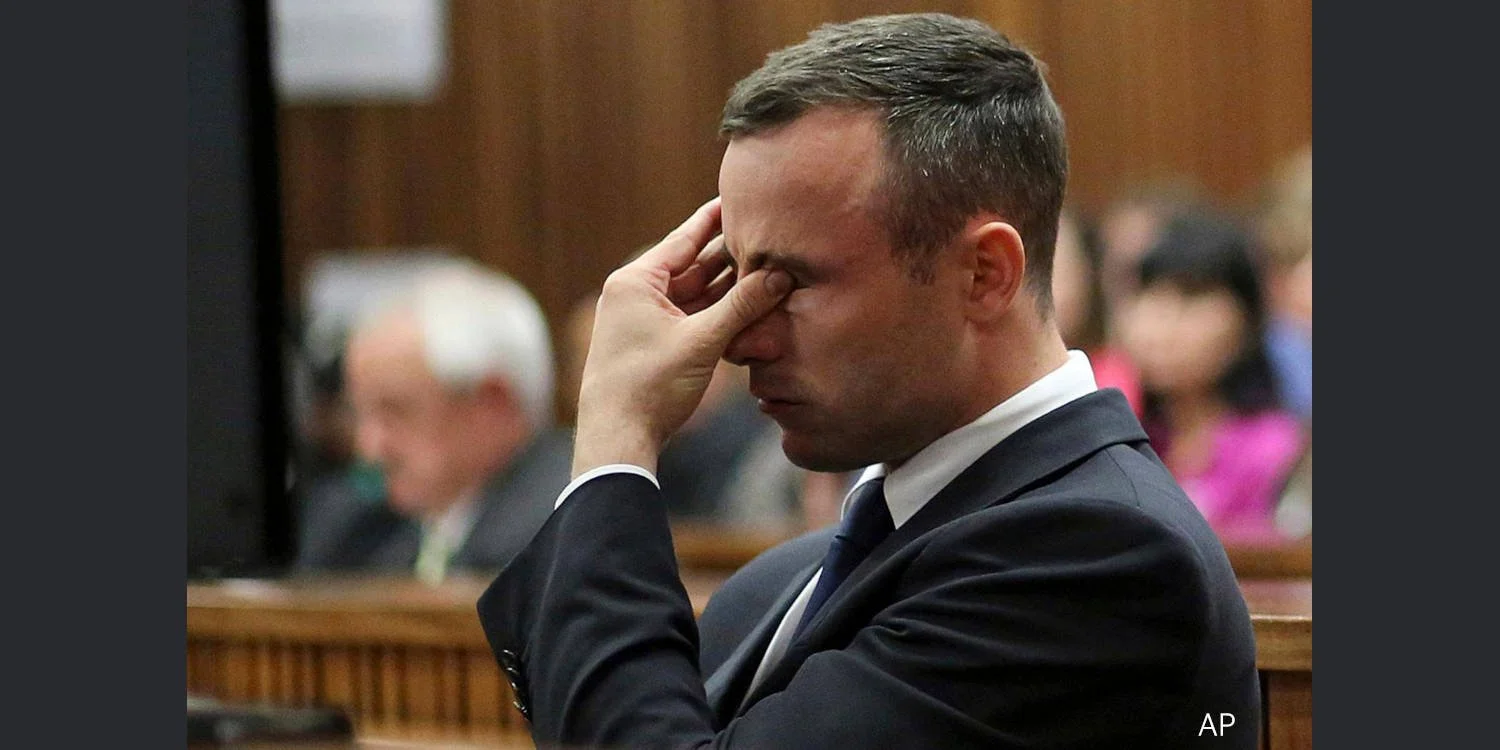
There were some moments of high drama in this trial. A woman seated in the courtroom gallery with line of site to the witness stand was observed to influence Thomas Grover’s testimony. During cross examination from my attorney, Grover protested to Judge Arthur Brennan that he cannot answer the attorney’s questions if he insists on standing near the defendant. So the judge instructed my lawyer to walk to the other side of the court to ask his questions. The question at hand was, “Who did you go to first with your claims, the police or a lawyer?” Instead of answering, Thomas Grover began to cry.
During a break in the trial, two persons who were present approached my attorney to report what they had just observed. The real issue was that while standing next to the defense table to pose his questions, my attorney was blocking the line of sight between Grover and that woman. The two court observers also reported to my attorney that the woman in question was giving Grover hand signals to influence and direct his testimony. This information was then reported to Judge Arthur Brennan, who apparently ignored it. Many years later one of these observers, Leo Demers, a PBS broadcasting official, wrote a letter to Judge Brennan, who again did not address the specific allegation:
“We saw something in your courtroom during the MacRae trial that I don’t think you ever saw. My wife nudged me and pointed to a woman, Ms. Pauline Goupil, who was engaged in what appeared to be clear witness tampering. During questioning by the defense attorney, Thomas Grover seemed to feel trapped a few times. On some of those ocassions, we witnessed Pauline Goupil make a distinct sad expression with a downturned mouth and gesturing with her finger from the corner of her eye down her cheek at which point Mr. Grover would begin to cry on the stand. I have been troubled about this for all these years. I know what I saw, and what I saw was a clear attempt to dupe the Court and the jury.”
In his brief response, retired Judge Brennan did not address any of the specific allegation of Leo Demers. Despite a pre-trial court order to turn over to the defense all records of Grover’s psychotherapy and counseling, the above incident was the first time my defense learned of therapist Pauline Goupil and her pre-trial coaching of Thomas Grover.
In a post-trial statement of Trina Ghedoni, who was Thomas Grover’s wife at the time of this trial, she reported that all information before and during trial passed through Pauline Goupil to Detective McLaughlin. Trina Ghedoni also reported that Pauline Goupil arranged for Mr. Grover to be drugged during the trial.
In “Repressed Memory Therapy: Lies of the Mind,” a foundational 1993 article in Time Magazine, author Leon Jaroff attributed the sensational emergence of repressed memory not to expert opinion, but to trends in popular culture “featured prominently on Geraldo, Oprah, Sally Jessy Raphael and other daytime TV talk shows.” The notion of repressed and recovered memory has never appeared in the Diagnostic and Statistical Manual of Mental Disorders published by the American Psychiatric Association.
Lies of the Mind or a Pathological Liar?
The famous Swiss psychologist, Jean Piaget, once penned an amazing account of false memory from his childhood. From early childhood on into adolescence, Piaget had a firm memory of an incident involving his nurse with himself as the potential victim of a kidnapping attempt. He had a clear memory of his nanny pushing him in a carriage when a man came up and tried to take him. He remembered in vivid detail the location of the event, the villain, the struggle, and the outcome. He recalled deep scratches on his nanny’s arms as she boldly fended off the attacker, and he remembered the police officer who came to their rescue.
However, when Piaget was 15 years old, his nanny decided to atone for her own past offenses. She publically admitted that she made up the entire kidnapping story including scratching her own arms to make it look as though an attacker had done it. Piaget was shocked to learn at age 15 that this story that haunted his early childhood, a story for which he had formed and retained vivid memories, never actually took place. In adulthood, Piaget concluded that his memories of the event arose and took shape solely from the nanny’s retelling of the false story in his childhood. Eventually the scene became rooted in Piaget’s memory as an actual event.
Another troubling story of memory reconstruction as evidence was reported by The Wall Street Journal’s Dorothy Rabinowitz in her myth-shattering book, No Crueler Tyrannies: Accusation, False Witness, and Other Terrors of Our Times. The terror this time was inflicted in Boston courts upon 61-year-old grandparents, Ray and Shirley Souza. No one could tell this with more succinctly existential terror than Dorothy Rabinowitz:
“Ray and Shirley Souza’s 24-year-old daughter had a dream one night. In the dream, her parents raped her. It was now the 1990s, the era of the repressed memory syndrome. Ray and Shirley’s grandchildren were taken to see therapists and interrogated. In court they testified that their grandparents tied them in a cage in the basement and raped them with elbows and feet and a big machine. Judge [Elizabeth] Dolan ruled [with no further evidence] that the children’s stories were credible and sentenced the Souza’s to a term of fifteen years in prison.”
— No Crueler Tyrannies, p. 90
Thus began the era of “Believe the Children” and the shame shrouded upon anyone who dared question a child’s account of abuse — even if the account emerged without evidence in the office of an agenda-driven therapist. It was also the era in which the case against me emerged.
And it was the era that gave birth to the False Memory Syndrome Foundation and its efforts to breathe sanity and reason into what can only be described as the emotional takeover of psychology and the justice system. The FMSF was established in 1992 and continued until 2019 to amass a database of false-memory claims and expertise in psychology and the legal system that refuted them. In 2008 the False Memory Syndrome Foundation published the following report on my 1994 trial and conviction:
From the quarterly journal of the False Memory Syndrome Foundation — Fall 2008, Vol. 17, No. 4, p. 8
FATHER MACRAE
A Reminder That There Are Still Many People in Prison Based Only on Accusations of Recovered Memories
Although there is no doubt of the Catholic Church’s irresponsible handling of thousands of reports of clergy abuse, there are also a growing number of cases in which priests appear to have been wrongly convicted. The case of Rev. Gordon MacRae, which was detailed by Dorothy Rabinowitz in 2005 in The Wall Street Journal, appears to be one of them.
In May 1993, Rev. Gordon MacRae was arrested for sexually assaulting three New Hampshire boys [all three came forward as adults at the same time, with the same claim of repressed memory, but only the claims of Thomas Grover went to trial], when he had been a priest there a decade earlier. The early 1990s were heydays for accusations of sexual abuse based on new-found memories and just about everything that could go wrong for the defense did go wrong.
Among the problems was a letter from Florida informing local police that MacRae was a suspect in a murder/sex crime there. This was the final bit of tinder for a hyper-zealous detective who then repeatedly interviewed many young people who knew MacRae and even attempted a series of “stings.” By the time that the Florida case was declared bogus, there was no stopping the effort to convict MacRae.
Prosecutors offered various plea arrangements to MacRae, who is serving a life term, but he refused them all, declaring his innocence. Indeed, Fr. MacRae would have been released after one to three years if he had taken a plea or would have been released on parole if he confessed. The “Catch-22” of prison is that those who do not admit guilt will not receive parole.
At the criminal trial, witness Thomas Grover’s testimony verged on the bizarre. He had accused MacRae of abusing him during counseling sessions. When asked why he continued to go to the sessions, Grover explained that he had ‘out of body’ experiences and completely forgot between sessions that he had ever been sodomized.
Even the judge’s rulings appeared biased. According to Rabinowitz:
“Throughout his testimony, [accuser] Thomas Grover repeatedly railed at the priest for forcing him to endure the torments of a trial. He would not have much to fear, in the end, in these proceedings, whose presiding judge, Arthur D. Brennan, refused to allow into evidence Thomas Grover’s long juvenile history of theft, assault, forgery and drug offenses. In New Hampshire, where juries need only find the accuser credible in sex abuse cases, with no proofs required, this was no insignificant restriction. The judge also took it upon himself to instruct jurors to “disregard inconsistencies in Mr. Grover’s testimony,” and said that they should not think him dishonest because of his failure to answer questions. The jury had much to disregard.”
To read more about this case: Beyond These Stone Walls/About
+ + +
Editor’s Note: Thank you for reading and sharing this troubling story, which should have had equal time in the influential daytime talk shows that contributed to it. You may also wish to read and share the following published statements of persons with first-hand knowledge of this case who have never been permitted by any New Hampshire judge to offer their testimony under oath.
Statement of Leo Demers, PBS Television executive
Statement of Dorothy Rabinowitz, The Wall Street Journal
Statement of Debra Collett, Thomas Grover’s former therapist
The Eucharistic Adoration Chapel established by Saint Maximilian Kolbe was inaugurated at the outbreak of World War II. It was restored as a Chapel of Adoration in September, 2018, the commemoration of the date that the war began. It is now part of the World Center of Prayer for Peace. The live internet feed of the Adoration Chapel at Niepokalanow — sponsored by EWTN — was established just a few weeks before we discovered it and began to include in at Beyond These Stone Walls. Click “Watch on YouTube” in the lower left corner to see how many people around the world are present there with you. The number appears below the symbol for EWTN.
Click or tap here to proceed to the Adoration Chapel.
The following is a translation from the Polish in the image above: “Eighth Star in the Crown of Mary Queen of Peace” “Chapel of Perpetual Adoration of the Blessed Sacrament at Niepokalanow. World Center of Prayer for Peace.” “On September 1, 2018, the World Center of Prayer for Peace in Niepokalanow was opened. It would be difficult to find a more expressive reference to the need for constant prayer for peace than the anniversary of the outbreak of World War II.”
For the Catholic theology behind this image, visit my post, “The Ark of the Covenant and the Mother of God.”

Detective James McLaughlin and the Police Misconduct List
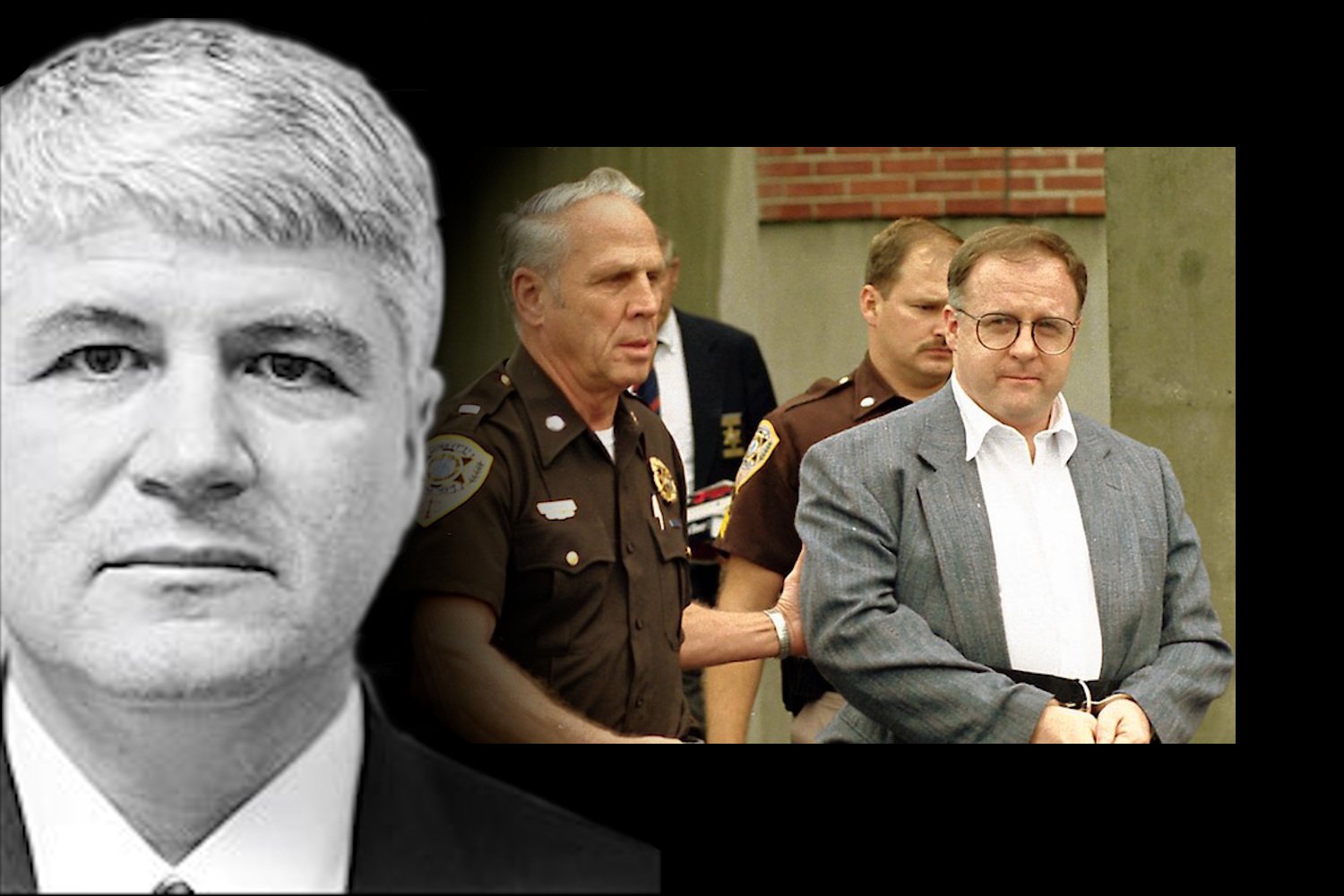
The NH ‘Laurie List’ is a once secret list of police misconduct. Ex-Detective James F McLaughlin, who sent a priest to life in prison, now sues to get off the list.

The NH ‘Laurie List’ is a once secret list of police misconduct. Ex-Detective James F McLaughlin was recently removed from the list in a secret ‘John Doe’ hearing.
Editor’s Note: Ryan A. MacDonald has published numerous articles on the sex abuse crisis in the Catholic Church including, “Police Misconduct: A Crusader Cop Destroys a Catholic Priest.” This is a necessary sequel.
+ + +
January 17, 2024 by Ryan A. MacDonald
Are you in favor of destroying the lives of Catholic priests under false pretense? If not, please read on. Catholic priest Gordon J MacRae is now in his thirtieth year of wrongful imprisonment after rejecting a 1994 plea deal offer to serve one to two years. I previously wrote at the link cited above about newly emerging evidence in the case. The Wall Street Journal boldly took up this matter in a series of articles by Pulitzer Prize-winning journalist Dorothy Rabinowitz and noted civil rights attorney Harvey Silverglate. Their work exposing this wrongful prosecution and police misconduct is collected at “The Wall Street Journal on the Case of Fr Gordon MacRae.”
Newly emerging evidence came to light with a revelation that the police detective who investigated and testified against Father Mac Rae was added to a previously secret list of officers with dishonesty or police misconduct issues. The list was held in secret by the New Hampshire Attorney General until a court ordered publication of the list in 2022. Detective James McLaughlin was added to the list for “Falsification of Records,” an incident or incidents that occurred in 1985, nine years before the 1994 MacRae trial. Because the behavior was known to state prosecutors at the time of the trial, they were obligated by Supreme Court precedent to report this to Father MacRae’s legal counsel before trial. They failed to do so.
This bombshell was first reported by someone at the New Hampshire Office of the American Civil Liberties Union which had been a plaintiff in a lawsuit that eventually made the “Laurie List” public. Father MacRae himself wrote of this development in “Predator Police: The New Hampshire ‘Laurie List’ Bombshell.”
Police officers placed on the Attorney General’s list have the ability to challenge its publication by petitioning the courts to remove their names for cause. Former Detective McLaughlin filed such a petition so, pending a court hearing, his name was blacked out from the public list just hours after it appeared. New Hampshire courts have allowed officers on the list to file their petitions using “John Doe” pseudonyms. A hearing for McLaughlin — though not a public one — is likely to be scheduled early in 2024.
Not everyone is on board with the notion of a judicial system operating in secret. One judge, a former Senior Assistant Attorney General, has objected to the secret forum in which these removal petitions are being heard. (See “Judge: Laurie List Police Lawsuits Are Being Improperly Sealed”). Judge Will Delker’s published objection cites a fundamental precept of democracy that public officials must be accountable to citizens: “Court records are presumptively open to the public absent some overriding consideration or special circumstance. The party seeking to maintain court records under seal must demonstrate a sufficiently compelling interest that outweighs the public’s right to access.”
New Hampshire reporter Damien Fisher has managed to obtain, through Freedom of Information Act requests, some limited, heavily redacted evidence of the matters before the court in former Detective McLaughlin’s petition. He documented them in a December 18, 2023 article, “Laurie List Lawsuit Matches Former Well-Known Keene Cop’s Record.” To force a reporter to such lengths to obtain public information in public records turns the court system into a sham.

Covering Up for Police Corruption
There is a good deal more in the problematic and unconstitutional practices of Detective James F. McLaughlin than what is currently before the Court in his petition to be removed from the public accountability list, but the public is kept in the dark. Citizens should have an opportunity to address concerns about why his name should remain on that published list, but that is circumvented by secrecy. The public cannot learn the identity of the “John Doe” before the Court. Reporter Damien Fisher was only able to discern this from a careful examination of this particular “John Doe’s” petition.
Additionally, the public cannot obtain a Court date or docket number to have their concerns heard. As a result, pertinent evidence is prevented from coming before the Court. The court of public opinion is a different matter, but no citizen should have to appeal to it in order to obtain justice.
Though not a resident and citizen of the State of New Hampshire, I have researched its laws in regard to the conduct of police. The violations alleged against McLaughlin in the case of Father MacRae alone are many and great. No public entity has investigated these and judges hearing MacRae’s two appeals — a direct State appeal in 1996 and a Writ of Habeas Corpus in 2012 — resulted in rejection without hearing from any witnesses privy to said misconduct.
So if we cannot place it before the Court, we place it before you in the form of official excerpts of the New Hampshire Revised Statutes Annotated, the very State laws that Detective McLaughlin has broken and for which he should be censured. Each is followed by signed Statements given to a former FBI official investigating this case, but in each case no judge has allowed the Statements or witnesses thereof to be heard under oath and on the record in any New Hampshire court.
RSA 105 : 19 — Reports of Misconduct by Law Enforcement Officers
For the purposes of this section, ‘misconduct’ means assault, sexual assault, bribery, fraud, theft, tampering with evidence, tampering with a witness, use of a choke hold, or excessive and illegal use of force.
1. STATEMENT OF STEVEN WOLLSCHLAGER (Alleging Attempted Bribery)
Introduction: Steven Wollschlager was a friend of accuser Thomas Grover. During Detective James McLaughlin’s investigations in 1988 and 1994, Mr. Wollschlager was interviewed. It is unknown whether the interviews were recorded. Wollschlager states that the interview reports misrepresented statements attributed to him that he never made. In a 1994 pre-trial interview, McLaughlin is alleged to have attempted to suborn Wollschlager to commit perjury before a grand jury with the suggestion of “a large sum of money.” Wollschlager reported being lured into agreement, but later recanted, refusing to testify before a grand jury:
“My name is Steven Wollschlager, DOB 12-7-1973. I give this signed statement at my own free will to Investigator James Abbott with no promises or bribes. I am willing to testify to the following statement to proceed in a court of law or otherwise under oath that I am giving facts and details to the best of my memory.
“I have had opportunities during several periods of my life to know Gordon McCrea (sic). Never in all our meetings or conversations was there any inappropriate talk of sex, sex for money, favors, or any other thing related to such.
“My first encounters with Gordon came when I was age 15 and using drugs. Gordon counseled me through Monadnock Family Counseling, maybe three sessions. During this time he also introduced me to some persons in the AA program. At this time there was never anything inappropriate going on, nor did I ever feel uncomfortable for any reason around Gordon.
“In 1988 while in rehab (which Gordon helped my parents get me into), I was interviewed by [Keene] Detective McLaughlin about Gordon. This detective did most of the talking — Did he ever do this or that? — asking me many questions as to whether or not anything inappropriate ever happened with Gordon against me. Never during this time did I say anything to any police officer that Gordon had done anything wrong towards me.
“Years passed and in 1994, before Gordon was to go on trial, I was contacted again by Keene police detectives McLaughlin and Collingworth. I was aware at the time of Gordon’s trial, knowing full well that it was bogus and having heard of the lawsuits and money involved, also the reputations of those who were making accusations. I agreed to meet with the above detectives after being told that I would be reimbursed for my time and gas money.
“Again during this meeting I mostly just listened to scenarios and statements being spoken to me by the police. The lawsuits and money were of greatest discussion and I was left feeling that if I would go along with the story I could reap the rewards as well.
“McLaughlin asked me many times if Gordon ever tried to come onto me sexually or offered me money for any sexual favors. He had me believing that all I had to do was make up a story about Gordon and I could receive a large sum of money as others already had. McLaughlin reminded me of the young child and girlfriend I had and referenced that life could be easier for us with a large amount of money.
“I knew the Grovers’ reputation as well as others involved, many of whom I went to school with. It seemed as though it would be easy money if I would also accuse Gordon of wrongdoing. I left that meeting after being given, I believe, $50, easy money like what would come from lawsuits against McCrae (sic). I was at the time using drugs and could have been influenced to say anything they wanted for money .
“A short time later after being subpoenaed to Court, I had a different feeling about the situation. I did not want to lie or make up stories. After speaking with the Clerk of Courts I was approached by another person. After telling this person that I did not want to be there and I stated Gordon had never done anything wrong towards me sexually or otherwise, I was told I could leave. This person seemed visibly upset that I had nothing to say.”
Signed: Steven Wollschlager October 27, 2008
2. STATEMENT OF DEBRA COLLETT (Alleging Witness Tampering and Tampering with Evidence)
Introduction: Ms. Debra Collett was Thomas Grover’s primary counselor in 1987 at Derby Lodge, a residential drug addiction treatment center located in Berlin, NH. In police interviews with Detective McLaughlin pretrial in 1993/94, Grover claimed to have revealed to Debra Collett that Fr. Gordon MacRae molested him in his teen years. Grover had previously been treated for addiction at Beech Hill Hospital in Dublin, NH in 1985, but his treatment was terminated when he was caught smuggling drugs to sell to other patients. Ms.Collett here reveals that Detective McLaughlin recorded his interviews with her, but neither a report nor the recordings were ever turned over to MacRae’s defense as required.
“I am Debra Collett, DOB 6-17-1952. I am making this Statement to James Abbott, Investigator for Gordon MacRae. My involvement leading to speaking with James Abbott was as Clinical Director at Derby’s Lodge in Berlin, NH. I was individual counselor for Tom Grover when he was a client at Derby Lodge.
“Thomas Grover never revealed to me that Gordon MacRae perpetrated against him. Mr Grover spent a great deal of time being confronted in treatment for his dishonesty, misrepresentation, and unwillingness to be honest about his problems. Thomas Grover did reveal that he had been perpetrated against sexually, but named no specific person except to say that his “step father” or “foster father” molested him. When asked if Thomas meant, “Mr. Grover,” Thomas replied, “yes, among others.”
“Thomas Grover presented as unwilling to join a group of other people who like himself experienced similar difficulties. Instead, he became angry, punched walls, flicked things, and slammed doors to evade and not address his issues.
“When it became evident that [the MacRae case] was going to trial, I was contacted by Keene Police Detectives Clarke and McLaughlin. They questioned me and I had several contacts with them.
“My experience was that neither presented as an investigator looking for what information I had to contribute, but rather presented as having made up their minds and sought to substantiate their belief in Gordon MacRae’s guilt. I experienced Detective Clark as the primary questioner. I was uncomfortable with his repeated stopping and starting the tape recorder when he did not agree with my answers to his questions and his repeated statements that he wanted to put this individual where he belonged, behind bars, that a priest of all people should be punished.
“I confronted Det. Clark about his statements and his stopping and starting the recording of my statement, and his attitude and treatment of me which seemed to include coercion, intimidation, veiled and more forward threats as well as being disrespectful. At that point, and in later dealings, I was overtly threatened concerning my reluctance to continue to subject myself to their treatment with threats of arrest. McLaughlin told me he would personally come to my home, drag me out of it bodily if necessary, and force me to appear in court and testify despite my information to him.
“My overall experience in interacting with these detectives was one of being bullied with their attitude of animosity, anger, and preconception of guilt regarding Gordon MacRae. They presented as argumentative, manipulative, and threatening via use of police power in an attempt to get me to say what they wanted to hear.”
Signed: Debra Collett 05-20-2008
3. STATEMENT OF LEO DEMERS IN A LETTER TO JUDGE ARTHUR BRENNAN (Alleging Witness Tampering and Suppression of Evidence)
Letter dated October 24, 2013:
“My wife, Penny, and I were present in the courtroom throughout most of the trial of Fr. Gordon MacRae. For all these years, I have had many questions about this trial and much that I’ve wanted to clarify for my own peace of mind. I learned recently that both a superior court judge here in New Hampshire and the NH Supreme Court declined to hold a hearing on the evidence and merits of a habeas corpus petition in this case. Now that state courts seem no longer to be involved, I feel more inclined to approach you on what has been bothering me, as you were the presiding judge.
“We saw something in your courtroom during the MacRae trial that I don’t think you ever saw. My wife nudged me and pointed to a woman, Ms. Pauline Goupil, who was engaged in what appeared to be clear witness tampering. During questioning by the defense attorney, Thomas Grover seemed to feel trapped a few times. On some of those occasions, we witnessed Pauline Goupil make a distinct sad expression with a downturned mouth and gesturing with her finger from the corner of her eye down her cheek at which point Mr. Grover would begin to cry and sob on the stand. The lawyer’s questions were never answered.
“I have been troubled about this for all these years. I know what I saw, and what I saw was a clear attempt to dupe the court and the jury. If the sobbing and crying were not truthful, then I cannot help but wonder what else was not truthful on the part of Mr. Grover. If he was really a victim who wanted to tell the simple truth, why was it necessary for him and Ms. Goupil to have what clearly appeared to be a set of prearranged signals to alter his testimony? The jury was privy to none of this, to the best of my knowledge.
“Secondly, I was struck by the difference in Thomas Grover’s demeanor on the witness stand in your court and his demeanor just moments before and after outside the courtroom. On the stand, he wept and appeared to be a vulnerable victim. Moments later, during court recess, in the parking lot he was loud, boisterous and aggressive. One time he even confronted me in a threatening attempt to alter my own testimony during sentencing. …
“I simply believe that, like so many others, Mr. Grover and those coaching him have misled you and your court. You also seemed to rely heavily in your sentencing of MacRae on the investigation and findings of Det. McLaughlin. My wife and I had some firsthand experience with him and his tactics during his investigation. He was not at all interested in the facts or the truth. He attempted to use coercion and bullying tactics to get my wife and me to change the facts we presented to him, facts that did not support any of his preconceived ideas.
“We are not the only persons to have had this experience with him. I have read that Debbie Collett, Thomas Grover’s counselor, outlined in detail how she was threatened and coerced into altering her testimony. Another witness alleges that he was overtly bribed by this detective to accuse MacRae during that investigation.”
Signed: Leo Demers, August 24, 2013
+ + +
There is much more alleged of this detective that should come before a Court deciding on his public exposure on the Exculpatory Evidence Schedule or ‘Laurie List.’ As long as the Court allows Mr. James McLaughlin to appear as “John Doe” in any hearing regarding his appearance on the police misconduct list which is meant to be public, citizens are prevented from witnessing to the truth in this regard. None of the people mentioned here have ever been allowed to testify under oath about this detective. Now we know why.
This necessitates a Part 2 of this post, hopefully coming next week.
Meanwhile, please share this article. There is nothing more destructive of the cause of justice and the common good than the noise of too few and the silence of too many.
Pray for justice, and for the integrity of our justice system.
+ + +
Editor’s Note: We thank Ryan A. MacDonald for this newest chapter in a continuing struggle for justice. You may also be interested in these related posts:
Police Misconduct: A Crusader Cop Destroys a Catholic Priest
Predator Police: The New Hampshire ‘Laurie List’ Bombshell
New Hampshire Corruption Drove the Fr Gordon MacRae Case
Police Investigative Misconduct Railroaded an Innocent Priest

Keene, NH Det. James McLaughlin celebrates his 350th arrest as a sex-crimes crusader.
The Eucharistic Adoration Chapel established by Saint Maximilian Kolbe was inaugurated at the outbreak of World War II. It was restored as a Chapel of Adoration in September, 2018, the commemoration of the date that the war began. It is now part of the World Center of Prayer for Peace. The live internet feed of the Adoration Chapel at Niepokalanow — sponsored by EWTN — was established just a few weeks before we discovered it and began to include in at Beyond These Stone Walls. Click “Watch on YouTube” in the lower left corner to see how many people around the world are present there with you. The number appears below the symbol for EWTN.
Click or tap here to proceed to the Adoration Chapel.
The following is a translation from the Polish in the image above: “Eighth Star in the Crown of Mary Queen of Peace” “Chapel of Perpetual Adoration of the Blessed Sacrament at Niepokalanow. World Center of Prayer for Peace.” “On September 1, 2018, the World Center of Prayer for Peace in Niepokalanow was opened. It would be difficult to find a more expressive reference to the need for constant prayer for peace than the anniversary of the outbreak of World War II.”
For the Catholic theology behind this image, visit my post, “The Ark of the Covenant and the Mother of God.”