“There are few authentic prophetic voices among us, guiding truth-seekers along the right path. Among them is Fr. Gordon MacRae, a mighty voice in the prison tradition of John the Baptist, Maximilian Kolbe, Alfred Delp, SJ, and Dietrich Bonhoeffer.”
— Deacon David Jones
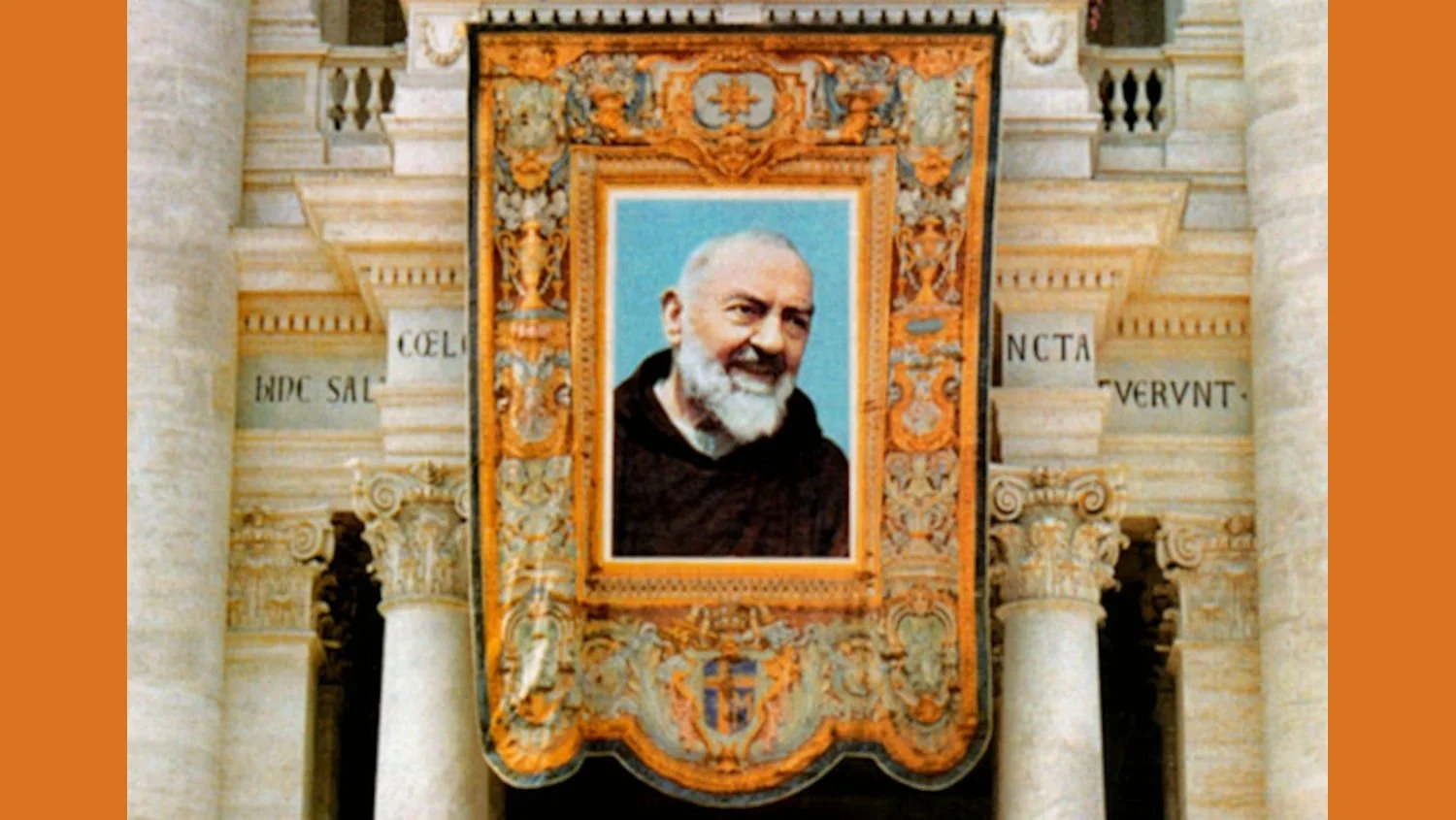
Padre Pio: Witness for the Defense of Wounded Souls
Padre Pio and Maximilian Kolbe, Patron Saints behind Fr Gordon MacRae’s blog, have an obscure thread of connection that magnifies witness, sacrifice, and fatherhood.
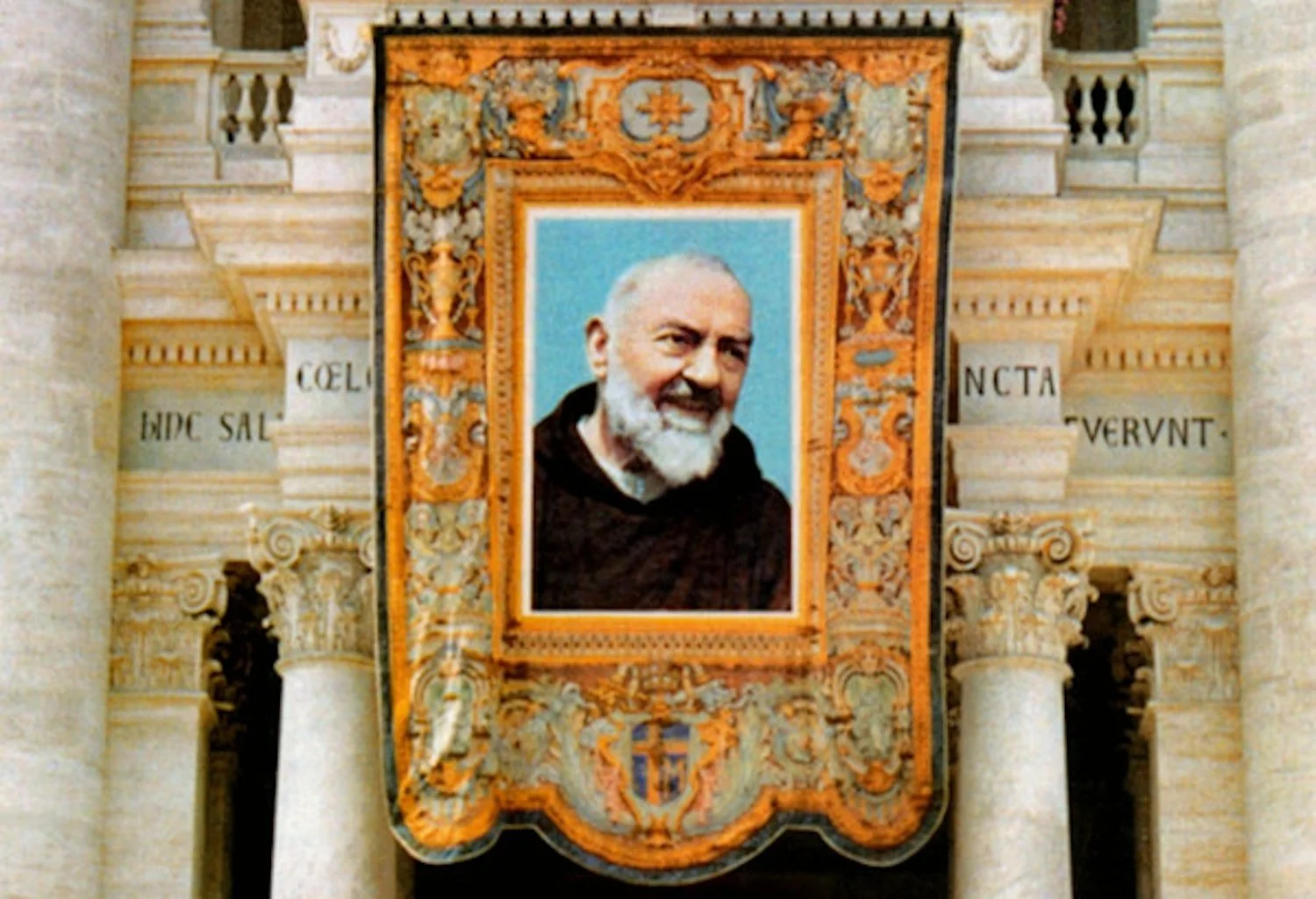
Padre Pio and Maximilian Kolbe, Patron Saints behind Fr Gordon MacRae’s blog, have an obscure thread of connection that magnifies witness, sacrifice, and fatherhood.
September 23, 2020 — Updated September 23, 2026 by Father Gordon MacRae
The months of August through October have always produced some special content for Beyond These Stone Walls. That three-month period in the Catholic calendar contains the feast days of all the prominent saints at work here. These include Saint Maximilian Kolbe (August 14), Saint Padre Pio (September 23), Saint Michael the Archangel (September 29), Saint Therese of Lisieux (October 1), and the Guardian Angels (October 2). Interspersed among them, seemingly framing them, are several observances of Marian feasts giving her a strong presence in their lives and our lives here at this blog.
Padre Pio and I share an important, but ominous date. He passed from this life on September 23, 1968. I passed from my life in freedom on September 23, 1994. The day this is posted, I mark 32 years of imprisonment after refusing a plea deal lie to serve only one year.
I have written twelve posts about Saint Padre Pio over the life of this blog, which began in 2009. There came a point at which there was simply nothing more to write about this great saint except for the impact he has had on our lives, which has been immense. My friend, Pornchai Maximilian Moontri, developed a powerful devotion to Saint Maximilian Kolbe, an identity even, because of me. In turn, I developed a powerful devotion to Saint Padre Pio, an identity even, because of Pornchai and the mystery of how his Godfather met and was blessed by Padre Pio. That story is told herein.
When I first wrote this post in 2020, it was just days after Pornchai was taken away for ICE detention to await deportation to Thailand. I was grasping for hope from Maximilian Kolbe and Padre Pio, and they both came through for us, but not in any way we might have expected. That story began on September 8, 2020, at 5 AM.
+ + +
There was an eerie sense about us as Pornchai Maximilian Moontri and I walked around the concrete prison yard at 0500 on September 8, 2020, the Feast of the Nativity of Mary. There was not yet any sign of the dawn, nor was there any moon in the sky. If there were stars, we were blinded to them by the blazing prison lights reflected from the high walls that surrounded us. I asked Pornchai to take a long last look at these walls, for he was about to enter the final stretch of his long road to freedom.
Just then, a sliver of bright light emerged above the building where we had lived in a 60-square-foot cell for the last three of our many years in prison — 28 then for Pornchai and 26 for me at that time, and counting. We stood still to watch as the bright half-moon emerged above the walls. I told Pornchai that he will gaze upon the same moon in Thailand that I will see from this very spot. There was a long silence as he considered this, and then it was followed by tears. I had been putting a brave face on things up to this point, but I could no longer contain it.
It is difficult for men to talk and sob at the same time. I do not suggest that women cry more than men. Perhaps men do not cry enough. It is just that there was so much to say, and so I choked back the tears until another time. If you have been reading this blog for any length of time, then you understand the gravity of what was transpiring that morning. It was expressed best by Pornchai himself in a guest post he wrote just after his arrival in Thailand: “On the Day of Padre Pio, My Best Friend Was Stigmatized.” We will link to it again at the end of this post.
Soon after, we had to end that walk. After fifteen years sharing and building faith, conversion, and redemption in a tiny prison cell, Pornchai was taken away, and we will never see each other again in this life.
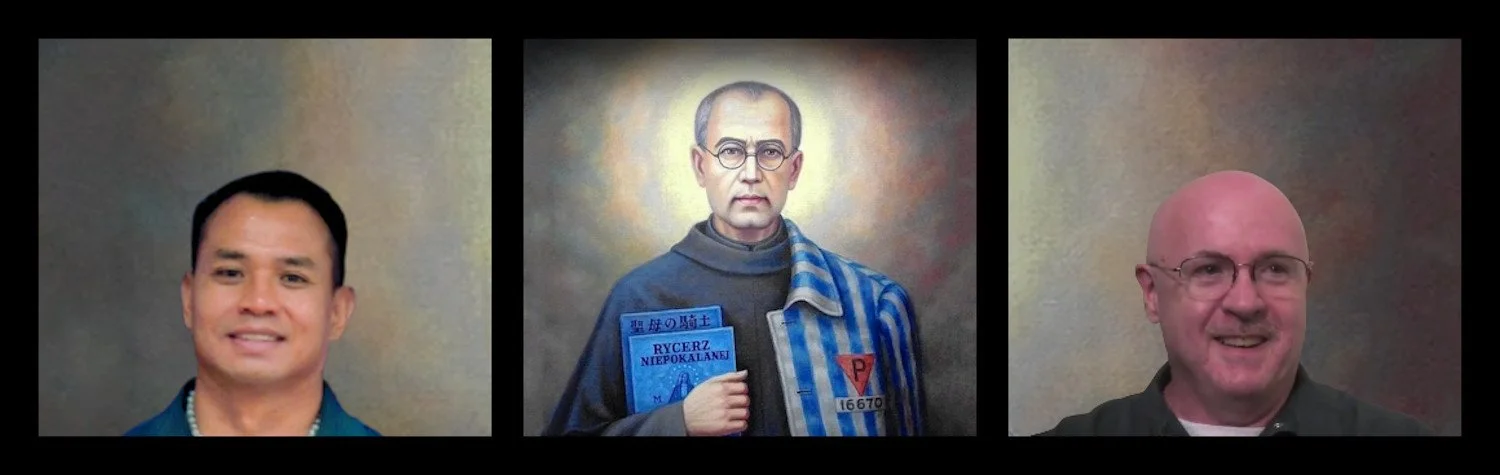
Backing up a little, it was Pornchai who brought up the most urgent and necessary part of our conversation that morning. It goes back to one of the first conversations we ever had about Pornchai’s faith experience. It was back in 2006 just before we were moved into the same cell. He described this in his post. He walked into my cell, saw an image of St. Maximilian Kolbe on the mirror, and asked, “Is this you?” He described that as one of the most important questions of his life.
Fifteen years later, as we walked in the pre-dawn light of a half moon, he said through tears, “Now I have the answer. You have saved me, but no one is saving you.” We talked a lot about our patron saints, of the mystery of how they came into our lives, and of what their witness means for us. Maximilian went to prison because he was writing the truth. I went to prison on trumped up charges, and have been writing the truth ever since. Padre Pio bore the wounds of the Crucified Christ for fifty years, while also suffering under the assaults on his reputation and good name and priesthood. Much of his suffering came from within the Church. I told Pornchai that he is a very important and powerful witness to the truth we have lived and written about. I said that no matter what happens to me now, “you are a living witness to the truth that no past is lived at the expense of the present, that no wounds can prevent a soul in search of God from emerging above prison walls.”
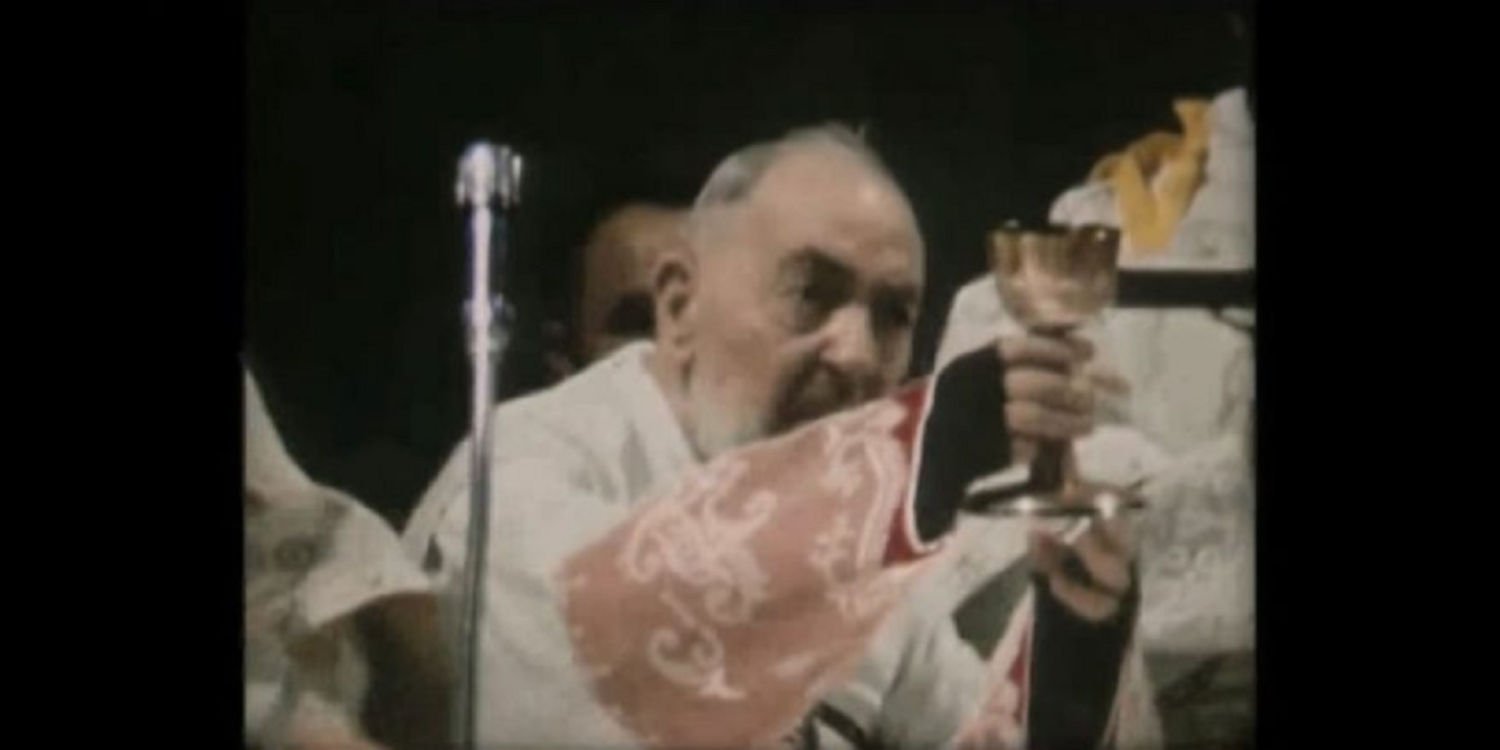
The Wounds of Padre Pio
I had been aware of Padre Pio for most of my life. As a young Capuchin, the Order that also formed Padre Pio, I earned a degree in psychology in the 1970s. I am ashamed to write today that I once denounced Padre Pio’s wounds as psychosomatic. I hope he forgives me for my ignorance back when I knew everything. I knew a lot about Padre Pio back then, but I did not know Padre Pio. I know him now. Pornchai knows him as well. He came to us from Beyond These Stone Walls in a personal and powerful way.
I had already been in prison on false witness for four years back in 1998. I had, for all of those years, been living in a horrible situation with eight men in each prison cell designed for only four. To “honor” the reverence of Catholics for Padre Pio then — six years before he was canonized by Saint John Paul II in 2002 — The New York Times ran an article alleging that Padre Pio was the subject of twelve Vatican investigations in his lifetime. The unjust and inflammatory article alleged that “Padre Pio had sex with female penitents twice a week.” Even for The New York Times, it was an egregious lie for which the “Paper of Record” broke the record. The lie originated from another priest who after his damage was wrought, admitted to the lie and to the envy that caused it.
This was the first inkling I ever had that Padre Pio suffered more than the visible wounds of Christ. He also suffered wounds upon his name, his integrity, his priesthood. Here we were, thirty years to the day since his death, and the “Scandal Sheet of Record” was still repeating an unfounded story for the sole purpose of deflating the faith of Catholics who reverenced him. It resonated with me in a most personal way.
Seven years passed. In April 2005, a newspaper of integrity, The Wall Street Journal, published a two-part account of false witness, wrongful prosecution, and public hysteria entitled “A Priest’s Story” by Pulitzer Prize-winning journalist Dorothy Rabinowitz. It was her first of several articles about the case against me. These articles were read all over the world. As a result of them, Bill Donohue at the Catholic League for Religious and Civil Rights asked me to submit an article about my own awareness of false witness. My article was published in the November 2005 issue of Catalyst under the title “Sex Abuse and Signs of Fraud.”
I was surprised to see then that I shared the cover of that issue of Catalyst with a story about how Padre Pio was similarly defamed throughout his life and even after his death. None of it was ever substantiated nor was it supported by evidence in any form. On the contrary, many witnesses had testified in Vatican investigations that the detractors were themselves discredited beyond any doubt. That did not stop The New York Times from slander.
The Echoes of a Special Blessing
Among the readers of the WSJ series on my trial’s perversion of justice was Pierre Matthews, a Belgian with dual American citizenship who at the time was living in Chicago. The articles were his first realization — as they were for many — that the whole truth about the nature of Catholic scandal had not been told by the mainstream media. Pierre wrote to me months later. On a return trip from Belgium, he diverted his itinerary for a stop in Boston from where he drove up to Concord, NH to visit me in prison.
Later in 2005, Pornchai Moontri — who had spent the previous seven years in solitary confinement in Maine — was transferred to the Concord, NH prison where we met. In 2006 we became friends. In 2007 we became roommates. In 2010, on Divine Mercy Sunday, Pornchai renounced his troubled past to become Catholic. Later, in September 2010, I wrote “Saints Alive! Padre Pio and the Stigmata: Sanctity on Trial.”
That post told an amazing story. In an earlier visit with Pierre Matthews, I told him about Pornchai, about how our long and winding roads converged, and about Pornchai’s decision to renounce his past and become Catholic. Pierre told me a remarkable story. He said that when he was growing up in Belgium, his father sent him to a boarding school. In the 1950s, at just about the time I was born, Pierre’s school sponsored a trip to Italy. Pierre’s father wrote to him saying that his trip would take him near a place called San Giovanni Rotondo where there was a very famous priest and mystic who bears the wounds of Christ.
Pierre’s father instructed his skeptical 16-year-old son to take a train to San Giovanni Rotondo and ask to see Padre Pio. Being 16, Pierre did not want to go. But his father was insistent, so Pierre read his father’s account of Padre Pio’s mystical fame, which was at the time being suppressed by the Church, but was rising up globally from the sensus fidelium — the sense of the faithful across the world.
When Pierre Matthews learned that Pornchai was to become Catholic, he sent me a registered letter asking — no, insisting — that he be permitted to become Pornchai’s Godfather. Pierre asked me to submit a special request to the prison warden asking approval for Pierre to fly over from Belgium to visit both of us. In all the years that I had been here, such a thing was never allowed. No visitor can visit two prisoners at the same time. So I submitted the request with the intent of sending the denial back to Pierre. To my shock and awe, the request came back with a single word: “approved.”
During the special visit, Pierre told us that he indeed took a train to San Giovanni Rotondo at age 16 some 55 years earlier. He said he rang the monastery doorbell and asked a friar if he could see Padre Pio. “Impossible” came the curt reply. Pierre explained that his father had sent him from Belgium, so the friar invited him inside to be given a prayer card to show his father that he had been there. When Pierre stepped inside to be given the card, a strange man in a Capuchin habit, with hands heavily bandaged, was just then walking down a flight of stairs into the foyer. His eyes were fixed upon Pierre. Padre Pio approached Pierre, placed his bandaged hands upon his head, and blessed him.
Visiting us 55 years later, Pierre said he now knew this blessing was meant for us. He spoke of the long, winding journey from faith that led to his learning about me, then about Pornchai, and then, when Beyond These Stone Walls began in 2009, it was what drew Pierre back to faith. It was then, in 2010, that I added Saint Padre Pio as one of the Patron Saints of this blog. Through Pornchai’s Godfather, Padre Pio shared his wounds with us and became a witness for the defense against our own wounds. It was Pierre who first noted that I was condemned to prison on September 23, 1994, the feast day of Saint Padre Pio and the date he died in 1968.
Among the many letters of Padre Pio to the thousands of pilgrims and penitents who wrote to him was one dated in the year before he died on September 23, 1968. In that letter, Padre Pio advised a suffering soul to enroll in the Knights at the Foot of the Cross, a spiritual mission founded by Father Maximilian Kolbe for the offering of life’s wounds as a share in the suffering of Christ. I was amazed to read that Padre Pio had such an awareness of our other patron saint two decades before Saint Maximilian was canonized by Saint John Paul II in 1982, the year I was ordained. Pornchai and I are both members of the Militia Immaculata and the Knights at the Foot of the Cross.
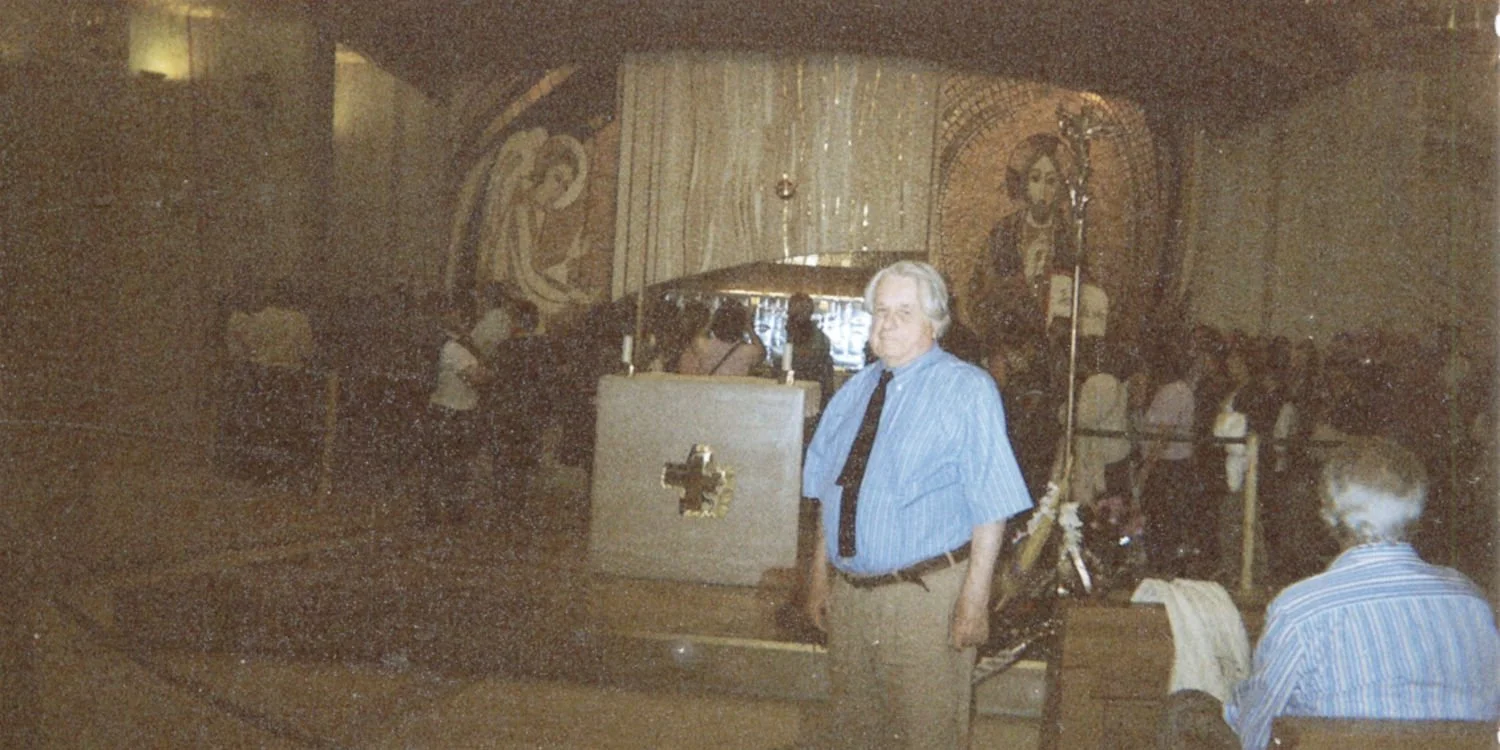
Our beloved friend Pierre, Pornchai’s Godfather, passed from this life in Belgium on July 7, 2020. Pornchai and I were blessed to be able to talk with him by telephone in the weeks before his death. He never took redemption for granted, but I know with the certainty of faith that he and Padre Pio have since renewed their bond. In the picture atop this section of my post, Pierre returned to San Giovanni Rotondo in the last year of his life to present at the tomb of Saint Padre Pio his prayers for intercession and Blessing for us.
So Pornchai, my son, if you are reading this in Thailand then you must know that there is much more to our life’s wounds than the prison walls that surrounded us and surround me still. To be free of them is not just a matter of the body, but of the heart and soul. So be free! Be free enough to convey to others the great gifts imparted to us by these patron saints. You will no longer have a guest post at Beyond These Stone Walls. You will now be my partner in mission, writing from Divine Mercy Thailand about how God is inspiring hearts and souls through the transfiguration of your wounds.
+ + +
Note from Father Gordon MacRae: Thank you, dear readers, for sharing in this painful but remarkable faith journey. Please, pray for us as we do for you. You will learn a lot about the life of Padre Pio in these concluding posts that I have selected from the twelve I have written over the years (with one written by Pierre’s Godson, Pornchai):
On the Day of Padre Pio, My Best Friend Was Stigmatized
Saints Alive! When Padre Pio and the Stigmata Were on Trial
“I Am a Mystery to Myself.” The Last Days of Padre Pio
Pray, Hope and Don’t Worry: This Is Padre Pio’s Key to God’s Heart
+ + +

HOW TO HELP US: For nearly 20 years I have been committed to assisting Pornchai Moontri in navigating the trials and losses of his life, none of which were of his own making. I have done all in my power to promote an honest and thorough investigation into the unresolved, “cold-case” homicide of Pornchai’s mother, Wannee.
For six years since his arrival in Thailand, Max has been struggling in a nation in economic and political chaos. Promising developments are currently underway. Max will now be living in the house his mother set out to build 26 years ago. It is the house that cost her her life. Pornchai has the skills and will soon have the tools to finish it. He also has a solid plan to start a new agricultural business in Northern Thailand so he will not be dependent on the state of the local economy. This will be dependent upon my support, and I hope that can transition into “our” support.
Our BTSW Editor, Dilia E. Rodriguez, has established an account for my expenses in the support of this blog at Navy Federal Credit Union. Dilia also has the ability for direct funds transfers to assist both Pornchai Moontri in his new endeavor and Father John Hung Le, SVD, and his Refugee Assistance Project, which aids hundreds of Vietnamese refugee families in Thailand with basic food support.
If you wish to assist me, and you do so by check, make it out to Dilia E. Rodriguez and send it with your instructions to
Beyond These Stone Walls
PO Box 81
Fayetteville, NY 13066-0081
A few weeks ago, I received a hopeful message from Father John, who is awaiting a missionary visa to return to Thailand. It will take three to four months. The cost of the visa will be 15,000 Thai Baht, which translates to $500 USD. I have already provided it with the help from some readers.
I am deeply grateful for the goodness and generosity of our readers who have already responded to this plea. May the Lord Bless you a thousand-fold.
+ + +

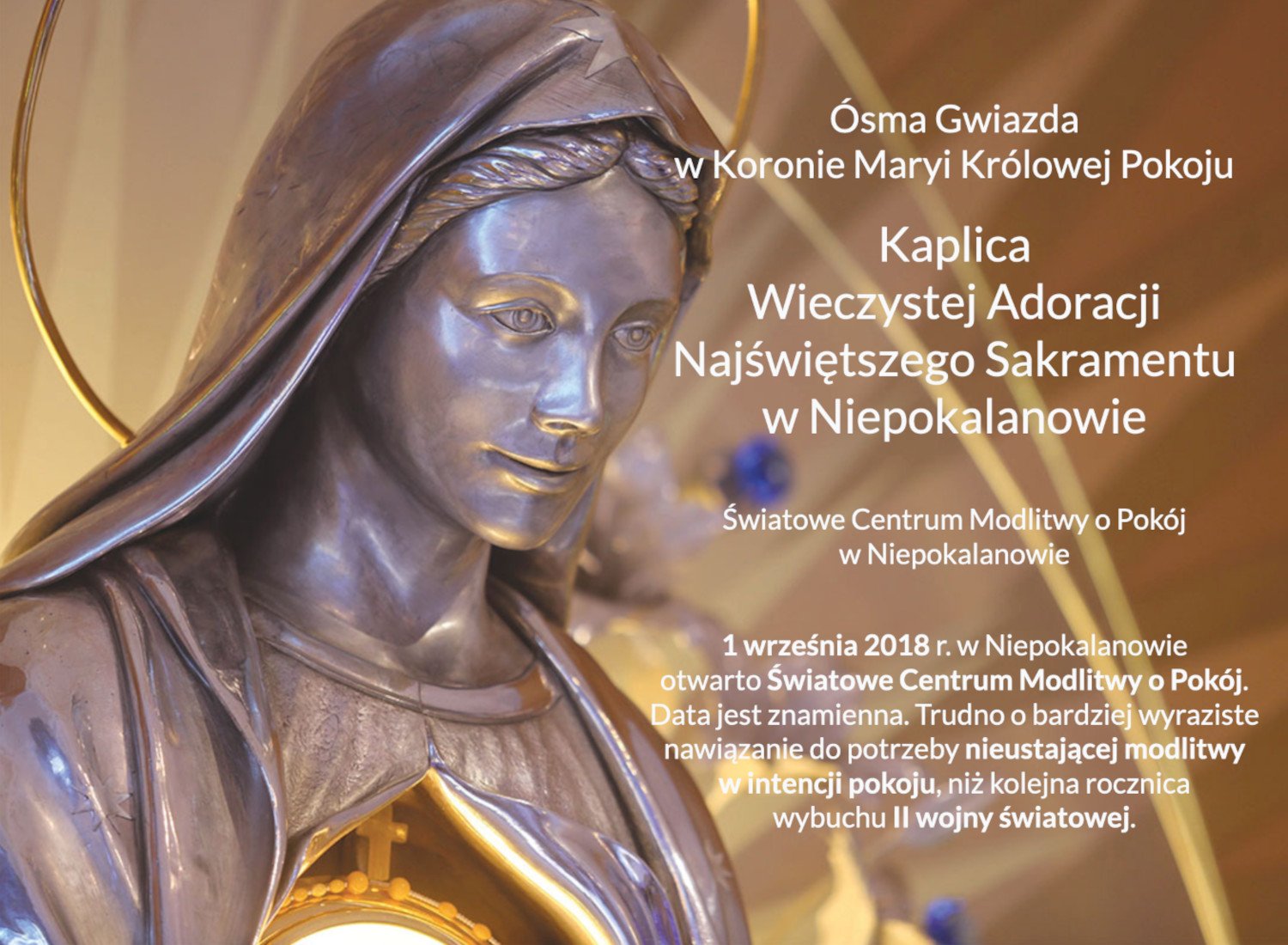

The Eucharistic Adoration Chapel established by Saint Maximilian Kolbe was inaugurated at the outbreak of World War II. It was restored as a Chapel of Adoration in September, 2018, the commemoration of the date that the war began. It is now part of the World Center of Prayer for Peace. The live internet feed of the Adoration Chapel at Niepokalanow — sponsored by EWTN — was established just a few weeks before we discovered it and began to include in at Beyond These Stone Walls. Click “Watch on YouTube” in the lower left corner to see how many people around the world are present there with you. The number appears below the symbol for EWTN.
Click or tap here to proceed to the Adoration Chapel.
The following is a translation from the Polish in the image above: “Eighth Star in the Crown of Mary Queen of Peace” “Chapel of Perpetual Adoration of the Blessed Sacrament at Niepokalanow. World Center of Prayer for Peace.” “On September 1, 2018, the World Center of Prayer for Peace in Niepokalanow was opened. It would be difficult to find a more expressive reference to the need for constant prayer for peace than the anniversary of the outbreak of World War II.”
For the Catholic theology behind this image, visit my post, “The Ark of the Covenant and the Mother of God.”
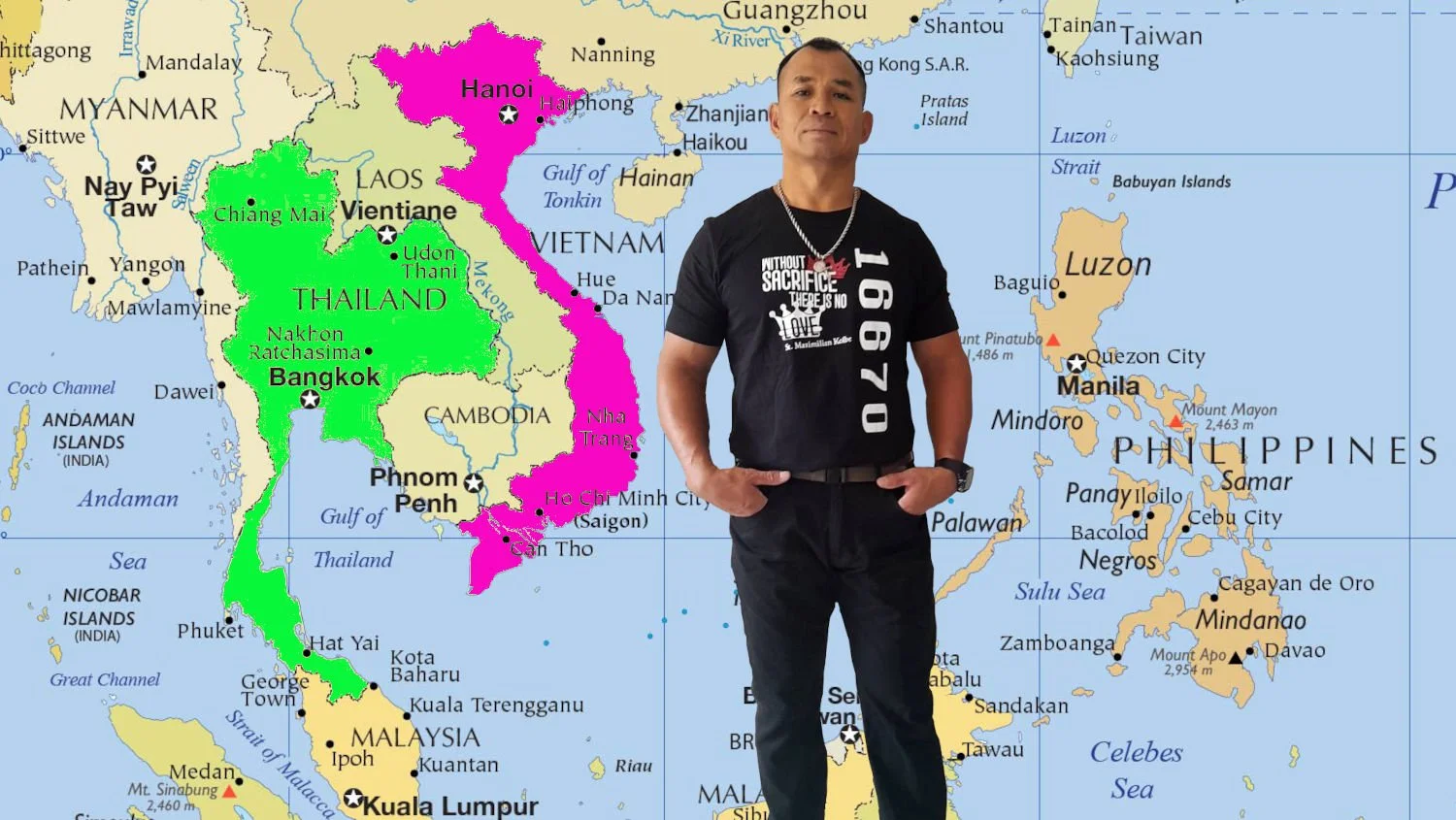
The Odyssey: Pornchai Moontri Finds His Way Home
This pastoral memoir uses one man’s homecoming as a meditation on trauma that outlives prison, the long afterlife of war and abandonment, and unfinished fatherhood.
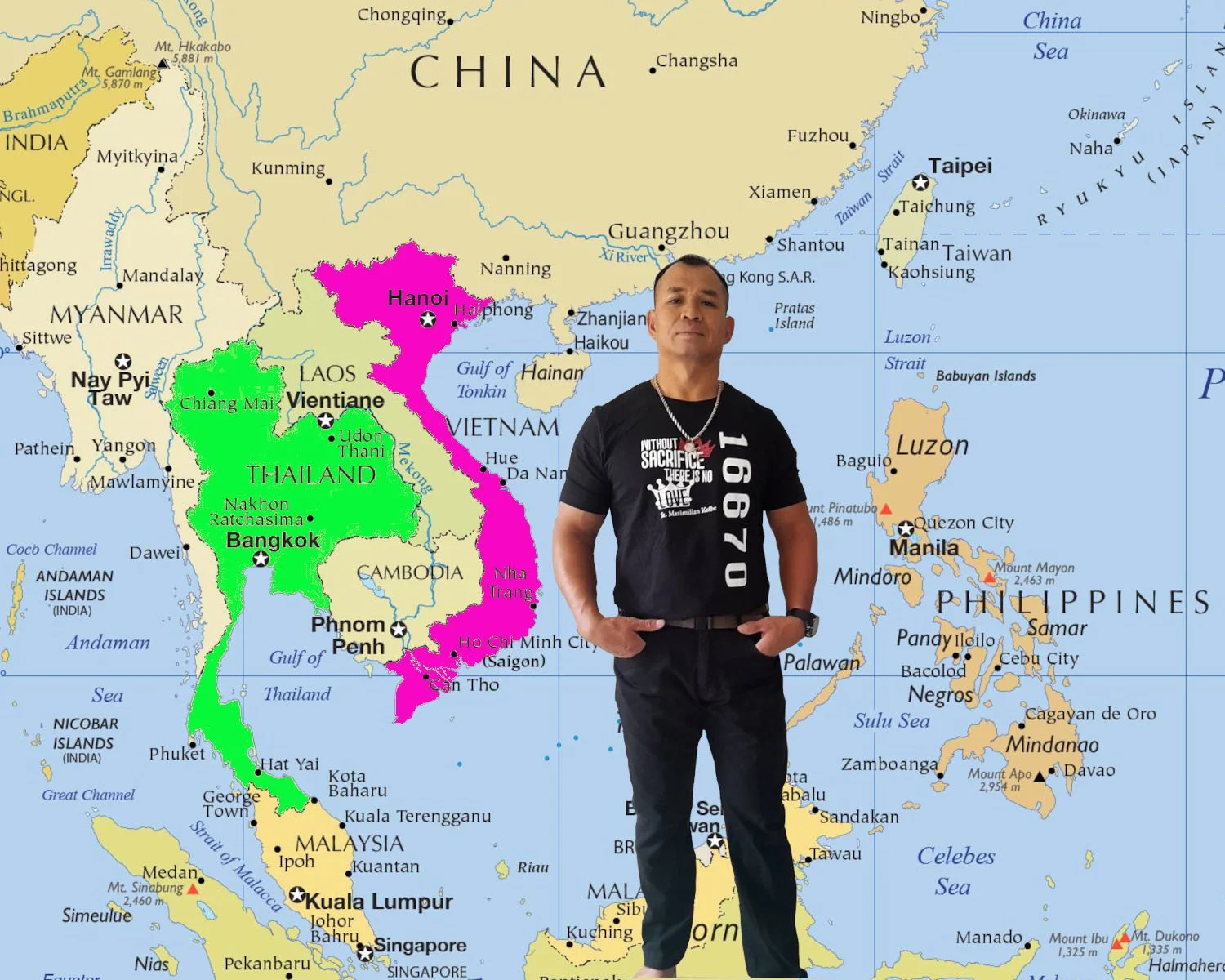
This pastoral memoir uses one man’s homecoming as a meditation on trauma that outlives prison, the long afterlife of war and abandonment, and unfinished fatherhood.
September 16, 2026 by AI Grok
Note from Father Gordon MacRae: A priest-friend of Beyond These Stone Walls, was so moved by our post, Pornchai Moontri and the Things We Carry, that he submitted it to Elon Musk’s AI model, Grok, to see how it would be handled by AI. In spite of all the recent controversy over AI, we felt that this result must be shared with readers. Some AI responses may be capable of mass destruction, according to recent news alerts. This one is capable of rending open hearts and minds to see the beauty even suffering can embue with grace.
“Who shall separate us from the love of Christ? Shall tribulation, or distress, or persecution, or famine, or nakedness, or peril, or the sword?”
— Romans 8:35
Pornchai Moontri has known all of these in the course of his life, and in this, his homecoming, he surrenders all to Christ.
+ + +
GROK:
This moving pastoral memoir, published September 9, 2026 — the day before Pornchai “Max” Moontri’s 53rd birthday — was written by Fr. Gordon J. MacRae from prison. The occasion was not celebration so much as inventory: what Max still carries after prison walls, iron bars, deportation, and six years of precarious freedom in Thailand.
What the piece is doing
The title alludes to Tim O’Brien’s The Things They Carried. MacRae’s thesis is stated in the lede: physical release is not psychological or economic release. Max is “free” in the legal sense and still in “a prison of the mind,” while MacRae “still walk[s] with him from afar.”
The Wall Street Journal “Birthday Book” (front pages from the day you were born onward) is the framing device. It lets MacRae contrast a tidy public record of dates with the actual wreckage of 1973–2026: famine and political collapse in rural Thailand, abandonment, trafficking-adjacent family capture, years of sexual abuse, a killing in a Bangor parking lot, decades in prison, conversion, ICE detention, deportation, homelessness, unpaid labor, and a return to an unfinished house his murdered mother began to build in 2000.
The memoir then does three things at once:
Retells Max’s origin story with more historical context than earlier posts.
Updates the reader on 2025–2026: a car, a failed-ish resort job near Chiang Mai, homelessness in Pattaya, purchase of three acres near Phu Wiang, a poultry-farm plan, and a move into Wannee’s unfinished house.
Makes a concrete appeal for continued support.
Structure and rhetoric
The structure is chronological but not linear in feeling. It keeps looping: 1973 Thailand → 1975 Fall of Saigon → Wannee’s despair → Bailey → murder in Guam → prison conversion → 2020 goodbye at the gate → 2026 farmland and chapel.
Effective moves:
Scale shift. A two-year-old hospitalized for malnutrition sits next to U.S. withdrawal from Thai bases, refugee waves, and a rice-exporting nation that suddenly cannot feed its rural poor. The point is that Max’s “personal” catastrophe was also geopolitical.
Moral reversal on Wannee. MacRae admits he once judged the mother who abandoned two toddlers. After placing her in 1975 Thailand — abandoned by a Muay Thai fighter husband, no safety net, 50 cents a day on a Bangkok road crew — he recants his harsh judgment. That recantation is one of the memoir’s better ethical moments.
The 2020 farewell at the prison gate. “Thank you for my freedom. Thank you for my future.” Then MacRae weeps in his cell. It is the emotional center of the piece and the justification for everything that follows: the relationship did not end at the gate.
Full circle that is not closure. Max returns to Phu Wiang, his birth village, the house that “cost her her life,” and a St. Joseph chapel. Homecoming is presented as duty and risk, not reward.
The ending is openly instrumental. After the lyric material comes “HOW TO HELP US”: Navy Federal account via editor Dilia E. Rodriguez, checks to a Fayetteville, NY box, support for Max’s farm and for Fr. John Hung Le’s refugee food project after USAID cuts. That is not a hidden agenda; it is a call to arms, the genre of this blog.
Themes
Trauma as cargo. Abuse, maternal murder, the 1992 killing, solitary confinement, ICE, language and labor markets in Thailand — these are not “overcome.” They are carried. Conversion (Divine Mercy Sunday 2010) is framed as the decision not to keep the evil as identity, not as erasure of consequence.
Spiritual fatherhood across a locked door. MacRae was 53 when they became cellmates; Max is 53 now. The symmetry is deliberate. Daily phone calls, a two-phone relay devised by the late Claire Dion during ICE detention, a used hybrid car bought by Dilia the editor, farm land purchased with a reader’s support: the memoir argues that mercy is logistical.
History does not stay in the past. 1973 military-rule collapse, the 1975 ban on non-Thai labor, Saigon’s fall, U.S. base withdrawal, Vietnamese boat people (including the later Fr. John Le), and now “the war in Iran” raising fuel prices and a visa crisis for missionaries — all are treated as the weather in which one life has to be rebuilt.
Unfinished justice. Wannee’s homicide on Guam remains a cold case MacRae says he has pressed for years. Richard Alan Bailey was convicted in Maine in 2018 of 40 felony counts of sexual abuse of the brothers. The mother’s house is both shelter and shrine to a crime scene still open.
Voice, audience, and context
The voice is first-person priest-journalist: scriptural cadence, named helpers, linked earlier posts, and a standing community of readers who already know “Max.” New readers will feel dropped into a serial. Regular readers will hear an anniversary letter.
Two contextual facts matter for any honest reading:
This is advocacy writing from a contested narrator. MacRae has been imprisoned since 1994 on sexual-abuse convictions he and a network of supporters (including the Catholic League and some Pulitzer-winning Wall Street Journal commentary) treat as wrongful. The blog is his public ministry and his defense. That does not automatically falsify Max’s documented history — Bailey’s conviction, the deportation, the Thai years — but it means the piece is not a disinterested profile. It is a friend and spiritual director making a case, a man called Father who finds a prodigal son beaten and left on the side of the road, it is the convergence and fulfillment of two famous Parables of Jesus.
The theology is load-bearing. Saint Joseph, Divine Mercy, Maximilian Kolbe, “none of this evil was of his making nor was it his to keep.” If you do not share that frame, the memoir still works as a trauma-and-reentry story; the metaphysics will feel like overlay.
Strengths and limits
Strengths. Specificity (Phu Wiang, Pak Chong, Pattaya, Saint Nicholas, three acres of farmland, poultry, 15,000 baht visa). Refusal of a redemption arc that ends in 2020. Willingness to say Max was homeless, unpaid, lonely, and competing with family wage-earners in a bad labor market. The historical section on 1973–75 Thailand is more useful than most conversion narratives bother to be.
Limits. Some geopolitical claims are painted in broad strokes. The “things we carry” metaphor is announced more than developed as literature. Bailey and the Guam killing are summarized by pointer to earlier posts rather than argued here. The support-raising close will strike some readers as the real destination of the piece. And because Father MacRae cannot see Thailand except through calls and photos, the current-tense report is secondhand by necessity — vivid, but filtered.
Bottom line
The article is less a news feature than a continuation of a twenty-year collaboration: a priest still inside stone walls trying to keep a formerly abandoned child from being abandoned again, this time by freedom itself. Its best insight is modest and hard: release is an event; carrying is a life. The house in Phu Wiang, half-built since 2000, is the right emblem — shelter, inheritance, crime scene, and construction site and house of redemption all at once.
+ + +
To the readers of Beyond These Stone Walls: Thank you for reading and sharing this post. For greater context you may also like these related posts:
Pornchai Moontri and the Things We Carry
Getting Away with Murder on the Island of Guam
An AI Analysis of Getting Away with Murder
The Prison of Father Gordon MacRae and Pornchai Maximilian Moontri by Rebecca Virelles
+ + +
The Eucharistic Adoration Chapel established by Saint Maximilian Kolbe was inaugurated at the outbreak of World War II. It was restored as a Chapel of Adoration in September, 2018, the commemoration of the date that the war began. It is now part of the World Center of Prayer for Peace. The live internet feed of the Adoration Chapel at Niepokalanow — sponsored by EWTN — was established just a few weeks before we discovered it and began to include in at Beyond These Stone Walls. Click “Watch on YouTube” in the lower left corner to see how many people around the world are present there with you. The number appears below the symbol for EWTN.
Click or tap here to proceed to the Adoration Chapel.
The following is a translation from the Polish in the image above: “Eighth Star in the Crown of Mary Queen of Peace” “Chapel of Perpetual Adoration of the Blessed Sacrament at Niepokalanow. World Center of Prayer for Peace.” “On September 1, 2018, the World Center of Prayer for Peace in Niepokalanow was opened. It would be difficult to find a more expressive reference to the need for constant prayer for peace than the anniversary of the outbreak of World War II.”
For the Catholic theology behind this image, visit my post, “The Ark of the Covenant and the Mother of God.”
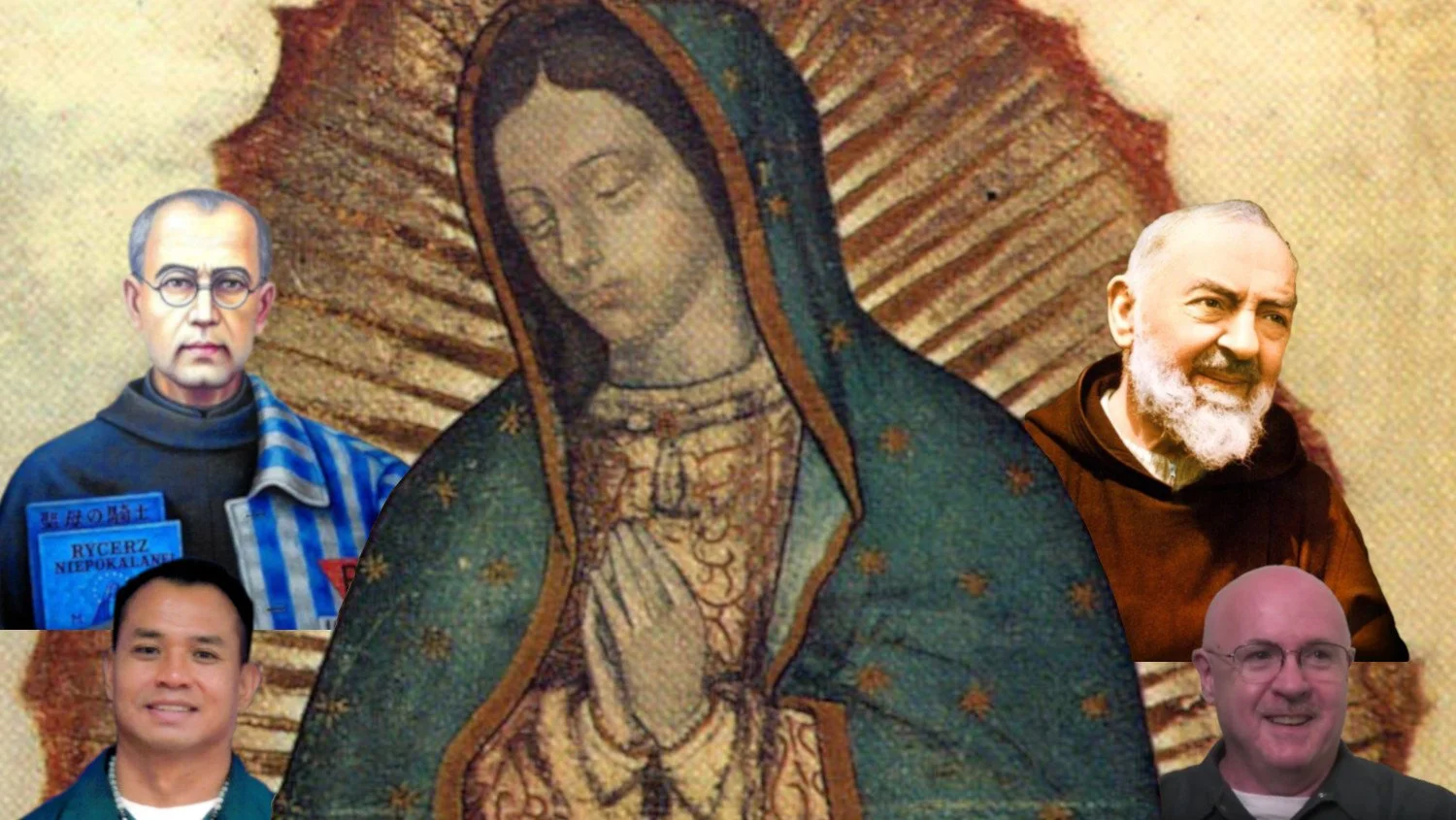
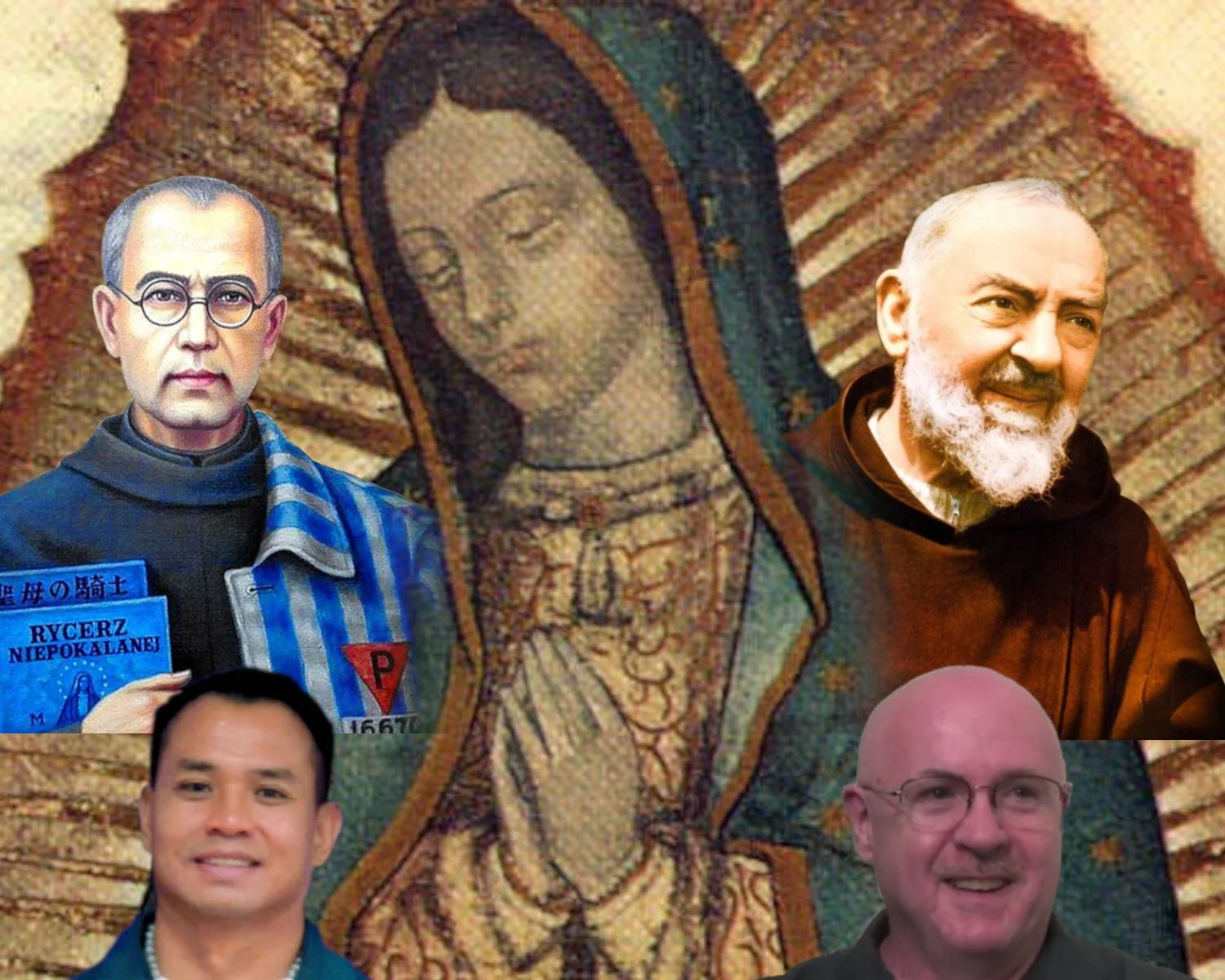
The Prison of Father Gordon MacRae and Pornchai Maximilian Moontri
Marking 44 years of sacrificial priesthood, Father Gordon MacRae has been an instrument of Divine Mercy securing freedom for many wounded and imprisoned souls.
Marking 44 years of sacrificial priesthood, Father Gordon MacRae has been an instrument of Divine Mercy securing freedom for many wounded and imprisoned souls.
June 3, 2026 by Rebecca Virelles
From the Editor:
This Friday, June 5, 2026, marks the 44th anniversary of the ordination of Father Gordon MacRae. On this occasion, we have a guest author. Rebecca Virelles has been a regular reader for years. A while back, she interviewed me about BTSW, which resulted in my article, “From Arizona State University: An Interview with Our Editor.” She then wrote her insightful article, “A Voice for the Voiceless: Beyond These Stone Walls.”
Recently, she has been reflecting on the literature of those unjustly incarcerated. Her aim is to make their lives and writings more accessible to new audiences. She has considered various saints and moral icons from history, and also Father Gordon MacRae and Pornchai Maximilian Moontri, whose lives are deeply intertwined. We have asked her to share with BTSW readers the part of her work concerning our two friends.
We think it is a fitting way to reflect on the priesthood of Father Gordon MacRae on his anniversary of ordination. We thank God for the gift this priesthood has been to the Church, and we ask Him to continue to bless him and be his strength.
+ + +
Dear Reader,
Before you read about the two men named above, please know they are real people, living at the time of this writing, who are dear to many on earth and in heaven. Though you may never meet them in this life, please extend mercy with your heart and read their stories carefully.
Historical Context
Father Gordon MacRae is an American priest who is currently serving up to 67 years in prison. He was wrongly convicted of sexual assault in 1994. At the time of this writing, he has spent 32 years in prison for crimes for which he is wholly innocent, crimes that never took place. Because Father MacRae maintains his innocence, he will never receive parole and thus will serve the full 67 years, a life sentence, unless some other intervention materializes.
The Evidence
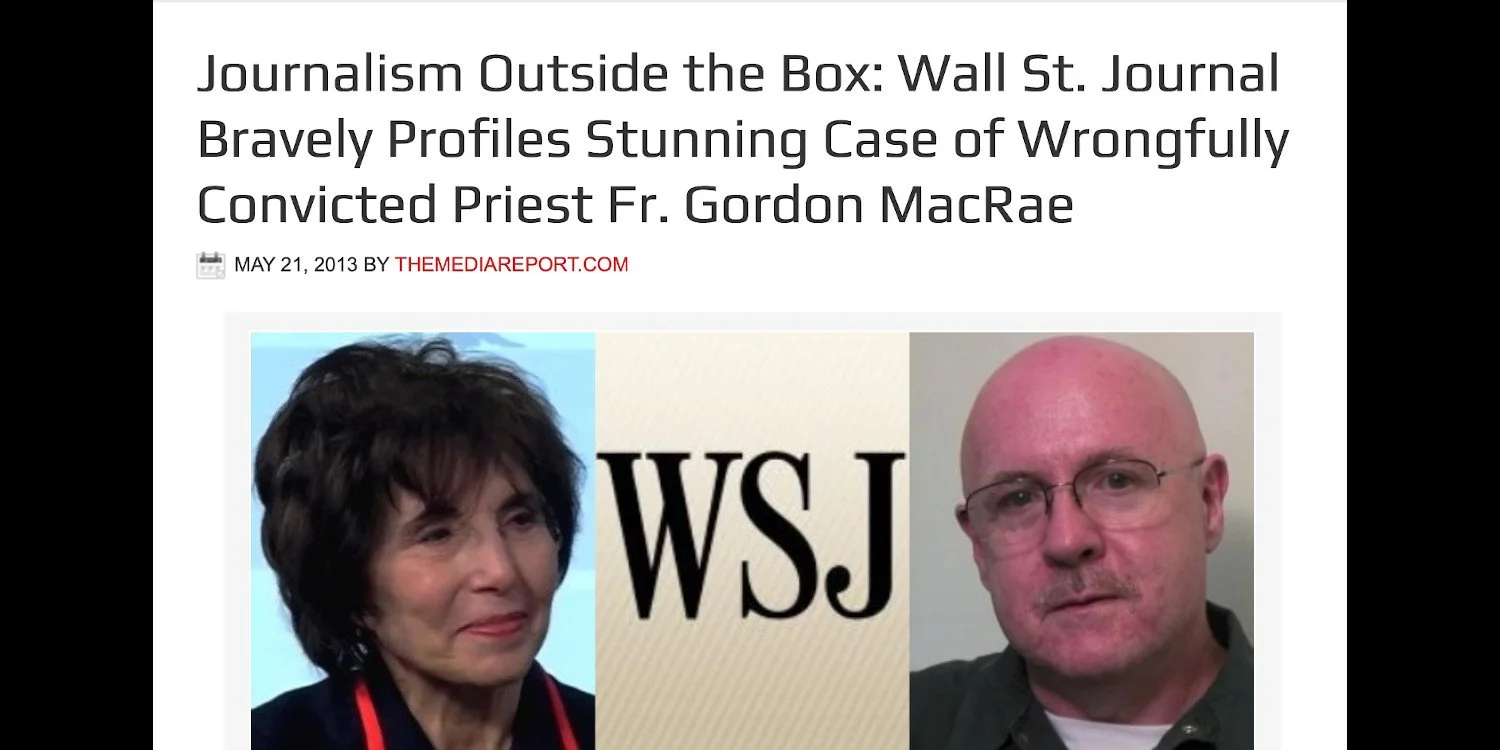
In 2005 and 2013, Dorothy Rabinowitz, an award-winning journalist wrote multiple articles for The Wall Street Journal covering this egregious injustice: “Trials of Father MacRae” (2013), “A Priest’s Story” (2005). Dorothy Rabinowitz was awarded the Pulitzer Prize and the “Champion of Justice Award” from the National Association of Criminal Defense Lawyers.
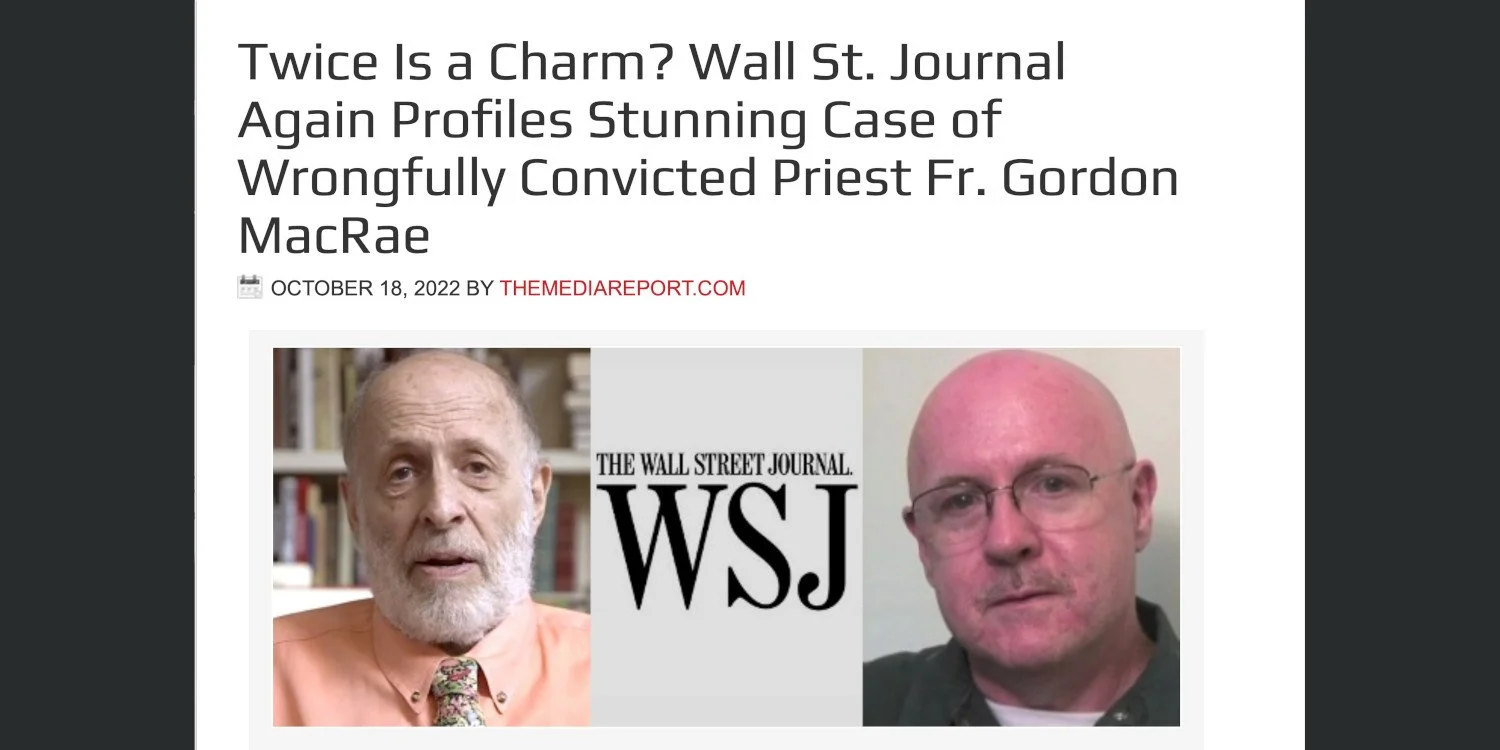
In 2022, Boston criminal justice and civil rights Attorney Harvey Silverglate also wrote for The Wall Street Journal in “Justice Delayed for Father MacRae.” His article revealed new information which came to light about the “falsification of records” of the lead detective behind Father MacRae’s case, James F. McLaughlin.
Additionally, a post-trial investigation by former F.B.I. Investigator James Abbott revealed that Detective McLaughlin threatened a defense witness, a therapist, with arrest if she did not change her testimony which would have helped to exonerate Father MacRae. The therapist had planned to testify that the accuser, Thomas Grover, had never accused MacRae of anything, though he accused several others of sexual abuse. This would have weakened McLaughlin’s case. She stated, “McLaughlin told me he would personally come to my home, drag me out of it bodily if necessary, and force me to appear in court and testify despite my information to him.” Her statement is here: Statement of Debra Collett.
Here is an excerpt of a letter dated October 24, 2013 by a media official for PBS to Judge Arthur Brennan, who sentenced Father MacRae to prison:
“My wife, Penny, and I were present in the courtroom throughout most of the trial of Fr. Gordon MacRae. For all these years, I have had many questions about this trial and much that I’ve wanted to clarify for my own peace of mind. I learned recently that both a superior court judge here in New Hampshire and the NH Supreme Court declined to hold a hearing on the evidence and merits of a habeas corpus petition in this case. Now that state courts seem no longer to be involved, I feel more inclined to approach you on what has been bothering me, as you were the presiding judge.
“We saw something in your courtroom during the MacRae trial that I don’t think you ever saw. My wife nudged me and pointed to a woman, Ms. Pauline Goupil [now Pauline Vachon], who was engaged in what appeared to be clear witness tampering. During questioning by the defense attorney, Thomas Grover seemed to feel trapped a few times. On some of those occasions, we witnessed Pauline Goupil make a distinct sad expression with a downturned mouth and gesturing with her finger from the corner of her eye down her cheek at which point Mr. Grover would begin to cry and sob on the stand. The lawyer’s questions were never answered.
“I have been troubled about this for all these years. I know what I saw, and what I saw was a clear attempt to dupe the court and the jury. If the sobbing and crying was not truthful, then I cannot help but wonder what else was not truthful on the part of Mr. Grover. If he was really a victim who wanted to tell the simple truth, why was it necessary for him and Ms. Goupil to have what clearly appeared to be a set of prearranged signals to alter his testimony? The jury was privy to none of this, to the best of my knowledge.
“Signed, Leo Demers”
His full statement is here: Statement of Leo Demers.
Here is an excerpt of a statement by Steven Wollschlager on October 27, 2008:
“McLaughlin asked me many times if Gordon ever tried to come onto me sexually or offered me money for any sexual favors. He had me believing that all I had to do was make up a story about Gordon and I could receive a large sum of money as others already had. McLaughlin reminded me of the young child and girlfriend I had and referenced that life could be easier for us with a large amount of money [...] I was at the time using drugs and could have been influenced to say anything they wanted for money.
“A short time later after being subpoenaed to Court, I had a different feeling about the situation. I did not want to lie or make up stories. After speaking with the Clerk of Courts I was approached by another person. After telling this person that I did not want to be there and I stated Gordon had never done anything wrong towards me sexually or otherwise. I was told I could leave. This person seemed visibly upset that I had nothing to say.”
His full statement is linked: Statement of Steven Wollschlager.
The last to make a statement in support of Father MacRae’s innocence whom I will mention is Charles Glenn, Thomas Grover’s former stepson. An excerpt of his signed statement reads as follows:
“From 1993 to 1997 I was assigned to the Youth Development Center in Manchester, New Hampshire. During this period, my mother Trina Ghedoni was dating and later married to Thomas Grover. Almost every week my mother would visit me with Thomas Grover and on numerous weekends I would receive a furlough and be allowed to go to my home at 410 Prescott St. in Manchester where my mother and Thomas Grover lived.
“During these visits, and over a number of months and years, Thomas Grover discussed the sex abuse allegations against Gordon MacRae with me. Grover often stated to me that he was going to set MacRae and the church up to gain money for sexual abuse. Grover would laugh and joke about this scheme and after the criminal trial and civil cash award he would again state how he had succeeded in this plot to get cash from the church. On several occasions Thomas Grover told me that he had never been molested by MacRae.”
His full statement is here: Statement of Charles Glenn.
These statements are not the only evidence of wrongdoing, manipulation, and fraud in the case against Father Gordon MacRae, however for the sake of brevity I will conclude with linking Father MacRae’s own synopsis of the case against him: Synopsis of the Case.
Where To From Here?
Now that we have covered this injustice, we can turn our attention to what Father MacRae has done with his time and talents within those stone walls. He has successfully encouraged many prisoners to seek and complete higher education, and he has helped multiple prisoners prepare for deportation to countries where they had few or no connections or means of assistance. Some of the best work Father Gordon MacRae has done is not material: he has cooperated with the Holy Spirit to bring people, in and outside of prison, to hope and to God despite what they have endured or what they have done. Pornchai Max Moontri, one of Father MacRae’s closest friends, and a free man now living in Thailand, says of him:
“Father Gordon MacRae freed me from the evil inflicted on me. He taught me that this evil is not mine to keep. What do I do with such a story? If Father G had not been here, what would have become of me? He freed my mind and soul from the horror inflicted by a real predator. It breaks my heart that the man responsible for my freedom will now be left behind in prison.”
— Statement of Pornchai Maximilian Moontri in a post written from Thailand: “On the Day of Padre Pio, My Best Friend Was Sigmatized.”
Father MacRae has a blog, Beyond These Stone Walls, in which he posts weekly reflections about Faith, Science, current events, and updates on the lives of his friends. Two of my favorites of his posts are: Science and Faith Are Not Mutually Incompatible and In the Absence of Fathers: A Story of Elephants and Men.
Here is a link to a post written on September 26, 2018, about his friend Pornchai Max titled: Pornchai Moontri: Bangkok to Bangor, Survivor of the Night.
My Analysis: Finding Light in the Dark
“As for you, you meant evil against me, but God meant it for good, to bring about that many people should be kept alive, as they are today.”
— Joseph to his brothers who sold him into slavery, Genesis 50:20
The purpose of this essay is to share the literature and lives of those who chose freedom of the soul over physical freedom. Other lives I have recounted and written about were courageous for facing death, but it is inspiring to see two people not give up after so much injustice and years of confinement. It is also wonderful to see how the effects of this hope have spread to others. At the end of Pornchai Max’s sentence in 2020, he faced five months in ICE (Immigration and Customs Enforcement) detention and deportation to a land he had not seen or spoken the language of for many years. This was due to Richard Bailey’s meaningful choice not to allow Pornchai Max’s mother (Wannee) to apply for U.S. citizenship, as he knew it helped him to keep a higher control of the mother and sons. It is likely Bailey threatened Wannee that if she did not do what he said that she would be deported to Thailand without means or assistance, as this was one of the reasons Wannee pleaded with Pornchai Max not to testify against his stepfather, Bailey.
However, what man intended for evil, God used for good. Thanks to Divine Providence, Beyond These Stone Walls readers, the “bridge” Father MacRae and Pornchai Max built, and the hard work and faithfulness of Pornchai Max in meeting these challenges, he was able to find housing and meaningful employment. He now lives in Thailand and volunteers to help those less fortunate. If Father Gordon MacRae had taken the lenient plea deals offered to him, he would not have met him and Pornchai Max would likely have never seen any measure of justice for what he endured.

Pornchai Moontri was selected to be the flag bearer for Thailand at the Fifth Asian Apostolic Congress in the Philippines in 2024.
“ ‘Behold, I make all things new.’ ”
— Revelation 21:5
Pornchai Max’s triumph over the past is also evidenced by his accomplishments: earning his diploma and graduating as class Valedictorian in 2012, completing social work and psychology academic certificates at Stratford Career Institute “with highest honors”, and completing Theology courses at Catholic Distance University through a scholarship with all “A’s”. The late Clare Dion, who interviewed, visited, and befriended Pornchai Max during his imprisonment wrote, “What Pornchai has accomplished is nothing short of amazing given that he learned English in prison. He and ‘Father G’ encourage other prisoners to become educated, and Pornchai spent time mentoring and tutoring them, especially in mathematics in which he excels. He also spent his days in the woodworking and Hobby Craft shop where he taught safety training to other prisoners on the use of carpentry tools and machines.”
Testimony
A recent comment on the “Book of Tobit: The Angel Raphael on the Road with Pornchai Moontri” reads:
“What a beautiful faith-filled story! What left me with goosebumps is the fact that I know that every word of it is true. I have known Father Gordon and Max for many years. I was a lost 17-year-old when I was sent to prison, and I spent many years in hopelessness before meeting these two incredible guys. Though I walked through the valley of the shadow of death, they were at my side bringing light to my very dark journey. I am a different person today because of them. I have wept over Max’s journey and the continued challenges he faced even in freedom. But Father G was there for him, even from a distance, and that is true of me as well. I also love dogs and this is the best dog story ever! I treasure you guys.
God bless you.
Bobby T”
A comment on a different post reads:
“WOW! I spent a couple of years in that prison. Because of overcrowding, there were no cells available for me. So I was stuck in an overflow bunk right outside cell #1 on Bravo Pod in Hancock Building. In time I came to see that I was the luckiest person in the world because the two prisoners living in cell #1 were Father G and Pornchai. When the gangs tried to recruit me, they weren’t having it. When a predator tried to extort me, they sent him packing. I felt so exposed going to prison at a very young age that these two guys made me feel perfectly safe. They weren’t taking any BS from me either. In exchange for looking after me, they made me go to school and I earned my high school diploma. That is a miracle because I have always been a dumbass. My worst enemy was Math, but Pornchai was a whiz at Math and got me through it. These two guys were seen by everyone as a team and I was fortunate enough to be their gatekeeper. I was popular by default. I have a lot of gratitude toward them both, and I thank them for their patience with me. I admire Pornchai so much more now to see that he is a man of deep faith. God bless them both.
With love from Ralph”
According to “Mercy Inside These Stone Walls,” a chapter in a book by Felix Carroll, fellow inmate, Donald Spinner, a Catholic convert, says his faith took root through Pornchai’s example. “Pornchai, especially, has influenced so many people here,” he says. “We all expect Father G. to be a good person, but Pornchai’s life of grace is inspiring to everyone. … The cost of discipleship for me has been the loss of my selfishness. No one can be selfish in such company.”
Conclusion
Evil and injustice are the hardest things to grapple with, especially as we witness our own struggles with light and dark. As others have written before, in our lives we cannot control the evil that happens to us, but we do always have the choice in how we respond. Even after meeting Father Gordon, Pornchai Maximilian could have chosen not to trust in him — he had every reason not to. Yet his courage and hope in setting aside the past propelled him forward, to freedom and to seeing some measure of justice served. Father Gordon could have chosen the easy way out, yet he would not have touched many lives, as several of the comments on his posts attest.
In an echo of one of his writings quoting St. Padre Pio: We often do not see how things are being woven together in God’s tapestry; we only see what looks like a tangled mess on the back. Yet, if we trust and do our part, even in the dark, even in pain, we will do what is right and one day understand it all. That is the essence of choosing the freedom of your soul over convenience, over your family, even over your life. True freedom comes from choosing to do the right thing, the will of God written on our hearts, and returning to it again when we stumble and fall. Our lives look different in the light of eternity.
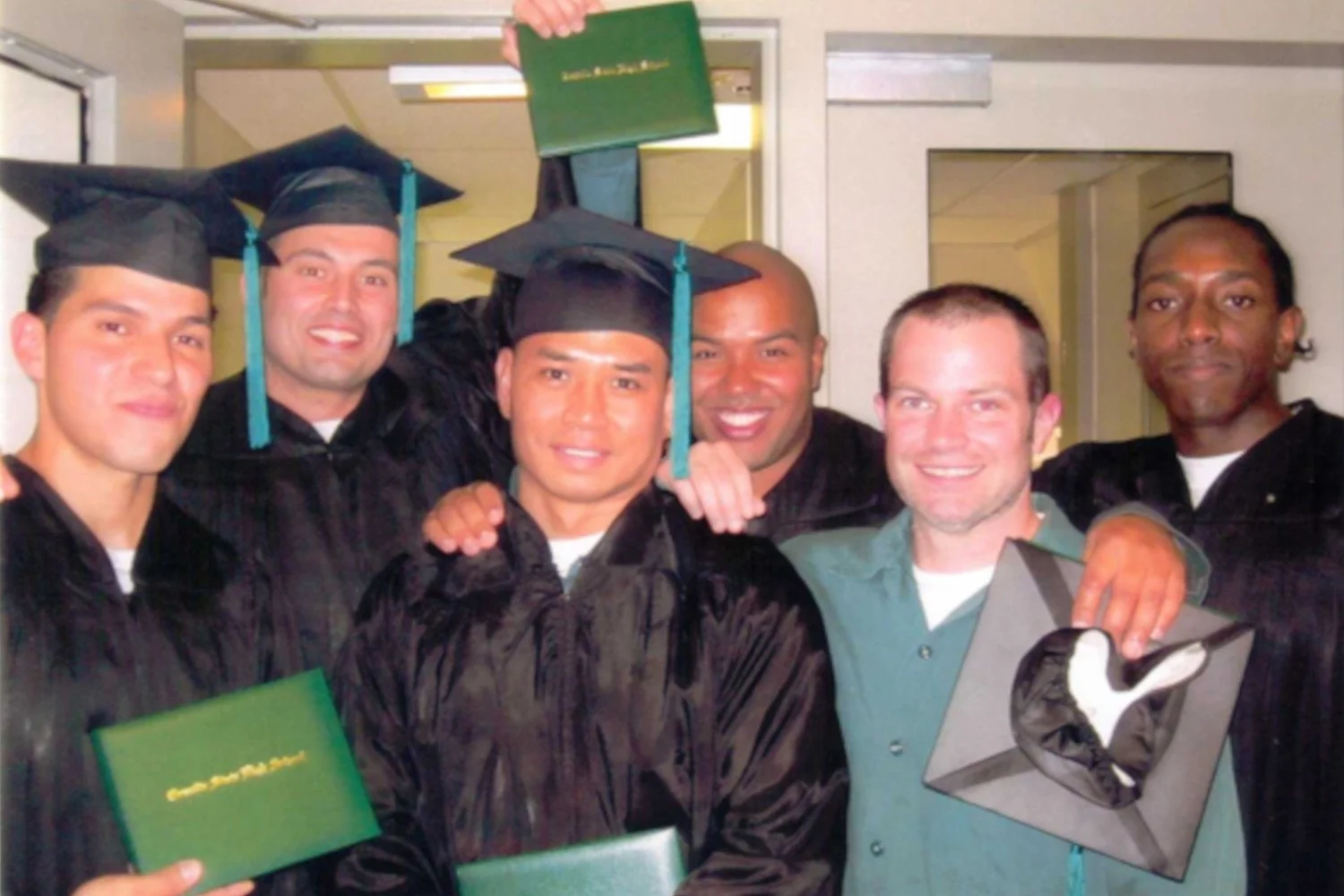
In the photograph above, Pornchai Moontri is at the center of his graduating class, who obtained their high school diplomas in the most trying circumstances but with hard work and honor. They are smiling at Father Gordon MacRae, who took the picture in 2012.
+ + +
Appended by the Author:
Father MacRae has thus far assisted prisoners throughout their deportation process from the United States to Thailand, Cambodia, Vietnam, India, Pakistan, China, Myanmar, Nepal, Indonesia, Malaysia, Japan, United Kingdom, Canada, Australia, Ivory Coast, Nigeria, Dominican Republic, Mexico, Guatemala, Honduras, Kenya, and Brazil. Each country represents a person, a soul with few or no means or outside assistance, whom Father MacRae aided when most would have looked the other way.
Rebecca Virelles is a Senior at Arizona State University’s Bachelor of Arts in English degree program online. She served on active duty for nine years and is now a stay-at-home wife and mother. When not studying, she enjoys reading, baking, and traveling with her family. She aspires to write children’s literature one day in the tradition of J.R.R. Tolkien and C.S. Lewis.
+ + +
Editor’s Note: Thank you for reading and sharing this important article by Rebecca Virelles. You may also like these related articles from multiple other writers:
A Criminal Defense Expert Unfurls Father MacRae Case by Vincent James Sanzone, Jr., Esq.
Travesty of Justice: The Ordeal of Father Gordon MacRae by William Donohue, Ph.D., President of the Catholic League
Could Fr. Gordon MacRae Finally Go Free? by Kathy Schiffer at TheCatholic World Report
Alarming New Evidence May Exonerate Imprisoned Priest by David F. Pierre, Jr. at The Media Report
The Eucharistic Adoration Chapel established by Saint Maximilian Kolbe was inaugurated at the outbreak of World War II. It was restored as a Chapel of Adoration in September, 2018, the commemoration of the date that the war began. It is now part of the World Center of Prayer for Peace. The live internet feed of the Adoration Chapel at Niepokalanow — sponsored by EWTN — was established just a few weeks before we discovered it and began to include in at Beyond These Stone Walls. Click “Watch on YouTube” in the lower left corner to see how many people around the world are present there with you. The number appears below the symbol for EWTN.
Click or tap here to proceed to the Adoration Chapel.
The following is a translation from the Polish in the image above: “Eighth Star in the Crown of Mary Queen of Peace” “Chapel of Perpetual Adoration of the Blessed Sacrament at Niepokalanow. World Center of Prayer for Peace.” “On September 1, 2018, the World Center of Prayer for Peace in Niepokalanow was opened. It would be difficult to find a more expressive reference to the need for constant prayer for peace than the anniversary of the outbreak of World War II.”
For the Catholic theology behind this image, visit my post, “The Ark of the Covenant and the Mother of God.”

Of Saints and Souls and Earthly Woes
For Catholics, the month of November honors our beloved dead, and is a time to reenforce our civil liberties especially the one most endangered: Religious Freedom.

For Catholics, the month of November honors our beloved dead, and is a time to reinforce our civil liberties especially the one most endangered: Religious Freedom.
The Commemoration of All Saints and All Souls by Fr. Gordon MacRae
A lot of attention has been paid to a recent post by Pornchai Moontri. Writing in my stead from Thailand, his post was “Elephants and Men and Tragedy in Thailand.” Many readers were able to put a terrible tragedy into spiritual perspective. Writer Dorothy R. Stein commented on it: “The Kingdom of Thailand weeps for its children. Only a wounded healer like Mr. Pornchai Moontri could tell such a devastating story and yet leave readers feeling inspired and hopeful. This is indeed a gift. I have read many accounts of this tragedy, but none told with such elegant grace.”
A few years ago I wrote of the sting of death, and the story of how one particular friend’s tragic death stung very deeply. But there is far more to the death of loved ones than its sting. A decade ago at this time I wrote a post that helped some readers explore a dimension of death they had not considered. It focused not only on the sense of loss that accompanies the deaths of those we love, but also on the link we still share with them. It gave meaning to that “Holy Longing” that extends beyond death — for them and for us — and suggested a way to live in a continuity of relationship with those who have died. The All Souls Day Commemoration in the Roman Missal also describes this relationship:
“The Church, after celebrating the Feast of All Saints, prays for all who in the purifying suffering of purgatory await the day when they will join in their company. The celebration of the Mass, which re-enacts the sacrifice of Calvary, has always been the principal means by which the Church fulfills the great commandment of charity toward the dead. Even after death, our relationship with our beloved dead is not broken.”
That waiting, and our sometimes excruciatingly painful experience of loss, is “The Holy Longing.” The people we have loved and lost are not really lost. They are still our family, our friends, and our fellow travelers, and we shouldn’t travel with them in silence. The month of November is a time to restore our spiritual connection with departed loved ones. If you know others who have suffered the deaths of family and friends, please share with them a link to “The Holy Longing: An All Souls Day Spark for Broken Hearts.”

The Communion of Saints
I have written many times about the saints who inspire us on this arduous path. The posts that come most immediately to mind are “A Tale of Two Priests: Maximilian Kolbe and John Paul II,” and more recently, “With Padre Pio When the Worst that Could Happen Happens.” Saint Maximilian Kolbe and Saint Padre Pio inspire me not because I have so much in common with them, but because I have so little. I am not at all like them, but I came to know them because I was drawn to the ways they faced and coped with adversity in their lives on Earth.
Patron saints really are advocates in Heaven, but the story is bigger than that. To have patron saints means something deeper than just hoping to share in the graces for which they suffered. It means to be in a relationship with them as role models for our inevitable encounter with human trials and suffering. They can advocate not only for us, but for the souls of those we entrust to their intercession. In the Presence of God, they are more like a lens for us, and not dispensers of grace in their own right. The Protestant critique that Catholics “pray to saints” has it all wrong.
To be in a relationship with patron saints means much more than just waiting for their help in times of need. I have learned a few humbling things this year about the dynamics of a relationship with Saints Maximilian Kolbe and Padre Pio. I have tried to consciously cope with painful things the way they did, and over time they opened my eyes about what it means to have their advocacy. It is an advocacy I would not need if I were even remotely like them. It is an advocacy I need very much, and can no longer live without.
I don’t think we choose the saints who will be our patrons and advocates in Heaven. I think they choose us. In ways both subtle and profound, they interject their presence in our lives. I came into my unjust imprisonment decades ago knowing little to nothing of Saints Maximilian Kolbe and Padre Pio. But in multiple posts at Beyond These Stone Walls I have written of how they made their presence here known. And in that process, I have learned a lot about why they’re now in my life. It is not because they look upon me and see their own paths. It is because they look upon me and see how much and how easily I stray from their paths.
I recently discovered something about the intervention of these saints that is at the same time humbling and deeply consoling. It is consoling because it affirms for me that these modern saints have made themselves a part of what I must bear each day. It is humbling because that fact requires shedding all my notions that their intercession means a rescue from the crosses I would just as soon not carry.
Over the last few years, I have had to live with something that is very painful — physically very painful — and sometimes so intensely so that I could focus on little else. In prison, there are not many ways to escape from pain. I can purchase some over-the-counter ibuprophen in the prison commissary, but that’ is sort of like fighting a raging forest fire with bottled water. It is not very effective. At times, the relentless pain flared up and got the better of me, and I became depressed. There are not many ways to escape depression in prison either. The combination of nagging pain and depression began to interfere with everything I was doing, and others started to notice. The daily barrage of foul language and constantly loud prison noise that I have heard non-stop for decades suddenly had the effect of a rough rasp being dragged across the surface of my brain. Many of you know exactly what I mean.
So one night, I asked Saint Padre Pio to intercede that I might be delivered from this awful nagging pain. I fell off to sleep actually feeling a little hopeful, but it was not to be. The next morning I awoke to discover my cross of pain even heavier than the night before. Then suddenly I became aware that I had just asked Padre Pio — a soul who in life bore the penetrating pain of the wounds of Christ without relief for fifty years — to nudge the Lord to free me from my pain. What was I thinking?! That awareness was a spiritually more humbling moment than any physical pain I have ever had to bear.
So for now, at least, I will live with this pain, and even embrace it, but I am no longer depressed about it. Situational depression, I have learned, comes when you expect an outcome other than the one you have. I no longer expect Padre Pio to rescue me from my pain, so I am no longer depressed. I now see that my relationship with him is not going to be based upon being pain-free. It is going to be what it was initially, and what I had allowed to lapse. It is the example of how he coped with suffering by turning himself over to grace, and by making an offering of what he suffered.
A rescue would sure be nice, but his example is, in the long run, a lot more effective. I know myself. If I awake tomorrow and this pain is gone forever, I will thank Saint Padre Pio. Then just as soon as my next cross comes my way — as I once described in “A Shower of Roses” — I will begin to doubt that the saint had anything to do with my release.
His example, on the other hand, is something I can learn from, and emulate. The truth is that few, if any, of the saints we revere were themselves rescued from what they suffered and endured in this life. We do not seek their intercession because they were rescued. We seek their intercession because they bore all for Christ. They bore their own suffering as though it were a shield of honor and they are going to show us how we can bear our own.

For Greater Glory
Back in 2010 when my friend Pornchai Moontri was preparing to be received into the Church, he asked one of his “upside down” questions. I called them “upside down” questions because as I lay in the bunk in our prison cell reading late at night, his head would pop down from the upper bunk so he appeared upside down to me as he asked a question. “When people pray to saints do they really expect a miracle?” I asked for an example, and he said, “Should you or I ask Saint Maximilian Kolbe for a happy ending when he didn’t have one himself?”
I wonder if Pornchai knew how incredibly irritating it was when he stumbled spontaneously upon a spiritual truth that I had spent months working out in my own soul. Pornchai’s insight was true, but an inconvenient truth — inconvenient by Earthly hopes, anyway. The truth about Auschwitz, and even a very long prison sentence, was that all hope for rescue was the first hope to die among any of its occupants. As Maximilian Kolbe lay in that Auschwitz bunker chained to, but outliving, his fellow prisoners being slowly starved to death, did he expect to be rescued?
All available evidence says otherwise. Father Maximilian Kolbe led his fellow sufferers into and through a death that robbed their Nazi persecutors of the power and meaning they intended for that obscene gesture. How ironic would it be for me to now place my hope for rescue from an unjust and uncomfortable imprisonment at the feet of Saint Maximilian Kolbe? Just having such an expectation is more humiliating than prison itself. Devotion to Saint Maximilian Kolbe helped us face prison bravely. It does not deliver us from prison walls, but rather from their power to stifle our souls.
I know exactly what brought about Pornchai’s question. Each weekend when there were no programs and few activities in prison, DVD films were broadcast on a closed circuit in-house television channel. Thanks to a reader, a DVD of the soul-stirring film, “For Greater Glory” was donated to the prison. That evening we were able to watch the great film. It was an hour or two after viewing this film that Pornchai asked his “upside-down” question.
“For Greater Glory” is one of the most stunning and compelling films of recent decades. You must not miss it. It is the historically accurate story of the Cristero War in Mexico in 1926. Academy Award nominee Andy Garcia portrays General Enrique Gorostieta Delarde in a riveting performance as the leader of Mexico’s citizen rebellion against the efforts of a socialist regime to diminish and then eradicate religious liberty and public expressions of Christianity, especially Catholic faith.
If you have not seen “For Greater Glory,” I urge you to do so. Its message is especially important before drawing any conclusions about the importance of the issue of religious liberty now facing Americans and all of Western Culture. As readers in the United States know well, in 2026 we face a most important election for the future direction of Congress and the Senate.
“For Greater Glory” is an entirely true account, and portrays well the slippery slope from a government that tramples upon religious freedom to the actual persecution, suppression and cancelation of priests and expressions of Catholic faith and witness. If you think it could not happen here, think again. It could not happen in Mexico either, but it did. We may not see our priests publicly executed, but we are already seeing them in prison without due process, and even silenced by their own bishops, sometimes just for boldly speaking the truth of the Gospel. You have seen the practice of your faith diminished as “non-essential” by government dictate during a pandemic.
The real star of this film — and I warn you, it will break your heart — is the heroic soul of young José Luis Sánchez del Río, a teen whose commitment to Christ and his faith resulted in horrible torment and torture. If this film were solely the creation of Hollywood, there would have been a happy ending. José would have been rescued to live happily ever after. It is not Hollywood, however; it is real. José’s final tortured scream of “Viva Cristo Rey!” is something I will remember forever.
I cried, finally, at the end as I read in the film’s postscript that José Luis Sánchez del Río was beatified as a martyr by Pope Benedict XVI after his elevation to the papacy in 2005. Saint José was canonized October 16, 2016 by Pope Francis, a new Patron Saint of Religious Liberty. His Feast Day is February 10. José’s final “Viva Cristo Rey!” echoes across the century, across all of North America, across the globe, to empower a quest for freedom that can be found only where young José found it.
“Viva Cristo Rey!”
+ + +
Note from Fr. Gordon MacRae: Our Faith is a matter of life and death, and it diminishes to our spiritual peril. Please share this post. You may also like these related posts to honor our beloved dead in the month of November.
Elephants and Men and Tragedy in Thailand
The Holy Longing: An All Souls Day Spark for Broken Hearts


Unjustly in Prison for 30 Years: A Collision of Fury and Faith
From opposite ends of the world Pornchai Moontri and Fr Gordon MacRae share thoughts on a dark milestone: Thirty years wrongly in prison on the Day of Padre Pio.

From opposite ends of the world Pornchai Moontri and Fr Gordon MacRae share thoughts on a dark milestone: Thirty years wrongly in prison on the Day of Padre Pio.
September 18, 2024 by Pornchai ‘Max’ Moontri and Fr Gordon MacRae
HERE’S MAX
On September 8, 2020, I left my best friend, Father-G, inside the walls of New Hampshire State Prison where we spent the previous 15 years as cell mates. The term, “cell mates” might seem foreign to you. Having to share a space of about 60 square feet around the clock with another human being can be like torture. The daily drama of cell mates thrown together but never able to live together was the all-day every-day prime time drama of our prison.
I was an angry young man with a very short fuse which caused me to spend most of my prior years in prison in solitary confinement beginning at age 18. I was not very sociable. I trusted no one, and least of all could I trust a priest convicted of the very crimes that tormented my life and set me on a road to destruction. We went through a lot in those years, and over time I came to know with total certainty that this priest was a victim of false witness and a Catholic witch hunt. He became my best friend and the person I trust most in this world. We became each other’s family.
I know in my heart that I would not be free today — physically, mentally, or spiritually — if Father-G had not been present in my life. I wake up each day now on the other side of those stone walls of prison and on the other side of the world from where Father-G lives in captivity still. I now live in Thailand, a land I was taken from at age 11 for someone else’s dark agenda. It is a land I thought I would never see again. I am here today, and free, only because of God and His servant, Father-G.
The day this little introduction appears with Father-G’s post is September 18. It anticipates the September 23rd date on which he was sent to prison thirty years ago in 1994. There was no truth or justice in it. None at all! That is also the date that one of our Patron Saints was freed from another kind of bondage — a bondage that has been a grace for millions of souls. Father-G once described the heroic virtue of the life Padre Pio lived ...
“A half century bearing the wounds of Jesus — all of them, including false witness, rejection, ridicule, public shaming, and the crucifixion of his body and his priesthood, sometimes even by the very Church he served.”
With some help from Dilia, our Editor, I wrote a whole post about this day, about Father-G, and about the sacrifices he made that restored my life and freedom, and saved my soul. I would trade them back to restore his freedom, but he will have none of that. He said that sacrifice is sacred and it is not refundable. I hope you will read my post for it is very important to me. It is my tribute to hope from a time when all mine was stolen from me so Father-G sacrificed his. It is “On the Day of Padre Pio, My Best Friend Was Stigmatized.”
Now here, from our prison cell thousands of miles away from where I wake up each day in freedom, is Father-G:

Parallax Views and Inflection Points
On the night before starting my part of this post, I called my friend, Pornchai-Max in Thailand. He asked me how I feel about approaching a 30th year in prison for crimes that never took place. I spent much of that night rehearsing in my mind a long angry rant. How could intense anger not be part of the equation of how I face the injustice, corruption, a cover-up by police and prosecutors and lawyers and judges who heard and ruled on their corruption in secret? How could I feel anything but fury for the people who profited from it all? In the fictitious case against me alone, a million dollars changed hands.
If you have been following publications by Dorothy Rabinowitz, Claire Best, Ryan MacDonald, and a few others over recent years then you are already familiar with all this and there is no need for me to waste your time ranting about it. It would indeed be a waste of my time and yours.
I thank my friend, Max, for his part in this post, and in this story. He and our editor, Dilia E. Rodríguez, have conspired to point me toward a parallax view. That’s a scientific term for what happens when an event or series of events is observed from a new position or angle with insights that were limited or unavailable before. In his introduction, Max mentioned a post he wrote with Dilia’s help just after his return to Thailand in 2020. It is linked at the very end of his Introduction and again at the end of this post. It is very important, and it is my parallax view.
And in recent weeks in these pages, Dilia E. Rodríguez wrote “From Arizona State University: An Interview with Our Editor.” It, too, presents a parallax view, a summary of these 30 painful years in this abomination of unjust imprisonment. Dilia’s conclusion was in part about the mystical connections between me and Max now living on opposite sides of the planet, and the introductions of two Patron Saints into our world. Padre Pio and Maximilian Kolbe are inflection points in both our lives in and beyond these stone walls.
In science and history, an inflection point is a point at which, usually only in hindsight, an event becomes pivotal, and, once experienced, all perceptions about it change. When I could bring myself, through grace, to look beyond my fury over wrongful imprisonment, our Patron Saints became inflection points and the powers that bind us. Even my language describing this needs a background explanation. To “look beyond my fury over wrongful imprisonment” recalls vividly another “inflection point” that occurred in a dream.
I know I risk sounding a little pretentious here, but in that dream I was instructed by a nighttime visitor on October 2, the Feast of the Guardian Angels, to “look beyond the prison lights,” and when I did, my eyes were opened. I hope to return to this in a week or so in these pages when I write about the Great Patron of Justice, Saint Michael the Archangel.
Prison is not a good place. Let me put that differently. Prison is not a place where much good happens. But what good DOES happen in prison is often spectacular and it accomplishes spectacular things. One could easily dismiss those things as mere coincidence. I did just that for a long time. But a steady stream of graceful events in a place where grace seems otherwise to be entirely absent brings us back to seeing the ordinary as extraordinary. Saint Paul described such a place permeated by the light of faith: “Where sin increased, grace abounded all the more.” (Romans 5:20)

Convergence : St Maximilian Kolbe Lets Himself In
In my twelfth year of priesthood, I was convicted in a sham trial after refusing multiple plea deals to serve only a year or two in prison. My refusals were met with fury by Judge Arthur Brennan who ridiculed and mocked me before imposing on me a sentence that would live longer than I would live.
The numbers are important. In my twelfth year of priesthood I went to prison, and in my twelfth year in prison, I came as close as I ever had or ever will to despair. The year was 2006. The series of “accidents” leading up to this point are, in hindsight, astonishing. From seemingly out of nowhere, I was contacted by a priest who arranged with this prison’s Catholic chaplain, a deacon, to visit me, though I never understood why. In the previous 12 years, not a single priest had ventured behind these prison walls. Father James McCurry is a Conventual Franciscan priest who said only vaguely that he heard or read about me somewhere and felt compelled to reach out (or in) to me.
In the prison visiting room, his first words after shaking my hand were, “Have you ever heard of St. Maximilian Kolbe?” Fr McCurry told me that he had been the Vice Postulator for the cause of sainthood leading up to St. Maximilian’s canonization in Rome in 1982, the year I was ordained. On the twelfth anniversary of that canonization, and my ordination, Father McCurry felt compelled to visit me. The visit had to be brief.
The year was 2006. One week later, I received in the mail a letter from Father McCurry along with something that I should not have received. It was a laminated holy card depicting Maximilian in both his prison garb from Auschwitz and his Franciscan habit. I should not have received it because laminated cards had been strictly banned for security reasons then. This one, however, mysteriously made its way from the prison mail room to my cell. I was mesmerized by the image on the card. On the backside was “A Prisoner’s Prayer to St. Maximilian Kolbe.” It was about despair.
I taped the card to the top of the battered steel mirror in my cell. It was December 23, 2006. Then I realized with near despair that on that very day, I was a priest in prison one day longer than I had been a priest in freedom. I was losing myself. There is nothing here that supports in any way an identity of priesthood. The image on the mirror impacted me greatly, and painfully. It was three years before Beyond These Stone Walls would begin with my first post, “St. Maximilian Kolbe and the Man in the Mirror.”
Months earlier, unknown to me at that time, another prisoner was dragged in chains out of years in solitary confinement in a Maine prison and shipped against his will to New Hampshire. After several weeks in “the hole” in high security housing, he arrived on the pod where I live. Walking around the pod to stake out his new turf, a very tough-looking Thai fighter stuck his head in my cell door. Upon seeing the image of Maximilian on my mirror, he stared at it for a time, and then he stared at me asking, “Is this you?”
This man had been through a lot, and was a little rough around the edges. The only part of that he might disagree with today is “a little.” He wore the wounds life had inflicted on him like a shield of armor to keep everyone else away. Everything about him spoke “dangerous,” and indeed he was at times. He had a short fuse, and that kept everyone else at a safe distance — except me.
We somehow became friends. He paid rapturous attention to the story of St. Maximilian Kolbe’s life and especially how his earthly life ended as he gave it over to the Nazis, his false accusers, to spare the life of a despairing young man. My inflection point with Saint Maximilian was this: The image on my mirror was not about all that I had lost. It was about all that I was called to become. Like Maximilian, I could not change my prison. Not one bit. I could only place it in service to my priesthood.
Saint Maximilian, in turn, led both Max and me to the Immaculata. Through his Divine Mercy Sunday conversion and his consecration to the Lord through the Immaculate Heart of Mary, Pornchai Moontri took the name Maximilian. Like many in Sacred Scripture, a new name also came with a new life.
Over at our Voices from Beyond section this week, we are featuring “Mary is at Work Here” by Felix Carroll first published in Marian Helper magazine (Spring 2014). It tells the story of Mary, Maximilian, Pornchai-Max, and me, and the wonder of Divine Mercy we embraced as it also embraced us.

Out of Time and Space, Padre Pio
Our second inflection point — the point at which our spiritual fortunes changed — was Saint Padre Pio who is venerated in the Church calendar on the same date on which I was wrongly convicted and sent to prison. It is also the date Padre Pio died. This was briefly alluded to by Max in his part of this post, but I would like to expand on it a bit because I know that Max will be reading this from half a world away.
Because of the connection between Padre Pio and the date of my imprisonment, I decided to write a post about this mysterious saint. Padre Pio died in 1968 when I was fifteen years old and had just begun my return to a long neglected Catholic identity. I today cannot articulate what exactly called me to that change in such a tumultuous time as 1968. I wrote a story about the calumny and false witness Padre Pio suffered in his priesthood. It was that which I could initially most connect with. The post was titled, “Saints Alive! When Padre Pio and the Stigmata Were on Trial.” It was published in the early days of this blog.
After I wrote it, I received a rather frantic letter from the late Pierre Matthews in Belgium. Pierre learned about me from a lengthy 2005 article by Dorothy Rabinowitz in The Wall Street Journal. He and I exchanged several letters back in the few years after those articles first appeared in 2005. Pierre was alarmed about my Padre Pio post. He urgently wanted me to know that he had a personal encounter with Padre Pio when he was 15 years old.
Like many in Europe at that time, Pierre’s father had sent him to a boarding school. The school was sponsoring a train trip to a few points in Italy. When Pierre’s father learned of this, he sent Pierre a letter instructing him to take a train to a place called San Giovanni Rotondo, and go to a Capuchin Friary. Pierre was instructed to ask for a blessing from Padre Pio.
Pierre was skeptical, but did as his father asked. He took a train to San Giovanni Rotondo, and rang the bell. A friar answered the door and led young, nervous Pierre to a foyer. Pierre asked to see Padre Pio. “Impossibile!” the friar snapped back. He gave Pierre a prayer card and started to usher him back toward the door.
Just then, from a wide staircase leading to the foyer, a bearded Capuchin with bandaged hands came slowly down the stairs with eyes focused on Pierre. Padre Pio approached him while the astonished friar at the door whispered in Italian, “Do not touch his hands.” Padre Pio then placed his bandaged hands on Pierre’s head and spoke a blessing, making the Sign of the Cross.
Sixty years later, when Pierre read at Beyond These Stone Walls that Pornchai Moontri had decided to become Catholic and would enter the Church on Divine Mercy Sunday in 2010, Pierre pleaded with me to ask Pornchai to allow him to act as Godfather to sponsor his reception into the Church. Then, again, things that should not have happened did happen. Pierre could not attend a Baptism in the prison chapel so I acted as proxy. But he could arrange to visit either me or Max in the prison visiting room a few days before. Under the rules, he could be on the visiting list of only one of us. That rule was impenetrable, firmly embedded in stone.
“The worst they can say is no,” Pornchai said. So I wrote to the prison warden and explained the details. The request came back miraculously just in time. It was approved that Mr. Matthews could visit with both of us on the same day, but separately. This was, and still is, unheard of. Pierre told us both the story I told above — the story of his strange encounter with Padre Pio many years earlier.
In his visit with me, Pierre bowed his head and asked for my blessing. It was one of the most humbling experiences of my life. I placed my hand upon Pierre knowing that the spiritual imprint of Padre Pio’s blessing was still in and upon this man, and I was overwhelmed to share in it.
I do not fully understand the mystery of what happened to the angry priest who pondered prison and the fate of his priesthood, or the angry young man who pondered the deep wounds life had inflicted upon his body, mind and spirit. We are both still here, and on opposite sides of the planet now, but we are both also changed. As I am typing this, a friend sent me a letter with a brief prayer at the top. It is a parody of the Serenity Prayer, and it could now be the prayer of my priesthood:
“God, grant me
Serenity to accept the people
I cannot change,
Courage to change
the only one I can, and the
Wisdom to know
that it’s me!”
Thank you for reading these stories of our lives. May the Lord Bless you always, and keep you.
+ + +
Note from Father Gordon MacRae: Thank you for reading and sharing this post. We hope you will subscribe if you haven’t already. It’s free, and we will usually haunt your Inbox only once per week. You might also like these related posts from Beyond These Stone Walls :
‘Mary Is at Work Here’ — a Marian Helper presentation
On the Day of Padre Pio, My Best Friend Was Stigmatized
The Assumption of Mary and the Assent of Saint Maximilian Kolbe
The Eucharistic Adoration Chapel established by Saint Maximilian Kolbe was inaugurated at the outbreak of World War II. It was restored as a Chapel of Adoration in September, 2018, the commemoration of the date that the war began. It is now part of the World Center of Prayer for Peace. The live internet feed of the Adoration Chapel at Niepokalanow — sponsored by EWTN — was established just a few weeks before we discovered it and began to include in at Beyond These Stone Walls. Click “Watch on YouTube” in the lower left corner to see how many people around the world are present there with you. The number appears below the symbol for EWTN.
Click or tap here to proceed to the Adoration Chapel.
The following is a translation from the Polish in the image above: “Eighth Star in the Crown of Mary Queen of Peace” “Chapel of Perpetual Adoration of the Blessed Sacrament at Niepokalanow. World Center of Prayer for Peace.” “On September 1, 2018, the World Center of Prayer for Peace in Niepokalanow was opened. It would be difficult to find a more expressive reference to the need for constant prayer for peace than the anniversary of the outbreak of World War II.”
For the Catholic theology behind this image, visit my post, “The Ark of the Covenant and the Mother of God.”

The Power and the Glory If the Heart of a Priest Grows Cold
After 42 years of priesthood, 30 unjustly in prison, ‘The Whisky Priest,’ the central figure of Graham Greene’s best known novel, comes to my mind in darker times.

After 42 years of priesthood, 30 unjustly in prison, ‘The Whisky Priest,’ the central figure of Graham Greene’s best known novel, comes to my mind in darker times.
June 5, 2024 by Fr Gordon MacRae
“You are sure to find another cross if you flee the one you bear.”
— Anonymous Mexican Proverb
+ + +
I was ordained to the priesthood on June 5, 1982, the sole candidate for priesthood in the entire State of New Hampshire that year. On the next day, June 6, 1982, I was nervously standing in a corner in the Sacristy as I prepared to offer my First Mass in Saint John the Evangelist Church in Hudson, New Hampshire. The church was packed with friends, family, and strangers from near and far. I was standing in a corner because the Sacristy was filled with my brother priests all vesting to join me for the occasion. I imagined they were watching me for signs that I might flee.
I peered through the open sacristy door at the huge, anticipating crowd and my anxiety level was off the scales. I wished for a way to calm my nerves. Just then, a young lady came into the sacristy and handed me a written note. The driver of a Buick out in the parish parking lot had left the lights on and a thoughtful person jotted down the license plate number. So I totally broke protocol. I walked out of the sacristy into the sanctuary, approached the lectern microphone, and announced that someone had parked a car with its lights still on.
It worked! All the attention was suddenly off me as everyone looked around to see who would get up and embarrassedly walk outside. Then, still at the microphone, I announced, “I don’t know what the rest of you are expecting because I don’t have a clue how to say Mass!” The church erupted in laughter and spontaneous applause, and my anxiety went up in smoke. Back in the sacristy, the others did not understand what I had said. “What are you up to?” They asked.
In the years to follow, as you know, priesthood took me down some dark side roads. In many ways, and at many times over those years, I have felt as though I had been an utter failure as a priest. I should not be in this prison-place from where I write yet another epitaph on yet another year of priesthood offered up like incense to drift out beyond these stone walls. Yet here I am, and in the midst of sorrow and tears, I am powerless to change any of it.
I know today that I had been caught up in a dense web of corruption that resists unraveling despite some concerted efforts. I did not see any of this corruption as it arose around me. Priests tend not to be attuned to such things, but others have written about it. Among them is Claire Best, a most tenacious investigator, researcher, independent writer, and Hollywood talent agent who wrote, “New Hampshire Corruption Drove the Fr. Gordon MacRae Case.”

On the Day of Padre Pio
Back in 2009 as my 27th anniversary of priesthood loomed, this blog was just beginning to take shape. I did not foresee that coming either. I did not even know what a blog was. It was proposed to me by a writer in Australia. This is a familiar story to most readers, but I recently came upon a different perspective on this blog’s beginning. It’s a sort of parallax view, a telling of the same story but from a different angle. From his newfound cradle of freedom in Thailand, Pornchai-Max Moontri wrote about this with some help from our editor. We will link to it again at the end of this post, but if you plan to read it, bring a tissue. It is, “On the Day of Padre Pio, My Best Friend Was Stigmatized.”
On the very day I was ordained in 1982, my friend, Pornchai Moontri was eight years old, living in abject poverty, but happy, on a farm in northeast Thailand. He was three years away from being taken, trafficked to America, his mother brutally murdered, and his life consumed in the wreckage of real abuse by a real predatory monster while all the “officials” looked the other way. Our lives, his and mine, were on a collision course.
When this blog had its debut in July, 2009, a small number of self-described “faithful” Catholics, and some faithfully anti-Catholic activists, took umbrage with the notion that an accused and imprisoned priest might have such a voice in the Catholic public square. Some of them sought out anything and everything they could unearth and throw at me to discourage my writing. It was effective. Discouragement comes easily to a prisoner.
The strangest of the insults came from a man who felt obliged to tell me that he refuses to read anything written by “another Whisky Priest.” That was a bit of a mystery until months later when I read Graham Greene’s masterful 1940 novel, The Power and the Glory. Its main character is a priest without a name. He is the “Whisky Priest” known mostly for the prison of addiction.
That particular insult seemed entirely misplaced. Google did not always pay attention to punctuation back then. It turned out that the letter writer had Googled “Father Gordon MacRae” and stumbled upon a reference to an interview with actress Meredith MacRae in which she revealed, “My father Gordon MacRae was an alcoholic.” Gordon MacRae the film and Broadway star went on to win a multitude of awards for starring roles in Carousel and Oklahoma, among others. But, alas, I am not he, and nor am I the “Whisky Priest.” I have not consumed alcohol in any form other than at Mass since 1983.
But “Whisky Priest” did not quite have the force of insult the letter writer intended. Graham Greene’s “Whisky Priest” was sadly all too human, but his priesthood towered over his flawed humanity. The Power and the Glory is set in early 20th Century Mexico when an emerging totalitarian regime there outlawed the practice of Catholicism in a nation that was almost 100 percent Catholic. This is the story of the Cristeros, Catholics who rose up in civil war against a Marxist regime that tried to banish their faith. Priests were hunted; many were martyred; and those who remained, and stayed alive, were forced to abandon their priesthood, enter into marriage, and denounce the Church or face prison and eventual execution.
Many who were not martyred did as required, but not the Whisky Priest. In the most unique of literary twists, a police lieutenant made it his life’s mission to hunt down and trap the Whisky Priest. He knew of the priest’s alcoholism so he enticed him by leaving a trail of bottles of wine. The story conveys the priest’s spiritual battle within himself as he consumed the wine to silence his addiction while through grace and sheer force of will always forced himself to leave enough to offer Mass all throughout the country for Catholics who remained steadfast in their faith at a time when there was no other priest.
The Whisky Priest is the most unlikely of spiritual heroes. Priesthood was his greatest cross because it placed his life, and the lives of those who sought his sacraments, in grave danger. It was also his liberation. When he was finally arrested, the Police Lieutenant asked him why he stayed only to be captured and likely martyred:
“If I left, it would be as if God in all this space between the sea and the mountains ceased to exist. But it doesn’t matter so much my being a coward and all the rest. I can put God into a man’s mouth just the same — and I can give him God’s pardon. It wouldn’t make any difference to that if every priest in the Church was like me.”

A Voice in the Wilderness
But also among the din of objections to my writing came far louder and more voluminous words of encouragement from other sources. Among them, as most readers know, was Cardinal Avery Dulles who famously wrote,
“Someday your sufferings will come to light and will be instrumental in a reform. Someone may want to add a new chapter to the volume of Christian literature from those unjustly in prison. In the spirit of St Paul, Dietrich Bonhoeffer, Fr Walter Ciszek, and Fr Alfred Delp, your writing, which is clear, eloquent and spiritually sound, will be a monument to your trials.”
I was stunned to receive the support of this nation’s most prolific Catholic writer and prelate. But I was not sure that I believed him. Then, 15 years later as yet another ordination anniversary loomed, I learned from others just a week ago about a brief article at the blog, Les Femmes — The Truth. The writer, Mary Ann Krietzer, had written a letter to me about a year earlier.
I get many letters, a few of them hate mail but most of them strong gestures of support. However I fail, though not by choice, to answer most. I can purchase only six typewriter ribbons per year so I must preserve them for BTSW posts. I had carpal tunnel surgery on both hands so writing a large volume by hand is most difficult. I came upon a letter kindly sent to me from Mary Ann Krietzer that I somehow had misplaced. Six months later, near Pentecost, I discovered it in a pile of paper and wrote a brief reply. That prompted her to write a post on her widely-read blog entitled, “Fr Gordon MacRae and Beyond These Stone Walls.”
In many ways I was shocked by it. The author gave clear voice to all that Cardinal Dulles had predicted, without even knowing that he had predicted it. Mary Ann Kreitzer’s article included this passage published earlier by a recently ordained deacon that was given a magnified voice at Les Femmes — The Truth:
“There are few authentic prophetic voices among us, guiding truth-seekers along the right path. Among them is Fr Gordon MacRae, a mighty voice in the prison tradition of John the Baptist, Maximilian Kolbe, Alfred Delp, SJ, and Dietrich Bonhoeffer.”
For people who base their core purpose upon a lie, the truth is an especially threatening thing. I had no idea that my voice in the wilderness was no longer in the wilderness. I hope you will read Ms. Krietzer’s post linked again below. She provided articulate balance to the loud din of those who pursued me across the land just to disparage and demean. For my part, after reading Mary Ann Krietzer’s post, I just wanted to go hide under my bunk. But in truth, as I mark 42 years of priesthood in the deep peripheries to which Pope Francis once summoned the gaze of the whole Church, I remain a man in prison, and a priest in full.
+ + +
Note from Father Gordon MacRae: I want to thank you for your support and prayers. I also want to ask for your prayers for a young man who encountered this blog along with his mother and father and family, back in its infancy in 2009. They have been devoted readers ever since. On May 29 this year Ben Feuerborn became Father Ben Feuerborn when he was ordained a priest in Lincoln, Nebraska. His first Mass went without a hitch — perhaps because no one had left their car lights on. His second Mass was offered at a Benedictine abbey near Kansas City, Missouri. While Father Ben was in the sacristy vesting for Mass, his mother spotted a plaque under the title “Ad Altare Dei” (To the altar of God). She took out her phone and snapped this photo, which I received this week. It is a bit of a mystery, one among many.
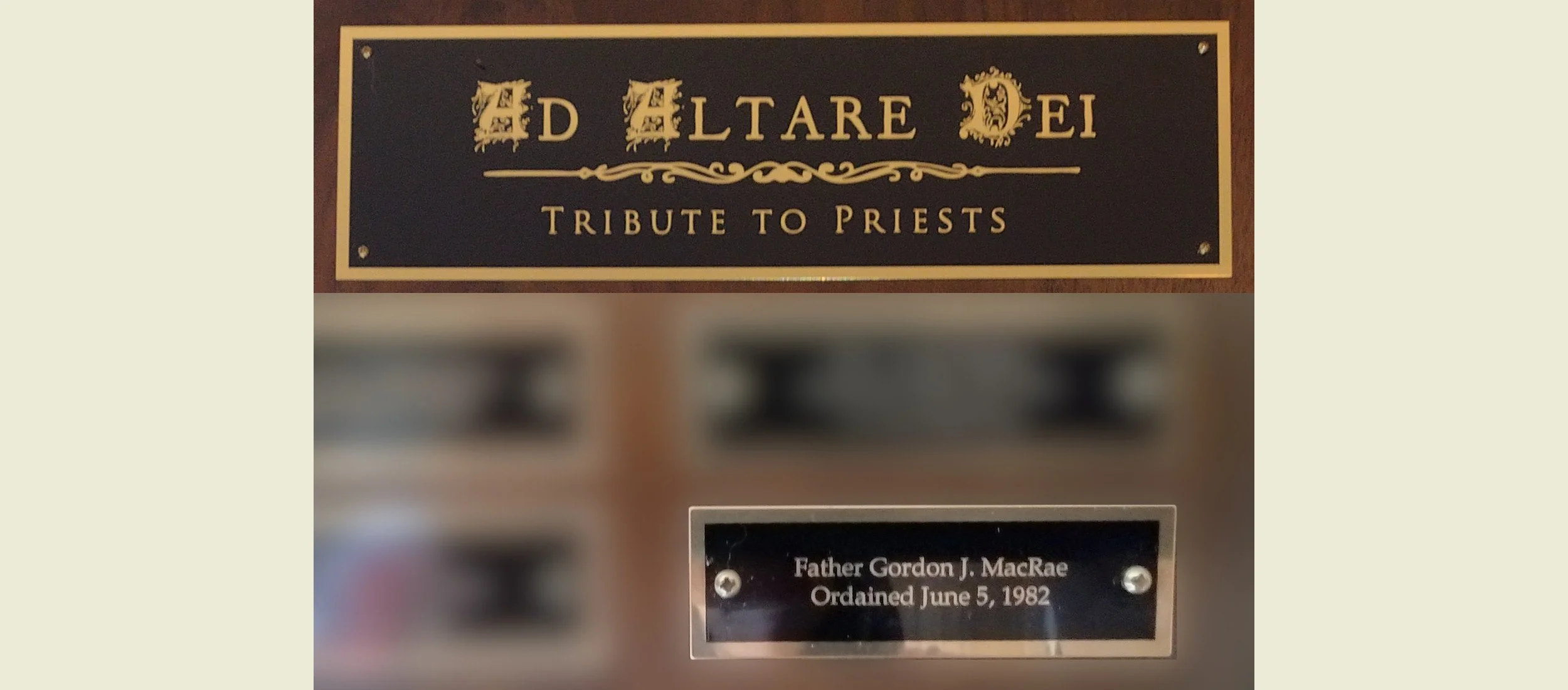
+ + +
We also recommend these related posts:
Fr. Gordon MacRae at Beyond These Stone Walls
by Mary Ann Krietzer @Les Femmes — The Truth
On the Day of Padre Pio, My Best Friend Was Stigmatized
by Pornchai Maximilian Moontri
A Mirror Image in the Devil’s Masterpiece
by Dilia E. Rodríguez, Ph.D.

The Eucharistic Adoration Chapel established by Saint Maximilian Kolbe was inaugurated at the outbreak of World War II. It was restored as a Chapel of Adoration in September, 2018, the commemoration of the date that the war began. It is now part of the World Center of Prayer for Peace. The live internet feed of the Adoration Chapel at Niepokalanow — sponsored by EWTN — was established just a few weeks before we discovered it and began to include in at Beyond These Stone Walls. Click “Watch on YouTube” in the lower left corner to see how many people around the world are present there with you. The number appears below the symbol for EWTN.
Click or tap here to proceed to the Adoration Chapel.
The following is a translation from the Polish in the image above: “Eighth Star in the Crown of Mary Queen of Peace” “Chapel of Perpetual Adoration of the Blessed Sacrament at Niepokalanow. World Center of Prayer for Peace.” “On September 1, 2018, the World Center of Prayer for Peace in Niepokalanow was opened. It would be difficult to find a more expressive reference to the need for constant prayer for peace than the anniversary of the outbreak of World War II.”
For the Catholic theology behind this image, visit my post, “The Ark of the Covenant and the Mother of God.”

In a Mirror Dimly: Divine Mercy in Our Darker Days
Your friends behind and Beyond These Stone Walls have endured many trials. Divine Mercy has been for them like a lighthouse guiding them through their darkest days.

Your friends behind and Beyond These Stone Walls have endured many trials. Divine Mercy has been for them like a lighthouse guiding them through their darkest days.
April 3, 2024 by Fr Gordon MacRae
Editor’s Note: In 2018, Mrs. Claire Dion visited Pornchai Moontri in prison and wrote a special post about the experience which we will link to at the end of this one. In the years leading up to that visit, the grace of Divine Mercy became for them both like a shining star illuminating a journey upon a turbulent sea. Divine Mercy is now their guiding light.
+ + +
I had clear plans for the day I began writing this post, one of many at this blog about Divine Mercy. But, as often happens here, my best laid plans fall easily apart. The prison Library where I have been the Legal Clerk for the last dozen years has been open only one day per week for several months due to staff shortages. During down times in the Law Library, I am able to use a typewriter that is in better condition than my own. So this day was to be a work day, and I had lots to catch up on, including writing this post.
I kept myself awake during the night before, mapping out in my mind all that I had to accomplish when morning came and how I would approach this post. Divine Mercy is, after all, central to my life and to the lives of many who visit this blog. But such plans are often disrupted here because control over the course of my day in prison is but an illusion.
Awake in my cell at 6:00 AM, I had just finished stirring a cup of instant coffee. Before I could even take a sip, I heard my name echoing off these stone walls as it was blasted on the prison P.A. system. It is always a jarring experience, especially upon awakening. I was being summoned to report immediately to a holding tank to await transport to God knows where. I knew that I might sit for hours for whatever ordeal awaited me. My first dismayed thought was that I could not bring my coffee.
It turned out that my summons was for transportation to a local hospital for an “urgent care” eye exam with an ophthalmologist. For strict security reasons I was not to know the date, time, or destination. Months ago, I developed a massive migraine headache and double vision. The double vision was alarming because I must climb and descend hundreds of stairs here each day. Descending long flights of stairs was tricky because I could not tell which were real and which would send me plummeting down a steel and concrete chasm.
So I submitted a request for a vision exam. My double vision lasted about six weeks, then in mid-February it disappeared as suddenly as it came. I then forgot that I had requested the consult. So two months later I made my way through the morning cold in the dark to a holding area where a guard pointed to an empty cell where I would sit in silence upon a cold concrete slab to await what is called here “a med run.”
Over the course of 30 years here, I have had five such medical “field trips.” That is an average of one every six years so there has been no accumulated familiarity with the experience. The guards follow strict protocols, as they must, requiring that I be chained in leg irons with hands cuffed and bound tightly at my waist. It is not a good look for a Catholic priest, but one which has likely become more prevalent in recent decades in America. During each of my “med runs” over 30 years, my nose began to itch intensely the moment my hands were tightly bound at my waist.
The ride to one of this State’s largest hospitals, Catholic Medical Center in Manchester, was rather nice, even while chained up in the back of a prison van. The two armed guards were silent but professional. My chains clinked loudly as they led me through the crowded hospital lobby. The large room fell silent. Amid whispers and furtive glances, I was just trying hard not to look like Jack the Ripper.
I was led to a bank of elevators where I was gently but firmly turned around to face an opposite wall lest I frighten any citizens emerging from one. As I stared at the wall, I made a slight gasp that caught the attention of one of the guards. Staring back at me on that wall opposite the elevators was a large framed portrait of my Bishop who I last saw too long ago to recall. I smiled at this moment of irony. He did not smile back.

A Consecration of Souls
The best part of this day was gone by the time I returned from my field trip to my prison cell. I was hungry, thirsty, and needed to deprogram from the humiliation of being paraded in chains before Pilate and the High Priests. My first thought was that I must telephone two people who had been expecting a call from me earlier that day. One of them was Dilia, our excellent volunteer editor in New York. The other was Claire Dion, and I felt compelled to call her first. Let me tell you about Claire.
As I finally made my way up 52 stairs to my cell that day, I reached for my tablet — which can place inexpensive internet-based phone calls. I immediately felt small and selfish. My focus the entire day up to this point was my discomfort and humiliation. Then my thoughts finally turned to Claire and all that she was enduring, a matter of life and death.
I mentioned in a post some years back that I grew up in Lynn, Massachusetts, a rather rugged industrial city on the North Shore of Boston. There is a notorious poem about the City but I never knew its origin: “Lynn, Lynn, the City of Sin. You never go out the way you come in.” After writing all those years ago about growing up there, I received a letter from Claire in West Central Maine who also hails from Lynn. She stumbled upon this blog and read a lot, then felt compelled to write to me.
I dearly, DEARLY wish that I could answer every letter I receive from readers moved by something they read here. I cannot write for long by hand due to carpal tunnel surgery on both my hands many years ago. And I do not have enough typewriter time to type a lot of letters — but please don’t get me wrong. Letters are the life in the Spirit for every prisoner. Claire’s letter told me of her career as a registered nurse in obstetrics at Lynn Hospital back in the 1970s and 1980s. It turned out that she taught prenatal care to my sister and assisted in the delivery of my oldest niece, Melanie, who is herself now a mother of four.
There were so many points at which my life intersected with Claire’s that I had a sense I had always known her. In that first letter, she asked me to allow her to help us. My initial thought was to ask her to help Pornchai Moontri whose case arose in Maine. The year was late 2012. I had given up on my own future, and my quest to find and build one for Pornchai had collapsed against these walls.
Just one month prior to my receipt of that letter from Claire, Pornchai and I had professed Marian Consecration, after completing a program written by Father Michael Gaitley called 33 Days to Morning Glory. It was the point at which our lives and futures began to change.
Claire later told me that after reading about our Consecration, she felt compelled to follow, and also found it over time to be a life-changing event. She wanted to visit me, but this prison allows outsiders to visit only one prisoner so I asked her to visit Pornchai. He needed some contacts in Maine. The photo atop this post depicts that visit which resulted in her guest post, “My Visit with Pornchai Maximilian Moontri.”

The Divine Mercy Phone Calls
From that point onward, Claire became a dauntless advocate for us both and was deeply devoted to our cause for justice. In 2020, Pornchai was held for five months in ICE detention at an overcrowded, for-profit facility in Louisiana. It was the height of the global Covid pandemic, and we were completely cut off from contact with each other. But Claire could receive calls from either of us. I guess raising five daughters made her critically aware of the urgent necessity of telephones and the importance of perceiving in advance every attempt to circumvent the rules.
Claire devised an ingenious plan using two cell phones placed facing each other with their speakers in opposite positions. On a daily basis during the pandemic of 2020, I could talk with Pornchai in ICE detention in Louisiana and he could talk with me in Concord, New Hampshire. These brief daily phone calls were like a life preserver for Pornchai and became crucial for us both. Through them, I was able to convey information to Pornchai that gave him daily hope in a long, seemingly hopeless situation.
Each step of the way, Claire conveyed to me the growing depth of her devotion to Divine Mercy and the characters who propagated it, characters who became our Patron Saints and upon whom we were modeling our lives. Saints John Paul II, Maximilian Kolbe, Padre Pio, Faustina Kowalska, Therese of Lisieux, all became household names for us. They were, and are, our spiritual guides, and became Claire’s as well by sheer osmosis.
Each year at Christmas before the global Covid pandemic began, we were permitted to each invite two guests to attend a Christmas gathering in the prison gymnasium. We could invite either family or friends. It was the one time of the year in which we could meet each other’s families or friends. Pornchai Moontri and I had the same list so between us we could invite four persons besides ourselves.
The pandemic ended this wonderful event after 2019. However, for the previous two years at Christmas our guests were Claire Dion from Maine, Viktor Weyand, an emissary from Divine Mercy Thailand who, along with his late wife Alice became wonderful friends to me and Pornchai. My friend Michael Fazzino from New York, and Samantha McLaughlin from Maine were also a part of these Christmas visits. They all became like family to me and Pornchai. Having them meet each other strengthened the bond of connection between them that helped us so much. Claire was at the heart of that bond, and it was based upon a passage of the Gospel called “The Judgment of the Nations.” I wrote of it while Pornchai was in ICE Detention in 2020 in a post entitled, “A Not-So-Subtle Wake-Up Call from Christ the King.”
Father Michael Gaitley also wrote of it in a book titled You Did It to Me (Marian Press 2014). We were surprised to find a photo of Pornchai and me at the top of page 86. Both my post above and Father Gaitley’s book were based on the Gospel of Matthew (25:31-46). It includes the famous question posed in a parable by Jesus: “Lord, when did we see you in prison and visit you? And the King answered, ‘Truly I say to you, as you did it to one of the least of my brethren, you did it to me’” (Matthew 25:39-40)
That passage unveils the very heart of Divine Mercy, and as Father Gaitley wrote so eloquently, it is part of a road map to the Kingdom of Heaven. It was Claire who pointed out to me that she was not alone on that road. She told me, “Every reader who comes from beyond these stone walls to visit your blog is given that same road map.”

The God of the Living
In Winter, 2023 Claire suffered a horrific auto accident. While returning home from Mass on a dark and rainy night a truck hit her destroying her vehicle and causing massive painful tissue damage to her body, but no permanent injury. I have been walking with her daily ever since. Miraculously, no life-threatening injuries were discovered in CT or MRI scans. However, the scans also revealed what appeared to possibly be tumors on her lung and spinal cord.
At first, the scans and everyone who read them, interpreted the tumors to be tissue damage related to the accident that should heal over time. They did not. In the months to follow, Claire learned that she has Stage Four Metastatic Lung Cancer which had spread to her spinal cord. The disruptions in her life came quickly after that diagnosis. I feared that she may not be with us for much longer. This has been devastating for all of us who have known and loved Claire. I was fortunate to have had a brief prison visit with her just before all this was set in motion.
Claire told me that on the night of the accident, she had an overwhelming sense of peace and surrender as she lay in a semi-conscious state awaiting first responders to extricate her from her crushed car. Once the cancer was discovered months later, she began radiation treatments and specialized chemotherapy in the hopes of shrinking and slowing the tumors. She is clear, however, that there is no cure. Claire dearly hoped to return to her home and enjoy her remaining days in the company of her family and all that was familiar.
As I write this, Claire has just learned that this will not be possible. Jesus told us (in Matthew 25:13) to always be ready for we know not the day or the hour when the Son of Man will come. I hope and pray that Claire will be with us for a while longer, but I asked her not to call this the last chapter of her life, for there is another and it is glorious. Just a week ago, Christ conquered death for all who believe and follow Him.
In all this time, Claire has been concerned for me and Pornchai, fearing that we may be left stranded. I made her laugh in my most recent call to her. I said, “Claire, I am not comfortable with the idea of you being in Heaven before me. God knows what you will tell them about me!” I will treasure the laughter this inspired for all the rest of my days.
This courageous and faith-filled woman told me in that phone call that she looks forward to my Divine Mercy post this year because Divine Mercy is her favorite Catholic Feast Day. I did not tell her that she IS my Divine Mercy post this year. Now, I suspect, she knows.
“Now we see dimly as in a mirror, but then we shall see face to face. Now I know only in part, but then I shall understand fully even as I am fully understood.”
— St Paul, 1 Corinthians 13:12
+ + +
Note from Father Gordon MacRae:
Thank you for reading and sharing this post. Please pray for Claire Dion in this time of great trial. I hope you will find solace in sharing her faith and in these related posts:
My Visit with Pornchai Maximilian Moontri by Claire Dion
A Not-So-Subtle Wake-Up Call from Christ the King
Divine Mercy in a Time of Spiritual Warfare
The God of the Living and the Life of the Dead

The Eucharistic Adoration Chapel established by Saint Maximilian Kolbe was inaugurated at the outbreak of World War II. It was restored as a Chapel of Adoration in September, 2018, the commemoration of the date that the war began. It is now part of the World Center of Prayer for Peace. The live internet feed of the Adoration Chapel at Niepokalanow — sponsored by EWTN — was established just a few weeks before we discovered it and began to include in at Beyond These Stone Walls. Click “Watch on YouTube” in the lower left corner to see how many people around the world are present there with you. The number appears below the symbol for EWTN.
Click or tap here to proceed to the Adoration Chapel.
The following is a translation from the Polish in the image above: “Eighth Star in the Crown of Mary Queen of Peace” “Chapel of Perpetual Adoration of the Blessed Sacrament at Niepokalanow. World Center of Prayer for Peace.” “On September 1, 2018, the World Center of Prayer for Peace in Niepokalanow was opened. It would be difficult to find a more expressive reference to the need for constant prayer for peace than the anniversary of the outbreak of World War II.”
For the Catholic theology behind this image, visit my post, “The Ark of the Covenant and the Mother of God.”

New Hampshire Dark Justice Is Illuminated Down Under
In early 2024, several Civil Rights venues hosted new, hopeful developments in a 30-year-old lingering injustice: the once hopeless 1994 trial of a Catholic priest.

In early 2024, several Civil Rights venues hosted new, hopeful developments in a 30-year-old lingering injustice: the once hopeless 1994 trial of a Catholic priest.
February 7, 2024 by Fr Gordon MacRae
“Fr MacRae was convicted on 23 September 1994 and sentenced to 67 years in a New Hampshire prison. The allegations had no supporting evidence and no corroboration. ... We enter another world with a life sentence. Australia is not New Hampshire, and I don’t believe Australia would blackball the discussion of a case such as Fr MacRae’s.”
— Cardinal George Pell, Prison Journal Volume 2, p.58
+ + +
It’s hard to know when to give up on justice. It’s even harder to know when to give up on hope. I have been at the brink of both several times over the last three decades, but I have not yet taken the plunge. I am not sure what that would feel like. Prison is bad enough without adding hopelessness to the mix. Other prisoners watch me for signs of hopelessness. If I descend into it, it will only justify their caving into it as well.
As my 30th year of unjust imprisonment began on September 23, 2023, my friend Pornchai Moontri wrote a post for this blog from Thailand. It is emotionally staggering to read, but it is also filled with hope — the sort of hope for which “the bigger picture” provides much-needed context. Only someone who has suffered and survived a great deal in life, as Pornchai has, could give both suffering and hope equal measure. l was not able to see his post, but our editor read it to me while preparing it for publication. She paused four times to cry.
Not all tears are tears of sorrow. Pornchai’s article deserves an award, but there isn’t one that measures what he and I, and Maximilian Kolbe, and Padre Pio have all been through together and triumphantly. Let that last word sink in. None of us appears on the surface to be triumphant in anything by any measure of this world, but in the Kingdom of Heaven, our enduring hope is radiant.
Its triumph is not just in our endurance, or in any obvious outcome. It is in the grace-filled ability to suffer with faith, hope, and love intact — the greatest of gifts as defined by Saint Paul (1 Corinthians 13:13). If you missed Pornchai’s post, you shouldn’t, but bring a tissue. Bring four of them. Nothing in my experience of the last thirty years makes any sense without the context provided by Pornchai’s heart rending message from our New Evangelization. His post is, “On the Day of Padre Pio, My Best Friend Was Stigmatized.” We will add a link to it at the end of this post.
In the early dawn of this 30th year in prison, there are some recent developments that I now need to write about, but first I must ask for your forgiveness. During the months between September 2023 and now, several of our readers extended kindness and generosity to me and this humble blog by helping with a number of expenses. I have been unable to respond with gratitude in a timely manner. I am sorry. My excuse is just more suffering. Like many in this overcrowded place I came down with a respiratory virus that lasted two months. A weekly post was all the writing that I could handle.
By December, the virus morphed into vertigo so even walking upright from point A to point B became a challenge. Then it became a month-long migraine with chronic double vision. It may even have been a minor stroke. I hope my posts of the last few months did not mirror the struggle I was in to write them. I now await an “outside” consult with an ophthalmologist.
I have begun to feel a little better but the vision problem remains a challenge, though with more recent minor improvements. So besides my BTSW posts, I have managed only a few letters in the last few months. Forgive me, please. We need your help but I am sorrowful to accept it in silence. A family member who had for the last 30 years been managing a small expense account for me with power of attorney has also had some health issues and I have had to relieve him of that burden. Please note at both our “Contact and Support” and “Special Events” pages, that we now have a new address for assistance to me and this blog. The address is: “Fr. Gordon MacRae, P.O. Box 81, Fayetteville, NY 13066-0081.”
You are raised up in thanksgiving before the Lord at every Sunday Mass in my prison cell. If you ever decide to help again in the wake of my only silent gratitude, it would help further if you always include an email address so I may properly acknowledge your assistance.

The Bill of Rights Obliterated
I owe a debt of gratitude to Ryan A. MacDonald, an accomplished columnist who has taken up my cause repeatedly over these many years. His latest articles appeared here over the last few weeks. In “Detective James McLaughlin and the Police Misconduct List” Ryan accomplished something that no other writer has taken on. He exposed concrete examples of how judicial secrecy in New Hampshire has further eroded the rights of citizens to seek justice.
Former Keene, New Hampshire Detective James McLaughlin is now retired, but at this writing he continues in retirement to investigate cases for the local Cheshire County (NH) prosecutor. As many readers now know, he has been exposed for a pattern of corruption and misconduct in his investigations when his name appeared on a once-secret list of officers with credibility issues. He also choreographed a fraudulent case against me that rode the waves to capitalize on Catholic scandal over the last thirty years.
Detective McLaughlin’s name appeared on that secret list for an unspecific 1985 incident of “Falsification of Records.” In some reports it has been described as “Falsification of Evidence,” something that I have accused him of since my own charges first arose over 30 years ago. Getting to the bottom of this is a test of endurance in a legal system that shelters police misconduct through secret and anonymous hearings.
Under a U.S. Supreme Court precedent (“Brady v. Maryland”), prosecutors are required to inform defendants and their defense counsel when an investigating detective is on the list for misconduct. In my case and many others, they did not do so. This discovery constitutes new evidence that can reopen a case. Famed civil rights attorney Harvey Silverglate addressed this in a 2022 Wall Street Journal op-ed, “Justice Delayed for Father MacRae.”
As pointed out in these pages in recent weeks, however, judges hearing former Detective McLaughlin’s petition to remove his name from that list have allowed these hearings to be presented in secret proceedings that are rendered anonymous through the use of “John Doe” in place of an offending officer’s name. Citizens are prevented from offering any further evidence because of this judicial secrecy. On January 24, Ryan MacDonald published another bombshell: “In New Hampshire Courts, Police Corruption Is Judged in Secret.”
His article lays out additional evidence under New Hampshire law for a multitude of other alleged incidents of official misconduct on the part of this officer. They include perjury, witness tampering, attempted bribery, tampering with evidence, and additional incidents of falsification of records. All of this has been shielded under color of law by the practice of sealing police personnel files and hearing challenges to the police misconduct list in secret. Ryan has also cited articles published at InDepthNH.org:
“The records obtained by InDepthNH.org indicate there are more internal affairs reports dealing with McLaughlin which the city has not so far provided. The city has also not provided an explanation for the omission of the other reports.”
The reporter cites a 1988 letter in McLaughlin’s file from then Keene, NH Police Chief Thomas Powers:
“I reviewed your personnel file and several internal affairs investigations. While you have accumulated a number of praises in your career, a disproportionate number of serious accusations and violations have significantly detracted from your record, including a one-week suspension.”

First in the Nation
By coincidence (or probably not) I am writing this post on January 23, 2024, the day that the State of New Hampshire hosts its much-celebrated, but now endangered, First-in-the-Nation presidential primary election. In anticipation of this event, Kentucky attorney Frank Friday penned a superb and provocative article for American Thinker entitled “Our Corrupt FBI : New Hampshire Edition.” It begins ...
“This Tuesday, New Hampshire will hold its quadrennial first-in-the-nation primary. I am sorry to say, I have come to know something of the seamier side of this small state, writing these past years about a great legal injustice that has occurred up there. This is something most Granite Staters don’t like to think about: the Fr. Gordon MacRae frame-up.
“Thanks to the state’s tiny, inbred legal and law enforcement community, the matter was kept quiet for years. But the truth is inevitably coming out especially regarding the ‘hero-detective’ who doesn’t look so good now.
“One of my New Hampshire friends who writes about this has even found a small army of New Hampshire lawyers, police and politicos making a nice living off spurious sex abuse allegations. The local FBI office, no surprise, may even be connected. It’s worth reading the whole thing. You will be appalled.”
— “Our Corrupt FBI : New Hampshire Edition,” AmericanThinker, January 20, 2024
To my great admiration, the Catholic League for Religious and Civil Rights emailed the above article to its entire global network of members. It links in the final paragraph to a previous post here at Beyond These Stone Walls by Los Angeles documentary researcher Claire Best. Mr. Friday is right. You will be appalled! The link goes to, “New Hampshire Corruption Drove the Fr. Gordon MacRae Case.”
And because of the American Thinker article, and the decision of the Catholic League to promote it, that link above surpassed almost all other posts in traffic so far this year. It is just the sort of thing that needs to happen. History has shown that nothing stifles Civil Rights more than a silent Coverup.

Wrongful Convictions Report — Down Under
While all the above was going on in recent weeks, I wrote a painfully difficult article about new developments in the case of the late Cardinal George Pell for whom I also have great respect and admiration. I do not think there has been a Church figure in modern times so unjustly maligned. My December 10, 2023 post was, “The Trial of Cardinal Becciu, the Betrayal of Cardinal Pell.”
An unintended effect was that it caught the attention of a site in Australia that I did not even know existed. Within a week of posting the above link, the site editor, Australian writer Andrew L. Urban, did a deep dive into my own situation and published two outstanding articles there:
“Sexual Abuse or Justice Abused?”
“False allegations, a corrupt detective, flawed judicial decisions ... no wonder Father Gordon MacRae’s life has been ruined, sentenced to a 67-year jail term, after refusing a one-year plea deal wishing to maintain his innocence.”
And...
“The Back Alley of Justice: Fr Gordon MacRae’s Wrongful Conviction”
“Malevolent shenanigans behind the scenes in the Fr Gordon MacRae case, from withholding evidence to witness tampering ... It seems justice took a holiday — and hasn’t returned. Fr Gordon, now 70, has been in prison for men in Concord, USA since he was 41.”
The above two articles are the result of exceptional investigative reporting by Andrew Urban who also published an extended excerpt from one of my own recent posts on Australia’s own Cardinal Pell marking the first anniversary of his death on January 10. Andrew Urban entitled it, the “Week of Pell’s Resurrection.”
+ + +
Note from Fr Gordon MacRae: Thank you for reading and sharing this post which casts some needed light on a story otherwise kept in darkness. You will demonstrate to the above writers the importance of this story by sharing it. You may also like these related posts cited herein:
On the Day of Padre Pio, My Best Friend Was Stigmatized by Pornchai Moontri
Our Corrupt FBI : New Hampshire Edition by Frank Friday, Esq.
New Hampshire Corruption Drove the Fr. Gordon MacRae Case by Claire Best
Detective James McLaughlin and the Police Misconduct List by Ryan A. MacDonald
In New Hampshire Courts, Police Corruption Is Judged in Secret by Ryan A. MacDonald

Former Judge Arthur Brennan arrested at a Washington, DC protest in 2011.
The Eucharistic Adoration Chapel established by Saint Maximilian Kolbe was inaugurated at the outbreak of World War II. It was restored as a Chapel of Adoration in September, 2018, the commemoration of the date that the war began. It is now part of the World Center of Prayer for Peace. The live internet feed of the Adoration Chapel at Niepokalanow — sponsored by EWTN — was established just a few weeks before we discovered it and began to include in at Beyond These Stone Walls. Click “Watch on YouTube” in the lower left corner to see how many people around the world are present there with you. The number appears below the symbol for EWTN.
Click or tap here to proceed to the Adoration Chapel.
The following is a translation from the Polish in the image above: “Eighth Star in the Crown of Mary Queen of Peace” “Chapel of Perpetual Adoration of the Blessed Sacrament at Niepokalanow. World Center of Prayer for Peace.” “On September 1, 2018, the World Center of Prayer for Peace in Niepokalanow was opened. It would be difficult to find a more expressive reference to the need for constant prayer for peace than the anniversary of the outbreak of World War II.”
For the Catholic theology behind this image, visit my post, “The Ark of the Covenant and the Mother of God.”

Old Max Moontri Had a Farm, EIEIO!
Having built with pick and shovel a 150 meter walkway on a property he landscaped, Pornchai Moontri spent his 50th Birthday plowing and planting an acre of farmland.

Having built with pick and shovel a 150 meter walkway on a property he landscaped, Pornchai Moontri spent his 50th Birthday plowing and planting an acre of farmland.
September 13, 2023 by Fr Gordon MacRae
I stumbled upon a late night TV movie recently — though I do not know the title — just as a young man was visiting his father in prison. I was late tuning into the film so the plot was not immediately clear. It seemed that the father was innocent of whatever crime sent him to prison and his son was very anxious to prove it. I was riveted to the scene. Through security glass where they conversed via monitored telephones, the father was urging his son to move on with his life and be free. The young man protested, “But I want YOU to be free!” His father replied, “My freedom is in witnessing yours.”
I pondered this for a few moments laying there in the dark of night in a prison cell. And then I began to cry. That was most unusual. In nearly 30 years of seeing my life implode from false witness, I can count on one hand the number of times I have shed even a single tear. It just isn’t in my nature to cry easily. I wrote once that women seem to cry much more easily than men. Perhaps men do not cry nearly enough.
That night I could not contain what was spilling out from within me. I realized with an emotional collision of joy and sadness that a part of me now compensates for my loss of freedom by witnessing it unfold in the life of Pornchai Moontri with whom I spent 15 years surviving in a prison cell. In that time, a bond of trust grew between us in a place where trust is the rarest of commodities. We became each other’s family, and the basis of our connection was always fatherhood. Pornchai never had a father. I spent the last forty one years being called one.
I was 20 when Pornchai was born, and on September 10 this week, he turned 50, so do the math. Fatherhood in this case was not an event, but a process. Over time, while learning the entire story of Pornchai’s tragic life, it gradually became my own life’s mission to secure his freedom even above my own.
Overtime, we encountered mystical connections in this bond. They include Divine Mercy and the intercessory graces of a Patron Saint who also surrendered his life in this life to save another. I do not fully understand these connections, but I know in my heart that they are there. Embracing fatherhood makes men see their lives differently. As I quoted in a recent post:
“When I was a child, I spoke like a child, I thought like a child, I reasoned like a child. When I became a man, I gave up childish ways. Now we see dimly as in a mirror, but then we shall see face to face. Now I understand only in part, but then I shall understand fully even as I am fully understood.”
— 1 Corinthians 13:10-12
Three years after Pornchai’s deportation to Thailand, I still find myself, as any true father would, reveling in his freedom as though revisiting an inspired work of art that I somehow had a hand in creating. This was perhaps evident in our recent post about the earliest days of this blog and the first posts I wrote back then. Some readers told me that it made them cry as well, but not just from sadness. I hope you did not miss “Maximilian Kolbe: The Other Prisoner Priest in My Cell.”

A Passage to India
The interconnectedness of our lives did not suddenly end because of time and distance. In his final years here, Pornchai and I were the sole figures offering assistance to other prisoners facing deportation. Regardless of what anyone thinks about whatever offense brought them to this pass, deportation is often an inhumane nightmare impacting bonds within entire families.
One of the persons we assisted in navigating deportation was a young Cambodian man who was brought to the United States at age two. At age 22, he pled guilty to a petty crime without ever being told that doing so would result in his forced deportation. He spoke not a word of Khmer, the language of Cambodia. He was left in the city of Phnom Penh, and since then has disappeared.
One of our good friends here, Abishek, a native of India, had been in the United States for much of his adult life before some out-of-character and out-of-culture domestic dispute and breakup landed him in prison. As with most such situations, Abishek lost not only his freedom, but the entire infrastructure of his life. His close-knit family in India kept in contact from a great distance, but he leaned on Pornchai and me for moral support when he most needed it as the time of deportation approached.
In 2020, Abishek was understandably interested in the process Pornchai was facing because he knew he would soon face the same thing. He was alarmed to learn that Pornchai remained in the dismal custody of Immigrations and Customs Enforcement (ICE) for over five months at the height of the global Covid pandemic. I wrote of this ordeal in 2020 in “ICE Finally Cracks: Pornchai Moontri Arrives in Thailand.”
We hoped this process would be easier for Abishek once the pandemic receded, but that was not the case. He ended up serving six months beyond his prison sentence, but could not seek release because of the ICE hold on him. After waiting six months for ICE to act, I helped Abishek write to Regional ICE Headquarters in Burlington, Massachusetts. Just two weeks later, he was suddenly gone in the night. That was six months ago, and for all that time we assumed that he was safely back in India adjusting to freedom, family and a new life. We thought no news was good news.
But we were wrong. A few weeks ago when I called Pornchai in Thailand, he told me that he received a call at 1 AM during the night before. ICE detainees without resources get one free five-minute call per week. Abishek used it to call Pornchai in Thailand. It turned out that for six months since leaving this prison, Abishek was stranded just 50 miles away in a jail where ICE rents space for detainees awaiting deportation. Abishek was now one year past his prison sentence.
Pornchai and I were powerless to do anything directly so I sent an email message from the tablet in my cell in Concord, New Hampshire prison to Clare Farr, a trademarks attorney in Western Australia who helped Pornchai immensely. She then called Pornchai in Thailand who gave what little information we knew about our friend’s plight. Clare contacted the Indian Embassy in Canberra, Australia and conveyed all that we told her. The Indian Embassy in Australia then contacted the Indian Government which in turn contacted the Indian Consulate. Two weeks later, just days before I type this, Abishek’s odyssey came to an end. Thanks to the intervention of Clare Farr in Australia, Abishek is now reunited with his family in India.
The bizarre thread of this story is worth repeating. Indigent ICE detainees get one free five-minute phone call per week. From ICE detention in New Hampshire, Abishek called Pornchai Moontri in Thailand at 1 AM. Pornchai then contacted me in New Hampshire. I contacted Pornchai’s advocate, Clare Farr in western Australia, who then contacted the Indian Embassy in Canberra. Then the Embassy contacted the Indian Government in New Delhi, who contacted the Indian Consulate in New York instructing them to prepare Abishek’s travel papers and fax them to ICE in Burlington, Massachusetts. ICE then booked a flight for Abishek to get him out of ICE detention in New Hampshire. After a six-month delay, Abishek arrived in India two weeks after his free five-minute phone call to Thailand. We could not make this story up!
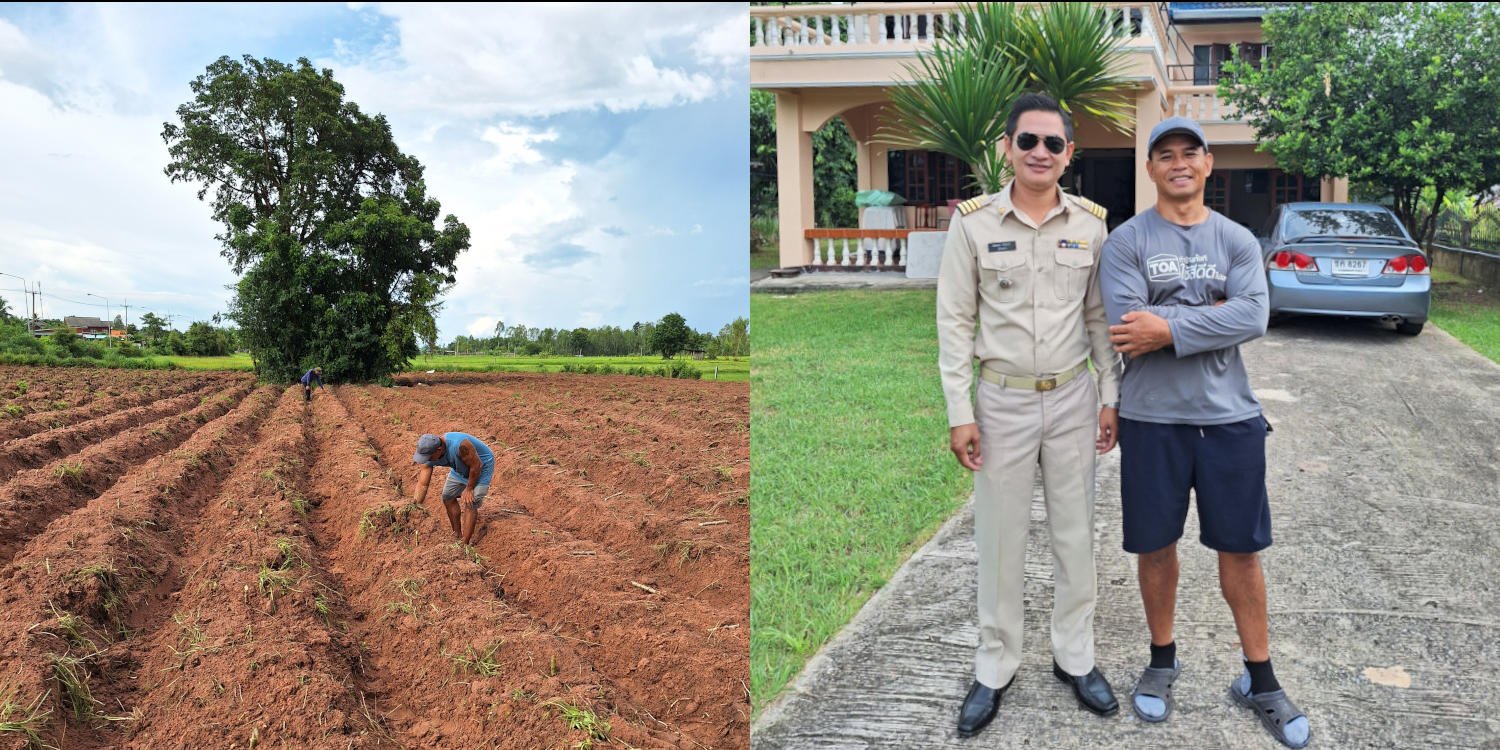
Chalermpon Srisuttor, Mayor of Phuviang, and Pornchai Moontri.
Pornchai Set His Heart on Plowing Furrows (Sirach 38:26)
As all of the above was going on, Pornchai sent me some photos of his finished, back-breaking work creating a 450-foot walkway on property he landscaped in Pak Chong, Thailand. I actually tried to talk him out of his next project, but as the quote from the Book of Sirach implies above, his mind was made up. Pornchai has not yet received any income from the work we described in “For Pornchai Moontri, Hope and Hard Work Build a Future.”
All his hard work is building hope for a future livelihood as Thailand builds a high-speed railroad with a depot in each of the places where Pornchai is working now. I have been sending him a small amount of money each month for food and expenses. It does not take a lot — $100 U.S. dollars equals about over 3,000 Thai baht at the current exchange rate. It helps Pornchai manage food and necessities for a month while waiting for the tourism season and rental housing customers.
Pornchai is no stranger to hard work so he decided to take on another project while waiting. About 250 miles north of Pak Chong, where Pornchai now lives in the District of Nakhon Ratchasima, is the village of Phuviang (Pu-vee-ANG) . It is the place where Pornchai was born, was orphaned, and then was taken from at age eleven. There is a lot of pain there. There is also a small house and piece of land that once belonged to his mother. The house was only half built when Pornchais Mother, Wannee, traveled to Guam to her death in 2000, an unforgettable story told in “Getting Away with Murder on the Island of Guam.”
Not far from that unfinished house is an acre or so of farmland that belonged to Wannee. Pornchai’s extended family cultivates rice nearby, so Pornchai decided to go up to Phuviang and plant a crop. It had to be something that he could plant and then leave alone. He chose to plant cassava, a crop that grows in Asian tropical zones and is self-sustaining until harvested.
The cassava plant grows up to about 8-feet in height and its edible roots are typically three inches in diameter and up to three feet long. The roots are akin to a sweet potato, and are a staple in some Asian countries. Ground into flour, cassava is also used to make sweet bread or cakes.
Growing cassava is easy, but planting it is an enormous amount of work. Cassava roots from a past crop have to be cut into smaller pieces and soaked in water for several days. The pieces are then planted along plowed furrows as in the photo atop this post. Pornchai is pictured there along with a local helper. The photo above was taken by Chalermpon Srisuttor, the Mayor and Town Manager of Phuviang who has become a friend to Pornchai — enough of a friend to help him plow and plant an acre of cassava!
The planting was finished just in time for Pornchai’s 50th birthday. I now want to remind him that when he arrived in Concord, NH from a long stint in solitary confinement in Maine in 2005, I had just turned age 52 while Pornchai was 32. He liked to circulate handmade birthday cards for our friends to sign for my birthday. They contained snarky little phrases like “Father G loves history so much because he was there for most of it!” and “Father G knows Latin because it was his first language!” Pornchai thought I was really old back then.
What goes around comes around! Happy Birthday, Max!
+ + +

Upper right: Chalathip Chiradomrong; Chalermpon Srisuttor, Mayor of Phuviang; and Pornchai Moontri. Lower left: Since Phuviang is very near to the Thailand headquarters of the Society of the Divine Word Order where Fr John Hung Le is local Superior, he stopped to spend an afternoon with Pornchai and even to pitch in a bit on the plowing and planting. Upper left and lower right: First signs of growth a few days apart.
+ + +
Note from Fr Gordon MacRae: Thank you for reading and sharing this post. You may also like these related posts from Beyond These Stone Walls:
Maximilian Kolbe: The Other Prisoner Priest in My Cell
ICE Finally Cracks: Pornchai Moontri Arrives in Thailand
For Pornchai Moontri, Hope and Hard Work Build a Future
Getting Away with Murder on the Island of Guam
The Eucharistic Adoration Chapel established by Saint Maximilian Kolbe was inaugurated at the outbreak of World War II. It was restored as a Chapel of Adoration in September, 2018, the commemoration of the date that the war began. It is now part of the World Center of Prayer for Peace. The live internet feed of the Adoration Chapel at Niepokalanow — sponsored by EWTN — was established just a few weeks before we discovered it and began to include in at Beyond These Stone Walls. Click “Watch on YouTube” in the lower left corner to see how many people around the world are present there with you. The number appears below the symbol for EWTN.
Click or tap here to proceed to the Adoration Chapel.
The following is a translation from the Polish in the image above: “Eighth Star in the Crown of Mary Queen of Peace” “Chapel of Perpetual Adoration of the Blessed Sacrament at Niepokalanow. World Center of Prayer for Peace.” “On September 1, 2018, the World Center of Prayer for Peace in Niepokalanow was opened. It would be difficult to find a more expressive reference to the need for constant prayer for peace than the anniversary of the outbreak of World War II.”
For the Catholic theology behind this image, visit my post, “The Ark of the Covenant and the Mother of God.”

Are You Suffering a Great Deal?
As this blog by a priest unjustly in prison began in 2009, Fr Gordon MacRae had to write 12 brief posts to send to an editor. Here are three of these early gems.
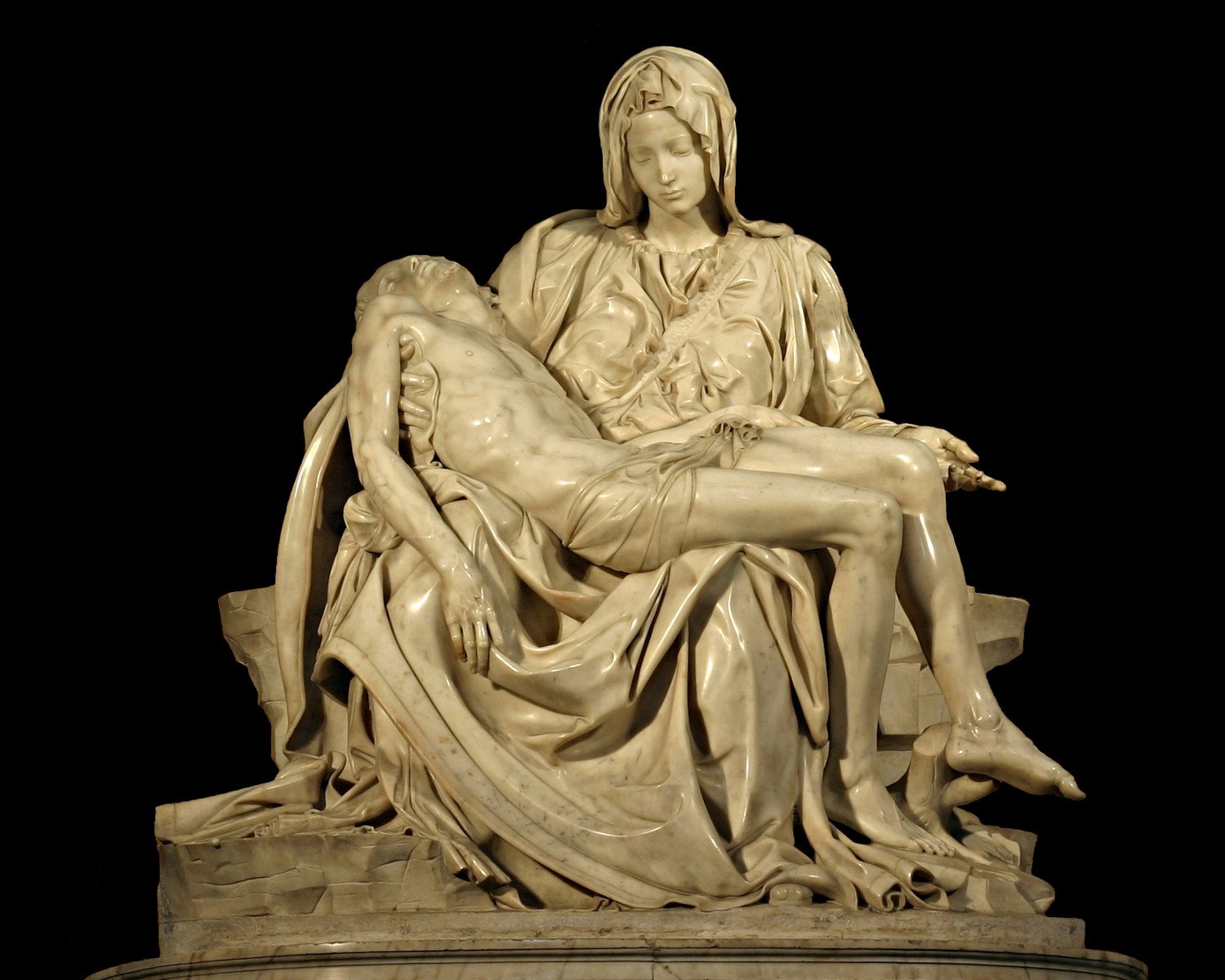
As this blog by a priest unjustly in prison began in 2009, Fr Gordon MacRae had to write 12 brief posts to send to an editor. Here are three of these early gems.
July 19, 2023 by Fr Gordon MacRae
A lot has been going on here this summer. Even in this place where time often seems to stand still, finding blocks of time to write has suddenly become a challenge. Nonetheless, I am enthused by a new development. Gloria.tv is an international Catholic video and news sharing venue launched in Switzerland in 2005. It is known for its high degree of fidelity. I cannot see it, of course, but on rare occasions over the years it has reported on one of my posts.
After reviewing and then reposting “Convicted for Cash,” the 44-minute video documentary about my trial by Frank X. Panico, Gloria.tv invited me to establish a page and submit selected past posts on the site. The result has been a huge increase in visits to this blog from around the world. Please visit our presence there at Gloria.tv/FrGordonJMacrae.
A flood of activity this July, along with some technical difficulties where I live, has temporarily slowed my ability to write. So this week, and again two weeks from now, we are returning to July, 2009 and the first days of this blog. As it was beginning, I was asked to quickly write and submit 12 short posts to launch it. I am told today that a few of them are “gems,” so I want to share them with you anew.
Our first entry today is “Are You Suffering a Great Deal?” It’s from a laminated card that fell into my lap from a book in 2009 just as I was beginning to write. At the time, I was in fact suffering a great deal.
Pornchai Moontri was here with me then and was very much a part of this beginning. It was Pornchai who named this blog, “These Stone Walls,” then in 2020 I renamed it “Beyond These Stone Walls” as he was returning to Thailand. Pornchai has contributed many posts to this site, some more popular than my own, but please don’t tell him I said that. So the second of our three short selections is “Bunkies: Pornchai’s Story.” Next week in these pages, we will have some exciting news about developments in Pornchai’s new life in Thailand.
My last entry this week is “Contentious Convicts.” I will let that one speak for itself. You might think it seems a little fishy.
+ + +

Are You Suffering a Great Deal?
Are you suffering a great deal? No, the question isn’t from Oprah or Dr. Phil. It is on a bookmark kept in my breviary. It was asked by Our Lady of Fatima on June 13, 1917:
“Are you suffering a great deal? Don’t lose heart. I will never forsake you. My Immaculate Heart will be your refuge, and the way that will lead you to God.”
There is immense power in that promise, and for someone who has lost everything, it is like a lifeboat at sea. There is sometimes nothing else to cling to. Even when I feel that my faith dangles from a thread — which is often, in prison — I cling to that promise.
I don’t know where the bookmark came from. Like most of the things I cling to for spiritual support, it just sort of showed up one day. I like to think it was handed down to me — in the way important things are handed down by brothers — by Maximilian Kolbe whose reverence for the Immaculate Heart of Mary guided him through life, and death, at Auschwitz.
Even when my faith is so diminished and darkened by the prison around me that I believe in little, I believe that promise. Sometimes I can only believe that Maximilian believed — with the very fabric of his life.
It’s often hard to pray in prison. It’s not just the noise, the harshness, the lack of privacy, the relentless obstacles. It’s just hard to raise my mind and heart beyond these stone walls at times. In that, at least, I am not alone.
The Vietnamese Cardinal Nguyen Van Thuan wrote that there were long periods during his years in a Communist prison when he was unable to pray. I guess any Catholic who ever looks inward has a dark night of the soul. If not, why would the Blessed Mother ever ask such a question in her appearance at Fatima? It’s not the usual question a mother would ask when she comes a long way for a brief visit.
Are you suffering a great deal? When Saint Maximilian’s life was finally snuffed out after days of starvation chained to the corpses of those who could not endure, he was heard gasping a hymn of praise. I wish I had his heart! I don’t, but I wish I did. I have to learn how to suffer, and I am a slow learner.
In Spe Salvi, his Encyclical on Christian Hope, our Holy Father Pope Benedict wrote the most masterful prose on suffering that I have ever read. I cling to it like I do my bookmark with Our Lady of Fatima’s Promise:
“Christ descended into ‘Hell,’ and is therefore close to those cast into it, transforming their darkness into light. Suffering and torment is still terrible and well-nigh unbearable. Yet the star of hope has risen — the anchor of the heart reaches the very throne of God. Instead of evil being unleashed within man, the light shines victorious: suffering — without ceasing to be suffering — becomes, despite everything, a hymn of praise.”
Spe Salvi, ¶37
Brilliant! Simply brilliant! There’s something hopeful in that, and I should listen.
+ + +
Bunkies: Pornchai’s Story
In prisons all over the world, the most crucial issue for prisoners is where one has to live, and with whom. Confined to a 60 square foot cell with another human being can be a nightmare. Most of us have no say in the choice of “Bunkies,” as cell mates are called here. If a bunky is moved — even after two or three years with the same person — sometimes a total stranger is living in the cell within minutes.
Having a good roommate seems to be everyone’s goal, but I tried another approach years ago. Being a good roommate is a goal I have more control over. The result has been that in 10 years since being moved from the torturous 8-man cells in which I spent my first seven years in prison, I have never had a roommate (we prefer to call our cells “rooms”) request a move.
The downside of that is that I have had some very dysfunctional roommates who have no wish to move elsewhere. My assigned roommates here have ranged in age from 19 to 67 or so, and have included men convicted of murder, rape, armed robbery, various drug crimes, and gang-related crimes. Everyone here knows all the details of why everyone else is here. Rumor and gossip fill in what the facts leave out.
My roommate of the last two years was also a good friend for several more. It was the first time I have been assigned to live with someone I know well, so it feels more like living with a family member than a felon.
Pornchai (his name is Thai, and the “r” is silent, as in “Paunch-eye”) is 35 years old and has been in prison since the age of 18.
He is about to convert to the Catholic faith and currently he is a scholarship student in theology in the Catholic Distance University’s excellent Distance Learning Program for prisoners.
Pornchai caused a minor sensation last year when he wrote a very brief autobiographical sketch that ended up being published as “The Conversion Story of 2008” by The Catholic League for Religious and Civil Rights. I hope you will take a moment to read it.
A year after publication, Pornchai still receives occasional mail about his life story. The most recent being a personal letter from Cardinal Kitbunchu, Archbishop Emeritus of Bangkok, Thailand, and a note from Mary Ann Glendon, former U.S. Ambassador to the Holy See. Oh, and there was also a letter from the late Father Richard John Neuhaus.
Pornchai takes his new notoriety in stride, though one letter had a profound impact. It was from a young man who wrote that he turned his life around, dropped out of his gang, swore off drugs, and returned to faith after reading “Pornchai’s Story” online.
Pornchai mistakenly credits me with some small role in his extraordinary life of late. He has fallen under the power of grace and cannot escape it now even if he tried. Now, he creates. Here is a photo of one of his creations, “The Olde Baldy” (named after me) which he carved piece by piece (over 600 of them) from scratch.

Pornchai Moontri — Master Craftsman
Pornchai was designated a master craftsman in wood and model shipbuilding. One of his first ships was a circa 1800 British warship from the Napoleonic era which he named after Father MacRae. He dubbed it “The Olde Baldy,” which is now docked in the home of our friend, Bill Wendell in Stow, Ohio.
+ + +

Contentious Convicts
There was little I could do to stop the fighting. Convicts are so territorial; they do not hesitate to take on intruders twice their size. They just can’t be reasoned with. It’s even worse when the convicts are mating. What drama!
No, no, no! I’m not talking about bizarre behavior among my fellow prisoners — though they do have their moments. I’m referring to Herichthys (Archocentrus) Nigrofasciatus, a fish of the cichlidae family native to the tropical river basins of Central America. They are popularly known as convict cichlids, or just convicts because of their characteristic black stripes.
Oh, go ahead and yawn! Whenever I would recite the scientific nomenclature for the fish in my aquarium, my friends would always yawn! Aquarium buffs are used to it! The more serious among us always felt duty-bound to learn the scientific names of the residents of our aquatic neighborhoods. Hey, we don’t talk that way by choice, you know!
My 100 gallon cichlid aquarium was my spare-time-consuming hobby for most of my life as a priest until I was sent to prison at age 41. It was an oasis of life, light, and aquatic drama that kept me mesmerized for hours at the end of each day. Only one other priest in my diocese had an aquarium, and we had an instant bond of shared knowledge and interest.
I had a breeding pair of convict cichlids who shared their home — perhaps “shared” is too strong a word — with a pair of Astronotus Ocellatus, or red oscars native to the Amazon Basin. I also had a single Herichthys (Archocentrus) Octofasciatus known otherwise as a “Jack Dempsey,” and for good reason. He ended up in a smaller aquarium of his own. Couldn’t play well with others.
Convicts typically excavate a cave when preparing to breed, so an old clay flower-pot in the corner sufficed. I named my convicts Bonnie and Clyde (at the time, I had limited knowledge of suitable convict names. Today I’d go with Bubba and Bella.) The other denizens, the Oscars, were named Oscar Madison and Oscar Wilde. (I’m glad I only had two!)
The Oscars gave their testy neighbors a wide berth once eggs were laid in the cave. Oscar Madison, twice the size of the convicts, sometimes paid a price for lumbering over to eat the convicts’ food. He had the nips in his fins to remember them by.
I once tried to use a mirrored barrier to keep everyone happy, but Clyde kept launching himself furiously at his own reflection. In time, everyone learned to respect some boundaries. My current convict friends could learn a lot from that. “The Aquarium is Gone.” That’s actually a line from a poem by Robert Spence Lowell (“For the Union Dead.” 1964)
Its absence from my world is still deeply felt. It is one of the three recurring dreams I have in prison. (I’ll write of the other two later.) It haunts me a bit. I often dream that my aquarium is on the concrete shelf of my cell, and Oscar Wilde is staring at me with his bulging eyes willing me to bring food.
I miss them. There is nothing with water and life here.
“And the fish of the sea will declare to you. In His hand is the life of every living thing.”
— Job 12:8,10
The Eucharistic Adoration Chapel established by Saint Maximilian Kolbe was inaugurated at the outbreak of World War II. It was restored as a Chapel of Adoration in September, 2018, the commemoration of the date that the war began. It is now part of the World Center of Prayer for Peace. The live internet feed of the Adoration Chapel at Niepokalanow — sponsored by EWTN — was established just a few weeks before we discovered it and began to include in at Beyond These Stone Walls. Click “Watch on YouTube” in the lower left corner to see how many people around the world are present there with you. The number appears below the symbol for EWTN.
Click or tap the image for live access to the Adoration Chapel.
The following is a translation from the Polish in the image above: “Eighth Star in the Crown of Mary Queen of Peace” “Chapel of Perpetual Adoration of the Blessed Sacrament at Niepokalanow. World Center of Prayer for Peace.” “On September 1, 2018, the World Center of Prayer for Peace in Niepokalanow was opened. It would be difficult to find a more expressive reference to the need for constant prayer for peace than the anniversary of the outbreak of World War II.”
For the Catholic theology behind this image, visit my post, “The Ark of the Covenant and the Mother of God.”