“There are few authentic prophetic voices among us, guiding truth-seekers along the right path. Among them is Fr. Gordon MacRae, a mighty voice in the prison tradition of John the Baptist, Maximilian Kolbe, Alfred Delp, SJ, and Dietrich Bonhoeffer.”
— Deacon David Jones

A Lesson From Saint Damien of Molokai, Leper Priest
Should the State’s flawed justice be mirrored in the Church? This must be asked and the truth written. But ask as well, “Can a leper priest also serve God?”

Should the State’s flawed justice be mirrored in the Church? This must be asked and the truth written. But ask as well, “Can a leper priest also serve God?”
May 10, 2026 by Father Gordon MacRae
This is a post I wrote on May 6, 2015, and everything in it is relative to that time frame. However, just about everything in it also impacts the current time frame. So I am posting it again.
+ + +
Pornchai Moontri and I and other friends are just beginning another retreat program in prison sponsored by the National Shrine of The Divine Mercy and the Marians of the Immaculate Conception. One of the texts used for the retreat is, You Did It to Me, one of many such books by Father Michael Gaitley, MIC.
Something happened over the last few weeks that cast yet another, but brighter light on recent events that have so overshadowed Beyond These Stone Walls. The text for the retreat is You Did It to Me by Father Michael Gaitley, MIC. The timing of it is by design, of course, but not by my design. I just nudged Pornchai Max and pointed out a photo of both of us in the middle of the book. “My, for prisoners, you guys get around,” wrote BTSW reader Mary Fran Cherry back then. She alerted me to our photo in the book. The retreat lifted a corner of the shroud that overshadowed my life behind these prison walls beginning on Wednesday of Holy Week.
Ryan A. MacDonald wrote of this in “For One Priest, A Fate Worse than Dying in Prison,” the second of his excellent two-part analysis of a recent court ruling that was a setback in my hope for justice and freedom. I have much gratitude for Ryan’s effort, and especially so because he left you with hope by telling you that I learned of this decision just as I was reading, You Did it to Me.
While reading that book, my eyes were opened a little, just enough to see what discouragement kept me from seeing. It reminded me so vividly of a story that took place on the road to Emmaus at another time of discouragement:
“That very day two of them were going to a village named Emmaus, about seven miles from Jerusalem, and talking with each other about all these things that had happened. While they were talking and discussing, Jesus himself drew near and went with them. But their eyes were kept from knowing him … Then one of them, named Cleopas, answered him, ‘Are you the only visitor to Jerusalem who does not know the things that have happened there in these days?”
— Luke 24:13-23
Someone might ask that same question of me if I lapse into writing about a Divine Mercy retreat without addressing “all these things that had happened” in the arena of justice and injustice. So I am also most grateful to New Jersey Attorney Vincent James Sanzone for his enlightened analysis of the legal precipice awaiting me and other falsely accused priests in both Church and State: “A Criminal Defense Expert Unfurls Father MacRae Case.” Prior to writing that guest post, Attorney Sanzone wrote a brilliant letter to Pope Francis about this matter, and to EWTN. I believe the EWTN letter may have been what prompted Brian Fraga and the National Catholic Register to publish “New Hampshire Priest Continues the Long Road to Clear His Name” (NCRegister.com, March 18, 2015).
Was I discouraged by the outcome revealed to me on Wednesday of Holy Week? Yes, I was. Was I devastated as some have suggested? I was, for a time. Have I given up? Not hardly. That is about all I have to offer about this. More important things have happened, and I have no time to descend into a litany of woe-is-me. Another day, perhaps. It is time now to step out of this arena of justice and all its flaws, and to step back onto that road to Emmaus.
Voice from Beyond
As I wrote at the beginning of this post, something happened that cast a brighter light — brighter than my discouragement, at least — on the events of recent days. Let me first tell you what happened.
On the evening of Divine Mercy Sunday as this retreat began, Pornchai Maximilian sat in a chair to my right and Michael Ciresi to my left. Along with seventeen other prisoners who joined us, we watched and listened to a DVD presentation by Father Michael Gaitley to introduce the retreat. It was excellent, of course, and Pornchai was riveted to the projection of Father Gaitley on the prison chapel wall.
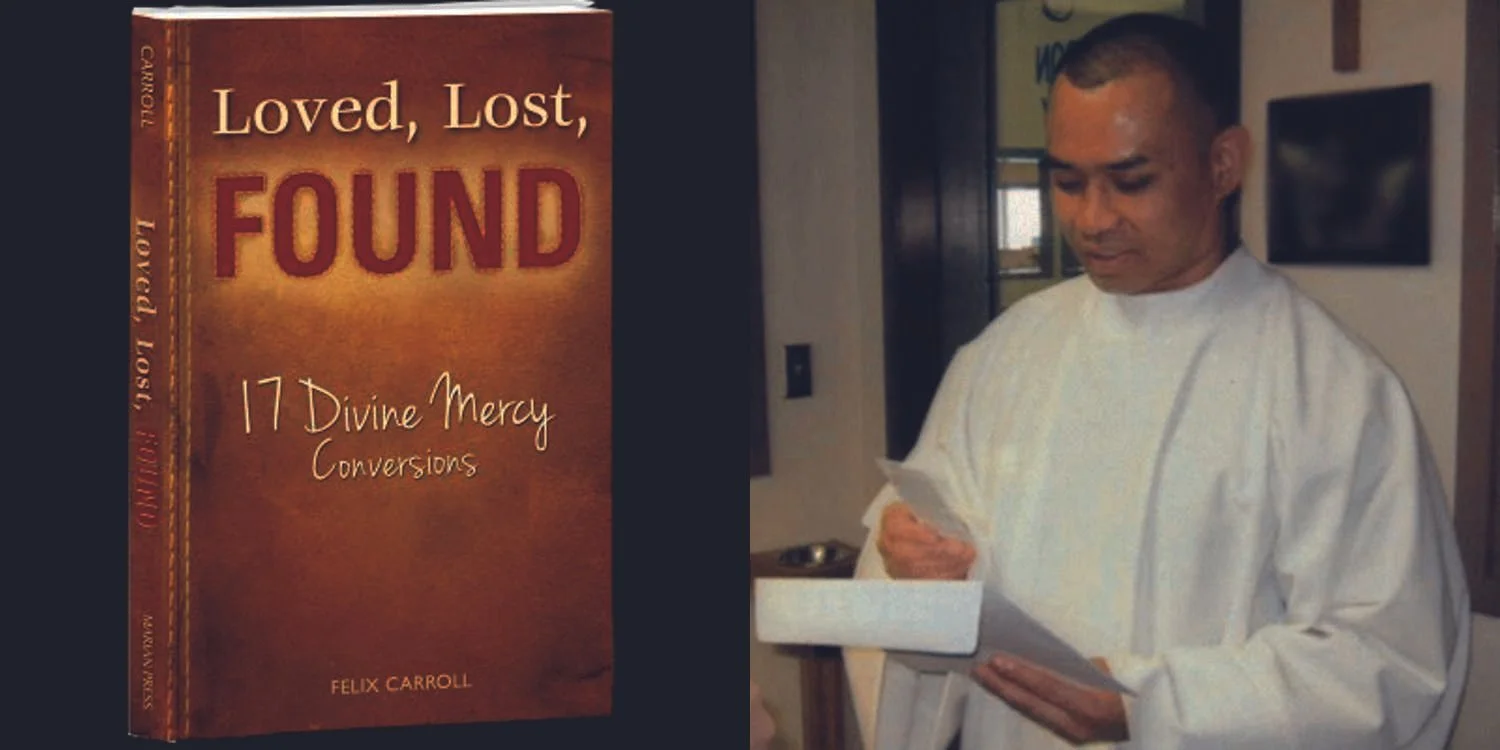
Every now and then the camera recording Father Gaitley swept over his audience, and there, seated near the back, I spotted a familiar face: Marian missionary Eric Mahl. You may recall that Pornchai and Eric Mahl both had chapters featuring them in Felix Carroll’s great Divine Mercy book, Loved, Lost, Found: 17 Divine Mercy Conversions. Later they met and became friends and brothers. I nudged Pornchai and pointed as Eric appeared on the wall. Just at that moment, Eric looked toward the camera and smiled. Pornchai smiled back.
The next day a letter arrived for Pornchai. As though right on cue, it was from Eric Mahl. It was a copy of a letter from Eric to some people who are helping Pornchai by organizing an effort to secure his future in Thailand when he is free from these stone walls. During his missionary outreach to prisons, Eric Mahl has had three meetings with Pornchai. On the last one, he was accompanied by Father Seraphim Michalenko who served as Vice-Postulator for the Cause of Canonization of Saint Maria Faustina. I wrote of that meeting in “Father Seraphim Michalenko on a Mission of Divine Mercy.” Eric also wrote of that meeting in his letter:
“This very holy priest had the opportunity to meet one-on-one with Pornchai in the Chapel, to talk to him and get to know him. When [Father Seraphim] and I were on our way home back to the Shrine in Massachusetts, he told me that the peace in that Chapel must be what Heaven is like and that Pornchai Moontri is a very holy and beautiful child of God. I write all of this to let you know how I desire to see this restored child of God out of prison and living free in Thailand where he could help the rest of society.”
— Letter of Eric Mahl
On April 19, the second Sunday evening of our retreat, we watched the second of Father Gaitley’s DVD presentations, and this time Pornchai listened intently while also looking for his friend Eric Mahl in the background. Later that evening, during a small group discussion led by Marian volunteer Jim Preisendorfer, I heard something astonishing. During Father Gaitley’s presentation, he spoke of the eight reasons why we do not appreciate the Trinity. One of them, Reason Number Seven, is “Because we listen to the voice of the enemy.” By way of example, I wrote in my notes:
“Part of Satan’s strategy is to keep us unfocused from our destiny. He lures us into being satisfied with this world so that so many of us just settle for what this life gives us, or despair over what this life denies us.”
When I read my own notes, I could not even remember writing that. It was as though my pen were on autopilot. Then table moderator Jim Preisendorfer asked for a comment on “Reason Number Seven.” No one spoke so I read my note above. Jim asked if I could give a concrete example. “I can,” Pornchai chimed in. He then spoke about a conversation he and I had seven years earlier. Hope seemed futile for him then. I had asked him back then if he had any hope at all for the future. I will never forget his answer, “I don’t have a future I only have a ‘Plan B.’ ”
Over time I came to understand what “Plan B” was, though, I had not heard Pornchai speak of it for a long time. At the table during our retreat that night, Pornchai explained that “Plan B” was his only plan, and it arose spontaneously within him. “Plan B” was to never leave prison. Having been cast into prison with a 45-year sentence at age 18, followed by years of solitary confinement in a dreaded “Supermax” prison, Pornchai had laid out in his mind the only future this life could promise him: to live out his life in prison. To die in prison. He had nothing else to look forward to.
On that night, however, Pornchai reflected what Eric Mahl described. He radiated the life of a restored child of God for whom that dismal “Plan B” was but a long forgotten memory. He spoke of it as a perfect example of how listening to the voice of the enemy can deny us our destiny. I sat there asking myself, “When did this happen. How did it happen?”
Then Pornchai jabbed a thumb in my direction at the table. “When this guy stepped into my life,” he said, “he released me from the grip of ‘Plan B.’ ” Pornchai described how he took a great risk to trust in some vague hope that was covered in a cloud and could not be seen, so he just took my word for it. “Now, seven years later,” he said that night, “ ‘Plan B’ is just an old memory with no power over me, and people all over the world have come together to replace it.”
While he spoke at that table, I looked down at my own thumbs as Pornchai jabbed his thumb in my direction. I could not look up. I knew that if I made eye contact with him at that moment, I would have fallen apart. My own plan for my life and my priesthood certainly never included life in prison for a crime that never took place. It never included being demonized and scapegoated to satisfy the demands of contingency lawyers and insurance companies as Ryan pointed out. It never included pleading for my Church to see the failures of American civil justice instead of just blindly declaring them final and fulfilled justice.
Ryan A. MacDonald charged in a comment a few weeks ago that the American hierarchy’s response to the priesthood crisis has been more like a housecleaning than a healing. My plan for my life never included a dread that my own bishop might echo in Rome the Twelfth Century plea of Henry II about Thomas Beckett “Will no one rid me of this turbulent priest?”
My plan for priesthood also never included Pornchai Moontri, nor could I have ever foreseen the notion that the tragedy that befell me could ever be anything other than a tragedy for someone else.
The Leper Priest
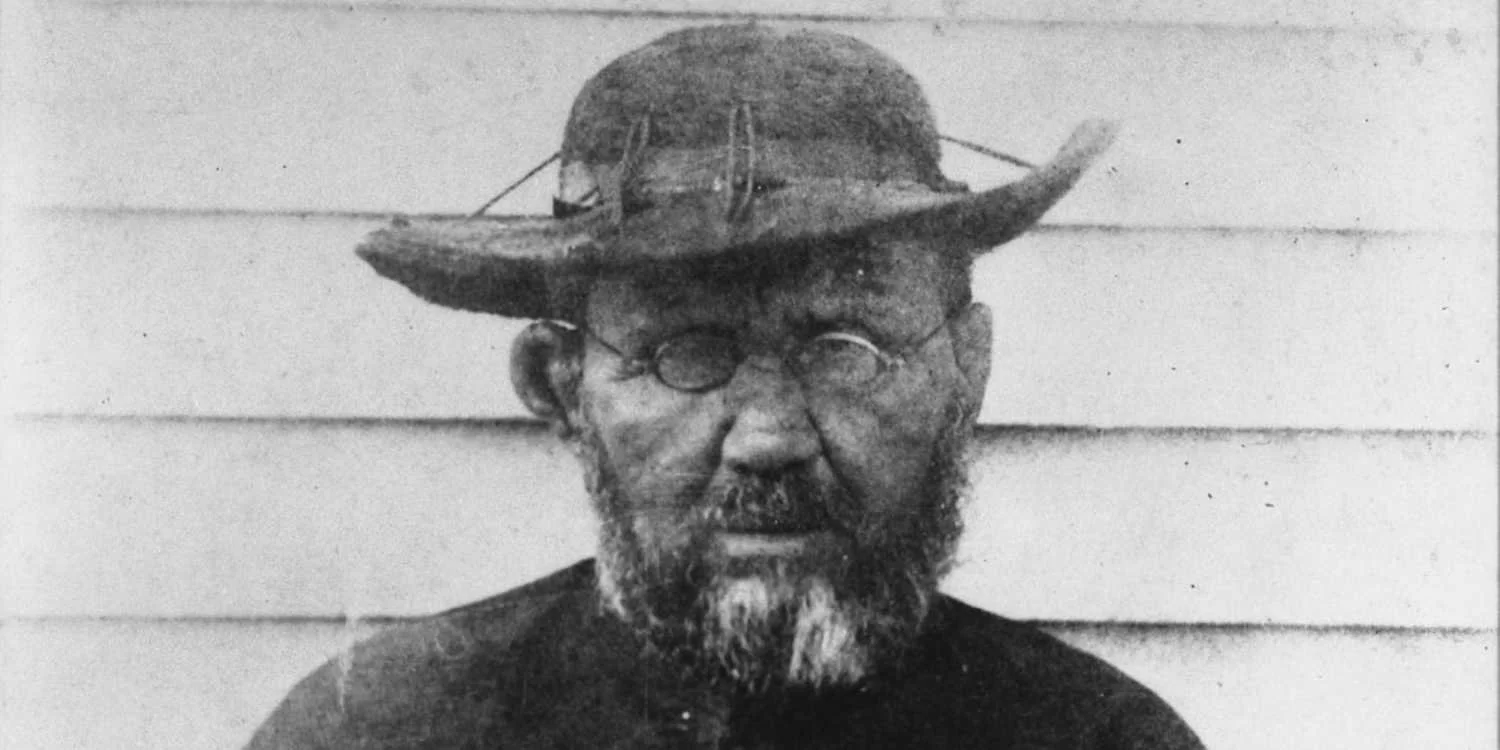
I vividly remember, as a young seminarian in the latter 1970s, watching a two-part PBS dramatization of the life of Father Damien de Veuster, the Belgian priest who in 2009 became Saint Damien of Molokai. I was fascinated by the PBS version. It remains in my psyche as one of the alluring things that drew me toward and kept me focused on a side of priesthood in danger of being lost today, the notion that priesthood is not a job, but an ontological state of being. To see priests “fired” and cast off seems like “Reason Number Seven,” like succumbing to the voice of the enemy as he lures priesthood from its destiny.
When Damien of Molokai was driven across that line between ministering to lepers and becoming a leper, it was seen as a tragedy to his friends, but hindsight sees it as a gift to the Church and the world. When he was canonized by Pope Benedict XVI in 2009, Emily Stimpson wrote of him in “Untamed Saint” in Our Sunday Visitor:
“Saints are made through trials and persecution. And Father Damien had more than his share of those. For most of the 16 years he served on Molokai, he served alone… He begged his superiors to send him help. Usually they ignored his requests. Twice, however, they did send someone. The first was a Dutch priest who complained incessantly. The second was a French priest who accused Father Damien of improper relations with the native women. His superiors and bishop grew tired of his constant demand for help. They considered him an obstinate, headstrong troublemaker. The government shared that opinion, and more than a few officials gave credence to false rumors circulated about him. His detractors heaped every sort of abuse and calumny upon Father Damien … Enduring his own dark night, he felt abandoned by God and unworthy of heaven.”
— Emily Stimpson, “Untamed Saint,” OSV, October 11, 2009

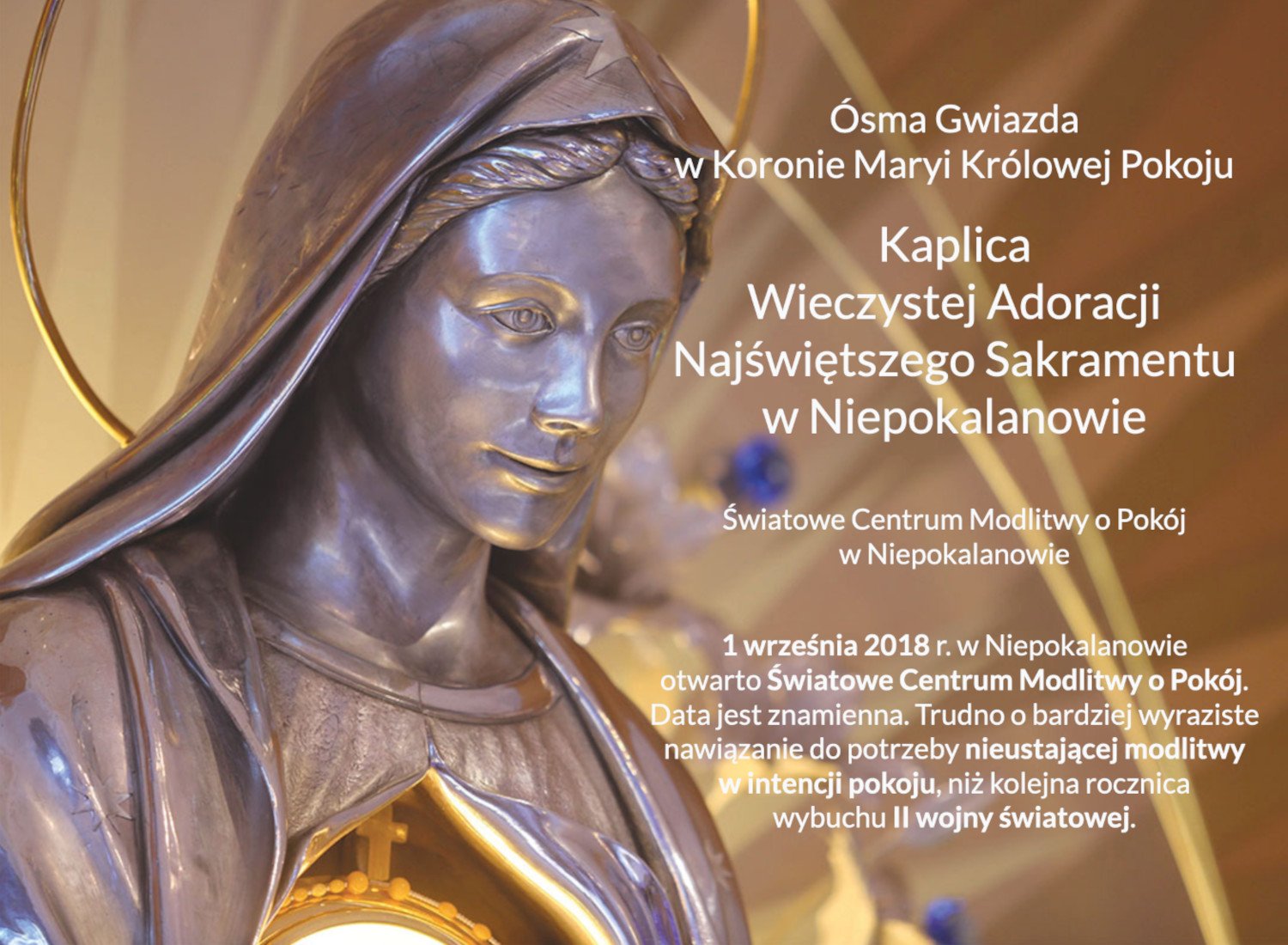

The Eucharistic Adoration Chapel established by Saint Maximilian Kolbe was inaugurated at the outbreak of World War II. It was restored as a Chapel of Adoration in September, 2018, the commemoration of the date that the war began. It is now part of the World Center of Prayer for Peace. The live internet feed of the Adoration Chapel at Niepokalanow — sponsored by EWTN — was established just a few weeks before we discovered it and began to include in at Beyond These Stone Walls. Click “Watch on YouTube” in the lower left corner to see how many people around the world are present there with you. The number appears below the symbol for EWTN.
Click or tap here to proceed to the Adoration Chapel.
The following is a translation from the Polish in the image above: “Eighth Star in the Crown of Mary Queen of Peace” “Chapel of Perpetual Adoration of the Blessed Sacrament at Niepokalanow. World Center of Prayer for Peace.” “On September 1, 2018, the World Center of Prayer for Peace in Niepokalanow was opened. It would be difficult to find a more expressive reference to the need for constant prayer for peace than the anniversary of the outbreak of World War II.”
For the Catholic theology behind this image, visit my post, “The Ark of the Covenant and the Mother of God.”
Illumination from Down Under: Hope Springs Eternal in the Priestly Breast
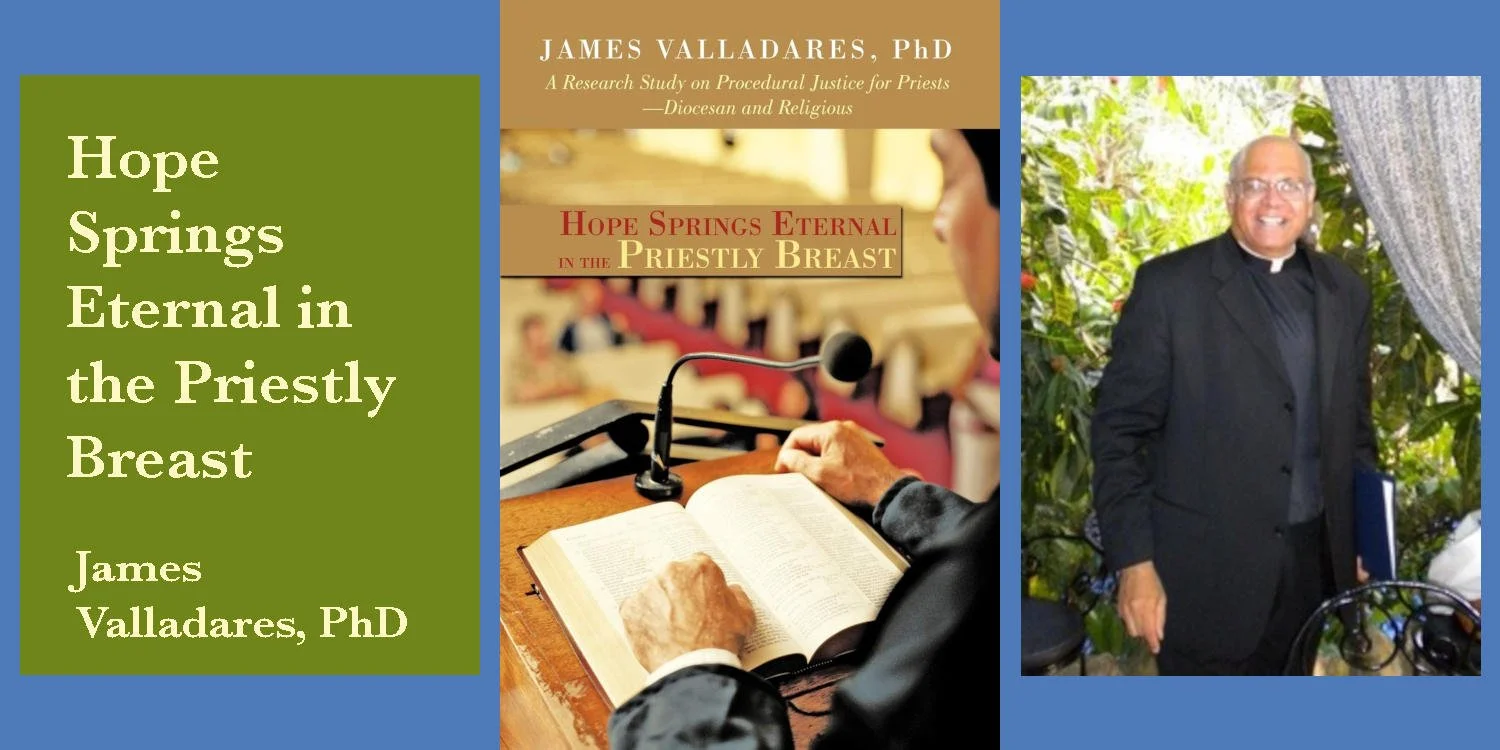
A well researched book by Fr. James Valladares casts light on the case of Fr. Gordon MacRae and the state of due process for Catholic priests falsely accused.
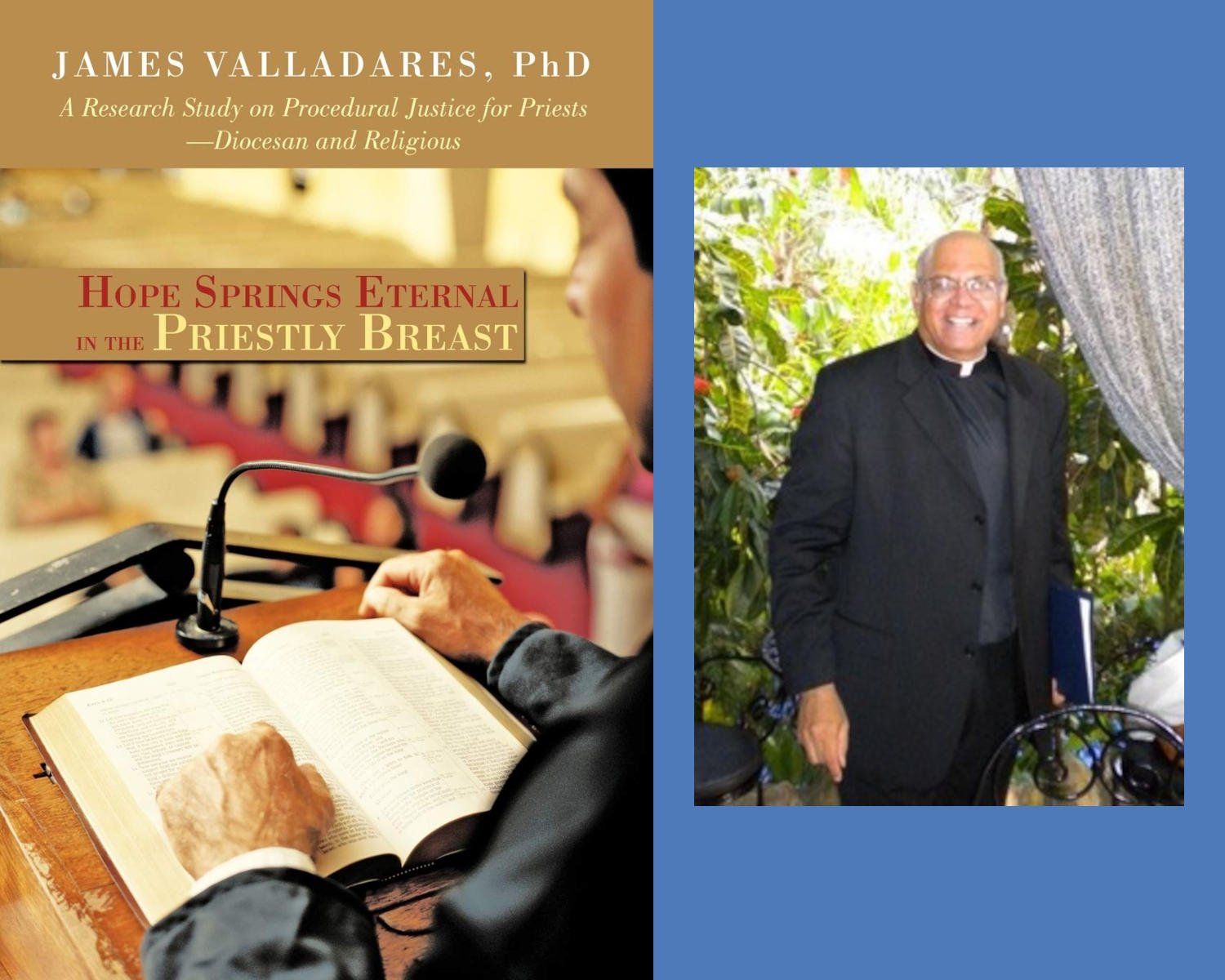
A well researched book by Fr. James Valladares casts light on the case of Fr. Gordon MacRae and the state of due process for Catholic priests falsely accused.
October 8, 2025 by Father Gordon MacRae
Abraham Lincoln once told a story about a man who traveled along a backwoods road on a dark and stormy night. After several claps of earth-shaking thunder in the blackness, with just the occasional flash of lightning to show him he was still on his path, the man issued a plea: “Lord, if it’s all the same to Thee, a little less noise and a little more light, please.”
I have been making that very same plea for over three decade now. It resonates clearly in my post, “When Priests Are Falsely Accused: The Mirror of Justice Cracked” and other more recent posts such as, “Unjustly in Prison for 30 Years: A Collision of Fury and Faith.” Those two posts are separated by twenty years, and their litany of woe has not evolved so much. When I wrote back in 2010, I felt very much alone on that dark and noisy path hoping that someone might come along with some light amid all the hype.
The sexual abuse crisis in the Catholic priesthood has generated so much pointless, noisy emotional rhetoric that light has become a precious and rare commodity. The “zero tolerance” policy of the U.S. Bishops’ panic-driven 2002 Dallas Charter added no light at all, but only turned up the volume on corrupt voices like the ones I described in “David Clohessy Resigned SNAP in Alleged Kickback Scheme.” In these decades of scandal, many Catholics have been duped. The crisis has been used by some very noisy people to silence a Catholic voice in the public square. And there are still no shortage of voices trying to silence Catholic justice in the public square.
In all times of moral panic, however, no amount of noise will dissuade a few courageous voices from the truth, no matter how much that truth is suppressed. One of these voices to emerge with full and reasoned Catholic courage is David F. Pierre, Jr., publisher of TheMediaReport.com and author of several landmark books including Catholic Priests Falsely Accussed: The Facts, The Fraud, The Stories.” We profiled this and several other of David Pierre’s work and his exposure of corruption in coverage of the Catholic scandal in “Hidden Evil: The Anti-Catholic Agenda of BishopAccountability.org.”
There is another, and his voice of priestly courage and fidelity rose up on the opposite side of the world in Australia, a land not unfamiliar to scapegoating a falsely accused and wrongly imprisoned priest, this time in the person of the late Cardinal George Pell. Father James Valladares, a priest, psychologist and noted author in Australia, published the compelling book, Hope Springs Eternal in the Priestly Breast (iUniverse 2012). Catholics concerned about the downward spiral of justice and public discourse in the Catholic Church would do well to read this book. (Twelve years after its first publication it is available as an e-book for $3.99, less than the price of a BigMac, and much more nourishing.) I recommend it for priests, bishops, and all Catholics who have felt demoralized by the contentious and confrontational tone constantly aimed at the Church and priesthood in the last three decades. I received my copy some years ago, and have recently been re-reading it for the moral and spiritual boost it brings. I was stunned by this courageous book.
Before I describe it further, however, we need some full disclosure. I am in this book. In fact, I am in this book extensively, and so is Beyond These Stone Walls. I find it very difficult to write about a book that I am in. Father James Valladares did his homework, and he did it well. His book exposes aspects of my story that made me tremble. I read it through two consecutive sleepless nights that left me spiritually and emotionally propelled in my priesthood, even in unjust imprisonment. It helped me to understand that I did not become a priest 43 years ago just to start thinking of myself when the world fell under my feet. It was not because the author framed my case as a justice crisis for the courts, but rather as a greater and more crucial justice crisis for the Church.
Father Valladares is the very first writer to accomplish this nebulous task, and he did it with amazing clarity and courage. In the end, I am not certain whether it should encourage me or frighten me. Not even I — after living in this nightmare for three decades — had a full understanding of the implications for the Church and priesthood that Father Valladares laid out so masterfully.
In Hope Springs Eternal in the Priestly Breast, Father James Valladares has excised these wounds upon the Church and priesthood with impeccable credentials in developmental, educational, and counseling psychology. Having served as a lecturer in psychology at Saint Andrew’s College in Mumbai, India, he has completed extensive post-doctoral research in religion, healing, and parenting. Father Valladares serves in the Archdiocese of Adelaide, Australia.
Channeling Father Neuhaus and Cardinal Dulles
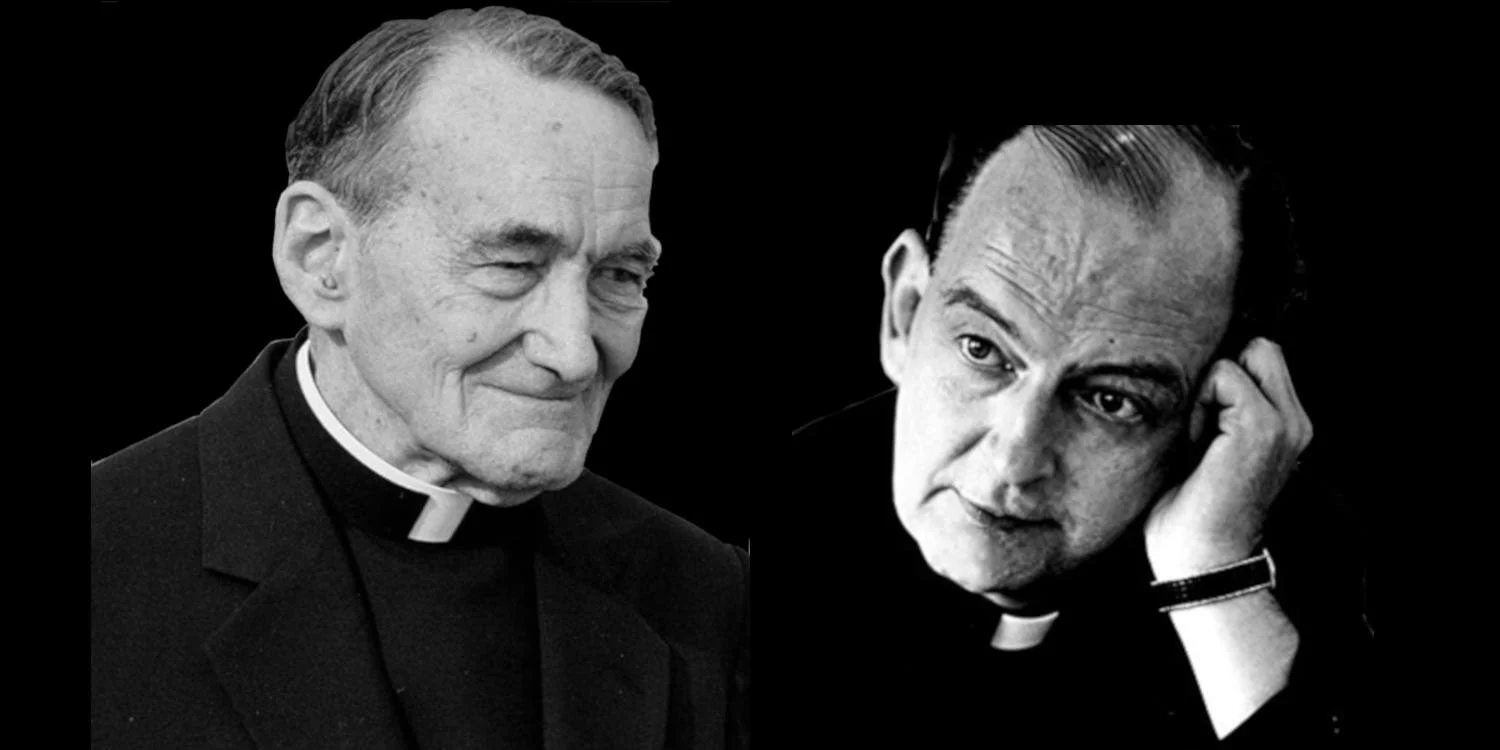
As I have written many times before, I am no strong believer in random coincidence. I picked up for the second time Hope Springs Eternal on May 14, the Feast of Saint Matthias, the man chosen by the Apostles to replace Judas, the Betrayer (Acts 1:26). I also was aware that May 14 was the birthday of my late great good friend Father Richard John Neuhaus, one of the inspirations behind Beyond These Stone Walls and forever remembered as a priest who served the Catholic Church in North America with exceptional light, clarity and fidelity. Another is Cardinal Avery Dulles, to whom I owe the idea of Beyond These Stone Walls’ existence. Both are cited and quoted repeatedly by Father James Valladares in Hope Springs Eternal in the Priestly Breast.
I had been reviewing excerpts of Father Neuhaus’ prophetic collection of essays, “Scandal Time,” about the priesthood crisis published in First Things magazine. On May 14, I had been reading an essay by Fr. Neuhaus entitled “In the Aftermath of Scandal,” (First Things, February 2004). When I opened Father Valladares’ book I spotted the excerpt from the same essay:
“The niceties of Canon Law, due process, and elementary decency have in many instances taken a beating. As one cardinal archbishop said after Dallas (2002), it may be necessary for some priests to suffer injustice for the good of the Church. In the course of history, Caiaphas has not been without his defenders.”
— Hope Springs Eternal in the Priestly Breast, p.25
Some readers might find it odd that I agree, at least in part, with that unnamed cardinal quoted by Father Neuhaus. It has always been necessary for some to suffer for the good of the Church. I hope that was clear in Pornchai Moontri’s prophetic post, “On the Day of Padre Pio, My Best Friend Was Stigmatized.”
My greatest suffering is not wrongful imprisonment, however, as horrible as that actually is. I hope readers know by now that I have not been languishing in prison beating my own priestly breast in a litany of woe for thirty-one years. My far greater suffering is that the Dallas Charter considers prison, even to be wrongfully imprisoned, to be the end of priesthood forever. Any Church bureaucrat who thinks that prison by its very nature marks the end of my priesthood seriously underestimates both me and priesthood. No consistent reader of Beyond These Stone Walls could ever draw such a flawed conclusion.
Father James Valladares most certainly has not drawn that conclusion. After reading his book, I was in awe of the extent to which he has been listening to me from the far side of the world through his reading of Beyond These Stone Walls. I cannot speak for him, but I think I can safely write that he has not listened to me because I am a priest or because I am a prisoner. He has listened to me because, to date at least, I remain both. I face every day as both. If I was not a priest in these extraordinary circumstances, not much of what I have had to say would have landed in this, or any, book.
So why would I conclude that at the time of my ordination in 1982, if I knew then what I know now, I would still be ordained a priest? We are a Church built upon the blood of the martyrs. To conclude today that their lives should never have been lost to bloodshed, and that their suffering has no meaning, is to discard the meaning of the very foundations of the Church, and even the Cross of Christ.
On the day I offered my First Mass, on June 6, 1982, I remember standing at the altar with great joy and profound peace surrounded by hundreds of my friends and brother priests who came to celebrate that First Mass with me. If elevating the Body of Christ for the very first time would have given me a glimpse of where priesthood would have me more than forty years in the future, would I have ever dared to elevate that Host again? I have to answer not with a resounding “yes,” but with a sacrificial one, and for the very reasons Father Valladares describes:
“In June of 2002, during the height of the media’s focus on Catholic bishops and priests, the Los Angeles Times [no friend of the priesthood] sent surveys to 5,000 priests in the United States . . . The survey found that 91 percent of respondents were satisfied with their life as a priest; 90 percent of respondents would choose to be a priest again if they had the opportunity; and 91 percent of respondents thought it was unlikely that they would ever leave the priesthood.”
— Hope Springs Eternal in the Priestly Breast, p.97
It was upon reading this that I understood why Father Valladares would dare to name his book about facing and cleansing the darkest wounds of the Church and Priesthood, Hope Springs Eternal in the Priestly Breast. It is because it does. In spite of all the noise and name calling, in spite of all the challenges and chastisement, in spite of all the suffering and sacrifice, priesthood in the Catholic Church is like that famous image of a flower forcing its way through cracks in the urban concrete to reach the light of day. Priesthood, if centered on sacrifice, will survive all that is thrown at it.
You will not read about this in The New York Times or the National Catholic Distorter – umm, Reporter. You will not read about this at the toxic landfill websites of SNAP or Bishop Accountability. Writer, Ryan A. MacDonald made this clear in his essay, “Why Did SNAP and VOTF Fear the Case of Father Gordon MacRae?” The toxic sites of SNAP and Bishop Accountability exist to promote agendas that have nothing to do with protecting children or serving the Church. They exist to restore the dissent of 1968, the year we drank from the poison of this world.
The wounds of the priesthood must be healed, but they cannot be healed as long as only one side of the story is told. It is a fact that vulnerable people were once harmed at the hands of a small number of Catholic priests several decades ago. It is a fact that child sexual abuse in our society was and still is a reality of epidemic proportions. It is also a fact that scapegoating the Catholic Church does little to cast light on this topic and does nothing — absolutely nothing — to protect children in our broken and narcissistic culture.
It is also a fact that many Catholic priests have been falsely accused despite the unfounded and poorly informed rhetoric of commentators such as Monsignor Stephen Rossetti. The former Director of Saint Luke Institute spoke at a symposium for Vatican officials tasked with exploring the truth. They were not well served by his uncorroborated claim that in his experience, false accusations against priests are very rare. From my experience, and that of David F. Pierre, Jr. at TheMediaReport.com, false allegations thrive and proliferate in direct proportion to the unquestioned money thrown at them by Church insurers and scandal-weary bishops. To date, the extorted settlements have exceeded $5 Billion nationwide.
Msgr. Rossetti’s baseless assertion may have been true in 1980. It is not true today. He would do well to spend some time at the Innocence Project website to examine the stories of hundreds of men exonerated after being wrongfully imprisoned for decades falsely accused of sexual assault. I can only respond to Monsignor Rossetti with something quoted in Father James Valladares’ book:
“Justice has turned on its head when men who stand to gain hundreds of thousands of dollars for making a false claim are automatically called ‘victims’ by Church leaders now, while priests accused without evidence from decades ago are just as quickly called ‘priest-offenders’ and ‘slayers of souls.’”
— Hope Springs Eternal in the Priestly Breast, p. 207
At the Turning of the Tide
Over recent years, some prophetic and courageous voices have emerged in the Catholic public square to stem the tide of unjust vilification of the priesthood. Let’s hope these voices reverberate throughout this time of crisis and conflicting agendas to inspire others. Father Michael P. Orsi, while Research Director of Ave Maria University School of Law, wrote “Bogus Charges Against Priests Abound.” So has David F. Pierre, host of The Media Report, with his “Bombshell Report” about false accusations and his “Alarming New Exclusive Report” about new evidence in my own case.
These writers of just and merciful Catholic conscience have made me proud to be a priest, and have given meaning to the suffering inherent in 31 years of wrongful imprisonment. Our reluctant Catholic press would do well to put aside its “Father Maciel Syndrome,” and follow their lead to cover this story.
In “The Prisoner-Priest Behind These Stone Walls,” Ryan A. MacDonald described Beyond These Stone Walls as “the finest example of priestly witness the last decades of scandal have produced.” If you are reading these pages you have lent to your Church and faith a courageous ear, and the tools for spreading the rest of the story. If you have been reading this story then you have demonstrated for me and the whole Body of Christ something that has been sorely lacking in this decades of scandal: hearts of courage and justice open to the whole truth, and not just the one-sided scarlet letter with which our scandal-driven news media and special interest groups have labeled your Church. Fr. James Valladares and David F. Pierre, Jr. have told the rest of the story.
I believe it is told here as well, but spreading the truth relies not just on their courage, but on yours. I have no doubt that you have such courage for I have seen it. Help us tell the rest of the story by sharing this post in the Catholic online world, among your social networking, and by sharing a link.
In his Foreword to Hope Springs Eternal in the Priestly Breast, Father Michael P. Orsi wrote:
“The present scenario reported by Fr. Valladares is dark. Yet, he has surprisingly chosen a title for his book that speaks of hope. For sure, it is a hope based on Jesus’ words to his disciples, ‘I will be with you always.’ Therefore, far from being pessimistic, Fr. Valladares presents the facts with confidence that ‘the truth will set us free.’ For his hard work, born out of a love for the priesthood and his brother priests, Fr. [James] Valladares is to be commended.”
+ + +
Note from Father Gordon MacRae: Thank you for reading and sharing this post. Don’t stop here. You might also like these related posts from Beyond These Stone Walls:
Fr Gordon MacRae in the Prison Journal of George Cardinal Pell
Unjustly in Prison for 30 Years: A Collision of Fury and Faith
Hidden Evil: The Anti-Catholic Agenda of BishopAccountability.org
On the Day of Padre Pio My Best Friend Was Stigmatized
About Beyond These Stone Walls
This fine book by Father Valladares is available at Amazon and Barnes and Noble as an e-book for $3.99, and at Amazon as softcover for $21.34.
The Eucharistic Adoration Chapel established by Saint Maximilian Kolbe was inaugurated at the outbreak of World War II. It was restored as a Chapel of Adoration in September, 2018, the commemoration of the date that the war began. It is now part of the World Center of Prayer for Peace. The live internet feed of the Adoration Chapel at Niepokalanow — sponsored by EWTN — was established just a few weeks before we discovered it and began to include in at Beyond These Stone Walls. Click “Watch on YouTube” in the lower left corner to see how many people around the world are present there with you. The number appears below the symbol for EWTN.
Click or tap here to proceed to the Adoration Chapel.
The following is a translation from the Polish in the image above: “Eighth Star in the Crown of Mary Queen of Peace” “Chapel of Perpetual Adoration of the Blessed Sacrament at Niepokalanow. World Center of Prayer for Peace.” “On September 1, 2018, the World Center of Prayer for Peace in Niepokalanow was opened. It would be difficult to find a more expressive reference to the need for constant prayer for peace than the anniversary of the outbreak of World War II.”
For the Catholic theology behind this image, visit my post, “The Ark of the Covenant and the Mother of God.”

A New Year’s Resolution That Is Always on My Mind
If the past is always on my mind, and the things I should have said and done still haunt me, then it may be time to give the past its due and get on the road again.

If the past is always on my mind, and the things I should have said and done still haunt me, then it may be time to give the past its due and get on the road again.
January 8, 2025 by Fr Gordon MacRae
“When I was a child, I used to talk as a child, think as a child, reason as a child; when I became a man, I put childish ways aside.”
— 1 Corinthians 13:11
In “A Glorious Mystery for When the Dark Night Rises,” I wrote of an event from my childhood growing up in the early 1960s in a city just north of Boston. We were more or less free-range kids then, though mostly unheard of today. We both roamed and ruled the streets without much in the way of parental supervision. Our cities were safer then, or so we believed.
As a child of the 1960s and that chaotic decade’s sounds of social revolution, I spent much of my past life disparaging country music. In the years before hard rock and heavy metal, leading up to Ed Sullivan exposing us to the British invasion, I made up my mind without ever really being attuned to it that country music was simply not cool. In fact, I ridiculed it in a Christmas post a few years back.
I wrote that in the 1980s there was a sort of urban legend that if you play AC/DC records backwards, you will hear satanic messages. I never tried it, but the legend prevailed throughout the 1980s. So what happens if you play Country Western music backwards? Your wife comes home; your dowg comes back; and you remember where you left your truck!
But like Saint Paul did in my quote from First Corinthians atop this post, I have since, for the most part, put childish ways aside. The evidence for that is nowhere more striking than in the music that now moves me. I have been watching some of the fundraising concerts on PBS this past Christmas season and throughout the past year. The long interludes of donation pitches aside, the music is usually outstanding. I will never tire of the PBS classic “Black & White Concert” with Roy Orbison or the concert with Blues guitarist Joe Bonamassa and his ensemble of brilliant musicians performing at Carnegie Hall. If you missed this, you must tune in if only to see and hear Joe Bonamassa’s near superhuman guitar and cello duet.
But one of my favorites of the PBS concerts still makes a small part of the Rock generation in me sneer in shame. I am not sure I want to openly admit it, but the PBS presentation ofThe Highwaymen made my face hurt. It’s because I could not suppress a smile for two solid hours as I listened to Johnny Cash, Waylon Jennings, the late Kris Kristofferson, (who recently passed just before Christmas this year), and the great Willie Nelson. Good Lord, what has happened to me? The Highwaymen completely ruined my disdain for country.
A few months ago, PBS replayed their 1990s concert. The Highwaymen have found a captive and captivated audience in me. I have been unable to stop my mind’s relentless replay of Johnny Cash. For days, the music in my mind alternated between “Ring of Fire” and “Folsom Prison Blues.” Of the latter, at least, I can relate. And who could have ever imagined a duet with Johnny Cash and Willie Nelson? In the days of my youth, I would have sneered at the thought, but I loved it. It brought me to tears.
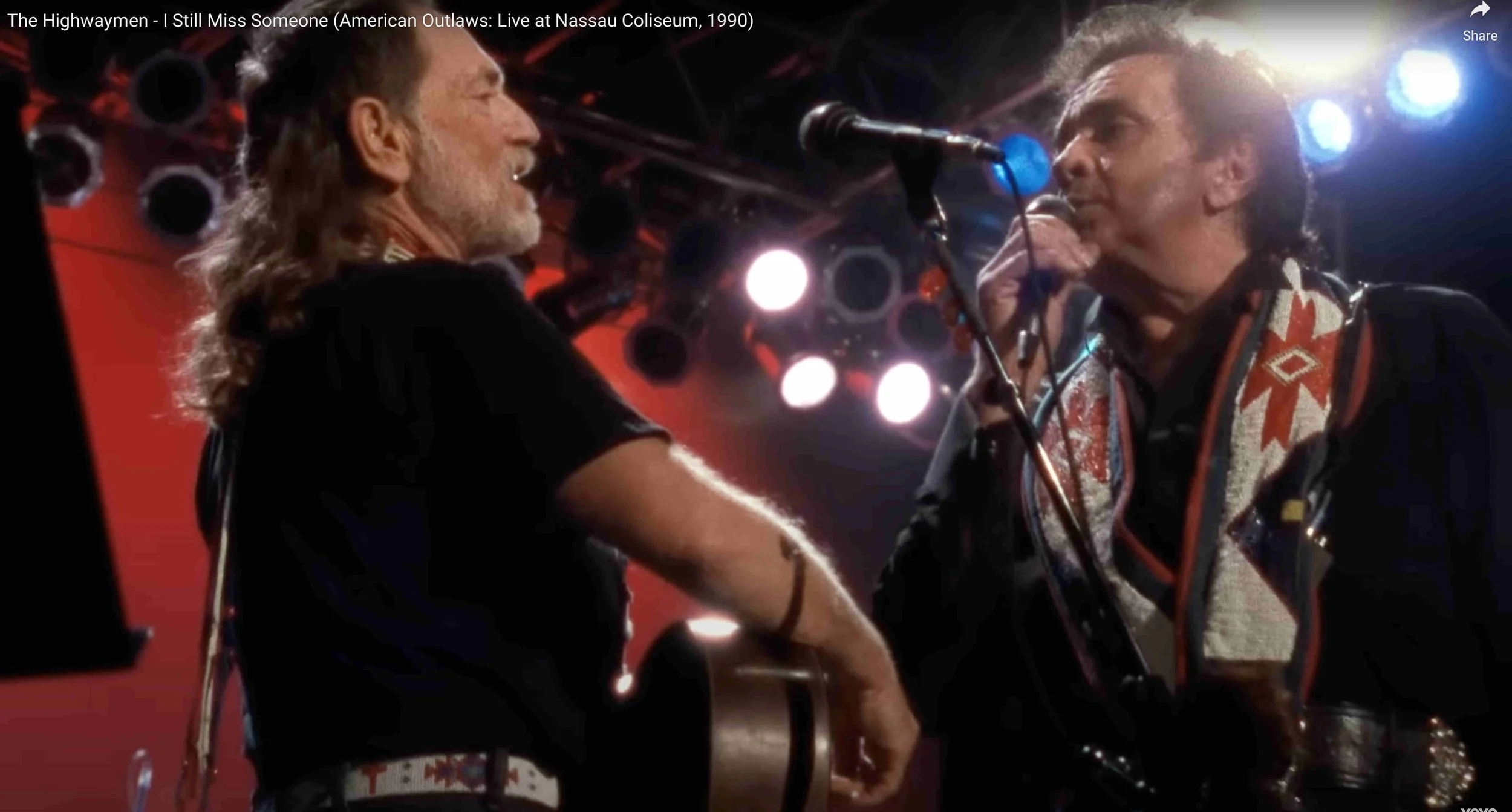
There will never be another Willie Nelson. His music relives the loves and losses of life in a way that calls to an otherwise endangered species in this troubled time: the hearts and souls of both men and women. After listening to his haunting song — “You Are Always on My Mind” — I adopted it for a New Year’s resolution. But first, I invite you to hear the Willie Nelson and Johnny Cash duet, “I Still Miss Someone.”
Living in the Past
Like so many of the people who write to me, I tend to get stuck in some of the events of the past — events that today I can do nothing to change except to atone and make amends. The need to do so is usually the only reason they haunt me. Or I can do neither of those and just beat myself up over the past and the people in my heart and mind who still dwell there.
I live in a place that holds 1,300 men — about 75 percent of them under age thirty — where the most available emotions are anger and regret. They cast everything here under a dark cloud that is always looming and churning in their minds. The explosive eruptions of emotionally fragile young men characterize all day every day where I live. If you were ever a Star Trek fan then you will know what I mean when I say that being in prison is like living among Klingons. They are ready to throw down at every slight, and their anger is never a reaction to the issue of the moment. It is just a part of the baggage they lug around with them wherever they go.
One of my problems with anger is that I am almost always infinitely patient with these guys. They rarely ever see me angry, but on those few occasions when it shows, I have learned that it can be destructive in far more ways than just breaking someone’s nose. There was a recent story that brought my anger to the surface.
One day just before Christmas last year I became very angry with my friend Joseph, and I let him know it. Days later my anger was long gone but Joseph was still brooding and cautious around me. I asked him why it is that everyone around me here can be angry almost all the time, but if I express anger it always seems catastrophic. Joseph responded with what for me was an eye-opener: “Because it’s you,” he said. “You’re everyone’s cornerstone and you aren’t supposed to get angry. It made me feel awful,” Joseph said. And, of course, what Joseph said made ME feel awful!
As Joseph would also say, “We’re cool now,” but I have learned something dark about myself. I am quick to want to atone and make amends when I become aware that I have hurt someone else, but when others have trespassed against me, I am not so quick to allow them to atone. I can let a trespass resonate for years, and I do not like what I have learned. Willie Nelson sang so beautifully about “the things I should have said and done.”
If someone is always on your mind generating negative thoughts, and the things you should have said and done still haunt you, then join me in this resolution to transform the hurts of the past into the prayers of the present. I have also learned that it is not possible to sincerely pray for someone and then retain whatever rage about that person still clouds your mind. It is time to give the past some perspective and get on the road again. This one paragraph incorporates two of Willie’s most popular songs.
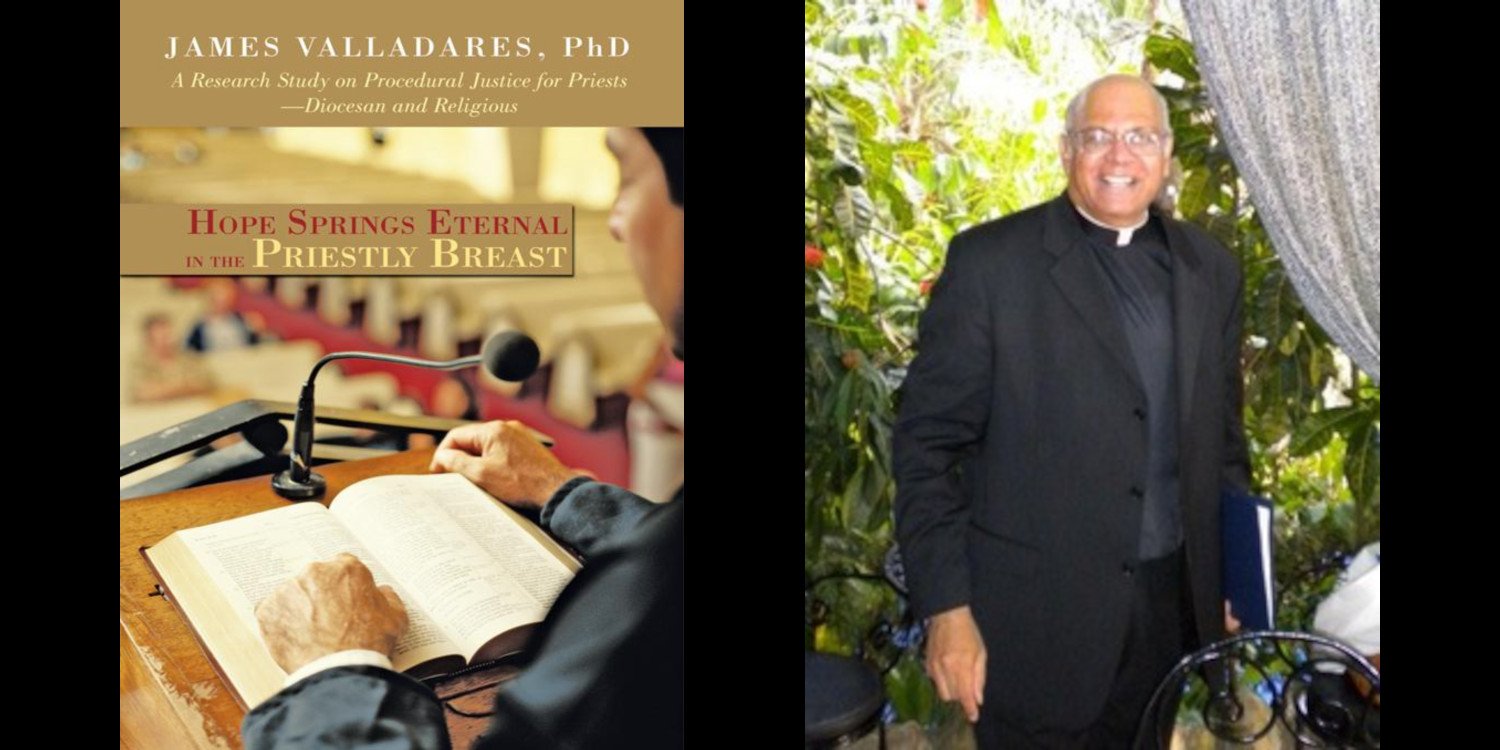
So here is some perspective that years ago caused me to surrender a trespass from the past. It is a story that was reproduced in an awesome 2011 book, Hope Springs Eternal in the Priestly Breast, by Australian priest and psychologist, Father James Valladares. A large segment of his book cites events read at Beyond These Stone Walls. Father Valladares captured this one with a stinging introduction:
“Fr. Gordon MacRae very truthfully states: ‘Trusting too much can harm your reputation. Not trusting enough can harm your soul.’ His story corroborates that candid assertion:
‘“I arrived at St. Bernard Parish in Keene, New Hampshire, on June 15, 1983. I was told by our diocesan personnel director at the time that I was going to a positive and worry-free assignment after a difficult year in a very troubled parish. But as was typical for my diocese then — and perhaps for many others — there seemed to be no limit to how out-of-touch the Chancery Office could be.
“I arrived to learn that the pastor had been charged with driving while intoxicated and was awaiting my arrival so he could leave for his third attempt at residential treatment for alcoholism. My heart went out to this good man who struggled so much with his fragile humanity while his superiors seemed oblivious to it.
“I was also there to replace another priest who was bitterly leaving the priesthood after three years at that parish, but decided to stay on to help me until the pastor returned. He was angry and disillusioned, and not exactly a source of fraternal support.
“The parish was immense, for New Hampshire at least. It had over 2000 families, provided round-the-clock pastoral care for a regional hospital and trauma unit, three nursing homes, a college campus, a regional Catholic school, a huge Catholic cemetery, and a second church fifteen miles away. I arrived to learn that I was essentially alone there.
“In that summer of 1983, there was a lot going on in my own life, too. Just weeks before I arrived at the parish, my father died suddenly at the age of 52. I had literally gone from presiding over his funeral Mass, and caring for my family, to packing and moving to a new parish 100 miles away. Two weeks after I arrived and got settled, my sister and her family drove up from the Boston area to visit me. We still had some unfinished details over the death of our father, and two months earlier my sister gave birth to her second child. I had the privilege of baptizing her in my new parish.
While my brother-in-law unpacked some of my boxes of books that he brought with him, my sister and I took my two nieces for a stroll down Keene, New Hampshire’s picturesque Main Street. It was a beautiful summer day, and we had lots to discuss while I pushed a stroller down the busy street.
By the middle of the following week, the rectory phone started ringing. First it was a priest in a neighboring parish. ‘I just wanted to give you a head’s up,’ he said. ‘I’ve heard from two people that you have a secret wife and kids.’ I laughed, at first, but by the end of the week I wasn’t laughing anymore. Then the parish council president called. ‘We don’t need another scandal,’ he said. ‘People are calling me with a rumor that you’ve fathered two children.’
“By then, I was furious. We were able to backtrack who said what to whom and when, and learned that the ugly rumor began with that innocent Sunday afternoon walk with my sister and nieces. And ground zero of the rumor was one parishioner, Geraldine (long since forgotten, no longer with us, and not her real name) who also happened to be out on Main Street that afternoon.
“Geraldine jumped to a conclusion and then jumped on the telephone. It was like a virus that spread from person to person, growing and mutating along the way. Poor Geraldine had no intention that her bit of gossip would spread like a wildfire, but it did. It spread everywhere.”
— Hope Springs Eternal in the Priestly Breast, pp. 117-119
The Day of Atonement
The problem with the story above was not just how Geraldine interpreted that Sunday afternoon stroll downtown. And it was not just her decision to place a few phone calls that would start the fake news in motion. The problem was that Keene, NH, like too many communities, had too many people all-too-ready to hear, believe, and spread any gossip that disparages a Catholic priest.
Once such a thing takes root and spreads, it forms a life of its own. An untrue rumor can be repeated so much, and spread so far, that the truth doesn’t stand a chance. The truth has a steep uphill climb once everyone else hears only one side of a story.
Actually, this is exactly what happened in the sexual abuse crisis in the Church. SNAP and the news media spread one story with such ferocity that the truth ended up swatted away like a pesky fly. But there’s even more to this story, however.
Nearly a dozen years later, someone else in that community accused me falsely. It was from that same place and that same Summer of 1983. A lot has been written about this, but one article by Ryan A. MacDonald contains photos of the “crime scene.” It is “Justice and a Priest’s Right of Defense in the Diocese of Manchester, NH.”
For years I have been haunted by the coincidence, wondering whether the roots of Geraldine’s gossip spread long and far with deep tentacles, raising questions about me and predisposing others toward forming a set of beliefs that eventually morphed into a moral panic. As the truth unfolded in 1983, Geraldine could take none of it back. She could not retrieve even one of the wisps of gossip cast into the wind to travel indiscriminately. That is the real harm of gossip. Its purveyors can never stem, or even know, its tide.
But another source of harm, and I cannot evade it, was my anger with Geraldine. In the account from the book, Hope Springs Eternal above, Father Valladares quoted me as saying that this event is “long since forgotten.” Well, it wasn’t. I just stopped thinking about it. But my anger with poor Geraldine lingered, and like all such things, it became part of the resonance of my life that I believe very much also affected hers, at least on a spiritual level. As I reflected late at night alone about anger and my discussion with my friend, Joseph, my mind drifted and then landed on this story about Geraldine.
Though she left this life in God’s friendship many years ago, I felt as though I had a moment of real and meaningful connection with her. I said the words aloud as a prayer in the dark: “Geraldine, I forgive you, and I pray that you come to know the fullness of God’s Presence.”
A great weight was lifted from me, and, I felt, from Geraldine as well. Those were “the things I should have said and done” back then. As it was for Willie Nelson, better late than never. Now I’m on the road again.
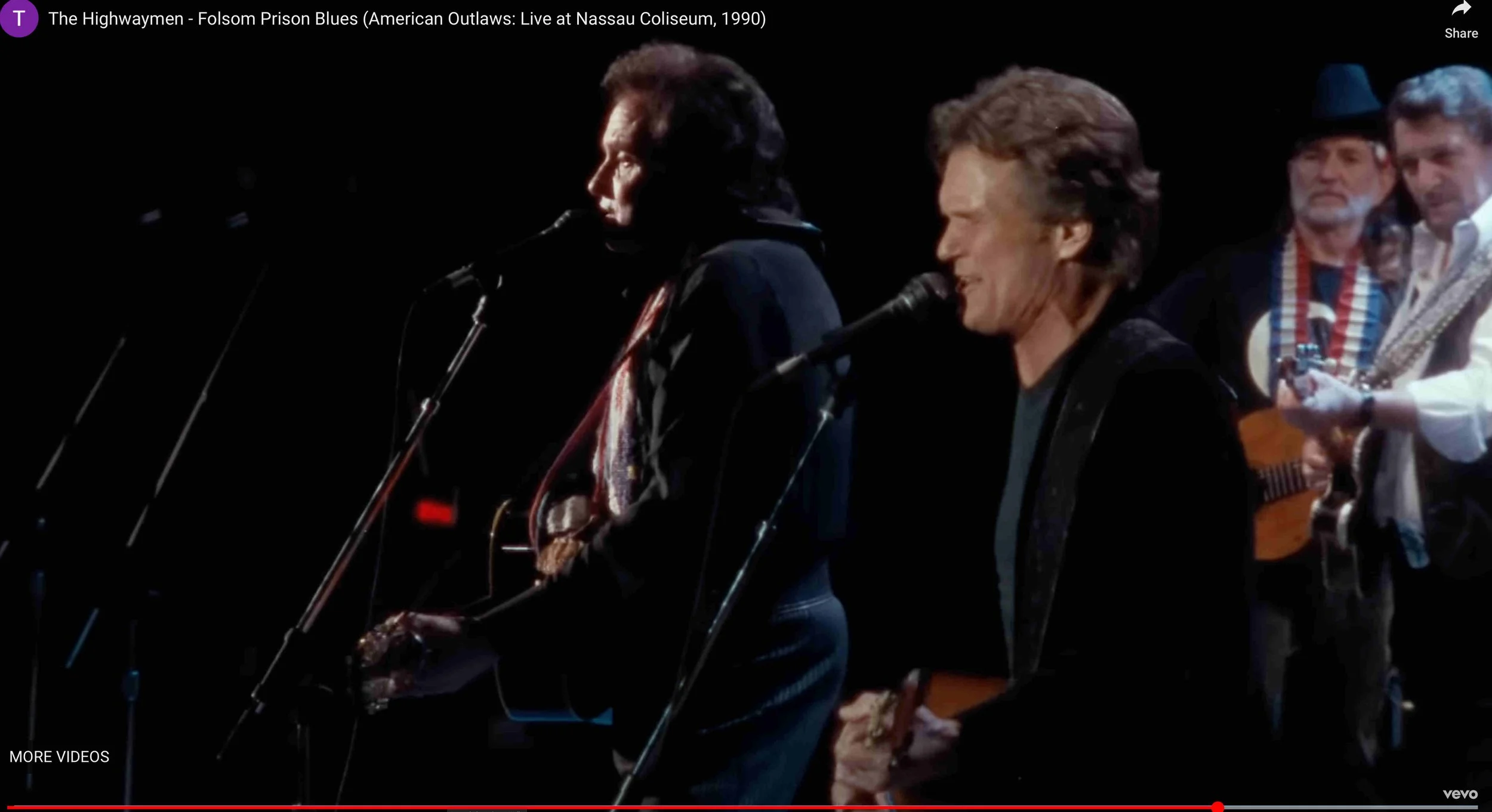
But since then I have switched my song. Now I find myself mysteriously singing with the great Johnny Cash, “Folsom Prison Blues.”
+ + +
Note from Fr Gordon MacRae: Thank you for reading and sharing this post. I want to call your attention also to a new entry in our Voices from Beyond Page. It’s an article with supporting photos by Ryan A. MacDonald, “Justice and a Priest’s Right of Defense in the Diocese of Manchester, NH.”
You may also like these related posts:
A Code of Silence in the U.S. Catholic Church: Affidavits
The Eucharistic Adoration Chapel established by Saint Maximilian Kolbe was inaugurated at the outbreak of World War II. It was restored as a Chapel of Adoration in September, 2018, the commemoration of the date that the war began. It is now part of the World Center of Prayer for Peace. The live internet feed of the Adoration Chapel at Niepokalanow — sponsored by EWTN — was established just a few weeks before we discovered it and began to include in at Beyond These Stone Walls. Click “Watch on YouTube” in the lower left corner to see how many people around the world are present there with you. The number appears below the symbol for EWTN.
Click or tap here to proceed to the Adoration Chapel.
The following is a translation from the Polish in the image above: “Eighth Star in the Crown of Mary Queen of Peace” “Chapel of Perpetual Adoration of the Blessed Sacrament at Niepokalanow. World Center of Prayer for Peace.” “On September 1, 2018, the World Center of Prayer for Peace in Niepokalanow was opened. It would be difficult to find a more expressive reference to the need for constant prayer for peace than the anniversary of the outbreak of World War II.”
For the Catholic theology behind this image, visit my post, “The Ark of the Covenant and the Mother of God.”

From Arizona State University: An Interview with Our Editor
Having pondered the project questions from a student at Arizona State University, the Editor of Beyond These Stone Walls tells the story of this prison journal.

Having pondered the project questions from a student at Arizona State University, the Editor of Beyond These Stone Walls tells the story of this prison journal.
September 4, 2024 by Dilia E. Rodríguez, PhD, Editor
Prelude from the Student:
“Truth in its simplicity, revealed by suffering, carries a quality in writing. I believe this is what has drawn me to Beyond These Stone Walls and retained my readership over the years when there is not a single other blog or newspaper that I read consistently. I believe it is also a mercy of God that I have been able to read authentic Catholic voices here regarding the tumultuous current events in our world because it has helped keep my Faith alive despite much darkness. I chose this topic because I love God and wish to glorify him.”
— an Arizona State University student
+ + +
How did you discover Beyond These Stone Walls, and how did you become the Editor?
I had never heard of Father Gordon MacRae or this blog. On the Feast of Saint Joseph in 2019, I searched “Pope Benedict XVI on St. Joseph,” and the fourth or fifth result was one of Father MacRae’s articles. I read several others, and I read his story at the About Page. Deeply saddened, I wanted to help with my prayers and in any other way I could. On the Feast of the Annunciation, I sent him a letter introducing myself and offering to be a Simon of Cyrene to him.
A priest friend of Father MacRae in North Carolina had been volunteering as acting editor for the previous few years while also having been given additional parish assignments. I was close to the end of my career as a civilian scientist for the United States Air Force. I had been pondering retirement for some time and this volunteer work for Beyond These Stone Walls seemed a perfect fit for me as I now manage all the nuts and bolts of a widely-read popular Catholic blog written under the most unusual conditions.
What is the process for you to receive posts from Father MacRae, post them, and then send the comments to him?
From inside a small prison cell, Father MacRae types each post on his old typewriter and mails it to me. I scan it using optical character recognition software. With the typewritten post he includes a description of the suggested images he would like to include above each section of the post, as well as at the top. Beyond These Stone Walls was built using Squarespace, which also hosts it. Using its services I compose text, images and links to create the post on the blog. We publish every Wednesday morning, and send out an email alert to our 2,000 or so direct subscribers. But the readership of this blog is much larger. Many people go directly to the posts without subscribing. We also publish the posts on some social media such as Gloria.TV where Father MacRae has been given a page. His Christmas post about shepherds had about 50 thousand readers, many in some of the poorest parts of the world such as India, Pakistan, and Bangladesh. Father Gordon has never actually seen his published posts. As a prisoner he has no access to the online world and has never seen any social media where his posts are published.
Prisoners cannot receive calls. So when Father Gordon calls me I read him the comments that have been posted on BTSW and some of the ones that have been posted on social media.
Do you believe your Faith life has changed since taking on this position? Why or Why not?
Beyond These Stone Walls shines a light on how Father Gordon MacRae is sharing in the Cross of Jesus. It nourishes me with his example and meditations. It reports on what is happening in society and in the Church, which corporate media and many Catholic media do not. Without Beyond These Stone Walls and the witness of Father MacRae I would miss much of what is going on in the world and in the Church, in which Jesus wants me to be His instrument. I pray that I may hear His voice and do whatever He tells me.
Jesus said, “I am the Way, the Truth, and the Life.” In my youth I had an agnostic period in which I agonized in search of Truth. Jesus, Truth, attracted me to Him. Father Gordon MacRae has most beautifully and faithfully answered Jesus’ ardent prayer to the Father, “Consecrate them in the truth. Your word is truth.” (John 17:17) When the corrupt and perverse “justice” system wanted him to lie about having committed crimes that never happened, he did not lie. As punishment Judge Arthur Brennan sentenced him to life in prison. Almost everyone abandoned him. But he clung to Truth, to Jesus. He is a model and a challenge to me and many, a light in the darkness.
This is a time in which astoundingly many are “those who call evil good, and good evil” (Isaiah 5:20). I ask myself what does Jesus want me to do. He says, “Behold, I am sending you like sheep in the midst of wolves; so be shrewd as serpents and simple as doves.” (Mt 10: 16)
In the midst of so much evil in our time, the Catholic sexual abuse scandal is most significant. Many outside and within the Church seek to confuse what is evil and what is good concerning this scandal. There are two wrongs: the abuse of young people by priests, and the false accusations of abuse of young people by priests. The latter wrong remains hidden from most, deceptively presented as the first wrong by an industry of lawyers, “victims’ advocates,” attorneys general, and anti-Catholic bigots; and very sadly and scandalously, by a bishops’ policy that encourages and promotes this evil industry. Father MacRae wrote of how this has evolved in his own diocese in To Fleece the Flock: Meet the Trauma-Informed Consultants.”
Had I not crossed paths with Beyond These Stone Walls and Father Gordon MacRae, I would not know about the false-accusation industry. I have come to believe that as ugly and depraved as the secular world has become, and as the Church is beset by multiple problems, it is the explosion of false accusations of priests that is the worst ever attack on the Church, the most diabolical attack on the Body of Christ, and therefore the world.
The immediate victims are the falsely accused priests. Their reputations are destroyed. The search for the truth of the accusation is nonexistent. The reputation of all priests is tarnished. The laity are also victims of this attack on the Church. Billions of dollars have been handed out to those who claimed to have been abused. No billionaire donated these funds. Dioceses have been bankrupted. Parish life has been affected.
And incredibly the worst members of this false-accusation industry are (most of) the bishops. In 2002, the Dallas Charter was adopted over the objections of Cardinal Avery Dulles, Father Richard John Neuhaus and a few others. The bishops adopted the “credible” standard, a fig-leaf term to convey a sense that accusations are investigated. They are not. I remember a couple of readers commenting that in their dioceses their bishops investigated the accusations, proved they were false, and the false accusations ceased.
Knowing that it is Jesus Who calls a man to be a priest, it is unimaginable that a bishop would discard a priest without a most thorough investigation. But it is a policy that has been enforced for over two decades. It masquerades as compassionate. It is an evil being called a good. The cruelty and the attack on priesthood it represents is astounding.
Shamelessly, quite a few years after the Dallas Charter was adopted, when there was talk of extending the “credible” standard to accusations against bishops, the USCCB got lawyers to begin defining the term [The Credibility of Bishops on Credibly Accused Priests]. This year the Diocese of Manchester, New Hampshire dropped altogether the fig-leaf term. Any priest accused of sexual abuse of a young person will be added to the list that publicly shames, and discards priests. The “credible” standard, as weak as it is, has been discarded. The accuser will be monetarily rewarded. Apparently, it should cross no one’s mind that handing out large sums of money would ever entice false accusations. Again, evil gets presented as good. Twenty-two years after the Dallas Charter was adopted a new generation of bishops upholds it.
How can this be anything but a diabolical, concerted effort to destroy priesthood, to destroy the Church?
How does this affect my Faith? This is not a superficial, little problem that for the most part I can forget while I go on with my life. With “fear and trembling” I ask, “What do You want me to do? Open my ears that I may hear. Without You I can do nothing,”
Certainly, it is a privilege for me to use my time and talent to help project the voice of Father Gordon MacRae outside that prison in New Hampshire as he tries to open minds and hearts to the truth of what is happening in the world and in the Church, to Truth Himself.
As to my treasure, I micromanage my donations. I have stopped donating to the lukewarm and to those who wittingly or unwittingly collaborate with the Father of Lies in trying to destroy priesthood, and I support some of the courageous people and entities that unceasingly defend and proclaim truth.
I pray that my righteousness may surpass that of the scribes and the Pharisees. I am sickened when I hear priests, bishops or the Pope consider every accusation of a priest to be true, as well as the media and lay people. May Jesus teach me to love them as He loves them.
What are your favorite things about editing BTSW? What are your least favorite?
It is a privilege and a joy to work with Father Gordon and watch his creativity as he directs me to edit an article on the fly. I want what we post to be beautiful and enjoy creating images to make it so. I want as beautiful images as I can get, and that usually takes me quite a bit of time. What I like least is not finding good images, or finding them but not being able to use them because they are copyrighted.
One of my other least favorite things, though it has come to some good, is the ocassional post that gets lost or delayed in the U.S. mail. Our choices in those weeks are to either skip a post entirely or for Father MacRae to slowly dictate a 2,000-word article to me by telephone.
What articles do you remember most? Why?
It is amazing the breadth of topics that Father MacRae tackles, from Scripture to history, to science, to current events. And he writes about his life. Pure evil placed him where he is, and he is sharing in the Cross of Jesus, but he shows how in magnificent ways God is ever present to him.
His Scripture articles are full of facts and striking insights. The collection of Holy Week posts is a gift. Another example is, “Casting the First Stone: What Did Jesus Write On the Ground?” Father MacRae brings out in fascinating detail the interplay between the law of Moses and the Roman law, and how Jesus’ response is a trap of the Pharisees. It seems to me that this and other Scripture articles need a second or third reading to fully grasp and appreciate the depth of what he is presenting.
Father Gordon loves science, especially cosmology. Many think or accuse the Church of being anti-science, but that has never been true. Not only have there been scientists in the Church, but some of the most significant advances in science were introduced by priests. For example, the father of modern genetics was a monk, Gregor Mendel. And a hero of Father Gordon discovered the Big Bang, Father Georges Lemaitre. He had known about Lemaitre for years, and was most flattered when in response to a letter he sent to Carl Sagan about his novel Contact, Sagan replied to Father MacRae, “You write in the spirit of Georges Lemaitre!” But God was not pleased to leave it just at that, He decided to make the most extraordinary connections between Father MacRae and Father Lemaitre.
Though Father Gordon has written several times about Father Lemaitre, maybe the most significant post on this subject is “Fr Georges Lemaître, the Priest Who Discovered the Big Bang.” It is an article about the great scientist Father Georges Lemaitre, co-written with noted physicist Father Andrew Pinsent, a research scientist at the University of Oxford. The article had two postscripts by Father Gordon MacRae. In the article Father Pinsent writes, “Among Catholics with some kind of popular outreach, Fr Gordon MacRae through his widely-read blog has done more than almost anyone I know in recent years to draw attention to Fr Lemaître.” For his part, Father Gordon recounts that after reading one of his posts on Belgian priest-scientist Lemaitre, Belgian BTSW reader Pierre Matthews, who is Pornchai Moontri’s Godfather, wrote to tell him that Fr. Lemaitre was his Godfather.
What makes the breadth of articles so surprising is that in prison, Father MacRae has no online access at all and no resources for research.
Initially, I was struck by how many posts are about or mention Pornchai Moontri. After a while I came to think that their profound bond was like that of friends who endure the horrors of war together and survive. Now I think that it is much more profound than that.
God has inspired many truth seekers to investigate the case of Father MacRae: Dorothy Rabinowitz, Harvey A. Silverglate, Ryan A. MacDonald, Dr. William Donohue, David F. Pierre, Jr., Father James Valladares, former FBI Special Agent Supervisor James Abbott, and investigative reporter Claire Best. Any fair-minded person who studies their work is convinced that a corrupt system put him in prison and Father Gordon MacRae is innocent.
But God wanted to reveal this with more than facts. He would reveal it with the powerful transformation of lives and souls. Pornchai had been viciously sexually and physically abused for years by a man who trafficked him from Thailand at the age of 11 and murdered his mother. Pornchai escaped and lived on the streets for all of his teen years. Then at age 18 he killed a man who tackled him and pinned him to the ground. After years of enduring violent sexual abuse this sent Pornchai into a rage. He spent the next 13 years in solitary confinement. He was then sent to the prison that houses Father Gordon. Having learned that he had been convicted of sexual abuse, Pornchai should have wanted to stay as far away as possible from Father Gordon. Yet, they became friends and then Pornchai asked Father Gordon if he could be his cellmate.
On the other hand, the corrupt and evil people who railroaded Father Gordon derailed his priesthood, took his freedom and viciously defamed him. It should be noted here that to their great credit, Vatican officials have not dismissed Father MacRae from the clerical state.
Most in the Church who should have stood by him instead abandoned him, or even worse denounced him. If this is how people in the Church treated Father Gordon, how much more understandable it would have been had Pornchai looked at him with suspicion and distrust. Yet, Pornchai has said that Father Gordon is the person in the whole world whom he most trusts. That must be a precious balm that heals Father Gordon’s heart. Many posts describe this most extraordinary friendship. Most important among them is Pornchai’s own words in, “On the Day of Padre Pio, My Best Friend Was Stigmatized.”
Though the suffering of Father Gordon MacRae’s cross has not abated in 30 years, God has not abandoned him. He has sent Father Gordon two special friends who let him know that he is not alone: the prisoner-priest Saint Maximilian Kolbe; and the stigmatist and mystic, who was accused of sexual abuse and attacked from within the Church, Saint (Padre) Pio of Pietrelcina. Two of my favorite posts describing their presence in Father Gordon’s life are “St. Maximilian Kolbe and the Man in the Mirror,” his first encounter with Saint Maximilian Kolbe; and “Saints Alive! When Padre Pio and the Stigmata Were on Trial,” a very interesting post, which among other things describes a most special blessing that connected Father Gordon, Pornchai Moontri and Saint Padre Pio through time and space.
Have any comments left an impression on you? Why?
One of the early comments on BTSW was that of Deacon David Jones:
“There are few authentic prophetic voices among us, guiding truth-seekers along the right path. Among them is Fr. Gordon MacRae, a mighty voice in the prison tradition of John the Baptist, Maximilian Kolbe, Alfred Delp, SJ, and Dietrich Bonhoeffer.”
I think Father Gordon deserves such a testimonial.
In 2010 Father MacRae’s blog was selected by readers of Our Sunday Visitor as The Best of the Catholic Web in the area of Catholic spirituality. About.com selected it as the second-place finalist for the Best Catholic Blog Award. Readers at the Fishers Net Award selected it as The Best Catholic Social Justice Site.
+ + +
Beyond These Stone Walls is a prison journal. Evil people did much to destroy the lives of Father Gordon J. MacRae and Pornchai Maximilian Moontri. But as this blog documents, their story is one of priesthood, sacrifice and conversion writ large. They met in the New Hampshire Prison for Men in Concord, New Hampshire, but as we have seen in some posts God had much earlier connected their lives in some intriguing ways. Into these lives weighed by deep suffering Divine Mercy entered at first in hidden ways, and then it overwhelmed them.
Shortly before the nightmare of arrest, trial and wrongful imprisonment, Father MacRae was invited to write an intention to be placed on the altar for the Mass of Beatification of Sister Maria Faustina Kowalska. He wrote:
“I ask Blessed Faustina’s intercession that I may have the strength and courage to be the priest God wants me to be.”
His strength and courage would be sorely tested. After six long years in prison he celebrated his first Mass on April 30, 2000, which unbeknownst to him was the day Pope John Paul II canonized Saint Faustina and the first official Divine Mercy Sunday.
Six years later at a most dark period in Father MacRae’s life and priesthood, Franciscan Father James McCurry, who had been a Vice Postulator for the cause of sainthood of Saint Maximilian Kolbe, visited him and asked him, “What do you know about Saint Maximilian Kolbe?” Thereupon began a most special friendship between these prisoner-priests.
At just this time Pornchai Moontri was transferred from solitary confinement in Maine to the New Hampshire prison. When he first entered Father MacRae’s cell and saw Saint Maximilian Kolbe’s image on a card, half in the garb of a prisoner and half in the garb of a priest, he asked, “Is this you?” Father MacRae writes, “From that moment on, we were caught up in the light of Divine Mercy.” Pornchai’s conversion was set in motion by Father Gordon’s example and writings. Pornchai Maximilian Moontri was received into the Church on Divine Mercy Sunday, 2010.
When they both learned that at the end of Pornchai’s prison term he would be deported to Thailand, the prospect seemed dismal. He had been taken from there decades earlier, he did not speak the language, and no one would be waiting for him. But Father Gordon said, “We will just have to build a bridge to Thailand.” And so it happened. Today Pornchai Maximilian Moontri lives in Pak Chong, Thailand and continues to be active in this blog.
Pornchai has recently been selected to represent Father Gordon MacRae and the group, Divine Mercy Thailand, at the Fifth Asian Conference on Divine Mercy in the Philippines this year. For Father Gordon, this is the best evidence that Mary is still at work here.

+ + +
Note from Father Gordon MacRae: Thank you for reading and sharing this post. We are simultaneously publishing the article by the Arizona State University student at the Voices from Beyond page:
A Voice for the Voiceless: Beyond These Stone Walls
You may also like these related posts:
A Mirror Image in the Devil’s Masterpiece by Dilia E. Rodríguez, PhD
Convicted for Cash: An American Grand Scam by Frank X. Panico
Betrayed by Victims’ Advocates by Anonymous
Simon of Cyrene Compelled to Carry the Cross by Fr Gordon MacRae
The Eucharistic Adoration Chapel established by Saint Maximilian Kolbe was inaugurated at the outbreak of World War II. It was restored as a Chapel of Adoration in September, 2018, the commemoration of the date that the war began. It is now part of the World Center of Prayer for Peace. The live internet feed of the Adoration Chapel at Niepokalanow — sponsored by EWTN — was established just a few weeks before we discovered it and began to include in at Beyond These Stone Walls. Click “Watch on YouTube” in the lower left corner to see how many people around the world are present there with you. The number appears below the symbol for EWTN.
Click or tap here to proceed to the Adoration Chapel.
The following is a translation from the Polish in the image above: “Eighth Star in the Crown of Mary Queen of Peace” “Chapel of Perpetual Adoration of the Blessed Sacrament at Niepokalanow. World Center of Prayer for Peace.” “On September 1, 2018, the World Center of Prayer for Peace in Niepokalanow was opened. It would be difficult to find a more expressive reference to the need for constant prayer for peace than the anniversary of the outbreak of World War II.”
For the Catholic theology behind this image, visit my post, “The Ark of the Covenant and the Mother of God.”

To Fleece the Flock: Meet the Trauma-Informed Consultants
With no court oversight the Diocese of Manchester paid a six-figure settlement for an expired abuse claim urged on by discredited “trauma-informed consultants.”

With no court oversight the Diocese of Manchester paid a six-figure settlement for an expired abuse claim urged on by discredited “trauma-informed consultants.”
May 29, 2024 by Ryan A. MacDonald
Editor’s Note: The following post is by Ryan A. MacDonald who has published extensively on the sexual abuse narrative in the Catholic Church. His most recent was a collaboration with Los Angeles writer and researcher Claire Best entitled “The New Hampshire YDC Scandal and the Trial of Father MacRae.”
+ + +
I hear that there is a lot going on in New Hampshire, the “Live Free or Die” State. The State has long operated a juvenile detention facility called YDC — the Youth Development Center. In more recent years it was renamed the “Sununu Youth Development Center” after former Governor John Sununu, father of current Governor Christopher Sununu. They both now seem anxious to have their family name removed from that facility. The “YDC,” as it is commonly called has been at the center of a massive child sexual and physical abuse case in New Hampshire. There are currently an estimated 1,300 open lawsuits and other claims against the State and its officials for alleged physical and sexual abuse and attempts to cover that up. The alleged abuse was going on, but hidden, at the same time the Diocese of Manchester was on the public radar when Fr. Gordon MacRae faced trial in 1994. It was still going on in 2002 when the State launched a grand jury investigation of the Diocese whose abuse narrative paled next to the one being kept hidden by the State. After the State convened a grand jury to investigate the Catholic Diocese in 2002, it convened another to investigate the prestigious St. Paul’s School in later years. The State has convened no grand jury to investigate the YDC claims, though they dwarf other cases.
The YDC saga exploded into public view last year when former resident David Meehan filed a lawsuit against the State for hundreds of incidents of victimization by sexual and physical violence as a young teen held at YDC. He was but the first of many to come forward. Recognizing its liability, the State Legislature earmarked a $100 million fund to settle the YDC claims. The lawyers involved scoffed stating that it needed to be at least four times that amount. The list of plaintiffs then exploded. The State offers unquestioned settlements of up to $1.5 million for sexual abuse claims and $150,000 for claims of physical abuse.
A minority of the 1,300 claimants opted for a quick settlement while to date most others are holding out for a trial to present evidence and have their injuries heard in open court. The horrific case of David Meehan was the first to go to trial in early May, 2024. It generated lurid headlines about the abuse he suffered, including testimony of some staff who tried to report it, but were not allowed to. A shocked jury came back with a verdict just a week before I am writing this post. The jury awarded David Meehan $38 million in compensatory and punitive damages for his pain and suffering. Now there are over 1,000 trials yet to be scheduled and heard. Writer and researcher Claire Best has a companion post this week describing the connections in this story and how its tangled web has influenced the case against Fr. MacRae and the responses of the Diocese of Manchester.
Back in 2019, I wrote an article that I am told is among the most read and cited posts at this site. “In the Diocese of Manchester, Transparency and a Hit List” documents a 2019 decision of Bishop Peter A. Libasci, Bishop of Manchester, to publicize for at least the second or third time an ever expanding list of New Hampshire Catholic priests who have been “credibly” accused going back at least 50 years.
It is alarming to see that in that relatively small New England diocese, there are now over 75 names on Bishop Libasci’s list. Most of those priests are deceased, some for decades, and few have had anything resembling legal due process through which to defend themselves. That is most certainly so when they are accused posthumously like most of those on the list.
Bishop Libasci cited “transparency” as his motive for updating and republishing that list. However, the words “credibly accused” seem to have fallen off the list. In the Diocese of Manchester, the standard for public shaming is now simply “accused.” It seems far more Calvinist than Catholic. For some transparency of our own, we should clarify that Fr. Gordon MacRae is also on that list under the unique heading of “convicted.” There have been many published commentaries about the how and why of that, but perhaps the best of these is a series in the highly credible venue, The Wall Street Journal.
If you visit that link, be sure to view and listen to its first item, a five-minute video interview with Dorothy Rabinowitz, a member of the WSJ Editorial Board who was awarded a Pulitzer for her writings on “Accusation, False Witness, and Other Terrors of Our Time.”
Bishop Libasci’s published list does more than just inform the public. What would be the public interest in learning that a long deceased priest was posthumously accused of molestation? The list also acts as a “hit list,” giving an aura of credibility to scammers who would take advantage of the abuse crisis by filing false claims while using the list to get their facts straight. It is folly to believe this does not happen. Our bishops know full well that it does. Just recently in these pages, Fr. MacRae himself wrote of several modern examples in “Weapons of Mass Destruction.”

Attorney Mitchell Garabedian. Courtesy of TheMediaReport
Given the well-founded caution about false claims and financial scammers cited above, it was alarming to read the following in a recent news article, “Diocese of Manchester Settles Sexual Abuse Claim from the 1970s.” Here is an excerpt:
“No lawsuit was filed because the alleged abuse happened outside the statute of limitations, ... but the attorney representing the ‘John Doe’ who was involved said it’s important for survivors to come forward as part of the healing process. Attorney Mitchell Garabedian and Bob Hoatson, President of the non profit “Road to Recovery,” announced the six-figure settlement outside the Diocese of Manchester office.”
Activist Bob Hoatson said he drove all the way to Manchester from New Jersey to recognize what he called “the heroic actions of the accuser.” In a statement, a spokesperson for the Diocese of Manchester explained why the Diocese opted for a six-figure settlement despite the fact that the statute of limitations for filing any claim at all had expired many years ago:
“The Diocese of Manchester provides financial assistance to those who have been harmed, regardless of when the abuse occurred, through a process utilizing independent trauma-informed consultants.”
To understand how this is all connected to the vast number of unquestioned settlements in the State of New Hampshire YDC cases, just take a moment to listen to this brief advertisement from a local New Hampshire lawfirm. This diocese should prepare itself now for an onslaught of claims filed with no judicial oversight, but demands for settlements brought by the likes of Attorney Mitchell Garabedian and victim-activist Bob Hoatson. Ironically, the two of them were also at the center of a most important op-ed here in these pages entitled, “Betrayed by Victims’ Advocates.”

The Center for Prosecutor Integrity
A most basic problem with handing the matter of due process for the accused and outcomes for the Diocese by abdicating judgment to “trauma-informed consultants” is that the term itself is widely noted and critiqued as highly biased by professionals. It has a documented negative impact on judicial fairness and due process of law in cases of sexual abuse and assault.
The Center for Prosecutor Integrity (CPI) is an organization that seeks to strengthen prosecutorial ethics, promote due process, and end wrongful convictions. Victim-centered investigations, also known in the sex abuse industry as “trauma-informed” investigations, presume the guilt of all defendants and lead to wrongful convictions by steering their investigations around an initial presumption of guilt.
According to the Center’s website, “The most destructive types of victim-centered investigations are known as “Start by Believing,” and “Trauma-Informed.” The CPI displays an entire bibliography documenting the “junk science” behind them, and how they have turned the problem of wrongful convictions into an epidemic of false witness and police and prosecutorial misconduct.
This has crept into the arena of sexual abuse and assault convictions in just the last decade as advocacy groups flourish through federal Department of Justice grants. One of these groups, “End Violence Against Women International,” had been the recipient of 18 grants totaling millions of dollars from the US Department of Justice since 2011. It had been one of the main proponents of “Start by Believing” and “Trauma-Informed” investigations. The organization widely distributed a “Start by Believing” Action Kit to police and prosecutors nationwide. According to the CPI, it openly endorses investigator bias, utilizes guilt-presuming terminology, and contains false claims."
The CPI website lists dozens of scholarly articles refuting the “trauma-informed” methods of civil and criminal investigation and adjudication of claims. Nasheia Conway, the Civil Rights Program Director for Prosecutor Integrity complained in 2019 to the Office of the U.S. Inspector General:
“These concepts and investigative methods abuse the mission of the Department of Justice, which states in part, “... to ensure fair and impartial administration of justice for all Americans.” Termed a ‘multimillion dollar threat to justice,’ they abuse the purpose and intent of Congressional appropriations. And they abuse the public trust which is critical to the effective functioning of our criminal justice system.”
These facts have been documented and exposed by the Center for Prosecutor Integrity:
Since 1989 there have been over 2,400 documented cases of persons who have been wrongfully convicted and later exonerated.
An estimated 43% of wrongful convictions arise from misconduct involving prosecutors, police, investigators, and other officials.
More than 90% of criminal cases are adjudicated during closed-door plea-bargain negotiations. These cases have little or no public accountability or even awareness.
The most common types of ethical violations committed by prosecutors include:
Failure to disclose exculpatory evidence (Brady violation)
Use of inadmissible or false evidence/lack of candor
Plea bargain offenses (former Keene, NH Detective James F. McLaughlin vastly bolstered his conviction rate by offering minuscule and lenient plea-bargain deals to defendants.)
Inflammatory statements and witness harassment (Read the statement of Debra Collett.)
Mischaracterizing evidence
Vouching
In 2019, the CPI published an extensive report documenting the “Junk Science in Trauma-Informed Investigations.” The U.S. Department of Justice ceased funding for “trauma-informed” investigations because it was determined that they disavowed due process.
Upon information and belief, the trauma-informed prosecutorial organization to which the Diocese of Manchester has deferred in the matter of abuse investigations and settlements is the New Hampshire Coalition Against Domestic and Sexual Violence (NHCADSV). The official investigator for the Diocese is now Julie Curtin, a former police officer in Concord, New Hampshire. She was also the principal investigator in a case that Fr. MacRae once wrote about in these pages: “Grand Jury, St. Paul’s School, and the Diocese of Manchester.” It is worth reading. It is also alarming to see that Ms. Curtin is now the investigator for the Diocese of Manchester Office for Ministerial Conduct.
Some months ago, Los Angeles researcher Claire Best wrote a long, nebulous, but entirely truthful analysis of the matter that sent Fr. MacRae to prison 30 years ago and keeps him there today. It is “New Hampshire Corruption Drove the Fr. Gordon MacRae Case.”
This week, Claire Best has a commentary on current events in New Hampshire which is simultaneously published at the Voices from Beyond page at this site.
“A New Hampshire Ponzi Scheme Uncovered?”
+ + +

The Eucharistic Adoration Chapel established by Saint Maximilian Kolbe was inaugurated at the outbreak of World War II. It was restored as a Chapel of Adoration in September, 2018, the commemoration of the date that the war began. It is now part of the World Center of Prayer for Peace. The live internet feed of the Adoration Chapel at Niepokalanow — sponsored by EWTN — was established just a few weeks before we discovered it and began to include in at Beyond These Stone Walls. Click “Watch on YouTube” in the lower left corner to see how many people around the world are present there with you. The number appears below the symbol for EWTN.
Click or tap here to proceed to the Adoration Chapel.
The following is a translation from the Polish in the image above: “Eighth Star in the Crown of Mary Queen of Peace” “Chapel of Perpetual Adoration of the Blessed Sacrament at Niepokalanow. World Center of Prayer for Peace.” “On September 1, 2018, the World Center of Prayer for Peace in Niepokalanow was opened. It would be difficult to find a more expressive reference to the need for constant prayer for peace than the anniversary of the outbreak of World War II.”
For the Catholic theology behind this image, visit my post, “The Ark of the Covenant and the Mother of God.”

If Night Befalls Your Father, You Don’t Discard Him! You Just Don’t!
There is another scandal in the Catholic Church just under the radar. It is what happens after Father is accused, and it would never happen if he were your father.

There is another scandal in the Catholic Church just under the radar. It is what happens after Father is accused, and it would never happen if he were your father.
February 28, 2024 by Fr Gordon MacRae
Back in the summer of 2011 in Massachusetts, Independence Day brought dismal news for devoted Catholics already bent under the millstone of scandal. On that morning I turned on New England Cable News to learn that a forty-two year old Massachusetts priest ordained only six years, had taken his own life. It was heartbreaking, and I know his family must have been devastated. However, I feared that far too many in his other family — the Catholic Church — had so steeled themselves against the relentless tide of painful news that such a tragedy was just part of another news day. That was an even greater tragedy. If you have never read my article, “The Dark Night of a Priestly Soul,” about the suicide of a priest I knew, please do. I wish this priest, and his diocesan family had read it. It may have helped him to seek another way to deal with whatever immense pain brought him to this horrific act. I have been where he was in the final moments of his life. I wrote about surviving that painful day in “How Father Benedict Groeschel Entered My Darkest Night.”
I do not know the particular anguish of that young priest in 2011. He died sometime the previous Saturday night after celebrating Mass and then ministering to a family in a hospital emergency room where he was a chaplain. When he did not show up for his Mass that Sunday morning, someone went in search of him. In between was the darkest night of his own priestly soul. Please, please pray for him. Though this was a major news story in 2011, I am sparing his family from reliving this again in 2024.
Some thirty American Catholic priests have taken their own lives since priests became a favorite target of the news media, of S.N.A.P., and of Satan himself. I have personally known eight of them, and three others who were murdered. A psychiatrist friend who has been conducting research on the priesthood told me that it is extraordinary that I have known 11 priests who were either murdered or died by their own hand. He said that I have been hanging out with the wrong crowd — or, if you read the Gospel, the right one.
I do know this: simply casting off the most wounded among our priests has been the sin of the Church, and it is a sin that would not happen in our own families. The late Cardinal Avery Dulles wrote of this in one of his last letters to me before his death in December 2008:
“Thank you for keeping me informed about the great scandal of the failure of the Church to support her priests in their time of need. Someday your story and that of your fellow sufferers will come to light and will be instrumental in a reform. I am sure that in the plans of Divine Providence your ministry of suffering is part of your priestly vocation.”
No corporate bottom line would dictate whether we care for our fathers, our grandfathers, our brothers, or our sons, but lately in the Church in America, it does, and it has compounded The Scandal. Christ came into the world to call forth a community’s soul, not a corporate sole. One bishop I know wrote in a whining missive to Rome that if he helped one accused priest in his diocese he would fear an uproar. At least the bishop was honest. His response toward a brother left beaten on the side of the road was moved by fear.
The problem was strictly American back then. But it has since spread to other parts of the world where the same draconian and terminal measures have been imposed upon priests who are merely accused without due process leading to their being simply discarded — sometimes on the streets with no place to go. I fear sometimes that the Catholic Church in America is becoming far more American than Catholic. America is a disposable culture that does not abide problems, and the Church has come to reflect this ugly side of America. Not long ago, Pope Francis derided our “cancel culture,” then he proceeded to cancel the careers of many priests and bishops who did not fall immediately into his ideological plan. The stewards of our faith have capitulated to cancel culture.

For full article tap image.
Disposable Priests in a Disposable Culture
There are priests who, for various reasons, are not assigned to ministry. Under a tenet of Canon Law (Canon 1722) a bishop, with just cause, may forbid a priest from the exercise of public ministry for a period of time, but he remains a priest. For seven years before I was accused and faced trial in 1994, I was not assigned by my bishop and diocese. For the first two years, I was director of a drug and alcoholism treatment center, and vice-president of the New Hampshire Association of Chemical Dependency Service Providers. But I was still very much a priest living under obedience to the authority of my bishop. I celebrated Mass and other sacraments. For the following five years I served in ministry to other priests as Director of Admissions in a residential psychological and spiritual renewal center for Catholic priests and religious.
Even now, in my 30th year in prison for a crime that I insist never took place, I witness to the Gospel and to the Mission of the Church every day in conditions that most priests cannot imagine. That is not a boast. Who would boast of such a thing? I celebrate the sacraments, as you know, and I am still a priest.
A priest may also petition the Holy See for voluntary removal from the clerical state, known popularly as “laicization.” Some years ago this blog had a comment from a man who left ministry as a priest to marry. As far as the Church was concerned, he remained a priest and entered into a civil, but invalid marriage. He reported that he was only recently granted his petition for laicization so that he may now have his marriage blessed by the Church. For reasons that are both sound and prudent, the Church has never been in any hurry to return a priest to the lay state.
One of the most destructive fallouts of the sex abuse scandal in the American Church has been the reality of involuntary laicization. When enacting the 2002 Dallas Charter for the Protection of Children and Young People, the US Bishops quoted a statement of Pope John Paul II in his address to American cardinals on April 23, 2002: “There is no place in the priesthood or religious life for those who would harm the young.” Some American bishops have used that statement to seek forced laicization of accused priests under Canon 290, by judicial sentence or by a special act of the Pope. Prior to the Dallas Charter, such a permanent and unappealable removal from the priesthood was exceedingly rare. After the Charter, there was a wave of involuntary laicizations, and some believe they have done irreparable harm to the very Catholic theology of priesthood.
From a practical standpoint, forced laicization — popularly but erroneously called “defrocking” in the media — might satisfy some vindictive urges in certain victim groups, but it does nothing to prevent any possible victimization. It merely discards a priest with problems, or an innocent one falsely accused, upon the dung heap of Job with no support, no supervision, and no accountability because of claims that are decades old and often unsubstantiated. Families do not discard their fathers, sons, or brothers, and the Church should not discard her priests.

A Puritan Response to Sin
The Bishops’ Charter failed to add a qualifying statement of Pope John Paul II to the American cardinals summoned to Rome in 2002:
“At the same time . . . we cannot forget the power of Christian conversion, that radical decision to turn away from sin and back to God, which reaches to the depth of a person’s soul and can work extraordinary change.”
By omitting the most important part of the Pope’s statement, the U.S. Bishops adopted a punishment with no allowance for repentance. In an essay for Homiletic & Pastoral Review (“Sex Abuse and Anti-Catholicism“) Ryan A. MacDonald wrote:
“The Puritan founders of New England would approve of the purging of the priesthood now underway in Western Culture, for it is far more Calvinist than Catholic.”
In a landmark article in America magazine, “The Rights of Accused Priests” (June 21, 2004), the late Cardinal Avery Dulles issued a stinging rebuke of the bishops. What follows are some excerpts:
“The United States bishops have taken positions at odds with [their own] high principles.”
“Under intense pressure from various survivors’ networks, they hastily adopted, after less than two days of debate, the so-called Dallas Charter . . . ”
“In their effort to . . . restore public confidence in the Church as an institution and to protect the Church from liability suits, the bishops opted for an extreme response.”
“The dominant principle of the Charter was ‘zero tolerance’ . . . Having been so severely criticized for exercising poor judgement in the past, the bishops apparently wanted to avoid having to make any judgements in these cases.”
Cardinal Dulles went on to address the often near impossibility of judging the truth of allegations against priests without investigation, and the inherent injustice of taking actions that brand a priest as guilty before such investigation. He then outlined the rights of priests under Canon Law, and how the Charter and current policies ignore or even destroy those rights. I urge every priest and every Catholic to read Cardinal Dulles’ article.
I am not a canon lawyer, and I have only limited training in Church Law. What I have learned has been from experience, and my own experience has been a crash course in fending off what I believe is a seriously flawed and unjust process faced by many accused priests who simply did not commit the crimes.
To highlight how flawed this process is, I would like to reproduce a letter I received in 2002 from a prominent priest, canon lawyer, and professor of Canon Law at a leading Catholic University. I am printing the entire letter, but without his name since I have not asked his permission to print his name. I will let his letter speak for itself:
“Dear Father MacRae:
Don’t ever discount the real spiritual good accomplished by your words at Beyond These Stone Walls. You make people like me, with consciences dulled by repetitious prevalence of procedural abuses, face our responsibilities to protest and to act. You make it personal and compelling.
I want to pass along some bad news. You may already be aware of it, since you seem very well informed, but, if not, at least it will give you occasion to reflect. It seems that the Congregation for the Doctrine of the Faith has turned to ‘penal dismissals from the clerical state’ as a routine solution to the cases being sent by American bishops after preliminary investigations. The decrees of dismissal are not subject to appeal or review.
The procedural injustice of this practice is obvious.
In the preliminary investigation process, the accused priest has no opportunity to defend himself. The cases are sent by bishops to CDF sometimes with an expectation that they will instruct the diocese to proceed with a canonical trial for dismissal or allow the accused priest to remain [in the priesthood] in a penitential state but removed from public ministry. Instead, the CDF seems to be taking this drastic and terminal action based solely on the information provided by a bishop in the preliminary investigation — often when the priest is accused of abuse alleged to have occurred thirty years ago or more.
I don’t want to discourage you or any petitions to the Holy See on your behalf. Quite the contrary, I would urge any and all possible interventions.
Think about the implications if this shameful result should fall on you. It is really an empty juridical gesture with no practical consequences. You remain a priest. No one can take that away. You can pray, and you can celebrate the Holy Eucharist validly, absolve or anoint in emergencies, and, I presume, you could continue your very valuable ministry of consciousness raising. What I am trying to say is please do not be discouraged or lose hope if this awful expedient is aimed at you.”

Ganging Up on the Already Down
To date, at least, that final chapter of my nightmare has not taken place. But the Church must be made aware — you must be made aware — of the inherent injustice of “piling on” that occurs when most priests are accused.
When I faced trial in 1994, I was entirely on my own against an assault on three simultaneous fronts. First, I faced a criminal trial, a highly sensationalized and problematic one that Ryan A. MacDonald recently described in these pages in “Judge Arthur Brennan Sentenced Father Gordon MacRae to Die in Prison.”
Very few priests earn a salary or have access to funds that would assure a fair trial. I certainly did not, but my diocese issued a letter to my attorneys instructing them: “To the extent he is without funds, he should contact the public defenders’ office.” The cost of my defense would have been but a tiny fraction of the cost of mediated settlements.
Secondly, simultaneous to a criminal defense and preparing for trial, I also faced civil lawsuits naming both me and my diocese as defendants. The accusers were represented by their contingency lawyers, and both they and their lawyers had a clear financial stake in the outcome. My diocese was represented by a high profile law firm seeking, from day one, the quietest path to settlement that would generate the least publicity. With my meager assets dissolved in only partial funding of a criminal defense, I was not represented at all against the civil claims. When I protested the possibility of a settlement without substantiation, my accusers and their lawyers simply dropped me as a defendant so that I would no longer have any standing in the matter.
Lastly, from the moment I was accused, I faced a trial-by-media that set an impossible boundary between me and justice. The accusers had contingency lawyers who were relentless spokespersons for their feigned “victimization.” My diocese had a spokesperson who advocated for the distance the diocese was motivated to obtain from me. As I faced trial in 1994, knowing that I maintained my innocence, and knowing that I was not represented at all as settlement negotiations ensued in the background, my bishop and diocese issued a press release stating:
“The Church has been a victim of the actions of Gordon MacRae just as these individuals. It is clear that he will never again function as a priest.”
— Press Release of the Diocese of Manchester, September 6, 1993
My attorneys protested this to deafened ears. With that public statement came the end of my civil rights to a presumption of innocence and a fair trial. Throughout the trial, the local news media cited that statement. The jurors in my trial read the statement. To pretend that this scenario represents justice requires far more skill in the art of pretense than I have ever been capable of.
And it’s even worse still, today.
The Bishop Accountability website publishes every sordid detail about every money-driven claim taking no responsibility whatsoever for whether their information is true or corroborated. The site administrators publish the names and lurid details claimed of every accused priest while removing the names of all accusers. In some instances, this amounts to aiding and abetting them in the commission of the crimes of fraud and larceny.
And now, as is clear from the canonist’s dismal letter above, if the accused priest cares anything at all about preserving his priesthood then he must also hire a canon lawyer to defend himself against yet another tier of simultaneous judicial processes: the possibility of canonical dismissal from the priesthood.
If night befalls your father, you don’t discard him! You just don’t!
+ + +
Note from Fr Gordon MacRae: Thank you for reading and sharing this important post. Please consider these related posts from Beyond These Stone Walls:
The Exile of Father Dominic Menna and Transparency at The Boston Globe
Priests in Crisis: The Catholic University of America Study
Our Bishops Have Inflicted Grave Harm on the Priesthood
When Priests Are Falsely Accused: The Mirror of Justice Cracked
The Eucharistic Adoration Chapel established by Saint Maximilian Kolbe was inaugurated at the outbreak of World War II. It was restored as a Chapel of Adoration in September, 2018, the commemoration of the date that the war began. It is now part of the World Center of Prayer for Peace. The live internet feed of the Adoration Chapel at Niepokalanow — sponsored by EWTN — was established just a few weeks before we discovered it and began to include in at Beyond These Stone Walls. Click “Watch on YouTube” in the lower left corner to see how many people around the world are present there with you. The number appears below the symbol for EWTN.
Click or tap here to proceed to the Adoration Chapel.
The following is a translation from the Polish in the image above: “Eighth Star in the Crown of Mary Queen of Peace” “Chapel of Perpetual Adoration of the Blessed Sacrament at Niepokalanow. World Center of Prayer for Peace.” “On September 1, 2018, the World Center of Prayer for Peace in Niepokalanow was opened. It would be difficult to find a more expressive reference to the need for constant prayer for peace than the anniversary of the outbreak of World War II.”
For the Catholic theology behind this image, visit my post, “The Ark of the Covenant and the Mother of God.”

In a City on a Hill: Lent, Sacrifice, and the Passage of Time
Sacrifice is at the very heart of being a priest and being a Catholic. This Lent, restoring sacrifice is the key to being a Church in a sinful and broken world.
Sacrifice is at the very heart of being a priest and being a Catholic. This Lent, restoring sacrifice is the key to being a Church in a sinful and broken world.
“Put your lamp upon a stand so that others who enter may see the light.”
— Luke 8:16
Most of our readers know that I have a full time job in this prison. I work as a legal clerk in the prison's law library, the last bastion for the poor who seek justice, that every prison is mandated to maintain. I earn $2.00 per day in this position. Early last week I was walking across the large library and was stopped by two young men seated at a table. “What is Fat Tuesday?” one of them asked. I explained that it is the day before Ash Wednesday, and the day that people may indulge in things that they are about to give up. They both looked perplexed. “What is Ash Wednesday?” the other asked. So I responded that it is the first day of Lent. The next question was predictable. “What is Lent?” they both asked. So I explained to them that Lent is a time of personal penance in which Christians discipline themselves toward higher goals in life by making sacrifices.
It is a challenge to have to couch religious terms in secular language so that I not run afoul of the purely secular nature of a law library. But these guys were fascinated by these concepts. So I sat down and explained it a bit further. I was inspired by the depth of their interest, but also saddened that they had never before heard any of this in life. I promised that on their next library day, I would explain Lent and sacrifice a bit further.
Today, Ash Wednesday, I mark 10,736 days and nights in prison. I didn’t tally this with scratch marks on my cell wall, and I don’t actually keep an ongoing count in my head. I won’t wake up tomorrow and tell myself it’s the start of day number 10,737. At least, I hope I won’t. That would be really awful. But two or three times a year I pull out my calculator and tally the days I have been in this place. I’m not even sure of why we do this, but everyone here does. When my friend Pornchai Moontri was here with me, he told me one day that he was observing day number 7,275 in prison. Others of our friends have been “inside” a lot less time. Recalling this on Ash Wednesday 2024 makes me want to rejoice in my friend’s freedom.
Sometimes I discover some strange coincidences when I count the days. For example, my 5,000th day in prison was also my 26th anniversary of priesthood ordination. The numbers don’t mean much except to convey a sense of the drama of time as it plays out in such a place.
Time is experienced differently here than anywhere else. Back in 2012 The New Yorker Magazine had a very good article by Adam Gopnik entitled “The Caging of America” (Jan. 22, 2012) about our ominous and burgeoning prison system. He wrote that “a prison is a trap for catching time” and described the trap thusly:
“It isn’t the horror of the time at hand but the unimaginable sameness of the time ahead that makes prisons unendurable for their inmates… That’s why no one who has been inside a prison, if only for a day, can ever forget the feeling. Time stops. A note of attenuated panic, or watchful paranoia — anxiety and boredom and fear mixed into a kind of enveloping fog.”
It is not a pretty picture, and I think the pain of living in prison is experienced proportionately to one’s mental capacity. Prison is the one place on Earth where intellect is a handicap, and possibly even a source of deep personal anguish. I took on “A Day Without Yesterday:” Father Georges Lemaitre and The Big Bang a while back because I feared my brain cells might atrophy from lack of use.
Perhaps I am in good company in this suspension of time. A great comment by my friend Carlos Caso-Rosendi mentioned that God lives in the ”nunc stans,” a place where there is no passage of time at all. Carlos is exactly right that God lives outside of time. Psalm 90 gives a hint of this, and it’s a good Ash Wednesday message:
“You turn man back to dust and say ‘Turn back, O children of men!’ For a thousand years in your sight are as yesterday when it is past, or as a watch in the night.”
— Psalm 90:3-4
I know the feeling. My time here has not been experienced as thousands upon thousands of days, but as one very long day still awaiting its final sunset, a sort of long Lent with no Easter in sight — except, perhaps, in hope. I guess it’s really that way for all of us. Without hope, there can be no Easter, only Lent. The reverse is also true. To be a Catholic Christian is to live in hope despite all appearances to the contrary.

A City on a Hill
I’m showing my age, but I can hear Roger McGuinn from The Byrds intoning the musical version of Ecclesiastes (3:1): “For everything there is a season and a time for every purpose under heaven.” I don’t mean to lecture you, but “doing time” — “doing Lent” — qualifies me to write about both. This Lent is our time to ponder freedom, and what we do with it, and all the dire threats to it.
It’s a time to wake up, a time to take stock of who and what we are, and most importantly of what we are becoming. It’s a time to measure our civic duty as Catholic members of the human race in this place at this time. It’s a time to account for what it means to live as humans are meant to live, in God’s image and likeness in a society and culture we are supposed to add to and not just take from. It’s a time to discern whether we as Catholics shape our culture more than it shapes us. Even a prisoner can enter into that discernment.
I once wrote of one vivid example that happened here, and I feel driven to write of it again for it is astonishing. It’s a typical prison story with a very atypical outcome. It involved my friend, Joseph. One of Joseph’s many disputes with other prisoners erupted into a fight. Both were hauled off to spend some time in “the hole.” Months later Joseph emerged first, then a week later, his enemy. News of their ongoing combat spread throughout the prison, and the peer pressure was intense. “Fight — Fight — Fight” was the sole message they heard from both friends and foes. The prison was abuzz with the inevitable. Joseph ducked all my efforts to intervene. This was about a month after our friend, Pornchai Moontri, whom everyone here admired, was received into the Church on Divine Mercy Sunday in 2010.
Seated in the prison chow hall one day, Joseph awaited his opponent for the big scene. Pornchai was sitting with me as usual as hundreds of prisoners poured in for dinner and a show. I decided I would have no choice but to try diplomacy. Then Pornchai suddenly stood up. In the presence of hundreds of anticipating prisoners, Pornchai walked to the door to meet up with Joseph’s enemy.
I groaned as I saw diplomacy fly right out the window. Then Pornchai gestured to the young man to follow him. Together they walked to the table where Joseph was seated. With all eyes riveted upon this scene, we could hear a pin drop. They sat down, and the three of them had a conversation. I watched from across the hall as Pornchai spoke and the two enemies stared at their shoes.
I don’t think the Treaty of Versailles entailed such drama and a sense of impending doom. Then suddenly — in the sight of all — the three of them stood up. Joseph and his enemy shook hands, gave each other a fraternal smack on the back, then parted company. The war ended and a treaty was struck. I was very proud of Pornchai. Gandhi could not have done better.
There is a Gospel declaration for the age we live in, and Pornchai exemplified it that day. It’s a worthy goal for Lent for all of us who have been waiting for some light in the darkness while sometimes forgetting that we are the ones who are supposed to bring it:
“You are the light of the world. A city on a hill cannot be hidden. Nor does anyone light a lamp and put it under a bushel, but on a stand where it gives light to all in the house.”
— Matthew 5:14-15
+ + +
Important announcement from Father Gordon MacRae:
Some fights must continue despite Lent. Our dear friend Claire Dion in the State of Maine is in a fight that she cannot allow herself to set aside or retreat from. She has long assisted me and Pornchai Moontri in this prison and beyond. Claire had a distinguished career as an obstetrics nurse. Forty-four years ago she delivered my oldest niece, Melanie. In her retirement she became a dedicated prolife activist. In recent weeks Claire has been diagnosed with stage 4 lung cancer and additional tumors on her spinal cord and pelvic area. As I write this, she is receiving her first dose of radiation treatment in an effort to shrink the largest of the tumors which is causing her immense pain. She is offering some of that pain for me, but I will never be worthy of it. In coming weeks she will begin to also undergo intensive chemotherapy. The goal is not to cure the cancer, for it has no known cure, but it is hoped that its inevitable route will slow down and enable her to live life as she has known it for as long as possible. No one who knows Claire can understand how or why she is facing lung cancer. She has never used tobacco products in her entire life. In fact, she has never been known to inhale anything but clean air and the grace of Divine Mercy.
Claire is a woman of deep faith, and she has handed her life over to the care of God and service to us. She wants to continue helping as long as she is able. Please keep Claire and her family in your prayers.
+ + +
My own fight continues.
Readers also know that I too am in a fight from which I must not retreat. There is no foe here for my friend Pornchai to meet at the door and talk some sense into. It is an attack not just on me, but on the entire priesthood and our Church.
Ryan A. MacDonald, who has been a courageous ally for truth in this fight, has revised and updated an article he wrote some 12 years ago. His updates shed new light on what has gone on in this fight, and this week he has decided to put that light on a stand for all to see. It is published at our “Voices from Beyond” feature under the title “Judge Arthur Brennan Sentenced Father Gordon MacRae to Die in Prison.”
It is not as bleak as it may sound. Grace has accomplished much within this story, and the evil that lurks in the hearts of some has not yet ruled the day nor has it had the last word.
Those who are able, and feel inclined to assist in this fight may do so, but we have a new address for that purpose. It is:
Fr. Gordon MacRae
Beyond These Stone Walls
PO Box 81
Fayetteville, NY 13066-0081
Assistance using PayPal or Zelle is also available at FrGordonMacRae@gmail.com. Both of these are managed by Claire Dion who wishes to continue in that role for as long as she is able. My prayer is that Claire will be in no hurry to journey Home. This world is a better place with Claire still in it.
May the Lord Bless you and keep you in this Season of Lent, Sacrifice and the Passage of Time.
The Eucharistic Adoration Chapel established by Saint Maximilian Kolbe was inaugurated at the outbreak of World War II. It was restored as a Chapel of Adoration in September, 2018, the commemoration of the date that the war began. It is now part of the World Center of Prayer for Peace. The live internet feed of the Adoration Chapel at Niepokalanow — sponsored by EWTN — was established just a few weeks before we discovered it and began to include in at Beyond These Stone Walls. Click “Watch on YouTube” in the lower left corner to see how many people around the world are present there with you. The number appears below the symbol for EWTN.
Click or tap here to proceed to the Adoration Chapel.
The following is a translation from the Polish in the image above: “Eighth Star in the Crown of Mary Queen of Peace” “Chapel of Perpetual Adoration of the Blessed Sacrament at Niepokalanow. World Center of Prayer for Peace.” “On September 1, 2018, the World Center of Prayer for Peace in Niepokalanow was opened. It would be difficult to find a more expressive reference to the need for constant prayer for peace than the anniversary of the outbreak of World War II.”
For the Catholic theology behind this image, visit my post, “The Ark of the Covenant and the Mother of God.”

New Hampshire Dark Justice Is Illuminated Down Under
In early 2024, several Civil Rights venues hosted new, hopeful developments in a 30-year-old lingering injustice: the once hopeless 1994 trial of a Catholic priest.

In early 2024, several Civil Rights venues hosted new, hopeful developments in a 30-year-old lingering injustice: the once hopeless 1994 trial of a Catholic priest.
February 7, 2024 by Fr Gordon MacRae
“Fr MacRae was convicted on 23 September 1994 and sentenced to 67 years in a New Hampshire prison. The allegations had no supporting evidence and no corroboration. ... We enter another world with a life sentence. Australia is not New Hampshire, and I don’t believe Australia would blackball the discussion of a case such as Fr MacRae’s.”
— Cardinal George Pell, Prison Journal Volume 2, p.58
+ + +
It’s hard to know when to give up on justice. It’s even harder to know when to give up on hope. I have been at the brink of both several times over the last three decades, but I have not yet taken the plunge. I am not sure what that would feel like. Prison is bad enough without adding hopelessness to the mix. Other prisoners watch me for signs of hopelessness. If I descend into it, it will only justify their caving into it as well.
As my 30th year of unjust imprisonment began on September 23, 2023, my friend Pornchai Moontri wrote a post for this blog from Thailand. It is emotionally staggering to read, but it is also filled with hope — the sort of hope for which “the bigger picture” provides much-needed context. Only someone who has suffered and survived a great deal in life, as Pornchai has, could give both suffering and hope equal measure. l was not able to see his post, but our editor read it to me while preparing it for publication. She paused four times to cry.
Not all tears are tears of sorrow. Pornchai’s article deserves an award, but there isn’t one that measures what he and I, and Maximilian Kolbe, and Padre Pio have all been through together and triumphantly. Let that last word sink in. None of us appears on the surface to be triumphant in anything by any measure of this world, but in the Kingdom of Heaven, our enduring hope is radiant.
Its triumph is not just in our endurance, or in any obvious outcome. It is in the grace-filled ability to suffer with faith, hope, and love intact — the greatest of gifts as defined by Saint Paul (1 Corinthians 13:13). If you missed Pornchai’s post, you shouldn’t, but bring a tissue. Bring four of them. Nothing in my experience of the last thirty years makes any sense without the context provided by Pornchai’s heart rending message from our New Evangelization. His post is, “On the Day of Padre Pio, My Best Friend Was Stigmatized.” We will add a link to it at the end of this post.
In the early dawn of this 30th year in prison, there are some recent developments that I now need to write about, but first I must ask for your forgiveness. During the months between September 2023 and now, several of our readers extended kindness and generosity to me and this humble blog by helping with a number of expenses. I have been unable to respond with gratitude in a timely manner. I am sorry. My excuse is just more suffering. Like many in this overcrowded place I came down with a respiratory virus that lasted two months. A weekly post was all the writing that I could handle.
By December, the virus morphed into vertigo so even walking upright from point A to point B became a challenge. Then it became a month-long migraine with chronic double vision. It may even have been a minor stroke. I hope my posts of the last few months did not mirror the struggle I was in to write them. I now await an “outside” consult with an ophthalmologist.
I have begun to feel a little better but the vision problem remains a challenge, though with more recent minor improvements. So besides my BTSW posts, I have managed only a few letters in the last few months. Forgive me, please. We need your help but I am sorrowful to accept it in silence. A family member who had for the last 30 years been managing a small expense account for me with power of attorney has also had some health issues and I have had to relieve him of that burden. Please note at both our “Contact and Support” and “Special Events” pages, that we now have a new address for assistance to me and this blog. The address is: “Fr. Gordon MacRae, P.O. Box 81, Fayetteville, NY 13066-0081.”
You are raised up in thanksgiving before the Lord at every Sunday Mass in my prison cell. If you ever decide to help again in the wake of my only silent gratitude, it would help further if you always include an email address so I may properly acknowledge your assistance.

The Bill of Rights Obliterated
I owe a debt of gratitude to Ryan A. MacDonald, an accomplished columnist who has taken up my cause repeatedly over these many years. His latest articles appeared here over the last few weeks. In “Detective James McLaughlin and the Police Misconduct List” Ryan accomplished something that no other writer has taken on. He exposed concrete examples of how judicial secrecy in New Hampshire has further eroded the rights of citizens to seek justice.
Former Keene, New Hampshire Detective James McLaughlin is now retired, but at this writing he continues in retirement to investigate cases for the local Cheshire County (NH) prosecutor. As many readers now know, he has been exposed for a pattern of corruption and misconduct in his investigations when his name appeared on a once-secret list of officers with credibility issues. He also choreographed a fraudulent case against me that rode the waves to capitalize on Catholic scandal over the last thirty years.
Detective McLaughlin’s name appeared on that secret list for an unspecific 1985 incident of “Falsification of Records.” In some reports it has been described as “Falsification of Evidence,” something that I have accused him of since my own charges first arose over 30 years ago. Getting to the bottom of this is a test of endurance in a legal system that shelters police misconduct through secret and anonymous hearings.
Under a U.S. Supreme Court precedent (“Brady v. Maryland”), prosecutors are required to inform defendants and their defense counsel when an investigating detective is on the list for misconduct. In my case and many others, they did not do so. This discovery constitutes new evidence that can reopen a case. Famed civil rights attorney Harvey Silverglate addressed this in a 2022 Wall Street Journal op-ed, “Justice Delayed for Father MacRae.”
As pointed out in these pages in recent weeks, however, judges hearing former Detective McLaughlin’s petition to remove his name from that list have allowed these hearings to be presented in secret proceedings that are rendered anonymous through the use of “John Doe” in place of an offending officer’s name. Citizens are prevented from offering any further evidence because of this judicial secrecy. On January 24, Ryan MacDonald published another bombshell: “In New Hampshire Courts, Police Corruption Is Judged in Secret.”
His article lays out additional evidence under New Hampshire law for a multitude of other alleged incidents of official misconduct on the part of this officer. They include perjury, witness tampering, attempted bribery, tampering with evidence, and additional incidents of falsification of records. All of this has been shielded under color of law by the practice of sealing police personnel files and hearing challenges to the police misconduct list in secret. Ryan has also cited articles published at InDepthNH.org:
“The records obtained by InDepthNH.org indicate there are more internal affairs reports dealing with McLaughlin which the city has not so far provided. The city has also not provided an explanation for the omission of the other reports.”
The reporter cites a 1988 letter in McLaughlin’s file from then Keene, NH Police Chief Thomas Powers:
“I reviewed your personnel file and several internal affairs investigations. While you have accumulated a number of praises in your career, a disproportionate number of serious accusations and violations have significantly detracted from your record, including a one-week suspension.”

First in the Nation
By coincidence (or probably not) I am writing this post on January 23, 2024, the day that the State of New Hampshire hosts its much-celebrated, but now endangered, First-in-the-Nation presidential primary election. In anticipation of this event, Kentucky attorney Frank Friday penned a superb and provocative article for American Thinker entitled “Our Corrupt FBI : New Hampshire Edition.” It begins ...
“This Tuesday, New Hampshire will hold its quadrennial first-in-the-nation primary. I am sorry to say, I have come to know something of the seamier side of this small state, writing these past years about a great legal injustice that has occurred up there. This is something most Granite Staters don’t like to think about: the Fr. Gordon MacRae frame-up.
“Thanks to the state’s tiny, inbred legal and law enforcement community, the matter was kept quiet for years. But the truth is inevitably coming out especially regarding the ‘hero-detective’ who doesn’t look so good now.
“One of my New Hampshire friends who writes about this has even found a small army of New Hampshire lawyers, police and politicos making a nice living off spurious sex abuse allegations. The local FBI office, no surprise, may even be connected. It’s worth reading the whole thing. You will be appalled.”
— “Our Corrupt FBI : New Hampshire Edition,” AmericanThinker, January 20, 2024
To my great admiration, the Catholic League for Religious and Civil Rights emailed the above article to its entire global network of members. It links in the final paragraph to a previous post here at Beyond These Stone Walls by Los Angeles documentary researcher Claire Best. Mr. Friday is right. You will be appalled! The link goes to, “New Hampshire Corruption Drove the Fr. Gordon MacRae Case.”
And because of the American Thinker article, and the decision of the Catholic League to promote it, that link above surpassed almost all other posts in traffic so far this year. It is just the sort of thing that needs to happen. History has shown that nothing stifles Civil Rights more than a silent Coverup.

Wrongful Convictions Report — Down Under
While all the above was going on in recent weeks, I wrote a painfully difficult article about new developments in the case of the late Cardinal George Pell for whom I also have great respect and admiration. I do not think there has been a Church figure in modern times so unjustly maligned. My December 10, 2023 post was, “The Trial of Cardinal Becciu, the Betrayal of Cardinal Pell.”
An unintended effect was that it caught the attention of a site in Australia that I did not even know existed. Within a week of posting the above link, the site editor, Australian writer Andrew L. Urban, did a deep dive into my own situation and published two outstanding articles there:
“Sexual Abuse or Justice Abused?”
“False allegations, a corrupt detective, flawed judicial decisions ... no wonder Father Gordon MacRae’s life has been ruined, sentenced to a 67-year jail term, after refusing a one-year plea deal wishing to maintain his innocence.”
And...
“The Back Alley of Justice: Fr Gordon MacRae’s Wrongful Conviction”
“Malevolent shenanigans behind the scenes in the Fr Gordon MacRae case, from withholding evidence to witness tampering ... It seems justice took a holiday — and hasn’t returned. Fr Gordon, now 70, has been in prison for men in Concord, USA since he was 41.”
The above two articles are the result of exceptional investigative reporting by Andrew Urban who also published an extended excerpt from one of my own recent posts on Australia’s own Cardinal Pell marking the first anniversary of his death on January 10. Andrew Urban entitled it, the “Week of Pell’s Resurrection.”
+ + +
Note from Fr Gordon MacRae: Thank you for reading and sharing this post which casts some needed light on a story otherwise kept in darkness. You will demonstrate to the above writers the importance of this story by sharing it. You may also like these related posts cited herein:
On the Day of Padre Pio, My Best Friend Was Stigmatized by Pornchai Moontri
Our Corrupt FBI : New Hampshire Edition by Frank Friday, Esq.
New Hampshire Corruption Drove the Fr. Gordon MacRae Case by Claire Best
Detective James McLaughlin and the Police Misconduct List by Ryan A. MacDonald
In New Hampshire Courts, Police Corruption Is Judged in Secret by Ryan A. MacDonald

Former Judge Arthur Brennan arrested at a Washington, DC protest in 2011.
The Eucharistic Adoration Chapel established by Saint Maximilian Kolbe was inaugurated at the outbreak of World War II. It was restored as a Chapel of Adoration in September, 2018, the commemoration of the date that the war began. It is now part of the World Center of Prayer for Peace. The live internet feed of the Adoration Chapel at Niepokalanow — sponsored by EWTN — was established just a few weeks before we discovered it and began to include in at Beyond These Stone Walls. Click “Watch on YouTube” in the lower left corner to see how many people around the world are present there with you. The number appears below the symbol for EWTN.
Click or tap here to proceed to the Adoration Chapel.
The following is a translation from the Polish in the image above: “Eighth Star in the Crown of Mary Queen of Peace” “Chapel of Perpetual Adoration of the Blessed Sacrament at Niepokalanow. World Center of Prayer for Peace.” “On September 1, 2018, the World Center of Prayer for Peace in Niepokalanow was opened. It would be difficult to find a more expressive reference to the need for constant prayer for peace than the anniversary of the outbreak of World War II.”
For the Catholic theology behind this image, visit my post, “The Ark of the Covenant and the Mother of God.”

In New Hampshire Courts, Police Corruption Is Judged in Secret
Former Detective James McLaughlin, aka John Doe, has a single incident on a list of police misconduct but only because the public is barred from providing evidence.

Former Detective James McLaughlin, aka John Doe, has a single incident on a list of police misconduct but only because the public is barred from providing evidence.
January 24, 2024 by Ryan A. MacDonald
Editor’s Note: The following is Ryan A. MacDonald’s continuation of a post that appeared here recently entitled, “Detective James McLaughlin and the Police Misconduct List.”
+ + +
Just a day before starting this article, I received a surprising message with a link to a new title posted in Australia by Andrew Urban on the well-known Wrongful Convictions Report blog . The title of the new article is “Sexual Abuse or Justice Abuse?”
The well-researched article first appeared in Australia on January 8 this year, but by the end of the day it had found its way around the globe. I read it with concern at first, wondering if Mr. Urban’s article somehow preempts this one which is also well researched. Our two pieces were written with similar conclusions but from very different points of view. I am struck by how incisively Andrew Urban and several reader comments unmasked the questionable police tactics of former Keene, NH Detective James McLaughlin, architect of the case against Father Gordon MacRae.
Since then, I have had a chance to peruse Mr. Urban’s excellent Wrongful Convictions Report with a special interest in his posts about the case against the late Cardinal George Pell. The cases of Cardinal Pell and Father MacRae seem remarkably similar in their background origins, their shady police investigations, and in the extent to which money changed hands. Most interestingly, Cardinal Pell and Father MacRae also wrote about each other in their respectively unjust imprisonment. Father MacRae’s latest report on the Pell matter was his recent bombshell, “The Trial of Cardinal Becciu, the Betrayal of Cardinal Pell.”
Preceding all the above by several months, Los Angeles-based documentary researcher, Claire Best also performed a public service with one of her many incisive articles published at Medium.com. This one, published September 1, 2023, is entitled simply, “Who Is James F. McLaughlin — New Hampshire’s Top Child and Internet Sex Crimes Detective?” Here’s an important excerpt:
“When McLaughlin’s name first appeared on a list of police with credibility issues in late 2021, it disappeared within hours. Something’s up, and past and present Attorneys General and District Attorneys know it. What are they hiding that they don’t want to come out, and why? For the majority of the sex crimes James F. McLaughlin investigated, plea deals were reached before trial. Money seems to be involved... He owns companies in Jaffrey (NH) with an agent/attorney who specializes in trusts and municipal laws. His wife owned a real estate company in Keene (NH). How were they funded to invest in real estate?
"Thomas Grover, the accuser of Father Gordon MacRae, admitted to his former stepson — Charles Glenn and a victim of YDC abuse who has demanded federal investigation of Attorneys General for their role — that he was offered money by James F. McLaughlin to accuse the priest who has been denied justice for the past 30 years — framed by the former sex crimes police officer.”
[See also “The New Hampshire YDC Scandal and the Trial of Fr MacRae,” a collaborative effort by Claire Best and Ryan A. MacDonald.]

Police Misconduct under Shield of Law
As indicated in “Detective James McLaughlin and the Police Misconduct List,” former detective James McLaughlin has petitioned the court to remove his name from an official NH Attorney General’s List of police with credibility or misconduct issues. McLaughlin has been allowed to seek his removal from the list under a pseudonym, “John Doe,” in Court filings. Thus any hearing before a New Hampshire judge will be held in secret at a time and place that is also secret. His police personnel file has been sealed. If any New Hampshire citizen had input or pertinent information that could further inform the Court in this process, that information is rendered moot by concessions to “John Doe’s” judicial secrecy.
At least one New Hampshire judge has published his disagreement with this process in a published op-ed, “Judge: Laurie List Police Lawsuits Are Being Improperly Sealed.” The judge, former NH Senior Assistant Attorney General Will Delker, stated:
“One of the fundamental precepts of a democracy is that public officials must be accountable to the citizens. This concept has been codified in the New Hampshire Constitution since 1784. Part I, Article 8 provides: ‘All power residing originally in, and being derived from, the people, all the magistrates and officers of government are their substitutes and agents, and always accountable to them. Government, therefore, should be open, accessible, accountable, and responsive...’” “Cases cannot be fully sealed from the outset.... The party seeking to maintain court records under seal must demonstrate a ‘sufficiently compelling interest’ that outweighs public right of access.”
Whatever that ‘sufficiently compelling interest’ is or was in the case of former Detective McLaughlin, it, too, remains under seal and beyond public view. Having followed his cases and activities for years, I simply cannot fathom what that “compelling” secrecy interest could be. The Court process itself smacks of corruption.
The obvious public hazard here is that the McLaughlin petition to be removed from the Laurie List is thus heard in a vacuum. All that is publicly known is an original, non-descript 1985 incident labeled “Falsification of Records.” In other postings, specifically in articles by Damien Fisher at InDepthNH.org, the Laurie List incident is described as “Falsification of Evidence,” a far more serious infraction for a police officer.
Whether the original matter was “falsification of records” or “falsification of evidence,” or both, McLaughlin’s 1988 and 1994 investigations of Fr. Gordon MacRae involved both. I will clarify evidence for this below.
Damien Fisher appears to be the sole New Hampshire reporter covering the matter of the Laurie List. He reports multiple attempts at obtaining information under Freedom of Information Act requests with limited success. What he has obtained and reported on, however, raises serious questions about the judicial secrecy under which this matter still hides. It seems that as a sworn officer, James F. McLaughlin is culpable of far more malfeasance than his 1985 “Falsification of Records” infraction alludes, but it remains the sole publicly known infraction. There are hints of many others, however, but public accountability is hindered by judicial secrecy.
Attorney Andru Volinsky, who is representing the New Hampshire Center of Public Interest Journalism in its ongoing lawsuit to unseal the complete Laurie List:
“I have no idea whether any of the judges who looked at these cases applied an appropriate standard whether to make this anonymous or sealed or not. It creates a system of secrecy that does not build confidence in the court system.”

Keene, NH Det. James McLaughlin celebrates his 350th arrest as a sex-crimes crusader.
Infractions That Never Made the Laurie List
Listed below, therefore, I have itemized specific New Hampshire Revised Statutes Annotated (NH RSAs) governing police misconduct laws. Each is followed by examples of claimed misconduct raised by citizens or reporters regarding Detective James McLaughlin that had been kept out of any official investigation due to the seal of judicial secrecy. No one has investigated these claims:
RSA 641 : 6 (I) — Falsifying Physical Evidence
A person commits a Class B felony if, believing that an official proceeding as defined in RSA 641:1, II, or investigation is pending or about to be instituted, he alters, destroys, conceals, or removes any thing with a purpose to impair its verity or availability in such proceeding.
RSA 641 : 1 (I a) - Perjury
A person is guilty of a Class B felony if in any official proceeding he makes a false material statement under oath or affirmation, or swears or affirms the truth of a material statement previously made, and he does not believe the statement to be true.
RSA 641 : 2 (I b)— False Swearing
A person is guilty of a misdemeanor if he makes a false statement under oath or affirmation or swears or affirms the truth if (b) the statement is one which is required by law to be sworn or affirmed before a notary or other person authorized to administer oaths;
EVIDENCE FOR VIOLATIONS: In sworn interrogatories in the 1994 case of NH v. Gordon MacRae, Detective McLaughlin was ordered by the Court to produce to the defense any taped conversations with MacRae or other witnesses in the case. McLaughlin wrote in a police report logged as Case No. 89-0-2440, “I also told [MacRae] the interview would be recorded to safeguard both him and the police from misunderstandings about what was exactly stated.”
McLaughlin then went on in his report to attribute statements to MacRae that were never made. When MacRae’s defense requested a copy of the tape, McLaughlin responded under oath that the recording in question had been recycled for other investigations and is thus no longer available.
Eleven years later, in 2005, McLaughlin sent that very tape recording to a reporter at The Wall Street Journal who then described its contents very differently than McLaughlin first reported them. Neither McLaughlin nor the prosecutor has ever explained this. This “Falsification of Evidence” should have been logged as an additional finding on the Laurie List about McLaughlin, but no one has acknowledged or investigated it.
RSA 641 : 3 (I a) — Unsworn Falsification
A person is guilty of a misdemeanor if he or she makes a written or electronic false statement ... on or pursuant to a form bearing a notification authorized by law.
EVIDENCE FOR VIOLATION: Throughout the “investigation” of MacRae, multiple tape recordings were referenced in police reports, but none were ever turned over for defense review as ordered by the court. McLaughlin’s signed reports attributed to named witnesses allegations about Gordon MacRae that those witnesses insist were never made. However the recordings containing such statements became inexplicably unavailable.
RSA 105 : 19 (I) — Reports of Misconduct by Law Enforcement Officers
For the purposes of this section, “misconduct” means assault, sexual assault, bribery, fraud, theft, tampering with evidence, use of a chokehold, or excessive and illegal use of force.
EVIDENCE FOR VIOLATION: From a Signed Statement of Steven Wollschlager: (October 27, 2008):
“Again during this meeting I mostly just listened to scenarios and statements being spoken to me by the police. The lawsuits and money were of greatest discussion and I was left feeling that if I would go along with the story I could reap the rewards as well.
“McLaughlin had me believing that all I had to do was make up a story and I could receive a large sum of money as others already had. McLaughlin reminded me of the young child and girlfriend I had and referenced that life could be easier for us with a large amount of money.”
RSA 641 : 5 (I a) — Tampering with Witnesses and Informants
A person is guilty of a class B felony if: Believing that an official proceeding, as defined in RSA 641 : 1, II or investigation is pending or about to be instituted, he attempts to induce or otherwise cause a person to a) Testify or inform falsely.
EVIDENCE FOR VIOLATION: From a Signed Statement of Debra Collett (February 20, 2008)
“I am Debra Collette I am making this Statement to James Abbott, Investigator for Gordon MacRae. My involvement leading to speaking with James Abbott was as Clinical Director at Derby's Lodge in NH. I was contacted by Keene Police Detective McLaughlin. I was uncomfortable with repeated stopping and starting the tape recorder when he did not agree with my answers to his questions ...
“His treatment of me included coercion, intimidation veiled and more forward threats as well as being disrespectful. I was overtly threatened. McLaughlin told me he would personally come to my home, drag me out of it bodily if necessary, and force me to appear in court and testify despite my information to him.
“My overall experience in interacting with [him] was one of being bullied with [his] attitude of animosity, anger, and preconception of guilt ... [He] presented as argumentative, manipulative, and threatening via use of police power in an attempt to get me to say what they wanted to hear.”
RSA 641 : 7 (III) — Tampering with Public Records or Information
A person is guilty of a misdemeanor if he purposely and unlawfully destroys, conceals, removes or otherwise impairs the verity or availability of any such thing.
EVIDENCE FOR INFRACTION: Detective McLaughlin’s tape recordings of his interviews with Ms. Debra Collett cited above simply disappeared before MacRae’s 1994 trial and therefore could not be heard by defense counsel, the judge, or the jury.
+ + +
Citations from reported articles at InDepthNH.org by Damien Fisher regarding content not reported on the Laurie List
1. Altered Tape Recordings: Source: Damien Fisher, “County Investigates McLaughlin Complaint Filed By Man Convicted Decades Ago” (November 15, 2022):
“In 1988, James McLaughlin received a letter of reprimand from then-Chief Thomas Powers after James McLaughlin was involved in a December 1987 heated verbal confrontation on the phone, and later inside the station. It was during this incident that the audio portion of the tape was destroyed under suspicious circumstances, according to Powers ... . Powers called James McLaughlin’s explanation for the tape erasure ‘unacceptable.’”
2. Other Undocumented Infractions:
a) [From the same source as above]: From a 1988 Letter of Chief Thomas Powers in the file of James F. McLaughlin:
“I reviewed your personnel file and several internal affairs investigations. While you have accumulated a number of praises in your career, a disproportionate number of serious accusations and violations have significantly detracted from your record, including a one-week suspension.”
b) Source: Damien Fisher, “Records Show Keene Police’s Famed Ex-Detective Caught in Lies” (September 19, 2022) :
“McLaughlin was suspended for lying about shooting his gun, and another in which he ‘accidentally’ destroyed an audio recording that could have put him in a bad light.” “The records obtained by InDepthnH.org indicate there are more internal affairs reports dealing with McLaughlin which the city has not so far provided. The city has also not provided an explanation for the omission of the other reports.”
c) Source: Damien Fisher, “Famed Keene Cop Called Out for Federal Entrapment” (January 11, 2022) :
“Once it was discovered that McLaughlin had sent [child sex abuse images] to [Defendant Lee] Allaben, United States District Court Judge Steven McAuliffe censured the police officer in court.”
+ + +
Editor’s Note: Thank you for reading and sharing this post. We thank Ryan A. MacDonald for his careful analysis. Part One, which appeared here recently, is: “Detective James McLaughlin and the Police Misconduct List.” You may also be interested in these related posts published at the site, Wrongful Convictions Report on the case of Fr. Mac Rae:
Sexual Abuse or Justice Abuse?
And by Claire Best and Ryan A. MacDonald:
The New Hampshire YDC Scandal and the Trial of Father MacRae
And again by Ryan A. MacDonald:
Police Misconduct: A Crusader Cop Destroys a Catholic Priest

The Eucharistic Adoration Chapel established by Saint Maximilian Kolbe was inaugurated at the outbreak of World War II. It was restored as a Chapel of Adoration in September, 2018, the commemoration of the date that the war began. It is now part of the World Center of Prayer for Peace. The live internet feed of the Adoration Chapel at Niepokalanow — sponsored by EWTN — was established just a few weeks before we discovered it and began to include in at Beyond These Stone Walls. Click “Watch on YouTube” in the lower left corner to see how many people around the world are present there with you. The number appears below the symbol for EWTN.
Click or tap here to proceed to the Adoration Chapel.
The following is a translation from the Polish in the image above: “Eighth Star in the Crown of Mary Queen of Peace” “Chapel of Perpetual Adoration of the Blessed Sacrament at Niepokalanow. World Center of Prayer for Peace.” “On September 1, 2018, the World Center of Prayer for Peace in Niepokalanow was opened. It would be difficult to find a more expressive reference to the need for constant prayer for peace than the anniversary of the outbreak of World War II.”
For the Catholic theology behind this image, visit my post, “The Ark of the Covenant and the Mother of God.”

Detective James McLaughlin and the Police Misconduct List
The NH ‘Laurie List’ is a once secret list of police misconduct. Ex-Detective James F McLaughlin, who sent a priest to life in prison, now sues to get off the list.

The NH ‘Laurie List’ is a once secret list of police misconduct. Ex-Detective James F McLaughlin was recently removed from the list in a secret ‘John Doe’ hearing.
Editor’s Note: Ryan A. MacDonald has published numerous articles on the sex abuse crisis in the Catholic Church including, “Police Misconduct: A Crusader Cop Destroys a Catholic Priest.” This is a necessary sequel.
+ + +
January 17, 2024 by Ryan A. MacDonald
Are you in favor of destroying the lives of Catholic priests under false pretense? If not, please read on. Catholic priest Gordon J MacRae is now in his thirtieth year of wrongful imprisonment after rejecting a 1994 plea deal offer to serve one to two years. I previously wrote at the link cited above about newly emerging evidence in the case. The Wall Street Journal boldly took up this matter in a series of articles by Pulitzer Prize-winning journalist Dorothy Rabinowitz and noted civil rights attorney Harvey Silverglate. Their work exposing this wrongful prosecution and police misconduct is collected at “The Wall Street Journal on the Case of Fr Gordon MacRae.”
Newly emerging evidence came to light with a revelation that the police detective who investigated and testified against Father Mac Rae was added to a previously secret list of officers with dishonesty or police misconduct issues. The list was held in secret by the New Hampshire Attorney General until a court ordered publication of the list in 2022. Detective James McLaughlin was added to the list for “Falsification of Records,” an incident or incidents that occurred in 1985, nine years before the 1994 MacRae trial. Because the behavior was known to state prosecutors at the time of the trial, they were obligated by Supreme Court precedent to report this to Father MacRae’s legal counsel before trial. They failed to do so.
This bombshell was first reported by someone at the New Hampshire Office of the American Civil Liberties Union which had been a plaintiff in a lawsuit that eventually made the “Laurie List” public. Father MacRae himself wrote of this development in “Predator Police: The New Hampshire ‘Laurie List’ Bombshell.”
Police officers placed on the Attorney General’s list have the ability to challenge its publication by petitioning the courts to remove their names for cause. Former Detective McLaughlin filed such a petition so, pending a court hearing, his name was blacked out from the public list just hours after it appeared. New Hampshire courts have allowed officers on the list to file their petitions using “John Doe” pseudonyms. A hearing for McLaughlin — though not a public one — is likely to be scheduled early in 2024.
Not everyone is on board with the notion of a judicial system operating in secret. One judge, a former Senior Assistant Attorney General, has objected to the secret forum in which these removal petitions are being heard. (See “Judge: Laurie List Police Lawsuits Are Being Improperly Sealed”). Judge Will Delker’s published objection cites a fundamental precept of democracy that public officials must be accountable to citizens: “Court records are presumptively open to the public absent some overriding consideration or special circumstance. The party seeking to maintain court records under seal must demonstrate a sufficiently compelling interest that outweighs the public’s right to access.”
New Hampshire reporter Damien Fisher has managed to obtain, through Freedom of Information Act requests, some limited, heavily redacted evidence of the matters before the court in former Detective McLaughlin’s petition. He documented them in a December 18, 2023 article, “Laurie List Lawsuit Matches Former Well-Known Keene Cop’s Record.” To force a reporter to such lengths to obtain public information in public records turns the court system into a sham.

Covering Up for Police Corruption
There is a good deal more in the problematic and unconstitutional practices of Detective James F. McLaughlin than what is currently before the Court in his petition to be removed from the public accountability list, but the public is kept in the dark. Citizens should have an opportunity to address concerns about why his name should remain on that published list, but that is circumvented by secrecy. The public cannot learn the identity of the “John Doe” before the Court. Reporter Damien Fisher was only able to discern this from a careful examination of this particular “John Doe’s” petition.
Additionally, the public cannot obtain a Court date or docket number to have their concerns heard. As a result, pertinent evidence is prevented from coming before the Court. The court of public opinion is a different matter, but no citizen should have to appeal to it in order to obtain justice.
Though not a resident and citizen of the State of New Hampshire, I have researched its laws in regard to the conduct of police. The violations alleged against McLaughlin in the case of Father MacRae alone are many and great. No public entity has investigated these and judges hearing MacRae’s two appeals — a direct State appeal in 1996 and a Writ of Habeas Corpus in 2012 — resulted in rejection without hearing from any witnesses privy to said misconduct.
So if we cannot place it before the Court, we place it before you in the form of official excerpts of the New Hampshire Revised Statutes Annotated, the very State laws that Detective McLaughlin has broken and for which he should be censured. Each is followed by signed Statements given to a former FBI official investigating this case, but in each case no judge has allowed the Statements or witnesses thereof to be heard under oath and on the record in any New Hampshire court.
RSA 105 : 19 — Reports of Misconduct by Law Enforcement Officers
For the purposes of this section, ‘misconduct’ means assault, sexual assault, bribery, fraud, theft, tampering with evidence, tampering with a witness, use of a choke hold, or excessive and illegal use of force.
1. STATEMENT OF STEVEN WOLLSCHLAGER (Alleging Attempted Bribery)
Introduction: Steven Wollschlager was a friend of accuser Thomas Grover. During Detective James McLaughlin’s investigations in 1988 and 1994, Mr. Wollschlager was interviewed. It is unknown whether the interviews were recorded. Wollschlager states that the interview reports misrepresented statements attributed to him that he never made. In a 1994 pre-trial interview, McLaughlin is alleged to have attempted to suborn Wollschlager to commit perjury before a grand jury with the suggestion of “a large sum of money.” Wollschlager reported being lured into agreement, but later recanted, refusing to testify before a grand jury:
“My name is Steven Wollschlager, DOB 12-7-1973. I give this signed statement at my own free will to Investigator James Abbott with no promises or bribes. I am willing to testify to the following statement to proceed in a court of law or otherwise under oath that I am giving facts and details to the best of my memory.
“I have had opportunities during several periods of my life to know Gordon McCrea (sic). Never in all our meetings or conversations was there any inappropriate talk of sex, sex for money, favors, or any other thing related to such.
“My first encounters with Gordon came when I was age 15 and using drugs. Gordon counseled me through Monadnock Family Counseling, maybe three sessions. During this time he also introduced me to some persons in the AA program. At this time there was never anything inappropriate going on, nor did I ever feel uncomfortable for any reason around Gordon.
“In 1988 while in rehab (which Gordon helped my parents get me into), I was interviewed by [Keene] Detective McLaughlin about Gordon. This detective did most of the talking — Did he ever do this or that? — asking me many questions as to whether or not anything inappropriate ever happened with Gordon against me. Never during this time did I say anything to any police officer that Gordon had done anything wrong towards me.
“Years passed and in 1994, before Gordon was to go on trial, I was contacted again by Keene police detectives McLaughlin and Collingworth. I was aware at the time of Gordon’s trial, knowing full well that it was bogus and having heard of the lawsuits and money involved, also the reputations of those who were making accusations. I agreed to meet with the above detectives after being told that I would be reimbursed for my time and gas money.
“Again during this meeting I mostly just listened to scenarios and statements being spoken to me by the police. The lawsuits and money were of greatest discussion and I was left feeling that if I would go along with the story I could reap the rewards as well.
“McLaughlin asked me many times if Gordon ever tried to come onto me sexually or offered me money for any sexual favors. He had me believing that all I had to do was make up a story about Gordon and I could receive a large sum of money as others already had. McLaughlin reminded me of the young child and girlfriend I had and referenced that life could be easier for us with a large amount of money.
“I knew the Grovers’ reputation as well as others involved, many of whom I went to school with. It seemed as though it would be easy money if I would also accuse Gordon of wrongdoing. I left that meeting after being given, I believe, $50, easy money like what would come from lawsuits against McCrae (sic). I was at the time using drugs and could have been influenced to say anything they wanted for money .
“A short time later after being subpoenaed to Court, I had a different feeling about the situation. I did not want to lie or make up stories. After speaking with the Clerk of Courts I was approached by another person. After telling this person that I did not want to be there and I stated Gordon had never done anything wrong towards me sexually or otherwise, I was told I could leave. This person seemed visibly upset that I had nothing to say.”
Signed: Steven Wollschlager October 27, 2008
2. STATEMENT OF DEBRA COLLETT (Alleging Witness Tampering and Tampering with Evidence)
Introduction: Ms. Debra Collett was Thomas Grover’s primary counselor in 1987 at Derby Lodge, a residential drug addiction treatment center located in Berlin, NH. In police interviews with Detective McLaughlin pretrial in 1993/94, Grover claimed to have revealed to Debra Collett that Fr. Gordon MacRae molested him in his teen years. Grover had previously been treated for addiction at Beech Hill Hospital in Dublin, NH in 1985, but his treatment was terminated when he was caught smuggling drugs to sell to other patients. Ms.Collett here reveals that Detective McLaughlin recorded his interviews with her, but neither a report nor the recordings were ever turned over to MacRae’s defense as required.
“I am Debra Collett, DOB 6-17-1952. I am making this Statement to James Abbott, Investigator for Gordon MacRae. My involvement leading to speaking with James Abbott was as Clinical Director at Derby’s Lodge in Berlin, NH. I was individual counselor for Tom Grover when he was a client at Derby Lodge.
“Thomas Grover never revealed to me that Gordon MacRae perpetrated against him. Mr Grover spent a great deal of time being confronted in treatment for his dishonesty, misrepresentation, and unwillingness to be honest about his problems. Thomas Grover did reveal that he had been perpetrated against sexually, but named no specific person except to say that his “step father” or “foster father” molested him. When asked if Thomas meant, “Mr. Grover,” Thomas replied, “yes, among others.”
“Thomas Grover presented as unwilling to join a group of other people who like himself experienced similar difficulties. Instead, he became angry, punched walls, flicked things, and slammed doors to evade and not address his issues.
“When it became evident that [the MacRae case] was going to trial, I was contacted by Keene Police Detectives Clarke and McLaughlin. They questioned me and I had several contacts with them.
“My experience was that neither presented as an investigator looking for what information I had to contribute, but rather presented as having made up their minds and sought to substantiate their belief in Gordon MacRae’s guilt. I experienced Detective Clark as the primary questioner. I was uncomfortable with his repeated stopping and starting the tape recorder when he did not agree with my answers to his questions and his repeated statements that he wanted to put this individual where he belonged, behind bars, that a priest of all people should be punished.
“I confronted Det. Clark about his statements and his stopping and starting the recording of my statement, and his attitude and treatment of me which seemed to include coercion, intimidation, veiled and more forward threats as well as being disrespectful. At that point, and in later dealings, I was overtly threatened concerning my reluctance to continue to subject myself to their treatment with threats of arrest. McLaughlin told me he would personally come to my home, drag me out of it bodily if necessary, and force me to appear in court and testify despite my information to him.
“My overall experience in interacting with these detectives was one of being bullied with their attitude of animosity, anger, and preconception of guilt regarding Gordon MacRae. They presented as argumentative, manipulative, and threatening via use of police power in an attempt to get me to say what they wanted to hear.”
Signed: Debra Collett 05-20-2008
3. STATEMENT OF LEO DEMERS IN A LETTER TO JUDGE ARTHUR BRENNAN (Alleging Witness Tampering and Suppression of Evidence)
Letter dated October 24, 2013:
“My wife, Penny, and I were present in the courtroom throughout most of the trial of Fr. Gordon MacRae. For all these years, I have had many questions about this trial and much that I’ve wanted to clarify for my own peace of mind. I learned recently that both a superior court judge here in New Hampshire and the NH Supreme Court declined to hold a hearing on the evidence and merits of a habeas corpus petition in this case. Now that state courts seem no longer to be involved, I feel more inclined to approach you on what has been bothering me, as you were the presiding judge.
“We saw something in your courtroom during the MacRae trial that I don’t think you ever saw. My wife nudged me and pointed to a woman, Ms. Pauline Goupil, who was engaged in what appeared to be clear witness tampering. During questioning by the defense attorney, Thomas Grover seemed to feel trapped a few times. On some of those occasions, we witnessed Pauline Goupil make a distinct sad expression with a downturned mouth and gesturing with her finger from the corner of her eye down her cheek at which point Mr. Grover would begin to cry and sob on the stand. The lawyer’s questions were never answered.
“I have been troubled about this for all these years. I know what I saw, and what I saw was a clear attempt to dupe the court and the jury. If the sobbing and crying were not truthful, then I cannot help but wonder what else was not truthful on the part of Mr. Grover. If he was really a victim who wanted to tell the simple truth, why was it necessary for him and Ms. Goupil to have what clearly appeared to be a set of prearranged signals to alter his testimony? The jury was privy to none of this, to the best of my knowledge.
“Secondly, I was struck by the difference in Thomas Grover’s demeanor on the witness stand in your court and his demeanor just moments before and after outside the courtroom. On the stand, he wept and appeared to be a vulnerable victim. Moments later, during court recess, in the parking lot he was loud, boisterous and aggressive. One time he even confronted me in a threatening attempt to alter my own testimony during sentencing. …
“I simply believe that, like so many others, Mr. Grover and those coaching him have misled you and your court. You also seemed to rely heavily in your sentencing of MacRae on the investigation and findings of Det. McLaughlin. My wife and I had some firsthand experience with him and his tactics during his investigation. He was not at all interested in the facts or the truth. He attempted to use coercion and bullying tactics to get my wife and me to change the facts we presented to him, facts that did not support any of his preconceived ideas.
“We are not the only persons to have had this experience with him. I have read that Debbie Collett, Thomas Grover’s counselor, outlined in detail how she was threatened and coerced into altering her testimony. Another witness alleges that he was overtly bribed by this detective to accuse MacRae during that investigation.”
Signed: Leo Demers, August 24, 2013
+ + +
There is much more alleged of this detective that should come before a Court deciding on his public exposure on the Exculpatory Evidence Schedule or ‘Laurie List.’ As long as the Court allows Mr. James McLaughlin to appear as “John Doe” in any hearing regarding his appearance on the police misconduct list which is meant to be public, citizens are prevented from witnessing to the truth in this regard. None of the people mentioned here have ever been allowed to testify under oath about this detective. Now we know why.
This necessitates a Part 2 of this post, hopefully coming next week.
Meanwhile, please share this article. There is nothing more destructive of the cause of justice and the common good than the noise of too few and the silence of too many.
Pray for justice, and for the integrity of our justice system.
+ + +
Editor’s Note: We thank Ryan A. MacDonald for this newest chapter in a continuing struggle for justice. You may also be interested in these related posts:
Police Misconduct: A Crusader Cop Destroys a Catholic Priest
Predator Police: The New Hampshire ‘Laurie List’ Bombshell
New Hampshire Corruption Drove the Fr Gordon MacRae Case
Police Investigative Misconduct Railroaded an Innocent Priest

Keene, NH Det. James McLaughlin celebrates his 350th arrest as a sex-crimes crusader.
The Eucharistic Adoration Chapel established by Saint Maximilian Kolbe was inaugurated at the outbreak of World War II. It was restored as a Chapel of Adoration in September, 2018, the commemoration of the date that the war began. It is now part of the World Center of Prayer for Peace. The live internet feed of the Adoration Chapel at Niepokalanow — sponsored by EWTN — was established just a few weeks before we discovered it and began to include in at Beyond These Stone Walls. Click “Watch on YouTube” in the lower left corner to see how many people around the world are present there with you. The number appears below the symbol for EWTN.
Click or tap here to proceed to the Adoration Chapel.
The following is a translation from the Polish in the image above: “Eighth Star in the Crown of Mary Queen of Peace” “Chapel of Perpetual Adoration of the Blessed Sacrament at Niepokalanow. World Center of Prayer for Peace.” “On September 1, 2018, the World Center of Prayer for Peace in Niepokalanow was opened. It would be difficult to find a more expressive reference to the need for constant prayer for peace than the anniversary of the outbreak of World War II.”
For the Catholic theology behind this image, visit my post, “The Ark of the Covenant and the Mother of God.”