“There are few authentic prophetic voices among us, guiding truth-seekers along the right path. Among them is Fr. Gordon MacRae, a mighty voice in the prison tradition of John the Baptist, Maximilian Kolbe, Alfred Delp, SJ, and Dietrich Bonhoeffer.”
— Deacon David Jones

The Shawshank Redemption and Its Grace Rebounding
Readers are struck by the fascination with this fictional prison from the mind and pen of Stephen King, while the real thing seems to resist any public concern.

Readers are struck by the fascination with this fictional prison from the mind and pen of Stephen King, while the real thing seems to resist any public concern.
July 2, 2025 by Father Gordon MacRae
The Shawshank Redemption was released in theatres just as I was led off to prison in September, 1994. Andy Dufresne and I went to prison in the same week, he at the fictional Shawshank State Prison set in Maine, and me one state over at the far more real New Hampshire State Prison in Concord.
In the years to follow its release, The Shawshank Redemption became one of American television’s great “Second Acts,” theatrical films that have endured far better on the small screen than they did in their first life at the cinema box office. The Shawshank Redemption is today one of the most replayed films in television history.
I’ve always been struck by the world’s fascination with this fictional prison that first emerged from the mind and pen of Stephen King. The real thing seems to resist most serious public concern.
Several years passed before I got to see The Shawshank Redemption. When I finally did, I could never forget that scene as new arrival, Andy Dufresne (Tim Robbins) stood naked in a shower, arms outstretched, to be unceremoniously doused with a delousing agent. It seemed the moment that human dignity was officially checked at the prison door.
The scene triggered a not-so-fond memory of my own arrival in prison coinciding with that of Andy Dufresne in September 1994. Andy Dufresne and I had a lot in common. We both came to that day of delousing with a life sentence, and no real hope of ever seeing freedom again. Upon arrival we both endured jeers from in-house consumers of the local news.
For my part, the rebuke was for my very public refusal to accept one of several proffered “plea deals.” This is about prison, however, and not justice or its absence, but the two are so inseparable in my imprisoned psyche that I cannot write without a mention of this elephant in my cell.
I refused a “plea deal,” proffered in writing, to serve no more than one to three years in exchange for a plea of guilty. Then I refused another, reduced to one-to-two years. I would have been released by 1997 had I taken that deal, but for reasons of my own, I could not. Even today, I could cut my sentence substantially if I would just go along with the required narrative, but alas … .
Andy and I also shared in common a misplaced hope that justice always works out in the end, and a nagging, never-relenting sense that we don’t quite fit in at the place to which it has sent us. This could never be home. Andy got out eventually, though I should not dwell too much on how. After thirty years, I am still here.
I was in my twenties when my fictitious crimes were alleged to have been committed. I was 41 when tried and sent to prison. For my audacity of hope for justice working, I was sentenced by the Honorable Arthur Brennan to consecutive terms more than 30 times the State’s proffered deal: a prison term with a total of 67 years for crimes that never actually took place. I am 72 at this writing and will be 108 when I next see freedom, if there is no other avenue to justice.

Dostoyevsky in Prison
As overtly tough as the Shawshank Prison appeared to movie viewers, Andy had one luxury for which I have always envied him. It was something unheard of in any New Hampshire prison. He had his own cell, and a modicum of solitude. Stephen King’s cinematic prison where Andy was a guest of the State of Maine was set in the 1950s and everyone within it had his own assigned cell.
Prison had changed a lot since then, even prisons in quaint New England landscapes where most other change is measured in small increments. In the decade before my 1994 delousing, prison in New Hampshire underwent a radical change. It was mostly due to the early 1980s passage of a knee-jerk New Hampshire law called “Truth in Sentencing.” Once passed, prisoners serving 66% of their sentence before being eligible for parole were now required to serve 100%. The new law was championed by a single New Hampshire legislator who then became chairperson of the state parole board.
Truth in Sentencing is another elephant roaming the New Hampshire cellblocks, and no snapshot of life in this prison can justly omit it. Truth in Sentencing changed the landscape of both time and space in prison. The wrongfully convicted, the thoroughly rehabilitated, the unrepentant sociopath all faced the same sentence structure: There is no way out.
In the years after its passage, medium security prison cells built for one prisoner were required to house two. Then a new medium security building called the Hancock Unit was constructed on the Concord prison grounds with cells built to house four prisoners each. A few years later, bunks were added and those four-man cells were now required to house six.
When I arrived in Hancock in early 1995, I carried my meager belongings up several flights of stairs, and then had to carry up my bunk as well. The four-man cells, having increased to six, were now to house eight. The look of resentment on my new cellmates’ faces was disheartening as I dragged a heavy steel bunk into their already crowded space.
Over the years I was moved from one eight-man cell to another, in each place adjusting to life with seven other strangers in a space meant for four. Generally, this was considered “temporary housing” for those who would move on to better living conditions after a year or two. I was there for 23 years, the price for maintaining my innocence.
I remember reading once about the great Russian novelist, Fyodor Dostoyevsky. Reflecting on his time in a Siberian prison, Dostoyevsky lamented, though I’m paraphrasing from memory:
"Above all else, I was entirely unprepared for the reality, the utter spiritual devastation, of day after day, for year upon year, of never, ever, ever, not for a single moment, being alone with myself."
Viewers of The Shawshank Redemption always react to the prison brutality depicted in the film. Some of that has always been present in the background of prison life, and there is no adjusting to it.
The most painful deprivation in any prison, however, is the absence of trust. That most basic foundation of human relating is crippled from the start in prison. But the longer term emotional toll is more subtle. The total absence of solitude and privacy is just as Dostoyevsky described it.
Imagine taking a long walk away from home, far beyond your comfort zone. Invite the first seven people you meet to come home with you. Now lock yourself in your bathroom with them, and come to terms with the fact that this is how you will be living for the unforeseen future.
In 2017, twenty-three years after my arrival in prison, I was finally able to move to a unit within the prison that housed two men per cell. It felt strange at first. Twenty-three years in the total absence of solitude had exacted a psychological toll. Just sitting on my bunk without seven other men in my field of view required some internal adjustment to adapt.
Then dozens of bunks were added to the dayrooms and recreation areas. Then space used for rehabilitation programs was converted to dormitories for the ever-growing overflow of prisoners. Confinement-sans-solitude crept like a virulent plague in the prodigious hills of New Hampshire.

Prison Dreams
There is, however, another perspective on this story about life in the absence of solitude. Also, like Andy Dufresne, I found friendship in prison, one that was the mirror image of Andy’s friendship with Red, portrayed in the film version of Stephen King’s story by the great Morgan Freeman. Friends and trust are both rare commodities in prison. But like shoots growing from cracks in the urban concrete, the human need for companions defeats all obstacles. Bonds of connection in this place happen on their own terms.
My friend, Pornchai Moontri had a very different prison experience from mine. He went to prison at age 18, in the State of Maine, and the very prison in which Stephen King’s story was set. In the years in which I was deprived of solitude in a small space with seven other men, Pornchai was a prisoner in the neighboring state where he spent most of those years in the utter cruelty of solitary confinement in a “supermax” prison.
Pornchai was brought to the United States from Thailand at the age of eleven, a victim of human trafficking. He became homeless in Bangor, Maine at age thirteen, and at 18 he was sent to prison. Pornchai is now 52 years old and he resides in his native Thailand, having spent well over 60% of his life in prison. This man once deemed unfit for the presence of other humans in Maine turned his life around with amazing results in New Hampshire.
Thrown together after my years in deprivation of solitude and Pornchai’s equal stint in solitary confinement, we lived with polar opposite prison anxieties. As the years passed in the 60 square feet in which we then dwelled, Pornchai graduated from high school, completed two post-secondary diplomas with highest honors, pursued dozens of programs in restorative justice, violence prevention, and mediation, and had a radical and celebrated Catholic conversion chronicled in the book Loved, Lost, Found by Felix Carroll (Marian Press 2013).
Pornchai Moontri then served as a mentor and tutor for other prisoners, wielding immense influence while helping to mend broken lives and misplaced dreams. The restoration of Pornchai has inspired others, and stands as a monument to the great tragedy of what is lost when strained budgets and overcrowding transform prison from a house of restorative justice into a warehouse of nothing more redemptive than mere punishment.
When Pornchai was twelve years old, a year before becoming a homeless teen in Bangor, Maine, he had a paper route. It is an ironic twist of fate that at just about the time Andy Dufresne and Red, sprang from the mind and pen of Stephen King, Pornchai was delivering the Bangor Daily News to his home.
Reflecting back on the reconstruction of his life against daunting obstacles, Pornchai once told me, “I woke up one day with a future, when up to now all I ever had was a past.” In the years to follow Pornchai’s transformation, he finally emerged from prison after 30 years to face deportation to Thailand, the place from which he had been taken at age 11. I wrote about this transformation, both for him and for me, in “Pornchai Moontri and the Long Road to Freedom.”
Pornchai emerged from a plane in Bangkok, unshackled after a 24-hour flight to begin a life that he was starting over in what for him was as a stranger in a strange land. He handed his future over to Divine Mercy and now, five years after his arrival in Thailand, he is home, and he is free in nearly every sense of those words.
In The Shawshank Redemption, the innocent prisoner Andy Dusfresne escaped from his cage decades after entering it. He had written to his friend Red about the hopes of one day joining him in freedom. Red had no way to conceive that as even possible.
Like Morgan Freeman’s character, Red, I revel in the very thought of my friend’s freedom, even into the dense fog of a future we cannot see. We both dream of my joining him there in freedom one day. It’s only a dream, and by their very nature, dreams defy reality.
But I cannot help remembering those final words that Stephen King gave to Andy Dufresne’s friend, Red, as he finally emerged from Shawshank. We cling to those words as we cling to the preservation of life itself, while otherwise adrift on a tumultuous and never-ending sea:
I am so excited I can hardly hold the pen in my trembling hand. I think it is the excitement that only a free man can feel, a free man starting a long journey whose conclusion is uncertain.
I hope Andy is down there.
I hope I can make it across the border.
I hope to see my friend and shake his hand.
I hope the Pacific is as blue as it has been in my dreams.
I hope.
+ + +
Note from Father Gordon MacRae: Authors generally prefer their own writing to any screenplay that transforms it into a movie. In an interview, Stephen King said that the film version of The Shawshank Redemption had the opposite effect: “The story had heart. The movie has more.” I have always been grateful to Mr. King for writing that story for Pornchai Max and I were unwitting characters within it, and our own character was somehow shaped by it. There is more to this story in the following posts from Beyond These Stone Walls:
The Parable of the Prisoner by Michael Brandon
For Pornchai Moontri, A Miracle Unfolds in Thailand



The Eucharistic Adoration Chapel established by Saint Maximilian Kolbe was inaugurated at the outbreak of World War II. It was restored as a Chapel of Adoration in September, 2018, the commemoration of the date that the war began. It is now part of the World Center of Prayer for Peace. The live internet feed of the Adoration Chapel at Niepokalanow — sponsored by EWTN — was established just a few weeks before we discovered it and began to include in at Beyond These Stone Walls. Click “Watch on YouTube” in the lower left corner to see how many people around the world are present there with you. The number appears below the symbol for EWTN.
Click or tap here to proceed to the Adoration Chapel.
The following is a translation from the Polish in the image above: “Eighth Star in the Crown of Mary Queen of Peace” “Chapel of Perpetual Adoration of the Blessed Sacrament at Niepokalanow. World Center of Prayer for Peace.” “On September 1, 2018, the World Center of Prayer for Peace in Niepokalanow was opened. It would be difficult to find a more expressive reference to the need for constant prayer for peace than the anniversary of the outbreak of World War II.”
For the Catholic theology behind this image, visit my post, “The Ark of the Covenant and the Mother of God.”

Why You Must Never Give Up Hope for Another Human Being
Overcoming many obstacles, Pornchai Moontri, Alberto Ramos, and seven other prisoners receive their high school diplomas in a model prison education program.
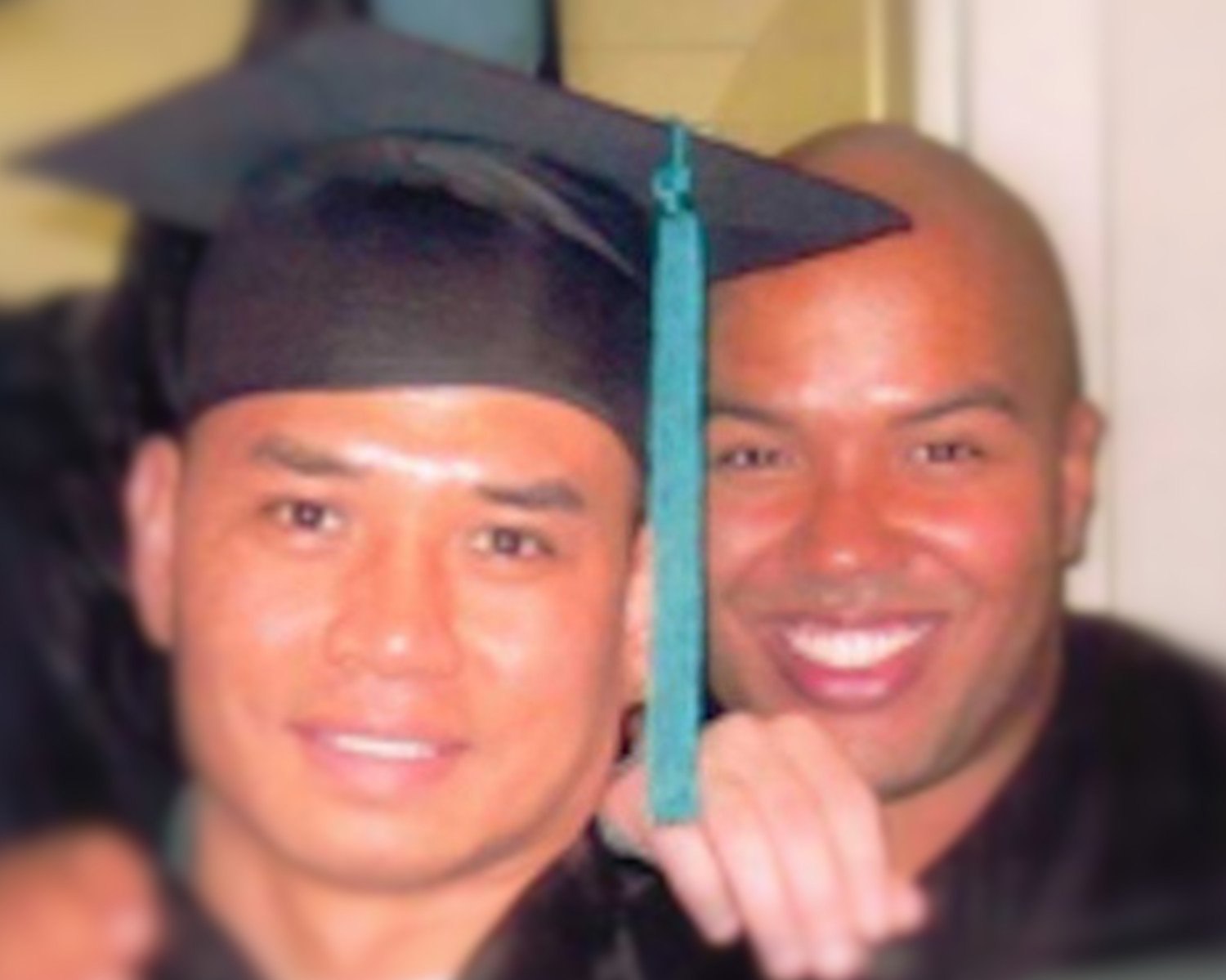
Overcoming many obstacles, Pornchai Moontri, Alberto Ramos, and seven other prisoners receive their high school diplomas in a model prison education program.
“The beginning of Wisdom is the most sincere desire to learn.”
— Wisdom of Solomon 6:17
In a recent post on Beyond These Stone Walls, I described some of what has gone terribly wrong with America’s enormous, ever-growing, and grossly expensive prison system. My post, “In the Absence of Fathers: A Story of Elephants and Men” made a crystal clear connection between the diminishment of fatherhood and the growth of prisons in Western Culture. It is especially evident in America which has more young men in prison than all 28 nations of the European Union combined.
In America, a dark cloud is rising in a dismal and growing trend to embrace the privatization of prisons for profit. Charles Dickens and George Orwell working together could not have conceived a more devious plan to keep young men in the dark wood of error away from any hope for a future, and then profit from that. The darkest tenet of prisons for profit is that they require their host states to guarantee that their prisons will remain at least 90% full.
In the midst of that debate, however, something is happening in the New Hampshire State Prison that has proven itself to be a lifeline for a growing number of young men determined to survive their own failures and emerge from the dark wood of error. Within these stone walls, this prison operates a special school district known as Granite State High School. The program grants both a GED high school equivalency and a far more arduous path for prisoner-students determined to prove themselves equal to the challenge: a fully accredited high school diploma earned course by course, credit by credit, over the course of several years.
In the world in which most of you live, a high school diploma is a necessary stepping stone. In this world, it is a milestone, and perhaps the most visible evidence of rehabilitation. To earn a high school diploma in prison, a prisoner must first expand his own boundaries, stake them out, reclaim his life and his mind from the many dark forces of prison life, and stand firmly on his own two feet in resisting a gang-culture vying every day for control over young minds in prison.
Against all this, a student in prison must go to school every day, complete homework every day, pass exams, write papers, and be a full-time student while living in the chaos of prison life. He must do this semester after semester, motivated by little more than the desire to learn and the hope that there is a world beyond prison in which education is a tool for building a better life. It is a goal that for many prisoners exists only on faith. There is no more effective measurement of the emergence of a man from the dark wood of error than the sheer drive required to overcome all these obstacles to earn a high school diploma in a prison environment.
Two people you know of — one of whom you will get to know better today — have done just that. Pornchai Moontri and his friend (and mine), Alberto Ramos, have completed high school in prison and will graduate this month. Pornchai needs no introduction to readers of Beyond These Stone Walls. His own story about the special challenges he faced was told in a riveting post, “Pornchai Moontri: Bangkok to Bangor, Survivor of the Night.”

A Man in Full
You have met Alberto Ramos as well. I mentioned him briefly in “Angelic Justice: Saint Michael the Archangel and the Scales of Hesed.” Alberto and I went to prison within a year of each other. The shocking part of this story is that Alberto went to prison at the age of 14. Alberto shot and killed a 19-year-old man in a drug and gang-related confrontation that spiraled out of control in a dark city alley in 1995. At the time, Alberto had already lived “on the streets” for two years since being thrown out of his single-parent home at age 12. At 14, Alberto was the youngest person in New Hampshire to be convicted of murder with an adult prison sentence — 30 years to life.
Because he was only 14, Alberto spent his first four years in solitary confinement. When he turned 18 in 1998, he was transferred to the New Hampshire State Prison. It was there, one year later, that Alberto and I first met. He was 19 years old, and had already been in prison for five years. No one can tell the story of Alberto’s life up to that point better than Alberto himself. He did just that in an essay he gave me two years ago, and which I have kept for all this time. I have his permission to publish it here with the same title he gave it:

Where Did My Inner Child Go?
By Alberto Luis Ramos
My story is one like the rest, but I will let you decide that for yourself. Both my parents were born and raised on the beautiful Caribbean island of Puerto Rico. As for myself, I am a first generation mainland American born in Philadelphia, PA, the birthplace of our nation. At the end of the day, I can honestly say I do not have a place I call home. We moved so many times that I even hate being asked, ‘So, where are you from?’ I would rather not be asked. I’m not from anywhere.
I only met my father once as a very young boy, and I have only a vague memory of him. He had other children with other mothers and I do not know my place in his family. It must have been last place. Today, I do not even know if he is still living.
I know what my mother looks like, but I do not know my mother at all. Some people think I became a man when my mother kicked me out of her home when I was 12. ‘It’s him or me,’ was the ultimatum her boyfriend gave her, and she needed him more than me. I was always running away from home anyway. This part of my life is nothing next to all the shit I’ve seen and heard.
Today I know that this is not when I became a man. Today I understand that the experience of being a boy alone on the street made me feel more like a child than ever, and today I know that all my anger and hostility just masked the fact that I was deeply hurt. My friend, Pornchai Moontri taught me this. Stripping away all the anger to get at the hurt was an ordeal, but we are friends because we traveled down the same road at the same time to face our hurt. I owe a lot to Pornchai.
I heard of a book once, Everything I Ever Needed to Know I Learned in Kindergarten. Well, everything I ever needed to know — or thought I needed to know — I learned on the streets. In a short time those streets took ownership of my life and took the place of my family and my home. By the age of 14 I wasn’t just in the gang culture of the streets. I was instructing my peers in the finer points of mere survival because I thought mere survival was all we can expect in this life. In my life on the streets, I settled for mere survival. I learned how to fight because I knew from instinct that kids on the street who know how to fight usually don’t have to fight. Violence was a daily reality in my life and world, and I could not escape from it. I could not be a child. I just didn’t know how.
Then one night I was in an alley. It was June 28, 1995. I had gone two days without sleep while getting high. I was 14 years old and had a confrontation with a 19-year old in this dark alley. Three shots fired and an order of carelessness, and two lives were destroyed. My act took his life, and hurt many other people.
I was 14 then. I am 32 now. The ensuing 18 years have been in adult prison, but that surely isn’t what defines being a man. I guess I cannot define when I became a man without naming the time I was a child. But that eludes me. I was never a child.

The Beginning of Wisdom
I remember vividly the day Alberto and I met. He was 19 years old and five years in prison when he asked to audit a class — Introduction to Psychology — that was available to prisoners in a short-lived prison college program through a local community college back in 1999 – 2001. Halfway through the semester, the instructor had to drop the course. Because I had a degree in that field, I was asked by the prison programs director to take the class for the remainder of the semester. I was a prisoner teaching other prisoners, and it was foreign territory to me. I walked into a class full of prisoners to talk about behavior modification with less than 60 minutes notice to prepare. I hadn’t even seen the textbook.
Sitting in the front row, middle seat of that cramped classroom sat Alberto Ramos who rather liked the previous instructor and rather resented the sudden change. He wore his prison uniform, but like many young men facing years in prison both behind and before them, he also wore rage, and suspicion, and skepticism, and loss, and defiance. He wore the streets that sent him here. But behind all that — to borrow a worn-out phrase — he wore the audacity of hope.
Seventy percent of the young men coming into prison do not have a high school diploma. It is a failure of societal proportions in an age of no child left behind. The difference an education can make in the life of a prisoner is massive. Study after study has shown that earning a high school diploma in prison cuts recidivism rates by up to 50%.
Having arrived at the beginning of wisdom, it is that which carried Alberto from the dark wood of error to the point of becoming a man. If he cannot define that moment, I can offer only this. Alberto Ramos became a man when he embraced a future beyond his past; when he gave up the stagnation of the present to look down that road less traveled; when he set out in that direction knowing not where it leads, but went there anyway.
This is why we must never give up hope for another human being. There are miracles before us, and now we have met two of them. Alberto Ramos and Pornchai Moontri are not just men, they are men who conquered the lowest depths, and climbed the highest peaks. Despite all, they are men in full.
And they are educated men with much to offer the world which must one day release them from all the prisons they have known to live in their true home: a place called freedom.
