“There are few authentic prophetic voices among us, guiding truth-seekers along the right path. Among them is Fr. Gordon MacRae, a mighty voice in the prison tradition of John the Baptist, Maximilian Kolbe, Alfred Delp, SJ, and Dietrich Bonhoeffer.”
— Deacon David Jones
Pornchai Moontri and the Things We Carry
Freedom from stone walls and iron bars brings no freedom from a prison of the mind. Pornchai Moontri now faces a tempest within and I still walk with him from afar.
Freedom from stone walls and iron bars brings no freedom from a prison of the mind. Pornchai Moontri now faces a tempest within and I still walk with him from afar.
September 9, 2026 by Father Gordon MacRae
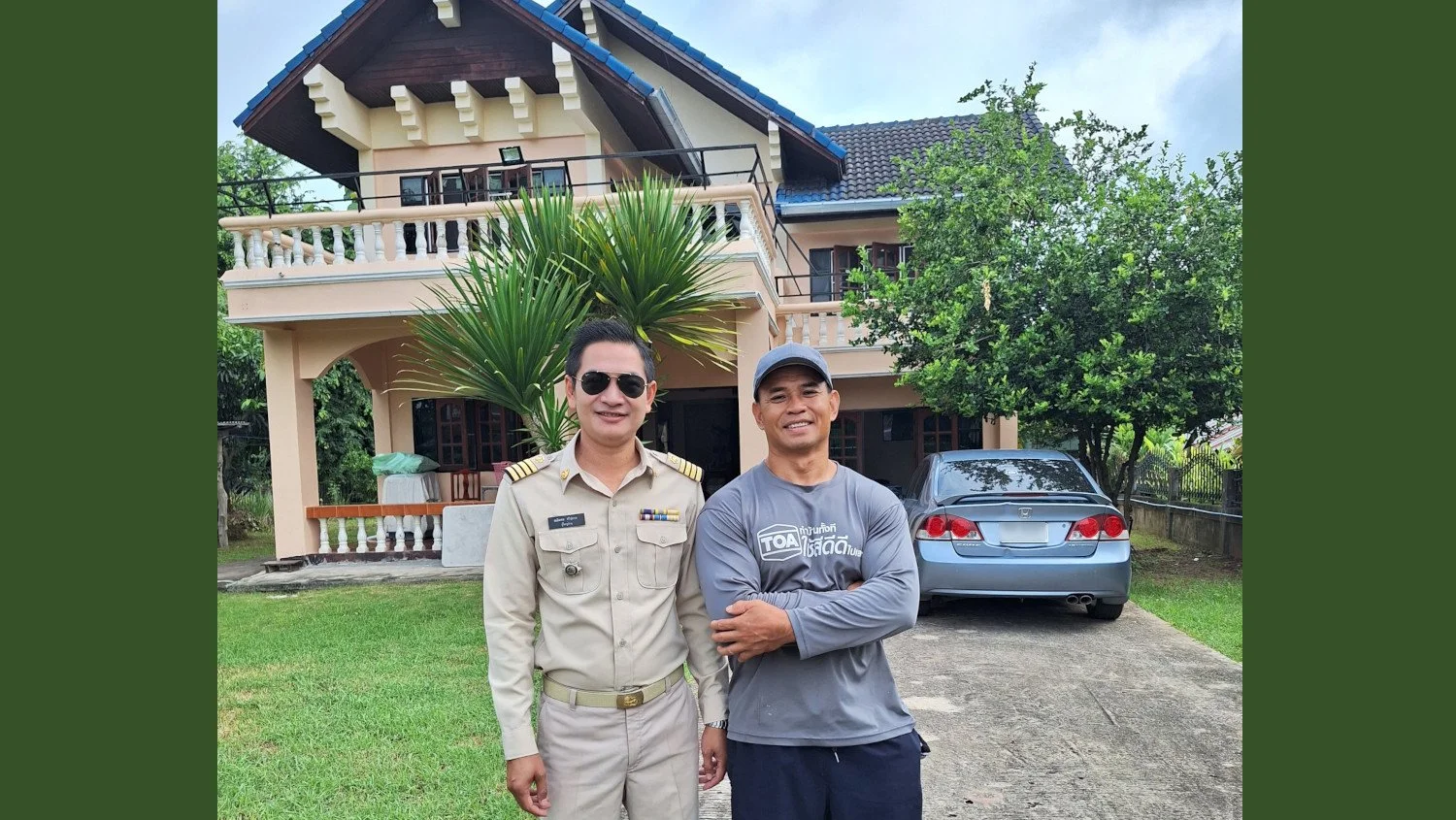
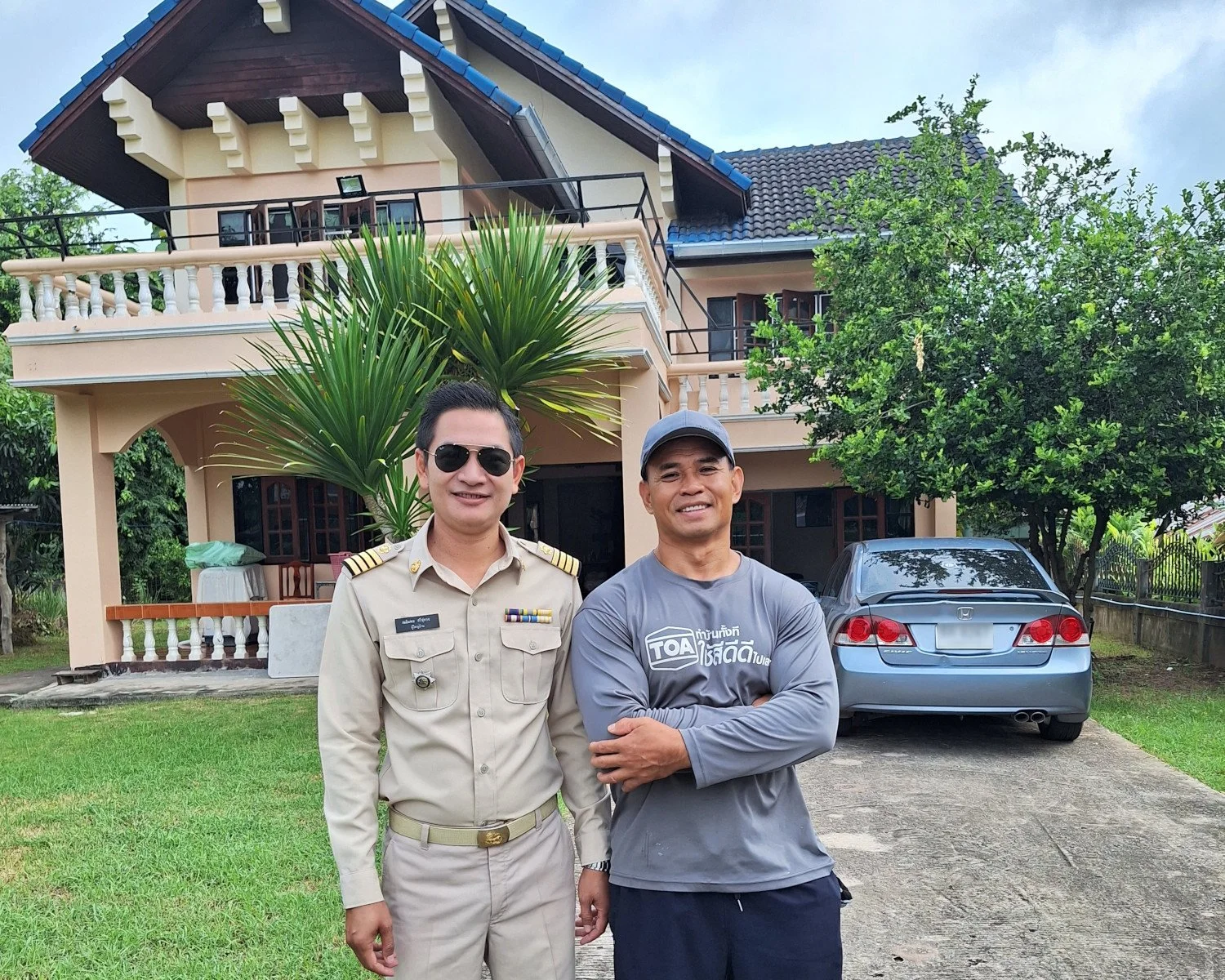
In the photo above, the military governor of the District of Phu Wiang, Thailand came to welcome Pornchai Moontri home as he prepares to recover and move into the home his mother, Wannee, had been building at the time of her death in April, 2000.
+ + +
The Wall Street Journal has been marketing a new bestseller called “The Birthday Book.” It features the Journal’s front pages from the day a gift recipient was born and every birthday hence up to the present time. On September 10, the day after this post is published, our friend, Pornchai “Max” Moontri, will turn 53 years of age. I was 53 when he and I first met in prison and landed in the same cell twenty years ago.
In 2009, three years after his arrival here after many years in solitary confinement in another prison, this blog began. Through an abundance of grace our lives became intertwined. It was Pornchai — who now prefers to be called “Max” for our Patron Saint — who proposed the name for this blog. Neither of us even knew then what a blog was. They did not exist when we last lived in the land of the free.
In 2007, Max learned with great trepidation that he would be deported to Thailand at the end of his long sentence. He had no one there, and he feared the darkness. I promised him that with this blog from our prison we could build a bridge to Thailand. Max wanted very much to believe that, but he scoffed. He does not scoff any longer.
In September 2020, this looming deportation into freedom happened, but life remains for Max a daily crucible of trials all connected to the trials that came before. Reading about The Wall Street Journal “Birthday Book,” I decided to take a deep dive into the time and place in which Pornchai first entered this world in the village of Phu Wiang (pronounced Poo Vee-ang) in the far northeast of Thailand in 1973. He is now in the process of relocating there, to the village of his birth. This move is out of desperation, actually, but I will get back to that hoping that perhaps someone may feel moved to help me help him.
Our readers may recall that Pornchai was born in Phu Wiang, Thailand in 1973, but in 1975, at the age of two, he and his four-year-old brother Priwan were abandoned there by their mother, Wannee Laporn, who was then barely 19 years old. I at first found it difficult not to form a harsh and spontaneous judgment of Wannee for such an abandonment. That changed when I understood the setting and context into which Wannee gave them life and then left them in such a vulnerable state.
In 1973, after thirteen months of military rule, Thailand’s government collapsed. After having been one of the world’s leading rice-exporting nations — the staple food of the world’s poor — food production in Thailand, especially in the rural north, became severely challenged. As a matter of self-preservation, Thailand’s interim government adopted a law banning non-Thais from being employed in Thailand. This had serious repercussions for the economy and the distribution of food access as throngs of refugees fled into Thailand from the war raging in Vietnam.
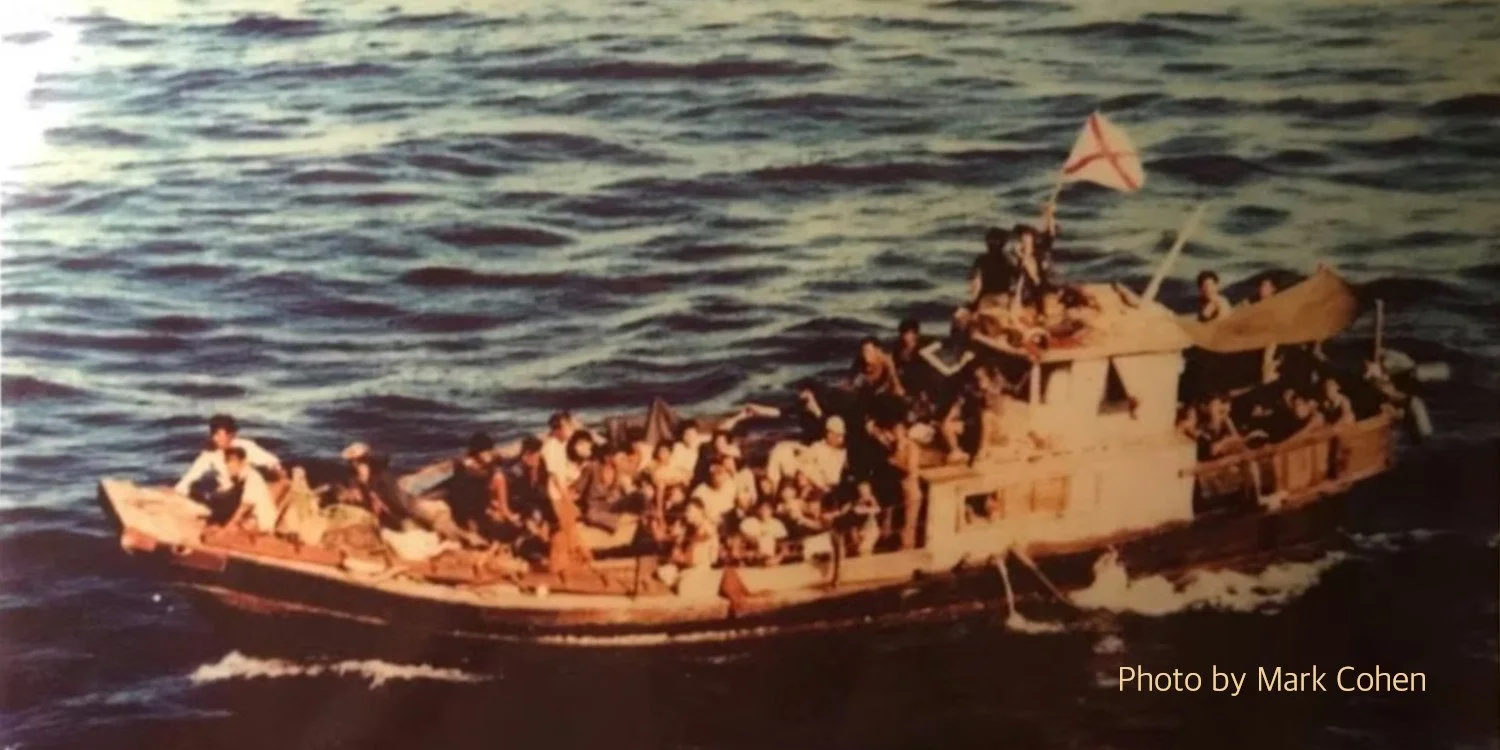
When Priwan was two years old, and while Wannee was still carrying Pornchai, she and they were abandoned by her husband. He was a Muay Thai martial arts fighter who earned a scant living traveling village to village for bouts. When he did not return, Wannee was left even more impoverished and unable to care for her sons. There was no social safety net. Then, in 1975 when Pornchai was two years old, the Fall of Saigon ended the war in Vietnam and brought thousands upon thousands of refugees fleeing into Thailand from Vietnam. Many refugees died.
Among the refugees fleeing from the victorious Viet Cong then was a 15-year-old boy who became one of the well-known Vietnamese “Boat People.” He would later also become an important figure in our lives as Father John Hung Le, SVD, a missionary priest of the Society of the Divine Word in Thailand. While following my writing at Beyond These Stone Walls, Father John became a good friend to me and to Max. He gave Max shelter upon his deportation from the United States in September 2020.
Back to the dilemma of Wannee, she was impoverished and alone with two starving children in 1975. She decided in despair to leave them to seek work elsewhere to support her sons from afar. She hoped her extended family would care for them. Wannee, in a fragile state herself, labored on a Bangkok road crew carrying huge buckets of cement on a pole for the equivalent of 50 cents per day. Back in Phu Wiang, Pornchai was hospitalized for malnutrition. Throughout his young life, food scarcity and access were a critical and common theme. It was not an auspicious beginning in life.
I much later realized in hindsight that in that same period, I was living comfortably as a college student, well fed, and with few worries beyond my grades. I have since done penance for my past misguided judgment of Wannee.
After the Fall of Saigon
In Vietnam in 1975, city after city and province after province fell into Communist hands. It was not so much a conquering on their part as it was another abandonment. Two years after a 1973 cease fire agreement, Thailand stood entirely alone as the sole democracy among a gathering of communist Southeast Asian nations. Thailand’s long-standing alliance with the United States deteriorated rapidly as a result of communist advances in Vietnam and Cambodia. It was a very scary time for a young woman alone with two small children. Wannee left with a desperate hope that her extended family would shelter them.
In late spring of 1975, the U.S. began to abandon its Thai bases as it withdrew all U.S. troops from Vietnam. Both the U.S. military presence and economic assistance were drastically reduced. Student demonstrators rampaged in Bangkok as South Vietnam unconditionally surrendered to the Viet Cong. In Saigon, a policeman put his pistol to his head and fired. Waves of despair were evident everywhere as waves of U.S. marines and Navy personnel crowded onto the Embassy rooftops awaiting helicopters for a final evacuation of 6,400 troops to a 40-vessel armada anchored just off the coast. I wrote of one of these Navy personnel who refused to leave in “For Fr. John Tabor, the Path to Priesthood Was War.”
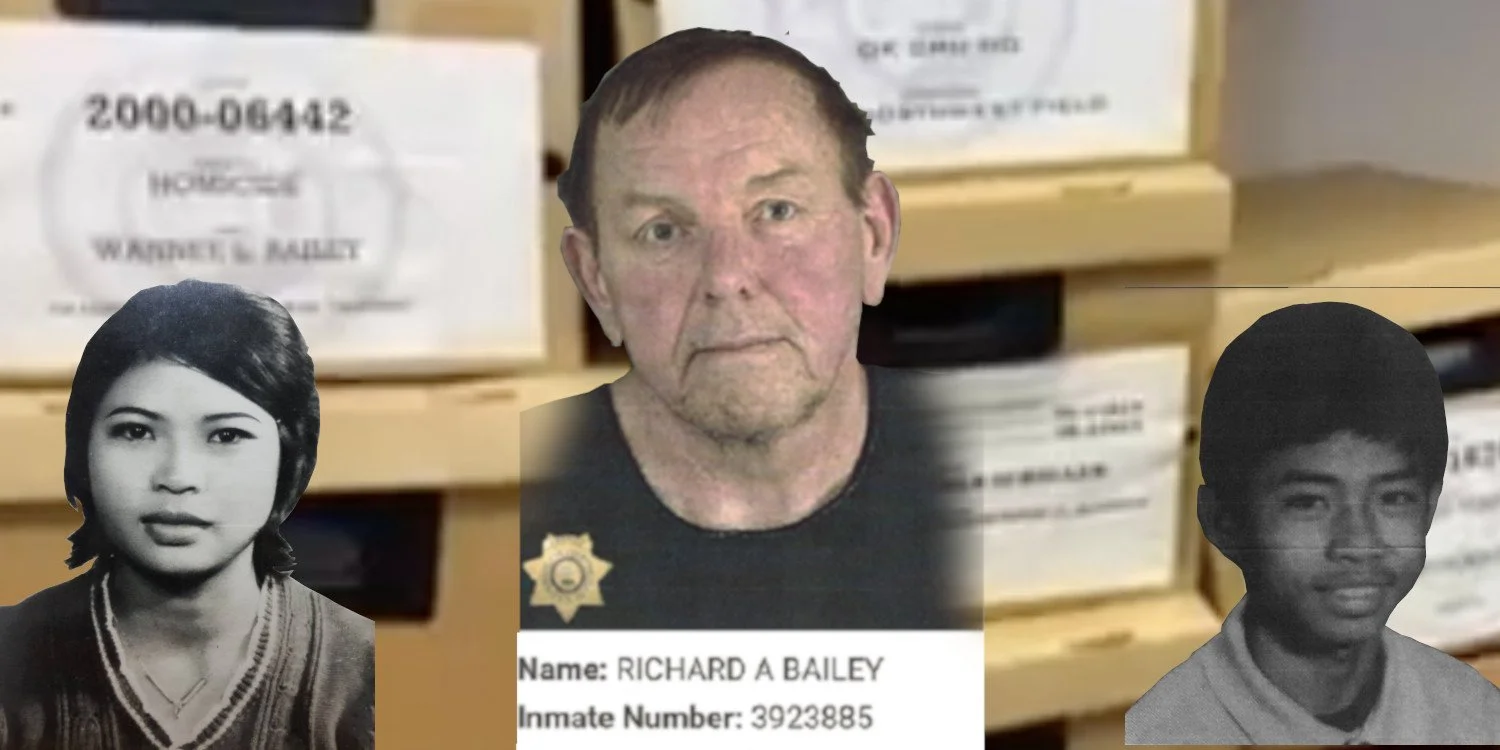
But also among those entering Thailand from Vietnam was someone Wannee and then later her sons would have the misfortune of ever coming to know. Richard Alan Bailey was a civilian helicopter pilot in Vietnam profiting from the last days of the war. He became a frequent visitor to Thailand exploiting various opportunities one of which was his quest for the servitude of a needy Thai wife. Somewhere, somehow, he encountered Wannee in 1978 and married her in Bangkok in 1980.
Wannee’s inability to return to her two sons in the far north of Thailand was not a personal choice, but it was to be the death of her. I wrote of Richard Alan Bailey and his dark, ominous and ongoing presence in this story in “Getting Away with Murder on the Island of Guam.” When Wannee threatened to go to authorities to report Bailey’s abuse of Pornchai and Priwan she was murdered.
The Heavy Baggage of a Stolen Life
We will link again to the above post and its sequel at the end of this one. The content they present would not be the usual for a WSJ “Birthday Book.” Not everyone has the lyrics of happy thoughts with which they can compose a Birthday Book.
Pornchai arrived in my cell in 2006, a broken, angry, and hostile young man. But as most readers know by now, that was all masking something else. The next four years were a daily battle of wills. On Divine Mercy Sunday in 2010, four years after his forced transfer from Maine’s “Supermax” prison, Pornchai converted to Catholicism and embraced Divine Mercy. In 2007, as mentioned earlier, we learned of his pending future deportation to Thailand, but he coped knowing that he no longer faced it alone.
As trust grew between us — and between Pornchai and Jesus Christ — Max told me of all the dark corners of his life that he carried with him. I convinced him that none of this evil was of his making nor was it his to keep. It took time to build Max up for this, but in 2018, with the help of Clare Farr, an attorney in Australia, we brought Richard Alan Bailey to justice. He was found guilty of 40 felony charges of gross sexual abuse in the State of Maine.
Then the lights came on in Maine. I filed petitions revealing the connections between Pornchai’s original offense and the terror that had been inflicted upon him between the ages of 12 and 15 under Richard Bailey’s “care.” Maine officials then reduced some of Pornchai’s sentence, which in short order handed him over to ICE custody on September 10, 2020, to await deportation. After nearly 16 years as my roommate, that was the last time I saw Pornchai Moontri. We stood in the predawn dark at the gates of our prison, with us on the inside and ICE agents on the outside. Max turned to me and said, “Thank you for my freedom. Thank you for my future.” After the gates closed, I went to my cell and wept.
The contacts we had built on the outside suddenly seemed vastly important to us. I had no way to call Max in ICE detention in a Louisiana ICE facility where he was held, and he had no way to call me. But our mutual friend, the late Claire Dion expressed to me her concern that if Pornchai cannot speak to me, “he will not make it.” So she devised a plan using two cell phones, her own and her husband’s. Max would call into one at a specified time and I would call into the other at the same time. It was not perfect, but it was a necessity and it got Max through all the discouragement and despair that comes with ICE detention.
Six months later, after a long grueling stay in an overcrowded ICE facility in Louisiana during a pandemic, we got word that on the next day Max would board a flight to Thailand with two ICE agents. On board the long flight, heading for a long layover in South Korea and before going on to Bangkok, the two ICE agents where nudging each other while looking at their phones. I learned later that they were reading posts I wrote about Pornchai’s life. Then they put away their phones and removed his shackles. They treated him with exemplary kindness. Pornchai suddenly felt free.
Now, six years later from the opposite side of the world, I still walk with Max. I still chip away at the heavy burdens he carries. Thanks to the kindness of our readers and their concern for us, Max and I can still speak daily by telephone, which has proven to be a necessity.
Finding work in Thailand was a great but discouraging task. I have been supporting Max with basic necessities since his arrival there. For a few years he lived on a property in Pak Chong in the middle of the country where he landscaped and helped manage the owner’s properties, but for no pay. He earned room and board only. Then about a year ago, he became homeless for a time living in a small rented room in Pattaya, which I paid for. Pattaya was known as the seamier side of Thailand. He attended Mass there at Saint Nicholas Church. Though Thailand is about 98 percent Theravada Buddhist, Max managed to find at least a small Catholic chapel everywhere he went.
The war in Iran has had a global impact on fuel prices. Our BTSW Editor, Dilia E. Rodriguez, found and purchased a pre-owned hybrid vehicle in Thailand for Max. He learned to drive there, which is fortunate because the steering wheel is on the wrong side of the car. This changed his day-to-day existence considerably. This past summer, Max obtained work as a translator for the Asian Oasis resort near Chiang Mai, Thailand serving a mostly European clientele. He did well there, and was an asset, but the long hours and loneliness worked against him. Meanwhile, Max’s main support in Thailand, Father John Hung Le, SVD, has been stranded in Myanmar and Vietnam because his visa was not renewed in Thailand. Missionary priests throughout the world are facing this same problem. His very important refugee assistance project also lost most of its funding due to cuts in USAID. Our politics have wide ranging repercussions around the world. I continue to be in contact with Father John.
Prospects for employment for Max were still dismal. He competes with thousands of family wage earners for a very limited number of jobs. So I felt his only real opportunity going forward was to start a small business. He wanted to remain in Phu Wiang, which is far removed from the noise and haste of Bangkok. One of our readers who asked not to be identified sent me a gift of $3,500. I remember the old adage: “If you give a man a fish he will eat for a day. If you teach a man to fish, he will eat for a lifetime.” I used the money to purchase three acres of good farmland near Phu Wiang for Max to begin farming. He is most interested in a poultry farm. I have been researching this and he is going to be enrolled in a semester of learning about how to begin. He is going to need help to get started. I just read that the world’s first poultry farm existed 8,000 years ago very near to what is now Phu Wiang, Thailand.
At the same time, Max is moving into the house his mother was having built for him. It is the house featured at the very top of this post. Max is painfully aware that his mother’s desire to finish this house cost her her life on the Island of Guam as she was liberating herself from Richard Alan Bailey in 2000. The outside of the house, which has been dormant for 26 years, is quite nice. The inside is nowhere near finished.
Max has now come full circle returning to the place of his birth, where he will start life over again. He is volunteering to help take care of a small Catholic chapel there, Saint Joseph Church, named for the Guardian of the Redeemer and Fatherhood Redeemed.
Max and I thank you for being here with us at this turning of the tide.
+ + +
HOW TO HELP US: For nearly 20 years I have been committed to assisting Pornchai Moontri in navigating the trials and losses of his life, none of which were of his own making. I have done all in my power to promote an honest and thorough investigation into the unresolved, “cold-case” homicide of Pornchai’s mother, Wannee.
For six years since his arrival in Thailand Max has been struggling in a nation in economic and political chaos. Promising developments are currently underway. Max will now be living in the house his mother set out to build 26 years ago. He has the skills and will soon have the tools to finish it. He also has a solid plan to start a new agricultural business in Northern Thailand so he will not be dependent on the state of the local economy. This will be dependent upon my support, and I hope that can transition into “our” support.
Our BTSW Editor, Dilia E. Rodriguez, has established an account for my expenses in the support of this blog at Navy Federal Credit Union. Dilia also has the ability for direct funds transfers to assist both Pornchai Moontri in his new endeavor and Father John Hung Le, SVD, and his Refugee Assistance Project, which aids 2,000 Vietnamese families in Thailand with basic food support.
If you wish to assist me, and you do so by check, make it out to Dilia E. Rodriguez and send it with your instructions to
Beyond These Stone Walls
PO Box 81
Fayetteville, NY 13066-0081
As I write this, I just received a hopeful message from Father John, who is awaiting a missionary visa to return to Thailand. It will take three to four months. The cost of the visa will be 15,000 Thai Baht, which translates to $500 USD. I have already provided it with the help from some readers.
+ + +
Thank you for reading and sharing this post. For a fuller understanding of this story, please see the following:
An AI Analysis of Getting Away with Murder on the Island of Guam
A Catholic League White House Plea Set Pornchai Moontri Free



The Eucharistic Adoration Chapel established by Saint Maximilian Kolbe was inaugurated at the outbreak of World War II. It was restored as a Chapel of Adoration in September, 2018, the commemoration of the date that the war began. It is now part of the World Center of Prayer for Peace. The live internet feed of the Adoration Chapel at Niepokalanow — sponsored by EWTN — was established just a few weeks before we discovered it and began to include in at Beyond These Stone Walls. Click “Watch on YouTube” in the lower left corner to see how many people around the world are present there with you. The number appears below the symbol for EWTN.
Click or tap here to proceed to the Adoration Chapel.
The following is a translation from the Polish in the image above: “Eighth Star in the Crown of Mary Queen of Peace” “Chapel of Perpetual Adoration of the Blessed Sacrament at Niepokalanow. World Center of Prayer for Peace.” “On September 1, 2018, the World Center of Prayer for Peace in Niepokalanow was opened. It would be difficult to find a more expressive reference to the need for constant prayer for peace than the anniversary of the outbreak of World War II.”
For the Catholic theology behind this image, visit my post, “The Ark of the Covenant and the Mother of God.”

The Shawshank Redemption and Its Grace Rebounding
Readers are struck by the fascination with this fictional prison from the mind and pen of Stephen King, while the real thing seems to resist any public concern.

Readers are struck by the fascination with this fictional prison from the mind and pen of Stephen King, while the real thing seems to resist any public concern.
July 2, 2025 by Father Gordon MacRae
The Shawshank Redemption was released in theatres just as I was led off to prison in September, 1994. Andy Dufresne and I went to prison in the same week, he at the fictional Shawshank State Prison set in Maine, and me one state over at the far more real New Hampshire State Prison in Concord.
In the years to follow its release, The Shawshank Redemption became one of American television’s great “Second Acts,” theatrical films that have endured far better on the small screen than they did in their first life at the cinema box office. The Shawshank Redemption is today one of the most replayed films in television history.
I’ve always been struck by the world’s fascination with this fictional prison that first emerged from the mind and pen of Stephen King. The real thing seems to resist most serious public concern.
Several years passed before I got to see The Shawshank Redemption. When I finally did, I could never forget that scene as new arrival, Andy Dufresne (Tim Robbins) stood naked in a shower, arms outstretched, to be unceremoniously doused with a delousing agent. It seemed the moment that human dignity was officially checked at the prison door.
The scene triggered a not-so-fond memory of my own arrival in prison coinciding with that of Andy Dufresne in September 1994. Andy Dufresne and I had a lot in common. We both came to that day of delousing with a life sentence, and no real hope of ever seeing freedom again. Upon arrival we both endured jeers from in-house consumers of the local news.
For my part, the rebuke was for my very public refusal to accept one of several proffered “plea deals.” This is about prison, however, and not justice or its absence, but the two are so inseparable in my imprisoned psyche that I cannot write without a mention of this elephant in my cell.
I refused a “plea deal,” proffered in writing, to serve no more than one to three years in exchange for a plea of guilty. Then I refused another, reduced to one-to-two years. I would have been released by 1997 had I taken that deal, but for reasons of my own, I could not. Even today, I could cut my sentence substantially if I would just go along with the required narrative, but alas … .
Andy and I also shared in common a misplaced hope that justice always works out in the end, and a nagging, never-relenting sense that we don’t quite fit in at the place to which it has sent us. This could never be home. Andy got out eventually, though I should not dwell too much on how. After thirty years, I am still here.
I was in my twenties when my fictitious crimes were alleged to have been committed. I was 41 when tried and sent to prison. For my audacity of hope for justice working, I was sentenced by the Honorable Arthur Brennan to consecutive terms more than 30 times the State’s proffered deal: a prison term with a total of 67 years for crimes that never actually took place. I am 72 at this writing and will be 108 when I next see freedom, if there is no other avenue to justice.

Dostoyevsky in Prison
As overtly tough as the Shawshank Prison appeared to movie viewers, Andy had one luxury for which I have always envied him. It was something unheard of in any New Hampshire prison. He had his own cell, and a modicum of solitude. Stephen King’s cinematic prison where Andy was a guest of the State of Maine was set in the 1950s and everyone within it had his own assigned cell.
Prison had changed a lot since then, even prisons in quaint New England landscapes where most other change is measured in small increments. In the decade before my 1994 delousing, prison in New Hampshire underwent a radical change. It was mostly due to the early 1980s passage of a knee-jerk New Hampshire law called “Truth in Sentencing.” Once passed, prisoners serving 66% of their sentence before being eligible for parole were now required to serve 100%. The new law was championed by a single New Hampshire legislator who then became chairperson of the state parole board.
Truth in Sentencing is another elephant roaming the New Hampshire cellblocks, and no snapshot of life in this prison can justly omit it. Truth in Sentencing changed the landscape of both time and space in prison. The wrongfully convicted, the thoroughly rehabilitated, the unrepentant sociopath all faced the same sentence structure: There is no way out.
In the years after its passage, medium security prison cells built for one prisoner were required to house two. Then a new medium security building called the Hancock Unit was constructed on the Concord prison grounds with cells built to house four prisoners each. A few years later, bunks were added and those four-man cells were now required to house six.
When I arrived in Hancock in early 1995, I carried my meager belongings up several flights of stairs, and then had to carry up my bunk as well. The four-man cells, having increased to six, were now to house eight. The look of resentment on my new cellmates’ faces was disheartening as I dragged a heavy steel bunk into their already crowded space.
Over the years I was moved from one eight-man cell to another, in each place adjusting to life with seven other strangers in a space meant for four. Generally, this was considered “temporary housing” for those who would move on to better living conditions after a year or two. I was there for 23 years, the price for maintaining my innocence.
I remember reading once about the great Russian novelist, Fyodor Dostoyevsky. Reflecting on his time in a Siberian prison, Dostoyevsky lamented, though I’m paraphrasing from memory:
"Above all else, I was entirely unprepared for the reality, the utter spiritual devastation, of day after day, for year upon year, of never, ever, ever, not for a single moment, being alone with myself."
Viewers of The Shawshank Redemption always react to the prison brutality depicted in the film. Some of that has always been present in the background of prison life, and there is no adjusting to it.
The most painful deprivation in any prison, however, is the absence of trust. That most basic foundation of human relating is crippled from the start in prison. But the longer term emotional toll is more subtle. The total absence of solitude and privacy is just as Dostoyevsky described it.
Imagine taking a long walk away from home, far beyond your comfort zone. Invite the first seven people you meet to come home with you. Now lock yourself in your bathroom with them, and come to terms with the fact that this is how you will be living for the unforeseen future.
In 2017, twenty-three years after my arrival in prison, I was finally able to move to a unit within the prison that housed two men per cell. It felt strange at first. Twenty-three years in the total absence of solitude had exacted a psychological toll. Just sitting on my bunk without seven other men in my field of view required some internal adjustment to adapt.
Then dozens of bunks were added to the dayrooms and recreation areas. Then space used for rehabilitation programs was converted to dormitories for the ever-growing overflow of prisoners. Confinement-sans-solitude crept like a virulent plague in the prodigious hills of New Hampshire.

Prison Dreams
There is, however, another perspective on this story about life in the absence of solitude. Also, like Andy Dufresne, I found friendship in prison, one that was the mirror image of Andy’s friendship with Red, portrayed in the film version of Stephen King’s story by the great Morgan Freeman. Friends and trust are both rare commodities in prison. But like shoots growing from cracks in the urban concrete, the human need for companions defeats all obstacles. Bonds of connection in this place happen on their own terms.
My friend, Pornchai Moontri had a very different prison experience from mine. He went to prison at age 18, in the State of Maine, and the very prison in which Stephen King’s story was set. In the years in which I was deprived of solitude in a small space with seven other men, Pornchai was a prisoner in the neighboring state where he spent most of those years in the utter cruelty of solitary confinement in a “supermax” prison.
Pornchai was brought to the United States from Thailand at the age of eleven, a victim of human trafficking. He became homeless in Bangor, Maine at age thirteen, and at 18 he was sent to prison. Pornchai is now 52 years old and he resides in his native Thailand, having spent well over 60% of his life in prison. This man once deemed unfit for the presence of other humans in Maine turned his life around with amazing results in New Hampshire.
Thrown together after my years in deprivation of solitude and Pornchai’s equal stint in solitary confinement, we lived with polar opposite prison anxieties. As the years passed in the 60 square feet in which we then dwelled, Pornchai graduated from high school, completed two post-secondary diplomas with highest honors, pursued dozens of programs in restorative justice, violence prevention, and mediation, and had a radical and celebrated Catholic conversion chronicled in the book Loved, Lost, Found by Felix Carroll (Marian Press 2013).
Pornchai Moontri then served as a mentor and tutor for other prisoners, wielding immense influence while helping to mend broken lives and misplaced dreams. The restoration of Pornchai has inspired others, and stands as a monument to the great tragedy of what is lost when strained budgets and overcrowding transform prison from a house of restorative justice into a warehouse of nothing more redemptive than mere punishment.
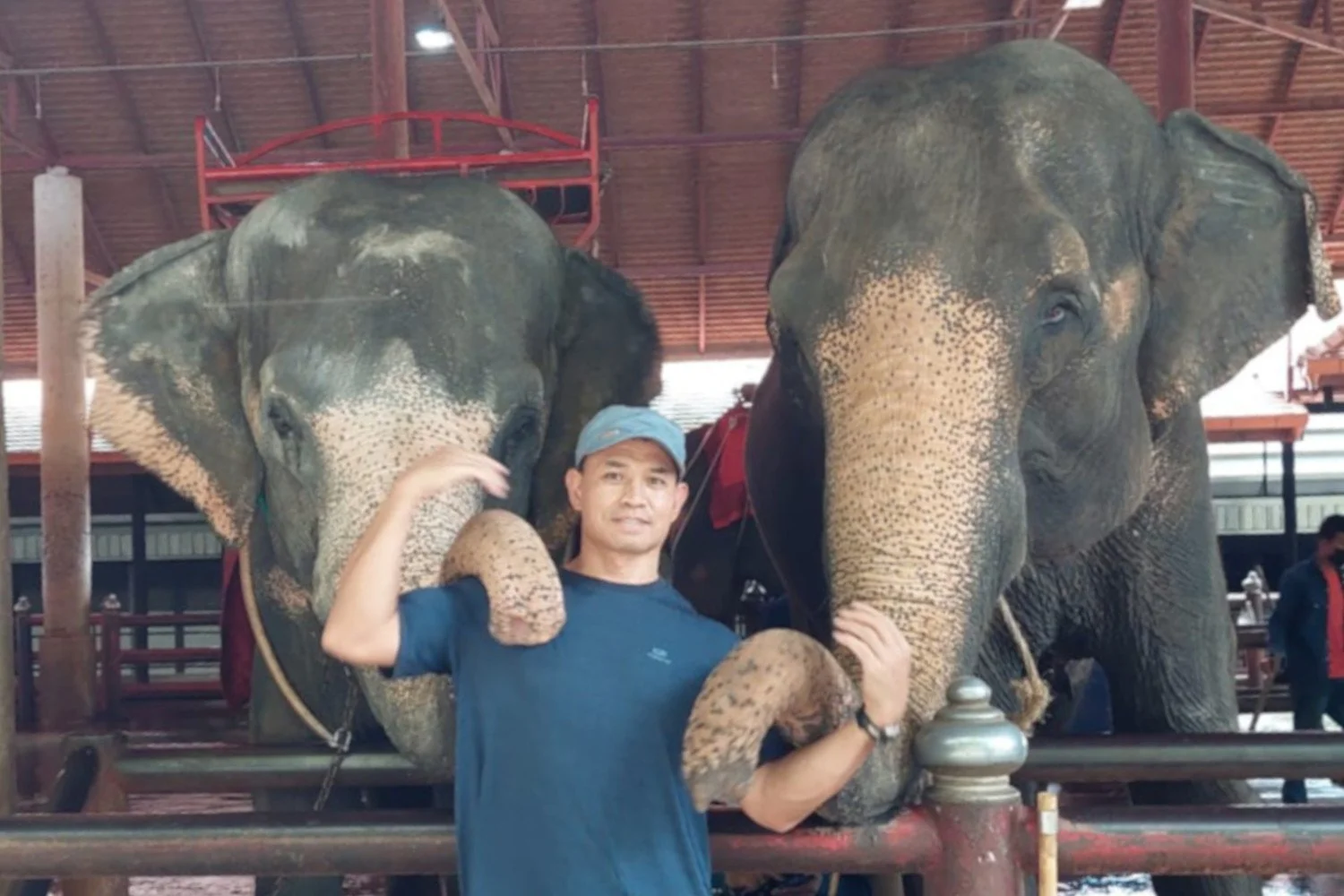
When Pornchai was twelve years old, a year before becoming a homeless teen in Bangor, Maine, he had a paper route. It is an ironic twist of fate that at just about the time Andy Dufresne and Red, sprang from the mind and pen of Stephen King, Pornchai was delivering the Bangor Daily News to his home.
Reflecting back on the reconstruction of his life against daunting obstacles, Pornchai once told me, “I woke up one day with a future, when up to now all I ever had was a past.” In the years to follow Pornchai’s transformation, he finally emerged from prison after 30 years to face deportation to Thailand, the place from which he had been taken at age 11. I wrote about this transformation, both for him and for me, in “Pornchai Moontri and the Long Road to Freedom.”
Pornchai emerged from a plane in Bangkok, unshackled after a 24-hour flight to begin a life that he was starting over in what for him was as a stranger in a strange land. He handed his future over to Divine Mercy and now, five years after his arrival in Thailand, he is home, and he is free in nearly every sense of those words.
In The Shawshank Redemption, the innocent prisoner Andy Dusfresne escaped from his cage decades after entering it. He had written to his friend Red about the hopes of one day joining him in freedom. Red had no way to conceive that as even possible.
Like Morgan Freeman’s character, Red, I revel in the very thought of my friend’s freedom, even into the dense fog of a future we cannot see. We both dream of my joining him there in freedom one day. It’s only a dream, and by their very nature, dreams defy reality.
But I cannot help remembering those final words that Stephen King gave to Andy Dufresne’s friend, Red, as he finally emerged from Shawshank. We cling to those words as we cling to the preservation of life itself, while otherwise adrift on a tumultuous and never-ending sea:
I am so excited I can hardly hold the pen in my trembling hand. I think it is the excitement that only a free man can feel, a free man starting a long journey whose conclusion is uncertain.
I hope Andy is down there.
I hope I can make it across the border.
I hope to see my friend and shake his hand.
I hope the Pacific is as blue as it has been in my dreams.
I hope.
+ + +
Note from Father Gordon MacRae: Authors generally prefer their own writing to any screenplay that transforms it into a movie. In an interview, Stephen King said that the film version of The Shawshank Redemption had the opposite effect: “The story had heart. The movie has more.” I have always been grateful to Mr. King for writing that story for Pornchai Max and I were unwitting characters within it, and our own character was somehow shaped by it. There is more to this story in the following posts from Beyond These Stone Walls:
The Parable of the Prisoner by Michael Brandon
For Pornchai Moontri, A Miracle Unfolds in Thailand
The Eucharistic Adoration Chapel established by Saint Maximilian Kolbe was inaugurated at the outbreak of World War II. It was restored as a Chapel of Adoration in September, 2018, the commemoration of the date that the war began. It is now part of the World Center of Prayer for Peace. The live internet feed of the Adoration Chapel at Niepokalanow — sponsored by EWTN — was established just a few weeks before we discovered it and began to include in at Beyond These Stone Walls. Click “Watch on YouTube” in the lower left corner to see how many people around the world are present there with you. The number appears below the symbol for EWTN.
Click or tap here to proceed to the Adoration Chapel.
The following is a translation from the Polish in the image above: “Eighth Star in the Crown of Mary Queen of Peace” “Chapel of Perpetual Adoration of the Blessed Sacrament at Niepokalanow. World Center of Prayer for Peace.” “On September 1, 2018, the World Center of Prayer for Peace in Niepokalanow was opened. It would be difficult to find a more expressive reference to the need for constant prayer for peace than the anniversary of the outbreak of World War II.”
For the Catholic theology behind this image, visit my post, “The Ark of the Covenant and the Mother of God.”