“There are few authentic prophetic voices among us, guiding truth-seekers along the right path. Among them is Fr. Gordon MacRae, a mighty voice in the prison tradition of John the Baptist, Maximilian Kolbe, Alfred Delp, SJ, and Dietrich Bonhoeffer.”
— Deacon David Jones

The Annunciation: When the Dawn from On High Broke Upon Us
The Gospel of Saint Luke opens with a news flash from the Archangel Gabriel for Zechariah the priest, and Mary — Theotokos — the new Ark of the Covenant.
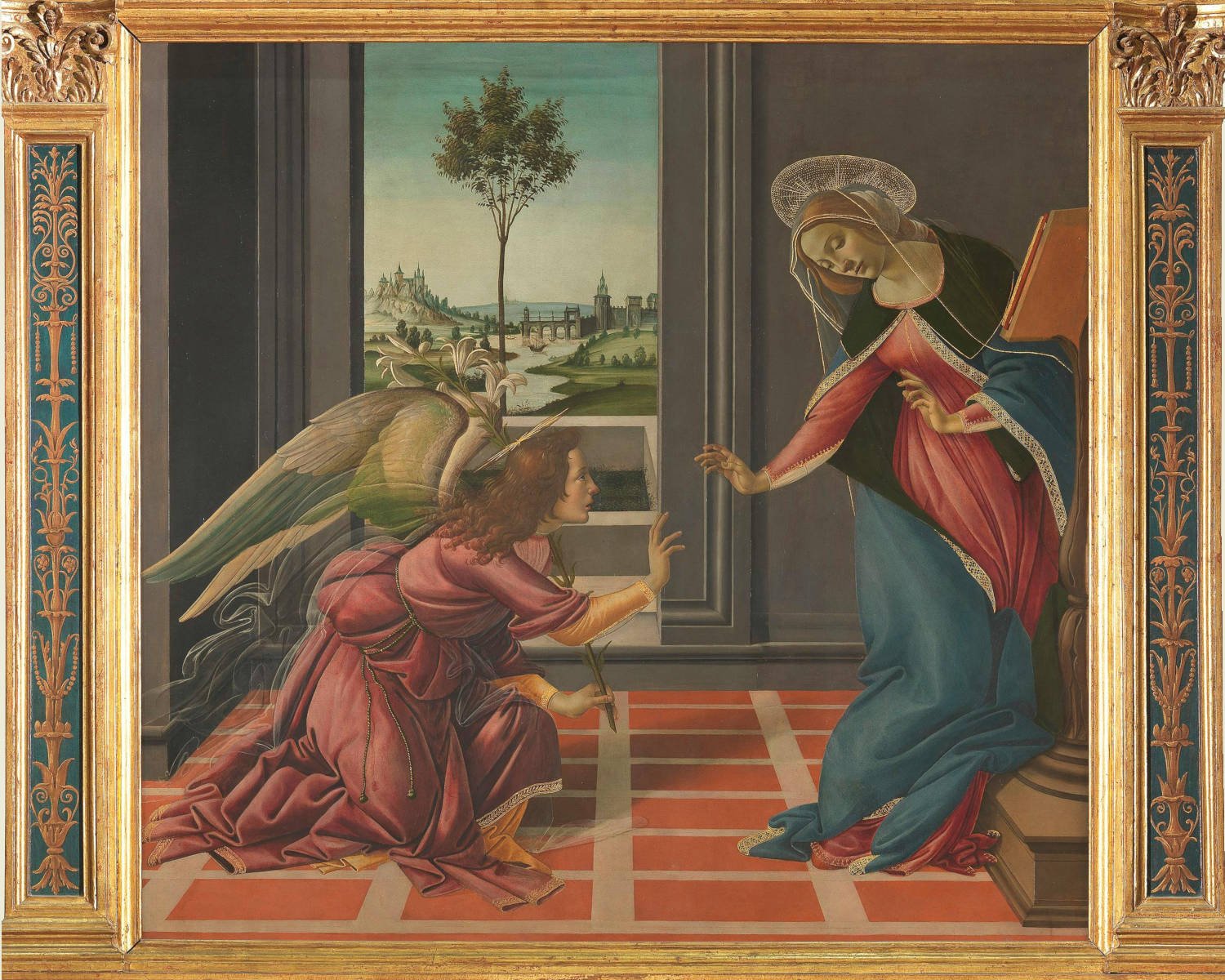
The Gospel of Saint Luke opens with a news flash from the Archangel Gabriel for Zechariah the priest, and Mary — Theotokos — the new Ark of the Covenant.
March 25, Solemnity of the Annunciation
On the 25th day of March, the Church remembers the Annunciation of the Angel Gabriel to Mary marking a pivotal event in Salvation History. The account is conveyed to us in the first chapter of the Gospel According to Saint Luke, a Gentile physician and a companion of the Apostle Paul. Several of the Fathers of the Early Church attribute the Third Gospel to Saint Luke and affirm his authorship of it. I once wrote of this unique Gospel in “Saint Luke the Evangelist, Dear and Glorious Physician.”
This Gospel reveals many facets of the life and mission of Jesus, but foremost among them is its universal message of Salvation. Luke, despite being a Gentile, anchors his Gospel in the traditions of the earlier Covenant, the Old Testament, portraying Jesus as the Savior and Redeemer of God’s Old Covenant people. He thus presents Jesus in history as one foretold by the Prophets (Isaiah 11:10-12, 49:6, and Ezekiel 39:25-29). Luke thus depicts Jesus as the Royal Messiah in the line and legacy of King David to reunite the scattered tribes of Israel and gather them into one nation. Given that he is the only Gentile Evangelist, that is an amazing feat through which Luke has prepared an artistic and spiritual masterpiece.
Saint Luke alone among the Evangelists recounts for us the Parable of the Good Samaritan (10:25-37), the Parable of the Prodigal Son (15:11-32), the Magnificat of Mary (1:46-55), the Benedictus of Zechariah (1:68-79), the Nunc Dimittis of Simeon (2:29-35), the Angelic Gloria (2:14) sung by the Angels on Christmas Night and in our liturgy to this day. And Luke is the sole source of the account that begins our story of Salvation: the Archangel Gabriel’s Annunciation to Mary.
No one really knows when or why tradition first places the Birth of Christ on December 25th, but the custom is ancient and it has a lot to do with the Annunciation, which also ties it into the events of Holy Week.
The first recorded mention of December 25 as the date of observance of the Feast of the Nativity was in a Roman document called the Philocalian Calendar dated as early as 336 A.D. Popular observance of the December 25 date of the Nativity, however, was at least a century older.
One obscure theory points to an early Roman Empire legend that great men are fated to die on the same date they were conceived. One tradition traced the date of Passover at or near March 25 in the year Jesus of Nazareth was crucified. If thus among some Romans it became popular belief that he was conceived on that date, then nine months to the day later would be December 25. However, it is impossible today to discern which came first, our belief in the December 25 date for the Birth of Jesus, or our belief in the March 25 date of his Crucifixion and therefore the Annunciation.

Spiritual Battle on a Cosmic Scale
The angels of TV-land usually worked out solutions to the drama of being human within each episode’s allotted sixty minutes. That’s not so with the angels of Scripture. Most came not with a quick fix to human madness, but with a message for coping, for giving hope, for assuring a believer, or, in the case of the Angel of the Annunciation, for announcing some really big news on a cosmic scale — like Salvation! What the angels of Scripture do and say has deep theological symbolism and significance, and in trying times interest in angels seems to thrive. The Archangel Gabriel dominates the Nativity Story of Saint Luke’s Gospel, but who is he and what is the meaning of his message?
We first meet Gabriel five centuries before the Birth of Christ in the Book of Daniel. The Hebrew name, “Gabri’El” has two meanings: “God is my strength,” and “God is my warrior.” As revealed in “Angelic Justice: Saint Michael the Archangel and the Scales of Hesed,” the Hebrew name Micha-El means “Who is like God?” The symbolic meaning of these names is portrayed vividly as Gabriel relates to Daniel the cosmic struggle in which he and Michael are engaged:
“Fear not, Daniel, for from the first day that you set your mind to understand, and humbled yourself before God, your words have been heard, and I have come because of your words. The prince of the kingdom of Persia withstood me twenty-one days, but Michael, one of the chief princes, came to help me. So I left him there with the prince of the kingdom of Persia, and came to make you understand what is to befall your people in the latter days . . . But I will tell you what is inscribed in the Book of Truth: there is none who contends at my side against these except Michael.”
— Daniel 10:12-14, 21
In the Talmud, the body of rabbinic teaching, Gabriel is understood to be one of the three angels who appeared to Abraham to begin Salvation History, and later led Abraham out of the fire into which Nimrod cast him. The Talmud also attributes to Gabriel the rescue of Lot from Sodom. In Christian apocalyptic tradition, Gabriel is the “Prince of Fire,” who will prevail in battle over Leviathan at the end of days. Centuries after the Canon of Old and New Testament Scripture was defined, Gabriel appears also in the Qu’ran as a noble messenger.
In Jewish folklore, Gabriel was in the role of best man at the marriage of Adam and Eve in the Garden of Eden. I found that a strange idea at first, but then it dawned on me: Who else were they going to ask? In later rabbinic Judaism, Gabriel watches over man at night during sleep, so he is invoked in the bedside “Shema” which observant Jews must recite at bedtime in a benediction called the Keri’at Shema al ha_Mitah:
“In the name of the God of Israel, may Michael be on my right hand, Gabriel on my left hand, Uriel before me, behind me Raphael, and above my head, the Divine Presence. Blessed is he who places webs of sleep upon my eyes and brings slumber to my eyelids. May it be your will to lay me down and awaken me in peace. Blessed are You, God, who illuminates the entire world with his glory.”
In an older issue of Word Among Us, Louise Perrotta described Gabriel’s central message to Daniel:
“History is not a haphazard series of events. Whatever the dark headlines — terrorist attacks, natural disasters, economic upheavals — we’re in the hands of a loving and all-powerful God. Earthly regimes will rise and fall, and good people will suffer. But . . . at an hour no one knows, God will bring evil to an end and establish His eternal kingdom.”
The way He accomplishes that is personified in the unusual graphic atop this section portraying Mary bearing the Christ Child in cosmic harmony with the Angelic realm.
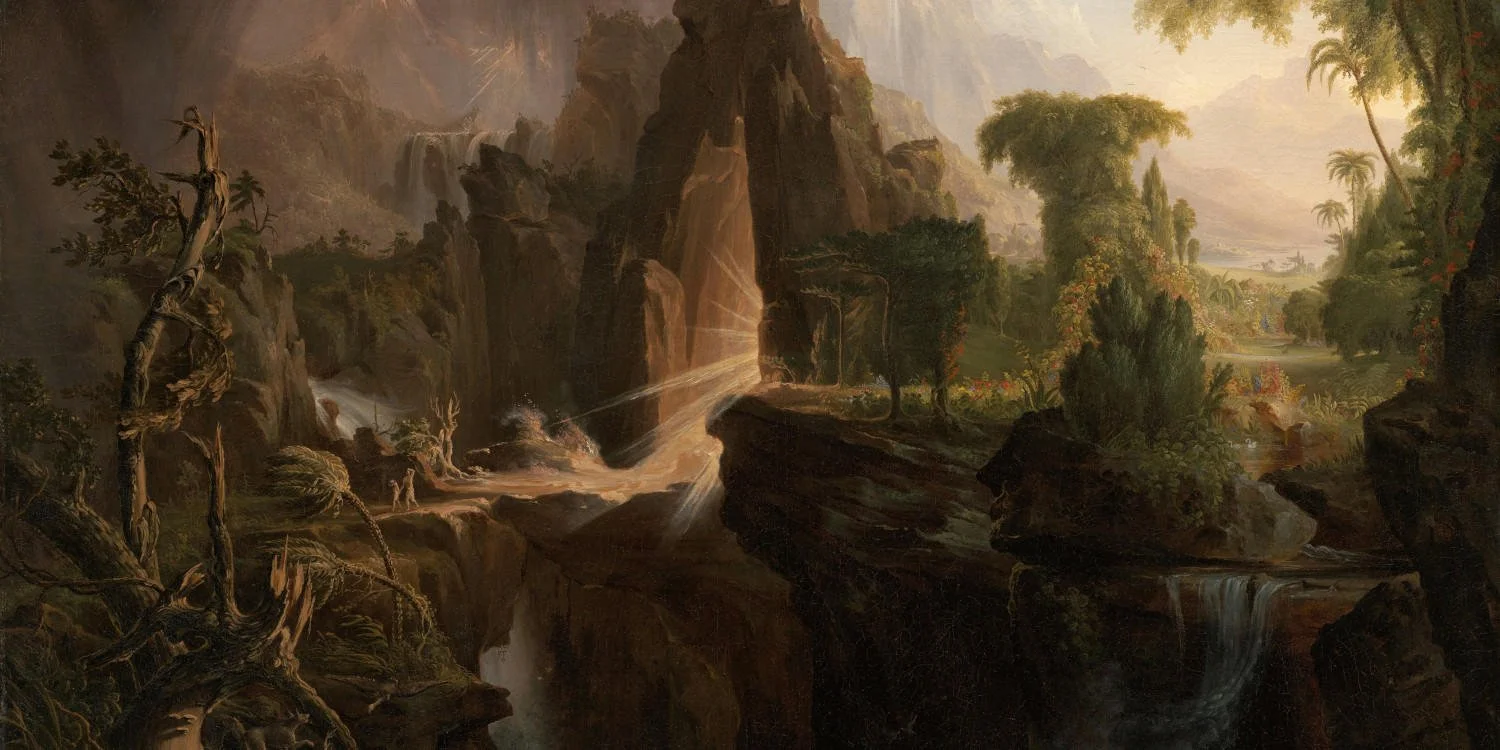
East of Eden; East of God
The Book of Tobit identifies the Archangel Raphael as one of seven angels who stand in the Presence of God. Scripture and the Hebrew Apocryphal books identify four by name: Michael, Gabriel, Raphael, and Uriel. The other three are not named for us. In rabbinic tradition, these four named angels stand at the Celestial Throne of God at the four compass points, and Gabriel stands to God’s left. From our perspective, this places Gabriel to the East of God, a position of great theological significance for the fall and redemption of man.
In a previous post I described the symbolism of “East of Eden,” a title made famous by the great American writer, John Steinbeck, who was awarded the Nobel Prize in Literature for it in 1962. I don’t mean to brag (well, maybe a little!) but a now-retired English professor at a very prestigious U.S. academy who knew Steinbeck left a comment on my post comparing it to Steinbeck’s work. This has absolutely nothing to do with the Archangel Gabriel, but I’ve been waiting for a subtle chance to mention it again! (ahem!) But seriously, in the Genesis account of the fall of man, Adam and Eve were cast out of Eden to the East (Genesis 3:24). It was both a punishment and a deterrent when they disobeyed God by eating from the Tree of Knowledge of Good and Evil:
“Behold, the man has become like one of us, knowing good from evil; and now, lest he put out his hand and take also from the Tree of Life, and eat, and live forever,’ therefore the Lord God sent him forth from the Garden of Eden to till the ground from which he was taken. He drove the man out, and to the east of the Garden of Eden he placed a Cherubim, and a flaming sword which turned every which way, to guard the way to the Tree of Life.”
— Genesis 3: 22-24
A generation later, after the murder of his brother Abel, Cain too “went away from the presence of the Lord and dwelt in the land of Nod, East of Eden.” (Genesis 4:16). The land of Nod seems to take its name from the Hebrew “nad” which means “to wander,” and Cain described his fate in just that way: “from thy face I shall be hidden; I shall be a fugitive and a wanderer on the earth” (Genesis 4:14). The entire subsequent history of Israel is the history of that wandering East of Eden. I wonder if it is also just coincidence that the Gospel of Saint Matthew, the only source of the story of the Magi, has the Magi seeing the Star of Bethlehem “in the east” and following it out of the east.
In rabbinic lore, Gabriel stands in the Presence of God to the left of God’s throne, a position of great significance for his role in the Annunciation to Mary. Gabriel thus stands in God’s Presence to the East, and from that perspective in St. Luke’s Nativity Story, Gabriel brings tidings of comfort and joy to a waiting world in spiritual exile East of Eden.
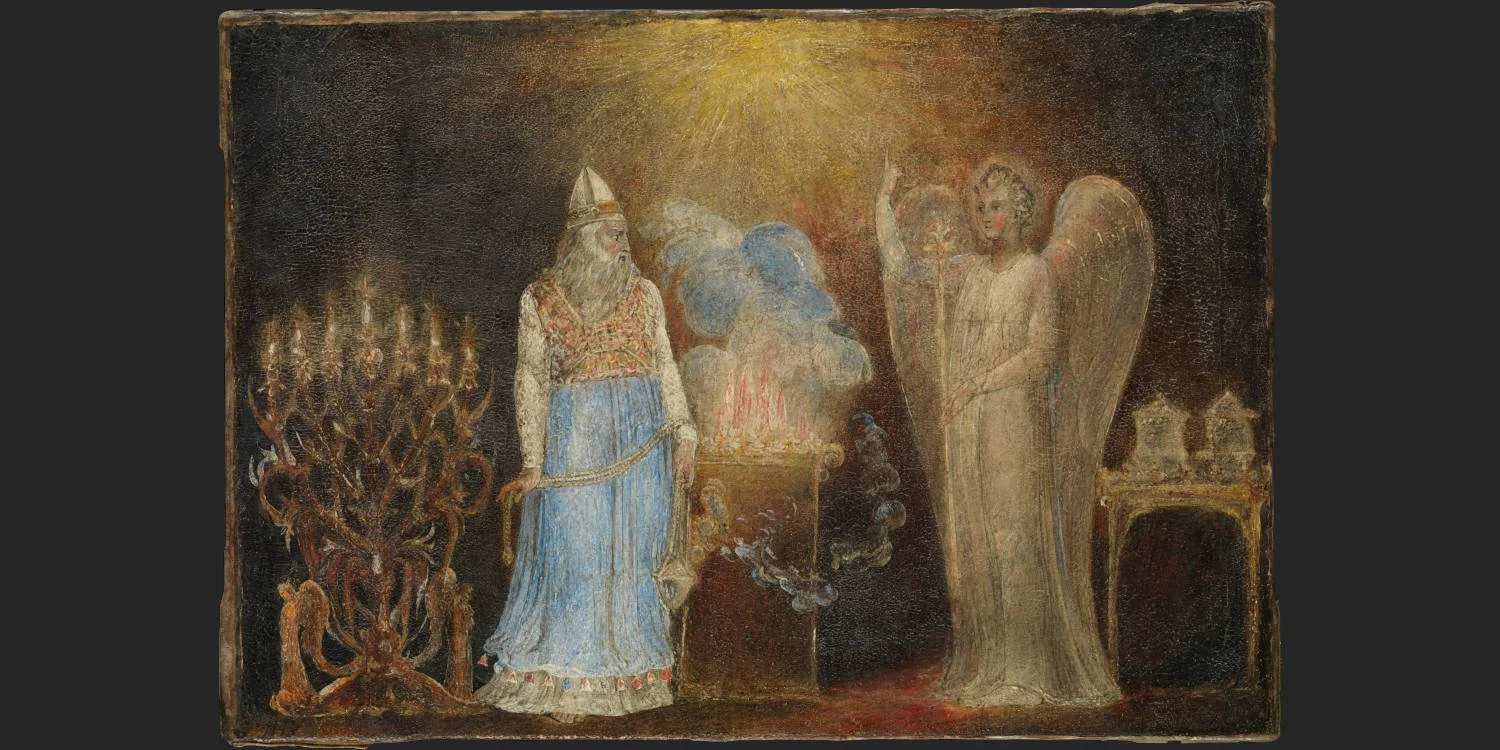
Gabriel Appears to Zechariah
The Archangel’s first appearance is to Zechariah, the husband of Mary’s cousin, Elizabeth. Zechariah is told that he and his wife are about to become the parents of the one who would become John the Baptist. The announcement does not sink in easily because, like Abraham and Sarah at the beginning of Salvation History, Zechariah and Elizabeth were rather on in years. Zechariah is about to burn incense in the Temple of Sacrifice, as close to the Holy of Holies as a human being can get, when the Archangel Gabriel appears with news:
“Fear fell upon him. But the angel said to him, ‘Do not be afraid, Zechariah, for your prayer is heard, and your wife, Elizabeth will bear you a son, and you shall call his name John . . . and he will be filled with the Holy Spirit even from his mother’s womb, and he will turn many of the sons of Israel to the Lord their God and will go before him in the spirit and power of Elijah . . .’”
— Luke 1:12-15
This news isn’t easily accepted by Zechariah, a man of deep spiritual awareness revered for his access to the Holy of Holies and his connection to God. Zechariah doubts the message, and questions the messenger. It would be a mistake to read the Archangel Gabriel’s response in a casual tone. Hear it with thunder in the background and the Temple’s stone floor trembling slightly under Zechariah’s feet:
“I am Gabriel who stand in the Presence of God . . . and behold, you will be silent and unable to speak until the day that these things come to pass.”
I’ve always felt great sympathy for Zechariah. I imagined him having to make an urgent visit to the Temple men’s room after this, followed by the shock of being unable to intone the Temple prayers.
Zechariah was accustomed to great deference from people of faith, and now he is scared speechless. I, too, would have asked for proof. For a cynic, and especially a sometimes arrogant one, good news is not easily taken at face value.
Then six months later “Gabriel was sent from God to a city of Galilee named Nazareth, to a virgin betrothed to a man whose name was Joseph, of the House of David, and the virgin’s name was Mary.” (Luke 1: 26-27). This encounter was far different from the previous one, and it opens with what has become one of the most common prayers of popular devotion.
Gabriel said, “Hail Mary, full of grace, the Lord is with thee.” His words became the Scriptural basis for the doctrine of the Immaculate Conception, that and centuries of “sensus fidelium,” the consensus of the faithful who revere her as “Theotokos,” the God-Bearer. Mary, like Zechariah, also questions Gabriel about the astonishing news. “How can this be since I have not known man?” There is none of the thunderous rebuke given to Zechariah, however. Saint Luke intends to place Gabriel in the presence of his greater, a position from which even the Archangel demonstrates great reverence and deference.
It has been a point of contention with non-Catholics and dissenters for centuries, but the matter seems so clear. There’s a difference between worship and reverence, and what the Church bears for Mary is the deepest form of reverence. It’s a reverence that came naturally even to the Archangel Gabriel who sees himself as being in her presence rather than the other way around. God and God alone is worshiped, but the reverence bestowed upon Mary was found in only one other place on Earth. That place was the Ark of the Covenant, in Hebrew, the “Aron Al-Berith,” the Holy of Holies which housed the Tablets of the Old Covenant. I wrote of Mary’s identification with the most sacred artifact in all of Israel in “The Ark of the Covenant and the Mother of God.”
But the story of Gabriel’s Annunciation to Mary draws on elements from the Second Book of Samuel. These elements are drawn by Saint Luke as he describes Mary’s haste to visit her cousin Elizabeth in the hill country of Judea. In 2 Samuel 6:2, David visits this very same place to retrieve the Ark of the Covenant. Upon Mary’s entry into Elizabeth’s room in Saint Luke’s account, the unborn John the Baptist leaps in Elizabeth’s womb. This is reminiscent of David leaping before the Ark of the Covenant in 2 Samuel 6:16.
For readers “with eyes to see and ears to hear,” Saint Luke presents an account of God entering into human history in terms quite familiar to the old friends of God. God himself expressed in the Genesis account of the fall of man that man has attempted to “become like one of us” through disobedience. Now the reverse has occurred. God has become one of us to lead us out of the East, and off the path to eternal darkness and death.
The Church honors with the deepest reverence Mary, Theotokos, the Bearer of God and the new Ark of the Covenant. Mary, whose response to the Archangel Gabriel was simple assent:
“Let it be done to me according to your word.”
“Then the Dawn from On High broke upon us, to shine on those who dwell in darkness and the shadow of death, and to guide our feet on the way to peace.”
— Luke 1:78-79
+ + +
Note from Father Gordon MacRae: Thank you for reading and sharing this post. It is also added to our collection of Scripture posts, The Bible Speaks.
You may also like these related posts:
Saint Luke the Evangelist, Dear and Glorious Physician
The Ark of the Covenant and the Mother of God
Holy Week begins this year on Palm Sunday, March 29. We have collected a list of seven Holy Week posts from Beyond These Stone Walls. Together, they form a sort of personal Holy Week Retreat. We invite you to take part in it by visiting or revisiting each of its linked posts throughout the course of this coming week. You may access here Our Beyond These Stone Walls Holy Week Retreat.

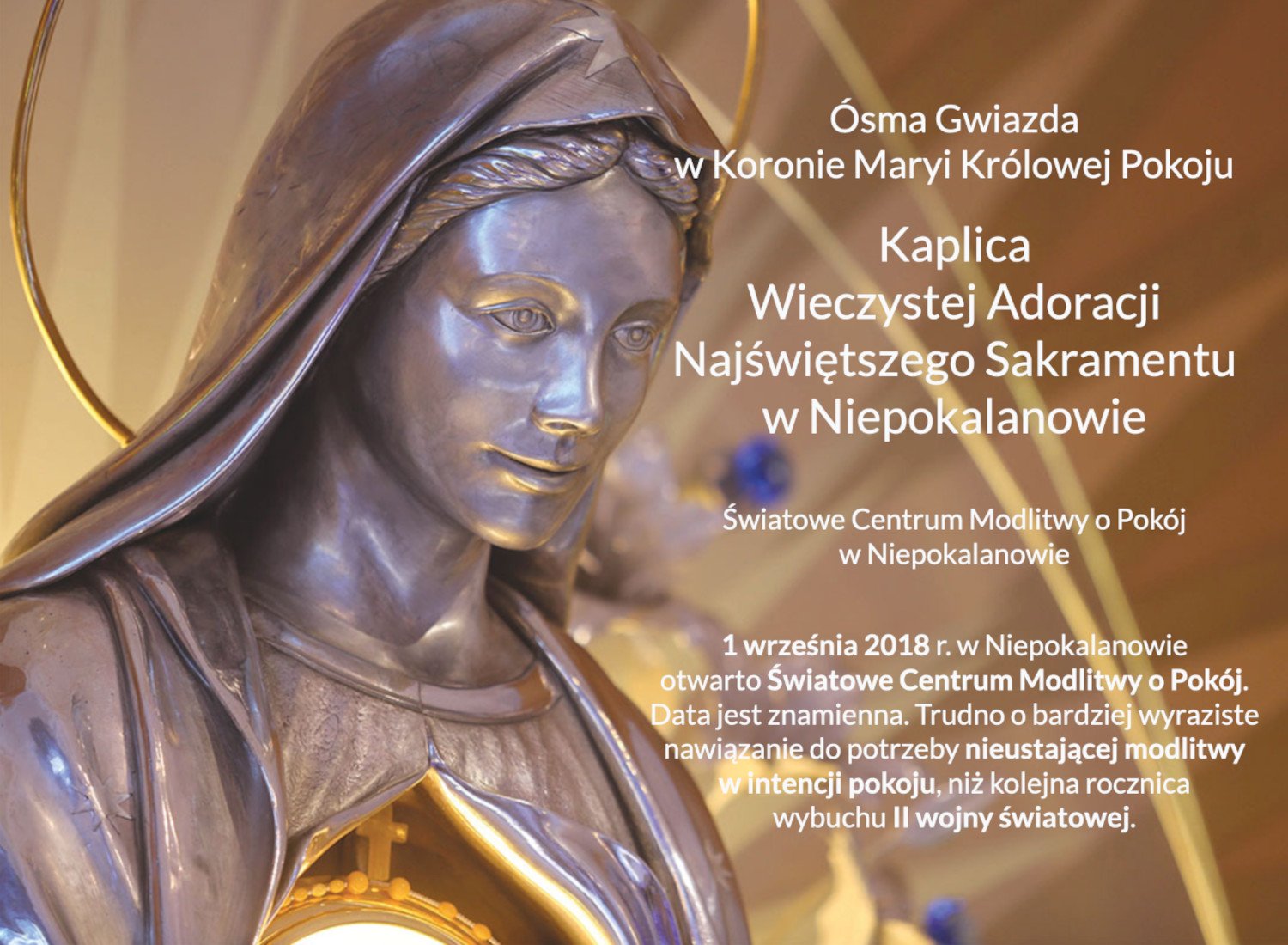

The Eucharistic Adoration Chapel established by Saint Maximilian Kolbe was inaugurated at the outbreak of World War II. It was restored as a Chapel of Adoration in September, 2018, the commemoration of the date that the war began. It is now part of the World Center of Prayer for Peace. The live internet feed of the Adoration Chapel at Niepokalanow — sponsored by EWTN — was established just a few weeks before we discovered it and began to include in at Beyond These Stone Walls. Click “Watch on YouTube” in the lower left corner to see how many people around the world are present there with you. The number appears below the symbol for EWTN.
Click or tap here to proceed to the Adoration Chapel.
The following is a translation from the Polish in the image above: “Eighth Star in the Crown of Mary Queen of Peace” “Chapel of Perpetual Adoration of the Blessed Sacrament at Niepokalanow. World Center of Prayer for Peace.” “On September 1, 2018, the World Center of Prayer for Peace in Niepokalanow was opened. It would be difficult to find a more expressive reference to the need for constant prayer for peace than the anniversary of the outbreak of World War II.”
For the Catholic theology behind this image, visit my post, “The Ark of the Covenant and the Mother of God.”

To Honor Saint Joseph and to Remember Pope Benedict
Saint John Paul II added a new title to honor Saint Joseph. As “Guardian of the Redeemer” Joseph’s dream set us on a path from spiritual exile to Divine Mercy.

Saint John Paul II added a new title to honor Saint Joseph. As “Guardian of the Redeemer” Joseph’s dream set us on a path from spiritual exile to Divine Mercy.
[Credit: Book cover of Consecration to St. Joseph, published by Marian Press. Photo of Pope Benedict XVI, L’Osservatore Romano / Catholic News Agency]
Out of my sometimes inflated separation anxiety, you may have read in these pages an oft-mentioned thought. From behind these stone walls, I write from the Oort Cloud, that orbiting field of our Solar System’s cast-off debris 1.5 light years from Earth out beyond the orbit of Pluto. It was named for its discoverer, the Dutch astronomer Jan Hendrick Oort (1900-1992).
There are disadvantages to being way out here cast off from society and the life of the Church. I am among the last to receive news and the last to be heard. But there is also one advantage. From here, I tend to have a more panoramic view of things, and find myself reflecting longer and reacting less when I find news to be painful.
It seems so much longer now, but it was twelve years ago this month that we had news from Rome that, for many, felt like an earthquake in our very souls. I wrote a series of posts about this in the last week of February and the first few weeks of March 2013. The first was “Pope Benedict XVI: The Sacrifices of a Father’s Love.”
Like most of you, I miss the fatherly Pope Benedict, I miss his brilliant mind, his steady reason, his unwavering aura of fidelity. I miss the rudder with which he stayed the course, steering the Barque of Peter through wind and waves.
But then they became hurricane winds and tidal waves. Amid all the conspiracy theories and “fake news” about Pope Benedict’s decision to abdicate the papacy, I suggested an “alternative fact” that proved to be true. His decision was a father’s act of love, and his intent was to do the one thing by which all good fathers are measured. His decision was an act of sacrifice, and the extent to which that is true was made clear in a post I wrote several years later, “Synodality Blues: Pope Francis in a Time of Heresy.” But this is not about Pope Francis, and the heresy is not at all what you may think.
Benedict is firm that he was guided by the Holy Spirit. For some, the end result was a Holy Father who emerged from the conclave of 2013 while silently in the background remained our here-but-not-here “Holier Father.” Such a comparison has always been unjust, but inevitable. A reader at that time sent me a review by Father James Schall, S.J., in Crisis Magazine. “On Pope Benedict’s Final Insights and Recollections” is a review of a published interview by Peter Seewald, Benedict XVI: Last Testament.
The word, “final” in Father Schall’s title delivered a sting of regret. It hearkened back to that awful March of 2013 when the news media pounced on Pope Benedict’s papacy and delivered news with a tone of contempt too familiar to Catholics today. The secular news media is getting its comeuppance now, and perhaps even finding a little humility in the process, though I doubt it. Even the late, ever fatherly Pope Emeritus took an honest poke at its distortions:
“The bishops (at Vatican II) wanted to renew the faith, to deepen it. However, other forces were working with increasing strength, particularly journalists, who interpreted many things in a completely new way. Eventually people asked, yes, if the bishops are able to change everything, why can’t we all do that? The liturgy began to crumble, and slip into personal preferences.”
— Benedict XVI, Last Testament, 2016
Benedict the Beloved also wrote from the Oort Cloud, but it is one that he cast himself into. I had always hoped I might run into him out here one day and I think I did. We got stoned together once. Neither of us inhaled anything illicit, but I wrote about it in “Breaking News! I got Stoned with the Pope.”
Benedict’s testament ended with these final, surprising words:
“It has become increasingly clear to me that God is not, let’s say, a ruling power, a distant force, rather He is love, and loves me, and as such, life should be guided by Him, by this power called love.”

Carnage in the Absence of Fathers
In the winter of a life so devoted to a dialogue with the deep theological mysteries of our faith, it seemed surprising that Benedict XVI would choose this as the final message he wanted to convey to the Church and the world. My own interpretation is that he chose not the words of a theologian, but those of a father, an equal partner in the ultimate vocation for the preservation of life and the sake of humanity: parenthood.
Fathers who live out the sacrifices required of them are an endangered species in our emerging culture of relativism. In his first-term inaugural address to the nation, President Donald Trump spoke of the “carnage” that our society has failed to face, and he was widely ridiculed for it. But he was right. I see evidence of that carnage every day in the world I am forced to live in here, and I would be a negligent father if I did not write about it.
So, I did write about it, and it struck a nerve. “In the Absence of Fathers: A Story of Elephants and Men” has been shared many thousands of times in social media and reposted in hundreds of venues. It seemed to awaken readers to the wreckage left behind as fathers and fatherhood were devalued into absence in our society. I am a daily witness to the shortsighted devastation of young lives that are cast off into prisons in a country that can no longer call itself their fatherland.
We breed errant youth in the absence of fathers, and those who stray too far are inevitably abandoned into prisons where they are housed, and fed, and punished, but rarely ever challenged to compensate for the great loss that set their lives askew. Prison is an expensive, but very poor replacement for a caring and committed father.
Our readers have come to know about the transformation of a dear friend, Pornchai Moontri who took the name “Maximilian” in his Divine Mercy Sunday conversion in 2010. He goes by “Max” now, because like the Biblical figures of old who discovered a covenant with God, he was given a new name. Not long after Max arrived in his native Thailand after a 36-year-long odyssey set in motion by the betrayal of a fake father, a terrible tragedy happened in Thailand in a village quite near the one where Max was born. A troubled police officer who had betrayed his badge was fired from his position after being caught trafficking in drugs. The former police officer went on an evil rampage and slaughtered dozens of preschool children in a small village before turning his weapons on himself. In a nation left speechless, and maybe even hopeless, Max found the courage to write about this story and his prophetic witness spread throughout Thailand. His post was “Elephants and Men and Tragedy in Thailand.” Speaking about a prior tragedy in Uvalde, Texas and the two young men who carried it out, Pornchai wrote to me:
“I did not care about anyone either; and then someone cared about me. If I did not find God, and you, and acceptance, and Divine Mercy, I might have stayed on a road to destruction. It was all I knew or expected. Hatred left me when something came along to replace it. Do you remember your Elephants post? It makes total sense. The one thing missing from my life and the lives of those two kids [who fired the shots in Uvalde, Texas] was a father. Without one, a decent one, a kid is at the mercy of dark forces and his mind just breaks.”

The Holy Family with a Little Bird by Bartolomé Esteban Murillo
Saint Joseph, Fatherhood Redeemed
I do not think it is mere coincidence that in the midst of this cultural crisis of fatherhood and sacrifice, our Church and faith are experiencing a resurgence in devotion to Saint Joseph, Spouse of Mary and Father of the Redeemer, a title formally bestowed upon him by Saint Pope John Paul II. His Feast Day on March 19th was established, not just by papal edict, but by “sensus fidelium” over a thousand years. He was declared Patron of the Universal Church by Pius IX in 1870. In 1989, he was given a new title, “Guardian of the Redeemer.” This title beckoned fathers everywhere to live their call to sacrifice and love so essential to fatherhood.
I had barely given Saint Joseph a passing thought for all the years of my priesthood, but in more recent years he has surfaced in my psyche and soul repeatedly with great spiritual power.
It is also not lost on me that he shares his name with Joseph Ratzinger, the late Pope Emeritus Benedict XVI, who in his final days bestowed upon the Church a summons to Divine Mercy. The winter of Benedict’s own life spent in silent but loving and faithful witness to the Church reflected the life of Saint Joseph in the Infancy Narratives of the Gospel, silent but so very present. I have heard from readers constantly with a growing interest in Saint Joseph.
In a surprising guest post in 2024, our editor Dilia E. Rodríguez, PhD described that she discovered this blog through a prior post I wrote about Saint Joseph and Pope Benedict, and then became our editor inspired, not by me, but by them. I am grateful, but not surprised, that Saint Joseph inspired Dilia to reach out to me and this blog. She was just then in the process of retiring from a career as a civilian scientist with the United States Air Force. Taking over the mechanics of Beyond These Stone Walls was a natural fit for Dilia. But of great benefit to me and all of us, she brought with her a deep devotion to Saint Joseph, Father of the Redeemer and Fatherhood Redeemed.
Saint Joseph is most present in the Infancy Narrative in the Gospel According to Saint Luke. He is virtually silent in that narrative, but his actions speak volumes to men, to fathers, to the priesthood and to the Church.
+ + +
Note from Father Gordon MacRae: When Saint Pope John Paul II established this Feast of Saint Joseph on March 19, he gave it a new title and insisted that it be a Solemnity, the highest level of liturgical observance in the Church. You may also like these related posts from Beyond These Stone Walls:
From Arizona State University: An Interview with Our Editor by Dilia E. Rodríguez, PhD
And by Father Gordon MacRae:
Joseph’s Dream and the Birth of the Messiah
Joseph’s Second Dream: The Slaughter of the Innocents
Saint Joseph: Father of the Redeemer and Fatherhood Redeemed
A Special Announcement
FROM ASHES TO EASTER: We have added a new feature at this blog, a list of the Scriptural accounts of Salvation History, which I hope you will visit and share with others: From Ashes to Easter.
Lastly, this other recent new feature may seem rather strange. Some of my advocates have been having a dialogue about my trial and the nature of the case against me that has kept me wrongly in prison for 30 years and counting. The dialogue has not just been among themselves but also with the advanced Artificial Intelligence platform launched by Elon Musk called xAI Grok. This is an ongoing endeavor that will have several chapters. The site, Les Femmes, The Truth, reviewed its first chapter and called it “absolutely fascinating.” So we are adding “The Grok Chronicle” a new feature at Beyond These Stone Walls. It may be the most unusual Lenten reading you’ve ever encountered.and we invite you to follow along beginning with “Chapter 1: Corruption and the Trial of Father MacRae.” additional chapters will follow over time.

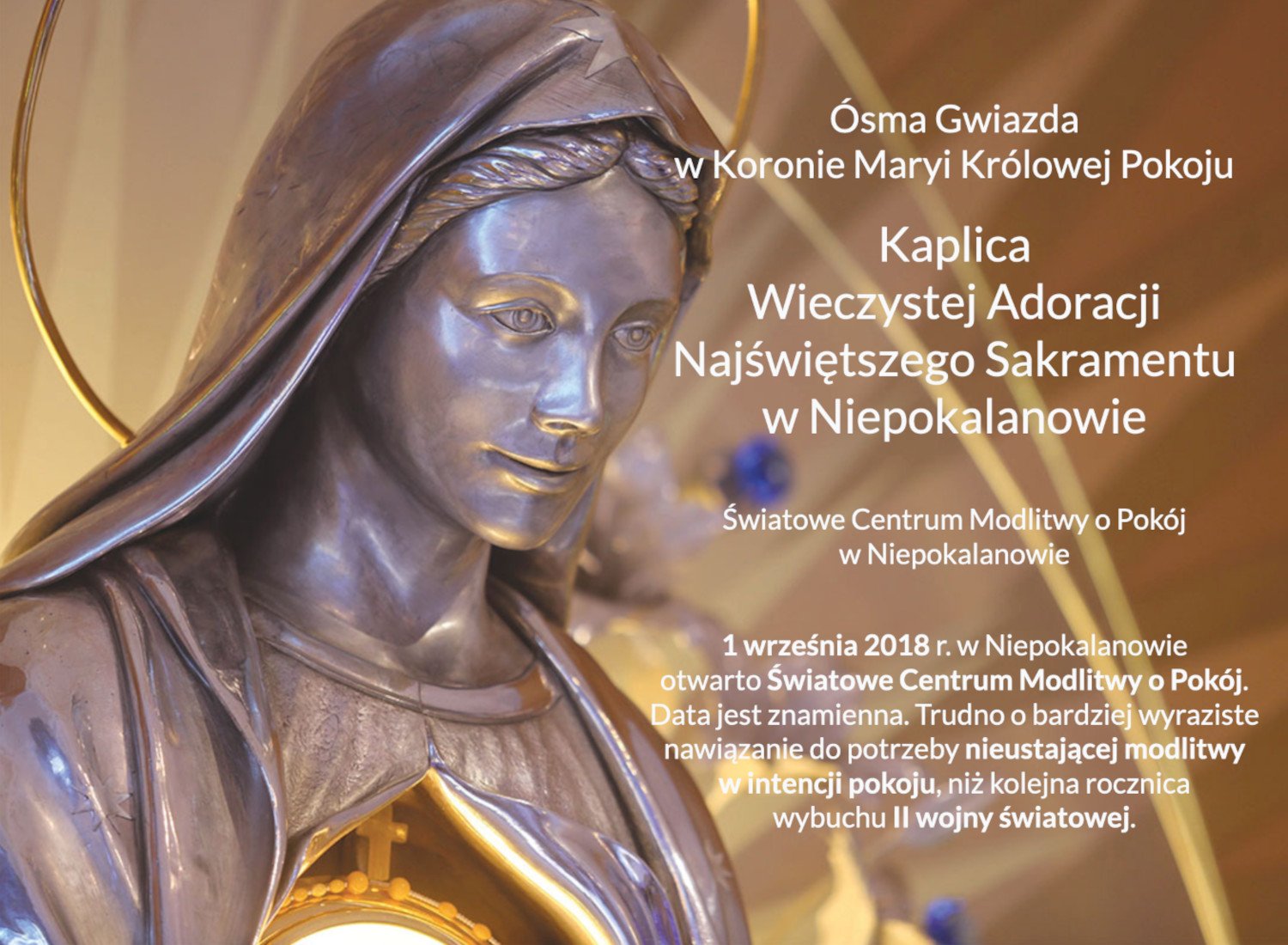

The Eucharistic Adoration Chapel established by Saint Maximilian Kolbe was inaugurated at the outbreak of World War II. It was restored as a Chapel of Adoration in September, 2018, the commemoration of the date that the war began. It is now part of the World Center of Prayer for Peace. The live internet feed of the Adoration Chapel at Niepokalanow — sponsored by EWTN — was established just a few weeks before we discovered it and began to include in at Beyond These Stone Walls. Click “Watch on YouTube” in the lower left corner to see how many people around the world are present there with you. The number appears below the symbol for EWTN.
Click or tap here to proceed to the Adoration Chapel.
The following is a translation from the Polish in the image above: “Eighth Star in the Crown of Mary Queen of Peace” “Chapel of Perpetual Adoration of the Blessed Sacrament at Niepokalanow. World Center of Prayer for Peace.” “On September 1, 2018, the World Center of Prayer for Peace in Niepokalanow was opened. It would be difficult to find a more expressive reference to the need for constant prayer for peace than the anniversary of the outbreak of World War II.”
For the Catholic theology behind this image, visit my post, “The Ark of the Covenant and the Mother of God.”

Saint Joseph: Guardian of the Redeemer and Fatherhood Redeemed
In 1989, Pope John Paul II added a new title to honor Saint Joseph. As “Guardian of the Redeemer” Joseph’s dream set us on a path from spiritual exile to Divine Mercy.

In 1989, Pope John Paul II added a new title to honor Saint Joseph. As “Guardian of the Redeemer” Joseph’s dream set us on a path from spiritual exile to Divine Mercy.
Out of my sometimes inflated separation anxiety, you may have read in these pages an oft-mentioned thought. From behind these walls, I write from the Oort Cloud, that orbiting field of our Solar System’s cast-off debris 1.5 light years from Earth out beyond the orbit of Pluto. It was named for its discoverer, the Dutch astronomer Jan Hendrick Oort (1900-1992).
There are disadvantages to being way out here cast off from the life of the Church. I am among the last to receive news and the last to be heard, if at all. But there is also one distinct advantage. From out here, while dodging the occasional asteroid, I tend to have a more panoramic view of things, and find myself reflecting longer and reacting less when I find news to be painful.
It’s difficult to believe, but it was just eleven years ago, March 13, 2013 that Pope Francis was elected to the Chair of Peter. In the previous month we had news from Rome that, for many, felt like one of those asteroids had struck at the very heart of the Church. I wrote a series of posts about this in the last week of February and the first few weeks of March 2013. The first was “Pope Benedict XVI: The Sacrifices of a Father’s Love.”
Like most of you, I miss the fatherly Pope Benedict, I miss his brilliant mind, his steady reason, his unwavering aura of fidelity. I miss the rudder with which he stayed the course, steering the Barque of Peter through wind and waves instead of causing them.
But then they became hurricane winds and tidal waves. Amid all the conspiracy theories and “fake news” about Pope Benedict’s decision to abdicate the papacy, I suggested an “alternative fact” that proved to be true. His decision was a father’s act of love, and his intent was to do the one thing by which all good fathers are measured. His decision was an act of sacrifice, and the extent to which that is true was made clear in a post I wrote several years later, “Synodality Blues: Pope Francis in a Time of Heresy.” Benedict was firm that he was guided by the Holy Spirit.
For some, the end result was a Holy Father who emerged from the conclave of 2013 while silently in the background remained our here-but-not-here “Holier Father.” Such a comparison has always been unjust. Some years ago a reader sent me a review by Father James Schall, S.J., in Crisis Magazine. “On Pope Benedict’s Final Insights and Recollections” is a review of a published interview by Peter Seewald, Benedict XVI: Last Testament.
The word, “final” in Father Schall’s title delivers a sting of regret. It hearkens back to that awful March of 2013 when the news media pounced on Pope Benedict’s papacy and delivered news with a tone of contempt too familiar to Catholics today. The secular news media is getting its comeuppance now, and perhaps even finding a little humility in the process. Even the late ever fatherly Benedict XVI took an honest poke at its distortions:
“The bishops (at Vatican II) wanted to renew the faith, to deepen it. However, other forces were working with increasing strength, particularly journalists, who interpreted many things in a completely new way. Eventually people asked, yes, if the bishops are able to change everything, why can’t we all do that? The liturgy began to crumble, and slip into personal preferences.”
— Benedict XVI, Last Testament, 2016
Benedict the Beloved also wrote back then from the Oort Cloud, but it is one that he cast himself into. I have always hoped I might run into him out here one day and I might have. His testament ended with these final, surprising words:
“It has become increasingly clear to me that God is not, let’s say, a ruling power, a distant force, rather He is love, and loves me, and as such, life should be guided by Him, by this power called love.”

Carnage in the Absence of Fathers
In the winter of a life so devoted to a dialogue with the deep theological mysteries of our faith, it seemed surprising that Benedict XVI would choose this as the final message he wants to convey to the Church and the world. My own interpretation is that he chose not the words of a theologian, but those of a father, an equal partner in the ultimate vocation for the preservation of life and the sake of humanity: parenthood.
Fathers who live out the sacrifices required of them are an endangered species in our emerging culture of relativism and self-indulgence. In his inaugural address to the nation, President Donald Trump spoke of the “carnage” that our society has failed to face, and he was widely ridiculed for it. If he was wrong about anything else, he was right about that. I see evidence of that carnage every day in the world I am forced to live in here, and I would be a negligent father if I did not write about it.
So, I did write about it, and it struck a nerve. “In the Absence of Fathers A Story of Elephants and Men” has been shared over 30,000 times on social media and reposted in hundreds of venues. It seemed to awaken readers to the wreckage left behind as fathers and fatherhood are devalued into absence in our society. I am a daily witness to the shortsighted devastation of young lives that are cast off into prisons in a country that can no longer call itself their fatherland.
We breed errant youth in the absence of fathers, and those who stray too far are inevitably abandoned into prisons where they are housed, and fed, and punished, but rarely ever challenged to compensate for the great loss that sets their lives askew. Prison is an expensive, but very poor replacement for a caring and committed father
I saw this carnage in a young man I once wrote about, but to whom I never returned because I wanted to shelter readers from the truth of what befell him. A light-hearted post several years ago — “Prison Journal: Looking for Lunch in All the Wrong Places” — included some of the culinary creations of other prisoners who greatly delighted in seeing them in print. One of them was a young man named Joey who made us all laugh with his recipe for a concoction called “mafungo” and his weird instructions for making it.
Joey descended into prison at age 17 as the result of a simple high school fight with another student who was injured. While in prison, he discovered the plague of opiates that is fast consuming a nation in denial. The extent to which drugs have consumed life in this prison was back then the subject of a Concord Monitor article “As drugs surge, inmate privileges nixed” (Michael Casey, Associated Press, Feb 27, 2017).
Joey reached out to me repeatedly throughout the ordeal of his imprisonment. As a member of a small group of prisoners tasked with negotiating over prison conditions, I argued for treatment over punishment when Joey’s addiction kept disrupting his life. The interventions were simply too little too late. At age 23, after six years here, Joey left prison with a serious problem that he did not come in with. Just two months after his release, Joey fatally overdosed on the street drug, fentanyl. He became a statistic, one of hundreds of overdose deaths of young adults in the city of Manchester, New Hampshire which, according to reports, led the entire nation in the rate of young adults opioid overdose deaths. If this is what President Trump meant then by “carnage,” we must face the reality that we are tightly in its grip, and the absence of fathers has been a devastating risk factor.

Now Comes Joseph, Guardian of the Redeemer
I do not think it is mere coincidence that in the midst of this cultural crisis of fatherhood and sacrifice, our Church and faith are experiencing a resurgence in devotion to Saint Joseph, Spouse of Mary. His Feast Day on March 19th was honored by “sensus fidelium” over twelve centuries ago. He was declared Patron of the Universal Church by Pope Pius IX in 1870. In 1989, he was given a new title, “Guardian of the Redeemer,” by Saint John Paul II. This title beckons fathers everywhere to live their call to sacrifice and love so essential to fatherhood.
I had barely given Saint Joseph a passing thought for all the years of my priesthood, but in the last two years he surfaces in my psyche and soul repeatedly with great spiritual power. It haunts me that he shares his name with my young friend, Joey, who personified a life in the absence of a father, sacrificed to some south-of-the-border cartel and the carnage of our culture of death.
And it is not lost on me that he shares his name with the late Joseph Ratzinger, Pope Benedict XVI, who in life and death personified for the Church a summons to Divine Mercy. The winter of Benedict’s own life spent in silent but loving witness to the Church reflects the life of Saint Joseph in the Infancy Narratives of the Gospel, silent but still so very present. I suddenly hear from readers constantly with a growing interest in Saint Joseph. Last Christmas, I wrote what I consider to be a most important post for our time, and a prequel to this summons to Divine Mercy. It was “Joseph’s Dream and the Birth of the Messiah.”
Ii was a post about love, fidelity, and sacrifice, the hallmarks of fatherhood and the foundations of Divine Mercy. And I wrote a sequel to that post which contains a painful but vital story. It was “Joseph’s Second Dream: The Slaughter of the Innocents.”
These biblical stories were lived by one who remains utterly silent in the pages of the Gospel, but whose life and actions as Guardian of the Redeemer were like a trumpet call to fatherhood and sacrifice. I am hereby bestowing upon him another title. He is, Saint Joseph, “Guardian of Fatherhood Redeemed.”
+ + +
Note Number 1 from Father Gordon MacRae: On occasion the Marian Fathers of the Immaculate Conception, stewards of The National Shrine of The Divine Mercy, send me a book from their own publishing house that they would like to see reviewed at Beyond These Stone Walls. We have featured several of them over time, but the last one they sent is a real treasure, and here it is: Consecration to St. Joseph: The Wonders of Our Spiritual Father, by Father Donald H. Calloway, MIC.
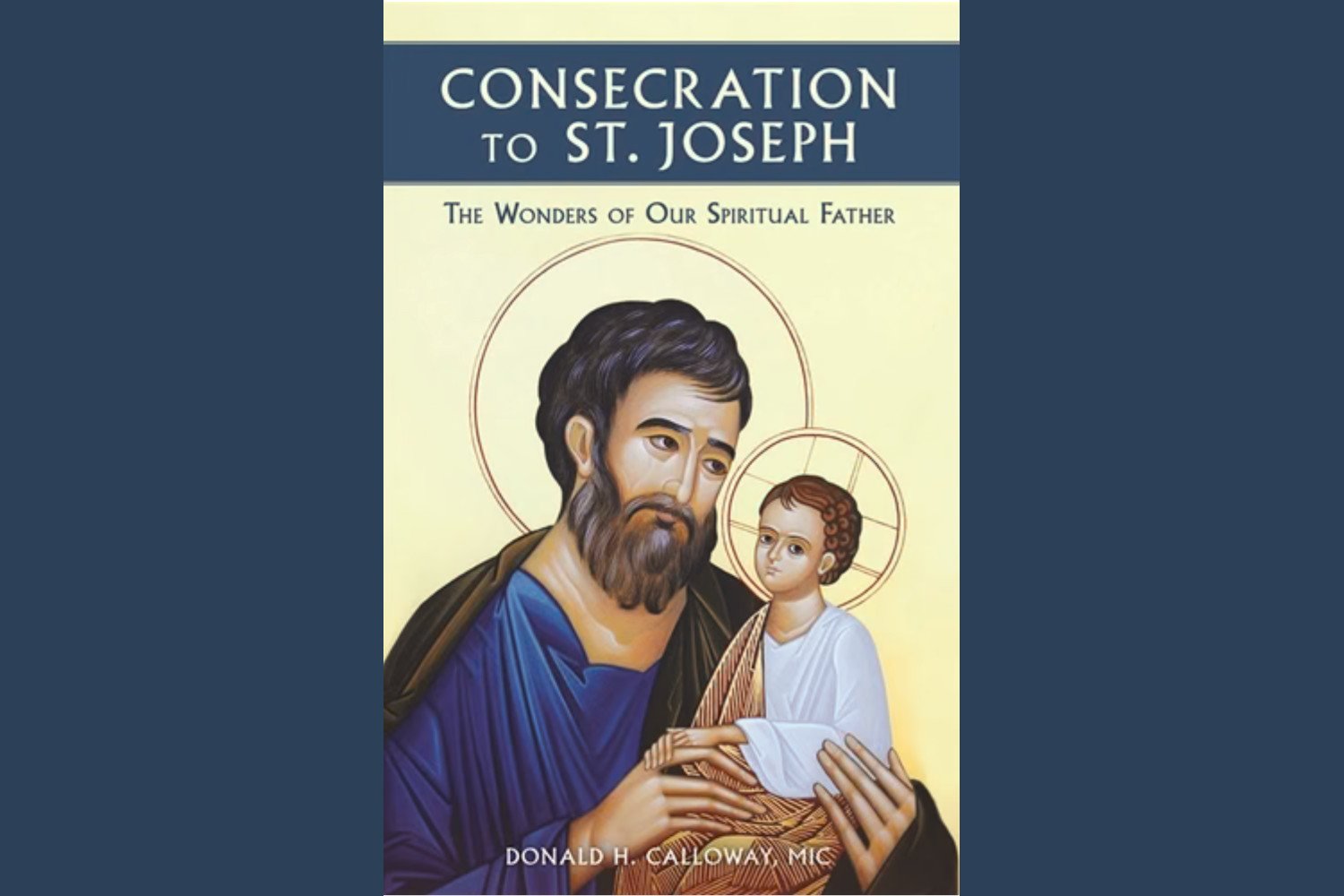
Please also note that the beautiful top graphic for this post is “Saint Joseph and the Christ Child” by Jacob Zumo (2019). It was commissioned by Father Donald H. Calloway, MIC for inclusion in Consecration to Saint Joseph. This and other wondrous works of art are available at Art By JZumo.
+ + +
Note Number 2 from Father Gordon MacRae: Some years ago his Eminence Cardinal Raymond Leo Burke wrote to me in prison. It was a personal letter which in many ways was a gift of Divine Mercy and Divine Compassion. Now he has invited me to take part in a worldwide call to prayer, Return to Our Lady through devotion to Our Lady of Guadalupe, a nine-month novena. Here is Cardinal Burke’s invitation to us. I have subscribed for the good of our Church, and I hope you will join me.

Tap or click the image.
The Eucharistic Adoration Chapel established by Saint Maximilian Kolbe was inaugurated at the outbreak of World War II. It was restored as a Chapel of Adoration in September, 2018, the commemoration of the date that the war began. It is now part of the World Center of Prayer for Peace. The live internet feed of the Adoration Chapel at Niepokalanow — sponsored by EWTN — was established just a few weeks before we discovered it and began to include in at Beyond These Stone Walls. Click “Watch on YouTube” in the lower left corner to see how many people around the world are present there with you. The number appears below the symbol for EWTN.
Click or tap here to proceed to the Adoration Chapel.
The following is a translation from the Polish in the image above: “Eighth Star in the Crown of Mary Queen of Peace” “Chapel of Perpetual Adoration of the Blessed Sacrament at Niepokalanow. World Center of Prayer for Peace.” “On September 1, 2018, the World Center of Prayer for Peace in Niepokalanow was opened. It would be difficult to find a more expressive reference to the need for constant prayer for peace than the anniversary of the outbreak of World War II.”
For the Catholic theology behind this image, visit my post, “The Ark of the Covenant and the Mother of God.”