“There are few authentic prophetic voices among us, guiding truth-seekers along the right path. Among them is Fr. Gordon MacRae, a mighty voice in the prison tradition of John the Baptist, Maximilian Kolbe, Alfred Delp, SJ, and Dietrich Bonhoeffer.”
— Deacon David Jones

For Fr. John Tabor, the Path to Priesthood Was War
Jaffrey, New Hampshire native Father John Tabor was called by God from the U.S. Navy at the Fall of Saigon to a half century of priesthood in Vietnam and Thailand.

Jaffrey, New Hampshire native Father John Tabor was called by God from the U.S. Navy at the Fall of Saigon to a half century of priesthood in Vietnam and Thailand.
November 30, 2022 by Fr. Gordon MacRae
Some time ago, I introduced a post by citing a famous 1990s play and movie by John Guare entitled, Six Degrees of Separation. In the film version, actor Will Smith played the central character, a young man who insinuated himself into the lives of a wealthy Manhattan couple by pretending to be the son of American actor, Sidney Poitier. The hoodwinked couple were so enthralled by what they thought was a fortuitous connection to a Hollywood star that they invited their wealthy friends to witness the new relationship. It was a con man’s dream.
The play and film introduced a theory that many came to believe was a valid sociological principle. It was the notion that the paths of all human beings are somehow connected by no more than six degrees of separation from each other. As the world grew smaller in the Internet age, the idea took on an aura of universal truth. It might even be true, for all I know, but it started off not as science, but as faith.
I have written of two examples. The path of my friend, Pornchai Moontri, my roommate of 16 years here, is separated from that of Saint Padre Pio by just two degrees. Pornchai’s Godfather, the late Pierre Matthews from Belgium, met and was blessed by Padre Pio at age 16. I wrote of their strange encounter in “With Padre Pio When the Worst that Could Happen Happens.”
Perhaps more profound and surprising, just after I wrote a popular science post about the origins of the Cosmos some years ago I learned that Pornchai is also separated by only two degrees from the famous mathematician-physicist, Fr. Georges Lemaitre, who discovered the Big Bang origin of the Universe. Father Lemaitre was a close friend of Pornchai’s Godfather’s parents who sent us several photos of them together. I wrote of the astronomical odds against such a development in “Fr. Georges Lemaitre: The Priest who Discovered the Big Bang.”
According to the theory, these two accounts left me also with only two degrees of separation from both Padre Pio and Father Lemaitre, two famous figures about whom I had been writing. It was mind-boggling, but it was never a legitimate scientific theory at all. For most people, threads of connection between people are mere coincidence. For others, they are the subtle threads of what I have called the Great Tapestry of God.
I subscribe to the latter view, but we should not try to reduce these threads to the limits of science. They are instead, for many, evidence of actual grace — perhaps more connected to a Scriptural mystery: “Faith is the substance of things hoped for, the evidence of things unseen” (Hebrews 11:1). People of true faith find meaning in these connections that science overlooks.

Priesthood in a Time of War
One of these unusual threads of connection just manifested itself in my life. The November/December 2022 issue of Parable magazine, a news publication from my diocese, had as its cover story a tribute to Father John Tabor entitled, “Soldier to Servant.” My path has crossed with that of Father Tabor several times in life, but we have never actually met.
Several years older than me, John Tabor graduated from Conant High School in Jaffrey, New Hampshire in 1964. I graduated at age 16 from a Boston area high school in 1970. His path took him to the U.S. Navy and to war in Vietnam. Mine did not. I was too young at graduation to go to war, and by the time I could, the war was over.
Father Tabor’s priestly vocation was shaped by a war in which he survived several near death encounters. One of them involved a military jeep he was driving in a war zone in Da Nang. It broke down right in front of a small Catholic church where he sought the help of a local priest to repair it. A short distance down the same road on the same day, a land mine exploded that would have killed him, but John missed it because he and the priest were slow making the needed repair. It was then that John gave serious thought to something that passed only fleetingly through his mind back in high school.
In the late 18th Century, France colonized Vietnam and remained in power as an occupying force until 1954. The long French occupation of Vietnam had the unintended effect of introducing Catholicism to the Vietnamese. As a result, many Vietnamese today practice Catholic faith with great reverence. A quarter century after the French departed from Vietnam, Father John Tabor was deeply moved by the depth of Catholic faith among the people of this war-torn country.
When the war was over, and his tour of duty in the Navy ended, John Tabor wrote to his family in New Hampshire to tell them of his decision to remain in Vietnam to study for the priesthood. He immersed himself in the Vietnamese language and became fluent. Father Tabor was ordained for the Diocese of Da Nang in 1974.
In that same year half a world away, my own path to priesthood had just begun. Five years later in 1979, during theological studies at St. Mary’s Seminary and University in Baltimore, my closest friend was Tran, a Vietnamese seminarian who had been a student during the war in the seminary in Da Nang. I tutored Tran in English so he could complete his studies. Like Father Tabor, Tran, had been forced to flee Vietnam after the Fall of Saigon under the post-war oppression of the communist North Vietnamese in 1975. He brought years of war trauma with him.
Tran had been one of hundreds of thousands forced to flee Vietnam among the famous “Boat People” whose struggle for freedom and survival captured the world’s attention. During seminary studies in Baltimore, Tran often spoke to me about Father John Tabor the American priest who taught English to Vietnamese seminarians at the seminary in Da Nang where Father Tabor first ministered.
Also among the Boat People fleeing communist Vietnam was a young high school student named John Hung Le. He is known to our readers today as a heroic priest in the Missionary Society of the Divine Word and the founder of the Vietnamese Refugee Project of Thailand. He is also the priest who helped to sponsor Pornchai Moontri upon his arrival in Thailand in 2021 and continues to support his repatriation today.
The Fall of Saigon, the surrender of the South Vietnamese to Northern Communist Vietnam took place on April 30, 1975. The Viet Cong tanks and troops soon began pouring into downtown Saigon — now called Ho Chi Minh City — and spread toward Da Nang. I vividly recall news footage of waves of U.S. Marine and Air Force helicopters. They flew 6,400 military and civilian evacuees from Saigon to a 40-vessel armada waiting 15 miles off the coast of South Vietnam.
American helicopters swept into Saigon just after dawn to retrieve 30 marines from the U.S. Embassy rooftop completing the final evacuation of about 900 Americans and more than 5,000 Vietnamese. Four American marines died during the final hours of the U.S. presence in Vietnam. Two were killed in a heavy morning bombardment of Tan Son Nhut Air Base when a rocket hit the compound of the U.S. defense attache’s office where they were on guard. The other two died during the evacuation when their helicopter plunged into the South China Sea.
Several Americans, including some brave newsmen, decided to stay. Hundreds of desperate Vietnamese civilians swarmed into the U.S. embassy compound in Saigon and onto the roof after the marines had left. The roof of a nearby building also served as an emergency helipad where several hundred South Vietnamese civilians waited in hopes that there would be more helicopters to rescue them away from the coming communist oppression. They waited in vain.

Udon Thani, Thailand
Also left behind, by his own choice, was Father John Tabor who had been ordained for the Diocese of Da Nang just ten months earlier in 1974. Though now fluent in spoken and written Vietnamese, he nonetheless knew that as an American he must leave Vietnam quickly. It would not be by sea. He made his way across a border into Laos, then north to the Capital, Vientiane. From there he crossed the border into Thailand where he was canonically received into the northern Thai Diocese of Udon Thani in 1975.
For historical context for our readers, at the time Father Tabor arrived in Udon Thani, just a short distance to the south in Non Bhua Lamphu, Thailand, two-year-old Pornchai Moontri had become an orphan. That complex story was told to wide acclaim in “Bangkok to Bangor, Survivor of the Night.”
Diplomatic relations between the U.S. and the Communist government of Vietnam were not restored until 1995. Father Tabor ministered in Udon Thani, Thailand for the next 47 years. After seeing him last month on the cover of Parable in my diocese, I had a friend help me send an email message to Father John Hung Le in Thailand. I told him what I had read of the story of Father Tabor and of how he had come to New Hampshire to visit his twin brother after an absence of fifty years. I asked Father John if his path had ever crossed with that of Father Tabor who was originally from New Hampshire.
The message that came back the next day contained attachments which our editor then sent to the GTL tablet in my cell. The first was a photo of Pornchai who had been helping Father John to distribute food to Vietnamese refugee families that day. The second was the photo above of Fathers John Le and John Tabor. “We had lunch together today,” said Father John. By coincidence they met in Bangkok that very morning when Father Tabor had a required checkup upon his return to Thailand from New Hampshire.
It turned out that they are old friends whose respective paths had taken them from the terrors of war into the priesthood of Jesus Christ on the frontier of Catholic missionary service in Southeast Asia. Father John Le’s community, the Society of the Divine Word, has long had a base in Udon Thani, the most northern region of Thailand along the border with Laos very near Pornchai’s childhood home. These are heroic priests whose selfless lives have been on the front lines of service to the Lord among the poorest of the poor for decades. I am humbled to know them.
In his recent message, Father John Le told me that he and my friend, Pornchai had met that evening with Father John’s Provincial Superior on his annual visitation from the Society of the Divine Word. The connectedness of our interwoven paths is staggering. I can only make sense of it through a single line in a prayer. It is the prayer of St. John Henry Newman that I wrote about some months ago in “Divine Mercy in a Time of Spiritual Warfare.” The prayer is entitled, “Some Definite Service”:
“God has created me to do Him some definite service. He has committed some work to me which he has not committed to another. I have my mission. I may never know it in this life, but I shall be told it in the next. I am a link in a chain, a bond of connection between persons.”
+ + +

Father John Tabor’s route from Da Nang, Vietnam through Laos to Udon Thani, Thailand
Note from Father Gordon MacRae:
Please keep Father John Tabor, Father John Hung Le, SVD, and Pornchai Moontri in your prayers. Over several months, readers have generously sent me gifts to be applied to Father John’s Refugee Project and the support of Pornchai’s repatriation to Thailand after 36 years. I have saved your recent gifts in support of Father John’s ministry until they amounted to $1,000 U.S.D. We just sent this amount to Father John who expressed his deeply felt gratitude (as do I!). That amount is equal to 30,000 Thai Baht which greatly assists him in bulk food and medical supply purchases for the Vietnamese refugee children and families of Thailand. During this time of global inflation, your sacrifices have made a difference. Thank you.
To assist in this project, please scroll through our SPECIAL EVENTS page for information.
Thank you for reading and sharing this post. You may also like the related links cited in this post:
Washington and the Vatican Strengthen Ties with Vietnam — National Catholic Register, October 8, 2023

Dragged Into Thanksgiving Kicking and Screaming
Even when inflation deepens our need, even when politics rage around us, even when unjustly in prison at Thanksgiving for 29 years, there is cause for gratitude.

Even when inflation deepens our need, even when politics rage around us, even when unjustly in prison at Thanksgiving for 30 years, there is cause for gratitude.
Thanksgiving by Fr. Gordon MacRae
One year ago, I wrote a post entitled, “A Struggling Parish Builds an Advent Bridge to Thailand.” It was about a selfless decision of Father Tim Moyle and the people of St. Anne Parish in rural Mattawa, Ontario. They set aside their own parish needs during Advent 2021 to raise funds to assist Father John Hung Le, a friend and Society of the Divine Word Missionary and the sole provider for the Vietnamese Refugees of Thailand. He serves some of the poorest of the world’s poor.
Father Tim and his parish got the idea for the project from reading Beyond These Stone Walls. The Advent project was a wonderful success, not only for the refugees, but also for the parish and for us, and in more ways than we yet even know.
Several months later, I wrote about the end result of this great endeavor in a post entitled, “February Tales and a Corporal Work of Mercy in Thailand.” Each event in this story carved out a path to other events which, on their surface, seemed not to be connected at all, but underneath we found profound meaning. In that post, I recalled a book that I read over a half century ago. It set in motion many paths which still make connections today. The book was The Once and Future King. Here is an excerpt from what I wrote of it in 2021:
I was sixteen years old for most of my senior year in high school growing up on the North Shore of Boston in 1969. I was a full year younger than most of my class. There are many events that stand out about that year, but one that I remember most was an adventure in British literature that I found in The Once and Future King, the classic novel of the Arthurian legend by T.H. White first published in 1939.
In my inner city public high school, The Once and Future King was required senior year reading. Most of my older peers groaned at its 640 pages, but I devoured it. The famed novel is the story of King Arthur, the Sword in the Stone, the Knights of the Round Table, and the quest for the Holy Grail — all based on the medieval Morte d’Arthur by Sir Thomas Mallory in the 16th Century. By the time I was half way through it at 16, I had completely forgotten that I was forced to read it and obliged to resent it.
I found a worn and tattered copy some 50 years later in a prison law library where I am the legal clerk. I took it back to my cell for a weekend to see if it held up against the test of time. It did so admirably, and I devoured it for the second time in my life. I was astonished by how well I remembered the plot and every character. I was reunited with my favorites, the Scottish knights and brothers Sirs Gawain, Agravaine, Gareth and Gaheris. A few days after I began to read it anew, I came upon one of the popular Marvel X-Men movies and noted with surprise that the character, Magneto, was reading The Once and Future King in his prison cell.

The backdrop of my first reading of the book at age 16 in 1969 was the chaos of my teenage life in a troubled inner city high school. Protests and riots against the Vietnam war were daily fare. I was just then beginning to take seriously the Catholic heritage to which I previously gave only Christmas and Easter acknowledgment, and I was tasked with restoring my newly recovered faith in the heat of division following the Second Vatican Council.
The Once and Future King was set in a time when the Church and the agrarian society of our roots lived in rhythmic harmony. The Church’s liturgical year is itself a character always in the background of the story. Too many of its signs and wonders have since been sadly set aside. I don’t think we are better off for that experiment and I remember wondering at age 16 whether we might one day regret it. That day is today.
It was on the Feast of Candlemas that Arthur drew the sword from the stone to become King Arthur. We don’t call it Candlemas any longer, but the day has a fascinating history. The Mass of Blessing of Candles takes place on the 2nd of February. Today we call it the Presentation of the Lord recalling the Purification of Mary forty days after Christmas as she brought the newborn Christ to Simeon in the Gospel (Luke 2: 22-35). It was the fulfillment of a ritual law set down in the Book of Leviticus (12:1-8). The purification was strictly a faithful fulfillment of the law and had no connection to moral failures or guilt.
“And his father and mother marveled at what was said about him; and Simeon blessed them and said to Mary his mother, ‘Behold, this child is set for the falling and rising of many in Israel, and for a sign that is spoken against (and a sword will pierce through your own soul also), that thoughts out of many hearts may be revealed.’”
— Luke 2:33-35
+ + +

A Tale of Thanksgiving
“Sometimes, life seems to be unfair.” That was what Merlyn said to Young Arthur in The Once and Future King. This quote was the introduction to a story within the story that I read long ago. For over half a century, the details of the story were always with me, engraved verbatim in my memory, but for the life of me, I could not recall exactly where and when I first read it. I stumbled upon it a half century later when I was writing the post described above. It was in The Once and Future King. It’s a story about Divine Providence, and it’s a perfect allegory for Thanksgiving.
The brief story within the story impacted me deeply at age 16, perhaps mostly because I thought then that sometimes life really is unfair. That fact has been reaffirmed for me countless times since. Here is the story just as Merlyn told it to young Arthur who, prior to extracting the Sword in the Stone, was known simply and humbly as “the Wart”:
“Sometimes,” Merlyn said, “life does seem to be unfair. Do you know the story of Elijah and the Rabbi Jachanan?” “No,” said the Wart.” He sat down resignedly upon the most comfortable part of the floor, perceiving that he was in for something like the parable of the looking glass.
“This Rabbi,” said Merlyn, “went on a journey with the Prophet Elijah. They walked all day and at nightfall they came to the humble cottage of a poor man whose only treasure was a cow. The poor man ran out of his cottage, and his wife ran too, to welcome the strangers for the night and to offer them the simple hospitality which they were able to give in straightened circumstances.
“Elijah and the Rabbi were entertained with plenty of cow’s milk, sustained by homemade bread and butter, and they were put to sleep in the best bed while their kindly hosts lay down before the kitchen fire. But in the morning, the poor man’s cow was dead.
“As they walked later, the Rabbi was unable to keep silent any longer. He begged the Prophet Elijah to explain the meaning of his dealings with human beings.
“In regard to the poor man who received us so hospitably,” said the Prophet, “it was decreed that his wife was to die that night but in reward for his goodness, God took his cow instead. I repaired the wall of the rich miser because a chest of gold was concealed at the place where it was crumbling. If the miser had repaired the wall himself, he would have discovered the treasure. So say not therefore to the Lord, ‘What doest Thou?’ but instead say in your heart, ‘Must not the Lord of all the Earth do right?’”
— T.H. White, The Once and Future King, pp 88-89
+ + +
Sometimes things are just not as they seem. Profound meaning and purpose can be found even in the greatest disappointments and suffering. God gives us the grace to bear these for a Divine End known only to Him, but sometimes also revealed in time to us. Divine Providence is exemplified with power and grace in a post that has become our Thanksgiving classic, and I hope it gives you perspective in whatever you suffer in life. I will post it here tomorrow.
+ + +
Note from Fr. Gordon MacRae:
Please visit our SPECIAL EVENTS Page for news on how to help us. Thank you for reading and sharing this post. I have recently received several letters from newer readers who thank me for adding links to related posts at the end of newer ones. The BTSW Public Library is open 24 hours a day, seven days a week for perusal of dozens of older posts.
I especially recommend the following categories:


Justice in the Tribunals of a Banana Republic
A writer from a self-described Third World country has some challenges for justice in both Church and State and the road ahead for a falsely accused priest in prison.
A writer from a self-described Third World country has some challenges for justice in both Church and State and the road ahead for a falsely accused priest in prison.
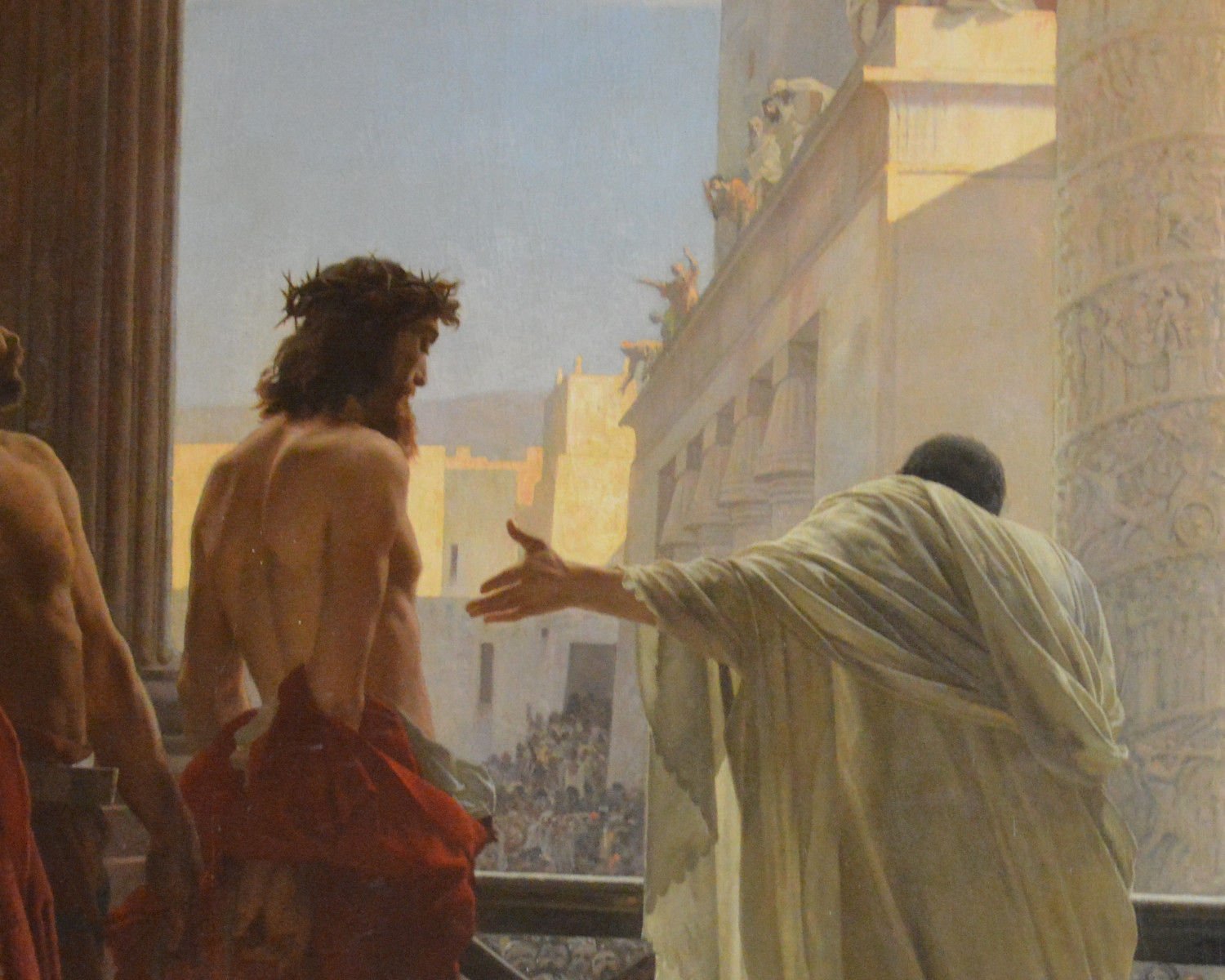
“The justice of New Hampshire found the priest guilty through a process no less infamous than those seen in the tribunals of any banana republic.”
— Carlos Caso-Rosendi in “Behold the Man!”
By Fr. Gordon J. MacRae — November 16, 2022
Carlos Caso-Rosendi, an accomplished author and translator in Buenos Aires, Argentina, published the fine article linked above in Spanish, Portuguese, and English. It is a superb commentary on the state of justice behind the years I have spent in prison. It challenges both Church and State to live up to the reasons for their existence. Here is a compelling excerpt:
“Many of us in the so-called ‘Third World’ look up to the United States of America as a model for what the administration of justice should be. While it is true that the United States has managed better than other countries to balance the interplay of state powers, we also must admit that those virtues have been shadowed by grievous errors such as justification of slavery, segregation, and lately of murder by abortion.
“Today I present the case of an innocent man, Fr. Gordon MacRae, who has spent the last twenty[-nine] years in prison unjustly condemned in circumstances that would cause any Stalinist magistrate of the former Soviet Union to blush. Someone with a well-known criminal record accused Fr. MacRae, an American citizen with full rights. The justice of New Hampshire found the priest guilty through a process no less infamous than those seen in the tribunals of any banana republic.”
— “Behold the Man!”
Mr. Carlos Caso-Rosendi’s use of the term, “Third World” has an interesting origin. In politics and sociology, it’s the accepted designation for an economically depressed or developing nation. The term arose during the Cold War when two opposing blocs — one led by the United States and the other by the Soviet Union — dominated world power. The Third World consisted of nations with less developed economies affiliated with neither bloc.
The term, Third World originated with Marxist psychiatrist and political theorist, Frantz Fanon, but it was perceived as negative and not always accepted by the nations on which the designation was imposed. Even after the collapse of the Soviet Union as a political bloc in the early 1990s, “Third World” remains in use to refer to economically developing nations in Latin America, Africa, and Asia.
From the pillars of power in the United States, the justice systems of Third World countries are often chastised for being woefully unjust, but not a lot of self-reflection went into that perception. Even setting aside how I came to be where I have been for over 29 years, there is a Third World country existing just beneath my feet. It is the U.S. prison system.
I really don’t have another way to describe it. When it rains, the power goes out. When it snows, the power goes out, when it’s windy, the power goes out. The prisoner telephone system would not be the envy of any Third World country. Prisoners exist in an Internet vacuum, trapped behind an iron and concrete curtain of world ignorance. Citizens in the prison labor force earn the equivalent of about $2.00 per day. The people amassed at the U.S. Southern border are fleeing the political oppression and poverty of Third World nations, but none of them come here for our justice system.
I thank Carlos Caso-Rosendi for writing with candor and truth what he sees from beyond the borders of the United States. He is not alone in his assessment. The great theologian, Fr. Richard John Neuhaus, also had a candid description of how I got here. In “A Kafkaesque Tale” he described it as the story of “a Church and a justice system that seem indifferent to justice.”

Voices Heard Round the World
I owe a debt of thanks to Pornchai Moontri for the moving post he sent us from Thailand. In 29 years in prison, I have barely ever shed a tear. I am stubborn. I just wouldn’t give the dark powers that sent me here the satisfaction of my grief. But when reading “Elephants and Men and Tragedy in Thailand” during a phone call with our editor, I had to pause three times to hold back tears so I could proceed. Pornchai’s post was sad, hopeful, deeply moving, and brilliant. Please pray for the people of Uthai Sawan, Thailand. I can only imagine their sorrow. And please pray for all the rest of us that in our divisions we may be given the grace of perspective from stories like the one Pornchai told us.
And I extend my gratitude to Attorney Harvey Silverglate whose Wall Street Journal op-ed, “Justice Delayed for Father MacRae” is also seen around the world. He was joined in October by David F. Pierre, Jr of The Media Report. They published a series of riveting articles in the past month at Beyond These Stone Walls and elsewhere while I just sat back and let them do all the work. I cannot thank them enough. Catholic League President, Dr. Bill Donohue also stood with me in October to publish a press release about these developments. The timing of these guest writers stepping forward was providential.
Now I need to be candid with you. I began the year 2022 with a new ray of hope, but as this year wound down I saw some looming clouds of possible defeat on the horizon. A revelation in Harvey Silverglate’s recent Wall Street Journal op-ed, “Justice Delayed for Father MacRae” revealed that a court hearing was held in secret in New Hampshire and a judge agreed in secret to allow Detective James McLaughlin to be removed from the public list of officers found to have engaged in misconduct. Secret proceedings are just not a good look for a justice system fending off suspicions of corruption. It is in fact the look of what Carlos Caso-Rosendi describes as “the justice of a Banana Republic.”
That designation refers to a small country economically dependent on a single crop or a single product, often governed by a cabal of like-minded conspirators operating for their own benefit. The misconduct for which former Detective James McLaughlin stands accused has been central in the case against me. As a result, a lot of attention is being paid to Mr.Silverglate’s WSJ op-ed. Among the many affronts to justice covered in that article, Mr. Silverglate wrote:
“In a May 1994 lawsuit, Father MacRae alleged that Detective McLaughlin accused the priest of having taken pornographic photographs of one of the alleged victims. No such photos were ever found.”
There is more to it. Not only were such photos never found, but they were also never looked for. There was no effort whatsoever on the part of the detective to confirm or refute this allegation which came only from McLaughlin himself. There was a reason for that. He already knew it was a lie, and it was his own lie. It floated out there among several news articles about me until 2005. It was even cited by Judge Arthur Brennan as his justification for imposing 67 years in prison. Eleven years after my trial, McLaughlin finally admitted to Dorothy Rabinowitz at The Wall Street Journal that “there was never any evidence of pornography.”
Even that did not stop Damien Fisher, a biased New Hampshire reporter with an agenda, from repeating the claim just months ago as though demonstrably true. Ryan MacDonald wrote a truthful rebuttal in, “A Reporter’s Bias Taints the Defense of Fr Gordon MacRae.” When police can invent evidence that never existed, when the news media can further propagate it long after it has been credibly debunked, what chance does a falsely accused man have in a New Hampshire court?
This is the sort of thing that had me feeling so defeated and had Carlos Caso-Rosendi comparing justice here to that of a banana republic. The justice system has become an ominous and oppressive trap for anyone wrongly convicted. When that trap covers up for the good ole’ boy secrecy behind which justice is being carried out here, how does one proceed?

Justice Unmoored from Truth
In light of all that has transpired and all that has been written, I have hard decisions to make. One of them is about hiring a New Hampshire attorney to challenge my convictions based on newly discovered evidence that the investigating police detective had a secret record of misconduct. The claims about him are taking shape and growing in number. One claim reported in local news media is that former Detective McLaughlin has erased tape recordings of statements from witnesses that do not support his bias. This is exactly what I have accused him of for the last 29 years .
I have recently been advised by a New Hampshire lawyer with expertise in this area. Her analysis was candid and I much appreciate it. The bottom line is that justice here will be yet another steep uphill and unpredictable climb. Detective McLaughlin has boasted of over 1,000 sexual assault arrests with a nearly 100 percent conviction rate due to his penchant for arranging lenient plea deals to boost his public persona. He has boasted of removing over 1,000 sexual offenders from the streets but the “removal” is only for a year or so. Guilty defendants gladly took his plea deals, but innocent defendants can only be conned or coerced into them.
Because of the extreme “success” of his actions and methods, Detective James McLaughlin has been widely hailed in some circles as a hero-cop. From the point of view of the justice department and judicial system, however, the growing evidence of his misconduct is a threat to the system itself. As a result — and it is a fact of the legal advice I have received — the entire system will be hell-bent on protecting the corrupt cop while sacrificing me. “They will flood you with motions and delays to bankrupt you,” I was told by a New Hampshire attorney, and that has indeed been my experience.
As a prisoner of 29 years (and counting) with no income beyond the $2.00 per day I earn in a Third World prison job, I do not have the resources for another legal challenge — and especially for another protracted and uncertain one. In 2012 when I raised funds for an appeal, New Hampshire judges simply declined to hear any new evidence or witnesses in the end. A past U.S. Supreme Court ruling left this to their discretion, but they did not seem to have any. The affidavit of the new investigator and the statements of the witnesses he uncovered are linked at the end of this post. You be the judge.
And then there is priesthood. I am likely the only imprisoned priest in the world who has not been simply discarded from the clerical state just for being deemed with the new designation of convenience for bishops, “unsuitable for ministry.” There is now in the U.S. a “Coalition for Canceled Priests” trying to assist priests who are thrown aside for far less cause than a prison sentence. I am innocent of the claims against me, but should I now be forced to trade priesthood for freedom? I cannot. Carlos Caso-Rosendi ended “Behold the Man!” with a burning question:
“Barabbas is gone,
Judas has received his thirty silver coins:
Behold the man, Gordon MacRae!
Bishops of the Church:
What do we do with him?”
+ + +
Editor’s Note: Read the affidavit of former FBI Special Agent Supervisor James Abbott and the statements of six witnesses from whom New Hampshire judges declined to hear.


The Lying, Scheming Altar Boy on the Cover of Newsweek
A 2016 Newsweek cover story by Ralph Cipriano exposed how a Catholic sex abuse fraud made Fr Charles Engelhardt a martyr and con man Daniel Gallagher a millionaire.
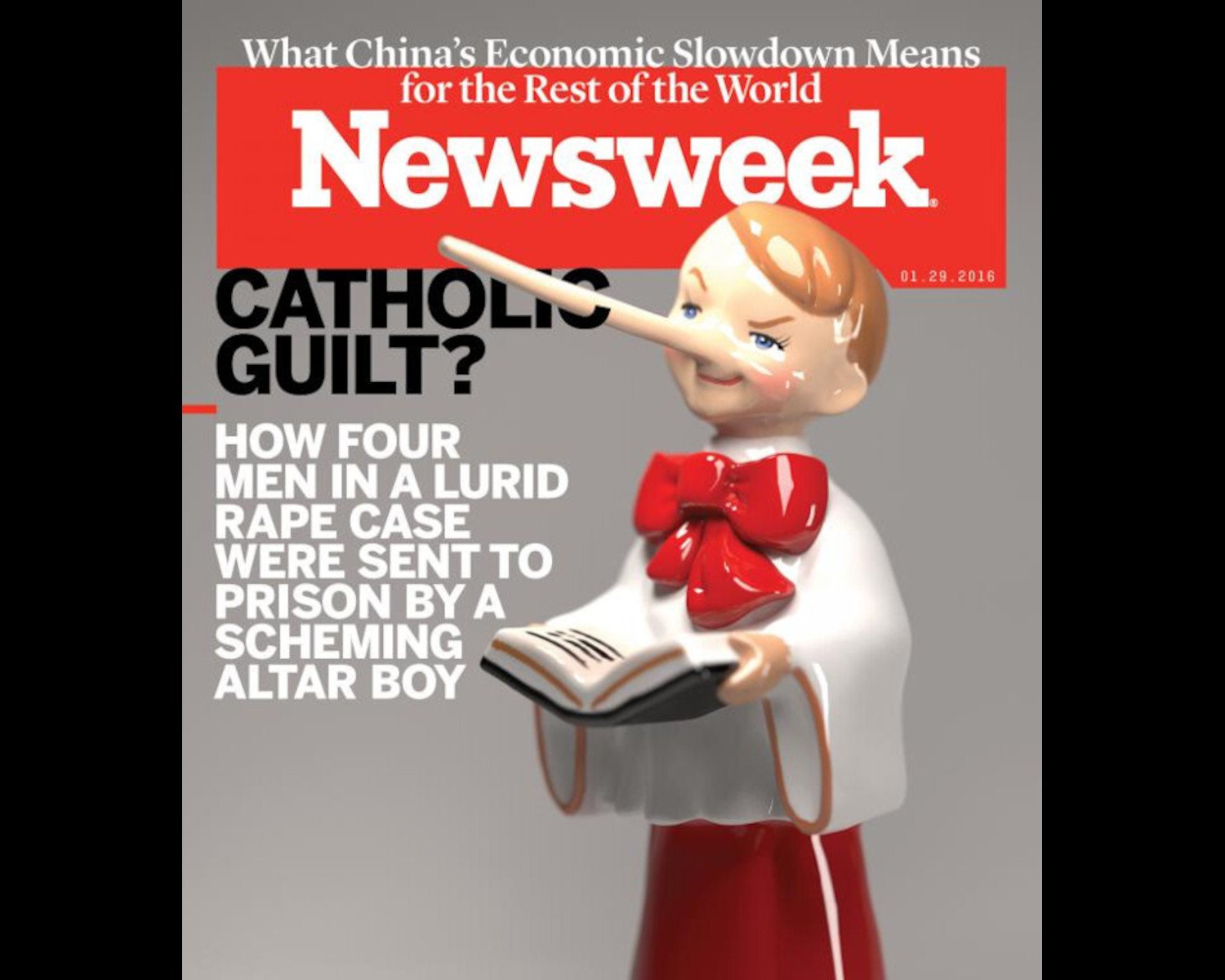
A 2016 Newsweek cover story by Ralph Cipriano exposed how a Catholic sex abuse fraud made Fr Charles Engelhardt a martyr, and con man Daniel Gallagher a millionaire.
November 14, 2022 by Fr. Gordon MacRae
Note from Fr. Gordon MacRae: It is very rare that we have two posts in a week. I first wrote this story in 2016. Fr. Charles Engelhardt died chained to a Pennsylvania prison medical unit gurney on November 15, 2014. I wanted to honor him with the truth, but in the years since this post was first written, so much more of this truth has come to light. In the time since his death, his Philadelphia prosecutor, Seth Williams, was the subject of a 23-count federal indictment for fraud, bribery and other charges. He took a plea deal and went to federal prison. Fr. Charles Engelhardt refused a plea deal and died in prison.
+ + +
This post has a most urgent preface, one that arrived in the mail just as I sat down to type. It was a single page sent to me by BTSW reader Helen, a frequent commenter from Pennsylvania who wrote across the top of the page, “Father Gordon, your face could be on this print.” No, Helen, it could not! The face on that printed page is someone I once met at a pivotal time in my life as a priest, but the sender could not have known that. Helen simply stumbled upon a quote she thought I ought to see, and she was right. The face and the quote on that page belong to the late Father John Hardon, SJ (1914–2000), an American Jesuit priest whose cause for beatification has begun with a recognition in Rome that he is held to be a Servant of God.
Father Hardon and I met in 1989 by “coincidence,” if you still believe in such things. I don’t, but how and why we met is another post for another day. Suffice it for now to say that it was an encounter I could not forget, and when I saw his face on that printed page, and read the words attributed to him, it seemed as though he once again stood next to me with a firm grip upon my shoulder. The quote expresses perfectly why I must write this post, why you must read it, and why together we must share it boldly, and as far and wide as we can make it travel. I took Father Hardon’s words to be a directive, and so should you. Here is the quote:
“Our duty as Catholics is to know the truth; to live the truth; to defend the truth; to share the truth with others; and to suffer for the truth.”
— Father John Hardon
I have long hoped, during the years of media coverage of Catholic scandal, that someone else in the news media might join the ranks of Dorothy Rabinowitz among journalists with a spinal column. It seems I had overlooked Ralph Cipriano. For some time now, he has been covering events in Philadelphia for BigTrial.net, his outstanding Philadelphia Trial Blog. Some time ago, Mr. Cipriano published a major media event in a Newsweek cover story entitled “Catholic Guilt? The Lying, Scheming Altar Boy Behind a Lurid Rape Case” (Jan. 20, 2016).
This is a dark story, and a painful one, and for any number of reasons you might be tempted to click it away at this point, please don’t, for it became a matter not only of justice, but of life and death. Ralph Cipriano’s Newsweek article arrived in my mail on the same day as the above quote from Servant of God, Father John Hardon, and I knew instantly that I had to write about this.
Reading through the Newsweek piece was a vivid experience of déjà vu because I have written of some aspects of this story in a post entitled, “The Path of Sabrina Rubin Erdely’s Rolling Stone.” It was an account of how a good, kind and much loved Pennsylvania priest, Father Charles Engelhardt, was martyred in prison as a result of greed, false witness and prosecutor misconduct. It is this same story that Ralph Cipriano covered in Newsweek, and both are to be commended for some courageous against-the-tide reporting. The Church and priesthood are indebted to Newsweek for presenting this story so boldly in a leading secular media venue while so much of the Catholic press crossed to the other side on the road to Jericho.
Father Charles Engelhardt died in a prison medical unit on November 15, 2014, and the full telling of this story is all that will bring meaning and purpose to his death.
So be brave, please, and read this post to the end, then share it every way you can. Do this, please, to honor the Servant of God who just told us that our duty as Catholics is to know, defend, and share the truth. Do this, please, to honor Father Charles Engelhardt who suffered for the truth and for his priesthood, a suffering that cost him his life.

Rolling Stone’s Sabrina Rubin Erdely
A Rolling Stone Gathers No Facts, Just Dirt
I’d like to think that I have approached this story as Ralph Cipriano did, with cool journalistic detachment, but I now admit that’s very hard to do when the story has a Kafkaesque ring that is all too familiar to me. I was admittedly angry and not at all detached when I wrote the heading for this section, “A Rolling Stone Gathers No Facts, Just Dirt,” a fact conveyed in my Search Engine summary for the post linked in the section above:
“A federal jury found Rolling Stone liable for defamation, and Sabrina Rubin Erdely for actual malice, but their earlier malice cost the life of an innocent priest.”
Today, I find myself no less angry revisiting it. It told the tale of how Sabrina Rubin Erdely’s infamous November 19, 2014 Rolling Stone article, “A Rape on Campus” came unraveled as her account of serial rape at the University of Virginia was debunked and widely exposed as grossly inaccurate and misinformed. Ms. Erdely fell for the story of “Jackie,” took it at face value, and ran with it — doing much damage not only to UVA and its students, but to the field of journalism itself.
Since I first wrote of this, the University of Virginia and its Phi Kappa Psi fraternity have filed multi-million dollar libel and slander lawsuits naming Sabrina Rubin Erdely and Rolling Stone magazine as defendants. Both have since suffered serious losses in journalistic credibility. Rolling Stone magazine has since retracted Ms. Erdely’s account of a lurid frat house serial rape case at UVA. Her Rolling Stone article, “A Rape on Campus,” is today widely seen as grossly irresponsible and agenda-driven slander masked as journalism.
However, Mr. Cipriano’s bold Newsweek cover story is the first hint of media clamor to revisit Ms. Erdely’s other Rolling Stone fraud, “The Catholic Church’s Secret Sex Crime Files” in which she introduced “Billy Doe,” a purported victim of violent and horrific sexual abuse by several Pennsylvania Catholic priests. Billy Doe, granted anonymity by Rolling Stone and everyone else in the news media, was described by Ms. Erdely as “a sweet, gentle kid with boyish good looks” who had been callously “passed around” from predator to predator in the Philadelphia Archdiocese. The story eventually resulted in $5 million in settlements for Billy Doe while landing three innocent Catholic priests in prison.
One of those priests was Father Charles Engelhardt whose decision to stand by the truth against Billy Doe’s $5 million fraud cost this good priest his life. As journalist Ralph Cipriano reveals in Newsweek, Father Engelhardt refused pre-trial plea deals including one deal on the eve of trial that would have resulted in no time in prison and a sentence of simple “community service.” Father Engelhardt chose the truth, and he chose to suffer for the truth. He instead was sentenced to a term of six to twelve years in prison “because he would not perjure himself by pleading guilty ‘to make a deal,’ to admit to a crime he did not commit.” In “Handcuffs and a Hospital Bed,” a November 17, 2014 posting at his “Big Trial” blog, Cipriano wrote:
“For Father Charles Engelhardt, the ordeal is finally over. The 67-year-old priest died at 8:30 PM Saturday night [November 15, 2014] an inmate at the State Correctional Institution in Coal Township [PA] where he served nearly two years of a 6-to-12 year sentence.”

Daniel Gallagher after his $5 million fraud took the life of Father Charles Engelhardt.
Daniel in the Liars’ Den
The man dubbed “Billy Doe” by Sabrina Rubin Erdely and Rolling Stone magazine — while shielding his true identity and character from view in all this — is Daniel Gallagher. Today he is a free man living in Florida where he settled into a lifestyle bankrolled by $5 million in settlements from the Archdiocese of Philadelphia and, in part, its insurers. Gallagher lives free from scrutiny and the long arm of the law because the DA, judge, and news media in Philadelphia all got behind this case, but remain unable to surrender enough of their hubris to stop covering for him, to admit to their pursuit of “trophy justice,” and to allow the facts to invade their field of vision. Sometimes the meting out of justice comes down, not to facts, but to mere ego.
In his riveting Newsweek article, and in “Newsweek’s Cover Boy Makes a Media Splash” on his BigTrial.net blog (Jan. 28, 2016) Ralph Cipriano pursued the truth about who and what Daniel Gallagher is. From his claims of serial victimhood to his ever changing accounts of abuse, to his vague and amorphous facts and stories, to his most recent (and most troubling) psychiatric profile, Daniel Gallagher is exposed as
“chronically maladjusted, immature, self-indulgent, manipulating others to his own ends, refusing to accept responsibility for his own problems, exaggerating, grandiose, hedonistic, impulsive, manipulative and self-serving, paranoid, delusional…”
And the list doesn’t stop there. Gallagher pulled off a con man’s dream when he got a DA and judge to agree that his 23 failed stints in drug treatment were all someone else’s fault. In a Linkedin article, “A Weapon of Mass Destruction,” I quoted a prison inmate who reacted to the flood of decades-old claims against priests with a dose of brutal self-honesty about his own proclivities and enablers:
“So let me get this straight. If I say that some priest touched me funny all those years ago, I’ll be seen as a victim, I’ll be paid for it, and my life will be his fault instead of mine? Do you have any idea how tempting this is?”
— A prison inmate
Daniel Gallagher’s claim of having passed polygraph tests also now appears to be no more truthful than his claim of being passed from priest to priest. No one but his contingency lawyer claims to have seen polygraph results, and efforts to obtain them have been met with silence. Meanwhile, Father Charles Engelhardt DID take polygraph tests, and passed them conclusively, as did other priests in Daniel Gallagher/Billy Doe’s sights. (And for what it is worth, so did I).
Readers of Beyond These Stone Walls should find a loud and clear ring of the familiar in all this. Everything now said of Daniel Gallagher in these reports has been said of Thomas Grover, my accuser trial. And it has all been said of Shamont Lyle Sapp, a con man who landed settlements from accusing four priests in four different states until he was exposed by a U.S. attorney and a journalist with integrity. I take no credit, but he was also exposed by me in my Linkedin article cited above.
This particular rolling stone about Daniel Gallagher and Father Charles Engelhardt, was sent downhill by Sabrina Rubin Erdely who has since been found liable for “actual malice” and “disregard for truth” by a judge in the University of Virginia story. The rolling stone about Father Engelhardt had a long path. It rolled all the way Down Under to Australia where elements of the story were duplicated and reused by prosecutors and the media in Australia to condemn an even greater trophy, Cardinal George Pell. I wrote of the glaring similarities in the two cases in “Was Cardinal George Pell Convicted on Copycat Testimony?” It turned out that indeed he was, and Australia’s highest court exonerated him after 400 days in prison.
Thanks to Ralph Cipriano and Newsweek magazine, some honest media has taken notice of the Daniel Gallagher scam, but not in time to save the life of Father Charles Engelhardt. Still, these revelations of truth bring immense comfort to those still charged with clearing this good priest’s good name. But there’s more than that at stake here. You have been duped. Our Church has been duped, and cast aside in the public square in the process. The truth is a value in its own right, and we owe it to ourselves to learn it and share it.
I can only thank Ralph Cipriano and Newsweek for taking this on, and for telling a truth most in the news media have shunned. Take a little time, please, and read the Newsweek article and Mr. Cipriano’s BigTrial.net blog, and share a link to this post with others. I know one Servant of God who will smile upon you for it.

Life Still Goes on Behind and Beyond These Stone Walls
Two years and 102 posts after the resurrection of this blog as Beyond These Stone Walls,the challenges of prison writing continue to be overcome week after week.
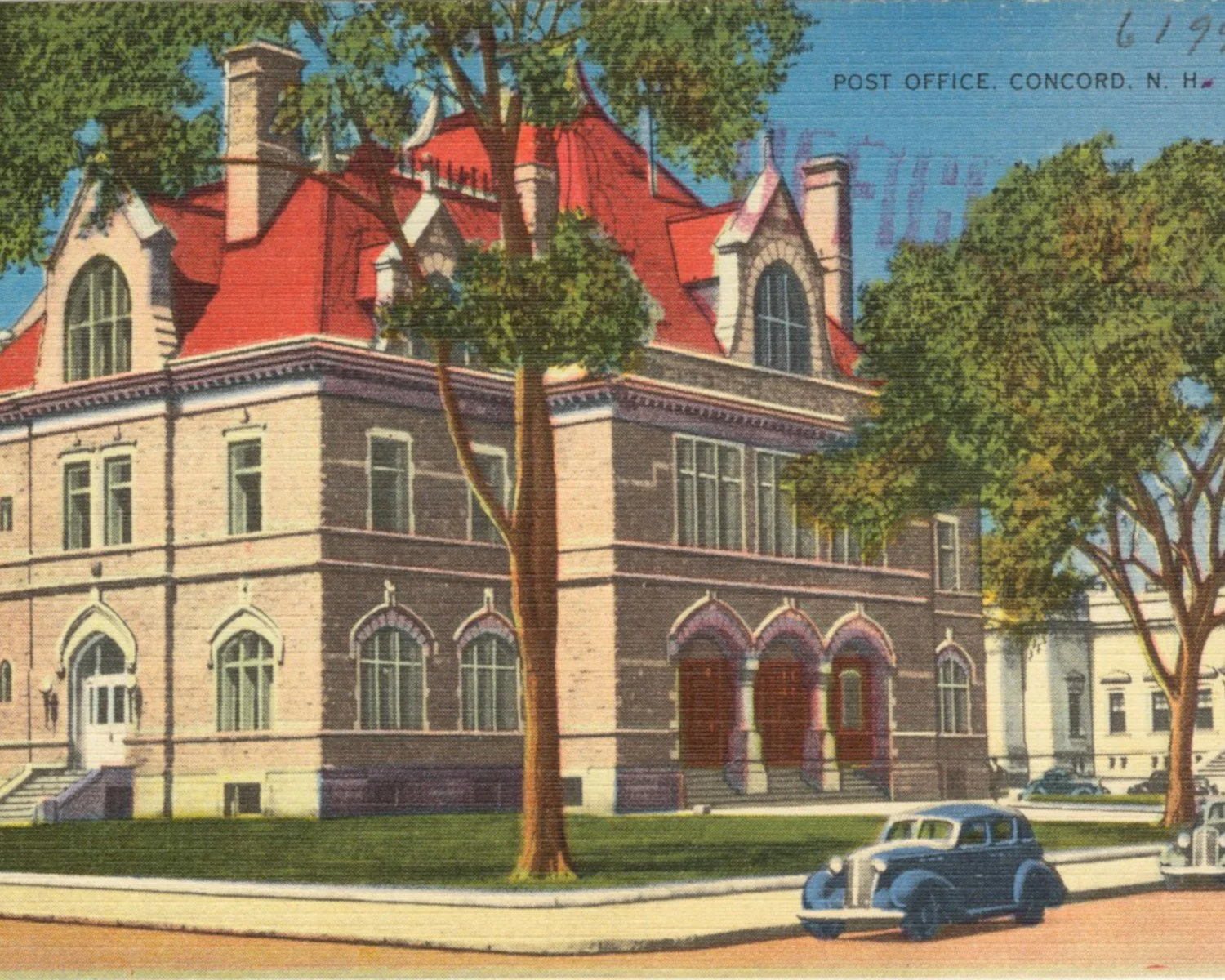
Historic Concord, New Hampshire Post Office
Two years and 102 posts after the resurrection of this blog as Beyond These Stone Walls, the challenges of prison writing continue to be overcome week after week.
November 9, 2022 by Fr. Gordon J. MacRae
The United States had a most crucial national election this week. What I am writing now will be posted just one day later so I cannot imagine anyone paying any attention at all to me. But I’m used to it — at least, I thought I was.
I owe many of you an apology. You might recall that two years ago this week, These Stone Walls, the older version of this blog, had to be taken down. I wrote about the circumstances behind its collapse in our first publication under its new name on November 11, 2020. That post was “Life Goes on, Behind and Beyond These Stone Walls.”
Two years and 102 posts later, we discovered something about the newer blog that we had previously overlooked. It came with its own email address for subscribers to contact us. Being locked away from ever being able to interface with technology, I had no idea. Just two weeks ago, our editor stumbled upon this internal email system along with hundreds of your unread and unanswered comments and messages dating back two years. For all this time, I thought you were all just ignoring me. The internal address is FatherG@BeyondTheseStonewalls.com.
And many of you must have thought the reverse. For two full years, subscribers had been clicking the “Reply” button on our weekly subscriber message to send me messages, comments, and reflections on my posts, but without any reply or even an acknowledgment from me.
Our editor’s discovery of the cache of hundreds of your emailed messages required two long marathon sessions by telephone over two days to hear them read to me and respond — up to two years late — to as many as I could. Our volunteer editor risked carpal tunnel syndrome typing all my dictated replies. Some messages were just too old for any reply to make any sense. Anyway, we apologize for the oversight.

A Voice in the Wilderness
It is humbling. Before becoming a guest of the State in 1994, I was known for being somewhat of a computer geek. I coached many other priests back then who were struggling to embrace the computer age. Now my prison barriers place me in Techno-caveman status relegating me to the technological Stone Age. Sometimes our editor is surprised when, sight unseen, I walk her through posting something at Linkedln, for example, without ever having even seen it. I read a lot about technology, but that is not quite the same as hands-on experience.
When I began writing from prison at the urging of Cardinal Avery Dulles and others, I had no idea what a blog was. They did not exist when I dropped off the face of the Earth in 1994. According to the latest estimates of Google, there are over 600 million registered blogs worldwide publishing 2.5 billion blog posts a year. So mine is literally a tiny voice in the wilderness.
It is difficult to say how many blogs identify themselves as “Catholic” blogs. For a time, a site called “Top Catholic Blogs” featured posts from me almost weekly, but it seems to have become inactive. Another site, The Big Pulpit, moderated by Tito Edwards for the National Catholic Register, featured an occasional post from me, but had not done so since our change of name two years ago. Then on the day before this is posted, The Big Pulpit proved me wrong by posting, “Catholic Priests Falsely Accused.” So in terms of promoting a message, it seems entirely up to me — and you, if you are willing.

When You Write to Me
While the nation is celebrating or regretting the outcome of this election and analyzing all of its implications, I want to address a few housekeeping items about Beyond These Stone Walls. I wish I could say that I have been more responsive to your snail mail than I was to your neglected email messages.
Mail to me in prison now goes through a process that will seem like an insult to all of your good intentions. There were all sorts of rules in place requiring that mail be either typed or hand written in plain black or blue ink. Now that has all been scrapped. Effective a few months ago, prisoners here no longer receive any original mail at all.
Letters and any enclosures are now photocopied in black and white, and I receive only the copy. The original is held for ten days and then shredded. There have been lots of problems with this, the most frequent being double-sided originals that are copied on only one side. When that happens, I have ten days to request re-copying of the original before it is shredded.
Despite all the obstacles, I still get a lot of mail. Please do not misunderstand me. Mail is the lifeblood of the psyche for any prisoner. There are many here who do not even bother to show up for mail call. My biggest heartache, however, is being unable to answer most of your letters in a timely manner. Sometimes mail piles up for so long that any reply just feels insulting. I am so very sorry that many of your letters and gifts have gone without response. It would help if you include an email address in your letters. It would be easier for me to send a reply in that way.
Part of this problem is that I have to handwrite each and every letter I send. I can purchase only six typewriter ribbons per year and therefore must reserve them for publishing posts. In addition to Beyond These Stone Walls, I am also occasionally asked to write for other venues. The latest is an article published at a U.K. site, False Allegations Watch. I hope you will look at it because it lets site administrators know that an article is important. My article there is “Did Police Misconduct Turn a False Allegation into a Wrongful Conviction?”
Facebook refused to allow that link to be posted. Ironically, the leftist media was eager to report about police misconduct until doing so helped the cause of a wrongly imprisoned Catholic priest. This latest experience with Facebook drove home for me the importance of what Elon Musk now plans to do with Twitter: No more cancelling conservative views; no more cancelling pro-life voices; no more cancelling Catholic fidelity. By the way, we have a Twitter account. Just go to Twitter.com and search BeyondTheseStoneWalls to follow us.

A Corporal Work of Divine Mercy
Sending an occasional monetary gift to me has been most helpful, but also somewhat of a heartache. Gifts cannot be sent to me directly, but my brother-in-law, a lifelong friend who somehow married my sister when I wasn’t looking 42 years ago, maintains a power-of-attorney account for my needs. Please see our “Contact and Support” page to help if you wish and are able. Modest gifts to that account help a good deal with annual expenses for this blog and with food and clothing costs.
I have an expense coming due just after Christmas that I hope to find some help with. It’s my $650 annual subscription to The Wall Street Journal which helps me immensely to stay in touch with the world and write about it. It is my one and only extravagance and the subscription fee is a bargain compared to other newspapers. I was shocked to learn from a reader that annual subscriptions to The New York Times and The Boston Globe are both over $1,200. In my opinion, the WSJ is a far superior newspaper (and not just because it has published about me!).
Some people have helped by using PayPal. We have an account, but PayPal has become problematic for many. On October 8 this year, PayPal sent an update to its Terms of Use Policy that alarmed many users, causing some to terminate their accounts. PayPal reserved the right to confiscate up to $2,500 from users’ accounts if PayPal determines that a user posted “misinformation” on the Internet. Paypal also blocked accounts in the UK such as Free Speech Union and the Daily Sceptic.
After global protests, many closed accounts, and a big selloff of PayPal stock, the company thought better of it and issued a retraction while restoring the closed accounts. There are many, however, who simply don’t trust PayPal going forward now. We receive few gifts through PayPal, but the annual total is almost enough to keep this blog afloat. If donors use that means, please always send me a message that you have done so using our PayPal donor email, FrGordonMacRae@gmail.com. This will better enable me to send you a message of acknowledgment and thanks.
Please also pay some attention to our Special Events page for information on how to help me with two causes that are most important to me: the support and rehabilitation of Pornchai Moontri, and the Vietnamese Refugee Project of Father John Hung Le, SVD. American funds go a long way in Thailand, and thanks to your help I have been able to help sustain them both. This means more to me than any endeavor on my own behalf .
The elections are over. May sanity, fairness and justice now reign. May Twitter be actually free from partisan censorship. May the woke finally go back to sleep. May God resume His hallowed place in our discourse. And may the Lord be with you.
+ + +
Note from Fr. Gordon MacRae: We assimilate much more of the message of the Gospel when its intended meaning is more fully understood. The Gospel from St. Luke at Mass this coming Sunday (Luke 21:5-19) is a prediction of terrible persecutions for which Jesus tells all of us to prepare. I previously wrote of this alarming Gospel text in the posts:


David Clohessy Resigned SNAP in Alleged Kickback Scheme
David Clohessy, activist director of the Survivors’ Network of Those Abused by Priests (SNAP), resigned after a SNAP employee sued citing a lawyer kickback scheme.

David Clohessy, activist director of the Survivors’ Network of Those Abused by Priests (SNAP), resigned after a SNAP employee sued citing a lawyer kickback scheme.
We do not have many headlines like this one at Beyond These Stone Walls. It has the look and feel of descending into tabloid journalism, but when the headline is true, there is just no higher road to take. This is a story that must be told.
And I am not the first to tell it. David F. Pierre, Jr., author of several books including Sins of the Press and host of TheMediaReport.com published a report entitled, “Lawsuit by Ex-SNAP Insider Exposes Lawyer Kickback Schemes.” And to the surprise of many, the left-leaning, usually SNAP-friendly National Catholic Reporter broke the story first in an by NCR Editor Dennis Coday, “Sex Abuse Advocacy Group SNAP Sued by Former Employee.”
One day later, The National Catholic Register carried the story by Catholic News Agency writer, Kevin Jones entitled, “Did SNAP Receive Kickbacks for Suing the Church?” All three versions of the story have been sent to me by multiple BTSW readers who asked me to write about it. A week after these accounts emerged, SNAP’s longtime Executive Director, David Clohessy, has mysteriously resigned. This is a development of immense importance in the arena of Catholic Priests Falsely Accused, one of David F. Pierre, Jr.’s most revealing books.
I have an angle on this story that none of the other accounts have, and I’ll get back to that, but first the story itself. In a lawsuit filed in the Circuit Court of Cook County, Illinois, Gretchen Rachel Hammond, SNAP’s former Director of Development, charged that she was terminated from her position after discovering what many have long suspected. The lawsuit alleges…
“… that SNAP routinely accepts financial kickbacks from attorneys, and in exchange for the kickbacks, SNAP refers survivors as potential clients to [these] attorneys, who then file lawsuits … against the Catholic Church. These cases often settle, to the financial benefit of the attorneys and, at times, to the benefit of SNAP, which has received direct payments from survivors’ settlements.”
The named defendants in the lawsuit are [the now-resigned] SNAP President Barbara Blaine, the now-resigned Executive Director David Clohessy, and “Outreach Director” Barbara Dorris who declined to comment for the NCR article. The lawsuit alleges that SNAP claims non-profit federal tax exempt status as an organization with the purpose of providing “support for men and women who have been sexually victimized by members of the clergy [with] moral support, information and advocacy,” while in reality it is a commercial operation “motivated by its directors’ and officers’ personal and ideological animus against the Catholic Church.”

Follow the Money
The lawsuit alleges that SNAP and its directors received substantial ‘contributions’ from the same attorneys to whom they refer clients, as much as 81 percent of SNAP’s annual budget in some years. In 2007, a full 38 percent of SNAP’s income for that year came from one “prominent Minnesota attorney who represents clergy abuse survivors.” That attorney is alleged to have provided $169,716 in kickbacks to SNAP in 2007, and $415,000 in 2008. The lawsuit claims that lawyers in California, Chicago, Seattle and Delaware also made major “donations,” some of them in six figures.
Former SNAP official Gretchen Rachel Hammond concludes in her lawsuit that “SNAP does not focus on protecting or helping survivors — it exploits them.” She alleges that SNAP leaders ordered her “not to reveal to anybody that SNAP received donations from attorneys.” She also alleges that in 2011 and 2012, SNAP leaders “concocted a scheme to have attorneys make donations to a front foundation” to conceal “attorneys’ kickbacks” to the organization.
The lawsuit alleges a pattern of collusion between plaintiff lawyers and SNAP officials to maximize publicity for the purpose of fueling bigger payouts while SNAP “callously disregards the real interests of survivors.” It claims that attorneys gave SNAP the drafts of plaintiff claims and other privileged information to generate sensational press releases.
In 2009, at the invitation of Bill Donohue, I wrote a feature article for Catalyst, the Journal of the Catholic League for Religious and Civil Rights entitled “Due Process for Accused Priests.” The article researched and exposed the practice of mediated settlements and SNAP’s demands to eliminate statutes of limitations for suing Catholic institutions — and only Catholic institutions — decades after civil laws allowed.
Up until that time, I had been spared SNAP’s pattern of public attack and character assassination, but my Catalyst article put me squarely on SNAP’s radar screen. Catholic writer Ryan A MacDonald — in “Why Do SNAP and VOTF Fear the Father Gordon MacRae Case” — quoted a comment by SNAP Director David Clohessy describing me as “a dangerous and demented man.”
On August 6, 2009, RenewAmerica.com writer Matt C. Abbott gave David Clohessy a soapbox for a rebuttal to my article which Mr. Abbott titled, “Imprisoned Priest, Clergy Abuse Survivor Clash.” Seeming to be in fear of the very exposure that the present lawsuit against SNAP now brings, Mr. Clohessy laid out a wildly false set of defensive statements and accusations: “The burden is on the victims, not the accused priests to prove these cases,” he wrote.
At the same time, Clohessy was well aware, and went on to describe, that the vast majority of the claims brought against priests are settled out of court with no findings of fact at all. Clohessy blamed this practice on the bishops who, he wrote, “insist on group settlements” because “they are scared to defend themselves in court.”
Clohessy knew very well that the machinery of making decades-old claims followed by financial compensation depended on asking few questions before writing lucrative checks. Still, he claimed that “many victims desperately want and could benefit from having their ‘day in court’ to expose not just their predator, but those who shielded and protected him.”
Now, according to Ms. Hammond’s lawsuit, it seems that David Clohessy’s annual salary and SNAP’s annual bottom line depended on keeping the machinery of blanket settlements going. In his landmark book, Catholic Priests Falsely Accused David F. Pierre, Jr. described the quality of due process and distinguishing true from false claims in my own diocese:
“In 2002, the Diocese of Manchester, New Hampshire, faced allegations from 62 individuals. Rather than spending the time and resources looking into the merits of the accusations ‘Diocesan officials did not even ask for specifics such as the dates and specific allegations for the claims,’ New Hampshire’s Union Leader reported. ‘Some victims made claims in the past month, and because of the timing of the negotiations, gained closure in just a matter of days.’ ‘I’ve never seen anything like it,’ a pleased and much richer plaintiff attorney admitted.”
— Catholic Priests Falsely Accused, p. 80
Two of the reporters covering this story — Dennis Coday for the National Catholic Reporter and Kevin Jones for Catholic News Agency — do a disservice to the cause of truth and justice in their reporting of it. They both refer repeatedly to SNAP’s (and the lawyers’) clients as “sex abuse victims” or “sex abuse survivors.”
It is true in some cases, of course, but it is true in most cases only if one accepts SNAP’s and the lawyers’ mythology that the claims against priests for which clients received blanket settlements were demonstrably true, and were measured and tested in some form of investigation. Most were not. Simply throwing money at an accuser does not constitute due process or a determination of truth. Some have been victims of little more than their own greed.
Pope Benedict’s ‘Crimes against Humanity’
SNAP successfully generated and manipulated a climate of outrage to fuel accusations and keep the money flowing. It was a climate few Catholic leaders had the courage to challenge, but one did. In his series of columns entitled “Scandal Time” in First Things magazine, Father Richard John Neuhaus tried to call upon American Catholics to put the brakes on the outrage fueled by SNAP:
“Priests, too, are to be deemed innocent until proven guilty. In the current climate of outrage, we need to be reminded of that truth again. … News reports claiming that a certain number of priests have been charged with abuse and that the claims were settled out of court must not be interpreted to mean that the priests are guilty. Some of them insisted and insist that they are innocent, but bishops were advised by lawyers and insurance companies that a legal defense against the charges would cost much more than settlement out of court.”
Scandal Time, by Richard John Neuhaus, April 2002
After Father Richard John Neuhaus published this cautionary statement, the bishops of the United States met in Dallas in 2002. Under the watchful eyes of a scandal hungry media, the bishops invited two “victim-activists” to address the conference that resulted in the Dallas Charter and the undoing of any priest accused. They were David Clohessy and SNAP president, Barbara Blaine.
SNAP’s national director, David Clohessy previously worked for over a decade for ACORN (Association of Community Organization for Reform Now), a group with aggressive, manipulative, and confrontational activism modeled after the tactics of 1960’s radical Saul Alinsky. Keeping the money flowing depended on creating and maintaining sufficient moral panic.
In August, 2011, the Catholic League published what should have been an explosive document if it had been given fair treatment in the news media. “SNAP Exposed” described in detail the ways David Clohessy and SNAP coached accusers in framing claims in order to maximize and manipulate media coverage.
One of the many egregious examples was SNAP’S recommendation for accusers and their lawyers to “display holy childhood photos” before news cameras adding, “If you don’t have holy childhood photos, we can provide you with photos of other kids that can be held up for the cameras.”
A month later, seemingly in retaliation for exposing the truth, SNAP co-opted a radically left legal activist group, the New York-based Center for Constitutional Rights, to file a “Crimes Against Humanity” charge against Pope Benedict XVI with the International Criminal Court at The Hague.
And in seeming retaliation for my 2009 article, “Due Process for Accused Priests,” I became an unwitting pawn in the attack on the Pope. David Clohessy and the Center for Constitutional Rights used an untrue and thoroughly debunked claim against me to bolster the charge against Pope Benedict. In her courageous article “Oscar Hangover Special: Why ‘Spotlight’ Is a Terrible Film,” journalist JoAnn Wypijewski unmasked the shame of this tactic in her in-depth coverage of the film, “Spotlight”:
“The film’s advertisement for SNAP, the Survivors Network for those Abused by Priests, … elides SNAP’s belief that wrongful prosecutions are a minor price to pay in pursuit of its larger mission, something the newspaper didn’t much concern itself with either as it collected its Pulitzer for service in the public interest; something even the Center for Constitutional Rights disregarded in 2011 when it joined with SNAP to file a grotesque brief to the International Criminal Court demanding “investigation and prosecution” of the Vatican for crimes against humanity.
“The CCR brief failed, but its unchallenged acceptance of accusations, anonymous complaints, prosecution arguments, grand jury reports, commission findings with no benefit of cross examination and no recognized rights of the accused is breathtaking, especially when one considers that CCR was simultaneously and courageously arguing on behalf of Guantanamo detainees …
“To CCR’s shame, Father MacRae is specifically mentioned in that brief, with respect to allegations of videotape (that is, child porn), which prosecutors threw in at sentencing but for which there is no evidence, according to the lead detective in the case cited by [The Wall Street Journal’s Dorothy] Rabinowitz.”
When I learned of this grave injustice, I tried to write to the Center for Constitutional Rights — It seemed a prophetic sign that its headquarters is located at 666 Broadway in Manhattan — but there was never a response. I wrote of the final outcome of CCR’s shameful complicity with SNAP in a BTSW post, “The International Criminal Court has Dismissed SNAP’s Last Gasp.”
Perhaps I was premature. SNAP’S last gasp now seems to be the current lawsuit by one of its own directors. David Clohessy has claimed that his resignation has nothing to do with the current lawsuit exposing SNAP’s alleged financial kickbacks from clients’ lawyers.
It now remains to be seen whether David Clohessy and SNAP will follow their own advice about out-of-court settlements, and allow this lawsuit to go to a full and open trial before a civil jury.
And perhaps a RICO investigation — the government’s acronym for Racketeering Influenced and Corrupt Organizations — might also now be in order.
As I come to the end of this post, it has just been announced that SNAP founder, Barbara Blaine, has also tendered her resignation. In her brief statement she insists that it has nothing to do with the lawsuit which she says has no merit “like all the other lawsuits” against SNAP. [See the report on David F. Pierre, Jr.’s TheMediaReport.com: SNAP Founder and President Barbara Blaine Now Resigns As Pressure Mounts From Multiple Lawsuits.]

Editor’s Note: David Clohessy and Barbara Blaine ultimately settled the lawsuit by Gretchen Rachel Hammond for an undisclosed amount after demanding and receiving a signed nondisclosure agreement.

The Last Full Measure of Devotion: Civil Rights and the Right to Life
Racial justice and a dubious idea of critical race theory are now center stage in our culture, but they give no voice to the most urgent Civil Rights issue of all.

Racial justice and a dubious idea of critical race theory are now center stage in our culture, but they give no voice to the most urgent Civil Rights issue of all.
For the entire second term in the presidency of Barack Obama, Ohio Republican congressman John Boehner was Speaker of the House of Representatives. He left that office in 2015. A devout Catholic, he had been honored by the University of Notre Dame with the Laetare Medal, a distinction awarded to Catholics in public life who witness to their faith in extraordinary ways. During Speaker Boehner’s first address to the House of Representatives in 2011, he said that “America is more than a country. It’s an idea.” Like any great idea, it did not begin in its current form. The idea of America evolved with fits and starts in response to both prophets and protests — and wars, and great losses, and immense sacrifices. From my perspective, in the decade from 1963 to 1973 the very idea of America gave birth to a Civil Rights movement that was hard fought and continues to be. Milestones were reached, but the Civil Rights movement never ended. It now just takes another form.
Civil Rights as an idea is not yet a done deal. Just as the idea formed and took shape for some in America, it failed an entire class of others. Just as the idea of Civil Rights embraced our fellow Americans living lives marked by racial divisions and distinctions, it failed millions of others not yet living outside the womb.
In the decade of the 1970s, it sometimes felt like I would be in school forever. After four years studying psychology and philosophy at Saint Anselm College, a Benedictine school just outside Manchester, NH, I commenced another four years at Saint Mary Seminary and University in Baltimore, Maryland from where I was awarded a Master of Divinity and a Pontifical degree in Sacred Theology. Saint Mary’s is the oldest Catholic seminary in the United States and, at that time at least, was the most academically demanding.
Like many seminarians then, I was chronically poor. During the rationing and long gas lines of the late 1970s, I paid $900 for a clunker of a 1969 Chevy Malibu. It had a V-8 engine that could pass everything but gas stations, and when I bought it, it burned almost as much oil as gasoline. A friend and I spent all our spare time in the summer of 1978 rebuilding its engine before I drove it off to Baltimore to begin the great adventure of faith seeking understanding. I was proud of the fact that we got the Malibu’s gas mileage up to a point where I could sit in the long gas lines with a clear conscience, though I don’t think General Motors would have still recognized its engine. I loved that car, not the least for where it took me.
Roaring around Baltimore from 1978 to 1982, I quickly learned that the great city was second only to my native Boston for the lure and lore of its history. Outside the seminary, there was a whole other field of education within 100 miles of Baltimore in any direction. So Saturdays in the seminary were devoted to field trips to the birth and growth of America; to the places where the idea first took shape. That’s when visiting history became my hobby, and an important part of my education. Much more than my loss of freedom, now, I mourn the passing of the world beyond these stone walls.

Upon the Field of Battle
One place stands out strikingly against the background of monuments and memories I visited and studied. I had some friends among the seminarians at Mount Saint Mary Seminary in Emmitsburg, Maryland, a two+ hour drive from Baltimore. On several Saturdays, my speedy Malibu drove north to pick up my friends and head for Gettysburg, just a few miles from Emmitsburg straddling the Maryland and Pennsylvania state line.
It’s hard to describe what I felt the first time I stood surveying the very heart of America’s most terrible war. The Battle of Gettysburg was fought there over the first four days of July in 1863. President Abraham Lincoln’s famous Gettysburg Address was delivered on that field on November 19, 1863, just three months after the horrific four-day battle that took the lives of over 80,000 Americans.
For some reason, standing on that field of battle for the first time in 1979, I thought of John F. Kennedy and his signature cause, the Civil Rights movement which was in turn taken up by President Lyndon Baines Johnson after Kennedy’s untimely death in 1963. It came as a shock to me to realize that the defining battle of the American Civil War — that I once thought to be ancient history — was fought and then immortalized in Lincoln’s great speech just l00 years before the assassination of John F. Kennedy. It was exactly 100 years, barely three generations in the lives of men. The Battle of Gettysburg, and all that led up to it, took place in the lifetime of my grandfather’s grandfather.
Suddenly, with that revelation, I felt linked to all that came before. Michael Shaara’s Pulitzer Prize winning 1974 historical novel, The Killer Angels relived this most decisive battle of the American Civil War, and my first visit came just after this great work of historical storytelling.
It felt strange standing for the first time upon Cemetery Hill where the Civil War pivoted toward victory for the North. But there was really no victory. It was America against itself, and the powerful imprint of death and sacrifice was still upon that battlefield as I stood there 116 years later. It was both eerie and inspiring. My friends went off to tour the museum and stare at row upon row of cannonballs and muskets, but I couldn’t leave that field. I realized standing there for the first time just what an idea can cost, and what hardship and sacrifice it can demand from those who serve it.

The Right to Life and the Cost of Liberty
By the time the Civil War was over, it demanded of America more lives of its citizens than World War I and World War II combined. Some 500,000 lost their lives fighting this nation’s war against itself. I didn’t understand then just how this happened, but standing on that Gettysburg field, I resolved to one day understand. Men and women can sacrifice their lives for an idea, or an ideal, or a principle that is far greater than themselves. They can sacrifice freedom, even, to stand firm on a ground made solid by conscience.
Many historians and legal scholars draw a direct line between the outbreak of the American Civil War in 1861 and a single case decided before the U.S. Supreme Court four years earlier in 1857. As a causal connection, the decision in Dred Scott v. Sanford enraged conscience-driven abolitionists and encouraged slave owners. It broadened the political and ideological abyss between the North and the South, and it led directly to a war of nothing less than the demands of conscience versus the realities of economic necessity and convenience.
Dred Scott was a fugitive slave. In 1848 at the age of 62, having spent decades in secret learning to read and write, he brought suit to claim his freedom on the ground that he resided in a free territory established by the 1820 Missouri Compromise. This is a piece of American history that must not be overlooked or forgotten, though many would prefer not to know. Dred Scott was purchased and lived his life as a slave, but was then taken by his “master”, an Army surgeon, to a free territory rendered free by the Missouri Compromise.
In Dred Scott v. Sanford, Supreme Court Justice Roger Taney wrote for the majority that the Missouri Compromise was unconstitutional and violated the Fifth Amendment because it deprived Southerners of a right to bring their private property — i.e., slaves — wherever they wanted. The decision further ruled that Congress did not have the authority to establish free territory, and in its most alarming language, Justice Taney’s decision established that black men are not citizens of the United States and had “no rights any white man is bound to respect.”
Reflecting upon this now, five generations later, is made all the more painful by the recognition that Supreme Court Chief Justice Roger Taney was a Catholic, though one who surely put the realities of national economics above the tenets of faith or conscience. As I wrote in “The True Story of Thanksgiving,” the Catholic Church had three centuries earlier established slavery as a moral evil, and declared it unacceptable in any Catholic country. It would take another 250 years from the founding of America for this nation to put economic interest aside and catch up with the conscience of the Catholic Church.
Justice Taney’s decision caused some in his day to conclude that there is a higher moral law than the Supreme Court’s interpretation of the Constitution at any given time in history. There is a higher moral law, and it led the nation on a direct path from Dred Scott to Civil War. The war came as a result of the conscience of individuals gradually forming a consensus about slavery, racial justice and the rights of man.

Rev. Martin Luther King and Father John Crowley
One hundred years after that war was fought, its ripples continued throughout this nation. In 1968, Rev. Martin Luther King was assassinated for his unwavering and prophetic public witness in a story that we all know only too well. My friend, the late Father Richard John Neuhaus (who contributed to our “About” page) wrote of the radical grace exemplified by Martin Luther King in American Babylon: Notes of a Christian Exile. He wrote of Dr. King’s notion of “The Beloved Community” and described his movement as a new order . . .
“. . . sought by all who know love’s grief in refusing to settle for a community of less than truth and justice uncompromised.”
Think for a moment, please, about that statement. There are not many of us who escape love’s grief — unless we become so shallow as to so steel ourselves against grief that we can ignore it. What a tragedy! Those of us who know love’s grief and refuse to settle for a community — a nation, a Church — of less than truth and justice uncompromised are in for some prophetic suffering.
Three years before Martin Luther King was assassinated, Father John Crowley, a heroic Catholic priest, was nearly driven from Selma, Alabama when he took out a full-page ad in the Selma Times-Journal on February 7, 1965.
His ad contained a brilliant essay entitled “The Path to Peace in Selma.” It urged the white community to speak out against racial segregation and discrimination not for the good of the black man and woman, but for the good of ALL men and women. Like the famous Lutheran Pastor, Dietrich Bonhoeffer, executed on the personal orders of Adolf Hitler on April 9, 1945, Father John Crowley called upon fellow priests and other Catholics to put aside their fears of loss and stand by the truth uncompromised. I share a date of birth with the date of Dietrich Bonhoeffer’s death, and I share my June 5th date of priesthood ordination with Father John Crowley. These very special men compel me to stand always by the truth uncompromised, and not to fear its cost.

Stand against the Culture of Death
Martin Luther King lost his life just five years before another divisive Supreme Court decision with grave implications for Civil Rights. There are some, and they are many, who see in the 1857 decision in Dred Scott the roots of the 1973’s Supreme Court decision in Roe v. Wade. Justice Antonin Scalia and Justice Anthony Kennedy have both cited this connection. In 1973, after the Supreme Court handed down its divided decision in Roe v. Wade, the State of Texas joined other states in filing a petition for a rehearing before the full Court. The Texas dissent declared that the decision in Roe that an unborn child was not a human being with rights to be protected was not at all unlike the decision in Dred Scott that virtually no just person in this nation would ever stand by today.
And just as Dred Scott inspired dissidents of conscience to hear the Commandments of a Higher Authority, Roe v. Wade has inspired similar heroism, most of it barely noticed in the mainstream media, or, worse, taunted. Have you noticed that much of the loudest ridicule of the Catholic Church in America comes on the heels of legislation that chips away at the right to life and human dignity? Many a media barrage against the Catholic Church has been for the purpose of silencing its pro-life voice in the public square.
Life Site News has carried the stories of two Canadian women whose sacrifices on behalf of civil rights for the unborn had landed them in prison. Linda Gibbons, a grandmother and prisoner of conscience, spent seven years in an Ontario prison because she refused to comply with a court order demanding that she cease and desist from standing on the sidewalk near an Ontario clinic to present alternatives to abortion. In eerie echoes of the Dred Scott decision, the clinic staff and the Ontario court charged her with interfering with fair commerce by suggesting to clients another way. Linda Gibbons first went to prison at the same time I did, in September 1994.
Mary Wagner took leave from a French convent to “witness to life” as Life Site News has called her sacrifice. In Holy Week, 2010, Mary was arrested by Vancouver police and remained in jail for months for refusing to obey court orders to cease talking to abortion clinic clients about Project Rachel.
And you may have heard of the late Norma McCorvey. She’s better known as “Jane Roe,” the plaintiff in the 1973 Roe v. Wade Supreme Court decision. Norma became a Catholic in 1998 and also became a dedicated pro-life activist. She was author of the 1998 book, Won by Love. In 2005, the U.S. Supreme Court rejected a petition by Norma McCorvey to reverse Roe v. Wade. In May 2009, she was among the Catholic pro-life witnesses arrested at the University of Notre Dame during President Obama’s Commencement address.
We can deduce where Martin Luther King would stand on the pressing civil rights issues of this day. There is some annual controversy that his niece, Dr. Alveda King, endeavors to clear up. She staunchly defends Rev. King against claims that he would be a pro-choice or pro-abortion supporter today. She insists that his civil rights agenda would today include a defense of life. It’s no irony that the week that begins in honor of his martyrdom for civil rights ends with the National March for Life in Washington, DC.
Beginning in the fall of 2004, 40 Days for Life has held prayer vigils at 238 locations in the U.S., Canada, England, and Australia. The US Catholic Bishops would do well to heed the courageous voices of those who have sacrificed much for the pro-life cause while the bishops debate the sanctity of the Eucharist and the demeanor necessary to receive the Body of Christ. The great Lutheran pastor, Deitrich Bonhoeffer, went to prison for writing to his fellow Lutherans that they cannot both profess their belief in Christ and support the Third Reich and its culture of death.

Conceived in Liberty
On the Saturday after my first visit to Gettysburg in 1979, I drove an hour south from Baltimore to Washington, DC. I went first to the Lincoln Memorial where the famous Gettysburg Address is etched into the stone behind the immense man’s monumental presence. The great speech immortalized the struggle for civil rights as an ongoing struggle that must never be set aside if the idea of America is to survive.
As I read it, I thought of that awful battlefield where I stood 116 years later, and also of the civil rights battlefields of today where millions are denied the right to life, and the millions more who sacrifice to witness for them. Lincoln’s memorable words apply no less to them.
Fourscore and seven years ago our fathers brought forth upon this continent a new nation, conceived in liberty and dedicated to the proposition that all men are created equal.
Now we are engaged in a great civil war, testing whether that nation or any nation so conceived and so dedicated can long endure. We are met on a great battle field of that war. We have come to dedicate a portion of that field as a final resting place for those who gave their lives that that nation might live. It is altogether fitting and proper that we should do this.
But, in a larger-sense, we can not dedicate — we can not consecrate — we can not hallow — this ground. The brave men, living and dead, who struggled here, have consecrated it far above our power to add or detract. The world will little note, nor long remember, what we say here, but it can never forget what they did here. It is for us the living, rather, to be dedicated here to the unfinished work which they who fought here have thus far so nobly advanced.
It is rather for us to be here dedicated to the great task remaining before us – that from those honored dead we take increased devotion to that cause for which they gave the last full measure of devotion — that we here highly resolve that these dead shall not have died in vain — that this nation, under God, shall have a new birth of freedom — and that government of the people, by the people, for the people, shall not perish from the earth.
+ + +
Note from Father Gordon MacRae: As readers know, we have restored a few older posts in the last three weeks while I have been unable to write. This post was first written in 2011. It has been substantially updated and revised so it is actually a new post. Among the several pro-life posts I have written, many readers thought this one to stand out.
The Supreme Court has announced that it will review limits on abortion which in turn could lead to a review of Roe v Wade. President Biden just announced his new commission to study packing the Court. There is too much at stake to stay on the sidelines. Please share this post.
You might also be interested in this related post:

In Honor of Mom: A Corner of the Veil
Pornchai Moontri and Fr Gordon MacRae have met the challenge of honoring their mothers during a most difficult time in life, the latter through this moving 2009 post.

The photograph above is the house where Father Gordon MacRae grew up just north of Boston. It is the home where his single-parent mother raised three sons and a daughter alone. The stone wall in the front was built by Father Gordon and his brother at ages 15 and 16. It still stands today.
Pornchai Moontri and Fr Gordon MacRae have met the challenge of honoring their mothers during a most difficult time in life, the latter through this moving 2009 post.
Note from Father Gordon: This post, which is dear to my heart, was first published in 2009 three years after my mother’s death. After I decided to repost it, Pornchai Moontri sent me some photos of how he has honored his mother in northern Thailand last month. For the first time in his life, Pornchai took part in the April celebrations of Songkhram, the Thai New Year, and Loy Krathong, the annual Water Festival and its ritual cleansing of the tombs of his mother and grandmother at a Buddhist temple in the village of his birth. (Note: Pornchai wants everyone to know that the shirt was a gift from one of his cousins!)

+ + +
When I was first sent to prison, my mother visited me weekly. She lived North of Boston, about a ninety minute drive from Concord, NH. She was usually brought here by my sister and her husband or by my younger brother. I was very concerned about how my imprisonment affected my mother. The mothers of most priests enjoy a sort of vicarious respect that they cherish with pride. My mother was visiting her priest-son in prison.
My mother was painfully aware that I could have left prison after only one or two years had I been willing to plead guilty to something that never took place. I knew she knew this. One day when we were alone during a visit, I took her hand and asked her if she was disappointed that I did not take a “deal” for the easy way out. She pondered this for a moment, squeezed my hand, and said,
“No, I would have been disappointed if you lived a lie. There’s no freedom in living a lie. I want you to fight for the truth.”
I was very proud of my mother, for in those few simple words she, too, put herself and her pride aside for principle. A few days after our visit, my mother sent me a simple card. It was a quote from Winston Churchill, plain white text on a black background, “Never, ever, ever give up!” It was one of my treasures. The card spent several years on my cell wall, then disappeared one day, lost —as are many such things when I was moved from place to place in the prison.
In the years to follow, my mother became very ill. Her visits were fewer and further between. I witnessed the digression as she appeared in the prison visiting room one day with a cane, then a walker, then a wheelchair — and then I saw her no more. Over the next two years, I could only speak with my mother by telephone. In the last year of her life, my mother and I could not speak at all.
It was a special agony to know that my mother was dying just seventy miles away. As her son and as a priest, I had lost any means to offer support for her except through prayer. I wrote to a priest-friend in Boston, Franciscan Father Raymond Mann, who graciously prepared my mother spiritually for death in my stead. I was most grateful to him, and to my sister and her family who cared for our mother every moment of her last years in this life. On November 5, 2006, my mother died.
Most of you cannot imagine being unable to see or comfort a loved one dying just seventy miles away. There is a barrier between the imprisoned and the free — almost as impenetrable as the barrier between the living and the dead. My duty as her son and as a priest would be carried out in silence in my own heart.

Redemptive Suffering
When I saw the Mel Gibson film, “The Passion of the Christ,” I was struck by the powerful, silent scenes in which Mary viewed her Son’s path to Calvary from a short distance, and yet could not touch him, could not speak to him. I felt as though I was living the reverse of those scenes, that I witnessed from the far side of an abyss the suffering and death of my mother, and could not be present. It was as though I had died before her — already, but not yet.
I was angry. As her son and as a priest, being present to my mother in death was a sacred duty, but one denied to her and to me through the false witness of accusers and the enticement of money — an enticement that has played a far greater role in the Church’s scandal than our bishops and the plaintiff lawyers will admit. How could I not be angry?
“One of the great temptations I have had to face in prison is the impulse to keep a litany of losses. It is a naturally human response to injustice, but the resentment to ensue would be a spiritually toxic weapon of self-destruction.”
My first post on These Stone Walls was “St. Maximilian Kolbe and the Man in the Mirror.” In it, I described something that occurred just six weeks after the death of my mother. I had been standing at the mirror in my cell shaving on the morning of December 23, 2006. I suddenly realized that the equation of my life had just changed, that on that very day I was a priest in prison longer than anywhere else.
The sense of loss and futility was overwhelming until later that same day when I received in the mail an image of Father Maximilian Kolbe in both his Franciscan habit and his prison uniform. I have described in several posts my encounter with St. Maximilian Kolbe just at the point at which the equation changed — the point at which more of my life as a priest was spent in prison than in freedom.
Father Kolbe’s sacrifice of his life for another made me realize the power that exists in sacrifice and especially in the sacrifice of unjust suffering. I have come to know without doubt that suffering offered for another is redemptive of both. It’s a difficult concept for someone on the wrong end of injustice to grasp, and I struggled with it at first. I began to offer my days in prison as a share in the suffering of Christ in the final weeks of my mother’s life. It was all I had to give her.

Newfoundland
My mother, Sophie Kavanagh MacRae, emigrated to the United States from Newfoundland at age 22 in 1949. The oldest of six, she was close to her three sisters and two brothers who remained in Newfoundland. My mother was closest in age and in friendship to her sister, Frances, two years younger.
In 2003, my mother visited her childhood home for the last time.
Even in sickness and in pending death, my mother never lost her Irish sense of humor. During the visit my mother sent me a postcard with a scene from a high cliff overlooking Saint John’s Harbour. She wrote the following message:
“Dear Gordon,
Newfoundland is simply beautiful. I am writing this while visiting Redcliff, a 200-foot sheer cliff where Newfoundlander mothers of old would take their most troublesome sons and threaten to heave them over the edge.
Wish you were here. Love, Mom”
She also sent me a terrific photograph of herself with her sister, Frances at Logy Bay, just north of St. John’s on the Avalon Peninsula where they grew up.
It was the only photo I had of my mother in her last years. I put the photo away, and then lost it. When my mother died, Pornchai helped me search our cell for the photo, but it was gone. It’s difficult for prisoners to hold onto such things. Prisoners’ cells are routinely searched — sometimes even ransacked in the process — and we have very little ability to preserve items we treasure such as photographs. The photo of my mother was lost.
In the July/August, 2009 issue of This Rock magazine (which later became Catholic Answers ), Father Dwight Longenecker has an interesting article, “Weird Things Happen.” He wrote of an experience in the Chapel of the Convent of Saint Gildard in Nevers, France as he prayed before the uncorrupted body of St. Bernadette:
“I kept silence there and noticed a beautiful fragrance of flowers. As I prayed, the fragrance grew stronger, and I felt transported by a presence that was beyond my understanding.”
Father Longenecker — who hosts the Standing on My Head blog — wrote of other phenomena that defy logical explanation in our repository of faith experience. He wrote of Padre Pio’s stigmata, apparitions of the Blessed Mother, healings in the presence of sacred relics. In a later issue of This Rock, Father Longenecker took some heat for what was wrongly interpreted as his dismissal of such experiences.
I found his article to be respectful and serious, with but one small flaw. Father Longenecker later questioned what, exactly, happened to him in that chapel before the body of St. Bernadette, and suggested that we need to be both believing and skeptical.
“Whenever a natural explanation for a seemingly supernatural event is available,” he wrote, “it is to be preferred”
But why should natural explanations preclude the miraculous? Naturally occurring events can be powerful catalysts of actual grace, and as such they seem miraculous. We have all had the experience of coincidence that is so unlikely, so personally shaking that it defies explanation. Who hasn’t picked up the telephone to call a loved one only to find that person already there calling you?
It seems a minor miracle when it happens, something inexplicable and astonishing, then the experience slowly diminishes as doubt and natural skepticism reinterpret the event for us. The task of getting on with life causes us to shrug off the experience over time. Sometimes the balance between belief and skepticism in the modern world can lean too heavily toward the latter.
I wrote of such an event in "A Shower of Roses" in October. While accompanying teenage Michelle through the last weeks of her life, I spoke of St. Therese, the Little Flower, who promised a shower of roses. Michelle, a day away from death, pointed at the ceiling where drifted a helium balloon with a vivid rose imprinted upon it. It left me stunned — for awhile, but in time the trials of life diminished the light of that event. How common are the signs and wonders that come to people of faith? Can we always see them when they arrive?

The Undiscovered Country
In Hamlet Shakespeare called death, “The Undiscovered Country.” I know many people who have suffered the death of someone they love. Think, in the midst of that suffering, of the incredible gift that it contains. Loss is not felt at all but for love, and love is a direct result of grace. It is what folds back a corner of the veil — what links the living to the dead. We have something very special to share with those whose physical life is lost to us: the grace of redemptive suffering, the hope of our prayers, the sacrifice of our trials.
Eight months after my mother’s death, I learned that her beloved sister, Frances, died in Newfoundland. She died on July 10,2007, but I did not learn of it for several days. Prisoners cannot be reached by telephone, so it was July 14th when I received my sister’s letter about the death of my aunt. The next day, July 15th, was my mother’s birthday, the first since her death the previous November. Late that night, I prepared to offer Mass in my cell for the souls of my mother and her sister. Pornchai Moontri was with me for the Mass and told me this week that he remembers this story very well.
Just as Mass began, a prisoner came to my cell to borrow a book. I was irritated. Couldn’t he wait? I had to pull a foot locker from under my bunk and rummage for the book. I found the book and handed it to him, and he left.
I turned back to the Mass, and a moment later there he was again at my door. He walked into my cell and plopped something right onto the corporal I had laid down for Mass. Pornchai and I were both stunned. It was the photo of my mother and Frances that I had lost four years earlier — the photo we searched for in vain when my mother died. It’s the photo above. Just as Mass began on my mother’s birthday — at the very moment I was offering the Mass for her and her sister — their last photograph together found me
An accident? Mere coincidence? It’s a greater leap of faith to dismiss such events as coincidence than to accept them for what they are: personally miraculous gifts of actual grace.
When I looked at the photograph, it was as though someone had lifted a tiny corner of the veil between life and death. I saw something in the photo I hadn’t noticed before. The two sisters stood side by side — my mother on the right — on the shore of a new life, being prepared for the Presence of God. I never saw my mother look happier. I never saw more contentment and hope in her eyes. I never felt so happy for her, so filled with promise that her journey is near its end: Home, her New Found Land.
+ + +
Please share this post in honor of Mother’s Day. You may also wish to visit the posts linked herein:

Padre Pio: Witness for the Defense of Wounded Souls
Padre Pio and Maximilian Kolbe, the Patron Saints behind These Stone Walls, have an obscure thread of connection that magnifies witness, sacrifice, and fatherhood.

Padre Pio and Maximilian Kolbe, the Patron Saints behind These Stone Walls, have an obscure thread of connection that magnifies witness, sacrifice, and fatherhood.
There was an eerie sense about us as Pornchai Maximilian Moontri and I walked around the concrete prison yard at 0500 on September 8, the Feast of the Nativity of Mary. There was not yet any sign of the dawn, nor was there any moon in the sky. If there were stars, we were blinded to them by the blazing prison lights reflected from the high walls that surrounded us. I asked Pornchai to take a long last look at these walls, for he was about to enter the final stretch of his long road to freedom.
Just then, a sliver of bright light emerged above the building where we have lived in a 60-square-foot cell for the last three of our years in prison — 28 for Pornchai and 26 for me. We stood still to watch as the bright half-moon arose above all the walls. I told Pornchai that he will gaze upon the same moon in Thailand that I will see from this very spot. There was a long silence as he considered this, and then it was followed by tears. I had been putting a brave face on things up to this point, but I could no longer contain it.
It is difficult for men to talk and sob at the same time. I do not suggest that women cry more than men. Perhaps men do not cry enough. It is just that there was so much to say, and so I choked back the tears until another time. If you have been reading These Stone Walls for any length of time, then you understand what was transpiring that morning. It was expressed best by Pornchai himself in a recent guest post, “Hope and Prayers for My Friend Left Behind.”
Soon after, we had to end that walk, after fourteen years sharing and building faith, conversion and redemption in a tiny prison cell, Pornchai was taken away and we will never see each other again in this life.
Backing up a little, it was Pornchai who brought up the most urgent and necessary part of our conversation that morning. It goes back to one of the first conversations we ever had about Pornchai’s faith experience. It was back in 2006 just before we were moved into the same cell. He described this in his post above. He walked into my cell, saw an image of St. Maximilian Kolbe on the mirror, and asked, “Is this you?” He described that as one of the most important questions of his life.
Fourteen years later, as we walked in the pre-dawn light of a half moon, he said through tears, “Now I have the answer. You have saved me, but no one is saving you.” We talked a lot about our patron saint, of the mystery of how he came into our lives, and of what his witness means for us. Maximilian went to prison because he was writing the truth. I went to prison on trumped up charges, and have been writing the truth ever since. I told Pornchai that he is a very important and powerful part of that truth. I said that no matter what happens to me now, “you are a living witness to the truth that no past is lived at the expense of the present, that no wounds can prevent a soul in search of God from emerging above prison walls.”

The Wounds of Padre Pio
At this writing, Pornchai is now in a tomb of solitary confinement, with no ability to communicate with the outside world. I can support him only with my prayers, but this should only last a few days. By the time you are reading this, he will have already emerged from that to enter another purgatory: ICE detention awaiting deportation. This is probably the most disorganized, haphazard, inhumane and one-size-fits-all thing that the American government bureaucracy does. But we have a team of advocates working to make this stay as brief as possible. They are in touch with me every day.
The Thai consulate will — hopefully soon — arrange a repatriation flight for Pornchai to return to his native land after a 36-year absence. Under ICE rules, he is allowed to have nothing but the clothes he is wearing. We had the foresight to pack a box of his treasured few possessions — a handmade rosary sent to him by TSW, reader Kathleen Riney, a Saint Maximilian medal, some photographs, and a set of Divine Mercy books by Father Michael Gaitley and others. These include Loved, Lost, Found by Felix Carroll which features a chapter about Pornchai’s life. The box is on its way to Thailand and may arrive ahead of him.
When Pornchai himself arrives in Bangkok, he will have a final 14-day stay in solitary confinement, but it will not be in a cell. The Thai government requires a 14-day quarantine period in a Bangkok hotel. Pornchai will not be allowed to leave his hotel room for the 14 days, but it will be unlike all previous experiences of solitary confinement.
[Editor’s note: You can see the solitary confinement unit that held Pornchai decades ago at wgbh.org/frontline/solitarynation. Pornchai knows many of the solitary confinement prisoners in this documentary about his first prison in Maine. If you haven’t seen this, you can’t begin to know what Pornchai has been through. It’s traumatic just to watch it. It’s the video right at the top of that link.]
One of our friends in Thailand will drop off a Samsung smart phone for Pornchai’s use so he and I can communicate. After 28 years in prison, he has never seen a smart phone. His first assignment is to learn how to answer the phone.
His second assignment will be to learn how to use the phone to read the post that you are reading right now. I want him to see what followed our painful discussion on the morning he left in tears — and left me in tears as well. I want him to ponder the mystery of the other patron saint who insinuated himself behind These Stone Walls with us. I want him to ponder the graces imparted to us by Saint Padre Pio who bore the wounds of Christ for fifty years.
I have been aware of Padre Pio for most of my life. As the young Capuchin studying (aka, misled by) pop psychology in the 1970s, a story I told in “Prison Journal: A Midsummer Night’s Midlife Crisis,” I am ashamed to write that I once denounced Padre Pio’s wounds as psychosomatic. I hope he forgives me for my ignorance back when I knew everything. I knew a lot about Padre Pio back then, but I did not know Padre Pio. Now I do. Pornchai knows him as well. He came to us behind These Stone Walls in a personal and powerful way.
I had already been in prison on false witness for four years back in 1998. I had, for all of those years, been living in a horrible situation with eight men in each prison cell designed for only four. To “honor” Catholics’ reverence for Padre Pio then — six years before he was canonized by Saint John Paul II in 2002 — The New York Times ran an article alleging that Padre Pio was the subject of twelve Vatican investigations in his lifetime. The unjust and inflammatory article alleged that “Padre Pio had sex with female penitents twice a week.”
This was the first inkling I ever had that Padre Pio suffered more than the visible wounds of Christ. He also suffered wounds upon his name, his integrity, his priesthood. Here we were, thirty years to the day since his death, and the “Scandal Sheet of Record” was still repeating an unfounded story for the sole purpose of deflating the faith of Catholics who reverenced him. It resonated with me in a most personal way.
Seven years passed. In April, 2005, a newspaper of integrity, The Wall Street Journal, published a two-part account of false witness, wrongful prosecution and public hysteria entitled, “A Priest’s Story” by Pulitzer Prize-winning writer, Dorothy Rabinowitz. The article was read all over the world. As a result of it, Bill Donohue at the Catholic League for Religious and Civil Rights asked me to submit an article about my own awareness of false witness. My article was published in the November 2005 issue of Catalyst under the title, “Sex Abuse and Signs of Fraud.”
I was surprised to see that I shared the cover of that issue of Catalyst with a story about how Padre Pio was similarly defamed throughout his life and even after death. None of it was ever substantiated nor was it supported by evidence in any form. On the contrary, many witnesses had testified in Vatican investigations that the detractors were themselves discredited beyond any doubt. That did not stop The New York Times from slander.

The Echoes of a Special Blessing
Among the readers of the WSJ series on my trial’s perversion of justice was Pierre Matthews, a Belgian with dual American citizenship who at the time was living in Chicago. The articles were his first realization — as they were for many — that the whole truth about the nature of Catholic scandal had not been told by the mainstream media. Pierre wrote to me. Months later, on a return trip from Belgium, he diverted his flight itinerary for a stop in Boston from where he drove up to Concord, NH to visit me in prison.
Later in 2005, Pornchai Moontri — who had spent the previous seven years in solitary confinement in Maine — was transferred to the Concord, NH prison where we met. In 2006 we became friends. In 2007 we became roommates. In 2010, on Divine Mercy Sunday, Pornchai renounced his troubled past to become Catholic. Later, in September 2010, I wrote “Saints Alive! Padre Pio and the Stigmata: Sanctity on Trial.”
That post told an amazing story. In an earlier visit with Pierre Matthews, I told him about Pornchai, about how our long and winding roads converged, and about Pornchai’s decision to renounce his past and become Catholic. Pierre told me a remarkable story. He said that when he was growing up in Belgium, his father sent him to a boarding school. In the 1950s, at just about the time I was born, Pierre’s school sponsored a trip to Italy. Pierre’s father wrote to him saying that his trip will take him near a place called San Giovanni Rotondo where there is a very famous priest and mystic who bears the wounds of Christ.
Pierre’s father instructed his skeptical 16-year-old son to take a train to San Giovanni Rotondo and ask to see Padre Pio. Being 16, Pierre did not want to go. But his father was insistent so Pierre read his Father’s account of Padre Pio’s mystical fame that was at the time being suppressed by the Church, but rising up from the sensus fidelium — the sense of the faithful.
When Pierre Matthews learned that Pornchai was to become Catholic, he sent me a registered letter asking — no, insisting — that he be permitted to become Pornchai’s Godfather. Pierre asked me to submit a special request to the prison warden asking approval for Pierre to fly over from Belgium to visit both me and Pornchai. In all the years that I had been here, such a thing was never allowed. No visitor can visit two prisoners at the same time. So I submitted the request with the intent of sending the denial back to Pierre. To my shock, the request came back with a single word: “approved.”
During the special visit, Pierre told us that he indeed took a train to San Giovanni Rotondo at age 16 over a half century earlier. He said he rang the monastery doorbell and asked a friar if he could see Padre Pio. “Impossible” came the curt reply. Pierre explained that his father had sent him from Belgium so the friar invited him inside to be given a prayer card to show his father that he was there. When he stepped inside to be given the card, a strange man in a Capuchin habit, with hands heavily bandaged, was just then walking down the stairs. His eyes were fixed upon Pierre, Padre Pio approached Pierre, placed his bandaged hands upon his head, and blessed him.
Visiting us 55 years later, Pierre said that he knows this blessing was meant for us. He spoke of the long, winding journey from faith that led to his learning about me, then about Pornchai, and then, when These Stone Walls began in 2009, it was what drew Pierre back to faith. It was then, in 2010, that I added Saint Padre Pio as one of the Patron Saints of These Stone Walls. Through Pornchai’s Godfather, Padre Pio shared his wounds with us and became a witness for the defense against our own wounds. It was Pierre who first noted that I was condemned to prison on September 23, 1994, the Feast of Saint Padre Pio.
Among the many letters of Padre Pio to the thousands of pilgrims and penitents who wrote to him, was one dated in the year before his death on September 23, 1968. In that letter, Padre Pio advised a suffering soul to enroll in the Knights at the Foot of the Cross, a spiritual mission founded by Father Maximilian Kolbe for the offering of life’s wounds as a share in the suffering of Christ. I was amazed to read that Padre Pio had such an awareness of our other patron saint two decades before St. Maximilian was canonized. Pornchai and I are both members of the Militia Immaculata and the Knights at the Foot of the Cross.
Our beloved friend Pierre, Pornchai’s Godfather, passed away in Belgium on July 7 this year. Pornchai and I were blessed to be able to talk with him by telephone in the weeks before his death. He never took redemption for granted, but I know with the certainty of faith that he and Padre Pio have renewed their bond.
So Pornchai, my son, if you are reading this then you must know that there is much more to our life’s wounds than the prison walls that surrounded us and surround me still. To be free of them is not just a matter of the body, but of the heart and soul. So be free. Be free enough to convey to others the great gifts imparted to us by these patron saints. You will no longer have a guest post at These Stone Walls. You will now be a partner in mission, writing from Divine Mercy Thailand about how God is inspiring hearts and souls through the transfiguration of your wounds.
+ + +
Please visit our Special Events page.
+ + +

Saints Maximilian Kolbe and Padre Pio were both canonized by Saint John Paul II.
+ + +
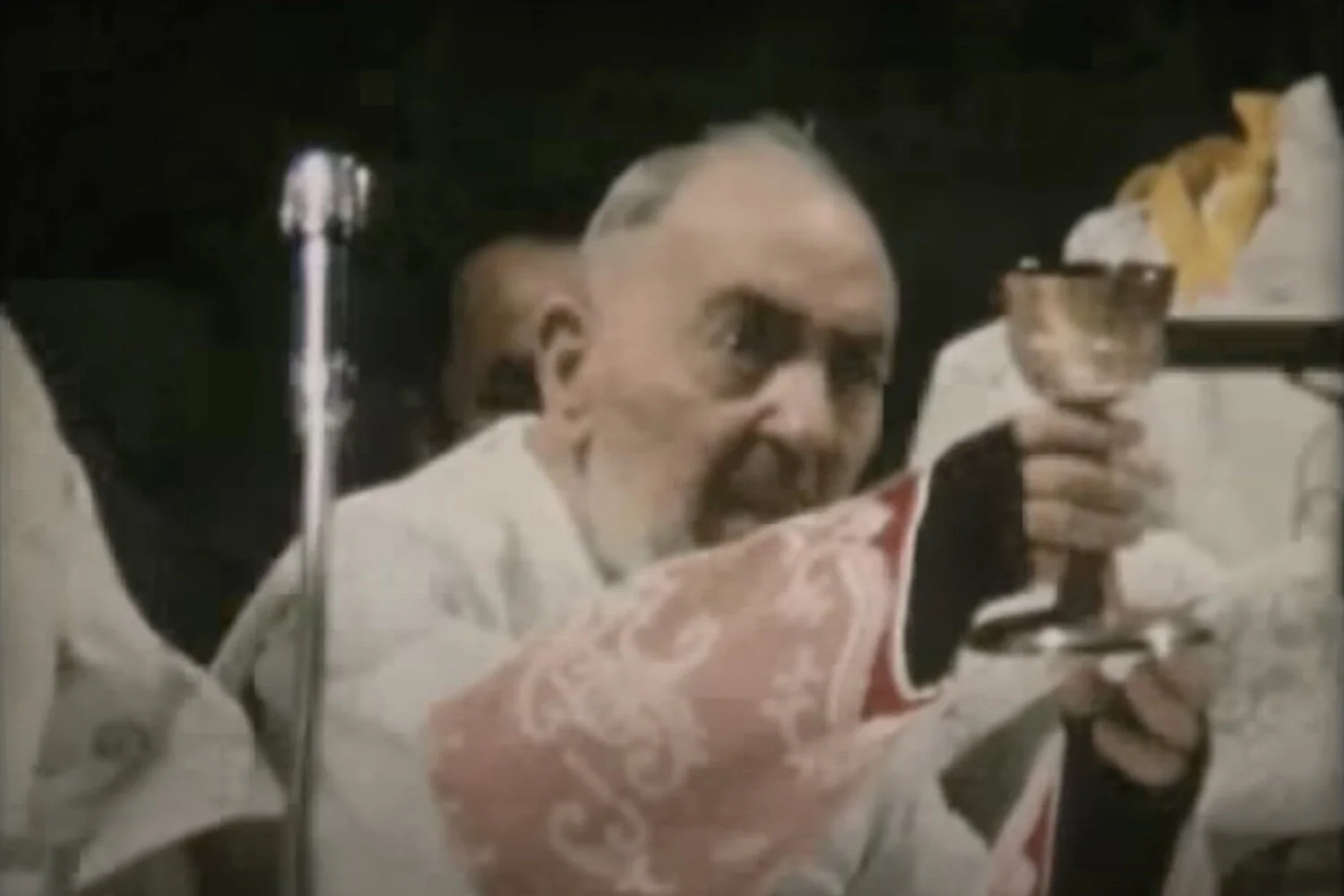
+ + +


Prison Journal: A Midsummer Night’s Mid-Life Crisis
As major transitions loom for our friends behind These Stone Walls, Social Psychologist Erik Erikson was the catalyst for a midsummer night’s mysterious dream.

As major transitions loom for our friends behind These Stone Walls, Social Psychologist Erik Erikson was the catalyst for a midsummer night’s mysterious dream.
In eleven years of writing from prison for These Stone Walls, this has always been the most difficult time of year to produce a post. Labor Day is looming in the United States, and in 2020 it is on the latest date possible. It’s a time of staff vacations in prison so pretty much every department is understaffed. This year, Labor Day conspires with a pandemic for limited access to everything.
All outside vendors, visitors, volunteers, program facilitators, and medical providers are currently barred from entry. Visitors have been barred for months. What was once a three-hour visiting period twice per week with family or friends was reduced last year to ninety minutes. In the time of Covid-19 it is now reduced to a single monthly 45-minute no-contact visit from behind glass with masks, and it has to be arranged three weeks in advance.
And as you know by now, my friend Pornchai Moontri and I have the added stress of knowing that major change is coming but we know neither the day nor the hour. Each day I face the possibility that I could return from work to an empty cell and no chance to wish him well and give him my blessing. Such is the nature of prison.
We do have a plan for when Pornchai finally arrives in Thailand after an ordeal in ICE detention. I hope you have read our recent posts, Pornchai’s “Hope and Prayers for My Friend Left Behind,” and my bombshell post, “Human Traffic: The ICE Deportation of Pornchai Moontri.” These have been the most visited posts of the year during our most difficult days of the year. Now, more than ever, our faith in Divine Mercy is getting a workout.
All of this has conspired to create a perfect storm lending itself to anxiety and, for me, a mid-life crisis. It is not my first, nor will it likely be my last. When I told a friend that I think I am now having one, he sent me this story about a midlife crisis. It is not a true story - at least, I hope it isn’t true - but it made me laugh and I needed a good laugh right now. Maybe you do, too:
“Approaching her sixtieth birthday, Mildred lapsed into a depression that sent her to a therapist. He diagnosed her downward spiral as a possible midlife crisis, and assured her that it is a very common phenomenon. The therapist suggested that Mildred take up something new and challenging, perhaps something adventurous.
“‘Well, I’ve always wanted to try horseback riding,’ said Mildred. Affirmed as a great choice by the therapist, she stopped at the library and checked out a couple of books on horseback riding. When she felt she had a grasp of the rudimentary details, Mildred ventured out on a Saturday morning for her first ride.
“Approaching the horse with some trepidation, Mildred placed her left foot into the stirrup, grabbed the crop atop the saddle just as the books suggested, and found mounting the horse to be surprisingly easy. Then the horse began an enjoyably slow but steady pace. As it worked up to a more pronounced gallop, however, Mildred found herself growing anxious.
“The horse picked up a little more speed, but Mildred’s anxiety grew along with it. Fearing that she was slipping from the saddle, she began to panic. Clutching the horse in her panic as it gained speed, Mildred began to scream for help as she struggled to hold on for dear life. Then, just as Mildred began to tumble completely from the saddle, Walter the Wal-Mart Greeter rushed over, and unplugged the horse.”

Erik Erikson on the Origins of Our Midlife Crises
I have known and counseled many people in the midst of a midlife crisis. I’ve had more than one of them myself. It’s a time when values and beliefs are questioned and sometimes even abandoned. The concept is not at all new in psychology or literature. In a few past posts on These Stone Walls, I have written that Dante Alighieri began the Inferno, Part One of his famous 14th Century literary masterpiece, The Divine Comedy, with what may very well be world literature’s first description of a midlife crisis:
“When I had journeyed half of our life’s way, I found myself within a shadowed forest, for I had lost the path that does not stray. Ah, it is hard to speak of what it was, that savage forest, dense and difficult, which even in recall renews my fear. So bitter — death is hardly more severe! I cannot clearly say how I had entered that wood; I was so full of sleep just at the point where I abandoned the true path. But to recall what good I found there, I must also tell you the other things I saw.”
I was once an avid student of psychology before studying theology. Dante put a spiritual spin on the “shadowed forest” of his midlife abandonment of ‘the true path.” That is fitting, for a midlife crisis is as much a spiritual phenomenon as a psychological one. Its evidence is just as Dante described it seven centuries ago.
Since Sigmund Freud became the Father of Psychoanalytic Theory in the early Twentieth Century, the various efforts to understand what makes us tick are fascinating. I once wrote a controversial TSW post about the secrets we keep even from ourselves entitled, “Be Wary of Crusaders! The Devil Sigmund Freud Knew Only Too Well.”
But I have since abandoned a good deal of psychoanalytic theory and practice as bunk. To be clear, the practice of it is often bunk but the science behind it is sometimes still helpful. There is one psychoanalytic pioneer, however, whose work has withstood the test of time and contrasts well with human experience.
In the 1960s and 1970s, Austrian-born Harvard social psychologist Erik Erikson developed his Stages of Psychosocial Development which today remains a standard for understanding how we develop psychologically. Much of his work became pivotal for comprehension of one particular stage of growth: adolescence, the most stressful time in the life of every parent. Erikson defined the central crisis of adolescence as one of identity verses role confusion.
Though he never used it, the term “Identity Crisis” has its origin in his work. For parents, an adolescent identity crisis results in experimentation, sometimes recklessly so, and a questioning of the parental status quo and value system. It is the time in which many parents are stressed to the limit.
The identity crisis is but one of Erikson’s Stages of Psychosocial development. The other stages and their respective life crises are, in a nutshell: infancy (basic trust vs. mistrust), early childhood (autonomy vs. shame and doubt), preschool years (initiative vs. guilt), middle childhood (industry vs. inferiority), adolescence and its crisis of identity, young adulthood (intimacy vs. isolation), middle adulthood (generativity vs. stagnation), and late adulthood (integrity vs. despair).

My Midsummer Night’s Anxious Dream
For this post, my focus is on the backdrop of every midlife crisis. Erikson never actually used the term, but it clearly has its origin in his stages of development. It comes in between the last two of the eight stages, between middle and late adulthood when the human psyche naturally begins a nostalgic, and sometimes excruciating examination of the past and a measurement of one’s place in it. Our minds are very complex, as is this subject, so let me stick my neck out a little with a personal example.
Early in the morning of August 17, 2020, I was awakened at about 3:00 AM by a troubling dream that seemed to play out in epic performance. It needs a little background. I began religious life as a member of the Capuchin Order, one of the main branches of the Franciscans. It was while a member of the order that I began formal studies in psychology working toward both undergraduate and graduate degrees
My mentor in this was Father Benedict Groeschel who years later would part from the Capuchins along with the late, Father Andrew Apostoli to become founders of the Franciscan Friars of the Renewal. Like them, I, too, left the Order on very good terms, but in a very different direction: to study for diocesan priesthood. I wrote about how that experience, from almost day one, became a crisis in its own right in “Priesthood, the Signs of the Times & the Sins of the Times.”
I don’t have to tell you where that change in my path ultimately led me. Now, at age 67, I look back over the decades and find myself spontaneously doing exactly what Erik Erikson predicted. My mind wanders often into a sort of inventory of my life and my place in it. All these years later, I find myself questioning my decision to leave my religious community, wondering to this day whether I did the right thing.
It’s interesting that I still, after forty years, refer to the Order is “my community.” The inner struggles that we have are often expressed in dreams, and in dreams my conflict is evident. The early morning dream of August 17 this year was no exception. It was both then and now. Dreams often have temporal confusion.
In the dream, I was in my Capuchin habit at Mass with my community, but I was also a prisoner having just been released on a sort of leave from prison. I was the age that I am right now, but everyone else in the dream was as they were back then. Except for my friend, Pornchai, who was with me at the Mass. In the dream, I was stricken by how out of place we were. Pornchai and I were deeply wounded by life while all the others present had been sheltered - just as I would want them to have been — from the sort of trials we have endured.In the dream, before the Mass ended, I had to leave. I removed my habit and left it there in the chapel. Others gathered at the door as Pornchai and I walked away. He asked me, “Where are we going?” I answered mysteriously, “We’re going to where this path leads.” It was then that I woke up, troubled, anxious and depressed. Only later in the day did I realize that the date was August 17, the day that I first professed vows in the Order forty-five years ago.
As I look back with some nostalgia, I realize that those years were among the happiest of my life. Then something happened that suddenly altered them. It is a story that I have never before told, but I know that someday I will tell it. It adds no light, but only more mystery, to the path I ended up upon.
That path led down a long and winding road to where I am right now, approaching 26 years in prison for crimes that never took place. This is not the sort of “community” I had in mind when I first discerned a vocation to religious life all those decades ago. It is also not lost on me that this condemnation and imprisonment began in 1994 on September 23, the feast day of the most famous of the Capuchin saints, Padre Pio, who would later insinuate himself behind These Stone Walls with us.
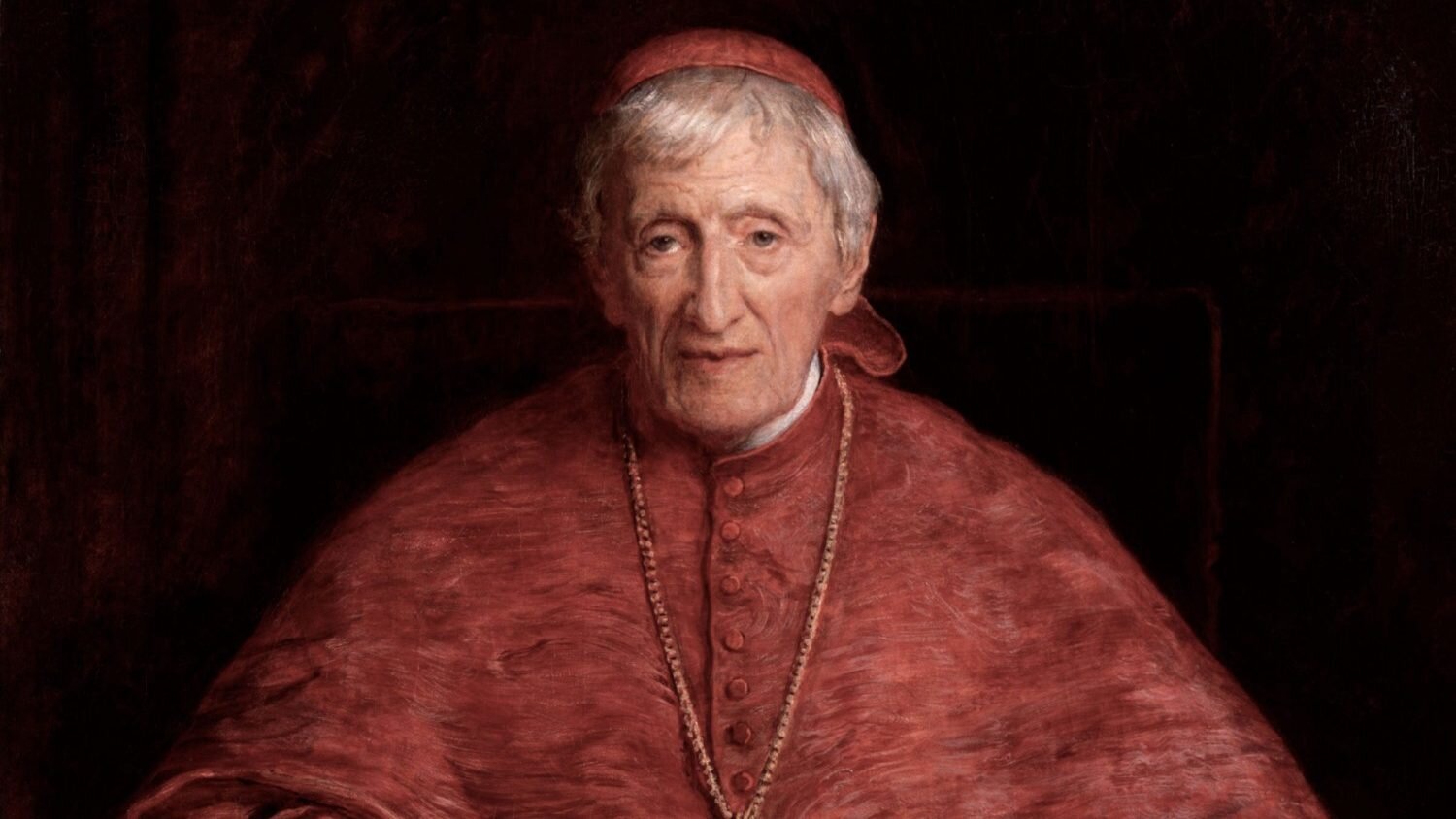
He Knows What He Is About
Over the last decade at These Stone Walls, we have told a story very much like the one Dante Aligheri told seven centuries ago in The Divine Comedy. It may have been divine, but it did not always feel much like a comedy. Like Dante, having strayed from the path I was on - though not by choice - I entered the dark wood of prison and brought the readers of These Stone Walls with me. Across this decade, we told a tale of all that I had found there, both the good and the bad. In the end, it is sometimes difficult to tell the difference between the two.
My friend, Pornchai Moontri is an example. On the surface of life he was seen as just another bad actor who made terrible choices that led him on a path to prison. My recent post, “Human Traffic: The ICE Deportation of Pornchai Moontri” pulled back the veil to reveal his life as a victim of horrific crime long before he was driven into one of his own.
Thanks to readers, that post found its way into several internet sites dedicated to addressing human trafficking. Pornchai’s story was told prolifically at These Stone Walls, but it remained hidden in plain sight until one of you shared it in just the right place. Whoever you were, you acted as a bond of connection between persons, a very important concept that I will return to below. In my midlife crisis dream, Pornchai asked me, “Where are we going?” I told him, “We’re going to where this path leads.” It seemed to me to be a strange response until I pondered it. Our path - the paths of all of us in life - lead along the threads of connection placed there by God through us - through the bad as well as through the good.
These Stone Walls became Pornchai’s religious community, the community of faith that formed him. His leaving, and leaving me behind, is painful, but at least one TSW reader has equated him to Timothy, the companion of Saint Paul. In that sense he is not leaving. He is being sent.
Where do I go from here? I have not even pondered that yet. My priority at the moment is to do what I can to spare my friend from the one-size-fits-all nightmare of ICE detention. Thanks to some of you sharing my posts in the right places, there is now a glimmer of hope for that. Just a glimmer, so please pray for that intention. I hope that in a month or two, These Stone Walls will have a voice from Catholic Thailand.
From the voice of Saint John Henry Newman: “Some Definite Service.”
“God has created me to do Him some definite service. He has committed some work to me which he has not committed to another. I have my mission. I may never know it in this life, but I shall be told it in the next.
“Somehow, I am necessary for His purposes... I have a part in this great work. I am a link in a chain, a bond of connections between persons. He has not created me for naught. I shall do good. I shall be an angel of peace, a preacher of truth in my own place, while not intending it, if I but keep His commandments and serve Him in my calling.
“Therefore I will trust him, whatever, wherever I am. I can never be thrown away. If I am in sickness, my sickness may serve Him. If I am in perplexity, my perplexity may serve Him. My sickness, or perplexity or sorrow may be necessary causes of some great end which is quite beyond us.
“He does nothing in vain. He may prolong my life, He may shorten it, He knows what He is about. He may take away my friends, he may throw me among strangers, He may make me feel desolate, hide my future from me - Still, He knows what He is about.”
— St. John Henry Cardinal Newman - March 7, 1848
NOTE FROM FATHER GORDON MACRAE: Mine is not the only “Prison Journal” in circulation these days. I have just pre-ordered my copy of the soon-published Prison Journal of George Cardinal Pell from Ignatius Press which promises to be a spiritual classic. You may also like these lesser classics from These Stone Walls: