“There are few authentic prophetic voices among us, guiding truth-seekers along the right path. Among them is Fr. Gordon MacRae, a mighty voice in the prison tradition of John the Baptist, Maximilian Kolbe, Alfred Delp, SJ, and Dietrich Bonhoeffer.”
— Deacon David Jones

Veterans Day: War and Remembrance for Freedom Was Not Free
Veterans Day and Remembrance Sunday in the UK honored the great sacrifices of the First and Second World Wars and freedom from a global tyranny too easily forgotten.

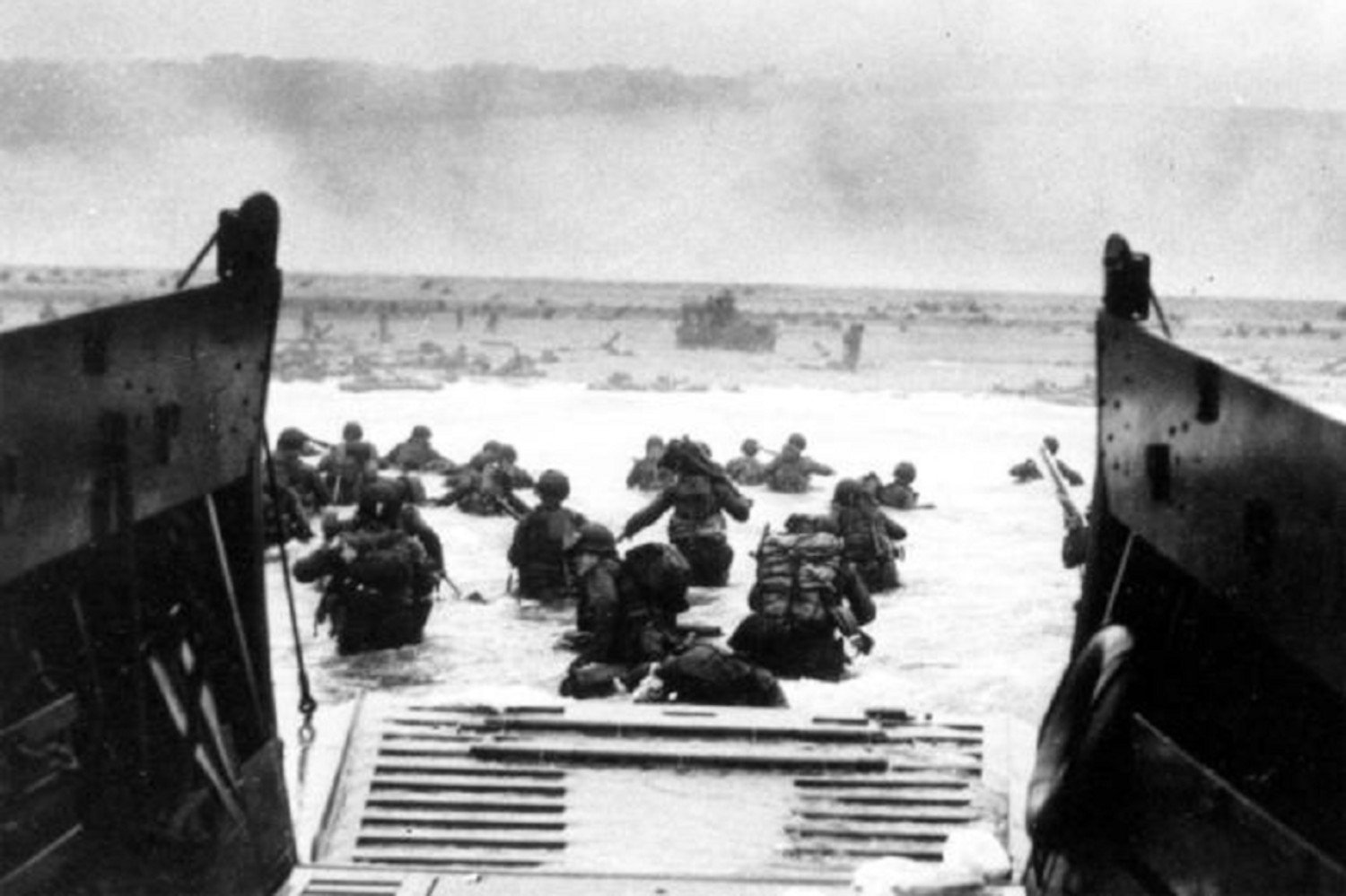
Omaha Beach during the Invasion of Normandy
Veterans Day and Remembrance Sunday first honored the great sacrifices of the First and Second World Wars, and freedom from a global tyranny too easily forgotten.
“What we obtain too cheap, we esteem too lightly.”
— Thomas Paine, 1776
What we today honor as Veterans Day (November 11) in the United States, and Remembrance Sunday (the Sunday nearest November 11) in the United Kingdom, began in Europe as Armistice Day. This history is worthy of a reminder, for we forget the fine points of history to our own peril. The armistice that ended hostilities in World War I, culminating in the 1919 Treaty of Versailles, was signed on November 11, 1918. In 1954, Armistice Day was expanded to become Veterans Day in the United States and Remembrance Sunday in England to honor all who served in the two World Wars. Today this memorial is expanded to honor the veterans of all wars.
The quote from Thomas Paine above was a criticism of American colonists who became comfortable in their isolation and failed to heed the growing oppressions that would eventually end up at their doors in the War for Independence. At a time when the American footprint is fading from the paths to tyranny throughout the world, it’s perilous to forget the high price that was paid to win and preserve our freedoms. The freedom from tyranny that we sometimes take for granted in America was won at the price of our brothers’ blood which today cries out to us from the Earth. We are free thanks to them. War is futile without remembrance.
World War I engulfed all of Western Europe, pitting the Central Powers of Germany and the Austria-Hungarian Empire against the Allies: Great Britain and its Dominions, France, Russia, and then later Italy and the United States. All was not quiet on the Western Front of that war which extended all the way from the Vosges Mountains in Eastern France to Ostend, Belgium.
America entered World War I in 1917 in response to Germany’s use of submarines to destroy commercial vessels crossing the Atlantic. This tipped the balance of the war which ended a year later. The First World War cost the lives of ten million people by the time an armistice was signed on November 11, 1918. World War II, which began with Germany’s invasion of Poland in 1939 and ended with the surrender of Germany and Japan in 1945, took the lives of fifty-five million people. Freedom was never free.
Dates with Destiny
We citizens of a civilized society remember significant dates for a reason. But the Internet generation is causing us to lose some of our collective cultural memory. Today, we rely too much on a Google search to provide meaning to our existence. There’s something to be said for having at least a basic framework of meaning for dates we observe and why they are of some cultural importance to us. Anniversaries that lend themselves to our social or cultural identity are in danger of being lost for subsequent generations.
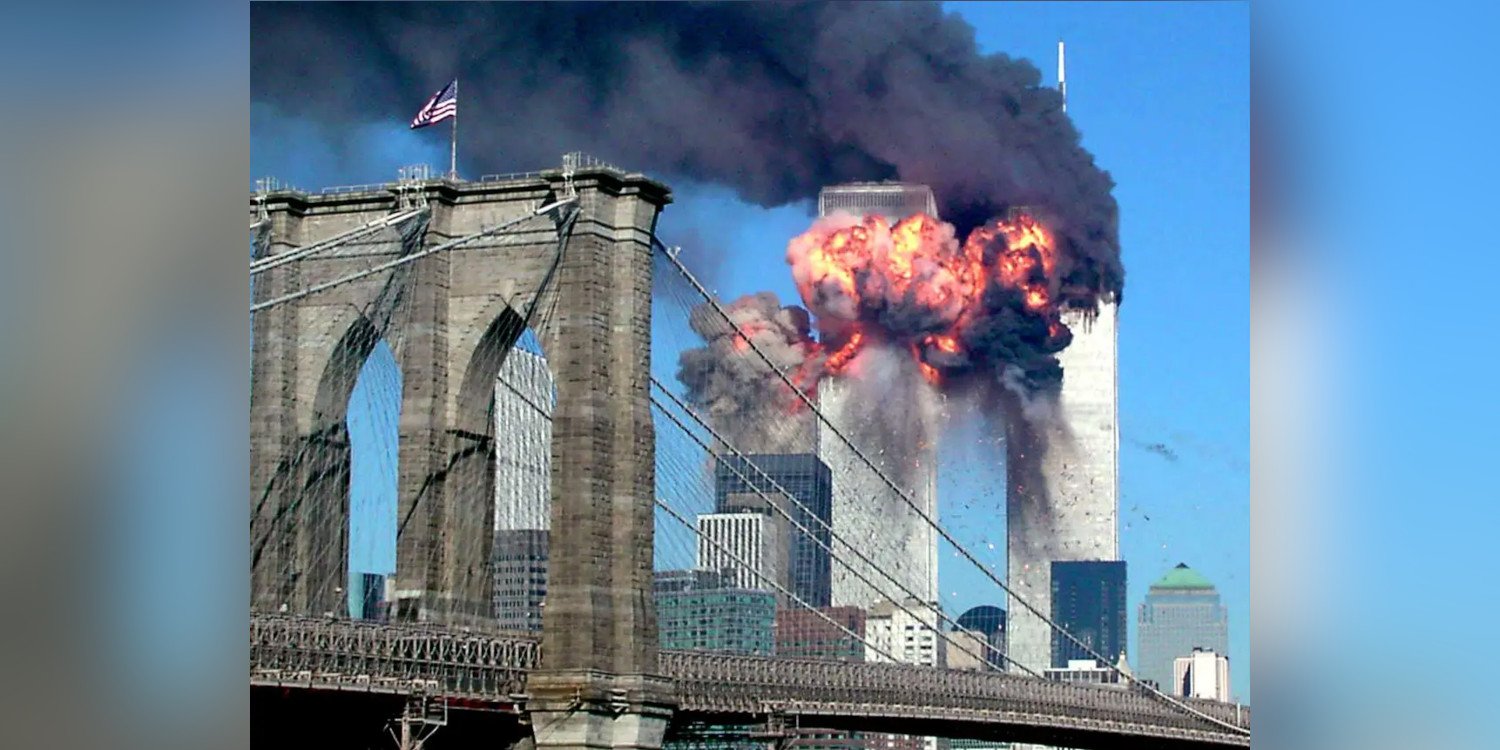
Perhaps the most modern example of a date with cultural meaning in Western Civilization is September 11, 2001 a date that today lives in infamy on a global scale. At Beyond These Stone Walls, I marked its twentieth anniversary with “The Despair of Towers Falling, the Courage of Men Rising.” That post was a vivid description of how that day unfolded from a very unusual perspective, that of a prison cell, and of its far reaching impact even here.
But most people in the Western world are not conscious of the whole story behind the significance of that date. Knowing why America became a target of al Qaeda on that date gives the event a whole new meaning, and human beings engage in an innate search for meaning in the events of our lives. That is the very purpose of religion. It seeks and finds meaning in our individual and collective existence. In human history, no culture has survived for long without religion, or a substitute for religion.
And it’s the substitute for religion — for real religious meaning — that we should most fear. Those who set the infamous day of September 11 in motion were themselves marking the anniversary of events they retained in collective consciousness for over 300 years, events that much of the rest of the world had forgotten. What happened in New York and Washington on September 11, 2001 began in Europe more than three centuries earlier during the Siege of Vienna on the night of September 11, 1683.
The story was described by the late Christopher Hitchens in “Why the suicide killers chose September 11” (The Guardian, October 3, 2001). Then it was expanded upon by Father Michael Gaitley in a great book entitled, The Second Greatest Story Ever Told.” In the book, Father Gaitley wrote of the historic significance of September 11:
“For some 300 years, an epic struggle raged between the Ottoman (Muslim) Empire and the Holy Roman (Catholic) Empire. The Battle of Vienna marked the turning point in this struggle as it stopped the Muslim advance into Europe…. On the night of September 11, [1683], the Muslims launched a preemptive attack on Austrian forces…”
— The Second Greatest Story Ever Told, p.45
By the next night, September 12, 1683, after a night of fierce battle, the Islamic forces were repelled and routed by the Polish cavalry led into battle by King Jan Sobieski himself. But victory also brought the knowledge that 30,000 hostages, mostly women and children, were executed before the Islamic retreat on orders from the Moslem commander. The Polish king wrote in a letter of his horror at the savagery of the fleeing invaders. Then, writing his post-victory letter to his nation, King Sobieski paraphrased in Latin Caesar’s famous words of victory: “Veni, Vidi, Deus Vincit” — “I Came, I Saw, God Conquered.”
King Sobieski had entrusted that battle to the intercession of Mary, Mother of God, and it was in honor of this victory that the Pope established the date of September 12 as the Feast of the Holy Name of Mary. What had thus been the date that began an event of glory and great sacrifice for Christendom was a date of infamy for fundamentalist Islam, a date remembered for over 300 years. It was for this reason that September 11 was chosen for an attack on the West by al Qaeda terrorists in 2001.

From the cover of A Pope and a President by Paul Kengor
Swords into Plowshares
Lord Jonathan Sacks, former Chief Rabbi of the United Hebrew Congregations of the British Commonwealth, described the West’s lack of awareness of that significance as being “among the worst failures of political intelligence in modern times.” In “Swords Into Plowshares,” an essay in The Wall Street Journal (October 3-4, 2015), Lord Sacks wrote that our lack of awareness was not accidental, but “happened because of a blind spot in the secular mind: the inability to see the elemental, world-shaking power of religion when hijacked by politics.”
That story of the significance of September 11 told above is not war in the name of religion as some would today have you believe. It is what takes the place of religion when it is suppressed in the human heart and soul, and overshadowed in the public square until man’s search for meaning is hijacked by politics.
One of the great victories of the First and Second World Wars — great victories won at great price — was freedom of religion. In our era of forgetfulness, this has been twisted into a guarantee of freedom FROM religion, and the result has been an agenda to park religious voices somewhere outside the American public square. By America, I mean all of the Americas. What happens in the U.S. does not stay in the U.S. Lord Jonathan Sacks has composed a wise and well informed caution for America:
“The liberal democratic state gives us freedom to live as we choose, but refuses, on principle, to guide us as to how we choose…. Religion has returned because it is hard to live without meaning in our lives… [but] the religion that has returned is not the gentle, quietist and ecumenical form that we in the West have increasingly come to expect. Instead it is religion at its most adversarial and aggressive. It is the greatest threat to freedom in the post-modern world.”
— Jonathan Sacks, “Swords Into Plowshares,” WSJ.com, October 3-4, 2015
It is only when religion is denied a voice in the public square that such a hijacking happens. Humanity will seek meaning then only in what is left. There is a broad assault on religion in Western Culture today with the goal of just that — of removing voices of religion from the public square by the process of selective memory, of blaming war on faith. The reality is very different. An analysis of 1,800 conflicts for the “Encyclopedia of Wars,” by Charles Phillips and Alan Axelrod determined that fewer than ten percent had any real religious motivations.
It’s very interesting that today Lord Jonathan Sacks cites the Western intellectuals’ belief that the collapse of the Berlin Wall and the fall of European Communism in 1989 was “the final act of an extended drama in which first religion, then political ideology, died after a prolonged period in intensive care…”
“The age of the true believer, religious or secular, was over. In its place had come the market economy and the liberal democratic state in which individuals, and the right to live as they chose took priority over all creeds and codes.”
The fall of the Berlin Wall and European Communism was, therefore, “the last chapter of a story that began in the 17th Century, the last great age of wars of religion.” What makes this theory so interesting is that it blatantly overlooks the fact that one of the greatest religious figures of the 20th Century — Saint John Paul II — is also the person most responsible for setting in motion the collapse of the Soviet Union and the fall of the Berlin Wall. That is what Father Michael Gaitley unveils as an essential element in The Second Greatest Story Ever Told, but first it has to look back upon Armistice Day.
Religious faith was never a cause for war, nor was it ever an excuse. But for those who survived the Great Wars of the Twentieth Century — and for 65 million lives lost in the face of Godless tyranny, faith was all that gave it meaning, and without meaning, what’s left?
Don’t let your religious freedoms and your voices of faith be so easily parked along the wayside of America and the rest of the free world, for thus it will not remain free for long. People died to give us that voice, and today is a good day to remember that, and to honor their sacrifice. To distance ourselves from war and remembrance — from the price of freedom — is to give witness to Thomas Paine’s dismal foreboding on the eve of war:
“What we obtain too cheap, we esteem too lightly.”
+ + +
Note from Father Gordon MacRae: Thank you for reading and sharing this post. Please join us in prayerful remembrance for those who served and especially those who gave their lives to secure and preserve our freedom. None of those who speak today about political threats to democracy have any real idea of what freedom cost.
You may also like these related posts:
From Dorothy Rabinowitz: ‘Say Not the Struggle Naught Availeth’
The Despair of Towers Falling, The Courage of Men Rising


A Mirror Image in the Devil’s Masterpiece
Inspired by Bishop Robert Barron’s acclaimed Letter to a Suffering Church, the Editor of Beyond These Stone Walls was moved to write and publish this inspired reply.

Inspired by Bishop Robert Barron’s acclaimed Letter to a Suffering Church, the Editor of Beyond These Stone Walls was moved to write and publish this inspired reply.
April 10, 2024 by Dilia E. Rodríguez, PhD with an Introduction by Father Gordon MacRae
Introduction
I will always owe a debt of gratitude to Suzanne Sadler of Australia. After following the sordid story that entangled many Catholic priests in false witness, Suzanne came upon an article I was invited to write for Catalyst, the Journal of the Catholic League for Religious and Civil Rights. The article, which appeared in the July, 2009 issue of Catalyst, was “Due Process for Accused Priests.”
Immediately upon reading it, Suzanne wrote to me from Australia with a suggestion that I permit her to establish a blog that would feature my writing. I was highly dubious, believing that I had nothing of interest or value that anyone would want to read. It was Pornchai Max Moontri, my friend and roommate of many years in prison who encouraged me to try. He reminded me of a letter from Cardinal Avery Dulles urging me to add a new chapter to the literature of Christians wrongly imprisoned. It was also Max who suggested this blog’s first title, “These Stone Walls.” Then Pornchai’s Godmother, Charlene C. Duline, a retired U.S. State Department official jumped aboard with an offer to help with logistics. I ran out of excuses, and in August of 2009 These Stone Walls was born with my first of hundreds of posts “St. Maximilian Kolbe and the Man in the Mirror.”
Over the course of the next nine years, These Stone Walls published some 500 original posts written mostly by me but some by far more distinguished guest writers. Then, in 2019, Covid struck and grew into a global pandemic affecting every tenet of our lives, including our lives of faith. Much that we had come to cherish began to desintegrate before our eyes. In the course of a single week in 2020, my voice in this wilderness of prison and false witness was silenced. These Stone Walls had collapsed.
Then, seemingly from out of the blue came a letter from Dilia E. Rodríguez in New York. She wrote that she was so enamored by a post she stumbled upon about Pope Benedict XVI and Saint Joseph that she felt compelled to read more. Just before my blog was taken offline she downloaded its entire contents onto her own computer.
So the end that I thought was upon us turned out not to be an end at all, but a new beginning. It was in September 2020 that this news came to me. It was just as my longtime friend Pornchai Max Moontri was departing for deportation to Thailand. Just as I was immersed in loss and sadness, Dilia was quietly in the background resurrecting this blog with new life and a new name, “Beyond These Stone Walls.” Dilia has now been our Editor for going on four years.
As we faced the terminal illness of Claire Dion, the subject of my Divine Mercy post last week, Dilia accepted the necessity of stepping out of the shadows and into the light to also take over all that Claire had managed.
Dilia E. Rodriguez, PhD retired in 2022 from a career in U.S. Government service as a civilian scientist for the United States Air Force. Holding advanced degrees in both Physics and Computer Science, Dilia is also a daily communicant and a strong supporter and participant in Eucharistic Adoration. In recent weeks she has also stepped up to take on the logistics of support services for me and this blog as described at our Contact and Support Page.
To mark this occasion and further introduce Dilia, I want to restore and repost something she had written on the Feast of the Holy Innocents in December 2019. Her post is a brilliant response to a small book by Bishop Robert Barron entitled, “Letter to a Suffering Church.”
Here is Dilia E. Rodriguez with
+ + +

A Mirror Image in the Devil’s Masterpiece
Today is the Feast of the Holy Innocents, and to me it offers symbols for the crisis in the Church.
First, let me say that, as so many others, I am moved by the impassioned efforts of Bishop Robert Barron to stop Catholics from leaving the Church. His heart and soul are on fire with the love of Jesus, of His Church and of His People.
I never thought of leaving, and it is not just “to whom shall we go?” It is that God is LOVE, and as one saint, whose name I cannot recall, said, “LOVE is not loved.” I see the current scandal as stark evidence that LOVE is not loved. So my reaction is that I want to love God, I want to love Jesus with my whole being, as I have never loved Him before.
I want to consider (… think aloud … pray aloud …) three points: the devil’s masterpiece, evangelization at this time, and the call for saints.
Bishop Barron convincingly describes the sexual abuse scandal as exquisitely designed by the devil. He shows the horror that attends the sexual abuse of young people by priests, and the cover-up of these abuses by bishops. Whether or not it is seen as the devil’s masterpiece, this is what is described almost universally as the entirety of the sexual abuse scandal, by the mainstream media, by the Catholic media, by attorneys general and others.
But there is more to the devil’s masterpiece. There is a mirror image that remains invisible to most. The Father of Lies surely can use lies in this masterpiece of masterpieces. In this mirror image the accused priests are innocent, and the ones who claim to have been abused are the abusers. In this mirror image bishops abuse innocent priests by publishing their names in lists of “credibly” accused. This requires no corroboration or evidence of the accusation. It replaces “innocent until proven guilty” with “guilty until proven innocent” or even “guilty even if proven innocent.” This “credible” accusation standard is neither a legal nor a biblical standard.
So two abuses coexist: the visible one, the sexual abuse of young people by priests; and the invisible one, the abuse of innocent priests by those who falsely claim to have been abused and profit from it.
In the accused innocent priests Jesus is living His Passion. Pilate said, “I find no guilt in him.” There is no evidence against many of the accused priests. Jesus stood wearing the crown of thorns and the purple cloak. The chief priests and the guards cried out, “Crucify him, crucify him.” Pilate tried to release him, but the crowd insisted, “Crucify him!” Bishops may want to do the right thing, but they cave in to the pressure and they crucify innocent priests; they remove them from the ministry to which God called them. Bishops cave in to the pressure of those who ask cynically “What is truth?”, and do not listen to the One Who is TRUTH.

Holy Innocents: Double Symbol for the Crisis
The massacre of the holy innocents captures in symbol the two coexisting abuses. Herod’s killing of the innocent children represents the killing of innocent faith of the young who have been abused by priests. The way of Herod — to kill the many to ensure killing the One — is the way that has been adopted to assuage the anger and fears of the crowd and the media. So Herod’s killing of the innocent children also represents the destruction of the lives of innocent priests without having to prove any claim against them. Both are very grievous abuses.
A mirror adds much light where there is light. The mirror-image abuse deceptively intensifies the dark evil of the abusive priests.
What can I do, … we do, … the bishops do, in response to the devil’s masterpiece of masterpieces? Absolutely nothing. Jesus said it, “Without Me you can do nothing.” (John 15:5) But He said, “Whoever remains in Me and I in him will bear much fruit.” Only Jesus can respond to the devil’s masterpiece of masterpieces.
This time of great scandal is the Olympics of Evangelization. The Gospel is not just for intellectual discussions or for run-of-the-mill problems. It is only the full power of the Gospel that can cope with the immensity of this scandal.
The response of Jesus cannot be implemented by the weekend Catholic “athletes.” After a recent EWTN / Real Clear poll, Professor Robert George of Princeton University noted: “So even if you take the most devout Catholics — those who believe all of what the Church teaches or most of what the Church teaches — only 66% of those believe in the Real Presence of Jesus in the Eucharist.” Clearly, an overwhelming majority of the laity can in no way be part of the response of Jesus. They are way out of shape.
The response of Jesus is the response of His Olympic team, the living saints, whom Bishop Barron and Benedict XVI point out as the great evangelizers; those who remain in Him, and He in them.
God is LOVE. Jesus said, “I am the WAY, the TRUTH, and the LIFE.” In the mystery of Jesus, LOVE, TRUTH, and LIFE are synonyms. There can be no love without truth. There can be no life without love. Only Jesus can love both the abused and the abuser. Only Jesus can restore their lives. Only Jesus, the WAY, can reject the way of Herod. Only Jesus … through those who remain in Him and He in them.
Bishop Barron wrote (p. 97): “Above all, we need saints, marked by holiness of course, but also by intelligence, an understanding of the culture, and the willingness to try something new.”
Under “intelligence” and “understanding of the culture” should come a realization that the moral relativism of this age, the pervasive misinformation in the news (e.g. huge pro-life marches become invisible), the readiness to attack the Church, etc., do not foster an accurate portrayal of the scandal in the Church.

Conditioned by the Media
If in trying to solve a problem, or to understand a phenomenon, we ignore whole classes of facts and observations, we have no possibility of success: we will not solve the problem or understand the phenomenon.
Even though way back I realized that the real abuses of minors by priests could be exploited by others against the Church, I was still conditioned by the media. When the Pennsylvania Attorney General report came out, my knee-jerk reaction was “Here we go again.” But there was almost nothing new in it, and truth and fairness may not necessarily be its hallmark.
Jesus said: “Behold, I am sending you like sheep in the midst of wolves; so be shrewd as serpents and simple as doves.” (Matthew 10:16). Saints marked by intelligence and understanding of the culture eagerly and persistently seek the truth in this age that so fiercely rejects it. Their messages and their lives are a bright light in this very dark period. Consider the following examples: “A Weapon of Mass Destruction: Catholic Priests Falsely Accused”; Hope Springs Eternal in the Priestly Breast; Men of Melchizedek; A Ram in the Thicket; The Catholic League for Religious and Civil Rights ; Catholic Priests Falsely Accused: The Facts, The Fraud, The Stories.
I began to see the magnitude of the mirror-image scandal when I accidentally discovered the blog “These Stone Walls.” It is the blog, published with the help of some friends, of Father Gordon J. MacRae, a falsely accused priest who has been in prison for 30 years. When the “hour had come,” Jesus prayed to the Father for those the Father had given to Him, “Consecrate them in the truth.” With a plea deal, Father MacRae could have been out of prison after one year. But he is consecrated to the Truth, and did not lie. For that, he got a life sentence.
Of his case Father Richard John Neuhaus wrote: “You may want to pray for Father MacRae, and for a Church and a justice system that seem indifferent to justice.”
The scandal of the Church is a colossal problem. The Dallas Charter of 2002 got some things right, but it also helped create the mirror-image scandal. Cardinal Avery Dulles wrote in 2004:
“The church must protect the community from harm, but it must also protect the human rights of each individual who may face an accusation. The supposed good of the totality must not override the rights of individual persons. Some of the measures adopted [at Dallas] went far beyond the protection of children from abuse … [By their actions, the bishops] undermined the morale of their priests and inflicted a serious blow to the credibility of the church as a mirror of justice.”
He also added:
“having been so severely criticized for exercising poor judgment in the past, the bishops apparently wanted to avoid having to make any judgments in these cases.”
If the priesthood is to be renewed, Jesus must be the foundation of this renewal. It must be His Way, His Love, and His Truth that renews the priesthood. The Church cannot be divided. It cannot call for saintly priests, while at the same time depriving some saintly priests of their civil and canonical rights when falsely accused.
Jesus, train me in Your ways. May I not utter empty words, and cry out “Lord, Lord.” May I love all the abused, all the abusers, and as Bishop Barron says, all fellow sinners. You have redeemed me through a Very Great Sacrifice. May I constantly beg You to make me Totally Yours.
Amen.
+ + +

Encoded Message from God
I got the idea that I wanted to find in the awful number the prison assigned to Father Gordon a comforting message from God. Maybe somehow the numbers could be mapped to some verse in the Bible. My starting point was to associate with each of the digits in 67546 the letters that phones assign to digits:
6 -> m n o; 7 -> p q r s; 5 -> j k l; 4 -> g h i; 6 -> m n o.
It really didn’t make much sense. I wanted to find some verse whose first word started with m or n or o, and whose second word started with p or r or q or s, and so on. I wasn’t finding such a five-word verse. I have as my desktop background the icon of Our Lady of Perpetual Help. So I asked her for help. After a while I considered my favorite Bible verse:
“I am the vine, you are the branches. Whoever remains in me and I in him will bear much fruit, because without me you can do nothing.”
— John 15:5
There was no direct connection, but it was possible to see a loose one.
“I am the vine, you are the branches. Whoever REMAINs IN ME and I in him will bear much fruit, because without me you can do nothing.”

At first I thought that it would have been better if “Jesus” had been the second word. But then I realized that Jesus being in the middle, at the heart of the prayer, was perfect.
With the help of Our Blessed Mother we can see that in the number the prison system uses to demean Father Gordon, God encoded the prayer he is living, and attests that he is bearing much fruit.
+ + +
Note from Fr Gordon MacRae: I am deeply grateful to Dilia for the ways she has saved my voice in the wilderness from being drowned out in the scandals of this age. I believe the Lord has in fact sent her just in the nick of time.
You may also like these other posts about our quest for Jesus and for justice:
Casting the First Stone: What Did Jesus Write On the Ground?
A Devil in the Desert for the Last Temptation of Christ
St. Michael the Archangel and the Scales of Our Salvation
Maximilian Kolbe: The Other Prisoner Priest in My Cell
Please consult our “Contact and Support” Page for new information on how to support this blog and our cause for justice.


The Eucharistic Adoration Chapel established by Saint Maximilian Kolbe was inaugurated at the outbreak of World War II. It was restored as a Chapel of Adoration in September, 2018, the commemoration of the date that the war began. It is now part of the World Center of Prayer for Peace. The live internet feed of the Adoration Chapel at Niepokalanow — sponsored by EWTN — was established just a few weeks before we discovered it and began to include in at Beyond These Stone Walls. Click “Watch on YouTube” in the lower left corner to see how many people around the world are present there with you. The number appears below the symbol for EWTN.
Click or tap here to proceed to the Adoration Chapel.
The following is a translation from the Polish in the image above: “Eighth Star in the Crown of Mary Queen of Peace” “Chapel of Perpetual Adoration of the Blessed Sacrament at Niepokalanow. World Center of Prayer for Peace.” “On September 1, 2018, the World Center of Prayer for Peace in Niepokalanow was opened. It would be difficult to find a more expressive reference to the need for constant prayer for peace than the anniversary of the outbreak of World War II.”
For the Catholic theology behind this image, visit my post, “The Ark of the Covenant and the Mother of God.”

From Dorothy Rabinowitz: ‘Say Not the Struggle Naught Availeth’
A Pulitzer Prize-winning journalist inspired poetic justice for a wrongly imprisoned priest with some obscure poetry that left a giant footprint on world history.
A Pulitzer Prize-winning journalist inspired poetic justice for a wrongly imprisoned priest with some obscure poetry that left a giant footprint on world history.
November 8, 2023 by Fr Gordon MacRae
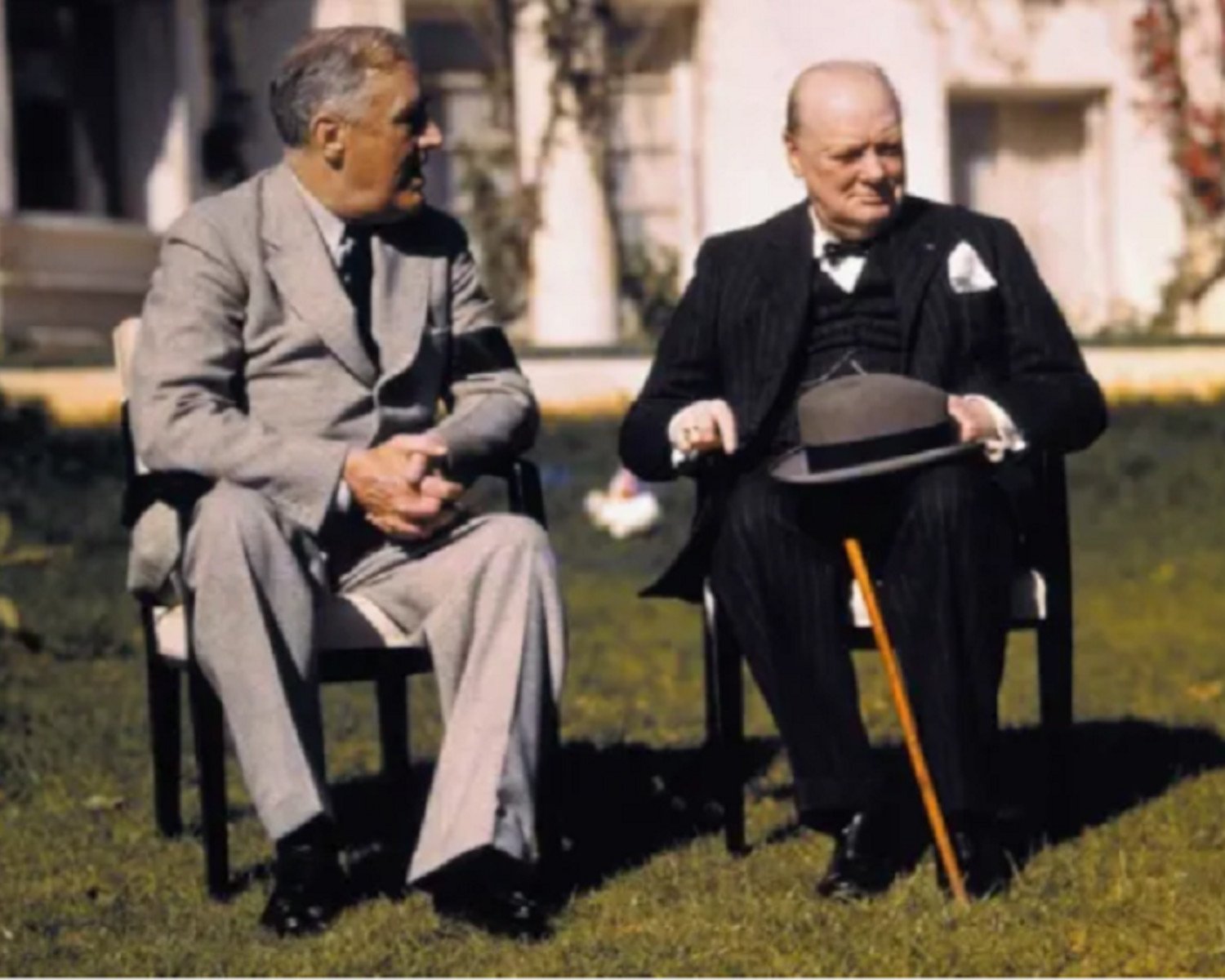
Introductory Note: A few years ago I wrote a post to honor Veterans Day, and have reposted a link to it each year near November 11. History is important and if we ignore it we end up repeating it. In the photo above, US President Franklin Roosevelt and British Prime Minister Winston Churchill met in 1941 to discuss a possible American entry into World War II after the Nazi invasion of Europe cast the entire free world into darkness. Strangely, their final decision was prompted by their trading two obscure poems each delivering to the other a message about vital events in history. Winston Churchill’s message to FDR was a pivotal moment. It was recently sent to me by Wall Street Journal columnist Dorothy Rabinowitz who inspired hope for me in the tyranny of darkness I faced. This is that remarkable story.
+ + +
As most readers know, I work in a library and though it is technically a law library it still gives me access to a world of books. Some of what is available there is not very helpful and not exactly literary but I still try to keep classic literature from being discarded to make room for the junk that too many prisoners want to read, such as graphic novels and comic books. Graphic novels fly off the shelves while Les Miserables collects dust.
The library has a fairly large poetry section, but what most prisoners are looking for is not Robert Frost or T.S. Elliot. They scour the shelves for snippets of love poems to plagiarize for their letters to girlfriends, both real and imagined. Longfellow languishes on the shelf while Cowboy Love Poetry blazes happy trails through the prison mail room.
I had also been scouring the poetry section. After the struggle described in some of our posts — such as “Dying in Prison in the ‘Live Free or Die’ State” — I received one day a surprising message from Dorothy Rabinowitz at The Wall Street Journal with the subject, “Thoughts Between Deadlines.” It set me on a course of self-assessment in the face of struggle when she wrote:
“Do you have access to Google for information seeking? This isn’t the kind of information that moves legal proceedings, but it is a great source of empowerment nonetheless. I would ask you to look up just the line, ‘Say Not the Struggle Naught Availeth.’ It should bring up the poem, written by the Victorian poet, Arthur Clough, who never wrote anything in the least memorable, except this one whose powers were such that, a hundred years after it was written, Winston Churchill sent it to Franklin Roosevelt.”
With this, Dorothy Rabinowitz certainly had my rapt attention pushing all the buttons — history, literature, and irony — that would draw me into a course of discovery. Between 2005 and 2022, The Wall Street Journal published a series of four major articles about my struggle culminating in the most recent, “Justice Delayed for Father MacRae,” by Boston attorney Harvey A. Silverglate.
In all that time, Dorothy maintained a rather stolid interest, more inclined to uncover and report the facts of a difficult and nebulous story than its implications far beyond just me. In all these years, this message from her was the first contact that went to my struggle for justice and not just the discernment of facts.
With no access to Google or the internet, it took a few days for Dorothy’s message to get to me along with the results of the search she recommended. By telephone, I asked a friend to conduct the search that Dorothy recommended. To my surprise it took us to a remarkable but obscure poem, and I will get back to that in a moment. But first, the remainder of Dorothy’s equally remarkable message:
“The year was 1941. The English stood alone. America was not yet at war, but FDR was doing all within his power to get aid to them. The world faced a Europe overrun with triumphant Nazi troops. FDR had just won his fourth term and sent his new personal ally, the very Republican he had defeated — a heroic internationalist, Wendell Wilkie, who had been the standard bearer for an entirely isolationist Republican party — with a personal message of support to Churchill.”
There is more to the message, which I will get back to in a moment, but what made it so fascinating for me was my admiration for both Churchill and FDR. By 1940, Nazi Germany under Hitler occupied Poland, France and much of Europe with terrifying speed while America slept. The Battle of Britain (a very fine historical film) made clear that Hitler could not defeat the British air and naval forces under Churchill. Back to that in a moment as well.
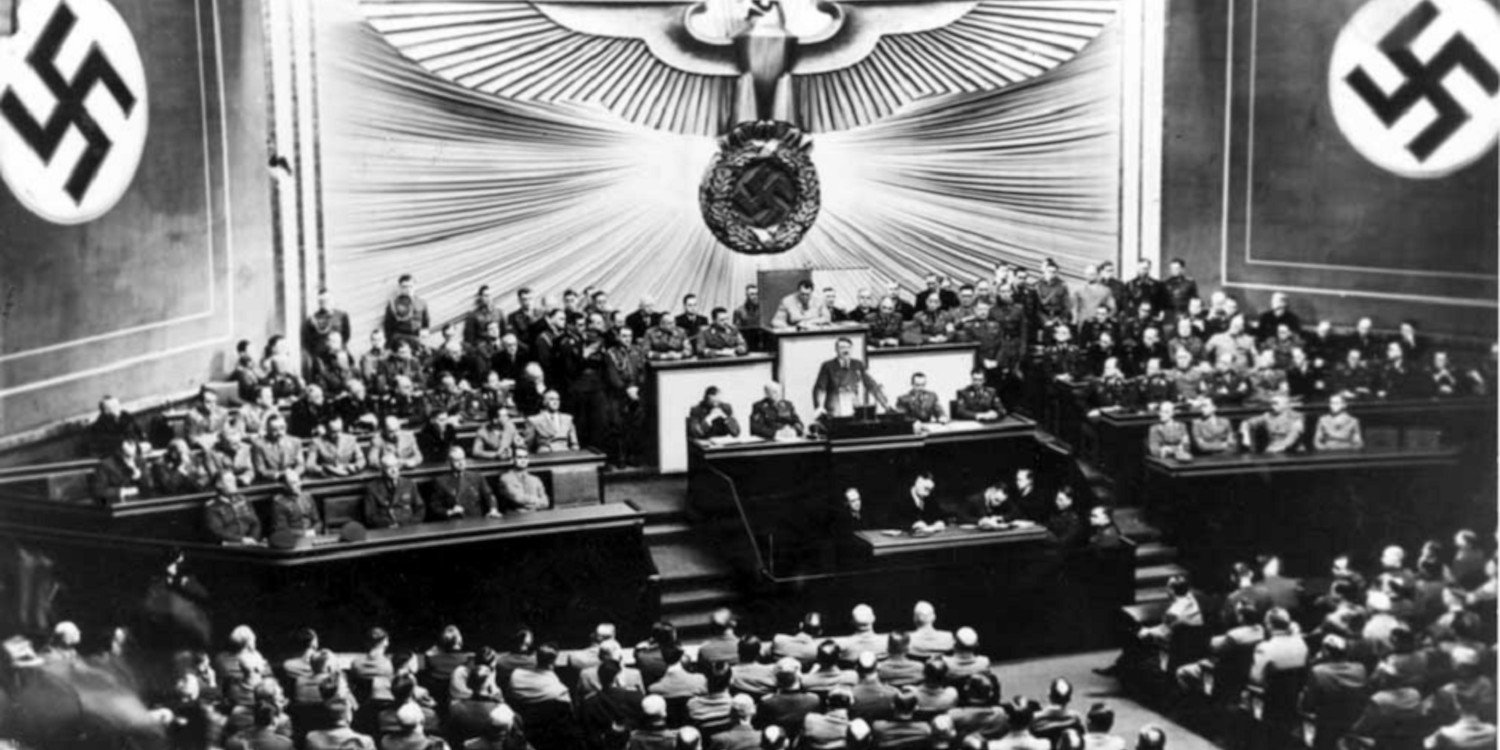
Readers may have heard or read recent articles about newly discovered information about Pope Pius XII and the Vatican during the Nazi terror in Europe in the 1940s. A lot of ink has been spilled suggesting that Pope Pius was “Hitler’s Pope.” It was a slur derived from commentary about his reticence to publicly condemn Hitler and the Nazi Party during the war. The new information recently divulged centered on an archbishop advising Pope Pius who became concerned that Germany was going to win this war and a slaughter would ensue. It could have been the end of the Catholic Church. So with Nazi troops on his doorstep, and the rest of Europe under siege, Pope Pius became extremely cautious. The Catholic bishops of Holland issued a public statement in German condemning the Nazi deportation of Jews who had become Catholics to Auschwitz and other death camps. In retaliation, the Nazis raided convents and monasteries in Holland arresting anyone with Jewish roots. One result was the execution of Edith Stein who is now revered as Saint Teresa Benedicta of the Cross. This is a story I told in “Saints and Sacrifices: Maximilian Kolbe and Edith Stein at Auschwitz.”
Poetic Justice
The origin of the term, “Poetic Justice” has been difficult to nail down. It appears to have been first used in the Sixth Century B.C. in reference to the Greek poet, Ibycus. His works were collected in seven books, of which only fragments survive. The manner of his death created a legend. Dying from an assault by robbers, the legend held, Ibycus called on a passing flock of cranes to avenge him. Near Corinth, one of the robbers saw the flock of cranes and cried out, “Behold the avengers of Ibycus!” His cry betrayed him and the cranes devoured him, a death described as “poetic justice.”
Dorothy Rabinowitz sent me the most stunning example of poetic justice in the modern era. Fears of Nazi domination of the Atlantic made it easier for Franklin Roosevelt to defy the American isolationists by increasing aid to Britain. When the U.K. depleted its financial reserves, FDR replaced them with U.S. funding for arms production. Under the “Lend-Lease” act of 1941, there were no terms for payback. Dorothy continued in her message:
“FDR’s message to Churchill included the Longfellow poem that ended, ‘Sail on, Sail on, O Union strong and great — humanity with all its hopes and fears is resting on thy fate.”
This, of course, sent me on a hunt for its source. I found it in a collection of poetry by Henry Wadsworth Longfellow entitled, “The Building of a Ship” published in 1850. Remember that both FDR and Churchill had come to the realization that England alone held the fragile line against German invasion and global tyranny. Its collapse seemed just a matter of time. This epic poem sent by FDR to Churchill nearly a century after it was written concluded,
“Then too, sail on O Ship of State!
Sail on, O Union strong and great!
Humanity with all its fears,
With all the hopes of future years,
Is hanging breathless on thy fate!
Sail on, nor fear to breast the sea!
Our hearts, our hopes are all with thee,
Our hearts, our hopes, our prayers, our tears,
Our faith triumphant o’er our fears,
Are all with thee, are all with thee.”
I can readily see why FDR sent this to Churchill along with his diplomatic message about US funding for arms production. The demonic shroud of darkness that Hitler cast over all of Europe 83 years ago placed the rest of the world in a state of hopeless terror. Dorothy’s message to me continued:
“Churchill had no trouble grasping the importance of the pledge in this American poem, and recited it in a 1941 address to Parliament. As a return message, he sent to FDR the British poem I am writing to you about. You will see why I thought of you when I read it. Read it in the face of all the silences and rejections of appeals to justice that you have seen.”
Dorothy’s message was printed and snail-mailed to me. As soon as I received it, I called a friend to search for the poem she refers to. Its author is the British poet, Arthur Hugh Clough (1819-1861). Educated at Oxford, he became a tutor there during the Oxford Movement. Also called “Tractarianism,” one of the chief leaders of the Oxford Movement was Saint John Henry Cardinal Newman. Newman and the other adherents of the movement challenged a common view that the English Reformation constituted a complete break between Rome and the Church of England. The movement began in 1833 when the British government abolished ten bishoprics in Ireland. The Oxford Movement’s adherents warned that the Church of England was abandoning the principles of the 16th Century Reformers by allowing the Church of England to be dominated by secular authorities.
The Oxford Movement proposed that the Church of England could be saved from secularism only through a return to its Catholic origins. This became wildly controversial in the Church of England when Cardinal Newman published “Tract 90” in 1841 in which he attempted to prove that the Anglican 39 Articles of Religion were not inconsistent with Roman Catholic teaching. As a consequence of the Oxford Movement being suppressed, several hundred English clergy left the Church of England to become Roman Catholic, including Cardinal Newman himself. It was at this time that Arthur Hugh Clough left Oxford in protest against the Church of England’s 39 Articles of Religion, a struggle that informed his poetry.
Background (CC BY-NC-SA 2.0 DEED)
Say Not the Struggle Naught Availeth
As Dorothy Rabinowitz wrote in her message to me, Arthur Clough wrote little that was memorable except this one poem, “Say Not the Struggle Naught Availeth.” A century after its writing, it had an oversized footprint on history. Here is the entire poem sent from Churchill to FDR:
Say not the struggle naught availeth,
The labour and the wounds are vain,
The enemy faints not, nor faileth,
And as things have been, they remain.
If hopes were dupes, fears may be liars;
It may be, in yon smoke concealed,
Your comrades chase e’en now the fliers,
And, but for you, possess the field.
For while the tired waves, vainly breaking
Seem here no painful inch to gain,
Far back through creeks and inlets making,
Comes silent, flooding in, the main.
And not by eastern windows only,
When daylight comes, comes in the light,
In front the sun climbs slow, how slowly,
But westward, look, the land is bright.
Clough’s beautiful poem is a testament to the notion that whatever struggle we must take up and endure in this life, the struggle itself is worthy, even when what we fight against is unjust and impenetrable. This is sometimes difficult to see and accept, but what sort of person would I be if I did not struggle against injustice not only against me, but for all priests falsely accused for financial gain? Margaret Drabble, a poetry critic at Literary Hub wrote of the poem:
“This poem by Arthur Hugh Clough unfailingly brings tears to my eyes. It speaks of hope, and effort, and disappointment, and perseverance... The imagery is profoundly beautiful, and reminds me of the great beaches of my childhood, of Wordsworth’s immortal shore. I can feel those ‘tired waves, vainly breaking,’ and then the flooding fullness of the sea.”
Dorothy also described the poem in her message:
“Clough was unspecific in the references. There are references to military battles, but they are clearly only metaphors. Its imperishable eloquence is exactly the kind that fires resolve to win in the end, which I depend on, which we must all depend on. Read it, and let me know you found it.”
So, Dorothy, as you can see, I found it! “Say Not the Struggle Naught Availeth” is now enshrined on my cell wall. As you have suggested, I read it in the face of all the silences and rejections of appeals to justice that I have seen. It is a vivid reminder, as it was for Churchill and FDR, that some struggles are much bigger than their mere protagonists. This struck home for me when a prominent writer — an author and Catholic deacon in Pennsylvania where the priesthood and Church have been much maligned of late — published this review of Beyond These Stone Walls:
“There are few authentic prophetic voices among us, guiding truth-seekers along the right path. Among them is Fr. Gordon MacRae, a mighty voice in the prison tradition of John the Baptist, Alfred Delp, SJ, and Dietrich Bonhoeffer.”
— Deacon David Jones
With that, Dorothy, I stopped being a victim of this struggle and became a warrior.
+ + +
Note From Father Gordon MacRae: Adolf Hitler declared war on the United States on December 11, 1941, so, for America, the struggle was availeth after all.
Please share this post. Please watch and listen to Dorothy Rabinowitz in a five-minute WSJ interview on this story.
You may also like these related posts from Beyond These Stone Walls:
Hitler’s Pope, Nazi Crimes and The New York Times
Catholic Scandal and The Third Reich: The Rise and Fall of a Moral Panic
November 11 is Veterans Day, a day set aside to remember all those who bravely risked much to win and defend our freedoms. Please honor them with me by sharing my post, “Veterans Day: War and Remembrance and the Cost of Freedom.”
May the Lord Bless you and keep you.

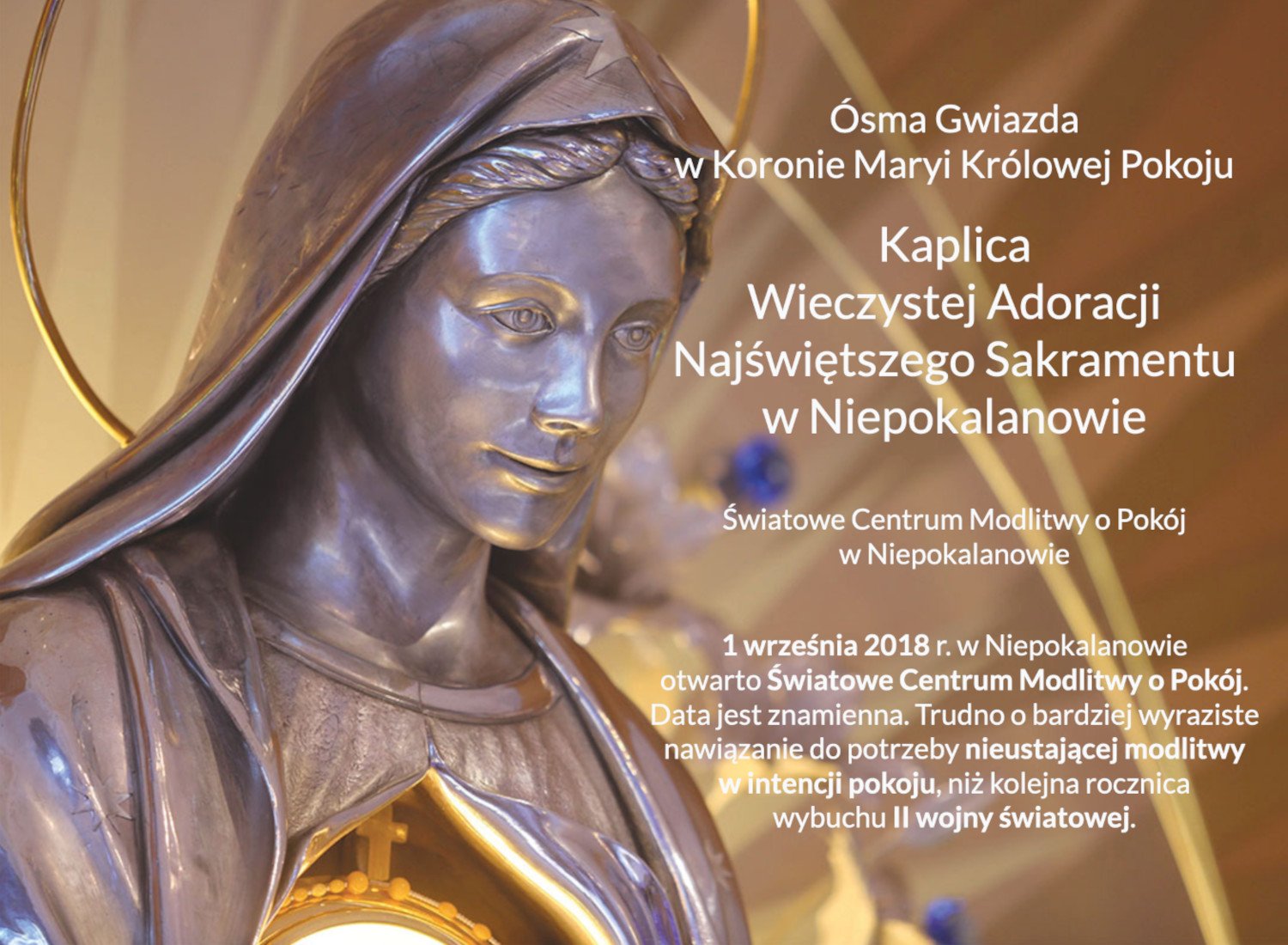

The Eucharistic Adoration Chapel established by Saint Maximilian Kolbe was inaugurated at the outbreak of World War II. It was restored as a Chapel of Adoration in September, 2018, the commemoration of the date that the war began. It is now part of the World Center of Prayer for Peace. The live internet feed of the Adoration Chapel at Niepokalanow — sponsored by EWTN — was established just a few weeks before we discovered it and began to include in at Beyond These Stone Walls. Click “Watch on YouTube” in the lower left corner to see how many people around the world are present there with you. The number appears below the symbol for EWTN.
Click or tap here to proceed to the Adoration Chapel.
The following is a translation from the Polish in the image above: “Eighth Star in the Crown of Mary Queen of Peace” “Chapel of Perpetual Adoration of the Blessed Sacrament at Niepokalanow. World Center of Prayer for Peace.” “On September 1, 2018, the World Center of Prayer for Peace in Niepokalanow was opened. It would be difficult to find a more expressive reference to the need for constant prayer for peace than the anniversary of the outbreak of World War II.”
For the Catholic theology behind this image, visit my post, “The Ark of the Covenant and the Mother of God.”

Synodality Blues: Pope Francis in a Time of Heresy
On February 28, 2013, Pope Benedict XVI shocked the world as the first pope in over 700 years to resign. The time of Pope Francis has been a tempest of controversy.

On February 28, 2013, Pope Benedict XVI shocked the world as the first pope in over 700 years to resign. The time of Pope Francis has been a tempest of controversy.
What faithful Catholic could forget the events of February and March, 2013? The story first broke on February 11 that year. It was a Monday. Pope Benedict XVI had summoned a minor consistory of the cardinal-residents of Rome. The official reason was the announcement of three new saints.
The names of the three beati were read by Cardinal Angelo Amati. Then Pope Benedict, looking tired and worn, stunned the world as he spoke in Latin from a prepared text:
“Ingravescente aetate non iam aptas esse ad munus Petrinum aeque administrandum …”
“I have come to the certainty that my strengths, due to an advanced age, are no longer suited to an adequate exercise of the Petrine ministry.”
I had just returned that afternoon from a meeting when a friend knocked on my door. “Can a pope quit?” he asked. “No,” came my tired reply. “Well,” he said, “I think this one just did.” I quickly turned on FOX News, and like so many of you, my heart was stabbed with sorrow. Even in exile, I pondered what could have brought Pope Benedict XVI to this point, and what it would mean for the Church.
If you spent any time at all with the rabid round-the-clock television news media back then, it seemed that the haters of the Catholic Church had won as Benedict collapsed under a relentless assault. If the gates of hell had not yet prevailed against the Church, they were certainly giving it their all.
In hindsight, there were foreshadows of Benedict’s thoughts, but only the most observant Vatican watchers might have noticed, and for the most part, they remained in silent denial. In 2010, Pope Benedict was extensively interviewed by journalist Peter Seewald for a book entitled Light of the World (Ignatius 2010). Readers of the book might have noted this statement of Benedict:
“If a pope clearly realizes that he is no longer physically, psychologically, and spiritually capable of handling the duties of his office, then he has a right and, under some circumstances an obligation, to resign.”
— Pope Benedict XVI
The last pope to have done so was Pope Saint Celestine V in the year 1294. In 2009, a year before publication of Light of the World, Pope Benedict visited the Cathedral in L’Aquila, Italy. While there, he placed a white stole on Pope Celestine’s glass coffin, a gesture given new meaning four years later when Benedict followed Celestine to become only the second pope in over 700 years to resign.

When in Rome, Don’t Do as the Romans Do
The media coverage was an absolute circus. Over successive weeks I felt an obligation to use my small voice at Beyond These Stone Walls to address this story in saner terms. In the five weeks leading up to the Conclave of 2013 and the earliest days of the papacy of Pope Francis, I wrote many posts. The first of these was “Benedict XVI: The Sacrifices of a Father’s Love.”
Writing them with limited resources and no Internet access at all made them more like editorials than blow-by-blow accounts of what was happening in Rome. This was all unfolding during Lent in 2013, and we were facing a daily media onslaught of wild speculation and agenda-driven reporting.
I had no idea when I wrote the above post that so many readers would later thank me for bringing sanity and clarity to a dark, tumultuous time of uncertainty and doubt. Since then, I have written several posts about the almost hidden Pope Emeritus and the pontificate of Pope Francis. One of the most recent of these was “Pope Francis Suppresses the Prayers of the Faithful.”
Some readers who vehemently disagree with some of the actions and positions of Francis have chided me for defending him. But I don’t think I have defended him. He doesn’t need my defense and wouldn’t even notice if I had one. Instead, I have defended the truth of what was actually happening in the Church at the time Benedict stepped down, and of how a reformer like Francis came to the Chair of Peter. That does not mean that I agree, or even see his reforms as reforms.
Some in the media speculated that a Wikileaks scandal was the ultimate cause of Benedict’s decision. It resulted when Pope Benedict’s butler stole and released confidential documents but, in the end, this had little to do with his resignation. It was, as I described it then, a result of “Pope Benedict XVI: The Sacrifices of a Father’s Love.”

The Winds of Change
In his eye-opening book, The Great Reformer: Francis and the Making of a Radical Pope (Henry Holt 2014) British religious affairs expert and journalist, Austen Ivereigh got to the heart of why Pope Benedict really stepped down. It was an event that occurred one year earlier in March of 2012, and my heart went out to Benedict when I read it:
“…at the end of a fleeting trip to Mexico and Cuba, [Benedict] realized that he could not go on. He had stumbled on the steps of the cathedral of Leon in the Mexican state of Guanajuato, and that night he hit his head on the sink as he fumbled his way to the bathroom in his hotel in the city. The cut was not deep, and few knew because his skullcap covered it, but, as often happens to old people after such falls, it brought a sudden cognizance of his frailty.”
— The Great Reformer, p 344
And as Austen Ivereigh also points out, “the Vatican was at this time imploding.” Headlines were full of the “Vatileaks” scandal described above. The public airing of confidential documents pilfered from the elderly Pope’s private desk conveyed an image of “an ineffectual pope sitting powerlessly atop a Vatican riven by Borgia-style factionalism and rivalry” (Ivereigh, p 343).
The Vatican was under siege by factions within its ranks. The documents were stolen by Pope Benedict’s otherwise faithful butler, Paolo Gabriele, and leaked for the same stated reason for which he stole them — a desperate action moved ultimately by fidelity to the Church. A lot of people in Rome shared his frustration with the stifled need for reform blocked by endless powerful factions in Rome — especially in the financial scandals in the Vatican bank. Austen Ivereigh characterized the time:
“Looking back, it is hard not to see in [Benedict’s] decision an exhausted European Church standing back to allow the vigorous Church of Latin America to step forward.”
— The Great Reformer, p 344
I’m not so sure that I agree that the above quote was what Pope Benedict had in mind when he made what had to be the most momentous decision of his life. But I do know that the local sensus fidelium — the mind of the truly faithful in Rome — had some sympathy for the desperate act of the Pope’s butler. Who knows? Centuries from now, his actions may be seen as inspired by the Holy Spirit.
I know that sounds unlikely, but judging this point in Church history is impossible in a Church that sees its place in history in terms of millennia. A while back, I wrote a post entitled “Michelangelo and the Hand of God: Scandal at the Vatican.” Its point was that one of the most corrupt and tumultuous periods in the history of the Church — the Renaissance papacy of the 15th and 16th Centuries — was a time in the Church, says historian Barbara Tuchman, “when the values of this world replaced those of the hereafter.”
From our vantage point in history, the corruption and scandal of that time also produced much of the art and architecture that we today treasure with reverence as the centerpieces of our expression of faith — including Saint Peter’s Basilica itself. Wherever you stand on the directions and decisions of Pope Francis, history supports the truth that the Holy Spirit has at times used our flawed human nature for the same ends in which He has used our gifts.
The Conclave of 2013 was carried out in an unprecedented intrusion of minute-by-minute media coverage and coverage by social media. The pressure for a reformer was great. Like many of you, I have misgivings and distrust about some of the direction in which this Pope seems to be taking the Church. I think most readers know that I share a deep respect for Tradition. Most readers would conclude, and rightly so, that I have felt thoroughly betrayed by liberal factions in both Church and State. My reasons for that sense of betrayal are many and complex. Both I and others have written about them.
But there has been a betrayal from the voices of Tradition as well. It’s a point that I know may alienate some readers, but it must be said. Among some conservative voices in the Church, there has been a huge controversy about the Pope’s pastoral exhortation, Amoris Laetitia. The concern is that its pastoral approach to reception of the Eucharist for some divorced and remarried Catholics undermines the Sacramental bond of Matrimony and the meaning of Communion. I share this concern for the integrity of the Sacraments and the integrity of the Church’s mandate to teach and personify the ideal — even when human nature doesn’t always live up to ideals. When has it ever?

The “Heresy” of Pope Francis
But for me, the Traditionalist voices may be choosing these battles selectively. They remained largely silent over the last twenty-one years since the grave public priesthood scandal of 2002. Using scandal as a means to an end, factional agendas in the Church have demanded broad changes in the way the Church perceives priests. These agendas have greatly undermined and reinterpreted the Sacrament of Holy Orders and all but destroyed the paternal bond between bishops and priests. Catholic writer Ryan A. MacDonald addressed this in his article, “Our Bishops Have Inflicted Grave Harm on the Priesthood.”
Where were these voices of Sacramental concern when all due process for accused priests was thrown out the window to pacify lawyers and insurance companies and a corrupt, scandal-hungry news media? None of them are ever pacified. Where were the voices of Sacramental concern when it was the Sacrament of Holy Orders that was being discredited, undermined and cheapened? Where were the defenders of the Sacramental bond when priests were being described as self-employed contractors as some bishops did to fend off insurance liability in 2002?
Where have these defenders of Sacramentals bonds been while bishops dismissed priests from the clerical state with no corroboration, no defense, little due process, and no appeal, and often based on mere accusations that were sometimes 30, 40, 50 years old, and sometimes based on no accusation at all?
The Sacrament of Holy Orders suddenly became dispensable in response to the current orthodoxy of political correctness which demands that no one must ever question a claim of victimhood. I must tell you that this attitude toward accused priests has invaded every aspect of American Catholic life, and like all things American, it is spreading throughout the world.
Sometimes, even with the most practiced politicians, it is a spontaneous reaction rather than one filtered through handlers that most clearly reflects justice in the human heart. I believe I saw justice, wisdom, and courage in the heart of Pope Francis when he let loose a spontaneous reply to a question for which he was later dressed down by his own team. It happened during a visit to Chile amid the controversy of a bishop widely condemned for tolerating, even witnessing, acts of sexual abuse. When asked why he had not removed that bishop, Pope Francis spontaneously replied, “Show me some evidence.”
For the victim culture that fuels the #MeToo movement, the Pope had committed cultural heresy. The next day, Boston Cardinal Sean O’Malley, a close advisor to Pope Francis on the sexual abuse crisis in the Church, issued a rare public rebuke, clarifying that the Church must not question any claim of victimhood. Within a day, the Pope’s spontaneous words were filtered through the new orthodoxy of political correctness and Pope Francis then fell into line with its doctrinal infallibility.
Not long after, the Our Sunday Visitor newspaper published an article by Brian Fraga entitled, “Abuse Survivors and the Value of Belief” (OSV Feb. 25-Mar. 3, 2018). Both the article and the subject were seriously marred, however, by an agenda-driven quote from Mary Jane Doerr, Director of the Archdiocese of Chicago Office for the Protection of Children and Young People:
“Doerr said that, generally, less than four percent of allegations are not true. ‘Children lie to get out of trouble, not into trouble…’ She added an insight she once heard from a mental health professional: ‘Children lie every day about sexual abuse. They lie to protect the abuser.’”
Mary Jane Doerr, and, I hope, Brian Fraga, should know that this in no way characterizes the story of Catholic priests accused of abuse. More than seventy percent of the accusations have come, not from children, but from adults who stand to gain huge financial settlements for making such claims. That in itself should be cause for caution and investigation. Finding the truth does not re-victimize real victims, only the fraudulent ones.
My accuser is not a child. At the time of my trial, he was a 27-year-old man with a criminal history of fraud, forgery, assault, and drug charges. He and his three adult brothers all conjured their memories of abuse in the same week. They together amassed $650,000 in unquestioned settlements, and bragged to friends who have since gone on record that they “got one over on the Catholic Church!”
In my 2005 article for Catalyst, “Sex Abuse and Signs of Fraud,” I quoted noted Boston Civil Rights lawyer Harvey Silverglate who wrote in 2004 that the Church should not capitulate to significant numbers of claims brought only after it became clear that the Church would settle financially, and with no corroboration. This characterizes more than seventy percent of the total number of such claims.
The initial, spontaneous reaction of Pope Francis to the matter of Bishop Barros in Chile was the only just one, and the only truly Catholic one. It is heresy, today, to even suggest the notion of due process and a presumption of innocence when a man stands accused of abuse. By no means do I want to compare Pope Francis with former President Donald Trump, but both committed the same spontaneous heresy against political correctness at roughly the same time.
After a media flurry about dismissing a White House staff member accused of domestic abuse, the former American President also had one of these lucid moments of spontaneous justice not yet filtered by handlers concerned for its political correctness. In one of his famous, sometimes too blunt tweets, President Donald Trump expressed a truth that I hope Pope Francis will keep in mind:
“Peoples lives are being shattered and destroyed by a mere allegation. Some are true and some are false. Some are old and some are new. There is no recovery for someone falsely accused. Life and career are gone. Is there no such thing any longer as due process?”
— President Donald Trump, Feb. 10, 2018
This erosion of the priestly Sacramental bond in the Church now threatens the Church’s mandate to be a Mirror of Justice to the world. When asked just a few years ago about priests blessing same-sex unions, Pope Francis spontaneously responded, “The Church cannot bless sin.” Now in response to demands of the woke in the Synod on Synodality, he has dabbled in talk about leaving this up to the conscience of individual priesst instead of the conscience of the Church. That is heresy.

+ + +
Editor’s Note: Father Gordon MacRae is a priest of the Diocese of Manchester, New Hampshire who has just begun his 30th year in prison for crimes that never took place. He is the subject of a multi-part analysis in The Wall Street Journal and a video documentary entitled, “Convicted for Cash: An American Grand Scam.”

On the Day of Padre Pio, My Best Friend Was Stigmatized
Writing from Thailand, Pornchai Moontri hopes and prays for justice for Fr Gordon MacRae who begins a 30th year unjustly in prison on the Feast Day of St Padre Pio.

Background photo by Sue Thompson (CC BY-ND 2.0)
Writing from Thailand, Pornchai Moontri hopes and prays for justice for Fr Gordon MacRae who begins a 30th year unjustly in prison on the Feast Day of St Padre Pio.
September 23, 2023 by Pornchai Maximilian Moontri
Note from our Editor: Pornchai Moontri wrote this post in 2020 as he was returning to Thailand after a 36 year absence. The post is mostly about a very important person in his life whom he had to very painfully leave behind. Father Gordon MacRae was wrongly sentenced to prison on the Feast Day of his Patron Saint, September 23, 1994. As Father G begins his 30th year under this injustice, Pornchai implores us all to pray for him that his faith and strength and hope will never fail.
+ + +
To My Dear Friends and Family Beyond These Stone Walls : It was not until my friend, Fr Gordon MacRae wrote “Pornchai Moontri and the Long Road to Freedom’’ in 2020 that the weight of this immense change in our lives really hit me. My emotions were on a roller coaster then. Father G and I worked long and hard over the previous 15 years that we had been friends, family and roommates. I could not have imagined on the day we first met that I would be facing this day with hope.
Hope is just one of the emotions competing for space in my heart back then. I was also scared beyond measure, and anxious, and excited, and I was very deeply sad. I guess I have to try to sort this out for myself and for you. I was scared because my whole life, and all that I have known since I was a homeless and lost teenager 32 years ago, was about to change completely.
I was anxious because I was to be cast among strangers for a time, and it was a long time due to Covid-19 pandemic and the constraints on international flights. Weeks after leaving Father G in Concord, New Hampshire Prison, ICE agents took me away to be a prisoner in another crowded, chaotic place where I lived among strangers, taking only the clothes I was wearing.
I was excited because this journey may well be the last of the nightmares of my life. At the other end of that ICE nightmare five months later, I was left in Bangkok, Thailand where I was entirely free for the first time in my living memory. I was adjusting to freedom and a new country and culture all at once. From inside the prison cell we shared for all those years, Father Gordon miraculously built a bridge to Thailand for me through this wonderful blog. Where there was once only darkness ahead, there were now people in Thailand waiting for me and I was not alone.
Father G wrote about my life before prison in an article that changed everything for me. I have not read it myself because I can’t. I will explain why, but I already know what is in it because I have lived it. I am just not ready to see it in print. The article was “Pornchai Moontri: Bangkok to Bangor, Survivor of the Night.”
All that had become familiar to me had to be left behind. Far worse, Father G had to be left behind and for that I am also sad beyond measure. I knew that when that day came, I would likely never see my friend, my mentor, my father, again in this life. There were times as that day approached when I would lay in the dark in my upper bunk in our prison cell at night, and my darkness and dismay about this felt overwhelming. The person who gave me hope would remain in prison while I would be set free, while banished to a foreign land.
But I was set free in another way, too, and it was Father Gordon MacRae who set me free. I can only barely remember being a happy 11-year-old boy living and working on a small farm in the North of Thailand. In December of 1985, I was taken from there and brought against my will to the United States. Though it was my mother who took me, I did not know her. She had abandoned my brother and me in Thailand when I was only two years old. She waited until I was age eleven to come and take me away because her life was under the control of a monster who sent her to bring me to him. It is that simple, and that terrible.
I have always wondered if readers know how unlikely this alliance between me and Father G is. To explain it, I have to go into what happened to me in life. That is very painful, even unspeakable, so I will spare you what is known only to Father G and God. Father G would later write about this in more general terms in an article that shattered my childhood shame for once being a victim. That post was “Getting Away with Murder on the Island of Guam.”
I was brought to America as a child. I was eleven when taken from my home and twelve years old when I arrived there. I spoke no English at all so I could not tell anyone what was happening to me. I became afraid to go to sleep at night. This went on for over two years before I escaped into the streets. I was fourteen in a foreign country fending for myself. While trying to protect my mother from what she was also suffering, I kept what had been happening to me a secret even though it had severely affected my mind and destroyed my spirit. This was no story about repressed memories like so many of the stories against Father G and other Catholic priests. My burden was that I could not forget a single moment of what happened no matter how much I tried.
So when I was sent to prison at age 18, I was broken and bitter. It is not a good place to grow up. I was forced to fight, a lot, and I convinced myself that I will never again be anyone’s victim. Eight years after I was sent to prison, I learned that my mother was murdered on the Island of Guam. She was brought there by the man who arranged for me to be taken from Thailand. It’s all in Father G’s article linked above and it is an American horror story.
I ended up in solitary confinement for years, a prison within a prison that just magnified the inner madness. In 2005, at the age of 32, I was chained up and transported to a prison in another state, New Hampshire. As you already know, I met Father G there. I heard why he was in prison. I wanted him to help me transfer to a Thai prison, something that he refused to do, but I also thought that he and I could never be friends. Then I heard that there were articles about him and his charges in The Wall Street Journal so I read them. The articles were the result of an honest investigation. I was shocked by them.
As a childhood survivor of horrible sexual abuse and violence, I felt disgusted by what I knew to be accusations made up for money. This guy, Thomas Grover was seen as credible by a police detective, a prosecutor, and a biased judge, but I did not see how that could be possible. Any real survivor of sexual abuse should see right through this. There was a claim that this con man, high school football player at age 15, was raped by Father G in a rectory office, then the guy returned five times saying that he repressed all memory of it from week to week. The stories of his brothers were even more incredible. Then I read that they all stood to get a $200,000 check from the Catholic Diocese of Manchester and no one questioned any of this???
I read that Father G was offered a plea deal from a corrupt detective and prosecutor. One year in prison. If he was guilty, of course he would take it. Even if he was innocent, but had no integrity, he might still take it. But he was innocent, and he did have integrity, so he refused the deal. Then he was sentenced to more than sixty times the time in prison he would have got if he was guilty. When I read all this, I was furious just as every real survivor of sexual abuse should be furious.
Now I have to jump ahead several years. I made a decision to trust Father G. This was a miracle all by itself because I never really trusted anyone. There is a writer in France named Marie Meaney who somehow wrote about this story. It is not a long version, but she caught every important detail and its meaning in just two pages. Her article is “Untying the Knots of Sin — In Prison.”

Ever Deeper Into the Tangled Threads
As the trust grew between me and Father G, I began to reveal all that happened to me. I did not imagine then that he was storing every detail in support of some future deliverance. We had been living in the same cell for two years when Beyond These Stone Walls began in the summer of 2009. I had been secretly thinking about becoming Catholic then, and had been taking correspondence courses in Scripture and Catholic teaching through the Knights of Columbus. My interest in the Catholic faith was growing because I saw it quietly working every day in the person I was living with in a small prison cell. I remember a day, just after I was moved into the area where Father G lived. It was a few months before we became roommates. I walked into his cell and the first thing I saw was a picture taped to a beat up steel mirror on the wall. I stared at it. The man was balding with glasses, and half in priest’s clothes and the clothes of a prisoner. Father G was busy writing something. I asked, “Is this you?”
It turned out to be the most important question of my life. Father Gordon then told me all about Saint Maximilian Kolbe, of how he was sent to prison in a Nazi concentration camp on fake charges, of how he helped other prisoners, and finally of how he gave his life to save a younger prisoner from execution. Father Maximilian was 41 years old when this happened. Father G was 41 when he was unjustly sent to prison. I learned about not only sainthood, but manhood from these two men. In another miracle, Felix Carroll, the Editor of Marian Helper magazine, wrote a book with a chapter about me. He wrote of this story:
“Eyes that once smoldered with coiled rage now sparkle with purpose and compassion. Through Fr. Gordon MacRae, Pornchai discovered the saints and the Blessed Mother. In St. Maximilian Kolbe he discovered what it means to truly be a man, what it means to be tough. A man doesn’t seek to destroy other men. A man doesn’t hold his own needs above the needs of others. A real man is selfless. St. Maximilian knew what it was like to be stripped of his humanity and dignity. In him, Pornchai found recourse because Maximilian never caved into despair. In 1941 at Auschwitz, he gave his life to save that of another man.”
— Loved, Lost, Found, pp.166-167
Over time, Father G became all of these things for me. He never once put himself first, and he made great sacrifices for me. He told me once that sacrifice is the most necessary part of being a man and a father. While I was slowly being drawn into faith and hope, Father G was always looking out for my best interests, never putting himself first. He became my best friend, and the person I trust most in this world. From prison, he opened for me a window onto Christ.
As I mentioned above, Beyond These Stone Walls began in our cell in the summer of 2009. It was another miracle I never would have thought possible. It was proposed to Father G in a phone call and he came to our cell and told me about it. He let me decide what to call it so I chose “These Stone Walls,” I always saw prison as a place where we were sent to be forgotten. Father G said that we could speak to the whole world from here, and we did.
I became a Catholic on Divine Mercy Sunday, 2010. Meanwhile, Father G’s writing at Beyond These Stone Walls got the attention of others. One of them was Mrs. Clare Farr, a Trademarks attorney in Western Australia. She and Father G teamed up to begin an investigation of my past life. They were relentless, and over time what they accomplished grew and grew. I never thought justice was even possible, but they kept probing and making connections. Then the police came to interview me. They came a second time along with a District Attorney. As a result, in 2017 Richard Alan Bailey was arrested in Oregon and held on $49,000 bail charged with forty felony counts of sexual abuse against a child.
There was to be no trial, however. Richard Bailey took a plea deal. He today stands convicted of all 40 felony charges. His sentence was suspended and he was given probation. This would be an international outrage if Richard Bailey were a Catholic priest. The story of the murder of my mother when he took her to the Island of Guam remains there a cold case unsolved homicide even though there is new evidence pointing to a solid suspect.

Pornchai Moontri’s mugshot at the time of his arrest at age 18 in Bangor, Maine, after having lived on the streets for two years.
True Crime and Punishment
Father Gordon MacRae freed me from the evil this man inflicted on me. He taught me that this evil is not mine to keep. I just see the horrible injustice in the handling of these two cases. My abuser did monstrous things. His assaults were more than the number he was charged with. There were witnesses ready to testify and lots of clear evidence.
He was sentenced to mere probation because I was a prisoner and the prosecutor feared that I would be assailed on the witness stand because of that. So they offered Richard Bailey a plea deal. He took the deal because he is guilty. So for forty counts of rape, he will never serve a single day in jail and all the evidence was never placed before the court.
In the case of Father Gordon MacRae, a plea deal was also offered. It was offered three times, and each time he refused the offer of a single year in prison because he is innocent. These offers were made because Thomas Grover, his 27-year-old accuser at trial, was not credible at all. He was a drug addict with a criminal record that was kept out of the trial by a biased judge. He was biased from the beginning and once told the jury to disregard all the inconsistencies in Thomas Grover’s story. As Dorothy Rabinowitz wrote in “The Trials of Father MacRae” in The Wall Street Journal, “They had much to disregard.” Father G was not on trial. The whole Catholic priesthood was on trial. Convicted of five counts with zero evidence, he got 67 years in prison.
What do I do with such a story? If Father G had not been here, what would have become of me? This is part of the Cross I now carry through life. I would give my freedom to save his, but he would have none of that.
For the last 14 years in this prison while becoming a Catholic and living as a Catholic, I have also lived in very close quarters with a man I know without a doubt to be innocent. During this time, I have been scandalized by the response of most other priests, and especially by Father G’s cowardly bishop who treats him like a dangerous outcast.
When they have come here for an occasional Mass, they barely speak or even acknowledge him. I am ashamed for their cowardly and petty attitude. Father G says the Church and the Mass are much bigger than the flawed human beings behind them.
After 29 years in prison, 15 of them as Father G’s roommate, and 12 of them as a Catholic, freedom came to me in steps. Three years ago I was freed from this prison, but I will never be free of Father G. It breaks my heart that the man responsible for my freedom was left behind unjustly in prison.
When I asked that question all those years ago — “Is this you?” — I got my answer. It was Saint Maximilian in that picture on the mirror but it is also Father Gordon MacRae, the man who freed my mind and soul from the horror inflicted on me by a real predator.
I could not bear to leave my friend, and I have not. We speak every day, and his fatherly guidance is no less potent now than it was in that prison cell. We have another Patron Saint, Saint Padre Pio who brought about much healing in my life. The day the Church honors him is also the date Father G was cast into prison. They have a special bond. I entrust Father Gordon MacRae to him, and to all of you.
Please do not forget Father G behind those stone walls.
+ + +

You may also like these related links:
When Justice Came to Pornchai Moontri, Mercy Followed, by Clare Farr
A chapter in the book, Loved, Lost, Found: The Divine Mercy Conversion of Pornchai Moontri, by Felix Carroll
Imprisoned by Walls, Set Free by Wood by Pornchai Moontri


The Eucharistic Adoration Chapel established by Saint Maximilian Kolbe was inaugurated at the outbreak of World War II. It was restored as a Chapel of Adoration in September, 2018, the commemoration of the date that the war began. It is now part of the World Center of Prayer for Peace. The live internet feed of the Adoration Chapel at Niepokalanow — sponsored by EWTN — was established just a few weeks before we discovered it and began to include in at Beyond These Stone Walls. Click “Watch on YouTube” in the lower left corner to see how many people around the world are present there with you. The number appears below the symbol for EWTN.
Click or tap here to proceed to the Adoration Chapel.
The following is a translation from the Polish in the image above: “Eighth Star in the Crown of Mary Queen of Peace” “Chapel of Perpetual Adoration of the Blessed Sacrament at Niepokalanow. World Center of Prayer for Peace.” “On September 1, 2018, the World Center of Prayer for Peace in Niepokalanow was opened. It would be difficult to find a more expressive reference to the need for constant prayer for peace than the anniversary of the outbreak of World War II.”
For the Catholic theology behind this image, visit my post, “The Ark of the Covenant and the Mother of God.”


Why this Falsely Accused Priest Is Still in Prison
Why are some innocent defendants kept in prison? Attorney Harvey Silverglate unmasks the perversion of justice when judges give finality more weight than justice.

Why are some innocent defendants kept in prison? Attorney Harvey Silverglate unmasks the perversion of justice when judges give finality more weight than justice.
August 30, 2023 by Fr Gordon MacRae
Preliminary Note: I first wrote this post in 2018. The entire landscape of my own situation has radically changed since then. On October 9, 2022, famed Boston civil rights Attorney Harvey Silverglate penned an Op-Ed for The Wall Street Journal entitled “Justice Delayed for Father MacRae.” He wrote of how any hope for my ongoing defense fell into silence for several years until early 2022. At that time, new evidence emerged that James F. McLaughlin, the Keene, New Hampshire police detective who choreographed the case against me in 1994 had been present on a secret list for police misconduct. The charge against him, which preceded my trial by a few years, was “falsification of records.” Since then a New Hampshire court has sealed his file and has, in a secret hearing, allowed his name to be removed from the public misconduct list. Others who have written of this matter have somehow uncovered other incidents of police misconduct by him including allegations of falsification of evidence, witness intimidation, destruction of tape-recorded evidence, and other examples of official dishonesty, all of which I have been accusing him of for the last 30 years. There are signs of an official coverup going on in New Hampshire, and until someone gets to the bottom of it, progress in my defense had once again fallen into silence.
Until now. Next week in these pages we will host an explosive Op-Ed by a Los Angeles documentary researcher who seems to have arrived, if not at the bottom line of what has actually gone on, then very near to it. She has described her Op-Ed as “the epic of all epic scandals.”
+ + +
In North Carolina in 1983, half brothers Henry Lee McCollum, 19, and Leon Brown, 15, were arrested and charged with a heinous crime, the rape, and murder of an 11-year-old girl. Public pressure to solve the case was intense. A lot of facts were overlooked because the police felt certain they had the right suspects. The two brothers were interrogated for hours on end, finally confessed, and then were sentenced to death.
But after an initial state appeal, the young men’s confessions were seen as coerced and vacated. They stood trial but were convicted again. Only the sentence changed. This time Henry Lee remained on death row while Leon, being still a minor, was sentenced to life in prison. Further attempts to appeal their case were rejected by judges citing the state’s interest in “finality,” a principle of law that often prevails over justice.
I often receive letters and comments from readers who may not know the history of my own attempts toward justice. The well-meaning comments suggest that I seek out the Innocence Project for assistance, or that I appeal to the New Hampshire Supreme Court, or file a habeas corpus petition in the federal courts.
I know that these readers would have to plow through a lot of past material on this site to get a sense of how strenuously we have tried all of the above. The Innocence Project has saved many lives, but before taking a case it usually requires the existence of irrefutable DNA evidence that would exonerate a prisoner.

Absence of Evidence Is Not Evidence
A conviction like mine is different. Because no crime ever actually took place — a truth that comes down to my word against an accuser’s word — there was no evidence and nothing to review except the accuser’s claims themselves. For reasons you might understand if you keep reading, emerging evidence of innocence, no matter how compelling, has so far been unable to prevail over the court’s interest in finality.
The sheer number of cases overturned with irrefutable DNA evidence do not seem to translate for judges into a concern that wrongful convictions are more common than they want to admit. Mistakes that are made when there is evidence do not compel judges to consider that mistakes are also made when there is none. How finality prevailed over justice in my own attempts at appeal was laid out in an important article by Ryan MacDonald, “A Grievous Error in Judge Joseph Laplante’s Court.”
The grievous error notwithstanding, Judge Laplante was not in error in his procedural handling of my habeas corpus appeal. He simply followed existing case law. One of the most egregious principles of law to come out of the United States Supreme Court in modern times was a 1993 decision in Herrera v. Collins.
Chief Justice William Rehnquist wrote in his majority opinion that “A claim of Actual Innocence is not itself a constitutional claim” that entitles a convicted defendant to federal habeas corpus relief. This also applies to death penalty cases. Actual innocence is not a bar to lawful execution.
Let that sink in. But first, back to half-brothers Henry Lee McCollum and Leon Brown in North Carolina: After being sent to prison for the heinous rape-murder charges, the two young men themselves became the victims of sexual and physical assaults.
In a bizarre twist, an older prisoner befriended them, stating his belief in their innocence. That prisoner, Roscoe Artis, had been convicted for a series of sexual assaults against women and was a suspect in at least one “cold case” homicide. It turned out that Mr. Artis believed in the innocence of Henry Lee McCollum and Leon Brown because he himself actually committed the crime for which they were in prison. He did not tell them this, however.
In 2014 — 31 years after being sentenced to prison — the case of Henry Lee, still not yet executed, was revisited by Sharon Stellato, an investigator for the North Carolina Innocence Inquiry Commission. She undertook a dogged pursuit of the actual evidence against them but found none. What she did find, however, was some DNA evidence from the crime scene that had never been tested.
It was enough — just enough — to overcome finality so a judge ordered it to be tested. It excluded Henry Lee and Leon from any involvement in the crime, and it convicted Roscoe Artis, the man who befriended and protected them in prison. It was also revealed that fingerprints found at the 1983 crime scene were not a match for either Henry Lee or Leon, a fact that the police never conveyed to defense attorneys. At ages 50 and 46, more than 30 years after they were sent to prison, Henry Lee and Leon were finally released.

Politics, Prosecutors, and Career Paths
About every other week or so, usually on a Friday afternoon, I am summoned to a prison office to open and sign for an item of legal mail. Anything sent to a prisoner that obviously comes from a court, a lawyer, or a law firm falls into this category. It simply means that unlike all other mail, the item is opened in my presence after I sign a log indicating that I accepted it.
Prisoners shudder when the P.A. system announces their names for legal mail. It is generally an omen of bad news for prisoners. Those who are guilty of their charged offenses — and yes, they are the vast majority — don’t mind so much. They expect little beyond the justice already meted out to them. But those who maintain their innocence brace themselves for a letdown, or another step toward bankruptcy, whenever their names are called.
It is one of the myths of prison that many prisoners claim to be innocent. The reality is just the opposite. Those who do so are taunted as “damn fools” by nearly all others. I spent my first few years here fending off a taunt by both prisoners and guards: ‘You could have been out of here in ONE YEAR if you took a deal? What an idiot!”
Much of the legal mail that I am summoned to pick up these days is from Harvey A. Silverglate, a well known civil rights and appellate defense lawyer in Cambridge, Massachusetts. Mr. Silverglate is author of the book, Three Felonies a Day: How the Feds Target the Innocent (Encounter Books 2009).
The foreword of the book is by Alan Dershowitz, a Harvard Law professor and a colleague and friend of the author. Both Misters Silverglate and Dershowitz appear frequently in the Boston and national media, and I have followed them for years.
In his Foreword, Alan Dershowitz presents with clarity a crucial point that I have made many times. Mr. Dershowitz writes:
“Prosecutors in other countries are civil servants who do not pander to the people’s understandable wish to be safe from crime ... in the United States, prosecutors are not only elected ... but the job is a stepping stone to a higher office as evidenced by the fact that nearly every congressman or senator who ever practiced law once served as a federal or state prosecutor. Winning becomes more important than doing justice.”
— Three Felonies a Day, p. xxv
It is also an important fact that prosecutors routinely move on to political appointments as judges. Judge Joseph Laplante, who declined to hear any evidence or testimony in my federal habeas corpus appeal, had a career as a federal prosecutor spanning twenty years before his appointment to the federal bench. Judge Laplante had been prosecutor in the NH Attorney General’s office at the time of my trial and first State appeal, and likely knew of Detective McLaughlin presence on the secret list of dishonest police.
Judge Arthur Brennan, who presided over my 1994 trial, was personal legal counsel to then-Governor Judd Gregg (1989-1992) when he received a political appointment to a judgeship just months before my trial. Judge Larry Smukler, who declined to hear my State habeas corpus appeal, also declined to provide any biographical information about his career trajectory for the official New Hampshire Law Directory.
The Acknowledgements section of Harvey Silverglate’s Three Felonies a Day is a virtual Who’s Who of many of the advocates for justice who have taken up my case. The names there include Dorothy Rabinowitz whose writings in The Wall Street Journal reopened my story in the important court of public awareness.
Also included there is Bob Chatelle, founder and president of the National Center for Reason and Justice which continues to feature my story and its appellate case files. Mr. Chatelle also hosts the Friends of Justice blog which links to many of my posts and has featured posts about my experience of justice.

Harvey Silverglate’s “Freedom Watch”
Mr. Silverglate, being a Massachusetts attorney, is not able to represent me in New Hampshire, but he generously sends me each installment in his series of articles called “Freedom Watch” published by WGBH News. I am most grateful for these informative glimpses into the inner function, and too often DYSfunction, of the criminal justice system. Mr. Silverglate has also long been a reader and supporter of Beyond These Stone Walls.
A recent article he sent was “When the Criminal Justice System Can’t Admit a Mistake: The James Rodwell Case.” He refers to this murder conviction as “a case that will not go away” because “too many people remain disturbed by the outcome.” Harvey Silverglate is one of them because …
[The] instinct that drives people to persevere when the system misfires is countered by the system’s self-protective reflex that makes it difficult to get judges to take a second, third or fourth look into a case, even when new and powerful evidence of a severe miscarriage of justice surfaces.”
This self-protective reflex, Mr. Silverglate says, has long roiled the justice system, producing “considerable disagreement between the two camps of judges — those who view finality as the ultimate goal, and others who deem justice to be paramount.” The central issue in the James Rodwell case, says Silverglate, is whether Mr. Rodwell actually committed the murder for which he has constantly maintained his innocence throughout 36 years in prison.
The sole evidence against him was the testimony of “two inmate thugs” who were treated favorably by prosecutors and police in exchange for their testimony. One of them claimed that Rodwell confessed to the murder while they occupied neighboring cells in a county jail where they were held pre-trial. Further, the district attorney’s office had since “lost” the entire file of its prosecution of this case.
Mr. Silverglate went on to describe the “remarkable display of clairvoyance” in a Superior Court judge who denied Rodwell’s latest appeal. The judge stated that “it is highly unlikely” that the ‘lost’ files contain evidence of prosecution deals afforded to inmate witnesses in exchange for their testimony.
This judicial clairvoyance struck a familiar note. When my own habeas corpus appeal came up against a wall of finality, Judge Joseph Laplante offered some clairvoyance of his own. While declining to hear from witnesses, including my accuser’s former wife, Judge Laplante attributed a motive for her to lie today about her ex-husband’s perjury: Thomas Grover was charged with felony domestic assault for punching her and breaking her nose before my trial — a charge conveniently dropped on the day my trial ended in a conviction.
Her bravely coming forward with the truth today was explained away by Judge Laplante who asserted that my defense could have called her as a witness at my 1994 trial, and could have tried to elicit the truth then. This assertion completely overlooks the fact that she may have been terrified of the man who had just broken her nose for questioning his truthfulness then. It is fascinating how all the credence afforded to victims of abuse and domestic violence is set aside when their testimony might right a judicial wrong.
Mr. Silverglate’s “Freedom Watch” article went on to describe some of the “far too many infamous cases where the indications are strong that justice misfired, but where the systemic preference for finality and the resistance to the confession of judicial error are strong.” One of these cases he cited is that against the Amirault family and the “witch trial” prosecution of them in the notorious Fells Acres Day Care Center case.
This story and others convey powerfully both the perversion of finality prevailing over justice and the perversion of justice when politics preside over a courtroom. In their book, Actual Innocence (New American Library, 2003) Innocence Project founders Barry Scheck and Peter Neufeld describe how the doctrine of “finality” is an obstacle to justice:
“Only the criminal justice system exempts itself from self-examination. Wrongful convictions are not seen as catastrophes, but as topics to be avoided... Finality is a doctrine that can be explained in two words when it comes to innocence tests: willful ignorance... The Innocence Project and other advocates have spent hundreds of hours just arguing against ‘finality’ doctrines that are used to block inquiries that no fair person would resist.”
— Actual Innocence, p. 320
For Harvey Silverglate, Advocate for Justice, “The key question is whether judges, clothespins firmly attached to noses, will continue to pretend that justice was done.” None of the rest of us are given clothespins.
+ + +
Note from Fr Gordon MacRae: Please share this post, and please return here next week for the “epic of all epic scandals.” You may also be interested to see some new evidence added to our Important Documents in the Fr Gordon MacRae Case. It is the evidence that appellate judges have declined to hear.
Affidavit of Former FBI Special Agent James Abbott
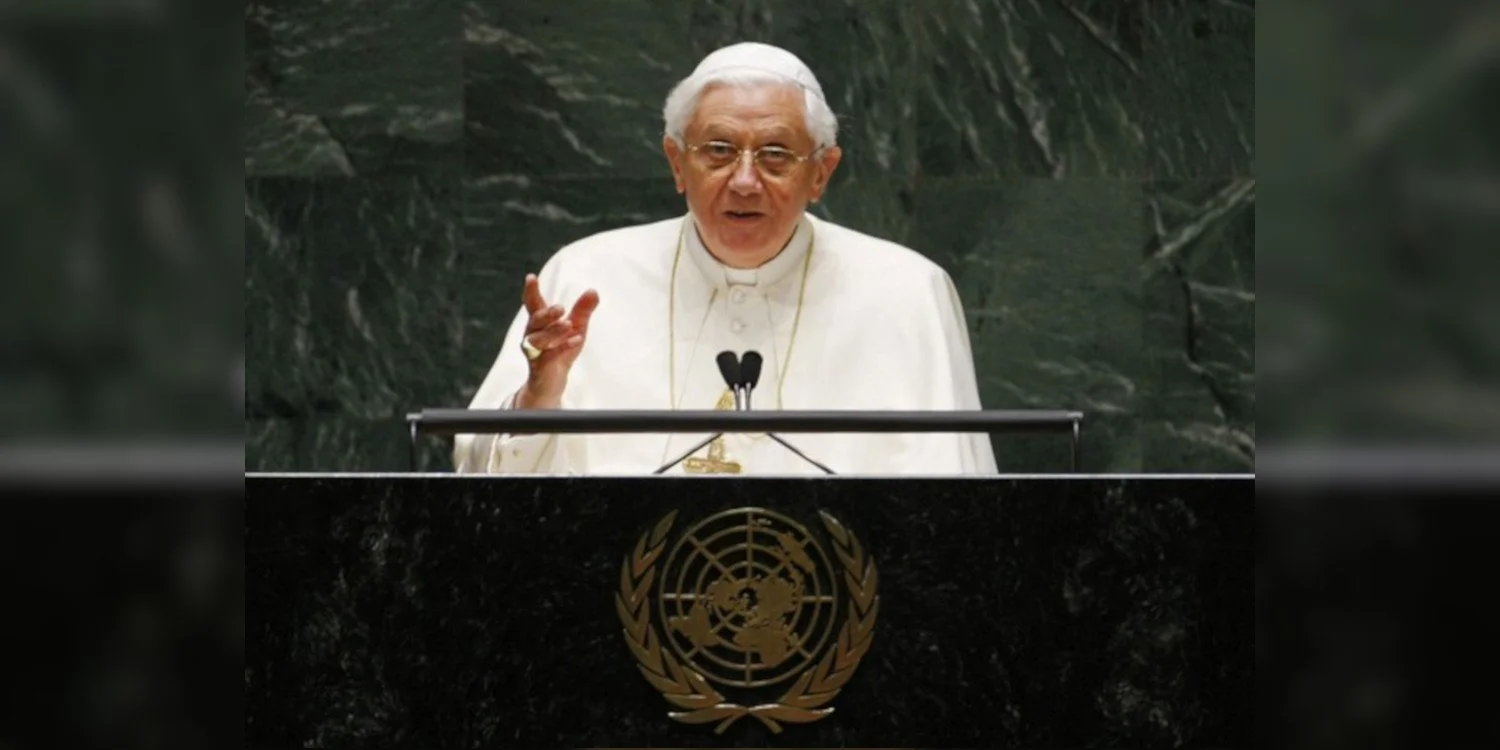
The United Nations High Commissioner of Hypocrisy
In 2014, a U.N. Commission accused the Vatican under Benedict XVI of a past sex abuse cover-up. Then the U.N. was exposed for a present sex abuse cover-up.

In 2014 a United Nations Commission accused the Vatican under Benedict XVI of a past sex abuse cover-up. Then the U.N. was exposed for a present sex abuse cover-up.
July 12, 2023 by Fr. Gordon MacRae
I sometimes come across an older post I have written about events in the news, and am struck by how much what I wrote ends up coming true. I just re-read a post I wrote on July 7, 2010. I read it anew with far more invested in the topic today than when I originally wrote it. That post is “The Exile of Father Dominic Menna and Transparency at The Boston Globe.”
It raised an important point about an issue that has simmered in the background of this blog since its inception in 2009. That issue is the Catholic clergy sex abuse story, and how much the story has itself been abused in the news media to further certain agendas. On Easter Sunday 2010, for example, The Boston Globe hyped this story about a popular Massachusetts senior priest, Father Dominic Menna, who under the terms of the U.S. Bishops’ “Dallas Charter,” was removed from ministry due to a claim of sexual abuse.
In reporting the story, the Globe neglected to mention that the uncorroborated single claim that destroyed this priest’s life was alleged to have occurred over a half century ago in 1971. And it was no accident that the story was reserved for the Globe’s Easter Sunday edition.
What the Globe omitted from the Easter Sunday 2010 story was the fact that the adult bringing that claim — a man in his late fifties — stood to gain a substantial financial settlement just for making the claim while proving nothing.
The contingency lawyers and their enablers in the media are counting on you to have no frame of reference to put any of the claims of priestly abuse into context. I do have a frame of reference, and I can tell you that the distortion created by lawyers and the news media is deeply unjust — not only to Catholics and their priests, but to millions of adult victims of abuse whose suffering has been trivialized and cheapened by the distortion that only victims of Catholic priests are worth hearing and compensating.
Since I wrote the above post, The Boston Globe was sold by its parent company, The New York Times, for less than ten cents on the dollar, compared to what the Times paid to purchase it. Some like to think that in the end the Globe pretty much reaped what it had sown at the expense of truth and justice.
The eventual result of the symphony created by contingency lawyers and biased news media was an arena in which the Church would become dislodged as a global source of moral truth. I wrote of some of the fallout for other innocent victims in my post, “Benedict Faced the Cruelty of a German Inquisition.”

The U.N. Assault on the Catholic Church
In 2014, an explosive 16-page report issued by the United Nations High Commissioner on the Rights of the Child indicted and convicted the Catholic Church without investigation, without evidence, without a formal defense, and without any trial of the facts. I know the feeling!
This public shaming of the Holy See came as a result of the emergence into public view of hundreds of claims of sexual abuse by priests dating back thirty, forty, fifty years or more. These were claims often brought forward by contingency lawyers who — once the mass settlement process had been established as status quo — flooded Church institutions with demands for “out-of-court” settlements with no effort at corroboration. “I’ve never seen anything like it,” said N.H. contingency lawyer, Peter Hutchins when handed a $5.2 million check from the Diocese of Manchester, New Hampshire.
The various bishops and dioceses caved in to these demands, and then a hapless U.N. committee took that to be proof enough that the claims were all true. In a courageous article in First Things, “Rolling Stone, Alan Dershowitz, and Catholic Priests” (May 21, 2015) Father Thomas Guarino described the cost of this abandonment of rights for the priests accused when bishops got the monkey off their backs by throwing money at it:
“This Episcopal peace comes at a heavy price…. The problem is that, in many cases, no contrary evidence can come forward because an accusation is decades old. What convincing evidence could possibly be adduced to clear a man’s name? Even if a charge could be true, is lifetime suspension a proportionate penalty for a mere possibility? Should bishops be held hostage by forces dividing them from their own priests?”
— Fr Thomas Guarino, First Things
The United Nations had no such interest in basic civil rights like the presumption of innocence. Claudia Rosett, who led the Investigative Reporting Project for the Foundation for the Defense of Democracies, also reacted to the U.N. Commission report on the Vatican with a similarly titled column in The Wall Street Journal (“The U.N. Assault on the Catholic Church,” WSJ, February 10, 2014). Ms. Rosett described the report:
“A Report on the Holy See — released by a U.N. Committee last week to much media fanfare — alleged that tens of thousands of children have been abused by Catholic clerics and that the Vatican has helped cover it up.”
Bill Donohue, President of the Catholic League, described that U.N. report as “one of the most ambitious power grab efforts ever undertaken by a U.N. committee.” The report was, of course, a lie, simply repeating a media mantra. But in the process of describing this in The Wall Street Journal, Claudia Rosett exposed another big lie, one belonging to the United Nations itself.

Now Hiring: A U.N. High Commissioner of Hypocrisy
Between 2007 and 2013, United Nations peacekeeper forces have been repeatedly implicated in the sexual abuse of children they were tasked to protect, and the U.N. has now been implicated in a cover-up of that fact. But the most disturbing part of this story is the extent to which it has been ignored — another form of cover-up — by the American news media. In fact, Ms. Rosett’s above column in the WSJ was likely the first hint of the scandal at the U.N. that appeared in mainstream U.S. news.
Since then, other media outlets have taken this up, but few of them in the United States. Sandra Laville, in The Guardian (U.K.) covered a report leaked to her newspaper alleging that the U.N.’s own investigation revealed “the rape and sodomy of starving and homeless boys” by French U.N. peacekeeper forces operating in the Central African Republic.
As sickening as that charge is, it gets much worse. French president Francois Hollande promised that France would prosecute those soldiers. The story came to light only because of a whistleblower. According to Matheiu Delahouse in the French paper, Le Nouvel Observateur, the U.N. marked its report on this matter “secret” and filed it away.
This is a story worth telling. The French government was not even informed of the claims against its soldiers until a man named Anders Kompass, a Swedish citizen working for the U.N. High Commissioner of Refugees, “broke protocol and gave a copy of the report to the French government,” according to The Week:
“Naturally, the French investigators asked if they could speak to the U.N. investigator who wrote the report, but the U.N…refused to allow that. Meanwhile, Kompass, the whistleblower, has been punished and may lose his job. Saying he leaked a confidential document, the self-interested bureaucrats at the U.N. have suspended this 30-year veteran of humanitarian work for intervening on behalf of children.”
— The Week, “United Nations: Riding sexual abuse by peacekeepers,” May 15, 2015
Rosa Freedman, writing at TheConversation.com from Australia, charged that the U.N. has “a long and sordid history of covering up sexual abuse by peacekeepers.” Simon Allison, writing from South Africa for The Daily Maverick observed about the U.N., “Who can trust an institution that covers up the sexual abuse of minors?”
The very fact that such a question is now asked of the United Nations itself after it dragged the Catholic Church through a round of public mudslinging is symptomatic of an institution in crisis. The situation is more hypocritical than it appears.
I have also written of the hubris and hypocrisy of the U.N.’s finger pointing on this issue. I have described evidence that even while the U.N. was pointing fingers at the Vatican for decades-old and unproven claims of abuse, the U.N. was itself being sued. In 2014, the United Nations employed any and every legal means to fight off a lawsuit from the beleaguered people of Haiti after its unscreened peacekeeper forces caused the deaths of innumerable children by bringing a cholera outbreak to their earthquake stricken country. One of its defenses was to blame the people of Haiti for the cholera, a plague that killed hundreds of Haitian children.
The saddest part of this story is that the Holy See sent emissaries to the U.N. Commission on the Rights of the Child to assure the U.N. that many hundreds of priests have been cast out after being accused in these decades-old claims of abuse. In “The U.N. Assault on the Catholic Church,” (WSJ, February 10, 2014), Claudia Rosett proposed a more fitting response from the Church to the U.N.:
“Pope Francis might want to consider that it is precisely to avoid gross intrusion by U.N. ‘experts’ that the United States signed, but never ratified, the U.N. Convention on the Rights of the Child. This treaty has less to do with children than with political power plays, and a fitting reform of the Vatican would be to walk away from it.”
Would that such advice was followed before hundreds of accused priests were thrown under the bus and out of the priesthood. Would that such advice was followed before the extent of United Nations hypocrisy was bared for all to see. Is reform of the U.N. on the horizon? The evidence does not indicate that it is. The United Nations now needs a High Commissioner of Hypocrisy.
+ + +
Note from Fr. Gordon MacRae: You would serve the cause of justice and truth by sharing this post. You may also like these related posts:
Human Trafficking: Thailand to America and a Cold Case in Guam
Benedict XVI Faced the Cruelty of a German Inquisition
Catholic Scandal and the Third Reich: Rise and Fall of a Moral Panic


The Eucharistic Adoration Chapel established by Saint Maximilian Kolbe was inaugurated at the outbreak of World War II. It was restored as a Chapel of Adoration in September, 2018, the commemoration of the date that the war began. It is now part of the World Center of Prayer for Peace. The live internet feed of the Adoration Chapel at Niepokalanow — sponsored by EWTN — was established just a few weeks before we discovered it and began to include in at Beyond These Stone Walls. Click “Watch on YouTube” in the lower left corner to see how many people around the world are present there with you. The number appears below the symbol for EWTN.
Click or tap the image for live access to the Adoration Chapel.
The following is a translation from the Polish in the image above: “Eighth Star in the Crown of Mary Queen of Peace” “Chapel of Perpetual Adoration of the Blessed Sacrament at Niepokalanow. World Center of Prayer for Peace.” “On September 1, 2018, the World Center of Prayer for Peace in Niepokalanow was opened. It would be difficult to find a more expressive reference to the need for constant prayer for peace than the anniversary of the outbreak of World War II.”
For the Catholic theology behind this image, visit my post, “The Ark of the Covenant and the Mother of God.”

For Those Who Look at the Stars and See Only Stars
An MIT astrophysicist trying to reconcile science with a quest for spiritual truth wrote upon the death of his parents, “I wish I believed.” I believe he just might.

First deep field image from the James Webb Space Telescope. Credits: NASA, ESA, CSA and STScl
An MIT astrophysicist trying to reconcile science with a quest for spiritual truth wrote upon the death of his parents, “I wish I believed.” I believe he just might.
July 5, 2023 by Fr. Gordon MacRae
Note from Fr. Gordon MacRae: The image atop this post is the first of many images transmitted by the James Webb Space Telescope parked one million miles from Earth in 2022 to survey the Cosmos. I first wrote this post in 2018 for an older version of this blog. It needed to be restored for our readers, but I ended up completely rewriting it. My goal was to highlight a bridge between science and faith, but some say it also highlights a bridge between life and death.
+ + +
When Beyond These Stone Walls was just a few months old back in 2009, I wrote a post about the death of my mother. It told a story about an event that occurred on her birthday a year after she died. At first glance it seemed an ordinary event, the sort of thing usually chalked up to coincidence. But its meaning and timing and how it unfolded made it an extraordinary grace beyond comprehension. It required that I set aside the mathematical odds against such a thing and see it foremost in the light of faith.
It remains to this day a pivotal moment, a wondrous event that shook my faith out of the closet of doubt where I tend to store it when times get rough — which is often. The story told in that post may shake you, too, if it hasn’t already. By that, I do not mean that it will challenge your faith. It’s just the opposite. My story lifted for me a corner of the veil between doubt and belief. So the title I gave it was “A Corner of the Veil.”
My friend, Pornchai Moontri was with me that night when the event occurred while I offered Mass in our prison cell. I asked Pornchai if he remembers it. “How could I forget it?” he said. He described it as an “ordinary miracle,” the kind he says he has seen a lot of since his eyes were opened.
I could repeat the whole story here, but it will take too long and I have written it once already. It is but a mere click away. I will link to it again after this post. You can decide for yourself whether the story it tells is mere coincidence or something more. My analytic brain tends toward coincidence, but sometimes that just doesn’t add up. This was one of those times.
I then came upon a strange little book of fiction by Laurence Cossé first published in French as Le Coin du Voile, and in English, A Corner of the Veil (Scribner 1999). It strangely fell at my feet from a library shelf after my post with the same title.
Laurence Cossé was a journalist for Radio France when she wrote this book described by Notre Dame theologian Ralph McInerney as “a theological thriller that makes a mystery out of the absence of mystery.” It is a spellbinding account of what happens to the people and institutions of Church and State when a manuscript surfaces that irrefutably proves the existence of God.
Science, religion, and politics all transform as their experts ponder its meaning and their own continued relevancy. The reader is left to wonder whether the discovery will spark a new era of harmony or launch the final battle of the apocalypse.
“Six pages further, Father Bertrand was trembling. The proof was neither arithmetical nor physical nor esthetical nor astronomical, it was irrefutable. Proof of God’s existence had been achieved. Bertrand was tempted, for a second, to toss the bundle into the wastebasket.” (p 15)
As it does for people who awaken to faith on a personal level, the discovery immediately altered the way its readers face both life and death. The transformation was astonishing. Death came to be seen, not as an entity unto itself, but as it really is a chapter in the continuity of life, of me, of the person I call "myself," integrated into the Great Tapestry of God.
I happen to know a lot of people whose experience of living is suddenly overshadowed by the prospect of dying. They have come to know that death is drawing nearer day by day. Some of them struggle. What does death mean, and why do we wage such war against it? The age of individualism and relativism distorts death into a fearsome enemy. As Dylan Thomas wrote,
“Do not go gentle into that good night. Rage, Rage against the dying of the light.”

Carina Nebula image from the James Webb Space Telescope. Credits: NASA, ESA, CSA and STScl
If That’s All There Is, Then Let’s Keep Dancing!
While writing this post, I received a letter from a reader in Ohio who asked me to write a note of encouragement to a friend whose death is drawing near. After a lifetime of faith, he wrote, the friend is having grave doubts and fears about the end of life and the finality of death. He is asking the age-old question put to song: “Is that all there is?”
But that is our problem. We speak in terms of “finality” as though when faced with death, all that we once believed with hope takes on the trappings of a mere children’s fantasy. I know too many people who are dying, and many of us treat it as the silent elephant in the room because we know that sooner or later we will join them just as our parents did before us. It is part of the flow of life, but we ward it off as a terror in the night. In the face of death, science alone comes up empty.
When you think of it, death is best seen as an act of love. Imagine the inherent selfishness of a humanity without death. Those we love the most in this world — those who fulfill our very purpose for being in this world — would be left out of existence if this life were ours alone to keep. But facing death with no life of faith casts both life and death into a formless, meaningless void.
I recently came across a review of a book by noted MIT physicist and astronomer Alan Lightman entitled Searching for Stars on an Island in Maine (Pantheon 2018). It was reviewed by UMass physics professor Alan Hirshfeld in “A Longing for Truth and Meaning” in The Wall Street Journal April 7-8, 2018).
In some previous science posts here at Beyond These Stone Walls, I have cited both writers for other books and articles they have written. Mr. Lightman’s book, and Mr. Hirshfeld’s review of it, both raise provocative questions about “the core mysteries of human life” and the way science explores the Universe:
“Why are we here? What, if anything, is the meaning of existence? Is there a God? Is there life after death? Whence consciousness?”
I am very happy to see science ponder these questions, but they can never be answered by science alone. It comes up short when the task moves beyond the mere physics and chemistry of life to its meaning and purpose. Consider this explanation of the self, of who and what you are as a conscious being, offered by Mr. Lightman:
“Self is the name we give to the mental sensation of certain electrical and chemical flows in our neurons.”
It is too tempting for science to reduce us to fundamental biology and chemistry, but the mere mechanics of what I am do not at all define who I am. If science is the only contribution to the meaning of life and death, then it becomes obvious why so many spend significant time in denial or in dread of death.
In his new book reflecting on the Cosmos, MIT astrophysicist Alan Lightman takes up these questions and more. Searching for Stars on an Island in Maine is a view of the world through a scientist’s lens which requires the scientist to see in it, as Alan Hirshfeld describes,
“Tangible bits of matter and energy, all governed by a set of fundamental physical laws … In keeping with his ‘Central Doctrine of Science,’ he eschews unprovable hypotheses, most significantly the existence of God and the afterlife.”
But these hypotheses are only unprovable from the point of view of science which concerns itself, as it concerns astrophysicist Alan Lightman, with matter and energy and fundamental laws. But Professor Lightman has acquired the wisdom not to stop there. His reflection on the death of his parents brings him to the “impossible truth” that they no longer exist, and he will one day follow them into this nonexistence.
Is that all there is? “I wish I believed,” he wrote. But “a precipice looms for each of us, an eventual plunge into nonexistence.” As Alan Hirshfeld described it:
“A depressing prospect, for sure, yet the inevitable judgment of those for whom religious or spiritual alternatives carry no resonance.”

Pictured: Fr. Georges Lemaître, Albert Einstein and Fr. Andrew Pinsent
Threads of the Tapestry of God
I have written numerous articles about the sciences of astronomy and cosmology, the origins and mechanics of the Universe. But these are not the only tools with which to explore the universe and measure life and death. The conclusions of science and faith are not as inseparable as science might have you believe.
I have raised this analogy before, but consider these two passages from two sources that have become meaningful to me. The Catechism of the Catholic Church (CCC 296) expresses a fundamental truth of faith God created the Universe and life “out of nothing.”
Among the many contributions of science that I hold in high regard, this is one by the mathematician Robyn Arianrhod whose book, Einstein’s Heroes: Imagining the World Through the Language of Mathematics (Oxford University 2005) draws the same conclusion. Don’t let the scientific language dissuade you from understanding this phenomenal bridge between science and faith:
“The Belgian priest and astrophysicist, Georges Lemaitre began to develop expanding cosmological models out of Einstein’s equations … In 1931, Lemaitre formally sowed the seeds of the Big Bang theory [which] showed that Einstein’s equations predicted the universe had expanded not from a tiny piece of matter located in an otherwise empty cosmos, but from a single point in four-dimensional spacetime … Before this point, about 13 billion years ago, there was no time and no space. No geometry, no matter. Nothing. The universe simply appeared out of nowhere. Out of nothing.”
— Arianrhod, pp 185-187
Reflecting on the death of his parents, Alan Lightman wrote that he wished he believed in the continuity of life after death. It could be at least a starting point that sometimes science and faith share some of the same language and conclusions about the origin of life. Faith, to have any real depth, is not simply an emotional experience to assuage our fears, but rather one arrived at also through reason. Catholicism presents 2,000+ years of faith seeking understanding, of belief built upon reason.
And sometimes reason just cannot explain away our intuition that life has an Author, and when we die, the book is still not finished. I am intrigued by Professor Hirshfeld’s use of the term, “resonance” for I have also used it in some recent posts. I have described it as a sort of echo that finds its way among the “threads of the Tapestry of God” in ways that give life meaning and purpose, in ways that connect us. One way spiritual resonance manifests itself is by giving meaning to suffering.
Consider this stunning action of spiritual resonance that was described in a post, “Fr Georges Lemaître, the Priest Who Discovered the Big Bang.” That post was co-authored by me and Father Andrew Pinsent, PhD, a priest, physicist and Director of the Institute for Science and Religion at Oxford University.
When my friend Pornchai Moontri came into the Catholic Church on Divine Mercy Sunday in 2010, one of our readers, the late Pierre Matthews in Belgium, inquired rather urgently asking to stand as Pornchai’s Godfather. They visited several times. However, it was only after I wrote about Father George Lemaitre that Pierre contacted me with the staggering revelation that the Godfather of Pornchai Moontri is the Godson of Father George Lemaitre. The mathematical odds against such a “mere coincidence” are ... well … astronomical!
It is a long time since I have viewed with awe the expanse of our galaxy spanning the night sky in all its brilliance, but like Alan Lightman, I have done so, and find it unforgettable. He is on the right track, and may one day come to see that the awe it instills in him is not the awe of science alone. “I wish I believed,” he wrote. I believe he just may.
+ + +
ANNOUNCEMENT: Fr. Gordon MacRae and Beyond These Stone Walls are now featured on Gloria.tv, an international Catholic social network and a video and news sharing platform. We are honored by this invitation, and by the Catholic fidelity demonstrated by Gloria.tv. We invite our readers to support this venue by visiting and sharing our page and other content there.
+ + +

Fr. Georges Lemaître
Editor’s Note: Continue this great adventure of science and faith with these related posts:
The God of the Living and the Life of the Dead

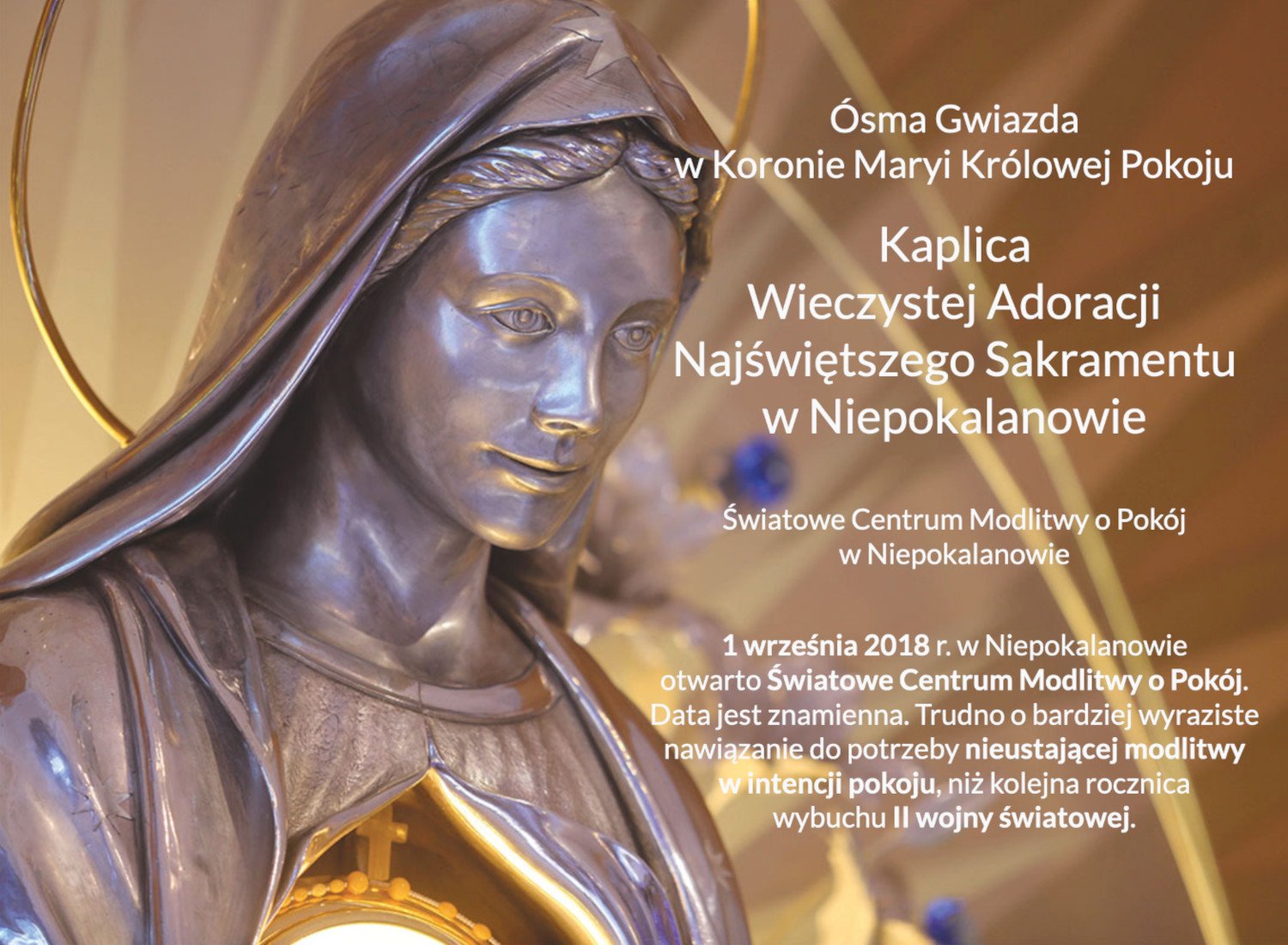

The Eucharistic Adoration Chapel established by Saint Maximilian Kolbe was inaugurated at the outbreak of World War II. It was restored as a Chapel of Adoration in September, 2018, the commemoration of the date that the war began. It is now part of the World Center of Prayer for Peace. The live internet feed of the Adoration Chapel at Niepokalanow — sponsored by EWTN — was established just a few weeks before we discovered it and began to include in at Beyond These Stone Walls. Click “Watch on YouTube” in the lower left corner to see how many people around the world are present there with you. The number appears below the symbol for EWTN.
Click or tap the image for live access to the Adoration Chapel.
The following is a translation from the Polish in the image above: “Eighth Star in the Crown of Mary Queen of Peace” “Chapel of Perpetual Adoration of the Blessed Sacrament at Niepokalanow. World Center of Prayer for Peace.” “On September 1, 2018, the World Center of Prayer for Peace in Niepokalanow was opened. It would be difficult to find a more expressive reference to the need for constant prayer for peace than the anniversary of the outbreak of World War II.”
For the Catholic theology behind this image, visit my post, “The Ark of the Covenant and the Mother of God.”
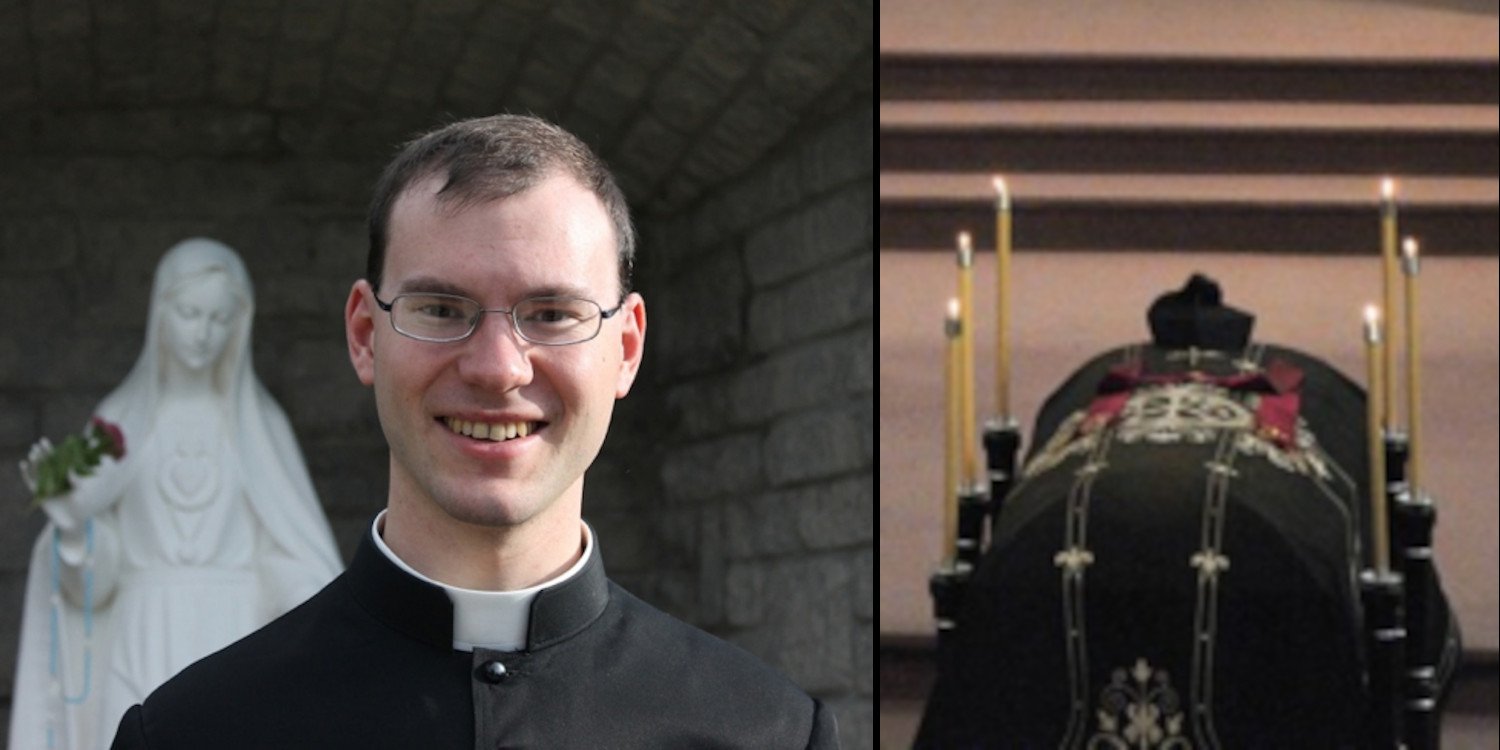
Jesus Wept: The Death of Father Kenneth Walker, FSSP
At a Phoenix Catholic church on June 11, 2014 Fr Kenneth Walker was murdered and Fr Joseph Terra brutally beaten by a man paroled from prison six weeks earlier.

At a Phoenix Catholic church on June 11, 2014 Fr Kenneth Walker was murdered and Fr Joseph Terra brutally beaten by a man paroled from prison six weeks earlier.
June 11, 2023 by Fr Gordon MacRae
Note from Father Gordon: Father Kenneth Walker, FSSP was tragically murdered at his parish on June 11, 2014. He was killed by a man who had recently been released from prison. Father Kenneth was 28 years old and had recently marked his second anniversary of ordination. As a priest and a prisoner, this tragedy struck me doubly. I wanted to remember him on this date with the post I wrote about him at that time. I believe this young martyr now stands in the presence of God.
With Blessings,
Father Gordon MacRae
+ + +
“Jesus wept.” Those two words in the Gospel of Saint John (11:35) comprise the shortest sentence in all of Sacred Scripture. Upon the sudden death of their brother Lazarus, his sisters, Martha and Mary, were consoled by many in their community. When they heard Jesus was coming, Martha went out to meet him while her sister Mary remained inside.
Martha engaged Jesus in a dialogue of faith in light of her brother’s death, but Mary challenged him with another kind of statement of faith: “Lord, if you had been here my brother would not have died” (John 11:32). Jesus asked to be taken to Lazarus. He saw Mary weeping, along with many others who had come to console her. Then, “Jesus wept.”
I must write of the tragic death of one of my brothers, Father Kenneth Walker, a young man I have never even met. I must write of this because I have friends who knew him, and who know Father Joseph Terra who was seriously injured in the attack that took Father Walker’s life. Like Martha in the Gospel account, I, too, believe Jesus is the resurrection and the life. But like Mary, I, too, want to say in my grief, “Lord, if you had been there, my brother would not have died.” But I believe in my heart that Jesus was there, and upon this senseless scene of human brokenness and tragic loss, Jesus wept.
For some who were not there, however, this story has all the makings of dark journalism. Father Joseph Terra, age 56, who went to investigate noises in the church courtyard, was ambushed and brutally beaten with a tire iron. Father Kenneth Walker, 28 years old and ordained just two years ago, walked in on the scene and was murdered by the intruder.
The man arrested for the murder and assaults is 54-year-old Gary Michael Moran, paroled from prison just weeks earlier having been convicted in 2005 of home invasion, burglary, and assault with a deadly weapon. In that case, he had stabbed a man in the abdomen before being subdued. Four years before that, he was sentenced in another case involving weapons. Moran did not know any of his victims then or now. In 2005, he said that he was crazed on methamphetamine, and cited a long history of drug abuse and its usual desperation for money to feed itself.
And in what has suggestively become the darkest fodder for politicizing the news of this tragedy, the gun that was used to kill Father Kenneth Walker did not belong to the crazed killer. It belonged to Father Joseph Terra. As the dust settled upon this case, I had no doubt that one or both ends of a political and moral spectrum would take this up, take it out of its context, and abuse this aspect of the story ad nauseam into a cacophony of political correctness.
That would be neither fair nor just, and if this aspect of the story gathers steam into a post mortem controversy, I believe you should give it the attention it deserves — which is none whatsoever. Father Joseph Terra bears no blame whatsoever for this tragedy, and is in fact one of its victims.

The Duty of Defense
Already, the mere fact that Father Joseph Terra owned a gun is littering the online world with suggestive overtones of disdain. Columnist EJ Montini, writing June 16 for AZCentral.com, had a posting entitled: “Should Catholic priests carry guns?” Of the murder of Father Walker, Mr. Montini wrote:
“The two priests operated in a tough part of town. And priests have as much right to protect themselves as anyone else. But does it seem incongruous for a priest to have a gun? … the former altar boy in me can’t imagine any of the priests I met as a kid carrying a weapon.”
I am not advocating that priests carry handguns, and in fact there is no evidence at all that Father Joseph Terra ever did. According to the news accounts, after being brutally beaten with a tire iron, which fractured his skull among other serious injuries, he had to flee the scene to retrieve a weapon kept in a rectory nightstand. He then returned to try to stop the intruder from intruding any further. The crazed meth addict allegedly wrestled the weapon away from Father Terra, and then shot and killed Father Walker who had just entered the scene.
Can “the former altar boy” in EJ Montini imagine the priests he knew as a kid being beaten to death in their churches by crazed meth addicts? Until he can, he has no right to cast a shadow on the fact that a citizen who defended himself was also a Catholic priest. These men of God were not attacked for some high ideal such as their profession of faith. They were attacked — one murdered and one nearly so — for the mere contents of their wallets, and whatever plunder could be carried off.
EJ Montini equated this scene with a story of a World War II priest chaplain in a war zone who was “armed” only with his rosary. The comparison was an insult to both our intelligence and our faith. Has Catholic culture in America become so comfortable with the notion of the last two decades that its priests should be little more than expendable targets with no ability or right of self-defense?
One friend with whom I spoke of this case by telephone this week asked if my position on Father Terra’s gun seems incongruous with the case against capital punishment that I laid out in “Stay of Execution: Catholic Conscience and the Death Penalty.” It is not, and in fact the very same moral principles apply to Father Terra’s right and duty of self-defense. The Catechism of the Catholic Church (CCC 2263) quotes Saint Thomas Aquinas in the morally legitimate defense defined in CCC 2264 and 2265:
“The act of self-defense can have a double effect: the preservation of one’s own life, and the killing of the aggressor. . . . The one is intended; the other is not..”
— St. Thomas Aquinas, Summa II-II, 64,7
“Therefore it is legitimate to insist on respect for one’s own right to life. Someone who defends his life is not guilty of murder even if he is forced to deal his aggressor a lethal blow.”
— CCC 2264
“Legitimate defense can be not only a right, but a grave duty for one who is responsible for the lives of others. The defense of the common good requires that an unjust aggressor be rendered unable to cause harm.”
— CCC 2265

The Death of Father Michael Mack
This story has brought back to me the full brunt of another tragic and eerily similar death of a priest with whom I once lived and who was — and remains — my friend. It’s an account that has come back to haunt me many times in the 12 years since it occurred, and with the Father Walker and Father Terra tragedy it has come back to haunt me again. I wrote some of this in a post called “The Holy Longing: An All Souls Day Spark for Broken Hearts,” but I had left out an important factor that I have often reflected upon since. What if I had been there?
On December 7, 2002, the Vigil of the Immaculate Conception, Father Michael Mack started a letter to me in prison from his rectory room in a parish in the Gallup, New Mexico Diocese where he had been assisting for several months. In the letter, Father Mike wrote of his decision to return to his community, the Servants of the Paraclete, and indeed was leaving that moment to commence the four-hour drive. He promised to continue the letter upon his return to the home he and I once lived in while I was a guest of that community, and a member of their staff in a ministry to wounded priests.
Late that night, as I was later able to piece together, Father Michael’s letter continued. Upon his arrival at the Servants of the Paraclete residence at midnight, he wrote of his happiness at finally being home, and of his hope that he might visit me in prison, might correspond more, and might help restore my freedom.
As he finished his midnight letter, Father Michael, who would have turned 60 two weeks later, did not know that he was not alone in that house. A 33-year-old drifter named Steven Degraff had chosen that night to break in through a back door, noting that the house had been empty for weeks as he staked it out. Armed with a knife and a hammer, hiding in a closet just fifteen feet from the desk where Father Mike finished his last letter to me, Steven Degraff awaited his moment to spring upon my friend.
Father Mike took his letter outside to a mailbox to be picked up the next day, and then walked back into that house to his death. His body was found the next day. Father Mike had been beaten to death with a hammer. The intruder then took Father Mike’s wallet and fled in Father Mike’s car.
Being in prison where no one can contact me except by mail, Father Mike’s last letter to me reached me just minutes before news of his murder. After mail call on the evening of December 12, 2002, I sat at a table outside my cell to read my friend’s letter. I can never forget this moment. As I read, someone laid the previous day’s newspaper on the table. With Father Mike’s letter still in my left hand, I turned the page to “National News Briefs” and read of his murder.
Days later, Steven Degraff was arrested in neighboring Santa Fe County for stealing yet another car, and for drug paraphernalia. He had served prison sentences in four states before killing Father Mike, a crime for which he confessed to police.
December 2002 was also the height of the nationwide explosion of claims of sexual abuse by priests, and the lurid news was not lost on Steven Degraff. Once Degraff talked with a lawyer, and learned that his murdered victim was a priest, he changed his story. This 33-year-old sociopath admitted that he broke into the home, but added that he killed Father Mike because the priest tried to molest him. Fortunately, even at the peak of nationwide witch hunt about priests, Steven Degraff’s story was dismissed as a blatant lie, but not before it became lurid fodder for some in the news media.
Since then, I have often thought of what I might have done had I still lived in that house and was there with Father Mike that night. These are not pleasant thoughts for a priest — for anyone. In more reflective moments, I wish I could have left in that house the means for my friend to defend his own life. I have no doubt in my mind that if I had been there, Father Michael Mack would not have died.

Blaming Father Terra ... Raising up Psychopaths
Finally, I must write of this story because I have lived for two decades with one foot in both worlds: the world of Father Kenneth Walker whose life was taken, and Father Joseph Terra beaten and scapegoated; and the world of Gary Michael Moran, the career criminal and methamphetamine addict released from prison just six weeks before these horrific Phoenix crimes. I do not, as you know, live in that latter world by choice, or even by any act of my own.
But in the two decades in which I have been forced to live in that world, I have encountered many men like Gary Michael Moran and Steven Degraff in prison. Don’t think it is lost on me for a single moment that Moran had been paroled from prison three times — and the sociopath Steven Degraff four times — during the two decades that I have been kept in prison for crimes that never took place. This story is not about me — I know that — but it is a sobering thought for anyone who still believes America’s criminal justice system is not broken and still works in real life like it does on TV’s “Law and Order.”
Far more than prison itself, however, it is the “Pollyanna” naiveté of so many Americans — both Catholics and not — that I find most demoralizing. The notion that men would not possibly accuse Catholic priests just for money is laughed at in prison by criminals like Gary Michael Moran and Steven Degraff. I have met some in prison who have snuffed out lives for a tiny fraction of the $200-grand doled out by my diocese to anyone ready to point at any priest.
I can no longer even count the number of times the minds of criminals have wandered in my direction, exploring ways to exploit our Catholic blindness about them while priests are thrown out of ministry — and sometimes into prison, and kept there. Should my post, “Our Catholic Tabloid Frenzy About Fallen Priests” now include even those who seek to defend themselves?
Might this tragedy in Phoenix cause some soul stirring about the bigger picture it represents? We can hope, and in fact it already has. A remarkable blog post by Rebecca Hamilton, “Guns. Blaming Father Terra for Trying to Defend Himself. And Raising Up Psychopaths.” (June 20, 2014) stands out among all the suggestive undertones about who wielded the murder weapon and how. I recommend reading all of it, but here is a portion that gave me pause:
“Guns are not the problem. We are. … The problem is our unwinding society and the feral young people we are raising up inside it. ... The blame-Father-Terra crowd is part of the problem... Good, normal people are always at a disadvantage in these situations ...”
I have prayed for Steven Degraff over these twelve long years, and I will pray for Gary Michael Moran. So will the families, friends, and parishioners of Father Joseph Terra and our tragically lost son and brother, Father Kenneth Walker. These people are not Catholic lite. They know their duty to the Gospel, and they will do it.
And as for Father Joseph Terra, I hold you in the highest regard, and with the deepest respect. I humbly ask for your prayers, and from prison I offer you my fraternal Blessing. May Divine Mercy reign in our hearts.

Funeral Mass for Father Kenneth Walker, FSSP
+ + +
Thank you for reading and sharing this Special Post. We will occasionally add other Special Posts to honor significant dates. You may also like these related posts:


The Eucharistic Adoration Chapel established by Saint Maximilian Kolbe was inaugurated at the outbreak of World War II. It was restored as a Chapel of Adoration in September, 2018, the commemoration of the date that the war began. It is now part of the World Center of Prayer for Peace. The live internet feed of the Adoration Chapel at Niepokalanow — sponsored by EWTN — was established just a few weeks before we discovered it and began to include in at Beyond These Stone Walls. Click “Watch on YouTube” in the lower left corner to see how many people around the world are present there with you. The number appears below the symbol for EWTN.
Click or tap here to proceed to the Adoration Chapel.
The following is a translation from the Polish in the image above: “Eighth Star in the Crown of Mary Queen of Peace” “Chapel of Perpetual Adoration of the Blessed Sacrament at Niepokalanow. World Center of Prayer for Peace.” “On September 1, 2018, the World Center of Prayer for Peace in Niepokalanow was opened. It would be difficult to find a more expressive reference to the need for constant prayer for peace than the anniversary of the outbreak of World War II.”
For the Catholic theology behind this image, visit my post, “The Ark of the Covenant and the Mother of God.”

Origin by Dan Brown, Like The Da Vinci Code, Is Bunk
In The Da Vinci Code, Dan Brown debunked Scripture to discredit Christianity. In Origin, he debunked science to discredit God. It is Dan Brown who needs debunking

In The Da Vinci Code, Dan Brown debunked Scripture to discredit Christianity. In Origin, he debunked science to discredit God. It is Dan Brown who needs debunking.
June 7, 2023 by Fr Gordon MacRae
Note to readers: Back in 2018 I wrote a post entitled “The Once and Future Catholic Church.” It tells an historically true account of a well documented event from the Sixth and early Seventh Century AD that took place in the life of Muhammad, founder of Islam. In 2011, the European Union High Court upheld the conviction of a seminar presenter who recounted this true story in a public lecture. The High Court ruling was that, though the story is historically accurate, retelling it in the present can only be to disparage Muhammad and Islam, which was the basis for the charge and fine.
Now, jump ahead a few years. You may have read or heard recent news about the Los Angeles Dodgers baseball team and its annual “Pride Night” celebration. The Dodgers are the leading baseball franchise in a city that is one third Catholic. Nonetheless, its managers thought it politically correct to present an award to a famously outrageous group calling itself the “Sisters of Perpetual Indulgence.” They describe themselves as a “leading-edge order of queer and trans nuns” They are most visible for their crude depictions of sacred Catholic rituals to mock the Church and its moral teachings on homosexuality and transgenderism. After some protest from the Catholic League and other voices, the Dodgers thought it best to withdraw the invitation and award. But then they caved to a louder and more demanding outcry from members of the LGBTQ+ community. The Dodgers have renewed their award to the Sisters of Perpetual Indulgence. And there, the matter stands.
The Wall Street Journal published two editorials about this high-profile debacle. One of them was by columnist Gerard Baker entitled, “The Bigotry That Proudly Speaks Its Name” (WSJ, May 30, 2023). I published one of the more than 2000 comments on this column in the WSJ, and my comment did not spare Church leaders for the setting in which such things happen today. Here is my comment:
“It would be unimaginable today, and not at all tolerated, if a similar disparagement was aimed at Islamic traditions or Jews. Neither would put up with it and rightly so. Catholic leaders in the United States especially have set the stage for this sort of ridicule by their open embrace of “Catholic Lite” and their practice of partisan politics. There are some faithful and courageous bishops who stand by the tenets of faith no matter the political cost. Bishop Strickland of Tyler, Texas comes to mind. Cardinal Dolan has also had his moments in the sun. However, the US bishops as a group have let pass opportunities to stand strong against the tide of relativism in support of life and their own Catholic traditions. They handle the second Catholic President in US history by entirely overlooking his living insult to the cause of life and what it means to be a faithful Catholic. Conservative bishops and priests are silent in the current regime out of fear of being cancelled. On the advice of liberal bishops, Pope Francis has marginalized the most faithful among us. It is no wonder that pop culture treats the Catholic Church as a farce. The late Father Richard John Neuhaus proposed a radical approach to saving the face of the Church in America: ‘Fidelity, fidelity, fidelity.’”
— WSJ, Gordon J. MacRae, June 1, 2023

There are many other factors that have lent themselves to the disparagement of Christianity and especially the ridicule of Catholicism in popular culture in a time when the very concept of “truth” is distorted as malleable and subjective.
As most readers of this blog know, I work as a clerk in a prison library. Granted, it a specialized legal library but a general library is attached to it with about 25,000 volumes available for education or entertainment. Too often, those two categories are blurred by some modern authors.
That is probably most true for authors like Dan Brown, a New Hampshire resident and an author of some of the most popular fiction that has been enjoyed by many but reinterpreted as scholarship by too many. I first wrote this post as a sort of public service in 2018 to counter in some small way the blatant disinformation in Dan Brown’s books. This is one of the posts I have long wanted to restore and update, but I ended up rewriting it for posting anew. Two millennia of Christian truth should not be simply waived away by the pen of a popular writer of highly distorted fiction masked as historical scholarship.
+ + +
Etymology, the study of the origins and meanings of words, has long been a fascination for me. So before delving into the claptrap and bunk of some of Dan Brown’s most popular novels, my terminology requires a little background.
“Claptrap” is often mistakenly used to refer to faulty logic or insincere babble, but that is not its only usage. Coming from the early days of modern theater, “claptrap” refers to a line or opinion inserted into a play for the sole purpose of generating applause. Thus a “claptrap” might be something like a subtle political reference for which some in agreement might spontaneously applaud. In turn, the rest of the audience would applaud because they did not want to appear that they missed the point. Claptrap is highly manipulative prose.
A similar modern day application is the laugh track on any one of several popular television sitcoms. The laugh track is subtle and often unnoticed, but if you listen carefully you will hear pre-recorded laughter from a non-existent audience. It is your cue that it’s time to laugh. The laugh track seems manipulative and irritating. Once you hear it, you can’t NOT hear it.
I characterize some of Dan Brown’s novels as claptrap because they undermine Christian traditions and beliefs at a time when the news media and pop culture have Christianity squarely in their sights for ridicule. In 2003, the Catholic Church in America was embroiled in a credibility crisis. Dan Brown chose that time in particular to take advantage of this momentum by publishing The Da Vinci Code. I’ll get around to debunking it in a moment.
But first, “bunk” and “debunk” are the other terms I want to explain. To say that some piece of information is “bunk” is commonly used to mean that it is false or contrived. Thus to “debunk” something is to expose its falsehood. There is more to these terms, however. The word “bunk” comes from a source where inarguably lots of bunk has originated: the floor of the United States Congress. During the 16th Congressional Session from 1819 to 1821, Congressman Felix Walker represented Buncombe County, North Carolina. One day, he held a captive audience when he droned on for hours with an incomprehensible speech despite protests from his colleagues.
Congressman Walker’s district, Buncombe County, was sometimes spelled “Bunkum” County by the less literate, and it was often referred to in conversation simply as “Bunk.” So both the word and the place became associated with that one nonsensical speech. Thus, “bunk” came to refer to a drawn out, illogical display of nonsense with no real conclusion. However, the remedy for bunk was delayed for a century in North Carolina. The word, “debunk” did not appear in any official document or literature until 1923.

The Legend of the Holy Grail
The premise of Dan Brown’s book, The Da Vinci Code, is that the famous 15th Century painter, Leonardo Da Vinci, embedded within his art a set of symbols for some enlightened future generation to find and interpret. It’s really Dan Brown’s Code because there is nothing in the field of art history to support it. The principal character and interpreter of the “secret” symbols in this and several other Dan Brown novels is Robert Langdon, a Harvard “Symbologist.” Brown does not make it easy to critique Langdon and his interpretations because the field of Symbology does not exist at Harvard or anywhere else.
And what these secret symbols supposedly reveal to Dan Brown’s characters is bunk. His characters uncover a conspiracy through which the Catholic Church has for centuries suppressed a truth that Jesus was married to Mary Magdalene, and that together they gave birth to a bloodline. That bloodline, the supposed descendants of Jesus and Mary Magdalene, became the Merovingian Dynasty of French kings. This was all known to a secret cabal called the Priory of Sion and kept covered up by a more sinister secret society called Opus Dei. It is, as I wrote earlier, pure bunk. But it is bunk that sold over 35 million copies to a generation of readers all-too-receptive to claptrap in a world poised to applaud and embrace anti-Catholic propaganda. Dan Brown’s books have sold 200 million copies worldwide. In 2005, after a year with The Da Vinci Code topping all the bestseller lists, Dan Brown was named one of the most influential writers in the world by Time Magazine.
A clever part of the allure of Dan Brown’s fiction is his use of a literary device called “verisimilitude.” Injected into his prose are true historical facts that lend credence to an otherwise fictional, even preposterous story to give it an aura of historical legitimacy. Brown begins The Da Vinci Code with a series of facts:
“The Priory of Sion” [Brown’s “secret” cabal] — a European secret society founded in 1099 — is a real organization. In 1975 Paris’ Bibliotheque Nationale discovered parchments known as ‘Les Dossiers Secrets’ [French for ‘The Secret Documents’ – give me a break!] identifying numerous members of the Priory of Sion, including Sir Isaac Newton, Botticelli, Victor Hugo, and Leonardo Da Vinci.”
One of the principal characters in The Da Vinci Code is Leigh Teabing who is presented as a multi-millionaire British Royal Historian and world-renowned expert on the Holy Grail. Of course, Teabing does not exist. He is a fictional character, and his historical conclusions from the pen of Dan Brown are also entirely fictional.
By giving the character of Leigh Teabing history credentials, however, Brown blurs the line between truth and fiction. “The marriage of Jesus and Mary Magdalene is part of the historical record,” says Teabing (The Da Vinci Code, p. 245). Over the next few ridiculous pages in the book, the “Royal Historian” presents his proof which boils down to nothing more than the fact that the Gospels do not directly and specifically say that Jesus was never married. They also never specifically say that Jesus was not an extraterrestrial. Hmmm… I wonder!
I wrote a post awhile back entitled “Mary Magdalene: Faith, Courage, and an Empty Tomb.” It was faithful to both the historical and Scriptural truths about her identity and her presence in the Gospels, and the reality of how she became distorted over the centuries. But what Dan Brown does with her twists the distortions into truly bizarre and unfounded bunk.
One of these conclusions is that history and the Catholic Church have suppressed and replaced a hard and demonstrable truth that Mary Magdalene is herself the Holy Grail. The prose is laughable. Looking at Leonardo Da Vinci’s late 15th Century masterpiece, The Last Supper, (depicted atop this section) Brown’s characters spot a secret symbol hidden for centuries from less enlightened eyes:
“‘The Holy Grail is a woman,’ Sophie thought… ‘You said you have a picture of this woman who you claim is the Holy Grail. [Teabing] wheeled suddenly and pointed to the far wall. On it hung an eight-foot-long print of The Last Supper… ‘There she is.’”
— The Da Vinci Code, p. 242
The characters of The Da Vinci Code then conclude that the figure to the right of Jesus in Leonardo’s painting may be a woman, then they conclude that the figure “must” be a woman, then they conclude that she “must” be Mary Magdalene, and that she and Jesus were married. Then they conclude that the Holy Grail was in fact at the Last Supper. Then finally they conclude that the Grail must actually be Mary Magdalene and not the Chalice. “So this is the woman who singlehandedly could crumble the Church!” said Sophie. (p. 243)
Sophie and Teabing then go on to “discover” that the Apostolic tradition and the See of Peter was an enormous mistake. Christ “must” have intended that the Church be in the hands of His “wife,” Mary Magdalene.
This alternative history in The Da Vinci Code entirely overlooks the fact that the Holy Grail was not a term at all familiar to the early Church. It first appeared in literature in the late 12th Century in Chrétien de Troyes’ romance novel, Perceval. From then on the term was solely a reference to the vessel containing the blood of Christ at the Last Supper. Another medieval legend was that Joseph of Arimathea acquired it after using it to contain the blood of Christ at the crucifixion. By the early 13th Century, the Holy Grail became attached to the Arthurian legends as a symbol of holiness and perfection sought by the Knights of the Round Table. In every source from medieval times to the present, the Grail refers to the cup of Christ’s blood sacrificed at the Last Supper or sacrificed on the Cross, or both.
Dan Brown’s “claptrap” revelation that Mary Magdalene, supposed wife of Jesus, is the Holy Grail intended by Christ to found His Church was followed in the book by another one. This one unmasks the real reason why Brown chose that moment in time — 2003 — to publish his barely shrouded anti-Catholic bigotry:
“Yes [said Teabing] the clergy in Rome are blessed with potent faith, and because of this, their beliefs can weather any storm, including documents that contradict everything they hold dear. But what about the rest of the world?… Those who look at Church scandals and ask, who ARE these men who claim to speak the truth about Christ and yet lie to cover up the sexual abuse of children by their own priests?”
— The Da Vinci Code, p. 266

Dan Brown’s Origin
Dan Brown’s knack for bunk has not diminished with time. According to the official DanBrown.com website, his 2017 book, Origin, addresses the two most important questions for humankind: “Where did we come from?” and “Where are we going?” The book already topped the best-seller lists when I wrote the earlier version of this post in 2018, but reviewers did not seem as enthused as Brown’s ready-to-be-misled-again readers. Here’s how The Week magazine summarized a review by Ron Charles in The Washington Post:
“Dan Brown is back, along with his Vatican-flouting, code-breaking hero, for another thriller so moronic you can feel your IQ points flaking away like dandruff. Symbologist Robert Langdon — Mickey Mouse watch still ticking — has joined a gathering where a computer genius is about to announce a discovery that will invalidate all existing religious doctrine. But before the secret is revealed, the speaker is taken out by an assassin, and with 300 pages to go, I wondered, ‘why couldn’t it have been me?’”
Janet Maslin, in a somewhat gentler review for The New York Times, referred to Brown’s “cringe-worthy prose,” but applauded his “clever use of settings” and “legitimately intriguing musings about the intersection of science and religion.” That caught my attention because the intersection between science and religion is something I have written a good deal about. In Origin, Dan Brown replaces the intersection with a collision.
The gist of Origin’s plot is that an M.I.T. physics professor named Jeremy England has “identified the underlying physical principle driving the origin and evolution of life.” The discovery is an earth-shattering disproof of every religious story of creation. The discovery threatens to render religion obsolete and God irrelevant. Dan Brown sets this latest bunk in motion with such blatant disregard for the bigger picture that something never before heard of in the world of literature has taken place. One of Brown’s own fictional characters has refuted him and in no less a public forum than The Wall Street Journal. This is from the real M.I.T. physics professor, Jeremy England:
“My actual research on how lifelike behaviors emerge in inanimate matter is widely available, whereas the Dan Brown character’s work is only vaguely described. There’s no real science in the book to argue over.”
— Jeremy England, “Dan Brown Can’t Cite Me to Disprove God,” WSJ.com Oct. 13, 2017
But in addition to debunking Dan Brown’s science in the book, Professor England’s op-ed reveals a wider rift that causes me to wonder whether Brown did any homework on his own character. The real M.I.T. professor Jeremy England wrote,
“I’m a scientist, but I also study and live by the Hebrew Bible. To me, the idea that physics could prove that the God of Abraham is not the creator and ruler of the world reflects a serious misunderstanding – of both the scientific method and the function of the biblical text… Disputes like this never answer the most important question: Do we need to keep learning about God? For my part, in light of everything I know, I am certain that we do.”
— Jeremy England, WSJ.com
No person of either faith or science should pick up Dan Brown’s Origin without first reading Professor England’s “Dan Brown Can’t Cite Me to Disprove God.” It made me want to stand up and cheer, not only for Dan Brown’s comeuppance but for another profound observation by the real Jeremy England:
“Encounters between God and the Hebrew prophets are often described in terms of covenants, partly to emphasize that seeing the hand of God at work starts with a conscious decision to view the world a certain way.”
Dan Brown seems to have made his conscious decision in the opposite direction and has misled millions of undecided souls along the way. The challenge for us is to make the conscious decision to see the world as Jeremy England does because real science cannot pretend to replace faith — Dan Brown’s claptrap and bunk notwithstanding.
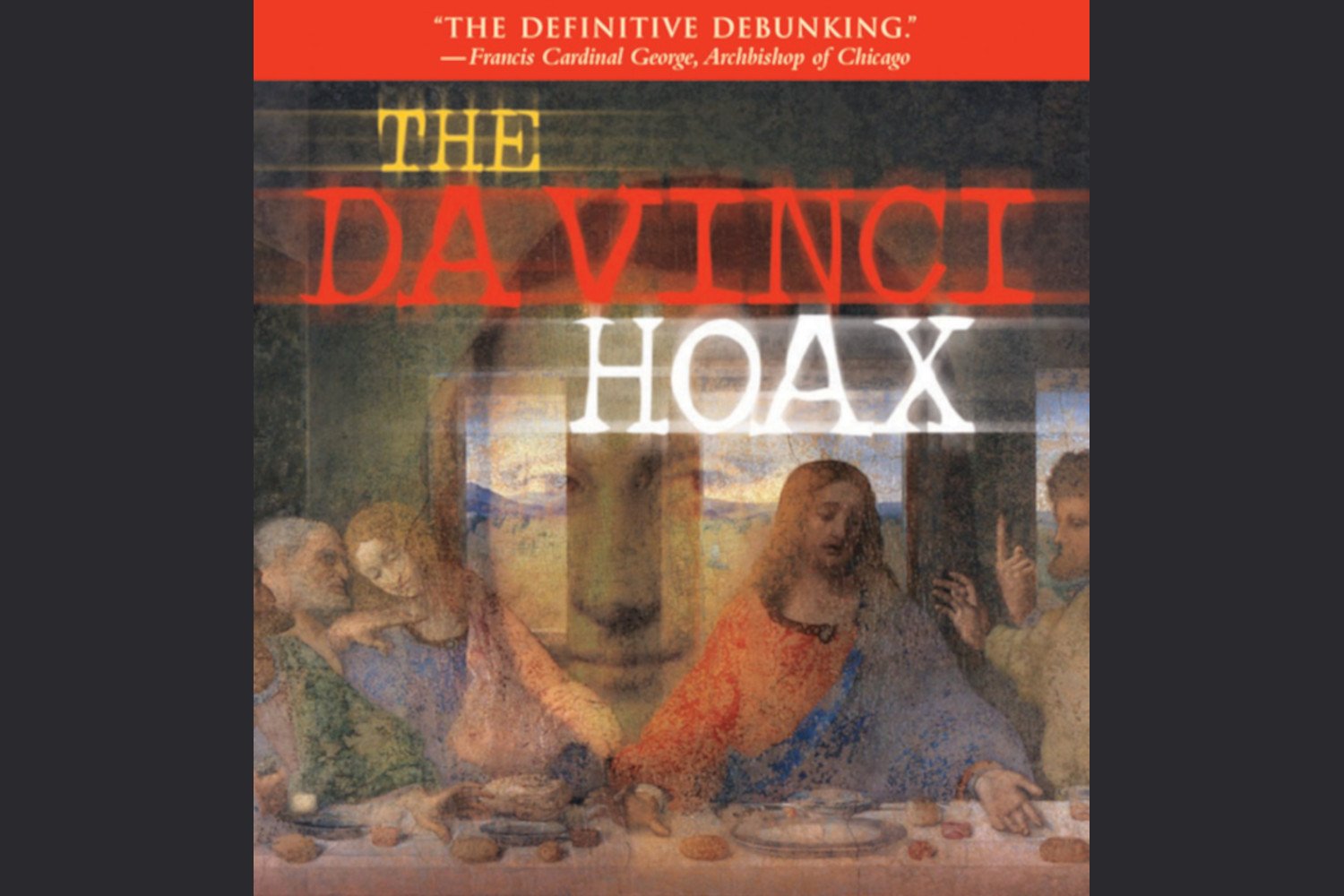
Note from Fr Gordon MacRae: Please visit and share these other “bunk free” posts on the intersection of science & religion:
Father Georges Lemaître, The Priest Who Discovered Big Bang
The March for Life and the People on the Planet Next Door

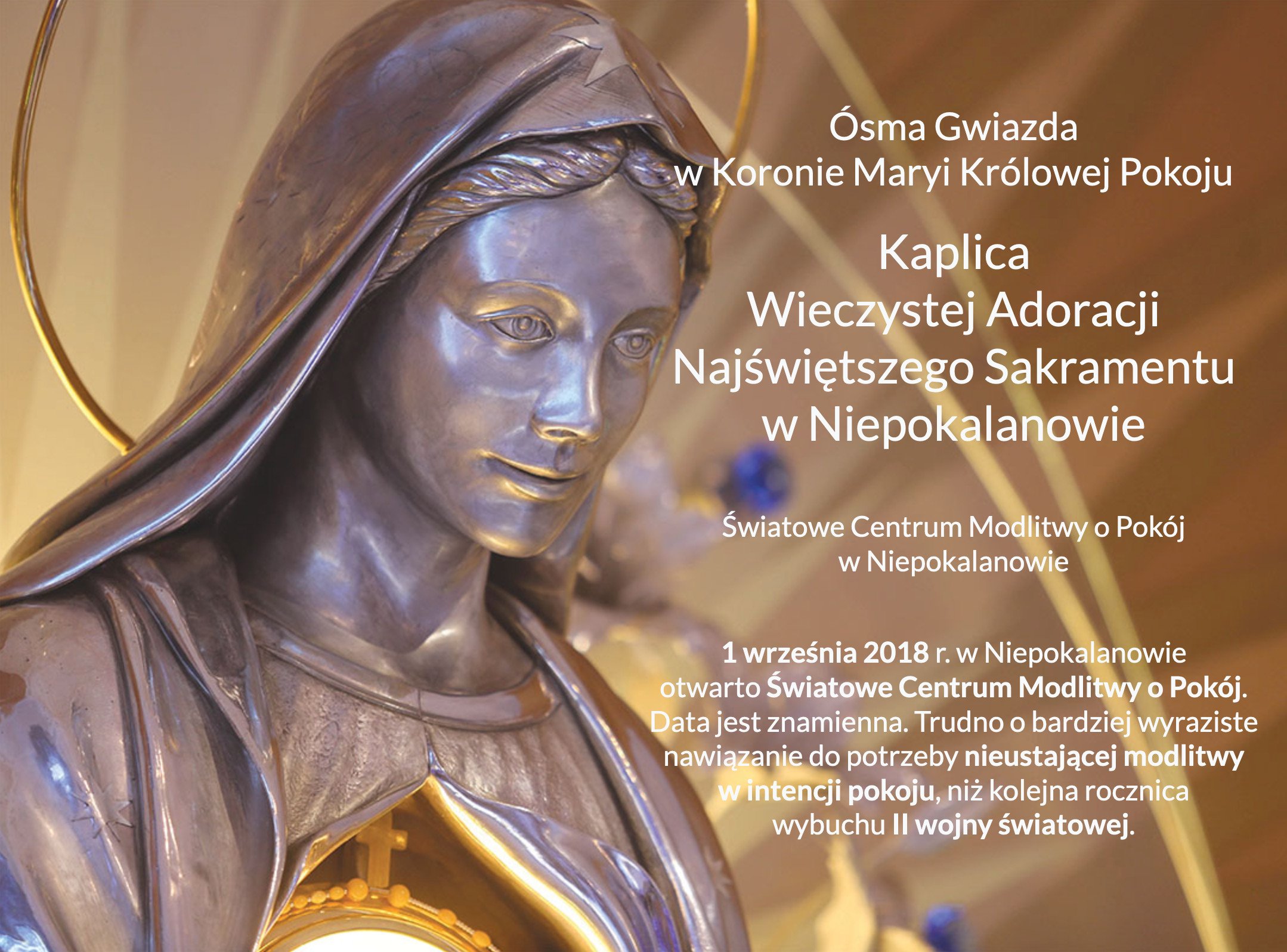

The Eucharistic Adoration Chapel established by Saint Maximilian Kolbe was inaugurated at the outbreak of World War II. It was restored as a Chapel of Adoration in September, 2018, the commemoration of the date that the war began. It is now part of the World Center of Prayer for Peace. The live internet feed of the Adoration Chapel at Niepokalanow — sponsored by EWTN — was established just a few weeks before we discovered it and began to include in at Beyond These Stone Walls. Click “Watch on YouTube” in the lower left corner to see how many people around the world are present there with you. The number appears below the symbol for EWTN.
Click or tap the image for live access to the Adoration Chapel.
The following is a translation from the Polish in the image above: “Eighth Star in the Crown of Mary Queen of Peace” “Chapel of Perpetual Adoration of the Blessed Sacrament at Niepokalanow. World Center of Prayer for Peace.” “On September 1, 2018, the World Center of Prayer for Peace in Niepokalanow was opened. It would be difficult to find a more expressive reference to the need for constant prayer for peace than the anniversary of the outbreak of World War II.”
For the Catholic theology behind this image, visit my post, “The Ark of the Covenant and the Mother of God.”