“There are few authentic prophetic voices among us, guiding truth-seekers along the right path. Among them is Fr. Gordon MacRae, a mighty voice in the prison tradition of John the Baptist, Maximilian Kolbe, Alfred Delp, SJ, and Dietrich Bonhoeffer.”
— Deacon David Jones

Divine Mercy in a Time of Spiritual Warfare
In the 1970s, Fr. Seraphim Michalenko smuggled the Diary of St. Faustina out of Communist-occupied Poland. Forty years later he smuggled Divine Mercy into a prison.

In the 1970s, Fr. Seraphim Michalenko smuggled the Diary of St. Faustina out of Communist-occupied Poland. Forty years later he smuggled Divine Mercy into a prison.
April 20, 2022 by Fr. Gordon MacRae
In a 2022 post, “The Annunciation and the Consecration of Russia and Ukraine,” I wrote about an old and dear friend, Fr. Tony Nuccio, a priest who became my surrogate father at a time when I most needed one. I was 16 then, and lost. When I was 18, two years after I commenced the practice of my renewed faith, Father Tony brought the Cursillo movement to our parish. I was invited, but I did not want to go. When I finally caved in, I did as he asked: “Participate. Don’t anticipate.” But it wasn’t easy. I was 18, and I already knew everything!
A year later, at 19, I was asked by Father Tony to be a team member for a subsequent Cursillo weekend, and to present a talk — called a “Rollo” (pronounced “Roy-o”) in the Spanish language of Cursillo. Father Tony knew exactly what he was doing. The Rollo he assigned me to present was entitled “Obstacles to Grace.” I was, of course, terrified, believing that I had no frame of reference for such a topic. Father Tony laughed and said, “Trust me on this. You’re an expert in the field.”
He was right about that. Trust itself — or actually its almost total absence — was always the source of my expertise. Trusting others, trusting life, trusting faith, trusting God were the great challenges of my youth. There I was fifty years ago in 1972, a 19-year-old kid already battered by life instructing a group of adult Catholic men about obstacles to grace and how to overcome them. My own words were meager, but in preparing the Rollo, I stumbled upon a passage from Saint John Henry Newman.
I cannot recall how or where I found it, but the passage struck me as one of life's Essential Truths then and still does today. For my entire life since, I have been both challenged and guided by this passage. I committed it to memory a half century ago and it is still there:
“God has created me to do Him some definite service. He has committed some work to me which he has not committed to another. I have my mission. I may never know it in this life, but I shall be told it in the next. I am a link in a chain, a bond of connection between persons. He has not created me for naught. I shall do good;
I shall do His work. I shall be an angel of peace, a preacher of truth in my own place, while not intending it, if I do but keep His commandments. Therefore, I will trust Him, whatever, wherever I am. I can never be thrown away. If I am in sickness, my sickness may serve Him; in perplexity, my perplexity may serve Him. If I am in sorrow, my sorrow may serve Him. He does nothing in vain. He knows what He is about. He may take away my friends. He may throw me among strangers. He may make me feel desolate, make my spirits sink, hide my future from me. Still, He knows what He is about.”
— Saint John Henry Newman

Behold Your Son! Behold Your Mother!
Over the course of the last dozen years of writing from prison, several readers have sent me that same passage. They say that it reminds them of what happened in my life, and in Pornchai Moontri’s life as well. I believe, and many believe, that I have found the work that God has committed to me alone, a work He has committed to no one else. All the rest of the passage is simply about trust. This passage goes to the heart of Divine Mercy, and at age 19 I surrendered to it without ever even hearing the term. My natural inclination was to resist, but resistance was futile!
I know today that just about the time I was discovering the above passage from Saint John Henry Newman in 1972, Marian Father Seraphim Michalenko was in Communist-occupied Poland. While there he devoted his life to the cause of Divine Mercy and bravely smuggled the Diary of Saint Faustina — the Manifesto of Divine Mercy — to bring it to the free world. Divine Mercy would one day become for me the framework of my existence as a man, as a priest, as a prisoner.
Father Seraphim was appointed by the Vatican to be Vice-Postulator for the cause of canonization of Saint Faustina. Internationally known as an expert on her life and famous Diary, he became the catalyst for publishing it and documenting the miracles that became the basis for Faustina’s beatification and canonization. Pope Benedict XVI called Divine Mercy “the nucleus of the Gospel.”
Four years before his death in 2021, Father Seraphim was brought to this prison for a Mass. After Mass in the prison chapel, Pornchai Moontri and I were both asked to remain because Father Seraphim wanted to speak with us. I had no idea what to expect. We both knew about him but had no idea how he knew about us. Pornchai was anxious. “I don’t know what to say,” he whispered. When Father Seraphim approached, he asked to speak with Pornchai first. Fifteen minutes later, a smiling Pornchai told me that I am next.
As Father Seraphim and I spoke, he asked about our connection with St. Maximilian Kolbe, how he entered our lives, and how we came to Divine Mercy. So I told him of my lifelong regard for the passage above from St. John Henry Newman and of how it has guided me. I remember saying that I am not certain of the “definite service” God has committed to me that He has committed to no one else. Father Seraphim leaned a little closer to me and said with quiet certainty “He is standing right over there.”
I want to emphasize this lest anyone think that it was me at the center of God’s attention in this story. It was never me. For some reason, the entire Divine Mercy apostolate in North America took up an interest in the life of Pornchai Moontri and committed him to the care of the Immaculate Heart of Mary. It is easy to scoff a bit at such a thought, but I first discovered it to be true when Marian Helper magazine published “Mary Is at Work Here” in 2014. The article, by Marian Helper editor Felix Carroll, included this startling passage that I have written about before:
“The Marians believe that Mary chose this particular group to be the first [invited to Marian Consecration]. That reason eventually was revealed. It turns out that one of the participating inmates was Pornchai Moontri who was featured in last year’s Marian Press title, Loved, Lost, Found: 17 Divine Mercy Conversions... As [the book] reveals, Pornchai experienced a dramatic conversion several years ago in no small part due to a friendship formed with fellow inmate — and now cellmate — Fr. Gordon MacRae who chronicles their lives in his celebrated website. [Beyond] These Stone Walls has gained widespread public support for their cause, including from the late Cardinal Avery Dulles. Father Gordon joined Pornchai in the Consecration and called it ‘a great spiritual gift’ that opened a door to the rebirth of trust during a dark time for both men. Great suffering requires great trust.”
— Marian Helper, Spring 2014
Our Marian Consecration was the culmination of a 33 Days to Morning Glory retreat based on the book of the same title by Father Michael Gaitley, MIC. “Behold Your Son! Behold Your Mother!” That is the title that the Marians of the Immaculate Conception gave to an article of mine about how Divine Mercy entered our lives behind these prison walls. It began as a pair of December 2013 posts that were later combined into a single narrative by Marian Helper editor Felix Carroll for posting at the site of the National Shrine of the Divine Mercy. Felix said that this article “lit up our website as never before.”

As Spiritual Battle Rages
What happens to Divine Mercy when life begins to descend — as it does for many right now — into the discouragement and trials of spiritual battle when evil has the appearance of coming out on top? The rest of this story takes up the latter part of the passage quoted above by St. John Henry Newman: “He may take away my friends. He may throw me among strangers. He may make me feel desolate, make my spirits sink, hide my future from me. Still, He knows what He is about."
Sadness is not always a negative state of mind only to be avoided. Sometimes, we should just allow ourselves to become immersed in it. Imagine the tragedy of going through life without ever loving another human being whom you will one day miss with great sadness. Imagine never caring about someone else enough that absence leaves you in pain.
I had been in prison for 26 years on September 23, 2020. That month was among the saddest of my life, and yet the sadness was necessary and in the end, even welcomed. For the previous 15 years, every sign told me that I am powerless to do anything about my own unjust imprisonment, so I worked hard to become a catalyst of liberty for another. I wrote of that September day of desolate losses in a special tribute to a Patron Saint in “Padre Pio: Witness for the Defense of Wounded Souls.”
America was caught up in a torrent of grief and chaos then. The global pandemic made its way out of China and wreaked havoc in places like the one where I live. In an over-crowded prison, social distancing was impossible. The only step that could be taken to ward off a disaster was to shut everything down and lock everyone up. There is no protection from a pandemic in a place where 24 grown men share two toilets and two sinks. And when 12 of them are sick, there is nowhere to hide.
Meanwhile, at the height of the pandemic across the land, mobs of protesters became unhinged as the death of George Floyd at the hands of police played out ad infinitum on the news. Cities were ablaze with violence while the news media told us these were just peaceful protests. News media and government officials (and even some bishops) claimed that our churches posed a high risk for contagion while mobs of looting protesters, an even greater mobs amassed at the southern border, posed no risk at all.
The pandemic and all the social chaos could not have come at a worse time for me in those awful months leading up to “The ICE Deportation of Pornchai Moontri.” I made that a link for those newer readers who may not already know of this story. Because of the pandemic, what should have been for Pornchai a few weeks in ICE detention awaiting deportation to his native Thailand — which is always a grueling experience — turned into five months. I am not sure who was suffering more from the ordeal, Pornchai or me.
I knew from experience that without help he could be easily lost in the ICE system so I worked from inside a 60-square foot prison cell in New Hampshire to coordinate a small team of advocates in the U.S., Thailand, and Australia to help guide Pornchai from a distance through the ICE minefield.
But the grief and losses I encountered were still not complete. Spiritual warfare chose that moment — from September to November of 2020 — to try to silence my voice. Father George David Byers, who had been helping me to post what I write, began to notice that at the very time my life was preoccupied with Pornchai’s departure, some of the content on These Stone Walls began to disappear. By the end of October 2020, a decision had to be made to take These Stone Walls down. Eleven years of writing and nearly 600 posts were simply gone. And so was my friend, into a cauldron of misery. We were both stranded and alone in our grief. But not for long.

Allies in Spiritual Battle
Living in a hellish environment with 70 men to a room in round-the-clock torment in a for-profit ICE facility in Louisiana, Pornchai was able to get out only one ten-minute phone call each day. But he and I could not call each other. It was clear to me that he could not cope with this alone for five months, so one of our friends and helpers, the late Claire Dion in Maine, devised a way to help us both.
Though we could not call each other, Claire suggested that at a pre-set time each day, Pornchai and I could both call her on two different cell numbers, then she would put the phones together. It was not ideal, but it worked and it saved the day every day for five months. There were times when Pornchai met the limit of his endurance, but that simple reassuring 10-minute daily call renewed his trust in Divine Mercy, and mine.
That’s our friend, Claire, and her ingenious phone rescue pictured above. But my spiritual battles of the fall were just getting started. Soon after Pornchai left, I became miserably ill with Covid. There was no treatment so I just toughed it out for three weeks in October along with all the others in my living area. Our housing unit was quarantined, but that only meant temperature checks twice a day while locked in with our misery.
Then I received a handwritten letter from a stranger in New York who had stumbled upon this blog. Four years earlier, Father Seraphim told me that my mission is to be like that of St. Joseph in Pornchai’s life. In the very week These Stone Walls came down, the stranger’s letter told me that she found a post of mine about St. Joseph and was very moved by it. With a Ph.D. in computer science, she was well placed to understand what took place in the cyberspace at work against us. To my awesome surprise, I learned that she had quietly uploaded to her own server all 600 past posts and all the other content of this site just before it was all taken down. I thought everything was lost only to find out nothing was lost.
The new publisher volunteered to reconstruct the site on a new platform with a new name — Beyond These Stone Walls. This was happening in the final months of 2020 while we simultaneously struggled to overcome the obstacles of a global pandemic and ICE indifference to return Pornchai home. [He has been in Thailand for a year now, and I wrote of that year in “Pornchai Moontri: A Night in Bangkok, A Year in Freedom.”]
We still speak daily. I deeply appreciate the support of friends and readers that makes that possible — that made all of this possible. Despite hardship and pain, the great adventure of Divine Mercy has won this day, and has won these lives.
God knows what He is about.
+ + +
Note from Fr. Gordon MacRae: That “definite service” that God has committed to me did not end with Pornchai’s departure last year. Please consider helping me to help him and Father John Le, SVD in their ongoing missions of Divine Mercy. See Part Two of our Special Events Page to find out how.
To join Pornchai Moontri and me in the Association of Marian Helpers, call the Marian Helpers Center at the National Shrine of the Divine Mercy at 1-800-462-7426.
Just a day before I wrote this post, Pornchai was invited to tour the Fr. Ray Foundation School in Pattaya, Thailand. At three sites in Thailand, The Father Ray Foundation provides a home and education for 850 underpriviledged and special needs Thai children. Our friends Father John Le, Pornchai’s Thai tutor, Chalathip, and Divine Mercy Thailand founder, Yela Smit, went with him. They sent photos!


To the Spirits in Prison: When Jesus Descended into Hell
The Apostles Creed is the oldest statement of Catholic belief and apostolic witness. Its Fifth Article, that Jesus descended into hell, is a mystery to be unveiled.
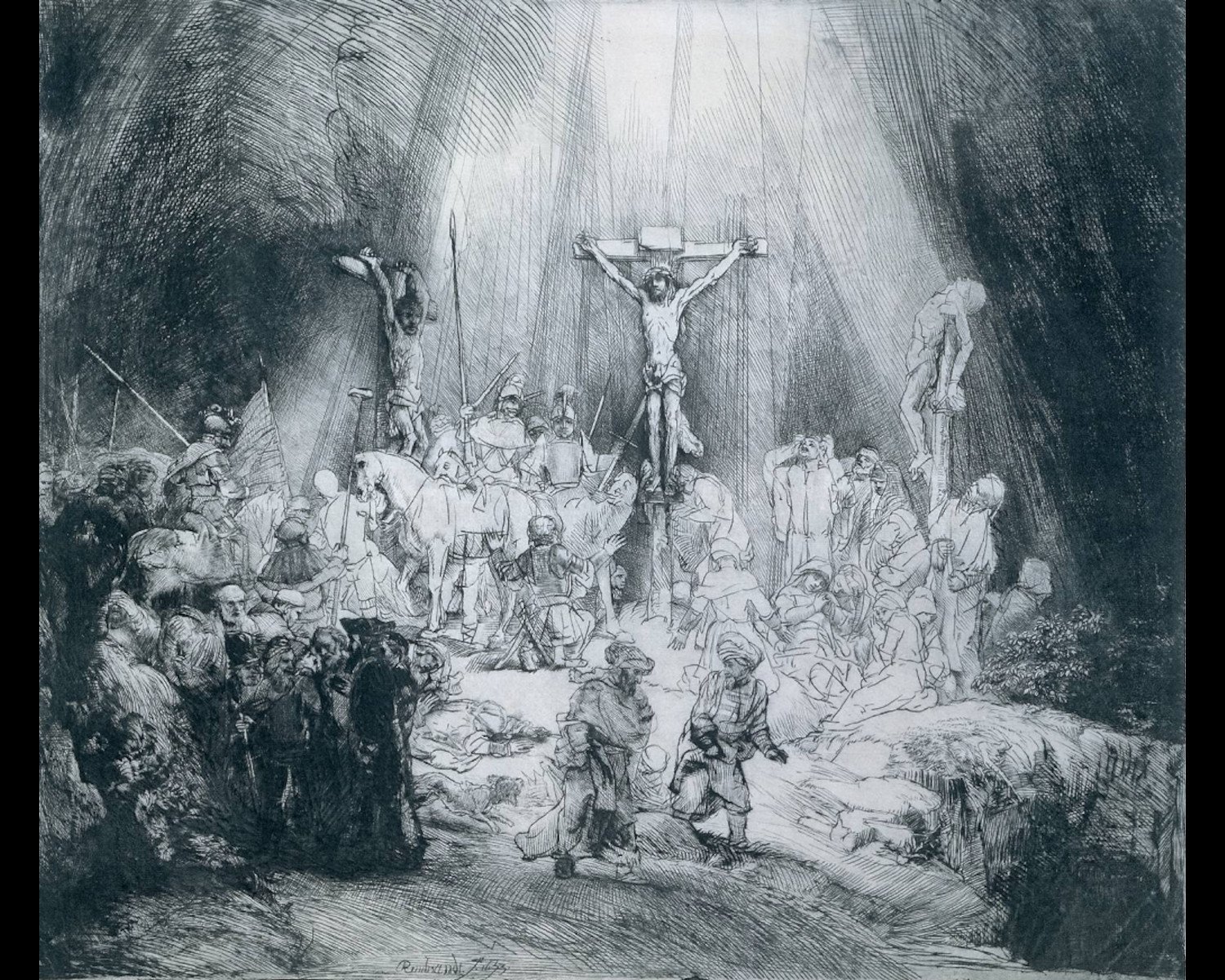
The Apostles Creed is the oldest statement of Catholic belief and apostolic witness. Its Fifth Article, what happened to Jesus between the Cross and the Resurrection, is a mystery to be unveiled.
“This is the night when Christ broke the prison bars of death and rose victorious from the underworld.”
— The Easter Vigil Exultet
April 13, 2022 by Fr. Gordon J. MacRae
This is my 13th Holy Week post from prison. In each of them, I have tried to move away from my usual format, which is sort of a prison journal, to make our Holy Week post a more serious theological endeavor. That has been a challenge where I live because my resources for research are few. Despite that obstacle, we have over these years presented a series of posts about the events of Holy Week that have become popular with readers.
Some of these posts stand out more than others. They tend to follow the Way of the Cross so we have selected seven (besides this one) that could become daily readings for a personal Holy Week retreat. We have now gathered them in one place “Our Holy Week Retreat for Beyond These Stone Walls” .
A few weeks ago in my post, “The Annunciation and the Consecration of Russia and Ukraine,” I wrote of my path of reversion to Catholic faith at age 16 in 1969. At a time when most of my peers were drifting away from faith in protests of one sort or another, I was drifting toward it. It was 1969, after all, and it was the age of protest and dissent. It was a strange time to commence taking Catholic faith seriously. It was the year after Pope Paul VI published “Humanae Vitae,” a year in which much of the world resisted authority and fidelity. It was a year of exodus for many priests and religious, a year in which secular and Catholic Culture began a misguided quest for relevance in a fracturing world.
It was also the year that I first paused while reciting the Apostles’ Creed to ponder its Fifth Article, a perplexing statement that Jesus, upon His death on the Cross, descended into hell. The Apostles’ Creed is a summary statement of the core beliefs of our faith’s first witnesses about the person and mission of Jesus. Did they really believe that upon His death He went to hell? For a 16-year-old struggling with faith, it was a startling question.
The answer to it has been a long and winding road into the meaning of the Cross, death, covenant, hell, and Heaven, the most fundamental questions for people of any faith. I have written a post that perhaps should precede this one for those who want a serious inquiry into the meaning of life and death in Sacred Scripture: “The God of the Living and the Life of the Dead.”
There are two creeds — summaries of belief — that have a special place in the life of the Church. The Apostles’ Creed identifies with the centrality of the Church of Rome and the See of Peter from Apostolic times to the present. It is the Church’s core statement of belief. The second, the Nicene Creed used in the Mass, is formulated from the first two Councils in the life of the Church, the Councils of Nicea (325 AD) and Constantinople (381 AD).
The Nicene Creed does not reflect a statement that Jesus descended into hell, but the Councils did not negate or refute it. This statement from the Apostolic era of the Church remains a dogma of faith. But what does it mean? What happened between the Cross and the Resurrection of Jesus?

Hell on Earth — Or under It?
The phrase, “descended into hell” rests entirely on the language of the Old Testament. The place we commonly understand as hell was not a destination for souls in the Hebrew Scriptures.
The place for the souls of the dead was Sheol (pronounced SHAYole), a Hebrew term of uncertain Hebrew origin. It was simply the abode of the dead and it implied no sense of moral standing, neither salvation nor condemnation, and no distinction between the righteous and the wicked. Depending on the life that was lived, souls could go to Sheol bearing peace or bearing sorrow, but Sheol itself imparted neither. Life in relation to God was this life alone.
In the Old Testament, “to die” meant to descend to Sheol. It was our final destination. To rise from the dead, therefore, meant to rise from Sheol. The concept of Sheol being the “underworld” is a simple employment of the cosmology of ancient Judaism which understood the abode of God and the heavens as being above the Earth, and Sheol, the place of the dead, as below it. This is the source of our common understanding of Heaven and hell, but it omits a vast theological comprehension of the death, resurrection and ascension of Jesus and the human need to understand our own death in terms of faith.
If, up to the time of Jesus, “to die” meant to descend into Sheol, then Jesus introduced an entirely new approach to understanding death in His statement from the Cross to the penitent criminal: “Today you will be with me in Paradise” (Luke 23: 43). This is an account that I once told entitled, “Dismas, Crucified to the Right: Paradise Lost and Found.”
On the Cross, where the penitent thief comes to faith while being crucified along with Jesus, God dissolves the bonds of death because death can have no power over Jesus. It is highly relevant for us that the conditions in which the penitent Dismas entered Paradise were to bear his cross and to come to faith.
It was at the moment Jesus declared, in His final word from the Cross, “It is finished,” that Heaven, the abode of God, opened for human souls for the first time in human history. The Gospels do not treat this moment lightly:
(Luke 23:44-46): “It was now about the sixth hour [3:00 PM], and there was darkness over the whole land until the ninth hour while the sun’s light failed; and the curtain of the Temple was torn in two. Then Jesus, crying with a loud voice, said, ‘Father, into your hands I commend my spirit.’ Saying this he breathed his last.”
(Matthew 27:51-54): “And behold, the curtain of the Temple was torn in two from top to bottom, and the Earth shook, and the rocks were split. The tombs also were opened, and many bodies of the saints who had fallen asleep were raised ... When the centurion, and those who were with him keeping watch over Jesus, saw the earthquake, and what took place, they were filled with awe, and said, ‘Clearly, this was the Son of God.’”
The veil of the Temple being torn in two appears also in Mark’s Gospel (15:38) and is highly significant. Two veils hung in the Jerusalem Temple. One was visible, separating the outer courts from the sanctuary. The other was visible only to the priests as it hung inside the sanctuary before its most sacred chamber in which the Holy of Holies dwelled (see Exodus 26:31-34). At the death of Jesus, the curtain of the Temple being torn from top to bottom is symbolic of salvation itself. Upon the death of Jesus, the barrier between the Face of God and His people was removed.
According to the works of the ancient Jewish historian, Josephus, the curtain barrier before the inner sanctuary that was torn in two was heavily embroidered with images of the Creation and the Cosmos. Its destruction symbolized the opening of Heaven, God’s dwelling place and the Angelic Realm, to human souls.
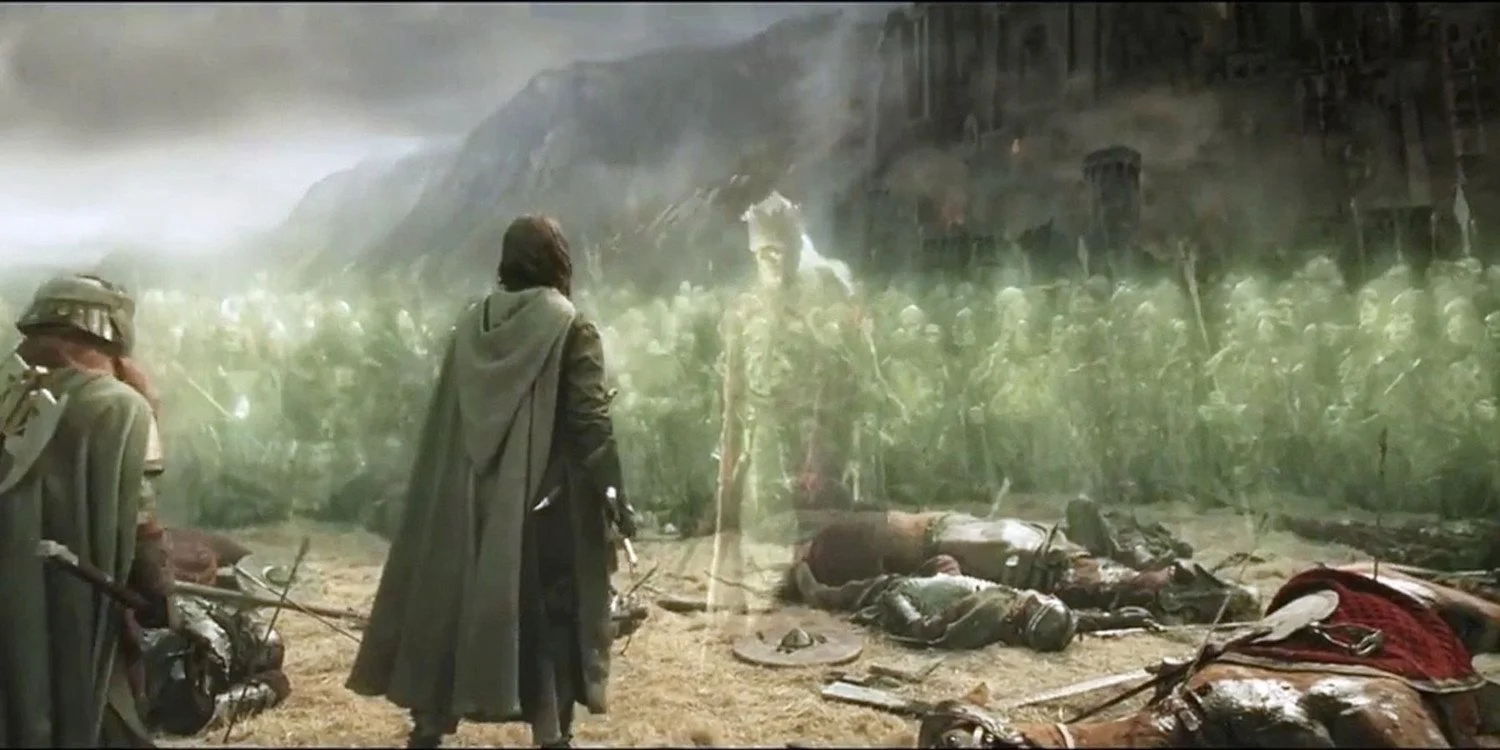
The Descent of Jesus to the Spirits in Prison
A very different tradition — and a highly perplexing one for Scripture scholars — exists in just a few verses in the New Testament First Letter of Peter (3:18-20):
“For Christ also died for sins once and for all, the righteous for the unrighteous, that he might bring us to God, being put to death in the flesh but made alive in the spirit, in which he went and declared to the spirits in prison who formerly did not obey when God's patience waited in the days of Noah.”
Interpreting this passage has been a challenge for scholars for centuries beginning with the Fathers of the Church and their predecessors known as the Apostolic Fathers. That is the term applied to certain disciples and successors of the Twelve Apostles. They were Greek-language writers who were among the martyrs and major figures of the 1st and 2nd centuries in the Christian church.
Although their writings were not considered canonical for inclusion in the New Testament, they are ranked as a continuation of the writings of the Apostles themselves and are a valuable source of early Church history. Among them was Clement of Alexandria. He understood the above verses from the First Letter of Peter as evidence that, during the silence of Holy Saturday, Christ descended to the dead to make a final offer of salvation to the deceased sinners of Noah’s day who rejected Noah and his covenant.
A few centuries later, St. Augustine proposed a different and far more complex interpretation. He suggested that Christ, through an exercise of pre-existent divinity, preached to the ancient world through the person of Noah urging disbelievers to repentance before the floodwaters of judgment (according to commentary in the 2010 Ignatius Study Bible New Testament adapted from the Revised Standard Version).
In the 17th Century, St. Robert Bellarmine reconnected this passage with Holy Saturday. He proposed that Christ descended to the souls in prison since the time of Noah to announce his salvation to those who had privately repented before the onset of the flood. A possibly related verse is also found in 1 Peter 4:6:
“For this is why the Gospel was preached even to the dead, that though judged in the flesh like men, they might live in the spirit like God.”
However, 20th Century discoveries in Biblical archeology have found yet another interpretation that likely circulated among the earliest Christian communities but was lost after the first few centuries, A.D. These discoveries might possibly link the appearance of Jesus to the spirits in prison not as an event during his descent to Sheol but rather connected to his Ascent as he passed through one of the lower heavens. An element of interest preceding the passage from First Peter above concerns an interpretation of the term “sons of God” from Genesis (6:2). According to some ancient Jewish texts, these were the “Watchers,” rebel angels who corrupted mankind before the flood, and therefore were in part the cause of it. Being spirits, they could not be destroyed by the waters of the flood so the Lord cast them into the prisons of the lower heavens.
These references occur in the Books of Enoch and Jubilees, Jewish apocryphal works that had a strong influence on the Essene community in the Intertestamental period from the First Century B.C. through the First Century A.D. One of these traditions, from the apocryphal First Book of Enoch, describes these spirits imprisoned not in Sheol, but in one of the lower heavens. There is evidence that these traditions were well known to the Essenes and thus had some influence in the Early Church. Thanks to the mid-20th Century discovery of the Dead Sea Scrolls and related material in and around the area of Qumran in the 1940s, scholars have been able to reconnect with ancient Jewish traditions and lore known to First Century Christians but lost to antiquity for much of the later life of the Church. These remarkable discoveries added context to our understanding of New Testament Scriptures. This was the subject of my post, “Qumran: The Dead Sea Scrolls and the Coming Apocalypse.”
In this sense, the spirits in prison to whom Christ is revealed on Holy Saturday between the Cross and Resurrection may not have been human souls at all, but fallen angels whose fall was closely connected to original sin and the flood of Noah’s time.
Whatever the solution to the mystery of Christ’s Holy Saturday mission, the total disabling of the enemy coincides with His triumphant entry into the innermost chambers of Satan’s power. “For to this end, Christ died and lived again, that He might be Lord of both the living and the dead.” (Romans 14:9)
On the Third Day He arose again from the dead — from Sheol — and resumed His Earthly body proclaimed in Revelation (1:2): “The Firstborn of the dead.” Death could have no power over Him. The Resurrection and Easter morning followed, then the first eyewitness: Mary Magdalene: Faith, Courage, and an Empty Tomb.
+ + +
Note from Fr. Gordon MacRae: As described early in this post, some of our Holy Week posts have been gathered into a personal Holy Week Retreat available from now until the Solemnity of Pentecost. Please see our Special Events page.
You may also like these related posts on Sacred Scripture:
The God of the Living and the Life of the Dead
Qumran: The Dead Sea Scrolls and the Coming Apocalypse


Resistance: A Birthday in the Shadow of Dietrich Bonhoeffer
On April 9, 1945 Dietrich Bonhoeffer was martyred for his resistance to tyranny. On April 9, 1953 another life began and resistance to tyranny has been its measure.

On April 9, 1945 Dietrich Bonhoeffer was martyred for his resistance to tyranny. On April 9, 1953 another life began and resistance to tyranny has been its measure.
“When Christ calls a man, He bids him come and die.”
— Dietrich Bonhoeffer
April 6, 2022 by Fr. Gordon J. MacRae
This story has to begin with a recent event. On its face, it may not at first seem connected to Dietrich Bonhoeffer, the famed Lutheran pastor and theologian who was executed on the personal order of Adolf Hitler in 1945. The connection is subtle but real so bear with me. This, too, is about tyranny.
Many readers have reacted to a LinkedIn article I wrote in early March, 2022, entitled, “Banned by Facebook for a True Story of Anti-Catholic Oppression.” The anti-Catholic oppression I wrote about was a well-documented true account that took place in Hitler’s Germany in 1937. I entitled it, “Catholic Scandal and the Third Reich: The Rise and Fall of a Moral Panic.”
But that was not the only anti-Catholic oppression. I shared that story with the 4,500 Facebook followers of Beyond These Stone Walls and in fourteen Catholic groups there such as the Knights of Columbus and The Catholic Writers Guild, both in which I have active membership.
Just as the post began to be widely shared by others in those groups, it was suddenly removed by Facebook with a statement that it, and the 14 copies I shared among Catholic groups, “violates Facebook Community Standards.” Minutes later, we received another message informing us that our account is now suspended and will be offline until a review takes place.
With the help of an editor, I immediately reviewed all of Facebook’s “Community Standards” and could not locate a single one that I had in any way violated. We then completed an extensive appeal using Facebook’s own format. Catholic League President Bill Donohue weighed in on this with a statement, sent to tens of thousands of Catholic League members, that this suspension was without cause and should be reversed. One week later, on March 14, we received this message from Facebook:
“Gordon J MacRae’s post is back on Facebook. We’re sorry we got this wrong. We reviewed your post again and it does follow our Community Standards. We appreciate you taking the time to request a review. Your feedback helps us do better.”
However, Facebook did not lift any of the restrictions imposed because of its staff’s alarming misreading of the post. We filed yet another appeal, but to date Facebook has remained unresponsive. I was thus barred from posting anything for the last month on my account and from sharing to any of the Catholic and Pro-Life groups to which we have contributed content over the last several years.
Mark Zuckerberg has testified before Congress that Facebook does not suppress conservative viewpoints. It has not suppressed the accounts of the Taliban, but it did suppress mine. Facebook recently suspended its “Community Standards” so that the people of Ukraine may express their honest thoughts about Vladimir Putin. In what world should Ukraine need Facebook’s permission to do that?
Facebook has stated that some of the restrictions on my account would remain in place until June 5, 2022. Ironically, June 5, 2022 is also the 40th anniversary of my priesthood ordination.

In the Shadow of Dietrich Bonhoeffer
I will be 69 years old on April 9, 2022. I am not certain at what point in my life I learned that I was born on the same date on which Dietrich Bonhoeffer died. I was young, likely in middle school when I learned about the great Lutheran pastor-theologian and the fact that I came into this world eight years to the day after he left it. I have long known that Bonhoeffer was hanged on April 9, 1945 on the personal order of Adolf Hitler just as Allied Forces descended upon Berlin. This order was one of Hitler’s last acts before taking his own life.
Many years later, I was sent to prison on trumped up charges. It was the same sort of charges that Hitler tried to falsely pin on 300 Catholic priests in Germany in 1937. It was the story I told in “Catholic Scandal and the Third Reich,” the post that got me banned from Facebook. Ironically, it began with a quote that Facebook hated, but that we should never forget:
“The great mass of people will more easily fall victim to a big lie than to a small one.”
— Adolf Hitler, Mein Kampf, (trans. “My Struggle”) 1937.
In prison, I developed a friendship, through correspondence, with Fr. Richard John Neuhaus, publisher and editor of First Things magazine to which I had long subscribed. Father Richard had been a celebrated Lutheran Pastor and theologian when he “crossed the Tiber” and was ordained a Catholic priest on September 7, 1991. His life was richly informed and influenced by two great men: Saint Pope John Paul II — who had become a friend to Father Neuhaus in this life — and Dietrich Bonhoeffer.
In his famous monthly First Things column, “The Public Square” in 2008 in the June/July issue, Father Neuhaus wrote “Lives Lived Greatly.” It was, among other things, a tribute to some of the most influential persons in his life:
“This April was a time of remembering and gratitude. April 2 [2008] was the third anniversary of the death, on the Eve of Divine Mercy Sunday, of John Paul the Great. On April 4, forty years ago, Martin Luther King, Jr. was assassinated. ... And on April 9, 1945, just days before the end of the war, Dietrich Bonboeffer was hanged on the direct orders of Adolf Hitler. Bonhoeffer’s writings and witness were a formative influence in my life, as in the lives of innumerable others .... Those were extraordinary April days. They were days of sorrow and gratitude. I count it a gift beyond measure to have known two of them as friends. The life of each awakens us to the possibilities of life lived greatly.”
What made that tribute so extraordinary for me was that one of those men, Dietrich Bonhoeffer, died as a prisoner. In an earlier April — April of 1943 — Bonhoeffer was arrested by the German Gestapo after informants tipped them off to a plan in which Bonhoeffer was involved to save the lives of Jews by smuggling them out of Germany to Switzerland. He was taken to the infamous Tegel prison where he wrote much of his classic prison journal entitled Letters and Papers from Prison (1953).
On July 24, 1944, the famous “Valkyrie” plot to assassinate Hitler went into action. That account later became a riveting film of the same name. The Valkyrie plot was the last of several such attempts on Hitler’s life, but the first in which the planted bomb actually exploded. Hitler lived, but a vast conspiracy to end his tyranny by ending his life was exposed. He ordered the arrest and torture of thousands, and one of those exposed by informants as a leader in another plot against his tyranny was the imprisoned pastor-theologian Dietrich Bonhoeffer.

The Last Station on the Road to Freedom
In February of 1945, Allied planes relentlessly began an aerial bombardment of Berlin in an effort to stop Hitler’s forces from overwhelming Europe. Dietrich Bonhoeffer was transferred from Tegel prison to the Buchenwald concentration camp where he remained for two months, and then to Flossenburg prison. As the Allied forces were advancing on Berlin to end Hitler’s tyranny, the unmoored fascist dictator issued an order for Dietrich Bonhoeffer’s immediate death by hanging. It was the morning of April 9, 1945, the Monday after Holy Week and Easter.
Bonhoeffer’s remains, like those of St. Maximilian Kolbe four years earlier, went up in smoke, his ashes mingled with those of the many Jews he once tried to save. But his writing — most of it from prison — survived him and survived death. When his writings were published they had a profound effect on the faith of the world. In the words of Eric Metaxas whose biography, Bonhoeffer, met wide acclaim,
“Bonhoeffer called death ‘the last station on the road to freedom.’ Bonhoeffer worshipped a God who had emphatically conquered death in Jesus Christ through the Crucifixion and Resurrection.” In Bonhoeffer’s own words ...
“How do we know that dying is so dreadful? Who knows whether in our human fear and anguish, we are only shivering and shuddering at the most glorious, heavenly blessed event in the world? Death is hell and night and cold if not transformed by our faith. But that is just what is so marvelous, that we can transform death.”
Though a Lutheran pastor and brilliant theologian, Dietrich Bonhoeffer had a most profound regard and respect for the Catholic faith. In a February 23, 1944 letter to his friend, Eberhard Bethge written from Tegel prison, Bonhoeffer wrote:
“If you have the chance of going to Rome during Holy Week, I advise you to attend the afternoon Maundy Thursday service at St. Peter’s Basilica. The twelve candles are lit on the altar and put out as a symbol of the disciples’ flight, till in the vast space there is only one candle left burning in the middle — for Christ. After that comes the cleansing of the altar in preparation for Good Friday and Holy Saturday.”
“Lives Lived Greatly” was the last substantive piece of writing by Father Richard John Neuhaus before he succumbed to cancer in January, 2009. Besides Dietrich Bonhoefer and Saint Pope John Paul II, the life and witness of fellow Catholic convert, Cardinal Avery Dulles, a Jesuit and theologian at Fordham University, had a major influence on his life and mine. Cardinal Dulles preceded Father Neuhaus in death by just three weeks. A few months before his death, Cardinal Dulles wrote to me with a request that I “Take up a new chapter in the volume of Christian literature from those unjustly in prison.” He cited Dietrich Bonhoeffer as one whose life my own suffering in prison might emulate. I was shocked and filled with doubt.
In an earlier 2008 issue of First Things, Father Neuhaus wrote about me in an op-ed entitled, “A Kafkaesque Tale.” His urging, and that of Cardinal Dulles, became the catalyst for my own letters from prison in the form of this blog which began six months after their deaths. A decade later, in a review of Beyond These Stone Walls, another writer wrote a brief review that our editor published atop our Posts Page. I was shocked again, and again filled with doubt.
Whatever resistance I have to the tyranny of false witness, unjust imprisonment, and even being one of Facebook’s cancelled priests, is lived in the shadow of Dietrich Bonhoeffer. But if I ever stepped into his shoes, it could only be to shine them. I could never be worthy to walk — or write — in such company.
+ + +
Notes from Father Gordon MacRae:
#Meta: A lot of Catholics, both the devout and the struggling, are among the two billion users of Facebook, but they cannot read this post unless you share it in my stead. Thank you.
#Consecration: After my post, “The Annunciation and the Consecration of Russia and Ukraine,” we posted the beautifully composed Act of Consecration Prayer at our Library Category page, “Behold Your Mother.”
#HolyWeek: In preparation for Holy Week, please walk the Way of the Cross with us through these special posts, From Ashes to Easter.

Prison Journal: Jesus and Those People with Stones
For readers beyond these stone walls, stories from prison can be depressing. With an open heart some can also be inspiring, and inspiration is a necessity of hope.

For readers beyond these stone walls, stories from prison can be depressing. With an open heart some can also be inspiring, and inspiration is a necessity of hope.
March 30, 2022 by Father Gordon MacRae
Readers may recall the great prison film, The Shawshank Redemption starring Tim Robbins as wrongly convicted prisoner, Andy Dufresne, and his friend, Red, a role for which actor Morgan Freeman received an Academy Award nomination. The film was released in theatres on the same day I was sent to prison in 1994 so it was some time before I got to see it.
Readers of this site found many parallels between those two characters and the conditions of my imprisonment with my friend, Pornchai Moontri. For the film's anniversary of release, I wrote a review of it for Linkedin Pulse entitled, “The Shawshank Redemption and its Real World Revision.”
My review draws a parallel between the fictional prison that sprang from the mind of Stephen King and the prison in which I am writing this. One of the elements in my movie review was a surprising revelation. At the time Stephen King was writing The Shawshank Redemption, 12-year-old Pornchai Moontri, newly arrived from Thailand to America, had a job delivering the Bangor Daily News to his home.
One aspect of my review was about our respective first seven years in prison. I spent those years confined in a place that housed eight men per cell. I described the experience: “Imagine walking alone in an unknown city. Approach the first seven strangers you meet and invite them to come home with you. Now lock yourself in your bathroom with them and face the fact that this is what your life will be like for the unforeseen future.”
Pornchai spent those same seven years in prison in the neighboring state of Maine commencing at age 18. Those years for him were the polar opposite of what they were for me. He spent them in the cruel torment of solitary confinement. Years later, Pornchai was transferred to New Hampshire and I had been relocated to a saner, safer place with but two men per cell. We landed in the same place, but came to it with polar opposite prison anxieties: Pornchai had to recover from years of forced solitude while I was recovering from years of never, ever, ever being alone.
We survived together with a camaraderie that mirrored the one between Andy and Red that sprang from the mind of Stephen King. So you might understand why, in all the years of my unjust imprisonment, the year 2016 was personally one of the most difficult. After 11 years together in a cell in that saner place, Pornchai and I were caught up in a mass move against our will that sent us back to the dungeon-like place with eight men to a cell. We were told that it would be for only a few weeks. One year later, we were still there.
However, others suffered in that environment far more than we did. It was two years after we had engaged in the spiritual surrender of consecration “To Christ the King Through the Immaculate Heart of Mary.” We had inner tools for coping with loss and discomfort while others here had far less. Pornchai and I were well aware that many of the men with whom we had been living in that other, kinder place were also relocated. I was impressed to witness, in our first night there, Pornchai going from one eight-man cell to another to make sure our friends were safe and that the strangers now among them were civil. Pornchai had a knack for inspiring civility.

The Cast of This Prison Journal
After just three days there, one of the strangers assigned to our crowded cell with us decided he would ask to move because, as he put it to one of his friends, “Living with MacRae and Moontri was like living with my parents.” This was solely because I told him that he is not going to sell drugs out our cell window. His move came at just the right time. We were able to request that our friend, Chen, move to the now empty bunk in our cell. Speaking very little English, Chen had been thrown in with strangers. On the day I went to his cell to tell him to pack and come with us, it was as though he had been liberated from some other Stephen King horror story.
I live with an odd and often polarized mix of people. Among prisoners, about half become entirely engrossed in the affairs of this world, consuming news — especially bad news — with insatiable interest. The other half seem to live in various degrees of ignorant bliss about all that is going on in the world. They never watch news, read a newspaper, or discuss current events. They play Dungeons and Dragons, poker, and video games. While I was hunched over my typewriter typing “Beyond Ukraine” a few weeks ago, my current roommate had no idea anything at all was going on there.
Just as in the world, there are many evil things that happen in prison. People here cope with them by either blindly accepting evil as a part of the cost of living or they just never even acknowledge evil’s existence at all. These are not good options, nor are they good coping mechanisms. Acknowledging evil while also resisting it with all our might is the first line of defense in spiritual warfare. Many of the men in prison with me never actually embraced evil. They just didn’t see it coming.
Many readers have told me that they shed some tears while reading “Pornchai Moontri: A Night in Bangkok, a Year in Freedom.” Pornchai has often told me of how his appearances in these pages have changed his life. This was summed up in one sentence in his magnificent post: “I began to realize that nearly everyone I meet in Thailand in the coming days will already know about me.”
All the fears that Pornchai had built up for years over his deportation to Thailand 36 years after being taken from there just evaporated because of his presence in Beyond These Stone Walls. I once told him that he must now live like an open book. Exposing the truth of his life to the world could be freeing or binding. The truth of his life in this prison could be a horror story, a bad war movie, or an inspirational drama that people the world over could tune into each week, and what they will see would be entirely up to him. I do not have to tell you that his life became an inspiration for many, including many he left behind here. The evil that was once inflicted on him was gone, and only its traumatic echoes remain.
A few years ago, I began to write about some of the other people who populate this world. Some of their stories became very important, and not least to their subjects. Prisoners who had little hope suddenly responded to the notion that others will read about them, and what they read will be up to them. Some of these stories are beyond inspiring. They are the firsthand accounts of the existence of evil that once permeated their lives, and of actual grace when they chose to confront and resist that evil and turn from it. Their stories are the hard evidence of something Saint Paul wrote:
“Where sin increased, grace abounded all the more.”
— Romans 6:1.

Getting Stoned in Prison
My subtitle above does not mean what you might think it means. There is indeed an illicit drug problem in just about every prison, including this one. As long as there is money to be had, risks will be taken and human life will be placed in jeopardy. I recently read that the small state of New Hampshire has the nation’s highest rate of overdose deaths among people ages 15 to 50. This is driven largely by the influx of illegal drugs, especially lethal fentanyl.
But in the headline above, I mean something entirely different. The Gospel for Sunday Mass on April 3rd, the Sunday before Holy Week this year, is the story of the woman caught in adultery and her encounter with Jesus before a crowd standing in judgment and about to stone her (John 8:1-11). You already know that some prisoners are not guilty of the crimes attributed to them, but most are, and most of those have stood where that woman stood before Jesus. When prisoners serve their prison sentence, the judgment of the courts comes to an end, but the judgment of the rest of humanity can go on and on mercilessly.
It should not be this way. Our nation’s expensive, bloated, one-size-fits-all prison system leaves too many men and women beyond the margins of social acceptance. The first two readings this Sunday lend themselves to the mercy of deliverance from the past, not only for ourselves, but for others too.
“Thus says the Lord, who opens a way in the sea and a path through the muddy waters ... Remember not the events of the past; the things of long ago consider not. See, I am doing something new! Do you not perceive it? In the desert I make a way; in the wasteland rivers.”
— Isaiah 43:16-21
“Just one thing: Forgetting what lies behind, but straining forward to what lies ahead, I continue my pursuit toward the goal, the prize of God’s upward calling in Jesus Christ.”
— Philippians 3:14
When this blog had to transition from its older format to Beyond These Stone Walls in November 2020, we learned that most of our older posts still exist, but must be restored and reformatted. In our “Beyond These Stone Walls Public Library” is a Category entitled, “Prison Journal.” In coming weeks, we will restore and add there some of the posts I have written about the inspiring stories of other prisoners.
But before that happens, I want to add my voice to that of Jesus. Please read our stories armed with mercy and not with stones. That is the Gospel for this week’s Sunday Mass, and it is filled with surprises. We are restoring it so that you may enter Holy Week with hearts open. Please read and share:
“Casting the First Stone: What Jesus Wrote on the Ground”
+ + +
Two important invitations from Father Gordon MacRae:
Please join us Beyond These Stone Walls for a Holy Week retreat. The details are at our Special Events page.
Also, thank you for participating with us in the Consecration of Ukraine and Russia on March 25, the Solemnity of the Annunciation. We have given the beautifully written Act of Consecration a permanent home in our Library Category, “Behold Your Mother.”
+ + +
You may also like these relevant posts:
The Measure By Which You Measure: Prisoners of a Captive Past
Why You Must Never Give Up Hope for Another Human Being


The Annunciation and the Consecration of Russia and Ukraine
The world is changing, and not for the better. The Annunciation proclaims an eternal truth: “Jesus Christ is the same, yesterday, today, and forever” (Hebrews 13:8)

The world is changing, and not for the better. The Annunciation proclaims an eternal truth: “Jesus Christ is the same, yesterday, today, and forever” (Hebrews 13:8)
Forty years ago, at my priesthood ordination on June 5, 1982, I received a number of gifts from a multitude of friends who had entered my life at various points along its path. Not a single one of them is a part of my life today. Many have left this life, almost all in God’s friendship but some also at various stages of doubt. It is not easy to keep the company of a friend you constantly doubt, but in the case of God we should just be thankful that it was never mutual.
One of the gifts I received on that day was from one of the greatest of my lifelong friends, Fr. Tony Nuccio, CSS. A priest of the Congregation of the Sacred Stigmata, he served Holy Family Parish in Lynn, Massachusetts, a rather rugged industrial city on the North Shore of Boston. I was a 17-year-old lost, faithless, fatherless teen, a condition which had not yet become so common, when Father Tony arrived to rescue me from the path of the Prodigal Son.
Father Tony filled in some very empty space in my life. He was present fourteen years later for my priesthood ordination. Tony died a year later from complications after a heart transplant. I have missed him ever since, but thanks to him that empty space in my life remained filled. I thank him, and thank God for him, at every Mass I have offered ever since.
The ordination gift that Father Tony gave me was very special. It was a wood panel reproduction of The Annunciation, a famous painting by the 15th Century Italian artist and Dominican friar, Fra Angelico. Father Tony brought it back from Rome and it was one of my great treasures, gracing the wall of every place I have lived since — except the place where I live now.
The scene depicted in the Annunciation, which is honored by the Church on March 25, is that of the Archangel Gabriel announcing to Mary that the Messiah is about to enter our world through a union between her and the Holy Spirit. I wrote of that scene with all its meaning in “Saint Gabriel the Archangel: When the Dawn from On High Broke Upon Us.”
The Archangel Gabriel appears in only two places in Sacred Scripture: in the scene above and in the Book of Daniel (8:16 and 9:21). The two appearances are like bookends. In Daniel, Gabriel is an interpreting angel who explains to Daniel events that will accompany the Messiah to come (9:21-27). This places the Archangel at both ends of Biblical prophecy. Having foretold the Messiah’s coming in the Old Testament, he now heralds in the New the arrival of Jesus and John the Baptist, his forerunner.
I have pondered Father Tony’s gift for most of the years of my priesthood. There is no doubt in me that the scene of the Annunciation took place on Earth, but, like the painting itself, it seems to have been made in Heaven. In the landscape, you can see Adam and Eve in a side panel that depicts their exile from Eden, an exile mended by the Birth and Cross of Christ.
Then one day, through the betrayal of false witness, the bottom fell out of my world. I never saw Father Tony’s gift again. For a long time, I had no idea what happened to it, and to all the other signs and symbols of my priesthood. When this miraculous blog took shape from behind these prison walls, I wrote of that loss and many other losses in “The Holy Longing: An All Souls Day Spark for Broken Hearts.”
That post was read by many around the world, including some who had become misplaced from my life by the cruel waves of time and circumstance. I learned that Father Tony’s gift had a chain of custody, ending up in the home of another priest and dear friend who took it into his heart without fully knowing from whence it came or what it meant to its owner.

Saving a World in Crisis
I was overjoyed to learn all these years later that Father Tony’s gift awaits my return to the land of the free just as Father Tony himself awaits my life in his company in a place where justice reigns and loss is unknown. Father Tony knew that his Redeemer lives, and he passed the surety of that knowledge onto me just as a real father should. And for those who doubt whether there is any real plan in place here, it was because of what Father Tony passed onto me that I passed onto Pornchai Moontri that same surety of faith. You can read about it, if you haven’t already, in “To Christ the King Through the Immaculate Heart of Mary.”
In the few decades just before the Birth of Christ, the Roman Empire adopted a calendar introduced under the authority of Julius Caesar. It was the first calendar to observe a solar year, the 365-day passage of one revolution of the Earth around the sun. The Julian Calendar also included a leap year, an additional day observed every four years on February 29 to compensate for the six extra hours of Earth’s yearly revolution. The Julian Calendar was observed throughout most of Europe until it was replaced by the Gregorian Calendar introduced by Pope Gregory VIII in 1562.
The “New Style” Gregorian Calendar observed the New Year as beginning on January 1, but in the “Old Style” Julian calendar, March 25 was New Year’s Day. As Christianity spread throughout Europe, New Year’s Day came to be called “Annunciation Day,” a tribute to the centrality of its meaning and message.
The world is once again in a time of great political and social upheaval. After writing a week ago here of the latest grim manifestation of evil in our midst, I wanted to follow it with something that may give hope. This is not the first time the world has been under the dark cloud of a regime spreading war like a plague.
In 2017, marking the 100th anniversary of the apparitions of Our Lady of Fatima to three peasant children, I received a letter from Craig Turner. An accomplished journalist and historian, Mr. Turner had been working on a CD presentation for Lighthouse Catholic Media that placed the Fatima appearances and all that followed into a context against the backdrop of history.
The result was fascinating. Having read some of my posts, Craig offered his CD presentation to me for a guest posting at Beyond These Stone Walls. He placed it into a narrative format that on its face may seem a little daunting. It turned out to be the most read and shared post of that year and one of the most read in the five years since.
After I wrote my recent post, “Beyond Ukraine: The Battleground Against Tyranny Is Us,” many readers asked why Pope Francis has not consecrated Russia to the Immaculate Heart of Mary as was once requested in her appearance at Fatima. At one time, I joined some of the rest of the world in not taking this very seriously. It is serious now. So I posed the question to my friend Father George David Byers. He in turn posed the same question to a close contact in Rome. On March 16, Father George received a response which he passed on to me.
His friend confirmed that the Holy Father, Pope Francis, intends to consecrate Russia and Ukraine to the Immaculate Heart of Mary at 5:00 PM Rome time on the Feast of the Annunciation, Friday, 25 March, 2022. The Holy Father had said he was going to be doing this in union with Cardinal Konrad Krajewski, the Papal Almoner sent to Fatima for this purpose. Father George asked his friend to request from Pope Francis that this consecration be made in union with all the other bishops in the world. Having made this request with the Holy Father about 12:00 Noon Rome time, 17 March, 2022, Pope Francis affirmed that all the bishops — “every bishop around the world” — will be joining him for the consecration of Russia and Ukraine to the Immaculate Heart of Mary. Five minutes later, at 7:05 AM EST, on 17 March, Father George received this email from his friend:
“Dear George, I have just asked the Holy Father about the Consecration with all the Bishops of the world. He confirmed that that is the way it is going to be: He will do it with every bishop around the world. Let us pray to Our Blessed Mother to stop the devil’s work …; and I also pray to her to stop the ongoing cultural revolution. God bless you!”
Much later that day, seemingly in response to what was set in motion here, Archbishop Christophe Pierre, Apostolic Nuncio to the United States sent this message to Archbishop José Gomez, President of the U.S. Conference of Bishops:
“In the context of the tragic events unfolding in Ukraine, the Holy Father, Pope Francis, will lead an Act of Consecration of Russia and Ukraine to the Immaculate Heart of Mary on the Feast of the Annunciation, March 25 next. The Holy Father intends to invite each bishop, together with all priests, to join in this Act of Consecration at an hour corresponding to 5:00 PM Rome time.”
Mary is at work here, not in the human sin that lies beneath Vladimir Putin’s horrific assault on the people of Ukraine, but in the spiritual warfare that all human beings face. In the end, the Immaculate Heart of Mary will triumph. On the 100th anniversary of Mary’s apparition at Fatima, I was immersed in a time of spiritual warfare of my own as chaos descended all around me. I was unable to write. It was at that time that I was contacted by Craig Turner and made a decision to host his guest post which opened my eyes and the eyes of many to our need to submit to the Immaculate Heart of Mary the knots of a screwed up world. Please do not miss:
“How Our Lady of Fatima Saved a World in Crisis.”
+ + +
You may also like these related posts from Beyond These Stone Walls:
Act of Consecration to the Immaculate Heart of Mary
Saint Gabriel the Archangel: When the Dawn from On High Broke Upon Us
To Christ the King Through the Immaculate Heart of Mary
The Ark of the Covenant and the Mother of God
+ + +


Beyond Ukraine: The Battleground Against Tyranny Is Us
Who better than a prisoner can weigh the value of a free, unchained life? Who else knows at such a personal level the cost of living under tyranny's lock and key?

Who better than a prisoner can weigh the value of a free, unchained life? Who else knows at such a personal level the cost of living under tyranny’s lock and key?
March 16, 2022 by Fr. Gordon MacRae
You have likely been as alarmed and dismayed as I have been over the scenes of slaughter and devastation in round-the-clock news coverage of the Russian assault on Ukraine in the past few weeks. Regardless of the final outcome for the peoples of Ukraine and Russia, the unrestrained tyranny of Russian President Vladimir Putin has left a permanent imprint on civil society. To purposely target civilians in a time of war is a war crime, and Putin has done so with impunity.
U.S. economic sanctions against Russia, highly touted in President Biden’s State of the Union address, are proving more painful for the people of Russia than for Putin himself. History tells us that sanctions have rarely resulted in the reconsideration of tyranny. Sergey Alekshenko, a former Russian bank official now in the U.S., recently told The Wall Street Journal that the economic sting of sanctions will be sorely felt by the Russian people, but this is Vladimir Putin’s war, not theirs. As his people suffer, Putin will still have food on his table and gas in his chauffered limousine. His strong-arm military will still be fed.
After two decades as Russian president, Putin now demonstrates that he cares little for the Russian people who are standing in long lines at banks as the Ruble collapses. Putin scoffs while tightening the chains of communist dictatorship. At this writing, he has already arrested and jailed over 8,000 Russian citizens for having the audacity to protest his war. With threats of nuclear destruction, he means to bring the Free World to heel, and it is working.
And as described in these pages a week ago, the leader of the Free World is compromised. The government of Poland has recently agreed to provide Ukraine with Russian-built war planes that Ukraine pilots could fly. It would go a long way to stopping the relentless slaughter of innocent civilians from the air. The deal required that the U.S. replace Poland’s fighter jets with American ones. The Pentagon agreed. The decision went all the way to President Biden’s desk. To the great dismay of battered Ukraine, the American President vetoed the idea fearing that it would provoke Putin. The same happened in Afghanistan resulting in American humiliation as Mr. Biden’s decision for a rapid exit was based on his fear of provoking the Taliban. Putin’s quest to bring the world to heel is manifested not only in Ukraine but in America.
As Putin’s invasion of Ukraine geared up, I had to wonder about some of the tone deaf headlines that came from America’s highest priced news media. Just as Russia began to rattle its saber at Ukraine, The New York Times ran an editorial with this headline about Ukraine President Volodymyr Zelensky: “The Comedian-Turned President Is Seriously in Over His Head.”
While most of the world stood by in shock at the manufactured tyranny Putin has aimed at Ukraine, it is difficult to believe that someone at the Times wrote that editorial, that an editor let it fly, and that both still have a job three weeks after printing it. Just two weeks later, the entire Free World hailed President Volodymyr Zelensky as a courageous leader and an icon of freedom.
The collective leaders of the European Union gave him a standing ovation for his compelling and impassioned plea that this fight is also their fight. Without intervention, this violently medieval conquering of Ukraine will leave a hostile nuclear-armed, Soviet-inspired communist government at the door of the European Union.
A reader recently wrote to me that, “In this troubled time, The Wall Street Journal is a resource like no other.” In a pair of recent editorials, the WSJ laid out the true nature of this war:
“A new cold war has arrived, and Biden has to meet the challenge ... For years a complacent West has erred by treating Putin like a reasonable geopolitical partner. He has made it clear he doesn’t want a place in the international order. He wants to blow it up.
“On Sunday [February 27] Mr. Putin put his nuclear forces on high alert in response to what he called threatening comments from NATO leaders ... The threats shouldn’t stop the growing support for Ukrainian resistance. The stakes of this war are very high, including for American interests. Mr. Putin is trying to restore Greater Russia and make himself the dominant European state and a global power. He wants a new world disorder.”
I do not agree with a whole lot that comes from editorials in The Washington Post, but this bit of wisdom by Max Boot gave me pause:
“We are all Ukrainians now. As Putin pursues his fantasy of rebuilding Russia’s lost empire, Ukrainian resistance is the only thing holding back a lawless new phase of world history. Their fight is our fight too.”

A Measure of Freedom
Compare Putin’s state of mind with that of President Volodymyr Zelensky. When it was suggested by U.S. officials that they could arrange a hasty exit to get him safely out of Ukraine, he said, “I need ammunition, not a ride.” President Zelensky has emerged as a global hero. Imagine what he and other Ukrainian citizens could now do with the $80 billion in advanced weapons and ammunition left behind for the Taliban in our last war. I described it in “Left in Afghanistan: Taliban, Al Qaeda, ISIS-K, Credibility.”
I have been listening to some of our Special Forces operatives in the U.S. who report having a very hard time staying on the sidelines as innocent Ukrainians are slaughtered. The United States cannot sustain a role as the world’s democracy police, but must our retreat be so total and dramatic? In just one year, the extent to which America has shrunk from tyranny is alarming.
I am certainly no fan of war, but I believe there are effective measures this nation could take but did not. Severe sanctions targeting Russia’s energy production were not taken because they could roil the energy markets and cause some economic pain for Americans as well. If this is so, it is only because production in the U.S. has been restrained and pipelines have been shut down by progressive agendas. How do we explain this to the people of Ukraine?
And then this humbling development came my way. Just one day before Russia launched its self-aggrandizing assault on Ukraine, I had someone look at both countries in our weekly BTSW traffic report. No one from Russia came to Beyond These Stone Walls, but on the very day Russia launched its invasion, several people in Ukraine spent time with us. They were looking at a specific post: “Pornchai Moontri: A Night in Bangkok, a Year in Freedom.”
I could not imagine this. For those who don’t believe we are on the eve of destruction, think about why — with a nuclear-armed demagogue launching a hostile assault upon their front door — people in the Ukraine chose to celebrate freedom with Pornchai Moontri. I told him about this in a telephone conversation just before typing this post. His response was a pensive silence, as though the weight of freedom had revealed itself. Freedom is never just for those who now are free. It carries within it a mandate to restore and preserve it for others.
Recent events all around us form a somewhat surreal and ironic backdrop to what is happening in Ukraine. As Communist Russia invades this sovereign state intent on destroying the freedom of its people, many Americans took in stride the heavy hand of oppression to our north as Canadian truckers were forcibly dispersed from the right of protest and a democratic government became demonstrably less so. Some in our news media went along, openly describing the truckers as staging shameful assaults and destruction, none of which was true.
American parents in Virginia rose up this year to refute the agenda of a political party that told them they should have no say in what is taught in their schools. And in nearly socialist San Francisco, voters ousted its three farthest left-leaning school board members by upwards of 79-percent of the vote because the school board had been more interested in renaming schools with “woke” icons than opening them as the pandemic winds down.
When a father in Loundon County Virginia complained to his elected school board members that his 14-year old daughter had been sexually assaulted in a gender-confused school lavatory, he was arrested. New York Times columnist Michelle Goldberg described this case as “the Right’s Big Lie about a sexual assault in Virginia.” The teenage boy was wearing a skirt and identified as “gender fluid” so in her world this could not have been a sexual assault. This was just one of the intellectual distortions propagated by the school board. The “gender fluid” boy was transferred to another school where he did the same thing again.
When an increasing number of parents showed up at school board meetings asking for representative government and reconsideration of progressive content taught in schools, the U.S. Attorney General ordered the Justice Department to investigate, not the school board, but the parents. CNN commentator Jeffrey Toobin chimed in recently,
“It’s really important to remember why we are talking about school boards at all; because it’s all about white supremacy, and that’s on the rise in the Republican Party.”
What might the people of Ukraine say today about the priorities for the American progressive movement promoting a totalitarian society while Ukraine’s citizens die trying to fend off communist control? I wrote of our own progressive oppression in “The ‘Woke’ Have Commenced Our Totalitarian Re-Education.”

Vladimir Putin Betrays God
In 1991, after the breakup of the Soviet Union, the United States worked to guarantee the sovereignty of Ukraine as a bridge between East and West. At that time, Ukraine had the world’s third largest arsenal of nuclear weapons with over 5,000 warheads. The United States and the United Kingdom were worried that these weapons could fall into terrorist hands, so the two Western nations, along with Russia, signed the 1994 Budapest Memorandum which agreed to a transfer of these nuclear weapons to Russian control in exchange for a commitment by Washington, London, and Moscow to respect Ukraine’s independence, sovereignty, and borders.
Vladimir Putin violated that pact first with his annexation of the Crimean Peninsula. At the time, both the U.S. and U.K. agreed that more should have been done to defend the pact than mere sanctions. That was but a test. Now Putin has broken that agreement on a much larger scale and he is again faced only with sanctions.
The United States may itself be partly responsible for this war. On November 10, 2021, the U.S. and Ukraine signed a Charter on Strategic Partnership in which the two countries agreed to pursue membership for Ukraine in NATO, the North Atlantic Treaty Organization, a move that a crazed despot like Putin could not abide on his own doorstep. Now both NATO and the United States are shrinking from that agreement.
Some religious conservatives in Western Culture have excused Putin’s aggression with a misplaced respect for his positions on cultural issues like same sex marriage, transgender ideology, and progressive agendas. His respect for these issues has nothing to do with anything akin to religious fidelity. It is not in the Name of God that he acts. It is in the name of Lenin and a Marxist disdain for free peoples and independent states.
You may have seen news footage of a Russian rocket striking a communications tower in the Babyn Yar area of Kyiv. Whether a strategic strike or the height of irony is unknown. That very spot was the site of one of the most deadly massacres of Jews during the Holocaust. Ukraine’s people are deeply religious. The majority practice Ukrainian Orthodoxy with smaller numbers of Roman Catholics, Eastern Rite Catholics, and smaller Evangelical congregations. Ukraine is also one of the few European nations with a vibrant Jewish community. Its President, Volodymyr Zelensky, is one of them.
If Putin is not stopped, Zelensky will surely be killed. If that happens without intervention from the Free World, the only voice left may be that of God Himself to Cain (Gen.4:10):
“Listen to the sound of your brother’s blood calling out to me from the Earth.”
+ + +
To the Readers of Beyond These Stone Walls: Speaking of tyranny, you may know from reading last week’s post, that I posted an entirely true and well researched account of an event in Germany that violates absolutely none of the publishing standards at Facebook. Nonetheless, on March 5th Facebook announced that it is disabling and removing our account. We have filed an official appeal of that decision. Meanwhile, for the next several weeks we are barred from sharing this post or any others on our Facebook page. However, you are not so barred. So please share this post.
You may also be interested in these related posts:
Banned by Facebook for a True Story of Anti-Catholic Oppression
A Soap Opera at CNN Amid the Winds of War


A Soap Opera at CNN Amid the Winds of War
While Russia invaded Ukraine with its nuclear arsenal on high alert, the White House and media were compromised by partisan secrets and selective reporting.
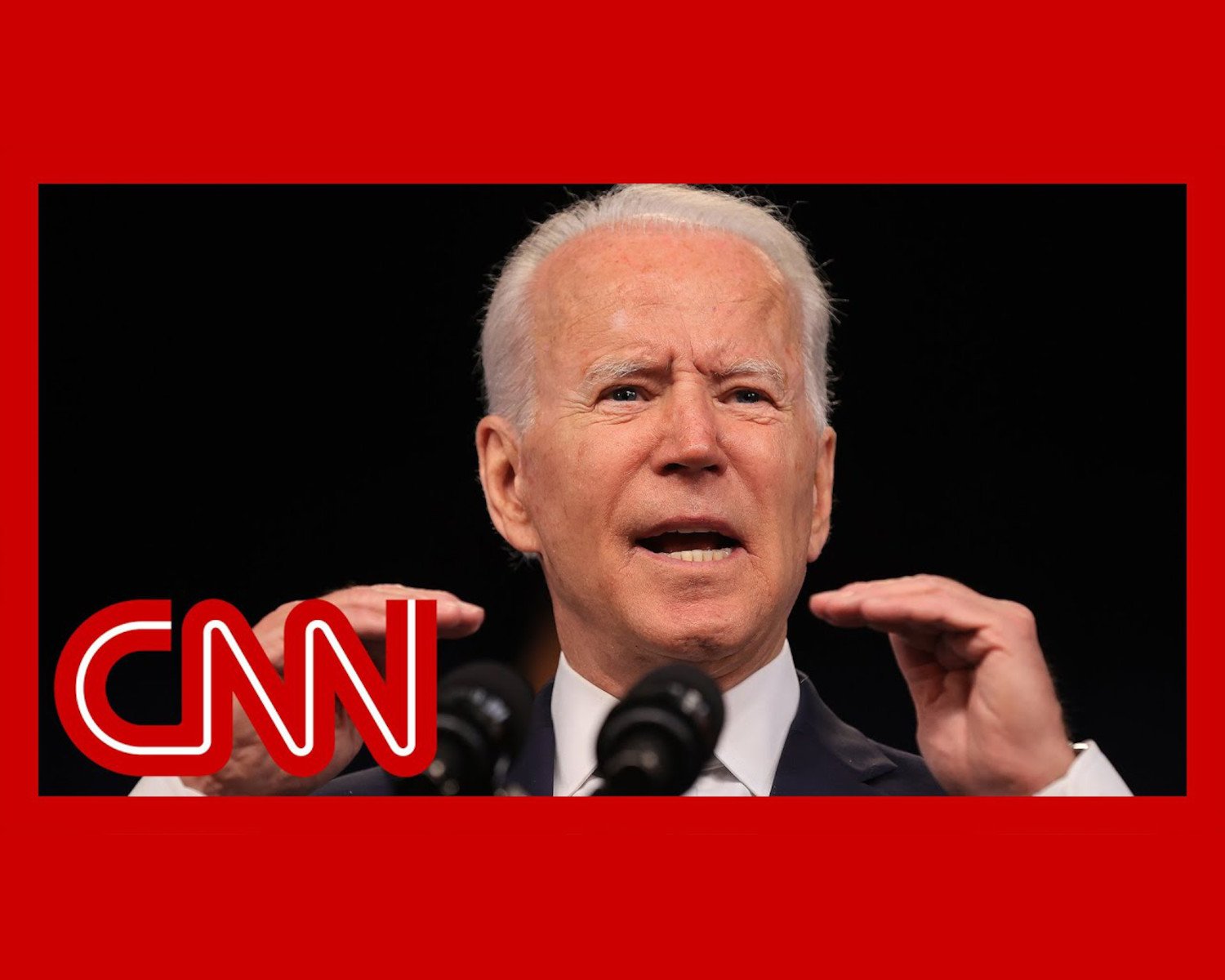
While Russia invaded Ukraine with its nuclear arsenal on high alert, the White House and media were compromised by partisan secrets and selective reporting.
March 9, 2022 by Fr. Gordon MacRae
A lot of media angst and ink have been spilled over the fact that Russian President Vladimir Putin has silenced Russian media to keep his own citizens from witnessing the horror he has inflicted upon the people of Ukraine. However, the Free World has a media problem of its own. As I began this post on March 4, 2022 my account on Facebook was disabled and taken down. This is the message I received from Facebook: “Your Facebook account has been disabled. This is because your account, or activity on it, doesn’t follow our Community Standards.” The offending post, which Facebook disabled based solely on the title and introductory quote was “Catholic Scandal and the Third Reich: The Rise and Fall of a Moral Panic.”
I actually wrote that post several years ago, and shared it then on Facebook with no problem. This time I shared it on Facebook’s Catholic groups which should have a particular interest in its subject matter. Eighty years ago the government of Germany launched a moral panic accusing and arresting without evidence, 300 Catholic priests on trumped up sexual abuse charges. It was all a fraud, and after many months in prison all but six were exonerated, and even several of them were falsely accused. For unknown reasons, Facebook did not want Catholic groups to see that post. I can no longer share my posts among the fifteen or so established Catholic groups and News groups such as Catholic News Agency on Facebook. But you can. Today, it seems, that the media of the “Free” World cannot abide such a story. We will be reassessing our use of social media, so if you have suggestions, please let us know.
I very much miss Walter Cronkite, the most trusted broadcast journalist of the 20th Century. He was the longtime anchor of CBS Evening News from 1962 to 1981. I grew up with him on my TV screen from the age of nine to almost twenty-nine. Walter Cronkite guided us through the assassinations of John F. Kennedy and Martin Luther King, Jr. From our living rooms, he navigated the Civil Rights movement and the war in Vietnam. He was with us as the nation held its breath in 1969 while Neil Armstrong walked on the moon, and he navigated a long cold war with the Soviet Empire. Yet no one I know could tell me today whether his personal politics leaned left or right.
In his career, Cronkite won five Emmys and the George Polk Journalism Award. He was a newsman and pundit in the strict sense of the term, and I wanted to emulate him. For some today, the word, “pundit” has a negative connotation confused with “spin doctor.” Its origin, however, is the word “pandit” from the Sanskrit word “pad itah” spoken in parts of India and Sri Lanka. It refers to a learned sage or scholar, someone to whom everyone else would be wise to listen.
Few stand out in the news media of today as Walter Cronkite did. I am just a minor voice in modern media, but as I began this post I was surprised to receive an invitation from the PEW Research Center to join its survey of journalists. “The views you share will tell us about experiences of journalists like you across the country.” While writing for Beyond These Stone Walls, I was also invited to serve as a Wall Street Journal Opinion Leader. That may be the reason for my PEW Research Center invitation, but I hope it is also because I try to write truth without political filters. As a result of writing with that in mind, some have come to appreciate Beyond These Stone Walls as a source of truth and reflection about truth. Over the last few years, BTSW has received several citations as a reliable news source at the “In the News” section of Catalyst, the Journal of the Catholic League for Religious and Civil Rights.
Our most recent Catalyst citation was for a post that demonstrated a double standard in public perceptions about accused Catholic priests. It was one of the most widely read posts of 2021 and still dominates traffic in 2022. Of interest, that post was widely read and shared by the thousands of readers at the r/Catholicism forum at Reddit. That post was “Bishop Peter A. Libasci Was Set Up by Governor Andrew Cuomo.”
I was happy about its success because that post in particular strove to cover the truth without spin. Its bottom line was something challenging to the news media status quo: that to be accused means to be guilty. In that case, the accused was my own bishop. I also have an unhappy history with him due to some of his actions and policies. Ryan MacDonald laid those out in a most important post, “In the Diocese of Manchester, Transparency and a Hit List.”
But I was proud that I set those concerns aside to take the high road in reporting on the story of allegations against my bishop. I believe him to be innocent of any such suspicion against him. However after publication of my post about a connection between former New York Governor Andrew Cuomo and claims in a civil lawsuit against my bishop, I was “permanently banned” from ever again posting content at the Reddit r/Catholicism community. Then BTSW’s invitation for membership in the Catholic Media Association was rescinded without cause or explanation. The reasons for these, and the Facebook dismissal, were political and had nothing to do with the truth of what I posted.

Political Fallout at CNN
Long after posting that first story, above, its connection to former Governor Andrew Cuomo kept it in the neon lights of online interest, something I neither intended nor expected. Because the Governor’s brother, Chris Cuomo, was a lead anchor at CNN, the spotlight of investigation fell on him as well. It was discovered that he used his position as a news anchor to coach his older brother on how to navigate the news media against multiple sexual misconduct allegations. Then similar allegations were leveled at Chris Cuomo as well, among other ethics concerns.
On his way out the CNN door under a cloud, it is suspected by some in the media that he acted as a whistleblower pointing at CNN Executive Director Jeff Zucker for a long term consensual relationship with another CNN upper management employee, Chief Marketing Officer Allison Gollust. In the end, both of them were also forced to resign from CNN under a cloud of ethical concerns amid charges of violations of their due process rights leveled by some of the remaining CNN staffers.
Allison Gollust also once briefly served as Governor Cuomo’s spokesperson. Sources at CNN today claim that Mr. Zucker and Ms. Gollust “pushed hard” to orchestrate and promote a series of CNN interviews between Chris Cuomo and Governor Cuomo while navigating the earlier days of the pandemic. The interviews were for the sole purpose of countering President Donald Trump’s daily news briefs about managing the pandemic. Some staff at CNN now charge that the daily Covid-19 pandemic interviews between the Cuomo brothers set the stage for the very thing for which Chris Cuomo eventually lost his job: a blurring of the borders between news and politics.
The CNN on-air interviews between Chris and Andrew Cuomo were pushed by CNN despite their straddling an ethical line because they were a boost for ratings. Since the presidential election of 2020, ratings at all three of the 24-hour cable news networks plummeted costing the networks billions in advertising dollars, but CNN and MSNBC suffered far more than Fox News. So journalistic ethics took a back seat to ratings concerns at CNN.
This is something I have long noticed. The blurring of news and opinion at all three of these networks spilled over into the ABC, CBS, and NBC evening news formats. Ratings and advertising dollars at all three were lagging behind the cable news networks which in turn were lagging behind their pre-2020 election standings. It became clear that former President Donald Trump was the cause.
CNN and MSNBC had to find ways to compete with FOX News which maintained comparatively healthy post election ratings. They could only do this by appealing to their virulently anti-Trump base. So you may have noted, as I did, that at some point around mid-2021 both CNN and MSNBC returned in their prime time news and opinion formats to a daily disparagement of Donald Trump long after he left office. This also spilled over into some print journalism. As I type this post, I have in hand a resent copy of The Week magazine which decidedly leans to the usual journalistic left. The issue I am looking at, dated in mid February 2022, contains one reference to sitting President Joe Biden and five references, all negative, to former president Donald Trump.
Of interest, CNN now plans major changes. After a merger between its parent WarnerMedia with Discovery Inc., former MSNBC producer Chris Licht will become chairman and CEO of CNN Global. He is reported to be planning to adjust CNN’s broadcast format to include an emphasis on hard news and less opinion especially in its prime time schedule.

A Laptop Window onto Corruption
As I write this, Russian President Vladimir Putin is waging a full scale invasion of Ukraine. It is frightening to watch this unfolding reminder of the old Soviet Union and its savage consumption of neighbor states. For the most part, MSNBC and CNN are taking a little break from disparaging Donald Trump, but even now I hear the occasional blame aimed at Trump's foreign policy. We are not at all well served in this partisan distortion of news, but it is even worse than you think. Vladimir Putin knows well that both the sitting President of the United States and the American news media are compromised. There is simply no other way to say this, and I know that, for some, it will label me as a pro-Trump partisan which is not at all the truth.
A few months ago, a reader gifted me with a small book entitled Laptop from Hell by New York Post columnist Miranda Devine. I was interested in the book because I was fascinated by media — and social media — treatment of this story in the months before the 2020 U.S. presidential election. We were a nation in denial about our own addiction to partisan politics, and the news media had become our greatest enabler as it struggled for ratings and advertising dollars. Now, with the Russian thirst for war, the truth of this story is at risk of being buried forever. So please let me do my own small part in preventing this even if it is painful. It is nonetheless the truth.
Our President is compromised, and so is much of our mainstream media. In 2019, drug-addicted Hunter Biden left his laptop at a Mac repair shop in Delaware, and then promptly forgot about it. It was just six days before Joe Biden announced his candidacy for the Democratic nomination. Months later, just as the 2020 primaries got underway, the owner of the repair shop discovered the abandoned laptop along with a signed repair invoice from Hunter Biden who never returned to retrieve it. The laptop ended up in the hands of the New York Post, the fourth largest newspaper in the United States.
Hunter Biden was unresponsive to inquiries to ascertain that the laptop was his. He later finally owned it by stating in an interview that “I just wasn’t keeping very good track of my possessions then.” Since no one claimed it in time, the Post began to have it analyzed and discovered the entire contents of its hard drive. Miranda Devine described it as:
“A treasure trove of corporate documents, emails, text messages, photographs and voice recordings spanning a decade. The laptop provided the first evidence that President Joe Biden was involved in his son’s ventures in China, Ukraine and beyond despite repeated denials. Hunter [Biden] had something to sell. He was the son of the vice president who would go on to become the leader of the free world.”
While Joe Biden was vice president, Hunter Biden mysteriously landed a $1 million per year position on the board of Burisma, a Ukraine oil company under suspicion for corruption. Hunter Biden had zero previous experience in that industry. Miranda Devine’s account of the contents of the “Laptop from Hell” reveals a series of emails to Hunter from shady figures in Ukraine demanding that he make good on his position by bringing political pressure to bear to remove a Ukraine prosecutor who had set his sights on investigating Burisma.
Joe Biden, while vice president, then set his own sights on that same prosecutor. In an impromptu speech before the Council on Foreign Relations in 2018, Joe Biden told the story of how he had flown into Kyiv aboard Airforce-2 and threatened to withhold from the Ukraine government $1 billion in U.S. aid unless Prosecutor General Shokin was fired. Vice President Biden boasted:
“I looked at them and said, ‘I’m leaving in six hours. If the prosecutor is not fired, you’re not getting the money.’ Well, son of a bitch. He got fired.”
— Laptop from Hell p. 95
In the months leading up to the presidential election of 2020, most of the mainstream media, and the powerful social media platforms at Twitter and Facebook, suppressed this story and many other related accounts covered by the New York Post. This is not about the outcome of that election. It is about trust in government and the news media to cover news without partisan political considerations. The existence of the book, Laptop from Hell by Miranda Devine, and the political efforts to silence it before a national election, now place our trust in both the media and our government at risk in a time of war. As Miranda Devine points out: “Hunter Biden found himself at the center of a titanic struggle between the US and Russia over energy... How the vice president’s son got involved with such a shady operation has always been obscured.”
Truth be told, our president and much of our news and social media credibility are now compromised by this story and Vladimir Putin knows this.
+ + +
Update from Father Gordon MacRae: As reported in this post, our Facebook page was taken down on March 4th. On March 8th, after I wrote the above post, I published a short article at Linkedin entitled “Banned by Facebook for a True Story of Anti-Catholic Oppression.”
A few hours after it was published, our Facebook page was reinstated without explanation and is now back online. However, when we attempted to post this post on my Facebook page, Facebook refused it with a message stating that other readers may not agree with it. Welcome to the world of the Facebook Speech Police.
We also want to bring to your attention a new addition to our “Voices from Beyond” section. It was first published a few years ago in the National Catholic Register newspaper, and it was the first time mainstream Catholic media had taken up my case. The article, by Brian Fraga, is “New Hampshire Priest Continues the Long Road to Clear His Name.”
There is more to come next week on the terror unfolding in Ukraine. Please share this post, and please pray for the people of Ukraine and Russia who are now pawns in these current events.


Benedict XVI Faced the Cruelty of a German Inquisition
Jesus was mocked by the devil in the Gospel of Luke (4:1-13). Before his death, Pope Emeritus Benedict XVI was mocked by a commission of progressive German Catholics.

Jesus was mocked by the devil in the Gospel of Luke (4:1-13). Before his death, Pope Emeritus Benedict XVI was mocked by a commission of progressive German Catholics.
March 2, 2022 by Fr. Gordon J. MacRae
“Aaron shall lay his hands upon the goat and confer upon it all the sins of the people ... The scapegoat shall bear their iniquities upon him into the wilderness ... to Azazel.”
— Leviticus 10:10,22
In the Gospel for the First Sunday of Lent (Luke 4:1-13), Jesus is tested by a devil in the desert. I wrote of the significance of this Gospel passage on Ash Wednesday. That important post is “To Azazel: The Fate of a Church That Wanders in the Desert.” Ironically, Pope Benedict XVI wrote of this same Gospel passage in his acclaimed book Jesus of Nazareth (Doubleday, 2007). His analysis of the demonic testing of Jesus seems now to be an omen of Catholic division:
“[The Devil’s] temptations of Jesus ... address the question as to what really matters in human life. At the heart of all temptation is the act of pushing God aside because we perceive him as secondary if not actually superfluous and annoying, in comparison with all the apparently far more urgent matters that fill our lives. Constructing a world by our own lights without reference to God, building on our own foundation; refusing to acknowledge the reality of anything beyond the political and material while setting God aside is an illusion.”
— Benedict XVI, Jesus of Nazareth, p. 28
In the Gospel account from St. Luke above, Jesus thwarts the devil at every turn. We cannot thwart the devil at all without Him. In the end, the devil departs to wait for a more “opportune time.” For some of the Catholic leadership of Germany, it seems that opportune time is now. Fifteen years after writing the above reflection on the testing of Jesus in the desert, Pope Emeritus Benedict became a target of the very forces he cautioned the Church against.
Built entirely on a political agenda with obvious bias and ideological goals, a commission of lawyers launched by the Archdiocese of Munich and Freising where Cardinal Joseph Ratzinger served as Archbishop 43 years ago accused him of dishonesty and a cover-up. It was because he could not immediately recall being present at a meeting 42 years earlier in which a specific priest was reportedly discussed. The equally progressive and partisan news media capitalized on this to embarrass the elderly Benedict whose painful response spoke volumes about his effort to satisfy his pernicious detractors. Here is an excerpt of Benedict’s response:
“In addition to responding to the questions posed ... this also demanded reading and analyzing almost 8,000 pages of documents ... and almost 2,000 pages of expert opinion. Amid the massive work, an oversight occurred regarding my participation in the chancery meeting of 15 January 1980. This error was not intentionally willed ... To me it has proved deeply hurtful that this oversight was used to cast doubt on my truthfulness and even to label me a liar.”
— Excerpt of Statement of Benedict XVI, 8 February 2022

The Moral Authority of a German Inquisition
In another post, “Stones for Pope Benedict and the Rusty Wheels of Justice,” I raised what I know to be an important historical context in defense of Benedict. Even if the allegations had substance, which they do not, I can only conclude that this archeological expedition was one-sided and deeply unjust. In my post linked above, I raised a pair of highly relevant but controversial questions. Germany’s historical inquiry into the protection of minors, which had taken on the tone and substance of a witch hunt, ventured back more than forty years to demand answers entirely out of context for the sole apparent purpose of isolating and demeaning Pope Benedict.
This is by no means the first time that Germany has launched such a destructive moral panic. I wrote of a very similar inquisition in “Catholic Scandal and the Third Reich: The Rise and Fall of a Moral Panic.” Why should this inquisition go back only to 1980? Go back just another forty years and you will find yourself in the Germany of 1940 when the vast atrocities visited upon the Children of Yahweh were amply documented and globally known. With what moral authority did Germany point a finger of blame at Joseph Ratzinger for being unable to recall a 42-year-old meeting?
It turned out, however, that the claims were not even true, but they were nonetheless nefarious. Pope Benedict added to his letter quoted above, “I have come to increasingly appreciate the repugnance and fear that Christ felt on the Mount of Olives when he saw all the dreadful things that he would have to endure inwardly.” A follow-up statement from Archbishop Georg Gänswein, longtime personal secretary of Pope Benedict, addressed the political, moral and spiritual depravity of those pointing fingers of blame. Here is an excerpt of Edward Pentin’s blog report, “Archbishop Gänswein: Movement Wants to Destroy Benedict XVI’s Life and Work”:
“Benedict denied personally mishandling abuse cases, each detailed in an appendix to [his] letter compiled by four lawyers acting on Benedict’s behalf. The three canonists and one attorney said that all four charges made against him ... were false. Benedict’s enemies nevertheless used the error to launch attacks on the Pope Emeritus with theologians and others accusing him of lying and perjury.”
— Statement of Archbishop Georg Gänswein
In all of this shameful debacle, Benedict was the only one talking about Jesus. None of these purportedly Catholic accusers ever even mention God, or Jesus, or fidelity to the Church as they prop up their own progressive agenda. It did not take long for the real agenda to become unmasked. These attacks on Benedict coincided with a plenary meeting of Germany’s “Synodal Path” which voted in the same weekend as the condemnation of Benedict to call for same-sex unions and blessings, sweeping revisions of Church teaching on homosexuality and priestly celibacy, the ordination of women, and lay involvement in the nomination and selection of bishops.

Constructing a World by Our Own Lights
In other words, while reviling Benedict, the German Synod demanded a transformation of German Catholicism into the 21st Century Episcopal church which had long since been torn from the Anglican Communion by these same demands. This is exactly what Benedict XVI cautioned against in his citation from Jesus of Nazareth above:
“Constructing a world by our own lights, without reference to God, building on our own foundation; refusing to acknowledge the reality of anything beyond the political and material while setting God aside is an illusion.”
— Benedict XVI, Jesus of Nazareth, p. 28
True to form, on February 4, 2022, the German Synod participants voted 163 to 42 to call on Pope Francis to loosen Church rules on priestly celibacy and to permit the ordination of women deacons two years after Francis declined to do either. This is evidence of something that I have witnessed and cautioned against. Elements in and outside the Church use a climate of fear and revilement around the topic of sexual abuse, not to protect the vulnerable, but as a cudgel to force an entirely secular path toward moral relativism.
The synod participants in Germany argued that obligatory celibacy for priests has impacted the sexual abuse crisis in the Church. This blindly ignores the setting in which the crisis emerged, the sexual revolution of the 1960s to 1980s which now impacts all of Western Culture. One of its tentacles has been a push far beyond mere societal acceptance of homosexuality to promote and normalize it as a societal good. This requires a denial of any connection between homosexuality and the sex abuse crisis in the Church.
As a result, the crisis is blamed on sexual repression and the practice of obligatory priestly celibacy. It is a testament to the power of reaction formation that an entire institution would come to prefer the term “pedophile scandal” to “homosexual scandal” even when the facts say otherwise. And the facts do say otherwise. This is not a political statement. It is a factual one, amply documented. I defended this point in “Cardinal Theodore McCarrick and the Homosexual Matrix.”
In the place where I live, there are over 1,200 men convicted of sexual offenses who must complete a sexual offender program to be considered for parole. In the wider state there are thousands already in the community on parole or as registered criminal sex offenders. Only one of them is a Catholic priest, and he is widely considered to be innocent. The vast majority were married men at the time of their offenses. None were driven to predation by the practice of celibacy, though most strive to practice it now.

The Schismatic Agenda
What is really going on in the German Catholic church is very different from its stated agenda of inclusiveness. Each step in this inquiry is a subtle effort to drag the Church away from the Gospel and into a politically correct arena of moral relativism. The next step in the sexual revolution will tear the Church apart.
I have come to appreciate the candor and spiritual integrity of prison writing from the ranks of Dietrich Bonhoeffer, Fr. Walter Ciszek, Fr. Alfred Delp, and more recently, Cardinal George Pell. Writing from prison with very limited opportunities for dialog and in-depth research means writing almost entirely from one’s own mind, heart and soul. The Prison Journal of George Cardinal Pell has been a goldmine of unfiltered candor and spiritual integrity.
While reading his Prison Journal Volume Two (in which, for full disclosure, my own writing occupies several pages) Cardinal Pell wrote candidly of his concerns for the direction of the Church in Germany. In an entry from his prison cell on August 9, 2019, he wrote of Edith Stein, now known as St. Teresa Benedicta of the Cross who, like St. Maximilian Kolbe, was murdered in Auschwitz by the Nazi regime of 1940s Germany.
Cardinal Pell wrote that Edith Stein was German by birth, and he asked readers to pray for her intercession for the Catholic Church in Germany. He quoted German Cardinal Gerhard Müller, former Prefect of the Congregation for the Doctrine of the Faith, a position once held by Cardinal Joseph Ratzinger:
“The Catholic Church in Germany is going down. Leaders there are not aware of the real problems. They are self-centered and concerned primarily with sexual morality, celibacy, and women priests. They do not speak about God, Jesus Christ, grace, the Sacraments, faith, hope, or love.”
— Cardinal Gerhard Müller quoted in Prison Journal Vol. II, p. 75
It gets much worse. Later in Prison Journal Volume II, Cardinal Pell wrote of Vatican concerns about the growing possibility of a German Catholic schism over the very issues identified by Cardinal Müller. If such a progressive-driven schism were to occur, it would sweep much of the European Union where Catholic Mass attendance is at its historically lowest point. Cardinal Pell cited a September 17, 2019 Catholic Culture article by Phillip Lawler, “Who Benefits from All This Talk of Schism?”
Lawler argued that the prospect of a schism is remote, but becoming less so. He cited that Pope Francis has spoken calmly about such a prospect saying that he is not frightened by it, something that Lawler found to be frightening in and of itself.
Cardinal Pell added that The New York Times has been writing about the prospect of a German Catholic schism by “the John Paul and Benedict followers in the United States, the Gospel Catholics.” He observed that Lawler’s diagnosis is correct in pointing out that,
“The most aggressive online defenders of Pope Francis realize they cannot engineer the radical changes they want without precipitating a split in the Church. So they want orthodox Catholics to break away first, leaving progressives free to enact their own revolutionary agenda.”
— Prison Journal Vol. II. p. 214-215
In light of this, it comes as no surprise that progressive bishops have pushed Pope Francis into divisive restrictions on the Traditional Latin Mass and other suppression of traditional expressions of the faith. These efforts, and the German Catholic steps taken to demean the late Pope Benedict, a stalwart of Catholic orthodoxy, should come as no surprise to faithful Catholics. Embracing and promoting fidelity at this juncture has never been more urgent. Faithful Catholics must never accede to the desired end that German progressives seek.
Handing the Church over to them would leave “Satan at the Last Supper” while Jesus is removed from the room.
+ + +
Note from Fr. Gordon MacRae: Thank you for reading and sharing this most important post. You may also be interested in these related posts from Beyond These Stone Walls :
Catholic Scandal and the Third Reich: The Rise and Fall of a Moral Panic
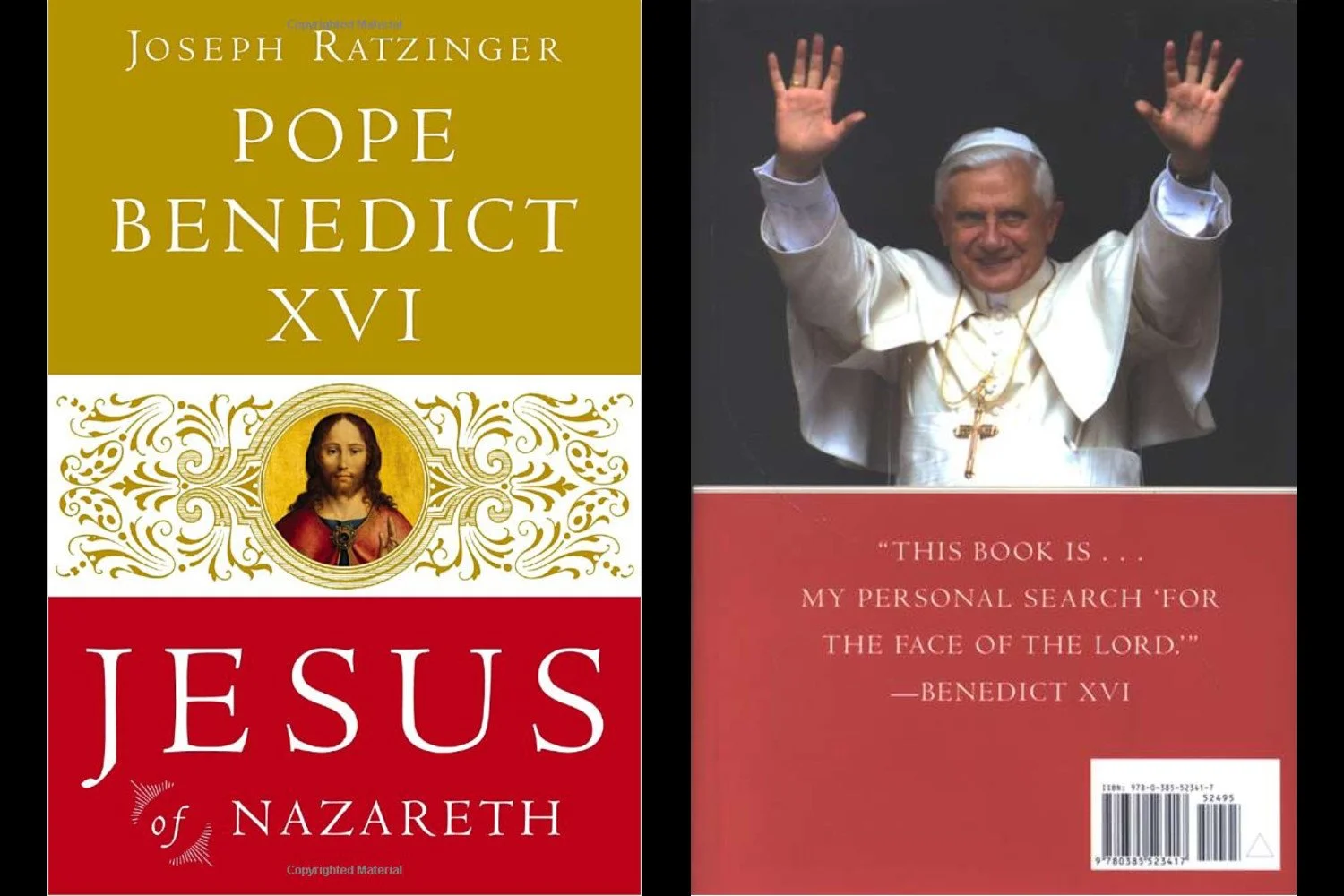

Pornchai Moontri: A Night in Bangkok, A Year in Freedom
Pornchai Moontri marks one year since his return to Thailand after 36 years away, and one year in freedom after 29 years in prison. Divine Mercy has won this day!

Pornchai Moontri marks one year since his return to Thailand after 36 years away, and one year in freedom after 29 years in prison. Divine Mercy has won this day!
February 23, 2022 by Pornchai Maximilian Moontri
Sawasdee Kup, my friends. The photo that you see below is my first moment in freedom in Thailand after a 36-year absence and 29 years in prison since age 18. As many of you know, the last 16 of those years were in the company of Fr. Gordon MacRae. Without him, none of the rest of this post would ever have taken place.
In the photo, that’s me on the left. It was the 24th day of February in 2021. I think I was the only person in Thailand to wear a pair of western jeans that day. It was all I had, and it was a very hot 40-degrees Celsius which is about 104-degrees Fahrenheit and extremely humid. The three people with me are (L to R): Khun Chalathip, a supporter and benefactor of the Divine Word Missionary work in Thailand; Yela Smit, co-founder of Divine Mercy Thailand and the person who worked with Fr. Gordon to prepare for my return; and Fr. John Hung Le, SVD who you already know well. Father G is not in the picture, of course, but he was still very much present.
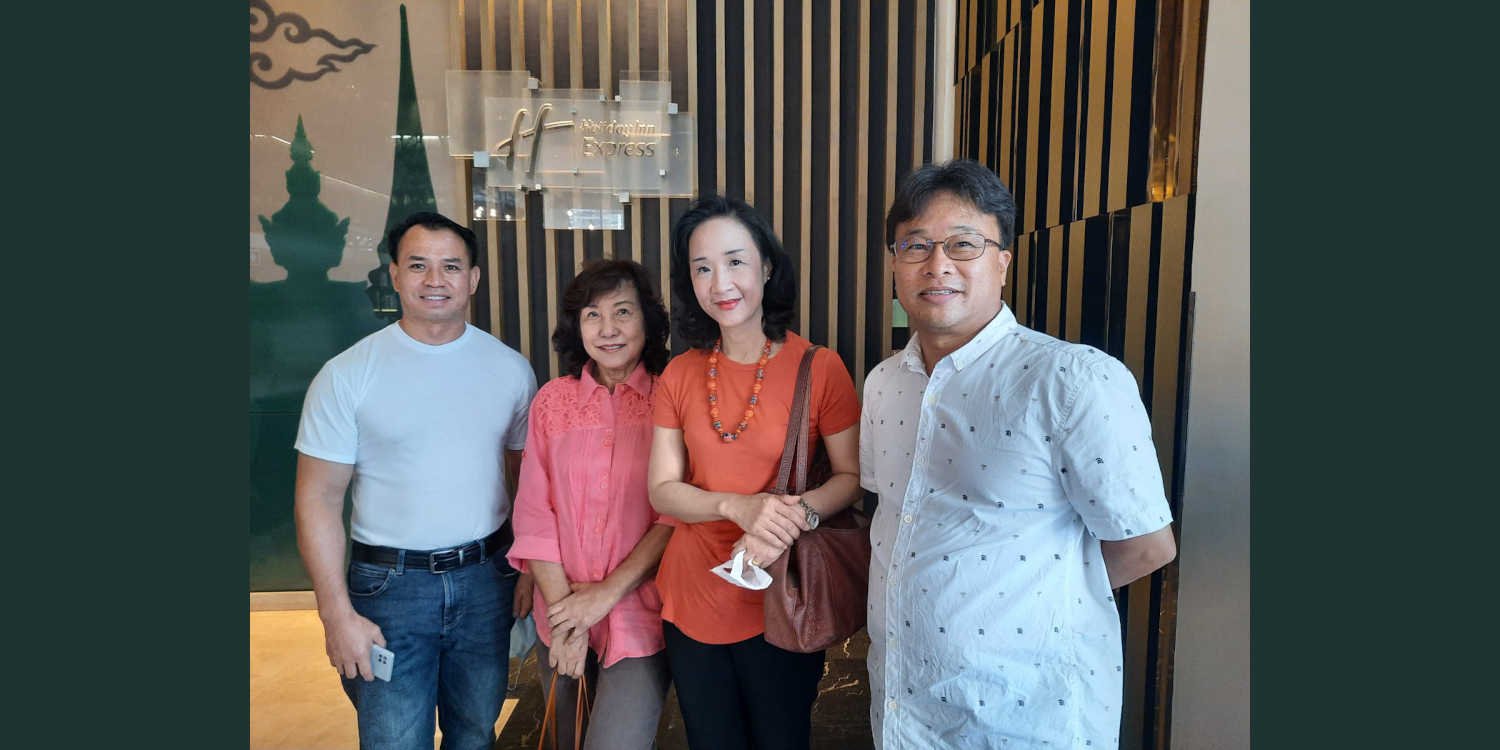
There are many others who made this picture possible. Because of Beyond These Stone Walls, an international effort formed to move a mountain. This included Yela Smit and Father John Le in Thailand, my legal advocate Clare Farr in Australia, Viktor Weyand in Michigan, Dilia E. Rodríguez in New York, Fr. George David Byers in North Carolina, Charlene Duline in Indiana, Bill Wendell in Ohio, Claire Dion, Carol Slade, Judith Freda, and Samantha McLaughlin in Maine, and Mr. Narongchai at the Royal Thai Embassy in Washington. All made a mighty effort to bring me home. Many of you contributed to my support in the great challenge of starting life over. I do not have adequate words to thank you all.
After the above photo was taken, I had my first meal in a Thai restaurant, and then we went shopping for clothes. Father John took me to the biggest, busiest shopping mall in Bangkok where I had to fight off a panic attack. It was a very long time since I was in the presence of so many people, and in a city as huge as Bangkok. It felt overwhelming.
Father G and I had talked a lot about what my first moments of freedom might be like, but living them was another matter. So many competing feelings rushed through my mind: excitement, terror, gratitude, terror, happiness, terror. It is not easy to describe how freedom feels after spending 60-percent of my life in a U.S. prison. Did I mention terror?

Samsung to the Rescue
The photo above was my first “selfie.” It was taken when I figured out how to use the camera on a smart phone. There is a little rosary and cross hanging from the mirror. That was made for me out of foil candy wrappers by a 19-year-old Honduran young man who I helped during five awful months in ICE detention. From the moment I arrived in Thailand, everything I did, saw, or touched that day and the days to follow was completely new to me. I feared that I will never be able to fit in. During these 14 days of quarantine in a hotel room alone for the first time in 29 years, Father G called me every day. For the rest of my life I will always remember that first phone call. It was the morning after my arrival.
We spoke about my first anxious night in that room. It was small, but still about three times bigger than the 60-squarefeet where I lived with Father G. I could not see anyone during my two weeks in quarantine, but our friend, Yela, left a Samsung Galaxy smart phone in the hotel for me. I looked at it like it was left behind by space aliens. It took me a while to figure it out, but I somehow managed to find Beyond These Stone Walls.
I wish you could have felt my heart thumping with excitement. This blog that had been so much a part of our lives, reaching out from a tiny prison cell to the whole world, was now right in front of me. I realized with deep emotion that I am now seeing it while Father G never has. It struck me that almost everyone I will meet in Thailand in coming days will already know about me. Then I found Father G’s Documentary Interview and listened for the next two hours as he talked while I fell asleep. “Just like old times,” I thought, but don’t tell him I said that.
One year ago, on February 24, 2021, Father G wrote about that first night in Thailand and my embarrassing encounter with a 21st Century toilet. It was “Pornchai Moontri and the Long Road to Freedom.” I remember thinking that this Samsung smart phone that now connects me to the world is a miracle, and that BTSW was an even greater miracle. I felt for the first time that I am not among strangers. I am home, and Father G came with me.

Pictures of Freedom
Father G and I still speak by telephone each day. He calls me with his GTL tablet from the same prison cell where we both lived. Sometimes it is for just ten minutes and sometimes longer. Every time I tell him about what is going on in my life now, he says the same thing: “Send me photos! We need photos.” Now I can see the reason for that. He suggested that the best way to tell the story of my first year in freedom is with photographs and links to what he and I have both written. So here goes!

Free at Last Thanks to God and You
I wrote this post just a few weeks after my arrival. I was living then in the Divine Word Community House with Fr. John Le and some members of his Order in Nontha Buri. Father G and Father John spoke often. It is with deep gratitude that I thank both of them. No one knows how difficult it is to re-enter society after almost thirty years in isolation. On the day I arrived at Father John’s home, he and Yela had a photo taken with me in the presence of the One most responsible for bringing me there. So that photo is posted above.

For Pornchai Moontri, A Miracle Unfolds in Thailand
Just a week later, Father Gordon wrote this amazing post after talking with me. It turned out that the headquarters for Father John’s Community in Thailand were located in the Province of Nong Bua Lamphu in the Northeast of Thailand, about a nine hour drive from Bangkok. That was the place of my birth and the place from where I was taken at age eleven. Just a few kilometers from a special home and clinic operated by Father John’s Order for Thai children, the Aunt and cousins I lived with as a child were still there. It was a most painful but also joyful reunion.
I spent my first night there in the unfinished home my mother was building before she was killed on the Island of Guam in 2000. All her things were still there. The next morning, I visited and prayed at her tomb for the first time. I was so thankful that Father John was with me. Though most of Thailand practices Buddhism, and so did I as a child, I am now a Catholic, and I asked Father John to bless my mother’s tomb. I will be going there again in April for Chakri, the annual Buddhist Water Festival when family members clean and honor the tombs of their loved ones.

Archangel Raphael on the Road with Pornchai Moontri
Father Gordon has told me many times that this was his favorite post of my first year in freedom. He told my story combined with the story of Tobias and the Archangel Raphael from the Book of Tobit. There is a mysterious dog in the Tobit story, and during this same journey my dog, Hill, adopted me. This was a very special post. Hill and I have had similar lives in which we both got battered around a bit. He started following me as soon as I first arrived in the village of Phu Wiang (Poo-vee-ANG) just as a dog followed Tobias in the company of Raphael in the Book of Tobit. Whenever I return there, Hill comes running and howling as I give him a special treat. Then he never leaves my side.

Beyond These Stone Walls in Thailand
Father G helped me to write this post which describes my long and difficult adjustment. In the photo above, Father John and Khun Chalathip, who took on the task of helping me to learn Thai again, brought me to a day of prayer at an Oblate retreat in Bangkok. Much of this post was written while I was there. Back at the New Hampshire State Prison, the Lieutenant of the unit where I lived saw it and had it posted on the wall outside his office. He asked the 300 prisoners there to all read it and he included it in a prison newsletter. Father G says that they especially liked this last paragraph and wanted other prisoners to read it:
“Sometimes I get impatient with myself. I wish I could be further along in learning Thai language, history and culture, the metric system, driving on the left side of the road, and not having to “report in” every time I go anywhere or do anything. After 29 years “inside” I am now out of prison but I still have to get prison out of me. The name, Thailand, after all, means ‘Land of the Free’.”

Pornchai Moontri: Citizen of the Kingdom of Thailand
Every Thai citizen is presented with a Thai National ID at the age of 16. But I was not in Thailand then and never received it. So returning at age 48 with my citizenship not yet fully established was a burden for me. There have been times in my life when everything that could go wrong did go wrong. I made multiple trips up to the village of my birth to visit with my family and my dog, Hill. Each time, I applied for my Thai ID and each time I was told that it is still pending.
In late October, much to my relief and Father G’s as well, I was summoned to Phu Wiang. I told Father G that I was buying a new dress shirt for the ID photo. Surely they could not turn me away with this beautiful new yellow shirt. Father G scoffed, but I had faith. (Now that’s a twist!) But this time I was successful and I wanted all of you to see my Thai ID. So Father G had my ID number blocked out and posted it.
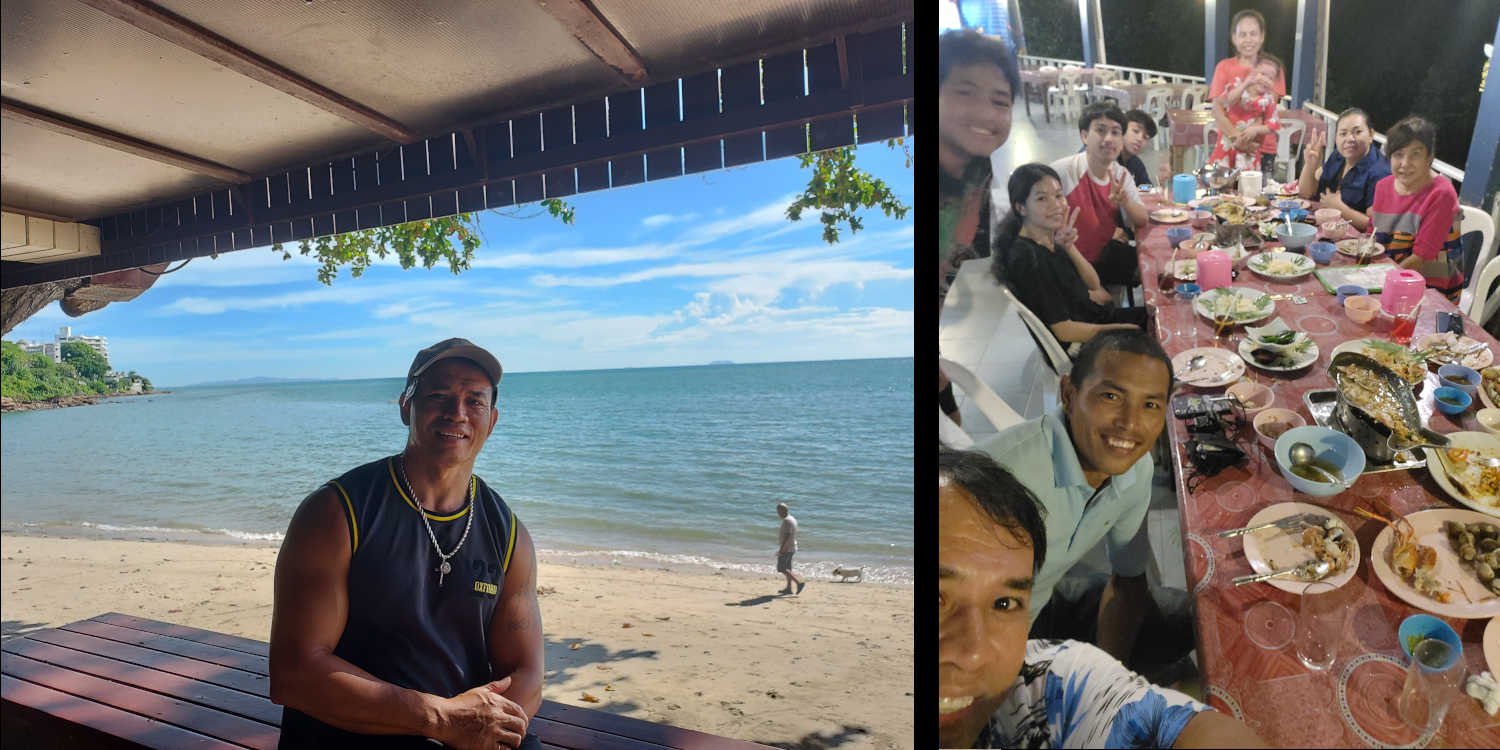
This was my birthday reunion with my cousin and his family. He was eight years old and I was eleven when we lived as brothers. Now he is an officer in the Royal Thai Navy. While being with him and his family at the Gulf of Thailand, the struggles of the past just evaporated for a time.

A Year in Photos
One of the things that I looked forward to was swimming. I had not been immersed in water for thirty years. I lived with my cousins as a child, but 36 years had passed before I saw them again. On my first visit with them, they took me to a lake. I was not sure I even still knew how to swim so they put some little flotation devices on me. I did not even know how to get into the water the first time. When Father G saw the picture of me floating he wrote, “This is what freedom looks like.”

Visiting with my Aunt and cousins during the rice harvest was humbling for me. I am no stranger to hard work, but they feared I would be too unaccustomed to the relentless Thai heat so they gave me the easy job of collecting bundles. It was a great blessing to be with them during this most important time.

When Father G wrote about our Advent project with Father Tim Moyle and Saint Anne’s Parish in Mattawa, Ontario, and Father John Le here in Thailand, I got to experience first hand what it means to take part in a Corporal Work of Mercy. Visiting the Vietnamese refugee families with Father John and helping to distribute food is an unforgettable experience for which I am most thankful. I greatly admire Father John’s ministry in Thailand, which Father G has described at our Special Events page.
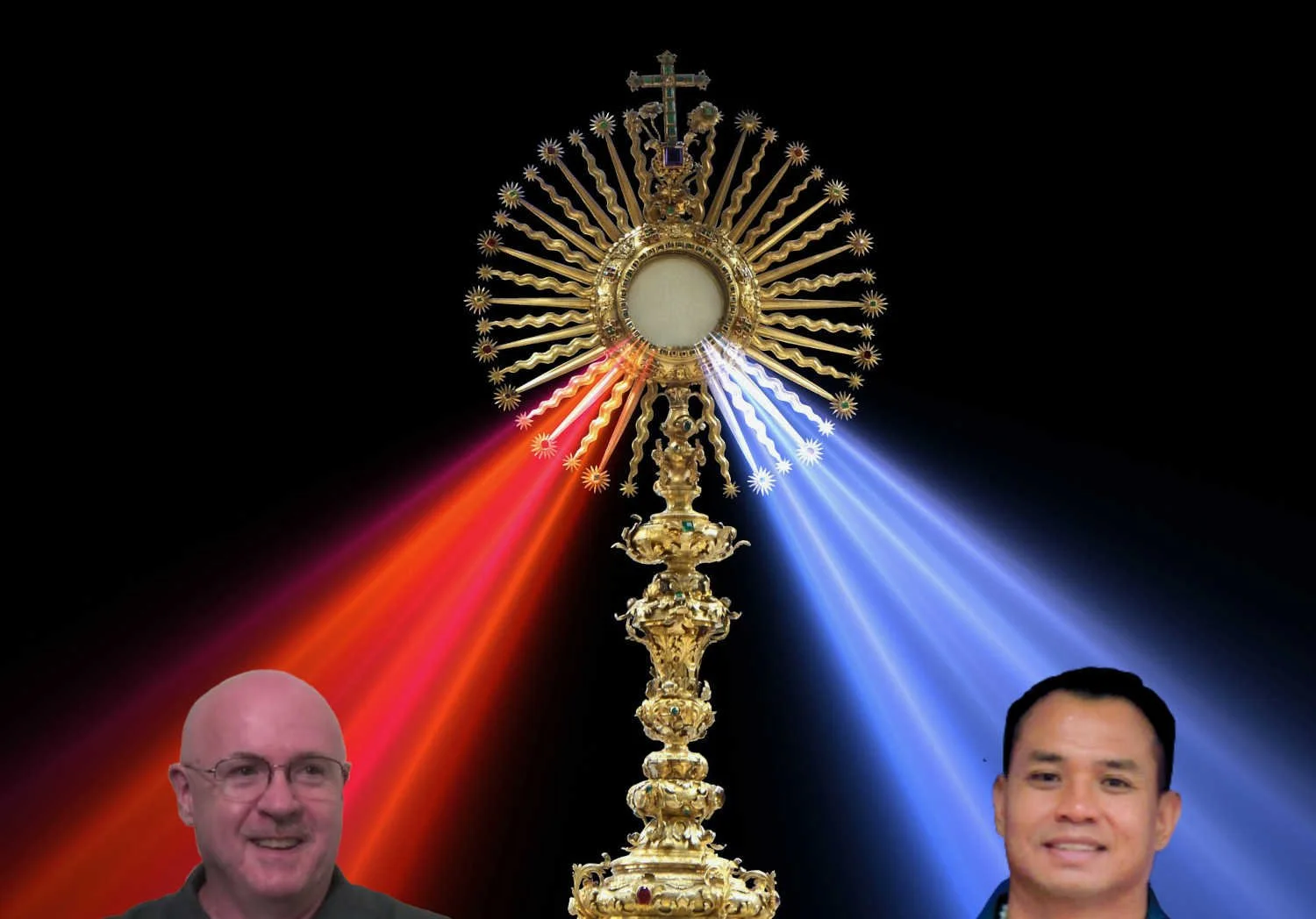
Here in Thailand, far beyond those stone walls, my heart aches that Father G is still behind them. I thank you for continuing to visit him in prison by reading these posts. I will always be indebted to you all for your acceptance of me, your kindnesses toward me, and the support of your prayers. I know that I would not have experienced this year in freedom without you. Father G will always be a part of my life and so will this wonderful blog.
May God bless you. With love to you all from me and Father G and from Hill too!

Pornchai Maximilian Moontri with his dog Hill. The tattoo on his arm is from a portrait of his Mother etched on his arm by an artistic prisoner after Pornchai learned of her death. It was his only means to memorialize and mourn her.

The Measure By Which You Measure: Prisoners of a Captive Past
The Gospel of Luke issues a difficult challenge before Lent. The mother of a murdered young man heeded it and rose to become an advocate for her son's former enemy.

The Gospel of Luke issues a difficult challenge before Lent. The mother of a murdered young man heeded it and rose to become an advocate for her son’s former enemy.
February 16, 2022
Like most human beings, and entirely unlike Jesus, I have enemies. This needs some clarification. There were some who made themselves enemies of Jesus, but never did Jesus perceive them as such. I have as of yet been unable to rise to that Gospel challenge. That much became clear in our recent posts, “Predator Police: The New Hampshire ‘Laurie List’ Bombshell,” and its sequel, “Police Misconduct: A Crusader Cop Destroys a Catholic Priest.” That latter post, by Ryan MacDonald, took a surprising turn. Several days after it was posted, it had been shared only about 200 times on social media. Then, on Monday, January 31st, it suddenly exploded, gathering 2,300 shares on Facebook, thus placing that post before hundreds of thousands.
In recent weeks and months, there have been many assaults and other attacks on police officers. The vast majority of police are couragous and honest men and women who do their jobs heroically. The posts linked above are not at all about them. They are about a deceitful and self-righteous crusader who used sleazy and dishonest tactics to frame and entrap people, including me. Now, just weeks after those posts were published, I am confronted with a Gospel passage two weeks before Lent that I would rather not hear. But I did hear it.
Should a priest have enemies? It is not exactly a good look, but priests are human beings and most humans do not respond well to being hated or hunted, or falsely accused. The words “enemy” and “enemies” (for those who sadly have amassed more than one) occur in Sacred Scripture 526 times. What would the opposite word be to contrast it in Scripture? It isn’t “friend.” I know many people who are neither friends nor enemies to me. I even have some ex-friends who are certainly not my enemies. There is no word for an ex-enemy. But as I pondered all this, the Gospel for the Seventh Sunday in Ordinary Time smacked me:
“Jesus said to his disciples, ‘To you who hear, love your enemies, do good to those who hate you, bless those who curse you, pray for those who mistreat you.’”
— Luke 6:27
I started splitting hairs upon reading this. Jesus said “To you who hear,” so what if I simply pretend I didn’t hear it? I could not handle the dishonesty that would entail, but I just don’t know what to do with what I heard. I tried praying for my enemy, but my prayer became corrupted: “I pray that my enemy will one day stand in the Presence of the Lord. Sooner rather than later might be nice!”
It isn’t a good prayer. I will have to try harder. The whole passage for this coming Sunday’s Mass ends, however, on a more reachable note. It is a statement that now haunts me with a call to arms. In this case, however, I am taking up arms not against my enemy, but against myself. It seems on first reading to be a lot easier than deciding to love my enemy and pray for him. Maybe that will come some day. Not today. But this final statement of Jesus concludes the Gospel for the Seventh Sunday of Ordinary Time. Let it sink in. It's not for my enemy. It is for me:
“The measure with which you measure will in turn be measured out to you.”
— Luke 6:38
Way to go, Jesus! Please pass the Tylenol.

Divine Mercy Calls Forth Unexpected Role Models
I wrote a post back in 2012 that was one of a few that contained the photograph above. That post was “Why You Must Never Give Up Hope for Another Human Being.” It has been on our list of posts from the older version of this blog that had to be restored for you to read them anew. I asked that it be moved to the top of the list so you could read it for this post. No need to do so now. I will add a link to it at the end. It’s very important.
The young men in the photo above all graduated from high school in this prison after putting in years of hard work and even more years of struggle with themselves. The obstacles against learning the right things in this environment are very great. With the right kind of support, each one of them overcame these obstacles. The result was this triumphant photograph above. I am very proud of it, and the men who are in it — all gawking at me on the other side of the camera. With their diplomas in hand, they are victorious.
In the photo, my friend Alberto is hunched down just behind and to the right of Pornchai Moontri. For the previous two years, he had been a student of mine in a pilot program for exceptional prisoners to enroll in courses for college credit even while working on their high school diplomas. I was recruited for the program by a local community college to teach two courses in which I had earned degrees before prison in Philosophy and Behavioral Science.
Alberto was my student for four semesters, taking one course at a time. He failed both courses in the first two semesters. Alberto hinted that, with the stroke of a pen, I could rescue him with a “C.” But I did not. So he re-registered to take both courses again. He passed both the second time around with a respectable “B+.” I was very proud of him both when he failed, because he made an effort, and when he came back and excelled because he would not accept yet another defeat in life.
Alberto became a good friend to me and to Pornchai. When he wasn’t in trouble and hauled off for a stint in the hole, he lived where we lived. I mentioned him long ago in a 2010 post, “Angelic Justice: St. Michael the Archangel and the Scales of Hesed.” Alberto read a hard copy of it because he was in it, and it became a turning point in his life. I cannot take credit for that because credit is rightly owed in equal measure to Pornchai Moontri and St. Michael.

In the Absence of Fathers
Alberto was 14 years old when the gun in his hand fired severing the artery of an 19-year-old with whom he struggled. It was a vicious end to a late night drug deal gone very bad in a dark Manchester, New Hampshire alley. It happened in 1994, the same year that I was sent to prison. It seemed a flip of a coin which combatant would die that night and which would survive only to wake up in prison. At 14, Alberto had lost himself. Sentenced to a prison term of 30 years to life, he spent his first years in solitary confinement. The experience extracted from him, as it also did from Pornchai, any light in his heart, any spark of optimism or hope in his eyes.
Then, when finally age 18, Alberto was allowed to live in the prison’s general population where the art of war is honed in daily spiritual and sometimes physical battle. It is a rare week that a City of Concord Fire Department ambulance doesn’t enter these prison walls shutting down all activity while some young man is taken to a local hospital after a beating or a stabbing or a headlong flight down some concrete stairs. The catalyst for such events is the same here as it was in the alley that sent Alberto here. There is no honor in any of it. It is just about drugs and gangs and money.
Alberto’s path to prison seemed inevitable. Abandoned by a father he never met, he was raised by a single mother who lost all control over him by age 12. Drugs and money and avoiding the law were the dominant themes of his childhood. By age 14, he was a child of the streets and nowhere else, but the streets make for the worst possible parents. Alberto became a textbook example of a phenomenon that I once wrote about to much public fanfare, but little public action: “In the Absence of Fathers: A Story of Elephants and Men.”
In “Big Prison” it was discovered that there is more to Alberto than the violence of his past. He was 32 when he earned his high school diploma here. He will one day soon be released after having spent more than two-thirds of his life behind bars.
I wrote about Alberto’s life in “Why You Must Never Give Up Hope for Another Human Being.” Now I want to challenge you to go read it because at the end of it at the very top of its many comments is one by the mother of the young man Alberto killed. She read it too. In just a few short sentences, Mrs. Rose Emerson became a role model for pondering what Jesus says in the Gospel on the Seventh Sunday of Ordinary Time:
“The measure with which you measure will in turn be measured out to you.”
Luke 6:38
+ + +
Note from Father Gordon MacRae: The post that I suggested above — “Why You Must Never Give Up Hope for Another Human Being” — is now posted under the “Prison Journal” category of our BTSW Library. I would like to leave Mrs. Emerson’s comment as the final word on that post. If you wish to comment further, and I hope you will, please return here to place your comment on this post. In coming weeks or months we hope to present other powerful stories of hope and Divine Mercy encountered in prison.
Please share this post.
+ + +

Jesus calls forth Lazarus from his tomb.