“There are few authentic prophetic voices among us, guiding truth-seekers along the right path. Among them is Fr. Gordon MacRae, a mighty voice in the prison tradition of John the Baptist, Maximilian Kolbe, Alfred Delp, SJ, and Dietrich Bonhoeffer.”
— Deacon David Jones
Life Still Goes on Behind and Beyond These Stone Walls
Two years and 102 posts after the resurrection of this blog as Beyond These Stone Walls,the challenges of prison writing continue to be overcome week after week.
Historic Concord, New Hampshire Post Office
Two years and 102 posts after the resurrection of this blog as Beyond These Stone Walls, the challenges of prison writing continue to be overcome week after week.
November 9, 2022 by Fr. Gordon J. MacRae
The United States had a most crucial national election this week. What I am writing now will be posted just one day later so I cannot imagine anyone paying any attention at all to me. But I’m used to it — at least, I thought I was.
I owe many of you an apology. You might recall that two years ago this week, These Stone Walls, the older version of this blog, had to be taken down. I wrote about the circumstances behind its collapse in our first publication under its new name on November 11, 2020. That post was “Life Goes on, Behind and Beyond These Stone Walls.”
Two years and 102 posts later, we discovered something about the newer blog that we had previously overlooked. It came with its own email address for subscribers to contact us. Being locked away from ever being able to interface with technology, I had no idea. Just two weeks ago, our editor stumbled upon this internal email system along with hundreds of your unread and unanswered comments and messages dating back two years. For all this time, I thought you were all just ignoring me. The internal address is FatherG@BeyondTheseStonewalls.com.
And many of you must have thought the reverse. For two full years, subscribers had been clicking the “Reply” button on our weekly subscriber message to send me messages, comments, and reflections on my posts, but without any reply or even an acknowledgment from me.
Our editor’s discovery of the cache of hundreds of your emailed messages required two long marathon sessions by telephone over two days to hear them read to me and respond — up to two years late — to as many as I could. Our volunteer editor risked carpal tunnel syndrome typing all my dictated replies. Some messages were just too old for any reply to make any sense. Anyway, we apologize for the oversight.

A Voice in the Wilderness
It is humbling. Before becoming a guest of the State in 1994, I was known for being somewhat of a computer geek. I coached many other priests back then who were struggling to embrace the computer age. Now my prison barriers place me in Techno-caveman status relegating me to the technological Stone Age. Sometimes our editor is surprised when, sight unseen, I walk her through posting something at Linkedln, for example, without ever having even seen it. I read a lot about technology, but that is not quite the same as hands-on experience.
When I began writing from prison at the urging of Cardinal Avery Dulles and others, I had no idea what a blog was. They did not exist when I dropped off the face of the Earth in 1994. According to the latest estimates of Google, there are over 600 million registered blogs worldwide publishing 2.5 billion blog posts a year. So mine is literally a tiny voice in the wilderness.
It is difficult to say how many blogs identify themselves as “Catholic” blogs. For a time, a site called “Top Catholic Blogs” featured posts from me almost weekly, but it seems to have become inactive. Another site, The Big Pulpit, moderated by Tito Edwards for the National Catholic Register, featured an occasional post from me, but had not done so since our change of name two years ago. Then on the day before this is posted, The Big Pulpit proved me wrong by posting, “Catholic Priests Falsely Accused.” So in terms of promoting a message, it seems entirely up to me — and you, if you are willing.

When You Write to Me
While the nation is celebrating or regretting the outcome of this election and analyzing all of its implications, I want to address a few housekeeping items about Beyond These Stone Walls. I wish I could say that I have been more responsive to your snail mail than I was to your neglected email messages.
Mail to me in prison now goes through a process that will seem like an insult to all of your good intentions. There were all sorts of rules in place requiring that mail be either typed or hand written in plain black or blue ink. Now that has all been scrapped. Effective a few months ago, prisoners here no longer receive any original mail at all.
Letters and any enclosures are now photocopied in black and white, and I receive only the copy. The original is held for ten days and then shredded. There have been lots of problems with this, the most frequent being double-sided originals that are copied on only one side. When that happens, I have ten days to request re-copying of the original before it is shredded.
Despite all the obstacles, I still get a lot of mail. Please do not misunderstand me. Mail is the lifeblood of the psyche for any prisoner. There are many here who do not even bother to show up for mail call. My biggest heartache, however, is being unable to answer most of your letters in a timely manner. Sometimes mail piles up for so long that any reply just feels insulting. I am so very sorry that many of your letters and gifts have gone without response. It would help if you include an email address in your letters. It would be easier for me to send a reply in that way.
Part of this problem is that I have to handwrite each and every letter I send. I can purchase only six typewriter ribbons per year and therefore must reserve them for publishing posts. In addition to Beyond These Stone Walls, I am also occasionally asked to write for other venues. The latest is an article published at a U.K. site, False Allegations Watch. I hope you will look at it because it lets site administrators know that an article is important. My article there is “Did Police Misconduct Turn a False Allegation into a Wrongful Conviction?”
Facebook refused to allow that link to be posted. Ironically, the leftist media was eager to report about police misconduct until doing so helped the cause of a wrongly imprisoned Catholic priest. This latest experience with Facebook drove home for me the importance of what Elon Musk now plans to do with Twitter: No more cancelling conservative views; no more cancelling pro-life voices; no more cancelling Catholic fidelity. By the way, we have a Twitter account. Just go to Twitter.com and search BeyondTheseStoneWalls to follow us.

A Corporal Work of Divine Mercy
Sending an occasional monetary gift to me has been most helpful, but also somewhat of a heartache. Gifts cannot be sent to me directly, but my brother-in-law, a lifelong friend who somehow married my sister when I wasn’t looking 42 years ago, maintains a power-of-attorney account for my needs. Please see our “Contact and Support” page to help if you wish and are able. Modest gifts to that account help a good deal with annual expenses for this blog and with food and clothing costs.
I have an expense coming due just after Christmas that I hope to find some help with. It’s my $650 annual subscription to The Wall Street Journal which helps me immensely to stay in touch with the world and write about it. It is my one and only extravagance and the subscription fee is a bargain compared to other newspapers. I was shocked to learn from a reader that annual subscriptions to The New York Times and The Boston Globe are both over $1,200. In my opinion, the WSJ is a far superior newspaper (and not just because it has published about me!).
Some people have helped by using PayPal. We have an account, but PayPal has become problematic for many. On October 8 this year, PayPal sent an update to its Terms of Use Policy that alarmed many users, causing some to terminate their accounts. PayPal reserved the right to confiscate up to $2,500 from users’ accounts if PayPal determines that a user posted “misinformation” on the Internet. Paypal also blocked accounts in the UK such as Free Speech Union and the Daily Sceptic.
After global protests, many closed accounts, and a big selloff of PayPal stock, the company thought better of it and issued a retraction while restoring the closed accounts. There are many, however, who simply don’t trust PayPal going forward now. We receive few gifts through PayPal, but the annual total is almost enough to keep this blog afloat. If donors use that means, please always send me a message that you have done so using our PayPal donor email, FrGordonMacRae@gmail.com. This will better enable me to send you a message of acknowledgment and thanks.
Please also pay some attention to our Special Events page for information on how to help me with two causes that are most important to me: the support and rehabilitation of Pornchai Moontri, and the Vietnamese Refugee Project of Father John Hung Le, SVD. American funds go a long way in Thailand, and thanks to your help I have been able to help sustain them both. This means more to me than any endeavor on my own behalf .
The elections are over. May sanity, fairness and justice now reign. May Twitter be actually free from partisan censorship. May the woke finally go back to sleep. May God resume His hallowed place in our discourse. And may the Lord be with you.
+ + +
Note from Fr. Gordon MacRae: We assimilate much more of the message of the Gospel when its intended meaning is more fully understood. The Gospel from St. Luke at Mass this coming Sunday (Luke 21:5-19) is a prediction of terrible persecutions for which Jesus tells all of us to prepare. I previously wrote of this alarming Gospel text in the posts:


Pornchai Moontri: Elephants and Men and Tragedy in Thailand
When Fr Gordon MacRae wrote about a tragedy in Uvalde, Texas, he interviewed me for that post. I never imagined we would one day face the same tragedy in Thailand.

Photo by Megan Coughlin (CC BY-ND 2.0)
When Fr Gordon MacRae wrote about a tragedy in Uvalde, Texas, he interviewed me for that post. I never imagined we would one day face the same tragedy in Thailand.
October 26, 2022 by Pornchai Maximilian Moontri
Sawasdee Kup, my friends. I greet you from the central Thailand city of Pak Chong. If you are wondering where Father G has been, nothing has changed. He is still right in the prison cell where we both lived for many years. As you know, there is a lot going on in his life at the moment. He has hard decisions to pray about and a lot of writing to do. I expect he will resume writing to you here next week.
I am most fortunate to be able to speak with Father Gordon daily. He calls me from his cell (it used to be our cell) at 0800 each morning which for me is 7:00 PM. I have been following very closely the posts by Ryan MacDonald, Harvey Silverglate, David F. Pierre, Jr., and Catholic League President Dr. Bill Donohue in the last few weeks. I laughed when I read Ryan’s comment about a local reporter refusing to see any of Ryan’s news about Father G saying, “My mind is made up.” I know Father Gordon better and longer than anyone. My mind is made up too.
In our daily call, Father G has told me about all that has been happening, but he has just never been at the center of his own focus on life. In recent weeks he has spoken with me every day about a tragedy that happened to some of the people of my home Province of Nong Bua Lamphu in Thailand. Like many people here, I have been shaken by this, but Father Gordon brings it up with a broken heart every time we speak now. He told me that the whole world was in mourning.
If you missed that news, it is an awful account. The small Thai village of Uthai Sawan in the north east of Thailand is near Phu Viang, the village where I was born. It is a part of Nong Bua Lamphu Province where Father John Le and his Order, the Society of the Divine Word, have their Thailand headquarters and a treatment center for Thai children with HIV. We are all deeply sad over what happened in Nong Bua Lamphu on October 6.
People in Thailand do not generally own guns. It is extremely rare that there is a murder here that involves a gun. The only people with guns are police officers. On October 6, 2022, a recently fired police officer named Panya Kamrab brought a 9mm handgun and a knife into a preschool daycare center in Uthai Sawan where he murdered 24 children ages two to five. Then he killed several adults and his own wife and child before turning his gun on himself. On that day, 36 people died at his hands.
Mr. Kamrab was 34 years old and a former police officer in that same community. He had lost his position due to his possession and use of methamphetamine drugs, but in the autopsy after his rampage there were no drugs found within him. The mayor of Uthai Sawan said that methamphetamine abuse is rampant. “The drugs are cheap and everywhere in society,” he said.
Uthai Sawan is a small rural farming community in the far Northeast of Thailand near and very similar to the place where I lived as a small child. Like my ancestral family, the people there are mostly farmers raising rice and sugar cane for market. The innocence of that community is now torn, and recovery will take a very long time.

It Takes a Village
In Thailand, the Monarch, King Maha Vajiralongkorn, is the Head of State while Prime Minister Prayuth Chan-ocha is the head of government. The Prime Minister, Deputy Prime Minister, and other senior members of the government all traveled to Uthai Sawan where the tragedy took place and promised compensation for the mourning families. The King told the families that their deceased children will receive Royal patronage and the King would pay for their funeral expenses. The Thai government has responded as well as possible, but there is no Ministry to Mend Broken Hearts.
In many rural Thai families, it is common for children to be raised by grandparents and extended family while parents travel in search of better paying jobs to support them. That is what happened in my family as well. But the world is different now. There are other influences. The people of Uthai Sawan blame drugs as the cause of this madness. They say that cheap narcotics have overwhelmed many adolescents and young adults holding more of an influence over them than their families can.
Drug abuse is a scourge on the world. Though no drugs were found in Panya Kamrab after the killings, he was known to struggle with methamphetamine. He had been scheduled to appear in a local court on drug charges set for three days after his rampage.
This tragedy is almost a mirror image of the senseless killings in Uvalde, Texas that Father Gordon wrote about in June this year in “Tragedy at Uvalde: When God and Men were Missing.” When he asked me back then what might have driven 18-year-old Salvatore Ramos to his rampage in Uvalde, I told Father G:
“I did not care about anyone either; and then someone cared about me. If I did not find God, and you, and acceptance, and Divine Mercy, I might have stayed on a road to destruction. It was all I knew or expected. Hatred left me when something came along to replace it. Do you remember your Elephants post? It makes total sense. The one thing missing from my life and the lives of those two kids in America was a father. Without one, a decent one, a kid is at the mercy of dark forces and his mind just breaks.”
The “Elephants post” I mentioned was one Father G wrote for Fathers Day in 2012. It opened my eyes and the eyes of many others and it began a serious conversation about the crisis of manhood and fatherhood in our time. That now famous post was “In the Absence of Fathers: A Story of Elephants and Men.”
Father G says it has been showing up a lot since the tragedy at Uvalde. It is not a surprise to me that some people in the U.S. are just now discovering that wonderful story. I was there when Father G wrote it in our cell on his typewriter for three hours on a Saturday afternoon. I was amazed at what came out of his mind on paper. He used to often give me his finished post to read, and I admit that sometimes I had to force my eyes to stay open, but not for that post. I thought it was fascinating.

Of Elephants and Men
I think we can learn some things about manhood from elephants. In Thailand, they are considered sacred. Their family units never succumb to outside pressures because elephant parents - and especially fathers — do not walk away from their instinct to protect, guide and teach their young. Elephants have long been revered and honored, and in Thailand and other Southeast Asian countries, they play a significant role in traditional religion.
I was taken away from Thailand as a Buddhist child and 36 years later I returned as a committed Catholic. I think you already know that a lot of suffering and loss were surrendered to Divine Mercy in that conversion. In Thailand, the small minority of Catholics and the large majority of Buddhists live and work side by side in harmony and mutual respect. Both have impacted our culture. All my ancestors were Buddhist as are 97 percent of the people of Thailand. In Buddhist traditional stories, the white elephants of Thailand were heralded as manifestations of God.
What does this have to do with the tragedies at Uvalde, Texas and Uthai Sawan, Thailand? Father G told me this wonderful true story in our phone call today:
“South African conservationist Lawrence Anthony was known as ‘The Elephant Whisperer.’ He spent his life working to save endangered species and became known for his ability to communicate with and rescue traumatized and injured elephants. He managed the 5,000 acre Thula Thula Reserve in Kwazulu Natal, South Africa.
“On March 2, 2012, [just three months before Father G wrote his post on Elephants and Men] Lawrence Anthony had a fatal heart attack. Then something extraordinary happened. The two elephant herds in Thula Thula walked from different directions for 12 hours to the house where Mr. Anthony died. They stood vigil at the compound for two days, apparently in ritual mourning. Then they disappeared again into the wild.
“No one can explain how the elephants knew of Mr. Anthony’s death. Then, for each of the two consecutive years following his death, elephants returned on that same date and time to mourn him.”
This is what has happened in recent weeks in Uthai Sawan in far Northeast Thailand. From the King of Thailand down to the youngest, smallest citizen, the Thai community has come to mourn from near and far the tragic loss of its beloved children.
In the years I lived in America, I thought that we gave up our dead too quickly, and returned too quickly to the day to day drama of our own lives. The Buddhists of Thailand believe that the souls of their dead linger for a time in the place where they lived. The time of mourning is a faith experience that is shared with them. As a Catholic, I too have been touched by death and those I loved in this life have lingered in my heart for the passing of many moons.
Father G taught me that no one can pass through life alone. The human village is essential, and faith is essential to the human village. No one should be lost. No child should be left behind. No one should go it alone now in this world of madness and distraction. We must all hear and heed the Word of God to Cain in the Book of Genesis: “Listen to the sound of your brother’s blood crying out to me from the Earth.” (Genesis 4:10)
Please pray for the parents of Uthai Sawan and for Thailand.
+ + +
Note from Pornchai Moontri: Thank you for reading and sharing this post, for supporting my best friend, Father G, and for making me part of our family of believers. You may also like these related posts:
In the Absence of Fathers: A Story of Elephants and Men
No Child Left Behind — Except in Afghanistan
The God of the Living and the Life of the Dead
+ + +
Note from Fr. Gordon MacRae: I thank Pornchai Moontri for stepping in for me with this moving post. While Pornchai was writing this, I was invited to write an article for the project, False Allegations Watch. My article, which was just published is “Did police misconduct turn a false allegation into a wrongful conviction? — Fr Gordon J. MacRae.” Visiting and sharing this article with others lets the project Editor know that this is an important story.
Please also visit our SPECIAL EVENTS PAGE to consider a new Corporal Work of Mercy from Beyond These Stone Walls for a cause that is dear to my heart. I will be back here next week!
“Stay sober and alert for your opponent the devil is prowling like a roaring lion looking for someone to devour. Resist him steadfast in your faith for you know that your brethren throughout the world are undergoing the same trials.”
— 1 Peter 5:8-9
+ + +

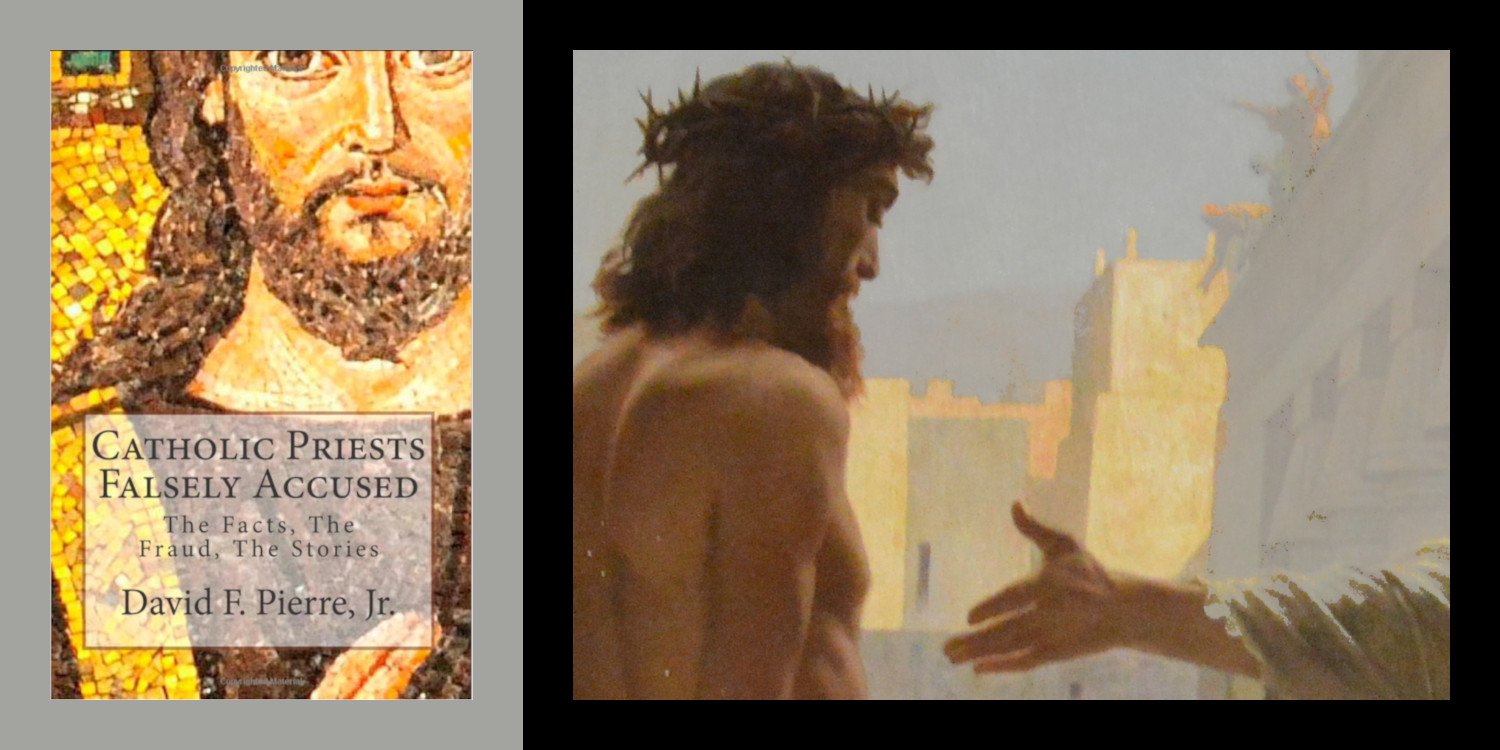
The Media Report: Catholic Priests Falsely Accused
David F. Pierre, Jr. is a widely acclaimed author on the Catholic abuse story. One of the cases presented in his book, entitled above, is that of Fr. Gordon MacRae.

David F. Pierre, Jr. is a widely acclaimed author on the Catholic abuse story. One of the cases presented in his book, entitled above, is that of Fr. Gordon MacRae.
October 19, 2022 by David F. Pierre, Jr.
A Message from David F. Pierre, Jr.:
“When I published my book Catholic Priests Falsely Accused over a decade ago, I never thought that the contents would still reverberate today and that the chapter on the case of Fr. MacRae would especially impact its readers. Since the book was released, there have been numerous additional revelations further vindicating Fr. MacRae — as Beyond These Stone Walls has compiled — and I consider the chapter just one piece of many chronicling the many important aspects of the case.”
The case of Father Gordon J. MacRae — from the Diocese of Manchester (New Hampshire) — falls into a category all its own. No single case in the Catholic Church abuse narrative has been more feverishly debated. The case has bitterly polarized observers for several years. There are those who maintain the priest’s guilt and those who forcefully assert his innocence.
Since 1994, Fr. MacRae has been incarcerated in the New Hampshire State Prison for Men. On September 23, 1994, a jury convicted the priest of repeatedly molesting a teenage boy during counseling sessions and elsewhere. A judge later sentenced the cleric to 67 years in prison.
Fr. Gordon vehemently asserts his innocence and claims that he is falsely accused. With the help of outside supporters, an old typewriter, and the use of traditional postal mail, Fr. MacRae authors BeyondTheseStoneWalls.com from his small prison cell. Fr. MacRae utilizes the blog not just as a forum to assert his innocence. He also posts thoughtful spiritual and theological commentary. BeyondTheseStoneWalls.com is truly a compelling venue on the Internet.
What are the facts in this controversial case? Those who believe Fr. Gordon’s guilt is demonstrable gesture to reams of court documents and articles available at an anti-Church watchdog site. However, as with so many other cases, there is an alarming opposite side to Fr. MacRae’s narrative that has not been widely told.
The criminal conviction of Fr. Gordon in 1994, which would catapult him to his sentence of 67 years in prison, rested on the uncorroborated testimony of one individual. The man’s name is Thomas Grover [who at this writing is 55 years of age]. Amazingly, two of Thomas’ brothers and two other men — known to the Grover boys — also accused Fr. Gordon of molesting them. Yet only the claims of Thomas Grover would be the subject of an actual criminal trial.
It is certainly a matter of debate whether the justice system yielded a fair trial for Fr. Gordon. Although the accuser Grover had a lengthy juvenile and adult criminal history of “theft, assault, forgery and drug offenses,” the presiding judge, the Hon. Arthur D. Brennan, did not allow the priest’s defense to present this as evidence. Had the judge allowed this important information, the jury may have examined Grover’s claims a bit more critically.
Indeed, Thomas Grover’s accusations were quite untenable. According to the court testimony of Grover, Fr. Gordon repeatedly sexually assaulted him about a decade earlier during four different counseling sessions in 1983, when he was fifteen years old. Asked at trial why he would repeatedly return week after week to counseling sessions at which he had been previously attacked, Grover testified that he had “repressed” the memory of the experience after each assault. He claimed that he had an “out-of-body experience” which resulted in him completely forgetting the fact that he had been victimized during the previous visit.
In addition, according to trial testimony, when Grover attended a drug treatment center in 1987, he told a counselor that his father had abused him. Grover did not cite the priest as an abuser. In fact, the accuser identified the priest by name to his counselor in only one instance. Grover wrote Fr. MacRae’s name on his discharge contract indicating that the priest would be his sponsor in sobriety. She reported that Grover went on in therapy to accuse so many people of sexually abusing him that the staff thought “he was going for some kind of sexual abuse victim world record.” But he never accused Fr. MacRae.
In a previous deposition under oath, Grover made more bizarre claims about Fr. Gordon, one of which was that the priest had chased him with a car. “And he had a gun,” the accuser added, “and he was threatening me and telling me over and over that he would hurt me, kill me, if I tried to tell anybody, that no one would believe me. He chased me through the cemetery and tried to corner me.” However, at Fr. MacRae’s trial, the prosecution did not call a single witness to corroborate the public spectacle of a priest with a gun in a car chasing a boy through a cemetery.
As the trial progressed, even the prosecution could see that Thomas Grover had serious credibility problems. In the middle of the trial, after Grover’s flimsy appearance, the prosecution offered Fr. Gordon a plea bargain in which the priest would agree to serve only a maximum of two years in jail in exchange for an admission of guilt. It was not the first time the prosecution extended such a generous deal. On two other occasions before the court case — six months before trial and again a week before trial — the state offered plea deals to Fr. Gordon, both of which would ask that he serve no longer than three years in prison. The prosecution would have loved to have seen the priest take the offers.
But Fr. Gordon was adamant. He would not plead guilty to charges that he maintained were false. “I am not going to say I am guilty of crimes I never committed so that the Grovers and other extortionists can walk away with hundreds of thousands of dollars for their lies,” the priest asserted.
The trial progressed, and although Thomas Grover’s testimony may have seemed hard to believe on the surface, the accuser was effectively theatrical during his appearance. He railed against the priest for “forcing” him to withstand the agony of a trial. In addition, during Grover’s testimony, the accuser’s therapist — retained by the man’s contingency lawyer — reportedly coached her former patient while sitting in open view inside the courtroom. Apparently directed by the therapist, Grover became emotional at strategic moments during his testimony. Courtroom witnesses have reported that when Grover was confronted with difficult questions, the therapist would gesture to her patient that he should cry. Grover would then become emotional and dramatic, often leading the judge to call a recess.
Meanwhile, Judge Brennan purposefully ordered the jury to “disregard inconsistencies in Mr. Grover’s testimony.” To the shock of Fr. Gordon, the jury returned with a guilty verdict in less than 90 minutes.
At Fr. Gordon’s sentencing, the prosecution efficiently utilized accusations of abuse charges by other men. Stomach-turning stories of child pornography also impacted the jury. An angry Judge Brennan railed against the convicted priest. He berated the cleric for his “lack of remorse” over his crimes. (Lost on the judge was the fact that the priest forcefully maintained his innocence and had rejected three different plea offers.) Building upon his rage, the judge added, “The evidence of your possession of child pornography is clear and convincing.”
There was one problem, however. “There was never any evidence of child pornography,” the lead detective on the case later admitted to The Wall Street Journal.
Under New Hampshire prison guidelines, Fr. Gordon will never be eligible for parole unless he admits guilt. As with the case of Msgr. McCarthy (Chapter 6), Father Gordon’s narrative highlights the zeal with which some detectives will seek a prosecution, despite the claims presented to them.
The criminal case against Fr. Gordon actually began when one of Thomas Grover’s brothers, Jonathan, approached Keene, New Hampshire, Detective James McLaughlin with the claim that Fr. Gordon had abused him years earlier. However, Jonathan did not just accuse Fr. Gordon of abuse; he accused a second priest as well — Fr. Stephen Scruton. However, as Detective McLaughlin further examined Jonathan’s claims, he realized that Fr. Scruton did not even serve at the parish of the alleged abuse until years after Jonathan claimed that the acts took place.
With this startling discovery of fact, many detectives would have concluded that Jonathan was not being truthful. There would even be more reason to doubt Jonathan when two of his brothers came forward to claim similar abuse by the two priests. But rather than dropping the investigation altogether and issuing charges against Jonathan for filing a false report, McLaughlin continued his crusade by simply scrubbing the existence of Fr. Scruton from future investigations altogether. [It was at this point in police reports that Detective McLaughlin gave the Grover brothers a copy of Fr. MacRae’s resume “to help them with their dates.”]
In the course of trying to nab Fr. MacRae, McLaughlin initiated a couple of attempted “stings” to get the priest to admit to the alleged abuse. One was a letter claiming to be from Jonathan Grover that “recalled” several sexual escapades and declared that the “sex between us was very special.” Fr. Gordon replied to the letter by saying that the letter writer must be an imposter, because no such acts ever took place. McLaughlin also attempted a number of secretly recorded phone calls to try to bust the priest, but none of them yielded anything incriminating. The calls were an utter failure, by all investigative measures.
Fr. Gordon would have been out of prison long ago if he had accepted the plea deals and admitted guilt. Instead, in staunchly maintaining his innocence, he will likely live in a prison cell for the remainder of his life.
In recent years, even more evidence has surfaced to support the claim that Fr. Gordon was falsely accused. One of the priest’s accusers (not Thomas Grover) has reportedly recanted his claims. In early 2011, a document surfaced in which the accuser plainly acknowledges that fraud was committed against Fr. Gordon and the Catholic Church. According to a New York investigative writer, the document says:
“I was aware at the time of the trial, knowing full well that it was bogus and having heard of the lawsuits and money involved, and also the reputations of those making accusations … whom I went to school with. It seemed as though it would be easy money if I would also accuse Fr. Gordon of some wrongdoing. … I believed easy money would come from lawsuits against MacRae. I was at the time using drugs and could have been influenced to say anything they wanted for money.” [Signed statement of Steven Wollschlager]
So despite the tempting opportunity of a high-stakes payout, the man refused to go along with what he saw was a gross money-grubbing scam.
In 2005 and 2013, Pulitzer Prize-winning writer Dorothy Rabinowitz profiled the case of Fr. Gordon for a trio of eye-opening articles for The Wall Street Journal. After months of studying court documents and combing through testimonies, Rabinowitz concluded that Fr. MacRae was clearly a victim of fraud and was wrongly convicted.
Sadly, under intense public pressure from events of the past decade, Church officials have essentially abandoned Fr. Gordon. Despite the fact that evidence possibly indicating innocence continues to surface, Church officials have kept their distance from the incarcerated cleric. While Church officials have publicly supported the prosecution of Fr. Gordon, there are reports that privately they admit that the cleric may have been falsely accused. For example, in 2011, two signed statements surfaced which claim that Bishop John McCormack, the longtime head of the Diocese of Manchester, has privately stated that he believes Fr. Gordon is innocent.
One such statement comes from a man who once worked at a television station that was to profile Fr. Gordon’s case. It quotes Bishop McCormack as saying to the man, “Understand, none of this is to leave this office. I believe Father MacRae is not guilty and his accusers likely lied. There’s nothing I can do to change the verdict,” Bishop McCormack said, according to the statement. [See Fr. George David Byers, “Omertà in a Catholic Chancery: Affidavits Expanded”]
The man submitted his statement about Bishop McCormack’s remarks because he believed there was a glaring injustice in the inconsistency between the Bishop’s public actions and his private statements.
Should the case against Father Gordon MacRae be reviewed? Considering the totality of the evidence, especially that which has surfaced in recent years, the answer is, “Yes.” Justice demands it.
In addition, recent developments and emerging information will likely result in appeals of Fr. MacRae’s case. Stay tuned.
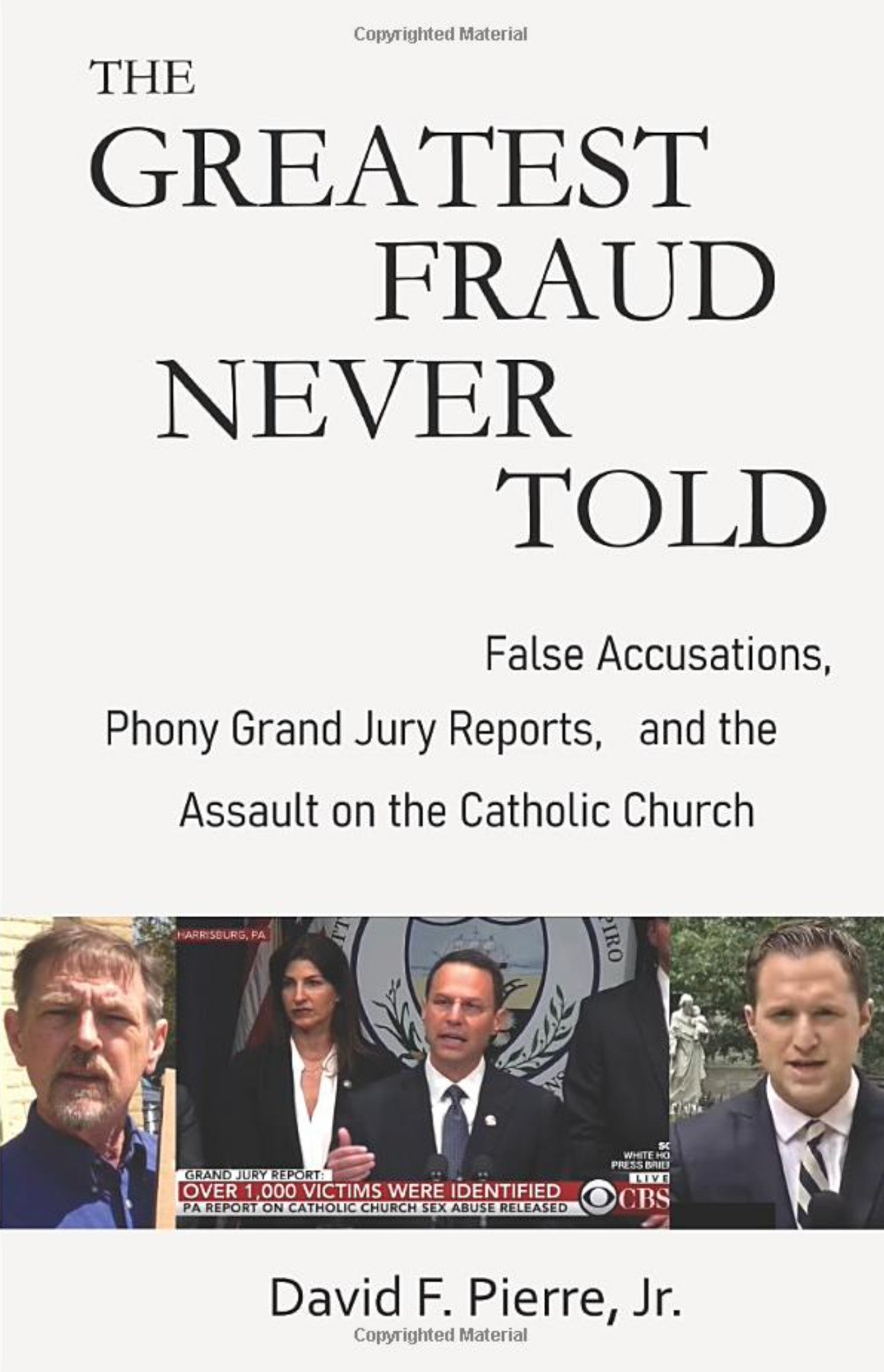
David F. Pierre, Jr. is the country’s leading observer of the media’s coverage of the Catholic Church abuse narrative and is the author of four books. His most recent is The Greatest Fraud Never Told: False Accusations, Phony Grand Jury Reports, and the Assault on the Catholic Church. David has been heard on National Public Radio (NPR) and cited in the New York Times, the Chicago Tribune, USA Today, and many other media outlets. He is the creator and author of TheMediaReport.com, an educational cooperative to chronicle and monitor the mainstream media’s coverage of the Catholic Church sex abuse narrative. He lives with his wife and family in Massachusetts.

Bogus Charges Against Priests Abound
Editor’s Note: In a 2012 article for Catalyst, the Journal of the Catholic League for Religious and Civil Rights, Rev. Michael P. Orsi, research fellow in Law and Religion at Ave Maria School of Law, wrote an extended review of David F. Pierre’s book cited above. His review is titled “Bogus Charges Against Priests Abound.”
The following is an excerpt from that review:
Catholic Priests Falsely Accused: The Facts, The Fraud, The Stories by David F. Pierre, Jr., Mattapoisett, Massachusetts: www.TheMediaReport.com
“David Pierre is one of the country’s leading observers of the Catholic Church abuse narrative. In Catholic Priests Falsely Accused: The Facts, the Fraud, the Stories, he presents case studies backed by hard data which clearly demonstrates some of the injustices foisted on Catholic priests and the Church. ...
“A sure way to ameliorate the injustices perpetrated against priests and to rehabilitate the reputation of the Church would be to re-examine the cases of those priests found guilty due to false or dubious abuse claims filed against them. The widely reported case of Fr. Gordon MacRae, of the Diocese of Manchester, New Hampshire, would be a good place to start. Pierre outlines it in his book. It is quite obvious that Fr. MacRae did not receive a fair trial according to the facts cited in a piece published in The Wall Street Journal.
“MacRae’s accuser, a fifteen year old boy, had a lengthy juvenile record and presented doubtful evidence in trial testimony. The judge even went so far as to order the jury to ‘disregard inconsistencies in Mr. Grover’s (his accuser) testimony.’ Father MacRae, protesting his innocence, refused a plea bargain deal of two years in prison. Now he is serving a 67 year sentence. His own, now retired, bishop believes him to be innocent. What a moral boost this would be for the nation’s priests and for the Catholic laity ... to have this case reopened!”
+ + +
BREAKING NEWS: Just as this post went to print, David F. Pierre, Jr. and The Media Report published “Twice Is a Charm? Wall St. Journal Again Profiles Stunning Case of Wrongfully Convicted Priest Fr. Gordon MacRae.”
To learn more about the rampant fraud, dishonest grand jury investigations, and career-building prosecutorial misconduct behind the Catholic Church abuse story, please consult these additional books by David F. Pierre, Jr. and The Media Report. Father Gordon MacRae also urges readers to subscribe to The Media Report.
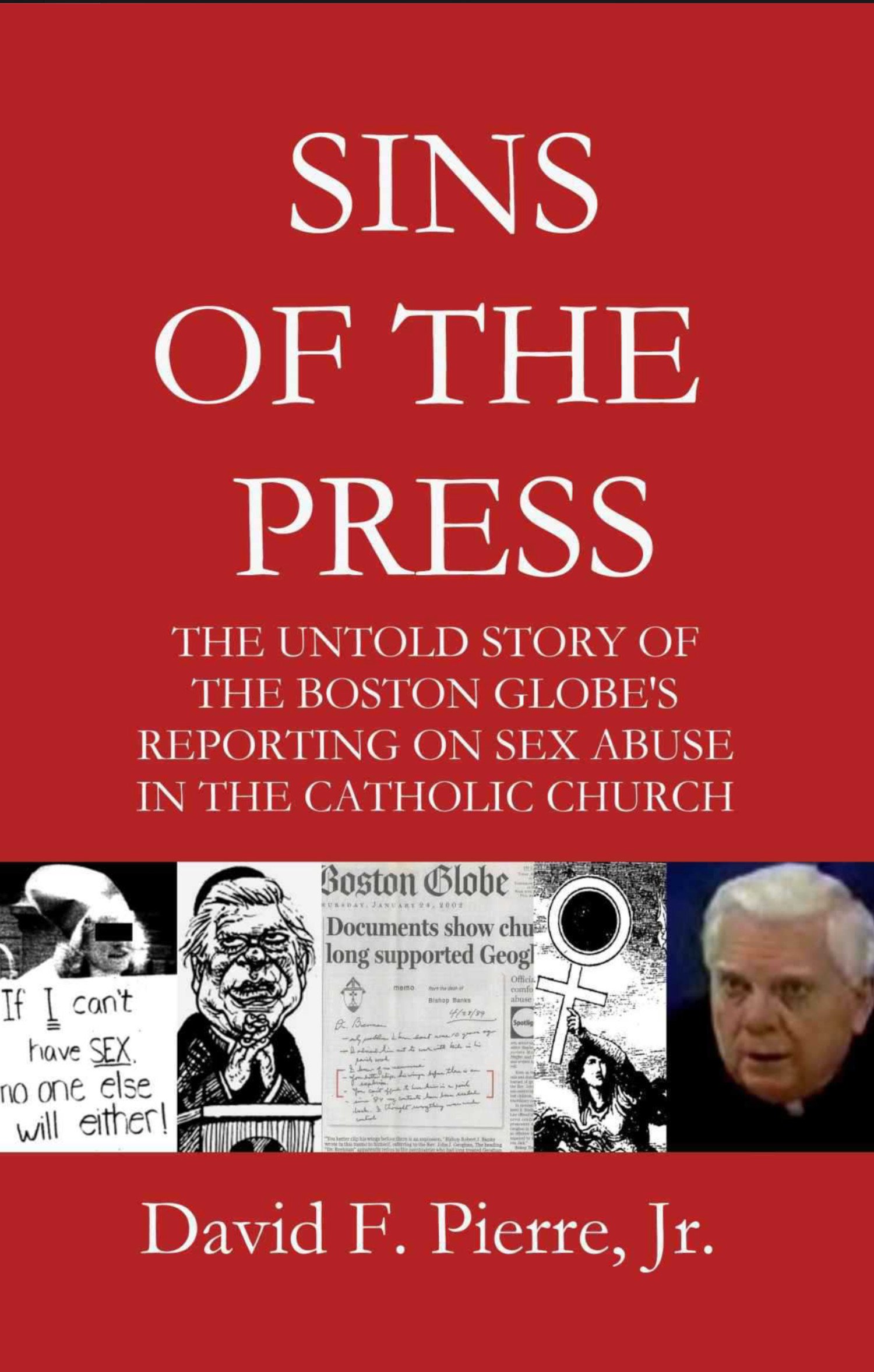
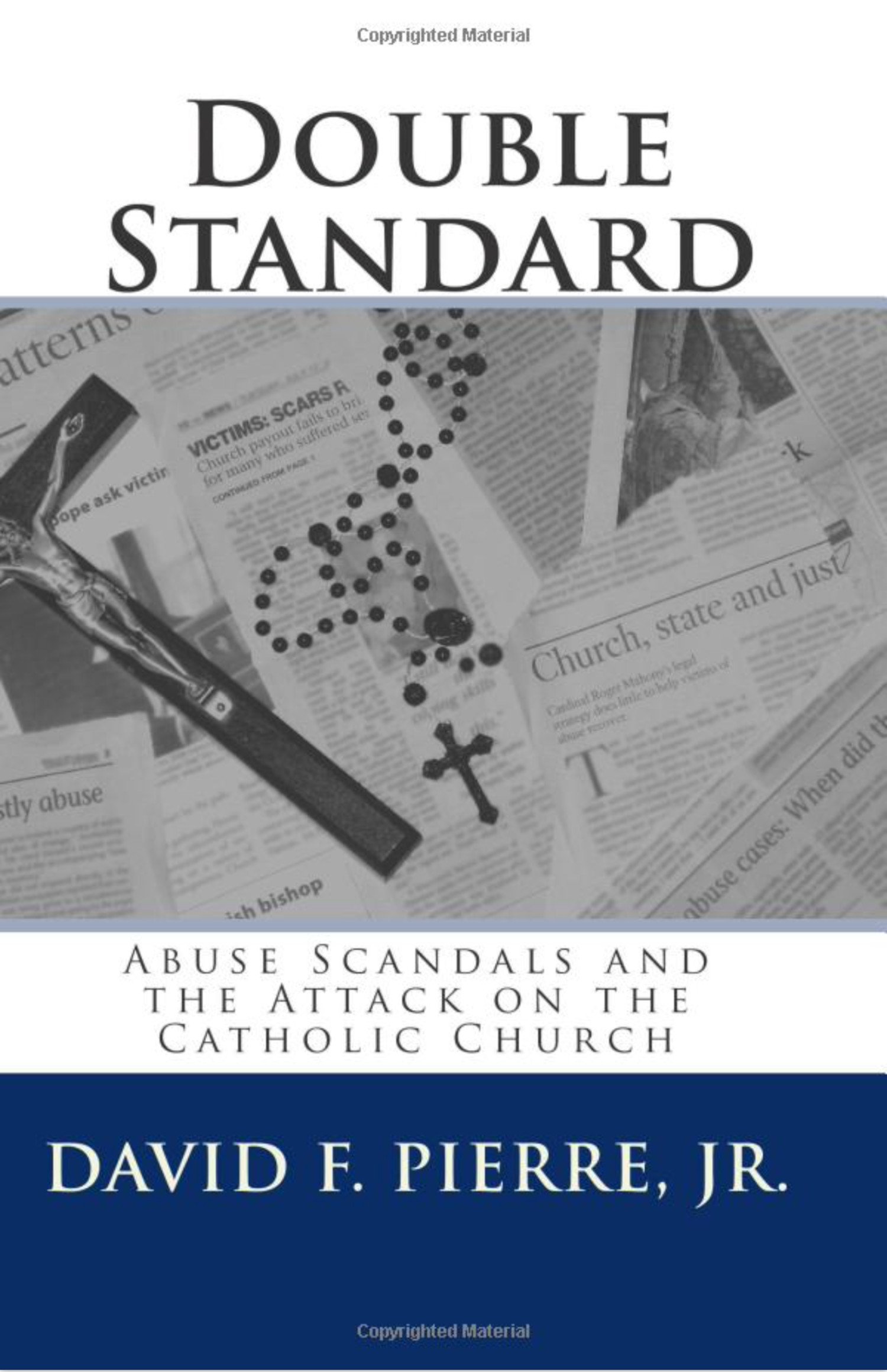


Weaponized Psychology: The Psych Evals of Father MacRae
Writer Damien Fisher cited psychological reports to bolster the condemnation of a priest in the court of public opinion, but some omitted facts expose a cover-up.

Writer Damien Fisher cited psychological reports to bolster the condemnation of a priest in the court of public opinion, but some omitted facts expose a cover-up.
October 12, 2022 by Ryan A. MacDonald
Editor’s Note: The following is Part Two of a series of posts by multiple writers presenting facts in the case of a wrongly imprisoned priest that some in the media have ignored or distorted. Part One, posted here one week ago, was: “A Reporter’s Bias Taints the Defense of Fr Gordon MacRae.”
+ + +
Part One in this series, linked above, explores a tendency of some in modern day news media to simply mimic material gleaned from prosecutorial officials. In news coverage, this practice has increasingly come to replace the hard work of investigative journalism and the natural skepticism every journalist should have.
One of the factors that irked me and other writers in Damien Fisher’s recent coverage of the MacRae story was his blind acceptance of an old and inadequate psychological evaluation of the accused priest that was debunked a decade ago. In 2012, a Catholic magazine published a letter to the editor from a reader of Father MacRae’s blog who defended him. In response, a member of SNAP, the activist Survivors Network of those Abused by Priests, wrote a rebuttal which was also published citing psychological evaluations of MacRae as evidence of his presumed guilt.
I wrote a more up-to-date and factual response, but it was a testament to the one-sided jaundice of even Catholic media on this topic that the lurid claims against the priest were published while my factual response was not. Given that Damien Fisher’s recent article cited here a week ago referenced the same biased and one-sided reports, I now present anew what I first uncovered in 2012.
Like all accused Catholic priests, Fr. Gordon MacRae was required by Church officials to undergo a psychological evaluation. It was one of the many travesties of justice in this case that elements of two of those reports inexplicably ended up in public view while a far more extensive and professional report did not.
Mr. Fisher gleaned his information from a 2003 Grand Jury Report on the Diocese of Manchester that referenced an inadequate and one-sided evaluation from an M.A. level clinician with a state contract to evaluate those accused of sexual offenses. The Grand Jury Report omitted a much broader and more professional assessment from a team of licensed psychologists and psychiatric experts that negates the validity of the evaluation cited in the Grand Jury Report and repeated by Damien Fisher.
It is indeed correct that MacRae was labeled a “fixated sexual offender” in a 1989 report by a masters-level clinician at the Strafford Guidance Center, a New Hampshire outpatient center with a state contract to evaluate those accused of sexual offenses. This evaluation was the result of a misdemeanor solicitation charge that was debunked extensively in my article, “A Reporter’s Bias Taints the Defense of Fr Gordon MacRae.”
A second evaluation was conducted over a four-day period at the now-closed House of Affirmation, a treatment center for clergy in Whitinsville, Massachusetts. It was entirely prosecutorial in nature, and in many ways it violated the priest’s basic civil rights. It weaponized the psychological process, reporting, for example, a finding that “Father MacRae exhibits extremely high abstract intellectual ability.” That result, from a single evaluation tool called the Wechsler Adult Intelligence Scale, was later used to unjustly label the accused priest as a potential sociopathic manipulator. The report and its conclusions were criminally unprofessional.

EEG recorded during scanning session.
A Forensic Search for Truth
Another, far more extensive evaluation was conducted by a team of three doctoral-level forensic clinical psychologists and two staff psychiatrists with decades of experience in the assessment of offenders. This in-depth assessment was conducted over a period of months at an inpatient facility, the Villa Louis Martin Center in New Mexico. What follows are excerpts of that report introduced by licensed clinical psychologist, Dr. Peter Lechner, Ph.D.:
“Of the reports mentioned earlier, one from House of Affirmation where Fr. MacRae spent four days and the other from the Strafford Guidance Clinic where he was evaluated, according to their report, for a two-hour period, they arrived at far-reaching, all embracing and definitive conclusions in regard to Fr. MacRae. The staff at VLM believes that such time periods would be inadequate to properly understand complex problems.
“The conclusions we arrived at came after many months.... It became clear that [Fr. MacRae] did not fit the description of the Strafford Guidance Clinic. He had a depth of conscientiousness and sensitivity to others, and a very high degree of ethical concern that did not fit with what their report said of him. Fr. MacRae does NOT fit the description of a fixated sexual offender. The reports are inaccurate.”
— 1990 Evaluation Report of the staff at Villa Louis Martin
Dr. Lechner went on to describe that the Strafford Guidance Center evaluation was conducted by an unlicensed masters-level clinician. It consisted of a single psychological test, the Minnesota Multiphasic Personality Inventory (MMPI) which was dismissed by the evaluator as “unrevealing and within normal range.” The sweeping negative conclusions of the rest of the report, according to the file, were arrived at based on three 45-minute interviews over the course of six weeks.
The clinician began his assessment with clear bias. The mere fact that MacRae is a Catholic priest with a commitment to practice celibacy, like all priests, was itself treated as sexually aberrant by the evaluator. His process and conclusions were dismissed as invalid and unjust by staff at the Villa Louis Martin Center. They concluded that “Two hours of interviews by a masters-level clinician is simply not professionally adequate to brand a man in the court of public opinion for the remainder of his life.” The director of the VLM Center added another comment to his report:
“In my report to the NH Department of Probation, I mentioned the accusations that had been made in the above reports by way of background information regarding what had been said about [Fr. MacRae]. I indicated that he did not present as someone obsessed by sexual fantasies or driven to act out. I then went on to write about our assessment and the medical issues [MacRae] faced. I was later dismayed to find out that my reports were misquoted, and positive statements that were essential to the reports were left out. This I feel was a serious injustice.”
The far more comprehensive VLM report by Dr. Lechner and his staff directly refuted the impressions of the Stafford Guidance Center assessment arrived at after three 45-minute interviews. However, the prosecutorial files released by the Diocese of Manchester after its bishop signed over the rights of the priests involved, and published online by the Attorney General in 2003 omitted the more professional report opting to publish only the impressions of the negatively biased one.
In the far more extensive report, the director of the VLM facility explained that MacRae remained at the Center for one year in 1989, an unusual length of time for inpatient treatment, but it was not because he was diagnosed as a sexual offender. That was discounted earlier. MacRae remained at the center for a year because a neurological evaluation that included an EEG and MRI revealed a diagnosis of epilepsy.
It has been professionally suggested that a diagnosis of untreated epilepsy and complex partial seizure disorder that was difficult to manage raised further questions about the legitimacy of the priest’s 1988 misdemeanor plea entered into without legal counsel after hours of intense badgering by a police detective with an agenda other than truth. This was disclosed in my article one week ago.
The VLM report of the evaluation of Fr. MacRae indicated that MacRae succumbed to coercion under duress in 1988 while talked into waiving his Constitutional right to legal counsel because Detective McLaughlin conned him into believing that he would be sparing the Church from adverse publicity if he took the plea. If MacRae is to be faulted for anything in this picture, the report concluded, “it is for placing his own well-being second.”
That 1988 misdemeanor charge was brought forward and propagated by the same detective who would five years later charge MacRae with more serious, but just as dubious offenses that now date back forty years. This is the same detective who now appears on a previously secret list accused of falsifying records, and has now also been accused of lying, erasing tapes, and tampering with evidence.
Four years after writing the Strafford Guidance Center report on MacRae, its author applied for employment at the Villa Louis Martin Center citing its thorough assessment of the priest as the reason for his desire to work there.
When Detective James McLaughlin’s new allegations emerged with new demands for settlement money in 1993, Fr. MacRae voluntarily submitted to two polygraph examinations with an expert. He passed both conclusively. No one who accused MacRae would agree to take a polygraph.

The Most Expert Evaluation
Perhaps the most important assessment, however, is one uncovered by Fr. George David Byers revealed in his article “Omertà in a Catholic Chancery: Affidavits Expanded.” Over 28 years in the New Hampshire State Prison, Fr. MacRae has never been even suspected of any form of predation. The prison system’s own evaluation labeled him at the lowest level of risk for any form of aberrant sexual interest or behavior. For 15 of those years MacRae was housed in a 60-square-foot cell with Pornchai Moontri, an adult survivor of sexual abuse. There is perhaps no better expert on the character of Fr. MacRae.
In Fr. Byers’ article linked above, he conveys a true story revealed to him by Pornchai:
“Pornchai has helped me to understand a truth that is nearly universal among those who have in fact been victims of sexual assault. The only thing that is as obnoxious to them as having been raped is to see their own sufferings capitalized upon by false accusers for money, and by clericalists who make themselves into heroes by paying out settlements with no evidence or due process of law. Priests are too often considered guilty just for being accused.
“Prison, by nature, is often a violent place. As a child of 12 brought to the State of Maine from a foreign country, Pornchai became a victim of violent sexual abuse. When Pornchai went to prison at age 18, he dealt with prison violence in the only way he could. He vowed that he would never again be someone’s victim. So he understandably met violence with violence of his own. It landed him in repeated long years in solitary confinement.
“After 14 years, Pornchai was transferred to the New Hampshire prison. He ended up in a cell with a man accused and convicted of the very thing that destroyed his life. It did not take him long — with his innate alertness to victimization — to discover that Father G had been falsely accused. Pornchai once told me this story that I held off writing until he was out of the prison system:
‘One day, I got a notice from the prison mental health department that a new 2O-week program was beginning called ‘Interpersonal Violence.’ My friend Father G thought it might be an opportunity for me so I said I would go if he goes with me. So we both signed up for it. Prison is filled with needy young men who have really broken lives. Some of them look for safe, comfortable older prisoners who might buy them things and take care of them. The result is a sort of mutual exploitation and prisons are filled with this. One young kid, about 19, who was attending the program quickly tried to latch on to Father G without knowing anything about him. I was going to speak with the kid, but decided to wait.
‘Over the next few sessions as I sat next to Father G, I was aware of how this kid was skillfully trying to gain his interest and maneuver his way into his life, but Father G was oblivious to it. Later that night I told him what I observed, but he had no idea what I was talking about. At the next session, Father G and I simply agreed to switch seats. In all his years in prison, Father G has been surrounded by people like this, many of them young drug addicts who would sell their soul for a few bucks for drugs. In all those years, Father G was never observed or even suspected of having any interest in them at all except to show those receptive to it a way out of their prison within a prison.’ ”
+ + +
IMPORTANT EDITOR’S NOTE:
During the 15 years that Fr. MacRae and Pornchai Moontri lived in the same prison cell, MacRae investigated Pornchai’s life and wrote about it in an explosive account that brought his abuser to justice. Richard Alan Bailey was convicted in 2018 on 40 felony counts of child sexual abuse. This most important story is told in
“Getting Away With Murder on the Island of Guam.”
+ + +
BREAKING NEWS — NEW IN THE WALL STREET JOURNAL:
Nationally prominent criminal-defense and civil-rights Attorney Harvey Silverglate has just published an op-ed on developments in the Fr. MacRae case in the WSJ. This is the fourth major article in the WSJ on this story. We have reprinted the op-ed so it may be viewed by our readers:

A Reporter’s Bias Taints the Defense of Fr Gordon MacRae
Ignoring exculpatory evidence and more honest media coverage, a writer’s selective reporting undermines the defense of a priest wrongly imprisoned for 28 years.
Ignoring exculpatory evidence and more honest media coverage, a writer’s selective reporting undermines the defense of a priest wrongly imprisoned for 28 years.
October 5, 2022 by Ryan A. MacDonald
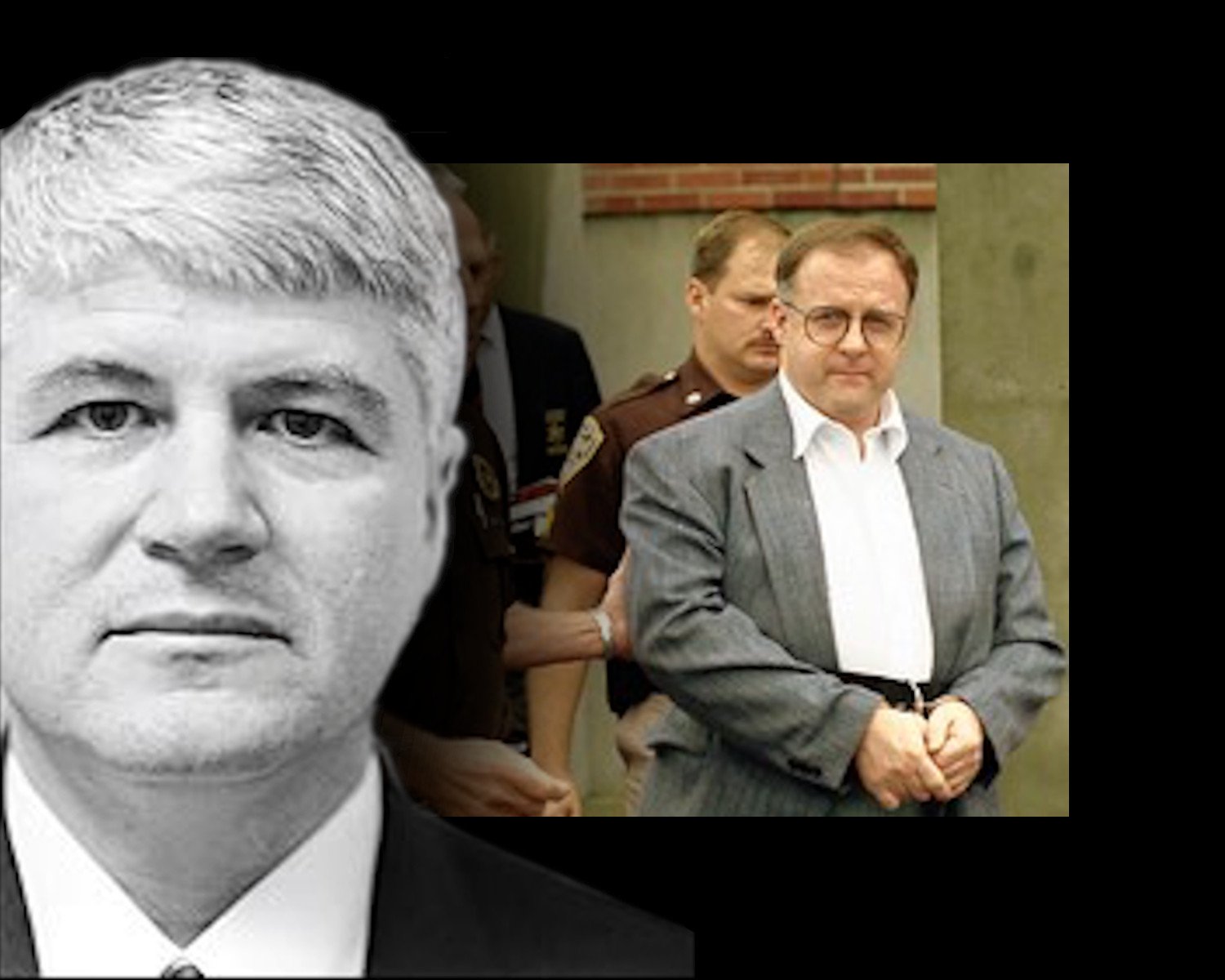
Editor’s Note: The image above depicts Keene, NH Detective James McLaughlin whose investigation of an early 1980s sexual assault case resulted in the wrongful imprisonment of Fr. Gordon MacRae. The following is a guest article by contributing writer, Ryan A. MacDonald. His most recent post in these pages was “Police Misconduct: A Crusader Cop Destroys a Catholic Priest.”
+ + +
Writing for InDepthNH, a New Hampshire online news venue, reporter Damien Fisher presented a negligent and entirely biased overview of the case against Fr. Gordon MacRae. On the one hand, it represented well that Keene, NH Detective James McLaughlin, who orchestrated the case against MacRae, is now exposed for falsifying records, tampering with evidence, and other misconduct which contributed to wrongful convictions.
On the other hand, a recent article by Damien Fisher obfuscates any future defense of MacRae with content that has already been debunked by more balanced investigations in The Wall Street Journal and elsewhere. (See our page on The Wall Street Journal.) Fisher’s article includes only the one-sided claims of a 2003 Grand Jury Report that a New Hampshire judge has already determined to have been published without merit or justice. Here is what Judge Richard McNamara wrote regarding the content of that report:
“[The 2003 Grand Jury Report on the Diocese of Manchester] fulfilled none of the traditional purposes of the common law grand jury. Rather than investigation of crime, the report is a post hoc summary of information the grand jury considered but did not indict on. A grand jury report that does not result in an indictment but references supposed misconduct results in a quasi-official accusation of wrongdoing drawn from secret ex parte proceedings in which there is no opportunity available or presented for a formal defense. ... Such a grand jury report is not far removed from, and no less repugnant to traditions of fair play than lynch law.”
— NH Judge Richard McNamara, August 12, 2019, In re: Grand Jury, No. 217-2017-CV-00382
Much of the content of the 2003 Grand Jury Report was generated in one-sided claims for settlement money and handed over to the State by Diocese of Manchester official Reverend Edward J. Arsenault. While settling without due process some 250 abuse claims against priests of the New Hampshire Diocese dating back 30 to 50 years, Arsenault was later charged and convicted of financial crimes in the amount of nearly $300,000 used to secretly support a relationship with a young gay musician. Now dismissed from the priesthood, he has a new name, Edward J. Bolognini. For some reason, he has been given a pass in Damien Fisher’s account.
The U.S. Department of Justice has recently disclosed an ongoing investigation into over $45 billion in fraudulent claims to reap benefits related to the Covid 19 pandemic. After the massive Gulf oil spill several years ago Exxon Oil Company had to establish a fraud task force to separate valid claims of damages from the billions of dollars in fraudulent ones. What makes anyone think that the Catholic abuse story has been spared such fraud?
This all requires a response. Today and over the next few weeks in these pages, David F. Pierre, Jr. of The Media Report.com, Catholic League President Bill Donohue and I will continue this rebuttal of that one-sided material. I hope readers of this blog will share this information widely to give this truthful side of the MacRae story the attention it deserves. Anything less is to contribute to what Dr. Bill Donohue called “a travesty of justice.”

Conflicts of Interest
In reporting on the MacRae case, however, Damien Fisher also has a conflict of interest. His wife is a columnist for Parable magazine, the official publication of the Diocese of Manchester, Father MacRae’s estranged diocese.
The Parable Managing Editor is Kathryn Marchocki, formerly a reporter for the statewide newspaper, New Hampshire Union Leader. In that capacity, Ms. Marchocki covered the 1994 MacRae trial and the 2003 Grand Jury Report on the Diocese of Manchester.
In early 2003, just before the New Hampshire Grand Jury Report was released to the public, Kathryn Marchocki met with Fr. MacRae at the New Hampshire State Prison. He presented her with a large amount of documentation that challenged the hyped contents and accusations in that one-sided report. Ms. Marchocki reportedly told the priest that his information is compelling, “but New Hampshire news media and my paper in particular are so anti-Catholic my editor will never let me write about this.”
Nonetheless, she asked MacRae — then in his ninth year in prison — to send her everything he had. He did, but never heard from Ms. Marchocki again. Now she is the editor of the Diocese of Manchester news magazine in which Damien Fisher’s wife is a columnist appearing in the monthly publication just opposite the musings of Father MacRae’s bishop, Most Reverend Peter A. Libasci, who himself now stands accused in a sexual abuse civil lawsuit in the State of New York. (See “Bishop Peter A. Libasci Was Set Up by Governor Andrew Cuomo.”)
Readers are likely aware of developments in the matter of former Keene, NH Detective James McLaughlin and his brief appearance on the Attorney General’s “Laurie List,” also called the Exculpatory Evidence Schedule. When the first rumblings about rampant dishonesty on the part of Detective McLaughlin began to appear in 2021, I personally reached out to Damien Fisher with a concern that the Father MacRae case had not been properly investigated and did not receive a fair trial.
Mr. Fisher shot back immediately with a verbal attack. He declared MacRae to be guilty based solely on untried rumor, innuendo, and uncorroborated claims for monetary settlement, such as those brought without trial in the discredited 2003 Grand Jury Report. He offered nothing that could be interpreted as evidence. I offered to send Mr. Fisher some compelling documentation that challenged his narrative, but I received this final message in reply: “Stop! I do not want to see anything you send. My mind is made up!” So much for journalistic integrity and objectivity.

Father MacRae in 1983, the time of the alleged charges (Courtesy of The Wall Street Journal)
A Pornographic Priest?
Much of Mr. Fisher’s current media coverage of MacRae centers on a claim that the priest produced pornographic photographs and videos of his accusers. The truth about this is in plain sight right at Mr. Fisher’s fingertips, but he omitted it. The accusation of creating pornography was first lodged by Detective McLaughlin himself in 1988. He had no evidence for it beyond a claim that he choreographed and promoted for a civil lawsuit involving an individual named Jon Plankey described in McLaughlin’s report as his “employee in a family-owned business.”
The first accusation elicited by McLaughlin was that MacRae had attempted to verbally solicit the teen. It was only after some evolution that a more substantial — and more lucrative — claim emerged that MacRae took photographs of the youth. McLaughlin actually wrote in his report that these claims will be the basis for a civil lawsuit against the Catholic Church. The lawsuit was settled without question by MacRae’s diocese over his strenuous objections.
The pornography accusation later weighed heavily in Father MacRae’s 1994 trial and sentencing in an unrelated case, that brought by accuser Thomas Grover. When sentencing the priest to life in prison, Judge Arthur Brennan cited MacRae’s “aggressive denials of wrongdoing [and] the evidence of child pornography is clear and compelling.”
But none of it ever happened. In 2005, Dorothy Rabinowitz at The Wall Street Journal investigated this entire case for her extensive report, “A Priest’s Story,” which served as a factual refutation of much of the content appearing in the 2003 Grand Jury Report. The accuser in the pornography matter, then in his 20s, declined to answer any questions, but Ms. Rabinowitz questioned Detective McLaughlin about the “clear and compelling” evidence of child pornography. The detective was cornered, and admitted,
“There was never any evidence of pornography.”
— Detective James McLaughlin
This information was available to Damien Fisher, but if he found it he could not continue the pornography victimization narrative, so he apparently never bothered to look.
There is a lot more to that story. In 1988, McLaughlin interviewed MacRae about Plankey’s claims for four hours on tape. McLaughlin, as was his practice, wrote reports claiming several admissions by MacRae that the priest says today were never made. MacRae insists that those claims could not possibly be on the tape. Later, when MacRae faced trial in 1994, the judge ordered all tape recordings turned over to his defense. Neither MacRae nor his lawyer ever received a single one. McLaughlin claimed, under oath in sworn Interrogatories, that the tapes in question were accidentally taped over for another case and the transcripts he cited were never made due to “clerical error.”
Eleven years later in 2005, McLaughlin apparently forgot his earlier perjury and sent that tape to The Wall Street Journal : Dorothy Rabinowitz wrote of how McLaughlin badgered MacRae again and again to plea to a misdemeanor of attempting to endanger a minor, but without legal representation. Here is her 2005 report about the tape:
“Fr. MacRae, summoned to meet with Detective McLaughlin, was informed that there was much more evidence against him, that the police had an affidavit for an arrest, and that it would be in everybody’s best interest for him to sign a confession. On the police tape, an otherwise bewildered-sounding Fr. MacRae is consistently clear about one thing — that he in no way solicited the Plankey boy for sex or anything else. ‘I don’t understand,’ he says more than once, his tone that of a man who feels that there must, indeed, be something for him to understand about these charges that eludes him.
“He listens as the police assure him that he can save all the bad publicity. ‘Our concern is, let’s get it taken care of, let’s not blow it out of proportion... . You know what the media does,’ they warned. He could avoid all the stories, protect the Church, let it all go away quietly.”
— The Wall Street Journal, “A Priest’s Story”
From here on the recording was shut off. MacRae says the badgering went on for another three hours. The priest had never before been in such a situation. When he asked if he should consult a lawyer, the detective reportedly said, and today denies saying it, doing so “will only muddy the waters.” In the end, MacRae signed the paper without legal counsel just to end this. In concluding the matter, McLaughlin wrote a press release: “Though no sexual acts were committed by MacRae,” it noted, “there are often varied levels of victimization.” Indeed there are!
In his police report on this matter, Detective McLaughlin wrote that Plankey worked for him in a family-owned business. Plankey’s mother was also an employee of the Keene Police Department. Before MacRae even knew about the claims, The Wall Street Journal reported, MacRae’s diocese received a call from Mrs. Plankey informing officials there that MacRae was being investigated on solicitation charges and a quick out-of-court settlement would “avoid a lawsuit and lawyers.”
Ah, but there’s more! This was not Detective McLaughlin’s first use of Jon Plankey to bring down a target. Plankey made an identical set of claims against Timothy Smith, a Keene Congregational church choir director with whom he struck up a relationship. That case was prosecuted by McLaughlin and ended in a similar misdemeanor plea deal. And Plankey accused a local Job Corp supervisor of soliciting him. That was another misdemeanor case pursued by McLaughlin. Then he accused a man who picked him up hitchhiking of soliciting him.
It was only after the above interview that the claim of producing photographs was made. The priest was never charged with this because that would require producing some evidence. Instead, McLaughlin capitalized on it for a civil settlement for Plankey despite later revealing to The Wall Street Journal that the story was contrived and there was never any evidence of pornography. The story nonetheless had a long shelf life. It was used by Judge Arthur Brennan to enhance MacRae’s sentence after trial in 1994.
And it was used by David Clohessy at SNAP, the Survivors Network of those Abused by Priests, to bolster a Crimes Against Humanity charge against Pope Benedict XVI in the International Criminal Court at The Hague. This aspect of McLaughlin’s handiwork was explored by journalist, Joann Wypijewski in “Spotlight Oscar Hangover: Why ‘Spotlight’ Is a Terrible Film.”
The Plankey case was among the files investigated by former FBI Special Agent Supervisor Jim Abbott, a specialist in counter-terrorism. Like most claimants, Jon Plankey took his money from the Diocese and disappeared. When Agent Abbott found him, Plankey refused to answer any questions without a lawyer. I had been writing about this matter and received an email message from Jon Plankey’s brother. Agent Abbott went to interview him and was told that the claims were a scam for settlement money. The brother said there is more to tell, but he, too, wanted money.

The Plea Deal Injustice
Damien Fisher relentlessly referenced Father MacRae’s post-trial acquiescence to a plea deal coerced by circumstances, presenting it as his sole evidence to bolster his implications that MacRae must be guilty. I do not want to belabor this point for I have written about it extensively already. When MacRae was convicted at trial — after Judge Arthur Brennan instructed the jury to “disregard inconsistencies in [accuser] Thomas Grover’s testimony” — he still faced additional “pile-on” charges from Grover’s brothers and two others who had climbed aboard for the inevitable monetary settlements.
When one of the newer accusers learned that MacRae was not likely to take any deal, he left the country to avoid testifying in a trial and he never filed his civil claim. Another accuser groomed by McLaughlin, Keene native Steven Wollschlager, received a summons to appear before a grand jury to indict the priest on a new charge.
Steven later went on to describe that he was solicited by McLaughlin to join other accusers in fabricating claims against MacRae. The enticement was a $50 bill and an assurance that a lot more money could be obtained in a civil lawsuit against the Church. When Steven balked, McLaughlin allegedly pointed out the girlfriend and child Steven had and said that life could be so much easier for them with a lot of money. Steven pondered this, and then agreed. He later described these meetings with McLaughlin:
“It was all about the lawsuits and the money. I was led to believe that all I had to do was make up a story about MacRae like others had done and I could obtain a lot of money. I was using drugs at the time and could have been influenced into saying anything they wanted for money.”
On the way to the court, Steven explained, he found his moral center and could not go through with it. He said that he knew MacRae as a teen and that the priest only tried to help him. He was told by an unnamed court official, “We won’t be needing anything further from you.”
When the trial was over, MacRae was penniless, abandoned by his Bishop and Diocese. He was placed in jail in custody until sentencing and had nowhere to turn. His lawyer resigned, exasperated at the three-ring circus in the trial and the lack of being allowed to put on an adequate defense. McLaughlin and prosecutors then offered MacRae another deal: a concurrent one-year sentence ending all remaining charges to be served simultanously with the sentence yet to be handed down in the Thomas Grover case.
MacRae’s trial lawyer, who left the trial before it was over, told MacRae in a telephone call from jail that he had no choice but to accept the deal. His bishop and Diocese, anxious to provide settlements and be rid of this, had issued a pre-trial press release declaring that the entire Catholic Church was victimized by MacRae. Everyone around him told him he had no choice. He went to the Court men’s room and vomited after entering his negotiated lie. I wrote extensively of this in “The Post-Trial Extortion of Fr. Gordon MacRae.”
All of this — my articles, the extensive coverage by The Wall Street Journal, the investigation by FBI Special Agent Jim Abbott, the polygraph examinations that Fr. MacRae passed conclusively, the findings of the National Center for Reason and Justice now sponsoring MacRae’s defense — has been in plain sight, readily available to Damien Fisher. He opted instead to spread another narrative, and God alone knows why.
There is more still, and it is coming. Perhaps the most egregious “evidence” cited by Damien Fisher came from supposed psychological evaluations of the accused priest. This will be the topic of a follow-up post next week in these pages.
+ + +
“In my three-year investigation of this matter, I have found no evidence that Gordon MacRae committed these crimes, or any crimes.”
— Sworn Affidavit of former FBI Special Agent James Abbott
+ + +
Editor’s Note: Ryan A. MacDonald has written extensively on the sexual abuse crisis in the American Catholic Church. You may also be interested in these related posts.
Grand Jury, St Paul’s School and the Diocese of Manchester
The Trial of Father MacRae: A Conspiracy of Fraud
The Post-Trial Extortion of Father Gordon MacRae
Be Wary of Crusaders! The Devil Sigmund Freud Knew Only Too Well

Getting Away with Murder on the Island of Guam
The U.S. Territorial Island of Guam has 103 unsolved cold case homicides. The victim in Case No. 70 was the mother of Pornchai Moontri and it needs a new set of eyes.

The U.S. Territorial Island of Guam has 103 unsolved cold case homicides. The victim in Case No. 70 was the mother of Pornchai Moontri and it needs a new set of eyes.
September 14, 2022 by Fr. Gordon MacRae
Important Note from Father MacRae: It has not escaped my notice that this is being posted on the Feast of the Exultation of the Cross. That is most fitting. This is an unusual post for us, but a necessary one. It tells a story that has deeply impacted our lives and it has been a long time in the making. Please note that portions of this account may be disturbing. I have done all I can to minimize such content without minimizing the story itself. This post is longer than most, but it is a mesmerizing account with no part that I could justly omit. If you have never shared a post of mine on social media or with others, please share this one.
+ + +
The Island of Guam, which at 212 square miles is the largest of the Mariana Islands in the Western Pacific, is today home to about 170,000 people. About 80% are indigenous Chamorro or of Filipino or other Pacific Islands descent. Guam also hosts one of the most strategic U.S. military bases in the Pacific, Andersen Air Force Base. In 1950, United States citizenship was conferred upon all permanent residents of this unincorporated U.S. territorial island.
As in the rest of the U.S., the citizens of Guam elect their Executive and Legislative branches of government. Guam has a federal judiciary appointed by the U.S. president, and superior court judges and an Attorney General appointed by the governor. Guam also has a phenomenon plaguing its law enforcement system. Writing for the Guam Daily Post (November 7, 2021) reporter Nick Delgado penned an article about the extraordinary number of Guam’s unsolved ‘cold case’ homicides.
One of these unsolved cases, number 70 on a list of 103, is that of Wannee Laporn Bailey, the mother of Pornchai Moontri. She was murdered in Guam at age 47 on April 18, 2000. I first wrote of this in “Human Trafficking: Thailand to America and a Cold Case in Guam,” an article that lays out the back story of Pornchai’s life before being sent to prison at age 18.
Earlier articles that I wrote about Pornchai’s life garnered some attention from around the world, including from some who had formed erroneous conclusions about him and his offense. What I wrote gave context to a nagging gap in his 1993 trial. That gap was the six years between his arrival in the United States at age 12 and the offense that sent him to prison at age 18.
After reading my articles, Clare Farr, a Trademarks attorney with an Intellectual Property law firm in Western Australia, alerted police and the District Attorney in Maine that something essential was amiss in Pornchai’s trial: an account of six years of trauma prior to his crime. A detective and an Assistant District Attorney then went to interview Pornchai 26 years into his prison sentence.
Then they interviewed Pornchai’s brother, Priwan, two years older. These interviews, now heavily corroborated, resulted in a 2017 warrant for the arrest of Richard Alan Bailey at his Westlake, Oregon home. He was indicted on 40 felony counts of gross sexual assault, charges in which Pornchai and his brother, Priwan, were victims as young immigrant children transported from rural Thailand to the city of Bangor, Maine in 1985. A long held and highly destructive secret thus ascended into the light.

Richard Bailey Brought to Justice — Sort Of
On September 12, 2018, Richard Alan Bailey entered a plea of “no contest” but was found guilty in a Maine Court on all 40 felony sexual assault charges. A testament to the nature of these proceedings was that of Pornchai himself whose testimony was read into the court record by Assistant District Attorney Alice Clifford:
“Your Honor, Richard [Bailey’s] actions have had a catastrophic impact on me, and I believe it is important for the Court to understand this in the context of my life history. I am an inmate of New Hampshire Prison for Men. I am in prison because when I was only 18, I killed a man and I have been in custody ever since. In 1993, I was sentenced to a term of 45 years in prison. I am now 46 years of age and have spent 60 percent of my life in prison.
“What Richard [Bailey] did to me began when I was only 12-years-old. The few years that I have spent in his “care” — and “care” is in quotations — were the worst years of my life. Worse even than the last 26 years in prison.
“I accept responsibility for the crime I committed. However, the responsibility for turning me into an angry, alienated and despairing young man who killed a man belongs to Richard Bailey. And he has never faced up to what he did to me. Nor has he faced up to what he did to my brother and our mother, Wannee.
“I was born in Thailand, and at the age of two I was abandoned by my parents and then raised by my grandmother living on a small farm in the north of Thailand. When I was 11, my mother came to retrieve me and my brother and told us that she had married an American, that she would take us to live with him in the United States, that we would have a great life, and want for nothing.
“We came to America in December of 1985 when I was 12. Within two weeks, Richard Bailey began to sexually assault me. The first time was when I was lying on the floor covered with a blanket while I was watching television. Richard placed himself under the blanket and began to fondle me. I was terrified.
“On another occasion … he got in the shower with me and began to explain male physiology while fondling me. At other times he would make me watch pornographic material. It wasn’t long before things graduated to sodomy. He would do such things when my mother was not in the vicinity. He would take me for drives or go camping and he would sodomize me. I hated it. I hated him. I could not speak English, but Richard was clear that if I told about the sexual assaults there would be dire repercussions.
“At home, Richard was a tyrant and a drunken bully who was physically abusive to me, my mother and my brother. We lived a life of fear, intimidation, and violence. No one was allowed to speak Thai in the house and we were not permitted to have friends come over … He completely controlled our lives …
“I first ran away from him to escape the abuse at age 12, only to be returned to him by the police. I spoke very little English and wasn’t able to tell the police that Richard had been sexually assaulting me. I could not tell my mother at that time because Richard threatened what would happen to her if I told.
“Richard Bailey sexually assaulted me more times than he is charged with … I ran away again and again, living in juvenile detention centers, the homes of friends, or finding a place of shelter wherever I could. Sometimes my mother would bring me food when I was living under a bridge in Bangor. When I had no food, I would steal. When I was caught I was sent to juvenile detention where I told counselors about the abuse and they reported it.”
— End of Transcript Excerpts

Maine Youth Center
Justice Delayed — Repeatedly
Because Pornchai was a prisoner when Richard Bailey was finally brought before the Court, the D.A feared putting Pornchai on the witness stand in a trial. So Bailey was offered a plea deal, and like most guilty defendants, he accepted it. For 40 felony counts of child sexual abuse, Bailey would serve no time in prison and 18 years on probation. After registering on the State of Maine Sex Offender Registry, he quietly returned to his lakeside Oregon home. He is clearly not “Father” Richard Bailey.
Over the six years when Pornchai was 12 to 18 years of age leading up to his own offense, Maine officials received reports about the sexual abuse of Pornchai. These interventions were inexplicably ineffective. Official reports from the Maine Youth Center and Department of Human Services should have resulted in a protection order for Pornchai, an investigation of Richard Bailey, and criminal charges, but none of that happened. Here are excerpts:
November 8, 1989: “Pornchai alleges that his stepfather, Rick Bailey, perpetrated sexual and physical abuse upon him. [He] is concerned that Mr. Bailey will take out revenge on his mother.”
November 10, 1989: “Pornchai has trouble explaining himself in English, so it was hard to get more details from him. Also, he is protective of his mother.”
December 14, 1989: “[The sexual abuse] totally destroyed boy’s faith in family — mother made aware — did nothing. Boy began to habitually run away. Boy terrified some type of revenge will be taken out on mother.”
December 21, 1989: “Pornchai has opened up to me information about sexual abuse by his stepfather. This was a significant breakthrough with Pornchai since he has been holding this in … At this point we have notified the Dept. of Human Services.”
February 15, 1990: “In terms of the allegations of sexual abuse, Pornchai has to go to Bangor. He will have to make a tape or prepare some kind of testimony and he is having a very difficult time even thinking about the events that occurred.”
April 26, 1990: “Pornchai has been going through some major crises in his life … He went to court in Bangor and was made a ward of the State. His allegations of sexual abuse do not seem to have progressed … His mother was in to visit him and told him that she did not want him to go through with this issue any further. He fears that he will be harming his mother if he proceeds with this.”
From an undated Interagency Protocol Report: “Boy states that stepfather started touching him, talking “dirty,” showing porno movies and progressively became more abusive. Made Pornchai perform oral sex on him. He would pull his hair and slap him if he refused. He would set up situations where he would have Pornchai alone. Stated if he told anyone his mother would suffer.”
The record contains dozens of similar reports of violent sexual abuse, some much more graphic and disturbing. Sheriff’s deputies once found Pornchai escaping Bailey’s house by running along railroad tracks out of Bangor, but they did not understand his protests as — with shades of the infamous Jeffrey Dahmer story — they forcibly returned him to Richard Bailey. They wrote a report of their suspicions, however, but nothing happened.
Pornchai’s mother found blood on his bedding and underwear, but Bailey kept her in a silent state of poverty, desperation and helplessness according to statements from neighbors and others. One neighbor confronted Bailey after seeing 12-year-old Pornchai beaten and bloody. Bailey beat Pornchai again while forbidding him from interacting with others. A school nurse documented suspicions that Pornchai was sexually and physically abused, but she was advised to keep silent and not get involved.

Penobscot County Jail
Pornchai’s Offense
From there on Pornchai spent most of his childhood living on the streets of Bangor, a broken child. Harassed by a Bangor gang, he carried a knife for protection. At the 2018 plea deal hearing for Richard Bailey, the D.A. read again from Pornchai’s Statement:
“A few months after I turned 18, I was involved in an incident at the local supermarket and I killed a man when I was highly intoxicated. I was tackled by Michael Scott McDowell, a man having a much larger frame than myself, and in a kneejerk reaction I took my knife and stabbed him and he later died. It was unintentional. At the moment I stabbed at him my mind was Richard Bailey on top of me and I never wanted to be in that situation again.”
It was not up to Pornchai Moontri to investigate and prosecute Bailey. That was the job of the State of Maine and the State failed him miserably. Pornchai was a traumatized child who neither spoke nor understood English when Bailey’s assaults commenced. After all the above interviews with DHS and Maine Youth Center staff, sheriff’s deputies interviewed Richard Bailey — and him alone. In his response, he gave them a well-rehearsed story about having lovingly opened his home to Pornchai, who doubled-down on his youthful shunning of a kind stepfather’s discipline by making false claims against him.
The sheriff’s deputies who interviewed Bailey in 1990 never questioned Pornchai, his brother, their mother, or any of the Maine Youth Center staff who made the above reports. This was not a case with dubious claims of repressed or recovered memory. No one can rightly claim today that sexual abuse just wasn’t on the radar in 1990. At the same time the above reports were made, a high-profile panic about sexual abuse by Catholic priests was brewing right next door to Maine in New Hampshire.
At Pornchai’s own trial in 1993, Bailey feared for what Pornchai might divulge to police and the Court so he took matters into his own hands. He wrote a letter to presiding Judge Margaret Kravchuk. He presented himself as a caring stepfather whose discipline was rejected by this wild child who turned on him. He blamed influence from Pornchai’s drug-infested and delinquent friends in order to deflect blame in case Pornchai pointed a finger at Bailey. These friends today describe that letter as “a pack of lies.”
Meanwhile, while held in Maine’s Penobscot County Jail waiting trial at age 18, Pornchai’s mother, Wannee, came to him, sent by Richard Bailey to deliver a message about what would happen to her if Pornchai told anyone about Bailey’s abuse of him. So he remained silent, refusing to participate in his own defense. Bailey’s egregious witness tampering took place right under the noses of Maine officials. Pornchai’s fear for the safety of his mother was well founded. The evidence for that loomed just over a distant horizon.
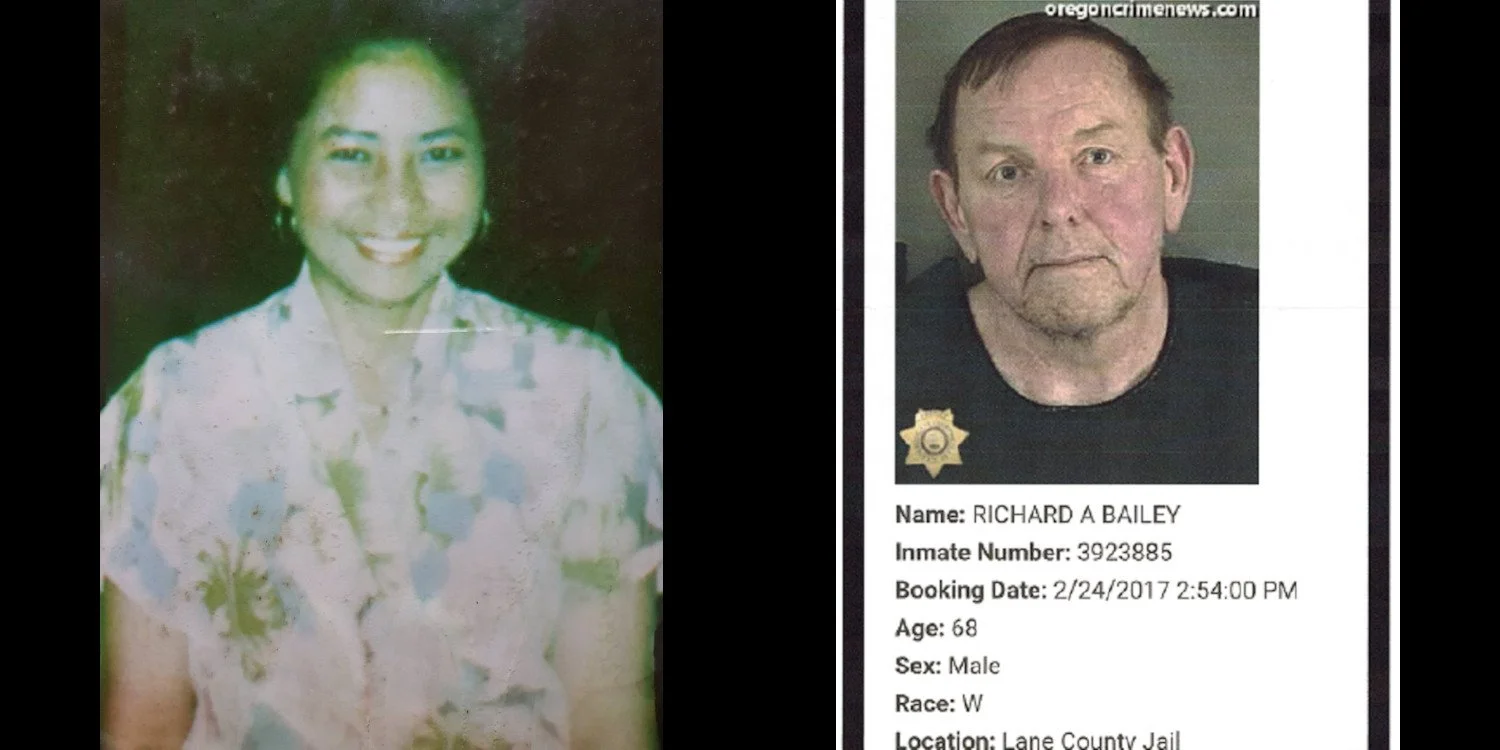
Getting Away with Murder
Wannee’s life had been a hard one even before meeting Bailey in Bangkok in the later 1970s. She was but 19 years old when she was abandoned in the rural north of Thailand by her first husband while raising two-year-old Priwan and still carrying the unborn Pornchai. In 1975, out of the desperation of poverty, she left them when they were two and four years of age hoping that her extended family would care for them.
Wannee traveled nine hours to Bangkok in search of work. Her first job was in construction. This small and frail young woman carried two large cement buckets on a pole as an indentured servant earning her meals and fifty cents a day. She later worked as a cook.
Richard Bailey had been a civilian helicopter pilot in Vietnam, but frequented the Bangkok area when the war ended. In the later 1970s, he and Wannee met. They married in Bangkok on February 14, 1980, then relocated to Bailey’s hometown of Bangor, Maine. There, with Wannee now in a foreign land where she spoke no English, he controlled her every move and would not allow her to pursue citizenship. He obtained work for her as a hotel chambermaid, but tightly controlled her income. Bailey knew that she left two young sons in Thailand, but he had no interest in them until they were 11 and 13 years old. Then, in 1985, he sent Wannee to retrieve them.
Two years after Pornchai was sentenced to prison, Richard Bailey sold his home in Maine and relocated with Wannee to the Western Pacific Island of Guam. Bailey secured work with the Federal Aviation Administration as an air traffic controller. They purchased a home in Talofofo, a small seaside town in the south of Guam. His life there was privileged, secure, and far from the wreckage he left behind in Maine.
The next few years passed by in relative comfort for Bailey living a new life in Guam, but Wannee grew increasingly troubled by all that had transpired. Finally, in late 1999, she became resolved to leave Bailey and filed for divorce in a Guam court. On February 14, 2000, a divorce decree was finalized with a judgment against Bailey which included the following provisions:
That Bailey pay Wannee monthly alimony payments of $1,000;
That the jointly owned home in Talofofo be sold and the proceeds be divided equally,
That upon Bailey reaching the age of 59½, he pay to Wannee $8,000 as her share of his IRA; and
That Bailey pay Wannee $25,000 from a money market account in May 2000.
Wannee had built up the courage to leave and return to Thailand, but both her sons were in their 20s living in Maine. Pornchai was in his eighth year in prison where he was stranded with no family help or support at all. While in Thailand, Wannee used what little funds she had to secure a small parcel of land and began to have a house built for her and her sons whom she hoped to redeem from the past. However, back in Guam Richard Bailey simply ignored court orders for payments to Wannee. So she planned a fateful return to Guam to seek justice.
On her way back to Guam, Wannee visited Pornchai in prison in Maine. She apologized for not believing him as a child, and for the years of torment he suffered. She told him that she had divorced Bailey and was going to expose all that he had done to her, Pornchai, and Priwan. But first, she said, she was returning to Guam to seek enforcement of the divorce decree. She had no idea she was going to her death.
Weeks later, while alone in a Maine prison, Pornchai received word from Richard Bailey’s sister in Maine that Wannee had died in Guam. Pornchai was left with an impression that his mother had accidentally fallen from a high cliff, but his instincts knew better. He asked Bailey’s sister, “Did Richard kill my mother” There was a moment’s pause before she answered, “I don’t know.”
After all the wreckage of the past, this news was devastating for Pornchai. He gave up on his life and ended up serving the next several years in the maddening cruelty of Maine State Prison’s “SuperMax” solitary confinement unit. (PBS Frontline produced a video documentary on Maine’s solitary confinement.) Pornchai had surpassed nearly all other prisoners in the amount of time spent there. Then, in 2005, he was transferred to the neighboring New Hampshire State Prison where he spent the next 15 years with me.
Over these years, as the story of Pornchai’s life unfolded, I wrote several additional articles. Solicitor Clare Farr, Pornchai’s legal advocate in Western Australia, joined me in an effort to investigate. Among the many inroads we made was one to officials in Guam who released Wannee’s April 2000 autopsy report. It revealed that her cause of death was ruled a homicide.
Wannee had been beaten to death according to the autopsy report. Her broken ribs caused devastating injuries to inner organs and a broken wrist revealed defensive wounds. Wannee was 47 years old at the time she died. Back in Concord, NH, Pornchai sat in our cell and wept openly upon learning the truth about the death of his mother. It was what Richard Bailey always said would happen, and what Pornchai always feared the most.

Courtesy of Dontana Keraskes / The Guam Daily Post
Cold Case Homicide
According to Guam police statements, Richard Bailey had reported that Wannee was on the Island visiting with him, but went missing. Two days later, Bailey reported finding Wannee’s body himself. Because this technically remains an open cold case homicide, though now dormant for 22 years, Guam police have seemed reluctant to provide further information.
However, an interview with Wannee’s niece conducted by Clare Farr in 2016, revealed that Wannee telephoned her from Guam on the day she died. She said Wannee was frantic, saying that Richard had threatened her. Richard could be heard shouting in the background. Wannee told her niece in Thai, “If I am found dead, Richard did it and I want you to demand an investigation.”
Bailey never did pay Wannee the money she was owed in alimony, or the money due to her from his IRA and the money market account and the sale of their jointly owned Guam property. And on her death, he should have paid the money due to the executor of Wannee’s estate. However, Bailey never told the executor that there were court orders in place and that he owed money to Wannee, so the money never went into Wannee’s estate for distribution to Pornchai and Priwan, who had been Bailey’s victims of abuse. This money would have been of crucial importance to Pornchai tasked with starting life over after he emerged from prison. He returned to Thailand penniless with nothing but the clothes he was wearing.
None of the above — not the background about Richard’s crimes against Pornchai and Priwan that he desperately wanted covered up, nor the telephone call from Wannee to her niece — was known to Guam police at the time they first investigated the homicide of Wannee in 2000. We believe that there is now sufficient cause to reopen this case and identify a suspect.
In a December 19, 2021 Guam Daily News article by Nick Delgado, “GPD Enhancing Efforts to Solve 103 Cold Cases,” Guam police Chief Stephen Ignacio described new efforts to investigate and close these unsolved cases. He also revealed that he led the Guam Cold Case Task Force in the early 2000s, the time of Wannee’s death. The Guam police have posted a short video describing these cases. A box containing the case of the homicide of Wannee Laporn Bailey is visibly at the top — and it is in the top graphic on this post along with a photo of Wannee and Pornchai.
Wannee’s cremated remains were returned to Thailand after her death in 2000. Upon his own return to Thailand in 2021, Pornchai prayed at her tomb for the first time and slept in the half-built home she had hoped to complete for him. Pornchai is overwhelmed with the wreckage not only of his own life, but with the lives of Wannee and Priwan as well. Rebuilding is a daunting task, but Pornchai Moontri is today a man of unconquerable faith and an inspiration to many.
Richard Alan Bailey still resides at his lakeside Oregon home. After Wannee’s death in 2000, he traveled to Thailand and returned with a new Thai wife 31 years younger than himself.
+ + +
Guam Court orders for restitution to Wannee and her estate for which Wannee died while Bailey ignored the Court orders.
Please share this important story and visit these related posts:
Former Maine Man to Serve no Prison Time for Sex Abuse in the 1980s (Bangor Daily News 09/12/2018)
Human Trafficking: Thailand to America and a Cold Case in Guam
For Pornchai Moontri, a Miracle Unfolds in Thailand
Pornchai Moontri: A Night in Bangkok, a Year in Freedom


For this Prodigal Son, Homecoming Is a Work in Progress
Pornchai Moontri’s return to Thailand after 36 years has been that of a Prodigal Son traversing some dark rivers of the heart, but with help from an unexpected navigator.

Pornchai Moontri’s return to Thailand after 36 years has been that of a Prodigal Son traversing some dark rivers of the heart, but with help from an unexpected navigator.
September 7, 2022 by Fr. Gordon MacRae
“Sawasdee Kup, my friends. This is Pornchai writing from Bangkok, Thailand. I am very happy to see this post by Father G about my other spiritual father and patron saint, Maximilian Kolbe. He has been so much a part of my life in too many ways for me to describe. I think Father G summed it up well when he introduced this post today on Linkedin and Facebook. Here is how he described it:
"#Resistance This post reveals a little known mystical connection between St. Maximilian Kolbe and St. Pope John Paul II. Resistance to evil is never futile."
My birthday is coming up. (That is not a hint!) Some of my friends got me my first computer as an early birthday present. Remember that I was "down" for the entire computer age. So this is like an alien device to me. Yesterday I saw Beyond These Stone Walls here in Thailand on a full size computer screen for the very first time. It is awesome! And so are all of you.
With love and my prayers,
Pornchai Maximilian Moontri”
After I posted “A Tale of Two Priests: Maximilian Kolbe and John Paul II” a few weeks ago, the comment above was posted by our friend Pornchai Moontri writing from Bangkok, Thailand. A few readers subsequently sent messages asking for an update about Pornchai and his life there. I had already intended to write about this because his birthday is September 10, just a few days after this is posted. Pornchail will be 49 years old and is still struggling to regain the sense of home that was lost when he left Thailand 37 years ago in 1985.
This post will be followed in a week by one that has been a long time coming. I have been working on it for months, and I believe it is the most important post I have ever written. There are some who do not want me to write it, but, for reasons that may seem apparent here next week, I must. It is an Earth-shattering account for which Satan himself has lodged many obstacles in the path of its telling. They have mostly been overcome. I ask for your prayers as I complete that most important post this week.
By coincidence, I learned only after beginning today’s post that the Gospel for the Sunday Mass following its publication is the Parable of the Prodigal Son (Luke 15:11-32). The word, “Prodigal” does not mean what some readers think it means. Its origin is in the Middle English “prodigalite” which comes from the Latin, “prodigere,” the original meaning of which is to drive away or squander. From the famous parable that Jesus told, it has also come to mean “reckless” or “wasteful,” neither of which I could ascribe to my own Prodigal Son, Pornchai Moontri.
But there was time in Pornchai’s life — a long time — when he felt compelled to drive away anyone and everyone who cared enough to enter it. This is the plight of so many who have been spiritually and emotionally wounded from a traumatic past. Pornchai tried to drive me away, too, but God had other plans and we both ended up following them. That story was told in this very same week one year ago, so I invite you to revisit it. If next week’s post is my most important, this one remains my own favorite. It is “The Parable of a Priest and the Parable of a Prisoner.”

Mary Calls in Reinforcements
I do not know whether I have the writing skills to adequately convey what Pornchai has been up against over the last 18 months. I have known and helped other prisoners who have faced deportation as adults to a home and country they had not seen since early childhood. Many simply do not survive. I had long been determined that Pornchai would not be one of those. Over time, by some mysterious grace, my writing made its way around the Globe to Thailand where people noticed and some support developed to assist Pornchai’s plight. He had no contact for 36 years with any of the extended family left behind when he was taken away at age eleven. He had only vague memories.
While he was still trapped in that grueling five months of post-prison ICE detention, my heart sank when I learned that the housing and support plan we had for him just fell apart in the eleventh hour due to illness. It was just weeks before Pornchai was to board a flight and I had no backup plan. Trying to put such things together from inside a prison cell half a world away is a daunting challenge.
I kept no secrets from Pornchai in this regard so I painfully remember hearing his own heart sink at the other end of the phone when I told him that the plan we had in place for him fell apart.
I remember trying to put the best spin I could on it. I asked him to trust. I said that often in my experience, such disappointments can become opportunities. Did I really believe that? I’m not sure, but I was sure of one thing: Pornchai would not believe it unless I did. So I did! In prayer, I turned this over to Mary, Undoer of Knots, my favorite from of Marian devotion and the most powerful. I asked her in an act of surrender to undo the knots of faithless distrust that held us bound.
Just two days later, in our daily ten-minute phone call while Pornchai was stranded in ICE waiting out a pandemic, I told him we had better news. I told him that Fr. John Hung Le, a Society of the Divine Word missionary priest from Vietnam, had been reading about us on Beyond These Stone Walls and sent me a message that he wants to help and would provide housing for Pornchai until we could find a better plan. Pornchai was dubious. “I don’t want to be a burden for anyone,” he said.
After Pornchai’s initial stay in required pandemic quarantine at a Bangkok hotel in February, 2021, Father John showed up with our Divine Mercy Thailand friend, Yela, and with Chalathip, Father John’s neighbor and a benefactor of his refugee project. Chalathip learned about Pornchai’s life from Yela and Fr. John, and she received an interior summons from Mary herself.
A retired teacher, Chalathip took on the task of helping Pornchai to assimilate in Thailand, a most difficult task after an absence consisting of his entire adult life since age eleven. Pornchai had to be tutored in conversational Thai, and quickly, but Chalathip knew this could not happen while Pornchai was living with four Vietnamese priests, none of whom spoke Thai.
So Chalathip spoke with Father John and decided to offer Pornchai a small apartment on the upper floor of her home just a few doors down the street from Father John’s. They spoke to me about this, but I was not going to second guess those with boots on the ground.
Chalathip owns several properties in Thailand, so in return Pornchai offered to help her manage them. Having become proficient in woodworking, Pornchai found that these skills translated easily into home repair. He dug up stumps, did landscaping, fixed leaky roofs, painted walls, sanded and restored furniture. Chalathip had two daughters. One had tragically died from an illness several years earlier and the other lived in the U.K. It did not take long for a strong maternal bond to form between her and Pornchai. This was literally divinely inspired. Chalathip never had a son, and Pornchai lost his Mother at a very early age.

Honor Thy Mother
Over recent months, Pornchai had enormous decisions to make. Chalathip had accompanied him and Father John on Pornchai’s first visit to the home and family from where he was taken at age eleven. It was in the village of Phuviang in Khon Kaen Province in the far northeast of Thailand — a nine-hour drive from Bangkok. I wrote about this hauntingly mysterious visit in “For Pornchai Moontri, a Miracle Unfolds in Thailand.”
In recent weeks, Pornchai had to return there to face a difficult decision. The half-completed home that his mother was building at the time of death in 2000, and the small amount of farmland around it, would have been taken from him unless he could come up with 80,000 Thai Baht in fees that had accumulated so he could effect a transfer of the house and land to his own name. Pornchai was frozen in place unable to decide what to do.
The amount seemed impossible for Pornchai, but in U.S. dollars, 80,000 is the equivalent of about $2,400. It just so happened that I had saved that amount in a just-in-case savings account. I did not want Pornchai to lose his mother’s home and land because it would have been gone forever. So I sent him what I had and he was able to complete the transfer. But the real Guardian Angel in this story was Chalathip. She went there with him, acting as a translator and trusted advisor pointing out options as Pornchai discerned under pressure what to do.
A kind reader has since returned my small investment to me. I am profoundly thankful, but most of all I am thankful for Chalathip. At every step of Pornchai’s long journey home, she has been a much needed teacher, guide, chauffeur and parent. She is near the age Pornchai’s Mother would be today had she lived, and I believe strongly that Chalathip, like me, was destined for this connection with Pornchai.
She returned with him to Phuviang four times in an effort to help him obtain his Thai ID for full citizenship. At some point I learned that after all my prayers to Mary Undoer of Knots, Chalathip was right there untangling all the complications that Pornchai faced in order to make Thailand his home again.
Father John and Chalathip have joined Pornchai in prayers at his Mother’s tomb at the Buddhist Temple cemetery nearby. Thailand is 99-percent Buddhist but there are many Catholic converts there and Catholicism has left a large footprint in Thailand. Chalathip, so very rare in Thailand, is Catholic since birth. Her deeply felt faith and fidelity to our Lord has bridged the chasm between hope and despair for Pornchai. He and I still speak every day, and I have recently detected that hope and some evidence of actual happiness in his voice knowing that he is not alone in his plight.
I detect it in my own voice as well of late. Night is often long and dark, but with the dawn comes — if not rejoicing, then at least a modicum of peace. It is what Jesus said would happen if we remain faithful. “Peace be with you.”
+ + +
Note from Fr. Gordon MacRae: Please join me here next week for the most important post I have ever written. It’s a matter of life and death!
And thank you for reading and sharing this post. Please “SUBSCRIBE” if you haven’t already. You may also like these related posts from Beyond These Stone Walls:
A Tale of Two Priests: Maximilian Kolbe and John Paul II
The Parable of a Priest and the Parable of a Prisoner
For Pornchai Moontri, A Miracle Unfolds in Thailand
Archangel Raphael on the Road with Pornchai Moontri
+ + +
Another note from Father Gordon: Our friends from Divine Mercy Thailand who sponsored Pornchai’s homecoming will be gathering with Father John’s community this week for a birthday celebration for Pornchai.
Also, Pornchai was recruited to teach an ocassional physical fitness class by the owner of MI Fitness in Pak Chong, Thailand. Mr. Mi (pronounced Mee) saw him working out at his gym and corralled him to teach a class. Mr. Mi and his wife created the poster below for their Facebook page and a short video of Pornchai’s first class. Just click on the poster to see the video.


Prison Journal: Looking for Lunch in All the Wrong Places
Just as in most Third World countries, the daily quest for food drives life in prison. The most frequently asked question about survival here is about prison food.

Just as in most Third World countries, the daily quest for food drives life in prison. The most frequently asked question about survival here is about prison food.
August 31, 2022 by Fr. Gordon MacRae
Two of my never-miss television shows in prison are gone now. You might think it strange that the highly civilized British drama, “Downton Abbey”, was a hit in prison. My other addictive favorite was “The Great British Baking Show.” Every now and then I stumble upon a remnant of it on PBS. I gain weight just watching British baking stars Mary Berry and Paul Hollywood judge (and sample) the baked creations of contestants vying for each episode’s designation of “Star Baker.”
I have never been obsessed about food. However, last week I received my semi-annual 20-pound food package that prisoners here are permitted to order from the outside world three times per year. I thank readers who help to make this possible.
About half of my usual food order is coffee. The prison commissary sells generic instant coffee at $2.75 for a 3oz. bag. It is not-so-kindly referred to as gun powder. So I try to order a supply of Folgers Instant Coffee to get me through until my next order. The rest of my order is for protein to supplement the prison’s high-carb-low-protein diet.
One result of having food items that can be obtained only a few times a year is the culinary creations that prisoners make. When Pornchai Moontri was here with me, he was the designated cell chef having had extensive culinary arts training in a vocational program. Pornchai could create things with instant rice that I can now only try to mimic with little success. It helps — helps both of us — that I am still able to talk with him by phone. He still provides tips for cooking in a prison cell.
You might think that my remark in the Meta-Description atop this post about prison being like a “Third World” country is an exaggeration. Most prisoners holding a prison job here earn no more than $10 per week. So saving for these semi-annual food orders is a major expense in the economy of prison. Prisoner families and friends help make up the difference.
Twelve years ago this week, I wrote a post about prison food. I called it “Looking for Lunch in All the Wrong Places.” So if the rest of this post seems vaguely familiar, it’s because it is an updated version of that post. This updated version will replace the original and will be added to the Prison Journal category in our BTSW Public Library. You will note that my friends Pornchai Moontri and Kewei Chen were here with me when I first wrote this. They are both gone now and I miss them dearly, but I thank the Lord every day for their freedom.
+ + +

Looking for Lunch in All the Wrong Places
“Hey, try this!” Every so often, some heavily tattooed, muscle bound ex marauding-biker-gang member shows up at my cell door, spoon in hand, to insist that I try his latest culinary creation. If it’s really awful, and I say so, I get an exasperated “ARE you SERIOUS?!” as though I’d just disparaged the Mona Lisa or declared Beethoven’s Fifth to be tedious. I can’t win. If I say it needs something, Bubba will be back in five with another spoon to try again for my approval. If I say it’s terrific, I risk the most dreaded words of all: “Gimme your bowl!”
I may have made a tactical error in prison survival when I wrote a few times about prison food. My tactical error was inviting prisoners to submit their own favorite recipes for their signature cell-cooked cuisine. Since then, some of my fellow prisoners keep showing up at my door with spoons because they want their culinary masterpieces immortalized at Beyond These Stone Walls.
In a past post I wrote of how life in prison revolves around TV. But in this prison’s general population where I’ve spent the last twenty eight years, TV is actually second in importance to everyone’s central concern: the daily quest for food!
In fact, the two are often connected. TV cooking shows are wildly popular here. When the closest thing we have to real meat is an 80% soy burger, it’s a self-inflicted torment to hear Emiril Lagasse yell “Bam!” as he jabs a garlic clove into a pork roast. Still, prisoners watch. Then they try their best to emulate Emiril with mixed results. Just yelling “Bam!” a lot doesn’t make for high cuisine.
Some cooking shows make me a little nervous. A few weeks ago, my friend Pornchai Moontri took copious notes as Andrew Zimmerman cooked up fried scorpions in northern Thailand on his “Bizarre Foods” show.
“Tastes like chicken,” Pornchai said. I’m glad we’re not in an Arizona prison. There are no scorpions in New Hampshire.
This prison serves three meals a day, and most are edible. I’m told that the food budget is under one dollar per person per day. That’s actually a rather stunning fact. Obviously, prisoners are not exactly feasting on a dollar a day, but we’re not fasting either. Sometimes prison food is even pretty good, considering, and it’s rarely as bad as what Clint Eastwood endured in Alcatraz. Nonetheless, complaining about the food is part of the daily grind in every prison. It generally comes in three forms: fat, salt and sugar and other carbohydrates. Protein is a rare commodity and type 2 diabetes is epidemic among those here for the long haul.
Personally, I can’t complain — though I did break a tooth in the chow hall a few months ago. I think the trail mix we had that day was made with real trails. Prison meals are not often a pleasant experience. The infrastructure here was built for about half the prison’s current population, so the dining halls are strained beyond limits. There are often more prisoners than seats, so on a typical day there are prisoners trying to eat their meal standing, balancing a tray in one hand while eating with the other. Sometimes the line out the “chow hall” door is very long. The main meal of the day is served at 4:00 PM so most prisoners are hungry again by 7:00. That’s when cell cuisine becomes most creative.
When I first came to this prison, I was assigned to live in the “special” housing unit. I still remember my first prison meal: a cold hot dog with beans on a paper plate, but with no eating utensils. The next day I was given a peanut butter sandwich along with a plastic fork. I saved the fork since I didn’t know when I would see another one. That night, a tray with spaghetti and sauce was shoved under my door, but not before a guard came in and took the fork away. I tried to see it as an opportunity for weight control, but fortunately I was moved to less “special” housing after a few months.
Every prisoner tries to supplement his food consumption with a few weekly meals of his own. Three times a year, prisoners are allowed to purchase a 20-pound food package from a designated vendor, and part of the profit supplements the prison’s recreation budget which pays for, among other things, cable TV. Prisoners save for this for months, or drop hints to their families and friends. We received our packages a few days ago, so the “in house” meals have been much improved.
The prison commissary sells a non-boiling hot pot for hot water. It’s the sole cooking appliance available, but the creations are astounding in number and variety, and sometimes they’re even a bit scary. The commissary also sells food items to fit various prisoner budgets. I asked around for some of the favorite signature recipes of my fellow prisoners.
The invitation was met with great enthusiasm, though the ex marauding-biker-gang guy wanted four inclusions. I asked him to just give me his favorite. Pornchai also wanted to submit a recipe, so I cautioned him that the ingredients must be bought, not caught!

Post-prison, Martha Stewart bakes for Snoop Dogg.
So here, by popular demand, is my second annual collection of Concord’s Culinary Creations in Captivity. Disclaimer: I did not try each of these recipes myself, and a few of them should probably not be attempted at home, at least not with dinner guests you plan on ever seeing again.
🍽
JOEY’S MAFUNGO FOR FOUR
Joey is 23 years old and has been in prison since he was 17. He obtained his high school diploma here, and is doing his best to stay out of trouble “with a little help from you older guys.” I have not yet tried Joey’s “Mafungo” recipe, but I watched it in progress, and I have no plans to partake.
Ingredients:
1 sleeve Saltine crackers
3 8-ounce bags potato chips
1 8-ounce bag white corn tortilla chips
4 slices white bread
one-half pound turkey meat sliced thick
1 package smoked baby clams
2 packages sliced pepperoni
2 summer sausages sliced
2 bags instant white rice
2 packages Ramen noodles
squeeze cheese
hot chile sauce
BBQ sauce.
(Joey wrote this recipe himself, and I believe it’s his own creation). With all chips in their unopened bags, smash them into fine crumbs. Then tear up the bread into crumbs as well. Next take a large plastic trash bag – one that hasn’t had trash in it – and cut the closed end, then also cut along one side. Sprinkle water on a table so the plastic will stick when you lay it down. Dump all the crumbs in a pile in the middle of the plastic on the table. Slowly add water while you squish the crumbs until you have a dough-like mass. Then squish some more for awhile until it is stretchy. Now wrap the dough in the plastic and use a shampoo bottle as a rolling pin. Make sure the shampoo is not open.
Before you start the dough, chop all meats and heat in a hot pot and add seasonings. While that’s cooking, mix rice, Ramen noodles, and baby clams in another trash bag adding hot water. Then fluff up mixture. Spread dough to a 3 or 4-foot by one-foot rectangle on the plastic on the table. Spread some hot sauce and BBQ sauce on it. Now mix the meat mixture into the bag with the rice mixture, and toss well. Then let it sit for five minutes. Then pour the food onto the dough in a single line like a huge egg roll. Then you roll it up and cover with the plastic for about five minutes. Then cut the roll into four equal sections.
🍽
BUBBA’S BEASTLY WRAPS
1 Package pita pockets ($.61)
2 8 oz packages “Rip-n-Ready” Roast Beef ($2.60 ea)
1 Bag instant pre-cooked white rice ($.95)
City-Cow squeeze cheese – cheddar ($1.82)
Diced peppers if you can get them
Garlic Powder ($.72)
1 removable cover from an 8-inch electric fan
Lenny says you will need two hot pots for this one so invite your roommate so you can use his. Begin by heating water in both hot pots. Remove the cover from your 8-inch fan and rinse the dust off well. Place four pita breads inside the fan cover, put it on one of the heated hot pots, and cover with a towel. Then pour hot water over the package of rice to cook, and finally place the two packages of roast beef into the remaining hot water to heat for an hour or so.
Combine rice, roast beef, garlic powder to taste, and either diced peppers or black pepper into a mixing bowl and mix together. Cut a clean plastic bag into 12-inch squares. Place one steamed pita bread on each square and scoop the rice and roast beef mixture onto the pita breads. Cover each with the desired amount of squeeze cheese, and roll the stuffed pita tightly in the square of plastic. Tape closed, and place the four wraps back into the fan cover. Cover again with a towel and heat for another half hour or so. [This is a lot of prep work, but the wraps are very good and will serve four prisoners — or one Lenny!]
🍽
MIKEY GOGGLES’ “TRASH-BAG CHOP SUEY”
8-oz package of “Rip-n-Ready” Beef Crumbles ($2.10)
“City-Cow” Cheddar processed “squeeze cheese” ($1.82)
Two or three packages of Ramen noodles ($.20 each)
Garlic powder ($.75)
One empty pita-pocket bag saved for just this occasion
Fill hot pot with four cups water and bring to a near boil (as hot as it gets!). Heat the unopened package of beef crumbles in the pot. While heating, break up two or three packages of Ramen noodles in the pita-pocket bag. (Put the flavor packets aside for another day as they add too much sodium.) Pour just enough hot water into the bag to moisten and heat the Ramen noodles. Squeeze the contents of the crumbled beef into the bag. Add “squeeze cheese” and garlic powder to taste. Shake the bag until the ingredients are well mixed. [I give this one high marks for easy clean-up. There isn’t any. But I don’t suggest inviting your in-laws on the night you try this.]
🍽
PORNCHAI’S PAD THAI SEAFOOD FRIED RICE
2 bags of pre-cooked instant white rice ($.95 ea)
2 packets Pad Thai seasoning mix ($1.00 ea)
2 Tbs. honey
2 3 ½ oz. packages of smoked baby clams ($1.83 ea)
Heat one and a half cups water in a hot pot and add both packages of Pad Thai seasoning. Stir in honey and rice, and simmer until liquid is absorbed. Add clams or any other seafood available. [I’m not a big fan of the clams so Pornchai makes mine with a packet of tuna. The rice is terrific. He has a way of turning bland instant rice into something that looks and tastes like real Asian fried rice.]
🍽
CHUBBS’ BREAKFAST SPECIAL (Submitted by our friend Kewei Chen)
3 Packets of Instant Quaker Oatmeal Peanut Butter
3 packets Sugar
2 Bagels
Instant Coffee Non-dairy Creamer Hot water
Mix the hot water with all three packets of instant oatmeal. Add peanut butter to taste. Spread additional peanut butter on the two bagels. Mix the instant coffee, creamer, and sugar with hot water. Eat. [Not a lot of thought went into this one. Chubbs told me this is the only thing he knows how to “cook.” He’ll need a new nickname if he doesn’t learn.]
🍽
MARK PINAULT’S CHICKEN TETRAZINI
2 packages of Bumble Bee chicken breast ($2.76 ea)
1 pound angel hair spaghetti ($1.20)
1 bottle pizza sauce ($1.35)
1 bottle salsa ($1.35)
1 small jar grated Romano/parmesan cheeses ($1.25)
Garlic Powder
Mrs. Dash Italian Seasoning
1 bag nacho chips ($1.25)
1 package pita bread ($.62)
In a hot pot, heat pizza sauce, salsa, spices, and most of the cheese. Let simmer for at least an hour. Shred the chicken breast into the pot. Crush the nacho chips and set aside. Then cook spaghetti in another hot pot. Undercook it a bit so it is al dente. Drain spaghetti and mix with crushed nacho chips. Pour chicken and sauce over spaghetti. While sauce is simmering, heat the pita breads on your spaghetti hot pot, then dust with garlic powder and remaining cheese. [This one is a strain on most prisoners’ budgets].
🍽
MY OWN SPECIALITY: PRISON PIZZA
2 used large mailing envelopes
1 bottle pizza sauce ($1.35)
1 bottle Citi-Cow squeeze cheese ($1.82)
1 small bottle grated Romano/parmesan ($1.25)
1 package of four pita breads ($.63)
1 package sliced pepperoni ($1.86)
Garlic powder
Mrs. Dash Italian seasoning
Heat some water in a hot pot, and put the strainer basket upside down inside. Save some large envelopes when your friends send you mail. Cut them open and spread them out on a counter. Put four pita breads on the paper. Squeeze some cheese on the pita breads and spread it evenly.
Do the same with pizza sauce, then sprinkle grated Romano/Parmesan on the sauce. Add garlic powder to taste, and then seven or eight slices of pepperoni to each pizza. Place one pita bread on the pre-heated hot pot. Make a tent from one of the large envelopes, and cover the pizza until well heated. Using two large mixing spoons, fold one side of the pita bread and then the other into a sort of calzone. Serve hot.
🍽
SKOOTER-WITH-A-K’s SUNDAY BRUNCH
1 cup of Cinnamon Toast Crunch Cereal ($2.45 per bag)
2 Packets of Instant Quaker Oatmeal ($2.15 per box)
1 Packet of Carnation Instant Breakfast ($.75)
1 Scoop peanut butter
Hot water
Crush the cup of Cinnamon Toast Crunch cereal into a bowl. Add instant oatmeal and instant breakfast packets. Stir in hot water until mixture has the consistency of cookie dough. Then stir in the peanut butter. Skooter says this is the only thing he knows how to make. I haven’t tried it, and have no plans to.
🍽
AND FOR DESERT, DONNY-DONUT’S CHOCOLATE-COVERED COOKIES
2 Hershey Bars ($1.20 each)
1 Package peanut butter sandwich cookies ($1.35)
Heat water to a near boil. Unwrap Hershey bars and save the wrappers. Break up chocolate bars and place pieces in bowl. Stir until melted. Dip cookies one by one in the bowl and set on wrappers to cool. Once completed, use remaining chocolate to drizzle over the covered cookies. Allow to cool completely, then eat until the sugar sends you into a hyperactive frenzy. [I haven’t tried this one either, but I watched Donny-Donuts in action. In a chaotic environment, this one can be pretty messy. Donny wore more chocolate than he ate.]


Will Pope Francis Stand Against Catholic Schism?
The Vatican rejects, for now, the radical reshaping of Catholic moral teaching and practice demanded by the German Synodal Path, but who will break faith first?

Courtesy of Catholic News Service
The Vatican rejects, for now, the radical reshaping of Catholic moral teaching and practice demanded by the German Synodal Path, but who will break faith first?
August 24, 2022 by Fr. Gordon MacRae
I have often said that in the Universe of Catholic life, I write from the “Oort Cloud,” that vast field of the Solar System’s castoff debris — asteroids, comets, and meteors — far out beyond the orbit of Pluto. It was named in 1950 for the astronomer who discovered it, J. H. Oort of Leiden, Holland. It’s an especially cold and exiled place from which to write, but it also offers a panoramic view of things, a perspective not always available to those entangled in the culture wars of Earth.
On August 11, 2021, I published “A House Divided: Cancel Culture and the Latin Mass.” Pope Francis had seriously wounded Traditional Catholics by imposing severe restrictions on offering the Traditional Latin Mass that had grown in popular preference among conservative Catholics in recent years. Its popularity, in part at least, is a reaction to the encroaching accommodations to secular culture that have invaded Catholicism.
For conservative and traditional Catholics, the timing of the Pope’s imposed restrictions could not have been worse. For the previous two years in America and across the Western World, Covid-19 brought invasive government restrictions on offering any Mass at all. Even when courts declared some restrictions unconstitutional, a number of Catholic bishops re-imposed the same restrictions. This gave rise to a concern about the proper and expected role of bishops, a concern given voice in my post, “The Faithful Departed: Bishops Who Bar Catholics from Mass.”
The last two years have been a rough time for faithful Catholics and more so for priests who openly support Catholic fidelity. The appointment of progressive bishops has created an appearance of forced compliance with their ideology among priests. The sexual abuse crisis opened pathways for bishops to discipline and even remove priests for virtually any reason or none at all. This gave rise to an initiative of the laity who in response in the U.S. created the “Coalition for Canceled Priests.”
Nowhere in Catholic life, however, has the modern wave of cancel culture been more visible or vocal than in Germany. For many months, some of the bishops of Germany have responded to the Pope’s emphasis on “synodality,” a term from the Greek meaning an ecclesiastical assembly, to promote a ‘woke’ agenda.
The agenda of the German Synodal Path includes a radical revision of Catholic moral teaching and sacramental life. It demands the ordination of women priests, a reconsideration of priestly celibacy, an accommodation for a married priesthood, sacramental recognition for same-sex unions, and the promotion of homosexuality and LGBTQ+ lifestyles as normative expressions of human sexuality.
It is interesting that more recently in the United States, parents have sought to limit some of these same influences in the education and indoctrination of children. While the bishops of Germany promote their demanded revisions as expressions of the “Census Fidelium,” the sense of the faithful, parents in America have been mobilizing to vote the proponents of LGBTQ+ education out of office on public school boards across the land.
On July 21, 2022, in a surprising and hopeful gesture of support for Catholic unity, Pope Francis took a step to rein in the fractious “German Synodal Way” that for the last year has moved ever closer to the precipice of Catholic schism. The Vatican Declaration, which was unsigned, stated that the German Synodal Path has no authority to oblige bishops or the faithful to assume new ways of governing or new approaches to doctrine or morals. This clarification was made “in order to protect the freedom of the people of God and the exercise of episcopal ministry.”

Courtesy of Catholic News Service
George Cardinal Pell and a Patron Saint for Germany
It feels ironic beyond measure that I first decided to write this post on August 9, 2022 the day the Church remembers Edith Stein, better known as St. Teresa Benedicta of the Cross. On the day before deciding to write this, I asked our editor to republish on social media a post I wrote several years ago: “Saints and Sacrifices: Maximilian Kolbe and Edith Stein at Auschwitz.”
To write this current post, as I now feel I must, I also need an extended excerpt from one that I wrote many months ago entitled, “Benedict XVI Faced the Cruelty of a German Inquisition.” The following excerpt is a necessary prequel for this post:
“While reading from Cardinal George Pell’s book, Prison Journal Volume 2, Cardinal Pell wrote candidly about his concerns for the direction of the Church in Germany. In an entry from his prison cell on August 9, 2019, he wrote of Edith Stein, now known as St. Teresa Benedicta of the Cross who, like St. Maximilian Kolbe a year earlier, was murdered in Auschwitz by the Nazi regime in 1942.
“Cardinal Pell wrote that Edith Stein was German by birth, and he asked readers to pray for her intercession for the Catholic Church in Germany. He quoted German Cardinal Gerhard Müller, former Prefect of the Congregation for the Doctrine of the Faith, a position once held by Cardinal Joseph Ratzinger:
“‘The Catholic Church in Germany is going down. Leaders there are not aware of the real problems. They are self-centered and concerned primarily with sexual morality, celibacy, and women priests. They do not speak about God, Jesus Christ, grace, the Sacraments, faith, hope, or love.’ (Prison Journal 2, p.75)
“Later in the book, Cardinal Pell wrote about Vatican concerns for the growing possibility of a German Catholic schism over the very issues identified by Cardinal Müller. If such a progressive schism were to occur, it would sweep much of the European Union where (with the exception of Poland) Mass attendance is at its historically lowest point. Cardinal Pell cited a September 17, 2019 Catholic Culture article by Phillip Lawler, ‘Who Benefits from All This Talk of Schism?’
Lawler argues that the prospect of a schism is remote, but becoming less so. He cited that Pope Francis has spoken calmly about such a prospect saying that he is not frightened by it, something that Lawler found to be frightening in and of itself. Cardinal Pell added that The New York Times has been writing about the prospect of a German Catholic schism by ‘the John Paul and Benedict followers in the United States.’ Cardinal Pell wrote that Lawler’s diagnosis is correct. Cardinal Pell added:
“‘The most aggressive online defenders of Pope Francis realize they cannot engineer the radical changes they want without precipitating a split in the Church. So they want orthodox Catholics to break away first, leaving progressives free to enact their own revolutionary agenda.’
“In light of this, it comes as no surprise that some progressive U.S. bishops have pushed Pope Francis into divisive restrictions on the Traditional Latin Mass and other traditional expressions of the faith. These efforts, and German Catholic steps taken recently to demean Pope Benedict, a stalwart of Catholic orthodoxy, may well be designed to encourage a conservative split from the Church. Embracing and promoting fidelity at this juncture has never been more urgent.
“Faithful Catholics must never accede to the desired end that German progressives seek. Handing the Church over to them would leave ‘Satan at the Last Supper’ while Jesus is removed from the room.”
(End of excerpt)

Courtesy Catholic News Service
Raymond Cardinal Burke Weighs In
Not everyone among German Catholics is in support of this path. One bold German Catholic disseminated my post above to many others in Germany, including many priests. It is interesting that at the same time this began to happen, Facebook started actively suppressing my blog, Beyond These Stone Walls to limit its being shared among various Catholic groups with a presence there to promote Catholic fidelity and unity.
In a May, 2022 interview, American Cardinal Raymond Burke spoke strongly about the direction of the Synodal Path being promoted by some of the German bishops who in the process seek to abandon traditional Catholic doctrine. Cardinal Burke responded boldly:
“The bishops doing this are abandoning the flock and they are showing themselves to be not shepherds, but hirelings who are trying to accommodate the Church’s teaching to the ways of this world, a secular way of thinking, a godless way of thinking. To hold what they are saying regarding unnatural sins against the 6th and 9th Commandments is heretical. They are leading people, to their great harm, into heresy at a time when the world needs the Church to proclaim her teaching with clarity and courage.
“[The Holy Father] must ask [the German bishops] to renounce these heresies and positions against the sound discipline of the Church. If they will not renounce their errors and correct themselves, then he would have to remove them from office. This is the situation in which we’ve arrived.”
— Statement of Raymond Cardinal Burke
In April of 2022, an open letter signed by six cardinals, 19 archbishops and 78 bishops expressed alarm over “the confusion that the Synodal Path has already caused and continues to cause, and the potential for schism that will inevitably result. In its effect the Synodal Path displays more submission and obedience to the world than to Jesus Christ as Lord and Savior.” Among the signatories of this letter were Joseph Cardinal Zen, George Cardinal Pell, Raymond Cardinal Burke, Francis Cardinal Arinze, and Wilfred Cardinal Napier. It should be noted that the first two names on this short list of cardinals are now considered by many to be white martyrs.

Bishop Georg Bätzing, second from left, is President of the German Catholic Bishops conference, pictured here at the opening meeting of the German Synodal Way.
The German Bishops Respond
The response of the German bishops has been largely voiced by one person, Bishop Georg Bätzing, an appointee of Pope Francis who became President of the German Bishops Conference in 2016. He showed no sign of backing down from the path he and the Synod have been on. Many found his response to be arrogant and alarming:
“Yes, the pope disappoints me. Even in the Catholic Church, even with all the right that would be his, he is not the one who could turn the Church from its head to its feet which is what we would like … He is initiating a process where all these questions are put on the table.”
Bishop Bätzing went on to describe the matter of women’s ordination as “like an iceberg,” meaning that there is more substance and clamor for it below the surface than can be seen from above. He said that he is moved by the “sensus fidelium” on this, but the sensus fidelium — the sense of the faithful — must be universal and not merely a fractious German consideration. On the day I am typing this, this blog had 850 visits from Germany alone. I wonder if Bishop Bätzing’s measure of the sensus fidelium includes them.
The state of the Church in Germany — where Catholic identity and Mass attendance are at their lowest points in history — does not reflect Catholicism in the rest of the world. It is the height of hubris to suggest that the political positions of Germany should take precedence and be imposed upon the faithful in Poland or Africa or the United States where many Catholics embrace fidelity to Sacred Tradition.
Like the American Episcopal church of the 1990’s, Bishop Bätzing would be willing to shatter the Church’s unity to satisfy the transient “woke” in Germany. Even if they had the Church that they want — one in which Christ takes a back seat to pop culture — there is no evidence that their practice of their faith would be any more faithful than it is now.
The most telling response of Bishop Bätzing was a statement that he would personally leave the Church if he had the impression that none of his agenda would be realized. He would lead the German Catholic church into a progressive schism if Traditional Catholics did not accede to it first.
Cardinal George Pell’s suggestion that Edith Stein, St. Teresa Benedicta of the Cross, would be the best intercessor for Catholic Germany is prophetic. Upon her arrival in Auschwitz on August 9, 1942, she took her younger sister by the hand and said, “Come Rosa, Let us go for our people.” Then, in full Carmelite habit, she walked to the Nazi gas chamber refusing to renounce either her Jewish heritage or her Catholic faith.
Pray for her intercession for the Catholic church of Germany being led astray by its bishops. And pray for Pope Francis that the Blood of the Martyrs still speaks to him with sacrificial clarity about the faith for which they surrendered their lives.
+ + +
Note from Fr. Gordon MacRae: Thank you for reading and sharing this post.
You may also like these related posts:
The Once and Future Catholic Church
Cardinal Theodore McCarrick and the Homosexual Matrix
The Faithful Departed: Bishops Who Bar Catholics from Mass
Saints and Sacrifices: Maximilian Kolbe and Edith Stein at Auschwitz
+ + +


To the Kingdom of Heaven through a Narrow Gate
he Gospel of St. Luke for the 21st Sunday of Ordinary Time is a summons to enter the Kingdom of God through a narrow gate, but it requires shedding some baggage.

The Gospel of St. Luke for the 21st Sunday of Ordinary Time is a summons to enter the Kingdom of God through a narrow gate, but it requires shedding some baggage.
August 17, 2022 by Fr. Gordon MacRae
Readers of a certain age who grew up in the United States might remember “S&H Green Stamps.” The Sperry and Hutchinson Company first introduced them in grocery stores in 1896 as promotional bonus awards to promote retail purchases. By World War II, gas stations and other retail outlets caught on. By 1960, ninety percent of U.S. retailers were awarding Green Stamps. In 1962, S&H issued more stamps that the U.S. Post Office.
My mother was a dedicated collector. About once a month, when I was seven or eight, I was cajoled into sitting at our kitchen table to paste the month’s supply of Green Stamps into collection booklets. When enough books were accumulated, they were taken to a place that I thought then to be magical. It was called the “S&H Redemption Center” where Green Stamps of dubious value could be redeemed for something new. S&H published the world’s largest catalog of redeemable items. It had a whole page of skateboards which had become all the rage in 1962. Alas, my mother passed it by in favor of a boring toaster.
By 1982, the year I became a priest — having never broken a bone because I never had a skateboard — Green Stamps disappeared from the retail landscape of America and our collective consciousness. The Redemption Centers are gone now, but hope for redemption never left and must never leave. Losing that hope would be catastrophic for humanity. We express that transforming hope every day, even if we do not realize it, and it is far more than a marketing ploy.
What do you mean when you pray, “Thy Kingdom Come,” “Adveniat Regnum Tuum”? It’s the third subordinate clause of the Lord’s Prayer, the “Pater Noster,” also known by its first two words of address in English, the “Our Father.” You pray, “Thy Kingdom Come” once at every Mass. If you pray the Rosary, you say it at least six times. A core expectation of the Gospel is that “The Kingdom of God is at hand” (Mark 1:5). In Volume One of his great book, Jesus of Nazareth, Pope Benedict XVI described the implications for that statement:
“The core constant of the Gospel is this: The Kingdom of God is at hand. A milestone is set up in the flow of time; something new has taken place, and an answer to this gift is demanded of man: conversion and faith.” (p. 47)
The phrase “Kingdom of God” occurs 122 times in the New Testament. In the Synoptic Gospels (Matthew, Mark and Luke) it is found 99 times and 90 of them are from the direct words of Jesus. In the post-Vatican II world, some came to believe that this expectation of the Kingdom of God is fulfilled and made manifest primarily in the Church. That may be true, but it is not the only truth as Pope Benedict explains in this surprising analysis:
“Instead of the great expectation of God’s own Kingdom, of a new world transformed by God himself we got something quite different, the Church! And what a pathetic substitute it is … Is changing the subject from the Kingdom of God to the genesis of the Church really just the collapse of a promise and the emergence of something else in its place?” ( p. 48)

The Cross and the Kingdom of God
The answer to that question depends on how we understand “Kingdom of God” as Jesus meant it. As Pope Benedict asked: “Is Jesus just a messenger charged with representing a cause that is ultimately independent of him, or is the messenger himself the message?” In other words, is Jesus Himself the Kingdom of God?
In the Gospel, “Kingdom of God” and “Kingdom of Heaven” refer to the same destination. Heaven — which I always capitalize — is distinct from “the heavens” which refer to the material universe. “Kingdom of Heaven” is not uttered as a substitute for God, but is rather in respect for the Jewish tradition that the name of God was not to be uttered or written. This is why you may often see Hebrew scholars write G-d in place of God.
Among the Fathers of the Church, Origen, in his early Second Century treatise, On Prayer, wrote,
“Those who pray for the coming of the Kingdom of God pray without any doubt for the Kingdom of God that is contained in themselves. For in every holy person it is God who reigns and has dominion. So let God stroll in us as a spiritual paradise and rule in us with his Christ.”
The idea of that beautiful image is that the Kingdom of God is not found on any map. It is not the kingdom of a fallen world. It is Christ himself and the extent to which he lives in us. So even if there is doubt that the Kingdom of God somehow touches my life, at least there is always hope. Just like most of you, I, too, struggle with that hope.
I think that most of our readers have come to understand that I have had my share of hardship. To be falsely accused and cast into prison for the last 28 years and counting seems the equivalent of living on the wrong side of a rather famous parable. It is one of the parables that most represents life in the Kingdom of God as it exists in the here and now. It involves choices. Commonly known as the Parable of the Good Samaritan, it is more accurately called the Parable of a Man Beaten by Robbers and Left for Dead.
The parable, found in Luke 10:25-37, begins with a question posed by a lawyer/Pharisee, “What must I do to inherit eternal life?” The lawyer, an expert in Hebrew Scripture, already knows the answer but he poses his question “to put Jesus to the test.” So Jesus answers the famous question with one of his own. “What is written in the law?” The lawyer responds correctly by combining two verses from the Hebrew Scriptures which were very familiar to Jesus:
“You shall love the Lord your God with all your heart, and with all your strength, and with all your mind” (Deuteronomy 6:5) “and your neighbor as yourself” (Leviticus 19:18).
Elsewhere, in Matthew 22:37-40, Jesus called these two Scripture verses “the greatest Commandment,” the one upon which all others depend. The Ten Commandments and the 613 precepts of the Mosaic Law — all the dietary and ritual laws of purity in the life of Israel — are distilled into striving for these two. Love of God and Mercy to others are the towering rules of the Kingdom of God.
In the parable itself, the man beaten by robbers and left at the side of the road is simply passed over by a priest and a Levite. The lawyer hearing this understands well that their religious duty, written in the laws of ritual purity described above, requires them not to touch the body of a dead or dying man. The Samaritan, on the other hand, is already an outcast from the religious practice of Israel, and is thus the only one free to show mercy.
The lawyer/Pharisee hearing this Parable would find it painfully familiar. It recalls a very similar story from the Second Book of Chronicles (28:8-15). About 1,000 years before Jesus told this parable, a group of people from the Kingdom of Judah were assailed and captured by the Northern Israelite army. Four men from Samaria came upon the beaten captives. The four Samaritans clothed, fed, and, anointed them, and placing them upon their own beasts of burden, took them peacefully to Jericho. The fact that the parable had a precedent deep in the history of Israel would have crushed the lawyer’s resistance to the story of grace imparted by way of mercy.

The Narrow Gate
The question posed by the lawyer/Pharisee that opens the Parable of the Man Beaten by Robbers is very similar to one posed in the Gospel at Mass on the 21st Sunday in Ordinary Time. Jesus had just described the Kingdom of God as being “like leaven.” Leaven used in dough is a rising agent. So what is it about the Kingdom of God that gives rise to it like leaven? He earlier refers to the kingdom as “like a mustard seed, the tiniest of seeds that grow into great trees where birds may make their nests.”
Then a question was posed. “Lord, will those who are saved be few? (Luke 13:23) The response of Jesus that follows has been disheartening for many, but I believe it is misunderstood:
“Strive to enter through the narrow door; for many, I tell you, will seek to enter but will not be able.” He then went on to talk about weeping and gnashing of teeth and “seeing Abraham and Isaac and Jacob and all the prophets in the Kingdom of God and you yourself cast out” (Luke 22:28). Not exactly a hopeful narrative.
The place I turn to for context is one that I have written about before. It is the story of the only human being, at first glance a seemingly unlikely one, who was directly given salvation and eternal life in the Gospel. I wrote of the story of this man in “Dismas, Crucified to the Right: Paradise Lost and Found.”
In Jesus of Nazareth Volume II: Holy Week Pope Benedict XVI wrote of that same account: “Of the two men crucified with Jesus, only one joins in mocking him. The other grasps the mystery of Jesus.” To do so while in the middle of one’s own crucifixion is the most hopeful and encouraging image that I have found in all of Sacred Scripture. The crucified Dismas asks but one thing, and it is not deliverance from his cross. He asks only, “Jesus, remember me when you come into your Kingdom.”
Clearly, while on the cross, the penitent Dismas realized that this powerless man beside him is a true king. He wanted to be at this man’s side in both crucifixion and in Glory. The simple response of Jesus recognized both the weight of this man’s cross and the depth of his conversion and transformation: “Today, you will be with me in Paradise.” (Luke 23:43).
The Greek word Luke’s Gospel used in describing what this man will encounter that day is “Paradeisos.” It is used only three times in the New Testament and was first used in all of Sacred Scripture in Genesis 2:8 where it refers to the Garden of Eden before the Fall of Man. There is no talk between Jesus and Dismas of weeping and gnashing of teeth, nor is there any mention of entering the Kingdom through the narrow door. Jesus promises to this repentant man nothing less than life in the eternal dwelling place of God.
There are hints for this through Scripture: “I am the way, and the truth, and the life; no one comes to the Father but by me. If you had known me, you would have known my Father also.” (John 14:6-7). This conveys to me a truth that Dismas Crucified to the Right, came to see only from his own cross.
Jesus does not have a map to the narrow gate, nor is he a key to it. He is not even a ticket through it. Dismas discovers on his cross that Jesus is Himself the Narrow Gate to the Kingdom of Heaven, the only passageway from this life to eternal life. It could not be clearer.
So our only task is to follow Him, to imitate Him, and not even perfectly because He knows we can do nothing perfectly. What he seeks in us is mercy in our hearts, the knowledge that the measure with which we measure will be measured back to us. This is the leaven, the stuff that expands the Kingdom of God within us.
Strive to enter through the Narrow Gate.
+ + +
Note from Father Gordon MacRae: Thank you for reading and sharing this post which will be placed in our Library Categories, Catholic Spiritual Life and Sacred Scripture. You may also want to visit — or revisit — these related posts from Beyond These Stone Walls:
Dismas, Crucified to the Right: Paradise Lost and Found
The Measure by Which You Measure: Prisoners of a Captive Past
To Christ the King Through the Immaculate Heart of Mary
The God of the Living and the Life of the Dead
Please visit our “Special Events” Page for ways to help us bring mercy to those left on the side of the road.

Courtesy of L’Obsservatore Romano