“There are few authentic prophetic voices among us, guiding truth-seekers along the right path. Among them is Fr. Gordon MacRae, a mighty voice in the prison tradition of John the Baptist, Maximilian Kolbe, Alfred Delp, SJ, and Dietrich Bonhoeffer.”
— Deacon David Jones

A Tale of Two Priests: Maximilian Kolbe and John Paul II
St. Maximilian Kolbe was a prolific writer before his arrest by the Gestapo in 1941. He died a prisoner of Auschwitz, but true freedom was his gift to all who suffer.

St. Maximilian Kolbe was a prolific writer before his arrest by the Gestapo in 1941. He died a prisoner of Auschwitz, but true freedom was his gift to all who suffer.
“There is no greater love than this, that a man should lay down his life for his friends.”
— John 15:13
August 10, 2022 by Fr. Gordon MacRae
In his wonderful book, Making Saints: How the Catholic Church Determines Who Becomes a Saint, Who Doesn’t, and Why (Touchstone 1990), author and former Newsweek editor Kenneth L. Woodward wrote that the martyrdom of St. Maximilian Kolbe was one of the most controversial cases ever to come before the Vatican Congregation for the Causes of Saints.
The essential facts of Kolbe’s martyrdom are well known. After six months as a prisoner of Auschwitz in 1941, Maximilian and the other prisoners of Cell Block 14 were ordered outside to stand at attention for commandant Karl Fritzch. Someone from the block had escaped. To encourage informants, the Commandant had a policy that ten men from the cell block of any escaped prisoner would be chosen at random to die from starvation, the slowest and cruelest of deaths.
The last to be chosen was Francis Gajowniczek, a young man who collapsed in tears for the wife and children he would never see again. Another man, Prisoner No. 16670, stepped forward. “Who is this Polish swine?” the Commandant demanded. “I am a Catholic priest,” Maximilian Kolbe replied, “and I want to take the place of that man.” The Commandant was speechless, but granted the request. Maximilian and the others were marched off to a starvation bunker.
For the next 16 days, Kolbe led the others in prayer as one by one they succumbed without food or water. On August 14, only four, including Maximilian, remained alive. The impatient Commandant injected them with carbolic acid and their bodies were cremated to drift in smoke and ash in the skies above Auschwitz. It was the eve of the Solemnity of the Assumption. God was silent, but it only seemed so. I wrote about this death, its meaning, and the cell where it occurred in “Saint Maximilian Kolbe and the Gift of Noble Defiance.”
If that event summed up the whole of Maximilian’s life, it may seem sufficient to be deemed heroic virtue. Today, the name of the brutal Commandant Karl Fritsch is forgotten from history while all the world knows of Maximilian Kolbe, and for far more than his act of sacrifice for someone he barely knew. His act of Consecration to Jesus through Mary was well known long before the Nazi occupation of Poland in 1939. As the occupation commenced, Maximilian had a readership of over 800,000 in Poland alone for his monthly magazine, Knights of the Immaculata.
Perceived as a clear threat to the Nazi mindset, he was arrested and jailed for several months in 1939 while his publishing ability was destroyed. Upon his release, he instituted the practice of round-the-clock Eucharistic Adoration for his community decades before it became common practice in parishes.
The Nazi occupiers of Poland were the cruelest foreign rulers in history. A detailed report on conditions of the Nazi occupation compiled and smuggled out of Poland by Catholic priests was made public in Vatican City in October 1941. More than 60,000 Poles were imprisoned in concentration camps, 540,000 Polish workers were deported to forced labor camps in Germany where another 640,000 Polish prisoners of war were also held.
By the end of 1941, 112,000 Poles had been summarily executed while 30,000 more, half of those held in concentration camps, died there. Famine and other deplorable conditions caused a typhus epidemic that took many more lives. By the end of the Nazi terror, six million Jews — fully a third of European Jews — had been exterminated. There are those whose revisionist history faulted the Vatican for keeping silent, but that was not at all the truth. I wrote the real, but shocking truth of this in “Hitler’s Pope, Nazi Crimes, and The New York Times.”
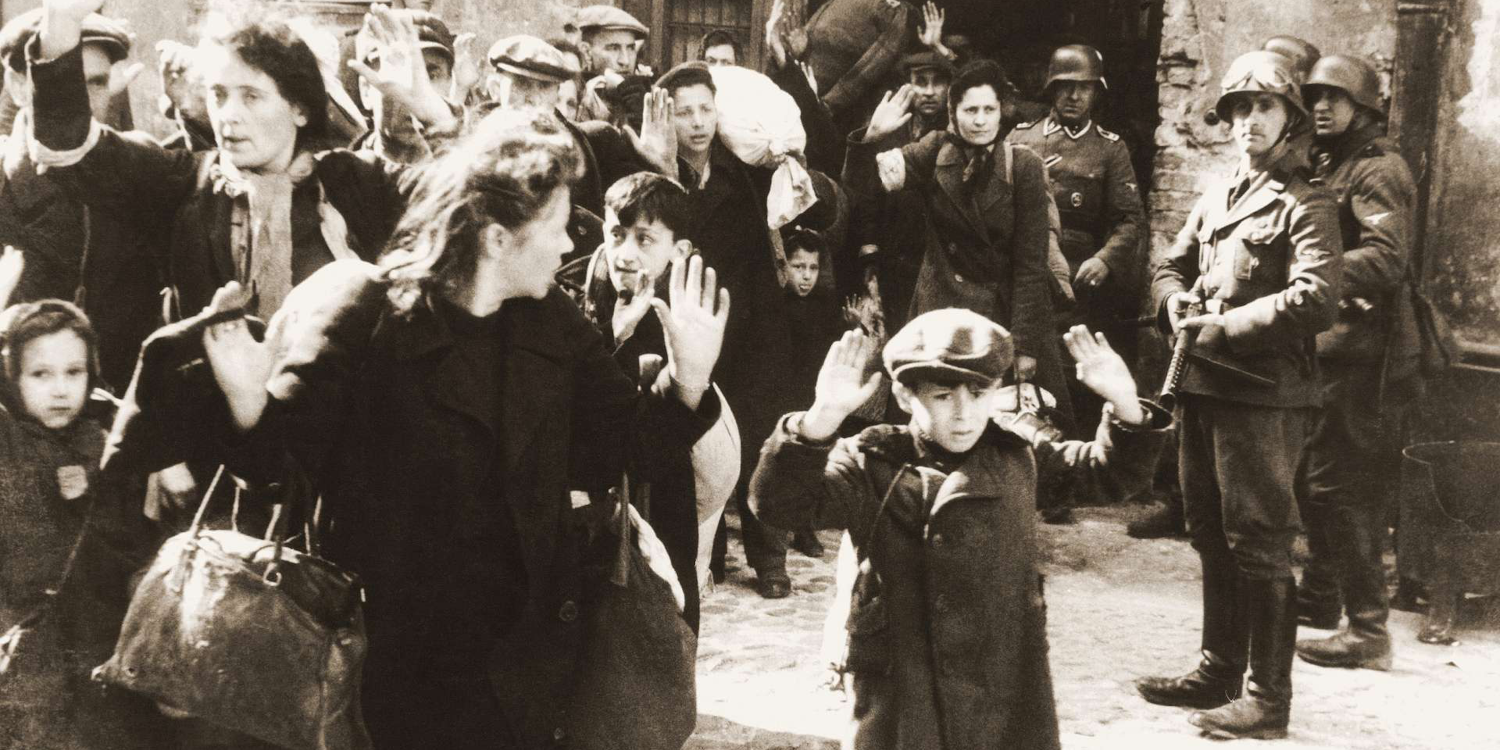
Karol Wojtyla
These were also the most formative years for a man who would one day become a priest, and then Archbishop of Krakow in which Auschwitz was located, and then Pope John Paul II. In 1939 as the Nazi occupation of his native Poland commenced, 18-year-old Karol Wojtyla found his own noble defiance. Over the next two years he worked in the mines as a quarryman, and at the Solvey chemical plant while he also took up studies as part of the clandestine underground resistance.
In the fall of 1942, Karol Wojtyla was accepted as a seminarian in a wartime underground seminary in the Archdiocese of Krakow. Two years later, a friend and fellow seminarian was shot and killed by the Gestapo. The war and occupation were a six-year trial by fire in which young Karol was exposed to a world of unspeakable cruelty giving rise to unimaginable heroism.
One of the stories that most impacted him was that of the witness and sacrifice of Father Maximilian Kolbe. He became for Karol the model of a man and priest living the sacramental condition of “alter Christus,” another Christ, by a complete emptying of the self in service to others. In scholarly papers submitted in his underground seminary studies, Karol took up the habit of writing at the top of each page, “To Jesus through Mary,” in emulation of Maximilian Kolbe.
On November 1, 1946, on the Solemnity of All Saints, Karol Wojtyla was ordained a priest in the wartime underground seminary. He was the only candidate for ordination that year. Two weeks later, he boarded a train for graduate theological studies in Rome where, like Maximilian Kolbe before him, he would obtain his first of two doctoral degrees. It was the first time he had ever left Poland.
In 1963, he was named Archbishop of Krakow by a new pontiff, Pope Paul VI. It was alive in him in a deeply felt way that he was now Archbishop of the city of Sister Faustina Kowalska, the mystic of Divine Mercy who died in 1938 and whose Diary had spread throughout Poland having a deep impact on young Karol Wojtyla. And he was Archbishop of the site of Auschwitz, of the very place where the Nazi terror occurred, the place where Maximilian Kolbe offered himself to save another.
I was ten years old the year Karol Wojtyla became Archbishop of Krakow. I was 25, and in my first-year of theological studies in seminary when he became Pope John Paul II. In June of 1979, he made his first pilgrimage as pope to his native Poland. This visit marked the beginning of the collapse of the Soviet Union and European Communism. During his pilgrimage, Pope John Paul visited the Auschwitz-Birkenau concentration and extermination camps. He knelt on the floor of Block 11, Cell 18 at the very spot in which Maximilian Kolbe died. John Paul kissed the floor where Kolbe had prayed in agony 38 years before. He left there a bouquet of red and white roses, an act with great significance that I will describe below.
When Pope John Paul emerged from his veneration in the starvation cell that June day in 1979, he embraced 78-year-old Franciszek Gajowniczek whose life Maximilian had saved by taking his place in death. I remember this visit. It was the first time I had ever heard of Maximilian Kolbe. I would next hear of him again when he was canonized in 1982, the year of my priesthood ordination. Neither event was without controversy. I recently wrote of my own in “Forty Years of Priesthood in the Mighty Wind of Pentecost.”
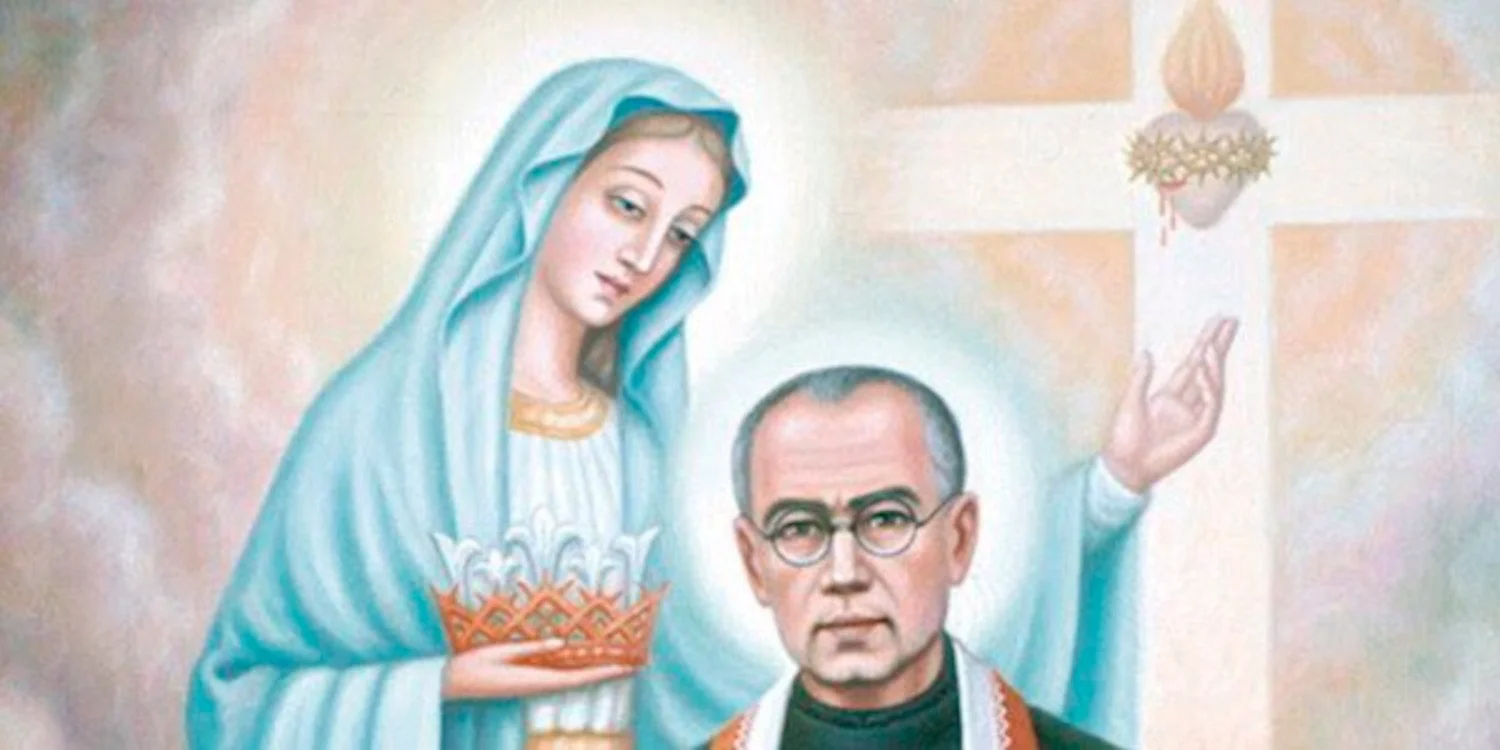
A Martyr in Red and White
But the controversy around the canonization of St. Maximilian Kolbe is much more interesting. It actually changed the way the Church has traditionally viewed martyrdom. Maximilian’s sacrifice of himself at Auschwitz was a story that spread far beyond Catholic circles. In his book, People in Auschwitz, Jewish historian and Auschwitz survivor, Hermann Langbein wrote:
“The best known act of resistance was that of Maximilian Rajmond Kolbe who deprived the camp administration of the power to make arbitrary decisions about life and death.”
In 1971, the beatification process for Maximilian presided over by Pope Paul VI was based solely on his heroic virtue. Two miracles had already been formally attributed to his intercession. Shortly after the beatification, Pope Paul VI received a delegation from Poland. Among them was Krakow Archbishop Karol Wojtyla. In his address to them, Pope Paul VI referred to Kolbe as a “martyr of charity.”
This rankled the Poles and even some of the German bishops who had joined the cause for Maximilian’s later canonization. They wanted him venerated as a martyr. Strictly speaking, however, it did not appear to Paul VI or to the Congregation for the Causes of Saints, that Maximilian was martyred for his faith, traditionally the sole standard for declaring a saint to also be venerated as a martyr. Pope Paul VI overruled the Polish and German bishops.
The next Pope, John Paul II, had for a lifetime held Maximilian Kolbe in high regard. In order to resolve the question of martyrdom, he bypassed the Congregation for the Causes of Saints and appointed a 25-member commission with two judges to study the matter. The Commission was presided over by Cardinal Joseph Ratzinger, Prefect of the Sacred Congregation of the Doctrine of the Faith, who would later become Pope Benedict XVI.
In the end, on November 9, 1982, the Mass for Canonization of St. Maximilian Kolbe took place at St. Peter’s Basilica before a crowd of 250,000, the largest crowd ever in attendance for a canonization. At the Mass, Pope John Paul II proclaimed:
“And so, in virtue of my apostolic authority I have decreed that Maximilian Maria Kolbe, who after beatification was venerated as a confessor, shall henceforth also be venerated as a martyr.”
The matter was officially settled. Maximilian Kolbe became a saint canonized by a saint. But it was really settled in the mind of John Paul three years earlier on the day when he laid a bouquet of red and white roses on the floor of the Auschwitz starvation cell where Maximilian died.
It was an echo from Maximilian’s childhood. At around the age of ten in 1904, Rajmond Kolbe was an active and sometimes mischievous future saint. He was obsessed with astronomy and physics, and dreamed of designing a rocket to explore the Cosmos. He exasperated his mother, a most ironic fact given his lifelong preoccupation with the Mother of God. One day, his mother was at her wit’s end and she scolded him in Polish, “Rajmond! Whatever will become of you?”
Rajmond ran off to his parish church and asked his “other” Mother the same question. Then he had a vision — or a dream — in which Mary presented him with two crowns, one dazzling white and the other red. These came to be seen as symbols for sanctity and martyrdom, and they were the source for Pope John Paul’s gesture of leaving red and white flowers at the place where Maximilian died.

Epilogue
I witnessed firsthand a similar experience involving the conversion of my friend, Pornchai Moontri who took the name, Maximilian, as his Christian name. He may not have been aware of his mystical heart to heart dialog with the patron saint we both shared. Pornchai is a master woodworker, a skill he has not been able to utilize yet in Thailand because organizing a work place and acquiring tools is a major undertaking.
Around the time of our Consecration to Jesus through Mary, an event I wrote of in “The Doors that Have Unlocked,” Pornchai took up a project. He had perfected the art of model shipbuilding and decided to design and build a model sailing ship named in honor of his Patron Saint. He called it “The St. Maximilian.”
Pornchai chose black for the ship’s hull, but on the night before completing it he had an insight that he had to paint the hull red and white. When I asked him why, he had no explanation other than, “It just seems right.” He could not have known about Maximilian’s childhood vision of the red and white crowns or Pope John Paul’s gesture at Auschwitz.

+ + +
Note from Father Gordon MacRae: This story is filled with irony and coincidence, none of which is really coincidence at all. It is summed up in this quote from St. Maximilian Kolbe, which was sent to me just before I wrote this post:
“For every single human being God has destined the fulfillment of a determined mission on this earth. Even from when he created the Universe, he so directed causes so that the chain of events would be unbroken, and that conditions and circumstances for the fulfillment of this mission would be the most appropriate and fitting.
“Further, every individual is born with particular talents and gifts (and flaws) that are applicable to, and in keeping with, the assigned task, and so throughout life the environment and circumstances so arrange themselves as to make possible the achievement of the goal and to facilitate its unfolding.”
— St. Maximilian Kolbe
Another note from Fr. G: The above quote was found on a bulletin from the National Shrine of St. Maximilian Kolbe in Libertyville, Illinois. It was sent from an unusual source, a retired F.B.I. Special Agent was attending Adoration at the Shrine when he spotted the quote and decided to send it to me. He also sent the message below, which will serve as the first comment for this post.
“During the third week of January of this year, I attended Adoration and the Noon Mass at Marytown, Libertyville, Illinois where The National Shrine of Saint Maximilian Kolbe is located and received a copy of the Marytown Church bulletin. The Shrine is under the sponsorship of the Conventual Franciscan Friars – the religious order that St. Maximilian was a member of. St Maximilian Kolbe was put to death at Auschwitz concentration camp on August 14, 1941 and was ‘cremated’ the next day on the Feast of the Assumption of Mary into Heaven. He is the patron saint of various groups but perhaps most notably known for being the patron saint of prisoners. Marytown is very much involved in ministry to prisoners throughout the United States by providing Catholic material to Chaplains of prison facilities and other outreach activities.
“The day after this particular visit to Marytown, I was reading the online Catholic League newsletter and saw information about the ‘Laurie List’ and how it pertained to the trial and incarceration of Fr. Gordon MacRae. The Laurie List was evidently a ‘secret’ list of New Hampshire police officers accessible to prosecutors, who had issues arise questioning their truthfulness and veracity. Any issue that arises as to the truthfulness of a witness particularly a police officer is supposed to be made known to the defendant and his attorney. The Keene NH detective who investigated the case against Fr. Gordon is on this list. If ‘impeachable’ information regarding this detective was known, this information should have been made available to Fr. Gordon and his defense attorney. I have been following Fr. Gordon’s situation for a number of years and so I am aware of his devotion to St. Maximilian Kolbe.
“After reviewing rules to send mail to the prison housing Fr. Gordon in Concord, New Hampshire, I forwarded the weekly bulletin to him which usually quotes a passage from the writings of St. Maximilian. This has led to a correspondence and receiving Father’s weekly post. Those familiar with Father’s website — Beyond These Stone Walls — are aware of Pornchai Moontri, his tragic life, long period of incarceration, transfer to the NH prison in Concord, becoming the cellmate of Fr. Gordon, Pornchai’s entrance into the Catholic Church — taking a baptismal name of Maximilian — and his ultimate release from prison. I currently try to assist Fr. Gordon’s work (his web site, assistance to Pornchai, etc.) through prayer and financial support.”
One last note from Fr. G: Please visit our “Special Events” page for an update on ways that you can help sustain Beyond These Stone Walls.
Thank you for reading and sharing this post. You may also wish to visit these related posts:
Saint Maximilian Kolbe and the Gift of Noble Defiance
Independence Day in Thailand by Pornchai Maximilian Moontri

In the Heart of Canada: Rescuing a Family Besieged by War
For the second time in a year, tiny St. Anne Parish in Mattawa, Ontario, has sacrificed for a Corporal Work of Mercy: now saving a refugee family from Ukraine.

For the second time in a year, tiny St. Anne Parish in Mattawa, Ontario, has sacrificed for a Corporal Work of Mercy: now saving a refugee family from Ukraine.
August 3, 2022 by Fr. Gordon MacRae and Fr. Tim Moyle
Introduction by Fr. Gordon MacRae: Somehow, word got out that I found myself chained up in the back of a Concord, NH ambulance for a trip to the Emergency Room on Tuesday, July 19. The sudden onset of an apparent cardiac problem during the night before was first thought to be impending heart failure. Twelve hours and several tests later came a diagnosis of acute pericarditis, less alarming and more easily treatable. Recovery time, I am told, is two to three months but I am out of the hospital and already feeling much better.
After that I was out of commission for just a few days, but they were the same few days during which I would have written a post for this week. With no time left to write and mail something, I came up empty.
Then, from out of the heart of Canada, came a message from Father Tim Moyle, an amazing priest, pastor and friend at St. Anne Parish in Mattawa, Ontario. One of the smallest and least financially endowed Catholic parishes in Canada, the people of St. Anne’s and the wider community of Mattawa are leaving an outsized footprint on some works of Divine Mercy in the world.
You might remember Father Tim and his parish. During Advent just seven months ago, Father Tim and his parishioners were inspired by posts at Beyond These Stone Walls about Pornchai Moontri and Fr. John Hung Le, a Society of the Divine Word missionary. For an Advent project, the people of St. Anne parish mobilized to raise awareness and funds for Fr. John’s Vietnamese Refugee Assistance effort among migrant workers in Thailand and their families left without income during the global pandemic. My post about their amazing effort was, “A Struggling Parish Builds an Advent Bridge to Thailand.”
Now, just seven months later, comes Father Tim again with news of yet another heroic Corporal Work of Mercy undertaken by the good people of his parish. I was deeply moved to learn from Father Tim’s letter that other posts from Beyond These Stone Walls helped inspire and inform this decision of this parish. One such post may have been, “Beyond Ukraine: The Battleground Against Tyranny Is Us.” Now, comes Father Tim.

From Fr. Tim Moyle on Behalf of the People of Mattawa
Hello Father Gordon.
After reading some of your recent posts, it struck me that I have not yet told you about our latest parish initiative here at St. Anne’s in Mattawa.
With the advent of the war in Ukraine, we decided to organize to bring a refugee family to our town and shelter them until they could return home or transition into becoming Canadian citizens. Using the same model we implemented when we raised funds for Thailand, we put out the call to our parishioners for donations of money and materials. Suffice it to say, I was blown away once again with their generosity and commitment. In a matter of a few weeks, we raised over $24,000 and enough furniture to fully equip a house.
We connected with a family in dire need through a diocesan parishioner who took a leave of absence from his employment to go to Ukraine to aid refugees. We brought them from Ukraine to our little town, and we were able to rent for them a three-bedroom house which we fully furnished and paid their rent for an entire year. A local internet company stepped up to connect the house with complimentary high-speed internet service so that they would be able to stay connected with family members who had to remain in Ukraine to fight for their freedom as a nation.
Local craft groups got together and quilted a set of handmade quilts done in the colours of the Ukrainian flag. Others donated gift cards to women’s clothing stores so that they could purchase items they would need in their daily lives here. Two local employers stepped up and offered full-time positions to them, and now the family is saving toward purchasing a car, a necessity in this part of the world as one needs to travel a fair distance to get various services.
A local medical clinic accepted them as patients, ensuring their health needs would be addressed while they are here. All of these incredible acts of charity have allowed the family not only to find shelter here in safety, but to integrate into our community as cherished members. Even more impressive, in my opinion, are the steady stream of people who regularly go to the house with offerings of food and aid, spending time with the family to help them learn English and bringing them into their own homes for evening social activities, using their own families to address the loneliness they would naturally feel being so far away from their homeland and extended family back in Eastern Europe.
This mission has gone so well that we are now expecting three more members of their extended family to arrive in a couple of weeks from their war-torn country. We will be providing refuge to three generations of this family in a time of great personal trial as the war in their homeland impacts the place where they were living.
All of this has had an amazing effect in our town of Mattawa and the people of our parish. This has become evident in the increased numbers of people at Mass each weekend and a general lifting of spirits in our entire town! We have people who are not Catholic reaching out to us to thank us for taking the lead in these troubled times in a way that makes everyone feel better and proud as citizens of the community of Mattawa.
Anyway, I just thought you might appreciate hearing some good news among the doom and gloom of life that seems to have befallen our countries these days. I hope this short message serves to make your day a bit lighter, as it has done for us up here in Canada.
Finally, please be assured of our parish community’s continued prayers for you and for Pornchai Moontri. We still pray at each Mass that you will soon see justice reign in your life and your ‘long Lent’ (to use a phrase from our mutual friend of happy memory) will soon be over.
Fraternally in God’s service.
Father Tim
From Father G Again
Father Tim was not the only one “blown away” by this latest effort of his small but powerful parish and town, powerful in grace if not resources. In his last message about my “long Lent” and our mutual friend, Father Tim is referring to the late Fr. Richard John Neuhaus, founder and former editor of First Things magazine. Father Neuhaus would smile upon these heroic efforts, and perhaps even upon my offering of some of my “long Lent” in spiritual support of the people of Mattawa, Ontario and Ukraine. I thank Father Tim and the people of St. Anne for reminding us that the way out of our own spiritual doldrums is sacrifice and our participation in the works of Divine Mercy.
+ + +
Editor’s note: For those who wish, and are able, to assist Father Gordon MacRae with support and expenses for this site, please note the new PayPal address at Contact and Support. Please share this post on social media and please visit these related posts from Beyond These Stone Walls:
Beyond Ukraine: The Battleground Against Tyranny Is Us
The Annunciation and the Consecration of Russia and Ukraine


Life and Death, Defunding Police, and That Space Telescope
Science and Religion and Politics and Death are among the last things people want to ponder in summer months, but they dominate all the news beyond these stone walls.

Science and Religion and Politics and Death are among the last things people want to ponder in summer months, but they dominate all the news beyond these stone walls.
July 27, 2022 by Father Gordon MacRae
Pay some attention, please, to the Scripture readings at Mass on the Eighteenth Sunday in Ordinary Time on July 31 this year. They are about life and death, though the latter is about the last thing anyone wants to ponder in this first summer after two years in a pandemic lockdown. We are just now beginning to live again. I have been especially struck by the Second Reading from St. Paul’s Letter to the Colossians (3:1-5, 9-11):
“If you were raised with Christ, seek what is above where Christ is seated at the right hand of God. Think of what is above, not of what is on Earth. For you have died, and your life is hidden with Christ in God. When Christ your life appears, then you too will appear with him in glory.”
I have long been both moved and perplexed by this haunting image. I have read it many times, but I only heard it in my heart for the first time a few years ago. When we had a weekly Sunday Mass in this prison (there has not been one for over two years), my friend Pornchai Moontri was recruited to be a lector. He did not want to accept at first because he was conscious of his Thai accent. After he finally assented, he would review the readings on the day before and ask me for correct pronunciations and the meanings of phrases.
Pornchai asked me to explain what St. Paul meant when he wrote, “For you have died, and your life is hidden with Christ in God.” I had heard this verse many times, but never fully pondered it until that day.
That single sentence drew me into a long and mystical pondering of the meaning of life and death. We have a point of reference for life. We live it every day and it is all we know. But death remains an ominous mystery, dreaded by most and hidden beyond time and space. Those we love who have died fall into total silence except in the recesses of our hearts.
If the dead are simply “no longer,” then how would we Catholics explain our very much alive prayers for the intercession of patron saints? It is a sort of heart to heart dialog that is inexplicable for nonbelievers, but very real for most Catholics and many other Christians. I find myself in casual conversation almost daily with two patron saints. I do not believe I could have survived 28 years of unjust imprisonment without their intercession and example. And yet, by the standards of this world, they have died.
The passage of St. Paul above was meant to convey that the messianic promises have been fulfilled in the death and Resurrection of Christ. It signifies the meaning of becoming a follower of Christ. To do so is to die with him, and to live with him while living here in the gap between the Resurrection of Jesus and the fulfillment of our lives in Heaven. This fulfillment is “hidden with Christ in God.”
While living in this gap, our true lives are hidden. It is a beautiful, but haunting image. It makes all things experienced here in the gap to be bearable whether they are loss, or illness, or alienation, or loneliness, or prison or death itself. The great challenge of our time is to actually live as though this were so. The pain of illness, loneliness, and loss can be either carried as the cruel burdens of life or as a share in the Sufferings of Christ. They become the tools of our advocates in spiritual battle, the Saints who are hidden with Christ in God.

Courtesy of Pete Luna / Uvalde Leader-News
The Ongoing Pain of Uvalde
After I wrote “Tragedy at Uvalde, Texas: When God and Men were Missing,” many people spent a lot of time pondering that awful story and its aftermath. It seems that just about everyone in Texas read my post, some several times. It’s unusual that I receive letters about a particular post, but I received many about that one, and most were from men. I am still in the process of responding to them. It has been heartbreaking to witness the losses those parents endured. We will be living in the wake of Uvalde for a long time to come. Please pray for them.
As that post mentioned, Texas Governor Greg Abbott spoke in defense of a longstanding Texas long gun policy. He said that 18-year-olds in Texas have been legally allowed to purchase and own long guns since the Frontier Days of the 19th Century, but only in the last two decades have these problems of school shootings emerged.
I also wrote in another post of a necessary focal point in this problem that our culture must find the courage to face and address. I wrote the post a decade before the events at Uvalde, but it seems to predict them and others like them. It was obviously already on our collective minds because it is the most-read post at this blog. It started showing up all across the nation just hours after news emerged out of Uvalde that day.
There is a lot to be learned from that post, but recent history tells us that learning it and putting it into practice are very different things. I have received mail from multiple communities urging me not to let the topic of that post fall by the wayside. It is “In the Absence of Fathers, A Story of Elephants and Men.”

Anti-terrorism vehicle acquired by the Keene, NH police force under a $286,000 federal grant for high-terror threat areas.
Support Your Local Police, But Not With Tanks
There is another matter in the aftermath of the tragedy at Uvalde that I want to address because no one else has touched it. A lot of ink is being devoted to the highly negligent response of local police that day.
After our recent post, “Dying in Prison in the ‘Live Free or Die’ State” by Charlene C. Duline, you might find it ironic that I am addressing fair treatment for police after all that she described. That was our fourth post in eight weeks to be endorsed and promoted by the Catholic League for Religious and Civil Rights for which I am grateful. This blog received thousands of new readers after each of those posts were recommended by Catholic League President Bill Donohue.
Please be clear that I do not at all excuse, or even understand, the apparent inaction of Police in Uvalde as events unfolded on that awful day, but I believe there is a more panoramic view that we as a society must consider. Our political system, especially among its Progressive and Democratic wings, has bludgeoned police since the death of George Floyd in 2020. We should not forget the urban riots across the land in the summer of 2020 as the news media and Democratic politicians dismissed the horror we were seeing as “mostly peaceful protests.” There are no Congressional hearings to discuss the events of those days.
Calls to “Defund Police” became a mantra chanted across the land, promoted heavily until we approached another election year. Then the slogan became a clear electoral liability and was quickly abandoned. For the previous two years, however, police were openly vilified and demonized through the United States. Many in politics and the news media were guilty of the same sort of profiling for which they accused the police. The misconduct of specific officers became an indictment of all police.
We have to fix this. When police face an explosive situation with guns in hand, all the training in the world will not compensate for the political burden now imposed on them. They have been forced to second guess their every move, forced to learn the race of an offender and weigh in the spur of a moment whether their actions will land them on the evening news cycle as abusive cops.
The hesitancy and indecisiveness in Uvalde was the result of a leadership vacuum. It should never have happened and must never happen again. Police, even in light of that awful negligence, must have the support of their community. The politics of Defund Police must be silenced. I wrote about a path for doing so in “Don’t Defund Police. Defund Unions that Cover-Up Corruption.” I wrote that in the awful summer of 2020 when our cities were burning and our police stood by and watched.
Officer Derek Chauvin had numerous complaints in his police personnel file for claims of using excessive force. Before his behavior resulted in the death of George Floyd those abuses were a secret kept from the public by his union.
There is one more important step that could be taken immediately to reform police departments. Over the last twenty years or so, there has been an ever-increasing militarization of police. Beginning with the Bush Administration, and then greatly extended under the Obama Administration, unused military equipment has been reassigned to local police forces giving them the appearance of military might at the expense of community policing.
The small city of Keene, New Hamshire that employed Detective James McLaughlin, for example, received an armored personnel carrier from the Obama Administration. If it was really the look the Keene police wanted, it worked. That small department has been plagued by abuse claims ever since the tank arrived.

Lost in Space
Perhaps it was too soon to venture into space, but one week after I wrote of Uvalde, we posted “The James Webb Space Telescope, and an Encore from Hubble.” I apologize for the jarring change of topic, but the Space Telescope was also happening just then and I felt we needed a break from tragedy.
Parked in a neutral gravity zone one million miles from Earth, the revolutionary infrared JWST began producing images from deep into our cosmic past and transmitting them back to NASA on July 12. Our editor has managed to send a few of the early images to my GTL tablet. They are awesome, and only the first of many to come. For the first time in human history, we will be able to look deeply through time to the earliest days of the Cosmos following the Big Bang some 13.2 billion years ago. When I first wrote of the James Webb Telescope, a few readers asked me to explain the difference between it and the Hubble Telescope which has been functioning in space for three decades. The basic difference is that Hubble is tethered to the Earth and in orbit around it. The Webb Telescope is in a fixed position one million miles away from the Earth, four times the distance from the Earth to the Moon, and along with the Earth it orbits the Sun. Its 21.5-foot diameter primary mirror is more powerful than any telescope in existence. Another reader asked me to explain what NASA means by the claim that the Webb allows us to look deeper into space, and thus further back in time, than has ever before been possible. The image you see below, the first taken by Webb and revealed by NASA, is a section of space the size of a grain of sand held at arm’s length. Within that space, Webb captured some of the first images of galaxies to come into existence after the Big Bang. Human beings are seeing these images for the very first time. The light that emerges from them took 13.2 billion years to get here. We are thus looking at the Cosmos in its infancy after Creation. I have long known about this theoretically, but seeing it for the first time was my “WOW” moment.
“The glory of the stars is the beauty of heaven, a gleaming array in the heights of the Lord standing like sentinels on high.”
— Sirach 43:9-10
“When I look at the heavens, the work of your hands, the moon and stars which you set in place, what is man that you should be mindful of him, and the son of man that you should care for him.”
— Psalm 8:3-4
+ + +

Editor’s Note: If you have assisted Father Gordon MacRae with personal expenses and the cost of this blog, please note that we have a new Paypal address for this purpose: FrGordonMacRae@gmail.com. You may also consult our Contact and Support page for further information.
Please visit these related posts linked in this one:
Tragedy at Uvalde, Texas: when God and Men Were Missing
Dying in Prison in the ‘Live Free or Die’ State

Fifty Years after Watergate Came the January 6 Committee
A news commentator described the January 6 Committee hearings as the most fascinating since Watergate, but I have yet to find anyone who has watched any of them.

On January 4, 2025, outgoing President Joe Biden presented the Medal of Freedom to former January 6 Committee Chair Liz Cheney to the detriment of truth, justice, this president’s legacy and freedom itself.
July 20, 2022 [Updated January 6, 2025] by Fr Gordon J MacRae
Many of our readers know that I was asked awhile back to serve as a Registered Wall Street Journal Opinion Leader. Besides its slightly ego-inflating title, the position actually means very little and comes with no perks at all — not even a discount on my annual subscription. The voluntary position requires only my commitment to participate in regular surveys about the news, about how it is gathered, reported and delivered, about marketing, and about various WSJ features. As a result I regularly publish commentary on news and opinion at WSJ.com.
I suspect that this led to a more surprising invitation. In 2020, I was asked to participate as a journalist and agree to an interview for the Pew Research Center 2022 Survey of Journalists. I have just received the full report of this survey on the state of journalism and the news industry in America. The Report has surprising results — the most important of which is a very wide disconnect between the perceptions of journalists and those of the public about the news. Here is a summary:

The Pew Research Center 2022 Survey of Journalists
“Washington, D.C. (June 14, 2022) — From the economic upheaval of the digital age to the rise of political polarization and the Covid-19 pandemic, journalism in America has been in a state of turmoil for decades. In this major new study, The Pew Research Center shares the perspective of journalists about the news industry they work in and their relationship with the public they serve.
“While journalists recognize challenges facing their industry, the Center’s survey of nearly 12,000 U.S. journalists finds that they express a high degree of satisfaction in their jobs and 77% say they would pursue a career in journalism again.
“At the same time, when asked to describe their industry in a single word, 72% used a word with negative connotations. The most common are words that relate to “struggling” or “chaos.” Specific areas of concern for journalists were widespread. They include disinformation, freedom of the press, and partisan coverage of the news. Here are some key findings of the Report:
Just 14% of journalists surveyed think the U.S public has a great deal or fair amount of trust in the news media.
About seven out of ten journalists (71%) say made-up news and information is a big problem for the country. This was significantly higher than the 50% of the adult public that said the same thing.
In a separate survey, 82% of the American public says that journalists should keep their views out of whatever they are reporting on. Among journalists, only 55% agree while 42% report that they feel unable to keep their own views out of their reporting.
Over half (55%) of journalists say that in reporting the news every side does not deserve to have equal coverage while only 44% said equal coverage of the news is a goal.
Journalists express far more concern than the public about politically like-minded people clustering around the same news outlets. 75% of journalists report this as a major concern while only 39% of the general public shares the same concern.
Two thirds of journalists surveyed say that social media has a negative impact on the state of journalism while only 18% say it has a positive impact.
The survey results reveal that journalists recognize that the public views their work with deep skepticism. When asked what one word they think the public would use to describe the news, the majority of journalists answered with “inaccurate, untrustworthy, biased, or partisan.”
Journalists and the public stand far apart on how well they think news outlets perform their key functions:
67% of journalists report that the quality of their coverage of important news is very good or good compared to only 41% of the public.
65% of journalists say they report the news accurately compared to only 29% of the public.
52% of journalists report that they fulfill their role as a watchdog of government. Only 29% of the public agrees.
43% of journalists say that they manage or correct misinformation in their reporting. Only 25% of the public agrees, and 51% of the public says that journalists do a poor job at correcting misinformation.”

The Journalist / Public Disconnect
Though not a part of this survey, other media surveys report that the only U.S. institution with less public trust than journalism is Congress. Perhaps nowhere is this journalist/public disconnect in perception more evident that in the work of the Congressional task force known as the “January 6 Committee.” It has been conducting hearings about the events of January 6, 2021 and the chaotic transition of power at the U.S. Capitol. After the Tragedy at Uvalde, Texas and the Supreme Court decision to overturn Roe v. Wade, it seems that far fewer people have been paying attention to the January 6 Committee hearings.
I was interested at first, and even began to follow the hearings. Then I heard one of the Committee members or an associate complain that the Uvalde, Texas tragedy was “a distraction” that took public attention from the partisan hearings. Like many Americans, I lost interest in the January 6 affair after that.
I have long admired and respected Wall Street Journal columnist Peggy Noonan, and I frequently publish commentary on her column in the WSJ Weekend Edition. However, I suspect that she was misreading the nation in one aspect of her June 25, 2022 column entitled, “Trump and Biden Both Face Rejection.” She attached to the January 6 hearings an awareness and importance to the collective consciousness of America that just doesn’t seem to be there. She did this, as her excerpts below attest, by drawing a comparison with the 1972 media coverage of the Watergate scandal. Ms. Noonan wrote:
“There has been criticism that the 1/6 committee isn’t the Watergate hearings, which the entire country watched and which in the end turned public opinion. Totally true. We had an entire country that watched things together once. But the Watergate story was often hard to piece together in those hearings. Not so here.
“The 1/6 committee has been knocked for hiring television producers, but that’s part of why it is yielding a coherent story. They made it tight, not cheap. And after they aired, the Watergate hearings disappeared because there was no internet. The 1/6 hearings will be telling their story forever — on C-Span and YouTube … and they will be heavily viewed.”
With all due respect to Peggy Noonan, I could not disagree more. The Watergate hearings of 1973 were iconic. They left a lasting impression on the American political psyche. The public was riveted to them. The hearings resulted in the production of a major motion picture — All the President’s Men — which won numerous Academy Awards and still enthralls 50 years later. Two Washington Post reporters, Bob Woodward and Carl Bernstein, remain household names 50 years later as icons of journalistic pursuit and integrity. No one in today’s news media has a similar reputation.
I was 19 years old when the Watergate burglary was reported at the offices of the Democratic National Committee in the Watergate complex in Washington, DC on June 17, 1972. I was 20 when the Watergate Congressional hearings took place and led to the resignation of President Richard Nixon. Along with the entire nation, I was riveted to the unfolding story and its fascinating cast of characters.
America was a different nation in 1972, and it was a different time. There was no Internet, no Facebook, no Google. The most memorable newsman in America was Walter Cronkite. As Washington correspondent for CBS Evening News, he established a reputation as a trusted, paternal figure. As a result, his reports on the Vietnam War and the Watergate affair greatly influenced public opinion. Today, no one in the news media evokes a similar reputation for trust that comes even close. I cannot say that the news media is better off for having generated no one of similar character and prestige over the last half century.

These Are Not Your Father’s Watergate Hearings!
I admit that I write from a peculiar vantage point. I cannot jump on the internet to take the pulse of the nation, but I am in touch with a lot of people who speak from varying points of view. So over a recent week, I informally polled some of them about their awareness of the January 6 Committee Hearings. This is by no means a scientific survey, but here is a sampling of the underwhelming results from some honest observers. I have not excluded any results that spoke from a contrary point of view:
Law enforcement officer #1 : “I know the hearings are going on, but they are totally one-sided. When I heard that Trump wanted to send troops to stop the Capitol riots but Nancy Pelosi declined, I stopped watching. No one I know watches any of this.”
Law enforcement officer #2 : “I haven’t watched. If they gave equal time to the Joe and Hunter Biden scandal, I might watch.”
Parish priest : “I have not seen the hearings, and none of my parishioners ever even mention them. There are way more important things going on like the reversal of Roe v. Wade.”
High school teacher #1 : “The hearings came as school was ending so I watched a little. I just don’t trust MSNBC which seems to be the main network covering (or exploiting) the story.”
High school teacher #2 : “I got pretty disgusted when I heard one of the Committee members complain that the tragedy at Uvalde was taking attention away from Jan. 6 hearings so I lost interest.”
High school teacher #3 : “I don’t follow the hearings after Nancy Pelosi declined to allow the participation of two prominent Republican Committee members. It is a one-sided political panel.”
Retired obstetrics nurse : “After the Supreme Court decision on Roe v. Wade, I don’t think anyone even knew these hearings were still going on.”
Federal Government Employee #1 : “I followed a little at first, but it seems totally one-sided. They just want to ‘get Trump’ while the country is moving on.”
Federal Government Employee #2 : “I haven’t watched the hearings, but I hope they can get Trump! Can’t stand him!”
Ten random prisoners: “Hearings? What hearings?”
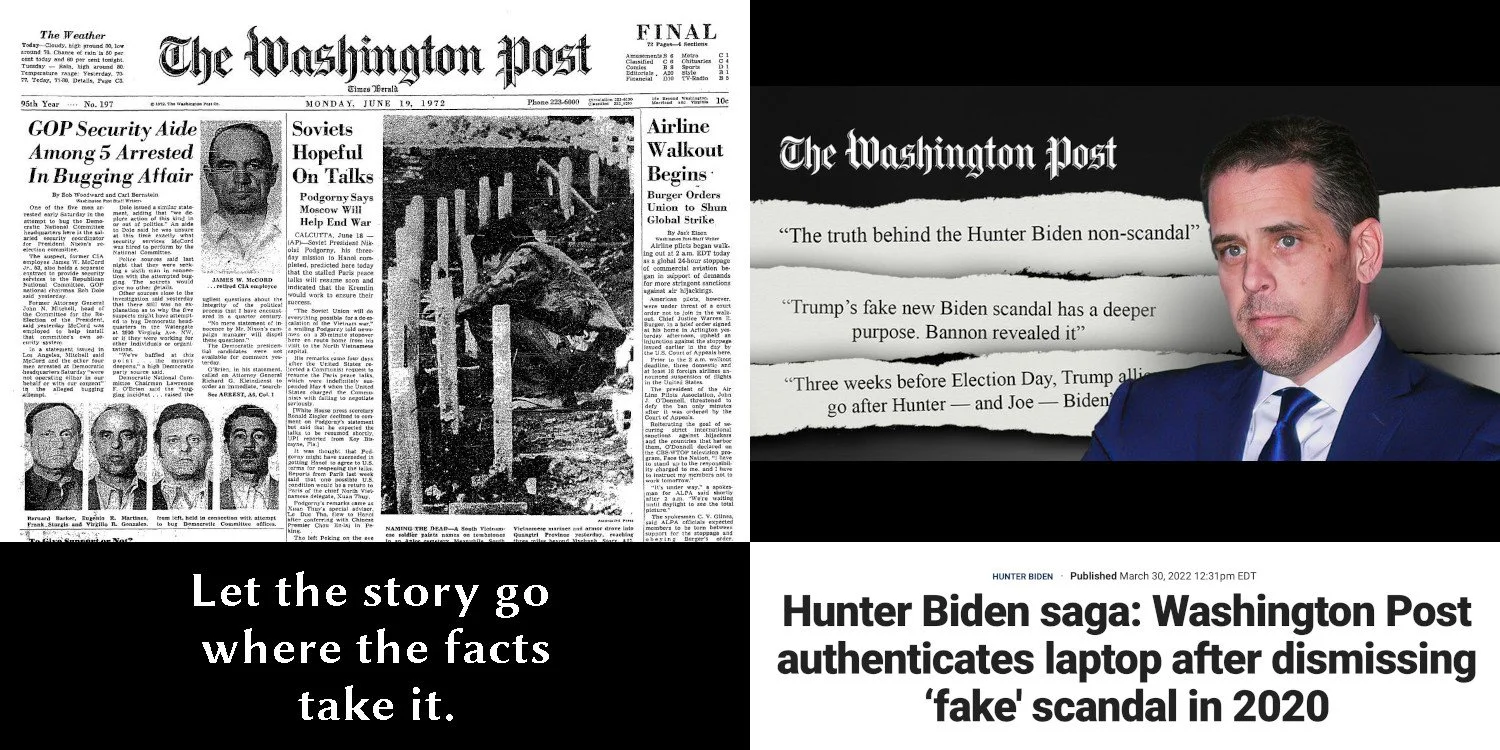
The Rise and Fall of the News Media
In 1972, The Washington Post sent two young reporters, Bob Woodward and Carl Bernstein, to cover the story of a break-in at the Democratic National Committee Headquarters in the Watergate Office Complex. The Post editors made a decision early on to allow that story to go where the facts led. As a result, Peggy Noonan was right. The whole country watched entranced as the Nixon Administration dissolved before our very eyes.
Fifty years later, Washington political scandal has not changed at all. What has changed is the news media. The Washington Post is now arguing in its editorials that George Washington University must change its name because of its namesake’s association with slavery 300 years ago. The Post is conveniently not applying the same argument to its own name. As historian, Barbara Tuchman wrote in The March of Folly, “There is nothing more unjust than to judge men of the past with the ideas of the present.”
The Washington Post and other news outlets today join the partisan Congressional framers of the January 6 Committee hearings to exaggerate public interest or decry the lack thereof. Meanwhile, The Wall Street Journal’s Holman Jenkins demonstrated journalistic courage in covering anew a story that most in the news media and the Democratic side of Congress helped to actively suppress.
In “Hunter and the Press: Who’s the Real Degenerate?” (WSJ July 2, 2022) Holman Jenkins revealed a series of evolving Washington Post headlines about the now notorious Hunter Biden laptop in late 2020. The Washington Post coverage leaves no doubt that the paper was actively suppressing that story in order to help facilitate a desired election outcome without regard to the damage it was doing to journalism, not to mention democracy. There was no hint of The Washington Post of the Watergate era. In the Hunter Biden story, The Post showed no consideration at all to its Watergate-era determination to “let the story go to where the facts take it.”
In this age of partisan spycraft and woke politics, the news media that was once the underpinning of democracy is now in a state of determined self-destruction. Most in the news media have chosen a partisan political side to the detriment of journalism, and perhaps the nation itself.
I hope, with the small voice given to me, to remain a purveyor of truth, and let the story go where the facts take it. Please do tell me anytime you think I might be screwing this up!
+ + +
Note: Thank you for reading. Please continue to take the measure of the news media with these related posts:
Miranda Devine, Cardinal Pell, and the Laptop from Hell
Hitler’s Post, Nazi Crimes and The New York Times
The Exile of Father Dominic Menna and Transparency at The Boston Globe

Dying in Prison in the ‘Live Free or Die’ State
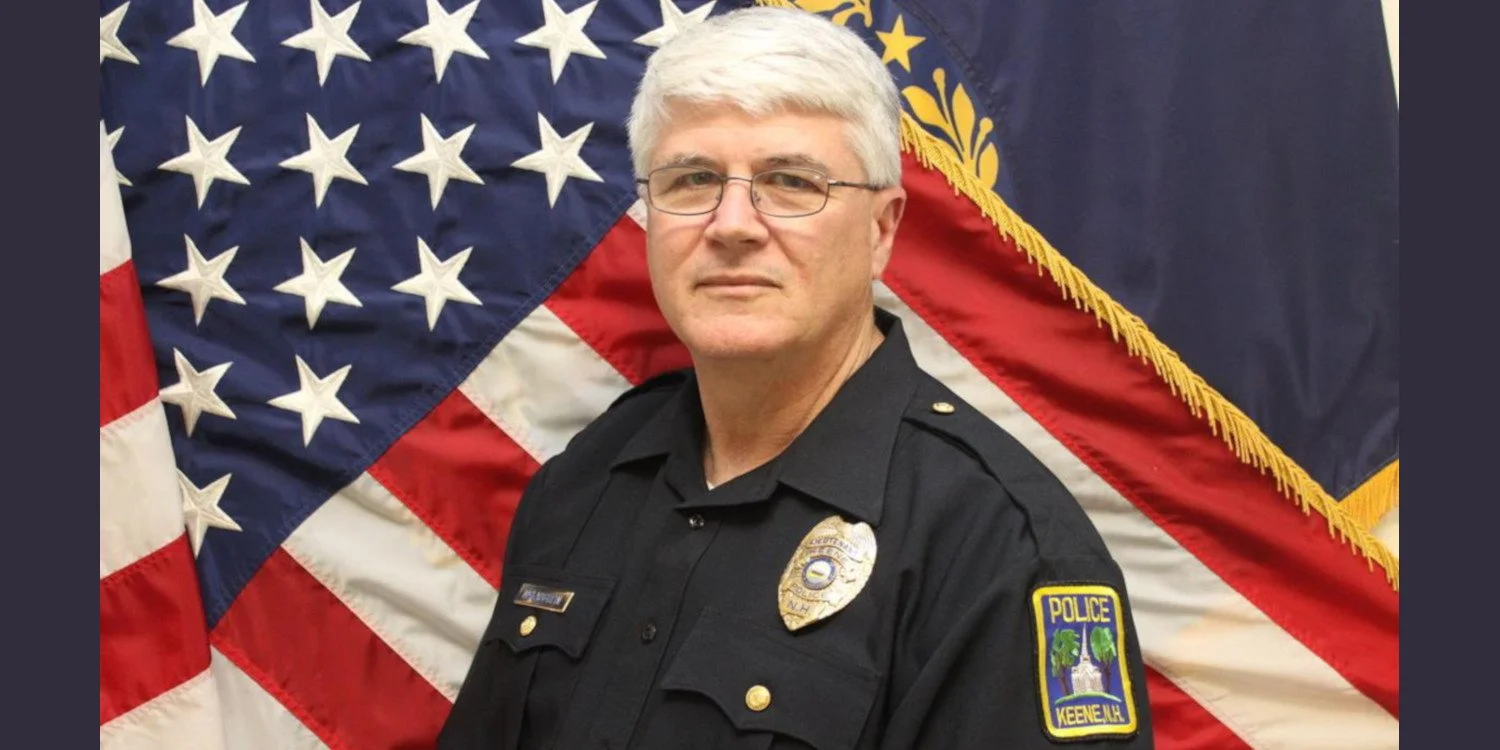
News articles allege that Detective James McLaughlin falsified reports and/or evidence but this was kept hidden from the jury in the 1994 trial of Fr. Gordon MacRae.

News articles allege that Detective James McLaughlin falsified reports and/or evidence but this was kept hidden from the jury in the 1994 trial of Fr. Gordon MacRae.
July 13, 2022 by Charlene C. Duline
Editor’s Note: The following is a guest post by noted author, Charlene C. Duline. Retired from a distinguished career as a diplomat and Foreign Service Officer with the U.S. State Department, Ms. Duline served the United States in several nations across the African Continent, in East Pakistan and Panama, and at United Nations Headquarters in New York. She holds degrees in journalism and political science from Indiana University and a Master’s degree in International Public Policy from the Johns Hopkins School of Advanced International Studies in Washington, DC.
+ + +
I am outraged at the State of New Hampshire! Every citizen in the State should be! Recent news articles by Damien Fisher and Nancy West at InDepthNH.org have pulled the shroud of secrecy from a grave injustice. Few people in that State knew about a list formally called the “Exculpatory Evidence Schedule,” now better known as the “Laurie List.” The list was revealed in December 2021 by the New Hampshire Attorney General as a result of litigation filed by the American Civil Liberties Union of New Hampshire and the New Hampshire Center for Public Interest Journalism which remains a litigant seeking the full publication of that list.
The court-ordered release of the list of compromised police is based on a Supreme Court decision holding that if favorable exculpatory evidence has been knowingly withheld by the prosecution in a criminal case, the burden shifts to the State to prove beyond a reasonable doubt that the undisclosed evidence would not have affected the outcome of a trial. If such a violation occurred and the State failed to meet its burden, a defendant has been denied his right to present all favorable proofs and is entitled to a new trial or to have his convictions vacated altogether.
Former NH detective James McLaughlin, the shady detective who was instrumental in pursuing lie after lie about Fr. Gordon MacRae sending him to a long prison term in 1994, was prominent on the Laurie List for “Falsification of Records” and/or evidence. Over 28 years of wrongful imprisonment in the New Hampshire State Prison, MacRae has consistently asserted that the case against him was built on lies, cheating and distortions aided and abetted by a dishonest police officer.
Just as Innocence Project founder Barry Scheck predicted in his 2003 book, Actual Innocence, those assertions have since been ignored or explained away at higher levels of the justice system by judges with a clear bias in favor of police and against defendants — and this defendant in particular. Judge Arthur Brennan, the first New Hampshire judge to hear this case, told jurors to “disregard inconsistencies” in accuser Thomas Grover’s testimony. As The Wall Street Journal’s Dorothy Rabinowitz wrote in The Trials of Father MacRae, they had much to disregard.
In addition to new evidence and witnesses that other judges declined to hear, much of MacRae’s failed 2012 Habeas Corpus petition was about Keene, New Hampshire sex crimes detective James McLaughlin and the shady tactics he employed to generate claims, prosecute, and convict MacRae in 1994 paving a path to lucrative settlement deals from the Catholic Diocese of Manchester.
Now it turns out that McLaughlin was sanctioned on a secret Attorney General’s list for “falsification of records” in 1985, nine years before the trial of Father MacRae. Under a U.S. Supreme Court precedent, Brady v. Maryland, prosecutors were required to reveal that fact to Defendant MacRae and his legal counsel. They did not. This was especially egregious because a central issue in this case has been the falsification of police reports and witness tampering.
Since there were no consequences, McLaughlin continued what he did best. The record in this case is filled with post-trial witness statements that he threatened, intimidated, coerced and lied to witnesses, and falsified records. At least one witness today claims that this detective attempted to suborn his perjury with a monetary bribe. Judge Joseph Laplante, the New Hampshire federal judge who heard MacRae’s Habeas Corpus petition, ignored all of this and allowed none of these witnesses to testify under oath.
Few people know that Fr. MacRae was offered two plea deals before his trial and one during trial. He was told that if he would plead guilty he would receive only one year in prison. This honest man turned down the plea deals. The lengthy criminal rap sheet of 27-year-old accuser Thomas Grover includes multiple arrests for forgery, theft, burglary, drugs, and assault. He broke his future ex-wife’s nose when she questioned his perjury.
The jury never heard any of this. Neither did they hear that Thomas Grover several times received financial payments from his personal injury lawyer, advances on his expected windfall in his accompanying civil lawsuit — a practice that is forbidden by the rules of professional conduct for lawyers. Grover was awarded almost $200,000 for crimes that never took place. There are photos of him dancing with stacks of $50 bills.
At the trial, Judge Arthur Brennan warned MacRae that if he took the stand in his own defense, the judge would open the door for Thomas Grover’s brothers to testify to their own false claims in related civil lawsuits. Gordon MacRae was the only person never heard from in this trial. In a flimsy 1996 appeal represented by a public defender (because MacRae’s diocese refused to help him), MacRae was not even allowed to be present. At three attempts at a Habeas Corpus appeal before state and federal courts since this trial, neither MacRae nor any witness for his defense were permitted to give testimony. At no time has any court official allowed a single word from this defendant.
The man who actually controlled the Diocese of Manchester during much of MacRae’s sentence was Monsignor Edward J. Arsenault, now known as Edward J. Bolognini. He violated Church law regarding Father MacRae who was never told, despite repeated requests, what the Diocese conveyed to the Holy See in Rome about this matter. Arsenault was later dismissed from the priesthood after pleading guilty to stealing almost $300,000 from the Diocese and the estate of a deceased priest. He reportedly spent the stolen money in the company of a much younger gay musician.
At the time of his nearly $300,000 embezzlement, Arsenault held a $170,000 per year position as Executive Director of the St. Luke Institute for troubled priests in Maryland. He served only two years of a 20-year prison sentence before being released and his sentence vacated when an unnamed third party paid his entire restitution. Now a convicted felon with a new name, he today administers a lucrative contract for the City of New York.
I believe that Father MacRae’s bishop and diocese owe him apologies for their abandonment of him, their presumptions of guilt, their refusals to visit or even correspond with him for 28 years in prison where Father Gordon MacRae remains a priest. He offers Mass in his cell each week, and has been instrumental in saving lives and souls. One of them is the life and soul of my Godson, Pornchai Moontri, a conversion story beautifully told by Marian Helper Editor, Felix Carroll in the great Divine Mercy book, Loved, Lost, Found.

+ + +
Editor’s Note: Charlene Duline’s Godson, Pornchai Moontri, now residing in Bangkok, Thailand, was the subject of a stunning investigative report by Father Gordon MacRae:
“Getting Away with Murder on the Island of Guam”.
For additional information on Charlene Duline’s article, see the following:
AG Hides Some ‘Laurie List’ Names Hours After Release By Damien Fisher, InDepthNH.org
Famed Keene Cop Called Out for Federal Entrapment By Damien Fisher, InDepthNH.org
A Grievous Error in Judge Joseph Laplante’s Court By Ryan A. MacDonald
The Trial of Father MacRae: A Conspiracy of Fraud by Ryan A. MacDonald


The Unspoken Racist Arena of Roe v. Wade
Catholic priests and politicians who are silent about abortion often cite racism as a higher moral priority. Are they blind to the racist oppression of Roe v. Wade?

Catholic priests and politicians who are silent about abortion often cite racism as a higher moral priority. Are they blind to the racist oppression of Roe v. Wade?
July 6, 2022 by Fr. Gordon MacRae
Shortly after a U.S. Supreme Court draft was mysteriously leaked with an impression that the 1973 decision in Roe v. Wade was about to be overturned, this reactionary nation descended once again into chaos. At the time, I wrote a post making a case for why overturning a precedent like Roe v. Wade was not the legal earthquake some in the partisan news media described it to be. Catholic League President Bill Donohue sent an email to the civil rights group’s thousands of members asking them to read my post entitled, “After Roe v. Wade, Hope for Life and a Nation’s Soul.”
It became our most-read post for the month of May, 2022, but I had long before been marked as a “prolife priest.” I had never even imagined that there are Catholic priests out there who might not champion the cause for life. I have since learned from lots of readers that they rarely if ever hear support for prolife causes in their parishes. So I set out in this post to make an argument for why Catholics — including priests — can and should be challenged to take up a well-informed defense of life.
I was a late arrival on the side of life. When I was a newly ordained priest forty0-two years ago in 1982, I learned that my one and only niece (two others arrived later) longed for a Cabbage Patch doll for Christmas. They were all the rage then, but my sister in the Boston area told me that the demand was so great it was simply impossible to find one. So I went on a mission and implored the help of a friend who managed a large department store just over the border in New Hampshire. She laughed saying that I should have listened to my sister, but I was an uncle determined not to disappoint my only niece.
A few days later, the friend called me and said that one of the chain’s stores had one that remained unclaimed so I quickly asked her to hold it for me. She wanted me to come late at night when the store was closing because she feared I might be mugged by desperate parents while carrying the semi-precious doll from the store. I felt like a thief in the night as I arrived to discover that the remaining doll was modeled after an African American infant. A flood of implications raced through my mind, but I dismissed them all and purchased the doll.
It was two weeks before Christmas, 1982. Back at my parish, I carefully opened the box, intrigued by the enormous social pressure on parents to find and buy this pseudo-human infant for their young daughters that Christmas. Inside the box, I was surprised to see what looked like an official birth certificate with the doll’s name and date of “birth” printed in nice calligraphy.
So the following Sunday at Mass, I brought the doll with me, box and all. It was the Fourth Sunday of Advent. During my homily, I opened the box and produced both the doll and the birth certificate. The parish was instantly riveted, not by the point I was making but by the fact that I had somehow actually obtained a Cabbage Patch doll. My homily called out the irony that the creators of this doll went to such great lengths to fabricate authenticity — including a birth certificate — and promote such enormous demand that mothers and fathers could not find one. Meanwhile, real human babies are quietly aborted by the millions every year across the land. The reaction to my homily was both strained and strange.

Project Rachel
As I held up the birth certificate, there were audible gasps. Some looked alarmed and uncomfortable, others mesmerized, some quite pleased, and others downright hostile. No priest likes hostility, and I was no exception. At the door after Mass, some people thanked me for bringing up a subject never before heard in their parish. Others whisked by me without eye contact. A few looked really ticked and muttered something about “politics from the pulpit.” One man who clearly did not get the point said, “a hundred bucks for the doll, Father.”
One week later at Christmas, my niece was overjoyed at her new “little sister.” Within a few years she would have two real ones, and would learn that little sisters are a mixed blessing when you are accustomed to being the only one at center stage. Today, they remain very close and each is now also a mother.
It was because of this experience — the simple act of buying a doll for my niece at Christmas — that I thought Roe v. Wade all the way through and knew that I could not be silent about what I had learned. My first lesson was how easy it was to dupe myself into comfortable moral complicity by not thinking it through. I know this is an uncomfortable subject for some, but it is not possible to fully profess the Gospel without discomfort.
Two years later, I became one of four priests in my diocese to join Project Rachel, a Catholic ministry approved by the U.S. bishops to assist women who have had an abortion with the process of repentance and reconciled Communion with their faith. It is one of the most important ministries in the Catholic community, second only to the cause of life itself.
Our culture has romanticized the Christmas story, but in the Gospel of St. Matthew it concludes with terrible tragedy. Enraged at being tricked by the Magi, Herod ordered the slaughter of the infants of Bethlehem. The story ends with a prophecy of Jeremiah which is the source for Project Rachel’s name:
“A voice was heard in Ramah, wailing and loud lamentation, Rachel weeping for her children; she refused to be consoled because they are no more.”
— Jeremiah 31:15 and Matthew 2:16-18
A reader of Beyond These Stone Walls recently told me of a discussion with her parish priest about abortion and Roe v. Wade, and the fact that the priest had never addressed either in a homily. She is a retired obstetrics nurse who obviously had a lifetime of thinking this through. I have heard the same critique of many priests in many states. Some respond that other social justice issues such as racism and inequality are higher moral priorities for them. They miss the crux of the matter.
There have been bold exceptions, priests who have inspired me and others in the cause of life. Among them are Father Frank Pavone, founder of Priests for Life, and Father Stephen Imbarrato, also known as the “Protest Priest.” He is the moderator of Catholic Prolife and a leader in Red Rose Rescue.
When San Francisco Archbishop Salvatore Cordileone recently imposed a canonical discipline barring House Speaker Nancy Pelosi from receiving Communion, Mrs. Pelosi accused him of hypocrisy. She stated that she is in fact prolife, but her prolife activism centers on limiting the death penalty. It is spiritual blindness, and a common progressive position. But it is also one that I have shared. I was dubbed “the priest who kicked the hornets nest” when I wrote of this a decade ago. To protest the death penalty while promoting abortion is to become comfortable with spiritual blindness.
Catholic politicians like former Speaker Nancy Pelosi and President Joe Biden have compartmentalized and dulled their Catholic consciences. Like many progressive politicians, they have not thought this all the way through. The arenas of both the death penalty and abortion rights are mired in racism.

The Real Social Injustice of Racial Inequality
The list of racial disparities in America is extensive. African Americans represent only 12.5 percent of the U.S. population but 40 percent of the U.S. prison population. Many studies have shown that African American defendants often received longer prison sentences than White defendants for the same offense. They have been more likely than White defendants to be sentenced to death for capital crimes, and have been many times more likely to actually be executed in states that retain a death penalty.
This is of grave concern, but all of our concern is moot if we cannot even get the subjects of our concern born in the first place. At his shocking and eye-opening site, Blackgenocide.org, Rev. Clenard H. Childress, Jr. reveals that “The most dangerous place for an African American is in the womb.” When it comes to racial disparities in abortion the political left and too many of our priests and bishops remain silent in a state of ignorant bliss. There is no more racist agenda than the one behind the abortion industry in America.
In 1992, President Bill Clinton presented what was then the accepted liberal Democratic view: that abortion should be “safe, legal, and rare.” Since then, the overall abortion rate has declined to about half of what it was in the 1980s — except among African Americans. According to Justice Clarence Thomas, Black women are today eight times more likely than White women to seek an abortion. Abortion’s impact on the size of the African American population is critical, but conveniently overlooked by the news media and the progressive political left.
I had no idea when I gave my three-year-old niece that African American-looking Cabbage Patch doll in 1982 that infants who look like that particular doll are especially in peril. In a 2019 abortion case, Supreme Court Justice Clarence Thomas observed that in New York City that year, for the first time in history, more African American infants were aborted than born.
It is also true that Planned Parenthood of America places its origin in the work of Margaret Sanger, an activist American nurse who worked tirelessly to provide access to abortion. From her own writings, one of her motivations was an interest in eugenics, the science of selective breeding. By controlling the growth of the African American population, Margaret Sanger and others believed that the purity of American genetic heritage could be maintained.
Jason L. Riley, an African American writer and a columnist for The Wall Street Journal authored a recent op-ed entitled “Why Won’t the Left Talk About Racial Disparities in Abortion?” (WSJ, May 11, 2022). He wrote that the political left in America is quick to set off alarms anywhere racial disparities are known to exist — except for this one.
Race-based differences in SAT test scores, for example, brought calls to eliminate the SAT as a college admission test. A racial gap in arrest and incarceration rates has long vexed this nation, resulting on the left with socially destructive reactions like the “defund police” movement. In terms of sheer numbers and their impact on the African American population, abortion far exceeds other social justice concerns. The number of babies aborted by Black women each year in America far exceeds the combined numbers of Black youths who drop out of school, are sent to prison, and who are murdered on the streets of our cities.
The WSJ’s Jason Reilly cited a Pennsylvania case study about death rates. Examining premature deaths from all causes in 2018, it was discovered that abortions constituted 23.9 percent of premature deaths among the White population and 62.7 percent among the Black population. Abortion rights activists often cite these facts as a function of poverty, but even among other groups with higher poverty levels, Black women still have abortions at much higher rates than any other demographic.
The notion that not growing up at all is better than growing up in poverty is a notion only of the elite. Think of the arrogance behind such statements. If activists believe that lower incomes impact Black abortions, then the social justice issue and goal should be equality in income not controlling the population Planned-Parenthood-style through abortion.
Black lives matter. Indeed they do. Black infant lives matter too. There is no more racist agenda in America than the one keeping an entire people down through abortion.
+ + +
Note from Fr. Gordon MacRae: Thank you for reading and sharing this post.
You may also like these related posts:
After Roe v. Wade: Hope for Life and a Nation’s Soul
Biden and the Bishops: Communion and the Care of a Soul
Joe Biden, Cardinal McCarrick and the Betrayal of Life
Last Full Measure of Devotion: Civil Rights and the Right to Life


Falsely Accused by Facebook: Like Déjà vu All Over Again
Wrongly accused of violating Facebook Community Standards my page was restored on appeal with an apology. Then Facebook warned me to never again do what I never did.

Wrongly accused of violating Facebook Community Standards my page was restored on appeal with an apology. Then Facebook warned me to never again do what I never did.
June 29, 2022 by Fr. Gordon MacRae
Some time ago, I wrote an article for LinkedIn Pulse entitled, “Gene Roddenberry and Captain Kirk’s Star Trek Epiphany.” It was an odd blend of science fiction and faith. LinkedIn users loved it — even some who were never Star Trek fans. It told the story of my childhood affinity for Star Trek which first entered our collective consciousness when I was 13 years old in 1966.
Actor Wil Wheaton caught my attention recently when he had a terrific essay published in the “Gears & Gadgets” section of The Wall Street Journal. A self-described geek, Mr. Wheaton played a somewhat cooler geek as Ensign Wesley Crusher in the 1980s Star Trek revival series, “Star Trek: The Next Generation.” My own geekness survived into adulthood so I saw every episode twice.
Since then, several additions to the Star Trek franchise have come and gone. My all-time favorite is the current one, Star Trek Discovery, a streaming series now in its third season.
But I’m off topic already. Wil Wheaton’s WSJ essay was “When Did We Lose the Internet?” (WSJ June 4-5, 2022). It was about how the Internet has evolved from his days as a young blogger in the early 1990s on Greymatter created by and named for Noah Grey. Wheaton wrote of Mr. Grey’s habit of personally assisting users:
“Can you imagine emailing Mark Zuckerberg any time you had a problem with Facebook? Now imagine him immediately fixing it.”
I have actually tried to imagine that. Facebook today boasts of having two billion users worldwide. I am one of them, but a reluctant and atypical one. I have never actually seen Facebook, but there is a page there for me and Beyond These Stone Walls that was created and maintained by our editor. I do not have a cat so readers will never see photos of my cat, but by some miracle my page has thousands of followers.
My entire Facebook experience involves simply posting my weekly post with help from our editor. My posts are then shared to a number of Catholic and prolife Facebook groups around the world. By posting to groups like CatholicismRocks and Catholic News Agency this humble blog reaches tens of thousands of readers.
Beyond These Stone Walls is not at all dependent on Facebook for readers, however. Those who come to the site from Facebook each week constitute less than ten percent of the readers of this blog. The vast majority come with “no referring link,” meaning that they subscribe directly (which is free and something I hope everyone will do).
In early March, 2022, I received an ominous message from Facebook that my account has been suspended and I am henceforth banned from posting, sharing, or commenting due to “violations of Facebook’s Community Standards.” I had no idea how this happened. So again with help, I reviewed the Community Standards and could not find any that I had ever violated.
From there, the story gets a little comical. At least, it would be comical if it were not also so frustrating. It was my first experience of pleading my case before an algorithm instead of a human person. I first wrote of this in another LinkedIn article, “Banned by Facebook for a True Story of Anti-Catholic Oppression.”

The Facebook Oversight Board
It turned out that the offending post was one that I had written a decade earlier. Facebook had no issue with it then. But when it was linked in another, newer post, it seriously riled Facebook’s Orwellian algorithm. The link was to a true story of anti-Catholic oppression that I had written back in 2011. It has been hiding in plain sight ever since. You may judge it for yourself. My banishment was because of “Catholic Scandal and the Third Reich: Rise and Fall of a Moral Panic.”
That post was an entirely true and fully documented account of false witness in 1939 Germany. Angered over an anti-Nazi document bravely published by Pope Pius XI, Adolf Hitler’s Minister of Propaganda, Joseph Goebbels, falsely accused over 300 German Catholic priests of sexual abuse and arrested them all. It was a demonic effort to silence the Church. In the end, all but three were acquitted and exonerated because the German courts had not yet fallen into lockstep with the Nazi regime. The post opened with a quote from Hitler himself: “The great mass of people will more easily fall victim to a big lie than to a small one.”
Somehow, Facebook’s algorithm immediately detected this mention of Hitler and his quote, and determined it — and me — to be socially and culturally dangerous. So Facebook froze my account. We appealed that decision in a lengthy process that rivaled any state or federal appeal I have encountered before or since.
Anyone who has ever taken the time to endure a Facebook Oversight Board appeal knows firsthand what I was up against. The aura of suspicion and prejudice was a reminder of all I have witnessed in state or federal courts. With help, I completed a multitude of forms and answered page after page of probing questions such as “What was your motivation in writing this offending material?”
Finally, I was asked what community purpose the questioned post served. I explained that the Catholic Church has been rocked by allegations of often decades-old abuse in multiple countries, and reviewing all aspects of this phenomenon is in the best interests of the Catholic community. I then asked the Oversight Board to simply read the post instead of reacting to the algorithm’s rejection of it. Apparently someone did read it. We received this reply from the Facebook Oversight Board a week later:
“Sorry that we did not get this right. Our review of your post indicates that you did not violate Facebook Community Standards. Your post has been restored. Thank you for taking the time to appeal this matter and assist us in our continuing efforts to assure the safety of the Facebook forum.”
There were no angels singing the Alleluia Chorus. I actually did not care at all what Facebook concluded from my posts. My concern was for the Catholic groups that choose that forum to communicate with other members. I estimate that our posts reach about 200,000 people in those groups, and I was not keen on abandoning them to the usual Facebook fare.
But it wasn’t over. The Oversight Board restored the post within 12 days of discovering it. But Facebook did not restore my account. For the next 30 days it remained visible, but inactive meaning that we could not post or comment. Then for another ninety days Facebook censured all our posts by preventing them from being shared on the newsfeed for each of the Catholic and pro-life groups we had joined. The Facebook fiasco finally ended on June 5, 2022 which also just happened to be the Solemnity of Pentecost and my 40th anniversary of priesthood ordination. So my last post to be suppressed was “Forty Years of Priesthood in the Mighty Wind of Pentecost.”

Metaverse Madness and Independence Day
One week later, when our editor checked our Facebook account status, the following message popped up: “Your account has been fully restored. If you violate Facebook’s Community standards again your account will risk being permanently suspended.” Facebook is now ever ready to penalize me for again doing what I never did in the first place.
At the same time, we received an email message from some unknown, even darker entity claiming to represent Facebook. It informed us that our account is “almost fully restored, but we need your account information and passwords to complete the restoration.” This was, of course, a fraud. A previous message also informed us that Facebook needs our debit card number and $50 to complete the restoration of the account.
We ignored and deleted both messages. It is troubling that Facebook’s algorithm can readily detect and react to anything suspected of violating “woke” sensitivities, but cannot detect attempts at fraud carried out in Facebook’s name. Facebook has enslaved itself to woke culture and for the same reasons MSNBC and, to a slightly lesser extent, CNN and network news outlets have. Advertisers require keeping a level of viewership, and viewers require content they agree with.
At Facebook, advertising dollars reign supreme. Facebook’s most valuable demographic is young people, but that age group’s mass migration to Tik Tok and other venues is underway. In 2022, quarterly revenue dropped significantly because Facebook’s advertising empire depends on keeping that demographic online and satisfied. Anything deemed offensive or disagreeable to that demographic is edged out of Facebook’s daily discourse — the First Amendment and free speech be damned.
Two weeks ago in these pages, we posted “Tragedy at Uvalde, Texas: When God and Men Were Missing.” In that post, I cited the grim reality of a burgeoning mental health crisis among young people in our culture, an alarming problem that exists today at a level never before seen. Something has gone terribly wrong. Over the last two years, daily users of Facebook rose exponentially because schools were closed and young men and women were learning remotely.
A lot of extra time was spent on Facebook in those two years, but the mental health crisis we are seeing demonstrates that Facebook just isn’t enough. Real, meaningful, human contact is essential to the development of the young. A computer just doesn’t cut it. We may never break free of social media, but we must break free of its addictive qualities. Independence Day 2022 is upon us, and it’s a good time to start with a Facebook-free day.
In the future world envisioned by Star Trek, no one ever even mentions Facebook or any anticipation of the accumulation of “likes.” Maybe our future might see Facebook as ancient history. Once you come face to face with a Klingon, no one wants to be his Facebook friend anyway.
+ + +

Actor Wil Wheaton in “The Game,” a classic episode of Star Trek the Next Generation in which he had to be liberated from enslavement to a mind-altering computer game.
Note from Fr. Gordon MacRae: Thank you for reading and sharing this post. Next week at Beyond These Stone Walls, I will present a post about the stunning news that the U.S. Supreme Court has overturned Roe v. Wade.
Please visit our newest addition to our Voices from Beyond page and please Subscribe if you haven’t already. You may also like these other titles that celebrate our hard-won freedoms this Independence Day:
After Roe v. Wade, Hope for Life and a Nation’s Soul

The James Webb Space Telescope and an Encore from Hubble
The James Webb Space Telescope in orbit in a neutral gravity zone one million miles from Earth may provide humanity's first glimpse of dark matter in the universe.

James Webb Space Telescope illustration courtesy of ESA/Hubble (Northrup Grumman).
As the James Webb Space Telescope entered orbit in a neutral gravity zone one million miles from Earth, the waning days of Hubble revealed an astronomical surprise.
June 22, 2022 by Fr. Gordon MacRae
“Where were you when I laid the foundations of the Earth? Can you bind the chains of the Pleiades or lose the chords of Orion?”
— Job 38:4,31
“Astronomy, Cosmology, Physics, Theology, History! Reading this blog is like enrolling in a graduate program at NYU.” That message was sent to me in a letter several years ago from a friend, an official of the Archdiocese of New York. I have written a good deal about the sciences of astronomy and cosmology, but only about a dozen posts over the 13-year lifespan of this blog.
In a recent telephone call from exile to my friend, Father George David Byers, STD, SSL, he chided me that I am way overdue for a science post. I cite his academic credentials here — a Doctorate in Sacred Theology from the Pontifical University Angelicum in Rome and a Licentiate in Sacred Scripture from the Pontifical Biblical Institute in Rome and Jerusalem — to reflect that his suggestion of a mere “science” post might contain just a hint of academic hubris. If so, I can only respond with a quote from the great English poet, Samuel Taylor Coleridge: “And the Devil did grin, for his darling sin is pride that apes humility.”
I actually did write a science post even before Father Byers brought it up. Please don't yawn or click me away just yet. For me, this is a very big deal and it has a “WOW” factor. The Hubble Space Telescope, launched into Earth orbit in 1990, has been operating for 32 years and has far exceeded its intended operational limit. In the waning days of Hubble, it surprised Earthbound scientists with an amazing discovery. I will get to it below, but first ...

Star Trek: The Next Generation
The next generation of space exploration was born with the December 25, 2021 launch of the James Webb Space Telescope (JWST). It has recently arrived at its designated orbit in what is called a “Lagrange point.” Named for the 18th Century French mathematician and physicist, Joseph Louis Lagrange, a “Lagrange point” is a zone of neutral gravity between the Earth and the Sun about one million miles from Earth. That point is now host to the revolutionary James Webb Space Telescope.
Thousands of scientists and engineers took part in this project on the cutting edge of astronomical science. The Space Telescope Science Institute will operate and monitor it from Baltimore. Webb successfully separated from its launch vehicle and unfolded a giant solar array to power the telescope. Armed with huge primary and secondary mirrors and a suite of cameras, spectrometers, and other instruments, the Webb Telescope is the size of a large truck. It is capable of producing spectral images of 100 galaxies at a time. As one scientist described it:
“[Webb] will crack open the treasure chest of the magnificent infrared sky invisible to the human eye. If a bumblebee hovered in space at the distance from Earth to the Moon, Webb will be able to see both the sunlight it reflects and the heat it emits.”
One of the burning questions of both science and faith that Webb may lend itself to solving is the existence of life elsewhere in the Universe. All the latest media craze about evidence of UFOs points only to Earth-bound technology. Distances between stars are like impenetrable barriers. If sentient life exists, we will detect each other long before we ever encounter each other. So far, after decades of searching, no such evidence yet exists.
A general consensus among astronomers is that life does exist “out there,” but complex life is much more rare, and sentient complex life like us, if it exists elsewhere at all, is extremely rare. I once wrote a post laying out a case for our uniqueness in the Cosmos. It was, “Star Trek and the Search for Extraterrestrial Intelligence.”
That post introduced readers to a remarkable contributor to the science that made the Webb Space Telescope possible. Astronomer Vera Rubin defied all the stereotypes of her time to become one of the great icons of cosmology. She discovered that the visible Universe that we see in the night sky is only about 10 to 15 percent of what is actually there. She wrote of this in “Dark Matter in the Universe” (Scientific American, 1998):
“As we have done for centuries, we gaze into the night sky from our planetary platform and wonder where we are in this cavernous cosmos. Flecks of light provide clues about great objects in space. And what we do discern about their motions and apparent shadows tells us that there is much more that we cannot yet see.
“From every photon we collect from the universe’s farthest reaches, we struggle to extract information. Astronomy is the study of light that reaches Earth from the heavens. Our task is not only to collect as much light as possible — from ground and space-based telescopes — but also to use what we can see in the heavens to understand better what we cannot see and yet know must be there.
“Based on 50 years of accumulated observations of the motions of galaxies and the expansion of the universe, most astronomers believe that as much as 90 percent of the stuff constituting the universe may be objects or particles that cannot be seen. In other words, most of the universe’s matter does not radiate. It provides no glow that we can detect in the electromagnetic spectrum. … We call this missing mass ‘dark matter,’ for it is the light, not the matter, that is missing.”
— Vera Rubin, 1998
In coming months, the first images to come from the James Webb Space Telescope now hovering one million miles between Earth and the Sun may provide humanity’s first illumination of dark matter, that 90-percent of the Universe that we have never before seen. The Webb Telescope enormous primary mirror has unfolded perfectly. In coming months Webb’s first images of the ancient cosmos will arrive on Earth. Be prepared to be amazed!

A Pre-retirement Surprise from Hubble
My favorite post of the past year is one that was only half written by me. The other (and far better) half was written by Fr. Andrew Pinsent, a noted particle physicist and Research Director at the Ian Ramsay Center for Science and Religion at Oxford University in the U.K. I was way out of my element in this joint venture, but it was this humble blog’s best foot forward. The jointly written post was, “Fr Georges Lemaître, the Priest Who Discovered the Big Bang.”
It was among our most popular and enduring posts of the last year. Perhaps it was just a nice break from this world’s seemingly never-ending preoccupations with war, pestilence, scandal, and other obsessions of our time.
In that post, I quoted an excerpt from the book, Einstein’s Heroes: Imagining the World Through the Language of Mathematics (Oxford University Press, 2005), a wondrous book by a brilliant mathematician, Robyn Arianrhod:
“In 1931, [Georges] Lemaitre formally sowed the seeds of the Big Bang theory when he suggested the universe had started as an explosion of a ‘primeval atom,’ and that it had continued expanding from that explosive beginning.... Einstein’s equation predicted the universe had expanded not from a tiny piece of matter located in an otherwise empty cosmos, but from a single point in four-dimensional space-time .... Before this point, about thirteen billion years ago, there was no time and no space. No geometry, no matter, nothing. The universe simply appeared out of nowhere. Out of nothing.” ( p. 187)
“The Universe simply appeared out of nowhere. Out of nothing.” And it all happened in an instant 13 billion years ago on “A day without yesterday.” This conclusion of modern cosmology was the work of a brilliant priest, mathematician and physicist, Fr. Georges Lemaitre. If you wonder about the relevance of faith in the scientific world, you may be surprised to learn that science and the Catechism of the Catholic Church are on the same page in describing the origin of a created universe:
“God created the universe out of nothing.” (CCC 290)
“We believe that God needs no pre-existent thing or any help in order to create. God created freely out of nothing.” (CCC 296)
“God said, ‘let there be light,’ and there was light” (Genesis 1:4). Scripture bears witness to faith in creation ‘out of nothing’ as a truth filled with promise and hope.” (CCC 297)
“Since God created everything out of nothing, He can also, through the Holy Spirit, give spiritual life to sinners by creating a pure heart in them, and bodily life to the dead through the Resurrection.” (CCC 298)
The Hubble Space Telescope is destined to soon retire, but not before it gave us some amazing images of the visible Cosmos. Its latest surprise is a photograph of the most distant star ever seen by human eyes or instruments, a star now called “Earendel.” It is 28 billion light years from Earth. A light year is a measure of distance and not of time. It is the distance light travels in a single year at the constant rate of 186,000 miles per second. A light year works out to be 5.6 trillion miles. Multiply that by 28 billion and that is the distance from Earth to Earendel. Please don’t ask me to convert this to kilometers.
The light Hubble captured from Earendel emanated from the star 12.9 billion years ago in the very infancy of creation as calculated by Fr. Georges Lemaitre. The only reason Hubble could spot this star is because of a rare cosmic alignment. A galaxy cluster beyond the Milky Way — our galaxy — was positioned in such a way that its gravity bent light creating a sort of cosmic magnifying lens.
If you did the math, you might have noticed that Earendel is twice the distance of the age of the Universe which is possible only because the Universe has continually expanded over those 13 billion years. This expansion, and the now proven fact that galaxies are defeating gravity by speeding away from one another, was also a discovery of the physics of Fr. Georges Lemaitre which in the end were applauded and embraced by Albert Einstein.
Who says priests are boring?
+ + +
Note: Thank you for reading and sharing this post. Please visit our “Special Events” page and these related links:
Star Trek and the Search for Extraterrestrial Intelligence
Fr Georges Lemaître, the Priest Who Discovered The Big Bang
“A Day Without Yesterday:” Father Georges Lemaitre and The Big Bang
+ + +


Tragedy at Uvalde, Texas: When God and Men Were Missing
Facing the truth about the tragedy in Uvalde, Texas will require courage. Something has gone terribly wrong in our culture and Pornchai Moontri knows it firsthand.

Facing the truth about the tragedy in Uvalde, Texas will require courage. Something has gone terribly wrong in our culture and Pornchai Moontri knows it firsthand.
June 15, 2022 by Fr. Gordon MacRae and Pornchai Moontri
Note to readers: Fr. Gordon MacRae interviewed Pornchai Moontri in Thailand for this post. Pornchai’s most recent post was “A Night in Bangkok, a Year in Freedom.”
+ + +
A dense, dark cloud has been hanging over America since the recent inexplicable and shocking murders of 19 elementary school children and two of their teachers by 18-year-old Salvatore Ramos in Uvalde, Texas. The close knit community will feel the effects of this trauma for decades to come. A lot of soul searching has gone on about what could have triggered such an event, about how it developed, how it might have been prevented, and what could have been done differently by responding police.
The tragedy at Uvalde was devastating, and was preceded just a week earlier by the racially charged rampage of another 18-year-old shooter brandishing the same sort of weapon. He killed 12 people — ten of them targeted for being African American — at a grocery store in Buffalo, New York.
After the shocking but unrelated stories unfolded, half the nation went immediately for the guns and political talking points. President Biden’s loudest and most immediate response was, “When in God’s name are we going to stand up to the gun lobby? Where in God’s name is our backbone?” They were not exactly the words of consolation the nation and the people of Uvalde needed in the moment. The politics should have waited.
Texas Governor Greg Abbott explained rationally that 18-year-olds in Texas have been able to own long guns (not hand guns) since frontier days while only in recent years have these mass shootings occurred in schools. That is true, but it is also true, as Governor Abbott added, that there are currently many reports of a burgeoning mental health crisis among young people that did not exist a hundred years ago. Why does it exist now?
After both stories dominated the news media, I reached out to our friend, Pornchai Moontri in Thailand. I knew that when he learned of these accounts, he might relate them to his own offense at age 18 at a supermarket in Bangor, Maine 30 years ago. During a parking lot struggle with a much larger man, 18-year-old Pornchai killed him. It happened on March 21, 1992. Pornchai never saw freedom again until almost 30 years later.
The major difference between that incident and the two young assailants in Buffalo and Uvalde is that Pornchai never set out to harm anyone that day or on any day. He carried a knife for self-protection. Having been torn from a rural village in Thailand at age 11, Pornchai was abused and tormented in Bangor, Maine until he escaped into homelessness on the streets of a foreign country. As the only Asian in town, he was often the subject of racial hatred, hunted by a Bangor street gang.
Most people who read this blog know Pornchai’s story. It is told in multiple places, but the best source is a widely read article at Linkedin. If you read it, you may wonder, as many already have, how one young man could endure so much and ever trust life again. The article is “Human Trafficking: Thailand to America and a Cold Case in Guam.”

In the Absence of Fathers
When I asked Pornchai for his thoughts about what might have driven 18-year-old Salvatore Ramos to this end, he put his response in the first person:
“I didn’t care about anyone; and then someone cared about me. If I did not find God, and you, and acceptance, and Divine Mercy, I might have stayed on a road to destruction. It was all I knew or expected. Hatred left me when something came along to replace it. Do you remember your Elephants post? It makes total sense. The one thing missing from my life and the lives of those two kids in America was a father. Without one, a decent one, a kid is at the mercy of dark forces and his mind just breaks.”
The “Elephants post” that Pornchai referred to was a Fathers Day post I wrote in this same week in 2012. It was a huge eye-opener for many people and began a serious discussion about the crisis of father absence in our time and the retreat of good men from engagement in the public square. The post was “In the Absence of Fathers: A Story of Elephants and Men.”
It is interesting that, ten years after writing it, that post began appearing in search engines all over the United States just hours after news struck about the horror in Uvalde, Texas. I had also made the same connection and decided that I would share that post anew on Facebook, Linkedin and Twitter. When our editor looked at traffic reports that day, even before we shared it, the post was showing up everywhere.
Despite the story and research covered in that post being suppressed in our agenda-driven mainstream ne ws media, people instinctively know the truth of it. There are two factors, both speaking loudly and clearly, about the burgeoning mental health crisis among the young that is now clearly evident in our culture. Those two factors are the growing and spreading of fathers from the lives of struggling young men and the diminishment of faith and hope as our culture separates itself from God. Along with this, incidents of violence and other criminal behavior among young men have increased 1,000 fold in two decades, and deaths by suicide and accidental opioid overdose are now the number one killers of young men ages 15 to 30.
I live with many who live without hope. For year after year, this prison sees a steady stream of lost, fatherless young men trapped in adolescence and unable to developmentally move on. They are 35 going on 12 emotionally, they suffer from panic attacks and other critical anxiety states, and they are subject to fits of overwhelming emotion. Over ninety percent of them grew up in the care of single mothers with absent fathers. The steady stream of social weapons aimed at men in recent decades — such as the #MeToo movement — has further diminished manhood and, by extension, fatherhood.

In the Name of the Father
Once God and Fatherhood are cast aside, only the feminine remains. That may sound great for the causes of radical feminism, but in the psyches of young men it wreaks havoc and chaos when coupled with the diminishment of fatherhood. The results are all around us: a marked increase in transgender ideology and great political pressure to embrace it, chronic gender confusion, identity confusion, self-medicating drug abuse, and the breakdown of identity and self-awareness. The great psychoanalyst, Erik Erikson predicted that adolescence cannot end until the crisis of identity is resolved. Our culture has extended that crisis to engulf a lifetime.
Before the election of 2020, then nominee Joe Biden said in a news conference “if an eight-year-old boy wakes up one morning and wants to be a girl, he should be given all the tools and medical support necessary and parents should have no say in it.”
That is not verbatim, but it is the context and content of what was said. Media heads were bobbing as they took notes.
Dr. Paul McHugh, Distinguished Professor of Psychiatry at Johns Hopkins University Medical Center and a widely recognized expert in this field, has stated that most transgender people suffer from a mental disorder and the idea of sex reassignment is simply mistaken — and leaves much psychological damage in its wake. Meanwhile, the Biden administration is now finalizing plans to require transgender treatment under healthcare plans. Catholic League President Bill Donohue recently addressed this in “Transgender Mania Grips the White House.”
These developments have all come about as a natural result of removing God from the public square. One of the last bastions of faithful witness has been the Catholic Church, but the sexual abuse crisis, though in too many ways real, was also hyped and manipulated to remove a Catholic voice from public discourse on moral issues. Gone also are the Boys Scouts of America. It is actually a hopeful sign that pro-abortion groups are attacking Catholic churches right now. It’s a sign that the Church is still perceived as being on the front line in the defense of life. Still, the eradication of God has made inroads that deeply affect young people and their ability to hope through hard times.
In a fine commentary by Peggy Noonan in The Wall Street Journal, she added the obvious, that it is one thing for an 18-year-old to have a gun to shoot rattlers in the 18th Century. It is quite another to allow an 18-year-old to buy a military grade assault rifle in the middle of a mental health crisis. Some common sense and compromise are likely to eventually prevail, even in an election year. Ms. Noonan went on, however, to point to a far deeper crisis and contributing factor to such tragedy in a recent column, “Let Not Our Hearts Grow Numb,” (WSJ, May 28, 2022):
“I continue in a kind of puzzled awe at my friends who proceed through life without faith, who get up and go forward without it ... I tell the young, I have been alive for some years and this is the only true thing, that there is a God and he is good and you are here to know him, love him, and show your feeling through your work and how you live. That is the whole mysterious point. And the ridiculous story, the father, the virgin, the husband, the baby — it is all, amazingly, true, and the only true thing ... Consolation is not why you believe, but is a fact of belief and helps all who have it live in the world and withstand it.”
I share with Peggy Noonan the consolation that the good people of Uvalde, Texas at least have that. This is part of our collective crisis. Too many have been robbed of the consolation of faith because of the relentless progressive assault on faith over the last few decades.
And she is also right about the crisis of mental health among the young. Signs of it are reported everywhere, and it is much exacerbated by the government enforced Covid lockdowns of the last two years.
I admire Peggy Noonan also for her unapologetic faith the absence of which is also a crisis among the young. It is the most common prayer request I receive from parents — a hope that their teen and young adult children will return to faith. As mentioned a week ago in these pages, Saint Paul famously wrote that only three gifts have lasting value, Faith, Hope, and Love. To impart Love without also imparting Faith and Hope diminishes love as a shallow and empty affair.

Among the Refugees of Thailand
What happened in Uvalde deeply impacted me. It made me double down on my own commitment as a father to Pornchai Moontri — even as he now lives many thousands of miles from me. When I asked him if he could explain Salvatore Ramos, he said, “I didn't care about anyone either; then someone cared about me.” He talked at length about my post, “In the Absence of Fathers: A Story of Elephants and Men.” Pornchai never knew his biological father, and then ended up in the hands of a sadistic abuser who did great harm to him mentally, spiritually and physically.
He vowed that he would never again be anyone’s victim and would never trust anyone again. When he finally took that chance, life fell back into place. Divine Providence steered the circumstances of our lives until they were on a collision course, and Pornchai courageously let me in.
Some readers have asked me what Pornchai is doing for work to support himself in Thailand. We are simply not there yet. American money goes a long way in Thailand so I manage to support Pornchai for just a small amount of money each month. A few good friends who understand that effort help me with it. I believe it is a necessity and I have dissuaded him from finding a menial job just to support himself right now. This is because I have a fully informed sense of what Pornchai has been through in life, of what others took from him.
So I have asked him to spend his time restoring his life by facing openly the traumas of his past without having to worry about where his next meal is coming from. He spends his days in learning, and when the need arises he spends whatever time is left assisting Father John Hung Le in caring for the Vietnamese refugees in Thailand.
This is of great importance. By caring for others, Pornchai is caring for himself just as the Father in his life taught him. That is why the photo below is so very special to me. In his last sixteen years here with me, at my urging, Pornchai sought the help of a therapist in the prison system to work through a lifetime of trauma and grief and loss. When the therapist saw the photo below, she said, “No one could have accomplished this but Gordon. No one else!”
I had little to do with it. It is God who directed this path. It required only sacrifice from me, and men need to be reminded that sacrifice is at the very heart of fatherhood.

+ + +
Note from Fr. Gordon MacRae: Thank you for reading this post with an open mind and heart, and for sharing it. It can only accomplish some good if others see it.
Please visit our SPECIAL EVENTS page and these related posts from Beyond These Stone Walls:
In the Absence of Fathers: A Story of Elephants and Men
Human Trafficking: Thailand to America and a Cold Case in Guam
The Parable of a Priest and the Parable of a Prisoner
No Child Left Behind — Except in Afghanistan
+ + +

The Toll of Decades in Prison on a Mind, Heart, and Soul
Pornchai Moontri was released after almost three decades in prison. A new development could also release Fr. Gordon MacRae, but what does freedom look like for them?

Pornchai Moontri was released after almost three decades in prison. A new development could also release Fr. Gordon MacRae, but what does freedom look like for them?
June 8, 2022 by Fr. Gordon MacRae
Someone who is an old friend to both Pornchai Moontri and me posted a Facebook rant in 2021 that was printed and sent to me by an angry reader who saw it. Our friend was reacting to a cut in Covid pandemic relief services. Clearly, the last two years have posed challenges for many people. Our friend’s rant protested the budget cut while bemoaning all the “free services” that he believes had been afforded to prisoners: “Free food, free housing, clothing, health care, legal representation, and free education!” I understood his argument. It is one held by many people, but none of it is true.
Prisoners where I have been forced to live against my will for 28 years are required to hold a prison job. However most prisons have become so overcrowded that more than 50-percent of prisoners are in the category of “no job available.” Prison jobs here pay a base rate of $1.15 per day for four hours of daily work. Both Pornchai Moontri and I held relatively privileged positions in specialized jobs that required some skill. These full time positions required working a full day, five days per week. Pornchai was the Safety Trainer for the prison woodworking shop managed by the Recreation Department. I am the sole legal clerk in the prison law library, a position that every prison is required to have by law. Both jobs were salaried positions with a rate of pay at $43 per month.
Prisons are required to provide the most basic level of sustenance including food, housing, clothing, etc. Beyond that, most prisons — this one included — sell food, hygiene items, and clothing items to prisoners either directly or through a prison-approved vendor who manages these sales with a healthy kickback to the prison’s recreation fund budget. A pair of shoes costs about six weeks’ pay.
Because the prison food budget affords lots of carbohydrates but far less protein, most prisoners strive to supplement food intake through purchases from a commissary. Those who cannot afford food, or who do not have families to help them, contrive all sorts of means to assure that they have adequate food. There is a lot of exploitation. Some prisoners will purchase food, and then sell it at inflated rates to the hungry who then rack up debts that they sometimes cannot pay.
The main meal of the day here is between 3:30 and 4:00 PM. By policy, prisoners are allowed 10 minutes to eat. It seldom ever takes that long. Neither Pornchai nor I were ever well off here, but we could not turn away prisoners who asked for a package of ramen noodles to fend off hunger at night. We both bought and stored them just so those around us would not have to owe someone who wanted to exact a profit — or worse.
The same is true with coffee and postage stamps, neither of which are provided to prisoners. A four-ounce bag of generic instant coffee is $5.00. A four-ounce packet of chicken is $3.25. A book of ten postage stamps is more than three days’ pay. Over the years, Pornchai and I have loaned enough coffee — seldom if ever repaid — to keep Juan Valdez on his burro for decades to come because those earning one dollar per day cannot afford coffee.
Many other items are required, but acquired only through purchase at the commissary. This includes soap, shampoo, toothpaste and toothbrushes, deodorant, cough syrup, Tylenol, bandages, toilet paper, paper towels, hand sanitizer, and, during the pandemic, face masks. Those who can afford to do so also purchase multivitamins, Omega-3, Vitamin D3, and other essential supplements. There are over 260 food and hygiene items sold to prisoners in the commissary here and in most other prisons.
Some enterprising prisoners develop little side ventures such as a laundry service. The more artistic ones create and sell greeting cards. Several have a sneaker cleaning service. The costs do not end with food, clothing and postage. A visit to daily Sick Call at Health Services has a co-pay that for some is the equivalent of three days’ pay. Telephone calls must be prepaid and are charged by the minute.

Money Laundering
Union Supply Direct, a company that markets only to prisoners, has cornered the commissary market here and also has a mail order business for prisoner clothing, electronics, and other needs. The catalog sells just about all clothing items except the actual New Hampshire prisoner uniform which consists of dark green slacks and a matching long sleeve buttoned shirt. Prisoners here may request three sets every two years. However, what we receive is used clothing. Ironed-on patches have the prisoners’s name and number. Prisoners often turn the replacements back in if they are in worse shape than the ones we already had. The last set I received had four prior ironed-on labels under the one with my name. The last set of new clothing I received was in 1998. The last used replacement set that was in good enough condition to keep was in 2012.
Purchased clothing is at risk of being stolen and then resold to other prisoners. This has never happened to me or to Pornchai, but it has happened to some of the people around us. My current roommate does not want to lose the new towels and clothing he purchased so he never puts them in the prison laundry. Instead, he washes them himself in the bucket that I use for Mass. In our small cell, he hangs them on a removable shoestring clothes line and aims a fan at them. Some enterprising prisoners have set up a sideline for private laundry services. They will pick up newer clothing, wash and dry it, and return it folded, all for a bag of coffee or food. Union Supply sells a gray fleece jacket for $42.95, and just about everyone will pay the fee to have it washed because it is a hot item for theft and resale.
The Union Supply Catalog sells about 200 items including clothing, sheets, towels, hygiene items, electronics, televisions, etc. at seemingly inflated prices. A small flat screen Clear Tunes TV is $275. In the latest catalog, a 4-ounce tube of Crest toothpaste is $12.95. A poor quality Swintec typewriter doubled in price this year and is now $375.95.
This could go on and on. Every category that our friend’s Facebook rant described as free for prisoners was falsely stated. When you consider the ratio between a prisoner’s expenses and what he or she can earn, prisoners are typically the most impoverished citizens on the planet. I know that the common argument for seeing this as “okay” is that “prisoners put themselves in prison.” That is indeed true for some, perhaps even most, but I hope that readers know by now that it is by no means true for all.

The Seeds We Sow in Prison
Surely the most advanced society on Earth can come up with a better model for the management of criminality than the current prison system, which has a recidivism rate of 50-percent. As a culture, we cave to our worst instincts for instant vengeance by the establishment of laws that make an adequate criminal defense virtually impossible. I am not guilty of the crimes attributed to me and I am by no means the only one now saying that.
When I heard Judge Arthur Brennan intone the jury instructions at my trial, I knew then that I was doomed. This was a case without evidence. None whatsoever. Judge Brennan first instructed the jury to “disregard inconsistencies” in accuser Thomas Grover’s claims. Then he told them that under New Hampshire law, (RSA 632a-6) “no evidence or corroboration is necessary for a conviction” under this category of offense.
After dutifully disregarding all the inconsistencies, the jury convicted me in less that ninety minutes. You already know that after refusing three efforts to convince me to take a plea deal to serve a minimum of one year in prison, Judge Brennan sentenced me to a term of 67 years. Attorney James Higgins, speaking for my bishop and diocese at the time, wrote to me in prison: “To the extent that you are without funds for an appeal, contact the Public Defender’s Office.” I was sent to prison at age 41 in 1994. I will be 70 on my next birthday. I will be 108 when my sentence is completed. I was 29 when the fictitious crimes were claimed to have occurred.
My peers in priesthood and in life are preparing for retirement. In contrast, I have spent the last nearly three decades of my life earning and trying to live on $43 dollars per month. Some readers have helped over time, and both Pornchai and I have survived almost solely because of that. We have profound gratitude. This blog could not exist without such help. One of the tragedies of prison is that people here for decades leave with nothing — with no life built up and no buffer or support system upon which to build one.
For a priest in prison, whether guilty or innocent, survival after would depend on the willingness of his bishop to observe Canon Law and provide some basic infrastructure such as housing, health insurance, etc. In the neighboring Archdiocese of Boston, a 75-year-old priest coming out of prison was told to go find a homeless shelter. Over time in the abuse scandal, fear reigned and the observance of Canon Law has diminished. Some bishops simply discard priests deemed inconvenient, again whether guilty or innocent. My bishop has given no indication whatsoever that he would assist me in any way. He visited me briefly ten years ago, but he would not let me speak of any of this.
Back in January, 2022, a surprising development surfaced. A New Hampshire court ordered the Attorney General to make public a previously secret list of police officers whose investigations or testimony have been tainted and discredited by misconduct. It turns out that former NH Detective James McLaughlin is on that list as revealed in “Predator Po1ice: The New Hampshire ‘Laurie List’ Bombshell.”
He is on the list for a 1985 incident of “Falsification of Records and/or Evidence” which is exactly what I have claimed of him for three decades. I am now expected to hire legal counsel for a new appeal based on this newly discovered evidence. I have been frozen in place ever since then. Only time will tell whether and how this develops. Saint Paul wrote that three gifts abide, Faith, Hope, and Love, and the greatest of these is Love (1 Corinthians 13:13). But Hope is the most fragile.
A part of me does not dare to hope or to even move on this. The last such hope in 2013 met a dead end with a prosecutorial judge who refused to review new evidence or hear new witnesses. Justice from men is not always even or just. At almost 70, I feel closer to meeting God’s justice than that of anyone in New Hampshire. Shall I try or shall I simply wait? Stay tuned!
+ + +
Important Notes from Fr. Gordon MacRae: Please do not understand this post as a plea for help, for many of you have already done just that. I offer profound thanks for your support, encouragement, and prayers for both me and Pornchai Moontri whom God has entrusted to my care.
An important sequel to this post will appear here next week. My heart was broken, as were many, by recent events in Uvalde, Texas. Twice in two weeks, a lost and deeply troubled and broken 18-year-old committed grave acts of terror in Buffalo, New York and then in Uvalde, Texas. My friend, Pornchai, was also 18 and broken when his offense was committed. Something essential has been lost in our culture and must be faced with bold courage. Pornchai and I both have some thoughts of hope about this that will be a part of our post next week. Meanwhile: please share this post, and please consider reading more through these related posts from Beyond These Stone Walls:
The Ordeal of Father Gordon MacRae by Catholic League President Bill Donohue
Predator Police: The New Hampshire ‘Laurie List’ Bombshell
Police Misconduct: A Crusader Cop Destroys a Catholic Priest
The Measure By Which You Measure: Prisoners of a Captive Past

The New Hampshire State Prison exit gate.