“There are few authentic prophetic voices among us, guiding truth-seekers along the right path. Among them is Fr. Gordon MacRae, a mighty voice in the prison tradition of John the Baptist, Maximilian Kolbe, Alfred Delp, SJ, and Dietrich Bonhoeffer.”
— Deacon David Jones

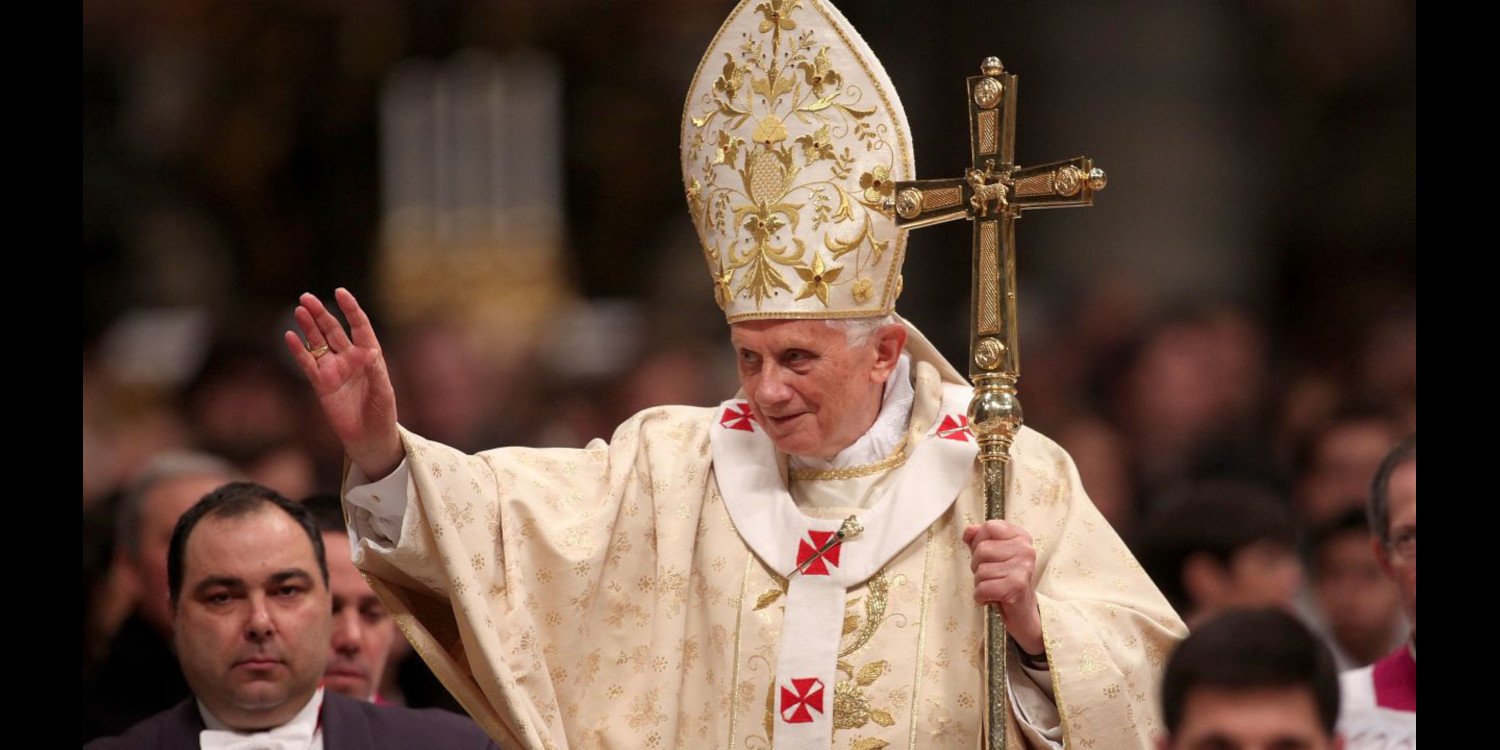
Pope Benedict XVI: The Sacrifices of a Father’s Love
Pope Benedict XVI left the Chair of Peter amid debate about what his decision meant for the Church. Above all else, it was an act of fatherly love and sacrifice.

Pope Benedict XVI left the Chair of Peter amid debate about what his decision meant for the Church. Above all else, it was an act of fatherly love and sacrifice.
December 31, 2022
Note from Fr. Gordon MacRae: The Holy Father, Pope Emeritus Benedict XVI entered Eternal Life at 9:34AM Rome time (3:34AM EDT) on the last day of the Year of Our Lord 2022. I wrote the following post in February 2013 in the weeks following his decision to leave the Chair of Peter. It was a time of great confusion for the Church, and great sorrow for those who loved this Pope. Upon the death of Pope Paul VI in 1978, Archbishop Fulton Sheen said that he offered a ‘Hail Mary’ for him, and then another ‘Hail Mary’ in his honor asking for his intercession before the Divine Presence. I offer these same prayers today for Benedict XVI and in the same way.
+ + +
February 2013
We are all prisoners of our own perception. We come to just about every concern and deliberation from the perspective of our own unique limits, circumstances, and points of view. The more fair and just among us practice varying degrees of empathy which is, in part at least, the ability to place ourselves in the shoes of another.
One truth became crystal clear to me on February 11, 2013. No matter how well honed our skills for empathy might be, none of us can ever adequately imagine ourselves in one pair of shoes — the Shoes of the Fisherman.
It was that very title that helped plant and cultivate my early thoughts of priesthood when I was 15 years old in 1968 — the same year Msgr. Charles Pope once wrote of in “1968 – The Year the Church Drank from the Poison of this World.” My friend, Father Louis Antonelli took me to see The Shoes of the Fisherman, the film starring Anthony Quinn as Pope Kyril I. It was scripted from the great novel of the same title by Morris West. In the end, the fictional Pope Kyril — who as a priest spent 20 years in a Soviet prison — sacrificed his papacy to avert nuclear war looming in the Communist stranglehold on the Soviet Union and China. The long, ponderous film deeply moved me at age 15 as Pope Kyril’s acts of love and sacrifice mollified the world at the expense of the Church. I left that film resolved to pray for the Pope, who in my sudden awareness became the most important man on Earth, and the most targeted man for the world’s wolves and the powers of evil.
Priesthood did not take me to where I had hoped back then to go. Like Kyril himself, it took me to prison. So it was from the perspective of my confinement in a prison cell that I learned the heartbreaking news on Monday morning, February 11, 2013, that our beloved Pope Benedict XVI would resign the Chair of Saint Peter effective February 28. Like so many of you, I found that news to be deeply disappointing — even devastating. That day felt as though someone had cast a pall over the entire Church.
The news footage soon to follow the Holy Father’s bombshell — the scene of a bolt of lightning striking the dome of Saint Peter’s Basilica — did nothing to ease the sense of oppression that day wrought. Like so many of you, I was filled with dread that the wolves had won — the very wolves the Holy Father referred to in his first homily as Pope in April 2005: “Pray for me that I may not flee for fear of the wolves.”
After eight years of his pontificate, I could not imagine this Pope fleeing from anything. In the ensuing weeks, I have slowly come to see his decision not only as agonizingly painful in its making — for us, but most especially for him — but also as a courageous act of sacrifice motivated by love for the Church and the 1.2 billion souls who come to Christ through Her.
Not in His Own Best Interest
By the end of the day on February 11, 2013, I asked a friend to post a comment from me on BTSW’s Facebook page. My comment focused only on the Holy Father’s brief statement and avoided much of the media spin launched within minutes of it — most of which I was unaware of anyway, and could only imagine. Pope Benedict’s own words left little room for spin, and they are worth hearing again as he abdicates:
“After having repeatedly examined my conscience before God, I have come to the certainty that my strengths, due to an advanced age, are no longer suited to an adequate exercise of the Petrine ministry. I am well aware that this ministry, due to its essential spiritual nature, must be carried out not only with words and deeds, but no less with prayer and suffering.
“However, in today’s world, subject to many rapid changes and shaken by questions of deep relevance for the life of faith, in order to steer the boat of Saint Peter and proclaim the Gospel, both strength of mind and body are necessary, strength which in the last few months has deteriorated in me to the extent that I have had to recognize my incapacity to adequately fulfill the ministry entrusted to me.”
My immediate reaction to these words was one of great sorrow. I believed that Pope Benedict, who would soon turn 86 years of age, was convinced by those around him not to allow age and infirmity to become the media’s face of the Church. I believed such advice to have been rooted in the last years of Pope John Paul’s pontificate as his obvious infirmity became its own news event.
And so my brief comment that February 11, though well intentioned, assumed that the Holy Father was simply convinced, as he himself stated, that his “strengths and advanced age are no longer suited to the Petrine ministry” — especially so in a world in which every papal tremble, stumble, and foible is caught on camera for instantaneous global news.
I thought the Holy Father had agonized over this and concluded simply, and understandably, that age and infirmity taking center stage in the future years of his papacy were neither in his best interest nor that of the Church. I thought wrongly.
There was absolutely nothing in this decision that the Holy Father considered to be in his own best interest. Like so many of the loving fathers I know, his own best interest never entered the equation at all. On the morning after the Pope’s announcement, The Wall Street Journal published a superb and influential commentary by Catholic writer George Weigel that helped to give me some perspective on this development. “Catholics Need a Pope for the ‘New Evangelization‘ ” (February 13, 2013) was a service to the Church calling upon us to look forward to consider the urgent challenges to be faced by the successor of Pope Benedict. George Weigel pointed out something that the Holy Father himself was deeply aware of as “we widen the historical lens through which we view this papal transition.” Pope Benedict XVI will be the last pope to have participated in the Second Vatican Council.
By ending his papacy, he had ended an ecclesiastical era. The question George Weigel asks us to ponder is not “What wolves brought this about?” but rather “To what future has Pope Benedict led Catholicism?” I believe the answer to that question is the urgent issue of the coming conclave, and I believe the Holy Father is convinced of the necessary timing of this as the Church summons forth a Pope for the New Evangelization.

And Not without Precedent
In the Western world, and especially in the Americas, it’s difficult for some to factor the Catholic Church as an ancient structure, the sole institution in human history to have survived — to have even thrived — for 2,000 years. In “The Canonization of Pope John Paul II,” I wrote of a History Channel presentation on the papacy. Hopefully, we may see it again before the coming conclave.
With reverence and historical accuracy, the cameras took us from the tomb of Saint Peter to the tomb of Blessed John Paul II. Between them, two millennia had past — 2,000 years of war, scandal, all manner of human debacles, and countless assaults on the Church and Holy See. And yet at the tomb of Saint John Paul II the Church stood. The gates of hell had not prevailed against Her — and not for lack of trying.
That trial continues. A pope’s resignation is rare, but not unheard of. Writing for The Wall Street Journal, Saint Louis University history professor Thomas F. Madden unveiled some of this history in “The Pope Joins a Fine but Rarely Seen Tradition” (Feb. 15, 2013). For the first 1,200 years in the life of the Church, Professor Madden explained, it was assumed that a pope could not resign except under extreme conditions such as being thrown into prison — a fate that befell three popes in the first millennium.
The last resignation of a pope was six centuries ago in the year 1415. Eight decades before Columbus sailed to the New World — 360 years before the United States even existed — Pope Gregory XII resigned the papacy to end the Great Schism. In so doing he was praised throughout Europe for placing the interests of the Church above his own interests and ambition.
But the real precedent was set in 1294 when Pope Celestine V, now Saint Celestine, resigned for reasons very similar to those now put forward by Pope Benedict. A conclave had been unable to arrive at a consensus for two years when Pietro del Murone was elected to resolve it. Already in his 80s when he became Pope Celestine V, he quietly established in canon law a tenet allowing for the resignation of a pope, and then applied it to himself with the support of the College of Cardinals.

The Prayer to Saint Michael
The Church canonized Saint Celestine in 1313. In the 2010 book, Light of the World (Ignatius Press), based on Peter Seewald’s extensive interviews with Pope Benedict XVI, the Holy Father cited the precedent set by Saint Celestine, and even hinted — then at age 84 — that if ever a pope’s reserves of strength no longer served the Church, that precedent could be repeated.
But there is still the matter of the wolves circling from both without and within. They have always been here. George Weigel pointed out that the Second Vatican Council’s deep reforms in the Catholic Church actually began in the previous century in 1878. According to Mr. Weigel, “Pope Leo XIII made the historic decision to quietly bury the rejectionist stand his predecessors had adopted toward cultural and political modernity.” George Weigel ended his article with a reflection about the current state of disunity in the Roman Curia, calling upon the coming conclave to elect a pope who will address the Curia’s “disastrous condition . . . so that the Vatican bureaucracy becomes an instrument of the New Evangelization, not an impediment to it.”
Pope Benedict XVI cited a similar concern in his Ash Wednesday homily from the pulpit of Saint Peter’s Basilica: “The face of the Church is at times disfigured by the sins against the unity of the Church and the divisions of the ecclesial body.” It is of interest that in 1888, Pope Leo XIII also cited this while composing his famous Prayer to Saint Michael the Archangel, only a small part of which has become the common prayer we know. In its original form, Pope Leo wrote:
“In the Holy Place itself, where has been set up the See of the most holy Peter and the Chair of Truth for the light of the world, they have raised the throne of their abominable impiety, with the iniquitous design that when the pastor is struck, the sheep may be scattered.”
Pope Benedict XVI has never had to earn our deference, but earn it he did, many times over, as our Holy Father in a time of great trial for the Church. We owe him the benefit of our fidelity, unity, and prayers, and I know he has those. By abdicating at this time, and by calling the Church’s focus to what comes next at this moment in history, Pope Benedict is engaging in an act of love and sacrifice for the Church.
What remains heartbreaking is that so many of us have come not only to reverence and respect this Pope for his gifted mind and great personal holiness, but we have come to love him. Even in life, this Holy Father’s long-serving predecessor was given another title in his last years. My friend, the late Father Richard John Neuhaus and others deservedly dubbed him “John Paul the Great,” and it stuck.
Pope Benedict XVI also stands to have a new name. Springing from the hearts of millions, no matter what role he plays or what the Church comes to call him, this Holy Father will forever be for us, “Benedict the Beloved.”
+ + +
Prologue — December 31, 2023: As cited above, in 1888 when Pope Leo XIII composed the prayer to Saint Michael, he added in the original version, “In the Holy Place itself, where has been set up the See of the most holy Peter and the Chair of Truth for the light of the world, they have raised the throne of their abominable impiety, with the iniquitous design that when the pastor is struck, the sheep may be scattered.”
For so many faithful Catholics the world over, history sometimes repeats itself.
+ + +

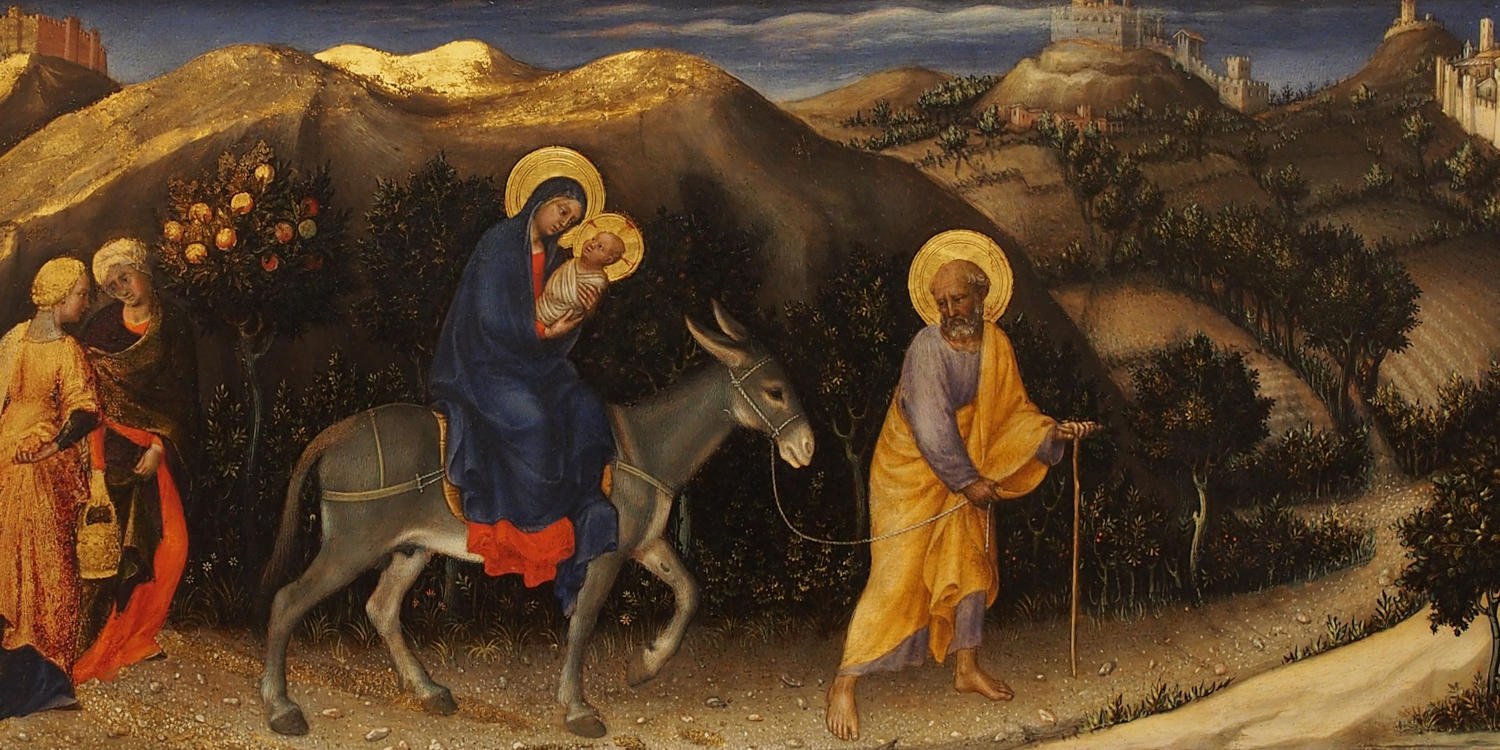
Joseph’s Second Dream: The Slaughter of the Innocents
After the Birth of the Messiah, a second angelic dream warns Joseph to flee to Egypt with Mary and the Christ Child as Herod orders a slaughter of the Innocents.

After the Birth of the Messiah, a second angelic dream warns Joseph to flee to Egypt with Mary and the Christ Child as Herod orders a slaughter of the Innocents.
Feast of the Holy Innocents by Fr. Gordon MacRae
Editor’s Note: The following is the second of a special two-part Biblical Christmas Season post. Part one, which appeared here two weeks ago was “Joseph’s Dream and the Birth of the Messiah.”
+ + +
In the proclamation of the Gospel according to Saint Matthew (2:13-18) on the Feast of the Holy Innocents, the Church recalls in just six verses an account of the Visit of the Magi, Joseph’s second dream of an Angel of the Lord, the Holy Family’s flight to Egypt, and the wrath of Herod as he orders the slaughter of all male children under two years of age in and around Bethlehem. As a priest, I have read this account over forty-two consecutive Christmas seasons, but never before was it overshadowed by such tragic realism.
Our safe, emotional buffer zone from that 2,000 year old account is gone now. The sense of personal distance is lost. A dark cloud still hangs over America since the shocking and senseless deaths of 19 young children in 2022 in a small Texas city called Uvalde. I first wrote of this shortly after this tragedy occurred in “Tragedy at Uvalde, Texas: When God and Men Were Missing.”
A lot of soul searching has gone into a quest for what could have spawned such a horrific event, how it developed, how it might have been prevented, and what should have been done differently by responding police. The tragedy was devastating. I can only imagine the heartache of the parents of Uvalde as they faced that Christmas with broken hearts and shattered dreams.
Then it happened again — this time in Thailand, and this time the killer was not a crazed teenager, but a drug addicted police officer. The story devastated the Kingdom of Thailand. On October 6, 2022 the recently fired police officer brought a 9mm handgun and a knife into a preschool daycare center in the village of Uthai Sawan. It was near where Pornchai Moontri lived as a small child. With no known motive, the former officer murdered 24 children ages two to five. Then he killed his wife and his own child before turning his gun on himself.
I could not bring myself to write that story, but Pornchai Moontri bravely took it up. Several readers told me that they did not read it because they knew it would be terribly painful. It was and still is. But there is much more to it than sorrow. There is hope there as well. “Elephants and Men and Tragedy in Thailand” was Pornchai’s faith-filled gift to his Homeland and to us. It is a most inspired post that I highly recommend. We will link to it again at the end of this one.

The Magi Take the Long Way Home
I am painfully aware that on the day this is posted, the Church honors those first Christian Martyrs, the innocent male children of Bethlehem who were subjected to the selfish wrath of King Herod. They became collateral damage in the first demonic attempt to rid the world of Christ. The explosive account is told with blunt force in the Gospel According to Matthew:
“Now when the Wise Men had departed, behold, an angel of the Lord appeared to Joseph in a dream and said, ‘Rise! Take the child and his mother and flee to Egypt, and remain there until I tell you; for Herod is about to search for the child to destroy him.’
“And Joseph arose and took the child and his mother by night and departed to Egypt and remained there until the death of Herod. This was to fulfill what the Lord had spoken by the Prophet: ‘Out of Egypt I have called my son.’ When Herod saw that he had been tricked by the Wise Men, he was in a furious rage. He sent and killed all the male children in Bethlehem and all that region who were two years old and under according to the time which he had ascertained from the Wise Men. Then was fulfilled what was spoken by the Prophet Jeremiah:
“‘A voice was heard in Ramah, wailing and loud lamentation, Rachel weeping for her children, she refused to be consoled, because they were no more.’”
— Matthew 2:13-20
In the first installment of this two-part post, I described the unique attributes of Joseph’s three dreams in Matthew’s account of the Birth of the Messiah. Dreams are an important element of the story. As I wrote in “Joseph’s Dream and the Birth of the Messiah”:
“There are 126 references to dreams among the characters of Sacred Scripture. Some of the pivotal moments in Salvation History were set in motion through dreams. But the dreams of Joseph are unique in the Biblical literature. In the original Greek of St. Matthew’s Gospel, the term used for Joseph’s three dreams about the birth of Jesus is ‘onar,’ and it is used nowhere else in Sacred Scripture but here.
“‘Onar’ in Greek refers not just to a dream, but to a divine intervention in human affairs. Coupled with the fact that the dream is induced by an “Angel of the Lord,” then the scene takes on a sense of great urgency when compared with a multitude of other angelic messages conveyed through dreams.”
In this second of Joseph’s dreams, the urgent intervention is God’s foresight that Herod is enraged, believing that he was tricked by the Magi. Herod plots to kill the child. He had asked the Magi to return from Bethlehem to reveal the location of this Christ-child with a false promise that he, too, would pay him homage. After a dream premonition not to return to Herod, the Magi left by another route. I wrote about the Magi in a popular Christmas post linked again at the end of this one: “Upon a Midnight Not So Clear, Some Wise Men from the East Appear.”
There is an important element of the Magi story that I omitted when I first wrote that post. The Magi were traditionally associated with astrologers and astral religion, a fact seen as scandalous to some early Christians who did not want to accept this aspect of Matthew’s account. In later Christian tradition, they became not Magi, but kings, a likely reflection on Psalm 72:10 — “May the kings of Tarshish and of the Isles bring him tribute, may the kings of Sheba and Seba bring gifts.”
The Star of Bethlehem is a popular element of the story, but it, too, was a scandal among some in the early Church. Some of the people of the Ancient Near East were drawn to astral religion because it brought a sense of surety in the midst of social chaos. But over time, astrology became oppressive, making people feel hopeless against the tyranny of “fate” when their destinies seemed dictated by the cold movement of the stars.
In contrast, however, the Star of Bethlehem served only God’s purpose. That, and the presence of astrologers who came to worship Christ, broke the power of astral religion and its belief in fate. But history repeats itself. As our culture again becomes socially chaotic, many are once again drawn into nature religions such as astrology, Wicca, and druidism for a false sense of determinism guided by practitioners claiming to interpret and control destiny. I recently saw a TV commercial selling fifteen minute intervals with a California seer. G.K. Chesterton once famously said that people without faith do not believe in nothing. They believe in anything.

Tragedy in Thailand | Photo courtesy of Reuters
Herod and the Slaughter of the Innocents
There are four rulers named Herod appearing in New Testament Scripture: Herod the Great reigned in Palestine from 37 B.C. until shortly after the Birth of Jesus. His son, Herod Antipas, Tetrarch of Galilee, ordered the beheading of John the Baptist (Matthew 14) and sent Jesus to trial before Pilate (Luke 23:7-15). His son, Herod Agrippa, imprisoned the Apostle Peter (Acts 12); and his son, Herod Agrippa II, attended the trial of Saint Paul (Acts 25:13).
Herod the Great was part of a non-Jewish Edomite family from a territory east and south of the Dead Sea. They were descendants of Esau, the elder brother of Jacob (Genesis 25:30). Herod was given the title, “King of the Jews” by the Roman Senate and ruled Palestine from 37 to 4 B.C. as a vassal king appointed by Caesar Augustus. Centuries-old adjustments to the Roman calendar place the birth of Jesus near the end of Herod’s life between six and four B.C.
Herod the Great (“Great” by Roman standards only) appears in Scripture only during the events surrounding the birth of Jesus (Matthew 1-2 and Luke 1:5). He ruled Palestine with brutality and paranoia. It is ironic that Herod took such violent steps to end the life of Jesus just prior to the undocumented end of his own life. He took great umbrage at the Magi’s revelation that the Star of Bethlehem was an omen for one who is born King of the Jews, a title Rome had bestowed upon Herod.
But Herod’s paranoia ran deeper than that. The Star of Bethlehem innocently described by the Magi recalled for Herod and his Hebrew advisors the ancient Fourth Oracle of Balaam in the Book of Numbers. The oracle predicted a future messiah and the end of Edom’s power. From the Oracle of Balaam (Numbers 24:17-19):
“I see him, but not now; I behold him, but not near. A star shall come out of Jacob, and a scepter shall rise out of Israel. It shall crush the borderlands of Moab, and the territory of all the Shethites. Edom will become a possession of its enemies, while Israel thrives valiantly. One out of Jacob shall rule.”
Being a descendant of the Edomites, Herod “was greatly troubled” (Matthew 2:3). So he summoned the Magi to ascertain exactly when the Star appeared. He sent them on to Bethlehem after securing a promise that they would return with the exact location of this newborn Child-King. When the Magi failed to return, Herod flew into a rage. He ordered his forces to find and kill all male children under two years of age in Bethlehem.
This event also has an echo from a much older time in Salvation History. Jesus is presented as the New Moses, one who will lead God’s people out of bondage. The first Moses led Israel from the bondage of slavery in Egypt, but Pharaoh was immovable until the Tenth Plague struck down the firstborn sons of Pharaoh and all of Egypt (Exodus 12:29-31).
The Evangelist, Matthew, captures with a quote from the Prophet Jeremiah the devastation that Herod left behind. In the Eighth Century B.C. the Assyrians devastated Northern Israel when their army swept through the city of Ramah about five miles north of Jerusalem. Ramah became equated with Israel’s great depth of sorrow left behind by the evil of tyranny. So it is of Ramah that is recalled in the face of Herod’s evil:
“A voice heard in Ramah, wailing and loud lamentation, Rachel weeping for her children. She refused to be consoled because her children were no more.”
— Matthew 2:18 and Jeremiah 3:15
Jesus, the New Moses would lead God’s People from the bondage of sin and death. Herod believed that the murder of the Children of Bethlehem was the last word, but it was not the last word. Then Herod the Great somehow became Herod the Dead. Scripture does not describe how, when, or where. God knows. The narrative of the Birth of the Messiah ends with the third dream of Joseph from an Angel of the Lord:
“Rise, take the child and his mother and go to the land of Israel, for those who sought the child’s life are dead. And [Joseph] rose and took the child and his mother, and went to the land of Israel. But when he heard that Herod’s son reigned in his place, he was afraid to go there, and being warned in a dream he withdrew to the district of Galilee. And he went and dwelt in a city called Nazareth.”
— Matthew 2:19-23
Thus concludes Matthew’s account of the Birth of the Messiah. It was not the end of tyranny, but it was the beginning of all hope.
+ + +
Note from Fr. Gordon MacRae: Please share this post. You may also like these related posts cited here:
Joseph’s Dream and the Birth of the Messiah
Tragedy at Uvalde, Texas: When God and Men were Missing
Elephants and Men and Tragedy in Thailand
Upon a Midnight Not So Clear, Some Wise Men from the East Appear
+ + +

One of our Patron Saints, Saint Maximilian Kolbe, founded a religious site in his native Poland called Niepokalanowa. Today the Chapel has a real-time live feed for a most beautiful adoration chapel where people around the world can spend time in Eucharistic Adoration. We invite you to come and spend some quiet time this Christmas celebrating the rebirth of the Messiah in your own life.
Click or tap here to proceed to the Adoration Chapel.
As you can see the monstrance for Adoration of the Blessed Sacrament is most unusual. It is an irony that all of you can see it but I cannot. So please remember me while you are there. For an understanding of the theology behind this particular monstrance of the Immaculata, see my post “The Ark of the Covenant and the Mother of God.”

Lead, Kindly Light: A Christmas Card to Our Readers
Abraham first heard God 21 centuries before the Magi followed a star to Bethlehem. We now live in the 21st century after. At the center of all faith Christ is born.

Abraham first heard God 21 centuries before the Magi followed a star to Bethlehem. We now live in the 21st century after. At the center of all faith Christ is born.
December 21, 2022
Note from Fr. Gordon MacRae: Dear Readers, Some elements of our Annual BTSW Christmas Card may seem a bit familiar to you. We have used some of these elements in our posts of Christmas past. Since 1949, The Wall Street Journal has published as its top editorial each Christmas Eve an outstanding piece of writing from the late Vermont C. Royster, the WSJ’s former Editorial Page Editor. His yearly repeated Christmas essay is “In Hoc Anno Domini,” (In this year of the Lord). It is one of the finest examples of historical Christian writing I have encountered, and one of the most faith-filled. Mr. Royster was awarded the Presidential Medal of Freedom and was a two-time recipient of the Pulitzer Prize. So at the expense of sounding a bit pretentious, if The Wall Street Journal can get away with publishing an annual Christmas gem, then so can I.
I begin our Christmas Card this year with Vermont C. Royster and his “In Hoc Anno Domini.”

When Saul of Tarsus set out on his journey to Damascus the whole of the known world lay in bondage. There was one state, and it was Rome. There was one master for it all, and he was Tiberius Caesar.
Everywhere there was civil order, for the arm of the Roman law was long. Everywhere there was stability, in government and in society, for the centurions saw that it was so.
But everywhere there was something else, too. There was oppression — for those who were not the friends of Tiberius Caesar. There was the tax gatherer to take the grain from the fields and the flax from the spindle to feed the legions or to fill the hungry treasury from which divine Caesar gave largess to the people. There was the impressor to find recruits for the circuses. There were executioners to quiet those whom the Emperor proscribed. What was a man for but to serve Caesar?
There was the persecution of men who dared think differently, who heard strange voices or read strange manuscripts. There was enslavement of men whose tribes came not from Rome, disdain for those who did not have the familiar visage. And most of all, there was everywhere a contempt for human life. What, to the strong, was one man more or less in a crowded world?
Then, of a sudden, there was a light in the world, and a man from Galilee saying, Render unto Caesar the things which are Caesar’s and unto God the things that are God’s.
And the voice from Galilee, which would defy Caesar, offered a new Kingdom in which each man could walk upright and bow to none but his God. Inasmuch as ye have done it unto one of the least of these my brethren, ye have done it unto me. And he sent this gospel of the Kingdom of Man into the uttermost ends of the earth.
So the light came into the world and the men who lived in darkness were afraid, and they tried to lower a curtain so that man would still believe salvation lay with the leaders.
But it came to pass for a while in divers places that the truth did set man free, although the men of darkness were offended and they tried to put out the light. The voice said, Haste ye. Walk while you have the light, lest darkness come upon you, for he that walketh in darkness knoweth not whither he goeth.
Along the road to Damascus the light shone brightly. But afterward Paul of Tarsus, too, was sore afraid. He feared that other Caesars, other prophets, might one day persuade men that man was nothing save a servant unto them, that men might yield up their birthright from God for pottage and walk no more in freedom.
Then might it come to pass that darkness would settle again over the lands and there would be a burning of books and men would think only of what they should eat and what they should wear, and would give heed only to new Caesars and to false prophets. Then might it come to pass that men would not look upward to see even a winter's star in the East, and once more, there would be no light at all in the darkness.
Stand fast therefore in the liberty wherewith Christ has made us free and be not entangled again with the yoke of bondage.
— Vermont C. Royster, The Wall Street Journal, December 24, 1949
+ + +

The liturgies of Christmas set out in the Roman Missal and Lectionary express the spirituality of the entire ecclesial body of the baptized into the Life, Death, and Resurrection of Jesus Christ, our communal past and hopeful future.
The Mass at Night for the Christmas Vigil begins with a moving recitation of the Roman Martyrology which places the Birth of the Messiah into a real historical context:
The twenty-fifth day of December when ages beyond number had run their course from the creation of the world, when God in the beginning created heaven and earth, and formed man in His own likeness; when century upon century had passed since the Almighty set his bow in the clouds after the Great Flood, as a sign of covenant and peace — In the twenty-first century since Abraham, our father in faith, came out of Ur of the Chaldees; in the thirteenth century since the people of Israel were led by Moses in the Exodus from Egypt; in the tenth century since David was anointed King; in the sixty-fifth week of the prophecy of Daniel; in the one hundred and ninety-fourth Olympiad; in the year seven hundred and fifty-two since the founding of Rome; in the forty-second year in the reign of Caesar Octavian Augustus, the whole world being at peace
— Jesus Christ, eternal God and Son of the eternal Father,
desiring to consecrate the world by his most loving presence, was conceived by the Holy Spirit, and when nine months had passed since His conception, was born of the Virgin Mary in Bethlehem of Judah, and
was made man.
— The Nativity of our Lord Jesus Christ according to the flesh
+ + +


I am forced by circumstance to live in a place with men who are banished, not just from home and family and freedom, but too often also from hope. Some with even the darkest pasts have come into the light to thrill us with their stories of grace and true repentance and conversion. You have read of several in these pages and there are other stories yet to come. Some of these wounded men become saints, I am not fit to fasten their sandals. We live East of Eden, most justly so, but some not.
The Magi of the Gospel saw a star and heard good news, the very best of news: Freedom can be found in only one place, and the way there is to follow the Star they followed. If you follow Beyond These Stone Walls, never follow me. Follow only Christ.
My Christmas Card to you is this message, a tradition of sorts for Beyond These Stone Walls. My small, barred cell window faces East. It is there that I offer Mass for our readers. So my gaze is always toward the East, a place to which we were all once banished to wander East of Eden.
At the end of these cold and gray December days I step outside to watch toward the West as the sun descends behind towering prison walls. It reminds me of my favorite prayer,
Lead, Kindly Light, amid the encircling gloom, Lead Thou me on;
The night is dark, and I am far from home; Lead Thou me on.
Keep Thou my feet; I do not ask to see
The distant scene; one step enough for me.
I was not ever thus, nor prayed that Thou shouldst lead me on;
I loved to choose and see my path, but now, Lead Thou me on.
I loved the garish day, and, spite of fears,
Pride ruled my will; Remember not past years.
So long Thy power hath blessed me, sure it still will lead me on,
O’er moor and fen, o’er crag and torrent, till the night is gone.
And with the morn those Angel faces smile,
Which I have loved long since, and lost awhile.
— Saint John Henry Newman
This moving prayer by Saint John Henry Newman has been set to music as a tribute to Saint John Paul II:
+ + +

My favorite Christmas hymn, “O Holy Night,” was originally based on a French poem entitled Cantique de Noël by Placide Cappeau in 1843. Composer Adolphe Adam set it to music in 1847. The English version (with small changes to the initial melody) is by John Sullivan Dwight. The hymn reflects on the birth of Jesus as humanity’s redemption.
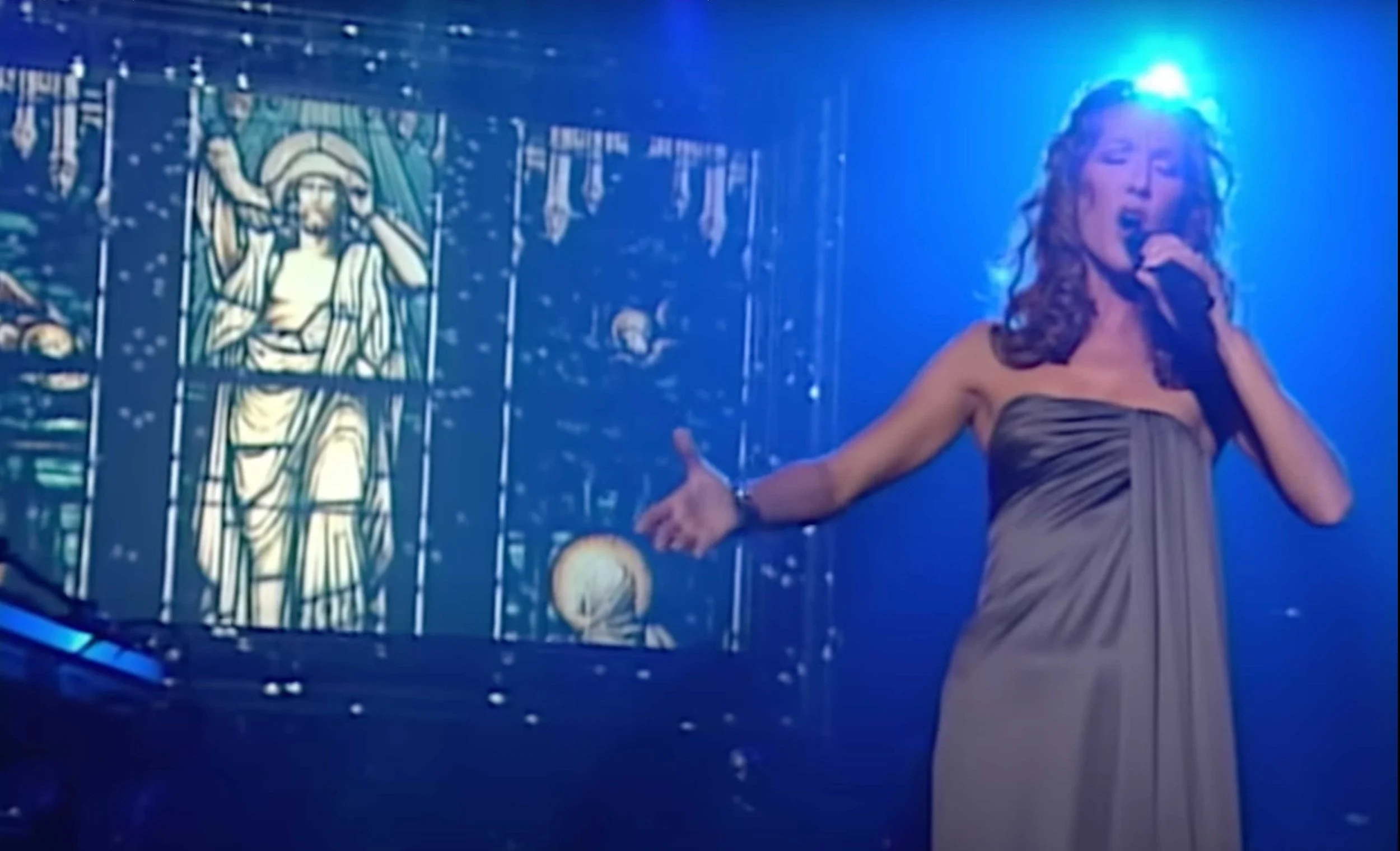
This wonderful hymn has been performed by many noted vocalists over the last two centuries. Few have performed it with more beauty and heartfelt faith than Celine Dion. Celine today suffers from a neurological disorder that may inhibit her voice. Please offer a prayer for her. Celine Dion’s beautiful voice should be long remembered for her rendition of this most beautiful of Christmas hymns.

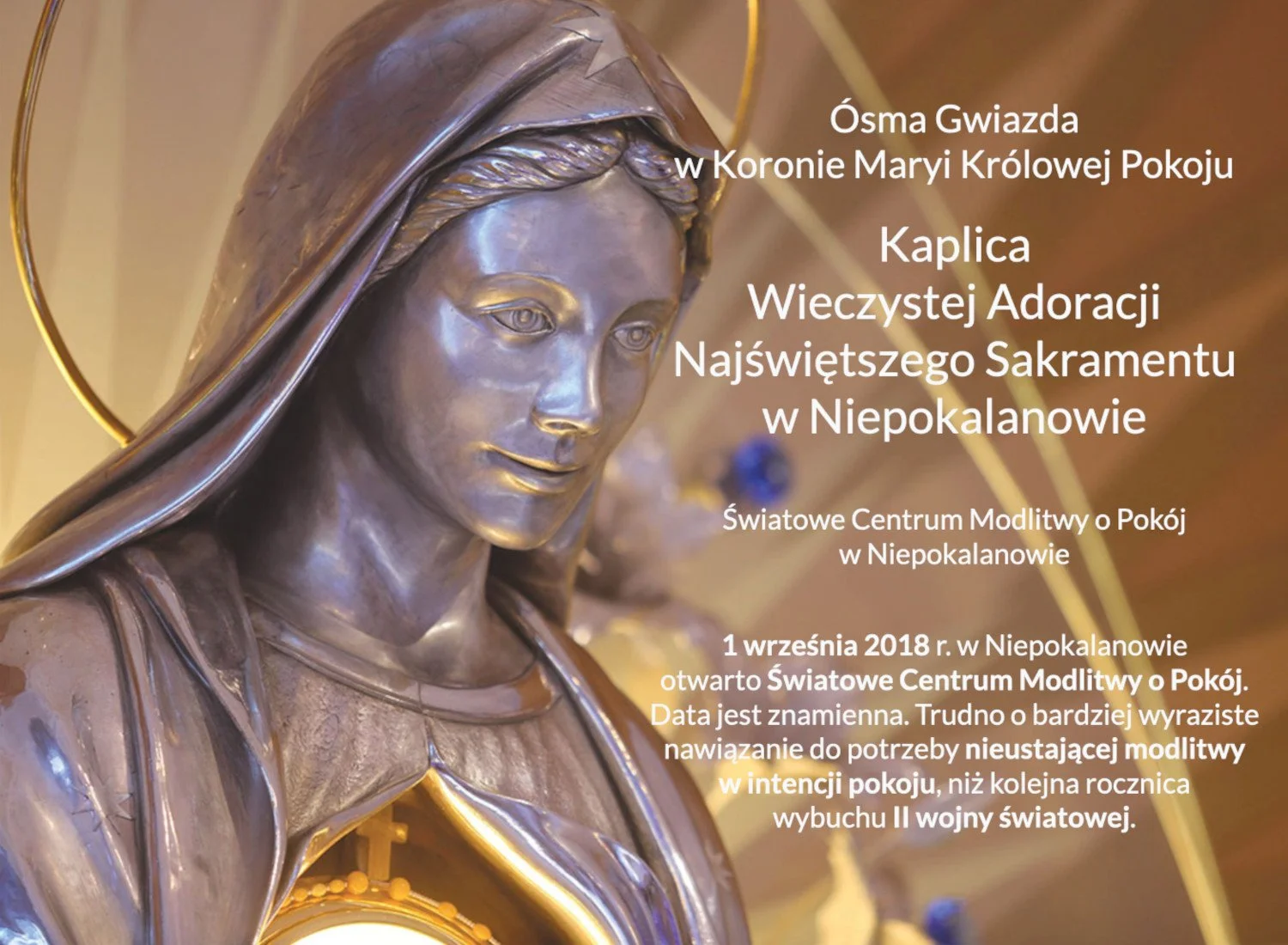

The Eucharistic Adoration Chapel established by Saint Maximilian Kolbe was inaugurated at the outbreak of World War II. It was restored as a Chapel of Adoration in September, 2018, the commemoration of the date that the war began. It is now part of the World Center of Prayer for Peace. The live internet feed of the Adoration Chapel at Niepokalanow — sponsored by EWTN — was established just a few weeks before we discovered it and began to include in at Beyond These Stone Walls. Click “Watch on YouTube” in the lower left corner to see how many people around the world are present there with you. The number appears below the symbol for EWTN.
Click or tap here to proceed to the Adoration Chapel.
The following is a translation from the Polish in the image above: “Eighth Star in the Crown of Mary Queen of Peace” “Chapel of Perpetual Adoration of the Blessed Sacrament at Niepokalanow. World Center of Prayer for Peace.” “On September 1, 2018, the World Center of Prayer for Peace in Niepokalanow was opened. It would be difficult to find a more expressive reference to the need for constant prayer for peace than the anniversary of the outbreak of World War II.”
For the Catholic theology behind this image, visit my post, “The Ark of the Covenant and the Mother of God.”
+ + +
Note from Father Gordon MacRae:
Blessings to you all during this joyous Christmas Season. We are living in darker times, and this Christmas is like no other, but we are children of the Light and we are promised that the darkness will never overcome it. May God Bless you and keep you safe. Feliz Navidad!
+ + +
Please also visit our Special Sacred Scripture Collection: Abraham to Easter.


The Duty of a Priest: Father Frank Pavone and Priests for Life
In a bombshell report, Fr. Frank Pavone of Priests for Life and the most visible pro-life priest in America has been dismissed from the priesthood by Pope Francis.

In a bombshell report, Fr. Frank Pavone of Priests for Life and the most visible pro-life priest in America has been dismissed from the priesthood by Pope Francis.
December 18, 2022 by Fr. Gordon MacRae
Note from Fr. Gordon MacRae: In a bombshell report that I learned of only today it seems that Fr. Frank Pavone, Director of Priests for Life and the most visible pro-life cleric in North America has been dismissed from the clerical state by Pope Francis. At this juncture, the dismissal is both inconceivable and unexplained.
I plan to postpone further comment on this troubling development for pro-life Catholics until there is further clarification from Rome, if ever. Of interest, I wrote this post about Fr. Frank Pavone and his struggles eleven years ago. Much that I described in this post has now come to pass. I have never been more sorrowful for being right. Please pray for Fr. Pavone and Priests for Life.
+ + +
For about a year now, Beyond These Stone Walls has had a link to Priests for Life, one of the strongest and most vocal pro-life organizations with oversight from the Catholic Church. So when news began to circulate that Father Frank Pavone, director of Priests for Life since 1993, was “recalled” to his diocese — the Diocese of Amarillo — I paid attention, as did many.
Before commenting on the justice or injustice of what has occurred to date in this matter, however, I must comment on the context. It has become clear to me even from behind these stone walls that not all is as it seems. Generally, a matter such as this would generate some dialogue within the Church, perhaps even in the Catholic media, but that would be the extent of its interest. This matter between Father Frank Pavone and Amarillo Bishop Patrick Zurek, however, has also become fodder for comments in the secular media providing fuel for the speculation and controversy now surrounding Father Pavone.
What exactly is the controversy? Father Frank Pavone has been recalled to his diocese, the Diocese of Amarillo, Texas, by his bishop. Father Pavone has been neither suspended nor disciplined for any cause. A Catholic News Service account included some clarification of this by Msgr. Harold Waldow, Vicar for Clergy in the Diocese of Amarillo:
“Father Frank Pavone, national director of Priests for Life, remains a priest in good standing in the Diocese of Amarillo, Texas. … Msgr. Harold Waldow told CNS that Bishop Patrick J. Zurek only suspended Father Pavone’s ministry outside of the diocese because the well-known pro-life priest is needed for work in Amarillo.”
— Catholic News Service, Sept. 14, 2011
But there remains some taint upon Father Pavone. This matter between a priest and his bishop has become a matter of public dispute, and that itself is a violation of Father Pavone’s rights under Church law. After writing a letter to the nation’s bishops describing his suspension of Father Pavone’s ministry outside his own diocese, the bishop reportedly released the letter publicly. That seems to be what sparked their differences thrusting this matter into a public forum, but without any clear allegation of wrongdoing.
Brian Fraga wrote an informative article about this in Our Sunday Visitor (“Pro-life priest ‘baffled’ by bishop’s shutdown,” OSV, October 2, 2011). He cited the broad support that has emerged for Father Pavone including from the Priests for Life Board of Directors, from the National Pro-Life Council, and other corners. Dr. Alveda King, niece of the late Rev. Martin Luther King and a staunch pro-life advocate, has released a powerfully supportive statement about Father Pavone and Priests for Life.
I have believed from the outset that the hype about all this has little to do with Father Frank Pavone and Bishop Zurek. It has to do with Priests for Life and its vocally Catholic pro-life stance. There is an agenda out there — an agenda with tentacles that have reached deeply into the arena of Catholic life — that would be encouraged by the diminishment or outright destruction of the Church’s pro-life ministry. In this entire matter, it is not only Father Pavone whose reputation is on the line. It is also the Church’s pro-life stance, consistently undermined by those who want compromise with a secular agenda in the culture war.
The demise of Priests for Life would be a great trophy for that agenda. I am no conspiracy theorist, but I can’t help notice that this story is unfolding nationally just as a Presidential Primary is taking shape, and the culture war is gearing up for battle.

Resisting Secular Sabotage
In a chapter entitled “Self-Sabotage: Catholicism” in his book, Secular Sabotage (Faith Words, 2009), Catholic League President Bill Donohue pointed out that dissent in the Church’s pro-life ministry is not as simple as some trendy left-wing Catholics promoting abortion. Very few people of even the remotest Christian persuasion actually promote abortion as a societal good. What Bill Donohue pointed out was something much more subtle. There is a growing consensus among left-wing Catholics that the Church has simply lost the battle for life and should just move on.
Please note here that I do not use the term “left-wing Catholics” in any derogatory sense. I spent much of my life and ministry squarely in that camp. So did Father Richard John Neuhaus and Cardinal Avery Dulles, two exemplary Churchmen to whose memory we have dedicated Beyond These Stone Walls. Their drift to the right is far more a story of their embracing the great adventure of orthodoxy to the Magisterial authority of the Church — an authority that took precedence for them above any trendy political ideology.
My own drift away from the left followed their same example. It marked the official end of my adolescence that the life of the Church took precedence over my own sometimes highly misinformed publicly dissenting points of view.
Part of the agenda among the more radical wing of the Catholic left has been to get about the business of removing any Magisterial authority from our faith experience. The goal is to carve out a distinctly American Catholic church with identifiably American Catholic values that mirror the now disintegrating American wing of the Church of England, the Episcopal church. But that’s a whole other blog post for some other day — such as next week, perhaps.
It’s time for American Catholic liberals to see and admit that their own views and causes are being hijacked by this radical wing. For them, organizations like Priests for Life are seen as an anachronistic hindrance to social progress. A nice little scandal undermining Priests for Life would be most welcomed in some circles right about now, not least among them some purportedly Catholic circles.
But there isn’t a scandal. Father Frank Pavone has not been accused of anything, though I do worry about his extreme vulnerability. There are agendas at work even in our Church that would be bolstered by the destruction of Father Pavone, his career, and his reputation. That fact must be a part of the equation as Catholics evaluate this story. Father Frank Pavone first was a target long before he was a suspect.
I have a personal example of how this works right here at Beyond These Stone Walls. For over two years now, BTSW has presented the views of a priest claiming to be falsely accused and wrongfully imprisoned. So much of what I have written has been in direct confrontation with the agendas and claims of victim groups like SNAP and Catholic “reform” groups like Voice of the Faithful. Some of my postings about the Catholic League report, “SNAP Exposed” have been confrontational. My three-part series, “When Priests Are Falsely Accused” made a very controversial case for why accusers should be named. Nothing flies in the face of the cult of victimhood like that particular point of view.
But very few people disagreed with me or attacked these statements and positions. At first, I wondered if these controversial posts were even noticed, but then I learned they were widely disseminated. Even the Spanish-language news network, Univision, posted links to “When Priests Are Falsely Accused” on their website, as did National Public Radio and many international secular sites. Very few people disagreed with me or attacked these posts.
The very worst attack — though a rather wimpy one — was a one-line comment from SNAP director, David Clohessy. Commenting on the Spero News version of my BTSW post, “Due Process for Accused Priests?” David Clohessy called me “a dangerous and demented man.” Maybe he didn’t read “Sticks and Stones: My Incendiary Blog Post on Catholic Civil Discourse.”
But in contrast to the lack of any real attacks on Beyond These Stone Walls was a barrage of nasty e-mail attacks when I posted a clearly pro-life article, “The Last Full Measure of Devotion: Civil Rights and the Right to Life” last January. I got clobbered. Some of the messages called me all sorts of names, denounced Beyond These Stone Walls, and denigrated those who assist me as its editors. It was perfectly okay with these people if I remind Catholics that some priests are falsely accused and some Americans are wrongly imprisoned. But how dare I use a Catholic blog to post a reasoned and thoughtful defense of the Catholic Church’s pro-life position and why it should not be compromised?
So that’s it then. I can write that a lot of men and women have committed fraud by falsely accusing Catholic priests of decades-old abuses. I can write that some of our bishops have been unwittingly complicit in this fraud and have left their priests vulnerable by blindly settling virtually every claim. I can even write that some of the purported “victims” are in fact criminals who should have their names and their claims exposed before any real due process and justice can take place. Not many on the left or right had much to say in response to any of that. But when I wrote about why abortion is a basic civil rights issue, some Catholics called me a “predator priest who should be silenced by the Church.” One writer called for prison officials to confiscate my typewriter.
It all reminded me of a troubling conversation I had with a prisoner two years ago. He was a career criminal; a gangster, a thief and a thug, who came to my door one day. “I have a question,” he said:
“Can you explain to me why all these Catholics can say they are protecting children when they scream about 30 or 40 year old claims of child abuse, but then have nothing to say about the fourteen million American babies sacrificed in abortions in just the last decade?”
It’s a hard question for which I have no answer. But I explained to him that no one in our Church will call him a gangster, a thief, or a thug unless he asks a question like that too loudly.
This was when I really came to admire Father Frank Pavone. I became aware of how visible the target on his back really is. As I wrote two weeks ago at the end of “Thy Brother’s Keeper,” I bow to Father Pavone’s faithful witness to both the truth and to his duty as a priest which is to preserve both his obligations and his rights under Church law. The bottom line is that anyone who thinks his bishop is going to protect his rights has not been paying attention in the last ten years.

Bishops as Prosecutors
I cannot speak to the internal disagreements between Father Frank Pavone and Bishop Patrick Zurek. I know none of the details. But I can speak in a broader sense of the necessity for any priest in the current climate to preserve his rights under Church law. I can only relate some of what transpired with my own bishop in a canonical proceeding to shed light on some of what may be happening behind the scenes in the Diocese of Amarillo.
Father Pavone came under recent attack in some circles because his bishop scheduled a personal meeting which Father Pavone declined to attend. There were some people — some very well intentioned — who saw in this some shades of culpability on the part of Father Pavone, using it to cast suspicion on his own transparency and desire to cooperate with his bishop.
It is likely, however, that Bishop Zurek has declined to allow a meeting to take place with Father Pavone’s Canonical Advocate present. I do not know this for certain, but I have read that Father Pavone’s Canonical Advocate has requested mediation in this matter between Father Pavone and his bishop. It was apparently on the advice of the Advocate that Father Pavone declined to meet without his Advocate or a mediator present. Both Father Pavone and his Canonical Advocate, Father David Deibel, J.D., J.C.L. have come under some public fire for this.
Church Law insists that any priest in a canonical forum has a right to advocacy. I stand by what I wrote in “Thy Brother’s Keeper’:
“I bow also to Father Pavone’s resolve to protect his rights under the higher authority of the law of the Church, for the [Dallas] Charter makes one thing clear now: Some bishops will neither protect nor respect those rights.”
I speak from experience. Throughout the last decade of attempting to defend myself before both a court of law and a court of public opinion, I have also had to simultaneously defend myself against a one-sided effort by my bishop to bring about a canonical dismissal from the priesthood with no defense whatsoever offered by me. Throughout this process, my bishop has steadfastly refused to meet or even converse with my Canonical Advocate regarding the matter of preserving my rights under Church law.
Far worse, when my bishop learned that I am seeking an opportunity to bring forward a new appeal of my conviction, my bishop hired his own lawyers to conduct a secret evaluation of my trial to present in Rome and circumvent my own efforts to defend myself. He has repeatedly refused to share with me or my Canonical Advocate the findings of that secret assessment.
My bishop has acted throughout in the role of a prosecutor, but it’s even worse than that. In America, prosecutors are required to turn over to the defense the nature of charges and any evidence that supports them. When I tried to assert my rights under Church law in this matter, my bishop responded with silence and has remained silent ever since.
I believe I could safely say that every organization formed on behalf of priests to assist in protecting their rights under Canon Law would now state that no priest in even a hint of an adversarial circumstance with his bishop should ever agree to a one-on-one meeting without his Canonical Advocate present. It would not only be foolish, it could be destructive. It would be akin to a prosecutor demanding to meet privately with a defendant without his lawyer present.
As the priesthood crisis became critical in 2002, Cardinal Avery Dulles gave bishops and priests a clear reminder of their rights and obligations under Church law. His fine article, “The Rights of Accused Priests” is reprinted under “Articles” on Beyond These Stone Walls. Given these rights and obligations, I admire that Father Pavone is determined to resolve this matter in unity with his bishop. No bishop can in justice order him or any priest to set aside his rights under Church law.
Complicating my own comments on this matter is the fact that Father Frank Pavone and I have the same Canonical Advocate in the person of Father David L. Deibel, J.D., J.C.L. who has broad training and experience in both civil and Church law. He, of course, has not discussed the Father Pavone matter with me at all. He is an accomplished professional motivated by the law and an impeccable set of ethics.
But Father Deibel has come under some highly unjust fire because of his advocacy for me. Some have used this to try to impugn his reputation and undermine Father Pavone’s own canonical defense. In truth, Father David Deibel was the sole Church official to appear at my trial and sentencing over seventeen years ago. He traveled from California at his own expense to do this. At the time I was sentenced by Judge Arthur Brennan to 67 years in prison, Father David Deibel was one of only two people in that courtroom with the moral courage and personal integrity to speak the truth, despite knowing that there was a price to pay for it. Father David Deibel was one of the heroes in my case, and the extent to which this is true will very soon be placed into public view. There is a lot more to come in this regard, and it is indeed coming.
Meanwhile, the Church owes Father Frank Pavone the right of defense — and respect, support, and encouragement for his tireless voice on behalf of those who have been denied one. Click here for Father Frank Pavone updates.


Christmas in the Land of Nod, East of Eden
Book of Genesis, Cain was banished to wander for his crime in the Land of Nod, East of Eden. The Star of Bethlehem was the only way back to a State of Grace.

In the Book of Genesis, Cain was banished to wander for his crime in the Land of Nod, East of Eden. The Star of Bethlehem was the only way back to a State of Grace.
Christmas by Fr. Gordon MacRae
At Thanksgiving this year, we recommended a post entitled “The True Story of Thanksgiving: Squanto, the Pilgrims, and the Pope.” It was more of a history lesson than a typical blog post, but it got a lot of notice. It is said that history is written by the victors, not the vanquished, so my take on Thanksgiving was unusual. It was told from the point of view of Squanto, the man I credit with the survival of the Puritan Pilgrims who — for better or worse — were the spiritual and cultural beginning of the first colonies in the New World.
Please indulge me in another brief foray into history — this time, Biblical history. I just can’t help myself. We can’t understand where we are until we discover where we’ve been. In the Genesis account of the fall of man, Adam and Eve were expelled from Eden as both a punishment and a deterrent. They disobeyed God by eating from the Tree of Knowledge of Good and Evil. So God cast them out of Eden “lest [Adam] put out his hand and take also from the Tree of Life, and eat, and live forever.”
They were cast out of Eden to the east (Genesis 3:24). God then placed a Cherubim with a flaming sword to the east of Eden to bar Man’s return, and to guard the way to the Tree of Life. Whether this is history, metaphor, myth, or allegory matters not. The inspired Word of God in the Genesis account tells us something essential about ourselves in relationship with God.
A generation later, after the murder of his brother Abel, Cain too “went away from the presence of the Lord, and dwelt in the land of Nod, east of Eden” (Genesis 4:16). The “land of Nod” has no other reference in Scripture. It represents no known geographical name or place. The name seems to derive from the Hebrew, “nad,” which means “to wander.” Cain himself described his fate in just that way: “from thy face I shall be hidden; I shall be a fugitive and a wanderer on the earth” (Genesis 4:14).
The Aggadah — a collection of Rabbinic commentary, legend, and anecdotes accumulated over a thousand years — expanded on the Biblical account. The “mark of Cain” imposed by God was a pair of horns. According to the Aggadah legend, Cain’s great-grandson, Lamech, had poor eyesight and shot Cain with an arrow believing him to be a beast. There was a sense of “what goes around comes around” in the Aggadah version.
In Genesis, Cain’s descendant, Lamech, became sort of a counter-cultural anti-hero seen as the epitome of the moral degradation of blood revenge. Lamech killed a man for wounding him. “If Cain is avenged sevenfold, truly Lamech seventy-sevenfold” (Genesis 4:24). Cain’s murder of his brother, and his banishment East of Eden, set in motion a ripple effect of epic proportion.
I have long wondered if the banishment of Adam and Cain “east of Eden” is a divinely inspired metaphor for man’s fall from grace, a state of being, more than a place. Jumping ahead way ahead — the Magi of Matthew’s Gospel came to Christ from the east (Matthew 2:1). They “saw his star in the east” and followed it out of the east — out of what is now likely modern day Iran, a story I told in “Upon a Midnight Not So Clear, Some Wise Men from the East Appear.”
I envision the Star of Bethlehem to be a sort of beacon leading the way out of the darkness of the east, the darkness of man’s past, out of the spiritual wanderlust set into motion by Adam and Cain. In the Tanakh translation of the Jewish Scripture — our “Old” Testament — Psalm 113:3 is translated, “From the east to the west the Name of the Lord will be praised.”

Family Values and Woke Politics
Some of the prisoners I see each day are aware that I write weekly for Beyond These Stone Walls. Those who had a recipe published in “Looking for Lunch in All the Wrong Places” invited their families to read that post. Several others asked to read a printed copy of “The True Story of Thanksgiving” and it’s been circulating here a bit. Just a few days ago, a prisoner I do not know asked me if the “Squanto story” is true. Squanto’s plight in my Thanksgiving account caused an interesting reaction, and seemed to inspire discussion about how to best cope with shattered dreams and hopes, with loss and the fall from grace, with life in the land of Nod. The prevailing thought has been that Squanto responded to his bitterness and loss with sacrifice. The irony of what Squanto did is not lost on prisoners.
Captured by a British ship and nearly sold into slavery — his life in ruins and everyone he loved destroyed — Squanto chose to come to the aid of the only people worse off than Squanto himself: the hapless pilgrims who stepped off the Mayflower in winter, 1620. Some prisoners conclude that they need to be more like Squanto. Many of the men around me have lives that spun out of control through drug addiction, poverty, selfishness, rage, or greed. A lot of people imagine that prisoners are just evil, brutal men incapable of considering anyone but themselves. The media’s portrayal of prisoners as brutal, manipulative and self-involved accurately describes only a very small minority.
Evil men do exist, and prisons everywhere contain them, but they are not typical of men in prison. Most men and women in prison simply got caught up in something, made mistakes — some very grave — but are no more evil than your friends and neighbors. Some would give anything to atone for their crimes, to take back the wrongs they have done. Some were victims before they were victimizers. Most are guilty of crimes, but some are not.
Many of the younger prisoners are just lost. There’s a clear correlation between their presence here and the systemic breakdown of family — especially fatherhood — in our culture. There is an alarming number of young prisoners here who have had either abusive fathers or none at all. There is a direct and demonstrable correlation between the breakdown of family and the marked increase in prisoners in our society. For the evidence for this, see the most-read post ever at Beyond These Stone Walls, “In the Absence of Fathers: A Story of Elephants and Men.”

Puritans and Empty Pews
Recently, the Pew Research Center published the results of a study that identified the most and least religious areas of the United States. The study based its conclusions on surveys with parameters such as professed belief in God, participation in worship, the importance of religion in daily lives, and the practice of personal prayer. Mississippi, Alabama, and Arkansas were the most religious states with mostly Southern states rounding out the top ten. In contrast, the six New England states were at the very bottom of the fifty states in religious identity and practice. It’s ironic that the Puritans settled New England in 1620 desiring to build a religiously based society free from Catholic influence. The Puritans wanted religion, but not a church. They wanted religion free of Sacraments and symbols, free of any magisterial teaching authority, a religion of the elect. Over 400 years later, the community they established has now been identified as the least religiously influenced region of the country.
In the Pew study, New Hampshire placed at the very bottom — 50th out of 50 states — with a population professing any sort of religious belief, practice, or a religiously informed value system. In inverse proportion to the influence of religion on its population, New Hampshire now leads the nation in the growth of its prison population in ratio to its citizen population. Almost predictably, it also currently leads the nation in drug overdose deaths among people ages 16 to 54.
In 1980, New Hampshire had 326 prisoners. By 2005, the prison population swelled to 2,500. Between 1980 and 2005, the New Hampshire state population grew 34 percent while its prison population grew nearly 600 percent in the same period, and without any commensurate increase in crime rate. Anyone who is not alarmed by this statistic doesn’t understand the relationship between religious values, family life, crime, and the abandonment of young people to wander east of Eden. Among young men now in the New Hampshire prison system, the recidivism rate is a staggering 57 percent.
There’s a compelling argument here for the preservation of family and the restoration of religion in the American public square. There are far better ways for our society to invest the billions of dollars it now sinks into new prisons. The population in the land of Nod east of Eden is growing fast.

Christmas Gifts
It’s not all gloom and doom. In New Hampshire, at least, there is an emphasis on programs and rehabilitation that present an avenue toward redemption. In the journey out of the east, there are some prisoners who stand out, and their journey is most clearly expressed in their art.
On the eastern end of the Concord prison complex is a workshop known as HobbyCraft. There, prisoner-volunteers make some 1,000 toys per year for the U.S. Marine Corp’s “Toys-for-Tots” program. Several prisoners gifted in woodworking take part in the Toys-for-Tots project each Christmas. They donate their time, their talent and their own materials to create high quality toys and other wood creations for this project.
Among the prisoner-artisans is Mike, a 55-year-old man who has been in prison for over thirty years. Mike has donated his prodigious skill in woodworking for the Toys-for-Tots program. Here are two of his most popular creations:

If there has ever been anyone in your life for whom you have lost hope for redemption, then take some time to read the story of Pornchai Moontri told in “Bangkok to Bangor, Survivor of the Night.” Pornchai’s story is a great example of the connection between conversion to a life of faith and rehabilitation.
Before Pornchai left prison for Thailand in late 2020, he spent his time studying theology through a scholarship program at Catholic Distance University. His creations in the HobbyCraft center have become legendary. Pornchai has mastered the art of model shipbuilding, and was designated a Master Craftsman in basic woodworking. Here are some of his most popular creations:


Two of the magnificent ships he designed and built last year were donated after being featured at the annual Newport Arts Festival. One of Pornchai’s creations was a replica of the U.S.S. Constitution. He carved and fitted each of its over 600 parts, and spent some 2,000 hours on the design, construction and rigging.
One of the first edicts in the Puritan’s Charter for their settlement in New England was to prohibit any observance of Christmas. As these and other prisoners have demonstrated on their journey out of the east of Eden, Christmas became very real after their Advent of the heart.
+ + +

Note from Fr. Gordon MacRae: Thank you for reading and sharing this post. December 8, the Solemnity of the Assumption honors the Immaculate Conception, and four days later on December 12 is a most important Feast Day for the Church of the Americas. Honor our Mother by reading and sharing,
A Subtle Encore from Our Lady of Guadalupe
You may also like these related posts linked in the post above:
The True Story of Thanksgiving: Squanto, the Pilgrims, and the Pope
Upon a Midnight Not So Clear, Some Wise Men from the East Appear


For Fr. John Tabor, the Path to Priesthood Was War
Jaffrey, New Hampshire native Father John Tabor was called by God from the U.S. Navy at the Fall of Saigon to a half century of priesthood in Vietnam and Thailand.

Jaffrey, New Hampshire native Father John Tabor was called by God from the U.S. Navy at the Fall of Saigon to a half century of priesthood in Vietnam and Thailand.
November 30, 2022 by Fr. Gordon MacRae
Some time ago, I introduced a post by citing a famous 1990s play and movie by John Guare entitled, Six Degrees of Separation. In the film version, actor Will Smith played the central character, a young man who insinuated himself into the lives of a wealthy Manhattan couple by pretending to be the son of American actor, Sidney Poitier. The hoodwinked couple were so enthralled by what they thought was a fortuitous connection to a Hollywood star that they invited their wealthy friends to witness the new relationship. It was a con man’s dream.
The play and film introduced a theory that many came to believe was a valid sociological principle. It was the notion that the paths of all human beings are somehow connected by no more than six degrees of separation from each other. As the world grew smaller in the Internet age, the idea took on an aura of universal truth. It might even be true, for all I know, but it started off not as science, but as faith.
I have written of two examples. The path of my friend, Pornchai Moontri, my roommate of 16 years here, is separated from that of Saint Padre Pio by just two degrees. Pornchai’s Godfather, the late Pierre Matthews from Belgium, met and was blessed by Padre Pio at age 16. I wrote of their strange encounter in “With Padre Pio When the Worst that Could Happen Happens.”
Perhaps more profound and surprising, just after I wrote a popular science post about the origins of the Cosmos some years ago I learned that Pornchai is also separated by only two degrees from the famous mathematician-physicist, Fr. Georges Lemaitre, who discovered the Big Bang origin of the Universe. Father Lemaitre was a close friend of Pornchai’s Godfather’s parents who sent us several photos of them together. I wrote of the astronomical odds against such a development in “Fr. Georges Lemaitre: The Priest who Discovered the Big Bang.”
According to the theory, these two accounts left me also with only two degrees of separation from both Padre Pio and Father Lemaitre, two famous figures about whom I had been writing. It was mind-boggling, but it was never a legitimate scientific theory at all. For most people, threads of connection between people are mere coincidence. For others, they are the subtle threads of what I have called the Great Tapestry of God.
I subscribe to the latter view, but we should not try to reduce these threads to the limits of science. They are instead, for many, evidence of actual grace — perhaps more connected to a Scriptural mystery: “Faith is the substance of things hoped for, the evidence of things unseen” (Hebrews 11:1). People of true faith find meaning in these connections that science overlooks.

Priesthood in a Time of War
One of these unusual threads of connection just manifested itself in my life. The November/December 2022 issue of Parable magazine, a news publication from my diocese, had as its cover story a tribute to Father John Tabor entitled, “Soldier to Servant.” My path has crossed with that of Father Tabor several times in life, but we have never actually met.
Several years older than me, John Tabor graduated from Conant High School in Jaffrey, New Hampshire in 1964. I graduated at age 16 from a Boston area high school in 1970. His path took him to the U.S. Navy and to war in Vietnam. Mine did not. I was too young at graduation to go to war, and by the time I could, the war was over.
Father Tabor’s priestly vocation was shaped by a war in which he survived several near death encounters. One of them involved a military jeep he was driving in a war zone in Da Nang. It broke down right in front of a small Catholic church where he sought the help of a local priest to repair it. A short distance down the same road on the same day, a land mine exploded that would have killed him, but John missed it because he and the priest were slow making the needed repair. It was then that John gave serious thought to something that passed only fleetingly through his mind back in high school.
In the late 18th Century, France colonized Vietnam and remained in power as an occupying force until 1954. The long French occupation of Vietnam had the unintended effect of introducing Catholicism to the Vietnamese. As a result, many Vietnamese today practice Catholic faith with great reverence. A quarter century after the French departed from Vietnam, Father John Tabor was deeply moved by the depth of Catholic faith among the people of this war-torn country.
When the war was over, and his tour of duty in the Navy ended, John Tabor wrote to his family in New Hampshire to tell them of his decision to remain in Vietnam to study for the priesthood. He immersed himself in the Vietnamese language and became fluent. Father Tabor was ordained for the Diocese of Da Nang in 1974.
In that same year half a world away, my own path to priesthood had just begun. Five years later in 1979, during theological studies at St. Mary’s Seminary and University in Baltimore, my closest friend was Tran, a Vietnamese seminarian who had been a student during the war in the seminary in Da Nang. I tutored Tran in English so he could complete his studies. Like Father Tabor, Tran, had been forced to flee Vietnam after the Fall of Saigon under the post-war oppression of the communist North Vietnamese in 1975. He brought years of war trauma with him.
Tran had been one of hundreds of thousands forced to flee Vietnam among the famous “Boat People” whose struggle for freedom and survival captured the world’s attention. During seminary studies in Baltimore, Tran often spoke to me about Father John Tabor the American priest who taught English to Vietnamese seminarians at the seminary in Da Nang where Father Tabor first ministered.
Also among the Boat People fleeing communist Vietnam was a young high school student named John Hung Le. He is known to our readers today as a heroic priest in the Missionary Society of the Divine Word and the founder of the Vietnamese Refugee Project of Thailand. He is also the priest who helped to sponsor Pornchai Moontri upon his arrival in Thailand in 2021 and continues to support his repatriation today.
The Fall of Saigon, the surrender of the South Vietnamese to Northern Communist Vietnam took place on April 30, 1975. The Viet Cong tanks and troops soon began pouring into downtown Saigon — now called Ho Chi Minh City — and spread toward Da Nang. I vividly recall news footage of waves of U.S. Marine and Air Force helicopters. They flew 6,400 military and civilian evacuees from Saigon to a 40-vessel armada waiting 15 miles off the coast of South Vietnam.
American helicopters swept into Saigon just after dawn to retrieve 30 marines from the U.S. Embassy rooftop completing the final evacuation of about 900 Americans and more than 5,000 Vietnamese. Four American marines died during the final hours of the U.S. presence in Vietnam. Two were killed in a heavy morning bombardment of Tan Son Nhut Air Base when a rocket hit the compound of the U.S. defense attache’s office where they were on guard. The other two died during the evacuation when their helicopter plunged into the South China Sea.
Several Americans, including some brave newsmen, decided to stay. Hundreds of desperate Vietnamese civilians swarmed into the U.S. embassy compound in Saigon and onto the roof after the marines had left. The roof of a nearby building also served as an emergency helipad where several hundred South Vietnamese civilians waited in hopes that there would be more helicopters to rescue them away from the coming communist oppression. They waited in vain.

Udon Thani, Thailand
Also left behind, by his own choice, was Father John Tabor who had been ordained for the Diocese of Da Nang just ten months earlier in 1974. Though now fluent in spoken and written Vietnamese, he nonetheless knew that as an American he must leave Vietnam quickly. It would not be by sea. He made his way across a border into Laos, then north to the Capital, Vientiane. From there he crossed the border into Thailand where he was canonically received into the northern Thai Diocese of Udon Thani in 1975.
For historical context for our readers, at the time Father Tabor arrived in Udon Thani, just a short distance to the south in Non Bhua Lamphu, Thailand, two-year-old Pornchai Moontri had become an orphan. That complex story was told to wide acclaim in “Bangkok to Bangor, Survivor of the Night.”
Diplomatic relations between the U.S. and the Communist government of Vietnam were not restored until 1995. Father Tabor ministered in Udon Thani, Thailand for the next 47 years. After seeing him last month on the cover of Parable in my diocese, I had a friend help me send an email message to Father John Hung Le in Thailand. I told him what I had read of the story of Father Tabor and of how he had come to New Hampshire to visit his twin brother after an absence of fifty years. I asked Father John if his path had ever crossed with that of Father Tabor who was originally from New Hampshire.
The message that came back the next day contained attachments which our editor then sent to the GTL tablet in my cell. The first was a photo of Pornchai who had been helping Father John to distribute food to Vietnamese refugee families that day. The second was the photo above of Fathers John Le and John Tabor. “We had lunch together today,” said Father John. By coincidence they met in Bangkok that very morning when Father Tabor had a required checkup upon his return to Thailand from New Hampshire.
It turned out that they are old friends whose respective paths had taken them from the terrors of war into the priesthood of Jesus Christ on the frontier of Catholic missionary service in Southeast Asia. Father John Le’s community, the Society of the Divine Word, has long had a base in Udon Thani, the most northern region of Thailand along the border with Laos very near Pornchai’s childhood home. These are heroic priests whose selfless lives have been on the front lines of service to the Lord among the poorest of the poor for decades. I am humbled to know them.
In his recent message, Father John Le told me that he and my friend, Pornchai had met that evening with Father John’s Provincial Superior on his annual visitation from the Society of the Divine Word. The connectedness of our interwoven paths is staggering. I can only make sense of it through a single line in a prayer. It is the prayer of St. John Henry Newman that I wrote about some months ago in “Divine Mercy in a Time of Spiritual Warfare.” The prayer is entitled, “Some Definite Service”:
“God has created me to do Him some definite service. He has committed some work to me which he has not committed to another. I have my mission. I may never know it in this life, but I shall be told it in the next. I am a link in a chain, a bond of connection between persons.”
+ + +

Father John Tabor’s route from Da Nang, Vietnam through Laos to Udon Thani, Thailand
Note from Father Gordon MacRae:
Please keep Father John Tabor, Father John Hung Le, SVD, and Pornchai Moontri in your prayers. Over several months, readers have generously sent me gifts to be applied to Father John’s Refugee Project and the support of Pornchai’s repatriation to Thailand after 36 years. I have saved your recent gifts in support of Father John’s ministry until they amounted to $1,000 U.S.D. We just sent this amount to Father John who expressed his deeply felt gratitude (as do I!). That amount is equal to 30,000 Thai Baht which greatly assists him in bulk food and medical supply purchases for the Vietnamese refugee children and families of Thailand. During this time of global inflation, your sacrifices have made a difference. Thank you.
To assist in this project, please scroll through our SPECIAL EVENTS page for information.
Thank you for reading and sharing this post. You may also like the related links cited in this post:
Washington and the Vatican Strengthen Ties with Vietnam — National Catholic Register, October 8, 2023

Dragged Into Thanksgiving Kicking and Screaming
Even when inflation deepens our need, even when politics rage around us, even when unjustly in prison at Thanksgiving for 29 years, there is cause for gratitude.

Even when inflation deepens our need, even when politics rage around us, even when unjustly in prison at Thanksgiving for 30 years, there is cause for gratitude.
Thanksgiving by Fr. Gordon MacRae
One year ago, I wrote a post entitled, “A Struggling Parish Builds an Advent Bridge to Thailand.” It was about a selfless decision of Father Tim Moyle and the people of St. Anne Parish in rural Mattawa, Ontario. They set aside their own parish needs during Advent 2021 to raise funds to assist Father John Hung Le, a friend and Society of the Divine Word Missionary and the sole provider for the Vietnamese Refugees of Thailand. He serves some of the poorest of the world’s poor.
Father Tim and his parish got the idea for the project from reading Beyond These Stone Walls. The Advent project was a wonderful success, not only for the refugees, but also for the parish and for us, and in more ways than we yet even know.
Several months later, I wrote about the end result of this great endeavor in a post entitled, “February Tales and a Corporal Work of Mercy in Thailand.” Each event in this story carved out a path to other events which, on their surface, seemed not to be connected at all, but underneath we found profound meaning. In that post, I recalled a book that I read over a half century ago. It set in motion many paths which still make connections today. The book was The Once and Future King. Here is an excerpt from what I wrote of it in 2021:
I was sixteen years old for most of my senior year in high school growing up on the North Shore of Boston in 1969. I was a full year younger than most of my class. There are many events that stand out about that year, but one that I remember most was an adventure in British literature that I found in The Once and Future King, the classic novel of the Arthurian legend by T.H. White first published in 1939.
In my inner city public high school, The Once and Future King was required senior year reading. Most of my older peers groaned at its 640 pages, but I devoured it. The famed novel is the story of King Arthur, the Sword in the Stone, the Knights of the Round Table, and the quest for the Holy Grail — all based on the medieval Morte d’Arthur by Sir Thomas Mallory in the 16th Century. By the time I was half way through it at 16, I had completely forgotten that I was forced to read it and obliged to resent it.
I found a worn and tattered copy some 50 years later in a prison law library where I am the legal clerk. I took it back to my cell for a weekend to see if it held up against the test of time. It did so admirably, and I devoured it for the second time in my life. I was astonished by how well I remembered the plot and every character. I was reunited with my favorites, the Scottish knights and brothers Sirs Gawain, Agravaine, Gareth and Gaheris. A few days after I began to read it anew, I came upon one of the popular Marvel X-Men movies and noted with surprise that the character, Magneto, was reading The Once and Future King in his prison cell.

The backdrop of my first reading of the book at age 16 in 1969 was the chaos of my teenage life in a troubled inner city high school. Protests and riots against the Vietnam war were daily fare. I was just then beginning to take seriously the Catholic heritage to which I previously gave only Christmas and Easter acknowledgment, and I was tasked with restoring my newly recovered faith in the heat of division following the Second Vatican Council.
The Once and Future King was set in a time when the Church and the agrarian society of our roots lived in rhythmic harmony. The Church’s liturgical year is itself a character always in the background of the story. Too many of its signs and wonders have since been sadly set aside. I don’t think we are better off for that experiment and I remember wondering at age 16 whether we might one day regret it. That day is today.
It was on the Feast of Candlemas that Arthur drew the sword from the stone to become King Arthur. We don’t call it Candlemas any longer, but the day has a fascinating history. The Mass of Blessing of Candles takes place on the 2nd of February. Today we call it the Presentation of the Lord recalling the Purification of Mary forty days after Christmas as she brought the newborn Christ to Simeon in the Gospel (Luke 2: 22-35). It was the fulfillment of a ritual law set down in the Book of Leviticus (12:1-8). The purification was strictly a faithful fulfillment of the law and had no connection to moral failures or guilt.
“And his father and mother marveled at what was said about him; and Simeon blessed them and said to Mary his mother, ‘Behold, this child is set for the falling and rising of many in Israel, and for a sign that is spoken against (and a sword will pierce through your own soul also), that thoughts out of many hearts may be revealed.’”
— Luke 2:33-35
+ + +

A Tale of Thanksgiving
“Sometimes, life seems to be unfair.” That was what Merlyn said to Young Arthur in The Once and Future King. This quote was the introduction to a story within the story that I read long ago. For over half a century, the details of the story were always with me, engraved verbatim in my memory, but for the life of me, I could not recall exactly where and when I first read it. I stumbled upon it a half century later when I was writing the post described above. It was in The Once and Future King. It’s a story about Divine Providence, and it’s a perfect allegory for Thanksgiving.
The brief story within the story impacted me deeply at age 16, perhaps mostly because I thought then that sometimes life really is unfair. That fact has been reaffirmed for me countless times since. Here is the story just as Merlyn told it to young Arthur who, prior to extracting the Sword in the Stone, was known simply and humbly as “the Wart”:
“Sometimes,” Merlyn said, “life does seem to be unfair. Do you know the story of Elijah and the Rabbi Jachanan?” “No,” said the Wart.” He sat down resignedly upon the most comfortable part of the floor, perceiving that he was in for something like the parable of the looking glass.
“This Rabbi,” said Merlyn, “went on a journey with the Prophet Elijah. They walked all day and at nightfall they came to the humble cottage of a poor man whose only treasure was a cow. The poor man ran out of his cottage, and his wife ran too, to welcome the strangers for the night and to offer them the simple hospitality which they were able to give in straightened circumstances.
“Elijah and the Rabbi were entertained with plenty of cow’s milk, sustained by homemade bread and butter, and they were put to sleep in the best bed while their kindly hosts lay down before the kitchen fire. But in the morning, the poor man’s cow was dead.
“As they walked later, the Rabbi was unable to keep silent any longer. He begged the Prophet Elijah to explain the meaning of his dealings with human beings.
“In regard to the poor man who received us so hospitably,” said the Prophet, “it was decreed that his wife was to die that night but in reward for his goodness, God took his cow instead. I repaired the wall of the rich miser because a chest of gold was concealed at the place where it was crumbling. If the miser had repaired the wall himself, he would have discovered the treasure. So say not therefore to the Lord, ‘What doest Thou?’ but instead say in your heart, ‘Must not the Lord of all the Earth do right?’”
— T.H. White, The Once and Future King, pp 88-89
+ + +
Sometimes things are just not as they seem. Profound meaning and purpose can be found even in the greatest disappointments and suffering. God gives us the grace to bear these for a Divine End known only to Him, but sometimes also revealed in time to us. Divine Providence is exemplified with power and grace in a post that has become our Thanksgiving classic, and I hope it gives you perspective in whatever you suffer in life. I will post it here tomorrow.
+ + +
Note from Fr. Gordon MacRae:
Please visit our SPECIAL EVENTS Page for news on how to help us. Thank you for reading and sharing this post. I have recently received several letters from newer readers who thank me for adding links to related posts at the end of newer ones. The BTSW Public Library is open 24 hours a day, seven days a week for perusal of dozens of older posts.
I especially recommend the following categories:


Justice in the Tribunals of a Banana Republic
A writer from a self-described Third World country has some challenges for justice in both Church and State and the road ahead for a falsely accused priest in prison.
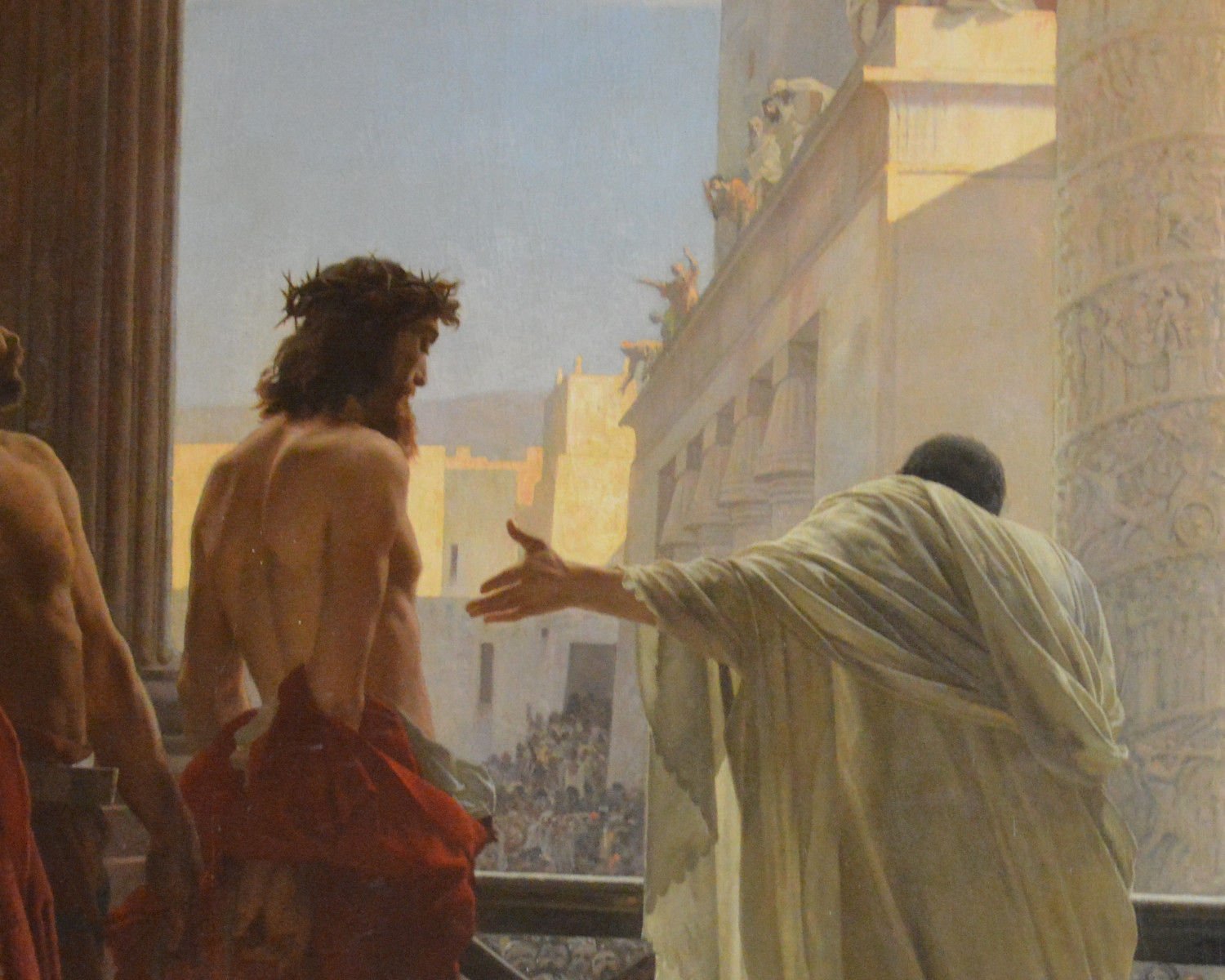
A writer from a self-described Third World country has some challenges for justice in both Church and State and the road ahead for a falsely accused priest in prison.
“The justice of New Hampshire found the priest guilty through a process no less infamous than those seen in the tribunals of any banana republic.”
— Carlos Caso-Rosendi in “Behold the Man!”
By Fr. Gordon J. MacRae — November 16, 2022
Carlos Caso-Rosendi, an accomplished author and translator in Buenos Aires, Argentina, published the fine article linked above in Spanish, Portuguese, and English. It is a superb commentary on the state of justice behind the years I have spent in prison. It challenges both Church and State to live up to the reasons for their existence. Here is a compelling excerpt:
“Many of us in the so-called ‘Third World’ look up to the United States of America as a model for what the administration of justice should be. While it is true that the United States has managed better than other countries to balance the interplay of state powers, we also must admit that those virtues have been shadowed by grievous errors such as justification of slavery, segregation, and lately of murder by abortion.
“Today I present the case of an innocent man, Fr. Gordon MacRae, who has spent the last twenty[-nine] years in prison unjustly condemned in circumstances that would cause any Stalinist magistrate of the former Soviet Union to blush. Someone with a well-known criminal record accused Fr. MacRae, an American citizen with full rights. The justice of New Hampshire found the priest guilty through a process no less infamous than those seen in the tribunals of any banana republic.”
— “Behold the Man!”
Mr. Carlos Caso-Rosendi’s use of the term, “Third World” has an interesting origin. In politics and sociology, it’s the accepted designation for an economically depressed or developing nation. The term arose during the Cold War when two opposing blocs — one led by the United States and the other by the Soviet Union — dominated world power. The Third World consisted of nations with less developed economies affiliated with neither bloc.
The term, Third World originated with Marxist psychiatrist and political theorist, Frantz Fanon, but it was perceived as negative and not always accepted by the nations on which the designation was imposed. Even after the collapse of the Soviet Union as a political bloc in the early 1990s, “Third World” remains in use to refer to economically developing nations in Latin America, Africa, and Asia.
From the pillars of power in the United States, the justice systems of Third World countries are often chastised for being woefully unjust, but not a lot of self-reflection went into that perception. Even setting aside how I came to be where I have been for over 29 years, there is a Third World country existing just beneath my feet. It is the U.S. prison system.
I really don’t have another way to describe it. When it rains, the power goes out. When it snows, the power goes out, when it’s windy, the power goes out. The prisoner telephone system would not be the envy of any Third World country. Prisoners exist in an Internet vacuum, trapped behind an iron and concrete curtain of world ignorance. Citizens in the prison labor force earn the equivalent of about $2.00 per day. The people amassed at the U.S. Southern border are fleeing the political oppression and poverty of Third World nations, but none of them come here for our justice system.
I thank Carlos Caso-Rosendi for writing with candor and truth what he sees from beyond the borders of the United States. He is not alone in his assessment. The great theologian, Fr. Richard John Neuhaus, also had a candid description of how I got here. In “A Kafkaesque Tale” he described it as the story of “a Church and a justice system that seem indifferent to justice.”

Voices Heard Round the World
I owe a debt of thanks to Pornchai Moontri for the moving post he sent us from Thailand. In 29 years in prison, I have barely ever shed a tear. I am stubborn. I just wouldn’t give the dark powers that sent me here the satisfaction of my grief. But when reading “Elephants and Men and Tragedy in Thailand” during a phone call with our editor, I had to pause three times to hold back tears so I could proceed. Pornchai’s post was sad, hopeful, deeply moving, and brilliant. Please pray for the people of Uthai Sawan, Thailand. I can only imagine their sorrow. And please pray for all the rest of us that in our divisions we may be given the grace of perspective from stories like the one Pornchai told us.
And I extend my gratitude to Attorney Harvey Silverglate whose Wall Street Journal op-ed, “Justice Delayed for Father MacRae” is also seen around the world. He was joined in October by David F. Pierre, Jr of The Media Report. They published a series of riveting articles in the past month at Beyond These Stone Walls and elsewhere while I just sat back and let them do all the work. I cannot thank them enough. Catholic League President, Dr. Bill Donohue also stood with me in October to publish a press release about these developments. The timing of these guest writers stepping forward was providential.
Now I need to be candid with you. I began the year 2022 with a new ray of hope, but as this year wound down I saw some looming clouds of possible defeat on the horizon. A revelation in Harvey Silverglate’s recent Wall Street Journal op-ed, “Justice Delayed for Father MacRae” revealed that a court hearing was held in secret in New Hampshire and a judge agreed in secret to allow Detective James McLaughlin to be removed from the public list of officers found to have engaged in misconduct. Secret proceedings are just not a good look for a justice system fending off suspicions of corruption. It is in fact the look of what Carlos Caso-Rosendi describes as “the justice of a Banana Republic.”
That designation refers to a small country economically dependent on a single crop or a single product, often governed by a cabal of like-minded conspirators operating for their own benefit. The misconduct for which former Detective James McLaughlin stands accused has been central in the case against me. As a result, a lot of attention is being paid to Mr.Silverglate’s WSJ op-ed. Among the many affronts to justice covered in that article, Mr. Silverglate wrote:
“In a May 1994 lawsuit, Father MacRae alleged that Detective McLaughlin accused the priest of having taken pornographic photographs of one of the alleged victims. No such photos were ever found.”
There is more to it. Not only were such photos never found, but they were also never looked for. There was no effort whatsoever on the part of the detective to confirm or refute this allegation which came only from McLaughlin himself. There was a reason for that. He already knew it was a lie, and it was his own lie. It floated out there among several news articles about me until 2005. It was even cited by Judge Arthur Brennan as his justification for imposing 67 years in prison. Eleven years after my trial, McLaughlin finally admitted to Dorothy Rabinowitz at The Wall Street Journal that “there was never any evidence of pornography.”
Even that did not stop Damien Fisher, a biased New Hampshire reporter with an agenda, from repeating the claim just months ago as though demonstrably true. Ryan MacDonald wrote a truthful rebuttal in, “A Reporter’s Bias Taints the Defense of Fr Gordon MacRae.” When police can invent evidence that never existed, when the news media can further propagate it long after it has been credibly debunked, what chance does a falsely accused man have in a New Hampshire court?
This is the sort of thing that had me feeling so defeated and had Carlos Caso-Rosendi comparing justice here to that of a banana republic. The justice system has become an ominous and oppressive trap for anyone wrongly convicted. When that trap covers up for the good ole’ boy secrecy behind which justice is being carried out here, how does one proceed?

Justice Unmoored from Truth
In light of all that has transpired and all that has been written, I have hard decisions to make. One of them is about hiring a New Hampshire attorney to challenge my convictions based on newly discovered evidence that the investigating police detective had a secret record of misconduct. The claims about him are taking shape and growing in number. One claim reported in local news media is that former Detective McLaughlin has erased tape recordings of statements from witnesses that do not support his bias. This is exactly what I have accused him of for the last 29 years .
I have recently been advised by a New Hampshire lawyer with expertise in this area. Her analysis was candid and I much appreciate it. The bottom line is that justice here will be yet another steep uphill and unpredictable climb. Detective McLaughlin has boasted of over 1,000 sexual assault arrests with a nearly 100 percent conviction rate due to his penchant for arranging lenient plea deals to boost his public persona. He has boasted of removing over 1,000 sexual offenders from the streets but the “removal” is only for a year or so. Guilty defendants gladly took his plea deals, but innocent defendants can only be conned or coerced into them.
Because of the extreme “success” of his actions and methods, Detective James McLaughlin has been widely hailed in some circles as a hero-cop. From the point of view of the justice department and judicial system, however, the growing evidence of his misconduct is a threat to the system itself. As a result — and it is a fact of the legal advice I have received — the entire system will be hell-bent on protecting the corrupt cop while sacrificing me. “They will flood you with motions and delays to bankrupt you,” I was told by a New Hampshire attorney, and that has indeed been my experience.
As a prisoner of 29 years (and counting) with no income beyond the $2.00 per day I earn in a Third World prison job, I do not have the resources for another legal challenge — and especially for another protracted and uncertain one. In 2012 when I raised funds for an appeal, New Hampshire judges simply declined to hear any new evidence or witnesses in the end. A past U.S. Supreme Court ruling left this to their discretion, but they did not seem to have any. The affidavit of the new investigator and the statements of the witnesses he uncovered are linked at the end of this post. You be the judge.
And then there is priesthood. I am likely the only imprisoned priest in the world who has not been simply discarded from the clerical state just for being deemed with the new designation of convenience for bishops, “unsuitable for ministry.” There is now in the U.S. a “Coalition for Canceled Priests” trying to assist priests who are thrown aside for far less cause than a prison sentence. I am innocent of the claims against me, but should I now be forced to trade priesthood for freedom? I cannot. Carlos Caso-Rosendi ended “Behold the Man!” with a burning question:
“Barabbas is gone,
Judas has received his thirty silver coins:
Behold the man, Gordon MacRae!
Bishops of the Church:
What do we do with him?”
+ + +
Editor’s Note: Read the affidavit of former FBI Special Agent Supervisor James Abbott and the statements of six witnesses from whom New Hampshire judges declined to hear.


The Lying, Scheming Altar Boy on the Cover of Newsweek
A 2016 Newsweek cover story by Ralph Cipriano exposed how a Catholic sex abuse fraud made Fr Charles Engelhardt a martyr and con man Daniel Gallagher a millionaire.
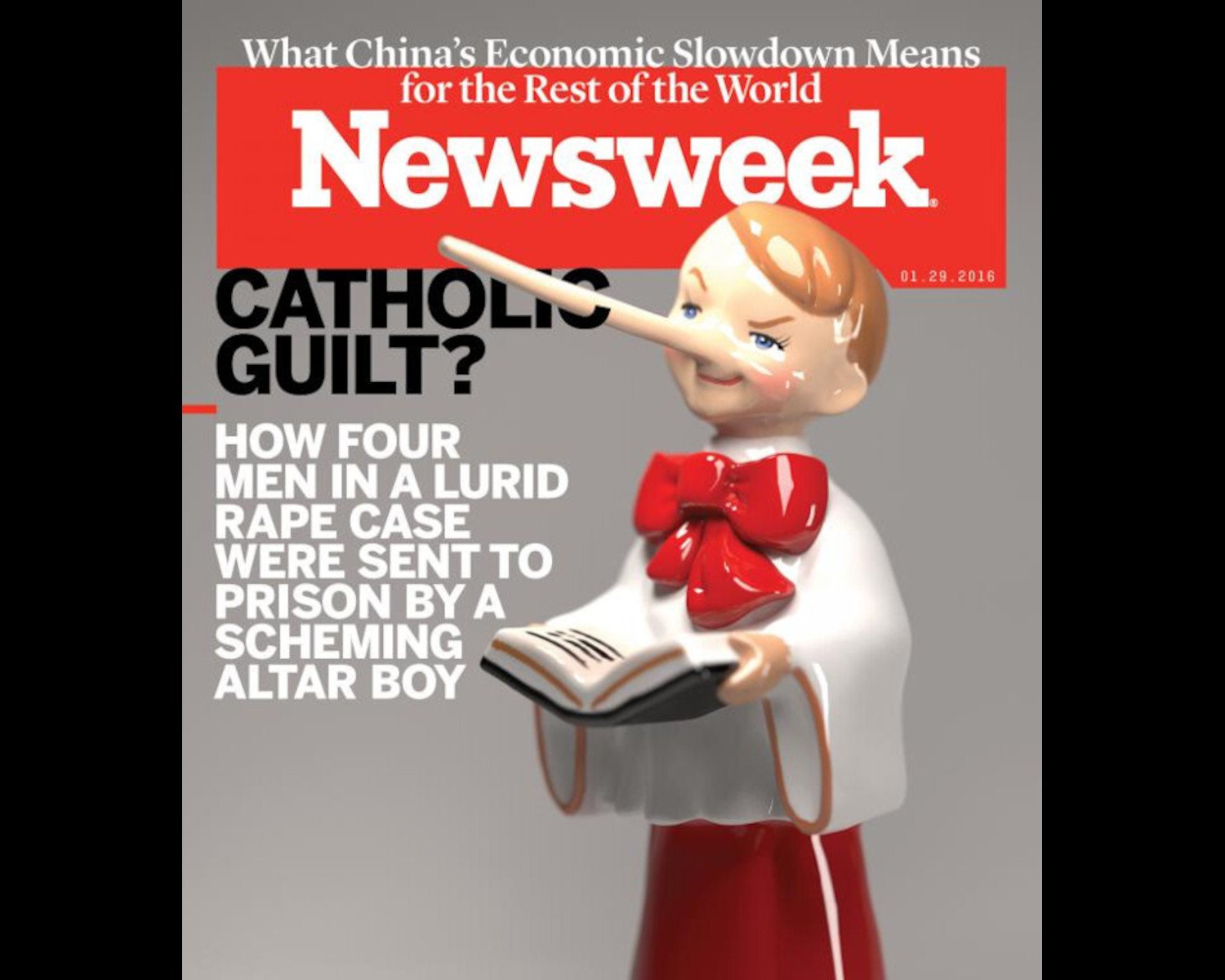
A 2016 Newsweek cover story by Ralph Cipriano exposed how a Catholic sex abuse fraud made Fr Charles Engelhardt a martyr, and con man Daniel Gallagher a millionaire.
November 14, 2022 by Fr. Gordon MacRae
Note from Fr. Gordon MacRae: It is very rare that we have two posts in a week. I first wrote this story in 2016. Fr. Charles Engelhardt died chained to a Pennsylvania prison medical unit gurney on November 15, 2014. I wanted to honor him with the truth, but in the years since this post was first written, so much more of this truth has come to light. In the time since his death, his Philadelphia prosecutor, Seth Williams, was the subject of a 23-count federal indictment for fraud, bribery and other charges. He took a plea deal and went to federal prison. Fr. Charles Engelhardt refused a plea deal and died in prison.
+ + +
This post has a most urgent preface, one that arrived in the mail just as I sat down to type. It was a single page sent to me by BTSW reader Helen, a frequent commenter from Pennsylvania who wrote across the top of the page, “Father Gordon, your face could be on this print.” No, Helen, it could not! The face on that printed page is someone I once met at a pivotal time in my life as a priest, but the sender could not have known that. Helen simply stumbled upon a quote she thought I ought to see, and she was right. The face and the quote on that page belong to the late Father John Hardon, SJ (1914–2000), an American Jesuit priest whose cause for beatification has begun with a recognition in Rome that he is held to be a Servant of God.
Father Hardon and I met in 1989 by “coincidence,” if you still believe in such things. I don’t, but how and why we met is another post for another day. Suffice it for now to say that it was an encounter I could not forget, and when I saw his face on that printed page, and read the words attributed to him, it seemed as though he once again stood next to me with a firm grip upon my shoulder. The quote expresses perfectly why I must write this post, why you must read it, and why together we must share it boldly, and as far and wide as we can make it travel. I took Father Hardon’s words to be a directive, and so should you. Here is the quote:
“Our duty as Catholics is to know the truth; to live the truth; to defend the truth; to share the truth with others; and to suffer for the truth.”
— Father John Hardon
I have long hoped, during the years of media coverage of Catholic scandal, that someone else in the news media might join the ranks of Dorothy Rabinowitz among journalists with a spinal column. It seems I had overlooked Ralph Cipriano. For some time now, he has been covering events in Philadelphia for BigTrial.net, his outstanding Philadelphia Trial Blog. Some time ago, Mr. Cipriano published a major media event in a Newsweek cover story entitled “Catholic Guilt? The Lying, Scheming Altar Boy Behind a Lurid Rape Case” (Jan. 20, 2016).
This is a dark story, and a painful one, and for any number of reasons you might be tempted to click it away at this point, please don’t, for it became a matter not only of justice, but of life and death. Ralph Cipriano’s Newsweek article arrived in my mail on the same day as the above quote from Servant of God, Father John Hardon, and I knew instantly that I had to write about this.
Reading through the Newsweek piece was a vivid experience of déjà vu because I have written of some aspects of this story in a post entitled, “The Path of Sabrina Rubin Erdely’s Rolling Stone.” It was an account of how a good, kind and much loved Pennsylvania priest, Father Charles Engelhardt, was martyred in prison as a result of greed, false witness and prosecutor misconduct. It is this same story that Ralph Cipriano covered in Newsweek, and both are to be commended for some courageous against-the-tide reporting. The Church and priesthood are indebted to Newsweek for presenting this story so boldly in a leading secular media venue while so much of the Catholic press crossed to the other side on the road to Jericho.
Father Charles Engelhardt died in a prison medical unit on November 15, 2014, and the full telling of this story is all that will bring meaning and purpose to his death.
So be brave, please, and read this post to the end, then share it every way you can. Do this, please, to honor the Servant of God who just told us that our duty as Catholics is to know, defend, and share the truth. Do this, please, to honor Father Charles Engelhardt who suffered for the truth and for his priesthood, a suffering that cost him his life.

Rolling Stone’s Sabrina Rubin Erdely
A Rolling Stone Gathers No Facts, Just Dirt
I’d like to think that I have approached this story as Ralph Cipriano did, with cool journalistic detachment, but I now admit that’s very hard to do when the story has a Kafkaesque ring that is all too familiar to me. I was admittedly angry and not at all detached when I wrote the heading for this section, “A Rolling Stone Gathers No Facts, Just Dirt,” a fact conveyed in my Search Engine summary for the post linked in the section above:
“A federal jury found Rolling Stone liable for defamation, and Sabrina Rubin Erdely for actual malice, but their earlier malice cost the life of an innocent priest.”
Today, I find myself no less angry revisiting it. It told the tale of how Sabrina Rubin Erdely’s infamous November 19, 2014 Rolling Stone article, “A Rape on Campus” came unraveled as her account of serial rape at the University of Virginia was debunked and widely exposed as grossly inaccurate and misinformed. Ms. Erdely fell for the story of “Jackie,” took it at face value, and ran with it — doing much damage not only to UVA and its students, but to the field of journalism itself.
Since I first wrote of this, the University of Virginia and its Phi Kappa Psi fraternity have filed multi-million dollar libel and slander lawsuits naming Sabrina Rubin Erdely and Rolling Stone magazine as defendants. Both have since suffered serious losses in journalistic credibility. Rolling Stone magazine has since retracted Ms. Erdely’s account of a lurid frat house serial rape case at UVA. Her Rolling Stone article, “A Rape on Campus,” is today widely seen as grossly irresponsible and agenda-driven slander masked as journalism.
However, Mr. Cipriano’s bold Newsweek cover story is the first hint of media clamor to revisit Ms. Erdely’s other Rolling Stone fraud, “The Catholic Church’s Secret Sex Crime Files” in which she introduced “Billy Doe,” a purported victim of violent and horrific sexual abuse by several Pennsylvania Catholic priests. Billy Doe, granted anonymity by Rolling Stone and everyone else in the news media, was described by Ms. Erdely as “a sweet, gentle kid with boyish good looks” who had been callously “passed around” from predator to predator in the Philadelphia Archdiocese. The story eventually resulted in $5 million in settlements for Billy Doe while landing three innocent Catholic priests in prison.
One of those priests was Father Charles Engelhardt whose decision to stand by the truth against Billy Doe’s $5 million fraud cost this good priest his life. As journalist Ralph Cipriano reveals in Newsweek, Father Engelhardt refused pre-trial plea deals including one deal on the eve of trial that would have resulted in no time in prison and a sentence of simple “community service.” Father Engelhardt chose the truth, and he chose to suffer for the truth. He instead was sentenced to a term of six to twelve years in prison “because he would not perjure himself by pleading guilty ‘to make a deal,’ to admit to a crime he did not commit.” In “Handcuffs and a Hospital Bed,” a November 17, 2014 posting at his “Big Trial” blog, Cipriano wrote:
“For Father Charles Engelhardt, the ordeal is finally over. The 67-year-old priest died at 8:30 PM Saturday night [November 15, 2014] an inmate at the State Correctional Institution in Coal Township [PA] where he served nearly two years of a 6-to-12 year sentence.”

Daniel Gallagher after his $5 million fraud took the life of Father Charles Engelhardt.
Daniel in the Liars’ Den
The man dubbed “Billy Doe” by Sabrina Rubin Erdely and Rolling Stone magazine — while shielding his true identity and character from view in all this — is Daniel Gallagher. Today he is a free man living in Florida where he settled into a lifestyle bankrolled by $5 million in settlements from the Archdiocese of Philadelphia and, in part, its insurers. Gallagher lives free from scrutiny and the long arm of the law because the DA, judge, and news media in Philadelphia all got behind this case, but remain unable to surrender enough of their hubris to stop covering for him, to admit to their pursuit of “trophy justice,” and to allow the facts to invade their field of vision. Sometimes the meting out of justice comes down, not to facts, but to mere ego.
In his riveting Newsweek article, and in “Newsweek’s Cover Boy Makes a Media Splash” on his BigTrial.net blog (Jan. 28, 2016) Ralph Cipriano pursued the truth about who and what Daniel Gallagher is. From his claims of serial victimhood to his ever changing accounts of abuse, to his vague and amorphous facts and stories, to his most recent (and most troubling) psychiatric profile, Daniel Gallagher is exposed as
“chronically maladjusted, immature, self-indulgent, manipulating others to his own ends, refusing to accept responsibility for his own problems, exaggerating, grandiose, hedonistic, impulsive, manipulative and self-serving, paranoid, delusional…”
And the list doesn’t stop there. Gallagher pulled off a con man’s dream when he got a DA and judge to agree that his 23 failed stints in drug treatment were all someone else’s fault. In a Linkedin article, “A Weapon of Mass Destruction,” I quoted a prison inmate who reacted to the flood of decades-old claims against priests with a dose of brutal self-honesty about his own proclivities and enablers:
“So let me get this straight. If I say that some priest touched me funny all those years ago, I’ll be seen as a victim, I’ll be paid for it, and my life will be his fault instead of mine? Do you have any idea how tempting this is?”
— A prison inmate
Daniel Gallagher’s claim of having passed polygraph tests also now appears to be no more truthful than his claim of being passed from priest to priest. No one but his contingency lawyer claims to have seen polygraph results, and efforts to obtain them have been met with silence. Meanwhile, Father Charles Engelhardt DID take polygraph tests, and passed them conclusively, as did other priests in Daniel Gallagher/Billy Doe’s sights. (And for what it is worth, so did I).
Readers of Beyond These Stone Walls should find a loud and clear ring of the familiar in all this. Everything now said of Daniel Gallagher in these reports has been said of Thomas Grover, my accuser trial. And it has all been said of Shamont Lyle Sapp, a con man who landed settlements from accusing four priests in four different states until he was exposed by a U.S. attorney and a journalist with integrity. I take no credit, but he was also exposed by me in my Linkedin article cited above.
This particular rolling stone about Daniel Gallagher and Father Charles Engelhardt, was sent downhill by Sabrina Rubin Erdely who has since been found liable for “actual malice” and “disregard for truth” by a judge in the University of Virginia story. The rolling stone about Father Engelhardt had a long path. It rolled all the way Down Under to Australia where elements of the story were duplicated and reused by prosecutors and the media in Australia to condemn an even greater trophy, Cardinal George Pell. I wrote of the glaring similarities in the two cases in “Was Cardinal George Pell Convicted on Copycat Testimony?” It turned out that indeed he was, and Australia’s highest court exonerated him after 400 days in prison.
Thanks to Ralph Cipriano and Newsweek magazine, some honest media has taken notice of the Daniel Gallagher scam, but not in time to save the life of Father Charles Engelhardt. Still, these revelations of truth bring immense comfort to those still charged with clearing this good priest’s good name. But there’s more than that at stake here. You have been duped. Our Church has been duped, and cast aside in the public square in the process. The truth is a value in its own right, and we owe it to ourselves to learn it and share it.
I can only thank Ralph Cipriano and Newsweek for taking this on, and for telling a truth most in the news media have shunned. Take a little time, please, and read the Newsweek article and Mr. Cipriano’s BigTrial.net blog, and share a link to this post with others. I know one Servant of God who will smile upon you for it.

Life Still Goes on Behind and Beyond These Stone Walls
Two years and 102 posts after the resurrection of this blog as Beyond These Stone Walls,the challenges of prison writing continue to be overcome week after week.
Historic Concord, New Hampshire Post Office
Two years and 102 posts after the resurrection of this blog as Beyond These Stone Walls, the challenges of prison writing continue to be overcome week after week.
November 9, 2022 by Fr. Gordon J. MacRae
The United States had a most crucial national election this week. What I am writing now will be posted just one day later so I cannot imagine anyone paying any attention at all to me. But I’m used to it — at least, I thought I was.
I owe many of you an apology. You might recall that two years ago this week, These Stone Walls, the older version of this blog, had to be taken down. I wrote about the circumstances behind its collapse in our first publication under its new name on November 11, 2020. That post was “Life Goes on, Behind and Beyond These Stone Walls.”
Two years and 102 posts later, we discovered something about the newer blog that we had previously overlooked. It came with its own email address for subscribers to contact us. Being locked away from ever being able to interface with technology, I had no idea. Just two weeks ago, our editor stumbled upon this internal email system along with hundreds of your unread and unanswered comments and messages dating back two years. For all this time, I thought you were all just ignoring me. The internal address is FatherG@BeyondTheseStonewalls.com.
And many of you must have thought the reverse. For two full years, subscribers had been clicking the “Reply” button on our weekly subscriber message to send me messages, comments, and reflections on my posts, but without any reply or even an acknowledgment from me.
Our editor’s discovery of the cache of hundreds of your emailed messages required two long marathon sessions by telephone over two days to hear them read to me and respond — up to two years late — to as many as I could. Our volunteer editor risked carpal tunnel syndrome typing all my dictated replies. Some messages were just too old for any reply to make any sense. Anyway, we apologize for the oversight.

A Voice in the Wilderness
It is humbling. Before becoming a guest of the State in 1994, I was known for being somewhat of a computer geek. I coached many other priests back then who were struggling to embrace the computer age. Now my prison barriers place me in Techno-caveman status relegating me to the technological Stone Age. Sometimes our editor is surprised when, sight unseen, I walk her through posting something at Linkedln, for example, without ever having even seen it. I read a lot about technology, but that is not quite the same as hands-on experience.
When I began writing from prison at the urging of Cardinal Avery Dulles and others, I had no idea what a blog was. They did not exist when I dropped off the face of the Earth in 1994. According to the latest estimates of Google, there are over 600 million registered blogs worldwide publishing 2.5 billion blog posts a year. So mine is literally a tiny voice in the wilderness.
It is difficult to say how many blogs identify themselves as “Catholic” blogs. For a time, a site called “Top Catholic Blogs” featured posts from me almost weekly, but it seems to have become inactive. Another site, The Big Pulpit, moderated by Tito Edwards for the National Catholic Register, featured an occasional post from me, but had not done so since our change of name two years ago. Then on the day before this is posted, The Big Pulpit proved me wrong by posting, “Catholic Priests Falsely Accused.” So in terms of promoting a message, it seems entirely up to me — and you, if you are willing.

When You Write to Me
While the nation is celebrating or regretting the outcome of this election and analyzing all of its implications, I want to address a few housekeeping items about Beyond These Stone Walls. I wish I could say that I have been more responsive to your snail mail than I was to your neglected email messages.
Mail to me in prison now goes through a process that will seem like an insult to all of your good intentions. There were all sorts of rules in place requiring that mail be either typed or hand written in plain black or blue ink. Now that has all been scrapped. Effective a few months ago, prisoners here no longer receive any original mail at all.
Letters and any enclosures are now photocopied in black and white, and I receive only the copy. The original is held for ten days and then shredded. There have been lots of problems with this, the most frequent being double-sided originals that are copied on only one side. When that happens, I have ten days to request re-copying of the original before it is shredded.
Despite all the obstacles, I still get a lot of mail. Please do not misunderstand me. Mail is the lifeblood of the psyche for any prisoner. There are many here who do not even bother to show up for mail call. My biggest heartache, however, is being unable to answer most of your letters in a timely manner. Sometimes mail piles up for so long that any reply just feels insulting. I am so very sorry that many of your letters and gifts have gone without response. It would help if you include an email address in your letters. It would be easier for me to send a reply in that way.
Part of this problem is that I have to handwrite each and every letter I send. I can purchase only six typewriter ribbons per year and therefore must reserve them for publishing posts. In addition to Beyond These Stone Walls, I am also occasionally asked to write for other venues. The latest is an article published at a U.K. site, False Allegations Watch. I hope you will look at it because it lets site administrators know that an article is important. My article there is “Did Police Misconduct Turn a False Allegation into a Wrongful Conviction?”
Facebook refused to allow that link to be posted. Ironically, the leftist media was eager to report about police misconduct until doing so helped the cause of a wrongly imprisoned Catholic priest. This latest experience with Facebook drove home for me the importance of what Elon Musk now plans to do with Twitter: No more cancelling conservative views; no more cancelling pro-life voices; no more cancelling Catholic fidelity. By the way, we have a Twitter account. Just go to Twitter.com and search BeyondTheseStoneWalls to follow us.

A Corporal Work of Divine Mercy
Sending an occasional monetary gift to me has been most helpful, but also somewhat of a heartache. Gifts cannot be sent to me directly, but my brother-in-law, a lifelong friend who somehow married my sister when I wasn’t looking 42 years ago, maintains a power-of-attorney account for my needs. Please see our “Contact and Support” page to help if you wish and are able. Modest gifts to that account help a good deal with annual expenses for this blog and with food and clothing costs.
I have an expense coming due just after Christmas that I hope to find some help with. It’s my $650 annual subscription to The Wall Street Journal which helps me immensely to stay in touch with the world and write about it. It is my one and only extravagance and the subscription fee is a bargain compared to other newspapers. I was shocked to learn from a reader that annual subscriptions to The New York Times and The Boston Globe are both over $1,200. In my opinion, the WSJ is a far superior newspaper (and not just because it has published about me!).
Some people have helped by using PayPal. We have an account, but PayPal has become problematic for many. On October 8 this year, PayPal sent an update to its Terms of Use Policy that alarmed many users, causing some to terminate their accounts. PayPal reserved the right to confiscate up to $2,500 from users’ accounts if PayPal determines that a user posted “misinformation” on the Internet. Paypal also blocked accounts in the UK such as Free Speech Union and the Daily Sceptic.
After global protests, many closed accounts, and a big selloff of PayPal stock, the company thought better of it and issued a retraction while restoring the closed accounts. There are many, however, who simply don’t trust PayPal going forward now. We receive few gifts through PayPal, but the annual total is almost enough to keep this blog afloat. If donors use that means, please always send me a message that you have done so using our PayPal donor email, FrGordonMacRae@gmail.com. This will better enable me to send you a message of acknowledgment and thanks.
Please also pay some attention to our Special Events page for information on how to help me with two causes that are most important to me: the support and rehabilitation of Pornchai Moontri, and the Vietnamese Refugee Project of Father John Hung Le, SVD. American funds go a long way in Thailand, and thanks to your help I have been able to help sustain them both. This means more to me than any endeavor on my own behalf .
The elections are over. May sanity, fairness and justice now reign. May Twitter be actually free from partisan censorship. May the woke finally go back to sleep. May God resume His hallowed place in our discourse. And may the Lord be with you.
+ + +
Note from Fr. Gordon MacRae: We assimilate much more of the message of the Gospel when its intended meaning is more fully understood. The Gospel from St. Luke at Mass this coming Sunday (Luke 21:5-19) is a prediction of terrible persecutions for which Jesus tells all of us to prepare. I previously wrote of this alarming Gospel text in the posts: