“There are few authentic prophetic voices among us, guiding truth-seekers along the right path. Among them is Fr. Gordon MacRae, a mighty voice in the prison tradition of John the Baptist, Maximilian Kolbe, Alfred Delp, SJ, and Dietrich Bonhoeffer.”
— Deacon David Jones

Holy Orders in an Unholy Collision with a Disposable Culture
Dealing with the sex abuse crisis has led many bishops to now treat priests as disposable for any infraction resulting in a serious erosion of Catholic theology.

Dealing with the sex abuse crisis has led many bishops to now treat priests as disposable for any infraction resulting in a serious erosion of Catholic theology.
February 1, 2023 by Father Stuart MacDonald, JCL
Note from Father Gordon MacRae: A few weeks ago in these pages I published, “Priests in Crisis: The Catholic University of America Study.” Because it was highly recommended to the huge membership of the Catholic League for Religious and Civil Rights, it was one of our most read posts of the year. I then invited Father Stuart MacDonald, JCL, a priest and canon lawyer who serves as advisor to this blog to present a guest post analyzing the same topic and its importance to the Church. Father Stuart’s last post here was “Bishops, Priests and Weapons of Mass Destruction.”
+ + +
I finally went, reluctantly, to a performance of the musical Hamilton. Neither American history nor rap are my particular interests; however, a friend convinced me to go. I am unqualified to offer any observations on the theatrical performance; however, I was indignant at the final message of the show and the audience reaction to it. In a nutshell, if you haven’t seen it, Hamilton is the story of Alexander Hamilton, a founding father of the United States of America and the author of a large number of the Federalist Papers. He was perhaps the first American politician to become involved in a public sex scandal involving marital infidelity. The musical suggests that history has been unkind to Hamilton and that his infidelity played a role in this. It concludes with a rousing song about one’s reputation and posterity. In other words, Hamilton was a great guy and how silly of us to judge his whole career by a single moral failing.
I could not agree more. But let’s face it, the hypocrisy of modern, woke, me-too movement aficionados rapturously cheering this message is comical. In less than a decade, North American culture has accepted as unquestionable the notion that it is unacceptable for leaders of any kind to have lapses in judgment or moral failings. When they do, in the current me-too mindset, they deserve to be cancelled, obliterated from history, never to be seen, heard from, or discussed again except, I realize, when it comes to Alexander Hamilton. Hamilton, the play, is a huge success being performed in several places throughout the world. Does no one else see the hypocrisy? Do people not think anymore? (No, don’t answer that question yet.)
Most readers are aware of the National Study of Priests conducted by The Catholic Project at the Catholic University of America. Father Gordon MacRae wrote of it with his usual aplomb in the link atop this post. What some of you may not have seen is an equally worthwhile analysis of it in Catholic World Report, entitled, “The National Survey of Priests Suggests a Deep Crisis in Catholic Theology,” by Msgr. Thomas Guarino. Father MacRae and I both highly recommend it and we will link to it again at the end of this post.
The import of the study, and the two articles linked above, is the fact that priests, not just in the United States to which all of the above-noted articles are limited, are suffering from a fear of the modern, woke, me-too movement aficionados who seem to be as prevalent in the Church as they are in the world. I do not need to reiterate the scenario of a priest being accused, removed from ministry and either being dismissed from the clerical state or left in limbo on so-called administrative leave. In cases too many to count, priests are abandoned, having been prohibited from exercising any priestly ministry, save the celebration of Mass in private.
Let me be clear, I am not referring to priests accused of sexual abuse of a minor. While the scourge of the sexual abuse crisis is going to be with us for a long time yet, the unfortunate and concomitant truth is that priests are now sitting ducks for any type of accusation. It is specifically to the other stuff that I am referring. Dealing with the sex abuse crisis, however, has led many bishops and Church leaders to think that priests are now like chattel, pieces of property who can be used or discarded at will. The praxis in the Church these days is that a priest can act as a priest only with the explicit permission of his bishop or superior. To put it another way, it is as if a priest is ordained and receives the sacrament of Holy Orders, but the power of those orders is like a tap is turned on or off by the bishop.
Perhaps Father has fallen into sin with a woman, someone doesn’t like Father’s preaching, or maybe Father is insisting on his right to offer Mass ad orientem, or, Heaven forbid, Father uses vulgar language in a fit of anger or impatience (pace the news reports, if indeed true, of Pope Francis’ recent tirade with seminarians from Barcelona). Any of those things, to name just a few, can lead to a priest’s removal from ministry cast into a form of canonical limbo with no defense and from which he may never emerge. The idea seems to have taken over the collective episcopal mindset that a priest exercises his Sacred Orders at his bishop’s unfettered discretion. As Father Thomas Guarino points out so well in his article at the end of this post, this has serious consequences for the Catholic theology of priesthood.
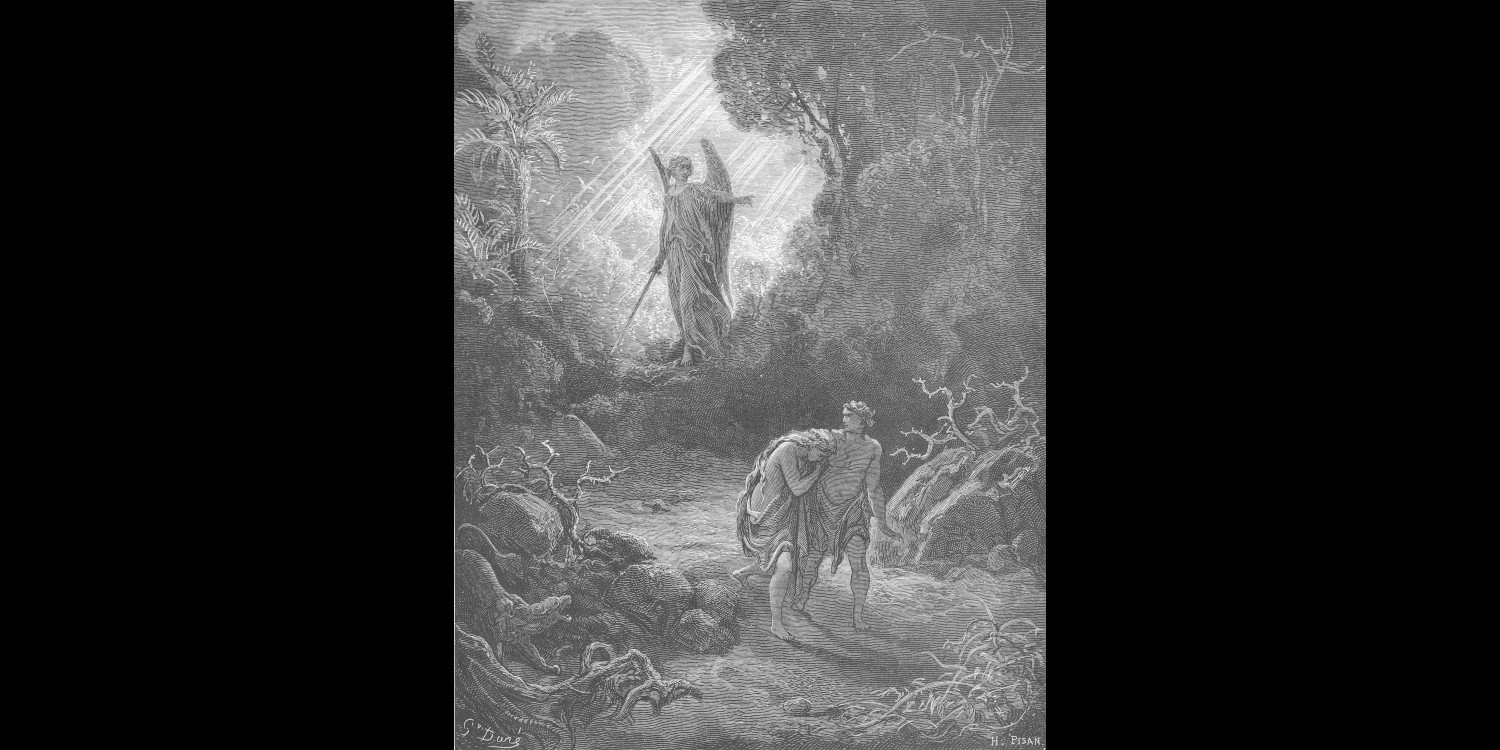
The Expulsion from Eden by Gustave Doré
Catholic Crime and Punishment
Of course, the Church and bishops need to maintain discipline and authority among clergy and religious. No one questions that. But one does rightly question the overreach of control that has crept into our day to day living. Not every bad behavior, or even sinful behavior of a priest is an ecclesiastical crime for which he can be punished or even destroyed. Clearly, if a priest violates his promise of celibacy by sexual acts with an adult woman who is not his parishioner, he commits a mortal sin for which he must repent and do penance like all other sinners. But the Church does not say he has committed a crime. A crime exists, in these specific circumstances, only if he begins to live with her in a married fashion (it doesn’t mean he literally has to live in the same house with her). That is the sin and crime of concubinage.
The last punishment meted out to a priest guilty of that crime is dismissal from the clerical state. It is not the automatic penalty. Clearly, the mind of the Church is that clerics are capable of very serious sin, and the greater is their fall when that happens; but it is naïve to think that clerics are not going to sin, or that some clerics will never commit sexual sins. There is a reason why the Church has had laws against such behavior from the earliest days of her existence.
So, what is happening today? The public backlash from the sexual abuse crisis has placed bishops and religious superiors on edge. No one likes to be unpopular. In an effort to re-instill confidence that the Church is no longer turning a blind eye to the nefarious actions of some clergy with minors, bishops are just appearing ‘tough on crime’ in general. Therefore, anything that a priest does which might reach the ears of the bishop is now fodder for tough disciplinary action. Notice the change in terminology. It is not crime, which would involve inflicting penalties (like suspension, excommunication) using penal law and processes (like criminal law, trials, and sentencing in the civil sphere). Rather, it is disciplinary action for behavior that is not a crime.
The priest who has grievously sinned with a woman, and who has repented of his sin which remains unknown to the public, is now removed as pastor, has had his faculties for preaching and confessions revoked, is forbidden from celebrating Mass in public, and cannot present himself as a priest. All of that for something that is not a crime. No one would tolerate that in the civil sphere. Let me remind you, as Father MacRae has written elsewhere that Saint Padre Pio was falsely accused of all these things and spent years under the unjust cloud of suspicion.
Analogies always fail in some way, I realize, but imagine that you are a manager of a large store of a famous brand name and your supervisor finds out that you committed perjury in court over a traffic accident. Would the supervisor be justified in terminating your employment over actions which did not directly encompass your work duties? Does the priest deserve reprimand? Yes. Should he be advised that any future fall will constitute a crime for which he will be punished? Certainly. Does he deserve immediate dismissal? I don’t think so, no more than the store manager deserves to be punished by his employer. Does his dishonesty raise a red flag about his integrity? Yes. Should his supervisor monitor dishonesty in the workplace? Yes. But it is difficult to imagine that he should be terminated. When priests are terminated or cancelled in this way, the Sacrament of Holy Orders is much diminished, reduced to mere employment from which a priest can be discarded.
It is precisely this situation that has caused the angst so prevalent among priests as described in the articles by Father MacRae and Msgr. Guarino. It is naïve to think in these cases that a bishop’s first interest is going to be the priest. It really should not surprise us, however, that we are in this state. Just as seminarians are the product of the culture whence they come, and the Church must take pains to purify them of all that is wrong with the culture, so the Church, our bishops, are products of the culture in which the Church lives. We are living in the midst of the me-too movement, of the culture of ridiculous wokeness in which some believe five- and six-year-old children need to be educated about transgender ideology and sexual identity.
This dominant culture seeks rogue justice, not repentance. It seeks conformity, not diversity. We claim rights, not just the fulfillment of duties. We live in an age of wicked hypocrisy. Priests are labelled as dirty child molesters, not men of learning on a mission. Bishops steer the difficult course of confronting all that is evil in culture while trying not to make themselves and the Church irrelevant. But at what cost? With what methods?
Pandering to the mad mob is not the answer. Rather, we need to re-claim and re-publicize that the Gospel message is one of repentance and forgiveness and a call to be perfect as our heavenly Father is perfect. We are bound to fall along the way, which is why the Second Person of the Trinity humbled Himself to be born of our human flesh. When we can regain our equilibrium after the scandals, we will be a much healthier Church, but less so if we simply discard those who have sinned but have embraced the grace of repentance. For now, as with so many other scandals and confusion in the Church, we ought as priests and laity to keep our heads down, say our prayers, and keep our Faith. This, too, shall pass. God knows when, but it will pass. How long, O Lord, how long?
+ + +
Fr. Stuart MacDonald, ordained in 1997, is a priest of the Diocese of St. Catharines, Canada. Pastor of a parish, he is currently a canon law doctoral candidate at St. Paul University in Ottawa and assists accused priests with canonical counsel. Previously, Fr. MacDonald studied canon law at the Pontifical Gregorian University in Rome and served as an official for the Congregation for the Doctrine of the Faith. Most recently, he has been asked by Fr. MacRae to be the Canon Law Advisor for Beyond These Stone Walls.
+ + +
Note from Father Gordon MacRae: I thank Father Stuart for this candid and most important post on the state of priesthood in this troubled time. Both he and I want to urge readers to visit and ponder the posts cited herein by Msgr. Thomas G. Guarino in The Catholic World Report entitled, “The National Survey of Priests Suggests a Deep Crisis in Catholic Theology.”
+ + +

Father Stuart MacDonald, JCL at the Vatican

One of our Patron Saints, Saint Maximilian Kolbe, founded a religious site in his native Poland called Niepokalanow. The site has a real-time live feed of its Adoration Chapel with Exposition of the Blessed Sacrament. We invite you to spend some time before the Lord in a place that holds great spiritual meaning for us.
Click or tap the image for live access to the Adoration Chapel.
As you can see the monstrance for Adoration of the Blessed Sacrament is most unusual. It is an irony that all of you can see it but I cannot. So please remember me while you are there. For an understanding of the theology behind this particular monstrance of the Immaculata, see my post “The Ark of the Covenant and the Mother of God.”

The March for Life and the People on the Planet Next Door
The human fascination with finding extraterrestrial life has turned a blind eye to a half century of Roe v Wade. How would we explain Planned Parenthood to E.T.?

Courtesy of Damian Entwistle / CC BY-NC 2.0
The human fascination with finding extraterrestrial life has turned a blind eye to a half century of Roe v Wade. How would we explain Planned Parenthood to E.T.?
January 25, 2023 by Father Gordon MacRae
Note from Father Gordon MacRae: I first wrote this post in this same week in January 2017. It was written for an older version of this blog so we would have to restore it to make it readable again. I decided instead to rewrite it and publish it anew. This post is substantially revised and updated, but we retained the 2017 comments. Please feel free to add to them.
The post was written before the U.S. Supreme Court overturned Roe v Wade leaving the battle for the Right to Life to individual states. The annual March for Life took place this week in the nation’s capital and around the country. It capped off a momentous year in the cause for life with the long-sought overturning of Roe v. Wade.
These events also coincide with a renewed interest in the scientific search for extraterrestrial life. The frenzy is fueled once again by grainy new images of something seen moving in the skies. Whatever it is, it is entirely of human origin for reasons explained in this post.
+ + +
Working in the prison law library a few days before a long holiday weekend in honor of Martin Luther King, Jr., I was trying to pick out a few books that might help me write a post for Beyond These Stone Walls during the long days stuck inside. I have to be really selective about books these days. I literally have to sleep with everything I’m reading. There is simply no place to put them but on my bunk. I’ll die if I can’t read and I’ll die if I can’t sleep. So I had to find a way to do both in the 60 square feet which I will never call home.
I knew there was a science post coming. I think Liz Feuerborn knew it, too. A dear friend and long time BTSW reader in Lincoln, Nebraska, Liz recently sent me a most welcomed Christmas gift. It’s a printed list of 244 Catholic priests and religious — four of them canonized saints — who have made major contributions to science. The list includes a description of the work of each.
I was very pleased to see among them another BTSW reader and contributor, Father Andrew Pinsent, a priest and particle physicist who has been a guest writer for this blog. Father Pinsent is the Research Director of the Ian Ramsey Center for Science and Religion at England’s Oxford University. I have written about him in a few posts, one of which he co-authored with me entitled, “Fr Georges Lemaître, the Priest Who Discovered the Big Bang.” The list of scientist-priests also includes Fr. Georges Lemaître, of course, a mathematician and physicist of the early 20th Century who is considered in scientific circles today to be the Father of Modern Cosmology. Ironically, he was also the godfather of Pornchai Moontri’s godfather. I am still trying to work out the astronomical odds against that.
Also on the list is Nicolaus Copernicus a priest and astronomer in the late 15th and early 16th Century who actually has a scientific revolution named after him. The Copernican Revolution knocked from the forefront of science the notion that our humble Earth is the center of our solar system. From my point of view, it has been a contribution to humankind’s capacity for humility that the Universe does not revolve around us. Alas, I am not on the list at all, but why would I be? I have no contribution to science except to be an observer. In that role, as I explain below, I have been in very good company.
But first, back to my selection of books for that long weekend stuck inside. The one that most caught my eye was the 2015 edition of the Guinness Book of World Records. It contains a few pages about scientific discoveries that have radically changed how we view our place in the Cosmos. A segment that got my attention was a small tribute to Vera Rubin, an American astronomer whose work led to the discovery of Dark Matter and Dark Energy, and changed the way science views the Universe.
Vera Rubin earned her doctorate in astronomy at Georgetown, a Catholic university in Washington, DC. In the 1960s and 1970s, her observations of other galaxies revealed that the velocity of the movement of stars in their outermost rims is much faster than the existing dogmas of science predicted. Her conclusions demonstrated that the Universe is much stranger than we had ever known, that the matter we actually can see in other galaxies comprises only five to ten percent of the actual Universe. The other ninety-five percent came to be known as dark matter and dark energy. “Astronomers thought they were studying the Universe,” she said, “and now we learn that we are just studying the five to ten percent that is luminous.”
Back at the start of 2017 I opened a copy of The Wall Street Journal and was stunned to see her obituary. Dr. Rubin died a week earlier on Christmas day at her home in Princeton, New Jersey. She was 88 years old, and one of the most accomplished astronomers of the late 20th Century. Much of what she discovered about the nature of the Universe and matter that we have been unable to see is now being demonstrated before our very eyes by a new and revolutionary telescope launched into distant orbit one million miles from Earth, a most important development that I described in 2022 in “The James Webb Space Telescope and an Encore from Hubble.”

Courtesy of Carnegie Institution of Washington and Smithsonian Air and Space Museum
Confounding the Scientific Theorists
Dr. Vera Rubin was awarded the National Medal of Science in 1993 for sparking “the realization that the Universe is more complex and more mysterious than had been imagined.” She shared several things in common with Father Georges Lemaître. One of them was the harsh reality that their proven research did not catch on right away. In his case, it was because he was a Catholic priest. In her case, it was because she was a woman. Dr. Rubin was predeceased by her daughter, Judy Young — also an accomplished astronomer — who died two years earlier in 2014. Vera Rubin wrote in 1995 that her role as a scientific observer “is to confound the theorists.” She will be confounding us for years to come.
At the limit of human knowledge just a century ago, the Universe consisted of just a single galaxy, the Milky Way, and astronomer Harlow Shapley demonstrated that our solar system was not at its center, but out on the galactic fringe in one of its spiral arms.
By the time of the Great Depression in the 1930s, astronomer Edwin Hubble discovered other galaxies while the Belgian priest and physicist, Fr Georges Lemaître, caused another scientific revolution with his mathematical equations, now supported by empirical science. He concluded that the Universe — all matter, space, and time — began “on a day without yesterday” from a primordial atom, later dubbed by a critic, “the Big Bang.”
Today, science reveals that there are trillions of galaxies, each containing hundreds of millions of stars, one of which is our sun. A recent issue of Popular Science magazine had a two-page spread that was another sort of epiphany for me. It was a depiction of a small segment of the Universe. The two page image contained 50,000 galaxies, and one tiny one was our Milky Way. From such an image, astrophysicist Mario Livio concludes, “From a purely physical perspective, we are just a speck of dust in the grand scheme of things.”
In just the last decade, it has been discovered that this one, unremarkable galaxy — one of trillions — contains about a billion planets orbiting its millions of stars. On December 5, 2011, the Kepler space telescope discovered the first known “Earth-like” exoplanet orbiting a star about 600 light years from Earth. It’s a distance of about 3,500 trillion miles.
The flurry of news and scientific speculation surrounding the discovery of other Earth-like exoplanets in orbit around distant stars handed science over to the theorists again. There was a presumption that life MUST have taken hold elsewhere, and that the planets MUST be host to one of the millions of civilizations like ours that MUST exist throughout the galaxy.
And of course the inevitable media target of the speculation is that religion, and most especially Christianity, MUST be made irrelevant when the aliens are finally found, or find us. The hope is that the discovery of E.T. will render obsolete 2,000 years of Western thought about God. As G.K. Chesterton put it, “Those who do not believe in God do not believe in nothing. They believe in anything!”
The story endured until the science media’s “next big thing”: The 2016 discovery of “Proxima B,” dubbed by the theorists to be “a potentially habitable Earth-like planet.” Orbiting Proxima Centauri, the star nearest to our sun, Proxima B is 4.2 light years away. It’s the planet next-door in galactic terms, about 25 trillion miles away. With current technology it would be a one-way journey of about 1,000 years or so.
In “If E.T. Phones Home, Make Sure It’s Collect” I laid out a series of reasons why I believe that Earth is the sole abode of intelligent life among the planets of this galaxy. For decades, the SETI Project — the Search for Extraterrestrial Intelligence — has used radio astronomy to listen for an electronic signature of extraterrestrial technology. Millions of stars and thousands of frequencies have been scanned and analyzed for over six decades, and the result has been nothing but silence.
The SETI project got a big boost in 2015. Russian billionaire, physicist and entrepreneur, Yuri Milner, invested $200 million into answering the basic question that so intrigues us. I wrote of this in “Yuri Milner’s $100 Million Search for Extraterrestrial Intelligence.”
That article, published at LinkedIn, quotes a number of prominent scientists who were convinced that humanity is at the very threshold of the Earthshaking discovery of intelligent life elsewhere in the Cosmos. Two years into it, and the only available observation to confound the theorists is silence — nothing but silence. The hard truth is that science has produced far more empirical evidence of the spiritual benefit of talking to God — what everyone we know in the known Universe calls “prayer” — than talking to — or listening for — extraterrestrials.

Courtesy of David Daleiden
An American Horror Story
Don’t get me wrong. I have been fascinated and enthused about the science of SETI for my entire life. But until there is scientific observation with actual evidence, then there is only speculation and science fiction. Absent evidence, I have to conclude, like the astronomer and biologist John Gribben, that Earth is the sole abode of intelligent life among the billions of planets in this galaxy.
But if such a discovery is ever made, it would be monumental on every level known to humankind, and the discovery would be in two directions. If other intelligent life exists, then science must assume that E.T. is just as curious and driven to discover us as we are to learn of other life.
I wonder how we would explain the annual March for Life that takes place in Washington, DC and around the country. I wonder how we would account for the reason why tens of thousands of people of conscience — young and old alike — brave the DC winter each year to urge a reassessment of our cultural respect for human life. I wonder how we would explain why our news media virtually ignores the March for Life while hyping anything that places a Catholic or a Catholic conscience in a negative spotlight. Could we ever explain to an alien race the contradiction of our driven pursuit of life out there while we have so blindly squandered the right to life right here?
I just listened to a speech from our present “devoutly Catholic” President who spoke of his driven commitment to the rights, dignity, respect, and equality for all people while condemning the recent U.S. Supreme Court decision affirming the right to life of those not yet born. How would we explain to newly encountered intelligent life the weird enigma of our moral and scientific duplicity?
We humans are just as likely to be discovered BY other life in the Cosmos as we are to discover it. Every radio and television broadcast ever emitted on Earth is traveling at the speed of light in all directions through the vacuum of space.
This is what makes the American Horror Story of abortion without limits and its vast machine so horrible. It’s our blind duplicity.
If we keep at it, the only real evidence of intelligent life in the universe will be the fact that they wisely and silently keep their distance. If they exist at all, as so many in science seem driven to believe but with no evidence whatsoever, then this is as plausible an explanation for their silence as any other.
If E.T. gets wind of Planned Parenthood, we might well appear to be the neighbors from hell.
+ + +

Photo courtesy of Webb Space Telescope
Editor’s Note: You might like these other Prolife posts on Beyond These Stone Walls:
After Roe v. Wade, Hope for Life and a Nation’s Soul
The Unspoken Racist Arena of Roe v. Wade
Yuri Milner’s $100 Million Search for Extraterrestrial Intelligence
If E.T. Phones Home, Make Sure It’s Collect
+ + +
The Catholic League for Religious and Civil Rights has released its 50-minute documentary film exposing “Walt’s Disenchanted Kingdom: How Disney Is Losing Its Way.” This film is a must-see for anyone concerned about the erosion of parental rights in the woke indoctrination of children. Watch the Catholic League documentary here.

+ + +

One of our Patron Saints, Saint Maximilian Kolbe, founded a religious site in his native Poland called Niepokalanowa. The site has a real-time live feed of its Adoration Chapel with Exposition of the Blessed Sacrament. We invite you to spend some time before the Lord in a place that holds great spiritual meaning for us.
Click or tap here to proceed to the Adoration Chapel.
As you can see the monstrance for Adoration of the Blessed Sacrament is most unusual. It is an irony that all of you can see it but I cannot. So please remember me while you are there. For an understanding of the theology behind this particular monstrance of the Immaculata, see my post “The Ark of the Covenant and the Mother of God.”

Disney’s Disenchanted Kingdom Versus Parental Rights
A Catholic League documentary film exposes the radical Disney descent into woke politics and child indoctrination and a flagrant disregard for parental rights.

Courtesy: the Catholic League
A Catholic League documentary film exposes the radical Disney descent into woke politics and child indoctrination and a flagrant disregard for parental rights.
January 18, 2023 by Fr. Gordon MacRae
Beyond These Stone Walls merited two citations in the “In the News” section of the December 2022 issue of Catalyst, the Journal of the Catholic League for Religious and Civil Rights. Seeing this blog cited as a news source among venues like Catholic News Service, Catholic World Report, and Newsmax did little to bolster my New Year’s resolution to foster humility.
Also in that same issue of Catalyst, President Bill Donohue wrote about a documentary film produced by the Catholic League entitled, “Walt’s Disenchanted Kingdom: How Disney is Losing its Way.” In a brief but important article, “Why We Did the Disney Movie,” Bill Donohue laid out a compelling case for its necessity:
“Over the years, beginning in the 1990s, Disney turned against its family-friendly image, making and distributing fare that sharply broke with its moorings. I know this because one of the first big victories I had was in 1995 when I confronted Disney senior officials, ordering them out of the headquarters of the New York Archdiocese where we were located at that time. The occasion was the movie, “Priest,” a diabolical film that featured totally dysfunctional priests, all of whose problems were a function of their priesthood.”
The Catholic-bashing Disney film was distributed by Miramax, a company owned by Harvey Weinstein, now in prison for a series of sexual offenses. Then, according to Dr. Donohue, “Disney/Miramax did one anti-Catholic film after another.”
In March of 2022, Disney released a statement condemning a Florida bill that barred teaching students about sexual and gender identity issues from kindergarten to grade three. Governor Ron DeSantis signed the bill into law recognizing that parental rights are being disregarded when a media company takes on the parental role of sex education, especially when such content targets children ages five to eight. Who could possibly have objected to such a bill?
The Disney franchise did. At first its then-CEO, Bob Chapek, decided to steer clear of the controversy, but then he caved in under a barrage of pressure from Disney’s “woke” employees who dubbed Florida’s effort to protect parental rights as the “don’t say gay” bill. I wrote a multi-faceted post with a segment about this story that many also found shocking. Here are excerpts:
“Disney world has been in the news lately, but not for anything that contributes anything to the common good. In early 2022, following waves of parental anxiety over “woke” trends in education, Florida Governor Ron DeSantis signed into law a bill restricting schools from teaching about gender identity and sexual orientation from kindergarten to the third grade. In a bizarre twist for a corporation counting on Florida for success, Disney CEO Bob Chapek launched a corporate protest of the law.
“Supporters of the law said it was aimed at asserting more parental control over content in the classroom, a trend that swept the nation after a former Governor of Virginia declared last year that parents should have no say in what is taught in schools. The loudest reaction from parents has been revealed at the voting polls. Some of the most liberal school board members in some of the most liberal Democrat-led cities across the nation have since been voted out of office.”

Disney in La La Land
If you think the Florida law squashes legitimate debate about public policy, it does nothing of the kind. It simply limits classroom indoctrination about sexual and gender identity issues from kindergarten to grade three. This should need no defense. The law also requires that curriculum on these topics in subsequent grades must be age-appropriate. Governor DeSantis defended the new law amid an onslaught of “woke” protests:
“You’ve seen a lot of sloganeering and fake narratives by leftist politicians, by activists, and by corporate media. We will continue to recognize that in the state of Florida, parents have a fundamental role in the education, healthcare and well-being of their children.”
I wrote in another post that the Disney franchise was not always on board with its current woke agenda. Walt Disney himself went to an opposite extreme. One of my favorite movies as a child was the Disney production of Old Yeller which left an entire generation of children and teens in tears around 1960. Disney star, Tommy Kirk played a frontier teen forced to euthanize his beloved dog. Tommy Kirk went on to play the starring role in another Disney box office blockbuster, The Shaggy Dog, and again in Swiss Family Robinson.
On sets, Walt Disney introduced Tommy as “our moneymaker.” Then, at age 21, Kirk was seen holding hands at poolside with another teen boy. Walt Disney personally had him escorted off the set and his career with Disney came to an end. In his 20s, Kirk tried to revive his career with a few unmemorable productions, and then he read the writing on the wall. After recovering from addiction, he ran a small business in obscurity for most of his life and died in his 70s in 2020.
Walt Disney did not necessarily harbor prejudice. He simply knew that the public face of Disney’s entertainment empire should not also be the face of controversial social issues. So how would Walt Disney respond today to the spectacle that unfolded earlier last year in Florida?
A half century after Tommy Kirk was expelled from Disney, a reader sent me a message in 2022 suggesting that I should watch a made-for-TV Disney Film called “Under Wraps 2.” I did so with reluctance. The plot was both simple and simple-minded. A group of three middle school students discovered a pair of Egyptian mummies in a museum, assisted in bringing them back to life, attended a party with them, and then the movie ended with the kids jubilantly in the front row at a same-sex wedding which had nothing to do with the rest of the ridiculous plot.
It was clearly meant for indoctrination, and its message was also clear. If Corporate Disney could not foster such indoctrination in schools, it would do so on television, the next largest arena where impressionable children gather, often without parental awareness. In Disney’s contemporary films, the kids are portrayed as the only people who know what is going on while adults — especially parents — are portrayed as disconnected and generally clueless.
Tolerance, respect for human rights, and justice for all people are desirable goals for every society, but there is a gaping chasm between such a noble effort and the sweeping woke demands for schools to teach and promote LGBTQ and gender identity issues as a natural, even preferable evolution in human development that contributes to the common good. The “common good” is the most abused and debatable part of this discussion. I once wrote a post on the special handling of presenting this subject as normative. It was an eye-opener for many entitled, “Cardinal Theodore McCarrick and the Homosexual Matrix.”
In its public opposition to a common sense law, Corporate Disney descended into La La Land and is out of touch with the currents of parental rights and responsibilities. Disney’s dive into the culture war should raise alarms for stockholders whose concerns for Disney’s bottom line might dwarf its woke agenda. It should also raise alarms for parents whose children are lured from parental influence by sexual indoctrination made enticing to children by mixing it with heavy doses of glitter and fun.

Courtesy: the Catholic League
Waking up the Woke
Disney Chief Executive Bob Chapek initiated a public dispute with Governor DeSantis over Florida's common sense measure. Mr. Chapek and Disney World were on the wrong side of public policy and parental rights in this. The Walt Disney franchise can only be harmed by this oblivious descent into suppressing parental rights. I predicted such a development in another post, “The ‘Woke’ Have Commenced Our Totalitarian Re-Education .”
Former long term Disney CEO Bob Iger, frustrated at the lack of response to the new Florida bill, tweeted, “If passed, this bill will put vulnerable young LGBTQ people in jeopardy.” Was Mr. Iger referring to LGBTQ kindergarten students? The absurdity of the statement was left dangling. According to an extended article on the Disney debacle in The Wall Street Journal (Disney Endgame Dec. 17-18, 2022) Mr. Iger had embraced Disney’s drift into progressive politics more than his successor. The tweet caused Mr. Chapek to change course and refute the Florida Bill.
The resultant public controversy took a toll on the Disney bottom line. By September 2021, the company had lost 45% of its stock value, but its corporate responsibility to shareholders became subordinate to what the WSJ described as “the company’s support of gay, lesbian, bisexual and transgender causes.”
In response to all this, Bill Donohue recruited the interest of Tony Perkins, president of the Family Research Council. Together they sought a meeting with Disney CEO Bob Chapek who ignored them. In the Catholic League documentary, former Disney writers reveal how the modern Disney franchise sexualizes children including “a history of exposing its young actors ... to grooming with gay and transgender messaging.” Disney's latest animated film, “Strange World,” depicts “the first openly gay teen romance in a children's movie.”
Of interest, one of the global moneymakers in the Disney franchise is Disney Shanghai. With close friends in Shanghai, I have photographs of their family outing at this newest and sprawling Disney theme park. Disney is careful not to let the same woke value judgments invade Shanghai because the Chinese Communist Party would not tolerate it. As Bill Donohue points out, Disney will accommodate China while ignoring polls in the U.S. revealing that “seventy-five percent of American voters say that targeting underage minors in a transgender movement has gone too far.”
In recent developments, CEO Bob Chapek has been fired by the Disney Board of Directors while former CEO Bob Iger has returned for another stint as Disney CEO. Disney’s stock valuation had taken a major hit. A recent extended article in The Wall Street Journal explores these developments at Disney but hints that its returning CEO leans even further left than Chapek. This does not bode well for navigating the company out of the quagmire of one-sided progressive politics into which it has descended.
Check the Catholic League website for information on the release of “Walt’s Disenchanted Kingdom” and a trailer. The documentary features prominent cultural and media commentators including Director Jason Meath, Dr. Bill Donohue, Tony Perkins, Mercedes Schlapp, Dr. Ben Carson, Miranda Devine, Brent Bozell, David Horowitz, and Washington Times Film Critic, Christian Toto.
I wonder what the late Tommy Kirk might think today about the Disney drift to the opposite extreme of LGBTQ concerns. One need not travel back more than a few decades to find a parade of young actors used, used up and discarded by Corporate Disney. Remember Bobby Driscoll? He found stardom as Jim Hawkins in the 1950s blockbuster Disney production of Treasure Island. Bobby died from drug addiction in his early thirties after spending much of his youth anonymously discarded on skid row.
“What father among you would hand his son a stone if he asks for a fish?” (Matthew 7:10). What parent among you would take a cue from Disney on the education and raising of your child?
+ + +
The Catholic League for Religious and Civil Rights has released its 50-minute documentary film exposing “Walt’s Disenchanted Kingdom: How Disney Is Losing Its Way.” This film is a must-see for anyone concerned about the erosion of parental rights in the woke indoctrination of children. Watch the Catholic League documentary here.

Editor’s Note: The December 2022 issue of the Catholic League Journal, Catalyst also profiles and recommends a new book by Stephen Krason, a member of the Catholic League Board of advisors who teaches political science at Franciscan University. His book gathers a stellar group of scholars who address, Parental Rights in Peril published by Catholic University Press.
Thank you for reading and sharing this important post. You may also like these related posts from Fr. Gordon MacRae at Beyond These Stone Walls:
The “Woke” Have Commenced Our Totalitarian Re-Education
Cardinal Theodore McCarrick and the Homosexual Matrix
+ + +

One of our Patron Saints, Saint Maximilian Kolbe, founded a religious site in his native Poland called Niepokalanowa. The site has a real-time live feed of its Adoration Chapel with Exposition of the Blessed Sacrament. We invite you to spend some some time before the Lord in a place that holds great spiritual meaning for us.
Click or tap here to proceed to the Adoration Chapel.
As you can see the monstrance for Adoration of the Blessed Sacrament is most unusual. It is an irony that all of you can see it but I cannot. So please remember me while you are there. For an understanding of the theology behind this particular monstrance of the Immaculata, see my post “The Ark of the Covenant and the Mother of God.”

Priests in Crisis: The Catholic University of America Study
While some high-profile priests are maligned from both in and beyond the Church, The Catholic University of America published its National Study of Catholic Priests.

While some high-profile priests are maligned from both in and beyond the Church, The Catholic University of America published its National Study of Catholic Priests.
“You will know them by their fruits. Are grapes gathered from thorns, or figs from thistles?”
— Matthew 7:16
January 11, 2023 by Fr. Gordon MacRae
In 2005, Catholic League President Bill Donohue was interviewed on the NBC Today show about accusations of sexual abuse by Catholic priests — some sadly true, but some also sadly false. Citing the case against me as an example, he said, “There is no segment of the American population with less civil liberties protection than the average American Catholic priest.”
Catholic priests in the United States have long been under assault from the news media, from activist groups, and at times even from within the Church. As most readers know, I have been the subject of many published articles, but not because I have been accused. It is because I strenuously refute the accusations as false. Much evidence has amassed in support of that. For some reason, this poses a threat to some nefarious agendas built around the sex abuse crisis in the Church.
When accused priests defend themselves in online media, seeding articles with vile comments using fake screen names had long been a tactic of SNAP, the Survivors Network of those Abused by Priests, an organization that sought not so much to support legitimate victims, but to maximize monetary awards and media condemnation. Its representatives terrorized Church officials with media manipulation whenever any accused priest is defended in the court of public opinion.
Despite all that, some standout news media have bravely produced articles and commentary against the tide of public vitriol about accused priests. The Wall Street Journal recently published its fourth such article about the case against me. The most recent was by Boston Attorney Harvey Silverglate entitled “Justice Delayed for Father MacRae.” This generated some excellent analysis by David F. Pierre, Jr. moderator of The Media Report. Those and other articles appear in our featured section, The Wall Street Journal.
I have much gratitude for Dorothy Rabinowitz, Harvey Silverglate, Ryan MacDonald, Bill Donohue, and David F. Pierre, Jr. for their valiant efforts to correct the public record. Without their truthful courage, I was at the mercy of nefarious means driven mostly by progressive political agendas and litigious greed. Most recently, however, even some bold Catholic writers have taken up the subject of Catholic Priests Falsely Accused.

The National Study of Catholic Priests
When I was first accused, my bishop and diocese published a press release declaring, without evidence, that I victimized not only my accusers, but the entire Catholic Church. That bishop’s successor later went on record to state his informed belief that I am innocent and should never have been in prison. Then his successor chose only to shun me, and to release my name on a public list of the “credibly” accused. He did this, he stated, for “transparency,” but that transparency has been highly selective.
My own experience leaves me with no trust at all that my bishop could, or would even try, to discern guilt from false witness in defense of me or any accused priest. Trust and distrust as the fallout from the scandal are now central issues in a recently published survey of 10,000 U.S. priests sponsored by The Catholic Project at The Catholic University of America in Washington, DC. I highly recommend reviewing a report on the study results entitled, “The National Study of Catholic Priests: A Time of Crisis.” It was the largest study on the state of the priesthood in fifty years. Here is an overview of its parameters:
“Over the last two decades, the clergy sexual abuse crisis in the Catholic Church has significantly eroded the trust between laity and clergy... Since the earliest days of the Dallas Charter there have been concerns that the bishops’ understandable eagerness to crack down on abusive priests was coming at the expense of due process protections for the accused: a de facto policy of ‘guilty until proven innocent.’ These concerns have been exacerbated by an expansion in the scope of the Church’s anti-abuse policies coupled with a perceived double standard in the way allegations against bishops have been handled in comparison to priests.”
Father Roger Landry, a columnist for the National Catholic Register, has an excellent analysis of The Catholic University of America study entitled, “Repairing the Relationship Between Priests and Bishops.”
The findings of the study are based on the responses of the thousands of U.S. priests who participated and submitted completed surveys. Given the difficult period of the last 20 years since the U.S. Bishops’ Dallas Charter was enacted, some of these responses are surprising, and point to the depth of commitment, spiritual life, optimism and resiliency of most priests. Most priests reported a high level of satisfaction in their ministry. A stunning 77% of priests self-reported that they are flourishing in their vocation.
Among the results, however, are some big red flags: 82% of priests report living with a fear of being falsely accused and left with no defense; 45% of priests report that they experience at least one symptom of ministry burnout, while 9% described their level of burnout as severe, and characterized by high levels of stress and emotional and physical exhaustion. Reports of high stress came particularly from younger priests. (I will get back to this later) .
The biggest concern among priests is related to the toll and fallout of the U.S. Bishops’ collective response to the sex abuse crisis in the Church. The sense of vulnerability among priests and their trust level for their bishops are the two most significant areas of negative fallout from the crisis.
In his NC Register column linked above, Father Roger Landry points to what I have called a disaster in the relationship between bishops and priests: the drafting and enactment of the 2002 “Dallas Charter” which imposed a draconian standard of “zero tolerance” and one-strike-and-you’re-out in response to any “credible” accusation against a priest. For an analysis of this standard of evidence, see my post, “The Credibility of Bishops on Credibly Accused Priests.”
Father Landry reports that the drafting of these policies in 2002 was done “hurriedly and under enormous pressure from the press, lawsuits and furious faithful.” Priests in the current study actually appreciated the efforts to respond to the crisis openly and with transparency. “But the priests surveyed gave stark testimony to the harms that have come from what the bishops in Dallas left out of balance.”

Guilty for Being Accused
The Vatican and Catholic hierarchy were unfairly maligned throughout publicity on “The Scandal.” At one point, SNAP partnered with the far-left, New York-based Center for Constitutional Rights to bring a crimes-against-humanity charge against Pope Benedict XVI at the International Criminal Court at the Hague. Some of the false claims against me were employed to shame Pope Benedict on a global scale. The scheme was nothing more than a publicity stunt to embarrass the Church into maximizing financial settlements. Many of its claims, including those against me were exposed as a fraud. Journalist Joann Wypijewski exposed this story in “Oscar Hangover Special: Why “Spotlight” Is a Terrible Film.”
Only in the Catholic Church is the highest echelon of governance blamed for the lowest level of misbehavior. Even in his later years, Benedict was demonized by German Catholics and others eager for any reason to blame him for the abuses of the past. Of interest, in the State of New Hampshire where I live more than 900 men between the ages of 20 and 50 have open lawsuits alleging systemic sexual abuse by State agents in the State’s juvenile detention facilities. Not one media outlet, not one victim group, not one of the victims themselves has blamed any of this on any present or former governor. This State carried out a witch-hunt in 2002 when the accused were Catholic priests. It is now confirmed that simultaneous to the witch-hunt was an active cover-up of the malfeasance of State agents.
As stated above, 82% of priests now report that they feel vulnerable to false accusations of sexual abuse that under existing policy will summarily end their ministry without due process. Compounding this fear, many report that they would be treated as guilty and left without support unless they could prove their innocence. Sixty-four percent said they would be left without support or resources to mount a defense, and almost half, 49%, think they would not be supported by their bishop. Father Landry added a sobering understanding of the reality:
“In most dioceses, when a priest is accused, he loses his home, his job, his good name — all within hours. He is removed immediately from his rectory and parish assignment, prevented from public ministry for the length of what is often an inexcusably glacial investigation, and required to dress like a layman. A press release is published in which the priest’s reputation is injured, if not ruined. He needs to exhaust his meager savings or beg and borrow money to hire a lawyer. Most excruciatingly, he has to linger for months or years under suspicion of being a sadistic pervert as well as a hypocrite to the faith for which he has given his life.”
Given the reality that most claims against priests are many years or decades old, establishing clear evidence is difficult if not impossible. So the bishops adopted what they called the “credible” standard. It means only that if a priest and an accuser lived in the same parish or community 20, 30, or 40 years ago, the accusation is “credible” on its face. No one in America but a Catholic priest could lose his livelihood, his reputation, sometimes even his freedom, under such a standard. I exposed one such case in “The Exile of Father Dominic Menna and Transparency at The Boston Globe.”
I am most appreciative to Father Roger Landry and the National Catholic Register for their bold and transparent analysis of what actually happens to an accused priest. By taking all the steps a diocese or bishop imposes above, such a priest is effectually silenced and unable to defend himself at all.
Stress along the fault lines between bishops and priests that these policies have caused is also clear in the survey. There is a wide disparity between how bishops view themselves and how they are viewed by their priests. Seventy-three percent of bishops reported viewing priests as their brothers. Only 28% of priests reported that their bishops treat them that way.
The disconnect revealed itself in several other ways as well: 70% of bishops reported that they are spiritual fathers to their priests while only 28% of priests thought the same. Father Landry reported that the biggest disconnect relates to a priest who is struggling. Ninety-percent of bishops reported that they would be present to and supportive of a struggling priest while only 36% of priests thought that this is true.
The Double Standard
Also evident in both the survey and Father Landry’s analysis of it is the double standard created when bishops failed to hold themselves accountable to the same standards imposed on their priests. In 2002, as the Charter was being debated during the U.S. Bishops Conference at Dallas, Cardinal Avery Dulles published a landmark article in America magazine entitled “The Rights of Accused Priests.”
The article was cheered by priests but largely ignored by bishops. Cardinal Dulles cited a 2000 pastoral initiative of the U.S. bishops entitled “Responsibility and Rehabilitation.” It criticized the U.S. justice system for the establishment of one-size-fits-all norms such as “zero tolerance” and “one strike and you’re out.” Then the same bishops, in a media panic, imposed those same standards on their priests.
But none of it ever applied to accusations against bishops, a reality that Father Landry described as “a double standard that profoundly affected their relationship [with priests].” While deliberating adoption of the Dallas Charter, the bishops removed the word “cleric,” which could have included bishops, and replaced it with “priests and deacons.” Now 51% of priests report that they do not have confidence in their bishop while 70% report a lack of confidence in bishops in general.
In a 2019 apostolic letter, Vos Estis Lux Mundi, Pope Francis addressed some of the disparities with mixed results. Father Landry points out that investigations of bishops, even in allegations of past sexual abuse, “seldom involve the draconian measures experienced by priests.”
I have written of a glaring example in my own diocese. Citing a desire for “transparency,” and with no one pressuring him to do so, my bishop proactively published in 2019 a list of the names and status of 73 priests of this diocese who had been “credibly” accused over fifty years. Most are deceased. Weeks later, a New Hampshire Superior Court judge barred publication of information from a grand jury investigation which was the source for most of the Bishop’s list. Ryan MacDonald wrote of the reasons for that in “Our Bishops Have Inflicted Grave Harm On the Priesthood.”
Months after publishing his list, my bishop was himself accused in a civil lawsuit in the Diocese of Rockville Center, New York. He was unjustly caught up in the political fallout of former New york Governor Andrew Cuomo who generated the claims when he signed into law an exemption window in which old time-barred accusations can be brought forward after the statute of limitations had run. I defended my bishop in a widely read post, “Bishop Peter A. Libasci Was Set Up by Governor Andrew Cuomo.”

Conservative Priests Face Greater Scrutiny
I mentioned above that I would revisit one finding of this report — that younger priests experience more stress than older priests. A separate research report on Catholic priests by the Austin Institute has documented that younger priests tend to be more conservative and traditional than older priests. That bears out from observations of our readers who find this distinction to be a positive development. Writing for The Wall Street Journal, Vatican Correspondent Francis X. Rocca reported on this in “Catholic Ideological Split Widens” (Dec.19, 2022):
“U.S. Catholic bishops elected conservative leaders last month, continuing to resist a push from Pope Francis to put issues such as climate change and poverty on par with the bishops’ declared priority of opposing abortion.”
The bishops appointed by Pope Francis tend to mirror his priorities. His recent elevation of San Diego Archbishop Robert McElroy, a leading liberal among U.S. bishops, to the College of Cardinals is an example. There is thus a growing disparity in liberal vs. conservative views as newly appointed bishops are more liberal while priests newly emerging from U.S. seminaries are more conservative and traditional.
Since the 1980s, successive annual ordinations have grown more conservative. Each successive 10-year grouping in the ordained priesthood supports Church teaching on moral and theological issues more strongly than the one before it. Those ordained after 2010, as a whole, are most conservative. When seminarians and younger priests do not have their views of the Church and Catholic practice affirmed, stress develops and increases. Younger U.S. priests represent a generation disillusioned with ideas of progress and religious pluralism, and the abandonment of the Church’s prolife charism in favor of topics like climate change.
This leaves a widening chasm between Pope Francis, his Episcopal appointments, and younger priests in the United States. The Catholic Project study also reveals that almost 80% of priests ordained before 1980 approve strongly of Pope Francis while only 20% of those ordained after 2010 share that view. Is their priestly interest in respect for tradition a plague upon the Church?
Or is it the whispering of the Holy Spirit?
+ + +
Note from Father Gordon MacRae: This brief essay from American Thinker by Attorney Franklin Friday is perhaps the best commentary on the future Church after the death of Pope Benedict XVI, and not only because I am in it. Please read and share this timely article: No Easy Road for Men of God.
You may also be interested in these related posts from Beyond These Stone Walls:
The Once and Future Catholic Church
Forty Years of Priesthood in the Mighty Wind of Pentecost

+ + +

One of our Patron Saints, Saint Maximilian Kolbe, founded a religious site in his native Poland called Niepokalanowa. The site has a real-time live feed of its Adoration Chapel with Exposition of the Blessed Sacrament. We invite you to spend some some time before the Lord in a place that holds great spiritual meaning for us.
Click or tap the image for live access to the Adoration Chapel.
As you can see the monstrance for Adoration of the Blessed Sacrament is most unusual. It is an irony that all of you can see it but I cannot. So please remember me while you are there. For an understanding of the theology behind this particular monstrance of the Immaculata, see my post “The Ark of the Covenant and the Mother of God.”

Pope Francis, Fr. Frank Pavone and the End of Roe v. Wade
Catholics were shocked by news that Pope Francis signed a decree dismissing Fr. Frank Pavone from the priesthood just months after the reversal of Roe v. Wade.

Catholics were shocked by news that Pope Francis signed a decree dismissing Fr. Frank Pavone from the priesthood just months after the reversal of Roe v. Wade.
January 4, 2023 by Fr. Gordon MacRae
As most readers of this post already know, I write as a priest in prison where I have spent the last 29 years in unjust confinement. In more recent years, much evidence has surfaced that I was wrongfully convicted, and that evidence has been repeatedly covered by a secular global media venue, The Wall Street Journal. Because I write for a blog with a global readership, others both here in my prison and beyond have come to see that faith is a better path to true freedom than any other. Priesthood, even in confinement, is meant to be lived in a state of sacrificial fatherhood.
Now I wonder how my stubborn clinging to something under such public assault as Catholic priesthood might be seen in the light of recent revelations about Pope Francis and the ever-growing reality of “cancelled priests” to which he seems to have lent the power of his pen. News of the dismissal from the priesthood of Father Frank Pavone, the most respected, outspoken, and visible prolife priest in North America, cast a good part of the Catholic prolife world back into the land of gloom just before Christmas. That drama continues with lots of finger-pointing.
As I ponder this troubling development, my own finger keeps turning like a compass needle to a possible causal connection. Midway through 2022 I wrote, “After Roe v. Wade, Hope for Life and a Nation’s Soul.” The Catholic League for Religious and Civil Rights sent that post to all its thousands of members asking them to read and share it. The U.S. Supreme Court decision to overturn Roe v. Wade cast much of this nation into political turmoil. It generated on the political left waves of threatened reprisals against Catholic churches, prolife Catholics, and the entire prolife movement. Did reprisals come from within the Church as well?
My internal compass cannot help but notice that only five months later, the most visibly prolife Catholic priest in America was removed from the priesthood ostensibly for behaviors that ordinarily would not have resulted in such a penalty. Fr. Pavone and others with internal knowledge of this bombshell have insinuated that activist progressive bishops brought pressure to bear. If this is true, and evidence surfaces to support this claim, it would be a scandal of immense proportions for the prolife cause and for the Church.
There are some that would readily imagine political payback as the true heart of this decision. Others see it as an unjust punishment imposed for reasons more secular and political than ecclesial. In his homily to priests on his apostolic visit to the United States in Philadelphia in 1979, Pope John Paul II articulated the indelible character of the priestly vocation: “It cannot be that God who gave the impulse to say ‘yes’ now wishes to hear ‘no.’”
We are not owed explanations of the Pope’s deliberations so we may never have an adequate explanation of this. But I cannot forget the last words published by Father Richard John Neuhaus about my own situation. The late Father Neuhaus was one of the premier theologians and observers of Catholic culture in the Church in North America. In “A Kafkaesque Tale” in First Things magazine (August-September 2008) he wrote of my imprisonment:
“You may want to pray for Father MacRae and for a Church and a justice system that seem indifferent to justice.”
We must now pray as well for Father Frank Pavone and all who were involved in bringing about his separation from priesthood. The Church must not seem indifferent to justice. The timing of this matter could not have been worse for prolife Catholics who sacrificed much over many years working toward a conscience-driven judicial reversal of Roe v. Wade even as many in the Catholic hierarchy set it aside in favor of other moral priorities such as climate change.
Absent any other explanation for Father Pavone’s dismissal, many are left to conclude something nefarious. There is no shortage of demonic attack on the champions of the Catholic prolife movement. I alluded to this in a paragraph in my recent post, “Joseph’s Dream and the Birth of the Messiah”:
“Our culture’s turning away from life is also a turning away from God. The fact that many nominally Catholic politicians lend their voices and votes to that turning away is a betrayal of Biblical proportions. In the Story of God and human beings, we have been here before. Planned Parenthood is our culture’s Temple to Baal.”

Double Standards
I have, in the past, expressed concerns about the fervent witness of high-profile outspoken priests like Fr. Frank Pavone and Fr. James Altman. I have written of my belief that their message might be more effective with some toning down of their rhetoric. Some readers reminded me that Jesus Himself did not seem to think so when he drove the money-changers out of the Temple (Mark 11:15). So, to borrow a phrase from Pope Francis himself, “Who am I to judge?”
Still, I have witnessed Father Pavone react to this latest news with an aura of both written and verbal apparent disrespect for Church authority. His anger is suspect, but the absence of any anger would be much more suspect. Would priesthood mean so little to him that being discarded should be met with calm acquiescence?
I recently received a letter from a priest in which he wrote, “I understand that you have a problem with Pope Francis. Perhaps you just don’t understand him.” I asked the priest what gave him that impression. In response, he referred to a post of mine entitled, “Pope Francis in a Time of Heresy.” It is but one of many posts I have written about Pope Francis. None were disrespectful.
However, the priest who wrote to me had not read anything beyond the title before concluding that I have a problem with Pope Francis and therefore use this blog to rebel. That could not be further from the truth. The “heresy” described in that post was not that of Pope Francis at all. It rather challenged the many self-described traditional and conservative Catholics who openly charged that any question of divorce, remarriage, and Communion cheapens the Sacrament of Holy Matrimony and undermines it.
True or not, those same Catholics had little or nothing to say when it was the Sacrament of Holy Orders that came under assault in 2002 and remains so. The “heresy” post ended up holding the record for being shared on social media (over 25,000 times on Facebook alone) only because many who thought it accused Pope Francis of heresy never actually read it.
After news of Father Pavone’s dismissal from priesthood, one of our readers referred to Pope Francis in a comment as “the fake pope.” Like Elon Musk (but with none of his resources) I much prefer to let people speak their minds, but I asked to have the word “fake” removed before posting that comment. Francis is the legitimate successor of the Chair of Peter. As priests, both Father Pavone and I owe allegiance and fidelity to his office. Sometimes exercising that fidelity means also writing and speaking the truth. I am committed to doing so without anger or insult.
However, many readers of this blog have commented that a clear double standard exists in the discipline of priests. It is widely believed that conservative and traditional priests are treated with more oversight and disdain from hierarchy than so-called progressive clerics. Many cite Fr. James Martin who openly challenges and even disregards Catholic moral teaching on sexual and gender issues, and some of the German bishops who defied Pope Francis by the blessing of same-sex unions.
None have received any penalty, much less the nuclear bomb dropped on Father Pavone and Priests for Life. The U.S. Bishops Conference had an opportunity, supported by many bishops, to address with pro-abortion Catholic politicians the dichotomy between what they profess as Catholics and what they practice in regard to the right to life. A few bishops took a courageous stance. Most voted against it, and the matter was left to dangle unaddressed. I wrote of this double standard in “Biden and the Bishops: Communion and the Care of a Soul.”
Because the subject, and that post, surfaced just months before a presidential election in 2020, the topic was largely suppressed in the media, a trend that now has a familiar ring. Suppressed as well is the fact that Pope Francis has himself made many bold statements in support of the prolife cause while his climate change statements are widely disseminated in the media. Given this, one would hope that he would be conscious of double standards and their effect on clergy and laity alike.

A Bombshell for So Many Catholics
As I was preparing to write this post, a reader sent me a recording from the popular radio show, “Catholic Drive Time with Joe McClane.” The episode was devoted to news of Fr. Frank Pavone’s dismissal, and Pavone himself was a call-in guest of the show. Joe McClane referred to the dismissal as “a bombshell for so many Catholics.”
Father Pavone was asked to respond to the matter, and said with some sarcasm, “What took them so long?” I expect him to be angry and disappointed, but I do not think sarcasm serves his cause. One concerned priest and canon lawyer observed this as well, and told me that Father Pavone may not be entirely innocent in all this. I recall a similar discussion with a reader who defended former police officer Derek Chauvin who brought about the death of George Floyd in 2020. He stated that Floyd tried to pass a fake $20 bill. True or not, no one in America is executed over a fake $20 bill.
Also appearing on the same show was Father Gerald Murray, JCD, a well-known canon lawyer in the Archdiocese of New York who appears frequently as part of “The Papal Posse” on EWTN’s The World Over with Raymond Arroyo. I have much respect for Father Murray and his canonical expertise. He pointed out that the charges against Father Pavone are two-fold: blasphemy in Internet postings and persistent disobedience to his bishop.
The charges were adjudicated by the Vatican Congregation for Clergy at the behest of the Bishop of Amarillo, Texas, Father Pavone’s bishop. Father Pavone was then judged to be guilty of both offenses. However, neither of those offenses, even if found to be true, generally result in a canonical dismissal from the clerical state according to Father Murray who added that punishment for those offenses went beyond what is prescribed in Canon Law. Father Pavone’s bishop may have requested removal. Until a formal decree is issued, no one seems to know how this dismissal came about, according to Father Murray.
To his credit, Father Pavone went on to explain that he has laid out his defense against the charges on his personal website, FrFrankPavone.com. I am told that there is a lot there to read, and I encourage readers with concerns about this matter to peruse that site.
In his Catholic Drive Time radio interview, Father Pavone concluded, “I urge everyone to respect authority in the Church, but I do not respect abuse of authority.” He did not place blame directly with Pope Francis for his dismissal, but with “certain bishops” who “lie, block and obstruct to control the kind of prolife message” the Church will hear.” He cited as an example of the abuse of process that he learned of his dismissal from Catholic News Agency instead of from his own bishop.

Priests for Life
The high-profile case of Father Pavone has now resulted in a high-profile reaction, some of it marked by obvious anger. The Coalition for Canceled Priests issued a statement from Sister Dede Byrne who found national prominence when she was invited to address the Republic National Convention before the 2020 presidential election where she advocated strongly for rights and protections for the unborn. Here is a segment of her public response to the laicization of Father Frank Pavone:
“The most vocal prolife priest has been laicized! What crime has he done to warrant such a harsh punishment? In the wake of this travesty, we still have the most pro-death, anti-nuclear family president in our nation’s history who professes to be a Catholic in good standing ... with no real guidance from our bishops or the Vatican ... What appears to many Catholics who love our Church is selective mercy from the Pope of Mercy. I ask myself, when the Son of Man comes, will he find faith on Earth?” (Luke 18:7)
Sister Dede Byrne touched upon what should be a grave concern for every priest. What happened to Father Pavone likely would not have happened just a decade ago. Another canon lawyer explained to me that under a 21st-Century papal decree, bishops obtained the authority to seek a priest’s removal from ministry and even formal dismissal from the clerical state without a penal process. Some have come to see this as the Church’s own version of capital punishment. More frequent use of this development should cause concern for every priest and lay Catholic. Such a process invites abuse and the application of bias against what a bishop might perceive as ideologically undesirable clergy.
The message sent by Pope Francis is that he is on board with such a cause. I wonder if he fully knows the deep sadness and disillusionment now thrust upon priests, the faithful, and especially the prolife cause in this dichotomy. The Pope who assumed the Chair of Peter and launched the Year of Mercy in his papacy appears to have abandoned all mercy for priests.
I have not been dismissed from priesthood. I hope and pray that such an injustice never befalls me. Father Frank Pavone and I have only the grace of fortitude. I never knew I had it until recently. It is defined as “Strength of mind that allows one to endure pain or adversity with courage.” We could both simply abandon the Church and be free of all scrutiny and betrayal, but the grace of fortitude stands in the way. I thank God for that.
An appeal of this dismal is not possible because the outcome already bears the signature of the highest authority in the Church. In 2002, however, Saint John Paul II reminded bishops that they should not lose sight of the power of prayer and conversion in the life of a priest. The Pope is also a priest and he can reconsider his own conclusions. Pope Francis and Father Frank Pavone are both priests for life. Please pray for them in these difficult days for the priesthood. Above all, pray for justice. The Church and priesthood are much diminished without it.
+ + +
Note from Fr. Gordon MacRae: Writing for The Catholic Thing, Fr. Peter M. J. Stravinskas, Ph.D, STD, has written perhaps the most pointed analysis in print on this matter: “Fr. Pavone and “The Spirit of Vatican I.”
Thank you for reading and sharing this week’s post. You may also like these related posts from Beyond These Stone Walls:
The Duty of a Priest: Father Frank Pavone and Priests for Life
Pope Francis in a Time of Heresy
Will Pope Francis Stand Against Catholic Schism?
Biden and the Bishops: Communion and the Care of a Soul
+ + +

Photo courtesy of Vatican Media
+ + +

One of our Patron Saints, Saint Maximilian Kolbe, founded a religious site in his native Poland called Niepokalanowa. Today the Chapel has a real-time live feed for a most beautiful adoration chapel where people around the world can spend time in Eucharistic Adoration. We invite you to come and spend some quiet time adoring our Lord.
Click or tap the image for live access to the Adoration Chapel.
As you can see the monstrance for Adoration of the Blessed Sacrament is most unusual. It is an irony that all of you can see it but I cannot. So please remember me while you are there. For an understanding of the theology behind this particular monstrance of the Immaculata, see my post “The Ark of the Covenant and the Mother of God.”

Pope Benedict XVI: The Sacrifices of a Father’s Love
Pope Benedict XVI left the Chair of Peter amid debate about what his decision meant for the Church. Above all else, it was an act of fatherly love and sacrifice.

Pope Benedict XVI left the Chair of Peter amid debate about what his decision meant for the Church. Above all else, it was an act of fatherly love and sacrifice.
December 31, 2022
Note from Fr. Gordon MacRae: The Holy Father, Pope Emeritus Benedict XVI entered Eternal Life at 9:34AM Rome time (3:34AM EDT) on the last day of the Year of Our Lord 2022. I wrote the following post in February 2013 in the weeks following his decision to leave the Chair of Peter. It was a time of great confusion for the Church, and great sorrow for those who loved this Pope. Upon the death of Pope Paul VI in 1978, Archbishop Fulton Sheen said that he offered a ‘Hail Mary’ for him, and then another ‘Hail Mary’ in his honor asking for his intercession before the Divine Presence. I offer these same prayers today for Benedict XVI and in the same way.
+ + +
February 2013
We are all prisoners of our own perception. We come to just about every concern and deliberation from the perspective of our own unique limits, circumstances, and points of view. The more fair and just among us practice varying degrees of empathy which is, in part at least, the ability to place ourselves in the shoes of another.
One truth became crystal clear to me on February 11, 2013. No matter how well honed our skills for empathy might be, none of us can ever adequately imagine ourselves in one pair of shoes — the Shoes of the Fisherman.
It was that very title that helped plant and cultivate my early thoughts of priesthood when I was 15 years old in 1968 — the same year Msgr. Charles Pope once wrote of in “1968 – The Year the Church Drank from the Poison of this World.” My friend, Father Louis Antonelli took me to see The Shoes of the Fisherman, the film starring Anthony Quinn as Pope Kyril I. It was scripted from the great novel of the same title by Morris West. In the end, the fictional Pope Kyril — who as a priest spent 20 years in a Soviet prison — sacrificed his papacy to avert nuclear war looming in the Communist stranglehold on the Soviet Union and China. The long, ponderous film deeply moved me at age 15 as Pope Kyril’s acts of love and sacrifice mollified the world at the expense of the Church. I left that film resolved to pray for the Pope, who in my sudden awareness became the most important man on Earth, and the most targeted man for the world’s wolves and the powers of evil.
Priesthood did not take me to where I had hoped back then to go. Like Kyril himself, it took me to prison. So it was from the perspective of my confinement in a prison cell that I learned the heartbreaking news on Monday morning, February 11, 2013, that our beloved Pope Benedict XVI would resign the Chair of Saint Peter effective February 28. Like so many of you, I found that news to be deeply disappointing — even devastating. That day felt as though someone had cast a pall over the entire Church.
The news footage soon to follow the Holy Father’s bombshell — the scene of a bolt of lightning striking the dome of Saint Peter’s Basilica — did nothing to ease the sense of oppression that day wrought. Like so many of you, I was filled with dread that the wolves had won — the very wolves the Holy Father referred to in his first homily as Pope in April 2005: “Pray for me that I may not flee for fear of the wolves.”
After eight years of his pontificate, I could not imagine this Pope fleeing from anything. In the ensuing weeks, I have slowly come to see his decision not only as agonizingly painful in its making — for us, but most especially for him — but also as a courageous act of sacrifice motivated by love for the Church and the 1.2 billion souls who come to Christ through Her.
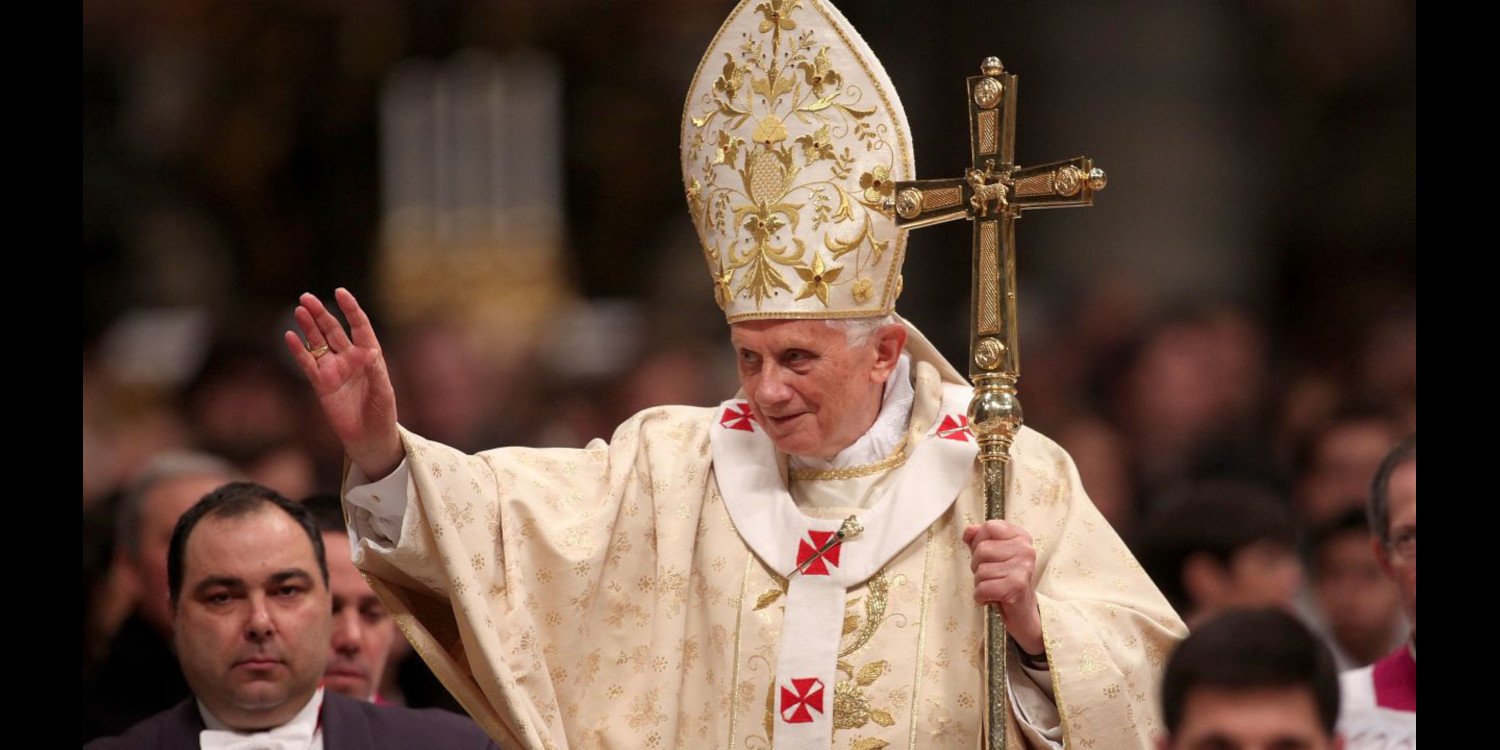
Not in His Own Best Interest
By the end of the day on February 11, 2013, I asked a friend to post a comment from me on BTSW’s Facebook page. My comment focused only on the Holy Father’s brief statement and avoided much of the media spin launched within minutes of it — most of which I was unaware of anyway, and could only imagine. Pope Benedict’s own words left little room for spin, and they are worth hearing again as he abdicates:
“After having repeatedly examined my conscience before God, I have come to the certainty that my strengths, due to an advanced age, are no longer suited to an adequate exercise of the Petrine ministry. I am well aware that this ministry, due to its essential spiritual nature, must be carried out not only with words and deeds, but no less with prayer and suffering.
“However, in today’s world, subject to many rapid changes and shaken by questions of deep relevance for the life of faith, in order to steer the boat of Saint Peter and proclaim the Gospel, both strength of mind and body are necessary, strength which in the last few months has deteriorated in me to the extent that I have had to recognize my incapacity to adequately fulfill the ministry entrusted to me.”
My immediate reaction to these words was one of great sorrow. I believed that Pope Benedict, who would soon turn 86 years of age, was convinced by those around him not to allow age and infirmity to become the media’s face of the Church. I believed such advice to have been rooted in the last years of Pope John Paul’s pontificate as his obvious infirmity became its own news event.
And so my brief comment that February 11, though well intentioned, assumed that the Holy Father was simply convinced, as he himself stated, that his “strengths and advanced age are no longer suited to the Petrine ministry” — especially so in a world in which every papal tremble, stumble, and foible is caught on camera for instantaneous global news.
I thought the Holy Father had agonized over this and concluded simply, and understandably, that age and infirmity taking center stage in the future years of his papacy were neither in his best interest nor that of the Church. I thought wrongly.
There was absolutely nothing in this decision that the Holy Father considered to be in his own best interest. Like so many of the loving fathers I know, his own best interest never entered the equation at all. On the morning after the Pope’s announcement, The Wall Street Journal published a superb and influential commentary by Catholic writer George Weigel that helped to give me some perspective on this development. “Catholics Need a Pope for the ‘New Evangelization‘ ” (February 13, 2013) was a service to the Church calling upon us to look forward to consider the urgent challenges to be faced by the successor of Pope Benedict. George Weigel pointed out something that the Holy Father himself was deeply aware of as “we widen the historical lens through which we view this papal transition.” Pope Benedict XVI will be the last pope to have participated in the Second Vatican Council.
By ending his papacy, he had ended an ecclesiastical era. The question George Weigel asks us to ponder is not “What wolves brought this about?” but rather “To what future has Pope Benedict led Catholicism?” I believe the answer to that question is the urgent issue of the coming conclave, and I believe the Holy Father is convinced of the necessary timing of this as the Church summons forth a Pope for the New Evangelization.

And Not without Precedent
In the Western world, and especially in the Americas, it’s difficult for some to factor the Catholic Church as an ancient structure, the sole institution in human history to have survived — to have even thrived — for 2,000 years. In “The Canonization of Pope John Paul II,” I wrote of a History Channel presentation on the papacy. Hopefully, we may see it again before the coming conclave.
With reverence and historical accuracy, the cameras took us from the tomb of Saint Peter to the tomb of Blessed John Paul II. Between them, two millennia had past — 2,000 years of war, scandal, all manner of human debacles, and countless assaults on the Church and Holy See. And yet at the tomb of Saint John Paul II the Church stood. The gates of hell had not prevailed against Her — and not for lack of trying.
That trial continues. A pope’s resignation is rare, but not unheard of. Writing for The Wall Street Journal, Saint Louis University history professor Thomas F. Madden unveiled some of this history in “The Pope Joins a Fine but Rarely Seen Tradition” (Feb. 15, 2013). For the first 1,200 years in the life of the Church, Professor Madden explained, it was assumed that a pope could not resign except under extreme conditions such as being thrown into prison — a fate that befell three popes in the first millennium.
The last resignation of a pope was six centuries ago in the year 1415. Eight decades before Columbus sailed to the New World — 360 years before the United States even existed — Pope Gregory XII resigned the papacy to end the Great Schism. In so doing he was praised throughout Europe for placing the interests of the Church above his own interests and ambition.
But the real precedent was set in 1294 when Pope Celestine V, now Saint Celestine, resigned for reasons very similar to those now put forward by Pope Benedict. A conclave had been unable to arrive at a consensus for two years when Pietro del Murone was elected to resolve it. Already in his 80s when he became Pope Celestine V, he quietly established in canon law a tenet allowing for the resignation of a pope, and then applied it to himself with the support of the College of Cardinals.

The Prayer to Saint Michael
The Church canonized Saint Celestine in 1313. In the 2010 book, Light of the World (Ignatius Press), based on Peter Seewald’s extensive interviews with Pope Benedict XVI, the Holy Father cited the precedent set by Saint Celestine, and even hinted — then at age 84 — that if ever a pope’s reserves of strength no longer served the Church, that precedent could be repeated.
But there is still the matter of the wolves circling from both without and within. They have always been here. George Weigel pointed out that the Second Vatican Council’s deep reforms in the Catholic Church actually began in the previous century in 1878. According to Mr. Weigel, “Pope Leo XIII made the historic decision to quietly bury the rejectionist stand his predecessors had adopted toward cultural and political modernity.” George Weigel ended his article with a reflection about the current state of disunity in the Roman Curia, calling upon the coming conclave to elect a pope who will address the Curia’s “disastrous condition . . . so that the Vatican bureaucracy becomes an instrument of the New Evangelization, not an impediment to it.”
Pope Benedict XVI cited a similar concern in his Ash Wednesday homily from the pulpit of Saint Peter’s Basilica: “The face of the Church is at times disfigured by the sins against the unity of the Church and the divisions of the ecclesial body.” It is of interest that in 1888, Pope Leo XIII also cited this while composing his famous Prayer to Saint Michael the Archangel, only a small part of which has become the common prayer we know. In its original form, Pope Leo wrote:
“In the Holy Place itself, where has been set up the See of the most holy Peter and the Chair of Truth for the light of the world, they have raised the throne of their abominable impiety, with the iniquitous design that when the pastor is struck, the sheep may be scattered.”
Pope Benedict XVI has never had to earn our deference, but earn it he did, many times over, as our Holy Father in a time of great trial for the Church. We owe him the benefit of our fidelity, unity, and prayers, and I know he has those. By abdicating at this time, and by calling the Church’s focus to what comes next at this moment in history, Pope Benedict is engaging in an act of love and sacrifice for the Church.
What remains heartbreaking is that so many of us have come not only to reverence and respect this Pope for his gifted mind and great personal holiness, but we have come to love him. Even in life, this Holy Father’s long-serving predecessor was given another title in his last years. My friend, the late Father Richard John Neuhaus and others deservedly dubbed him “John Paul the Great,” and it stuck.
Pope Benedict XVI also stands to have a new name. Springing from the hearts of millions, no matter what role he plays or what the Church comes to call him, this Holy Father will forever be for us, “Benedict the Beloved.”
+ + +
Prologue — December 31, 2023: As cited above, in 1888 when Pope Leo XIII composed the prayer to Saint Michael, he added in the original version, “In the Holy Place itself, where has been set up the See of the most holy Peter and the Chair of Truth for the light of the world, they have raised the throne of their abominable impiety, with the iniquitous design that when the pastor is struck, the sheep may be scattered.”
For so many faithful Catholics the world over, history sometimes repeats itself.
+ + +

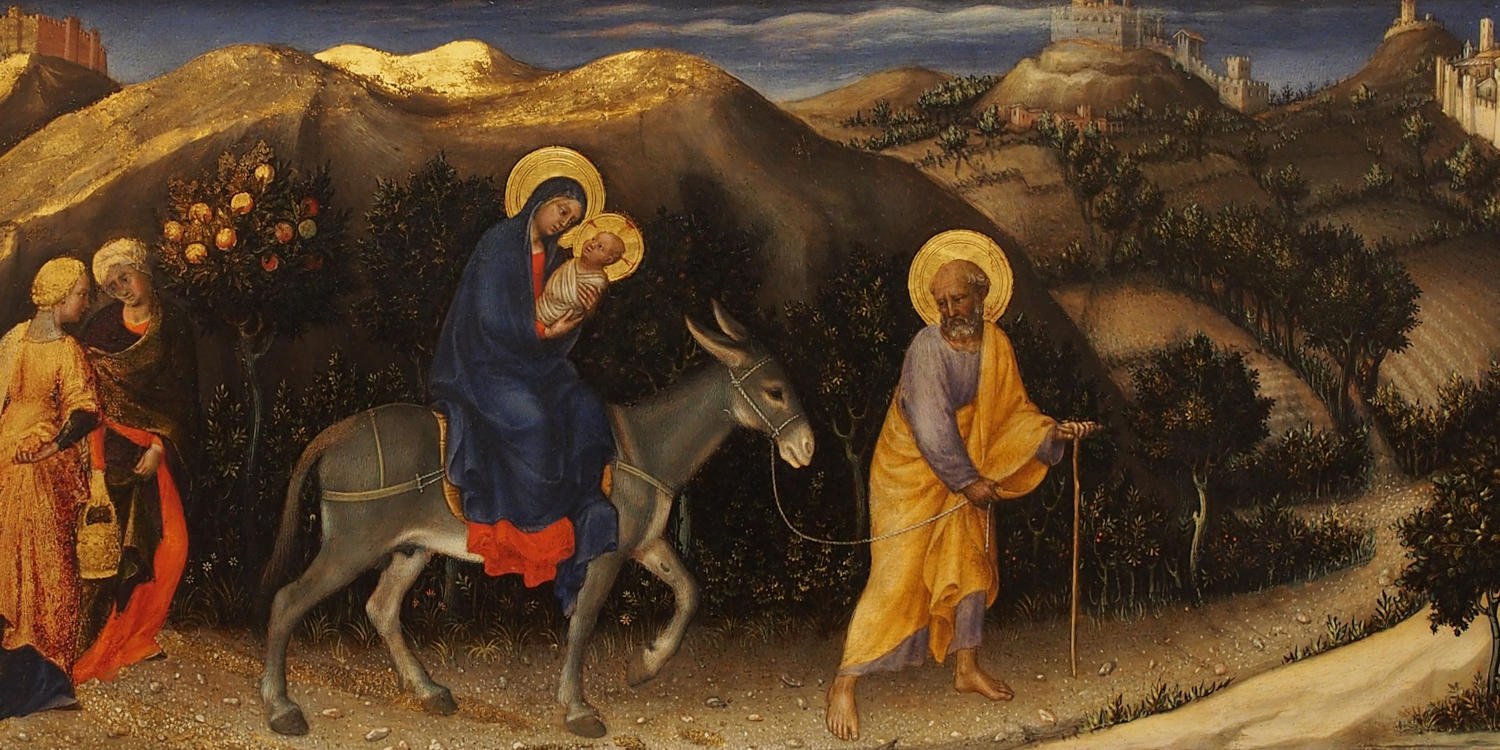
Joseph’s Second Dream: The Slaughter of the Innocents
After the Birth of the Messiah, a second angelic dream warns Joseph to flee to Egypt with Mary and the Christ Child as Herod orders a slaughter of the Innocents.

After the Birth of the Messiah, a second angelic dream warns Joseph to flee to Egypt with Mary and the Christ Child as Herod orders a slaughter of the Innocents.
Feast of the Holy Innocents by Fr. Gordon MacRae
Editor’s Note: The following is the second of a special two-part Biblical Christmas Season post. Part one, which appeared here two weeks ago was “Joseph’s Dream and the Birth of the Messiah.”
+ + +
In the proclamation of the Gospel according to Saint Matthew (2:13-18) on the Feast of the Holy Innocents, the Church recalls in just six verses an account of the Visit of the Magi, Joseph’s second dream of an Angel of the Lord, the Holy Family’s flight to Egypt, and the wrath of Herod as he orders the slaughter of all male children under two years of age in and around Bethlehem. As a priest, I have read this account over forty-two consecutive Christmas seasons, but never before was it overshadowed by such tragic realism.
Our safe, emotional buffer zone from that 2,000 year old account is gone now. The sense of personal distance is lost. A dark cloud still hangs over America since the shocking and senseless deaths of 19 young children in 2022 in a small Texas city called Uvalde. I first wrote of this shortly after this tragedy occurred in “Tragedy at Uvalde, Texas: When God and Men Were Missing.”
A lot of soul searching has gone into a quest for what could have spawned such a horrific event, how it developed, how it might have been prevented, and what should have been done differently by responding police. The tragedy was devastating. I can only imagine the heartache of the parents of Uvalde as they faced that Christmas with broken hearts and shattered dreams.
Then it happened again — this time in Thailand, and this time the killer was not a crazed teenager, but a drug addicted police officer. The story devastated the Kingdom of Thailand. On October 6, 2022 the recently fired police officer brought a 9mm handgun and a knife into a preschool daycare center in the village of Uthai Sawan. It was near where Pornchai Moontri lived as a small child. With no known motive, the former officer murdered 24 children ages two to five. Then he killed his wife and his own child before turning his gun on himself.
I could not bring myself to write that story, but Pornchai Moontri bravely took it up. Several readers told me that they did not read it because they knew it would be terribly painful. It was and still is. But there is much more to it than sorrow. There is hope there as well. “Elephants and Men and Tragedy in Thailand” was Pornchai’s faith-filled gift to his Homeland and to us. It is a most inspired post that I highly recommend. We will link to it again at the end of this one.

The Magi Take the Long Way Home
I am painfully aware that on the day this is posted, the Church honors those first Christian Martyrs, the innocent male children of Bethlehem who were subjected to the selfish wrath of King Herod. They became collateral damage in the first demonic attempt to rid the world of Christ. The explosive account is told with blunt force in the Gospel According to Matthew:
“Now when the Wise Men had departed, behold, an angel of the Lord appeared to Joseph in a dream and said, ‘Rise! Take the child and his mother and flee to Egypt, and remain there until I tell you; for Herod is about to search for the child to destroy him.’
“And Joseph arose and took the child and his mother by night and departed to Egypt and remained there until the death of Herod. This was to fulfill what the Lord had spoken by the Prophet: ‘Out of Egypt I have called my son.’ When Herod saw that he had been tricked by the Wise Men, he was in a furious rage. He sent and killed all the male children in Bethlehem and all that region who were two years old and under according to the time which he had ascertained from the Wise Men. Then was fulfilled what was spoken by the Prophet Jeremiah:
“‘A voice was heard in Ramah, wailing and loud lamentation, Rachel weeping for her children, she refused to be consoled, because they were no more.’”
— Matthew 2:13-20
In the first installment of this two-part post, I described the unique attributes of Joseph’s three dreams in Matthew’s account of the Birth of the Messiah. Dreams are an important element of the story. As I wrote in “Joseph’s Dream and the Birth of the Messiah”:
“There are 126 references to dreams among the characters of Sacred Scripture. Some of the pivotal moments in Salvation History were set in motion through dreams. But the dreams of Joseph are unique in the Biblical literature. In the original Greek of St. Matthew’s Gospel, the term used for Joseph’s three dreams about the birth of Jesus is ‘onar,’ and it is used nowhere else in Sacred Scripture but here.
“‘Onar’ in Greek refers not just to a dream, but to a divine intervention in human affairs. Coupled with the fact that the dream is induced by an “Angel of the Lord,” then the scene takes on a sense of great urgency when compared with a multitude of other angelic messages conveyed through dreams.”
In this second of Joseph’s dreams, the urgent intervention is God’s foresight that Herod is enraged, believing that he was tricked by the Magi. Herod plots to kill the child. He had asked the Magi to return from Bethlehem to reveal the location of this Christ-child with a false promise that he, too, would pay him homage. After a dream premonition not to return to Herod, the Magi left by another route. I wrote about the Magi in a popular Christmas post linked again at the end of this one: “Upon a Midnight Not So Clear, Some Wise Men from the East Appear.”
There is an important element of the Magi story that I omitted when I first wrote that post. The Magi were traditionally associated with astrologers and astral religion, a fact seen as scandalous to some early Christians who did not want to accept this aspect of Matthew’s account. In later Christian tradition, they became not Magi, but kings, a likely reflection on Psalm 72:10 — “May the kings of Tarshish and of the Isles bring him tribute, may the kings of Sheba and Seba bring gifts.”
The Star of Bethlehem is a popular element of the story, but it, too, was a scandal among some in the early Church. Some of the people of the Ancient Near East were drawn to astral religion because it brought a sense of surety in the midst of social chaos. But over time, astrology became oppressive, making people feel hopeless against the tyranny of “fate” when their destinies seemed dictated by the cold movement of the stars.
In contrast, however, the Star of Bethlehem served only God’s purpose. That, and the presence of astrologers who came to worship Christ, broke the power of astral religion and its belief in fate. But history repeats itself. As our culture again becomes socially chaotic, many are once again drawn into nature religions such as astrology, Wicca, and druidism for a false sense of determinism guided by practitioners claiming to interpret and control destiny. I recently saw a TV commercial selling fifteen minute intervals with a California seer. G.K. Chesterton once famously said that people without faith do not believe in nothing. They believe in anything.

Tragedy in Thailand | Photo courtesy of Reuters
Herod and the Slaughter of the Innocents
There are four rulers named Herod appearing in New Testament Scripture: Herod the Great reigned in Palestine from 37 B.C. until shortly after the Birth of Jesus. His son, Herod Antipas, Tetrarch of Galilee, ordered the beheading of John the Baptist (Matthew 14) and sent Jesus to trial before Pilate (Luke 23:7-15). His son, Herod Agrippa, imprisoned the Apostle Peter (Acts 12); and his son, Herod Agrippa II, attended the trial of Saint Paul (Acts 25:13).
Herod the Great was part of a non-Jewish Edomite family from a territory east and south of the Dead Sea. They were descendants of Esau, the elder brother of Jacob (Genesis 25:30). Herod was given the title, “King of the Jews” by the Roman Senate and ruled Palestine from 37 to 4 B.C. as a vassal king appointed by Caesar Augustus. Centuries-old adjustments to the Roman calendar place the birth of Jesus near the end of Herod’s life between six and four B.C.
Herod the Great (“Great” by Roman standards only) appears in Scripture only during the events surrounding the birth of Jesus (Matthew 1-2 and Luke 1:5). He ruled Palestine with brutality and paranoia. It is ironic that Herod took such violent steps to end the life of Jesus just prior to the undocumented end of his own life. He took great umbrage at the Magi’s revelation that the Star of Bethlehem was an omen for one who is born King of the Jews, a title Rome had bestowed upon Herod.
But Herod’s paranoia ran deeper than that. The Star of Bethlehem innocently described by the Magi recalled for Herod and his Hebrew advisors the ancient Fourth Oracle of Balaam in the Book of Numbers. The oracle predicted a future messiah and the end of Edom’s power. From the Oracle of Balaam (Numbers 24:17-19):
“I see him, but not now; I behold him, but not near. A star shall come out of Jacob, and a scepter shall rise out of Israel. It shall crush the borderlands of Moab, and the territory of all the Shethites. Edom will become a possession of its enemies, while Israel thrives valiantly. One out of Jacob shall rule.”
Being a descendant of the Edomites, Herod “was greatly troubled” (Matthew 2:3). So he summoned the Magi to ascertain exactly when the Star appeared. He sent them on to Bethlehem after securing a promise that they would return with the exact location of this newborn Child-King. When the Magi failed to return, Herod flew into a rage. He ordered his forces to find and kill all male children under two years of age in Bethlehem.
This event also has an echo from a much older time in Salvation History. Jesus is presented as the New Moses, one who will lead God’s people out of bondage. The first Moses led Israel from the bondage of slavery in Egypt, but Pharaoh was immovable until the Tenth Plague struck down the firstborn sons of Pharaoh and all of Egypt (Exodus 12:29-31).
The Evangelist, Matthew, captures with a quote from the Prophet Jeremiah the devastation that Herod left behind. In the Eighth Century B.C. the Assyrians devastated Northern Israel when their army swept through the city of Ramah about five miles north of Jerusalem. Ramah became equated with Israel’s great depth of sorrow left behind by the evil of tyranny. So it is of Ramah that is recalled in the face of Herod’s evil:
“A voice heard in Ramah, wailing and loud lamentation, Rachel weeping for her children. She refused to be consoled because her children were no more.”
— Matthew 2:18 and Jeremiah 3:15
Jesus, the New Moses would lead God’s People from the bondage of sin and death. Herod believed that the murder of the Children of Bethlehem was the last word, but it was not the last word. Then Herod the Great somehow became Herod the Dead. Scripture does not describe how, when, or where. God knows. The narrative of the Birth of the Messiah ends with the third dream of Joseph from an Angel of the Lord:
“Rise, take the child and his mother and go to the land of Israel, for those who sought the child’s life are dead. And [Joseph] rose and took the child and his mother, and went to the land of Israel. But when he heard that Herod’s son reigned in his place, he was afraid to go there, and being warned in a dream he withdrew to the district of Galilee. And he went and dwelt in a city called Nazareth.”
— Matthew 2:19-23
Thus concludes Matthew’s account of the Birth of the Messiah. It was not the end of tyranny, but it was the beginning of all hope.
+ + +
Note from Fr. Gordon MacRae: Please share this post. You may also like these related posts cited here:
Joseph’s Dream and the Birth of the Messiah
Tragedy at Uvalde, Texas: When God and Men were Missing
Elephants and Men and Tragedy in Thailand
Upon a Midnight Not So Clear, Some Wise Men from the East Appear
+ + +

One of our Patron Saints, Saint Maximilian Kolbe, founded a religious site in his native Poland called Niepokalanowa. Today the Chapel has a real-time live feed for a most beautiful adoration chapel where people around the world can spend time in Eucharistic Adoration. We invite you to come and spend some quiet time this Christmas celebrating the rebirth of the Messiah in your own life.
Click or tap here to proceed to the Adoration Chapel.
As you can see the monstrance for Adoration of the Blessed Sacrament is most unusual. It is an irony that all of you can see it but I cannot. So please remember me while you are there. For an understanding of the theology behind this particular monstrance of the Immaculata, see my post “The Ark of the Covenant and the Mother of God.”

Lead, Kindly Light: A Christmas Card to Our Readers
Abraham first heard God 21 centuries before the Magi followed a star to Bethlehem. We now live in the 21st century after. At the center of all faith Christ is born.

Abraham first heard God 21 centuries before the Magi followed a star to Bethlehem. We now live in the 21st century after. At the center of all faith Christ is born.
December 21, 2022
Note from Fr. Gordon MacRae: Dear Readers, Some elements of our Annual BTSW Christmas Card may seem a bit familiar to you. We have used some of these elements in our posts of Christmas past. Since 1949, The Wall Street Journal has published as its top editorial each Christmas Eve an outstanding piece of writing from the late Vermont C. Royster, the WSJ’s former Editorial Page Editor. His yearly repeated Christmas essay is “In Hoc Anno Domini,” (In this year of the Lord). It is one of the finest examples of historical Christian writing I have encountered, and one of the most faith-filled. Mr. Royster was awarded the Presidential Medal of Freedom and was a two-time recipient of the Pulitzer Prize. So at the expense of sounding a bit pretentious, if The Wall Street Journal can get away with publishing an annual Christmas gem, then so can I.
I begin our Christmas Card this year with Vermont C. Royster and his “In Hoc Anno Domini.”

When Saul of Tarsus set out on his journey to Damascus the whole of the known world lay in bondage. There was one state, and it was Rome. There was one master for it all, and he was Tiberius Caesar.
Everywhere there was civil order, for the arm of the Roman law was long. Everywhere there was stability, in government and in society, for the centurions saw that it was so.
But everywhere there was something else, too. There was oppression — for those who were not the friends of Tiberius Caesar. There was the tax gatherer to take the grain from the fields and the flax from the spindle to feed the legions or to fill the hungry treasury from which divine Caesar gave largess to the people. There was the impressor to find recruits for the circuses. There were executioners to quiet those whom the Emperor proscribed. What was a man for but to serve Caesar?
There was the persecution of men who dared think differently, who heard strange voices or read strange manuscripts. There was enslavement of men whose tribes came not from Rome, disdain for those who did not have the familiar visage. And most of all, there was everywhere a contempt for human life. What, to the strong, was one man more or less in a crowded world?
Then, of a sudden, there was a light in the world, and a man from Galilee saying, Render unto Caesar the things which are Caesar’s and unto God the things that are God’s.
And the voice from Galilee, which would defy Caesar, offered a new Kingdom in which each man could walk upright and bow to none but his God. Inasmuch as ye have done it unto one of the least of these my brethren, ye have done it unto me. And he sent this gospel of the Kingdom of Man into the uttermost ends of the earth.
So the light came into the world and the men who lived in darkness were afraid, and they tried to lower a curtain so that man would still believe salvation lay with the leaders.
But it came to pass for a while in divers places that the truth did set man free, although the men of darkness were offended and they tried to put out the light. The voice said, Haste ye. Walk while you have the light, lest darkness come upon you, for he that walketh in darkness knoweth not whither he goeth.
Along the road to Damascus the light shone brightly. But afterward Paul of Tarsus, too, was sore afraid. He feared that other Caesars, other prophets, might one day persuade men that man was nothing save a servant unto them, that men might yield up their birthright from God for pottage and walk no more in freedom.
Then might it come to pass that darkness would settle again over the lands and there would be a burning of books and men would think only of what they should eat and what they should wear, and would give heed only to new Caesars and to false prophets. Then might it come to pass that men would not look upward to see even a winter's star in the East, and once more, there would be no light at all in the darkness.
Stand fast therefore in the liberty wherewith Christ has made us free and be not entangled again with the yoke of bondage.
— Vermont C. Royster, The Wall Street Journal, December 24, 1949
+ + +

The liturgies of Christmas set out in the Roman Missal and Lectionary express the spirituality of the entire ecclesial body of the baptized into the Life, Death, and Resurrection of Jesus Christ, our communal past and hopeful future.
The Mass at Night for the Christmas Vigil begins with a moving recitation of the Roman Martyrology which places the Birth of the Messiah into a real historical context:
The twenty-fifth day of December when ages beyond number had run their course from the creation of the world, when God in the beginning created heaven and earth, and formed man in His own likeness; when century upon century had passed since the Almighty set his bow in the clouds after the Great Flood, as a sign of covenant and peace — In the twenty-first century since Abraham, our father in faith, came out of Ur of the Chaldees; in the thirteenth century since the people of Israel were led by Moses in the Exodus from Egypt; in the tenth century since David was anointed King; in the sixty-fifth week of the prophecy of Daniel; in the one hundred and ninety-fourth Olympiad; in the year seven hundred and fifty-two since the founding of Rome; in the forty-second year in the reign of Caesar Octavian Augustus, the whole world being at peace
— Jesus Christ, eternal God and Son of the eternal Father,
desiring to consecrate the world by his most loving presence, was conceived by the Holy Spirit, and when nine months had passed since His conception, was born of the Virgin Mary in Bethlehem of Judah, and
was made man.
— The Nativity of our Lord Jesus Christ according to the flesh
+ + +


I am forced by circumstance to live in a place with men who are banished, not just from home and family and freedom, but too often also from hope. Some with even the darkest pasts have come into the light to thrill us with their stories of grace and true repentance and conversion. You have read of several in these pages and there are other stories yet to come. Some of these wounded men become saints, I am not fit to fasten their sandals. We live East of Eden, most justly so, but some not.
The Magi of the Gospel saw a star and heard good news, the very best of news: Freedom can be found in only one place, and the way there is to follow the Star they followed. If you follow Beyond These Stone Walls, never follow me. Follow only Christ.
My Christmas Card to you is this message, a tradition of sorts for Beyond These Stone Walls. My small, barred cell window faces East. It is there that I offer Mass for our readers. So my gaze is always toward the East, a place to which we were all once banished to wander East of Eden.
At the end of these cold and gray December days I step outside to watch toward the West as the sun descends behind towering prison walls. It reminds me of my favorite prayer,
Lead, Kindly Light, amid the encircling gloom, Lead Thou me on;
The night is dark, and I am far from home; Lead Thou me on.
Keep Thou my feet; I do not ask to see
The distant scene; one step enough for me.
I was not ever thus, nor prayed that Thou shouldst lead me on;
I loved to choose and see my path, but now, Lead Thou me on.
I loved the garish day, and, spite of fears,
Pride ruled my will; Remember not past years.
So long Thy power hath blessed me, sure it still will lead me on,
O’er moor and fen, o’er crag and torrent, till the night is gone.
And with the morn those Angel faces smile,
Which I have loved long since, and lost awhile.
— Saint John Henry Newman
This moving prayer by Saint John Henry Newman has been set to music as a tribute to Saint John Paul II:
+ + +

My favorite Christmas hymn, “O Holy Night,” was originally based on a French poem entitled Cantique de Noël by Placide Cappeau in 1843. Composer Adolphe Adam set it to music in 1847. The English version (with small changes to the initial melody) is by John Sullivan Dwight. The hymn reflects on the birth of Jesus as humanity’s redemption.
This wonderful hymn has been performed by many noted vocalists over the last two centuries. Few have performed it with more beauty and heartfelt faith than Celine Dion. Celine today suffers from a neurological disorder that may inhibit her voice. Please offer a prayer for her. Celine Dion’s beautiful voice should be long remembered for her rendition of this most beautiful of Christmas hymns.

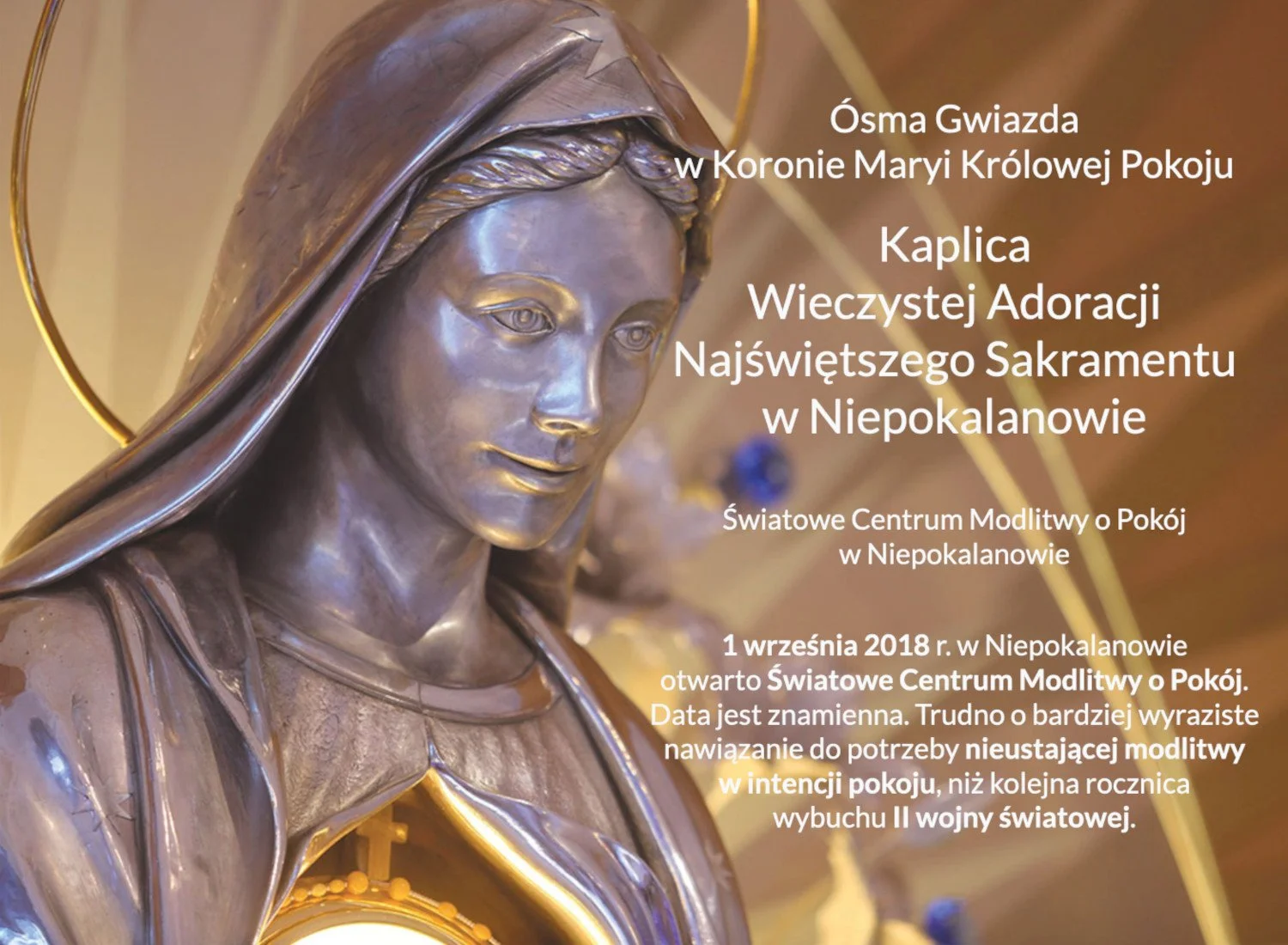
The Eucharistic Adoration Chapel established by Saint Maximilian Kolbe was inaugurated at the outbreak of World War II. It was restored as a Chapel of Adoration in September, 2018, the commemoration of the date that the war began. It is now part of the World Center of Prayer for Peace. The live internet feed of the Adoration Chapel at Niepokalanow — sponsored by EWTN — was established just a few weeks before we discovered it and began to include in at Beyond These Stone Walls. Click “Watch on YouTube” in the lower left corner to see how many people around the world are present there with you. The number appears below the symbol for EWTN.
Click or tap here to proceed to the Adoration Chapel.
The following is a translation from the Polish in the image above: “Eighth Star in the Crown of Mary Queen of Peace” “Chapel of Perpetual Adoration of the Blessed Sacrament at Niepokalanow. World Center of Prayer for Peace.” “On September 1, 2018, the World Center of Prayer for Peace in Niepokalanow was opened. It would be difficult to find a more expressive reference to the need for constant prayer for peace than the anniversary of the outbreak of World War II.”
For the Catholic theology behind this image, visit my post, “The Ark of the Covenant and the Mother of God.”
+ + +
Note from Father Gordon MacRae:
Blessings to you all during this joyous Christmas Season. We are living in darker times, and this Christmas is like no other, but we are children of the Light and we are promised that the darkness will never overcome it. May God Bless you and keep you safe. Feliz Navidad!
+ + +
Please also visit our Special Sacred Scripture Collection: Abraham to Easter.


The Duty of a Priest: Father Frank Pavone and Priests for Life
In a bombshell report, Fr. Frank Pavone of Priests for Life and the most visible pro-life priest in America has been dismissed from the priesthood by Pope Francis.

In a bombshell report, Fr. Frank Pavone of Priests for Life and the most visible pro-life priest in America has been dismissed from the priesthood by Pope Francis.
December 18, 2022 by Fr. Gordon MacRae
Note from Fr. Gordon MacRae: In a bombshell report that I learned of only today it seems that Fr. Frank Pavone, Director of Priests for Life and the most visible pro-life cleric in North America has been dismissed from the clerical state by Pope Francis. At this juncture, the dismissal is both inconceivable and unexplained.
I plan to postpone further comment on this troubling development for pro-life Catholics until there is further clarification from Rome, if ever. Of interest, I wrote this post about Fr. Frank Pavone and his struggles eleven years ago. Much that I described in this post has now come to pass. I have never been more sorrowful for being right. Please pray for Fr. Pavone and Priests for Life.
+ + +
For about a year now, Beyond These Stone Walls has had a link to Priests for Life, one of the strongest and most vocal pro-life organizations with oversight from the Catholic Church. So when news began to circulate that Father Frank Pavone, director of Priests for Life since 1993, was “recalled” to his diocese — the Diocese of Amarillo — I paid attention, as did many.
Before commenting on the justice or injustice of what has occurred to date in this matter, however, I must comment on the context. It has become clear to me even from behind these stone walls that not all is as it seems. Generally, a matter such as this would generate some dialogue within the Church, perhaps even in the Catholic media, but that would be the extent of its interest. This matter between Father Frank Pavone and Amarillo Bishop Patrick Zurek, however, has also become fodder for comments in the secular media providing fuel for the speculation and controversy now surrounding Father Pavone.
What exactly is the controversy? Father Frank Pavone has been recalled to his diocese, the Diocese of Amarillo, Texas, by his bishop. Father Pavone has been neither suspended nor disciplined for any cause. A Catholic News Service account included some clarification of this by Msgr. Harold Waldow, Vicar for Clergy in the Diocese of Amarillo:
“Father Frank Pavone, national director of Priests for Life, remains a priest in good standing in the Diocese of Amarillo, Texas. … Msgr. Harold Waldow told CNS that Bishop Patrick J. Zurek only suspended Father Pavone’s ministry outside of the diocese because the well-known pro-life priest is needed for work in Amarillo.”
— Catholic News Service, Sept. 14, 2011
But there remains some taint upon Father Pavone. This matter between a priest and his bishop has become a matter of public dispute, and that itself is a violation of Father Pavone’s rights under Church law. After writing a letter to the nation’s bishops describing his suspension of Father Pavone’s ministry outside his own diocese, the bishop reportedly released the letter publicly. That seems to be what sparked their differences thrusting this matter into a public forum, but without any clear allegation of wrongdoing.
Brian Fraga wrote an informative article about this in Our Sunday Visitor (“Pro-life priest ‘baffled’ by bishop’s shutdown,” OSV, October 2, 2011). He cited the broad support that has emerged for Father Pavone including from the Priests for Life Board of Directors, from the National Pro-Life Council, and other corners. Dr. Alveda King, niece of the late Rev. Martin Luther King and a staunch pro-life advocate, has released a powerfully supportive statement about Father Pavone and Priests for Life.
I have believed from the outset that the hype about all this has little to do with Father Frank Pavone and Bishop Zurek. It has to do with Priests for Life and its vocally Catholic pro-life stance. There is an agenda out there — an agenda with tentacles that have reached deeply into the arena of Catholic life — that would be encouraged by the diminishment or outright destruction of the Church’s pro-life ministry. In this entire matter, it is not only Father Pavone whose reputation is on the line. It is also the Church’s pro-life stance, consistently undermined by those who want compromise with a secular agenda in the culture war.
The demise of Priests for Life would be a great trophy for that agenda. I am no conspiracy theorist, but I can’t help notice that this story is unfolding nationally just as a Presidential Primary is taking shape, and the culture war is gearing up for battle.

Resisting Secular Sabotage
In a chapter entitled “Self-Sabotage: Catholicism” in his book, Secular Sabotage (Faith Words, 2009), Catholic League President Bill Donohue pointed out that dissent in the Church’s pro-life ministry is not as simple as some trendy left-wing Catholics promoting abortion. Very few people of even the remotest Christian persuasion actually promote abortion as a societal good. What Bill Donohue pointed out was something much more subtle. There is a growing consensus among left-wing Catholics that the Church has simply lost the battle for life and should just move on.
Please note here that I do not use the term “left-wing Catholics” in any derogatory sense. I spent much of my life and ministry squarely in that camp. So did Father Richard John Neuhaus and Cardinal Avery Dulles, two exemplary Churchmen to whose memory we have dedicated Beyond These Stone Walls. Their drift to the right is far more a story of their embracing the great adventure of orthodoxy to the Magisterial authority of the Church — an authority that took precedence for them above any trendy political ideology.
My own drift away from the left followed their same example. It marked the official end of my adolescence that the life of the Church took precedence over my own sometimes highly misinformed publicly dissenting points of view.
Part of the agenda among the more radical wing of the Catholic left has been to get about the business of removing any Magisterial authority from our faith experience. The goal is to carve out a distinctly American Catholic church with identifiably American Catholic values that mirror the now disintegrating American wing of the Church of England, the Episcopal church. But that’s a whole other blog post for some other day — such as next week, perhaps.
It’s time for American Catholic liberals to see and admit that their own views and causes are being hijacked by this radical wing. For them, organizations like Priests for Life are seen as an anachronistic hindrance to social progress. A nice little scandal undermining Priests for Life would be most welcomed in some circles right about now, not least among them some purportedly Catholic circles.
But there isn’t a scandal. Father Frank Pavone has not been accused of anything, though I do worry about his extreme vulnerability. There are agendas at work even in our Church that would be bolstered by the destruction of Father Pavone, his career, and his reputation. That fact must be a part of the equation as Catholics evaluate this story. Father Frank Pavone first was a target long before he was a suspect.
I have a personal example of how this works right here at Beyond These Stone Walls. For over two years now, BTSW has presented the views of a priest claiming to be falsely accused and wrongfully imprisoned. So much of what I have written has been in direct confrontation with the agendas and claims of victim groups like SNAP and Catholic “reform” groups like Voice of the Faithful. Some of my postings about the Catholic League report, “SNAP Exposed” have been confrontational. My three-part series, “When Priests Are Falsely Accused” made a very controversial case for why accusers should be named. Nothing flies in the face of the cult of victimhood like that particular point of view.
But very few people disagreed with me or attacked these statements and positions. At first, I wondered if these controversial posts were even noticed, but then I learned they were widely disseminated. Even the Spanish-language news network, Univision, posted links to “When Priests Are Falsely Accused” on their website, as did National Public Radio and many international secular sites. Very few people disagreed with me or attacked these posts.
The very worst attack — though a rather wimpy one — was a one-line comment from SNAP director, David Clohessy. Commenting on the Spero News version of my BTSW post, “Due Process for Accused Priests?” David Clohessy called me “a dangerous and demented man.” Maybe he didn’t read “Sticks and Stones: My Incendiary Blog Post on Catholic Civil Discourse.”
But in contrast to the lack of any real attacks on Beyond These Stone Walls was a barrage of nasty e-mail attacks when I posted a clearly pro-life article, “The Last Full Measure of Devotion: Civil Rights and the Right to Life” last January. I got clobbered. Some of the messages called me all sorts of names, denounced Beyond These Stone Walls, and denigrated those who assist me as its editors. It was perfectly okay with these people if I remind Catholics that some priests are falsely accused and some Americans are wrongly imprisoned. But how dare I use a Catholic blog to post a reasoned and thoughtful defense of the Catholic Church’s pro-life position and why it should not be compromised?
So that’s it then. I can write that a lot of men and women have committed fraud by falsely accusing Catholic priests of decades-old abuses. I can write that some of our bishops have been unwittingly complicit in this fraud and have left their priests vulnerable by blindly settling virtually every claim. I can even write that some of the purported “victims” are in fact criminals who should have their names and their claims exposed before any real due process and justice can take place. Not many on the left or right had much to say in response to any of that. But when I wrote about why abortion is a basic civil rights issue, some Catholics called me a “predator priest who should be silenced by the Church.” One writer called for prison officials to confiscate my typewriter.
It all reminded me of a troubling conversation I had with a prisoner two years ago. He was a career criminal; a gangster, a thief and a thug, who came to my door one day. “I have a question,” he said:
“Can you explain to me why all these Catholics can say they are protecting children when they scream about 30 or 40 year old claims of child abuse, but then have nothing to say about the fourteen million American babies sacrificed in abortions in just the last decade?”
It’s a hard question for which I have no answer. But I explained to him that no one in our Church will call him a gangster, a thief, or a thug unless he asks a question like that too loudly.
This was when I really came to admire Father Frank Pavone. I became aware of how visible the target on his back really is. As I wrote two weeks ago at the end of “Thy Brother’s Keeper,” I bow to Father Pavone’s faithful witness to both the truth and to his duty as a priest which is to preserve both his obligations and his rights under Church law. The bottom line is that anyone who thinks his bishop is going to protect his rights has not been paying attention in the last ten years.

Bishops as Prosecutors
I cannot speak to the internal disagreements between Father Frank Pavone and Bishop Patrick Zurek. I know none of the details. But I can speak in a broader sense of the necessity for any priest in the current climate to preserve his rights under Church law. I can only relate some of what transpired with my own bishop in a canonical proceeding to shed light on some of what may be happening behind the scenes in the Diocese of Amarillo.
Father Pavone came under recent attack in some circles because his bishop scheduled a personal meeting which Father Pavone declined to attend. There were some people — some very well intentioned — who saw in this some shades of culpability on the part of Father Pavone, using it to cast suspicion on his own transparency and desire to cooperate with his bishop.
It is likely, however, that Bishop Zurek has declined to allow a meeting to take place with Father Pavone’s Canonical Advocate present. I do not know this for certain, but I have read that Father Pavone’s Canonical Advocate has requested mediation in this matter between Father Pavone and his bishop. It was apparently on the advice of the Advocate that Father Pavone declined to meet without his Advocate or a mediator present. Both Father Pavone and his Canonical Advocate, Father David Deibel, J.D., J.C.L. have come under some public fire for this.
Church Law insists that any priest in a canonical forum has a right to advocacy. I stand by what I wrote in “Thy Brother’s Keeper’:
“I bow also to Father Pavone’s resolve to protect his rights under the higher authority of the law of the Church, for the [Dallas] Charter makes one thing clear now: Some bishops will neither protect nor respect those rights.”
I speak from experience. Throughout the last decade of attempting to defend myself before both a court of law and a court of public opinion, I have also had to simultaneously defend myself against a one-sided effort by my bishop to bring about a canonical dismissal from the priesthood with no defense whatsoever offered by me. Throughout this process, my bishop has steadfastly refused to meet or even converse with my Canonical Advocate regarding the matter of preserving my rights under Church law.
Far worse, when my bishop learned that I am seeking an opportunity to bring forward a new appeal of my conviction, my bishop hired his own lawyers to conduct a secret evaluation of my trial to present in Rome and circumvent my own efforts to defend myself. He has repeatedly refused to share with me or my Canonical Advocate the findings of that secret assessment.
My bishop has acted throughout in the role of a prosecutor, but it’s even worse than that. In America, prosecutors are required to turn over to the defense the nature of charges and any evidence that supports them. When I tried to assert my rights under Church law in this matter, my bishop responded with silence and has remained silent ever since.
I believe I could safely say that every organization formed on behalf of priests to assist in protecting their rights under Canon Law would now state that no priest in even a hint of an adversarial circumstance with his bishop should ever agree to a one-on-one meeting without his Canonical Advocate present. It would not only be foolish, it could be destructive. It would be akin to a prosecutor demanding to meet privately with a defendant without his lawyer present.
As the priesthood crisis became critical in 2002, Cardinal Avery Dulles gave bishops and priests a clear reminder of their rights and obligations under Church law. His fine article, “The Rights of Accused Priests” is reprinted under “Articles” on Beyond These Stone Walls. Given these rights and obligations, I admire that Father Pavone is determined to resolve this matter in unity with his bishop. No bishop can in justice order him or any priest to set aside his rights under Church law.
Complicating my own comments on this matter is the fact that Father Frank Pavone and I have the same Canonical Advocate in the person of Father David L. Deibel, J.D., J.C.L. who has broad training and experience in both civil and Church law. He, of course, has not discussed the Father Pavone matter with me at all. He is an accomplished professional motivated by the law and an impeccable set of ethics.
But Father Deibel has come under some highly unjust fire because of his advocacy for me. Some have used this to try to impugn his reputation and undermine Father Pavone’s own canonical defense. In truth, Father David Deibel was the sole Church official to appear at my trial and sentencing over seventeen years ago. He traveled from California at his own expense to do this. At the time I was sentenced by Judge Arthur Brennan to 67 years in prison, Father David Deibel was one of only two people in that courtroom with the moral courage and personal integrity to speak the truth, despite knowing that there was a price to pay for it. Father David Deibel was one of the heroes in my case, and the extent to which this is true will very soon be placed into public view. There is a lot more to come in this regard, and it is indeed coming.
Meanwhile, the Church owes Father Frank Pavone the right of defense — and respect, support, and encouragement for his tireless voice on behalf of those who have been denied one. Click here for Father Frank Pavone updates.


Christmas in the Land of Nod, East of Eden
Book of Genesis, Cain was banished to wander for his crime in the Land of Nod, East of Eden. The Star of Bethlehem was the only way back to a State of Grace.

In the Book of Genesis, Cain was banished to wander for his crime in the Land of Nod, East of Eden. The Star of Bethlehem was the only way back to a State of Grace.
Christmas by Fr. Gordon MacRae
At Thanksgiving this year, we recommended a post entitled “The True Story of Thanksgiving: Squanto, the Pilgrims, and the Pope.” It was more of a history lesson than a typical blog post, but it got a lot of notice. It is said that history is written by the victors, not the vanquished, so my take on Thanksgiving was unusual. It was told from the point of view of Squanto, the man I credit with the survival of the Puritan Pilgrims who — for better or worse — were the spiritual and cultural beginning of the first colonies in the New World.
Please indulge me in another brief foray into history — this time, Biblical history. I just can’t help myself. We can’t understand where we are until we discover where we’ve been. In the Genesis account of the fall of man, Adam and Eve were expelled from Eden as both a punishment and a deterrent. They disobeyed God by eating from the Tree of Knowledge of Good and Evil. So God cast them out of Eden “lest [Adam] put out his hand and take also from the Tree of Life, and eat, and live forever.”
They were cast out of Eden to the east (Genesis 3:24). God then placed a Cherubim with a flaming sword to the east of Eden to bar Man’s return, and to guard the way to the Tree of Life. Whether this is history, metaphor, myth, or allegory matters not. The inspired Word of God in the Genesis account tells us something essential about ourselves in relationship with God.
A generation later, after the murder of his brother Abel, Cain too “went away from the presence of the Lord, and dwelt in the land of Nod, east of Eden” (Genesis 4:16). The “land of Nod” has no other reference in Scripture. It represents no known geographical name or place. The name seems to derive from the Hebrew, “nad,” which means “to wander.” Cain himself described his fate in just that way: “from thy face I shall be hidden; I shall be a fugitive and a wanderer on the earth” (Genesis 4:14).
The Aggadah — a collection of Rabbinic commentary, legend, and anecdotes accumulated over a thousand years — expanded on the Biblical account. The “mark of Cain” imposed by God was a pair of horns. According to the Aggadah legend, Cain’s great-grandson, Lamech, had poor eyesight and shot Cain with an arrow believing him to be a beast. There was a sense of “what goes around comes around” in the Aggadah version.
In Genesis, Cain’s descendant, Lamech, became sort of a counter-cultural anti-hero seen as the epitome of the moral degradation of blood revenge. Lamech killed a man for wounding him. “If Cain is avenged sevenfold, truly Lamech seventy-sevenfold” (Genesis 4:24). Cain’s murder of his brother, and his banishment East of Eden, set in motion a ripple effect of epic proportion.
I have long wondered if the banishment of Adam and Cain “east of Eden” is a divinely inspired metaphor for man’s fall from grace, a state of being, more than a place. Jumping ahead way ahead — the Magi of Matthew’s Gospel came to Christ from the east (Matthew 2:1). They “saw his star in the east” and followed it out of the east — out of what is now likely modern day Iran, a story I told in “Upon a Midnight Not So Clear, Some Wise Men from the East Appear.”
I envision the Star of Bethlehem to be a sort of beacon leading the way out of the darkness of the east, the darkness of man’s past, out of the spiritual wanderlust set into motion by Adam and Cain. In the Tanakh translation of the Jewish Scripture — our “Old” Testament — Psalm 113:3 is translated, “From the east to the west the Name of the Lord will be praised.”

Family Values and Woke Politics
Some of the prisoners I see each day are aware that I write weekly for Beyond These Stone Walls. Those who had a recipe published in “Looking for Lunch in All the Wrong Places” invited their families to read that post. Several others asked to read a printed copy of “The True Story of Thanksgiving” and it’s been circulating here a bit. Just a few days ago, a prisoner I do not know asked me if the “Squanto story” is true. Squanto’s plight in my Thanksgiving account caused an interesting reaction, and seemed to inspire discussion about how to best cope with shattered dreams and hopes, with loss and the fall from grace, with life in the land of Nod. The prevailing thought has been that Squanto responded to his bitterness and loss with sacrifice. The irony of what Squanto did is not lost on prisoners.
Captured by a British ship and nearly sold into slavery — his life in ruins and everyone he loved destroyed — Squanto chose to come to the aid of the only people worse off than Squanto himself: the hapless pilgrims who stepped off the Mayflower in winter, 1620. Some prisoners conclude that they need to be more like Squanto. Many of the men around me have lives that spun out of control through drug addiction, poverty, selfishness, rage, or greed. A lot of people imagine that prisoners are just evil, brutal men incapable of considering anyone but themselves. The media’s portrayal of prisoners as brutal, manipulative and self-involved accurately describes only a very small minority.
Evil men do exist, and prisons everywhere contain them, but they are not typical of men in prison. Most men and women in prison simply got caught up in something, made mistakes — some very grave — but are no more evil than your friends and neighbors. Some would give anything to atone for their crimes, to take back the wrongs they have done. Some were victims before they were victimizers. Most are guilty of crimes, but some are not.
Many of the younger prisoners are just lost. There’s a clear correlation between their presence here and the systemic breakdown of family — especially fatherhood — in our culture. There is an alarming number of young prisoners here who have had either abusive fathers or none at all. There is a direct and demonstrable correlation between the breakdown of family and the marked increase in prisoners in our society. For the evidence for this, see the most-read post ever at Beyond These Stone Walls, “In the Absence of Fathers: A Story of Elephants and Men.”

Puritans and Empty Pews
Recently, the Pew Research Center published the results of a study that identified the most and least religious areas of the United States. The study based its conclusions on surveys with parameters such as professed belief in God, participation in worship, the importance of religion in daily lives, and the practice of personal prayer. Mississippi, Alabama, and Arkansas were the most religious states with mostly Southern states rounding out the top ten. In contrast, the six New England states were at the very bottom of the fifty states in religious identity and practice. It’s ironic that the Puritans settled New England in 1620 desiring to build a religiously based society free from Catholic influence. The Puritans wanted religion, but not a church. They wanted religion free of Sacraments and symbols, free of any magisterial teaching authority, a religion of the elect. Over 400 years later, the community they established has now been identified as the least religiously influenced region of the country.
In the Pew study, New Hampshire placed at the very bottom — 50th out of 50 states — with a population professing any sort of religious belief, practice, or a religiously informed value system. In inverse proportion to the influence of religion on its population, New Hampshire now leads the nation in the growth of its prison population in ratio to its citizen population. Almost predictably, it also currently leads the nation in drug overdose deaths among people ages 16 to 54.
In 1980, New Hampshire had 326 prisoners. By 2005, the prison population swelled to 2,500. Between 1980 and 2005, the New Hampshire state population grew 34 percent while its prison population grew nearly 600 percent in the same period, and without any commensurate increase in crime rate. Anyone who is not alarmed by this statistic doesn’t understand the relationship between religious values, family life, crime, and the abandonment of young people to wander east of Eden. Among young men now in the New Hampshire prison system, the recidivism rate is a staggering 57 percent.
There’s a compelling argument here for the preservation of family and the restoration of religion in the American public square. There are far better ways for our society to invest the billions of dollars it now sinks into new prisons. The population in the land of Nod east of Eden is growing fast.

Christmas Gifts
It’s not all gloom and doom. In New Hampshire, at least, there is an emphasis on programs and rehabilitation that present an avenue toward redemption. In the journey out of the east, there are some prisoners who stand out, and their journey is most clearly expressed in their art.
On the eastern end of the Concord prison complex is a workshop known as HobbyCraft. There, prisoner-volunteers make some 1,000 toys per year for the U.S. Marine Corp’s “Toys-for-Tots” program. Several prisoners gifted in woodworking take part in the Toys-for-Tots project each Christmas. They donate their time, their talent and their own materials to create high quality toys and other wood creations for this project.
Among the prisoner-artisans is Mike, a 55-year-old man who has been in prison for over thirty years. Mike has donated his prodigious skill in woodworking for the Toys-for-Tots program. Here are two of his most popular creations:

If there has ever been anyone in your life for whom you have lost hope for redemption, then take some time to read the story of Pornchai Moontri told in “Bangkok to Bangor, Survivor of the Night.” Pornchai’s story is a great example of the connection between conversion to a life of faith and rehabilitation.
Before Pornchai left prison for Thailand in late 2020, he spent his time studying theology through a scholarship program at Catholic Distance University. His creations in the HobbyCraft center have become legendary. Pornchai has mastered the art of model shipbuilding, and was designated a Master Craftsman in basic woodworking. Here are some of his most popular creations:


Two of the magnificent ships he designed and built last year were donated after being featured at the annual Newport Arts Festival. One of Pornchai’s creations was a replica of the U.S.S. Constitution. He carved and fitted each of its over 600 parts, and spent some 2,000 hours on the design, construction and rigging.
One of the first edicts in the Puritan’s Charter for their settlement in New England was to prohibit any observance of Christmas. As these and other prisoners have demonstrated on their journey out of the east of Eden, Christmas became very real after their Advent of the heart.
+ + +

Note from Fr. Gordon MacRae: Thank you for reading and sharing this post. December 8, the Solemnity of the Assumption honors the Immaculate Conception, and four days later on December 12 is a most important Feast Day for the Church of the Americas. Honor our Mother by reading and sharing,
A Subtle Encore from Our Lady of Guadalupe
You may also like these related posts linked in the post above:
The True Story of Thanksgiving: Squanto, the Pilgrims, and the Pope
Upon a Midnight Not So Clear, Some Wise Men from the East Appear
