“There are few authentic prophetic voices among us, guiding truth-seekers along the right path. Among them is Fr. Gordon MacRae, a mighty voice in the prison tradition of John the Baptist, Maximilian Kolbe, Alfred Delp, SJ, and Dietrich Bonhoeffer.”
— Deacon David Jones

For Pornchai Moontri, Hope and Hard Work Build a Future
After his ascension beyond these stone walls, starting life over in Thailand was not easy for Pornchai Moontri but Divine Mercy and hard work are building a future.

After his ascension beyond these stone walls, starting life over in Thailand was not easy for Pornchai Moontri but Divine Mercy and hard work are building a future.
July 26, 2023 by Fr. Gordon MacRae
The heroic true story of former Homeland Security Agent Tim Ballard captured international attention around Independence Day in the United States this year. It is told in the inspiring and unforgettable film, Sound of Freedom. Jim Caviezel is cast in the role of Tim Ballard, a U.S. federal agent who launched a real-life search and rescue mission to save kidnapped children from human traffickers in Central America and Colombia.
Sound of Freedom is being shown in over 2,600 movie theaters across the U.S. this summer. Some of our readers hesitated to view it thinking it may be too depressing. Its subject is dark, but the film is an outstanding and true inspirational triumph that should not be missed.
The film’s topic and its aftermath have also been prominent in recent years here at Beyond These Stone Walls. It was at the center of an article published by the Catholic League for Religious and Civil Rights, and republished here this week. That article is “Pornchai’s Story.”
The real story of Sound of Freedom is the triumph of Divine Mercy manifested in one man’s path of sacrifice and human courage. Though on a smaller scale, Pornchai Moontri’s story has taken a similar turn. The most amazing part of it also involves a pathway — one that seems a metaphor for the life he once lived and now lives very differently. The scene atop this post captured that pathway to a remarkable transformation.
But first, it requires some background. If you are new to this story, visit my 2021 post, “Pornchai Moontri and the Long Road to Freedom.” His story reads a lot like the plight of some of the children the heroic Tim Ballard set out to rescue. I do not claim to have rescued Pornchai, but he may tell this story differently. Pornchai arrived in my life in 2005 an angry, depressed, sometimes volatile young man wholly committed to a singular, all encompassing goal: to never again be someone’s victim.
Pornchai spent the previous 14 years in and out of the cruel torment of solitary confinement. The path we were on over the succeeding years was not easy, but through Divine Mercy we built trust and became each other’s family. Fifteen years later, Pornchai left my presence a committed Catholic convert and a gifted young man. His new path in life was not to flee from his past, but to be empowered by it in the service of others.
On the morning of September 8, 2020, as we walked in the dark outside awaiting the dawn and his departure after fifteen years together, he left me in tears when he shook my hand and said with simple sincerity, “Thank you for my future.” When ICE agents arrived to take him away, I watched from afar as Pornchai walked through a distant gate. I knew I may never see him again in this life.
I had to hand him over to face his life’s next chapter alone, but like the father of the Prodigal Son cast off to a distant land (Luke 15), I worried about him. Pornchai knew so many wounds in life that even from a great distance I still had a mission to accomplish and no time to grieve. I wrote in a post for September 23, 2020 of the day he left. It was the Memorial of Saint Padre Pio and the 26th anniversary of my own unjust imprisonment. You should not miss that story either. It was “Padre Pio: Witness for the Defense of Wounded Souls.”

When I Was a Stranger ... (Matthew 25:35)
I am incredulous at the newest developments in Pornchai’s life since then, and just as incredulous to find myself still so much a part of them even from a great distance. Pornchai arrived in Thailand on February 24, 2021, free for the first time in 29 years. The photos above depict his first moments and his first meal in freedom with friends you will meet below, friends who would become key elements to a then unknown future for Pornchai.
There were many challenges. I learned that the housing plan we developed for Pornchai fell apart just before ICE agents placed him aboard a flight. Before his plane landed in Bangkok 24 hours later, Yela Smit, the facilitator of Divine Mercy Thailand, contacted me with an emergency plan to support Pornchai’s return to a country he had not seen and a language he had not heard since age eleven 36 years earlier.
Yela told me by telephone that Fr. John Hung Le, a Divine Word Missionary and head of a Vietnamese refugee project in Thailand, offered shelter for Pornchai. Father John knew this would be a difficult and traumatic adjustment. His sudden presence in this story seemed an intervention by Divine Mercy. When Pornchai’s required two-week pandemic quarantine ended on February 24, 2021 — his final stint in solitary confinement — Yela and Father John arrived to meet him. Left to right in the left photo above are Pornchai, Chalathip, Yela and Fr. John.


Pornchai came to call Chalathip “Mae Thim” (Thai for “Mother Thim.”) She lived alone in the home pictured above near the Society of the Divine Word Mission where Pornchai was to stay with Father John and two other priests. Chalathip, a devoted supporter of Father John’s refugee project, has been Catholic since birth which is unusual in Thailand, a country that is 98-percent Theravada Buddhist.
Bangkok, a city of 9.5 million, is massive and intimidating. After 29 years in a U.S. prison coupled with the traumatic events that led up to it, acclimating to Bangkok was a mountain of a challenge. “Mae Thim,” widowed with an adult daughter living in the U.K., knew that Pornchai lost his mother early in life and then was taken against his will from his homeland. So she proposed to Father John that Pornchai needs to immerse himself in Thai language and culture, but cannot do this while living with three Vietnamese priests who do not speak Thai. She offered to give Pornchai a second floor apartment in her home in close proximity to Father John.
Father John conferred with me, and I agreed with him that this would be in Pornchai’s best interest. As readers know from our “Special Events” page, I had been trying to raise funds to help me to support Pornchai as much as possible. He could have found work as a laborer in Bangkok, but at a rate of pay equivalent to just a few dollars per day for ten-hour workdays. I feared that this would delay his needed adjustment, which was massive and daunting, and that his language barrier would then frustrate and overwhelm him.
Generous readers began to assist in supporting me in this effort. It did not require a lot of money. For just a few hundred dollars a month I could support Pornchai and also assist Father John. He and Chalathip and Pornchai became somewhat of a family filling in a large gap from the wounds of life imposed upon each of them. I am grateful to Father John and Chalathip.

Pornchai was not idle. Over the coming months he volunteered for Father John’s food outreach to Vietnamese refugee families rendered without work in Thailand during the pandemic. Pornchai also worked to repair and restore Mae Thim’s home in the city of Nonthaburi just a few kilometers from Bangkok. Armed with only hand tools he devoted himself to repairs inside and out. While Bangkok’s tropical temperature soared to 46 degrees Celsius (114 degrees Fahrenheit) Pornchai restored the home and property. Despite toil and sweat, the property is beautiful, as the photos attest.

Climb Every Mountain
The rest of this story could be told in pictures, and there are lots of them. Over the coming months, a wonderful bond grew between Chalathip and Pornchai. However, Bangkok’s air quality was raising havoc with his allergies. So Chalathip brought him to another property she owns in the small city of Pak Chong in the mountainous region of Thailand about 240 kilometers north of Bangkok. The air is cleaner and substantially cooler there.
Chalathip’s property in Pak Chong has two homes, one a two bedroom cottage where Pornchai now lives, and the other a large three bedroom, two-bath home, with an adjacent one bedroom one bath apartment attached. Together they are on almost an acre of what in Thailand would be luxury property. At first, Pornchai decided to remain there to make several repairs to the two homes and property. Thailand’s rainy season can be hard on a home so he set out to repair several roof leaks.
The floors, walls, and roofs in most modern Thai homes are made of concrete which endures humidity and high tropical heat. There is no winter ice to crack it, but natural settling can produce small cracks and relentless leaks. To assist him, our friend Claire Dion in Maine ordered a case of Flex Seal products not readily available in Thailand, and shipped them to him. It is a great product and its website has videos for every application. Pornchai fixed every leaks and even those of some neighbors. At one point I thought he was starting up a new “Leaks-r-Us” business.
Then he turned his attention to the property. The result was remarkable. Using only a spade, a pickax, and lots of muscle, Pornchai transformed the overgrown property into the magnificent park-like setting pictured atop this post. Armed only with a pickax, he dug through 4-5 inches of hardened clay for a distance of over 240 yards to create a pathway across the entire property. With an ax, he chopped away a large stump that no one had been able to remove. He built or repaired yard furnishings, painted both homes inside and out, repaired a gazebo, added outdoor lights, and restored everything in sight. He removed dying trees and used the wood to line his new walkway. Then he transplanted new trees.

Mae Thim was in awe of what he had accomplished. Retired without a steady income available to her, she and Pornchai then devised a plan to use the property as a small business. Pornchai would live in the smaller home while renting out the larger one and managing the property. Pak Chong is convenient to Khao Yai National Park, Thailand’s oldest and largest park and game preserve where wild elephants still roam free.

In recent weeks I have also learned that China is extending a high-speed railway from Kunming in its southernmost province to Vientiane, the capital of Laos, which is on the northern border of Thailand. China plans to extend the railway the entire length of Thailand to Bangkok and then extend it all the way to Singapore. Pak Chong, where Pornchai now lives, is designated to become a major depot by 2026. This promises to create a large economic change in the region bringing trade and tourists and a higher demand for housing.
Even before learning of the above, Chalathip decided to also rent her property pictured above in Nonthaburi just north of Bangkok. She has designated Pornchai as her official Property Manager. With the help of a friend, we have been building a Linkedln page for Pornchai and will link to it at the end of this post. This endeavor is not yet up and running or producing any income, but it has the potential to support them both for years to come.
For a Buddhist nation, Catholicism has an oversized footprint in Thailand. There are two Catholic universities, hospitals, and multiple orphanages and specialized residential schools under the auspices of the Fr. Ray Foundation. Pak Chong has two Catholic parishes. Pornchai attends Mass at St. Nicholas Parish where he lights a weekly candle for me and another for the readers of Beyond These Stone Walls.
Pak Chong’s location in central Thailand is midway on Father John’s route to Nong Bua Lamphu, the Thai headquarters of his order and the place of Pornchai’s birth. So Pornchai and Chalathip have made Pak Chong an overnight stopover for Father John so he does not have to drive the entire nine+ hours each way from Bangkok to the Laos border, the route he takes in his ministry to Vietnamese refugee communities. On a recent visit, Father John took Pornchai fishing. They caught a 155 pound Mekong River catfish which they mercifully released after a one-hour battle. The fish swam happily away. Freedom now means a lot to Pornchai, and apparently to his fish as well.
My role in Pornchai’s life and the salvation of his freedom and his soul is the most important thing I have ever done as a man and as a priest. It is the story of Saint Maximilian Kolbe and his sacrifice to restore life to another prisoner. I have experienced first hand the grace of the sound of freedom, and it is glorious.
+ + +
Here are some additional photos of Pornchai’s hard work.


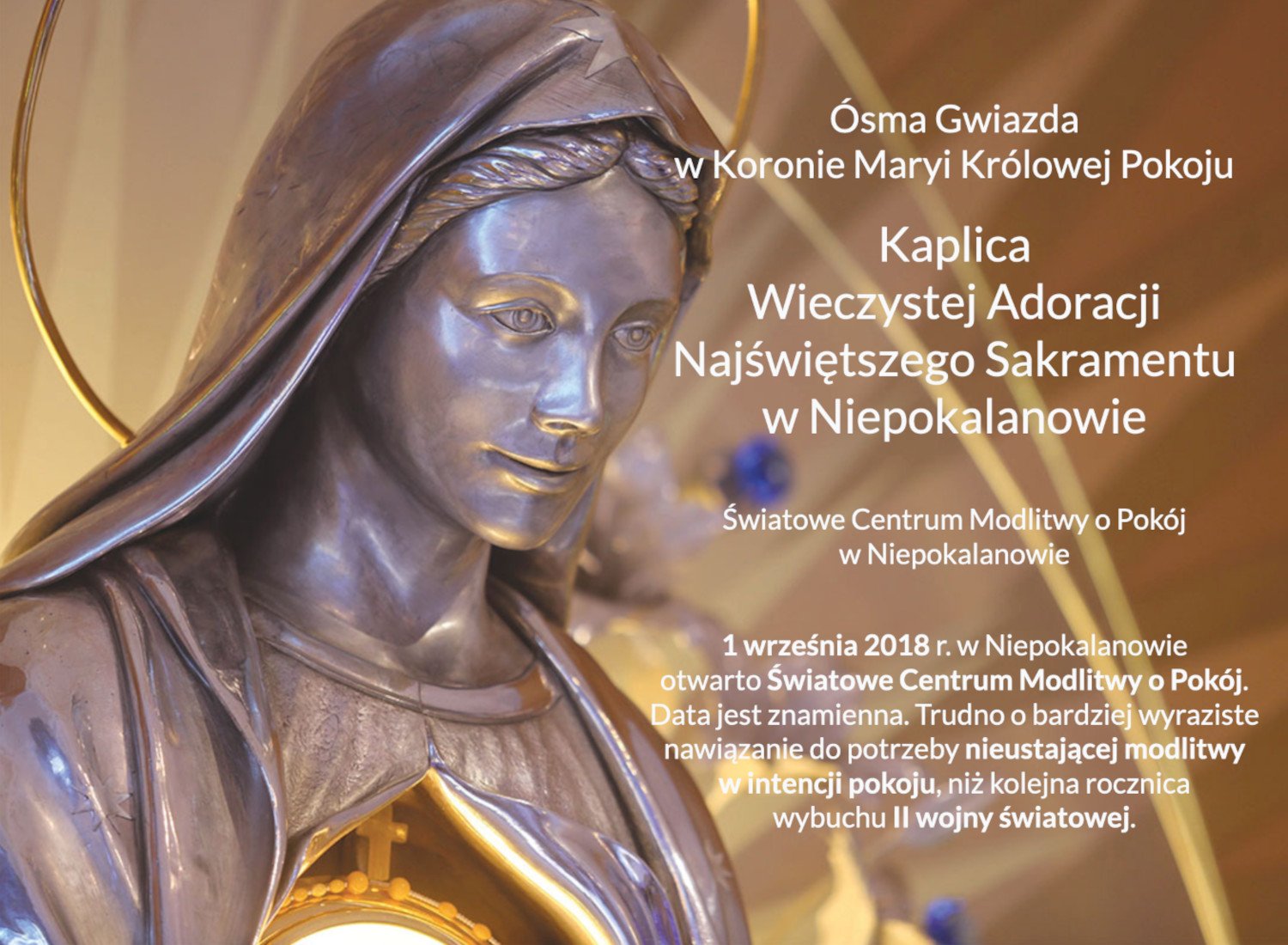

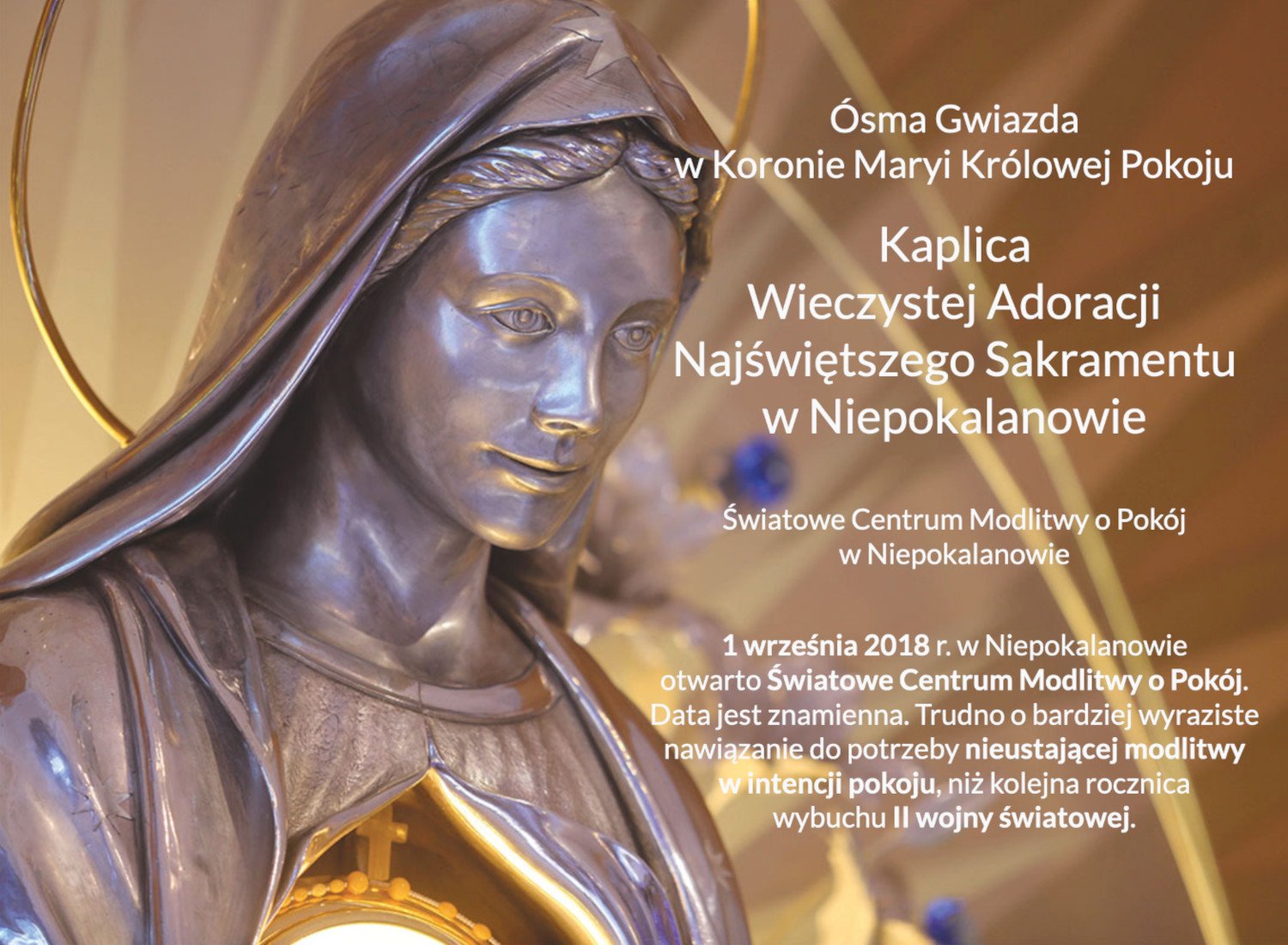
The Eucharistic Adoration Chapel established by Saint Maximilian Kolbe was inaugurated at the outbreak of World War II. It was restored as a Chapel of Adoration in September, 2018, the commemoration of the date that the war began. It is now part of the World Center of Prayer for Peace. The live internet feed of the Adoration Chapel at Niepokalanow — sponsored by EWTN — was established just a few weeks before we discovered it and began to include in at Beyond These Stone Walls. Click “Watch on YouTube” in the lower left corner to see how many people around the world are present there with you. The number appears below the symbol for EWTN.
Click or tap the image for live access to the Adoration Chapel.
The following is a translation from the Polish in the image above: “Eighth Star in the Crown of Mary Queen of Peace” “Chapel of Perpetual Adoration of the Blessed Sacrament at Niepokalanow. World Center of Prayer for Peace.” “On September 1, 2018, the World Center of Prayer for Peace in Niepokalanow was opened. It would be difficult to find a more expressive reference to the need for constant prayer for peace than the anniversary of the outbreak of World War II.”
For the Catholic theology behind this image, visit my post, “The Ark of the Covenant and the Mother of God.”

Are You Suffering a Great Deal?
As this blog by a priest unjustly in prison began in 2009, Fr Gordon MacRae had to write 12 brief posts to send to an editor. Here are three of these early gems.
As this blog by a priest unjustly in prison began in 2009, Fr Gordon MacRae had to write 12 brief posts to send to an editor. Here are three of these early gems.
July 19, 2023 by Fr Gordon MacRae
A lot has been going on here this summer. Even in this place where time often seems to stand still, finding blocks of time to write has suddenly become a challenge. Nonetheless, I am enthused by a new development. Gloria.tv is an international Catholic video and news sharing venue launched in Switzerland in 2005. It is known for its high degree of fidelity. I cannot see it, of course, but on rare occasions over the years it has reported on one of my posts.
After reviewing and then reposting “Convicted for Cash,” the 44-minute video documentary about my trial by Frank X. Panico, Gloria.tv invited me to establish a page and submit selected past posts on the site. The result has been a huge increase in visits to this blog from around the world. Please visit our presence there at Gloria.tv/FrGordonJMacrae.
A flood of activity this July, along with some technical difficulties where I live, has temporarily slowed my ability to write. So this week, and again two weeks from now, we are returning to July, 2009 and the first days of this blog. As it was beginning, I was asked to quickly write and submit 12 short posts to launch it. I am told today that a few of them are “gems,” so I want to share them with you anew.
Our first entry today is “Are You Suffering a Great Deal?” It’s from a laminated card that fell into my lap from a book in 2009 just as I was beginning to write. At the time, I was in fact suffering a great deal.
Pornchai Moontri was here with me then and was very much a part of this beginning. It was Pornchai who named this blog, “These Stone Walls,” then in 2020 I renamed it “Beyond These Stone Walls” as he was returning to Thailand. Pornchai has contributed many posts to this site, some more popular than my own, but please don’t tell him I said that. So the second of our three short selections is “Bunkies: Pornchai’s Story.” Next week in these pages, we will have some exciting news about developments in Pornchai’s new life in Thailand.
My last entry this week is “Contentious Convicts.” I will let that one speak for itself. You might think it seems a little fishy.
+ + +

Are You Suffering a Great Deal?
Are you suffering a great deal? No, the question isn’t from Oprah or Dr. Phil. It is on a bookmark kept in my breviary. It was asked by Our Lady of Fatima on June 13, 1917:
“Are you suffering a great deal? Don’t lose heart. I will never forsake you. My Immaculate Heart will be your refuge, and the way that will lead you to God.”
There is immense power in that promise, and for someone who has lost everything, it is like a lifeboat at sea. There is sometimes nothing else to cling to. Even when I feel that my faith dangles from a thread — which is often, in prison — I cling to that promise.
I don’t know where the bookmark came from. Like most of the things I cling to for spiritual support, it just sort of showed up one day. I like to think it was handed down to me — in the way important things are handed down by brothers — by Maximilian Kolbe whose reverence for the Immaculate Heart of Mary guided him through life, and death, at Auschwitz.
Even when my faith is so diminished and darkened by the prison around me that I believe in little, I believe that promise. Sometimes I can only believe that Maximilian believed — with the very fabric of his life.
It’s often hard to pray in prison. It’s not just the noise, the harshness, the lack of privacy, the relentless obstacles. It’s just hard to raise my mind and heart beyond these stone walls at times. In that, at least, I am not alone.
The Vietnamese Cardinal Nguyen Van Thuan wrote that there were long periods during his years in a Communist prison when he was unable to pray. I guess any Catholic who ever looks inward has a dark night of the soul. If not, why would the Blessed Mother ever ask such a question in her appearance at Fatima? It’s not the usual question a mother would ask when she comes a long way for a brief visit.
Are you suffering a great deal? When Saint Maximilian’s life was finally snuffed out after days of starvation chained to the corpses of those who could not endure, he was heard gasping a hymn of praise. I wish I had his heart! I don’t, but I wish I did. I have to learn how to suffer, and I am a slow learner.
In Spe Salvi, his Encyclical on Christian Hope, our Holy Father Pope Benedict wrote the most masterful prose on suffering that I have ever read. I cling to it like I do my bookmark with Our Lady of Fatima’s Promise:
“Christ descended into ‘Hell,’ and is therefore close to those cast into it, transforming their darkness into light. Suffering and torment is still terrible and well-nigh unbearable. Yet the star of hope has risen — the anchor of the heart reaches the very throne of God. Instead of evil being unleashed within man, the light shines victorious: suffering — without ceasing to be suffering — becomes, despite everything, a hymn of praise.”
Spe Salvi, ¶37
Brilliant! Simply brilliant! There’s something hopeful in that, and I should listen.
+ + +
Bunkies: Pornchai’s Story
In prisons all over the world, the most crucial issue for prisoners is where one has to live, and with whom. Confined to a 60 square foot cell with another human being can be a nightmare. Most of us have no say in the choice of “Bunkies,” as cell mates are called here. If a bunky is moved — even after two or three years with the same person — sometimes a total stranger is living in the cell within minutes.
Having a good roommate seems to be everyone’s goal, but I tried another approach years ago. Being a good roommate is a goal I have more control over. The result has been that in 10 years since being moved from the torturous 8-man cells in which I spent my first seven years in prison, I have never had a roommate (we prefer to call our cells “rooms”) request a move.
The downside of that is that I have had some very dysfunctional roommates who have no wish to move elsewhere. My assigned roommates here have ranged in age from 19 to 67 or so, and have included men convicted of murder, rape, armed robbery, various drug crimes, and gang-related crimes. Everyone here knows all the details of why everyone else is here. Rumor and gossip fill in what the facts leave out.
My roommate of the last two years was also a good friend for several more. It was the first time I have been assigned to live with someone I know well, so it feels more like living with a family member than a felon.
Pornchai (his name is Thai, and the “r” is silent, as in “Paunch-eye”) is 35 years old and has been in prison since the age of 18.
He is about to convert to the Catholic faith and currently he is a scholarship student in theology in the Catholic Distance University’s excellent Distance Learning Program for prisoners.
Pornchai caused a minor sensation last year when he wrote a very brief autobiographical sketch that ended up being published as “The Conversion Story of 2008” by The Catholic League for Religious and Civil Rights. I hope you will take a moment to read it.
A year after publication, Pornchai still receives occasional mail about his life story. The most recent being a personal letter from Cardinal Kitbunchu, Archbishop Emeritus of Bangkok, Thailand, and a note from Mary Ann Glendon, former U.S. Ambassador to the Holy See. Oh, and there was also a letter from the late Father Richard John Neuhaus.
Pornchai takes his new notoriety in stride, though one letter had a profound impact. It was from a young man who wrote that he turned his life around, dropped out of his gang, swore off drugs, and returned to faith after reading “Pornchai’s Story” online.
Pornchai mistakenly credits me with some small role in his extraordinary life of late. He has fallen under the power of grace and cannot escape it now even if he tried. Now, he creates. Here is a photo of one of his creations, “The Olde Baldy” (named after me) which he carved piece by piece (over 600 of them) from scratch.

Pornchai Moontri — Master Craftsman
Pornchai was designated a master craftsman in wood and model shipbuilding. One of his first ships was a circa 1800 British warship from the Napoleonic era which he named after Father MacRae. He dubbed it “The Olde Baldy,” which is now docked in the home of our friend, Bill Wendell in Stow, Ohio.
+ + +

Contentious Convicts
There was little I could do to stop the fighting. Convicts are so territorial; they do not hesitate to take on intruders twice their size. They just can’t be reasoned with. It’s even worse when the convicts are mating. What drama!
No, no, no! I’m not talking about bizarre behavior among my fellow prisoners — though they do have their moments. I’m referring to Herichthys (Archocentrus) Nigrofasciatus, a fish of the cichlidae family native to the tropical river basins of Central America. They are popularly known as convict cichlids, or just convicts because of their characteristic black stripes.
Oh, go ahead and yawn! Whenever I would recite the scientific nomenclature for the fish in my aquarium, my friends would always yawn! Aquarium buffs are used to it! The more serious among us always felt duty-bound to learn the scientific names of the residents of our aquatic neighborhoods. Hey, we don’t talk that way by choice, you know!
My 100 gallon cichlid aquarium was my spare-time-consuming hobby for most of my life as a priest until I was sent to prison at age 41. It was an oasis of life, light, and aquatic drama that kept me mesmerized for hours at the end of each day. Only one other priest in my diocese had an aquarium, and we had an instant bond of shared knowledge and interest.
I had a breeding pair of convict cichlids who shared their home — perhaps “shared” is too strong a word — with a pair of Astronotus Ocellatus, or red oscars native to the Amazon Basin. I also had a single Herichthys (Archocentrus) Octofasciatus known otherwise as a “Jack Dempsey,” and for good reason. He ended up in a smaller aquarium of his own. Couldn’t play well with others.
Convicts typically excavate a cave when preparing to breed, so an old clay flower-pot in the corner sufficed. I named my convicts Bonnie and Clyde (at the time, I had limited knowledge of suitable convict names. Today I’d go with Bubba and Bella.) The other denizens, the Oscars, were named Oscar Madison and Oscar Wilde. (I’m glad I only had two!)
The Oscars gave their testy neighbors a wide berth once eggs were laid in the cave. Oscar Madison, twice the size of the convicts, sometimes paid a price for lumbering over to eat the convicts’ food. He had the nips in his fins to remember them by.
I once tried to use a mirrored barrier to keep everyone happy, but Clyde kept launching himself furiously at his own reflection. In time, everyone learned to respect some boundaries. My current convict friends could learn a lot from that. “The Aquarium is Gone.” That’s actually a line from a poem by Robert Spence Lowell (“For the Union Dead.” 1964)
Its absence from my world is still deeply felt. It is one of the three recurring dreams I have in prison. (I’ll write of the other two later.) It haunts me a bit. I often dream that my aquarium is on the concrete shelf of my cell, and Oscar Wilde is staring at me with his bulging eyes willing me to bring food.
I miss them. There is nothing with water and life here.
“And the fish of the sea will declare to you. In His hand is the life of every living thing.”
— Job 12:8,10
The Eucharistic Adoration Chapel established by Saint Maximilian Kolbe was inaugurated at the outbreak of World War II. It was restored as a Chapel of Adoration in September, 2018, the commemoration of the date that the war began. It is now part of the World Center of Prayer for Peace. The live internet feed of the Adoration Chapel at Niepokalanow — sponsored by EWTN — was established just a few weeks before we discovered it and began to include in at Beyond These Stone Walls. Click “Watch on YouTube” in the lower left corner to see how many people around the world are present there with you. The number appears below the symbol for EWTN.
Click or tap the image for live access to the Adoration Chapel.
The following is a translation from the Polish in the image above: “Eighth Star in the Crown of Mary Queen of Peace” “Chapel of Perpetual Adoration of the Blessed Sacrament at Niepokalanow. World Center of Prayer for Peace.” “On September 1, 2018, the World Center of Prayer for Peace in Niepokalanow was opened. It would be difficult to find a more expressive reference to the need for constant prayer for peace than the anniversary of the outbreak of World War II.”
For the Catholic theology behind this image, visit my post, “The Ark of the Covenant and the Mother of God.”
The United Nations High Commissioner of Hypocrisy
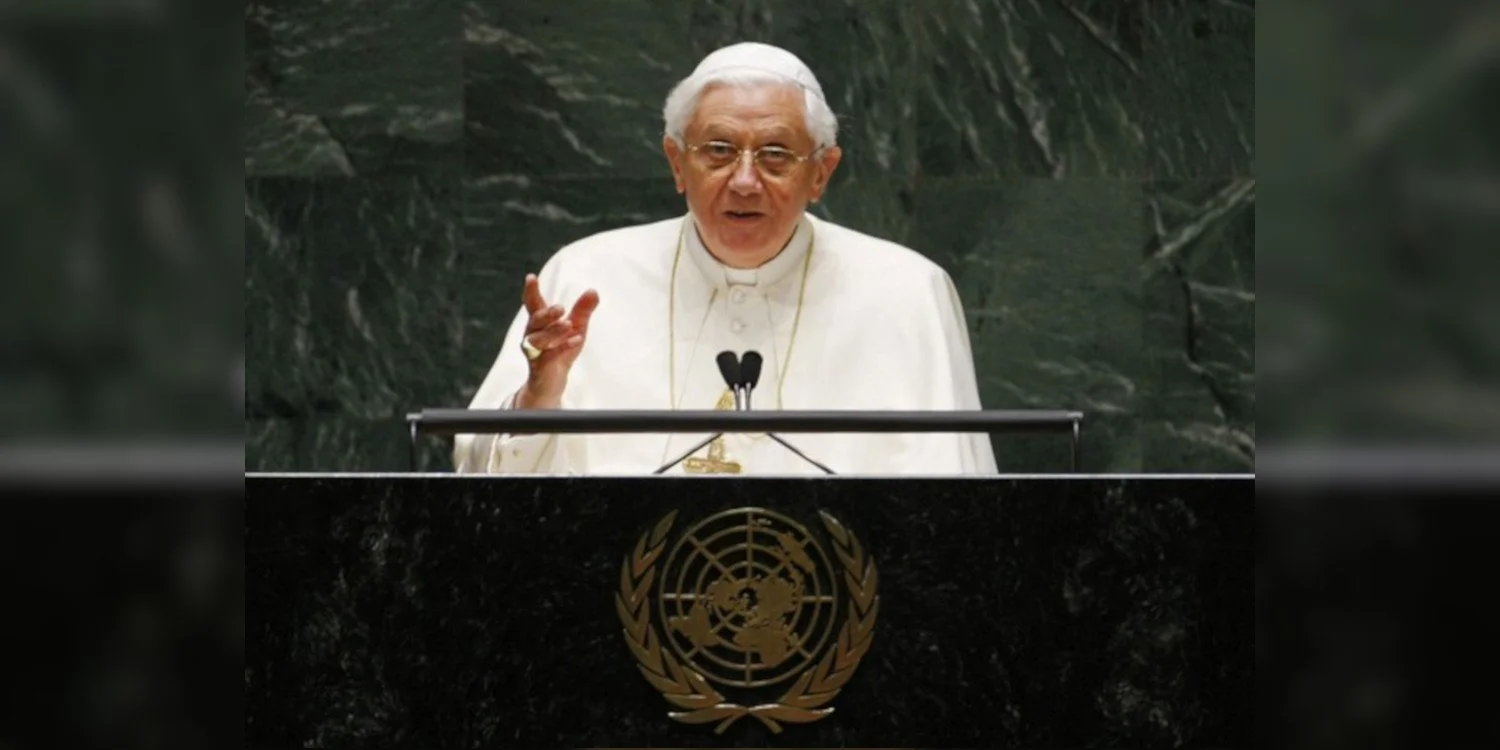
In 2014, a U.N. Commission accused the Vatican under Benedict XVI of a past sex abuse cover-up. Then the U.N. was exposed for a present sex abuse cover-up.

In 2014 a United Nations Commission accused the Vatican under Benedict XVI of a past sex abuse cover-up. Then the U.N. was exposed for a present sex abuse cover-up.
July 12, 2023 by Fr. Gordon MacRae
I sometimes come across an older post I have written about events in the news, and am struck by how much what I wrote ends up coming true. I just re-read a post I wrote on July 7, 2010. I read it anew with far more invested in the topic today than when I originally wrote it. That post is “The Exile of Father Dominic Menna and Transparency at The Boston Globe.”
It raised an important point about an issue that has simmered in the background of this blog since its inception in 2009. That issue is the Catholic clergy sex abuse story, and how much the story has itself been abused in the news media to further certain agendas. On Easter Sunday 2010, for example, The Boston Globe hyped this story about a popular Massachusetts senior priest, Father Dominic Menna, who under the terms of the U.S. Bishops’ “Dallas Charter,” was removed from ministry due to a claim of sexual abuse.
In reporting the story, the Globe neglected to mention that the uncorroborated single claim that destroyed this priest’s life was alleged to have occurred over a half century ago in 1971. And it was no accident that the story was reserved for the Globe’s Easter Sunday edition.
What the Globe omitted from the Easter Sunday 2010 story was the fact that the adult bringing that claim — a man in his late fifties — stood to gain a substantial financial settlement just for making the claim while proving nothing.
The contingency lawyers and their enablers in the media are counting on you to have no frame of reference to put any of the claims of priestly abuse into context. I do have a frame of reference, and I can tell you that the distortion created by lawyers and the news media is deeply unjust — not only to Catholics and their priests, but to millions of adult victims of abuse whose suffering has been trivialized and cheapened by the distortion that only victims of Catholic priests are worth hearing and compensating.
Since I wrote the above post, The Boston Globe was sold by its parent company, The New York Times, for less than ten cents on the dollar, compared to what the Times paid to purchase it. Some like to think that in the end the Globe pretty much reaped what it had sown at the expense of truth and justice.
The eventual result of the symphony created by contingency lawyers and biased news media was an arena in which the Church would become dislodged as a global source of moral truth. I wrote of some of the fallout for other innocent victims in my post, “Benedict Faced the Cruelty of a German Inquisition.”

The U.N. Assault on the Catholic Church
In 2014, an explosive 16-page report issued by the United Nations High Commissioner on the Rights of the Child indicted and convicted the Catholic Church without investigation, without evidence, without a formal defense, and without any trial of the facts. I know the feeling!
This public shaming of the Holy See came as a result of the emergence into public view of hundreds of claims of sexual abuse by priests dating back thirty, forty, fifty years or more. These were claims often brought forward by contingency lawyers who — once the mass settlement process had been established as status quo — flooded Church institutions with demands for “out-of-court” settlements with no effort at corroboration. “I’ve never seen anything like it,” said N.H. contingency lawyer, Peter Hutchins when handed a $5.2 million check from the Diocese of Manchester, New Hampshire.
The various bishops and dioceses caved in to these demands, and then a hapless U.N. committee took that to be proof enough that the claims were all true. In a courageous article in First Things, “Rolling Stone, Alan Dershowitz, and Catholic Priests” (May 21, 2015) Father Thomas Guarino described the cost of this abandonment of rights for the priests accused when bishops got the monkey off their backs by throwing money at it:
“This Episcopal peace comes at a heavy price…. The problem is that, in many cases, no contrary evidence can come forward because an accusation is decades old. What convincing evidence could possibly be adduced to clear a man’s name? Even if a charge could be true, is lifetime suspension a proportionate penalty for a mere possibility? Should bishops be held hostage by forces dividing them from their own priests?”
— Fr Thomas Guarino, First Things
The United Nations had no such interest in basic civil rights like the presumption of innocence. Claudia Rosett, who led the Investigative Reporting Project for the Foundation for the Defense of Democracies, also reacted to the U.N. Commission report on the Vatican with a similarly titled column in The Wall Street Journal (“The U.N. Assault on the Catholic Church,” WSJ, February 10, 2014). Ms. Rosett described the report:
“A Report on the Holy See — released by a U.N. Committee last week to much media fanfare — alleged that tens of thousands of children have been abused by Catholic clerics and that the Vatican has helped cover it up.”
Bill Donohue, President of the Catholic League, described that U.N. report as “one of the most ambitious power grab efforts ever undertaken by a U.N. committee.” The report was, of course, a lie, simply repeating a media mantra. But in the process of describing this in The Wall Street Journal, Claudia Rosett exposed another big lie, one belonging to the United Nations itself.

Now Hiring: A U.N. High Commissioner of Hypocrisy
Between 2007 and 2013, United Nations peacekeeper forces have been repeatedly implicated in the sexual abuse of children they were tasked to protect, and the U.N. has now been implicated in a cover-up of that fact. But the most disturbing part of this story is the extent to which it has been ignored — another form of cover-up — by the American news media. In fact, Ms. Rosett’s above column in the WSJ was likely the first hint of the scandal at the U.N. that appeared in mainstream U.S. news.
Since then, other media outlets have taken this up, but few of them in the United States. Sandra Laville, in The Guardian (U.K.) covered a report leaked to her newspaper alleging that the U.N.’s own investigation revealed “the rape and sodomy of starving and homeless boys” by French U.N. peacekeeper forces operating in the Central African Republic.
As sickening as that charge is, it gets much worse. French president Francois Hollande promised that France would prosecute those soldiers. The story came to light only because of a whistleblower. According to Matheiu Delahouse in the French paper, Le Nouvel Observateur, the U.N. marked its report on this matter “secret” and filed it away.
This is a story worth telling. The French government was not even informed of the claims against its soldiers until a man named Anders Kompass, a Swedish citizen working for the U.N. High Commissioner of Refugees, “broke protocol and gave a copy of the report to the French government,” according to The Week:
“Naturally, the French investigators asked if they could speak to the U.N. investigator who wrote the report, but the U.N…refused to allow that. Meanwhile, Kompass, the whistleblower, has been punished and may lose his job. Saying he leaked a confidential document, the self-interested bureaucrats at the U.N. have suspended this 30-year veteran of humanitarian work for intervening on behalf of children.”
— The Week, “United Nations: Riding sexual abuse by peacekeepers,” May 15, 2015
Rosa Freedman, writing at TheConversation.com from Australia, charged that the U.N. has “a long and sordid history of covering up sexual abuse by peacekeepers.” Simon Allison, writing from South Africa for The Daily Maverick observed about the U.N., “Who can trust an institution that covers up the sexual abuse of minors?”
The very fact that such a question is now asked of the United Nations itself after it dragged the Catholic Church through a round of public mudslinging is symptomatic of an institution in crisis. The situation is more hypocritical than it appears.
I have also written of the hubris and hypocrisy of the U.N.’s finger pointing on this issue. I have described evidence that even while the U.N. was pointing fingers at the Vatican for decades-old and unproven claims of abuse, the U.N. was itself being sued. In 2014, the United Nations employed any and every legal means to fight off a lawsuit from the beleaguered people of Haiti after its unscreened peacekeeper forces caused the deaths of innumerable children by bringing a cholera outbreak to their earthquake stricken country. One of its defenses was to blame the people of Haiti for the cholera, a plague that killed hundreds of Haitian children.
The saddest part of this story is that the Holy See sent emissaries to the U.N. Commission on the Rights of the Child to assure the U.N. that many hundreds of priests have been cast out after being accused in these decades-old claims of abuse. In “The U.N. Assault on the Catholic Church,” (WSJ, February 10, 2014), Claudia Rosett proposed a more fitting response from the Church to the U.N.:
“Pope Francis might want to consider that it is precisely to avoid gross intrusion by U.N. ‘experts’ that the United States signed, but never ratified, the U.N. Convention on the Rights of the Child. This treaty has less to do with children than with political power plays, and a fitting reform of the Vatican would be to walk away from it.”
Would that such advice was followed before hundreds of accused priests were thrown under the bus and out of the priesthood. Would that such advice was followed before the extent of United Nations hypocrisy was bared for all to see. Is reform of the U.N. on the horizon? The evidence does not indicate that it is. The United Nations now needs a High Commissioner of Hypocrisy.
+ + +
Note from Fr. Gordon MacRae: You would serve the cause of justice and truth by sharing this post. You may also like these related posts:
Human Trafficking: Thailand to America and a Cold Case in Guam
Benedict XVI Faced the Cruelty of a German Inquisition
Catholic Scandal and the Third Reich: Rise and Fall of a Moral Panic


The Eucharistic Adoration Chapel established by Saint Maximilian Kolbe was inaugurated at the outbreak of World War II. It was restored as a Chapel of Adoration in September, 2018, the commemoration of the date that the war began. It is now part of the World Center of Prayer for Peace. The live internet feed of the Adoration Chapel at Niepokalanow — sponsored by EWTN — was established just a few weeks before we discovered it and began to include in at Beyond These Stone Walls. Click “Watch on YouTube” in the lower left corner to see how many people around the world are present there with you. The number appears below the symbol for EWTN.
Click or tap the image for live access to the Adoration Chapel.
The following is a translation from the Polish in the image above: “Eighth Star in the Crown of Mary Queen of Peace” “Chapel of Perpetual Adoration of the Blessed Sacrament at Niepokalanow. World Center of Prayer for Peace.” “On September 1, 2018, the World Center of Prayer for Peace in Niepokalanow was opened. It would be difficult to find a more expressive reference to the need for constant prayer for peace than the anniversary of the outbreak of World War II.”
For the Catholic theology behind this image, visit my post, “The Ark of the Covenant and the Mother of God.”

For Those Who Look at the Stars and See Only Stars
An MIT astrophysicist trying to reconcile science with a quest for spiritual truth wrote upon the death of his parents, “I wish I believed.” I believe he just might.

First deep field image from the James Webb Space Telescope. Credits: NASA, ESA, CSA and STScl
An MIT astrophysicist trying to reconcile science with a quest for spiritual truth wrote upon the death of his parents, “I wish I believed.” I believe he just might.
July 5, 2023 by Fr. Gordon MacRae
Note from Fr. Gordon MacRae: The image atop this post is the first of many images transmitted by the James Webb Space Telescope parked one million miles from Earth in 2022 to survey the Cosmos. I first wrote this post in 2018 for an older version of this blog. It needed to be restored for our readers, but I ended up completely rewriting it. My goal was to highlight a bridge between science and faith, but some say it also highlights a bridge between life and death.
+ + +
When Beyond These Stone Walls was just a few months old back in 2009, I wrote a post about the death of my mother. It told a story about an event that occurred on her birthday a year after she died. At first glance it seemed an ordinary event, the sort of thing usually chalked up to coincidence. But its meaning and timing and how it unfolded made it an extraordinary grace beyond comprehension. It required that I set aside the mathematical odds against such a thing and see it foremost in the light of faith.
It remains to this day a pivotal moment, a wondrous event that shook my faith out of the closet of doubt where I tend to store it when times get rough — which is often. The story told in that post may shake you, too, if it hasn’t already. By that, I do not mean that it will challenge your faith. It’s just the opposite. My story lifted for me a corner of the veil between doubt and belief. So the title I gave it was “A Corner of the Veil.”
My friend, Pornchai Moontri was with me that night when the event occurred while I offered Mass in our prison cell. I asked Pornchai if he remembers it. “How could I forget it?” he said. He described it as an “ordinary miracle,” the kind he says he has seen a lot of since his eyes were opened.
I could repeat the whole story here, but it will take too long and I have written it once already. It is but a mere click away. I will link to it again after this post. You can decide for yourself whether the story it tells is mere coincidence or something more. My analytic brain tends toward coincidence, but sometimes that just doesn’t add up. This was one of those times.
I then came upon a strange little book of fiction by Laurence Cossé first published in French as Le Coin du Voile, and in English, A Corner of the Veil (Scribner 1999). It strangely fell at my feet from a library shelf after my post with the same title.
Laurence Cossé was a journalist for Radio France when she wrote this book described by Notre Dame theologian Ralph McInerney as “a theological thriller that makes a mystery out of the absence of mystery.” It is a spellbinding account of what happens to the people and institutions of Church and State when a manuscript surfaces that irrefutably proves the existence of God.
Science, religion, and politics all transform as their experts ponder its meaning and their own continued relevancy. The reader is left to wonder whether the discovery will spark a new era of harmony or launch the final battle of the apocalypse.
“Six pages further, Father Bertrand was trembling. The proof was neither arithmetical nor physical nor esthetical nor astronomical, it was irrefutable. Proof of God’s existence had been achieved. Bertrand was tempted, for a second, to toss the bundle into the wastebasket.” (p 15)
As it does for people who awaken to faith on a personal level, the discovery immediately altered the way its readers face both life and death. The transformation was astonishing. Death came to be seen, not as an entity unto itself, but as it really is a chapter in the continuity of life, of me, of the person I call "myself," integrated into the Great Tapestry of God.
I happen to know a lot of people whose experience of living is suddenly overshadowed by the prospect of dying. They have come to know that death is drawing nearer day by day. Some of them struggle. What does death mean, and why do we wage such war against it? The age of individualism and relativism distorts death into a fearsome enemy. As Dylan Thomas wrote,
“Do not go gentle into that good night. Rage, Rage against the dying of the light.”

Carina Nebula image from the James Webb Space Telescope. Credits: NASA, ESA, CSA and STScl
If That’s All There Is, Then Let’s Keep Dancing!
While writing this post, I received a letter from a reader in Ohio who asked me to write a note of encouragement to a friend whose death is drawing near. After a lifetime of faith, he wrote, the friend is having grave doubts and fears about the end of life and the finality of death. He is asking the age-old question put to song: “Is that all there is?”
But that is our problem. We speak in terms of “finality” as though when faced with death, all that we once believed with hope takes on the trappings of a mere children’s fantasy. I know too many people who are dying, and many of us treat it as the silent elephant in the room because we know that sooner or later we will join them just as our parents did before us. It is part of the flow of life, but we ward it off as a terror in the night. In the face of death, science alone comes up empty.
When you think of it, death is best seen as an act of love. Imagine the inherent selfishness of a humanity without death. Those we love the most in this world — those who fulfill our very purpose for being in this world — would be left out of existence if this life were ours alone to keep. But facing death with no life of faith casts both life and death into a formless, meaningless void.
I recently came across a review of a book by noted MIT physicist and astronomer Alan Lightman entitled Searching for Stars on an Island in Maine (Pantheon 2018). It was reviewed by UMass physics professor Alan Hirshfeld in “A Longing for Truth and Meaning” in The Wall Street Journal April 7-8, 2018).
In some previous science posts here at Beyond These Stone Walls, I have cited both writers for other books and articles they have written. Mr. Lightman’s book, and Mr. Hirshfeld’s review of it, both raise provocative questions about “the core mysteries of human life” and the way science explores the Universe:
“Why are we here? What, if anything, is the meaning of existence? Is there a God? Is there life after death? Whence consciousness?”
I am very happy to see science ponder these questions, but they can never be answered by science alone. It comes up short when the task moves beyond the mere physics and chemistry of life to its meaning and purpose. Consider this explanation of the self, of who and what you are as a conscious being, offered by Mr. Lightman:
“Self is the name we give to the mental sensation of certain electrical and chemical flows in our neurons.”
It is too tempting for science to reduce us to fundamental biology and chemistry, but the mere mechanics of what I am do not at all define who I am. If science is the only contribution to the meaning of life and death, then it becomes obvious why so many spend significant time in denial or in dread of death.
In his new book reflecting on the Cosmos, MIT astrophysicist Alan Lightman takes up these questions and more. Searching for Stars on an Island in Maine is a view of the world through a scientist’s lens which requires the scientist to see in it, as Alan Hirshfeld describes,
“Tangible bits of matter and energy, all governed by a set of fundamental physical laws … In keeping with his ‘Central Doctrine of Science,’ he eschews unprovable hypotheses, most significantly the existence of God and the afterlife.”
But these hypotheses are only unprovable from the point of view of science which concerns itself, as it concerns astrophysicist Alan Lightman, with matter and energy and fundamental laws. But Professor Lightman has acquired the wisdom not to stop there. His reflection on the death of his parents brings him to the “impossible truth” that they no longer exist, and he will one day follow them into this nonexistence.
Is that all there is? “I wish I believed,” he wrote. But “a precipice looms for each of us, an eventual plunge into nonexistence.” As Alan Hirshfeld described it:
“A depressing prospect, for sure, yet the inevitable judgment of those for whom religious or spiritual alternatives carry no resonance.”

Pictured: Fr. Georges Lemaître, Albert Einstein and Fr. Andrew Pinsent
Threads of the Tapestry of God
I have written numerous articles about the sciences of astronomy and cosmology, the origins and mechanics of the Universe. But these are not the only tools with which to explore the universe and measure life and death. The conclusions of science and faith are not as inseparable as science might have you believe.
I have raised this analogy before, but consider these two passages from two sources that have become meaningful to me. The Catechism of the Catholic Church (CCC 296) expresses a fundamental truth of faith God created the Universe and life “out of nothing.”
Among the many contributions of science that I hold in high regard, this is one by the mathematician Robyn Arianrhod whose book, Einstein’s Heroes: Imagining the World Through the Language of Mathematics (Oxford University 2005) draws the same conclusion. Don’t let the scientific language dissuade you from understanding this phenomenal bridge between science and faith:
“The Belgian priest and astrophysicist, Georges Lemaitre began to develop expanding cosmological models out of Einstein’s equations … In 1931, Lemaitre formally sowed the seeds of the Big Bang theory [which] showed that Einstein’s equations predicted the universe had expanded not from a tiny piece of matter located in an otherwise empty cosmos, but from a single point in four-dimensional spacetime … Before this point, about 13 billion years ago, there was no time and no space. No geometry, no matter. Nothing. The universe simply appeared out of nowhere. Out of nothing.”
— Arianrhod, pp 185-187
Reflecting on the death of his parents, Alan Lightman wrote that he wished he believed in the continuity of life after death. It could be at least a starting point that sometimes science and faith share some of the same language and conclusions about the origin of life. Faith, to have any real depth, is not simply an emotional experience to assuage our fears, but rather one arrived at also through reason. Catholicism presents 2,000+ years of faith seeking understanding, of belief built upon reason.
And sometimes reason just cannot explain away our intuition that life has an Author, and when we die, the book is still not finished. I am intrigued by Professor Hirshfeld’s use of the term, “resonance” for I have also used it in some recent posts. I have described it as a sort of echo that finds its way among the “threads of the Tapestry of God” in ways that give life meaning and purpose, in ways that connect us. One way spiritual resonance manifests itself is by giving meaning to suffering.
Consider this stunning action of spiritual resonance that was described in a post, “Fr Georges Lemaître, the Priest Who Discovered the Big Bang.” That post was co-authored by me and Father Andrew Pinsent, PhD, a priest, physicist and Director of the Institute for Science and Religion at Oxford University.
When my friend Pornchai Moontri came into the Catholic Church on Divine Mercy Sunday in 2010, one of our readers, the late Pierre Matthews in Belgium, inquired rather urgently asking to stand as Pornchai’s Godfather. They visited several times. However, it was only after I wrote about Father George Lemaitre that Pierre contacted me with the staggering revelation that the Godfather of Pornchai Moontri is the Godson of Father George Lemaitre. The mathematical odds against such a “mere coincidence” are ... well … astronomical!
It is a long time since I have viewed with awe the expanse of our galaxy spanning the night sky in all its brilliance, but like Alan Lightman, I have done so, and find it unforgettable. He is on the right track, and may one day come to see that the awe it instills in him is not the awe of science alone. “I wish I believed,” he wrote. I believe he just may.
+ + +
ANNOUNCEMENT: Fr. Gordon MacRae and Beyond These Stone Walls are now featured on Gloria.tv, an international Catholic social network and a video and news sharing platform. We are honored by this invitation, and by the Catholic fidelity demonstrated by Gloria.tv. We invite our readers to support this venue by visiting and sharing our page and other content there.
+ + +

Fr. Georges Lemaître
Editor’s Note: Continue this great adventure of science and faith with these related posts:
The God of the Living and the Life of the Dead


The Eucharistic Adoration Chapel established by Saint Maximilian Kolbe was inaugurated at the outbreak of World War II. It was restored as a Chapel of Adoration in September, 2018, the commemoration of the date that the war began. It is now part of the World Center of Prayer for Peace. The live internet feed of the Adoration Chapel at Niepokalanow — sponsored by EWTN — was established just a few weeks before we discovered it and began to include in at Beyond These Stone Walls. Click “Watch on YouTube” in the lower left corner to see how many people around the world are present there with you. The number appears below the symbol for EWTN.
Click or tap the image for live access to the Adoration Chapel.
The following is a translation from the Polish in the image above: “Eighth Star in the Crown of Mary Queen of Peace” “Chapel of Perpetual Adoration of the Blessed Sacrament at Niepokalanow. World Center of Prayer for Peace.” “On September 1, 2018, the World Center of Prayer for Peace in Niepokalanow was opened. It would be difficult to find a more expressive reference to the need for constant prayer for peace than the anniversary of the outbreak of World War II.”
For the Catholic theology behind this image, visit my post, “The Ark of the Covenant and the Mother of God.”

Faith and Freedom at the Twilight’s Last Gleaming
Supreme Court Justice Neil Gorsuch offers a candid view of the state of our civil liberties after three years of forced Covid pandemic restrictions and shutdowns.

Photo by John Sonderman (CC BY-NC 2.0)
Supreme Court Justice Neil Gorsuch offers a candid view of the state of our civil liberties after three years of forced Covid pandemic restrictions and shutdowns.
June 28, 2023 by Fr Gordon MacRae
Readers in the United States may recognize the second half of my title this week as a line from the Star Spangled Banner, our National Anthem: “Oh say can you see, by the dawn’s early light, what so proudly we hailed at the twilight’s last gleaming.” It was composed during a battle in the War of 1812. Thirty-six years after the American Revolution in 1776, the War of 1812 was called by some the second war for American independence.
In 1814, two years into the war, a British warship bombarded Fort McHenry in the Port of Baltimore. The part of the text of the famous poem that became our National Anthem was composed on the spot by American lawyer and poet, Francis Scott Key. “He was aboard a British frigate under a flag of truce to negotiate the release of a prisoner. While aboard, a fierce battle broke out between British and American warships.
As the smoke of battle cleared at dawn, Francis Scott Key was so inspired by the sight of an American flag still intact aboard a battered U.S. ship that he wrote down what he saw. His “Star Spangled Banner” appeared in a Baltimore newspaper. Then its first stanza was set to music to the tune of a popular pub drinking song, “To Anacreon in Heaven.” It became the National Anthem of the United States by an act of Congress on March 3, 1931.
Few people seem to know that the famous poem that inspired the U.S. National Anthem had four stanzas. Only the first was set to music. Nonetheless, at age eight I was one of four fourth grade students required by our teacher, Miss McNeil, to each memorize a stanza for an Independence Day school assembly. I was fortunate enough to draw the first stanza which was the most familiar and easiest to memorize. I remember imagining at the time that Miss McNeil might actually have been present when Francis Scott Key composed the text in 1814:
“Oh, say can you see by the dawn’s early light
What so proudly we hailed at the twilight’s last gleaming?
Whose broad stripes and bright stars thru the perilous fight,
O’er the ramparts we watched were so gallantly streaming?
And the rocket’s red glare, the bombs bursting in air,
Gave proof through the night that our flag was still there .
Oh, say does that star-spangled banner yet wave
O’er the land of the free and the home of the brave?
“On the shore, dimly seen through the mists of the deep,
Where the foe’s haughty host in dread silence reposed,
What is that which the breeze, o’er the towering steep,
As it fitfully’ blows, half concealed, half disclosed?
Now it catches the gleam of the morning’s first beam,
In full glory reflected now shines in the stream:
’Tis the star-spangled banner! Oh long may it wave
O’er the land of the free and the home of the brave!
“And where is that band who so vauntingly swore
That the havoc of war and the battle’s confusion,
A home and a country should leave us no more!
Their blood has washed out their foul footsteps’ pollution.
No refuge could save the hireling and slave
From the terror of flight, or the gloom of the grave:
And the star-spangled banner in triumph doth wave
O'er the land of the free and the home of the brave!
“Oh! Thus be it ever, when free men shall stand
Between their beloved home and war’s desolation!
Blest with victory and peace, may the heav’n rescued land
Praise the Power that hath made and preserved us a nation.
Then conquer we must, when our cause it is just,
And this be our motto: ‘In God is our trust.’
And the star-spangled banner in triumph shall wave
O’er the land of the free and the home of the brave.”
— Francis Scott Key, 1814

Independence Day 2023: The State of Our Freedom
For Independence Day 2023, I want to look at what the land of the free and the home of the brave has done with the sacrifices that won for us this cherished freedom. Freedom was never free, so justice requires that we honor it. Sadly, we went awry over the last few years when the threat was not so tangible a thing as bombs flying, but rather the tiniest of things: a virus that emerged in China.
Lest someone take umbrage with that last thought, the evidence now seems clearer that Covid originated from a lab, though likely by accident, in Wuhan, China. That said, I must remind myself and all of us that China is the Peoples’ Republic, but Covid was not the peoples’ pandemic. The good people of China live under the hammer of an oppressive communist regime. They had nothing to do with the Covid-19 pandemic.
What I find so ironic, however, is what we did with it. Perhaps the best commentary on the state of our post-pandemic freedom as we emerge from three-plus years of government Covid policy is a statement by U.S. Supreme Court Justice Neil Gorsuch. It was published on May 18, 2023 in a Supreme Court Order halting a lawsuit filed to continue Title 42. If you have not heard or read this before, it is because the free press suppressed it. The statement is a bold assessment of post-pandemic truth:
“Since March 2020, we may have experienced the greatest intrusions on civil liberties in the peacetime history of the United States. Executive officials across the country issued emergency decrees on a breathtaking scale. Governors and local leaders imposed lockdown orders forcing people to remain in their homes. They shuttered businesses and schools, public and private. They closed churches even as they allowed casinos and other favored businesses to carry on.
“They threatened violators not just with civil penalties, but with criminal sanctions as well. They surveilled church parking lots, recorded license plates, and issued notices warning that attendance at even outdoor services satisfying all state social-distancing and hygiene requirements could amount to criminal conduct. They divided cities and neighborhoods into color-coded zones, forced individuals to fight for their freedoms in court on emergency timetables, and then changed their color-coded schemes when defeat in court seemed imminent .
“Federal executive officials entered the act too, and not just with emergency immigration decrees. They deployed a public health agency to regulate landlord-tenant relations nationwide. They used a workplace safety agency to issue a vaccine mandate for working Americans. They threatened to fire non-compliant employees and warned that service members who refused to vaccinate might face dishonorable discharge and confinement. Along the way, it seems federal officials may have pressured social media companies to suppress information about pandemic policies with which they disagreed.
“At the very least, one can hope that the Judiciary will not soon again allow itself to be part of the problem by permitting litigants to manipulate our docket to perpetuate a decree designed for one emergency to address another.”
— Justice Neil Gorsuch, May 18, 2023

Churches, Casinos and Liquor Stores
At a time of intense public anxiety, Churches were deemed non-essential by government officials in many states. Justice Gorsuch pointed out above that state government officials “closed churches even as they allowed casinos and other favored businesses to carry on.” In New Hampshire, churches were forced to remain closed while all the liquor stores remained open — even on Sunday. No one pointed out that in New Hampshire, the State owns all the liquor stores.
But the saddest oppression came later. When constitutional civil rights lawsuits in various states succeeded through the courts in reopening churches with reasonable safeguards, some of our own Catholic bishops instantly replicated the heavy hand of government to keep them closed. On June 10, 2020, I posted “The Faithful Departed: Bishops Who Bar Catholics from Mass.” My own bishop issued a chilling decree.
“As Bishop of the Diocese of Manchester understanding my responsibility to issue liturgical norms by which all are bound (Canon 838:3), I hereby decree the public celebration of Mass remains suspended ... until such time as I deem it prudent to modify [this] decree.”
In a state that led the nation in opioid overdose deaths among young people (and still does) deaths by overdose outpaced deaths by Covid substantially. The closure of churches never took into consideration the hopelessness to which it contributed. The year of the Bishop’s decree saw 250 deaths statewide from Covid. All but 65 of its victims succumbed in nursing homes where government failed to protect the elderly. In contrast, the same period saw 2,500 fatal overdoses from street drugs.
In some areas, Masses were relocated to online only where the reception of Communion was impossible. When court challenges opened up churches, some state governments — and later some bishops — required Catholics who chose to attend Mass to register their name, address, and signature at the church door. Some priests were removed from ministry for openly defying these edicts. In his post, “Coronavirus “Creativity” for Mass”, one priest friend famously challenged “Just do it in the Parking Lot.” No. And … Hell no.
Easter 2023 mercifully did not look much different from Easter 2019 except perhaps in the size of congregations gathered to observe it. In a Wall Street Journal - NORC poll published in April, 2023, 39-percent of Americans reported that religion was “very important” to them. This was down from 48-percent in 2019 before the pandemic. In 1998, this figure was 62-percent. It seemed that Covid had the effect of accelerating a pre-pandemic trend.
In March, 2023, the Pew Research Center released a study reporting that the percentage of U.S. adult Christians who participated in worship at least once per month was 43-percent, down from a pre-pandemic report of 49% in 2019. However, 22-percent of the respondents in 2023 reported that their “participation” was either online or on television. Of interest, Catholic parishes that kept congregations engaged throughout the pandemic using social media and streaming parish services to their own parishioners have retained more of their communicants than Catholic parishes that just rode the wave and remained closed.
The great downside to streaming Catholic Masses online is that it habituated the practice of many faithful to take part in worship without reception of the Eucharist which is central to the Mass and to the identity of Catholics.
An interesting story developed out of China while American Christians wrangled with our post-pandemic commitment to faith. All 63 members of an Evangelical Chinese Christian congregation escaped communist China, the first parish ever to do so en masse. In response to increasing oppression of the Chinese communist government religious identity and practice, the entire parish community fled China, first to South Korea, then to Thailand, and then to the United States.
Aided by Freedom Seekers International, a Texas non-profit that helps people flee religious persecution, the group submitted applications to the United Nations refugee agency in Bangkok. Having overstayed their Thai travel visas by one year, the group had to be deported, but Thai police worked with the U.S. State Department to deport them not back to China, but to Tyler, Texas.
The Chinese communist government viewed the church as illegal and threatened to shut it and its religious school down. Rather than risk the loss of their faith community, the 63 members of this small congregation decided unanimously to preserve their faith and flee their country. Here in America, we have never faced the forced choice between God and country. What we obtain too cheap we may esteem too lightly.

+ + +
Note from Fr Gordon MacRae: Thank you for reading and sharing this post. You may also like these related posts about freedom from Beyond These Stone Walls:
The Faithful Departed: Bishops Who Bar Catholics from Mass
The Chinese Communist Party and the True Origin of Covid-19
Pornchai Moontri and the Long Road to Freedom
A Year in the Grip of Earthy Powers
+ + +
Sound of Freedom

Click or tap image to watch the movie trailer. Get your tickets at: https://www.angel.com/soff.
Celebrated new film starring Jim Caviezel (The Passion of the Christ ) about the precarious state of human freedom. Jim Caviezel is asking Americans to view this movie around its opening on Independence Day.
Having unjustly lost my own freedom, this project is dear to my heart.
With Blessings,
Fr. Gordon MacRae
The Eucharistic Adoration Chapel established by Saint Maximilian Kolbe was inaugurated at the outbreak of World War II. It was restored as a Chapel of Adoration in September, 2018, the commemoration of the date that the war began. It is now part of the World Center of Prayer for Peace. The live internet feed of the Adoration Chapel at Niepokalanow — sponsored by EWTN — was established just a few weeks before we discovered it and began to include in at Beyond These Stone Walls. Click “Watch on YouTube” in the lower left corner to see how many people around the world are present there with you. The number appears below the symbol for EWTN.
Click or tap here to proceed to the Adoration Chapel.
The following is a translation from the Polish in the image above: “Eighth Star in the Crown of Mary Queen of Peace” “Chapel of Perpetual Adoration of the Blessed Sacrament at Niepokalanow. World Center of Prayer for Peace.” “On September 1, 2018, the World Center of Prayer for Peace in Niepokalanow was opened. It would be difficult to find a more expressive reference to the need for constant prayer for peace than the anniversary of the outbreak of World War II.”
For the Catholic theology behind this image, visit my post, “The Ark of the Covenant and the Mother of God.”

Convicted for Cash: An American Grand Scam
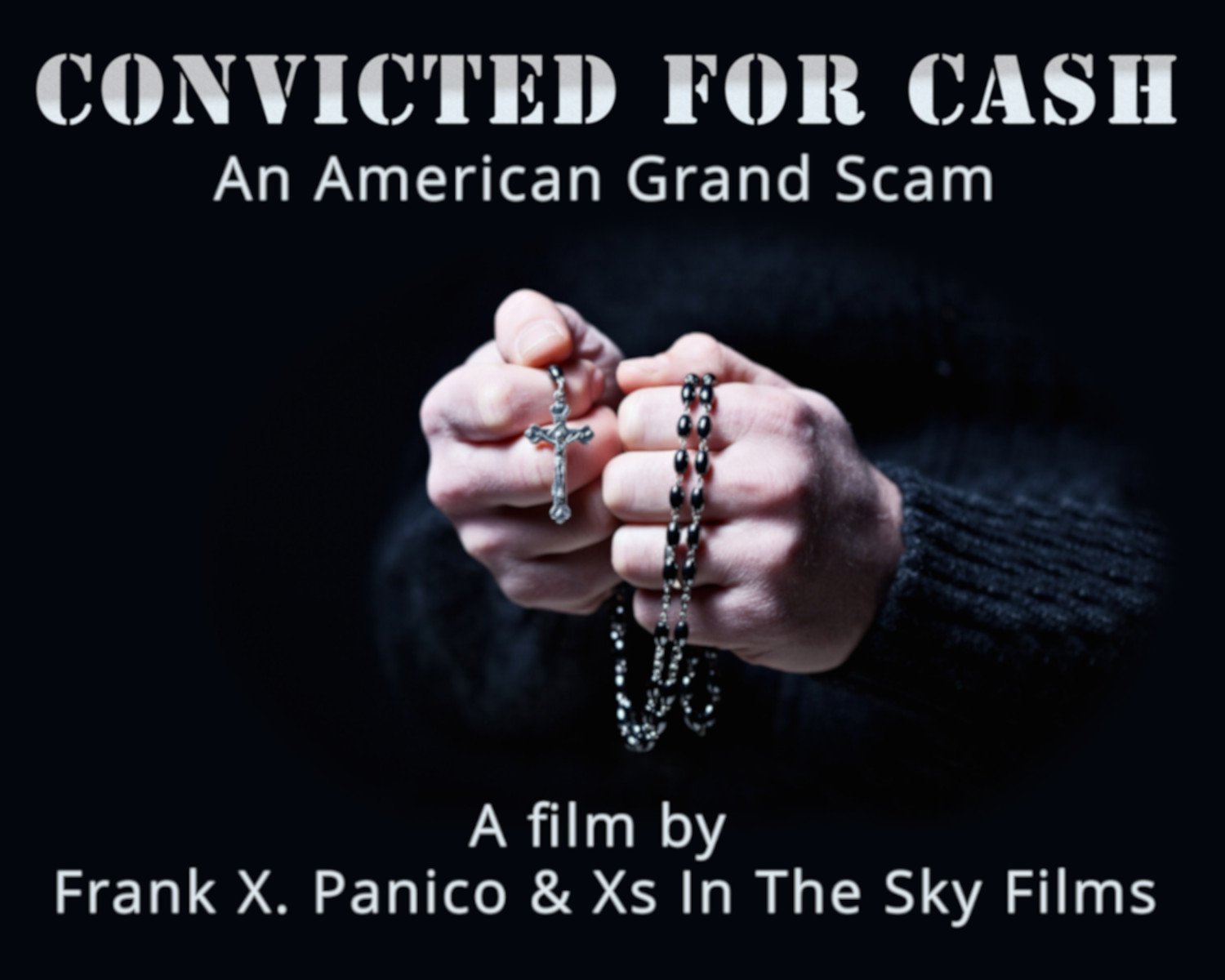
Frank X. Panico and Xs in the Sky Films present “Convicted for Cash: An American Grand Scam,” a film about a Catholic priest falsely accused and imprisoned for life.
Frank X. Panico and Xs in the Sky Films present “Convicted for Cash: An American Grand Scam,” a film about a Catholic priest falsely accused and imprisoned for life.
June 21, 2023 by Frank X. Panico and Xs in the Sky Films
Editor’s Note: This is our first “video post” at Beyond These Stone Walls. This 44-minute documentary film was created by Frank X. Panico, an award-winning short filmmaker whose work has been featured on EWTN, NewsMax, Salem Now and multiple other venues. Here is Frank X. Panico:
+ + +
“Take no part in unfruitful works of darkness, but expose them.”
— Ephesians 5:11
I created this short documentary film because I believe that railroading, convicting and imprisoning a Catholic priest through lies and deceitful tactics is an unfruitful work of darkness. The railroaded Catholic priest I refer to is Father Gordon MacRae. This documentary film is entitled “Convicted for Cash: An American Grand Scam.” It exposes the plight of a man of God wrongfully imprisoned.
When I learned of this true story, it drew me in. I have known Fr Gordon MacRae for less than a year, but after researching this story I feel that I have known him forever. I have studied every detail, and I have never personally vetted a subject of my films so extensively. There were many credible sources before me: The Wall Street Journal, the Catholic League for Religious and Civil Rights, The Media Report, The Catholic World Report, all bravely taking up the case of this wrongfully imprisoned priest against an avaricious tide of Catholic scandal and media coverage.
During production of this film, I often felt as though unseen spiritual warfare was in play. The evil one and his minions would have liked nothing more than for me to abandon this cause. I rejected such thoughts and came to know the truth. Father MacRae is an innocent man and the victim of a sham trial. I felt called to help someone who was absolutely falsely accused through a rogue communist-like legal system.
Don’t get me wrong. This is not the only reason I produced this film. I also found its subject matter to be intriguing and marketable. Not long after Tucker Carlson aired footage from the January 6th affair, an innocent prisoner caught in its net was released from prison just days later. I pray for the same result that this innocent man might be freed.
I am immensely pleased with the documentary, “Convicted for Cash.” Salem Now has picked it up so obviously they were pleased with it as well. As a daily communicant, I continue to pray at Mass for the well being and release of Fr. Gordon MacRae, a brother in Christ. Please view and then share Convicted for Cash by clicking on the link or the image below.

NOTE — NEWLY DISCOVERED EVIDENCE: In 2022, after Father MacRae had served 29 years in prison, compelling exculpatory evidence surfaced. It turns out that former Keene, NH sex-crimes Detective James F. McLaughlin was censured for “falsification of records” in another case nine years before MacRae went to trial. Previous Supreme Court rulings required that this be revealed to defendant MacRae and his legal counsel before trial. Instead, it was kept hidden. Since then, a Court has secretly sealed McLaughlin’s police file from further discovery. Nonetheless, news reports in New Hampshire reveal that the detective had a long history of police misconduct including allegations of falsifying evidence, threatening witnesses, tampering with tape recordings, selective investigation, and lying under oath. He briefly appeared on a list of dishonest police that is now also under judicial seal in New Hampshire.

The Eucharistic Adoration Chapel established by Saint Maximilian Kolbe was inaugurated at the outbreak of World War II. It was restored as a Chapel of Adoration in September, 2018, the commemoration of the date that the war began. It is now part of the World Center of Prayer for Peace. The live internet feed of the Adoration Chapel at Niepokalanow — sponsored by EWTN — was established just a few weeks before we discovered it and began to include in at Beyond These Stone Walls. Click “Watch on YouTube” in the lower left corner to see how many people around the world are present there with you. The number appears below the symbol for EWTN.
Click or tap the image for live access to the Adoration Chapel.
The following is a translation from the Polish in the image above: “Eighth Star in the Crown of Mary Queen of Peace” “Chapel of Perpetual Adoration of the Blessed Sacrament at Niepokalanow. World Center of Prayer for Peace.” “On September 1, 2018, the World Center of Prayer for Peace in Niepokalanow was opened. It would be difficult to find a more expressive reference to the need for constant prayer for peace than the anniversary of the outbreak of World War II.”
For the Catholic theology behind this image, visit my post, “The Ark of the Covenant and the Mother of God.”

In Hell’s Kitchen: The Moral Quagmire of Fr Bobby Carillo
Actor Robert De Niro has been cast as a Catholic priest in three films : True Confessions, The Mission, and Sleepers. The latter tells a spellbinding true story.

Actor Robert De Niro has been cast as a Catholic priest in three films : True Confessions, The Mission, and Sleepers. The latter tells a spellbinding true story.
June 14, 2023 by Fr Gordon MacRae
I began this post in May, 2019, but a lot has happened since then that caused me to want to start over. This is an important story about a topic still front and center in the world of Catholic affairs: the Catholic sex abuse crisis. If you’re just plain sick of it, well, frankly, so am I. Both mainstream and Catholic media are still saturated with it. I last wrote of it in April, 2023 in “Follow the Money: Another Sinister Sex Abuse Grand Jury Report.”
Fans of Robert De Niro the actor are not necessarily also fans of Robert De Niro the person. Whatever the reasons for that distinction, I want to write of his outstanding roles as a Catholic priest in three controversial films: True Confessions (1981), The Mission (1989) and Sleepers (1996). In each, his character became embroiled in an unforgettable moral quagmire.
The term, “quagmire” first appeared in British literature in 1570. It combines two older British terms, “quag,” with its origin in the word, “quake,” and “mire,” which means to find oneself bogged down in something. A quagmire was first used to refer to becoming trapped in a bog which looks solid enough to walk upon, but then entraps a person in the unseen muck. Today it is used to refer to a situation that seems innocent enough on its surface, but entraps a person in a moral dilemma.
In each of the films above, Robert De Niro portrayed a priest caught up in such a quagmire. I have written before of one of them. In True Confessions, based on a novel of the same name by John Gregory Dunne, De Niro was cast in the role of Monsignor Desmond Spellacy. Groomed to become Archbishop of Los Angeles, Spellacy becomes marginally implicated in the murder of a prostitute, a crime being investigated by his L.A. homicide detective brother portrayed by Robert Duvall.
The moral quagmire of True Confessions is that the priest is entirely innocent of the crime, but is he innocent of any knowledge of it? If he knows, how does he know? The title of the film and book gives a hint to the nature of the moral quagmire, a nightmare scenario for many Catholic priests.
But the De Niro role that I want to focus on for this post is that of “Father Bobby” Carillo in Sleepers, a 1996 film based on a book of the same title by Lorenzo Carcaterra published in 1995 but written in 1994, the year of my imprisonment. The story reads like a novel, but it is actually a biographical account in which Carcaterra has changed the names of his characters to protect the innocent.
The book and film unfold in the Hell’s Kitchen area on the West Side of Manhattan in 1966 when I was in high school. Hell’s Kitchen was then a poor bastion of mostly Irish Catholics in a tough neighborhood — a term used here with an emphasis more on “hood” than “neighbor.”
In Sleepers, Robert De Niro’s character, Father Bobby, is in stark contrast to much of the media portrayal of Catholic priests since then. He is a priest as tough as the neighborhood in which he lives. Father Bobby meets a group of adolescent boys who hang out in the neighborhood. All have absent fathers or abusive fathers, or both, and over time Father Bobby comes to fulfill a role that today would land him squarely in the crosshairs of societal and media suspicion.

Father Carillo’s Moral Quagmire
Father Bobby does not indoctrinate these street kids into faith. That is something he walks more than talks. I hope you catch the meaning of that because it is central to fatherhood. Father Bobby does not drag them into church. Instead, he protects them, cares for them, challenges them, and becomes a father to them and the sole person on Earth that any of them trust. His lack of Catholic indoctrination might not be the witness some of us might hope for, but it is clearly the witness that these boys most need. One of the saddest aspects of the fallout of the sexual abuse crisis of suspicion in the Church is that such a scenario could never happen again.
But even in 1966, as the story unfolds, Father Carillo is keenly aware of appearances and the necessity of professional distance. As an indirect result of keeping his emotional connection to these young men in check, he is one day not present to them when trouble finds them. Several of them commit a petty crime that escalates. A corrupt judge and court system sentences them to time in “juvey” a New York juvenile detention facility. While there, four of them “earn” a stint in solitary confinement. Sleepers is the slang term for juvenile delinquents serving more than six months in solitary confinement.
While there, they are demoralized and dehumanized beyond description. They are beaten by guards and several of them are repeatedly and brutally raped. To make the awful story shorter, they survive and are restored to freedom but could never be “free” again. They emerged from their nightmare destroyed as men, but they hide the truth. They make a pact to never reveal any of this to Father Bobby — first and foremost because they are ashamed.
Twenty years pass. The 14-year-old boys are now 34-year-old men. One became a prosecutor in the D.A.’s office. Most of the others became street thugs having dropped out of school and all engagement with the human race as a result of what they endured at the hands of the State. All of them occasionally still see Father Bobby, and to a man, they still trust and revere him.
I have to remind readers at this point that this is not some seedy fictional story. It is a true account. In the early 1990s when Lorenzo Carcaterra wrote it, the mainstream media had no interest in the story because the priest in the account is not the perpetrator of sexual abuse, but rather the savior of its victims. And lest you choose to believe that such abuse could not happen in a state run juvenile justice facility, I have firsthand knowledge to the contrary.
At the time Sleepers was written in 1994, my friend Pornchai Moontri was in the solitary confinement unit of the Maine State Prison for nearly seven years. The news venue, PBS Frontline produced a segment on that very same place filmed just months after Pornchai was transferred from there to the New Hampshire State Prison. If you have never viewed PBS Frontline’s Solitary Nation [part1, part2] , be brave and consider doing so. The abuse by guards is all masked because they were on camera and knew it, but the true nature of such a place remains clear.

The Reckoning
Back to Sleepers. One day, some twenty years after Father Bobby’s friends emerged from solitary confinement, two of them ventured into a dark neighborhood bar. Seated alone in a booth was “Nokes,” the most monstrous and sadistic of the guards who sexually assaulted and dehumanized them twenty years earlier. By the end of the day, his victims exacted the justice denied.
In the aftermath, Father Carillo learned the entire truth of what happened to these men in juvenile detention. He then had to wrestle with the deepest, most perplexing moral quagmire of his life as a man and as a priest. He was told by their lawyer that he alone could save them with an alibi defense. All of this painfully reminded me of another story told in my post, “Getting Away with Murder on the Island of Guam.”
Most who have read that story agree that all the media hype about the supposed crimes of Catholic priests — some sadly true but many not at all — pale in comparison to the crimes committed against Pornchai and his mother. And yet, the survivor in that story, like the survivors in Sleepers, fled not from the Catholic Church but to it. Pornchai himself confirmed this in a post written upon his arrival in Thailand, “Free at Last Thanks to God and You!”
Pornchai and I had another friend, TJ, who was released from prison only to find himself back here at age 26 with a new petty offense. Just after Pornchai left in 2020, TJ was moved from solitary confinement to a crowded cellblock. He unpacked his few possessions and obtained a pass to come to see me in the prison Law Library. With his head bowed in silent shame for his failure to live uprightly in freedom, he told me only that life was hard and he “did something stupid.” I don’t know the details.
What I do know, and it is well documented, is that for much of his young life until he was old enough to escape, TJ was a victim of unspeakable sexual and physical violence. The pairing of sex and violence is especially psychologically destructive. Like the young men in Sleepers, TJ and Pornchai both carried in their hearts a devastating devaluation of their lives. With every day in “fight or flight” mode, freedom was stolen from them long before prison.
As an accused Catholic priest, one would think that I would be the last person TJ would want anything to do with, but Pornchai and I taught him that he need not be forever defined by the sins of others. We did not allow his past to excuse his present and neither should he, but we also placed his offenses into the totality of his life. We saw through his façade and challenged him too grieve his past without letting it rule his present.
So I, too, was in a quagmire here — with Pornchai and TJ and others. I was left with the irony of sheltering them not only from what happened to them, but also from what happened to me. When leaders of the Church built upon God’s Truth, God’s Justice and God’s Mercy reflected none of these, I covered for them in the presence of Pornchai and TJ. They looked to the Church for healing and hope, and I could never deprive them of that. Neither could Father Bobby Carillo.
+ + +
Note from Fr. Gordon MacRae: This post ends in another glaring irony. At the time my diocese was besieged by a grand jury report from the State of New Hampshire in 2003, the State was itself hiding an enormous sexual abuse scandal brought by former residents of its Youth Detention Center. Over the last year, that story had come to light.
The Diocese of Manchester paid $30 million in unquestioned mediated settlements over the last 30 years, while state officials raked the Church over the coals. Now the State of New Hampshire has earmarked $100 million to settle in excess of 1,300 pending lawsuits against the state. One attorney described this as “the largest child abuse case in U.S. history.” Unlike its treatment of the Catholic Church, however, the State has not convened a grand jury to investigate and create a grand jury report as has happened to Catholic institutions across the land. Apparently, for the State some things are best left in the dark.
You may also be interested in these related links:
In the Absence of Fathers: A Story of Elephants and Men
Grand Jury, St Paul’s School and the Diocese of Manchester

The Eucharistic Adoration Chapel established by Saint Maximilian Kolbe was inaugurated at the outbreak of World War II. It was restored as a Chapel of Adoration in September, 2018, the commemoration of the date that the war began. It is now part of the World Center of Prayer for Peace. The live internet feed of the Adoration Chapel at Niepokalanow — sponsored by EWTN — was established just a few weeks before we discovered it and began to include in at Beyond These Stone Walls. Click “Watch on YouTube” in the lower left corner to see how many people around the world are present there with you. The number appears below the symbol for EWTN.
Click or tap the image for live access to the Adoration Chapel.
The following is a translation from the Polish in the image above: “Eighth Star in the Crown of Mary Queen of Peace” “Chapel of Perpetual Adoration of the Blessed Sacrament at Niepokalanow. World Center of Prayer for Peace.” “On September 1, 2018, the World Center of Prayer for Peace in Niepokalanow was opened. It would be difficult to find a more expressive reference to the need for constant prayer for peace than the anniversary of the outbreak of World War II.”
For the Catholic theology behind this image, visit my post, “The Ark of the Covenant and the Mother of God.”
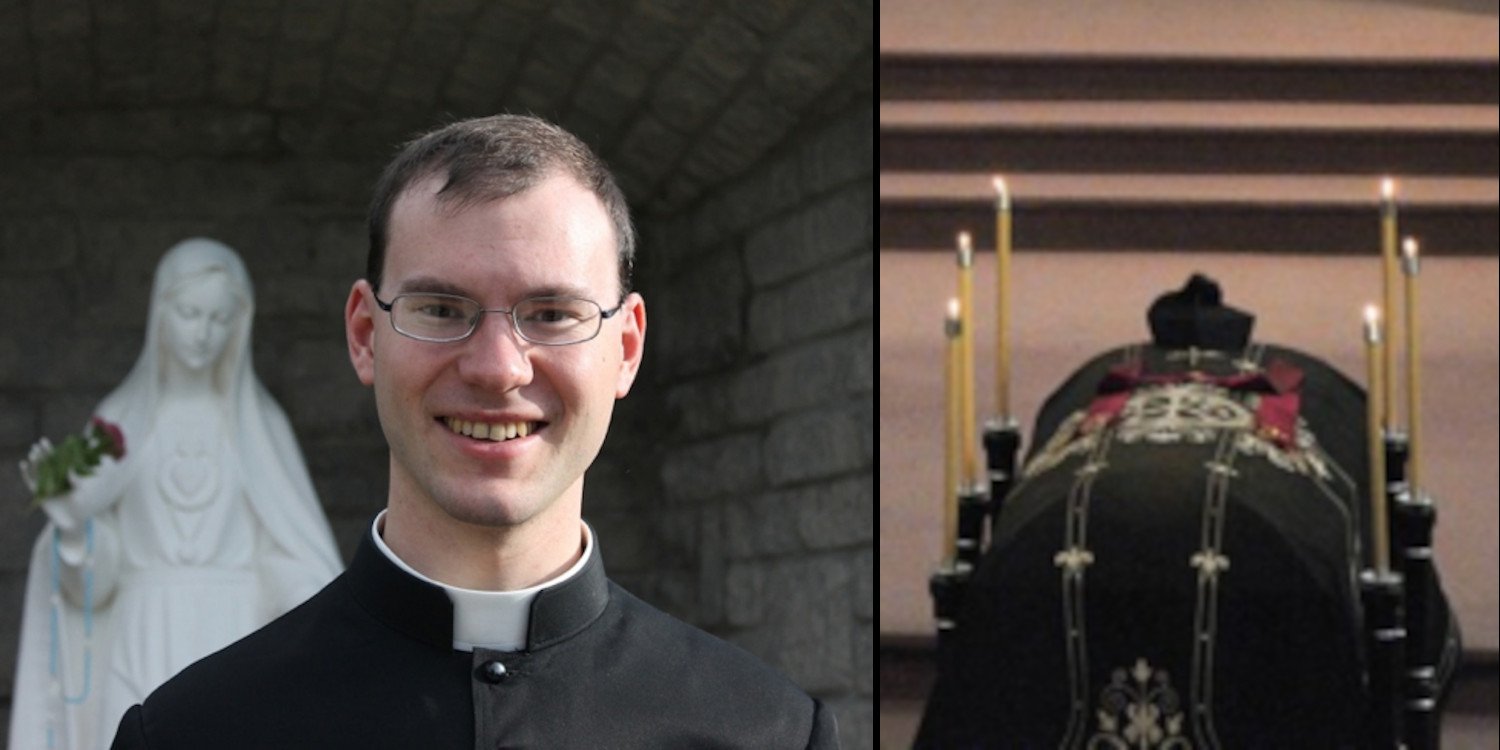
Jesus Wept: The Death of Father Kenneth Walker, FSSP
At a Phoenix Catholic church on June 11, 2014 Fr Kenneth Walker was murdered and Fr Joseph Terra brutally beaten by a man paroled from prison six weeks earlier.

At a Phoenix Catholic church on June 11, 2014 Fr Kenneth Walker was murdered and Fr Joseph Terra brutally beaten by a man paroled from prison six weeks earlier.
June 11, 2023 by Fr Gordon MacRae
Note from Father Gordon: Father Kenneth Walker, FSSP was tragically murdered at his parish on June 11, 2014. He was killed by a man who had recently been released from prison. Father Kenneth was 28 years old and had recently marked his second anniversary of ordination. As a priest and a prisoner, this tragedy struck me doubly. I wanted to remember him on this date with the post I wrote about him at that time. I believe this young martyr now stands in the presence of God.
With Blessings,
Father Gordon MacRae
+ + +
“Jesus wept.” Those two words in the Gospel of Saint John (11:35) comprise the shortest sentence in all of Sacred Scripture. Upon the sudden death of their brother Lazarus, his sisters, Martha and Mary, were consoled by many in their community. When they heard Jesus was coming, Martha went out to meet him while her sister Mary remained inside.
Martha engaged Jesus in a dialogue of faith in light of her brother’s death, but Mary challenged him with another kind of statement of faith: “Lord, if you had been here my brother would not have died” (John 11:32). Jesus asked to be taken to Lazarus. He saw Mary weeping, along with many others who had come to console her. Then, “Jesus wept.”
I must write of the tragic death of one of my brothers, Father Kenneth Walker, a young man I have never even met. I must write of this because I have friends who knew him, and who know Father Joseph Terra who was seriously injured in the attack that took Father Walker’s life. Like Martha in the Gospel account, I, too, believe Jesus is the resurrection and the life. But like Mary, I, too, want to say in my grief, “Lord, if you had been there, my brother would not have died.” But I believe in my heart that Jesus was there, and upon this senseless scene of human brokenness and tragic loss, Jesus wept.
For some who were not there, however, this story has all the makings of dark journalism. Father Joseph Terra, age 56, who went to investigate noises in the church courtyard, was ambushed and brutally beaten with a tire iron. Father Kenneth Walker, 28 years old and ordained just two years ago, walked in on the scene and was murdered by the intruder.
The man arrested for the murder and assaults is 54-year-old Gary Michael Moran, paroled from prison just weeks earlier having been convicted in 2005 of home invasion, burglary, and assault with a deadly weapon. In that case, he had stabbed a man in the abdomen before being subdued. Four years before that, he was sentenced in another case involving weapons. Moran did not know any of his victims then or now. In 2005, he said that he was crazed on methamphetamine, and cited a long history of drug abuse and its usual desperation for money to feed itself.
And in what has suggestively become the darkest fodder for politicizing the news of this tragedy, the gun that was used to kill Father Kenneth Walker did not belong to the crazed killer. It belonged to Father Joseph Terra. As the dust settled upon this case, I had no doubt that one or both ends of a political and moral spectrum would take this up, take it out of its context, and abuse this aspect of the story ad nauseam into a cacophony of political correctness.
That would be neither fair nor just, and if this aspect of the story gathers steam into a post mortem controversy, I believe you should give it the attention it deserves — which is none whatsoever. Father Joseph Terra bears no blame whatsoever for this tragedy, and is in fact one of its victims.

The Duty of Defense
Already, the mere fact that Father Joseph Terra owned a gun is littering the online world with suggestive overtones of disdain. Columnist EJ Montini, writing June 16 for AZCentral.com, had a posting entitled: “Should Catholic priests carry guns?” Of the murder of Father Walker, Mr. Montini wrote:
“The two priests operated in a tough part of town. And priests have as much right to protect themselves as anyone else. But does it seem incongruous for a priest to have a gun? … the former altar boy in me can’t imagine any of the priests I met as a kid carrying a weapon.”
I am not advocating that priests carry handguns, and in fact there is no evidence at all that Father Joseph Terra ever did. According to the news accounts, after being brutally beaten with a tire iron, which fractured his skull among other serious injuries, he had to flee the scene to retrieve a weapon kept in a rectory nightstand. He then returned to try to stop the intruder from intruding any further. The crazed meth addict allegedly wrestled the weapon away from Father Terra, and then shot and killed Father Walker who had just entered the scene.
Can “the former altar boy” in EJ Montini imagine the priests he knew as a kid being beaten to death in their churches by crazed meth addicts? Until he can, he has no right to cast a shadow on the fact that a citizen who defended himself was also a Catholic priest. These men of God were not attacked for some high ideal such as their profession of faith. They were attacked — one murdered and one nearly so — for the mere contents of their wallets, and whatever plunder could be carried off.
EJ Montini equated this scene with a story of a World War II priest chaplain in a war zone who was “armed” only with his rosary. The comparison was an insult to both our intelligence and our faith. Has Catholic culture in America become so comfortable with the notion of the last two decades that its priests should be little more than expendable targets with no ability or right of self-defense?
One friend with whom I spoke of this case by telephone this week asked if my position on Father Terra’s gun seems incongruous with the case against capital punishment that I laid out in “Stay of Execution: Catholic Conscience and the Death Penalty.” It is not, and in fact the very same moral principles apply to Father Terra’s right and duty of self-defense. The Catechism of the Catholic Church (CCC 2263) quotes Saint Thomas Aquinas in the morally legitimate defense defined in CCC 2264 and 2265:
“The act of self-defense can have a double effect: the preservation of one’s own life, and the killing of the aggressor. . . . The one is intended; the other is not..”
— St. Thomas Aquinas, Summa II-II, 64,7
“Therefore it is legitimate to insist on respect for one’s own right to life. Someone who defends his life is not guilty of murder even if he is forced to deal his aggressor a lethal blow.”
— CCC 2264
“Legitimate defense can be not only a right, but a grave duty for one who is responsible for the lives of others. The defense of the common good requires that an unjust aggressor be rendered unable to cause harm.”
— CCC 2265

The Death of Father Michael Mack
This story has brought back to me the full brunt of another tragic and eerily similar death of a priest with whom I once lived and who was — and remains — my friend. It’s an account that has come back to haunt me many times in the 12 years since it occurred, and with the Father Walker and Father Terra tragedy it has come back to haunt me again. I wrote some of this in a post called “The Holy Longing: An All Souls Day Spark for Broken Hearts,” but I had left out an important factor that I have often reflected upon since. What if I had been there?
On December 7, 2002, the Vigil of the Immaculate Conception, Father Michael Mack started a letter to me in prison from his rectory room in a parish in the Gallup, New Mexico Diocese where he had been assisting for several months. In the letter, Father Mike wrote of his decision to return to his community, the Servants of the Paraclete, and indeed was leaving that moment to commence the four-hour drive. He promised to continue the letter upon his return to the home he and I once lived in while I was a guest of that community, and a member of their staff in a ministry to wounded priests.
Late that night, as I was later able to piece together, Father Michael’s letter continued. Upon his arrival at the Servants of the Paraclete residence at midnight, he wrote of his happiness at finally being home, and of his hope that he might visit me in prison, might correspond more, and might help restore my freedom.
As he finished his midnight letter, Father Michael, who would have turned 60 two weeks later, did not know that he was not alone in that house. A 33-year-old drifter named Steven Degraff had chosen that night to break in through a back door, noting that the house had been empty for weeks as he staked it out. Armed with a knife and a hammer, hiding in a closet just fifteen feet from the desk where Father Mike finished his last letter to me, Steven Degraff awaited his moment to spring upon my friend.
Father Mike took his letter outside to a mailbox to be picked up the next day, and then walked back into that house to his death. His body was found the next day. Father Mike had been beaten to death with a hammer. The intruder then took Father Mike’s wallet and fled in Father Mike’s car.
Being in prison where no one can contact me except by mail, Father Mike’s last letter to me reached me just minutes before news of his murder. After mail call on the evening of December 12, 2002, I sat at a table outside my cell to read my friend’s letter. I can never forget this moment. As I read, someone laid the previous day’s newspaper on the table. With Father Mike’s letter still in my left hand, I turned the page to “National News Briefs” and read of his murder.
Days later, Steven Degraff was arrested in neighboring Santa Fe County for stealing yet another car, and for drug paraphernalia. He had served prison sentences in four states before killing Father Mike, a crime for which he confessed to police.
December 2002 was also the height of the nationwide explosion of claims of sexual abuse by priests, and the lurid news was not lost on Steven Degraff. Once Degraff talked with a lawyer, and learned that his murdered victim was a priest, he changed his story. This 33-year-old sociopath admitted that he broke into the home, but added that he killed Father Mike because the priest tried to molest him. Fortunately, even at the peak of nationwide witch hunt about priests, Steven Degraff’s story was dismissed as a blatant lie, but not before it became lurid fodder for some in the news media.
Since then, I have often thought of what I might have done had I still lived in that house and was there with Father Mike that night. These are not pleasant thoughts for a priest — for anyone. In more reflective moments, I wish I could have left in that house the means for my friend to defend his own life. I have no doubt in my mind that if I had been there, Father Michael Mack would not have died.

Blaming Father Terra ... Raising up Psychopaths
Finally, I must write of this story because I have lived for two decades with one foot in both worlds: the world of Father Kenneth Walker whose life was taken, and Father Joseph Terra beaten and scapegoated; and the world of Gary Michael Moran, the career criminal and methamphetamine addict released from prison just six weeks before these horrific Phoenix crimes. I do not, as you know, live in that latter world by choice, or even by any act of my own.
But in the two decades in which I have been forced to live in that world, I have encountered many men like Gary Michael Moran and Steven Degraff in prison. Don’t think it is lost on me for a single moment that Moran had been paroled from prison three times — and the sociopath Steven Degraff four times — during the two decades that I have been kept in prison for crimes that never took place. This story is not about me — I know that — but it is a sobering thought for anyone who still believes America’s criminal justice system is not broken and still works in real life like it does on TV’s “Law and Order.”
Far more than prison itself, however, it is the “Pollyanna” naiveté of so many Americans — both Catholics and not — that I find most demoralizing. The notion that men would not possibly accuse Catholic priests just for money is laughed at in prison by criminals like Gary Michael Moran and Steven Degraff. I have met some in prison who have snuffed out lives for a tiny fraction of the $200-grand doled out by my diocese to anyone ready to point at any priest.
I can no longer even count the number of times the minds of criminals have wandered in my direction, exploring ways to exploit our Catholic blindness about them while priests are thrown out of ministry — and sometimes into prison, and kept there. Should my post, “Our Catholic Tabloid Frenzy About Fallen Priests” now include even those who seek to defend themselves?
Might this tragedy in Phoenix cause some soul stirring about the bigger picture it represents? We can hope, and in fact it already has. A remarkable blog post by Rebecca Hamilton, “Guns. Blaming Father Terra for Trying to Defend Himself. And Raising Up Psychopaths.” (June 20, 2014) stands out among all the suggestive undertones about who wielded the murder weapon and how. I recommend reading all of it, but here is a portion that gave me pause:
“Guns are not the problem. We are. … The problem is our unwinding society and the feral young people we are raising up inside it. ... The blame-Father-Terra crowd is part of the problem... Good, normal people are always at a disadvantage in these situations ...”
I have prayed for Steven Degraff over these twelve long years, and I will pray for Gary Michael Moran. So will the families, friends, and parishioners of Father Joseph Terra and our tragically lost son and brother, Father Kenneth Walker. These people are not Catholic lite. They know their duty to the Gospel, and they will do it.
And as for Father Joseph Terra, I hold you in the highest regard, and with the deepest respect. I humbly ask for your prayers, and from prison I offer you my fraternal Blessing. May Divine Mercy reign in our hearts.

Funeral Mass for Father Kenneth Walker, FSSP
+ + +
Thank you for reading and sharing this Special Post. We will occasionally add other Special Posts to honor significant dates. You may also like these related posts:


The Eucharistic Adoration Chapel established by Saint Maximilian Kolbe was inaugurated at the outbreak of World War II. It was restored as a Chapel of Adoration in September, 2018, the commemoration of the date that the war began. It is now part of the World Center of Prayer for Peace. The live internet feed of the Adoration Chapel at Niepokalanow — sponsored by EWTN — was established just a few weeks before we discovered it and began to include in at Beyond These Stone Walls. Click “Watch on YouTube” in the lower left corner to see how many people around the world are present there with you. The number appears below the symbol for EWTN.
Click or tap here to proceed to the Adoration Chapel.
The following is a translation from the Polish in the image above: “Eighth Star in the Crown of Mary Queen of Peace” “Chapel of Perpetual Adoration of the Blessed Sacrament at Niepokalanow. World Center of Prayer for Peace.” “On September 1, 2018, the World Center of Prayer for Peace in Niepokalanow was opened. It would be difficult to find a more expressive reference to the need for constant prayer for peace than the anniversary of the outbreak of World War II.”
For the Catholic theology behind this image, visit my post, “The Ark of the Covenant and the Mother of God.”

Origin by Dan Brown, Like The Da Vinci Code, Is Bunk
In The Da Vinci Code, Dan Brown debunked Scripture to discredit Christianity. In Origin, he debunked science to discredit God. It is Dan Brown who needs debunking

In The Da Vinci Code, Dan Brown debunked Scripture to discredit Christianity. In Origin, he debunked science to discredit God. It is Dan Brown who needs debunking.
June 7, 2023 by Fr Gordon MacRae
Note to readers: Back in 2018 I wrote a post entitled “The Once and Future Catholic Church.” It tells an historically true account of a well documented event from the Sixth and early Seventh Century AD that took place in the life of Muhammad, founder of Islam. In 2011, the European Union High Court upheld the conviction of a seminar presenter who recounted this true story in a public lecture. The High Court ruling was that, though the story is historically accurate, retelling it in the present can only be to disparage Muhammad and Islam, which was the basis for the charge and fine.
Now, jump ahead a few years. You may have read or heard recent news about the Los Angeles Dodgers baseball team and its annual “Pride Night” celebration. The Dodgers are the leading baseball franchise in a city that is one third Catholic. Nonetheless, its managers thought it politically correct to present an award to a famously outrageous group calling itself the “Sisters of Perpetual Indulgence.” They describe themselves as a “leading-edge order of queer and trans nuns” They are most visible for their crude depictions of sacred Catholic rituals to mock the Church and its moral teachings on homosexuality and transgenderism. After some protest from the Catholic League and other voices, the Dodgers thought it best to withdraw the invitation and award. But then they caved to a louder and more demanding outcry from members of the LGBTQ+ community. The Dodgers have renewed their award to the Sisters of Perpetual Indulgence. And there, the matter stands.
The Wall Street Journal published two editorials about this high-profile debacle. One of them was by columnist Gerard Baker entitled, “The Bigotry That Proudly Speaks Its Name” (WSJ, May 30, 2023). I published one of the more than 2000 comments on this column in the WSJ, and my comment did not spare Church leaders for the setting in which such things happen today. Here is my comment:
“It would be unimaginable today, and not at all tolerated, if a similar disparagement was aimed at Islamic traditions or Jews. Neither would put up with it and rightly so. Catholic leaders in the United States especially have set the stage for this sort of ridicule by their open embrace of “Catholic Lite” and their practice of partisan politics. There are some faithful and courageous bishops who stand by the tenets of faith no matter the political cost. Bishop Strickland of Tyler, Texas comes to mind. Cardinal Dolan has also had his moments in the sun. However, the US bishops as a group have let pass opportunities to stand strong against the tide of relativism in support of life and their own Catholic traditions. They handle the second Catholic President in US history by entirely overlooking his living insult to the cause of life and what it means to be a faithful Catholic. Conservative bishops and priests are silent in the current regime out of fear of being cancelled. On the advice of liberal bishops, Pope Francis has marginalized the most faithful among us. It is no wonder that pop culture treats the Catholic Church as a farce. The late Father Richard John Neuhaus proposed a radical approach to saving the face of the Church in America: ‘Fidelity, fidelity, fidelity.’”
— WSJ, Gordon J. MacRae, June 1, 2023

There are many other factors that have lent themselves to the disparagement of Christianity and especially the ridicule of Catholicism in popular culture in a time when the very concept of “truth” is distorted as malleable and subjective.
As most readers of this blog know, I work as a clerk in a prison library. Granted, it a specialized legal library but a general library is attached to it with about 25,000 volumes available for education or entertainment. Too often, those two categories are blurred by some modern authors.
That is probably most true for authors like Dan Brown, a New Hampshire resident and an author of some of the most popular fiction that has been enjoyed by many but reinterpreted as scholarship by too many. I first wrote this post as a sort of public service in 2018 to counter in some small way the blatant disinformation in Dan Brown’s books. This is one of the posts I have long wanted to restore and update, but I ended up rewriting it for posting anew. Two millennia of Christian truth should not be simply waived away by the pen of a popular writer of highly distorted fiction masked as historical scholarship.
+ + +
Etymology, the study of the origins and meanings of words, has long been a fascination for me. So before delving into the claptrap and bunk of some of Dan Brown’s most popular novels, my terminology requires a little background.
“Claptrap” is often mistakenly used to refer to faulty logic or insincere babble, but that is not its only usage. Coming from the early days of modern theater, “claptrap” refers to a line or opinion inserted into a play for the sole purpose of generating applause. Thus a “claptrap” might be something like a subtle political reference for which some in agreement might spontaneously applaud. In turn, the rest of the audience would applaud because they did not want to appear that they missed the point. Claptrap is highly manipulative prose.
A similar modern day application is the laugh track on any one of several popular television sitcoms. The laugh track is subtle and often unnoticed, but if you listen carefully you will hear pre-recorded laughter from a non-existent audience. It is your cue that it’s time to laugh. The laugh track seems manipulative and irritating. Once you hear it, you can’t NOT hear it.
I characterize some of Dan Brown’s novels as claptrap because they undermine Christian traditions and beliefs at a time when the news media and pop culture have Christianity squarely in their sights for ridicule. In 2003, the Catholic Church in America was embroiled in a credibility crisis. Dan Brown chose that time in particular to take advantage of this momentum by publishing The Da Vinci Code. I’ll get around to debunking it in a moment.
But first, “bunk” and “debunk” are the other terms I want to explain. To say that some piece of information is “bunk” is commonly used to mean that it is false or contrived. Thus to “debunk” something is to expose its falsehood. There is more to these terms, however. The word “bunk” comes from a source where inarguably lots of bunk has originated: the floor of the United States Congress. During the 16th Congressional Session from 1819 to 1821, Congressman Felix Walker represented Buncombe County, North Carolina. One day, he held a captive audience when he droned on for hours with an incomprehensible speech despite protests from his colleagues.
Congressman Walker’s district, Buncombe County, was sometimes spelled “Bunkum” County by the less literate, and it was often referred to in conversation simply as “Bunk.” So both the word and the place became associated with that one nonsensical speech. Thus, “bunk” came to refer to a drawn out, illogical display of nonsense with no real conclusion. However, the remedy for bunk was delayed for a century in North Carolina. The word, “debunk” did not appear in any official document or literature until 1923.

The Legend of the Holy Grail
The premise of Dan Brown’s book, The Da Vinci Code, is that the famous 15th Century painter, Leonardo Da Vinci, embedded within his art a set of symbols for some enlightened future generation to find and interpret. It’s really Dan Brown’s Code because there is nothing in the field of art history to support it. The principal character and interpreter of the “secret” symbols in this and several other Dan Brown novels is Robert Langdon, a Harvard “Symbologist.” Brown does not make it easy to critique Langdon and his interpretations because the field of Symbology does not exist at Harvard or anywhere else.
And what these secret symbols supposedly reveal to Dan Brown’s characters is bunk. His characters uncover a conspiracy through which the Catholic Church has for centuries suppressed a truth that Jesus was married to Mary Magdalene, and that together they gave birth to a bloodline. That bloodline, the supposed descendants of Jesus and Mary Magdalene, became the Merovingian Dynasty of French kings. This was all known to a secret cabal called the Priory of Sion and kept covered up by a more sinister secret society called Opus Dei. It is, as I wrote earlier, pure bunk. But it is bunk that sold over 35 million copies to a generation of readers all-too-receptive to claptrap in a world poised to applaud and embrace anti-Catholic propaganda. Dan Brown’s books have sold 200 million copies worldwide. In 2005, after a year with The Da Vinci Code topping all the bestseller lists, Dan Brown was named one of the most influential writers in the world by Time Magazine.
A clever part of the allure of Dan Brown’s fiction is his use of a literary device called “verisimilitude.” Injected into his prose are true historical facts that lend credence to an otherwise fictional, even preposterous story to give it an aura of historical legitimacy. Brown begins The Da Vinci Code with a series of facts:
“The Priory of Sion” [Brown’s “secret” cabal] — a European secret society founded in 1099 — is a real organization. In 1975 Paris’ Bibliotheque Nationale discovered parchments known as ‘Les Dossiers Secrets’ [French for ‘The Secret Documents’ – give me a break!] identifying numerous members of the Priory of Sion, including Sir Isaac Newton, Botticelli, Victor Hugo, and Leonardo Da Vinci.”
One of the principal characters in The Da Vinci Code is Leigh Teabing who is presented as a multi-millionaire British Royal Historian and world-renowned expert on the Holy Grail. Of course, Teabing does not exist. He is a fictional character, and his historical conclusions from the pen of Dan Brown are also entirely fictional.
By giving the character of Leigh Teabing history credentials, however, Brown blurs the line between truth and fiction. “The marriage of Jesus and Mary Magdalene is part of the historical record,” says Teabing (The Da Vinci Code, p. 245). Over the next few ridiculous pages in the book, the “Royal Historian” presents his proof which boils down to nothing more than the fact that the Gospels do not directly and specifically say that Jesus was never married. They also never specifically say that Jesus was not an extraterrestrial. Hmmm… I wonder!
I wrote a post awhile back entitled “Mary Magdalene: Faith, Courage, and an Empty Tomb.” It was faithful to both the historical and Scriptural truths about her identity and her presence in the Gospels, and the reality of how she became distorted over the centuries. But what Dan Brown does with her twists the distortions into truly bizarre and unfounded bunk.
One of these conclusions is that history and the Catholic Church have suppressed and replaced a hard and demonstrable truth that Mary Magdalene is herself the Holy Grail. The prose is laughable. Looking at Leonardo Da Vinci’s late 15th Century masterpiece, The Last Supper, (depicted atop this section) Brown’s characters spot a secret symbol hidden for centuries from less enlightened eyes:
“‘The Holy Grail is a woman,’ Sophie thought… ‘You said you have a picture of this woman who you claim is the Holy Grail. [Teabing] wheeled suddenly and pointed to the far wall. On it hung an eight-foot-long print of The Last Supper… ‘There she is.’”
— The Da Vinci Code, p. 242
The characters of The Da Vinci Code then conclude that the figure to the right of Jesus in Leonardo’s painting may be a woman, then they conclude that the figure “must” be a woman, then they conclude that she “must” be Mary Magdalene, and that she and Jesus were married. Then they conclude that the Holy Grail was in fact at the Last Supper. Then finally they conclude that the Grail must actually be Mary Magdalene and not the Chalice. “So this is the woman who singlehandedly could crumble the Church!” said Sophie. (p. 243)
Sophie and Teabing then go on to “discover” that the Apostolic tradition and the See of Peter was an enormous mistake. Christ “must” have intended that the Church be in the hands of His “wife,” Mary Magdalene.
This alternative history in The Da Vinci Code entirely overlooks the fact that the Holy Grail was not a term at all familiar to the early Church. It first appeared in literature in the late 12th Century in Chrétien de Troyes’ romance novel, Perceval. From then on the term was solely a reference to the vessel containing the blood of Christ at the Last Supper. Another medieval legend was that Joseph of Arimathea acquired it after using it to contain the blood of Christ at the crucifixion. By the early 13th Century, the Holy Grail became attached to the Arthurian legends as a symbol of holiness and perfection sought by the Knights of the Round Table. In every source from medieval times to the present, the Grail refers to the cup of Christ’s blood sacrificed at the Last Supper or sacrificed on the Cross, or both.
Dan Brown’s “claptrap” revelation that Mary Magdalene, supposed wife of Jesus, is the Holy Grail intended by Christ to found His Church was followed in the book by another one. This one unmasks the real reason why Brown chose that moment in time — 2003 — to publish his barely shrouded anti-Catholic bigotry:
“Yes [said Teabing] the clergy in Rome are blessed with potent faith, and because of this, their beliefs can weather any storm, including documents that contradict everything they hold dear. But what about the rest of the world?… Those who look at Church scandals and ask, who ARE these men who claim to speak the truth about Christ and yet lie to cover up the sexual abuse of children by their own priests?”
— The Da Vinci Code, p. 266

Dan Brown’s Origin
Dan Brown’s knack for bunk has not diminished with time. According to the official DanBrown.com website, his 2017 book, Origin, addresses the two most important questions for humankind: “Where did we come from?” and “Where are we going?” The book already topped the best-seller lists when I wrote the earlier version of this post in 2018, but reviewers did not seem as enthused as Brown’s ready-to-be-misled-again readers. Here’s how The Week magazine summarized a review by Ron Charles in The Washington Post:
“Dan Brown is back, along with his Vatican-flouting, code-breaking hero, for another thriller so moronic you can feel your IQ points flaking away like dandruff. Symbologist Robert Langdon — Mickey Mouse watch still ticking — has joined a gathering where a computer genius is about to announce a discovery that will invalidate all existing religious doctrine. But before the secret is revealed, the speaker is taken out by an assassin, and with 300 pages to go, I wondered, ‘why couldn’t it have been me?’”
Janet Maslin, in a somewhat gentler review for The New York Times, referred to Brown’s “cringe-worthy prose,” but applauded his “clever use of settings” and “legitimately intriguing musings about the intersection of science and religion.” That caught my attention because the intersection between science and religion is something I have written a good deal about. In Origin, Dan Brown replaces the intersection with a collision.
The gist of Origin’s plot is that an M.I.T. physics professor named Jeremy England has “identified the underlying physical principle driving the origin and evolution of life.” The discovery is an earth-shattering disproof of every religious story of creation. The discovery threatens to render religion obsolete and God irrelevant. Dan Brown sets this latest bunk in motion with such blatant disregard for the bigger picture that something never before heard of in the world of literature has taken place. One of Brown’s own fictional characters has refuted him and in no less a public forum than The Wall Street Journal. This is from the real M.I.T. physics professor, Jeremy England:
“My actual research on how lifelike behaviors emerge in inanimate matter is widely available, whereas the Dan Brown character’s work is only vaguely described. There’s no real science in the book to argue over.”
— Jeremy England, “Dan Brown Can’t Cite Me to Disprove God,” WSJ.com Oct. 13, 2017
But in addition to debunking Dan Brown’s science in the book, Professor England’s op-ed reveals a wider rift that causes me to wonder whether Brown did any homework on his own character. The real M.I.T. professor Jeremy England wrote,
“I’m a scientist, but I also study and live by the Hebrew Bible. To me, the idea that physics could prove that the God of Abraham is not the creator and ruler of the world reflects a serious misunderstanding – of both the scientific method and the function of the biblical text… Disputes like this never answer the most important question: Do we need to keep learning about God? For my part, in light of everything I know, I am certain that we do.”
— Jeremy England, WSJ.com
No person of either faith or science should pick up Dan Brown’s Origin without first reading Professor England’s “Dan Brown Can’t Cite Me to Disprove God.” It made me want to stand up and cheer, not only for Dan Brown’s comeuppance but for another profound observation by the real Jeremy England:
“Encounters between God and the Hebrew prophets are often described in terms of covenants, partly to emphasize that seeing the hand of God at work starts with a conscious decision to view the world a certain way.”
Dan Brown seems to have made his conscious decision in the opposite direction and has misled millions of undecided souls along the way. The challenge for us is to make the conscious decision to see the world as Jeremy England does because real science cannot pretend to replace faith — Dan Brown’s claptrap and bunk notwithstanding.
Note from Fr Gordon MacRae: Please visit and share these other “bunk free” posts on the intersection of science & religion:
Father Georges Lemaître, The Priest Who Discovered Big Bang
The March for Life and the People on the Planet Next Door

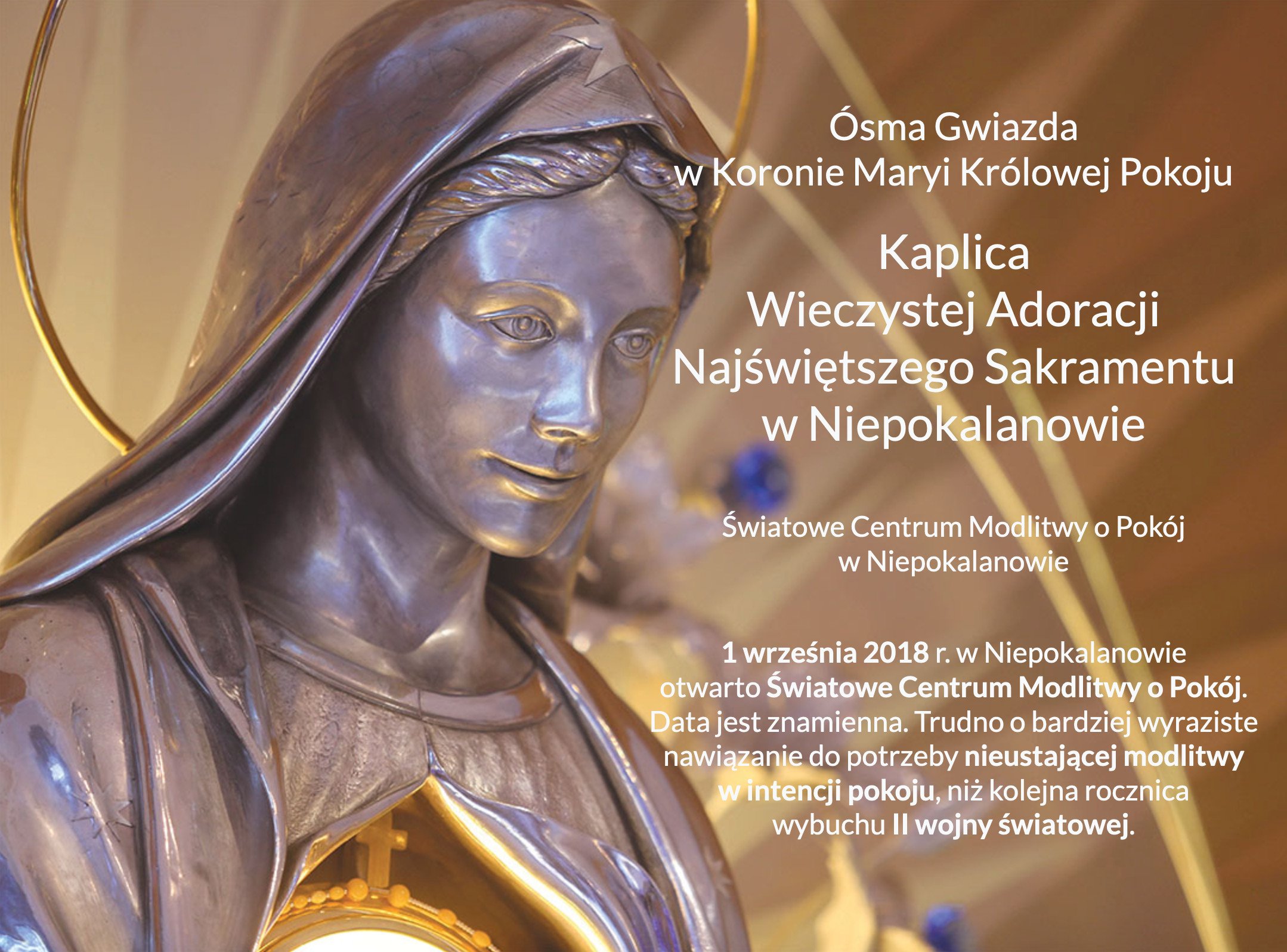

The Eucharistic Adoration Chapel established by Saint Maximilian Kolbe was inaugurated at the outbreak of World War II. It was restored as a Chapel of Adoration in September, 2018, the commemoration of the date that the war began. It is now part of the World Center of Prayer for Peace. The live internet feed of the Adoration Chapel at Niepokalanow — sponsored by EWTN — was established just a few weeks before we discovered it and began to include in at Beyond These Stone Walls. Click “Watch on YouTube” in the lower left corner to see how many people around the world are present there with you. The number appears below the symbol for EWTN.
Click or tap the image for live access to the Adoration Chapel.
The following is a translation from the Polish in the image above: “Eighth Star in the Crown of Mary Queen of Peace” “Chapel of Perpetual Adoration of the Blessed Sacrament at Niepokalanow. World Center of Prayer for Peace.” “On September 1, 2018, the World Center of Prayer for Peace in Niepokalanow was opened. It would be difficult to find a more expressive reference to the need for constant prayer for peace than the anniversary of the outbreak of World War II.”
For the Catholic theology behind this image, visit my post, “The Ark of the Covenant and the Mother of God.”
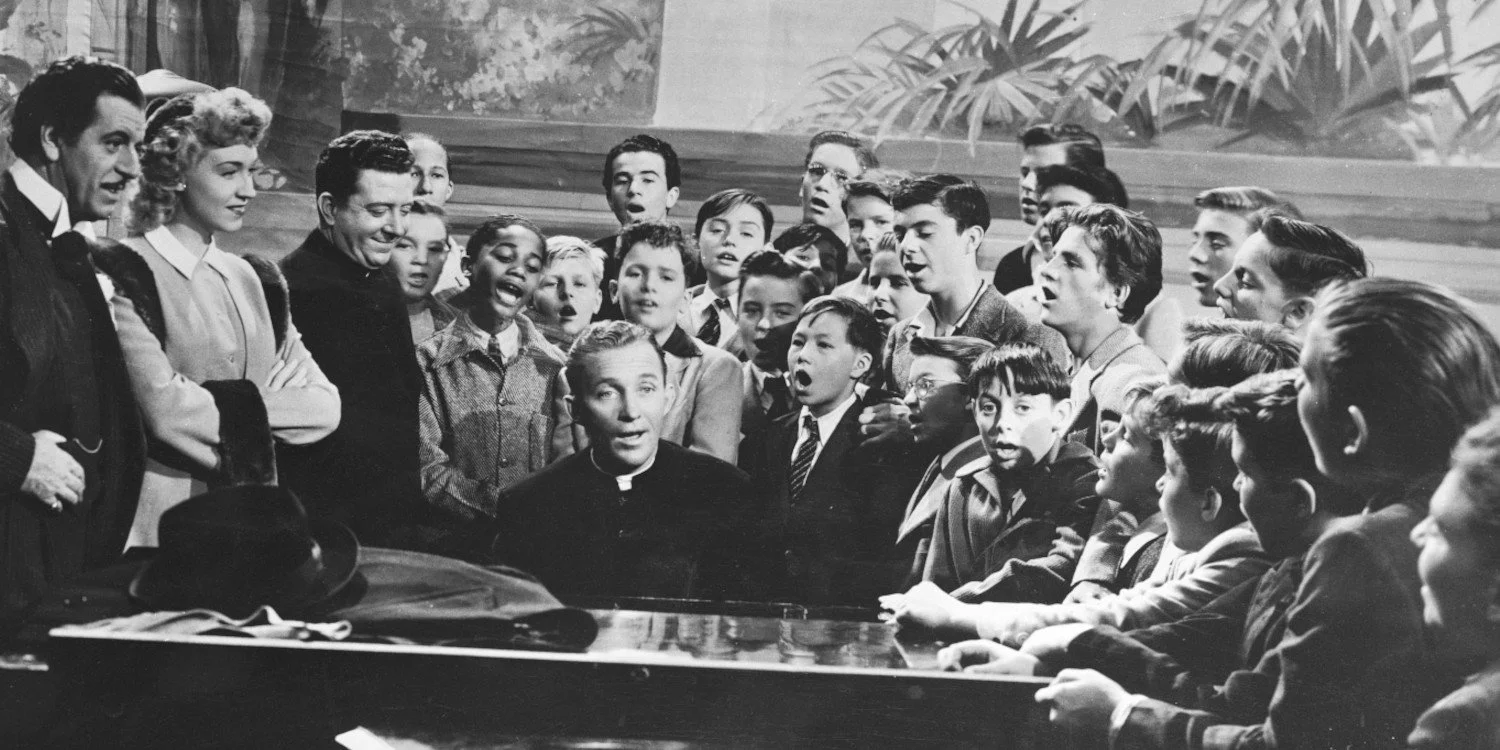
Priesthood Has Never Been Going My Way
Marking forty-one years of priesthood, twenty-nine of them in unjust imprisonment, the faith of this priest has been sorely tested, but he remains a man in full.
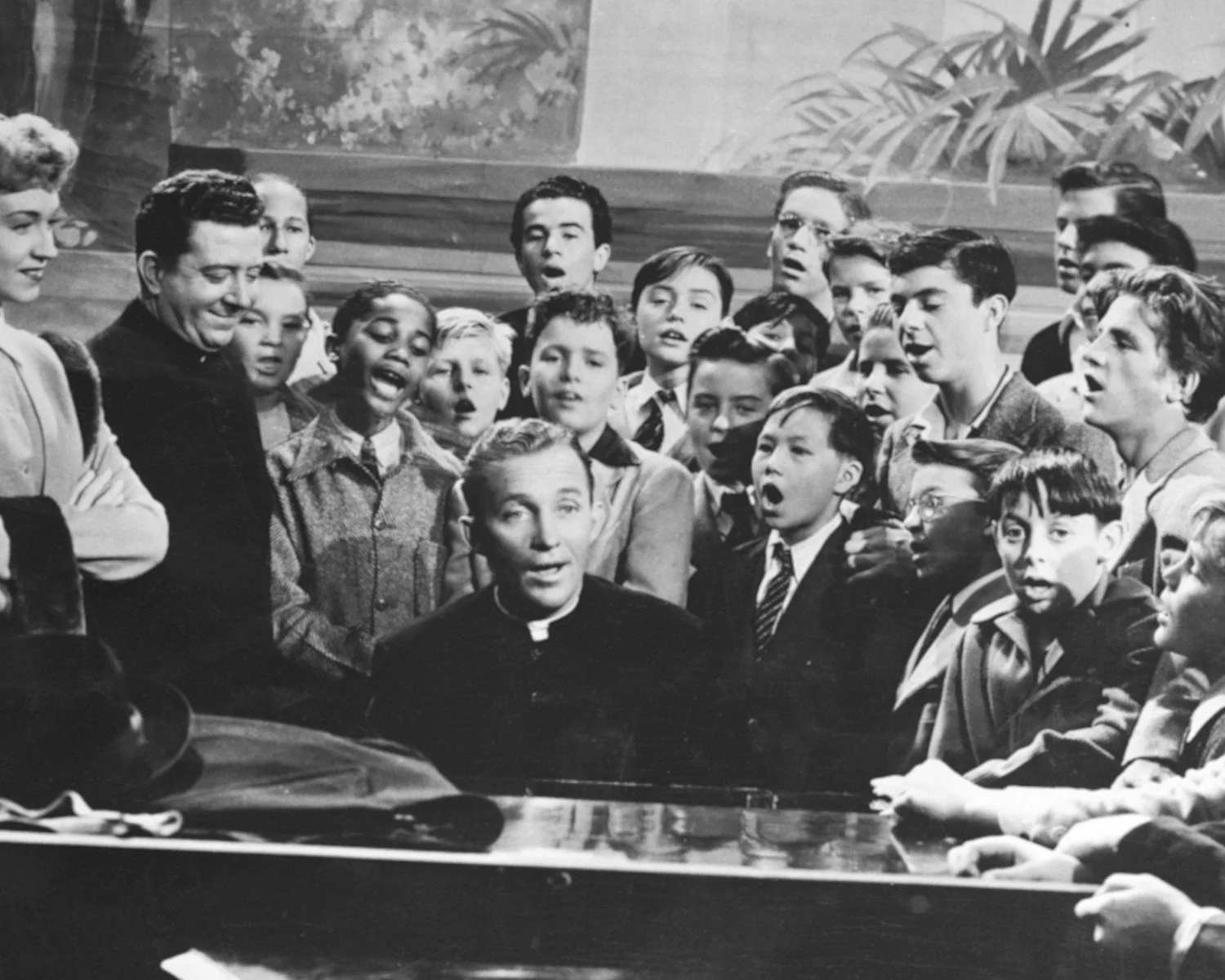
Marking forty-one years of priesthood, twenty-nine of them in unjust imprisonment, the faith of this priest has been sorely tested, but he remains a man in full.
May 31 , 2023 by Fr Gordon MacRae
In 1945, at the end of World War II and eight years before I was born, the film “Going My Way” swept the Academy Awards for Best Picture, Best Director, Best Screenplay, and Musical Score. The film about a Catholic priest trying to save a struggling urban parish was a huge box office hit. Bing Crosby won the Best Actor Oscar for his role as Father Chuck O’Malley, a spirited young priest sent as a last-ditch effort to revitalize the dying parish. Barry Fitzgerald won the Oscar for Best Supporting Actor in the role of the elderly pastor, Father Fitzgibbon.
Bing Crosby’s Father Chuck O’Malley saved the day and the parish when he organized a neighborhood gang into a “bit rough around the edges” choir. Father O’Malley then composed a hit song and taught them to sing it. “Swinging on a Star” topped the charts and won the Oscar for Best Song. The young men saved the church while Father O’Malley saved them. The film also swept the Golden Globe and New York Film Critic awards.
Jump ahead 60 years. In 2005 another film about Catholic priests won the Academy Award for Best Picture and won The Boston Globe an ill-conceived Pulitzer for “Public Service.” That scornful film was “Spotlight,” a one-sided, jaded, cynical effort to smear the Church and priesthood with a broad brush as “slayers of the soul.” The critics and media were delighted, but not all the critics bought it. One of them, the brave journalist JoAnn Wypijewski, performed an autopsy on it. Though I never figured into the film, I had a strong presence throughout its autopsy in “Spotlight Oscar Hangover: Why ‘Spotlight’ Is a Terrible Film.”
The sixty-year period in between these two motion pictures saw perhaps the greatest cultural swing the Western World has ever known. The media turned left and the left became its master. Then the Second Vatican Council radically altered the world’s view of the Church. Then Roe v. Wade happened and the not-yet-woke Church came down on the side of life. All the attacks hence were really about Roe v. Wade. Then the “woke” were born.
On June 5, 1982, as this rapid descent in the world’s view of the Church and priesthood was well into its decline, I was the sole candidate for priesthood ordination in the Diocese of Manchester, New Hampshire. Twelve years later, I collapsed under the weight of several other tragedies that unfolded all around me. It’s a story that I have never been able to make sense of. It has elements of the demonic, but here I still stand. Author Ryan A. MacDonald did some excavation of it and wrote much of it, but not all, in an eerie account entitled, “The Story Buried Under the Fr. Gordon MacRae Case.”
At the end of this post, we will link again to this and other posts referenced here, but I leave it up to you whether to read them. They leave most people, me included, just scratching our heads wondering how this could all happen.
But there is a “rest of the story” known, to date, only to one other, and that person has since passed from this life. In 1977 and 1978 I spent long hours with this story in the company of an old friend, Fr Benedict Groeschel. Before he became a founder of the Franciscan Friars of the Renewal, we were members of the same Capuchin province based in New York. Father Groeschel was aware of all that had happened, and he listened intently to its impact on me. In 1978 he and I together discerned the path that I must take. I’ll get back to that, but first back up a few years.

In the Eye of a Storm
Four years after high school graduation, I entered the novitiate of the Capuchin Order in 1974. I knew immediately that I was on the right path in life. I did not have much of a family life growing up, and the Capuchin emphasis on life in community drew me in. One of my friends in the Order grew up in an orphanage, and I admired how he treasured the accountability and support of a religious community that most others took for granted.
I was a very good student. Carrying a double major in both psychology and philosophy on a full scholarship at St. Anselm College nearby in New Hampshire, I thought I had the perfect balance of spiritual life, intellectual growth, and physical work. When I was not studying, I chopped firewood for long hours day after day. A lot of stress was vented, and some wounds long neglected began to heal.
I loved my community and developed many close friendships among its members. Two of those friendships were with classmates from the Island of Guam and the Northern Mariana Islands. We were the same age and college classmates. The three of us bonded and often studied together, and I learned a great deal about the home they left behind on the far side of the world. At that time, Guam was a mission territory for the Order and several members of our Capuchin province were assigned there. I began to discern signs that Guam may be where my future lies.
Then a tragedy struck that blindsided me and forever altered my path. Being far from home for long periods of time had an effect on my friends. One of them began to exhibit signs of extreme stress manifested in paranoia. One night he knocked on my friary door awakening me at 3:00 AM. He frantically asked me to come to his room. I went with him and found there a butcher knife impaled in his mattress with a typewritten note threatening his life.
My friend appeared very shaken, so I remained with him until dawn and then took him and the evidence to the room of our religious superior. My friend related what he knew about the incident. However, something in his tone and substance troubled me. Similar incidents occurred on two more occasions over the next week. After the second such incident, I told the local superior of my concern that my friend had done this to himself and needed immediate help.
Then it happened again. On the next day, I was summoned to the office of the superior. Accompanied by two other senior members of the Order, he accused me of plotting to murder my friend. I reiterated my concern that my friend was under extreme stress and had been doing this to himself. That only made matters worse. The superior had in his hands the ribbon from my typewriter where the threatening notes had clearly been typed — but not by me.
For the next two weeks I was confined to quarters and forbidden from speaking with anyone. I was also going through final exams for the year in that same week. I aced them, but to this day I do not know how. This happened in the Spring of 1977. At the end of two weeks, the local superior summoned me again. One priest on the formation staff was skeptical of the conclusions so he spent a few nights observing my friend. Then one night he saw him come out of his room, return with a knife, and plunge it with another note into his own mattress. My friend was then taken away in the night.
The superior who later summoned me again told me only that his investigation was complete and that he concludes that I had nothing to do with these events except that I was a friend of the other Capuchin. “You should just forget about all this and keep doing what you’ve been doing,” he said. And it was over.
Father Benedict Groeschel
But it wasn’t really over. Because I was barred from speaking of the incident, no one else in the Province was told any of the truth of this story or its outcome, except the Provincial Council on which Fr Benedict Groeschel served. The rest of the Province knew only that my friend disappeared in the night and I had been a suspect. I was not able to learn anything of what had happened to my friend. To protect him from any further exposure, I spoke of this to only one person, Father Groeschel, a psychologist and respected member of the Province. I decided then that I could not remain in the Order. Among all the feelings of betrayal, injustice, and anger at the rush to judgment, I was first and foremost heartbroken.
When I learned that my friend had typed these notes on my typewriter while I was away, and then carried out these assaults upon himself just as I had feared, I was furious not at him, but at those who would not listen because their minds were already made up. I never saw or heard from my friend again, and never learned what was behind his pleading cry for help made through me. I also never learned what became of him.
I was 24 years old then. I am 70 now, and still carry this after all these years. I also had no idea, then, that such devastating false witness would be repeated in my life fifteen years later as a diocesan priest.
One year later, in 1978 under the direction of Father Groeschel, the Province had given strong recommendations in support of my decision to transfer to studies toward diocesan priesthood. I completed a Master of Divinity degree and a Pontifical degree in Sacred Theology at St. Mary’s Seminary and University in Baltimore and was ordained on June 5, 1982.
The story about my friend stayed buried for the next 42 years. Then, in 2019, a previously unknown factor in it was revealed to me. A Capuchin priest from my former Province who came to this prison for Mass asked to speak with me. He told me that he remembered this incident and hoped that I did not. I told him that my life had been radically altered as a result of it. He said that he felt partially responsible. He had been pursuing a degree in Scripture studies at Harvard Divinity School in 1977, the same year as the events above. My uncle, a Jesuit, was a faculty member at Harvard at the time. One day they had a chance meeting.
After a class, my uncle approached the Capuchin priest and asked him if he and I were in the same province. He said that we were, and my uncle inquired about how I was. The events written above were just two weeks away in 1977. My uncle shared with the Capuchin that I had a difficult life growing up in a home and family devasted by the disease of alcoholism. My uncle was glad to hear from the Capuchin that I was flourishing there in community life. Two weeks after their discussion, the above story exploded in 1977. Forty-two years later that same Capuchin priest told me that he had shared that conversation with my religious superior in 1977. It was this that caused the superior then to jump to a conclusion that I must have been the one responsible for the acts of violence.
Gauging my reaction upon learning of this 42 years later told me how much the wounds left by this incident still festered. Everyone in this account — the Capuchin priest, my Jesuit uncle, even my accusing religious superior — all believed that they had acted in what they thought was my best interest balanced with that of my friend. The betrayal did not belong to any one person, but I was the only one in this scene who knew of its insanity and acted to save my friend. Forty-two years later, my anger still smoldered.
Complicating all this, the Capuchin who had come to this prison for Sunday Mass in 2019, died in his sleep just two days later. This was also the onset of the Covid pandemic and there has not been a Catholic Mass in this prison since. My own Mass offered in my prison cell has been the only Mass in this prison for the last four years.
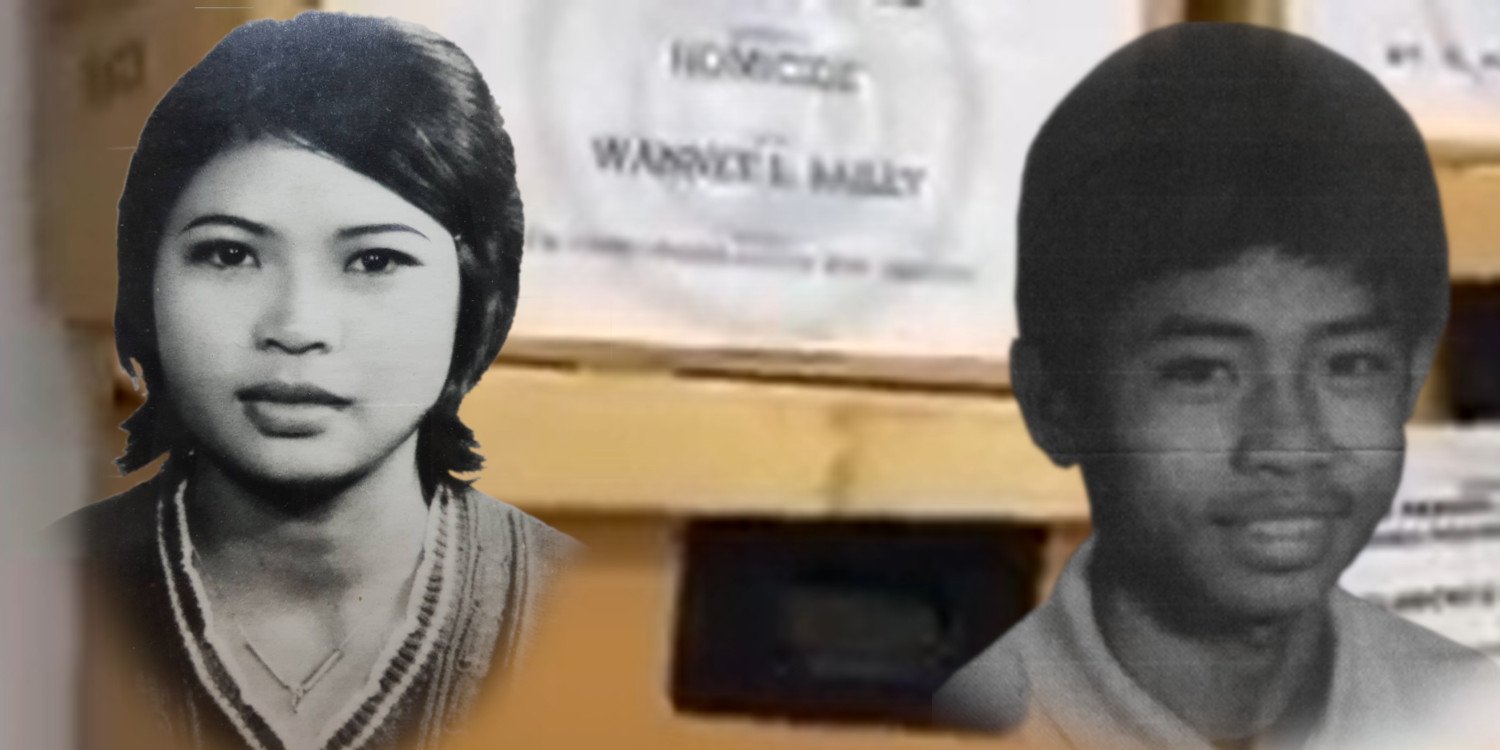
The Haunting Echoes of the Past
In 1994, as you know, I was falsely accused again and faced trial with no evidence or corroboration in a case fabricated by a police officer who is now known to have a history of corruption, including the falsification of evidence. I wrote of this most recent development in “Predator Police: The New Hampshire ‘Laurie List’ Bombshell.”
After being so accused again, echoes of how helpless and oppressed I was during the first such encounter were still with me. I became, perhaps understandably, despondent, and again I could reach out to no one. It was more than I could bear at the time, and I fell. You can read about this in a post that has hidden in plain sight since I wrote it in 2017. It is “How Father Benedict Groeschel Entered My Darkest Night.” I could have added the words, “... for the Second Time.”
In September, 2022, I wrote a post in these pages that shocked readers around the world. It might have shocked them a lot more had they known of the cross of memories I had to face and set aside in order to write it when no one else could. It is a centerpiece of my priesthood, and my magnum opus. Had I not gone through everything described in this post, I would not have been wounded enough, or strong enough, or wise enough, to become for another the saving grace that Father Groeschel had become for me.
It was a story long overdue that had to be written so I manned up, set aside the past, and wrote it. It was about events in the life of my friend, Pornchai Moontri and it had many echoes of the past for me. It was, “Getting Away with Murder on the Island of Guam.”
On June 5, 2023, I mark 41 years of priesthood out here in the Oort Cloud, that distant region of space where, among our Solar System’s detritus, I encounter others cast out among the unwanted debris. Most of those I encounter here have had lives bearing far deeper wounds than my own.
Bing Crosby notwithstanding, priesthood has never been going my way. But I have done what was recommended in these pages recently in “The Holy Spirit and the Book of Ruth at Pentecost.” I have mourned what was lost. I have let it ascend. And I have surrendered to the life — and priesthood — that I am living now. I do not have the power to change any of its past. In the present, I surrender all to the Divine Will. It is the way to peace, and a path I recommend for anyone burdened with life’s wounds.
As, I mark 41 years of priesthood before the True Presence, in spite of all, the Lord has done great things for me, and perhaps even a few great things through me.
+ + +
Note from Fr Gordon MacRae: Thank you for being here with me as I mark 41 years of the awe-full yet wonderful adventure of sacrificial priesthood. Please also visit one or more of these related posts:
The Holy Spirit and the Book of Ruth at Pentecost
How Father Benedict Groeschel Entered My Darkest Night
The Story Buried Under the Fr. Gordon MacRae Case
The Parable of a Priest and the Parable of a Prisoner
And for those who hunger and thirst for justice ...
The Eucharistic Adoration Chapel established by Saint Maximilian Kolbe was inaugurated at the outbreak of World War II. It was restored as a Chapel of Adoration in September, 2018, the commemoration of the date that the war began. It is now part of the World Center of Prayer for Peace. The live internet feed of the Adoration Chapel at Niepokalanow — sponsored by EWTN — was established just a few weeks before we discovered it and began to include in at Beyond These Stone Walls. Click “Watch on YouTube” in the lower left corner to see how many people around the world are present there with you. The number appears below the symbol for EWTN.
Click or tap the image for live access to the Adoration Chapel.
The following is a translation from the Polish in the image above: “Eighth Star in the Crown of Mary Queen of Peace” “Chapel of Perpetual Adoration of the Blessed Sacrament at Niepokalanow. World Center of Prayer for Peace.” “On September 1, 2018, the World Center of Prayer for Peace in Niepokalanow was opened. It would be difficult to find a more expressive reference to the need for constant prayer for peace than the anniversary of the outbreak of World War II.”
For the Catholic theology behind this image, visit my post, “The Ark of the Covenant and the Mother of God.”