“There are few authentic prophetic voices among us, guiding truth-seekers along the right path. Among them is Fr. Gordon MacRae, a mighty voice in the prison tradition of John the Baptist, Maximilian Kolbe, Alfred Delp, SJ, and Dietrich Bonhoeffer.”
— Deacon David Jones

Psychotherapists Helped Send an Innocent Priest to Prison
Psychotherapists who capitalize on moral panic and enlist junk science to help send innocent people to prison should be held personally and professionally liable.

Psychotherapists who capitalize on moral panic and enlist junk science to help send innocent people to prison should be held personally and professionally liable.
August 23, 2023 by Ryan A. MacDonald
From the Editor: Ryan A. MacDonald is a frequently cited columnist, and an occasional contributor at Beyond These Stone Walls. Among his standout articles is “Police Misconduct: A Crusader Cop Destroys a Catholic Priest.”
On September 23, 1994, Rev. Gordon MacRae, a New Hampshire Catholic priest, was convicted of raping a male counseling client more than a decade earlier. At the time of Fr. MacRae’s trial, accuser Thomas Grover was 27 years old. His core testimony was simple. Grover stated that, in 1983, he sought MacRae out for counseling for his drug addiction in the months preceding his 16th birthday. He claimed that during each session he was berated, made to cry, and then forced to submit to oral sex in a Church rectory office. His claim that these events occurred during counseling sessions enhanced the charges to five counts of aggravated felonious sexual assault. When asked by defense counsel why Grover, at almost age 16 — being 5’ 11” and weighing in excess of 180 pounds — would return from week to week after having been raped, Grover answered, “I don’t know — I repressed it.” When the defense pressed for an explanation, Grover said, “I had out of body experiences; I don’t remember how I got there.”
During this remarkable testimony, a woman in the spectator section of the court was taking copious notes. She wasn’t with reporters in the press section. When defense counsel approached her during a break, she identified herself as “a student interested in the trial.”
Following Thomas Grover’s testimony, the prosecution was permitted to call to the stand an expert witness, Leonard Fleischer, Ed.D., whose role was purportedly to “educate” the jury about Child Abuse Accommodation Syndrome, Post Traumatic Stress Disorder, and “delayed reporting.” His description of PTSD included a reference to “out of body experiences” even though, as a witness, Leonard Fleischer was not allowed to be present during Thomas Grover’s testimony. During the trial, however, Fleischer was seen in a restaurant with the “student” who had been taking notes during Grover’s testimony. From all appearances, he had planted a surrogate in the courtroom to hear what he was not allowed to hear. Thomas Grover also testified that between ages 15 and 27, he was treated in six drug abuse treatment centers, the first being Beech Hill Hospital in New Hampshire. Leonard Fleischer then testified that he had once been a therapist at Beech Hill Hospital, and “in my experience 70% to 80% of the males who had been treated at Beech Hill Hospital were sexually abused.”
On appeal, the State conceded that this uncorroborated statistical testimony by this “expert” witness should not have been allowed. The state appellate court agreed, but determined that it was “harmless error beyond a reasonable doubt.” In the book, Actual Innocence, Innocence Project founder Attorney Barry Scheck described “harmless error” as “the process by which judges excuse the misconduct of police and prosecutors.” In post-trial interviews with jurors, several stated that their verdict was swayed solely by the expert witness testimony.
One juror said she voted for guilty because she watched the defendant carefully during the trial, “and he did not appear to be remorseful.” The jury never heard that this trial came after MacRae’s rejection of the State’s plea offer of a sentence of one to three years. He rejected this offer twice before trial and again following Thomas Grover’s testimony. After the trial, he was sentenced by Judge Arthur Brennan to a term of up to 67 years — more than 20 times the maximum of the State’s proffered deal.
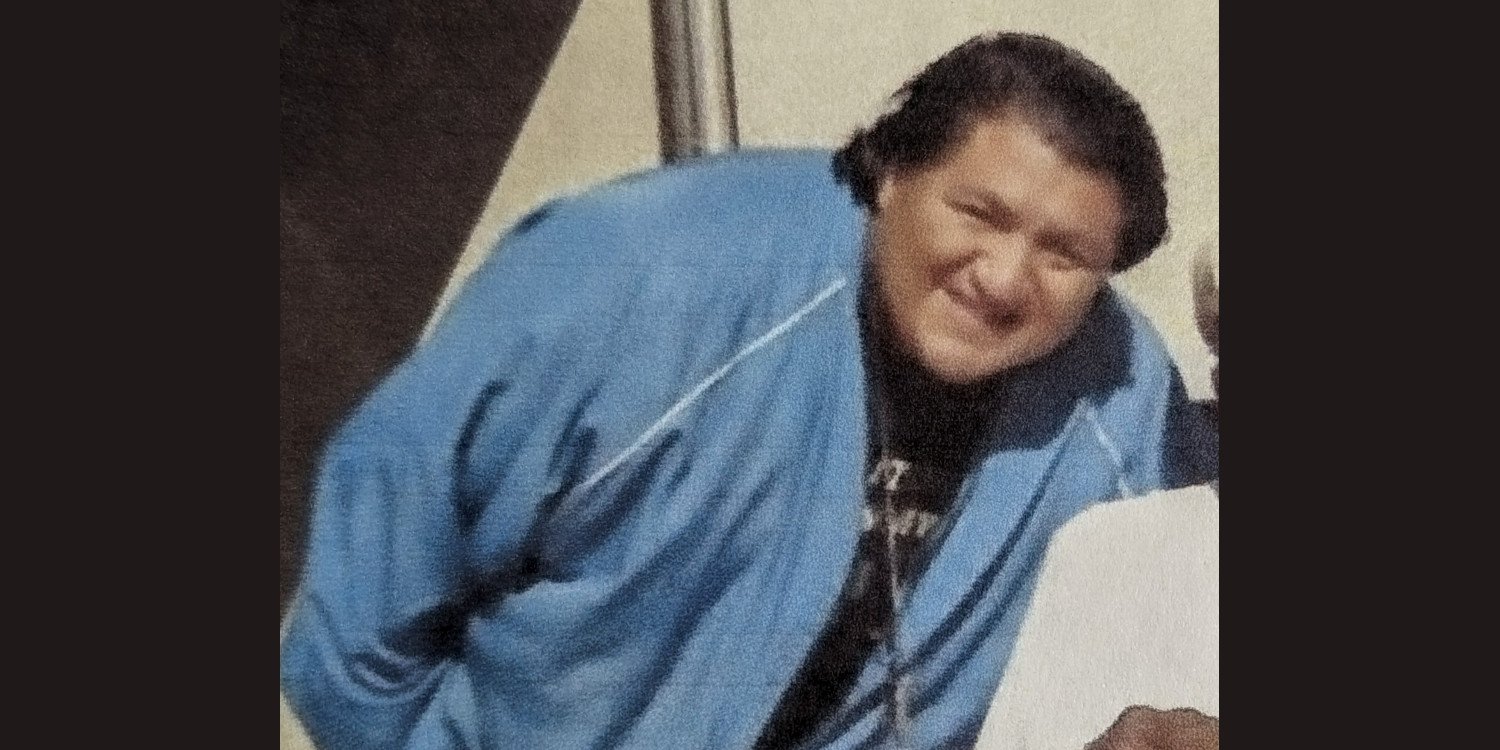
After receiving $200,000 settlement from the Diocese of Manchester in 1996, Thomas Grover relocated to Arizona. He is pictured here about three years after the MacRae trial.
Now Pauline Goupil, M.A.
Far more troubling was the role played in this trial and its aftermath by psychotherapist Pauline Goupil, M.A. (now Pauline Goupil Vachon). As defense counsel Ron Koch (pronounced “Coke”) stood at the defense table to cross-examine Thomas Grover, Mr. Grover turned in protest to the judge. This 27-year-old, 220 lb. man, no stranger to the criminal justice system, complained that he did not want to look at the defendant during the trial and therefore could not answer Mr. Koch’s questions if he stood in the middle aisle by the defense table. In apparent disregard of the Constitutional right of defendants to confront an accuser at trial, Judge Brennan ordered defense counsel to cross-examine Thomas Grover from a position in the court as far from the defendant as possible.
Later, during a break in the trial, PBS-TV official Leo Demers and his wife Penny approached the defense attorney. The issue, they said, had nothing to do with the lawyer standing near the defendant. They pointed out the presence of a woman seated with spectators on the center aisle. They reported seeing that woman influence Thomas Grover’s testimony using hand signals. They pointed out that defense counsel had been blocking Grover’s view of her when he was standing near Father MacRae during cross examination.
Mr. and Mrs. Demers claimed that when defense counsel asked Mr. Grover to explain to whom he first brought his sexual abuse claims, the police or a contingency lawyer, Thomas Grover looked directly at the woman seated at the center aisle at which point she gestured with her index finger over her eye and down her cheek. Grover then began to sob uncontrollably on the stand, causing the judge to declare a recess. Leo Demers pointed the woman out, and defense counsel approached her.
The woman identified herself as Pauline Goupil, M.A., Thomas Grover’s therapist. The defense approached the bench, the jury was dismissed for the day, and Pauline Goupil was ordered to the stand. Ms. Goupil testified that she had been retained by Thomas Grover at the behest of contingency lawyer, Robert Upton, to counsel Grover throughout the trial and keep him “clean and sober.” Ms. Goupil stated that she had a practice specialization in treating victims of sexual abuse and assault.
For an entire afternoon, Pauline Goupil, M.A. testified about her role, and vehemently protested defense attempts to obtain her file. Pre-trial, the defense moved for copies of all Thomas Grover’s treatment records, but received none of them despite Grover's claim that he had been treated for his drug addiction six times. The defense was never told of Grover’s on-going treatment with Pauline Goupil.
In the end, the judge ruled that he would conduct an in-camera review of Ms. Goupil’s treatment file which she was ordered to produce the next day. She was then barred from the court for the remainder of trial. The presence of Ms. Goupil, and the matter of her giving Grover hand signals during his testimony, was never heard by the jury and the defense counsel did not move for a mistrial.
Pauline Goupil’s file was submitted the next day for in-camera review by Judge Brennan. In it was a letter from Ms. Goupil to Thomas Grover in which she chastised him for not showing up for her sessions, and assured him:
“I have good news. Jim [Keene, NH sex crimes detective James F. McLaughlin] told me that MacRae is being offered a plea deal he will have to accept. So there will be no trial. We can just move on with the settlement phase.”
Neither the letter, nor Pauline Goupil’s coaching of Thomas Grover’s testimony ever became known to the jury.
Several years after this trial, but before his retirement from PBS and WGBH Television in Boston, Leo Demers wrote a personal letter to retired Judge Arthur Brennan:
“My wife and I were present in the courtroom throughout most of the trial of Fr. Gordon MacRae in 1994. For all these years, I have had many questions about this trial and much that I have wanted to clarify for my own peace of mind ... . We saw something in your courtroom during the MacRae trial that I don’t think you ever saw. My wife nudged me and pointed to a woman, Ms. Pauline Goupil, who was engaged in what appeared to be clear witness tampering. During questioning by the defense attorney, Thomas Grover seemed to feel trapped a few times. On some of those occasions, we witnessed Pauline Goupil make a distinct sad expression with a down-turned mouth and gesturing her finger from the corner of her eye down her cheek at which point Mr. Grover would begin to cry and sob on the stand. The lawyer’s questions were never answered.
“I have been troubled about this for all these years. I know what I saw, and what I saw was clearly an attempt to dupe the court and the jury. If the sobbing and crying was not truthful, then I cannot help but wonder what else was not truthful on the part of Mr. Grover. If he was really a victim who wanted to tell the simple truth, then why was it necessary for him and Ms. Goupil to have what clearly appeared to be a set of prearranged signals to alter his testimony?”
Back at the 1994 trial, once Pauline Goupil’s role in the case was known, Thomas Grover was put back on the stand. He testified that Ms. Goupil arranged for him to be drugged before his testimony, and that was why he could not remember specifics. Thomas Grover claimed that part of the residual effect of the abuse he suffered was chronic unemployment due to his emotional state. He was asked by defense counsel how — since he could not hold a job — could he afford weekly therapy with Ms. Goupil. Grover stated, “She worked something out with my lawyer. She’ll be paid after the settlement.” Earlier in his testimony, Grover denied having any awareness of plans to sue the Catholic Church.
The next morning in the court, Judge Brennan cited a local Keene Sentinel news article reporting that Thomas Grover appeared confused and inconsistent on the witness stand. Judge Brennan came up with a shocking remedy for this. When he summoned the jurors back into the Court, he instructed them to “disregard inconsistencies in Mr. Grover's testimony.”
Pauline Goupil had just three years earlier obtained a B.A. in psychology from “The School of Lifelong Learning.” She then received an M.A. in counseling from Antioch College in Keene, NH where the state’s expert witness in this trial, Leonard Fleischer, Ed.D., was a faculty member and Ms. Goupil’s mentor.
Shortly after Father MacRae was sent to prison, some of the witnesses in this trial spotted Ms. Goupil in the prison’s visiting area. She was visiting her son who in 1989 was convicted at age 19 of multiple charges of serial rape for which he is serving a lengthy sentence. Her son’s convictions came just a few years before Pauline Goupil began a practice specialization in treating victims of sexual assault.
Two years after Gordon MacRae’s criminal trial, Pauline Goupil offered extensive testimony in a lawsuit against the Catholic Church brought by Thomas Grover and his brothers. Her testimony was in support of Grover’s attempt to defeat the state’s three-year statute of limitations on tort actions by claiming, successfully, that the statute of limitations should begin to toll only when a victim becomes aware he was injured and makes a causal connection with abuse.
Toward that end, Pauline Goupil testified with a whole lot of information and documentation that was not part of the treatment file that she was ordered by Judge Brennan to hand over in 1994 for in-camera review.
In her renewed testimony for the lawsuit in 1996, she testified that Thomas Grover’s particular version of Post Traumatic Stress Disorder caused him to “suppress” all emotional awareness of the abuse he suffered, and caused him to forget many crucial details of that abuse until his pre-trial treatment sessions with her. From the 1996 testimony of Pauline Goupil, M.A.:
Q: Now, one of the ways that a person avoids trauma is inability to recall important aspects of the trauma?
Ms. Goupil: Yes.
Q: That’s not true in Tom’s case is it?
Ms. Goupil: Yes, it is true.
Q: Didn’t he tell you all about this trauma?
Ms. Goupil: He told me some incidences of trauma, but there were some details that were very relevant that I heard when I was sitting in court that he had never spoken with me about that he could remember. One of the symptoms of [PTSD] is that the person forgets information that is really quite relevant to the trauma.
Q: How do you know that he forgot these things?
Ms. Goupil: The point [is] that a person who suffers from Post Traumatic Stress Disorder will forget relevant information, meaning that it’s relevant to the trauma that they experienced, but they will remember irrelevant information.
Q: Tom remembered this trauma, isn’t that right?
Ms. Goupil: Parts of the trauma.
Q: Is it fair to say that, as you understand it...that he did not forget any aspect of what happened to him that he had reported to you?
Ms. Goupil: He did forget some aspects of what happened to him.
Q: No. That he had reported to you.
Ms. Goupil: Your questions are very complicated.
Q: All right. Let me start again... . It was apparent that he had always remembered the things that he told you?
Ms. Goupil: No, that is not apparent.
Q: Okay. Tell me. Did he say, “I just remembered these.”?
Ms. Goupil: Yes.
Q: And what did he say that he just remembered?
Ms. Goupil: I can’t tell you any specific memory because all the memories are just sort of there, but he would come into a — I can’t name a particular session — I would have to consult the file — where he would say...you know, something happened and I just remembered it.
Elsewhere in the 1996 lawsuit transcript, Pauline Goupil testified about her diagnosis of Tom Grover:
Q: ... Now did you review your records in the time that you were away about the number of visits that you had with Tom?
Ms. Goupil: Yes.
Q: ... And what’s the total number?
Ms. Goupil: Twenty-eight.
Q: And those sessions each lasted about an hour in the usual course?
Ms. Goupil: Fifteen minutes.
Q: And the diagnosis you made was when? At the end of the line? At the beginning
Ms. Goupil: At the beginning. It usually takes two or three sessions to make an assessment.
Q: You said you gave him a dual diagnosis?
Ms. Goupil: Yes.
Q: One thing I heard was Post Traumatic Stress Disorder?
Ms. Goupil: Uh-huh.
Q: The other problem?
Ms. Goupil: Substance abuse. In remission.
Q: ... So, now we’re talking about PTSD, and you’re diagnosing it with regard to someone who has had a sexual experience.
Ms. Goupil: That’s correct... . In 1980 PTSD was taken out of the battlefields and brought into the battlefields of persons who have been abused because the symptomatology was very obviously similar to people who were returning from war.
Q: ... Would you say psychotherapy is an art, science, or both?
Ms. Goupil: My degree is a Master of Arts so I guess it’s probably an art.
Author’s note: During an ongoing investigation of this matter by former FBI Special Agent Supervisor James Abbott, both Thomas Grover and Pauline Goupil declined to be interviewed or to answer any questions regarding this matter.
+ + +
Editor’s Note: Thank you for reading and sharing this post. You may also be interested in these related posts by Ryan A. MacDonald.
The Trial of Father MacRae: A Conspiracy of Fraud

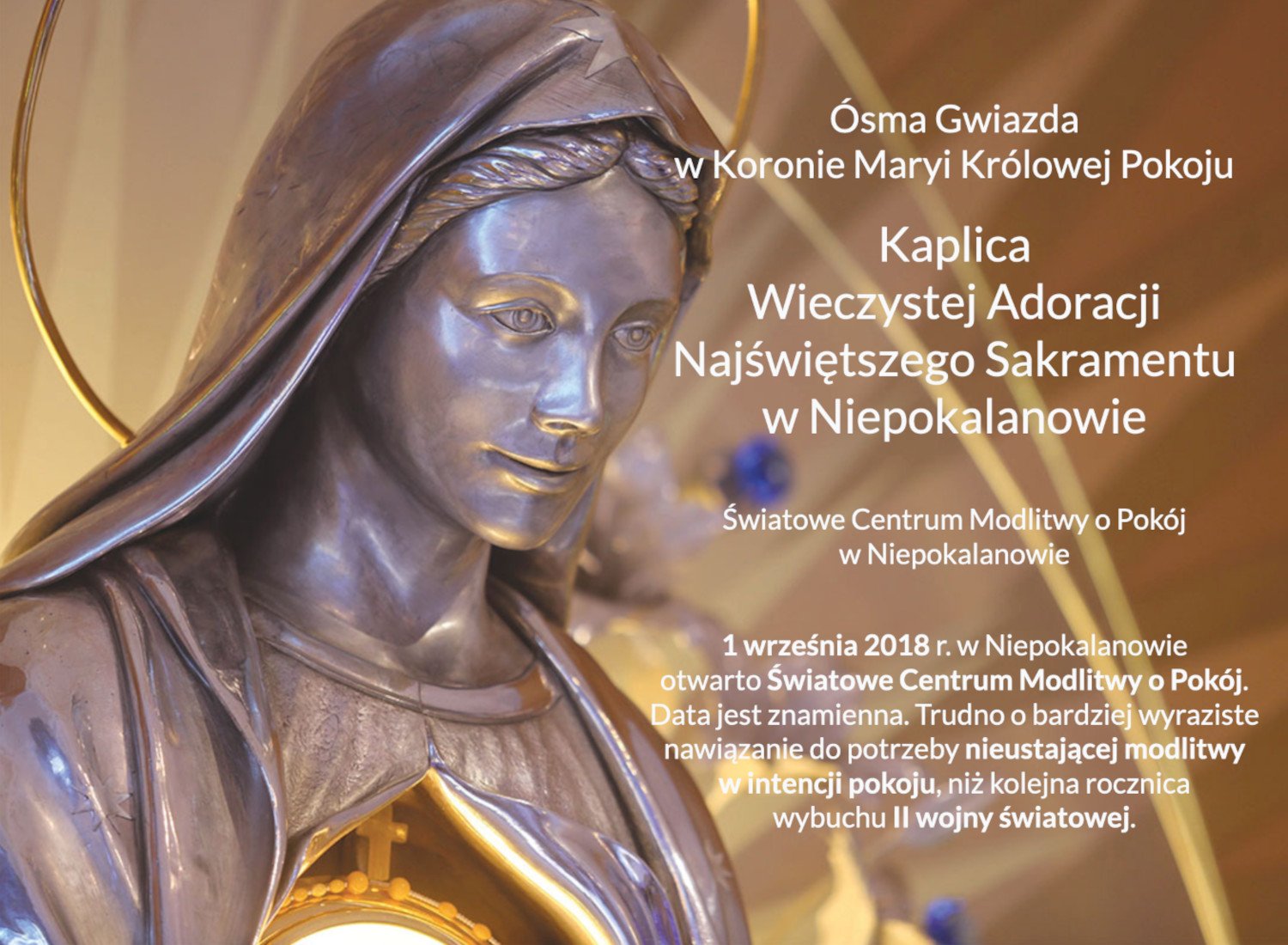

The Eucharistic Adoration Chapel established by Saint Maximilian Kolbe was inaugurated at the outbreak of World War II. It was restored as a Chapel of Adoration in September, 2018, the commemoration of the date that the war began. It is now part of the World Center of Prayer for Peace. The live internet feed of the Adoration Chapel at Niepokalanow — sponsored by EWTN — was established just a few weeks before we discovered it and began to include in at Beyond These Stone Walls. Click “Watch on YouTube” in the lower left corner to see how many people around the world are present there with you. The number appears below the symbol for EWTN.
Click or tap the image for live access to the Adoration Chapel.
The following is a translation from the Polish in the image above: “Eighth Star in the Crown of Mary Queen of Peace” “Chapel of Perpetual Adoration of the Blessed Sacrament at Niepokalanow. World Center of Prayer for Peace.” “On September 1, 2018, the World Center of Prayer for Peace in Niepokalanow was opened. It would be difficult to find a more expressive reference to the need for constant prayer for peace than the anniversary of the outbreak of World War II.”
For the Catholic theology behind this image, visit my post, “The Ark of the Covenant and the Mother of God.”

Listen to Our Mother: Mary and the Fatima Century
The century since the Miracle of Fatima in 1917 saw an explosion of Marian devotion throughout the world. For me, one skeptic priest, resistance was futile.

The century since the Miracle of Fatima in 1917 saw an explosion of Marian devotion throughout the world. For me, one skeptic priest, resistance was futile.
Back in May, 2017, Mother’s Day in the United States was on the day after the 100th anniversary of the first apparition of Our Lady of Fatima which occurred on May 13, 1917. There was a lot taking place in preparation for the observance of that day, but very little of it was available to me. Months earlier I received a wonderful letter from Annie Karto, a Catholic songwriter and music composer. She had composed a beautiful song entitled “Rise Up All People,” and she performed it in 2016 as part of a special Divine Mercy production that included a slide presentation. She wanted me to know that I was a part of that presentation and that she was dedicating the song to me. She wanted to send me a link to the video so I could hear it and see the presentation. I was most grateful to her but there was simply no format available to me in prison to make that happen.
For the previous 23 years, I had been living in what was widely understood here to be punitive housing. I was told that it was because I do not admit guilt. So for 23 years I just endured it. I endured it far longer than any other prisoner. For half of those years, Pornchai Moontri lived in a cell with me. As you know, some very important things took place in those years that were filled with grace personally inspired by Saint Maximilian Kolbe who pointed us always to the Immaculata.
During a Divine Mercy workshop in the prison chapel that year, one of the volunteers from the National Shrine of The Divine Mercy told me that Concord, NH has a Catholic radio station. I had no idea. The only radio available for purchase where I happened to be living was a small hand-held model manufactured by Sangean and sold to prisoners here for just under $50. It was a pricey item considering that there are many radios for a fraction of that price, but in prison we had no other options. I decided against the purchase because the world of concrete and steel where we lived blocked out most radio signals. So why would anyone here buy a radio? That was a question I was asking myself even as I filled out the order form to send to a friend who wanted to order one for me from a catalog of items approved for prisoners. At the time, I needed other things more than a radio. I had holes in my socks but for reasons I do not understand to this very day, a friend was insistent that I have a radio. So when my radio arrived, I installed two AAA batteries, tuned into the FM frequency that carried the signal for Ave Maria Radio, and heard nothing but disappointing static.
So in mid May 2017, the morning of Mother’s Day, the day after hearing all that static on my new radio, Pornchai and I went outside to the prison Ball Field. He was pitching for a baseball game that day, and I just wanted to walk the perimeter of the field. On our way there, after we had passed through several locked doors and barriers, Pornchai said, “Why don’t you bring your radio?” So I rushed back through multiple barriers, patiently waiting at each for unseen entities to buzz me through a multitude of electronic locks. I got back to our cell, grabbed the radio, and reversed the process of waiting at each of the locked doors.
I made it back to the Ball Field just as the last door was about to slam shut. I walked toward the back of the field, took my radio out of my pocket, and unraveled its earbud headphones. It was still tuned to the local Catholic station from which I heard only static the night before. At the moment it came alive in the Ball Field, I heard the voice of Teresa Tomeo say, “Our guest today is Catholic singer and songwriter Annie Karto to discuss her latest CD, ‘Rise Up All Peoples.’” And then I heard for the first time Annie’s now famous song. I had imagined that song in my mind many times, but never heard it. Months before, Annie Karto, produced a video for that song for a national conference on Divine Mercy, and the video included, among many images, a photograph of me from an article for the Year of Mercy entitled “The Doors that Have Unlocked.”
Having neither seen nor heard any of this before, I could only imagine it until that morning outside when I had the right receptor at just the right time to hear the music play. My friend, Pornchai Moontri was on the pitcher’s mound in a game when he stopped to wonder why I was standing mesmerized and immobilized at the far outfield.

Click or tap image to play Annie Karto’s 4-minute presentation of “Rise Up All People.”
Listening to Mary with the Right Receptors
When that was over, and Teresa Tomeo’s Catholic Connection had signed off for the day, I had another five minutes out in the field. I continued listening to a call-in show about Scripture. The first caller was a man who identified himself as a fallen away Catholic who is now a Protestant Evangelical. He said that he left the Church because of the Catholic focus on Mary as “a conduit of grace” which, he seemed to believe, is not supported by Biblical truth.
At that moment, my new radio just stopped working. It died two months after I received it. I tried everything to get it working again, but to no avail. I cannot return it, and given its limited use (outside only) I could not justify buying a new one. So now I just walk in the Ball Field in silence. But I have the strangest sense that I heard the things that I was supposed to hear when I had the right receptor to hear them. I do not know how the Catholic radio commentators responded to the Evangelical’s concern about Mary, but the answer came to me immediately. I was thunderstruck by it, and by how little thought I had ever given to this before.
The basis of religious authority for Evangelical Protestants is “Sola Scriptura,” Latin for “Scripture Alone.” The concept embraces not just Biblical authority, but also a deeply held belief in Biblical inerrancy. Both notions clearly support Catholic belief in the role of Mary in Salvation History. It’s a truth that I was once deaf to as well, because I did not employ the right receptors to hear it. There was a time as a younger priest inspired only by science, when I scoffed at notions such as Marian apparitions at Fatima. But I have come to understand that such things are highly valued in our life of faith, less by the events themselves and more by their impact on our spiritual history. I was a little slow in my heart to come to understand Mary in our life of faith as Catholics. I knew all that there was to know about her, but I did not know her. I did not “hear” Mary because I did not have inner receptors tuned to her. The deep reverence that Catholics hold for Mary, and the notion that she can be, and has been, an emissary from Heaven and a conduit of grace make total sense.
The appearances of Mary in the Gospel are like bookends for the story of salvation. Her first appearance — in the Gospel of Saint Luke (1:26-56) — opens with an angelic declaration that is unprecedented in all of Sacred Scripture:
“In the sixth month the Angel Gabriel was sent from God to a city of Galilee named Nazareth, to a virgin betrothed to a man whose name was Joseph, of the house of David; and the virgin’s name was Mary. And he came to her and said, ‘Hail, full of grace, the Lord is with you.’”
— Luke 1:26-28
Scripture contains 326 references to angelic appearances between the fall of Adam and the Resurrection of Christ. This brief passage in the Gospel of Luke is the first and only place where an angel refers to a human person with a title instead of a name. And the title — rendered “full of grace” in its English translation — is fascinating.
The term appears in only one other place, the Book of Acts of the Apostles which was also authored by Saint Luke. It’s a reference to Stephen who would become Christianity’s first martyr: “Stephen, full of grace and power, did great wonders and signs among the people” (Acts 6:8). However, these English translations of the term fail to capture the full meaning the Evangelist intended. In Saint Luke’s original Greek, the terms have very different meanings.
In the case of Stephen, the original Greek words of Luke for “full of grace” were “plērēs charitos.” You can see in this the Greek roots of the word “charity.” But in the angel’s reference to Mary, a very different Greek term was used to convey the words, “full of grace.” It was a title much more than a trait. The Greek term Saint Luke used is “kecharitomēnē,” a far more revealing concept. It refers not just to a facet of her character, as in the case of Stephen, but of her essence. “Kecharitomēnē” refers to a prior action of God in which Mary was “graced” in the sense of her being a “vessel” in multiple tenses — past, present, and future — who is instilled with divine life, a soul that magnifies the Lord.
This does not mean that Mary was divine. It means that God prepared her from the moment of her conception. Some English translations use the term “highly favored one” instead of “full of grace” in the Angel’s greeting, but this in no way captures the truth of the Evangelist’s meaning which is far more profound than “favor.” It is closer to “innate holiness.” Saint Luke’s unique Greek title became the Scriptural basis for the Catholic doctrine of the Immaculate Conception. It points not to a trait of Mary’s character, but to a revelation of her lifelong holiness and unique place in Salvation History as the Mother of both the Redeemer and the redeemed — the new Eve.
In the angelic declaration to Mary (Luke 1:28) the next phrase is rendered in English, “the Lord is with you.” Its more proper sense is, “the Lord is within you.” Her Greek title, “Theotokos,” literally “Mother of God,” was defined at the Council of Ephesus in A.D. 431 and reaffirmed by the Second Vatican Council in Lumen Gentium (53). For the entire life of the Church, Mary has been venerated — not worshipped, but venerated — as the Mother of God. This is a theological truth that I described in “The Ark of the Covenant and the Mother of God.”

The Miracles of Fatima
I owe a debt today to the Marians of the Immaculate Conception, stewards of the National Shrine of The Divine Mercy in Stockbridge, Massachusetts. I wrote of this debt, and of my all-too-human resistance to their great gift, in “Divine Mercy in a Time of Spiritual Warfare.” That debt was deepened in 2022. That is when the Church marked the 100th anniversary of our Blessed Mother’s first of six appearances to three small shepherd children in the village of Fatima, Portugal. She appeared to them in this little known, out-of-the-way village in Portugal as World War One raged on all around them. It was the time of what Pope Benedict XV (not XVI) described as “the suicide of Europe.” It was at this very time that Mary reentered human history to convey a message through the smallest of voices in a most insignificant place. Then it echoed with ever increasing volume across the century to follow.
I had never fully understood the apparitions at Fatima. My scientific mind with its natural skepticism had always been in the way, making real moments of grace hard won for me. But now I think, for the first time in my life, I understand what happened at Fatima commencing on May 13, 1917 and the 13th of each of five months to follow. And thanks to Fr Michael Gaitley’s book The Second Greatest Story Ever Told, I finally understand Fatima’s meaning in the context of faith and in the context of human history.
My understanding has also been greatly aided by a wonderful gift by a superb Catholic writer and friend of Beyond These Stone Walls, Felix Carroll. You have met Felix Carroll in these pages before. He is the Executive Editor of Marian Helper magazine, which has published two major articles about my friend Pornchai Moontri’s Divine Mercy conversion and my place in that remarkable story. Felix is also the author of the great Divine Mercy book, Loved, Lost, Found: 17 Divine Mercy Conversions with a chapter about the life of Pornchai.
As I was pondering how to approach a post about the Fatima Century, I quickly found myself wading into waters I am only now beginning to sound for spiritual depth. Knowing the facts is one thing, but knowing the necessary story under the story is quite another. The Spring 2017 issue of Marian Helper with a cover entitled “Fatima: 100 Years Later” filled in a lot of the blanks for me. I read it cover to cover in one sitting. Its centerpiece is an amazing article by Felix Carroll entitled, “Fatima. The Place. The Message.” I am simply in awe of his achievement. I urge you to visit Marian Helper and read Felix Carroll’s outstanding writing, his historical analysis, and the depth of his understanding of the message and miracle of Fatima — all in just a few very readable pages.
In 2017, at the behest of Fr Michael Gaitley and Felix Carroll, I wrote an article about the journeys of both me and Pornchai Moontri into the Heart of Jesus through the Immaculate Heart of Mary. The article was, “Behold Your Son, Behold Your Mother!” Felix told me that it “ lit up the Marians’ website as never before.” It was not me and Pornchai who got the attention of so many people. It was her. It is no mystery in our troubled time that so many are finally coming to listen to our Mother. After writing the article I received this brief reflection from an Evangelical Protestant college student:
“I finally get it! I am a college student and a lifelong Protestant. I never understood the Catholic connection to Mary until I read this. Thanks to this I finally understand Mary and her place in the life of faith.”
+ + +
Note from Fr Gordon MacRae: Please honor our Mother by sharing this post. You will behold her place in history as never before by reading and sharing with others another amazing post written for Beyond These Stone Walls and LifeSite News by Craig Turner entitled:
“How Our Lady of Fatima Saved a World in Crisis”
The 100th Anniversary of the apparitions at Fatima can be seen through a lens of history. Journalist and historian Craig Turner presents a fascinating view of the Fatima Century.
July 12, 2017 by Craig Turner with an Introduction by Fr Gordon MacRae
The Eucharistic Adoration Chapel established by Saint Maximilian Kolbe was inaugurated at the outbreak of World War II. It was restored as a Chapel of Adoration in September, 2018, the commemoration of the date that the war began. It is now part of the World Center of Prayer for Peace. The live internet feed of the Adoration Chapel at Niepokalanow — sponsored by EWTN — was established just a few weeks before we discovered it and began to include in at Beyond These Stone Walls. Click “Watch on YouTube” in the lower left corner to see how many people around the world are present there with you. The number appears below the symbol for EWTN.
Click or tap here to proceed to the Adoration Chapel.
The following is a translation from the Polish in the image above: “Eighth Star in the Crown of Mary Queen of Peace” “Chapel of Perpetual Adoration of the Blessed Sacrament at Niepokalanow. World Center of Prayer for Peace.” “On September 1, 2018, the World Center of Prayer for Peace in Niepokalanow was opened. It would be difficult to find a more expressive reference to the need for constant prayer for peace than the anniversary of the outbreak of World War II.”
For the Catholic theology behind this image, visit my post, “The Ark of the Covenant and the Mother of God.”
Maximilian Kolbe: The Other Prisoner Priest in My Cell
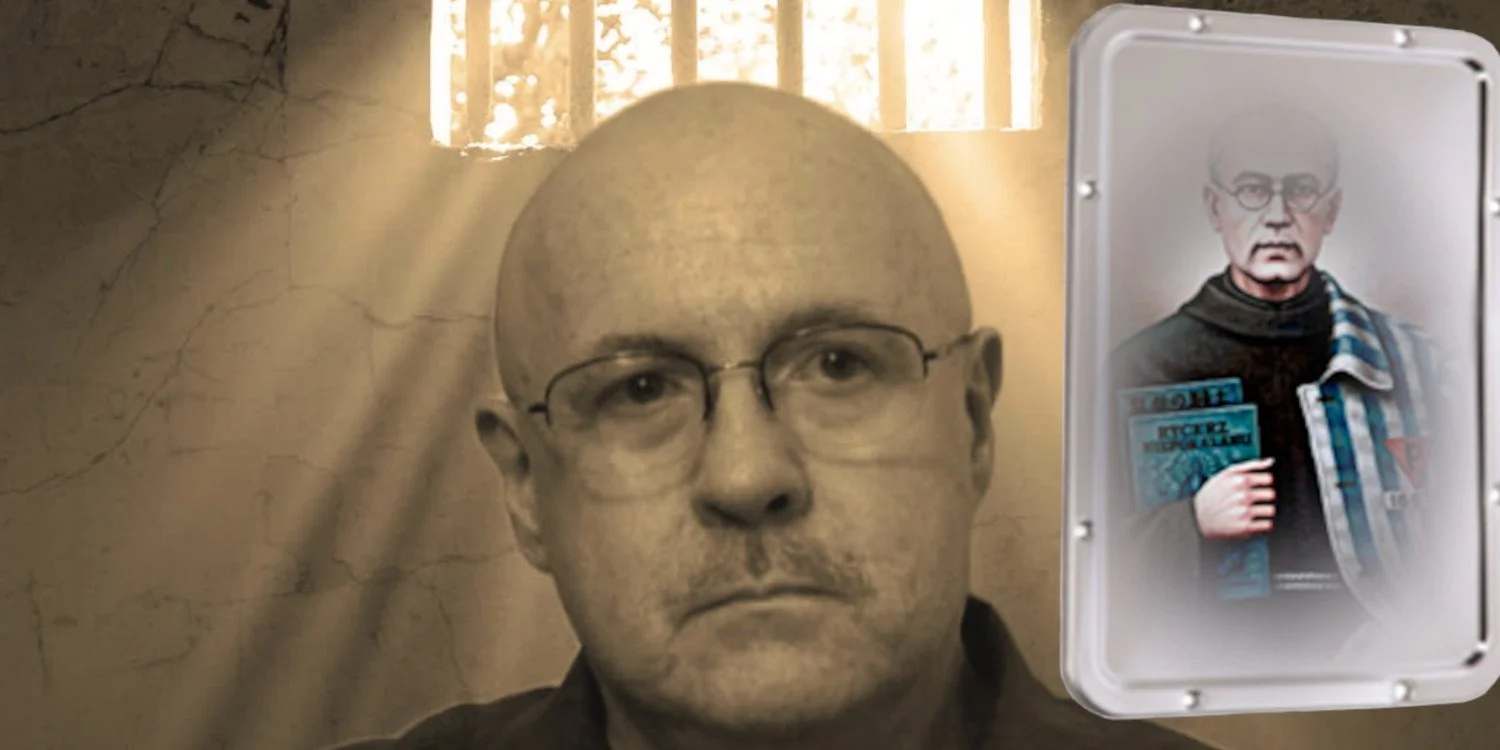
Unjustly in prison since 1994, Fr Gordon MacRae began this blog in early August 2009. From his cell he looked into a mirror as a prisoner, but a priest looked back.
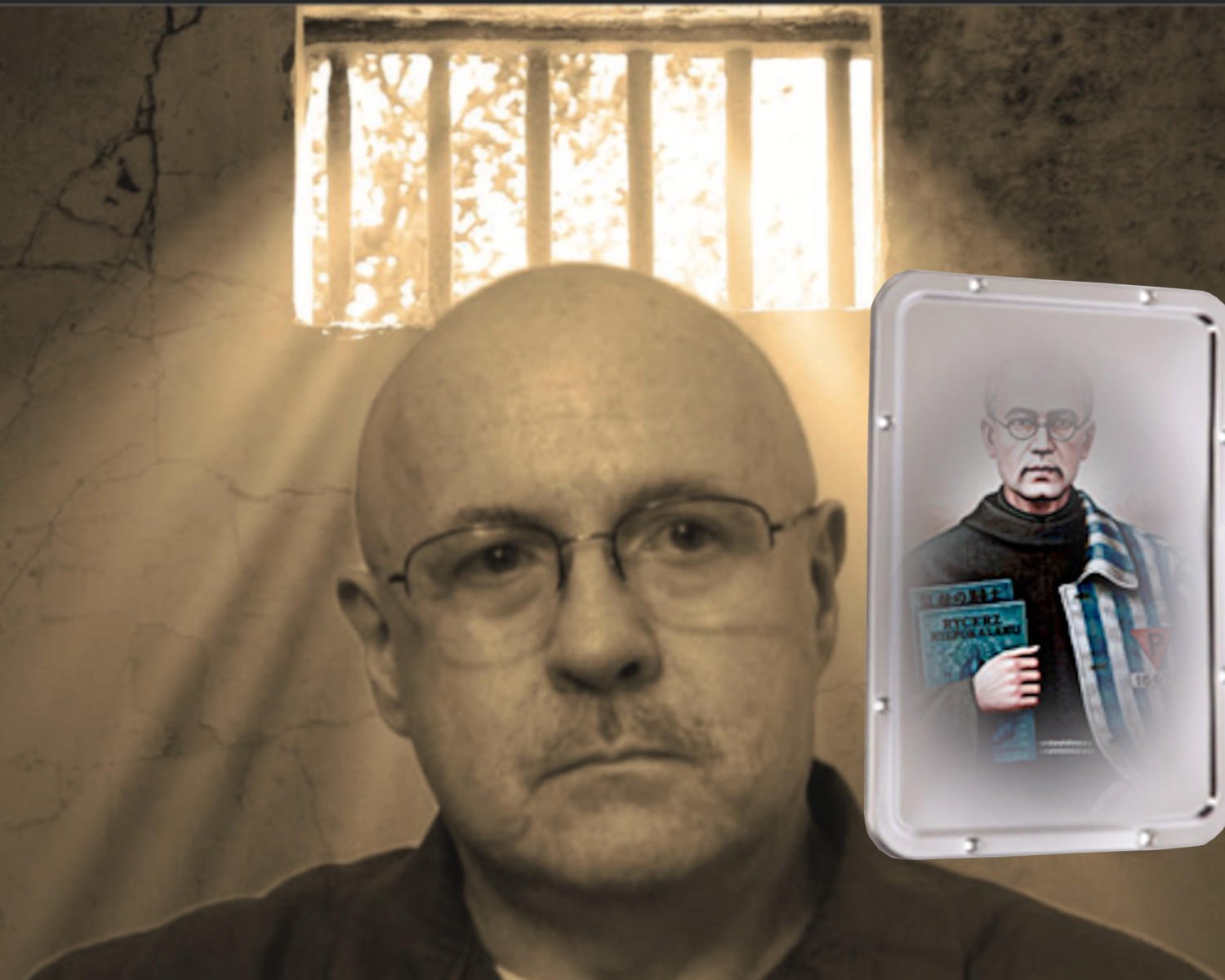
Unjustly in prison since 1994, Fr Gordon MacRae began this blog in early August 2009. From his cell he looked into a mirror as a prisoner, but a priest looked back.
August 9, 2023 by Fr Gordon MacRae
“Now we see dimly as in a mirror, but then we shall see face to face. Now I know only in part, but then I shall understand fully even as I am fully understood.”
— 1 Corinthians 13:12
+ + +
At the end of our annual BTSW Christmas Card in December, 2022, we posted a live YouTube feed linked to a beautiful Adoration chapel in Poland sponsored by EWTN. Months later, I wrote a post that was popular with readers around the world. It was “Eucharistic Adoration: Face to Face in Friendship with God.” Its introduction was, “A live internet feed from a Eucharistic Adoration chapel in Poland landed on this blog at Christmas and is now revealed as a gift from a beloved Patron Saint.”
It was only weeks after we posted it that I learned that the live feed was from the chapel of Niepokalanow, the City of the Immaculata founded by St. Maximilian Kolbe prior to his 1941 arrest and imprisonment at Auschwitz where he was martyred. Most of our readers knew what this meant to me. It was a direct link to the Patron Saint of this blog — the saint who inserted himself not only in my life, but in the life of Pornchai Moontri as well. At the time of his Divine Mercy conversion, Pornchai took the name Maximilian as his Christian name.
I have written so many posts about St. Maximilian Kolbe that I cannot write this one in any way that would make it stand out. Maximilian is one of two Patron Saints who stand with me in this imprisonment and in this blog. I mean that literally. The other is Saint Padre Pio.
Oddly enough, I must refer you to a post about Padre Pio for a sense of what the other patron saint has meant to us. That post is “Padre Pio: Witness for the Defense of Wounded Souls.” I will link to it again at the end of this post, but I want to first present an excerpt from it here:
“Among the many letters of Padre Pio to the thousands of pilgrims and penitents who wrote to him was one dated in the year before Padre Pio's death on September 23, 1968. In that letter, Padre Pio advised a suffering soul to enroll in the Knights at the Foot of the Cross, a spiritual movement founded by Father Maximilian Kolbe for the offering of life's wounds as a share in the suffering of Christ. I was amazed to read that Padre Pio had such an awareness of our other patron saint two decades before St. Maximilian Kolbe was canonized.”
I should point out that both saints were canonized by another saint, John Paul II. I wrote the above post in September 2020. It begins with a description of my friend Pornchai Moontri walking with me in the prison yard early in the morning of September 8, 2020. It was the day Pornchai left after nearly 15 years in a prison cell with me. Last week in these pages, I wrote of that journey, of both the heartbreak of change and the challenge of hope. You should not miss that post either. It was, “For Pornchai Moontri, Hope and Hard Work Build a Future.”
The year 2009, when this blog began, was a strange one for us behind these stone walls. It was four years after The Wall Street Journal published the first of many articles exposing prosecutorial corruption in the case that sent me to life in prison in 1994. Judge Arthur Brennan, now retired in New Hampshire, might not agree that he imprisoned me to a “life” sentence, but I was 41 years old when he imposed a 67-year prison sentence on me citing “clear and convincing evidence.”
The “evidence” he cited did not exist, has never existed, and has been exposed as the result of a police officer’s corruption which some entities are working very hard to cover up. I am now 70, and will be 108 when my sentence is over. Even now there is a suggestion that I could see freedom if I just admit guilt.
In my first 12 years in prison from 1994 to 2006, I existed in a sort of mental and spiritual paralysis. Then two things happened in 2006 that altered the course, not only of my life, but of my soul. First, St. Maximilian arrived on my cell mirror. Then, as though on cue, Pornchai Moontri also arrived in my cell. The first thing he ever said to me was in the form of a question. Pointing to the photo on my mirror he asked, “Is this you?”
I could best answer that question today by revisiting the first three posts I wrote for this blog in August, 2009. Don’t worry. I was a lot less long-winded back then. Each of these three earliest posts was but a page or two. Fourteen years later, they hold up well against the test of time, so bear with me please.
+ + +
August, 2009 — St. Maximilian Kolbe and the Man in the Mirror

For someone on the outside looking in, it must seem an odd place to begin. Virtually every prison cell has one: a small stainless steel sink with a matching toilet welded to its side. Bolted to the cinderblock wall just above it is a small stainless steel mirror, dinged, dented, and scraped so badly that the image it reflects is unrecognizable.
I begin each day at the break of dawn in prison by shaving in front of that mirror. This morning ritual has repeated 5,412 times. [At this writing, it is 10,530 times.] I seldom cut myself shaving — a minor miracle as I can see very little of me in that mirror. I often think of St. Paul’s cryptic image in his first letter to the Church in Corinth (13:12): “For now I see dimly, as in a mirror, but then I shall see face to face.” It is a hopeful image.
I sometimes find that my mind calculates dates and their meanings on a sort of autopilot. There came a day when I stood at the mirror to shave and realized that on this day it was Dec. 23, 2006. I have been a priest in prison for the exact amount of time that I was a priest “on the streets” as prisoners like to describe their lives before prison.
From that day until now, I wonder which I see more of in that flawed mirror. Do I see the man who is a priest of 27 years? Or do I see only Prisoner 67546, the identity given to me inside these stone walls?
A strange thing happened on the day after I first reflected — as best I could in that mirror — on who I see. It was Christmas Eve, December 24, 2006, the day that the equation changed. It was the day that I was a priest in prison longer than anywhere else. That night at prison mail call, I had a few Christmas cards. One of them was from Father James McCurry, a Conventual Franciscan priest who once visited me in prison.
Inside Father McCurry’s Christmas card was a prayer card that is now one of my enduring treasures. It is taped to the stone wall just above the shaving mirror of my cell and has been there ever since the day I received it. The holy card has an image of St. Maximilian Kolbe who offered himself for execution in place of another prisoner in Auschwitz in 1941. The card depicts Father Kolbe in his Conventual Franciscan habit. He has one sleeve in the striped jacket of his prison uniform with the number 16670 emblazoned across it. There is a scarlet “P” above the number indicating his Polish nationality. He was also a priest and a falsely accused prisoner. Does either designation extinguish the other? Father Kolbe is at once both, though only one identity was chosen by him.
The image is a haunting image for it captures fully that struggle I have so keenly felt. Father Maximilian appeared in my cell just a day after I asked the question of myself. Who am I? I thought at the time, that it was a rhetorical question, but it was a prayer. As such, it begged a reply — and got one.
+ + +

August, 2009 - Maximilian and This Man’s Search for Meaning Part I
How I came to be in this prison is a story told elsewhere, by me and by others. How I “met” Father Maximilian Kolbe 60 years after he surrendered his life at Auschwitz is a story about actual grace. In his Catholic Catechism, Jesuit Father John Hardon defines actual grace as God’s gift of “the special assistance we need to guide the mind and inspire the will” on our path to God. Sometimes, it’s very special.
My first three years in prison are a blur in my memory. There is no point trying to find words to express the sense of loss, of alienation, of being cast into an abyss that was not of my own making — a loss that could not be grounded in any reality of mine. About 1,000 days and nights passed in the abyss before what Father Hardon described as “special assistance” crossed my path.
Someone, somewhere — I don’t know who — sent the prison’s Catholic chaplain (a layman then) a book entitled Man’s Search for Meaning by Viktor Frankl, M.D. Somewhere in my studies, I heard of this book, but only a prisoner can read it in the same light in which it was written. The chaplain summoned me to his office. He wanted to know whether he should recommend this book, but didn’t have time to read it. He wanted my opinion. It had been years since anyone had asked my opinion on anything.
I didn’t read Dr. Frankl’s book so much as devour it. I read it through three times in seven days. As a priest, I often preached that grace is a process and not an event. It is not always so. I was meant to read Man’s Search for Meaning at the precise time that it landed upon my path. A week earlier, I would not have been ready. A week later may have been too late. I was drowning in the solitary sea of deeply felt loss. I was not going to make it across. My priesthood and my soul were dying.
The Book, as I have come to call it, is Viktor Frankl’s vivid account of how he was alone among his family to survive imprisonment at Auschwitz. This was an imprisonment imposed on him for who he was: a Jew. There is a central message in this small book. A profound message, so clear in meaning, that it has within it the hallmark of inspired truth. Like Saul thrown from his mount to become Paul, I remember sinking to the floor when I read it
“There is a freedom that no one can ever take from you: The freedom to choose the person you are going to be in any set of circumstances.”
This changed everything. Everything! You will see how later. At the very end of his book, Dr. Frankl revealed the name of his inspiration for surviving Auschwitz. He wrote of Sigmund Freud’s cynical view that man is self-serving. And a man’s instinctual need to survive will trump “quaint notions” such as grace and sacrifice every time. For Dr. Frankl, Auschwitz provided the proof that Freud was wrong.
That proof, he wrote, was Father Maximilian Kolbe . . . .
+ + +

August, 2009 — Maximilian and This Man’s Search for Meaning Part II
As a young priest in 1982, I was only vaguely familiar with the name Maximilian Kolbe. I remember reading of his canonization by Pope John Paul II, but Father Kolbe’s world was far removed from my modern suburban priestly ministry. I was far too busy to step into it. I didn’t know that nearly two decades later, Father Kolbe’s life, death, and sainthood would be proclaimed on the wall of my prison cell. I also didn’t know that this would help define the person I choose to be in prison.
Being a Jew and not a Catholic, Dr. Viktor Frankl in Man’s Search for Meaning, said nothing about Maximilian’s sainthood or any miracles attributed to his intercession. Instead, Dr. Frankl was moved by the profound charity of Maximilian, which defied the narcissism of our times. For those unfamiliar with him, the story is simple.
The prisoners of Auschwitz were packed into bunkers like cattle. To encourage informants, the camp had a policy that if any prisoner escaped, 10 others would be randomly chosen for summary execution. At the morning roll call one day, a prisoner from Maximilian’s bunker was missing. Guards chose 10 men to be executed. The 10th fell to the ground and cried for the wife and children he would never see again. Father Kolbe spontaneously stepped forward. The camp commandant stopped the selection process and demanded, “Who is this Polish swine?” Father Maximilian answered, “I am a Catholic priest, and I would like to take the place of this man.”
Two weeks later, he alone was still alive among the 10 prisoners chained and condemned to starvation. Maximilian was injected with carbolic acid on August 14, 1941, and his remains unceremoniously incinerated. For the unbeliever, all that Maximilian was went up in smoke and ash to drift in the sky above Auschwitz.
Viktor Frankl shared some other corner of that horrific prison. The story of the person Father Kolbe chose to be rippled through the camp. This story offered proof to Viktor Frankl that we can be as much inspired by grace as doomed by despair. We get to choose which will define us.
Within days of reading Man’s Search for Meaning and learning of Father Kolbe’s sacrifice, I received a letter from out of the blue. Conventual Franciscan Father James McCurry had been in an airport in Ireland when he heard an Irish priest nearby mention that he corresponds with a priest in a Concord, New Hampshire prison. Father McCurry said he was on his way to visit his order’s house in Granby, Massachusetts and would arrange to visit the Concord prison. Weeks later, Father McCurry and I met in the prison visiting room. When I asked him what his “assignment” is, he said, “Well I just finished a biography of St. Maximilian Kolbe. Have you heard of him?”
Father McCurry went on to say that he was the Vice Postulator in Rome for the cause of Saint Maximilian’s canonization. He had met the man whose grandfather’s life was saved by Father Kolbe. A few years later, Father McCurry arranged a Father Maximilian Kolbe exhibit at the National Holocaust Museum. It was then that he sent me the card depicting Father Maximilian clothed in his Franciscan habit with one sleeve in his prison uniform. I keep the card above my mirror in my cell.
I can never embrace these stone walls. I can’t claim ownership of them. Passively acceding to injustice anywhere contributes to injustice everywhere. Father Maximilian never approved of Auschwitz.
One can’t understand how I now respond to these stone walls, however, without hearing of Father Maximilian’s presence there. Above my mirror, he refocused my hope in the light of Christ. The darkness can never overcome it. What hope and freedom there is in that fact! The darkness can never, ever, ever overcome it!
+ + +

August 2023
The events described in the three short posts above were published in August, 2009, but they took place in 2006 and 2007. In early 2007 a young man named Pornchai Moontri arrived in this prison after a lifelong passage through the depths of hell. Following 14 years in and out of solitary confinement in a Supermax prison in the state of Maine, Pornchai was transferred to the Concord, NH prison. One day he was dragging a trash bag with his life’s belongings through the cell block where I lived. My door just happened to be open. He stopped in front of it and looked at me with deep hostility in his eyes. It was not the person he chose to be, but rather the person he felt he had to be.
Pornchai looked into my cell and looked directly at the mirror above my sink. He pointed to the image of Saint Maximilian and said, “Is this you?”
Three years later, when Pornchai was received into the Catholic faith on Divine Mercy Sunday 2010 he became — like Saul thrown from his horse to become Paul — Pornchai Maximilian Moontri.
+ + +
Note from Fr Gordon MacRae : Thank you for reading and sharing this post which now incorporates my first three posts from Beyond These Stone Walls. On August 9, the day this is posted, the Church also honors another martyr of Auschwitz, St. Teresa Benedicta of the Cross, the Carmelite scholar formerly known as Edith Stein. We hope you might want to read a bit further with these posts:
Saints and Sacrifices : Maximilian Kolbe and Edith Stein at Auschwitz
A Tale of Two Priests : Maximilian Kolbe and John Paul II

The Eucharistic Adoration Chapel established by Saint Maximilian Kolbe was inaugurated at the outbreak of World War II. It was restored as a Chapel of Adoration in September, 2018, the commemoration of the date that the war began. It is now part of the World Center of Prayer for Peace. The live internet feed of the Adoration Chapel at Niepokalanow — sponsored by EWTN — was established just a few weeks before we discovered it and began to include in at Beyond These Stone Walls. Click “Watch on YouTube” in the lower left corner to see how many people around the world are present there with you. The number appears below the symbol for EWTN.
Click or tap the image for live access to the Adoration Chapel.
The following is a translation from the Polish in the image above: “Eighth Star in the Crown of Mary Queen of Peace” “Chapel of Perpetual Adoration of the Blessed Sacrament at Niepokalanow. World Center of Prayer for Peace.” “On September 1, 2018, the World Center of Prayer for Peace in Niepokalanow was opened. It would be difficult to find a more expressive reference to the need for constant prayer for peace than the anniversary of the outbreak of World War II.”
For the Catholic theology behind this image, visit my post, “The Ark of the Covenant and the Mother of God.”

The Transfiguration of Christ
Jesus took Peter, James, and John to a mountaintop where he was transfigured before their eyes, an event that echoes through the ages in the transformation of souls.

Jesus took Peter, James, and John to a mountaintop where he was transfigured before their eyes, an event that echoes through the ages in the transformation of souls.
August 2, 2023 by Fr. Gordon MacRae
The image atop this post depicts the Transfiguration of Christ, an inspired work by Venetian artist, Giovanni Bellini painted in 1480. The painting is displayed in the Museo di Capodimonte in Naples, Italy. It portrays the Transfiguration of Jesus in the Gospels of Matthew, Mark, and Luke. The account in the Gospel according to Saint Matthew (17:1-9) is the Gospel for the Feast of the Transfiguration of the Lord observed on August 6, 2023 . The Feast of the Transfiguration has been celebrated in the Eastern Church since the Fifth Century. It was inserted into the general calendar in 1457 by Pope Callistus III to mark the defeat of the Muslim Turks in the Battle of Belgrade. It was celebrated on the Sixth of August because it occurs 40 days before the Feast of the Exultation of the Holy Cross on September 14.
The Transfiguration account told in the Gospel of Saint Mark (9:2-10), is simply told, but filled with history and theological meaning:
“After six days, Jesus took Peter, James, and John and led them up a high mountain apart by themselves. And he was transfigured before them, and his clothes became dazzling white, such as no fuller on earth could bleach them. Then Elijah appeared to them along with Moses, and they were conversing with Jesus. Then Peter said to him in reply, ‘Rabbi, it is good that we are here! Let us erect three tents: one for you, one for Moses, and one for Elijah.’ He hardly knew what to say; they were so terrified. Then a cloud came, casting a shadow over them. From the cloud came a voice; ‘This is my beloved son. Listen to him.’ Suddenly, looking around, they no longer saw anyone but Jesus alone with them.”
— Mark 9:2-10
The same basic elements of the Transfiguration account appear in each of the Synoptic Gospels. Peter’s idea to erect tents for Jesus, Moses, and Elijah seems an almost comical response from someone just given a vision of the Kingdom of God and its most renowned denizens from the Hebrew Scriptures. As the passage points out, Peter “hardly knew what to say. They were so terrified.” But the idea wasn’t entirely out of place.
It was the seventh and last day of Sukkoth, the “Feast of Booths” described in the Books of Deuteronomy (16 13-15) and Leviticus (23:42-44). Known in Hebrew as Hag ha-Asif, translated as “The Festival of Gathering,” it lasted for seven days during which Jewish observers erected tents or booths from the boughs or branches of palm trees. The booths were a memorial of their ancestors’ deliverance from bondage in Egypt:
“You shall dwell in booths for seven days, all that are native in Israel shall dwell in booths that your generations may know that I made the people of Israel dwell in booths when I brought them out of the land of Egypt. I am the Lord your God.”
— Leviticus 23: 42-43
The presence of Moses and Elijah with Jesus on Mount Tabor represents the Law and the Prophets, the two pillars of divine revelation in Hebrew Scripture. They represent the heart of God’s covenant with Israel. There were some previous hints of the Transfiguration. In Exodus (34:29), Moses did not know that upon his descent from Mount Sinai with the Tablets of the Law, “the skin of his face shone because he had been talking with God.”
Upon the death of Moses, according to Deuteronomy (34: 5-6), God himself secretly buried his body in an unknown place in the land of Moab. However, the New Testament Letter of Saint Jude (Jude 9) refers to an ancient Jewish legend from the apocryphal text, The Assumption of Moses. Saint Jude described a story that he presumes his listeners already know: that Satan attempted to take the body of Moses, but the Archangel Michael “contended with the devil” and brought the physical body of Moses into Heaven.
The same became true of Elijah. In the Second Book of Kings (2:11) the prophets Elijah and Elisha became separated by “a chariot of fire and horses of fire” and “Elijah went up in a whirlwind into Heaven, then Elisha saw him no more.” In the Gospel account of the Transfiguration, Peter, James, and John — as well as the early Jewish Christian Church — would have readily perceived that Moses and Elijah came from Heaven to witness the Transfiguration of Jesus.
They would also have known well the Prophet Malachi.
“Remember the law of my servant Moses, the statutes and ordinances that I commanded him at Horeb for all Israel. Behold, I will send you Elijah the Prophet before the great and terrible Day of the Lord comes.”
— Malachi 4:4-5
Hence, as each of the Transfiguration Gospels points out, “they were terrified.”

A Transfiguration of Faith
Saint Matthew’s account of the Transfiguration that you will hear at Mass on August 6 begins with the words, “after six days.” Something very important happened six days earlier between Jesus and his disciples that literally rocked their world and shook their faith. As the pilgrimage Feast of Sukkoth began, they saw Jesus cure a blind man at Bethsaida. Then Jesus asked them at Caesarea Philippi (Matthew 16:13-20), “Who do men say that the Son of Man is?” They answered, “Some say John the Baptist” [already slain at Herod’s command], while “others say Jeremiah, or one of the Prophets.”
“But who do you say that I am?” Jesus asked. Simon, answered with something — like the offer to build some booths six days later— that came spontaneously from his heart and soul: “You are the Christ, the Son of the living God!”
What exactly did that mean to Simon Peter, James and John? Those who awaited a Messiah in Israel envisioned a political force who would transform the known world and set it aright. But Jesus said something astonishing (Mark 16:21-24): “From that time Jesus began to show his disciples that he must go to Jerusalem and suffer many things from the elders and chief priests and scribes, and be killed, and on the third day be raised. And Peter took him and began to rebuke him, saying, ‘God forbid, Lord! It shall never happen to you!’ ... Jesus answered, ‘If any man would come after me, let him deny himself, and take up his cross, and follow me.’”
And then a final bombshell: “Truly I say to you, there are some standing here who will not taste death until they see the Kingdom of God come with power.” Hence, once again, Simon Peter, James, and John, dazzled upon Mount Tabor six days later, were terrified when Moses and Elijah appeared.
And what of the Transfiguration itself? The Greek word the Gospel used to describe it is metamorphothe. His very form and substance were transformed. Recall the great hymn of Christ recounted by Saint Paul to the Philippians (2:5-11):
“Though he was in the form of God, Jesus did not deem equality with God something to be grasped, but rather emptied himself, taking the form of a servant, being born in the likeness of men. And being found in human form he humbled himself and became obedient unto death, even death on a cross. Therefore God has highly exalted him and bestowed on him a name above every other name so that at the name of Jesus every knee should bend, in heaven and on earth and under the earth, and every tongue proclaim, to the glory of God the Father, that Jesus Christ is Lord.”
— Philippians 2:5-11
For six days, Simon Peter, James, and John must have lived with shattered hopes, discouraged over the revelation about what it means to follow Jesus to the cross and death. Ascending that mountain to see him transfigured in glory was a gift of Divine Mercy that also transformed the cross — forever.
These same three disciples had been present when Jesus restored life to the daughter of Jairus (Mark 5:35-42), and the same three would later be present with Jesus in the Garden of Gethsemane (Matthew 26:36-46) to see him humiliated as the Passion of the Christ commenced. They were also the only disciples to have been given new names by Jesus. Simon became Peter, “the Rock,” “Petros” in Greek, from which was derived the name, “Peter.” And he called James and John “Boanerges,” the “Sons of Thunder.” Their new names denoted that they were forever changed by these experiences, a transfiguration of identity and faith.

Transfiguration behind These Stone Walls
On August 6, 2014, the Feast of the Transfiguration, the well known Canadian Catholic blog, Freedom Through Truth, featured a post by Michael Brandon titled, “Transfiguration Behind These Stone Walls.” Michael Brandon wrote some very nice things, not so much about me personally, but about what I write. I was first bewildered by it. Then I was very moved. Then I finally accepted his premise that he and other readers have a vantage point I do not have. Michael Brandon wrote:
“In the years that I have followed Beyond These Stone Walls, I have seen the transfiguration of Father Gordon MacRae and Pornchai Moontri.”
Michael Brandon is also the author of a very popular post featured at our “Voices from Beyond.” It is “The Parable of a Prisoner,” and it describes a transfiguration of the heart.
“In our struggle to be holy, grace is certainly required. But we must also do the footwork — we must will to be better than we really are… The degree of perfection is measured by the amount of adversity we overcome in order to be holy.”
— St. Maximilian Kolbe
+ + +
Note from Fr. GordonMacRae: Thank you for reading and sharing this post. We continue the story of Transfiguration in the lives of Sacred Scripture in these other posts from Beyond These Stone Walls:
The Holy Spirit and the Book of Ruth at Pentecost
Joseph’s Dream and the Birth of the Messiah
The Eucharistic Adoration Chapel established by Saint Maximilian Kolbe was inaugurated at the outbreak of World War II. It was restored as a Chapel of Adoration in September, 2018, the commemoration of the date that the war began. It is now part of the World Center of Prayer for Peace. The live internet feed of the Adoration Chapel at Niepokalanow — sponsored by EWTN — was established just a few weeks before we discovered it and began to include in at Beyond These Stone Walls. Click “Watch on YouTube” in the lower left corner to see how many people around the world are present there with you. The number appears below the symbol for EWTN.
Click or tap here to proceed to the Adoration Chapel.
The following is a translation from the Polish in the image above: “Eighth Star in the Crown of Mary Queen of Peace” “Chapel of Perpetual Adoration of the Blessed Sacrament at Niepokalanow. World Center of Prayer for Peace.” “On September 1, 2018, the World Center of Prayer for Peace in Niepokalanow was opened. It would be difficult to find a more expressive reference to the need for constant prayer for peace than the anniversary of the outbreak of World War II.”
For the Catholic theology behind this image, visit my post, “The Ark of the Covenant and the Mother of God.”

For Pornchai Moontri, Hope and Hard Work Build a Future
After his ascension beyond these stone walls, starting life over in Thailand was not easy for Pornchai Moontri but Divine Mercy and hard work are building a future.

After his ascension beyond these stone walls, starting life over in Thailand was not easy for Pornchai Moontri but Divine Mercy and hard work are building a future.
July 26, 2023 by Fr. Gordon MacRae
The heroic true story of former Homeland Security Agent Tim Ballard captured international attention around Independence Day in the United States this year. It is told in the inspiring and unforgettable film, Sound of Freedom. Jim Caviezel is cast in the role of Tim Ballard, a U.S. federal agent who launched a real-life search and rescue mission to save kidnapped children from human traffickers in Central America and Colombia.
Sound of Freedom is being shown in over 2,600 movie theaters across the U.S. this summer. Some of our readers hesitated to view it thinking it may be too depressing. Its subject is dark, but the film is an outstanding and true inspirational triumph that should not be missed.
The film’s topic and its aftermath have also been prominent in recent years here at Beyond These Stone Walls. It was at the center of an article published by the Catholic League for Religious and Civil Rights, and republished here this week. That article is “Pornchai’s Story.”
The real story of Sound of Freedom is the triumph of Divine Mercy manifested in one man’s path of sacrifice and human courage. Though on a smaller scale, Pornchai Moontri’s story has taken a similar turn. The most amazing part of it also involves a pathway — one that seems a metaphor for the life he once lived and now lives very differently. The scene atop this post captured that pathway to a remarkable transformation.
But first, it requires some background. If you are new to this story, visit my 2021 post, “Pornchai Moontri and the Long Road to Freedom.” His story reads a lot like the plight of some of the children the heroic Tim Ballard set out to rescue. I do not claim to have rescued Pornchai, but he may tell this story differently. Pornchai arrived in my life in 2005 an angry, depressed, sometimes volatile young man wholly committed to a singular, all encompassing goal: to never again be someone’s victim.
Pornchai spent the previous 14 years in and out of the cruel torment of solitary confinement. The path we were on over the succeeding years was not easy, but through Divine Mercy we built trust and became each other’s family. Fifteen years later, Pornchai left my presence a committed Catholic convert and a gifted young man. His new path in life was not to flee from his past, but to be empowered by it in the service of others.
On the morning of September 8, 2020, as we walked in the dark outside awaiting the dawn and his departure after fifteen years together, he left me in tears when he shook my hand and said with simple sincerity, “Thank you for my future.” When ICE agents arrived to take him away, I watched from afar as Pornchai walked through a distant gate. I knew I may never see him again in this life.
I had to hand him over to face his life’s next chapter alone, but like the father of the Prodigal Son cast off to a distant land (Luke 15), I worried about him. Pornchai knew so many wounds in life that even from a great distance I still had a mission to accomplish and no time to grieve. I wrote in a post for September 23, 2020 of the day he left. It was the Memorial of Saint Padre Pio and the 26th anniversary of my own unjust imprisonment. You should not miss that story either. It was “Padre Pio: Witness for the Defense of Wounded Souls.”

When I Was a Stranger ... (Matthew 25:35)
I am incredulous at the newest developments in Pornchai’s life since then, and just as incredulous to find myself still so much a part of them even from a great distance. Pornchai arrived in Thailand on February 24, 2021, free for the first time in 29 years. The photos above depict his first moments and his first meal in freedom with friends you will meet below, friends who would become key elements to a then unknown future for Pornchai.
There were many challenges. I learned that the housing plan we developed for Pornchai fell apart just before ICE agents placed him aboard a flight. Before his plane landed in Bangkok 24 hours later, Yela Smit, the facilitator of Divine Mercy Thailand, contacted me with an emergency plan to support Pornchai’s return to a country he had not seen and a language he had not heard since age eleven 36 years earlier.
Yela told me by telephone that Fr. John Hung Le, a Divine Word Missionary and head of a Vietnamese refugee project in Thailand, offered shelter for Pornchai. Father John knew this would be a difficult and traumatic adjustment. His sudden presence in this story seemed an intervention by Divine Mercy. When Pornchai’s required two-week pandemic quarantine ended on February 24, 2021 — his final stint in solitary confinement — Yela and Father John arrived to meet him. Left to right in the left photo above are Pornchai, Chalathip, Yela and Fr. John.


Pornchai came to call Chalathip “Mae Thim” (Thai for “Mother Thim.”) She lived alone in the home pictured above near the Society of the Divine Word Mission where Pornchai was to stay with Father John and two other priests. Chalathip, a devoted supporter of Father John’s refugee project, has been Catholic since birth which is unusual in Thailand, a country that is 98-percent Theravada Buddhist.
Bangkok, a city of 9.5 million, is massive and intimidating. After 29 years in a U.S. prison coupled with the traumatic events that led up to it, acclimating to Bangkok was a mountain of a challenge. “Mae Thim,” widowed with an adult daughter living in the U.K., knew that Pornchai lost his mother early in life and then was taken against his will from his homeland. So she proposed to Father John that Pornchai needs to immerse himself in Thai language and culture, but cannot do this while living with three Vietnamese priests who do not speak Thai. She offered to give Pornchai a second floor apartment in her home in close proximity to Father John.
Father John conferred with me, and I agreed with him that this would be in Pornchai’s best interest. As readers know from our “Special Events” page, I had been trying to raise funds to help me to support Pornchai as much as possible. He could have found work as a laborer in Bangkok, but at a rate of pay equivalent to just a few dollars per day for ten-hour workdays. I feared that this would delay his needed adjustment, which was massive and daunting, and that his language barrier would then frustrate and overwhelm him.
Generous readers began to assist in supporting me in this effort. It did not require a lot of money. For just a few hundred dollars a month I could support Pornchai and also assist Father John. He and Chalathip and Pornchai became somewhat of a family filling in a large gap from the wounds of life imposed upon each of them. I am grateful to Father John and Chalathip.

Pornchai was not idle. Over the coming months he volunteered for Father John’s food outreach to Vietnamese refugee families rendered without work in Thailand during the pandemic. Pornchai also worked to repair and restore Mae Thim’s home in the city of Nonthaburi just a few kilometers from Bangkok. Armed with only hand tools he devoted himself to repairs inside and out. While Bangkok’s tropical temperature soared to 46 degrees Celsius (114 degrees Fahrenheit) Pornchai restored the home and property. Despite toil and sweat, the property is beautiful, as the photos attest.

Climb Every Mountain
The rest of this story could be told in pictures, and there are lots of them. Over the coming months, a wonderful bond grew between Chalathip and Pornchai. However, Bangkok’s air quality was raising havoc with his allergies. So Chalathip brought him to another property she owns in the small city of Pak Chong in the mountainous region of Thailand about 240 kilometers north of Bangkok. The air is cleaner and substantially cooler there.
Chalathip’s property in Pak Chong has two homes, one a two bedroom cottage where Pornchai now lives, and the other a large three bedroom, two-bath home, with an adjacent one bedroom one bath apartment attached. Together they are on almost an acre of what in Thailand would be luxury property. At first, Pornchai decided to remain there to make several repairs to the two homes and property. Thailand’s rainy season can be hard on a home so he set out to repair several roof leaks.
The floors, walls, and roofs in most modern Thai homes are made of concrete which endures humidity and high tropical heat. There is no winter ice to crack it, but natural settling can produce small cracks and relentless leaks. To assist him, our friend Claire Dion in Maine ordered a case of Flex Seal products not readily available in Thailand, and shipped them to him. It is a great product and its website has videos for every application. Pornchai fixed every leaks and even those of some neighbors. At one point I thought he was starting up a new “Leaks-r-Us” business.
Then he turned his attention to the property. The result was remarkable. Using only a spade, a pickax, and lots of muscle, Pornchai transformed the overgrown property into the magnificent park-like setting pictured atop this post. Armed only with a pickax, he dug through 4-5 inches of hardened clay for a distance of over 240 yards to create a pathway across the entire property. With an ax, he chopped away a large stump that no one had been able to remove. He built or repaired yard furnishings, painted both homes inside and out, repaired a gazebo, added outdoor lights, and restored everything in sight. He removed dying trees and used the wood to line his new walkway. Then he transplanted new trees.

Mae Thim was in awe of what he had accomplished. Retired without a steady income available to her, she and Pornchai then devised a plan to use the property as a small business. Pornchai would live in the smaller home while renting out the larger one and managing the property. Pak Chong is convenient to Khao Yai National Park, Thailand’s oldest and largest park and game preserve where wild elephants still roam free.

In recent weeks I have also learned that China is extending a high-speed railway from Kunming in its southernmost province to Vientiane, the capital of Laos, which is on the northern border of Thailand. China plans to extend the railway the entire length of Thailand to Bangkok and then extend it all the way to Singapore. Pak Chong, where Pornchai now lives, is designated to become a major depot by 2026. This promises to create a large economic change in the region bringing trade and tourists and a higher demand for housing.
Even before learning of the above, Chalathip decided to also rent her property pictured above in Nonthaburi just north of Bangkok. She has designated Pornchai as her official Property Manager. With the help of a friend, we have been building a Linkedln page for Pornchai and will link to it at the end of this post. This endeavor is not yet up and running or producing any income, but it has the potential to support them both for years to come.
For a Buddhist nation, Catholicism has an oversized footprint in Thailand. There are two Catholic universities, hospitals, and multiple orphanages and specialized residential schools under the auspices of the Fr. Ray Foundation. Pak Chong has two Catholic parishes. Pornchai attends Mass at St. Nicholas Parish where he lights a weekly candle for me and another for the readers of Beyond These Stone Walls.
Pak Chong’s location in central Thailand is midway on Father John’s route to Nong Bua Lamphu, the Thai headquarters of his order and the place of Pornchai’s birth. So Pornchai and Chalathip have made Pak Chong an overnight stopover for Father John so he does not have to drive the entire nine+ hours each way from Bangkok to the Laos border, the route he takes in his ministry to Vietnamese refugee communities. On a recent visit, Father John took Pornchai fishing. They caught a 155 pound Mekong River catfish which they mercifully released after a one-hour battle. The fish swam happily away. Freedom now means a lot to Pornchai, and apparently to his fish as well.
My role in Pornchai’s life and the salvation of his freedom and his soul is the most important thing I have ever done as a man and as a priest. It is the story of Saint Maximilian Kolbe and his sacrifice to restore life to another prisoner. I have experienced first hand the grace of the sound of freedom, and it is glorious.
+ + +
Here are some additional photos of Pornchai’s hard work.


The Eucharistic Adoration Chapel established by Saint Maximilian Kolbe was inaugurated at the outbreak of World War II. It was restored as a Chapel of Adoration in September, 2018, the commemoration of the date that the war began. It is now part of the World Center of Prayer for Peace. The live internet feed of the Adoration Chapel at Niepokalanow — sponsored by EWTN — was established just a few weeks before we discovered it and began to include in at Beyond These Stone Walls. Click “Watch on YouTube” in the lower left corner to see how many people around the world are present there with you. The number appears below the symbol for EWTN.
Click or tap the image for live access to the Adoration Chapel.
The following is a translation from the Polish in the image above: “Eighth Star in the Crown of Mary Queen of Peace” “Chapel of Perpetual Adoration of the Blessed Sacrament at Niepokalanow. World Center of Prayer for Peace.” “On September 1, 2018, the World Center of Prayer for Peace in Niepokalanow was opened. It would be difficult to find a more expressive reference to the need for constant prayer for peace than the anniversary of the outbreak of World War II.”
For the Catholic theology behind this image, visit my post, “The Ark of the Covenant and the Mother of God.”

Are You Suffering a Great Deal?
As this blog by a priest unjustly in prison began in 2009, Fr Gordon MacRae had to write 12 brief posts to send to an editor. Here are three of these early gems.
As this blog by a priest unjustly in prison began in 2009, Fr Gordon MacRae had to write 12 brief posts to send to an editor. Here are three of these early gems.
July 19, 2023 by Fr Gordon MacRae
A lot has been going on here this summer. Even in this place where time often seems to stand still, finding blocks of time to write has suddenly become a challenge. Nonetheless, I am enthused by a new development. Gloria.tv is an international Catholic video and news sharing venue launched in Switzerland in 2005. It is known for its high degree of fidelity. I cannot see it, of course, but on rare occasions over the years it has reported on one of my posts.
After reviewing and then reposting “Convicted for Cash,” the 44-minute video documentary about my trial by Frank X. Panico, Gloria.tv invited me to establish a page and submit selected past posts on the site. The result has been a huge increase in visits to this blog from around the world. Please visit our presence there at Gloria.tv/FrGordonJMacrae.
A flood of activity this July, along with some technical difficulties where I live, has temporarily slowed my ability to write. So this week, and again two weeks from now, we are returning to July, 2009 and the first days of this blog. As it was beginning, I was asked to quickly write and submit 12 short posts to launch it. I am told today that a few of them are “gems,” so I want to share them with you anew.
Our first entry today is “Are You Suffering a Great Deal?” It’s from a laminated card that fell into my lap from a book in 2009 just as I was beginning to write. At the time, I was in fact suffering a great deal.
Pornchai Moontri was here with me then and was very much a part of this beginning. It was Pornchai who named this blog, “These Stone Walls,” then in 2020 I renamed it “Beyond These Stone Walls” as he was returning to Thailand. Pornchai has contributed many posts to this site, some more popular than my own, but please don’t tell him I said that. So the second of our three short selections is “Bunkies: Pornchai’s Story.” Next week in these pages, we will have some exciting news about developments in Pornchai’s new life in Thailand.
My last entry this week is “Contentious Convicts.” I will let that one speak for itself. You might think it seems a little fishy.
+ + +

Are You Suffering a Great Deal?
Are you suffering a great deal? No, the question isn’t from Oprah or Dr. Phil. It is on a bookmark kept in my breviary. It was asked by Our Lady of Fatima on June 13, 1917:
“Are you suffering a great deal? Don’t lose heart. I will never forsake you. My Immaculate Heart will be your refuge, and the way that will lead you to God.”
There is immense power in that promise, and for someone who has lost everything, it is like a lifeboat at sea. There is sometimes nothing else to cling to. Even when I feel that my faith dangles from a thread — which is often, in prison — I cling to that promise.
I don’t know where the bookmark came from. Like most of the things I cling to for spiritual support, it just sort of showed up one day. I like to think it was handed down to me — in the way important things are handed down by brothers — by Maximilian Kolbe whose reverence for the Immaculate Heart of Mary guided him through life, and death, at Auschwitz.
Even when my faith is so diminished and darkened by the prison around me that I believe in little, I believe that promise. Sometimes I can only believe that Maximilian believed — with the very fabric of his life.
It’s often hard to pray in prison. It’s not just the noise, the harshness, the lack of privacy, the relentless obstacles. It’s just hard to raise my mind and heart beyond these stone walls at times. In that, at least, I am not alone.
The Vietnamese Cardinal Nguyen Van Thuan wrote that there were long periods during his years in a Communist prison when he was unable to pray. I guess any Catholic who ever looks inward has a dark night of the soul. If not, why would the Blessed Mother ever ask such a question in her appearance at Fatima? It’s not the usual question a mother would ask when she comes a long way for a brief visit.
Are you suffering a great deal? When Saint Maximilian’s life was finally snuffed out after days of starvation chained to the corpses of those who could not endure, he was heard gasping a hymn of praise. I wish I had his heart! I don’t, but I wish I did. I have to learn how to suffer, and I am a slow learner.
In Spe Salvi, his Encyclical on Christian Hope, our Holy Father Pope Benedict wrote the most masterful prose on suffering that I have ever read. I cling to it like I do my bookmark with Our Lady of Fatima’s Promise:
“Christ descended into ‘Hell,’ and is therefore close to those cast into it, transforming their darkness into light. Suffering and torment is still terrible and well-nigh unbearable. Yet the star of hope has risen — the anchor of the heart reaches the very throne of God. Instead of evil being unleashed within man, the light shines victorious: suffering — without ceasing to be suffering — becomes, despite everything, a hymn of praise.”
Spe Salvi, ¶37
Brilliant! Simply brilliant! There’s something hopeful in that, and I should listen.
+ + +
Bunkies: Pornchai’s Story
In prisons all over the world, the most crucial issue for prisoners is where one has to live, and with whom. Confined to a 60 square foot cell with another human being can be a nightmare. Most of us have no say in the choice of “Bunkies,” as cell mates are called here. If a bunky is moved — even after two or three years with the same person — sometimes a total stranger is living in the cell within minutes.
Having a good roommate seems to be everyone’s goal, but I tried another approach years ago. Being a good roommate is a goal I have more control over. The result has been that in 10 years since being moved from the torturous 8-man cells in which I spent my first seven years in prison, I have never had a roommate (we prefer to call our cells “rooms”) request a move.
The downside of that is that I have had some very dysfunctional roommates who have no wish to move elsewhere. My assigned roommates here have ranged in age from 19 to 67 or so, and have included men convicted of murder, rape, armed robbery, various drug crimes, and gang-related crimes. Everyone here knows all the details of why everyone else is here. Rumor and gossip fill in what the facts leave out.
My roommate of the last two years was also a good friend for several more. It was the first time I have been assigned to live with someone I know well, so it feels more like living with a family member than a felon.
Pornchai (his name is Thai, and the “r” is silent, as in “Paunch-eye”) is 35 years old and has been in prison since the age of 18.
He is about to convert to the Catholic faith and currently he is a scholarship student in theology in the Catholic Distance University’s excellent Distance Learning Program for prisoners.
Pornchai caused a minor sensation last year when he wrote a very brief autobiographical sketch that ended up being published as “The Conversion Story of 2008” by The Catholic League for Religious and Civil Rights. I hope you will take a moment to read it.
A year after publication, Pornchai still receives occasional mail about his life story. The most recent being a personal letter from Cardinal Kitbunchu, Archbishop Emeritus of Bangkok, Thailand, and a note from Mary Ann Glendon, former U.S. Ambassador to the Holy See. Oh, and there was also a letter from the late Father Richard John Neuhaus.
Pornchai takes his new notoriety in stride, though one letter had a profound impact. It was from a young man who wrote that he turned his life around, dropped out of his gang, swore off drugs, and returned to faith after reading “Pornchai’s Story” online.
Pornchai mistakenly credits me with some small role in his extraordinary life of late. He has fallen under the power of grace and cannot escape it now even if he tried. Now, he creates. Here is a photo of one of his creations, “The Olde Baldy” (named after me) which he carved piece by piece (over 600 of them) from scratch.

Pornchai Moontri — Master Craftsman
Pornchai was designated a master craftsman in wood and model shipbuilding. One of his first ships was a circa 1800 British warship from the Napoleonic era which he named after Father MacRae. He dubbed it “The Olde Baldy,” which is now docked in the home of our friend, Bill Wendell in Stow, Ohio.
+ + +

Contentious Convicts
There was little I could do to stop the fighting. Convicts are so territorial; they do not hesitate to take on intruders twice their size. They just can’t be reasoned with. It’s even worse when the convicts are mating. What drama!
No, no, no! I’m not talking about bizarre behavior among my fellow prisoners — though they do have their moments. I’m referring to Herichthys (Archocentrus) Nigrofasciatus, a fish of the cichlidae family native to the tropical river basins of Central America. They are popularly known as convict cichlids, or just convicts because of their characteristic black stripes.
Oh, go ahead and yawn! Whenever I would recite the scientific nomenclature for the fish in my aquarium, my friends would always yawn! Aquarium buffs are used to it! The more serious among us always felt duty-bound to learn the scientific names of the residents of our aquatic neighborhoods. Hey, we don’t talk that way by choice, you know!
My 100 gallon cichlid aquarium was my spare-time-consuming hobby for most of my life as a priest until I was sent to prison at age 41. It was an oasis of life, light, and aquatic drama that kept me mesmerized for hours at the end of each day. Only one other priest in my diocese had an aquarium, and we had an instant bond of shared knowledge and interest.
I had a breeding pair of convict cichlids who shared their home — perhaps “shared” is too strong a word — with a pair of Astronotus Ocellatus, or red oscars native to the Amazon Basin. I also had a single Herichthys (Archocentrus) Octofasciatus known otherwise as a “Jack Dempsey,” and for good reason. He ended up in a smaller aquarium of his own. Couldn’t play well with others.
Convicts typically excavate a cave when preparing to breed, so an old clay flower-pot in the corner sufficed. I named my convicts Bonnie and Clyde (at the time, I had limited knowledge of suitable convict names. Today I’d go with Bubba and Bella.) The other denizens, the Oscars, were named Oscar Madison and Oscar Wilde. (I’m glad I only had two!)
The Oscars gave their testy neighbors a wide berth once eggs were laid in the cave. Oscar Madison, twice the size of the convicts, sometimes paid a price for lumbering over to eat the convicts’ food. He had the nips in his fins to remember them by.
I once tried to use a mirrored barrier to keep everyone happy, but Clyde kept launching himself furiously at his own reflection. In time, everyone learned to respect some boundaries. My current convict friends could learn a lot from that. “The Aquarium is Gone.” That’s actually a line from a poem by Robert Spence Lowell (“For the Union Dead.” 1964)
Its absence from my world is still deeply felt. It is one of the three recurring dreams I have in prison. (I’ll write of the other two later.) It haunts me a bit. I often dream that my aquarium is on the concrete shelf of my cell, and Oscar Wilde is staring at me with his bulging eyes willing me to bring food.
I miss them. There is nothing with water and life here.
“And the fish of the sea will declare to you. In His hand is the life of every living thing.”
— Job 12:8,10
The Eucharistic Adoration Chapel established by Saint Maximilian Kolbe was inaugurated at the outbreak of World War II. It was restored as a Chapel of Adoration in September, 2018, the commemoration of the date that the war began. It is now part of the World Center of Prayer for Peace. The live internet feed of the Adoration Chapel at Niepokalanow — sponsored by EWTN — was established just a few weeks before we discovered it and began to include in at Beyond These Stone Walls. Click “Watch on YouTube” in the lower left corner to see how many people around the world are present there with you. The number appears below the symbol for EWTN.
Click or tap the image for live access to the Adoration Chapel.
The following is a translation from the Polish in the image above: “Eighth Star in the Crown of Mary Queen of Peace” “Chapel of Perpetual Adoration of the Blessed Sacrament at Niepokalanow. World Center of Prayer for Peace.” “On September 1, 2018, the World Center of Prayer for Peace in Niepokalanow was opened. It would be difficult to find a more expressive reference to the need for constant prayer for peace than the anniversary of the outbreak of World War II.”
For the Catholic theology behind this image, visit my post, “The Ark of the Covenant and the Mother of God.”
The United Nations High Commissioner of Hypocrisy
In 2014, a U.N. Commission accused the Vatican under Benedict XVI of a past sex abuse cover-up. Then the U.N. was exposed for a present sex abuse cover-up.

In 2014 a United Nations Commission accused the Vatican under Benedict XVI of a past sex abuse cover-up. Then the U.N. was exposed for a present sex abuse cover-up.
July 12, 2023 by Fr. Gordon MacRae
I sometimes come across an older post I have written about events in the news, and am struck by how much what I wrote ends up coming true. I just re-read a post I wrote on July 7, 2010. I read it anew with far more invested in the topic today than when I originally wrote it. That post is “The Exile of Father Dominic Menna and Transparency at The Boston Globe.”
It raised an important point about an issue that has simmered in the background of this blog since its inception in 2009. That issue is the Catholic clergy sex abuse story, and how much the story has itself been abused in the news media to further certain agendas. On Easter Sunday 2010, for example, The Boston Globe hyped this story about a popular Massachusetts senior priest, Father Dominic Menna, who under the terms of the U.S. Bishops’ “Dallas Charter,” was removed from ministry due to a claim of sexual abuse.
In reporting the story, the Globe neglected to mention that the uncorroborated single claim that destroyed this priest’s life was alleged to have occurred over a half century ago in 1971. And it was no accident that the story was reserved for the Globe’s Easter Sunday edition.
What the Globe omitted from the Easter Sunday 2010 story was the fact that the adult bringing that claim — a man in his late fifties — stood to gain a substantial financial settlement just for making the claim while proving nothing.
The contingency lawyers and their enablers in the media are counting on you to have no frame of reference to put any of the claims of priestly abuse into context. I do have a frame of reference, and I can tell you that the distortion created by lawyers and the news media is deeply unjust — not only to Catholics and their priests, but to millions of adult victims of abuse whose suffering has been trivialized and cheapened by the distortion that only victims of Catholic priests are worth hearing and compensating.
Since I wrote the above post, The Boston Globe was sold by its parent company, The New York Times, for less than ten cents on the dollar, compared to what the Times paid to purchase it. Some like to think that in the end the Globe pretty much reaped what it had sown at the expense of truth and justice.
The eventual result of the symphony created by contingency lawyers and biased news media was an arena in which the Church would become dislodged as a global source of moral truth. I wrote of some of the fallout for other innocent victims in my post, “Benedict Faced the Cruelty of a German Inquisition.”

The U.N. Assault on the Catholic Church
In 2014, an explosive 16-page report issued by the United Nations High Commissioner on the Rights of the Child indicted and convicted the Catholic Church without investigation, without evidence, without a formal defense, and without any trial of the facts. I know the feeling!
This public shaming of the Holy See came as a result of the emergence into public view of hundreds of claims of sexual abuse by priests dating back thirty, forty, fifty years or more. These were claims often brought forward by contingency lawyers who — once the mass settlement process had been established as status quo — flooded Church institutions with demands for “out-of-court” settlements with no effort at corroboration. “I’ve never seen anything like it,” said N.H. contingency lawyer, Peter Hutchins when handed a $5.2 million check from the Diocese of Manchester, New Hampshire.
The various bishops and dioceses caved in to these demands, and then a hapless U.N. committee took that to be proof enough that the claims were all true. In a courageous article in First Things, “Rolling Stone, Alan Dershowitz, and Catholic Priests” (May 21, 2015) Father Thomas Guarino described the cost of this abandonment of rights for the priests accused when bishops got the monkey off their backs by throwing money at it:
“This Episcopal peace comes at a heavy price…. The problem is that, in many cases, no contrary evidence can come forward because an accusation is decades old. What convincing evidence could possibly be adduced to clear a man’s name? Even if a charge could be true, is lifetime suspension a proportionate penalty for a mere possibility? Should bishops be held hostage by forces dividing them from their own priests?”
— Fr Thomas Guarino, First Things
The United Nations had no such interest in basic civil rights like the presumption of innocence. Claudia Rosett, who led the Investigative Reporting Project for the Foundation for the Defense of Democracies, also reacted to the U.N. Commission report on the Vatican with a similarly titled column in The Wall Street Journal (“The U.N. Assault on the Catholic Church,” WSJ, February 10, 2014). Ms. Rosett described the report:
“A Report on the Holy See — released by a U.N. Committee last week to much media fanfare — alleged that tens of thousands of children have been abused by Catholic clerics and that the Vatican has helped cover it up.”
Bill Donohue, President of the Catholic League, described that U.N. report as “one of the most ambitious power grab efforts ever undertaken by a U.N. committee.” The report was, of course, a lie, simply repeating a media mantra. But in the process of describing this in The Wall Street Journal, Claudia Rosett exposed another big lie, one belonging to the United Nations itself.

Now Hiring: A U.N. High Commissioner of Hypocrisy
Between 2007 and 2013, United Nations peacekeeper forces have been repeatedly implicated in the sexual abuse of children they were tasked to protect, and the U.N. has now been implicated in a cover-up of that fact. But the most disturbing part of this story is the extent to which it has been ignored — another form of cover-up — by the American news media. In fact, Ms. Rosett’s above column in the WSJ was likely the first hint of the scandal at the U.N. that appeared in mainstream U.S. news.
Since then, other media outlets have taken this up, but few of them in the United States. Sandra Laville, in The Guardian (U.K.) covered a report leaked to her newspaper alleging that the U.N.’s own investigation revealed “the rape and sodomy of starving and homeless boys” by French U.N. peacekeeper forces operating in the Central African Republic.
As sickening as that charge is, it gets much worse. French president Francois Hollande promised that France would prosecute those soldiers. The story came to light only because of a whistleblower. According to Matheiu Delahouse in the French paper, Le Nouvel Observateur, the U.N. marked its report on this matter “secret” and filed it away.
This is a story worth telling. The French government was not even informed of the claims against its soldiers until a man named Anders Kompass, a Swedish citizen working for the U.N. High Commissioner of Refugees, “broke protocol and gave a copy of the report to the French government,” according to The Week:
“Naturally, the French investigators asked if they could speak to the U.N. investigator who wrote the report, but the U.N…refused to allow that. Meanwhile, Kompass, the whistleblower, has been punished and may lose his job. Saying he leaked a confidential document, the self-interested bureaucrats at the U.N. have suspended this 30-year veteran of humanitarian work for intervening on behalf of children.”
— The Week, “United Nations: Riding sexual abuse by peacekeepers,” May 15, 2015
Rosa Freedman, writing at TheConversation.com from Australia, charged that the U.N. has “a long and sordid history of covering up sexual abuse by peacekeepers.” Simon Allison, writing from South Africa for The Daily Maverick observed about the U.N., “Who can trust an institution that covers up the sexual abuse of minors?”
The very fact that such a question is now asked of the United Nations itself after it dragged the Catholic Church through a round of public mudslinging is symptomatic of an institution in crisis. The situation is more hypocritical than it appears.
I have also written of the hubris and hypocrisy of the U.N.’s finger pointing on this issue. I have described evidence that even while the U.N. was pointing fingers at the Vatican for decades-old and unproven claims of abuse, the U.N. was itself being sued. In 2014, the United Nations employed any and every legal means to fight off a lawsuit from the beleaguered people of Haiti after its unscreened peacekeeper forces caused the deaths of innumerable children by bringing a cholera outbreak to their earthquake stricken country. One of its defenses was to blame the people of Haiti for the cholera, a plague that killed hundreds of Haitian children.
The saddest part of this story is that the Holy See sent emissaries to the U.N. Commission on the Rights of the Child to assure the U.N. that many hundreds of priests have been cast out after being accused in these decades-old claims of abuse. In “The U.N. Assault on the Catholic Church,” (WSJ, February 10, 2014), Claudia Rosett proposed a more fitting response from the Church to the U.N.:
“Pope Francis might want to consider that it is precisely to avoid gross intrusion by U.N. ‘experts’ that the United States signed, but never ratified, the U.N. Convention on the Rights of the Child. This treaty has less to do with children than with political power plays, and a fitting reform of the Vatican would be to walk away from it.”
Would that such advice was followed before hundreds of accused priests were thrown under the bus and out of the priesthood. Would that such advice was followed before the extent of United Nations hypocrisy was bared for all to see. Is reform of the U.N. on the horizon? The evidence does not indicate that it is. The United Nations now needs a High Commissioner of Hypocrisy.
+ + +
Note from Fr. Gordon MacRae: You would serve the cause of justice and truth by sharing this post. You may also like these related posts:
Human Trafficking: Thailand to America and a Cold Case in Guam
Benedict XVI Faced the Cruelty of a German Inquisition
Catholic Scandal and the Third Reich: Rise and Fall of a Moral Panic


The Eucharistic Adoration Chapel established by Saint Maximilian Kolbe was inaugurated at the outbreak of World War II. It was restored as a Chapel of Adoration in September, 2018, the commemoration of the date that the war began. It is now part of the World Center of Prayer for Peace. The live internet feed of the Adoration Chapel at Niepokalanow — sponsored by EWTN — was established just a few weeks before we discovered it and began to include in at Beyond These Stone Walls. Click “Watch on YouTube” in the lower left corner to see how many people around the world are present there with you. The number appears below the symbol for EWTN.
Click or tap the image for live access to the Adoration Chapel.
The following is a translation from the Polish in the image above: “Eighth Star in the Crown of Mary Queen of Peace” “Chapel of Perpetual Adoration of the Blessed Sacrament at Niepokalanow. World Center of Prayer for Peace.” “On September 1, 2018, the World Center of Prayer for Peace in Niepokalanow was opened. It would be difficult to find a more expressive reference to the need for constant prayer for peace than the anniversary of the outbreak of World War II.”
For the Catholic theology behind this image, visit my post, “The Ark of the Covenant and the Mother of God.”

For Those Who Look at the Stars and See Only Stars
An MIT astrophysicist trying to reconcile science with a quest for spiritual truth wrote upon the death of his parents, “I wish I believed.” I believe he just might.

First deep field image from the James Webb Space Telescope. Credits: NASA, ESA, CSA and STScl
An MIT astrophysicist trying to reconcile science with a quest for spiritual truth wrote upon the death of his parents, “I wish I believed.” I believe he just might.
July 5, 2023 by Fr. Gordon MacRae
Note from Fr. Gordon MacRae: The image atop this post is the first of many images transmitted by the James Webb Space Telescope parked one million miles from Earth in 2022 to survey the Cosmos. I first wrote this post in 2018 for an older version of this blog. It needed to be restored for our readers, but I ended up completely rewriting it. My goal was to highlight a bridge between science and faith, but some say it also highlights a bridge between life and death.
+ + +
When Beyond These Stone Walls was just a few months old back in 2009, I wrote a post about the death of my mother. It told a story about an event that occurred on her birthday a year after she died. At first glance it seemed an ordinary event, the sort of thing usually chalked up to coincidence. But its meaning and timing and how it unfolded made it an extraordinary grace beyond comprehension. It required that I set aside the mathematical odds against such a thing and see it foremost in the light of faith.
It remains to this day a pivotal moment, a wondrous event that shook my faith out of the closet of doubt where I tend to store it when times get rough — which is often. The story told in that post may shake you, too, if it hasn’t already. By that, I do not mean that it will challenge your faith. It’s just the opposite. My story lifted for me a corner of the veil between doubt and belief. So the title I gave it was “A Corner of the Veil.”
My friend, Pornchai Moontri was with me that night when the event occurred while I offered Mass in our prison cell. I asked Pornchai if he remembers it. “How could I forget it?” he said. He described it as an “ordinary miracle,” the kind he says he has seen a lot of since his eyes were opened.
I could repeat the whole story here, but it will take too long and I have written it once already. It is but a mere click away. I will link to it again after this post. You can decide for yourself whether the story it tells is mere coincidence or something more. My analytic brain tends toward coincidence, but sometimes that just doesn’t add up. This was one of those times.
I then came upon a strange little book of fiction by Laurence Cossé first published in French as Le Coin du Voile, and in English, A Corner of the Veil (Scribner 1999). It strangely fell at my feet from a library shelf after my post with the same title.
Laurence Cossé was a journalist for Radio France when she wrote this book described by Notre Dame theologian Ralph McInerney as “a theological thriller that makes a mystery out of the absence of mystery.” It is a spellbinding account of what happens to the people and institutions of Church and State when a manuscript surfaces that irrefutably proves the existence of God.
Science, religion, and politics all transform as their experts ponder its meaning and their own continued relevancy. The reader is left to wonder whether the discovery will spark a new era of harmony or launch the final battle of the apocalypse.
“Six pages further, Father Bertrand was trembling. The proof was neither arithmetical nor physical nor esthetical nor astronomical, it was irrefutable. Proof of God’s existence had been achieved. Bertrand was tempted, for a second, to toss the bundle into the wastebasket.” (p 15)
As it does for people who awaken to faith on a personal level, the discovery immediately altered the way its readers face both life and death. The transformation was astonishing. Death came to be seen, not as an entity unto itself, but as it really is a chapter in the continuity of life, of me, of the person I call "myself," integrated into the Great Tapestry of God.
I happen to know a lot of people whose experience of living is suddenly overshadowed by the prospect of dying. They have come to know that death is drawing nearer day by day. Some of them struggle. What does death mean, and why do we wage such war against it? The age of individualism and relativism distorts death into a fearsome enemy. As Dylan Thomas wrote,
“Do not go gentle into that good night. Rage, Rage against the dying of the light.”

Carina Nebula image from the James Webb Space Telescope. Credits: NASA, ESA, CSA and STScl
If That’s All There Is, Then Let’s Keep Dancing!
While writing this post, I received a letter from a reader in Ohio who asked me to write a note of encouragement to a friend whose death is drawing near. After a lifetime of faith, he wrote, the friend is having grave doubts and fears about the end of life and the finality of death. He is asking the age-old question put to song: “Is that all there is?”
But that is our problem. We speak in terms of “finality” as though when faced with death, all that we once believed with hope takes on the trappings of a mere children’s fantasy. I know too many people who are dying, and many of us treat it as the silent elephant in the room because we know that sooner or later we will join them just as our parents did before us. It is part of the flow of life, but we ward it off as a terror in the night. In the face of death, science alone comes up empty.
When you think of it, death is best seen as an act of love. Imagine the inherent selfishness of a humanity without death. Those we love the most in this world — those who fulfill our very purpose for being in this world — would be left out of existence if this life were ours alone to keep. But facing death with no life of faith casts both life and death into a formless, meaningless void.
I recently came across a review of a book by noted MIT physicist and astronomer Alan Lightman entitled Searching for Stars on an Island in Maine (Pantheon 2018). It was reviewed by UMass physics professor Alan Hirshfeld in “A Longing for Truth and Meaning” in The Wall Street Journal April 7-8, 2018).
In some previous science posts here at Beyond These Stone Walls, I have cited both writers for other books and articles they have written. Mr. Lightman’s book, and Mr. Hirshfeld’s review of it, both raise provocative questions about “the core mysteries of human life” and the way science explores the Universe:
“Why are we here? What, if anything, is the meaning of existence? Is there a God? Is there life after death? Whence consciousness?”
I am very happy to see science ponder these questions, but they can never be answered by science alone. It comes up short when the task moves beyond the mere physics and chemistry of life to its meaning and purpose. Consider this explanation of the self, of who and what you are as a conscious being, offered by Mr. Lightman:
“Self is the name we give to the mental sensation of certain electrical and chemical flows in our neurons.”
It is too tempting for science to reduce us to fundamental biology and chemistry, but the mere mechanics of what I am do not at all define who I am. If science is the only contribution to the meaning of life and death, then it becomes obvious why so many spend significant time in denial or in dread of death.
In his new book reflecting on the Cosmos, MIT astrophysicist Alan Lightman takes up these questions and more. Searching for Stars on an Island in Maine is a view of the world through a scientist’s lens which requires the scientist to see in it, as Alan Hirshfeld describes,
“Tangible bits of matter and energy, all governed by a set of fundamental physical laws … In keeping with his ‘Central Doctrine of Science,’ he eschews unprovable hypotheses, most significantly the existence of God and the afterlife.”
But these hypotheses are only unprovable from the point of view of science which concerns itself, as it concerns astrophysicist Alan Lightman, with matter and energy and fundamental laws. But Professor Lightman has acquired the wisdom not to stop there. His reflection on the death of his parents brings him to the “impossible truth” that they no longer exist, and he will one day follow them into this nonexistence.
Is that all there is? “I wish I believed,” he wrote. But “a precipice looms for each of us, an eventual plunge into nonexistence.” As Alan Hirshfeld described it:
“A depressing prospect, for sure, yet the inevitable judgment of those for whom religious or spiritual alternatives carry no resonance.”

Pictured: Fr. Georges Lemaître, Albert Einstein and Fr. Andrew Pinsent
Threads of the Tapestry of God
I have written numerous articles about the sciences of astronomy and cosmology, the origins and mechanics of the Universe. But these are not the only tools with which to explore the universe and measure life and death. The conclusions of science and faith are not as inseparable as science might have you believe.
I have raised this analogy before, but consider these two passages from two sources that have become meaningful to me. The Catechism of the Catholic Church (CCC 296) expresses a fundamental truth of faith God created the Universe and life “out of nothing.”
Among the many contributions of science that I hold in high regard, this is one by the mathematician Robyn Arianrhod whose book, Einstein’s Heroes: Imagining the World Through the Language of Mathematics (Oxford University 2005) draws the same conclusion. Don’t let the scientific language dissuade you from understanding this phenomenal bridge between science and faith:
“The Belgian priest and astrophysicist, Georges Lemaitre began to develop expanding cosmological models out of Einstein’s equations … In 1931, Lemaitre formally sowed the seeds of the Big Bang theory [which] showed that Einstein’s equations predicted the universe had expanded not from a tiny piece of matter located in an otherwise empty cosmos, but from a single point in four-dimensional spacetime … Before this point, about 13 billion years ago, there was no time and no space. No geometry, no matter. Nothing. The universe simply appeared out of nowhere. Out of nothing.”
— Arianrhod, pp 185-187
Reflecting on the death of his parents, Alan Lightman wrote that he wished he believed in the continuity of life after death. It could be at least a starting point that sometimes science and faith share some of the same language and conclusions about the origin of life. Faith, to have any real depth, is not simply an emotional experience to assuage our fears, but rather one arrived at also through reason. Catholicism presents 2,000+ years of faith seeking understanding, of belief built upon reason.
And sometimes reason just cannot explain away our intuition that life has an Author, and when we die, the book is still not finished. I am intrigued by Professor Hirshfeld’s use of the term, “resonance” for I have also used it in some recent posts. I have described it as a sort of echo that finds its way among the “threads of the Tapestry of God” in ways that give life meaning and purpose, in ways that connect us. One way spiritual resonance manifests itself is by giving meaning to suffering.
Consider this stunning action of spiritual resonance that was described in a post, “Fr Georges Lemaître, the Priest Who Discovered the Big Bang.” That post was co-authored by me and Father Andrew Pinsent, PhD, a priest, physicist and Director of the Institute for Science and Religion at Oxford University.
When my friend Pornchai Moontri came into the Catholic Church on Divine Mercy Sunday in 2010, one of our readers, the late Pierre Matthews in Belgium, inquired rather urgently asking to stand as Pornchai’s Godfather. They visited several times. However, it was only after I wrote about Father George Lemaitre that Pierre contacted me with the staggering revelation that the Godfather of Pornchai Moontri is the Godson of Father George Lemaitre. The mathematical odds against such a “mere coincidence” are ... well … astronomical!
It is a long time since I have viewed with awe the expanse of our galaxy spanning the night sky in all its brilliance, but like Alan Lightman, I have done so, and find it unforgettable. He is on the right track, and may one day come to see that the awe it instills in him is not the awe of science alone. “I wish I believed,” he wrote. I believe he just may.
+ + +
ANNOUNCEMENT: Fr. Gordon MacRae and Beyond These Stone Walls are now featured on Gloria.tv, an international Catholic social network and a video and news sharing platform. We are honored by this invitation, and by the Catholic fidelity demonstrated by Gloria.tv. We invite our readers to support this venue by visiting and sharing our page and other content there.
+ + +

Fr. Georges Lemaître
Editor’s Note: Continue this great adventure of science and faith with these related posts:
The God of the Living and the Life of the Dead

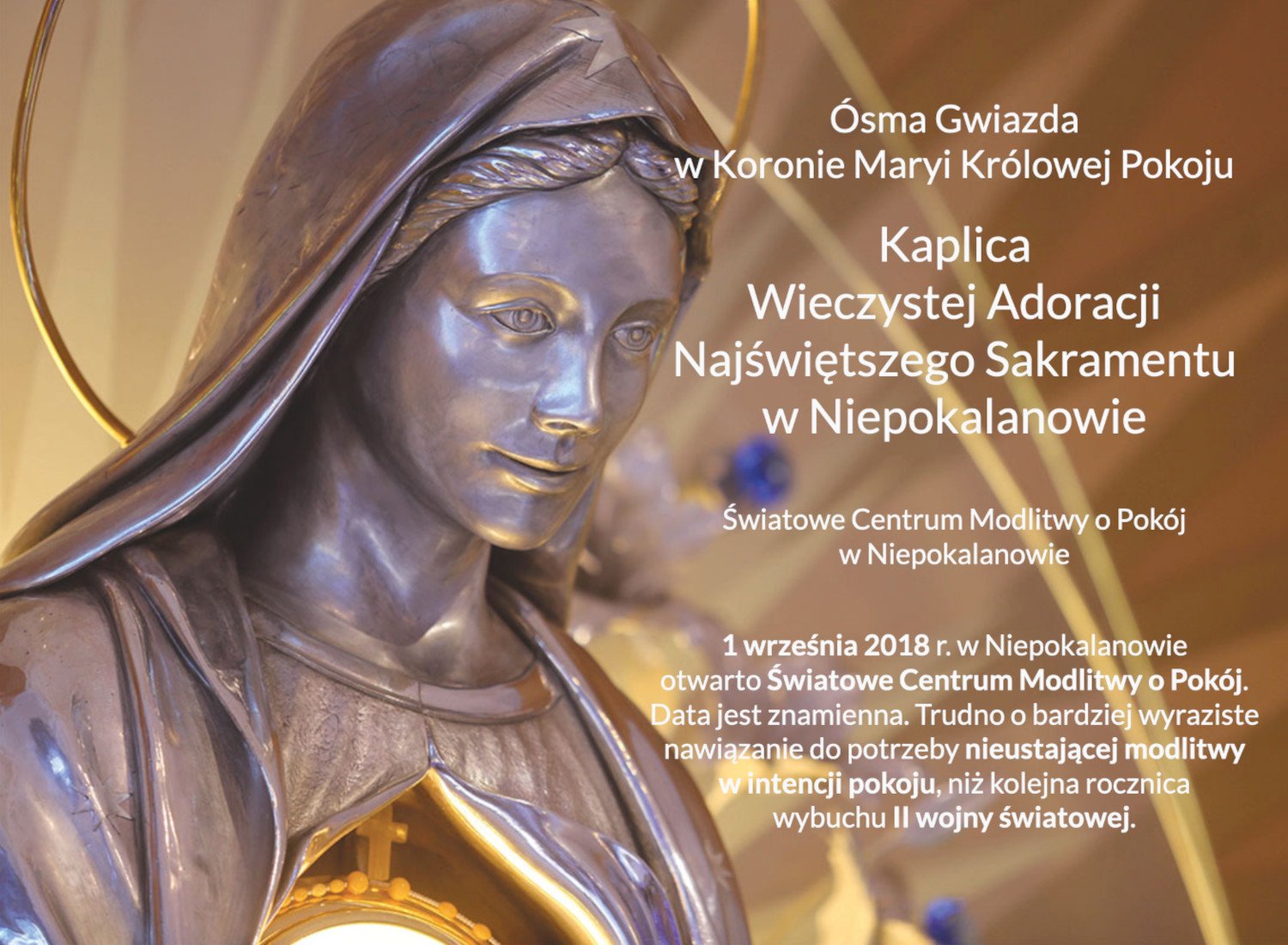

The Eucharistic Adoration Chapel established by Saint Maximilian Kolbe was inaugurated at the outbreak of World War II. It was restored as a Chapel of Adoration in September, 2018, the commemoration of the date that the war began. It is now part of the World Center of Prayer for Peace. The live internet feed of the Adoration Chapel at Niepokalanow — sponsored by EWTN — was established just a few weeks before we discovered it and began to include in at Beyond These Stone Walls. Click “Watch on YouTube” in the lower left corner to see how many people around the world are present there with you. The number appears below the symbol for EWTN.
Click or tap the image for live access to the Adoration Chapel.
The following is a translation from the Polish in the image above: “Eighth Star in the Crown of Mary Queen of Peace” “Chapel of Perpetual Adoration of the Blessed Sacrament at Niepokalanow. World Center of Prayer for Peace.” “On September 1, 2018, the World Center of Prayer for Peace in Niepokalanow was opened. It would be difficult to find a more expressive reference to the need for constant prayer for peace than the anniversary of the outbreak of World War II.”
For the Catholic theology behind this image, visit my post, “The Ark of the Covenant and the Mother of God.”

Faith and Freedom at the Twilight’s Last Gleaming
Supreme Court Justice Neil Gorsuch offers a candid view of the state of our civil liberties after three years of forced Covid pandemic restrictions and shutdowns.

Photo by John Sonderman (CC BY-NC 2.0)
Supreme Court Justice Neil Gorsuch offers a candid view of the state of our civil liberties after three years of forced Covid pandemic restrictions and shutdowns.
June 28, 2023 by Fr Gordon MacRae
Readers in the United States may recognize the second half of my title this week as a line from the Star Spangled Banner, our National Anthem: “Oh say can you see, by the dawn’s early light, what so proudly we hailed at the twilight’s last gleaming.” It was composed during a battle in the War of 1812. Thirty-six years after the American Revolution in 1776, the War of 1812 was called by some the second war for American independence.
In 1814, two years into the war, a British warship bombarded Fort McHenry in the Port of Baltimore. The part of the text of the famous poem that became our National Anthem was composed on the spot by American lawyer and poet, Francis Scott Key. “He was aboard a British frigate under a flag of truce to negotiate the release of a prisoner. While aboard, a fierce battle broke out between British and American warships.
As the smoke of battle cleared at dawn, Francis Scott Key was so inspired by the sight of an American flag still intact aboard a battered U.S. ship that he wrote down what he saw. His “Star Spangled Banner” appeared in a Baltimore newspaper. Then its first stanza was set to music to the tune of a popular pub drinking song, “To Anacreon in Heaven.” It became the National Anthem of the United States by an act of Congress on March 3, 1931.
Few people seem to know that the famous poem that inspired the U.S. National Anthem had four stanzas. Only the first was set to music. Nonetheless, at age eight I was one of four fourth grade students required by our teacher, Miss McNeil, to each memorize a stanza for an Independence Day school assembly. I was fortunate enough to draw the first stanza which was the most familiar and easiest to memorize. I remember imagining at the time that Miss McNeil might actually have been present when Francis Scott Key composed the text in 1814:
“Oh, say can you see by the dawn’s early light
What so proudly we hailed at the twilight’s last gleaming?
Whose broad stripes and bright stars thru the perilous fight,
O’er the ramparts we watched were so gallantly streaming?
And the rocket’s red glare, the bombs bursting in air,
Gave proof through the night that our flag was still there .
Oh, say does that star-spangled banner yet wave
O’er the land of the free and the home of the brave?
“On the shore, dimly seen through the mists of the deep,
Where the foe’s haughty host in dread silence reposed,
What is that which the breeze, o’er the towering steep,
As it fitfully’ blows, half concealed, half disclosed?
Now it catches the gleam of the morning’s first beam,
In full glory reflected now shines in the stream:
’Tis the star-spangled banner! Oh long may it wave
O’er the land of the free and the home of the brave!
“And where is that band who so vauntingly swore
That the havoc of war and the battle’s confusion,
A home and a country should leave us no more!
Their blood has washed out their foul footsteps’ pollution.
No refuge could save the hireling and slave
From the terror of flight, or the gloom of the grave:
And the star-spangled banner in triumph doth wave
O'er the land of the free and the home of the brave!
“Oh! Thus be it ever, when free men shall stand
Between their beloved home and war’s desolation!
Blest with victory and peace, may the heav’n rescued land
Praise the Power that hath made and preserved us a nation.
Then conquer we must, when our cause it is just,
And this be our motto: ‘In God is our trust.’
And the star-spangled banner in triumph shall wave
O’er the land of the free and the home of the brave.”
— Francis Scott Key, 1814

Independence Day 2023: The State of Our Freedom
For Independence Day 2023, I want to look at what the land of the free and the home of the brave has done with the sacrifices that won for us this cherished freedom. Freedom was never free, so justice requires that we honor it. Sadly, we went awry over the last few years when the threat was not so tangible a thing as bombs flying, but rather the tiniest of things: a virus that emerged in China.
Lest someone take umbrage with that last thought, the evidence now seems clearer that Covid originated from a lab, though likely by accident, in Wuhan, China. That said, I must remind myself and all of us that China is the Peoples’ Republic, but Covid was not the peoples’ pandemic. The good people of China live under the hammer of an oppressive communist regime. They had nothing to do with the Covid-19 pandemic.
What I find so ironic, however, is what we did with it. Perhaps the best commentary on the state of our post-pandemic freedom as we emerge from three-plus years of government Covid policy is a statement by U.S. Supreme Court Justice Neil Gorsuch. It was published on May 18, 2023 in a Supreme Court Order halting a lawsuit filed to continue Title 42. If you have not heard or read this before, it is because the free press suppressed it. The statement is a bold assessment of post-pandemic truth:
“Since March 2020, we may have experienced the greatest intrusions on civil liberties in the peacetime history of the United States. Executive officials across the country issued emergency decrees on a breathtaking scale. Governors and local leaders imposed lockdown orders forcing people to remain in their homes. They shuttered businesses and schools, public and private. They closed churches even as they allowed casinos and other favored businesses to carry on.
“They threatened violators not just with civil penalties, but with criminal sanctions as well. They surveilled church parking lots, recorded license plates, and issued notices warning that attendance at even outdoor services satisfying all state social-distancing and hygiene requirements could amount to criminal conduct. They divided cities and neighborhoods into color-coded zones, forced individuals to fight for their freedoms in court on emergency timetables, and then changed their color-coded schemes when defeat in court seemed imminent .
“Federal executive officials entered the act too, and not just with emergency immigration decrees. They deployed a public health agency to regulate landlord-tenant relations nationwide. They used a workplace safety agency to issue a vaccine mandate for working Americans. They threatened to fire non-compliant employees and warned that service members who refused to vaccinate might face dishonorable discharge and confinement. Along the way, it seems federal officials may have pressured social media companies to suppress information about pandemic policies with which they disagreed.
“At the very least, one can hope that the Judiciary will not soon again allow itself to be part of the problem by permitting litigants to manipulate our docket to perpetuate a decree designed for one emergency to address another.”
— Justice Neil Gorsuch, May 18, 2023

Churches, Casinos and Liquor Stores
At a time of intense public anxiety, Churches were deemed non-essential by government officials in many states. Justice Gorsuch pointed out above that state government officials “closed churches even as they allowed casinos and other favored businesses to carry on.” In New Hampshire, churches were forced to remain closed while all the liquor stores remained open — even on Sunday. No one pointed out that in New Hampshire, the State owns all the liquor stores.
But the saddest oppression came later. When constitutional civil rights lawsuits in various states succeeded through the courts in reopening churches with reasonable safeguards, some of our own Catholic bishops instantly replicated the heavy hand of government to keep them closed. On June 10, 2020, I posted “The Faithful Departed: Bishops Who Bar Catholics from Mass.” My own bishop issued a chilling decree.
“As Bishop of the Diocese of Manchester understanding my responsibility to issue liturgical norms by which all are bound (Canon 838:3), I hereby decree the public celebration of Mass remains suspended ... until such time as I deem it prudent to modify [this] decree.”
In a state that led the nation in opioid overdose deaths among young people (and still does) deaths by overdose outpaced deaths by Covid substantially. The closure of churches never took into consideration the hopelessness to which it contributed. The year of the Bishop’s decree saw 250 deaths statewide from Covid. All but 65 of its victims succumbed in nursing homes where government failed to protect the elderly. In contrast, the same period saw 2,500 fatal overdoses from street drugs.
In some areas, Masses were relocated to online only where the reception of Communion was impossible. When court challenges opened up churches, some state governments — and later some bishops — required Catholics who chose to attend Mass to register their name, address, and signature at the church door. Some priests were removed from ministry for openly defying these edicts. In his post, “Coronavirus “Creativity” for Mass”, one priest friend famously challenged “Just do it in the Parking Lot.” No. And … Hell no.
Easter 2023 mercifully did not look much different from Easter 2019 except perhaps in the size of congregations gathered to observe it. In a Wall Street Journal - NORC poll published in April, 2023, 39-percent of Americans reported that religion was “very important” to them. This was down from 48-percent in 2019 before the pandemic. In 1998, this figure was 62-percent. It seemed that Covid had the effect of accelerating a pre-pandemic trend.
In March, 2023, the Pew Research Center released a study reporting that the percentage of U.S. adult Christians who participated in worship at least once per month was 43-percent, down from a pre-pandemic report of 49% in 2019. However, 22-percent of the respondents in 2023 reported that their “participation” was either online or on television. Of interest, Catholic parishes that kept congregations engaged throughout the pandemic using social media and streaming parish services to their own parishioners have retained more of their communicants than Catholic parishes that just rode the wave and remained closed.
The great downside to streaming Catholic Masses online is that it habituated the practice of many faithful to take part in worship without reception of the Eucharist which is central to the Mass and to the identity of Catholics.
An interesting story developed out of China while American Christians wrangled with our post-pandemic commitment to faith. All 63 members of an Evangelical Chinese Christian congregation escaped communist China, the first parish ever to do so en masse. In response to increasing oppression of the Chinese communist government religious identity and practice, the entire parish community fled China, first to South Korea, then to Thailand, and then to the United States.
Aided by Freedom Seekers International, a Texas non-profit that helps people flee religious persecution, the group submitted applications to the United Nations refugee agency in Bangkok. Having overstayed their Thai travel visas by one year, the group had to be deported, but Thai police worked with the U.S. State Department to deport them not back to China, but to Tyler, Texas.
The Chinese communist government viewed the church as illegal and threatened to shut it and its religious school down. Rather than risk the loss of their faith community, the 63 members of this small congregation decided unanimously to preserve their faith and flee their country. Here in America, we have never faced the forced choice between God and country. What we obtain too cheap we may esteem too lightly.

+ + +
Note from Fr Gordon MacRae: Thank you for reading and sharing this post. You may also like these related posts about freedom from Beyond These Stone Walls:
The Faithful Departed: Bishops Who Bar Catholics from Mass
The Chinese Communist Party and the True Origin of Covid-19
Pornchai Moontri and the Long Road to Freedom
A Year in the Grip of Earthy Powers
+ + +
Sound of Freedom
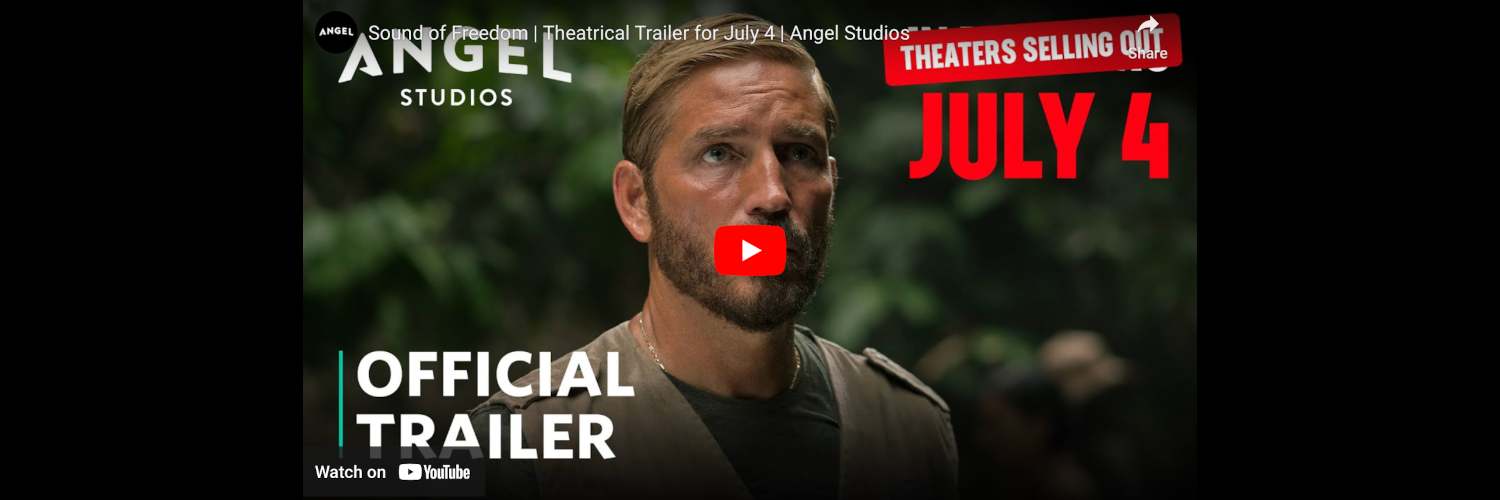
Click or tap image to watch the movie trailer. Get your tickets at: https://www.angel.com/soff.
Celebrated new film starring Jim Caviezel (The Passion of the Christ ) about the precarious state of human freedom. Jim Caviezel is asking Americans to view this movie around its opening on Independence Day.
Having unjustly lost my own freedom, this project is dear to my heart.
With Blessings,
Fr. Gordon MacRae
The Eucharistic Adoration Chapel established by Saint Maximilian Kolbe was inaugurated at the outbreak of World War II. It was restored as a Chapel of Adoration in September, 2018, the commemoration of the date that the war began. It is now part of the World Center of Prayer for Peace. The live internet feed of the Adoration Chapel at Niepokalanow — sponsored by EWTN — was established just a few weeks before we discovered it and began to include in at Beyond These Stone Walls. Click “Watch on YouTube” in the lower left corner to see how many people around the world are present there with you. The number appears below the symbol for EWTN.
Click or tap here to proceed to the Adoration Chapel.
The following is a translation from the Polish in the image above: “Eighth Star in the Crown of Mary Queen of Peace” “Chapel of Perpetual Adoration of the Blessed Sacrament at Niepokalanow. World Center of Prayer for Peace.” “On September 1, 2018, the World Center of Prayer for Peace in Niepokalanow was opened. It would be difficult to find a more expressive reference to the need for constant prayer for peace than the anniversary of the outbreak of World War II.”
For the Catholic theology behind this image, visit my post, “The Ark of the Covenant and the Mother of God.”

Convicted for Cash: An American Grand Scam
Frank X. Panico and Xs in the Sky Films present “Convicted for Cash: An American Grand Scam,” a film about a Catholic priest falsely accused and imprisoned for life.
Frank X. Panico and Xs in the Sky Films present “Convicted for Cash: An American Grand Scam,” a film about a Catholic priest falsely accused and imprisoned for life.
June 21, 2023 by Frank X. Panico and Xs in the Sky Films
Editor’s Note: This is our first “video post” at Beyond These Stone Walls. This 44-minute documentary film was created by Frank X. Panico, an award-winning short filmmaker whose work has been featured on EWTN, NewsMax, Salem Now and multiple other venues. Here is Frank X. Panico:
+ + +
“Take no part in unfruitful works of darkness, but expose them.”
— Ephesians 5:11
I created this short documentary film because I believe that railroading, convicting and imprisoning a Catholic priest through lies and deceitful tactics is an unfruitful work of darkness. The railroaded Catholic priest I refer to is Father Gordon MacRae. This documentary film is entitled “Convicted for Cash: An American Grand Scam.” It exposes the plight of a man of God wrongfully imprisoned.
When I learned of this true story, it drew me in. I have known Fr Gordon MacRae for less than a year, but after researching this story I feel that I have known him forever. I have studied every detail, and I have never personally vetted a subject of my films so extensively. There were many credible sources before me: The Wall Street Journal, the Catholic League for Religious and Civil Rights, The Media Report, The Catholic World Report, all bravely taking up the case of this wrongfully imprisoned priest against an avaricious tide of Catholic scandal and media coverage.
During production of this film, I often felt as though unseen spiritual warfare was in play. The evil one and his minions would have liked nothing more than for me to abandon this cause. I rejected such thoughts and came to know the truth. Father MacRae is an innocent man and the victim of a sham trial. I felt called to help someone who was absolutely falsely accused through a rogue communist-like legal system.
Don’t get me wrong. This is not the only reason I produced this film. I also found its subject matter to be intriguing and marketable. Not long after Tucker Carlson aired footage from the January 6th affair, an innocent prisoner caught in its net was released from prison just days later. I pray for the same result that this innocent man might be freed.
I am immensely pleased with the documentary, “Convicted for Cash.” Salem Now has picked it up so obviously they were pleased with it as well. As a daily communicant, I continue to pray at Mass for the well being and release of Fr. Gordon MacRae, a brother in Christ. Please view and then share Convicted for Cash by clicking on the link or the image below.

NOTE — NEWLY DISCOVERED EVIDENCE: In 2022, after Father MacRae had served 29 years in prison, compelling exculpatory evidence surfaced. It turns out that former Keene, NH sex-crimes Detective James F. McLaughlin was censured for “falsification of records” in another case nine years before MacRae went to trial. Previous Supreme Court rulings required that this be revealed to defendant MacRae and his legal counsel before trial. Instead, it was kept hidden. Since then, a Court has secretly sealed McLaughlin’s police file from further discovery. Nonetheless, news reports in New Hampshire reveal that the detective had a long history of police misconduct including allegations of falsifying evidence, threatening witnesses, tampering with tape recordings, selective investigation, and lying under oath. He briefly appeared on a list of dishonest police that is now also under judicial seal in New Hampshire.

The Eucharistic Adoration Chapel established by Saint Maximilian Kolbe was inaugurated at the outbreak of World War II. It was restored as a Chapel of Adoration in September, 2018, the commemoration of the date that the war began. It is now part of the World Center of Prayer for Peace. The live internet feed of the Adoration Chapel at Niepokalanow — sponsored by EWTN — was established just a few weeks before we discovered it and began to include in at Beyond These Stone Walls. Click “Watch on YouTube” in the lower left corner to see how many people around the world are present there with you. The number appears below the symbol for EWTN.
Click or tap the image for live access to the Adoration Chapel.
The following is a translation from the Polish in the image above: “Eighth Star in the Crown of Mary Queen of Peace” “Chapel of Perpetual Adoration of the Blessed Sacrament at Niepokalanow. World Center of Prayer for Peace.” “On September 1, 2018, the World Center of Prayer for Peace in Niepokalanow was opened. It would be difficult to find a more expressive reference to the need for constant prayer for peace than the anniversary of the outbreak of World War II.”
For the Catholic theology behind this image, visit my post, “The Ark of the Covenant and the Mother of God.”