“There are few authentic prophetic voices among us, guiding truth-seekers along the right path. Among them is Fr. Gordon MacRae, a mighty voice in the prison tradition of John the Baptist, Maximilian Kolbe, Alfred Delp, SJ, and Dietrich Bonhoeffer.”
— Deacon David Jones
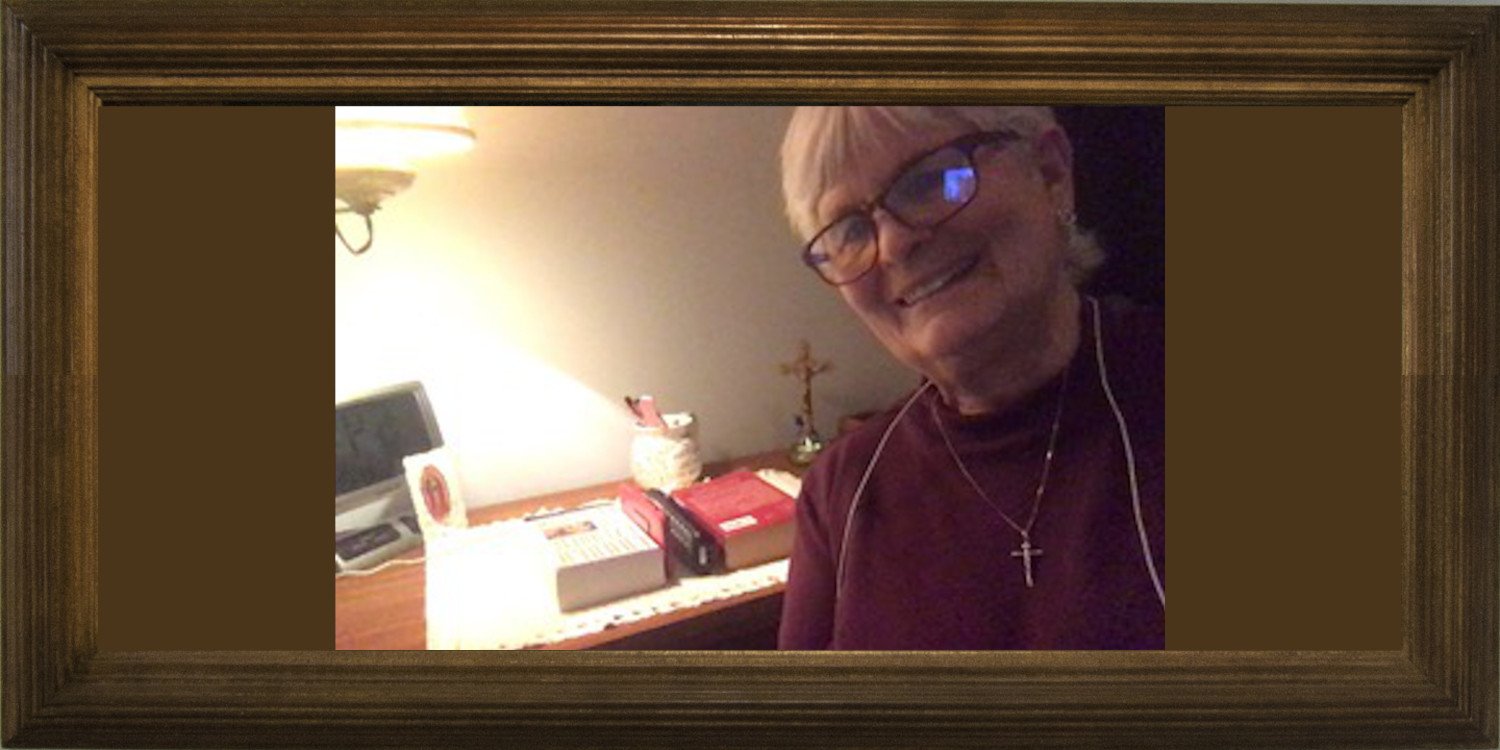
Claire Dion Has Fallen into the Hands of the Living God
Our great friend, Claire Dion, succumbed to cancer early on April 26, 2024. She passed peacefully in the presence of her family into the hands of the Living God.

Our great friend, Claire Dion, succumbed to cancer early on April 24, 2024. She passed peacefully in the presence of her family into the hands of the Living God.
April 29, 2024 by Father Gordon MacRae
“For you have died, and your life is hidden with Christ in God.”
— Colossians 3:3
It is rare that I publish more than one post a week. However, I could not let this opportunity pass to acknowledge Mrs. Claire Dion for her undaunted efforts over many years to help bring our posts to you every week. I wrote a tribute to Claire posted on April 3, 2024 entitled, “In a Mirror Dimly: Divine Mercy in Our Darker Days.” Claire played many roles in my life and in the life of our friend Pornchai Max Moontri in ways both innovative and heroic. I have spent much time pondering, in the past few days, how we could ever continue on without her.
But we must, and Claire would be the first to insist that we must. She was and is one of the most selfless souls ever to cross my path. A Mass of Christian Burial is to be offered for Claire on the day this is posted, April 29, 2024. The Mass will be at Saint Pius V Catholic Church in Lynn, Massachusetts in the very neighborhood in which I grew up. You may read all about Claire, and our hopes and fears for her in the winter of her life, in the post linked above.
But the memory I most want to cling to, and convey to all of you, is perhaps the most innovative thing she had done for us. It was late September of 2020 at the height of a global pandemic. After 16 years here as my friend, my roommate, and my family, Pornchai Maximilian Moontri was taken away by Immigration and Customs Enforcement (ICE) to begin the long and painful ordeal of deportation to his native Thailand. Prison life was beset by a panicked and draconian response to Covid, and it seemed much of the world had come to a screeching halt. Here is how I presented this story a few weeks ago:

The Divine Mercy Phone Calls
In 2020, Pornchai was held for five months in ICE detention at an overcrowded, for-profit facility in Louisiana. It was the height of the global Covid pandemic, and we were completely cut off from contact with each other. But Claire could receive calls from either of us. I guess raising five daughters made her critically aware of the urgent necessity of telephones and the importance of perceiving in advance every attempt to circumvent the rules.
Claire devised an ingenious plan using two cell phones placed facing each other with their speakers in opposite positions. On a daily basis during the pandemic of 2020, I could talk with Pornchai in ICE detention in Louisiana and he could talk with me in Concord, New Hampshire. These brief daily phone calls were like a life preserver for Pornchai and became crucial for us both. Through them, I was able to convey information to Pornchai that gave him daily hope in a long, seemingly hopeless situation.
Each step of the way, Claire conveyed to me the growing depth of her devotion to Divine Mercy and the characters who propagated it, characters who became our Patron Saints and upon whom we were modeling our lives. Saints John Paul II, Maximilian Kolbe, Padre Pio, Faustina Kowalska, Therese of Lisieux, all became household names for us. They were, and are, our spiritual guides, and became Claire’s as well by sheer osmosis.
Neither Pornchai Max nor I will ever forget Claire, but what we will both most remember with gratitude in our hearts and thanksgiving to the Lord for the graces bestowed to us through Claire is the clever and innovative story described above. It was unorthodox, but she saved the day for us both.
If you would like to post a prayer or thought about Claire, or condolence to her family, you are invited to do so at this site.
+ + +
Note from Fr Gordon MacRae: Please pray for Claire and her family. You may also like these related posts from Beyond These Stone Walls.
In a Mirror Dimly: Divine Mercy in Our Darker Days

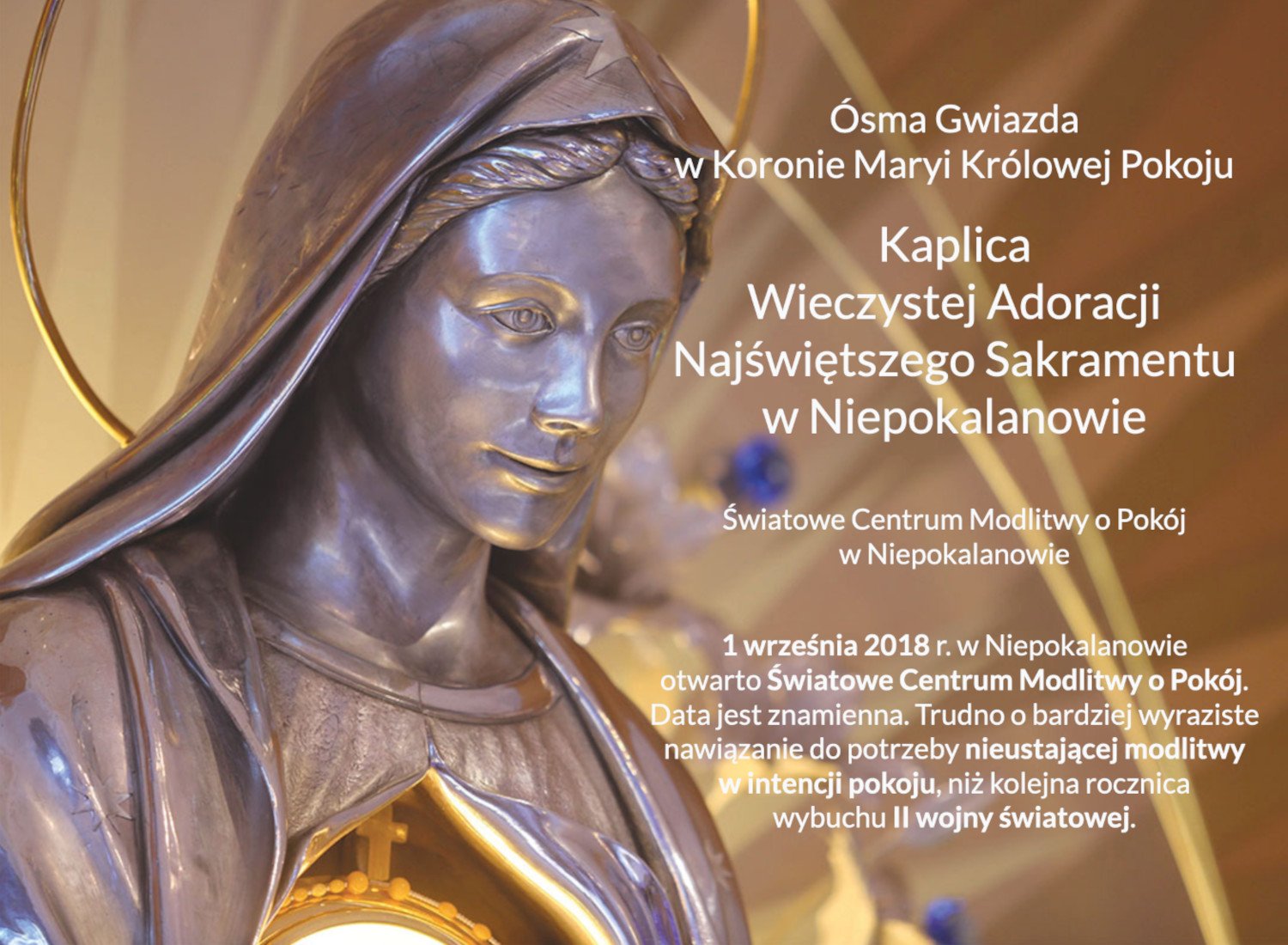

The Eucharistic Adoration Chapel established by Saint Maximilian Kolbe was inaugurated at the outbreak of World War II. It was restored as a Chapel of Adoration in September, 2018, the commemoration of the date that the war began. It is now part of the World Center of Prayer for Peace. The live internet feed of the Adoration Chapel at Niepokalanow — sponsored by EWTN — was established just a few weeks before we discovered it and began to include in at Beyond These Stone Walls. Click “Watch on YouTube” in the lower left corner to see how many people around the world are present there with you. The number appears below the symbol for EWTN.
Click or tap here to proceed to the Adoration Chapel.
The following is a translation from the Polish in the image above: “Eighth Star in the Crown of Mary Queen of Peace” “Chapel of Perpetual Adoration of the Blessed Sacrament at Niepokalanow. World Center of Prayer for Peace.” “On September 1, 2018, the World Center of Prayer for Peace in Niepokalanow was opened. It would be difficult to find a more expressive reference to the need for constant prayer for peace than the anniversary of the outbreak of World War II.”
For the Catholic theology behind this image, visit my post, “The Ark of the Covenant and the Mother of God.”

Pop Stars and Priests: Michael Jackson and the Credible Standard
The late Michael Jackson settled one abuse claim for $20 million but supporters maintain his innocence. A Catholic priest is ruined for life just for being accused.

The late Michael Jackson settled one abuse claim for $20 million but supporters maintain his innocence. A Catholic priest is ruined for life just for being accused.
April 24, 2024 by Fr Gordon MacRae
Daniel Kahneman died last month on March 27, 2024. Just as Beyond These Stone Walls was beginning, I was asked by Catholic League President Bill Donohue, to write an article for the Catholic League Journal, Catalyst. Published in July 2009, my article was “Due Process for Accused Priests.” It began with a revelation about the work of Daniel Kahneman, a noted psychologist who was awarded the Nobel Prize in Economics for his work in a phenomenon known as “availability bias.”
As a result of availability bias, humans tend to replace their beliefs with the crowd’s beliefs simply because a proposition has been repeated in the media and presented as widely believed. We are subjected to subtle cues of social pressure every day in marketing that convince many people to purchase things they don’t really need. We also face subtle cues and social pressure in the daily bombardment of news stories that cause many people to believe something based solely on its prevalence in the media. It is indeed possible that Michael Jackson and many Catholic priests became the subjects of classic, media-fueled availability bias.
In his 2011 bookThinking, Fast and Slow Daniel Kahneman laid out the foundations of what a stream of availability bias might look like:
“An availability cascade is a self-sustaining chain of events, which may lead up to public panic and large-scale government action. On some occasions, a media story about a risk catches the attention of a segment of the public, which becomes aroused and worried. This emotional reaction becomes a story in itself, prompting additional coverage in the media, which in turn produces greater concern and involvement. The cycle is sometimes sped along deliberately by ‘availability entrepreneurs,’ individuals or organizations who seek to ensure a continuous flow of worrying news. The danger is increasingly exaggerated as the media compete for attention-grabbing headlines. Anyone who claims that the danger is overstated is suspected of association with a ‘heinous cover-up’”
— Kahneman, Thinking, Fast and Slow, p.142
Does this not sound like exactly what has taken place in the early days of the priesthood crisis? In that arena, the “availability entrepreneurs” were composed largely of contingency lawyers and groups like SNAP, which I once exposed in “David Clohessy Resigned SNAP in Alleged Kickback Scheme.”
One of the conclusions of “availability bias” widely touted in the media is that statutes of limitation for lawsuits should be extended or discarded because it takes victims of sexual abuse many years or decades to come forward. The prison system in which I have spent the last 30 years houses nearly 3,000 prisoners. Estimates of those convicted of sexual offenses account for about 40 percent of them. This translates into a population of approximately 1,200 offenders in this one prison who stand convicted of sexual crimes, most true but some not. In addition to these 1,200 men, thousands more are currently on parole in New Hampshire as “registered” sexual offenders.
Only one among these thousands is a convicted Catholic priest, and if you have been paying attention at all, then you know that his conviction has been widely called into serious doubt. The thousands of other men convicted of sexual abuse are accused parents, grandparents, step-parents, foster parents, uncles, teachers, ministers, scout leaders, and so on, and for them the typical time lapse between abuse and the victim reporting it has been measured in weeks or months, not years — and certainly not decades.
My own diocese, the Diocese of Manchester, New Hampshire, in just the last month has provided a six-figure settlement to the accuser of a long deceased priest accused in a claim from 52 years ago. Even the lawyer involved admitted in a press report that “No lawsuit was filed because the alleged abuse happened outside the statute of limitations, but … it is important for survivors to come forward as part of the healing process,” which in this case involves a whole lot of money, forty percent of which goes to that attorney. In their own statement, Church officials said, “The Diocese of Manchester provides financial assistance to those who have been harmed, regardless of when the abuse occurred.” I live in a place with men some of whom have taken lives for far less money than that provided by my diocese to those who falsely took my reputation and freedom.
A simultaneous press release came under the title “Diocese of Manchester Adds to List of Clergy Accused of Sexual Abuse of a Minor.” Accuracy in language is important here. The press release continued, “The Diocese of Manchester added three priests to its list of clergy accused of sexual abuse.” Note that the usual term “credibly accused” is missing from these reports. Even that weakest of standards seems to have been discarded in favor of discarding priests who are merely “accused.” Ryan A. MacDonald wrote of the risks that such published lists pose to priests. His eye-opening article was, “In the Diocese of Manchester, Transparency and a Hit List.”

Pop Stars and Priests
I kicked a hornets’ nest some years ago when I wrote an article in response to a quote from actress Marlo Thomas who suggested in some published forum that the best American role model for middle school age boys might be singer Michael Jackson. I scoffed in my own response why the suggestion was ridiculous for many reasons, not least being the taint of sexual abuse claims against him.
Despite being acquitted in a criminal trial, Michael Jackson settled a single claim of sexual abuse for a reported $20 million, and untold millions settled other claims against him. When Michael Jackson died, he was celebrated as a cultural icon of the entertainment industry. In contrast, an American bishop, under pressure from a victims’ group, reportedly ordered the remains of a posthumously accused priest exhumed from a diocesan cemetery and reinterred elsewhere.
My point was not that I thought Michael Jackson was guilty. It was that for many fans the claims and sett1ements did not destroy his name. He was acquitted at trial, so if there was any evidence at all a jury did not find it persuasive. Some people conclude that, despite acquittal in a criminal trial, Michael Jackson’s multi-million dollar settlement of civil lawsuits was itself evidence of guilt. I’ll get back to that point.
Catherine Coy, a fan and advocate of Michael Jackson, sent a shot across my bow back then for suggesting any connection between settlements and credible accusations. I knew I was in for it when Ms. Coy began her message with “You, of all people …!” Actually, when Catherine Coy and I listened to each other, we came to a sort of detente if not agreement. In a 2005 article, “Sex Abuse and Signs of Fraud” (Catalyst, Nov. 2005), I detailed the relationship between mediated settlements and claims against Catholic priests. Did Michael Jackson become vulnerable to the same media-generated shroud under which claims against priests were seen as “credible?”
Catherine Coy insisted that in spite of monetary settlements, Jackson had never had a “credible” claim of sexual abuse lodged against him. That statement might evoke a dismissive “Yeah, right!” in some corners, but not in mine.
Why did so many people presume the worst of Mr. Jackson? It certainly wasn’t evidence. It is more of a spontaneous response, and one that is very similar to what happens when priests are accused and maintain their innocence. This is the point predicted by Nobel laureate Daniel Kahneman. The mere news media repetition of sordid stories about Michael Jackson and Catholic priests took on such prevalence in the news media that they became an unconscious bias against both. When the Catholic bishops of the United States refer to a 20-, or 30- or 40-year-old claim against a priest as “credible” they mean only that they have determined that both the priest and the accuser lived in the same community in the time period alleged.
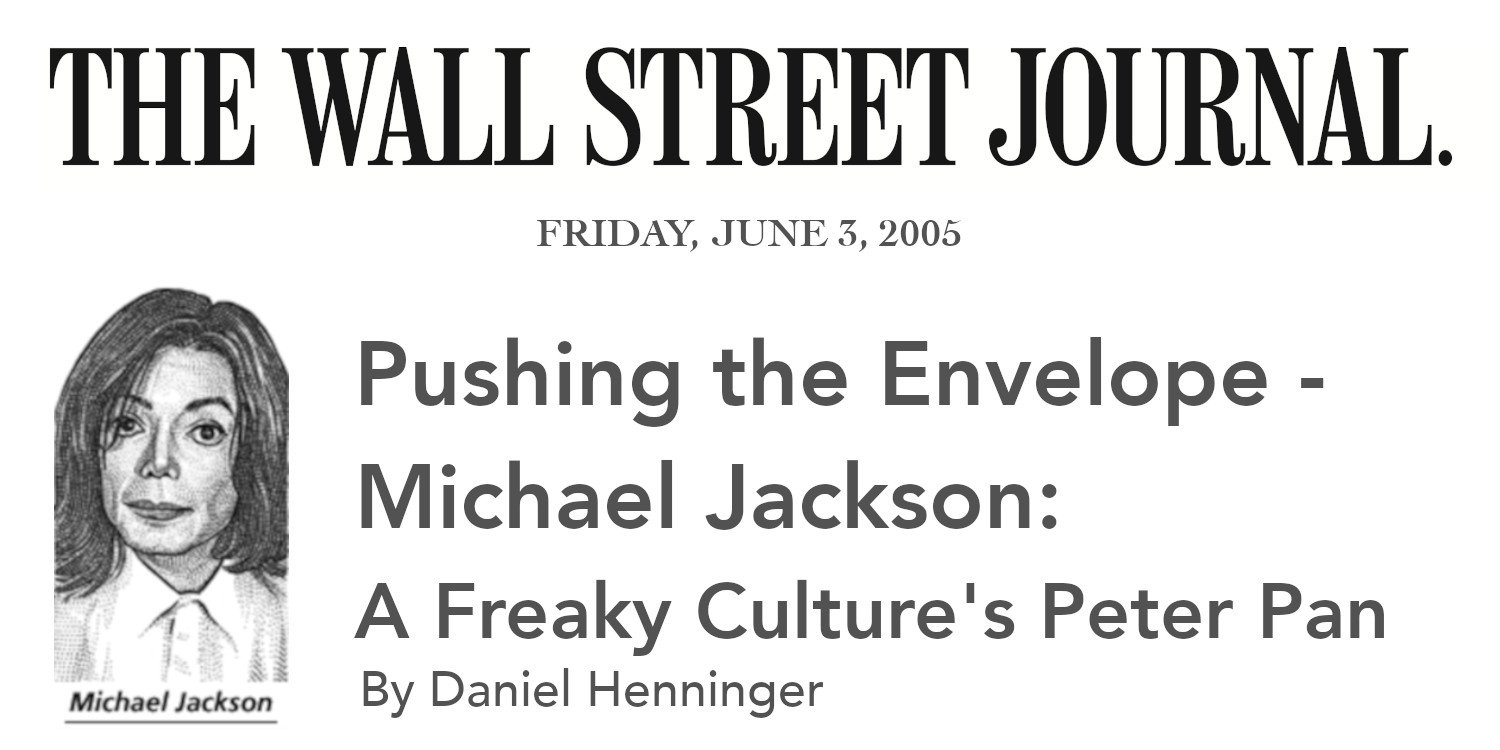
Michael and I in The Wall Street Journal
Catherine Coy was right. I, of all people, should have seen the analogy instantly. Ms. Coy wrote “There isn’t a person alive who could have withstood the onslaught of lies, innuendo and slander that was heaped on Jackson for well over 20 years.” On that score, I beg to differ, but I see her point.
The very association of Michael Jackson’s name with the bizarre proclivity attributed to him may in fact be the result of media-fueled availability bias and not evidence. There is no doubt in my mind that I and many other priests have faced this same phenomenon. With no personal experience of the behaviors attributed to some accused priests, many Catholics simply adopted the point of view given them by the news media.
This does not mean that all the claims of sexual abuse by priests are false. The U.S. Bishops commissioned a formal study of the matter conducted by the John Jay College of Criminal Justice. There were really two waves in the scandal. The first was the revelations that priests were accused at the time alleged abuse happened in the 1960’s to the 1980’s, and then were quietly moved around to other parishes to avoid a public scandal. This was scandalous enough, and tragic.
The John Jay Report also revealed that a full seventy percent of the claims faced by bishops and dioceses in 2002 and following also alleged claims from the 1960’s to 1980’s, but those claims were not brought forward until 2002 when it became clear that Church institutions would settle because of the bludgeoning they took in the media. Those claims were propelled by the widely held belief that it takes victims decades to realize they were abused and report it. Lots of people now believe that, and entire states have passed legislation to accommodate that belief. However, as demonstrated in “Due Process for Accused Priests,” the “delayed reporting” principle is classic availability bias.
In June, 2005, just three months after Dorothy Rabinowitz published an explosive two-part analysis of the case against me in The Wall Street Journal, Deputy Editorial Page Editor, Daniel Henninger wrote a most interesting commentary as Michael Jackson’s criminal trial got underway (“Pushing the Envelope – Michael Jackson: A Freaky Culture’s Peter Pan,” June 3, 2005).
It was Daniel Henninger who first put into print what I hoped someone out there might grasp:
“[Prosecutor] Tom Sneddon may lose this case. If so, it will be because Mr. Jackson, like Kobe Bryant [and O.J. Simpson], was able to mount a defense equal to the accusatory powers of the state. Not everyone can do that. If Michael walks, I’ll wonder if any of the many convicted Catholic priests similarly charged were in fact innocent but found guilty because they couldn’t push back against the state’s relentless steamroller.”
I do not at all begrudge Michael Jackson’s having had the means to mount a defense equal to the state’s prosecution of him. Whatever he spent defending himself, it was less than the state spent trying to put him in prison. At the same time, I thought Daniel Henninger’s comment about convicted priests was just and fair, but he missed an important point. I no longer have the letter, but I wrote to Mr. Henninger shortly after his 2005 editorial. This is the gist of what I wrote:
“As a priest without the means to push back in equal measure to Michael Jackson, I must point out some factors you overlooked:
“Imagine how steeply uphill Michael Jackson’s battle would have been if twenty years passed between the alleged crime and the state’s prosecutorial steamroller rumbling into action for a trial. Imagine the state having to prove nothing while Michael Jackson’s defense tried in vain to prove that something alleged to have happened two decades earlier never happened at all.
“Then imagine Michael Jackson struggling to proclaim his innocence while the institution he served denounced him and his attempts to defend himself, seeking only the path of least resistance to settle with his accusers and rid themselves of liability at the expense of due process.
“Imagine all of this, and you will have captured the scene faced by most similarly accused Catholic priests.”

The Wall Street Journal
The aftermath of those articles in April, 2005 was most interesting. The accusers in the case against me — anxious to talk to the news media before receiving settlements — suddenly had nothing to say. one of my prosecutors had nothing to say. The other took his own life. The judge was quoted in a local news article saying, vaguely, “Review is a positive thing.” Then he took early retirement from the bench. The police detective who choreographed the case, reportedly offering bribes to potential accusers, had nothing to say and has since been exposed on a previously secret list of ethically challenged police.
After those WSJ articles about me, I expected an onslaught of defensive rhetoric from victims’ groups, prosecutors, and contingency lawyers, but it never came. The sole protest came from the most unexpected source. Father Edward Arsenault, my Bishop’s delegate and the man most involved in settlement negotiations in these cases, declared that I was found guilty in a court of law by a jury of my peers, and nothing else needed to be said. Father Arsenault denounced The Wall Street Journal and its writer as biased. Incredible!
A few years later, Msgr. Edward Arsenault was convicted of multiple counts of embezzlement, including charges of forgery and fraud, and sentenced to prison. He was subsequently dismissed from the clerical state by Pope Francis but now inexplicably has a new life and a new name: Edward J. Bolognini.
In 2005 just as the Catholic scandal was building up steam to rumble full speed ahead for a national contingency lawyer windfall, I did not expect that the world’s largest secular newspaper would publish so openly against the tide — or tidal wave — of typical media coverage of claims against priests while most in the Catholic media remained silent. With the exception of Father Richard John Neuhaus in First Things and The Catholic League in Catalyst, and the Catholic World Report, the Catholic media — on both the left and the right — continued to remain silent about false claims against priests brought for money, or, worse, they have used the clergy scandal for some agenda of their own.
And of Michael Jackson, writing in The Nation, (“The Love We Lost”), JoAnn Wypijewski wrote that
“Ordinary rules of judgment have been suspended” in this sound-bite culture of news that shapes most peoples’ views on sex and the accused:
“[I]t cannot matter that Michael Jackson was acquitted of child molestation, since he was frequently remembered in death as a pedophile… just as it cannot matter whether others who plead guilty to a sex charge really did it, or whether evidence to convict was nonsense, or whether the guilty served their time. They can never ‘pay their debt to society.’ Guilt is the presumption, forever.”
JoAnn Wypijewski went on to describe the case of the priest convicted in a trial in which the sole “credible” evidence presented to the jury was the mere fact that he is a priest — that, and a claim of repressed and recovered memory, the legitimacy of which is always questioned when the accused is not a priest. In an all-too familiar twist, that priest’s bishop added his own sound bite by administratively dismissing the priest from the priesthood just before the sham of a trial.
JoAnn Wypijewski also bravely wrote about me just as the fiasco film, “Spotlight” was receiving its Academy Award for Public Service. Her ground-shaking article was “Oscar Hangover Special: Why "Spotlight" Is a Terrible Film.”
After what has now exceeded $4 billion in total mediated settlements nationwide, the matter of false claims is the elephant in the sacristy that no one wants to talk about. At the same time, our beleaguered Catholic bishops present case after case as “credible” despite knowing exactly what that term means and does not mean.
The “credible” standard Catherine Coy applied to Michael Jackson is admirable and hopeful. Ms. Coy’s fair-minded attitude about Michael Jackson is the polar opposite of what is now applied to Catholic priests.
There is no mechanism whatsoever beyond preserved DNA or an admission of guilt that would serve as evidence that a priest accused from decades ago is guilty. There is no investigation technique that could determine the credibility of such claims. What makes most claims against priests “credible” is the fact that someone — not them — has paid money to an accuser. Nothing else. Catholics should take note of the efforts by Michael Jackson fans to revisit credibility despite financial settlements which, in the secular world, are merely designed to make the claim go away with no statement of culpability.
For my part, I can only remember the famous scene early in Michael’s trial during which he danced on the hood of an SUV outside the court to the wild cheers of fans. Michael sure was a strange guy, but the dance gave me pause. Having been through such a trial, I know its oppression. That dance was surely the act of a delusional man …
… or perhaps an innocent one.

Note from Fr Gordon MacRae: Thank you for reading and sharing this post. Your comments are most welcome, but they are moderated, so they may not appear instantly. You may also like these related posts from Beyond These Stone Walls.
Due Process for Accused Priests, Catalyst, July 2009
In the Diocese of Manchester, Transparency and a Hit List
The Eucharistic Adoration Chapel established by Saint Maximilian Kolbe was inaugurated at the outbreak of World War II. It was restored as a Chapel of Adoration in September, 2018, the commemoration of the date that the war began. It is now part of the World Center of Prayer for Peace. The live internet feed of the Adoration Chapel at Niepokalanow — sponsored by EWTN — was established just a few weeks before we discovered it and began to include in at Beyond These Stone Walls. Click “Watch on YouTube” in the lower left corner to see how many people around the world are present there with you. The number appears below the symbol for EWTN.
Click or tap here to proceed to the Adoration Chapel.
The following is a translation from the Polish in the image above: “Eighth Star in the Crown of Mary Queen of Peace” “Chapel of Perpetual Adoration of the Blessed Sacrament at Niepokalanow. World Center of Prayer for Peace.” “On September 1, 2018, the World Center of Prayer for Peace in Niepokalanow was opened. It would be difficult to find a more expressive reference to the need for constant prayer for peace than the anniversary of the outbreak of World War II.”
For the Catholic theology behind this image, visit my post, “The Ark of the Covenant and the Mother of God.”

The Acquittal of O.J. Simpson and the Conviction of Father MacRae
The trial of O.J. Simpson and the trial of Fr Gordon MacRae were parallel dramas playing out on opposite sides of the U.S. in the 1990s and with opposite results.

The trial of O.J. Simpson and the trial of Fr Gordon MacRae were parallel dramas playing out on opposite sides of the U.S. in the 1990s and with opposite results.
April 17, 2024 by Fr Gordon MacRae
Editor’s Note: The above image depicts O.J. Simpson at the time of his arrest in 1994 and Father Gordon MacRae in 1983 at the time his accusations are alleged to have taken place.
+ + +
On the night of May 5, 1993, I entered into a nightmare from which I have not yet awakened. I had dinner that evening at a small Rio Rancho, New Mexico diner with two friends with whom I also shared a home and office, Father Michael Mack and Father Clyde Landry. I wrote of them once, and of the chasm of loss brought about by their sudden absence from my imprisoned life, in “The Holy Longing: An All Souls Day Spark for Broken Hearts.”
Minutes after arriving at home on that evening in 1993, the doorbell rang. I opened it to see two Rio Rancho police officers standing there. “We’re looking for a Gordon J. MacRae,” one said. “I am he,” I replied. “Please turn and face the wall,” said one of the officers as he placed me in handcuffs to escort me to his cruiser.
That scene, and the ones to follow that night, have replayed in my mind a thousand times since then. I was driven to the Rio Rancho Police Headquarters where Detective Arlan Norby showed me a warrant for my arrest issued weeks earlier 2,000 miles away in Keene, New Hampshire. The warrant described that I stand accused of numerous charges of sexual assault upon two adolescent males alleged to have occurred a dozen years earlier. It listed their identities only as “T.G.” and “J.G.” and I had no idea who they were.
It did not take long for the true nature of the case to surface. Detective Arlan Norby told me that he had numerous telephone conversations with Keene, NH, Detective James F. McLaughlin who was investigating these claims, and added, “This is all because your church has not been handling these cases very well.” From that moment on, I knew this would not be a simple case of truth and justice, and I was right. I was not to be the one on trial.
Within three days, I was released from custody on a personal recognizance bond ordered by a New Mexico judge, and the long, slow process of obtaining information on the case against me began. It was weeks before I learned the identities of “T.G.” and “J.G.” and when I did, I had not thought it possible. I remembered Thomas Grover and his brother, Jonathan, two Native American young men who, years earlier, had been adopted in the Keene area by Patricia and Elmer Grover who divorced after adopting eight multi-racial children. Theirs was not an easy life, but it seemed they found an easy repository for their life’s woes — that and a road to easy money.
Thomas Grover, then age 27, had a criminal record of his own for fraud, forgery, theft, and drug charges, and had pending domestic violence and assault charges. His brother, Jonathan Grover, then age 25, had been discharged from the U.S. Navy after a drunk driving arrest. Jonathan Grover had by then also accused another priest. I could not fathom then how or why these brothers would concoct such a scheme, but the rest of this story — at least, the parts we know, for there are still mysteries yet to be uncovered here — has since been published by various writers including Dorothy Rabinowitz whose summation you may read for yourself as it unfolded in “The Wall Street Journal on the Case of Fr Gordon MacRae.”
It took a full 18 months, and the refusal of numerous lenient plea deal offers, before the case was scheduled for trial. At one point, in a highly unusual development, the prosecution requested a six-month delay because the principal accuser, Thomas Grover, had become uncooperative. It was later learned that he rebelled because he was told that I refused a one-year plea deal. He had apparently been assured that there would be no trial and he could just move on to the money.
It was an irony that I had not fully considered at the time, but I had been living in New Mexico for the previous five years because I was working in ministry as Director of Admissions for the Servants of the Paraclete center for priests. Over the previous two years, the center had become notorious in both local and national news media — including “60 Minutes” which did a shameless, one-sided “gotcha” segment over the treatment of Father James Porter some twenty-five years previously, a case that was ever in the background of my trial.
Thomas and Jonathan Grover’s older brother, David, was actually the first to accuse me. A police report documented that he heard on his truck radio about eighty blanket settlements in the notorious “Father Porter” case by the Diocese of Fall River in neighboring Massachusetts in 1993. He had to pull over, he later claimed, as a flood of repressed memories of abuse suddenly emerged.
David Grover was the first to attempt the scam, claiming that he was molested by me at my parish at age twelve. It somehow became known that I was never there until two weeks before he turned 18 and joined the U.S. Army. So the process of charging me with even a semblance of possibility fell to his two younger brothers. Blatant lies are no obstacle to settlement, however. My diocese still settled with David Grover for $185,000.
This pattern has not changed since then. Even as I write this post, I have learned that my diocese, the Diocese of Manchester, New Hampshire, provided a six-figure settlement last month, when a newly emerged accusation against a long deceased priest claimed that he molested a teenager more than 50 years earlier in 1972:
“No lawsuit was filed because the alleged abuse happened outside the statute of limitations, but the attorney representing the John Doe who was involved said it’s important for survivors to come forward as part of the healing process.”
“In a statement, the Diocese of Manchester said, in part: ‘The Diocese of Manchester provides financial assistance to those who have been harmed, regardless of when the abuse occurred, through a process utilizing independent trauma-informed consultants.’”
— WMUR News, March 26, 2024

The White Bronco
I had to take a leave from my ministry with the Servants of the Paraclete center as I awaited trial, but the superiors of the Order in New Mexico asked me to remain with them throughout my ordeal. It was a courageous gesture of mercy and support for which I have only gratitude, even after all these years.
It was while living with that community that I walked into our common room a few weeks later on June 17, 1994, to see the now famous televised spectacle of a white Ford Bronco being pursued at low speed on a Los Angeles freeway by a dozen police vehicles and TV news helicopters. Ever since then, the case of O.J. Simpson seems in my memory to be the backdrop against which my own nightmare played out.
My trial, from jury selection to conviction, was over in less than two weeks because there was zero evidence for a jury to review. I was pronounced guilty in less than two hours of jury deliberation, and then sent to prison with a 67-year sentence on September 23, 1994. Most of the local news media pounced on the “priest in prison” story while ignoring the fact that I had three times been offered a sentence of one year in prison if I would plead guilty.
The O.J. Simpson trial, by contrast, stretched on for nine months, dominating the background of my entire first year in prison. It was all other prisoners ever talked about. Because the trial was televised, it seemed the only thing every prisoner watched. I did not have a television then, but I was crammed into a cell with seven other men, and had a daily dose of the O.J. Trial whether I wanted it or not.
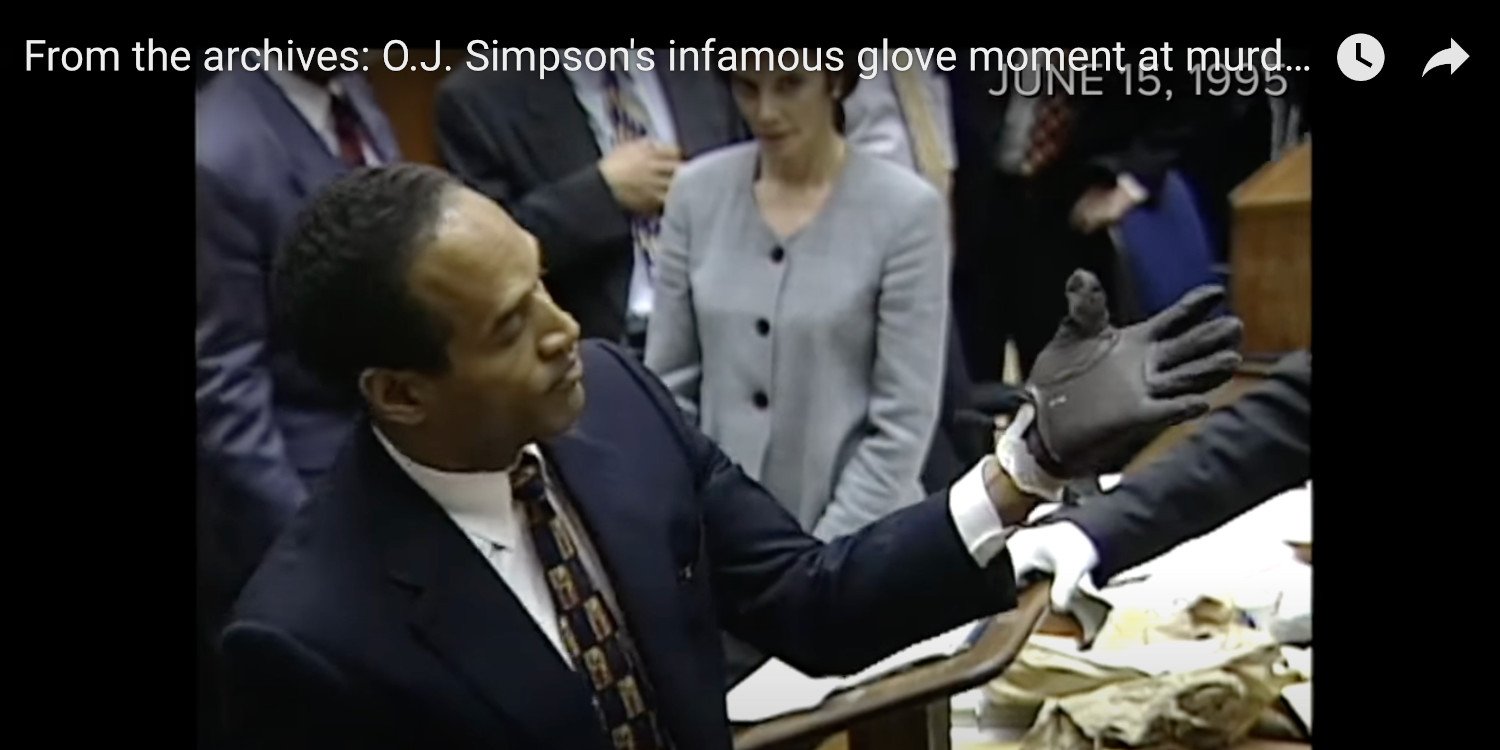
Still from KCLA News Los Angeles video
“If It Doesn’t Fit, You Must Acquit.”
Thanks to television, the entire nation had a front row seat to the rare drama of “The O.J. Trial.” The spectacle included the opening statements of L.A. prosecutors Marcia Clark and Christopher Darden on January 24, 1995; the theatrical opening statement of defense attorney Johnny Cochran the next day, and some famous names among lawyers as F. Lee Bailey, Barry Scheck, and Robert Shapiro joined him in O.J.’s million dollar Dream Team defense.
In the year-long spectacle, we heard L.A. Detective Mark Fuhrman grilled by defense attorney F. Lee Bailey for his suspected history of racist remarks only to later assert his Fifth Amendment right to refuse questions after tapes were played in open court. Then Attorney Robert Shapiro cross-examined Detective Vanatter about statements he allegedly made to mob informants that shed light on why the L.A. police went to the home of O.J. Simpson in the early days of the case.
We witnessed the heavily hyped scene of O.J. trying on the gloves obtained as prosecutorial evidence resulting in Johnny Cochran’s most famous sound bite to emerge from this trial “If it doesn’t fit, you must acquit.” And we saw all of this entirely eclipse a mountain of physical and scientific forensic evidence against O.J. Simpson, including DNA evidence. But none of it mattered. None of it could defeat the theatrics.
In his closing argument before the jury, O.J. defense attorney, Johnny Cochran compared Los Angeles Detective Mark Fuhrman to Adolf Hitler. In his closing argument in my trial just a few months earlier, prosecutor Bruce Elliot Reynolds compared me to Adolf Hitler. However, my attorney had already left the trial and was not there to object.
On October 2, 1995, after a trial that presented mountainous evidence over the course of nine months, the O.J. Trial jury reached a verdict in just three hours. It was one of the most watched moments in American television history. From my prison cell, having served a year in prison with just sixty-six left to go for crimes that never took place and for which there was no evidence at all, I heard the O.J. verdict: “not guilty” on both counts of murder.

Book cover by Graymalkin Media. Photo by AFP
Now Comes Marcia Clark
Three years after the O.J. Trial ended, with me still in prison, I received a letter from the studios of Mark Phillips Films and Television in Los Angeles. Here’s the entire letter dated January 15, 1998:
“Dear Father MacRae: I work for former Los Angeles prosecutor Marcia Clark. She is doing a primetime special for FOX Broadcasting Network which will air at 9:00 PM on Monday, February 16, 1998. Through the National Justice Committee I heard about your story. I talked with Mark Phillips, the Executive Producer of the show, about your case. He in turn talked with the executives at FOX about profiling your story on our special, and they want to feature your story on our show.
“Basically what we are doing in this one-hour, one-on-one interview show with Marcia Clark is to send her wherever the story is. She would do a sit-down interview with you. The interview would end with you taking a polygraph test. I understand you have taken several polygraphs in this case, and have passed them.
“We want to profile your story in a more positive light. It is obvious to us that an injustice has occurred in your case, and through profiling your story we want to get the word out that justice has not been served, and that there is an innocent man sitting in prison who should be free. By getting your story out, people will think twice about blindly accepting charges brought by one person against another person in your situation.”
— Letter of January 15, 1998 from Mark Phillips Films & Television
I accepted Marcia Clark’s invitation immediately, though I added that my accusers should also cooperate with polygraph (lie detector) tests. This had been proposed a number of times, but none of my accusers or their attorneys would even acknowledge similar invitations to take a polygraph or respond to questions. When a former FBI agent investigating the case found and approached accuser Thomas Grover at the Hualapai Tribal Reservation in Arizona where he is hiding, all he would say is “I want a lawyer.” Where I live, pretty much everyone knows what “I want a lawyer” means.
But to make a long story shorter, the 1998 Marcia Clark program was a dead end. New Hampshire officials blocked the plan and would not allow FOX to conduct an on-camera interview, nor would they allow the polygraph expert to test me. Fox executives sent an appeal to then Governor Jeanne Shaheen (now U.S. Senator Jeanne Shaheen, D-NH) who responded in a letter dated January 31, 1998:
“I understand your company’s interest in an on-camera interview with Gordon J MacRae, who is currently an inmate in the New Hampshire State Prison, however I will not interfere with the decision not to allow media access to Mr. MacRae.”
So the Constitution, the First Amendment, and Freedom of the Press all took a back seat to some hidden agenda. The interest of Marcia Clark, however, is the real reason I am writing of this today. Perhaps the overture would have been different after the fall of the priesthood in the revelations of 2002 and 2003 which managed to squash all other media courage — except that of Dorothy Rabinowitz and The Wall Street Journal — in seeing both sides of this story.
In the trial of O.J. Simpson, Marcia Clark saw justice fail in a very big way as a prosecutor trying to bring justice to two murdered victims in Los Angeles. Just three years later, for her to even attempt to bring justice to another high profile story when the rest of the media world was just spitting on it is, for me, a sign of real courage and integrity that is sorely lacking in most of the news media today.
In 2016, twenty one years after the O.J. Trial, the FX cable television network broadcast American Crime Story: The People v. O.J. Simpson, a dramatic presentation of the trial. The series was built upon a factual publication of CNN Legal Analyst Jeffrey Toobin entitled, The Run of His Life. It was a serious effort with an impressive cast including Academy Award-winning actor Cuba Gooding, Jr. as O.J. Simpson, Sarah Paulson as prosecutor Marcia Clark, and John Travolta, Nathan Lane, and Courtney B. Vance as defense attorneys Robert Shapiro, F. Lee Bailey, and Johnny Cochran respectively.
Executive Producer Nina Jacobson promised that “looking back at O.J. helps us understand the world we live in now — 20 years later.” Well, Nina, the world I live in now 30 years later makes me want to turn the channel and run for cover. Justice is not served, then or now.
So my first thought was that I’d rather have a root canal than relive the O.J. Trial! But in a saner, quieter moment, I came to the only conclusion possible. How could I NOT watch? Maybe someone else in the media will catch the example of the likes of Marcia Clark and Dorothy Rabinowitz and grow a spinal column.
O.J. Simpson passed away from cancer at the age of 76 on April 10, 2024, the day after my 71st birthday in my 30th year in prison.
+ + +
Note from Fr Gordon MacRae: Thank you for reading and sharing this timely post. You may also like these related posts from Beyond These Stone Walls :
In the Diocese of Manchester, Transparency and a Hit List
Police Misconduct: A Crusader Cop Destroys a Catholic Priest
The Eucharistic Adoration Chapel established by Saint Maximilian Kolbe was inaugurated at the outbreak of World War II. It was restored as a Chapel of Adoration in September, 2018, the commemoration of the date that the war began. It is now part of the World Center of Prayer for Peace. The live internet feed of the Adoration Chapel at Niepokalanow — sponsored by EWTN — was established just a few weeks before we discovered it and began to include in at Beyond These Stone Walls. Click “Watch on YouTube” in the lower left corner to see how many people around the world are present there with you. The number appears below the symbol for EWTN.
Click or tap here to proceed to the Adoration Chapel.
The following is a translation from the Polish in the image above: “Eighth Star in the Crown of Mary Queen of Peace” “Chapel of Perpetual Adoration of the Blessed Sacrament at Niepokalanow. World Center of Prayer for Peace.” “On September 1, 2018, the World Center of Prayer for Peace in Niepokalanow was opened. It would be difficult to find a more expressive reference to the need for constant prayer for peace than the anniversary of the outbreak of World War II.”
For the Catholic theology behind this image, visit my post, “The Ark of the Covenant and the Mother of God.”

A Mirror Image in the Devil’s Masterpiece
Inspired by Bishop Robert Barron’s acclaimed Letter to a Suffering Church, the Editor of Beyond These Stone Walls was moved to write and publish this inspired reply.

Inspired by Bishop Robert Barron’s acclaimed Letter to a Suffering Church, the Editor of Beyond These Stone Walls was moved to write and publish this inspired reply.
April 10, 2024 by Dilia E. Rodríguez, PhD with an Introduction by Father Gordon MacRae
Introduction
I will always owe a debt of gratitude to Suzanne Sadler of Australia. After following the sordid story that entangled many Catholic priests in false witness, Suzanne came upon an article I was invited to write for Catalyst, the Journal of the Catholic League for Religious and Civil Rights. The article, which appeared in the July, 2009 issue of Catalyst, was “Due Process for Accused Priests.”
Immediately upon reading it, Suzanne wrote to me from Australia with a suggestion that I permit her to establish a blog that would feature my writing. I was highly dubious, believing that I had nothing of interest or value that anyone would want to read. It was Pornchai Max Moontri, my friend and roommate of many years in prison who encouraged me to try. He reminded me of a letter from Cardinal Avery Dulles urging me to add a new chapter to the literature of Christians wrongly imprisoned. It was also Max who suggested this blog’s first title, “These Stone Walls.” Then Pornchai’s Godmother, Charlene C. Duline, a retired U.S. State Department official jumped aboard with an offer to help with logistics. I ran out of excuses, and in August of 2009 These Stone Walls was born with my first of hundreds of posts “St. Maximilian Kolbe and the Man in the Mirror.”
Over the course of the next nine years, These Stone Walls published some 500 original posts written mostly by me but some by far more distinguished guest writers. Then, in 2019, Covid struck and grew into a global pandemic affecting every tenet of our lives, including our lives of faith. Much that we had come to cherish began to desintegrate before our eyes. In the course of a single week in 2020, my voice in this wilderness of prison and false witness was silenced. These Stone Walls had collapsed.
Then, seemingly from out of the blue came a letter from Dilia E. Rodríguez in New York. She wrote that she was so enamored by a post she stumbled upon about Pope Benedict XVI and Saint Joseph that she felt compelled to read more. Just before my blog was taken offline she downloaded its entire contents onto her own computer.
So the end that I thought was upon us turned out not to be an end at all, but a new beginning. It was in September 2020 that this news came to me. It was just as my longtime friend Pornchai Max Moontri was departing for deportation to Thailand. Just as I was immersed in loss and sadness, Dilia was quietly in the background resurrecting this blog with new life and a new name, “Beyond These Stone Walls.” Dilia has now been our Editor for going on four years.
As we faced the terminal illness of Claire Dion, the subject of my Divine Mercy post last week, Dilia accepted the necessity of stepping out of the shadows and into the light to also take over all that Claire had managed.
Dilia E. Rodriguez, PhD retired in 2022 from a career in U.S. Government service as a civilian scientist for the United States Air Force. Holding advanced degrees in both Physics and Computer Science, Dilia is also a daily communicant and a strong supporter and participant in Eucharistic Adoration. In recent weeks she has also stepped up to take on the logistics of support services for me and this blog as described at our Contact and Support Page.
To mark this occasion and further introduce Dilia, I want to restore and repost something she had written on the Feast of the Holy Innocents in December 2019. Her post is a brilliant response to a small book by Bishop Robert Barron entitled, “Letter to a Suffering Church.”
Here is Dilia E. Rodriguez with
+ + +

A Mirror Image in the Devil’s Masterpiece
Today is the Feast of the Holy Innocents, and to me it offers symbols for the crisis in the Church.
First, let me say that, as so many others, I am moved by the impassioned efforts of Bishop Robert Barron to stop Catholics from leaving the Church. His heart and soul are on fire with the love of Jesus, of His Church and of His People.
I never thought of leaving, and it is not just “to whom shall we go?” It is that God is LOVE, and as one saint, whose name I cannot recall, said, “LOVE is not loved.” I see the current scandal as stark evidence that LOVE is not loved. So my reaction is that I want to love God, I want to love Jesus with my whole being, as I have never loved Him before.
I want to consider (… think aloud … pray aloud …) three points: the devil’s masterpiece, evangelization at this time, and the call for saints.
Bishop Barron convincingly describes the sexual abuse scandal as exquisitely designed by the devil. He shows the horror that attends the sexual abuse of young people by priests, and the cover-up of these abuses by bishops. Whether or not it is seen as the devil’s masterpiece, this is what is described almost universally as the entirety of the sexual abuse scandal, by the mainstream media, by the Catholic media, by attorneys general and others.
But there is more to the devil’s masterpiece. There is a mirror image that remains invisible to most. The Father of Lies surely can use lies in this masterpiece of masterpieces. In this mirror image the accused priests are innocent, and the ones who claim to have been abused are the abusers. In this mirror image bishops abuse innocent priests by publishing their names in lists of “credibly” accused. This requires no corroboration or evidence of the accusation. It replaces “innocent until proven guilty” with “guilty until proven innocent” or even “guilty even if proven innocent.” This “credible” accusation standard is neither a legal nor a biblical standard.
So two abuses coexist: the visible one, the sexual abuse of young people by priests; and the invisible one, the abuse of innocent priests by those who falsely claim to have been abused and profit from it.
In the accused innocent priests Jesus is living His Passion. Pilate said, “I find no guilt in him.” There is no evidence against many of the accused priests. Jesus stood wearing the crown of thorns and the purple cloak. The chief priests and the guards cried out, “Crucify him, crucify him.” Pilate tried to release him, but the crowd insisted, “Crucify him!” Bishops may want to do the right thing, but they cave in to the pressure and they crucify innocent priests; they remove them from the ministry to which God called them. Bishops cave in to the pressure of those who ask cynically “What is truth?”, and do not listen to the One Who is TRUTH.

Holy Innocents: Double Symbol for the Crisis
The massacre of the holy innocents captures in symbol the two coexisting abuses. Herod’s killing of the innocent children represents the killing of innocent faith of the young who have been abused by priests. The way of Herod — to kill the many to ensure killing the One — is the way that has been adopted to assuage the anger and fears of the crowd and the media. So Herod’s killing of the innocent children also represents the destruction of the lives of innocent priests without having to prove any claim against them. Both are very grievous abuses.
A mirror adds much light where there is light. The mirror-image abuse deceptively intensifies the dark evil of the abusive priests.
What can I do, … we do, … the bishops do, in response to the devil’s masterpiece of masterpieces? Absolutely nothing. Jesus said it, “Without Me you can do nothing.” (John 15:5) But He said, “Whoever remains in Me and I in him will bear much fruit.” Only Jesus can respond to the devil’s masterpiece of masterpieces.
This time of great scandal is the Olympics of Evangelization. The Gospel is not just for intellectual discussions or for run-of-the-mill problems. It is only the full power of the Gospel that can cope with the immensity of this scandal.
The response of Jesus cannot be implemented by the weekend Catholic “athletes.” After a recent EWTN / Real Clear poll, Professor Robert George of Princeton University noted: “So even if you take the most devout Catholics — those who believe all of what the Church teaches or most of what the Church teaches — only 66% of those believe in the Real Presence of Jesus in the Eucharist.” Clearly, an overwhelming majority of the laity can in no way be part of the response of Jesus. They are way out of shape.
The response of Jesus is the response of His Olympic team, the living saints, whom Bishop Barron and Benedict XVI point out as the great evangelizers; those who remain in Him, and He in them.
God is LOVE. Jesus said, “I am the WAY, the TRUTH, and the LIFE.” In the mystery of Jesus, LOVE, TRUTH, and LIFE are synonyms. There can be no love without truth. There can be no life without love. Only Jesus can love both the abused and the abuser. Only Jesus can restore their lives. Only Jesus, the WAY, can reject the way of Herod. Only Jesus … through those who remain in Him and He in them.
Bishop Barron wrote (p. 97): “Above all, we need saints, marked by holiness of course, but also by intelligence, an understanding of the culture, and the willingness to try something new.”
Under “intelligence” and “understanding of the culture” should come a realization that the moral relativism of this age, the pervasive misinformation in the news (e.g. huge pro-life marches become invisible), the readiness to attack the Church, etc., do not foster an accurate portrayal of the scandal in the Church.

Conditioned by the Media
If in trying to solve a problem, or to understand a phenomenon, we ignore whole classes of facts and observations, we have no possibility of success: we will not solve the problem or understand the phenomenon.
Even though way back I realized that the real abuses of minors by priests could be exploited by others against the Church, I was still conditioned by the media. When the Pennsylvania Attorney General report came out, my knee-jerk reaction was “Here we go again.” But there was almost nothing new in it, and truth and fairness may not necessarily be its hallmark.
Jesus said: “Behold, I am sending you like sheep in the midst of wolves; so be shrewd as serpents and simple as doves.” (Matthew 10:16). Saints marked by intelligence and understanding of the culture eagerly and persistently seek the truth in this age that so fiercely rejects it. Their messages and their lives are a bright light in this very dark period. Consider the following examples: “A Weapon of Mass Destruction: Catholic Priests Falsely Accused”; Hope Springs Eternal in the Priestly Breast; Men of Melchizedek; A Ram in the Thicket; The Catholic League for Religious and Civil Rights ; Catholic Priests Falsely Accused: The Facts, The Fraud, The Stories.
I began to see the magnitude of the mirror-image scandal when I accidentally discovered the blog “These Stone Walls.” It is the blog, published with the help of some friends, of Father Gordon J. MacRae, a falsely accused priest who has been in prison for 30 years. When the “hour had come,” Jesus prayed to the Father for those the Father had given to Him, “Consecrate them in the truth.” With a plea deal, Father MacRae could have been out of prison after one year. But he is consecrated to the Truth, and did not lie. For that, he got a life sentence.
Of his case Father Richard John Neuhaus wrote: “You may want to pray for Father MacRae, and for a Church and a justice system that seem indifferent to justice.”
The scandal of the Church is a colossal problem. The Dallas Charter of 2002 got some things right, but it also helped create the mirror-image scandal. Cardinal Avery Dulles wrote in 2004:
“The church must protect the community from harm, but it must also protect the human rights of each individual who may face an accusation. The supposed good of the totality must not override the rights of individual persons. Some of the measures adopted [at Dallas] went far beyond the protection of children from abuse … [By their actions, the bishops] undermined the morale of their priests and inflicted a serious blow to the credibility of the church as a mirror of justice.”
He also added:
“having been so severely criticized for exercising poor judgment in the past, the bishops apparently wanted to avoid having to make any judgments in these cases.”
If the priesthood is to be renewed, Jesus must be the foundation of this renewal. It must be His Way, His Love, and His Truth that renews the priesthood. The Church cannot be divided. It cannot call for saintly priests, while at the same time depriving some saintly priests of their civil and canonical rights when falsely accused.
Jesus, train me in Your ways. May I not utter empty words, and cry out “Lord, Lord.” May I love all the abused, all the abusers, and as Bishop Barron says, all fellow sinners. You have redeemed me through a Very Great Sacrifice. May I constantly beg You to make me Totally Yours.
Amen.
+ + +

Encoded Message from God
I got the idea that I wanted to find in the awful number the prison assigned to Father Gordon a comforting message from God. Maybe somehow the numbers could be mapped to some verse in the Bible. My starting point was to associate with each of the digits in 67546 the letters that phones assign to digits:
6 -> m n o; 7 -> p q r s; 5 -> j k l; 4 -> g h i; 6 -> m n o.
It really didn’t make much sense. I wanted to find some verse whose first word started with m or n or o, and whose second word started with p or r or q or s, and so on. I wasn’t finding such a five-word verse. I have as my desktop background the icon of Our Lady of Perpetual Help. So I asked her for help. After a while I considered my favorite Bible verse:
“I am the vine, you are the branches. Whoever remains in me and I in him will bear much fruit, because without me you can do nothing.”
— John 15:5
There was no direct connection, but it was possible to see a loose one.
“I am the vine, you are the branches. Whoever REMAINs IN ME and I in him will bear much fruit, because without me you can do nothing.”

At first I thought that it would have been better if “Jesus” had been the second word. But then I realized that Jesus being in the middle, at the heart of the prayer, was perfect.
With the help of Our Blessed Mother we can see that in the number the prison system uses to demean Father Gordon, God encoded the prayer he is living, and attests that he is bearing much fruit.
+ + +
Note from Fr Gordon MacRae: I am deeply grateful to Dilia for the ways she has saved my voice in the wilderness from being drowned out in the scandals of this age. I believe the Lord has in fact sent her just in the nick of time.
You may also like these other posts about our quest for Jesus and for justice:
Casting the First Stone: What Did Jesus Write On the Ground?
A Devil in the Desert for the Last Temptation of Christ
St. Michael the Archangel and the Scales of Our Salvation
Maximilian Kolbe: The Other Prisoner Priest in My Cell
Please consult our “Contact and Support” Page for new information on how to support this blog and our cause for justice.


The Eucharistic Adoration Chapel established by Saint Maximilian Kolbe was inaugurated at the outbreak of World War II. It was restored as a Chapel of Adoration in September, 2018, the commemoration of the date that the war began. It is now part of the World Center of Prayer for Peace. The live internet feed of the Adoration Chapel at Niepokalanow — sponsored by EWTN — was established just a few weeks before we discovered it and began to include in at Beyond These Stone Walls. Click “Watch on YouTube” in the lower left corner to see how many people around the world are present there with you. The number appears below the symbol for EWTN.
Click or tap here to proceed to the Adoration Chapel.
The following is a translation from the Polish in the image above: “Eighth Star in the Crown of Mary Queen of Peace” “Chapel of Perpetual Adoration of the Blessed Sacrament at Niepokalanow. World Center of Prayer for Peace.” “On September 1, 2018, the World Center of Prayer for Peace in Niepokalanow was opened. It would be difficult to find a more expressive reference to the need for constant prayer for peace than the anniversary of the outbreak of World War II.”
For the Catholic theology behind this image, visit my post, “The Ark of the Covenant and the Mother of God.”

In a Mirror Dimly: Divine Mercy in Our Darker Days
Your friends behind and Beyond These Stone Walls have endured many trials. Divine Mercy has been for them like a lighthouse guiding them through their darkest days.

Your friends behind and Beyond These Stone Walls have endured many trials. Divine Mercy has been for them like a lighthouse guiding them through their darkest days.
April 3, 2024 by Fr Gordon MacRae
Editor’s Note: In 2018, Mrs. Claire Dion visited Pornchai Moontri in prison and wrote a special post about the experience which we will link to at the end of this one. In the years leading up to that visit, the grace of Divine Mercy became for them both like a shining star illuminating a journey upon a turbulent sea. Divine Mercy is now their guiding light.
+ + +
I had clear plans for the day I began writing this post, one of many at this blog about Divine Mercy. But, as often happens here, my best laid plans fall easily apart. The prison Library where I have been the Legal Clerk for the last dozen years has been open only one day per week for several months due to staff shortages. During down times in the Law Library, I am able to use a typewriter that is in better condition than my own. So this day was to be a work day, and I had lots to catch up on, including writing this post.
I kept myself awake during the night before, mapping out in my mind all that I had to accomplish when morning came and how I would approach this post. Divine Mercy is, after all, central to my life and to the lives of many who visit this blog. But such plans are often disrupted here because control over the course of my day in prison is but an illusion.
Awake in my cell at 6:00 AM, I had just finished stirring a cup of instant coffee. Before I could even take a sip, I heard my name echoing off these stone walls as it was blasted on the prison P.A. system. It is always a jarring experience, especially upon awakening. I was being summoned to report immediately to a holding tank to await transport to God knows where. I knew that I might sit for hours for whatever ordeal awaited me. My first dismayed thought was that I could not bring my coffee.
It turned out that my summons was for transportation to a local hospital for an “urgent care” eye exam with an ophthalmologist. For strict security reasons I was not to know the date, time, or destination. Months ago, I developed a massive migraine headache and double vision. The double vision was alarming because I must climb and descend hundreds of stairs here each day. Descending long flights of stairs was tricky because I could not tell which were real and which would send me plummeting down a steel and concrete chasm.
So I submitted a request for a vision exam. My double vision lasted about six weeks, then in mid-February it disappeared as suddenly as it came. I then forgot that I had requested the consult. So two months later I made my way through the morning cold in the dark to a holding area where a guard pointed to an empty cell where I would sit in silence upon a cold concrete slab to await what is called here “a med run.”
Over the course of 30 years here, I have had five such medical “field trips.” That is an average of one every six years so there has been no accumulated familiarity with the experience. The guards follow strict protocols, as they must, requiring that I be chained in leg irons with hands cuffed and bound tightly at my waist. It is not a good look for a Catholic priest, but one which has likely become more prevalent in recent decades in America. During each of my “med runs” over 30 years, my nose began to itch intensely the moment my hands were tightly bound at my waist.
The ride to one of this State’s largest hospitals, Catholic Medical Center in Manchester, was rather nice, even while chained up in the back of a prison van. The two armed guards were silent but professional. My chains clinked loudly as they led me through the crowded hospital lobby. The large room fell silent. Amid whispers and furtive glances, I was just trying hard not to look like Jack the Ripper.
I was led to a bank of elevators where I was gently but firmly turned around to face an opposite wall lest I frighten any citizens emerging from one. As I stared at the wall, I made a slight gasp that caught the attention of one of the guards. Staring back at me on that wall opposite the elevators was a large framed portrait of my Bishop who I last saw too long ago to recall. I smiled at this moment of irony. He did not smile back.

A Consecration of Souls
The best part of this day was gone by the time I returned from my field trip to my prison cell. I was hungry, thirsty, and needed to deprogram from the humiliation of being paraded in chains before Pilate and the High Priests. My first thought was that I must telephone two people who had been expecting a call from me earlier that day. One of them was Dilia, our excellent volunteer editor in New York. The other was Claire Dion, and I felt compelled to call her first. Let me tell you about Claire.
As I finally made my way up 52 stairs to my cell that day, I reached for my tablet — which can place inexpensive internet-based phone calls. I immediately felt small and selfish. My focus the entire day up to this point was my discomfort and humiliation. Then my thoughts finally turned to Claire and all that she was enduring, a matter of life and death.
I mentioned in a post some years back that I grew up in Lynn, Massachusetts, a rather rugged industrial city on the North Shore of Boston. There is a notorious poem about the City but I never knew its origin: “Lynn, Lynn, the City of Sin. You never go out the way you come in.” After writing all those years ago about growing up there, I received a letter from Claire in West Central Maine who also hails from Lynn. She stumbled upon this blog and read a lot, then felt compelled to write to me.
I dearly, DEARLY wish that I could answer every letter I receive from readers moved by something they read here. I cannot write for long by hand due to carpal tunnel surgery on both my hands many years ago. And I do not have enough typewriter time to type a lot of letters — but please don’t get me wrong. Letters are the life in the Spirit for every prisoner. Claire’s letter told me of her career as a registered nurse in obstetrics at Lynn Hospital back in the 1970s and 1980s. It turned out that she taught prenatal care to my sister and assisted in the delivery of my oldest niece, Melanie, who is herself now a mother of four.
There were so many points at which my life intersected with Claire’s that I had a sense I had always known her. In that first letter, she asked me to allow her to help us. My initial thought was to ask her to help Pornchai Moontri whose case arose in Maine. The year was late 2012. I had given up on my own future, and my quest to find and build one for Pornchai had collapsed against these walls.
Just one month prior to my receipt of that letter from Claire, Pornchai and I had professed Marian Consecration, after completing a program written by Father Michael Gaitley called 33 Days to Morning Glory. It was the point at which our lives and futures began to change.
Claire later told me that after reading about our Consecration, she felt compelled to follow, and also found it over time to be a life-changing event. She wanted to visit me, but this prison allows outsiders to visit only one prisoner so I asked her to visit Pornchai. He needed some contacts in Maine. The photo atop this post depicts that visit which resulted in her guest post, “My Visit with Pornchai Maximilian Moontri.”

The Divine Mercy Phone Calls
From that point onward, Claire became a dauntless advocate for us both and was deeply devoted to our cause for justice. In 2020, Pornchai was held for five months in ICE detention at an overcrowded, for-profit facility in Louisiana. It was the height of the global Covid pandemic, and we were completely cut off from contact with each other. But Claire could receive calls from either of us. I guess raising five daughters made her critically aware of the urgent necessity of telephones and the importance of perceiving in advance every attempt to circumvent the rules.
Claire devised an ingenious plan using two cell phones placed facing each other with their speakers in opposite positions. On a daily basis during the pandemic of 2020, I could talk with Pornchai in ICE detention in Louisiana and he could talk with me in Concord, New Hampshire. These brief daily phone calls were like a life preserver for Pornchai and became crucial for us both. Through them, I was able to convey information to Pornchai that gave him daily hope in a long, seemingly hopeless situation.
Each step of the way, Claire conveyed to me the growing depth of her devotion to Divine Mercy and the characters who propagated it, characters who became our Patron Saints and upon whom we were modeling our lives. Saints John Paul II, Maximilian Kolbe, Padre Pio, Faustina Kowalska, Therese of Lisieux, all became household names for us. They were, and are, our spiritual guides, and became Claire’s as well by sheer osmosis.
Each year at Christmas before the global Covid pandemic began, we were permitted to each invite two guests to attend a Christmas gathering in the prison gymnasium. We could invite either family or friends. It was the one time of the year in which we could meet each other’s families or friends. Pornchai Moontri and I had the same list so between us we could invite four persons besides ourselves.
The pandemic ended this wonderful event after 2019. However, for the previous two years at Christmas our guests were Claire Dion from Maine, Viktor Weyand, an emissary from Divine Mercy Thailand who, along with his late wife Alice became wonderful friends to me and Pornchai. My friend Michael Fazzino from New York, and Samantha McLaughlin from Maine were also a part of these Christmas visits. They all became like family to me and Pornchai. Having them meet each other strengthened the bond of connection between them that helped us so much. Claire was at the heart of that bond, and it was based upon a passage of the Gospel called “The Judgment of the Nations.” I wrote of it while Pornchai was in ICE Detention in 2020 in a post entitled, “A Not-So-Subtle Wake-Up Call from Christ the King.”
Father Michael Gaitley also wrote of it in a book titled You Did It to Me (Marian Press 2014). We were surprised to find a photo of Pornchai and me at the top of page 86. Both my post above and Father Gaitley’s book were based on the Gospel of Matthew (25:31-46). It includes the famous question posed in a parable by Jesus: “Lord, when did we see you in prison and visit you? And the King answered, ‘Truly I say to you, as you did it to one of the least of my brethren, you did it to me’” (Matthew 25:39-40)
That passage unveils the very heart of Divine Mercy, and as Father Gaitley wrote so eloquently, it is part of a road map to the Kingdom of Heaven. It was Claire who pointed out to me that she was not alone on that road. She told me, “Every reader who comes from beyond these stone walls to visit your blog is given that same road map.”

The God of the Living
In Winter, 2023 Claire suffered a horrific auto accident. While returning home from Mass on a dark and rainy night a truck hit her destroying her vehicle and causing massive painful tissue damage to her body, but no permanent injury. I have been walking with her daily ever since. Miraculously, no life-threatening injuries were discovered in CT or MRI scans. However, the scans also revealed what appeared to possibly be tumors on her lung and spinal cord.
At first, the scans and everyone who read them, interpreted the tumors to be tissue damage related to the accident that should heal over time. They did not. In the months to follow, Claire learned that she has Stage Four Metastatic Lung Cancer which had spread to her spinal cord. The disruptions in her life came quickly after that diagnosis. I feared that she may not be with us for much longer. This has been devastating for all of us who have known and loved Claire. I was fortunate to have had a brief prison visit with her just before all this was set in motion.
Claire told me that on the night of the accident, she had an overwhelming sense of peace and surrender as she lay in a semi-conscious state awaiting first responders to extricate her from her crushed car. Once the cancer was discovered months later, she began radiation treatments and specialized chemotherapy in the hopes of shrinking and slowing the tumors. She is clear, however, that there is no cure. Claire dearly hoped to return to her home and enjoy her remaining days in the company of her family and all that was familiar.
As I write this, Claire has just learned that this will not be possible. Jesus told us (in Matthew 25:13) to always be ready for we know not the day or the hour when the Son of Man will come. I hope and pray that Claire will be with us for a while longer, but I asked her not to call this the last chapter of her life, for there is another and it is glorious. Just a week ago, Christ conquered death for all who believe and follow Him.
In all this time, Claire has been concerned for me and Pornchai, fearing that we may be left stranded. I made her laugh in my most recent call to her. I said, “Claire, I am not comfortable with the idea of you being in Heaven before me. God knows what you will tell them about me!” I will treasure the laughter this inspired for all the rest of my days.
This courageous and faith-filled woman told me in that phone call that she looks forward to my Divine Mercy post this year because Divine Mercy is her favorite Catholic Feast Day. I did not tell her that she IS my Divine Mercy post this year. Now, I suspect, she knows.
“Now we see dimly as in a mirror, but then we shall see face to face. Now I know only in part, but then I shall understand fully even as I am fully understood.”
— St Paul, 1 Corinthians 13:12
+ + +
Note from Father Gordon MacRae:
Thank you for reading and sharing this post. Please pray for Claire Dion in this time of great trial. I hope you will find solace in sharing her faith and in these related posts:
My Visit with Pornchai Maximilian Moontri by Claire Dion
A Not-So-Subtle Wake-Up Call from Christ the King
Divine Mercy in a Time of Spiritual Warfare
The God of the Living and the Life of the Dead

The Eucharistic Adoration Chapel established by Saint Maximilian Kolbe was inaugurated at the outbreak of World War II. It was restored as a Chapel of Adoration in September, 2018, the commemoration of the date that the war began. It is now part of the World Center of Prayer for Peace. The live internet feed of the Adoration Chapel at Niepokalanow — sponsored by EWTN — was established just a few weeks before we discovered it and began to include in at Beyond These Stone Walls. Click “Watch on YouTube” in the lower left corner to see how many people around the world are present there with you. The number appears below the symbol for EWTN.
Click or tap here to proceed to the Adoration Chapel.
The following is a translation from the Polish in the image above: “Eighth Star in the Crown of Mary Queen of Peace” “Chapel of Perpetual Adoration of the Blessed Sacrament at Niepokalanow. World Center of Prayer for Peace.” “On September 1, 2018, the World Center of Prayer for Peace in Niepokalanow was opened. It would be difficult to find a more expressive reference to the need for constant prayer for peace than the anniversary of the outbreak of World War II.”
For the Catholic theology behind this image, visit my post, “The Ark of the Covenant and the Mother of God.”

The Apostle Falls: Simon Peter Denies Christ
The fall of Simon Peter was a scandal of Biblical proportions. His three-time denial of Jesus is recounted in every Gospel, but all is not as it first seems to be.

The fall of Simon Peter was a scandal of Biblical proportions. His three-time denial of Jesus is recounted in every Gospel, but all is not as it first seems to be.
Note from Father Gordon MacRae: At Beyond These Stone Walls, I try to present many important matters of faith, but I also try not to overlook the most important of all: Salvation. In 2023 we began what I hope will be an annual Holy Week and Easter Season tradition by composing past Holy Week posts into a personal Easter retreat. The posts follow a Scriptural Way of the Cross. You are invited to ponder, pray and share them in our season of Highest Hope. They are linked again at the end of today’s post.
+ + +
Holy Week, March 27, 2024 by Fr Gordon MacRae
I had been 17 years old for only one month when I graduated from high school in May, 1970. Unlike most of my peers, I was too young to go to war in Southeast Asia. Some of my friends who went never came back. On my 17th birthday in April,1970, President Richard Nixon ordered U.S. troops into Cambodia while the U.S. withdrawal from Vietnam began. Across this nation, college campuses erupted into violence and walkouts. At Kent State in Ohio, four students were killed by national guardsmen sent to prevent rioting. In response to the protests, Congress passed an amendment to block U.S. troop incursions beyond South Vietnam.
The measure did not forbid bombing, however, so U.S. air strikes continued and increased in Cambodia until 1973. The combined effects of the incursion and bombings completely disrupted Cambodian life, driving millions of peasants from their ancestral lands into civil war. The Khmer Rouge was formed and then became one of the deadliest regimes of the 20th century. Meanwhile, the United States was yet again in a state of rage. Satan loves rage.
This was the setting of my life at seventeen. It seemed that evil was all around me then, but not yet in me. As 1970 gave way to 1971 and I turned eighteen, The Exorcist by William Peter Blatty was published by Harper and Row. I do not today recall how or why I came to have a copy of it so hot off the presses, but I read The Exorcist within weeks of its publication. I cannot say that I devoured it. At one point, I feared it might devour me.
The book left a vivid imprint on me, so much so that halfway through it I had to set it aside for a month. In its pages I came face to face with the personification of evil, accepting that it was a catalyst behind so much of this world’s agony. But I also had no delusion that I was any match for it. William Peter Blatty’s disturbing story of demonic possession seemed to be an allegory for what was happening in the world in which I lived.
Two years later, in 1973, the film version of The Exorcist was produced to scare the hell out of (or into) the rest of the nation that had not yet read the book. Because I did read the book, I was somewhat steeled against the traumatic impact that so many felt from the film. Its influence was evident in its awards. The Exorcist won the Academy Award for Best Writing and Screenplay for William Peter Blatty, and Golden Globe Awards for Best Motion Picture, Best Director, Best Screenplay, and Best Actor.
An Oscar nomination for Best Supporting Actress went to Linda Blair for her unforgettable portrayal of Regan, the possessed and tormented young target of an unnamed demon. The film’s producers hired a priest, Father William O’Malley, to portray “Father Dyer,” one of the priest-characters in the book and film. That lent itself to an aura of realism present throughout the book.
Ultimately, The Exorcist also set in motion my resolve to find something meaningful to embrace in life. I began to explore more deeply the Catholic faith that my family previously gave only a Christmas and Easter nod to. I felt called to a journey of faith just as most of my peers were abandoning theirs, but it did not last long. At the same time, my family was disintegrating and I was powerless to stem that tide and the void it left behind.
I was haunted by a sense that even as I embraced the Sacraments of Salvation, evil and its relentless pursuit of souls was never far behind in this or any age. Both seemed in pursuit of me. I was living in a verse reminiscent of Francis Thompson’s epic poem, “The Hound of Heaven” which begins:
I fled Him, down the nights and down the days ;
I fled Him, down the arches of the years ;
I fled Him, down the labyrinthine ways
Of my own mind; and in the midst of tears
I hid from Him.
Not even Satan can hide from God. I wrote the previously untold story of my path to priesthood on the 41st anniversary of my ordination. It was “Priesthood Has Never Been Going My Way.”
While pursuing a degree in psychology in the later l970’s, I had an interest in the work of psychoanalyst Erik Erikson and his stages of human development. Erikson predicted that in the latter years of our lives — the years I am in now — we enter a crisis of “generativity versus despair.” Many of us begin recalling and recalibrating the past, especially at “inflection points,” the points at which we changed. At this writing, I am 70 years old and counting. I realized only in later years that The Exorcist was an unexpected inflection point in my life, a point at which I turned from one path onto another.

The Betrayer Judas Iscariot
Even at age seventeen, the Catholic experience of Holy Week became a most important time for me. I began then to see clearly that the events of Holy Week were a nexus between the promises of Heaven and the pursuits of hell. The sneakiest thing Satan has ever done in the modern world was to get so many in this world to cease believing in him, and then to marginalize God. Many in the current generation calling itself “woke” now believe that Satan, if even real at all, has just been misunderstood.
The nightmarish story of The Exorcist was like a battleground. I was deeply impacted by a scene near the end of the book and film when the Exorcist, Father Damien Karras, tricked the demon into leaving young Regan and entering himself. He then leapt through a high window to his death on the Georgetown streets of Washington, DC down below. The scene set off a national debate. Had Father Karras despaired and committed suicide? Or had he heroically saved the devil’s victim by sacrificing himself?
Just as I was recently pondering this idea, I was struck by the photo atop this section of my post. It is my friend, Pornchai Moontri standing against a map of Southeast Asia which, I just now realized, is also where this post began. I had seen the photo previously in his January 2024 post, “A New Year of Hope Begins in Thailand,” but I failed to look more closely at it then.
Look closely at the T-shirt Pornchai is wearing in the photo. It quotes another inflection point in both his life and mine. His T-shirt bears a quote from St. Maximilian Kolbe who became a Patron Saint for us and who deeply impacted our lives. Maximilian also sacrificed his life to save another. His simple but profound quote on Pornchai’s T-shirt is, “Without Sacrifice,There Is No Love.”
That is how Father Damien Karras defeated the devil. Pornchai today says it is also how he was released from the prison of his past. And it is how Jesus conquered death and opened for us a path to Heaven. Sacrifice is the “Narrow Gate” He spoke of, the passage to our true home.
Earlier this Lent, I wrote “A Devil in the Desert for the Last Temptation of Christ.” It was about how Satan first set his demonic sights in pursuit of Jesus Himself. What utter arrogance! At the end of that account, having given it his all, the devil in the desert “departed from him until an opportune time.” (Luke 4:13)
By his very nature, the betrayer Judas Iscariot provided this opportune time. The Gospel gives many hints about his greed and ambition, traits that leave many open to the subtle infiltration of evil. Satan plays the long game, not only in human history, but also in a person’s life and soul. In the allegorical book, The Screwtape Letters, C.S. Lewis laid out the long, subtle trail upon which we humans risk the slippery slope toward evil:
“It does not matter how small sins are provided that their cumulative effect is to edge a person away from the Light and out into the Nothing ... . Indeed the safest road to Hell is the gradual one - the gentle slope, soft underfoot, without sudden turnings, without milestones, without signposts.”
— The Screwtape Letters, Letter #12, p. 60-61
Judas Iscariot gave Satan a lot to work with. He served as a treasurer for the Apostles but he embezzled from the treasury. The Gospel of John described him as “a devil” (6:70-71), “a thief” (12:6), “a son of destruction” (17:12).
The Gospel makes clear that Jesus was betrayed because “Satan entered into Judas called Iscariot” (Luke 22:3). At the Passover meal (John 13:26-30), Jesus gave a morsel of bread to Judas. When Judas consumed it, “Satan entered into him.” That would not have been possible had Judas truly believed in the Christ. The Gospel of John then ends this passage with a chilling account of the state of Judas’ life and soul: “He immediately went out, and it was night.” (John 13:30).
In the scene laid out in the Gospel of John above, Satan finds his opportune time when Judas let him in. I wrote of a deeper meaning in this account in one of our most-read posts of Holy Week, “Satan at the Last Supper: Hours of Darkness and Light.”

The Turning of Simon Peter
The Eucharist had just been instituted and shared by Jesus among his Apostles. All the Gospels capture these moments. All are inspired, but Luke is my personally most inspiring source. The Evangelist cites at the very end of the meal its true purpose: “This chalice which is poured out for you is the new covenant in my blood” (Luke 23:20). Jesus adds that “The Son of Man goes as it has been determined, but woe to that man by whom he is betrayed.”
The others at the Table of the Lord are alarmed by all this talk of Jesus being betrayed. They launch immediately into a dispute about who among them would do such a thing, who among them would never do such a thing, and finally who among them is the greatest (Luke 22:26). Simon Peter leads that last charge, but first we need to look at what has come before. How and why did Simon come to be called Peter? The answer opens some fascinating doors leading to events to come.
On a hillside in Bethsaida, a fishing village on the north side of the Sea of Galilee, a vast crowd gathered to hear Jesus. They numbered about 5,000 men. This was Simon’s hometown so he likely knew many of them. After a time, the disciples asked Jesus to send the crowd away to find food. Jesus instructed the disciples to give them something to eat. They protested that they had only seven loaves of bread and a few meager fish.
In a presage of the Eucharistic Feast, Jesus blessed and broke the bread, and with the few fish, a symbol of Christ Himself, the disciples fed the entire multitude on the hillside (Luke 9:10-17). Immediately following this, Jesus asked his disciples, “Who do you say that I am?” Simon replied, “You are the Christ, the Son of the Living God.” Simon is thus given a new and transformative name and mission:
“You are Peter (in Greek, Petra and in Aramaic, Cephas — both meaning “rock”) and on this rock I will build my Church, and the gates of Hades shall not prevail against it. I will give you the keys to the kingdom of heaven, and whatever you bind on earth will be bound in heaven, and whatever you loose on earth will be loosed in heaven.”
This is more than a figurative gesture. In the Hebrew Scriptures, Hades is the abode of the dead, the place where souls descend through its gates to an eternal Godless realm of the dead (Psalm 9:13, 17 and Isaiah 38:10) where they are held until the Last Judgment. It is the precursor to our traditional concept of hell being under the Earth, the place of the habitation of evil forces that bring about death.
In Hebrew tradition, the Foundation Stone of the Temple at Jerusalem, called in Hebrew “eben shetiyyah,” was a massive stone believed since ancient times to seal and cap off a long shaft leading to the netherworld (Revelation 9:1-2 and 20:1-3). It is this particular stone that the Evangelist seems to refer to as the rock upon which Jesus will build His Church. The Jerusalem Temple, resting securely on this impenetrable rock, was thus conceived to be the very center of the Cosmos and the junction between Heaven and Hell.
Jesus assures Peter, from the Biblical Greek meaning “rock,” that Peter and his successors will have the figurative keys to these gates and the power to hold error and evil at bay. By being equated with the very Foundation Stone itself, Peter is given the unique status of a prime minister, a position to be held for as long as the Kingdom stands.
Later in Luke’s Gospel, Simon Peter insists that he is “ready to go to prison and even death” with Jesus. Jesus corrects him saying, “Simon, Simon, behold, Satan demanded to sift you like wheat, but I have prayed for you that your faith may not fail; and when you have turned again, strengthen your brethren.” (Luke 22 : 31-32)
We all know, now, that Peter’s faith did fail. It gave way to fear and led him to three times deny being with, or even knowing, Jesus. But there is a lot more packed within that brief statement of Jesus above. The word “you” appears three times in the short verse. Like the rest of Luke’s Gospel, it is written in Biblical Greek. The word used for the first two occasions of “you” is plural. It refers to all of the Apostles, except Judas who had already gone out into the night.
The third use of the word “you” in that passage is singular, however, referring only to Peter himself. Jesus knew he would fall because his human nature had already fallen. But, “When you have turned again, strengthen your brethren.” Peter’s three-time denial of Jesus pales next to the betrayal of Judas from which there is no return. The story of Peter’s denial is remedied, and he “turns again” in the post Resurrection appearance at the Sea of Galilee (John 21:15-19).
Jesus brings restorative justice to Peter’s three-time denial by asking him three times to “feed my lambs,” “tend my sheep,” “feed my sheep.” Then Jesus tells Peter what to expect of his unique apostolate:
“Truly, truly I say to you, when you were young, you fastened your own belt and walked where you would; but when you are old, you will stretch out your hands, and another will fasten your belt for you and carry you where you do not wish to go”
— John 21:18
This was to foretell the assaults from beyond the Gates of Hell to which the Church will be subjected. And then, in John 21:19, He spoke His last words to Peter which, in Matthew 4:19, were also His first words to Peter. Through them, He speaks now also to us in this Holy Week of trials, assailed from all sides:
“Follow me.”
+ + +
“Stay sober and alert for your opponent the devil prowls about the world like a roaring lion seeking someone to devour. Resist him steadfast in the faith knowing that your brethren throughout the world are undergoing the same trials.”
— First Letter of Peter 5:8-9
+ + +

Photo by Nicolas Grevet (CC BY-NC-SA 2.0 DEED)
+ + +
Note from Father Gordon MacRae: You are invited to make our Holy Week posts a part of your Holy Week and Easter Season observance. I cannot claim that they are bound in Earth or Heaven, but we will retain them at our “Special Report” feature until the conclusion of the Easter Season at Pentecost:
The Passion of the Christ in an Age of Outrage (2020)
Overshadowing Holy Week with forced pandemic restrictions and political outrage recalls the Bar Kochba revolt of AD 132 against the Roman occupation of Jerusalem.
Satan at the Last Supper: Hours of Darkness and Light (2020)
The central figures present before the Sacrament for the Life of the World are Jesus on the eve of sacrifice and Satan on the eve of battle to restore the darkness.
Waking Up in the Garden of Gethsemane (2019)
The Agony in the Garden, the First Sorrowful Mystery, is a painful scene in the Passion of the Christ, but in each of the Synoptic Gospels the Apostles slept through it.
The Apostle Falls: Simon Peter Denies Christ (2024)
The fall of Simon Peter was a scandal of biblical proportions. His three-time denial of Jesus is recounted in every Gospel, but all is not as it first seems to be.
Behold the Man, as Pilate Washes His Hands (2014)
‘Ecce Homo,’ an 1871 painting of Christ before Pilate by Antonio Ciseri, depicts a moment woven into Salvation History and into our very souls. ‘Shall I crucify your king?’
The Chief Priests Answered, ‘We Have No King but Caesar’ (2017)
The Passion of the Christ has historical meaning on its face, but a far deeper story lies beneath where the threads of faith and history connect to awaken the soul.
Simon of Cyrene Compelled to Carry the Cross (2023)
Simon of Cyrene was just a man on his way to Jerusalem but the scourging of Jesus was so severe that Roman soldiers feared he may not live to carry his cross alone.
Dismas, Crucified to the Right: Paradise Lost and Found (2012)
Who was Saint Dismas, the Penitent Thief, crucified to the right of Jesus at Calvary? His brief Passion Narrative appearance has deep meaning for Salvation.
To the Spirits in Prison: When Jesus Descended into Hell (2022)
The Apostles Creed is the oldest statement of Catholic belief and apostolic witness. Its Fifth Article, what happened to Jesus between the Cross and the Resurrection, is a mystery to be unveiled.
Mary Magdalene: Faith, Courage, and an Empty Tomb (2015)
History unjustly sullied her name without evidence, but Mary Magdalene emerges from the Gospel a faithful, courageous, and noble woman, an Apostle to the Apostles.
The Eucharistic Adoration Chapel established by Saint Maximilian Kolbe was inaugurated at the outbreak of World War II. It was restored as a Chapel of Adoration in September, 2018, the commemoration of the date that the war began. It is now part of the World Center of Prayer for Peace. The live internet feed of the Adoration Chapel at Niepokalanow — sponsored by EWTN — was established just a few weeks before we discovered it and began to include in at Beyond These Stone Walls. Click “Watch on YouTube” in the lower left corner to see how many people around the world are present there with you. The number appears below the symbol for EWTN.
Click or tap here to proceed to the Adoration Chapel.
The following is a translation from the Polish in the image above: “Eighth Star in the Crown of Mary Queen of Peace” “Chapel of Perpetual Adoration of the Blessed Sacrament at Niepokalanow. World Center of Prayer for Peace.” “On September 1, 2018, the World Center of Prayer for Peace in Niepokalanow was opened. It would be difficult to find a more expressive reference to the need for constant prayer for peace than the anniversary of the outbreak of World War II.”
For the Catholic theology behind this image, visit my post, “The Ark of the Covenant and the Mother of God.”

Our Holy Week Retreat for Beyond These Stone Walls
Each Holy Week since 2010 Fr Gordon MacRae has composed a special post based on the Scriptural events of the Way of the Cross. They now comprise a Holy Week retreat.

Each Holy Week since 2010 Fr Gordon MacRae has composed a special post based on the Scriptural events of the Way of the Cross. They now comprise a Holy Week retreat.
March 20, 2024 by Father Gordon MacRae
As many of our readers know, this blog began in controversy in 2009. Born out of a challenge from the late Cardinal Avery Dulles to rise above suffering and consider instead its legacy. Many posts in my long Prison Journal since 2010 have been about the injustices that I and other priests have faced. But in the weeks before his death in December 2008, Cardinal Dulles sent a series of letters to me in prison. He challenged me to dig deeper into my own passion narrative. Cardinal Dulles wrote:
“Someone might want to add a new chapter to the volume of Christian literature from those unjustly in prison. In the tradition of Dietrich Bonhoeffer, Fr Alfred Delp, Fr Walter Ciszek, and Saint Paul, your writing, which is clear, eloquent and spiritually sound, will be a monument to your trials.”
And so in preparation for Holy Week in 2010, I began to make a concerted effort to set aside my own unjust plight to write a post about the Passion of the Christ. I compose a new Holy Week post every year since to present a different scene in the Way of the Cross. For me, this has become a sacred obligation as a priest to take part in my own unique way in the events that led to Calvary and beyond. And, yes, there IS a beyond.
Many readers, especially those who have also suffered in ways large or small, have found these posts to be inspiring. No one has been more surprised by this than me. So we have collected our Holy Week posts in the order in which they appear in the Gospel narrative to become an invitation for a personal retreat. We invite you to make these posts a part of your Holy Week and Easter observance.
If any of them touches your heart and soul in some way, or gives you a deeper understanding of the Scriptures, then please also share a link to them with others. I hear from many newer readers who first came to this blog in just that way, and then found in these pages spiritual consolation and a path to peace.
We will add a new post on Wednesday of Holy Week this year and will make the title linked here, active at that time. We will retain these links at our “Special Post” feature until Pentecost, the conclusion of the Easter Season:
The Passion of the Christ in an Age of Outrage (2020)
Overshadowing Holy Week with forced pandemic restrictions and political outrage recalls the Bar Kochba revolt of AD 132 against the Roman occupation of Jerusalem.
Satan at the Last Supper: Hours of Darkness and Light (2020)
The central figures present before the Sacrament for the Life of the World are Jesus on the eve of sacrifice and Satan on the eve of battle to restore the darkness.
Waking Up in the Garden of Gethsemane (2019)
The Agony in the Garden, the First Sorrowful Mystery, is a painful scene in the Passion of the Christ, but in each of the Synoptic Gospels the Apostles slept through it.
The Apostle Falls: Simon Peter Denies Christ (2024)
The fall of Simon Peter was a scandal of biblical proportions. His three-time denial of Jesus is recounted in every Gospel, but all is not as it first seems to be.
Behold the Man, as Pilate Washes His Hands (2014)
‘Ecce Homo,’ an 1871 painting of Christ before Pilate by Antonio Ciseri, depicts a moment woven into Salvation History and into our very souls. ‘Shall I crucify your king?’
The Chief Priests Answered, ‘We Have No King but Caesar’ (2017)
The Passion of the Christ has historical meaning on its face, but a far deeper story lies beneath where the threads of faith and history connect to awaken the soul.
Simon of Cyrene Compelled to Carry the Cross (2023)
Simon of Cyrene was just a man on his way to Jerusalem but the scourging of Jesus was so severe that Roman soldiers feared he may not live to carry his cross alone.
Dismas, Crucified to the Right: Paradise Lost and Found (2012)
Who was Saint Dismas, the Penitent Thief, crucified to the right of Jesus at Calvary? His brief Passion Narrative appearance has deep meaning for Salvation.
To the Spirits in Prison: When Jesus Descended into Hell (2022)
The Apostles Creed is the oldest statement of Catholic belief and apostolic witness. Its Fifth Article, what happened to Jesus between the Cross and the Resurrection, is a mystery to be unveiled.
Mary Magdalene: Faith, Courage, and an Empty Tomb (2015)
History unjustly sullied her name without evidence, but Mary Magdalene emerges from the Gospel a faithful, courageous, and noble woman, an Apostle to the Apostles.

Before the gates there sat, On either side a formidable Shape
One of Gustave Dore’s illustrations of the epic poem Paradise Lost by John Milton (Courtesy of University at Buffalo)

The Eucharistic Adoration Chapel established by Saint Maximilian Kolbe was inaugurated at the outbreak of World War II. It was restored as a Chapel of Adoration in September, 2018, the commemoration of the date that the war began. It is now part of the World Center of Prayer for Peace. The live internet feed of the Adoration Chapel at Niepokalanow — sponsored by EWTN — was established just a few weeks before we discovered it and began to include in at Beyond These Stone Walls. Click “Watch on YouTube” in the lower left corner to see how many people around the world are present there with you. The number appears below the symbol for EWTN.
Click or tap here to proceed to the Adoration Chapel.
The following is a translation from the Polish in the image above: “Eighth Star in the Crown of Mary Queen of Peace” “Chapel of Perpetual Adoration of the Blessed Sacrament at Niepokalanow. World Center of Prayer for Peace.” “On September 1, 2018, the World Center of Prayer for Peace in Niepokalanow was opened. It would be difficult to find a more expressive reference to the need for constant prayer for peace than the anniversary of the outbreak of World War II.”
For the Catholic theology behind this image, visit my post, “The Ark of the Covenant and the Mother of God.”

Saint Joseph: Guardian of the Redeemer and Fatherhood Redeemed
In 1989, Pope John Paul II added a new title to honor Saint Joseph. As “Guardian of the Redeemer” Joseph’s dream set us on a path from spiritual exile to Divine Mercy.

In 1989, Pope John Paul II added a new title to honor Saint Joseph. As “Guardian of the Redeemer” Joseph’s dream set us on a path from spiritual exile to Divine Mercy.
Out of my sometimes inflated separation anxiety, you may have read in these pages an oft-mentioned thought. From behind these walls, I write from the Oort Cloud, that orbiting field of our Solar System’s cast-off debris 1.5 light years from Earth out beyond the orbit of Pluto. It was named for its discoverer, the Dutch astronomer Jan Hendrick Oort (1900-1992).
There are disadvantages to being way out here cast off from the life of the Church. I am among the last to receive news and the last to be heard, if at all. But there is also one distinct advantage. From out here, while dodging the occasional asteroid, I tend to have a more panoramic view of things, and find myself reflecting longer and reacting less when I find news to be painful.
It’s difficult to believe, but it was just eleven years ago, March 13, 2013 that Pope Francis was elected to the Chair of Peter. In the previous month we had news from Rome that, for many, felt like one of those asteroids had struck at the very heart of the Church. I wrote a series of posts about this in the last week of February and the first few weeks of March 2013. The first was “Pope Benedict XVI: The Sacrifices of a Father’s Love.”
Like most of you, I miss the fatherly Pope Benedict, I miss his brilliant mind, his steady reason, his unwavering aura of fidelity. I miss the rudder with which he stayed the course, steering the Barque of Peter through wind and waves instead of causing them.
But then they became hurricane winds and tidal waves. Amid all the conspiracy theories and “fake news” about Pope Benedict’s decision to abdicate the papacy, I suggested an “alternative fact” that proved to be true. His decision was a father’s act of love, and his intent was to do the one thing by which all good fathers are measured. His decision was an act of sacrifice, and the extent to which that is true was made clear in a post I wrote several years later, “Synodality Blues: Pope Francis in a Time of Heresy.” Benedict was firm that he was guided by the Holy Spirit.
For some, the end result was a Holy Father who emerged from the conclave of 2013 while silently in the background remained our here-but-not-here “Holier Father.” Such a comparison has always been unjust. Some years ago a reader sent me a review by Father James Schall, S.J., in Crisis Magazine. “On Pope Benedict’s Final Insights and Recollections” is a review of a published interview by Peter Seewald, Benedict XVI: Last Testament.
The word, “final” in Father Schall’s title delivers a sting of regret. It hearkens back to that awful March of 2013 when the news media pounced on Pope Benedict’s papacy and delivered news with a tone of contempt too familiar to Catholics today. The secular news media is getting its comeuppance now, and perhaps even finding a little humility in the process. Even the late ever fatherly Benedict XVI took an honest poke at its distortions:
“The bishops (at Vatican II) wanted to renew the faith, to deepen it. However, other forces were working with increasing strength, particularly journalists, who interpreted many things in a completely new way. Eventually people asked, yes, if the bishops are able to change everything, why can’t we all do that? The liturgy began to crumble, and slip into personal preferences.”
— Benedict XVI, Last Testament, 2016
Benedict the Beloved also wrote back then from the Oort Cloud, but it is one that he cast himself into. I have always hoped I might run into him out here one day and I might have. His testament ended with these final, surprising words:
“It has become increasingly clear to me that God is not, let’s say, a ruling power, a distant force, rather He is love, and loves me, and as such, life should be guided by Him, by this power called love.”

Carnage in the Absence of Fathers
In the winter of a life so devoted to a dialogue with the deep theological mysteries of our faith, it seemed surprising that Benedict XVI would choose this as the final message he wants to convey to the Church and the world. My own interpretation is that he chose not the words of a theologian, but those of a father, an equal partner in the ultimate vocation for the preservation of life and the sake of humanity: parenthood.
Fathers who live out the sacrifices required of them are an endangered species in our emerging culture of relativism and self-indulgence. In his inaugural address to the nation, President Donald Trump spoke of the “carnage” that our society has failed to face, and he was widely ridiculed for it. If he was wrong about anything else, he was right about that. I see evidence of that carnage every day in the world I am forced to live in here, and I would be a negligent father if I did not write about it.
So, I did write about it, and it struck a nerve. “In the Absence of Fathers A Story of Elephants and Men” has been shared over 30,000 times on social media and reposted in hundreds of venues. It seemed to awaken readers to the wreckage left behind as fathers and fatherhood are devalued into absence in our society. I am a daily witness to the shortsighted devastation of young lives that are cast off into prisons in a country that can no longer call itself their fatherland.
We breed errant youth in the absence of fathers, and those who stray too far are inevitably abandoned into prisons where they are housed, and fed, and punished, but rarely ever challenged to compensate for the great loss that sets their lives askew. Prison is an expensive, but very poor replacement for a caring and committed father
I saw this carnage in a young man I once wrote about, but to whom I never returned because I wanted to shelter readers from the truth of what befell him. A light-hearted post several years ago — “Prison Journal: Looking for Lunch in All the Wrong Places” — included some of the culinary creations of other prisoners who greatly delighted in seeing them in print. One of them was a young man named Joey who made us all laugh with his recipe for a concoction called “mafungo” and his weird instructions for making it.
Joey descended into prison at age 17 as the result of a simple high school fight with another student who was injured. While in prison, he discovered the plague of opiates that is fast consuming a nation in denial. The extent to which drugs have consumed life in this prison was back then the subject of a Concord Monitor article “As drugs surge, inmate privileges nixed” (Michael Casey, Associated Press, Feb 27, 2017).
Joey reached out to me repeatedly throughout the ordeal of his imprisonment. As a member of a small group of prisoners tasked with negotiating over prison conditions, I argued for treatment over punishment when Joey’s addiction kept disrupting his life. The interventions were simply too little too late. At age 23, after six years here, Joey left prison with a serious problem that he did not come in with. Just two months after his release, Joey fatally overdosed on the street drug, fentanyl. He became a statistic, one of hundreds of overdose deaths of young adults in the city of Manchester, New Hampshire which, according to reports, led the entire nation in the rate of young adults opioid overdose deaths. If this is what President Trump meant then by “carnage,” we must face the reality that we are tightly in its grip, and the absence of fathers has been a devastating risk factor.

Now Comes Joseph, Guardian of the Redeemer
I do not think it is mere coincidence that in the midst of this cultural crisis of fatherhood and sacrifice, our Church and faith are experiencing a resurgence in devotion to Saint Joseph, Spouse of Mary. His Feast Day on March 19th was honored by “sensus fidelium” over twelve centuries ago. He was declared Patron of the Universal Church by Pope Pius IX in 1870. In 1989, he was given a new title, “Guardian of the Redeemer,” by Saint John Paul II. This title beckons fathers everywhere to live their call to sacrifice and love so essential to fatherhood.
I had barely given Saint Joseph a passing thought for all the years of my priesthood, but in the last two years he surfaces in my psyche and soul repeatedly with great spiritual power. It haunts me that he shares his name with my young friend, Joey, who personified a life in the absence of a father, sacrificed to some south-of-the-border cartel and the carnage of our culture of death.
And it is not lost on me that he shares his name with the late Joseph Ratzinger, Pope Benedict XVI, who in life and death personified for the Church a summons to Divine Mercy. The winter of Benedict’s own life spent in silent but loving witness to the Church reflects the life of Saint Joseph in the Infancy Narratives of the Gospel, silent but still so very present. I suddenly hear from readers constantly with a growing interest in Saint Joseph. Last Christmas, I wrote what I consider to be a most important post for our time, and a prequel to this summons to Divine Mercy. It was “Joseph’s Dream and the Birth of the Messiah.”
Ii was a post about love, fidelity, and sacrifice, the hallmarks of fatherhood and the foundations of Divine Mercy. And I wrote a sequel to that post which contains a painful but vital story. It was “Joseph’s Second Dream: The Slaughter of the Innocents.”
These biblical stories were lived by one who remains utterly silent in the pages of the Gospel, but whose life and actions as Guardian of the Redeemer were like a trumpet call to fatherhood and sacrifice. I am hereby bestowing upon him another title. He is, Saint Joseph, “Guardian of Fatherhood Redeemed.”
+ + +
Note Number 1 from Father Gordon MacRae: On occasion the Marian Fathers of the Immaculate Conception, stewards of The National Shrine of The Divine Mercy, send me a book from their own publishing house that they would like to see reviewed at Beyond These Stone Walls. We have featured several of them over time, but the last one they sent is a real treasure, and here it is: Consecration to St. Joseph: The Wonders of Our Spiritual Father, by Father Donald H. Calloway, MIC.
Please also note that the beautiful top graphic for this post is “Saint Joseph and the Christ Child” by Jacob Zumo (2019). It was commissioned by Father Donald H. Calloway, MIC for inclusion in Consecration to Saint Joseph. This and other wondrous works of art are available at Art By JZumo.
+ + +
Note Number 2 from Father Gordon MacRae: Some years ago his Eminence Cardinal Raymond Leo Burke wrote to me in prison. It was a personal letter which in many ways was a gift of Divine Mercy and Divine Compassion. Now he has invited me to take part in a worldwide call to prayer, Return to Our Lady through devotion to Our Lady of Guadalupe, a nine-month novena. Here is Cardinal Burke’s invitation to us. I have subscribed for the good of our Church, and I hope you will join me.

Tap or click the image.
The Eucharistic Adoration Chapel established by Saint Maximilian Kolbe was inaugurated at the outbreak of World War II. It was restored as a Chapel of Adoration in September, 2018, the commemoration of the date that the war began. It is now part of the World Center of Prayer for Peace. The live internet feed of the Adoration Chapel at Niepokalanow — sponsored by EWTN — was established just a few weeks before we discovered it and began to include in at Beyond These Stone Walls. Click “Watch on YouTube” in the lower left corner to see how many people around the world are present there with you. The number appears below the symbol for EWTN.
Click or tap here to proceed to the Adoration Chapel.
The following is a translation from the Polish in the image above: “Eighth Star in the Crown of Mary Queen of Peace” “Chapel of Perpetual Adoration of the Blessed Sacrament at Niepokalanow. World Center of Prayer for Peace.” “On September 1, 2018, the World Center of Prayer for Peace in Niepokalanow was opened. It would be difficult to find a more expressive reference to the need for constant prayer for peace than the anniversary of the outbreak of World War II.”
For the Catholic theology behind this image, visit my post, “The Ark of the Covenant and the Mother of God.”

Casting the First Stone: What Did Jesus Write On the Ground?
There is another scandal in the Catholic Church just under the radar. It is what happens after Father is accused, and it would never happen if he were your father.
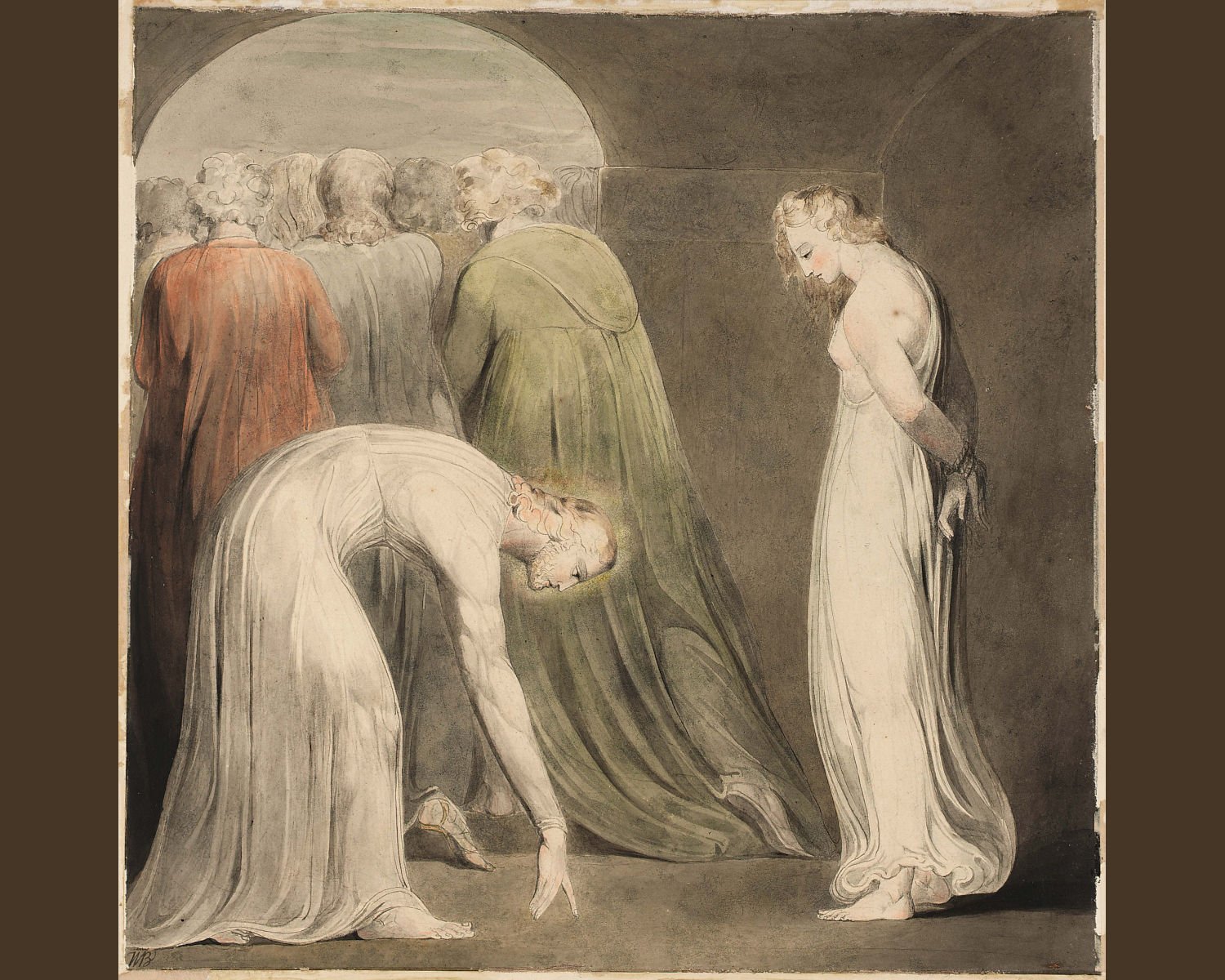
The Woman Taken in Adultery, William Blake, c. 1805
“Teacher, this woman was caught in the act of committing adultery. In the Law, Moses commanded us to stone such women. So what do you say?,” asked the Pharisees.
March 6, 2024 by Fr Gordon MacRae
In the three-year cycle of Scripture Readings for Catholic Mass, the Eighth Chapter of the Gospel of John (8:1-11), the story of the woman caught in adultery, is assigned to the Fifth Sunday of Lent for one of those three years. This year it is the Gospel for the day after, March 18, 2024. It is an important story and one of the most cited passages of the Gospel. It is also one of the most popularly misunderstood. Having myself been stoned in the public square, I have long been intrigued and inspired by the deeper meaning of this account.
But before we travel into the depths of that wondrous account, Holy Week is coming, and that means some in the news media are already preparing for their traditional Easter Season stoning of your faith by the hyping and re-airing of Catholic scandal. The spurious tradition in our secular news media has already begun. Not much has changed since I last wrote of our experience of this annual media stoning in a 2022 post entitled, “Benedict XVI Faced the Cruelty of a German Inquisition.” We will link to it again at the end of this post. The media’s Holy Week hot seat when I first was inspired to write it was occupied by Pope Benedict XVI. I wrote it because Pope Benedict and I had both been subjected to a stoning in the public square at about the same time.
Stoning was the most common method of execution in ancient Israel, and was seen as the community’s “purging the evil from its midst” (Deuteronomy 21:21). Stoning was imposed as both a punishment and a deterrent for a number of crimes against the community including idolatry (Deut 17:5), blasphemy (Leviticus 24: 14-16), child sacrifice (Lev 20:2), sorcery (Lev 20:27), adultery (Deut 22:13-24), and being “a stubborn and rebellious son who will not obey” (Oh, for the good old days of Deut 22:18)! That latter example reminds me of a post card I received years ago from my mother on vacation in her native Newfoundland:
“Dear Son: Newfoundland is as beautiful as I remember it. Right now I am standing at Redcliff, a 100-foot precipice where Newfoundland mothers of old would take their most troublesome sons and threaten to heave them over the edge. Wish you were here. Love, Mom.”
It is interesting that in that latter case — the stubborn and rebellious son who will not obey — the stoning was carried out by all the men of the community (Deut 21:21), and only the men. In each case, the punishment of stoning always took place outside of town. More importantly — and this has a bearing on the story of the woman caught in adultery in John 7:53-8:11 — the first stones could be cast only by firsthand witnesses of the offense. And the punishment could be imposed only when there were two or more such witnesses. “A person shall not be put to death on the evidence of only one witness” (Deut 17 6).

The Story’s Place in Scripture
The sources and limits of stoning in the Hebrew Scriptures present a necessary backdrop for a fuller understanding of John 7:53-8:11, the story of a woman caught in adultery. It’s best to let Saint John tell it:
“Jesus went to the Mount of Olives. Early in the morning he came again to the temple, all the people came to him, and he sat down and taught them. The scribes and the Pharisees brought a woman who had been caught in adultery, and placing her in their midst they said to him, ‘Teacher, this woman has been caught in the act of adultery. Now, in the law, Moses commanded us to stone such. What do you say about her?’ This they said to test him, that they might have some charge to bring against him. Jesus bent down and wrote with his finger on the ground. And as they continued to ask him, he stood up and said to them, ‘Let him who is without sin among you be the first to throw a stone at her.’ Again he bent down and wrote with his finger on the ground. But when they heard this they went away one by one, beginning with the eldest, and Jesus was left alone with the woman standing before him. Jesus looked up and said to her, ‘Where are they? Is there no one to condemn you?’ She said, ‘No one, Lord.’ And Jesus said, ‘Neither do I condemn you; go, and do not sin again.”
— John 7:53-8:11
The placement of this account in Scripture has endured a long controversy. The story is believed by some Scripture scholars to be an ‘agraphon,’ a source of authentic sayings of Jesus that survived orally, then became part of the written canon of Scripture toward the end of the Apostolic age. Two well known Catholic Scripture scholars — Sulpician Father Raymond Brown and Jesuit Father George W. MacRae (my late uncle) — were among those who defended that this story is both authentic and canonical despite the controversy about where it lands in the text.
The controversy itself is fascinating. It seems that some ancient versions of the Gospel of John did not contain this story, but an early text of the Gospel of Luke did. It was found in an early version of Saint Luke’s Gospel after Luke 21:38 and before Luke, Chapter 22.
“And every day he was teaching in the temple, but at night he went out and lodged on the mount called Olivet. And early in the morning, all the people came to him in the temple to hear him.”
— Luke 21:37-38
In the very next verse (Luke 22:1) the chief priests and the scribes began a conspiracy to kill Jesus. “Then Satan entered into Judas called Iscariot who was of the number of the Twelve; he went away and conferred with the chief priests how he might betray him to them. And they were glad, and engaged to give him money.” (Luke 22:3-5) So it seems that the Gospel accounts of the woman caught in adultery may have originally appeared in Scripture in the Gospel of Luke just prior to Satan entering into Judas and the plot to kill Jesus, which will be the subject of our Holy Week post this year. These accounts go to the very heart of our Catholic understanding of sin, redemption and grace.
For some scholars, the story of the woman caught in adultery may have been originally placed in between these verses. The Lord’s defeat of the nefarious intentions of the Pharisees, and his ability to use their own laws against them, may have been the trigger that set his arrest in motion. But instead this account ended up somehow in the Gospel of John, the last of the Gospel texts to come into written form at the end of the Apostolic age. Outside of Sacred Scripture, the historian, Josephus, mentions the account, but mentions it in reference to the Gospel of Saint Luke. For me, this little side road into the examination of texts and origins does not in itself question whether the text is canonical — that is, an authentic event in the life and sayings of Jesus, and an inspired Scriptural text.
For Fathers Raymond Brown and George W. MacRae (and his nephew), there is simply no reason to doubt this. But I will add one factor that the scholars may not have considered. The very idea that this story may have somehow become separated from one tradition (the Lucan tradition) only to end up in another (the Johannine tradition) is evidence of the importance of the story for the Gospel. It seems a divine determination to ensure that this story comes to us regardless of where it ended up in the Gospel narrative.

The Woman Taken in Adultery, Rembrandt, 1644 (cropped)
The Cast of Characters
The presence of the Pharisees, and their intentions in this story, call to mind a well-known parable from the Gospel of Luke, the Parable of the Good Samaritan (10:25-37). In both that account and the account of the woman caught in adultery in the Gospel of John (John 8), Jesus is confronted by a Pharisee with a question. In both cases, the purpose of the question is not to learn from Jesus, but to entrap him in a corner from which he cannot emerge. In both cases, Jesus turns the table on his questioner in a checkmate.
In the account of the woman caught in adultery above, the Pharisee seems to have laid a more solid trap. “Teacher, this woman has been caught in the act of adultery. The law of Moses commanded us to stone such. What do you say about her?” Jesus and the Pharisee both know that the Roman Empire has occupied Palestine. One of its many imposed laws is that the death penalty for crimes must be imposed and enforced only under Roman law and not under local custom. The Pharisees, therefore, could not execute the woman as the law of Moses prescribes. It is for this same reason that the High Priest, Caiaphas, had to hand Jesus, accused of blasphemy, over to the Roman governor Pontius Pilate. The prohibition is mentioned later in John:
“Pilate said to them, ‘take him yourselves and judge him by your own law.’ The Jews said to him, ‘It is not lawful for us to put any man to death.’”
— John 18:31
And so part of the trap is laid using both the Law of Moses and the politics of Rome: “This they said to test him, that they might have some charge to bring against him.” If Jesus openly concurs with the law of Moses about the penalty for adultery laid down in the Book of Deuteronomy (22:22) then the Pharisees can charge him with sedition for subverting the laws of Rome. If Jesus openly forbids the stoning, the Pharisees can use that to discredit him with his disciples as a false Messiah who contradicts the law of Moses.
The response of Jesus seems very odd. Instead of replying at all, he simply bends down and writes with his finger on the ground (John 8:6). Centuries of Scriptural wrangling have been devoted to what he could have written. What Jesus inscribed on the earth is entirely unknown, but it may well be that the act of writing on the ground — and not the content of the writing — is itself the point. What may be happening here — and some Patristic authors agree — is that Jesus uses the authority of the Prophets to undo the Pharisee’s trap using the authority of the Law. The gesture of writing on the ground may have recalled for them the Prophet Jeremiah:
“Those who turn away from you shall be written in the earth, for they have forsaken the Lord, the fountain of living water.”
— Jeremiah 17:31
Just a few verses earlier in the Gospel (John 7:38), Jesus identified himself as the fountain of living water: “He who believes in me … out of his heart shall flow rivers of living water.” Thus Jesus may well have been inscribing into the ground the very names of the Pharisees standing before him. Then Jesus did something equally odd. He stood and said, “Let him who is without sin among you be the first to cast a stone at her.” It strikes me as immense irony that the only person without sin in that gathering is Jesus himself, the one posing this counter-challenge.
This challenge of Jesus — about who is to cast the first stone at her — also recalls a law these Pharisees would know well. Deuteronomy (17:7) prohibits anyone but a firsthand witness to the crime — and there must be at least two such witnesses — from casting the first stone. So the befuddled Pharisees look at each other, wondering which of them is about to implicate himself in this adulterous offense against the law of Moses, and, if he casts the stone, implicate himself in an offense against the law of Rome.
As Jesus stooped a second time to continue his writing on the ground, the Pharisees left one by one, “beginning with the eldest.” That is another way of saying “beginning with the wisest” among them, for they were the first to catch on that their trap had not only been sprung by Jesus, but actually turned round in a way that entraps them. Once again, Jesus has exposed their duplicity and thoroughly frustrated their plans, a trend that will eventually land him before Pilate.
Thus being the sole person present without sin, and under his own terms the only one qualified to stone her, Jesus assures the woman with an act of Divine Mercy:
“‘Where are they? Has no one condemned you?’ She said, ‘No one, Lord.’ And Jesus said, ‘Neither do I condemn you; go, and do not sin again.’”
— John 8:10-11
It is the perfect Lenten story. Christ is the fountain of living water, the source of the Spirit poured out upon the world, and he is simultaneously the source of mercy poured out for those who come to know and profess the truth about Him — and about ourselves. In the very next verse in the Gospel of John, Jesus spoke to the assembled crowd as the Pharisees were departing: “I am the light of the world; he who follows me will not walk in darkness but will have the light of life.” (John 8:12)
+ + +
Note from Father Gordon MacRae: Thank you for reading and sharing this post. You might like these three related posts from Beyond These Stone Walls:
Benedict XVI Faced the Cruelty of a German Inquisition
Stones for Pope Benedict and Rust on the Wheels of Justice
A Subtle Encore from Our Lady of Guadalupe
+ + +
An Important Announcement from His Eminence, Raymond Leo Cardinal Burke:
Tap or click the image.
The Eucharistic Adoration Chapel established by Saint Maximilian Kolbe was inaugurated at the outbreak of World War II. It was restored as a Chapel of Adoration in September, 2018, the commemoration of the date that the war began. It is now part of the World Center of Prayer for Peace. The live internet feed of the Adoration Chapel at Niepokalanow — sponsored by EWTN — was established just a few weeks before we discovered it and began to include in at Beyond These Stone Walls. Click “Watch on YouTube” in the lower left corner to see how many people around the world are present there with you. The number appears below the symbol for EWTN.
Click or tap here to proceed to the Adoration Chapel.
The following is a translation from the Polish in the image above: “Eighth Star in the Crown of Mary Queen of Peace” “Chapel of Perpetual Adoration of the Blessed Sacrament at Niepokalanow. World Center of Prayer for Peace.” “On September 1, 2018, the World Center of Prayer for Peace in Niepokalanow was opened. It would be difficult to find a more expressive reference to the need for constant prayer for peace than the anniversary of the outbreak of World War II.”
For the Catholic theology behind this image, visit my post, “The Ark of the Covenant and the Mother of God.”

If Night Befalls Your Father, You Don’t Discard Him! You Just Don’t!
There is another scandal in the Catholic Church just under the radar. It is what happens after Father is accused, and it would never happen if he were your father.

There is another scandal in the Catholic Church just under the radar. It is what happens after Father is accused, and it would never happen if he were your father.
February 28, 2024 by Fr Gordon MacRae
Back in the summer of 2011 in Massachusetts, Independence Day brought dismal news for devoted Catholics already bent under the millstone of scandal. On that morning I turned on New England Cable News to learn that a forty-two year old Massachusetts priest ordained only six years, had taken his own life. It was heartbreaking, and I know his family must have been devastated. However, I feared that far too many in his other family — the Catholic Church — had so steeled themselves against the relentless tide of painful news that such a tragedy was just part of another news day. That was an even greater tragedy. If you have never read my article, “The Dark Night of a Priestly Soul,” about the suicide of a priest I knew, please do. I wish this priest, and his diocesan family had read it. It may have helped him to seek another way to deal with whatever immense pain brought him to this horrific act. I have been where he was in the final moments of his life. I wrote about surviving that painful day in “How Father Benedict Groeschel Entered My Darkest Night.”
I do not know the particular anguish of that young priest in 2011. He died sometime the previous Saturday night after celebrating Mass and then ministering to a family in a hospital emergency room where he was a chaplain. When he did not show up for his Mass that Sunday morning, someone went in search of him. In between was the darkest night of his own priestly soul. Please, please pray for him. Though this was a major news story in 2011, I am sparing his family from reliving this again in 2024.
Some thirty American Catholic priests have taken their own lives since priests became a favorite target of the news media, of S.N.A.P., and of Satan himself. I have personally known eight of them, and three others who were murdered. A psychiatrist friend who has been conducting research on the priesthood told me that it is extraordinary that I have known 11 priests who were either murdered or died by their own hand. He said that I have been hanging out with the wrong crowd — or, if you read the Gospel, the right one.
I do know this: simply casting off the most wounded among our priests has been the sin of the Church, and it is a sin that would not happen in our own families. The late Cardinal Avery Dulles wrote of this in one of his last letters to me before his death in December 2008:
“Thank you for keeping me informed about the great scandal of the failure of the Church to support her priests in their time of need. Someday your story and that of your fellow sufferers will come to light and will be instrumental in a reform. I am sure that in the plans of Divine Providence your ministry of suffering is part of your priestly vocation.”
No corporate bottom line would dictate whether we care for our fathers, our grandfathers, our brothers, or our sons, but lately in the Church in America, it does, and it has compounded The Scandal. Christ came into the world to call forth a community’s soul, not a corporate sole. One bishop I know wrote in a whining missive to Rome that if he helped one accused priest in his diocese he would fear an uproar. At least the bishop was honest. His response toward a brother left beaten on the side of the road was moved by fear.
The problem was strictly American back then. But it has since spread to other parts of the world where the same draconian and terminal measures have been imposed upon priests who are merely accused without due process leading to their being simply discarded — sometimes on the streets with no place to go. I fear sometimes that the Catholic Church in America is becoming far more American than Catholic. America is a disposable culture that does not abide problems, and the Church has come to reflect this ugly side of America. Not long ago, Pope Francis derided our “cancel culture,” then he proceeded to cancel the careers of many priests and bishops who did not fall immediately into his ideological plan. The stewards of our faith have capitulated to cancel culture.

For full article tap image.
Disposable Priests in a Disposable Culture
There are priests who, for various reasons, are not assigned to ministry. Under a tenet of Canon Law (Canon 1722) a bishop, with just cause, may forbid a priest from the exercise of public ministry for a period of time, but he remains a priest. For seven years before I was accused and faced trial in 1994, I was not assigned by my bishop and diocese. For the first two years, I was director of a drug and alcoholism treatment center, and vice-president of the New Hampshire Association of Chemical Dependency Service Providers. But I was still very much a priest living under obedience to the authority of my bishop. I celebrated Mass and other sacraments. For the following five years I served in ministry to other priests as Director of Admissions in a residential psychological and spiritual renewal center for Catholic priests and religious.
Even now, in my 30th year in prison for a crime that I insist never took place, I witness to the Gospel and to the Mission of the Church every day in conditions that most priests cannot imagine. That is not a boast. Who would boast of such a thing? I celebrate the sacraments, as you know, and I am still a priest.
A priest may also petition the Holy See for voluntary removal from the clerical state, known popularly as “laicization.” Some years ago this blog had a comment from a man who left ministry as a priest to marry. As far as the Church was concerned, he remained a priest and entered into a civil, but invalid marriage. He reported that he was only recently granted his petition for laicization so that he may now have his marriage blessed by the Church. For reasons that are both sound and prudent, the Church has never been in any hurry to return a priest to the lay state.
One of the most destructive fallouts of the sex abuse scandal in the American Church has been the reality of involuntary laicization. When enacting the 2002 Dallas Charter for the Protection of Children and Young People, the US Bishops quoted a statement of Pope John Paul II in his address to American cardinals on April 23, 2002: “There is no place in the priesthood or religious life for those who would harm the young.” Some American bishops have used that statement to seek forced laicization of accused priests under Canon 290, by judicial sentence or by a special act of the Pope. Prior to the Dallas Charter, such a permanent and unappealable removal from the priesthood was exceedingly rare. After the Charter, there was a wave of involuntary laicizations, and some believe they have done irreparable harm to the very Catholic theology of priesthood.
From a practical standpoint, forced laicization — popularly but erroneously called “defrocking” in the media — might satisfy some vindictive urges in certain victim groups, but it does nothing to prevent any possible victimization. It merely discards a priest with problems, or an innocent one falsely accused, upon the dung heap of Job with no support, no supervision, and no accountability because of claims that are decades old and often unsubstantiated. Families do not discard their fathers, sons, or brothers, and the Church should not discard her priests.

A Puritan Response to Sin
The Bishops’ Charter failed to add a qualifying statement of Pope John Paul II to the American cardinals summoned to Rome in 2002:
“At the same time . . . we cannot forget the power of Christian conversion, that radical decision to turn away from sin and back to God, which reaches to the depth of a person’s soul and can work extraordinary change.”
By omitting the most important part of the Pope’s statement, the U.S. Bishops adopted a punishment with no allowance for repentance. In an essay for Homiletic & Pastoral Review (“Sex Abuse and Anti-Catholicism“) Ryan A. MacDonald wrote:
“The Puritan founders of New England would approve of the purging of the priesthood now underway in Western Culture, for it is far more Calvinist than Catholic.”
In a landmark article in America magazine, “The Rights of Accused Priests” (June 21, 2004), the late Cardinal Avery Dulles issued a stinging rebuke of the bishops. What follows are some excerpts:
“The United States bishops have taken positions at odds with [their own] high principles.”
“Under intense pressure from various survivors’ networks, they hastily adopted, after less than two days of debate, the so-called Dallas Charter . . . ”
“In their effort to . . . restore public confidence in the Church as an institution and to protect the Church from liability suits, the bishops opted for an extreme response.”
“The dominant principle of the Charter was ‘zero tolerance’ . . . Having been so severely criticized for exercising poor judgement in the past, the bishops apparently wanted to avoid having to make any judgements in these cases.”
Cardinal Dulles went on to address the often near impossibility of judging the truth of allegations against priests without investigation, and the inherent injustice of taking actions that brand a priest as guilty before such investigation. He then outlined the rights of priests under Canon Law, and how the Charter and current policies ignore or even destroy those rights. I urge every priest and every Catholic to read Cardinal Dulles’ article.
I am not a canon lawyer, and I have only limited training in Church Law. What I have learned has been from experience, and my own experience has been a crash course in fending off what I believe is a seriously flawed and unjust process faced by many accused priests who simply did not commit the crimes.
To highlight how flawed this process is, I would like to reproduce a letter I received in 2002 from a prominent priest, canon lawyer, and professor of Canon Law at a leading Catholic University. I am printing the entire letter, but without his name since I have not asked his permission to print his name. I will let his letter speak for itself:
“Dear Father MacRae:
Don’t ever discount the real spiritual good accomplished by your words at Beyond These Stone Walls. You make people like me, with consciences dulled by repetitious prevalence of procedural abuses, face our responsibilities to protest and to act. You make it personal and compelling.
I want to pass along some bad news. You may already be aware of it, since you seem very well informed, but, if not, at least it will give you occasion to reflect. It seems that the Congregation for the Doctrine of the Faith has turned to ‘penal dismissals from the clerical state’ as a routine solution to the cases being sent by American bishops after preliminary investigations. The decrees of dismissal are not subject to appeal or review.
The procedural injustice of this practice is obvious.
In the preliminary investigation process, the accused priest has no opportunity to defend himself. The cases are sent by bishops to CDF sometimes with an expectation that they will instruct the diocese to proceed with a canonical trial for dismissal or allow the accused priest to remain [in the priesthood] in a penitential state but removed from public ministry. Instead, the CDF seems to be taking this drastic and terminal action based solely on the information provided by a bishop in the preliminary investigation — often when the priest is accused of abuse alleged to have occurred thirty years ago or more.
I don’t want to discourage you or any petitions to the Holy See on your behalf. Quite the contrary, I would urge any and all possible interventions.
Think about the implications if this shameful result should fall on you. It is really an empty juridical gesture with no practical consequences. You remain a priest. No one can take that away. You can pray, and you can celebrate the Holy Eucharist validly, absolve or anoint in emergencies, and, I presume, you could continue your very valuable ministry of consciousness raising. What I am trying to say is please do not be discouraged or lose hope if this awful expedient is aimed at you.”

Ganging Up on the Already Down
To date, at least, that final chapter of my nightmare has not taken place. But the Church must be made aware — you must be made aware — of the inherent injustice of “piling on” that occurs when most priests are accused.
When I faced trial in 1994, I was entirely on my own against an assault on three simultaneous fronts. First, I faced a criminal trial, a highly sensationalized and problematic one that Ryan A. MacDonald recently described in these pages in “Judge Arthur Brennan Sentenced Father Gordon MacRae to Die in Prison.”
Very few priests earn a salary or have access to funds that would assure a fair trial. I certainly did not, but my diocese issued a letter to my attorneys instructing them: “To the extent he is without funds, he should contact the public defenders’ office.” The cost of my defense would have been but a tiny fraction of the cost of mediated settlements.
Secondly, simultaneous to a criminal defense and preparing for trial, I also faced civil lawsuits naming both me and my diocese as defendants. The accusers were represented by their contingency lawyers, and both they and their lawyers had a clear financial stake in the outcome. My diocese was represented by a high profile law firm seeking, from day one, the quietest path to settlement that would generate the least publicity. With my meager assets dissolved in only partial funding of a criminal defense, I was not represented at all against the civil claims. When I protested the possibility of a settlement without substantiation, my accusers and their lawyers simply dropped me as a defendant so that I would no longer have any standing in the matter.
Lastly, from the moment I was accused, I faced a trial-by-media that set an impossible boundary between me and justice. The accusers had contingency lawyers who were relentless spokespersons for their feigned “victimization.” My diocese had a spokesperson who advocated for the distance the diocese was motivated to obtain from me. As I faced trial in 1994, knowing that I maintained my innocence, and knowing that I was not represented at all as settlement negotiations ensued in the background, my bishop and diocese issued a press release stating:
“The Church has been a victim of the actions of Gordon MacRae just as these individuals. It is clear that he will never again function as a priest.”
— Press Release of the Diocese of Manchester, September 6, 1993
My attorneys protested this to deafened ears. With that public statement came the end of my civil rights to a presumption of innocence and a fair trial. Throughout the trial, the local news media cited that statement. The jurors in my trial read the statement. To pretend that this scenario represents justice requires far more skill in the art of pretense than I have ever been capable of.
And it’s even worse still, today.
The Bishop Accountability website publishes every sordid detail about every money-driven claim taking no responsibility whatsoever for whether their information is true or corroborated. The site administrators publish the names and lurid details claimed of every accused priest while removing the names of all accusers. In some instances, this amounts to aiding and abetting them in the commission of the crimes of fraud and larceny.
And now, as is clear from the canonist’s dismal letter above, if the accused priest cares anything at all about preserving his priesthood then he must also hire a canon lawyer to defend himself against yet another tier of simultaneous judicial processes: the possibility of canonical dismissal from the priesthood.
If night befalls your father, you don’t discard him! You just don’t!
+ + +
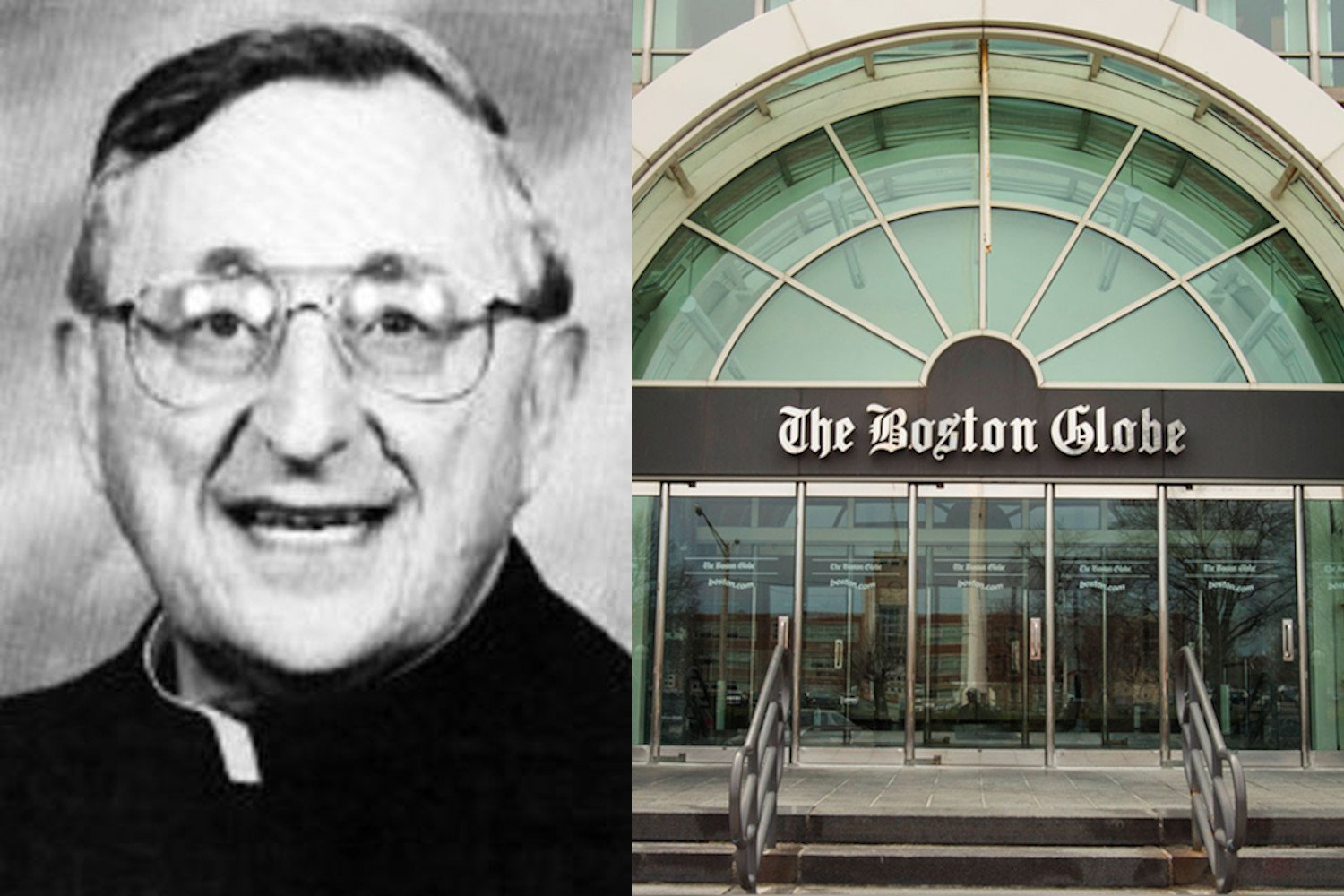
Note from Fr Gordon MacRae: Thank you for reading and sharing this important post. Please consider these related posts from Beyond These Stone Walls:
The Exile of Father Dominic Menna and Transparency at The Boston Globe
Priests in Crisis: The Catholic University of America Study
Our Bishops Have Inflicted Grave Harm on the Priesthood
When Priests Are Falsely Accused: The Mirror of Justice Cracked
The Eucharistic Adoration Chapel established by Saint Maximilian Kolbe was inaugurated at the outbreak of World War II. It was restored as a Chapel of Adoration in September, 2018, the commemoration of the date that the war began. It is now part of the World Center of Prayer for Peace. The live internet feed of the Adoration Chapel at Niepokalanow — sponsored by EWTN — was established just a few weeks before we discovered it and began to include in at Beyond These Stone Walls. Click “Watch on YouTube” in the lower left corner to see how many people around the world are present there with you. The number appears below the symbol for EWTN.
Click or tap here to proceed to the Adoration Chapel.
The following is a translation from the Polish in the image above: “Eighth Star in the Crown of Mary Queen of Peace” “Chapel of Perpetual Adoration of the Blessed Sacrament at Niepokalanow. World Center of Prayer for Peace.” “On September 1, 2018, the World Center of Prayer for Peace in Niepokalanow was opened. It would be difficult to find a more expressive reference to the need for constant prayer for peace than the anniversary of the outbreak of World War II.”
For the Catholic theology behind this image, visit my post, “The Ark of the Covenant and the Mother of God.”