“There are few authentic prophetic voices among us, guiding truth-seekers along the right path. Among them is Fr. Gordon MacRae, a mighty voice in the prison tradition of John the Baptist, Maximilian Kolbe, Alfred Delp, SJ, and Dietrich Bonhoeffer.”
— Deacon David Jones

Iran, by Another Name, Was Once the Savior of Israel
A story out of time for our time: The Prophet Isaiah wrote of Cyrus, King of Persia (now Iran) who knew not God but was chosen by God to restore freedom to Israel.

A story out of time for our time: The Prophet Isaiah wrote of Cyrus, King of Persia (now Iran) who knew not God but was chosen by God to restore freedom to Israel.
June 25, 2025 by Father Gordon MacRae
It is hard for me to NOT write about some developments especially when they fall within the realm of human rights and religious freedom. If I fail to address what seems to engulf the attention of entire nations, then I feel as though I am overlooking the elephant in the sacristy. The world was riveted to events in Iran, Israel, and the United States on Saturday, June 21, 2025. There is a backstory that rises up out of ancient times in the same place where nuclear Armageddon was possibly prevented on that day.
This post is about Cyrus the Great, the Sixth Century BC conqueror and King of the Persian Empire in what is now modern day Iran. King Cyrus is the subject of a reading from the Prophet Isaiah (45:1):
“Thus says the Lord to his anointed, to Cyrus, whose right hand I have grasped to subdue nations before him and ungird the loins of kings, to open doors before him that gates may not be closed.”
Read on, please, because this Cyrus, pulled from the pages of Biblical history as the ancestor of contemporary Iran, was once the salvation of Israel.

In Defense of Jerusalem
“Thus says the Lord to his anointed, to Cyrus, whose right hand I have grasped, subduing nations before him, and making kings run in his service, opening doors before him, and leaving the gates unbarred: For the sake of Jacob, my servant, of Israel, my chosen one, I have called you by your name, giving you a title, though you knew me not. I am the Lord and there is no other; there is no God besides me. It is I who arm you, though you know me not, so that toward the rising and the setting of the sun people may know that there is none besides me. I am the Lord. There is no other.”
— Isaiah 45:1, 4-6
There is little known of the Prophet Isaiah except that he lived in Jerusalem and his prophetic activity extended from about 740 BC to 701 BC, a period of about forty years. In the passage above, the Lord, through Isaiah, is addressing a man named Cyrus who is called by God and given power and a title, “though you knew me not.” The power and authority given to Cyrus is not for Cyrus, but rather so that “the people may know that there is none besides me. I am the Lord.”
Two centuries after the prophesies of Isaiah, in 597 BC, Israel fell under the armies of Babylonian King Nebuchadnezzar II. This account, told in the Second Book of Kings (Ch. 24ff) resulted in two waves of exile of the Jews into Babylon. In the first wave, in 597 BC, Israel’s leaders were compromised and taken away. This undermining of the leaders was for the purpose of destroying the religious identity of the people. Then, in 586 BC, the real devastation came. Babylon destroyed the Temple and the entire city of Jerusalem, and sent the remaining Jews into exile.
Then, some two centuries after first appearing in the prophecy of Isaiah, God took the right hand of a man named Cyrus, who knew not God, and subdued nations before him, placed kings in his service, opened doors and unbarred gates just as predicted. Cyrus the Great conquered Babylon and all its surrounding regions to become first King of the Persian Empire — which again includes present-day Iran. Cyrus did not live a lifestyle that the People of God had any reason to respect. He did not appear to believe in anything but himself.
But Cyrus had one quirky trait that seemed to have been instilled in him by a much Higher Authority. Despite his personally sinful lifestyle and quest for Earthly powers, Cyrus developed a deep respect for the Jews and their Faith, even though he personally shared in none of it. The Lord God had groomed him, knocked down kingdoms before him, so Cyrus did what only the Emperor of the Persian Empire could do. He issued an edict ordering the reconstruction of the city of Jerusalem and its Temple, and he returned the Chosen People from their fifty-year exile in 539 BC to the land of Israel earning him an honored place in Judaism and Salvation History as Israel’s Redeemer.

The Prophet Ezra and the Decree of Cyrus
The Prophet Isaiah presents Cyrus as appearing in about 545 BC as the hope for Jerusalem. He is bestowed by Isaiah with a rather lofty title, “the anointed of Yahweh.” Such a title marked the beginning of the Age of Messianic Prophecy for Israel. The title would have been seen as a great insult to the Jews, but in forced exile they came to view Cyrus for his present actions and not his past pursuits. Isaiah (44:28) expanded his title to “Shepherd of Israel,” in recognition of the strangest trait that was found in him: his almost obsessive insistence on the promotion of religious liberty and the establishment of laws that will guarantee and protect it for the Jewish People and for Israel.
In regard to the restoration of Israel, this hope was fulfilled in 538 BC when Cyrus ordered the protection of the Jews and their return to Jerusalem to oversee the rebuilding of their Temple from the treasury of the Persian Empire. The full text of the Decree of Cyrus appears in the Book of the Prophet Ezra (6:3-5), a passage once doubted for its authenticity but now accepted as authentic by modern Scripture scholars:
“In the first year of Cyrus the King, a decree concerning the House of God in Jerusalem: Let the House be rebuilt, the place where sacrifices are offered and burnt offerings are brought. Its height shall be sixty cubits and its breadth sixty cubits with three courses of great stone and one course of timber. Let the cost be paid from the royal treasury. And also let the gold and silver vessels of the House of God, which Nebuchadnezzar took out of the Temple and brought to Babylon, be restored to Israel and returned to the Temple in Jerusalem, each to its place in the House of God.”
— Ezra 6:3-5
The Prophet Ezra went on to describe that some of the restoration of Jerusalem was interrupted by local vassal kings who did not believe that the conquering tyrant, Cyrus, would issue such an order. A complaint was made by a local governor to Darius I, King of Hystaspis, that the Jews were rebuilding the city. Darius then found an authenticated copy of the Decree of Cyrus, and ordered that the Temple and reconstruction of the city will be continued with no further hindrance. This was the same King Darius, by the way, who threw Daniel in the lions’ den (Daniel 6:6ff).
Is there a point of understanding to be considered from all this in our present time? Only you can arrive at such a conclusion. I have already arrived at mine, and I must come down on the side of religious liberty and those, some of whom knew not God, who are nonetheless chosen and set in place to bring it about for those in Covenant with God.
+ + +
Note from Father Gordon MacRae: Thank you for reading and sharing this post, which strives to bring context out of the past and into the present for a story that is consuming our news. In the Seventh Century AD, some 1,200 years after the events described in this post, Arabs brought Islam to the Middle East and it spread.
You might also like these related posts out of history:
Behold the Lamb of God Upon the Altar of Mount Moriah
Qumran: The Dead Sea Scrolls and the Coming Apocalypse


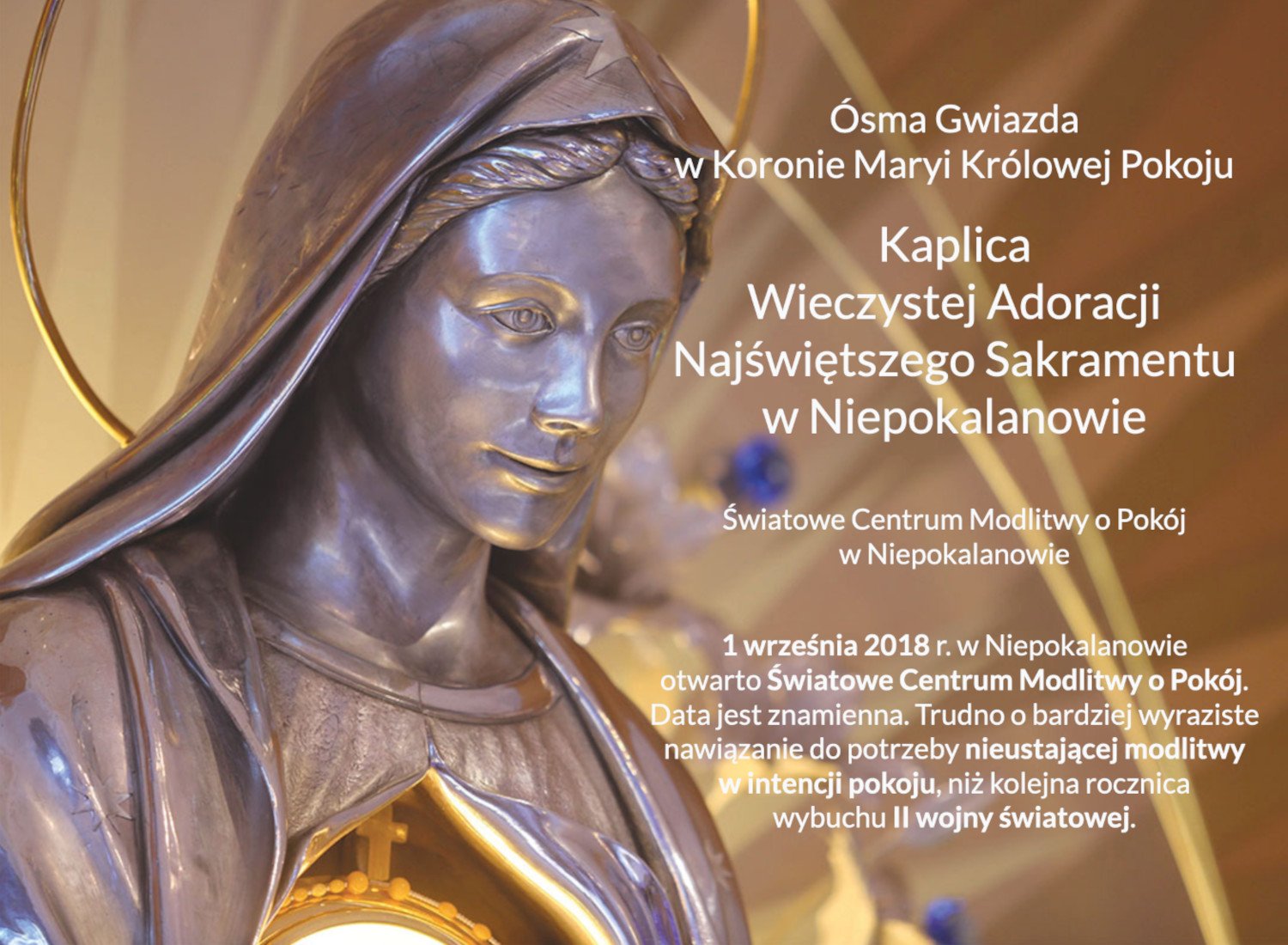

The Eucharistic Adoration Chapel established by Saint Maximilian Kolbe was inaugurated at the outbreak of World War II. It was restored as a Chapel of Adoration in September, 2018, the commemoration of the date that the war began. It is now part of the World Center of Prayer for Peace. The live internet feed of the Adoration Chapel at Niepokalanow — sponsored by EWTN — was established just a few weeks before we discovered it and began to include in at Beyond These Stone Walls. Click “Watch on YouTube” in the lower left corner to see how many people around the world are present there with you. The number appears below the symbol for EWTN.
Click or tap here to proceed to the Adoration Chapel.
The following is a translation from the Polish in the image above: “Eighth Star in the Crown of Mary Queen of Peace” “Chapel of Perpetual Adoration of the Blessed Sacrament at Niepokalanow. World Center of Prayer for Peace.” “On September 1, 2018, the World Center of Prayer for Peace in Niepokalanow was opened. It would be difficult to find a more expressive reference to the need for constant prayer for peace than the anniversary of the outbreak of World War II.”
For the Catholic theology behind this image, visit my post, “The Ark of the Covenant and the Mother of God.”

Science and Faith and the Big Bang Theory of Creation
The discovery of cosmic ripples from the birth of the Universe is evidence beyond reasonable doubt of the Big Bang theory first proposed by Fr Georges Lemaitre.

The discovery of cosmic ripples from the birth of the Universe is evidence beyond reasonable doubt of the Big Bang theory first proposed by Fr Georges Lemaitre (pictured above with Albert Einstein and Fr Andrew Pinsent)
June 18, 2025 by Father Gordon MacRae
“In the beginning God created the heavens and the earth. The earth was without form and void, and darkness was upon the face of the deep; and the Spirit of God was moving over the face of the waters. And God said, ‘Let there be light,’ and there was light.”
— Genesis 1:1-3
When my friend Augie was back in 2014, he used to like to stop by my room to compare notes about our favorite TV shows. We had been mesmerized by the return of Jack Bauer’s 24 back then, and we were eagerly awaiting the extra-terrestrial return of Falling Skies. One day when Augie came by my door he asked, “What do you think of The Big Bang Theory? “ I was so glad he asked. I launched into a 15-minute analysis of the science of modern cosmology and the meaning of the so-called Big Bang for both science and faith. When I finished, Augie looked dazed and said, “Umm…I meant the TV show!”
Then Mike Ciresi (“Coming Home to the Catholic Faith I Left Behind”) stopped by and asked, “What are you writing about this week?” “The Big Bang Theory,” I replied, hoping for another chance to spout off my explanation of the Cosmos. “Oh, I LOVE that show,” said Mike as he made a hasty retreat.
Okay, what had I been missing? Despite its being the most watched show on television, I had never seen an episode of the CBS hit, “The Big Bang Theory.” So I watched a few reruns. The show turned all social science on its head. I had no idea nerds were now “in!” And they even had girlfriends! Nerdhood had sure changed since I studied physics!
Alas, however, it was the OTHER Big Bang theory that I am taking on this week, but I implore you not to click me away just yet. I MUST write about this, and I hope you will read on. I am not quite as funny as Sheldon, Leonard, Howard and Raj, and of course Penny! I can only be that funny when I’m trying hard NOT to be funny! Like now!
I must write about the Big Bang theory for two reasons. First and foremost, a new discovery of cosmic microwave background radiation was big news a few years ago because it lent evidence beyond reasonable doubt to the truth of the science behind the Big Bang, a discovery first proposed by a Catholic priest who turned Twentieth Century cosmology on its head. I want to write about what this means for both the science of cosmology and the faith that we have all invested into a notion that this Universe was created by God. I will get back to that.
Finally, I must write about this because I was somehow thrown into the ring of debate about what it all means. My name showed up on a Facebook page for a quantum physics website. Mary Anne O’Hare posted in response to an article about the implications of so-called parallel universes and the “Many Worlds” theory:
“Gordon J. MacRae is one of the best authors who melds science with faith. Would be interested in his feedback.”
Thank you, Mary…I think! However, the ego bubble you built was burst just moments after I read your remark. BTSW reader Liz McKernan from England sent me a clipping from the (UK) Catholic Herald. It reminded me that my paranormal quest for science and truth beyond these stone walls is dwarfed by another priest, the U.K.’s Father Andrew Pinsent. He is one of the most accurate and prolific contemporary writers and bridge builders in the realm of science and faith. Liz McKernan’s clipping detailed Father Pinsent’s presentation to a packed room at the Newman Forum on “The Alleged Conflict Between Faith and Science.”

Are Science and Faith Mutually Exclusive?
When I decided to profile the work of Father Andrew Pinsent, I was surprised to learn (Ahem! Ahem!) that he also happens to be a reader of Beyond These Stone Walls. You also may recall a previous post of mine that revealed a connection between Father Georges Lemaitre and our friend, Pornchai Maximilian Moontri whose Belgian Godfather, Pierre Matthews, was a close family friend of Father Lemaitre. The photo above depicts Pierre Matthews and Fr. Lemaitre together during a family vacation. It came as a great shock to me to learn that Pornchai, my roommate of the previous 15 years, is probably the only person on Earth who can say that his Godfather’s Godfather is the Father of the Big Bang and Modern Cosmology.
Before I delve further into Father Andrew Pinsent’s defense of the truth about Catholic contributions to science, however, I want to comment on another television show I awaited with great anticipation. The FOX -TV production of Cosmos hosted by astrophysicist Neil deGrasse Tyson is terrific despite one very unfortunate and inaccurate anti-Catholic slur in its first segment: “The Roman Catholic Church maintained a system of courts known as the Inquisition and its sole purpose was to torment anyone who dared voice views that differed from theirs.”
It seems the Cosmos writers have been reading far too much of the sort of shoddy revisionist history put forth by novelists like Dan Brown. As the University of Dayton historian, Thomas Madden, pointed out, the Inquisition formed at a time when much of European society was in a perilous state of disorder, and the order it brought to anarchy saved thousands of lives. More importantly, Professor Madden wrote, “The Catholic Church as an institution had almost nothing to do with” the Inquisition.
The insinuation by a Cosmos background writer was that the Catholic Church has been hostile to science. However, the truth about the relationship between science and faith in the Twentieth Century demonstrates that just the reverse has more often been the case. For much of the later Twentieth Century, a fringe but vocally dominant number of scientists have been far more hostile to religion than religion has been to science. Few living scientists have done more than Father Andrew Pinsent to refute the attempts of this anti-religion fringe to replace faith in God with faith in science by always pointing to the “irrationality of believers.”
Father Pinsent, a doctoral-level physicist with a doctorate in Philosophy, has helped redeem science by exposing the truth about the great contributions to science by Catholic priests. His examples include the Jesuit astrophysicist, Fr Angelo Secchi; the father of the science of genetics, Msgr Gregor Mendel; and of course the astronomer and mathematician, Fr Georges Lemaitre. In this list, I cannot exclude Father Andrew Pinsent himself who after a career at the Ian Ramsey Centre for Science and Religion at Oxford is currently professor of Philosophy at one of the most prestigious Catholic seminaries in the United States, Mount St. Mary’s Seminary, also known as the Athenaeum.

Science from East of Eden
Still, I greatly respect and admire Neil deGrasse Tyson who went on in Cosmos to repair the damage somewhat by giving Fr Georges Lemaitre due credit as a foundational theorist of modern physics and cosmology right along with Albert Einstein.
The description of Father Lemaitre’s discovery as “The Big Bang” actually began as a term of mockery of his idea. The term first appeared in 1949, more than two decades after Lemaitre first proposed his theory. The prevailing winds of scientific thought for much of the first half of the Twentieth Century had settled on a belief that the Universe was not “created” at all, but had always existed, had no beginning, and will have no end. In that sense, for science, the Universe itself replaced God as eternal and without an origin. This was the accepted view, even by Einstein.
It was this predominant view that relegated the Judeo-Christian understanding of Creation to the shelf, treating it, and all religion, as a quaint anachronism stubbornly clinging to bygone days of scientific ignorance. Science attempted to remove all rational belief from our Biblical Creation account, and declared it to be a myth in the way we popularly understand myth. In mid-Twentieth Century science, God was obsolete, and some in philosophy were soon to follow with “God is dead!” Many in science held that if science could so undermine the very first awareness of man that God is Creator, all the rest of Judeo-Christian faith would eventually crumble.
Then, in the 1920s and 1930s, along came a brilliant mathematician-priest who subjected the conclusions of science to the rigors of mathematics. I wrote about the challenge this priest posed to the prevailing winds of science in “A Day Without Yesterday: Father Georges Lemaitre and the Big Bang.” Father Lemaitre was much respected by Albert Einstein, but far more for his mind than for his faith. At a 1933 conference in Brussels exposing his Theory of General Relativity, Einstein was asked if he believed it was understood at all by most of the scientists present. Einstein replied, “By Professor D. perhaps, and certainly by Lemaitre; as for the rest, I don’t think so.”
However, Einstein also had a fundamental disagreement with Father Lemaitre, though one — to the consternation of many in science — that was short-lived. Lemaitre used mathematics to present a model of the Universe based on Einstein’s own Theory of General Relativity which proposed that mass and energy create curvature of space-time causing particles of matter to follow a curved trajectory. Gravity, therefore, would bend not only matter, but light and even space itself. This had profound implications for science and was radically different from the reigning Newtonian physics which held that space is absolute and linear.
Even while demonstrating relativity, Einstein held to a “Steady State” theory of the Universe as being eternal, without beginning or end, and static. Using Einstein’s Theory of General Relativity, Father Lemaitre created a mathematical model for the origin of the Universe concluding in 1927 that the Universe — including space and time — came into existence suddenly, some 13.7 billion years ago, from an explosive expansion of a tiny singularity that he called the “Primeval Atom.” The Universe, and time, were born on a day without yesterday. Suddenly, a created Universe was back on the scientific table and is now the scientifically accepted truth.
Father Lemaitre conceived of nothing in existence but the relatively tiny speck into which was contained all matter and energy that we now know as the Universe. In an infinitesimal fraction of a second, the Universe came into being in a moment of immeasurable heat and light. The resistance to this view within the scientific community was enormous. As Father Andrew Pinsent himself once wrote to me:
“As late as 1948 astronomers in the Soviet Union were urged to oppose the Big Bang theory because they were told it was ‘encouraging clericalism.’ People tend to forget that the world’s first atheist state in effect banned the Big Bang and genetics, both invented by priests, for more than thirty years.”
Einstein studied Lemaitre’s 1927 paper intensely, but could find no fault in the mathematics behind his proposal. Einstein would not be a slave to mathematics, however, and simply could not conceive of his instinct about the mechanics of the Universe being wrong. “Your mathematics is perfect,” he told the priest, “but your physics is abominable.” Einstein would one day take back those words.
Two years later, in 1929, the astronomer Edwin Hubble — in whose honor is named the Hubble Space Telescope — demonstrated that the Universe was in fact not only not static, as Einstein insisted, but expanding. This lent scientific weight to Father Lemaitre’s Primeval Atom because if the Universe is expanding, then logic held that in the far distant past it must have been much, much smaller while containing the same matter, mass, and energy. In fact, Physicist Stephen Hawking would decades later calculate the density of the Primeval Atom in tons per square inch to be one followed by seventy-two zeros.
Lemaitre’s model traced the origin of the Universe back 13.7 billion years to a point of immeasurable mass and density that suddenly expanded giving birth not only to matter, but to the space-time continuum itself. Appearing at a symposium with Father Lemaitre in 1933, Einstein stood and applauded the priest declaring that his view — which is today called the Standard Model of Cosmology — “Is the most beautiful explanation of creation I have ever heard.”

Cosmic Ripples
“Let there be light!” was back in the parlance of scientific truth. Though not many cosmologists were ready to embrace the Biblical account of Creation as being the sudden appearance of immense light upon the command of God, the science suddenly supported a belief in a Universe with a genesis “created from nothing.” In 1965, Bell Laboratory technicians Arno Penzias and Robert Wilson detected the background radiation from the Big Bang. They were jointly awarded the Nobel Prize in Physics for their discovery of the background signature of Father Lemaitre’s expansion of the Universe on a day without yesterday.
Early in 2014, astronomers announced the discovery of Cosmic Microwave Background Radiation permeating the Universe caused from the ripples left over from the moment of the Big Bang 13.7 billion years ago. Even for the rigors of science and what constitutes proof, there is no longer reasonable doubt within reputable science that Father Georges Lemaitre was right.
But if you are having trouble bending your mind around all this, please don’t ask what God did before the Big Bang. On that day, time itself was created so there was no “before.” That’s a mind-boggling post for another day. And as for those theories about multiple worlds and parallel universes that Mary Anne O’Hare wanted my opinion on, the idea is theoretical, entirely without evidence, and not technically, at this juncture, in the realm of science. In a terrific book, Why Science Does Not Disprove God (William Morrow 2014) mathematician-author Amir D. Aczel described multiverse theory as a sort of “atheism of the gaps,” an attempt to plug theoretical scientific holes with anything BUT religious ideas. As G.K. Chesterton once said:
“People who do not believe in God do not believe in nothing. They believe in anything!”
The great contemporary priest-scientist, Father Robert Spitzer, SJ, wrote a wonderful book about God’s intervention in our science, Christ, Science, and Reason. Father Spitzer referred to Father Georges Lemaitre as “the founder of modern cosmology.” He quoted Albert Einstein as stating that Father Lemaitre’s discovery “is the finest description of Creation that I have ever heard.” We should find great hope in the fact that the Catechism of the Catholic Church and the findings of modern cosmology are now on the same page about the origin of the Universe as coming into existence “out of nothing.” We should have no fear after that. Surely, the God Who could do this would have no problem arranging eternal life for us who believe.
Another friend just came by to ask me what I am writing about. Finally, my moment had arrived! “What do you know about the Big Bang Theory?” I asked. The young man pondered the question for a moment then said, “I like Sheldon the best.” I can’t win!
+ + +
Important Message to Readers of Beyond These Stone Walls:
In 2020, 11 years after this blog began, we were forced to shut it down and start over. I described the circumstances for this in a 2020 post, “Life Goes On Behind and Beyond These Stone Walls.”
However, this transition left over 500 posts behind in the older version of this blog, but still discoverable in search engines, but without proper formatting.
Restoring and updating 500+ posts is a daunting task. So I choose posts to update based on how often they show up in reader searches. It amazes me that hundreds of our older posts are still being routinely read.
This week’s post was first published in 2014, but it shows up repeatedly in new searches. So we have restored and substantially updated it with new information for posting anew.
You may also like these related posts which have also been restored:
Life Goes On Behind and Beyond These Stone Walls
Fr Georges Lemaître, the Priest Who Discovered the Big Bang
“A Day Without Yesterday:” Father Georges Lemaitre and The Big Bang
The Eucharistic Adoration Chapel established by Saint Maximilian Kolbe was inaugurated at the outbreak of World War II. It was restored as a Chapel of Adoration in September, 2018, the commemoration of the date that the war began. It is now part of the World Center of Prayer for Peace. The live internet feed of the Adoration Chapel at Niepokalanow — sponsored by EWTN — was established just a few weeks before we discovered it and began to include in at Beyond These Stone Walls. Click “Watch on YouTube” in the lower left corner to see how many people around the world are present there with you. The number appears below the symbol for EWTN.
Click or tap here to proceed to the Adoration Chapel.
The following is a translation from the Polish in the image above: “Eighth Star in the Crown of Mary Queen of Peace” “Chapel of Perpetual Adoration of the Blessed Sacrament at Niepokalanow. World Center of Prayer for Peace.” “On September 1, 2018, the World Center of Prayer for Peace in Niepokalanow was opened. It would be difficult to find a more expressive reference to the need for constant prayer for peace than the anniversary of the outbreak of World War II.”
For the Catholic theology behind this image, visit my post, “The Ark of the Covenant and the Mother of God.”

Fatherhood Wandering in the Land of Nod
Behind the high walls and razor wire of American prisons, the most visible and deeply felt deprivation and longing is not just for freedom, but also for fatherhood.

Behind the high walls and razor wire of American prisons, the most visible and deeply felt deprivation and longing is not just for freedom, but also for fatherhood.
June 11, 2025 by Father Gordon MacRae
“Nikolai Petrovich went out to meet (his son, Arkady) in the garden and, upon approaching the arbor, suddenly overheard the rapid footsteps and voices of two young men. They were walking on the other side of the arbor and could not see him. Nikolai Petrovich hid.
‘You don’t know my father well enough,’ said Arkady. ‘Your father is a good man,’ Bazarov said ‘but he is antiquated; his song has been sung.’
Nikolai Petrovich listened more intently. Arkady made no reply. The ‘antiquated’ man stood there without moving for a few minutes, and then slowly made his way home.”
— Ivan Sergeyevich Turgenev, Fathers and Sons, 1862
Once upon a time, when Beyond These Stone Walls was in its earliest existence, I wrote a post about the Biblical story of Cain and Abel. Cain first appears in Scripture in the Book of Genesis (4:1). Having given birth to the first human born of a woman, Eve declared, “I have produced a man with the help of the Lord.” It was great, of course, that Eve acknowledged the role of the Lord in this, but some have erroneously interpreted this to mean that no role at all is to be attributed to Adam. Just seven verses later, Cain has murdered his brother, Abel, and is exiled to wander in the Land of Nod, East of Eden. In only 11 verses in the fourth chapter in the Book of Genesis Cain is conceived, born, grows up, and murders his brother Abel. The Lord said to Cain:
“The voice of your brother’s blood is crying to me from the earth. And now you are cursed from the ground, which has opened its mouth to receive your brother’s blood from your hand. When you till the ground, it shall no longer yield to you its strength; you shall be a fugitive and a wanderer on the earth … . Then Cain went away from the presence of the Lord, and dwelt in the land of Nod, East of Eden.”
— Genesis 4:1-12, 16
The Land of Nod is also where I wander now. The word, Nod, (or “Nad”) in Hebrew means to wander. In the story of Cain, he is disenfranchised not only from the family of man but is also to be deprived of the fatherhood of God. The story is not told in Scripture as a justification of eternal punishment, but rather it sets the stage for the most visible, hurtful, and deeply felt deprivation, not just for the demise of freedom but also the demise of fatherhood. And it is felt as well far beyond these stone walls. Humanity is weaker for its absence.
You have probably, at some time in your life, heard of a term in modern philosophy called “nihilism.” It comes from the Latin word, “nihil” which means “nothing.” You may have seen the term, “Nihil Obstat” on the title pages of Catholic books. It is the mark of a censor noting that “nothing objectionable” to faith is found in the book.
An English derivative is the word, “annihilate,” which means to reduce to nothing. Nihilism was a movement in philosophy that began in mid 19th-century Russia. It scorned authority and tradition and promoted radical change in society. Its adherents believed that tradition, reason, and family systems lent nothing to humanity except bondage. Its agenda was to end Christian influence and to render obsolete the faith of our fathers … and even our fathers themselves. We can readily see in this the roots of Socialism, when the State becomes our father and the Nation our Fatherland.
When nihilism paved the road to Communism, Christianity was its greatest threat. The term first appeared in literature in the 1862 novel, Fathers and Sons by Russian novelist Ivan Sergeyevich Turgenev. His principal character, Bazarov, introduced nihilism to Western minds by rendering fatherhood and tradition obsolete. The sad excerpt atop this post set the stage for that story.
One result of the slow but steady annihilation of fatherhood in our culture was what the world witnessed in Ireland several years ago. The Irish “Pro Choice” referendum to repeal a 1983 Constitutional amendment banning abortion reflected not only the diminishment of respect for life but also the diminishment of fatherhood, and even life itself. A natural development of that diminishment has been the growth of assisted suicide, such as in the bill just passed in New York State, but not yet signed into law.
All the language and rhetoric preceding the Irish vote was dominated by the same terms that swept America in the wake of the 1973 decision in “Roe v. Wade”: “a woman’s right to choose,” “a woman’s reproductive rights,” and “my body, my choice.” The right to life itself fell silently away, and along with it, the partnership of fatherhood also fell silently away — or perhaps rather was “silenced.” All of this rhetoric went itself to the diminishment not only of the right to life, but also the right to fatherhood.
Many readers had asked me to write about this, and I did so in several posts. Since 1973 when the United States Supreme Court issued its deeply divided vote affirming Roe v. Wade, American voices of respect for life have grown thunderous despite being largely silenced by the mainstream news media and our increasingly socialist politics of the left. That has now changed and that change is reflected in two important posts at this blog: “After Roe v. Wade, Hope for Life and a Nation’s Soul,” and “The Unspoken Racist Arena of Roe v. Wade.” The latter post examined how the demise of fatherhood rendered almost meaningless the role of African American fathers and their “right” to fatherhood.

The Fallout from Absent Fathers
The photograph atop this section, presents some faces familiar to many of our readers. All of them were prisoners who did the hard work of reclaiming their lives from the Purgatory of prison. In the center is the one most familiar to readers. It is Pornchai Max Moontri who was Valedictorian for his high school graduation class for the prison’s Special School District in 2012. His story is told in a multitude of posts, including “Pornchai Moontri and the Long Road to Freedom.” To the far left is Evenor Pineda, whose rising star in freedom was told in “Evenor Pineda and the Late Mother’s Day Gift.” To the rear and right of Pornchai is Alberto Ramos, a story told in “Why You Must Never Give Up Hope for Another Human Being.”
The stories of each of these young men, who have paid in full any debt to society that they owed, are characterized most especially by the absence of fathers in their lives. This is not just a crisis for the right to life, but for the right to manhood, and the right to fatherhood. Something amazing has taken place in the United States of late, and is hopefully spreading throughout the Western world. Men are only now rising up to respond to the diminishment of both manhood and fatherhood. Since 1973 or so, men had drifted from embracing traditional roles as fathers and leaders. The six young men above are striking examples of the great harm caused by that diminishment. The trend had for too long been for men to remain silent on this issue, going gently into that good night instead of standing up to rage, rage against the dying of the light. The most natural expression of manhood in our culture has been fatherhood, and when manhood fades so does fatherhood. If fades with disastrous consequences. There is a direct and alarming correlation between the explosive growth of America’s prison population and growing up without direction from an attentive, involved, and nurturing father. Even elephants have figured this out, and we have failed to take the hint.
Who can look at the photo above and conclude that these are evil men not worthy of redemption? Evil is found here in abundance, but these young men have, with just a little help, placed all their newfound energy as men into repelling it.
There are other realities involved in the fact that prisons are now replacing parents in the upbringing of large numbers of discarded adolescent and young adult men. The sentences judges impose have grown longer to reflect the politics of tough-on-crime agendas like those promoted in the 1990s Clinton Crime Bill. It has not gone without notice that former President Joe Biden, on the very eve of leaving office, pardoned a convicted federal judge in Pennsylvania whose “Kids for Cash” scheme enriched him with kickbacks after sending a multitude of adolescents into the prison system illegally. What is the message sent by such a betrayal which most of the news media simply passed over without comment? What was the message sent when the President showered mercy upon that betrayal while showing none whatsoever to the young men betrayed?
Prisons have also burgeoned with the closing of services and facilities that once housed the mentally ill. Now they are warehoused in prisons instead of state-funded hospitals and treatment centers. The most devastating factor is the massive increase in drug traffic and drug addiction throughout America and especially throughout American prisons. Growing numbers of young men who came into the prison system without a drug problem are leaving with one.
Regardless of the demographics of crime and punishment, the people who are coming to prison in mindless, aimless droves all have this one thing in common. Eighty to ninety percent of them grew up in fatherless environments. Without reinventing the wheel, I wrote about this phenomenon in a Father’s Day 2012 post that was recently cited for “The Best of the Catholic Web” in the National Catholic Register. That article was “In the Absence of Fathers: A Story of Elephants and Men” linked again at the end of this post.
That article struck a chord with readers who know experientially that the story it tells is true. Here is another staggering statistic about these young men. In 2008, 1,070 of them were granted parole to serve the remainder of their sentences under public supervision. By 2010, over 500 of them were back in prison for either parole violations or new offenses. What about the victims of these new crimes? What other publicly funded endeavor could exhibit a fifty percent failure rate, and still function as “business as usual”? Until we acknowledge that very often one of the victims of a crime is also the perpetrator, no effective intervention can take place in lives ruined by absent or, far worse, abusive fathers, and the addictions caused by attempts to medicate that loss.
Prison has become not only something that will teach them any lesson to prevent future bad acts. Despite many efforts at rehabilitation, our overcrowded and understaffed prisons have become merely something that young men must somehow survive. Prison has become a place where they are more likely than not to encounter the polar opposite of what they need most.

Jordan Peterson’s Summons to Manhood
In some recent posts, I have recommended a book that, I am glad to see, is still on the “Best Seller” lists. Canadian psychologist and author, Jordan Peterson, was described by Wesley Lang in Esquire magazine as being, “on a crusade to save masculinity.” That itself may explain why, in the liberal culture of Canada’s progressive politics, Jordan Peterson had been all but silenced.
I first wrote of him in a reflection on a Wall Street Journal column by Peggy Noonan. Her January 27, 2018 column was entitled, “Who’s Afraid of Jordan Peterson?” Formerly associate professor of psychology at Harvard, Jordan Peterson taught psychology at the University of Toronto for 20 years. Ms. Noonan wrote about his book, 12 Rules for Life: An Antidote to Chaos.
Peggy Noonan was intrigued because the interviewer was critical of Professor Peterson for his resistance to adopting the new orthodoxy of political correctness. Peggy Noonan summarized that the interviewer tried to silence Peterson’s…
“Scholarly respect for the stories and insights into human behavior — into the meaning of things — in the Old and New Testaments. ‘Their stories exist for a reason,’ he says, ‘and have lasted for a reason.’ They are powerful indicators of reality, and their great figures point to pathways.”
Men and women are different, Peterson says, and men should resist becoming “androgenized.” Progressive critics have attacked him repeatedly — probably a good sign that he’s on the right track — and some have labeled him an “alt-right reactionary.” But that is far from true and was leveled by the same crowd that would warehouse your sons in prison just to hide the evidence of what radical feminism has visited upon us and them. As Peterson writes,
“When softness and harmlessness become the only acceptable virtues, a man will start to act like an overgrown child.”
I now live among many of them. This is how bullies are created, and they are the very antithesis of what manhood should be. They grow up to make horrible fathers — and then absent ones — if indeed they grow up at all.
So, wake up, men! Get your heads back in the game. And get your butts back in church, and bring your sons with you! You have no idea of the devastation your absence has wrought.
“Prisons cannot replace fathers. At best new prisons constitute an expensive endgame strategy for quarantining some of the consequences of fatherlessness. It is not an act of justice. It is an admission of failure, of the retreat of men.”
— David Blankenhorn, Fatherless America Confronting our Most Urgent Social Problem, p 32
+ + +
Note from Father Gordon MacRae: Thank you for reading and sharing this post. Over past years, we have maintained a Facebook page for this blog. A number of Catholic groups there have expressed gratitude for our posts. About two months ago some anonymous person at Facebook decided that our posts with Catholic content are “SPAM.” Now Facebook blocks our attempts to post. So we cannot share this post on Facebook, but you can, and we hope you will.
Meanwhile BTSW still maintains pages at LinkedIn, X (formerly Twitter), Pinterest and Gloria.tv, all of which gladly accept and promote our posts. You may follow us if you wish at any of these sites.
You may also like these related posts from Beyond These Stone Walls:

The Eucharistic Adoration Chapel established by Saint Maximilian Kolbe was inaugurated at the outbreak of World War II. It was restored as a Chapel of Adoration in September, 2018, the commemoration of the date that the war began. It is now part of the World Center of Prayer for Peace. The live internet feed of the Adoration Chapel at Niepokalanow — sponsored by EWTN — was established just a few weeks before we discovered it and began to include in at Beyond These Stone Walls. Click “Watch on YouTube” in the lower left corner to see how many people around the world are present there with you. The number appears below the symbol for EWTN.
Click or tap here to proceed to the Adoration Chapel.
The following is a translation from the Polish in the image above: “Eighth Star in the Crown of Mary Queen of Peace” “Chapel of Perpetual Adoration of the Blessed Sacrament at Niepokalanow. World Center of Prayer for Peace.” “On September 1, 2018, the World Center of Prayer for Peace in Niepokalanow was opened. It would be difficult to find a more expressive reference to the need for constant prayer for peace than the anniversary of the outbreak of World War II.”
For the Catholic theology behind this image, visit my post, “The Ark of the Covenant and the Mother of God.”

Goodbye, Good Men: How Progressive Bishops Sabotage Vocations
Two studies show that major ideological differences between bishops and their priests and seminarians are destructive of vocations to priesthood and religious life.

Two studies show that major ideological differences between bishops and their priests and seminarians are destructive of vocations to priesthood and religious life.
June 4, 2025 by Father Gordon MacRae
On June 5, 2025, the day after this is posted, I mark forty-three years of priesthood. Thirty one of those years have been spent in wrongful imprisonment, and the last sixteen of them have been lived out in your presence through this blog. Reflecting on priesthood in these circumstances has always been a challenge. Even as I offered Mass alone in my cell last Sunday night, I was struck by the absolute absence of anything or anyone around me that supports even the idea of priesthood. But yet, here I am. I reached into an older post with elements that may sound a little familiar by their repetition, but it is important that I uphold them. I do not want my life as a priest to go the way of my favorite Willie Nelson song about the things I should have said and done.
Not long ago, I was surprised to be bestowed with the honor of membership in The Catholic Writers Guild. One of my first thoughts as I plugged in my typewriter today is that this might be the post that gets me kicked out. We are in one of the strangest times in the life of the Church and in the ministry of bishops and priests that we have seen in many centuries. There have been times almost as strange, but the difference is that you were kept from knowing about them.
My priesthood ordination took place on June 5, 1982 at St. John the Evangelist Church in Hudson, New Hampshire. It did not start off well. There was another candidate for ordination that year, but he fled just days before. Someone then scrambled to revise and reprint the program for the Mass of Ordination. It was presided over by The Most Reverend Odore Gendron, Bishop of Manchester. That was four bishops ago.
Like most Catholic priests in America, I was ordained on a Saturday afternoon. Unlike most, I was ordained alone. Such a thing became a more prevalent phenomenon, however, as the signs of the times began to reflect the sins of the times. In the 1970s and 1980s, fewer men found the courage for such a counter-cultural commitment as the Catholic priesthood, a response I will be presenting in a special restored post for Pentecost this week. That post will describe the story behind the story of the gathering of the Apostles at Pentecost. The Acts of the Apostles (1:13) reports that the Eleven — Judas had come to ruin — came to Jerusalem in the company of Mary, Mother of the Resurrected Jesus, to mark the Pilgrimage Feast of Weeks fifty days after the spring celebration described in the Book of Leviticus (23:15-16). Among the Greek-speaking Jews of the New Testament, it came to be called Pentecost for “fiftieth day.”
Pentecost had long been a Jewish festival but it became a Christian feast when the Holy Spirit came upon the Apostles in Jerusalem in the form of a mighty wind and tongues of fire. Immediately after, the newborn Church saw its first scandal as Peter rose to defend the Apostles against a false accusation that they were all intoxicated at 9:00 in the morning (Acts 2:15).
One of my most vivid memories of my ordination is lying prostrate alone on the floor before the altar while a choir intoned for a packed church the Litany of Saints. I had a moment of terror on that floor as I imagined my sister shouting at me from a pew several feet away, “Get up, you fool! Flee!” I later asked my sister if she actually had such a thought. “Yup, that was me.”
Thirty-one years later in 2013 Dorothy Rabinowitz was writing “The Trials of Father MacRae,” her third in a series for The Wall Street Journal. She interviewed my sister who spoke candidly with a comment that never made its way into the articles. “The Catholic Church took my brother,” my sister said, “And now look what they have done to him.”
I have written of this in past Ordination Anniversary posts, but many people have since asked me The Big Question. If I knew then what I know now, would I have joined John, the man who was to be ordained with me, in flight from this fate?

The Signs of the Times
Back in 2012, Anne Hendershott penned a research study for The Catholic World Report entitled, “Called by Name.” There were some interesting statistics analyzed in the study. In 2010 in the Diocese of El Paso, Texas, a region that is 79-percent Catholic, there were no priesthood ordinations.
In the same year in the Diocese of Lincoln, Nebraska, a region that is only 17-percent Catholic, there were seven ordinations to the priesthood. In Portland, Oregon, the population of which is only 16-percent Catholic, there were nine ordinations in 2010. Researchers suggested that areas with large Latino populations may have fewer candidates for priesthood.
That turned out to be untrue. In the Diocese of Corpus Christi, Texas in 2010 there were seven priesthood ordinations and most were Latino. But across the nation in 2010, the number of priesthood ordinations and their ratio to the Catholic population varied greatly. Something less obvious was driving this.
In 1996, then Omaha, Nebraska Archbishop Elden Curtis penned an article entitled “Crisis in Vocations? What Crisis?” He theorized with some compelling data to back it up, that the attitudes and strength of fidelity in Church leadership is the number one causal factor in reduced numbers of viable candidates for priesthood. Archbishop Curtis wrote:
“When dioceses and religious communities are unambiguous about the ordained priesthood and vowed religious life as the Church defines these calls; when there is strong support for vocations, and a minimum of dissent about the male celibate priesthood and religious life; when there is loyalty to the Magisterium; when the bishops, priests, religious and lay people are united in vocation ministry — then there are documented increases in vocations. Young people do not want to commit themselves to dioceses or communities that permit or simply ignore dissent from Church doctrine”
— Archbishop Elden Curtis
In her article for The Catholic World Report cited above, Anne Hendershott analyzed a study by Andrew Yuengert, a Pepperdine University sociologist, who tried to quantify the observations of Archbishop Curtis about the connection between priesthood vocations and the attitudes and fidelity of Church leaders. He discovered some fascinating corollaries.
Andrew Yuengert found that dioceses with bishops ordained in the 1970s had significantly lower numbers of priesthood vocations than those with bishops ordained before or later. He found that corollary to be most prominent in the ordination statistics of bishops who were characterized as orthodox or progressive. Of interest, he discovered that bishops who regularly published articles in America magazine — considered to be more liberal — fostered fewer vocations than bishops who were more likely to publish articles in The Catholic Answer, considered to be more orthodox.
There was another interesting corollary in the Yuengert study. You may remember the great controversy at the University of Notre Dame in 2009 when then-President Barack Obama was invited to give the Commencement Address and was bestowed with an honorary degree.
At the time, eighty-three U.S. bishops signed a formal statement disapproving of the University administration’s decision to bestow an honorary degree on the openly pro-abortion President Obama who worked to expand access to abortion throughout the U.S. and the world. Yuengert discovered in this another unexpected corollary: Many of the 83 bishops who signed that statement led dioceses with the highest percentages of priesthood ordinations in the country.

The Sins of the Times
I have heard many horror stories from priests ordained in the 1970s and 1980s that the seminaries they were sent to were anything but loyal to the Magisterium and supportive of priestly vocations. I have a horror story of my own that I wrote about a decade ago. It is worth repeating because it was typical of the sins of the times in the 1970s and 1980s, the era in which the decline of priesthood was set in motion.
Following my 1978 graduation from St. Anselm College in New Hampshire, I was making a transition from religious life as a Capuchin to study for diocesan priesthood. I had requested to study at St. John’s Seminary in the Archdiocese of Boston which was where I grew up. I was sent instead to Baltimore. This story took place in the fall of 1979 in my second year of graduate theological studies at St. Mary’s Seminary and University in Baltimore. St. Mary’s was at the time considered to be the most academically challenging and most theologically liberal of U.S. seminaries. It was called “The Harvard of seminaries,” but it also had a reputation for fostering — even demanding — dissent.
There were about 160 seminarians from some 40 U.S. dioceses studying for priesthood at St. Mary’s then. It had a capacity for more than twice that number, a reality that created an atmosphere of competition between national seminaries (as opposed to local seminaries like St. John’s in Boston). Though St. Mary’s has undergone a complete revision of its direction since then, in the 1970s and 1980s it was known among priests as a birthplace of theological dissent.
The atmosphere reflected that. Seminarians never wore any form of clerical attire, and would have been laughed out the door if they did. The beautiful main chapel was used for Mass only once per week — on Wednesday nights where a weekly seminary-wide liturgy took place, often hosting clown masses, experimental music (“Dust in the Wind” by Kansas was once the Communion hymn).
There were many liturgical abuses, and any refutation earned the commenter a notation of “theologically rigid” in his file. Other weekday masses were held in small groups in faculty quarters. On Sundays, seminarians were on their own, encouraged to attend Mass at one of several Baltimore parishes. Some rarely ever attended Mass at all.
In 1979, a rift of sorts formed between the seminary rector and those planning for a U.S. visit by Pope John Paul II at the end of the first year of his pontificate. In October, 1979, Pope John Paul II spent six eventful days in the United States, visiting Boston, New York City, Philadelphia, Iowa, Chicago, and Washington, D.C.
One of the highlights of the visit was Pope John Paul’s address to the United Nations General Assembly on October 2, 1979. He stressed the theme of human rights and the dignity of the person, deploring violations of religious freedoms. However, most of the 67 addresses given by Pope John Paul II during his visit were directed to Catholics and stressed their responsibilities as believing members of the Church.
The messages were conservative in tone and contained unqualified condemnations of abortion, artificial birth control, homosexual practice, and premarital and extramarital sex. The Pope reminded priests of the permanency of their ordination vows and also ruled out the possibility of ordination for women, bringing protests from a number of misguided Catholic activists.
Little of Pope John Paul’s vision for the Church in the modern world was received with any enthusiasm by the administration and faculty of St. Mary’s Seminary in Baltimore. It was in the weeks before this momentous visit that all hell broke loose at St. Mary’s. The seminary rector, Father Leonard Foisy, now deceased, was a priest of my diocese and a member of the Congregation of St. Sulpice — aka The Sulpicians — which ran the nation’s oldest seminary since its founding some 200 years earlier.
Just weeks before Pope John Paul’s planned visit, it was somehow learned that all seminarians from several major seminaries in the region were invited by the Holy Father to take part in a Mass for seminarians on the National Mall in Washington, DC. Upwards of a thousand seminarians were to have special seating with an expected crowd of 100,000.
Seminarians at St. Mary’s in Baltimore, one hour from Washington, DC, however, were never told of the invitation, nor were we told that the Seminary Rector had declined it on our behalf for reasons that he refused to divulge. The resultant furor was shocking; not only for the majority liberal seminarians, but for the administration and faculty who just assumed that we would disdain the theology and vision of Pope John Paul II just as much as they did. A line had been crossed that threatened to sever our identity as future priests.
A letter of protest was quickly drafted and signed by more than half of the 160 seminarians representing some forty dioceses across the land. I was one of the signatories of that letter, a fact that the Rector took very personally because we represented the same diocese, the Diocese of Manchester, New Hampshire. As a result, I was labeled a disobedient rebel.
A seminary-wide meeting was held, and the Rector doubled down on his rejection of the papal invitation. He warned that anyone who attempted to attend the Pope’s Mass one hour away in Washington would not receive permission to do so, and would receive failing grades for any course work assigned for that day. He also said that several crucial exams would be held that day and failing grades would be reported back to the diocese of each seminarian along with a report of disobedience to his legitimate authority.
Needless to say, we went anyway. No one has a vocation to the seminary.

The Priest Who Kicked the Hornet’s Nest
The graphic above is not a real book, so please don’t try to order it from Amazon. It was created by the BTSW editor in response to a post of mine that stirred an uproar when first posted in November, 2013.
That post publicly refuted another priest who published a letter in Our Sunday Visitor calling for expanded use of the death penalty in the United States. As a prisoner-priest, I wrote in favor of mercy. But it was I, and not he, who kicked the hornet’s nest.
Back to the seminary: One factor that struck me at St. Mary’s in the 1970s was the unwillingness of some bishops to become involved in — or even aware of — the training of their future priests. Formal complaints from seminarians about the blatant disregard for Pope John Paul II by seminary administration were ignored by most of the bishops who received them.
Some of the more traditional seminarians survived only because they were academically brilliant. They became the priests who kicked the hornet’s nest merely for refusing to either bend in their fidelity or be driven out as candidates for priesthood.
In the years since my ordination, I have heard many stories from priests whose priestly spirits were wounded in a kind of spiritual abuse that characterized their seminary years. Perhaps some will comment here.
In January 2023, I wrote and posted “Priests in Crisis: The Catholic University of America Study.” It is a most important document that especially needs the Church’s attention at this time of great transition in Rome. A good deal of pressure had been placed by the pontificate of the late Pope Francis upon those who have come to express their devotion and find spiritual solace in the Traditional Latin Mass. The Catholic University of America Study examines what has been happening in the breech between more liberal bishops and younger more conservative priests. The absolutism of disdain from upper levels for more conservative and traditional expressions of Catholicism has had the effect of driving people toward Tradition, and not from it. In more recent times some bishops have reacted to this by edict and fiat rather than by leadership. One newly appointed bishop in the diocese of Charlotte, North Carolina created a great stir by forcing any observants of the Traditional Latin Mass into the rural hinterlands in his diocese. The previous bishop there had opened a seminary which has attracted a significant number of candidates for priesthood. It remains to be seen what becomes of them, but they should henceforth be treated as a treasure of the Church and not as an experiment. Anything less is to repeat a grave mistake from the 1970s captured in the book, Goodbye, Good Men.
When you think about it rationally, the Traditional Mass, which at one time was the only Mass, seems a very strange place for any bishop to plant his flag on a hill of battle with the People of God. As I pointed out in these pages one week ago, “Jesus Christ is the same, yesterday, today, and forever.” (Hebrews 13:8)
+ + +
Note from Father Gordon MacRae: Thank you for reading and sharing this post. Sharing this, along with one or two of the timely posts below, just may be a Corporal Work of Mercy for someone else:
Did Leo XIV Bring a Catholic Awakening Or Was It the Other Way Around?
In the Absence of Fathers: A Story of Elephants and Men
The Eucharistic Adoration Chapel established by Saint Maximilian Kolbe was inaugurated at the outbreak of World War II. It was restored as a Chapel of Adoration in September, 2018, the commemoration of the date that the war began. It is now part of the World Center of Prayer for Peace. The live internet feed of the Adoration Chapel at Niepokalanow — sponsored by EWTN — was established just a few weeks before we discovered it and began to include in at Beyond These Stone Walls. Click “Watch on YouTube” in the lower left corner to see how many people around the world are present there with you. The number appears below the symbol for EWTN.
Click or tap here to proceed to the Adoration Chapel.
The following is a translation from the Polish in the image above: “Eighth Star in the Crown of Mary Queen of Peace” “Chapel of Perpetual Adoration of the Blessed Sacrament at Niepokalanow. World Center of Prayer for Peace.” “On September 1, 2018, the World Center of Prayer for Peace in Niepokalanow was opened. It would be difficult to find a more expressive reference to the need for constant prayer for peace than the anniversary of the outbreak of World War II.”
For the Catholic theology behind this image, visit my post, “The Ark of the Covenant and the Mother of God.”

Did Leo XIV Bring a Catholic Awakening Or Was It the Other Way Around?
Cancel Culture was canceled after the 2024 election. A Catholic awakening began with the 2025 Conclave. Did Pope Leo XIV bring it, or did it bring us Pope Leo XIV?
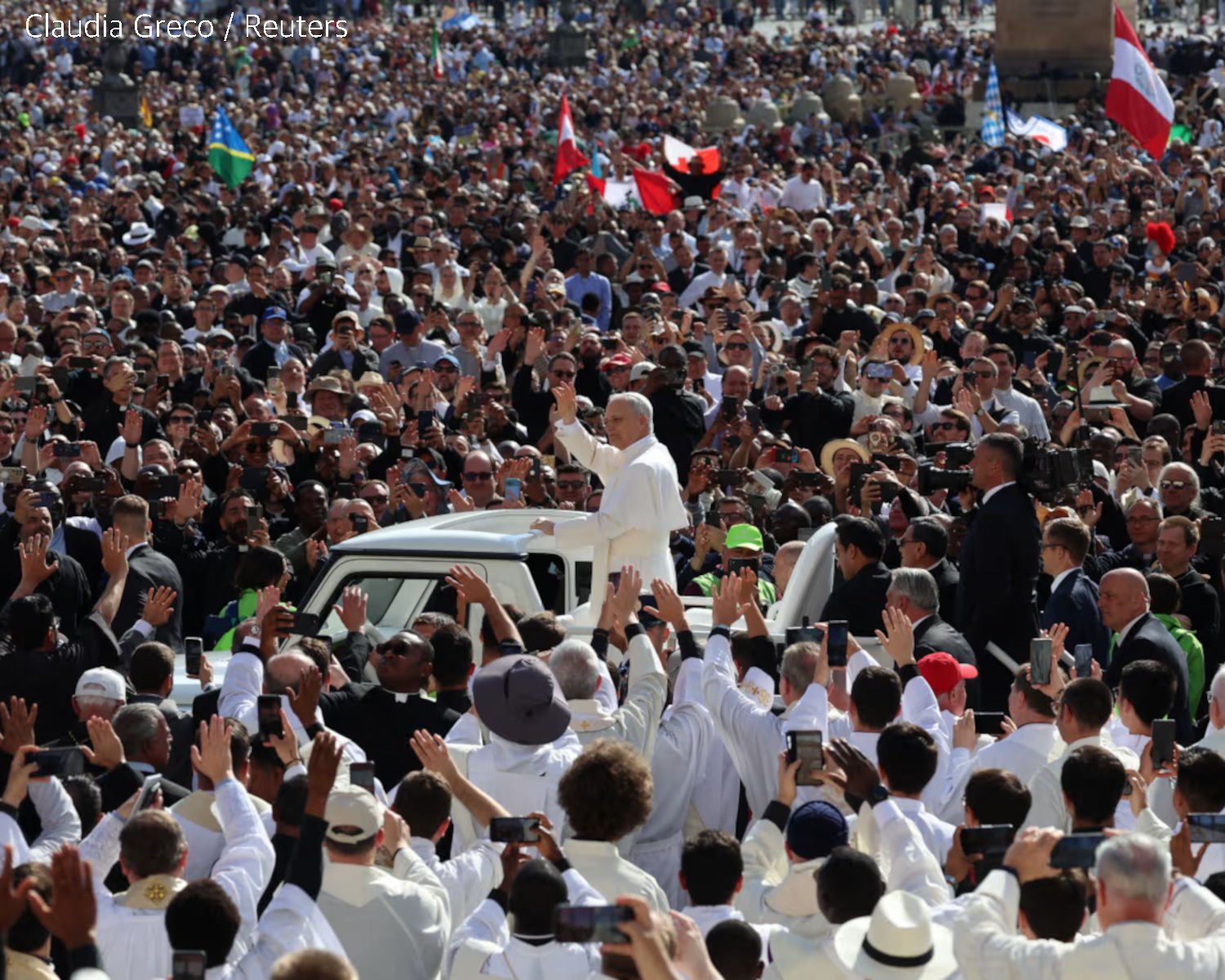
Cancel Culture was canceled after the 2024 election. A Catholic awakening began with the 2025 Conclave. Did Pope Leo XIV bring it, or did it bring us Pope Leo XIV?
May 28, 2025 by Father Gordon MacRae
On Sunday, May 18, 2025, I watched much of the Inaugural Mass for Pope Leo XIV broadcast by EWTN from St. Peter’s Square. Like many, I was amazed not only by the size of the crowd — estimated by The Wall Street Journal to be about 200,000 — but also by the makeup of that crowd. Jubilant young men and women, thousands of young families, priests, seminarians, religious sisters, energetic Catholic youth, and men and women of all ages celebrated the moment with brilliant smiles and deep respect. Not since the papacy of John Paul II have I witnessed such an outpouring of energy and exuberance in a Catholic setting.
I wrote a post back in 2018 entitled, “The Once and Future Catholic Church.” It began with a troubling but truthful account from the early days of Islam in the Seventh Century AD. It told a story that has since been spun into acceptability and normalcy across once-Catholic Europe. The brief story and its aftermath are historically important. We will link to that post again at the end of this one.
That post also profiled a fine article entitled “The Catholic Crisis” by Sohrab Ahmari in the May, 2018 issue of Commentary magazine. It was a review of the book, To Change the Church: Pope Francis and the Future of Catholicism by Ross Douthat. At the time of his review, Sohrab Ahmari was a recent and celebrated convert to the Catholic faith. He was also the London editor for The Wall Street Journal. His Review and Douthat’s book were written during the papacy of Pope Francis. Here is an excerpt describing their experience and that of many before the Conclave of 2025:
“There is reason to worry that lately a spirit of relativism has entered the Roman Church that threatens to undermine its unity and catholicity. That should concern Catholics and non-Catholics, because the Church is the living bedrock of the West and one of the last bastions of the principle that moral truth is moral truth yesterday, today, a thousand years from now.”
That sacred trust, which the Church must hold and defend, calls to mind for me one of the basic tenets of Scriptural faith that is too often overlooked in any quest to abandon yesterday in anticipation of tomorrow: “Jesus Christ is the same, yesterday, today, and forever” (Hebrews 13:8).
During the 12-year pontificate of Pope Francis, both of the Catholic writers cited above experienced a papacy that “thrived in ambiguity.” Among their list of perplexing notions was a media-hyped comment by Pope Francis that called into question the existence of hell. Defenders of the Pope excused the incident as a misreading of the Pope’s remarks by left-leaning atheist journalist, Eugenio Scalfari. However, as Mr. Ahmari pointed out it was the fifth interview Pope Francis had granted to that particular journalist.
At the same time, Pope Francis was unresponsive to requests for dialogue and clarification in a series of Dubia posed by Cardinal Raymond Leo Burke and other conservative prelates. The Pope, according to Ahmari, “first ignored and then ridiculed them.”
Sorab Ahmari also reported on Douthat’s “fascinating speculation” on the projected future of liberal Catholicism:
“Liberals simply don’t have the numbers … . Theological liberalism is in demographic decline, and liberal orders struggle to attract vocations. Church coffers may be full, but the pews are empty. The leading lights of theological liberalism are octogenarians, and there are no successors in the wings. Conservatives and traditionalists, meanwhile, have the numbers, the intellects and the energy. Orders that prize orthodoxy are thriving worldwide.”

The Conservative Rise
It is important to acknowledge where we have been. Two weeks before the Conclave and the election of a new pope, The Wall Street Journal published a most interesting Front Page analysis entitled, “Conservative U.S. Catholics Gain Sway” by Joshua Chaffin and Aaron Zitner (WSJ, April 22, 2025). It was published on the day after the death of Pope Francis implying that much of its research and content was written prior to that development. The authors described that their analysis “focused attention on the Vatican’s fraught relationship with an American flock undergoing cultural and theological changes … .”
Consulting a number of Vatican observers and insiders, the authors presented keen insights on what they expected from the Conclave. The result, however, was entirely unexpected. The Conclave completed its mission just one day after it commenced. The Journal authors had cited a brief final meeting between Vice President JD Vance and Pope Francis on the day before the Pope’s death:
“For Francis, it was a final encounter with the conservative wing of American Catholicism that is flourishing and increasingly assertive at a time when the Church, more broadly, is struggling.”
Of interest, a companion article in the days before the Conclave, “Who Are the Frontrunners for the Papacy?” by Marcus Walker (WSJ, April 22, 2025) presented ten cardinals seen as “front-runners,” a misleading term that suggests a political campaign. Despite the secrecy of a conclave, it is by no means certain that any of the names proposed were “running” for the office. The one ultimately elected, Cardinal Robert Francis Prevost, was presented in the Journal article as a “dark horse.”
However, one of the commentators made a prescient statement before the Conclave began. In a lecture on the growth of Catholic conservatism, theologian David Deane spoke of JD Vance and his brief meeting with Pope Francis on the day before his death: “Vance is one of a legion of young people who have followed the path from atheism to radical suspicion and rejection of liberal culture to a form of Augustine-inspired Christianity … . Seminaries are increasingly populated by young men who think like this.”
This was followed in the Chaffin and Zitner article in the Journal by a reflection from Timothy Gray, President of the Augustine Institute, a Catholic graduate school of theology outside St. Louis, MO that “emphasizes a return to the rigors of Scripture and Tradition”:
“A lot of progressives think that if the Church could just accommodate the modern world, it will stop its decline. But everywhere the Church has embraced the modern world and its contemporary values, it has died.”
Such comments may have been prophetic. The Conclave commenced just ten days later. After deliberating for only four voting sessions in less than two days, the Conclave elected “the dark horse,” Cardinal Robert Francis Prevost, formerly Superior General of the Order of Saint Augustine.

The Catholic Project
In 2022, The Catholic Project, a research initiative of Catholic University in Washington, DC published the striking results of a survey of 3,500 U.S. Catholic priests. It found that among those ordained after 2010, 80 percent identify as conservative or orthodox while those who identify as liberal or progressives have faced a virtual collapse. Stephen P. White, Executive Director of The Catholic Project, called this “a massive shift among priests,” adding that this trend is rapidly spreading not only in the United States, but throughout much of the Western world.
A separate research project on Catholic priests by the Augustine Institute documented that younger priests tend to be much more conservative and traditional that older priests. This bears out from observations in comments and emails from our readers who find this distinction to be a positive development. Writing at the time for The Wall Street Journal, Vatican correspondent Francis X. Rocca reported on the strains of this trend in “Catholic Ideological Split Widens” (WSJ, Dec. 19, 2022):
“U.S. Catholic bishops elected conservative leaders (in 2022) continuing to resist a push from Pope Francis to put issues such as climate change and poverty on par with the bishops’ declared priority of opposing abortion.”
The bishops appointed by Pope Francis tended to mirror his priorities. His elevation of San Diego Archbishop Robert McElroy, a leading liberal among U.S. bishops, to the College of Cardinals and then as Cardinal Archbishop of Washington, DC, is an example. That appointment was preceded two years earlier by the sudden, highly controversial removal of popular conservative Bishop Joseph Strickland from the Diocese of Tyler, Texas leaving many in that diocese and among conservatives throughout the United States reeling from the loss.
According to a WSJ article, Pope Francis had expressed his own discontent with some leaders in the U.S. Church. In 2023, he cited a “very strong, organized reactionary attitude” against him by conservatives in the U.S. Church, adding: “I would like to remind these people that backwardness is useless.” Seemingly in response, he removed Bishop Strickland from his post stirring up a reaction, manifested in distrust, among a majority of conservative U.S. Catholics.
There is thus a growing disparity in liberal versus conservative views as newly appointed bishops are more liberal while priests emerging from U.S. seminaries over the last few decades are more conservative and traditional. When seminarians and younger priests do not have their views of the Church and Catholic practice affirmed, stress and disillusionment develop and increase.
Since the 1980s, successive annual priesthood ordinations have grown more conservative. Each successive 10-year grouping in the ordained priesthood supports Church teaching on moral and theological issues more strongly than in the decade before. Those ordained after 2010, as a whole, are the most conservative. Younger priests represent a generation disillusioned with the ideas of progressive religious pluralism.
This had left an ever widening chasm between Pope Francis, his Episcopal appointments, and younger priests in the United States. The Catholic Project Study also revealed that 80 percent of U.S. priests ordained before 1980 approved strongly of Pope Francis, while only 20 percent of those ordained after 2010 shared that high approval.
According to the most recent Pew Research Center survey, 19 percent of Americans report that they identify as Catholic. That dropped from 24 percent in a 2007 survey. In the 1970s, in excess of 50 percent of U.S. Catholics participated in Mass weekly. Today that has dropped to 25 percent. Catholic voters in 2020 were virtually split between left and right politically. In 2024 they turned sharply for Donald Trump increasing Catholic vote support for him by an 11 point margin.
Pope Leo XIV has been widely presented in the media as “the first American Pope.” In actuality, however, he has served the Church as a citizen of the world. Is all this priestly interest in respect for orthodoxy a plague upon the Church? Or is it the whispering of the Holy Spirit, a whispering that also placed Leo XIV in the Chair of Peter? Ponder for a moment the massive crowd in St. Peter’s Square in the Inauguration Mass for His Holiness Leo XIV for your answer. Perhaps there is something to be said for a pope to be in the world but not of it.
+ + +
Note from Father Gordon MacRae: Thank you for reading and sharing this post. You may also like these related posts from Beyond These Stone Walls:
The Once and Future Catholic Church
Pope Francis Had a Challenge for the Prodigal Son’s Older Brother
The Vatican Today: Cardinal George Pell’s Last Gift to the Church

Pray for the papacy of Pope Leo XIV
The Eucharistic Adoration Chapel established by Saint Maximilian Kolbe was inaugurated at the outbreak of World War II. It was restored as a Chapel of Adoration in September, 2018, the commemoration of the date that the war began. It is now part of the World Center of Prayer for Peace. The live internet feed of the Adoration Chapel at Niepokalanow — sponsored by EWTN — was established just a few weeks before we discovered it and began to include in at Beyond These Stone Walls. Click “Watch on YouTube” in the lower left corner to see how many people around the world are present there with you. The number appears below the symbol for EWTN.
Click or tap here to proceed to the Adoration Chapel.
The following is a translation from the Polish in the image above: “Eighth Star in the Crown of Mary Queen of Peace” “Chapel of Perpetual Adoration of the Blessed Sacrament at Niepokalanow. World Center of Prayer for Peace.” “On September 1, 2018, the World Center of Prayer for Peace in Niepokalanow was opened. It would be difficult to find a more expressive reference to the need for constant prayer for peace than the anniversary of the outbreak of World War II.”
For the Catholic theology behind this image, visit my post, “The Ark of the Covenant and the Mother of God.”

Pope Leo XIV Defamed by the Survivors Network of those Abused by Priests
In 2018 this exposé of SNAP’s shady tactics to increase settlements over accused priests was widely ignored. After the Conclave of 2025 it exploded on the Internet.

In 2018 this exposé of SNAP’s shady tactics to increase settlements over accused priests was widely ignored. After the Conclave of 2025 it exploded on the Internet.
May 21, 2025 by Father Gordon MacRae
It did not take long. In the weeks leading up to the Conclave of 2025, Pope Leo XIV was accused by SNAP — the U.S.-based Survivors Network of those Abused by Priests — of negligently investigating and then covering up a decades-old account of alleged clergy sexual abuse. Lifted out of all context, the story is missing its most important element: the simple truth. To its great credit last week, the Catholic League for Religious and Civil Rights responded to this story by providing the truth and context that the story lacks. I am grateful to the Catholic League for having the Holy Father’s back, not to mention my own.
At about the same time, an article that I wrote in 2018 about SNAP’s deceptions and destructive malfeasance suddenly went viral after the Conclave of 2025. The Catholic League pounced on that as well, and courageously republished it anew under the title, Father Gordon J. Macrae On SNAP’s Deception.
That fact alone conveyed to me the urgency of this account of how and when SNAP activists terrorized the Church and priesthood for two decades.
So here it is again, apparently by popular demand of SNAP itself by raising the same tired old story with a new target: Pope Leo XIV. The papacy of Pope Leo XIV should not be tainted by a repeat of the dishonest rhetoric from this shady and morally compromised anti-Catholic activist network. SNAP can no longer mask the truth revealed in these pages.
Please read and share, as so many in Europe have done:
Abused by the Survivors Network of those abused by Priests

If there exists a Catholic priest still in denial about the agenda of SNAP, it’s because he has lived with his head in the sand blind to the threat lying in wait for him.
In 2009, at the same time I began writing for Beyond These Stone Walls, Catholic League President Bill Donohue invited me to write a feature article for the Catholic League Journal, Catalyst. My article, “Due Process for Accused Priests,” began by describing an important phenomenon.
In 2002, just as the national story of Catholic priests and sexual abuse emerged out of Boston to sweep the country, psychologist Daniel Kahneman was awarded the Nobel Prize in Economics for his work on a phenomenon called “availability bias.” It revealed the power of the media to not just report the news, but to reshape it to fit media bias, to cultivate it, to take a story’s small microphone and turn it into a megaphone.
Activist organizations have trained people to harness this force to sway what others adopt as a bias. It is not new, just newly analyzed. One of the most potent deployments of “availability bias” is one I have quoted before in these pages. It comes from Mein Kampf, the 1926 book by Adolf Hitler that gave rise to the Nazi party in Germany:
“The great mass of people will more easily fall prey to a big lie than to a small one.”
After my 2009 Catalyst article was published, I was subjected to an open assault by David Clohessy, Executive Director of the activist organization, SNAP, the Survivors Network of those Abused by Priests. Matt Abbott at Renew America forwarded my article to Mr. Clohessy and invited a response posted at Renew America entitled, “Imprisoned Priest, Sex Abuse Victim Clash.”
David Clohessy was obviously perturbed by what I exposed about the lawsuit settlement process and how it is advanced and cultivated by “self-serving contingency lawyers and various agenda-driven groups using scandal for their own ends.” Mr. Clohessy had long derided Church officials for entering into secrecy agreements to keep settlement amounts from public view.
On January 17, 2017, former SNAP employee Gretchen Rachel Hammond filed a lawsuit against SNAP in the Circuit Court of Cook County, Illinois. Ms. Hammond had been SNAP’s Director of Development before leaving the organization and filing her lawsuit. The named parties in the suit included David Clohessy, SNAP’s Executive Director, and Barbara Blaine, SNAP’s founder and president, and a member of SNAP’s board of directors.
Ms. Hammond’s lawsuit alleged that she was a victim of retaliatory discharge for questioning the allegedly corrupt practices of this organization. These included claims that SNAP and its leaders received substantial kickbacks in the form of “donations” from attorneys to whom SNAP officials referred clients or potential clients.
The lawsuit exposed that lawyers in California, Chicago, Seattle, and Delaware made major “donations,” some of them in six-figure amounts, and that SNAP leaders “concocted a scheme to have other attorneys make donations to a front foundation” to mask “attorneys’ kickbacks” to the organization.
The lawsuit also alleged a pattern of collusion between SNAP officials and plaintiff lawyers to maximize publicity for the purpose of fueling bigger payouts. It accused SNAP officials of callous disregard for the real interests of real sexual abuse survivors. Among the lawsuit’s other allegations were these:
SNAP engaged in a commercial enterprise motivated by its directors’ and officers’ personal and ideological animus against the Catholic Church.
SNAP conducted business premised on farming out abuse survivors as clients for specific attorneys who file lawsuits and collect settlements from the Catholic Church.
Attorneys routinely gave SNAP confidential plaintiff claims and other privileged information in order for SNAP to maximize payouts with sensational press releases.
SNAP claimed that it existed to provide support for survivors of clergy sexual abuse, however at all relevant times, SNAP did not have a single grief counselor or rape counselor on its payroll. SNAP would ignore survivors who reached out to SNAP for legitimate counseling.
Ms. Hammond alleged that she was told by SNAP official Barbara Dorris to ignore calls from survivors who were seeking only counseling.
Despite accepting funds for counseling and aiding survivors of sexual abuse, SNAP squandered those funds to advance its own interests and those of its leadership.
SNAP set out to deliberately jeopardize the ability of accused priests to receive due process and fair trials.
In 2011, SNAP oversaw fundraising for a charge brought against Pope Benedict XVI at the International Court at The Hague; however SNAP used the funds to pay for lavish hotels and other extravagant travel expenses for its leadership.

The Fallout
When the lawsuit became public, David Clohessy resigned as Executive Director, and SNAP founder and president, Barbara Blaine also resigned. They have since settled the lawsuit by a secrecy clause just like the ones for which Mr. Clohessy had railed against Catholic bishops over the last two decades.
After the settlement, others among SNAP’s more notorious leaders also resigned as reported by David F. Pierre, Jr. at The Media Report in “SNAP R.I.P.” Barbara Dorris, who replaced David Clohessy as Executive Director, and Regional Director Joelle Casteix both resigned. Among the revelations uncovered by David Pierre was that SNAP published the email addresses and personal phone numbers of accused priests to generate harassment.
Ms. Hammond’s lawsuit was only one of several brought against SNAP, but it was the one that appeared to finally expose what had long been suspected of SNAP and its leaders. Simultaneously in 2017, Father Joseph Jiang, a priest of the Archdiocese of St. Louis, filed a defamation lawsuit against SNAP.
Charges brought against Father Jiang were heavily promoted by SNAP leaders who, as they do whenever a priest is accused, issued a public call for anyone else who wants to accuse the priest. When Father Jiang passed a polygraph test [ I did, too, by the way, twice ] the charges were dismissed in 2015.
In 2016 a federal judge ruled that SNAP made false statements against Father Jiang “negligently and with reckless disregard for the truth.” SNAP and the parents of the minor who had falsely accused him settled the lawsuit.
As part of its settlement, SNAP issued a public apology, but the ever complicit news media failed to mention that SNAP was forced to do so in the wake of a false claim and lawsuit. SNAP’s apology, written by its legal counsel, included this statement:
“The SNAP defendants never want to see anyone falsely accused of a crime. Admittedly, false reports of clergy sexual abuse do occur. SNAP apologizes for false or inaccurate statements… its representatives made which in any way disparaged Father Joseph Jiang.”
In reporting this story, some Catholic media outlets continued to refer to SNAP as “a victims’ support group” or “a victim advocacy group.” It’s a bad habit that blindly gives legitimacy of purpose to SNAP which it does not have, and has never had.

Pope Benedict’s “Crimes Against Humanity”
The most important and visible source exposing SNAP’s corruption and reckless disregard for truth is a document by Catholic League President Bill Donohue entitled, “SNAP Implodes.” It provides a comprehensive and compelling account of the path of destruction SNAP and its leaders have left in the Church and priesthood under the false guise of advocating for real victims.
Among the most manipulative of David Clohessy’s “advocacy” was an instruction to accusers to attend SNAP press conferences. To play on the emotions of reporters, Clohessy urged those awaiting settlements to “display holy childhood photos” before the news cameras, and… “If you don’t have compelling holy childhood photos we can provide you with photos of other kids that can be held up for the cameras.”
If that doesn’t infuriate Catholics who have any regard left for truth, then what would? SNAP had a much worse perversion of justice than was first hyped, and then covered up, by the news media. It was the most destructive publicity stunt SNAP and its leaders have devised or condoned to date.
Both Bill Donohue and the Hammond lawsuit cited this one (see the final bullet point in Ms. Hammond’s lawsuit above). What they do not reveal is that SNAP used the false case against me to help bring it about.
David F. Pierre, Jr., moderator of The Media Report exposed this SNAP media stunt in “The Hague Tosses SNAP’s Nutty Lawsuit Against the Vatican, SNAP’s Latest P.R. Stunt Exposed.” That was before I even knew that I was a part of this story. In 2011, SNAP and the Center for Constitutional Rights — located at 666 Broadway in Manhattan — jointly filed a “crimes against humanity” charge against Pope Benedict XVI at the International Criminal Court.
The ICC is an independent judicial institution with the power to hold trials and impose sentences for the most serious crimes of international concern: genocide, crimes against humanity, and war crimes. The ICC was approved by international treaty in 1998 and officially came into being on July 1, 2002, after 60 countries ratified the treaty.
The court is headquartered in The Hague, The Netherlands. Of interest, in May of 2002, President George Bush declined to sign the treaty and refused to allow the ICC to have jurisdiction over United States cases. So SNAP’s target was not U.S. Catholic priests and bishops, but the Pope himself.
SNAP duped the left-leaning Center for Constitutional Rights to compose and file the briefs with information provided by SNAP in collaboration with plaintiff lawyers hoping for a precedent to tap Vatican assets in their never-ending quest for big bucks. I first learned of my involvement in this story from an article by journalist JoAnn Wypijewski, in “Spotlight Oscar Hangover: Why ‘Spotlight’ Is a Terrible Film.” Here is an excerpt:
“The Center for Constitutional Rights [CCR] . . . joined with SNAP to file a grotesque brief to the International Criminal Court demanding ‘investigation and prosecution’ of the Vatican for crimes against humanity… To CCR’s shame, Father [Gordon] MacRae is specifically mentioned in that brief with respect to allegations… which prosecutors threw in at sentencing but for which there is no evidence according to the lead detective in the case [as] cited by [Dorothy] Rabinowitz.”
SNAP, apparently in retaliation for my Catalyst articles calling for independent investigation of dubious claims, fed information to the Center for Constitutional Rights that would fuel a case against the Vatican. They made no attempt to contact me or my defense, nor did they contact Dorothy Rabinowitz at The Wall Street Journal who researched and published extensively on the same story, but with polar opposite conclusions.
And SNAP did this without attempting to contact James Abbott, the former FBI Special Agent who spent three years investigating this case before dismissing it as a fraud. (Agent Abbott’s affidavit is cited at the end of Ryan A. MacDonald’s recent post, “#MeToo and #HimToo: Jonathan Grover and Father Gordon MacRae” which also lays out the fraud behind this story).
In the end, to its great credit, the International Criminal Court declined to accept jurisdiction or the crimes against humanity charge against Pope Benedict XVI, but that was no surprise. Everyone involved knew that this fiasco would go nowhere, and it was never really SNAP’s goal. It was merely a publicity stunt for David Clohessy and SNAP to heighten pressure for quick and lucrative financial settlements.
The people who terrorized American Catholic priests for the last quarter century are gone now. Their fraud is exposed. Their coffers are empty. Their leaders have fled. In “SNAP Implodes,” Catholic League President Bill Donohue summed up what I had come to know at a very personal level in this moral panic that SNAP promoted and extorted for profit over the last 25 years:
“SNAP officials function as borderline gangsters out to destroy innocent persons. It is motivated by hate and exploits the very people it claims to serve. Justice demands that it be shut down by the authorities before it does any more harm.”
+ + +
Note from Father Gordon MacRae: Once again, you would serve the cause of truth and justice if you share this post and ask your contacts to do the same. Eyes may also be opened by these related posts from Beyond These Stone Walls:
The Eucharistic Adoration Chapel established by Saint Maximilian Kolbe was inaugurated at the outbreak of World War II. It was restored as a Chapel of Adoration in September, 2018, the commemoration of the date that the war began. It is now part of the World Center of Prayer for Peace. The live internet feed of the Adoration Chapel at Niepokalanow — sponsored by EWTN — was established just a few weeks before we discovered it and began to include in at Beyond These Stone Walls. Click “Watch on YouTube” in the lower left corner to see how many people around the world are present there with you. The number appears below the symbol for EWTN.
Click or tap here to proceed to the Adoration Chapel.
The following is a translation from the Polish in the image above: “Eighth Star in the Crown of Mary Queen of Peace” “Chapel of Perpetual Adoration of the Blessed Sacrament at Niepokalanow. World Center of Prayer for Peace.” “On September 1, 2018, the World Center of Prayer for Peace in Niepokalanow was opened. It would be difficult to find a more expressive reference to the need for constant prayer for peace than the anniversary of the outbreak of World War II.”
For the Catholic theology behind this image, visit my post, “The Ark of the Covenant and the Mother of God.”
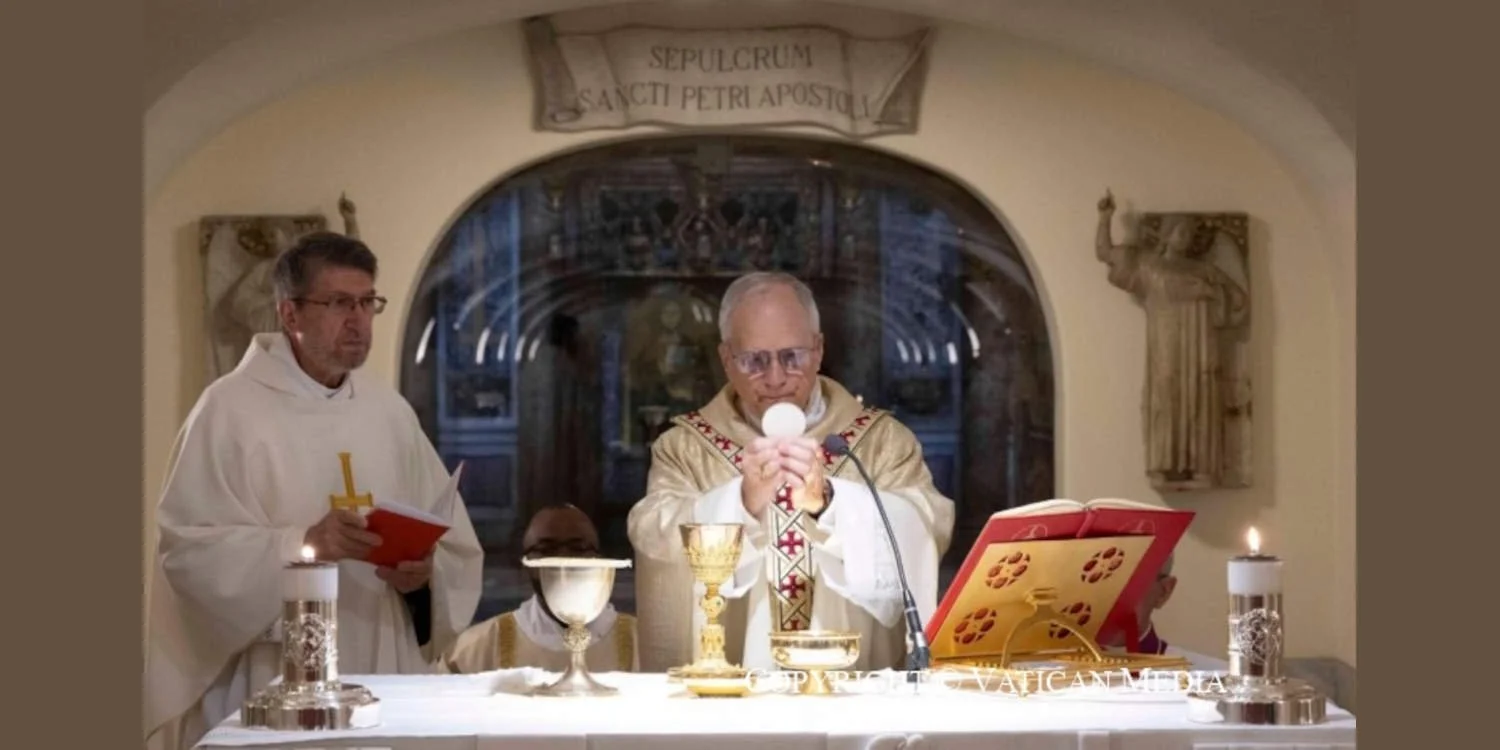
“Peter Lives in Rome Again”
In March, 2010 when Beyond These Stone Walls was a newborn blog, a post about Vatican scandal went viral. Fifteen years later it is still widely read and spread.

In March, 2010 when Beyond These Stone Walls was a newborn blog, a post about Vatican scandal went viral. Fifteen years later it is still widely read and spread.
May 14, 2025 by Father Gordon MacRae
We have already published a post this week, though four days earlier than our usual. It has a rather blunt title, but if you missed it, you should at least indulge me. That post was, “Pope Leo XIV Is Certainly No Clone of Pope Francis.”
If you search in any search engine the term “scandal at the Vatican,” using quotes, you will immediately come across a post that technically gave birth to this blog. It was written in March, 2010 when Beyond These Stone Walls was literally nine months along. Its title is “Michelangelo and the Hand of God: Scandal at the Vatican.” I had no idea when I wrote it that “Scandal at the Vatican” would become one of the most common searches on the Internet in regard to Catholic affairs thus making my post top the charts at various points along the way.
Vatican scandal was not at all what I had in mind when I wrote that post. It tells a fascinating story about overlapping layers of art history and we will link to it again at the end of this post.
Just days ago, worldwide attention was focused on the Sistine Chapel, the site at which Pope Leo XIV was recently elected. My post from fifteen years ago was focused upon that very same place but for different reasons. I am always a bit nervous when that post surfaces widely into view again as it did during and after the recent conclave. My post was about art, and Michelangelo, and a little-known event of art history. Rome is home to some of the world's most accomplished artists and art historians. I sometimes worry about whether and how something I wrote might measure up to their scrutiny. But the post in question has been making waves on the Internet for at least the last fifteen years. No one has yet complained or challenged my artistic interpretation. I won’t repeat that entire story here. You may read it for yourself linked again at the end of this post. Despite the fact that I wrote it, it is indeed an amazing story.

Landmarks
Among the vast media sources of published commentary about the results of the recent Vatican papal conclave, some have stood out far above the rest. One of these was published in The Wall Street Journal by Canadian priest and author of some reknown, Father Raymond de Souza entitled “Catholics Welcome an American Pope” (WSJ, May 9, 2025). I found a few of its paragraphs to be especially fascinating and moving. They gave me my title for this post:
“Twenty years ago, at the election of Pope Benedict XVI, Cardinal Francis George, Archbishop of Chicago, stood on the balcony of St. Peter’s and was caught staring off into the distance. He confessed later that he was marveling that the Church had elected yet another man to succeed Peter, while the great imperial Rome, the caput mundi, which put Peter to death on the Vatican hill, was no longer. Only ruins remained.
“In 1586, Pope Sixtus V had moved one of these ruins, a 350-ton granite obelisk, to the center of St. Peter’s Square, where it stands to this day. That obelisk could have been among the last landmarks St. Peter looked upon as he was crucified. It is the first thing a new pope sees when he lookes out over the assembled masses in the square below.
“On the top of that obelisk is a bronze cross, and place therein is a relic of the true Cross of Christ. There is in the Catholic calendar a feast of the Exaltation of the Holy Cross. It falls on September 14 — the new Pope Leo XIV’s birthday.”
“Peter lives in Rome again.”
+ + +
Note from Father Gordon MacRae: Thank you for reading and sharing this post, and our post about Pope Leo XIV for whom we hold high hopes which, if you saw the faces of the immense crowd in St. Peter’s Square last week, seemed to be contagious.
Please also read and share these related posts cited herein:
Michelangelo and the Hand of God: Scandal at the Vatican
Conclave: Amid the Wind and the Waves, a Successor of Peter
Pope Leo XIV is No Clone of Pope Francis
+ + +
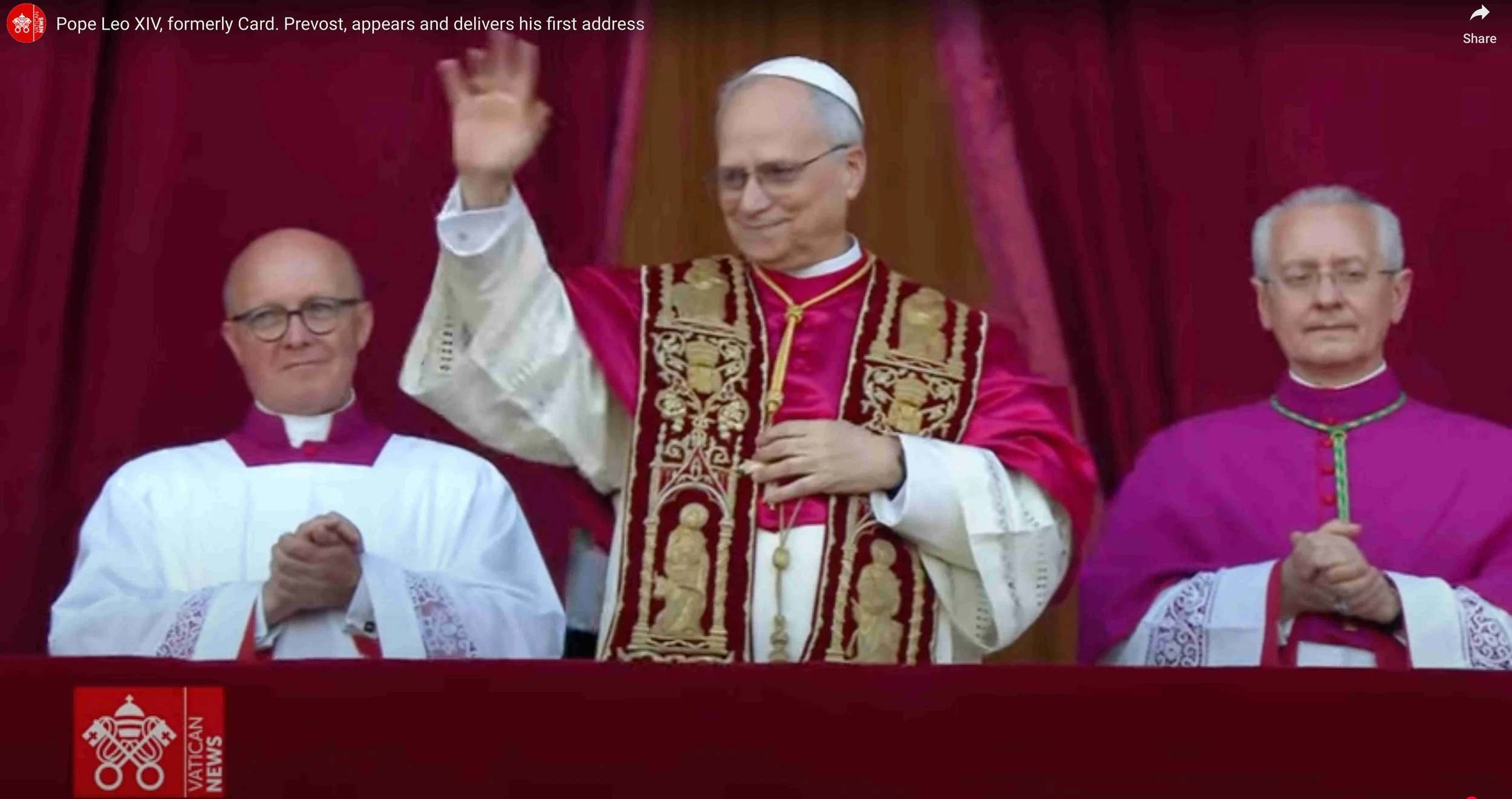
The Eucharistic Adoration Chapel established by Saint Maximilian Kolbe was inaugurated at the outbreak of World War II. It was restored as a Chapel of Adoration in September, 2018, the commemoration of the date that the war began. It is now part of the World Center of Prayer for Peace. The live internet feed of the Adoration Chapel at Niepokalanow — sponsored by EWTN — was established just a few weeks before we discovered it and began to include in at Beyond These Stone Walls. Click “Watch on YouTube” in the lower left corner to see how many people around the world are present there with you. The number appears below the symbol for EWTN.
Click or tap here to proceed to the Adoration Chapel.
The following is a translation from the Polish in the image above: “Eighth Star in the Crown of Mary Queen of Peace” “Chapel of Perpetual Adoration of the Blessed Sacrament at Niepokalanow. World Center of Prayer for Peace.” “On September 1, 2018, the World Center of Prayer for Peace in Niepokalanow was opened. It would be difficult to find a more expressive reference to the need for constant prayer for peace than the anniversary of the outbreak of World War II.”
For the Catholic theology behind this image, visit my post, “The Ark of the Covenant and the Mother of God.”

Pope Leo XIV Is Certainly No Clone of Pope Francis
Pope Leo XIV, the first pope with American roots, is profiled by some as being in solidarity with the progressivism of Pope Francis, but a closer look is required.

Pope Leo XIV, the first pope with American roots, is profiled by some as being in solidarity with the progressivism of Pope Francis, but a closer look is required.
May 10, 2025 by Father Gordon MacRae
We are posting this days before our usual Wednesday post day, but we did not want to wait. On Thursday, May 8, 2025 Robert Francis Cardinal Prevost became the 267th Pontiff of the Catholic Church, and the first in Church history to assume the Chair of Peter from America. One priest I called on that day described him as “a clone of Francis.” I gasped at the thought, but it is too much of a knee-jerk reaction. Since then, several voices from the left have spread the notion that he is our latest “woke pope.” That is nonsense, little more than propaganda, and there is lots of information to discredit it.
That was an otherwise interesting day for me. The Conclave began on Wednesday, May 7, 2025. I wrote about our expectations here in “Conclave: Amid the Wind and the Waves, a Successor of Peter.”
You could probably tell by that post that I expected a slightly more prolonged conclave, predicting that it might end with white smoke no sooner than Friday, May 9. I followed it intensely from the first procession into the Sistine Chapel. It was just a coincidence that my work was cancelled on Thursday afternoon. So at 1 PM, I was in my cell staring at the Sistine Chapel stove pipe while busy writing some notes. I looked away for just a minute and when I looked back and there were puffs of white smoke billowing out of the pipe. The silence was deafening, but the bells left no doubt.
I was off by a full day. I had ascertained that the 1978 election of John Paul II took eight votes. The 2005 election of Benedict XVI took three, and the 2013 election of Francis took five. So in my mind I calculated the average of all three votes to take 5.33 voting sessions. I therefore predicted that the conclave would end in the afternoon of Friday. The longest conclave in Church history lasted 1,006 days many centuries ago. None of us has the nerve to survive such a thing. But now, a day early there it was, white smoke at 1 PM (EST). Before the new pope was even introduced to the world, I quickly telephoned our editor, Dilia, in New York. Most of us about to witness monumental events wish not to witness them alone. So while Dilia was tuned in to EWTN, I watched Fox News and we compared notes. We were both stunned to meet Cardinal Robert Prevost, a native of Chicago, who was presented to the world as Pope Leo XIV. I imagine that every reporter on earth scrambled to discover what they could about the relative unknown.
Pundits immediately compared him to the late Pope Francis, claiming that they shared the same worldview and progressive mindset. There might even be some truth to that. We will all find out going forward. But what my eyes saw there on that balcony told a very different story. There, standing before the world, was an obviously humble man overwhelmed by the roaring crowds of Saint Peter’s Square. The roaring crowd was evidence of something in its own right. There were thousands of young men and women shouting in triumph in support not only of this man, but of this moment. When did we become, seemingly overnight, a Church filled with young and vibrant true believers?
I was struck by the presentation of Pope Leo XIV. Unlike his predecessor he chose to be bedecked in all the traditional garb of the Roman Pontiff. That is a sign, read with a bullhorn of what we may expect from this pope. These signs and wonders were all of his personal choice. So was the papal name he chose. It was that alone which filled me with hope.
We have a lot yet to learn about Pope Leo XIV. His chosen namesake, Pope Leo XIII who reigned from 1878 to 1903, can tell us volumes about the nature and person of the man who now occupies the Chair of Peter. The pontificate of Pope Leo XIII began the modern age of Roman Catholicism. He was known as “a social justice warrior,” a title that may bring shivers to some. But theologically, and in affairs of the Church and our life of faith, that Leo was certainly no liberal. His letters echoed the emphases of Pius IX Syllabus of Errors, and he endorsed the stance about concience, worship, and separation of Church and State by Pope Gregory XVI. Pope Leo XIII wrote the encyclical letters, Aeterni Patris (Eternal Father) which urged a revival of the work of Saint Thomas Aquinas as the basis of political and social renewal. Pope Leo was also the author of the encyclical, Rerum Novarum, which advocated for just wages earning him the title of “The Worker’s Pope.”
It seems that Leo XIV sees the Church and the world, at least in part, through the eyes of Leo XIII. And they were eyes never deluded about the true nature of this world and the Church which works for salvation within it.
I was thrilled by this knowledge. Pope Leo XIII and I shared a common vision about this world and the dangers it poses for the Church. After a night of terror, Pope Leo XIII wrote the following prayer, which I can only hope will also be prayed by his successor and namesake. We must also pray that prayer for him:

Prayer to Saint Michael the Archangel by Pope Leo XIII
O Glorious Prince of the heavenly host, St. Michael the Archangel, defend us in the battle and in the terrible warfare that we are waging against the principalities and powers, against the rulers of this world of darkness, against the evil spirits. Come to the aid of man, whom Almighty God created immortal, made in His own image and likeness, and redeemed at a great price from the tyranny of Satan.
Fight this day the battle of the Lord, together with the holy angels, as already thou hast fought the leader of the proud angels, Lucifer, and his apostate host, who were powerless to resist thee, nor was there place for them any longer in Heaven. That cruel, ancient serpent, who is called the devil or Satan who seduces the whole world, was cast into the abyss with his angels. Behold, this primeval enemy and slayer of men has taken courage. Transformed into an angel of light, he wanders about with all the multitude of wicked spirits, invading the earth in order to blot out the name of God and of His Christ, to seize upon, slay and cast into eternal perdition souls destined for the crown of eternal glory. This wicked dragon pours out, as a most impure flood, the venom of his malice on men of depraved mind and corrupt heart, the spirit of lying, of impiety, of blasphemy, and the pestilent breath of impurity, and of every vice and iniquity.
These most crafty enemies have filled and inebriated with gall and bitterness the Church, the spouse of the immaculate Lamb, and have laid impious hands on her most sacred possessions. In the Holy Place itself, where the See of Holy Peter and the Chair of Truth has been set up as the light of the world, they have raised the throne of their abominable impiety, with the iniquitous design that when the Pastor has been struck, the sheep may be scattered.
Arise then, O invincible Prince, bring help against the attacks of the lost spirits to the people of God, and give them the victory. They venerate thee as their protector and patron; in thee holy Church glories as her defense against the malicious power of hell; to thee has God entrusted the souls of men to be established in heavenly beatitude. Oh, pray to the God of peace that He may put Satan under our feet, so far conquered that he may no longer be able to hold men in captivity and harm the Church. Offer our prayers in the sight of the Most High, so that they may quickly find mercy in the sight of the Lord; and vanquishing the dragon, the ancient serpent, who is the devil and Satan, do thou again make him captive in the abyss, that he may no longer seduce the nations. Amen.
Our Holy Father Pope Leo XIV has an immense task before him. Let us pave that way with the support of our prayers and good intentions.
+ + +
Note from Fr Gordon MacRae: Thank you for reading this post. You can help stem the tide of misinformation by sharing it. We can no longer share to Facebook, but you can do so in our stead. You may also follow Beyond These Stone Walls on X and at gloria.tv.
You may also like these related posts:
Saint Michael the Archangel Contends with Satan Still
The Eucharistic Adoration Chapel established by Saint Maximilian Kolbe was inaugurated at the outbreak of World War II. It was restored as a Chapel of Adoration in September, 2018, the commemoration of the date that the war began. It is now part of the World Center of Prayer for Peace. The live internet feed of the Adoration Chapel at Niepokalanow — sponsored by EWTN — was established just a few weeks before we discovered it and began to include in at Beyond These Stone Walls. Click “Watch on YouTube” in the lower left corner to see how many people around the world are present there with you. The number appears below the symbol for EWTN.
Click or tap here to proceed to the Adoration Chapel.
The following is a translation from the Polish in the image above: “Eighth Star in the Crown of Mary Queen of Peace” “Chapel of Perpetual Adoration of the Blessed Sacrament at Niepokalanow. World Center of Prayer for Peace.” “On September 1, 2018, the World Center of Prayer for Peace in Niepokalanow was opened. It would be difficult to find a more expressive reference to the need for constant prayer for peace than the anniversary of the outbreak of World War II.”
For the Catholic theology behind this image, visit my post, “The Ark of the Covenant and the Mother of God.”

Conclave: Amid the Wind and the Waves, a Successor of Peter
In the Sistine Chapel, under the gaze of Christ in Michelangelo’s Last Judgment, cardinal-electors discern the successor of Peter the Holy Spirit has already chosen.

In the Sistine Chapel, under the gaze of Christ in Michelangelo’s Last Judgment, cardinal-electors discern the successor of Peter the Holy Spirit has already chosen.
May, 7 2025 by Father Gordon MacRae
“Simon, Simon, behold, Satan demanded to have you, that he might sift you like wheat, but I have prayed for you that your faith may not fail; and when you have turned again, strengthen your brethren.”
— Luke 22:31-32
“Jesus said, ‘Come.’ So Peter got out of the boat and walked on the water, but when he saw the wind and the waves he was afraid and began to sink, calling out, ‘Lord, save me.’”
— Matthew 14:29-30
+ + +
It has been written, by me and by others, that 1968 was the year we drank from the poison of this world. I was fifteen years old then. The war in Vietnam was raging. Battles for racial equality engulfed the American South. Senator Robert F. Kennedy was assassinated on his way to the presidency. Reverend Martin Luther King, Jr was assassinated on his way to civil rights. Riots broke out at the Democratic National Convention in Chicago. Violent partisan politics spread across the land like a pandemic setting a tone for decades to come.
Nineteen Sixty-Eight was also the year Pope Paul VI published Humanae Vitae, a papal encyclical asserting a moral framework for sexual ethics and human reproduction. From Catholics of every stripe, including some bishops and theologians, it subjected Pope Paul to tidal waves of global resentment and dissent. A notable exception, which was published in these pages, was “Padre Pio’s Letter to Pope Paul VI on Humanae Vitae.” The letter was written two weeks before Padre Pio’s death on September 23, 1968.
After witnessing all the above in 1968, I sat mesmerized in a Boston movie theater at age fifteen on a Sunday afternoon for the debut screening of “The Shoes of the Fisherman,” a film about the election of a pope based on a 1963 novel of the same name by Australian writer, Morris West. Like the book, the movie was long and ponderous, short on action, long on dialogue. At least it seemed that way to the mind of a fifteen year old.
But it told an amazing story. Archbishop Kyril Lakota, a courageous Soviet dissident was elevated to the papacy after spending seventeen years in a Soviet prison. Had I been able to see three or four decades into my own future in 1968, I might have cheered the result of that conclave.
Beyond my baptism, of which I had no recollection, and my first communion at age seven — which I remember mostly for the hot cocoa I spilled on my borrowed white suit in a diner where my mother took me afterward — I had little to no knowledge of the Catholic faith in 1968.
So, largely ignorant of our faith, I devoured The Shoes of the Fisherman — first the movie and then later the book. The film won a Golden Globe Award for Best Musical Score, which rose up to transcend any music I had ever heard up to that point in my life.

Emerging from All Our Prisons
Keeping his original name, Pope Kyril faced the greatest political and moral crisis ever seen in the 2000-year life of the Church. The world was at the brink of nuclear war. The people of China were starving while the Soviet Empire exploited other world powers which became islands unto themselves. Pope Kyril was tasked with mediating an end to hostilities and the looming threat of full-scale nuclear war which could destroy the planet and everyone on it. So after much prayer, Pope Kyril did the unthinkable. He sacrificed the patrimony of the Church. He sought to avert hunger and war by liquidating and surrendering all property and other assets held by the global Catholic Church.
Critics of the communists chafed. Critics of the movie choked, while critics of the Church cheered. They dismissively held that the Church would not have survived a nuclear war anyway. But faith would survive and Pope Kyril was boldly going to put that to the test. I left the theater resolved to take a serious look at the Church the adolescent me had set aside as irrelevant.
I watched this film and read this book fifty-seven years ago. I am amazed today to recall how much of its details became imprinted upon me. At the conclave in The Shoes of the Fisherman, Kyril Lakota was a startling figure. The book describes him:
“For seventeen years he had been in prison or in the labor camps. Only once in all that time had he been able to offer Mass, with a thimbleful of wine and a crust of white bread. All that he could cling to of doctrine and prayer and sacrament formulae was locked in his own mind. All that he had tried to spend of strength and compassion upon his fellow prisoners he had to dredge up out of himself and out of the well of Divine Mercy.”
— The Shoes of the Fisherman, p 20
During his Soviet imprisonment, Kyril had become a cardinal in pectore (in secret). Released just before the death of the pope, he was entirely unknown while facing the conclave ahead. After the opening Mass, the cardinal camerlengo was to choose someone to read a homily in Latin. Expecting to be bored, most of the electorate settled in for a long, boring treatise. Instead, the carmerlengo walked to the far end of the stalls in the Sistine Chapel and led to the pulpit the former prisoner, Kyril, portrayed in the film by the great Anthony Quinn:
“My name is Kyril Lakota, and I am come the latest and the least into this Sacred College. I speak to you today by the invitation of our brother the Cardinal Camerlengo. To most of you I am a stranger because my people are scattered and I have spent the last seventeen years in prison. If I have any rights among you, any credits at all, let this be the foundation of them — that I speak for the lost ones, for those who walked in darkness and in the valley of the shadow of death. It is for them and not for ourselves that we are entering into conclave. It is for them and not for our selves that we must elect a pontiff.
“The first man who held this office was one who walked with Christ, and was crucified like the Master. Those who have best served the Church and the faithful are those who have been closest to Christ and to the people who are the image of Christ. We have power in our hands, my brothers, but we shall put even greater power into the hands of the one we elect. We must use that power as servants and not as masters …
“It is not asked of us that we shall agree on what is best for the Church, but only that we shall deliberate in charity and humility and in the end give our obedience to the one who shall be chosen by the majority. We are asked to act swiftly so that the Church may not be left without a head. In all this we must be what, in the end, our Pontiff shall proclaim himself to be — servants of the servants of God.”
— The Shoes of the Fisherman, p 17

The Conclave of 2025
My authority for the following reflections on the current conclave now underway are largely from one whom I have come to respect as a fair and balanced observer unfettered by personal bias. Most of what I here present is summarized from a fine article by George Weigel in The Wall Street Journal (“The High Stakes in Choosing the next Pope,” WSJ, April 26-27, 2025).
Of the 252 current members of the College of Cardinals, 135 are eligible to vote in the Conclave underway in the Sistine Chapel under the stern gaze of Christ in Michelangelo’s The Last Judgment. The Conclave’s mystery, pagentry and secrecy have long provided fodder for movies, novels, and conspiracy theories run amok.
Among the conclave myths is one that has recently proliferated in the media with a concern for the direction in which Pope Francis took the Church during his twelve-year reign. There is widespread concern that, because his papacy elevated a high percentage of the current cardinal-electors, some two thirds of them to be exact, Francis may have already determined his own successor, or at least the ideological mindset of his successor.
To the great relief of many, George Weigel points out that history does not support that notion. He cites several examples:
IN 1878, every cardinal-elector had been appointed by either Gregory XVI, an unabashed reactionary, or Pius IX, a fierce critic of modernity. That electorate chose a pope, Leo XIII, who took Catholicism in a different direction for 23 years, seeking to engage cultural, social, and political modernity rather than merely condemning it.
Leo XIII appointed 61 of the 62 electors who then chose his successor in 1903. They chose Pius X who firmly applied the brakes to his predecessor’s reform initiatives.
And just over a decade ago, cardinals chosen by John Paul II and Benedict XVI elected as a successor Pope Francis whose pontificate has included senior figures determined to dismantle the legacies of John Paul II and Benedict XVI.
Shocking events have also played a role in the selection of a pope. In October, 1978, cardinal-electors were stunned to be recalled to Rome for a conclave after the 33-day pontificate of Pope John Paul I, whom they had just elected in a swift conclave. That shock created the conditions for doing what previously seemed unthinkable. The electors broke the succession of Italian popes electing the first non-Italian in 455 years, Poland’s Karol Wojtyla, who became John Paul II.
Another shocker soon followed after the 25-year papacy of John Paul II. The succession of Josef Ratzinger who became Benedict XVI and faithfully continued the legacy of John Paul II ended in another unexpected shock. In 2013 Benedict XVI became the first pope to step down since the year 1415. Like in the fictional story of The Shoes of the Fisherman, a consensus formed among the electors that they had to resolve the election quickly to demonstrate the Church’s unity. Cardinal Jorge Mario Bergoglio of Argentina, who like Kyril Lakota in The Shoes of the Fisherman had given a moving reflection on the person of Christ during the pre-conclave session, was quickly chosen becoming Pope Francis.
The conditions under which the current conclave is taking place have no precedent in Church history. No one can predict the outcome. The electorate in this conclave will be the largest and most diverse in history. When Pius XII was elected in 1939 there were 62 cardinal-electors of whom 37, or 60 percent, were Italian. The current electorate is over twice that size with 135 cardinal-electors and only 28, or 21 percent, are Italian. Today 13 percent of the electors are from sub-Saharan Africa, which George Weigel points out is the Church’s greatest area of growth. In other regions, 17 percent are from Asia, another 17 percent are from Latin America and the Caribbean, 10 percent are from North America, and 39 percent are from across Europe excluding Italy. Some of the more powerful European electors, such as those from Germany, represent a nation of Catholics for whom participation in the Mass and the Eucharist hovers around two percent, compared to over 70 percent in Africa. For the first time there are cardinal-electors from Singapore, East Timor, Papua New Guinea, Malaysia, Myanmar, South Sudan, Mongolia, Sweden, Serbia, Ruwanda, Burkina Faso, Paraguay, Laos, Morocco, Cape Verde and Haiti. Traditional Catholic centers such as Dublin, Paris, Milan, Venice and Los Angeles will have no one in the conclave.
I must give the last word in this post to His Eminence Cardinal Raymond Leo Burke, who has composed a beautiful and timely Novena Prayer for Catholics to participate in the Conclave by seeking the intercession of Our Lady of Guadalupe, who has been known to be in the company of the Holy Spirit:
Cardinal Burke’s Novena for the Election of the Next Pope
I kneel before you, O Virgin Mother of God, Our Lady of Guadalupe, the compassionate mother of all who love you, cry to you, seek you, and trust in you. I plead for the Church at a time of great trial and danger for her. As you came to the rescue of the Church at Tepeyac in 1531, please intercede for the Sacred College of Cardinals gathered in Rome to elect the Successor of Saint Peter, Vicar of Christ, Shepherd of the Universal Church.
At this tumultuous time for the Church and for the world, plead with your Divine Son that the Cardinals of the Holy Roman Church, His Mystical Body, will humbly obey the promptings of the Holy Spirit. Through your intercession, may they choose the most worthy man to be Christ’s Vicar on earth. With you, I place all my trust in Him Who alone is our help and salvation. Amen.
Heart of Jesus, salvation of those who trust in Thee, have mercy upon us!
Our Lady of Guadalupe, Virgin Mother of God and Mother of Divine Grace, pray for us!
Raymond Leo Cardinal BURKE
April 24, 2025

+ + +
Note from Fr Gordon MacRae: Thank you for reading and sharing this post with others during this most critical time for the life of the Church. I also invite you to visit these related posts from Beyond These Stone Walls:
The Once and Future Catholic Church
A Vision on Mount Tabor: The Transfiguration of Christ
The Vatican Today: Cardinal George Pell’s Last Gift to the Church
Synodality Blues: Pope Francis in a Time of Heresy
+ + +
Follow Beyond These Stone Walls on X.

The Eucharistic Adoration Chapel established by Saint Maximilian Kolbe was inaugurated at the outbreak of World War II. It was restored as a Chapel of Adoration in September, 2018, the commemoration of the date that the war began. It is now part of the World Center of Prayer for Peace. The live internet feed of the Adoration Chapel at Niepokalanow — sponsored by EWTN — was established just a few weeks before we discovered it and began to include in at Beyond These Stone Walls. Click “Watch on YouTube” in the lower left corner to see how many people around the world are present there with you. The number appears below the symbol for EWTN.
Click or tap here to proceed to the Adoration Chapel.
The following is a translation from the Polish in the image above: “Eighth Star in the Crown of Mary Queen of Peace” “Chapel of Perpetual Adoration of the Blessed Sacrament at Niepokalanow. World Center of Prayer for Peace.” “On September 1, 2018, the World Center of Prayer for Peace in Niepokalanow was opened. It would be difficult to find a more expressive reference to the need for constant prayer for peace than the anniversary of the outbreak of World War II.”
For the Catholic theology behind this image, visit my post, “The Ark of the Covenant and the Mother of God.”

South Park’s Bill Donohue Disgrace Was This Convert’s Amazing Grace
If ever there is an award for a Catholic who heroically goes above and beyond for others, Pornchai Moontri’s Nominee would be Catholic League President Bill Donohue.

If ever there is an award for a Catholic who heroically goes above and beyond for others, Pornchai Moontri’s Nominee would be Catholic League President Bill Donohue.
April 30, 2025 by Fr Gordon MacRae and Pornchai Maximilian Moontri
Earlier in April 2025, the Catholic League for Religious and Civil Rights in New York City sent out the following Media Alert to all Catholic League members:
“April 10, 2025
South Park's "Fantastic Easter Special," featuring the animated character of Bill Donohue, will air Friday morning, April 11, on Comedy Central at 4:00 a.m. ET. It can also be streamed on HBO's streaming service for those who have a subscription.”
I had the Alert sent by email to our friend Max Moontri in Pak Chong, Thailand. For those who are newer readers to this blog, Pornchai Max Moontri was my roommate for almost 16 years. His story, amazing in its own righ, was told in these pages just a week ago on Relevant Radio in an interview with The Drew Mariani Show.
Upon receipt of Bill Donohue’s Media Alert about South Park, Max wrote to me immediately to tell me that the date of the Catholic League Media Alert was also the anniversary of Max being received into the Catholic Church on Divine Mercy Sunday, 2010. It is difficult to hear this entire story and still cling to any doubt about the truth and power of Divine Mercy. Pornchai Max filled in a lot of blanks so I will now turn this story over to him.
“I was a teenager when I went to prison [in 1992]. Over the next 13 years, I was sent to solitary confinement over and over, for up to three-and-a-half years at a time, because I was so hostile. The longer I was there each time, the more inhuman I felt and became. Living for years on end in solitary confinement joined with the guilt I felt for the life I took during a struggle when I was 18 years old.
“So I just gave up on myself as a human being. I sank to the very bottom of the prison I was in, and stayed there. Then, in the spring of 2005, after almost fourteen years in and out of solitary confinement in Maine’s Supermax Prison, I was told that I was to be shipped to another prison in another state. I sat for months alone in my cell wondering about whatever hell was coming next. Then one day, guards in riot gear came and chained me up….”
[Editor: You can see the solitary confinement unit that held Pornchai in PBS FRONTLINE “Solitary Nation.” If you have not seen this, you cannot begin to know what Pornchai has been through.]
While I was writing the above, I had already lived in a prison cell with Father Gordon MacRae (“Father G”) for almost five years. I shudder when I think of my life before then. It is hard to put together this series of events that seem to be disconnected from each other. It only seems that way. Going from years in brutal solitary confinement to life in a cell with a Catholic priest is something I never imagined.
When I look back, and see all the small steps in which our Blessed Mother inserted herself into my life leading me to Jesus, it seems miraculous to me. If someone else told me this story twenty years ago, I would not believe it. But there is a lot more to my story.
Most people I knew in my earlier prison were afraid of me. Most expected me to erupt in violence any minute. I liked having that reputation then. I could not see it at the time, but it protected me from ever again feeling the terror I felt from the time I was taken from Thailand at age 11 to the time I ended up a homeless teenager living alone on the streets of Bangor, Maine at age 14.

A Black Hole from Which No Light Could Escape
What happened in those three years upon my arrival in America was like a black hole from which no light could escape without Divine assistance. I kept it bottled up within me for many years in a seething rage of trauma and hurt. It became my prison within a prison. But it served a purpose. It kept everyone else away, everyone except Father G.
I have read a little about exorcism since I became a Catholic on Divine Mercy Sunday in 2010. I understand it to be the spiritual casting out of evil. My exorcism at the hands of Jesus through His priest took a long time. It had to begin with my long, slow awakening to the fact that the evil within me was not planted there by me and it was not mine to keep. It was placed in my heart and soul by someone else.
On September 12, 2018, the Feast of the Most Holy Name of Mary, Richard Alan Bailey, the man who violently raped and tortured me more than forty times when I was taken to America, was brought to justice. It was Father G and Beyond These Stone Walls that ultimately accomplished this. Father G wrote some articles about what happened to me. They circled the globe and eventually they found the right persons who would be instrumental in my redemption. One of those persons was Dr. Bill Donohue, President of the Catholic League for Religious and Civil Rights of which I am now a member.
Backing up a little, in Fall, 2005, I was shackled, chained, thrown into a prison van, and driven from solitary confinement in Maine to Concord, New Hampshire. I was handled like a dangerous animal, and thrown into a familiar place: another stint in solitary confinement. But it was brief. It was also in 2005 that The Wall Street Journal wrote its first articles about the injustices that happened to Father G. Not long after I first met him by “chance” one day, I read those articles.
Later in 2006, Father G and I landed in the same place. Our cells were two doors apart. I remember the first time I walked into his cell. I saw a photo on a card attached to a battered mirror on the cell wall, and the man on the card looked sort of like Father G. So I said, “Is this you?” This turned out to be the most important question of my life. Father G then told me about St. Maximilian Kolbe, about what he did in prison at Auschwitz, and about how this card came to be on his mirror. Father G wrote this story in “The Parable of a Priest and the Parable of a Prisoner.”
Then one day came dreaded news. A U.S. Immigration Court ruled that I would be deported to Thailand at the end of my sentence. I never wanted to leave Thailand as a child. I was forcibly brought to America, and all I really knew in America was its prisons. In the meantime, my Mother — my only connection to Thailand — was murdered on the Island of Guam after she was brought there by Richard Alan Bailey. Her death remains classified there as a “cold case unsolved homicide.” It is not “unsolved” in the minds of either me or Father G.
When news of my eventual deportation came, I sank into deep depression. I knew that I had no future in Thailand. I had no future anywhere. Father G helped me appeal the deportation order, but like most such appeals, it was denied. So I just gave up again, and settled in my mind on my own “Plan B,” my eventual self-destruction. Father G confronted this setback with his own optimism that provided no hope or comfort at all. He said, “We are just going to have to build a bridge from here to Thailand.”
Who could take him seriously? I sure didn’t. We were in a prison cell thousands of miles away! All the things Father G tried to instill in me about hope and trust and surrender just felt empty again. But I had nothing else to hang onto. No hope at all. So I hung onto his.

Catholic League President Bill Donohue [l] and Pornchai Moontri at age 12 [r] just as he arrived in America and before the troubling events in this story took place.
Pornchai’s Story
Soon after this rejection from the Immigration Court, Father G came into our cell one day and told me that we have to get a summary of my life story on paper… So we talked for a long time. He asked me lots of questions and took notes. Then he helped me put it together in a four-page document. I could not see the point of it. I tried to type it on his typewriter, but my heart was not in it at all. Father G became impatient with my one-word-per-minute typing speed. So Father G took over and he typed it while I waited. He was not patient with my typing speed, but he was patient with me and my attitude of hopelessness and defeat.
After the story was typed, Father G said that he wanted my permission to send the short life story we typed to a few contacts in the outside world. He said that these were all people who had connections, and that he believed one of them would find connections for me in Thailand.
I thought this was hopeless, of course. No one is going to be interested in me. But I hate arguing so I just told him to go ahead. I believed it would come to nothing.

Dr Bill Donohue on South Park
I wrote that story with Father G’s help in 2007. When Father G said he wanted to send it out to others, I answered with a sarcastic “Whatever!” It was that word for which every parent of every adolescent wants to smack him for saying it. Father G sent my story to several people and he told me that it will come to good. Then I said it again, “Whatever!”
In coming weeks — to my shock and awe — I started receiving letters of support and encouragement. One was from Cardinal Kitbunchu, Archbishop Emeritus of Bangkok, Thailand. I nearly fell over when I saw the envelope with his return address and Thai stamps. Another came from Honorable Mary Ann Glendon, U.S. Ambassador to the Vatican. Another was from Father Richard John Neuhaus, Editor of First Things magazine. They encouraged me to cling to hope even when I saw none. And then finally one came from Dr. Bill Donohue, President of the Catholic League for Religious and Civil Rights. Dr. Donohue shocked me. He asked my permission for the Catholic League to publish my story.
At first, I was excited. Then the inevitable gloom within me crept back in. I did not dare to hope. Hope is not for the beaten down. It is just too painful. I told Father G I did not want others to know that I was victimized in America. I also was consumed with shame. I told Father G that I did not want to publish the story. But this gets really strange from here on.
I used to sometimes come across a horrible cartoon called South Park on the Comedy Central TV channel. South Park spared no one. They would often take famous people and create a cartoon satire to ridicule them. On April 5, 2007, I was watching an episode of South Park. It was their Easter Special. Suddenly, there on my screen was a cartoon version of Dr. Bill Donohue.
I stuck my head down from my top bunk and told Father G to turn it on. The cartoon was very disrespectful, but my first reaction was to shout, “WOW! DR DONOHUE IS REALLY FAMOUS!”
I thought he must be really good because only good people are ridiculed on South Park. Dr. Donohue was ridiculed along with Jesus and Pope Benedict in the same episode. At one point, Jesus punched Dr. Donohue. I was horrified! But this is also what changed my mind. I thought that if Dr. Donohue is brave enough to endure this ridicule, I can be too. So I asked Father G to help me write to Dr. Donohue with permission for the Catholic League to publish my story. It was because of South Park!
Two years later, in 2009, Beyond These Stone Walls began our long adventure in what Father G calls “The Great Tapestry of God.” He told me that in this life, we live only in the back of the tapestry, unable to see what all our tangled threads are producing.
Over the next decade, we together confronted evil. It was not all at once. It was in slow steps because at points along the way whenever I felt overwhelmed, I would retreat and then give up and quit. But Father G never quit. He stayed the course, patiently waiting for a better day to pull me back onto what he called “our road to Emmaus.” And staying the course meant writing about me. What he wrote started to become noticed.
Strange things began to happen. Just weeks after I was received into the Church on Divine Mercy Sunday in 2010, I read that South Park editors cancelled an episode that ridiculed Mohammed after freely ridiculing Jesus, Pope Benedict and Dr. Bill Donohue. I never watched South Park again.
But there are stranger things still. Because of what was being written about me, Clare and Malcolm Farr — husband and wife attorneys in Southwest Australia — offered to assist me pro bono. They are today among my dearest friends, but we have never actually even met in person. They performed miracles with contacts in Thailand, with an attempt to reopen the case of the murder of my Mother in Guam, and with helping Father G to bring my abuser to justice.
Then Father G received a letter from a group called Divine Mercy Thailand. The letter revealed that Marian Father Seraphim Michalenko had been in Thailand and he carried with him a copy of “Pornchai’s Story,” which he read from the Catholic League’s site to the Divine Mercy Thailand group. I learned only later from Father G that Father Seraphim Michalenko was the Vatican’s vicepostulator for the cause of sainthood of Maria Faustina Kowalska. It was Father Seraphim who smuggled Saint Faustina’s diary out of Communist Poland and assisted in its English translation. Father G wrote about this when Father Seraphim came to this prison to interview both of us. Father G’s post was “Divine Mercy in a Time of Spiritual Warfare.”
Father Seraphim’s interest, triggered by Dr. Bill Donohue, then inspired Felix Carroll, who was then Editor of Marian Helper magazine, to contact Father G. Felix Carroll said that he posted my story from the Catholic League’s site and “it lit up our website like never before.” Felix asked that we allow him to include a chapter about me in his book, Loved, Lost, Found: 17 Divine Mercy Conversions.
The miracles continued. I was visited in prison by a representative of the Royal Thai Consulate in New York who offered help in restoring my Thai citizenship and preparing me for repatriation. Then one day I was called to the prison library. The library had received a donated set of Thai language CDs which were set up on a computer for me to study. Then Divine Mercy Thailand wrote again and offered me a home. The bridge to Thailand Father G had once promised was built and I was utterly amazed. Then, in 2020, just before the pandemic took hold, Father G filed a petition on my behalf revealing all that had happened that never made its way into my trial in 1992. I was to be set free within the coming months.
I will never say “Whatever!” to Father G again. He and Bill Donohue, and even the disgraceful South Park, became the keys to the locks that held me bound. If there is ever a book called Divine Mercy Miracles, I expect to find this story in it. I am free!
+ + +
Eternal Father, I offer You the Body and Blood, Soul and Divinity of Your Dearly Beloved Son, Our Lord, Jesus Christ, in atonement for our sins and those of the whole world. For the sake of His sorrowful Passion, have mercy on us and on the whole world.
+ + +
Note from Fr Gordon MacRae: If you are not a member of the Catholic League, please consider lending your voice to this nation’s largest endeavor in protection of Religious Liberty: Catholic League Membership Subscription. Your membership fee also includes a one-year subscription to the Catholic League Journal Catalyst.
We also recommend these related posts:
Pornchai’s Story: The Catholic League Conversion Story for 2008
Divine Mercy in a Time of Spiritual Warfare
A Catholic League White House Plea Set Pornchai Moontri Free
The Parable of a Priest and the Parable of a Prisoner
Thailand’s Once-Lost Son Was Flag Bearer for the Asian Apostolic Congress

The Eucharistic Adoration Chapel established by Saint Maximilian Kolbe was inaugurated at the outbreak of World War II. It was restored as a Chapel of Adoration in September, 2018, the commemoration of the date that the war began. It is now part of the World Center of Prayer for Peace. The live internet feed of the Adoration Chapel at Niepokalanow — sponsored by EWTN — was established just a few weeks before we discovered it and began to include in at Beyond These Stone Walls. Click “Watch on YouTube” in the lower left corner to see how many people around the world are present there with you. The number appears below the symbol for EWTN.
Click or tap here to proceed to the Adoration Chapel.
The following is a translation from the Polish in the image above: “Eighth Star in the Crown of Mary Queen of Peace” “Chapel of Perpetual Adoration of the Blessed Sacrament at Niepokalanow. World Center of Prayer for Peace.” “On September 1, 2018, the World Center of Prayer for Peace in Niepokalanow was opened. It would be difficult to find a more expressive reference to the need for constant prayer for peace than the anniversary of the outbreak of World War II.”
For the Catholic theology behind this image, visit my post, “The Ark of the Covenant and the Mother of God.”