Book of Tobit: The Angel Raphael on the Road with Pornchai Moontri

The Old Testament Book of Tobit provides a setting for this story of a familiar wanderer and his dog and their angelic quest for healing from a traumatic past.
April 22, 2026 by Father Gordon MacRae
The young man went out and the angel went with him, and a dog came along and journeyed with them.
— Tobit 6:1-2
+ + +
There are 46 books in the Old Testament of Sacred Scripture. Among them are 14 that are in the category of Historical Books. Each tells a story about the history of God’s people from the earliest times. The Historical Books of the Bible do not convey the Word of God in the same way as the Law and the Prophets, but in them we come to know God through the power of story. I wrote of one of these wonderful accounts in the category of Historical Books in “The Holy Spirit and the Book of Ruth at Pentecost.”
Also among these Historical Books are two that are set against the background of the time of exile in Eighth Century BC. They are the Books of Tobit and Esther, each presenting a story of exile far from the Holy Land.
Today’s post is about the Book of Tobit in which we found a modern-day version quite reminiscent of it, in which God’s fidelity in the midst of our suffering and hardship is revealed even in the far-off places. The Book of Tobit mirrors a chapter in the contemporary life of a good friend on the verge of the next chapter in his life.
+ + +
Up to now, I have written about only two of the named angels of Sacred Scripture. So as not to distract you from this post, I will link to those other accounts at the end of this one. In a most strange way, the Archangel Raphael has placed himself into the cast of characters at work on our behalf beyond these stone walls. It is a profound account with lots of twists and turns like the Book of Tobit itself, but I will try to straighten the curves a bit.
This is a Part Two of sorts to an earlier post about our friend, Pornchai Moontri and his return to his native Thailand after an absence of 36 years. Pornchai is now 52, and has been struggling to adjust to the land of the free in a country he had not seen since age eleven. Part One of this post was “For Pornchai Moontri, a Miracle Unfolds in Thailand.”
Before I continue that account, I have to comment on the photo atop this post. After the reunion with his family described in the post linked above, Pornchai left with Father John Le for the nine-hour drive back to the Bangkok area and the Society of the Divine Word home, where he had first been living upon his arrival in Thailand. While there, Pornchai learned of an annual Thai custom called, in English, the “Water Festival.” It occurs in mid-April to mark the Thai New Year. It is tradition that Thai citizens honor the dead — a tribute akin to All Souls Day — by cleaning and restoring their tombs. So Pornchai decided to return there for a month to clean and honor the tombs of his Mother and Grandmother. The Water Festival is from April 12 to 16.
In the weeks before the Festival began, Pornchai had been spending his time doing yard work around the unfinished home of his Mother, left vacant since the time of her death. You may recall that after her own return to Thailand, she left that home in 2000 not knowing that she was going to her own untimely death, a victim of an unsolved homicide on the Island of Guam. She was almost the same age Pornchai is now. Being there, and coming to terms with all that transpired before, is an essential part of a most painful journey.
While in the village of Phuwiang (pronounced poo-vee-ANG) Pornchai had been rebuilding his relationship with his distant extended family from which he had been estranged for 36 years. “You can’t go home again.” That was the title of an American novel by Thomas Wolfe. His title signifies that you cannot return to the past, childhood, or old places, as time, change, and memory make the original “home” impossible to truly revisit. They were a close-knit family when Pornchai was taken from them against his will at age eleven. I cannot begin to fathom the depth of alienation and pain behind these reunions. I had been talking with Pornchai daily during this time. I usually called him at 11 AM which is 10 PM for him. It was the month of April, the hottest time of the year in Thailand. One night when I called he was out walking on the street with his late mother’s elder sister. They were surrounded by a pack of loudly barking dogs.
The connections between humans and dogs is a little different in the rural north of Thailand than in the Western World. The dogs are pets only in a loose sense of the term. They bond with someone who feeds them so they are not left entirely to their own devices, but they otherwise roam free to rule the street, rarely if ever coming indoors. They are more or less feral dogs. When I called Pornchai a few nights later, he told me that one of the dogs, the “Alpha” dog who seemed to be the leader of the pack, started following Pornchai every place he went. If Pornchai entered a building, the dog would sit outside and patiently wait for him. He also kept all the other dogs away from Pornchai.
The dog’s name seemed to be “Hill.” No one knows where either the dog or the name came from. Perhaps it means something in Thai, the sole language that Hill had ever heard. Hill attached himself to no one, but over those few weeks, he and Pornchai had become the best of friends. I asked for a photograph of them together, and the one atop this post appeared on my GTL tablet the next day. It broke my heart. Hill, like Pornchai, had a very tough life. Hill exhibited all the wounds and scars of life on the outside that Pornchai bears on the inside. He has had to be a ferocious dog to survive, but in Pornchai’s presence he was as docile and gentle as a lamb.

Enter the Archangel Raphael
I’m not at all sure what prompted me to do this, but after meeting Hill from afar, I began to research the role of dogs in Sacred Scripture. There are 46 references to dogs, and all but two of them are negative. “Many dogs surround me; a pack of evil doers closes in upon me” (Psalm 22:16). But it was the two references that were positive that caught my attention. Both are in the Book of Tobit (6:1-2 and 11:4) and they refer to a single, mysterious dog who appears at the beginning and the end of Raphael’s healing mission with Tobias, the son of Tobit. The dog has no part in the story other than to be there.
The name, Raphael, comes from the Hebrew for “God heals.” Raphael is a prominent figure in the ancient traditions of both Judaism and Christianity. He is identified in Judaism as an “Angel of the Presence,” one of four (Michael, Gabriel, Raphael and Uriel) who surround God’s Throne and live in his eternal Presence. In the Hebrew Talmud, he was one of the three angels who visited Abraham (Genesis 18) setting in motion the birth of Salvation History. He appears in the Hebrew Shema before retiring: “In the name of the God of Israel, may Michael be on my right hand, Gabriel on my left hand, Uriel before me, Raphael behind me, and above my head, the Divine Presence.”
In Catholic tradition, Raphael is venerated as an angel of healing. Ancient Christian lore presents him as the head of the Guardian angels, the angel of knowledge, and an angel of science. In the Apocryphal Book of Enoch, Raphael binds the fallen angel, Azazel, and casts him into the desert darkness. In the Canon of Sacred Scripture, Raphael appears in only one place, the Book of Tobit and the Bible’s most memorable healing journey. Written up to eight centuries before Jesus walked the Earth, The Book of Tobit reflects the commission of Raphael in the more ancient Apocryphal Book of Enoch:
“Tobias remembered the words of Raphael ... and made a smoke. When the demon smelled the odor, he fled to the remotest parts of Egypt where the angel bound him.”
—Tobit 8:2-3
I wrote some years ago about my bout with Azazel, this demon of the desert, but it was long before I realized that Raphael is the angel who bound him. For a glimpse of who and what Azazel is, and his role in our misery, see “Christ in the Desert: A Devil of a Time,” also linked at the end of this post.

The Book of Tobit Is Pornchai’s Story
The Book of Tobit was originally written in Aramaic, the language of the Jews before the development of Hebrew and their settlement in the land of Canaan, the Promised Land. A version of the story was preserved in the Septuagint, the Greek translation of the Jewish Scriptures. Fragments of it were also found among the Dead Sea Scrolls in Qumran.
The story of Tobit is brief but complex. Though written in Aramaic, most scholars date its origin in oral tradition in the Eighth Century BC and its written form at least two centuries before Christ. Among Jewish scholars, it was seen not as a historical book, but as Wisdom Literature. In the Canon of Sacred Scripture today the Book of Tobit is among the Historical Books for its focus on story, which is not a measure of historical accuracy, but of meaning. Its characters are historical persons, but its point is to convey a Scriptural truth. The story begins with Tobit, a devout and charitable Israelite who is deported into exile in Nineveh. Even there, he is an exemplary man who cares for his son, Tobias, his wife, and other captives in exile.
Then one day, due to an accident, Tobit loses his sight. About to lose everything else, he commissions his son, Tobias, to journey to far away Media to recover funds left in the care of a distant relative there. Tobit’s wife thinks Tobias is being sent to his doom, so Tobit issues a desperate plea to God to protect his son and recover his fortune. Meanwhile, in Media, Sarah, the daughter of the distant relative, is plagued by the presence of a demon named Asmodeus who has murdered everyone she loves. Sarah also prays a desperate plea to God for deliverance.
God hears both their prayers, and assigns Archangel Raphael to be the instrument of His Divine Mercy. Raphael involves himself in the Great Tapestry of God to see to it that these desperate lives converge safely upon Media and their paths cross. In the form of a stranger named Azarias, Raphael shows up in Nineveh to accompany Tobias safely to Media, a journey that will bring about the healing of both Tobit and Sarah and the rebuilding of their lives.
Strangely, as the opening lines of this post suggest, on the day Tobias and the Archangel depart on their healing journey, a dog shows up and walks with them (Tobit 6:1-2). The dog has no part in the story other than to accompany them. In the footnotes of the Scripture scholars who analyze this story in the Revised Standard Version, the dog is referred to simply as “surprising.”
In the end, the balm made by Tobias under Raphael’s instruction for the ultimate healing of Tobit’s blindness also exposes the demon haunting Sarah. The demon Asmodeus flees into Egypt where the Archangel Raphael binds him and imprisons him in the desert. Then Raphael acquires the sum of money needed by Tobit, and they all commence the long journey back to Nineveh to heal Tobit’s blindness. And for the second time, the Book of Tobit mysteriously reports, “So they went their way, and the dog went along behind them” (Tobit 11:4).
In the end, Raphael revealed himself to Tobit, Tobias and Sarah. He told Tobit that God has seen all the good he has done even in exile:
“I am Raphael, one of the Seven Holy Angels who present the prayers of the saints and enter into the presence in the Glory of the Holy One ... Do not be afraid, for I did not come on my own part, but by the will of our God.”
— Tobit 12:15ff

To Be Reborn In the Land of Your Birth
I am writing this post on Divine Mercy Sunday, the day and date that Pornchai became a Catholic in prison in 2010. In a call to him this morning, he told me that he attended Mass at Saint Joseph Church, a small Catholic parish thriving in the Buddhist enclave of Nong Bua Lamphu Province in Northern Thailand where many have gathered for the Buddhist Water Festival to honor the tombs of their loved ones.
Among them is the tomb of Wannee, Pornchai’s Mother who was also murdered by the demon, Asmodeus. You may note from the photo with Hill atop this post that Pornchai has a large tattoo on his left shoulder. It is from a portrait of his Mother, etched masterfully on his arm by an artistic prisoner just days after Pornchai learned of her death. It was at the time his only means to memorialize and to mourn her.
Pornchai has felt lost in Thailand. After a 36-year absence, and five months in horrible ICE detention, he has been free for just over five years at this writing. How could he feel anything else but lost? One of our good friends, a young man whom Pornchai has helped much, said as I write this that “Pornchai’s mission right now is not to do, but simply to be.” That is a very wise young man.
Please join me in a petition to Our Father to send Raphael to accompany Pornchai on this long and arduous journey of healing from the wounds of the past. And perhaps even a prayer for Hill, a battered dog who now walks with Raphael. Pornchai dearly misses him and commends him to the Angel of Presence.
O Raphael the Archangel, lead us toward those we are waiting for, those who are waiting for us. Raphael, Angel of happy meeting, lead us by the hand toward those we are looking for. May all our movements be guided by your light and transfigured with your joy. Angel, guide of Tobias, lay the request we now address to you at the feet of Hirn whose unveiled face you are privileged to gaze. Lonely and tired, crushed in spirit by the separations and sorrows of life, we feel the need of calling to you and pleading for the protection of your wings so we may not be as strangers in the province of joy. Remember the weak, you who are so strong, you whose home lies beyond the region of thunder in a land that is always at peace, bright with the resplendent glory of God.
Addendum: Max Moontri and the Fate of Hill, the Dog
My post above about the Book of Tobit caused a stir among our readers who wanted to know the fate of Hill, the dog. Hill arrived in Max’s life in mystery and left the same way.
After I wrote “Book of Tobit: Angel Raphael on the Road with Pornchai Moontri,” I received a larger-than-usual number of messages from readers who all had one nagging question: “What happened to Hill, Pornchai’s dog? Did he die? That would be just awful!” I agree, but that outcome was by no means certain. It is likely that Hill has in fact died, but like the rest of that story it remains shrouded in mystery. Max had decided not to leave Hill on the streets in the Village of Phuwiang, Max’s place of birth. Instead, after talking with me, Max and I both decided that he should bring Hill to the home where Max was living in the City of Pak Chong. Hill was an older dog who, like Max in a darker time of his life, was forced to live on the streets. It was the only life Hill knew, and Max agonized over what to do. The stories told to him by cousins in Phuwiang, that every time Max went there and then left, Hill would linger in a lonely vigil outside the house of Max’s late Mother waiting for Max to return.
So we decided on a trial run. Max would bring Hill to Pak Chong, where he would be better cared for, and Max could always bring him back after a few days if Hill showed signs of distress. Getting Hill into the car was a challenge at first. Hill had never before been in a car. But with a little coaxing and a little food, Hill jumped in. He slept through most of the long ride and appeared to adjust quite well. He was well fed and cared for over several weeks and seemed to love Pak Chong. Max and Hill would run in the large, walled off front yard. Hill would stand guard while Max did some landscaping, and would snarl whenever another dog or unknown person would approach the wall. Then one night, Max was outside with Hill, and they were running together. Hill would run immediately behind Max. Then Max stepped into the house for just a moment. When he came out Hill was mysteriously gone without a trace. Max searched the entire property. Hill was nowhere to be found. The only conclusion was that he must have jumped over the wall. Max searched for days in every direction, but with no sign of Hill anywhere. That was about three years ago, and no trace of Hill ever showed up. Max was heartbroken and felt that he had let Hill down. I took the opposite view, that Max had given Hill his only human companion in life. Why and how he left remains a mystery.
I like to think that, like the mysterious dog in the Book of Tobit, Hill went with the Angel Raphael.
+ + +
Note from Father Gordon MacRae: After five years in his native Thailand, some of it on the verge of homelessness, my friend Pornchai Max is about to embark on another journey to which Divine Mercy has summoned him. This has developed only in the last few weeks, so I will have more information coming soon. In coming days Pornchai will relocate to the far northwestern corner of Thailand where he will undertake a mission in support of one of Thailand’s alienated hill tribes.
Thank you for reading and sharing this post, but don’t stop here. For more on this amazing and moving story please see:
For Pornchai Moontri, a Miracle Unfolds in Thailand
Christ in the Desert: A Devil of a Time
Michael, Gabriel, Raphael: Allies in Spiritual Battle
Getting Away with Murder on the Island of Guam


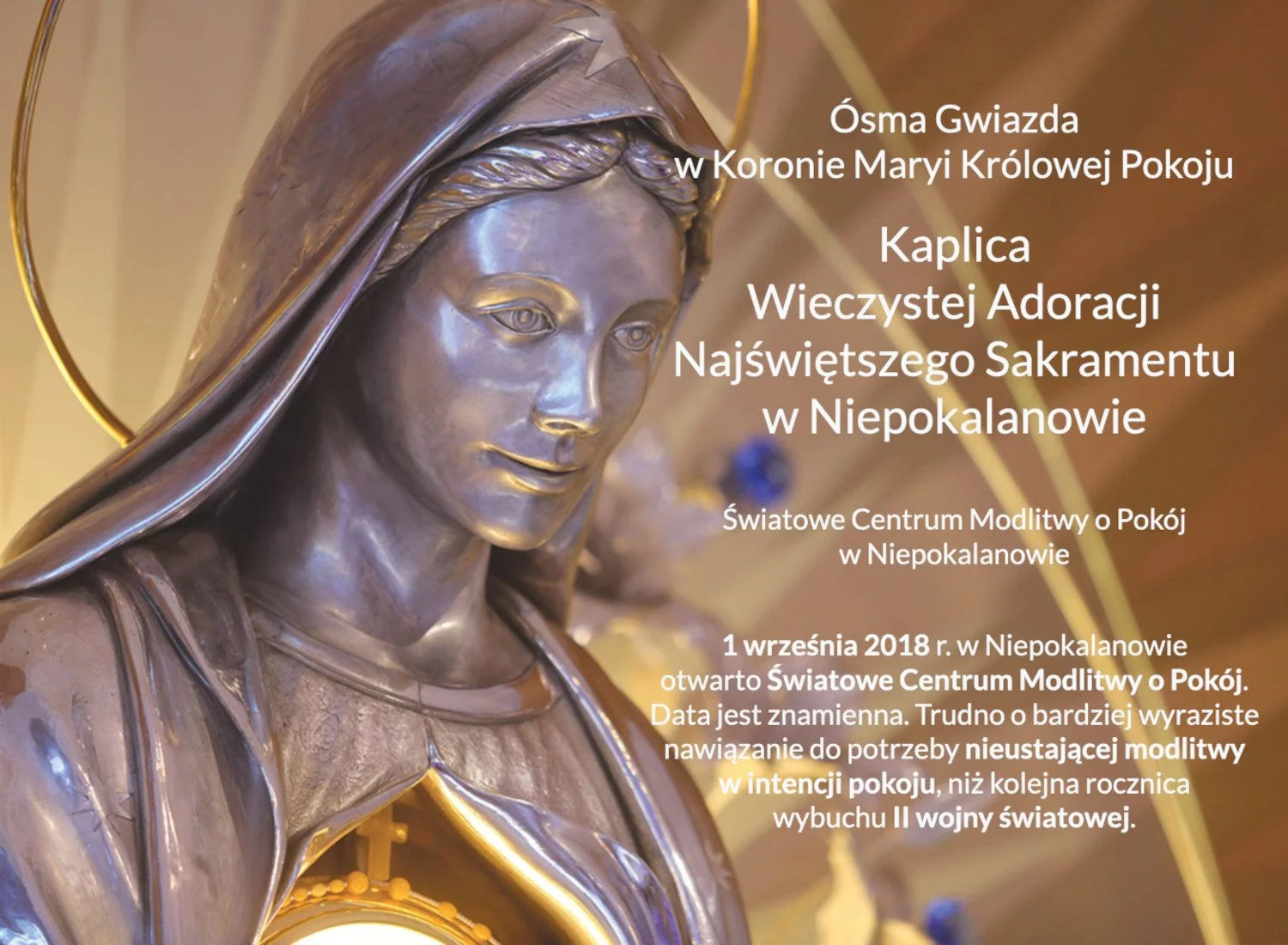
The Eucharistic Adoration Chapel established by Saint Maximilian Kolbe was inaugurated at the outbreak of World War II. It was restored as a Chapel of Adoration in September, 2018, the commemoration of the date that the war began. It is now part of the World Center of Prayer for Peace. The live internet feed of the Adoration Chapel at Niepokalanow — sponsored by EWTN — was established just a few weeks before we discovered it and began to include in at Beyond These Stone Walls. Click “Watch on YouTube” in the lower left corner to see how many people around the world are present there with you. The number appears below the symbol for EWTN.
Click or tap here to proceed to the Adoration Chapel.
The following is a translation from the Polish in the image above: “Eighth Star in the Crown of Mary Queen of Peace” “Chapel of Perpetual Adoration of the Blessed Sacrament at Niepokalanow. World Center of Prayer for Peace.” “On September 1, 2018, the World Center of Prayer for Peace in Niepokalanow was opened. It would be difficult to find a more expressive reference to the need for constant prayer for peace than the anniversary of the outbreak of World War II.”
For the Catholic theology behind this image, visit my post, “The Ark of the Covenant and the Mother of God.”