“There are few authentic prophetic voices among us, guiding truth-seekers along the right path. Among them is Fr. Gordon MacRae, a mighty voice in the prison tradition of John the Baptist, Maximilian Kolbe, Alfred Delp, SJ, and Dietrich Bonhoeffer.”
— Deacon David Jones

The Path of Sabrina Rubin Erdely’s Rolling Stone
A federal jury found Rolling Stone liable for defamation, and Sabrina Rubin Erdely for actual malice, but their earlier malice cost the life of an innocent priest.

A federal jury found Rolling Stone liable for defamation, and Sabrina Rubin Erdely for actual malice, but their earlier malice cost the life of an innocent priest.
At some point before or after reading this post, pay a visit to Ralph Cipriano’s “The Lying, Scheming Altar Boy Behind a Lurid Rape Case” in Newsweek Magazine, published in February, 2016. My post about it is one of the most widely read and shared posts on Beyond These Stone Walls. Some readers found it infuriating. Others enlightening. But nearly all readers were shocked to learn of this story from only one humble little “new media” blog while all the once trustworthy “old media” (with the striking exception of Newsweek) blatantly ignored it.
I’ll explain why they ignored it in a moment, but I warn you in advance, the answer isn’t pretty. I reveal this true account only on a “need to know” basis — as in, “You need to know.” Before you spend another dime on a news media subscription under the guise of being kept informed, you need to know.
In an article for Newsmax magazine (“Trump Taps Into Mass Distrust,” April 22, 2016), Catholic League President Bill Donohue cited a new poll by the Media Insight Project. It was a joint effort by the Associated Press and the American Press Institute, and the results did not go well for the political and media elite.
Respondents in the survey were asked to comment on how much confidence they have in various sectors of society. I found the results fascinating. The top five sources of public trust in America are the military, the scientific community, the U.S. Supreme Court, organized religion, and financial institutions.
At rock bottom on the barometer of public trust were the very news media platforms that launched the survey. Only six percent of Americans responded that they had a great deal of confidence in the press. Members of Congress followed close behind with an embarrassing four percent.
Bill Donohue, whose academic background includes a doctorate in sociology, reported that the two most common reasons cited for widespread public mistrust of the news media are inaccurate reporting and media bias. Donohue also cited other sources that give perspective to the media survey results. In 1985, a Pew Research Center poll found that 55 percent of Americans trust the news media to “get the facts straight.” By 2011, that figure dropped by more than half to only 25 percent. In the 1985 Pew survey, 45 percent of Americans judged the media to be biased. In 2011, that figure jumped to 63 percent.

The Crocodile Tears of a Predatory Media
One of the clearest examples of why the media is no longer trusted can be found in an important story that became buried under all the recent election coverage. A few weeks before the election, Journalist Sabrina Rubin Erdely, a contributing editor for Rolling Stone magazine, testified under oath as a defendant in a $7.5 million lawsuit charging her with actual malice, and Rolling Stone with defamation. The lawsuit was filed by University of Virginia Administrator Nicole Eramo.
Two years earlier, Sabrina Rubin Erdely and Rolling Stone defamed Ms. Eramo and U-VA in “A Rape on Campus,” a notorious November, 2014, story. It was the shocking account of “Jackie” who claimed to be a victim of gang rape at a U-VA fraternity in 2012. The story helped launch a national debate about sexual assault on college campuses across the nation, and contributed to an atmosphere of moral panic. Draconian measures to limit the due process rights of any student so accused were set in place in response to the high profile account.
Erdely’s Rolling Stone account depicted U-VA administrators as having callous disregard for the pain and suffering of Jackie and, by extension, other victims of sexual assault. But when Erdely’s rolling stones gathered up their dirt and the dust settled on this story, a major problem slowly came to light.
Jackie’s story turned out to be a massive lie, and Erdely’s coverage of it a massive betrayal of journalistic standards. Erdely did no fact checking of her own. She just ran with the lurid and sensational account with no attempt at corroboration. In the defamation trial, Erdely drew upon the same script used by contingency lawyers against Catholic priests and bishops for two decades.
“It takes trauma victims some time to come forward with all the details,” said Erdely in dismissal of her callous disregard for the journalistic skepticism so many in the media have abandoned in favor of political correctness. It is the same necessary skepticism that journalist Joan Wypijewski described in “Oscar Hangover Special: Why ‘Spotlight’ Is a Terrible Film.”
I am haunted by the familiar ring of this story’s aftermath. Reading about Ms. Erdely’s agenda masked as journalism brought a loud and clear echo from my own trial as Judge Arthur Brennan instructed jurors to “disregard inconsistencies” in accuser Thomas Grover’s testimony.
And it recalled Keene, NH Detective James McLaughlin’s shady and unexplained coaching of accusers. [In 2022 McLaughlin was exposed on a New Hampshire Attorney General’s previously secret list of dishonest police. McLaughlin’s offense was the fabrication of records and evidence.] In a 1994 police report, he described his response to my accusers’ inconsistencies and multiple versions of the story: “I gave them a copy of MacRae’s resume to help them with their dates.” Dates that repeatedly changed, and were off by years, not days or weeks or months.
“It’s not unusual,” Erdely explained when confronted on the witness stand about her response to the ever changing details and versions of Jackie’s account detailed in the Rolling Stone lawsuit. When Jackie changed aspects of her story, Erdely never questioned her credibility, never confronted her about the discrepancies. With streaming tears, the story and the wreckage left in its wake were all Jackie’s fault. “It was a mistake to rely on someone whose intent was to deceive me.”
The jury saw this differently. Rolling Stone was found to be liable for defamation, and Sabrina Rubin Erdely for actual malice. The bar for proving defamation and malice against a journalist is steep. A jury must conclude, as it did in this case, that a media venue published what it knew to be false, or did so with reckless disregard for the truth. It was only after a multi-million dollar judgment was rendered against Rolling Stone that Erdely was removed from its Contributing Editors listing in the December 2016 issue.
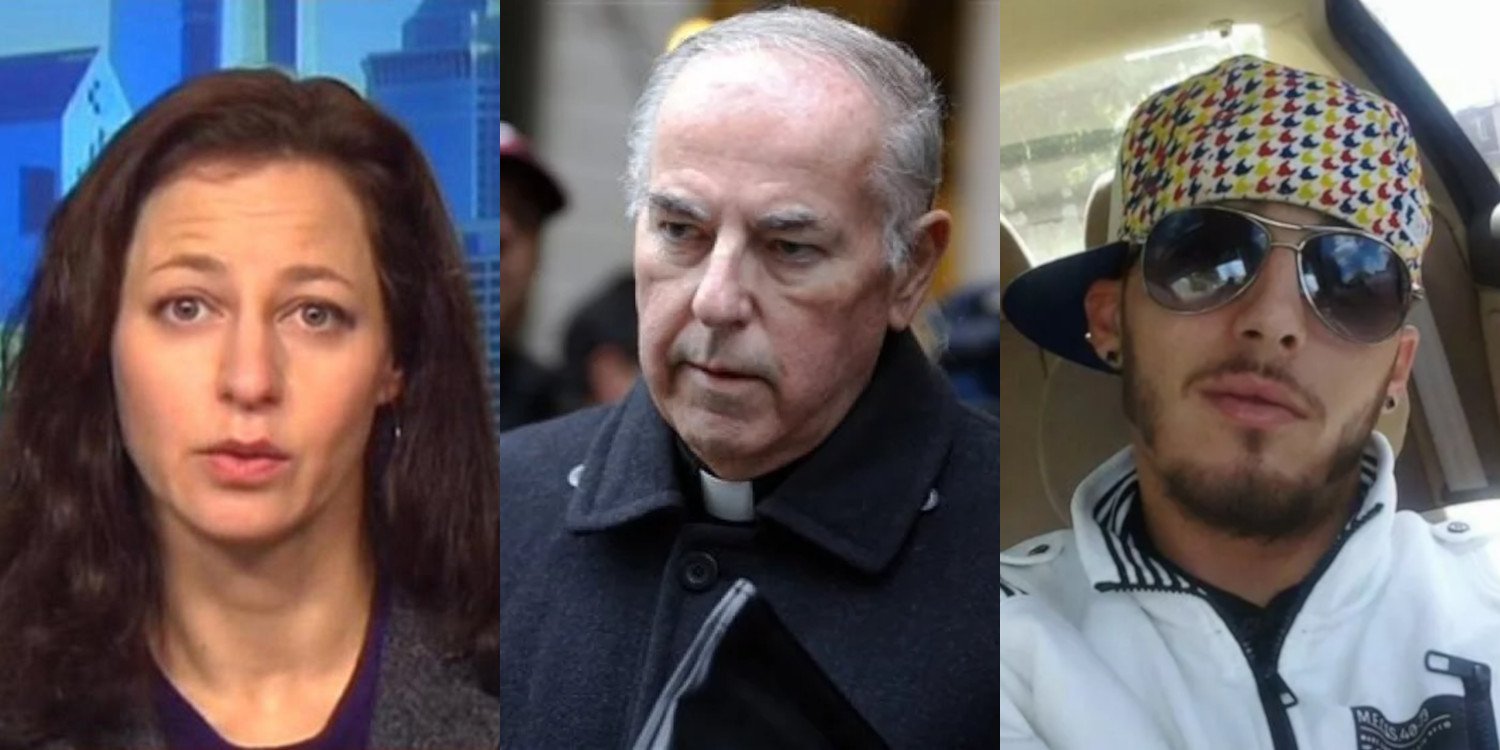
Former journalist, Sabrina Rubin Erdely; the late Fr. Charles Engelhardt, who died in prison; newly minted millionaire Daniel Gallagher, aka “Billy Doe.”
A Media Double Standard: When Erdely’s Jackie Was Billy
One can easily detect between the lines the rest of the news media’s discomfort with this story. Moriah Balingit took it on for The Washington Post in “Rolling Stone reporter says ‘Jackie deceived her about U-VA gang rape’” (October 20, 2016).
I commend Ms. Balingit for her truthful treatment of the story, but it’s a truth reported with carefully drawn limits. My strong suspicion is that the limits on truth were not those of the writer, but of The Washington Post. The focus of the account was on this one story, and not the standards and ethics of Sabrina Rubin Erdely. There is no reason to conclude that her compromised journalistic standards began with Jackie at U-VA.
A news media in pursuit of the whole truth instead of an agenda would look at Ms. Erdely’s past work as well, but they won’t. They won’t because doing so would require delving into another Rolling Stone debacle by Ms. Erdely. It’s a story that I have suggested at the top of this post: “The Lying, Scheming Altar Boy Behind a Lurid Rape Case.”
In that story, Ms. Erdely applied her “reckless disregard for truth” to the wildly inconsistent account of “Billy Doe” told in Rolling Stone on September 15, 2011 with the title, “The Catholic Church’s Secret Sex-Crime Files.” It was a clear example of a writer’s preference for shock value over truth.
This time Ms. Erdely’s disregard for journalistic standards cost Father Charles Engelhardt — a good man and good priest — his life. He died chained to a bed in the hospital wing of a Pennsylvania prison because the news media failed in its once honored pursuit of truth. There is an explanation for why most in the news business cower from revisiting this story to look under the rolling stones cast by Ms. Erdely. The Wall Street Journal’ s Dorothy Rabinowitz, a rare and courageous “old media” voice of journalistic integrity, explained why:
“Arguing for due process on behalf of a person charged with child sex abuse violated the progressive views held by many toward crimes involving special categories of victims like women and children… [T]here [is] a school of advanced political opinion of the view that to take up for those falsely accused of sex abuse charges was to undermine the battle… It was to betray all other victims of sexual predators … Where advanced reasoning of this sort prevailed, the facts of a case were simply irrelevant.”
Dorothy Rabinowitz, No Crueler Tyrannies, p. 17-18

“The Story Was Killed Higher Up”
And it’s not just the press. Broadcast news is driven by the same agendas. Last year I was contacted by a correspondent for a popular cable news venue. This is a news figure with obvious integrity whose positions I trusted and still do. She had been reading Beyond These Stone Walls and invested some time in researching the story described on our “About” page. The news correspondent wrote to me asking if I would agree to an on-camera interview for what was described to me as “a few hard questions.”
I agreed, and then waited. And waited. And waited… But the hard questions were never asked. They were never asked because someone did not want them publicly answered. An acquaintance of the news correspondent told me of her disappointment that “the story was killed higher up.”
The story was killed for the same reasons The Washington Post or The New York Times will not look into Sabrina Rubin Erdely’s prior work for Rolling Stone. Hard questions will be asked, and it would be a politically incorrect affront to the media’s progressive agenda if those hard questions were answered. This would require a legitimate inquiry into the story of Daniel Gallagher — Erdely’s “Billy Doe” in the pages of Rolling Stone. It would require some integrity reborn in an “old media” venue such as The Washington Post. For too many in the news business a progressive agenda requires the suppression of truth. As I wrote earlier, you need to know.
You need to know this too. The presiding judge in the case profiled by Ms. Erdely in Rolling Stone in 2011 was by no means immune from the bias Erdely helped to shape. During the process of vetting jurors for the trial of two priests accused in that case, Philadelphia Common Pleas Court Judge M. Teresa Sarmina objected to a question posed to prospective jurors saying,
“Anybody that doesn’t think there is widespread sexual abuse within the Catholic Church is living on another planet.”

Survivors and Liars
A recent issue of Chronicles: A Magazine of American Culture has an article by Penn State University professor Philip Jenkins entitled “Survivors and Liars” (August 2016). It’s an analysis of the story of Lauren Stratford. Her shocking tale of childhood sexual abuse and Satanic Ritual Abuse became a fixture of 1980s tabloid journalism “including a legendary Geraldo Rivera special broadcast near Halloween in 1988” in a “Geraldo” installment called “Satanic Breeders.” The story helped launch a moral panic giving unquestioned credence to the claims of adult “survivors” of sexual and Satanic Ritual Abuse that emerge without evidence, often with claims of “repressed and recovered” memory.
Just two weeks later, Geraldo Rivera helped launch the birth pangs of another moral panic with the November 1988 airing of “The Church’s Sexual Watergate.” It featured the early wave of contingency lawyers and the nascent voices of SNAP eager to harness the news media’s developing scent for Catholic scandal.
Ryan MacDonald found a transcript of that 1988 Geraldo Show among the first documents obtained by Keene, NH Detective James McLaughlin to help defraud the Church out of a lot of money. Ryan produced a rather shocking report of his own about how that Geraldo Rivera show influenced the case against me in “A Grievous Error in Judge Joseph Laplante’s Court.”
As for Geraldo’s Lauren Stratford story, it was later exposed as a fraud thanks to a report of Bob and Gretchen Passantino entitled “Satan’s Sideshow” — described by Philip Jenkins as “a superb piece of investigative journalism.” Lauren Stratford’s shocking tale hyped on “Geraldo” was just a massive lie told by a delusional narcissist. In its wake, Philip Jenkins asks,
“Might other adult ‘survivors’ of child abuse be telling the literal truth? Certainly. But the case of Lauren Stratford should be a ringing reminder that, absent evidence, to the contrary, any one of them could be making up every word.”


How Father Benedict Groeschel Entered My Darkest Night
Prayers for justice, for the fall of prison walls, are prayers for hope. On the night hope fell, Fr Benedict Groeschel served upon me a summons from the Highest Court.

Prayers for justice, for the fall of prison walls, are prayers for hope. On the night hope fell, Fr Benedict Groeschel served upon me a summons from the Highest Court.
I don’t think I have ever struggled with a post as I struggle now with this one. It is painful to write, and, in part at least, I know it will be painful to read. What I am about to describe is an earlier scene in the story of my own passion narrative that you do not know about, and now it is time to put it openly before you. I only ask you to withhold judgment for the judgment on this story is not yours to have. And I ask that you bear with me to the end for, as you will read, that is exactly what I am doing.
This confession of sorts was prompted by the 54-day Rosary Novena in which so many readers of Beyond These Stone Walls are engaged on my behalf. Many others who could not commit to that effort are offering prayers and sacrifices for those who are. Some include our friend, Pornchai Maximilian Moontri in these prayers, and I am most grateful for that. I mentioned in a post two weeks ago that I have been simply lost for words by this outpouring of faith and hope, and I will have something to say about it in my post this week.
But that was not entirely true. I have not been as “lost for words” as I claimed. It’s just that the words that come, the words that I must convey to you now, are from a time when my own faith and hope fell into the darkest of nights, and I fear you may think less of me for it. That is what I risk for total candor, but I risk far more if I do not speak up.
When my post, “Seven Years Behind These Stone Walls” appeared on BTSW on June 29, some readers surprised me with an overture to begin a 54-Day Rosary Novena for the cause of justice. It was to begin on the following day, June 30, the Commemoration of the First Martyrs of the Church of Rome.
Your prayer for me is much more a prayer for hope, and you may have no idea how much that prayer is needed. Most have no idea how fragile hope can be for the falsely accused. BTSW reader, Helen, sent me a note asking if I am conscious of the prayer support of so many. What I have been most conscious of is what happened on the morning this Rosary Novena began.
At 3:00 AM that Thursday morning, June 30th, I was awakened in my cell from a very vivid and troubling dream. You know that in February I underwent surgery and now have a seven-inch scar extending under my ribcage from the front to my side. In the dream, I woke up with a strange sensation. I lifted my shirt to discover with horror that my scar had opened and blood and water were pouring out from it drenching everything. It was not water mixed with blood. Both were streaming out of the open wound, blood on one side and water on the other. I tried to put my hand over it to stop it, but the flow continued right through my hand. It went on for a long time, and in my subconscious mind this was somehow connected with your prayers.
When I finally awoke for real, I quickly sat up and lifted my shirt. I grabbed my book light and a mirror, but all was dry and the scar was sealed and intact. It was a little after 3:00 AM and I was filled with anxiety and had trouble breathing.
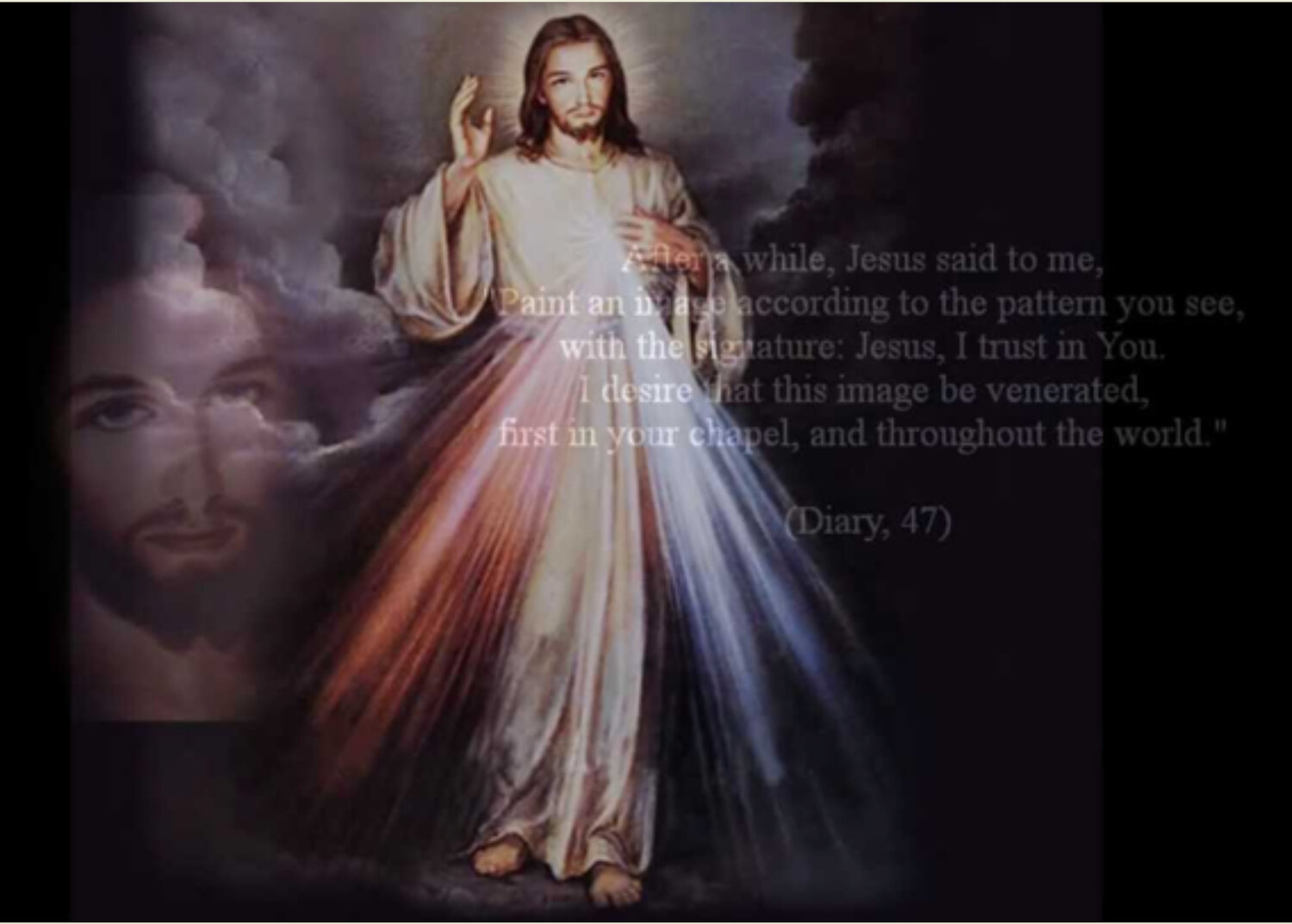
So I got up and paced around this cell. Soon after, Pornchai was awakened in the bunk above me. He asked me what was wrong. I was shaken, but I told him about the dream. As I spoke, he glanced over my shoulder at the Divine Mercy image on our cell wall. Pornchai got it immediately, but I am a little slow in such matters. Saint Faustina wrote:
“During prayer I heard these words within me: The two rays denote Blood and Water. The pale ray stands for the Water which makes souls righteous. The red ray stands for the Blood which is the life of souls... These two rays issued forth from the very depth of my tender mercy when my agonized heart was pierced by a lance on the Cross.… Happy is the one who will dwell in their shelter for the just hand of God shall not lay hold of him.”
— Diary of Saint Faustina, 299
Later that morning, I called Father George David Byers and told him about this dream. It was only then that I connected it with an event in the Gospel of John (19:34), “But one of the soldiers pierced his side with a spear, and at once there came out blood and water.” Please do not misunderstand me. I have no messianic delusions whatsoever. Christ asked, and I merely fled. The first stunning lines of Francis Thompson’s haunting, “The Hound of Heaven” capture best what happened when I was first issued a summons to Divine Mercy:
“I fled him, down the night and down the days; I fled him, down the arches of the years; I fled him, down the labyrinthine ways of my own mind; and in the midst of tears, I hid from him.”
Christ at the Crossroads
A note on John 19:34 describes the flow of blood and water as evidence of Christ’s humanity, that place where His life and that of fallen humanity intersects. The dream has stayed with me through the days of your prayers, and I find it to be both scary and hopeful. The hardest, most unrepentant criminal here fears only one thing: dying in prison. You can imagine then the toll that such a prospect takes on someone wrongfully imprisoned.
So of course I want your prayers to have real meaning, and to succeed despite the fact that I am not worthy of them. I am not worthy of them because there was a time in my life when, on the night of my own Gethsemane, faith and hope utterly failed me and I fell. In my hopelessness, I attempted to take my own life, and was hospitalized for it.
I have to try to convey the context. It was May of 1993, weeks after I had been accused. At the time, ironically, I served in ministry as Director of Admissions of the New Mexico Servants of the Paraclete residential center for priests.
There is no point in the details, but what I did was serious, and deadly, and I should not have survived it. But I did survive. It is one thing for someone justly accused to face such charges, but to be falsely accused, summarily declared guilty by my own bishop and diocese, disposed for the sake of thirty pieces of silver, is devastating for a priest.
Complicating this picture was the fact that I have epilepsy — specifically, complex-partial seizure disorder with a focus bilaterally in the temporal lobes. That, combined with the crushing experience of being falsely accused and discarded, swept away in a moment of despair all frame of reference for my life as a priest, and left me drained of all resources.
This was a time when the U.S. church was reeling over the sudden emergence of many such claims from decades past, and many in the Church pretended to believe them all just to ease the path to quick, quiet financial settlement. It was the dawn of what Father George David Byers described as “The Judas Crisis.” As my broken spirit descended into chaos, I believed that a sacrifice was required, the sacrifice of the life of a priest, and I believed I was to be that sacrifice. It was a moment when all hope went out of my world, and my faith and sanity fell along with it.
By some miracle of actual grace, I survived. On that night late in May of 1993 I regained consciousness in the Intensive Care Unit of Albuquerque Presbyterian Hospital. I did not, for a time, know where, or even who I was, but within a day my mind came back on line as though rebooted. I felt the deepest darkest shame and despair over this shattering of all hope as my life and priesthood lay before me in utter ruins.
My friend, Father Clyde Landry, was there with me. He told me that I had written a letter to the Servant General, Father Liam Hoare, asserting my innocence of these charges, but asking his forgiveness for the sacrifice of my life because of the harm these false claims brought upon priesthood and Church. I do not know what became of that letter.
That night in my hospital room, my friend Father Clyde brought me something that he knew I treasured and might want. It was a portable shortwave radio. Later, when I was alone, still deeply shattered, I turned it on and placed the earpiece in my ear. I randomly turned the dial, then stopped suddenly.
I had used that radio on many nights as I surfed the shortwave band for broadcasts from around the world, but I had never before come across what I heard that night in Gethsemane. I distinctly heard intoned the “Salve Regina,” and then an announcer’s voice that I was listening to EWTN broadcasting on a shortwave band from Irondale, Alabama. Then I heard a clear and very familiar voice. It was the voice of someone I had known well many years earlier, but lost touch with. The lilting voice and Yonkers accent were unmistakable. It was Father Benedict Groeschel.
My Gift to the Lord: An Empty Vessel
Some time ago, I wrote a post in defense of Father Groeschel entitled, “Father Benedict Groeschel at EWTN: Time for a Moment of Truth.” What happened on the night I am now describing is why I wrote that post. He was accused of calling into question a claim of victimhood in the Catholic scandal, and the Gospel of Political Correctness that American bishops had cowardly agreed to was not going to spare him. The wolves began to circle Father Groeschel and several Catholic institutions he so generously served all began to get some distance from him. In my challenging post, I drew a line in the sand that many stood behind. “Not this time! Not this priest!” I wrote.
I wrote that post because twenty years earlier, Father Benedict Groeschel entered my darkest night with a message of hope, and a plan for redemption when all was lost. In that hospital bed that night, it was as though he was addressing me directly. I can only paraphrase it here, and hope that I am doing it justice:
“When life seems as though it has fallen apart, and you face an immeasurable sense of loss, whether the cause is tragic illness, or loss of a loved one, or financial ruin, or public shame, or grave injustice, the loss of all hope seems to be the final loss. It leaves you as though an empty vessel which you feel can never be filled again. This is a crucial and vulnerable time. It is also a moment when God is nearest to you.”
Father Groeschel went on that night to speak of the only response left for an empty vessel: a spirit of abandonment and surrender to God’s Providence. God alone can fill what has been torn asunder by the forces of this world. “Surrender control, for control of your life is an illusion,” he said. “Embrace surrender to God’s Providence so that your empty vessel may serve Him in the salvation not just of your soul, but of many souls.” I was, for perhaps the first time in my life, ready to hear these words and absorb them. Nothing made sense up to then, but Father Groeschel made total sense.
You may remember a post of mine about the suicide of another priest from my diocese, Father Richard Lower. I wrote of this tragedy in “The Dark Night of a Priestly Soul.” After being informed by Monsignor Edward Arsenault of the emergence of a decades-old sexual abuse claim, Father Lower was given the usual 24 hours to vacate his parish and residence without a word to his parishioners whom he had served for a dozen years. He was to be just another priest who disappears in the night. In his darkest night, he walked out to a deserted mountain path and took his own life. In “The Dark Night of a Priestly Soul” I wrote that I would have given anything to have been on that path with him. It’s because I HAVE been on that path, and I survived.
Some twenty-six accused U.S. Catholic priests have taken their own lives since the U.S. Bishops entered into The Judas Crisis by presuming every money-driven claim against a priest to be true. Whatever cynic presumes from this their guilt knows nothing of the identity of priesthood and its permanent bond with the notion of sacrifice. No priest should be required to sacrifice his life to satisfy the demands of contingency lawyers, insurance companies, and the agendas of those who despise the Church.
The Summons of Divine Mercy
The summons served upon me by Father Benedict Groeschel that night came from the Highest Court of justice, a Court in which Divine Mercy is its mirror image. It was actually the second time that summons was served. The first time was exactly one month earlier. A friend and coworker in the Servants of the Paraclete ministry to priests was Father Richard Drabik, MIC. He was also my spiritual director. You may recognize him as the former Provincial Superior of the Marian Fathers of the Immaculate Conception, and the author of the Preface to the Diary of Saint Maria Faustina.
In early April, 1993, Father Drabik came to my office with a request. He was leaving for Rome a week later to concelebrate Mass at the Beatification of (then) Blessed Faustina on Divine Mercy Sunday, April 18, 1993. Father Drabik invited me to draft a petition that he would place on the altar at the Beatification. The petition I wrote was this simple note sealed in a small envelope:
“I ask for the intercession of Blessed Faustina that I may have the courage to be the priest God intends for me to be.”
Fifteen days after the Beatification, I was charged with crimes alleged to have taken place over a decade earlier, crimes that never took place at all, and the violent emptying of the vessel of my life and priesthood began. Two weeks later, the courage I asked for gave way to hopelessness as I lay in ICU hearing this summons repeated by Father Benedict Groesechel.
So on that awful night, I solemnly vowed to go the distance, to remain an empty vessel with hope and trust as my only choices in life while discerning God’s Providence. Since then, as you know if you have been an attentive reader of Beyond These Stone Walls, that summons to Divine Mercy has become woven into every fiber of my life, and not only my life, but many others.
The stunning evidence for this is found in many places, but one of the more striking is the medical miracle confirmed as attributed to Saint Faustina by the Vatican Congregation for the Cause of Saints. The recipient of that miracle was Mrs. Maureen Digan who shares a chapter along with Pornchai Moontri in Felix Carroll’s wondrous book, Loved, Lost, Found: 17 Divine Mercy Conversions. Seeing Pornchai’s and Maureen’s stories together in that volume is to see Divine Mercy come full circle in my life and priesthood, and this empty vessel filled with hope beyond imagining. I thank you for your heroic prayers for justice on my behalf. The most fundamental aspect of justice is the preservation of hope.
“O Blood and Water which gushed forth from the Heart of Jesus as Fount of Mercy for us, I trust in You.”
— Diary of Saint Faustina, 309
“To priests who proclaim and extol My mercy, I will give wondrous power; I will anoint their words and touch the hearts of those to whom they will speak.”
— Diary of Saint Faustina, 1521
+ + +
Editor’s Note: This post continues next week on Beyond These Stone Walls with “Saint Maximilian Kolbe: A Knight at My Own Armageddon.”
And with joy and thanksgiving, Father Gordon MacRae wants you to know about the publication of an inspiring biography, A Friar’s Tale: Remembering Father Benedict J.Groeschel, C.F.R. by John Collins available from Our Sunday Visitor.

A Friar’s Tale — Remembering Fr. Benedict J. Groeschel by John Collins (Our Sunday Visitor)

A Grievous Error in Judge Joseph Laplante’s Court
Federal Judge Joseph LaPlante dismissed without testimony Fr Gordon MacRae’s recent hope for justice. No U.S. court has allowed this defendant to utter a single word.

Federal Judge Joseph Laplante dismissed without testimony Fr Gordon MacRae’s recent hope for justice. No U.S. court has allowed this defendant to utter a single word.
June 22, 2016 by Ryan A. MacDonald
Editor’s Note: The following is a guest post by Ryan A. MacDonald, author of “The Trial of Father MacRae: A Conspiracy of Fraud.”
I am not here to cast Donald Trump-like aspersions upon a judge whose decision I simply do not like. I have no doubt that Father Gordon MacRae would bar me from publishing here if I did. I am simply here to describe a grievous error that occurred in United States District Court in Concord, New Hampshire, and other facts that continue to trouble me greatly a year after I published an important article on this site: “Judge Joseph Laplante Denies Priest’s Appeal.”
Many people have come to believe that the 1994 prosecution and trial of Father Gordon MacRae, and subsequent appeals, have left an innocent man in prison and a gaping wound on the integrity of the criminal justice system. One issue that I and others simply cannot comprehend is that no one in this system — absolutely no one — has allowed this accused priest to utter a single word in his own defense.
After the prosecution rested its case in 1994 — with lots of theatrics but no evidence — Judge Arthur Brennan addressed MacRae directly, outside the presence of the jury. He cautioned MacRae against testifying in his own defense. If he did so, the judge warned, the door would be opened to allow other claims from Thomas Grover, his brothers, and others to come before the jury and taint its view of this case.
The public defender who minimally handled MacRae’s direct appeal in 1996 said that he was surprised by Judge Brennan’s warning, but could find no legal precedent to cite it as an appeal issue. At one point in the trial, Judge Brennan instructed the jurors to “disregard inconsistencies in Thomas Grover’s testimony.” As Dorothy Rabinowitz wrote in The Wall Street Journal, “they had much to disregard” (WSJ, “A Priest’s Story,” April 28, 2005).
In a sentencing hearing weeks after the trial, Judge Arthur Brennan sentenced MacRae to a term of 67 years in prison — more than thirty times the two-year maximum sentence proposed to MacRae pre-trial, deals that the priest rejected citing his innocence of the charges. During the sentencing phase, he was not permitted to say a single word in his own defense while the Judge berated him for observing his Constitutional right to a jury trial.
When sentencing MacRae, Judge Arthur Brennan offered some evidence and testimony of his own: “This court has heard clear and convincing evidence that you created child pornography of your victims.” In the entire trial, not a single word about child pornography was ever raised. Eleven years later, the lead detective in the case admitted to Dorothy Rabinowitz of The Wall Street Journal, “There was never any evidence of pornography.”
MacRae, in prison after the trial, was neither present nor represented by counsel as Thomas Grover and his brothers continued the fraud in civil court seeking lucrative settlements from the Catholic Diocese of Manchester. Everyone had a voice and a lawyer except Gordon MacRae.
And he was silenced yet again, not even permitted to be present, in his direct state appeal in 1996 when judges dismissed as “harmless error” the egregious testimony of a psychological expert that should not have been admitted at trial while MacRae’s defense was allowed no expert. As Innocence Project founders, Attorneys Barry Scheck and Peter Neufeld described in their book, Actual Innocence (Random House 2000):
“For an innocent person, the two most dangerous words in the language of the law are ‘harmless error.’ These are the magic words that appellate courts use to absolve police officers and prosecutors of misconduct.”

“Especially a Catholic Priest”
There was a lot to absolve. As The Wall Street Journal’s Dorothy Rabinowitz described (see “The Trials of Father MacRae,” May 13, 2013): “Those aware of the facts of this case find it hard to imagine that any court today would ignore the perversion of justice it represents.” I exposed some concrete examples of those perversions of justice in “The Trial of Father MacRae: A Conspiracy of Fraud.”
It is an inescapable fact of injustice that from 2012 to 2015 three additional judges and courts heard motions to revisit this trial, but dismissed them without permitting a single word of testimony from defendant Gordon MacRae or any of the witnesses who have come forward, some quite courageously.
On March 17, 2015, Judge Joseph Laplante heard oral arguments from attorneys Robert Rosenthal and Cathy Green representing the imprisoned priest, and Assistant Attorney General Elizabeth Woodcock for the prosecution. Neither Father MacRae nor any of the newly presented witnesses in this case were present, nor was any of their testimony heard. The arguments took just under two hours, a flash in time compared to the twenty-two years MacRae has thus far spent in wrongful imprisonment. On March 25, 2015, Judge Laplante dismissed the habeas corpus petition from going forward. There was to be no further hearing on testimony, merits or evidence.
Additionally, Judge Laplante declined to grant a Certificate of Appealability to bring this matter to the First Circuit Court of Appeals. This had the effect of forcing MacRae to fund an added appeal of the denial of a Certificate of Appealability. One full year later, in April of 2016, the First Circuit Court of Appeals declined to reverse the decision not to allow a further appeal. I held my pen until that decision was rendered.
I do not want to use limited space here to rehash what I wrote in “Judge Joseph Laplante Denies Priest’s Appeal.” I hope that after reading this article, you will go back to read it for yourselves for it lays out all the reasons why I believe this outcome to be an abuse of judicial discretion. Denying the Certificate of Appeal had the effect of bankrupting the defense of a man who has spent twenty-two years in prison for crimes that most observers today conclude never took place.

The Grievous Error
However, none of that addresses the error that I am here today to address. I have spent considerable time reading a transcript of that hearing and Judge Laplante’s ruling. A significant part of both troubled me greatly, and I know that it troubled Father MacRae as well. It simply did not concur with MacRae’s memory of this case, and his memory, according to Dorothy Rabinowitz, is “encyclopedic.” The error involves a point that was heavily stressed by Judge Laplante in both the transcript and his dismissal order. I will begin with the transcript. The speaker is Judge Laplante:
“Now, leaving [Thomas] Grover’s credibility aside, nothing that [new witnesses] say undermines what seems to be a very important piece of evidence in the underlying criminal trial which is that when [James] McLaughlin, a detective from Keene, confronted MacRae with these accusations, he didn’t deny them. He had a very unusual response, basically quibbling with [Detective] McLaughlin over the proper terminology to apply to a person who is sexually attracted to children under 14 or 15. I don’t even remember the terms right now, but he basically corrected the detective for using the word pedophile. He came up with a more correct term — a more precise term. Whether that was even correct is debatable. But it was a very unusual response. It wasn’t a denial. It wasn’t the type of conduct that one would expect one to undertake when accused in that way. Especially a Catholic priest … MacRae did not react in a manner one would expect of an innocent person.”
Now, the excerpt above reflects just two paragraphs of a 70-page court transcript, but it was an extensive part of the reasoning behind Judge Laplante’s two-page decision dismissing the federal habeas petition. What Judge Laplante described above is a claim that Detective McLaughlin confronted Father MacRae about the charges involving Thomas Grover, referred to MacRae as a “pedophile,” and then instead of simply denying it, MacRae supposedly corrected McLaughlin by telling him that the correct term is “hebophile.”
There is just one major problem here. It never happened! Detective James McLaughlin never once “confronted MacRae with these accusations,” nor did any of what Judge Laplante refers to above have any connection with the case at hand. This is an egregious perversion of justice.
When I read this I was very troubled. Father MacRae has been confined in a 96-square-foot cell for twenty-two years with very limited access to documents in this case and no access to online research. As the above scenario surfaced, his lawyers sent him a statement to sign stating that he never made any such admission to Detective McLaughlin, but “told him that someone who might be attracted to someone Grover’s age would be an ‘phebophile,’ not a ‘pedophile.’ “
MacRae was troubled because he has no memory of McLaughlin ever discussing any aspect of the Thomas Grover case with him. He simply assumed that someone (his own lawyers? the prosecutors?) who have access to transcripts, must have found such a reference somewhere.
But they did not. No such reference exists. In the case for which Father MacRae was indicted and faced trial, McLaughlin and the prosecutors brought secret indictments. This priest first learned of the very existence of this case on the night of May 5, 1993, the night that police showed up at his door to arrest him on charges that were then over a decade old. He had no subsequent or even previous discussion about these charges with McLaughlin.
So what is going on here? When I got to the bottom of it, the truth was spine-chilling in its gross manipulation of this defendant, but it had no connection whatsoever with Thomas Grover’s charges or this trial or the appeal of this case. Bear with me, please, for this is indeed a complex account.

Whack-a-Mole Justice Holds Court
In 1988, a full five years before Thomas Grover and his brothers concocted their scheme to accuse Gordon MacRae, Keene, NH sex crimes Detective James McLaughlin targeted a number of Catholic priests who had lived and worked in the Keene area. One of them was Father MacRae who was assigned in Keene from 1983 to 1987. In 1987 and 1988, on a leave from parish ministry, MacRae was Executive Director of a regional chemical dependency treatment center near Keene, and in 1989 he became Director of Admissions for the Servants of the Paraclete facility for troubled priests in Albuquerque, NM.
No one had come to Detective McLaughlin with a complaint about MacRae. He launched an exhaustive investigation based on a letter from state social worker, Sylvia Gale, claiming that MacRae was once a priest in Florida where he “molested two boys, one of whom was murdered and his body mutilated.” Dorothy Rabinowitz wrote about that contrived and slanderous account in “A Priest’s Story” (WSJ, April 27, 2005). The Florida story had no basis in fact. MacRae had never been a priest in Florida nor had such a crime ever occurred there. The social worker’s claimed source was an official of the Diocese of Manchester who later denied it. For Detective McLaughlin, however, it became probable cause to launch a moral panic.
On September 19, 1989, Father MacRae received a telephone call from his sister in the Boston area. Upset and angry, she informed him that she received a call from Detective McLaughlin in Keene who told her that he was investigating MacRae for creating pornographic photographs of Keene youths. She gave her brother the number that McLaughlin left, and of course, knowing there was no truth to the claim, the priest called that number.
This was all set up in advance. That particular telephone line into the Keene Police Department was automatically recorded so McLaughlin was not required to obtain a warrant to call and record the priest. A warrant would require evidence, and there was none. This was a fishing expedition. In this telephone call, McLaughlin accused MacRae of taking pornographic photos of 15-year-old Jon Plankey who was later described by McLaughlin as an employee of his in “a family owned business.” It was also later discovered that McLaughlin and Plankey had made similar claims against three others, one of them Timothy Smith, a local Protestant church choir director who was charged and pled guilty.
MacRae vehemently denied the claim. He did not know he was being recorded, but at some point he invited McLaughlin to search his earthly possessions which were still stored in New Hampshire. McLaughlin declined to search anything, but stated that Plankey’s claims would become part of a lawsuit against the Diocese of Manchester. MacRae insisted that no such photographs were ever taken and do not exist. He asked McLaughlin why he isn’t even interested in searching for them. The detective reportedly replied, “Because I know there will be nothing there. You probably gave them to another priest.”
The detective wrote a report about this telephone conversation. It was report file number 89-12196 dated September 19, 1989. In that report, McLaughlin wrote that he recorded the conversation. His report claimed that he and Jon Plankey listened to the tape together, and that “a transcript will be made of this tape.” MacRae states (above) that McLaughlin said, “You probably gave [the photographs] to another priest.” If true, McLaughlin omitted this from his report, but it would have been present on the tape and transcript. So, where are they? And where are the condemning photographs?
Also in that report, McLaughlin wrote that he asked MacRae if he is a “pedophile.” His report claims that MacRae corrected him saying, “the correct term would be ‘hebophile.’” MacRae says he has never even heard of this word. I have found a reference to that word in only two places: McLaughlin’s 1989 report, and a transcript of a 1988 Geraldo Rivera Show faxed to McLaughlin (described below).
Among the many people McLaughlin approached in 1988-1989 looking for someone to accuse MacRae were members of the Grover family. Their mother, Patricia Grover, was then a social worker for the state agency that investigates child abuse cases, a position in which she interfaced often with Detective McLaughlin and with Sylvia Gale, author of the bogus Florida letter. His 1988 report indicated that Mrs. Grover would interview her three adopted sons, Thomas, David, and Jonathan Grover, all in their early twenties. None voiced a complaint about MacRae. Five years later, when the prospect of money loomed, all three changed their minds at the same time. Demonstrating the role that expectations of money played in this case, there is hard evidence that McLaughlin conducted some of his investigation from the office of Attorney Robert Upton, Thomas Grover’s contingency lawyer.
In 1993, as MacRae prepared for trial in the Thomas Grover case, state prosecutors were required to turn over all police reports related to the priest. MacRae was shocked to learn of a vast 72-page 1988 report and the 1989 report of the taped phone call with the “hebophile” claim.
When Thomas Grover accused MacRae five years later in 1993, prosecutors attempted to introduce into the trial the Plankey claim from 1989 as so-called “404-B” evidence of “other bad acts.” The defense filed a motion to obtain the recordings referred to in McLaughlin’s 1989 report. Judge Arthur Brennan ordered the state to turn over all recordings that McLaughlin claimed in reports to have made. McLaughlin wrote in a sworn statement that the tapes were lost due to having been “recycled.” Judge Brennan also ordered him to turn over the transcript of the 1989 recording. McLaughlin claimed that due to a clerical error the transcript was never made. The 1989 tape recorded conversation detailed herein is well documented (see USDC-NM 1504, §§ 28-32).
I can only conclude today that McLaughlin knew the recording contained his comment, “You probably gave [the lewd photos] to another priest,” a statement that would have unmasked a vile prejudice that would have weighed heavily in the trial. So the recordings disappeared. So did the so called “404-B” evidence.
Eleven years after this trial, after claiming repeatedly and under oath that all the tape recordings of MacRae that McLaughlin referenced in his reports were “recycled” and cannot be produced, the detective mailed one of them to Dorothy Rabinowitz at The Wall Street Journal. It contained 45 minutes of Father MacRae sounding bewildered by the lurid accusations aimed at him, and his reference that he should talk to a lawyer, a request McLaughlin claims the priest never made.
This issue of tape recordings is very suspicious and has never been explained. McLaughlin claimed to have taped three phone conversations with MacRae, without his knowledge, and though there was no evidence obtained, McLaughlin attributed remarks to MacRae that the priest says he never made. Then all the tape recordings disappeared. The only witnesses to their existence or content are the detective and the priest. So why do the courts believe one over the other? Further, it seems that it was McLaughlin’s practice to tape record all conversations with accusers, but in this one case he produced not a single tape recording of any interview with the Grover brothers. In every other case of this sort he meticulously created recordings and preserved them as evidence. In some cases, including a claimant against another priest, McLaughlin arranged a polygraph for the accuser. None of this happened in the MacRae case. It should be noted here that MacRae himself underwent two voluntary polygraph examinations and passed them both.
There is more. It seems that the source of the “hebophile” term for which Judge Joseph Laplante dismissed MacRae’s petition may have been McLaughlin himself. Among the discovery obtained from the 1989 report about Jon Plankey’s claims of pornographic photos was a transcript faxed from the Geraldo Rivera Show to the Keene Police Department on November 14, 1988. The pages of the transcript were labeled by prosecutors in the discovery material as E-326 through E-331.
The topic of the “Geraldo” transcript that became part of Detective McLaughlin’s file was “The Church’s Sexual Watergate.” It contains this passage that someone at either Keene Police or the prosecutor’s office underlined and marked with a bold asterisk before sending it in pre-trial discovery in 1994. The transcript has nothing to do with the MacRae case, nor was he ever a part of it. It details a conversation between Geraldo Rivera and “Roland Lewis, Attorney for Church sex abuse victims”:
Geraldo: “Did there come a time, sir, when this priest was recognized to be a pedophile by the church and was taken to St. Luke’s Institute to be treated?”
Mr. Lewis: “They sent him to St. Luke’s Institute. He was kept there 12 weeks. During that time it was determined, according to their medical records, that he was a homosexual. We finally were able to obtain copies of those medical records. We have had them evaluated. They establish without question that he is a pedophile and a hebophile.”
Geraldo: “What’s a hebophile?”
Mr. Lewis: “It’s an abuser of adolescent children.”
Geraldo: “I thought that’s what a pedophile was. Help me.”
Mr. Lewis: “The preadolescent is primarily a pedophile. The adolescent is a hebophile.”
I wrote of this same transcript, and the role it played in the MacRae case, in “Truth in Justice: Was the Wrong Catholic Priest Sent to Prison?” It seems that someone has lifted the supposed 1989 telephone conversation between Father MacRae and Detective McLaughlin — mired in suspicions of misconduct over missing tapes and transcripts — implanted it into the unrelated trial involving Thomas Grover, then used it twenty-two years later to deny access to justice in Father MacRae’s appeals. If this is the state of criminal justice, it is only half right. It is criminal. But it isn’t justice.

Saint Thomas More returning the Livery Collar of his office and fealty to King Henry VIII
What Would Saint Thomas More Do?
On September 13, 2012, a full year before MacRae’s habeas corpus petition came before Judge Laplante, the annual “Red Mass” for the legal and law enforcement community took place at Saint Joseph Cathedral up in the Diocese of Manchester, New Hampshire. It was officiated by The Most Reverend Peter A. Libasci, Bishop of Manchester. Following the Mass, Bishop Libasci was a guest of honor as the New Hampshire Catholic Lawyer’s Guild held its annual awards dinner at the Radisson Hotel to honor the 2012 recipient of the St. Thomas More Award.
According to the Catholic Lawyer’s Guild invitation, the award is bestowed upon a Catholic lawyer or judge “who embodies the spirit of St. Thomas More in courage, dedication, integrity, civility, and compassion toward others.” On September 13, 2012 the St. Thomas More Award was presented by Bishop Libasci and the Catholic Lawyer’s Guild to The Honorable Joseph N. Laplante.
Saint Thomas More would have heard all sides. He would not, as so many have done, simply assume a priest’s guilt. He would not have made comments like “especially a Catholic priest.” He would not have presumed the existence of evidence he had never seen nor heard for himself. He would have gotten to the truth of the matter before tossing the case off his desk. He would not have allowed the continued judicial railroading of an innocent man.
+ + +
ADDENDUM JANUARY 26, 2022:

Police Misconduct: A Crusader Cop Destroys a Catholic Priest
Keene New Hampshire sex crimes detective James McLaughlin developed claims against a Catholic priest while suppressing exculpatory evidence and coercing witnesses.
+ + +
For more information on this story, please read these other articles by Ryan A. MacDonald:
The Wall Street Journal on the Case of Fr Gordon MacRae
The Trial of Father MacRae: A Conspiracy of Fraud
The Prison of Father MacRae: A Conspiracy of Silence
The Post-Trial Extortion of Father Gordon MacRae
Justice and a Priest’s Right of Defense in the Diocese of Manchester

Priesthood in the Real Presence and the Present Absence
A new Manual for Eucharistic Adoration from the Poor Clares and Saint Benedict Press has found a captive audience in Fr Gordon MacRae as he marks 34 years of priesthood.

A new Manual for Eucharistic Adoration from the Poor Clares and Saint Benedict Press has found a captive audience in Fr Gordon MacRae as he marks 34 years of priesthood.
June 1, 2016 by Fr. Gordon MacRae
“You have GOT to be joking!” That was my first reaction. In early April this year, I was summoned to a prison office to sign for “personal property.” I had no idea what it could be. I hadn’t ordered anything recently from the place where we in prison must purchase shoes, clothing, toiletries. So it had to be a book, but receiving books here also requires that I know in advance that the book is coming. I knew of nothing.
I signed for the mysterious item and returned to my cell where I sat down on a concrete stump — the same one I am typing upon at this moment. “You have GOT to be joking’” I said to myself as I perused the book in my hand and its cover letter. It was from Christian Tappe, Director of Marketing at Saint Benedict Press in Charlotte, North Carolina. The letter began:
“I am pleased to enclose this review copy of TAN Books’ Manual for Eucharistic Adoration… written by the Poor Clares of Perpetual Adoration. If you would like more information, or to schedule an interview…”
I was more bewildered than ever. It was the fourth time in the last year that a Catholic publisher has sent me a book to review on These Stone Walls. Are people actually reading TSW? But this particular book was a complete mystery. First off, I should not have received it at all. The shipment and cover letter were addressed to “Father” Gordon MacRae with no prison number (67546) as required on anything sent to me. In the ordinary course, either the use of a title or the absence of a number would cause the book to be rejected and returned to sender without my even knowing about it. But here it was, in my hand nonetheless.
My first impulse was to toss the book aside as useless, at least for me. My apologies to the Poor Clares who so lovingly wrote it, and to the publisher who so kindly sent it to me. I am a slow learner, so the nicely adorned book sat unopened in a corner of my cell for a month. I was simply too caught up in the glaring irony of it. There is no True Presence here to adore. There is only the present absence.
To make matters worse, and more mysterious, on the same day I received the Manual for Eucharistic Adoration I learned from lawyers that we had lost yet another effort at appeal of my wrongful conviction and imprisonment. It took one full year for the First Circuit Court of Appeals to notify us that they will not review an earlier decision to dismiss my appeal with no hearing on its merits or evidence. This has made the road to justice ever steeper and more treacherous. I am told that others will be taking this up to write about it.

In the Nighttime
So it was in the dim and murky light of continued injustice that I tossed aside the good sisters’ book about Eucharistic Adoration, and shrugged it off. But appearances can be deceiving, and you never know what apparently “useless” thing might have a profound influence on your view of the world — not only the world you live in, but the world that lives in you. Who you are is in large part a collision of these two worlds, and a person of faith risks great loss if the interior life is forfeited to live only in that other, more calamitous world. We have to live in and with both worlds, and we have to keep them in balance.
One day recently, I saw a vocation ad in Our Sunday Visitor for a community of sisters. The ad described them as a “monastic, cloistered and contemplative community,” and then added, “Find us on Facebook!” That, to me, seemed a collision of two worlds, but it works if the sisters can reflect in the latter world the light that shines in the former.
On June 5th I mark thirty-four years of priesthood. Twenty-two of them have been in a place where presence before the Blessed Sacrament is unavailable and simply impossible. It can only be imagined. It has been a long time since I wrote of the power of the True Presence in a place where it seems absent. In 2010 I wrote a post entitled “The Sacrifice of the Mass” (Part I and Part II), and it seemed a pivotal point not only for These Stone Walls, but for my life as a priest in extraordinary circumstances.
The two-part post described the utter deprivation of something many readers simply took for granted in their world. For my first seven years in this prison, Mass was unavailable to me, and without it I found myself growing ever more distant from my life as a priest. That post described the extreme efforts it took to gain the ability to offer Mass, beginning with what I today call a “spiritual offering.”
It wasn’t what you might think. It was along the lines of a “Spiritual Communion,” and I got the idea from reading Father Walter Ciszek’s book, He Leadeth Me. During twenty years in a Siberian prison accused of being a Vatican spy, Father Ciszek could only imagine the Mass. Sitting in the pitch dark at night on his bunk, he began to recite The Roman Canon in his mind, and to imagine himself present before the Blessed Sacrament. After reading this, I began to do the same, and my post, “The Sacrifice of the Mass” evolved from that. After I wrote that two-part post, a TSW reader sent me a letter, an excerpt of which follows:
“I cannot imagine what sustains your identity as a priest in that prison. There is nothing in that environment that in any way supports your priesthood. You are not ever in the company of other priests. Your diocese and fellow priests have cast you off. You see yourself each day in the mirror wearing the uniform of a prisoner, and you know in your mind, heart and soul that there has been no justice in your being forced to wear this role.
“And yet when I read your writings, your priesthood is always at the forefront, the part of you that shines the brightest, that speaks the loudest, that sustains not only you but apparently many of those around you in that place. Can you explain, Father MacRae, what exactly allows you to retain a priestly identity?”

Come Be My Light
I do not have an answer for this. After I wrote my recent post, “Mother Teresa of Calcutta: Pentecost Illumines the Night,” some readers wrote in comments that they are moved by my faith. It is not so obvious. At least, it is not obvious to me. I struggle with faith on a daily basis, and I found a kindred spirit in Saint Mother Teresa when I learned that she struggled as well. The truth is that it was the Poor Clares’ Manual of Eucharistic Adoration that caused me to look more deeply into the faith life of soon-to-be Saint Mother Teresa. The Manual includes an admonition from her, and it was this quote that prompted me to write “Mother Teresa of Calcutta: Pentecost Illumines the Night.”
“The time you spend with Jesus in the Blessed Sacrament is the best time you will spend on earth. Each moment that you spend with Jesus will deepen your union with Him and make your soul everlastingly more glorious and beautiful in heaven, and will help bring about everlasting peace on earth.”
Manual, p. 111
It was from writing that post that I fathomed the necessity of Eucharistic Adoration. It is not for us to be present to Him. It is for Him to be present to us in a way that “will deepen your union with Him.” That is the very purpose of the interior life, that other world that we must balance with our other foot in this world.
While writing my Pentecost post, I learned of the spiritual deprivation often experienced by Mother Teresa, but that deprivation never seemed able to diminish her commitment to serve the poor. Rather, the opposite happened. It was her service to the poor that brought her to the Paschal Mystery and kept her there, ever providing the beckoning of Christ that compelled her spiritual life. Mother Teresa sought union with Christ in the Blessed Sacrament, and brought Christ from there to the poor. It was never the other way around.

Eucharistic Adoration
So how could I, as a priest wrongly imprisoned for decades, possibly bring my interior life into this world where the True Presence is so overshadowed by the present absence? No matter what the source of the sense of emptiness is in your life, if you are reading this you know what I mean by “the present absence.” That is why God allowed Mother Teresa and others among our patron saints to suffer spiritual deprivation, and to endure it. It was so that we might emulate them as they serve as beacons in spiritual darkness. Their witness inspires hope in the dark, not just our rescue from it.
As has happened on so many nights in prison, I awoke one night recently, filled with an anxiety that has no name. It’s not related to anything I can identify. It’s just there, a natural side effect of the stifling nature of an American prison. I have a little battery-powered book light purchased from the same prison vendor from which we purchase clothing and other needs. Waking often in the night, I have gotten hundreds of times my money’s worth from that small light.
I switched on the light in that anxious night, and reached for my glasses and a book on a small shelf at the end of my iron bunk. I thought I had grabbed another book, but my hand landed on the previously untouched Manual for Eucharistic Adoration by the Poor Clares. It has a ribbon page marker so I opened to the ribbon and was struck by this admonition from Saint John Vianney, the Curé of Ars and the patron saint of priests:
“When you awake in the night, transport yourself quickly in spirit before the tabernacle, saying, ‘Behold, my God, I come to adore you, to praise, thank, and love you, and to keep you company with the angels.’”
Manual, p. 116
So that night I tried to imagine a time and a place in which being before the Blessed Sacrament was most meaningful to me. Sadly, it was long ago. It wasn’t during my years as a parish priest when time and again I passed by the sanctuary and tabernacle barely noticing, blindly going from one pastoral task to another, not even genuflecting, not even knowing that I failed to bring Christ with me because I failed to stop and enter into His Presence. At some point in my life as a priest, this world collided with that one, and demolished it. This has been the real priesthood scandal. Action somehow overshadowed contemplation to our priestly peril.
It was only years later, after year upon year of absence, that I became aware of this deprivation of the Presence of God. So in that night of prison anxiety my mind fled down the nights and down the days, past the parishes where I served, and the seminary I attended, to a Benedictine Abbey just twenty miles from this prison. The journey in my mind took me to 1977. I was a Capuchin then, attending school at Saint Anselm College, and my most special place on campus was a tiny alcove built into the Abbey Church.
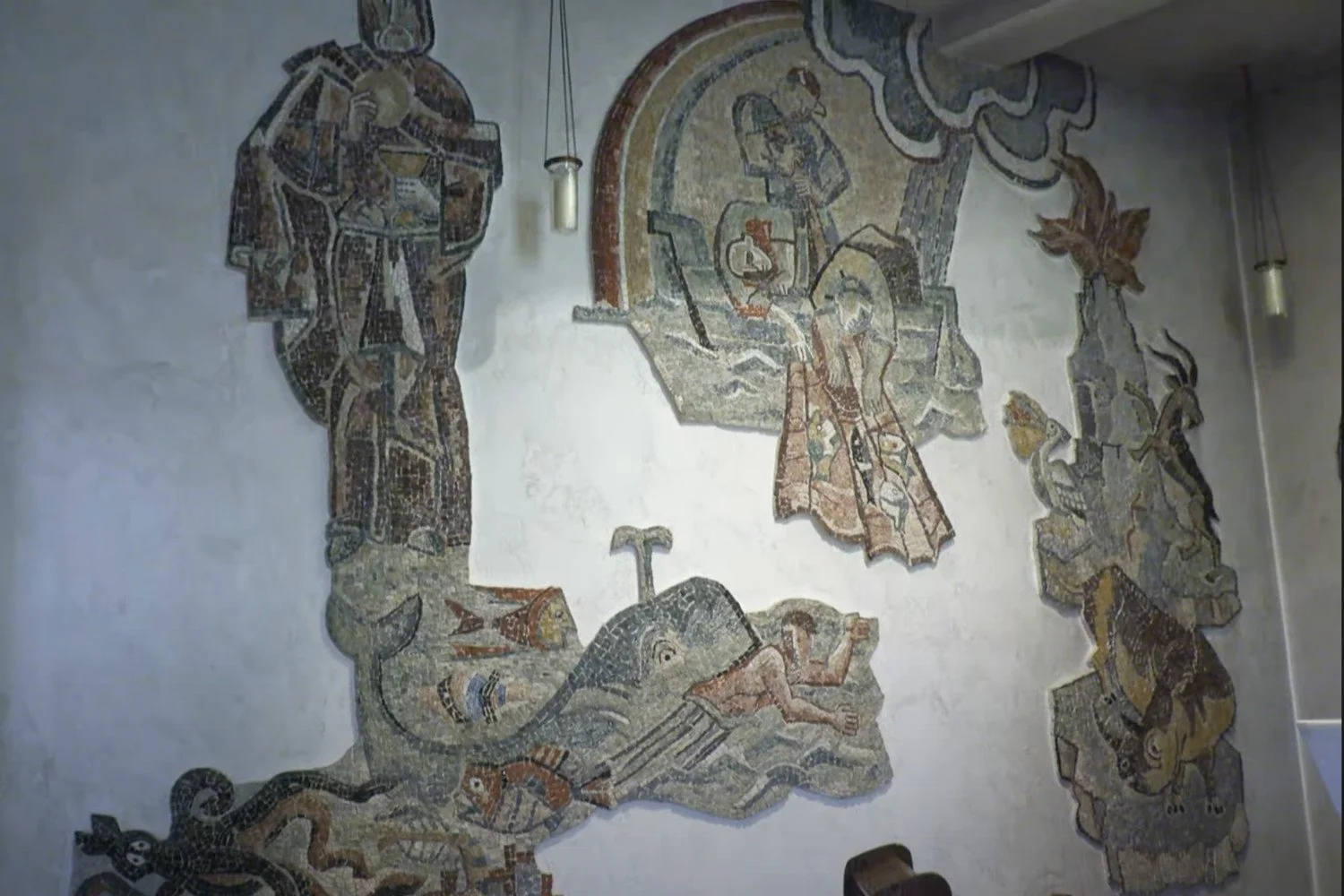
There, before a magnificent granite tabernacle, I spent many hours in the Presence of the Lord. Last year, a reader found a photograph of the interior of the Saint Anselm Abbey Church and printed it for me. It is the opening graphic for this post. Then our Missionary of Mercy Friend, Father George David Byers, found a photo of the Blessed Sacrament alcove to the right of the main sanctuary. This is where I went back then, before the world shook lose the Holy Longing to be in His Presence. This is where I go now when I awaken in the night. Sometimes, now, I don’t think I awaken with anxiety and then go there. I think I now awaken just to go there.
In just a few months, These Stone Walls will mark seven years in publication, just one third the time that I have been in this prison. During that seven years, many readers have sent me letters and comments informing me that they have devoted an hour before the Blessed Sacrament to be in His Presence in my stead. You have bestowed upon me a most priceless gift, and for this I have much gratitude.
Now the Poor Clares of Perpetual Adoration, along with author Paul Thigpen and Saint Benedict Press, have provided a road map to the interior life, and a tool to converse with the Living Christ among us. I most highly recommend the Manual for Eucharistic Adoration and, if you are not there already, the restoration of the Lord’s Presence in your interior life.
I humbly thank you for thirty-four years of priesthood, even out here on the dark peripheries from which I write. Without you, I might have forgotten how to be a priest, and might today be just a prisoner. There are two kneelers before the Blessed Sacrament at Saint Anselm Abbey Church in Manchester, New Hampshire. Some night when anxiety awakens you in the dark, join me there. I’ll have the Manual for Eucharistic Adoration in my hands.

A Criminal Defense Expert Unfurls Father MacRae Case
Criminal Defense Attorney, Vincent James Sanzone, explains why the case of Father Gordon MacRae has been no measure of justice for either Church or State.

Criminal Defense Attorney, Vincent James Sanzone, explains why the case of Father Gordon MacRae has been no measure of justice for either Church or State.
The unjust imprisonment and suffering of Catholic priests at the hands of communist, fascist and other evil despots has and will unfortunately never end. And let’s not forget that Jesus Christ himself told his apostles that the world will hate them as they hated him. Christ was falsely accused and condemned because one man, Pontius Pilate, like most of us, did not have the courage to stand up against the hysterical crowd which did not know, or want to know the truth. As our Lord taught, “The Son of Man came … not to be served but to serve and to give his life as a ransom for many.” (Mt 20:28)
When such persecutions occur there is little if anything that the Church can do. Could even our Holy Father, Pope Francis do anything to stop the daily killing of Christians throughout the world today?
Such unjust punishments are not limited to these regimes, and one such travesty of injustice which has been occurring for the last 30 years right here in the United States is the wrongful conviction and imprisonment of Father Gordon MacRae. In 1994 this young and dedicated priest was sentenced by a New Hampshire state judge to the draconian sentence of 33 ½ to 67 years, effectively a life sentence. Because Father MacRae refused to admit to a crime which he did not commit so as to take a plea offer before trial, nor will he do so now, he will not be paroled from prison, and is likely to die in jail.
Any reasonable person examining the trial with any degree of fairness can come to no other conclusion: the prosecution and continuing imprisonment of Father Gordon is not only a tragedy for this good and holy priest, for all clergy and the faithful, but is also a blight on our criminal justice system. The machine of the criminal justice system of the State of New Hampshire is not attempting to re-examine this case and rectify it.
It is without dispute that our society in general is quick to condemn someone accused of committing a crime, especially when there is an allegation of a sexual crime, and more so when the accuser claims involvement of a Catholic priest. Even one with the most conservative law enforcement mindset would deny that for the last 25 years the deck has been stacked against any priest charged with a sexual offense, and that it is almost impossible for a Catholic priest to be processed fairly by jury and judge.
At the time of Father Gordon’s prosecution there was a climate of media-fueled national hysteria regarding any allegation of sexual offenses on anyone under 18 years of age, whether true or false, especially if a Catholic priest was purportedly involved. Such a climate almost entirely preempted juries from fairly applying the reasonable doubt standard, as they were and are prone to believe any allegation of sexual misconduct no matter how bizarre. Many legal scholars have examined the hysteria of the 1980s and 1990s, and equate this period to the Salem witch trials of the seventeenth century. The prosecution of Father MacRae was also fueled by sensationalistic media hype with little concern for civil liberties and the presumption of innocence. As one court put it at that time:
“[A] series of highly questionable child sex abuse prosecutions … were fueled by a vast moral panic … a period in which allegations of outrageously bizarre and often ritualistic child abuse spread like wildfire across the country and garnered world-wide media attention.” “[T]remendous emotion [was] generated by the public” as a result of which “the criminal process often fail[ed]”
The genesis of the criminal prosecution of Father Gordon MacRae is no different than what is to be found in most other wrongful convictions. The convergence of factors in this case was a perfect storm for this wrongful conviction. In the wake of these factors, Father Gordon had zero chance of receiving a fair trial and being acquitted of the false charges at trial. As a practicing criminal defense attorney involved in many such cases over the last 25 years, any defendant charged with such a crime must actually attempt to prove his or her innocence. The jury has a sacred duty when charged with deliberating a criminal case: they are to respect that the defendant is innocent and has no burden to prove that innocence, with the burden of proving guilt beyond any reasonable doubt belonging to the prosecution. All of this is often ignored by juries.
In Father Gordon’s case, the evidence is overwhelming that false criminal allegations were brought by a manipulative man with a financial motive to lie. The accuser was trained and coached during the entire process by his attorney, who was seeking a large payout from the diocese of Manchester. The accuser had a long history of alcohol and drug abuse and involvement in the criminal justice system as well as a long history of opportunistic and manipulative lying. Years after the verdict, it was discovered that he bragged to friends and family members how he manipulated the justice system and the diocese. The entire prosecution of Father MacRae hinged upon the inconsistent, contradictory, and incredulous testimony of this one accuser. Father Gordon’s only “crime” had been to try to help this young man who had no family support and was heading down the path to destruction.

In the early 1990s it was common knowledge in New Hampshire that the Diocese of Manchester, as other dioceses in the United States, was paying huge sums of money to anyone claiming to have been abused by a priest. The Diocese was making these payments while conducting little or no investigation to determine the validity of the claims. It was a windfall for predatory personal injury attorneys making money off the backs of faithful parishioners, and a dream come true for scammers and fraudsters looking to cash in. Such was Thomas Grover, a foster child of the Grover family, which sought the help of Father Gordon to counsel and help Thomas. His foster parents struggled with their son’s alcohol and drug abuse, as well as with his mental health problems and frequent run-ins with the law. Years later, when Thomas Grover became aware of the large amounts of money that the Diocese was paying out to accusers, saw his opportunity to make a large amount of money. This was the way he “thanked” Father Gordon for all that he had done for him, weaving a string of lies impossible to refute.
There was not a single witness except Grover himself, which makes his story absurd, since he claimed that he was assaulted by Father Gordon in very public areas. Yet, Manchester Diocese paid him nearly $200,000.00.
Based on legal papers submitted in federal court, credible witnesses have now been located and have come forward, willing to testify that Grover admitted committing perjury at trial, and bragged about how he scammed the diocese and the justice system. Grover’s former wife, Trina Ghedoni, and stepson, Charles Glenn, have admitted that he was a “compulsive liar”, “manipulator”, “drama queen” and “hustler” who had a long history of lying to get what he wanted. When confronted with his lies, he “would lose his temper”, and would then admit himself into the psychiatric unit at Elliot Hospital. While seeking “help”, he would accuse others of molesting him. He accused another unnamed clergyman as well as his foster father and baby sitters when he was a child. In addition to his psychological state and alcohol and drug addition, he had an extensive criminal history prior to making his false allegations against Father Gordon. Grover was arrested and convicted for two burglaries, two forgeries, two thefts, theft by deception, assault on a police officer, and aggravated assault on his former wife when he broke her nose during one of many such beatings. His former wife considered him to be a sexual predator, and never left her two daughters from another relationship alone with him while they were living together, as he would eye and grope them.
In April of 2005, the lead detective James F. McLaughlin was confronted with these sobering facts about Grover in The Wall Street Journal articles by Dorothy Rabinowitz about the unjust conviction of Father Gordon. In response to his botched and incompetent investigation, McLaughlin made himself a self-appointed psychologist and responded remarkably by saying: “So we had all these elevated activities with our male victims, so in a sense, when you have a victim present that has this baggage, it’s corroborative of their victimization” (“Story of Jailed Priest Retold”, The Union Leader: Manchester NH, April 28, 2005).

At trial, Grover lied and told the jury that he needed money from his lawsuit with the Diocese for therapy because of the “abuse.” However, after his $200,000.00 payout, and after the trial was over, Grover did not attend one therapy session but took his former wife to Arizona, where he blew it all on alcohol, drugs, cars, pornography and gambling. In fact on that trip he lost about $70,000.00 on a Las Vegas gambling spree. In addition, he stiffed the casino another $50.000.00 on a credit line which he fraudulently applied for by providing false information about his job and income. A collection action initiated by the casino was unsuccessful. His wife finally left him in 1998 when the money was gone, and Grover was caught in bed with his biological sister.
Grover’s testimony at trial did not border on the absurd; it was absurd. His shifty testimony was fantastic, nonsensical and contradictory. When he was spoon-fed by the direct questioning of prosecutor Bruce Elliot Reynolds, he was able to recite his rehearsed testimony. However, on cross-examination it was far different. Every time he was trapped in a lie or inconsistent statement he fell back on his rehearsed line, saying that question “overloads my mind and… leaves me more or less in shock for days after…”
When Grover was confronted as to why he did not report the abuse for 10 years he claimed that he repressed the memory of the abuse, and it was “difficult to talk [about it] in front of people” until he spoke to his attorneys.
The fundamental question must be asked about our justice system; how could any reasonable jury, having the sworn duty to acquit Father Gordon unless the prosecution proves guilt beyond a reasonable doubt, find him guilty under this type of incredulous testimony? The State had the burden of proof. How could they have gotten it so wrong? Before a jury could find him guilty they would have to have found Grover’s testimony completely credible. Under our criminal justice system no competent and reasonable jury should have found this type of testimony sufficient to convict a Catholic priest who, previous to these series of false allegations, had never been convicted of anything.
Not unlike other unjust convictions, the law enforcement investigation of Father Gordon was both overzealous and intentionally unfair. The lead detective, James F. McLaughlin, was not interested in a fair and impartial investigation, but only in creating and spinning the facts to support his — and eventually the prosecution’s — theory of the case. McLaughlin also suppressed any facts which clearly pointed out that Father Gordon was innocent of the false allegations made by the accuser. McLaughlin engaged in investigating this matter in a way that was patently unfair and used his power as a law enforcement officer to suppress witnesses who were willing to testify for Father Gordon MacRae.
To make matters worse, Father Gordon’s bishop at the time of his trial did not support him, but in fact allowed his office to issue a press release prior to trial which literally condemned the accused priest. This misstatement by the bishop helped fuel media hysteria, and it unquestionably tainted the potential jury pool, insuring the prosecution of a conviction. The bishop did not stand up for one of his priests with courage, but rather retreated to bureaucratic-clericalism, more worried about pleasing his lawyers, insurance carrier and insulating the diocese from potential civil liability. This abandonment by the diocese has continued for 30 years. The bishop’s technique accomplished nothing because the diocese paid out monetary awards to any and all accusers. The greater cost, of course, was the loss of any trust of the priests of the diocese for the bishop and chancery. Not only was Father Gordon not able to count on his bishop for support, but the bishop negligently or intentionally acted in such a way as to let the public be given the message that Father Gordon was guilty. The bishop needs to answer questions about sacrificing priests on the altar of insurance considerations. To date it is conservatively estimated that the Church in the United States has paid over $4 billion in claims because of the sexual abuse scandal. How many of these claims were outright false can only be guessed. In any case, the bishop distanced himself from Father MacRae and left him on his own.
If the cards were not already stacked against Father Gordon, his defense attorney at trial was no help. Father Gordon was represented by Ron Koch, an attorney from New Mexico, who died in the year 2000 at the age of 49. Although this attorney did his best to defend Father Gordon, he nevertheless made critical trial errors which hurt the defense and opened the door for the prosecutor to introduce prejudicial evidence which the trial judge had already ruled was inadmissible and not relevant. Mr. Koch was forced to split his time between his active criminal practice in New Mexico and preparing for Father’s Gordon’s trial, which Mr. Koch was unable to do. Mr. Koch failed to conduct important pretrial discovery and inadequately prepared the case for trial. Father Gordon trial counsel was unprepared and out matched, and therefore constitutionally ineffective. Father Gordon’s constitutional rights to procedural due process and a fair trial were eviscerated. Mr. Koch failed to interview and subpoena critical witnesses for the defense, failed to go to the scene in which Grover alleged that he had been touched, and lastly, failed to preserve attorney-client privileged documents which Koch turned over to the prosecution.
Many people unfamiliar with the criminal justice system in the United States believe that the criminal justice system eventually corrects an unjust conviction. This sadly is the exception and not the rule. Under our judicial system the jury verdict is final, and most appeals, regardless as to the justice of the verdict are denied. Father Gordon is going on 30 years of imprisonment. Every appeal has been rejected without hearing. No judge in New Hampshire would agree to hear new evidence or new witnesses in this matter. On March 17, 2015, federal district court Judge Joseph Laplante, who many had high hopes would grant Father MacRae’s writ of habeas corpus, instead, granted the State of New Hampshire’s motion to dismiss on the pleadings. The judge did not even grant Father Gordon an evidentiary hearing.
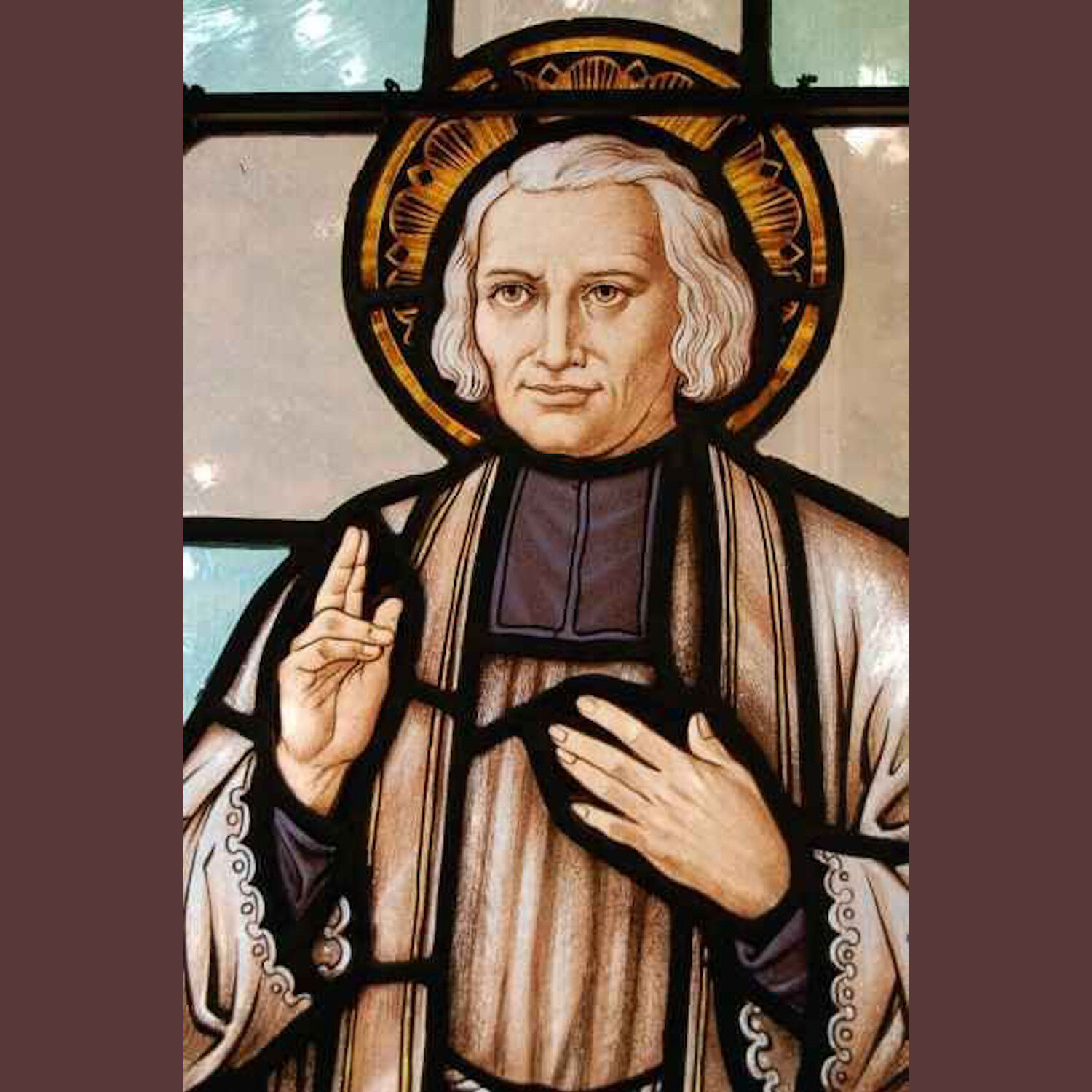
The Catholic Church cannot proclaim the fullness of the truth without its priests. Every priest has been called by God for this mission. The Church has no alternative but to pursue and fight for authentic justice, and it must start with Father Gordon MacRae. No pope, cardinal, bishop, priest, or anyone among the laity can sit by and permit this injustice to continue. Diabolic advocacy and persecution of the Church has prevailed and will continue. Satan knows his enemy, and his enemy is the Holy Roman Catholic Church, in particular its clergy. Satan’s relentless pursuit is against the only institutional defender of natural law and of life in the world, from the moment of conception to natural death, the Catholic Church.
St. John Vianney, the patron of parish priests, understood this all too well. He was also subjected to outrageous lies about his character when he made this profound statement over 150 years ago:
“When people wish to destroy religion, they begin by attacking the priest, because where there is no longer any priest, there is no sacrifice, and where there is no longer any sacrifice, there is no religion.”
At the end of our brief temporal life all of us will be judged for what we “did and failed to do”; did we all do what is right and just?
+ + +

Vincent James Sanzone, Jr., Esq., loves his Catholic faith, and has been a practicing criminal defense attorney in New Jersey for the last 35 years. Attorney Sanzone is a member of the New Jersey Bar Association, of the National Association of Criminal Defense Attorneys, and of the Legal Center for Defense of Life. He is admitted to the bar in the State of New Jersey and the United States District Court for the District of New Jersey as well as Federal Appeals Courts for the Third and Fourth Circuits. In addition, he has been admitted to practice pro hac vice in the Southern District of New York, and in the Federal District Court for the Northern District of Ohio. Attorney Sanzone has argued successfully before the New Jersey Supreme Court, and has tried hundreds of criminal trials. Many of his clients were minority young men and women who were acquitted of all charges at trial and went on to live exemplary lives.

Mary Magdalene: Faith, Courage, and an Empty Tomb
History unjustly sullied her name without evidence, but Mary Magdalene emerges from the Gospel a faithful, courageous and noble woman, an apostle to the Apostles.

History unjustly sullied her name without evidence, but Mary Magdalene emerges from the Gospel a faithful, courageous and noble woman, an apostle to the Apostles.
Within the Octave of Easter by Father Gordon MacRae
As an imprisoned priest, a communal celebration of the Easter Triduum is not available to me. My celebration of this week is for the most part limited to a private Mass using the Roman Missal. Still, over all the years in which I have been writing for this blog, I have always agonized about Holy Week posts. I feel a special duty to contribute what little I can to the Church’s volume of reflection on the meaning of this week.
Though I have little in the way of resources beyond what is in my own mind, I feel an obligation in this of all weeks to “get it right,” and leave something a reader might return to. So I have focused in past Holy Week posts not so much on the meaning of the events of the Passion of the Christ, but on the characters central to those events. In so doing, I have developed a rather special kinship with some of them.
I hope readers will spend some time with them this week by revisiting my Holy Week tributes to “Simon of Cyrene, Compelled to Carry the Cross,” and “Dismas, the Good Thief Crucified Next to Christ the King,” and others in a Collection of about 50 biblical posts that we call The Bible Speaks. Last year in Holy Week, I visited a haunting work of art fixed upon the wall of my prison cell in “Behold the Man, as Pilate Washes His Hands.”
Lifting these characters out of the lines of the Gospel into the light of my quest to know them has enhanced a sense of solidarity with them. This has never been truer than it is for the subject of this particular Holy Week post. Any believer whose reputation has been overshadowed by innuendos of a past, anyone who stands in possession of a truth that must be told, but is denied the social status to be believed will marvel, as I do, at the faith and courage of Mary Magdalene.

Her Demon-Haunted World
First, a word about language. You might note that I always use the Aramaic term, “Golgotha,” instead of the more familiar “Calvary” for the place where Jesus was crucified. Aramaic is closely related to Hebrew. It became the language of the Middle East sometime after the fall of Nineveh in 612 B.C., and was the language of Palestine at the time of Jesus. Jesus spoke in Aramaic, and so did his disciples.
The Aramaic word, “Golgotha” means “place of the skull.” When the Roman Empire occupied Palestine in 63 B.C., it used that place for crucifixions. It isn’t certain whether that is the origin of the name “Golgotha” or whether the hill resembles a skull from some vantage point. The Gospels were written in Greek, so the Aramaic “Golgotha” was translated “Kranion,” Greek for “skull.” Then in the Fourth and early Fifth Century, Saint Jerome translated the Greek Gospels into Latin using the term, “Calvoriae Locus” for “Place of the Skull.” That’s how the name “Calvary” entered Christian thought.
Mary Magdalene is one of only two figures in the Gospel to have been present with Jesus during his public ministry, at the foot of the Cross at Golgotha, and in his Resurrection appearances at and after the empty tomb. The sole other figure was John, the Beloved Disciple. Mary the Mother of Jesus was also present at the Cross, but there is no mention of her at the empty tomb. In the Gospel of Saint Luke, the Twelve were with Jesus during his public ministry …
“… also some women who had been healed of evil spirits and infirmities, Mary, called Magdalene, from whom seven demons had gone out, and Joanna the wife of Chuza, Herod’s steward, and Suzanna, and many others who provided for them out of their means.”
The presence of these women openly challenged Jewish customs and mores of the time which discouraged men from associating with women in public. Add to this the fact that these particular women “had been healed of evil spirits and infirmities” could have set the community abuzz with whispers at their presence with Jesus. In the Gospel of John (4:27), the Apostles came upon Jesus talking with a woman of Samaria at Jacob’s well, and they “marveled that he was talking with a woman.”
A revelation that seven demons had gone out of Mary Magdalene is in no way suppressed by the Gospel writer. On the contrary, it seems the basis of her undying fidelity to the Lord. The Gospel of Saint Mark adds that account in the most unlikely place — the one place where Mary’s credibility seems a necessity, the first Resurrection appearance:
“Now when he rose early on the first day of the week, he appeared first to Mary Magdalene from whom he had cast out seven demons. She went and told those who had been with him, as they mourned and wept. But when they heard he was alive and had been seen by her, they would not believe it.”
In all four of the Gospel accounts, it was Mary Magdalene who first discovered and announced the empty tomb, and in all four places the announcement sowed doubt, and even some propaganda. In the Gospel of Matthew (28:1-10), “Mary Magdalene and the other Mary went to the tomb … .” There they were met by an angel who instructed them, “Go quickly and tell his disciples that he has risen from the dead and behold, he is going before you to Galilee.”
Then, in Saint Matthew’s account, Jesus appeared to them on the road and said, “Do not be afraid. Go and tell my brethren to go to Galilee, and there they will see me.” Put yourself in Mary Magdalene’s shoes. She, from whom he cast out seven demons; she, who watched him die a gruesome death, is to find Peter, tell this story, and expect to be believed?
Immediately after in the Gospel of Matthew, the Roman guards went to Caiaphas the High Priest with their own story of what they witnessed at the tomb. Like the thirty pieces of silver used to bribe Judas, Caiaphas paid the guards to spread an alternate story:
“Go report to Pilate that Jesus’ disciples came and stole his body while the guards slept…’ This story has been spread among the Jews even to this day”
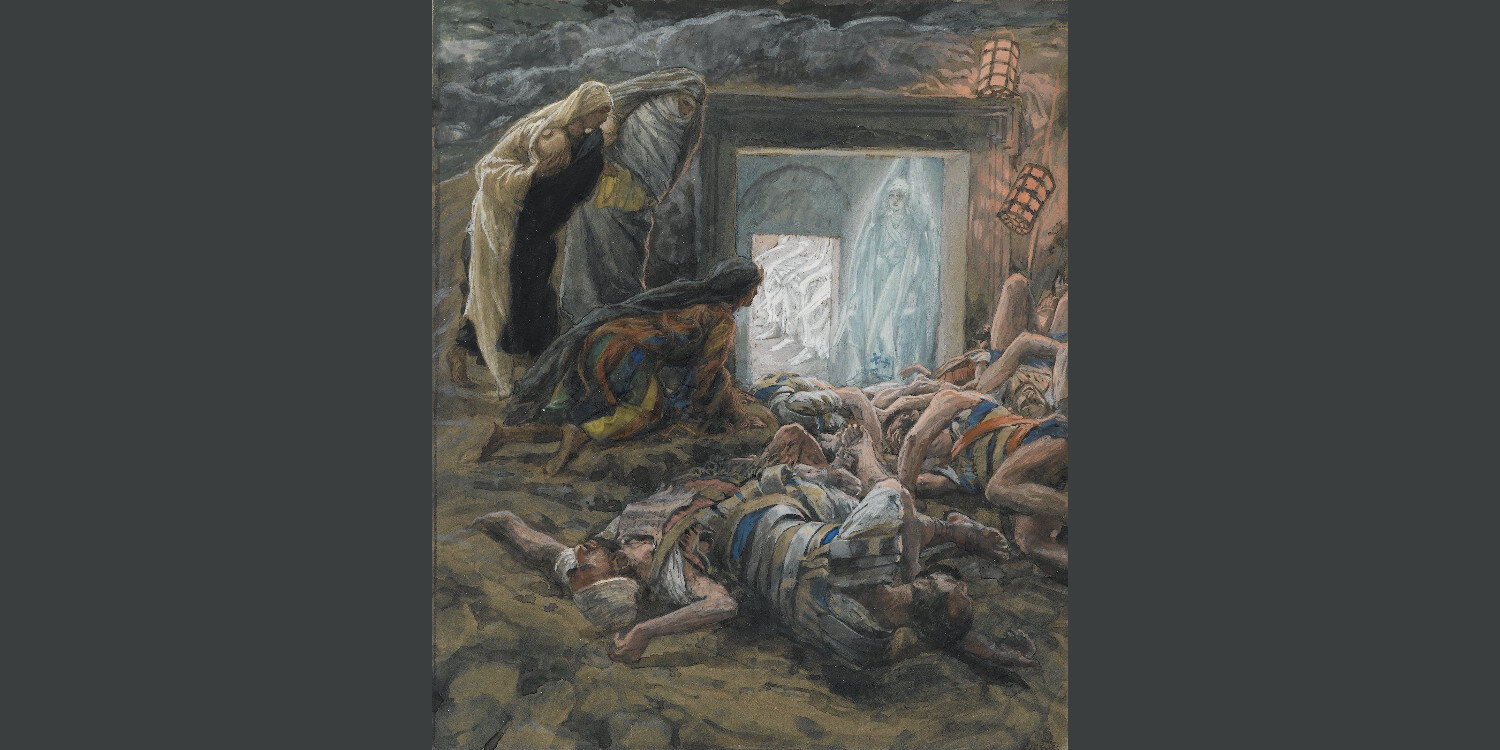
Apostle to the Apostles
It makes perfect sense. I, too, have seen “truth” reinvented when there is money involved. Remember that Mary Magdalene is a woman alone, with demons in her past, and she must convey her amazing account to men. So suspect is she as a source that even the early Church overlooked her witness. When Saint Paul related the Resurrection appearances to the Church at Corinth about twenty years later, he omitted Mary Magdalene entirely:
“He appeared to Cephas [the Greek name for Peter], then to the Twelve, then to more than 500 brethren at one time, most of whom are still alive, though some have fallen asleep. Then he appeared to James then to all the Apostles. Then last of all, as to one untimely born, he appeared to me, for I am the least of the Apostles.”
Saint Paul lists six appearances of Jesus during the forty days between the Resurrection and the Ascension. One of those appearances “to more than 500” appears in none of the Gospel accounts. Saint Paul likely omitted the fact that it was Mary Magdalene from whom news of the Resurrection first arose, and to whom the Risen Christ first appeared, because at that time in that culture, women could not give sworn testimony.
And remember that there was another matter Mary Magdalene had to reconcile before conveying her news. It is the elephant in the upper room. She must not only tell her story to men, but to men who fled Golgotha while she remained. Among all in that room, only Mary Magdalene and the Beloved Disciple John saw Christ die. Peter, their leader, denied knowing Jesus and remained below, listening to a cock crow.
I have imagined another version of Mary Magdalene’s empty tomb report to Peter. I imagined reading it between the lines, but of course it isn’t really there. Still, it’s the version that would have made the most human sense: Mary Magdalene burst into an upper room where the Apostles hid “for fear of the Jews.” She summoned the courage to look Peter in the eye.
Mary M.: “I have good news and not-so-good news.”
Peter: “What’s the good news?”
Mary M.: “The Lord has risen and I have seen him!”
Peter: “And the not-so-good good news?”
Mary M.: “He’s on his way here and he’d like a word with you about last Friday.”
Of course, nothing like that happened. The words of Jesus to Peter about “last Friday” correct his three-time denial with a three-time commission of the risen Christ to “feed my sheep.” The Gospel message is built upon values and principles that challenge all our basest instincts for retribution and justice. The Gospel presents God’s justice, not ours.
Of the four accounts of the Crucifixion and the Resurrection Appearances, the Gospel of John conveys perhaps the most painful, beautiful, and stunning portrait of Mary Magdalene, all written between the lines:
“Standing by the Cross of Jesus were his mother, his mother’s sister [possibly Salome, mother of James and John], Mary the wife of Clopas, and Mary Magdalene.”
Also standing there is John, the Beloved Disciple, and Mary Magdalene becomes a witness to one of the most profound scenes of Sacred Scripture. Jesus addressed his mother from the Cross, “Woman, behold your son.” Is it a reference to himself or to the young man standing next to his mother? Is it both? Standing just feet away, the woman from whom he once cast out seven demons is fixated by what is taking place here. “Behold your Mother!” he says among his last words from the Cross, bestowing upon John — and all of us by extension — the gifts of grace and the care of his mother.

“Woman, Why Are You Weeping?”
“From that point on, John took her into his home,” and we took her into the home of our hearts. Mary Magdalene could barely have dealt with this shattering scene as her Deliverer died before her eyes when, on the morning of the first day of the week, she stood weeping outside his empty tomb. “Woman, why are you weeping?” Pope Emeritus Benedict XVI wrote of this scene from the Gospel of John in his beautifully written book, Jesus of Nazareth: Holy Week (Ignatius Press, 2011):
“Now he calls her by name: ‘Mary!’ Once again she has to turn, and now she joyfully recognizes the risen Lord whom she addresses as ‘Rabboni,’ meaning ‘teacher.’ She wants to touch him, to hold him, but the Lord says to her, “Do not hold me, for I have not yet ascended to the Father” (John 20:17). This surprises us…. The earlier way of relating to the earthly Jesus is no longer possible.”
Hippolytus of Rome, a Third Century Father of the Church, called Mary Magdalene an “apostle to the Apostles.” Then in the Sixth Century, Pope Gregory the Great merged Mary Magdalene with the unnamed “sinful woman” who anointed Jesus in the Gospel of Luke (7:37), and with Mary of Bethany who anointed him in the Gospel of John (12:3). This set in motion any number of conspiracy theories and unfounded legends about Jesus and Mary Magdalene that had no basis in fact.
The revisionist history in popular books like The Da Vinci Code, and other novels by New Hampshire author Dan Brown, was contingent upon Mary Magdalene and these two other women being one and the same. The Gospel provides no evidence to support this, a fact the Church now accepts and promotes. This faithful and courageous woman at the Empty Tomb was rescued not only from her demons, but from the distortions of history.
“While up to the moment of Jesus’ death, the suffering Lord had been surrounded by nothing but mockery and cruelty, the Passion Narratives end on a conciliatory note, which leads into the burial and the Resurrection. The faithful women are there…. Gazing upon the Pierced One and suffering with him have now become a fount of purification. The transforming power of Jesus’ Passion has begun.”
+ + +

Fr Seraphim Michalenko on a Mission of Divine Mercy
Midway in our Consoling the Heart of Jesus retreat in prison, Fr Seraphim Michalenko, Director of the National Shrine of The Divine Mercy, fulfilled Hebrews 13:3.

Midway in our Consoling the Heart of Jesus retreat in prison, Fr Seraphim Michalenko, Director of the National Shrine of The Divine Mercy, fulfilled Hebrews 13:3.
Some strange and interesting things are happening behind These Stone Walls this summer, and it’s a task and a half to stay ahead of them and reflect a little so I can write of them. In too many ways to describe, we sometimes feel swept off our feet by the intricate threads of connection that are being woven, and sometimes revealed.
I wasn’t even going to have a post for this week. I spent the last ten days immersed in a major writing project that I just finished. I knew it would be a struggle to type a post on top of that. I also had no topic. Absolutely nothing whatsoever came to mind. So I decided to just let readers know that I need to skip a week on TSW. Yet here I am, and it’s being written on the fly as I struggle to type it and get it in the mail in time.
What brought on this frenzy to get something posted on this mid-summer day? Well, first of all I awoke this morning and looked at the calendar, and realized that the post date I decided to skip is also the Memorial of Our Lady of Mount Carmel. It commemorates the apparition of our Blessed Mother to Saint Simon Stock, founder of the Carmelite Order, in the year 1215. She promised a special blessing to those who would wear her scapular. According to the explanation of this Memorial in the Daily Roman Missal, “Countless Christians have taken advantage of Our Lady’s protection.”
“Protection.” It seems a strange word to describe what we might expect from devotion to Mary. Most TSW readers remember my post, “Behold Your Mother! 33 Days to Morning Glory” about the Marian Consecration which Pornchai Maximilian and I entered into on the Solemnity of Christ the King in 2013. Felix Carroll also wrote of it — with a nice photo of us — in “Mary is at Work Here” in Marian Helper magazine. [Flash Version and PDF Version]
Throughout that 33 Days retreat leading up to our Consecration, I was plagued with the creepy feeling that this was all going to cost us something, that maybe Pornchai and I were opening ourselves to further suffering and trials by Consecrating to Mary the ordeals we are now living. What we have both found since our Marian Consecration, however, has been a sort of protection, a subtle grace that seems to be weaving itself in and around us, permeating our lives. Exactly what has been its cost? It has cost us something neither of us ever imagined we could ever afford to pay. The price tag for such grace is trust, and where we live, that is a precious commodity not so easily invested, but very easily taken from us.
I am amazed at the number of TSW readers who have written to me about their decisions to commence the 33 Days retreat, and commit themselves to Marian Consecration. I received a letter this week from Mary Fran, a reader and frequent correspondent who is completing her 33 Days retreat with her Marian Consecration on the day this is posted, the Memorial of Our Lady of Mount Carmel. She is going into this with just the right frame of mind and spirit. I hope she doesn’t mind, but here’s an excerpt of her letter:
“This is a very good retreat. I will be sorry to see it over. I have the Consecration Prayer typed out on pretty paper in preparation for the big day. A new beginning. A new way of life. Under new management.”
The truth is, Mary Fran, that it will never be over. But I like your idea of a life “under new management.” The concept seems to have a lot less to do with what Marian Consecration might cost in terms of trials to be offered, and more to do with what graces might be gained to endure them when they come. I’m not sure of why or exactly when it started, but after receiving the Eucharist since my own Consecration I have begun to pray the Memorare, a prayer attributed to Saint Bernard of Clairvaux that best expresses our confidence in Mary as repository of grace and, therefore, protection:
“Remember, O most gracious Virgin Mary, that never was it known that anyone who fled to your protection, implored your help, or sought your intercession was left unaided. Inspired with this confidence, I fly unto you, O Virgin of virgins, my Mother. To you I come, sinful and sorrowful. O Mother of the Word incarnate, despise not my petitions, but in your mercy hear and answer me. Amen.”
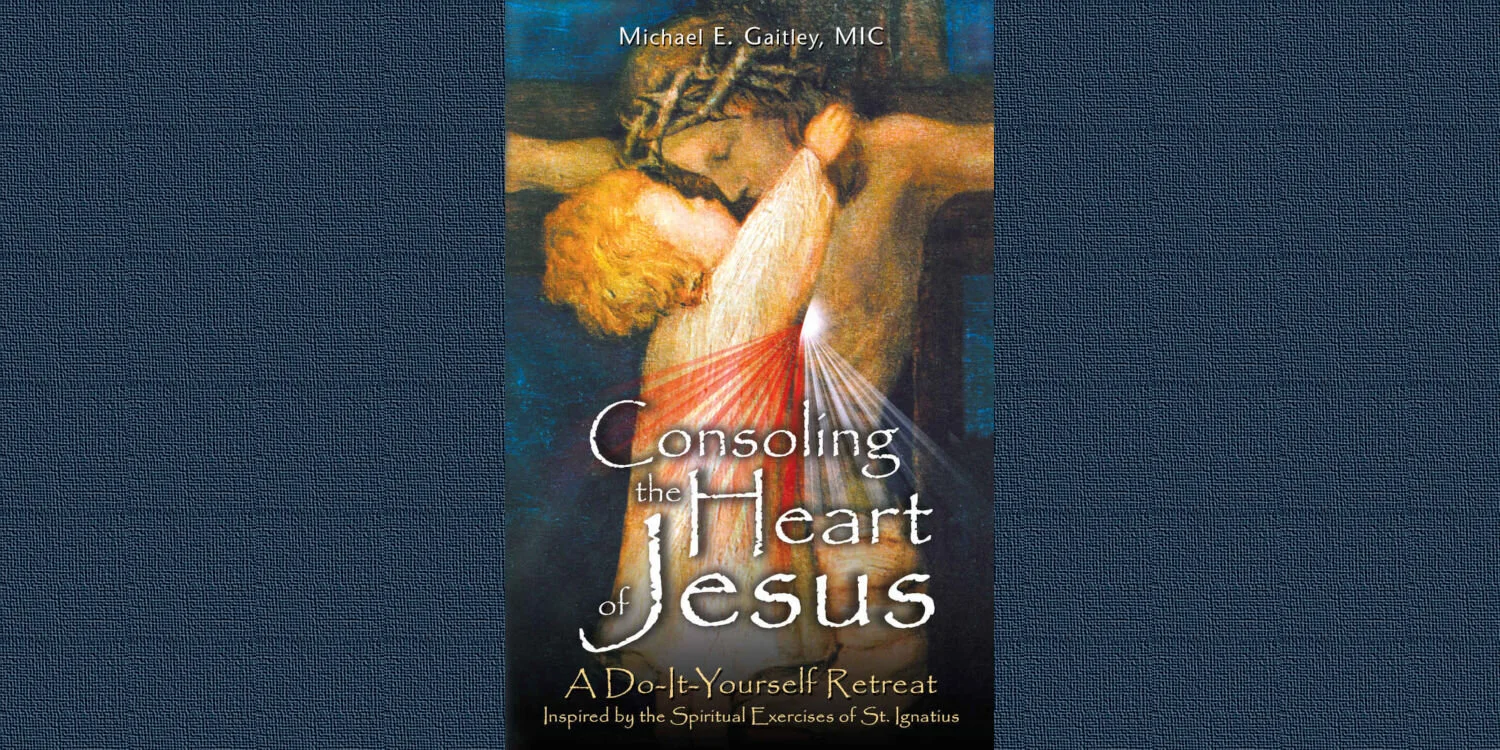
Trust Is the Currency of Grace
In a post last month, “Father’s Day in Prison Consoling the Heart of Jesus,” I wrote a little about how much of a daily ordeal our prisons can sometimes be. Near the end of that post, I quoted a brief dialogue between Father Michael Gaitley, author of Consoling the Heart of Jesus, and Father Seraphim Michalenko, Director of The National Shrine of The Divine Mercy. Their discussion is worth expanding a bit for this post. In fact, it was part of this week’s assigned reading in our Consoling the Heart of Jesus retreat in which we are at the midway point behind these prison walls. So here is a little more of that conversation:
“Father Gaitley: ‘And we want to console Jesus in the best possible way … and the best way to console Him is to remove the thorn that hurts His heart the most, the thorn that is lack of trust in His merciful love … and the best way to remove that thorn and console Him is to trust Him.’
”Father Seraphim: ‘And how do you LIVE trust? What is its concrete expression in your daily 1iving? … The way you live that trust is by praise and thanksgiving, to praise and thank God in all things. That’s what the Lord said to St. Faustina.’”
It struck me just today that the new trial asked of me in Marian Consecration is to imitate her trust, her famous fiat to the seemingly impossible: “Be it done to me according to Thy word.” Such trust is not an easy thing to embrace when the world turns dark, when freedom is taken by forces beyond our control, when fortune fades, when health fails, when loved ones are lost, when love itself is lost, when evil seems to win all around us, when depression, the noon-day devil, wants to rule both day and night.
That almost seems to sum up prison, and as such we are all destined for the trials of life in some form or another. We are all destined for some form of prison. So many readers have asked me for an update on our friend, Anthony, of whom I wrote recently in “Pentecost, Priesthood, and Death in the Afternoon.” Anthony is in prison dying of cancer. Several weeks ago, he could no longer bear the pain he was in so he was moved to the prison medical unit for palliative care. He came to the prison chapel for Mass the following Sunday, and the one after that. He was not there at Mass last week, and it is very possible we will not see Anthony again in this life.
Though he is but 200 yards away locked in another building, prisons pay no heed to the bonds of connection between human beings in captivity. Once Anthony was moved elsewhere, we may not visit him, inquire about him, or even hear from him. That is one of the great crosses of prison, and the welfare of that person and his soul is something about which we can now only trust. We can only be consoled by what YOU have done in our stead. When I last saw Anthony, he smiled and said, “I have gotten so much mail and so many cards I feel totally surrounded by God’s love.”
Father Michael Gaitley summed up nicely the road out of this dense forest of all our anxious cares:
“So the best way to console Jesus’ Heart is to give him our trust, and according to the expert [Fr Seraphim Michalenko] the best way to live trust is with an attitude of praise and thanksgiving, the way of joyful, trustful acceptance of God’s will.”
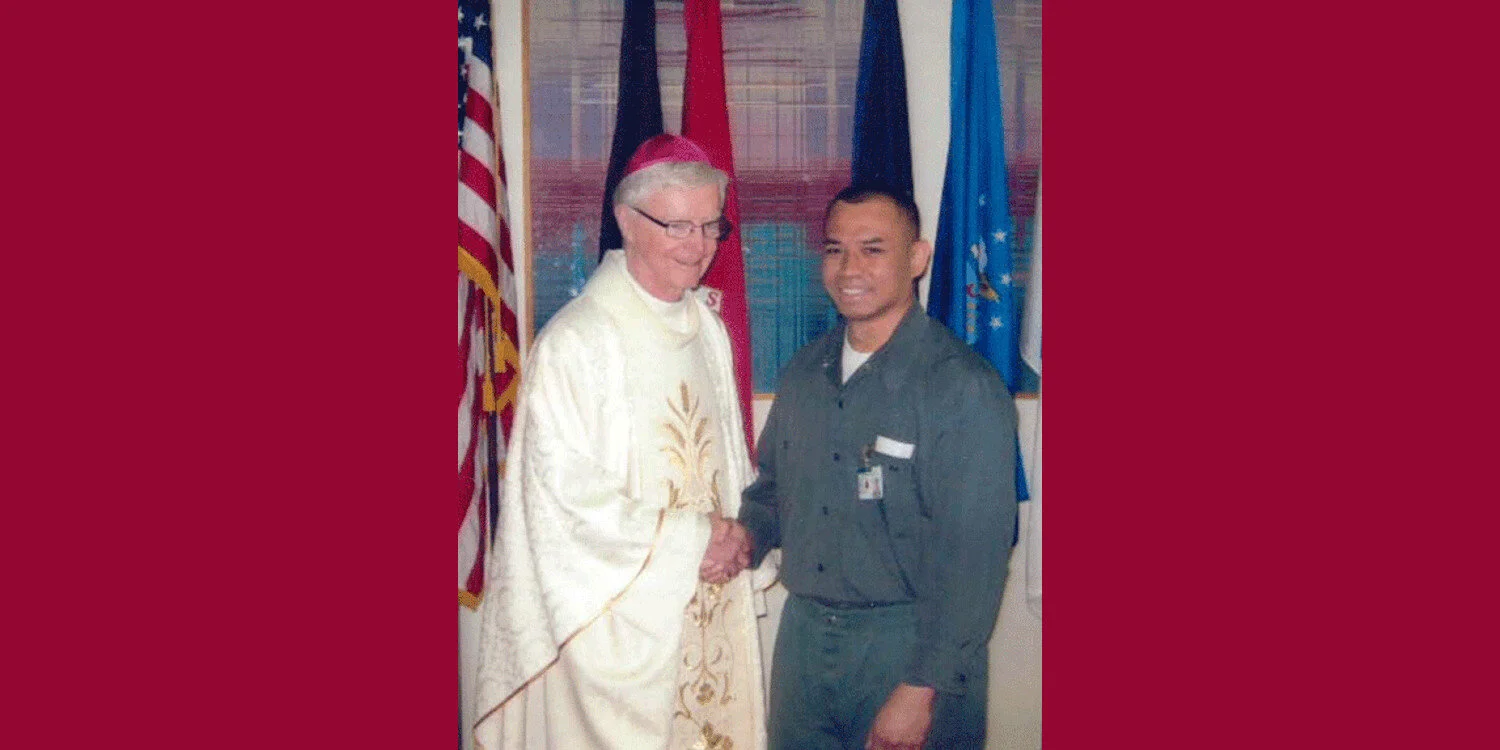
Opening Impenetrable Doors
At the end of “Dostoevsky in Prison and the Perils of Odysseus,” I wrote, “the hand of God is somewhere in all this, visible only in the back of the tapestry where we cannot yet see. He is working among the threads, weaving together the story of us.” Some readers liked that imagery, but it’s also true. It really happens and is really happening in our lives right now. I have experienced it, and Pornchai has recently experienced it in a very big way, but only with eyes opened by trust. Here’s how.
In the months after Pornchai Maximilian Moontri and I first met, United States Immigration Judge Leonard Shapiro had just ruled that Pornchai must be deported from the U.S. to Thailand upon whatever point he is to be released from prison. The very thought of this was dismal, like stepping off a cliff in dense fog with no safe landing in sight. Pornchai had only a “Plan B”: to make certain that he never leaves prison.
I was deeply concerned for him, and tried to put myself in his shoes. How does a person get literally dumped into a country only vaguely familiar with no human connections whatsoever? How would he live? How could he even survive? So I told him something so totally foreign to both of us that I shuddered and doubted even as I was saying the words. I told him he has to abandon his “Plan B” and trust. Trust me and trust God. What was I saying?! I wasn’t even sure I trusted at all.
Three years later, Pornchai became a Catholic on Divine Mercy Sunday 2010. A lot of people don’t realize that this was completely by “accident.” And it caused me to worry even more about his future. Thailand is a Buddhist nation. Less than one percent of its people are Catholic. I wondered how becoming Catholic could possibly serve him in a country and culture from which he was already completely alienated and in which he must somehow survive.
Pornchai didn’t even know that the time he was choosing for his entry into the Church was Divine Mercy Sunday. What he had originally planned was to surprise me by telling me of his decision to be Baptized on my birthday, April 9, which was a Friday in 2010. It was, in his mind, to be a birthday present. Some present! I wasn’t even trusting that this was a good idea.
So Pornchai went to talk with the prison’s Catholic chaplain, Deacon Jim Daly to help arrange this. The Chaplain asked a local priest to come to the prison for the Baptism, but he was only available to do this on Saturday, April 10. I stood in as proxy for Pornchai’s Godparents, one in Belgium and one in Indianapolis, while Vincentian Father Anthony Kuzia Baptized and Confirmed Pornchai.
The next day was Divine Mercy Sunday, and it just so happened that Bishop John McCormack was coming to the prison for his annual Mass that day. So just the night before, I explained to Pornchai about Saint Faustina, Divine Mercy, why Pope John Paul II designated the Sunday after Easter to be Divine Mercy Sunday, and how this devotion seemed to sweep the whole world. Pornchai thus received his First Eucharist and was received into the Church on Divine Mercy Sunday, and Whoever planned this, it wasn’t us!
Then because I mentioned that fact on TSW a few times, it got the attention of Felix Carroll, a writer for Marian Helper magazine. Felix then asked if he could write of Pornchai’s Divine Mercy connection for the Marian.org website in an article entitled, “Mercy – Inside Those Stone Walls.” The response to that article was amazing. From all over the world, people commented on it and circulated it. Felix wrote that “the story of Pornchai lit up our website like no other!”
So then in the eleventh hour, Felix Carroll pulled a book he was just about to publish. It was supposed to be about 16 Divine Mercy conversions, but Felix changed the titled to Loved, Lost, Found: 17 Divine Mercy Conversions, and added an expanded chapter about Pornchai Moontri’s life and conversion. The chapter even mentions me and These Stone Walls, though I really had very little to do with Pornchai’s conversion. Pornchai and I received copies of the book, looked at each other, and simultaneously asked, “How did this happen?”

The Needlepoint of God
The book went everywhere, including into the hands of Father Seraphim Michalenko, Director of the National Shrine of The Divine Mercy and the person I quoted on the issue of trust in this post. Father Seraphim became an instrument for the threads God was weaving for Pornchai. He sent the book to another contact, Yela Smit, a co-director of the Divine Mercy Apostolate in Bangkok, Thailand. The result was simply astonishing, and the threads of connection just keep being woven together. I wrote of this incredible account in “Knock and the Door Will Open: Divine Mercy in Bangkok Thailand.”
In that post, I wrote of how I undertook responsibility for easing Pornchai’s burden by trying to find him connections in Thailand only to be frustrated every step of the way. Then, in spite of myself, in the back of the tapestry where we cannot yet see, those threads were being woven together miraculously, and trust found a foundation in the dawn of hope. Suddenly, through nothing either of us did or didn’t do, the cross of fear and dread about how Pornchai would survive alone in Thailand was lifted from him.
Pornchai and I went to Sunday Mass in the Prison Chapel last week. The priest who is usually here is away for a few weeks so we heard it would be someone “filling in.” It was Father Seraphim Michalenko, MIC, 84 years old and the man who opened the doors of Divine Mercy for Pornchai in Thailand where God has accomplished some amazing needlework. Father Seraphim was accompanied by Eric Mahl who also has a chapter in Felix Carroll’s Loved, Lost, Found, and who has become a good friend to me and Pornchai. They both returned that evening for a session of our Consoling the Heart of Jesus Retreat. Pornchai was able to meet with Father Seraphim for a long talk. He has seen firsthand the evidence of Divine Mercy, and it all happened behind the walls of an impenetrable prison.


The Post-Trial Extortion of Father Gordon MacRae
Some who today cite a coerced post-trial plea deal to evidence Fr Gordon MacRae’s guilt actually had a hand in bringing it about. Plea deals can destroy justice.

Detective James McLaughlin preparing to test a lie.
Some who today cite a coerced post-trial plea deal to evidence Fr Gordon MacRae’s guilt actually had a hand in bringing it about. Plea deals can destroy justice.
My first installment in this series on the story of Father Gordon MacRae was “The Trial of Father MacRae: A Conspiracy of Fraud” posted here in February. I have since learned that after it was published, this blog received a couple of unposted comments that could be construed as death threats. Both were from the same person using fake identities, and contained the same overtly threatening language, “Kill the priest, kill the priest, kill the priest!” They were posted by a man with an IP address in Eastern Massachusetts.
The man who posted them happens to be known to me, but he has been unaware of that fact until now. This man has tried to post other comments using fake names both at Beyond These Stone Walls and other venues when commenters mention this case. He seems to take very personally these efforts to uncover and publish the truth of this matter though he has no direct involvement in this story, and he has never even met Father MacRae. He appears to be highly motivated, however, to bury the truth of this case under the usual toxic rhetoric and hysteria that plague the subject of Catholic priests accused of sexual abuse, and prevent constructive, rational investigation.
Like many members of SNAP, that writer does not post a lot of comments so much as he posts the same comment over and over again in any venue that will accept it. In the case of Father Gordon MacRae, this Toxic Avenger’s favorite comment is that MacRae “has publicly admitted to molesting children!” The claim is by no means new, but like so much of this case it has become part of a public mantra, a snowball that grew ever bigger as it rolled downhill. It is but the latest chapter in this perversion of justice. I want to thank our Massachusetts friend for raising it again and spreading it around until finally I was moved to take it up.

Former Judge Arthur Brennan arrested after accusing Congress of “stealing our freedoms.”
Plea Deals and a Compromised Judge
In her third major article on this story in The Wall Street Journal, “The Trials of Father MacRae,” (May 10, 2013), Dorothy Rabinowitz devoted a few lines to the subject of plea deals offered to the accused priest before and during his trial:
“In mid-trial, the state was moved to offer Father MacRae an enticing plea deal: one to three years for an admission of guilt. The priest refused it, as he had turned down two previous offers, insisting on his innocence.”
— The Trials of Father MacRae by Dorothy Rabinowitz
The previous offers were put into writing in the prosecutor’s pre-trial letters to MacRae’s attorney. In the pre-trial media coverage, state prosecutors trumpeted the multiple accusers — there were four, three of them brothers in the same family — and multiple indictments against this priest, all claims that arose at the same time from over a decade earlier. I described these claims in a post aptly titled, “In Fr Gordon MacRae Case, Whack-A-Mole Justice Holds Court.”
While publicly presenting the priest as a monster in the local New Hampshire news media, state prosecutors moved quietly behind the scenes to offer MacRae a deal to plead guilty and then get on with his life in just one year. Defense lawyers talked up the deal. It would save lots of time and money, and might even save Father MacRae who, it seemed to them, did not actually do any of this. The priest refused it twice before trial and again in the middle of trial just after Thomas Grover’s incredible testimony.
In my article that began this series, “The Trial of Father MacRae: A Conspiracy of Fraud,” I described Thomas Grover’s testimony at trial — testimony that was heavily coached to the point of witness tampering. Pauline Goupil, a psychotherapist retained at the behest of Grover’s contingency lawyer, was observed coaching Grover’s testimony with what appeared to be prearranged signals to cry when tough questions were asked. Her scant “treatment” file contained a copy of a pre-trial letter from Ms. Goupil to Grover never seen by the jury:
“Jim [that’s Keene, NH detective James McLaughlin] told me MacRae is being offered a deal his lawyers will want him to take. So there won’t be a trial. We can just move on to the settlement.”
— Excerpt of letter from Ms. Goupil to Thomas Grover
There seemed to be a sort of bewilderment among prosecutors as to why the priest would not accept their deal. During a short recess, prosecutors pulled defense Attorney Ron Koch aside, then he in turn pulled his client into a hallway.
“They want to know why we won’t take their deal,” he told Father MacRae. “They want us to make a counter offer. They want this conviction. They don’t necessarily want you,” the lawyer said. MacRae says, today, that he just couldn’t go along, that it was never a matter of “throwing his life away” as his lawyers described his insistence on a trial. It was the fact that avoiding trial by taking a plea deal meant that none of the details of this case would ever come out. He would just be another guilty priest who vaguely assaulted claimants who were then given huge settlements by the Catholic Church. It was the story widely told up to then, and since then, but in this case it was not the truth.
When MacRae refused that third plea deal offer following Thomas Grover’s testimony, however, the tone of this trial changed. On cross examination, Attorney Koch asked Grover a simple question: “Who did you go to first with this story, the police, or a lawyer?” As he did so often in this trial when cornered with a question that might unmask him, 27-year-old Thomas Grover (of whom Judge Brennan referred throughout trial as “the victim”) looked alarmed, rattled on incoherently, meandered down meaningless, unresponsive side roads, then looked to Ms. Pauline Goupil for the signal that it was time to start crying. In a related article, “Psychotherapists Helped Send an Innocent Priest to Prison,” I wrote the story behind Grover’s sobbing performance on the witness stand.
The question of who Thomas Grover went to first with his story — the police or his contingency lawyer — went to the very heart of this case and the motive for bringing it: an expectation of a financial settlement from the Diocese of Manchester. To date, the question of who he went to first has never been answered.
The next morning in that courtroom, Judge Arthur Brennan took it upon himself to remedy the situation. Outside the presence of the jury, he instructed all present that he had given Thomas Grover a limiting order barring him from any testimony about the simultaneous claims of abuse brought by two of his brothers, one two years older and one a year younger. Judge Brennan’s remedy was to summon the jury and instruct them — with no explanation whatsoever — that they are to disregard inconsistencies in Thomas Grover’s testimony. As Dorothy Rabinowitz wrote, that jury “had much to disregard.”
Then, when an opportunity approached for the accused priest to take the stand in his own defense, Judge Brennan once again dismissed the jury and addressed the priest directly. He said that if MacRae chooses to testify in his own defense, he will almost certainly open the door to permit the claims of Thomas Grover’s brothers to come before the jury, and thereby become — as bizarre as their stories were — corroborating witnesses for each other. In other words, one lie standing alone has a chance to be undone. Three lies standing together left the defense defenseless. So, in the entirety of this trial and sentencing, Father Gordon MacRae was never permitted to utter a single word.
I covered the story of these additional claims in “Truth in Justice: Was the Wrong Catholic Priest Sent to Prison?”

This is the office at St. Bernard’s Church in Keene, NH. Thomas Grover claims to have been raped there five times at age 15 in 1983. A chess set that he claimed to be in the office was not given to MacRae until three years later.
The Marble Chess Set
On direct and on cross examination, Thomas Grover testified that during the 1983 sexual assaults he endured in Father MacRae’s rectory office, Grover saw a large elaborate marble chess set on a table in that office. I described this office, including a set of exterior photographs, in a post on my own blog entitled “Justice and a Priest’s Right of Defense in the Diocese of Manchester.” I am convinced that there are people from Keene, NH who read that — Father MacRae’s jurors, perhaps, and others who know the truth of this story — but they stay in the shadows.
At the trial, Father “Moe” Rochefort testified that he and MacRae and three other friends purchased that marble chess set during a hiking and camping vacation in Bar Harbor, Maine in 1986. So it was not possible that Grover saw that chess set in 1983. Today, Thomas Grover’s ex-wife, Trina Ghedoni, reports that Grover admitted to her at the time that he committed perjury in his testimony about the chess set, “but it was what they wanted him to say.” When asked who “they” referred to, Ms. Ghedoni replied, “Pauline Goupil and Detective [James] McLaughlin.”
Late in the last full day of the trial, Defense lawyer Ron Koch, now deceased, delivered his closing argument to the jury and then left the court to fly off for a murder trial. He was not present in the courtroom when Prosecutor Bruce Reynolds told the MacRae jury that “some people in this court said MacRae was a nice guy. People said that of Hitler too.”
The trial ended and the jury began deliberations late in the afternoon of Thursday, September 22, 1994. Presumably, that first hour was used to select a jury foreman, then they all went home. The next day, Friday, September 23, 1994, the jury returned at 9:30 AM to ask a question of Judge Brennan. They wanted to see a transcript of Father Rochefort’s testimony about the marble chess set. Judge Brennan denied the jury request, telling them that they must rely solely on their memories of that testimony.
One hour later, MacRae was summoned back into the courtroom. The jury had reached a verdict in spite of their unanswered question. MacRae stood to hear the twelve jurors’ finding of “guilty.” He says, today, that not one would look at him directly. They looked only at Judge Brennan.

The Sentence and the Extortion
Knowing about the proffered and refused plea deals — or at least having no excuse NOT to know of them — Judge Arthur Brennan would eventually sentence Gordon MacRae to more than thirty times the minimum sentence of one year which the State was willing to recommend had MacRae allowed the entire case to be piled into one convenient plea deal. I wrote about the refused deal of one to three years and the imposed term of 67 years in “Judge Arthur Brennan Sentenced Fr Gordon MacRae to Die in Prison.”
That article raised an important question about justice. How is it that the man who stood before Judge Brennan was more of a monster for maintaining his innocence and preserving his rights than he was had he admitted guilt? If MacRae had in fact been guilty, and therefore willing to say as much, he would have left prison over 25 years ago.
When this trial was over, Father MacRae was taken immediately to a jail cell to await Judge Brennan’s sentence. Defense lawyer Ron Koch resigned from the case telling the priest via telephone that the verdict “did not reflect anything that took place in that courtroom.”
In “The Prison of Father MacRae: A Conspiracy of Silence,” my second installment in this series, I wrote that MacRae took and passed a set of polygraph examinations in the claims brought by Thomas Grover and his brothers, Jonathan Grover and David Grover. None of the three have ever agreed to submit to polygraphs. I wrote that a defense decision to reveal MacRae’s polygraph results to the Diocese of Manchester before trial was disastrous.
The result was a glaring, highly prejudicial, and explosive pre-trial press release that publicly declared Father MacRae to be guilty before jury selection in his trial. The Bishop of Manchester’s press release so prejudiced this case that it was a major factor in defense attorney Ron Koch’s decision to resign.
Attorney Koch was simply bewildered at the willingness of Church officials to enter into settlement negotiations with accusers regardless of the truth, regardless of the guilt or innocence of the accused. Dorothy Rabinowitz put it somewhat more delicately, “Diocesan officials had evidently found it inconvenient to dally while due process took its course.”
This appears to be what The Rev. Richard John Neuhaus meant in “A Kafkaesque Tale” when he wrote that the MacRae case “reflects a Church and a justice system that seem indifferent to justice.” Exiting the case, Attorney Koch told the convicted and jailed priest that subsequent trials would have to be turned over to a public defender, and that MacRae had no hope of prevailing. None. Zero. He warned the priest that there was hope of overturning the Thomas Grover case on appeal, but that he could not possibly hope to ever leave prison if he is convicted in another trial of claims brought by Thomas Grover’s brothers and then two others who jumped aboard. (That’s a whole other story, and it’s coming!)

The Negotiated Lie
State prosecutors knew all this, but those behind this case also knew that certain facts in the background risked also becoming public in future trials. So a new deal was set forth. The priest, still awaiting Judge Brennan’s sentence in the Thomas Grover trial, was offered a sentence of zero years in prison if he would forego additional trials and plead guilty to only the remaining charges. The details of those remaining charges are laid out in an article of mine entitled, “Truth in Justice: Was the Wrong Catholic Priest Sent to Prison?”
It’s cheap and easy to say today that Father MacRae should not have accepted this deal, but that does not capture the reality of it. Everyone around him at the time told him that he had no choice. The State’s prosecutorial machine and the Diocese of Manchester’s press release combined to utterly destroy this man, his due process rights, and his freedom. Under their combined, unbearable weight — alone, impoverished by the previous trial, abandoned by his legal counsel, vilified by his own bishop and diocese, siting in jail awaiting sentence — Gordon MacRae was undone as this final negotiated lie was thrust upon him. There were many owners of this lie. It was not MacRae’s alone.
Seventeen years later, Joan Frawley Desmond, Senior Editor at the National Catholic Register newspaper, took on a subject anathema to most in the secular and Catholic press: the idea that some accused priests might be innocent. In “Priests in Limbo,” the second of a two-part article in the NC Register (Feb. 17, 2011) Joan Frawley Desmond wrote of the story of Father Gordon MacRae:
“The Diocese of Manchester doesn’t share [Ms.] Rabinowitz’s belief in the priest’s innocence. ‘Father MacRae pleaded guilty to felonious sexual assault,’ stated diocesan spokesman Kevin Donovan.
“Rabinowitz offered an exculpatory back story to Father MacRae’s post-trial plea … . Donovan also would not address Rabinowitz’s charge that the Manchester Diocese issued a pre-trial statement that lent credence to the abuse allegations.”
— Joan Frawley Desmond, NC Register
That officials of the Diocese of Manchester would today cite as evidence of guilt the very scenario that they themselves had a hand in creating is one of the bombshells yet to be fully defused in this case. Those very words, that MacRae “admitted” to some charges, were packaged by Monsignor Edward Arsenault — himself sent to prison after taking a plea deal — and sent to Rome in an effort to have MacRae forcibly dismissed from the priesthood, an effort that, thankfully, has not succeeded.
Such perversions of justice are by no means limited to this one case. The Innocence Project reveals that of the more than 800 proven wrongful convictions in the United States in recent years, a full twenty-five percent had buckled under coerced pre-trial plea deals. Ninety-five percent of criminal cases are resolved through plea bargaining, and it is no measure of justice.
I am far more persuaded by the sworn statement of career FBI Special Agent Supervisor, James Abbott, who concluded,
“During the entirety of my three-year investigation of this matter, I discovered no evidence of MacRae having committed the crimes charged, or any crimes. Indeed, the only 'evidence' was the claims of Thomas Grover which others today, including members of his family, have discredited.”
— FBI Special Agent Supervisor, James Abbot
If you ever again read somewhere that Father Gordon MacRae “admitted guilt,” please set the record straight and leave a link to this post. He didn’t. Not by any standard of truth and justice I know of.
+ + +
Editor’s Note: Thank you for reading and sharing this post. You may also like this related post from Brian Fraga at the National Catholic Register :
New Hampshire Priest Continues the Long Road to Clear His Name

Behold the Man, as Pilate Washes His Hands
“Ecce Homo!” An 1871 painting of Christ before Pilate by Antonio Ciseri depicts a moment woven into the fabric of salvation history, and into our very souls.

“Ecce Homo!” An 1871 painting of Christ before Pilate by Antonio Ciseri depicts a moment woven into the fabric of salvation history, and into our very souls.
“So when Pilate saw that he was gaining nothing, but rather that a riot was beginning, he took water and washed his hands before the crowd saying, ‘I am innocent of this righteous man’s blood.’”
A now well known Wall Street Journal article, “The Trials of Father MacRae” by Dorothy Rabinowitz (May 10, 2013) had a photograph of me — with hair, no less — being led in chains from my 1994 trial. When I saw that photo, I was drawn back to a vivid scene that I wrote about during Holy Week two years ago in “Dismas, Crucified to the Right: Paradise Lost and Found.” My Holy Week post began with the scene depicted in that photo and all that was to follow on the day I was sent to prison. It was the Feast of Saint Padre Pio, September 23, 1994, but as I stood before Judge Arthur Brennan to hear my condemnation, I was oblivious to that fact.
Had that photo a more panoramic view, you would see two men shuffling in chains ahead of me toward a prison-bound van. They had the misfortune of being surrounded by clicking cameras aimed at me, and reporters jockeying for position to capture the moment to feed “Our Catholic Tabloid Frenzy About Fallen Priests.” That short walk to the prison van seemed so very long. Despite his own chains, one of the two convicts ahead of me joined the small crowd in mockery of me. The other chastised him in my defense.
Writing from prison 18 years later, in Holy Week 2012, I could not help but remember some irony in that scene as I contemplated the fact of “Dismas, Crucified to the Right.” That post ended with the brief exchange between Christ and Dismas from their respective crosses, and the promise of Paradise on the horizon in response to the plea of Dismas: “Remember me when you come into your kingdom.” This conversation from the cross has some surprising meaning beneath its surface. That post might be worth a Good Friday visit this year.
But before the declaration to Dismas from the Crucified Christ — “Today, you will be with me in Paradise” (Luke 23:43) — salvation history required a much more ominous declaration. It was that of Pontius Pilate who washed his hands of any responsibility for the Roman execution of the Christ.
Two weeks ago, in “What if the Prodigal Son Had No Father to Return To?”, I wrote of my fascination with etymology, the origins of words and their meanings. There is also a traceable origin for many oft-used phrases such as “I wash my hands of it.” That well-known phrase came down to us through the centuries to renounce responsibility for any number of the injustices incurred by others. The phrase is a direct allusion to the words and actions of Pontius Pilate from the Gospel of Saint Matthew (27: 24).
Before Pilate stood an innocent man, Jesus of Nazareth, about to be whipped and beaten, then crowned with thorns in mockery of his kingship. Pilate had no real fear of the crowd. He had no reason to appease them. No amount of hand washing can cleanse from history the stain that Pilate tried to remove from himself by this symbolic washing of his hands.
This scene became the First Station of the Cross. At the Shrine of Lourdes the scene includes a boy standing behind Pilate with a bowl of water to wash away Pilate’s guilt. My friend, Father George David Byers sent me a photo of it, and a post he once wrote after a pilgrimage to Lourdes:
“Some of you may be familiar with ‘The High Stations’ up on the mountain behind the grotto in Lourdes, France. The larger-than-life bronze statues made vivid the intensity of the injustice that is occurring. In the First Station, Jesus, guarded by Roman soldiers, is depicted as being condemned to death by Pontius Pilate who is about to wash his hands of this unjust judgment. A boy stands at the ready with a bowl and a pitcher of water so as to wash away the guilt from the hands of Pilate . . . Some years ago a terrorist group set off a bomb in front of this scene. The bronze statue of Pontius Pilate was destroyed . . . The water boy is still there, eager to wash our hands of guilt, though such forgiveness is only given from the Cross.”

The Writing on the Wall
As that van left me behind these stone walls that day over thirty years ago, the other two prisoners with me were sent off to the usual Receiving Unit, but something more special awaited me. I was taken to begin a three-month stay in solitary confinement. Every surface of the cell I was in bore the madness of previous occupants. Every square inch of its walls was completely covered in penciled graffiti. At first, it repulsed me. Then, after unending days with nothing to contemplate but my plight and those walls, I began to read. I read every scribbled thought, every scrawled expletive, every plea for mercy and deliverance. I read them a hundred times over before I emerged from that tomb three months later, still sane. Or so I thought.
When I read “On the Day of Padre Pio, My Best Friend Was Stigmatized,” Pornchai Maximilian Moontri’s guest post from Thailand, I wondered how he endured solitary confinement that stretched for year upon year. “Today as I look back,” he wrote, “I see that even then in the darkness of solitary confinement, Christ was calling me out of the dark.” It’s an ironic image because one of the most maddening things about solitary confinement is that it’s never dark. Intense overhead lights are on 24/7.
The darkness of solitary confinement he described is only on the inside, the inside of a mind and soul, and it’s a pitch blackness that defies description. My psyche was wounded, at best, after three months. I cannot describe how Pornchai endured this for many years. But he did, and no doubt those who brought it about have since washed their hands of it.
For me, once out of solitary confinement, the writing on the walls took on new meaning. In “Angelic Justice: St Michael the Archangel and the Scales of Hesed,” I described a section of each cell wall where prisoners are allowed to post the images that give meaning and hope to their lives. One wall in each cell contains two painted rectangles, each barely more than two by four feet, and posted within them are the sole remnant of any individualism in prison. You can learn a lot about a man from that finite space on his wall.
When I was moved into this cell, Pornchai’s wall was empty, and mine remained empty as well. Once this blog began in 2009, however, readers began to transform our wall without realizing it. Images sent to me made their way onto the wall, and some of the really nice ones somehow mysteriously migrated over to Pornchai’s wall. A very nice Saint Michael icon spread its wings and flew over to his side one day. That now famous photo of Pope Francis with a lamb placed on his shoulders is on Pornchai’s wall, and when I asked him how my Saint Padre Pio icon managed to get over there, he muttered something about bilocation.

Ecce Homo!
One powerful image, however, has never left its designated spot in the very center of my wall. It’s a five-by-seven inch card bearing the 1871 painting, “Ecce Homo!” — “Behold the Man!” — by the Swiss-born Italian artist, Antonio Ciseri. It was sent to me by a reader during Holy Week a few years ago. The haunting image went quickly onto my cell wall where it has remained since. The Ciseri painting depicts a scene that both draws me in and repels me at the same time.
On one dark day in prison, I decided to take it down from my wall because it troubles me. But I could not, and it took some time to figure out why. This scene of Christ before Pilate captures an event described vividly in the Gospel of Saint John (19:1-5). Pilate, unable to reason with the crowd has Jesus taken behind the scenes to be stripped and scourged, a mocking crown of thorns thrust upon his head. The image makes me not want to look, but then once I do look, I have a hard time looking away.
When he is returned to Pilate, as the scene depicts, the hands of Christ are bound behind his back, a scarlet garment in further mockery of his kingship is stripped from him down to his waist. His eyes are cast to the floor as Pilate, in fine white robes, gestures to Christ with his left hand to incite the crowd into a final decision that he has the power to overrule, but won’t. “Behold the Man!” Pilate shouts in a last vain gesture that perhaps this beating and public humiliation might be enough for them. It isn’t.
I don’t want to look, and I can’t look away because I once stood in that spot, half naked before Pilate in a trial-by-mob. On that day when I arrived in prison, before I was thrown into solitary confinement for three months, I was unceremoniously doused with a delousing agent, and then forced to stand naked while surrounded by men in riot gear, Pilate’s guards mocking not so much what they thought was my crime, but my priesthood. They pointed at me and laughed, invited me to give them an excuse for my own scourging, and then finally, when the mob was appeased, they left me in the tomb they prepared, the tomb of solitary confinement. Many would today deny that such a scene ever took place, but it did. It was thirty years ago. Most are gone now, collecting state pensions for their years of public service, having long since washed their hands of all that ever happened in prison.

Behold the Man!
I don’t tell this story because I equate myself with Christ. It’s just the opposite. In each Holy Week post I’ve written, I find that I am some other character in this scene. I’ve been “Simon of Cyrene, Compelled to Carry the Cross.” I’ve been “Dismas, Crucified to the Right.” I tell this story first because it’s the truth, and second because having lived it, I today look upon that scene of Christ before Pilate on my wall, and I see it differently than most of you might. I relate to it perhaps a bit more than I would had I myself never stood before Pilate.
Having stared for three years at this scene fixed upon my cell wall, words cannot describe the sheer force of awe and irony I felt when someone sent me an October 2013 article by Carlos Caso-Rosendi written and published in Buenos Aires, Argentina, the home town of Pope Francis. The article was entitled, “Behold the Man!” and it was about my trial and imprisonment. Having no idea whatsoever of the images upon my cell wall, Carlos Caso-Rosendi’s article began with this very same image: Antonio Ciseri’s 1871 painting, “Ecce Homo!” TSW reader, Bea Pires, printed Carlos’ article and sent it to Pope Francis.
I read the above paragraphs to Pornchai-Maximilian about the power of this scene on my wall. He agrees that he, too, finds this image over on my side of this cell to be vaguely troubling and disconcerting, and for the same reasons I do. He has also lived the humiliation the scene depicts, and because of that he relates to the scene as I do, with both reverence and revulsion. “That’s why it stay on your wall,” he said, “and never found its way over to mine!”
Aha! A confession!
+ + +
Note from the Editor: Please visit our Holy Week Posts Page.

Coming Home to the Catholic Faith I Left Behind
Former police Sgt Michael Ciresi lost his faith and left his Church after a devastating childhood trauma. His coming home is the moving story of a prodigal son.

Former police Sgt Michael Ciresi lost his faith and left his Church after a devastating childhood trauma. His coming home is the moving story of a prodigal son.
Editor’s Note: This is a guest post by Michael Ciresi, a former North Providence, RI police sergeant now writing from the NH State Prison.
On Sunday, March 30, 2014, I took part in a Consecration to Mary during Mass in the Chapel of the New Hampshire State Prison. It was the end of my “33 Days to Morning Glory” retreat, the second such retreat to be offered in this prison, and it began a new chapter in my life. A door has opened that was slammed shut long ago, and for me it is miraculous.
I am 46 years old, and over the last year I have returned to the Catholic faith I left behind 36 years ago. My two good friends in this prison, Gordon MacRae (Father G) and Pornchai Moontri were invited to take part in the “33 Days to Morning Glory” retreat last October. I wanted to sign up with them, but only because they are my friends. I had no religious reason for doing this at the time. You may have read (see “Woman, Behold Your Son!“) that Father G and Pornchai decided not to go because of some very trying times in this prison. I remember that month, and all they had been through. I wish I could spell it out to you, but I cannot.
In the end, they took part in the “33 Days,” (see “Behold Your Mother!”) but I lost my spot because of their indecision. No harm, no foul, I thought. I didn’t really want to go anyway, or so I believed. Then an opportunity for a second “33 Days” retreat rolled around and Gordon and Pornchai decided I was going. Well, I wasn’t! And I thought that was final! It’s enough they drag me to Mass on Sunday, something I would not have seen myself ever doing just two years ago. Then on one of those Sunday mornings at Mass while sitting next to my two good friends, I took out a photo of my 11-year-old twin sons, Michael, Jr. and Steven.
I nudged Father G. to show him the photo. He looked, and then whispered, “Someday your sons might need your faith. You’d better have some when that day comes.” That did it! I conceded defeat to my worthy adversary and signed up for the second “33 Days to Morning Glory” on my way out of Mass that morning.
Our friend, Michael Martinez signed up with me. This all makes for a very strange story with connections from the past that Father G wrote about in “With the Dawn Comes Rejoicing: Lent for the Lost and Found.” As Michael Martinez and I stood at Mass on March 30 for our Consecration, I realized that G’s title for that post was perfect. It was the dawn for us, and we had much to rejoice about. The road up to that point is long and painful and I have been invited by Father G to tell you about it.

To Serve and Protect
For as long as I can remember, all I ever wanted to be in life was a police officer. I still remember the day a police officer from my home town of Providence, Rhode Island visited our grade school with his black and white cruiser. All the kids in my class were wide-eyed at the sight of the officer in his sharp uniform with his badge and hardware. He wore a handgun low on his hip and his hat stood tall on his head. In my mind as a child, he was a modern day cowboy.
I was spellbound as the officer spoke about his job description, “to serve and protect your families and our community.” He turned to me and asked my name. “Michael, sir,” I said. “Well, Michael, how would you like to see the inside of the cruiser?” I was the luckiest kid on earth! In full view of my classmates, I hopped into the driver’s seat and he placed his hat on my head. It fell over my eyes and I had to prop it at an angle to see. He then showed me how to work the lights and siren and said, “You should consider being a police officer when you grow up.” At eight years old, my life’s path was laid out clearly before me.
Fast forward 13 years. I was a proud graduate of the Rhode Island Police Academy in its Class of 1989. My mother was in attendance, and she proudly pinned my first shield — Badge 83 — on my uniform. I told my mother no one could ever hurt us or our family as long as I wear that uniform. This was a job that commanded respect, but it also commanded power and control, two factors that past events made very important to me. They would come back to haunt me, but I’ll get back to that.
My mother was a devout Catholic who raised all six of her children in a strict Catholic tradition. After my childhood school experience with the visiting police officer and his black and white cruiser, I became an altar server for a brief period of time. The proudest moment of my childhood — even more so than sitting behind the wheel of that cruiser — was the first time I served at Mass. It seems so very long ago now — a lifetime ago.

The Fall of Man
I have harbored a dark secret for a long time, and it was because of this secret, I know today, that I had great difficulty surrendering control or ever appearing vulnerable in my life. As a young child, I was by nature very trusting. I believed that most people were good, and I had immense faith in the Lord that no one would ever harm me. This all changed in the summer after my ninth birthday.
I cannot go into the details of what happened, for the details are not the story I wish to tell. At the age of nine, I became a victim of sexual abuse. The perpetrator was someone I trusted implicitly, and never for a moment questioned being alone with. I saw him as a friend, and as one of the sources of my naive childhood sense of safety and security. He was one of our local Catholic priests. I lost many things that day, and first among them was all sense of power and control over my life. That loss would influence me and my actions from that day forward.
My immediate reaction was to quit as an altar server to the great chagrin of my devout mother. I could never tell her what had happened to me. From that day forward, we argued constantly about attending Mass. On one Sunday in particular, I was so filled with anxiety and shame that I hid from my family to avoid going to Mass with them. I was terrified, and no child should ever equate God or the Church or faith with terror. I hid, and that triggered a large search party, including local police, that spent most of that Sunday looking for me. No one in my family ever knew what really happened. They never knew the nightmare I was living in.
Over the following years of my childhood, I pulled completely away from anything to do with faith and my Church. The final nail in God’s coffin for me was the death of my mother from cancer at age 54, just months after she pinned on my badge at the Police Academy.
Even in the last days of her life, my mother tried to assure me that God was always there, always watching over me, and would always protect me. Once she was gone, I buried God and the Church with her, and took control of my own life and destiny. I thought no one could ever take anything from me again.

The Right to Remain Silent
Throughout my career as a police officer, I also buried my childhood nightmare not even realizing that I was living it out by exacting vengeance upon anyone who abused others through sex or violence. With each event, I fell deeper and deeper into a spiritual abyss. I had an illustrious two-decade career with many high profile arrests, numerous commendations and letters of recognition. That was on the outside, but on the inside I always struggled with a fear of losing power and control. There were times when I placed myself in harm’s way, times when I could have been killed, even times when I wished I had. I was not aware of my downward spiral as an officer and as a man. Then the bottom fell out beneath me.
By 2004, after 15 years on the force, my life started to visibly unravel. I was having marital problems, family issues, financial challenges, and my attempts to control everything made them worse. Instead of seeking help, which would mean surrendering control, I continued down this path of destruction leading a double life as a police officer. I was indicted and faced trial, and then convicted, for robbing two notorious drug dealers. I was made an example of, and sentenced to twenty years in prison — almost the same amount of time I had been a police officer.
On May 29, 2008 I entered prison to face what I was sure would be a death sentence. I was filled with hate, anger, disgust, and loneliness in the three months I spent in solitary confinement. Then I was transferred to the New Hampshire State Prison where I could leave my past behind and no one would ever know of my prior life as a decorated police officer. I started life in this new prison alone, afraid, filled with anger and hate and for all of it, I shared the blame equally between myself and God.
The worst part of it was that I knew there was no one I could ever trust. I was wrong about that. I was wrong about a lot of things. In prison I was moved again and again, always kept in a state of adjustment, until early 2009 when I landed in a unit that housed two men who were to become the best friends I have ever known.
I first met Pornchai Moontri when I made it known that I wanted to join a weekend prisoner card game. I was determined not even to tell other prisoners my name, so they just called me random names, whatever came to mind. Then in the middle of a card game, Pornchai Moontri said something shocking. He said, “You remind me of ‘Hank,’ that Rhode Island State Trooper played by Jim Carey in that movie, ‘Me, Myself, and Irene!’ ”
I was stunned! Did he know? It turned out he didn’t, but from that day on I was stuck with the prison moniker, “Hank” and that is what Pornchai and others, including Father G, call me to this day. Later, I came to know Pornchai, and though I was still very guarded about my past, I came to some degree of trust for him. He often spoke of his roommate, Gordon, and how he had helped Pornchai change the course of his life. When Pornchai told me Gordon is a Catholic priest, however, I felt the blood freeze in my veins. I would have nothing to do with him. I spoke only when I had to. I despised him for what he was.
As I came to know Pornchai, however, there was no avoiding interacting with his friend, Gordon. The trust between them was highly visible, and so unusual not only in my life, but in prison. I slowly came to confide in Pornchai about my life, including my life as a police officer. Gordon was part of some of those conversations. They just quietly accepted me, and even protected me by keeping this news from others. I slowly began to challenge the limits of my trust.
Then one day I risked talking with Gordon alone. I asked straightforward questions about his life and how he came to prison, and much of what I heard troubled me. I told him that I had lots of questions about the case against him, about the way it was investigated and all that happened. Today, I am absolutely convinced that he was and is a victim of false accusation for monetary gain. I have lots of unanswered questions about the behavior of the police detective who seemed to orchestrate this case.
But throughout all that, Gordon was really the one doing all the probing. He got so much out of me without my even realizing it that one day he sat me down alone and said, “Michael, there is something more, and I know what it is.” I denied it. Then Gordon asked Pornchai if he would let me read “Pornchai’s Story.” Pornchai agreed.
I was stunned! I was completely blown away! I was stunned not only by the awful secret I shared with Pornchai in our respective childhoods, but also by the huge transformation in Pornchai’s life when his devastating secret was stripped of its power. He shared his secret with Father G, and then, through “Pornchai’s Story,” with the world.
So I plunged into my abyss. I told Father Gordon everything. The three of us had long talks about what happened, and what it means for my life as a man, as a father, as a friend, as a Catholic. The secret I had kept all those years, that terrible burden of shame and anxiety, is now just a chapter in an open book that is my new life. And as it all came out, my anger with God somehow was also transformed. I followed the lead of my two friends, and they led me into the light of Divine Mercy.
I am a work in progress. I know that. But I have found two friends who I today know are gifts from God sent to show me the way back, not only to faith but to the people who mean the most to me in this world, my sons Michael, Jr. and Steven whom I hold deep in my heart and soul. Father G was right! Faith is the most precious gift I can ever share with my sons, and I must share it the same way it was shared with me: by example — by the heroic example of wounded men who are true believers and who place even their wounds in the service of Christ their King!
In my Marian Consecration after “33 Days to Morning Glory” last week, I placed myself in the rays of Divine Mercy coming from the Heart of our Lord. I will never be able to understand and explain the strangeness of it all, but in prison, with the very best of friends and teachers, I am learning how to be free.
