“There are few authentic prophetic voices among us, guiding truth-seekers along the right path. Among them is Fr. Gordon MacRae, a mighty voice in the prison tradition of John the Baptist, Maximilian Kolbe, Alfred Delp, SJ, and Dietrich Bonhoeffer.”
— Deacon David Jones

St. Michael the Archangel and the Scales of Our Salvation
In Judeo-Christian tradition the scales of Saint Michael the Archangel measure souls for eternity, weighing not only justice and mercy for us but also from us.

In Judeo-Christian tradition the scales of Saint Michael the Archangel measure souls for eternity, weighing not only justice and mercy for us but also from us.
September 27, 2023 by Fr Gordon MacRae
In September 2010, when this blog was but a year old, I wrote a post that was to become one of the most-read posts of the last decade. I had no idea at the time that it would find readers year after year on six of the seven continents. (Is there no one reading BTSW in Antarctica?) The post was “Angelic Justice: St. Michael the Archangel and the Scales of Hesed.”
The last word of its title, “Hesed,” is a Hebrew term associated with two central tenets of salvation: Mercy and Righteousness. The story that post tells began within these stone walls and brought about a resurgence of interest in this Patron Saint of Justice. Over time, his Angelic Presence — his name means “who is like God” — has developed a seemingly mystical connection with this imprisonment.
This connection began with a simple gesture from a devout young man named Alberto Ramos. Sent to prison at age 14 for murder — a back-alley drug deal gone horribly wrong — Alberto was a psychology student of mine at age 18 in a prison program for college credit. Alberto also lived in the same prison unit as me and Pornchai Moontri. His painfully amazing story was told at Beyond These Stone Walls in “Why You Must Never Give Up Hope for Another Human Being.” We will link to that post again at the end of this one, and if you click on it you will see a wonderful photo of Alberto and Pornchai as they are graduating from high school.
A startling thing happened after I wrote it. The mother of the young man who died in that Manchester, NH alley that night read it. Then she agonized over it. Then she had a conversion of heart, something she says she would not have thought possible after years of entrenched bitter resentment toward Alberto. She forgave him, and wrote of her forgiveness in a moving comment on that post. She also decided to try to help him.
Mere words cannot capture the meaning of “Hesed” relative to the Scales of Saint Michael and the weighing of souls, but the mother of that murdered boy attained it as much as any human being can. A conversion of heart that sets aside bitterness to give way to mercy made her righteous in the eyes of the Lord.
Some of the images of Saint Michael with his scales depict Satan, even while subdued under his feet, reaching to tip the scales by stifling our ongoing conversion. The battleground of spiritual warfare is our very soul, and the battle is real. One day Alberto walked into my cell carrying a card with a painting on it. He silently climbed up onto a concrete counter and taped the image above my door. “You need this here,” he said, “and you should never take it down.” It was a startling image depicting this scene from the Apocalypse:
“War broke out in heaven; Michael and his angels fought against the dragon. The dragon and his angels fought back, but they were defeated and there was no longer any place for them in heaven. The great dragon was thrown down, the ancient serpent who is called the Devil and Satan, the deceiver of the whole world — he was thrown down to Earth and his angels were thrown down with him. Then I heard a loud voice in heaven, ‘Now have salvation and power come, and the kingdom of our God and the authority of His Anointed One, for the accuser of our brothers is cast out, who night and day accused them before God.’”
— Revelation 12:7-10
At the center of the painting was St. Michael the Archangel, sword in one hand and scales in the other, subduing Satan after a fierce battle. I asked Alberto why he thinks I need this. “Because you were falsely accused,” he said, “And you need his protection so you won’t be bitter and never trust anyone again.” Now, almost 14 years later, that image is still above the door of my cell.

Guardian of the Covenant
Sometime later, Alberto was moved to another prison in another state, but I have for years pondered what he said. I did not include his warning about bitterness when I first wrote in “Angelic Justice” of his placing that image above my door. I am not certain why I left it out. But I have come to see that false witness is a powerful tipping of the scales in the measure of souls, and so is succumbing to bitterness. We are far more spiritually vulnerable than most of us realize. It took a long time, but I was finally able to convince both Pornchai and Alberto of a tough lesson I was slow in learning myself. Bitterness is like a toxic brew that we mix for our enemies just to end up drinking it ourselves.
In Jewish tradition, Saint Michael is one of the four angels who stand in the Presence of God. The Book of Daniel (12:1) also identifies Michael as “One who stands beside the sons of your people,” an allusion that he is the guardian of God’s chosen people. His name is mentioned in the Shema, a prayer from Hebrew tradition:
“In the Name of the Lord God of Israel, on my right hand stands Michael, on my left, Gabriel, before me, Uriel, behind me, Raphael, and above me, the Divine Presence of Yahweh.”
Every mention of Michael in the Hebrew Scriptures identifies him as an advocate for Israel and therefore an advocate for the Covenant relationship with God. Advocate in that sense is used in the same manner that someone falsely accused of a crime might describe his defense attorney. And Satan is presented as prosecutor. It is fascinating that in the Book of Revelation, the scene of Satan’s expulsion from heaven by Michael and his angels ends with a declaration: “The accuser of our brethren is cast out.” The offense for which Satan accuses us is something he himself is denied: a hope for salvation. In ancient traditions, Michael defends the righteous in the presence of Yahweh in our final judgment.
Like much of what I write at Beyond These Stone Walls my post, “Was Cardinal George Pell Convicted on Copycat Testimony?”appeared on the professional social media site, Linkedln where it had hundreds of views. I rather like Linkedln even though I have never actually seen it. It’s a little tamer than some other social media platforms where the give and take can become overbearing. And on LinkedIn, you will never have to look at pictures of other people’s cats.
So I was a little surprised when even at the venerable LinkedIn, my rational and factual defense of Cardinal Pell ran into some pointed opposition. One writer who identified himself as “a practicing Catholic” wrote that Cardinal Pell is in prison where he belongs for “abusing children.” Several readers responded that the evidence does not support that claim. In my response, I wrote that his practice of Catholicism needs more practice. And as you know, Cardinal Pell was ultimately exonerated in a unanimous decision of Australia’s highest court.
The abuse crisis in the priesthood is a two-edged sword in seemingly equal measure. It is a story of clerical corruption, but it is by same measure a story of false witness. Clerical corruption has had ample play in the news media, and social media has been no exception. False witness, however, is grossly under-reported.
Also under-reported are the wonderful expressions of Catholic faith by people of real fidelity undaunted by the arena in which scandal plays out on the front page. Father George David Byers sent me a link to a short video of the Eucharistic Congress Procession in the Diocese of Charlotte, North Carolina. Wonderful!

The Origin of the Eighth Commandment
From the first signs of Satan’s pursuit of the hearts and souls of humankind, the Covenant conscripts us into Saint Michael’s battle against evil. The separation of light from darkness in the human relationship with God portrays Saint Michael as a warrior tasked with the protection and defense of human souls, and the preservation of the covenant.
Written contracts did not exist in the Hebrew society of our Old Testament. In their place, the spoken word had the authority of a signed contract. A blessing or curse was understood to follow the person to whom it was directed for all of his or her life. Spoken words were thus carefully considered. The parties of a covenant were bound by mutual agreement with serious repercussions for those who violated its terms. God’s covenant with Abraham was seen in Jewish culture as the foundation of our relationship with Yahweh. For that story, see “The Feast of Corpus Christi and the Order of Melchizedek.”
However, the covenant with Israel itself, the covenant that made Israel a people of Yahweh, was the Sinai Covenant in the Book of Exodus (19:1-ff). It made them a people because it set down ethical standards for being a people. The Covenant was set down in the stone tablets of the law, and had the authority of God’s Presence housed in the Ark of the Covenant.
One of these sacred tenets, the Eighth Commandment — “You shall not bear false witness against your neighbor” — is thought by both Jewish and legal scholars to have an unusual origin: Genesis, Chapter 39. When Joseph was betrayed by his brothers and taken down to Egypt, he was purchased as a slave by Potiphar, a high ranking officer of Pharaoh. In the account in Genesis (39:6-21), Potiphar’s wife repeatedly pursued Joseph but he would not consent. In one episode, she tried to grab his garment, but he fled, tearing off a section of his garment in her hand. She later accused him of sexual assault using the garment as evidence against him.
For this, Joseph was unjustly imprisoned. Alan Dershowitz, a Jewish scholar and Emeritus Professor of Law at Harvard, addressed this in his book, Genesis of Justice (Warner Books, 2000):
“The Ninth Commandment [Eighth in the Christian texts] — “Thou shalt not bear false witness against thy neighbor” — derives directly from Potiphar’s wife bearing false witness against Joseph and Joseph then bearing false witness — even as a pretense — against his brothers. [His brother] Yehuda’s desperate question, ‘How can we clear ourselves?’ is answered by this prohibition and the subsequent procedural safeguards that rest upon this Commandment.”
— Genesis of Justice, p 250
The subsequent procedural safeguards were laid out in the Books of Exodus, Deuteronomy, and Leviticus. The accusation of a single witness, without evidence or corroboration, could not result in a conviction. The testimony of a witness who had a financial stake in the outcome of a juridical trial could not be admitted as evidence against the accused. Today’s juridical proceedings have fallen far from these safeguards.
In both its active and passive forms, false witness was seen in the Covenant as a slayer of souls. Safeguards against it were implemented from the earliest days of Salvation History. In its active form, false witness was any testimony not based on absolute truth. In its passive form, it spreads through rumor, innuendo, and judgments based on bias and agendas instead of facts.

The Necessity of Allies in Spiritual Warfare
It is because of the great danger to the soul that false witness poses that Saint Michael the Archangel took up his cosmic role, as described in the passage from the Book of Revelation above, to cast out the false accuser who no longer has a place in heaven.
Hebrew Scripture and tradition was not unique in this concept. Egyptian mythology depicts a rite in the underworld in which the heart of the deceased was weighed on a set of scales against a “truth feather.” If the heart was heavy with falsehood and false witness, it could not pass on to paradise.
The grave effect of false witness on the person accused, on the souls of accusers, and on the Covenant with God is reflected throughout Sacred Scripture as evidenced in just this partial sampling of passages:
Exodus 20:16 “You shall not bear false witness against your neighbor.”
Exodus 23 1-2 “You shall not spread a false report. You shall not join hands with the wicked to act as a malicious witness. You shall not follow a majority in wrongdoing to bear witness in a lawsuit.”
Exodus 23:6-7 “You shall not pervert justice. Keep far from a false charge. Do not kill the innocent or those in the right for I will not acquit the guilty.”
Deuteronomy 5:20 “Neither will you bear false witness against your neighbor.”
Deuteronomy 19:18 “If the witness is a false witness, having testified falsely against another, then [the judge] shall do to that witness what he intended to do to the other. So shall you purge the evil from your midst.”
Psalm 27:12 [This is one many priests could plea to their bishops] “Do not give me up to the will of my adversaries, for false witnesses have risen up against me.”
Proverbs 6:16-19 “There are six things that the Lord abhors: haughty eyes, a lying tongue, a hand that sheds innocent blood, a heart that plots wicked plans, a lying witness who testifies falsely, and one who sows discord in a family.”
Proverbs 19:20 “A false witness will not go unpunished.”
Proverbs 25:18 “Like a war club, a sword, or a sharp arrow is one who bears false witness against a neighbor.”
This list of excerpts from the Word of the Lord could go on for pages. We live in an age of falsehood, a time when the rule of law is collapsing under the weight of political correctness, identity politics, expediency, and moral relativism. These will spell the ruin of both souls and society.
This is why we have allies in spiritual warfare behind and beyond these stone walls, and we are more than willing to share them with you. They include Mary, Mother of God, whose heart was wounded by seven swords; Saint Maximilian Kolbe, wrongly imprisoned under an evil regime, who gave his life for another; Saint Padre Pio, falsely accused, suspended from priestly ministry, even while openly bearing the wounds of Christ.
And Saint Michael the Archangel who prevailed when “the accuser of our brothers was cast out who night and day accused them before God.” (Revelation 12:10) False witness, sans repentance, is a path to spiritual ruin for eternity.
Saint Michael the Archangel, defend us in battle. Be our protection against the wickedness and snares of the devil. May God rebuke him, we humbly pray, and do you, O Prince of the Heavenly Host, cast into hell Satan, and all evil spirits who prowl about this world seeking the ruin of souls.
+ + +
Note from Father Gordon MacRae: You may also like these related posts :
+ + +
POSTSCRIPT
As indicated in this post, my friend Alberto Ramos was sent to another prison about six years ago. While I was writing this post he was returned to the New Hampshire prison to prepare for his coming release after 30 years “inside.” At his earliest opportunity, he came to the prison law library where I am the clerk. His smile was visible in Heaven. As he took my hand in his firm grip he asked three rapid-fire questions: “How are you?, Where is Pornchai? Is Saint Michael still above your door?”

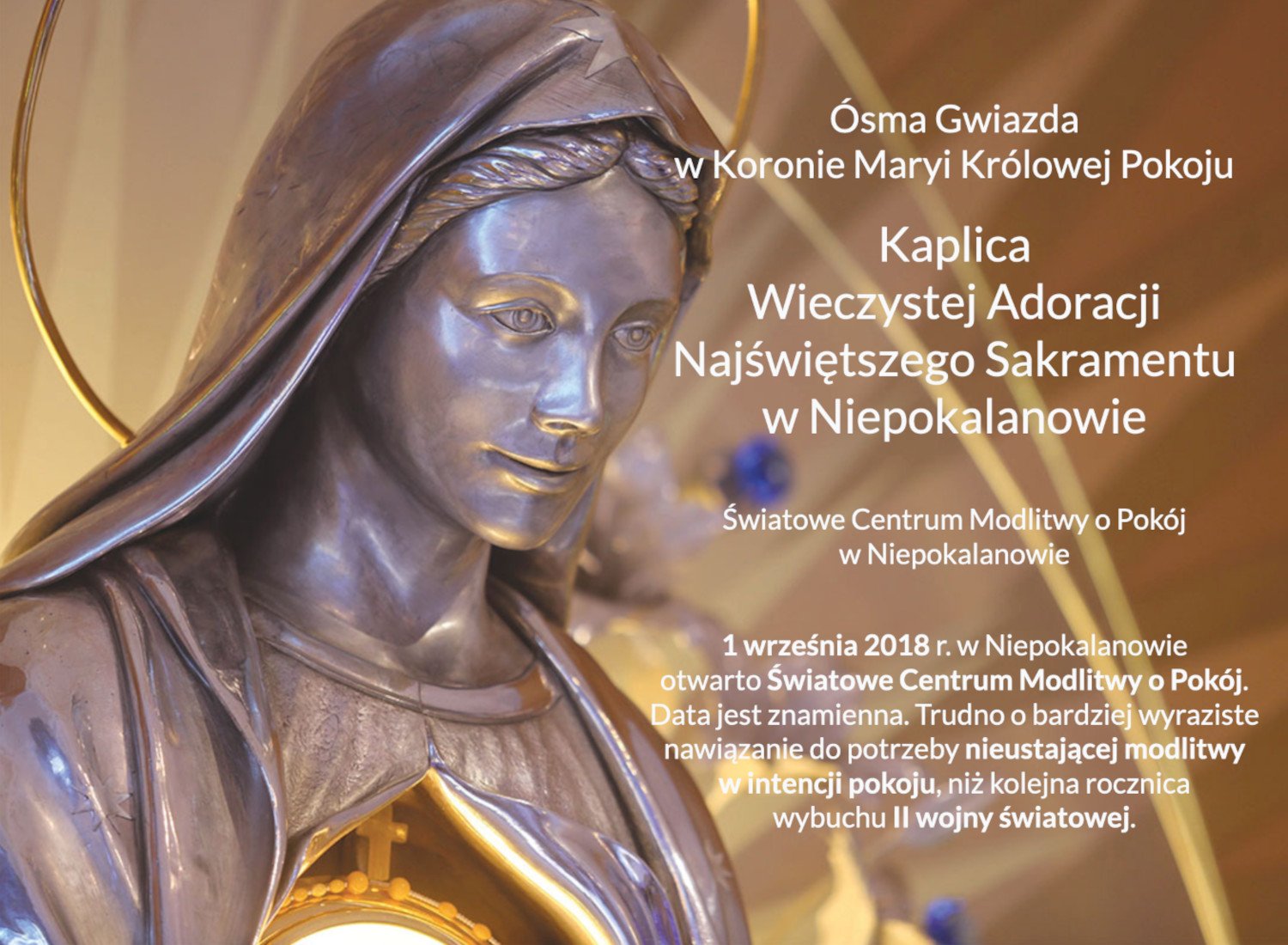

The Eucharistic Adoration Chapel established by Saint Maximilian Kolbe was inaugurated at the outbreak of World War II. It was restored as a Chapel of Adoration in September, 2018, the commemoration of the date that the war began. It is now part of the World Center of Prayer for Peace. The live internet feed of the Adoration Chapel at Niepokalanow — sponsored by EWTN — was established just a few weeks before we discovered it and began to include in at Beyond These Stone Walls. Click “Watch on YouTube” in the lower left corner to see how many people around the world are present there with you. The number appears below the symbol for EWTN.
Click or tap here to proceed to the Adoration Chapel.
The following is a translation from the Polish in the image above: “Eighth Star in the Crown of Mary Queen of Peace” “Chapel of Perpetual Adoration of the Blessed Sacrament at Niepokalanow. World Center of Prayer for Peace.” “On September 1, 2018, the World Center of Prayer for Peace in Niepokalanow was opened. It would be difficult to find a more expressive reference to the need for constant prayer for peace than the anniversary of the outbreak of World War II.”
For the Catholic theology behind this image, visit my post, “The Ark of the Covenant and the Mother of God.”

On the Day of Padre Pio, My Best Friend Was Stigmatized
Writing from Thailand, Pornchai Moontri hopes and prays for justice for Fr Gordon MacRae who begins a 30th year unjustly in prison on the Feast Day of St Padre Pio.

Background photo by Sue Thompson (CC BY-ND 2.0)
Writing from Thailand, Pornchai Moontri hopes and prays for justice for Fr Gordon MacRae who begins a 30th year unjustly in prison on the Feast Day of St Padre Pio.
September 23, 2023 by Pornchai Maximilian Moontri
Note from our Editor: Pornchai Moontri wrote this post in 2020 as he was returning to Thailand after a 36 year absence. The post is mostly about a very important person in his life whom he had to very painfully leave behind. Father Gordon MacRae was wrongly sentenced to prison on the Feast Day of his Patron Saint, September 23, 1994. As Father G begins his 30th year under this injustice, Pornchai implores us all to pray for him that his faith and strength and hope will never fail.
+ + +
To My Dear Friends and Family Beyond These Stone Walls : It was not until my friend, Fr Gordon MacRae wrote “Pornchai Moontri and the Long Road to Freedom’’ in 2020 that the weight of this immense change in our lives really hit me. My emotions were on a roller coaster then. Father G and I worked long and hard over the previous 15 years that we had been friends, family and roommates. I could not have imagined on the day we first met that I would be facing this day with hope.
Hope is just one of the emotions competing for space in my heart back then. I was also scared beyond measure, and anxious, and excited, and I was very deeply sad. I guess I have to try to sort this out for myself and for you. I was scared because my whole life, and all that I have known since I was a homeless and lost teenager 32 years ago, was about to change completely.
I was anxious because I was to be cast among strangers for a time, and it was a long time due to Covid-19 pandemic and the constraints on international flights. Weeks after leaving Father G in Concord, New Hampshire Prison, ICE agents took me away to be a prisoner in another crowded, chaotic place where I lived among strangers, taking only the clothes I was wearing.
I was excited because this journey may well be the last of the nightmares of my life. At the other end of that ICE nightmare five months later, I was left in Bangkok, Thailand where I was entirely free for the first time in my living memory. I was adjusting to freedom and a new country and culture all at once. From inside the prison cell we shared for all those years, Father Gordon miraculously built a bridge to Thailand for me through this wonderful blog. Where there was once only darkness ahead, there were now people in Thailand waiting for me and I was not alone.
Father G wrote about my life before prison in an article that changed everything for me. I have not read it myself because I can’t. I will explain why, but I already know what is in it because I have lived it. I am just not ready to see it in print. The article was “Pornchai Moontri: Bangkok to Bangor, Survivor of the Night.”
All that had become familiar to me had to be left behind. Far worse, Father G had to be left behind and for that I am also sad beyond measure. I knew that when that day came, I would likely never see my friend, my mentor, my father, again in this life. There were times as that day approached when I would lay in the dark in my upper bunk in our prison cell at night, and my darkness and dismay about this felt overwhelming. The person who gave me hope would remain in prison while I would be set free, while banished to a foreign land.
But I was set free in another way, too, and it was Father Gordon MacRae who set me free. I can only barely remember being a happy 11-year-old boy living and working on a small farm in the North of Thailand. In December of 1985, I was taken from there and brought against my will to the United States. Though it was my mother who took me, I did not know her. She had abandoned my brother and me in Thailand when I was only two years old. She waited until I was age eleven to come and take me away because her life was under the control of a monster who sent her to bring me to him. It is that simple, and that terrible.
I have always wondered if readers know how unlikely this alliance between me and Father G is. To explain it, I have to go into what happened to me in life. That is very painful, even unspeakable, so I will spare you what is known only to Father G and God. Father G would later write about this in more general terms in an article that shattered my childhood shame for once being a victim. That post was “Getting Away with Murder on the Island of Guam.”
I was brought to America as a child. I was eleven when taken from my home and twelve years old when I arrived there. I spoke no English at all so I could not tell anyone what was happening to me. I became afraid to go to sleep at night. This went on for over two years before I escaped into the streets. I was fourteen in a foreign country fending for myself. While trying to protect my mother from what she was also suffering, I kept what had been happening to me a secret even though it had severely affected my mind and destroyed my spirit. This was no story about repressed memories like so many of the stories against Father G and other Catholic priests. My burden was that I could not forget a single moment of what happened no matter how much I tried.
So when I was sent to prison at age 18, I was broken and bitter. It is not a good place to grow up. I was forced to fight, a lot, and I convinced myself that I will never again be anyone’s victim. Eight years after I was sent to prison, I learned that my mother was murdered on the Island of Guam. She was brought there by the man who arranged for me to be taken from Thailand. It’s all in Father G’s article linked above and it is an American horror story.
I ended up in solitary confinement for years, a prison within a prison that just magnified the inner madness. In 2005, at the age of 32, I was chained up and transported to a prison in another state, New Hampshire. As you already know, I met Father G there. I heard why he was in prison. I wanted him to help me transfer to a Thai prison, something that he refused to do, but I also thought that he and I could never be friends. Then I heard that there were articles about him and his charges in The Wall Street Journal so I read them. The articles were the result of an honest investigation. I was shocked by them.
As a childhood survivor of horrible sexual abuse and violence, I felt disgusted by what I knew to be accusations made up for money. This guy, Thomas Grover was seen as credible by a police detective, a prosecutor, and a biased judge, but I did not see how that could be possible. Any real survivor of sexual abuse should see right through this. There was a claim that this con man, high school football player at age 15, was raped by Father G in a rectory office, then the guy returned five times saying that he repressed all memory of it from week to week. The stories of his brothers were even more incredible. Then I read that they all stood to get a $200,000 check from the Catholic Diocese of Manchester and no one questioned any of this???
I read that Father G was offered a plea deal from a corrupt detective and prosecutor. One year in prison. If he was guilty, of course he would take it. Even if he was innocent, but had no integrity, he might still take it. But he was innocent, and he did have integrity, so he refused the deal. Then he was sentenced to more than sixty times the time in prison he would have got if he was guilty. When I read all this, I was furious just as every real survivor of sexual abuse should be furious.
Now I have to jump ahead several years. I made a decision to trust Father G. This was a miracle all by itself because I never really trusted anyone. There is a writer in France named Marie Meaney who somehow wrote about this story. It is not a long version, but she caught every important detail and its meaning in just two pages. Her article is “Untying the Knots of Sin — In Prison.”

Ever Deeper Into the Tangled Threads
As the trust grew between me and Father G, I began to reveal all that happened to me. I did not imagine then that he was storing every detail in support of some future deliverance. We had been living in the same cell for two years when Beyond These Stone Walls began in the summer of 2009. I had been secretly thinking about becoming Catholic then, and had been taking correspondence courses in Scripture and Catholic teaching through the Knights of Columbus. My interest in the Catholic faith was growing because I saw it quietly working every day in the person I was living with in a small prison cell. I remember a day, just after I was moved into the area where Father G lived. It was a few months before we became roommates. I walked into his cell and the first thing I saw was a picture taped to a beat up steel mirror on the wall. I stared at it. The man was balding with glasses, and half in priest’s clothes and the clothes of a prisoner. Father G was busy writing something. I asked, “Is this you?”
It turned out to be the most important question of my life. Father Gordon then told me all about Saint Maximilian Kolbe, of how he was sent to prison in a Nazi concentration camp on fake charges, of how he helped other prisoners, and finally of how he gave his life to save a younger prisoner from execution. Father Maximilian was 41 years old when this happened. Father G was 41 when he was unjustly sent to prison. I learned about not only sainthood, but manhood from these two men. In another miracle, Felix Carroll, the Editor of Marian Helper magazine, wrote a book with a chapter about me. He wrote of this story:
“Eyes that once smoldered with coiled rage now sparkle with purpose and compassion. Through Fr. Gordon MacRae, Pornchai discovered the saints and the Blessed Mother. In St. Maximilian Kolbe he discovered what it means to truly be a man, what it means to be tough. A man doesn’t seek to destroy other men. A man doesn’t hold his own needs above the needs of others. A real man is selfless. St. Maximilian knew what it was like to be stripped of his humanity and dignity. In him, Pornchai found recourse because Maximilian never caved into despair. In 1941 at Auschwitz, he gave his life to save that of another man.”
— Loved, Lost, Found, pp.166-167
Over time, Father G became all of these things for me. He never once put himself first, and he made great sacrifices for me. He told me once that sacrifice is the most necessary part of being a man and a father. While I was slowly being drawn into faith and hope, Father G was always looking out for my best interests, never putting himself first. He became my best friend, and the person I trust most in this world. From prison, he opened for me a window onto Christ.
As I mentioned above, Beyond These Stone Walls began in our cell in the summer of 2009. It was another miracle I never would have thought possible. It was proposed to Father G in a phone call and he came to our cell and told me about it. He let me decide what to call it so I chose “These Stone Walls,” I always saw prison as a place where we were sent to be forgotten. Father G said that we could speak to the whole world from here, and we did.
I became a Catholic on Divine Mercy Sunday, 2010. Meanwhile, Father G’s writing at Beyond These Stone Walls got the attention of others. One of them was Mrs. Clare Farr, a Trademarks attorney in Western Australia. She and Father G teamed up to begin an investigation of my past life. They were relentless, and over time what they accomplished grew and grew. I never thought justice was even possible, but they kept probing and making connections. Then the police came to interview me. They came a second time along with a District Attorney. As a result, in 2017 Richard Alan Bailey was arrested in Oregon and held on $49,000 bail charged with forty felony counts of sexual abuse against a child.
There was to be no trial, however. Richard Bailey took a plea deal. He today stands convicted of all 40 felony charges. His sentence was suspended and he was given probation. This would be an international outrage if Richard Bailey were a Catholic priest. The story of the murder of my mother when he took her to the Island of Guam remains there a cold case unsolved homicide even though there is new evidence pointing to a solid suspect.

Pornchai Moontri’s mugshot at the time of his arrest at age 18 in Bangor, Maine, after having lived on the streets for two years.
True Crime and Punishment
Father Gordon MacRae freed me from the evil this man inflicted on me. He taught me that this evil is not mine to keep. I just see the horrible injustice in the handling of these two cases. My abuser did monstrous things. His assaults were more than the number he was charged with. There were witnesses ready to testify and lots of clear evidence.
He was sentenced to mere probation because I was a prisoner and the prosecutor feared that I would be assailed on the witness stand because of that. So they offered Richard Bailey a plea deal. He took the deal because he is guilty. So for forty counts of rape, he will never serve a single day in jail and all the evidence was never placed before the court.
In the case of Father Gordon MacRae, a plea deal was also offered. It was offered three times, and each time he refused the offer of a single year in prison because he is innocent. These offers were made because Thomas Grover, his 27-year-old accuser at trial, was not credible at all. He was a drug addict with a criminal record that was kept out of the trial by a biased judge. He was biased from the beginning and once told the jury to disregard all the inconsistencies in Thomas Grover’s story. As Dorothy Rabinowitz wrote in “The Trials of Father MacRae” in The Wall Street Journal, “They had much to disregard.” Father G was not on trial. The whole Catholic priesthood was on trial. Convicted of five counts with zero evidence, he got 67 years in prison.
What do I do with such a story? If Father G had not been here, what would have become of me? This is part of the Cross I now carry through life. I would give my freedom to save his, but he would have none of that.
For the last 14 years in this prison while becoming a Catholic and living as a Catholic, I have also lived in very close quarters with a man I know without a doubt to be innocent. During this time, I have been scandalized by the response of most other priests, and especially by Father G’s cowardly bishop who treats him like a dangerous outcast.
When they have come here for an occasional Mass, they barely speak or even acknowledge him. I am ashamed for their cowardly and petty attitude. Father G says the Church and the Mass are much bigger than the flawed human beings behind them.
After 29 years in prison, 15 of them as Father G’s roommate, and 12 of them as a Catholic, freedom came to me in steps. Three years ago I was freed from this prison, but I will never be free of Father G. It breaks my heart that the man responsible for my freedom was left behind unjustly in prison.
When I asked that question all those years ago — “Is this you?” — I got my answer. It was Saint Maximilian in that picture on the mirror but it is also Father Gordon MacRae, the man who freed my mind and soul from the horror inflicted on me by a real predator.
I could not bear to leave my friend, and I have not. We speak every day, and his fatherly guidance is no less potent now than it was in that prison cell. We have another Patron Saint, Saint Padre Pio who brought about much healing in my life. The day the Church honors him is also the date Father G was cast into prison. They have a special bond. I entrust Father Gordon MacRae to him, and to all of you.
Please do not forget Father G behind those stone walls.
+ + +

You may also like these related links:
When Justice Came to Pornchai Moontri, Mercy Followed, by Clare Farr
A chapter in the book, Loved, Lost, Found: The Divine Mercy Conversion of Pornchai Moontri, by Felix Carroll
Imprisoned by Walls, Set Free by Wood by Pornchai Moontri


The Eucharistic Adoration Chapel established by Saint Maximilian Kolbe was inaugurated at the outbreak of World War II. It was restored as a Chapel of Adoration in September, 2018, the commemoration of the date that the war began. It is now part of the World Center of Prayer for Peace. The live internet feed of the Adoration Chapel at Niepokalanow — sponsored by EWTN — was established just a few weeks before we discovered it and began to include in at Beyond These Stone Walls. Click “Watch on YouTube” in the lower left corner to see how many people around the world are present there with you. The number appears below the symbol for EWTN.
Click or tap here to proceed to the Adoration Chapel.
The following is a translation from the Polish in the image above: “Eighth Star in the Crown of Mary Queen of Peace” “Chapel of Perpetual Adoration of the Blessed Sacrament at Niepokalanow. World Center of Prayer for Peace.” “On September 1, 2018, the World Center of Prayer for Peace in Niepokalanow was opened. It would be difficult to find a more expressive reference to the need for constant prayer for peace than the anniversary of the outbreak of World War II.”
For the Catholic theology behind this image, visit my post, “The Ark of the Covenant and the Mother of God.”


Saints Alive! When Padre Pio and the Stigmata Were on Trial
Padre Pio was proclaimed a living saint for the wounds he bore for Christ, but his reputation for sanctity became another wound, this one inflicted from the Church.

Padre Pio was proclaimed a living saint for the wounds he bore for Christ, but his reputation for sanctity became another wound, this one inflicted from the Church.
September 20, 2023 by Fr Gordon MacRae
“Six Degrees of Separation,” a famous play by John Guare, became a 1993 film starring Will Smith, Donald Sutherland, and Stockard Channing. The plot revolved around a theory proposed in 1967 by sociologists Stanley Milgram and Frigyes Karinthy. Wikipedia describes “Six Degrees of Separation” as:
“The idea that everyone is at most six steps away from any other person on Earth, so that a chain of ‘a friend of a friend’ statements can be made to connect any two people in six steps or fewer.”
It’s an intriguing idea, and sometimes the connections are eerie. In “A Day Without Yesterday” I wrote about my long-time hero, Fr. Georges Lemaitre, the priest-physicist who changed the mind of Albert Einstein on the creation of the Universe. A few weeks after my post, a letter arrived from my good friend, Pierre Matthews in Belgium. Pierre sent me a photo of himself as a young man posing with his family and a family friend, the famous Father Lemaitre, in Switzerland in 1956. In a second photo, Pierre had just served Mass with the famous priest who later autographed the photo.
When I wrote of Father Lemaitre, I had no idea there are but two degrees of separation between me and this famous priest-scientist I’ve so long admired. The common connection we share with Pierre Matthews — not to mention the autographed photo — left me awestruck. The mathematical odds against such a connection are staggering. Something very similar happened later and also involving Pierre Matthews. It still jolts my senses when I think of it. The common bond this time was with Saint Padre Pio.
When Pierre visited me in prison in 2010, I told him about this blog which had been launched months earlier. When I told Pierre that I chose Saints Maximilian Kolbe and Padre Pio as the patrons of Beyond These Stone Walls, Pierre quietly and modestly said, “I’ve met Padre Pio.”
Pierre’s casual remark dropped like a bomb on our conversation. What were the odds that I would be sitting at a table in the prison visiting room with a man who traveled from Europe to tell me of how he met Padre Pio. The saint imposed his wounded and bandaged hands in blessing upon Pierre’s head over a half century earlier.
The labyrinthine ways of grace are far beyond my understanding. Pierre told me that as a youth growing up in Europe, his father enrolled him in a boarding school. When he wrote to his father about a planned visit to central Italy, his father instructed him to visit San Giovanni Rotondo and ask for Padre Pio’s blessing. Pierre, a 16-year-old at the time, had zero interest in visiting Padre Pio. But he obediently took a train to San Giovanni Rotondo. He waited there for hours. Padre Pio was nowhere to be seen.
Pierre then approached a friar and asked if he could see Padre Pio. ‘Impossible!’ he was told. Just then, he looked up and saw the famous Stigmatic walking down the stairs toward him. Padre Pio’s hands were bandaged and he wore gloves. The friar, following the young man’s gaze, whispered in Italian, ‘Do not touch his hands.’ Pierre trembled as Padre Pio approached him. He placed his bandaged hands upon Pierre’s head and whispered his blessing.
Fifty-five years later, in the visiting room of the New Hampshire State Prison, Pierre bowed his head and asked for my blessing. It was one of the most humbling experiences of my life. I placed my hand upon Pierre knowing that the spiritual imprint of Padre Pio’s blessing was still in and upon this man, and I was overwhelmed to share in it.
This wasn’t the first time I shared space with Padre Pio. Several years ago, in November 2005, we shared the cover of Catalyst, the Journal of the Catholic League for Religious and Civil Rights. I also share a painful date with Padre Pio. September 23 was the date he died in 1968. On September 23, 1994 I was put into chains and taken to prison to begin a life sentence for crimes that never took place.
That’s why we shared that cover of Catalyst. Catholic League President Bill Donohue wrote of his appearance on NBC’s “Today” show on October 13, 2005 during which he spoke of my trial and imprisonment declaring, “There is no segment of the American population with less civil liberties protection than the average American Catholic priest.” That issue of Catalyst also contained my first major article for The Catholic League, “Sex Abuse and Signs of Fraud” written from prison in 2005.

The Indictment of Heroic Virtue
Padre Pio was on that Catalyst cover because three years after he was canonized in 2002 by Pope John Paul II, Atlantic Monthly magazine carried a brief article by Tyler Cabot entitled “The Rocky Road to Sainthood” (November 2005). Of one of the most revered priests in Church history, Cabot wrote:
“Despite questions raised by two papal emissaries – and despite reported evidence that he raised money for right-wing religious groups and had sex with penitents – [Padre] Pio was canonized in 2002.”
I’m not sure whether the bigger scandal for Tyler Cabot and Atlantic Monthly was the sexual accusation or “raising money for right-wing religious groups.” Bill Donohue expressed surprise that such a “highly regarded magazine would publish such trash.” I was more dismayed than surprised by the irresponsibility. Yes, it’s irresponsible to tell half the story and present it as the truth.
It wasn’t the first time such attacks were launched against Padre Pio. Four years before his canonization, and thirty years after his death, The New York Times (September 24, 1998) carried an article charging that Padre Pio was the subject of no less than twelve Vatican investigations in his lifetime, and one of the investigations alleged that “Padre Pio had sex with female penitents twice a week.” It’s true that this was alleged, but it’s not the whole truth. The New York Times and Atlantic Monthly were simply following an agenda that should come as no surprise to anyone. I’ll describe below why these wild claims fell apart under scrutiny.
But first, I must write the sordid story of why Padre Pio was so accused. That’s the real scandal. It’s the story of how Padre Pio responded with heroic virtue to the experience of being falsely accused repeatedly from within the Church. His heroic virtue in the face of false witness is a trait we simply do not share. It far exceeds any grace ever given to me.

Twice Stigmatized
Early in the morning of September 20, 1918, at the age of 31, Francesco Forgione, known to the world as Padre Pio, received the Stigmata of Christ. He was horrified, and he begged the Lord to reconsider. Each morning in the month to follow, Padre Pio awoke with the hope that the wounds would be gone. He was terrified. After a month with the wounds, Padre Pio wrote a note to Padre Benedetto, his spiritual advisor, describing in simple, matter-of-fact terms what happened to him on that September 20 morning:
“On the morning of the 20th of last month, in the choir, after I had celebrated Mass . . . I saw before me a mysterious person similar to the one I had seen on the evening of 5 August. The only difference was that his hands and feet and side were dripping blood. The sight terrified me and what I felt at that moment is indescribable. I thought I should die and really should have died if the Lord had not intervened and strengthened my heart which was about to burst out of my chest.
“The vision disappeared and I became aware that my hands and feet and side were dripping blood. Imagine the agony I experienced and continue to experience almost every day. The heart wound bleeds continually, especially from Thursday evening until Saturday.
“Dear Father, I am dying of pain because of the wounds and the resulting embarrassment I feel in my soul. I am afraid I shall bleed to death if the Lord does not hear my heartfelt supplication to relieve me of this condition.
“Will Jesus, who is so good, grant me this grace? Will he at least free me from the embarrassment caused by these outward signs? I will raise my voice and will not stop imploring him until in his mercy he takes away . . . these outward signs which cause me such embarrassment and unbearable humiliation.”
— Letters 1, No. 511
And so it began. What Padre Pio faced that September morning set in motion five decades of suspicion, accusation, and denunciation not from the secular world, but from the Catholic one. From within his own Church, Padre Pio’s visible wounds brought about exactly what he feared in his pleading letter to his spiritual director. The wounds signified in Padre Pio exactly what they first signified for the Roman Empire and the Jewish chief priests at the time Christ was crucified. They were the wounds of utter humiliation.
Within a year, as news of the Stigmata spread throughout the region, the people began to protest a rumor that Padre Pio might be moved from San Giovanni Rotondo. This brought increased scrutiny within the Church as the stories of Padre Pio’s special graces spread throughout Europe like a wildfire.
By June of 1922, just four years after the Stigmata, the Vatican’s Holy Office (now the Congregation for the Doctrine of the Faith) began to restrict the public’s access to Padre Pio who was accused of self-inflicting his own wounds and sexually abusing penitents. He was even accused of being a political agitator for a fascist group, and helping to incite a riot. His accusers included fellow friars, and neighboring priests, bishops, and archbishops increasingly threatened by Padre Pio’s growing fame and influence. A physician and founder of Rome’s Catholic university hospital labeled Padre Pio, sight unseen, “an ignorant and self-mutilating psychopath who exploited peoples’ credulity.”
Padre Pio and I have this one thing in common. You would not believe some of the things I’ve been called, sight unseen, by people presenting themselves as the voice of the faithful.
From 1924 to 1931, accusation after accusation was investigated by the Holy See which issued a series of official statements denying the supernatural origin of Pio’s wounds and the legitimacy of his gifts. At one point, the charge that his wounds were self-inflicted was withdrawn. Several legitimate examinations found no evidence for this. It was then charged that Padre Pio’s wounds were psychologically self-induced because of his “persistent concentration on the passion of Christ.”
Finally, in the one instance in which I can personally relate to Padre Pio, he responded with sheer exasperation at his accusers: “Go out to the fields,” he wrote, “and look very closely at a bull. Concentrate on him with all your might. Do this and see if horns grow on your head!”
By June of 1931, Padre Pio was receiving hundreds of letters daily from the faithful asking for prayers. Meanwhile, the Holy See ordered him to desist from public ministry. He was barred from offering Mass in public, barred from hearing confessions, and barred from any public appearance as sexual abuse charges against him were formally investigated — again. Padre Pio was a “cancelled priest” long before it became “a thing” in the Church.
Finally, in 1933, Pope Pius XI ordered the Holy Office to reverse its ban on Padre Pio’s public celebration of Mass. The Holy Father wrote, closing the investigation: “I have not been badly disposed toward Padre Pio, but I have been badly informed.” Over the succeeding year his faculties to function as a priest were progressively restored. He was permitted to hear men’s confessions in March of 1934 and the confessions of women two months later.

Potholes on the Road to Sainthood
The accusations of sexual abuse, insanity, and fraud did not end there. They followed Padre Pio relentlessly for years. In 1960, Rome once again restricted his public ministry citing concerns that his popularity had grown out of control.
An area priest, Father Carlo Maccari, added to the furor by once again accusing the now 73-year-old Padre Pio of engaging in sex with female penitents “twice a week.” Father Maccari went on to become an archbishop, then admitted to his lie and asked for forgiveness in a public recantation on his deathbed.
When Padre Pio’s ministry was again restored, the daily lines at his confessional grew longer, and the clamoring of all of Europe seeking his blessing and his prayers grew louder. It was at this time that my friend, Pierre Matthews encountered the beleaguered and wounded saint on the stairs at San Giovanni.
The immense volume of daily letters from the faithful also continued. In 1962, Padre Pio received a pleading letter from Archbishop Karol Wotyla of Krakow in Poland. The Archbishop’s good friend, psychiatrist Wanda Poltawska, was stricken with terminal cancer and the future pope took a leap of faith to ask for Padre Pio’s prayers. When Dr. Poltawska appeared for surgery weeks later, the mass of cancer had disappeared. News of the miraculous healing reached Archbishop Wotyla on the eve of his leaving for Rome on October 5, 1962 for the convening of the Second Vatican Council.
Former Newsweek Religion Editor Kenneth Woodward wrote a riveting book entitled Making Saints (Simon & Shuster, 1990). In a masterfully written segment on Padre Pio twelve years before his canonization, Kenneth Woodward interviewed Father Paolo Rossi, the Postulator General of the Capuchin Order and the man charged with investigating Padre Pio’s cause for sainthood. Fr. Rossi was asked how he expects to demonstrate Padre Pio’s heroic virtue. The priest responded:
“People would better understand the virtue of the man if they knew the degree of hostility he experienced from the Church . . . The Order itself was told to act in a certain way toward Padre Pio. The hostility went all the way up to the Holy Office, and the Vatican Secretariat of State. Faulty information was given to the Church authorities and they acted on that information.”
— Making Saints, p.188
It is one of the Church’s great ironies that Saint Padre Pio was canonized by Pope John Paul II in 2002 just as the U.S. bishops were implementing a response to the newest media furor about accused U.S. priests. I am one of those priests. The irony is that if the charter the bishops adopted was imposed in Italy forty years earlier, Padre Pio may have been denied any legitimate chance of ever clearing his name. The investigations that eventually exposed those lies simply do not take place in the current milieu.
I’ll live with that irony, and I’m glad Padre Pio didn’t have to. Everything else he wrote to his spiritual director on that fateful morning of September 20, 1918 came to pass. He suffered more than the wounds of Christ. He suffered the betrayal of Christ by Judas, and the humiliation of Christ, and the scourging of Christ, and he suffered them relentlessly for fifty years. As Father Richard John Neuhaus wrote of him in First Things (June/July 2008):
“With Padre Pio, the anguish is not the absence of God, but the unsupportable weight of His presence.”
Fifty years after receiving the Stigmata, Padre Pio’s wounds disappeared. They left no scar — no trace that he ever even had them. Three days later, on September 23, 1968, Padre Pio died. I was fifteen years old — the age at which he began religious life.
In April, 2010, the body of Saint Pio of Pietrelcina was moved from its shrine at San Giovanni Rotondo to a new church dedicated in his honor in 2009 by Pope Benedict XVI. Padre Pio’s tomb is the third most visited Catholic shrine in the world after the Vatican itself and the Basilica of Our Lady of Guadalupe in Mexico City.
The New York Times might still spread another story, but the people of God have spoken. Padre Pio was canonized by the sensus fidelium — by the near universal acclaim of believers long before the Church ratified their belief. Padre Pio is a saint of the people.
Some years ago, a priest in Dallas — who read of Padre Pio’s “Patron Saint” status on our About Page sent me a relic of Saint Pio encased in plastic. He later wrote that he doesn’t know why he sent it, and realized too late that it might not make it passed the prison censors. Indeed, the relic was refused by prison staff because they couldn’t figure out what it was. Instead of being returned to sender as it should have been, it made its way somehow to the prison chaplain who gave it to me.
The relic of Saint Pio is affixed on my typewriter, just inches from my fingers at this moment. It’s a reminder, when I’m writing, of his presence at Beyond These Stone Walls, the ones that imprison me and the one I write for. The relic’s card bears a few lines in Italian by Padre Pio:
“Due cose al mondo non ti abbandonano mai, l’occhio di Dio che sempre ti vede e il cuore della mamma che sempre ti segue.”
“There are two things in the world that will never forsake you: the eye of God that always sees you, and the heart of His Mother that always follows you.”
— Padre Pio
Saints alive! May I never forget it!
+ + +
EPILOGUE
In 2017, Pierre Matthews, my friend and Pornchai Moontri’s Godfather, passed from this life. After his death someone in his family sent me a photograph of him kneeling at the Shrine of Saint Padre Pio where he offered prayers for me and for Pornchai.
+ + +

The Eucharistic Adoration Chapel established by Saint Maximilian Kolbe was inaugurated at the outbreak of World War II. It was restored as a Chapel of Adoration in September, 2018, the commemoration of the date that the war began. It is now part of the World Center of Prayer for Peace. The live internet feed of the Adoration Chapel at Niepokalanow — sponsored by EWTN — was established just a few weeks before we discovered it and began to include in at Beyond These Stone Walls. Click “Watch on YouTube” in the lower left corner to see how many people around the world are present there with you. The number appears below the symbol for EWTN.
Click or tap here to proceed to the Adoration Chapel.
The following is a translation from the Polish in the image above: “Eighth Star in the Crown of Mary Queen of Peace” “Chapel of Perpetual Adoration of the Blessed Sacrament at Niepokalanow. World Center of Prayer for Peace.” “On September 1, 2018, the World Center of Prayer for Peace in Niepokalanow was opened. It would be difficult to find a more expressive reference to the need for constant prayer for peace than the anniversary of the outbreak of World War II.”
For the Catholic theology behind this image, visit my post, “The Ark of the Covenant and the Mother of God.”

Old Max Moontri Had a Farm, EIEIO!
Having built with pick and shovel a 150 meter walkway on a property he landscaped, Pornchai Moontri spent his 50th Birthday plowing and planting an acre of farmland.

Having built with pick and shovel a 150 meter walkway on a property he landscaped, Pornchai Moontri spent his 50th Birthday plowing and planting an acre of farmland.
September 13, 2023 by Fr Gordon MacRae
I stumbled upon a late night TV movie recently — though I do not know the title — just as a young man was visiting his father in prison. I was late tuning into the film so the plot was not immediately clear. It seemed that the father was innocent of whatever crime sent him to prison and his son was very anxious to prove it. I was riveted to the scene. Through security glass where they conversed via monitored telephones, the father was urging his son to move on with his life and be free. The young man protested, “But I want YOU to be free!” His father replied, “My freedom is in witnessing yours.”
I pondered this for a few moments laying there in the dark of night in a prison cell. And then I began to cry. That was most unusual. In nearly 30 years of seeing my life implode from false witness, I can count on one hand the number of times I have shed even a single tear. It just isn’t in my nature to cry easily. I wrote once that women seem to cry much more easily than men. Perhaps men do not cry nearly enough.
That night I could not contain what was spilling out from within me. I realized with an emotional collision of joy and sadness that a part of me now compensates for my loss of freedom by witnessing it unfold in the life of Pornchai Moontri with whom I spent 15 years surviving in a prison cell. In that time, a bond of trust grew between us in a place where trust is the rarest of commodities. We became each other’s family, and the basis of our connection was always fatherhood. Pornchai never had a father. I spent the last forty one years being called one.
I was 20 when Pornchai was born, and on September 10 this week, he turned 50, so do the math. Fatherhood in this case was not an event, but a process. Over time, while learning the entire story of Pornchai’s tragic life, it gradually became my own life’s mission to secure his freedom even above my own.
Overtime, we encountered mystical connections in this bond. They include Divine Mercy and the intercessory graces of a Patron Saint who also surrendered his life in this life to save another. I do not fully understand these connections, but I know in my heart that they are there. Embracing fatherhood makes men see their lives differently. As I quoted in a recent post:
“When I was a child, I spoke like a child, I thought like a child, I reasoned like a child. When I became a man, I gave up childish ways. Now we see dimly as in a mirror, but then we shall see face to face. Now I understand only in part, but then I shall understand fully even as I am fully understood.”
— 1 Corinthians 13:10-12
Three years after Pornchai’s deportation to Thailand, I still find myself, as any true father would, reveling in his freedom as though revisiting an inspired work of art that I somehow had a hand in creating. This was perhaps evident in our recent post about the earliest days of this blog and the first posts I wrote back then. Some readers told me that it made them cry as well, but not just from sadness. I hope you did not miss “Maximilian Kolbe: The Other Prisoner Priest in My Cell.”

A Passage to India
The interconnectedness of our lives did not suddenly end because of time and distance. In his final years here, Pornchai and I were the sole figures offering assistance to other prisoners facing deportation. Regardless of what anyone thinks about whatever offense brought them to this pass, deportation is often an inhumane nightmare impacting bonds within entire families.
One of the persons we assisted in navigating deportation was a young Cambodian man who was brought to the United States at age two. At age 22, he pled guilty to a petty crime without ever being told that doing so would result in his forced deportation. He spoke not a word of Khmer, the language of Cambodia. He was left in the city of Phnom Penh, and since then has disappeared.
One of our good friends here, Abishek, a native of India, had been in the United States for much of his adult life before some out-of-character and out-of-culture domestic dispute and breakup landed him in prison. As with most such situations, Abishek lost not only his freedom, but the entire infrastructure of his life. His close-knit family in India kept in contact from a great distance, but he leaned on Pornchai and me for moral support when he most needed it as the time of deportation approached.
In 2020, Abishek was understandably interested in the process Pornchai was facing because he knew he would soon face the same thing. He was alarmed to learn that Pornchai remained in the dismal custody of Immigrations and Customs Enforcement (ICE) for over five months at the height of the global Covid pandemic. I wrote of this ordeal in 2020 in “ICE Finally Cracks: Pornchai Moontri Arrives in Thailand.”
We hoped this process would be easier for Abishek once the pandemic receded, but that was not the case. He ended up serving six months beyond his prison sentence, but could not seek release because of the ICE hold on him. After waiting six months for ICE to act, I helped Abishek write to Regional ICE Headquarters in Burlington, Massachusetts. Just two weeks later, he was suddenly gone in the night. That was six months ago, and for all that time we assumed that he was safely back in India adjusting to freedom, family and a new life. We thought no news was good news.
But we were wrong. A few weeks ago when I called Pornchai in Thailand, he told me that he received a call at 1 AM during the night before. ICE detainees without resources get one free five-minute call per week. Abishek used it to call Pornchai in Thailand. It turned out that for six months since leaving this prison, Abishek was stranded just 50 miles away in a jail where ICE rents space for detainees awaiting deportation. Abishek was now one year past his prison sentence.
Pornchai and I were powerless to do anything directly so I sent an email message from the tablet in my cell in Concord, New Hampshire prison to Clare Farr, a trademarks attorney in Western Australia who helped Pornchai immensely. She then called Pornchai in Thailand who gave what little information we knew about our friend’s plight. Clare contacted the Indian Embassy in Canberra, Australia and conveyed all that we told her. The Indian Embassy in Australia then contacted the Indian Government which in turn contacted the Indian Consulate. Two weeks later, just days before I type this, Abishek’s odyssey came to an end. Thanks to the intervention of Clare Farr in Australia, Abishek is now reunited with his family in India.
The bizarre thread of this story is worth repeating. Indigent ICE detainees get one free five-minute phone call per week. From ICE detention in New Hampshire, Abishek called Pornchai Moontri in Thailand at 1 AM. Pornchai then contacted me in New Hampshire. I contacted Pornchai’s advocate, Clare Farr in western Australia, who then contacted the Indian Embassy in Canberra. Then the Embassy contacted the Indian Government in New Delhi, who contacted the Indian Consulate in New York instructing them to prepare Abishek’s travel papers and fax them to ICE in Burlington, Massachusetts. ICE then booked a flight for Abishek to get him out of ICE detention in New Hampshire. After a six-month delay, Abishek arrived in India two weeks after his free five-minute phone call to Thailand. We could not make this story up!

Chalermpon Srisuttor, Mayor of Phuviang, and Pornchai Moontri.
Pornchai Set His Heart on Plowing Furrows (Sirach 38:26)
As all of the above was going on, Pornchai sent me some photos of his finished, back-breaking work creating a 450-foot walkway on property he landscaped in Pak Chong, Thailand. I actually tried to talk him out of his next project, but as the quote from the Book of Sirach implies above, his mind was made up. Pornchai has not yet received any income from the work we described in “For Pornchai Moontri, Hope and Hard Work Build a Future.”
All his hard work is building hope for a future livelihood as Thailand builds a high-speed railroad with a depot in each of the places where Pornchai is working now. I have been sending him a small amount of money each month for food and expenses. It does not take a lot — $100 U.S. dollars equals about over 3,000 Thai baht at the current exchange rate. It helps Pornchai manage food and necessities for a month while waiting for the tourism season and rental housing customers.
Pornchai is no stranger to hard work so he decided to take on another project while waiting. About 250 miles north of Pak Chong, where Pornchai now lives in the District of Nakhon Ratchasima, is the village of Phuviang (Pu-vee-ANG) . It is the place where Pornchai was born, was orphaned, and then was taken from at age eleven. There is a lot of pain there. There is also a small house and piece of land that once belonged to his mother. The house was only half built when Pornchais Mother, Wannee, traveled to Guam to her death in 2000, an unforgettable story told in “Getting Away with Murder on the Island of Guam.”
Not far from that unfinished house is an acre or so of farmland that belonged to Wannee. Pornchai’s extended family cultivates rice nearby, so Pornchai decided to go up to Phuviang and plant a crop. It had to be something that he could plant and then leave alone. He chose to plant cassava, a crop that grows in Asian tropical zones and is self-sustaining until harvested.
The cassava plant grows up to about 8-feet in height and its edible roots are typically three inches in diameter and up to three feet long. The roots are akin to a sweet potato, and are a staple in some Asian countries. Ground into flour, cassava is also used to make sweet bread or cakes.
Growing cassava is easy, but planting it is an enormous amount of work. Cassava roots from a past crop have to be cut into smaller pieces and soaked in water for several days. The pieces are then planted along plowed furrows as in the photo atop this post. Pornchai is pictured there along with a local helper. The photo above was taken by Chalermpon Srisuttor, the Mayor and Town Manager of Phuviang who has become a friend to Pornchai — enough of a friend to help him plow and plant an acre of cassava!
The planting was finished just in time for Pornchai’s 50th birthday. I now want to remind him that when he arrived in Concord, NH from a long stint in solitary confinement in Maine in 2005, I had just turned age 52 while Pornchai was 32. He liked to circulate handmade birthday cards for our friends to sign for my birthday. They contained snarky little phrases like “Father G loves history so much because he was there for most of it!” and “Father G knows Latin because it was his first language!” Pornchai thought I was really old back then.
What goes around comes around! Happy Birthday, Max!
+ + +

Upper right: Chalathip Chiradomrong; Chalermpon Srisuttor, Mayor of Phuviang; and Pornchai Moontri. Lower left: Since Phuviang is very near to the Thailand headquarters of the Society of the Divine Word Order where Fr John Hung Le is local Superior, he stopped to spend an afternoon with Pornchai and even to pitch in a bit on the plowing and planting. Upper left and lower right: First signs of growth a few days apart.
+ + +
Note from Fr Gordon MacRae: Thank you for reading and sharing this post. You may also like these related posts from Beyond These Stone Walls:
Maximilian Kolbe: The Other Prisoner Priest in My Cell
ICE Finally Cracks: Pornchai Moontri Arrives in Thailand
For Pornchai Moontri, Hope and Hard Work Build a Future
Getting Away with Murder on the Island of Guam
The Eucharistic Adoration Chapel established by Saint Maximilian Kolbe was inaugurated at the outbreak of World War II. It was restored as a Chapel of Adoration in September, 2018, the commemoration of the date that the war began. It is now part of the World Center of Prayer for Peace. The live internet feed of the Adoration Chapel at Niepokalanow — sponsored by EWTN — was established just a few weeks before we discovered it and began to include in at Beyond These Stone Walls. Click “Watch on YouTube” in the lower left corner to see how many people around the world are present there with you. The number appears below the symbol for EWTN.
Click or tap here to proceed to the Adoration Chapel.
The following is a translation from the Polish in the image above: “Eighth Star in the Crown of Mary Queen of Peace” “Chapel of Perpetual Adoration of the Blessed Sacrament at Niepokalanow. World Center of Prayer for Peace.” “On September 1, 2018, the World Center of Prayer for Peace in Niepokalanow was opened. It would be difficult to find a more expressive reference to the need for constant prayer for peace than the anniversary of the outbreak of World War II.”
For the Catholic theology behind this image, visit my post, “The Ark of the Covenant and the Mother of God.”

New Hampshire Corruption Drove the Fr. Gordon MacRae Case
A researcher unravels a trail of financial corruption behind the cases of Father Gordon MacRae in the Diocese of Manchester and Owen Labrie at St. Paul’s School.

A researcher unravels a trail of financial corruption behind the cases of Father Gordon MacRae in the Diocese of Manchester and Owen Labrie at St. Paul’s School.
September 6, 2023: An Op-Ed by Claire Best
For the last 29 years, Father Gordon MacRae has been denied justice, relegated to Concord Men’s Prison in New Hampshire. Despite an ex-FBI agent’s 3-year investigation, a Pulitzer prize-winning Wall Street Journalist’s multi-part exposé, even a current investigation into the police officer who framed him, nothing has thus far moved the needle — except perhaps in the court of public opinion.
Finally in 2023, the pieces of this puzzle have come together to explain why this might be: The New Hampshire Department for Children, Youth and Families (DCYF), some New Hampshire Police, local attorneys, the “compliance officer” for the Diocese of Manchester, and the Attorney General’s office have been involved in a racket. For Father Gordon MacRae to get justice, they would all risk being exposed in an organized crime to frame him in order to extort the insurance for the Diocese and trigger an expansion of business that spreads to the Catholic Medical Center, schools, nursing homes, day care centers, clinics, addiction recovery centers, banks, insurance companies and media. This is an enterprise worth billions that stretches far beyond the borders of New Hampshire across the US and internationally.
While Father Gordon MacRae has been incarcerated, New Hampshire has covered up horrific child sex abuse by its very own employees at the State’s Youth Detention Center. The NH DCYF has failed multiple audits by the US Department of Health and Human Services Office of the Inspector General (DHHS OIG). It has downplayed Medicaid fraud. Opioids and fentanyl overdoses have skyrocketed. Children and young adults have died or disappeared, drugs have been trafficked, arms have been trafficked, money has been laundered, billions have been made and a monopoly without accountability has blossomed. That monopoly is tied to the interests of the US Government and its three letter agencies. Framing Father Gordon MacRae to get inside the Diocese of Manchester looks like it was a strategic plan that has had catastrophic consequences not just for MacRae but for anyone who has become a tool for, or victim of, the Government infiltration of Catholic organizations.
Father Gordon MacRae was prosecuted, convicted and imprisoned in 1994, the year the Clinton Crime Bill (authored by Joe Biden) was enacted. It is also the year that the Violence Against Women Act was passed enabling $9 billion in grants from the Department of Justice to police, prosecutors and Non-Government Organizations (NGOs). Creating crimes that didn’t exist (while hiding those of state employees or friends of law enforcement and the courts) in order to access grants has undermined the integrity of the justice system in the State of New Hampshire and across the land.
“Justice for the Victim” has been a rallying cry in New Hampshire which has deliberately and consistently failed to ascertain the validity of claims of domestic and sexual assault, while pre-determining victims and predators without doing anything that could remotely be called due process.
Lots of people are denied justice each year and decades later a few of them go free after prosecutorial and police misconduct, or other flaws in the original investigations and trials, are exposed. Some years ago in Pennsylvania, a “Kids for Cash” scheme was unravelled. It involved police, prosecutors, judges and private attorneys. In California, a local journalist came across a series of gatherings in which judges, prosecutors, private attorneys and the media conspired to rig cases in civil, family and criminal courts. What has transpired in New Hampshire bears all the same markings as these. A few breadcrumbs here and there have provided clues to an epic scandal that has been carefully hidden from the public for decades — in large part due to a small “club” who are vested in the profits from it. That club comprises law enforcement, non-profits, local councils, attorneys general, elected representatives, justices, other members of the New Hampshire Bar and certain media outlets. They figured out that by controlling the news, they could control the narrative. And by controlling the narrative they could leverage the outcomes of criminal trials and civil lawsuits. Father Gordon MacRae is a victim of this corruption which even includes local “investigative” reporters who have no critical thinking skills but are determined to reinforce the court corruption in their coverage — presumably due to the sponsorship of their media outlets.
In 1995, a prosecutor in New Hampshire failed to let the defense know that a police officer who arrested a man on trial for murder had a dishonest track record. The state dropped the case. The defendant’s name was Carl Laurie, for whom the “Laurie List” is named. A 1963 US Supreme Court case, Brady v Maryland, requires the prosecution to provide any and all exculpatory evidence to the defense in a timely manner before any criminal trial. Somehow New Hampshire ignored this rule, and for decades judges and prosecutors have been OK with that. This is most likely because there isn’t really a division between police, prosecutors, judges and media in New Hampshire. So a lie that works for one finds its way up the ladder to work for all. Elected DAs who have challenged the ethics of this have been voted out of office (Robin Davis, DA of Merrimack County) or have been undermined by the Attorney General taking over their prosecutions (Michael Conley, DA of Hillsborough County). It is easier in New Hampshire to promote a lie than it is to defend the truth because there is a waterfall of money to be made in the lie — federal grants, civil settlements, contracts, promotions, rewards.

Detective James F. McLaughlin
In June 2018 the police detective who began investigating Father Gordon MacRae in the late 1980s was added to the Attorney General’s secret list of corrupt police officers — the “Laurie List” — also known as the Exculpatory Evidence Schedule for a charge of “Falsification of Records.” James F. McLaughlin, New Hampshire’s top child sex crimes detective, was brought out of retirement in 2017 to work on a Grand Jury Criminal Investigation of St Paul’s School following the framing of scholarship student, 18-year-old Owen Labrie, by Concord Police Detective Julie Curtin. Attorney General Gordon MacDonald brought McLaughlin into the investigation to supervise Detective Julie Curtin and Lieutenant Sean Ford. The report into the school and alleged cover-ups of sex abuse from 2009 to 2017 was completed in August 2018 and a settlement agreement was reached between the Attorney General and the school administration in September 2018. The agreement required a “compliance officer” and a contract with victims advocacy organization the New Hampshire Coalition Against Domestic and Sexual Violence (NHCADSV).
The agreement mirrored one that had been entered into in 2002 after James F. McLaughlin’s investigation into Father Gordon MacRae triggered the circumstances for a Grand Jury criminal investigation, a “compliance officer” and settlement with the Diocese of Manchester. The NHCADSV had brought on board Brian Harlow of SNAP (the Survivors Network of those Abused by Priests) in 2012. Though Harlow had no connection to the MacRae case, he had been one of the original “victims” to come forward for the Diocese of Manchester investigation in 2002. NHCADSV wanted him to help them expand their business and they had a contract with the Department of Defense as well as with the University of New Hampshire which had a strategic agreement with the (Obama) White House 2014 “Not Alone” task force to combat sexual assault on campuses. The Chair of the University System in New Hampshire is Alex Walker. He just so happens to also now be the CEO of Catholic Medical Center in the Diocese of Manchester. As published in a Catholic Medical Center statement:
“Alex has been actively involved in the community for many years. He currently serves on the Board of Trustees of the University System of New Hampshire and on the New Hampshire Business Committee for the Arts. In 2019 and 2020 he co-chaired the Bishop’s Charitable Assistance Fund with his wife, Lisa. He was Chairman of the Board of Trustees of the Palace Theatre, and past Chairman of the Board of Directors of Granite United Way. He has also served on the New Hampshire Bar Association’s Board of Governors, the New Hampshire Supreme Court’s Access to Justice Commission, the Board of Directors of City Year New Hampshire, the Board of Directors for the Business and Industry Association of New Hampshire, and the Greater Manchester Chamber of Commerce Board of Directors where he served as Chairman of the Board in 2011.”
Alex Walker provided counsel to the Diocese alongside the Nixon Peabody law firm which was formed in 1999 in Boston and Manchester. Gordon MacDonald, an attorney at Nixon Peabody became Attorney General and is the current New Hampshire Supreme Court Chief Justice. Before he took office as AG, he successfully managed to block an audit of his client Purdue Pharma. New Hampshire’s opioid crisis has been one of the worst in the country. Catholic Medical Center was fined $3.8 million recently for a kick back scheme. The Boston Globe has exposed cover-ups of medical malpractice by CMC’s administrators headed by Alex Walker. Curiously however, the Boston Globe Spotlight team which covered the Catholic priest sex abuse scandal in 2002-2003 is only interested in exposing a portion of the story that benefits ambulance chasing civil attorneys. The Globe is guilty of removing comments under articles which smacks of the newspaper’s own compromised position preventing its journalists from seeking the real truth as opposed to the monied subjective “his/her/their truth”.
With the addition of Detective James F. McLaughlin on the police misconduct “Laurie List,” AG Gordon MacDonald was suddenly compromised. He had hired McLaughlin because of his history with the Diocese and now he had to hide the fact that he knew McLaughlin was dishonest in the middle of the investigation into St Paul’s School which he had ordered. Instead of coming clean, Gordon MacDonald kept McLaughlin’s dishonesty secret because he was part of the club that had profiteered from McLaughlin’s misconduct. His success as an attorney is deeply tied to his representation of the Diocese of Manchester.
The “compliance officer” in the Diocese was Father Edward Arsenault who became a Monsignor before being defrocked by the Pope after he pled guilty to defrauding the diocese, a dead priest’s estate, and Catholic Medical Center in 2014. Among the expenses Edward Arsenault had clocked up using church funds were the purchase of cell phones, computer equipment, trips to Boston, meals out and work with journalists as well as travel expenditures for himself and his young adult lover.
Recent articles in the last few weeks have revealed that the FBI had planned to infiltrate and undermine the Catholic Church. Christopher Wray, head of the FBI, has tried to toss this off. But the case of Father Gordon MacRae and those of police officer, James F. McLaughlin and Monsignor Edward Arsenault should force a wider inquiry into the Government’s involvement in Catholic institutions going back to the 1980s when Sylvia Gale made up a false rumor about MacRae and shared it with McLaughlin launching his investigation of MacRae.
I have long suspected that Edward Arsenault was never really a priest but actually an FBI operative who got inside the Diocese of Manchester to increase the business of The National Catholic Risk Retention Group and Catholic Charities in such a way that they would become intertwined with Maximus Inc — a for-profit enterprise acting on behalf of the Government. His background is in accounting and finance and he also seems to be heavily involved in big pharma-adjacent enterprises: health/mental health non-profits.
Around the same time (1975) that the US Senate “Church Committee” Inquiry revealed the CIA’s work with 186 educational institutions and non-profits for MK Ultra experiments, Maximus Inc was founded by David Mastran, a Vietnam vet involved with DARPA. Since then Maximus has grown to become the most enormous outsource company for the Governments of the US, Canada, Australia, UK, Israel and Saudi Arabia. Its tentacles have reached into pretty much any Government program you can think of from the IRS to Medicaid, from student loans to Title IV funds, from Department of Defense contracts to Covid vaccination tracking. For all intents and purposes, Maximus has taken over where the CIA and FBI left off when their clandestine and abhorrent human experiments were exposed by the US Senate Church Committee. It would be hard to imagine that the CIA just stopped its experiments in its tracks with so many organizations involved.
In the 1980s in Keene New Hampshire, Sylvia Gale, an employee with State Child Protective Services and DCYF, created a false rumor about Father Gordon MacRae. In an official DCYF letter in 1988, she told Keene Police Detective James F. McLaughlin that MacRae had been involved in a serious crime: the sexual abuse and murder of a child in Florida. Sylvia Gale cited that the source of the fake Florida murder molestation that became McLaughlin’s “probable cause” was Msgr. John Quinn who was at the time Director of Catholic Charities in the Diocese of Manchester.
The crime did not exist and Father Gordon MacRae had never even been in Florida. McLaughlin was known in 1985 for dishonesty but for some reason it took until June 2018 for his name to appear on a State list kept in secret by the Attorney General. In December 2021 Detective McLaughlin’s name appeared publicly on the “Laurie List” of corrupt police for just a few hours before it was removed by Attorney General Gordon MacDonald. Whether Sylvia Gale knew of McLaughlin’s dishonesty when she spread her rumor will forever be an unanswered question but since there were rewards being bandied about by McLaughlin, I believe she probably did know and that money was involved as a reward to her as a “witness” for creating the rumor. Sylvia Gale was a DCYF supervisor of Patricia Grover, the mother of Father MacRae’s accuser at his 1994 trial.
In the time frame from 1985-2018, James F. McLaughlin rose to be New Hampshire’s most celebrated child and internet sex crimes investigator who instructed others in his tactics which included making false statements, procuring and coercion of “victims,” deleting exculpatory evidence, working with media to “shape the message,” federal entrapment (sending unsolicited images of minors), working with civil attorneys and non-profits/victims rights advocates in kick-back schemes. He was given a lifetime achievement award in 2016. At the same ceremony, Concord Police Detective Julie Curtin, was given an award for her work in investigating St. Paul’s school, singling out and framing 18-year-old Owen Labrie. She worked with domestic and international agencies to censor social media for the “victim” who had been recruited in June 2014 for the latest sick experiment. She was carrying the McLaughlin torch forward while he was supposed to retire.
James F. McLaughlin’s crooked enterprise yielded millions in grants, increases in police budgets, non-profit budgets and grants for DCYF, the University of New Hampshire and other affiliated agencies. Why did it matter if a few people had to be framed when so much money could be extorted and former federal prosecutors working at Nixon Peabody are on their side? The law firm’s business grew, turning it into a giant in representation for the health care industry. Particularly that tied to Catholic healthcare institutions — where Monsignor Edward Arsenault was tasked with increasing profits — and the opioid industry. Nixon Peabody represented Purdue Pharma when it was sued by the State of New Hampshire. Creating sex offenders, extorting Catholic establishments, creating drug addicts and claiming Medicaid for medical treatments and facilities has been a sustainable business in New Hampshire for over two decades.
James F. McLaughlin’s enterprise is reminiscent of that of Tom Coleman, aka “T.J. Dawson,” a police officer in Tulia, Arizona who built a business, with accolades all along the way, framing members of the black community for drug offenses they did not commit. Drugs would be planted on unsuspecting targets. Instead of drugs, for Keene Detective James F. McLaughlin, it was sex crimes that were planted. He would fabricate whatever story he could pull off to get plea deals and convictions. In New Hampshire it was easy because the statutes for sex crimes require no corroborating witnesses or evidence. Add qualified immunity for police officers to that, and sovereign immunity for prosecutors, judges and non-profits tied to the courts such as CASA, NHCADSV and agencies like DCYF. They had the perfect racket: collect the federal grants, fabricate the crimes, hide the exculpatory evidence, train the witnesses, use media to garner public outrage to leverage civil settlements with attorneys at the ready to profiteer, and non-profits to train victims and write impact statements. Wash, rinse, repeat.

The National Catholic Risk Retention Group
Attorney General Gordon MacDonald went on to become New Hampshire’s Supreme Court Chief Justice without ever having served as a judge in any capacity. He has a lot to thank James McLaughlin for. MacDonald joined the Nixon Peabody law firm to represent the Diocese of Manchester in the early 2000s. Together with his partner David Vicinanzo, a former federal prosecutor for Massachusetts who had spent time working in the New Hampshire Attorney General’s office, they settled dozens, if not hundreds, of claims against the Diocese of Manchester. Monsignor Edward Arsenault was the appointed compliance officer — nominally. Actually he was in charge of all financial affairs of the Diocese and increasing its reach. He had a business to run; a business to grow. In Monsignor Arsenault’s once-published resume, since removed from view, he boasted of having personally negotiated multi-million dollars settlements in 250 sexual abuse claims against the Diocese of Manchester with a select few personal injury lawyers.
Meanwhile, James F. McLaughlin’s father had been a member of the Concord City Council for 25 years. The Council approves the budget for police investigations including the payments of witnesses for Grand Juries. Although Concord only has 43,000 residents, it is the capital of New Hampshire and is home to the 2nd largest legislative body in the United States after the US Congress in Washington, DC, and the 4th largest in the world. There are 400 elected representatives in New Hampshire. It is an important first stop for any presidential candidate making it a magnet for dark money and a perfect place for three letter agencies involved in clandestine operations to experiment.
The Concord Police Department is not accredited. The current police chief, Bradley Osgood, stated that his department did not have the time or resources to get accredited. The cost is under $20,000. Bradley Osgood was trained in Virginia by the FBI. His predecessor, Timothy O’Malley, left the job to join Vanguard Securities in the fraud department. Dartmouth College and other institutions have accounts with Vanguard Securities. These institutions also have accounts tied to the “Pandora Papers” as does Maximus.
In 1996 Maximus went public. It was the same year that Father Gordon MacRae was denied his first appeals. Bill Clinton was President. He and Hillary were friends with Jeanne and Bill Shaheen. Attorney General Philip McLaughlin, who ordered the investigation into the Diocese in 2002, had been appointed by Governor Jeanne Shaheen who achieved her position with the help of the Clintons. John Sununu, the father of current Governor Chris Sununu, was close to George Bush senior and worked in his administration as White House Chief of Staff. The State of New Hampshire renamed its “Youth Development Center” the “Sununu Youth Development Center” after Governor John Sununu. It is now exposed that youths in the detention center were subjected to sexual, physical, and mental abuse, a scandal that exploded in secret in the early 2000s while the State was investigating the Catholic Church. There are currently over 1,330 pending lawsuits alleging sexual and physical abuse by State employees. The State has hidden millions of documents pertaining to this abuse. Curiously, unlike in the cases of the Diocese of Manchester and St. Paul’s School, no grand jury has been convened to investigate the State and create a report. Maximus and DCYF are front and center in this, but local news organizations have not scrutinized this relationship or that of Catholic Charities and New Hampshire’s police.
In 1999, Nixon Peabody formed in Boston and Manchester, New Hampshire, bringing together a law firm comprising 450 lawyers across New England. The Diocese of Manchester was their client and Maximus was a generous donor to Catholic Charities while starting to get contracts with Catholic institutions. But Maximus was a for-profit wing of the federal government that was effectively now wheedling its way into the vast array of businesses that fall under Catholic Charities. Disgraced Monsignor Edward Arsenault was Chairman of the Board of the Catholic insurance wing for these, The National Catholic Risk Retention Group. David Vicinanzo had been a federal prosecutor who joined Nixon Peabody. Vicinanzo and Nixon Peabody were thus connected to the FBI and so, by association at least, was Edward Arsenault and the Diocese of Manchester, Catholic Charities and their insurance.
The Diocese today refers children to the Children’s Trust Fund for claims of child sex abuse. Children’s Trust Fund shares the same address (10 Ferry Street) as Maximus and Virtus LLC founded in 1999 by Edward Arsenault. Virtus is owned by The National Catholic Risk Retention Group. Also located at 10 Ferry Street is Policy Studies Inc which Kathleen Kerr (on the board of Maximus) joined after she received a letter from US Department of Health and Human Services (DHHS) regarding failures of NH DCYF in 1999. She was legal counsel for DCYF and was there 12 years before she segued into Policy Studies Inc and Maximus which bought it after it was taken over by Veritas. She would have been working with DCYF when the MacRae case took place involving staff members of the DCYF and their families.
Coincidentally, Sylvia Gale, who created the first untrue rumor about Father Gordon MacRae back in 1988, successfully appealed a complaint against her for conflicts of interests that arose between her work for the Nashua DCYF and other non-profits. Sylvia Gale died in 2020 and left behind a legacy for her work in children’s advocacy, but judging by reports on New Hampshire’s Youth Detention Center scandal, the State’s Foster Care System, failures of the DCYF, and the drugging of children in State care, I am not sure it is a legacy to be proud of. It was Sylvia Gale’s colleague, Patricia Grover whose son Thomas Grover became a drug addict before he was convinced by James F. McLaughlin that he could make substantial money by being a witness/victim of Father Gordon MacRae. The Diocese of Manchester coughed up $200,000. Years later, Grover admitted to family members that he was bribed and that the case was a fraud. A therapist sat at the back of the courtroom motioning for him to cry during his testimony against the priest, a story exposed in “Psychotherapists Helped Send an Innocent Priest to Prison.”

The Diocese of Manchester and St. Paul’s School
The Catholic links of Maximus go all the way to the Vatican. Disgraced Monsignor Edward Arsenault appears to have been a conduit between the Diocese, the FBI and the Vatican. When Arsenault went to jail for multiple felony counts of embezzlement in 2014, Assistant Attorney General Jane Young (now the US Attorney for New Hampshire) shook his hand. She even allowed him to continue consulting from behind bars. He was sentenced to prison for four to twenty years, but released on home confinement. Ultimately he had the remainder of his sentence vacated and his restitution of nearly $300,000 was paid in full by unknown third parties during his confinement. Then he appeared with a new name: Edward Bolognini. This time, he claimed he was married — to Francesco Bolognini-Arsenault. They own a Sicilian ceramics import shop together, a luxury condo and Edward Bolognini works for ReServe a non-profit with a $10 million contract from the City of New York despite his financial crimes. Edward Bolognini’s current boss does not seem remotely bothered that he had been convicted of defrauding another non-profit before joining ReServe. Is he just FBI infiltrating/controlling another business related to the Government? Does his sales pitch include promises to increase profits and provide access to Catholic Charities databases in return for immunity for his own crimes?
In September 2018, Laura L. Dunn, an advisor to the White House “Not Alone” Task Force which was partnered with the University of New Hampshire and the NHCADSV, tweeted a congratulations on the settlement agreement reached by Attorney General Gordon MacDonald (David Vicinanzo’s ex-partner from Nixon Peabody) with St Paul’s School following a grand jury criminal investigation. She had actually been introduced to the trial of NH v Owen Labrie by James F. McLaughlin’s protegé, Concord Police Detective Julie Curtin sometime between June 2014 and March 2015, five months before the high profile high school sexual assault trial. Laura Dunn had lied about her own case on NHPR in 2010 but the White House, (then) Vice President Joe Biden, the DOJ and DOE do not mind. She was a useful tool. She helped plant the Rolling Stone UVA “A Rape on Campus” fake story by Sabrina Rubin Erdeley who previously wrote a story about a Catholic priest’s sexual abuse — which also turned out to be untrue. Ironically, Father Gordon MacRae exposed that story from prison in an article entitled, “The Lying, Scheming Altar Boy on the Cover of Newsweek.”
The Attorney General’s settlement agreement with St. Paul’s School was identical to the one arranged for the Diocese of Manchester in 2002. In the case of St. Paul’s School, however, Nixon Peabody Attorney David Vicinanzo commended the Judge for keeping the St. Paul’s School Grand Jury Report private. Vicinanzo’s client, the NHCADSV, got a contract out of it and Attorney General Gordon MacDonald, Vicinanzo’s former partner at Nixon Peabody, got to install a “compliance officer” (an ex-police officer) at the school’s expense. News about this arrangement was lauded by the NHCADSV and others. Allowing the Government to get inside a private Episcopal School was praiseworthy and novel. It would set the example for other private schools around the nation. The compliance officer implemented a behavior reporting software called maxient.com which has been criticized by many as being something the Stasi would have approved of. AG Gordon MacDonald knew that James F. McLaughlin was on the dishonest police officer list when he was carrying out the grand jury criminal investigation into the school but he never revealed that knowledge to the public. Instead he released the settlement agreement just hours after Owen Labrie’s first NH Supreme Court appeal was argued and then later denied. In September 2019, the same month Judge Richard McNamara ruled that the St. Paul’s School Grand Jury Report should remain private, the NHCADSV published a report which asserted that Gordon MacDonald wanted to increase the number of prosecutions for sexual assault.
Before becoming Attorney General, Gordon MacDonald also knew about a thriving false accusations industry for lawyers in New Hampshire because, according to Father Gordon MacRae and a 2005 article in The Wall Street Journal, MacDonald asked the priest to admit to the sexual assault of males he had never met nor even heard of just so Nixon Peabody could reach a quick settlement.
In November 2019, I ran into S. Daniel Carter who had been a partner with Laura L. Dunn in her non-profit SurvJustice tied to the White House “Not Alone” Task Force. He admitted to me that the real interest in NH v Owen Labrie was in St. Paul’s School as opposed to the framed scholarship student himself. The real interest was in the Diocese of Manchester, not Father Gordon MacRae. Both cases were about power, money, control and politics. This explains why Father MacRae was originally offered a lenient plea deal to serve one to three years. Because he would not go along with the lie, he was sentenced by Judge Arthur Brennan to up to 67 years.
On reflection, with recent news regarding the FBI’s memo about its plans within the Catholic Church, I believe that the real goal behind NH v Gordon MacRae and NH v Owen Labrie was a Government goal to get inside Catholic and Episcopal institutions to undermine their religious principles and force them to be subjected to corrupt and greedy Government operatives hiding behind NGOs or Maximus, for-profit enterprises. In contrast, police did not bother going after State employees at the Youth Detention Center leaving it covered up even as they went after the Catholic Church. They also did not bother going after sex abusers in local public schools. There was no money in those and they were already under Government control whereas the private institutions were not. But Government-tied extortionists wanted a piece of those pies.
The FBI in Bedford, New Hampshire and Boston, Massachusetts seem none too bothered by the extortion rackets of these institutions. Why would they be? Their members might even be complicit in them. Robert Mueller was head of the FBI in 2014 when St. Paul’s School was targeted and Owen Labrie framed. He had expanded the definition of rape in 2011. He also happened to be an alum of St Paul’s School in the same class as Senator John Kerry.
Neither the Diocese of Manchester nor St. Paul’s School seem to have benefitted from the fake “independent” compliance officers who are actually spies. Donald Sullivan, the current compliance officer at St. Paul’s School, wrote in a recent report that the information from maxient.com on student conduct is now entering the “analysis phase.” The information is shared with RAINN which has a contract with the Department of Defense as does the NHCADSV. It is also shared with the Attorney General’s office. Data on kids in private religious schools — not exactly what anybody might be interested in except the FBI, the DOD and the DOJ.
Are the Government’s MK Ultra programs still alive and thriving behind Maximus, Virtus, maxient.com and “compliance officer” police state spies? Thomas Grover was offered financial rewards to accuse Father Gordon MacRae. He was a drug addict and he was the son of a DCYF social worker supervisor. Chessy Prout was offered financial rewards to accuse Owen Labrie. She had taken “health” leave for downing nail polish remover in an attempt at self-harm. Like Thomas Grover, she was coached in the courtroom. Useful and malleable tools to frame disposable assets to get at the money and control of Catholic and Episcopal institutions.
+ + +
Claire Best is the founder and CEO of Claire Best & Associates — an international film and television agency based in Los Angeles. Her clients include Oscar and Emmy Award winners. Her background is in documentaries.
Suspicious of the over-sensationalism surrounding the high-profile criminal sexual assault trial of St. Paul’s School (Concord, New Hampshire) scholarship student Owen Labrie in August 2015 she started to investigate. In the fall of 2019 she came across Beyond These Stone Walls and Father Gordon’s post comparing the settlement agreement and players involved in the St. Paul’s School and Diocese of Manchester cases. This led her to follow the money to find out what was really going on and why there was such a desire to quash inquiry. Although New Hampshire is the 5th smallest state in the US, it is “First In the Nation” for primary presidential elections. It has a global significance in the financial affairs of Catholic Charities, Maximus and three letter agencies.
+ + +
SOURCES
DCYF:
Joe Biden and the Crime Bill
Violence Against Women Act
VAWA $9 billion in grants
Kids for Cash Scandal
California Bench, Bar, Media Scandal
Article mentioning the “club” in New Hampshire’s Bar/judiciary from 1999
Controlling the Narrative: “Pretrial Publicity Friend or Foe: Advice from the Experts Amanda Grady Sexton (NHCADSV, City of Concord Council member) and Steve Kelly Esq (lead attorney in multiple Does v St. Paul’s School suits, and Rappuano and Does v Dartmouth which yielded $14 million of which the NHCADSV was a financial beneficiary to the tune of $2.865 million)
Laurie List
Father Gordon MacRae
Brady v Maryland / Brady Rule
Robin Davis
Michael Conley
James McLaughlin caught in lies
Diocese of Manchester and St. Paul’s School Agreement mirror each other
White House strategic partnership with UNH for “Not Alone” task force
Alex Walker tapped as Chair of New Hampshire University System
Gordon MacDonald defended Purdue Pharma
Catholic Medical Center Kick-back scheme $3.8 million fine
Boston Globe exposes Catholic Medical Center cover-ups for medical malpractice
FBI targeted Catholic Church and Christopher Wray lied about it
Maximus, Inc
Edward Arsenault — defrocked former priest
Senate Church Committee
MKUltra
James F. McLaughlin
Concord Police Detective Julie Curtin receives award
Tulia Drug Bust Revisited
Diocese of Manchester pays for dozens of claims
Dark Money in NH Politics
AG Phil McLaughlin, mentor to Jeanne Shaheen
YDC Abuse Lawsuits survive State’s attempt to dismiss
Attorney who represented church abuse victims (Chuck Douglas) defends State’s YDC settlement plan
10 Ferry Street
Pandora Papers
US DHHS OIG complaint sent in 1999 to Kathleen Kerr at NH DCYF
Maximus links to the Catholic Church
Laura L. Dunn
NH v Owen Labrie
maxient.com Stasi like
https://www.washingtontimes.com/news/2023/feb/20/as-colleges-become-more-stasi-like-students-live-i/
Virtus LLC
David Vicinanzo: WASHINGTON (June 5) — Attorney General Janet Reno announced Friday career federal prosecutor David Vicinanzo of New Hampshire will head the Justice Department’s campaign finance task force.
“Who is David Vicinanzo?”
The Eucharistic Adoration Chapel established by Saint Maximilian Kolbe was inaugurated at the outbreak of World War II. It was restored as a Chapel of Adoration in September, 2018, the commemoration of the date that the war began. It is now part of the World Center of Prayer for Peace. The live internet feed of the Adoration Chapel at Niepokalanow — sponsored by EWTN — was established just a few weeks before we discovered it and began to include in at Beyond These Stone Walls. Click “Watch on YouTube” in the lower left corner to see how many people around the world are present there with you. The number appears below the symbol for EWTN.
Click or tap here to proceed to the Adoration Chapel.
The following is a translation from the Polish in the image above: “Eighth Star in the Crown of Mary Queen of Peace” “Chapel of Perpetual Adoration of the Blessed Sacrament at Niepokalanow. World Center of Prayer for Peace.” “On September 1, 2018, the World Center of Prayer for Peace in Niepokalanow was opened. It would be difficult to find a more expressive reference to the need for constant prayer for peace than the anniversary of the outbreak of World War II.”
For the Catholic theology behind this image, visit my post, “The Ark of the Covenant and the Mother of God.”

Why this Falsely Accused Priest Is Still in Prison
Why are some innocent defendants kept in prison? Attorney Harvey Silverglate unmasks the perversion of justice when judges give finality more weight than justice.

Why are some innocent defendants kept in prison? Attorney Harvey Silverglate unmasks the perversion of justice when judges give finality more weight than justice.
August 30, 2023 by Fr Gordon MacRae
Preliminary Note: I first wrote this post in 2018. The entire landscape of my own situation has radically changed since then. On October 9, 2022, famed Boston civil rights Attorney Harvey Silverglate penned an Op-Ed for The Wall Street Journal entitled “Justice Delayed for Father MacRae.” He wrote of how any hope for my ongoing defense fell into silence for several years until early 2022. At that time, new evidence emerged that James F. McLaughlin, the Keene, New Hampshire police detective who choreographed the case against me in 1994 had been present on a secret list for police misconduct. The charge against him, which preceded my trial by a few years, was “falsification of records.” Since then a New Hampshire court has sealed his file and has, in a secret hearing, allowed his name to be removed from the public misconduct list. Others who have written of this matter have somehow uncovered other incidents of police misconduct by him including allegations of falsification of evidence, witness intimidation, destruction of tape-recorded evidence, and other examples of official dishonesty, all of which I have been accusing him of for the last 30 years. There are signs of an official coverup going on in New Hampshire, and until someone gets to the bottom of it, progress in my defense had once again fallen into silence.
Until now. Next week in these pages we will host an explosive Op-Ed by a Los Angeles documentary researcher who seems to have arrived, if not at the bottom line of what has actually gone on, then very near to it. She has described her Op-Ed as “the epic of all epic scandals.”
+ + +
In North Carolina in 1983, half brothers Henry Lee McCollum, 19, and Leon Brown, 15, were arrested and charged with a heinous crime, the rape, and murder of an 11-year-old girl. Public pressure to solve the case was intense. A lot of facts were overlooked because the police felt certain they had the right suspects. The two brothers were interrogated for hours on end, finally confessed, and then were sentenced to death.
But after an initial state appeal, the young men’s confessions were seen as coerced and vacated. They stood trial but were convicted again. Only the sentence changed. This time Henry Lee remained on death row while Leon, being still a minor, was sentenced to life in prison. Further attempts to appeal their case were rejected by judges citing the state’s interest in “finality,” a principle of law that often prevails over justice.
I often receive letters and comments from readers who may not know the history of my own attempts toward justice. The well-meaning comments suggest that I seek out the Innocence Project for assistance, or that I appeal to the New Hampshire Supreme Court, or file a habeas corpus petition in the federal courts.
I know that these readers would have to plow through a lot of past material on this site to get a sense of how strenuously we have tried all of the above. The Innocence Project has saved many lives, but before taking a case it usually requires the existence of irrefutable DNA evidence that would exonerate a prisoner.

Absence of Evidence Is Not Evidence
A conviction like mine is different. Because no crime ever actually took place — a truth that comes down to my word against an accuser’s word — there was no evidence and nothing to review except the accuser’s claims themselves. For reasons you might understand if you keep reading, emerging evidence of innocence, no matter how compelling, has so far been unable to prevail over the court’s interest in finality.
The sheer number of cases overturned with irrefutable DNA evidence do not seem to translate for judges into a concern that wrongful convictions are more common than they want to admit. Mistakes that are made when there is evidence do not compel judges to consider that mistakes are also made when there is none. How finality prevailed over justice in my own attempts at appeal was laid out in an important article by Ryan MacDonald, “A Grievous Error in Judge Joseph Laplante’s Court.”
The grievous error notwithstanding, Judge Laplante was not in error in his procedural handling of my habeas corpus appeal. He simply followed existing case law. One of the most egregious principles of law to come out of the United States Supreme Court in modern times was a 1993 decision in Herrera v. Collins.
Chief Justice William Rehnquist wrote in his majority opinion that “A claim of Actual Innocence is not itself a constitutional claim” that entitles a convicted defendant to federal habeas corpus relief. This also applies to death penalty cases. Actual innocence is not a bar to lawful execution.
Let that sink in. But first, back to half-brothers Henry Lee McCollum and Leon Brown in North Carolina: After being sent to prison for the heinous rape-murder charges, the two young men themselves became the victims of sexual and physical assaults.
In a bizarre twist, an older prisoner befriended them, stating his belief in their innocence. That prisoner, Roscoe Artis, had been convicted for a series of sexual assaults against women and was a suspect in at least one “cold case” homicide. It turned out that Mr. Artis believed in the innocence of Henry Lee McCollum and Leon Brown because he himself actually committed the crime for which they were in prison. He did not tell them this, however.
In 2014 — 31 years after being sentenced to prison — the case of Henry Lee, still not yet executed, was revisited by Sharon Stellato, an investigator for the North Carolina Innocence Inquiry Commission. She undertook a dogged pursuit of the actual evidence against them but found none. What she did find, however, was some DNA evidence from the crime scene that had never been tested.
It was enough — just enough — to overcome finality so a judge ordered it to be tested. It excluded Henry Lee and Leon from any involvement in the crime, and it convicted Roscoe Artis, the man who befriended and protected them in prison. It was also revealed that fingerprints found at the 1983 crime scene were not a match for either Henry Lee or Leon, a fact that the police never conveyed to defense attorneys. At ages 50 and 46, more than 30 years after they were sent to prison, Henry Lee and Leon were finally released.

Politics, Prosecutors, and Career Paths
About every other week or so, usually on a Friday afternoon, I am summoned to a prison office to open and sign for an item of legal mail. Anything sent to a prisoner that obviously comes from a court, a lawyer, or a law firm falls into this category. It simply means that unlike all other mail, the item is opened in my presence after I sign a log indicating that I accepted it.
Prisoners shudder when the P.A. system announces their names for legal mail. It is generally an omen of bad news for prisoners. Those who are guilty of their charged offenses — and yes, they are the vast majority — don’t mind so much. They expect little beyond the justice already meted out to them. But those who maintain their innocence brace themselves for a letdown, or another step toward bankruptcy, whenever their names are called.
It is one of the myths of prison that many prisoners claim to be innocent. The reality is just the opposite. Those who do so are taunted as “damn fools” by nearly all others. I spent my first few years here fending off a taunt by both prisoners and guards: ‘You could have been out of here in ONE YEAR if you took a deal? What an idiot!”
Much of the legal mail that I am summoned to pick up these days is from Harvey A. Silverglate, a well known civil rights and appellate defense lawyer in Cambridge, Massachusetts. Mr. Silverglate is author of the book, Three Felonies a Day: How the Feds Target the Innocent (Encounter Books 2009).
The foreword of the book is by Alan Dershowitz, a Harvard Law professor and a colleague and friend of the author. Both Misters Silverglate and Dershowitz appear frequently in the Boston and national media, and I have followed them for years.
In his Foreword, Alan Dershowitz presents with clarity a crucial point that I have made many times. Mr. Dershowitz writes:
“Prosecutors in other countries are civil servants who do not pander to the people’s understandable wish to be safe from crime ... in the United States, prosecutors are not only elected ... but the job is a stepping stone to a higher office as evidenced by the fact that nearly every congressman or senator who ever practiced law once served as a federal or state prosecutor. Winning becomes more important than doing justice.”
— Three Felonies a Day, p. xxv
It is also an important fact that prosecutors routinely move on to political appointments as judges. Judge Joseph Laplante, who declined to hear any evidence or testimony in my federal habeas corpus appeal, had a career as a federal prosecutor spanning twenty years before his appointment to the federal bench. Judge Laplante had been prosecutor in the NH Attorney General’s office at the time of my trial and first State appeal, and likely knew of Detective McLaughlin presence on the secret list of dishonest police.
Judge Arthur Brennan, who presided over my 1994 trial, was personal legal counsel to then-Governor Judd Gregg (1989-1992) when he received a political appointment to a judgeship just months before my trial. Judge Larry Smukler, who declined to hear my State habeas corpus appeal, also declined to provide any biographical information about his career trajectory for the official New Hampshire Law Directory.
The Acknowledgements section of Harvey Silverglate’s Three Felonies a Day is a virtual Who’s Who of many of the advocates for justice who have taken up my case. The names there include Dorothy Rabinowitz whose writings in The Wall Street Journal reopened my story in the important court of public awareness.
Also included there is Bob Chatelle, founder and president of the National Center for Reason and Justice which continues to feature my story and its appellate case files. Mr. Chatelle also hosts the Friends of Justice blog which links to many of my posts and has featured posts about my experience of justice.

Harvey Silverglate’s “Freedom Watch”
Mr. Silverglate, being a Massachusetts attorney, is not able to represent me in New Hampshire, but he generously sends me each installment in his series of articles called “Freedom Watch” published by WGBH News. I am most grateful for these informative glimpses into the inner function, and too often DYSfunction, of the criminal justice system. Mr. Silverglate has also long been a reader and supporter of Beyond These Stone Walls.
A recent article he sent was “When the Criminal Justice System Can’t Admit a Mistake: The James Rodwell Case.” He refers to this murder conviction as “a case that will not go away” because “too many people remain disturbed by the outcome.” Harvey Silverglate is one of them because …
[The] instinct that drives people to persevere when the system misfires is countered by the system’s self-protective reflex that makes it difficult to get judges to take a second, third or fourth look into a case, even when new and powerful evidence of a severe miscarriage of justice surfaces.”
This self-protective reflex, Mr. Silverglate says, has long roiled the justice system, producing “considerable disagreement between the two camps of judges — those who view finality as the ultimate goal, and others who deem justice to be paramount.” The central issue in the James Rodwell case, says Silverglate, is whether Mr. Rodwell actually committed the murder for which he has constantly maintained his innocence throughout 36 years in prison.
The sole evidence against him was the testimony of “two inmate thugs” who were treated favorably by prosecutors and police in exchange for their testimony. One of them claimed that Rodwell confessed to the murder while they occupied neighboring cells in a county jail where they were held pre-trial. Further, the district attorney’s office had since “lost” the entire file of its prosecution of this case.
Mr. Silverglate went on to describe the “remarkable display of clairvoyance” in a Superior Court judge who denied Rodwell’s latest appeal. The judge stated that “it is highly unlikely” that the ‘lost’ files contain evidence of prosecution deals afforded to inmate witnesses in exchange for their testimony.
This judicial clairvoyance struck a familiar note. When my own habeas corpus appeal came up against a wall of finality, Judge Joseph Laplante offered some clairvoyance of his own. While declining to hear from witnesses, including my accuser’s former wife, Judge Laplante attributed a motive for her to lie today about her ex-husband’s perjury: Thomas Grover was charged with felony domestic assault for punching her and breaking her nose before my trial — a charge conveniently dropped on the day my trial ended in a conviction.
Her bravely coming forward with the truth today was explained away by Judge Laplante who asserted that my defense could have called her as a witness at my 1994 trial, and could have tried to elicit the truth then. This assertion completely overlooks the fact that she may have been terrified of the man who had just broken her nose for questioning his truthfulness then. It is fascinating how all the credence afforded to victims of abuse and domestic violence is set aside when their testimony might right a judicial wrong.
Mr. Silverglate’s “Freedom Watch” article went on to describe some of the “far too many infamous cases where the indications are strong that justice misfired, but where the systemic preference for finality and the resistance to the confession of judicial error are strong.” One of these cases he cited is that against the Amirault family and the “witch trial” prosecution of them in the notorious Fells Acres Day Care Center case.
This story and others convey powerfully both the perversion of finality prevailing over justice and the perversion of justice when politics preside over a courtroom. In their book, Actual Innocence (New American Library, 2003) Innocence Project founders Barry Scheck and Peter Neufeld describe how the doctrine of “finality” is an obstacle to justice:
“Only the criminal justice system exempts itself from self-examination. Wrongful convictions are not seen as catastrophes, but as topics to be avoided... Finality is a doctrine that can be explained in two words when it comes to innocence tests: willful ignorance... The Innocence Project and other advocates have spent hundreds of hours just arguing against ‘finality’ doctrines that are used to block inquiries that no fair person would resist.”
— Actual Innocence, p. 320
For Harvey Silverglate, Advocate for Justice, “The key question is whether judges, clothespins firmly attached to noses, will continue to pretend that justice was done.” None of the rest of us are given clothespins.
+ + +
Note from Fr Gordon MacRae: Please share this post, and please return here next week for the “epic of all epic scandals.” You may also be interested to see some new evidence added to our Important Documents in the Fr Gordon MacRae Case. It is the evidence that appellate judges have declined to hear.
Affidavit of Former FBI Special Agent James Abbott

Psychotherapists Helped Send an Innocent Priest to Prison
Psychotherapists who capitalize on moral panic and enlist junk science to help send innocent people to prison should be held personally and professionally liable.

Psychotherapists who capitalize on moral panic and enlist junk science to help send innocent people to prison should be held personally and professionally liable.
August 23, 2023 by Ryan A. MacDonald
From the Editor: Ryan A. MacDonald is a frequently cited columnist, and an occasional contributor at Beyond These Stone Walls. Among his standout articles is “Police Misconduct: A Crusader Cop Destroys a Catholic Priest.”
On September 23, 1994, Rev. Gordon MacRae, a New Hampshire Catholic priest, was convicted of raping a male counseling client more than a decade earlier. At the time of Fr. MacRae’s trial, accuser Thomas Grover was 27 years old. His core testimony was simple. Grover stated that, in 1983, he sought MacRae out for counseling for his drug addiction in the months preceding his 16th birthday. He claimed that during each session he was berated, made to cry, and then forced to submit to oral sex in a Church rectory office. His claim that these events occurred during counseling sessions enhanced the charges to five counts of aggravated felonious sexual assault. When asked by defense counsel why Grover, at almost age 16 — being 5’ 11” and weighing in excess of 180 pounds — would return from week to week after having been raped, Grover answered, “I don’t know — I repressed it.” When the defense pressed for an explanation, Grover said, “I had out of body experiences; I don’t remember how I got there.”
During this remarkable testimony, a woman in the spectator section of the court was taking copious notes. She wasn’t with reporters in the press section. When defense counsel approached her during a break, she identified herself as “a student interested in the trial.”
Following Thomas Grover’s testimony, the prosecution was permitted to call to the stand an expert witness, Leonard Fleischer, Ed.D., whose role was purportedly to “educate” the jury about Child Abuse Accommodation Syndrome, Post Traumatic Stress Disorder, and “delayed reporting.” His description of PTSD included a reference to “out of body experiences” even though, as a witness, Leonard Fleischer was not allowed to be present during Thomas Grover’s testimony. During the trial, however, Fleischer was seen in a restaurant with the “student” who had been taking notes during Grover’s testimony. From all appearances, he had planted a surrogate in the courtroom to hear what he was not allowed to hear. Thomas Grover also testified that between ages 15 and 27, he was treated in six drug abuse treatment centers, the first being Beech Hill Hospital in New Hampshire. Leonard Fleischer then testified that he had once been a therapist at Beech Hill Hospital, and “in my experience 70% to 80% of the males who had been treated at Beech Hill Hospital were sexually abused.”
On appeal, the State conceded that this uncorroborated statistical testimony by this “expert” witness should not have been allowed. The state appellate court agreed, but determined that it was “harmless error beyond a reasonable doubt.” In the book, Actual Innocence, Innocence Project founder Attorney Barry Scheck described “harmless error” as “the process by which judges excuse the misconduct of police and prosecutors.” In post-trial interviews with jurors, several stated that their verdict was swayed solely by the expert witness testimony.
One juror said she voted for guilty because she watched the defendant carefully during the trial, “and he did not appear to be remorseful.” The jury never heard that this trial came after MacRae’s rejection of the State’s plea offer of a sentence of one to three years. He rejected this offer twice before trial and again following Thomas Grover’s testimony. After the trial, he was sentenced by Judge Arthur Brennan to a term of up to 67 years — more than 20 times the maximum of the State’s proffered deal.
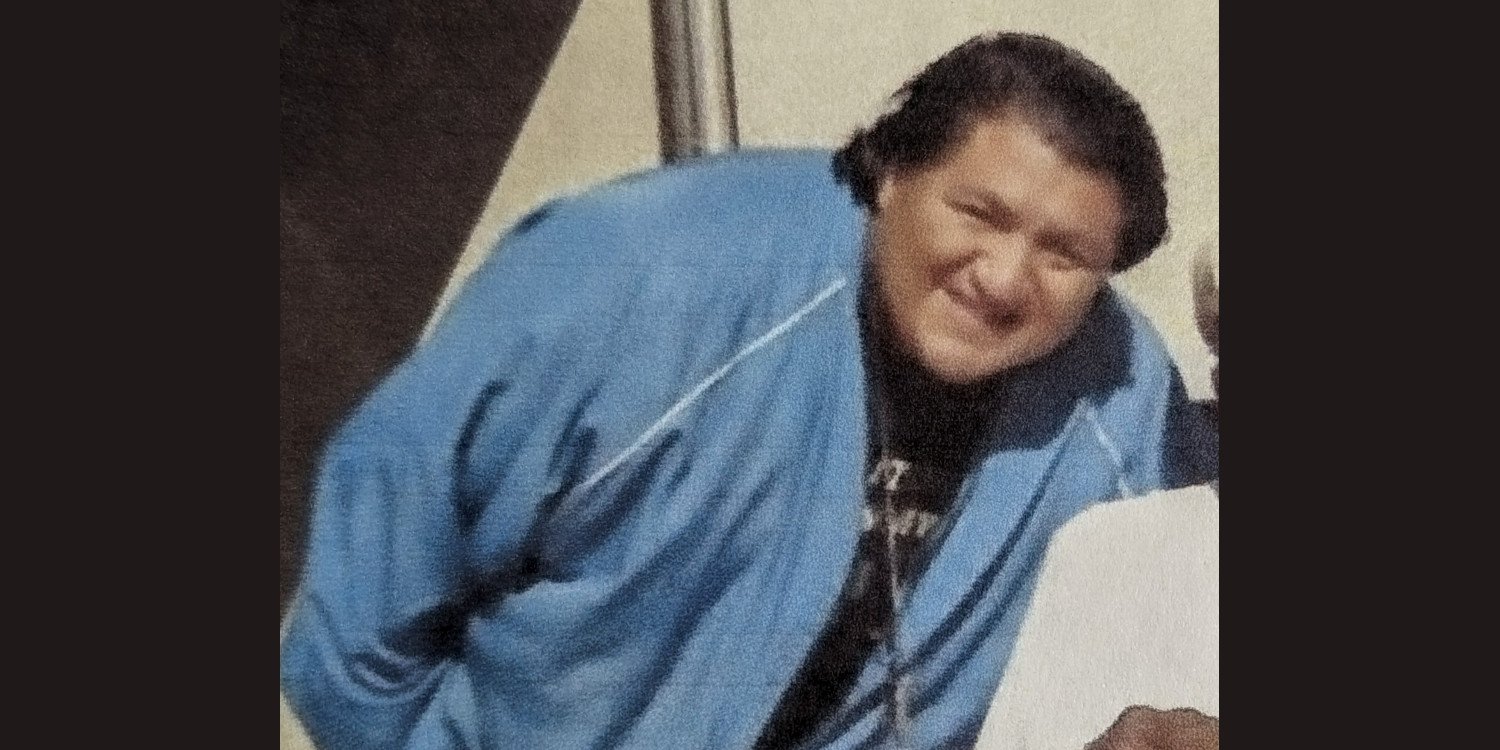
After receiving $200,000 settlement from the Diocese of Manchester in 1996, Thomas Grover relocated to Arizona. He is pictured here about three years after the MacRae trial.
Now Pauline Goupil, M.A.
Far more troubling was the role played in this trial and its aftermath by psychotherapist Pauline Goupil, M.A. (now Pauline Goupil Vachon). As defense counsel Ron Koch (pronounced “Coke”) stood at the defense table to cross-examine Thomas Grover, Mr. Grover turned in protest to the judge. This 27-year-old, 220 lb. man, no stranger to the criminal justice system, complained that he did not want to look at the defendant during the trial and therefore could not answer Mr. Koch’s questions if he stood in the middle aisle by the defense table. In apparent disregard of the Constitutional right of defendants to confront an accuser at trial, Judge Brennan ordered defense counsel to cross-examine Thomas Grover from a position in the court as far from the defendant as possible.
Later, during a break in the trial, PBS-TV official Leo Demers and his wife Penny approached the defense attorney. The issue, they said, had nothing to do with the lawyer standing near the defendant. They pointed out the presence of a woman seated with spectators on the center aisle. They reported seeing that woman influence Thomas Grover’s testimony using hand signals. They pointed out that defense counsel had been blocking Grover’s view of her when he was standing near Father MacRae during cross examination.
Mr. and Mrs. Demers claimed that when defense counsel asked Mr. Grover to explain to whom he first brought his sexual abuse claims, the police or a contingency lawyer, Thomas Grover looked directly at the woman seated at the center aisle at which point she gestured with her index finger over her eye and down her cheek. Grover then began to sob uncontrollably on the stand, causing the judge to declare a recess. Leo Demers pointed the woman out, and defense counsel approached her.
The woman identified herself as Pauline Goupil, M.A., Thomas Grover’s therapist. The defense approached the bench, the jury was dismissed for the day, and Pauline Goupil was ordered to the stand. Ms. Goupil testified that she had been retained by Thomas Grover at the behest of contingency lawyer, Robert Upton, to counsel Grover throughout the trial and keep him “clean and sober.” Ms. Goupil stated that she had a practice specialization in treating victims of sexual abuse and assault.
For an entire afternoon, Pauline Goupil, M.A. testified about her role, and vehemently protested defense attempts to obtain her file. Pre-trial, the defense moved for copies of all Thomas Grover’s treatment records, but received none of them despite Grover's claim that he had been treated for his drug addiction six times. The defense was never told of Grover’s on-going treatment with Pauline Goupil.
In the end, the judge ruled that he would conduct an in-camera review of Ms. Goupil’s treatment file which she was ordered to produce the next day. She was then barred from the court for the remainder of trial. The presence of Ms. Goupil, and the matter of her giving Grover hand signals during his testimony, was never heard by the jury and the defense counsel did not move for a mistrial.
Pauline Goupil’s file was submitted the next day for in-camera review by Judge Brennan. In it was a letter from Ms. Goupil to Thomas Grover in which she chastised him for not showing up for her sessions, and assured him:
“I have good news. Jim [Keene, NH sex crimes detective James F. McLaughlin] told me that MacRae is being offered a plea deal he will have to accept. So there will be no trial. We can just move on with the settlement phase.”
Neither the letter, nor Pauline Goupil’s coaching of Thomas Grover’s testimony ever became known to the jury.
Several years after this trial, but before his retirement from PBS and WGBH Television in Boston, Leo Demers wrote a personal letter to retired Judge Arthur Brennan:
“My wife and I were present in the courtroom throughout most of the trial of Fr. Gordon MacRae in 1994. For all these years, I have had many questions about this trial and much that I have wanted to clarify for my own peace of mind ... . We saw something in your courtroom during the MacRae trial that I don’t think you ever saw. My wife nudged me and pointed to a woman, Ms. Pauline Goupil, who was engaged in what appeared to be clear witness tampering. During questioning by the defense attorney, Thomas Grover seemed to feel trapped a few times. On some of those occasions, we witnessed Pauline Goupil make a distinct sad expression with a down-turned mouth and gesturing her finger from the corner of her eye down her cheek at which point Mr. Grover would begin to cry and sob on the stand. The lawyer’s questions were never answered.
“I have been troubled about this for all these years. I know what I saw, and what I saw was clearly an attempt to dupe the court and the jury. If the sobbing and crying was not truthful, then I cannot help but wonder what else was not truthful on the part of Mr. Grover. If he was really a victim who wanted to tell the simple truth, then why was it necessary for him and Ms. Goupil to have what clearly appeared to be a set of prearranged signals to alter his testimony?”
Back at the 1994 trial, once Pauline Goupil’s role in the case was known, Thomas Grover was put back on the stand. He testified that Ms. Goupil arranged for him to be drugged before his testimony, and that was why he could not remember specifics. Thomas Grover claimed that part of the residual effect of the abuse he suffered was chronic unemployment due to his emotional state. He was asked by defense counsel how — since he could not hold a job — could he afford weekly therapy with Ms. Goupil. Grover stated, “She worked something out with my lawyer. She’ll be paid after the settlement.” Earlier in his testimony, Grover denied having any awareness of plans to sue the Catholic Church.
The next morning in the court, Judge Brennan cited a local Keene Sentinel news article reporting that Thomas Grover appeared confused and inconsistent on the witness stand. Judge Brennan came up with a shocking remedy for this. When he summoned the jurors back into the Court, he instructed them to “disregard inconsistencies in Mr. Grover's testimony.”
Pauline Goupil had just three years earlier obtained a B.A. in psychology from “The School of Lifelong Learning.” She then received an M.A. in counseling from Antioch College in Keene, NH where the state’s expert witness in this trial, Leonard Fleischer, Ed.D., was a faculty member and Ms. Goupil’s mentor.
Shortly after Father MacRae was sent to prison, some of the witnesses in this trial spotted Ms. Goupil in the prison’s visiting area. She was visiting her son who in 1989 was convicted at age 19 of multiple charges of serial rape for which he is serving a lengthy sentence. Her son’s convictions came just a few years before Pauline Goupil began a practice specialization in treating victims of sexual assault.
Two years after Gordon MacRae’s criminal trial, Pauline Goupil offered extensive testimony in a lawsuit against the Catholic Church brought by Thomas Grover and his brothers. Her testimony was in support of Grover’s attempt to defeat the state’s three-year statute of limitations on tort actions by claiming, successfully, that the statute of limitations should begin to toll only when a victim becomes aware he was injured and makes a causal connection with abuse.
Toward that end, Pauline Goupil testified with a whole lot of information and documentation that was not part of the treatment file that she was ordered by Judge Brennan to hand over in 1994 for in-camera review.
In her renewed testimony for the lawsuit in 1996, she testified that Thomas Grover’s particular version of Post Traumatic Stress Disorder caused him to “suppress” all emotional awareness of the abuse he suffered, and caused him to forget many crucial details of that abuse until his pre-trial treatment sessions with her. From the 1996 testimony of Pauline Goupil, M.A.:
Q: Now, one of the ways that a person avoids trauma is inability to recall important aspects of the trauma?
Ms. Goupil: Yes.
Q: That’s not true in Tom’s case is it?
Ms. Goupil: Yes, it is true.
Q: Didn’t he tell you all about this trauma?
Ms. Goupil: He told me some incidences of trauma, but there were some details that were very relevant that I heard when I was sitting in court that he had never spoken with me about that he could remember. One of the symptoms of [PTSD] is that the person forgets information that is really quite relevant to the trauma.
Q: How do you know that he forgot these things?
Ms. Goupil: The point [is] that a person who suffers from Post Traumatic Stress Disorder will forget relevant information, meaning that it’s relevant to the trauma that they experienced, but they will remember irrelevant information.
Q: Tom remembered this trauma, isn’t that right?
Ms. Goupil: Parts of the trauma.
Q: Is it fair to say that, as you understand it...that he did not forget any aspect of what happened to him that he had reported to you?
Ms. Goupil: He did forget some aspects of what happened to him.
Q: No. That he had reported to you.
Ms. Goupil: Your questions are very complicated.
Q: All right. Let me start again... . It was apparent that he had always remembered the things that he told you?
Ms. Goupil: No, that is not apparent.
Q: Okay. Tell me. Did he say, “I just remembered these.”?
Ms. Goupil: Yes.
Q: And what did he say that he just remembered?
Ms. Goupil: I can’t tell you any specific memory because all the memories are just sort of there, but he would come into a — I can’t name a particular session — I would have to consult the file — where he would say...you know, something happened and I just remembered it.
Elsewhere in the 1996 lawsuit transcript, Pauline Goupil testified about her diagnosis of Tom Grover:
Q: ... Now did you review your records in the time that you were away about the number of visits that you had with Tom?
Ms. Goupil: Yes.
Q: ... And what’s the total number?
Ms. Goupil: Twenty-eight.
Q: And those sessions each lasted about an hour in the usual course?
Ms. Goupil: Fifteen minutes.
Q: And the diagnosis you made was when? At the end of the line? At the beginning
Ms. Goupil: At the beginning. It usually takes two or three sessions to make an assessment.
Q: You said you gave him a dual diagnosis?
Ms. Goupil: Yes.
Q: One thing I heard was Post Traumatic Stress Disorder?
Ms. Goupil: Uh-huh.
Q: The other problem?
Ms. Goupil: Substance abuse. In remission.
Q: ... So, now we’re talking about PTSD, and you’re diagnosing it with regard to someone who has had a sexual experience.
Ms. Goupil: That’s correct... . In 1980 PTSD was taken out of the battlefields and brought into the battlefields of persons who have been abused because the symptomatology was very obviously similar to people who were returning from war.
Q: ... Would you say psychotherapy is an art, science, or both?
Ms. Goupil: My degree is a Master of Arts so I guess it’s probably an art.
Author’s note: During an ongoing investigation of this matter by former FBI Special Agent Supervisor James Abbott, both Thomas Grover and Pauline Goupil declined to be interviewed or to answer any questions regarding this matter.
+ + +
Editor’s Note: Thank you for reading and sharing this post. You may also be interested in these related posts by Ryan A. MacDonald.
The Trial of Father MacRae: A Conspiracy of Fraud
The Eucharistic Adoration Chapel established by Saint Maximilian Kolbe was inaugurated at the outbreak of World War II. It was restored as a Chapel of Adoration in September, 2018, the commemoration of the date that the war began. It is now part of the World Center of Prayer for Peace. The live internet feed of the Adoration Chapel at Niepokalanow — sponsored by EWTN — was established just a few weeks before we discovered it and began to include in at Beyond These Stone Walls. Click “Watch on YouTube” in the lower left corner to see how many people around the world are present there with you. The number appears below the symbol for EWTN.
Click or tap the image for live access to the Adoration Chapel.
The following is a translation from the Polish in the image above: “Eighth Star in the Crown of Mary Queen of Peace” “Chapel of Perpetual Adoration of the Blessed Sacrament at Niepokalanow. World Center of Prayer for Peace.” “On September 1, 2018, the World Center of Prayer for Peace in Niepokalanow was opened. It would be difficult to find a more expressive reference to the need for constant prayer for peace than the anniversary of the outbreak of World War II.”
For the Catholic theology behind this image, visit my post, “The Ark of the Covenant and the Mother of God.”

Listen to Our Mother: Mary and the Fatima Century
The century since the Miracle of Fatima in 1917 saw an explosion of Marian devotion throughout the world. For me, one skeptic priest, resistance was futile.

The century since the Miracle of Fatima in 1917 saw an explosion of Marian devotion throughout the world. For me, one skeptic priest, resistance was futile.
Back in May, 2017, Mother’s Day in the United States was on the day after the 100th anniversary of the first apparition of Our Lady of Fatima which occurred on May 13, 1917. There was a lot taking place in preparation for the observance of that day, but very little of it was available to me. Months earlier I received a wonderful letter from Annie Karto, a Catholic songwriter and music composer. She had composed a beautiful song entitled “Rise Up All People,” and she performed it in 2016 as part of a special Divine Mercy production that included a slide presentation. She wanted me to know that I was a part of that presentation and that she was dedicating the song to me. She wanted to send me a link to the video so I could hear it and see the presentation. I was most grateful to her but there was simply no format available to me in prison to make that happen.
For the previous 23 years, I had been living in what was widely understood here to be punitive housing. I was told that it was because I do not admit guilt. So for 23 years I just endured it. I endured it far longer than any other prisoner. For half of those years, Pornchai Moontri lived in a cell with me. As you know, some very important things took place in those years that were filled with grace personally inspired by Saint Maximilian Kolbe who pointed us always to the Immaculata.
During a Divine Mercy workshop in the prison chapel that year, one of the volunteers from the National Shrine of The Divine Mercy told me that Concord, NH has a Catholic radio station. I had no idea. The only radio available for purchase where I happened to be living was a small hand-held model manufactured by Sangean and sold to prisoners here for just under $50. It was a pricey item considering that there are many radios for a fraction of that price, but in prison we had no other options. I decided against the purchase because the world of concrete and steel where we lived blocked out most radio signals. So why would anyone here buy a radio? That was a question I was asking myself even as I filled out the order form to send to a friend who wanted to order one for me from a catalog of items approved for prisoners. At the time, I needed other things more than a radio. I had holes in my socks but for reasons I do not understand to this very day, a friend was insistent that I have a radio. So when my radio arrived, I installed two AAA batteries, tuned into the FM frequency that carried the signal for Ave Maria Radio, and heard nothing but disappointing static.
So in mid May 2017, the morning of Mother’s Day, the day after hearing all that static on my new radio, Pornchai and I went outside to the prison Ball Field. He was pitching for a baseball game that day, and I just wanted to walk the perimeter of the field. On our way there, after we had passed through several locked doors and barriers, Pornchai said, “Why don’t you bring your radio?” So I rushed back through multiple barriers, patiently waiting at each for unseen entities to buzz me through a multitude of electronic locks. I got back to our cell, grabbed the radio, and reversed the process of waiting at each of the locked doors.
I made it back to the Ball Field just as the last door was about to slam shut. I walked toward the back of the field, took my radio out of my pocket, and unraveled its earbud headphones. It was still tuned to the local Catholic station from which I heard only static the night before. At the moment it came alive in the Ball Field, I heard the voice of Teresa Tomeo say, “Our guest today is Catholic singer and songwriter Annie Karto to discuss her latest CD, ‘Rise Up All Peoples.’” And then I heard for the first time Annie’s now famous song. I had imagined that song in my mind many times, but never heard it. Months before, Annie Karto, produced a video for that song for a national conference on Divine Mercy, and the video included, among many images, a photograph of me from an article for the Year of Mercy entitled “The Doors that Have Unlocked.”
Having neither seen nor heard any of this before, I could only imagine it until that morning outside when I had the right receptor at just the right time to hear the music play. My friend, Pornchai Moontri was on the pitcher’s mound in a game when he stopped to wonder why I was standing mesmerized and immobilized at the far outfield.

Click or tap image to play Annie Karto’s 4-minute presentation of “Rise Up All People.”
Listening to Mary with the Right Receptors
When that was over, and Teresa Tomeo’s Catholic Connection had signed off for the day, I had another five minutes out in the field. I continued listening to a call-in show about Scripture. The first caller was a man who identified himself as a fallen away Catholic who is now a Protestant Evangelical. He said that he left the Church because of the Catholic focus on Mary as “a conduit of grace” which, he seemed to believe, is not supported by Biblical truth.
At that moment, my new radio just stopped working. It died two months after I received it. I tried everything to get it working again, but to no avail. I cannot return it, and given its limited use (outside only) I could not justify buying a new one. So now I just walk in the Ball Field in silence. But I have the strangest sense that I heard the things that I was supposed to hear when I had the right receptor to hear them. I do not know how the Catholic radio commentators responded to the Evangelical’s concern about Mary, but the answer came to me immediately. I was thunderstruck by it, and by how little thought I had ever given to this before.
The basis of religious authority for Evangelical Protestants is “Sola Scriptura,” Latin for “Scripture Alone.” The concept embraces not just Biblical authority, but also a deeply held belief in Biblical inerrancy. Both notions clearly support Catholic belief in the role of Mary in Salvation History. It’s a truth that I was once deaf to as well, because I did not employ the right receptors to hear it. There was a time as a younger priest inspired only by science, when I scoffed at notions such as Marian apparitions at Fatima. But I have come to understand that such things are highly valued in our life of faith, less by the events themselves and more by their impact on our spiritual history. I was a little slow in my heart to come to understand Mary in our life of faith as Catholics. I knew all that there was to know about her, but I did not know her. I did not “hear” Mary because I did not have inner receptors tuned to her. The deep reverence that Catholics hold for Mary, and the notion that she can be, and has been, an emissary from Heaven and a conduit of grace make total sense.
The appearances of Mary in the Gospel are like bookends for the story of salvation. Her first appearance — in the Gospel of Saint Luke (1:26-56) — opens with an angelic declaration that is unprecedented in all of Sacred Scripture:
“In the sixth month the Angel Gabriel was sent from God to a city of Galilee named Nazareth, to a virgin betrothed to a man whose name was Joseph, of the house of David; and the virgin’s name was Mary. And he came to her and said, ‘Hail, full of grace, the Lord is with you.’”
— Luke 1:26-28
Scripture contains 326 references to angelic appearances between the fall of Adam and the Resurrection of Christ. This brief passage in the Gospel of Luke is the first and only place where an angel refers to a human person with a title instead of a name. And the title — rendered “full of grace” in its English translation — is fascinating.
The term appears in only one other place, the Book of Acts of the Apostles which was also authored by Saint Luke. It’s a reference to Stephen who would become Christianity’s first martyr: “Stephen, full of grace and power, did great wonders and signs among the people” (Acts 6:8). However, these English translations of the term fail to capture the full meaning the Evangelist intended. In Saint Luke’s original Greek, the terms have very different meanings.
In the case of Stephen, the original Greek words of Luke for “full of grace” were “plērēs charitos.” You can see in this the Greek roots of the word “charity.” But in the angel’s reference to Mary, a very different Greek term was used to convey the words, “full of grace.” It was a title much more than a trait. The Greek term Saint Luke used is “kecharitomēnē,” a far more revealing concept. It refers not just to a facet of her character, as in the case of Stephen, but of her essence. “Kecharitomēnē” refers to a prior action of God in which Mary was “graced” in the sense of her being a “vessel” in multiple tenses — past, present, and future — who is instilled with divine life, a soul that magnifies the Lord.
This does not mean that Mary was divine. It means that God prepared her from the moment of her conception. Some English translations use the term “highly favored one” instead of “full of grace” in the Angel’s greeting, but this in no way captures the truth of the Evangelist’s meaning which is far more profound than “favor.” It is closer to “innate holiness.” Saint Luke’s unique Greek title became the Scriptural basis for the Catholic doctrine of the Immaculate Conception. It points not to a trait of Mary’s character, but to a revelation of her lifelong holiness and unique place in Salvation History as the Mother of both the Redeemer and the redeemed — the new Eve.
In the angelic declaration to Mary (Luke 1:28) the next phrase is rendered in English, “the Lord is with you.” Its more proper sense is, “the Lord is within you.” Her Greek title, “Theotokos,” literally “Mother of God,” was defined at the Council of Ephesus in A.D. 431 and reaffirmed by the Second Vatican Council in Lumen Gentium (53). For the entire life of the Church, Mary has been venerated — not worshipped, but venerated — as the Mother of God. This is a theological truth that I described in “The Ark of the Covenant and the Mother of God.”

The Miracles of Fatima
I owe a debt today to the Marians of the Immaculate Conception, stewards of the National Shrine of The Divine Mercy in Stockbridge, Massachusetts. I wrote of this debt, and of my all-too-human resistance to their great gift, in “Divine Mercy in a Time of Spiritual Warfare.” That debt was deepened in 2022. That is when the Church marked the 100th anniversary of our Blessed Mother’s first of six appearances to three small shepherd children in the village of Fatima, Portugal. She appeared to them in this little known, out-of-the-way village in Portugal as World War One raged on all around them. It was the time of what Pope Benedict XV (not XVI) described as “the suicide of Europe.” It was at this very time that Mary reentered human history to convey a message through the smallest of voices in a most insignificant place. Then it echoed with ever increasing volume across the century to follow.
I had never fully understood the apparitions at Fatima. My scientific mind with its natural skepticism had always been in the way, making real moments of grace hard won for me. But now I think, for the first time in my life, I understand what happened at Fatima commencing on May 13, 1917 and the 13th of each of five months to follow. And thanks to Fr Michael Gaitley’s book The Second Greatest Story Ever Told, I finally understand Fatima’s meaning in the context of faith and in the context of human history.
My understanding has also been greatly aided by a wonderful gift by a superb Catholic writer and friend of Beyond These Stone Walls, Felix Carroll. You have met Felix Carroll in these pages before. He is the Executive Editor of Marian Helper magazine, which has published two major articles about my friend Pornchai Moontri’s Divine Mercy conversion and my place in that remarkable story. Felix is also the author of the great Divine Mercy book, Loved, Lost, Found: 17 Divine Mercy Conversions with a chapter about the life of Pornchai.
As I was pondering how to approach a post about the Fatima Century, I quickly found myself wading into waters I am only now beginning to sound for spiritual depth. Knowing the facts is one thing, but knowing the necessary story under the story is quite another. The Spring 2017 issue of Marian Helper with a cover entitled “Fatima: 100 Years Later” filled in a lot of the blanks for me. I read it cover to cover in one sitting. Its centerpiece is an amazing article by Felix Carroll entitled, “Fatima. The Place. The Message.” I am simply in awe of his achievement. I urge you to visit Marian Helper and read Felix Carroll’s outstanding writing, his historical analysis, and the depth of his understanding of the message and miracle of Fatima — all in just a few very readable pages.
In 2017, at the behest of Fr Michael Gaitley and Felix Carroll, I wrote an article about the journeys of both me and Pornchai Moontri into the Heart of Jesus through the Immaculate Heart of Mary. The article was, “Behold Your Son, Behold Your Mother!” Felix told me that it “ lit up the Marians’ website as never before.” It was not me and Pornchai who got the attention of so many people. It was her. It is no mystery in our troubled time that so many are finally coming to listen to our Mother. After writing the article I received this brief reflection from an Evangelical Protestant college student:
“I finally get it! I am a college student and a lifelong Protestant. I never understood the Catholic connection to Mary until I read this. Thanks to this I finally understand Mary and her place in the life of faith.”
+ + +
Note from Fr Gordon MacRae: Please honor our Mother by sharing this post. You will behold her place in history as never before by reading and sharing with others another amazing post written for Beyond These Stone Walls and LifeSite News by Craig Turner entitled:
“How Our Lady of Fatima Saved a World in Crisis”
The 100th Anniversary of the apparitions at Fatima can be seen through a lens of history. Journalist and historian Craig Turner presents a fascinating view of the Fatima Century.
July 12, 2017 by Craig Turner with an Introduction by Fr Gordon MacRae
The Eucharistic Adoration Chapel established by Saint Maximilian Kolbe was inaugurated at the outbreak of World War II. It was restored as a Chapel of Adoration in September, 2018, the commemoration of the date that the war began. It is now part of the World Center of Prayer for Peace. The live internet feed of the Adoration Chapel at Niepokalanow — sponsored by EWTN — was established just a few weeks before we discovered it and began to include in at Beyond These Stone Walls. Click “Watch on YouTube” in the lower left corner to see how many people around the world are present there with you. The number appears below the symbol for EWTN.
Click or tap here to proceed to the Adoration Chapel.
The following is a translation from the Polish in the image above: “Eighth Star in the Crown of Mary Queen of Peace” “Chapel of Perpetual Adoration of the Blessed Sacrament at Niepokalanow. World Center of Prayer for Peace.” “On September 1, 2018, the World Center of Prayer for Peace in Niepokalanow was opened. It would be difficult to find a more expressive reference to the need for constant prayer for peace than the anniversary of the outbreak of World War II.”
For the Catholic theology behind this image, visit my post, “The Ark of the Covenant and the Mother of God.”
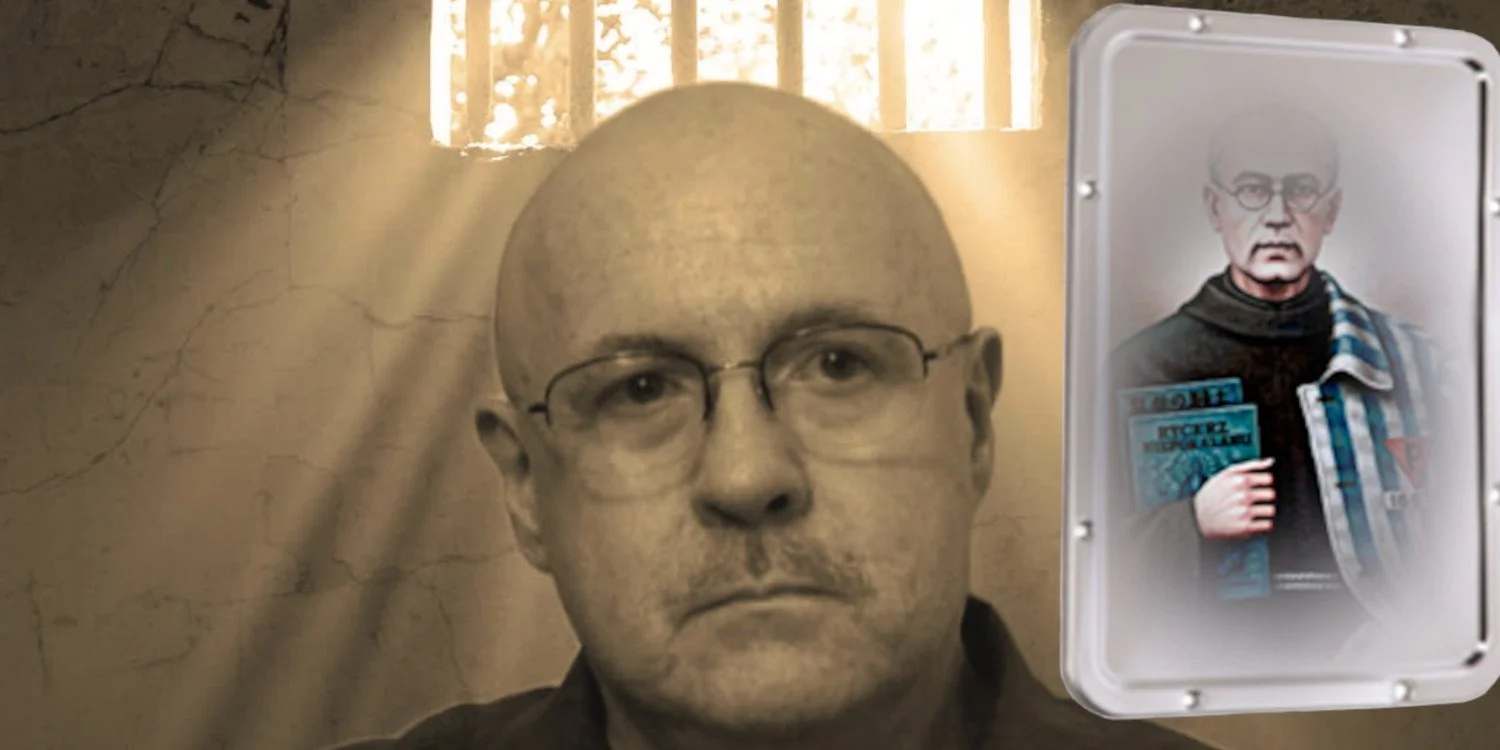
Maximilian Kolbe: The Other Prisoner Priest in My Cell
Unjustly in prison since 1994, Fr Gordon MacRae began this blog in early August 2009. From his cell he looked into a mirror as a prisoner, but a priest looked back.
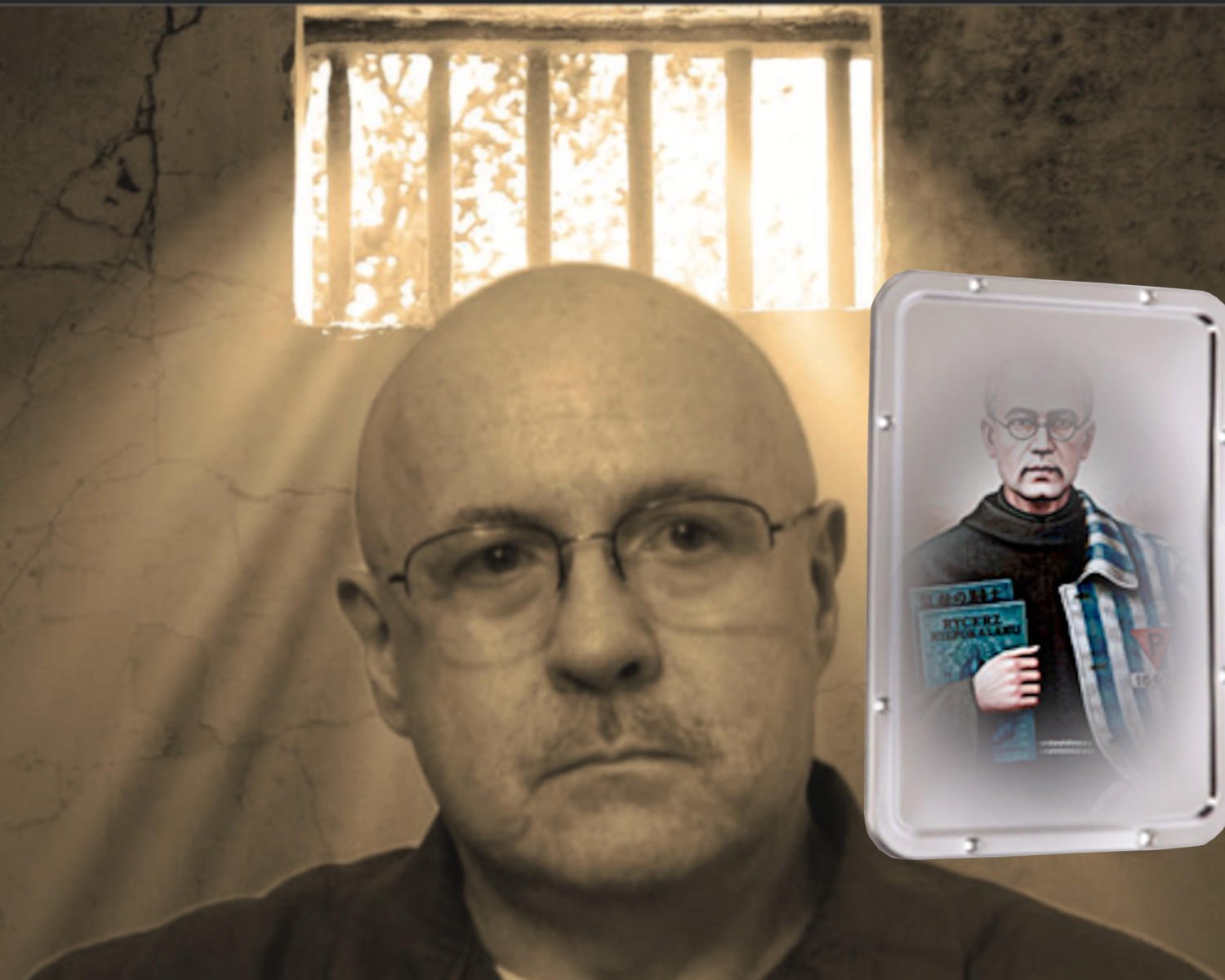
Unjustly in prison since 1994, Fr Gordon MacRae began this blog in early August 2009. From his cell he looked into a mirror as a prisoner, but a priest looked back.
August 9, 2023 by Fr Gordon MacRae
“Now we see dimly as in a mirror, but then we shall see face to face. Now I know only in part, but then I shall understand fully even as I am fully understood.”
— 1 Corinthians 13:12
+ + +
At the end of our annual BTSW Christmas Card in December, 2022, we posted a live YouTube feed linked to a beautiful Adoration chapel in Poland sponsored by EWTN. Months later, I wrote a post that was popular with readers around the world. It was “Eucharistic Adoration: Face to Face in Friendship with God.” Its introduction was, “A live internet feed from a Eucharistic Adoration chapel in Poland landed on this blog at Christmas and is now revealed as a gift from a beloved Patron Saint.”
It was only weeks after we posted it that I learned that the live feed was from the chapel of Niepokalanow, the City of the Immaculata founded by St. Maximilian Kolbe prior to his 1941 arrest and imprisonment at Auschwitz where he was martyred. Most of our readers knew what this meant to me. It was a direct link to the Patron Saint of this blog — the saint who inserted himself not only in my life, but in the life of Pornchai Moontri as well. At the time of his Divine Mercy conversion, Pornchai took the name Maximilian as his Christian name.
I have written so many posts about St. Maximilian Kolbe that I cannot write this one in any way that would make it stand out. Maximilian is one of two Patron Saints who stand with me in this imprisonment and in this blog. I mean that literally. The other is Saint Padre Pio.
Oddly enough, I must refer you to a post about Padre Pio for a sense of what the other patron saint has meant to us. That post is “Padre Pio: Witness for the Defense of Wounded Souls.” I will link to it again at the end of this post, but I want to first present an excerpt from it here:
“Among the many letters of Padre Pio to the thousands of pilgrims and penitents who wrote to him was one dated in the year before Padre Pio's death on September 23, 1968. In that letter, Padre Pio advised a suffering soul to enroll in the Knights at the Foot of the Cross, a spiritual movement founded by Father Maximilian Kolbe for the offering of life's wounds as a share in the suffering of Christ. I was amazed to read that Padre Pio had such an awareness of our other patron saint two decades before St. Maximilian Kolbe was canonized.”
I should point out that both saints were canonized by another saint, John Paul II. I wrote the above post in September 2020. It begins with a description of my friend Pornchai Moontri walking with me in the prison yard early in the morning of September 8, 2020. It was the day Pornchai left after nearly 15 years in a prison cell with me. Last week in these pages, I wrote of that journey, of both the heartbreak of change and the challenge of hope. You should not miss that post either. It was, “For Pornchai Moontri, Hope and Hard Work Build a Future.”
The year 2009, when this blog began, was a strange one for us behind these stone walls. It was four years after The Wall Street Journal published the first of many articles exposing prosecutorial corruption in the case that sent me to life in prison in 1994. Judge Arthur Brennan, now retired in New Hampshire, might not agree that he imprisoned me to a “life” sentence, but I was 41 years old when he imposed a 67-year prison sentence on me citing “clear and convincing evidence.”
The “evidence” he cited did not exist, has never existed, and has been exposed as the result of a police officer’s corruption which some entities are working very hard to cover up. I am now 70, and will be 108 when my sentence is over. Even now there is a suggestion that I could see freedom if I just admit guilt.
In my first 12 years in prison from 1994 to 2006, I existed in a sort of mental and spiritual paralysis. Then two things happened in 2006 that altered the course, not only of my life, but of my soul. First, St. Maximilian arrived on my cell mirror. Then, as though on cue, Pornchai Moontri also arrived in my cell. The first thing he ever said to me was in the form of a question. Pointing to the photo on my mirror he asked, “Is this you?”
I could best answer that question today by revisiting the first three posts I wrote for this blog in August, 2009. Don’t worry. I was a lot less long-winded back then. Each of these three earliest posts was but a page or two. Fourteen years later, they hold up well against the test of time, so bear with me please.
+ + +
August, 2009 — St. Maximilian Kolbe and the Man in the Mirror

For someone on the outside looking in, it must seem an odd place to begin. Virtually every prison cell has one: a small stainless steel sink with a matching toilet welded to its side. Bolted to the cinderblock wall just above it is a small stainless steel mirror, dinged, dented, and scraped so badly that the image it reflects is unrecognizable.
I begin each day at the break of dawn in prison by shaving in front of that mirror. This morning ritual has repeated 5,412 times. [At this writing, it is 10,530 times.] I seldom cut myself shaving — a minor miracle as I can see very little of me in that mirror. I often think of St. Paul’s cryptic image in his first letter to the Church in Corinth (13:12): “For now I see dimly, as in a mirror, but then I shall see face to face.” It is a hopeful image.
I sometimes find that my mind calculates dates and their meanings on a sort of autopilot. There came a day when I stood at the mirror to shave and realized that on this day it was Dec. 23, 2006. I have been a priest in prison for the exact amount of time that I was a priest “on the streets” as prisoners like to describe their lives before prison.
From that day until now, I wonder which I see more of in that flawed mirror. Do I see the man who is a priest of 27 years? Or do I see only Prisoner 67546, the identity given to me inside these stone walls?
A strange thing happened on the day after I first reflected — as best I could in that mirror — on who I see. It was Christmas Eve, December 24, 2006, the day that the equation changed. It was the day that I was a priest in prison longer than anywhere else. That night at prison mail call, I had a few Christmas cards. One of them was from Father James McCurry, a Conventual Franciscan priest who once visited me in prison.
Inside Father McCurry’s Christmas card was a prayer card that is now one of my enduring treasures. It is taped to the stone wall just above the shaving mirror of my cell and has been there ever since the day I received it. The holy card has an image of St. Maximilian Kolbe who offered himself for execution in place of another prisoner in Auschwitz in 1941. The card depicts Father Kolbe in his Conventual Franciscan habit. He has one sleeve in the striped jacket of his prison uniform with the number 16670 emblazoned across it. There is a scarlet “P” above the number indicating his Polish nationality. He was also a priest and a falsely accused prisoner. Does either designation extinguish the other? Father Kolbe is at once both, though only one identity was chosen by him.
The image is a haunting image for it captures fully that struggle I have so keenly felt. Father Maximilian appeared in my cell just a day after I asked the question of myself. Who am I? I thought at the time, that it was a rhetorical question, but it was a prayer. As such, it begged a reply — and got one.
+ + +

August, 2009 - Maximilian and This Man’s Search for Meaning Part I
How I came to be in this prison is a story told elsewhere, by me and by others. How I “met” Father Maximilian Kolbe 60 years after he surrendered his life at Auschwitz is a story about actual grace. In his Catholic Catechism, Jesuit Father John Hardon defines actual grace as God’s gift of “the special assistance we need to guide the mind and inspire the will” on our path to God. Sometimes, it’s very special.
My first three years in prison are a blur in my memory. There is no point trying to find words to express the sense of loss, of alienation, of being cast into an abyss that was not of my own making — a loss that could not be grounded in any reality of mine. About 1,000 days and nights passed in the abyss before what Father Hardon described as “special assistance” crossed my path.
Someone, somewhere — I don’t know who — sent the prison’s Catholic chaplain (a layman then) a book entitled Man’s Search for Meaning by Viktor Frankl, M.D. Somewhere in my studies, I heard of this book, but only a prisoner can read it in the same light in which it was written. The chaplain summoned me to his office. He wanted to know whether he should recommend this book, but didn’t have time to read it. He wanted my opinion. It had been years since anyone had asked my opinion on anything.
I didn’t read Dr. Frankl’s book so much as devour it. I read it through three times in seven days. As a priest, I often preached that grace is a process and not an event. It is not always so. I was meant to read Man’s Search for Meaning at the precise time that it landed upon my path. A week earlier, I would not have been ready. A week later may have been too late. I was drowning in the solitary sea of deeply felt loss. I was not going to make it across. My priesthood and my soul were dying.
The Book, as I have come to call it, is Viktor Frankl’s vivid account of how he was alone among his family to survive imprisonment at Auschwitz. This was an imprisonment imposed on him for who he was: a Jew. There is a central message in this small book. A profound message, so clear in meaning, that it has within it the hallmark of inspired truth. Like Saul thrown from his mount to become Paul, I remember sinking to the floor when I read it
“There is a freedom that no one can ever take from you: The freedom to choose the person you are going to be in any set of circumstances.”
This changed everything. Everything! You will see how later. At the very end of his book, Dr. Frankl revealed the name of his inspiration for surviving Auschwitz. He wrote of Sigmund Freud’s cynical view that man is self-serving. And a man’s instinctual need to survive will trump “quaint notions” such as grace and sacrifice every time. For Dr. Frankl, Auschwitz provided the proof that Freud was wrong.
That proof, he wrote, was Father Maximilian Kolbe . . . .
+ + +

August, 2009 — Maximilian and This Man’s Search for Meaning Part II
As a young priest in 1982, I was only vaguely familiar with the name Maximilian Kolbe. I remember reading of his canonization by Pope John Paul II, but Father Kolbe’s world was far removed from my modern suburban priestly ministry. I was far too busy to step into it. I didn’t know that nearly two decades later, Father Kolbe’s life, death, and sainthood would be proclaimed on the wall of my prison cell. I also didn’t know that this would help define the person I choose to be in prison.
Being a Jew and not a Catholic, Dr. Viktor Frankl in Man’s Search for Meaning, said nothing about Maximilian’s sainthood or any miracles attributed to his intercession. Instead, Dr. Frankl was moved by the profound charity of Maximilian, which defied the narcissism of our times. For those unfamiliar with him, the story is simple.
The prisoners of Auschwitz were packed into bunkers like cattle. To encourage informants, the camp had a policy that if any prisoner escaped, 10 others would be randomly chosen for summary execution. At the morning roll call one day, a prisoner from Maximilian’s bunker was missing. Guards chose 10 men to be executed. The 10th fell to the ground and cried for the wife and children he would never see again. Father Kolbe spontaneously stepped forward. The camp commandant stopped the selection process and demanded, “Who is this Polish swine?” Father Maximilian answered, “I am a Catholic priest, and I would like to take the place of this man.”
Two weeks later, he alone was still alive among the 10 prisoners chained and condemned to starvation. Maximilian was injected with carbolic acid on August 14, 1941, and his remains unceremoniously incinerated. For the unbeliever, all that Maximilian was went up in smoke and ash to drift in the sky above Auschwitz.
Viktor Frankl shared some other corner of that horrific prison. The story of the person Father Kolbe chose to be rippled through the camp. This story offered proof to Viktor Frankl that we can be as much inspired by grace as doomed by despair. We get to choose which will define us.
Within days of reading Man’s Search for Meaning and learning of Father Kolbe’s sacrifice, I received a letter from out of the blue. Conventual Franciscan Father James McCurry had been in an airport in Ireland when he heard an Irish priest nearby mention that he corresponds with a priest in a Concord, New Hampshire prison. Father McCurry said he was on his way to visit his order’s house in Granby, Massachusetts and would arrange to visit the Concord prison. Weeks later, Father McCurry and I met in the prison visiting room. When I asked him what his “assignment” is, he said, “Well I just finished a biography of St. Maximilian Kolbe. Have you heard of him?”
Father McCurry went on to say that he was the Vice Postulator in Rome for the cause of Saint Maximilian’s canonization. He had met the man whose grandfather’s life was saved by Father Kolbe. A few years later, Father McCurry arranged a Father Maximilian Kolbe exhibit at the National Holocaust Museum. It was then that he sent me the card depicting Father Maximilian clothed in his Franciscan habit with one sleeve in his prison uniform. I keep the card above my mirror in my cell.
I can never embrace these stone walls. I can’t claim ownership of them. Passively acceding to injustice anywhere contributes to injustice everywhere. Father Maximilian never approved of Auschwitz.
One can’t understand how I now respond to these stone walls, however, without hearing of Father Maximilian’s presence there. Above my mirror, he refocused my hope in the light of Christ. The darkness can never overcome it. What hope and freedom there is in that fact! The darkness can never, ever, ever overcome it!
+ + +

August 2023
The events described in the three short posts above were published in August, 2009, but they took place in 2006 and 2007. In early 2007 a young man named Pornchai Moontri arrived in this prison after a lifelong passage through the depths of hell. Following 14 years in and out of solitary confinement in a Supermax prison in the state of Maine, Pornchai was transferred to the Concord, NH prison. One day he was dragging a trash bag with his life’s belongings through the cell block where I lived. My door just happened to be open. He stopped in front of it and looked at me with deep hostility in his eyes. It was not the person he chose to be, but rather the person he felt he had to be.
Pornchai looked into my cell and looked directly at the mirror above my sink. He pointed to the image of Saint Maximilian and said, “Is this you?”
Three years later, when Pornchai was received into the Catholic faith on Divine Mercy Sunday 2010 he became — like Saul thrown from his horse to become Paul — Pornchai Maximilian Moontri.
+ + +
Note from Fr Gordon MacRae : Thank you for reading and sharing this post which now incorporates my first three posts from Beyond These Stone Walls. On August 9, the day this is posted, the Church also honors another martyr of Auschwitz, St. Teresa Benedicta of the Cross, the Carmelite scholar formerly known as Edith Stein. We hope you might want to read a bit further with these posts:
Saints and Sacrifices : Maximilian Kolbe and Edith Stein at Auschwitz
A Tale of Two Priests : Maximilian Kolbe and John Paul II

The Eucharistic Adoration Chapel established by Saint Maximilian Kolbe was inaugurated at the outbreak of World War II. It was restored as a Chapel of Adoration in September, 2018, the commemoration of the date that the war began. It is now part of the World Center of Prayer for Peace. The live internet feed of the Adoration Chapel at Niepokalanow — sponsored by EWTN — was established just a few weeks before we discovered it and began to include in at Beyond These Stone Walls. Click “Watch on YouTube” in the lower left corner to see how many people around the world are present there with you. The number appears below the symbol for EWTN.
Click or tap the image for live access to the Adoration Chapel.
The following is a translation from the Polish in the image above: “Eighth Star in the Crown of Mary Queen of Peace” “Chapel of Perpetual Adoration of the Blessed Sacrament at Niepokalanow. World Center of Prayer for Peace.” “On September 1, 2018, the World Center of Prayer for Peace in Niepokalanow was opened. It would be difficult to find a more expressive reference to the need for constant prayer for peace than the anniversary of the outbreak of World War II.”
For the Catholic theology behind this image, visit my post, “The Ark of the Covenant and the Mother of God.”

The Transfiguration of Christ
Jesus took Peter, James, and John to a mountaintop where he was transfigured before their eyes, an event that echoes through the ages in the transformation of souls.

Jesus took Peter, James, and John to a mountaintop where he was transfigured before their eyes, an event that echoes through the ages in the transformation of souls.
August 2, 2023 by Fr. Gordon MacRae
The image atop this post depicts the Transfiguration of Christ, an inspired work by Venetian artist, Giovanni Bellini painted in 1480. The painting is displayed in the Museo di Capodimonte in Naples, Italy. It portrays the Transfiguration of Jesus in the Gospels of Matthew, Mark, and Luke. The account in the Gospel according to Saint Matthew (17:1-9) is the Gospel for the Feast of the Transfiguration of the Lord observed on August 6, 2023 . The Feast of the Transfiguration has been celebrated in the Eastern Church since the Fifth Century. It was inserted into the general calendar in 1457 by Pope Callistus III to mark the defeat of the Muslim Turks in the Battle of Belgrade. It was celebrated on the Sixth of August because it occurs 40 days before the Feast of the Exultation of the Holy Cross on September 14.
The Transfiguration account told in the Gospel of Saint Mark (9:2-10), is simply told, but filled with history and theological meaning:
“After six days, Jesus took Peter, James, and John and led them up a high mountain apart by themselves. And he was transfigured before them, and his clothes became dazzling white, such as no fuller on earth could bleach them. Then Elijah appeared to them along with Moses, and they were conversing with Jesus. Then Peter said to him in reply, ‘Rabbi, it is good that we are here! Let us erect three tents: one for you, one for Moses, and one for Elijah.’ He hardly knew what to say; they were so terrified. Then a cloud came, casting a shadow over them. From the cloud came a voice; ‘This is my beloved son. Listen to him.’ Suddenly, looking around, they no longer saw anyone but Jesus alone with them.”
— Mark 9:2-10
The same basic elements of the Transfiguration account appear in each of the Synoptic Gospels. Peter’s idea to erect tents for Jesus, Moses, and Elijah seems an almost comical response from someone just given a vision of the Kingdom of God and its most renowned denizens from the Hebrew Scriptures. As the passage points out, Peter “hardly knew what to say. They were so terrified.” But the idea wasn’t entirely out of place.
It was the seventh and last day of Sukkoth, the “Feast of Booths” described in the Books of Deuteronomy (16 13-15) and Leviticus (23:42-44). Known in Hebrew as Hag ha-Asif, translated as “The Festival of Gathering,” it lasted for seven days during which Jewish observers erected tents or booths from the boughs or branches of palm trees. The booths were a memorial of their ancestors’ deliverance from bondage in Egypt:
“You shall dwell in booths for seven days, all that are native in Israel shall dwell in booths that your generations may know that I made the people of Israel dwell in booths when I brought them out of the land of Egypt. I am the Lord your God.”
— Leviticus 23: 42-43
The presence of Moses and Elijah with Jesus on Mount Tabor represents the Law and the Prophets, the two pillars of divine revelation in Hebrew Scripture. They represent the heart of God’s covenant with Israel. There were some previous hints of the Transfiguration. In Exodus (34:29), Moses did not know that upon his descent from Mount Sinai with the Tablets of the Law, “the skin of his face shone because he had been talking with God.”
Upon the death of Moses, according to Deuteronomy (34: 5-6), God himself secretly buried his body in an unknown place in the land of Moab. However, the New Testament Letter of Saint Jude (Jude 9) refers to an ancient Jewish legend from the apocryphal text, The Assumption of Moses. Saint Jude described a story that he presumes his listeners already know: that Satan attempted to take the body of Moses, but the Archangel Michael “contended with the devil” and brought the physical body of Moses into Heaven.
The same became true of Elijah. In the Second Book of Kings (2:11) the prophets Elijah and Elisha became separated by “a chariot of fire and horses of fire” and “Elijah went up in a whirlwind into Heaven, then Elisha saw him no more.” In the Gospel account of the Transfiguration, Peter, James, and John — as well as the early Jewish Christian Church — would have readily perceived that Moses and Elijah came from Heaven to witness the Transfiguration of Jesus.
They would also have known well the Prophet Malachi.
“Remember the law of my servant Moses, the statutes and ordinances that I commanded him at Horeb for all Israel. Behold, I will send you Elijah the Prophet before the great and terrible Day of the Lord comes.”
— Malachi 4:4-5
Hence, as each of the Transfiguration Gospels points out, “they were terrified.”

A Transfiguration of Faith
Saint Matthew’s account of the Transfiguration that you will hear at Mass on August 6 begins with the words, “after six days.” Something very important happened six days earlier between Jesus and his disciples that literally rocked their world and shook their faith. As the pilgrimage Feast of Sukkoth began, they saw Jesus cure a blind man at Bethsaida. Then Jesus asked them at Caesarea Philippi (Matthew 16:13-20), “Who do men say that the Son of Man is?” They answered, “Some say John the Baptist” [already slain at Herod’s command], while “others say Jeremiah, or one of the Prophets.”
“But who do you say that I am?” Jesus asked. Simon, answered with something — like the offer to build some booths six days later— that came spontaneously from his heart and soul: “You are the Christ, the Son of the living God!”
What exactly did that mean to Simon Peter, James and John? Those who awaited a Messiah in Israel envisioned a political force who would transform the known world and set it aright. But Jesus said something astonishing (Mark 16:21-24): “From that time Jesus began to show his disciples that he must go to Jerusalem and suffer many things from the elders and chief priests and scribes, and be killed, and on the third day be raised. And Peter took him and began to rebuke him, saying, ‘God forbid, Lord! It shall never happen to you!’ ... Jesus answered, ‘If any man would come after me, let him deny himself, and take up his cross, and follow me.’”
And then a final bombshell: “Truly I say to you, there are some standing here who will not taste death until they see the Kingdom of God come with power.” Hence, once again, Simon Peter, James, and John, dazzled upon Mount Tabor six days later, were terrified when Moses and Elijah appeared.
And what of the Transfiguration itself? The Greek word the Gospel used to describe it is metamorphothe. His very form and substance were transformed. Recall the great hymn of Christ recounted by Saint Paul to the Philippians (2:5-11):
“Though he was in the form of God, Jesus did not deem equality with God something to be grasped, but rather emptied himself, taking the form of a servant, being born in the likeness of men. And being found in human form he humbled himself and became obedient unto death, even death on a cross. Therefore God has highly exalted him and bestowed on him a name above every other name so that at the name of Jesus every knee should bend, in heaven and on earth and under the earth, and every tongue proclaim, to the glory of God the Father, that Jesus Christ is Lord.”
— Philippians 2:5-11
For six days, Simon Peter, James, and John must have lived with shattered hopes, discouraged over the revelation about what it means to follow Jesus to the cross and death. Ascending that mountain to see him transfigured in glory was a gift of Divine Mercy that also transformed the cross — forever.
These same three disciples had been present when Jesus restored life to the daughter of Jairus (Mark 5:35-42), and the same three would later be present with Jesus in the Garden of Gethsemane (Matthew 26:36-46) to see him humiliated as the Passion of the Christ commenced. They were also the only disciples to have been given new names by Jesus. Simon became Peter, “the Rock,” “Petros” in Greek, from which was derived the name, “Peter.” And he called James and John “Boanerges,” the “Sons of Thunder.” Their new names denoted that they were forever changed by these experiences, a transfiguration of identity and faith.

Transfiguration behind These Stone Walls
On August 6, 2014, the Feast of the Transfiguration, the well known Canadian Catholic blog, Freedom Through Truth, featured a post by Michael Brandon titled, “Transfiguration Behind These Stone Walls.” Michael Brandon wrote some very nice things, not so much about me personally, but about what I write. I was first bewildered by it. Then I was very moved. Then I finally accepted his premise that he and other readers have a vantage point I do not have. Michael Brandon wrote:
“In the years that I have followed Beyond These Stone Walls, I have seen the transfiguration of Father Gordon MacRae and Pornchai Moontri.”
Michael Brandon is also the author of a very popular post featured at our “Voices from Beyond.” It is “The Parable of a Prisoner,” and it describes a transfiguration of the heart.
“In our struggle to be holy, grace is certainly required. But we must also do the footwork — we must will to be better than we really are… The degree of perfection is measured by the amount of adversity we overcome in order to be holy.”
— St. Maximilian Kolbe
+ + +
Note from Fr. GordonMacRae: Thank you for reading and sharing this post. We continue the story of Transfiguration in the lives of Sacred Scripture in these other posts from Beyond These Stone Walls:
The Holy Spirit and the Book of Ruth at Pentecost
Joseph’s Dream and the Birth of the Messiah
The Eucharistic Adoration Chapel established by Saint Maximilian Kolbe was inaugurated at the outbreak of World War II. It was restored as a Chapel of Adoration in September, 2018, the commemoration of the date that the war began. It is now part of the World Center of Prayer for Peace. The live internet feed of the Adoration Chapel at Niepokalanow — sponsored by EWTN — was established just a few weeks before we discovered it and began to include in at Beyond These Stone Walls. Click “Watch on YouTube” in the lower left corner to see how many people around the world are present there with you. The number appears below the symbol for EWTN.
Click or tap here to proceed to the Adoration Chapel.
The following is a translation from the Polish in the image above: “Eighth Star in the Crown of Mary Queen of Peace” “Chapel of Perpetual Adoration of the Blessed Sacrament at Niepokalanow. World Center of Prayer for Peace.” “On September 1, 2018, the World Center of Prayer for Peace in Niepokalanow was opened. It would be difficult to find a more expressive reference to the need for constant prayer for peace than the anniversary of the outbreak of World War II.”
For the Catholic theology behind this image, visit my post, “The Ark of the Covenant and the Mother of God.”