“There are few authentic prophetic voices among us, guiding truth-seekers along the right path. Among them is Fr. Gordon MacRae, a mighty voice in the prison tradition of John the Baptist, Maximilian Kolbe, Alfred Delp, SJ, and Dietrich Bonhoeffer.”
— Deacon David Jones

The Birds and the Bees Behind These Stone Walls
Fr Gordon MacRae wrote this post for Independence Day 2012 when he lived in a far more confining space. We are updating this summer gem about the meaning of liberty.

Photo by Lip Lee — CC BY-SA 2.0
Fr Gordon MacRae wrote this post for Independence Day 2012 when he lived in a far more confining space. We are updating this summer gem about the meaning of liberty.
July 3, 2024 by Fr Gordon MacRae
Okay, relax! This isn’t going to be a soap opera about the lurid things you’ve heard about prisons — most of which are not true at all. And I’m not going to San Francisco wearing flowers in my hair or anything. I don’t even have any hair, let alone flowers. So before you unsubscribe or delete BTSW from your blog lists, let me deflate your expectations. My title is far more boring than it sounds.
This is being posted on Independence Day in the United States, the peak of vacation season in the Northern Hemisphere. So I expect a lot of BTSW readers will be outside barbecuing and not stuck inside reading this post. Of course, in an age of iPhones and iPads — neither of which I have ever seen — you could be lounging at the beach while reading of Independence Day in the slammer. Actually, I hope most of you somehow manage to do both!
This post really is about birds and bees — real ones, not the metaphorical ones parents lectured us about growing up. This is about the great outdoors, which, from my perspective, is mostly experienced through a two-by-three-foot, sealed and heavily barred window in a concrete and steel prison cell. Through that window, I have seen 18 years of summers come and go. I was never one for hanging around bars, but now I have little choice. I have been a devoted observer of the rhythms of life through a small barred window for a long, long time.
Sometimes I receive letters from readers who tell me they’re hesitant to write of their vacations and travels, their celebrations and family gatherings, their liberties. They write that they fear making me depressed by reminding me of places I cannot see, things I cannot have, and freedoms I can no longer embrace. Please don’t ever feel this way. I do not see most things in terms of myself. I don’t think there is anyone who revels in your freedom more than I do.
Hebrews 13:3 tells us to “Remember those who are in prison as though in prison with them.” I much appreciate that so many of you fulfill this admirably. But I can also remember freedom, and I can celebrate yours. Perhaps there are things you can also learn about appreciating life and liberty from someone unjustly in prison. On this Independence Day, if you can log off Beyond These Stone Walls with some new appreciation for freedom, I will be the happiest writer in cyberspace.

The Inside-Out Aquarium
“Contentious Convicts” was one of my earliest posts on BTSW. (We later republished it as the third of three short posts, so if you click on it, just scroll to number three.) It was brief, so I hope you’ll take a few moments to read it anew because it is closely related to this post. Since I wrote it, I’ve had a recurring dream in prison that I live in a reverse aquarium. In the dream, I live inside the tank and all the water and life are on the outside. My view out my cell window is a lot like that, and is perhaps even the source of my disconcerting dream.
The more we are denied something as basic as the great outdoors, the more we long for it, and are fascinated by it. The patch of grass I can see is not really grass. It might have been at one time. Today, it is a few square yards of weeds interspersed with grass and a few wildflowers. My cell is on the bottom floor of a four-story cinder block prison containing 96 cells and 504 prisoners. It is one of six housing units in this prison complex. All surrounded by a 20-foot wall.
Some prisoners in this building live eight to a cell, a horror I endured for over six years. Some prisoners live stacked in dayrooms and recreation areas with no windows at all. So today I count myself blessed to live on the ground floor, with only two to a cell, and a window but a few feet from the birds and the bees and the flowers and the trees that I can see so closely, but never touch.
You might be amazed at the varieties of life I’ve seen in just the small patch of grass and shrubs that separates this window from the towering prison wall dominating my field of view from ten yards away. At night a family of skunks somehow manages to tunnel into the prison (Go figure!) to forage for grubs among the weeds and grass. Early one morning last summer, a beautiful red-tailed hawk perched for an hour atop the prison wall just beyond my window. It seemed as though he was watching me on this side of the bars and thick Plexiglas. Then his three-foot wingspan spread out. He swooped toward me, and caught a field mouse just two feet from my window. I was shocked at how quickly he devoured it. The experience really put me off field mice for breakfast. I’ll stick with Cheerios, thank you!
I’ve had a close-up view as the dandelions open to greet the dawn. I’ve watched the bees just a few feet away as they fly from flower to flower. There is a ficus tree about twenty feet from my window. I first spotted it years ago when it was just a foot tall. It grows up the center of a dense spiral of razor wire that descends from a corner of the prison wall just outside my window. Over a few years the ficus tree slowly engulfed the spirals of razor wire and completely obscured them. It was a drama about the victory of life played out in slowest motion. I cheered that tree on! Then one morning, my spirits fell.
Through a security grate under the window I awoke to the sounds of saws and clippers. Was it four summers ago or five? Years in prison tend to blend together. Anyway, I watched in silent mourning as the ficus tree was cut down to its very roots. Someone had declared it a security hazard because it had grown so tall, blocking the view from atop a nearby guard tower. I missed that tree, and I resented the spirals of razor wire back in full view. My tree lost that battle.
Prison: 1 — Ficus Tree: 0
For the rest of that summer, I stared out the window at the small bare stumps left behind among the grass and weeds beneath the razor wire. I thought sure the tree was dead. Then three summers ago, I noticed a few shoots with tiny buds protruding from the stumps and the grass around them. Day after day the buds unfolded into leaves and a small bush slowly took shape.
Over each succeeding summer the ficus tree emerged anew, and grew bigger and stronger. It took on a different shape than it had in its first life, growing wider and taller. It became a host for birds and a way station for all manner of living things. The birds and the bees seem to thrive around it. I never before witnessed something cling so tenaciously to life.
Prison: 0 — Ficus Tree: 1

Photo by Francesco Pradella — CC BY-ND 2.0
Emily Dickinson on Poetic Justice
In a week or so, our friend Pornchai Moontri will commence a course in American Literature, his final class before earning his full high school diploma from Granite State High School, an accredited high school program inside prison walls.
Pornchai earned his GED equivalency years ago, and has since completed a few college level classes in theology at Catholic Distance University. But he decided to take on the challenge of finishing high school the hard way, and with this one last class he will graduate. (Note: In 2024, I wrote of this 2012 graduating class in “Evenor Pineda and the Late Mother’s Day Gift.”) I’m proud of Pornchai’s undaunted effort like I’m proud of that ficus tree.
I’m looking forward to Pornchai’s American Lit class mostly because I’ll be able to steal a few hours with his textbook. I once wrote of my third year at Saint Anselm College in 1977. I had written a term paper entitled, “Emily Dickinson, Recalcitrant Daughter of Abraham.” The paper focused on Emily Dickinson’s reputation as a recluse and cynic in her poetry. Here are a few paragraphs that I wrote about her in a previous post:
“As I sat here yesterday morning thinking of a title, I heard something unusual through the open grate. It was a song, and it came from a red-breasted robin perched atop the spirals of razor wire on the twenty-foot wall that had been my view of the outside world for years. I watched the robin for a long time, and listened as he sang. It instantly made me think of Emily Dickinson and one of her most pessimistic poems:
“ ‘I dreaded that first Robin, so,
But He is mastered, now,
I’m some accustomed to Him grown,
He hurts a little, though — ’ ”
I won’t depress you with the rest. I could just imagine the reclusive Emily Dickinson pondering with a grimace the signs of life that spring brought to her window — the very idea of cracking it open a bit to let some spring air clear the foul mood of her winter.
I understood her though. It’s hard to be depressed while listening to a robin sing. Her’s must have sung a lot, for she changed her own tune with a later poem:
“Hope is the thing with feathers —
That perches in the Soul —
And sings the tunes without the words —
And never stops — at all.”
My robin sings the latter song, and he was back again this morning. I don’t dread this robin at all. I just dread not being able to open this window so I can hear him better!
If you’re not planning some time outside, consider this: A recent study found that youngsters in America now spend more than four hours a day in front of computer screens of one sort or another. As a result, there’s no longer time for nature. Over the last few years, childhood outdoor recreation fell another 15 percent. In another study, psychologist Ruth Ann Atchley gave 60 backpackers a standard test of creativity before a hike. She gave the same test to a different group four days into a hiking trip. The latter group scored fifty percent higher on the creativity test across the board, and these results were consistent for all age groups. Without a doubt, exposure to the outdoors is good for us.
So as soon as the realities of prison allow it, I’ll get away from this window and take a long walk around the baseball field. I wrote about that field in a very special article published at LinkedIn entitled, “At Play in the Field of the Lord.”
To get to that field, I have to stare beyond the ficus tree to wait for a door to open in that prison wall. Then I have to wait to be buzzed through three sets of locked doors, wait in a long line at a guard station for a “movement pass,” wait for passage through two more security checkpoints, and then walk the walled path around the back of this building right past that “resurrected” ficus tree now consuming all the prison razor wire in its slow dance of victory over prison and death.
Your friends behind these stone walls offer some of our days and nights in prison for you. So on this Independence Day, honor life, and let freedom ring! Then resist with all your might the forces in our world now seeking to squander or squash them both.
+ + +
Note from Fr. Gordon MacRae: Thank you for reading and sharing this post. You may also like these related posts at Beyond These Stone Walls:
Faith and Freedom at the Twilight’s Last Gleaming
Contentious Convicts (scroll to the third section)
Evenor Pineda and the Late Mother’s Day Gift
At Play in the Field of the Lord

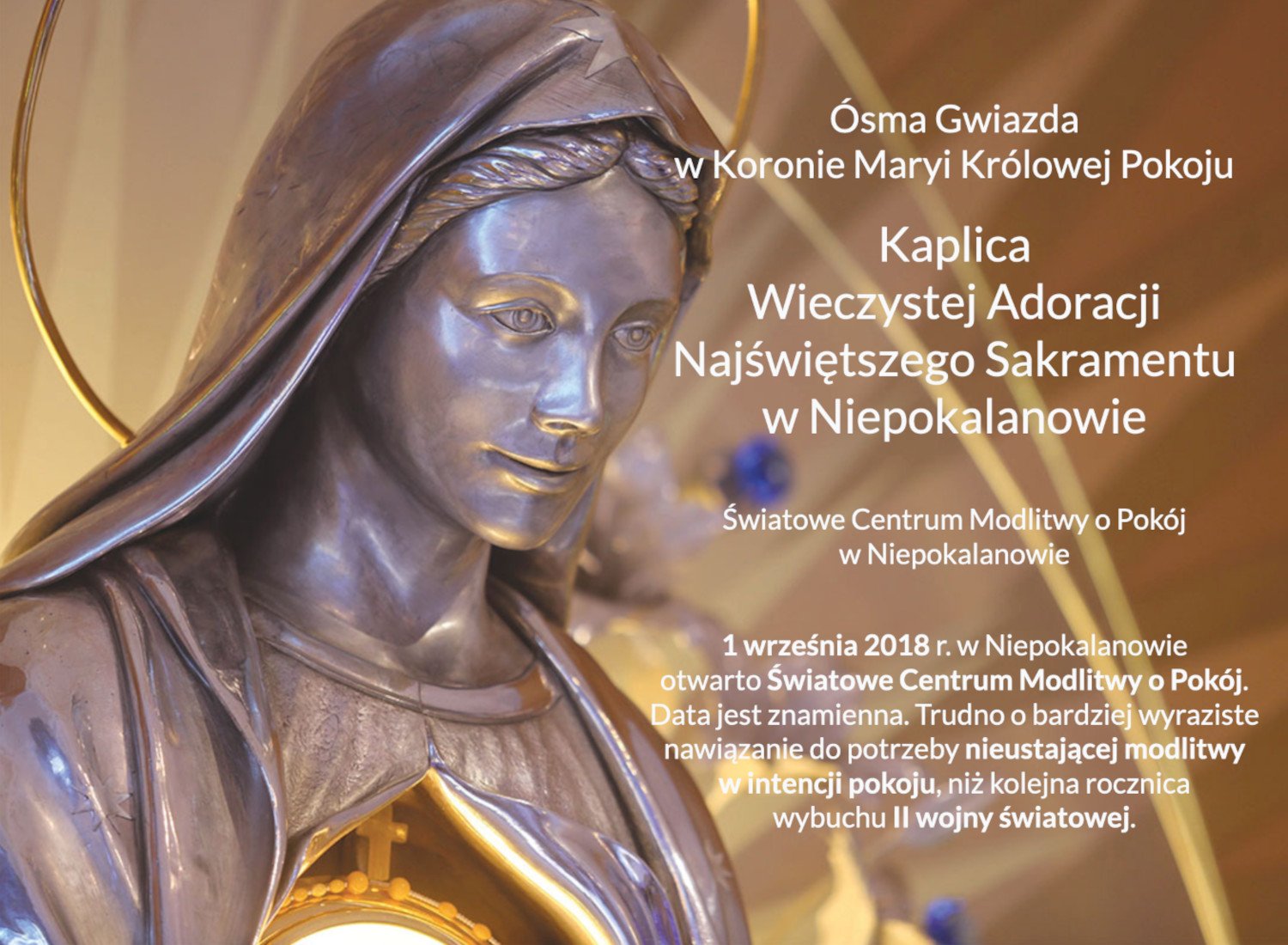

The Eucharistic Adoration Chapel established by Saint Maximilian Kolbe was inaugurated at the outbreak of World War II. It was restored as a Chapel of Adoration in September, 2018, the commemoration of the date that the war began. It is now part of the World Center of Prayer for Peace. The live internet feed of the Adoration Chapel at Niepokalanow — sponsored by EWTN — was established just a few weeks before we discovered it and began to include in at Beyond These Stone Walls. Click “Watch on YouTube” in the lower left corner to see how many people around the world are present there with you. The number appears below the symbol for EWTN.
Click or tap here to proceed to the Adoration Chapel.
The following is a translation from the Polish in the image above: “Eighth Star in the Crown of Mary Queen of Peace” “Chapel of Perpetual Adoration of the Blessed Sacrament at Niepokalanow. World Center of Prayer for Peace.” “On September 1, 2018, the World Center of Prayer for Peace in Niepokalanow was opened. It would be difficult to find a more expressive reference to the need for constant prayer for peace than the anniversary of the outbreak of World War II.”
For the Catholic theology behind this image, visit my post, “The Ark of the Covenant and the Mother of God.”

Bombshells and Black Ops Defeated Justice in New Hampshire
Keene, NH sex crimes Detective James F McLaughlin is retired but his legacy of bombshells and black ops left a lingering trail of deceit, injustice and ruined lives.

Keene, NH sex crimes Detective James F McLaughlin is retired but his legacy of bombshells and black ops left a lingering trail of deceit, injustice and ruined lives.
June 26, 2024 by Ryan A. MacDonald
(Editor’s Note: The photo above depicts the Keene, NH Central Square gazebo. Photo: “Keene NH 26” by Alexius Horatius, used under CC BY-SA 3.0 / cropped)
On the day this article is published, a Catholic priest in America will awaken in a prison cell at age 71 in his thirtieth year of wrongful incarceration for fictitious crimes, sans evidence alleged to have occurred in 1983.
Every time I write about this story, my Inbox fills with messages from readers stunned and appalled by the facts of the 1994 trial of Fr Gordon MacRae. A small minority pose questions such as “How do you know he is innocent?” to which I usually reply, “What makes you think he may not be?” Then the tirades begin, but they never answer my question. Those who labor to suppress this case of false accusation preface their answers with statements like, “Priests did terrible things and bishops covered it up!” “We all know these priests are guilty,” and (from a SNAP activist) “The Catholic Church is a child raping institution!”. The prevailing logic here is that the details of this specific case do not matter. Father MacRae went to prison in 1994 for the sins of the Church, the sins of the bishops, and the sins of the priesthood. For too many silent Catholics who just want to move on from The Scandal, that is okay. It is not okay.
Then there are those who trumpet the fact that after Fr MacRae’s trial he pled guilty to other things. It is a favorite chant of the prosecutorial voices in all this which, sadly, include some officials of MacRae’s diocese. But it is true only if one is jaded enough to view the truth in its narrowest sense, disconnected from its factual history. It is not the whole truth. I explored that phenomenon in depth in “The Post Trial Extortion of Father Gordon MacRae,” a previous chapter in this series.
In the trial of Father MacRae, the sole evidence was the word of Thomas Grover, a 27-year-old, 200 pound former high school football player who fell on bad times. Grover had a criminal rap sheet for assault, theft, forgery, and narcotics charges — all kept from the jury by Judge Arthur Brennan. He had a long history of drug abuse, and gained nearly $200,000 for “telling a lie and sticking to it,” as his ex-wife later described his testimony. She also says, today, that he punched her and broke her nose when she questioned his perjury.
And yet throughout this case, with all these factors in plain sight of everyone but the jury, not one person questioned whether this man might be lying for money. Not the zealot Detective James F. McLaughlin who today reportedly responded to the question of injustice with one of his own: “Why didn’t MacRae just take the plea deal?” Not the two prosecutors, one of whom was fired after this trial while the other later committed suicide. Not Judge Arthur Brennan who sent this priest to prison for the rest of his life while citing evidence that no one has ever seen or heard, evidence that never existed. Evidence that Grover was lying for money would have been in plain sight in a legitimate investigation. It emerged only years later in the Statement of Charles Glenn.
Nor was the possibility of lying for money ever openly considered by anyone in the Diocese of Manchester as they wrote six-figure checks to pay Grover and his brothers off. By the time it was all over, Thomas Grover, Jonathan Grover, David Grover and Jay Grover — all adults “remembering” their claims in the same week over a decade later — emerged from the case with combined settlements in excess of $650,000. Father MacRae boldly addressed the nature of such settlements, which continue to this day, in “To Fleece the Flock: Meet the Trauma-Informed Consultants.”
MacRae took, and passed, two pre-trial polygraph (lie detector) tests in this case. Thomas Grover and his brothers never assented to take a polygraph.
In “The Ordeal of Father MacRae,” President Bill Donohue of the Catholic League for Religious and Civil Rights charged that Fr MacRae, “has been treated unjustly by the authorities, both ecclesiastical and civil.” Bill Donohue is not the first Church figure of note to suggest this. The late writer and editor, Father Richard John Neuhaus wrote that this case “reflects a Church and a justice system that seem indifferent to justice.” The late Cardinal Avery Dulles expressed a similar analysis of the case. I do not imagine any of them would blithely suggest that some Church officials — by commission or, more likely, omission — abetted a process in which a priest was wrongly imprisoned less than twenty miles from the Chancery Office of his diocese while denied proper legal assistance and due process for three decades.

Celebrating a Witch Hunt
The truth is worse than you know. During these same three decades , Fr MacRae — and he is still “Father” MacRae — has been forced to divide his less than meager resources to also fight off a simultaneous attempt by his Bishop to have him dismissed from the clerical state based on the fact that he is convicted and in prison. In a commentary for the Homiletic and Pastoral Review, I referred to such forced laicization as “a sort of ecclesiastical equivalent of lethal injection.” To date, that one-sided effort has not yet been successful in the MacRae case, but the effort was initiated by the same bishop who was the subject of this letter from a former official at PBS television:
“I contacted the Manchester Diocese from WGBH… A few weeks later, when I met with Bishop [John] McCormack, the very first words he said to me were, ‘This must never leave this office. I believe Fr MacRae is innocent and his accusers likely lied.’.”
— Letter to Judge Brennan, Oct. 24, 2013
This whole story began with an explosive, slanderous lie. But the question remains, “Whose lie was it?” Bill Donohue wrote that MacRae’s troubles began in 1983 with a vague claim that was investigated, but nothing came of it. In 1985 the same claim surfaced again, was investigated by state officials, and was formally dismissed as “Unfounded.” This story should have ended there, but it was only just beginning.
In September of 1988, Ms. Sylvia Gale with the New Hampshire Division of Children, Youth and Families (DCYF) sent a letter to Keene, NH sex crimes Detective James F. McLaughlin. The letter claimed that she had developed information that before coming to New Hampshire, Father Gordon MacRae was a priest in Florida where “he molested two boys, one of whom was murdered and his body mutilated.” She identified MacRae as the primary suspect in that case, and claimed in the letter that the case remained unsolved when MacRae was sent by Church officials to “Berlen (sic) NH” to avoid that investigation. The Sylvia Gale letter was at best, a bombshell.
The explosive letter went on to claim that this information was passed on to Sylvia Gale by a former employee of Catholic Social Services who claimed to have been told this account by her supervisor, Monsignor John Quinn of the Diocese of Manchester. Ms. Gale’s letter alleged that Msgr Quinn threatened to fire his employee if she divulged this story further. This unnamed Catholic social services worker appears to have also been the therapist who began the MacRae case with the repeated but unfounded claims in 1983 and 1985.
Until 1994, when he received it as part of pre-trial discovery, Fr MacRae was entirely unaware of the libelous letter from Sylvia Gale implicating him in molestation and murder. But in New Hampshire, state social workers, prosecutors, and judges are immune from lawsuits. Nor was MacRae even aware of Detective McLaughlin’s investigation that ensued as a result of the Sylvia Gale letter. He had no idea that Detective McLaughlin, armed with this letter, proceeded to track down every family whose adolescent sons knew Father MacRae at any time during the 1980s. His report describes questioning twenty-six Keene, NH adolescents and their parents while generating little more than gossip and innuendo for most, and the first thoughts of lucrative opportunities for some.
Among those approached by Detective McLaughlin armed with the Florida molestation and murder story in 1988 was Patricia Grover, the mother of accusers yet to come and herself a state social worker in the same child protection agency that employed Sylvia Gale. It appears from the reports that the two had already collaborated about the Florida letter, and Ms. Grover vowed that she would begin speaking with her sons who knew Father MacRae.
One of them, Jonathan Grover, was soon to be discharged from the U.S. Navy for refusing its alcohol intervention program after a drunk driving arrest. Jonathan years later died of an accidental fentanyl overdose at age 48 in Phoenix, Arizona. Another, Thomas, then age 21, had been terminated from his third or fourth stint in residential treatment for drug addiction after he was caught smuggling drugs into the treatment facility. In 1988, these approaches to the Grover brothers yielded no accusations. Five years later, as the prospect of money loomed, they changed their minds.
In regard to the slanderous Florida, claim, Father MacRae had never been a priest in Florida, had never even visited Florida, and had never been assigned in Berlin, NH, as Sylvia Gale’s letter alleged. A simple check with the records of the Diocese of Manchester would have revealed that he was ordained for that diocese in 1982. He spent the previous four years at St Mary Seminary & University in Baltimore, Maryland and the four years before that at St Anselm College in Manchester, NH. Detective McLaughlin ran with the Sylvia Gale letter without ever bothering to check the facts. This is consistent with a reading of all of his reports in the MacRae case and with new witness statements. It appears that McLaughlin skillfully avoided asking questions or pursuing leads that might yield any information contrary to his bias.
I read up to page fifty of Detective McLaughlin’s voluminous, outrageous witch hunt that was his 1988 report before the Florida story emerged again. He learned from unnamed Florida police that the story was bogus and never happened, that there was never a molestation and murder case involving a Catholic priest, and that they had never before even heard the name of Father Gordon MacRae.
However McLaughlin’s report also claimed that another Florida sheriff, a “Sgt. Smith,” revealed that some other priest molested two boys there and was moved by the Church to New Hampshire. “But the names don’t match and your suspect is too young to be that suspect,” McLaughlin quoted the Florida sheriff. His report gives the impression that McLaughlin did not even think to ask for the name of that priest. Officials of the Diocese of Manchester later wrote that no priest ever came to the Diocese of Manchester under those circumstances.
It is of interest in these reports that Fr MacRae was somehow transformed from a “subject” to a “suspect,” but of what? This was never a case in which individuals went to the police with a complaint about this priest. From all the witness statements I have seen, it was McLaughlin who went to them, and it was McLaughlin who suggested that “a large sum of money” could be had by accusing MacRae. In another report McLaughlin wrote, “I asked him where he stood on a civil lawsuit.”
Meanwhile, written questions to Monsignor John Quinn about his reportedly being the source of the Florida story were answered minimally, with one-word denials but no light. Others in the Diocese of Manchester cooperated in similar fashion and often only after prompting by the suggestion of a subpoena.
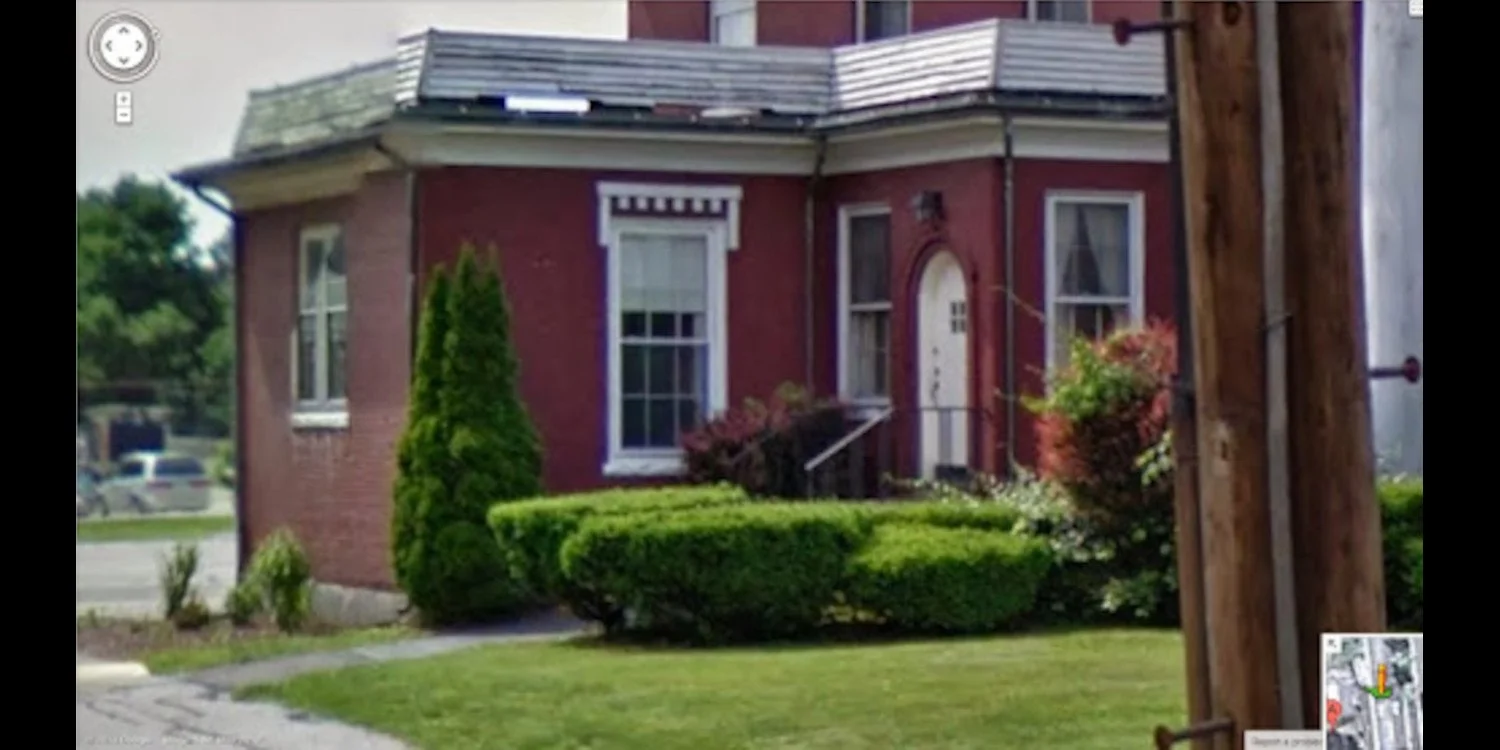
The door and window of Father MacRae’s office at Saint Bernard rectory in Keene, New Hampshire in 1983. It overlooks Main Street and the busiest part of downtown Keene, NH.
“Going for a Sex Abuse Victim World Record”
A year before the above investigation ensued, Thomas Grover was a patient at Derby Lodge, a drug treatment center in Berlin, NH, and his third or fourth attempt at such treatment. While there, according to his counselor, he was repeatedly confronted for his distortions, dishonesty, and manipulation. He reportedly told his counselor, Ms. Debbie Collett , that he had been sexually abused by his adoptive father who by this point had been divorced from Patricia Grover.
According to Ms. Collett’s statements, Grover also claimed to have been sexually abused by so many people in the past that it appeared that he was “going for some sort of sexual abuse victim world record.” Also according to her statements, he never accused Fr Gordon MacRae. Ms. Collett went on to reveal an alleged series of coercive harassment and overt threats from Detective McLaughlin to get her to alter her account before testifying at MacRae’s 1994 trial.
Four and a half years after the Florida letter and Detective McLaughlin’s investigation swept through Keene, NH, Thomas Grover and two of his brothers — and later a third brother, Jay Grover, who once told Detective McLaughlin that MacRae had never done anything wrong — all now accused the priest. Two of them also accused another priest, Father Stephen Scruton, providing highly detailed accounts of rape and molestations by Scruton. Fr Scruton was also named as someone who witnessed MacRae’s abuse of Jonathan Grover, and in two of his claims, the two priests abused him simultaneously at age 12. Then it was changed to age 14.
However, Fr Scruton was not present in that parish with MacRae until Jonathan Grover was over sixteen years old. When that fact became apparent, it never raised a doubt in McLaughlin’s mind. He just excised Scruton’s name from future reports as though never mentioned, and MacRae became the sole priest accused. The entire file contains no evidence that Detective McLaughlin ever questioned Rev. Stephen Scruton about Jonathan Grover’s claims despite having already investigated and charged Scruton with an entirely unrelated claim brought by Todd Biltcliff who was a high school classmate of Jonathan Groven. That claim resulted in a financial settlement by the Diocese of Manchester.
McLaughlin wrote in one of his reports that he gave the Grovers a copy of MacRae’s resume “to help them with their dates.” At the end of this three-ring circus, Father MacRae ended up in a trial of the facts where there were no facts, in a courtroom where credibility was the sole measurement of guilt or innocence. But there was also no credibility. Hype and a stellar performance by a practiced con artist had to suffice, and it did.

Witness Tampering
Late in 2013, a man who was present at that 1994 trial wrote a letter about it to retired Judge Arthur Brennan who presided over the MacRae trial. What follows are some excerpts of that letter postmarked November 24, 2013:
“My wife and I were present in the courtroom throughout most of the trial of Fr Gordon MacRae in 1994. I have had many questions about this trial and much that I’ve wanted to clarify for my own peace of mind… We saw something in your courtroom during the MacRae trial that I don’t think you ever saw. My wife nudged me and pointed to a woman, Ms. Pauline Goupil, who was engaged in what appeared to be clear witness tampering. During questions by the defense attorney, Thomas Grover seemed to feel trapped a few times. On some of those occasions, we witnessed Pauline Goupil make a distinct sad expression with a down-turned mouth and gesturing her index finger from the corner of her eye down her cheek at which point Mr. Grover would begin to cry and sob on the stand. The questions were never answered.
“I have been troubled about this for all these years. I know what I saw, and what I saw was clearly an attempt to dupe the court and the jury. If the sobbing and crying were not truthful, then I cannot help but wonder what else was not truthful on the part of Mr. Grover. If he were really a victim who wanted to tell the simple truth, why was it necessary for him and Ms. Goupil to have what clearly appeared to be a set of prearranged signals to alter his testimony? The jury was privy to none of this to the best of my knowledge.”
One of the challenges for the prosecution of this trial was to get Thomas Grover to look like a victim. It was not easy. At 27 years old at trial, Grover was a 5’ 11”, 200-pound ex-high school football player with a history of alcoholism and a police record including domestic violence, assault, forgery, narcotics, and theft charges — all suppressed in this trial by Judge Arthur Brennan. The sobbing Thomas Grover on the witness stand could not mask his real persona for long. Consider this next excerpt from the above letter to Judge Brennan from a witness at trial:
“Secondly, I was struck by the difference in Thomas Grover’s demeanor on the witness stand in your court and his demeanor just moments before and after outside the courtroom. On the stand, he wept and appeared to be a vulnerable victim. Moments later, during court recess, in the parking lot he was loud, boisterous and aggressive. One time he even confronted me in a threatening attempt to alter my own testimony during sentencing.”
The presence of Ms. Pauline Goupil in this story is highly problematic, and, to a layman’s eyes, most suspicious. A masters level psychotherapist, she was retained pre-trial by Grover at the behest of his contingency lawyer “because it would look better for the jury,” according to Grover’s ex-wife, Trina Ghedoni, whose later Statement cast some previously unseen light on this trial.
At one point in the trial, Ms. Goupil, once exposed, was forced under a court order to turn over her treatment file. It contained but a few pages, and not a single therapeutic record pertaining to any claims of abuse of Thomas Grover by Father MacRae. However, Ms. Goupil’s file did contain this letter purportedly written by her to Thomas Grover who apparently had not been showing up for his pre-trial coaching sessions with her:
“Jim tells me MacRae is being offered a deal his lawyers will want him to take so there won’t be a trial. We can just move on to the settlement phase.”
I discussed this letter previously in “The Trial of Father MacRae: A Conspiracy of Fraud,” my first installment in this series. The letter was part of a file of perhaps six pages that Pauline Goupil turned over upon orders of the court. A year later, during evidentiary proceedings from lawsuits brought by Thomas Grover and two of his brothers — a hearing in which everyone but the imprisoned priest had lawyers representing them — Ms. Goupil testified at length about her pre-trial sessions with Thomas Grover and her work in aiding the reconstruction of his memories of abuse at age 15. For excerpts of that testimony see my article, “Psychotherapists Helped Send an Innocent Priest to Prison.”
None of Ms. Goupil’s role in this case ever became known by the Fr MacRae trial jury. Like everyone else involved in the prosecution of this case, she has since declined to be interviewed or to answer any questions.
“Jim” in Ms. Goupil’s above letter to Thomas Grover refers to Detective James McLaughlin, a now retired sex crimes investigator for the Keene, NH Police Department. In 2018, his name was briefly added to a secret list of police officers with a history of official misconduct. McLaughlin sued in a secret “John Doe” lawsuit heard with no public accountability. In May 2024, he was allowed to have his name removed from that public list. The prevailing belief among court observers in New Hampshire was that McLaughlin was afforded this level of anonymity and the judicial outcome because leaving his name on that list could have reopened hundreds of other cases like MacRae’s.
At some point in his investigation of Thomas Grover’s claims against Gordon MacRae, the detective appears to have taken up some sideline work on behalf of Grover’s contingency lawyer. In 1993 before Fr MacRae was charged or even aware of the claims against him, McLaughlin obtained a warrant for a “one-party intercept,” a sting attempt to record a telephone call from Thomas Grover to the priest who at that time was involved in in New Mexico. Little, if any, of the resultant call made its way into the 1994 trial, however. The recorded claims from Grover elicited nothing more than the bewildered voice of Father MacRae apparently wondering what on Earth the caller was talking about. However, this attempt at a telephone sting revealed something far more interesting.
Detective McLaughlin had apparently learned of a toll-free “800” number for contacting Fr MacRae. His police report detailed his attempts to call that number from his office at the Keene Police station. However, phone records which coincided with McLaughlin’s reports about executing the warrant indicate that the calls were not placed from his office at Keene Police headquarters, but from the office of Grover’s contingency lawyer 50 miles away. This has never been explained. Also never explained are statements from Grover’s family members who today reveal that the contingency lawyer gave Grover repeated cash advances before MacRae’s criminal trial, a practice that, if true, was a violation of the New Hampshire Rules of Professional Conduct for lawyers. It is but another example of the pervasive lure of money in this story from start to finish.
An immediate problem for anyone trying to get to the bottom of all this is the absence of recorded interviews. It seemed to be Detective McLaughlin’s standard procedure to record interviews with accusers — referred to as “victims” in every one of his reports that I have read.
Another new witness statement from Steven Wollschlager alleges that McLaughlin knowingly elicited false accusations against Fr MacRae in exchange for cash and an implication that “life could go easier with a lot of money.” Wollschlager was subpoenaed to testify before a Grand Jury to process a new indictment against Fr MacRae just before the Grover trial, but decided at the last minute that he could not pursue this lie. Wollschlager added that McLaughlin’s reports contain statements that he never said, and distortions of what he did say.
The one recording McLaughlin did appear to make was that of his interview with Thomas Grover’s counselor, Ms. Debbie Collett. Today, she reports that he badgered her, threatened her, and allegedly bullied her into restating her account into something he wanted to hear, and he did all of this on tape. That recording was never turned over to the defense and has never seen the light of day.
Detective McLaughlin did not seem to record his interviews with any of the Grover brothers accusing Gordon MacRae. This was a startling departure from his own longstanding methods and protocols. The choice not to record anything in this one case seems calculated, and it has never been explained. The fact that today, multiple witnesses claim to have been bribed, coerced, badgered, and otherwise manipulated by this detective could lead a rational observer to question what has gone on here, and to doubt the credibility of the claims against this priest.
It is true that there has been a cover-up in the Catholic clergy sex abuse story, but it is not the one everyone thinks it is. It took place twenty years ago in beautiful downtown Keene, New Hampshire.
+ + +
Editor’s Note: The above article continued a series by Ryan A. MacDonald. Other titles in this series include “The Trial of Father MacRae: A Conspiracy of Fraud,” “The Prison of Father MacRae: A Conspiracy of Silence,” and “The Post-Trial Extortion of Father Gordon MacRae.”

Judge Arthur Brennan, who sentenced Father Gordon MacRae to life in prison, being arrested in the Congressional Chambers in Washington, DC as part of the “Occupy Movement.”
The Eucharistic Adoration Chapel established by Saint Maximilian Kolbe was inaugurated at the outbreak of World War II. It was restored as a Chapel of Adoration in September, 2018, the commemoration of the date that the war began. It is now part of the World Center of Prayer for Peace. The live internet feed of the Adoration Chapel at Niepokalanow — sponsored by EWTN — was established just a few weeks before we discovered it and began to include in at Beyond These Stone Walls. Click “Watch on YouTube” in the lower left corner to see how many people around the world are present there with you. The number appears below the symbol for EWTN.
Click or tap here to proceed to the Adoration Chapel.
The following is a translation from the Polish in the image above: “Eighth Star in the Crown of Mary Queen of Peace” “Chapel of Perpetual Adoration of the Blessed Sacrament at Niepokalanow. World Center of Prayer for Peace.” “On September 1, 2018, the World Center of Prayer for Peace in Niepokalanow was opened. It would be difficult to find a more expressive reference to the need for constant prayer for peace than the anniversary of the outbreak of World War II.”
For the Catholic theology behind this image, visit my post, “The Ark of the Covenant and the Mother of God.”

Cardinal Bernard Law on the Frontier of Civil Rights
Former Boston Archbishop, Cardinal Bernard Law was vilified by The Boston Globe and SNAP, but before that he was a champion of justice in the Civil Rights Movement.

Former Boston Archbishop, Cardinal Bernard Law was vilified by The Boston Globe and SNAP, but before that he was a champion of justice in the Civil Rights Movement.
June 19, 2024 by Fr Gordon MacRae
Note from Fr MacRae: I first wrote this post in November 2015. I wrote it in the midst of a viral character assassination of a man who had become a convenient scapegoat for what was then the latest New England witch hunt. That man was Cardinal Bernard Law, Archbishop of Boston. I have to really tug hard to free this good man’s good name from the media-fueled availability bias that so mercilessly tarnished it back then. A good deal more has come to light, and I get to have the last word.
By coincidence, and it was not planned this way, but the date of this revised reposting is June 19, 2024, the day that the United States commemorates the emancipation of African American slaves on June 19, 1865 in Galveston, Texas. As you will read herein, Cardinal Bernard Law was a national champion in the cause for Civil Rights and racial equality.
+ + +
Four years after The Boston Globe set out to sensationalize the sins of some few members of the Church and priesthood, another news story — one subtly submerged beneath the fold — drifted quietly through a few New England newspapers. After a very short life, the story faded from view. In 2006, Matt McGonagle resigned from his post as assistant principal of Rundlett Middle School in Concord, New Hampshire. Charged with multiple counts of sexually assaulting a 14-year-old high school student six years before, McGonagle ended his criminal case by striking a plea deal with prosecutors. McGonagle pleaded guilty to the charges on July 28, 2006.
He was sentenced to a term of sixteen months in a local county jail. An additional sentence of two-and-a-half to five years in the New Hampshire State Prison was suspended by the presiding judge in Merrimack County Superior Court — the same court that declined to hear evidence or testimony in my habeas corpus appeal in 2013 after having served 20 years in prison for crimes that never took place.
In a statement, Matt McGonagle described the ordeal of being prosecuted. He said it was “extraordinarily difficult,” and thanked his “many advocates” who spoke on his behalf. In the local press, defense attorney James Rosenberg defended the plea deal for a sixteen month county jail sentence:
“The sentence is fair, and accurately reflects contributions that Matt has made to his community as an educator.”
— Melanie Asmar, “Ex-educator pleads guilty in sex assault,” Concord Monitor, July 29, 2006
Four years earlier, attorney James Rosenberg was a prosecutor in the New Hampshire Attorney General’s Office from where he worked to prosecute the Diocese of Manchester for its handling of similar, but far older claims against Catholic priests.
The accommodation called for in the case of teacher/principal Matt McGonagle — an insistence that he is not to be forever defined by the current charges against him — was never even a passing thought in the prosecutions of Catholic priests. Those cases sprang from the pages of The Boston Globe, swept New England, and then went viral across America. The story marked The Boston Globe’s descent into “trophy justice.”

Cardinal Sins
I have always been aware of this inconsistency in the news media and among prosecutors and some judges, but never considered writing specifically about how it applied to Cardinal Bernard Law until I read Sins of the Press, a book by David F. Pierre, Jr. On page after page it cast a floodlight on The Boston Globe’s Pulitzer-endorsed lynching of Cardinal Law, offered up as a scapegoat for The Scandal and driven from Boston by the news media despite having never been accused, tried, or convicted of any real crime.
Does the “lynching of Cardinal Law” seem too strong a term? Historically, the word “lynching” came into the English lexicon from the name of Captain William Lynch of Virginia who acted as prosecutor, judge and executioner. He became notorious for his judgment-sans-trial while leading a band to hunt down Loyalists, Colonists suspected of loyalty to the British Crown in the War for Independence in 1776.
The term applies well to what started in Boston, then swept the country. Most of those suspected or accused in the pages of The Boston Globe, including Cardinal Bernard Law, were never given any trial of facts. As I recently wrote in, “To Fleece the Flock: Meet the Trauma-Informed Consultants,” many of the priests were deceased when accused, and many others faced accusations decades after any supportive evidence could be found, or even looked for. The Massachusetts Attorney General issued an astonishing statement given short shrift in the pages of The Boston Globe:
“The evidence gathered during the course of the Attorney General’s sixteen-month investigation does not provide a basis for bringing criminal charges against the Archdiocese and its senior managers.”
— Commonwealth of Massachusetts Attorney General Thomas Reilly, “Executive Summary and Scope of the Investigation,” July 23, 2003
So I decided to explore the story of Cardinal Bernard Law for Beyond These Stone Walls. When I first endeavored to write about him, he had been virtually chased from the United States by some in the news media and so-called victim advocates deep into lawsuits to fleece the Church. Though not intended originally, my post was to be published on November 4, 2015, which also happened to be Cardinal Law’s 84th birthday.
When I wrote of my intention to revisit the story of Cardinal Bernard Law from a less condemning perspective, it sparked very mixed feelings among some readers. A few wrote to me that they looked forward to reading my take on the once good name of this good priest. A few taunted me that this was yet another “David v Goliath” task. Others wrote more ominously, “Don’t do it, Father! Don’t step on that minefield! What if they target you next?” That reaction is a monument to the power of the news media to spin a phenomenon called “availability bias.”
A while back, I was invited by Catholic League President Bill Donohue to contribute some articles for Catalyst, the Journal of the Catholic League for Religious and Civil Rights. My second of two articles appeared in the July/August 2009 issue just as Beyond These Stone Walls began. It was entitled “Due Process for Accused Priests” and it opened with an important paragraph about the hidden power of the press to shape what we think:
“Psychologist Daniel Kahneman won the Nobel Prize in Economics in 2002 for his work on a phenomenon in psychology and marketing called ‘availability bias.’ Kahneman demonstrated the human tendency to give a proposition validity just by how easily it comes to mind. An uncorroborated statement can be widely seen as true merely because the media has repeated it. Also in 2002, the Catholic clergy sex abuse scandal swept out of Boston to dominate news headlines across the country….”
This is exactly what happened to Cardinal Law. There was a narrative about him, an impression of his nature and character that unfolded over the course of his life. I spent several months studying that narrative and it is most impressive.
Then that narrative was replaced by something else. With a target on his back, the story of Cardinal Law was entirely and unjustly rewritten by The Boston Globe. Then the rewrite was repeated again and again until it took hold, went viral, and replaced in public view the account of who this man really was.
Even some in the Church settled upon this sacrificial offering of a reputation. Perhaps only someone who has known firsthand such media-fueled bias can instinctively recognize it happening. Suffice it to say that I instinctively recognized it. I offer no other defense of my decision to visit anew the first narrative in the story of who Bernard Law was. If you can set aside for a time the availability bias created around the name of Cardinal Bernard Law, then you may find this account to be fascinating, just as I did.

From Harvard to Mississippi
As this account of a courageous life and heroic priesthood unfolded before me, I was eerily reminded of another story, one I came across many years ago. It was the year I began to seek something more than the Easter and Christmas Catholicism I inherited. It was 1968, and I was fifteen years old in my junior year at Lynn English High School just north of Boston. Two champions of the Civil Rights Movement I had come to admire and respect in my youth — Martin Luther King and Bobby Kennedy — had just been assassinated. And just as my mind and spirit were being shaped by that awful time, I stumbled upon something that would refine for me that era: the great 1963 film, The Cardinal.
Based on a book of the same name by Henry Morton Robinson (Simon & Schuster 1950), actor Tom Tryon portrayed the title role of Boston priest, Father Stephen Fermoyle who rose to become a member of the College of Cardinals after a heroic life as an exemplary priest. It was the first time I encountered the notion that priesthood might require courage, and I wondered whether I had any. I was fifteen, sitting alone at Mass for the first time in my life when this movie sparked a scary thought.
Father Fermoyle was asked by the Apostolic Nuncio to tour the southern United States “between the Great Smokies and the Mississippi River” — an area known for anti-Catholic prejudice. He was tasked with writing a report on the state of the Catholic Church there during a time of great racial unrest.
In the script (and in the book which I read later) Mississippi Chancery official, Monsignor Whittle (played in the film by actor, Chill Wills) was fearful of the racist, anti-Catholic Ku Klux Klan. He tried to dissuade Father Fermoyle from making any waves, but his mere presence there would set off a tidal wave of suspicion. In a horrific scene, Father Fermoyle was kidnapped in the night, blindfolded, and driven to the middle of a remote field — a field where many young black men had disappeared.
His blindfold removed, he found himself surrounded by men in sheets and white hoods, illuminated by the light of a burning cross. Father Fermoyle was given a crucifix and ordered to spit on it or face the scourging of Christ. Henry Morton Robinson’s book conveys the scene:
“He held the crucifix between thumb and forefinger, lofting it like a lantern in darkness…. Ancient strength of martyrs flowed into Stephen’s limbs. Eyes on the gilt cross, he neither flinched nor spoke. [The music played] ‘In Dixieland I’ll take my stand.’ Stephen prayed silently that no drop of spittle, no whimpering plea for mercy, would fall from his lips before the end… The sheeted men climbed into their cars. Not until the last taillight had disappeared had Stephen lowered the crucifix.”
— The Cardinal, pp 412-413
This could easily have been a scene from the life of Father Bernard Law. Born on 4 November 1931 in Torreon, Mexico, Bernard Francis Law spent his bilingual childhood between the United States, Latin America, and the Virgin Islands. His father was a U.S. Army Captain in World War II and Bernard was an only child. Very early in life, he learned that acceptance does not depend on race, or color, or creed, and once admonished his classmates in the Virgin Islands that “Never must we let bigotry creep into our beings.”
At age 15, Bernard read Mystici Corporis, a 1943 Encyclical of Pope Pius XII that Bernard later described as “the dominant teaching of my life.” He was especially touched by the language of inclusion of a heroic Pope in a time of great oppression. The encyclical was banned in German-occupied Belgium for “subversive” lines connecting the Mystical Body of Christ with the unity of all Christians, transcending barriers such as race or politics.
As a weird aside, I was in shock and awe as I sat typing this post when I asked out loud, “How could I find a copy of Mystici Corporis while stuck in a New Hampshire prison cell?” Then our convert friend, Pornchai Moontri jumped from his bunk, pulled out his footlocker containing the sum total of his life, and handed me a heavily highlighted copy of the 1943 Encyclical. I haven’t yet wrapped my brain around that, but it’s another post for another time.
While attending Harvard University, Bernard Law found a vocation to the priesthood during his visits to Saint Paul’s Church in Cambridge, Massachusetts. After graduating from Harvard in 1953, the year I was born, a local bishop advised him that Boston had lots of priests and he should give his talents to a part of the Church in need. At age 29, Father Bernard Law was ordained for what was the Diocese of Natchez-Jackson, Mississippi.

Standing before the Mask of Tyranny
The year was 1961. The Second Vatican Council would soon open in Rome, and the Civil Rights Movement was gathering steam (and I do mean steam!) in the United States, Father Law immersed himself in both. A Vicksburg lawyer once remarked that Father Law “went into homes as priests [there] had never done before.” With a growing reputation for erudition and bridge building on issues many others simply avoided, Bernard was summoned by his bishop to the State Capital to become editor of the diocesan weekly newspaper, then called The Mississippi Register.
It was there that the courage to proclaim the Gospel took shape in him, and became, along with his brilliant mind, his most visible gift of the Holy Spirit. Another young priest of that diocese noted that Father Law’s racial attitudes — shaped by his childhood in the Virgin Islands — were different from those of most white Mississipians. “He felt passionately about racial justice from the first moment I knew him,” the priest wrote. “It wasn’t a mere following of teaching, it came from his heart.”
I know many Mississippi Catholics today — including many who read Beyond These Stone Walls — but in the tumultuous 1960s, Catholics were a small minority in Mississippi. They were also a target for persecution by the Ku Klux Klan which was growing in both power and terror as the nation struggled with a burgeoning Civil Rights Movement.
An 1896 U.S. Supreme Court decision in “Plessy v. Ferguson” had defined the doctrine of “separate but equal” as a Constitutional nod to racial segregation, but in 1954 in “Brown v. Board of Education,” the Supreme Court based a landmark desegregation ruling on solid evidence that “separate” was seldom “equal.” Opposition to the ruling grew throughout the South, and so did terrorist Klan activities. In 1955, the murder of a black Mississippi boy, 14-year-old Emmett Till, rocked the state and the nation, as did the acquittal of his accused white killers.
This was the world of Father Bernard Law’s priesthood. Up to that time, the diocesan newspaper, The Mississippi Register, had been visibly timid on racial issues, but this changed with this priest at the helm. In June of 1963 he wrote a lead story on the evils of racial segregation citing the U.S. Bishops’ 1958 “Statement on Racial Discrimination and the Christian Conscience.”
One week later, the respected NAACP leader Medgar Evers was gunned down outside his Jackson, Mississippi home. Both Father Law and (then) Natchez-Jackson Bishop Richard Gerow boldly attended the wake for Medgar Evers under the watchful eyes of the Klan. Father Law’s next issue of The Mississippi Register bore the headline, “Everyone is Guilty,” citing a statement by his Bishop that many believe was written by Bernard Law:
“We need frankly to admit that the guilt for the murder of Mr. Evers and the other instances of violence in our community tragically must be shared by all of us… Rights which have been given to all men by the Creator cannot be the subject of conferral or refusal by men.”
Father Law and Bishop Gerow were thus invited to the White House along with other religious leaders to discuss the growing crisis in Mississippi with President John F. Kennedy and his brother, Attorney General Robert Kennedy. Later that summer, Father Law challenged local politicians in The Mississipi Register for their lack of moral leadership on racial desegregation, stating “Freedom in Mississippi is now at an alarmingly low ebb.” Massachusetts District Judge Gordon Martin, who was a Justice Department attorney in Mississippi at that time, once wrote for The Boston Globe that Father Law…
“…did not pull his punches, and the Register’s editorials and columns were in sharp contrast with the racist diatribes of virtually all of the state’s daily and weekly press.”
Later that year, Father Law won the Catholic Press Association Award for his editorials. In “Freedom Summer” 1964, when three civil rights workers were missing and suspected to have been murdered, Father Bernard Law openly accepted an invitation to join other religious leaders to advise President Lyndon Johnson on the racial issues in Mississippi. When the bodies of the three slain young men were found buried at a remote farm, the priest boldly issued a challenge to stand up to the crisis:
“In Mississippi, the next move is up to the white moderate. If he is in the house, let him now come forward.”
Later that year Father Law founded and became Chairman of the Mississippi Council on Human Relations. Then the home of a member, a rabbi, was bombed. Then another member, a Unitarian minister, was shot and severely wounded. The FBI asked Father Law to keep them apprised of his whereabouts, and Bishop Gerow, fearing for his priest’s safety, ordered him from the outskirts of Jackson to the Cathedral rectory, but Bernard Law feared not.
Cardinal Law’s life and mine crossed paths a few times over the course of my life as a priest. I mentioned above that while attending Harvard University, Bernard Law found his vocation to the priesthood during visits to Saint Paul’s Church in Cambridge. Many years later, in 1985, my uncle, Father George W. MacRae, SJ, the first Roman Catholic Dean of Harvard Divinity School and a renowned scholar of Sacred Scripture, passed away suddenly at the age of 57. I was a concelebrant at his Mass of Christian Burial at Saint Paul’s Church in Cambridge. Concelebrating with me was Cardinal Bernard Law where his life as a priest first took shape.
In 2013, The New York Times sold The Boston Globe for pennies on the dollar.
On December 20, 2017, Cardinal Bernard Law passed from this life in Rome.
Oh, that such priestly courage as his were contagious, for many in our Church could use some now. Thank you, Your Eminence, for the gift of a courageous priesthood. Let us not go gentle into The Boston Globe’s good night.
+ + +
Note from Father Gordon MacRae: I am indebted for this post to the book, Boston’s Cardinal : Bernard Law, the Man and His Witness, edited by Romanus Cessario, O.P. with a Foreword by Mary Ann Glendon (Lexington Books, 2002).
You may also like these related posts from Beyond These Stone Walls:
Saint John Paul the Great: A Light in a World in Crisis
Pell Contra Mundum: Cardinal Truths about the Synod
The Eucharistic Adoration Chapel established by Saint Maximilian Kolbe was inaugurated at the outbreak of World War II. It was restored as a Chapel of Adoration in September, 2018, the commemoration of the date that the war began. It is now part of the World Center of Prayer for Peace. The live internet feed of the Adoration Chapel at Niepokalanow — sponsored by EWTN — was established just a few weeks before we discovered it and began to include in at Beyond These Stone Walls. Click “Watch on YouTube” in the lower left corner to see how many people around the world are present there with you. The number appears below the symbol for EWTN.
Click or tap here to proceed to the Adoration Chapel.
The following is a translation from the Polish in the image above: “Eighth Star in the Crown of Mary Queen of Peace” “Chapel of Perpetual Adoration of the Blessed Sacrament at Niepokalanow. World Center of Prayer for Peace.” “On September 1, 2018, the World Center of Prayer for Peace in Niepokalanow was opened. It would be difficult to find a more expressive reference to the need for constant prayer for peace than the anniversary of the outbreak of World War II.”
For the Catholic theology behind this image, visit my post, “The Ark of the Covenant and the Mother of God.”

The Twilight of Fatherhood: Cry, the Beloved Country
Fatherhood fades from the landscape of the human heart to the peril of the souls of our youth. For some young men in prison, absent fathers conjure empty dreams.

Fatherhood fades from the landscape of the human heart to the peril of the souls of our youth. For some young men in prison, absent fathers conjure empty dreams.
June 12, 2024 by Fr Gordon MacRae
“Cry, the beloved country, for the unborn child that is the inheritor of our fear. Let him not love the earth too deeply. Let him not laugh too gladly when the water runs through his fingers, nor stand too silent when the setting sun makes red the veld with fire. Let him not be too moved when the birds of his land are singing, nor give too much of his heart to a mountain or a valley. For fear will rob him of all if he gives too much.”
— Alan Paton, Cry, the Beloved Country, 1948
I was five days shy of turning fifteen years old and looking forward to wrapping up the tenth grade at Lynn English High School just north of Boston on April 4, 1968. That was the day Reverend Martin Luther King, Jr. was murdered in Memphis, Tennessee. On that awful day, the Civil Rights struggle in America took to the streets. History eventually defined its heroes and its villains.
There is an unexpected freedom in being who and where I am. I can write the truth without the usual automatic constraints about what it might cost me. There is only one thing left to take from me, and these days the clamor to take it seems to have abated. That one thing is priesthood which — in this setting, at least — places me in the supporting cast of a heart-wrenching drama.
But first, back to 1968. Martin Luther King’s “I Had a Dream” speech still resonated in my 14-year-old soul when his death added momentum to America’s moral compass spinning out of control. I had no idea how ironic that one line from Martin’s famous speech would be for me in years to come: “From the prodigious hills of New Hampshire, Let Freedom Ring!”
Two months later, on June 5, 1968, fourteen years to the day before I would be ordained a priest, former Attorney General and Civil Rights champion, Senator Robert F. Kennedy, the presumptive Democratic presidential nominee, was murdered in Los Angeles after winning the California primary. The Democratic National Convention in Chicago that August was marked by calamitous riots as Vice President Hubert Humphrey became the nominee only to lose the 1968 election to Richard Nixon in November.

Cry, the Beloved Country
It was at that moment in history — between the murders of two civil rights giants, one black and one white — that a tenth grade English teacher in a racially troubled inner city high school imposed his final assignment to end the school year. It was a book and a book report on Alan Paton’s masterpiece novel set in South Africa during Apartheid. It was Cry, the Beloved Country.
In a snail mail letter some months ago, a reader asked me to write about the origins of my vocation. His request had an odd twist. He wanted me to write of my call to priesthood in light of where it has put me, “so that we might have hope when God calls ordinary people to extraordinarily painful things.” I recently tried to oblige that request when I wrote “The Power and the Glory If the Heart of a Priest Grows Cold.”
I gave no thought to priesthood in the turmoil of a 1968 adolescence. Up to that time I gave little thought to the Catholic faith into which I was born. At age 15, like many adolescents today if left to their own devices, my mind was somewhere else. We were Christmas and Easter Catholics. I think the only thing that kept my family from atheism was the fact that there just weren’t enough holidays.
My first independent practice of any faith came at age 15 just after reading Cry, the Beloved Country. It started as an act of adolescent rebellion. My estranged father was deeply offended that I went to Mass on a day that wasn’t Christmas or Easter, and my decision to continue going was fueled in part by his umbrage.
But there was also something about this book that compelled me to explore what it means to have faith. Written by Alan Paton in 1948, Cry, the Beloved Country was set in South Africa against the backdrop of Apartheid. I read it in 1968 as the American Civil Rights movement was testing the glue that binds a nation. That was 56 years ago, yet I still remember every facet of it, for it awakened in me not just a sense of the folly of racial injustice, but also the powerful role of fatherhood in our lives. It is the deeply moving story of Zulu pastor, Stephen Kumalo, a black Anglican priest driven to leave the calm of his rural parish on a quest in search of his missing young adult son, Absalom, in the city of Johannesburg.
South Africa during Apartheid is itself a character in the book. The city, Johannesburg, represents the lure of the streets as a looming cultural detriment to fatherhood, family, faith and tradition. Fifty-six years after reading it, some of its lines are still committed to memory:
“All roads lead to Johannesburg. If you are white or if you are black, they lead to Johannesburg. If the crops fail, there is work in Johannesburg. If there are taxes to be paid, there is work in Johannesburg. If the farm is too small to be divided further, some must go to Johannesburg. If there is a child to be born that must be delivered in secret, it can be delivered in Johannesburg.”
— Cry, the Beloved Country, p. 83
Apartheid was a system of racial segregation marked by the political and social dominance of the white European minority in South Africa. Though it was widely practiced and accepted, Apartheid was formally institutionalized in 1948 when it became a slogan of the Afrikaner National Party in the same year that Alan Paton wrote his influential novel.
Nelson Mandela, the famous African National Congress activist, was 30 when the book was published. I wonder how much it inspired his stand against Apartheid that condemned him to life in prison at age 46 in 1964 South Africa. His prison became a symbol that brought global attention to the struggle against Apartheid which finally collapsed in 1991. After 26 years in prison, Nelson Mandela shared the Nobel Peace Prize with South African President F.W. de Klerk in 1993. A year later, Nelson Mandela was elected president in South Africa’s first fully democratic elections.

In the Absence of Fathers
I never knew my teacher’s purpose for assigning Cry, the Beloved Country at that particular moment in living history, but I have always assumed that it was to instill in us an appreciation for the struggle for civil rights and racial justice. I never really needed much convincing on the right path on those fronts, but the book had another, more powerful impact that seemed unintended.
That impact was the necessity of strong and present fathers who are up to the sacrifices required of them, and especially so in the times that try men’s souls. There is a reason why I bring this book up now, 56 years after reading it. I had a friend here in this prison who had been quietly standing in the background. I will not name him because there are people on two continents who know of him. He is African-American in the truest sense, a naturalized American citizen brought to this country when his Christian family fled Islamic oppression in their African nation. He was 20 years old when we met, and had been estranged from his father who was the ordained pastor of a small Evangelical congregation in a city not so far from our prison.
I came to know this young prisoner when he was moved to the place where I live. He disliked the new neighborhood immensely at first, finding little in the way of common ground, but Pornchai Moontri and his friends managed to draw him in. Perhaps what finally won him over was the fact that we, too, were in a strange land here. Pornchai brought him to me and introduced me as “everyone’s father here.”
We recruited him on Porchai’s championship baseball team which won the 2016 pennant defeating eight other teams.
I broke the ice one day when I showed our new friend a copy of a weekly traffic report for this blog. He was surprised to see a significant number of visits from the land of his birth. Our friend’s African name was hardly pronounceable, but many younger prisoners have “street names.” So after some trust grew a little between us, he told me some of the story of his life. It was then that I began to call him “Absalom.” The photo at the top of this post is Pornchai’s 2016 championship baseball team in which Pornchai, our old friend Chen (now in China), Absalom, and I are all pictured.
I do not think that I was even conscious at the time of the place in my psyche from which that name was dusted off. He did not object to being called “Absalom,” but it puzzled him.
It puzzled me, too. Absalom was the third son of King David in the Hebrew Scriptures, our Old Testament. In the Second Book of Samuel (15:1-12) Absalom rebelled against his father, staging a revolt that eventually led to his own demise. In the forest of Ephraim, Absalom was slain by Joab, David’s nephew and the commander of his armies. David bitterly mourned the loss of his son, Absalom (2 Samuel 19:1-4).
When I told this story to our new friend,he said, “that sounds like the right name for me.” I told him that in Hebrew, Absalom means “my father is peace.” But even as I said it, I remembered that Absalom is also the name of Pastor Stephen Kumalo’s missing son in Cry, the Beloved Country.
So I told my friend the story of how Absalom’s priest-father in South Africa had instilled in him a set of values and respect for his heritage, of how poverty and oppression caused him to leave home in search of another life only to be lured ever more deeply into the city streets of Johannesburg. I told of how his father sacrificed all to go in search of him.
I also told my friend that I read this book at age 15 in my own adolescent rebellion, and the story was so powerful that it has stayed with me for all these years and shaped some of the most important parts of my life. I told Absalom of the Zulu people and the struggles of Apartheid, a word he knew he once heard, but had no idea of what it meant. I told him that the Absalom of the story left behind his proud and spiritually rich African culture just to succumb to the lure of the street and of how he forgot all that came before him.
“That’s my story!” said Absalom when I told him all this. So the next day I went in search of Alan Paton’s Cry, the Beloved Country. The prison library had a dusty old copy so I brought it back for Absalom to read, and he struggled with it. A part of the struggle is the Zulu names and terms that are vaguely familiar deep in our Absalom’s cultural memory. Another part of the struggle is the story itself, not just of Apartheid, but of the painful estrangement that grew between father and son, an estrangement that our Absalom could not articulate until now.
So then something that I always believed was going to happen, did happen. Absalom told me that he has contacted his mother to ask his father to visit him for the first time in the years that he has been in prison. He said they plan to visit on Father’s Day. They have a lot to talk about, and that is a drama for which I feel blessed to be in the supporting cast — all the rest of prison BS notwithstanding!
But there is something else. There is always something else. When I began writing this post, I asked Absalom to lend me his copy of Cry, the Beloved Country. When he brought it to me, he pointed out that he has only twenty pages left and wanted to finish it that night. “This is the first book I have ever read by choice,” he said, “and I don’t think I could ever forget it.” Neither could I.
As I thumbed through the book looking for a passage I remember reading 56 years ago (the one that begins this post), I came to a small bookmark near the end that Absalom used to mark his page. It was “A Prisoner’s Prayer to Saint Maximilian Kolbe.” I asked my friend where he got it, and he said, “It was in the book. I thought you put it there!” I did not. God only knows how many years that prayer sat inside that book waiting to be discovered, but here it is:
O Prisoner-Saint of Auschwitz, help me in my plight. Introduce me to Mary, the Immaculata, Mother of God. She prayed for Jesus in a Jerusalem jail. She prayed for you in a Nazi prison camp. Ask her to comfort me in my confinement. May she teach me always to be good.
If I am lonely, may she say, ‘Our Father is here.’
If I feel hate, may she say, ‘Our Father is love.’
If I sin, may she say, ‘Our Father is mercy.’
If I am in darkness, may she say, ‘Our Father is light.’
If I am unjustly accused, may she say, ‘Our Father is truth.’
If I lose hope, may she say, ‘Our Father is with you.’
If I am lost and afraid, may she say, ‘Our Father is peace.’
And that last line, you may recall, is the meaning of Absalom.
+ + +
Note from Father Gordon MacRae: South Africa is also home to Kruger National Park which forms its eastern border with Mozambique. Kruger National Park was also the setting for the most well read of our Fathers Day posts, the first those linked below:
In the Absence of Fathers: A Story of Elephants and Men
Coming Home to the Catholic Faith I Left Behind
If Night Befalls Your Father, You Don’t Discard Him! You Just Don’t!
Saint Joseph: Guardian of the Redeemer and Fatherhood Redeemed
+ + +

The Eucharistic Adoration Chapel established by Saint Maximilian Kolbe was inaugurated at the outbreak of World War II. It was restored as a Chapel of Adoration in September, 2018, the commemoration of the date that the war began. It is now part of the World Center of Prayer for Peace. The live internet feed of the Adoration Chapel at Niepokalanow — sponsored by EWTN — was established just a few weeks before we discovered it and began to include in at Beyond These Stone Walls. Click “Watch on YouTube” in the lower left corner to see how many people around the world are present there with you. The number appears below the symbol for EWTN.
Click or tap here to proceed to the Adoration Chapel.
The following is a translation from the Polish in the image above: “Eighth Star in the Crown of Mary Queen of Peace” “Chapel of Perpetual Adoration of the Blessed Sacrament at Niepokalanow. World Center of Prayer for Peace.” “On September 1, 2018, the World Center of Prayer for Peace in Niepokalanow was opened. It would be difficult to find a more expressive reference to the need for constant prayer for peace than the anniversary of the outbreak of World War II.”
For the Catholic theology behind this image, visit my post, “The Ark of the Covenant and the Mother of God.”

The Power and the Glory If the Heart of a Priest Grows Cold
After 42 years of priesthood, 30 unjustly in prison, ‘The Whisky Priest,’ the central figure of Graham Greene’s best known novel, comes to my mind in darker times.

After 42 years of priesthood, 30 unjustly in prison, ‘The Whisky Priest,’ the central figure of Graham Greene’s best known novel, comes to my mind in darker times.
June 5, 2024 by Fr Gordon MacRae
“You are sure to find another cross if you flee the one you bear.”
— Anonymous Mexican Proverb
+ + +
I was ordained to the priesthood on June 5, 1982, the sole candidate for priesthood in the entire State of New Hampshire that year. On the next day, June 6, 1982, I was nervously standing in a corner in the Sacristy as I prepared to offer my First Mass in Saint John the Evangelist Church in Hudson, New Hampshire. The church was packed with friends, family, and strangers from near and far. I was standing in a corner because the Sacristy was filled with my brother priests all vesting to join me for the occasion. I imagined they were watching me for signs that I might flee.
I peered through the open sacristy door at the huge, anticipating crowd and my anxiety level was off the scales. I wished for a way to calm my nerves. Just then, a young lady came into the sacristy and handed me a written note. The driver of a Buick out in the parish parking lot had left the lights on and a thoughtful person jotted down the license plate number. So I totally broke protocol. I walked out of the sacristy into the sanctuary, approached the lectern microphone, and announced that someone had parked a car with its lights still on.
It worked! All the attention was suddenly off me as everyone looked around to see who would get up and embarrassedly walk outside. Then, still at the microphone, I announced, “I don’t know what the rest of you are expecting because I don’t have a clue how to say Mass!” The church erupted in laughter and spontaneous applause, and my anxiety went up in smoke. Back in the sacristy, the others did not understand what I had said. “What are you up to?” They asked.
In the years to follow, as you know, priesthood took me down some dark side roads. In many ways, and at many times over those years, I have felt as though I had been an utter failure as a priest. I should not be in this prison-place from where I write yet another epitaph on yet another year of priesthood offered up like incense to drift out beyond these stone walls. Yet here I am, and in the midst of sorrow and tears, I am powerless to change any of it.
I know today that I had been caught up in a dense web of corruption that resists unraveling despite some concerted efforts. I did not see any of this corruption as it arose around me. Priests tend not to be attuned to such things, but others have written about it. Among them is Claire Best, a most tenacious investigator, researcher, independent writer, and Hollywood talent agent who wrote, “New Hampshire Corruption Drove the Fr. Gordon MacRae Case.”

On the Day of Padre Pio
Back in 2009 as my 27th anniversary of priesthood loomed, this blog was just beginning to take shape. I did not foresee that coming either. I did not even know what a blog was. It was proposed to me by a writer in Australia. This is a familiar story to most readers, but I recently came upon a different perspective on this blog’s beginning. It’s a sort of parallax view, a telling of the same story but from a different angle. From his newfound cradle of freedom in Thailand, Pornchai-Max Moontri wrote about this with some help from our editor. We will link to it again at the end of this post, but if you plan to read it, bring a tissue. It is, “On the Day of Padre Pio, My Best Friend Was Stigmatized.”
On the very day I was ordained in 1982, my friend, Pornchai Moontri was eight years old, living in abject poverty, but happy, on a farm in northeast Thailand. He was three years away from being taken, trafficked to America, his mother brutally murdered, and his life consumed in the wreckage of real abuse by a real predatory monster while all the “officials” looked the other way. Our lives, his and mine, were on a collision course.
When this blog had its debut in July, 2009, a small number of self-described “faithful” Catholics, and some faithfully anti-Catholic activists, took umbrage with the notion that an accused and imprisoned priest might have such a voice in the Catholic public square. Some of them sought out anything and everything they could unearth and throw at me to discourage my writing. It was effective. Discouragement comes easily to a prisoner.
The strangest of the insults came from a man who felt obliged to tell me that he refuses to read anything written by “another Whisky Priest.” That was a bit of a mystery until months later when I read Graham Greene’s masterful 1940 novel, The Power and the Glory. Its main character is a priest without a name. He is the “Whisky Priest” known mostly for the prison of addiction.
That particular insult seemed entirely misplaced. Google did not always pay attention to punctuation back then. It turned out that the letter writer had Googled “Father Gordon MacRae” and stumbled upon a reference to an interview with actress Meredith MacRae in which she revealed, “My father Gordon MacRae was an alcoholic.” Gordon MacRae the film and Broadway star went on to win a multitude of awards for starring roles in Carousel and Oklahoma, among others. But, alas, I am not he, and nor am I the “Whisky Priest.” I have not consumed alcohol in any form other than at Mass since 1983.
But “Whisky Priest” did not quite have the force of insult the letter writer intended. Graham Greene’s “Whisky Priest” was sadly all too human, but his priesthood towered over his flawed humanity. The Power and the Glory is set in early 20th Century Mexico when an emerging totalitarian regime there outlawed the practice of Catholicism in a nation that was almost 100 percent Catholic. This is the story of the Cristeros, Catholics who rose up in civil war against a Marxist regime that tried to banish their faith. Priests were hunted; many were martyred; and those who remained, and stayed alive, were forced to abandon their priesthood, enter into marriage, and denounce the Church or face prison and eventual execution.
Many who were not martyred did as required, but not the Whisky Priest. In the most unique of literary twists, a police lieutenant made it his life’s mission to hunt down and trap the Whisky Priest. He knew of the priest’s alcoholism so he enticed him by leaving a trail of bottles of wine. The story conveys the priest’s spiritual battle within himself as he consumed the wine to silence his addiction while through grace and sheer force of will always forced himself to leave enough to offer Mass all throughout the country for Catholics who remained steadfast in their faith at a time when there was no other priest.
The Whisky Priest is the most unlikely of spiritual heroes. Priesthood was his greatest cross because it placed his life, and the lives of those who sought his sacraments, in grave danger. It was also his liberation. When he was finally arrested, the Police Lieutenant asked him why he stayed only to be captured and likely martyred:
“If I left, it would be as if God in all this space between the sea and the mountains ceased to exist. But it doesn’t matter so much my being a coward and all the rest. I can put God into a man’s mouth just the same — and I can give him God’s pardon. It wouldn’t make any difference to that if every priest in the Church was like me.”

A Voice in the Wilderness
But also among the din of objections to my writing came far louder and more voluminous words of encouragement from other sources. Among them, as most readers know, was Cardinal Avery Dulles who famously wrote,
“Someday your sufferings will come to light and will be instrumental in a reform. Someone may want to add a new chapter to the volume of Christian literature from those unjustly in prison. In the spirit of St Paul, Dietrich Bonhoeffer, Fr Walter Ciszek, and Fr Alfred Delp, your writing, which is clear, eloquent and spiritually sound, will be a monument to your trials.”
I was stunned to receive the support of this nation’s most prolific Catholic writer and prelate. But I was not sure that I believed him. Then, 15 years later as yet another ordination anniversary loomed, I learned from others just a week ago about a brief article at the blog, Les Femmes — The Truth. The writer, Mary Ann Krietzer, had written a letter to me about a year earlier.
I get many letters, a few of them hate mail but most of them strong gestures of support. However I fail, though not by choice, to answer most. I can purchase only six typewriter ribbons per year so I must preserve them for BTSW posts. I had carpal tunnel surgery on both hands so writing a large volume by hand is most difficult. I came upon a letter kindly sent to me from Mary Ann Krietzer that I somehow had misplaced. Six months later, near Pentecost, I discovered it in a pile of paper and wrote a brief reply. That prompted her to write a post on her widely-read blog entitled, “Fr Gordon MacRae and Beyond These Stone Walls.”
In many ways I was shocked by it. The author gave clear voice to all that Cardinal Dulles had predicted, without even knowing that he had predicted it. Mary Ann Kreitzer’s article included this passage published earlier by a recently ordained deacon that was given a magnified voice at Les Femmes — The Truth:
“There are few authentic prophetic voices among us, guiding truth-seekers along the right path. Among them is Fr Gordon MacRae, a mighty voice in the prison tradition of John the Baptist, Maximilian Kolbe, Alfred Delp, SJ, and Dietrich Bonhoeffer.”
For people who base their core purpose upon a lie, the truth is an especially threatening thing. I had no idea that my voice in the wilderness was no longer in the wilderness. I hope you will read Ms. Krietzer’s post linked again below. She provided articulate balance to the loud din of those who pursued me across the land just to disparage and demean. For my part, after reading Mary Ann Krietzer’s post, I just wanted to go hide under my bunk. But in truth, as I mark 42 years of priesthood in the deep peripheries to which Pope Francis once summoned the gaze of the whole Church, I remain a man in prison, and a priest in full.
+ + +
Note from Father Gordon MacRae: I want to thank you for your support and prayers. I also want to ask for your prayers for a young man who encountered this blog along with his mother and father and family, back in its infancy in 2009. They have been devoted readers ever since. On May 29 this year Ben Feuerborn became Father Ben Feuerborn when he was ordained a priest in Lincoln, Nebraska. His first Mass went without a hitch — perhaps because no one had left their car lights on. His second Mass was offered at a Benedictine abbey near Kansas City, Missouri. While Father Ben was in the sacristy vesting for Mass, his mother spotted a plaque under the title “Ad Altare Dei” (To the altar of God). She took out her phone and snapped this photo, which I received this week. It is a bit of a mystery, one among many.
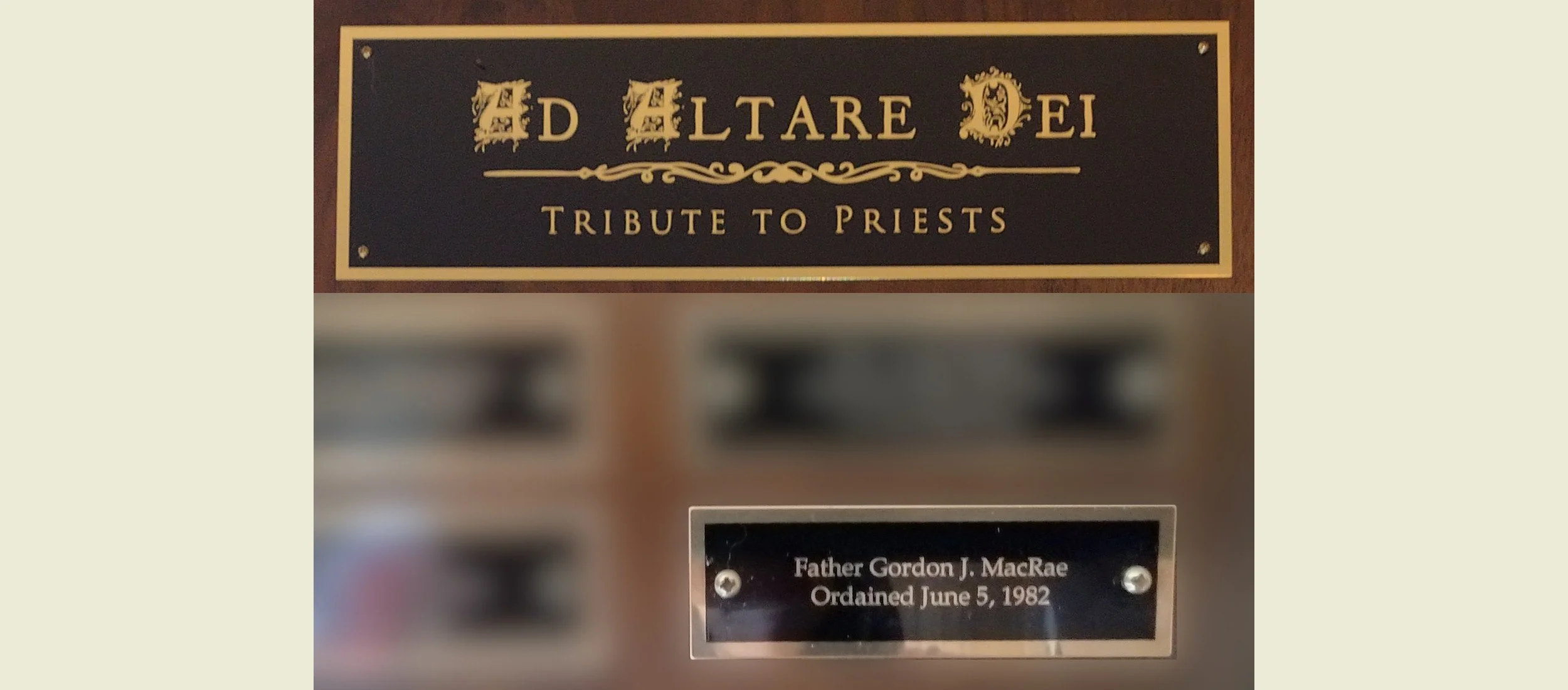
+ + +
We also recommend these related posts:
Fr. Gordon MacRae at Beyond These Stone Walls
by Mary Ann Krietzer @Les Femmes — The Truth
On the Day of Padre Pio, My Best Friend Was Stigmatized
by Pornchai Maximilian Moontri
A Mirror Image in the Devil’s Masterpiece
by Dilia E. Rodríguez, Ph.D.

The Eucharistic Adoration Chapel established by Saint Maximilian Kolbe was inaugurated at the outbreak of World War II. It was restored as a Chapel of Adoration in September, 2018, the commemoration of the date that the war began. It is now part of the World Center of Prayer for Peace. The live internet feed of the Adoration Chapel at Niepokalanow — sponsored by EWTN — was established just a few weeks before we discovered it and began to include in at Beyond These Stone Walls. Click “Watch on YouTube” in the lower left corner to see how many people around the world are present there with you. The number appears below the symbol for EWTN.
Click or tap here to proceed to the Adoration Chapel.
The following is a translation from the Polish in the image above: “Eighth Star in the Crown of Mary Queen of Peace” “Chapel of Perpetual Adoration of the Blessed Sacrament at Niepokalanow. World Center of Prayer for Peace.” “On September 1, 2018, the World Center of Prayer for Peace in Niepokalanow was opened. It would be difficult to find a more expressive reference to the need for constant prayer for peace than the anniversary of the outbreak of World War II.”
For the Catholic theology behind this image, visit my post, “The Ark of the Covenant and the Mother of God.”

To Fleece the Flock: Meet the Trauma-Informed Consultants
With no court oversight the Diocese of Manchester paid a six-figure settlement for an expired abuse claim urged on by discredited “trauma-informed consultants.”

With no court oversight the Diocese of Manchester paid a six-figure settlement for an expired abuse claim urged on by discredited “trauma-informed consultants.”
May 29, 2024 by Ryan A. MacDonald
Editor’s Note: The following post is by Ryan A. MacDonald who has published extensively on the sexual abuse narrative in the Catholic Church. His most recent was a collaboration with Los Angeles writer and researcher Claire Best entitled “The New Hampshire YDC Scandal and the Trial of Father MacRae.”
+ + +
I hear that there is a lot going on in New Hampshire, the “Live Free or Die” State. The State has long operated a juvenile detention facility called YDC — the Youth Development Center. In more recent years it was renamed the “Sununu Youth Development Center” after former Governor John Sununu, father of current Governor Christopher Sununu. They both now seem anxious to have their family name removed from that facility. The “YDC,” as it is commonly called has been at the center of a massive child sexual and physical abuse case in New Hampshire. There are currently an estimated 1,300 open lawsuits and other claims against the State and its officials for alleged physical and sexual abuse and attempts to cover that up. The alleged abuse was going on, but hidden, at the same time the Diocese of Manchester was on the public radar when Fr. Gordon MacRae faced trial in 1994. It was still going on in 2002 when the State launched a grand jury investigation of the Diocese whose abuse narrative paled next to the one being kept hidden by the State. After the State convened a grand jury to investigate the Catholic Diocese in 2002, it convened another to investigate the prestigious St. Paul’s School in later years. The State has convened no grand jury to investigate the YDC claims, though they dwarf other cases.
The YDC saga exploded into public view last year when former resident David Meehan filed a lawsuit against the State for hundreds of incidents of victimization by sexual and physical violence as a young teen held at YDC. He was but the first of many to come forward. Recognizing its liability, the State Legislature earmarked a $100 million fund to settle the YDC claims. The lawyers involved scoffed stating that it needed to be at least four times that amount. The list of plaintiffs then exploded. The State offers unquestioned settlements of up to $1.5 million for sexual abuse claims and $150,000 for claims of physical abuse.
A minority of the 1,300 claimants opted for a quick settlement while to date most others are holding out for a trial to present evidence and have their injuries heard in open court. The horrific case of David Meehan was the first to go to trial in early May, 2024. It generated lurid headlines about the abuse he suffered, including testimony of some staff who tried to report it, but were not allowed to. A shocked jury came back with a verdict just a week before I am writing this post. The jury awarded David Meehan $38 million in compensatory and punitive damages for his pain and suffering. Now there are over 1,000 trials yet to be scheduled and heard. Writer and researcher Claire Best has a companion post this week describing the connections in this story and how its tangled web has influenced the case against Fr. MacRae and the responses of the Diocese of Manchester.
Back in 2019, I wrote an article that I am told is among the most read and cited posts at this site. “In the Diocese of Manchester, Transparency and a Hit List” documents a 2019 decision of Bishop Peter A. Libasci, Bishop of Manchester, to publicize for at least the second or third time an ever expanding list of New Hampshire Catholic priests who have been “credibly” accused going back at least 50 years.
It is alarming to see that in that relatively small New England diocese, there are now over 75 names on Bishop Libasci’s list. Most of those priests are deceased, some for decades, and few have had anything resembling legal due process through which to defend themselves. That is most certainly so when they are accused posthumously like most of those on the list.
Bishop Libasci cited “transparency” as his motive for updating and republishing that list. However, the words “credibly accused” seem to have fallen off the list. In the Diocese of Manchester, the standard for public shaming is now simply “accused.” It seems far more Calvinist than Catholic. For some transparency of our own, we should clarify that Fr. Gordon MacRae is also on that list under the unique heading of “convicted.” There have been many published commentaries about the how and why of that, but perhaps the best of these is a series in the highly credible venue, The Wall Street Journal.
If you visit that link, be sure to view and listen to its first item, a five-minute video interview with Dorothy Rabinowitz, a member of the WSJ Editorial Board who was awarded a Pulitzer for her writings on “Accusation, False Witness, and Other Terrors of Our Time.”
Bishop Libasci’s published list does more than just inform the public. What would be the public interest in learning that a long deceased priest was posthumously accused of molestation? The list also acts as a “hit list,” giving an aura of credibility to scammers who would take advantage of the abuse crisis by filing false claims while using the list to get their facts straight. It is folly to believe this does not happen. Our bishops know full well that it does. Just recently in these pages, Fr. MacRae himself wrote of several modern examples in “Weapons of Mass Destruction.”

Attorney Mitchell Garabedian. Courtesy of TheMediaReport
Given the well-founded caution about false claims and financial scammers cited above, it was alarming to read the following in a recent news article, “Diocese of Manchester Settles Sexual Abuse Claim from the 1970s.” Here is an excerpt:
“No lawsuit was filed because the alleged abuse happened outside the statute of limitations, ... but the attorney representing the ‘John Doe’ who was involved said it’s important for survivors to come forward as part of the healing process. Attorney Mitchell Garabedian and Bob Hoatson, President of the non profit “Road to Recovery,” announced the six-figure settlement outside the Diocese of Manchester office.”
Activist Bob Hoatson said he drove all the way to Manchester from New Jersey to recognize what he called “the heroic actions of the accuser.” In a statement, a spokesperson for the Diocese of Manchester explained why the Diocese opted for a six-figure settlement despite the fact that the statute of limitations for filing any claim at all had expired many years ago:
“The Diocese of Manchester provides financial assistance to those who have been harmed, regardless of when the abuse occurred, through a process utilizing independent trauma-informed consultants.”
To understand how this is all connected to the vast number of unquestioned settlements in the State of New Hampshire YDC cases, just take a moment to listen to this brief advertisement from a local New Hampshire lawfirm. This diocese should prepare itself now for an onslaught of claims filed with no judicial oversight, but demands for settlements brought by the likes of Attorney Mitchell Garabedian and victim-activist Bob Hoatson. Ironically, the two of them were also at the center of a most important op-ed here in these pages entitled, “Betrayed by Victims’ Advocates.”

The Center for Prosecutor Integrity
A most basic problem with handing the matter of due process for the accused and outcomes for the Diocese by abdicating judgment to “trauma-informed consultants” is that the term itself is widely noted and critiqued as highly biased by professionals. It has a documented negative impact on judicial fairness and due process of law in cases of sexual abuse and assault.
The Center for Prosecutor Integrity (CPI) is an organization that seeks to strengthen prosecutorial ethics, promote due process, and end wrongful convictions. Victim-centered investigations, also known in the sex abuse industry as “trauma-informed” investigations, presume the guilt of all defendants and lead to wrongful convictions by steering their investigations around an initial presumption of guilt.
According to the Center’s website, “The most destructive types of victim-centered investigations are known as “Start by Believing,” and “Trauma-Informed.” The CPI displays an entire bibliography documenting the “junk science” behind them, and how they have turned the problem of wrongful convictions into an epidemic of false witness and police and prosecutorial misconduct.
This has crept into the arena of sexual abuse and assault convictions in just the last decade as advocacy groups flourish through federal Department of Justice grants. One of these groups, “End Violence Against Women International,” had been the recipient of 18 grants totaling millions of dollars from the US Department of Justice since 2011. It had been one of the main proponents of “Start by Believing” and “Trauma-Informed” investigations. The organization widely distributed a “Start by Believing” Action Kit to police and prosecutors nationwide. According to the CPI, it openly endorses investigator bias, utilizes guilt-presuming terminology, and contains false claims."
The CPI website lists dozens of scholarly articles refuting the “trauma-informed” methods of civil and criminal investigation and adjudication of claims. Nasheia Conway, the Civil Rights Program Director for Prosecutor Integrity complained in 2019 to the Office of the U.S. Inspector General:
“These concepts and investigative methods abuse the mission of the Department of Justice, which states in part, “... to ensure fair and impartial administration of justice for all Americans.” Termed a ‘multimillion dollar threat to justice,’ they abuse the purpose and intent of Congressional appropriations. And they abuse the public trust which is critical to the effective functioning of our criminal justice system.”
These facts have been documented and exposed by the Center for Prosecutor Integrity:
Since 1989 there have been over 2,400 documented cases of persons who have been wrongfully convicted and later exonerated.
An estimated 43% of wrongful convictions arise from misconduct involving prosecutors, police, investigators, and other officials.
More than 90% of criminal cases are adjudicated during closed-door plea-bargain negotiations. These cases have little or no public accountability or even awareness.
The most common types of ethical violations committed by prosecutors include:
Failure to disclose exculpatory evidence (Brady violation)
Use of inadmissible or false evidence/lack of candor
Plea bargain offenses (former Keene, NH Detective James F. McLaughlin vastly bolstered his conviction rate by offering minuscule and lenient plea-bargain deals to defendants.)
Inflammatory statements and witness harassment (Read the statement of Debra Collett.)
Mischaracterizing evidence
Vouching
In 2019, the CPI published an extensive report documenting the “Junk Science in Trauma-Informed Investigations.” The U.S. Department of Justice ceased funding for “trauma-informed” investigations because it was determined that they disavowed due process.
Upon information and belief, the trauma-informed prosecutorial organization to which the Diocese of Manchester has deferred in the matter of abuse investigations and settlements is the New Hampshire Coalition Against Domestic and Sexual Violence (NHCADSV). The official investigator for the Diocese is now Julie Curtin, a former police officer in Concord, New Hampshire. She was also the principal investigator in a case that Fr. MacRae once wrote about in these pages: “Grand Jury, St. Paul’s School, and the Diocese of Manchester.” It is worth reading. It is also alarming to see that Ms. Curtin is now the investigator for the Diocese of Manchester Office for Ministerial Conduct.
Some months ago, Los Angeles researcher Claire Best wrote a long, nebulous, but entirely truthful analysis of the matter that sent Fr. MacRae to prison 30 years ago and keeps him there today. It is “New Hampshire Corruption Drove the Fr. Gordon MacRae Case.”
This week, Claire Best has a commentary on current events in New Hampshire which is simultaneously published at the Voices from Beyond page at this site.
“A New Hampshire Ponzi Scheme Uncovered?”
+ + +

The Eucharistic Adoration Chapel established by Saint Maximilian Kolbe was inaugurated at the outbreak of World War II. It was restored as a Chapel of Adoration in September, 2018, the commemoration of the date that the war began. It is now part of the World Center of Prayer for Peace. The live internet feed of the Adoration Chapel at Niepokalanow — sponsored by EWTN — was established just a few weeks before we discovered it and began to include in at Beyond These Stone Walls. Click “Watch on YouTube” in the lower left corner to see how many people around the world are present there with you. The number appears below the symbol for EWTN.
Click or tap here to proceed to the Adoration Chapel.
The following is a translation from the Polish in the image above: “Eighth Star in the Crown of Mary Queen of Peace” “Chapel of Perpetual Adoration of the Blessed Sacrament at Niepokalanow. World Center of Prayer for Peace.” “On September 1, 2018, the World Center of Prayer for Peace in Niepokalanow was opened. It would be difficult to find a more expressive reference to the need for constant prayer for peace than the anniversary of the outbreak of World War II.”
For the Catholic theology behind this image, visit my post, “The Ark of the Covenant and the Mother of God.”

Weapons of Mass Destruction
At the behest of paid, unnamed ‘trauma-informed consultants,’ my diocese provided a six-figure settlement of a claim far too old to be filed in any court of law.

At the behest of paid, unnamed ‘trauma-informed consultants,’ my diocese provided a six-figure settlement for a claim far too old to be filed in any court of law.
May 22, 2024 by Fr Gordon MacRae
And they keep on coming. A year before the 2002 wave of clergy sex abuse claims rippled out of Boston across the country, Sean Murphy, age 37, and his mother, Sylvia, demanded $850,000 from the Archdiocese of Boston. Sean claimed that three decades earlier, he and his brother were repeatedly molested by their parish priest. In support of the claim, Mrs. Murphy produced old school records placing her sons in a community where the priest was once assigned. No other corroboration was needed. Shortly thereafter, Byron Worth, age 41, recounted molestation by the same priest and demanded his own six-figure settlement. The men were following an established practice of “mediated settlements,” a precedent set in the early 1990s when a multitude of molestation claims from the 1960s and 1970s emerged against Father James Porter and a few other priests. In 1993, the Diocese of Fall River settled some 80 such claims in a single negotiated deal. Other Church institutions followed that lead on the advice of insurers and attorneys.
Before the Murphys’ $850,000 demand was paid, however, Sean, his mother, and Byron Worth were indicted by a Massachusetts grand jury for conspiracy, attempted larceny, and soliciting others to commit larceny. It turned out that Sean and Byron were once inmates together at the Massachusetts Correctional Institute at Shirley where they concocted their fraudulent plan to score a windfall from their beleaguered Church.
On November 16, 2001, Sean Murphy and Byron Worth pleaded guilty to fraud charges and were sentenced to less than two years in prison for the scam. The younger Murphy brother was never charged, and Mrs. Murphy died before facing court proceedings. Local newspapers relegated the Murphy scam to the far back pages while headlines screamed about the emerging multitude of decades-old claims of abuse by priests. When two other inmates at MCI-Shirley accused another priest in 2001, a Boston lawyer wrote that it is no coincidence these men shared the same prison. “They also shared the same contingency lawyer,” he wrote. “I have some contacts in the prison system, having been an attorney for some time, and it has been made known to me that this is a current and popular scam.”
It is not difficult to understand the roots of such fraud. Prison inmates, like others, read newspapers. Just months before the onslaught of claims against priests, the Archdiocese of Boston landed on the litigation radar screen with the notorious arrest of Mr. Christopher Reardon, a young, married, Catholic layman, model citizen, and youth counselor at a local YMCA who was also employed part-time at a small, remote parish outpost north of Boston. As Mr. Reardon’s extensive serial child molestation case came to light—with substantial and graphic DNA, videotape, and photographic evidence of assaults that occurred over previous months—the YMCA quickly entered into settlements consistent with the State’s charitable immunity laws.
In a search for deeper pockets, however, a local contingency lawyer pondered for the news media about whether the rural part-time parish worker’s activities were personally known—and covered up—by the Cardinal Archbishop of Boston. It was a ludicrous suggestion, but it was a springboard to announce in the Boston Globe (July 14, 2001) that “the hearsay and speculation” among lawyers and clients, is that “the Catholic Church settled their cases [of suspected abuse by priests] for an average of $500,000 each since the 1990s.”
It was a dangled lure that would soon have many takers, some of whom have been to the Church’s ATM more than once. In January of 2003, at the height of the clergy scandal, a 68-year-old Massachusetts priest had the poor judgment to be drawn into a series of suggestive Internet exchanges with a total stranger, a 32-year-old man named Dominic Martin. Using a threat of media exposure of the printed exchanges, Mr. Martin demanded that the priest leave an envelope containing $3,000 in a local restaurant lobby.
The frightened priest, who never had a prior accusation, compounded his poor judgment by paying the demand. Soon after, another cash demand was made, but the priest finally called the police who set up a sting of their own. On January 24, 2003, Dominic Martin and his wife, Brianna, were arrested at the drop point, and charged with extortion.
The police report revealed that Mr. Martin had changed his name. His birth name was identified as Tod Biltcliffe, a man who, a decade earlier, obtained a settlement when he accused a New Hampshire priest of molesting him in the 1980s. At the time the priest protested that Mr. Biltcliffe was committing fraud and larceny. The Church settled anyway. Biltcliffe’s claim was that when he was 15 years old, the priest fondled his genitals while the two were in a hot tub at a local YMCA. Curiously, the investigation file contained a transcript of a 1988 “Geraldo Rivera” show entitled “The Church’s Sexual Watergate.” One of the cases profiled was that of a young man who claimed that a priest fondled his genitals while the two were in a hot tub at a local YMCA.
The 1988 “Geraldo” transcript was a sensationalized account of clergy sex abuse cases from the 1970s and 1980s. The transcript is notable because it contains many of the same claims of exposing secret Church documents, archives, and episcopal cover-ups in 1988 that lawyers and reporters claim to have exposed for the first time in 2003.
Writer Jason Berry, and contingency lawyers Jeffrey Anderson and Roland Lewis all appeared live on “Geraldo” on November 14, 1988 to announce the existence of secret Church archives, cover-ups by bishops, and out-of-court settlements of Catholic clergy sex abuse claims across the country. Jason Berry, who excoriates the Church and priesthood at every turn, actually defended, in 1988, the existence of so-called “secret” Church archives: “Canon law says that you have to have a secret archive in every diocese…. That’s funny because I’ve been attacking the Church for three years on this… I want to express my own irony of [now] being in a position of defending the Church.”

Enter Shamont Lyle Sapp
When Shamont Lyle Sapp first detected the smell of money, he found it too enticing to pass up. Convicted for a series of bank robberies, Mr. Sapp, then age 51, was serving a lengthy sentence in the dark peripheries of the U.S. Penitentiary in Allenwood, Pennsylvania when the scent first drifted by his cell in 2008. That was when Sapp filed a lawsuit against the Archdiocese of Portland, Oregon. Detailing his tragic past, Sapp’s lawsuit claimed that he was a stranded teenage runaway from his Pennsylvania home en route to stay with relatives in Oregon. Then Archdiocese of Portland priest, Father Thomas Laughlin took advantage of his plight to repeatedly sexually abuse him.
Sapp claimed in his highly detailed lawsuit that the priest offered the young runaway a job cutting grass, then sexually abused him at a Portland Catholic church. Then Father Laughlin sodomized him during a five-day motel stay paid for by the priest who then funded the youth’s return trip to Pennsylvania. It was the latest horror story in the Catholic abuse narrative, and one that dismayed Catholics coast to coast.
Mr. Sapp’s story rang true, so it flew. Further inquiry was deemed unnecessary. The detailed claims were reported to civil legal authorities for whom the story also rang true, but Father Tom Laughlin had already been accused and convicted by others with similar tales. Mr. Sapp’s disturbing story added to the weight of a growing millstone around the priest’s neck.
In all public documents in the case, Mr. Sapp found refuge among an ever-expanding list of “John Does” accusing priests from the Archdiocese of Portland to cash in on its bankruptcy proceedings. Sapp’s story was accepted at face value resulting in a cash settlement of $70,000. Inmate Sapp accepted the offer while lawyers, the Archdiocese, and victim advocates all pontificated about how no amount of money could compensate him for the trauma he endured. As for Father Laughlin, the “credible” (aka “settled”) accusations drove another nail into the coffin containing the remains of his priesthood as the Archdiocese sought his dismissal.
There was only one problem with Shamont Lyle Sapp’s story: “It was entirely fabricated,” said Assistant U.S. Attorney Stephen Peifer who in 2014 prosecuted Sapp for mail fraud and other federal charges for this and three similar frauds carried out against Catholic priests and dioceses in four jurisdictions. While serving another sentence in a medium security state prison in Minersville, PA, Mr. Sapp filed a second lawsuit claiming that a priest of the Diocese of Tucson, Arizona sexually abused him.
Later still, Sapp was serving a sentence in a South Carolina prison from where he sought compensation for claimed sexual abuse by another priest. And before all the above, Sapp filed a 2006 lawsuit claiming that a Spokane, Washington priest had sexually abused him in a similar account.
In all these other claims, Sapp picked from diocesan records the names of senior priests who had never before been accused, destroying not only their good names, but their vocations. Each was removed from ministry under the terms of the U.S. Bishops’ Dallas Charter. They became “Priests in Limbo,” as the National Catholic Register’s Joan Frawley Desmond described priests living, sometimes for years, under a cloud of shame and suspicion for events that could not be disproven after the passage of time. In each of his claims, Shamont Lyle Sapp simply did a little research on publicly available bankruptcy proceedings entered into by each of the four beleaguered dioceses he sued. He then attached his name and claims to each case — one by one over several years — aided and abetted by an assurance of anonymity as “John Doe” at every level in the settlement process.
He was also “John Doe” in the news media, and in the fired-up rhetoric of the activists of SNAP, the Survivors Network of those Abused by Priests who are ready to dismiss any hard questions as “revictimizing the victims.” It was ultimately his own greed that unfolded Mr. Sapp’s hand. In 2011, Sapp gained some notoriety when he filed a lawsuit seeking $1 million in damages against comedians Jamie Fox and Tyler Perry, falsely claiming that they stole from him an idea for a film project called “Skank Robbers.” Finally, someone took a hard look at Shamont Lyle Sapp, and it was his undoing.

“Like the Anti-Communist Witch Hunt of the 1950s”
In a 2004 article in the Boston Phoenix, “Fleecing the Shepherds,” legal expert and author Harvey Silverglate cautioned against capitulating to significant numbers of questionable claims brought after the Church entered into huge blanket settlements. In some cases, such claims were deemed “credible” — the standard established for permanent removal of accused priests — with no other basis than their having been settled.
As accusations swept over the U.S. Church, few in the media dared write anything contrary to the tidal wave gaining indiscriminate momentum against the Church. A notable exception was the left-leaning Catholic magazine Commonweal, which editorialized: “Admittedly, perspective is hard to come by in the midst of a media barrage that is reminiscent of the day care sex abuse stories, now largely disproved, of the early nineties… All analogies limp, but it is hard not to be reminded of the din of accusation and conspiracy-mongering that characterized the anti-Communist witch hunts of the early 1950s.”
With media coverage of the unprecedented $4 billion invested in mediated settlements, the trolling for claims and litigation continues unabated. In 2007, a Boston area high school history teacher and coach of twenty years, a husband and father with no prior record or accusation, was caught up in an Internet sting by New Hampshire Detective James F. McLaughlin posing on-line as a teenage boy cruising Internet chat rooms for sexual encounters. The practice has netted the detective some 600 arrests, including — by his own estimation — one Catholic priest, six police officers, and 18 public school teachers.
The Keene, New Hampshire police detective was also known to have fielded cases for local contingency lawyers. The ex-teacher, now prison inmate, related that as the handcuffs were set upon him, before he was even led out of the YMCA to which he had been lured and arrested, Detective James F. McLaughlin reportedly asked some enticing questions: “Are you a Catholic?” “Yes,” said the suspect. “Were you ever an altar boy?” Another “Yes.” “Were you ever molested by a priest?”
+ + +
Note from Fr Gordon MacRae: The mainstream media, and sometimes even the Catholic media as well, too often shrinks from reporting on the story of fraudulent claims of victimhood. So please share this post on social media and elsewhere. You may also like these related posts from Beyond These Stone Walls:
The Lying, Scheming Altar Boy on the Cover of Newsweek
Follow the Money: Another Sinister Sex Abuse Grand Jury Report
The Eucharistic Adoration Chapel established by Saint Maximilian Kolbe was inaugurated at the outbreak of World War II. It was restored as a Chapel of Adoration in September, 2018, the commemoration of the date that the war began. It is now part of the World Center of Prayer for Peace. The live internet feed of the Adoration Chapel at Niepokalanow — sponsored by EWTN — was established just a few weeks before we discovered it and began to include in at Beyond These Stone Walls. Click “Watch on YouTube” in the lower left corner to see how many people around the world are present there with you. The number appears below the symbol for EWTN.
Click or tap here to proceed to the Adoration Chapel.
The following is a translation from the Polish in the image above: “Eighth Star in the Crown of Mary Queen of Peace” “Chapel of Perpetual Adoration of the Blessed Sacrament at Niepokalanow. World Center of Prayer for Peace.” “On September 1, 2018, the World Center of Prayer for Peace in Niepokalanow was opened. It would be difficult to find a more expressive reference to the need for constant prayer for peace than the anniversary of the outbreak of World War II.”
For the Catholic theology behind this image, visit my post, “The Ark of the Covenant and the Mother of God.”

Evenor Pineda and the Late Mother’s Day Gift
Like many single mothers of prodigal sons, Evenor Pineda’s Mom struggled against formidable forces — the streets, the gangs, jail, then prison — but never gave up.
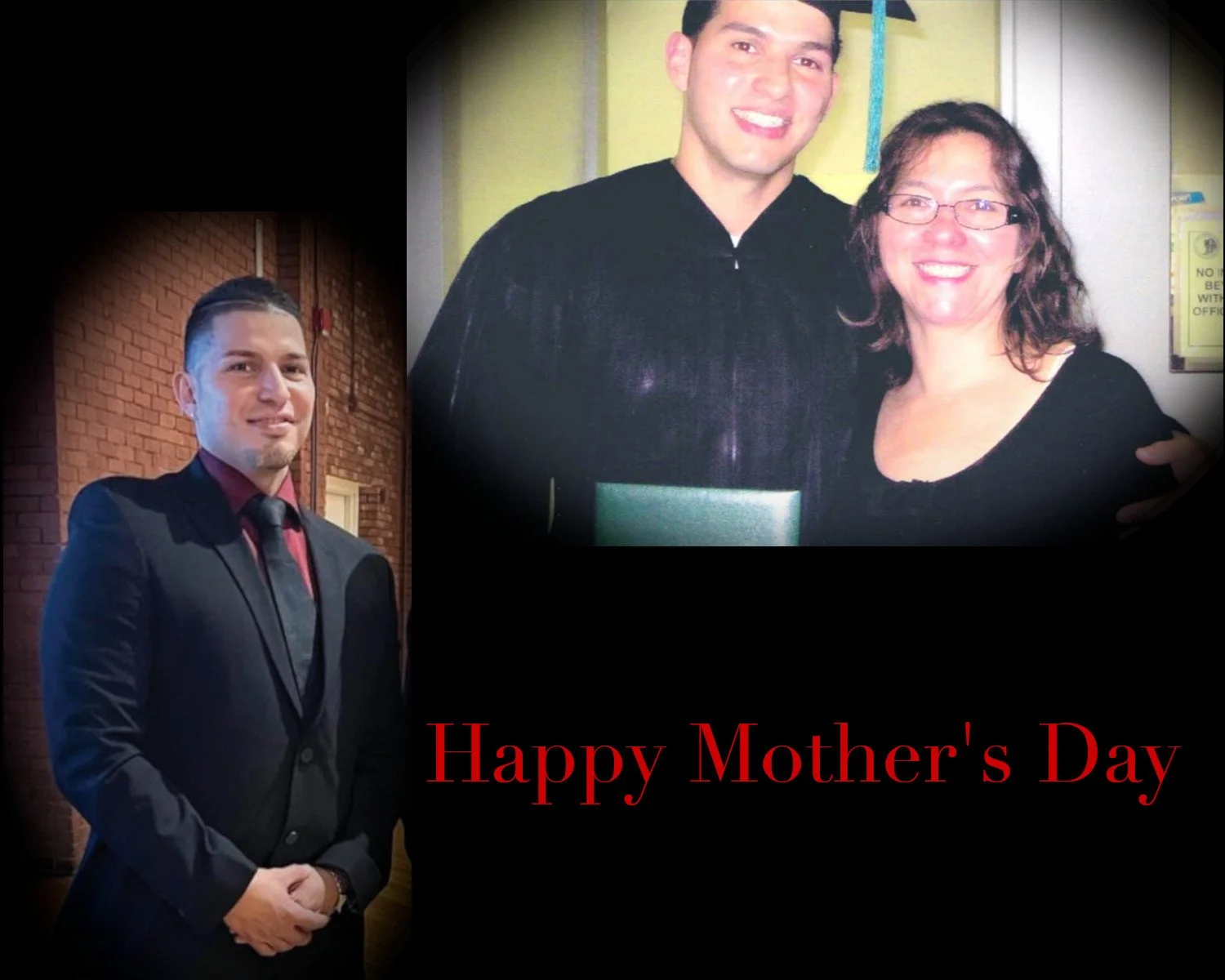
Like many single mothers of prodigal sons, Evenor Pineda’s Mom struggled against formidable forces — the streets, the gangs, jail, then prison — but never gave up.
May 15, 2024 Fr Gordon MacRae
Toya Graham is not exactly a household name, but odds are you’ve seen her. Just about every cable and network news outlet in America carried a video clip of Mrs. Graham chasing her masked and hooded teenage son down a Baltimore street back in 2015. She searched for him, and found him in the middle of an urban protest surrounded by police in riot gear. Not long after she left with her prodigal son in tow, the crowd erupted into a rampaging mob that laid waste to one of the poorest neighborhoods of Baltimore.
As the news footage of a desperate mother chasing down her son went viral, Toya Graham quickly became a national icon of sorts, a single mother struggling to raise her son alone against the lure of the streets. My heart went out to this woman. The very scene she unwittingly brought to national attention was one I described in a post entitled, “In the Absence of Fathers: A Story of Elephants and Men.” Seven years after it was published, it was cited by the National Catholic Register as being among the best of Catholic blogs because it struck a very exposed nerve in our culture.
I hope you will read it and share it in these weeks between Mother’s Day and Father’s Day in America. That article has been the most widely read and shared post at Beyond These Stone Walls, having been republished in hundreds of venues and shared over 30,000 times on Facebook alone. It told a story that might be the real catalyst behind the looting, raging mobs that overtake inner city streets across America. It is a story about much more than race.
Toya Graham became an icon of the one thing necessary to keep a peaceful and legitimate protest from descending into a lawless mob: a loving, caring, responsible and available parent — preferably two of them in faithful partnership — willing to meet head-on the challenge of parenting. In the now epidemic absence of fathers in neighborhoods like that one in Baltimore — and in prisons all over America — Toya Graham met that challenge heroically, and alone.
A few days later, Mrs. Graham and her son, Michael Singleton, appeared on one of the morning network news shows. He presented as a remarkably articulate and respectful son, traits that no doubt spoke more of his Mom than himself, and he joked that running toward the police in riot gear on that street that day made more sense to him after seeing the look on his mother’s face.
For her part, Mrs. Graham apologized to the nation for a few foul words delivered before cameras in the heat of the moment, but she apologized to no one for the almost comical smack she delivered to the son who towered over her. “As long as I have breath in my body,” she said, “my son will not be down there doing that!” If this blog had a Mother-of-the-Year award, it would have gone to Toya Graham.
But she would have to share it with Rosa Levesque. Rosa is the mother of another young man I know, Evenor Pineda, and I have come to admire her very greatly even though we have never actually met. You have previously met Evenor Pineda however. He appears in a photograph that you will see again below.
Evenor's is a remarkable story of the undying love and urgent hope of a single mother struggling to redeem her prodigal son. It is best to tell it in Evenor’s own words:

Here Is Evenor Pineda:
“I was born on Wednesday, December 30, 1981 to immigrant parents in Nashua, New Hampshire. My father, Cosme, was a political refugee who fought on the losing side of a civil war in Nicaragua. My mother, Rosa, was an orphan adopted into an oppressive and abusive family that emmigrated to the United States. My sister, Lina, was born two years and a day after me, and by her second birthday our mother left our father, fleeing in an attempt to protect us from the drug dealing and growing addiction that was consuming his life and our family.
“As I grew into adolescence with the wonderful woman struggling to raise us alone, I betrayed her faith, hope, and trust by becoming the next male role model in our family to become an abuser and addict, and I added a new twist — a gang member.
“While my mother struggled to pay the bills I did everything to undermine her. Our home became a hangout for the gang. I brought alcohol and drugs into our home and police to our door, because there was no one there to stop me. Under my influence, even my younger sister began to stray into my world, but our mother took a much harder line with her, pulling her back from the brink upon which I lived.
“It wasn’t that my mother didn’t take that same hard line with me. She did. But she also knew that outside our home were the streets always luring her rebellious son from beyond her influence. She knew that she risked losing me forever, so my Mom did what she always did. She struggled as best she could.
“Between the ages of fifteen and eighteen I would drop out of school, be arrested a dozen times, incarcerated four times in both juvenile detention and then county jails, but my mother never gave up on me. Not even when I gave up on myself.
“On my eighteenth birthday, I maxed out of a county jail and was able to land a real job. I held it for five years, but the ties to my gang grew stronger and I simply became better at evading arrest. And my Mom still struggled against them.
“By the time I was twenty-two, I had two beautiful children of my own, my son, Tito and my daughter, Nati. Fatherhood was something I had to learn from scratch, having had no personal experience of it in my life. The relationship I was in with their mother collapsed, but my mother was, as always, right there to help me raise my children. She was an incredible grandmother.
“I was balancing two different lives, however, one as a young father and family man and the other as a gangster. Those two lives collided on April 17, 2005. My friend Kaleek and I had a falling out over drugs that escalated. We both fell victim to the street culture we had embraced, and that would not release us from its grip. It ultimately took Kaleek’s life, and my freedom.
“This marked the lowest point in my life. It was the point at which I learned who my true friends were — and were not — and it reinforced how much the adage is true — that blood is thicker than water. It was a selfish moment in my life where I thought of no one but myself. I knew I suffered, but I had no idea how much I made my family suffer. By this time, my sister, Lina was serving in Iraq, and at a time when I should have been a support to my family, I instead went to prison. I had been in this place for ten years, with eight more left to serve.
“My mother had become both grandmother and mother to my children, and the one mainstay of my life who never stopped struggling to save me. So when there came a time when I had to decide who I am, I looked to the one person who might know. My mother taught me by the sheer force of example the meaning of love and sacrifice, the meaning of parenthood.
“In 2010, I became a volunteer facilitator for the prison’s Alternatives to Violence Program. I trained for this alongside two men you know: Michael Ciresi and Pornchai Moontri. In 2012, Pornchai Moontri and I graduated together from Granite State High School, an accredited school in the Corrections Special School District. My friend, Alberto Ramos.
“One day, my friend, Gordon MacRae showed me an article he wrote about our graduation. It told my friend, Alberto’s story and was titled, “Why You Must Never Give Up Hope for Another Human Being.” It was then that I realized that I must never give up on myself. I know you have seen the photograph of us that I am told is now rather famous. That is Pornchai in the middle with Alberto just behind and to his right.
“I am on the left, and clearly in the very best of company. Gordon is not in the picture, but stood next to the photographer. We were all proudly showing him our diplomas.
“In the ensuing years I served with my friend Gordon on the Resident Communications Committee (RCC), a representative group of ten prisoners that met monthly with prison administration to keep open channels of communication and to try to make this a better and safer environment. After a year I was appointed co-chairman of the RCC having been nominated for that post by Gordon. I want to thank him. At least, I think I do!
“I also was a member of Hobby Craft and its woodworking department where I have learned the skill to produce furniture and other items that were then sold to the public. I used the funds I earned to help my mother and my children, and also to further my education. Through this effort, I was able to afford one or two courses per semester at New England College which had a presence in this prison.
“I formally renounced my gang membership. There was no longer any room for that past in my present. I remember something my friend, Pornchai Moontri wrote in an article I read. ‘One day I woke up with a future when up to then all I ever had was a past.’ Sometimes the truth just smacks you in the head. Today, I find reason to be proud, not only of my mother, but my sister, Staff Sergeant Lina Pineda of the New Hampshire National Guard, and of my children. I am their future, and it is an awesome responsibility from which I must not shrink.
“When we graduated from high school in 2012, Gordon MacRae was there to hear Pornchai’s great graduation speech. He wrote about this in an article I read. I gave a speech that day, too. My mother, Rosa, was there, and I wrote it for her. Gordon later asked me for a copy, and then asked me to let him reproduce it here.”

Evenor Pineda’s Commencement Speech:
“Not everyone is fortunate enough to have an opportunity to receive an education or to have parents to encourage their education. I, however, was one of those fortunate enough to have both an opportunity and someone who cared enough to show interest in my education.
“Yet I then took for granted what I now recognize was then a luxury and I squandered a wonderful opportunity to seize a controlling stake in my future. It was a future which up until high school was very promising. All I had to do was stay the course.
“It was a far cry from other children in the world not as fortunate as I was to have a parent who cared and who valued education, children whose future is bleak, at best. The most shameful part about this is that I knew how good I had it and how bad others did.
“I know of such a woman whose childhood was the polar opposite of mine. She was parentless at the age of three, placed in an orphanage with her six sisters all of whom were eventually placed with different families. At nine she found herself in a home where she was denied an education, robbed further of her childhood, forced into a life of servitude: cooking, cleaning, caring for that family’s biological children, and abused both physically and mentally. She was told that she would amount to nothing, would be nothing.
“Yet this woman did not allow circumstance to dictate her future, and as fate would have it, when the family she was living with emmigrated to the United States, the Land of Opportunity, she did just that. She seized an opportunity and a controlling stake in her future. At the age of just seventeen in a foreign land, she struck out on her own, started her own family, learned English, and with only a third grade education, earned her GED.
“Then she earned a college certificate in her field of work, earned her citizenship, earned a home, and earned the American dream. It was a dream this woman, my Mother, struggled to obtain, and I was a product of that American dream. I was born into an opportunity not afforded to my mother, yet she — unlike me — capitalized on her opportunities.
“I had to endure great loss and suffering to finally grasp and understand to what lengths my mother had to struggle and sacrifice to solidify her place in this country, and how much it must have pained her to see me throw away the opportunities bestowed upon me.
“Not everyone is fortunate enough to have an opportunity at an education, let alone a second chance. This is why this diploma has taken on a whole new meaning. It is a step toward redeeming myself to my mother and my family. It is a symbol of my commitment to follow in the steps of my mother in pursuing the American Dream.
“I’m sorry to be late this Mother’s Day, Mom, and all the Mother’s Days past. I love you, and I thank you. I am so very proud of you. Your struggle has not been in vain.”
+ + +
Editor’s Note: Evenor emerged from prison in 2017 and has never returned. He is today the Intervention Programming Coordinator for the Manchester Police Athletic League where he diverts many young people from the lure of the streets. He has also assisted other inmates emerging from prison by challenging them to employ the tools needed to move forward. He is today an outstanding father thanks to the support of an outstanding mother.
Thank you for reading and sharing Evenor’s profoundly moving story. You may also like these related posts from Beyond These Stone Walls:
In the Absence of Fathers: A Story of Elephants and Men
Why You Must Never Give Up Hope for Another Human Being
The Eucharistic Adoration Chapel established by Saint Maximilian Kolbe was inaugurated at the outbreak of World War II. It was restored as a Chapel of Adoration in September, 2018, the commemoration of the date that the war began. It is now part of the World Center of Prayer for Peace. The live internet feed of the Adoration Chapel at Niepokalanow — sponsored by EWTN — was established just a few weeks before we discovered it and began to include in at Beyond These Stone Walls. Click “Watch on YouTube” in the lower left corner to see how many people around the world are present there with you. The number appears below the symbol for EWTN.
Click or tap here to proceed to the Adoration Chapel.
The following is a translation from the Polish in the image above: “Eighth Star in the Crown of Mary Queen of Peace” “Chapel of Perpetual Adoration of the Blessed Sacrament at Niepokalanow. World Center of Prayer for Peace.” “On September 1, 2018, the World Center of Prayer for Peace in Niepokalanow was opened. It would be difficult to find a more expressive reference to the need for constant prayer for peace than the anniversary of the outbreak of World War II.”
For the Catholic theology behind this image, visit my post, “The Ark of the Covenant and the Mother of God.”

On Good Authority, “Salvation Is from the Jews”
Anti-Israel protests and prejudice were as common as any other plague in Biblical history, and often inflamed, just as they are today, by agitators in a proxy war.

Anti-Israel protests and prejudice were as common as any other plague in Biblical history, and often inflamed, just as they are today, by agitators in a proxy war.
May 8, 2024 by Fr. Gordon MacRae
In the image above, The Deliverance of Israel depicted in “The Crossing of the Red Sea” by Raphael Sanzio, 1519.
There is a lawyer here in this prison who, like me, has been here for too many years. He is a learned Jewish man who is one of the most well-read persons I know. He says I am the second most well-read, but I am not prepared to throw down with him over that. A few days before I began to write this post, he approached me in the prison law library where I serve as the legal clerk. I sometimes have to ask him a question or two about legal forms and procedure.
Seeming especially stressed and guarded that day, he nervously scanned the room before talking with me. He wanted to know if I understand the meaning of the word, “pogrom.” I associated it with the earliest days of the Holocaust, and he nodded silent agreement. It was crowded that day in the prison law library, and he seemed keenly aware that mine were not the only ears listening. Wary of the attention his question drew, he left, saying that we must have this discussion in a less public forum.
I knew what this was about. Across the U.S., the anxiety of Jews has heightened of late as universities campuses erupted in violent protest against the Nation of Israel. A “pogrom” is a Russian term that means “devastation.” It refers to a mob attack that is promoted, condoned, or even just conveniently overlooked, by civil authorities. The term was historically used to describe Nazi-era tactics to threaten and harass Jews while inflaming spontaneous mob uprisings and outright assaults against their property, or their persons, or both.
One such pogrom, known as Kristallnacht (German for “Night of Broken Glass”), took place in Germany on the night of November 9, 1938. In the minds of many Jews, including my lawyer-friend, Kristallnacht was the opening act in one of the most feared of all pogroms, the Holocaust. It was carried out in Nazi Germany and Eastern Europe from 1939 to 1945 and it systematically exterminated six million Jews — fully two thirds of the Jews of Europe.
For my friend, and for the Jews of New York City, which hosts the world’s largest population of Jews outside of Israel, recent events have been frightening reminders of the “Night of Broken Glass.” It left succeeding generations of Jews in a state of existential distrust if not terror.
For day after day in the United States and throughout the free world in recent weeks, we have been witnesses to a pogrom, an organized series of so-called “Pro-Palestinian” protests threatening to evolve into riots on major college campuses across America. At Columbia University in New York, the directive given to Jews from campus administration was to “Stay home for remote classes” because the University could not guarantee their safety.
The outrage of many Jews should now be keenly felt by all Americans. The news media called these noisy, escalating protests “Pro-Palestinian,” but in reality they are more accurately “Pro-Hamas.” Let that sink in, please. In the United States of America, should our national response to threats from an internationally recognized terrorist organization openly operating in U.S. territory be to tell its innocent victims to just “stay home?”

Free Palestinians from Hamas
Upon the advice of well meaning friends, I have wanted to avoid writing about this latest hornets’ nest of politics and power struggles in the Middle East, however, it seems inevitable that the forces at work there would eventually work to bring their pogrom here to be acted out before American news cameras. For weeks now, our democracy has been saturated in it, infected by it, and at risk of being further divided by it as it takes hold and festers here.
It would be foolish to think that these protests have spread spontaneously of their own accord to college campuses across the United States. Some in the less partisan and more incisive news media have uncovered evidence of financial manipulation with activist organizations on the deep political left offering $3,000 (student stipends) to infiltrate and inflame mobs for anti-Israel protests.
Many others among the chanting students have been misled and indoctrinated into a revisionist history leaving them tone-deaf to the actual meaning of rousing chants like “From the river to the sea, Palestine will be free.” It calls for the annihilation of Israel, and by extension the eradication of Jews. That this chant has been propagated by some Democrat members of the United States Congress has spread fears of our darkest history repeating itself. In a lead editorial entitled, “America’s New Mob Rule” (May 1, 2024), The Wall Street Journal Editorial Board wrote that the protesting students seem not to know or care that Hamas’ Charter calls for the annihilation of Jews.
What is now happening across America began in Israel on October 7, 2023. Thousands of young Israeli citizens and others were savagely slaughtered in the light of day by Hamas terrorists on an innocent Saturday afternoon. The victims were mostly young people the same ages as many of those now promoting and supporting their murderers. These campus protesters are utterly ignorant of the forces manipulating them. I wrote of the meaning and history of Hamas in “The Hamas Assault on Israel and the Emperor Who Knew Not God.”
There was much more to the events of October 7, 2023 than the vicious assault on Jews along the Gaza border. In response to those events, I wrote a post that stunned many of our readers who had no idea of the extent of Hamas brutality and of how its violence had also targeted other innocent people. That post was “Thailand’s Victims of Hamas in Israel.”
It clarified the extent of the pogrom, the devastation, inflicted on many innocent young people that day, including many whose only crime was poverty and a desire to work to support their families, something these hapless university protesters have never had to do. What follows is an excerpt cited in the above linked post from The Wall Street Journal of October 28, 2023 written by the usually restrained and moderate Editorial Board. If it does not send a shudder down any reader’s spine, then there is no spine left.
“Why did the Hamas men, upon confronting the dead body of a teenage girl start cheering? Why did they argue over who would get to decapitate a Thai guest worker they had shot, then proclaim ‘Allahu akbar,’ ‘God is most great’ with every swing at his neck? ‘Allahu akbar’ was on their lips over and over as they shot defenseless civilians, dragged corpses, and pumped round after round into the dead. There it was again on the terrorists’ return to Gaza, ‘Allahu akbar’ coming from crowds as a Hamas man pulled by the hair a battered hostage with pants bloodied around her groin … . During the music-festival massacre, a terrorist paused to put a bullet through each of the porta-potties lest a single girl escape.”
I regret that you had to read the above excerpt in these pages. The parts left out about the acts of Hamas were far more hideous and barbaric “Allahu akbar!” God is great but this was not God. This was the work of evil spinning up from the dark hearts of men who have, over eons of inherited hatred, let their politics take the place of God. Some in our nation are at risk of doing the same.
It is this that masses of American college students now support with misinformed, misguided, and inflammatory anti-Israel rhetoric masked as concern for the Palestinian people — many of whom are not at all enamored of the Hamas terrorists in their midst using them as human shields. I am all for supporting Palestine. The free world must help them become free of Hamas. The good people of Palestine are as much held hostage by Hamas as the men, women and children chained up in Hamas tunnels to be used as political pawns.
Salvation and Freedom Are Both from The Jews
When I told a priest-friend about the title I was choosing for this post his knee-jerk reaction was, “Are you crazy? Don’t you think ‘they’ can get to you?” I wonder who ‘they’ are. The words of my title — “Salvation Is from the Jews” — were spoken by Jesus of Nazareth in the Gospel of Saint John, Chapter 4, Verse 22.
The setting is a field in Samaria at a place that came to be known to Jews as “Jacob’s Well.” Tradition has it located at the foothills of Mount Gerazim, a sacred site of Samaritan worship. In New Testament times (First Century AD) the Samaritans were considered heretical and hostile to the Jews who returned that hostility with some of their own. The people of Samaria were separatist Jews who had lived in exile for centuries, a history that I described in “The Hamas Assault on Israel and the Emperor Who Knew Not God.”
The disciples of Jesus were shocked (John Chapter 4) to discover him conversing with a Samaritan woman. The Samaritans then were only semi-Jewish whose Scriptures were limited to the Pentateuch, the first five books of the Hebrew Bible known as the “Books of Moses.” The Samaritans knew nothing of the Prophets, the Psalms, the Wisdom literature, the struggles of Judaism, or the Davidic Kingdom and its promised Messianic return. The Jewish-Samaritan disdain for each other is evident in the irony highlighted by Jesus in the parable of the Good Samaritan (Luke 10:30-37). The Samaritan in the famous Parable aided a robbed and beaten Jewish traveler when a priest and Levite, honored members of the traveler’s own faith, were barred by ritual laws from doing so.
It was also evident in the dialogue between Jesus and the woman of Samaria set at Jacob’s Well near Mount Gerazim. Jesus instructed her: “You worship what you do not know; we worship what we know, for salvation is from the Jews.” (John 4:22) This was so in God’s Covenants with Noah, Abraham, and Moses, but it was not to stay that way. Christianity arose with Jesus himself upon whom salvation now rests. That is a theological truth, but it does not change the historical truth that Jesus conveyed to the woman of Samaria.
“Salvation is from the Jews.” Saint John’s Gospel reports that “many Samaritans from that city believed in him because of the woman’s testimony... . So when the Samaritans came to him, they asked him to stay with them ... and many more believed because of his word.”
— John 4:39-42
Freedom also comes from the Jews. Freedom is more than a right that enables and tolerates hapless student protests against what they clearly do not understand. Freedom is the right to live unencumbered by any will beyond your own, and your legitimate government’s, and your Creator’s. The journey to freedom of every enslaved people since the Exodus from Egypt is rooted in the freedom from bondage won for the Jews by the Hand of God.
Higher education in the United States is nothing if not predictable in the current age. The age of tolerance now opts for a select body of lies that many more clear-headed people might describe as “woke,” the newest trendy measure of orthodoxy. Steven Stalinsky, Executive Director of the Middle East Media Research Institute, described the fallout in “Who’s Behind the Anti-Israel Protests” in The Wall Street Journal (April 23, 2024):
“At Columbia University, demonstrators chanted support for terrorist organizations [while] burning the American flag and waving Hezbollah’s. They called for Hamas’ Al-Qassam Brigades to attack again, and taunted Jewish students with ‘Never forget the 7th of October,’ and ‘That will happen 10,000 more times.’ Three men interrupted the Easter Vigil at Saint Patrick’s Cathedral in New York unfurling a banner while shouting, ‘Free Palestine.’”
They also called for humanitarian aid, not for Palestine, but for the protesters themselves. They also demanded unquestioned passage of the Green New Deal, and free pizza.
The protesters at Columbia University in New York City, like those in many other protests, wore masks or face shields so they could remain anonymous. So much for the courage of their convictions. When Wall Street Journal columnist Peggy Noonan approached several of them for an interview, they each declined, one by one, saying “I’m not trained.”
Trained by whom?
+ + +

This young Thai guest worker was shot three times by Hamas terrorists while trying to save other Thai workers on October 7, 2023. Interviewed in his hospital bed in Tel Aviv, he said: “I want the people of Israel to know that they are in my thoughts and prayers all the time.”
+ + +
Note from Fr. Gordon MacRae: Thank you for bravely reading and boldly sharing this post. You may also like these related posts from Beyond These Stone Walls:
Thailand’s Victims of Hamas in Israel
The Hamas Assault on Israel and the Emperor Who Knew Not God
The Eucharistic Adoration Chapel established by Saint Maximilian Kolbe was inaugurated at the outbreak of World War II. It was restored as a Chapel of Adoration in September, 2018, the commemoration of the date that the war began. It is now part of the World Center of Prayer for Peace. The live internet feed of the Adoration Chapel at Niepokalanow — sponsored by EWTN — was established just a few weeks before we discovered it and began to include in at Beyond These Stone Walls. Click “Watch on YouTube” in the lower left corner to see how many people around the world are present there with you. The number appears below the symbol for EWTN.
Click or tap here to proceed to the Adoration Chapel.
The following is a translation from the Polish in the image above: “Eighth Star in the Crown of Mary Queen of Peace” “Chapel of Perpetual Adoration of the Blessed Sacrament at Niepokalanow. World Center of Prayer for Peace.” “On September 1, 2018, the World Center of Prayer for Peace in Niepokalanow was opened. It would be difficult to find a more expressive reference to the need for constant prayer for peace than the anniversary of the outbreak of World War II.”
For the Catholic theology behind this image, visit my post, “The Ark of the Covenant and the Mother of God.”

After Eight Years in Exile Fr William Graham Is Credibly Innocent
Fr William Graham of the Diocese of Duluth, Minnesota was falsely accused and cast out in 2016 after his bishop deemed a nearly 40-year-old claim to be “credible.”

Fr William Graham of the Diocese of Duluth, Minnesota was falsely accused and cast out in 2016 after his bishop deemed a nearly 40-year-old claim to be “credible.”
May 1, 2024 by Fr William Graham with an Introduction by Fr Gordon MacRae.
“Now have salvation and power come … for the accuser of our brethren has been thrown down, who accused them day and night before God. They have conquered him by the blood of the Lamb and by the word of their testimony.”
— Revelation 12:10-11
From Fr Gordon MacRae: Some of our readers might have passed over my recent post, “Pop Stars and Priests: Michael Jackson and the Credible Standard.” Much more than the strange story of Michael Jackson, that post was really about the much stranger story of Catholic priests falsely accused. Commenter James Anderson wrote of it, “This article is the best ever on your false conviction.” The matter of falsely accused Catholic priests has received some increased attention of late, but not nearly enough to counter the vast media bias that grew and festered through news of the scandal of sexual abuse in the Catholic priesthood since the moral panic of 2002.
In my post linked above, I wrote of a development in my diocese, the Diocese of Manchester, New Hampshire. A press release from the diocese has indicated that more names of long deceased priests have been added to a published list of the merely accused. The previous standard of “credibly accused” has now evolved to include everyone accused with no apparent investigation whatsoever. We published about the grave injustice posed by this practice in another post, “In the Diocese of Manchester, Transparency and a Hit List.”
Also in recent years, the Catholic League for Religious and Civil Rights has published a good deal about the rights of priests and why those rights must be defended within the Church. Another excellent source of commentary built upon justice is The Media Report hosted by writer David F. Pierre, Jr. Back in 2019, he sent a title and link into our Inbox: Two Falsely Accused Priests Fight Back and Win! In the matter of one priest in the Diocese of Duluth, MN, Dave Pierre summarized a development that caught my attention back then:
We are pleased to report that a Minnesota appeals court recently upheld a $13,500 jury award to Rev. William C. Graham after the jury found that an accuser had falsely accused him.
As we reported last year, the accuser was represented by the notorious law firm of Jeff Anderson, and Anderson's sleazy lawyer, Mike Finnegan, lied to the media that there was somehow a "split verdict" in the jury's decision.
But a woman on the jury wrote a letter blasting Finnegan's characterization of the verdict and added that there was "no proof" that any abuse occurred. Good for her.
Hopefully, this is the beginning of a new trend. When folks lie to courts claiming they were abused by priests, the priests should countersue, naming names. Justice demands it.
The slowly evolving matter of justice for Father William Graham finally came to a conclusion just days ago when Father Graham’s removal from ministry was overturned by the Vatican for lack of any credible evidence. Father Graham has been restored as pastor to the very parish from which he was removed unjustly eight years ago, and exiled from any priestly ministry, barred from even identifying himself as a priest. It comes as a great and triumphant irony that Father William Graham is now restored as pastor of Saint Michael the Archangel Parish, a parish named to honor the Patron Saint of Justice. Here is Father Graham’s first homily upon his return sent to me just days ago.
+ + +

Father William Graham on the Road to Emmaus
Well, as I was saying, before I was so rudely interrupted ... Thank you. I’ve been working on that line for the last 95 months.
The old gospel hymn describes what I see here today: “When all God’s children get together, what a time, what a time, what a time!” And what a wonderful sight this is to me: all of us together again around book and table, thanking God for the gift of Christ, remembering and celebrating that the Church makes the Eucharist and the Eucharist makes the Church. Vatican II teaches us that: “the Church has never failed to come together to celebrate the Paschal Mystery: reading those things ‘which were in all the scriptures concerning Him’ (Luke 24:27), celebrating the Eucharist in which ‘the victory and triumph of His death are again made present,’ and at the same time giving thanks ‘to God for His unspeakable gift’ (2 Cor. 9:15) in Christ Jesus, ‘in praise of His glory’ (Eph. 1:12), through the power of the Holy Spirit. To accomplish so great a work, Christ is always present in His Church, especially in her liturgical celebrations.’
We are much like those disciples who, on the road to Emmaus, met Jesus. He was made known to them as He is made known to us: in the telling of the stories and in the breaking of the bread. Those disciples shared the agony of the passion and death of Jesus. We, too, have suffered as the Body of Christ, broken, but called to new life and renewed hope.
You and I have been through a terrible, traumatizing experience. I was falsely accused and denied both justice and mercy by our local Church. A number of folks have asked why I didn’t just quit and go away. That is not how justice is accomplished; it is not how we seek the Truth, who is Christ, and who will set us free. Doing the right thing is a demanding task. You know that. I have found the path to justice exhausting and worrisome and, let me say, very, very, very expensive. All that we have is our human dignity, and it is our obligation to assert and defend that dignity as we seek the face of God. Pope St. Leo the Great told us of that duty of ours when he said in the fifth century, “Christian: remember your dignity!”
I am deeply sorry that the pursuit of justice was so long and difficult for you here, and for me, and for all who were involved. Those who stood for justice will enjoy what the psalmist promises, that the Lord does wonders for his faithful ones, and hears us when we call upon him. Further, the light of the Lord will shine on us, and he will put gladness into our hearts (Psalm 4).
The Vatican official who made the last determination of my case spoke out on March 25. He is Archbishop Charles Scicluna, adjunct secretary of the Dicastery for the Doctrine of the Faith. He told Vatican Media that “The pope very often repeats this phrase: ‘When one of us suffers, we all suffer.’” Scicluna added, “If there is this attitude of solidarity, if there is the thirst for justice of which Jesus speaks, but also the will to do good, then the law becomes a living instrument, otherwise, like all laws, it could remain a dead letter.”
I am grateful for the Church’s laws and courts. I received no justice, no comfort and no word of mercy from the Diocese of Duluth during my long ordeal, and often told the bishop, and the previous bishop, that Psalm 31 speaks to my pain: “I am like a dead man, forgotten, like a thing thrown away.”
Pope Paul VI told us that if we want peace, we must work for justice. We who seek Christ among us must understand that justice is the first virtue of both Church and civilization. Without justice, we have no future or no hope. I am grateful to the Vatican, my legal team, my family and friends, and many of the members of this parish, and many former members, who insisted that justice be done. We cannot walk away from injustice and hope that the universe will fix it. Our mission is to build the Reign of God among us; we cannot do so if we ignore the demands of justice. Justice is first and obligatory; we are bound to seek justice; we are called to do charity. Jesus Himself tells us in today’s Gospel passage why we pursue justice, no matter the cost. Remember that the two disciples who had encountered Jesus on the road to Emmaus were telling the others about their experience. “While they were still speaking about this, [Jesus] stood in their midst and said to them, ‘Peace be with you.’” They were terrified, thinking He was a ghost. When they recognized Jesus, He ate with them, and said:
“Thus it is written that the Christ would suffer
and rise from the dead on the third day
and that repentance, for the forgiveness of sins,
would be preached in his name to all the nations,
beginning from Jerusalem.
You are witnesses of these things.”
Christ “claims dominion over all creation,
that He may present to [the] almighty Father,
an eternal and universal kingdom:
a kingdom of truth and life,
a kingdom of holiness and grace,
a kingdom of justice, love, and peace.”
— Preface of Christ the King
We, you and I, are called to be men and women of peace, in imitation of Jesus, with whom we are on the road, and whose Spirit gathers us to Himself. Here at St. Michael’s, our immediate task will be to pray together and listen to each other with the ears of our hearts. After that, we will ask each other, Where do we go from here? We can’t have a plan or an agenda yet, but we will move to healing and peace, reconciliation, cooperation with grace, “Proclaiming the Gospel in Word, Sacrament, and Service” (Parish Mission Statement 2015).
I have heard that some say that this is a time for mourning, or grief or grieving. I do not say that. I say that this is the day that the Lord has made. Let us be glad and rejoice in it.
May The One who began this good work in us bring it to completion in the day of Our Lord Jesus Christ!
+ + +
Note from Father Gordon MacRae: Thank you for reading and sharing this landmark post. You may also like these related posts from Beyond These Stone Walls:
Saint Joseph: Guardian of the Redeemer and Fatherhood Redeemed
Casting the First Stone: What Did Jesus Write on the Ground?
The Eucharistic Adoration Chapel established by Saint Maximilian Kolbe was inaugurated at the outbreak of World War II. It was restored as a Chapel of Adoration in September, 2018, the commemoration of the date that the war began. It is now part of the World Center of Prayer for Peace. The live internet feed of the Adoration Chapel at Niepokalanow — sponsored by EWTN — was established just a few weeks before we discovered it and began to include in at Beyond These Stone Walls. Click “Watch on YouTube” in the lower left corner to see how many people around the world are present there with you. The number appears below the symbol for EWTN.
Click or tap here to proceed to the Adoration Chapel.
The following is a translation from the Polish in the image above: “Eighth Star in the Crown of Mary Queen of Peace” “Chapel of Perpetual Adoration of the Blessed Sacrament at Niepokalanow. World Center of Prayer for Peace.” “On September 1, 2018, the World Center of Prayer for Peace in Niepokalanow was opened. It would be difficult to find a more expressive reference to the need for constant prayer for peace than the anniversary of the outbreak of World War II.”
For the Catholic theology behind this image, visit my post, “The Ark of the Covenant and the Mother of God.”