The Higgs Boson God Particle: All Things Visible and Invisible
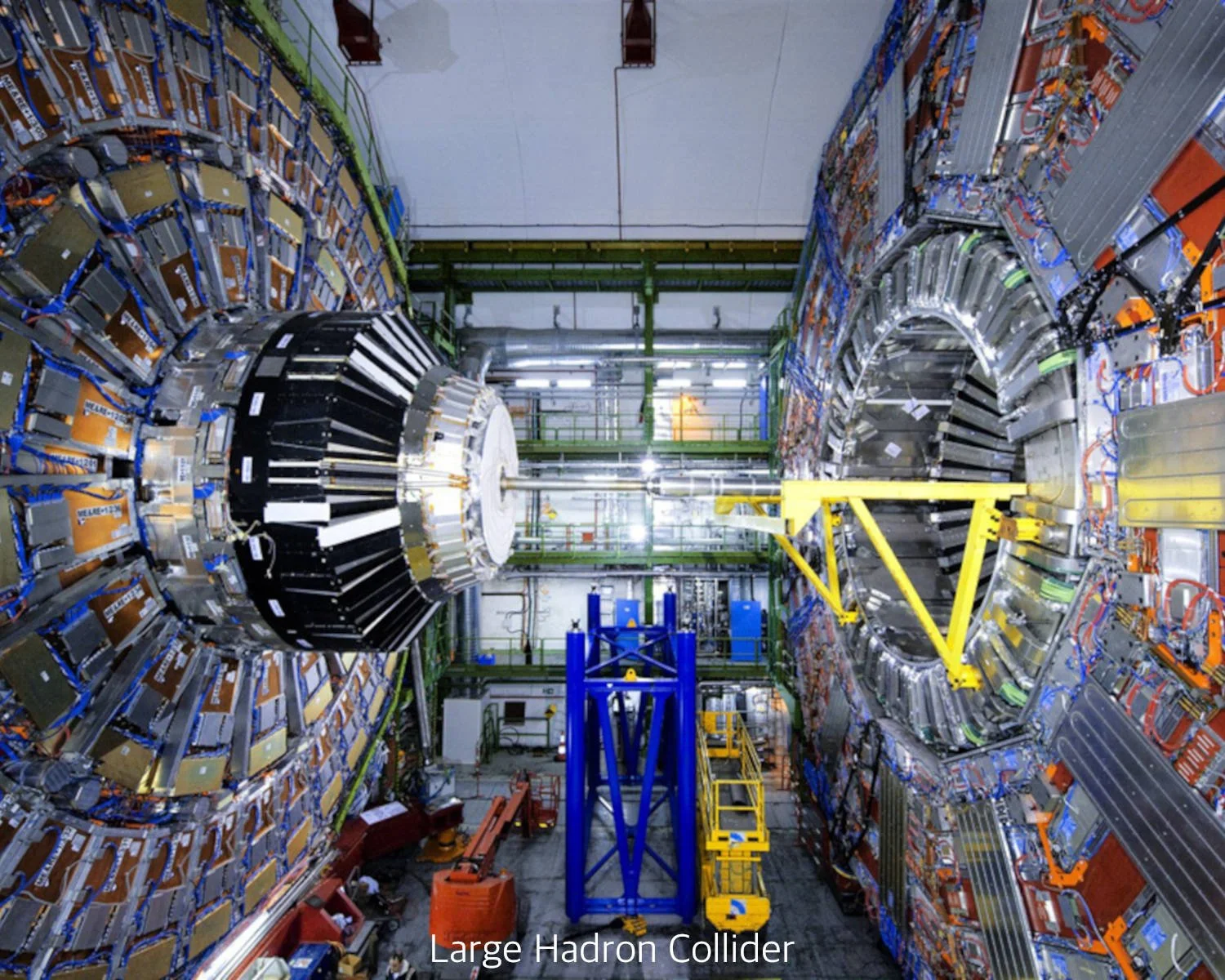
In 2012, scientists at the Large Hadron Collider detected the elusive Higgs boson, a subatomic particle dubbed the “God Particle” explaining the origin of matter.
February 4, 2026 by Father Gordon MacRae
“Two Higgs boson particles walked into a bar. Over drinks one said, ‘I hear Stephen Hawking bet $100 that we don’t exist. What if he’s right?’ The other replied, ‘No matter!’ ”
Get it? No matter? Get it? Well, hopefully you will in a few minutes. I didn’t get it either until I did some heavy-duty reading.
If this post is creating a touch of déjà vu, a sense that you have seen it before, it’s because you probably have. Something quite unusual happened here at this blog in recent weeks. In the earliest days of this blog in 2010, I was contacted by a reader in Australia about a new book by physicists Stephen Hawking and Leonard Mlodinow entitled The Grand Design (Bantam Books, 2010). The letter writer was concerned that media outlets in Australia and around the world were citing aspects of the book out of context in an attempt to demonstrate that Stephen Hawking declared that God does not exist. That was a faulty interpretation and the reader wanted me to set the record straight. It was a tall order, but I had time on my side to ponder and present a contrary point of view. So on October 6, 2010, we published “Did Stephen Hawking Sacrifice God on the Altar of Science?”
A lot of work went into that post, but to my chagrin it was met by most of our readers with a yawn the size of a giant black hole. Fifteen years later, someone (not me) submitted that post to an advanced artificial intelligence model requesting an analysis of it. The results were then read to me by our Editor. AI scoured the Internet and then referred to me as “a Catholic priest with a background in science” while singling out that post as “a significant example of bridging the gap between science and faith.”
So of course, I thought that was the nicest thing any AI had ever said about me (There was very little to compare it to.). Given this new interest in a bridge between science and faith, I decided to haul out this 15-year-old post and rehabilitate it for a new audience. On July 30, 2025, we republished “Did Stephen Hawking Sacrifice God on the Altar of Science?” The result was mind boggling, but it was not immediate. A few months later that post started showing up in our stats and then it began a viral spread. By January it was outpacing my regular weekly posts in popularity. And then by mid-January it spread all over the world in unprecedented numbers for this blog.
I cannot pretend to know why this happened. I do not understand the global attention to this one post on the space-time continuum. Perhaps my only conclusion is that when I post a bomb, just wait 15 years and post it again.
The Discovery
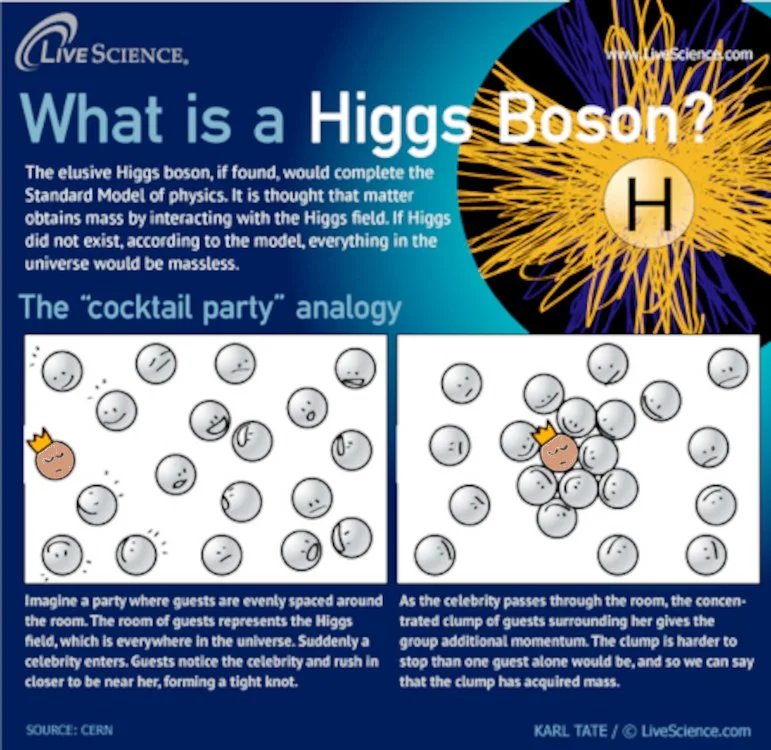
There is another post of mine that also bridges the gap between science and faith. I do not have an explanation for why or how, but another of my posts, this one from 2012, also began to show up in unusually large numbers with that other post. I have long wanted to repost this one with some updated information so that those who are currently reading and spreading it can see the updated version. It is “The Higgs Boson God Particle: All Things Visible and Invisible.”
I first wrote it in September 2012. It, too, was met with a rather extended yawn, but today it shows up often and everywhere. It profiles the work of the late physicist Peter Higgs who rose to prominence in the scientific community in 1964 when he theorized that the Higgs boson exists as a necessary subatomic particle which explains the existence of matter. After my post was first published, the Higgs boson was experimentally demonstrated again and Peter Higgs was awarded the Nobel Prize in Physics. He died on April 8, 2024 at the age of 94 knowing that his life’s work was a major addition to the scientific understanding of the Universe.
A boson in physics is a component of subatomic particles such as protons and photons, which exist in every atom of matter. As a class of particle, a boson is so-called in honor of Indian physicist, Satyenda Nath Bose, who collaborated with Albert Einstein. The existence of a then-theoretical Higgs boson resolved a puzzle in the Standard Model of physics, a widely accepted model for how particles interact. The thinking in the Standard Model was that particles such as photons — particles of light — have no mass. They should move throughout the Universe unhindered. The mathematics of the Standard Model explained successfully the existence of particles, but not mass or matter. The Higgs boson proposed by Peter Higgs in 1964 was an explanation for how particles could attain mass, and thus bring into being a Universe filled with matter that we can see or otherwise detect.
CERN, the European agency for nuclear research, operates and oversees the Large Hadron Collider. It is a donut-shaped laboratory 27-miles in circumference on the French-Swiss border. Two beams of protons were set on a collision course moving at close to the speed of light. Their collision resulted in an explosion that recreated the conditions of The Big Bang, the scientifically accepted origin of our Universe. During the collision, a supercomputer detected the presence of the Higgs boson particle and a Higgs field for a trillionth of a second. It was the first time its existence had ever been established in a laboratory
On July fourth in 2012, physicists announced that they had a momentary glimpse of the elusive Higgs boson, the subatomic particle long theorized to exist, and without which matter itself would not exist. The physicists who reported that they only found “evidence” of the Higgs boson were just being careful scientists. The discovery had a 99.9999% rate of certainty. There is no doubt left. The Higgs boson does indeed exist and that experiment has since been ratified.
So what exactly does this mean? Many scientists grimaced every time someone in the news media referred to this discovery as “the God particle.” Using science out of context to debunk religious faith is a favorite pastime of some in the media, but the reverse should also not happen.
I took a hard look at the interaction between faith and science in “Did Stephen Hawking Sacrifice God on the Altar of Science?” After publication of The Grand Design, some in the news media speculated that Hawking’s book demonstrated that gravity — and not God — is responsible for the creation of the Universe. My conclusion was simply that Stephen Hawking has thrown in with the wrong “G,” and the pundits misreading his book have confused the tools of God with God. I cited in that post a vivid example. If you were an archeologist digging in ruins in Florence, Italy and you discovered a worn chisel that was used by Michelangelo to create the Pietà, one of the most celebrated examples of sculptured marble in art history, would you then conclude that Michelangelo did not create the Pietà, his chisel did?
What I find most interesting about the recent discovery is that the Higgs boson appears nowhere in Stephen Hawking’s The Grand Design. His analysis of the science of cosmology omitted it entirely. In fact, two decades ago Stephen Hawking wagered $100 that the Higgs boson would never be detected. He lost the bet.
The discovery of the Higgs boson is a big deal in science because it presents a purely scientific explanation for how matter exists, but not why. The model for creation it implies is that a primordial atom exploded in what we call The Big Bang 13.7 billion years ago. As the explosion cooled, a force known as a “Higgs field” — which contained the Higgs boson — was formed and permeates the Universe. As other particles interacted with this field, they acquired mass allowing gravity to bring particles together. It acted sort of like a dam slowing particles so that they would mass together. The result was matter as we know and see it — everything from stars to us. It’s sort of the yeast with which God bakes bread.
A Day Without Yesterday
The Higgs boson was detected by the Large Hadron Collider’s super computers in July 2012 for a fraction of a trillionth of a second. The tiny collision sent particles in every direction producing the energy equivalent to 14 trillion electron volts and blistering temperatures. The collision recreated a tiny model of the instance of The Big Bang. Some theorize that it was the presence of the Higgs boson particle within the primordial atom that caused The Big Bang itself, and the explosion of all matter in the Universe.
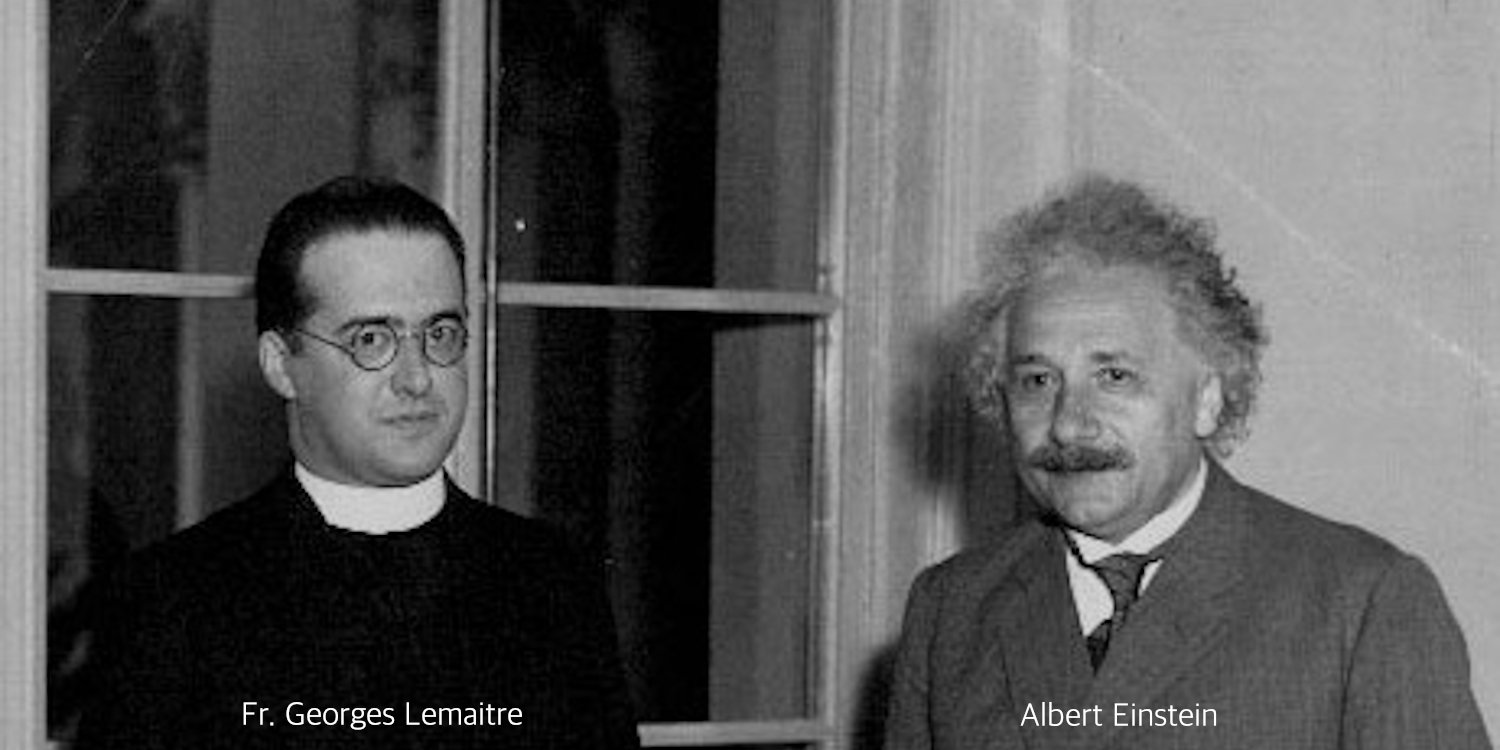
I find this all fascinating, but what is most fascinating is that the entire model was first mathematically predicted, and then demonstrated to even Albert Einstein’s satisfaction, by a Catholic priest. I wrote of the Belgian priest and physicist, Father Georges Lemaitre, in “A Day Without Yesterday:” Father Georges Lemaitre and the Big Bang. As a result of that post and others related to it, I began a correspondence with Father Andrew Pinsent, who prior to priesthood had been a physicist at CERN. We collaborated on a very special post, “Fr Georges Lemaître, the Priest Who Discovered the Big Bang.”
If ever you bristle about the typical anti-Catholic mythology that religion attempts to hold back science, remember that the originator of all the science behind this model of creation was a Catholic priest, and many of the great scientists of his time did everything they could to suppress his ideas. They failed because they could not successfully refute either his faith or his science. In the end, even Einstein bowed to Father Lemaitre, declaring that his model was “the most satisfactory explanation of creation I have ever heard.”
Pope Pius XII applauded Father Lemaitre’s discovery of The Big Bang because it challenged the acceptable science of the time which claimed that the Universe was not created, but always existed and is eternal. Einstein later acknowledged that his “Cosmological Constant” was his greatest error.
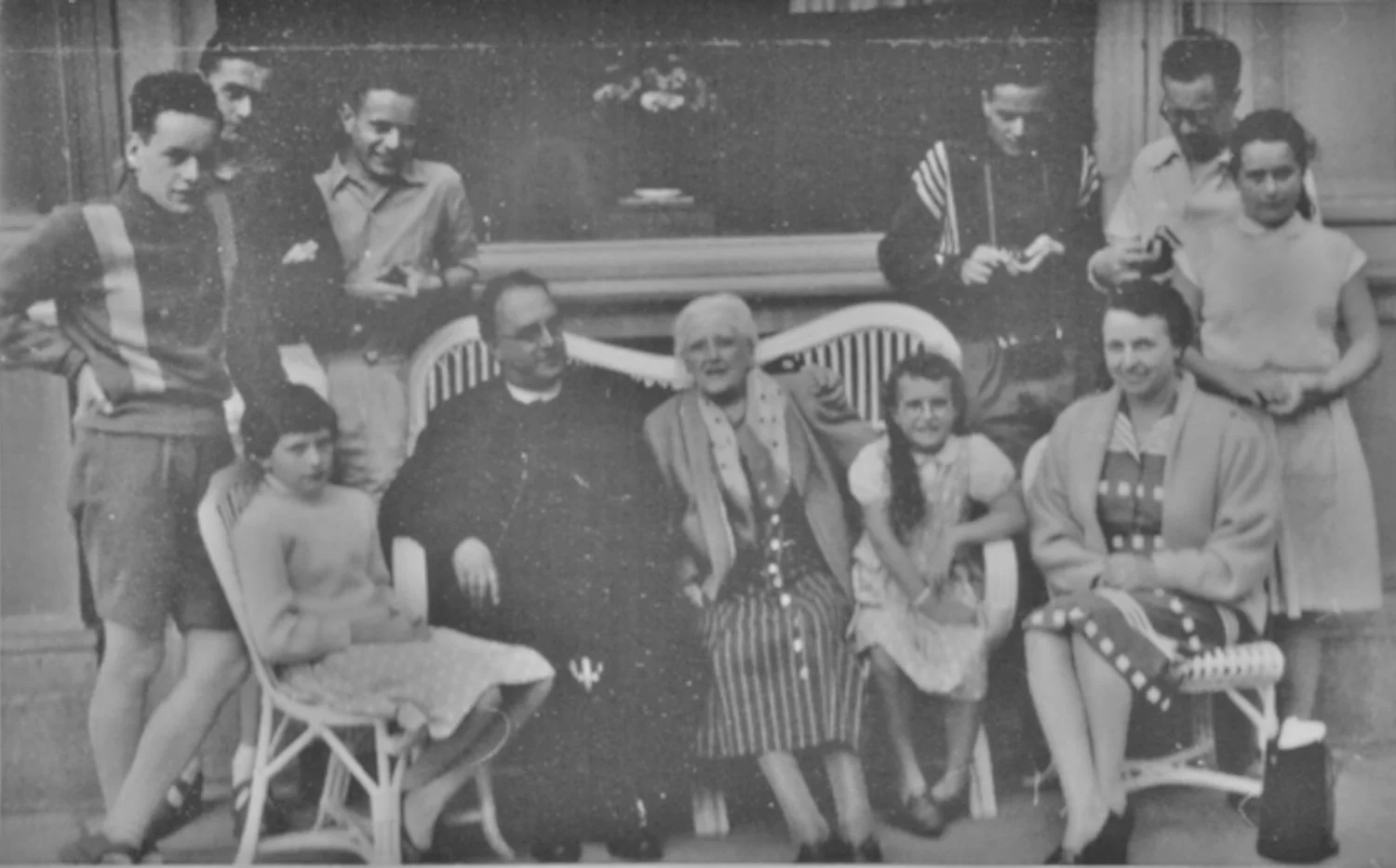
Perhaps the greatest miracle of all for me was receiving the photo below of Pornchai Moontri’s Godfather, the late Pierre Matthews, whose mother was a close friend of Father Lemaitre, who became Pierre’s Godfather. The odds that my roommate in Concord, New Hampshire would turn out to be the Godson of a man whose own Godfather discovered the Big Bang are as great as the odds of the Big Bang itself.
Michio Kaku, a professor of theoretical physics at City University of New York, wrote a brilliant and (unlike this post) brief commentary about the Higgs boson for The Wall Street Journal (“The Spark That Caused the Big Bang,” July 6, 2012). Professor Kaku wrote:
“The press has dubbed the Higgs boson the ‘God particle,’ a nickname that makes many physicists cringe. But there is some logic to it. According to the Bible, God set the Universe in motion as He proclaimed ‘Let there be light.’”
“So why did the Higgs boson particles hurry to church?
Because Mass could not start without them.”
+ + +
Note from Fr. Gordon MacRae: For open minds and enlightened souls bridges are taking shape between the realms of science and faith. You may also like these related posts from Beyond These Stone Walls:
Did Stephen Hawking Sacrifice God on the Altar of Science?
Fr Georges Lemaître, the Priest Who Discovered the Big Bang (a must-read by Father Andrew Pinsent)
The James Webb Space Telescope and an Encore from Hubble
For Those Who Look at the Stars and See Only Stars
+ + +
And then there was this: xAI Grok on Higgs Boson, God Particle, Science and Faith.

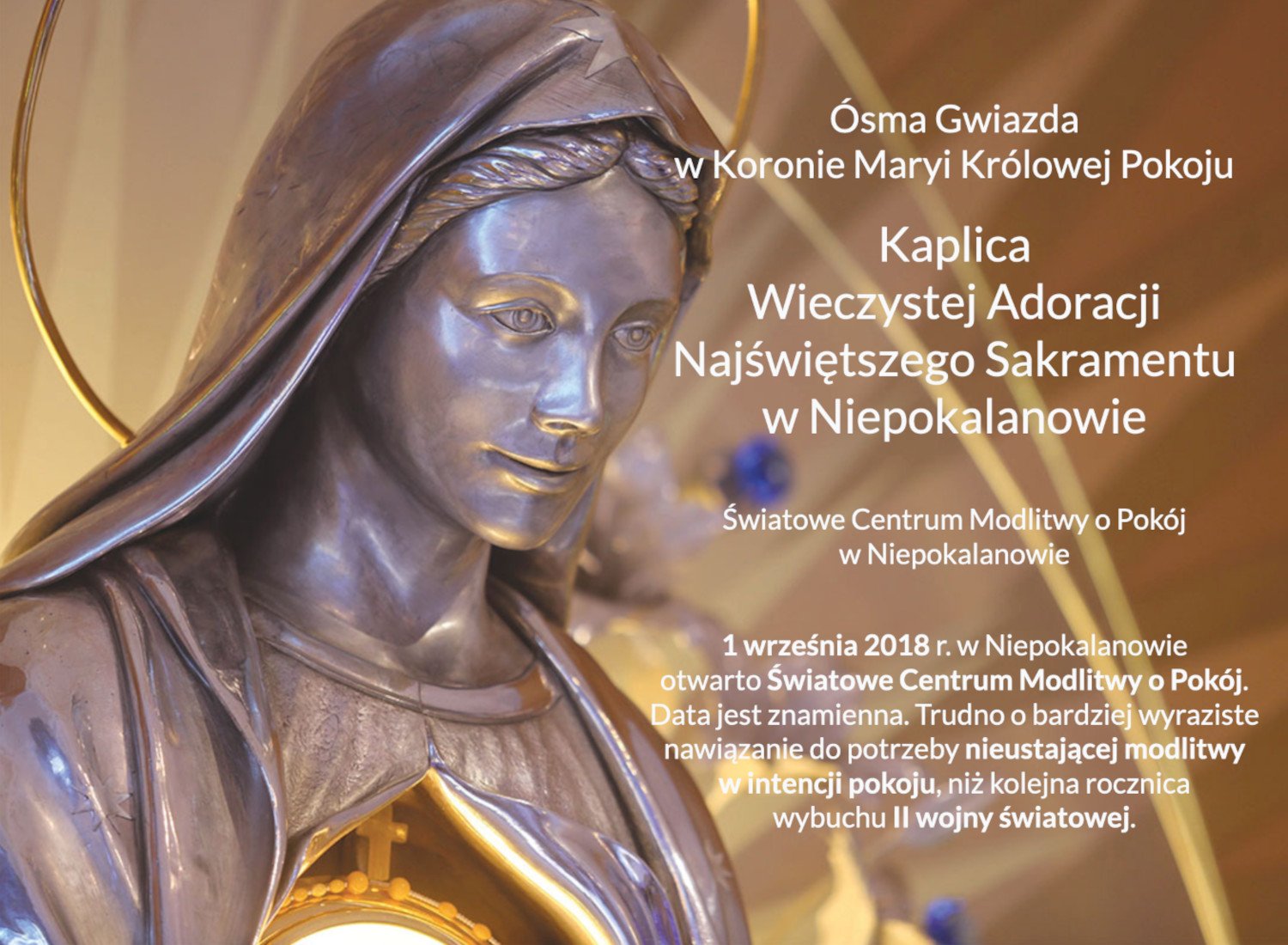

The Eucharistic Adoration Chapel established by Saint Maximilian Kolbe was inaugurated at the outbreak of World War II. It was restored as a Chapel of Adoration in September, 2018, the commemoration of the date that the war began. It is now part of the World Center of Prayer for Peace. The live internet feed of the Adoration Chapel at Niepokalanow — sponsored by EWTN — was established just a few weeks before we discovered it and began to include in at Beyond These Stone Walls. Click “Watch on YouTube” in the lower left corner to see how many people around the world are present there with you. The number appears below the symbol for EWTN.
Click or tap here to proceed to the Adoration Chapel.
The following is a translation from the Polish in the image above: “Eighth Star in the Crown of Mary Queen of Peace” “Chapel of Perpetual Adoration of the Blessed Sacrament at Niepokalanow. World Center of Prayer for Peace.” “On September 1, 2018, the World Center of Prayer for Peace in Niepokalanow was opened. It would be difficult to find a more expressive reference to the need for constant prayer for peace than the anniversary of the outbreak of World War II.”
For the Catholic theology behind this image, visit my post, “The Ark of the Covenant and the Mother of God.”